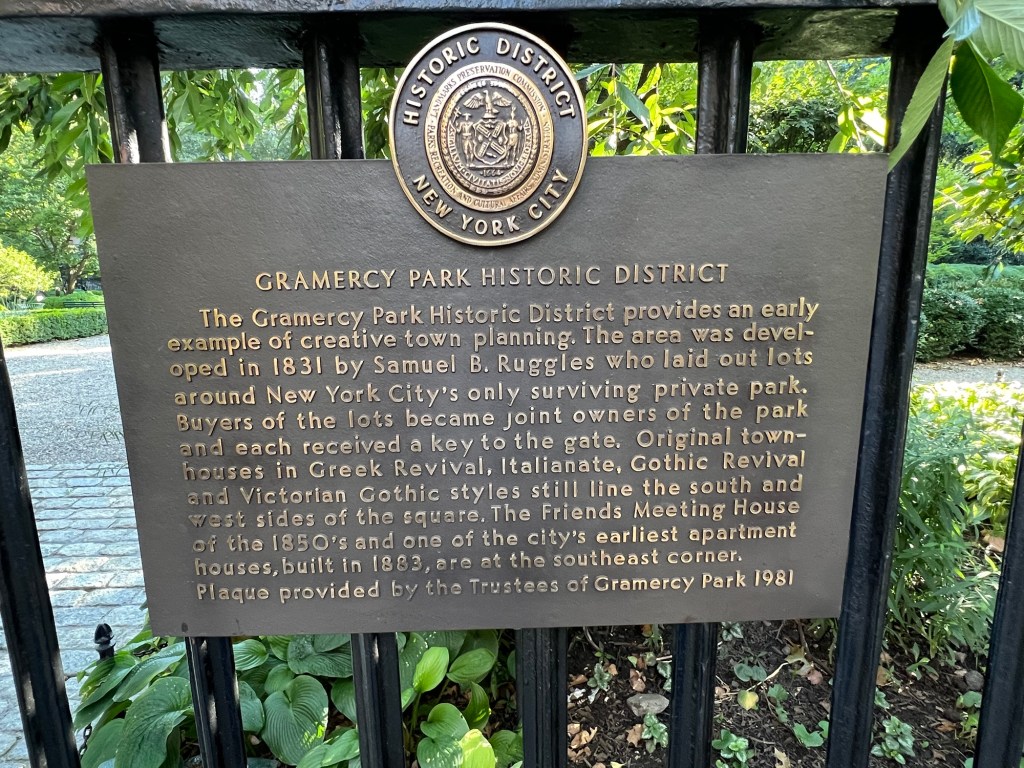
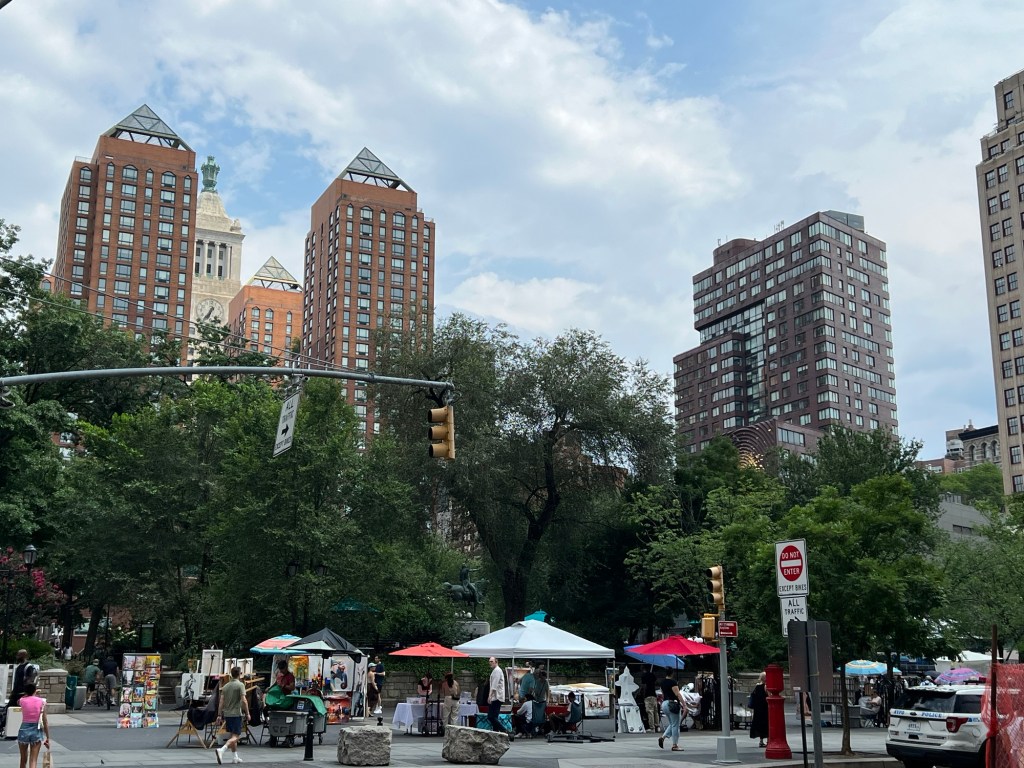
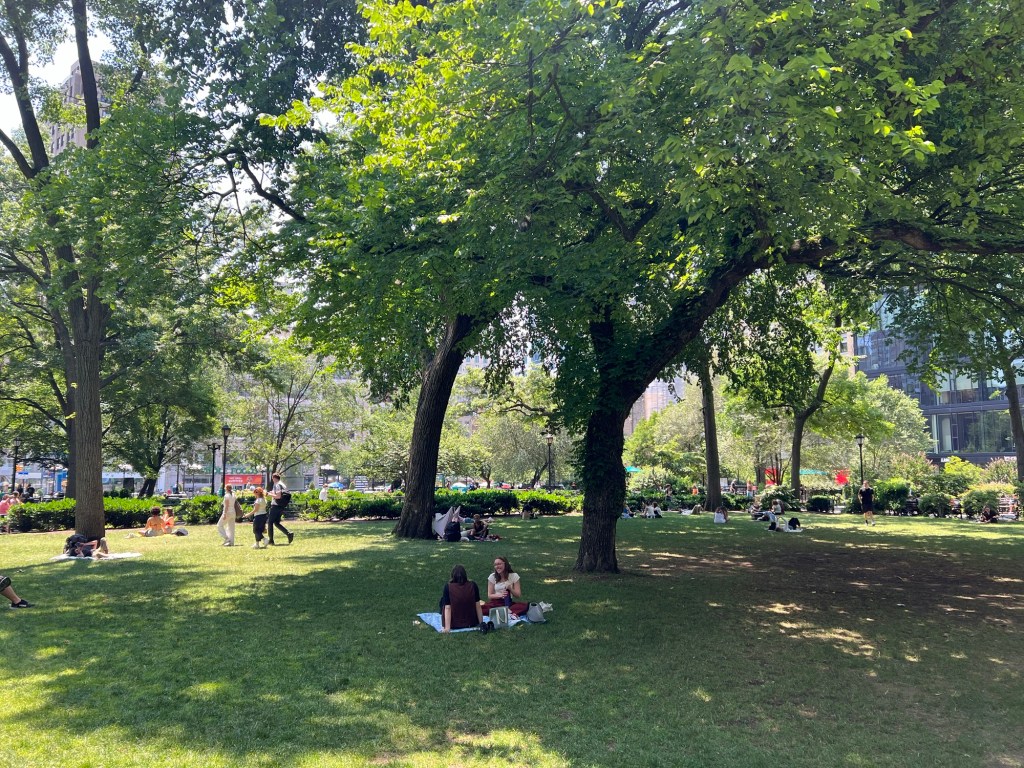
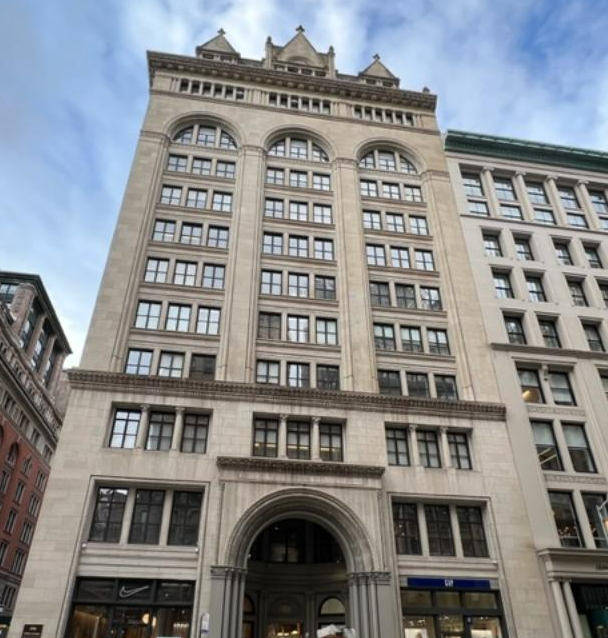
It was another hot day in Manhattan. I worked a double shift at the Soup Kitchen so I was there until 3:00pm. The weather was a lot cooler since the rain showers but still hot. It was a lot better to walk around though.
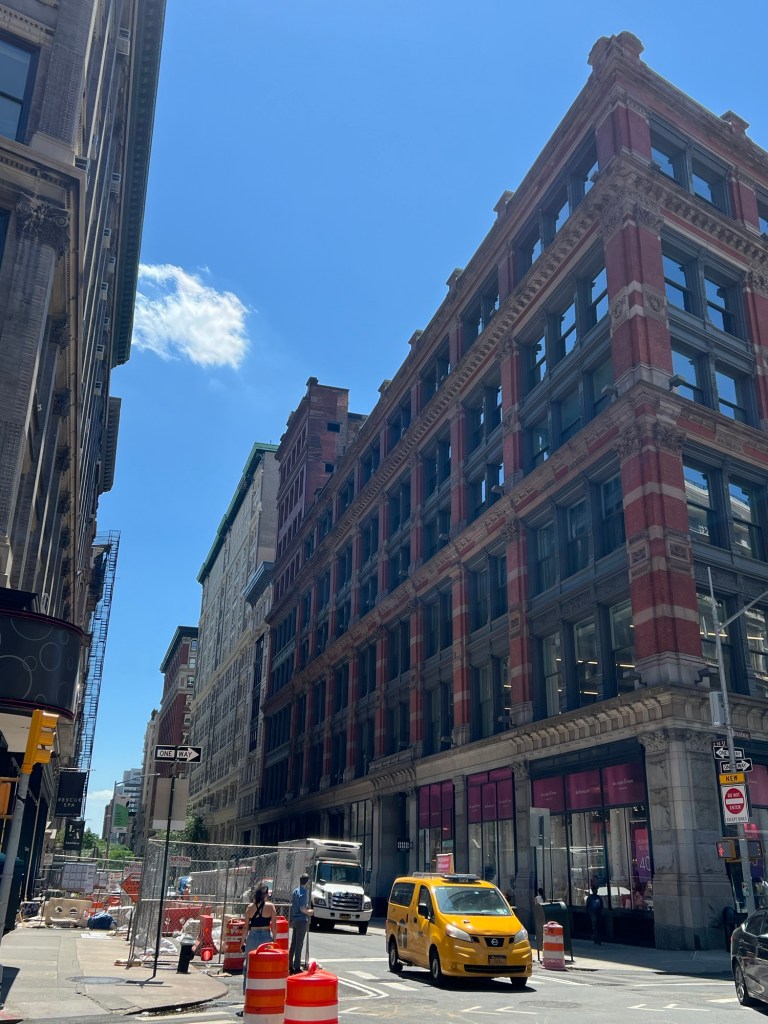
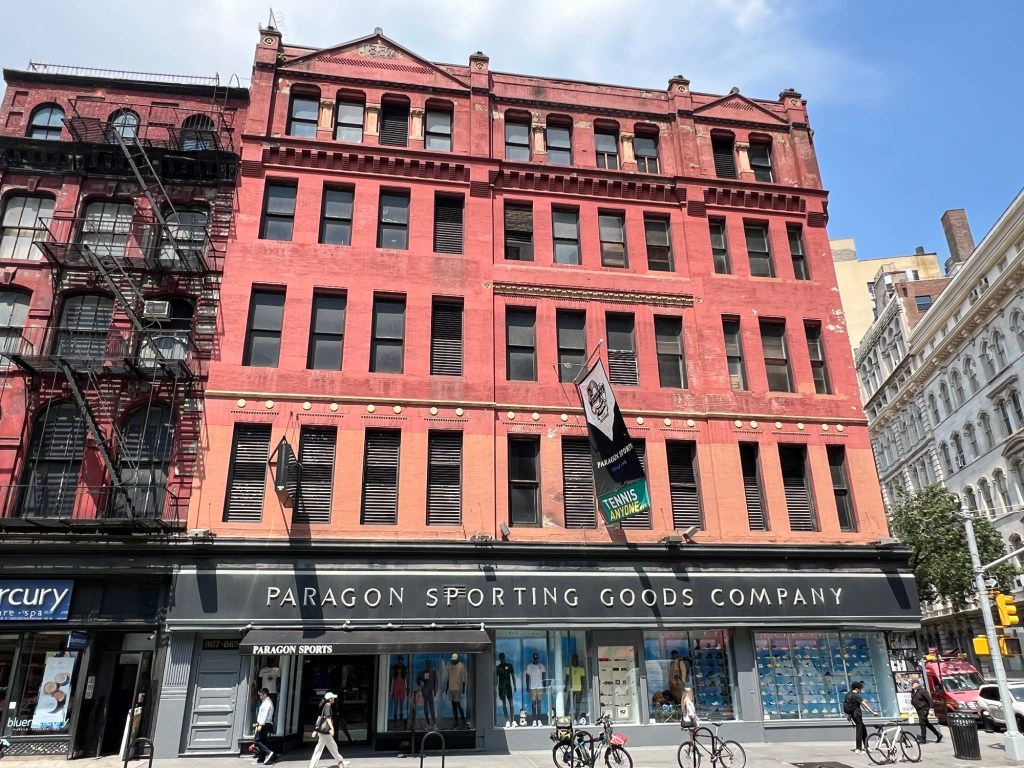
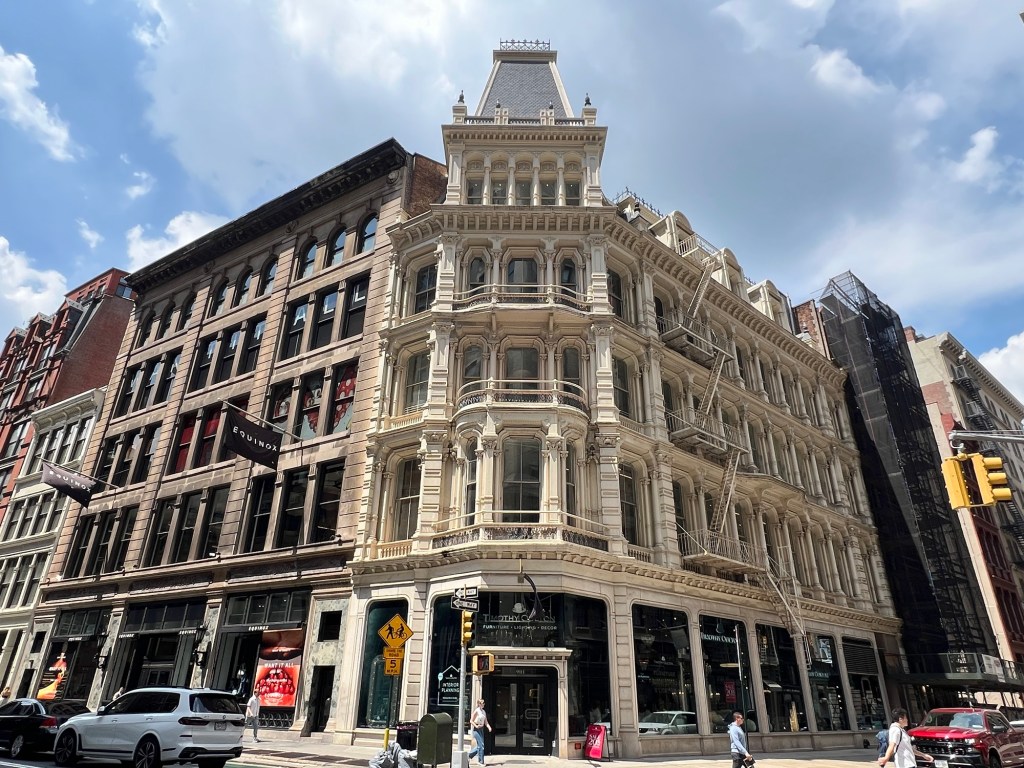
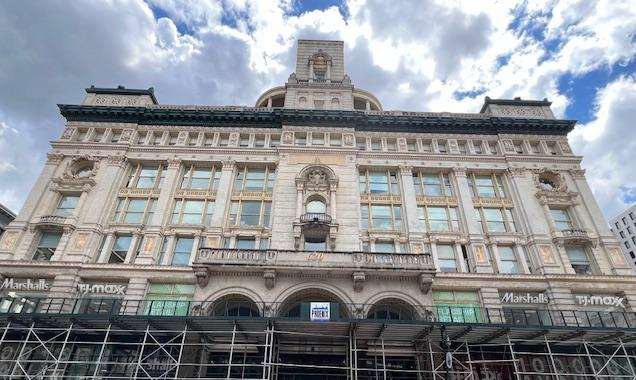
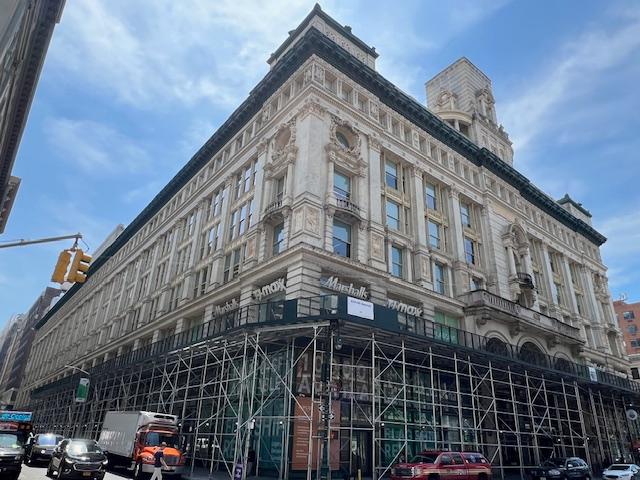
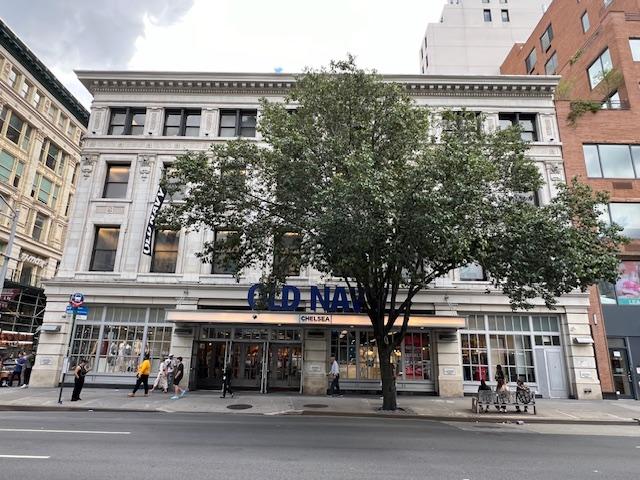
I started my walk on Fifth Avenue and East 19th Street across from the old Arnold Constable Department store building. In comparison to the newer store across from the New York Public Library on Fifth and East 42nd Street, this store was four times the size. I had read online that not only was it the main store at the time but the warehouse, wholesale location and where some of the manufacturing took place. This building that stretches from Fifth Avenue to Broadway and was built in three stages over the late 1800’s.
The former Arnold Constable building at Fifth Avenue and East 19th Street
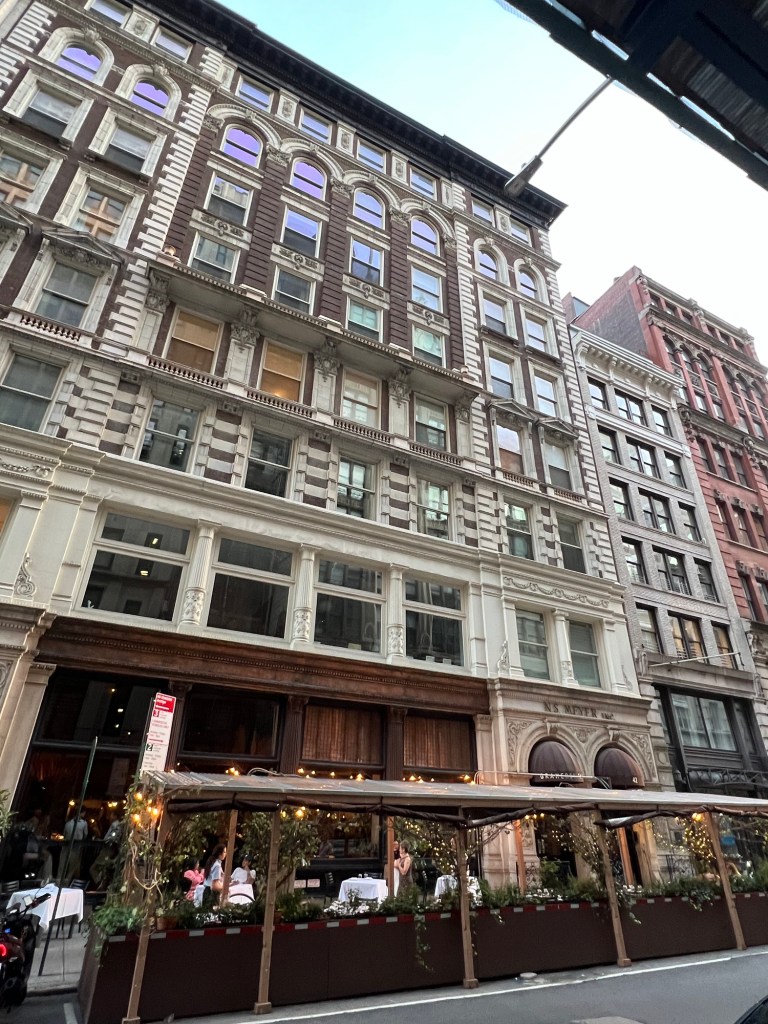
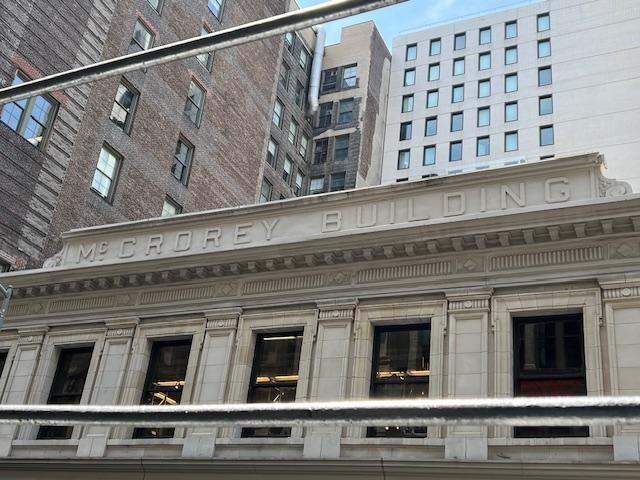
When I crossed Broadway, it was the ABC store, the former store that dominates between Broadway and 19th Street, the old main shopping district from the pre-Civil War era. After the Civil War, it would move to 23rd Street. This was the former W. & J. Sloane’s Furniture store.
The ABC Store, the former at Broadway and East 19th Street
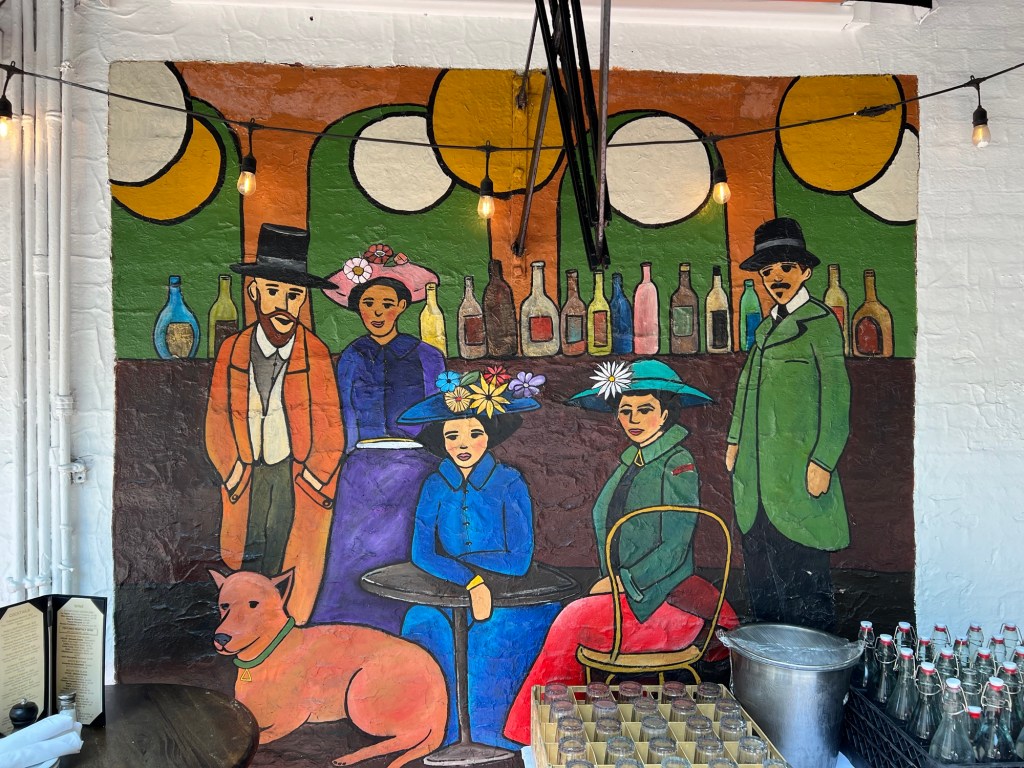
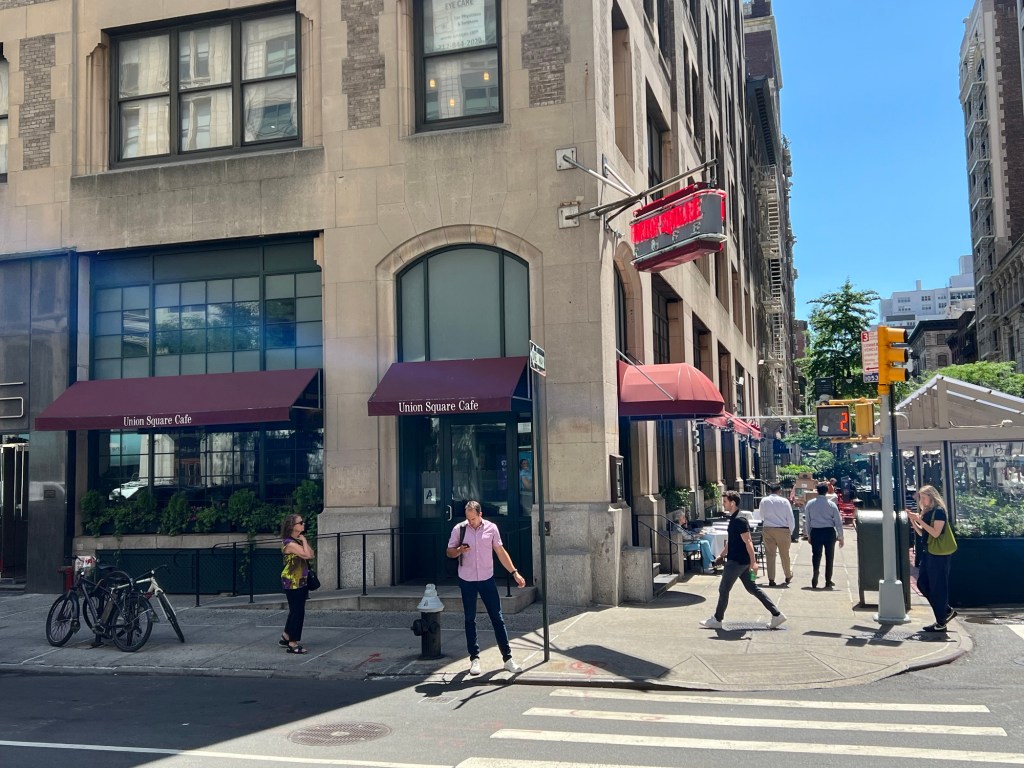
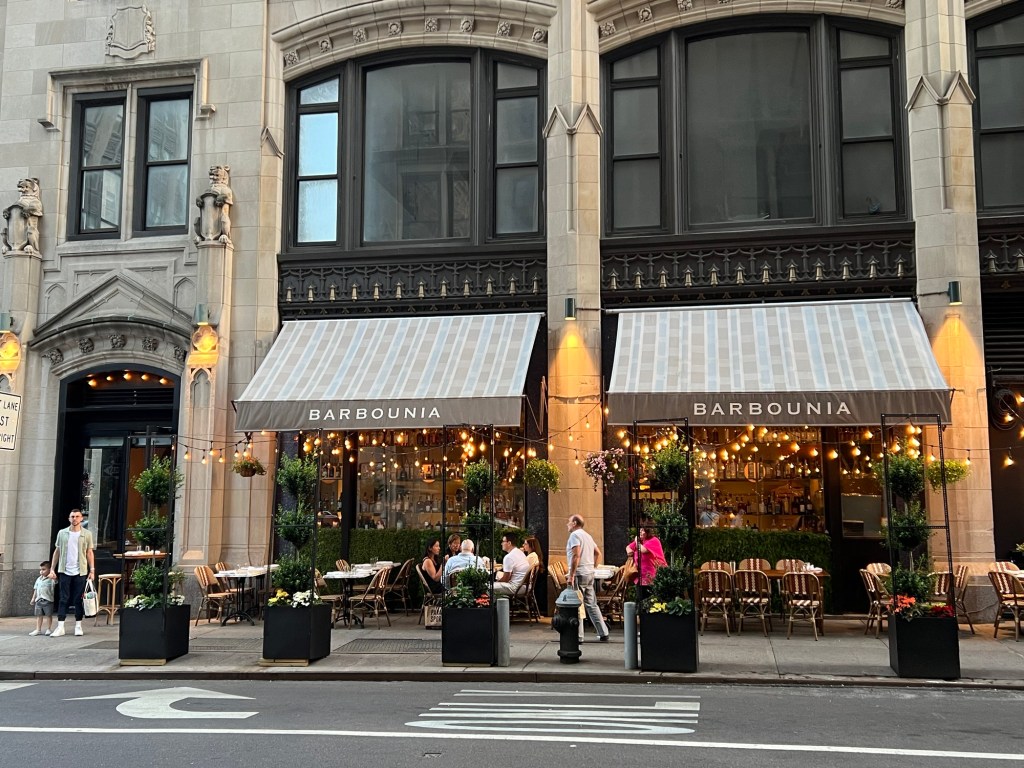
When I walked further down East 19th Street to Park Avenue South, I came across the new location for the Union Square Cafe at 101 East 19th Street a restaurant I had eaten at many times in the old location since the 1990’s.
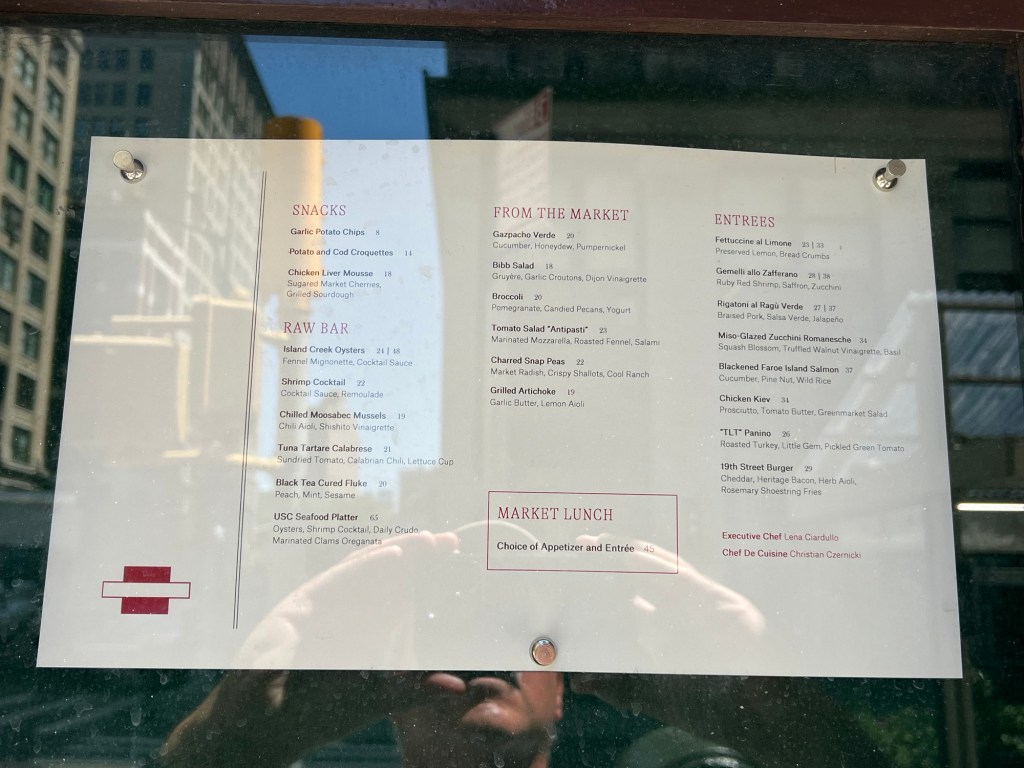
I stopped and took a look at the menu. It wasn’t the innovative menu that I remember from past trips to the old restaurant. They had the standard dishes that I had seen before. It looked like they were keeping it safe in post-COVID but I did note that the restaurant has gotten very expensive.
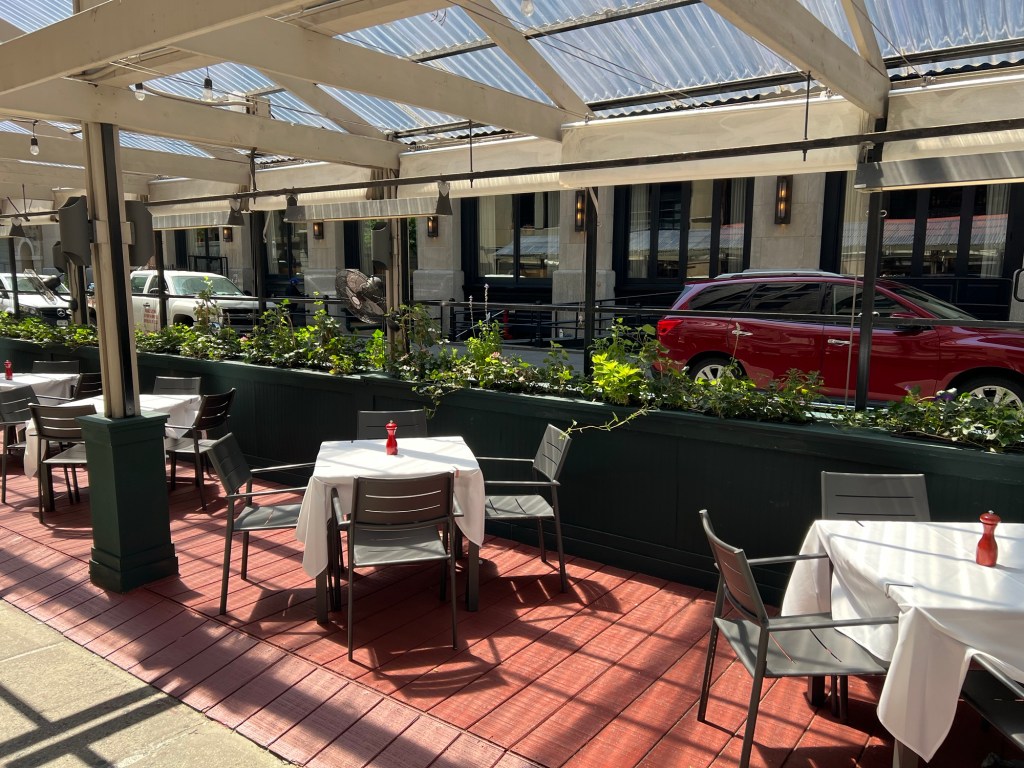
The one thing I did like about the restaurant is that it had the most amazing outdoor seating. On a nice day this is the perfect restaurant to eat outside. The view of the quiet street and the historical buildings is a nice backdrop to the restaurant.
The outdoor cafe on this bright, sunny day
I had remembered the Union Square Cafe in the old location and the vibe was not the same here. It was like they wanted to cater to a hipper younger crowd instead of the older traditional crowd that they had before as customers. I continued walking down the street.
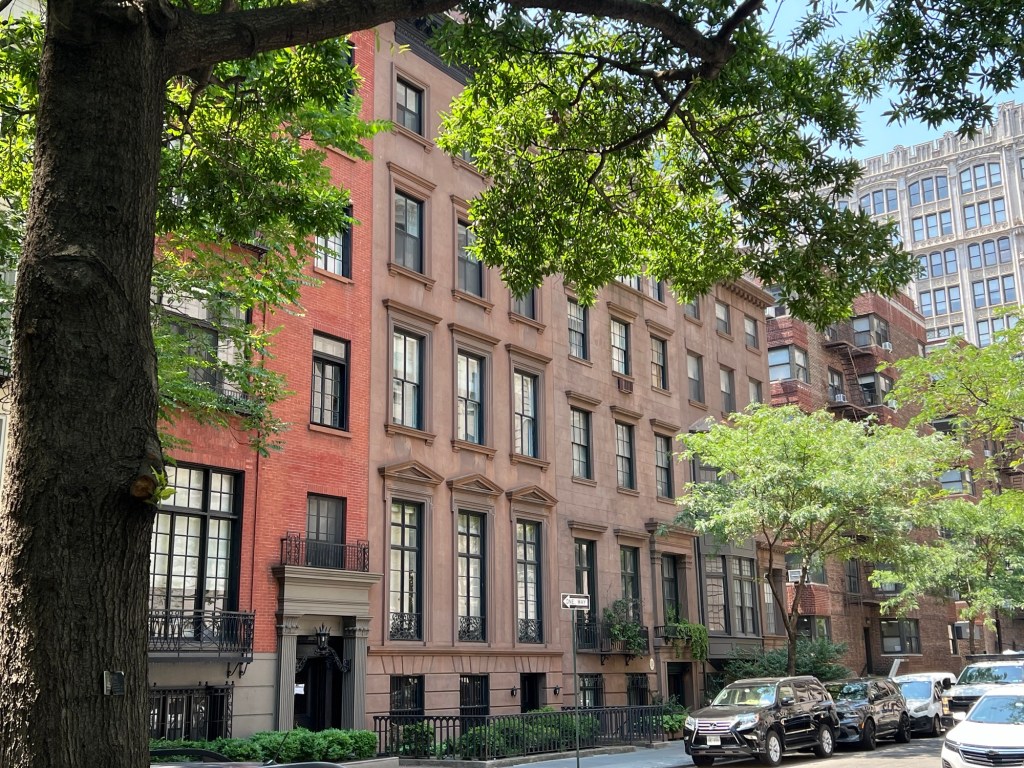
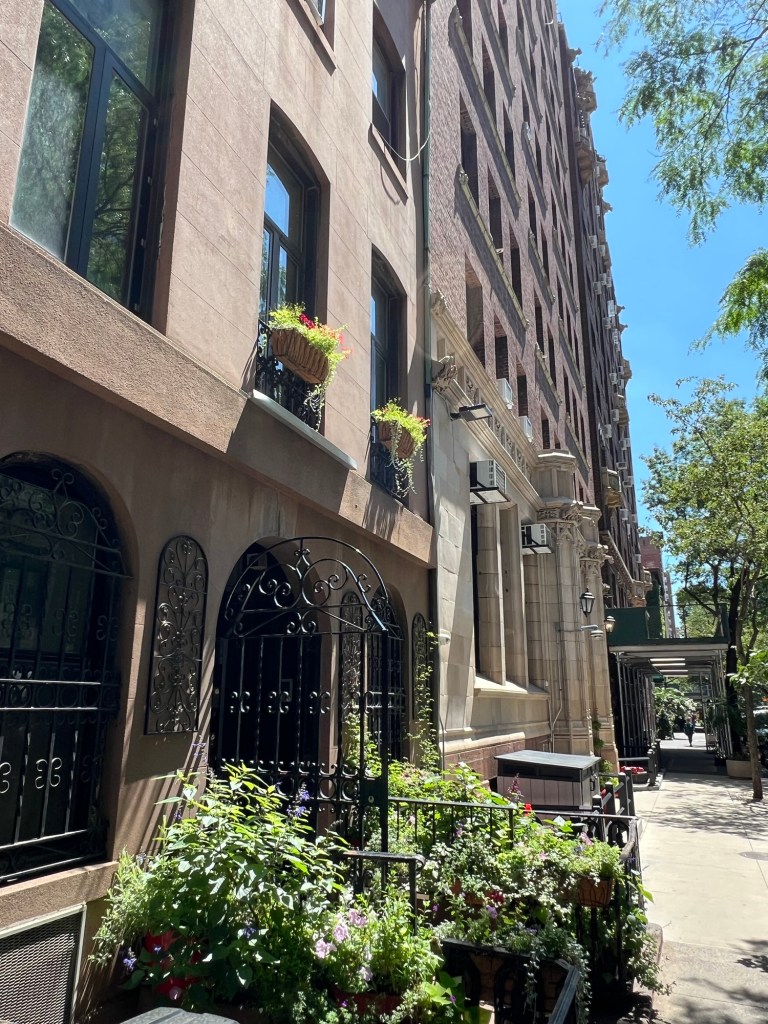
As you get closer to Irving Place, it starts to get more residential. Some of the homes are really beautiful. The residents have really done a nice job with their flower boxes and outdoor gardens in the neighborhood.
The homes closer to Irving Place on East 19th Street
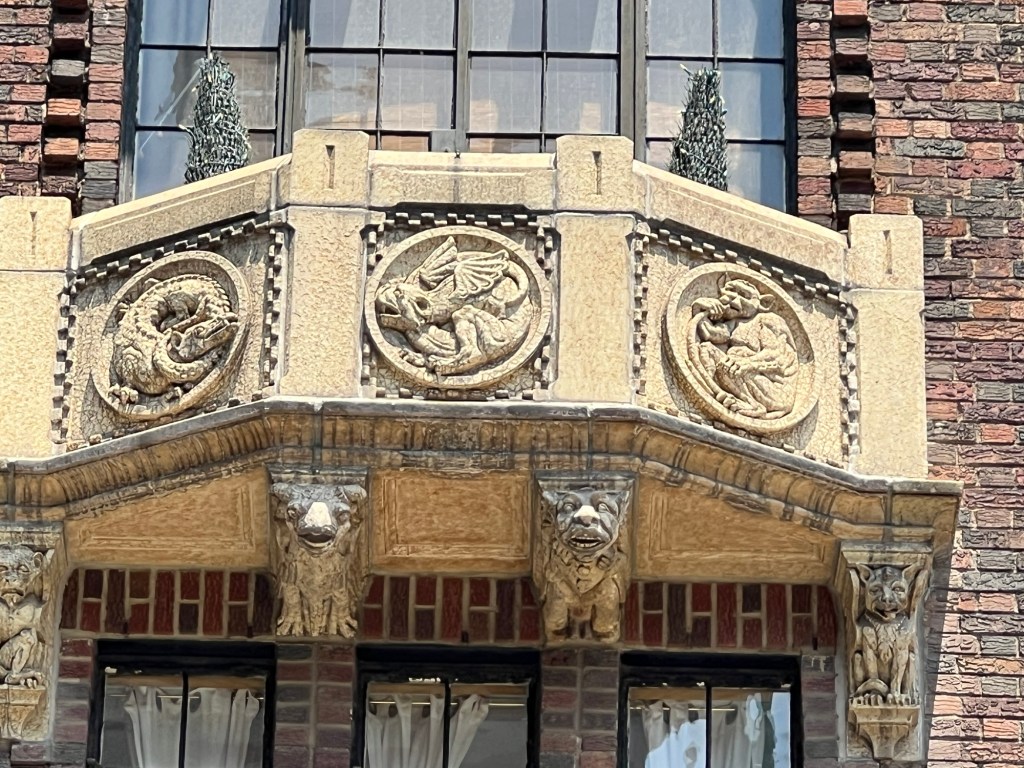
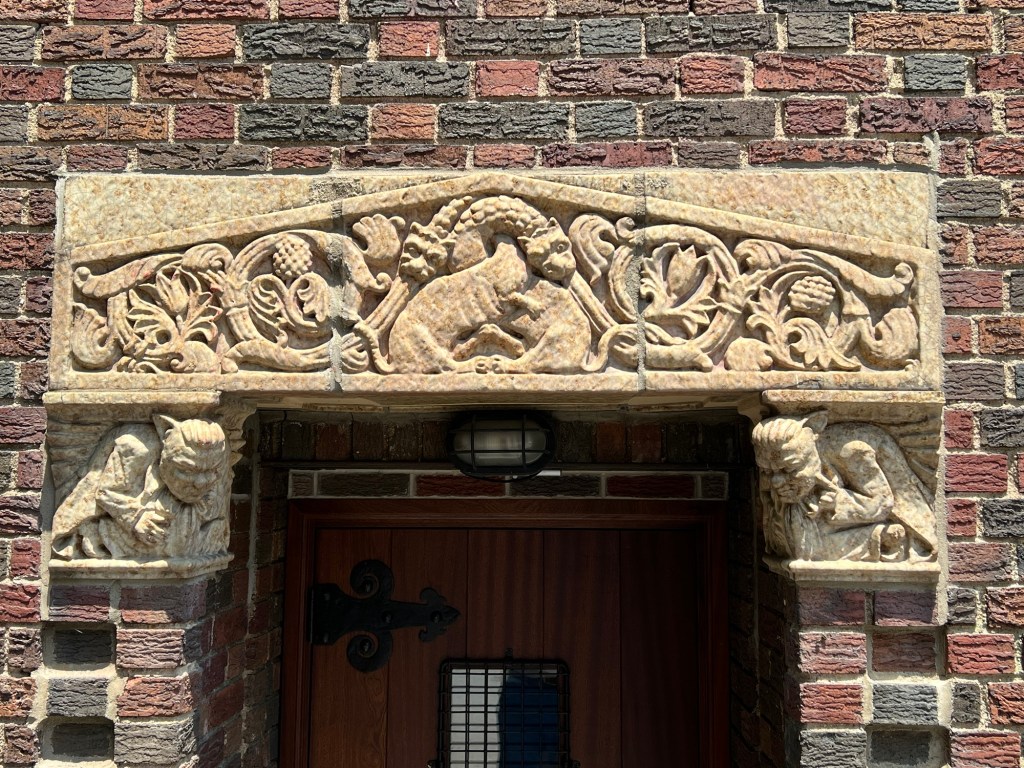
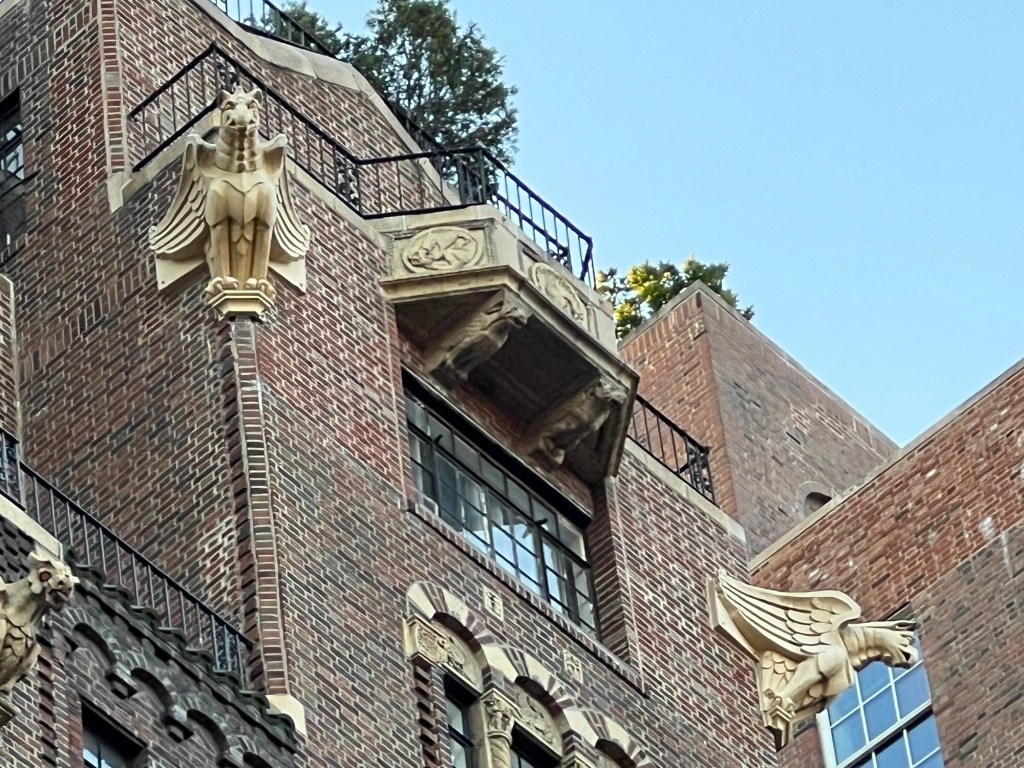
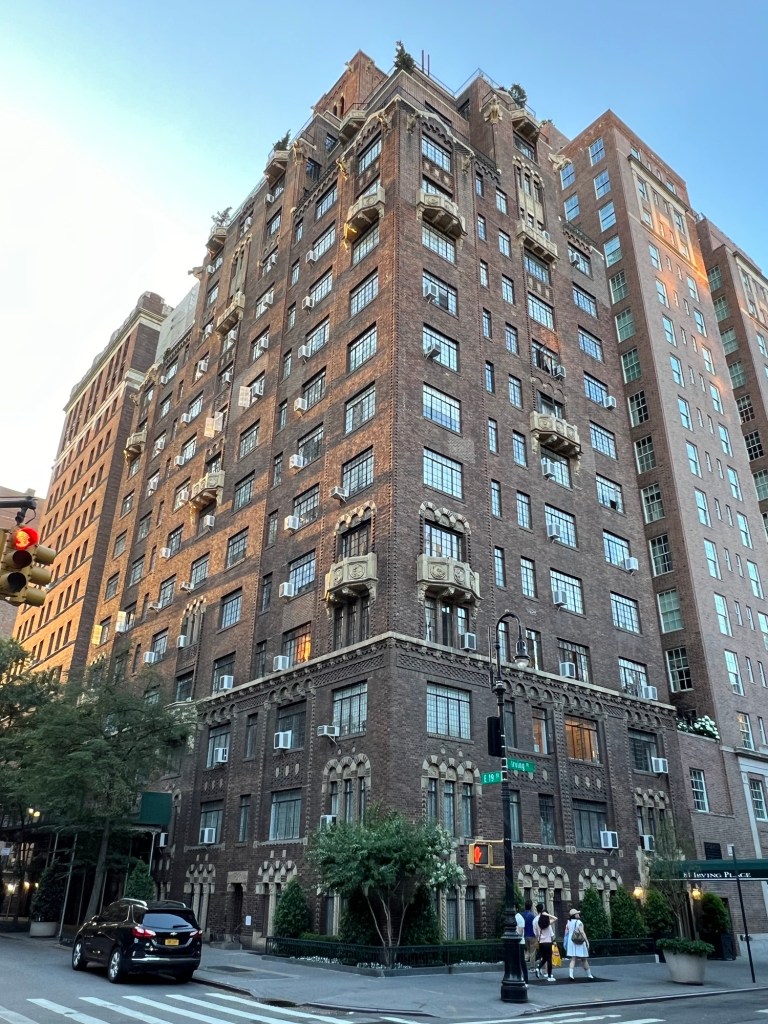
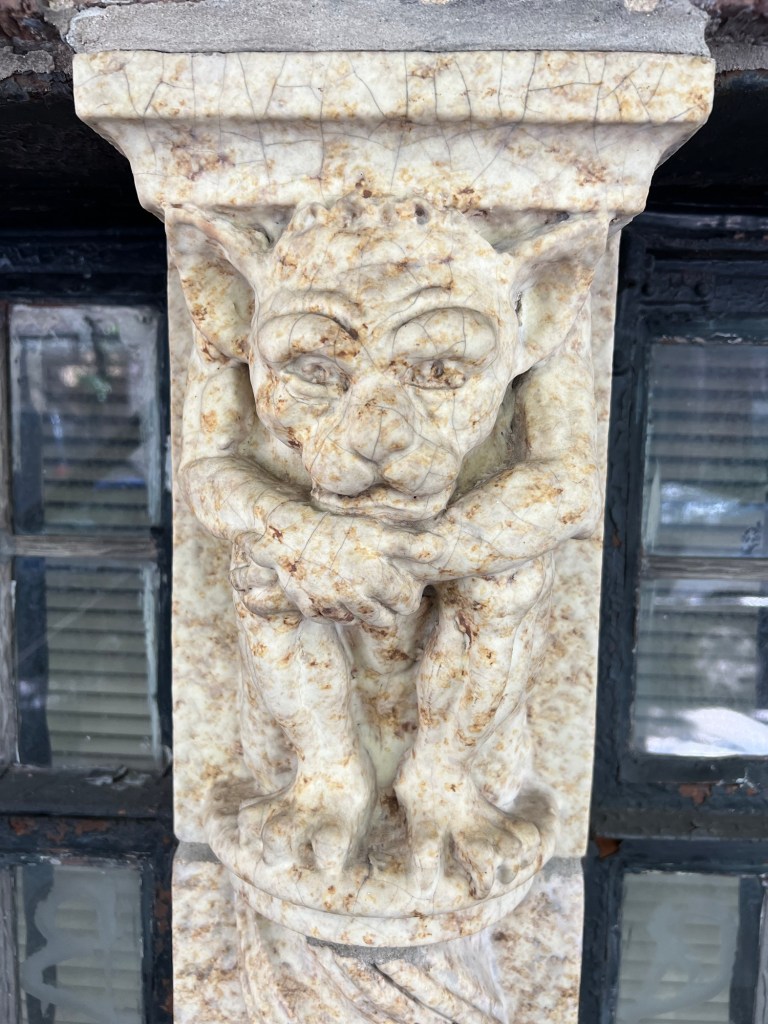
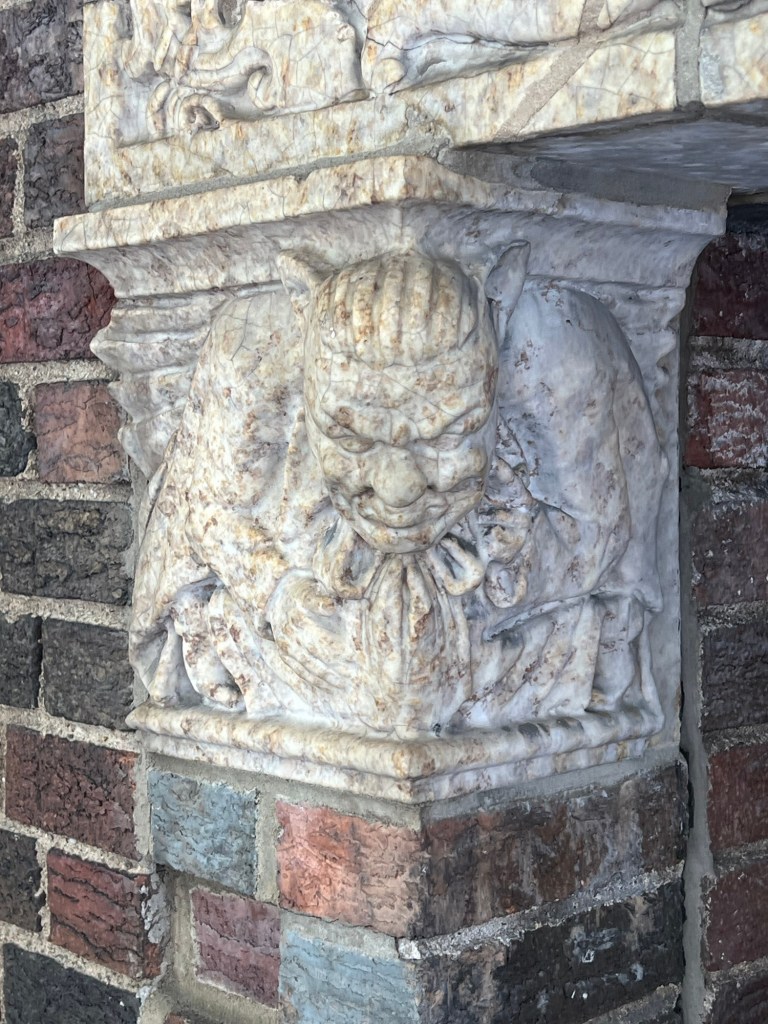
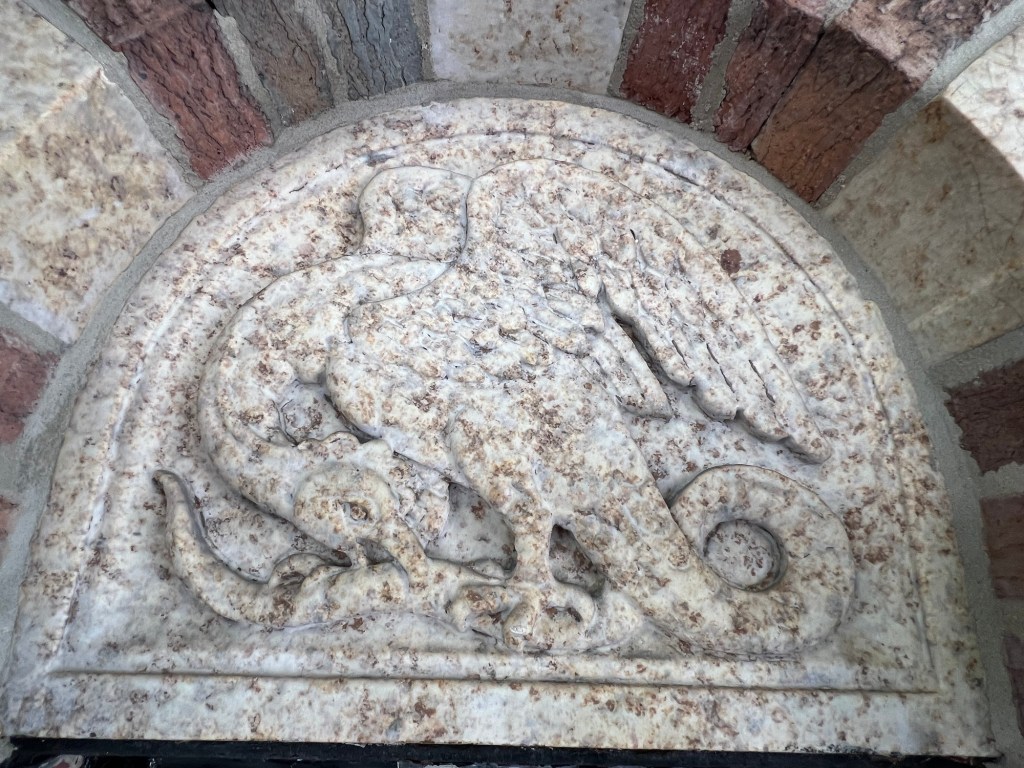
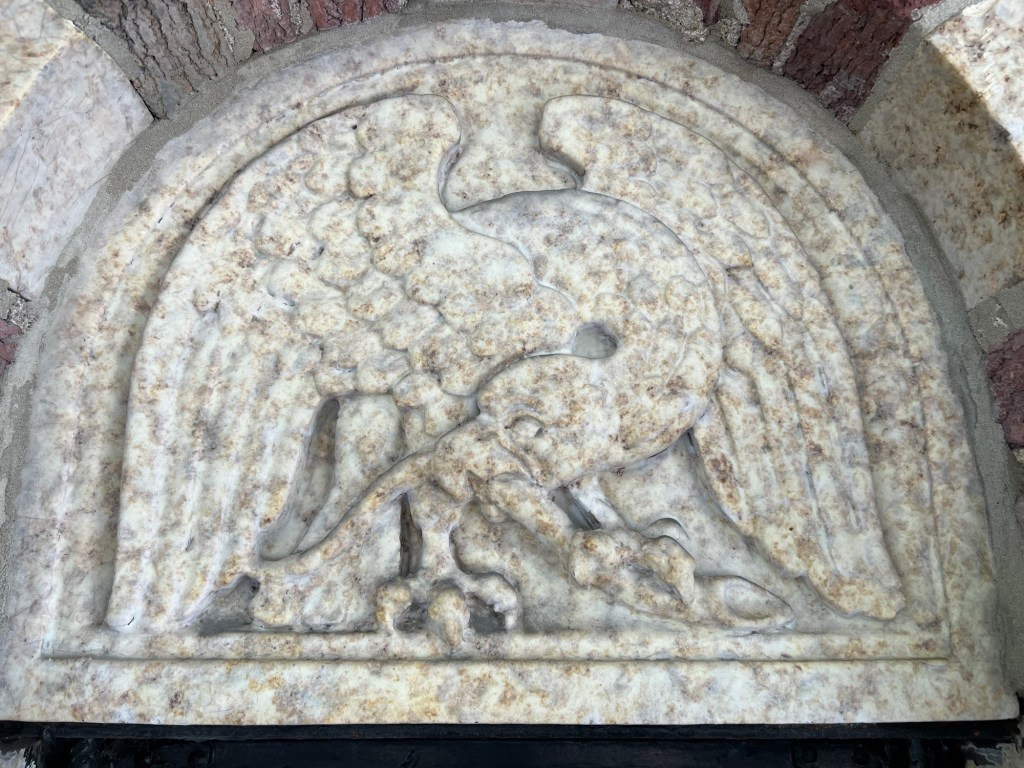
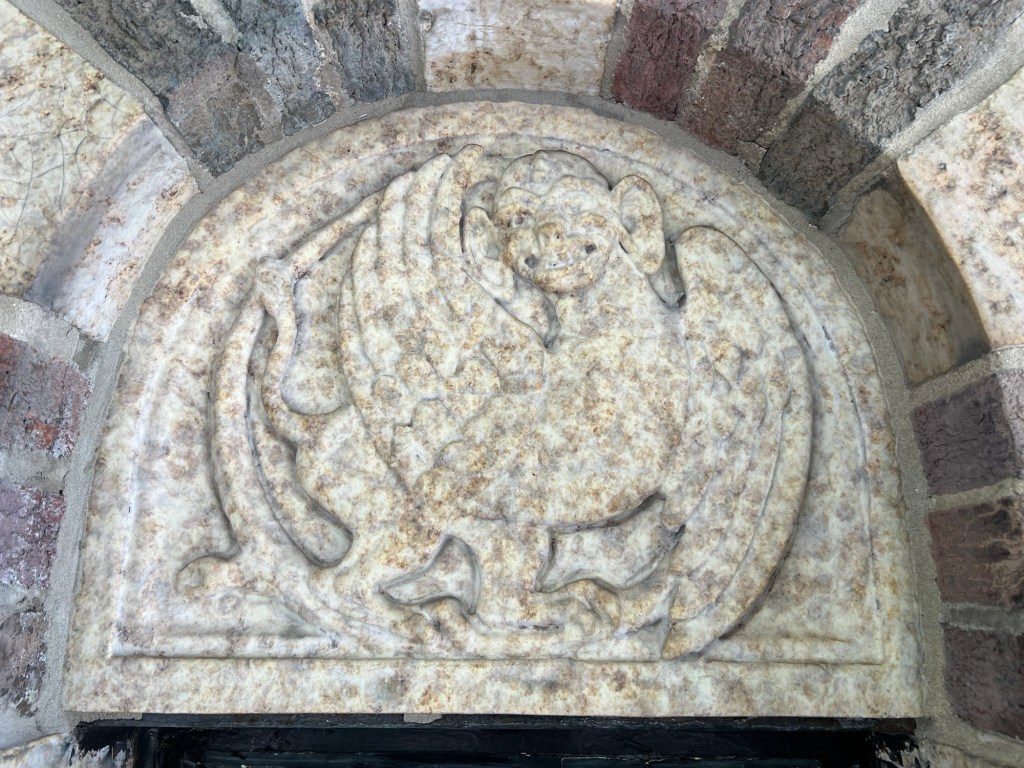
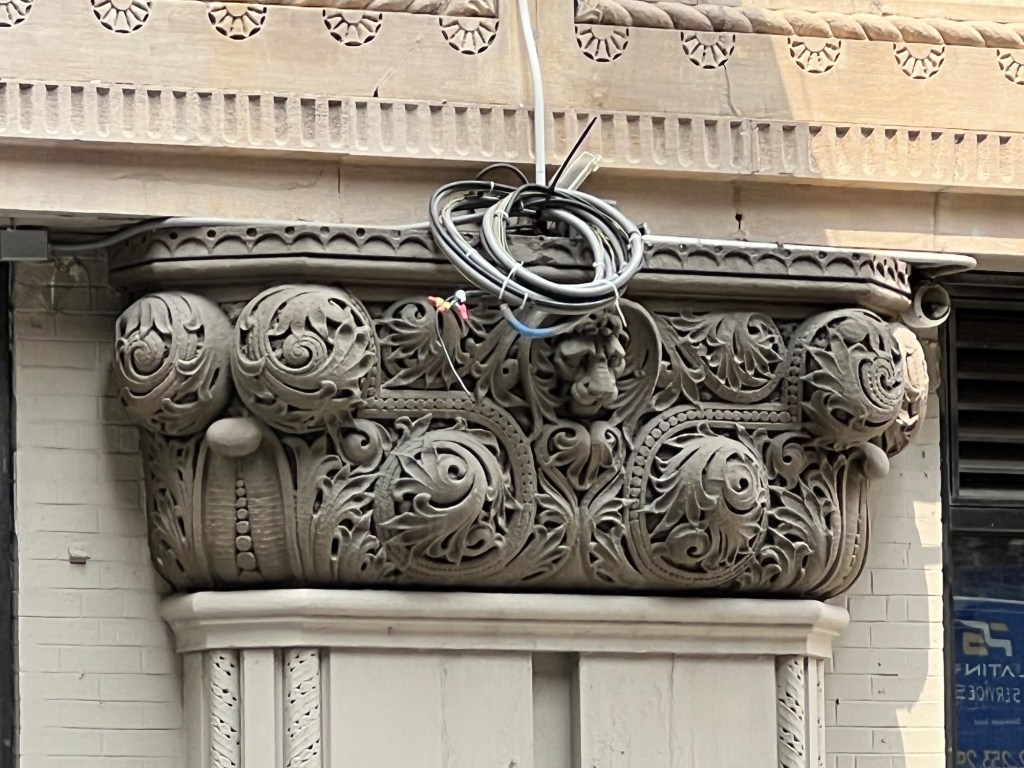
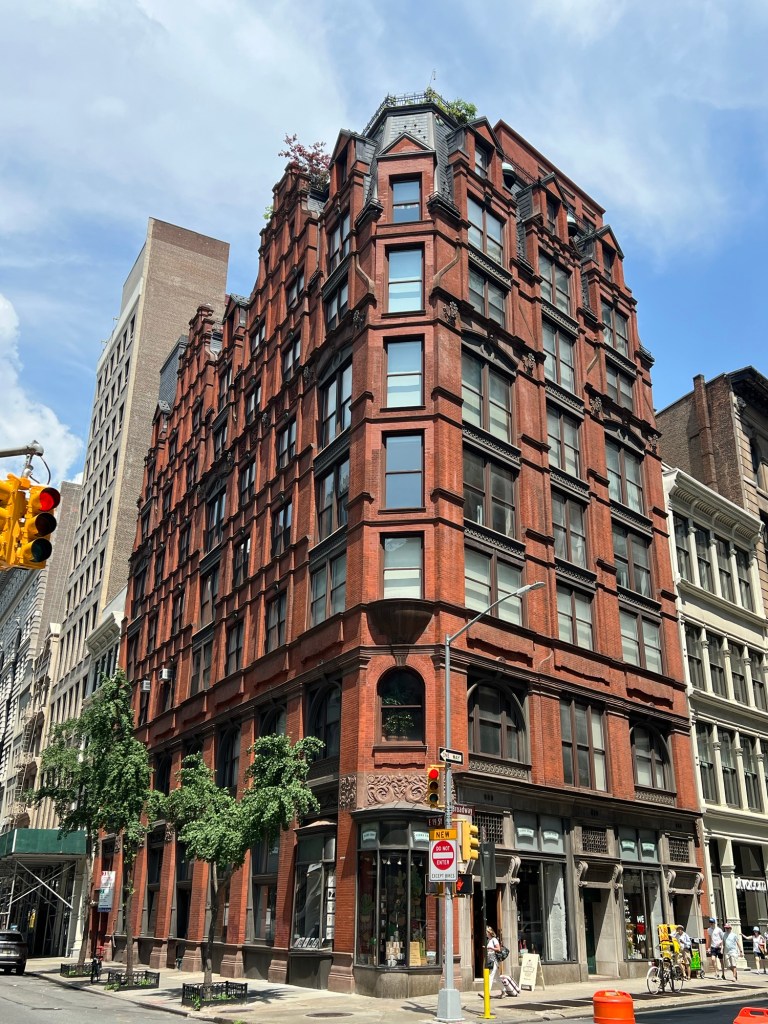
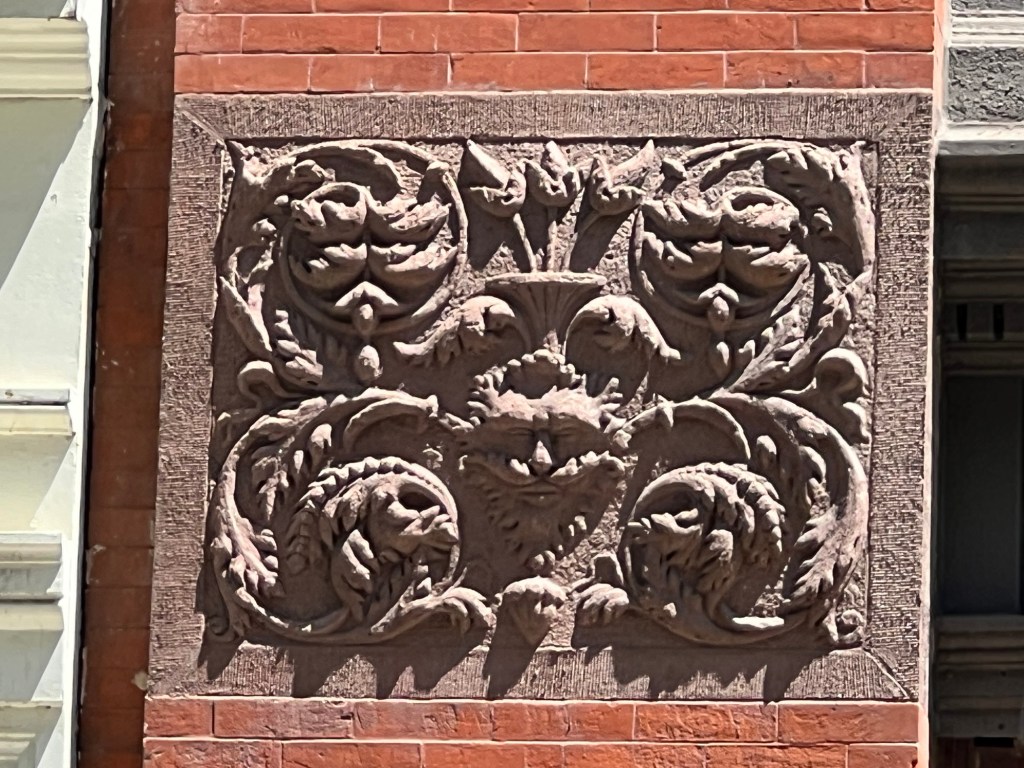
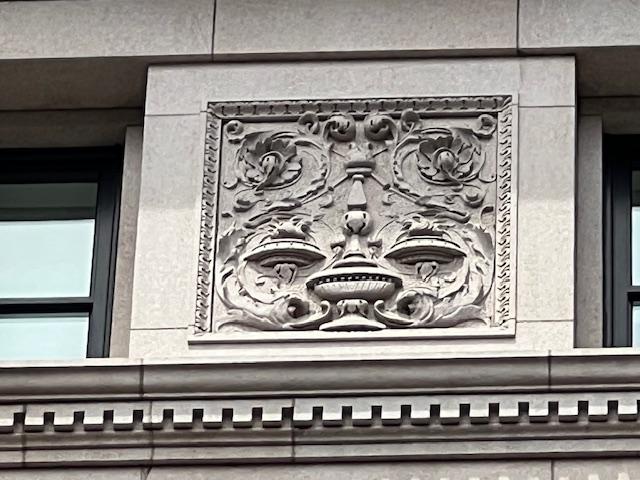
I reached Irving Place and was confronted with the embellishments I had admired at 81 Irving Place. They were just so unusual and ghoulish. I think this is one of the more unique buildings in the neighborhood.
81 Irving Place is one of the most beautiful apartment complexes in the city that I have come across. The embellishments along the building are some of most detailed and elegant I have seen. This prewar Co-Op was built in 1929. You have to walk around the building to appreciate it and from the street level you can see all these wonderful details.
The strange creatures
Surround this building
On all sides of it
They stare at you
Welcoming you to the building
Protecting you
Staring at you
Welcoming you home
Happy to see you
Sad to see you
The faces great you with strange looks
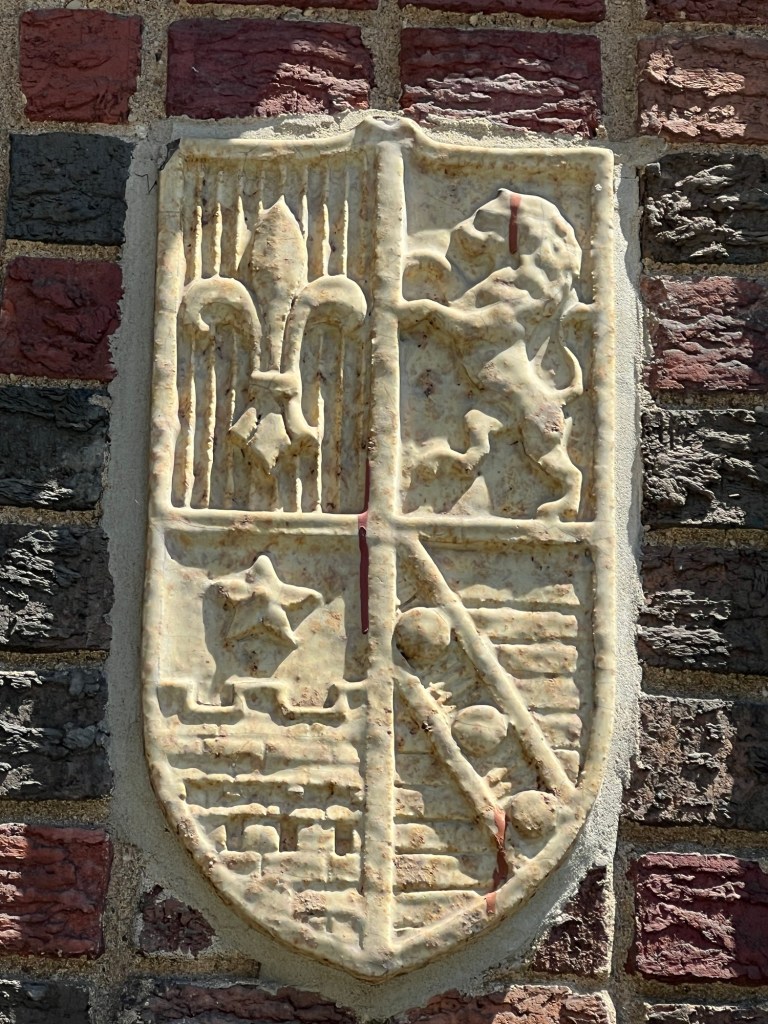
Coat of Arms
Coat of Arms
Coat of Arms
I had not noticed all of this when I had walked the borders of the neighborhood. I just saw all these detail from a distance. When you walk along East 19th Street, you see all designs in one long shot. I thought whoever created this building had a sense of humor. When I turned around on this corner, you really can enjoy the beauty of the building.
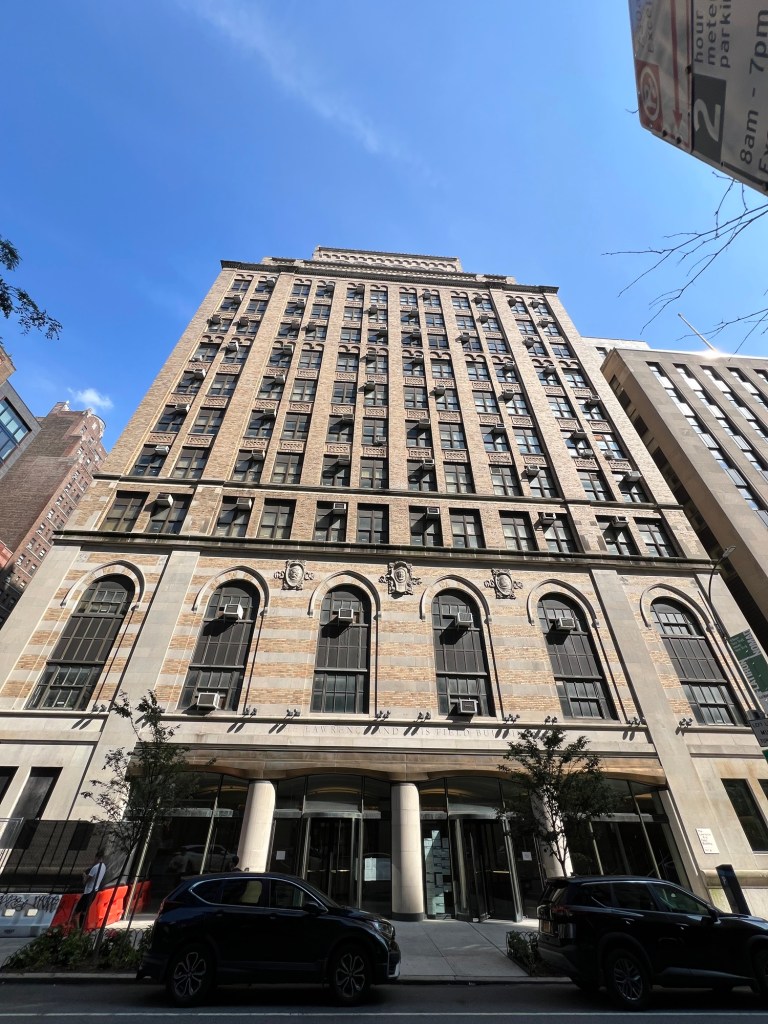
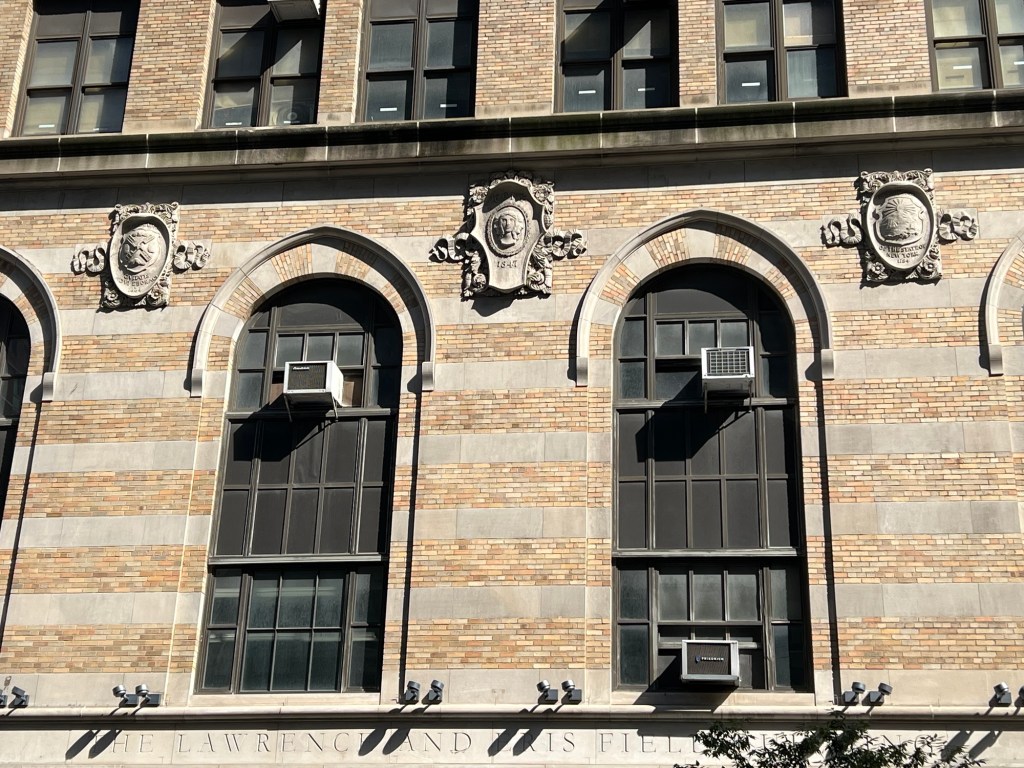
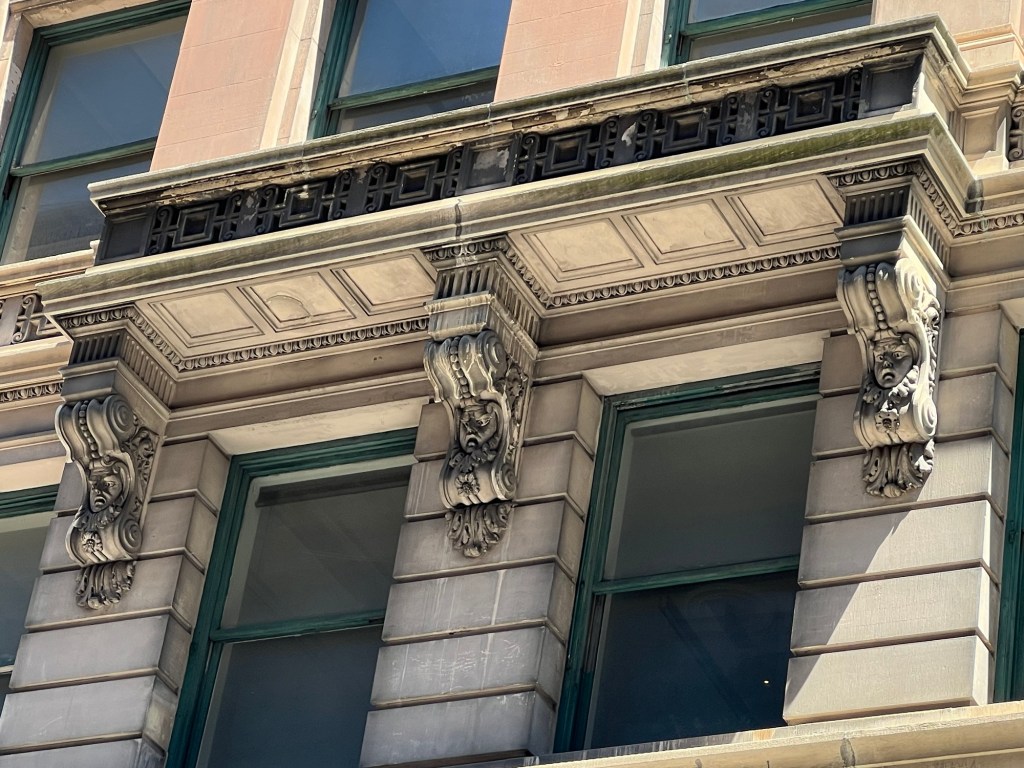
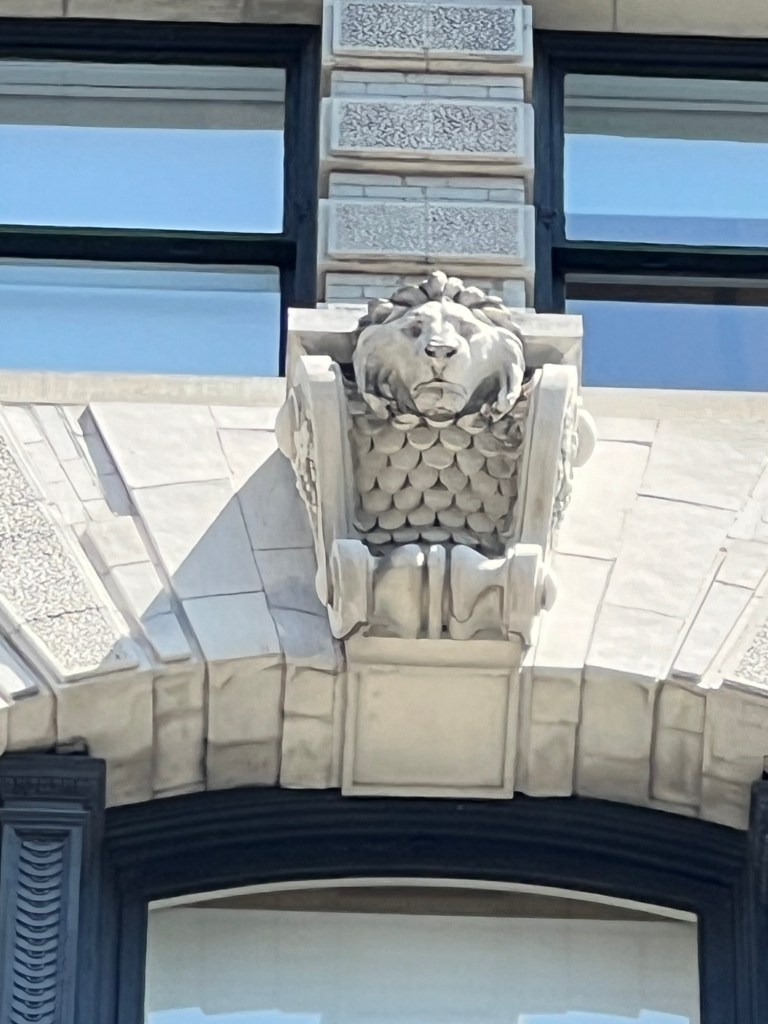
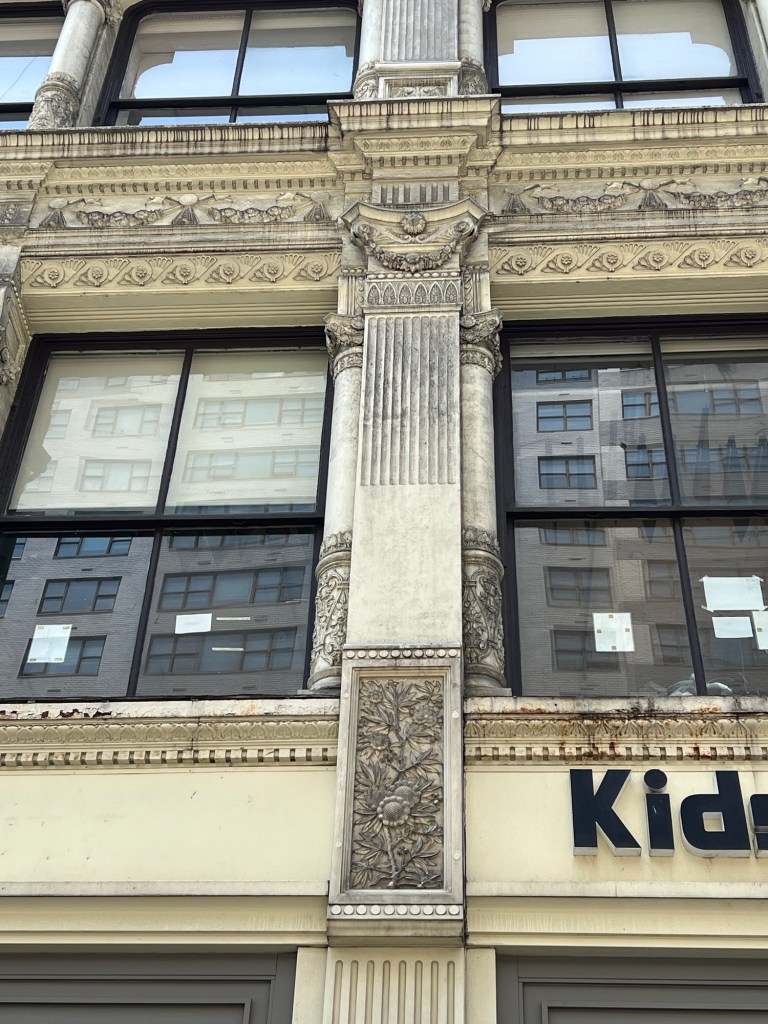
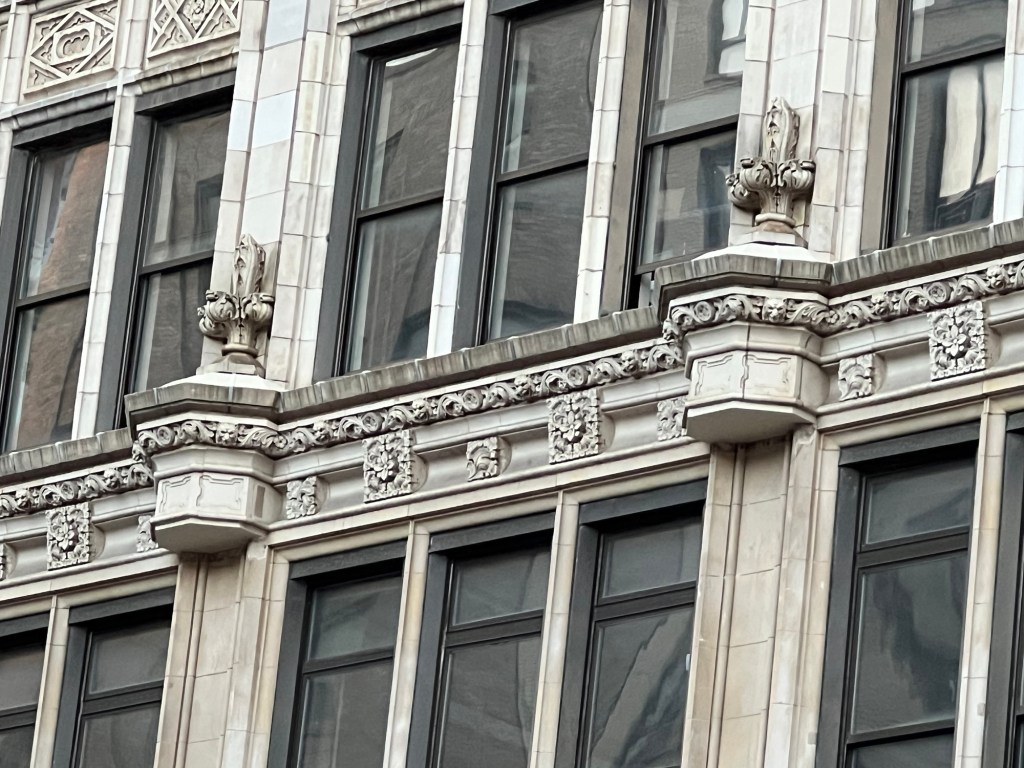
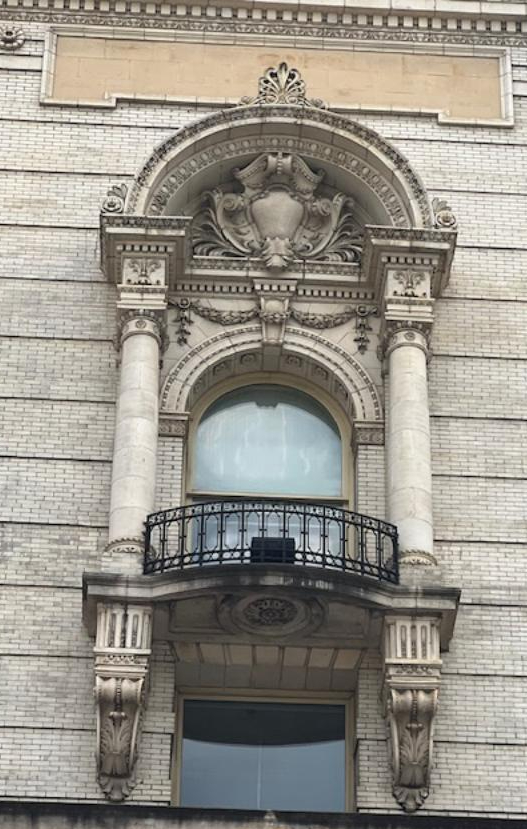
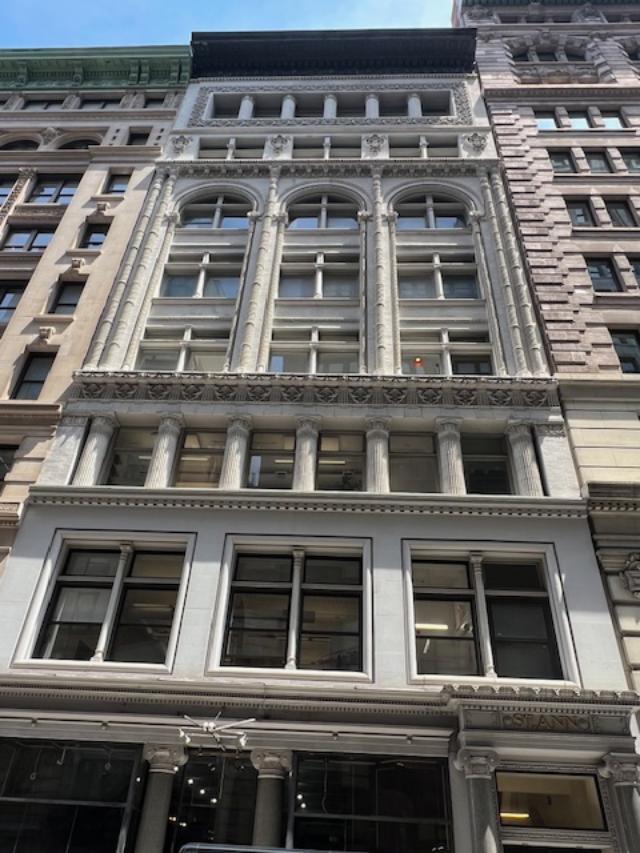
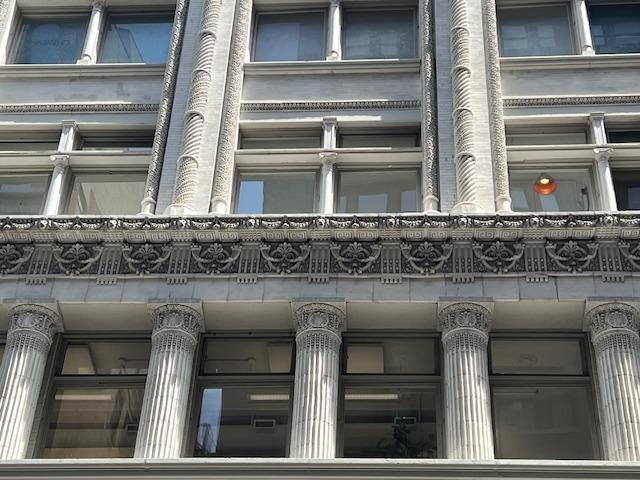
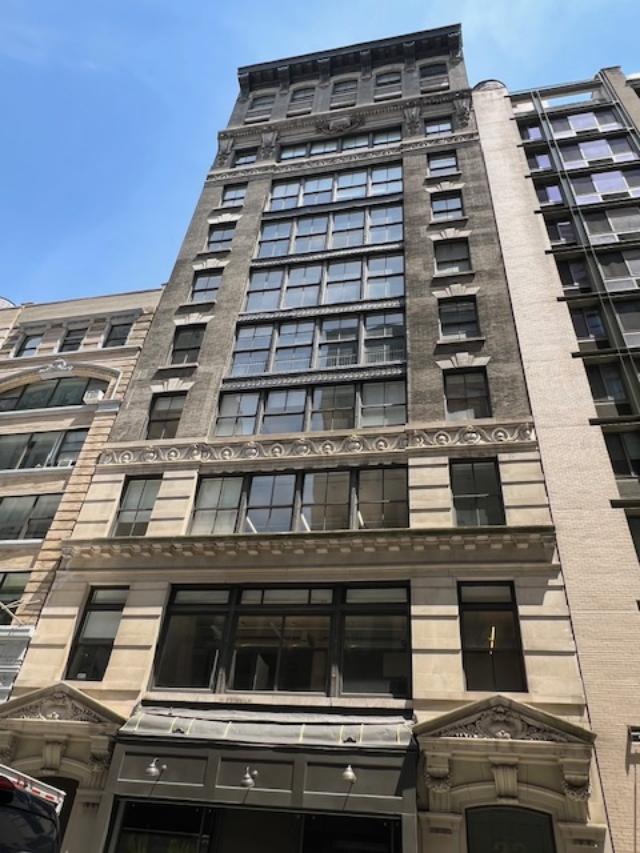
Another building where I had not noticed the elegance before was 33 East 19th Street. You really have to stare up to see the details of the faces and animals.
This former office building was built in 1920 and have been converted to loft apartments.
The faces greeting from the top of the building so you have to look up to look back
The strange stares you get from the building are almost a judgement call
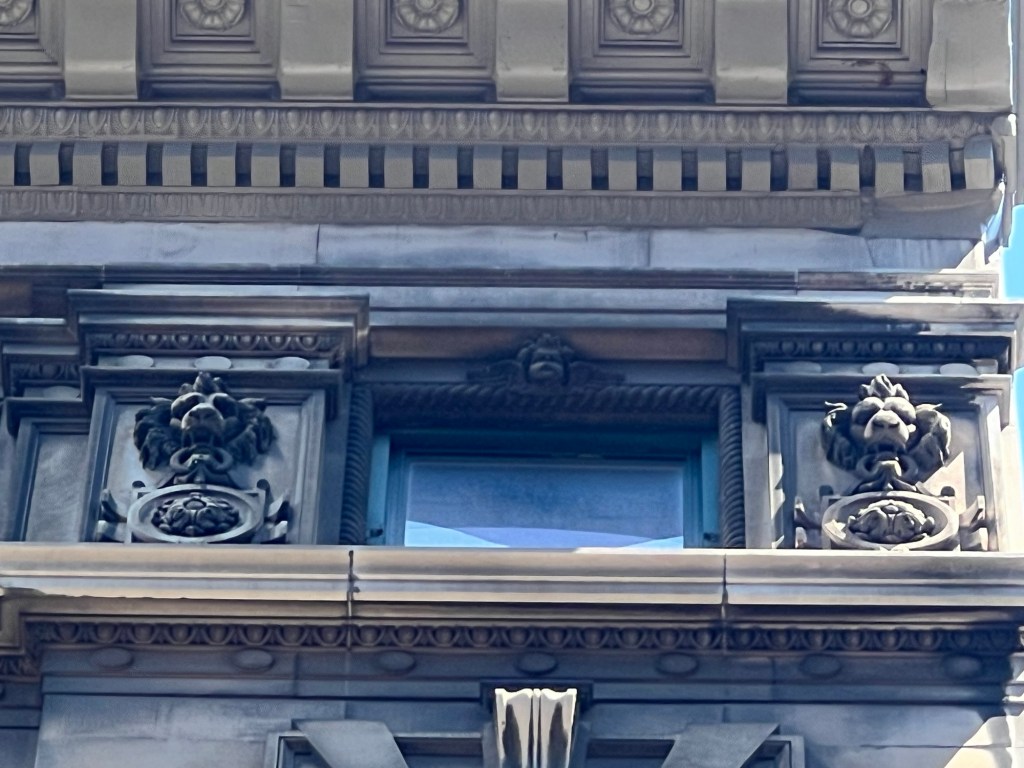
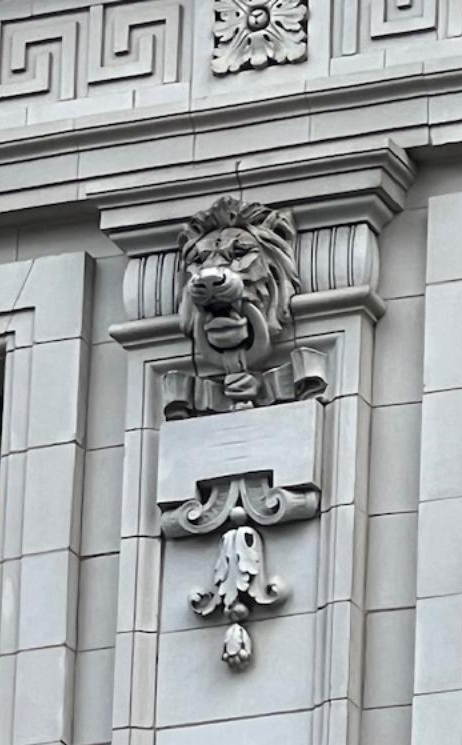
The lions protecting the building from the top
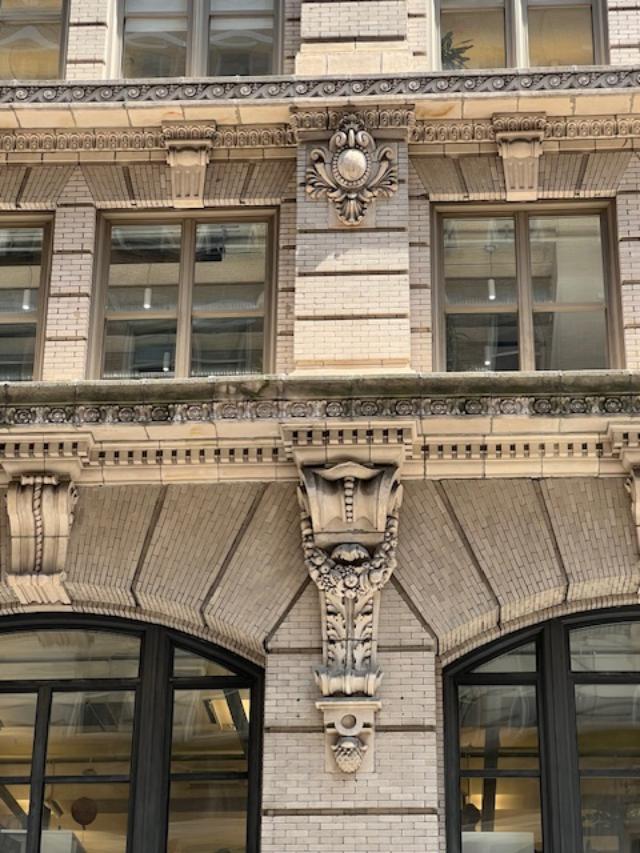
As I walked past Broadway, I passed 889 Broadway, which I had passed many times before. Just like other buildings on this street, there are more details on the street level rather than on the main avenues.
889 Broadway-The former Gorham Manufacturing Company Building
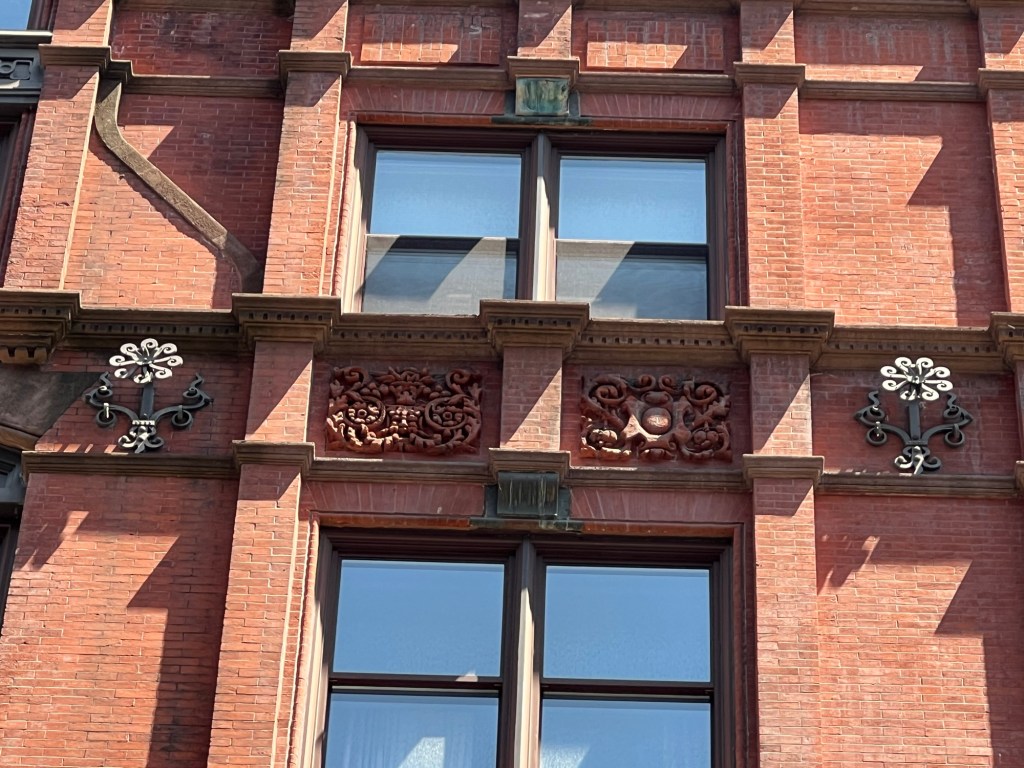
The beauty of 889 Broadway can be seen on all sides but you have to look at every angle of the building to appreciate it. There is all sorts of masonry and iron work around the building that gives it unique look. The building was designed by architect Edward Hale Kendall in the Queen Ann style and finished in 1884. The company moved uptown in 1905 when the retail district started to move further north (Wiki).
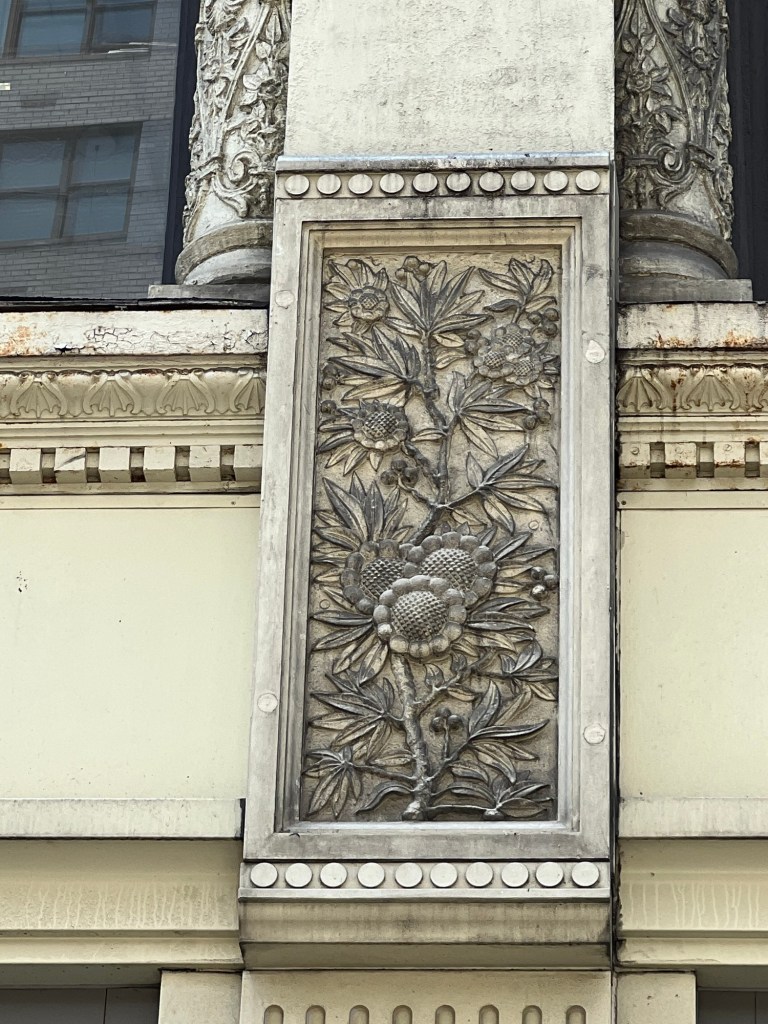
The unique carvings and metal work on the building
More faces watching you on the street making judgement calls
119 Fifth Avenue at the corner of East 19th Street in the Flatiron District neighborhood of Manhattan, New York City was built in 1905-06 and was designed by John H. Duncan in the neo-Renaissance style. It was built to be an annex to the Lord & Taylor department store buildings which took up most of the square block between Broadway and Fifth Avenue and East 19th and 20th Streets, being connected by bridge to two of them. After Lord & Taylor moved uptown in 1914, the building had multiple uses (Wiki).
The lion watching over you
The stonework at the top of building
This section of Fifth Avenue was meant to impress when this was the financial and retail center of Manhattan. The buildings were designed in the Neo-Classical and Beaux Arts style sowing the importance of the companies who created them, who are that point long gone. This area had been the center of business before and after the Civil War.
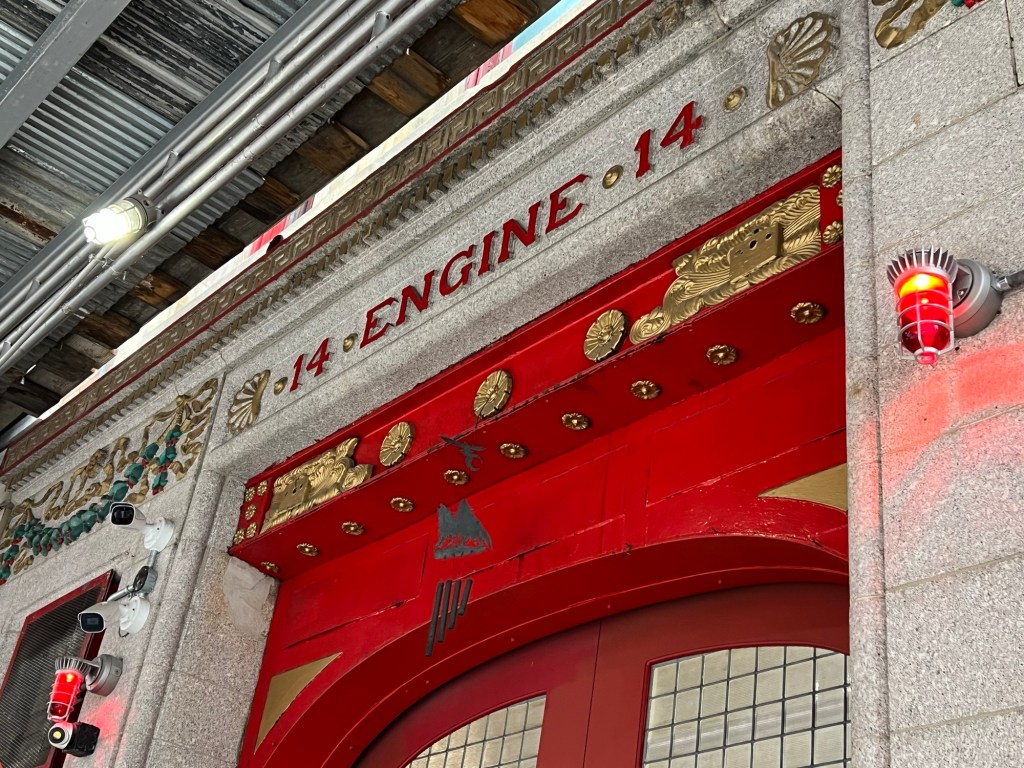
I then rounded the Fifth Avenue business core and walked down East 18th Street and came across one of the most beautifully designed firehouses I have ever seen in the City, Engine 14. In all my times walking around Manhattan, I don’t think I have ever walked down this street before because I never noticed this.
Engine 14 at East 18th Street was under renovation but it’s 1894 facade peeked out
The building is currently under renovation. Engine Co. 14 was erected in 1895 by architect Napoleon LeBrun, who designed this in the Beaux Arts design. This style is typical of the earliest New York City firehouses (Manhattan Sideways).
This was under the scaffolding
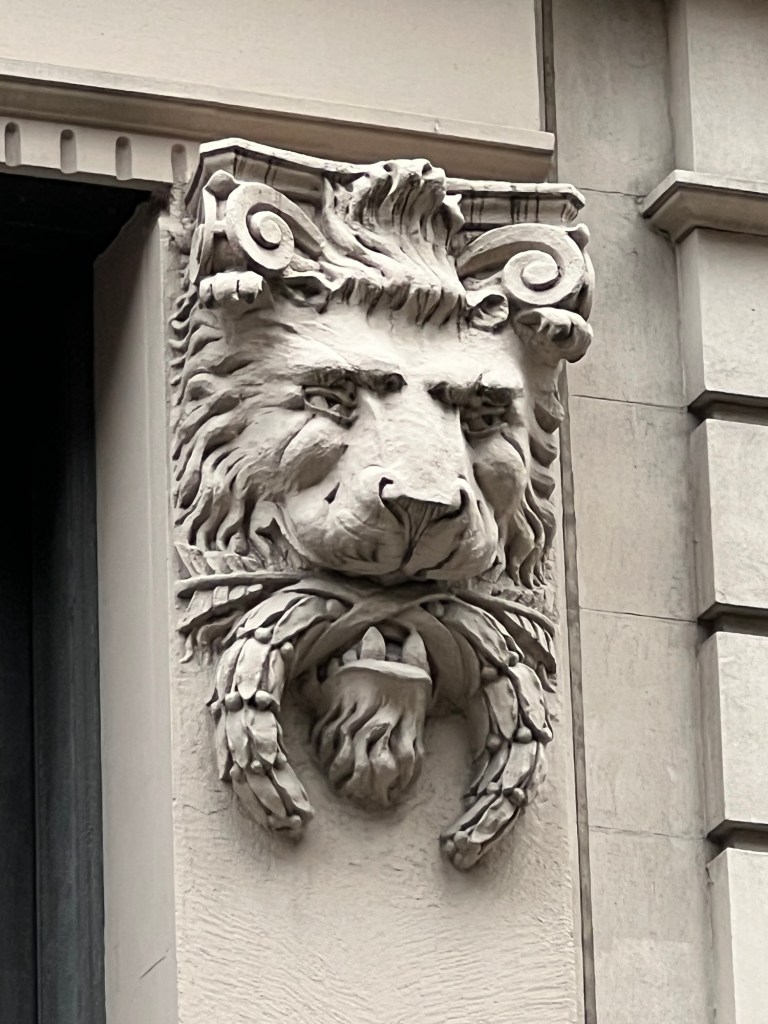
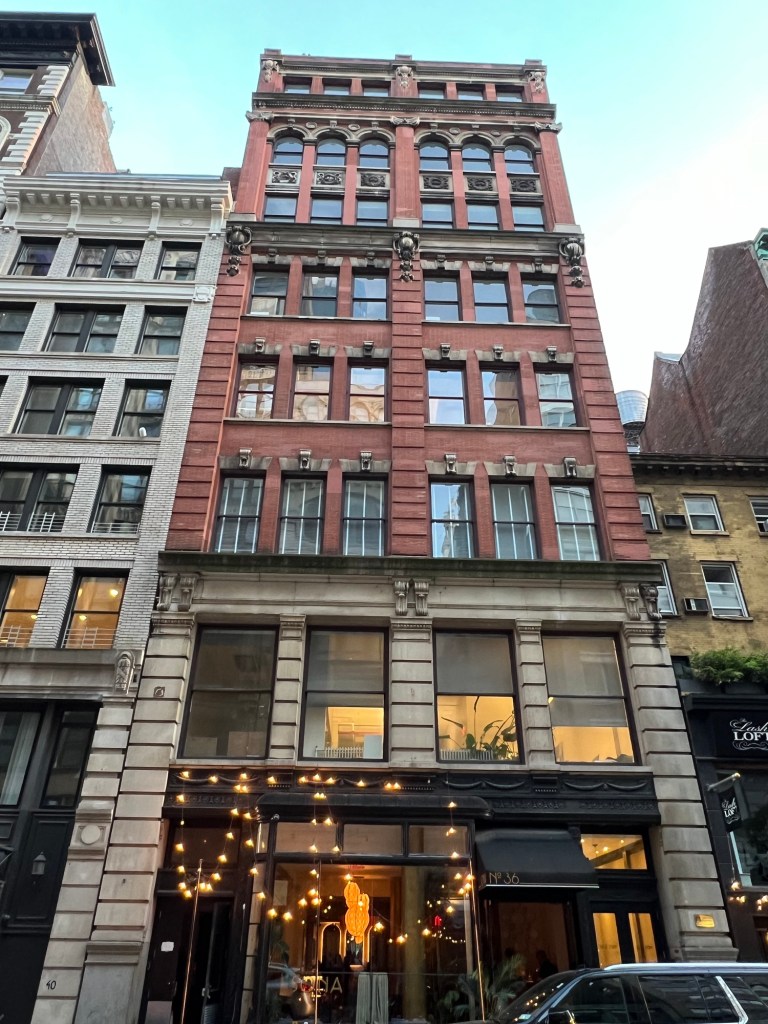
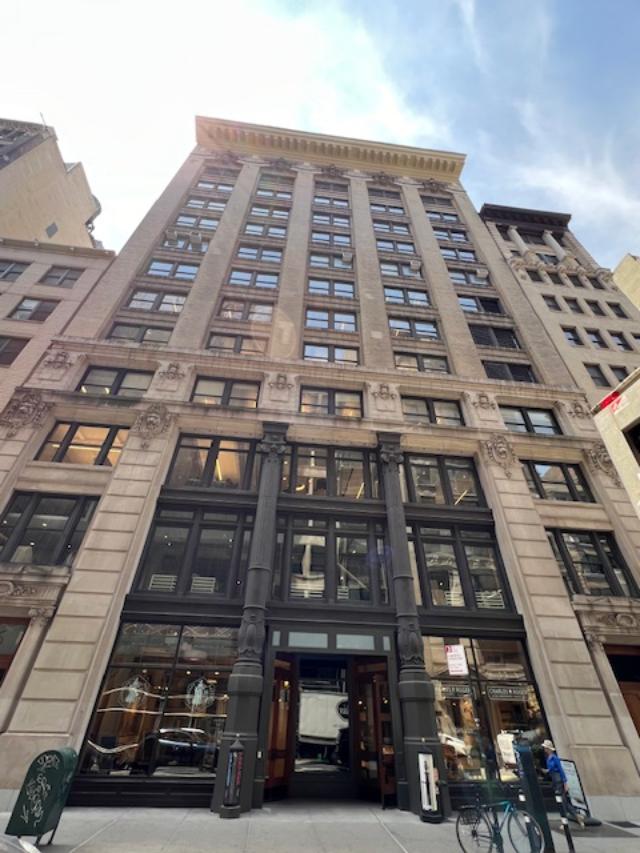
I turned the corner at East 17th Street and most of these buildings have a historic value to them and I was surprised by the collection of retailers on this block. I thought it would be a bit more upscale. I looked up at 16 East 17th Street and thought I heard the roar of a lion.
The former office building was designed by William Dilthey and built in 1898. It had originally had been a button factory. It was converted to a Coop in 1979 (Corcoran.com/Bondnewyork.com).
The lion sculpture on East 18th Street
The lions protect you as you enter the building.
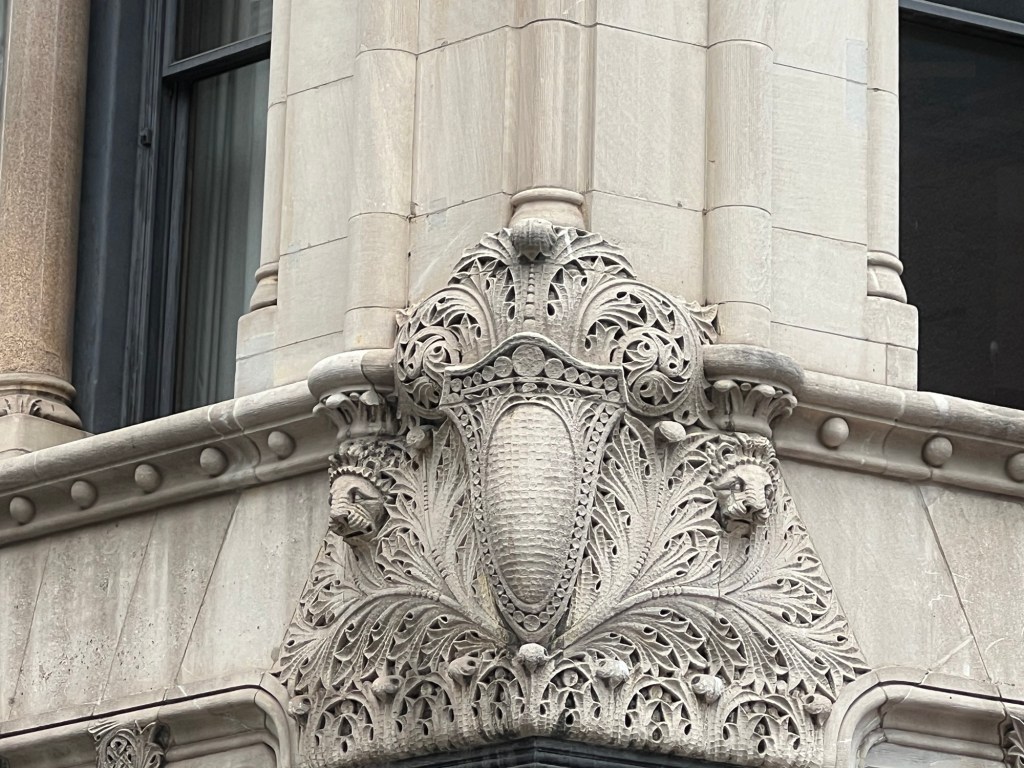
When I was walking back down East 17th Street I had not noticed this beautiful carving on 874 Broadway. This is on the corner of the McIntrye Building.
The McIntyre Building was the work of Ewen McIntrye, a pharmacist whose building had grown and had made him wealthy. He demolished the store he had on this spot and built this office building. The structure was designed by architect Robert Henry Robertson in a mixture of designs of the time. You can see Gothic Revival and Renaissance Revival and Victorian Eclectic in the design especially at the top of the building (DaytoninManhattan.com).
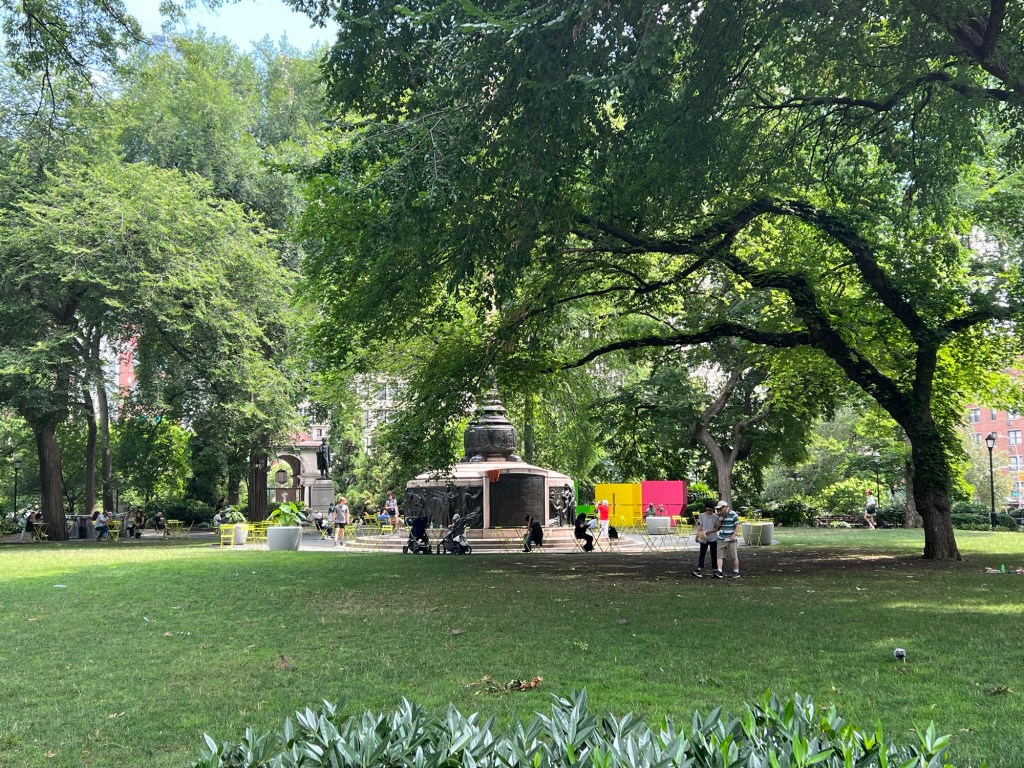
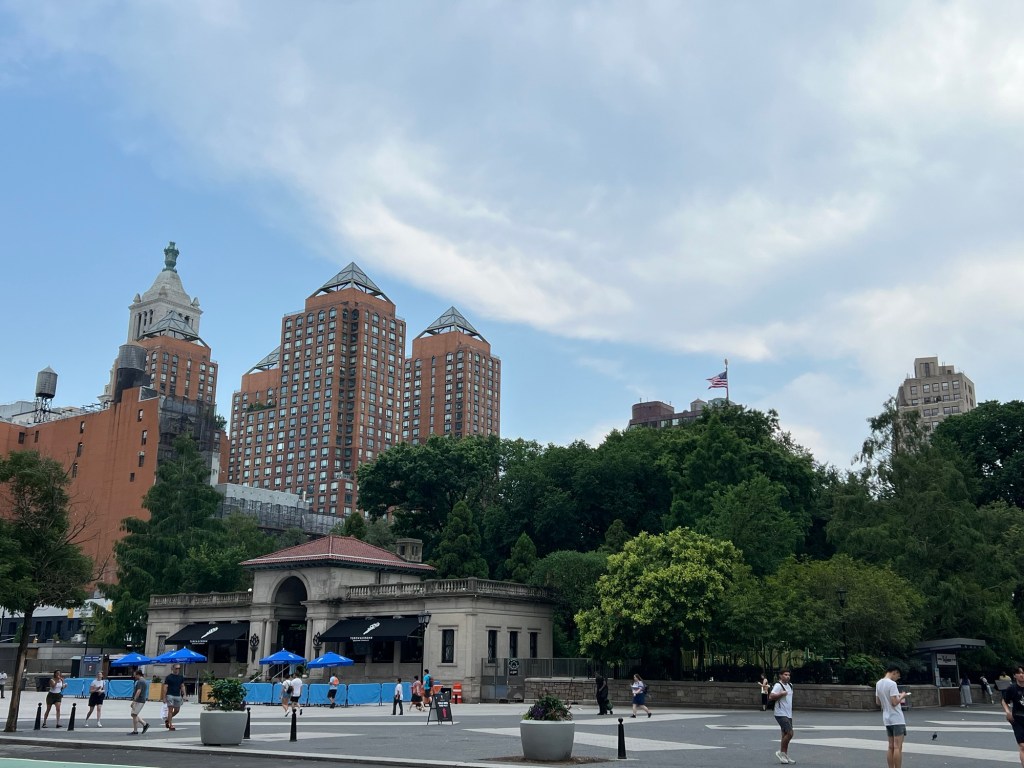
When I got to East 17th Street, I really got an excellent view of the northern part of Union Square Park. This is where you can see the real changes of the park. It is so lively and residents and business people use it as a place to unwind and relax.
The northern section of Union Square Park
Facing the northern section Union Square Park is 33 East 17th Street. I have always admired this building for its embellishments and the elegance of the design.
The now Barnes and Nobel Publishing was once known as the Century Building, due to Century Publishing Company making this their headquarters from 1881 to 1915. It is also known as the Drapery Building. The building was designed by architect William Schickel and was completed in 1881 as a real estate project by the department store company Arnold Constable & Company. Left empty through the 1970’s, it was renovated by Barnes and Nobel as their headquarters in 1995 (Wiki).
The details on the doorway of 33 East 17th Street
The doorway entrance to the store at 33 East 17th Street
This fascinating face is on the left side of the entrance to 33 East 17th Street
The look from this face shows the determination of a serious book buyer
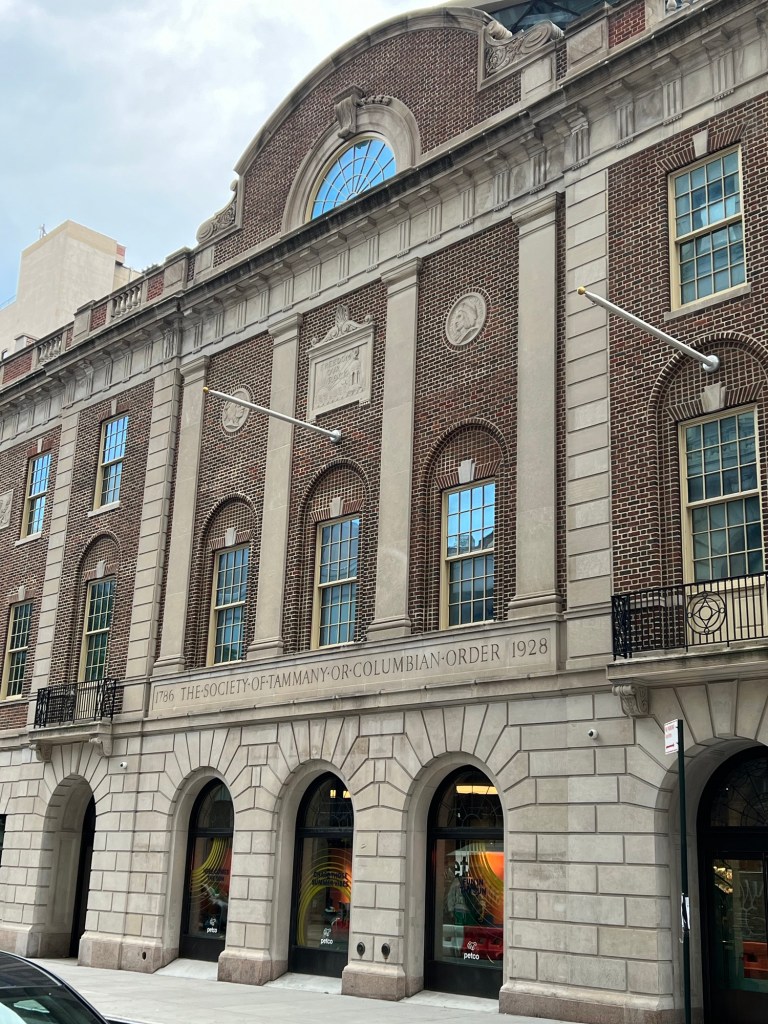
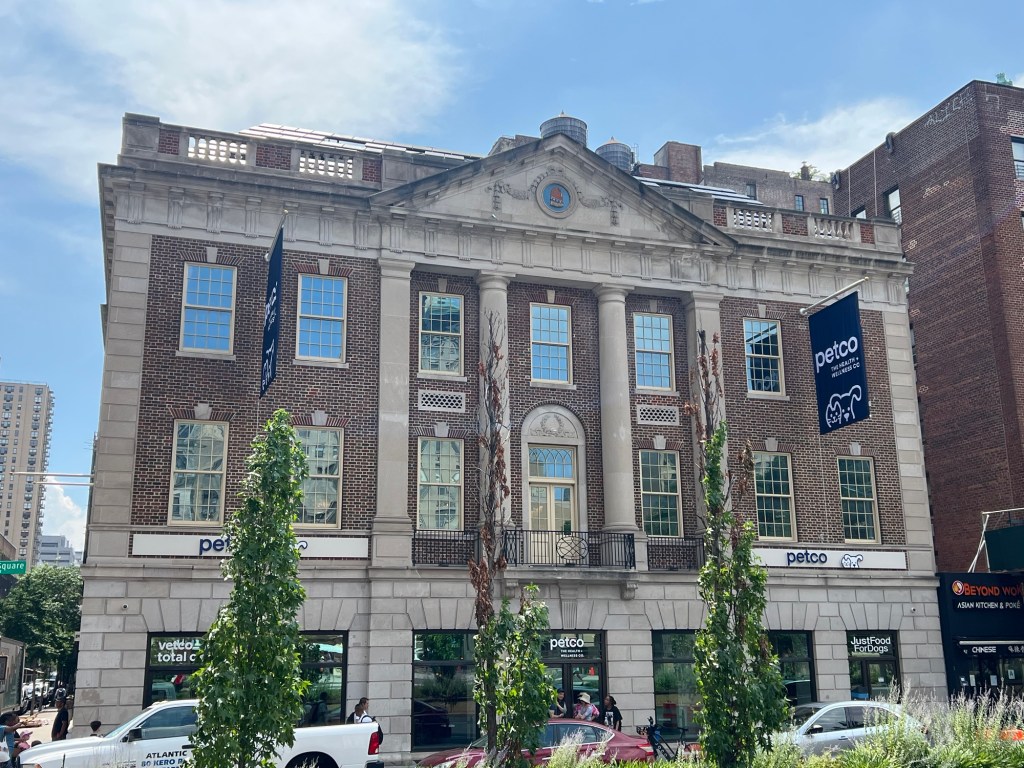
As I passed Union Square Park, I passed the old Tammany Hall Building at 100 East 17th Street. The balance of power in New York City has changed since and it now the home of Petco Pet Products.
The side of the old Tammany Hall at 122 East 17th Street
The Tammany Hall building 100 East 17th Street is now a Petco
The building was designed by the architectural firm of Thompson, Holmes & Converse and Charles B. Meyers for the Tammany Society political organization, known as Tammany Hall. It was designed in the neo-Georgian style and built in 1929. It was the organization oldest surviving headquarters building. After the loss of the organization’s political power in the early 1930’s, it was sold to the International Ladies Garment Workers Union and in present times has been used as a theater and performance space. It is now occupied by Petco (Wiki).
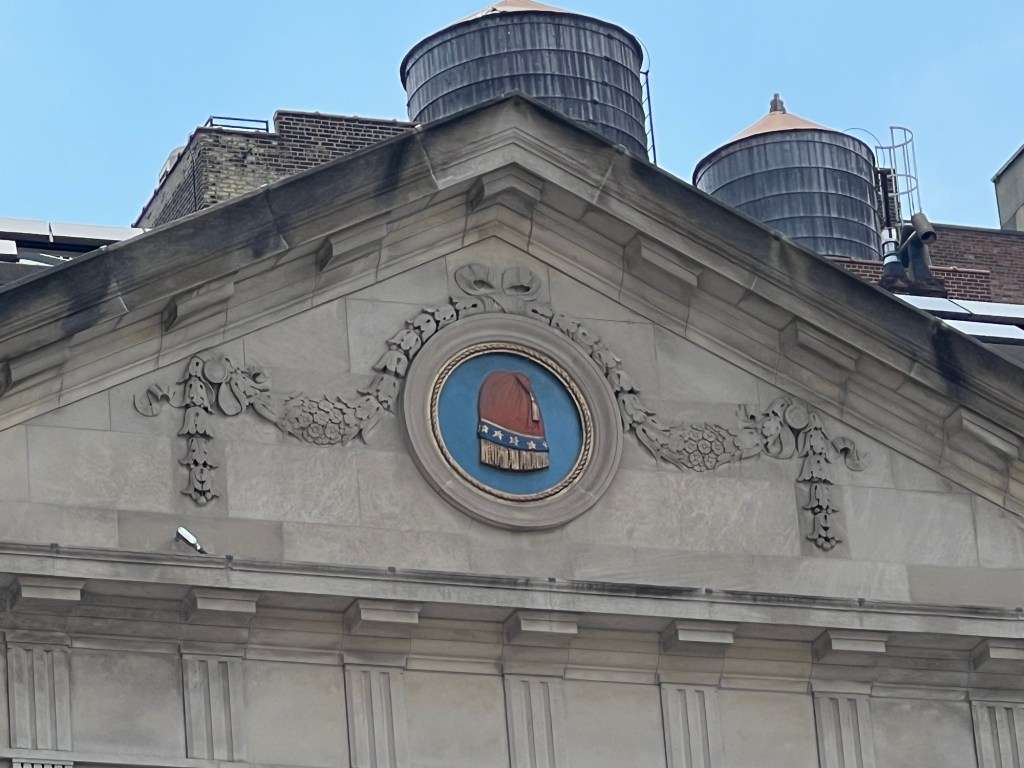
The symbols of Tammany Hall at the East 17th Street entrance
As I passed the commercial buildings of the neighborhood to the more residential buildings of Irving Place and passed the former carriage house at 121 East 17th Street.
The old carriage house at 121 East 17th Street-Martinys
This carriage house is a holdover from when Union Square was a fashionable neighborhood before the Civil War. After the war was over, the commercial neighborhood of Manhattan moved from Canal Street to between 14th to 23rd Street. This small carriage house survived all the decades of change to the neighborhood (DaytoninManhattan.com). I thought this a gracious building that added to the historical and Old New York look of the Gramercy Park neighborhood.
At the very edge of the neighborhood in Irving Place is the Washington Irving House that wasn’t his house.
The Washington Irving House that Washington Irving never lived in at 122 East 17th Street on the corner of East 17th Street and Irving Place
The “Irving House” was built by Peter Voorhis between 1843 and 1844, along with the adjacent two houses at 45 and 47 Irving Place. The original tenants of 49 Irving Place (at that time referred to as 122 East 17th Street) were Charles Jackson Martin, an insurance executive, and his wife, who would reside there from 1844 until 1852. Henry and Ann E. Coggill would live in it in 1853, and in 1854 it would become the home of banker Thomas Phelps and his wife Elizabeth, who would remain until 1863 (Atlasobsucra.com).
The first mention in print of Irving having lived in the house came in the Sunday Magazine Supplement of the New York Times on April 4, 1897. The article is a human interest story about Elsie de Wolfe and the means and methods she used to decorate “Irving’s house.” In 1905, de Wolfe would become known as the first professional interior decorator and it appears this article is an early attempt at publicity for her. As for the information about Irving, the article takes enormous liberties (actually, it flat-out makes things up), claiming that Irving had conceived of the house himself and was very particular about the architecture and design (Atlasobsucra.com).
Looking up Broadway to the old shopping district from East 17th Street
When I reached the border of the neighborhood at Irving Place, you could see the tradition of the old commercial and residential districts of the neighborhood. These have become blurred over time as restaurants, bars and boutiques have moved into former residential buildings.
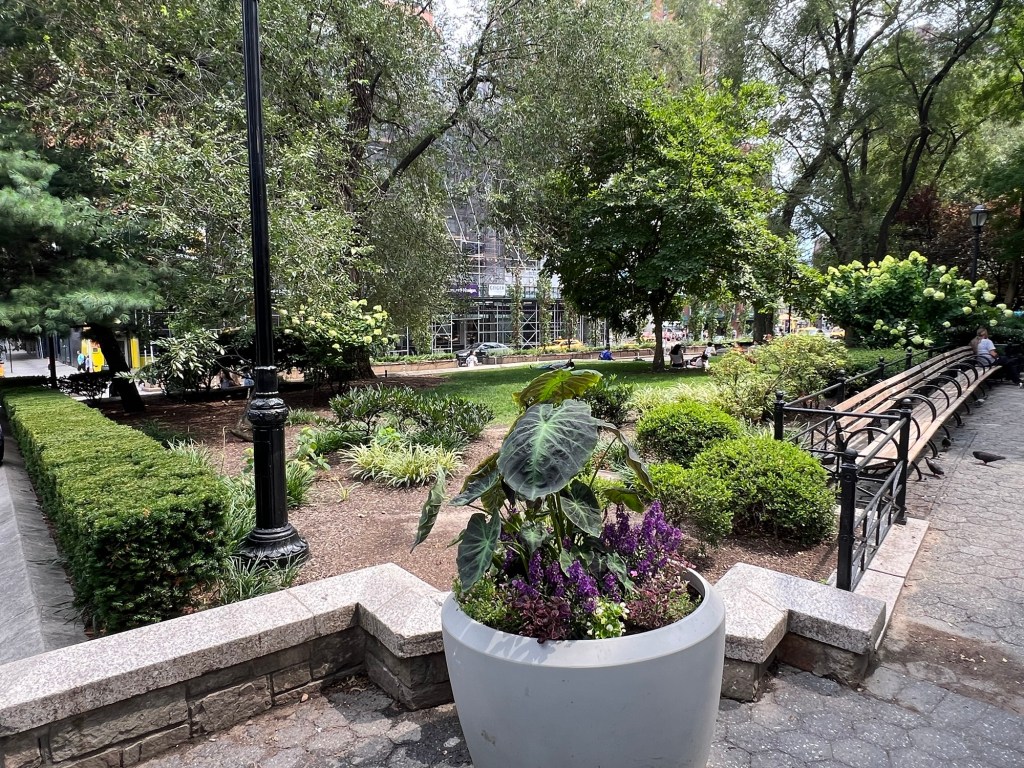
On the way back to Union Square Park, I walked through the parks to admire all the flowers and gardens that were in full bloom and stopped to sit on a bench in the shade.
The view of Union Square Park at East 17th Street on the walk back to Fifth Avenue
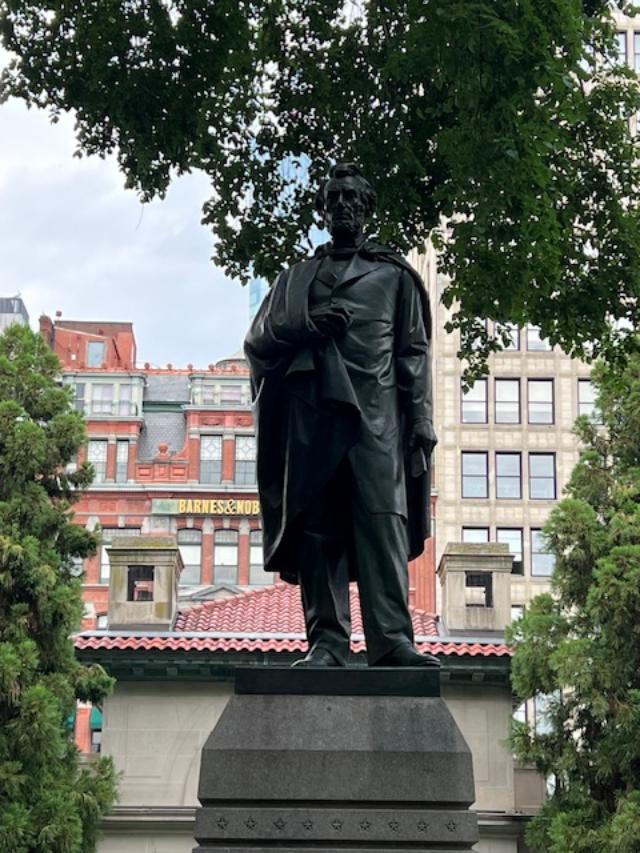
In the northern part of the park is the impressive statue of Abraham Lincoln. The one thing that I like about New Yorkers as opposed to other cities is that they look at statuary as a debate but not so quick to knock it down like in other cities. Either that or no one really noticed it at the time of the riots. These valuable art works are meant to be debated and discussed not torn down or hidden because someone does not agree with them.
Located at the northern end of the Union Square is the prominent statue of President Lincoln. This statue stands and overlooks the lawn of the park.
This impressive statue of Abraham Lincoln was designed by sculptor Henry Kirke Brown and was dedicated in 1870. In his statue of Lincoln, cast in 1868, and dedicated September 16, 1870, he combines a classically styled pose with a perceptive naturalism, uniting realistic detail with an idealistic stance (NYCParks.org).
Artist Henry Kirke Brown was an American born artist who had studied with artists in Italy for his training. He is best known for his figurative historical statues. He also designed the statue of George Washington in Union Square.
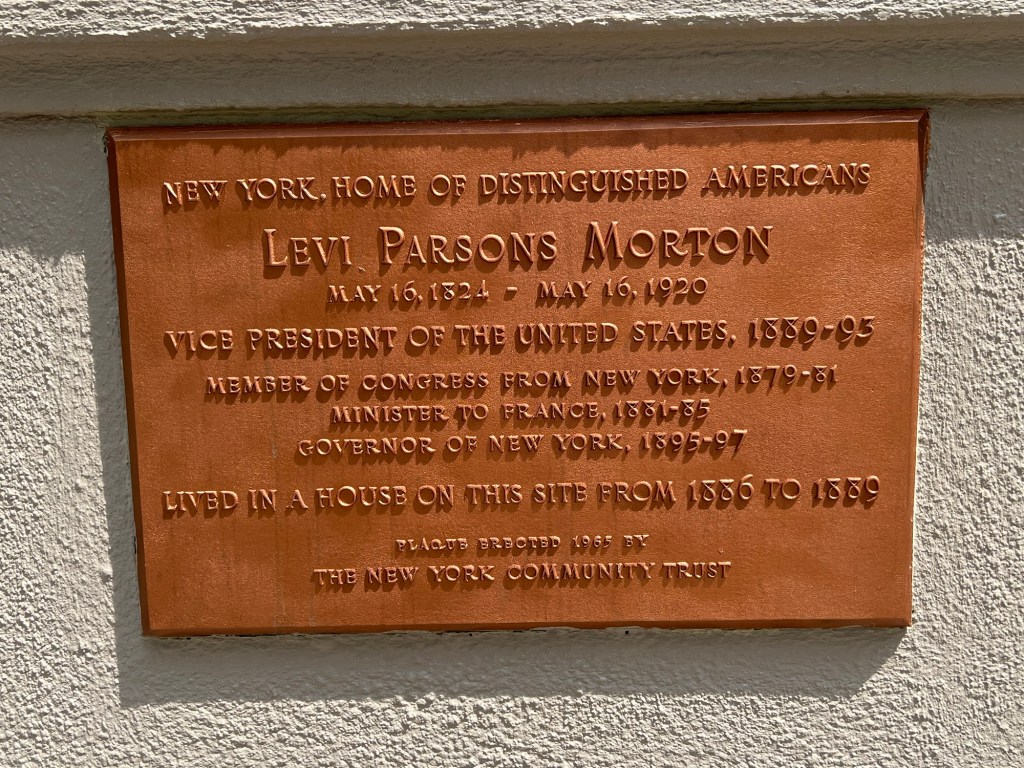
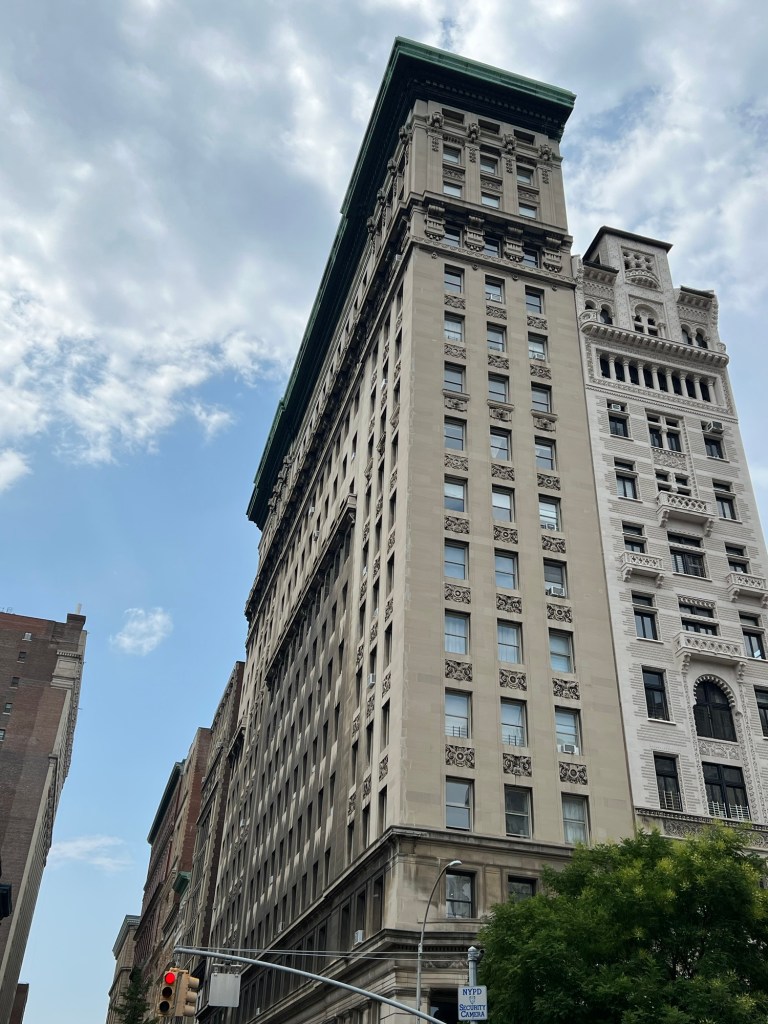
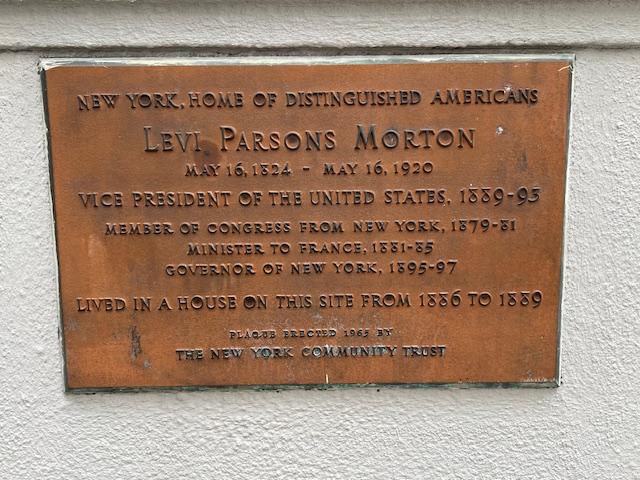
I started my walk down East 16th Street at the Levi Parsons Morton plaque at the corner of Fifth Avenue and East 16th Street.
The Levi Parsons Morton historic plaque
The plaque of the former Vice-President’s home on Fifth Avenue.
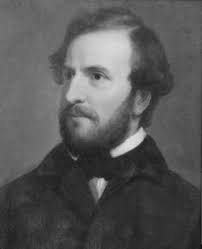
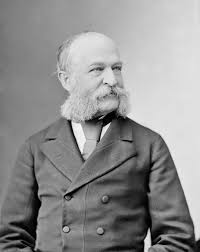
Vice-President and former New York Governor Levi Parsons Morton
The B. Shackman & Company sign was for the former B. Shackman & Company novelty and toy store that was located here until the 1970’s. The store once sold all sorts of novelties and gifts (Ephemeral New York.com/Consumer Grouch).
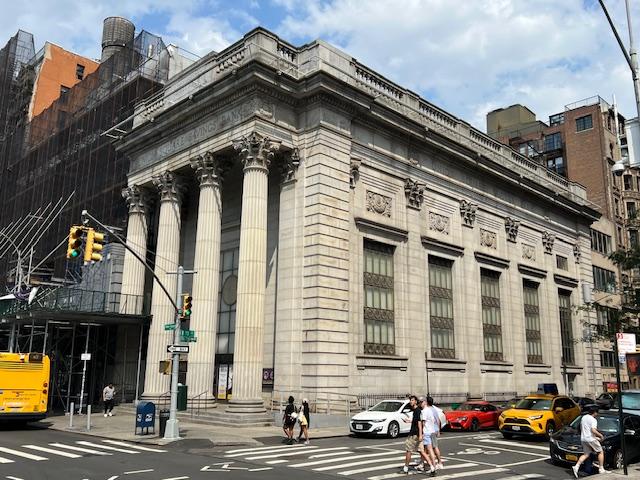
31 Union Square West built in 1902-03 as the Bank of the Metropolis was designed by architect Bruce Price and designated a landmark in 1988. This early skyscraper shows the influence of the American Renaissance sensibility celebrated at the Chicago World’s Fair of 1893 (Streeteasy.com).
You have to look at the very corners of the top of this building to appreciate the roar of these lions
Just like East 17th Street, East 16th Street is filled with more interesting historical buildings.
The building was designed by architect Louis Korn for Martin Johnson and built between 1895 and 1896 (Wiki).
The corniches have such a fanciful design to them
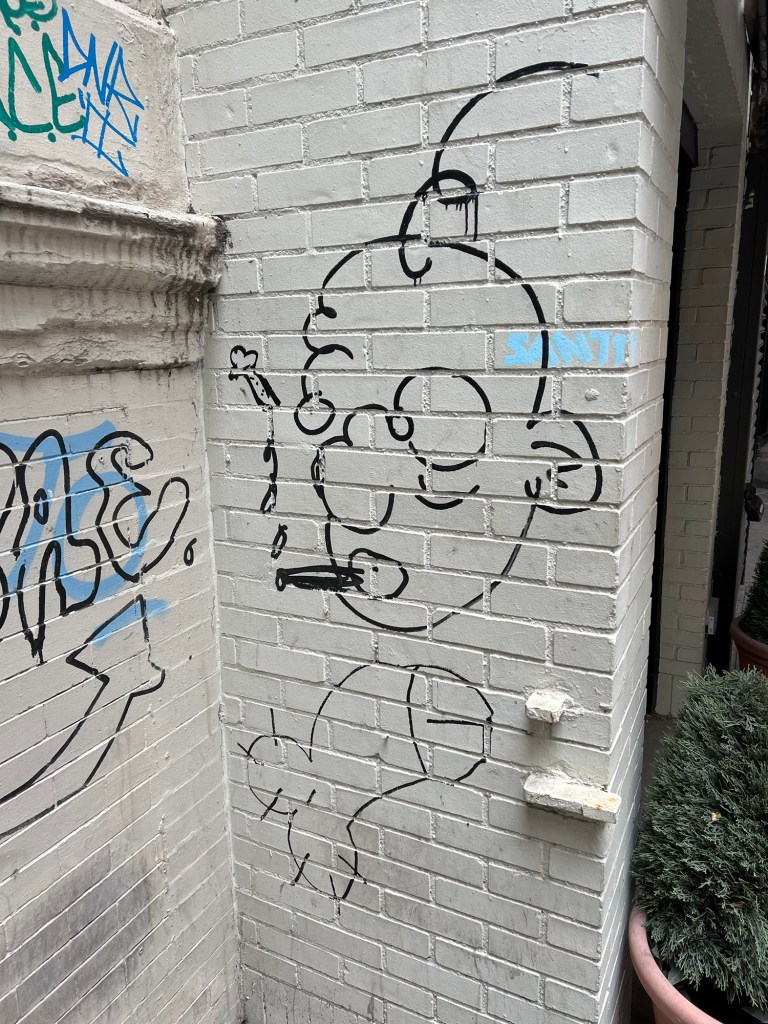
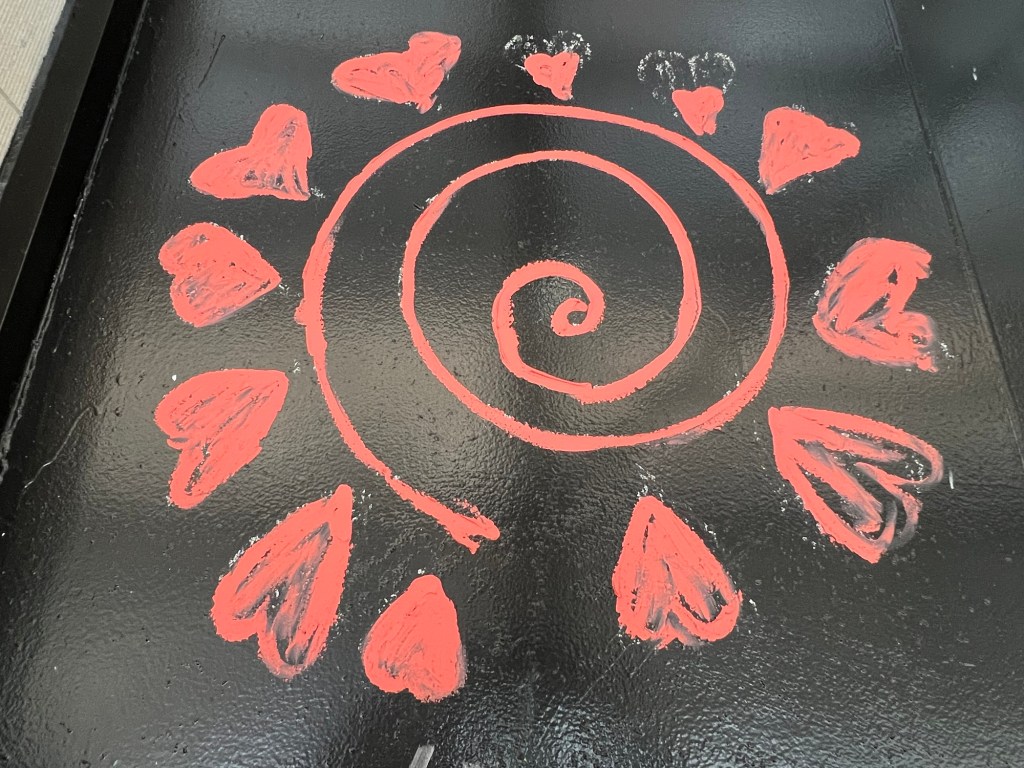
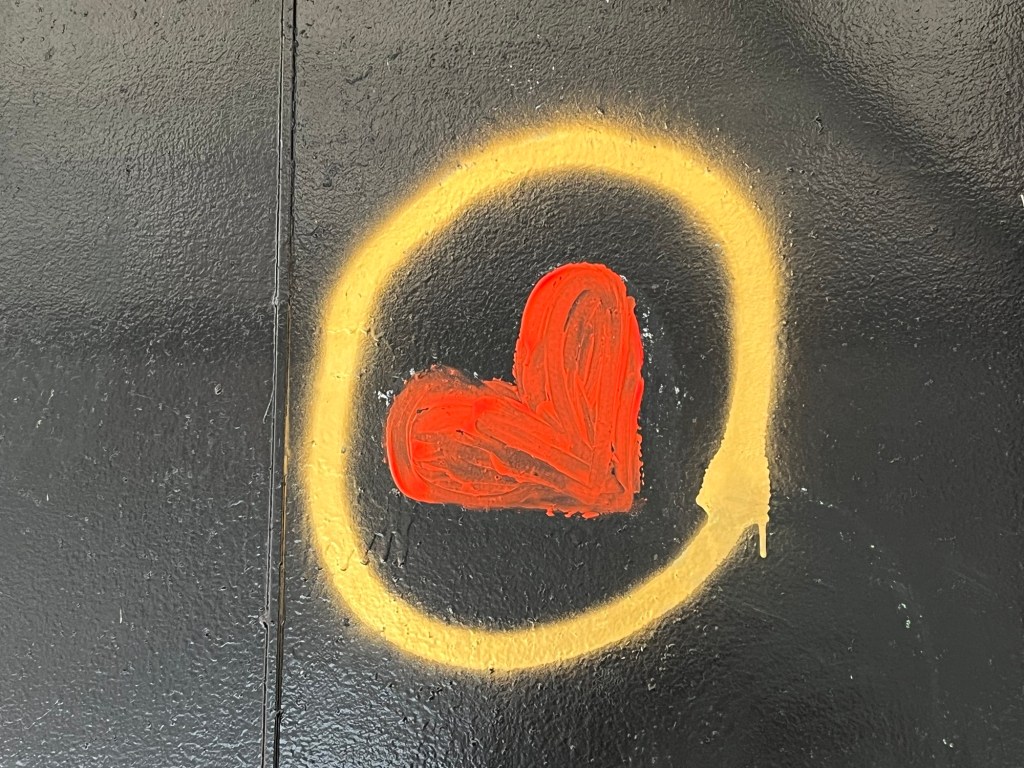
As I walked down the street I noticed not just architecturally beautiful buildings but some very talented street artists left their mark in the neighborhood. Being so close to the Museum of Sex, I thought some were quite unique.
A fried egg
I won’t ask!
Love symbols
More love symbols
I love looking down the street with its small individually owned shops and restaurants give me faith that New York City is coming back strong after COVID. It is nice to see the City so alive.
This block leads into the heart of Union Square Park and to where the Farmers Market was going strong.
The beauty of the park by East 16th Street in the middle of the afternoon
I walked down East 15th Street and relaxed in the park for a while as it got hotter out. I walked along the flower beds and paths and admired the hard work it takes to maintain this park.
How colorful the park is at East 15th Street
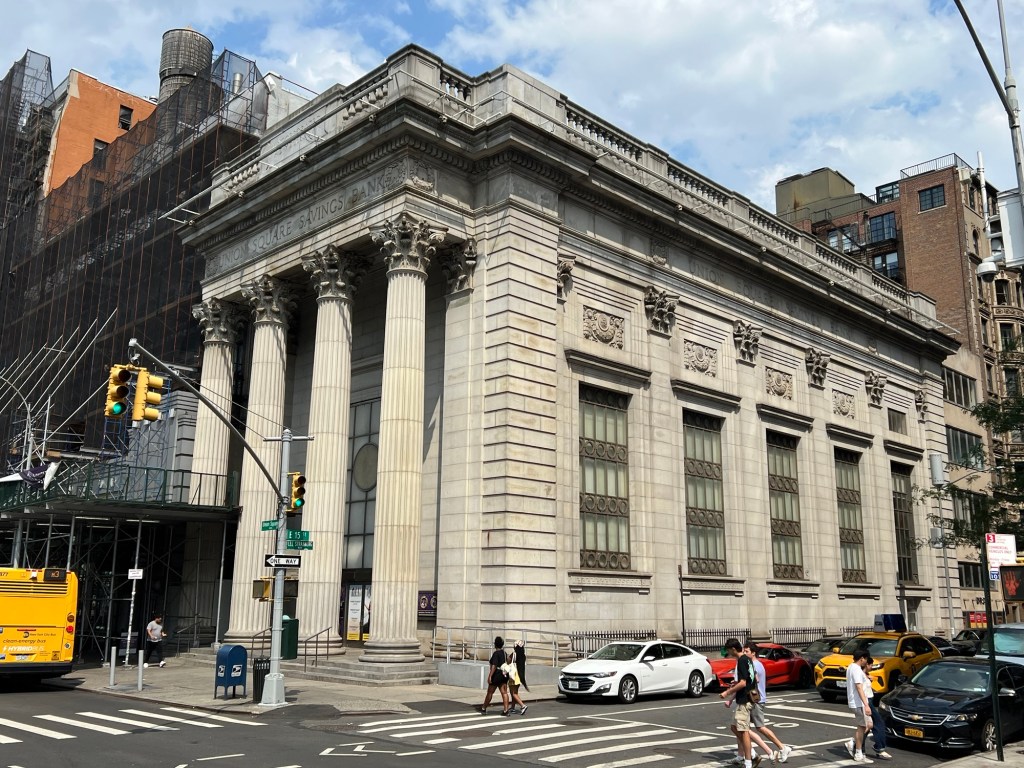
I walked down East 15th Street and admired one the old bank buildings that was going through a renovation.
101 East 15th Street-The Union Square Savings Bank Building/Daryl Roth Theater
The bank itself was founded in 1848 and moved to this location in 1895. This building was designed by architect Henry Bacon in the neo classical design in 1905 and the building was finished in 1906. The bank closed in 1992 (Wiki).
The beauty in the side of the building facing East 15th Street
I find it interesting to look at these old buildings with names of companies long gone and ask myself, ‘What happened to them?’ and ‘What happened to them?’ These buildings were designed and built for companies that were once at the pinnacle of their success. Now they are being used for hotels and retail stores proving New York’s resilience to change and to time.
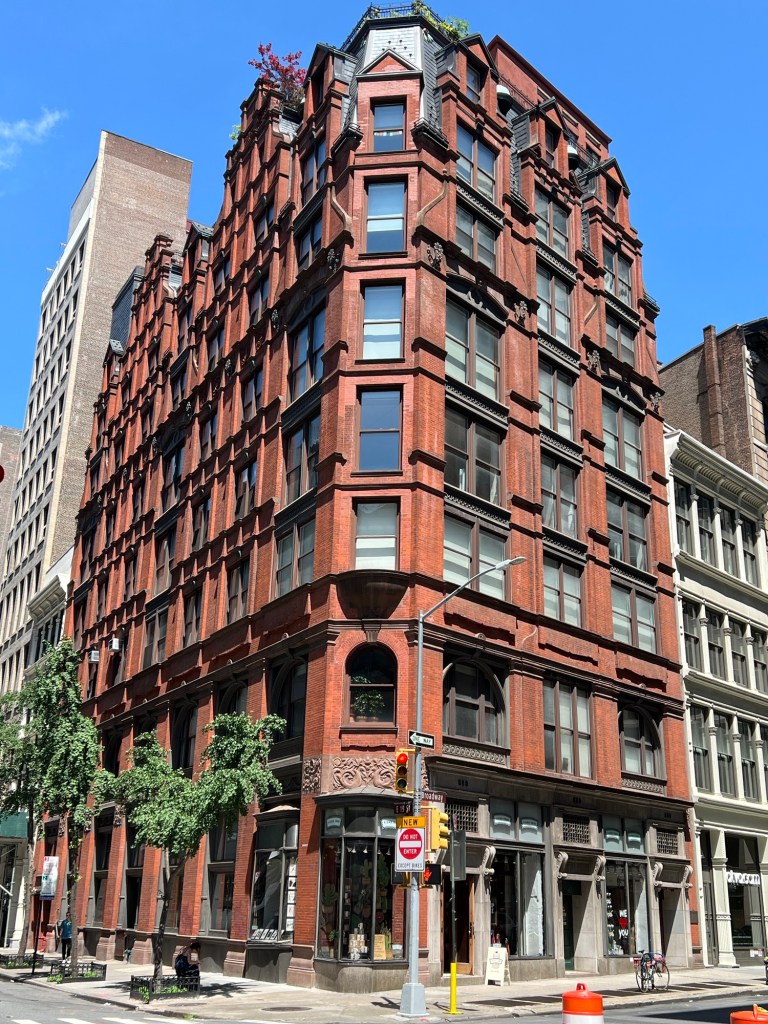
The last building that impressed me the most in the neighborhood was the apartment building at 105 East 15th Street with its garish details and graceful windows.
The Swannanoa is a 10-story Neo-Renaissance apartment building designed by architect Gilbert Schellinger, who was a renowned and prolific designer of residential buildings back in the late 1800’s and 1900’s. Constructed in 1898, this building is easily recognized by its bay windowed facade, elegant marble lobby and hallways, which have all been beautifully restored (Streeteasy.com).
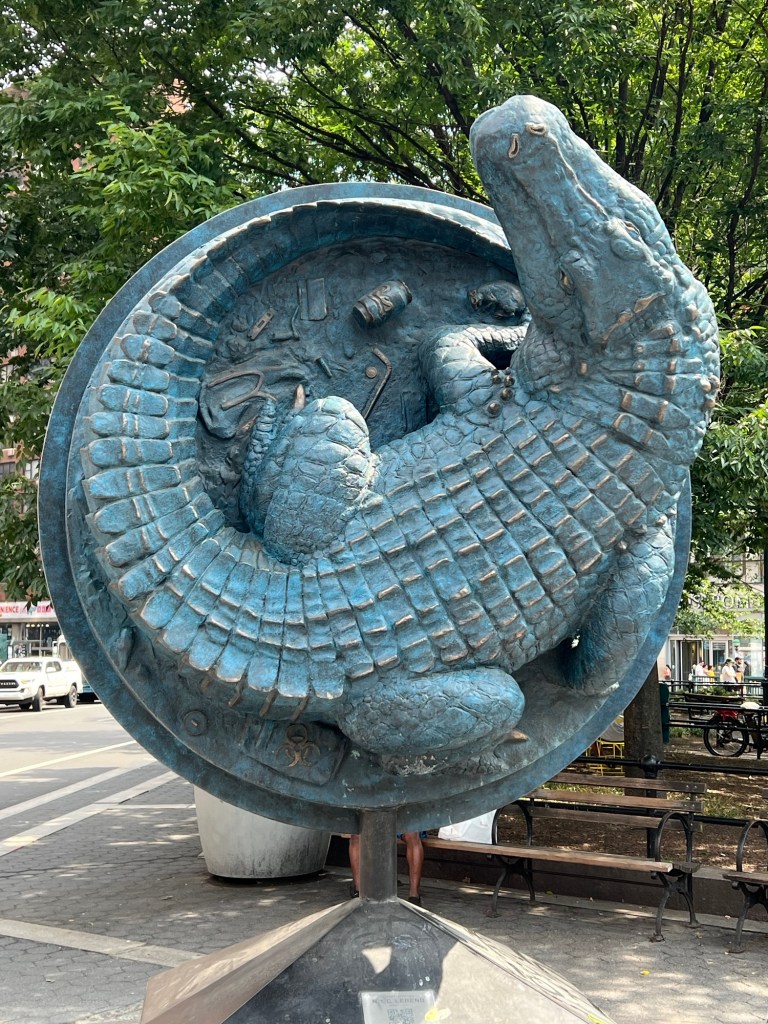
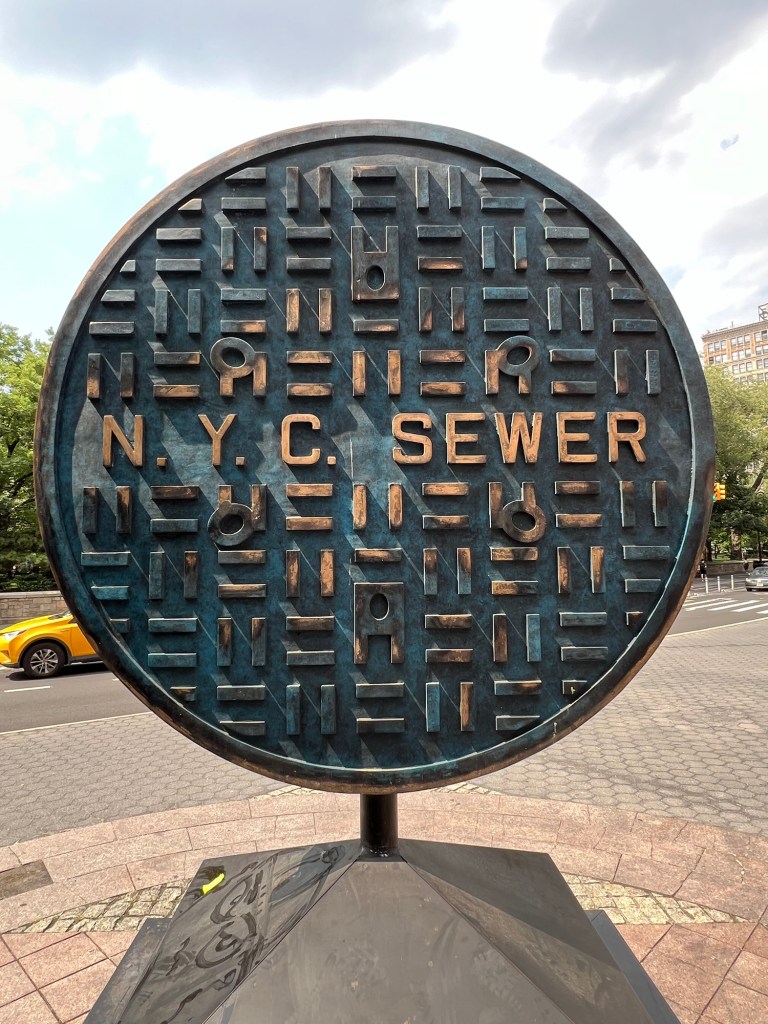
In all the walks of this neighborhood that I have made walking back from NYU in the evening from class and I walked around and through Union Square Park and I had not noticed the sculpture on the edge of the park.
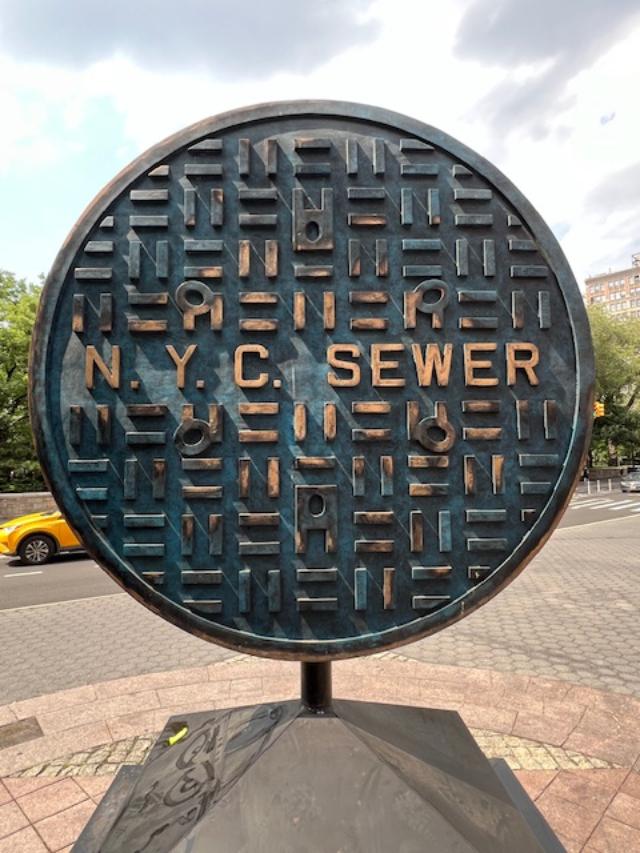
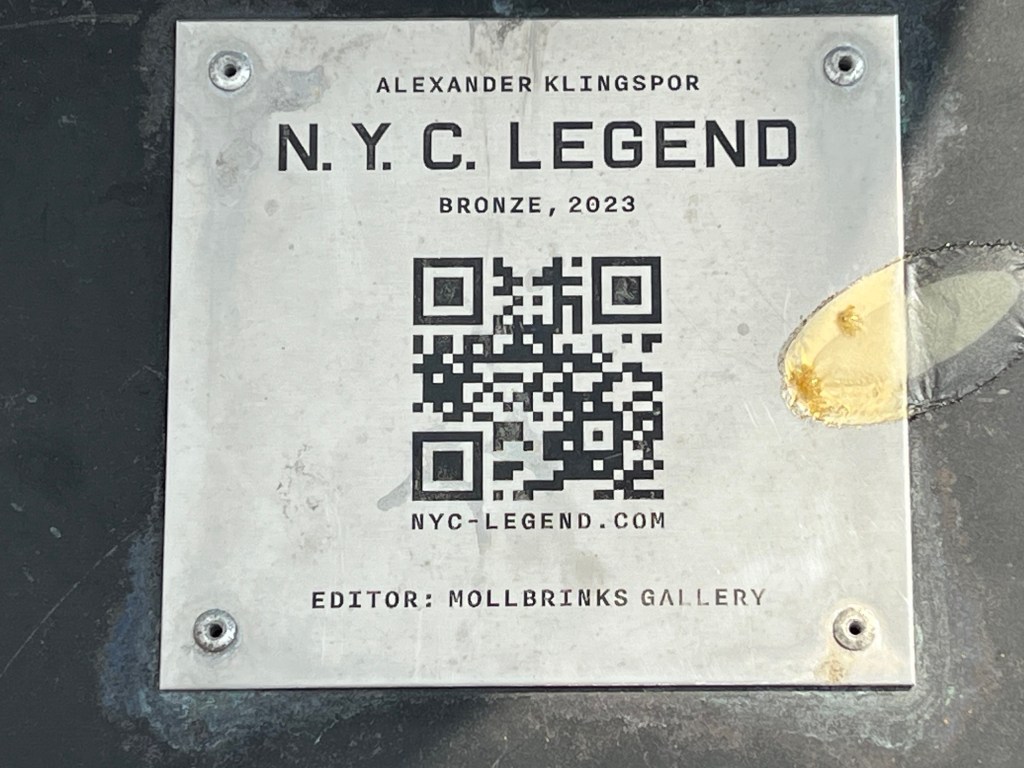
New York Legend-the front of the sculpture
New York Legend-the back of the sculpture
This unique and very creative sculpture was designed by artist Alexander Klingspor
This fascinating sculpture shows the urban legend of alligators lining in New York City sewers. With all the pollution in the water around Manhattan and the rest of the City, there is No Way this would happen. I’m surprised they can still live in Florida.
Artist Alexander Klingspor is Swedish born artist who works both in the United States and Sweden. He apprenticed under American artist Mark English. He is known for his paintings and sculptures (Wiki).
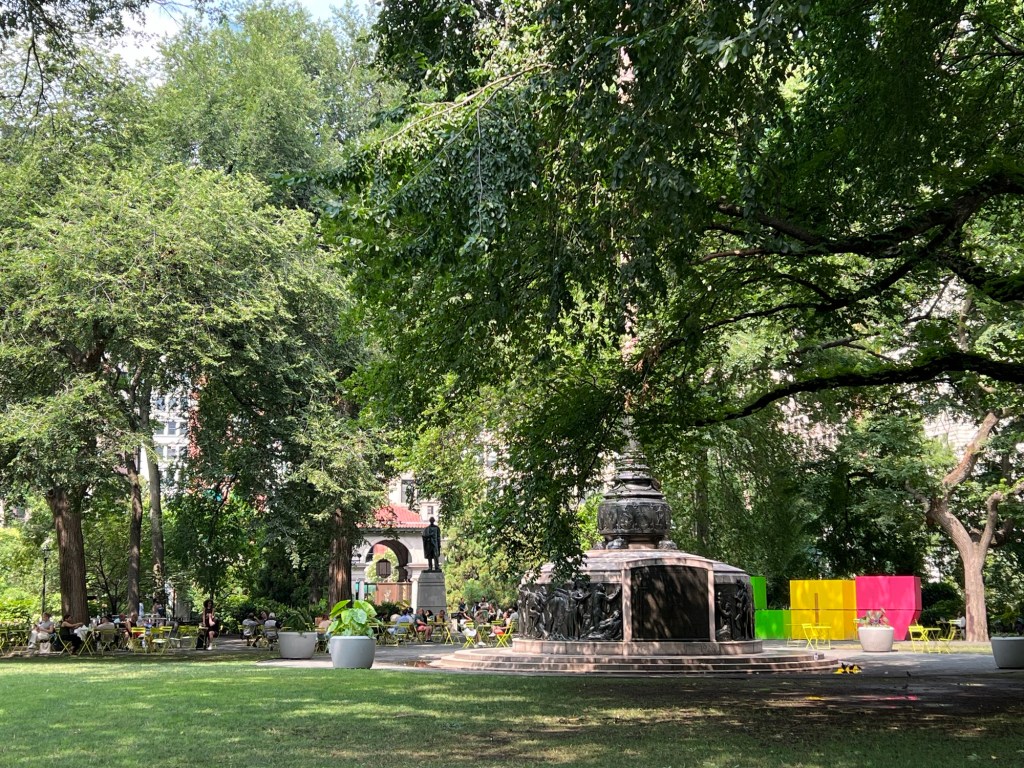
I then walked through the park for the last time that afternoon as it really started to get hot and watched the people sunning themselves, reading books or just conversing. Again it shows what time and a little effort being made can change things in Manhattan. I think the artists that dominated this area when it was going downhill would be shocked if they got out of a time machine to see how the area has changed.
Union Square Park in the late afternoon.
The Union Square Art and Farmers Market
Just remembering coming here for a hot dog with my father in 1982 and eating next to a transvestite I realized how times have changed. I think about all this when I am looking at young couples strolling around the Farmers Market with expensive baby carriages, looking at $5.00 for one cookie and $15.00 for a Cinnamon Banana Bread. I think it is no longer 1982 but 2024 post COVID and how far we have come. Union Square Park just shows how Manhattan just reinventing itself and changes with the time.
That’s New York City!
The other blogs on the Union Square neighborhood:
Day Three Hundred and Thirteen: Walking the Borders of Union Square:
We had another long day at Holy Apostles Soup Kitchen. Since the holiday weekend, the Soup Kitchen does not close on the holiday, but we do on the weekend, so we had long lines on this Monday morning and afternoon. We spent our whole morning packing up bags of snacks and wipes for the meals that will be served tomorrow. We finished by 10:30am (talk about teamwork) and I was able to walk around Union Square Park and both Broadway and Park Avenue South and still make it back for lunch at 12:30pm. It was a long morning and afternoon.
The Farmer’s Market was in full swing again and the place was mobbed. Many people must have taken this week off as well because the City seemed so quiet today as well. It has been quiet since July 1st and will stay that way for another week. People were out in force walking through the market with their dogs, talking with their friends and sitting in the grass at the parking reading and relaxing.
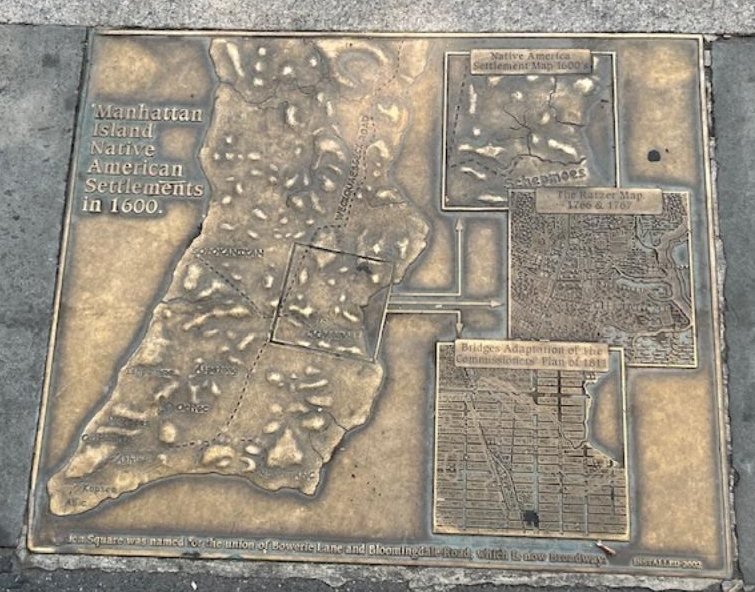
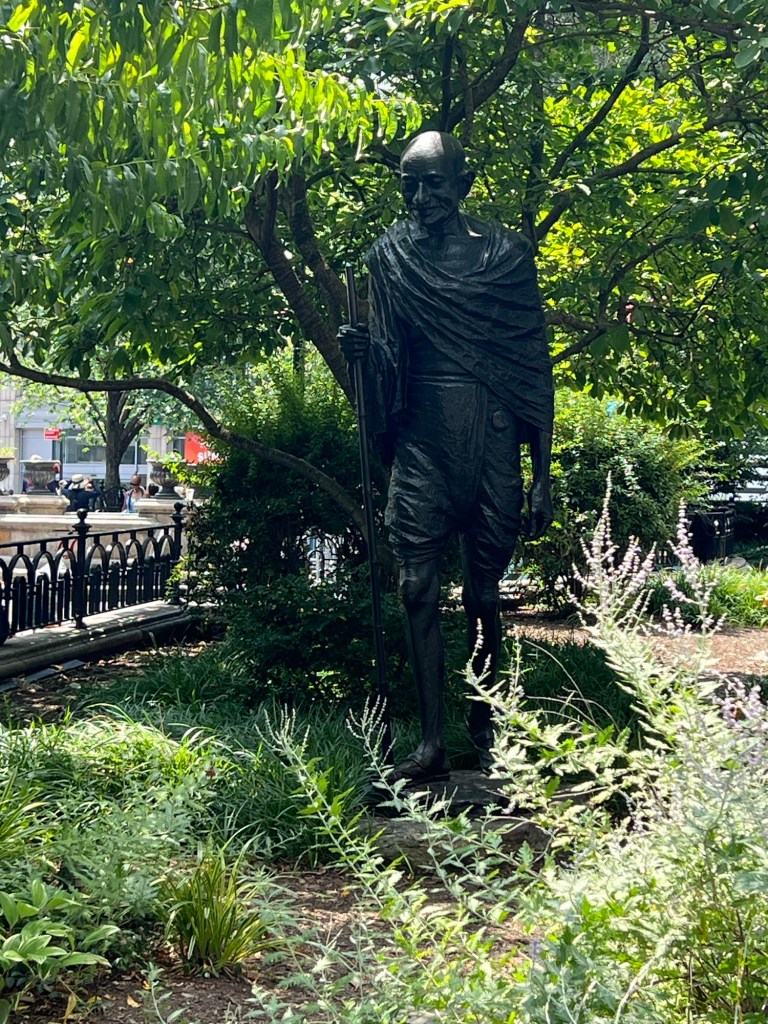
I looked over all the statuary in the park and I found I had missed quite a few things that I had not seen because either they had been covered up with the Farmer’s Market going on or tables of things people were selling in the park. There were all sorts of medallions on the history of the park and the neighborhood and there was a statue of a mother and her child that formed the old water fountain of the park. In the corner of the park near 14th Street, there is a statue of Mohandas Karamchand Gandhi. I had never noticed it before because all the landscaping and flowers had surrounded it.
The statue of Gandhi is hiding in the bushes on the southern corner of the park
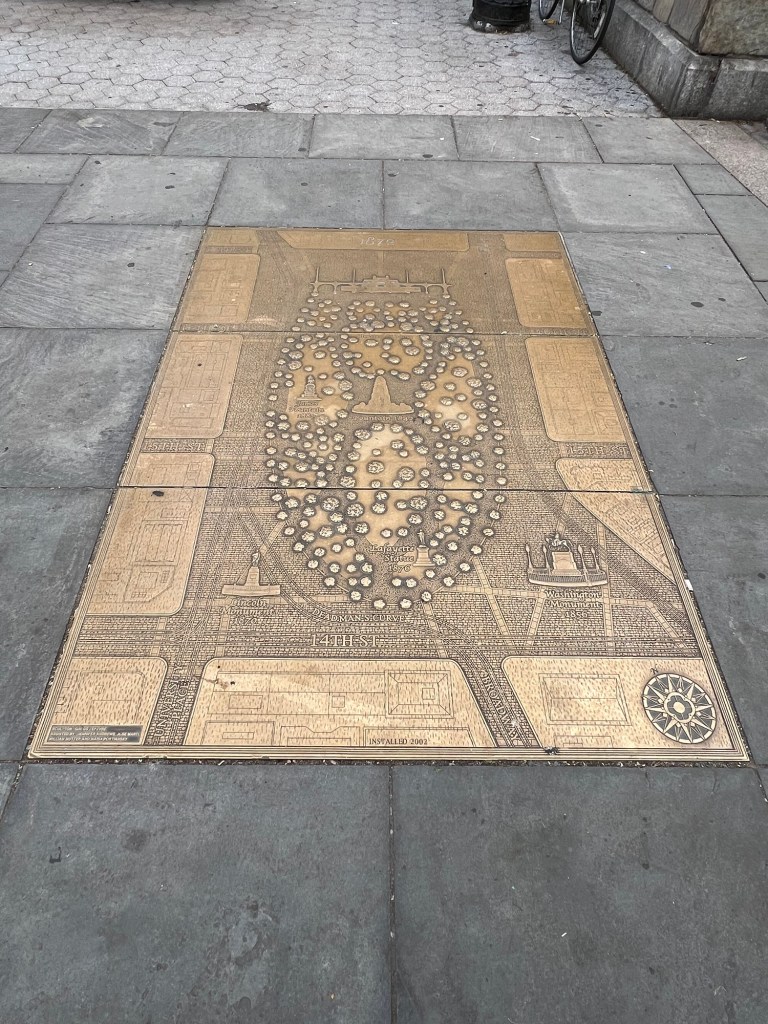
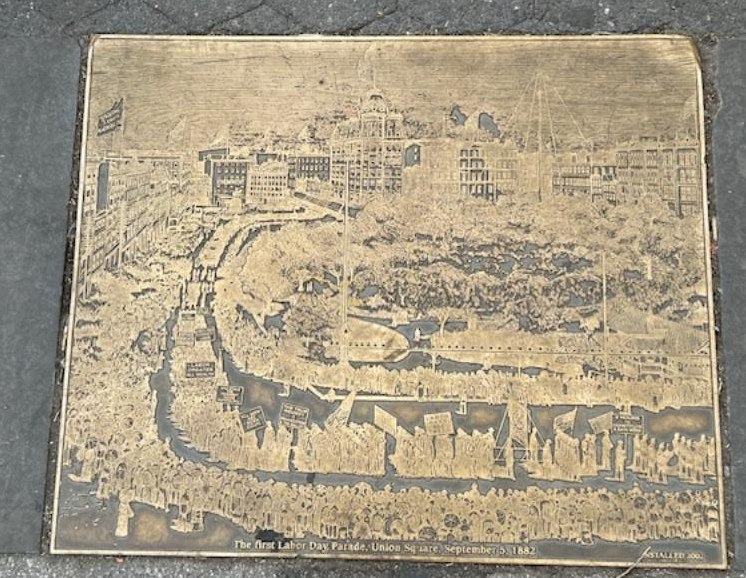
As I walked around the Farmers Market, looking over the very over-priced fruits, vegetables and bakery products, J noticed more of the medallions that line the border of Union Square Park. The first one I admired without the sunlight distracting me was the medallion of the layout of the park from the 1800’s.
This is the original layout of the park in 1876 plaque
I walked around the park and marveled at it on a very hot afternoon. Like most parks in former edgy neighborhoods, it fascinates me how a bunch of twenty year old’s and families sun themselves and socialize where thirty years earlier you would be harassed by homeless, drug dealers and methadone addicts. You still might see them on the fringes of the part but not like in the early 1980’s.
The park now has a business partnership and I believe a Friends group as well. There are so many activities going on in the park, that I am sure people don’t notice all the chess hustlers and counterculture types on the 14th Street perimeter.
Looking at the southern part of the park facing 14th Street and the southern entrance to Broadway
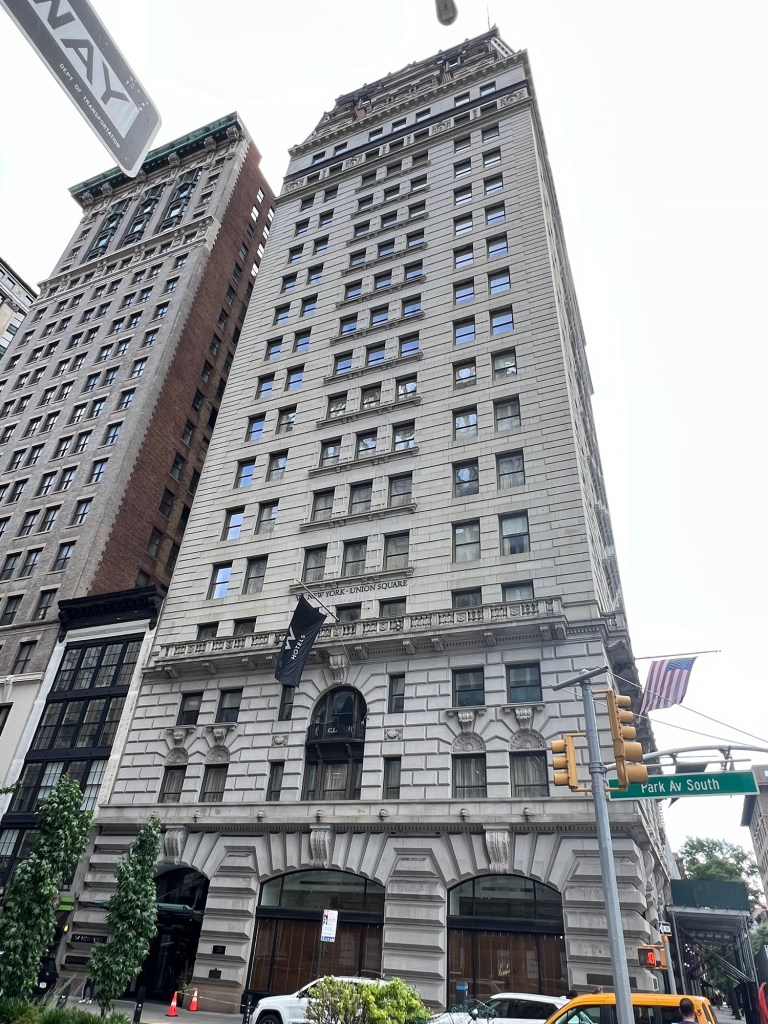
I started my walk up Park Avenue South which is actually the western border of Gramercy Park. I have always been impressed by the W Hotel on the corner of 16th Street and Park Avenue South at 201 Park Avenue South.
This luxury hotel has an impressive history of being one of the innovators of luxury in the Marriott chain. The W Hotel concept was known for its edginess in design and the creativity in its restaurants. Things must be progressing as their customer gets older because their General Manager spoke to our Leadership class before I graduated from NYU and said they are softening the music (finally!) and changing the designs in the rooms. Maybe there will finally be a place to put your clothes.
The historic plaque on the building
This historic building was designed by the architects D’oench & Yost in the Modern French mode and built in 1911. Like most historic office buildings below 23rd Street, the are being refitted as hotels and condos as the desire for high ceilings and soaring lobbies have become desirable. This building had been designed for the Germanic Life Insurance Company Wiki).
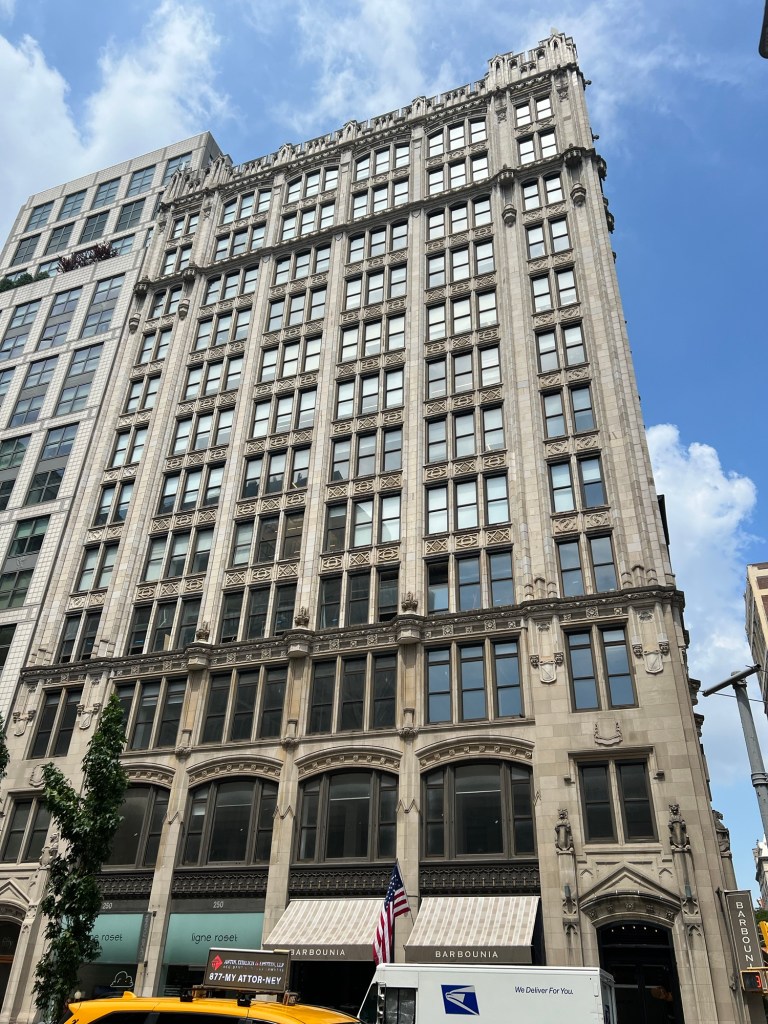
I continued up Park Avenue South to East 20th Street to see another familiar building on the border of the neighborhood, 250 Park Avenue South. This building seems to be on the border of many Manhattan neighborhoods.
250 Park Avenue South was designed by architects Rouse & Goldstone in 1911 in the Neo-Classical design. You have to look at the building from a distance to appreciate all the interesting embellishments on the sides and top of the building.
The building 16 East 17th Street was plain but I thought these lions the adorned the build were pretty cool.
The building was designed by William Dilthey and built in 1898. The building’s style, scale and materials contribute to the special architectural and historic characteristics of the Ladies Mile District (Corcoran Group).
On the way back to Union Square Park, I passed the Tammany Hall building at 100 East 17th Street that I never noticed before because it was always under scaffolding being renovated. Now you could admire it the way the architects wanted you to originally.
The Tammany Hall building 100 East 17th Street is now a Petco
The building was designed by the architectural firm of Thompson, Holmes & Converse and Charles B. Meyers for the Tammany Society political organization, known as Tammany Hall. It was designed in the neo-Georgian style and built in 1929. It was the organization oldest surviving headquarters building. After the loss of the organization’s political power in the early 1930’s, it was sold to the International Ladies Garment Workers Union and in present times has been used as a theater and performance space. It is now occupied by Petco (Wiki).
The design on the top of the building is the logo for Tammany Hall
The Society of Tammany or Columbia Order sign above the entrance on East 17th Street
From Park Avenue South Union Square East is the extension of the street that lines the eastern end of the park. At the corner of East 15th Street and Union Square East is 101 East 15th Street the old Union Square Savings Bank building.
101 East 15th Street-The Union Square Savings Bank Building/Daryl Roth Theater
The side of the Union Square Savings Bank building
The bank itself was founded in 1848 and moved to this location in 1895. This building was designed by architect Henry Bacon in the neo classical design in 1905 and the building was finished in 1906. The bank closed in 1992 (Wiki).
I walked to the small triangle of Union Square Park that sits between East 15th and 14th Streets and came across a sculpture that I had never seen before on all my walks back from NYU. Maybe I just missed it when it was dark out. It was a depiction of an urban legend of the NYC sewers.
Artist Alexander Klingspor is Swedish born artist who works both in the United States and Sweden. He apprenticed under American artist Mark English. He is known for his paintings and sculptures (Wiki).
Across the street from the park on the way up Union Square East is tucked off in the corner of the park is the statue of General Lafayette. Why this important figure of the Revolutionary War is hidden is unfortunate.
The statue of General Marie-Joseph Paul Yves Roch Gilbert du Motier de La Fayette, Marquis de La Fayette
The larger-than-life-sized figure was sculpted by Frédéric-Auguste Bartholdi, who also designed the Statue of Liberty (1886), another gift from the French government that figures prominently in New York Harbor. The granite pedestal designed by H.W. DeStuckle was donated by French citizens living in New York. (NYCParks.org).
Frederic Auguste Bartholdi was a French born artist best known for designing the Statue of Liberty. Bartholdi attended the Lycée Louis-le-Grand in Paris where he graduated in 1852. He then went on to study architecture at the Ecole nationale superieure des Beaux-Arts (Wiki).
I walked through the northern half of the park through the now busy Farmers Market again to get to Broadway. While I walked through the crowds all I kept saying to myself is ‘doesn’t anyone work anymore?’ I could not understand the large crowds on a early Friday afternoon.
When I walk through the parks in the City, all I see is twenty and early thirty year old’s sunning themselves, talking on their cell phones or chatting with friends. In 1990, I was behind a desk at Macy ‘s busy as hell all day when I was all of their ages. Things have changed in thirty years.
The Union Square Market on a busy Friday afternoon
The northern end of the park from Broadway the day of the Union Square Farmers Green Market
I began the walk up Union Square West to Broadway. The stretch from Union Square Park from East 14th Street to East 20th Street was once a major shopping district right before the Civil War and is lined with the buildings of former department and specialty stores with their cast iron fronts and detailed embellishments. In some buildings you can still see the carvings of the old companies in the design of the front of the building.
These buildings are the ghosts of Sloan’s, Lord & Taylor, Arnold Constable, McCreery’s, FAO Schwarz, and other specialty stores whose names have either disappeared or who long moved uptown closer to Fifth Avenue. The irony of gentrification and time and the location of these beautiful buildings is that they are now filling up with new upscale independent and chain merchants filling in where past merchants have left. Old New York becomes new New York again.
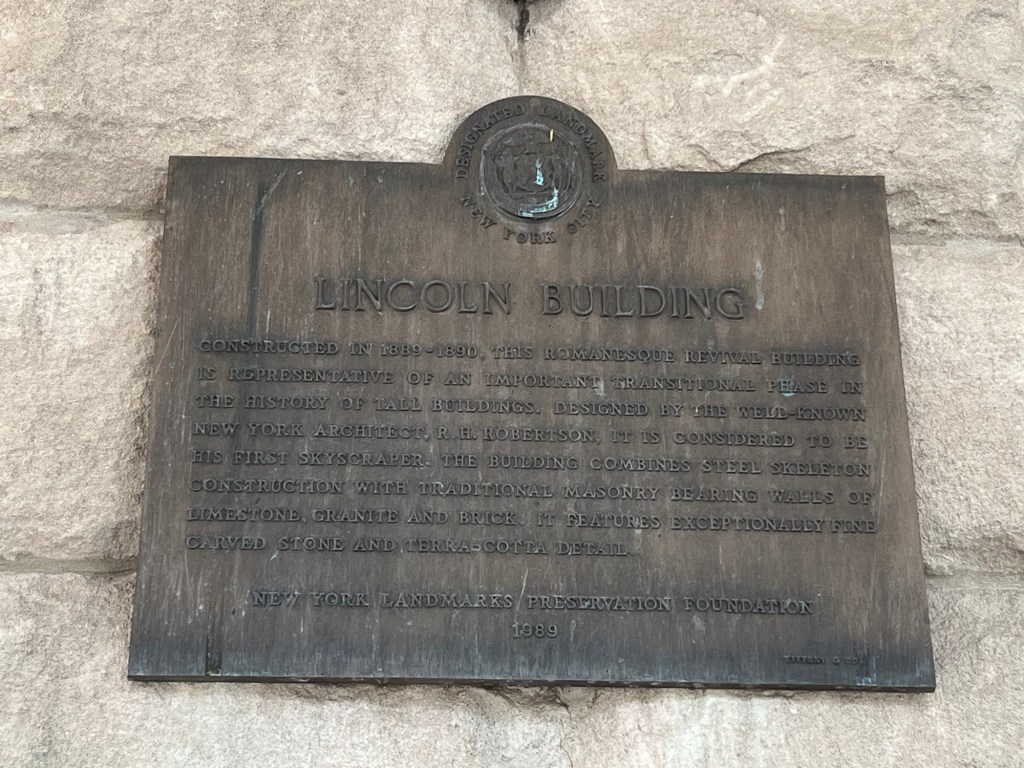
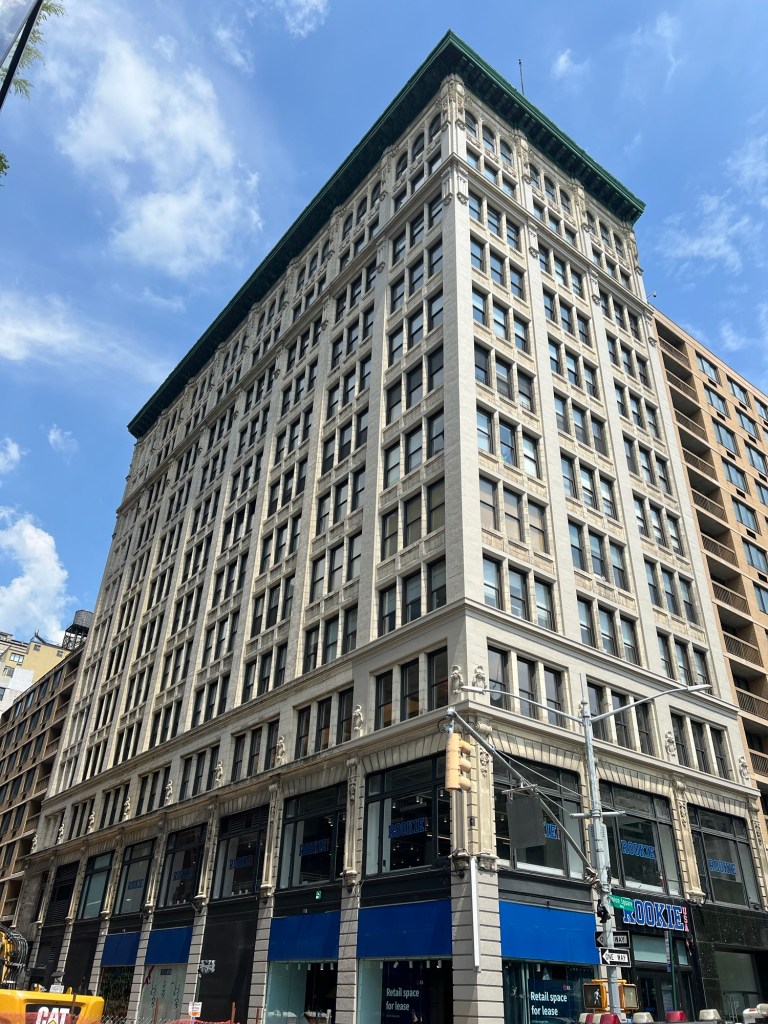
The first building I noticed as I walked up Union Square West was under scaffolding. The Lincoln Building I could not see from the street or the view from the park but was able to read their historical plaque at street level. The building was designed by the architectural firm of R.H. Robertson with a combination of steel and masonry construction in the Romanesque Revival design. The building opened in 1890 (NY Landmarks Commission).
The historic plaque of the Lincoln Building which is under renovation with scaffolding in front of it. It will be interesting to see what emerges.
There were many buildings that faced Union Square Park that gives it a historical feel. The elegant look of the buildings with their neo-Classical and Beaux Arts designs gave the park the feel of the Victorian era of business. The first was 25 East 15th Street with its interesting details.
Union Square West facing the park
25 East 15th Street was built at the turn of the last century and it now fully renovated.
The beautiful details at the top of the building at 25 East 15th Street
The next building I admired was right across the street from the park as well at 31 Union Square West
31 Union Square West built in 1902-03 as the Bank of the Metropolis was designed by architect Bruce Price and designated a landmark in 1988. This early skyscraper shows the influence of the American Renaissance sensibility celebrated at the Chicago World’s Fair of 1893 (Streeteasy.com).
The details at the top of the building
The lions roar at the top of 31 Union Square East give the top of the building a unique style
Right next door to the old Bank of the Metropolis building is 33 Union Square East which I thought looked like a Moorish castle. This building has an illustrious past.
The Decker Building Union Square West
33 Union Square East-The Decker Building
The building was built for the Decker Brothers Piano Company and was designed by architect John H. Edelmann. It was completed in 1892 and has influence of Venetian and Islamic styles in the details of the building. From 1968 to 1973, loft space in the building was used by artist Andy Warhol for his studio, ‘The Factory’. This is where Valerie Solaris shot the artist in 1968 (Wiki).
The magnificent Moorish design on the top of the building
The Islamic influences of the building can be seen in its details at the top of the structure
I passed the park and the Farmers Market and took the walk up Broadway which I have made many times on my full walk of Broadway blog. This part of the neighborhood was once the main shopping district just before and after the Civil War and many of these buildings still stand in all their beauty. Unless you are a architectural major, many people don’t appreciate the elegance of this part of Broadway and its steep history in New York City business and trade.
Day One Hundred and Thirty-Nine: Exploring Broadway blog:
The first building I admired but I have to admit never really noticed is 867 Broadway. This is a building steeped in retail history as the home of Ditson & Company, retailers selling musical instruments and books (Daytonian in Manhattan.com).
The building was designed by architect George Washington Pope and was designed in the Romanesque Revival style. The building was completed in 1882 as the top marker is carved at the top of the building. They conducted business on the ground floor of the building until 1906 when they moved to a new headquarters on East 34th Street (DaytonianinManhattan.com).
I can’t believe this building is from 1882
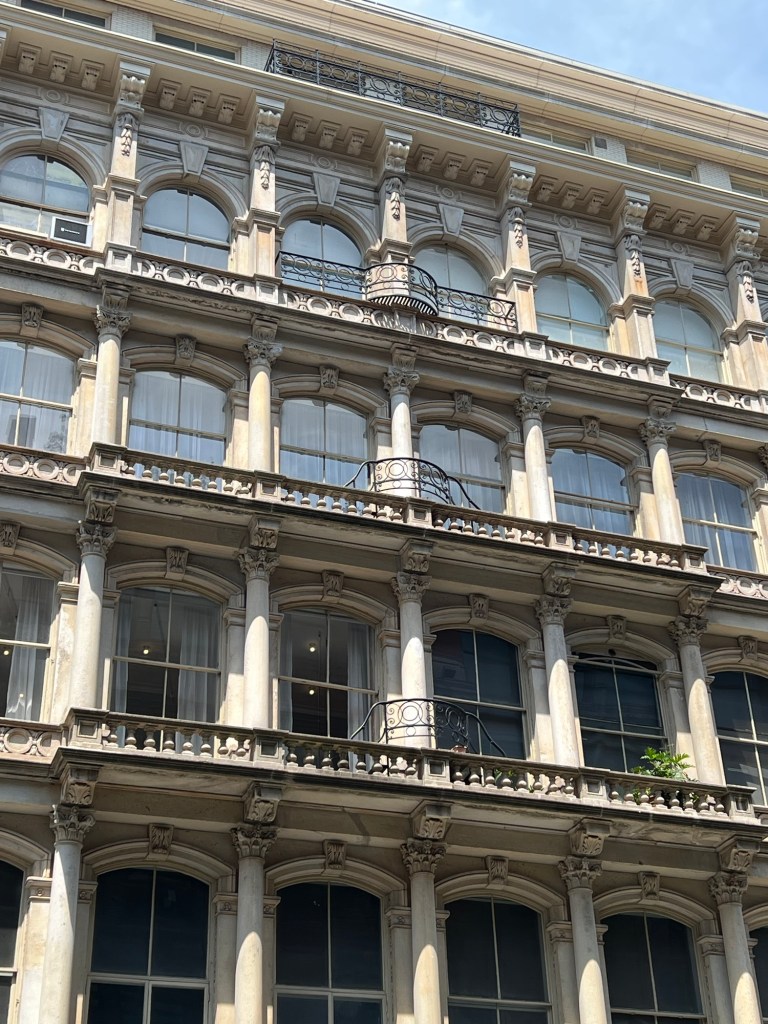
The next series of buildings have the Cast Iron design that was becoming fashionable after the Civil War at 873 and 881 Broadway. These show the change of direction of American businesses at that time there was a permanence to their business and these buildings were meant to last.
873 Broadway-The former Hoyt, Spragues & Company Department store
As Union Square gave way from being a residential district to a commercial district after the Civil War, the old homes were torn down and were being replaced by a modern shopping district. The retailer Hoyt, Spragues & Company hired architect Griffith Thomas to design this store as the new headquarters of the company on the southern corner of 18th Street and Broadway. The other half of the block was the new Arnold Constable & Company store at 881 Broadway that stretched from Fifth Avenue to Broadway. The architect designed this store as well (Wiki/DaytonianinManhattan.com).
The cast iron front of 873 Broadway and its elaborate details
Next to 873 Broadway is the Fifth Avenue extension of the Arnold Constable & Company building. The company owned this entire side of the block and was an extremely large department store for its time.
Arnold Constable & Company had outgrown its Canal Street headquarters (which still exists at 309-311 Canal Street) and moved to this new location in 1869. The store had two more expansions to Fifth Avenue in 1872 and 1876 to Fifth Avenue for both retail and wholesale businesses. The facade on Broadway was designed by architect Griffin Thomas who had designed the the Hoyt, Spragues & Company building to give a continuous flow to the block. Arnold Constable added the Mansard Room as the building was designed in the Second Empire Commercial style. The store moved to Fifth Avenue in 1914 right across from the NY Public Library (which is now the annex across the street) (Wiki).
The Mansard Roof of the old Arnold Constable building designed in the Second Empire Commercial style
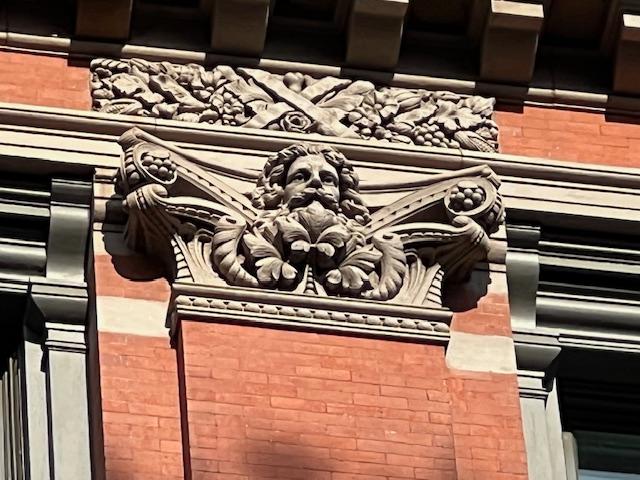
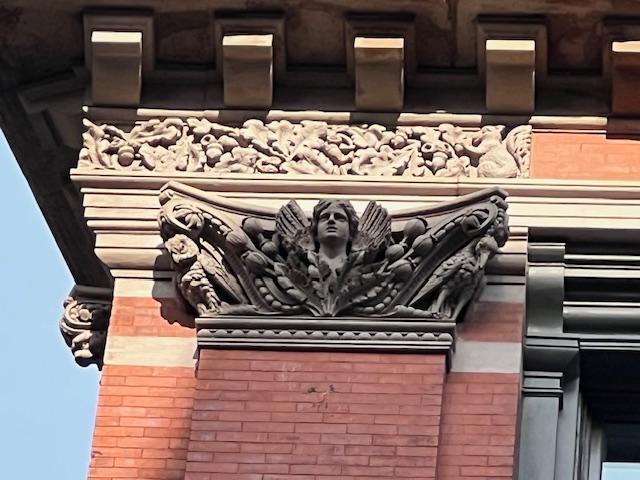
One of the buildings on Broadway that I have always admired for its details and embellishments is 889 Broadway. You really have to walk around this building to appreciate its details and the beautiful carvings and faces that stare back at you.
889 Broadway-The former Gorham Manufacturing Company Building
The beauty of 889 Broadway can be seen on all sides but you have to look at every angle of the building to appreciate it. There is all sorts of masonry and iron work around the building that gives it unique look. The building was designed by architect Edward Hale Kendall in the Queen Ann style and finished in 1884. The company moved uptown in 1905 when the retail district started to move further north (Wiki).
The cast iron and carved details of 889 Broadway
The carved faces of the embellishment of 889 Broadway
The last building in this former shopping district is the old Lord & Taylor building at 901 Broadway. This is one of the most elegant and most underrated building in the neighborhood. The problem with the building was the renovation of the Broadway side of the building throws off the rest of the design. The company used to use this building in its old Christmas window designs in their former Fifth Avenue store.
The former Lord & Taylor building is the border of the neighborhood and was the northern tip of the shopping district that expanded along 23rd Street from Broadway to Sixth Avenue. The store was designed in a Cast Iron design by architect James H. Giles. The store has one of the first steam-powered elevators in the City when it opened. This was all part of the Ladies Shopping Mile from just before the Civil War to the Gilded Age before it moved to 34th Street around 1905 (Wiki/Lord & Taylor history blog).
I made my way back down Broadway to admire the other side of the avenue and its historical set of buildings. The first was 888 Broadway, the home of ABC Carpet and the former home of W. & J. Sloan.
888 Broadway-The old W. & J. Sloan’s now ABC Carpeting
The building that now houses ABC Carpeting was once the headquarters of W. & J. Sloan. The building was designed by architect William Wheeler Smith and was completed in 1882. The store that once held floor after floor of high end rugs, furniture and decorative products for the home moved uptown in 1912 (DaytonianinManhattan.com).
The details of 888 Broadway
Next to ABC Carpet is 876 Broadway, the former D.S. Hess Building. This impressive brick building was built for David S. Hess, a decorator and furniture dealer.
The brick building was designed by architect Henry Fernbech in the Renaissance style and was completed in 1884. The details are in the panels by the doors and display window. D.S. Hess moved out of the building in 1984 to a new location on Fifth Avenue and a series of retailers have rented the space since (DaytoninManhattan.com).
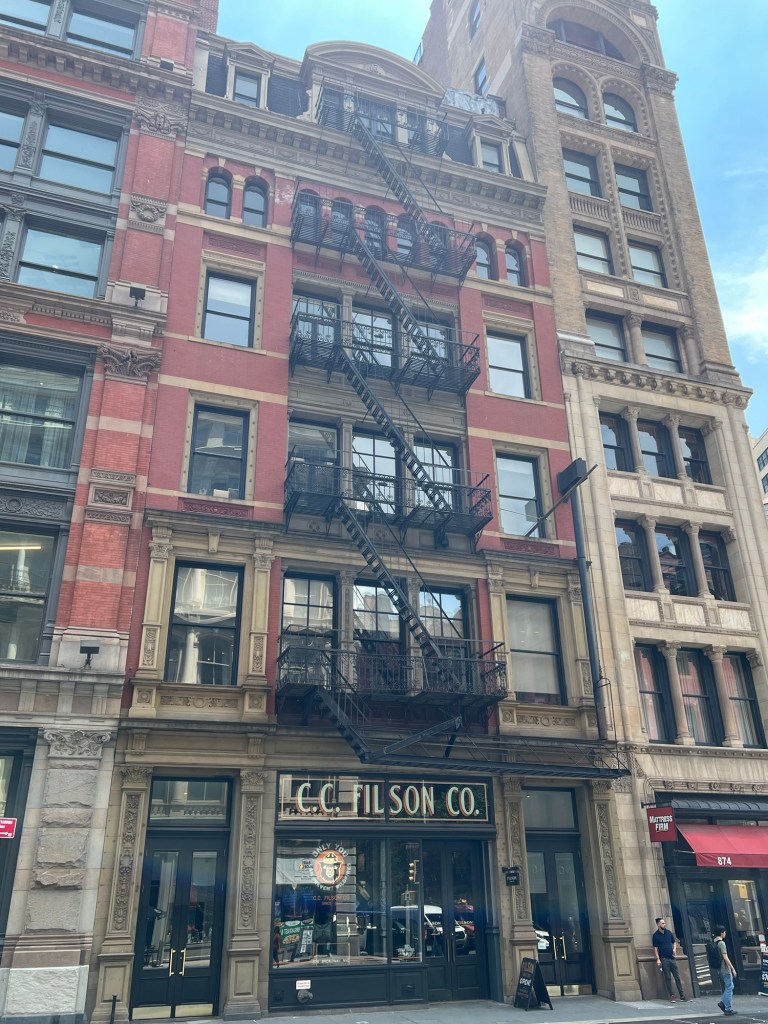
The McIntyre Building was the work of Ewen McIntrye, a pharmacist whose building had grown and had made him wealthy. He demolished the store he had on this spot and built this office building. The structure was designed by architect Robert Henry Robertson in a mixture of designs of the time. You can see Gothic Revival and Renaissance Revival and Victorian Eclectic in the design especially at the top of the building (DaytoninManhattan.com).
Broadway from another angle
874 Broadway from the front angles showing the commercial section of the building on East 17th Street
The elegant roof and details of 874 Broadway
I finished walking the neighborhood in just three hours and was able to enjoy walking around Union Square Park and just relaxing with some cold water on one of the benches. This is when I really discovered all the statuary and attributes to the park that I missed all these years. I had always been so busy passing by the park on my way to something that I never really noticed it before.
The Farmers Market was in full swing in northern section of Union Square Park when I returned and as I walked through the northern end of Union Square Park, I passed the Abraham Lincoln statue. It still surprises me that all these presidential statues survived the riots in 2020. Unlike other cities, New Yorkers did not knock down their statues.
The statue of Abraham Lincoln in Union Square Park
This impressive statue of Abraham Lincoln was designed by sculptor Henry Kirke Brown and was dedicated in 1870. In his statue of Lincoln, cast in 1868, and dedicated September 16, 1870, he combines a classically styled pose with a perceptive naturalism, uniting realistic detail with an idealistic stance (NYCParks.org).
Artist Henry Kirke Brown was an American born artist who had studied with artists in Italy for his training. He is best known for his figurative historical statues. He also designed the statue of George Washington in Union Square.
From there I strolled to the edges of the park admiring the landscaping and the work that the Union Square Partnership along with volunteers do to keep the park looking pristine. Like Bryant Park on West 42nd Street, these parks had a dark past made lighter by modern times and a new found enjoyment found in New York City parks.
I then just relaxed and admired the beauty of Union Square Park. I got to watch the sunbathers and dog walkers in the park.
Union Square Park in the late afternoon
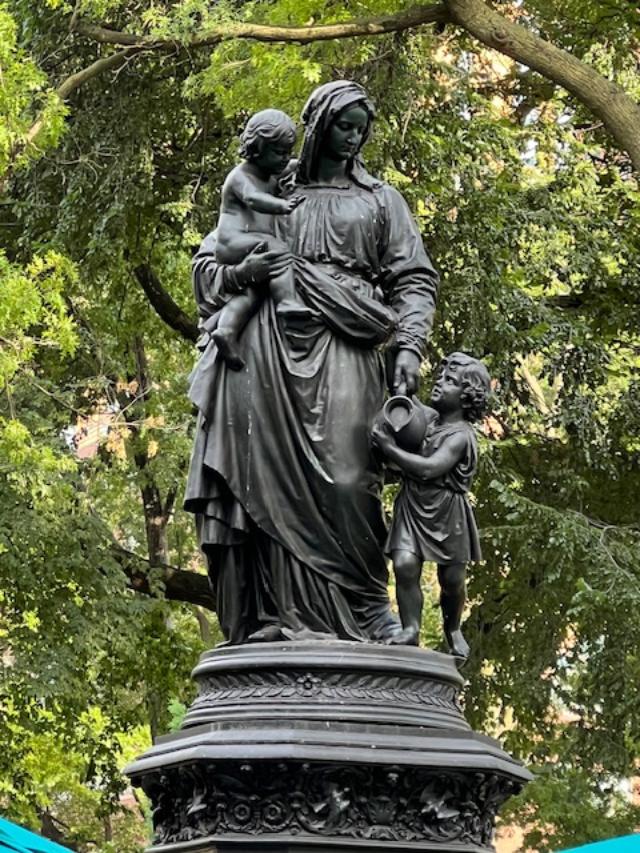
As I explored the borders of the park, I came across a statue of a mother and child. I never noticed that this was an old water fountain for the park. It is always blocked off by vendors during either the Farmers or Arts Markets. With nothing in front of it, I could finally see it in its full form.
Consisting of a bronze statuary group atop a granite stepped pedestal, it was crafted by German sculptor Karl Adolph Donndorf and donated by philanthropist Daniel Willis James to promote public health as well as the virtue of charity (NYCParks.org).
Artist Karl Adolph Donndorf was a German born artist know for his large realistic sculptures. He had served as an artist apprentice to further his education on sculpture (Wiki).
I look at where Union Square started then progressed to and then what it turned into in the late 1960’s, 70’s and 80’s and what it is today coming back to where it was before and it gives me faith in how a City keeps morphing. It has its ups and downs over time but then keeps progressing. It improves and neighborhoods find new purpose.
How I have seen this neighborhood change from the 1980’s to today is a gap as large as the Atlantic Ocean. The twenty year old’s today can not imagine what I saw in this park when I was twenty. It is night and day. This shows the resilience of Manhattan and of New York City and how with each year it reinvents itself. I can only imagine the neighborhood in 2030 and what we will see then.
It will be fun to find out.
The other blogs on the Union Square neighborhood:
Day Three Hundred and Thirteen: Walking the Borders of Union Square:
I have been coming to Coney Island since 1970 and I have to say that it is still has a grittiness to it even while other parts of Brooklyn have been under hyper gentrification. There may be lots of building going on around the amusement area but still there is a feeling of edginess to it around each corner and as you leave Surf Avenue to walk the side streets.
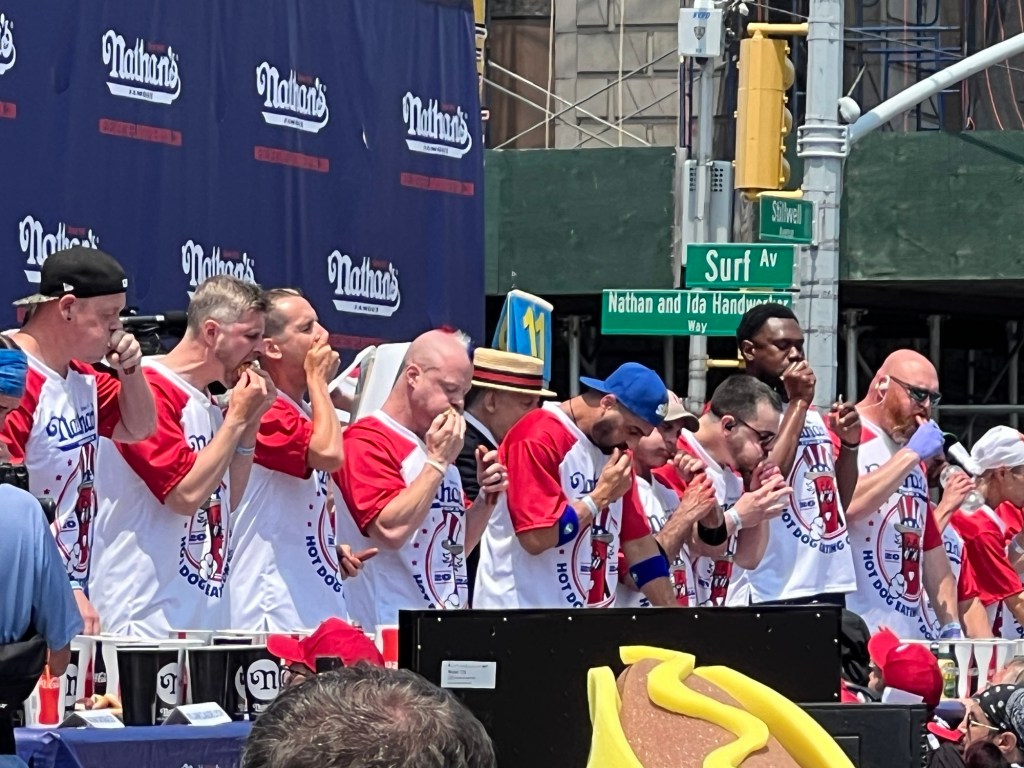
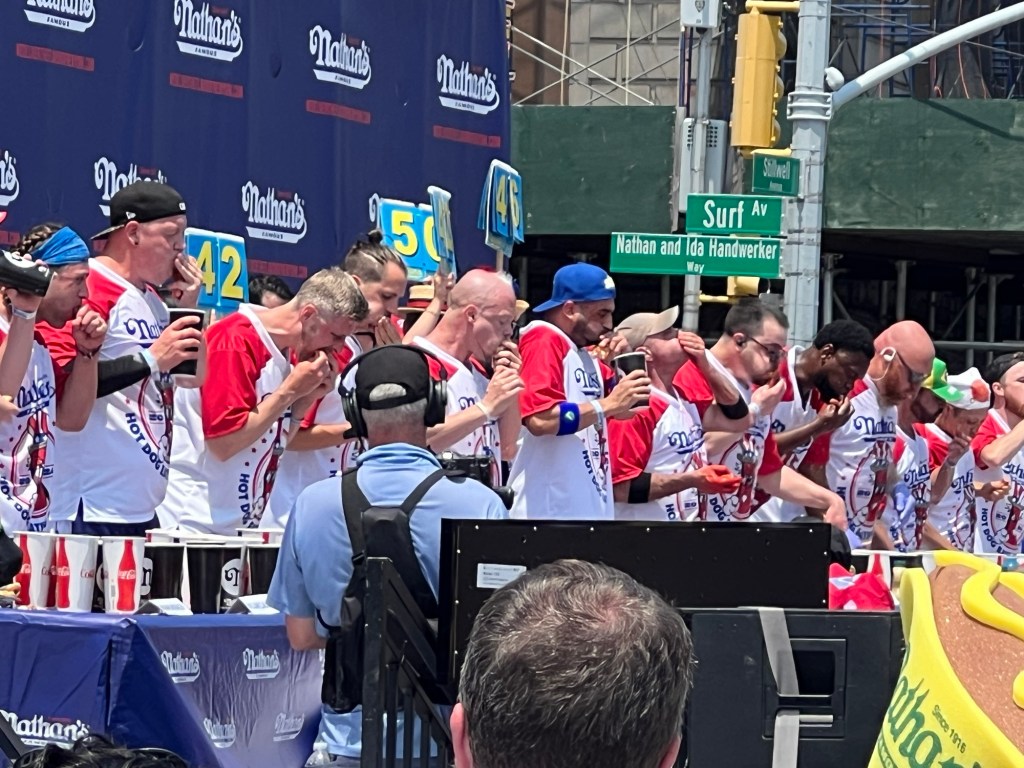
Arriving in Coney Island in the morning for the Nathan’s Hot Dog Eating Contest
I had to leave the house early to take the bus and then the subway to Coney Island. The internet said that the Women’s Contest started at 10:30am and I wanted to get in the viewing area before that. Thank God, the City was quiet and both the bus and subway were right there when I needed them. Talk about timing.
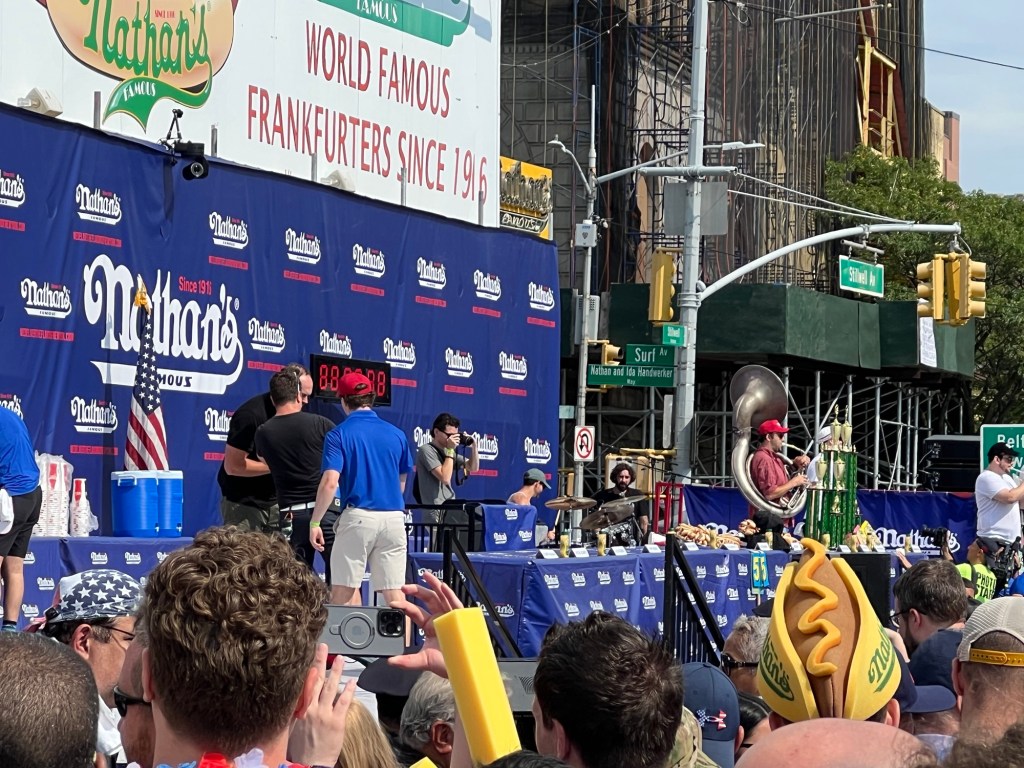
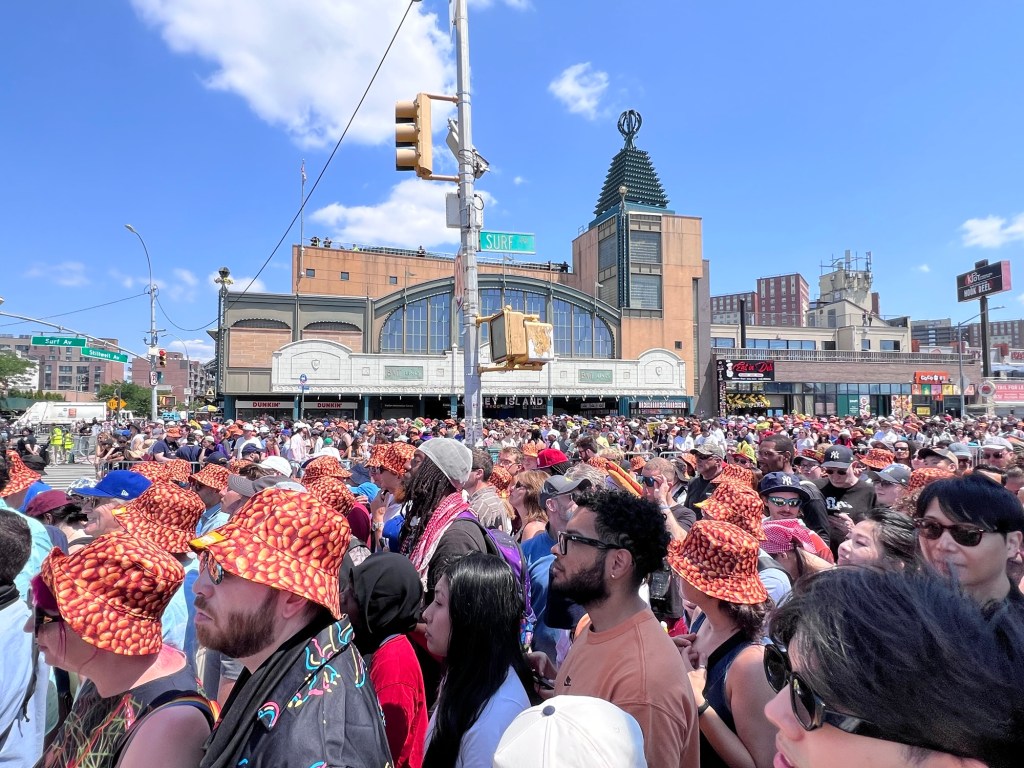
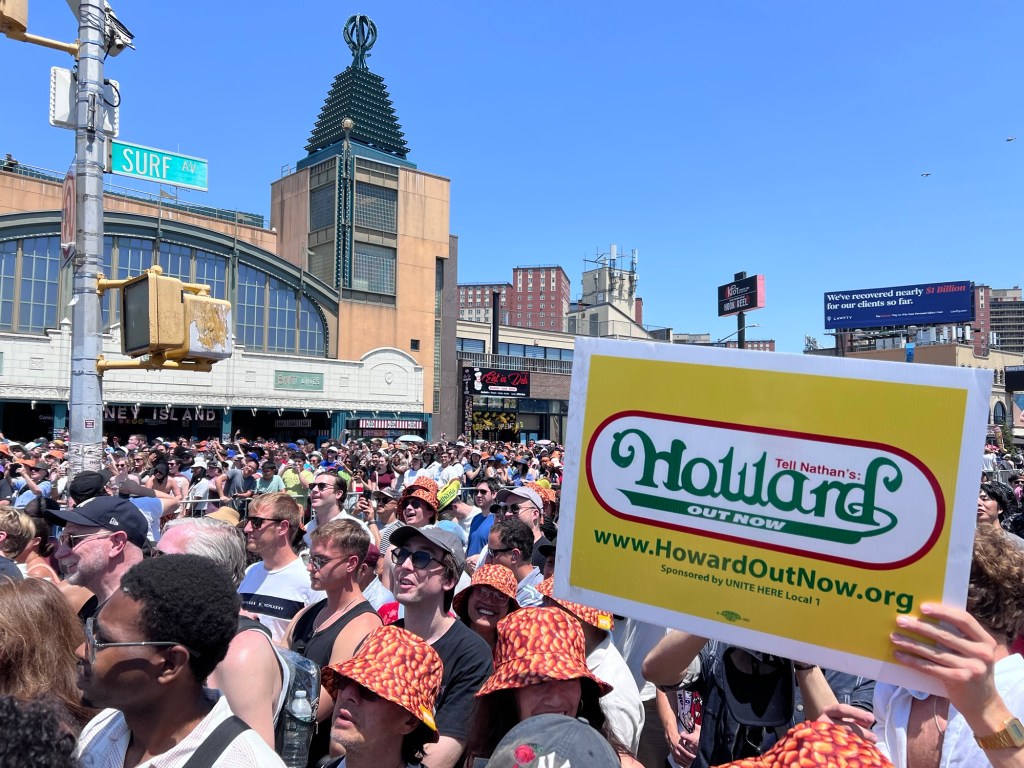
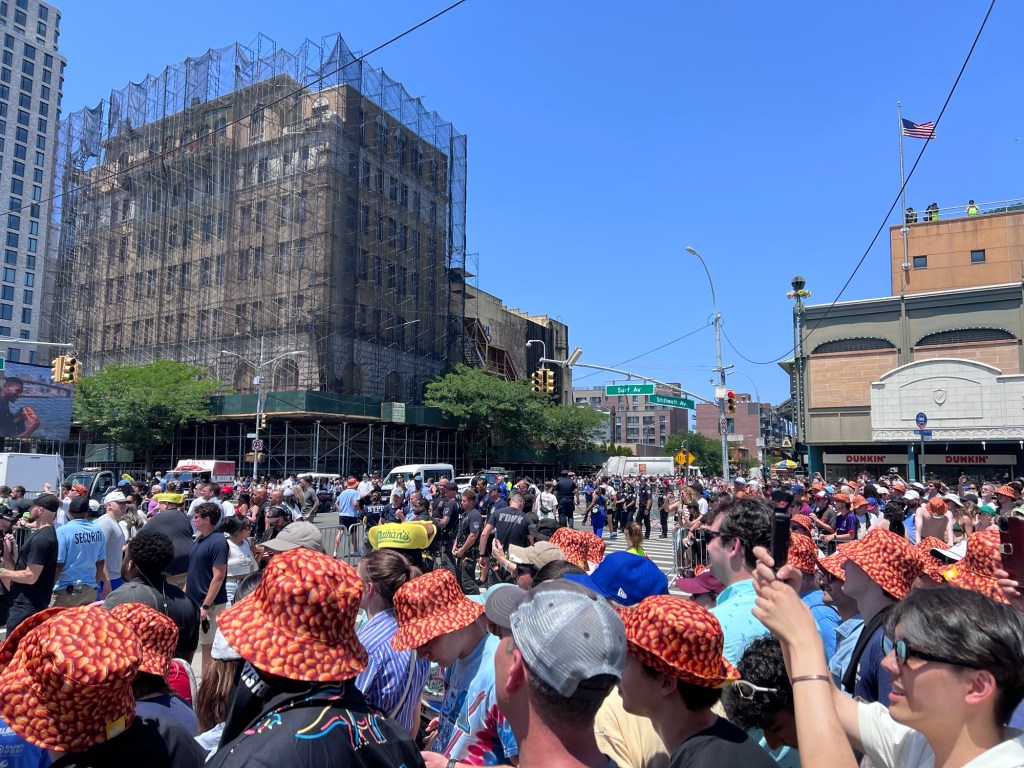
I lucked out for the hot dog eating contest. I thought it was going to be cloudy all day and it ended up being a very sunny and pleasant morning when I got there. The crowds had not been that big when I arrived so I got a good spot near the stage that was perfect for taking pictures. The only problem was the women’s contest did not start until 11:00am. The entertainment was very good and kept the crowd engaged.
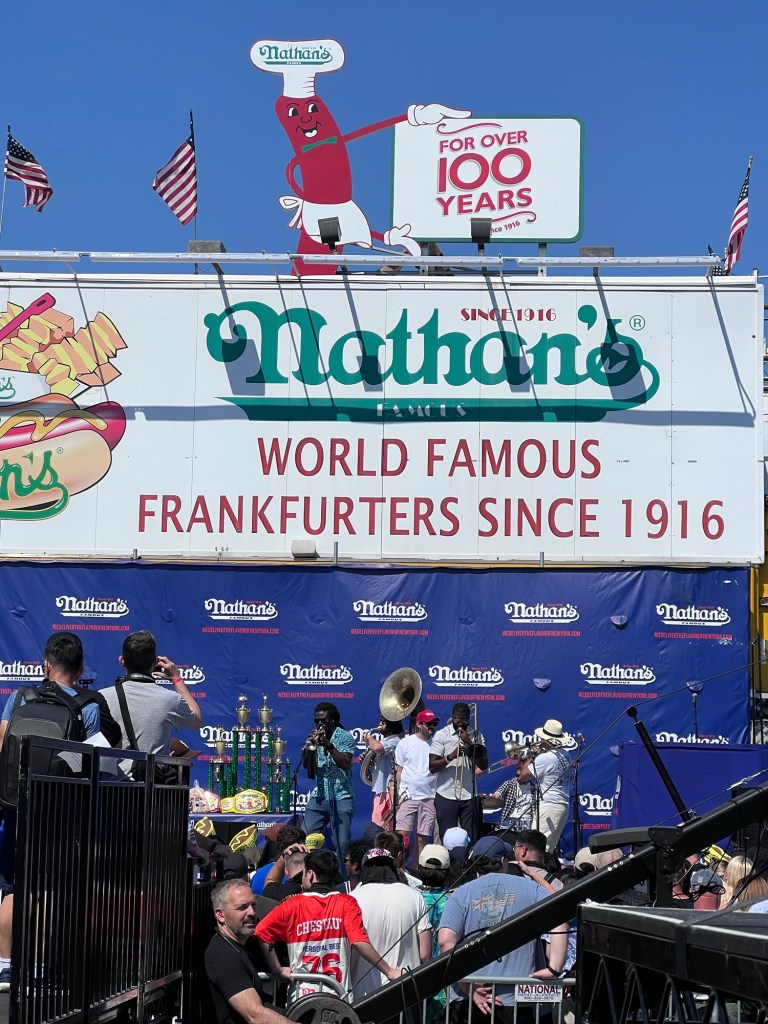
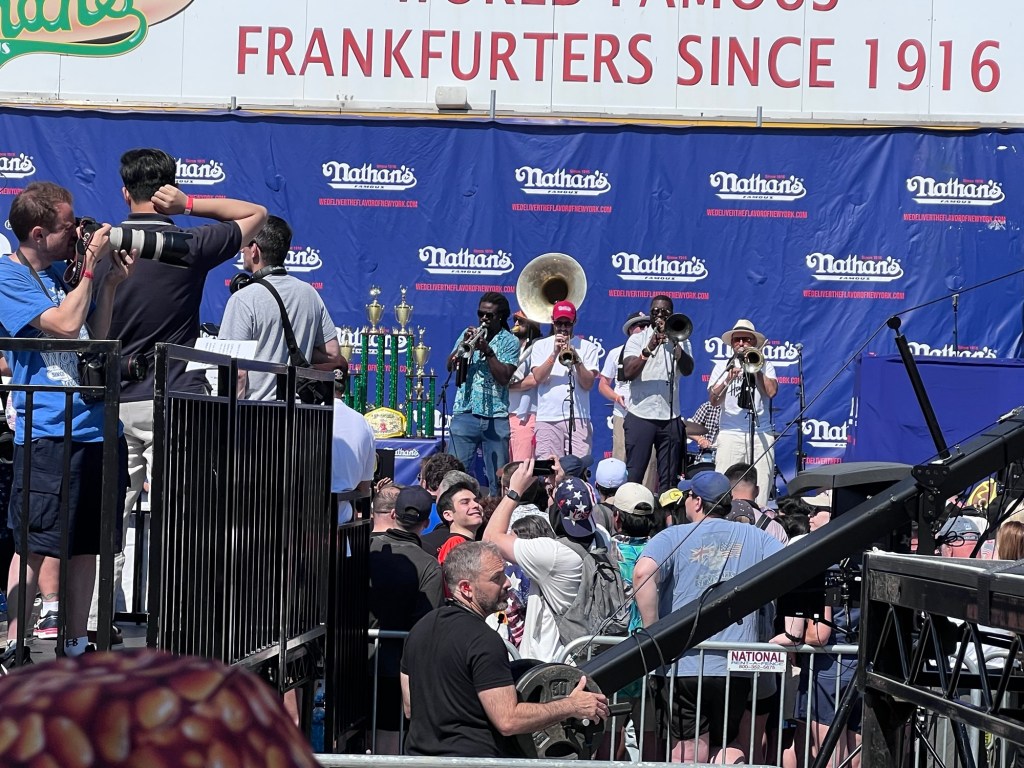
The band kept everyone pumped before the contest began:
I got close to the stage and being tall I was still able to get great pictures and view the contest up close. Trust me when I say that people take this contest very seriously and there is a lot of pomp and circumstance to all of this. Last year’s female winner, Miki Sudo, the woman from Japan and the 2021 winner all looked very determined to win this year. These woman had looks on their faces (and I mean all of them as I was close enough to all of them when they announced their names) that they were there to win!
Nathan’s was the place to be on the 4th of July
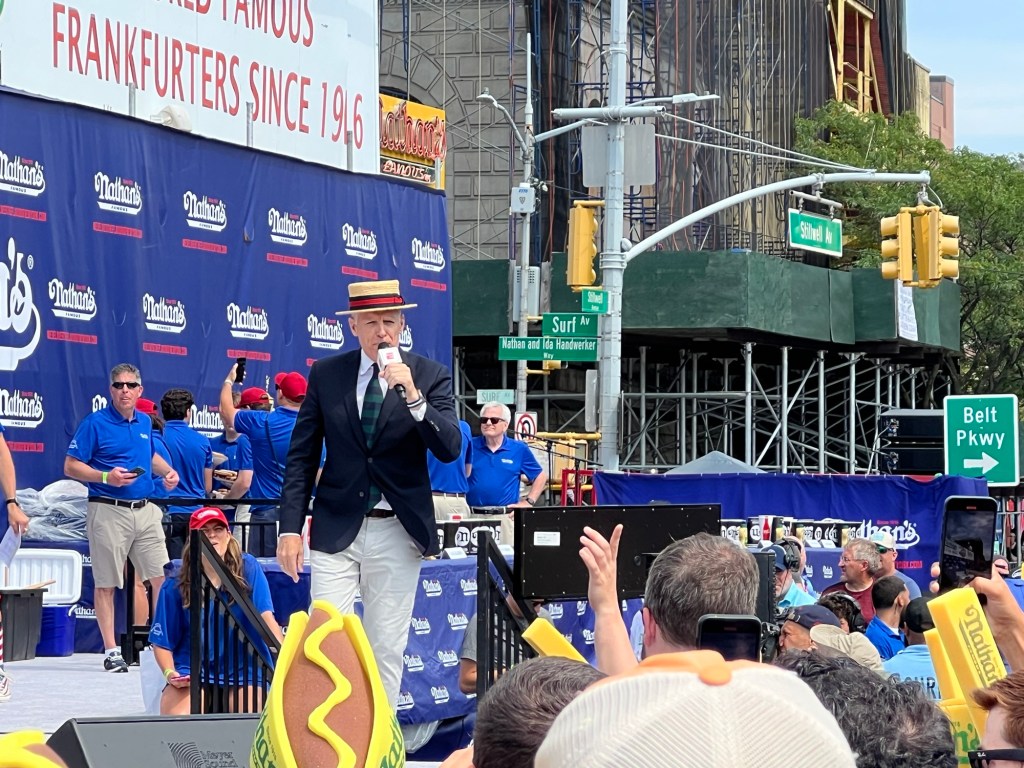
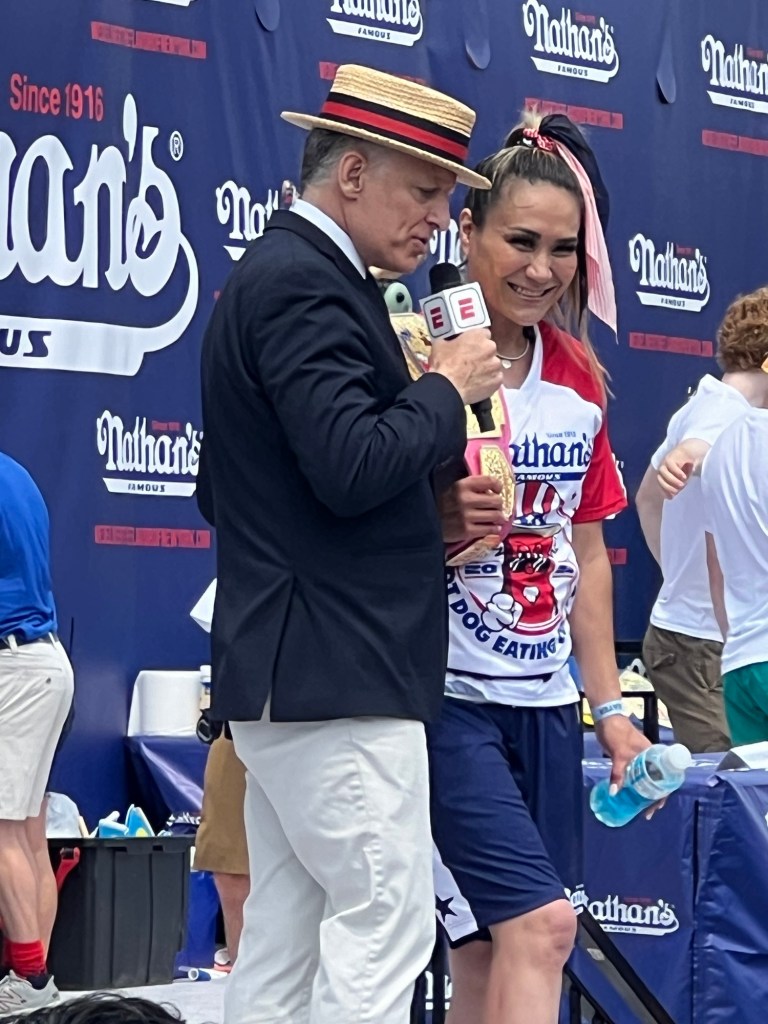
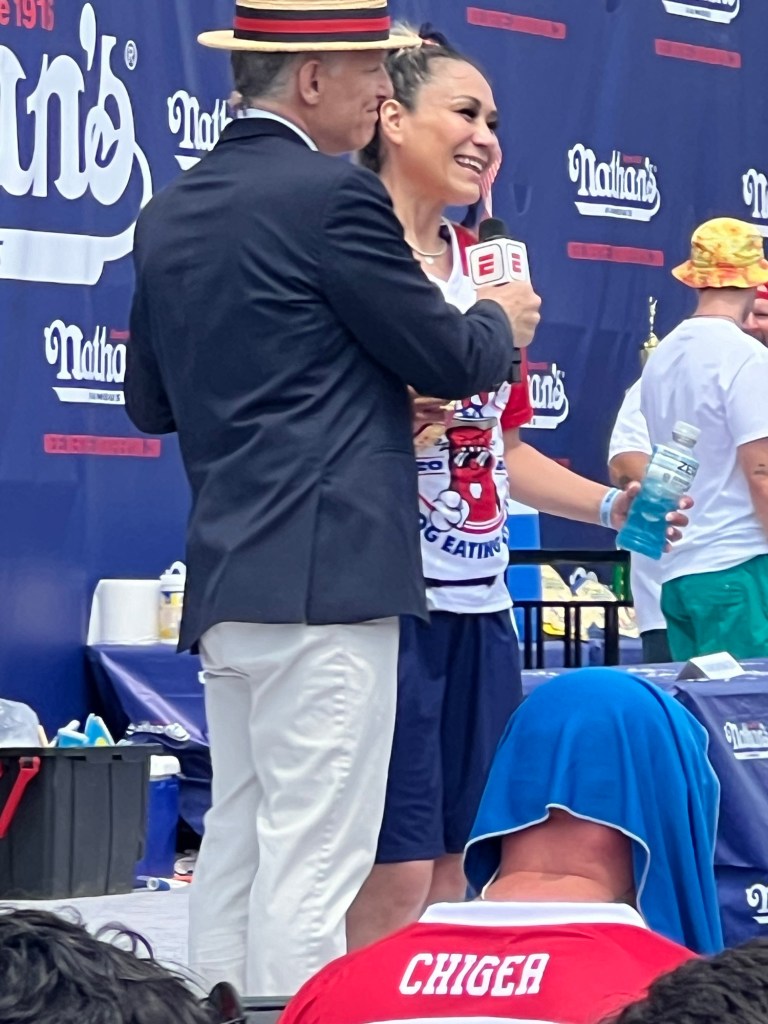
The MC for Nathan’s, George Shea, has been doing this for a long time and I could tell took this contest just as seriously as the contestants. He was just as engaged with the crowd as he was with the contestants and made sure between the entertainers as well as the contestants had a good time.
The MC for the afternoon George Shea
The MC had started out by saying that Joey Chestnut would not be coming this year because of endorsement he made with an all natural vegetarian hot dog and he did not want a conflict. I read later that you as a contestant must pledge their support to Nathan’s Hot Dogs, which I believe is true. It also opened the contest to a new winner which made the Men’s Division so much more exciting.
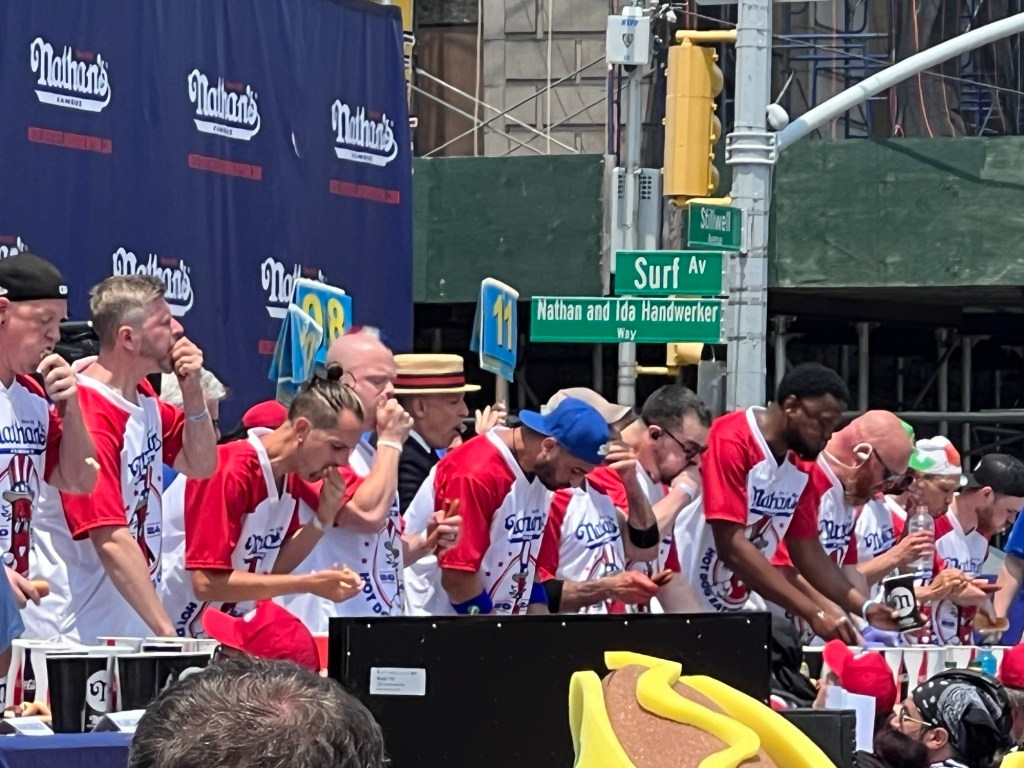
After the speeches, announcements and entertainment were over, it was time to eat and they started the Women’s Division first. Most of these women were pretty thin and well-built in their category and most were competitive eaters. Some had won numerous contests that I could never win let alone contemplate ever participating in. What it could do to your health would worry me but that did not take the fun out of the contest.
We started the contest with the National Anthem and these two annoying hot dog mascots who were always in the way of our shots.
Then the Bugaboos came out to perform and work he crowds before the women made their entrance
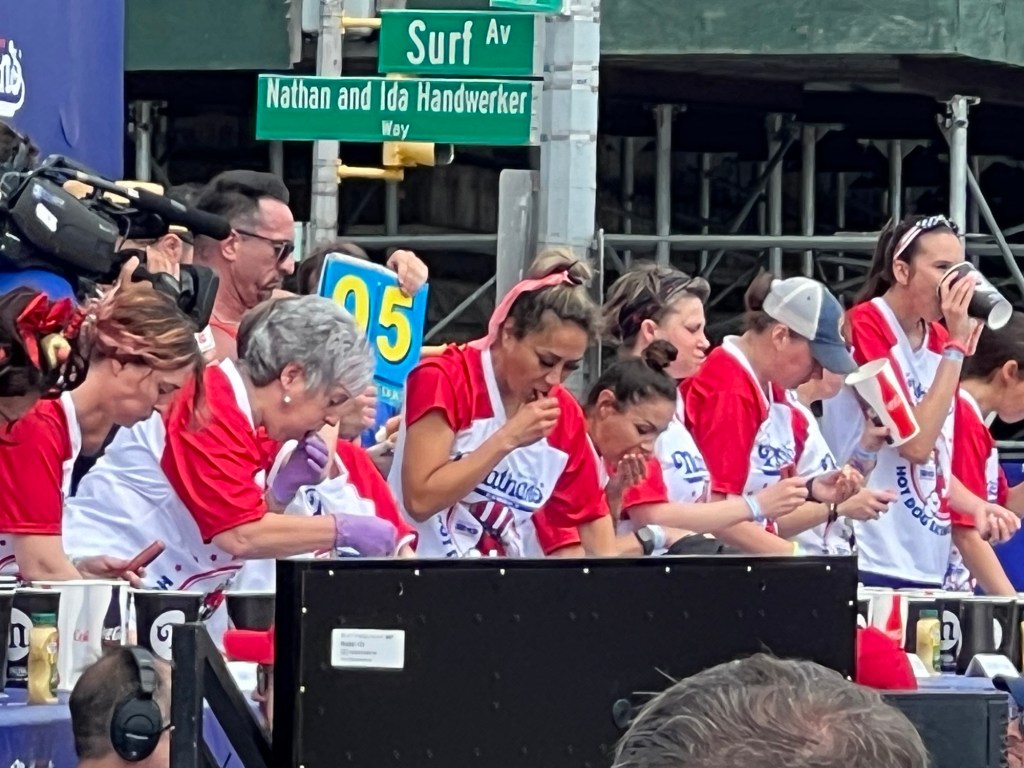
Then the women came out and their names were announced like prize fighters coming into battle. Some of these women were serious eating champions of things like Mac and cheese and strawberry shortcake. I was impressed as I could never do that.
The women’s Division before the start of the contest
There was a lot of anticipation between the returning champion, Miki Sudo, the Japanese competitor and the 2021 champion. This was serious competition. The top three competitors were going to go at it.
The returning champion thrilled to have won the title again
Reining Champion, Miki Sudo, ate a record 51 hot dogs to keep the Women’s Division title
Winner Miki Sudo giving the crowd a welcoming speech on their support
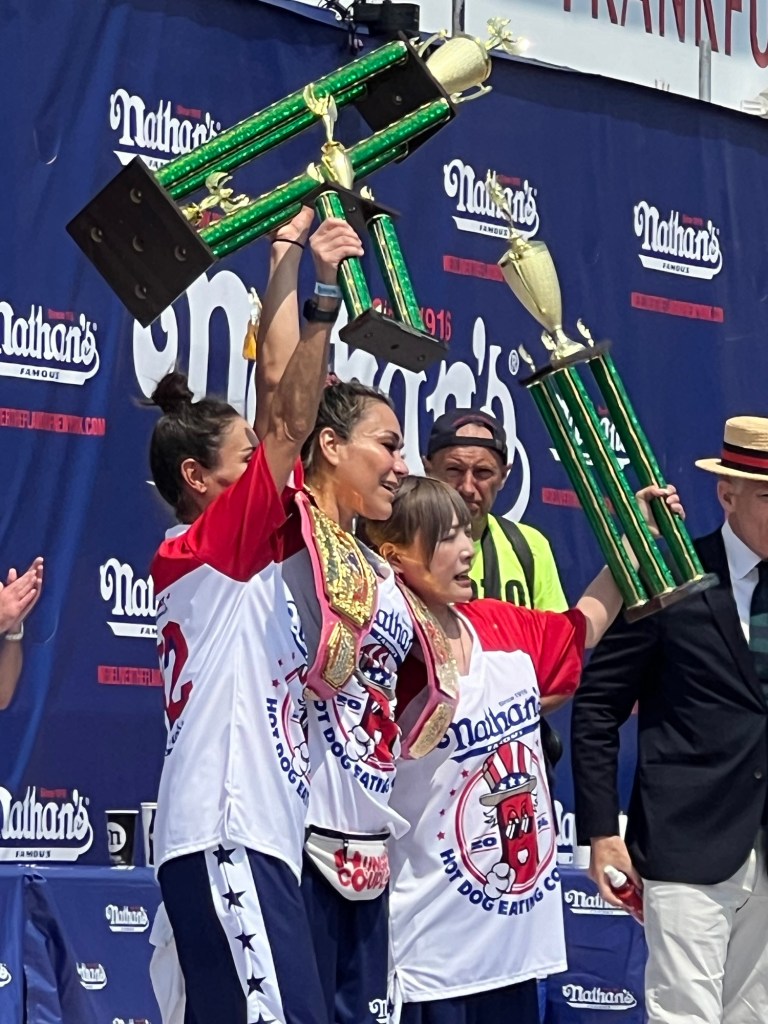
The women showing great sportsmanship at the end of the contest holding their trophies and the pink belts
Then it was time for the Lemonade Chugging Contest. There was one guy who was the raining champion and he was about 400 pounds. I do not know how anyone could beat him.
The men and women of the Lemonade Chugging contest
Then they were off and running. After it was over one poor guy got so sick they had to delay the men’s competition just to clean up. So they brought back the entertainment and we were delayed by twenty minutes. Once they were cleaned up and reset, they brought out the Men’s competitors like the ladies. Who won what eating contests in the past and the ranks they fell in the world competitions were announced as they entered the stage area.
I have never heard of most of these competitions but these guys won dumpling, mac and cheese, hot peppers and chicken wings like pros. They were also announced like prize fighters and again almost all these guys were in excellent shape.
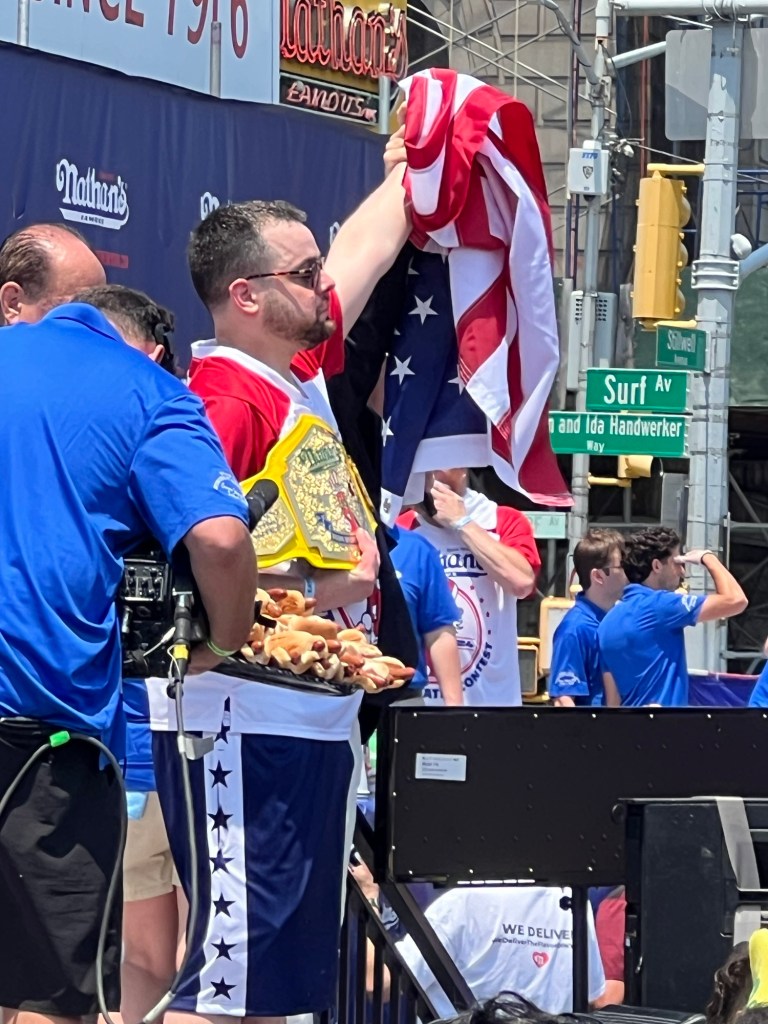
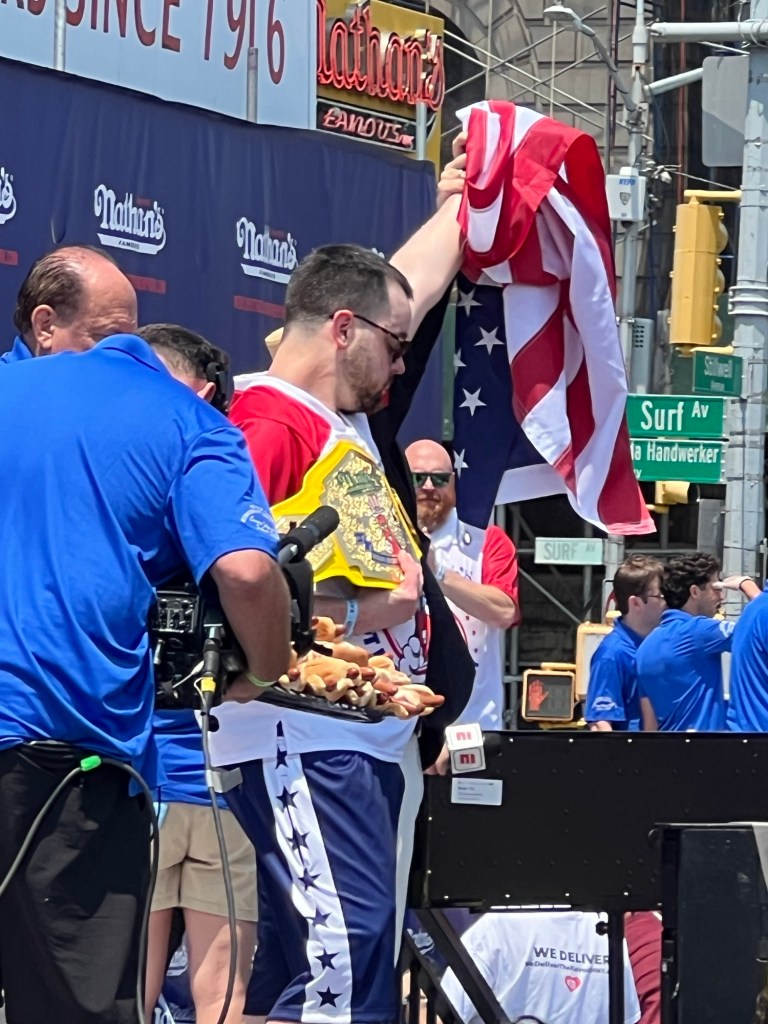
It was almost a photo finish how it went back and forth in this contest but only one winner prevailed and that was Patrick Bertoletti with 58 hot dogs. The other guys put up the battle but he just steamrolled ahead of the competition.
The winner Patrick Bertoletti holding the flag
The proud winner after the interview holding the ‘Mustard Belt’
After the competition was over, Nathan’s was mobbed with people ready to eat their own hot dogs and I did not feel like dealing with that crowd, so I waited until the crowds died down. I went to walk around the amusement park area and see what was going on there. The place was mobbed with people after the contest and people still arriving to Coney Island by subway.
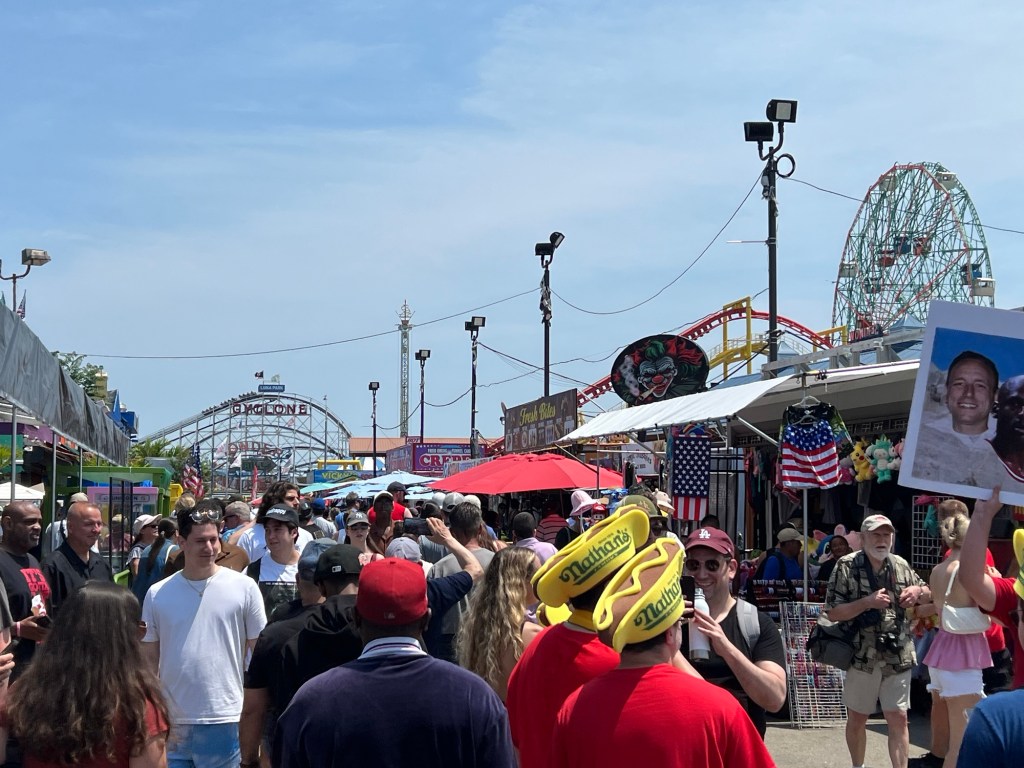
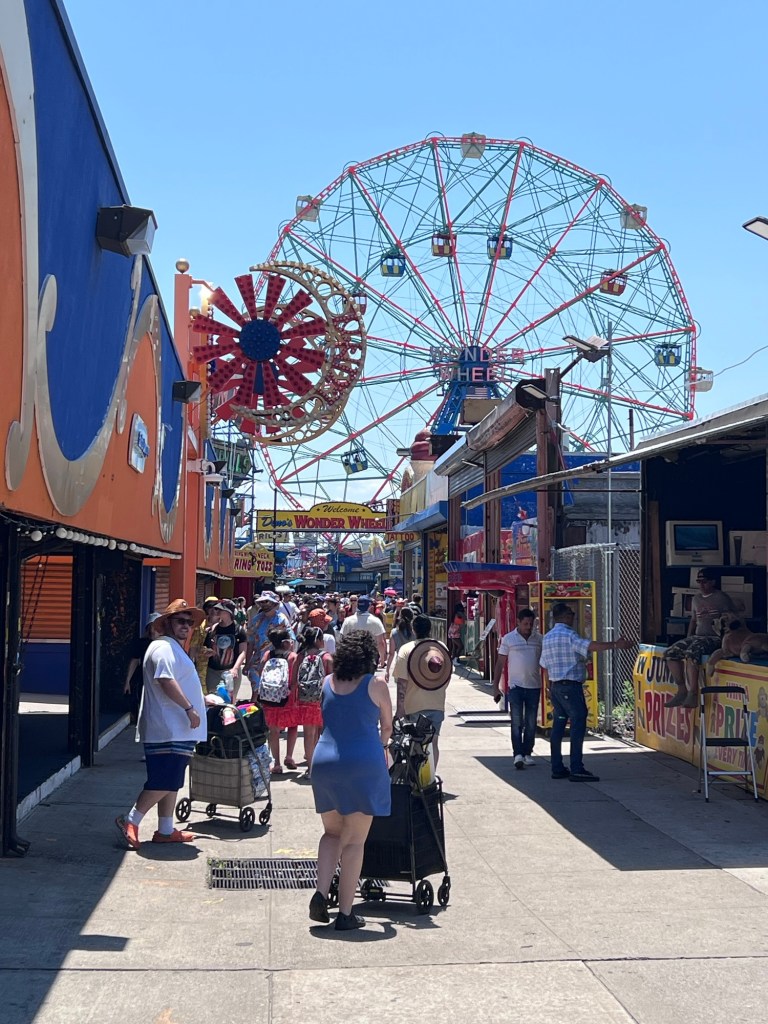
The crowds on the Midway by Deno’s Wonder Wheel Amusement Park
People still walked around with their foam Nathan’s hats on around Coney Island
I waited on lunch and took a tour around the amusement area which was mobbed after the contest. Deno’s had lines I had not seen before and families waited patiently to get on the Wonder Wheel and into the Haunted Mansion.
This was just a small glimpse of the growing lines at Deno’s Wonder Wheel Amusement Park at 3059 West 12th Street
What amazed me was the amount of tourists versus the locals that I saw and heard in the crowds. It is nice to see the tourists rediscover Coney Island again. Even walking along the Midway with the new Luna Park in the distance, it still has that rough feel about it. I sometimes wish they would do more with Surf Avenue as it really does look unattractive. Nothing like the pictures from 1910 when the amusement area was at its peak in Coney Island innovation.
I then made my way to Luna Park, which was a little quieter than Deno’s. I keep thinking is because Deno’s has more adult rides where Luna Park is more geared to kids and families. The space they have in both parks limits both the types of rides they offer and how far they can expand.
We discovered that when my graduate school paper in Customer Relations from NYU on Luna Park discussed these challenges and those of the ‘Harvest Fest’ Halloween event and the first ‘Frost Fest’ during Christmas time. Our group visited the park to experience what Luna Park had to offer:
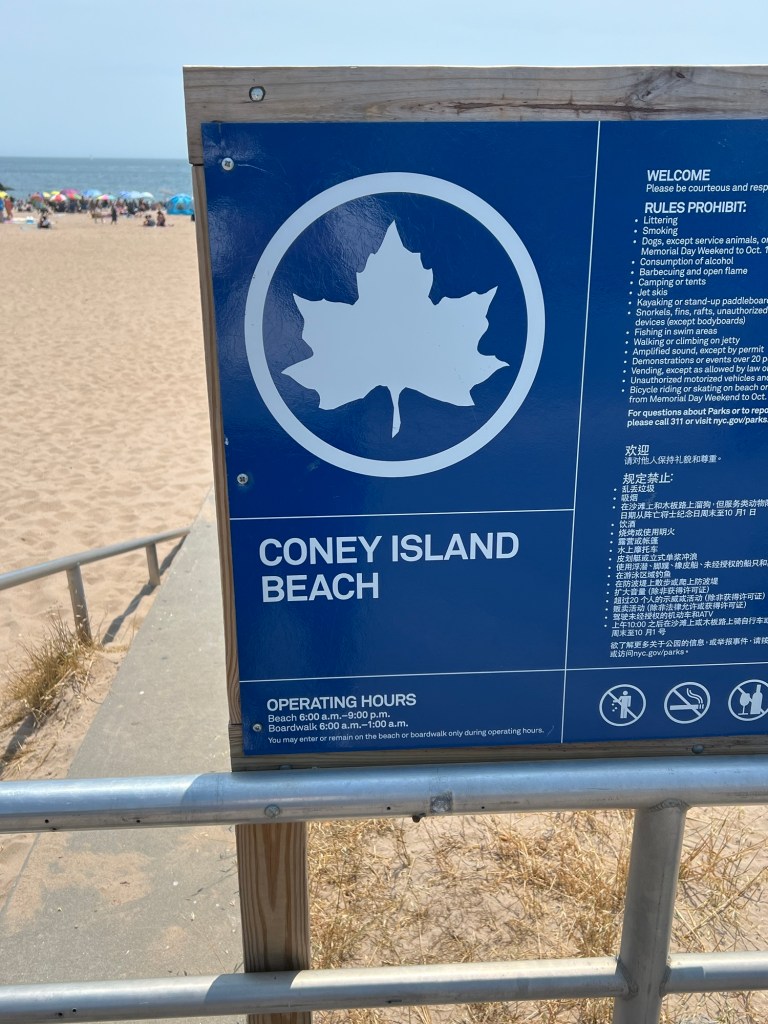
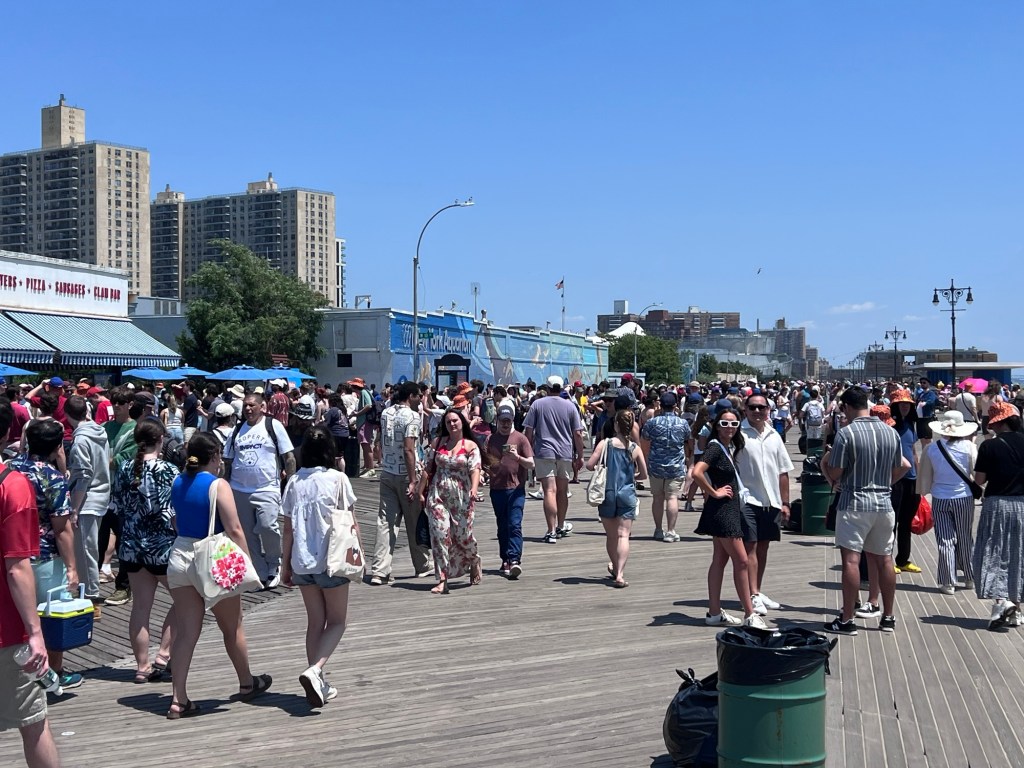
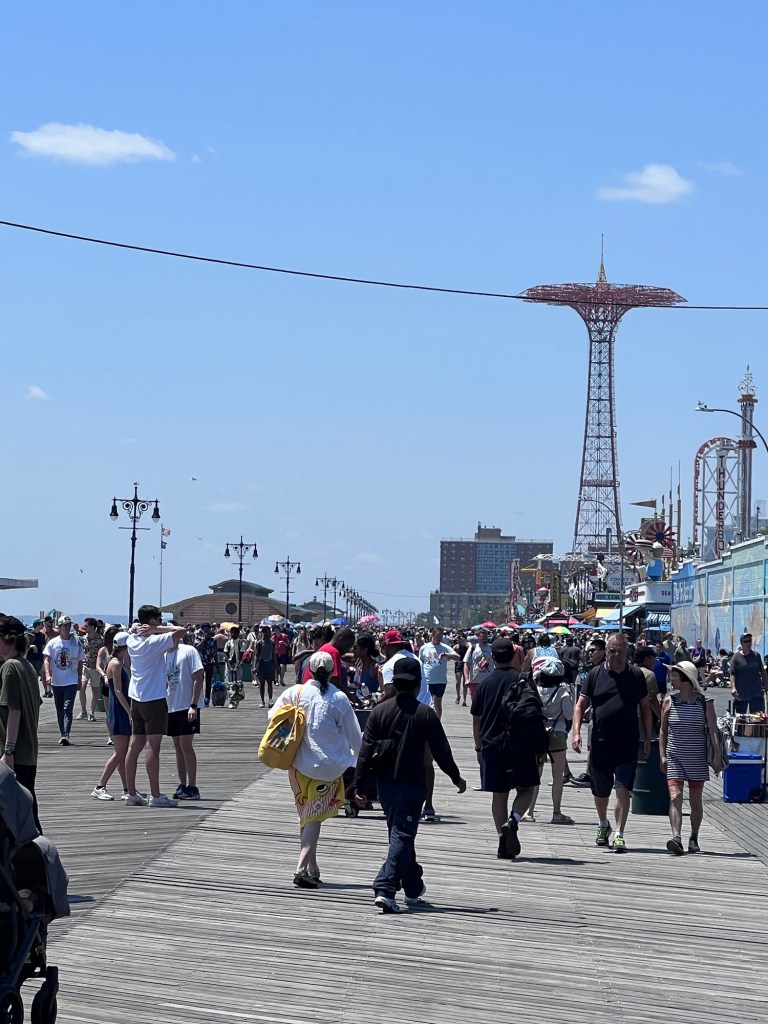
After taking a walk through both parks and dodging the crowds, I took a walk on the Boardwalk and headed to the aquarium before lunch. I love the characters on the Boardwalk. People were doing everything from barbecuing and selling food to singing, playing disco and salsa music and dancing to showing off their giant snakes (ugh). Everyone was having such a good time on the 4th of July and it showed.
There is nothing like the Coney Island boardwalk
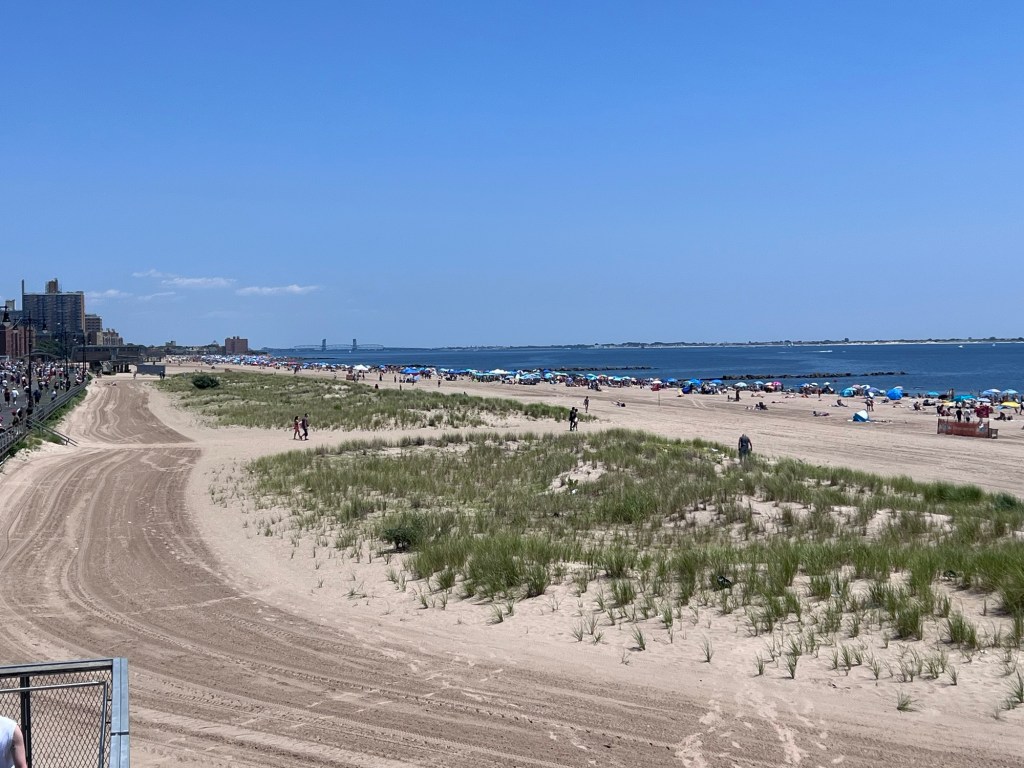
The beach was busy but not as packed as I thought it would be on the 4th of July. I remember seeing pictures of the beach in the 40’s after WWII and there was no place to move. There are some old movies of what Coney Island was like in the 1940’s and 50’s where you could not move on the beach. Even at the turn of the last century with work rules changing, ocean bathing became a new nation phenomenon even in 1904 (how bathing suits have changed!):
Dancing the “Cake Walk” on the beaches of Coney Island
The Coney Island beach started it all. Sun bathing got its start on this beach
Not as busy as I would have thought but the day had not started yet
I headed over to the New York Aquarium for the afternoon. I wanted to see the seal show and walk around the shark tanks again. The aquarium like the rest of the boardwalk was really busy but this was filled with families escaping the heat of the beach and the boardwalk with airconditioned buildings and nautical displays.
The New York Aquarium at 602 Surf Avenue has gotten much better since Hurricane Sandy. The aquarium has upgraded itself since the flood
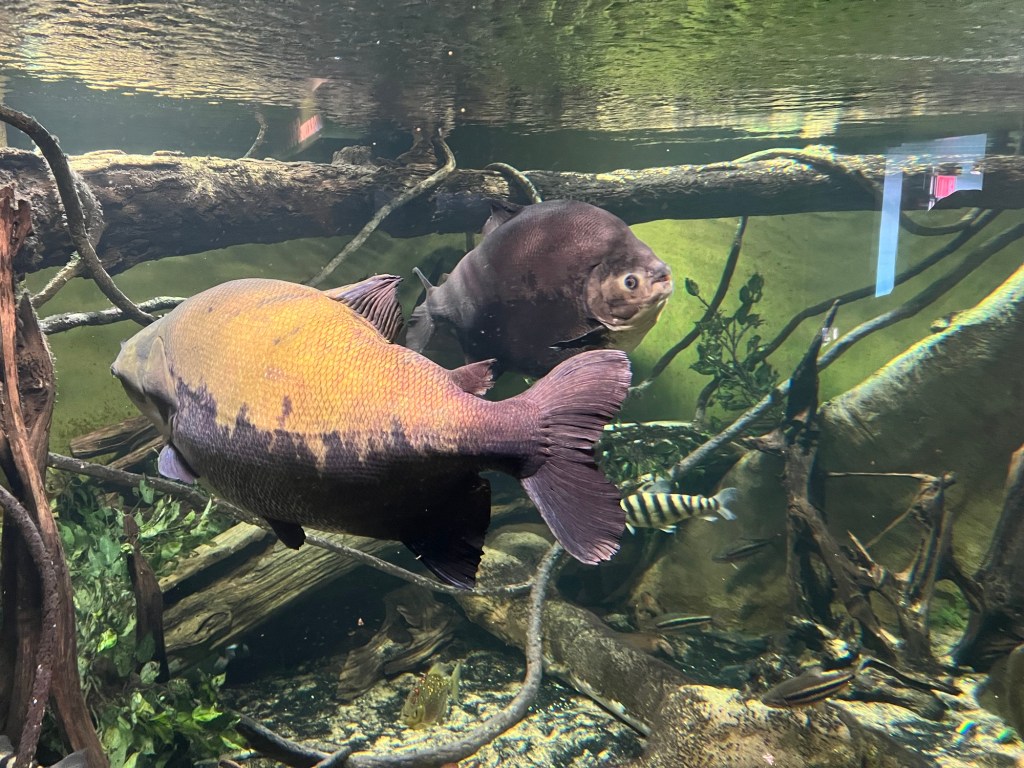
The New York Aquarium is one of the reasons why I joined the Wildlife Conservatory again. I love the seal shows and walking around the ‘Spineless’ exhibition and watching the jellyfish move around. This aquarium is so different in feel than the Jenkinson Aquarium on my recent visit to Point Pleasant. Just a different set up and way to approach the animals. The first part of the aquarium you enter is the coral reef displays.
The coral reef exhibition at the aquarium shows what a healthy reef should look like in the ocean
The fish passing by in the reef
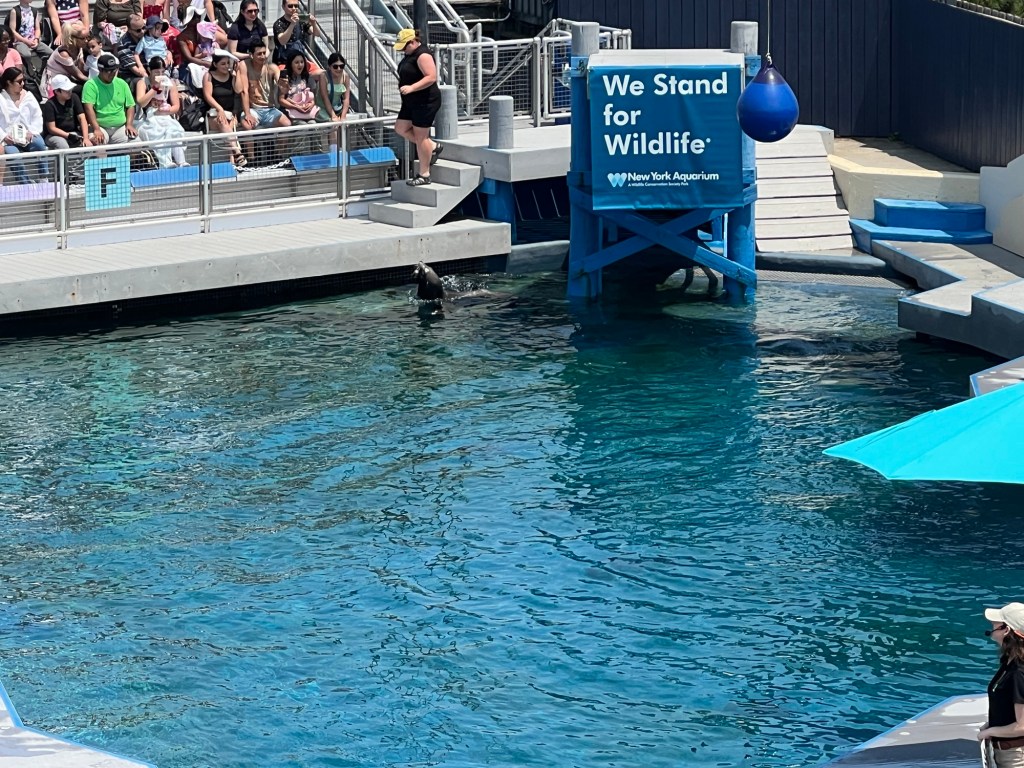
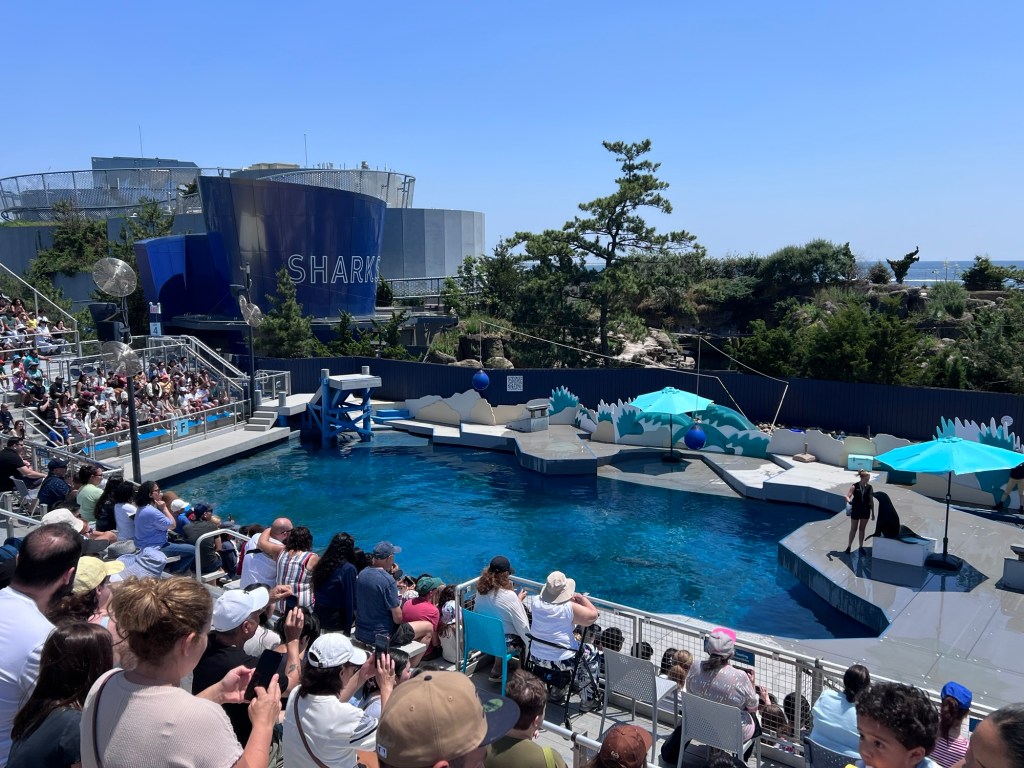
I got there as the seal show was starting. The seals in the show were both born at the aquarium so they only know life in captivity. Sometimes I think they do have a bit of a New York attitude.
The Seal Show at the New York Aquarium
The show was mobbed with people watching the seals do all sorts of tricks but I could see very disciplined animals just having fun with the crowd. It also gives them a bigger tank to move around in.
The seals know when to ham it up
The seals that live at the aquarium were born here and are native New Yorkers
The seal and his trainer welcoming the crowd
Good communication
The seals perform like pros and react beautifully with their human trainers. There seems to be a real bond here
I think it is an excellent way for humans to understand other mammals
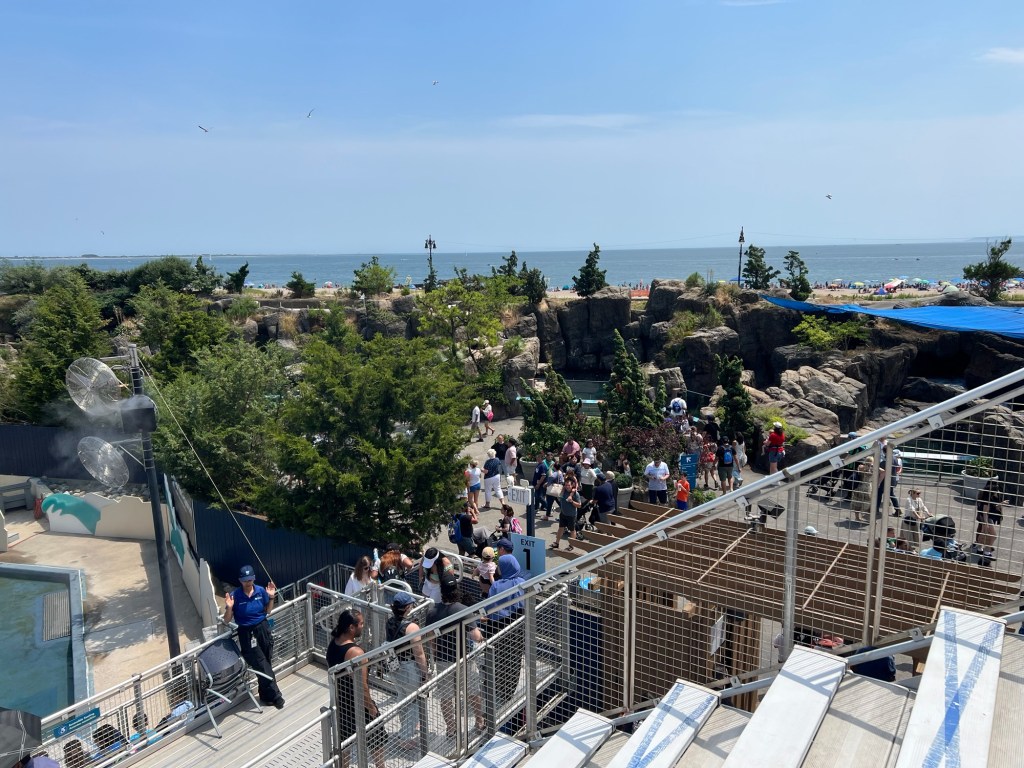
This is one of the best parts of the aquarium to experience on a nice day. The breezes are fantastic, the seals are so talented and the staff take such good care of not just mammals but the performance area, making it comfortable for everyone. You have to see the show at least once.
The view of the aquarium and beach from the top of the theater
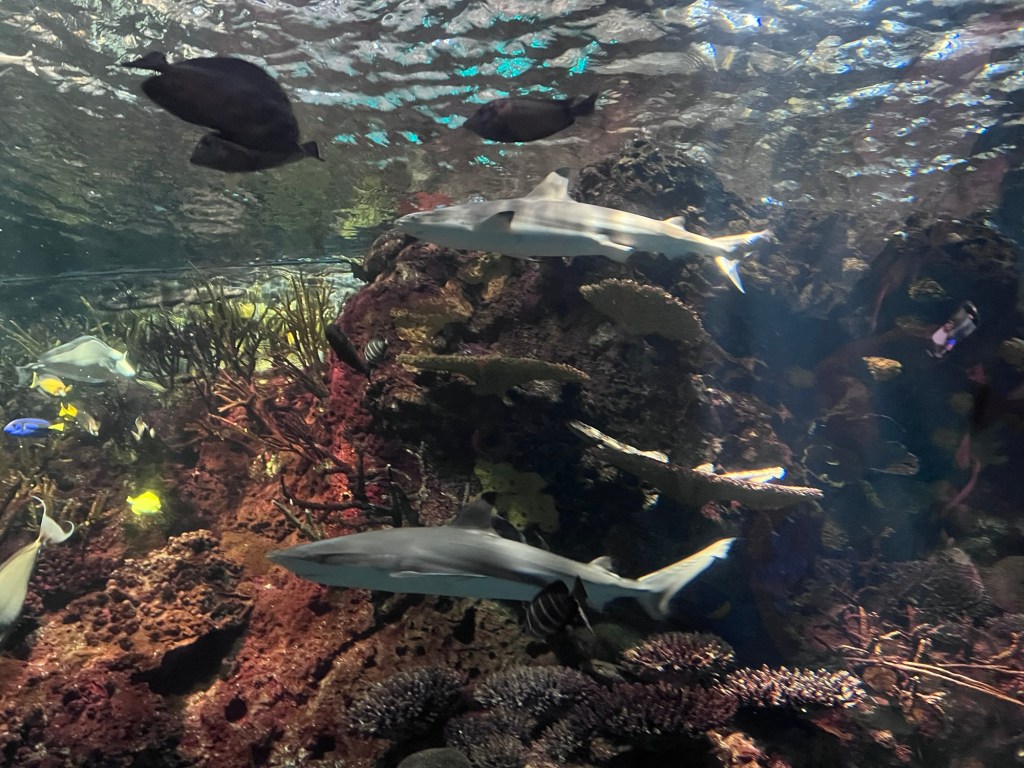
Then it was time to visit the Shark Tank exhibition which is the newest part of the aquarium and the most impressive display of wildlife.
The Shark exhibition
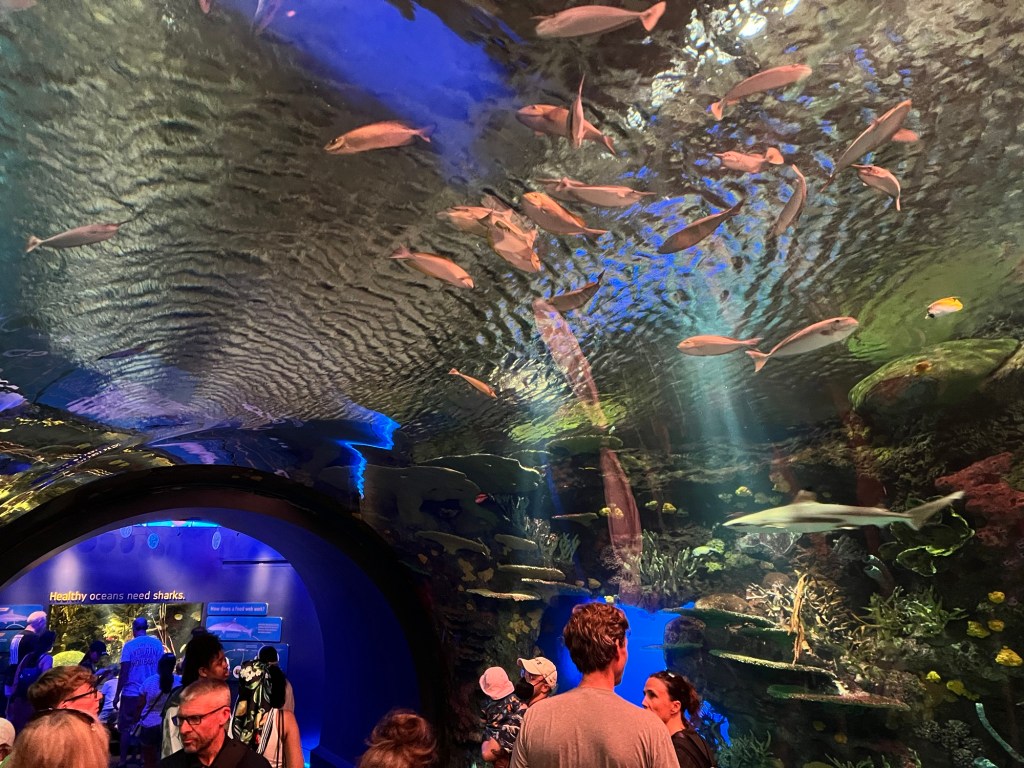
I love walking through the Shark halls as you feel like you are in an underwater adventure. The first time I had experienced this was when I was on Sentosa Island in Singapore at their aquarium and that feeling of exploring the deep by walking through it. You can see the sharks swimming on top of you. I am glad they created the same sort of tanks that you can walk through to experience the deep from the bottom looking up.
Experiencing life under water
The thrill of seeing a shark on top of you at a safe distance is a great experience. There is underwater magic going on here.
The underwater magic of the sea
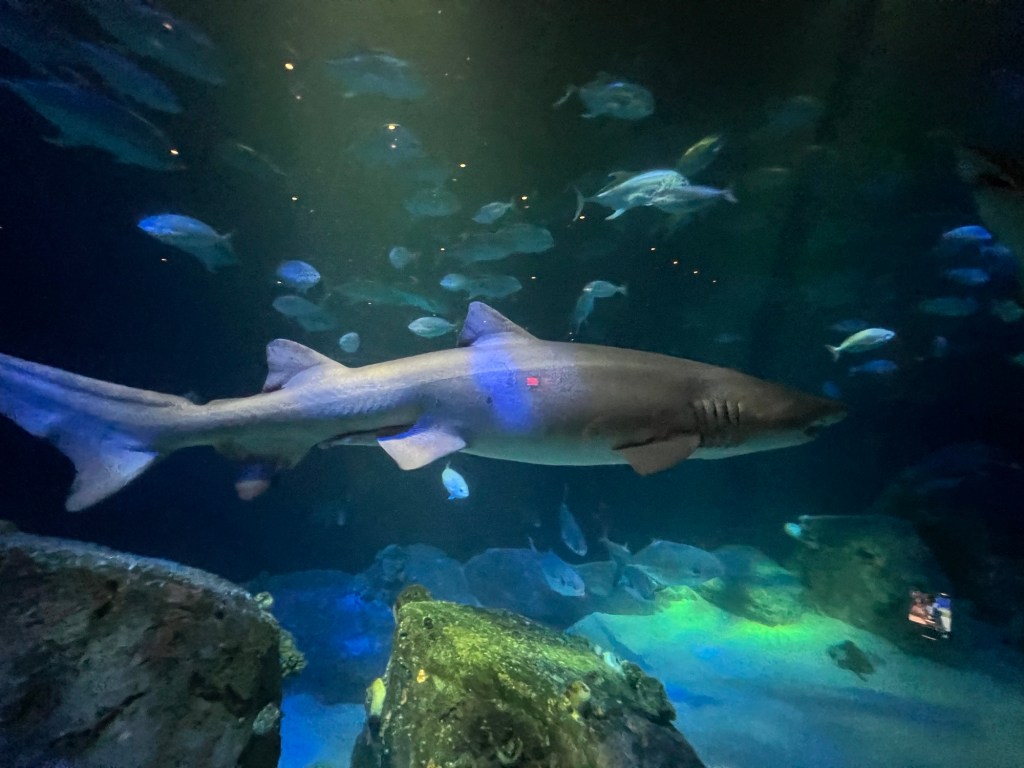
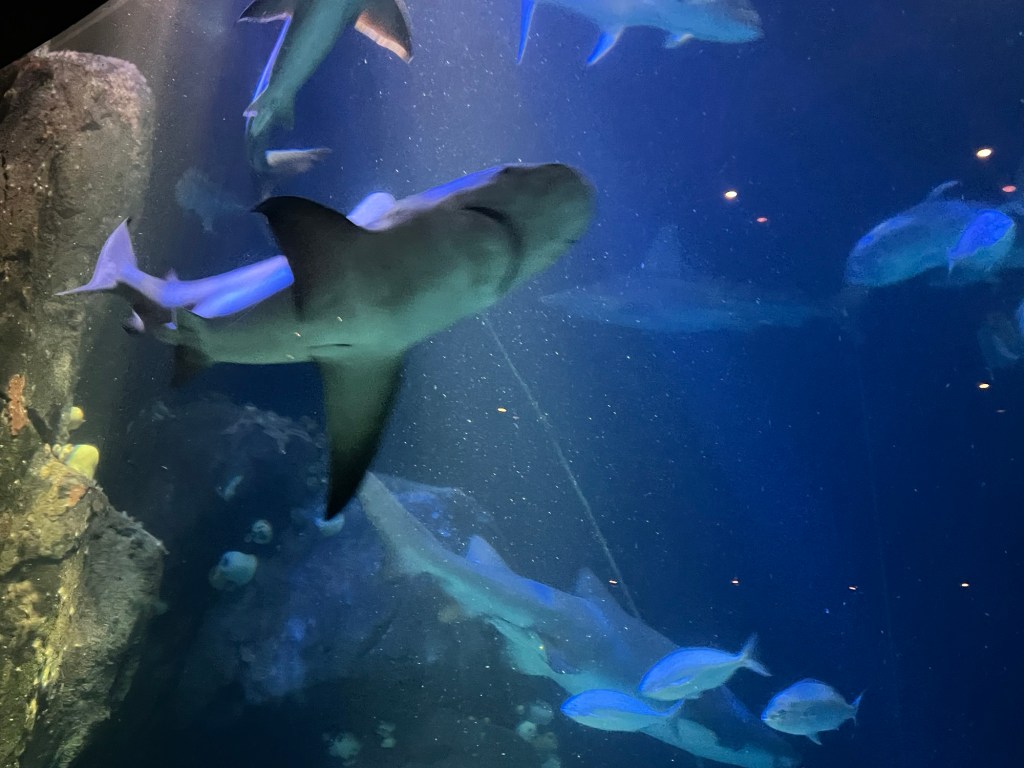
When I arrived at the main tank, that is when I could see the sharks and stingrays up close along with all the colorful fish.
Seeing one of the baby sharks up close
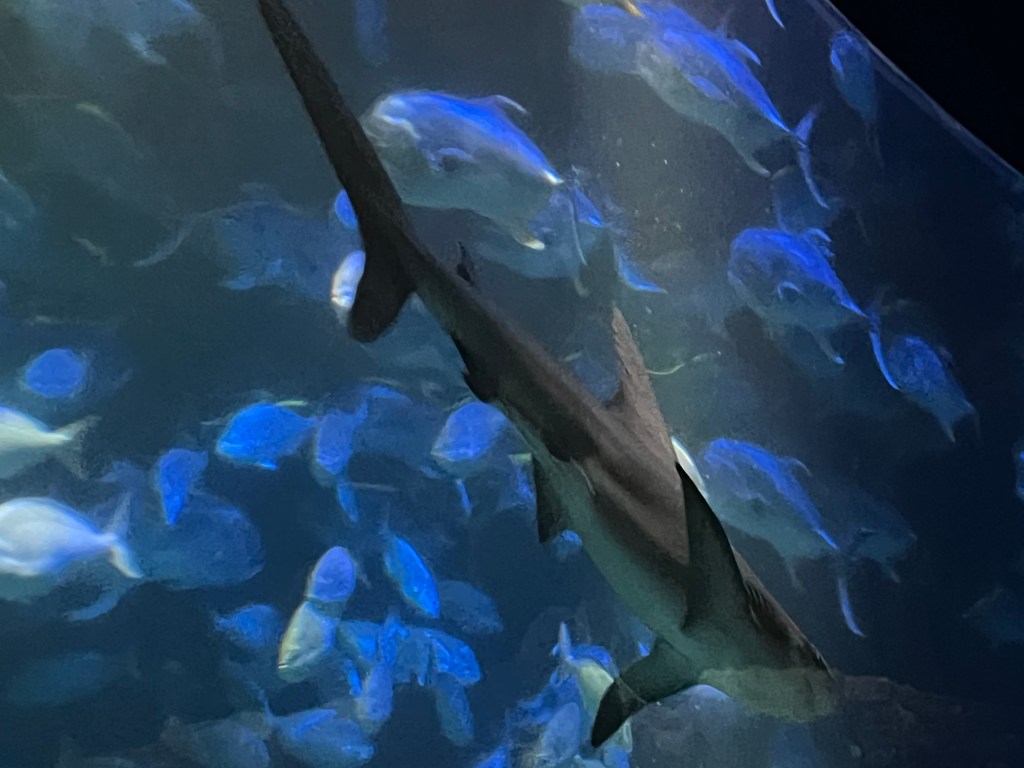
The sharks interacting with the other fish in the tank
The school of sharks in front of us
I walked around the aquarium looking at the penguins home, the coral reef tanks and the ‘Spineless’ tanks with all the unusual jellyfish swimming around.
The jellyfish are so elegant swimming around
They are the most beautiful creature up close but don’t get near those tentacles in real life.
The penguins were milling around themselves in their home as they waited for their feeding. They standed direct and the group of them looked like they knew what time it was for them.
The Penguin home at the aquarium
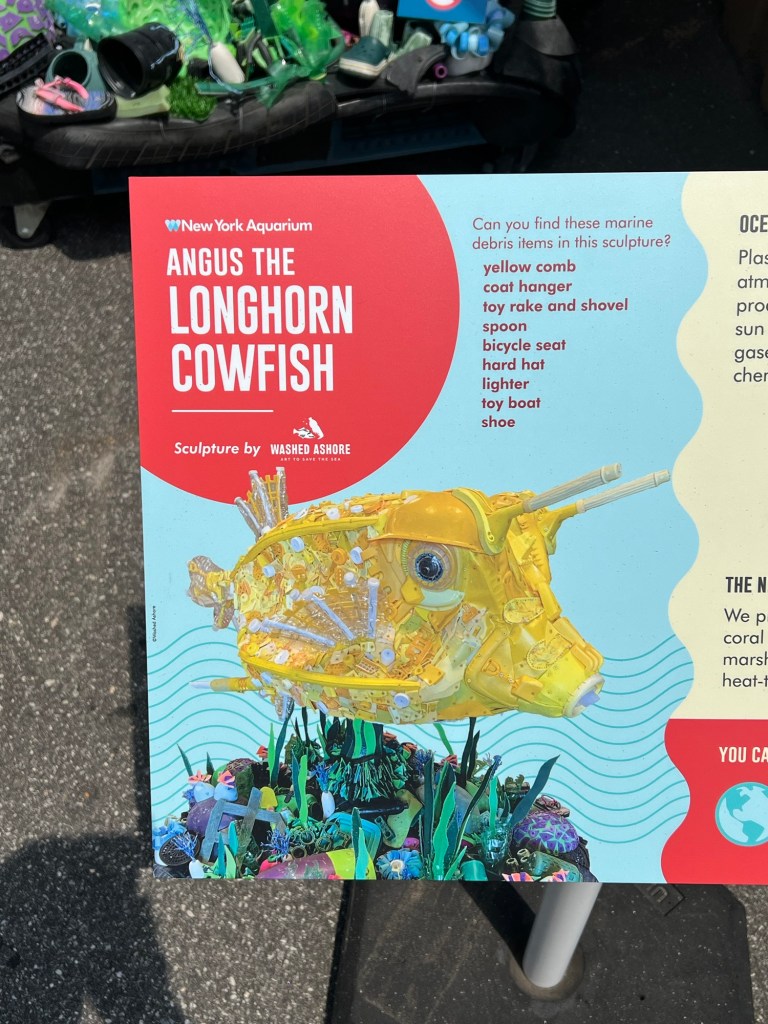
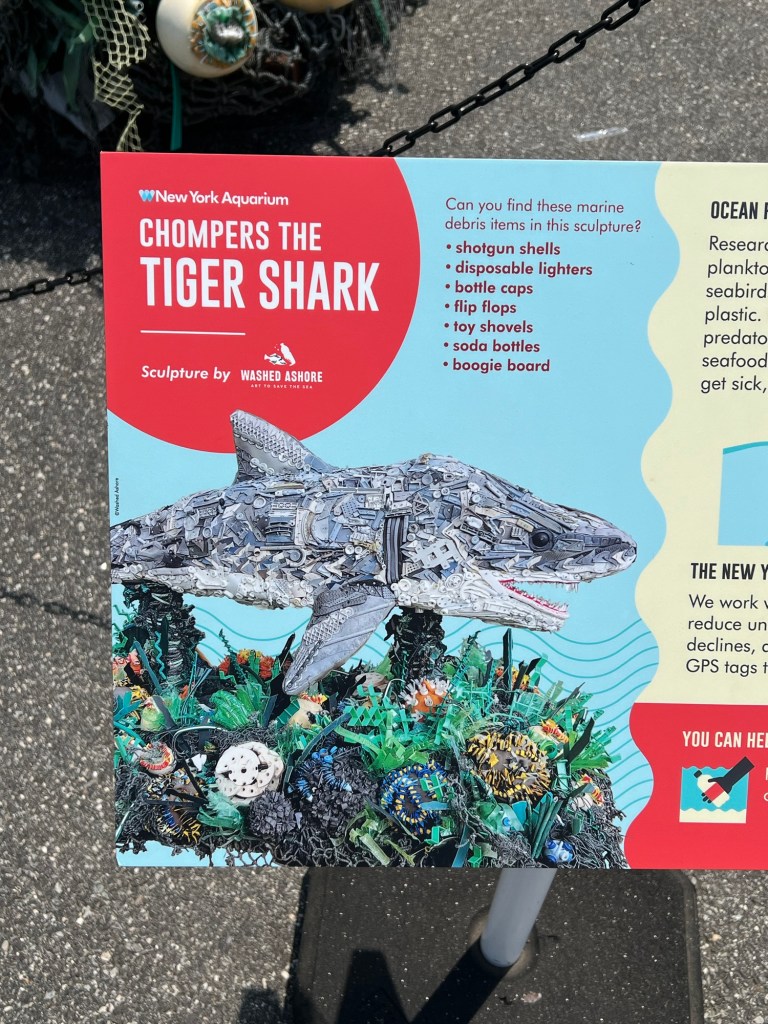
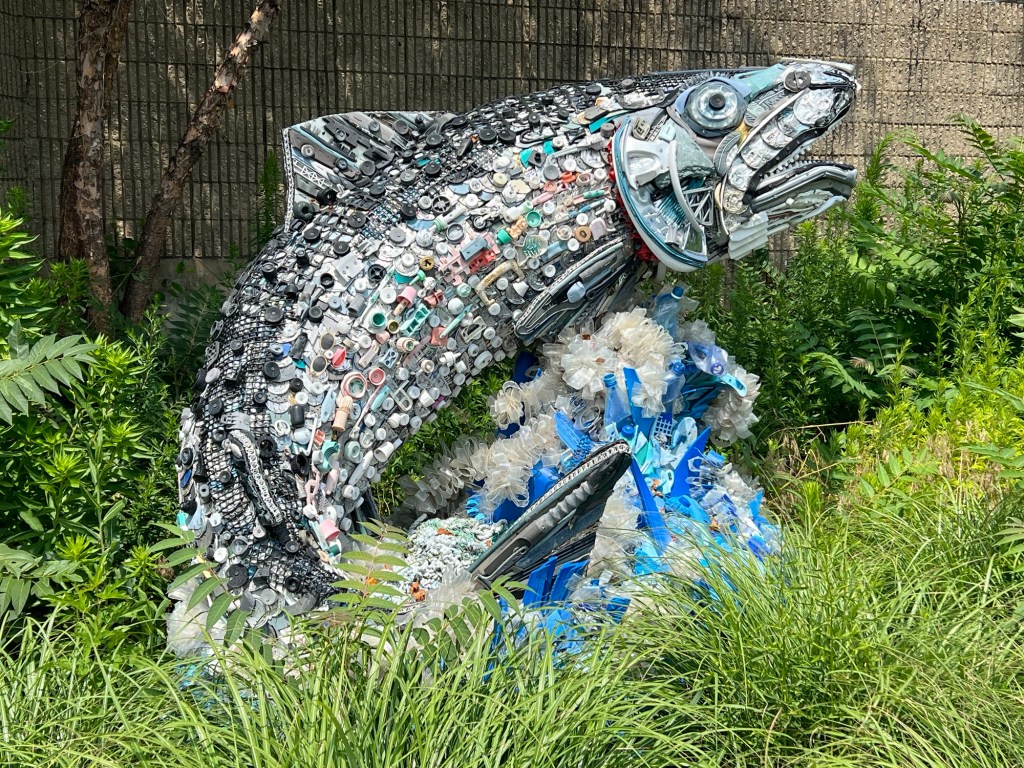
What I thought was interesting and caught my attention was the nautical artwork the was displayed all over the grounds. The works created by ‘Washed Ashore’, were made of plastic products found in the ocean. It really does show the consciousness we should show to our bodies of water and what we throw into them.
The Angus the Longhorn Fish sculpture sign
The Angus the Longhorn Fish sculpture
Choppers the Tiger Shark sign
The Choppers the Tiger Shark sculpture
The Nora the Salmon sculpture sign
The Nora the Salmon sculpture
These were some of the many sculptures that were dotted around the aquarium. I thought they brought light to how much plastic there is currently in the ocean. I took one tour around the aquarium and then it was back to Nathan’s for a late lunch. I thought at this point the lines would be slowing down. It was still busy even by 3:00pm.
Surf Avenue in the mid afternoon and things are changing fast here
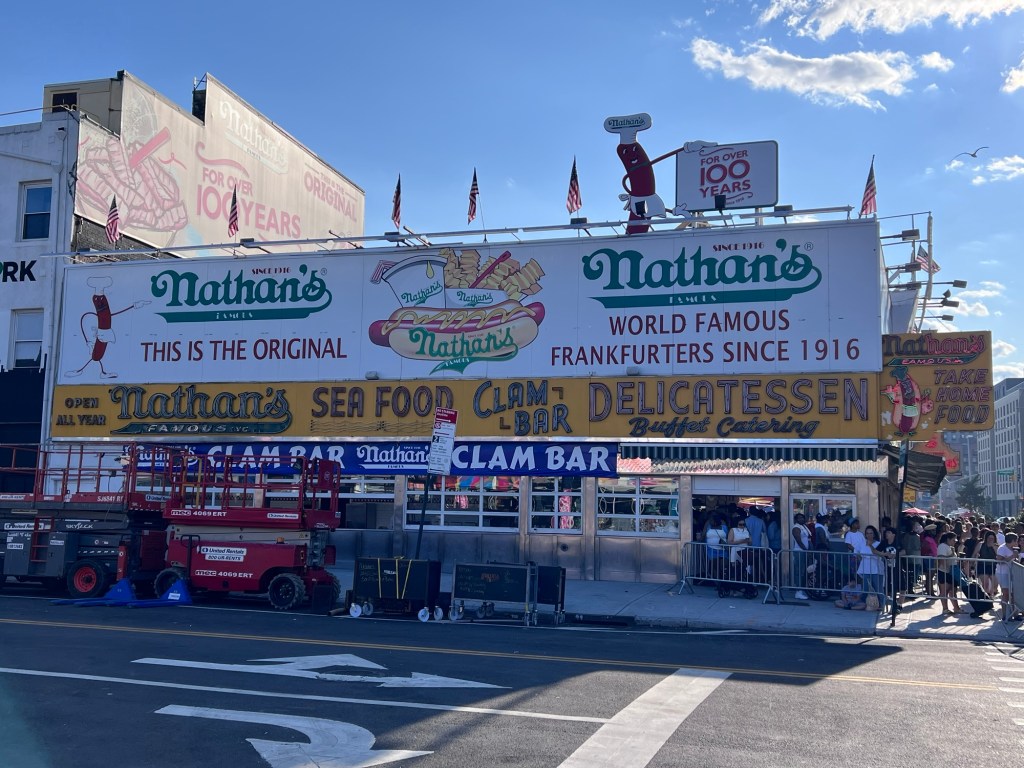
The lines never stopped at Nathan’s at Surf Avenue. The contest ended at 1:00pm but lines on both sides of the restaurant were out the door and when I got in line there were literally thirty people behind me. They were fully staffed and that line went quickly. I was ordered and eating my lunch within ten minutes. The staff worked really hard that day and they got all the customers through the lines very quickly.
The lines at Nathan’s at 1310 Surf Avenue in Coney Island on the 4th of July seemed endless
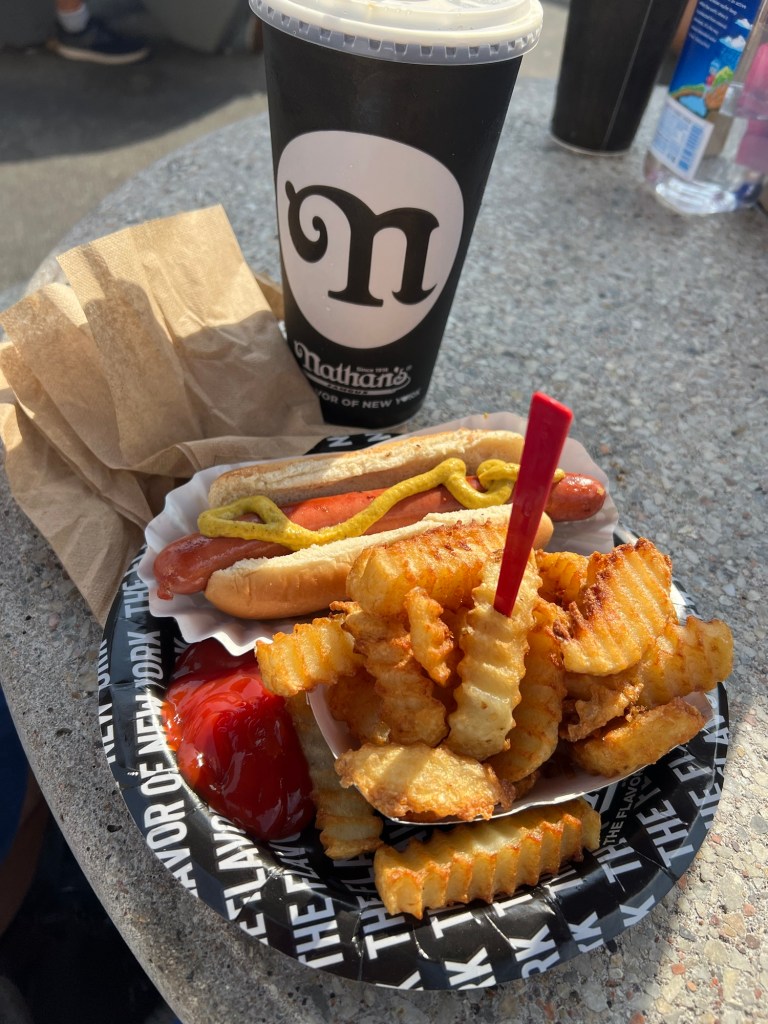
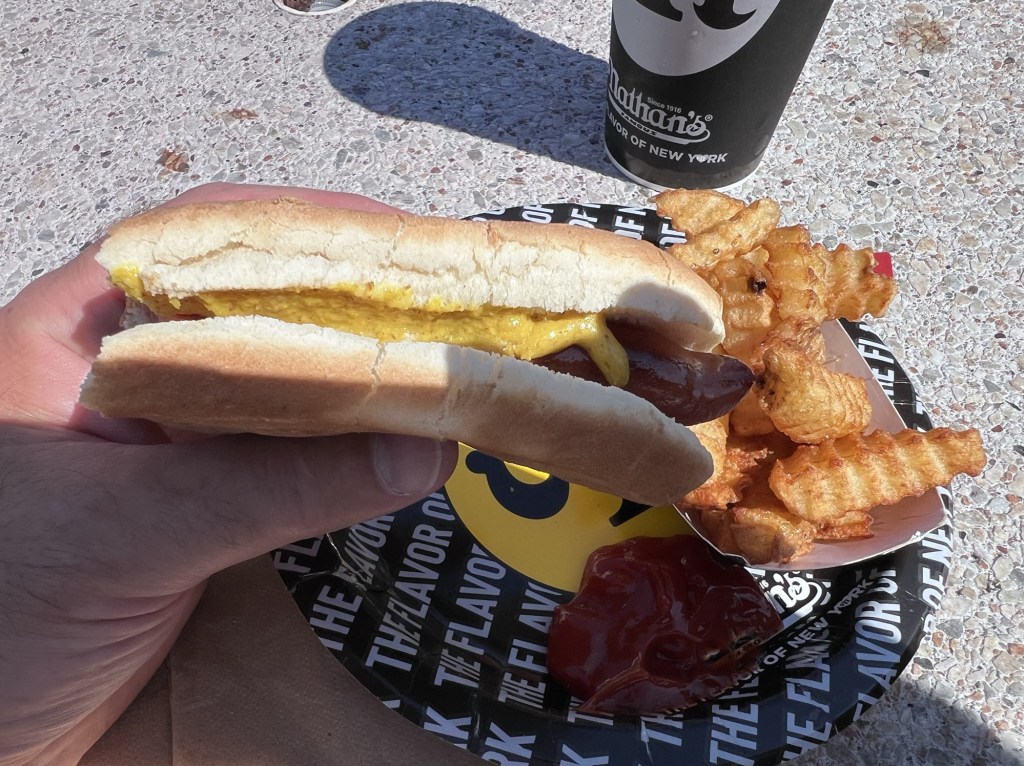
I love going to Nathan’s. I have been eating here since my first trip here with my cousins in 1974. I still remember what I ordered then, a slice of pizza and a Coke. Since then it has been a hot dog, a medium fries and a Coke.
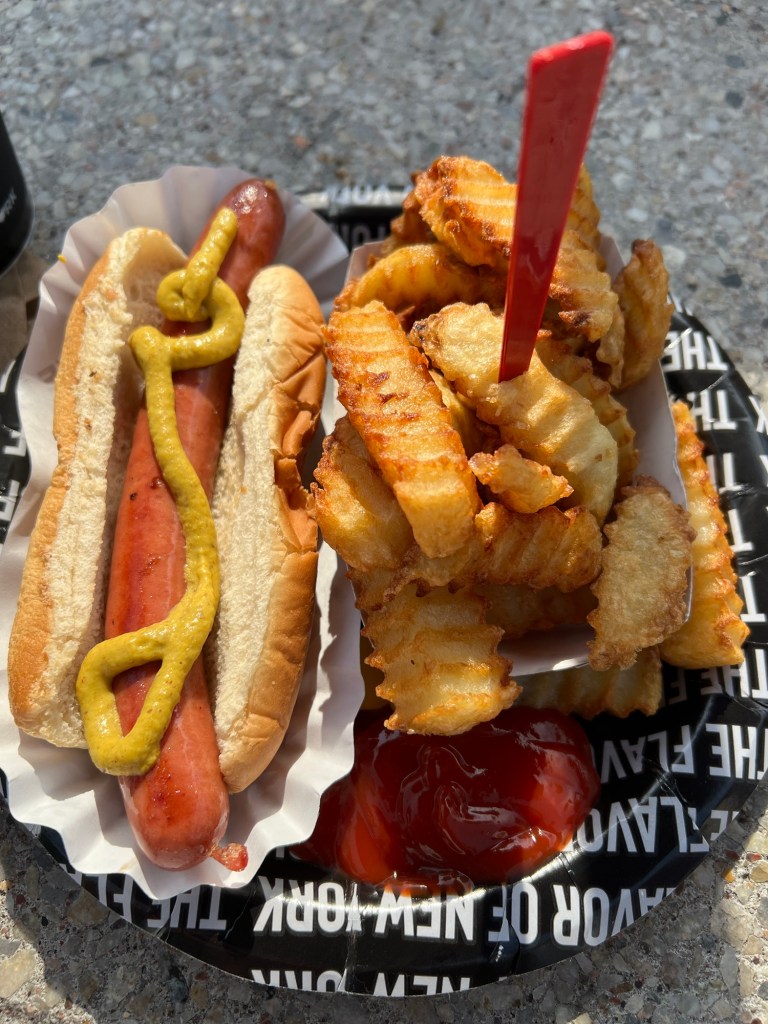
My Nathan’s meal when visiting Coney Island
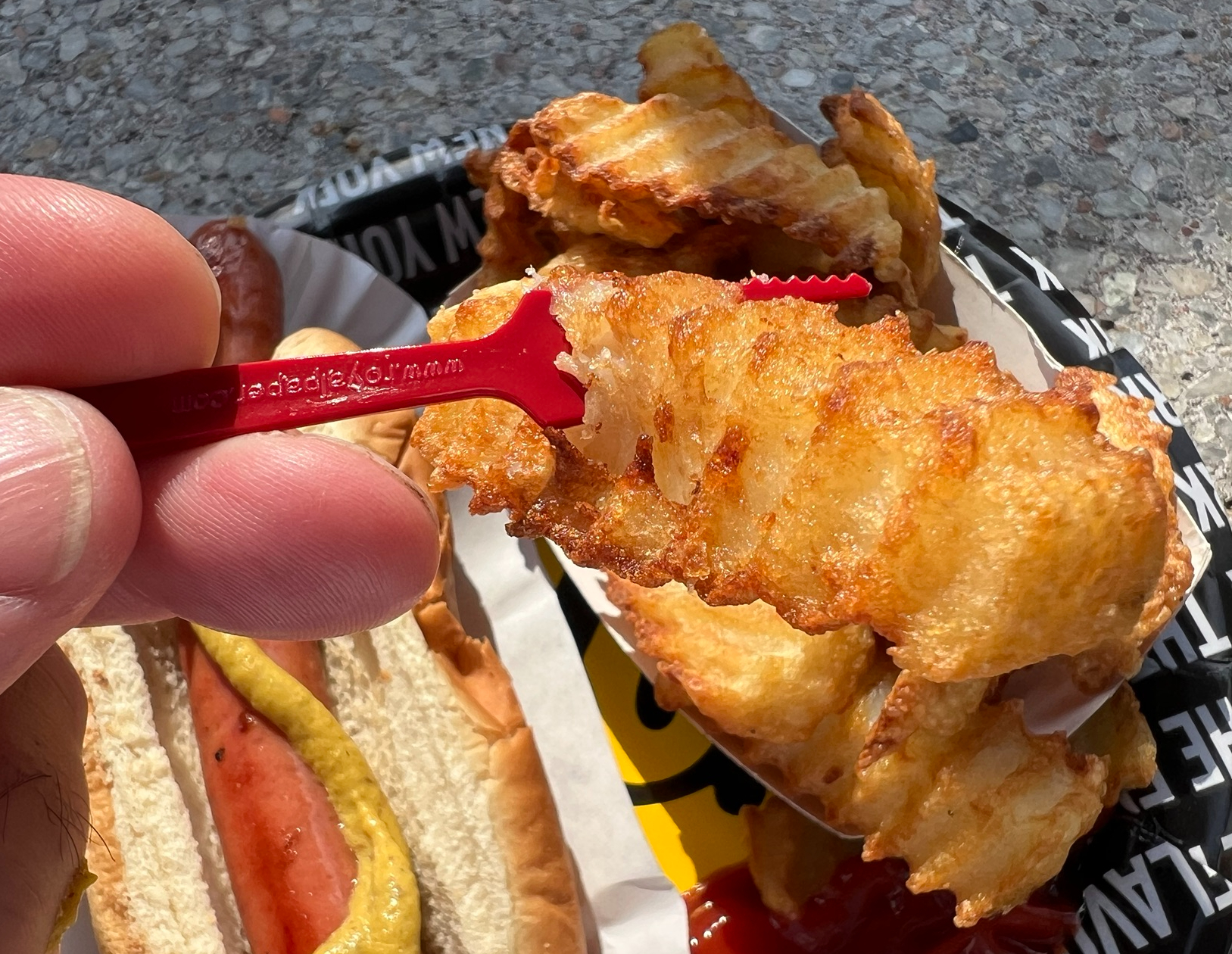
I love the crispness of the garlicky hot dog and the crispness of the fries. The fries here are legendary and I remember them winning awards in the 1970’s.
The best lunch on the 4th of July
No wonder people eat these hot dogs by the dozen
The fries are amazing
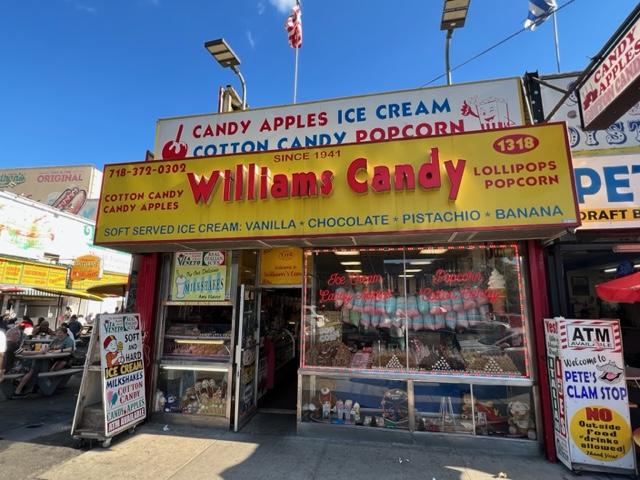
Williams Candy next door has been a Coney Island institution for years and their windows are filled with all sorts of candy apples and marshmallow treats on a stick.
The crowds kept coming at Nathan’s
What I like about Williams Candy is the assortment and the smells of cotton candy, popcorn and ice cream when you walk in the door.
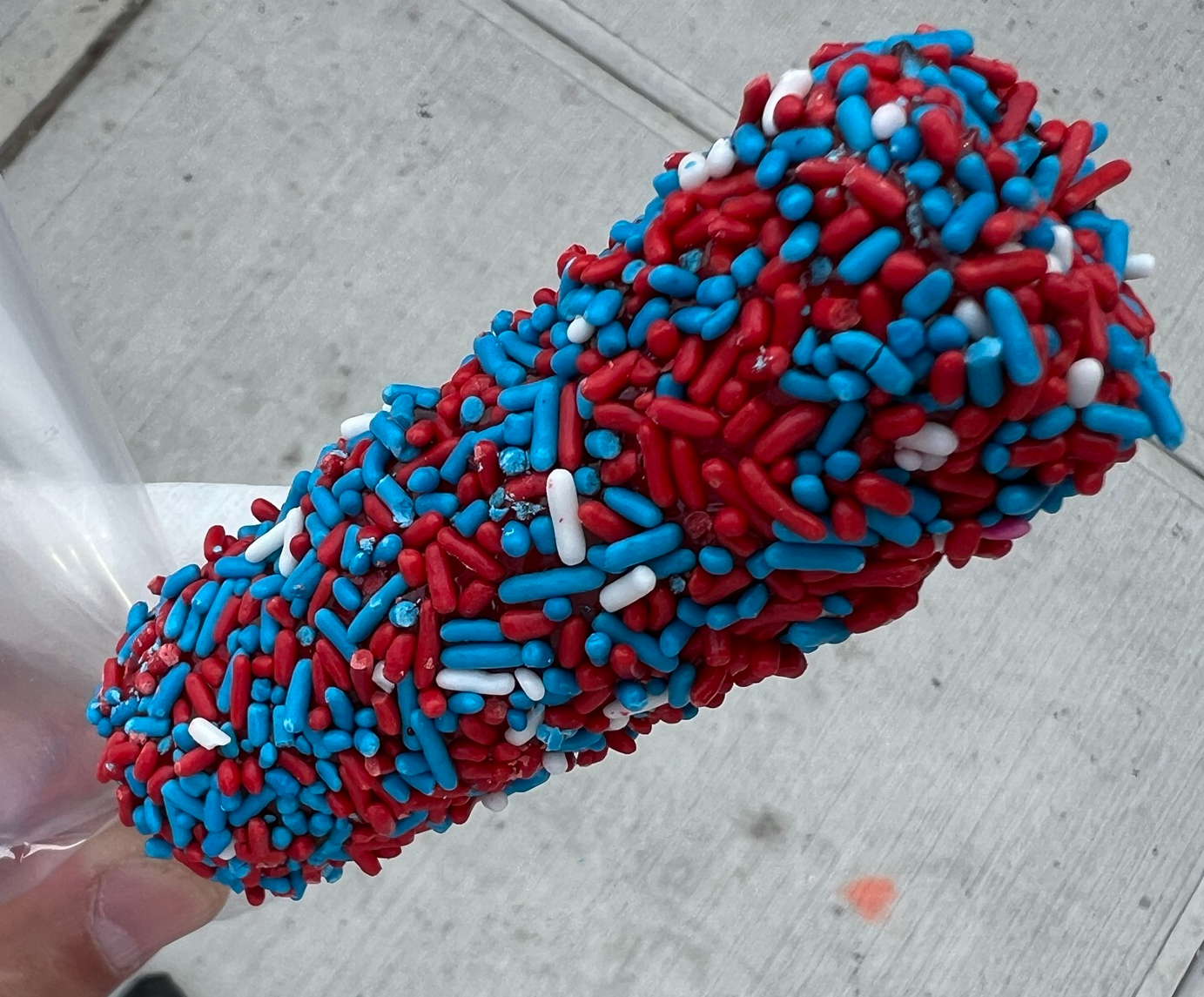
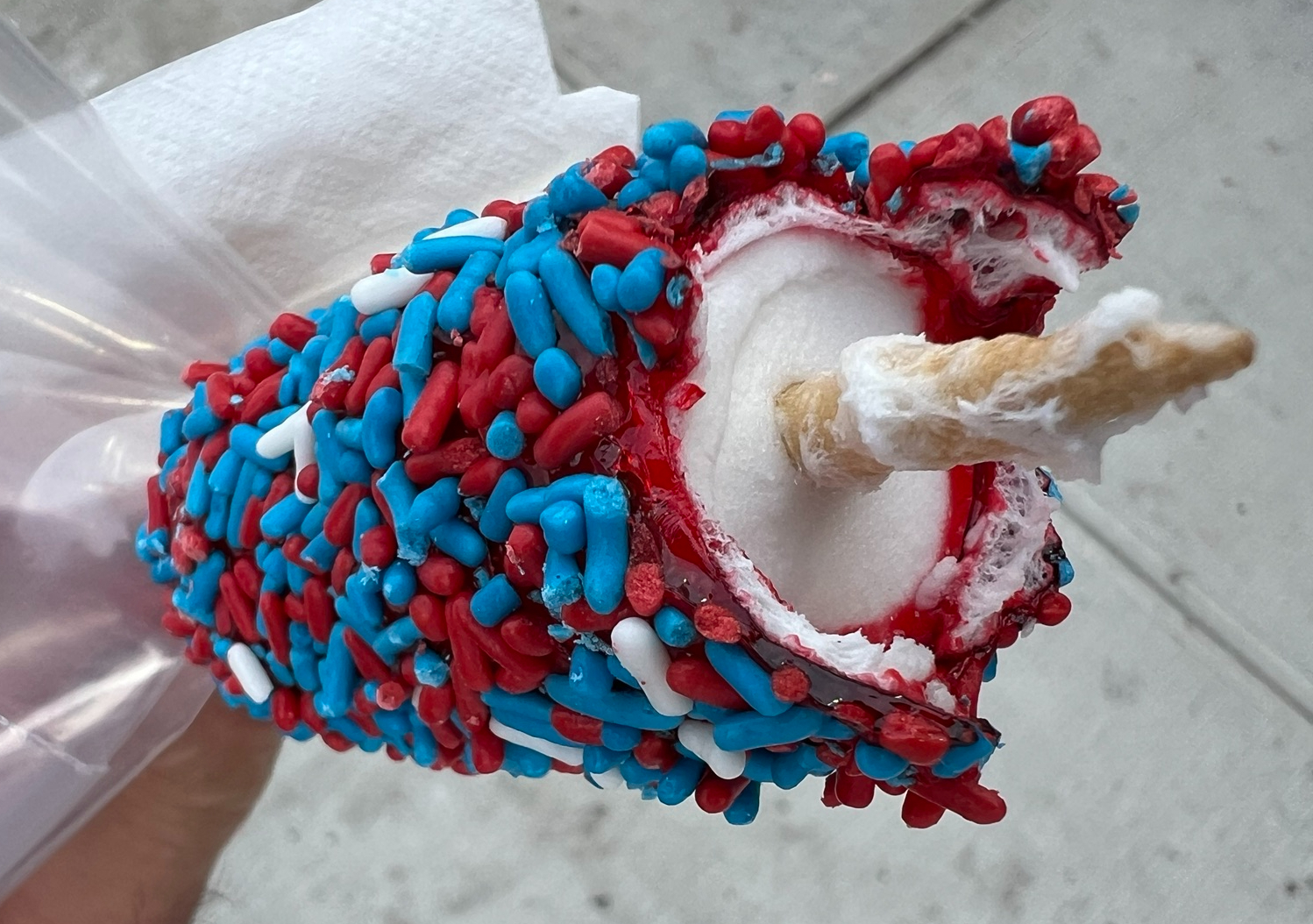
I was eyeing the candy coated marshmallows but when I realized that the other marshmallows were dipped in the candy coating and then rolled in the sprinkles, I chose the red, white and blue one.
The Marshmallow on a stick at Williams Candy
I can’t tell you how good this is when you bite into it. Between all the sprinkles packed on top and the crunchy candy coating was sugar heaven.
You can’t miss this sugary treat. What a great patriotic dessert!
I now had to work all this off so I went to tour the boardwalk and decided to walk down to Seagate at the end of it. It was an interesting walk. Everything was going on that afternoon. Families were out barbecuing, disco dancing, line dancing and dancing to salsa music. There was a lot of energy on that Boardwalk.
The Boardwalk was jammed that day
With all the talk on the revival of Coney Island, I passed the old parachute jump and it still looks it is going to need a lot of work in the future.
The parachute jump
The funny thing about Coney Island is that it is an island of contrasts. On one hand there is a lot of building going on in the central part of the island with luxury housing being built around the baseball field (where Steeplechase Park once existed) and then you have some of the most dangerous public housing in the City just two blocks west of that. Then at the very end is Seagate, a gated community that seems to keep to itself on the other side of the fence.
I walked to the end of the Boardwalk and back watching families barbecue, dance and having a good time. By the time I got back to the amusement section of the island both the aquarium and the museum were both closed, Nathan’s was still packed and this section of the Boardwalk got busier as people were leaving the beach and wanting to get dinner.
All that walking was making me hungry again as it was getting closer to dinner time. Both Gargiulo’s Italian Restaurant and Totonno’s Pizzeria were both closed for the day and the rest of the restaurants on the Boardwalk were either packed or everything was deep fried and I did not want that after my meal at Nathan’s for lunch so I decided to head back to Manhattan.
I did not know if there would be fireworks on the beach that evening but with the clouds rolling in and the threat of rain, I did not want to get caught in it. The subways were mobbed and the bulk of the people were illegally walking through the emergency doors. I swear nothing changes. No one was watching what people were doing.
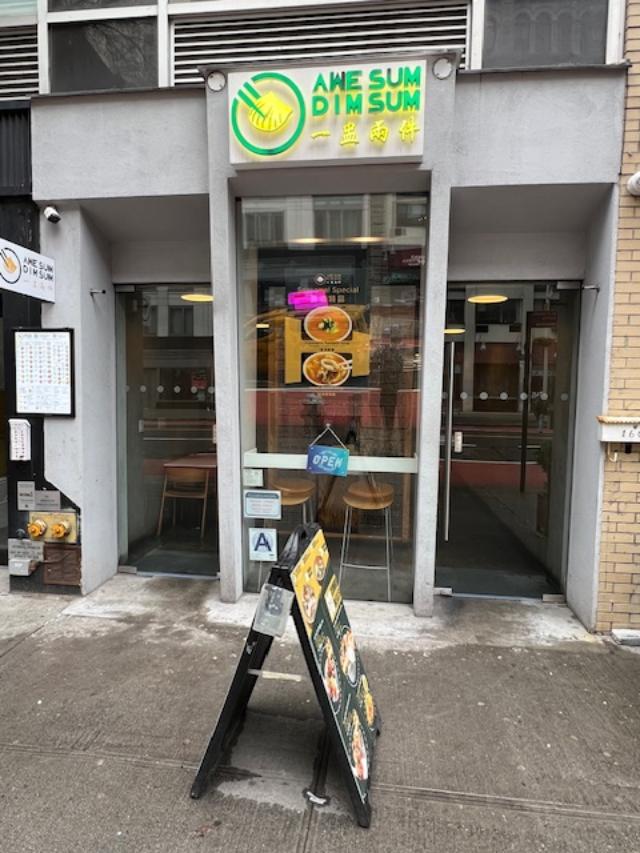
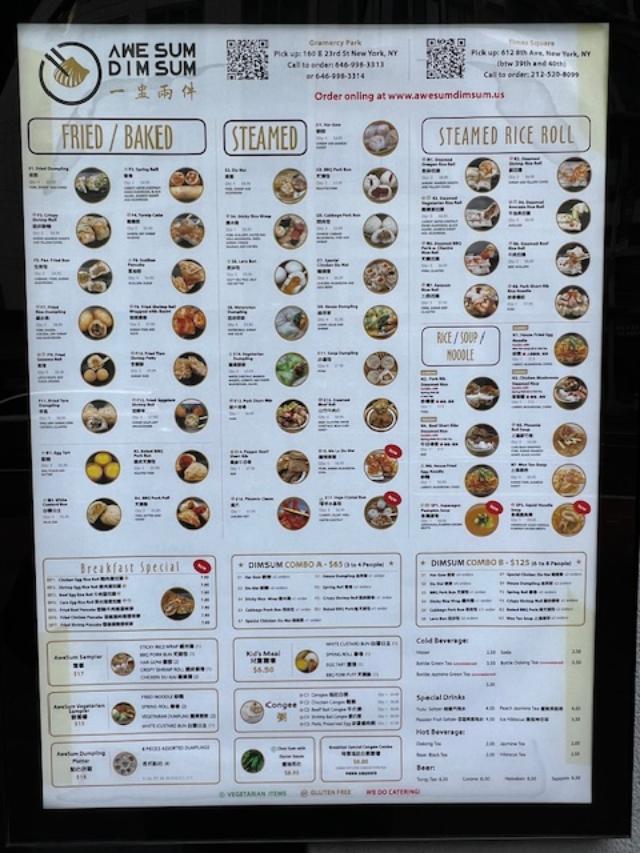
When I got back to Manhattan, I did not want to run around looking for a place for a quick dinner. I remembered that there were a few Chinese restaurants by the Port Authority and I stopped at Awesum Dim Sum at 612 Eighth Avenue for quick dinner before I left for home. The restaurant was surprisingly busy for food you don’t equate with the 4th of July.
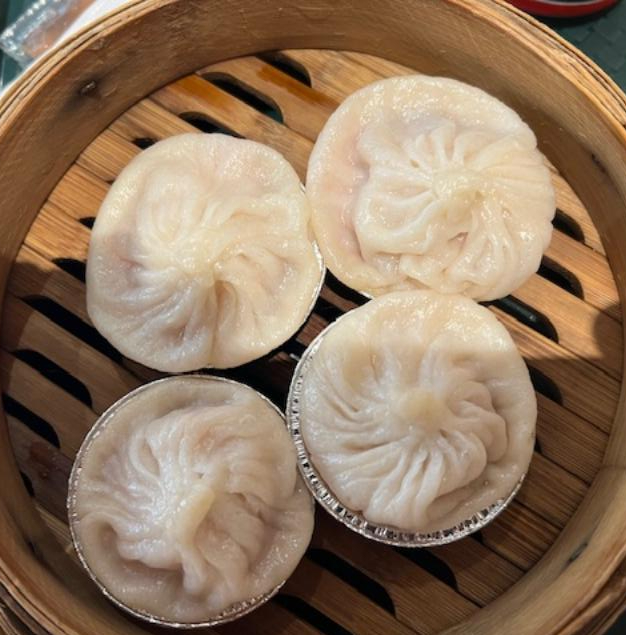
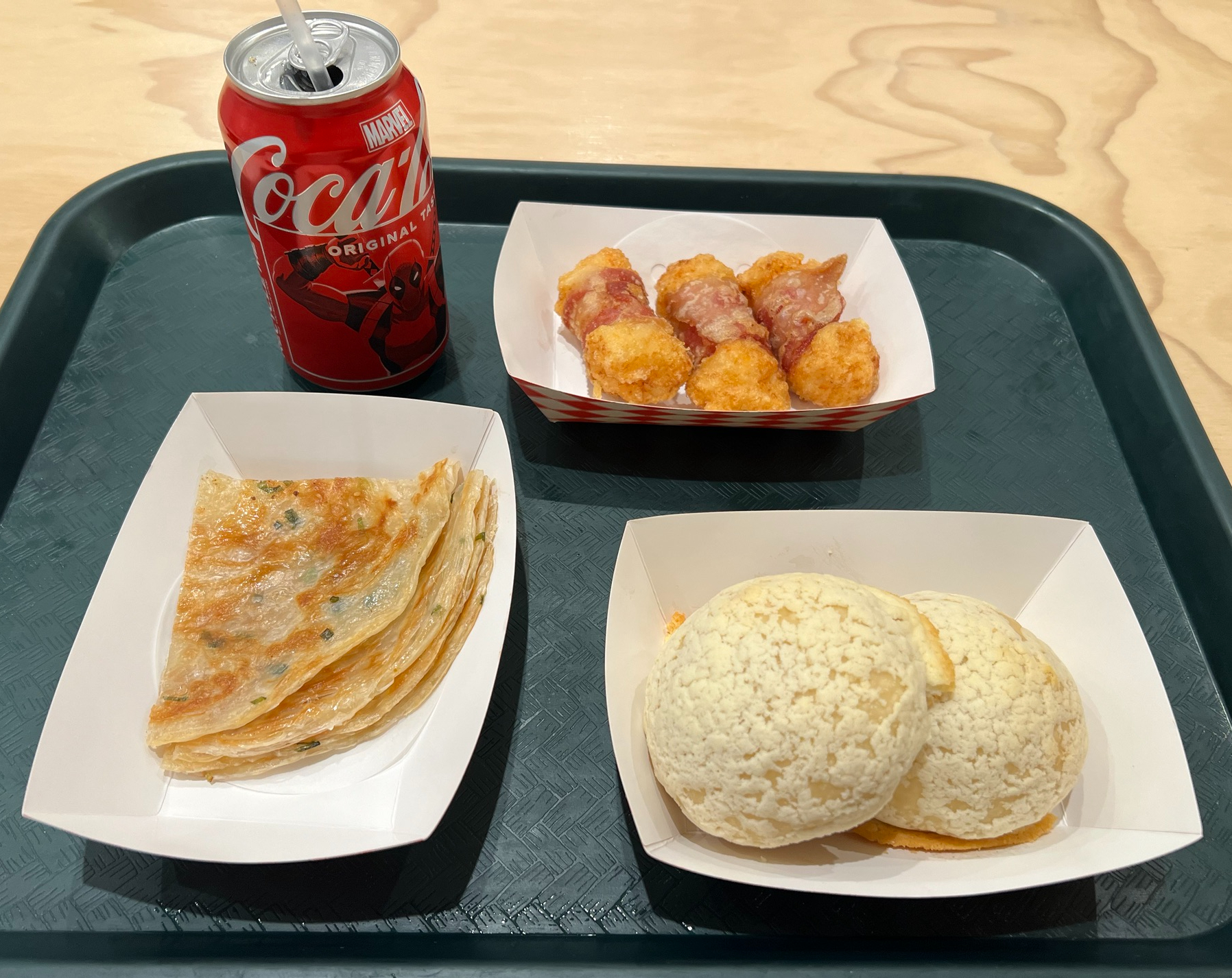
I love the selection of Dim Sum at the restaurant and ordered a small dinner for myself before I left the City. I had to have the Bacon Wrapped Fried Shrimp, which I was craving, the Scallion Pancakes and the Cream filled buns for dessert. Everything was cooked to order, fresh and was excellent (see TripAdvisor review).
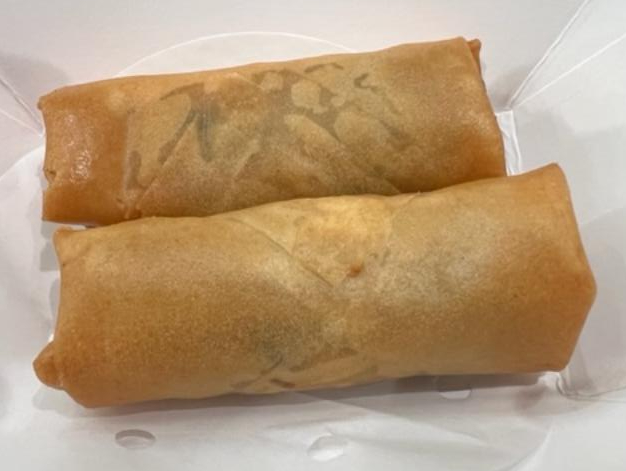
Dinner that night at Awesum Dim Sum, Bacon Wrapped Fried Shrimp, Scallion Pancakes and the Cream Filled Buns
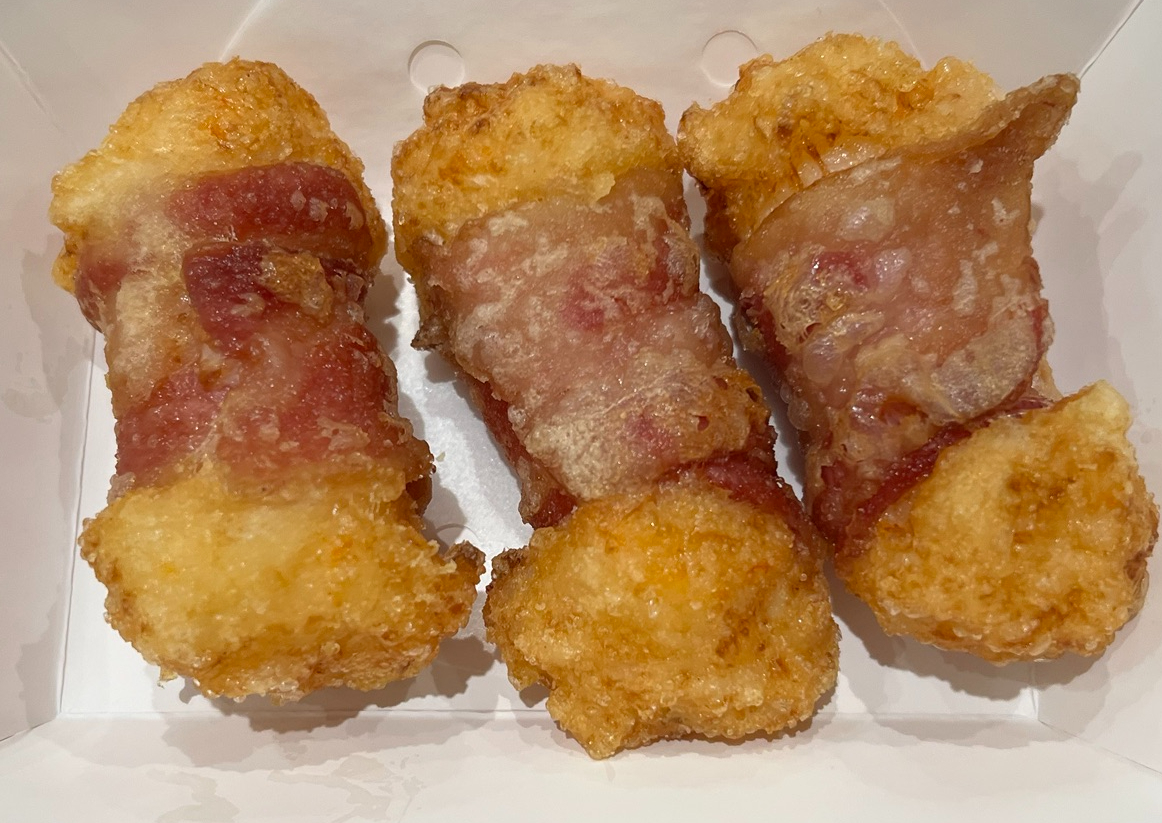
It was a nice change from barbecue foods and since I already had a hot dog for lunch, I thought this would make a great dinner. It was just enough and made the perfect meal. Then I was on my way home. Their Fried Shrimp with Bacon is excellent. The shrimp mixture has a nice sweetness to with the contrasts of the smokiness of the bacon.
The Fried Shrimp with Bacon
The Scallion Pancakes were crisp and had a nice taste especially with the dipping sauce.
The Scallion Pancakes
The Cream Buns were the perfect way to end the meal. They were crisp and sweet on the outside because of the rice dough and rich and creamy on the inside. I thought it was a nice change and a great way to end the day.
The Cream Filled Buns
It really was a nice 4th of July and I really enjoyed my day in Coney Island. I have to admit that the neighborhood is rough when you leave the beach area but like the rest of the City, you just need to watch were you walk and stick to the Boardwalk area, you should be fine. The Nathan’s Hot Dog Eating Contest is something everyone should experience once.
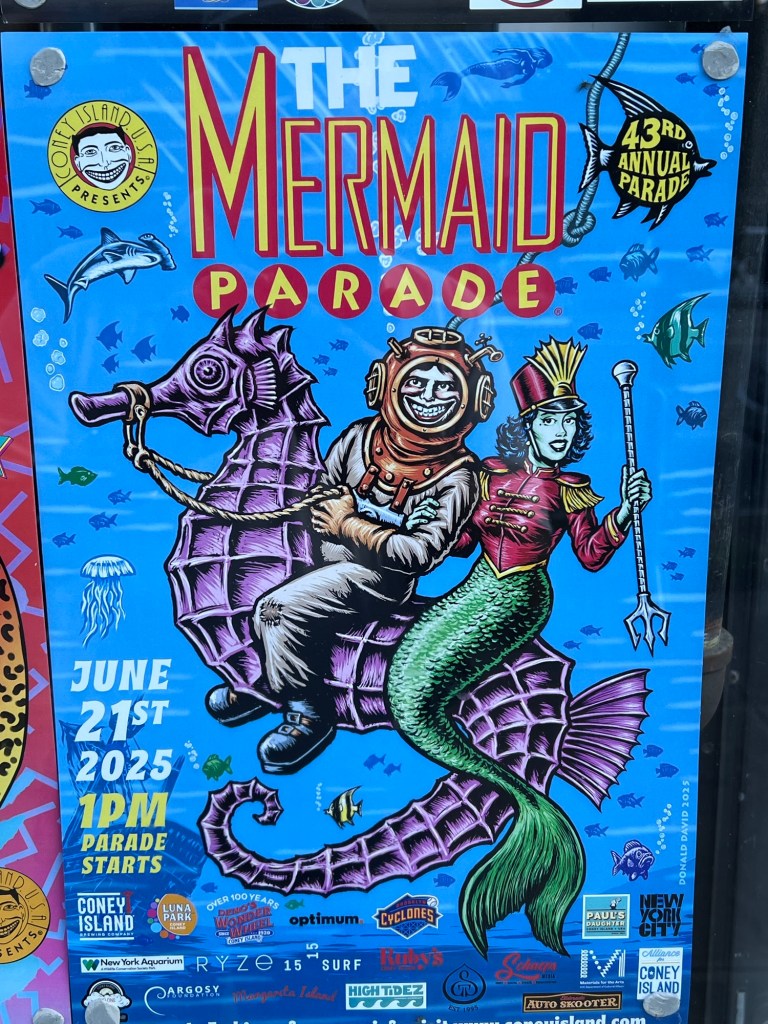
I had to plan my trip back to Coney Island like D-Day to see the contest again. I had been on the Island recently for the Mermaid Parade and could not believe how fast the 4th of July weekend arrived.
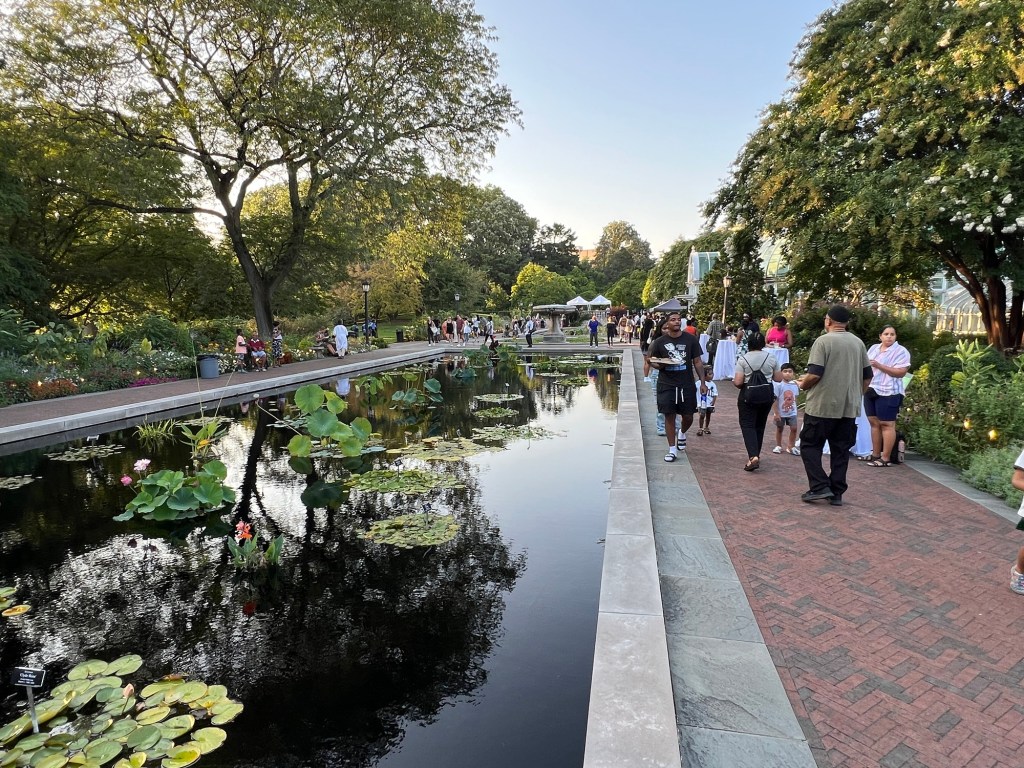
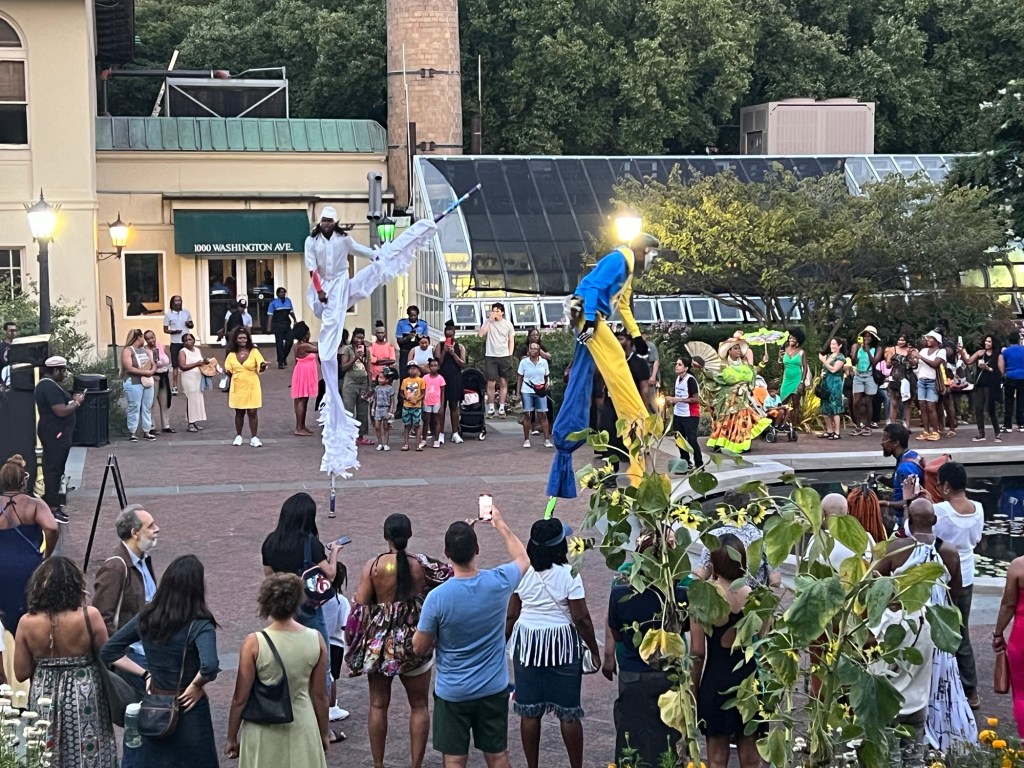
I was so tired from being in the City the day before trying to finish walking Chelsea, going to one of my fellow volunteers Memorial Services at Holy Apostles Soup Kitchen and then a Jazz Night at the Brooklyn Botanic Garden. That on top of posting grades for class, I was pooped from all the running around.
I got off to a late start that morning still tired from running around Brooklyn the night before. By the time I caught the bus at 8:00am and got into the City just before 9:00am, I knew I was behind schedule.
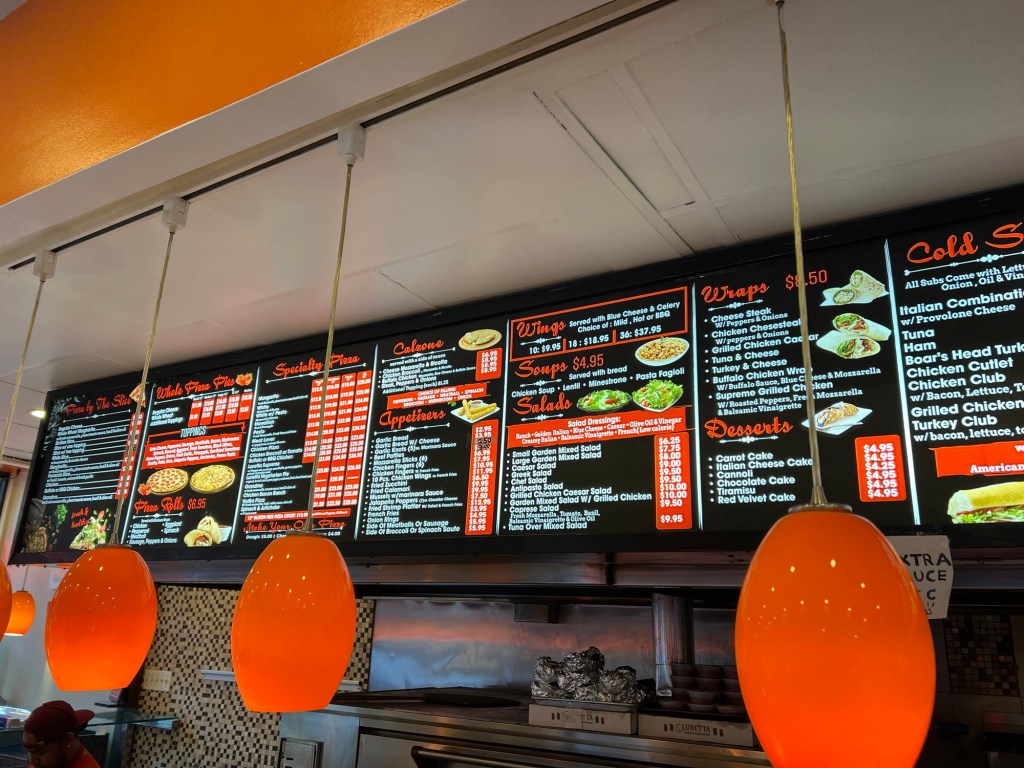
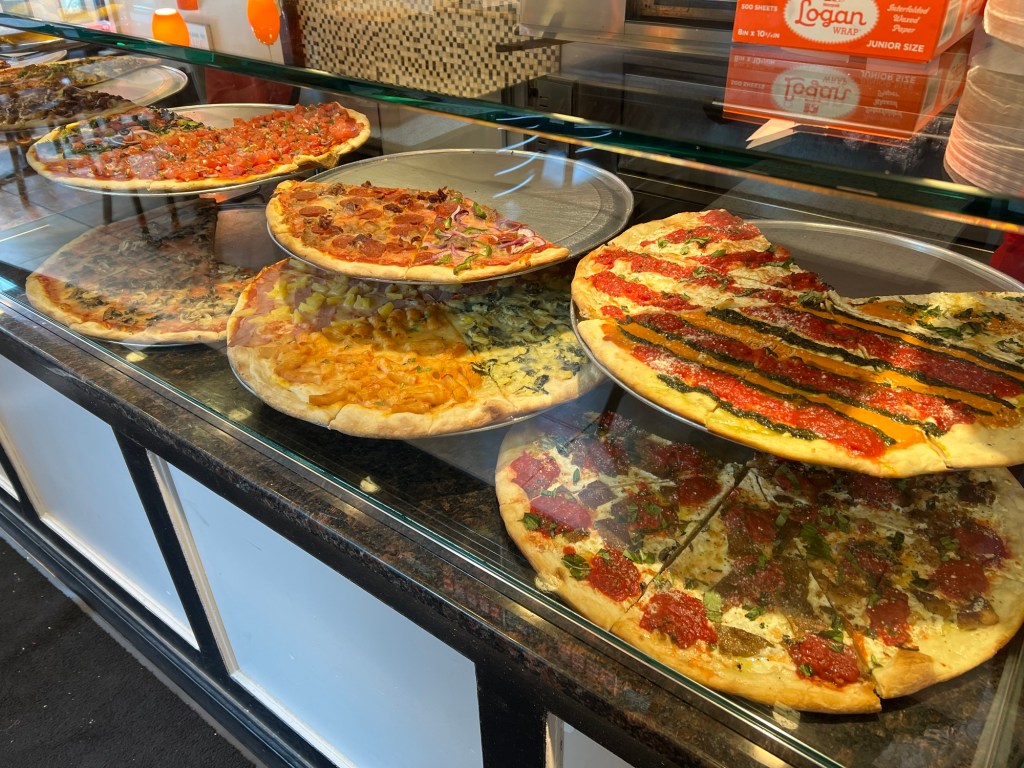
I had planned on having breakfast on 23rd Street at a place I liked but there was not enough time. So I stopped at Villa Pizza inside the Port Authority for a breakfast Stromboli.
Villa Pizza inside the Port Authority
The assortment of Breakfast Stromboli
The breakfast items at a pizzeria
For a chain pizzeria inside a bus terminal, breakfast here was not bad. I had always seen the Breakfast Strombolis in the case and wondered what they tasted like.
My breakfast the Bacon, Egg and Cheese Stromboli with a freshly squeezed orange juice
The Bacon, Egg and Cheese Stromboli
The Breakfast Stromboli
The selection of both breakfast and lunch dishes at Villa Pizza inside
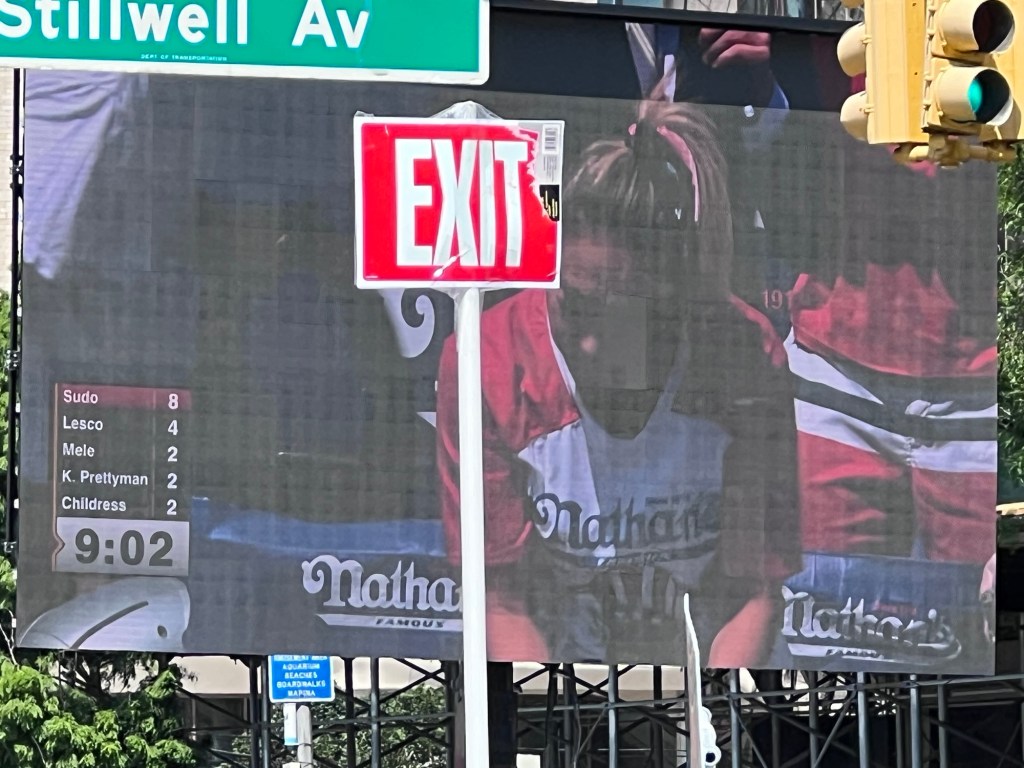
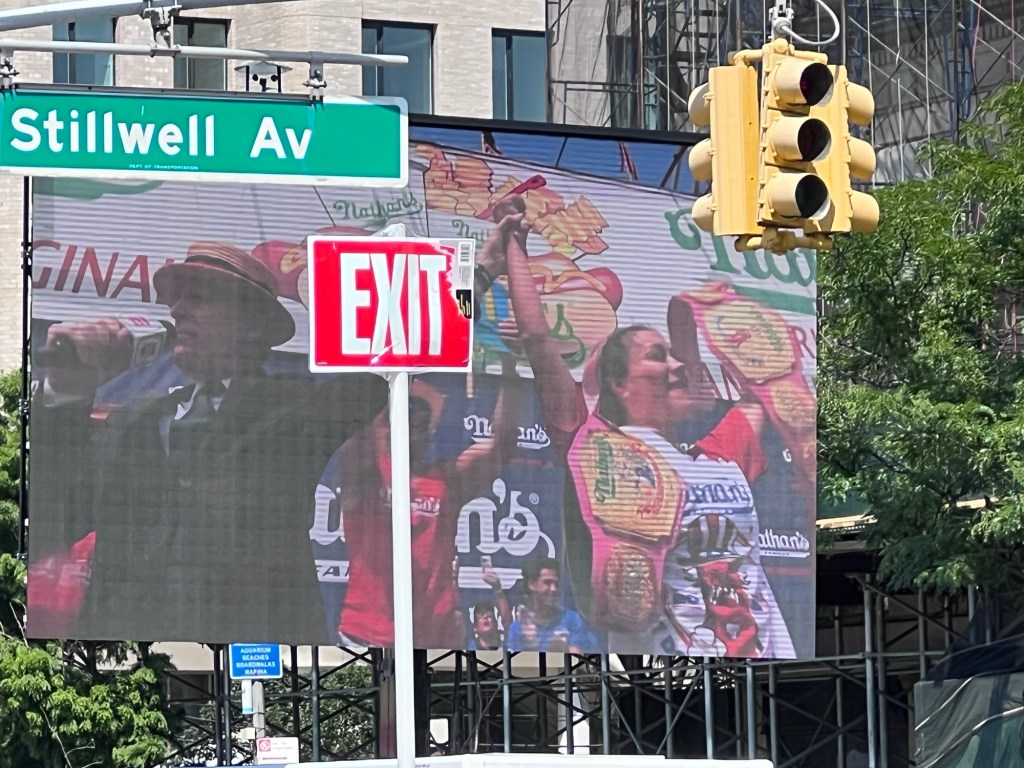
After breakfast was finished I took the Q back down to Coney Island. The subway was packed with people heading to the shore. People got off at all the beach spots and when I got into Stilwell Avenue, Nathan’s was already packed with people trying to get to the stage area. I ended up standing outside the press stage with an ‘Exit’ sign blocking my views of the screen (that’s why there is an exit sign in all of my pictures and videos).
Arriving at Nathan’s as the band was performing
Nathan’s has been in this spot since the 1920’s
The band that had entertained last year
The brass band playing before the contest
The band really got the audience fired up and with some local dance groups performing and then the ‘Star Spangled Banner’ performed, it was time for the contest to begin.
First was the Ladies competition
Miki Suto was defending her crown
She won her record 11th belt
After a series of entertainment, the Men’s Eating Contest started. The crowd went wild when they announced Joey Chestnut’s name. The place went wild.
The crowd was ten times what it was when I got there
The excitement built before the contest
The crowd was all for Joey Chestnut
Then the man of the hour got on stage
The excitement building before the contest
The crowd going crazy during the contest
The crowd was going crazy during the competition
The contest that I could from behind the bleachers
The man of the hour Joey Chestnut won the contest with 70.5 hot dogs. Last year’s winner came in second with 53. Both the Men’s and Women’s winners did not come close to their records. It was not like last year but it still was an exciting contest.
The celebration after the contest was over for the 4th of July
After the contest was over and the winners took their pictures, I wondered around Coney Island and explored the Boardwalk and amusement areas.
There is such an energy in Coney Island on the 4th of July
Walking through Deno’s Wonder Wheel Park
The famous Wonder Wheel
The Spook A Rama, my first ride on Coney Island as a kid
The Boardwalk on the 4th of July afternoon
Looking down the Boardwalk from the Aquarium
The beach by the Aquarium
I decided to go to the NY Aquarium before lunch. Every restaurant was a line so I figured to come here first.
I made I in time to see the Sea Lion Show
The Sea Lion Show
The second group of sea lions
The end of the sea lion show
After the Sea Lion Show, I toured the Shark Tanks and walked around the exhibition.
The Shark exhibition
The underwater tanks
After a nice walk around the Aquarium, I was getting hungry and decided on a late lunch at Nathan’s. I figured that the lines would be down at this point and when I got there, it was only a ten minute wait to order.
Arriving back at Nathan’s Famous for lunch
My favorite lunch at Nathan’s, a plain hot dog, medium fries and a Coke
The taste has not changed in fifty years
Yum!
Lunch at Nathan’s is always an experience. You have to share the tables outside when it is busy and you never know who you will be sitting next to for lunch. Some woman parked herself at the table and asked if she could eat with me. I guess I looked safe.
After lunch, I took one last tour around the Boardwalk and Surf Avenue and realized I want to put my feet in the water.
Off went the shoes as I walked along the beach
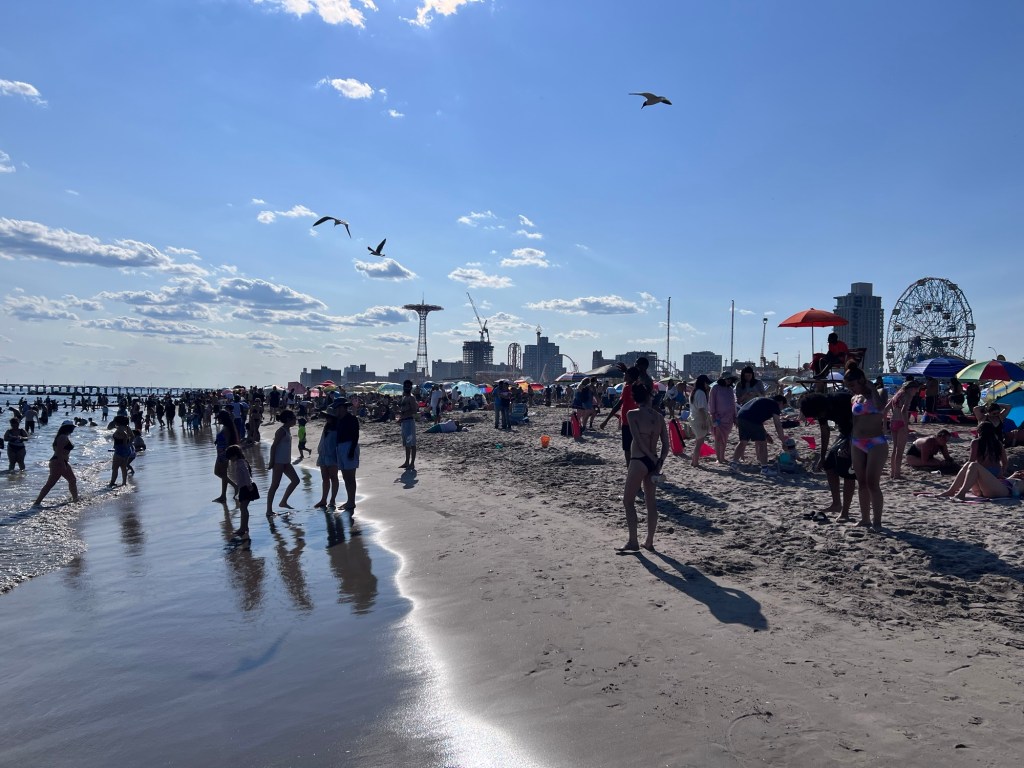
Even though the beach was crowded with families, it was not the crowds that I saw in old pictures when thousands of people would pack the shore on a summer weekend or holiday. Still to walk these iconic beaches on the 4th of July is quite the experience.
The Coney Island beach on July 4th
I made my way back to the subway and walked along Surf Avenue. It is amazing to see the changes to this area in the last 100 years.
Passing Nathan’s again across from the subway
The sign for the hot dog eating contest at Nathan’s
The Mermaid Parade sign from two weeks ago
It really is a fun experience and you have to add the Hot Dog Eating contest to the bucket of things to experience when you are in New York City.
I finally got into Union Square and at a nice time of the year. The park was packed with people sunning themselves, reading and enjoying the sunshine. The Farmers Market was in full swing and offered so many wonderful things for sale.
What a beautiful day to start the walk in Union Square Park
I was able to tour the neighborhood twice in the two day period over Father’s Day Weekend once at twilight just as the sun was setting and the lights were coming on at the cafes and restaurants and then the next morning after breakfast on a clear and sunny day. The buildings took on two different personalities at different times of the day.
The first part of the walk was revisiting lower Fifth Avenue from West 20th to West 14th Streets. Again which I had just covered for my blogs on the Lower Flatiron District. Just after the Civil War to WWI, the was the Midtown Manhattan of that era with the banking and shopping districts where you still see these traces in the beauty of the buildings. From Beaux-Arts to Neo-Classical, these former headquarters buildings were meant to impress. I started my tour passing the same Fifth Avenue buildings that share the border with the Lower Flatiron District.
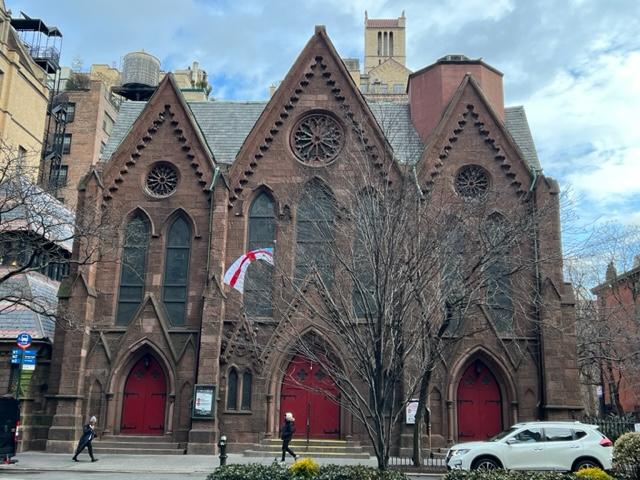
I passed 156 Fifth Avenue as I walked this part of the neighborhood again and admired it for its detailed stonework carving and unusual styled roof. The Presbyterian Building was built in 1893 and was designed by architect James B. Baker and was designed in the French Gothic style. It was to be used by the Presbyterian Church as their base for domestic and foreign missions and used as office space. The Panic of 1893 changed that, and they had to lease the space out (Daytonian in Manhattan).
I then took the long walk down Fifth Avenue and all the architectural treasures it contains. This was once the core of the old ‘Midtown Manhattan’ after the Civil War and the City started its march uptown.
119 Fifth Avenue at the corner of East 19th Street in the Flatiron District neighborhood of Manhattan, New York City was built in 1905-06 and was designed by John H. Duncan in the neo-Renaissance style. It was built to be an annex to the Lord & Taylor department store buildings which took up most of the square block between Broadway and Fifth Avenue and East 19th and 20th Streets, being connected by bridge to two of them. After Lord & Taylor moved uptown in 1914, the building had multiple uses (Wiki).
The details of 119 Fifth Avenue
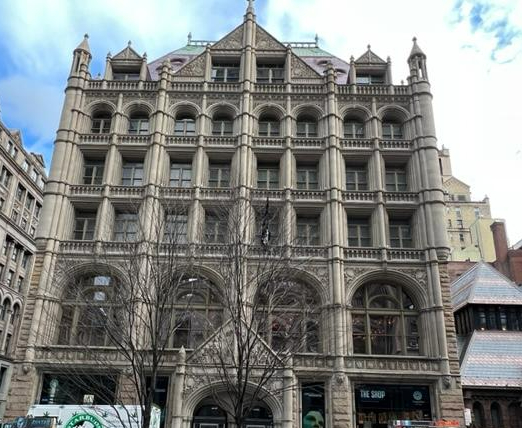
One of the most impressive buildings in the neighborhood is the old Arnold Constable Store building that stretches from its Broadway entrance down the entire block on 18th Street to its Fifth Avenue entrance.
115 Fifth Avenue-Arnold Constable Department Store
This seven-story department store building was designed by architect Griffith Thomas in 1868 for the prominent dry-goods company of Arnold Constable & Company. ‘The Palace of Trade’ as it became known as, is located stretches between Broadway and Fifth Avenue. The stunning Second Empire building is faced in marble, brick, and cast-iron, features stacked arch orders and a prominent, two-story, pavilioned mansard roof. Arnold Constable & Co. was founded by Aaron Arnold, who opened a small dry goods store in the city in 1825 (Buildings of New England).
As the business prospered he moved into larger quarters numerous times. In 1842, James Constable, an employee, married Arnold’s daughter Henrietta and was subsequently made a partner. From this, the company was renamed Arnold Constable & Co. In its heyday, Arnold Constable & Co. was the largest dealer to the elite in New York City, supplying the latest fashions to a clientele that included the leading families in the city (Buildings of New England).
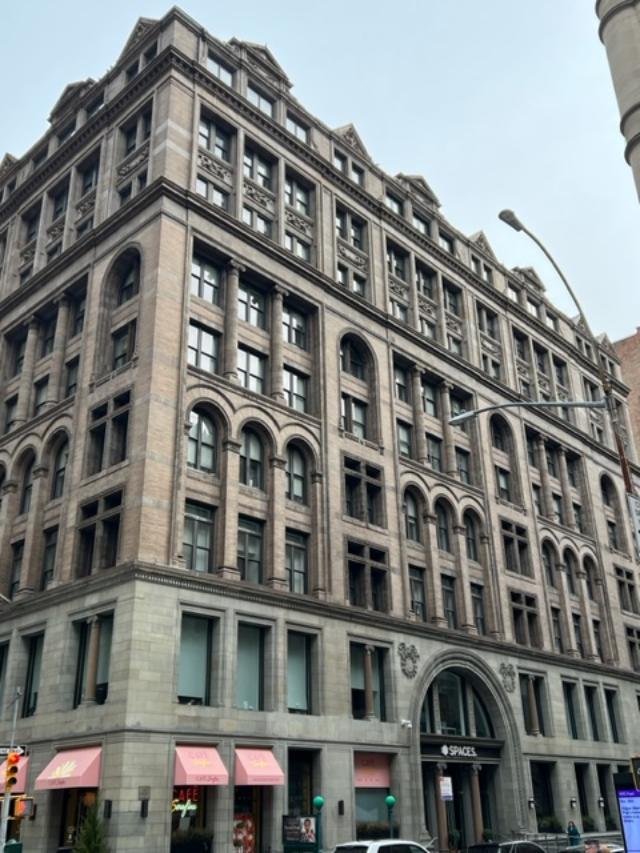
The building had an interesting history. The building was designed by architect Louis Korn and was designed in the Beaux-Arts design. It was completed in 1896 and it was named after Edwards Pierrepont, whose mansion had stood on the site before the construction of the building. When it opened the building was popular small publishing and mercantile companies (Dayonianinmanhattan.com).
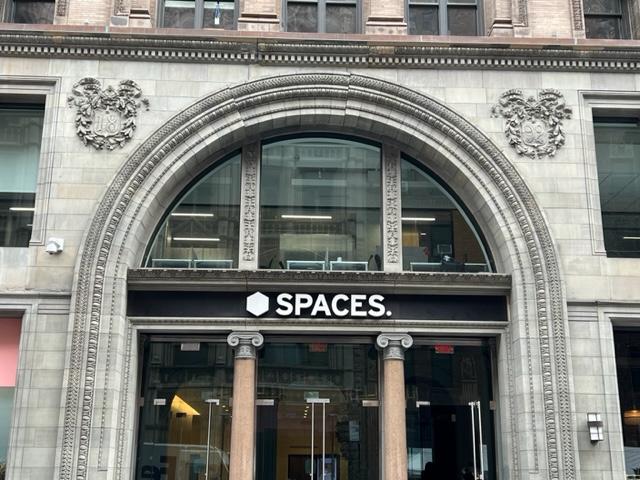
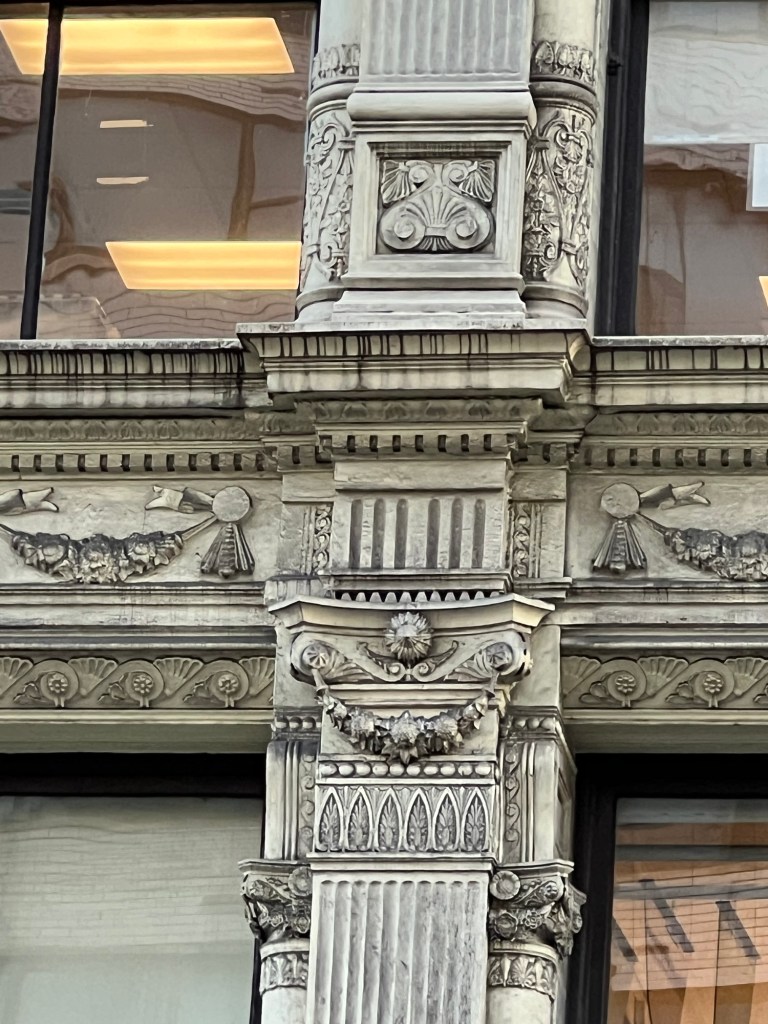
The 103 Fifth Avenue details
103 Fifth Avenue embellishments
In between the buildings there was plaque to Levi Parsons Morton, the former Governor of New York State and the Vice-President of the United States under President Benjamin Harrison. This is where his home was located.
The plaque of the former Vice-President’s home on Fifth Avenue.
Vice-President and former New York Governor Levi Parsons Morton
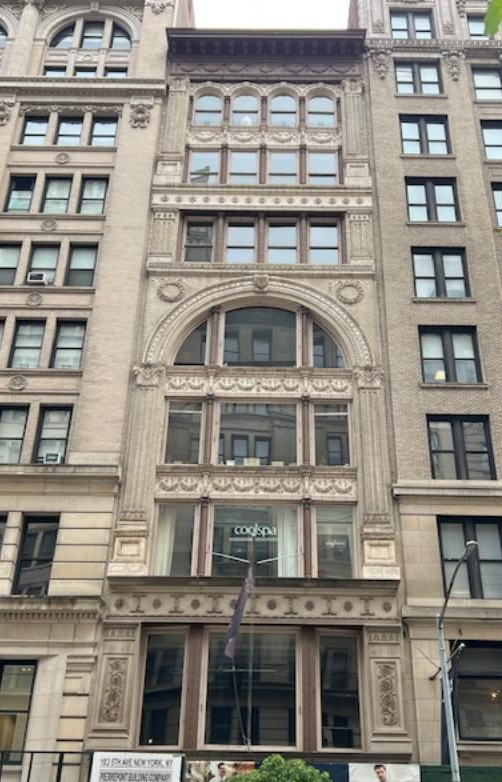
The B. Shackman & Company sign was for the former B. Shackman & Company novelty and toy store that was located here until the 1970’s. The store once sold all sorts of novelties and gifts (Ephemeral New York.com/Consumer Grouch).
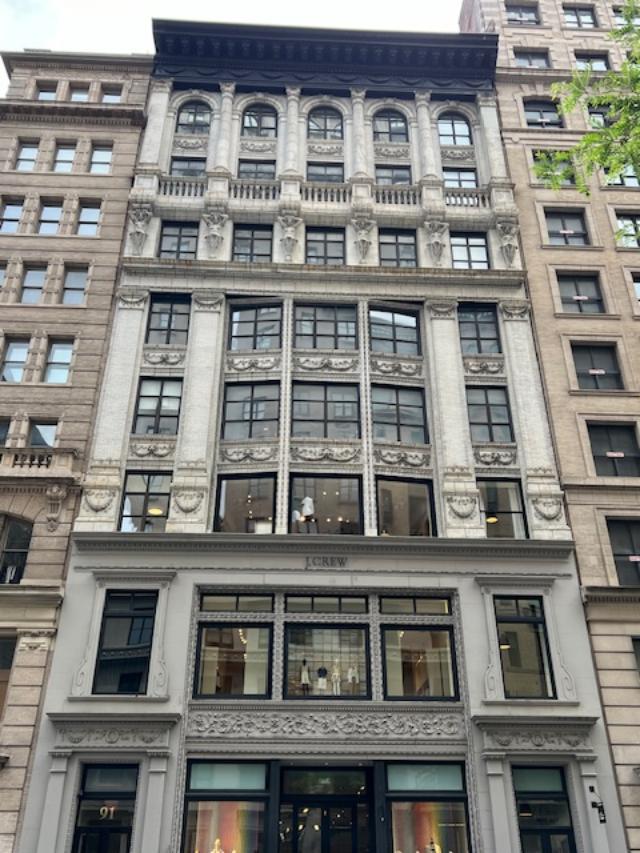
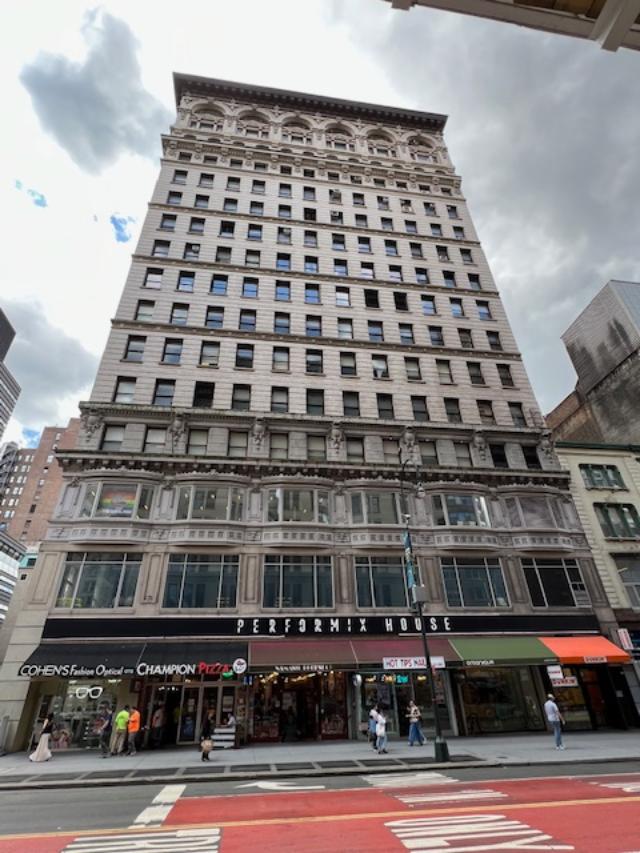
This beautiful office building was designed by architect Louis Korn for businessmen Henry and Samuel Korn in 1896. The office building currently houses small companies (Wiki).
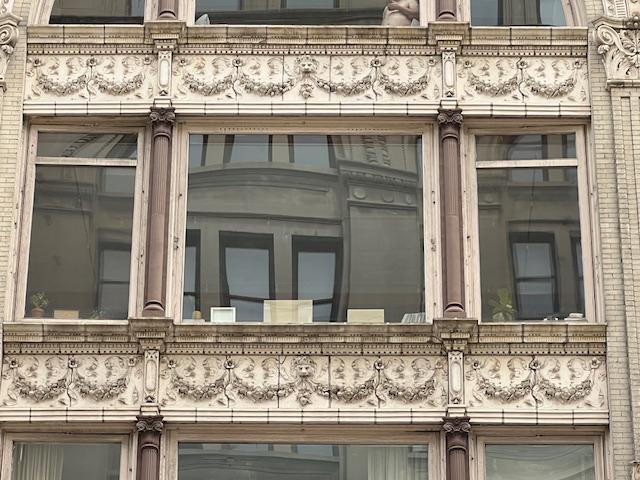
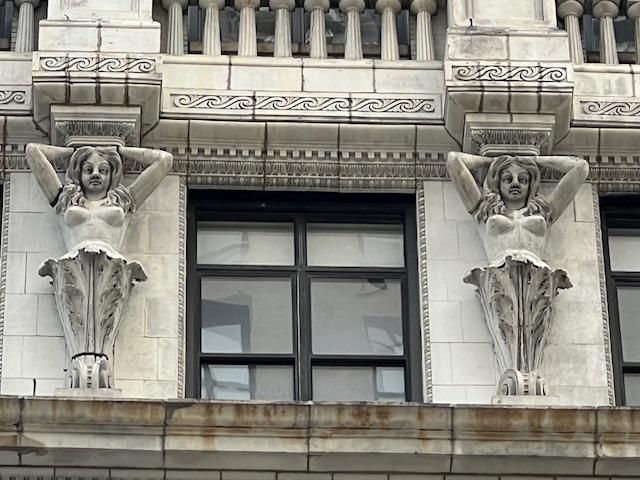
The details of women looking down at us on the street at 91 Fifth Avenue
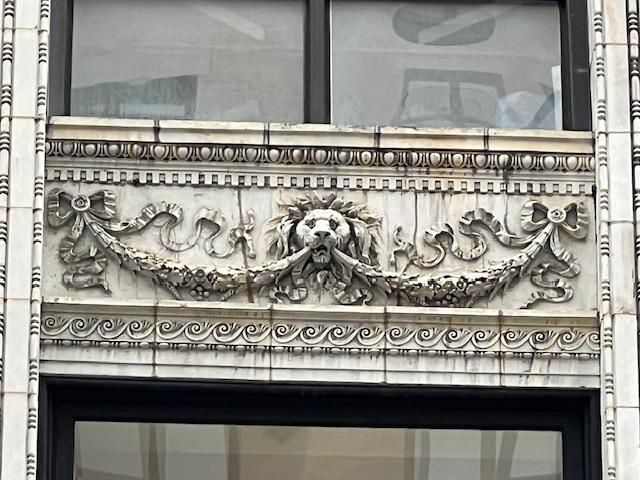
The lion details on 91 Fifth Avenue.
The last building on this part of Fifth Avenue was under an extensive renovation and I was not able to get the pictures that I wanted but still you could see the details in the building around the renovations.
Looking up Fifth Avenue from 16th Street
The Kensington Building was designed by architect Samuel Sass in the Beaux-Arts design and completed in 1906. Some of the first tenants of the building was the Milton Bradley company. The building was converted into a residential building in 1996 and were designed by architect Joseph Pell Lombardi (Landmark Branding LLC).
This part of Fifth Avenue has kept its character all these years and now that these buildings are back in vogue because of their history and design detail, they are being refitted for modern times. These were once the headquarters of companies that are now long gone but are housing the new future companies leading us into the 21st Century.
Looking up Fifth Avenue from 15th Street and the core of the Lower Flatiron District.
West 14th Street is a Hodge podge of building types and in various conditions. COVID really hit 14th Street businesses hard and between the pandemic, urban renewal of the neighborhood and changing tastes of building types, there is only a few buildings left from the era when this was a major shopping street at the turn of the last century. This was before everything moved up to the 23rd Street and Sixth Avenue area.
Much of the block between Fifth and Sixth Avenue is in the process of being knocked down, renovated or both. Still there are some architectural gems still left on the street.
On the corner of Fifth Avenue and West 14th Street is 80 Fifth Avenue.
80 Fifth Avenue is an elaborately-detailed Renaissance Revival style office building that was constructed by the architecture firm of Buchman and Fox. This building was constructed in 1908 to be used as manufacturing and office space (Kates, Ariel. Off the Grid).
Seeing better detail work on the building from the West 14th Street view.
This beautiful building’s lower and upper levels feature decorative floral and geometric ornamentation, elaborate cornices, and angled bay windows on the third floor. Ornamented pilasters are found at either side of these windows, with slightly more austere middle floors and in its arched windows and elaborate ornamentation at the top story (Kates, Ariel. Off the Grid).
The beautiful detail work on 80 Fifth Avenue.
The building’s history has a long past of companies that have worked in these offices but the most prominent had been the creation of the gay organization, The National Gay Task Force. Among the Task Force’s accomplishments during the time it was located at 80 Fifth Avenue included getting the American Psychiatric Association to end its classification of homosexuality as a mental illness; getting the federal government to end its ban on employing gay or lesbian people in any federal agencies (Kates, Ariel. Off the Grid).
When I turned to the corner and walked down East 14th Street, I know seeing developers attempt to rid Union Square of its once seedy past. As I pass the park itself, I still remember the days when this was a major drug haven, a major methadone clinic was located here and sensible people stayed far away from Union Square Park. It took Danny Meyers and the creation of Union Square Cafe in 1985 at 101 East 19th Street and then the closing of the methadone clinic to change all that. The popularity of the Farmers Market and the renovation of the park in the late 1980’s changed the complexity of the neighborhood.
The original Union Square Cafe at 21 East 16th Street
My father and I on Father’s Day at the original Union Square Cafe for lunch in early 2000’s
There were also a series of buildings around the square that were knocked down and new buildings built in their place most notably the old S. Klein on the Square building replaced by a new office building, a branch of NYU opening on the southern end of the park and the Zeckendorf Towers buildings at One Union Square changed the who complexity of Union Square into a desirable neighborhood. In the 21st Century, it is now becoming a trendy neighborhood catering to the tech industry.
As I crossed Fifth Avenue to West 14th Street towards Union Square I remembered that this was the most southern part of the old Ladies Shopping District before the Civil War. It had been the theater district as well with the Academy of Music closer to Irving Street. After the Civil War, the shopping and theater district moved uptown towards 23rd Street, then to 34th Street and then ending at 42nd Street.
Between Fifth Avenue and Broadway along the southern border of Union Square, there is not much left of that shopping district. Many of the older buildings had been knocked down in the early 1900’s for new stores and since then much of the non-landmarked buildings were again knocked down in the early 1980’s to improve the district. S. Klein stood empty from 1975, when it closed for business to 1983 when it finally was knocked down for the Zeckendorf Towers and that changed the district forever (Wiki).
Still when I walked from Fifth Avenue to Union Square there was one building that stood out amongst all the new late 20th buildings on 14th Street and that was 22-26 East 14th Street.
This impressive building at 22-26 East 14th Street built along the former Ladies Shopping Mile was once meant to impress. This was once the home for Baumann Brothers Furniture & Rugs
The building was designed by architects David and Jon Jardine for successful textile merchant James McCreery in 1881. The building was designed in the Neo-Grec and Neo-Classical design and until 1897 was the home for Baumann Brothers Furniture and Carpet store. It then passed to Woolworth’s and the broken up for other retailers. It is now home to Footlocker but you can still see the beauty in this building with its elaborate embellishments (DaytonianinManhattan.com)
You really have to stop and look at its Neo-Classical details to really appreciate this building
The intricate details of the McCreery Building
The floral details in the middle of the building
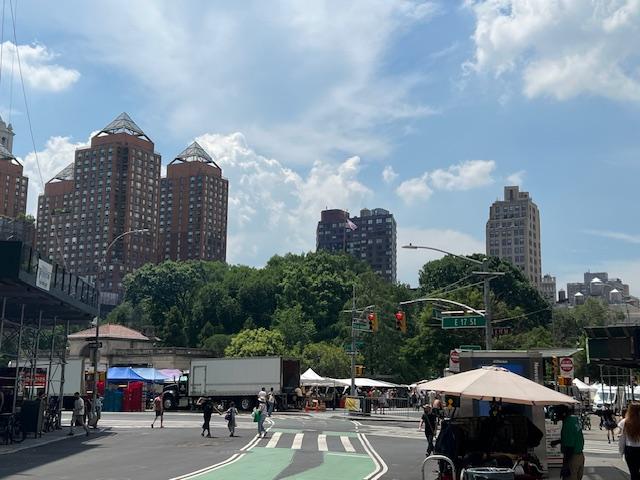
I got a chance to walk around Union Square once I finished my tours of Fifth Avenue and East 14th Street. It was a beautiful sunny day and people were outside enjoying the sun and shade in the park. The Farmers Market was going on which made it even busier. By the subway station, there were guys hustling to play chess. A typical day in Union Square Park. Thirty years ago just like Bryant Park or Madison Square Park, sensible people stayed away from these squares of green with the garbage and graffiti and drug dealing. How a City transforms itself over a period of time is confounding. From the ashes of COVID, another New York City is rising.
What impresses me the most about the park is that the crazy protestors never knocked our statues down. Inside Union Square are three very prominent and very famous statues of George Washington, Abraham Lincoln and General Lafayette.
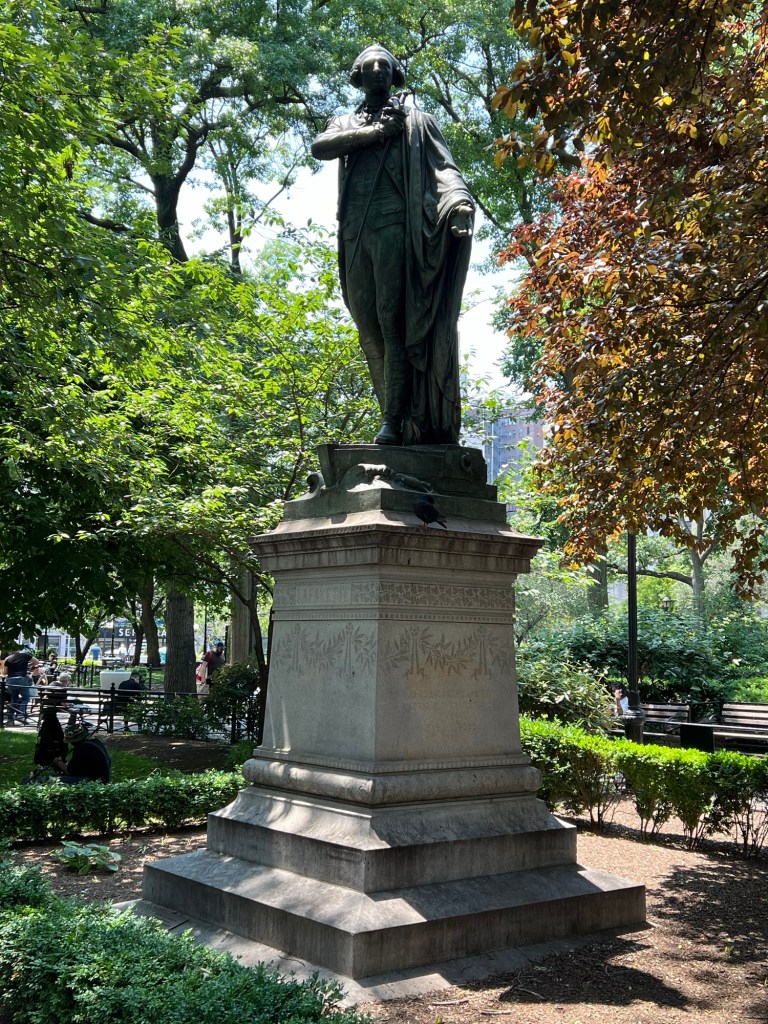
We are lucky that our statues were not knocked down like other cities in 2020. This impressive statue of General Washington sits at the entrance of Union Square.
This impressive statue of George Washington was designed by sculptor Henry Kirke Brown and was dedicated in 1856. The moment Brown depicts is that of Evacuation Day, November 25, 1783, when Washington reclaimed the city from the British. With outstretched hand, he signals to the troops in a gesture of benediction (NYCParks.org).
Artist Henry Kirke Brown was an American born artist who had studied with artists in Italy for his training. He is best known for his figurative historical statues. He also designed the statue of Abraham Lincoln in Union Square.
On the southern part of Union Square is the Climate Clock atop the NYU Dorms at 60 East 14th Street. The facade of the building makes quite the statement above Union Square if you stop to look at its details.
The new climate clock and NYU dorms replaced the once seedy shopping district the was Union Square at 60 East 14th Street
The Climate Clock melds art, science, technology, and grassroots organizing to get the world to #Actin Time. The project is centered on a simple tool: a clock that counts down the critical time window to reach zero emissions (our “Deadline”), while tracking our progress on key solution pathways (“Lifelines”) By showing us what we need to do by when, the Clock frames our critical mission — a rapid and just transition to a safe climate future — and puts it at the very forefront of our attention (Climateclock.world.com).
The building that single handedly changed Union Square (outside of Union Square Cafe) was the Zeckendorf Towers. This replaced the long closed S. Klein Department store that had closed in 1975 and lead to the seediness of the area. The store had been boarded up for years and led to the downfall of Union Square in the early 1980’s.
S. Klein Department Store on Union Square East was boarded up for years
When the store was torn down to make way for the Zeckendorf Towers, this completely changed the area. That and the renovation of Union Square in the late 1980’s and the creation of the Union Square Farmers Market made this a desirable area once again.
The Zeckendorf Towers at One Irving Place/One Union Square East
The success of the Zeckendorf Towers changed the complexity of the neighborhood for years to come replacing the S. Klein Department store. The residential building was designed by the architectural firm of Davis, Brody & Associates and was name for owner William Zeckendorf. The building was finished in 1987.
Tucked off in the corner of the park is the statue of General Lafayette. Why this important figure of the Revolutionary War is hidden is unfortunate.
The statue of General Marie-Joseph Paul Yves Roch Gilbert du Motier de La Fayette, Marquis de La Fayette
The larger-than-life-sized figure was sculpted by Frédéric-Auguste Bartholdi, who also designed the Statue of Liberty (1886), another gift from the French government that figures prominently in New York Harbor. The granite pedestal designed by H.W. DeStuckle was donated by French citizens living in New York. (NYCParks.org).
Frederic Auguste Bartholdi was a French born artist best known for designing the Statue of Liberty. Bartholdi attended the Lycée Louis-le-Grand in Paris where he graduated in 1852. He then went on to study architecture at the Ecole nationale superieure des Beaux-Arts (Wiki).
As the sun started to set on this Sunday afternoon, I passed 4 Irving Place which the first couple of floors were under scaffolding. I admired the clocktower on the top of the building, the beautiful embellishments and just the elegance of the building. The building is home to Consolidated Edison (ConEd).
The was designed by architect Henry Janeway Hardenbergh and architectural firm of Warren and Wetmore in the Neo-Classical design. The first phase of the building was started in 1911 and both phases were finished by 1929. The original section of the building is in the picture with the wings of the building to both sides (Wiki).
I passed 4 Irving Place, the Con Ed Building, just as twilight hit the building and you could see the beauty in its shadows.
Its clock told the time of the early evening.
The next morning when I walked past it again, you could see the true beauty of its design.
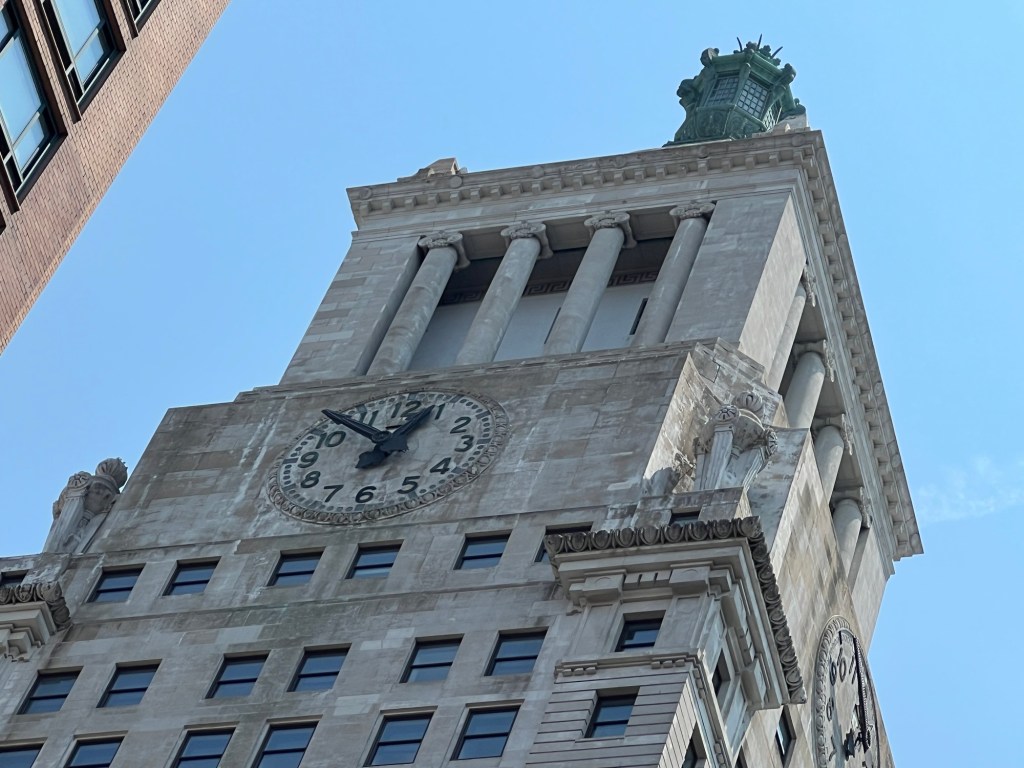
I also noticed that the roof top held a more intricate design than I noticed the night before. Look up at its intricate details to admire its beauty. This is part of the originally designed building.
Once I turned onto Irving Place, the old core of its industrial past gave way to the bohemian village it would become and stay in the future. This was once ‘THE’ neighborhood to live in and has stayed that way since even through the rough times of Union Square.
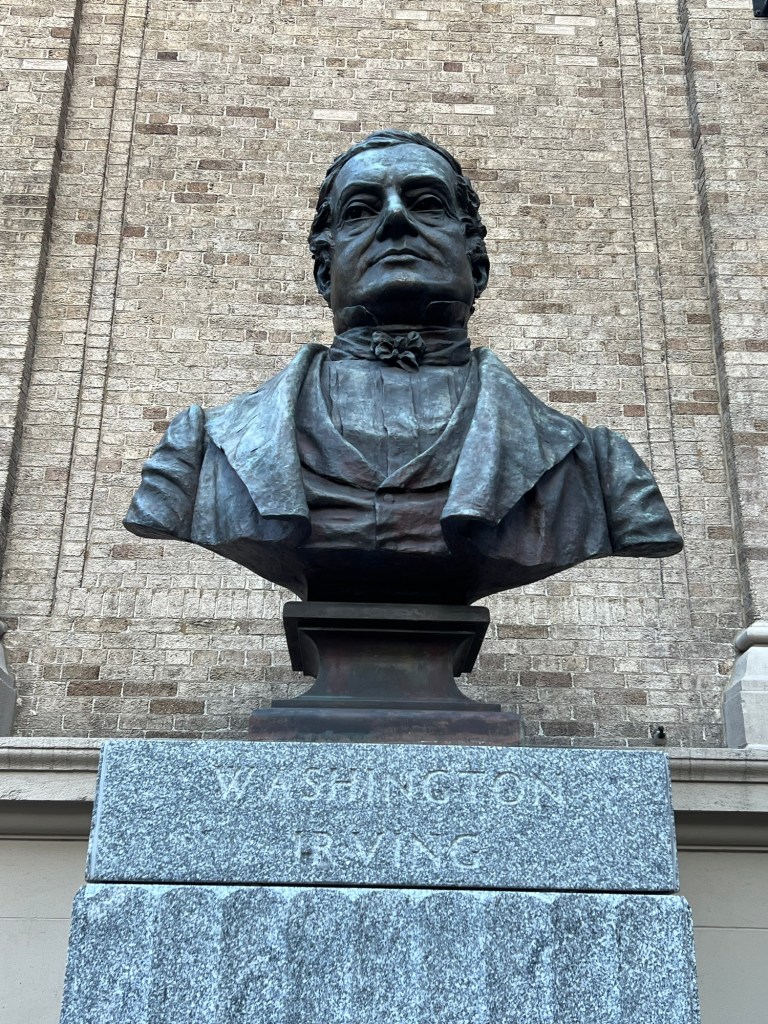
The most impressive object you will see in the neighborhood is this bust of Washington Irving that sits outside the Washing Irving Campus on Irving Place.
Artist Friedrich Beer was a German born artist known for his works on busts of famous individuals.
The neighborhood goes from commercial to more residential as you get further up Irving Place and closer to Gramercy Park. The borders of Union Square overlap with Gramercy Park and the Flatiron District between East 18th and East 20th streets so I revisited buildings that J had seen before. If people went in a Time Machine to Manhattan from 100 years ago they would still see the same buildings but with totally different uses.
The Washington Irving house at 122 East 17th Street and Irving Place (Washington Irving never lived here)
The “Irving House” was built by Peter Voorhis between 1843 and 1844, along with the adjacent two houses at 45 and 47 Irving Place. The original tenants of 49 Irving Place (at that time referred to as 122 East 17th Street) were Charles Jackson Martin, an insurance executive, and his wife, who would reside there from 1844 until 1852. Henry and Ann E. Coggill would live in it in 1853, and in 1854 it would become the home of banker Thomas Phelps and his wife Elizabeth, who would remain until 1863 (Atlasobsucra.com).
The front of the house facing Irving Place
The first mention in print of Irving having lived in the house came in the Sunday Magazine Supplement of the New York Times on April 4, 1897. The article is a human interest story about Elsie de Wolfe and the means and methods she used to decorate “Irving’s house.” In 1905, de Wolfe would become known as the first professional interior decorator and it appears this article is an early attempt at publicity for her. As for the information about Irving, the article takes enormous liberties (actually, it flat-out makes things up), claiming that Irving had conceived of the house himself and was very particular about the architecture and design (Atlasobsucra.com).
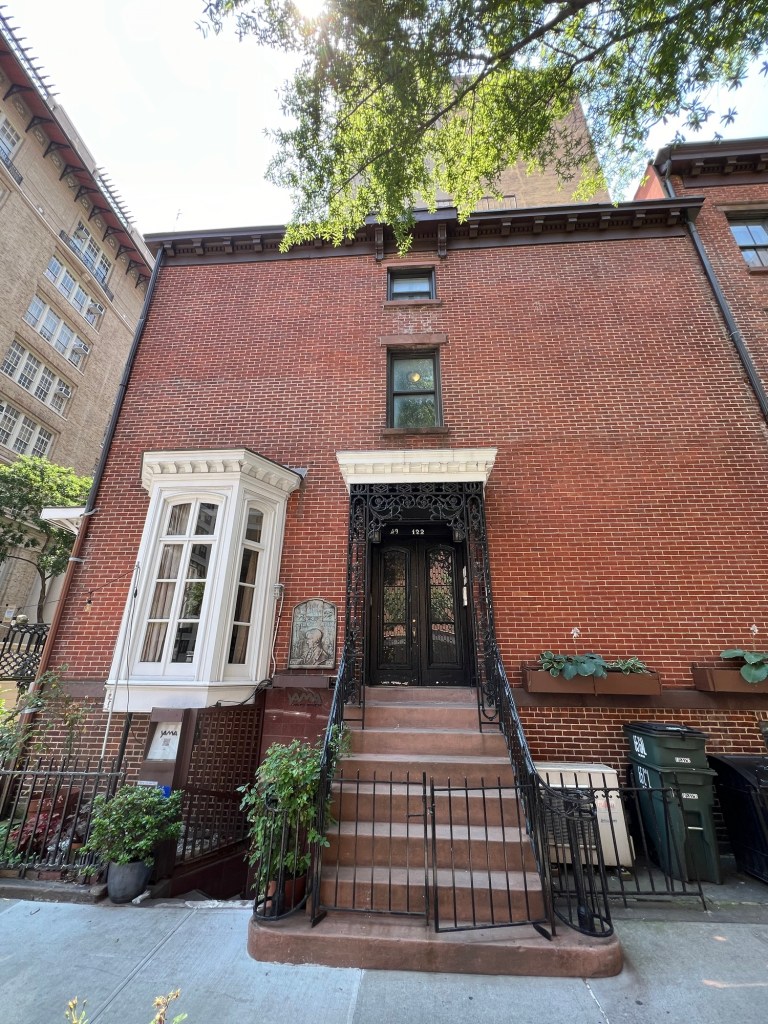
The entrance to the house at 122 East 17th street
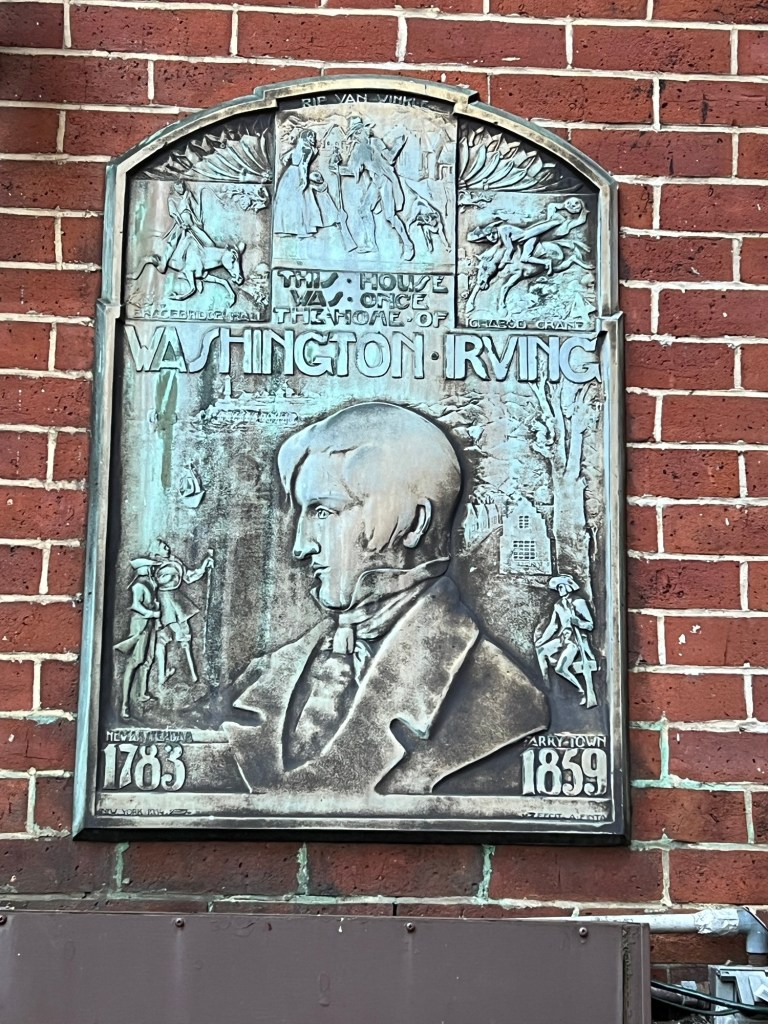
The plaque on the house dedicated to the writer created by artist Alexander Finta
In 1930, a restaurant called the Washington Irving Tea Room was operating in the basement of the building and in 1934 a plaque sculpted by Rodin-student Alexander Finta was put up on the north facade that would cement the story in the public consciousness. Today, the surrounding area remains covered in references to Irving, from the large art installations in the nearby W Hotel to the Headless Horseman pub on 15th Street(Atlasobsucra.com).
Artist Alexander Finta was a Hungarian born artist who moved to the United States in 1923. He had studied mechanical engineering in his own country and had studied with Auguste Rodin. His is known for his elaborate busts. He spent the remainder of his career at 20th Century Fox Studios (Wiki)
All along the Irving Place corridor, the street is lined with interesting and historical buildings many of them turned into restaurants or inns. There are many historic plaques in this neighborhood and some creative architecture. The first building that caught my eye was 53 Irving Place, which is the home of Pierre Loti Wine Bar.
The home of Pierre Lotte Mediterranean Restaurant at 53-55 Irving Place was the home of O Henry
When I looked at the side of the building near the entrance, I was this historic plaque that said that this was the home of author William Sidney Porter (O. Henry). The author lived here from 1903-1907 and wrote the “Gift of the Magi” while living here and eating at Pete’s Tavern across the street (Wiki).
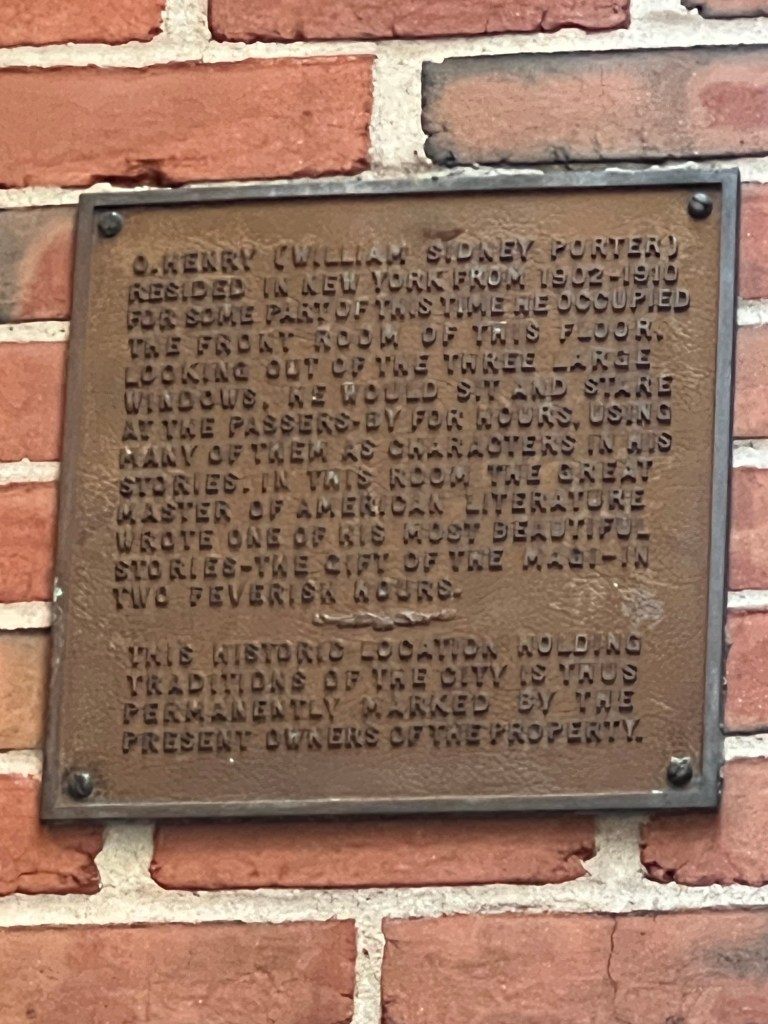
The historic plaque for author O Henry at 53-55 Irving Place
Down the road at is Pete’s Tavern, one of the most famous and the oldest literary restaurants in the City. The restaurant was founded in 1864 as the Portman Hotel and then in 1899 when changed to Healy’s Cafe when it was run by John and Tom Healy. Then in 1899, it was bought by Peter D’ Belles and renamed Pete’s Tavern. The restaurant was a ‘Speakeasy’ during prohibition and the dining rooms have not changed much over the last over hundred years (Pete’s Tavern website).
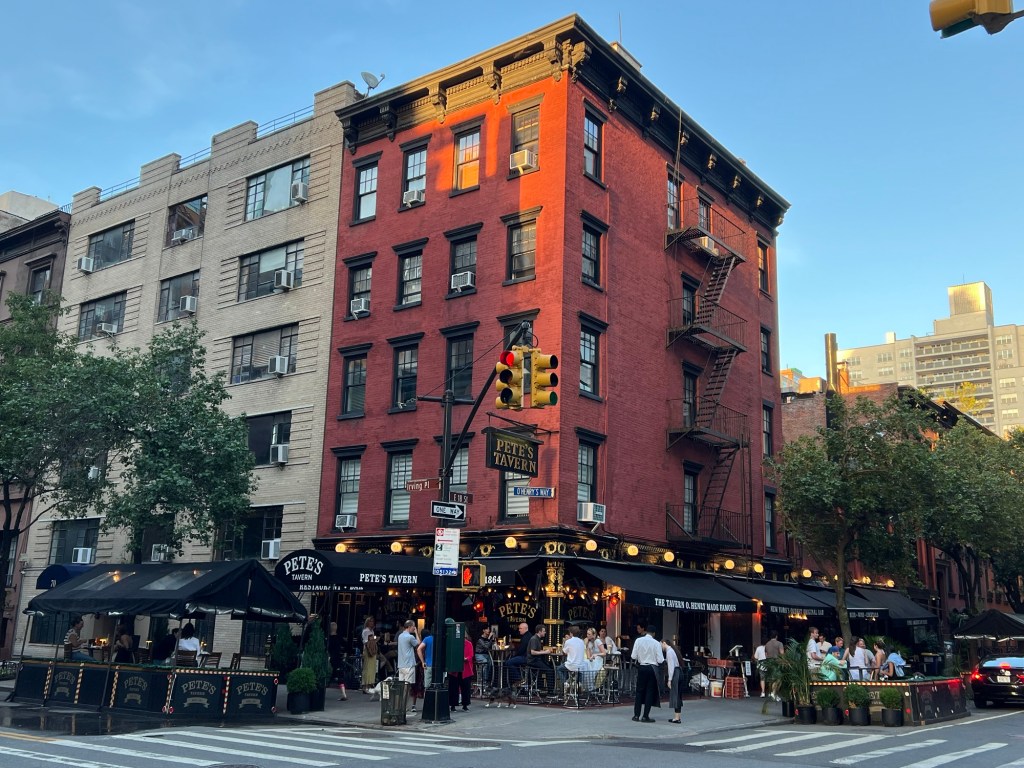
Pete’s Tavern was busy on the night of my first part of the walk.
The painting outside of Pete’s Tavern of the Speakeasy years
Pete’s Tavern was busy both nights that I passed it. I had not eaten there in over a decade when I had a holiday dinner there with friends by I remember the food and service being excellent. The restaurant is really special during the Christmas holiday season from what I can remember.
My friends Barbara, Lillian and I after dinner at Pete’s Tavern in the early 2000’s
Another restaurant I went to before my friend, Barbara, moved to Florida was a Friend of the a Farmer at 77 Irving Place, a farm to table concept before it became very popular. I remember the food being wonderful but the place being a bit noisy. She lived on the fringe of Gramercy Park and had passed this restaurant many times and had wanted to try it that evening.
Another great restaurant is Friend of a Farmer at 77 Irving Place
Across the street, I passed this apartment building at 76 Irving Place. I loved the outside embellishments on the building and the friendly looks you get from the statuary. The building was built in 1897 by architect Lyndon P. Smith (Corcoran Group).
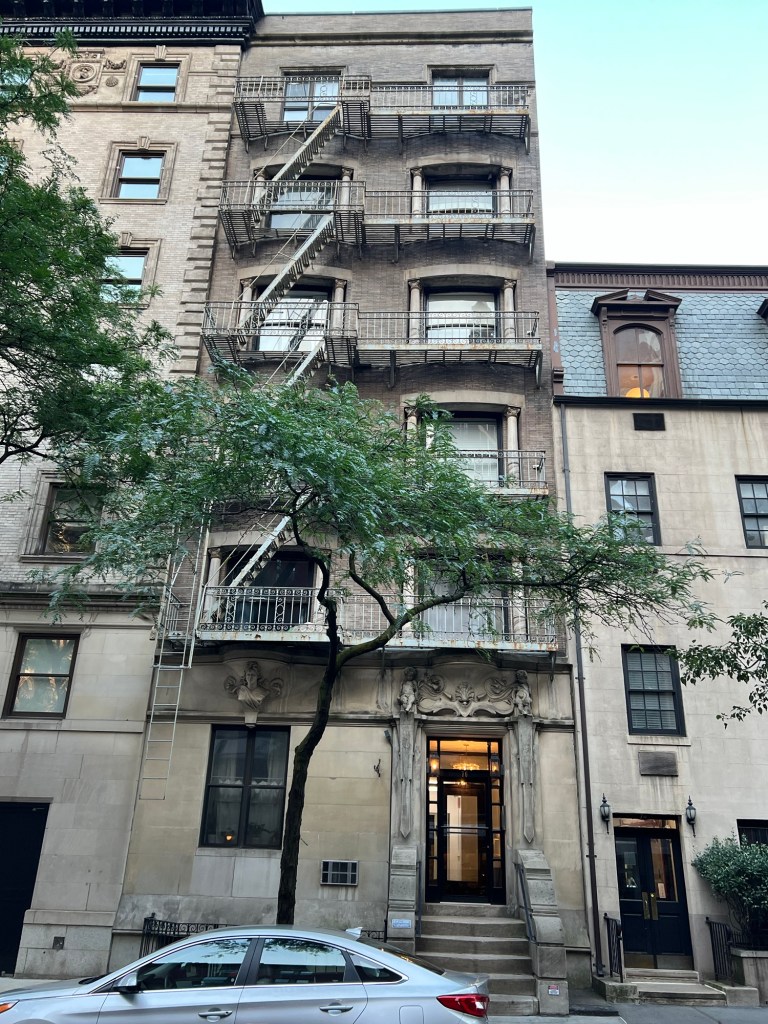
You have to look up to admire the details of 76 Irving Place
The entrance to 76 Irving Place with its tiny angels
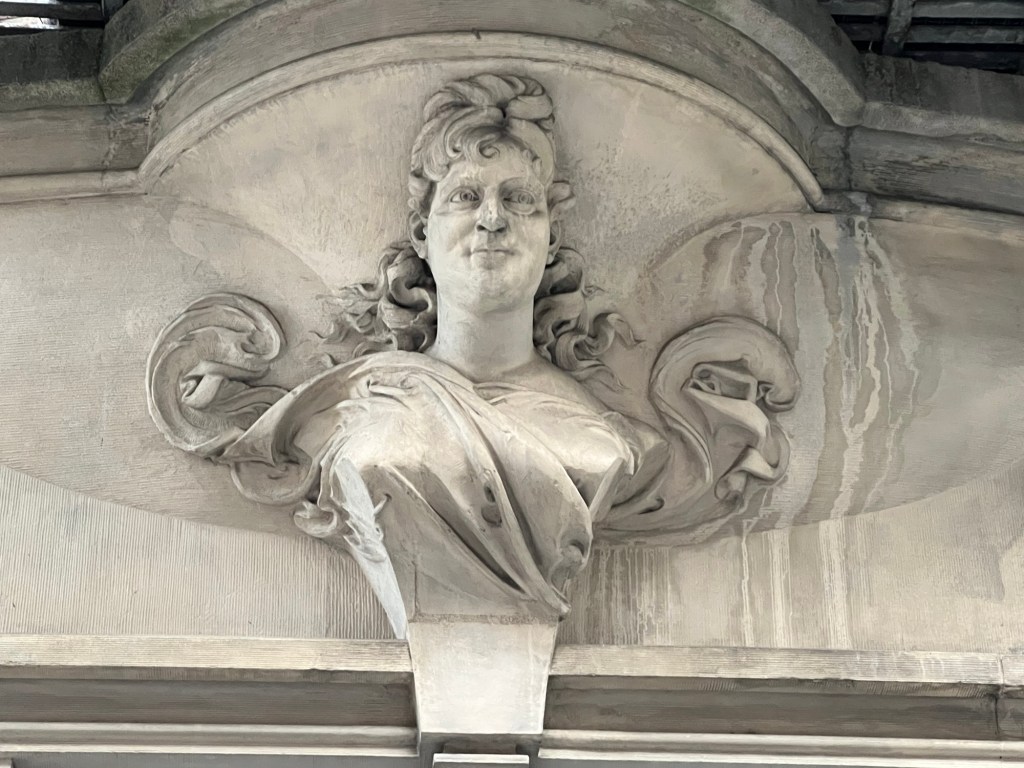
This woman guards the front of Irving Place like guard
This woman greets you at 76 Irving Place
The classic architecture of the block especially as you get closer to Gramercy Park changes from smaller apartment buildings to brownstones lining the parks southern border. Gramercy Park offers some of the most interesting architecture. This ivy covered building that impressed me so much as the sun was going down is at 80 Irving Place.
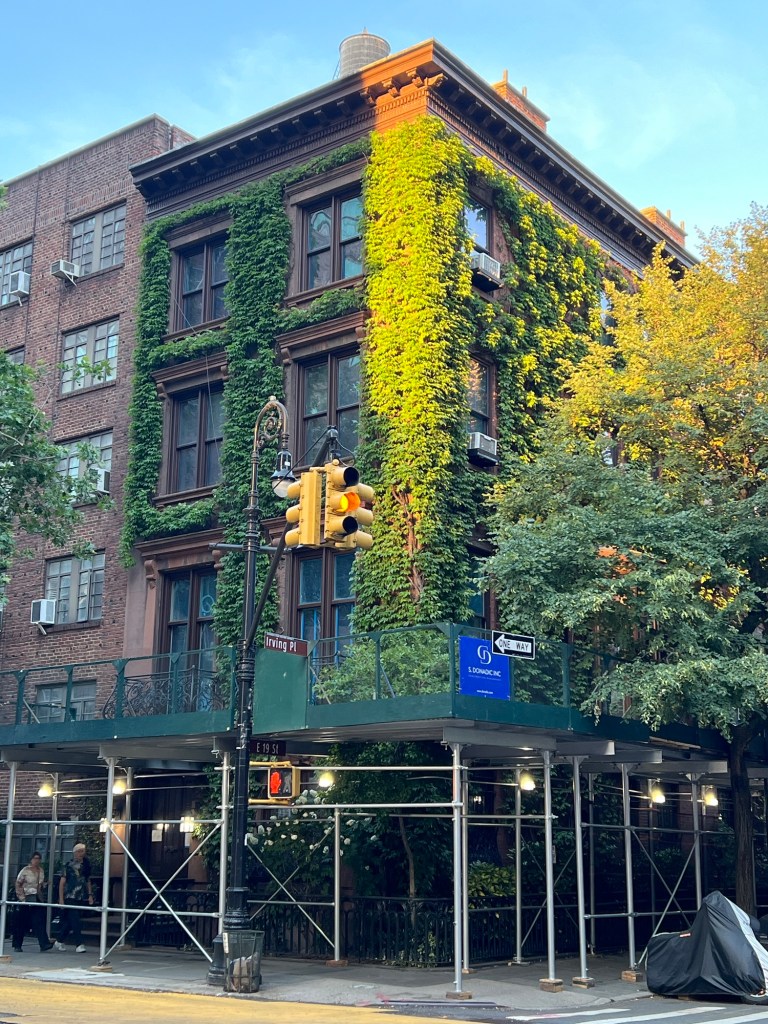
This building at East 19th street and Irving Place is typical for the buildings that once lined this neighborhood
The house was built as a single family mansion between 1853 and 1854 and had been the home of the prominent Wood family and then to actress Agnes Ethel Tracy. Since 1987, it has been a single family home again. What I thought was interesting was that the house was used in the movie “Working Girl” as Sigourney Weavers character’s home (DaytoninManhattan.com).
Look up at the beautiful details of 81 Irving Place
81 Irving Place is one of the most beautiful apartment complexes in the city that I have come across. The embellishments along the building are some of most detailed and elegant I have seen. This prewar Co-Op was built in 1929.
The details along the windows
The embellishments of the building
The dragons and demons that adorn the windows
The embellishments of the building
The unusual creatures at the doorways
The embellishments of the building
The creatures guarding the windows
The embellishments of the building
The rooftop gardens are protected by these griffins
The building has a whimsical almost storybook imagine of creatures protecting their home.
Where I want my future home to be when I retire to the City and can afford it is 19 Gramercy Park South. I have always loved this building since I fell in love with the neighborhood over thirty years ago. I always wanted a home with a key to Gramercy Park. The building has that classic turn of the last century look about it and it has always been my dream to live here when I retire. I need to hurry and win the lottery.
My dream home would be at 19 Gramercy Park South with a key to the park
I had thought this was a apartment building but it is actually a single family mansion with 37 rooms. It was built in 1845 and when the mansion was extended by Stamford White in 1887 was the home of socially prominent Stuyvesant-Fish family. It is currently back to being a single family mansion (Wiki).
As I turned the corner at East 20th Street I never tire of peering into Gramercy Park and keep wishing for that key. Gramercy Park is still one of the most beautiful and fantastical parks in New York City. It has once been part of the Stuyvesant estate and got its name from Gramercy Farm that once stood here. It is the only piece of the old Rose Hill Farm still in existence (Wiki).
I love the beauty of this park. There is an English feel to this park that reminds me of London and some of the neighborhoods that I visited it there. I have never been inside the park but it would be fun to walk around. I found out from researching for another blog on the Rose Hill neighborhood is that Gramercy Park is the corner and last surviving parcel of the old Rose Hill Farm.
East 20th street across from the park has some of the most interesting brownstones in Manhattan. They add to the historic value of the neighborhood. When you turn the corner of Gramercy Park off Irving Place, you will see the classic architecture that surrounds the park. It is one of the most picturesque neighborhoods in Manhattan.
The beauty of East 20th Street across from Gramercy Park
Right across the street from the park sits one of the best known brownstones in the neighborhood housing the “Players Club”. This club was made famous by the movie “Manhattan Murder Mystery’” for the wine tasting scene.
The movie “Manhattan Murder Mystery” by director Woody Allen was shot in the neighborhood
The mansion was built in 1847 and was the home of Valentine G. Hall. The building was bought by actor Edwin Booth, the older brother of John Wilkes Booth who assassinated President Lincoln. He kept a suite for himself at the top of the home and then turned the rest of the building into the “Players Club” in 1888. The club now serves as a social club with artifacts of the theater arts on display and a private restaurant (Wiki).
Artist Robert Henri was an American born artist. He studied at the Pennsylvania Academy of Fine Arts Philadelphia and at the Ecole des Beaux-Arts in Paris. He is best known for his works in the Impressionism movement (Wiki).
As I crossed Park Avenue South, I entered the familiar neighborhood of the Flatiron District meeting the bottom of the Rose Hill neighborhood. This is when Manhattan neighborhood borders get confusing. Since the Union Square technically ends at East 18th Street but that would leave two blocks open without being in a specific neighborhood, I stretched it to East 20th Street. This again borders the Flatiron and Rose Hill/NoMAD section of the City. I figure that I will let the realtors figure this one out.
When you cross the border at Park Avenue South, I admired the same buildings I had seen several month earlier when I walked these streets and avenues just as Fall semester at NYU began.
The building at 250 Park Avenue South houses the restaurant Barbounia in the base of the building.
42 East 20th Street was designed by the architectural firm of Neville & Bagge and was built in 1890 in the Beaux-Arts design. N.S. Meyer was a military company selling Army and Navy equipment since 1868 (14to42.net).
The beauty of the NS Meyer Inc. building
Next to that is another beautiful building the at 36 East 20th Street. This commercial building was built in 1901 with Beaux-Arts details on it.
The building is a commercial building that was built in 1901.
You can see the beauty of all the details
The details on the top of 36 East 20th Street
Right down the street at 28 East 20th Street is the Theodore Roosevelt Birthplace Historic Site Museum. It had been closed for so long after COVID I never thought it would open any time soon. It did finally open late last year and I thought this was one of the most interesting of the historical homes in the City. This one had been completely recreated by the family and then furnished with family heirlooms from the original house. That makes for an interesting museum.
At 28 East 20th Street is the Theodore Roosevelt Birthplace Historic Site, which is an exact replication of the original home that President Theodore Roosevelt was born and raised. The house that originally stood on the site was built in 1848 and was bought by the Roosevelts in 1854. Theodore Roosevelt was born there on October 27, 1858, and lived in the house with his family until 1872, when the neighborhood began to become more commercial and the family moved uptown (Wiki).
The Roosevelt House Living Room
The original building was demolished in 1916 to make way for retail space, but upon the death of Roosevelt in 1919 the lot was purchased and the house rebuilt by the Women’s Roosevelt Memorial Association, which eventually merged with the Roosevelt Memorial Association in 1953 to form the Theodore Roosevelt Association.
Theodore Roosevelt’s bedroom
Noted female American architect Theodate Pope Riddle was given the task of reconstructing a replica of the house, as well as designing the museum, situated next door, that serves to complete the site (Wiki).
The Parlor of the house
You have to take time when the museum is open to take the independent tour. When you walk around the house you will swear that the family had just left the room to grab something. It is well worth the trip to see how the family lived before they moved uptown.
The next building on the block that is unique is 7 East 20th Street, the old Holtz Building.
The old Holtz Building at 7 East 20th Street
The ornate, Beaux-Arts edifice was erected in 1907 as a commercial building with the Holtz Restaurant located on the lower two floors. In the early 1900’s Phillip Braender commissioned architect William C. Frohne to design a 12-story building, with the lower two floors being specifically customized and designed to house for the Holtz Restaurant. The Holtz was a high-end establishment catering to the upper echelon of the population and converted to condo lofts in 1987 (Corcoran Group.org/Streeteasy.org)
After I finished the walk down East 20th Street, I walked back down Fifth Avenue to Union Square Park in the mid afternoon to see what was going on. There was a smaller version of the bigger weekend Farmers Market.
The Farmers Market in Union Square is one of the biggest and most popular Farmers Markets in the City
The Union Square Greenmarket in full swing on a sunny afternoon
After walking through all the stands and admiring the wares and the baked goods, I wanted to cool down with a walk through the park. I never really noticed all the beautiful statuary in the park before. There is a lot of interesting and famous works in the park.
The original layout of the park on a gold map
The golden plaque on the sidewalk outside Union Square Park with the original layout of the park
People relaxing in the park
New Yorkers relaxing on a warm sunny afternoon in Union Square Park
When I walked around the park, I noticed more and more artwork and statuary around the park. This flagpole is located in the middle of the park. You really have to walk around the base to appreciate the details the artist created on this.
The flagpole in the middle of the park
The Independence Flagstaff in Union Square Park
Although this flagstaff commemorates the 150th anniversary of the signing of the Declaration of Independence, it is also known as the Charles F. Murphy Memorial Flagpole. The intricate bas-reliefs and plaques were completed in 1926 by sculptor Anthony De Francisci and feature a procession of allegorical figures representing democracy and tyranny, the text of the Declaration of Independence, and emblems from the original 13 colonies. The enormous flagpole, said to be one of the largest in New York State, is capped with a gilded sunburst (NYCParks.org).
Artist Anthony De Francisci is an Italian born artist whose family were stone carvers by trade. He studied at Copper Union and the National Academy of Design when he moved to New York City. He is known for his known for his work as a sculptor and his design of American currency.
The magnificent details in the flagpole
The details are amazing on the flagstaff
The flagpole was erected to commentate the 150th Anniversary of the Declaration of Independence
Located at the northern end of the Union Square is the prominent statue of President Lincoln. This statue stands and overlooks the lawn of the park.
This impressive statue of Abraham Lincoln was designed by sculptor Henry Kirke Brown and was dedicated in 1870. In his statue of Lincoln, cast in 1868, and dedicated September 16, 1870, he combines a classically styled pose with a perceptive naturalism, uniting realistic detail with an idealistic stance (NYCParks.org).
Artist Henry Kirke Brown was an American born artist who had studied with artists in Italy for his training. He is best known for his figurative historical statues. He also designed the statue of George Washington in Union Square.
There is a lot more to Union Square than just the park. There is interesting architecture. Historic statuary, wonderful restaurants and great selection of stores.
The amazing part about Union Square is the transformation of the area in the past thirty years from a park that everyone avoided to one that people could not live without. From the days of being home to one of the biggest methadone clinics in the City to be home to Union Square Cafe which transformed the park, Union Square has become the gateway to Uptown.
Finishing up the walk with some relaxation in the park
The Northern end of Union Square Park
The neighborhood has transformed itself with hip cafes, expensive lofts and a Farmers Market that is the benchmark that all others hold themselves. Just watching people sit and relax in the park reminds me of how this area had changed. You have to walk the streets to see the influences of the past and the present and how it has it has morphed to the neighborhood that it has become.
Union Square Park on that sunny warm June afternoon
As I explored the borders of the park, I came across a statue of a mother and child. I never noticed that this was an old water fountain for the park. It is always blocked off by vendors during either the Farmers or Arts Markets. With nothing in front of it, I could finally see it in its full form.
Consisting of a bronze statuary group atop a granite stepped pedestal, it was crafted by German sculptor Karl Adolph Donndorf and donated by philanthropist Daniel Willis James to promote public health as well as the virtue of charity (NYCParks.org).
Artist Karl Adolph Donndorf was a German born artist know for his large realistic sculptures. He had served as an artist apprentice to further his education on sculpture (Wiki).
Just looking at old pictures online of Union Square in the 1970’s and 80’s shows me the power and resilience of Manhattan. It just goes to show you how a City can reinvent itself even in the worst of times and keep morphing!
The other blogs on the Union Square neighborhood:
Day Three Hundred and Thirteen: Walking the Borders of Union Square:
I started my walk on the streets of the Lower Flatiron District in between my volunteer time at Holy Apostles Soup Kitchen. I had been working in the pantry for both the morning and afternoon shifts and we finished the morning shift an hour early. I decided to walk down to the neighborhood on break and then walk as many blocks as I could that afternoon. I was able to walk from West 19th to West 17th and then walk back to Holy Apostles in time for lunch and then the next shift.
Each block offered its own surprises. A lot of new restaurants have opened in the area, and I have to say the prices were quite high on most of them. I am sure that the rents are getting higher in this very trendy area. There has also been a transition from commercial to residential in these gorgeous Beaux-Arts and Geo-Classical buildings.
These were buildings that were built to last as the headquarters for businesses that have long since passed. Even some before the Great Depression. Their legacy remains as you admire the details and embellishments of the buildings that line the streets here. Urban Renewal in the 1960’s was the fate of this neighborhood that has thankfully been rediscovered by a population that finally realizes that they ‘don’t build them like this anymore.’
Walking down West 19th Street, like most of the neighborhood was a mixture of architectural types with marble features and embellishments. The Siegel-Cooper Department store dominated most of the block from West 19th to West 18th and the beautiful details on the building were most impressive on the sides of the building as is the front of the building on Sixth Avenue.
The Seigel-Cooper Department store facing Sixth Avenue.
The details of the building were just as impressive when you turned the corner on the next two blocks and were able to admire the rest of the building. This can be seen on both sides of the store on West 19th and West 18th Streets.
The old Siegel-Cooper Department store while walking down West 19th Street.
The Siegel-Cooper Department store was a Chicago based store that was founded in 1877 by Henry Siegel, Frank H. Cooper and Isaac Keim. They opened the New York City store in 1896 on the Ladies Mile Shopping District. The store was designed by the architectural firm of DeLemons & Cordes in the Beaux-Arts design. When it opened, it was the largest department store in the world until Macy’s opened in 1902 (Wiki).
The Siegal Cooper insignia on the top and sides of the building.
The window details in the front of the store.
The windows on the front and sides of the buildings are so elegant.
Henry Siegel over-extended himself and sold the company in 1902 to an investor and the store declared bankruptcy in 1915 and closed in 1917. After the store closed, it was used as a military hospital and then as a warehouse. Today after years of being used as a warehouse, it now has several retailers located in the store space (Wiki).
Another building that stood out on West 19th Street was 11 West 19th Street. It was built in 1904 as an office building in the Beaux Arts design. It has since been converted to apartments.
D. Price and Company was once a fancy women’s store at the turn of the last century which ceased business in the 1920’s upon Mr. Price’s death and the store moved out as the shopping district changed by the 1930’s (DaytonianinManhattan.com).
The lion design was very prominent on many of these buildings.
The signage was very prominent on the buildings and I even saw where McCrorey’s had their business.
McCrorey’s was a discount store that had leased part of the Price Building to gain entry to the neighborhood. It closed in the early 1930’s as the neighborhood changed (Wiki).
The I passed 3 West 18th Street which was another charming building.
3 West 18th Street was built as a commercial building back in 1900 and is still in use for that purpose. The outside of the building has a Neo-Classical look about it.
The details of 3 West 18th Street
When I was walking down West 17th Street to Fifth Avenue, I looked up and saw a series of what I thought was dogs staring down on me from above and I saw the characters from 26 West 17th Street. This is the one building on the block that really stood out.
This interesting building was built in 1907 and is still being used for commercial purposes. When you look closer they were not dogs but lions staring back at you.
The details on the outside of 26 West 17th Street
The intricate detail work of the embellishments of 26 West 17th Street. The lions have a very inquisitive look about them.
I then passed the exquisitely designed 33-35 West 17th Street. This office building was constructed in 1907 and is still being used for commercial use today.
I had to race back to the Soup Kitchen for my second shift in the Pantry so I had to wait until two days later when I was in the City to visit the MoMA for an exhibition to finish the neighborhood. Before I headed down to the Flatiron district, I revisited the Upper West Side and covered neighborhoods that I had not been to in four years. Many buildings had been under scaffolding and others I had just missed when walking through the first time.
Then it was back down to West 16th Street and was floored by the detailed by the campus of The Church of Francis Xavier at 36 West 16th Street. The Church is one of the most beautiful I have seen in the City.
The Church of Francis Xavier at 36 West 16th Street
The church was designed by architect Patrick Charles Keely in the Roman Basilica style and the exterior of the church designed in the Neo-baroque style. The church has been in continual use since 1882 and was dedicated by the Archbishop Michael Corrigan that December (Wiki). The high school complex is attached and just down the road from the original church.
The Church of Frances Xavier High School at 30 West 16th Street
The history of the high school dates back to the early 1800’s. What was to become Fordham University opened in 1841 and was placed under the direction of the Jesuits in 1846. It was a member of that community, Fr. John Larkin, S.J., who in 1847 traveled to Lower Manhattan to found Xavier. The Regents of the University of the State of New York chartered Xavier in 1861 Francis Xavier HS website).
In 1886, the military department was established under the direction of the National Guard, beginning a lasting military heritage that continues to thrive today. 1897 saw the class systems reorganized to complete the break between college and high school departments. In 1912, the college was closed, and full emphasis was placed on secondary education. The enrollment was 338 at that time. With the National Defense Act of 1916, the Congress of the United States created a Reserve Officer’s Training Corps (ROTC) program and authorized the establishment of Junior ROTC units at secondary schools that would offer a course of military training for a minimum of three academic years. In 1935 Xavier’s military program became a JROTC unit (Francis Xavier HS website).
In 1968, Xavier was raised to the status of a military institute, offering four years of military science and training. Graduates were then eligible for two years credit towards Senior ROTC advancement and one honor cadet could be nominated for each of the major service academies. The JROTC program became optional for students in 1971 (Francis Xavier HS website).
When I was walking on the other side of the street from the high school, I noticed this unique urban garden that this homeowner created and I was struck about the choice of plants and the colors and the vibrance of the plantings. It really pepped up the block.
The urban garden in front of 33 West 16th Street was unique and colorful.
When I walked down West 15th Street, it was later in the afternoon and I could see shadows forming in the corners of the buildings. The back of the Francis Xavier Church and School was the Xavier Mission, which was busy with people lining up to receive food packages. The blocks below West 17th Street until you get to West 14th Street are more residential. The church complex pretty much takes up most of the blocks along West 15th and 16th Streets.
The back part of the school and church complex and the residential area of West 15th Street
Weird street art along West 15th Street
I was not sure whether this street artist was commenting on greed, making fun of those who have money or mocking the wealthy but I thought this was interesting.
There was one standout along West 15th and it was the toy store, Kidding Around, which has been a neighborhood staple since 1993. The store was founded in 1989 on Bleeker Street and has been part of the neighborhood for over thirty years. The store’s philosophy has been “We are a local family-owned toy store founded on the idea that good toys inspire creativity and educate while encouraging family interaction and fun!” (Kidding Around website).
This interesting little toy store is stocked from floor to ceiling with interactive and educational toys in a whimsical environment. The displays and the signage just add to the fun. Both kids and adults alike when I was walking around were having a good time.
The Dolls and Board Games section of the store.
The Science and Book section of the store.
I finished my walk of the Lower Flatiron District just as it was getting dark. The sun was still peeking out but the early evening was upon me. This is a neighborhood in transition with a lot of renovation and building going on and there will be more changes in the future as these projects finish. It may not be the ‘fashionable’ shopping district of the early 1800’s but it is holding its own.
These beautiful old buildings are finding life again as condos and apartments bringing a new energy to a neighborhood that is growing to be a ‘university’ community with the New School, NYU and CUNY moving into the area. There is a certain vibe and energy happening here.
Read my blog on Walking the Borders and Avenues of the Lower Flatiron District:
The one thing I suggest getting is the Sprinkle Cookie Cake Batter Vodka Martini infused Ice Cream sandwich. Words can’t describe how good this dessert is and after a long day it will give you a nice buzz.
The Sprinkle Cookie Cake Batter Vodka Martini Ice Cream sandwich I highly recommend
With Graduation behind me and in between Summer classes, I am finally exploring the streets below 23rd Street. I never thought I would get here. It had been two long semesters and the Christmas from hell. I don’t think my feet ever hit the floor. I just kept going.
I finally got back to the Flatiron District. This is where the lines get a blurry with the neighborhoods. The Flatiron District overlaps with Union Square which overlaps with Gramercy Park. NoMAD mixes with the Flatiron District and Rose Hill and then Kips Bay and Gramercy Park again. It gets very confusing so I just repeat the roads in other neighborhoods. Since the official southern border of the Flatiron District is West 20th Street, I looked to the neighborhood to walk.
The Lower Flatiron District by McCreery’s Department store on 15th Street.
I decided to defy what the relators say and I cut the neighborhoods by Avenues. I decided that Lower Flatiron District would be from West 20th to West 14th Streets between Sixth and Fifth Avenues. Union Square would be from West 20th to West 14th Streets between Fifth and Irving Place. From there I would finish Gramercy Park past Irving Place and then Lower Chelsea from West 23rd to West 14th Street from Sixth Avenue to Twelve Avenue. Have I confused you yet? It is for me and I am not sure if the residents of these communities know what neighborhood association to join.
I started my walk along the northern section of the neighborhood which I had walked before the semester had started at NYU. I started on West 20th Street and it was like visiting an old friend. It was then I realized that I had not walked this neighborhood in two years and that a lot had changed in that time. I had finished walking it in 2022 before Grad school had even started.
Walking through Chelsea to West 20th Street. I love how the purple in this restaurant stands out every summer. I walked through the outside seating to Shukette, a restaurant at 230 Ninth Avenue.
At the corner of Sixth Avenue and West 20th Street, another building got my attention at 650 Sixth Avenue. This impressive building, which is known as the Cammeyer and is located at 650 Avenue of the Americas on the southeast corner at 20th Street, was converted to a residential condominium in 2007 (Carter Horsley. CityRealty.com).
650 Sixth Avenue at the corner of Sixth Avenue and West 20th Street-Now the Cammeyer
The building was designed by Hubert, Piersson & Hoddick in 1892 for the estate of William C. Rhinelander. The red-brick, Neo-Renaissance-style building has white stone and terra cotta trim, a large copper cornice and a handsome band course beneath its top floor. It was the home of the Cammeyer Shoe Store, the one of the largest shoe stores in country (Daytonian).
The conversion was designed by Perkins Eastman for by Penterium, the residential development arm of Korean firm Kumang Housing Corp (Carter Horsley. CityRealty.com).
I was admiring 27 West 20th Street on my walk down West 20th Street to Park Avenue South. This detailed twelve story office building was built in 1908 and now offers loft style offices. the details of the building include elaborate stonework both around the doorways and lower windows and the top floors.
What I liked about the side streets as well as the avenues as I walked the neighborhood was that it kept its character and that these buildings had not been knocked down for the modern skyscraper. They were finding new use like the buildings in Midtown South and in NoMAD and become very desirable.
There was true beauty in the details of 20 West 20th Street that was built in 1906. The Beaux Art style details around the windows and doors accent the elegant building.
This is also the details you see in the office building of 10 West 20th Street built in 1903 with Beaux Art style details along the lower windows and doors and the upper floors of the building.
I passed 156 Fifth Avenue as I crossed the border from west to east in this part of the neighborhood and admired it for its detailed stonework carving and unusual styled roof. The Presbyterian Building was built in 1893 and was designed by architect James B. Baker and was designed in the French Gothic style. It was to be used by the Presbyterian Church as their base for domestic and foreign missions and used as office space. The Panic of 1893 changed that, and they had to lease the space out (Daytonian in Manhattan).
I then took the long walk down Fifth Avenue and all the architectural treasures it contains. This was once the core of the old ‘Midtown Manhattan’ after the Civil War and the City started its march uptown.
119 Fifth Avenue at the corner of East 19th Street in the Flatiron District neighborhood of Manhattan, New York City was built in 1905-06 and was designed by John H. Duncan in the neo-Renaissance style. It was built to be an annex to the Lord & Taylor department store buildings which took up most of the square block between Broadway and Fifth Avenue and East 19th and 20th Streets, being connected by bridge to two of them. After Lord & Taylor moved uptown in 1914, the building had multiple uses (Wiki).
The details of 119 Fifth Avenue
One of the most impressive buildings in the neighborhood is the old Arnold Constable Store building that stretches from its Broadway entrance down the entire block on 18th Street to its Fifth Avenue entrance.
115 Fifth Avenue-Arnold Constable Department Store
This seven-story department store building was designed by architect Griffith Thomas in 1868 for the prominent dry-goods company of Arnold Constable & Company. ‘The Palace of Trade’ as it became known as, is located stretches between Broadway and Fifth Avenue. The stunning Second Empire building is faced in marble, brick, and cast-iron, features stacked arch orders and a prominent, two-story, pavilioned mansard roof. Arnold Constable & Co. was founded by Aaron Arnold, who opened a small dry goods store in the city in 1825 (Buildings of New England).
As the business prospered he moved into larger quarters numerous times. In 1842, James Constable, an employee, married Arnold’s daughter Henrietta and was subsequently made a partner. From this, the company was renamed Arnold Constable & Co. In its heyday, Arnold Constable & Co. was the largest dealer to the elite in New York City, supplying the latest fashions to a clientele that included the leading families in the city (Buildings of New England).
interesting history. The building was designed by architect Louis Korn and was designed in the Beaux-Arts design. It was completed in 1896 and it was named after Edwards Pierrepont, whose mansion had stood on the site before the construction of the building. When it opened the building was popular small publishing and mercantile companies (Dayonianinmanhattan.com).
The 103 Fifth Avenue details
103 Fifth Avenue embellishments
In between the buildings there was plaque to Levi Parsons Morton, the former Governor of New York State and the Vice-President of the United States under President Benjamin Harrison. This is where his home was located.
The plaque of the former Vice-President’s home on Fifth Avenue.
Vice-President and former New York Governor Levi Parsons Morton
The B. Shackman & Company sign was for the former B. Shackman & Company novelty and toy store that was located here until the 1970’s. The store once sold all sorts of novelties and gifts (Ephemeral New York.com/Consumer Grouch).
This beautiful office building was designed by architect Louis Korn for businessmen Henry and Samuel Korn in 1896. The office building currently houses small companies (Wiki).
The details of women looking down at us on the street at 91 Fifth Avenue
The lion details on 91 Fifth Avenue.
The last building on this part of Fifth Avenue was under an extensive renovation and I was not able to get the pictures that I wanted but still you could see the details in the building around the renovations.
Looking up Fifth Avenue from 16th Street
The Kensington Building was designed by architect Samuel Sass in the Beaux-Arts design and completed in 1906. Some of the first tenants of the building was the Milton Bradley company. The building was converted into a residential building in 1996 and were designed by architect Joseph Pell Lombardi (Landmark Branding LLC).
This part of Fifth Avenue has kept its character all these years and now that these buildings are back in vogue because of their history and design detail, they are being refitted for modern times. These were once the headquarters of companies that are now long gone but are housing the new future companies leading us into the 21st Century.
Looking up Fifth Avenue from 15th Street and the core of the Lower Flatiron District.
West 14th Street is a Hodge podge of building types and in various conditions. COVID really hit 14th Street businesses hard and between the pandemic, urban renewal of the neighborhood and changing tastes of building types, there is only a few buildings left from the era when this was a major shopping street at the turn of the last century. This was before everything moved up to the 23rd Street and Sixth Avenue area.
Much of the block between Fifth and Sixth Avenue is in the process of being knocked down, renovated or both. Still there are some architectural gems still left on the street.
On the corner of Fifth Avenue and West 14th Street is 80 Fifth Avenue.
80 Fifth Avenue is an elaborately-detailed Renaissance Revival style office building that was constructed by the architecture firm of Buchman and Fox. This building was constructed in 1908 to be used as manufacturing and office space (Kates, Ariel. Off the Grid).
Seeing better detail work on the building from the West 14th Street view.
This beautiful building’s lower and upper levels feature decorative floral and geometric ornamentation, elaborate cornices, and angled bay windows on the third floor. Ornamented pilasters are found at either side of these windows, with slightly more austere middle floors and in its arched windows and elaborate ornamentation at the top story (Kates, Ariel. Off the Grid).
The beautiful detail work on 80 Fifth Avenue.
The building’s history has a long past of companies that have worked in these offices but the most prominent had been the creation of the gay organization, The National Gay Task Force. Among the Task Force’s accomplishments during the time it was located at 80 Fifth Avenue included getting the American Psychiatric Association to end its classification of homosexuality as a mental illness; getting the federal government to end its ban on employing gay or lesbian people in any federal agencies (Kates, Ariel. Off the Grid).
Walking past buildings that are being renovating or built much of what must have been there from the turn of the last century had been torn down and that beauty in the buildings that must have been the ‘Ladies Shopping District’ in the early 1900’s. The only other building on West 14th Street that had the same characteristics and beauty is 56 West 14th Street by the corner of West 14th and Sixth Avenue.
This Neo-Classically designed building was the annex to the original Macy’s store that stood at the corner of Sixth Avenue and West 14th Street. R.H. Macy Dry Goods originally opened in a small building (since demolished) on this corner in 1858, and as its success grew it expanded into a number of neighboring buildings. No. 56 was built in 1898 by then-owners Isador & Nathan Straus. It was designed by architects William Schickel and Isaac E. Ditmars (Moskowitz, Sam Off the Grid).
The elaborate embellishments of 56 West 14th Street
The interesting details of the building.
Four years later, in 1902, the department store moved uptown to it’s present location on Herald Square, which is the current headquarters of the store.
Walking up Sixth Avenue towards West 20th Street, there is again the same issue. Most of the more elaborate buildings are closer to the edge of West 20th Street. Walking back up toward the heart of the former “Ladies Garment Mile” along Sixth Avenue from West 18th Street to West 23rd Street, the lower part of Sixth Avenue is similar in look to West 14th Street. A mish-mosh architectural styles from years of knocking down the older buildings. Inside are a variety of fast food restaurants, coffee shops and small stores.
The first building left of the former shopping district is the former Pace Building at 610 Sixth Avenue.
David Price opened his first women’s clothing store, D. Price & Co. around 1887. The Price Building was built in 1910-1912 and designed by Buchman & Fox in the Beaux-Arts style (Wiki). The was the combination of the two stores, the one facing Sixth Avenue and the one facing 18th Street (DaytoninManhattan.com).
The embellishments of 610 Sixth Avenue designed by Buchman & Fox.
Next to the Price Building is what was one of the grandest of the department stores in New York City at 620 Sixth Avenue, Seigel Cooper
620 Sixth Avenue-The former Siegal Cooper Department Store
The original store design in the late 1800’s (New York Historical Society)
The Siegel-Cooper Department store was a Chicago based store that was founded in 1877 by Henry Siegel, Frank H. Cooper and Isaac Keim. They opened the New York City store in 1896 on the Ladies Mile Shopping District. The store was designed by the architectural firm of DeLemons & Cordes in the Beaux-Arts design. When it opened, it was the largest department store in the world until Macy’s opened in 1902 (Wiki).
The Siegal Cooper insignia on the building.
The window details
The details on the upper windows of the store.
Henry Siegel over-extended himself and sold the company in 1902 to an investor and the store declared bankruptcy in 1915 and closed in 1917. After the store closed, it was used as a military hospital and then as a warehouse. Today after years of being used as a warehouse, it now has several retailers located in the store space (Wiki).
Across the street from the Siegel-Cooper store is the old B. Altman & Company store before they moved to East 34th Street.
625 Fifth Avenue-The old B. Altman & Company Department Store.
B. Altman & Company was founded in 1865 as a family store that eventually came under the control of Benjamin Altman. It moved from its Third Avenue and Tenth Street location to 621 Sixth Avenue in 1877. The store expanded four times in this location to cover what is now 625 Sixth Avenue. The store was designed in the Neo-Grec design and built in four stages. First by architects David and John Jardine for the original store in 1877 and then the extension in 1880. Then by architect William Hume in 1887 and then by architects Buchman & Fox in 1910. The store moved to the corner of Fifth Avenue and 34th Street in 1906 when the shopping district moved to 34th Street (Wiki).
The last old department store on the Ladies Mile Shopping District is at 641 Sixth Avenue on the corner of Sixth Avenue and West 20th Street.
641 Sixth Avenue-The old Simpson Crawford Department Store
Simpson Crawford like many stores on Sixth Avenue had its humble beginnings on 19th Street. The store continued to grow and expand catering to the ‘carriage trade’ and selling the finest merchandise. After their new store was destroyed in a fire in 1880, they opened the store at 641 Sixth Avenue in 1899 which was designed by architectural firm William H. Hume & Son in the Beaux-Arts design (dayoninmanhattan.com).
The details of 641 Sixth Avenue.
This part of the Flatiron District feels so different from the northern part of the neighborhood. So much of it has disappeared over the years that the character has changed. It does not have the distinction of the blocks between 23rd and 20th streets. There are blocks of these types of buildings whereas the blocks of the old shopping districts of the early to late 1800’s from 14th to 18th Streets have slowly disappeared over time. Older buildings have since been replaced with modern office and apartment buildings. The buildings have even been refitted for apartments and for the growing college campuses in the area.
While there are many architectural gems in this neighborhood, it just goes to show the progression of Manhattan and how things have changed in the last 100 years. The City keeps marching on. Still this section of the Lower Flatiron District shows just how important this part of the old “Midtown Manhattan” was from the Civil War until WWI. Just look up and admire all the details on each building. There are a surprise and delight for the eyes.
The Street art on West 15th Street off Sixth Avenue “I Love New York”
Read my blog on Walking the Streets of the Lower Flatiron District:
With the warmer months upon us and the coming of the summer, new exhibitions are opening up and is the museums chance to showcase their exhibitions before they open to the public. These after hour events give the members a chance to see these exhibitions when the museum is closed for the evening.
The welcome to the Private Members Night at the MoMA.
I thought the line to the recent Private Members Night at the Metropolitan Museum of Art was long until I saw the line to get into the MoMA. It wrapped around the block to the West 53rd Street entrance. They should have had multiple entrances for this event because so many people were in line. We were lucky in that the line moved really fast and we got in the museum rather quickly.
The crowd dispersed quickly with some people intrigued by the visual display in the lobby outside the main courtyard where the concert would take place that evening.
The visual art display in the lobby of the Museum of Modern Art mesmerizes everyone.
Unlike like The Met, there is not the room in the main hall or the courtyard for all these people. Ron Carter, the famous Jazz musician was playing in the courtyard and they had to hold the line because there were too many people outside. Knowing these events, I got outside for the concert as soon as I made a trip to the bathroom (that was packed too). The courtyard was full of groups talking and waiting in line to get to the bar.
The crowds were huge at this event.
The worst part was that there were only two bars for all these people. One was in the lobby and one was in the courtyard and the lines were easily sixty deep for most of the night. There should have been a second bar both in the courtyard and maybe on the second floor of the museum to handle the flow of people. Still people did not seem to mind.
I was lucky in that I went to the courtyard first after going to the bathroom so I did not have to leave the courtyard so quick. I could see they were holding the line to get outside and the concert would only be from 7:30pm to 8:30pm. Even when I left the courtyard at 8:10pm, the line was still sizable to get outside. The concert was well worth it.
Mr. Carter’s performance was excellent. I could not believe that the first time he had been to the museum was in 1965. The last time he performed here was in 1993. For a guy in his 80’s, he looks in great shape. The concert was really good but since there was not enough seating for everyone it made it a bit in comfortable for the audience. Still I stayed through the first four numbers and enjoyed the music.
Around 8:15pm, I saw all these people peering through the window of the lobby and figured I should go see other things at the museum before it closes. About thirty other people felt the same way and a large group of us left the courtyard to the relief of another thirty who were let in. The concert only had about fifteen minutes left.
Ron Carter’s number last number when I left.
I went to explore the museum and see a few of the exhibitions that I missed the last time I was in the museum. This was the start of the Spring shows. As the concert started to wind down, the rest of the museum became busy.
One of the features of the even was scratch artist Kathie Kollwitz whose work spanned the world wars and show the plight of the working class in Germany during and in between the wars.
The paintings of Kathie Kollwitz.
Times were so rough for these people at that time and conditions not pleasant, the artwork reflected it. It was really depressing and I could see why Hitler rose to power. Her work showed how raw life was like between the wars and how bad their economy was at the time.
The other exhibition I saw was American artist Latoya Ruby Frazier, whose work representing our own working and underclass and of a population in Pennsylvania who time has passed by. The artist’s family was exposed to the problems of the steel industry and the after effects of its collapse.
The Latoya Ruby Frazier exhibition on the Private Members Night
I liked about her show was the honesty of the whole show. She showed her personal relationship with her relationship with her grandmother and her family. She also showcased her community, who had so much influence in her life. The community had been so badly affected by pollution, poverty and discrimination that it left a scar on the tight knit community of Braddock, PA.
The artist’s gallery display of her relationship with her family
When the biggest employer left, the much needed hospital, closed because their headquarters said it was losing money. This with the loss of the automotive industry caused the community to deteriorate. These are the communities that time left behind after WWII. It was really honest work.
The decline of Braddock as industry left the area.
The exhibition was heartbreaking and touching at the same time. She showed how much she cared about her community and many others in the exhibition like Flint, MI and Youngstown, PA and how one change in corporate behavior can effect the entire community.
I was able to visit other parts of the museum as well but all things do come to an end after three hours and it was time to leave. By the end of the evening, I was ready to go. What an interesting and engaging evening it was and what a great job the MoMA did creating this fantastic evening for all of us.
The skyline along Sixth Avenue.
When I left the museum for the evening, the lights of midtown came on. I never get bored on how beautiful the City is at night.
Walking back to the Port Authority at night.
It was another wonderful Member’s Night. This is why you should join the MoMA!
The “Met After Hours” sign inside the museum that evening.
How beautiful and welcoming the Met always looks on Private Members Nights.
After the weekend of my graduation from NYU and the activities of the graduation, I had almost forgotten that the Metropolitan Museum of Art was having one of their ‘Private Members Nights’ the next Monday. Between the last days of classes at both colleges and my graduation, it was nice to have a break and get my mind off everything.
‘Private Members Nights’ are a special night that happens usually on Monday when the museum closes early and a large portion of the museum is open exclusively to just members and a guest. They are a great to spend an evening touring the museum at a slower pace. Only certain parts of the building are open as well as the exhibitions so it gives everyone a chance to see particular exhibitions.
What is nice is that they have a Members Bar and the restaurants open so the members can relax and have dinner or a drink or both. There an also music so it makes it a very festive and social evening. This was a very crowded section of the museum
The Members Bar and Music on the Private Members Night.
Since I had just been in the museum the other week to see the ‘Harlem Renaissance’ exhibition and a couple of the other exhibitions, I decided to see two others I was interested in ‘Weaving Abstraction’ and ‘Sleeping Beauties’, an exhibition on Vintage clothing and the memories and personality left behind by their former owners.
The entrance to the ‘Weaving Abstraction’ exhibition.
In the exhibition for ‘Weaving Abstraction’ the art is a comparison of ancient Pre-Columbian Art and modern artists equivalents. The comparison and the quality of the artwork was intriguing. Sometimes I could not tell what was ancient and what was new.
The description of ‘Weaving Abstraction’
The work took a modern approach to how each artist interpreted the art. What I found interesting with the art and this is without looking at the signs is what was ancient and what was modern.
Some of the current pieces in the collection.
Some of the modern pieces in the collection mixed in with Pre-Columbian art.
Some of the more modern pieces in the exhibition.
The Loincloth was one of my favorite pieces in the exhibition.
The Loincloth was one of the most interesting and colorful pieces in the exhibition.
I was able to relax and have a drink at the bar before I headed up to the ‘Sleeping Beauties’ exhibition. The line was long and moved quickly showing that the exhibition was really popular.
The ‘Sleeping Beauties’ exhibition is a different angle at looking at clothing. Rather than its history, it looks at the personality of its prior owner. The means the smells that the owners left with things like perfume and smoking. Near most of the clothing there were scent beads to better represent the smells.
This detailed evening cape I thought was beautiful.
The description of the Cape made by Gucci.
This beaded jacket I thought was one of the nicest pieces in the collection.
Some unusual displays took center stage at the exhibition.
The collection of vintage clothing on display from different eras.
This dress studded with beads and embellishments was influenced by insects and bugs.
The description of this evening dress by the House of Lanvin.
By the time I had finished viewing the exhibition, it was almost time to leave. The lines had been so long to see “Sleeping Beauties” (this had been extremely popular that evening) that it was almost ten o’clock when I left.
The evenings are when the museum shows its true magic when it is all lit up. Here is the outside of the museum at the end of the evening.
The Met at the end of the evening.
The courtyard outside the museum at night.
The fountain lit for the evening had almost a musical appearance.
The Members entrance as I was leaving for the evening. This is the true beauty of the Metropolitan Museum of Art.
It was a relaxing evening of music and great art. Just what I needed after a long semester and my graduation from college.