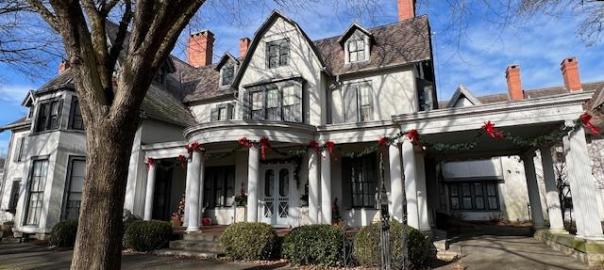
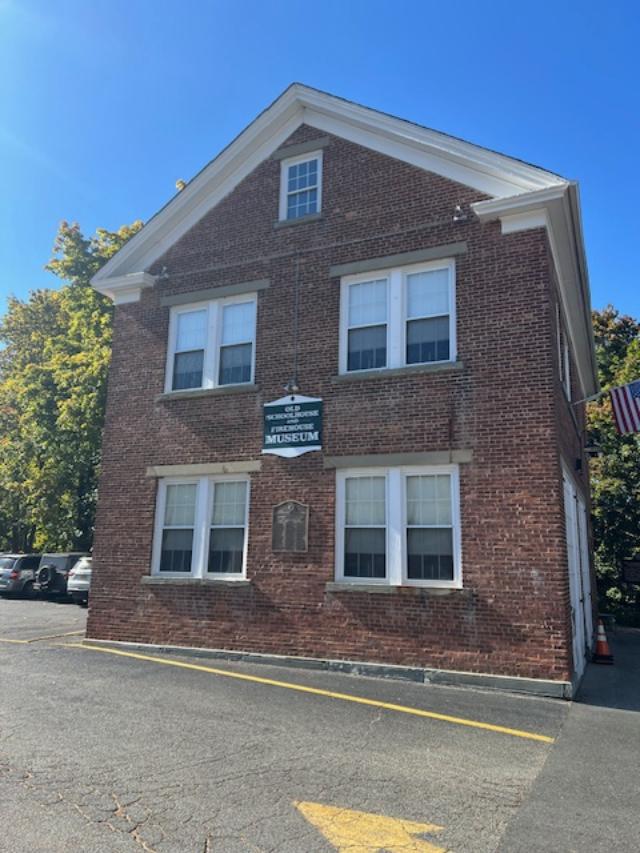
The Morgan Farmhouse at the Morgan Farm Museum, the headquarters of the Cedar Grove Historical Society
The museum sign just off Route 23 South
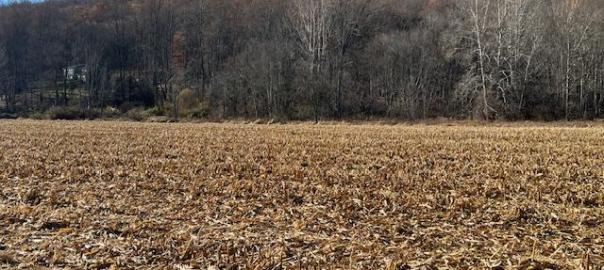
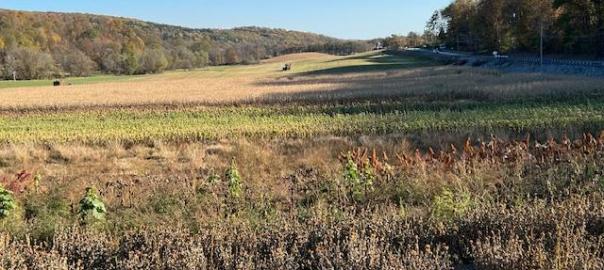
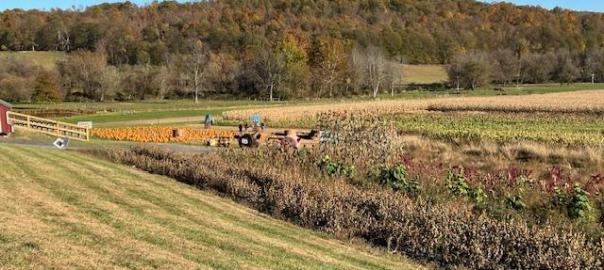
The farm property the day of the Fall Pumpkin & Apple sale and Open House
I recently visited the Morgan Farm and Museum one Saturday afternoon in the Fall and was surprised to find that they were hosting their Annual Pumpkin & Apple Sale, which has been a tradition on the property since the last owners of the farm, the Morgan family did this every Fall.
It was a lot of fun. The Society members were selling pumpkins and apples, baked goods like Cider doughnuts and cookies (completely sold out by the time I got there), Apple Cider and clothing products. On the farm land there was a petting zoo, picture taking by the Pumpkin Patch and tours of the house. The tour of the house was very interesting in that their docents to assist you on each floor to explain the family dynamic. It was a wonderful afternoon and a enjoyable family event.
The sign of Route 23 South for the Pumpkin & Apple Sale
The History of the Pumpkin and Apple Sale at the Morgan Farm Museum:
(from the museum pamphlet)
Each year the Cedar Grove Historical Society holds a Pumpkin and Apple Sale in honor of Edith Morgan and her son Courtenay Morgan. In the Fall of each year, the Morgan’s sold pumpkins and apples in the front of the Morgan farmhouse. The pumpkins were grown on the farm but the apples came from northern New Jersey. Mrs. Morgan passed away in 1961 but Courtenay, the last farmer in Cedar Grove, continued the tradition until his death in 1985 at the age of 86. The Historical Society continues that tradition each October.
Courtenay left his property to the Township of Cedar Grove with the stipulations that the Township create a park for passive recreation and that the Historical Society create a museum to preserve the history of Cedar Grove. Our pumpkins and apples are from the Chester area. Today the Historical Society’s home is the Morgan Museum located in the Morgan farmhouse. The Township created the J. Courtenay Morgan Park on the property.
The farm’s old barn now used as a meeting place and gift shop
History of the Morgan’s Farm and Museum:
(from the Museum pamphlet)
The Cedar Grove Historical Society welcomes you to Morgan’s Farm & Museum and the Canfield-Morgan House. The guide explains why Morgan’s Farm is unique and leads you to points of interest that you may want to explore.
The Morgan’s Farm is a fourteen acre site that was farmed continuously from the mid-1800’s until 1985. In 1985, Courtenay Morgan donated the farm to the Township of Cedar Grove. This portion of the farm is a park managed by the Township while the farmhouse and other buildings are operated as a museum and education center by the Cedar Grove Historical Society.
The Cedar Grove Historical Society maintains a wonderful collection of agricultural tools and equipment that reflect farming methods over a period of one hundred years. Items on display in the Canfield-Morgan House includes letters, photographs, clothing, furniture and other objects that show us how people lived during the early 1900’s.
The Family History:
(from the Museum pamphlet)
Benjamin Canfield built the farmhouse sometime around 1845 for his family. The Canfields were typical, hardworking farmers who were respected for the quality of their produce. They grew corn, apples, melons and other crops which they sold in the Newark and Paterson markets. The Canfield family farmed the land until 1910 when James and Edith Morgan bought the property James Morgan was an advertising executive who commuted by rail to New York City.
Mr. Morgan was passionate about farming and he worked hard to learn the latest farming methods. he experimented with the different types of crops until tuberculosis took his life in 1920. After Mr. Morgan died, Edith and her son, Courtenay struggled to keep the farm operating. They were well known locally for the vegetable and fruit stand they operated off the front porch.
Long before the Canfield and Morgan families lived here, the Lenape Indians used the site as temporary camp. Courtenay Morgan found many Native American tools as he plowed the fields. These artifacts are now preserved by the Cedar Grove Historical Society. A portion of the Lenape Trail passes through Morgan’s Farm.
The front parking lot of the farm property and the Pumpkin Patch
The inside Barn gift shop was selling apples, pumpkins, gourds, apple cider and doughnuts. By the time I got there, there was not much left. The Society even sells their own honey.
The barn from across the gardens near the farmhouse
The History of the Barn:
(from the Museum pamphlet)
The barns that you see behind the Canfield-Morgan House today were reconstructed by the Cedar Grove Historical Society in 1994 because they were had badly deteriorated. While the center of the barn is not as high as it once was, it has its original foundation and looks much like it did in 1910. This barn was probably used to house livestock at one time. On the west side of the main barn is a structure that once was a carriage house with a small apartment on the second floor for hired help. At some point, possibly in 1911, the second floor was removed. The shed on the east side was used to shelter livestock and later to store farm machinery.
There was all sorts of fun activities for families and especially the kids with a Pumpkin Patch, games and a Petting Zoo plus tours of the house.
The entrance to the Pumpkin Patch offered kids a chance to take pictures and pick the perfect pumpkin to make a Jack O Lantern
The Pumpkin Patch was perfect for picture taking
The pumpkin decorations in the Pumpkin Patch
The were plenty of places where the kids could take pictures with all sorts of characters of ghosts and ghouls and things that go bump in the night
Halloween is on its way
I loved the small Petting Zoo that they had set up. There was a baby cow, a baby pig, ducks and chickens.
The Petting Zoo
The baby cow was really friendly
The ducks were walking around their pen
The baby pig ran around his pen as well
The highlight of the afternoon was touring the old Morgan Farmhouse, which was furnished with family antiques and heirlooms, plus artifacts from the community of Cedar Grove, NJ.
The back of the house facing the barn
The History of the House and Barn:
The Canfield-Morgan House looks much like it did after Benjamin Canfield finished building it in the mid-1800’s. The modern kitchen and the accessible porch and bathroom are the most visible changes. The size and character of the house are typical of a traditional farmhouse. The features of the French windows in the front parlor and a wide entrance hall suggest that the Canfield’s were interested in current fashion and design of homes. A cistern under the kitchen floor stored water that was collected in gutters and piped into the cistern.
The gardens have many flowers such as daylilies, akebia, peonies, roses and quince that were planted by Edith Morgan and continued to bloom in the garden. The Morgan family added pergolas to the garden in 1911 and grew honeysuckle to cover them.
The fields of the farm is a variety of crops were planted in fields east of the park and south of the farmhouse. Crops included everything from tomatoes to pumpkins and apples. The Canfield family grew corn on what is now the front lawn. While these crops are no longer grown on Morgan’s Farm, the fields remain open space.
The Cedar Grove Historical Society sign on entering the house
The entrance to the house through the main hallway. The original part of the house was built in the 1700’s with an addition which added these rooms in the mid 1800’s. This is the newer side of the house.
The tour of the house was on my own but there were plenty of docents from the Society to explain each room. There were all sorts family furnishings and heirlooms of the Morgan family that were donated when this became a museum. The Society keeps the home in immaculate shape and its looks like the family still lives here and off for the day, letting us see a glimpse into their home.
The Living Room/Music Room
The corner of the Living Room and Music Room
Mr. Morgan’s desk in the home
The antique musical instruments in the collection
The Cedar Grove Music Association in 1900
The Morgan family photos from the family’s private collection, now part of the museum
The Morgan family portrait
Gail Morgan Chandler as a young girl
The Reception and Recreation Room next to the Living Room
Some of the family decorative pieces on display
Across the hall from the Living Room is the Dining Room that displays the home’s baking and serving pieces and some of the family China.
The Dining Room of the farmhouse
You can also see how the fireplace served as not just conversation but as the heat source as being part of the original section of the home.
The Morgan Dining Room
The formally set Dining Room table
The fireplace was the source of heat on the original 1700’s section of the home
Family baking and cooking equipment on display in the Dining Room
Family China and serving pieces on display in the Dining Room
Along the stairs on the way to the seconds floor is lined with all sorts of family and community artifacts.
The stairs to the second floor
The library in the house and a display of hats at the staircase landing
The second floor contained these rooms bedrooms and the museum offices , which were located in the old bedroom loft of the original 1700’s house.
Mr. and Mrs. Morgan’s bedroom at the end of the hall
Mrs. Morgan’s bedroom vanity with some personal items from the Morgan family
Mrs. Morgan’s desk
A small doll by the bed
Mr. James W. Morgan
Mrs. Edith Louise Potter-Morgan
The Morgan children when they were young
The second bedroom was being used as a gallery for local artifacts either found or donated from Cedar Grove. This included old pictures of buildings and homes in the community, Native American artifacts, clothing and uniforms and everyday items.
The second floor Artifact Gallery
The display of local artifacts
The Native American display
Display of local artifacts
Artwork by local artists
The pictures of local hospitals and medical centers
The pictures of local historical houses
When I was through touring the house, I went back outside to join the rest of the visitors, who were picking out pumpkins on the lawn.
The back part of the estate
What I like about the Morgan Farm Museum is that it is not just about walking around an old house, it is about experiencing someone’s life story.
I also got to see how the community of Cedar Grove grew from the farming community it once was to the bedroom community of New York City it is today.
The Morgan family dealt with quite a blow with the death of Mr. Morgan but is son took control and built the farm up to what the museum it is today. A living breathing example of turn of the last century ingenuity and determination and created a successful business that we can all share in today.
I can’t believe that a whole year passed and I am back to Wildwood for the NJ State Firemen’s Convention. Time just keeps zipping by each year.
Just before the Convention, I left a couple of days before and visited my mother and her partner since I will not see them again until the Christmas holiday. This is when I give them both the first part of their Christmas present and take them to dinner at a restaurant of their choice. They chose Blue Coast in Rehoboth Beach as their present, the same restaurant we celebrated Mother’s Day. The food was really good but the service was a little off. I do not think they had enough help that evening. Still we had a very nice time.
Blue Coast at 30115 Veterans Way in Rehoboth Beach, DE
The food at Blue Coast is always wonderful and I am glad they made the choice. With the Christmas holidays here before you know it, getting one Christmas present out of the way makes things easier. Plus we had a ball!
My mother and I at dinner for her ‘early Christmas’ present
The Fried Calamari we shared
The food was really a standout. My mother’s partner and I shared the Fried Calamari, which they make really well and was perfectly cooked and not greasy and for my main entree, I had the Fried Shrimp with French Fries. I had not eaten this much fried food in one sitting in a long time and I considered it a rare treat.
The Fried Shrimp entree
Before I left my mother’s house for the Convention, she prepared an amazing French Toast breakfast for me while they enjoyed all the doughnuts and pastries I brought from Mills bakery. My mother still likes to spoil me at my age. This is when it is fun to have parents who care!
Having breakfast with my mother before the Convention and we talked through the meal
The Raison Bread French Toast was delicious
The it was off to the Lewes-Cape May Ferry Terminal for my annual trip from Lewes, DE to Cape May, NJ. The trip takes about an hour and forty-five minutes and on a nice sunny not only is quicker but the views are amazing. Dolphins traveling along side of us made the trip more interesting as the whole ferry moved to one side of the boat every time they passed by. I think they just wanted the attention and know what we were doing.
The Lewes Cape May Ferry Terminal on the Lewes, DE side of the ride
It was a beautiful day that morning and many of the patrons were either at the bar or eating an early lunch at the restaurant. It was also enjoyable to listen to music at the bar. I think many of the locals enjoy eating here just for the views and watching the ferries coming and going.
The restaurant and bar were really busy that afternoon
The ferry looks so graceful as it enters the port in Lewes, DE
I swear everyone makes a B line to the concession stand for snacks when I get on one of these ferries. During the holidays when I take the ferry over to Cape May, I have enjoyed their egg sandwiches.
They really stock this place and have a nice selection of snacks
Depending on the weather, it can take between an hour and a half to get to Cape May from Lewes or when the water is rough like in December, two hours. The views are beautiful
Entering the Cape May coastline during the late summer of 2026
The concert continued into the early evening and the end of the Summer brought darkness earlier in the evening. I could not understand why it was getting dark around 7:30pm. I was used to it at 8:30pm. The crowds kept getting busier as the evening wore on.
The Ramble in the evening
The audience really grew
The Ramble
I was not hungry after such a big breakfast and a snack, so I just wanted a slice of pizza but not much was open this late at night so I walked around the beach after the concert was over and found Blue Moon Pizza open late. It was really quiet and it must have been quiet for a while because the counter guy and the owner/pizza maker looked bored.
My dinner that night and the Cheese pizza was quite good for a slice that was warmed
The strange part of the meal was it was about 10:00pm when I finished and it looked like the restaurant had been quiet for a while. While I was eating a party of four came in and ordered a large pizza, then another gentleman walked in and ordered four slices to go and then another couple came in and ordered another four slices and they needed to make another cheese pie for the case. When I left, there were seven people eating in the pizzeria and another couple walked in as I was leaving. The owner came out into the dining room to see what was going on and then gave me a big smile like I brought all these people into his pizzeria. Even I was surprised by all this at this time of night.
I just walked along the shore line for the rest of the evening and then through Washington Mall (Cape May’s Downtown) before going to bed. I was exhausted both from work and the trip and needed a little R & R. When I got back to the hotel, it was later in the evening and it had that creepy, ominous look about it. Sometimes it looks like ‘The Overlook Hotel’ from ‘The Shining’.
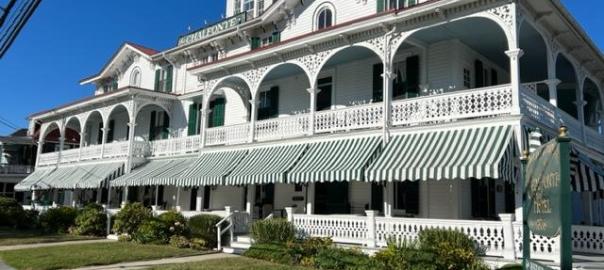
The Chalfonte Hotel at night after ‘The Ramble’ was finished.
I was staying in one of the back rooms on the second floor. I felt like I was walking down haunted halls.
Especially with old pictures of the hotel and faded bathing beauties line the walls of the hallway. Late in the evening, you feel like you are in the “Overlook Hotel” in the “The Shining”
My comfortable room for the next three days of the Convention
I slept like the dead that night and even if there were a ghost haunting the halls they could not have woken me up. I slept for a solid eight hours and woke up to a beautiful sunny morning.
The morning of the Convention I got up at eight and got ready to head over to Wildwood. I had time before our 11:00am meeting a so I decided to treat myself to breakfast on the Veranda at The Magnolia Room, the hotel’s signature restaurant. It was a beautiful, sunny morning so it was perfect to eat outside.
Dining on the Veranda of the hotel on the first morning at The Magnolia Room
They have a nice but limited breakfast menu. I miss their breakfast buffet
I ordered the Challah bread French Toast with bacon
Though I miss the old Breakfast Buffet at the Magnolia Room before COVID, the breakfasts on the porch are part of my first day meetings ritual. On a nice warm morning, there is nothing like it and the French Toast was really good.
It did not look like a lot but I was stuffed after breakfast
The French Toast was excellent and I highly recommend ordering it
It was nice to just sit back and enjoy breakfast on this warm sunny morning before a long day of meetings. With all the grading, scheduling and driving and running around between the prior week and this week, I needed this break.
This is the way to dine in the morning
I got to the Convention Center early and checked in and wondered into the empty Convention Hall before the meeting. To start the meeting, the Wildwood Fire Department Honor Guard and the Bergen County Pipe and Drum performed to open the meeting along with a very loud and heartfelt ‘Pledge of Alliance”. You have never heard it recited until you are with over a thousand firefighters reciting it all at once.
The start of the meeting as the Wildwood Color guard entered with the Bergen County Pipe and Drum
One of the main speakers was Donna Busch’s, whose husband the Buschio Exam is named after who helps so many firefighters with full medical exams.
After several hours in the meeting, we finished for the day and I walked down the Boardwalk for lunch. I knew where all wanted to go and made a beeline to Franconi’s Pizzeria on the Boardwalk.
Walking on the Boardwalk in Wildwood, NJ after the first Convention meeting
What really surprised me that afternoon was how quiet the Boardwalk was for lunch. Normally the Boardwalk is bustling with people but for some reason only the restaurants closest to the Convention Center were busy and that was it.
Walking around the Morey Piers whose staff was preparing for that evening when it opened at night
The second bend of the Boardwalk was very quiet that Friday afternoon
What was crazy was the number of restaurants loaded with food on their cases and extra staff all sitting around with cellphones waiting for people to come. I had never seen this before at a Convention meeting afternoon.
There was not a lot of people on the Boardwalk and when I got to Franconi’s Pizza. I was one of three customers at the restaurant after hundreds of guys had just attended meeting down the Boardwalk.
Franconi’s Pizzeria at Oak Avenue and the Boardwalk
I stopped in for lunch after the first set of meetings. I did not want to have a huge lunch because I had plans for dinner. So I thought I will just order sausage calzone. Big mistake, the thing was huge!
When the waitress brought it out, I thought she brought me the large one. This is the small!
I wondered how I would finish this thing
This calzone was the size of a small pizza
The calzone was filled with lots of cheese and sausage and came with the restaurants delicious red sauce. This could have fed two people.
It was delicious and what a lunch
After a meal like this, I needed a long walk on the Boardwalk and then walked the length of the Boardwalk to North Wildwood and back. When I walked back it seemed emptier than before.
I took a pit stop through Douglas Candies on the Boardwalk when I saw the candy demo in the window and the festive Halloween displays.
The one product I really like at the store is their candy bars especially their milk chocolate. They are a bit pricy but a once in a while treat is a good thing. You can always taste the richness in freshly made chocolate and their chocolate bars are the best. Their moi taffy was delicious too when they were sampling it.
The delicious taffy and assorted candies
The decorated Candy Apples
Each counter has a different type of candy and even in early September, the store was being decorated for Halloween. This smiling witch greeted customers at the door. There was all sorts of products being packaged for the Halloween when I was there and the store was creatively decorated for the holidays.
The store decorated for Halloween
The store was decorated early for Halloween
After I was finished with my walk of the Boardwalk, I planned on coming back later in the evening after dinner. I just wanted to get back to the hotel and relax for awhile.
When I got to Cape May, I put my feet in the ocean and enjoyed my walk along the beach. It was one of those beautiful sunny late afternoons. The water was a little rough as a Nor’easter was supposed to be heading up the coast later next week but for now the perfect late Summer afternoon.
Walking along the beach in Cape May
The beach was perfect and the water was so warm and because most of the kids were back in school at this point it was quiet on the beach.
The waves were so relaxing
The Ravioli House at 102 East Bennett Avenue in Downtown Wildwood, NJ
For dinner that evening I kept with my annual tradition on the first night of Convention and it was a trip to the Ravioli House in Downtown Wildwood. I dined there for a late dinner and ordered the Lasagna with a side of meatballs and came with bread and a House Salad. The meal was excellent.
The House Salad with fresh bread that I enjoyed before my Lasagna dinner
The Lasagna at Ravioli House is the type you might find in the Emilo-Romano section of Italy. It is layered with two different types of meat, two different types of cheese and slices of hard-boiled eggs baked between the homemade lasagna sheets and then topped with their homemade red sauce. It is decadent and delicious. They served it with two homemade Pork Meatballs that were excellent.
The Lasagna dinner also came with two homemade meatballs
They give you a sizeable slice of Lasagna loaded with meats, cheese and sliced hardboiled eggs
Yum!
The restaurant closes for the season on October 13th, so there will be no more trips until next year so I planned on dining here both nights of the Convention.
I was so stuffed from dinner, I had no interest in dessert and more interested in a long walk on the Boardwalk to work off both lunch and dinner. The lights had come on and the whole Boardwalk takes on a fantasyland look to it.
The Boardwalk was busier in the evening
The Boardwalk was much busier in the evening than it had been in the afternoon but still not what it once was in years past. It’s a sign of the times with this economy. I am used to it being much more crowded with families.
It got busier by the Morey Amusement Piers, where the park was celebrating Octoberfest
The Morey family extends their season for the Firemen’s Convention and the park was pretty busy that night with the young families. All the rides were full force and there was such an energy on this part of the Boardwalk. It is almost bittersweet because after this weekend, the piers close until next May.
The piers were lit like a fantasyland that evening
The rides were so colorful on that Friday night
The Garage bands they had that evening were good but not great. Some of the singers were a bit off key but still some of them brought energy to the park and it was a lot of fun that night. They really had the crowd moving around the dance floor in front of the stage.
The opening of ‘Octoberfest’ that evening
I stayed until about 9:00pm and then wanted to head back to the hotel. We had voting in the early morning and then after that I had to head up to Vineland to visit the Vineland Historical Society Museum in Downtown Vineland, NJ. So I had some running around to do the next day.
It was another good night’s sleep at the hotel and then back to Wildwood for breakfast and voting. It was another beautiful sunny morning and I love the drive between Cape May and Wildwood through the marshes.
The Chalfonte Hotel in the early morning. The wedding party who were in house the night before had filled up the patio for breakfast.
The drive between the two towns is beautiful in the late summer with the tall grasses and green trees. Fall had not hit yet so the last vestiges of Summer were still here. You have stop and look at their gracefulness. You can see all the birds digging for their breakfast.
The local highway between the two towns along the shoreline
The marshes in the late Summer
The views of the marshes are spectacular in the early morning
I got to the Convention Center for voting at 8:00am and was able to take a picture of the Wildwood Boardwalk when it was quiet.
The Boardwalk and the beach are quite beautiful in the early morning
I got to the Convention Center which I could not believe was that busy that early in the morning. I guess everyone else had the same idea to vote early and start their day as well.
The entrance to the Wildwood Convention Center in the morning
After I left voting and got back to the Boardwalk to go have breakfast, everyone on the Boardwalk stopped as they played the National Anthem at 9:00am sharp. If you want to see patriotism, watch hundreds of firefighter s and their families stop, remove their hats and sing ‘God Bless America’. It is quite a site.
Everything stopped for the National Anthem
I have to say that I was very impressed and proud to be a member of the fire service. With all the problems we have in this country, it is nice to see that some people still believe in it. The whole Boardwalk stopped for this.
This led to two more patriotic songs and then everyone went back to their morning. I walked down the Boardwalk to Franconi’s Pizzeria, who was having their annual Firefighters specials for breakfast.
I loved the Lorax sign on the Boardwalk
I love coming to Franconi’s for any meal. The food is so reasonable, the service always so welcoming and meals excellent. In all the years I have been coming here, I have never had a bad meal.
Franconi’s Pizzeria at 3300 Boardwalk on the second bend of the Boardwalk
The lunch was so good that I stopped in for breakfast the next morning. I had one of the Firemen’s Special Breakfast’s that had three eggs, your choice of bacon or sausage, hashbrowns and two blueberry pancakes (I paid three dollars extra for these but well worth it).
The Firemen’s Special of Three Eggs with Sausage and Hashbrowns and two large Blueberry pancakes
They did not skip on the blueberries in the Blueberry Pancakes
The Scrambled eggs were excellent and everything on the plate was perfectly cooked and spiced
I don’t what it is about Franconi’s that makes it so special to eat here. Maybe it is the location on the boardwalk so close to the beach and the sea air or the sounds of the ocean and the boardwalk or just people enjoying themselves.
What a breakfast!
I walked the Boardwalk for a bit since it was such a beautiful morning and then headed out to Vineland, NJ for a visit to the Vineland Historical Society Museum. The Museum Director had reached out to me about a year earlier to come for a visit and everytime I tried to go, it just did not work out. Before I left for Wildwood, I had Googled the museum for hours and it just happened to be open the weekend of the Convention so off I went up the back highways to Downtown Vineland, NJ.
I had not been to Vineland since my father had worked for Vineland Industries back in 1974, so it had been a long time and I hardly remember it. Downtown Vineland is still vibrant in some ways but could use some more businesses. The historical society was located just off the downtown area and located in a beautiful building that had been built for the museum around the turn of the last century.
The front of the Vineland Historical Society Museum at 108 South Seventh Street in Downtown Vineland, NJ
On my off time from the Firemen’s Convention after voting, I had planned to visit a group of small museums in Cumberland and Glouster Counties in New Jersey. Most of the small ones were closed or had changed their hours online but the Vineland Historical Society was open for touring and was having a speaker that day. I had been invited to come by the President of their Board of Directors about a year earlier so I was glad that I was able to visit this weekend where the schedules matched up.
What an interesting museum with its focus not just on the history of the Town of Vineland but of the surrounding communities and the impact that Vineland had and has on Urban Design, Farming, Manufacturing and Inventions that contribute to the whole country.
About the Museum:
The museum had been designed as a Historical Museum for community leaders who wanted to share their love of historical objects and the past history of the community. This is what built the collection over the years. Each section of the museum tells a different part of Vineland’s history from the community events like its “100th Anniversary” of the town, the history of the Police, Fire and Veterans of Foreign Wars, members of the community who contributed to Women’s Suffrage and to the number of everyday products we use like Grape Juice and Marshmallow Fluff that were invented here. Each section of the museum tells an interesting story.
The museum is a stop on the Woman’s Suffrage Tour
The Mission of the Museum:
The Vineland Historical and Antiquarian Society is the oldest local historical society in New Jersey and its museum is the oldest purpose-built museum in the State of New Jersey. The Society is dedicated to collecting and preserving artifacts and records related to Vineland and the South Jersey region, and to sharing that material with visitors through exhibits, programs and other appropriate venues. Vineland has a rich, culturally-diverse past that is reflected through our collections. To learn more, please contact us or make an appointment to visit.
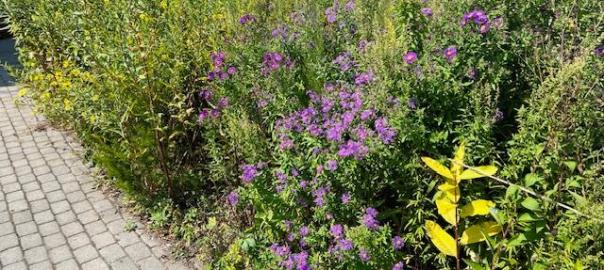
The Rain Garden outside the museum
The Rain Water Garden sign
The Rain Water Garden outside the museum was in full bloom at the Summer and you could see that the garden was trying to attract butterflies and other insects that would help pollinize the garden. It must be very colorful during the Spring.
The first floor of the museum is the lecture room, the library and the gift shop along with local artifacts and the Glass Manufactured Gallery
The main gallery was set for a lecture later that afternoon. On all sides of the museum tell the story and the timeline of Vineland and the surrounding communities. There is the City of Vineland and Vineland Borough and Landis Township in 1952. So you see the artifacts of the farming communities and those of the developing City (Wiki).
The early views of the museum with the original heating unit and turn of the century shell art
Historical community information
The First floor collection of artifacts
The bust of Charles K. Landis, who founded the town
The display of the early Women’s Suffrage Movement in town, which helped women earn the right to vote. New Jersey was an early pioneer in the Movement.
The photo of Portia Kellogg Chase, an early leader in the Women’s Suffrage Movement in Vineland, NJ
Made in Vineland: A Celebration of Local Inventors and Their Creations:
The exhibition highlights the remarkable people and ideas born right here in Vineland. From everyday household items to groundbreaking innovations in transportation, food, tools, and telecommunications, this special 2026 exhibit tells the stories of local inventors whose creations shaped daily life far beyond our city. Visitors are invited to explore these inventions and the fascinating individuals behind them during our Open House held every third Saturday of the month.
The ‘Made in Vineland’ exhibition:
The inventions of the Flower vase, the Woodruff Train Car and the Self Adjusted Plane
The inventions of Angel Food Cake Marshmallow fluff
The inventions of the Grape Juice industry and Skee-ball game
The post office desk from the turn of the last century
Just off the side of the main room is the Blown Glass Room. The area is known for special sand that is used for glass making. This made the State of New Jersey one of the leading manufacturers of glass in the country at the time.
Each of the cases displays glass for different purposes and for different industries made by different companies. The museum has a very extensive collection of glass.
The Blown Glass Room
The Blown Glass Room
Since the other museums closed around 1:00pm, I decided to head back to Cape May. I would have to visit these small local museums on my next trip to the area. Both the Matchbox Road Museum at 15 Pearl Street in Newfield, NJ and the Clayton Historic Museum at 29 East Avenue in Clayton, NJ both had limited hours that I missed on my trip to the area. For the next time.
The Matchbox Road Museum at 15 Pearl Street in Newfield, NJ
Along the local highway coming back from the Clayton Historic Museum, I passed Twin Kiss, a small restaurant and ice cream stand that looked like time had passed by. One of these little establishments that dot parts of New Jersey that once well travelled roads.
The Twin Kiss Drive Inn at 25 South Delsea Drive in Clayton, NJ
Twin Kiss Drive In, at 25 S. Delsea Drive, has been a Clayton icon since 1955, when George W. and Mary Lillian “Lilly” Kasper opened the ice cream franchise. The couple borrowed $5,000.00 and bought into the brand-new Twin Kiss franchise, opening several locations throughout Pennsylvania, coming to CLAYTON opening that stand on May 19, 1955 .
In 1959, when Twin Kiss developed a sandwich unit, Lilly joined George full time, and they worked side by side for over 40 years. They ran it for 46 years until retiring in 2001. New owners, John and Stacey Chamberlin, took over in 2001.
Twin Kiss Drive Inn and their Mission Statement:
(from the restaurant website)
Welcome to Twin Kiss Drive-In, a beloved local staple in Clayton, New Jersey, where great food and classic drive-in charm come together.
Proudly owned and operated by Stacy and John Chamberlain, Twin Kiss Drive-In is built on a simple idea: serve quality food, create a welcoming atmosphere, and give the community a place to gather and enjoy. Whether you’re stopping by for a quick bite, bringing the family for a casual night out, or reliving a bit of nostalgia, Twin Kiss offers an experience that feels both timeless and uniquely local.
For years, Twin Kiss has been known for its friendly service, classic American favorites, and that unmistakable drive-in vibe. Stacy and John are hands-on owners who take pride in maintaining the tradition while continuing to make the space feel fresh, inviting, and community-focused.
More than just a place to eat, Twin Kiss Drive-In is a part of Clayton’s story—a spot where memories are made, from summer nights and after-game stops to everyday moments worth savoring. We’re grateful to be part of this community and look forward to serving you.
The front of the restaurant
The ice cream and dessert menu
The sandwich and sub menu
The delicious Salted Caramel with Pretzel Ice Cream I had that day and this was a small!
Twin Kiss Drive Inn is one of those classic New Jersey restaurants that every town should have in them. After my visit to Twin Kiss for dessert, I drove back to Cape May through the back roads, visiting towns that I had never been to and driving down roads that once had been the major highways in this region.
The funny part about traveling some of these local highways is that I felt like I wasn’t even in New Jersey anymore. I felt like I was in small towns in Alabama or something. This is the way I feel sometimes when I visit small towns in the Hudson River Valley.
Once you leave the more ‘popular’ tourism towns like Rhinebeck, you visit these more ‘local’ towns and you feel like you are visiting the place that time forgot. I will have to make a special road trip back next month to visit some of the local museums.
I got back to Cape May with plenty of time to walk around. Unfortunately the hotel was hosting another wedding and I just wanted to get away from that. Cape May was really busy that night now that the Convention meeting was over so couples and families were running around the town.
I changed my clothes and went back to Wildwood for dinner and to walk the Boardwalk to work off meals. My goal was to go to the Ravioli House for dinner one last time because I knew it would be closing in two weeks.
The town had quieted down since the Firemen’s Parade was over and I think a lot of people had headed home. I just wanted another night at the shore to relax now that my work was done. I had another excellent evening.
I was so happy with dinner the night before, that I decided to have dinner there again my last night at the shore. The restaurant closes for the season on October 13th, so there will be no more trips until next year.
What I really enjoy about the restaurant is starting with their house salad with homemade dressing
The salads are so crisp and fresh
Dinner was the Shrimp Scampi with homemade linguine
After several days of fried foods and heavy sauces, I decided to order something lighter and ordered the Shrimp Scampi, which came with a lemon and wine sauce. It blended in wonderfully with the fresh cooked pasta. The sauce had a creamy consistency.
The jumbo shrimp were perfectly cooked and were sweet and tender
The meal was delicious and the seafood was so fresh
After dinner was over and I was thoroughly stuffed from both the meal and dessert, I enjoyed another night of walking the Boardwalk and enjoying the lights.
I watched part of Michigan State-Notre Dame football game on the big screen TV at the Morey Pier. They kept it on low and I watched enough to goal at Notre Dame’s last touch down against us. It was depressing but we held our own for a team that is going through a rebuild.
The lights dazzled my last night on the Boardwalk
Before I left the Boardwalk that evening. I stopped by the Douglass Pavilion for some ice cream. I had never noticed this before and when the menu, it carried such unusual flavors.
The store has a complete ice cream store to compliment the sale of the pints of ice cream in the Douglass Candy store across the Boardwalk. This way you can taste the flavors before you buy them. The store was getting ready for the Halloween holiday season so it was all about pumpkins and Jack-0-Lanterns.
The Douglas Creamery is across the Boardwalk from the store
The menu and flavors of the ice creams that you can choose from. The ice creams are homemade and themed with some of the candy items in the store
I loved the selection of flavors and some included the candies that they sell in the store. The flavors were also geared toward the Fall with Pumpkin and Apple Cider Doughnut flavors.
The tables and the store were decorated for Halloween
I chose the Molasses Paddy (which is a candy they are known for) and the Apple Cider Doughnut ice cream
The ice cream is rich and delicious and they give you nice sized scoops
The store is getting ready for Halloween
I got back to the hotel as the wedding broke up and the hotel had that eerie late evening look to it. I love the look of this old hotel. It looks like the ghosts from the past still visit it.
The Chalfonte Hotel on my last evening
I woke up the next morning like I slept for a year. I got nine hours of sleep. It was overcast that morning and I was still full from dinner and the ice cream the night before. Since I didn’t foresee coming back to the shore, I decided to just have a piece of pastry at the Ravioli House Pastry Shop, take another quick walk on the Boardwalk and then head home.
The Wildwood Boardwalk on the last day of my trip
The Morey Pier was quiet in the early morning and I believe was closed for the season
I stopped at the Ravioli House for breakfast on my last morning of the Convention. I was getting tired of Pancakes, Bacon and Eggs and wanted something different. I had seen pastries in the case I had always wanted to try so I returned one last time before I headed home.
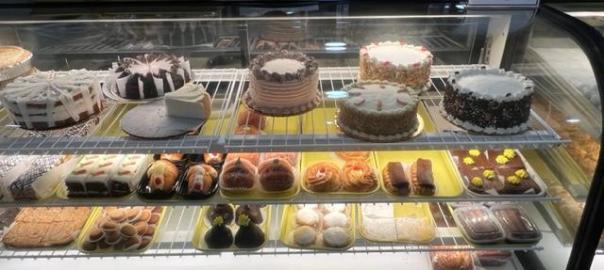
The Ravioli House Bake Shop has a wonderful assortment of bakery treats
The seating area in the pastry shop allows people to talk amongst themselves
Since my dinners were so filling, I never got a chance to try two of the desserts I had wanted in the last two visits to the restaurant so I stopped in the bakery and had breakfast here ordering a Cassata Cake and a Napoleon with fruit. I could just about finish the Cassata Cake because the pastry was so large and very sweet that I brough the Napoleon home.
The Napoleon and the Cassata Cake with some hot tea with lemon
The Cassata Cake at Ravioli House is very dense and rich and should be shared
The dessert is filled with a mixture of cake, nuts and liquors
The Napoleon I saved for later
I was on a major sugar high on the way home that morning. I knew this would be going on the three hour trip home. I was surprised how quickly I got home that afternoon. I figured everyone else had checked out the day before.
It was another successful trip for my Fire Department Convention work and my blogging for all the Travel sites. I got a lot accomplished this weekend. We got the voting for the Convention done that we wanted and I had another set of museums that I had visited or planned to visit in the future. Now on to Halloween.
Ringwood Manor in Ringwood Park at Christmas time:
I have visited the Ringwood Manor during the Christmas holidays over the last four years and it keeps getting better. Each room in the house is tastefully decorated for the holidays. The West Milford Garden Club does an excellent job decorating every year and in the post-COVID environment, it is nice to see such a beautiful and well thought out display for Christmas.
The outside of the house was decorated with garland and ribbons and welcomed visitors with Christmas cheer.
The entrance of Ringwood Manor.
The entrance to the estate.
The patio of Ringwood Manor.
The outside of the house was tastefully decorated in garland and bows.
The decorated front door on the Ryerson side of Ringwood Manor.
History of Ringwood, NJ:
Colonial Ringwood:
Long before the Forges & Manor of Ringwood existed this property was occupied by the Native American people. Prehistoric artifacts found on the grounds confirm their inhabitants back to the Archaic and Woodlands periods. Living in a hunting and farming paradise, these Munsee-speaking Lenape peoples dwelled at the head of the Topompock or Ringwood River Valley. This paradise attracted colonial prospectors, who by 1740, came for the iron ore found in the ground. Recognizing the rich magnetite ores, Cornelius Board settled here in 1739 and first utilized the property for iron mining. He was followed shortly thereafter by the Ogden family who established the Ringwood Company and built the first blast furnace here in 1742.
After twenty years of production, a German promoter, Peter Hasenclever, organized the American Iron Company to exploit the resources in colonial North America, purchasing the Ringwood area in 1764. He would also develop forges at Long Pond and Charlotteburg but made Ringwood the center of his iron empire. Hasenclever established iron plantations and developed the production of flax and timber across 50,00 acres of land stretching through New Jersey and New York, from present day Butler to New Foundland and Nova Scotia. The iron was said to have been “the best iron in the American colonies.” Robert Erskine, the last ironmaster of the American Iron Company, was sent from England in 1771 and would manage the company during the Revolutionary War.
(History of Ringwood, NJ)
The decorated carriage house.
When you walk into the home, the first rooms is decorated tastefully around a collection of antique guns and hunting equipment. The Great Hall was decorated with garland and ornaments with a large tree in the corner.
The Great Hall of the Ringwood Manor when you enter for Christmas.
The Great Hall upon entering.
The Chamber Gun display.
The Chamber Gun display in the Great Hall of Ringwood Manor.
The Great Hall fireplace decorated for the holidays.
The formal dining room was set for Christmas dinner for the family after church. The elegant china was set on the table with poppers and small Christmas gifts for the guests. The side boards were set with the dinner entrees and sides for the family meal. There was a little discussion of how the Hewitt family would entertain during the holidays and in 2019 and in 2023, they opened up the kitchen and Butler’s pantry for touring.
The Hallway leading to the formal Dining Room.
The decorated staircase in the Great Hall
The Great Hall hallway
The Dining Room sign
The Dining Room at the Ringwood Manor.
The Dining Room set for Christmas dinner.
Dining Room set for Christmas dinner beautifully.
The details of the Dining Room
The Dining Room paintings and details.
Preparing for the holidays in the Dining Room
The statuary of the Dining Room
The lighting fixtures of the Dining Room.
Each room was set for the holidays with garlands, trees and decorations. As it was explained to me on another house tour during the holidays, the Victorians would normally only decorate one or two rooms for the holidays and not the whole house. The whole house might be decorated based on the wealth of the family and the amount of servants to take care of the home. Needles would have to cleaned up and the trees would have to be attended to on a daily basis.
the Butler’s Pantry just off the Dining Room
The Butler’s Pantry in preparation for Christmas dinner
The Christmas treats in the Butler’s Pantry.
I then walked back through the house and passed by the Office on my way to the social rooms of the first floor. The office is where business was taken care by Mr. Hewitt when he was in residence.
Mr. Hewitt’s Office decorated for Christmas
Mr. Hewitt’s office at Christmas time.
The Christmas tree in Mr. Hewitt’s office.
Before I left this part of the house, I passed the Breakfast Room which is just off the Dining Room. It had beautifully decorated for a Christmas breakfast.
The Breakfast Room sign
The Breakfast Room was decorated with desserts and sweets for the Christmas holidays.
The Breakfast Room beautifully decorated for the holidays.
The Breakfast Room for a Christmas feast.
The Christmas tree in the Breakfast Room.
Before entering the Great Hall, I visited the Receiving Room, where guests waited until dinner was served.
The Waiting Room
The Waiting Room was for guests to relax and wait for Mr. & Mrs. Hewitt.
The Waiting Room fireplace is nicely decorated.
The ‘Birdcage’ in the Waiting Room
Passing through the Great Hall again, I entered what had once been the original Ryerson House built in the early 1800’s. The first room on the tour of this side of the house was the French Drawing Room decked out for the holidays. This room was used by the ladies after dinner was over to converse and get away from their husbands, who would have still been in the dining room.
French Drawing Room, the “Withdrawing” room.
The French Drawing Room
The French Drawing Room in all its Christmas glory.
The Christmas tree in the French Drawing Room
The fireplace in the French Drawing Room.
On the other side of the house is the original Ryerson mansion that was added on by the Hewitt’s when they bought the house. The older house had the original moldings and windows from the early 1800’s and that side of the house had a different feel to it starting with the original entrance and staircase.
The Ryerson Staircase and foyer sign
The Ryerson Staircase and foyer
The decorated Ryerson staircase.
One of the nicest rooms that was decorated was the screened in porch. Here there was a tree set with presents, hot house flowers and garland lining the room. The sunlight shined throughout the room and the decorations sparkled.
The South Ryerson Parlor
The South Ryerson South Parlor
The fireplace in the South Parlor.
The latest addition to the house was the screened in porch, The Glass Piazza, of the house which was used in the summer months for rest and relaxation. The screen in porch was beautifully decorated for the holidays with all sorts of Christmas trees and decorations.
The Glass Piazza, the screened in porch of the main house.
The Glass Piazza decked out at Christmas time.
The doll mini tea service in the Glass Piazza.
The Glass Piazza set for tea at the holidays.
The Glass Piazza at Christmas time.
The beautiful Christmas tree in the Glass Piazza in 2023.
When you leave the Glass Piazza, you enter the original part of the house again with the North Ryerson Parlor. This room was used by the family for less formal affairs but it was still decked out of the holidays.
The North Ryerson Parlor
The Ryerson North Parlor decorated for tea.
The Ryerson North Parlor fireplace decorated for Christmas time.
The last room I visited on the tour was the Music Room in the original Ryerson House. The room was used by both the Ryerson’s and the Hewitt’s for social occasions and the Hewitt’s were all musically inclined.
The Music Room at the Ringwood Manor
The Music Room at the Ringwood Manor.
The Music Room at the Ringwood Manor.
The fireplace in the Music Room decked out for the holidays.
The Music Room during Christmas time.
Each room had a docent to explain the decor or what the room’s use had been in the family’s time. A visitor can roam the house at their leisure and see the rooms as many times as they want. There is also a gift shop in a room off the formal dining room that contains some beautiful Christmas crafts for sale by the Women’s Club of New Milford. Some of these women are very creative and sell the most amazing Christmas ornaments made of glitter, wood, branches, walnuts and moss.
The decor of the home changes over time and there are different things to see every year. The barn also on the property as you drive in has more artwork and crafts. In the Gardener’s Shed next to the house, the Society has a small cafe with sandwiches, desserts and coffee/tea/hot chocolate.
The Carriage House was used as a gift shop and a place to get something to eat.
The tour of Ringwood Manor is wonderful during the holiday season and the rest of the house opens up during the warmer months of the year.
History of the House:
This 582 acre historic site is open to the public year round. The historic house museum, Ringwood Manor is open Wednesday to Sundays year round.
History of 19th Century Manor House and Landscape:
The present manor house was begun by Martin J. Ryerson in 1807. He and his sons controlled not only the iron mines and forges on the property but also operated productions at four other locations in the area. The Ryerson family resided in their 10 room Federal style home for almost 50 years.
The entrance to the historical home.
In 1853, the Ryerson’s house and property were purchased by business partners Peter Cooper and his son in law Abram S. Hewitt. The 22,000 acre ironworks and the Ryerson’s home were purchased for a sum of $100,000. Their company, Cooper-Hewitt & Company, grew to be the fifth largest corporation in the United States. The Hewitt’s, one of the most influential and wealthiest families of the 19th century, fell in love with the Ringwood estate.
The expanded Ringwood Manor estate in the winter months.
Ringwood manor at the holidays.
They decided to make this site of their summer home, naming it The Forges and Manor of Ringwood. They enlarged the home of the Ryerson’s, constructing major additions or renovations in 1864, 1875, 1900 and 1910. The completed 51 room house is 226.5 feet long and features 28 bedrooms, 24 fireplaces and 13 bathrooms and more than 250 windows. The house was built in an eclectic style, typical of the Victorian period. In 1875, the Manor House was an excellent example of the Gothic Revival style of architecture. By 1900, the Hewitt’s changed the exterior facade to its present appearance, adding the neo-classical portico and columns of the front porch and affixing white stucco to the exterior walls. The furnishings of the house reflect the varying tastes and styles of the family and time period.
Ringwood Manor during the holidays.
(From the Ringwood Manor website)
The formal gardens surrounding the Manor House were developed by Mrs. Hewitt and her daughter, Eleanor around 1900. Their design was influenced by the Hewitt’s many trips overseas. The gardens possess a mysterious old world charm that captivates visitors as they enjoy the serenity of reflecting pools and the progression of blooms from early spring to late fall. Placed throughout the garden are French and Italian statuary and garden ornaments as well many interesting architectural items from New York City acquired while Abram Hewitt served as Mayor and Congressman. Examples of these features include columns from the old New York Life building, gates from the Astor family’s home and gate posts from Columbia College. Relics from the iron company that are found on the grounds include a trip hammer and anvil, cog wheel and a Dictator-class mortar the base of which was created by the Hewitt’s company and used at the Battle of Vicksburg in Mississippi during the Civil War.
The Ringwood Manor in the Fall of 2026:
I visited the park again in October of 2026 after taking a tour of the NJ Botanical Gardens down the road at the Skylands Manor. The grounds were just changing colors during all the cool weather we were having and the grounds could not have been more picturesque.
The lawn of the estate in the early Fall in 2026
Walking through the walkways and driveway of the estate
Walking up to the Manor House at Ringwood Park
The pond by the house overlooking the barns
The marble walkway up to the house
The Manor House in the Fall of 2026
The estate lawn from the house
The gardens and landscaped gardens on the estate
In the barn which is used as a Art Gallery, hosts a Jazz Concert on some weekends during the Fall. We had a nice time listening the music.
The Jazz Concert in the afternoon
The Jazz Concert at the barn
The grounds are so beautiful at any time of the year.
The front of the Vineland Historical Society Museum at 108 South Seventh Street in Downtown Vineland, NJ
On my off time from the Firemen’s Convention after voting, I decided to visit a group of small museums in Cumberland and Glouster Counties in New Jersey. Most of the small ones were closed or had changed their hours online but the Vineland Historical Society was open for touring and was having a speaker that day. I had been invited to come by the President of their Board of Directors about a year earlier so I was glad that I was able to visit this weekend where the schedules matched up.
What an interesting museum with its focus not just on the history of the Town of Vineland but of the surrounding communities and the impact that Vineland had and has on Urban Design, Farming, Manufacturing and Inventions that contribute to the whole country.
The museum had been designed as a Historical Museum for community leaders who wanted to share their love of historical objects and the past history of the community. This is what built the collection over the years. Each section of the museum tells a different part of Vineland’s history from the community events like its “100th Anniversary” of the town, the history of the Police, Fire and Veterans of Foreign Wars, members of the community who contributed to Women’s Suffrage and to the number of everyday products we use like Grape Juice and Marshmallow Fluff that were invented here. Each section of the museum tells an interesting story.
About the Museum:
The museum is a stop on the Woman’s Suffrage Tour
The Mission of the Museum:
The Vineland Historical and Antiquarian Society is the oldest local historical society in New Jersey and its museum is the oldest purpose-built museum in the State of New Jersey. The Society is dedicated to collecting and preserving artifacts and records related to Vineland and the South Jersey region, and to sharing that material with visitors through exhibits, programs and other appropriate venues. Vineland has a rich, culturally-diverse past that is reflected through our collections. To learn more, please contact us or make an appointment to visit.
The Rain Garden outside the museum
The Rain Water Garden sign
The Rain Water Garden outside the museum was in full bloom at the Summer and you could see that the garden was trying to attract butterflies and other insects that would help pollinize the garden. It must be very colorful during the Spring.
The first floor of the museum is the lecture room, the library and the gift shop along with local artifacts and the Glass Manufactured Gallery
The main gallery was set for a lecture later that afternoon. On all sides of the museum tell the story and the timeline of Vineland and the surrounding communities. There is the City of Vineland and Vineland Borough and Landis Township in 1952. So you see the artifacts of the farming communities and those of the developing City (Wiki).
The early views of the museum with the original heating unit and turn of the century shell art
Historical community information
The First floor collection of artifacts
The bust of Charles K. Landis, who founded the town
The display of the early Women’s Suffrage Movement in town, which helped women earn the right to vote. New Jersey was an early pioneer in the Movement.
The photo of Portia Kellogg Chase, an early leader in the Women’s Suffrage Movement in Vineland, NJ
Made in Vineland: A Celebration of Local Inventors and Their Creations:
The exhibition highlights the remarkable people and ideas born right here in Vineland. From everyday household items to groundbreaking innovations in transportation, food, tools, and telecommunications, this special 2026 exhibit tells the stories of local inventors whose creations shaped daily life far beyond our city. Visitors are invited to explore these inventions and the fascinating individuals behind them during our Open House held every third Saturday of the month.
The ‘Made in Vineland’ exhibition:
The inventions of the Flower vase, the Woodruff Train Car and the Self Adjusted Plane
The inventions of Angel Food Cake Marshmallow fluff
The inventions of the Grape Juice industry and Skee-ball game
The post office desk from the turn of the last century
Just off the side of the main room is the Blown Glass Room. The area is known for special sand that is used for glass making. This made the State of New Jersey one of the leading manufacturers of glass in the country at the time.
Each of the cases displays glass for different purposes and for different industries made by different companies. The museum has a very extensive collection of glass.
The Blown Glass Room
The Blown Glass Room
The Blown Glass Room
The Grape Juice industry glass and advertising display
The Ravioli House Restaurant and Pastry Shop at 102 East Bennet Avenue.
* I wanted to note that since COVID all the prices have changed so please check the website as my prices enclosed were reflective at the time of the visit.
Sometimes a shop does not fit the traditional pattern of establishments that I include on this site. They fall into a category that is more restaurant than a traditional store. Ravioli House & Pastry Shop is a combination of both where quality and service separates it from other restaurants and bakeries that I have visited lately.
The Pastry counter at the back of the restaurant
I came across the Ravioli House when I was attending the Firemen’s Convention every September. I was walking around Wildwood to see what the town was like after our main meeting and came across the Ravioli Pastry Shop which is the back part of the restaurant. It had an inviting entrance with the words “fresh Italian desserts” and that was for me. What a great surprise inside!
The sign for the Pastry Shop in the back.
The pastries here are amazing and are very innovative. There is a combination of traditional and modern Italian desserts to choose from. The eclairs are larger than their French versions and full of creamy vanilla filling. They are topped with a thick layer of chocolate frosting and this confection is a pleasure in every bite.
The Pastry Shop and Bar in the back of the restaurant.
They bake a usual cookie called a “Deliciousioso”, which is a type of Linzer Tart but instead of jelly it is filled with almond cream and then the sides are rolled in nuts. It has a subtle sweetness to it and you can taste the richness in the cream filling.
Having a Deliciousioso on a recent night
They are so delicious
Don’t miss these sweet treats
It is hard to choose from all the delicious pastries
All the delicious pastries I enjoy: the Peach dessert, The St. Joseph’s Puff, the Deliciousso and the Chocolate Cake dessert.
The St. Joseph dessert with Vanilla Cream
The St. Joseph Puff Pastry differs from a Cream Puff only in that it is filled with a combination of Cannoli cream and vanilla filling rather than a traditional whipped cream or vanilla filling. It large, dense and you can taste the sweetness in both the Cannoli Cream and in the pastry itself.
On another recent trip, I had the St. Joseph Puff Pastry with the Vanilla Cream, and it was amazing. Creamy and sweet on the inside and the same crisp outside. Both versions are worth a try.
The St. Joseph’s Pastries with both Vanilla Cream and Cannoli Cream are both delicious
The Cannoli’s here are filled to order and made in house. The Cannoli Cream is thick, rich and delicious and studded with chocolate chips. The outside shells are crisp and well baked.
The Ravioli House Restaurant:
The restaurant section is just as good as the Pastry Shop, with all sauces, pastas and dressings that are made in house and the quality of the food and service is top notch. It is a real home town restaurant as it has been owned by the same family for almost 50 years and the daughter of the owner still guards over the dining room and her mother, the owner still works in the kitchen and supervises the staff.
The Dining Room at the Ravioli House.
The Dining Room in the late evening
The new outdoor addition of the restaurant is seasonal
The best start to the meal: the salad with homemade Creamy Italian Dressing with their freshly baked bread
The homemade Ravioli here is excellent and was the meal of my choice on my visit in 2023. Little pillows of fresh pasta that are filled with Cheese, Meat and Spinach. Order the Ravioli House Trio with a side of meatballs and you will get to sample all three. The marinara sauce here is made with fresh tomatoes and garlic and is full of flavor.
Their homemade Ravioli is excellent
The Manicotti here with meatballs is very good. They are made with light as air pasta pancakes filled with a ricotta and Parmesan cheese filling and topped with their fresh marinara sauce.
The Manicotti with Homemade Meatballs
The pasta was light as air
The side of pork meatballs were amazing. So rich in the sauce.
All their entrees come with a freshly tossed salad along with their homemade creamy Italian dressing that is so good you will need extra bread to sop it up with when finished.
You always need plenty of their freshly made in house breads to soak up their sauces. When really hot, there is nothing like it.
Their fresh tossed mixed salads come with the entree and are topped with their homemade creamy Italian dressing
Another dish I can recommend is the Linguine in White Clam Sauce, which is made with fresh in house linguine and studded with fresh baby clams and steamers in a light white wine and lemon sauce which enhances the freshness of the seafood and not overwhelming. I had this on a recent trip for dinner.
The Linguini with Clam Sauce has two different types of clams in the dish
The pasta was perfectly cooked and the clams were sweet and tender
The Linguine is also good with their Bolognese Sauce, which is topped with a rich and flavor packed meat sauce of ground beef and chopped vegetables.
The Linguini with Bolognese Sauce
They must have given me a pound of pasta
The sauce was full of lots of meats and vegetables
When visiting for the 2021 Convention, I made my annual visit to Ravioli House again and this time because of COVID, they used the parking lot next to the restaurant for outdoor dining. So I had a nice table facing New Jersey Avenue and ordered my meal. The waiter could not have been nice enough and the service here is always top notch.
For dinner, I ordered the Chicken Pastina Soup, which was a rich chicken stock with chunks of chicken, carrots and tiny pastina pasta cooked to perfection in the soup. Each spoonful had a nice combination of flavors of the cooked chicken and the chopped fresh vegetables. It was the perfect way to start a meal on a early summer evening.
The Chicken Pastina Soup with its rich broth.
As part of my dinner, it included a house salad with crisp green leaf lettuce, tiny cherry tomatoes and chopped cucumber in a zesty house creamy Italian dressing that is also made inhouse. The dressing was just enough to add some zing to the salad. Each bite was crunchy and sweet.
The Tossed House salad
The entrée was a real feast when I ordered the ‘Trip Around Italy’, which was a sampler of the restaurant’s fresh pastas. The entrée included two large stuffed shells, two fresh cheese ravioli, a large portion of homemade Gnocchi and Spaghetti covered with a rich red sauce that was topped with a large meatball and a nice piece of sausage. The meal could have feed two people comfortably.
The “Trip to Italy” can feed two people
All the pastas were delicious and so well prepared. The Spaghetti was perfectly cooked and was a meal in itself. The Gnocchi was perfectly cooked and each piece of pasta was nice sized. The pillowy Ravioli and Stuffed Shells were filled to the brim with a nice cheese mixture of Mozzarella, Ricotta and Parmesan. The red sauce had a nice combination of spices that accented the fresh tomatoes used in the sauce.
I was completely stuffed when I finished the meal that I could not eat dessert. I had been eyeing the Napoleons when I was in the pastry shop before dinner, but I could not eat another bite. It was another excellent meal at the restaurant.
In 2022 and in the summer of 2024 (a month before Convention), I returned to the Ravioli House for dinner on my traditional Saturday night at 8:00pm meal and it was ‘same time next year’ with the owner who l left in the same spot last year this time. We even laughed about it.
I wanted something totally different this year and I had the Chicken Picante, which is thinly sliced chicken breasts sauteed in butter, wine and lemon and then was served with a side of spaghetti in a red sauce. It also came with a small house salad with oil and vinegar. This was the perfect meal.
The delicious home made rolls served with the meal.
Most of the entrees start with a fresh tossed salad with homemade Italian dressing
The tossed salad with a side of the homemade bread is the best way to start a meal at Ravioli House
The chicken was so tender, and you got two nice sized pieces with the order. The sauce had such a nice flavor, and you could taste the lemons and capers in every bite. Their red sauce is made from scratch, as all their sauces and pastas are and you could taste the spices, they added to it. The spaghetti was cooked perfectly and had a nice bite to it.
The Chicken Piccante at Ravioli House is a real treat
The full dinner comes with two large chicken breasts with a side of homemade spaghetti and homemade red sauce
When I came for dinner during the convention in 2025, it was picture taking time and I revisited the dishes I had before like the Manicotti and the Pasta Bolognese. This time though I tried the Fried Mozzarella for an appetizer and it was delicious.
The Fried Mozzarella with Red Sauce
The pastas here are all homemade
This includes all the stuffed pastas, ravioli and stuffed shells
On a recent trip to the Ravioli House during the Firemen’s Convention, I dined there for dinner and ordered the Lasagna dinner which came with bread and a House Salad. The meal was excellent.
The House Salad with fresh bread that I enjoyed before my Lasagna dinner
The Lasagna at Ravioli House is the type you might find in the Emilo-Romano section of Italy. It is layered with two different types of meat, two different types of cheese and slices of hard-boiled eggs baked between the homemade lasagna sheets and then topped with their homemade red sauce. It is decadent and delicious.
The Lasagna dinner also came with two homemade meatballs
They give you a sizeable slice of Lasagna loaded with meats, cheese and sliced hardboiled eggs
Yum!
I was so happy with dinner the night before, that I decided to have dinner there again my last night at the shore. The restaurant closes for the season on October 13th, so there will be no more trips until next year.
What I really enjoy about the restaurant is starting with their house salad with homemade dressing
The salads are so crisp and fresh
Dinner was the Shrimp Scampi with homemade linguine
After several days of fried foods and heavy sauces, I decided to order something lighter and ordered the Shrimp Scampi, which came with a lemon and wine sauce. It blended in wonderfully with the fresh cooked pasta. The sauce had a creamy consistency.
The jumbo shrimp were perfectly cooked and were sweet and tender
The meal was delicious and the seafood was so fresh
For Dessert and Visiting the Bakery behind the restaurant:
For dessert this time, I had one of the St. Joseph pastries with the vanilla cream. Talk about heaven in each bite. The pastry was sweet and tender for each bite and the vanilla cream had a sweet and luscious taste to it. I love all their pastries as I work my way through it every year.
The St. Joseph’s pastries come in both Vanilla and Cannoli Cream.
The Saint Joseph dessert is so special
Even the Whipped Cream that it was served with tasted homemade
All the desserts are made in house in the pastry shop next door
The service here is always very friendly and when it is not too busy can be very personal. Their wait staff has been very well trained and handle a busy dining room like an artist. Everyone is made to feel at home here.
The Chocolate Éclair was the star dessert in 2023
The restaurant is opened seasonally and will close in October until the beginning of April.
The Peach Pastry has been a favorite of mine for years. This was the dessert of choice when I visited during the Firemen’s Convention in 2024. I found out from the waiter that this dish was the creation of the restaurant owner, Teresa. It is one of her signature desserts.
The Peach doughnut
The Peach dessert up close
The inside of the dessert is filled with rich cream and is soaked in maraschino cherry juice. It is heavenly!
Take time to visit the pastry shop in the back of the restaurant where an assortment of delicious Italian baked goods are available.
The bake shop has a wonderful assortment of bakery treats
The assortment of cookies and puffs
The assortment of cakes and pastries
The seating area in the pastry shop allows people to talk amongst themselves
I stopped in for a late breakfast snack and tried one of the Delishioso cookies.
My dessert that morning
The Delishioso cookie
The delicious crème filled cookie
It was delicious
I stopped in for breakfast on my last morning of the Convention in 2026. I was getting tired of Pancakes, Bacon and Eggs and wanted something different. Since my dinners were so filling, I never got a chance to try two of the desserts I had wanted in the last two visits to the restaurant so I stopped in the bakery and had breakfast here ordering a Cassata Cake and a Napoleon with fruit. I could just about finish the Cassata Cake because the pastry was so large and very sweet that I brough the Napoleon home.
The Napoleon and the Cassata Cake with some hot tea with lemon
The Cassata Cake at Ravioli House is very dense and rich and should be shared
The dessert is filled with a mixture of cake, nuts and liquors
The Napoleon I saved for later
It is fun after a day at the beach to come in for a piece of pastry. The selection is wonderful and very creative.
It is nice to come to a restaurant where quality still matters and everything is made from scratch. That is very rare these days.
The front of the Van Kirk family home which serves as the headquarters of the Sparta Historical Society
The History of the Site:
(from the museum website)
The Van Kirk Homestead, as it stands today, is 3.5 acres. There is one outbuilding both dating from 1930s – the red carriage barn. A detached garage, dating from the 1970s, is across from the carriage barn. The original log cabin is gone but its site is known (Sparta Historical Society website).
The house that exists today is from 1780s but because it was lived in by generational Van Kirks’ it has had a few expansions. It is this house which has been revamped into a museum. The original part of the house has a stone basement that was opened in 2019 as two exhibit galleries. The first floor has two original fireplaces comprised of four exhibit galleries. The second floor has the original wide plank floors and has another three exhibit galleries (Sparta Historical Society website).
The sign in the Main Street
The historical description of the house
The main part of the house was closed due to a renovation and the members were going to be opening a new exhibition upstairs. So I toured the lower level kitchen area.
The lower level of the house which was used for the kitchen and storage areas
The history of the kitchen at the Van Kirk House:
(from the museum website)
A two-year major restoration of century comparison period kitchens with the addition of several new gifts and collection purchases. This exhibit shows the original fireplace colonial kitchen, reopened after 100 years, and the numerous transitions experienced by American families during the Industrial Revolution and its effect on kitchen appliances (Sparta Historical Society website).
The kitchen and dining area with family China and cookware in the background
The prep area, washing equipment and summer storage area
The baking and prep area
The wash equipment and ice box and tongs in the back
The Mining Exhibition just off the kitchen:
(from the museum website)
Opened in October 2019, this permanent exhibit features original Edison artifacts, a scale model of Lime Crest Quarry, and a large fluorescent mineral display. Through these and other rare artifacts, the exhibit explores the town’s mines and the people who worked at them. Housed in the 1780 section of the Van Kirk Homestead Museum, expect insights into, and understanding of, the past which supplements our understanding of our once primary iron and lime industry in Sparta and elsewhere in Sussex County. It also provides a glimpse into the time-consuming, labor-intensive methods used in the 18th, 19th, and early 20th centuries to prepare, and ship minerals (Sparta Historical Society website).
The other side of the kitchen has an exhibition on the Mining Industry which is a big fabric of the community. The exhibition included a model of the Lime Crest Quarry and the Sterling Quarry.
The sign for the Lime Crest Quarry Model
The Mining exhibition-the Lime Crest Quarry model
The Men, Mines and Minerals exhibition with the lights off
The minerals and the clock from the mines
The Mineral exhibition with the lights off
The iron ore and the magnet exhibition
After touring the inside exhibition, I then explored the grounds which are still being used for gardens and vegetable beds for the society.
The back of the house grounds. They were setting up for an afternoon concert
The grounds of the house and the garage in the background
The family garage on the property exhibition:
(from the museum website)
Opened in August 2019, this permanent old fashioned transportation exhibit is located in the multi-year restoration project of the Nicholson Family Wagon House. On display at the Historic Transportation exhibit, you will discover ahorse drawn carriagewagon, an oldhorse drawn sleigh, an old antique car Model T Fordand transportation artifacts. Learn how horse buggies, vintage carriages and old antique cars set the path for historic transportation to the present (Sparta Historical Society website).
The inside of the garage had a Model T car in perfect shape, a buggy and a sleigh.
The inside of the garage
The Model T car
The buggy and the sleigh in the back of the garage
The Studebaker Doctor’s buggy sign
The buggy
The Sturtevant-Larabee Sleigh sign
The sleigh
Also in the garage is various pieces of equipment and even an old gas pump
The sign for the Gilbert and Baker Self-Measuring Gas Pump
The old fashioned gas pump in the garage
Along all the walls were old pictures of the farm when it was still active and under family control
The gardens an grounds in the distance
One of the old sheds was converted into a school house and the room was set up as an old fashioned on room school house. Here kids of various ages were taught the fundamentals of Math, English and History.
The One Room Schoolhouse
The history of the Schoolhouse from the early 1900’s:
(from the museum website)
Step back in time to when classes consisted of all ages together! Welcome to our One Room Schoolhouse exhibit which opened in 2023. Sparta had four one room schoolhouses. The first school was built at the Presbyterian Church in 1812 and was replaced in 1860 after a fire destroyed it. The one-room schoolhouses were established in New Jersey when a 1819 bill funded public education, and they remained active through the 1930’s, when regional schools were established. Students from grades one to eight attended these schools. Four of the structures that housed the one-room schoolhouse remain (Sparta Historical Society website).
Our schoolhouse replicates schools that were generally equipped with a teacher’s desk, student desks, a flag, a globe or map, books, a slate board, and a clock. Our schoolhouse has an 1860 map of Sussex County. At the back of the room is an old stove similar to those used to heat the room (Sparta Historical Society website).
The inside of the One Room Schoolhouse
The Teacher’s desk
The Grounds and Gardens of the Museum:
(from the museum website)
Besides the two fenced Sparta Community Gardens, the homestead grounds have a fir pine grove, a New Jersey Champion Big Tree, a herb garden, and a continual seasonal flowering landscape (Sparta Historical Society website).
The last thing I toured at the museum was the open vegetable gardens which looked like they were getting ready to harvest.
The vegetable gardens in the back of the schoolhouse
The inside of one of the flower and vegetable gardens
The entire museum complex of the Van Kirk House, grounds with the sheds and garage and gardens on both sides.. The grounds are beautifully maintained.
Video on the site from the Sparta Historical Society:
The tour of the house:
Tour of the house and the grounds:
Historical Tour of Sparta, NJ:
The museum has interesting exhibitions and an array of special events through December 13th when the museum closes for the season. It reopens again in April with the warmer weather.
Take time to stroll the grounds and take a look at all the exhibits. It is an interesting look into New Jersey’s past.
I recently visited the Ogdensburg Old Schoolhouse and Firehouse Museum at 6 Passaic Avenue in Downtown Ogdensburg and discovered the community’s rich history of farming and mining in its past and its current destination as a weekend vacation spot and a up and coming bedroom community of New York City.
The County still has some farming and agriculture going on as the County continues to be built up with expats from the City, and Bergen and Morris Counties. The first floor is dedicated to the history of the Ogdensburg Fire Department with an old Engine and Ladders trucks, artifacts from the Sterling Mine just up the road and township property such as an old voting booth. You can read about the history of the Ogdensburg family as you head to the outside gallery.
The second floor has displays of various town departments including the Rescue, the Police Department and Fire Department. There are various displays of the town’s school system and various clubs in town. There are displays on the town’s mining and agricultural past with items such as farm advertising and mining equipment and minerals. Each display plays a role in the development of the community and how it progressed from farming to mining to manufacturing to the bedroom community it is today.
History of the Building:
“Built in 1910 as Ogdensburg’s fifth public school, it was adapted for re-use in 1930 as the Borough’s first firehouse replacing the one built in 1872. In 1984, with the aid of two state grants, the Ogdensburg Historical Society adapted it for re-use and dedicated it as the Old Schoolhouse and Firehouse Museum in 1987.
After 97 years, the Museum continues to serve the Borough of Ogdensburg as an historical learning and preservation center, and as a meeting hall. On June 10, 2006 it was dedicated as an Ogdensburg Historic Site.”
The historic sign of the museum
The Borough of Ogdensburg is the host of this marker commemorating the rich history provided by this building. This building has been maintained with much thought and care and remains as a museum and meeting place for the residents of the town. The marker is located in front of the building on Passaic Avenue just off Main Street by the Ogdensburg Elementary School. This marker was part of the 2008 placement (Museum website).
The outside of the museum which served as a school and a firehouse
The first floor of the building has the fire trucks, the history of the fire department and Ogdensburg’s 250th Anniversary of the United States on display.
The museum artifacts from the 250th celebration of the Country
The museum is on the heart of mining country of Sussex County, NJ and the museum has an interesting mineral collection along with their collection of mining artifacts.
The Mineral and Mining Collection
The museum being home to the Ogdensburg Fire Department contains the history of the local fire department along with vehicles and artifacts from the department.
One of the early pull hose beds pulled by men and then by horses
The first floor also contains the history of the Ogden family in the region.
The history of the Ogden family in the community
The town voting booth and a turn of the last century phone
The second floor gallery used to serve as offices and living space of the fire department.
The main gallery on the second floor
The gallery case lines are filled with memorabilia from different aspects of the community telling the story of the growth of the community that included Mining and Farming. It explains the growth into the modern suburbs of today.
The main gallery on the second floor of the museum
The main gallery on the second floor
The display case of Ogdensburg departments including school, fire and police departments
Blanket with historical sites and artifacts of the town of Ogdensburg, NJ
The businesses including schools and the domestic and farming industries
Each of the display cases represented different aspects of the town and has a variety of pictures and memorabilia from a variety of eras. The case lines show how the community changed over time from a mining community to the changes of a bedroom community of Newark and New York City.
The Entertainment display of recorders, phonographs, radios and early record players
The influence that Thomas Edison had on the community with new technology. Several pieces of Thomas A. Edison memorabilia are on exhibit to honor the ten years Edison spent mining iron ore at the old Edison Ore Milling Company on Sparta Mountain. Several of his phonographic inventions were created here (Ogdensburg Historical Society website).
Close up view of record players and Victrola’s
The School system display
The Ogdensburg Presbyterian Church display of artifacts from inside the church
The Sterling Mine display with minerals and equipment
The NJ Zinc Mine and Mineral display is a small s as molding of the museum down the street and the importance of the mining industry at the turn of the last century.
A closer look at the minerals display
A replica of a working mine operation. The machine shows how workers descending and brought up rock from the mines.
The Dedication to Mr. Waco Hadowantez, the town historian
The last display as you leave the museum is dedicated to the man who founded the historical society, Waco Hadowantez.
The museum tells an interesting story of the history of Ogdensburg and the surrounding area. It shows the importance of the Mining Community at the turn of the last century and how the community is pivoting towards tourism to tell its story.
Please contact the museum directly for seasonal hours and tours.
The Stone Harbor Life Saving Station at 11617 Second Avenue
(From the Stone Harbor Museum website)
American Legion Post 331 represents both Avalon and Stone Harbor, but also includes many members from outside the area. The Post occupies the old Tatham Life Saving Station, the oldest building in Stone Harbor, and is dedicated to the memory of PFC Stephen C. Ludlam, of Stone Harbor, New Jersey (1925-1945). Stephen was the recipient of the Distinguished Service Cross (our nation’s 2nd highest award) and Purple Heart for heroic action during the Battle of the Colmar Pocket in World War II (Stone Harbor Museum website).
The historic Life Saving Boat
The historic signs
The historic signs
The historic signs
The museum is open for limited hours Monday-Wednesday and on Fridays from 10:00am-2:00pm during the summer months and then by appointment only during the rest of the year. The building is used for the local Veterans VFW meeting place so the building is used all year round.
The outside painting of the rescue team on the outside of the old bay
(From the Stone Harbor Museum website)
Murals in the building depict the history of the building, use of life saving equipment during the 1900s and honor to our fallen soldiers. All murals were created by artist and member Mr. James J. Thompson. Memorabilia available includes the life saving surf boat, steering oars, historic photos of the Life Saving Service and wall panels describing in detail the various aspects of life saving operations. The murals, wall panels and surfboat restoration were funded by the Cape May County Board of Chosen Freeholders. Also of interest is the view from the tower which presents an excellent panorama of Stone Harbor, the ocean, Hereford Inlet and the bay (Stone Harbor Museum website).
The second painting
I took a guided tour on a recent Friday and one of the veterans gave me a very though tour of the museum and all the displays. If you like this depth of the history of both the Coast Guard, the Jersey Shore Rescues and this history of all the wars especially WWI and WWII, this museum shows that history in depth with artifacts from both local residents and members of the military from New Jersey.
The Rescue painting from the old rescue bays
We started the tour on the first floor with the history of the building, how the Jersey Shore Rescue units worked and the early formation of the Coast Guard from the earlier Rescue Units.
The painting in the lobby is rescued
The beginnings of the US Coast Guard
The building is named after local resident , Stephen Ludham. The memorial to Private First Class Stephen Ludham is located in the first room.
The memorial Stephen Ludlam
The picture of Stephen C. Ludlam
(From the American Legion Post 331 website)
The American Legion Post 331 was chartered on March 30, 1946. At the time of our organization, we received permission from Mr. and Mrs. Jesse D. Ludlam of Stone Harbor to name the new post in honor of their son, Private First Class (PFC) Steven C. Ludlam. PFC Ludlam was killed in action at the age of 19 near Ostheim, France on January 23, 1945. For his heroic action on that date, he was posthumously awarded the Distinguished Service Cross, an award second only to the Medal of Honor. His brother, John Ludlam an Army Air Corps member, was a charter member of the new post (American Legion Post 331 website).
Post 331 is unique primarily because it is fortunate enough to have been able to purchase and restore a deactivated U. S. Coast Guard (USCG) station that was formerly an 1895 U. S. Life-Saving Service (USLSS) station as its Post building. The building not only serves as a meeting place for legionnaires, but it also houses a life-saving museum on its first floor and a military museum on its second floor. The building’s tower offers a panoramic view of the southern part of Seven Mile Island (formerly Seven Mile Beach). American Legion Post 331 and Sons of The American Legion (S. A. L.) Squadron 331 members provide free tours of the historic building five days a week during the summer (American Legion Post 331 website).
Post 331 is also unique among many Posts because it services the summer resort communities of Avalon and Stone Harbor whose populations, to include active legion members, drastically fall during the off-season months. As a result, the Post is closed during the months of February and March. The Post has a membership of over 200 members. Our membership is comprised of past and present members of our nation’s military services: Army, Navy, Marine Corps, Coast Guard, Air Force and in the future US Space Force. As members of The American Legion, they carry out our goal of veterans helping veterans and our local communities (American Legion Post 331 website).
The main room on the first room where the VFW meets, there is all sorts of artifacts and pictures along the walls.
The main meeting room of the building
The beach live Guarding stations in this part of the shore district
The Rescue Stations used to line the coastline along a certain amount of miles that could be covered by Teams with the technology of the time. As modern rescue practices were developed after WWI, we saw the formation of the current US Coast Guard.
The uniform and the award to Charles M. Wright, along with his memos.
What the site looked like in the early part of the last century before Stone Harbor grew up around it.
The next memorial was to Seaman Stephen Tieser along with his uniform.
The memorial to Stephen Tieser
Stephen Teiser’s Sailor’s uniform
The uniforms and the group shot of the ‘Manning Station’, the men of the life guarding station
As we left the first floor of the station and arrived on the second floor, the first display was on the ‘Code Talkers’, the native Americans who spoke the ‘Navajo’ language, and established a code that no one could break during WWII.
The Code Talkers display. This was the basis for the movie “Windtalkers”
The second floor landing has an interesting display of artifacts, including uniforms and art from WWII.
The second floor display
The second floor WWII display
The WWI display of the ‘Doughboy’ uniform and pictures
The full uniform
The WWII display of veterans memorabilia
The museum has an interesting display of items that were taken as spoils of the war from veterans based in Germany. The collection as a lot of Nazi war items.
The Nazi memorabilia
The second floor gallery of the station
The electronic equipment used in the war
The WWII Women’s display of factory and war support
A local couple who both members of the armed forces during WWII family donated their entire collection of their parent’s memorabilia from the war years.
The collection of family memorabilia
Jay and Rosie Hart and all awards and accolades
A Japanese bomber uniform in the WWII
The Vietnam veteran display in the second floor gallery
The war display on the second floor landing
The third floor of the building had the look out and a spectacular view of the ocean.
The third floor lookout
The view from the lookout tower
The tour takes about an hour but can go longer depending on your tour guide and the amount of time you want to spend on each exhibition. It is a fascinating look not just at the history of the Legion and of the Rescue facility but of all our foreign wars. The museum is open from 10:00am-2:00pm on selected days of the week depending on the season.
The History of the American Legion Post 331:
(From the American Legion Post 331 website)
Since being chartered in 1946, Stephen C. Ludlam Post 331 of The American Legion has been welcoming veterans from all branches of our Armed Forces. The American Legion was chartered and incorporated by Congress in 1919 as a patriotic veterans organization devoted to mutual helpfulness. It is the nation’s largest wartime veterans service organization, committed to mentoring youth and sponsorship of wholesome programs in our communities, advocating patriotism and honor, promoting strong national security, and continued devotion to our fellow service members and veterans (American Legion Post 331 website).
The American Legion is a nonpartisan, not-for-profit organization with great political influence perpetuated by its grass-roots involvement in the legislation process from local districts to Capitol Hill. Legionnaires’ sense of obligation to community, state and nation drives an honest advocacy for veterans in Washington. The Legion stands behind the issues most important to the nation’s veterans community, backed by resolutions passed by volunteer leadership (American Legion Post 331 website).
This National Registered restored 1872 New York, Susquehanna & Western railroad station, one of oldest in New Jersey, is located in the heart of Maywood, NJ. Restored by the Maywood Station Historical Committee and opened in September 25, 2004, it contains an extensive railroad museum and collection. The site also contains a restored caboose and engine.
The museum sign welcomes you
The side of the museum where materials are dropped off
I visited the Maywood Station Museum when it was open recently and found a fascinating collection of railroad memorabilia, Maywood fire department history and early maps of the town of Maywood. It is a treasure trove of articles for people who like to study railroad history especially its growth in small towns, early stages of industry in the town and in New Jersey.
The inside of the station museum
There is a lot of items that show the history of rail service not just on the train but in the station as well. There are antique desks, phones, ticket takers, mailboxes, benches and pictures all from the turn of the last two centuries.
The train ticket collection
The Maywood Station Historical Committee (MSHC) division of New York, Susquehanna & Western Technical & Historical Society operates the Maywood Station Museum and is chartered as a tax-exempt, 501(c)3 non-profit, educational and historical organization with a mission to preserve our railroad and cultural heritage through restoration and preservation, historical awareness, archiving and interpretation, museum open houses, meetings and special events (Maywood Station Museum Committee).
The train artifacts
The History of the Museum:
(From the Museum website)
The museum is operated and staffed by the volunteer membership of the Maywood Station Historical Committee. The main focus of the museum is concentrated on the history of Maywood Station and the New York, Susquehanna & Western Railroad and the roles they played in the development of the Borough of Maywood and the surrounding area. The museum collection contains hundreds of photographs, displays, documents, maps and artifacts covering the histories of Maywood Station, the NYS&W and local railroads, the Borough of Maywood and the local region, which are changed periodically and designed to entertain and educate visitors of all ages as well as offer a virtual timeline to these subjects.
The Museum and Railroad Car
Maywood Station Museum is also the official site of the New York, Susquehanna & Western Technical & Historical Society’s (www.nyswths.org) archive, which contains thousands of drawings, maps, track diagrams, photos, timetables, documents and records covering the history of the New York, Susquehanna & Western Railroad (Wiki).
Train documents and other artifacts
For those interested in historical buildings, meticulous care has been taken by the Maywood Station Historical Committee to show the museum in a historical context. The museum features the original woodwork painted and stained in the original colors and original Maywood Station furnishings have been restored and displayed such as the potbelly stove, station agent’s desk, chairs, telegraph keys and freight scale. Victorian-period original light fixtures and sconces adorn the ceilings and walls. Additional items have been painstakingly reproduced to the exact original specifications of over one hundred years ago including the station benches and bay window area (Wiki).
The Station Master’s desk
The Maywood Station Museum collection includes a former Penn Central/Conrail N-12 class caboose, which was restored by Maywood Station Historical Committee members. Visitors to the Maywood Station Museum are invited to come aboard Caboose 24542 and view additional displays and an operating model train layout. The Maywood Station Museum collection also includes original New York, Susquehanna & Western Railroad ALCO Type-S-2 Locomotive #206, which has also been restored by Maywood Station Historical Committee members (Wiki).
On September, 10, 2009, NYS&W S-2 #206 was placed on the State of New Jersey Register of Historical Places. The locomotive was placed onto the National Register of Historical Places on March 19, 2010 (Wiki).
The History of Maywood Station:
The Museum Logo
In 1871, the New Jersey Midland Railway, predecessor of today’s New York, Susquehanna & Western (NYS&W), began constructing a rail line between Newfoundland, NJ and Hackensack, NJ. The line was part of a plan to connect with the New York & Oswego Midland (later New York, Ontario & Western) in Middletown, NY and provide rail service from the Great Lakes to New York Harbor. The residents of what would later become Maywood, which at the time was part of an area called Midland Township, saw the advantages of the new railroad and requested a stop be made.
At the time, approximately 13 homes with nearly 90 residents were in the boundaries of today’s Maywood. Soon afterward, construction of Maywood Station began. On March 11, 1872, the New Jersey Midland commenced operating trains on the new line and Maywood Station formally opened in the same paint colors you see it restored to today. Six passenger trains a day in each direction initially stopped at Maywood. It should be noted that for a brief period after that station opened, the station sign said “West Hackensack” but this removed due to the requests of local residents who wanted the station named “Maywood”, as the immediate area surrounding the station had then become known (Maywood Station Museum).
A station agent was employed and it is believed that the first agent was name George Sipley. The station agent handled passenger baggage, freight shipments to and from the station, passenger ticketing and general functions in addition to performing the job of postmaster. In the 1872 to 1910 period, Maywood Station served as Maywood’s post office at various times when it wasn’t housed in a local merchant’s store. Another station agent/postmaster was Charles M. Berdan, who held this position in the late 1890’s into the early 1900’s. Mr. Berdan’s home was located directly across Maywood Avenue from the station and exists today. Maywood Station was also equipped with a telegraph so that the railroad could communicate between their stations and local residents could send messages around the world. The station also offered Wells Fargo and later, Railway Express Agency delivery services. These services lasted into the 1960’s (Maywood Station Museum).
The Railroad buckles
When Maywood Station was built, it originally located on the south side of the current tracks. In 1893, the station was moved to its present location on the north side of the tracks due to the addition of a second set of tracks being constructed and a purchase of additional land by the railroad. At the time, several additional NYS&W stations along the line were similarly moved for the same reason. When the station was moved, it was jacked up onto the rails, the rails greased, spun around and slide approximately 30 feet closer to Maywood Avenue, then jacked up again and moved to its present location. A new foundation was also added. It is interesting made at this time including the addition of a freight platform at the “new” rear of the station.
The Maywood, NJ Railroad Museum
The spot where Maywood Station was moved to originally included a passing siding where steam locomotives were stationed to be added, when necessary to help heavy freight trains on the several grades encountered heading west on the line. When the station was moved, the passing siding was cut back and one of the two switches was removed. The remaining trackage was then used to store freight cars, which were unloaded at the station. The siding started to the west of the station and ran 440 feet to near the rear freight platform of the station. The siding was last used in the early 1970’s and remnants of it can be seen today (Museum Station Museum).
The train sections on displays in the back of the museum
In 1894, the approximate 1.1. square mile area that included Maywood Station, formerly part of Midland Township was incorporated as the Borough of Maywood. Also that year, the NYS&W expanded into western New Jersey and through its Wilkes-Barre & Eastern Railroad subsidiary, into the coal fields in the Pocono region of northeastern Pennsylvania. The rail line could now take a passenger from a ferry at New York City to a connection at Jersey City, NJ to almost Scranton, PA on its own rails. The added ease of transportation began to attract manufacturing to Maywood as well as a demand for new homes. In 1894, the total residents living in Maywood numbered approximately 300 but this was about to change (Maywood Station Museum).
The rails next to the museum
New manufacturing and homes sprang up in the area surrounding the station and included such industry as Schaefer Alkaloids Company, Maywood Chemical Company and Maywood Art Tile Company. As these companies expanded so did Maywood’s population and by 1920 it numbered nearly 3000 (today Maywood has approximately 9,500 residents). The 1920’s also marked the height of passenger service provided by the NYS&W at Maywood Station. Thirteen passenger trains in each direction stopped at Maywood Station on a daily basis. Freight shipments continued to be delivered to the station and most of the local industry had their own rail sidings serving their plants. The NYS&W was enjoying a period of posterity and in 1920, a freight house addition was added to rear of Maywood Station and the exterior walls received a stucco finish over the existing boards and battens.
Station equipment
Stucco was in-vogue in the 1920’s and the NYS&W applied this material to several other stations on their line as well. In 1926, another round of various improvements were made at Maywood Station including the addition of interior men’s and women’s bathrooms, an 8-inch concrete floor installed to replace the wooden floor planking plus electrical and heating improvements. Unfortunately the Great Depression stuck in October 1929 and lasted well into the late 1930’s and the growth slowed dramatically. In 1937, the NYS&W declared bankruptcy and shortly thereafter was spun off from its parent, the Erie Railroad, which had controlled it since 1898. Around the same time, Maywood Station’s bay window was removed due its deteriorating condition (Maywood Station Museum).
The newly independence NYS&W fought hard to survive and cut back certain services but at the same time tried innovative concepts like streamlined, self-propelled, rail passenger cars as a way of cutting costs while boosting efficiency. The railroad also quickly retired its steam locomotives and replaced them with more efficient diesel locomotives stating in 1941 and completed the program in 1947. During World War II, the fortunes of the NYS&W did improve with the wartime demands placed on America’s railroads. As in World War I, many of Maywood’s servicemen departed through Maywood Station, some never to return. By 1953, the NYS&W was solvent once again but only for a few more years. Faced with mounting losses from the passenger services it offered and America’s love affair with the automobile and a new interstate highway system, the railroad once again embarked on a period of reducing their passenger train schedules.
The Station Master Desk
Losses continued and on June 30, 1966, the last passenger train called on Maywood Station as well as on the entire NYS&W, however the railroad continued to utilize the tracks at Maywood Station for their freight operations, which continues to prosper to this day. Shortly after the end of passenger service, the station was closed and was used by the NYS&W as maintenance base and for storage. Bill Spence served as Maywood Station’s last station agent. In the late 1970’s. Maywood’s Veterans of Foreign Wars (VFW) leased the station from the NYS&W to be used as a meeting hall. The VFW made a number of improvements including repainting the station, repairing cracked stucco, repairing the roof and maintaining the grounds. In the early 1990’s, the VFW moved out of the station and it remained unoccupied until June 2002, even thought the NYS&W attempted to lease it to another tenant during this period.
Faced with a pending order of demolition by the Borough of Maywood in early 2002 due to the deteriorating conditions of the station, a volunteer, 501C3 non-profit group named the Maywood Station Historical Committee Division of the New York, Susquehanna & Western Technical & Historical Society Inc. was formed on May 29, 2002 with a plan to restore the station and turn it into their museum.
The back of the museum
After several years of volunteer work to restore the station and create a museum, the group has successfully achieved their objectives and more, including placement of the station on both the National Register and State of New Jersey Register of Historic Places. The station now enjoys the notoriety as being one of the most impressive restoration projects and museum efforts to date in the State of New Jersey’s historical community (Maywood Station Museum).
Train lanterns
I want to the thank the Maywood Station Museum for this interesting information and please check out their website at http://www.maywoodstation.com.
The Margate Historical Society at 1 South Washington Avenue
The Margate Historical Society is a small history museum that tells the story of Margate, NJ and nearby Atlantic City, NJ. The two towns are intertwined by history and business. This small museum is run by the Margate Library, part of the town’s municipal system.
The museum sign when open
The entrance to the museum
The inside of the museum and their fire and rescue displays
This interesting museum covers the history of the Fire, Rescue and Police Departments with lots of artifacts from all three departments including pictures and equipment.
The rescue and life guard display
The display explains both the lifeguard stations and members and the rescue units run by both this department and the fire department.
The museum has a lot of interesting artifacts from the Margate Fire Department that covers both the working and social aspects of the department. Many cover the last 100 years of the department.
Margate Fire Company #1 Banner
The history of the Margate Fire Department
The Margate Police Department also had an interesting display of artifacts including a jail cell. The department also donated uniforms and items to arrest people.
The museum features the history of the town from community events and organizations to artifacts on buildings and businesses.
Transit display
The history of the community of Margate, NJ
The town has many historical sites especially the “Lucy the Elephant” building down the road from the museum, which is one of the most well known structures at the Jersey shore.
The history of the Margate trolley system that used to exist on the shore line
Artifacts from the old trolleys
The history of the early community
Artifacts from residents of the town that continue to be collected by the museum
Artifacts from the community
The corner stones from the local schools
The museum has an interesting display of the 1964 Democratic Convention that was held in a fading Atlantic City. One of the biggest complaints was that the hotels were past their prime. This was before gambling would be introduced five year later.
The Democratic Convention in Atlantic City that was held in 1964
The museum touches on all parts of the Town of Margate,NJ and its role in the formation of beach communities along the Jersey shore. The museum shows the spirit of this New Jersey community.
The inside of the museum and the extensive displays of this small but interesting local museum.
The museum takes about an hour to visit and is packed with interesting information. The museum has very limited hours but you can work with the library in the off times to arrange a private tour.