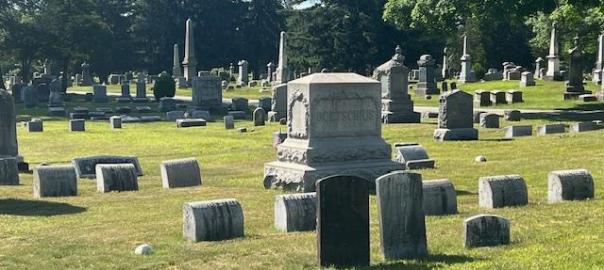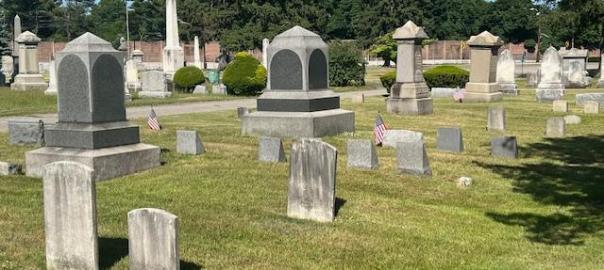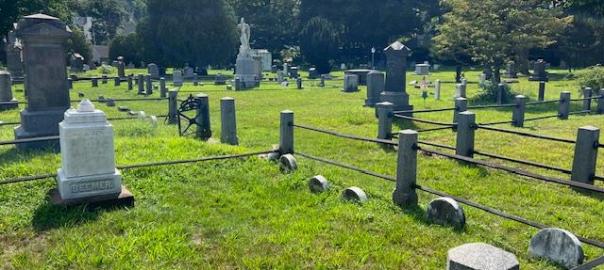
Maple Grove Park Cemetery in Hackensack, New Jersey, is a historic burial ground originally established around 1850 by the Dutch Reformed Churches of New York City. Formerly known as the New York Cemetery, it is a significant local repository for both 19th-century history and rescued historical remains.
Originally founded to serve members of the True Reformed Dutch Church, the cemetery was previously referred to as the New York Cemetery on Plank Road. As older churches and their surrounding burial grounds in northern New Jersey were decommissioned, their headstones and remains were frequently relocated to Maple Grove
The historic front section of the cemetery in the front of the cemetery
I visited the Maple Grove Park Cemetery one afternoon in search of a Revolutionary War Veteran, Albert Voorhis. I did not find his particular tombstone but I did find his family plot and many of the ‘first families’ of Bergen County. These include families such as the Demarest’s, Haring’s, Voorhis, Ackerman’s, Christie’s, Hopper’s, Van Saun’s and Blauvelt’s.
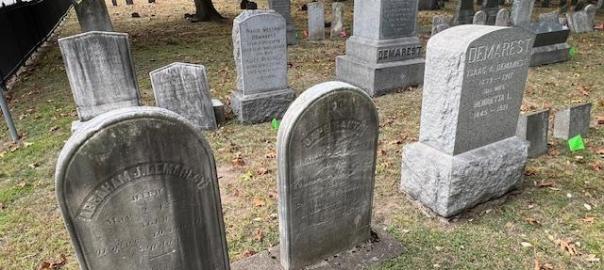
The Demarest family plot
The front part of the cemetery is nicely landscaped with interesting family plots dotted all over the this part of the cemetery. These were the families that shaped this history of the County and other branches of their extended family are either buried in historic Reformed Church graveyards or are in small cemeteries that were part of the family farm that now sit in subdivisions of McMansions, neglected and forgotten.
The Demarest family plot
I found it interesting to note how big many of these families were and how all of these ‘first families’ married into one another, probably because of family stature or maybe to extend the length of the family farm. These interconnections shaped and developed how Bergen County developed over a three hundred year period.
The Demarest/Hopper family plot
The Westervelt Family plot
The extended Voorhis family plot
The Zabriskie family plot
The extended Terhune family plot
The DeBaun family
The Brinkerhoff family plot
The Van Winkle family plot
The Ackerman family plot
The Blawvelt (Blauvelt) family plot
The Van Saun family plot
Another Terhune family plot
The Vreeland family plot
The Quackenbush family plot
The Hopper family plot
The Hopper-DeWolfe family plot
The extended Christie family plot
The extended Lydecker family plot
The Van Valen family
Another branch of the extended Demarest family
This cemetery is an interesting look at the early history of not just Bergen County or New Jersey but of the United States. These extended families contributed so much not just in military activity but in business, religion and education that helped build this country.
This unique cemetery is more than just a place of rest but a place of history and of respect. These were the extended families who contributed so much to the progress of our country and how it was directed into the future.
I visited the Alpine Cemetery, which is a historical active cemetery just off Closter Dock Road. This is the resting place of Revolutionary War Veteran, William Wilson and many other veterans from the Civil, Spanish American, World War I and II as well as from Vietnam, Korea and Desert Storm. All the graves were marked with American flags as we just finished Memorial Day weekend.
The family plots that separate the site
There are many family plots of “First Family’s” of Bergen County like the Westervelt’s, the Haring’s and the Campell’s. The family plots are separated by small fences and some are marked by the family names.
The cemetery on the hill in Alpine, NJ
The separate family burial plots
The Campbell Family burial plot
The Campbell family plots
The Van Sciver family plots
The Anthony Family plots
The Anthony family plot
The Haring Family plot
The Haring family obelisk
The Westervelt family plot
The Jordan/Wilson family plot
I looked at the Wilson family plot for the Revolutionary War veteran but the burial spot is probably has been lost to time. William Wilson may be lost to history but I know he was buried here.
The front part of the cemetery
The Veteran’s Memorial Rock with the names of World War I and II, Vietnam and Korea veterans
The Van Valen family plots
The Pearsall family plots
The Older family plots
The burial grounds from the front
There is a quiet elegance to these historic cemeteries. Who were these people? What did they do? Do people remember them? They are very interesting places to visit.
The history of the cemetery:
(From the historic sign)
The cemetery was founded in 1822 by resident William Gecox along Closter Dock Road when he bought 23 and a half acres as a burial ground for neighbors and for laborers who worked in the area. Mr. Gecox sold these plots on what had already been a burial ground.
The people buried in the cemetery were farmers, laborers, and tradesmen and their family. By 1870, the village “in the Closter Mountain” had take the name “Alpine” in the 1890’s. When William and his wife, Susan Helms pass in the 1890’s, their children sold the remaining plots. The cemetery has continued to be used into the twenty-first century.
The front of the English Neighborhood Reformed Church
The sign in front of this historic church
The front of the church
The front of the church from Church Road
The historic marker in front of the church
Since my project studying the historic graveyards and cemeteries of the Revolutionary War with my International Marketing students, I have taken my time to walk these sites and try to understand the history and importance of these sites as part of the memories of who these people were, the contributions that made to not just our county but the country and trying to keep their memories alive while many have been forgotten by their families.
The newer back part of the cemetery
Visiting during a recent post Memorial Day visit, I got to see how many veterans of all the wars from the American Revolution to Desert Storm were buried here. Even though we studied just the veterans of the Revolutionary War, I was fascinated by the number of Civil War and World War I and II veterans here as well.
The older section of the graveyard
The history of our County and Country are shown among the rows of tombstones that represent the contribution of our County residents to the many causes. It was very humbling to see them being honored at this time.
What I found interesting was many of the branches of ‘Founding First Families’ of Bergen County were interned here, representing Bergen County’s contributions to the foundation of the United States.
The Engle family plot where Revolutionary War veteran John Engle was a member
The Vreeland family plot closest to the church is the resting place of Revolutionary War veteran Michael Vreeland (again this site was once their family’s farm)
A closer look at the Vreeland family plot
I believe this is the tombstone of Michael Vreeland, Revolutionary War veteran
Another branch of the Vreeland family
The Herring (Haring) family crypt
The Outwater family crypt. General Outwater’s side of the family is buried in a family plot in Carlstadt, NJ
The Banta family plot
The DeGraw family plot
The grave of Benjamin Westervelt
The grave of a soldier I could not read
It was so interesting to walk amongst the rows of tombstones and trying to understand each person’s story and their personal contributions to the way our community was founded and developed. So many of these family names are woven into the history of Bergen County.
There is a quiet elegance to these graveyards and on a warm sunny afternoon they are less scary and more of a place of understanding and respecting our past. It was an interesting history lesson.
Looking at the oldest section of the graveyard where many Colonial family plots are located
History of the Church:
(From the Church website)
The English Neighborhood Reformed Church is the oldest building in Ridgefield, NJ, erected on its current site way back in 1793, long before Bergen County became the bustling metropolitan area it is today.
But even before this, way back in 1675, Ridgefield was known as “The English Neighborhood” and covered roughly 10 miles of land between the Hackensack and Hudson Rivers. This is where our church gets its historic name. The first construction of the church (in Leonia) dates back to 1768, but was moved to its present site in Ridgefield, in 1793.
This area played a role in the Revolutionary war, when General Washington retreated with the Continental Army in 1776 from NY City and passed through the English Neighborhood. Those who fled the area for their cause, included the English Neighborhood Church’s first minister, Garrit Leydekker, an Englishman and a Tory, who fled for the safety of New York City, taking the church’s first records with him.
The historic graveyard next to the church
The church’s steeple was the tallest structure to rise above the flat meadowlands and would become a surveyors landmark. It is approx. 80 ft. in height and made from hand-strewn timbers and wood dowels, rather than nails.
The historic church on a sunny afternoon
In 1804, Edgewater Avenue was a bustling artery for commerce and was part of the toll road known as the Bergen Turnpike. For 100 years, covered wagons transported their goods from the farms of NJ, to the ferries that would carry them to market in NY City, right past the church. The church was once located in the heart of the bustle of life as it was, before the industrial revolution.
The historic doors of the church
In 1854, the railroad was brought to Ridgefield, which introduced industry and growth to the town. Throughout the Civil War, members of the congregation were active in the “underground railroad.” Runaway slaves were hidden under the bridge by Overpeck Creek. They were given food, clothes and other necessities to help move them to the next safe haven, during the night.
In 1912, the Sunday school building was added, across the way from the church. Additions to the building were completed in 1954 and 1962.
A bridge was built over the Railroad tracks in 1932, which led to the closing of Edgewater Avenue and the “Old Highway” that once brought passersby with regularity, became a dead-end street. These gradual changes have meant that the historic legacy of the English Neighborhood and its church, goes largely unnoticed.
However, these changes also, today provide the quiet hamlet that the church finds itself surrounded by – a little piece of heaven on earth – right here in a busy, and often congested, Ridgefield. It is this history and this unique location that makes the English Neighborhood Church a one-of-a-kind place to worship.
We hope you will join us some Sunday to see for yourself. God has blessed this congregation for nearly 233 years (2026). Jesus is doing some amazing things with this church and its people. You are welcome to be one of them, as we move into the next thing God is calling us to do and be, as Jesus’s disciples.
I recently attended the Annual ‘Pathways Tour’ in Morris County, NJ to visit some of the historical sites. It was a very interesting visit to some of these sites that were over 250 years old. With the anniversary of our country coming up in two months, I can see that these sites will be getting more attention.
Having toured most of the sites in Morris County, which has a treasure trove of historical homes, parks and museums, I concentrated on the sites that are rarely open, like the Doremus House and the Florham Park Schoolhouse for my blog, VisitingaMuseum.com.
Readers reach out to me asking about these sites but no one seems to man them outside the Pathways tours. So you have to race to see them then. These small historical sites offer a glimpse into New Jersey’s rural past and the history of how our state developed.
The Henry Doremus House during the Pathway’s tour
I visited the Henry Doremus House first during the Morris County Pathways Tour in May of 2026 and it is good look at the early farming communities of New Jersey under the Dutch and then the English. The house was used by General George Washington while he was passing through this section of New Jersey during the Revolutionary War.
The sign for the Henry Doremus House
The historic sign for the house
Montville Township Historical Society:
(from the Museum website)
Established in 1963, the Montville Township Historical Society is dedicated to the preservation and promotion of the cultural heritage of Montville Township. Our unwavering commitment to meticulous archival work, interactive educational programs, and community outreach initiatives is aimed safeguarding the rich history of our town. Our ultimate objective is to ensure that the stories and traditions of Montville Township are cherished and celebrated for years to come.
The farm and harvest equipment
General Washington’s payment to the Doremus family for use of their home during the Revolutionary War. I thought this was really cool.
The farming equipment
The farm and household equipment room
The farm equipment from the time of the Revolutionary War
Henry Doremus House History:
(from the Museum’s website)
The Henry Doremus House is a Dutch American stone farmhouse that has been remarkably preserved since the time the first portion was built, circa 1760. The house has never been modernized with heating, plumbing, electricity, or wiring, and is one of only seven left in New Jersey without modern electricity. What is now Route 202 was one of the main military routes during the Revolutionary War through Montville and Towaco, (then part of Pequannock Township). The Henry Doremus house was located in a small community often referred to as Doremus Town.
The main room of the original house during the tour
The kitchen and cooking equipment by the open hearth fireplace
The open hearth fireplace for cooking and heat for the home
Cooking items
I visited Diane’s Dairy at 446 Main Road Suite 8 after my tour of the Henry Doremus House, a local ice cream store just around the corner from the historic home. What started as a place to turn around my car, I had to stop on this historical looking strip mall. When I saw the words ‘homemade ice cream’ I of course had to stop. Ice cream is one of my weaknesses.
Diane’s Dairy at 446 Main Road Suite 8
The menu of the selection of flavors
What was nice was I got to meet Diane herself that morning and she explained to me that they create and make over 92 flavors inside the store. I could tell by the quality and taste of the ice cream that a lot of care was taken in the making of her ice creams.
The section of ice cream
Diane has created many unique flavors so it was hard for me to choose but I wanted to try something different and settled on Bubble Gum flavored ice cream. It was delicious.
The Bubble Gum ice cream
The ice cream was rich and dense and had such an intense flavor of cream and cherry flavored gum. What I also liked was her prices were very fair and the portion size for a small ice cream is the size of most mediums sizes at the commercial ice cream stores. Plus I like to support local businesses. Diane has created a wonderful product and could not have been nicer.
The ice cream is do good
This ice cream was the best. Funny enough though I was her first review on TripAdvisor. I would have thought more people would have been singing her praises. After my snack, it was off to the second site on my list, the Florham Park Little Red Schoolhouse.
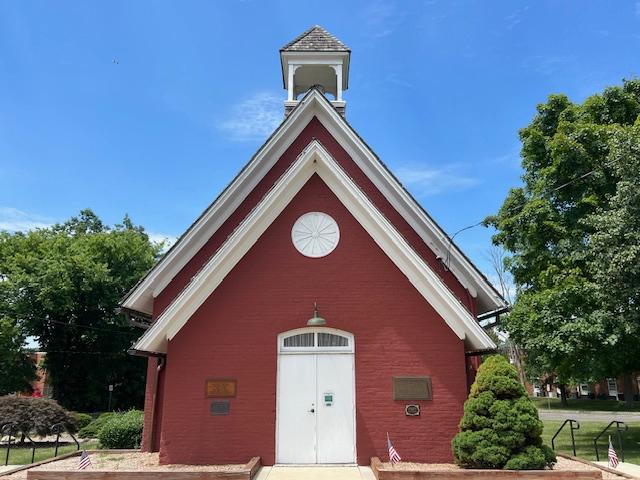
I visited the “Little Red Schoolhouse” Museum at 203 Ridgedale Avenue in Florham Park, which is also rarely opened. This interesting little museum showcases the town’s historical collection of items from the 1800’s and 1900’s dealing with all aspects of town life.
Schooling at the “little red frame building” prospered and so by the 1850’s, the building was “in condition of dilapidation rendering it unfit to be occupied” due to overcrowding.
The schoolhouse from the front
The inside of the museum schoolhouse display
The inside of the old classroom
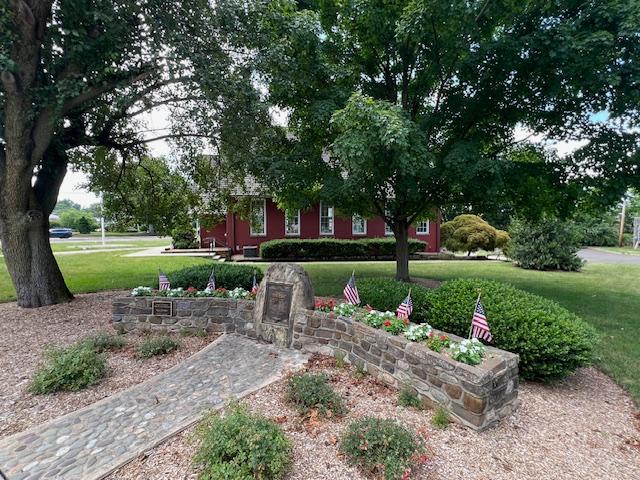
The schoolhouse setting
In the back there is a small classroom set up keeping with the theme of the building. This lets students, who are visiting the building of their counterpart’s early education with desks, ink wells and chalk boards that have not changed that much over the years.
Not much has changed in the modern classroom over the years
The old schoolhouse desks
There is early century clothing, farming equipment from the town’s farming past and even Native American objects found in the town and in private collections.
The town artifacts and school items
The hitching post
Other items included decorative items from the home including dishware, home products and furnishings.
Each section of the museum is divided up by lifestyle.
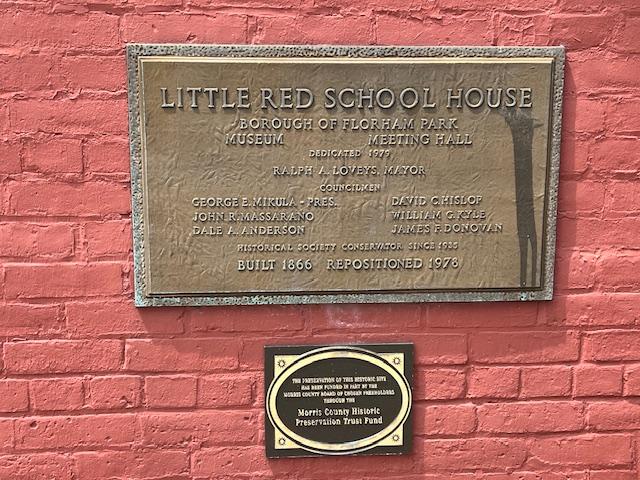
The museum’s historic plaque
The docents that day explained that the items were reflect the town’s past and some came from families that have been in town for years. The museum reflects the community spirit of town’s past. It explains that times have progressed but not changed too much over the years.
The Veteran’s Monument outside the museum
History of the Little Red Schoolhouse Museum:
(From the Museum Website)
By Kat Kurylko, Research Assistant
In 1830, the residents of Columbia, now Florham Park, sought to improve their thriving farming and broom-making community by establishing a public school for the local children. Therefore, a small schoolhouse, Columbia School #5, was built on the corner of Columbia Turnpike and Ridgedale Avenue and dedicated it on February 17th, 1831.
The schoolroom display
Schooling at the “little red frame building” prospered and so by the 1850’s, the building was “in condition of dilapidation rendering it unfit to be occupied” due to overcrowding. It just showed me one thing as an educator, that the concept of modern education has not changed that much in 150 years.
I next visited the Tunis-Ellicks House 16 Village Road in New Vernon and enjoyed the self-guided tour of this well maintained and displayed home. Unlike many sites I have visited over the years where things are left out and jumbled on tables, the Tunis-Ellicks House offers a look at small family farms from before the Civil War. The displays depict and discuss the life of a farming family in Central New Jersey.
The Tunis-Ellicks House in New Vernon, NJ
The house sign
The house is located in the New Vernon Historic District
The house was located in one of the oldest sections of the community, facing other structures in the historical district of New Vernon, NJ.
The house and front garden from the road
The vegetable garden in the front of house
In front of the house was a large vegetable and fruit garden with a grape arbor for spirits on the side of the house. These items would be jarred and pickled for the winter months or sold at market.
I liked the way the volunteers maintained the gardens with fruits and vegetables that would have been used in Colonial times mixed in with a modern twist.
Mission Statement:
(From the Museum website)
The Harding Township Historical Society is a private, not-for-profit corporation founded in 1977 to stimulate interest in the history of Harding Township. The Society shall support, assist in and seek to achieve the preservation of documents, buildings and sites related to Harding Township. It shall also collect, preserve, maintain and interpret original cultural material, which illuminates this history. In addition, The Society is responsible for preserving and maintaining the Tunis-Ellicks House and environs. Through use of its historic site, collections and programs, the society endeavors to document and illustrate the history of Harding Township for present and future generations (Tunis-Ellicks website).
You enter the museum from the back of the house. In the backyard of the home, there were all sorts of activities going on while you could start a self-guided tour of the house.
The back of the Tunis-Ellick’s House
The beautiful view from the back door of the home
The inside of the main part of the museum
The main part of the museum was the newer extension of the home where the living room and dining rooms were located. There were displays on the walls discussing farm life in New Jersey during the late 1700’s and early 1800’s.
The Dining Room section of the house
The workings of the Dining Room
The story of ‘Country Life’ and the gentleman farmer
Pieces of the decor on display
The kitchen area of the older part of the home offers a homey fireplace for cooking and summer storage for jarred and pickled food stuffs for the winter.
The kitchen and storage areas of the home
Pottery collection in the museum
The pottery collection
The kitchen dining and cooking area of the home
The fireplace for cooking, roasting and stewing of foods
The oven for baking breads, cookies and pies and the baking equipment
The Summer storage area for canned and jarred provisions for the winter months and for cooking.
History of the Harding Township Historical Society:
(From the Museum website)
The Harding Township Historical Society was formed in 1977 to save the circa 1795 Tunis-Ellicks House and restore it as it appeared in the early 19th century. The society discovered an original 18th century hearth and Federal-style mantel and a water-fed cooling room besides the well. Areas of the house were left exposed to showcase the post-and-beam construction. A permanent exhibit on 19th century farming was created as well as space for temporary exhibits.
The Society saved a circa 1870 Tramp House from destruction when the Great Swamp National Wildlife Refuge was created by having the building moved the Tunis-Ellicks House property. The Harding Township Historical Society maintains an extensive archive containing records, maps, and objects since the colonial era pertaining to the town. The archive is open to researchers, genealogists and the public. Each year we provide an award to a student at the Harding Township School that excels in the subject of history. The Society produces exhibits, lectures, tours, and interactive events to bring history to the public.
When I drove to the Tunis-Ellicks House, I was really hungry and it was lunch time. I had passed the Green Village Deli at 536 Green Village Road and I read the reviews online while in their parking lot and they were excellent so I decided to give it a try. The food and the service were excellent.
The Green Village Deli at 536 Green Village Road
The sign that welcomes you to this local breakfast and lunch establishment
The Village Green Deli is a popular local sandwich shop, where the staff seems to know all the customers by name (with the exception of me) and is located in this small downtown area facing the Village Green.
I really liked the vibe of this small town deli where the owners knew everyone by name and I felt like an interloper at a private party.
The inside of the Village Green Deli
The deli has that small town feel to it, with local art and sports paraphernalia in the walls. The woman who worked the register was greeting everyone by name and the guys that worked the grill seemed happy to see me.
Looking at the menu at the grill
I looked at the extensive lunch menu of popular sandwiches and some wonderful combos. You could even still get breakfast as I saw some of the guys at the counter devouring as I decided on what I wanted to order.
The deli has a wonderful selection of sandwiches, hero’s and other delicious sounding items.
There were so many things I wanted to try that day that it was hard to choose. Was it a breakfast sandwich with local sausage? The Thanksgiving ‘Gobbler’ sandwich with turkey, stuffing and cranberry relish, that sounded so good? I decided on an Italian hero sandwich with a selection of deli meats with fresh lettuce, tomato and onion. The hero was excellent!
The Italian hero with a pickle
The sandwiches here are huge! One half of a sandwich a normal person could eat for lunch and save the rest for another meal. The sandwich was loaded with salami, bologna, ham, Swiss Cheese and fresh veggies. I could barely fit it in my mouth.
The sandwich was excellent
The food was excellent. The bread was so fresh and the cooks did not skimp on one ingredient. The vegetables were so fresh and crispy and I loved the combination of flavors of the cold cuts. I really enjoyed my lunch and would like to make a special trip back just to try more of their sandwiches. I was very happy with my lunch.
One of the last places I visited was the Historical Society of Boonton Township, which is located in the former Oscar Kincaid Farm Homestead 591 Powerville Road. The house and what was left of the acreage of the farm was part of the current museum. The museum was an example of early New Jersey farming that dated from the 1800’s to the Twenty-First century.
There was not much in the way of period furniture or farm equipment (items of the home were sold off since Mr. Kincaid’s passing), but the new historical society is buying artifacts and bringing them back to the farm. This includes one of Mr. Kincaid’s tractors. His roll up desk is also still in the display room which was once the Living Room of the home.
The Kincaid Homestead at 591 Powerville Road
History of Oscar Kincaid and Homestead:
(From the Morris County Historical Society website)
Originally a part of the extensive tract belonging to William Penn, the earliest portion of the home was constructed in 1785 by Adam Miller and Anna DeMouth Miller. Just over a decade later, they sold the property to Adam’s cousin, Sarah Miller Parlimen (of the Miller/Dixon homestead) and her husband, John, who built a sawmill there. After a brief ownership by William Scott of Powerville, a Miller relative, the land was sold to John Decker in 1828. An industrious man, Decker operated both a farm and successful forge, shipping his goods to New York via the Morris Canal. By 1837, he expanded the home, adding a distinctive folk-art painting of a face and unique plasterwork that can still be seen today (MCHS website).
The homestead passed through generations of Decker’s family, ultimately being inherited by Oscar Kincaid Sr. in the early 20th century. Kincaid ran a popular ice cream stand and dairy business throughout the 1920s and 30s. Following World War II, the family opened Valley Farm on the site, which continued until the death of Oscar Kincaid Jr. in 2000. Added to the National Register of Historic Places in 2005, the Decker-Kincaid Homestead today operates as a museum and headquarters of the Historical Society of Boonton Township (MCHS website).
The Kincaid House
The historical marker for the house
The front yard
The entrance to the house
The main foyer of the house
The house is a small farmhouse built in two sections. The original part of the house dates back to the late 1700’s and the newer part in the early 1800’s. The once furnished rooms now hold displays of Morris County and the farming industry of the time plus community artifacts.
The former Living Room
Oscar Kincaid’s desk
There were not much left in the way of family furnishings and heirlooms but this desk was Oscar Kinkaid’s.
The back bedroom
The Flag display for the ‘250th Anniversary’
Story of Oscar Kincaid’s life: Oscar Kincaid was a farmer/businessman, a politician and a conservationist.
After the short tour around the house, I walked around the farm grounds. The house was set on a beautiful piece of land that sloped down to the old farmstand. There was also a swimming pond which was once part of the farm which is now private property.
The farm property from the side with the barn
The barn across the street
The property was about ten acres at the time of his death and parts have been developed. It still has some of the most wonderful views of the area.
The view of the old farm from the front porch
The farm land stretches over different sections of the road and the property is very picturesque. It is a very beautiful homestead.
The view of the farm from the lawn
The swimming pond on the edge of the property
The old farm stand that had been used for eighty years
Every semester for my Business Marketing, Management and Communications classes, I create one big Team assignment for my students. In a Commuter College, it is a lot tougher for students to get to know one another between their studies and their jobs, so I create these projects to foster learning, creativity and especially Teamwork.
This semester I taught International Marketing. This is a tough course to teach as you always have students of various age groups and various levels of industry experience. The Spring semester was no different. This makes the class more interesting yet more challenging to teach. I still challenge them and test them to see what type of future executives they will become.
I also taught Principles of Management and International Marketing which came with their own challenges. It was the amount of people in each class and what projects would they be working on. I knew the things I wanted to work on, I just had to figure out how to frame them.
In the past, I have created these projects under the Bergecco-Parc Consulting Inc. banner, the main consulting company, the Orion Malls banner, a Mall design company and the Buscomonzefi.com banner, my Tech Division.
Each business concept does its best to be creative, forward thinking and have a thought producing presentations. I also challenge the students to top on another in their presentations and build on what they have seen others do in the past.
The Bergecco-Parc Consulting Inc. concept is an acronym for Bergen Community College Paramus campus where I work. It came to me one night around 3:00am in the morning when I was trying to figure out a project for my students to work on.
Professor Justin Watrel, CEO Bergecco-Parc Consulting Inc.
Our Corporate site (created my one of my former President’s:
This semester I attempted one of the toughest and most extensive Team projects in all the historical projects I have created, taking the listing of the Daughters of the American Revolution created for Bergen County Historical Division for the “Bergen 250”and we took it to another level.
I challenged the students to visit all the cemeteries and graveyards on the listing (using my blog if needed), find the tombstones of the veterans of the Revolutionary War and photograph them. Next they needed to create a biography of each of the veterans.
From there, they needed to create a short video of that gravesite and put it all into a QR code so visitors can find them. It was a big challenge but I knew this class could do it. There was something about the personality of this class that would make it work.
I then planned a series of field trips so that the students could visit particular sites in a more formal tour. I asked a lot of the contacts who I have met over the years to help me out, so the students could see why this project was so important to the 250th Anniversary to both our County and our Country. It took a lot to plan and execute. I gave them six weeks to do the research and create other sections of the project.
A. They had to take the listing of all the veterans and their list of grave sites and play ‘detective’ to find the tombstones and then film and create the QR codes.
B. They had to create a special “250th Medallion’ that would be placed at each veteran’s tombstone to honor them on the “Bergen 250”. These pieces of art were very clever.
C. They had to create a “Farm to Table” fundraiser with three courses and an American selection of wines, one being from New Jersey. They also had to create the menu and the invitation to the event. The Teams created the menu, cost and budget to show how much they would raise for the event.
D. As an extra credit assignment, I had the Teams create a special “Halloween Tour”, with a special concession menu, tour script of the cemetery or graveyard of their choice and create the logo and advertising for it. Three of the four Teams created this.
Then I planned a series of field trips to visit the most important sites in Bergen County, some were tiny stand alone family cemeteries, some were historical sites and some were very important church graveyards with family plots.
I think this is where the students had the most fun. This is where the comradery of the class was created. As I took the Team out to many of the sites on their listings, the Teams got to see the concept of “Dark Tourism”, the desire to visit places were either bad things have happened, the site has an evil past or something to do with death. This has become a popular form of Tourism in the Twenty-First Century. (Think the 9/11 Memorial).
It was also a chance to get out of the classroom and get some fresh air and sunshine. These are some of the places our Team visited.
My Graveyard and Cemetery Team “Out in the Field”:
The first site I took my Team to was the Baylor Massacre site in River Vale, NJ, where the British had ambushed a battalion of soldiers and killed them. The site has a rather dark history from the war.
The irony about the site is that all my students were from Bergen County and none of them had been here before. I had taken my previous ‘Bergen 250’ class here as well as our next stop, the Haring Farm Cemetery just a few blocks away.
The Team picture at the Baylor Massacre site
We next toured the Haring Family Cemetery down the road on Old Haring Farm Road. This was one of the many examples of small family cemeteries that used to be placed at the edge of family farms, who wanted loved ones buried close by or the distance to the family church was too far away at that time.
Touring the Haring Family Cemetery
The Haring family is one of the most important and prominent Colonial families in New Jersey (and are very distantly related to me by marriage), so I felt this site was very important to visit to show the family dynamic of that era.
Our Team at the Haring Farm Cemetery at Old Haring Farm Court
We then went on our Team lunch at Pompilio’s Pizzeria in Downtown Westwood, NJ. I feel on projects like this to build comradary and for the students to start their projects, we need to ‘break bread’ with one another and get to know each other in a relaxed place. Plus the students seem to love free pizza and Coke. This lunch has started many successful projects.
Our Team Divisional at lunch at Pompilio’s Pizzeria:
Our Team lunch at Pompilio’s Pizzeria
We all had such a nice time at lunch and feel this is the best way to get to know one another. The food at Pompilio’s is also excellent. I always host the lunch with large Cheese Pizza and Coke.
My Executive Team at our lunch
Our next Field Trip was the Old Stone Church in Saddle River at 481 East Saddle River Road in Saddle River, NJ. This is one of the oldest churches in Bergen County and in New Jersey.
The Old Stone Church at 481 East Saddle River Road in Saddle River
This church has the most complete set of tombstones of Revolutionary War veterans and the church website has some of the most complete information on their veterans.
Our group picture at the Old Stone Church
Our next trip was to the First Reformed Church of Hackensack, the second oldest church in New Jersey and one of the most important for the Revolutionary War. Their graveyard has the most amount of Revolutionary War veterans in Bergen County.
My students outside the First Reformed Church of Hackensack at 42 Court Street
The historic outside cornerstones of the church with the original family founder names carved in the bricks
The family keystones
John Paulson keystone
Henry Berry keystone
Albert C. Zabrifky keystone
The Historic First Reformed Church pews and stained glass windows.
The first floor of the church and the inside pews
The alter
The view of inside of the church
The Revolutionary War artifacts
My student visit on the second floor of the church. The church’s artifacts are displayed in the cases here.
Tour of the church
The Child’s family windows
Voorhis-Lozier-Moore Windows
The Kraissi family windows
The Van Valen windows
The War years windows
The church is the second oldest church in New Jersey and one of the oldest in the country. We then walked outside to tour the historic graveyard in the back of the church. It had the most amount of Revolutionary War veterans buried in Bergen County, NJ.
Many of the veterans of the American Revolution were buried closest to the church, which was the tradition of the time to be buried as close to the church as possible. Their graves were marked by Revolutionary War medallions and American flags.
The Demarest-Voorhis Revolutionary War graves
General Poor’s grave
Albert Romin grave Revolutionary War veteran
The front part of the church by the Hackensack Green was the resting place of many of these heros
Our Team of Student Consultants picture inside the historic graveyard
It is also the resting place of General Enoch Poor, who died during battle, whose funeral was attended by General George Washington himself. We took this group picture by the General’s grave.
Our Team pictures with General Poor
Our last field trip and one of our most important was to the Old South Presbyterian Church in Bergenfield. This was the place of the Demarest family plot, which is currently under a full renovation.
We worked with Melissa Naylis, who is leading the renovation of the church and master carver, Bob Carpenter, who showed us how he is restoring the graveyard. He had led one of my previous classes when we visited the graveyard for my ‘Bergen 250’ project.
Master Carver Bob Carpenter leading our tour
The South Presbyterian Church and the Demarest family plot
The Demarest family plot
Melissa Naylis starting the tour with us
The students got to learn of the important history of the grave sites and why they are an important piece of the United States founding. The were the men who fought for our freedom and the wives and families that supported the effort.
Melissa leading the tour and introducing Bob Carpenter to us
Melissa Naylis explaining the work that is being done in the graveyard
Bob Carpenter explains his work
Some of the earliest tombstones in the graveyard
Bob Carpenter explaining the renovation
Bob Carpenter talking about the Demarest plot renovation
Pastor Glen from the Old South Presbyterian Church introducing himself to the students and joining us on this part of the tour.
Talking about the care of the tombstones
Talking about care of the tombstones
We then moved to tombstone of the founder of Rutgers University for a marble carving demonstration. Bob Carpenter wanted the students to know the effort into carving into stone and brought the tools of that era and a piece of marble for the students to use. The students got a kick out of this and some really enjoyed it.
Bob explaining the work of a marble carver
Describing the process
My students giving it a try
My student Amy, carving marble
My student, Walid, carving on marble
Demonstrating the process
After the demonstration, we talked about the work of the Demarest family and their contributions within Bergen County.
The founder of Rutgers University, John Henry Goetscheus and a member of the extended Demarest family.
Our Team picture after the tour
Taking a quick tour of the graveyard after the formal tour, the Blauvelt-Kipp family burial ground
I found that being ‘out of the field’ really exposed the students to not just to visiting parts of the county they had never seen but showing them how cemeteries and graveyards are part of our culture of respect and memory. They can be looked at less as religious standpoint but as a historical value of who we are and how it part of all of our pasts.
We also looked about how these sites could play a role of building Bergen County tourism by promoting these sites as a part of the history of our country. Not just during the Revolutionary War but as part of our cultural fabric.
On April 29th, 2026, the students made their formal Presentation of the project and showed off their research of the sites and their fundraising tools to support the restoration of these sites.
This was an amazing project that will benefit so many people from historians to researchers to people who love the Revolutionary War and its history to family members looking for loved ones.
It is my class’s contribution as well as other future and past projects to benefit the “Bergen 250” and the rich history of Bergen County, NJ. Our County has contributed so much to not just the building of the state but of the United States as well. It was one of the best projects I ran as CEO of Bergecco-Parc Consulting Inc.
Our Executive Picture:
The “Cemetery and Graveyards” Team
Our Reception following the Presentation
Our Presentation was followed by a Q & A with many people we had met along the way from our visits “out in the field” who had come to see the final project and this was followed by our Corporate Team picture and then a reception in honor of the Student Consultants who made this important possible and come to life.
Every semester for my Business Marketing, Management and Communications classes, I create one big Team assignment for my students. In a Commuter College, it is a lot tougher for students to get to know one another between their studies and their jobs, so I create these projects to foster learning, creativity and especially Teamwork.
This semester I taught two sections of Business 101-Introduction to Business, which is the entry level course to the Business/Hotel Management School. This is a tough course to teach as you always have students of various age groups and various levels of industry experience.
The Spring semester was no different. This makes the class more interesting yet more challenging to teach. I still challenge them and test them to see what type of future executives they will become.
I also taught Principles of Management, which came with its own set of challenges. It was the amount of people in the class and what projects would they be working on.
In the past, I have created these Team projects under the Bergecco-Parc Consulting Inc. banner, the main consulting company, the Orion Malls banner, a Mall design company and the Buscomonzefi.com banner, my Tech Division. All of these business concepts are simulated.
Each business does its best to be creative, forward thinking and have a thought producing presentations. I also challenge the students to top on another in their presentations and build on what they have seen others do in the past.
The Bergecco-Parc Consulting Inc. concept is an acronym for Bergen Community College Paramus campus where I work.
Professor Justin Watrel, CEO Bergecco-Parc Consulting Inc.
Our Corporate site (created my one of my former President’s:
While my morning Business 101 classes worked on their ‘Breakfast at Primo Pizza’ project and my International Marketing students worked on their “The Historic Revolutionary War Graveyards and Cemeteries of Bergen County” projects, I had my Principle of Management students create a game plan to market the Pascack Historical Society Museum in Park Ridge, NJ to a younger, more modern audience.
When choosing a project for this class, I had had two other ideas that fell through, then I had remembered working with the Pascack Historical Society Museum the prior year for my “Bergen 250” Team Project. We had proposed a Farm to Table Dinner at the Wortendyke Barn down the road with the dinner starting with a Cocktail Party here with a tour of the museum. I asked the museum again to partner with me on this project.
The Video Presentation of the “Bergen 250”in 2024:
The museum had created a wonderful exhibition for the “Bergen 250” but when I went to visit it, no one was at the museum but myself. When I asked the volunteers that day how many people had visited the museum, they told me I was the first one. That got me thinking why people were not visiting this wonderful museum with its interesting artifacts and intriguing displays.
The outside of the Pascack Historical Society Museum at 19 Ridge Avenue in Park Ridge, NJ
Then I looked at their website and their displays. I realized that the museum was not adapting to the cellphone age. There were no QR codes at any of the displays, not enough pictures of the display on their website and their scavenger hunt bingo game needed an update to engage a younger crowd.
That’s when I came up with a Marketing plan for the museum and proposed it to their Executive Board. We worked together to come up with new ways to promote the museum and its collection. This was our combined idea and we looked at how to bring more traffic to the museum.
The Proposal for “Bergen 250: Touring the Pascack Historical Society Museum”:
I presented the project to my students after the Spring Break and then the next week took my students on a mandatory field trip to the Pascack Historical Society Museum in early April. The Board members of the Museum led us on a tour of all the exhibitions, then discussed their plans for the “Bergen 250” and then discussed some of the challenges that the museum faced with attendance.
Touring the museum
The students on their part took pictures and notes about the museum and their displays. Many would make various trips back to the museum to crest the QR codes for the displays and map the museum’s backyard for the Farm to Table fundraiser and a proposed afternoon tea.
Touring the museum
Touring the museum
Touring the museum with the Board of the museum
The museum’s Board members could not have been nicer and more helpful to the students and myself. We got a lot of insights on what direction the Board wanted to go.
Our Team picture at the museum
The tour of the museum took about an hour. We then had a Division Team Dinner at Pompilio’s Pizzeria in Downtown Westwood, NJ:
I find that these Team dinners and lunches are very helpful in getting the students together to get to know each other and we share a nice meal as a Team should. We asked the Board to join us so we could continue the conversation.
Dinner with both the Board and my Team
For the next five weeks the three Teams broken into Marketing, Historical and Foodservice created their ideas and game-plans to help the museum increase traffic by trying to bring a younger and tech savvy visitor into the space.
The Pascack Historical Society YouTube Presentation:
The video of our Presentation to the Board of the Pascack Historical Society Museum on the evening of April 29th, 2026
On the evening of April 29th, the Board members of the museum joined us for the Presentation of ideas the students came up with including setting new QR codes for all the displays, a revamped Marketing plan to showcase the museum, a new historical walking tour, one aimed at adults and one to children and the ideas for the fundraising dinner, a children’s birthday party concept and a Afternoon Tea fundraiser.
After the Presentation, we had a Q & A on the ideas and after the Presentation was over, we had a reception for our guests and for the student consultants. Then we took our Corporate Team picture.
My Divisional Team the night of the Presentation
Our reception after the Presentation
It was another successful project accomplished and it looked like the Board went home with new ideas and the students learned a few things about themselves. I could not have been more proud of the students.
The Van Bushkirk Burial Ground behind the residence at 45 East Saddle River Road
The Van Bushkirk Burial Ground is part of the history of Saddle River, NJ’s early settlement period. The burial ground has about 40 tombstones that are arched and shaped. These are some of the first residents both of Saddle River and Bergen County, NJ.
The burial ground lies next to a creek off East Saddle River Road and can only be accessed by going through private property of the residents living at 45 East Saddle River Road. Please do not enter without permission of the owner of the home. These pictures were taken with a long distance camera from the street.
The Van Bushkirk Burial Ground at 45 East Saddle River Road
The History of Saddle River:
(from the Saddle River Town website):
In 1675, Lenni Lenape tribal leaders sold a large amount of land on the Eastern side of the Saddle River (known as Werimus) to Albert Zabriskie. In 1708, Zabriskie sold this tract of land to Thomas Van Buskirk. The first house in Saddle River was built by the Van Buskirk family in 1709. The original Van Buskirk homestead still stands at 164 East Saddle River Road across from Borough Hall.
In 1709, the Lenni Lenape sold the land on the west side of the Saddle River to the English as part of the Ramapo Tract. Property on the west side of the Saddle River was acquired from this Tract throughout the 1700’s. The Ackerman Family was the most prolific buyer of these early Saddle River parcels and first settled on the West side of the Saddle River in 1745 when Johannes Ackerman acquired 245 acres.
The graves of George and Margaret Achenbach
Saddle River continued to grow and populate during the 18th century. Families such as the Van Buskirk’s, the Ackerman’s, the Achenbach’s, the Hopper’s, the Zabriskie’s, the Stilwell’s and the Baldwin’s farmed and developed the area.
The grave of George Achenbach
The first of many Saddle River mills was built in 1714 and the first school was constructed in 1720. Another early 18th century business was the blacksmith shop operated by the Ackerman family. Over the years, these 1st families built the quintessential “Old Dutch Homesteads” from actual sandstone that was found in town.
The Revolutionary War era tombstones
The Revolutionary War was a horrendous time for the residents of Saddle River. The townsfolk had spent the entire 18th century developing the area into a well established community and all growth essentially stopped during the war. Since the Jersey Dutch initially considered the revolution to be an English issue, it was particularly shocking when the fighting came to their backyards. From December 1776 until the end of the war, both American and British forces traveled through Saddle River and many times set up camp in the center of town.
Residents were in constant fear of the British employed Hessian soldiers who would terrorize families by raiding the houses for food and then burning the fields before leaving. Although no major battles took place in Saddle River, there were small skirmishes to fend off raids and the Blue Mill on East Saddle River Road was destroyed. Even George Washington, the future father of our country, passed through Saddle River on multiple occasions and tradition has him staying overnight at the Ackerman Homestead on the East road.
When the Revolutionary War ended, Saddle River residents picked up right where they left off in terms of community and industry development. The Ackerman’s built a Foundry on what is now Waterford Gardens. Tice and Berdan both opened stores in town and the Bulls Head Tavern opened its doors to weary travelers in 1802. Old mills were re-opened and new ones such as Van Riper’s Saw Mill and Basket Factory were established. The post war growth continued for decades and culminated in the 1820s with the construction of the Zion Lutheran Church in 1821 and a new schoolhouse behind the church in 1825.
The worn tombstones in the cemetery
History of the Van Bushkirk family in Bergen County during the Revolutionary War:
(From the Bergen County Historical Society website):
Loyalists in Bergen County came from all backgrounds, religions and economic classes. At the beginning of the war, a number were officers in the militia, the military force composed of all able-bodied males maintained by each province, and later the states. The lieutenant colonel of the militia was John Zabriskie of New Bridge. Zabriskie understood the sentiments of many of his neighbors, particularly those of Abraham Van Buskirk, whose property was directly across the bridge in Teaneck. Van Buskirk was a surgeon in the militia under Zabriskie, and with whom he served on Bergen County’s Committee of Correspondence, an entity established to keep in touch with other New Jersey counties and the events occurring there.
The Van Houton Family Cemetery at 108 Delaware Lane on what was once the family farm
The historic Marker from 1822
The family plot from the entrance of the cemetery
About five generations of Van Houton’s have been buried in this spot, with an impressive list of family members who have served in all the nation’s wars.
From the Revolutionary War up to World War II, the family’s contribution extends not just to Bergen County but our entire country.
The family extends to other older ‘first families’ of Bergen County, such as the Snyder’s, the Demarest’s, DeBuan’s and the Van Ripper’s.
This multi-generational cemetery is still used today by the descendents of John Van Houten, who left the property in his will. The grounds of the cemetery are well maintained. A metal fence around the property could use some minor repairs. Unfortunately a couple of the obelisk markers have fallen off their bases.
In the August 1992 Cemetery Inventory Booklet, published by the Bergen County Department of Parks, Division of Cultural and Historic Affairs, they listed Andrew Schaaf as a contact person for the cemetery, with an address of 749 High Mountain Road, Franklin Lakes, NJ 07417. The same publication mentions that an inventory of the cemetery was done by John Neafie in 1911.
In the 17th century, Lenape Indians traveled the land we now call Franklin Lakes. They made winter camp in the “Clove” near Buttermilk Falls and fished in Micharagrape Pond ( now Franklin Lake).
Slowly, the Dutch settlers made their way west from the Hudson River Valley. In 1701 the East Jersey Proprietors confirmed to Michael Hawden the land around the Pond. In 1772 Franklin Township was formed and included much of northwestern Bergen County. Farming was the major occupation of the early inhabitants, mostly Dutch with the names of Van Winkle, Van Houten, Ackerman, Pulisfelt, Van Blarcom, etc. They built solid farmhouses of sandstone and fieldstone. Fourteen of these historic homes still stand in our Borough.
Some of the original family member tombstones in the cemetery
Mills sprang up along the creeks: sawmills, gristmills, tanneries and forges. Daniel Youman’s Grist Mill on Franklin Lake was probably the first business established (it later served as a saw mill and a cider mill).
The 1876 Walker Atlas showed Franklin Lakes had about 100 residences, 5 mills, 1 tannery, 3 schools, 4 blacksmith and wagon shops, 1 church, 2 hotels, 1 store, and 2 railroad depots.
The railroad stations were built in 1869 when the New Jersey Midland Railroad was extended to Oakland. One station stood at Campgaw on Pulis Avenue, the other at Crystal Lake on High Mountain Road. Residents used the train for commuting, moving goods and mail.
Around the turn of the century, estate houses and mansions began to appear in the area. The industrial revolution brought wealth, and many of the wealthy became “gentleman farmers,” sometimes living here only in the summer. Examples of these houses include the Bartholf-Hughes house on Somerset, the Post-Terhune house on Franklin Lake Road, and the Atterbury-Brockhurst house on Ewing Avenue.
Eventually, the Campgaw section became the civic center of our Borough. In 1922 Franklin Lakes separated from Franklin Township, incorporated, and elected William V. Pulis as its first Mayor.
Edward May built three lakes and started the Shadow Lake Swim Club, which evolved into Shadow Lakes Estates. On the other side of the Borough, J. Nevins McBride purchased land around Franklin Lake and began building single-family homes in Urban Farms.
When Route 208 was extended to Oakland in 1959, Franklin Lakes became more accessible, and by 1980 there were more than 8,500 residents. The completion of Interstate 287 in the early 1990’s stimulated another boom in building. Today, the population of our Borough is 10,422.
From a sleepy rural community to an affluent metropolitan suburb, Franklin Lakes has changed extensively, continuing to be a desirable place to live and raise families.
The Franklin Lakes Historical Society was created to help preserve our Borough’s rich history, while at the same time looking to the future of our unique community and those who choose to make this their home.
The family still uses the cemetery into the twenty-first century
Part of the cemetery into modern times
Multiple family members are often buried together
The cemetery in modern times
The children of Ralph Van Houten who passed within a few years of one another
The grave of Abraham Van Houton and his wife, Bridget
The front part of the cemetery shows the different branches of the family and when they were buried.
The back part of the cemetery is rather old
The Snyder branch of the family
Another branch of the Van Houten family is buried together here
Members of the Ackerman and Cooper side of the family
Conrad and Elizabeth Van Houten
Jacob and Elizabeth Van Houten
Some of the modern graves of the Van Houten’s and Ackerman sides of the family
Many of these small family plots sit on buffs and have the most amazing views. It is as if the final resting place was to be a place of beauty and contemplation.
Unfortunately the family farm is long gone and the cemetery is now surrounded by McMansions. Talk about progress!
My logo for “Smile! You’re Visiting New Jersey!” created my very creative nephew, Artist Kyle McFarlane
I have found that the way we market the State of New Jersey boring. Most of the tourism books created by the state tourism board and the local county tourism boards just don’t capture all the wonderful things to do and see in the State of New Jersey. From our quirky beach communities to our unique small downtown based towns, each section of the state is so different.
When most tourists think of New Jersey, they think of the opening scene of “The Soprano’s”, with the glimpses of Newark Bay and the skyline of lower Manhattan or the more urban sections of the state that have their share of problems. What we miss about our great state is that every part of the state has so much to offer. We even run into the paradox of North and South Jersey, where part of our state roots for New York teams and the other for Philadelphia teams and never the two should meet (except over the summer when I was in Cape May when Philly played the Mets to a very mixed crowd of fans).
We range from big cities, university towns and commuter townships to historical small towns and Revolutionary War era villages that rival anything in Vermont or New Hampshire with their town squares and “Greens” to the 18th century architecture with signs that read “Washington Slept here”. Don’t write off communities such as Newark or Paterson, which have a host of great things to do and experience. We have so much to offer.
So from this point, I have created this site to mirror the work I am doing on blog “MywalkinManhattan.com, which is walking every inch of the Island of Manhattan and surrounding parts of New York City, to creating this site to do the same with every corner of the State of New Jersey.
I have recategorized all my New Jersey based blogs from museums and cultural sites to festivals and special events that I have experienced and walking tours that I have enjoyed that I want to share with readers. This also includes great restaurants, delis and bakeries that dot our great state. If you have not been to New Jersey then you are missing a lot.
So join me as we explore the great State of New Jersey and say “Smile! You’re Visiting New Jersey!”
I thought this was an interesting video to describe the state. I hope you enjoy it.
The Union Cemetery of The First Presbyterian Church of Ramsey, NJ
History of the Cemetery:
(from the church website)
Union Cemetery is a religious cemetery located at 316 Darlington Ave. in Ramsey, NJ. The cemetery is owned and managed by the First Presbyterian Church in Ramsey. As a religious cemetery, the cemetery is restricted under New Jersey state law and is not open to the general public. Only members of a Christian church and their immediate relatives may be interred at the cemetery.
The historic cemetery from the road. To the left is the oldest part of the cemetery
Entering the cemetery from Darlington Avenue
The newer part of the cemetery is to the right of the driveway
I was visiting the Union Cemetery in search of veterans of the Revolutionary War and found an interesting cemetery with a deep history in Bergen County. Many first families of Bergen County are buried here and veterans not just from the Revolutionary War but the Civil War all the way up to today are buried in this active town cemetery.
The older part of the cemetery is to the left of the driveway. These tombstones are from the early 1800’s.
The older part of the cemetery dates back to before the Revolutionary War
Many of the early family plots are located here with well known names like Hopper, Christie, Ackerman and the town’s namesake, the Ramsey family, whose family plot is in the oldest section of the cemetery.
The grave of Hannah Jane Ramsey in the Ramsey family plot
Part of the Ramsey family plot
The Ramsey family plot
The Union Cemetery to find the graves of Revolutionary War veterans and found some but not all of them. The tombstones are so worn after over two hundred years that they either had disappeared or were so worn you could not read them.
The oldest section of the cemetery where many veterans both from the Revolutionary and Civil War are buried. It was hard to read many of the tombstones. Some the veterans were buried in their family plots, others with their spouses separately. The burials were concentrated in the oldest part of the cemetery. Most of the veterans have been honored with American flags.
The first tombstones I found were from Ackerman family members
I could not make out the name of this Ackerman member but I figured it was one of the brothers wife
The grave of veteran John P. Post
The Post family history:
(from the Saddle River Historical Society website)
The Post family was of Dutch descent. The first Post was a soldier, who came here to protect the new settlements along the Hudson. They soon turned to milling; the name Post is attached to several mills in Bergen and Rockland Counties. Joseph Post, born in 1775, built a mill on the west branch of the Saddle River about 1800. He also opened a tavern and store on what is now West Saddle River Road, just north of Parker Place, across from the entrance to the mill.
The graves of members of the community at that time including the grave of John P. Post
The grave of veteran William Vanderbeck
The grave of a member of the Van Blarcom family, who was married to James Ramsey
I was not too sure who this was but by the veteran’s flower I am assuming the grave of veteran John Van Blarcom
The grave of Hannah (I believe Ackerman)
The Christie family plot
The Hopper family plot
The Hopper Family history:
(from the Saddle River Historical Society website)
The Hopper family is one of the oldest of European descent in Bergen County. Andries Hopper came from the Netherlands to New Amsterdam in the 1640’s. His widow and her son Hendrick were in the Polifly area (Hackensack) by the late 1600s. There was land to be had in the unsettled areas of what became Bergen County. Hendrick’s two oldest sons, Andries and Jan settled in the HoHoKus area (part of Paramus) around 1712. The Hopper name appears on many old homes and mills on early maps of the area. It was two of Andries’ children, Abram and Jan, who settled sometime around 1730 along the Saddle River in what is now Upper Saddle River.