I recently visited the American Folk Art Museum in New York City for the “Made in New York City” exhibition and it is a very interesting and engaging museum. The artwork for the museum was a combination of painting, sculpture, pottery and metal work created at different periods of the City’s history. It really showed the extent of manufacturing in New York City and the craftsmanship that was once here.
The entrance to the museum
I recently visited the American Folk Art Museum in New York City for the “Nation”exhibition and it is a very interesting and engaging museum.
The main gallery of the museum with early American art
The main gallery with one of the revolving shows
The artwork for the museum was a combination of painting, sculpture, pottery and metal work created at different periods of the City’s and the Country’s history.
Some of the permanent works were made in the Tri-state area. It really showed the extent of manufacturing in New York City and the craftsmanship that was once here.
The ‘Folk Nation’: Crafting Patriotism in the United States’ exhibition
Patriotism in the United States draws from the American Folk Art Museum’s rich collections to explore links between vernacular art and the construction of an American sense of self. Introducing visitors to the concept of “folk” as a category developed in conjunction with the art and antiques markets, this exhibition positions works as multilayered in their meanings, imbued with cultural significance by not only their creators, but also their collectors and subsequent owners. Americans have long preserved objects as a way of telling stories about themselves. Beginning after the Revolutionary War and gathering momentum in the late nineteenth and early twentieth centuries, people turned to early American things to construct a national history and sense of collective identity—an impulse often driven by lingering insecurity about the young nation’s perceived cultural provinciality compared to Europe (Folk Art Museum.com).
One of the painting’s that stood out to me was more contemporary approach to the Statue of Liberty, entitled ‘Miss Liberty reaches out to the persecuted’. A different approach to folk art.
The painting ‘Miss Liberty reaches out to the persecuted’ by Reverend Benjamin Franklin Perkins
The description of the painting
Some of the interesting things you will see are the paintings by artists in both Colonial New York and from the Hudson River School of prominent New Yorkers through its first 200 years of history. You will see how the styles of art have changed over the years.
Also there is a lot of metal work in the ways of signs and rods for the front of doors and for the roofs. The woodwork carvings that once graced the front doors of merchants all over the City is now a lost art. Here you could see the works of German and Russian carvers and the craftsmanship that was put into every piece. It was interesting too to see the racial themes and stereotypes that were used in the art.
Several revolving shows were being featured on a recent trip to the museum such as ‘Nation’ and ‘Self Made’, themed shows for the 250th Anniversary of the Country.
The show ‘Self Made’ A century of inventing artists’
Self-Made: A Century of Inventing Artists takes a critical look at the historical definition of the “self-taught artist” in the United States from the early twentieth century to today. The exhibition examines how artists without academic training have depicted, conceptualized, and identified themselves on their own terms. In doing so, it aims at challenging reductive, long-standing narratives that have cast these artmakers as amateurs or isolated geniuses working out of time, without lineage, influence, or artistic networks (Folk Art Museum.com).
The sixty artists featured here largely worked outside conventional art-school, gallery, museum, and peer-exchange systems. Their practices are rooted in diverse sites of learning, from professional expertise to community-based traditions. Drawn primarily from the American Folk Art Museum’s collection, this selection of artworks brings together outstanding examples of paintings, sculptures, photographs, videos, and artists’ notebooks by key national and international figures—many of them recent or rarely seen acquisitions (Folk Art Museum.com).
The exhibition is organized around three methods of artistic “self-making” and self-fashioning: self-portraits, alter egos, and autobiographies. Each gallery unfolds chronologically, providing grounding for the artists’ intentions. The works function as primary documents: firsthand accounts of the self, authored by the self. Akin to diaries or other personal statements, they call for close attention, asking viewers to “look at me, in this way, that I have chosen.” By centering the makers’ perspectives and aesthetic choices, Self-Made shifts the focus away from the viewer’s role in completing the creative act and places it squarely on the artist’s agency (Folk Art Museum.com).
Some of the paintings that stood out seemed to be self-portraits.
The painting ‘Untitled’
The painting ‘Untitled’
The museum takes different approaches to the way art is portrayed.
Another program that the museum does well is they have afternoon Jazz Wednesdays and Free Concerts on Friday nights.
There are family programs, walking tours, curator talks and lectures as part of the museum programming so there is something for everyone.
The American Folk Art Mission:
(From the Museum website)
Since 1961, the American Folk Art Museum has been shaping the understanding of art by the self-taught through its exhibitions, publications and educational programs. As a center of scholarship and by showcasing the creativity of individuals whose singular talents have been refined through experience rather than formal artistic training, the museum considers the historical, social and artistic context of American culture. Its collection includes more than seven thousand artworks dating from the eighteenth century to the present, from compelling portraits and dazzling quilts to powerful works by living self-taught artists in a variety of mediums (Museum bio).
Self-Taught art, past and present, tells empowering stories of everyday life. The field of American folk art was first defined at the turn of the twentieth century by collectors, professional artists, critics, dealers and curators whose search for an authentic American Art seemed to be finally answered in works that presented a nuanced of national identity, faith, progress, ingenuity, community and individuality. Under the umbrella of “folk art” expanded to also include artists working in the present. For the last twenty years, the term self-taught has more regularly come to address these artists, whose inspiration emerges from unsuspected paths and unconventional places, giving voice to individuals who may be situated outside the social mainstream. Those individuals have been active participants in the shaping of American visual culture, influencing generations of artists and establishing lively artistic traditions (Museum History).
American Folk Art Museum History:
(From the Museum website)
The museum of Early American Folk Arts as it was known initially held its first exhibition in a rented space on 49 West 53rd Street in 1961. The museum’s collection was launched in 1962 with the gift of a gate in the form of an American flag, celebrating the nation’s centennial. The gift reflected the museum’s early focus on eighteenth and nineteenth century vernacular arts from the northeast America.
In 1966, after receiving a permanent charter, the museum expanded its name and mission. As the Museum of American Folk Arts, it looked beyond the traditional definitions of American folk art. Its exhibitions and collection began to reflect “every aspect of the folk arts in America-north, south, east and west.” Founding curator Herbert W. Hemphill Jr. “expanded the notion of folk art beyond traditional, utilitarian and communal expressions.” Under his direction, the museum began to champion idiosyncratic and individualistic artwork from the fields of traditional and contemporary folk art. In doing so, the museum ushered in a new era in the field of twentieth-century folk art (Museum History).
The 1990’s brought new focus to the diversity and multiculturalism of American Folk Art. Offering a more inclusive vision. the museum began to present African American and Latino artworks in their exhibitions and permanent collections. Director Gerard C. Wertikin announced American folk art’s common heritage as “promoting an appreciation of diversity in a way that does not foster ethnic chauvinism or racial division.” (Museum History).
The museum further established its broadened outlook with the 1998 formation of the Contemporary Center, a division of the museum devoted to the work of 20th and 21st century self-taught artists as well as non-American artworks in the tradition of European art brut. In 2001, the museum opened the Henry Darger Center to house 24 self-taught artist’s works as well as a collection of his books, tracings, drawing and source materials (Museum History).
The gift shop
In 2001, the museum chose its current name, American Folk Art Museum. Recognizing that American Fold Art could be fully understood in an international context, the word American functions as an indication of the museum’s location, emphasis and principal patronage rather than as a limitation on the kind of art it collects, interprets or presents. The museum’s current programming reflects this shift in focus. Past exhibits have included folk arts of Latin America, England, Norway, among other countries and continents (Museum history).
Don’t miss this amazing little museum on the Upper West Side of Manhattan.
I came across the branch of Aux Merveilleux de Fred (I discovered there are three other branches in New York City) when I was exploring the Garment District for my blog MywalkinManhattan.com. I spied the delicious pastries in the window and this the last part of my trip that day. I saw items being made in front of me and a new batch of brioche just coming into the window.
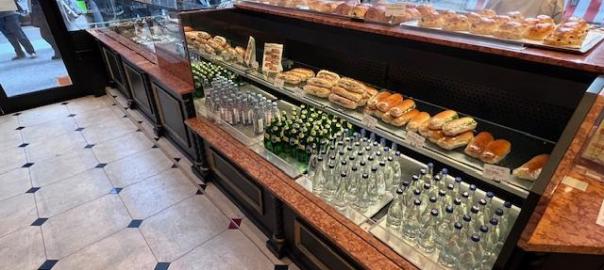
The wonderful selection of sandwiches and brioche
The delicious pastries and meringues
I fell in love with the sugary brioche and the delicious meringues. The pastries here are such high quality and the selection of delicious treats is so different from other pastry shops in the City.
The store was beautifully decorated for the Christmas holidays. A little bit of Paris transported to New York City.
The delicious Sugar Brioche and the Cherry Merveilleux
The Cherry Merveilleux is a light meringue with a sugary Cherry topping. These delightful treats are sweet and whimsical to look at and more fun to eat. The sugary brioche have a chewy and crunchy consistency to them and are the perfect afternoon treat.
The Sugar Brioche
Inside the layers of brioche dough are the sugar crystals that give the pastry its extra sweetness.
The brioche pulls apart so nicely
The are so buttery and rich. These were warm just out of the oven.
The Cherry Mini Merveilleux are wonderful
This simple Meringue is delicious
The baked goods here are high quality and delicious. The service was excellent as well, very friendly and personal. It like visiting Paris in Manhattan. You can not pass by this bakery without stopping in to try something.
The history of Aux Merveilleux de Fred:
(from the Aux Merveilleux de Fred website)
About Chef Frederic Vaucamps:
Frédéric Vaucamps is a pastry chef from the North of France. During the 1980s, his career in pastry took him back to a cake dear to his heart: The Merveilleux. He adapted the recipe to make it extremely lightweight. In 1997, he decided to name his Lille store after his flagship cake, and so “Aux Merveilleux de Fred” was born. His version of The Merveilleux has quickly become a must-have, just like the cramiques and his Belgian waffles. Frédéric combines know-how and tradition to offer high-quality products in stores that are the epitome of French elegance.
Artisan pastry chef Frédéric Vaucamps utilizes his unique know-how to create his recipes whilst remaining true to his signature style: lightness and deliciousness. Each cake and pastry requires artisan know-how, a mastery of the craft that imbues them with a flavor that is instantly recognizable amongst thousands of others.
About the Company:
We love to share and showcase our artisan know-how. Our specialties are created in front of our customers, in each of our store’s ateliers. Every day we pledge our commitment to offering high-quality products, created before your eyes and baked all day long. We make our specialties using ingredients that have been selected for their quality.
These tiny and delicate meringue treats evoke a specific period in French history: high society life during the Directory regime. The aristocratic Incroyables and Merveilleuses, as they were known at the time, would gather in salons to discuss politics and economics. But their main objective there was to see and be seen, to drink tea and eat cakes. The “Aux Merveilleux de Fred” stores with their refined, baroque decor, are generously adorned with mirrors and gilding and take inspiration from this historical period.
Frédéric Vaucamps transmits his passion for the French art of living through his cakes and pastries: the art of taking your time and appreciating good and beautiful things.
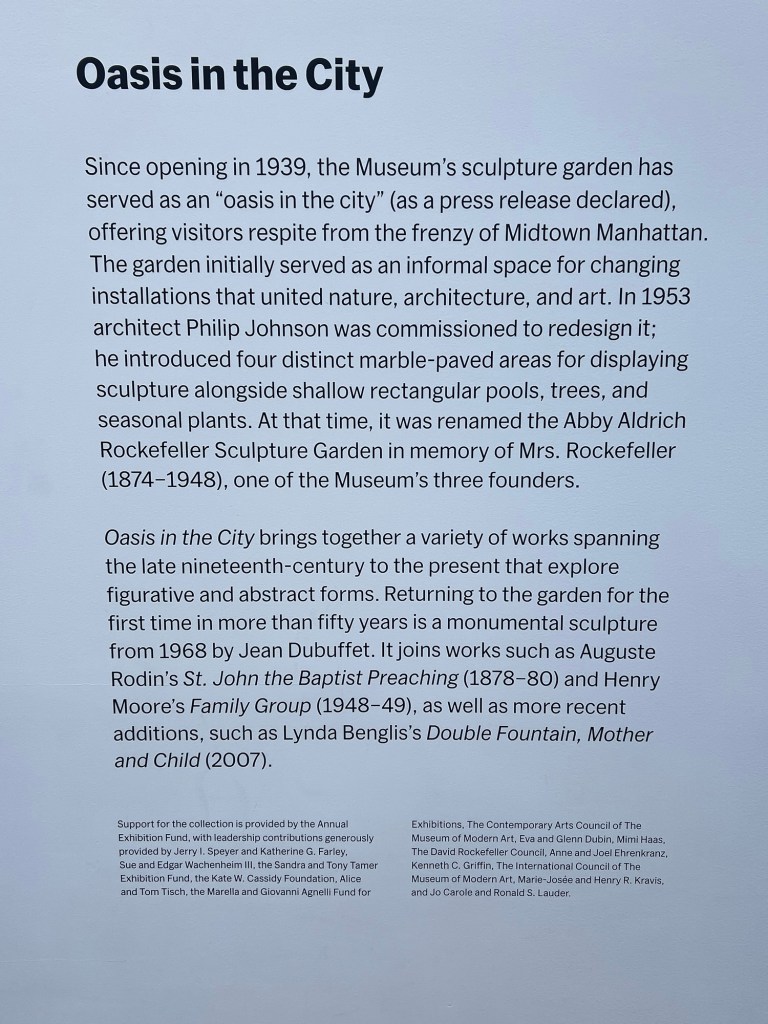
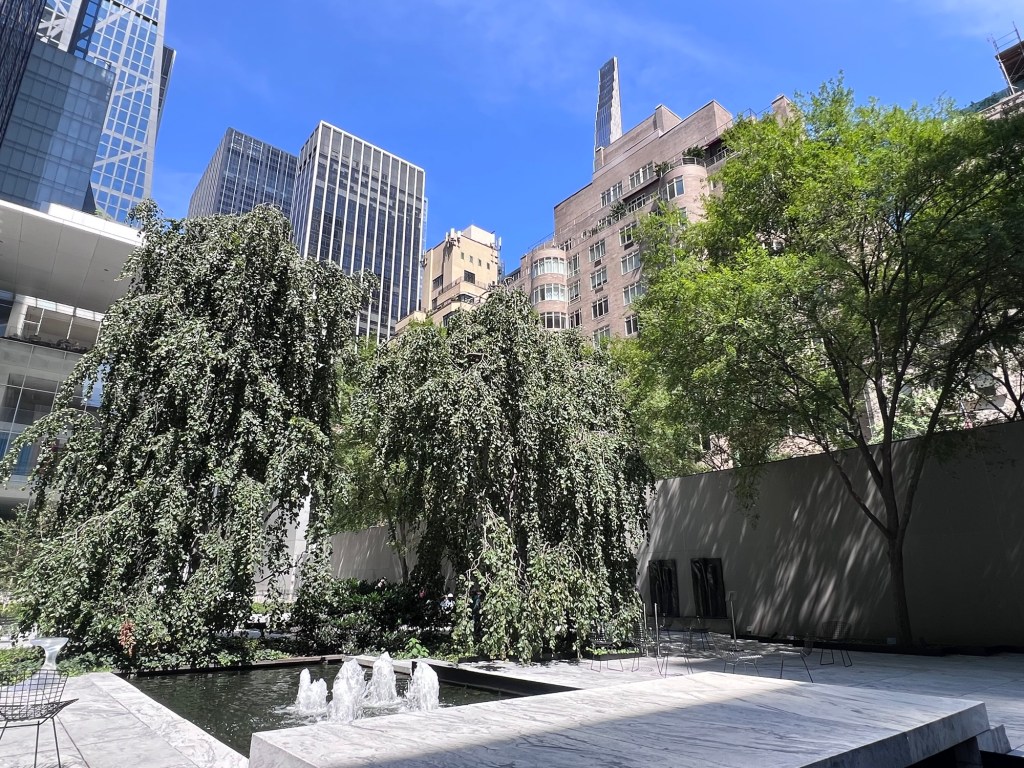
What I love about being a member of the museums in New York City is that there is an opportunity to see the museum in the early hours for private events. This morning I got up early to experience Manhattan on a spectacular sunny morning for the event ‘Oasis in the Garden’, a talk on the design, purpose and art in the MoMA outdoor garden.
We met inside the museum before the tour
Since the museum opened at 9:30am and there was no one at the museum at that hour, we had the outdoor garden to ourselves for almost an hour and a half.
The outdoor garden at the MoMA at 10:00am in the morning
Our tour guide led about fifteen of us through a history of the creation of the gardens, the purpose in the museum, its renovation in 2004 when I joined and the sculpture in the garden.
She also talked about taking her students here and that some of them wanted specific answers to what the art meant rather than forming their own opinion. It is funny how I see this in my own students.
What I liked about our tour group was that it was an older, very educated crowd of people who brought different opinions on how the art we were seeing should be thought about. From the time the artist created it to it modern interpretation by the ‘politically correct police’, I was amazed by the other members take on each piece of art.
The gardens are a refuge from the noise and crowds of the museum and the City
Video of the fountain
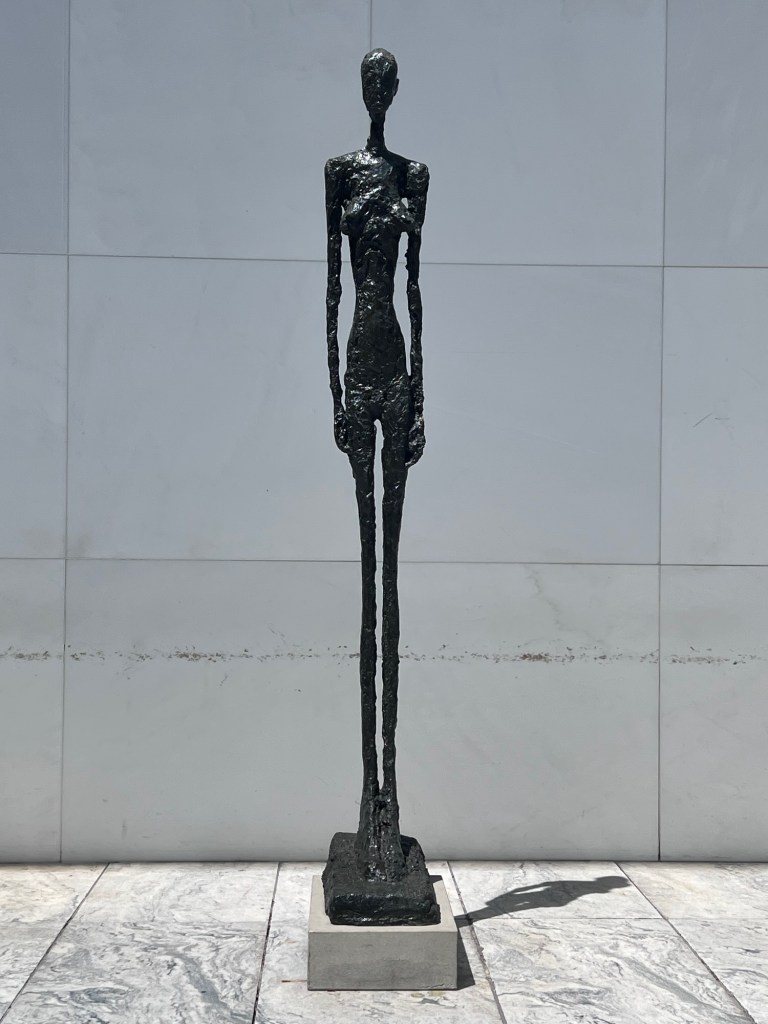
The Albert Giacometti ‘Talk Figure III’
Each piece of sculpture we touch upon was chosen specifically for the gardens and we talked about its place from when it was made to the modern interpretation and how they differ. Our first discussion was about the Albert Giacometti sculpture ‘Tall Figure III’. Some people talked about hunger and the stance on poverty. I asked if her students had different thoughts of the statue when it was made versus today.
She explained everything is seen differently through the artist’s eyes versus the modern I perception. It was hard to compare the two opinions without a debate. I thought today’s students needed to lighten up a little and stop taking art at face value and just enjoy it. The context of work over a hundred years ago is very different from how it can be looked at today.
We had time to talk and relax between art pieces and I swear the sound of the fountains relaxed me so much I almost feel asleep.
The fountains were so calming that morning
Video of the Japanese fountain
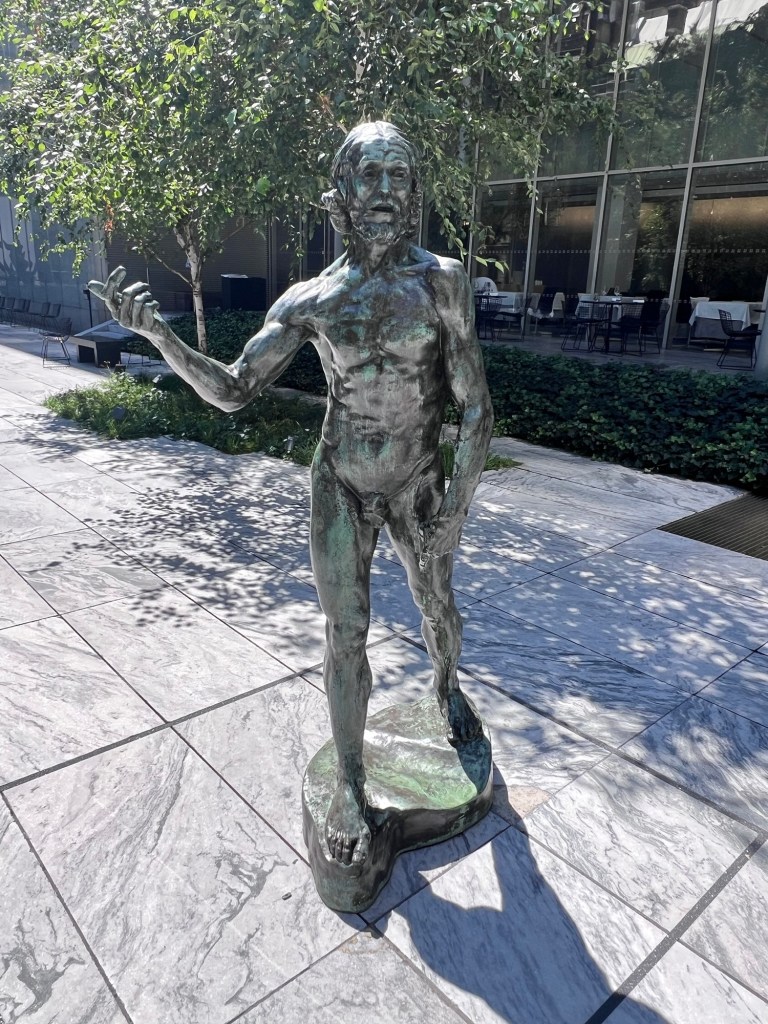
The August’s Rodin ‘St. John the Baptist Preaching’
We talked about the religious standpoint of the sculpture versus its place in modern society. I thought it was a naked guy hitchhiking. It’s funny how you see art.
The Jacques Lipchitz ‘Figure 1926-30’
With the ‘Figure’ many of the member talked about their interpretation of the modern take of Cubism and some members asked about whether these were arms and legs or something else.
The back of the gardens
The back of the gardens were so peaceful. I stood back from the tour so I could just hear the water rumble.
The Henry Moore sculpture ‘ The Family Group 1948-49
We discussed the modern family unit of today versus when the sculpture was created.
The back of the gardens
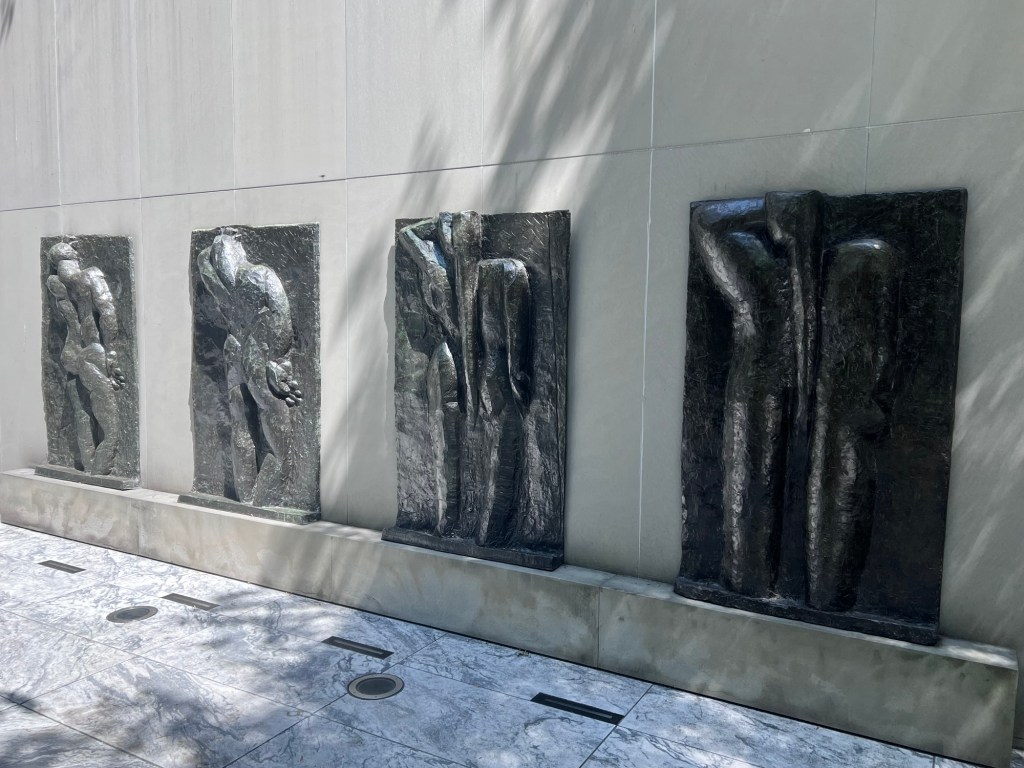
The Henri Matisse ‘The Back (III) 1913-16
The Aristide Maillol ‘The River’
We talked about the fall from God. One person said it looked like someone was tripping into the fountain. I thought that was clever.
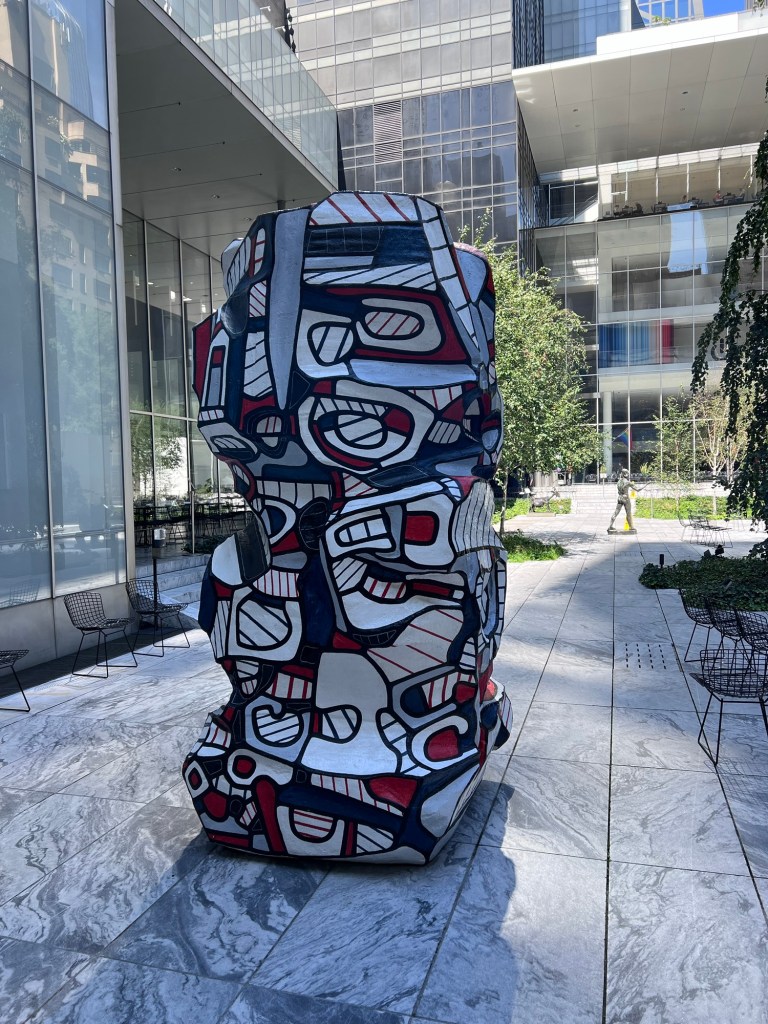
The Jean Dubuffet ‘Study for Tower with Figures’
This was the last figure we discussed and we were asked as a group what was the first thing that came to our minds when we saw this. I said ‘Juxtaposed’. So much going on and a lot being said. We talked about children and their make up in the family unit. How they change things.
I have to say that I saw the art in a different light this morning. It was interesting to hear the artist’s interpretation versus what members thoughts were on what the art meant. I thought it was a good take away when we finished the tour. There were so many interesting opinions on the art. What I liked was the weather was so amazing, and it was so nice to be outside.
The garden as the public entered later that morning
I know I got a lot out of the tour. It’s always nice to see different points of view of what the art means and how we interpret it. This is why it is fun to be a member of the MoMA. It’s nice to see the museum when it is quiet and you can just take your time.
I started walking the streets of Lower Chelsea after Maricel and I spent the morning wondering around Chinatown with her nephew. I swear that kid has an appetite. We went out for dumplings and roast pork buns and between them and myself nothing was left.
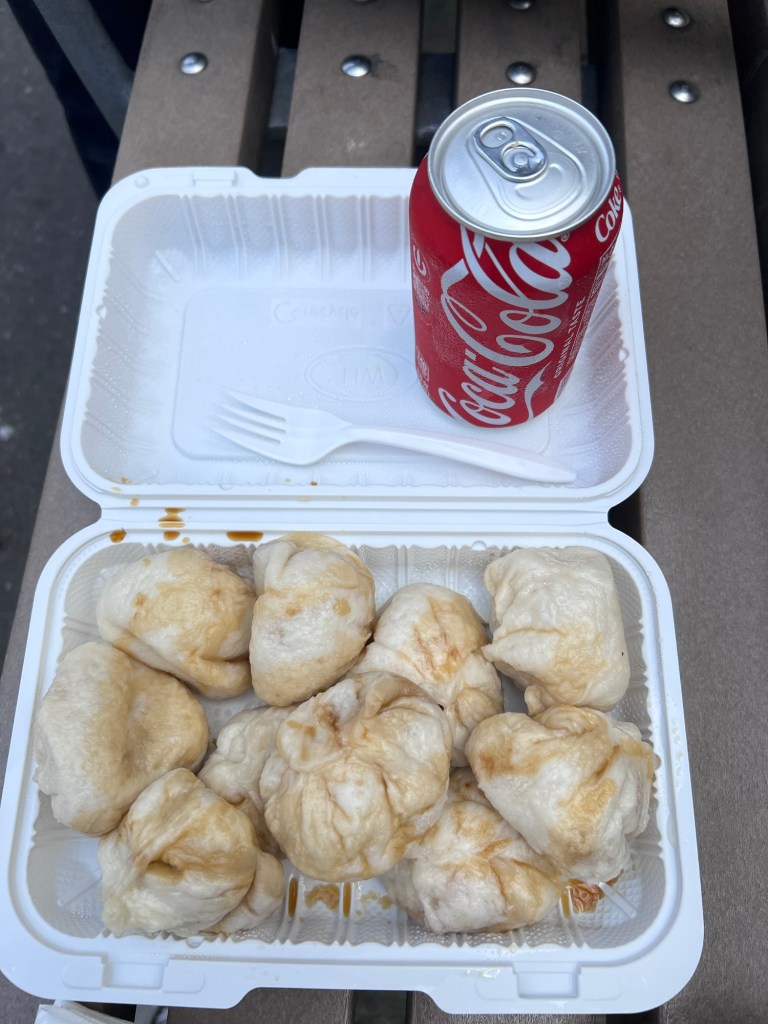
Dumplings is a wonderful place on Henry Street right off Catherine Street in Chinatown and for $5.00 you can get either ten large pork and chive dumplings or ten large pork buns. I opted for the pork buns on this trip.
The Pork Buns from Dumplings
These make the best lunch
We ate in the park and caught up with work. I had to thank her again for that wonderful Afternoon Tea at the Plaza the week before. It was pretty amazing being back in the Palm Court after all those years.
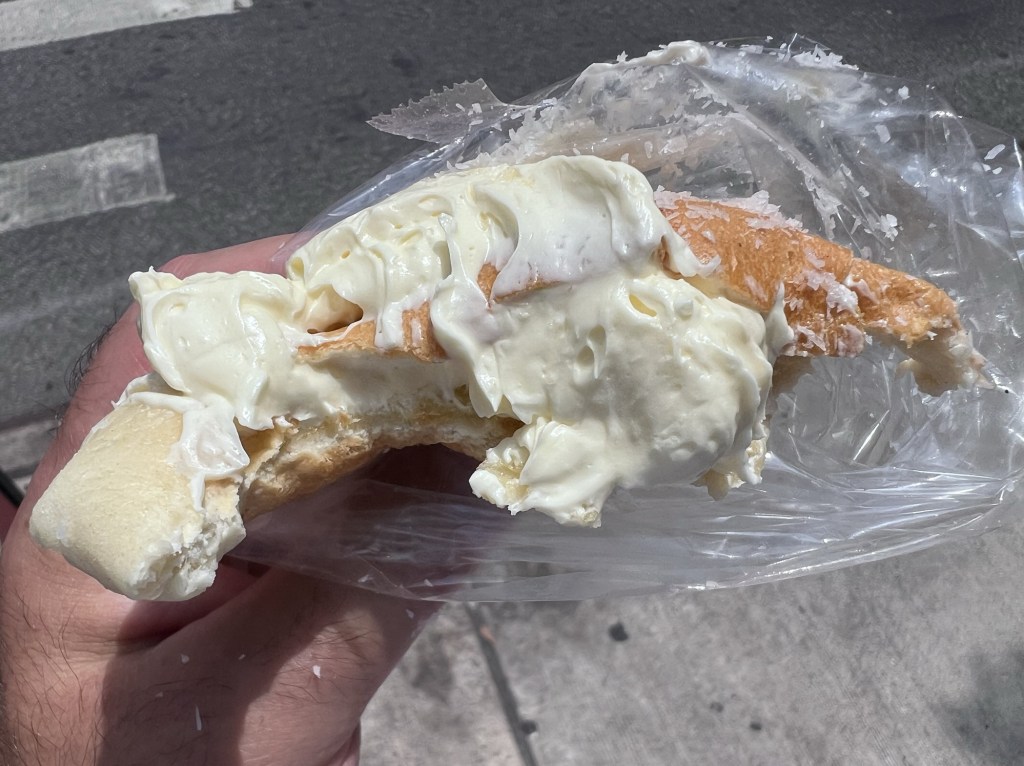
Then it was off the Tasty Bakery on Catherine Street for dessert. We indulged in Cream buns for dessert. Tasty Bakery is one of those very local coffee and bakery places that the older Chinese residents meet during the day and that are quickly disappearing. That’s why you have to visit for these fantastic pastries.
The Cream filled buns are the best
Yum!
After walking around the East Village for a while, they left the City and I ventured up to Lower Chelsea to start the walk of the neighborhood. I walked up from Chinatown as the humidity seemed to die down today. It ended up being a bit cooler than the recent days. The weather had been so hot and humid during some of these walks.
I started the walk on this spectacular day in Madison Square Park. It was such a breathtaking sunny day and the humidity was finally starting to fall. Perfect for walking around the park admiring the gardens and fountains. Everything was in bloom and the park looked spectacular. I love this patch of green in the middle of Manhattan.
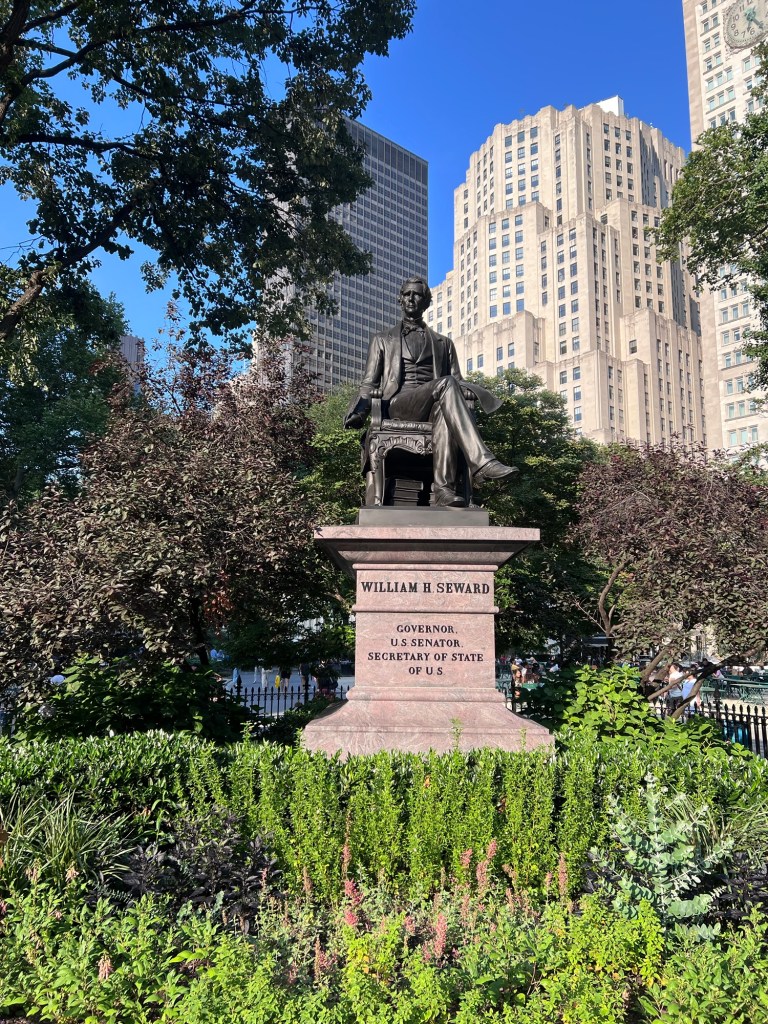
The statute of Senator William Sewart, who was famous for the purchase of Alaska ‘Stewart’s Folly’ greets you at the entrance to Madison Square Park at West 23rd Street
The park was in full bloom in the beginning of the summer and the pathways and gardens were just gorgeous.
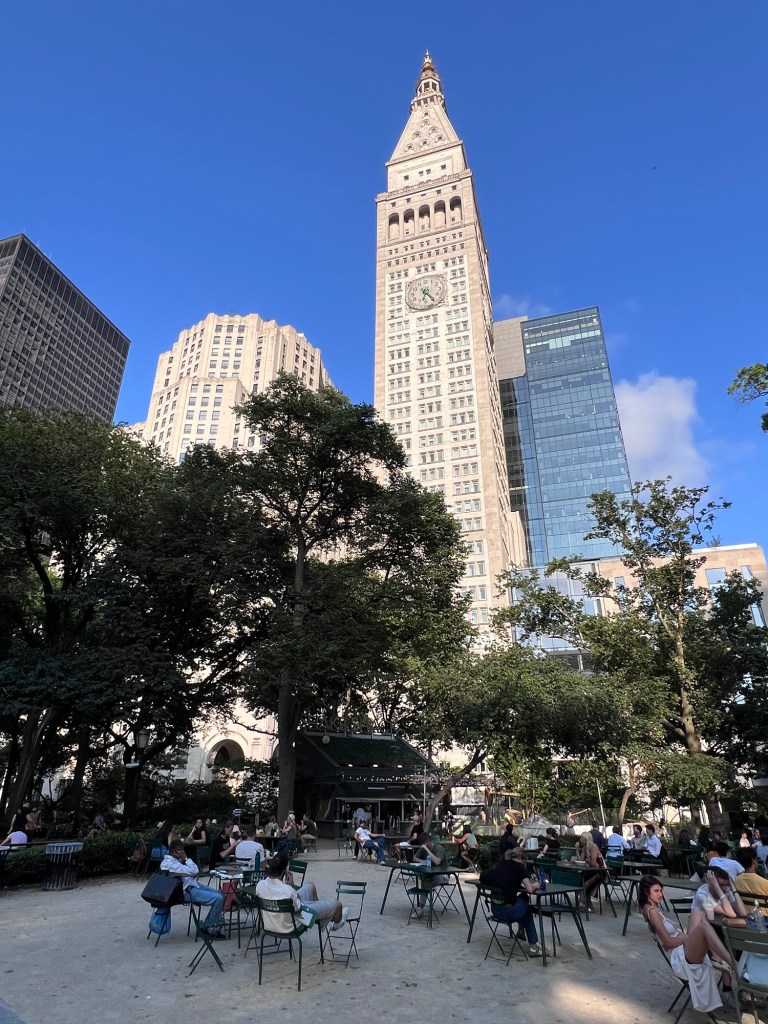
Madison Square Park in front of Shake Shack
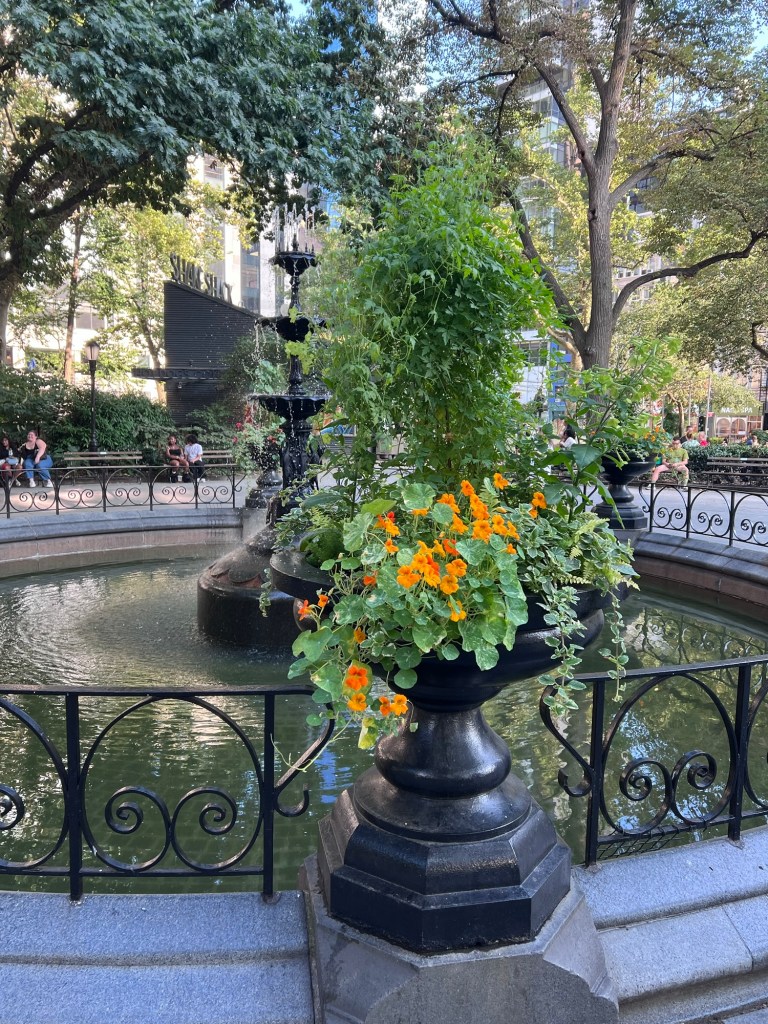
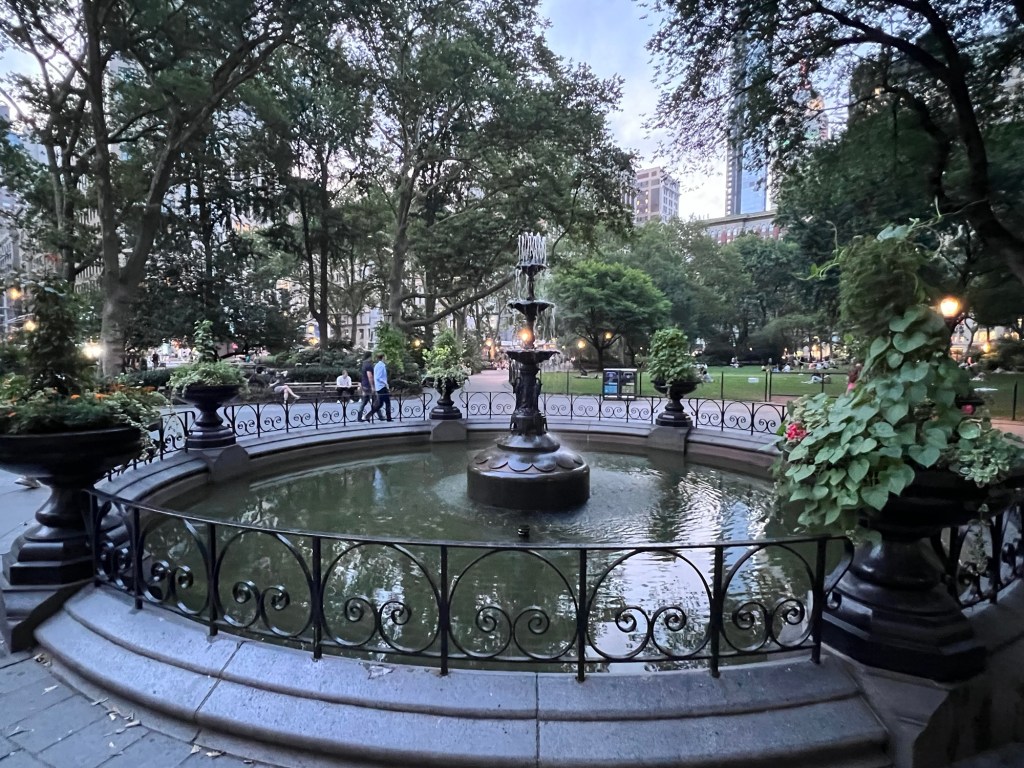
The fountain in the park
The flower pots around the fountain
Looking north of the park with the Empire State Building in the background
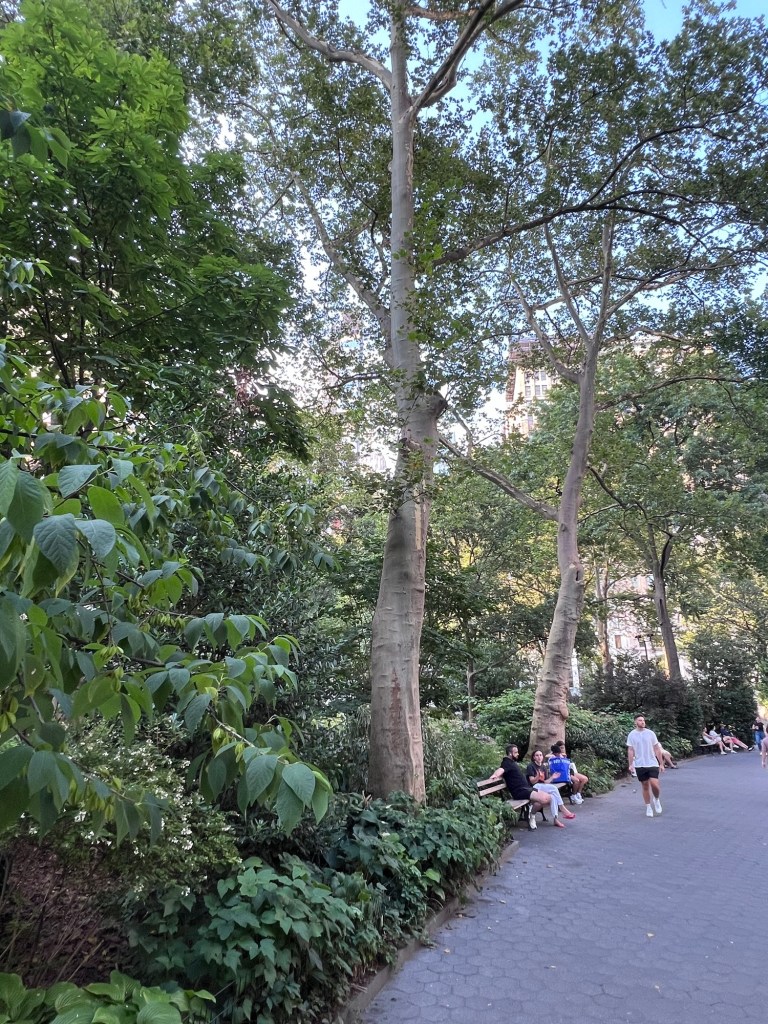
Walking along the paths inside the park
Looking west of the park in the trendy NoMAD neighborhood
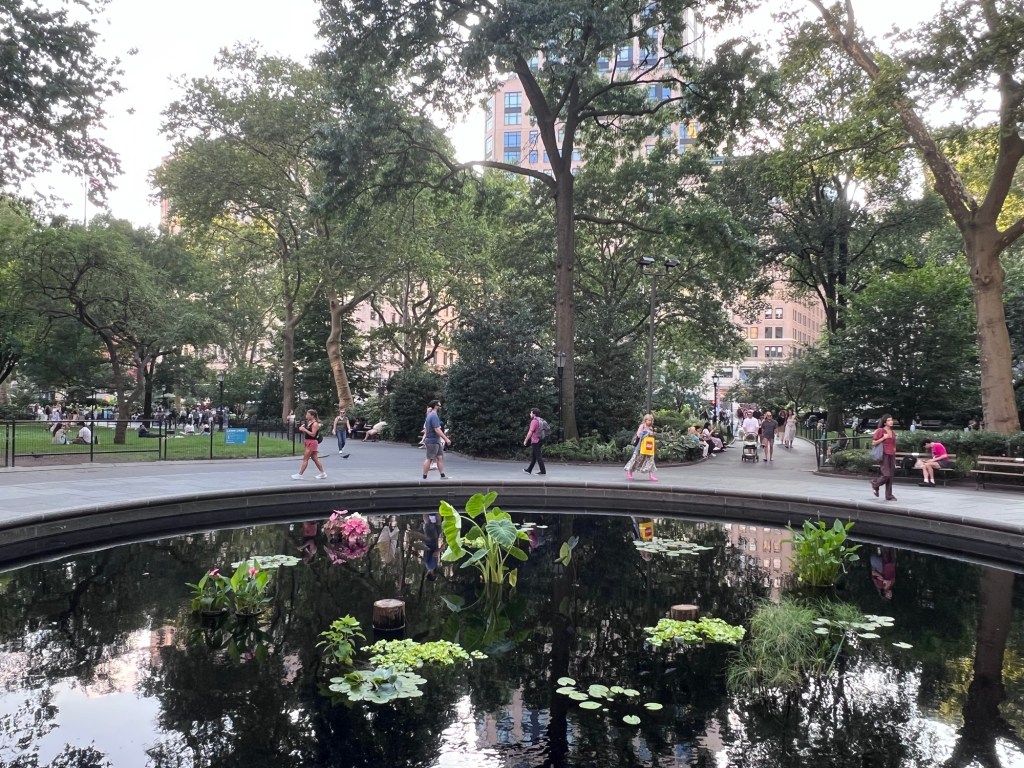
The Lilly Pond in the northern side of the park
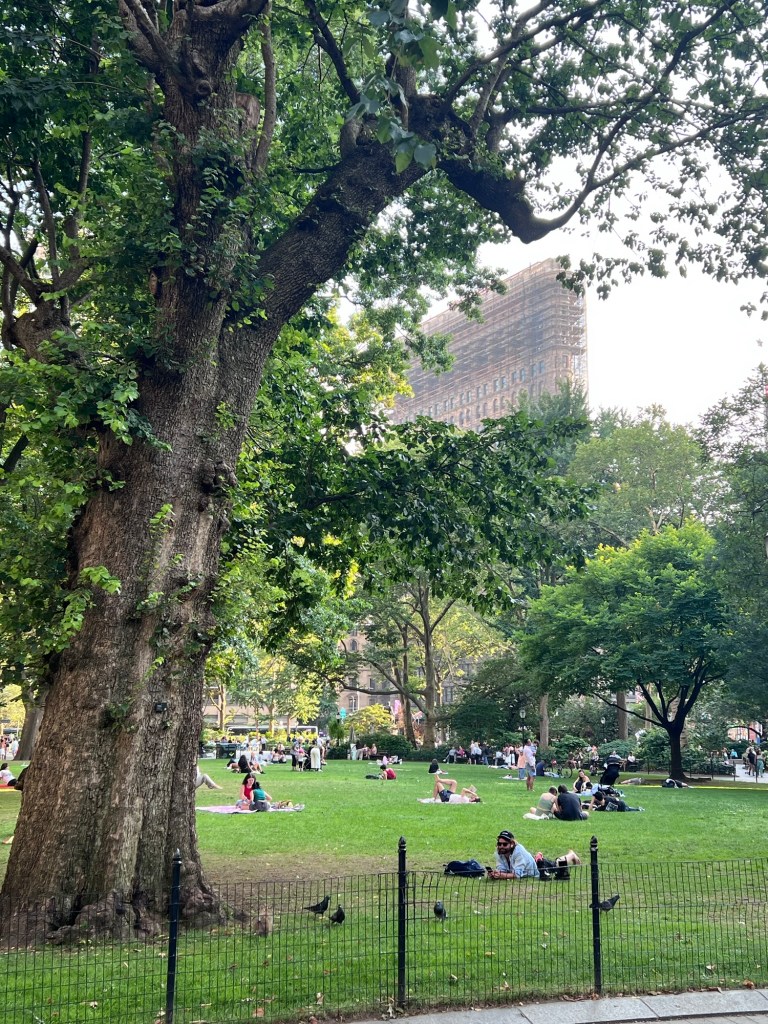
Looking south on the lawn in the middle of the park where office workers and tourists relaxed under the shade trees
Starting the walk on the cross roads of the neighborhood at West 23rd Street and Fifth Avenue
I love the way that the light reflects off the buildings at West 23rd Street
I was lucky that the weather broke. My recent Broadway was ended up being on a 91 degree day. I did not get too far that afternoon as ‘Manhattanhenge’, the alignment of the sun setting to the street grid of the West Side of Manhattan was that evening and I wanted to see it. I needed to get a good spot.
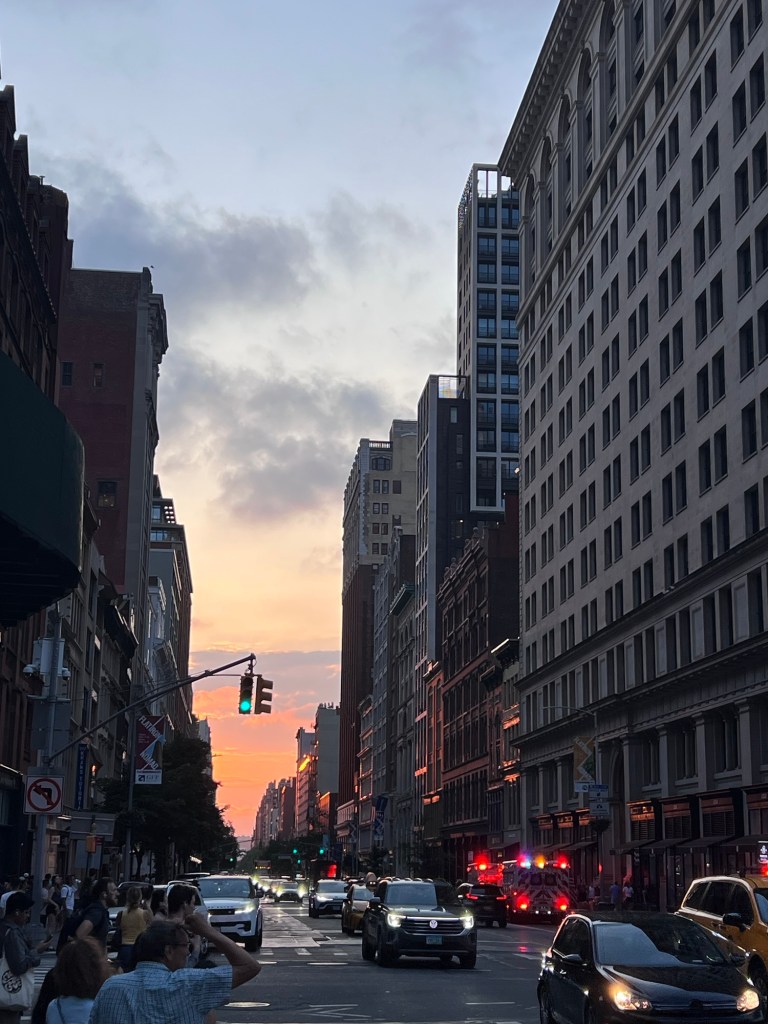
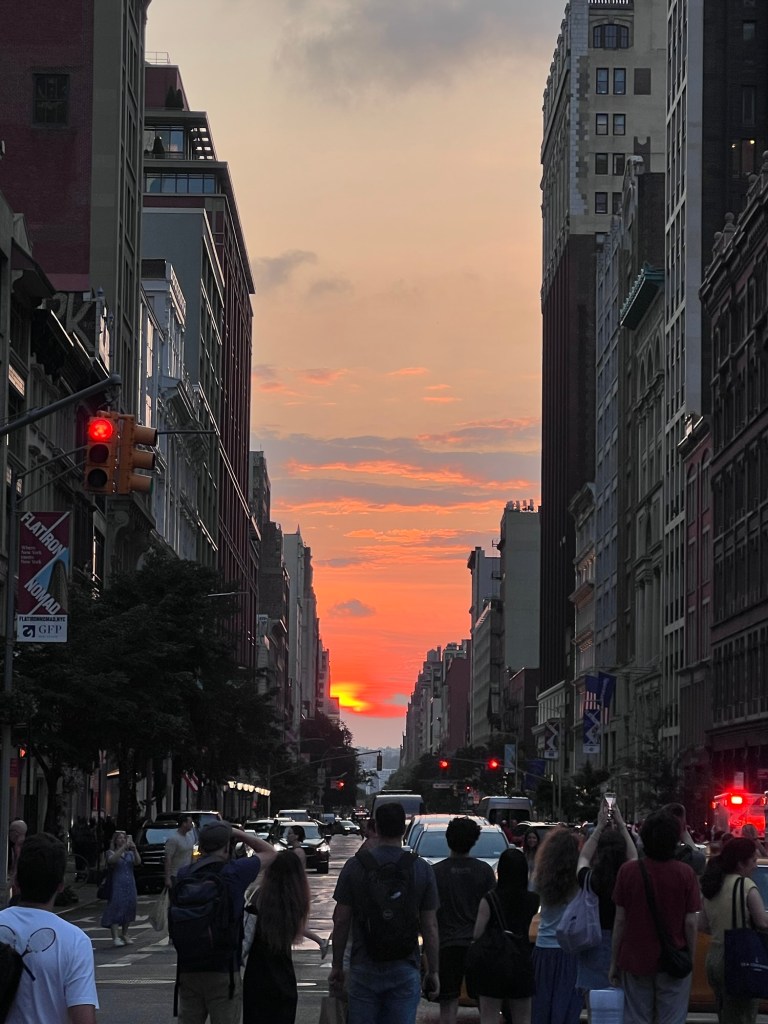
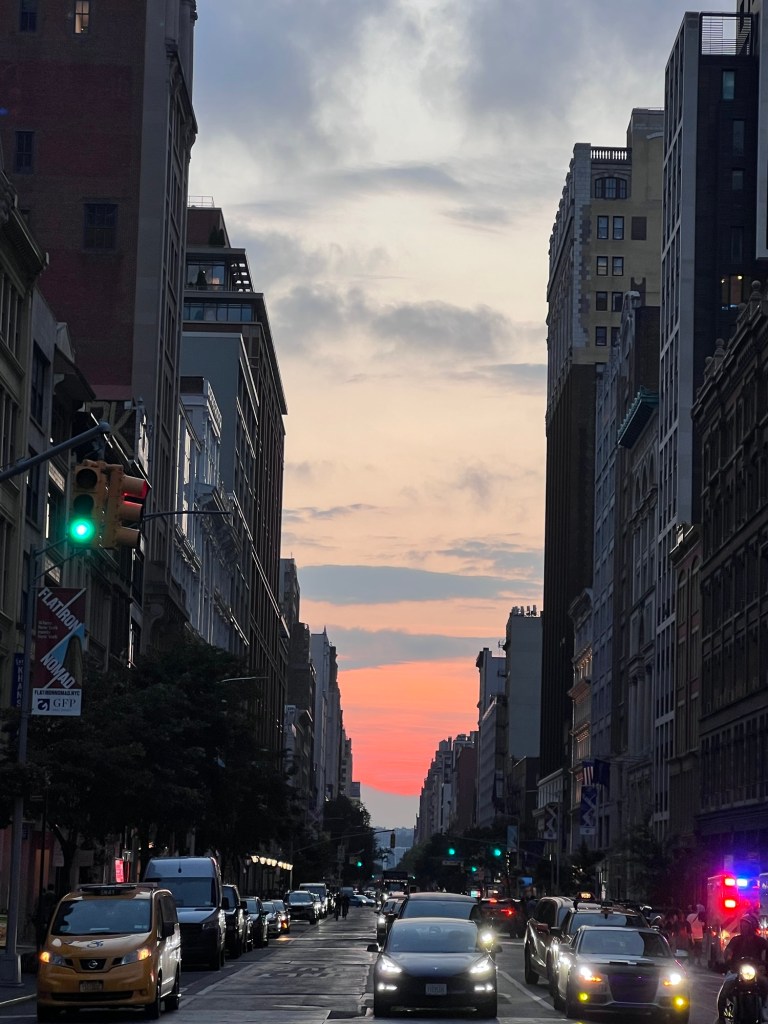
I doubled back that evening to watch ‘Manhattanhenge’, a time when the sun aligns with the buildings on the West Side and set a between the buildings. This happens two times a year and you have to pray for clear weather or else the clouds get in the way. The clouds got in the way this evening.
The start of ‘Manhattanhenge’ at 8:15pm on July 11th, 2025
The sun starting to set
The sun setting on ‘Mznhattanhenge’
Just as the sun set a cloud got in the way
A video of the final setting of the sun
After the sun set, I went back into Madison Square Park and just relaxed. It had been a long week of running around and was going to be busier over the weekend.
Madison Square Park is especially beautiful in the evening. The lights come on and then the park works its magic with all the beautiful lights, cool music from the patrons and the talking and laughter from the many people visiting on a warm New York evening.
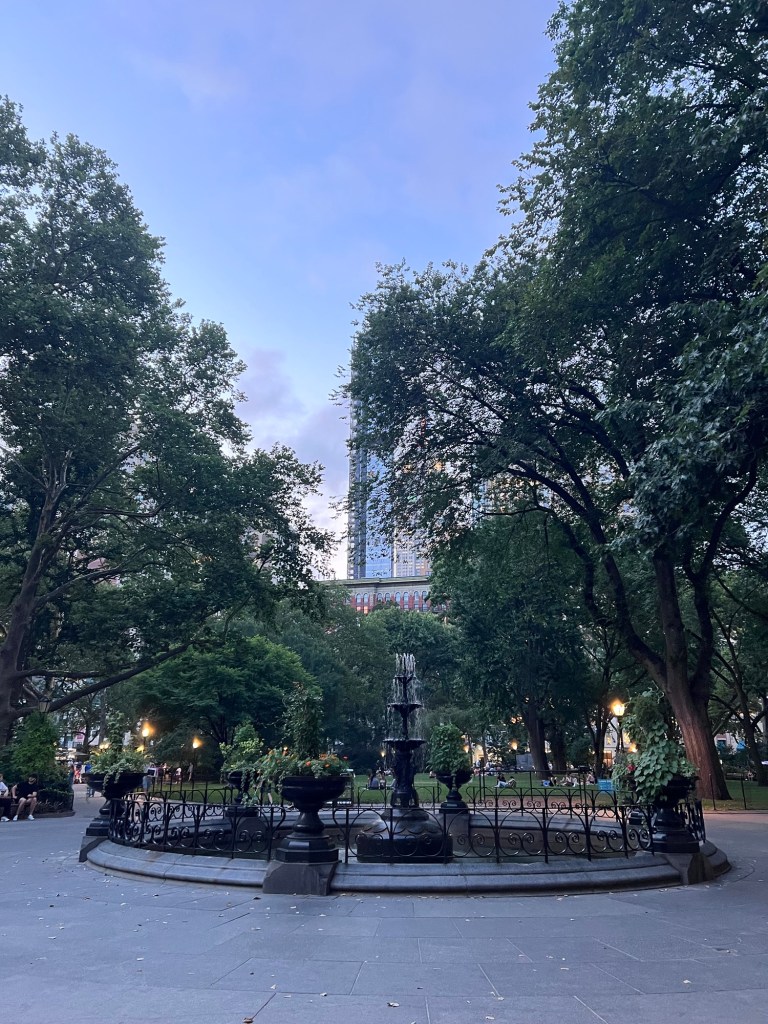
The fountain inside the park at twilight
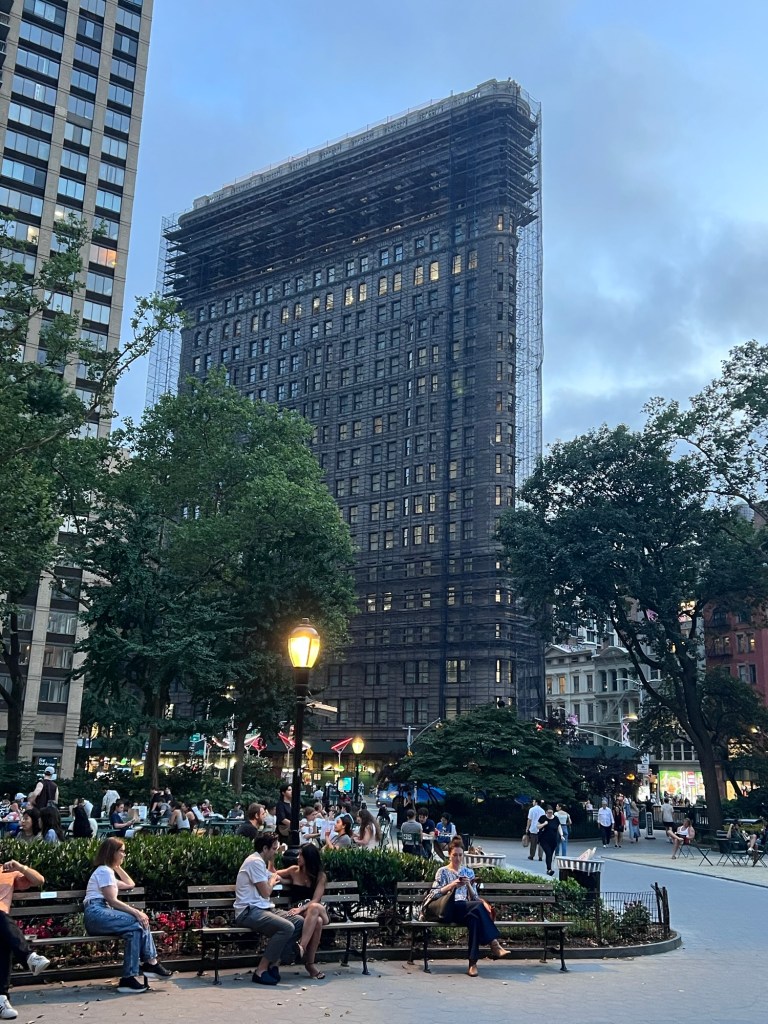
The Flatiron Building across from the park at night
The fountain flowing while looking north in the park
Video of the Madison Square Park fountain at night
The skyline of the park at night with the Empire State Building lit in the distance
During the warmer months, I have found Madison Square Park to be safe due to the sheer number of people in the park and the extra security the park hired. Still like any part of New York, you have to watch yourself. Don’t let your guard down just because there are people in the park. Just like any other part of New York City, have eyes in the back of your head.
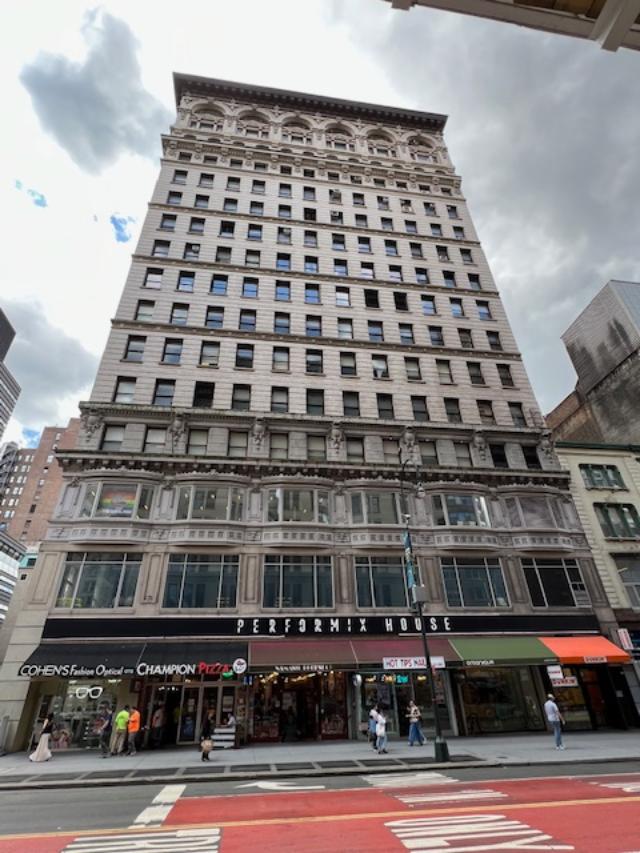
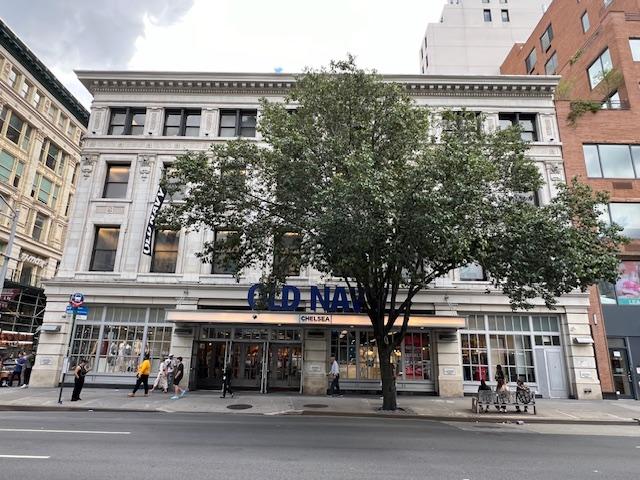
I started my walk of the streets of Lower Chelsea around 1:00pm in the afternoon on a Saturday and found the City to be extremely quiet. Most of the residents must have been out of town. I started at the corner of West 22nd Street and Sixth Avenue in the middle of the old Ladies Shopping District.
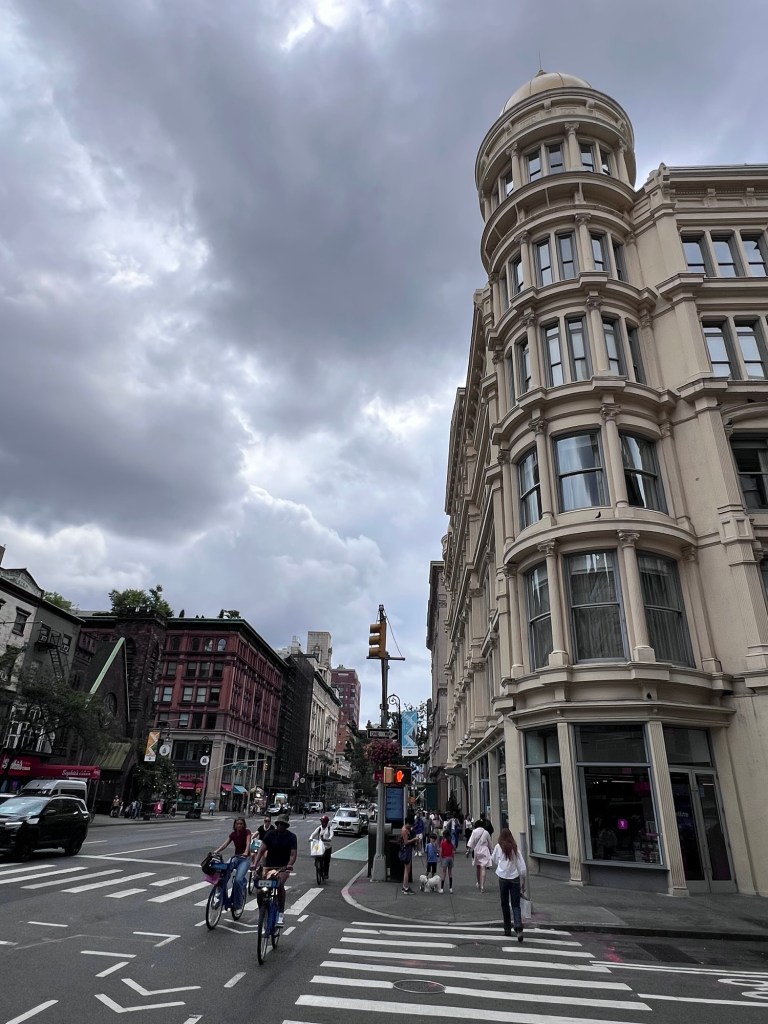
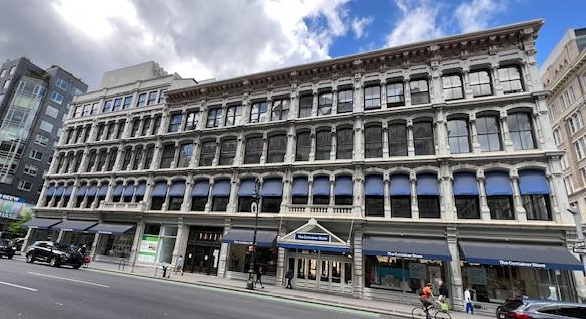
The old department stores on Sixth Avenue and West 22nd Street
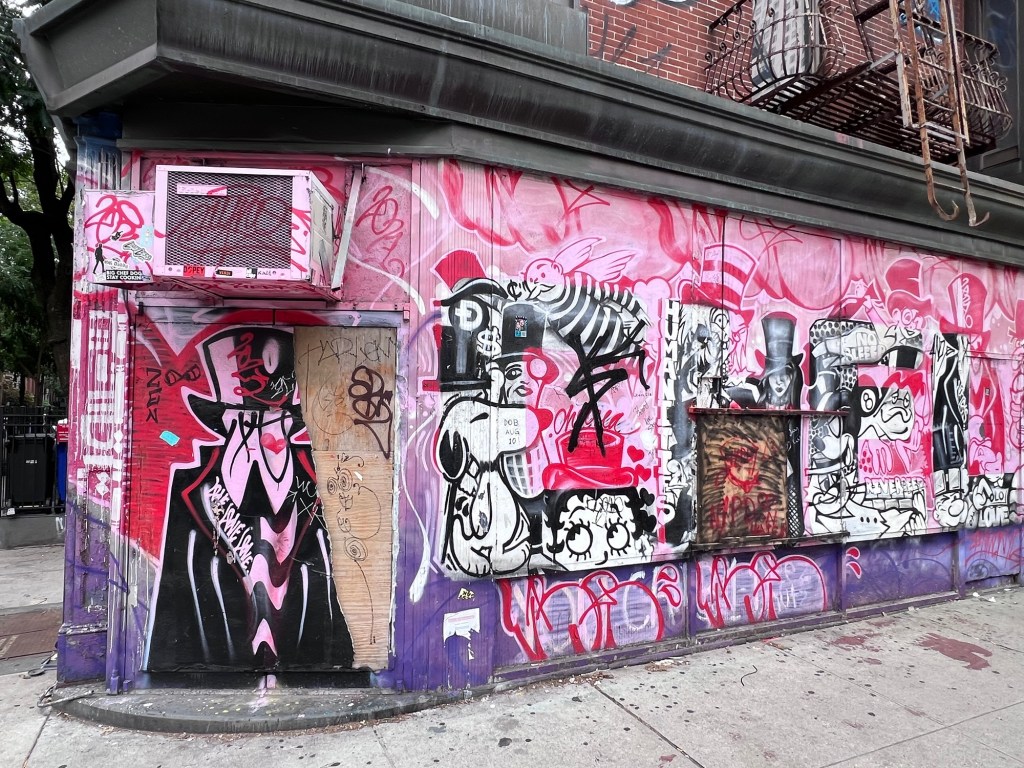
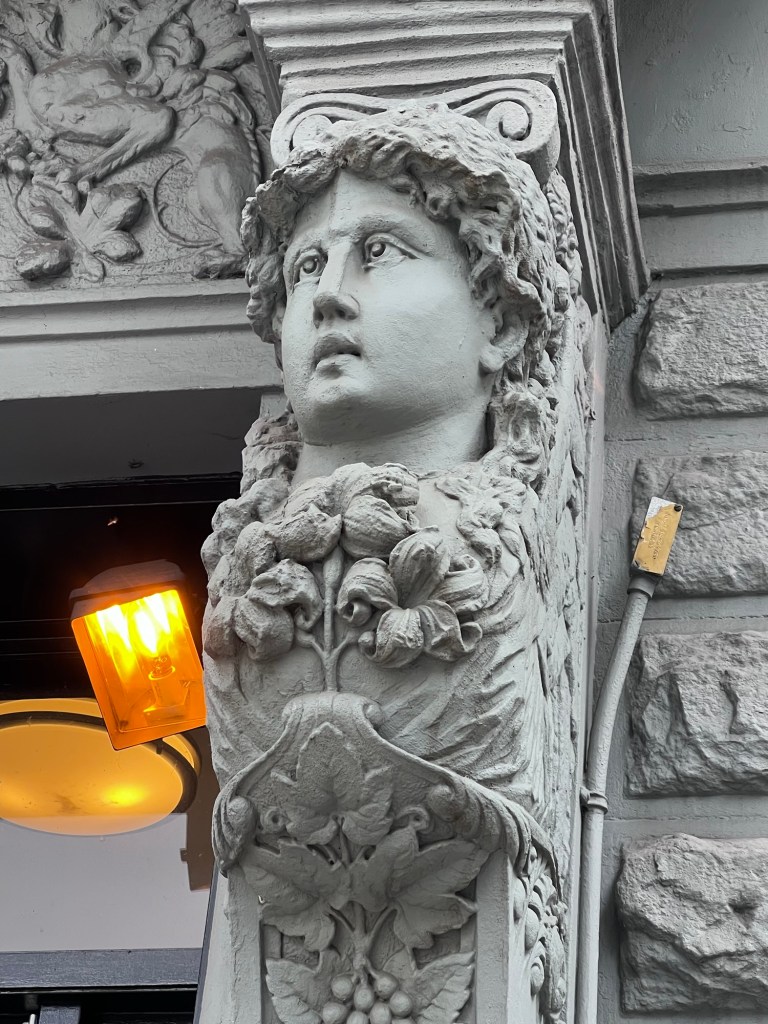
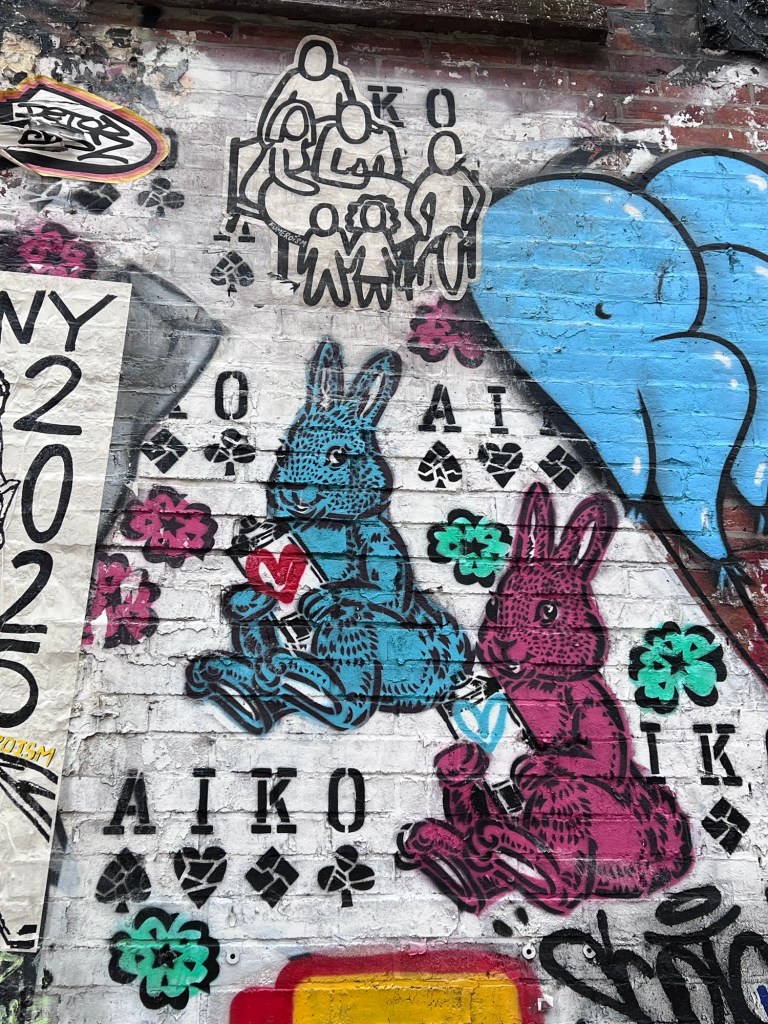
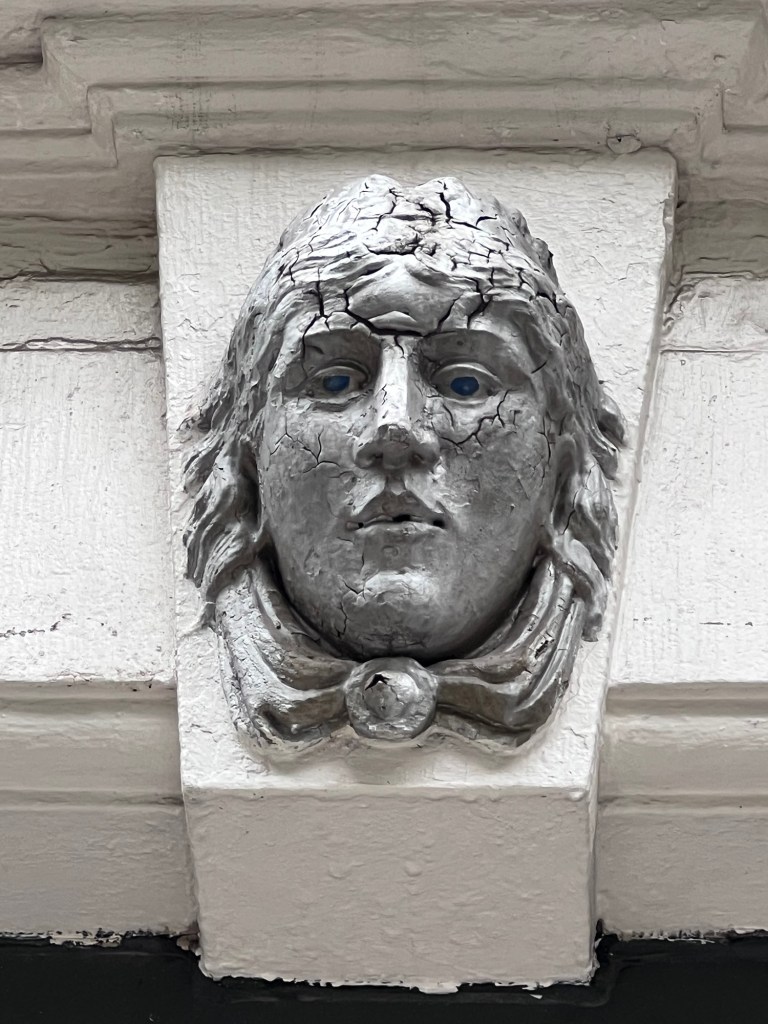
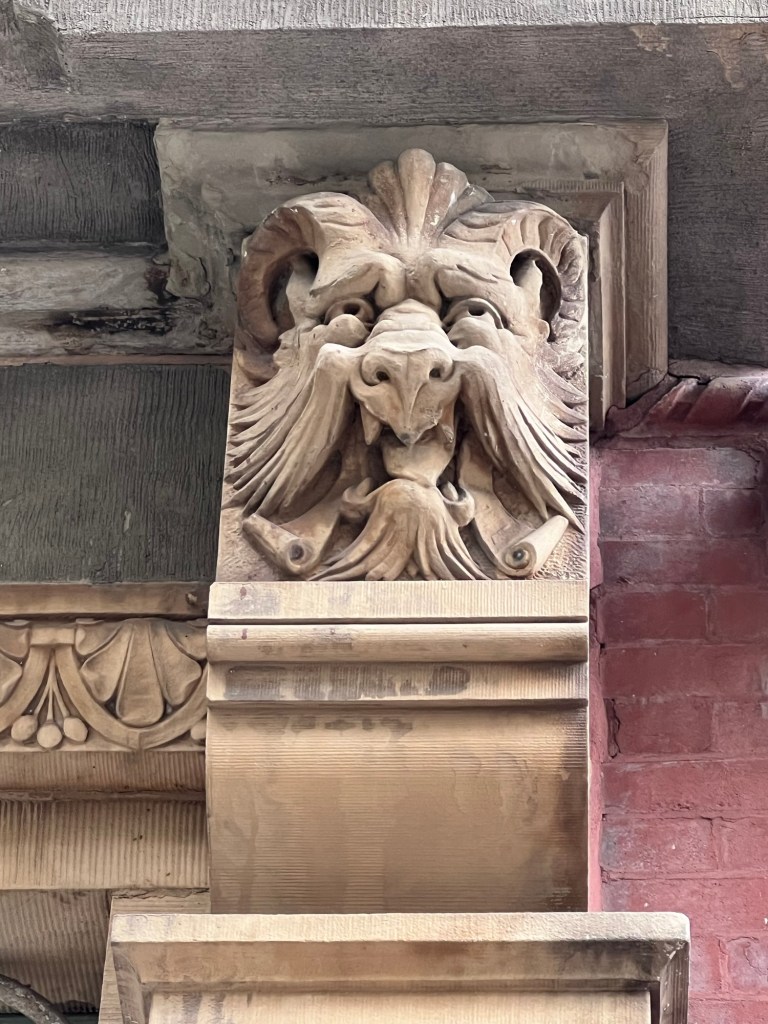
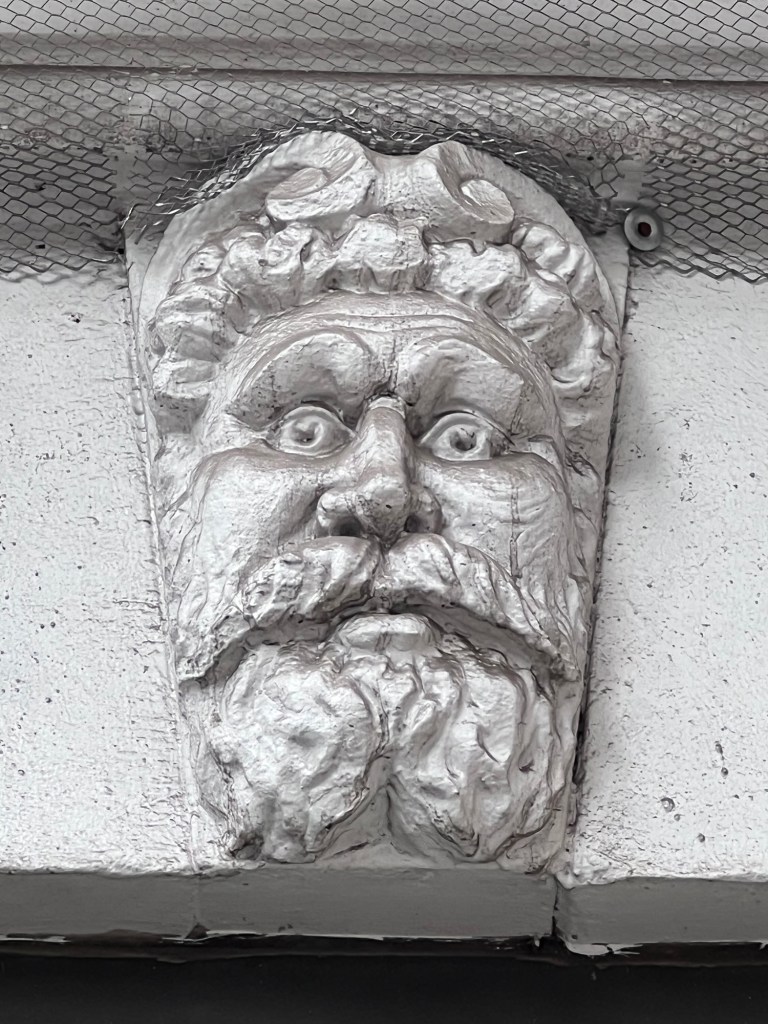
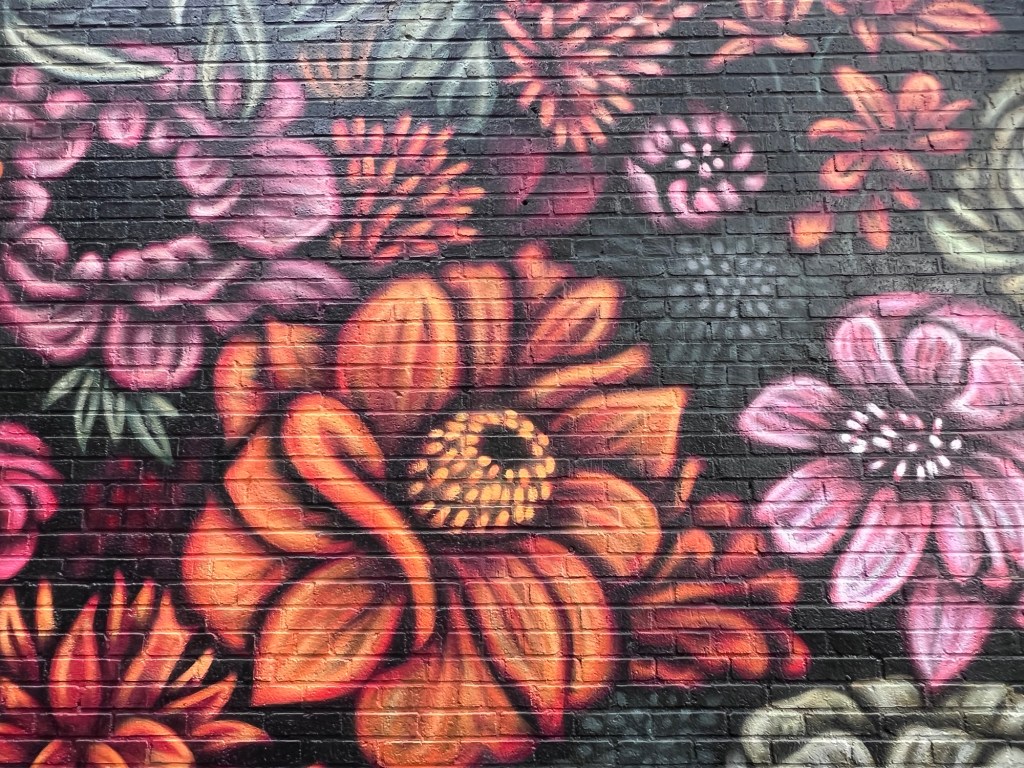
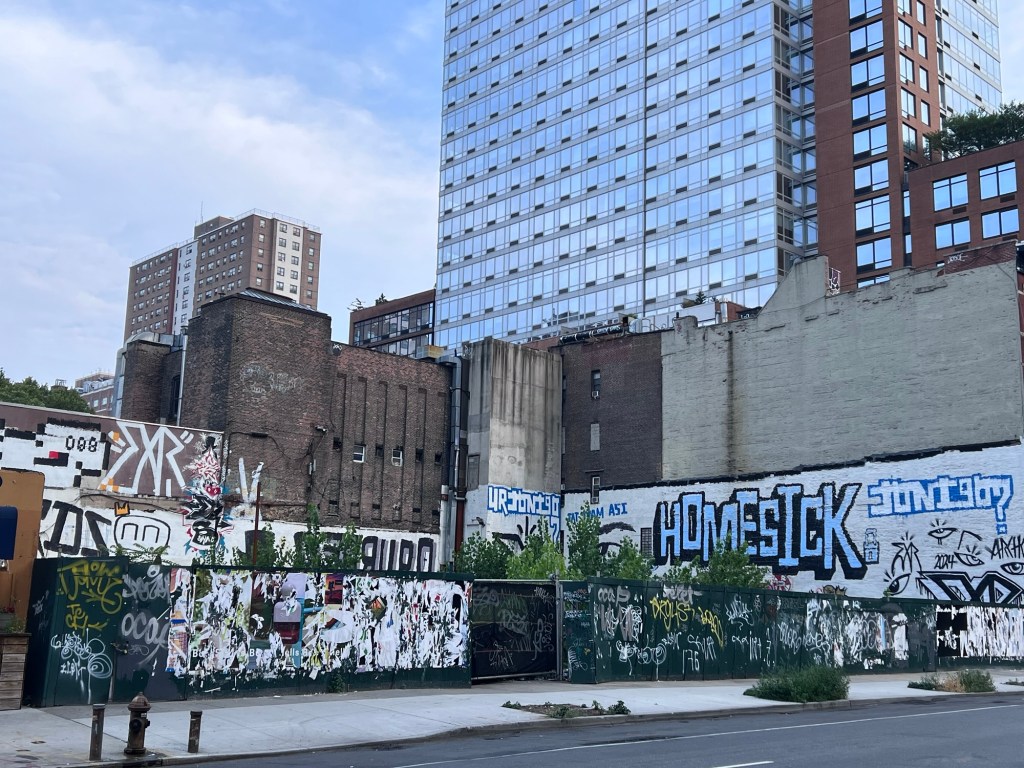
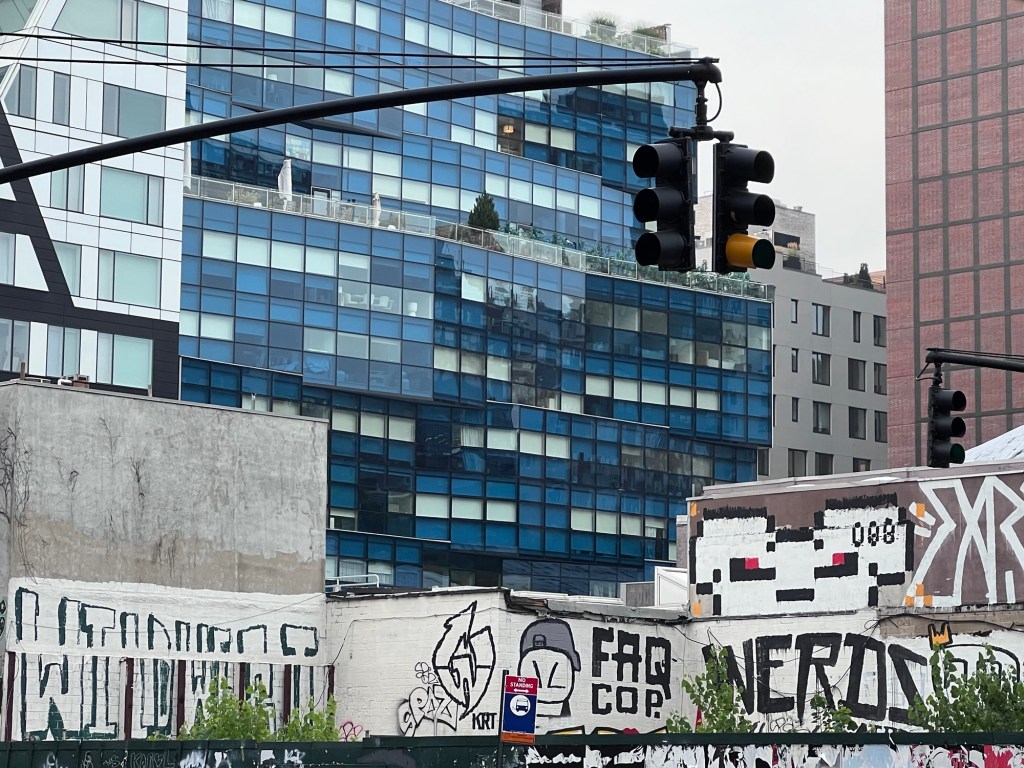
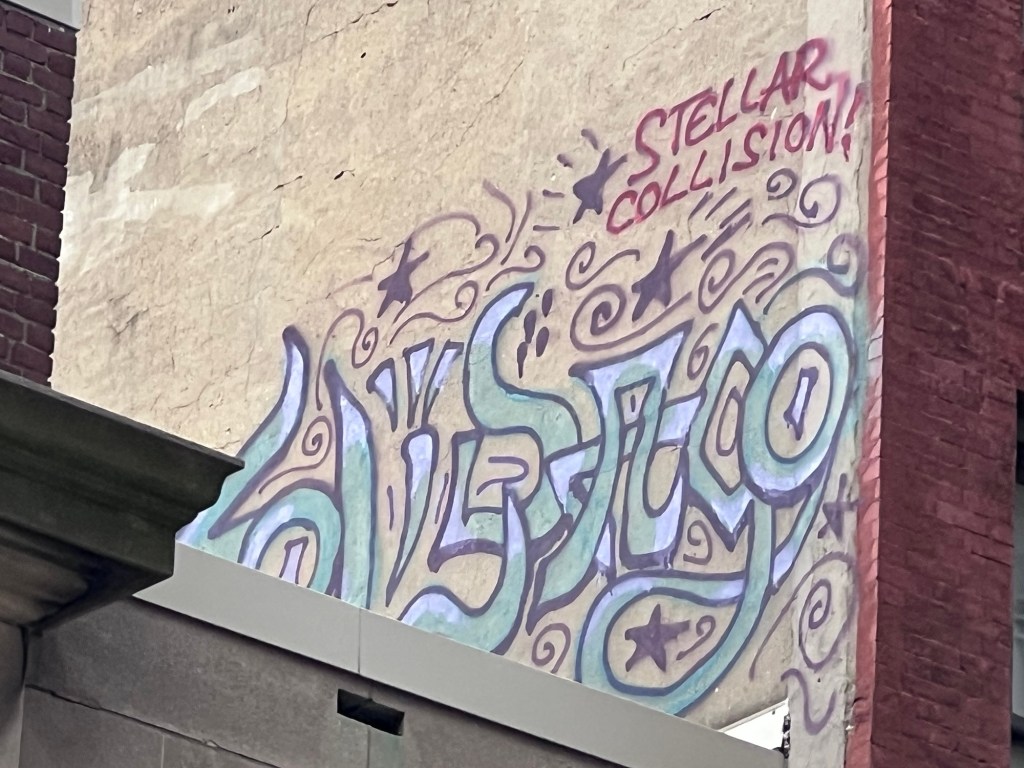
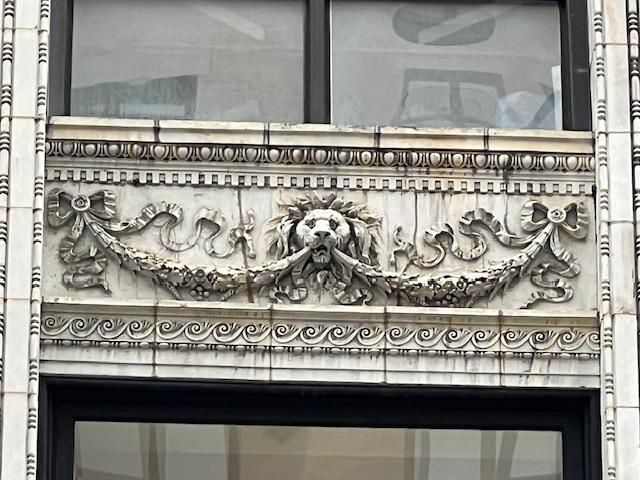
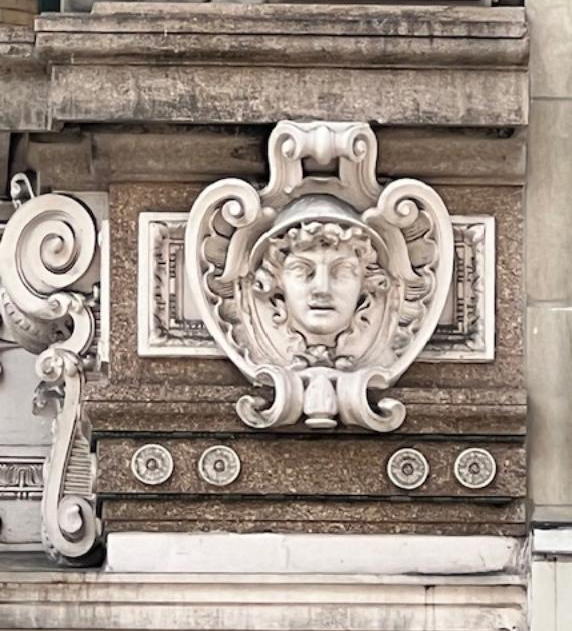
On the way down each block, I admired two things that stood out, the street art and the stone work that seemed to stare out you at every twist and turn on many of the buildings I passed.
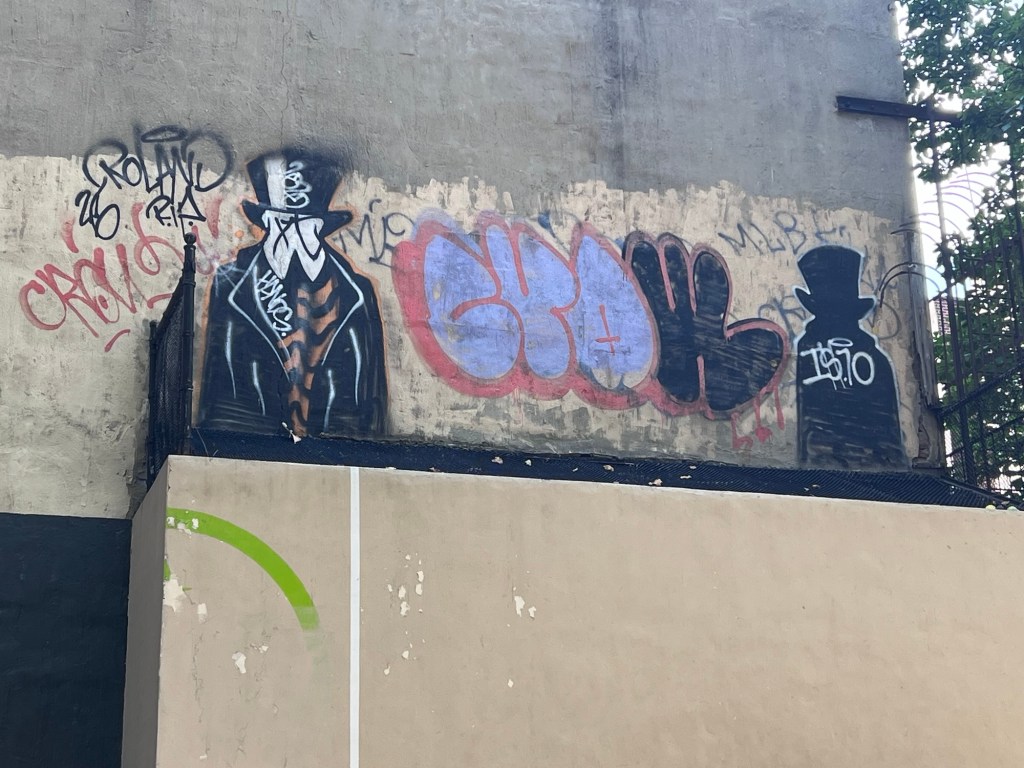
The street art at the corner of Seventh Avenue and West 22ns Street
The other walk facing West 22nd Street
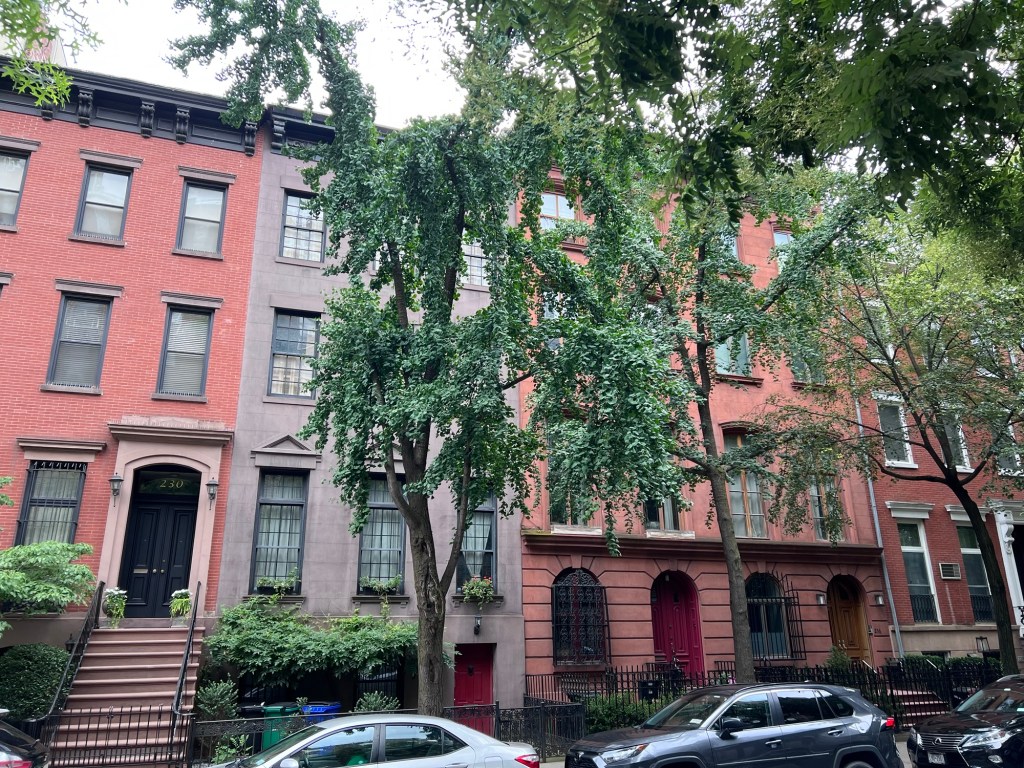
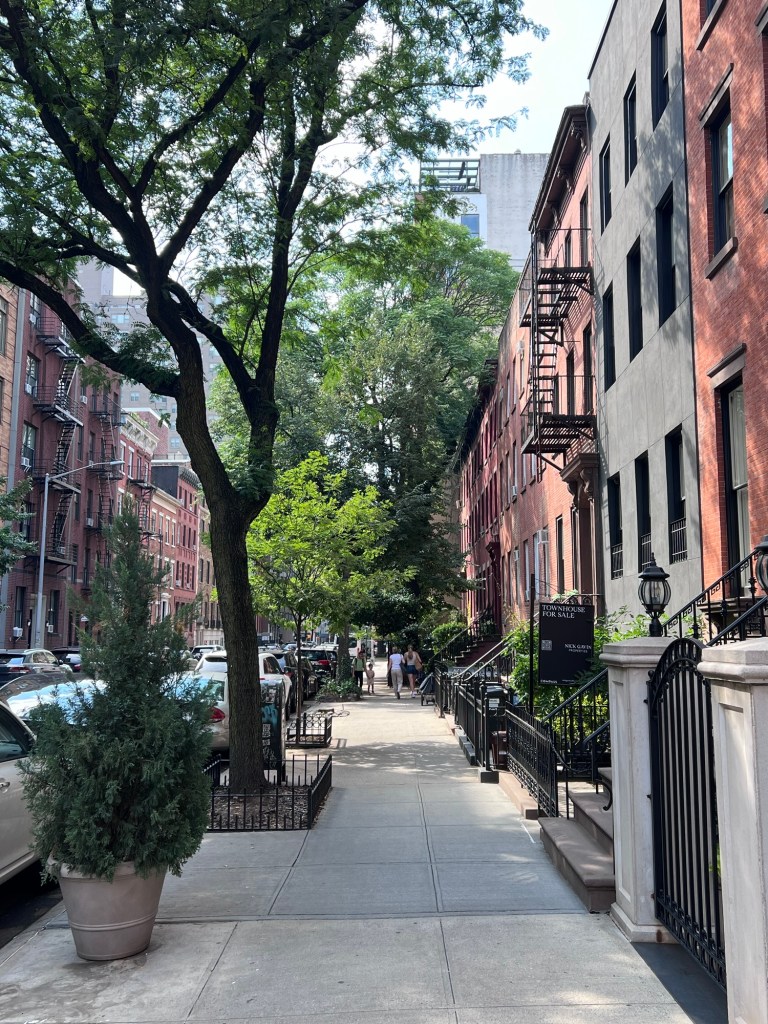
Walking down West 22nd Street between Seventh and Eighth Avenues
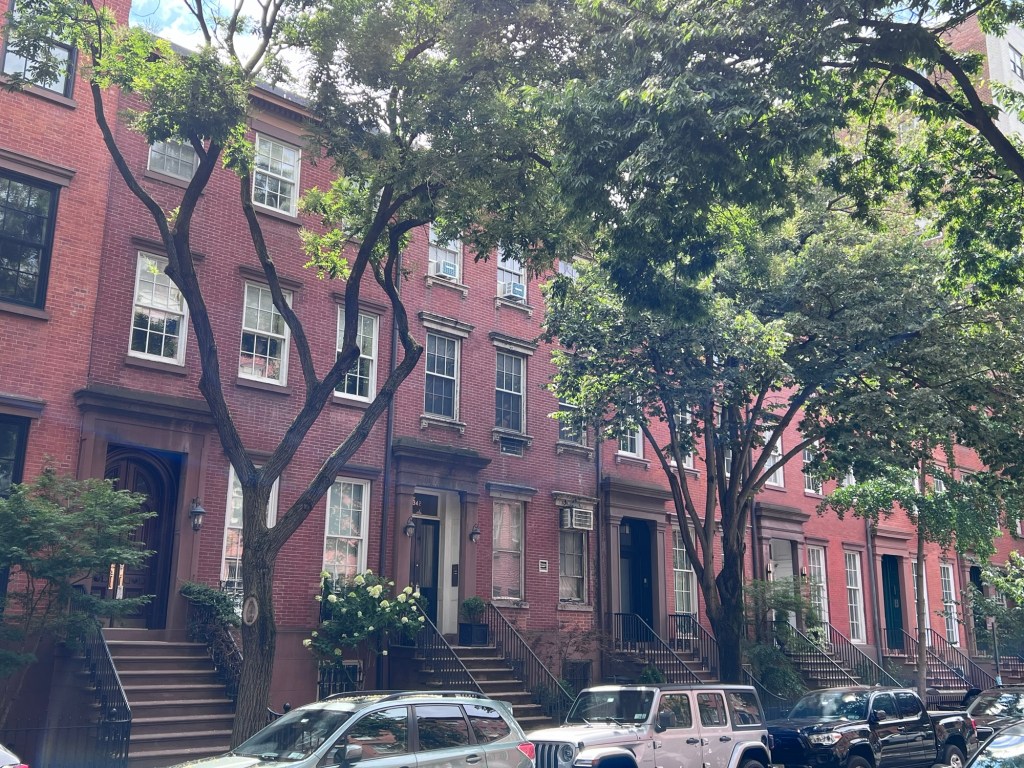
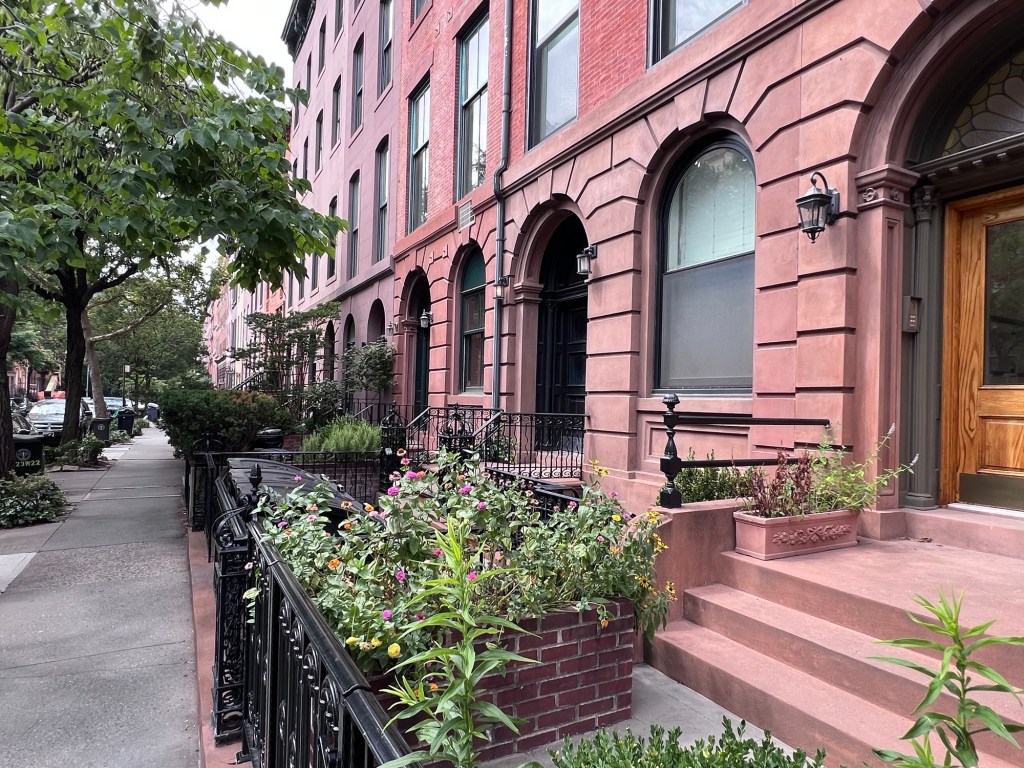
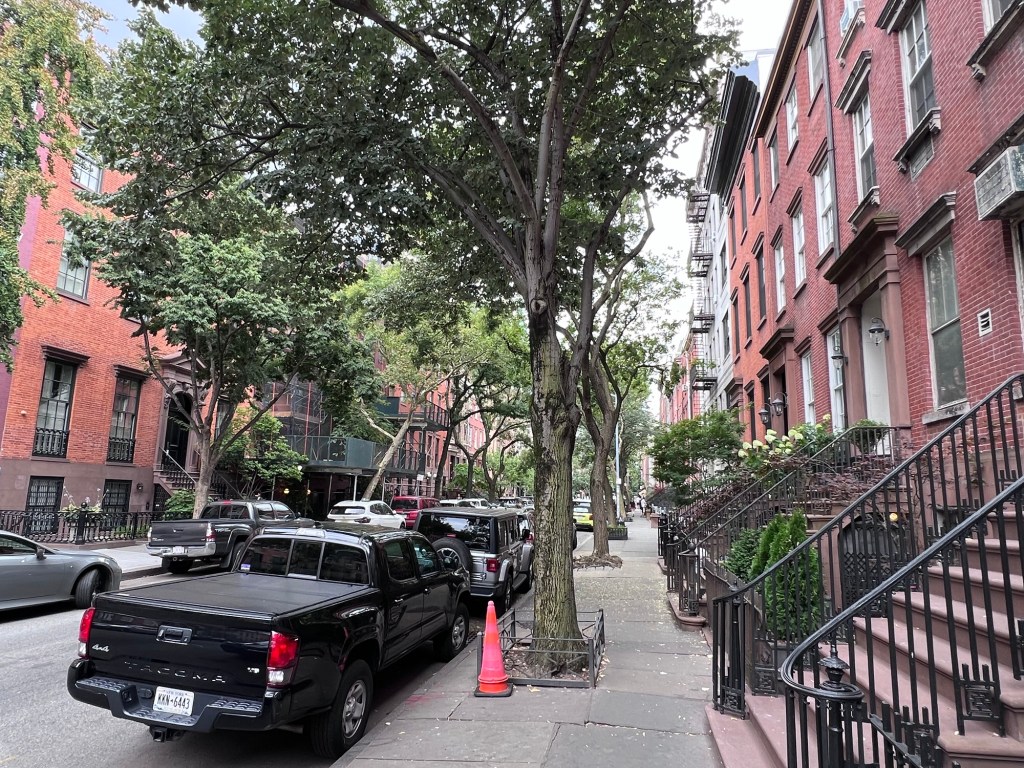
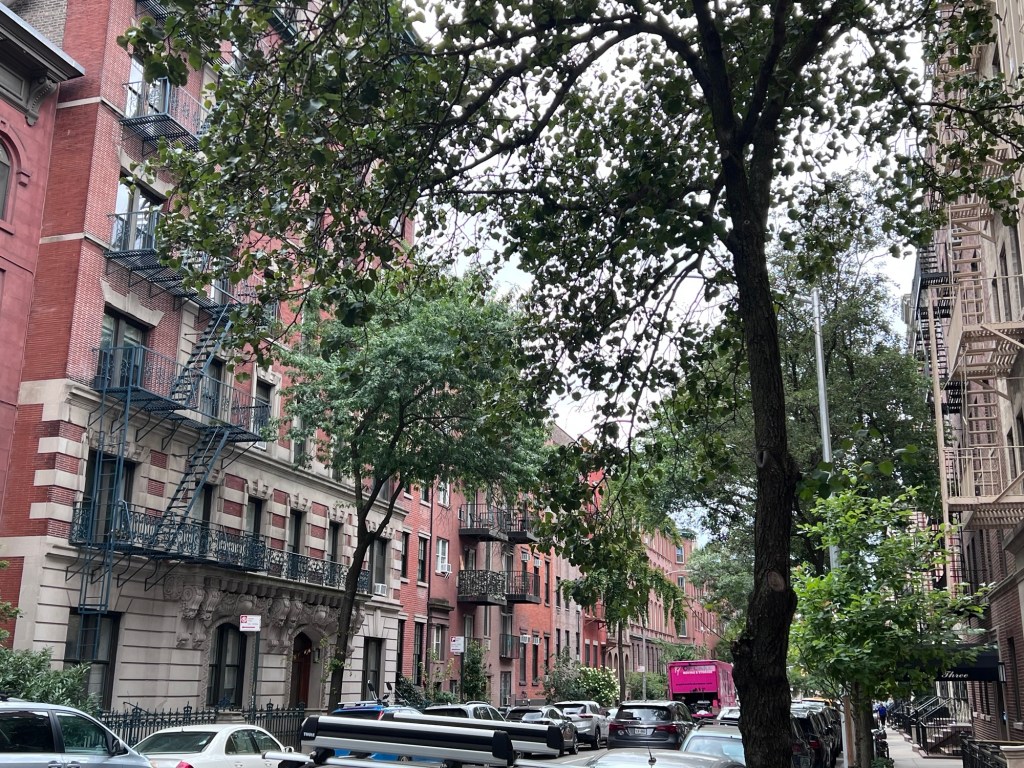
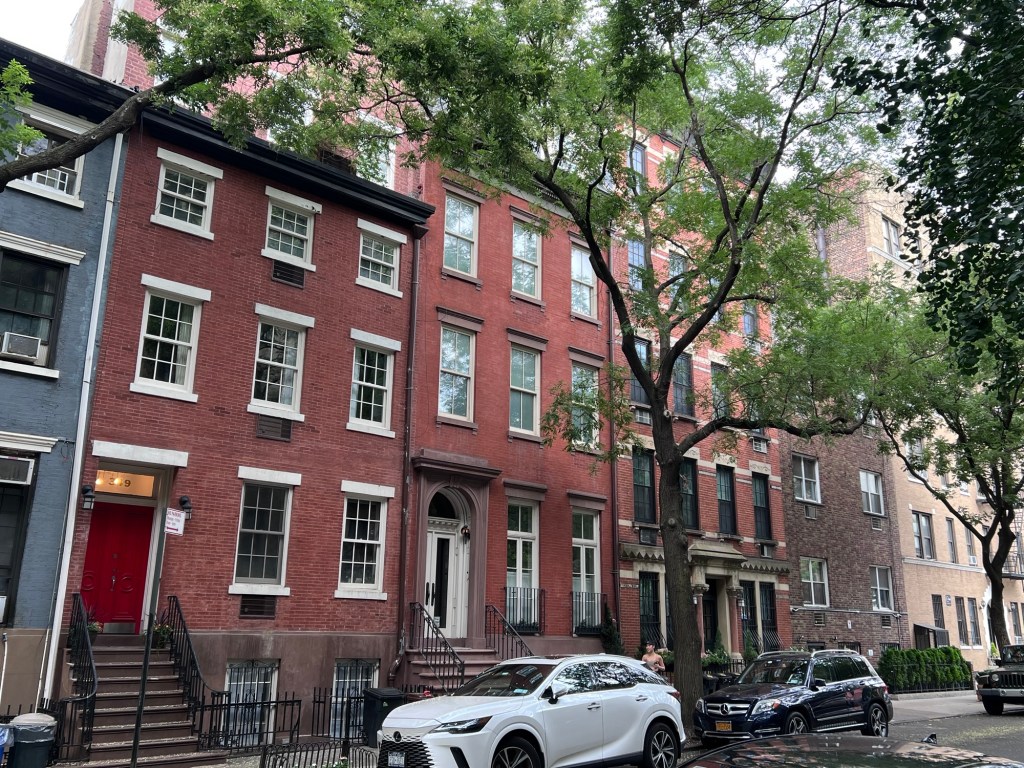
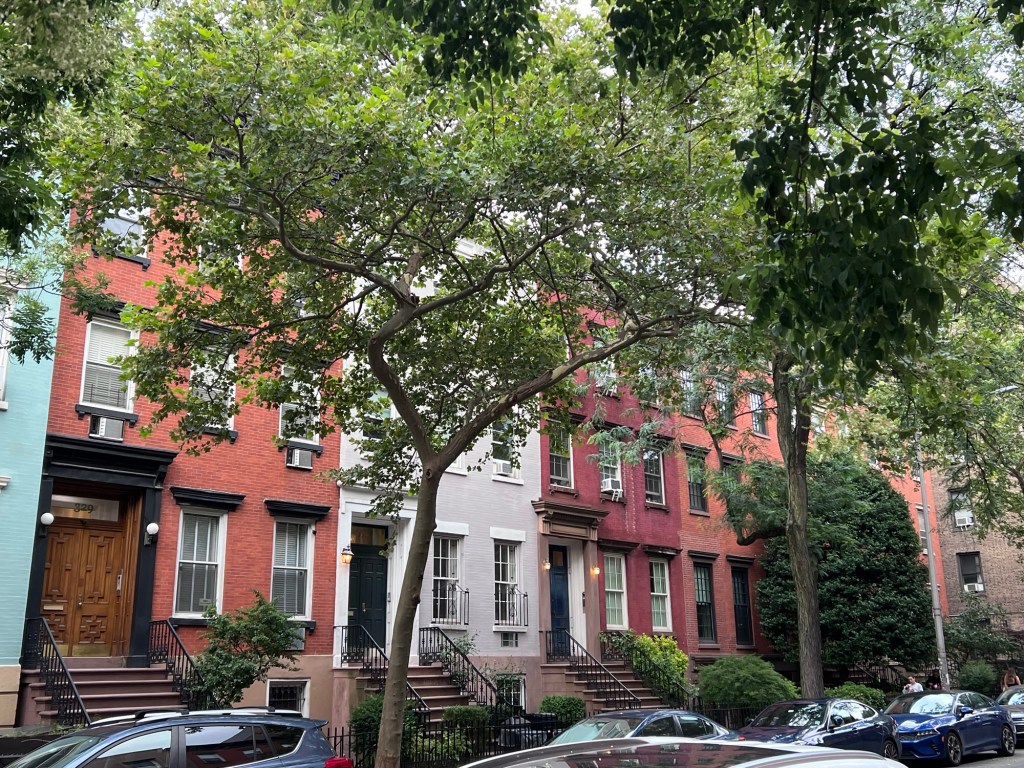
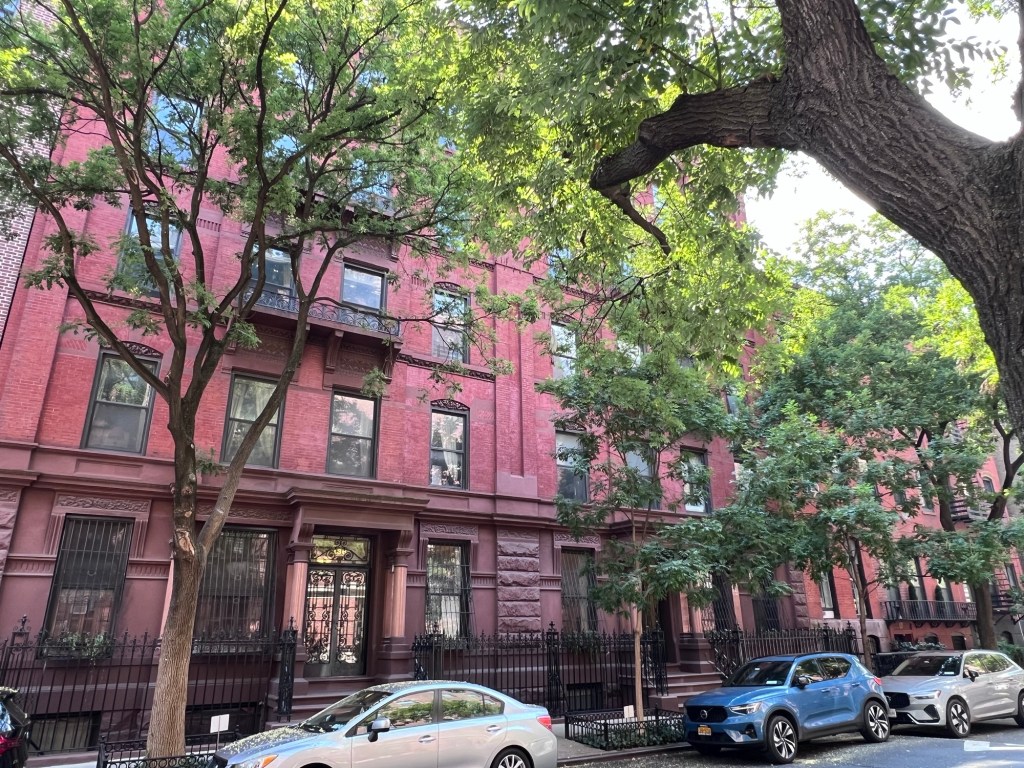
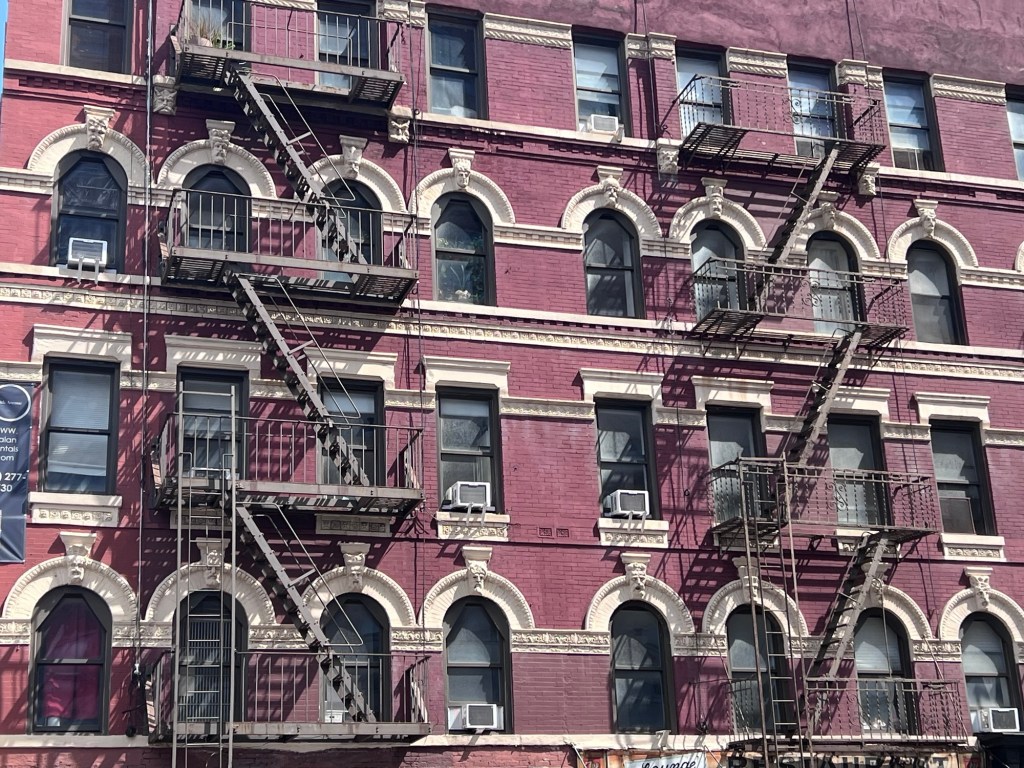
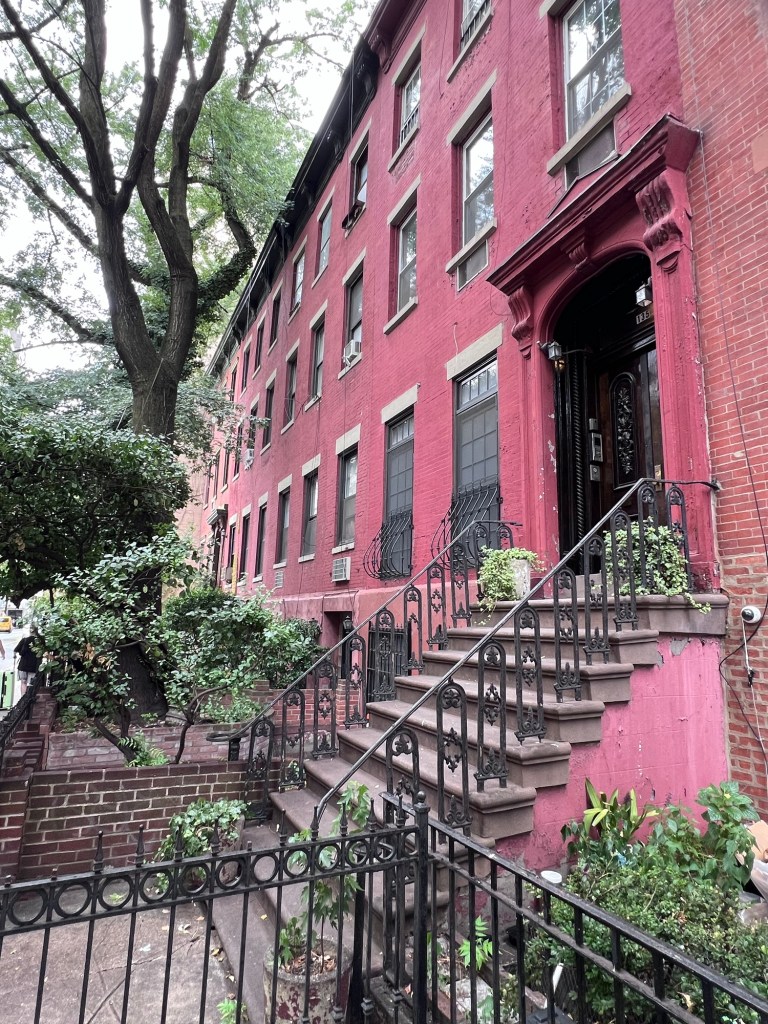
The beautiful brownstones and brick townhouses on the block
One brownstone on this part of the street is 246 West 22nd Street with its interesting embellishments. This building is a pre-war apartment that was built in 1920(Streeteasy.com).
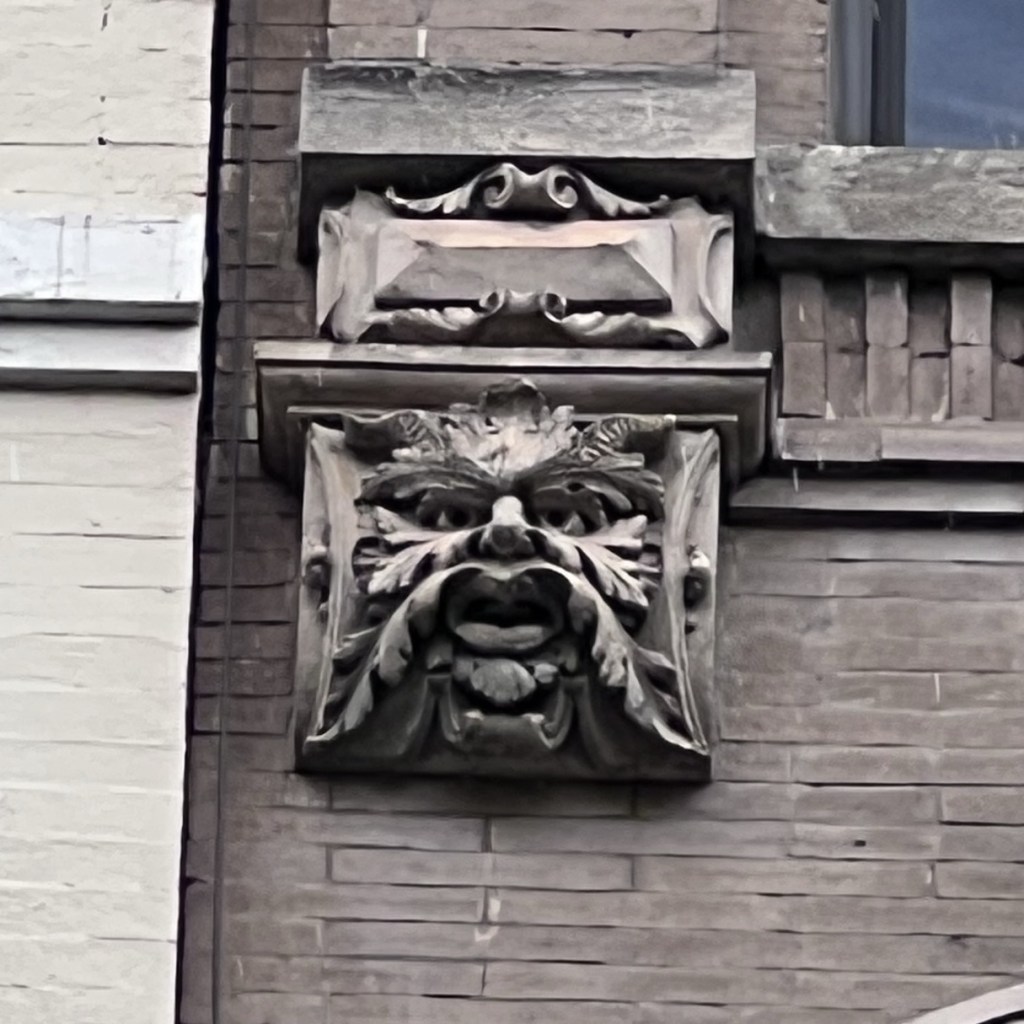
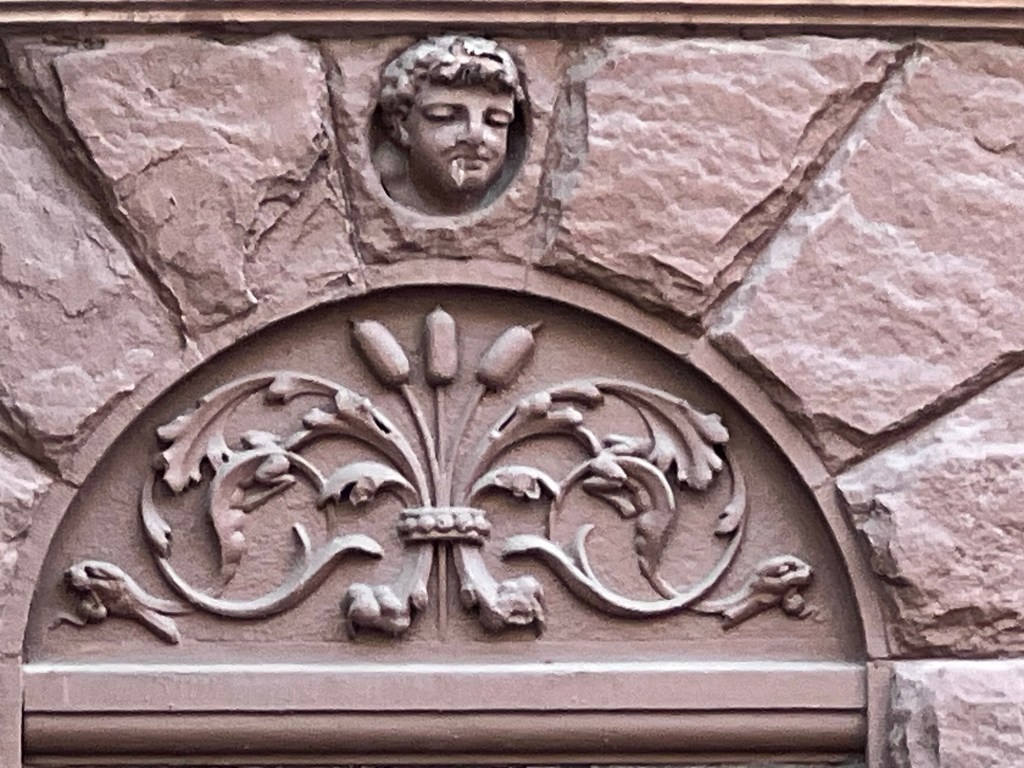
The unusual stonework on the building
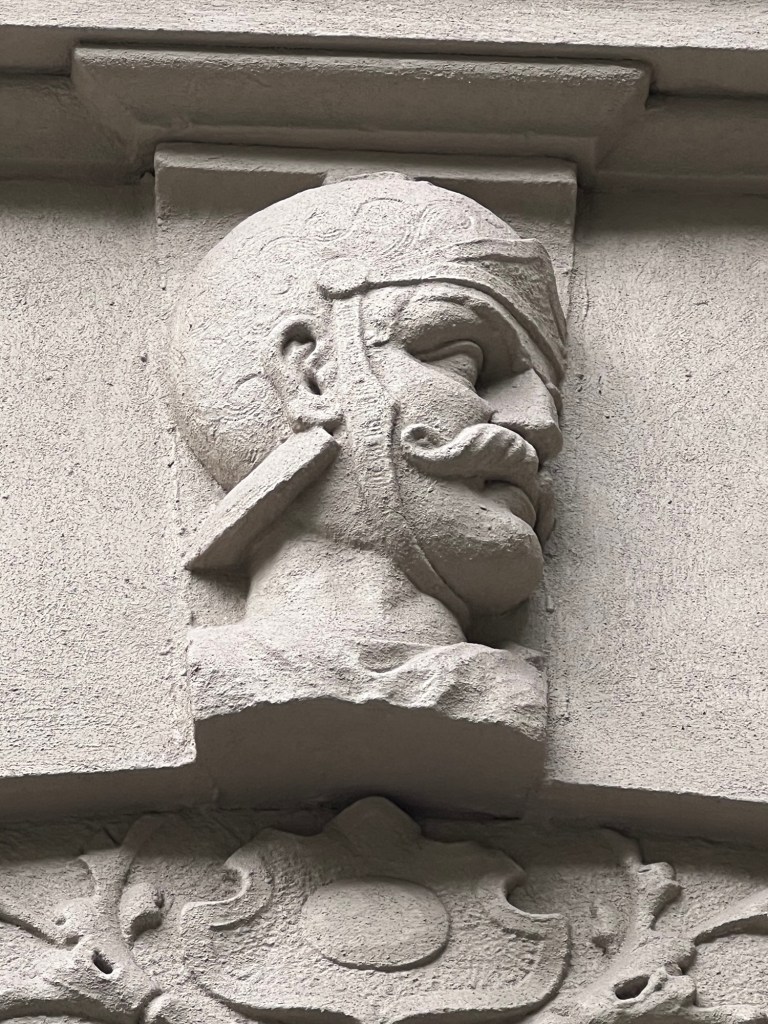
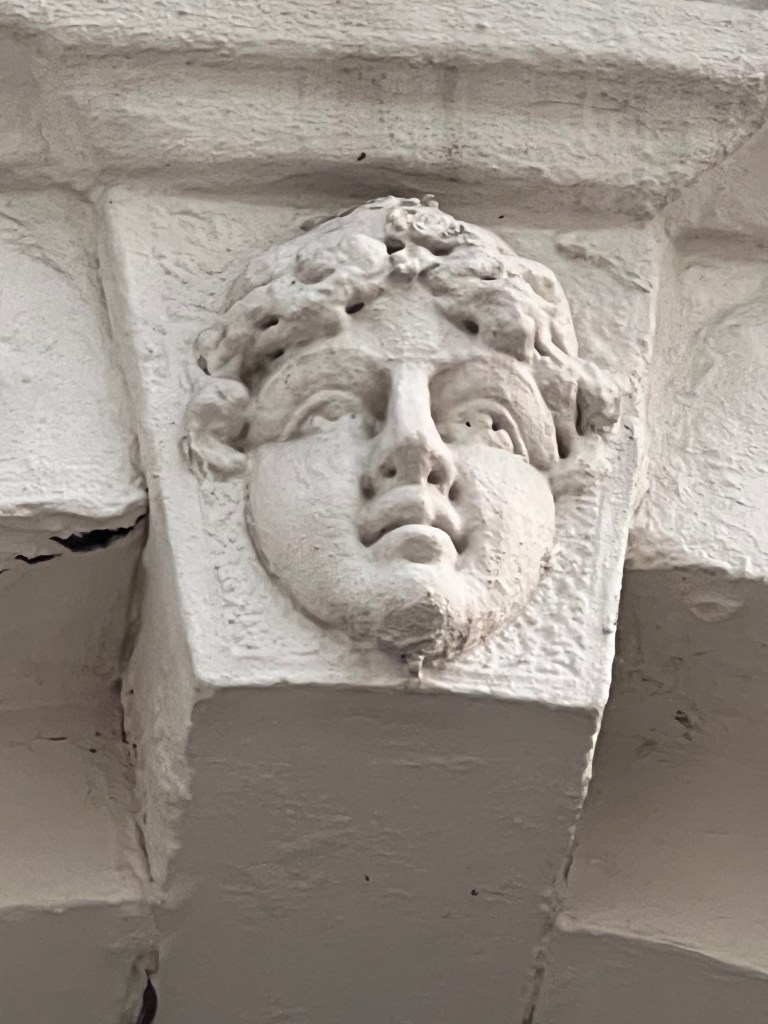
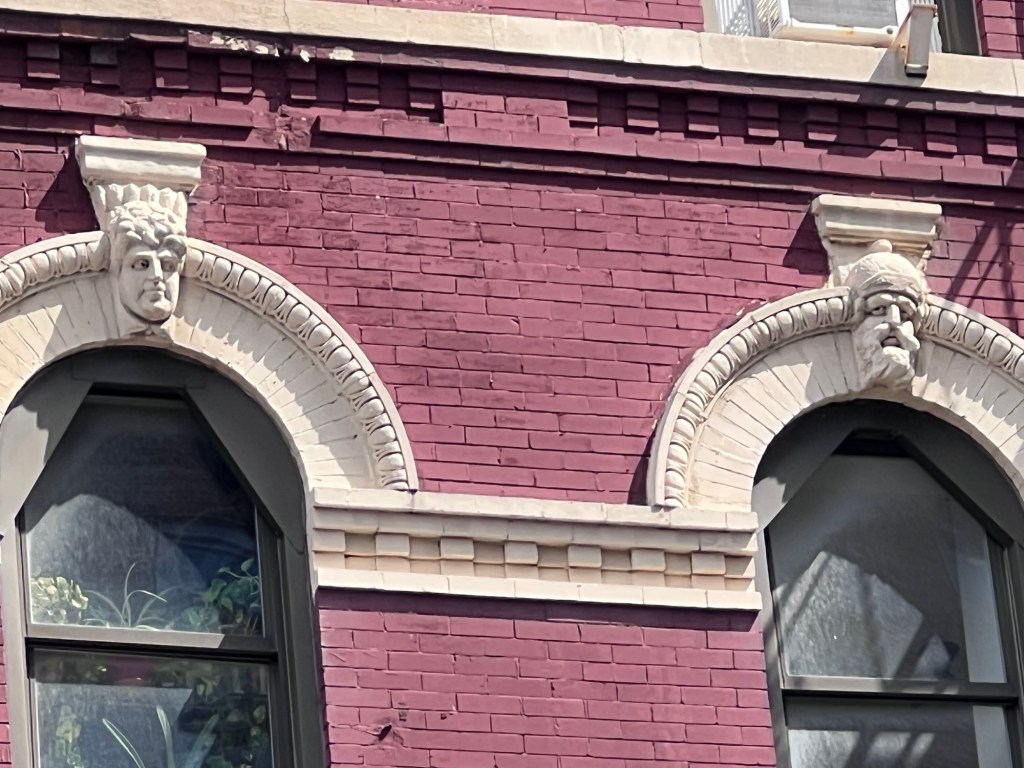
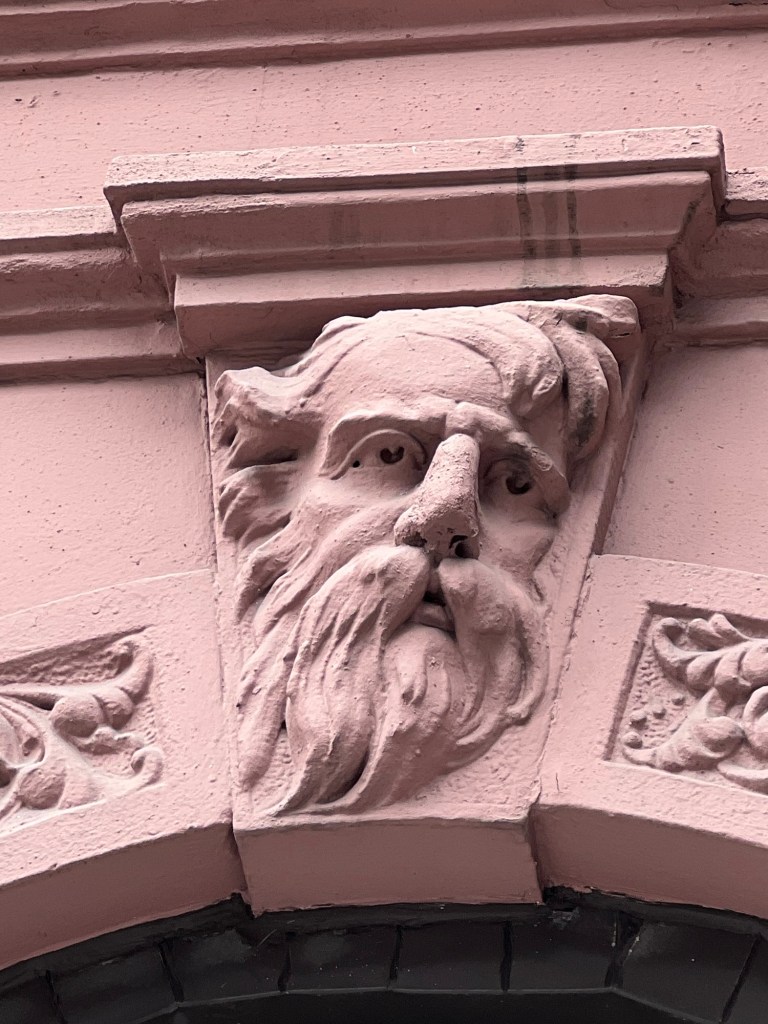
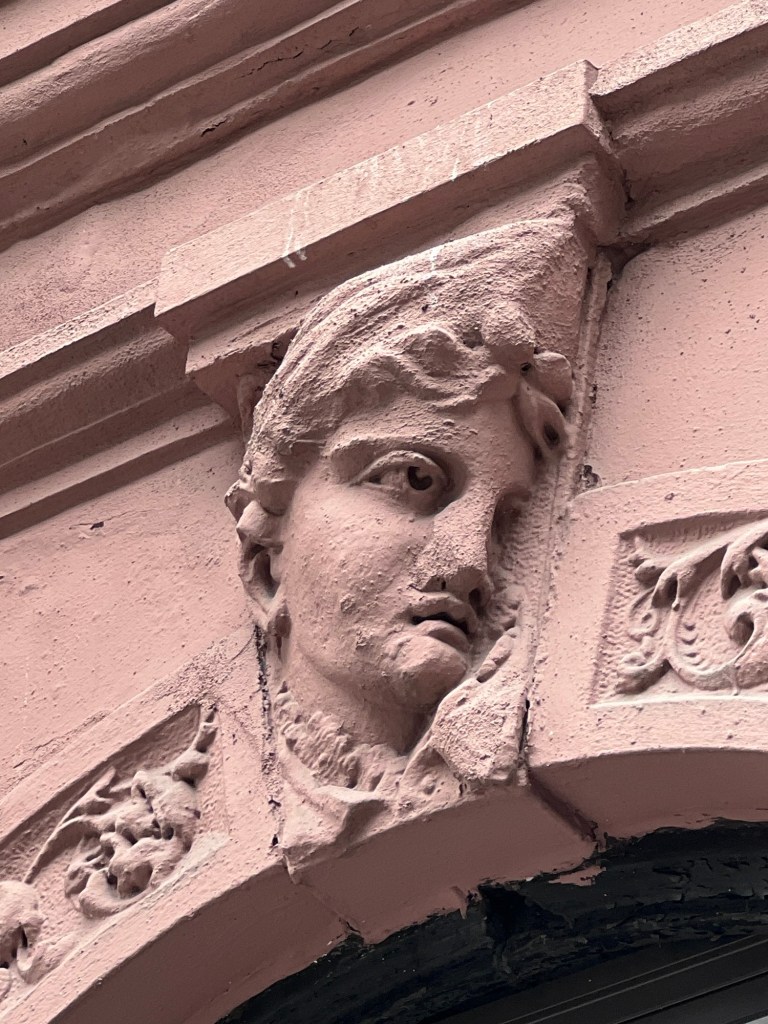
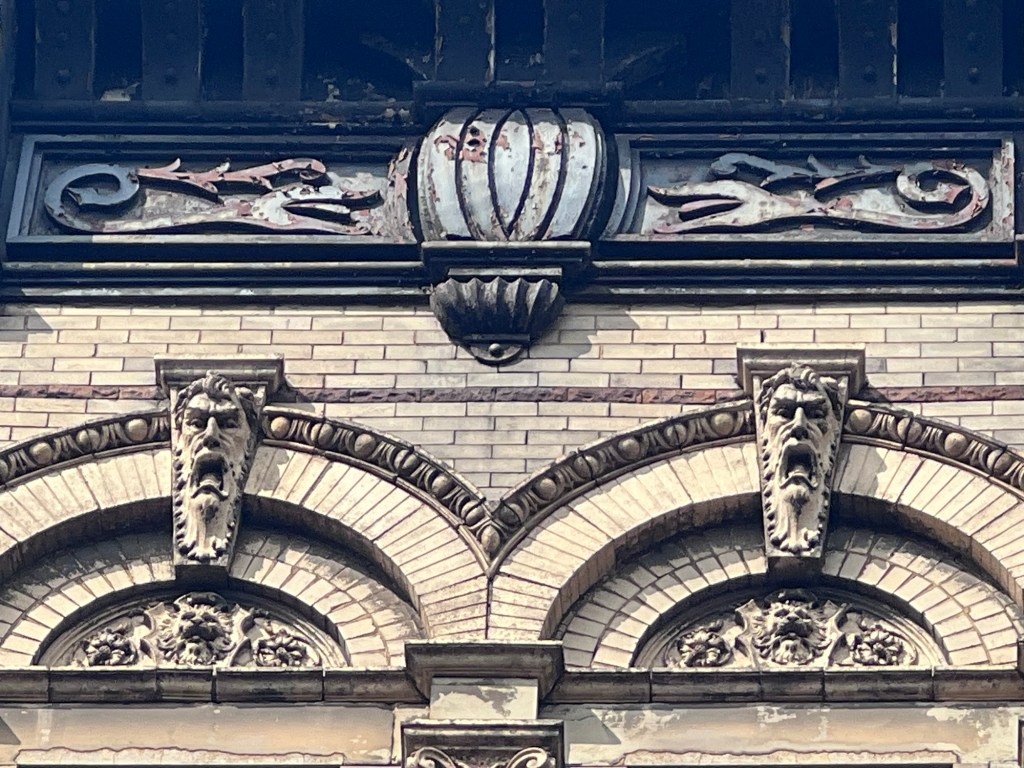
The faces can captivate you
Face number one
Face number two
Face number three
Face number four
The next building to stand out was 262 West 22nd Street. This is another pre-war building was built in 1920 (Streeteasy.com).
Another building whose embellishments were rather unusual were outside of 264 West 22nd Street. This building was another pre-war building in the 1920’s. It has a lot of unique embellishments all over the building (Streeteasy.com).
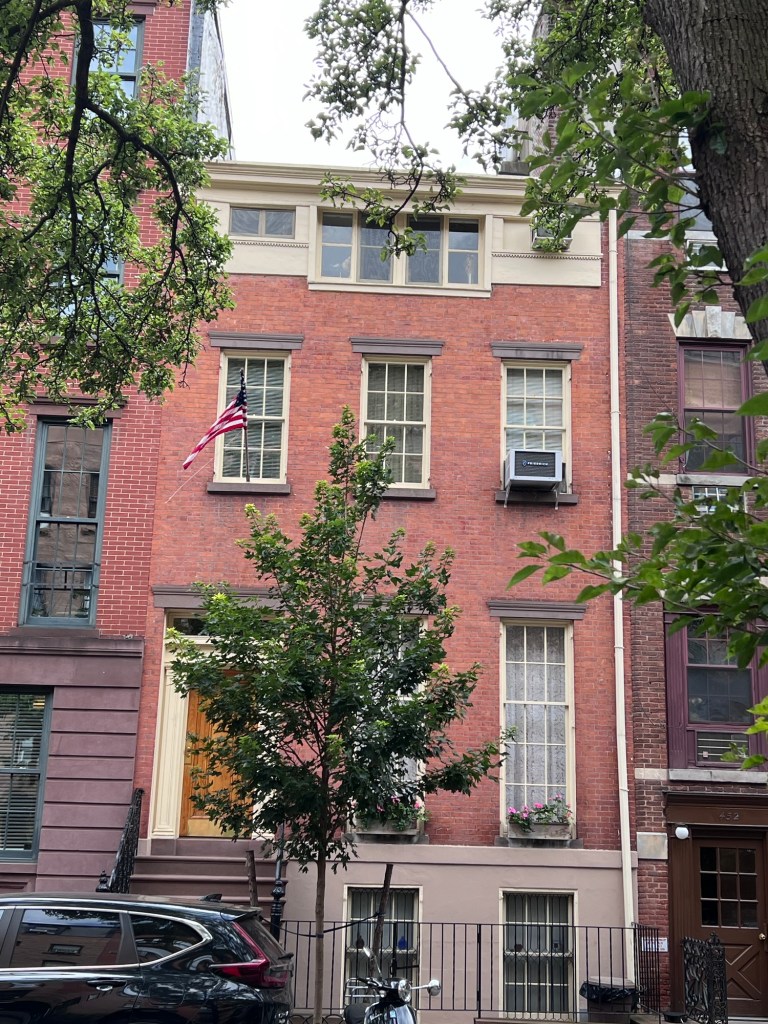
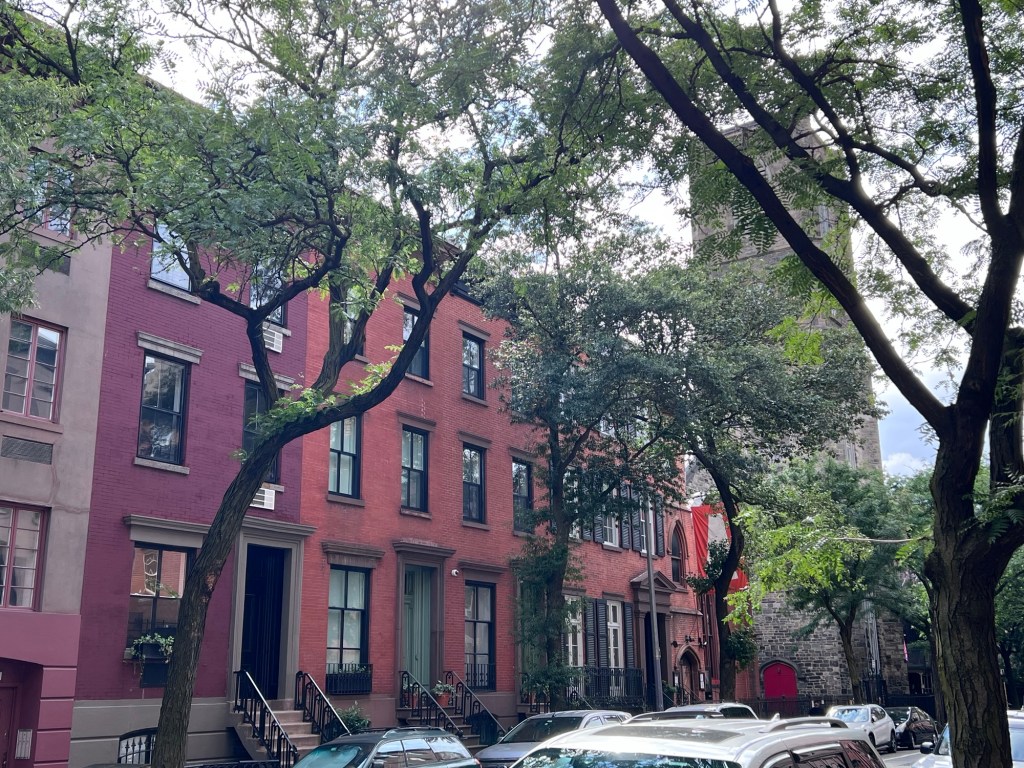
West 22nd Street from Seventh to Ninth Avenues has several blocks of beautiful townhouses and brownstones some dating back to the mid 1880’s. The blocks look something out of a movie set.
Street art on the building at 441 West 16th Street
Street art on the building
Street art on the building
Walking under the High Line Park
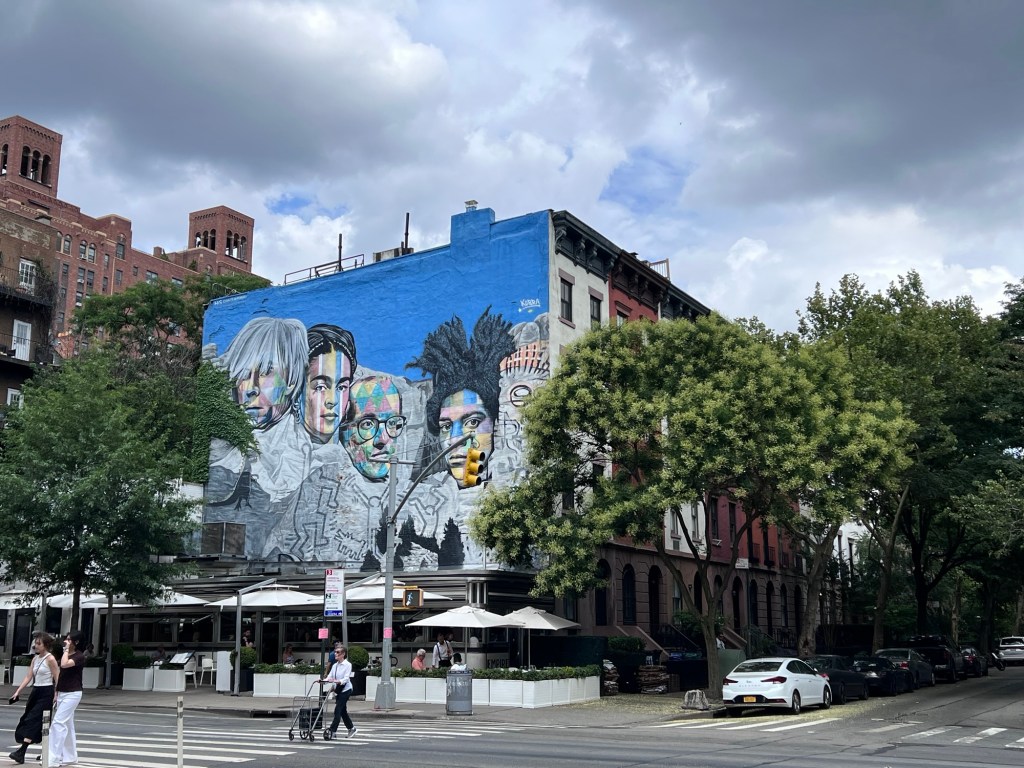
Artist Eduardo Kobra painting “The Mount Rushmore of Art” above the Empire Diner at Tenth Avenue and West 22nd Street
The mural, created by Brazilian artist Eduardo Kobra, “Mount Rushmore of Art”, is the artist’s memorial to some of modern art’s biggest artists including Andy Warhol, Frida Kahlo, Keith Haring and Jean-Michel Basquiat (Vibe Map 2023).
Eduardo Kobra is a Brazilian born artist known for his contemporary and colorful art murals all over the world.
I continued to walk down the road and admired the beauty of each of the streets with their front gardens and plantings.
The beauty of West 22nd Street between Eighth and Seventh Avenues
More faces staring at you while you walk by
I feel like they are passing judgement as you walk by
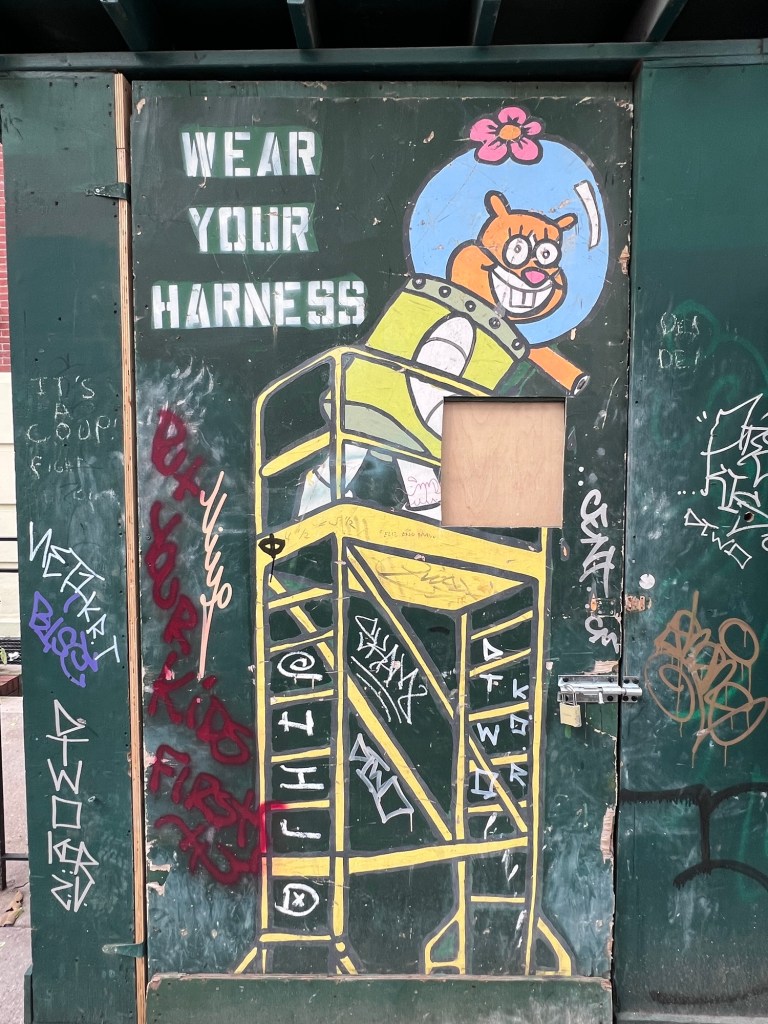
Even the work sites are home to art work
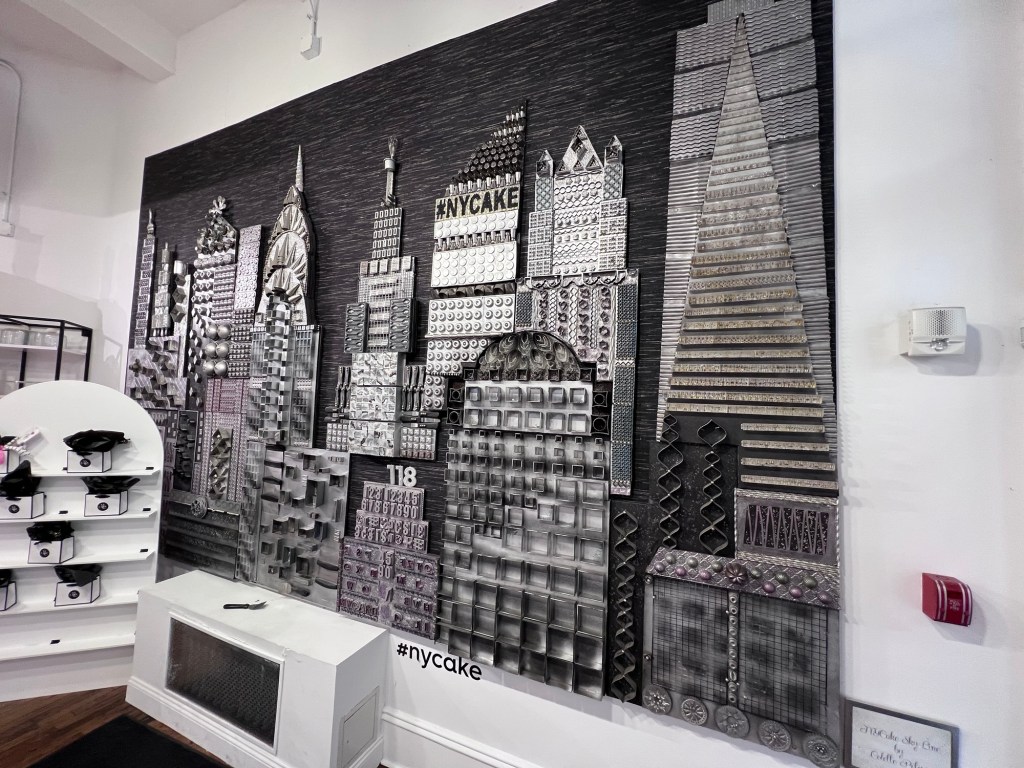
While making my way down West 22nd Street, I passed NY Cake, a specialty store all the items cake decorating and making. The store has everything you need for both professional and amateur baking. I walked along the aisles looking at all the merchandise when I spotted an fascinating piece of art at the front entrance.
Cake Artist Collette Peters is an American born baker, artist, cake design maker and author of “Collette’s Cakes: The Art of Cake Decorating”.
I the rounded West 21st Street and walked down the street admiring all the beautiful homes and street art.
Sixth Avenue and West 23rd Street
This was in the very heart of what once the ‘Ladies Shopping Mike’, with the former Crawford-Simpson Department store
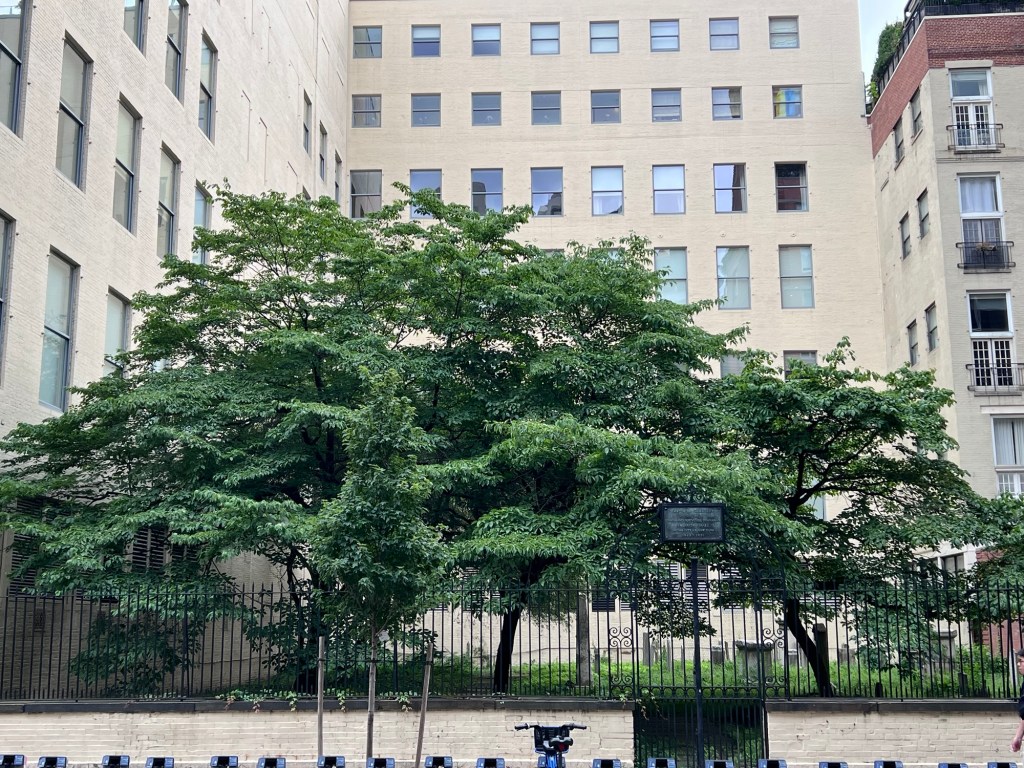
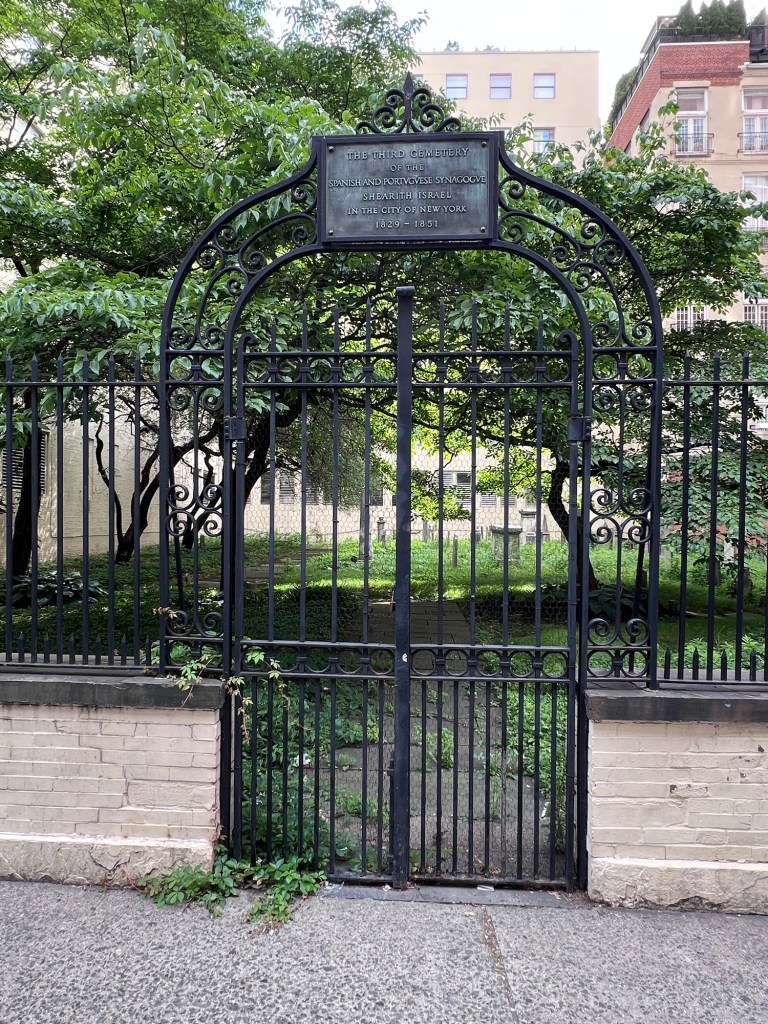
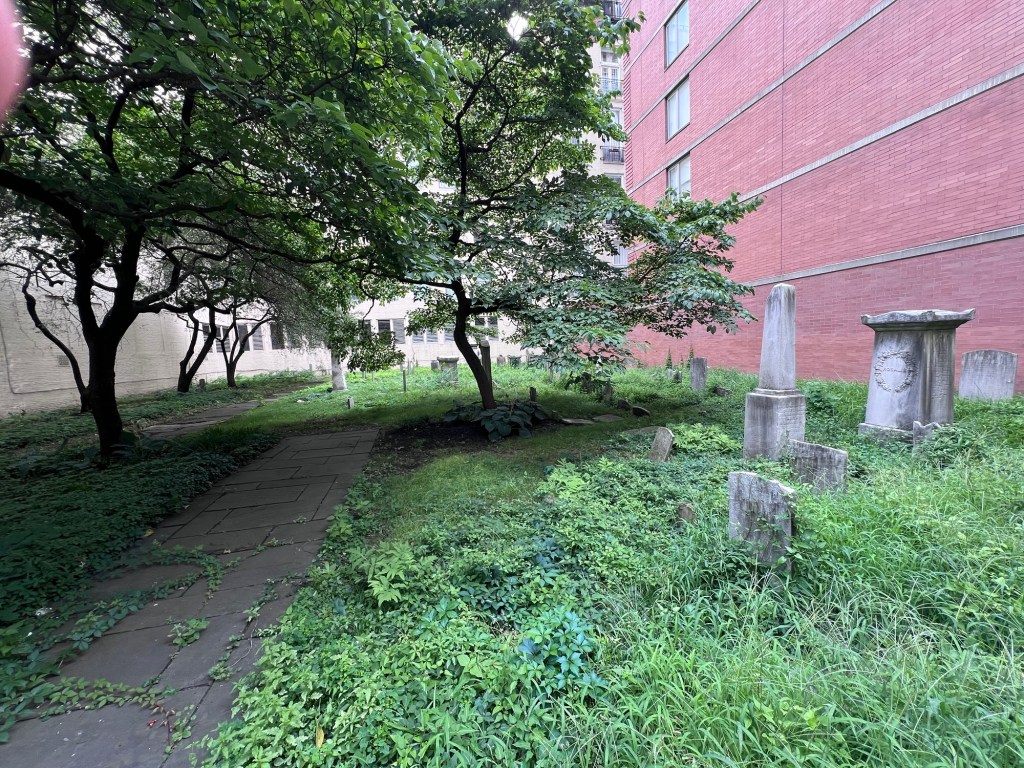
The first thing I saw as I walked down the street admiring, tucked in between the buildings was the Third Shearith Jewish Cemetery at 98-110 West 21st Street.
The Third Shearith Cemetery at 98-110 West 21St Street
When Congregation Shearith Israel was forced to close its graveyard in Greenwich Village in 1829, it established a new cemetery in an area even further away from the city center. The 21st Street cemetery served as the congregation’s burial ground until 1851, when the city banned burials below 86th Street (New York City Cemetery Project website). Their original cemetery was just off Canal Street in Chinatown and also sits behind a locked gate.
The cemetery is a quiet reminder that the City keeps progressing and builds around the past. It just shows how time marches on.
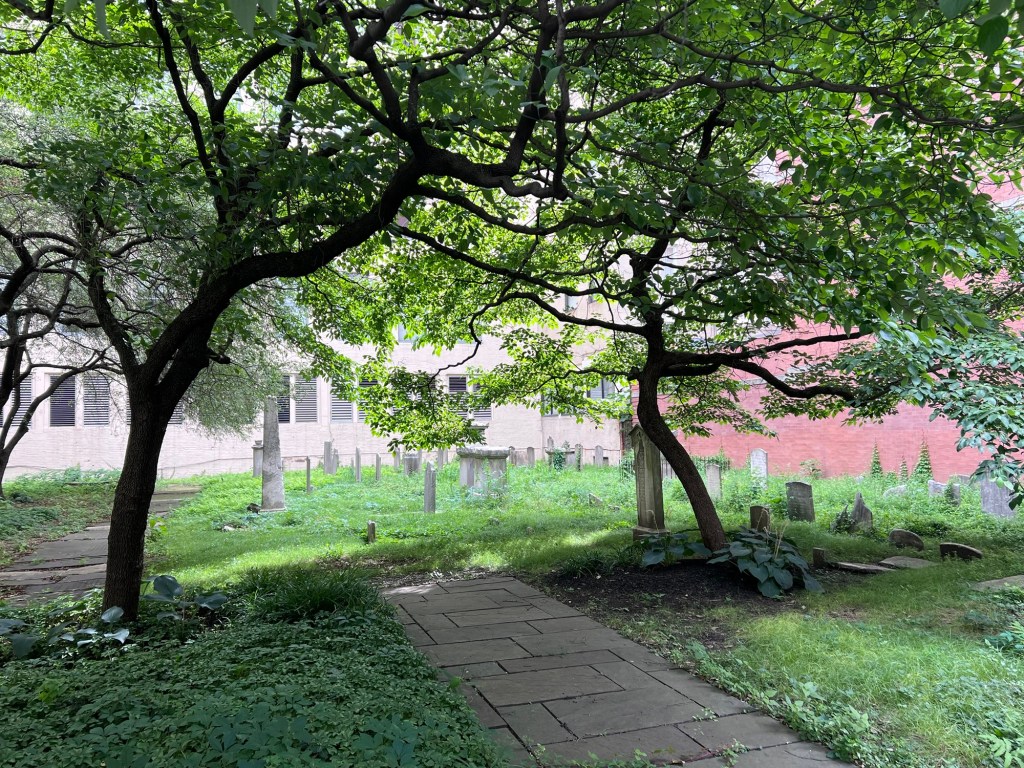
The inside of the cemetery
There is a real beauty to these small historic cemeteries. You wonder if the families understood the changes and progress in the City over the next hundred years.
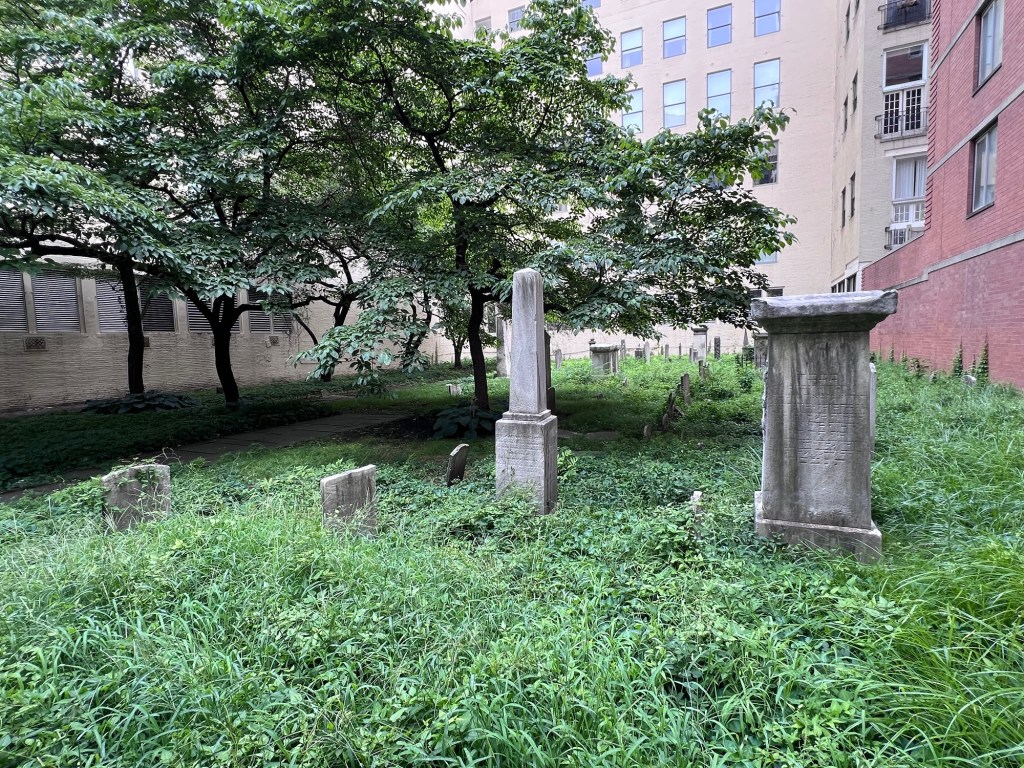
The small cemetery seems surreal in this built up neighborhood
I wondered if anyone visited these folks anymore. The cemetery looks like it is taken care of but not on a regular basis.
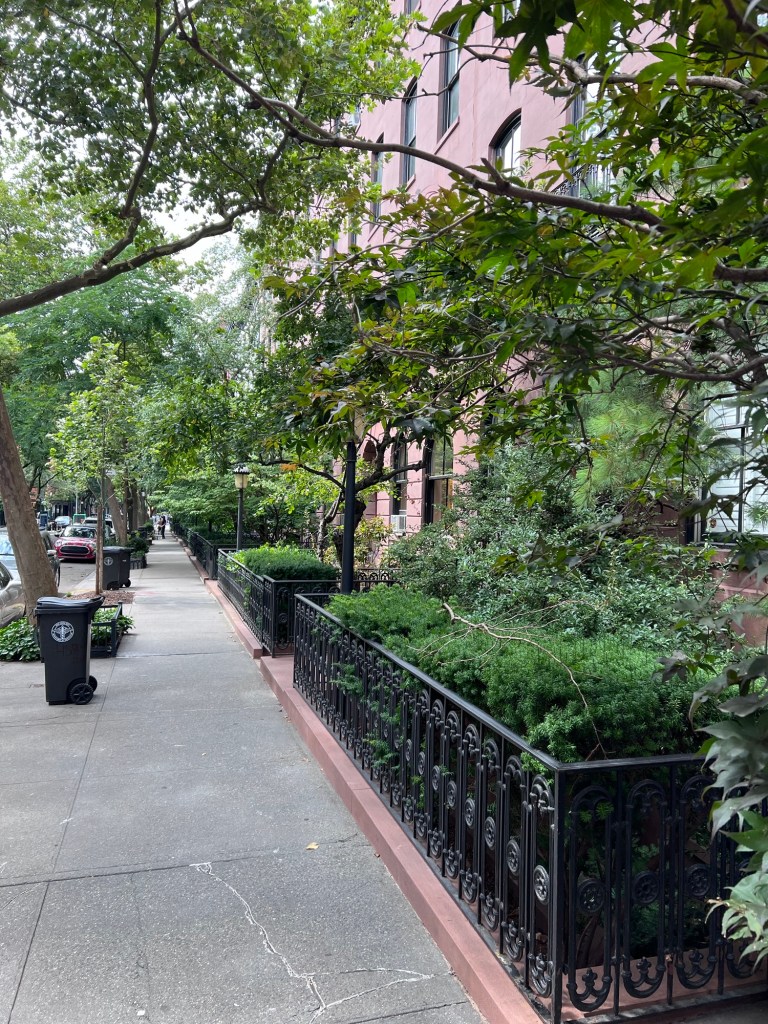
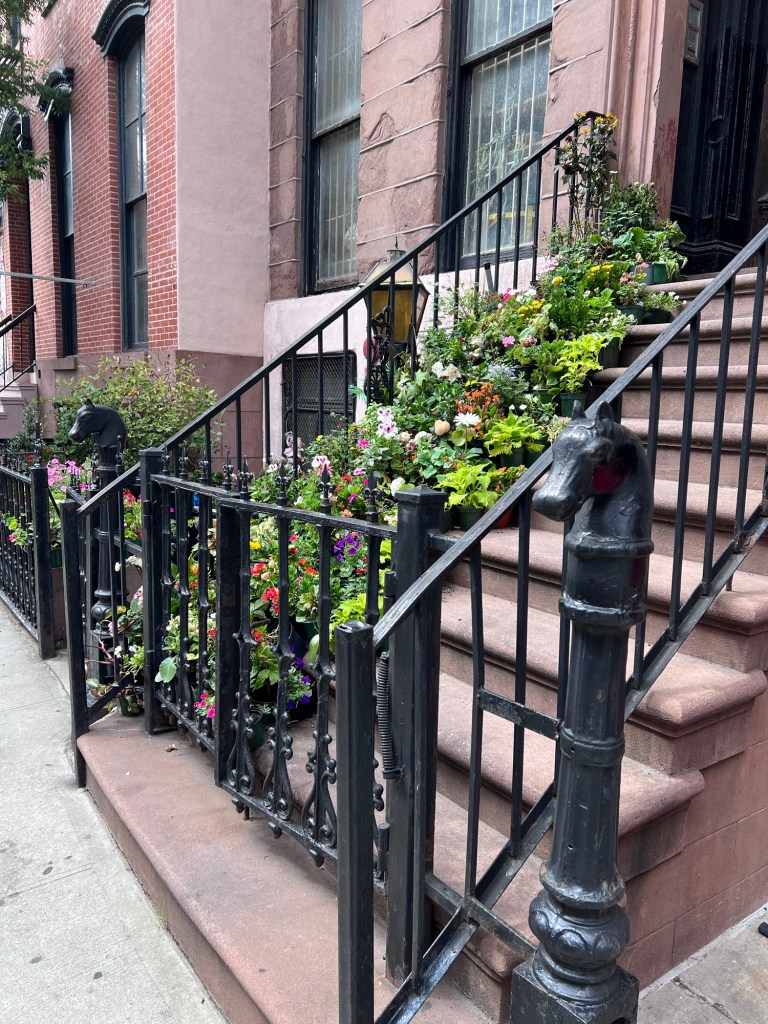
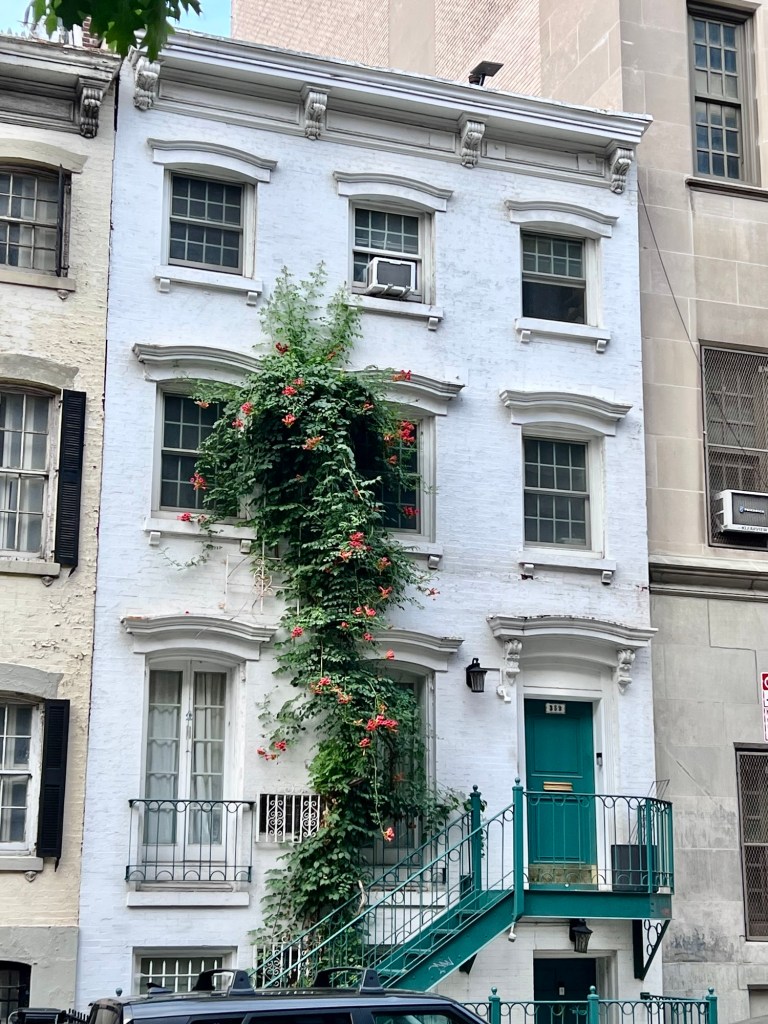
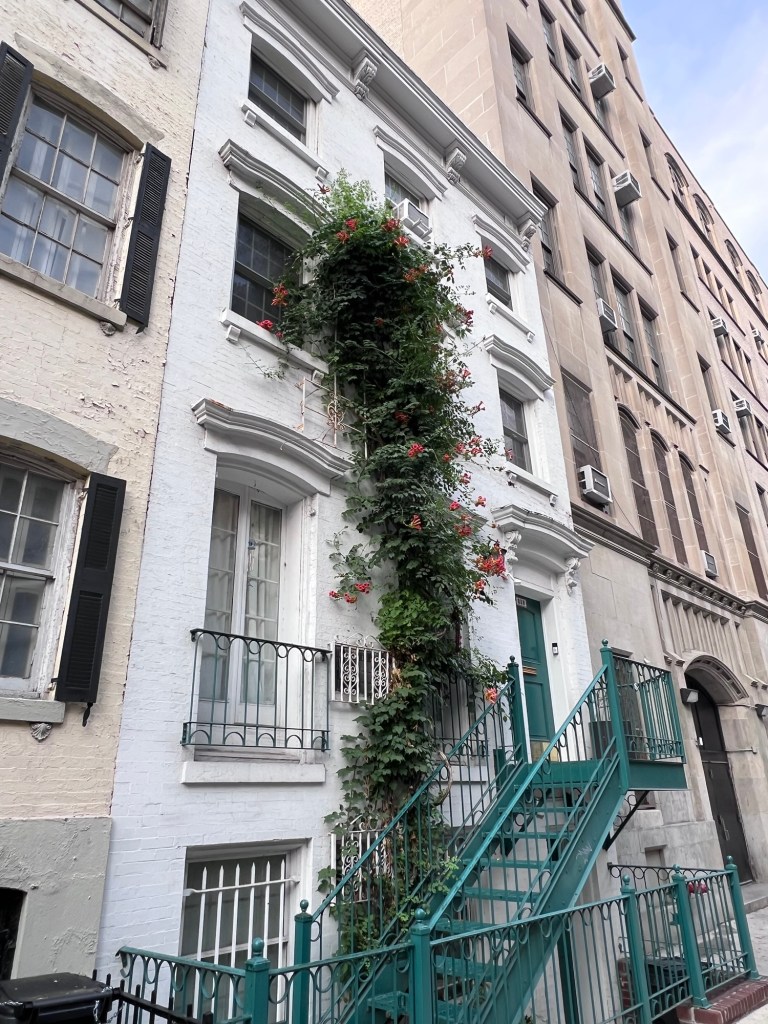
As I continued to walk down the street more surprises popped up along the way. Along the blocks with townhouses and brownstones, there are small pocket gardens and flower beds bursting with color. Along all these streets in Chelsea, there were little surprises everywhere on buildings architecture, tucked in corners by stairs and along the staircases. There is a lot of detail you can miss if you don’t stop for a moment and just appreciate it.
The beautiful plantings and urban gardens that lined the street
Outside of C.S. Hardware at 189 Seventh Avenue there is an interesting mural
The streets in the neighborhood are really picturesque and look like they are out of a movie set. The streets are lined with beautiful brownstones and brick townhouses. Just be careful as the faces follow you around. You will find one thing about Chelsea, the faces on the buildings are all over the place and each has their own unique look about them.
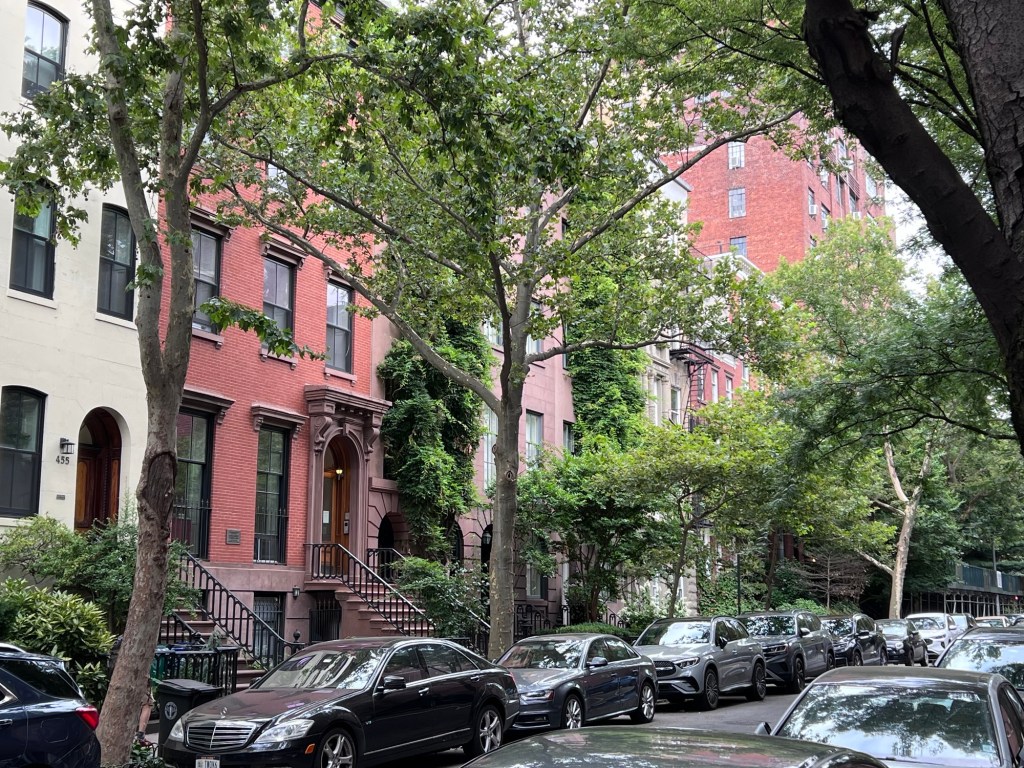
The beauty of West 21st Street
Faces carved into the doorways around the neighborhood
They just seem to follow you around
Even on the sidewalks faces follow you on the walk to 11th Avenue. The eyes are always watching
I love all the carved faces in the buildings in the neighborhood. These interesting embellishments in some cases are the only decorations the buildings have so I looked out for them as I walked by. The rest of the building is rather plain but the keystone greeting you always has a look of longing.
I wasn’t sure if this was a lion or a demon
The neighborhood has three Fernando Kobra murals painted on the buildings. This is ‘I ❤️ New York’ on 212 Eighth Avenue.
The Kobra painting ‘I Love New York’
The Kobra painting of Albert Einstein ‘We ❤️ New York’
I continued my walk down West 21st Street looking at the treasure trove of outside art and architecture.
The entrance to the Reilly Building
Has the most interesting face guarding the building
The buildings that watch you
Look at you with a look of horror
The residents creating small gardens along the blocks
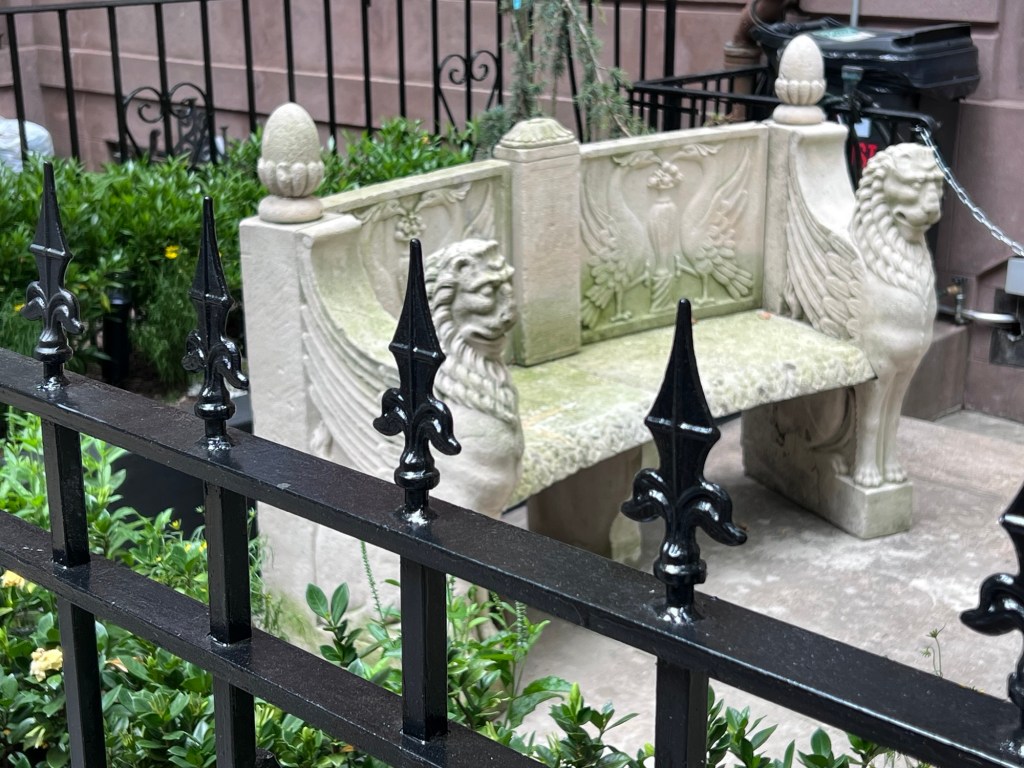
I loved this stone chair outside on of the brownstones
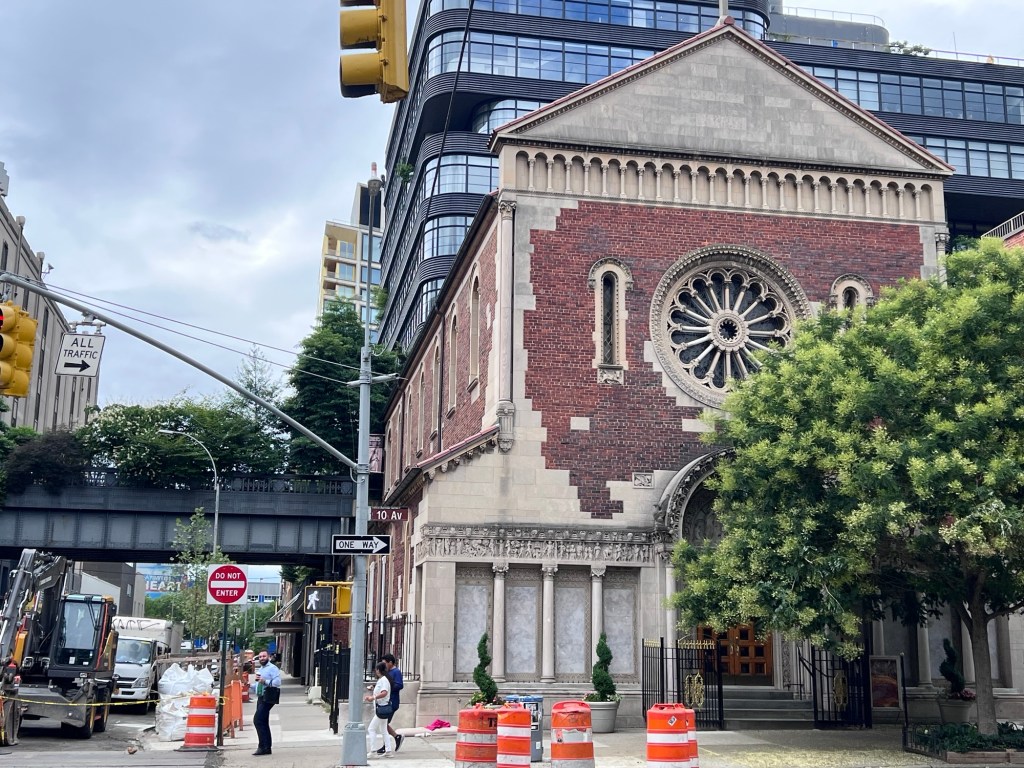
Passing by the Guardian Angel School on 193 Tenth Avenue with High-line Park in full bloom
The church school was designed and built in 1930 by architect John Van Pelt of the Van Pelt, Hardy & Goubert firm. The building was designed in the Southern Sicilian Romanesque style and has many different religious elements in the detail of the outside of the building. You have to look at it from all directions to appreciate its beauty (Wiki).
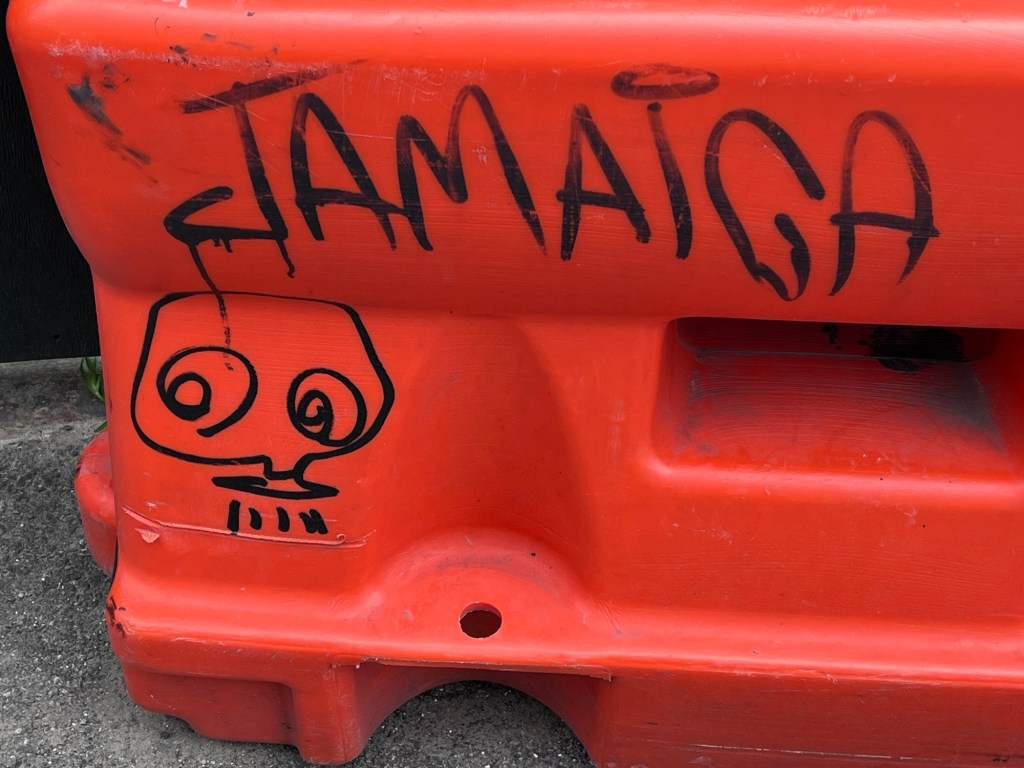
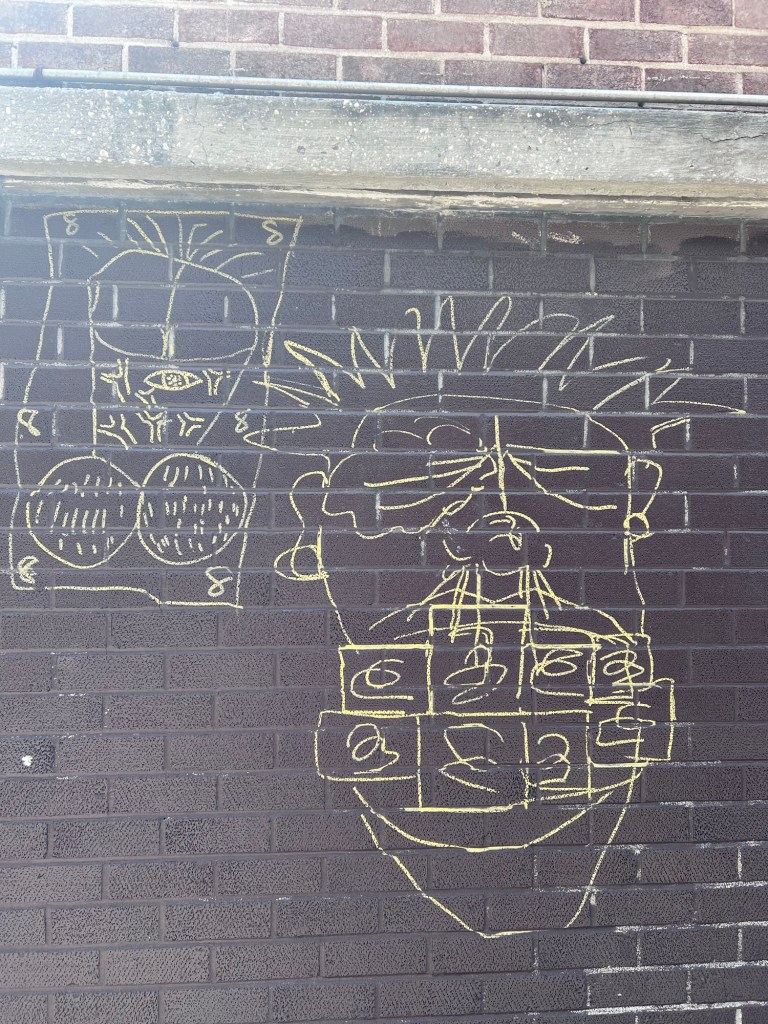
On the corner of West 21st Street and 11th Avenue, I came across this interesting drawing on a plastic barrier. I assumed the street artist was from Jamaica.
Walking on the other side of West 21st Street on the way back showed just as many interesting views.
High line Park is in full bloom by 10th Avenue
Walking down West 21st Street near Eighth Avenue
Walking past the historic brick townhouses in the neighborhood
As I passed the school yard, I saw this work on the fence and thought it was really whimsical
As I left West 21st Street, I took another peak at the cemetery and thought about when they buried these people. It must have been wilderness at the time this cemetery was created. The first one is down in Chinatown.
I rounded West 20th Street in the late afternoon and I did notice a change in the architecture as I walked further into the neighborhood. It seemed a little more commercial though the use of the buildings seem to be changing.
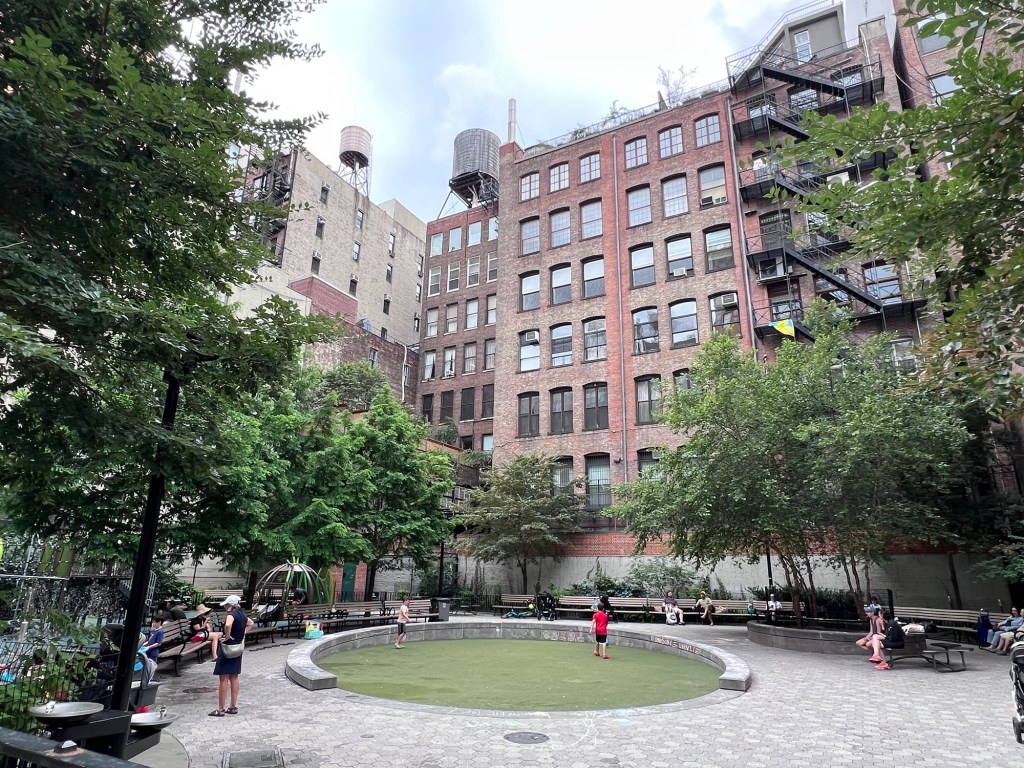
Then I passed Chelsea Green Park at 140 West 20th Street
The Chelsea Green Park was an oasis from the hot weather that had been going on the week I walked the neighborhood. It seemed all the parents were trying to escape the heat as well as everyone sat under shade trees while the kids ran through the sprays of water and throwing water balloons at each other.
Chelsea Green Park sign
The parks history
This park sits on a former school and when the building was torn down, the neighborhood rallied to create this park. This much needed green space is the neighborhood focal point on these hot summer days that we experienced in the summer of 2025.
Walking by the busy park in the early afternoon
Some of the businesses are quite unique in the neighborhood. I loved the window display at ‘Purple Passion’ at 211 West 20th Street. If anything stood out was this creative set of ensembles.
The display window at Purple Passion at 211 West 20th Street
Purple Passion has become the darling of fetishists-in-the-know over the last few years almost exclusively by word of mouth. A selection of fetish “toys”, restraints and clothing more diverse than almost any other store in New York is crammed into a tiny shop now so packed with merchandise it’s difficult for more than two or three customers to be inside it at once (The NYCGoth.com website).
This interesting brownstone is a pre-war building that was built in 1920. This rather daring face protects the entrance of the building.
The front door is on guard
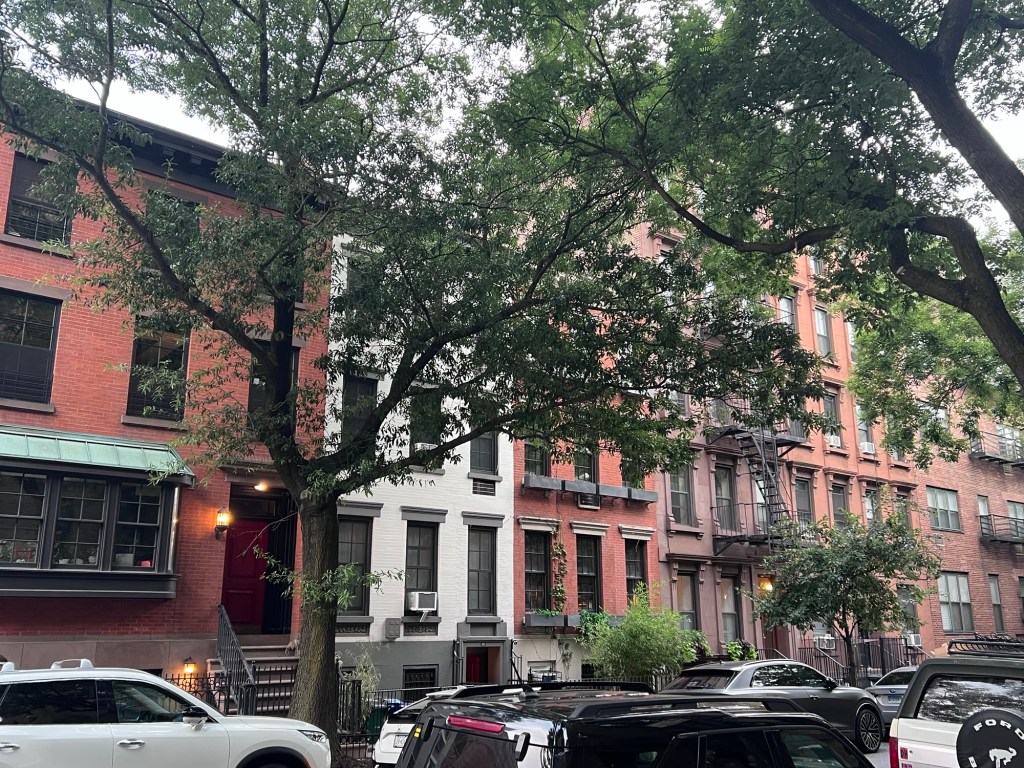
The blocks in the center of the neighborhood down each street from Seventh to Ninth Avenue are lined with rows of rows of tree lined streets with classic brick townhouses.
Walking down the picturesque West 20th Street
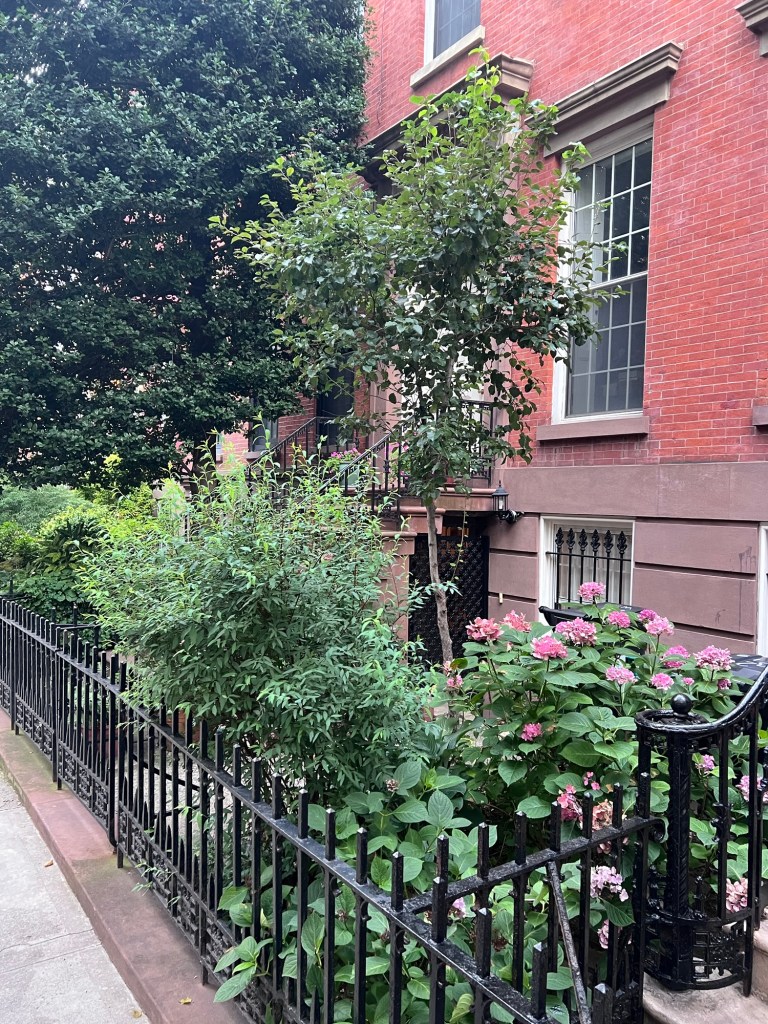
The garden boxes along the way
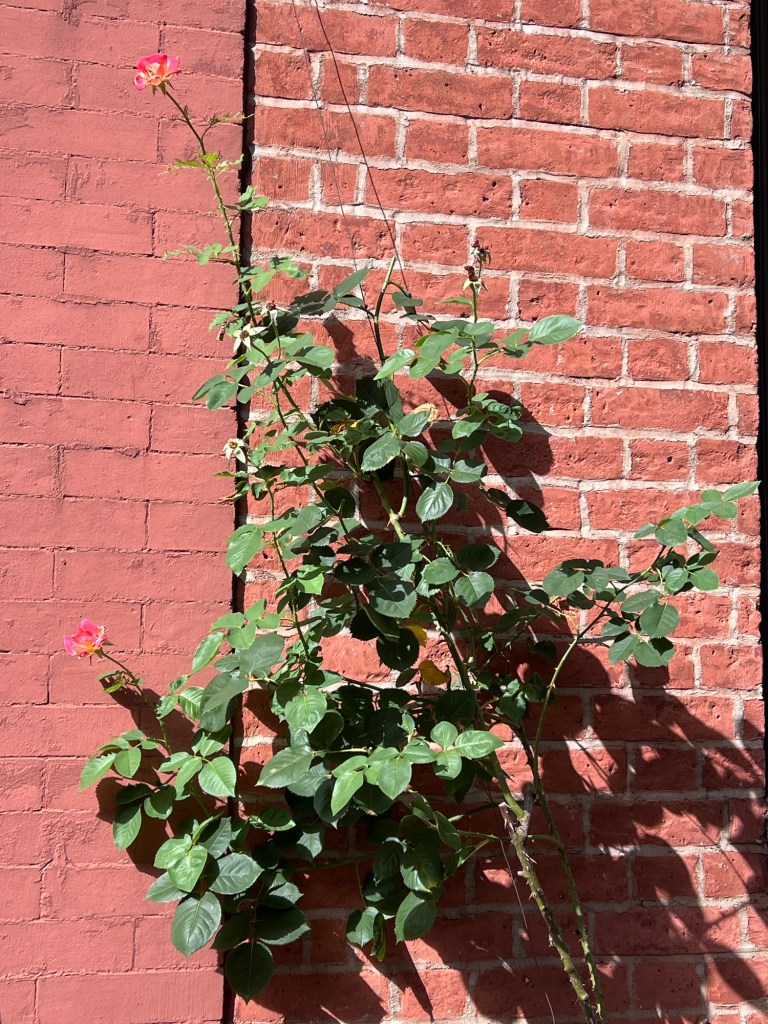
Flowers peaking out here and there along the walls
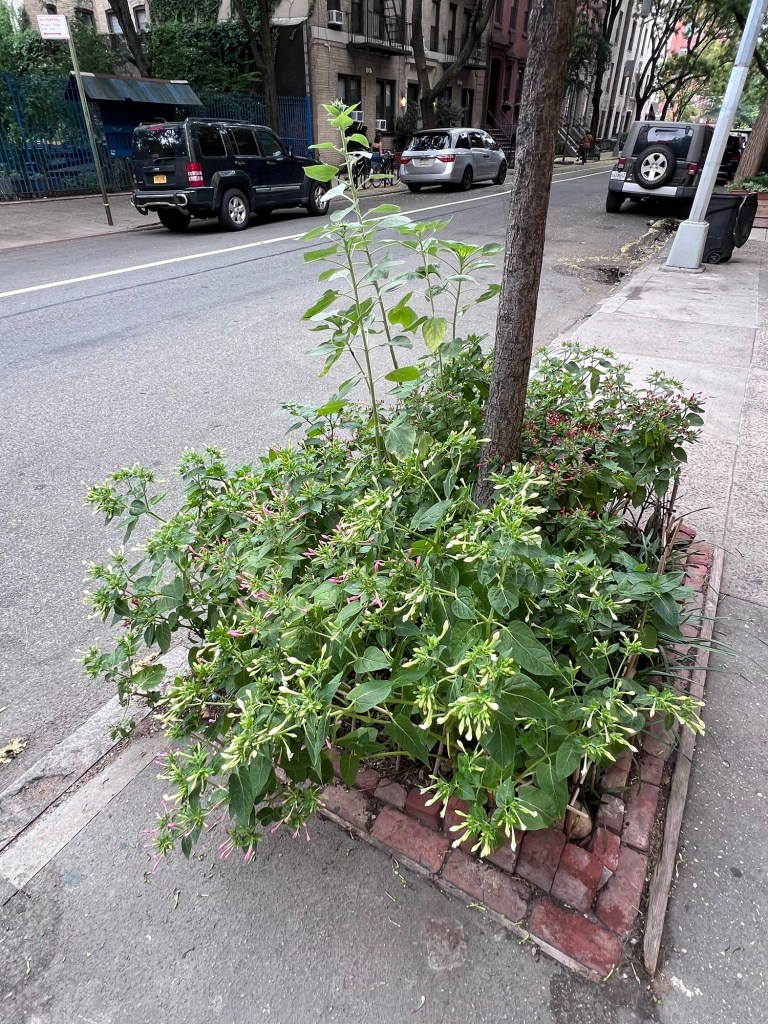
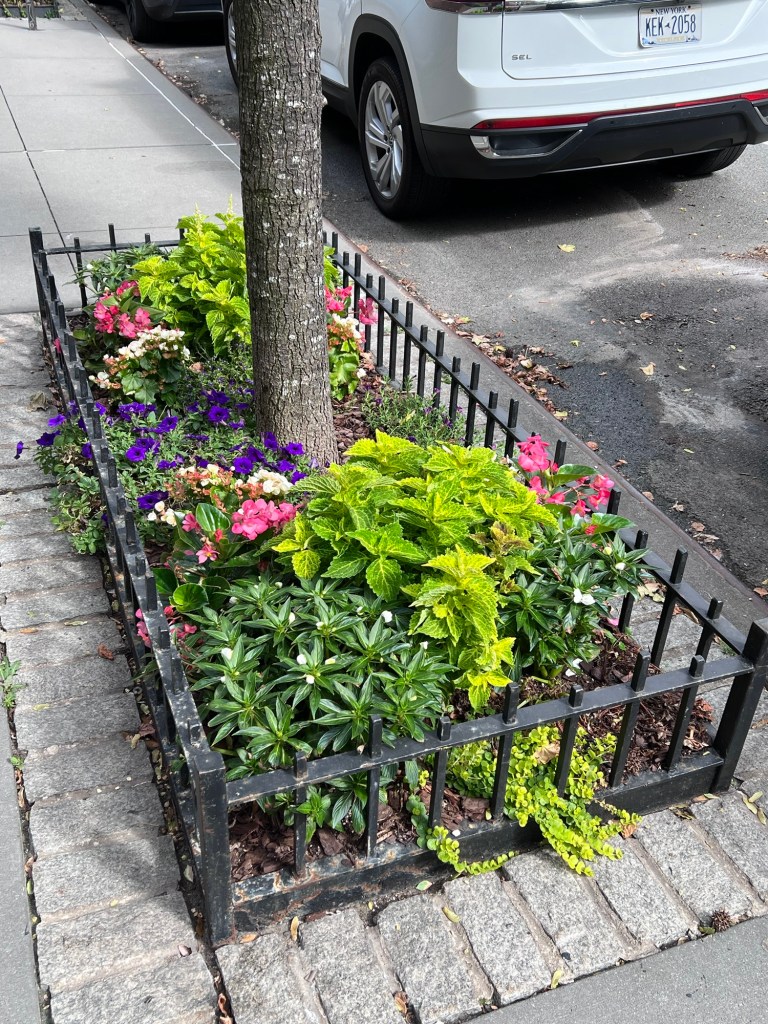
The residents landscaping the tree boxes along the street
A tree growing in the High Line Hotel courtyard at 180 Tenth Avenue
The Cushman Row is one of the finest examples of Greek Revival style of architecture in New York, this superbly designed row of houses has retained most of its handsome original detail. Built by Don Alonzo Cushman, parish leader and financier, in 1840 (from the Cushman Historical Marker).
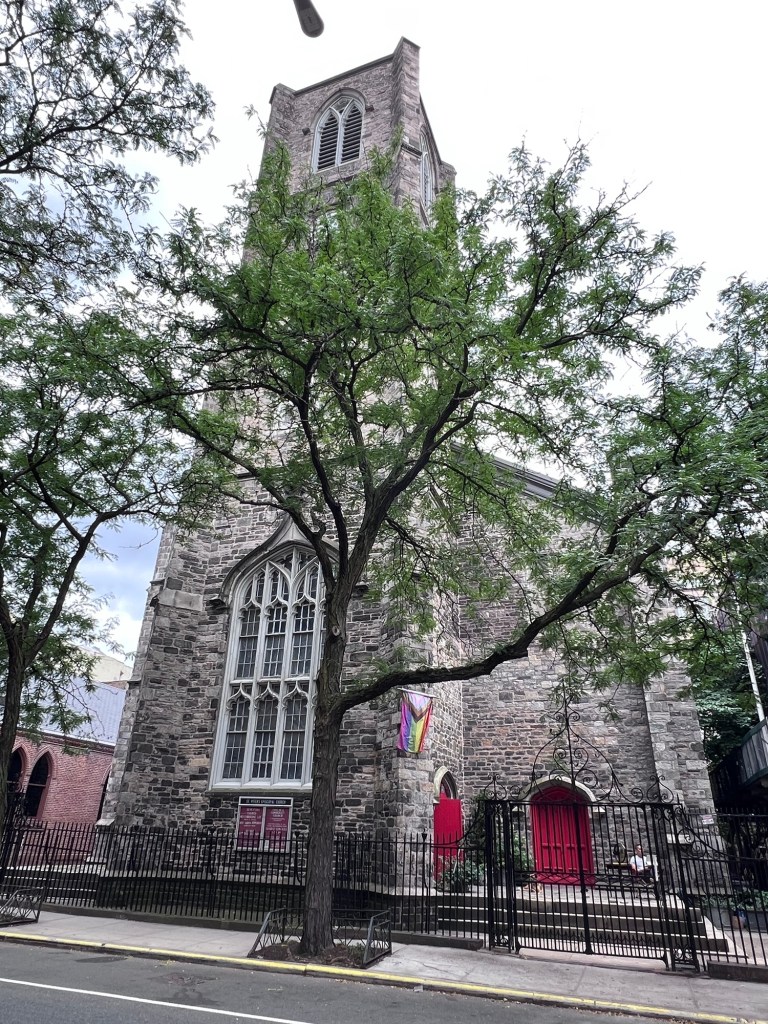
Then I passed the elegant and beautiful St. Peter’s Church was in the middle of the neighborhood.
The sign for St. Peter’s Episcopal Church at 346 West 20th Street
The historic St. Peter’s Episcopal Church in the summer of 2025
St. Peter’s Episcopal Church was constructed in 1835 and was designed by architect James W. Smith in the Greek Revivial style. The design was also influenced by Clement Clarke Moore, on whose estate the land had been donated (Wiki).
As I passed the 10th Precinct at 230 West 20th Street, I looked at the 9/11 mural and realized that next year would be 25 years since that horrible day. It is amazing how fast it has gone by.
I stopped inside the Chelsea Green Park to relax for a while and it was a lot of kids running around and parents talking amongst themselves. The kids seemed occupied by both a water balloon and a squirt gun fight.
The Chelsea Green Park in the late afternoon
After a nice rest and a lot of water, I turned down West 19th Street to continue my tour.
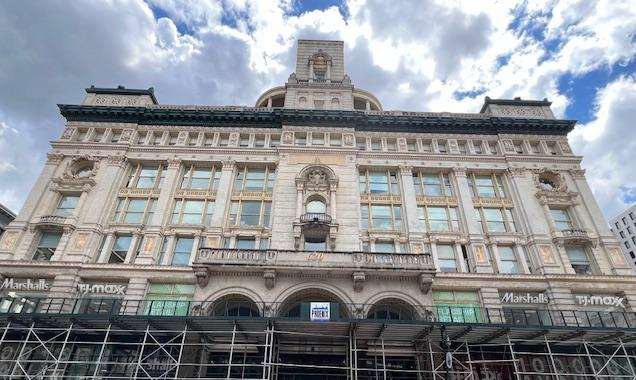
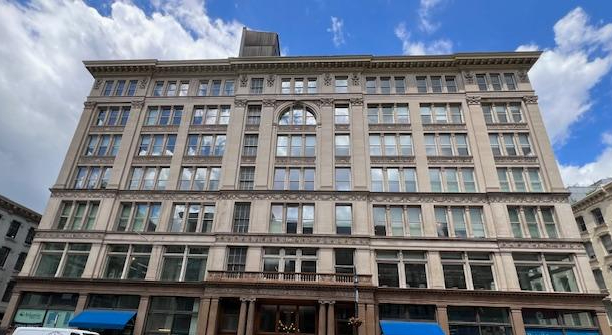
In front of of the old Siegel-Cooper Department Store building on Sixth Avenue and West 19th Street
Walking past the townhouses along West 19th Street
The street art along the way
The beautiful gardens in front of of the homes
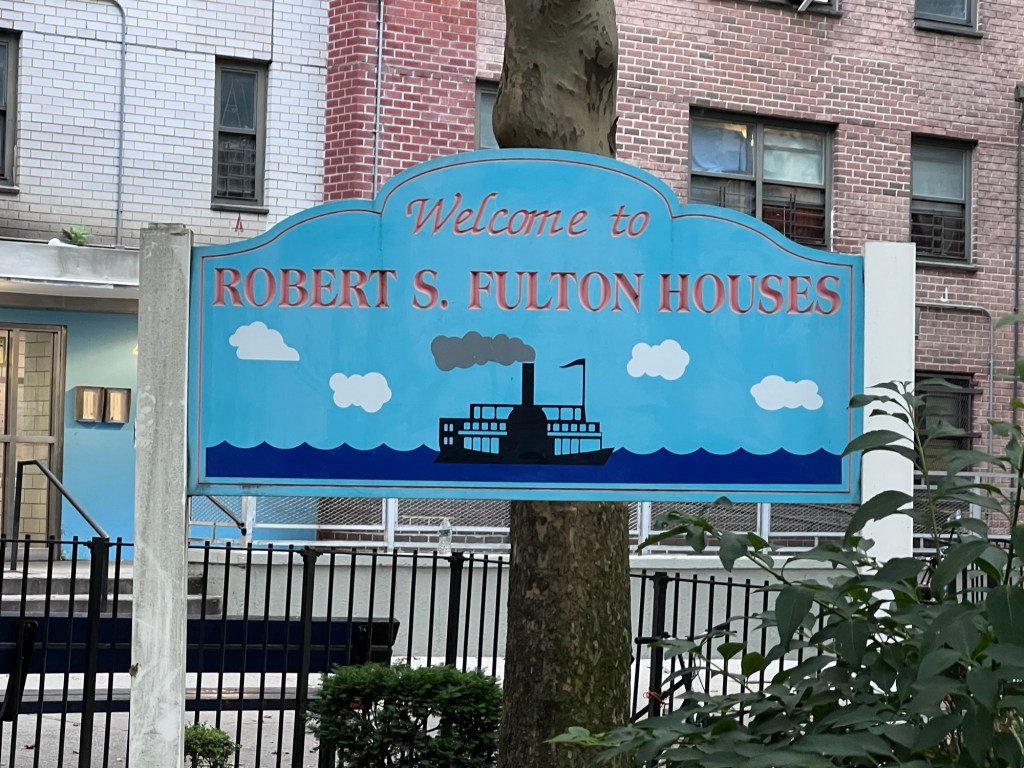
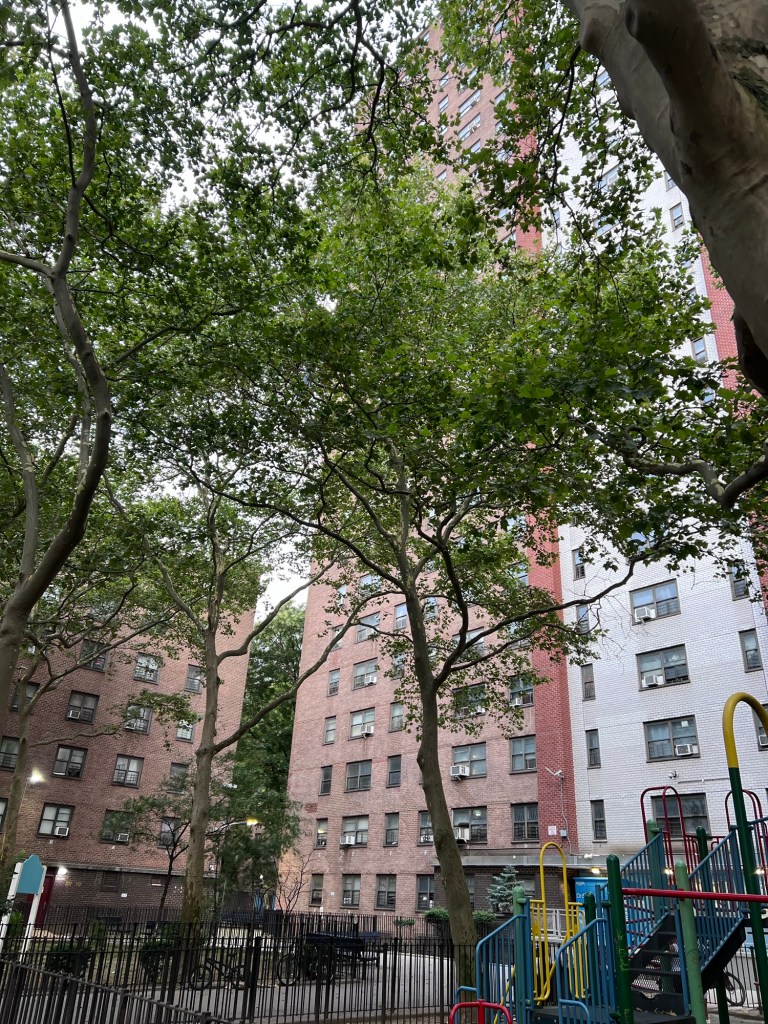
In the middle of the block were the Robert Fulton Houses which along with the Chelsea-Elliott Houses are both slated for demolishing later this year. That will change the completion of this neighborhood. These were opened in 1962 and were designed by architects Brown & Guenther.
Its narrow, 18-foot-width precluded the traditional stable design of a centered carriage bay flanked by a pedestrian entrance and window. The property was a three-story brick house, home to Samuel Weekes and his family who would remain through 1858 (DaytonianinManhattan.com).
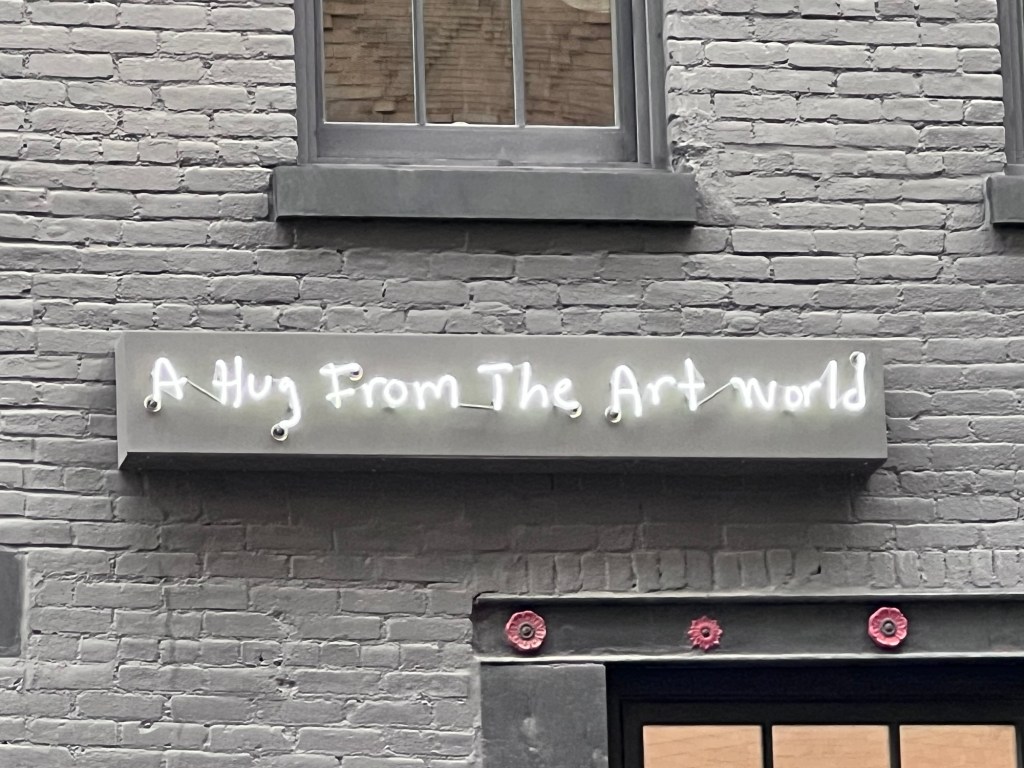
I liked the sign at the top of the door way of the “A Hug from The Art World”
I took a break after all the walking at The Sleeping Cat at 160 Seventh Avenue for a quick snack/late lunch. The place was pretty crowded in the late afternoon. They ran out of the three things I wanted to try so I ordered a Chicken with Brie Club sandwich on a milk bun with a Pomegranate soda for lunch.
My lunch that afternoon
The Chicken and Brie sandwich
Yum!
For dessert I chose a Lemon Poppyseed Cake, which was delicious. You could really taste the fresh lemon juice and zest in the cake.
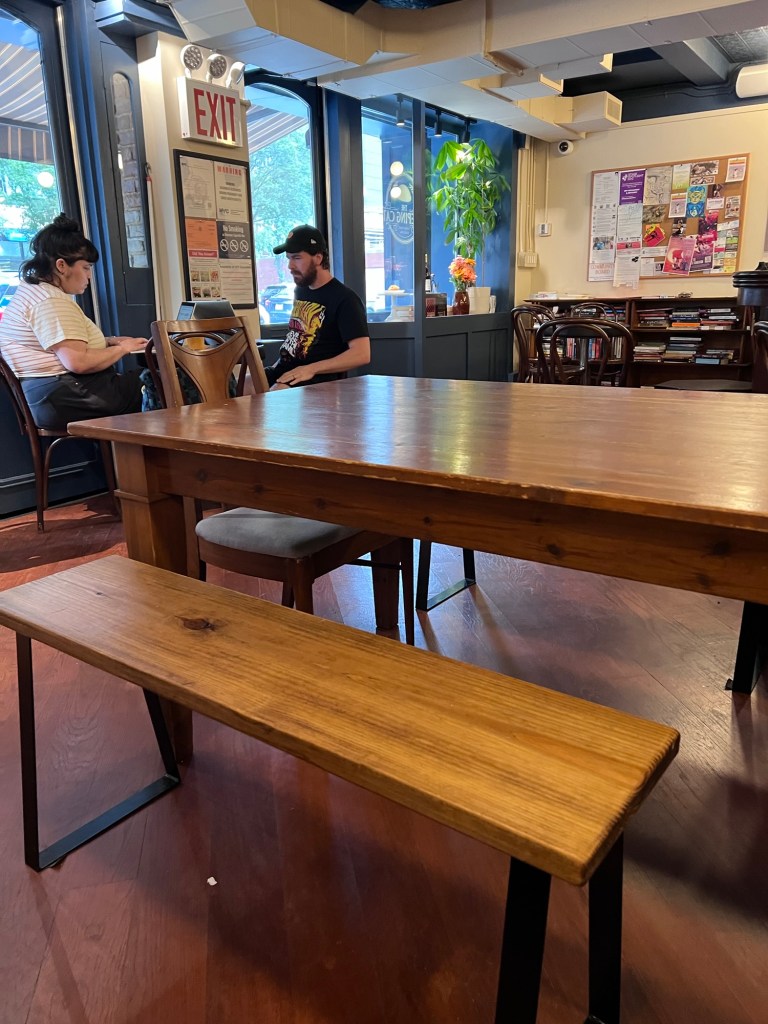
The inside of the unique coffee shop
I continued my tour of the neighborhood a few days later when I came back into the City for the Michigan State Alumni Picnic that Saturday. We ended the picnic at 4:00pm, so I walked from Central Park to West 18th Street after a pit stop to recharge my phone and go to the bathroom.
I wanted to finish the neighborhood before dark but could only finish the blocks from West 18th through West 17th Streets. You just can’t take good pictures after 7:00pm when the shadows hit the buildings.
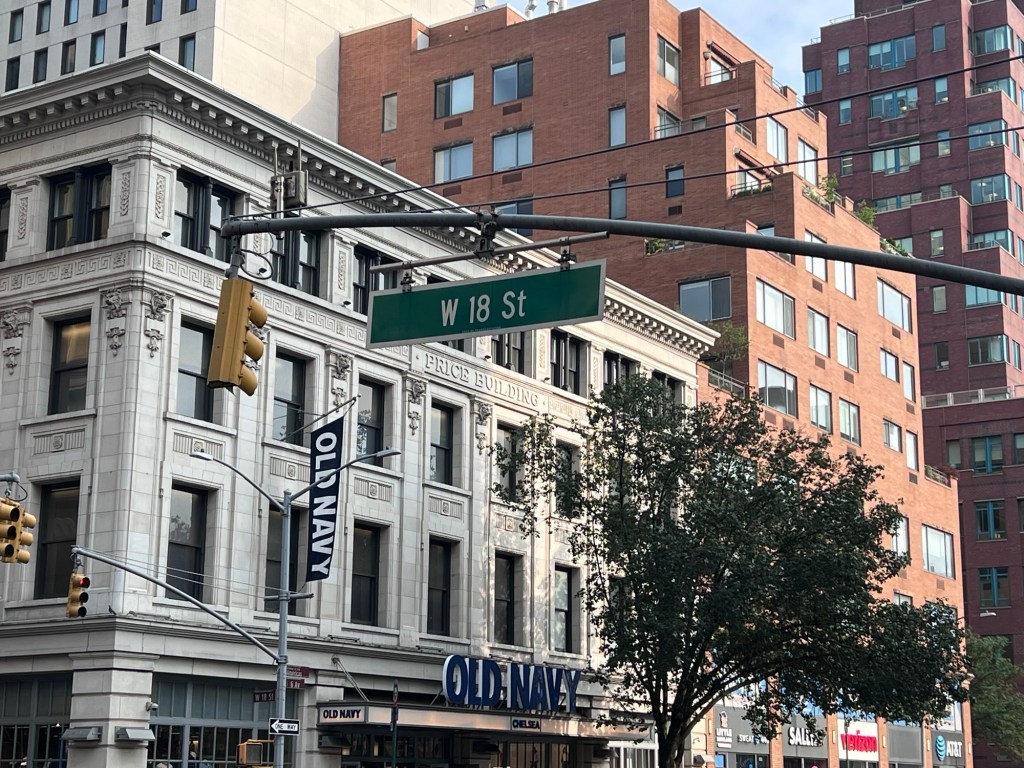
Starting on West 18th Street
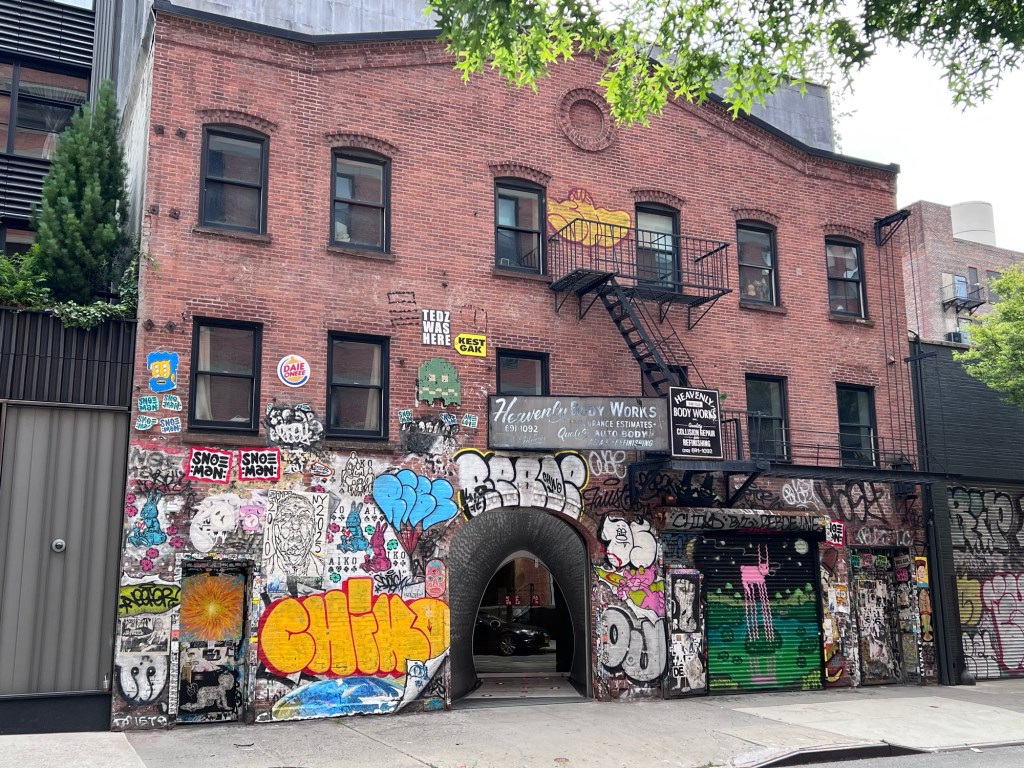
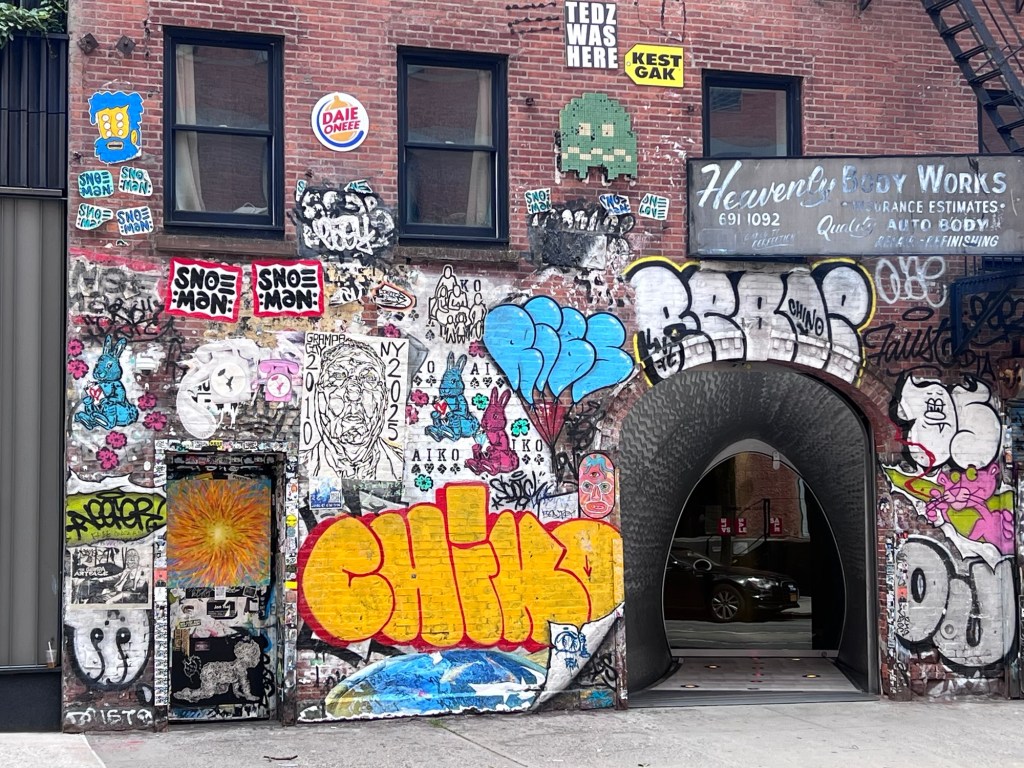
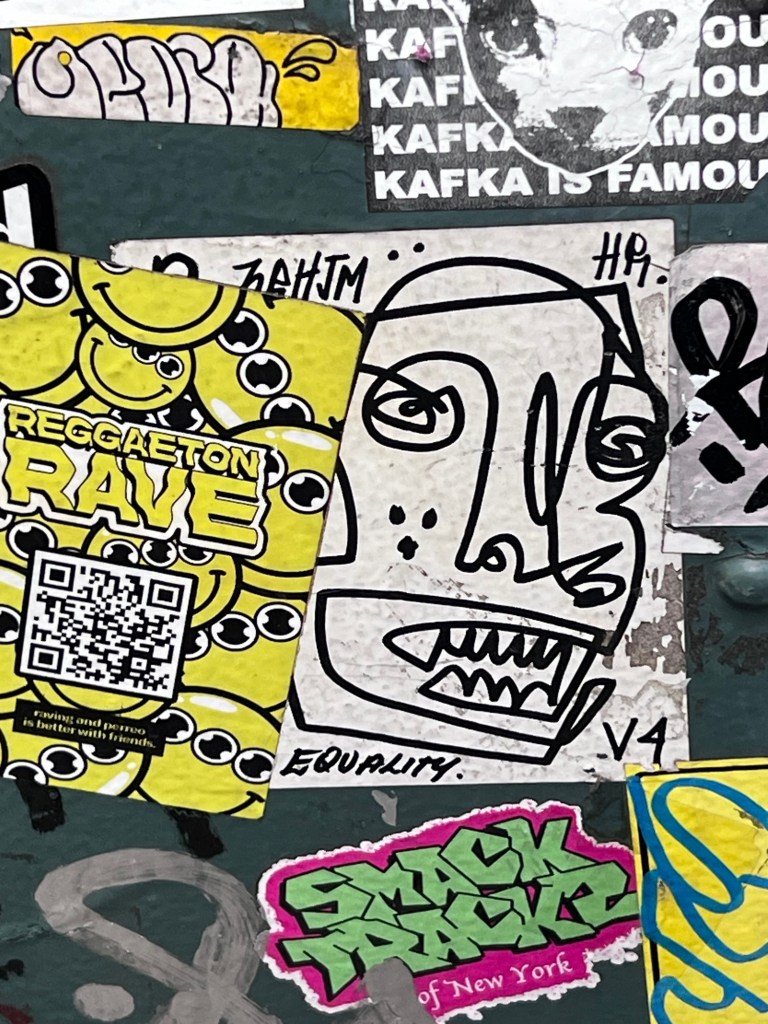
Some of the interesting street art you will see in the neighborhood
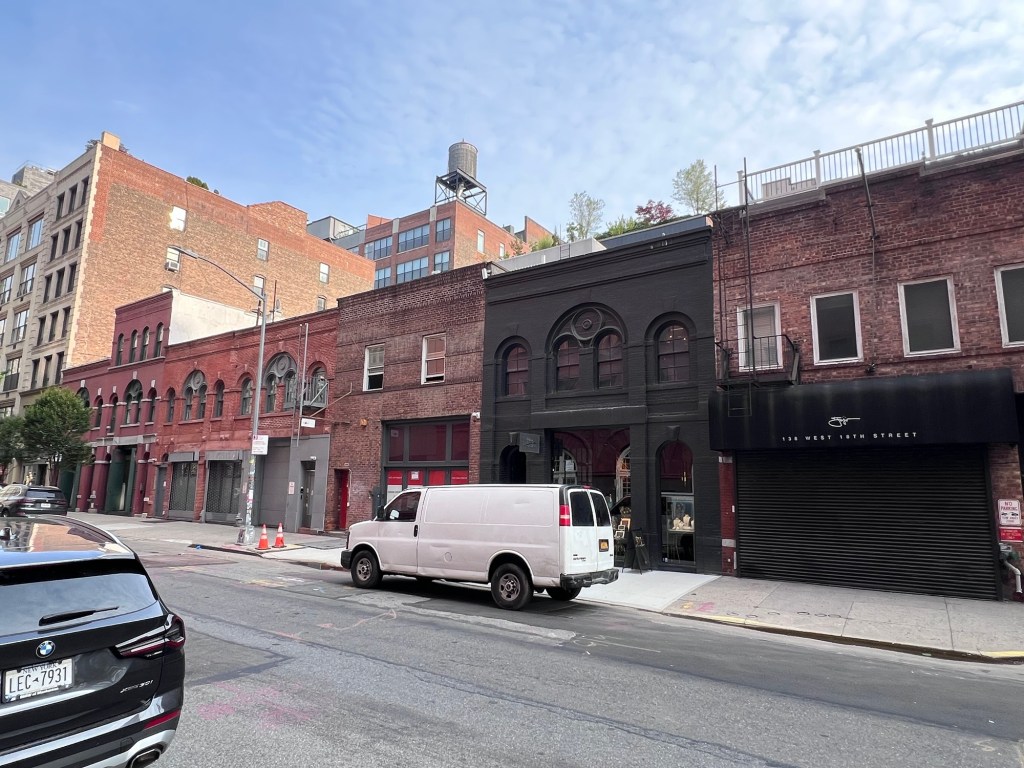
This series of what looks like old carriage houses lines West 18th Street just off Sixth Avenue
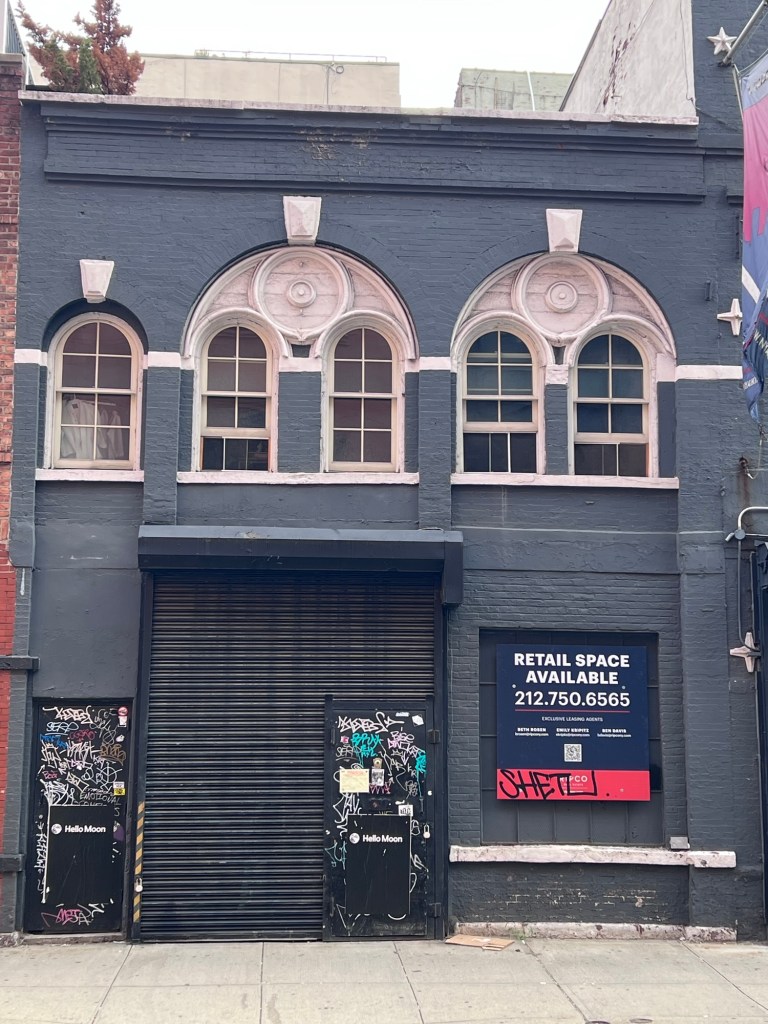
These buildings were designed in a round arched utilitarian style related to the German Rundbogenstil and incorporate Romanesque and Renaissance Revival details. They were built between 1864 and 1865 and were used as stables (HDC.com). They are now being used as restaurants, shops and art galleries.
A close up of one of the series of buildings at 136 West 18th Street
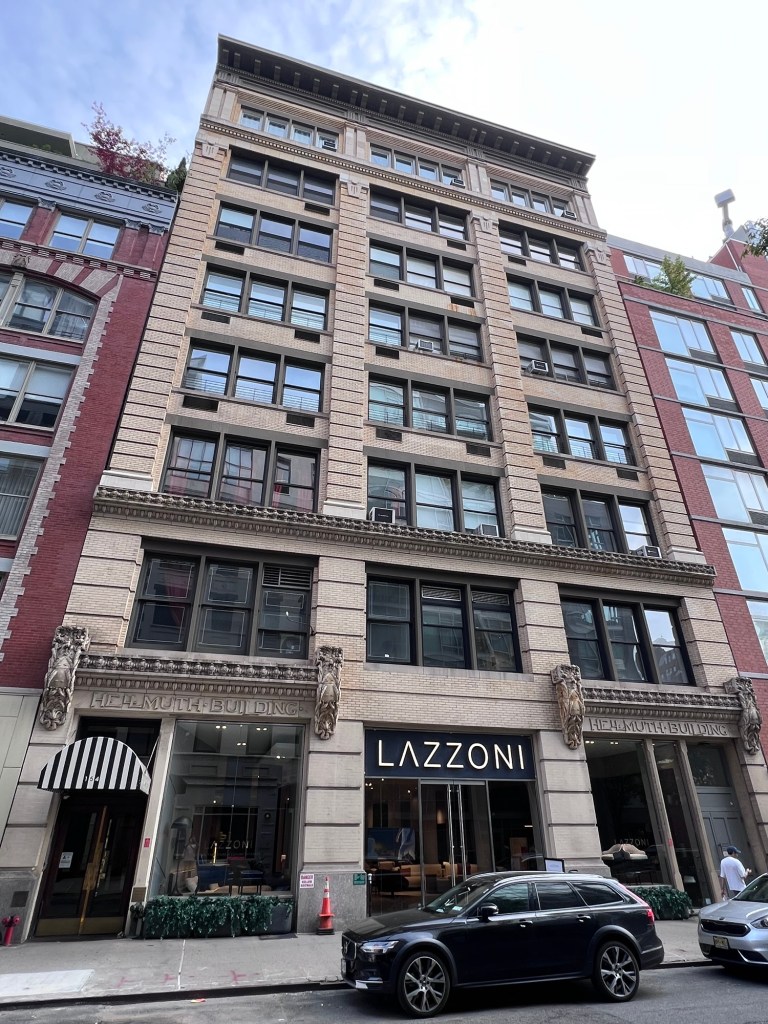
There were several buildings that stood out along West 18th Street and one of them was 154 West 18th Street, the Hellmutg Building now home to the Lazzoni store.
The Hellmuth Building was designed by architect Adolph Schoeller in the Art Nouveau style in 1907 and was built for William Hellmuth, who was a highly-successful manufacturer of printing and lithographic inks and varnishes (DaytonianinNYC.com)
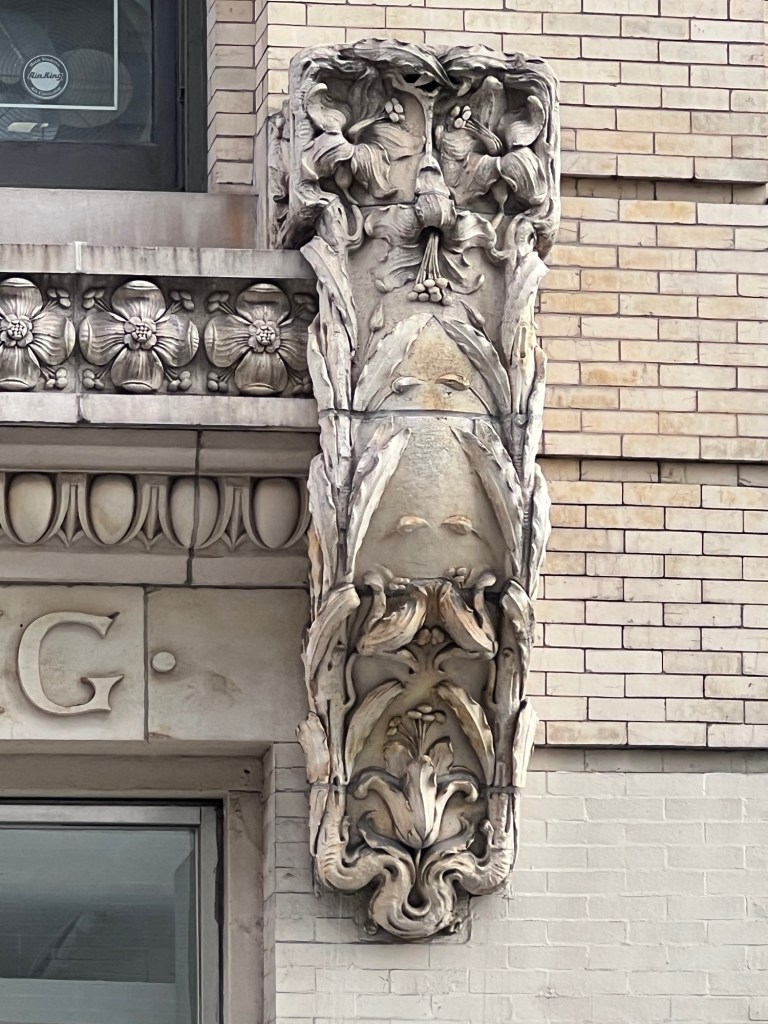
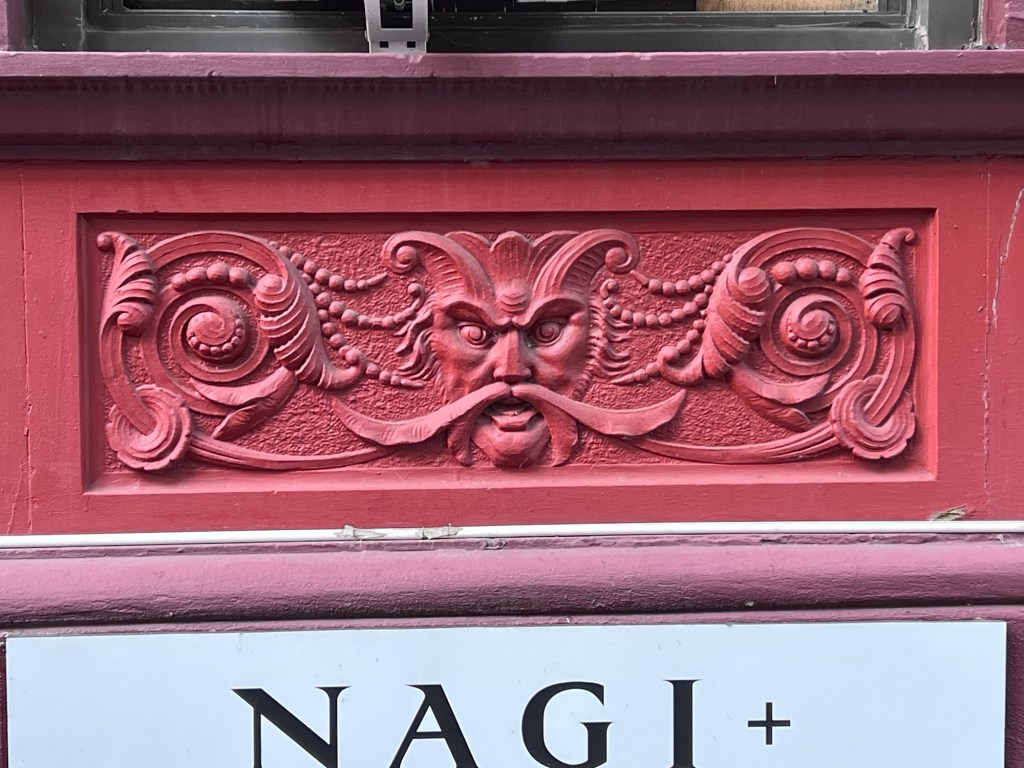
The details of the Hellmuth Building
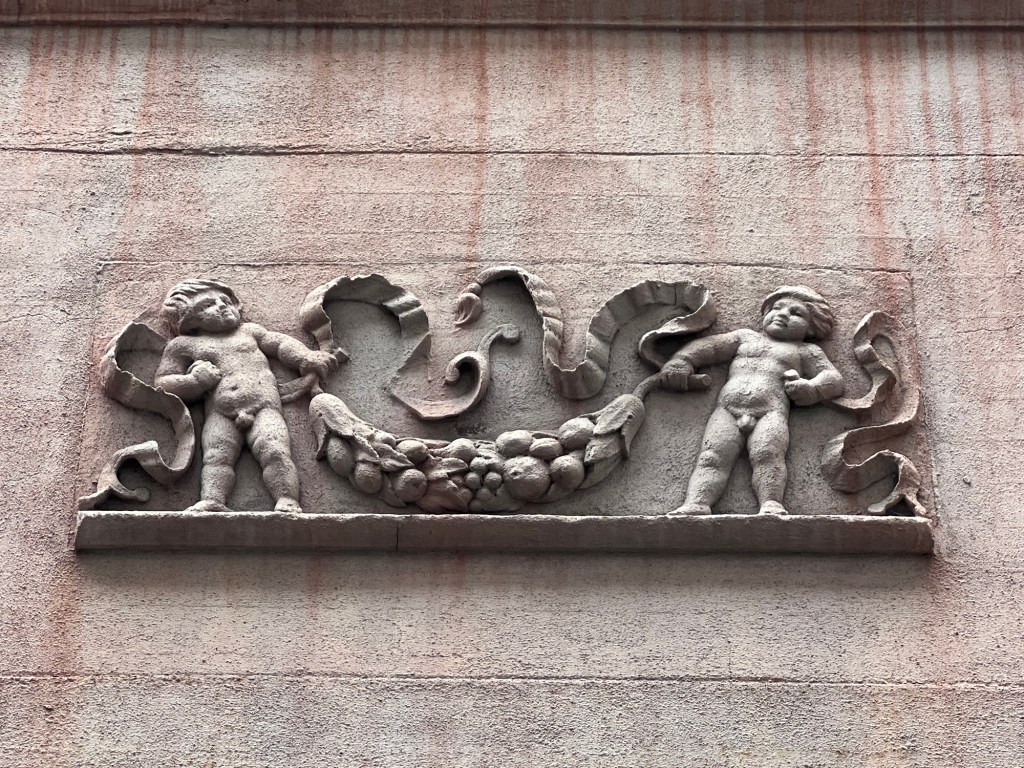
The carved embellishment of the building
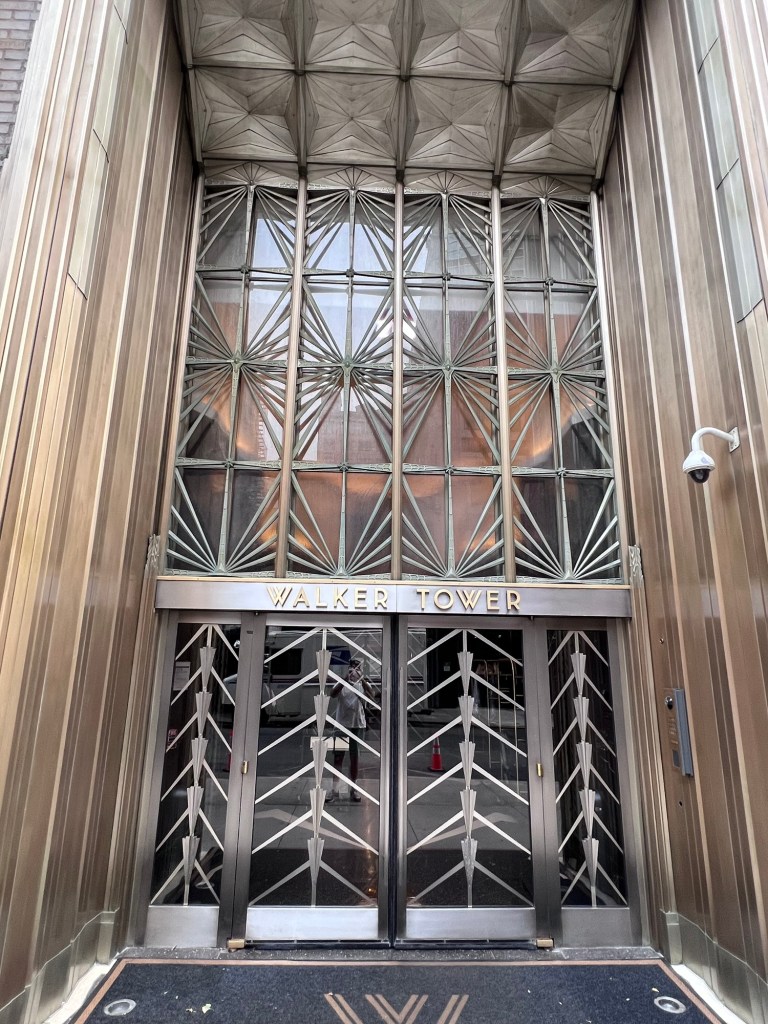
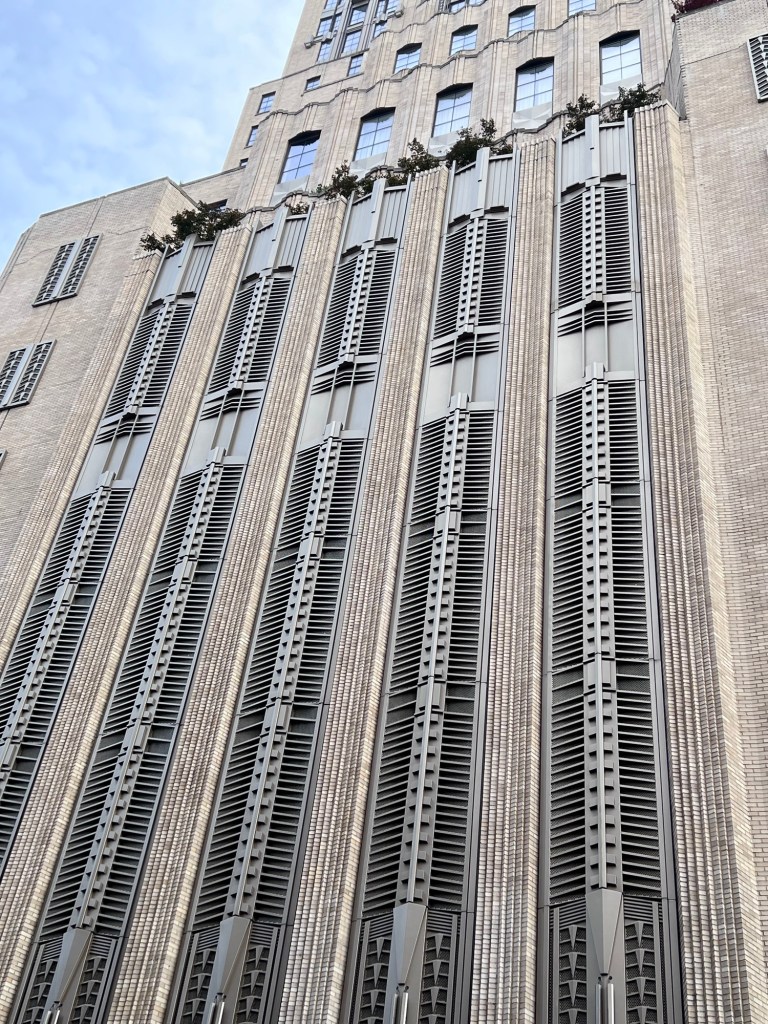
Another building that stood out was the Art Deco style Walker Tower at 212 West 18th Street
Originally constructed in 1929 as a commercial building for the New York Telephone Company, this historic structure was designed by the renowned architect Ralph Thomas Walker, celebrated for his distinctive Art Deco style (The Walker Tower website).
The Walker Tower in full view
The art deco details to the outside of the building
The details outside of 265 West 18th Street were very unique.
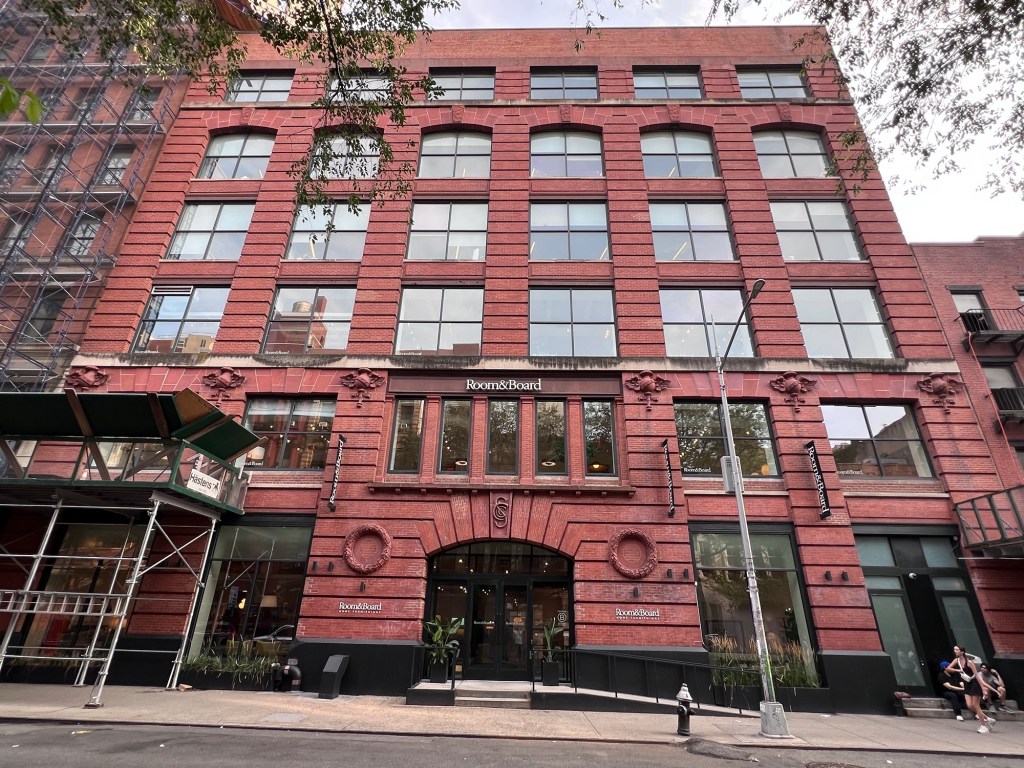
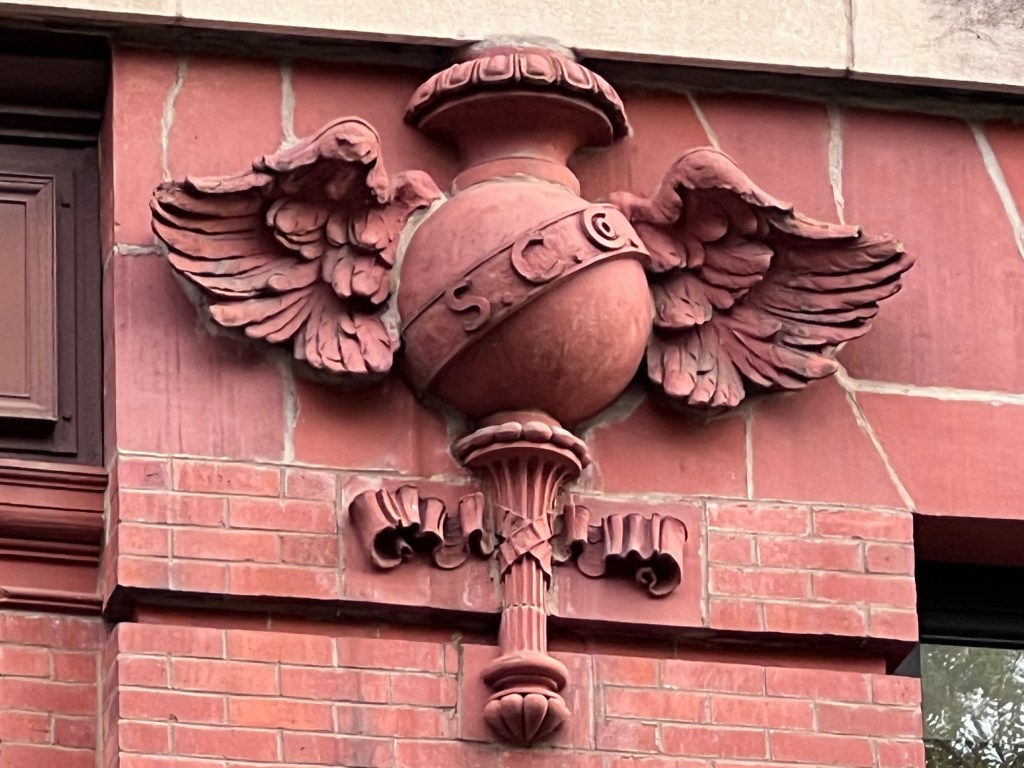
While I was walking down the street, I passed the Room & Board store and saw all the embellishments on the building and wondered what they meant. It was the insignia for the old Seigel-Cooper Warehouse building.
The old Siegel-Cooper Warehouse Building is now home to the Room & Board showroom at 249 West 17th Street with entrance at West 18th Street
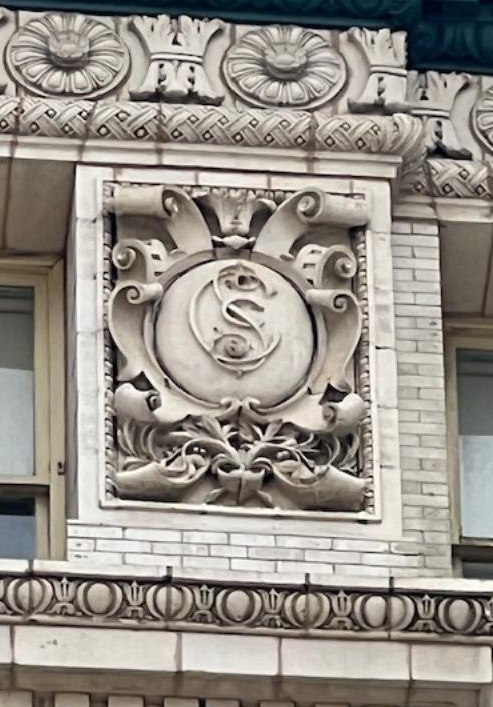
The Seigel-Cooper insignia can still be seen on the building
The building was designed by the architectural firm De Lemos & Cordes and opened in 1904. the architects used lusty terra cotta ornaments to distinguish the façade. Each pier culminated with winged orbs bearing a sash emblazoned with SC&Co; and the bay doors were flanked by large, intricate wreaths (DaytonianinManhattan.com).
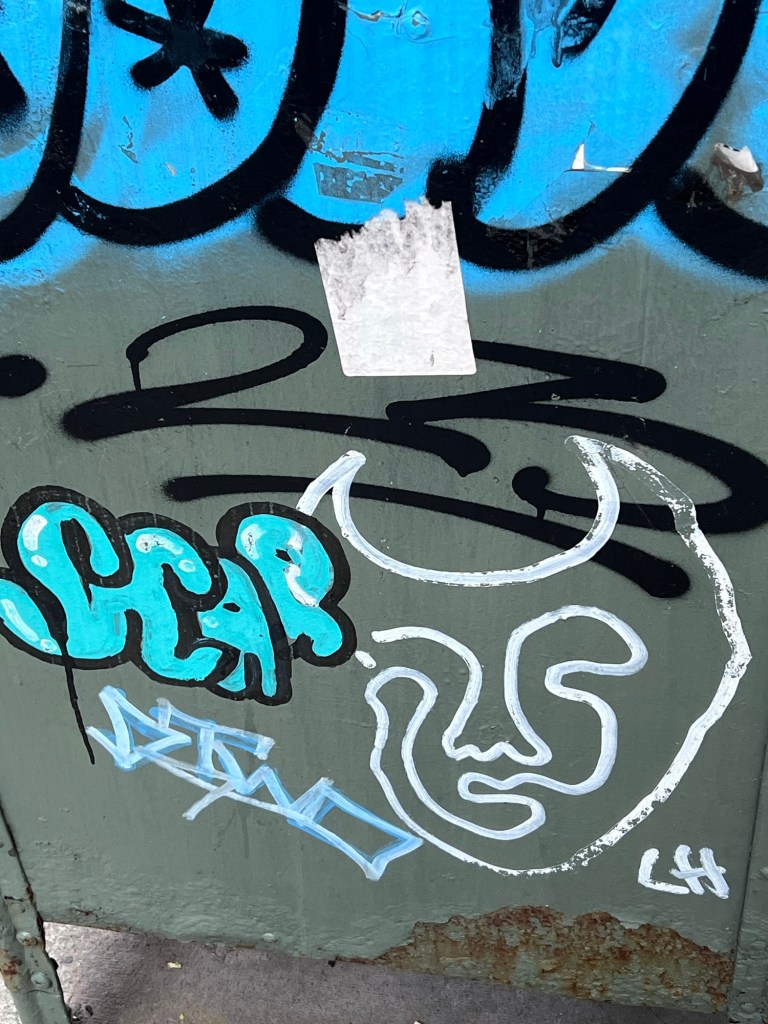
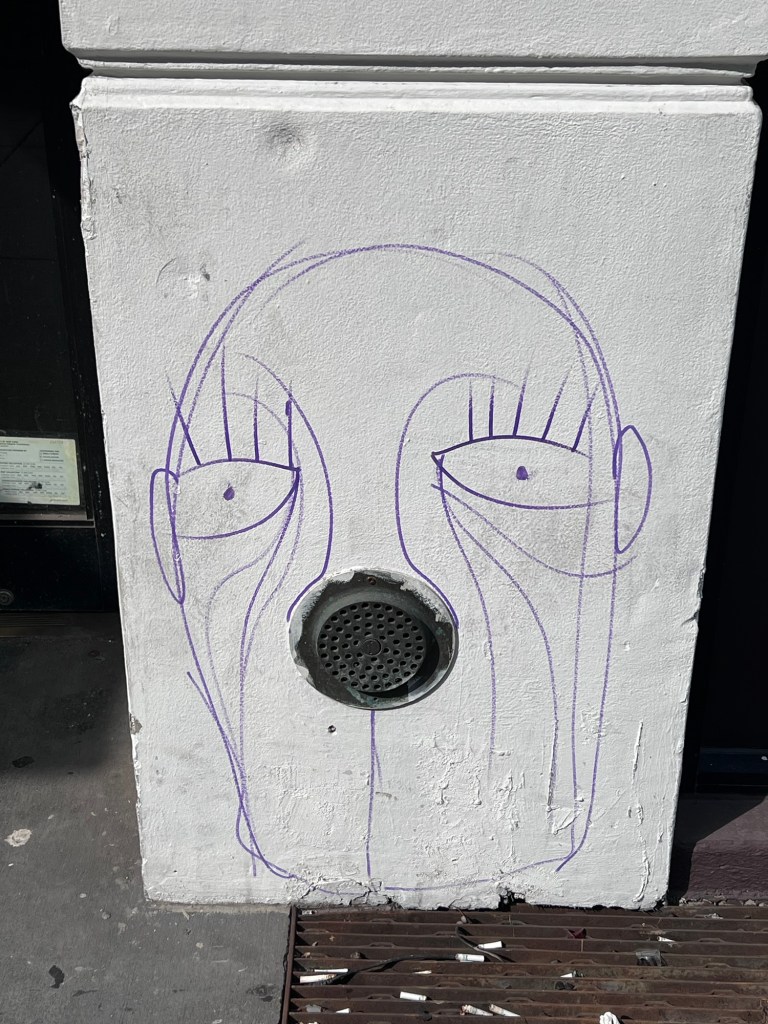
You can find street art all over the sidewalks in this neighborhood. Just look down and many artists leave their mark.
This interesting twin building with a mansard roof was built in 1910 (Streeteasy.com). What I thought was interesting about the building is how it stands out amongst all the brick townhouses that had a plainer design. It looks like something you would see on the Upper East Side inside of this neighborhood.
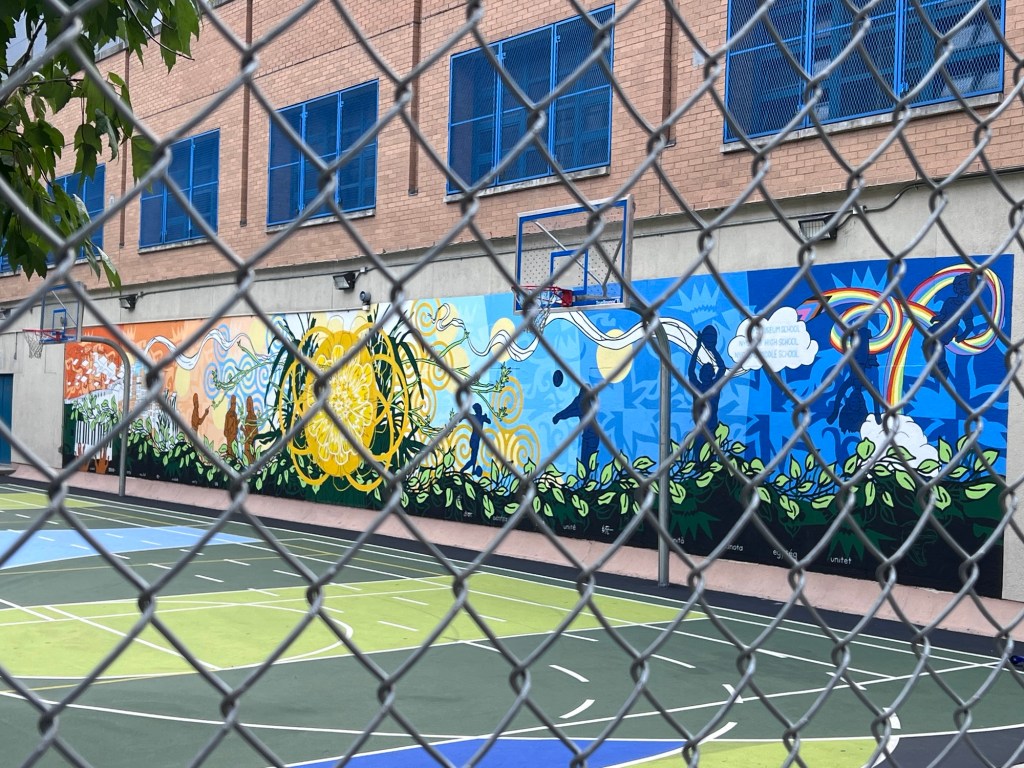
As I passed the high school in the area, I came across this mural painted on the playground walls. I saw this mural on the Liberty High School for Newcomers at 250 West 18th Street. I could not get a good look at it as the playground was locked.
The mural outside of the Liberty High School for Newcomers at 250 West 18th Street
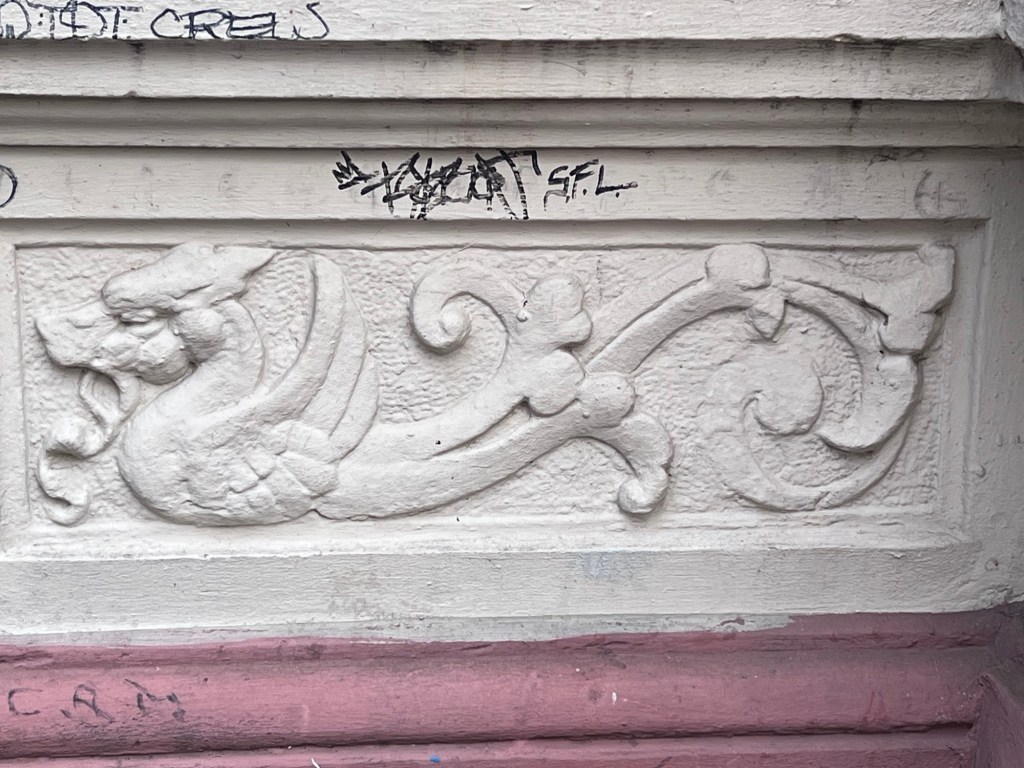
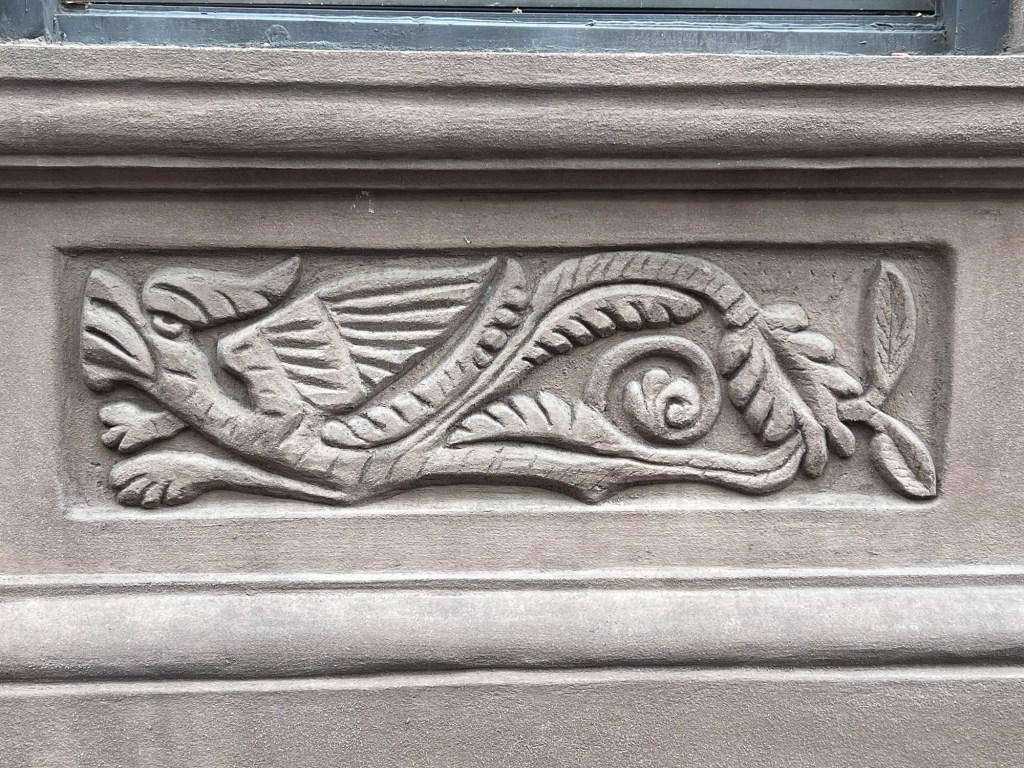
A serpent embellishment outside one of the buildings
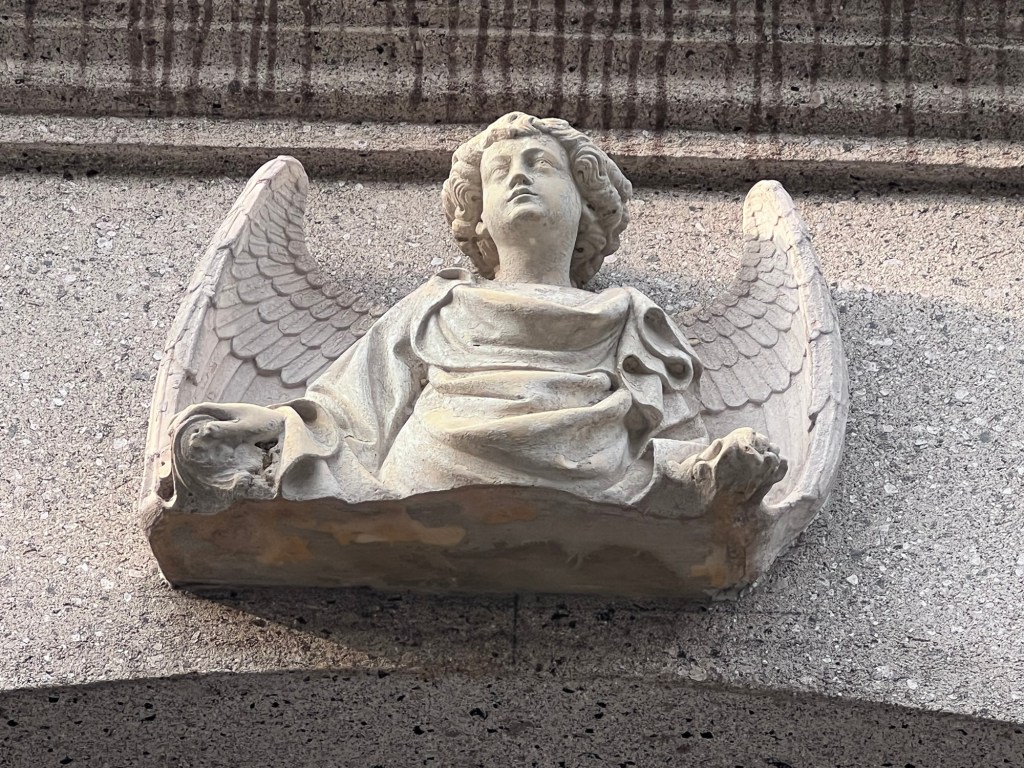
Tucked in the corners of buildings all over the neighborhood, there were all sorts of interesting and unusual street art and stone carvings and embellishments. While most of the buildings were rather plain, it was a serpent here, a dragon there and a face staring back at you from the front door keystone that gave the building something special to admire.
Some of the street artists, whether hired or tagging were very creative on the sides of buildings. I am sure that the building owners were not happy to see this but the City has its own ideas sometimes.
You have to look up or you will miss this street art on the top of one of the buildings
I have seen this artist’s work all over the neighborhood
With all the unique architecture and street art along West 18th Street, I anticipated more surprises when I rounded the corner of West 17th Street. You never know what you will see tucked here and there along these streets.
Turning the corner along West 17th Street and Sixth Avenue
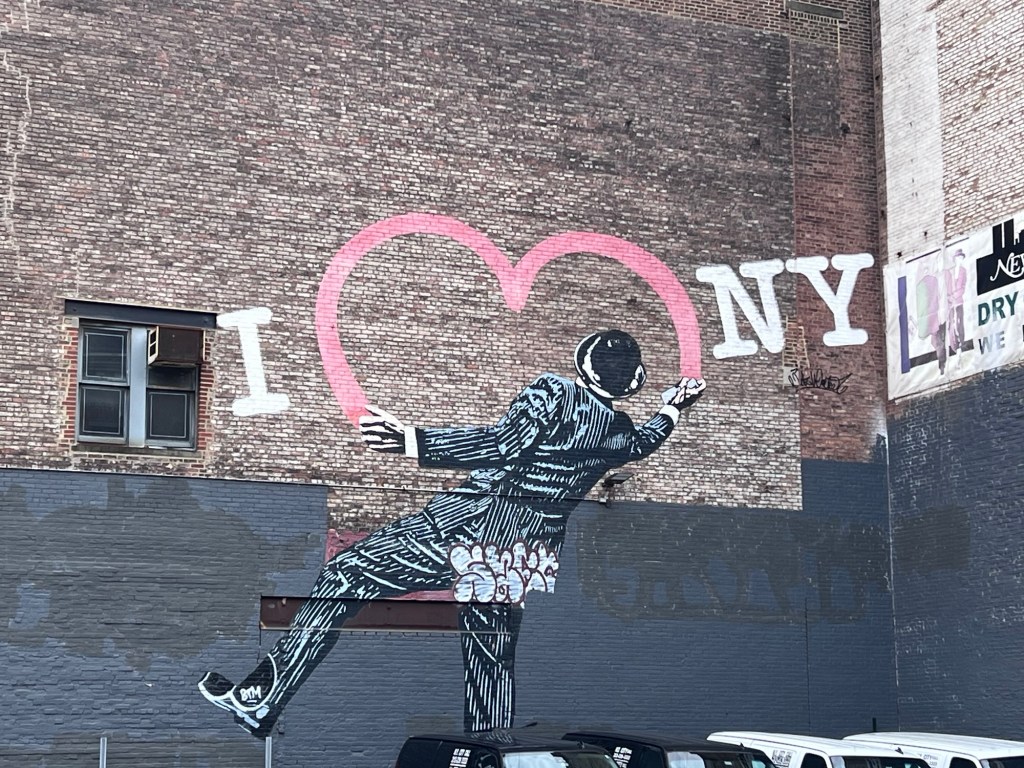
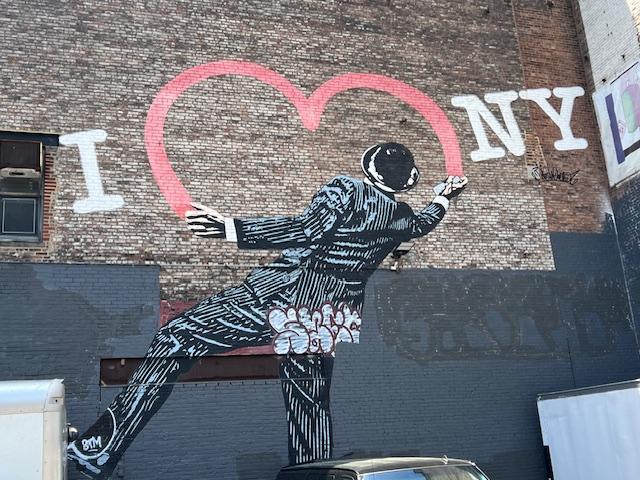
The mural of ‘I Love New York’ is iconic in this neighborhood. This has been here for many years. This work of art was created by artist Nick Walker.
Artist Nick Walker is a British born artist that now lives in Manhattan. He is know for being part of the ‘stencil art’ movement that was started in the 1980’s. He is know for his large murals of contemporary art and is best known for merging freehand work with stenciled imagery (Wiki/Artsy.net).
As I started to walk down West 16th Street, I passed an old friend in the restaurant da Umberto’s at 107 West 17th Street. I have spent the last three Halloween nights enjoying dinner with other volunteers from the Halloween parade here after the parade was over. The food and service are excellent.
Da Umberto’s Restaurant is where we have our dinners after finishing our night volunteering at the Halloween Parade. I have been here for the post dinner celebration for the last four years and the food and service are wonderful (See review on TripAdvisor.com).
Our dinner at Da Umberto’s on Halloween night
The restaurant’s food and service are wonderful and I highly recommend it.
The irony was just to add to the Halloween lore, these street art bats were right next to the restaurant.
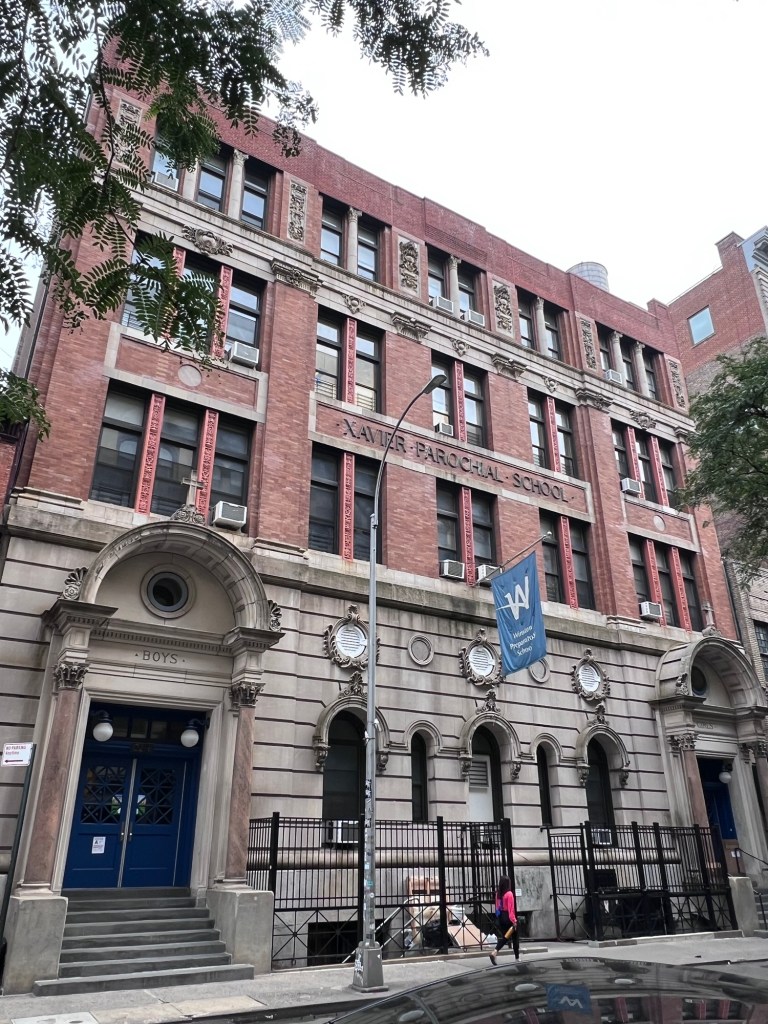
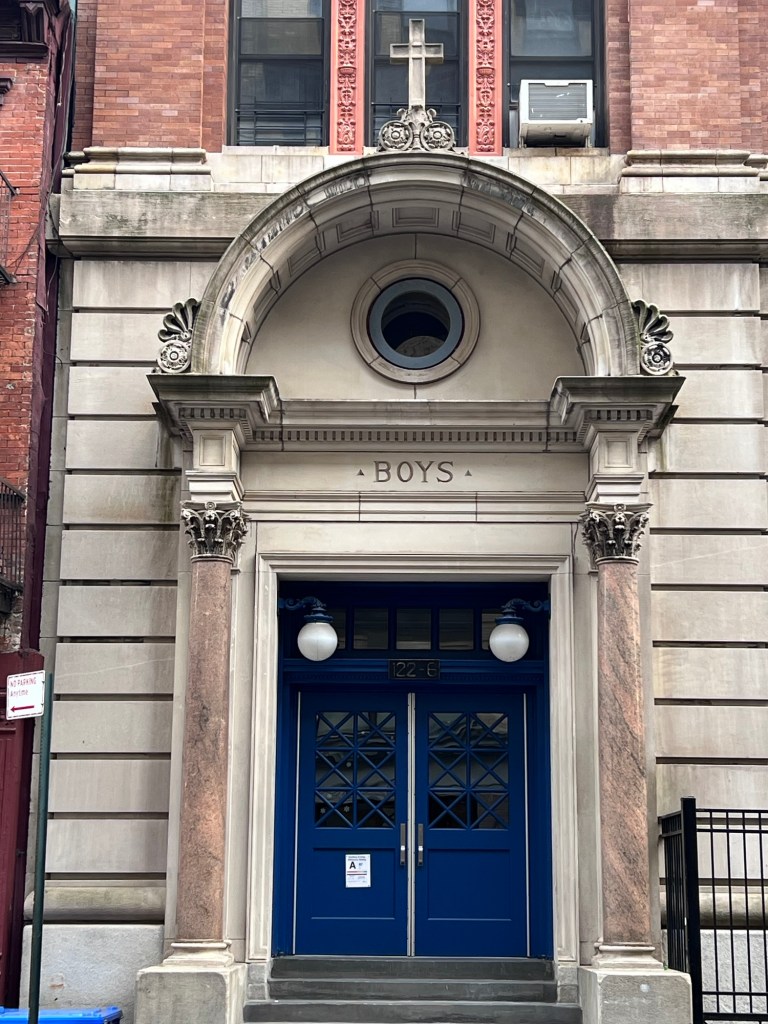
One of the most beautiful buildings on the block is the old Xavier Parochial School now the Winston Preparatory School at 126 West 17th Street. The details on the school are so beautiful and it still has the original entrances of one for Boys and one for Girl’s.
The Winston Preparatory School at 126 West 17th Street
The building at 128 West 17th Street was built around 1853 and had once served as the Xavier Parochial School and now houses the Winston Preparatory School (Wiki).
The old Boys entrance
The old Girl’s entrance
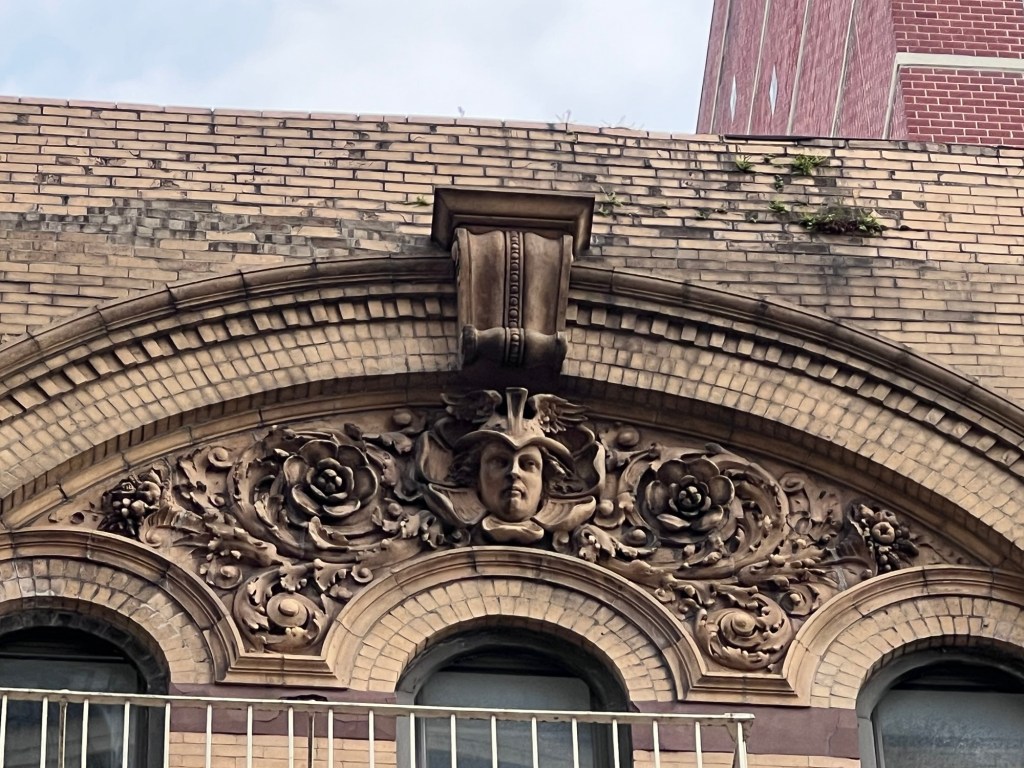
All along the buildings in Chelsea there are the interesting embellishments that stare, surprise and snarl at you. You just have to put down that cellphone and look up.
The top of the building had many snarling tigers staring out into space
Embellishment on the top of the building
The embellishments on the top of the building
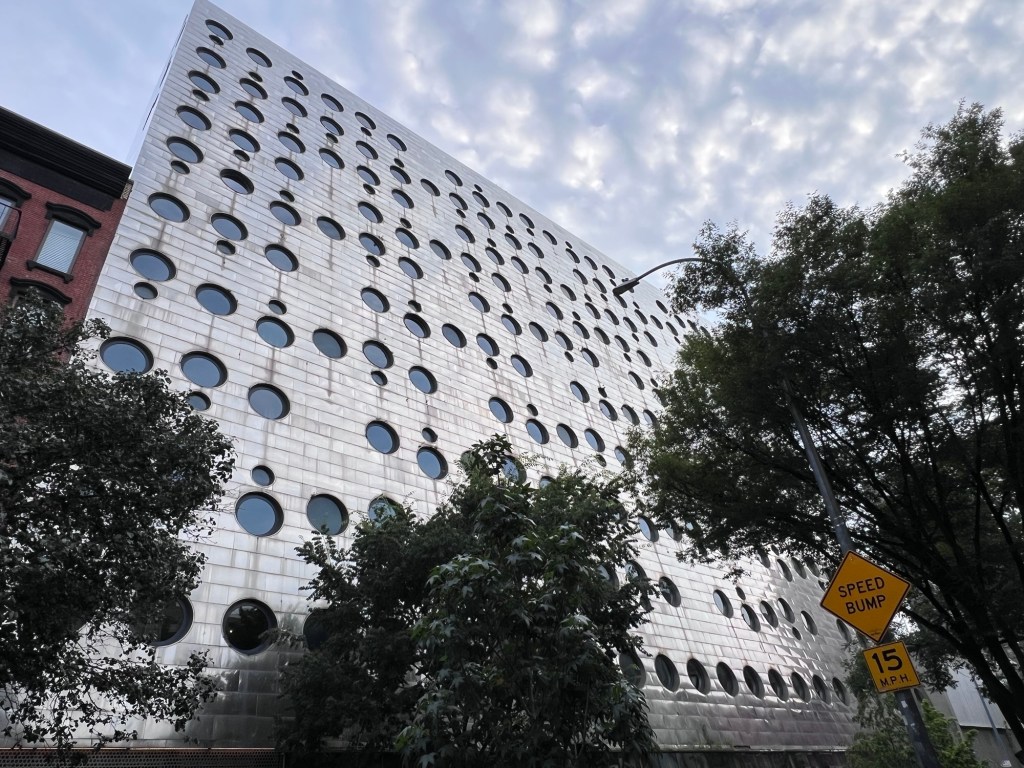
Another building that stood was futuristic structure with all sorts of pot holes. This is the former Maritime Union Building that is now the Dream Hotel. It was once part of a series of three buildings that was part of the National Maritime Union. When the Union folded due to lack of membership as industry changed, the building was left empty. The building designed byBronx-born but New Orleans-based architect Albert C. Ledner in 1966 (New Yorkitecture 2015).
When I walked to the end of the block and turned back, it took a look across the street to the Robert Fulton Houses playground and saw the most creative and unusual set of plantings along the wall. I could not find on the artist on these works (but I will keep looking). These are fun!
The paintings in the Robert Fulton figure
This series of paintings was behind the water fountain along the back wall of the park.
The close up of the third painting in the series
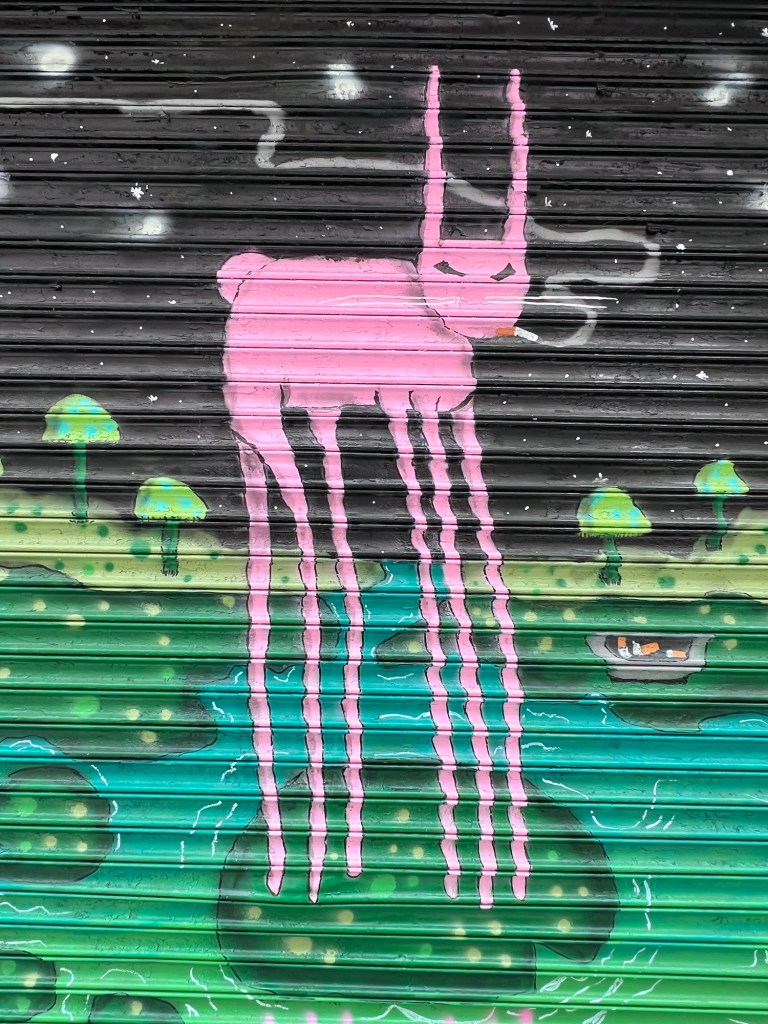
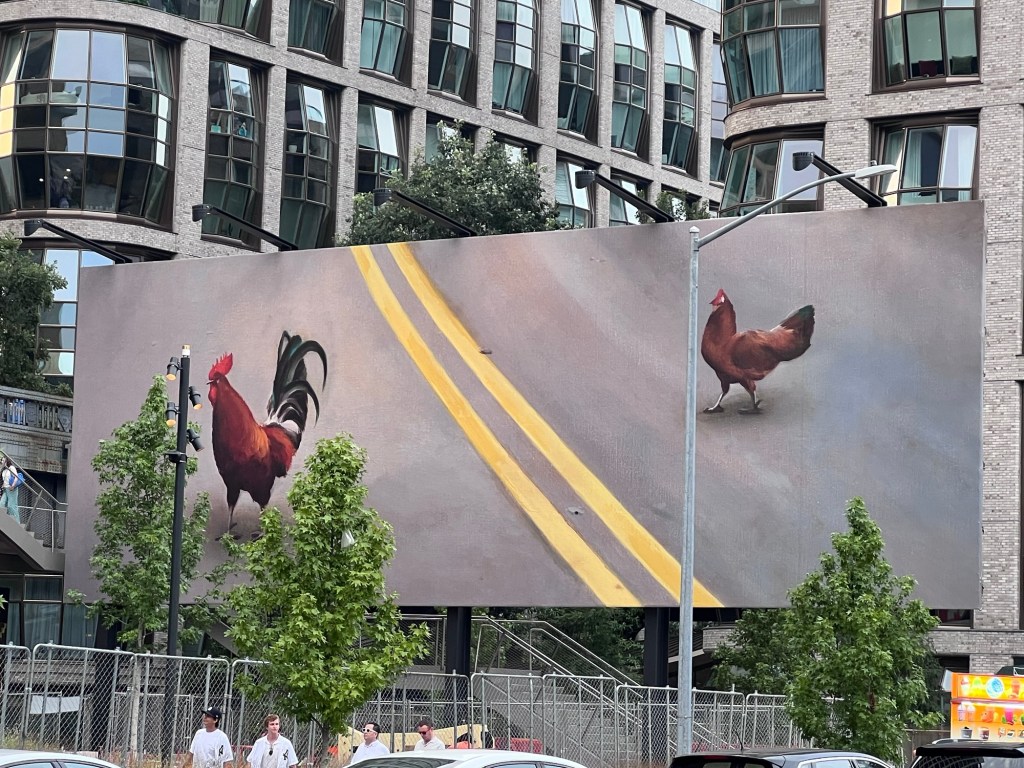
This painting of the Chicken crossing the road “Don’t Ask” by Artist Allison Katz. It seemed to replace the Pink Panther mural of a few weeks ago.
Artist Allison Katz presents Don’t ASK. On this monumental scale, a rooster and hen are depicted in the middle of an asphalt street, seemingly bringing to life the classic anti-joke, “why did the chicken cross the road?” (High Line.org).
Artist Allison Katz is Canadian born artist who now lives in London, England. She studied Fine Arts at Concordia University in Montreal and received her MFA from Columbia University in New York. Katz’s work investigates the ways in which aesthetic practices link and absorb autobiography, information systems, graphic icons, and art history (Ago.ca).
At the very end of the road, West 17th Street turned into a cobblestone street and you do not see much of this anymore in Manhattan.
Walking back from Tenth Avenue, I saw the street art from a different angle and I could see the street art peaking out from behind the fence.
The street art in the empty lot along 20th Avenue
There was something unique about this tiny garden just off 10th Avenue
Another face staring out at me
There was another small park on this block to relax and cool off too. The Dr. Gertrude Kelly Park is another patch of green where residents were relaxing that afternoon.
It was nice to be able to sit under a shade tree and just relax. Though it was not as hot as previous days, it got warmer in the late afternoon.
The inside of Dr. Gertrude B. Kelly Park on hot afternoon
The park goes through the two blocks
On the way back to Sixth Avenue, I passed the back of the old Siegel-Cooper Department Store warehouse building that is now the Room & Board store. The same beautiful details were on both sides of the building.
The Seigel-Cooper Warehouse Building
Here and there I kept seeing such interesting street art along the walls and corners of buildings all over the neighborhood.
This interesting looking ‘PAC Man’ figure was on one of the walls of a building on the block
The last building I passed was the Rubin Museum which was closed that day. I had not been there in over a decade and remembered that it did have very interesting art. I had not realized that the museum had closed its doors in the Fall of 2024. It closed October 6th, 2024.
The Rubin Museum at 140 West 17th Street (Closed in October 2024)
The Rubin Museum of Himalayan Art (formerly Rubin Museum of Art) was founded in 2004 as a haven for Himalayan art in the Chelsea neighborhood of New York City by Shelley and Donald Rubin, who are philanthropists, cultural leaders, and collectors. The opening was the culmination of 30 years of art collecting, six years of planning, and the purchase and renovation of the former Barneys department store (Rubin Museum website-Museum Closed in October 2024).
As I exited West 17th Street to finish my walk of this part of the Chelsea neighborhood, I came across this interesting piece of street art on Seventh Avenue. It always amazes me with people on what they can create.
This was on the wall of an empty store on Seventh Avenue
On my last day walking around the lower part of the neighborhood, the temperature hit 96 degrees and the humidity was worse. Since I only had to walk from Sixth to Eleventh Avenues from 15th to 16th Streets, I thought it would take about an hour. Throw in lunch and a dessert break and it was two and a half hours in the heat.
Starting the walk at the corner of West 16th Street and Sixth Avenue
The tree lined blocks between Sixth and Seventh Avenues
Here and there the small gardens pop up with lots of colorful flowers
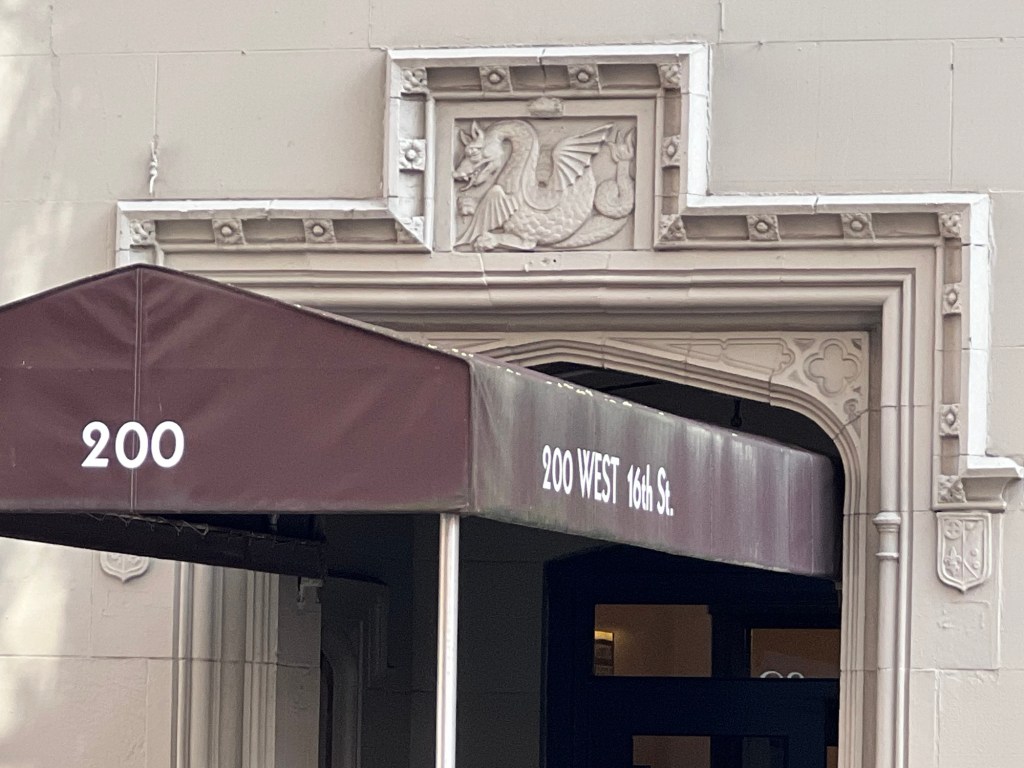
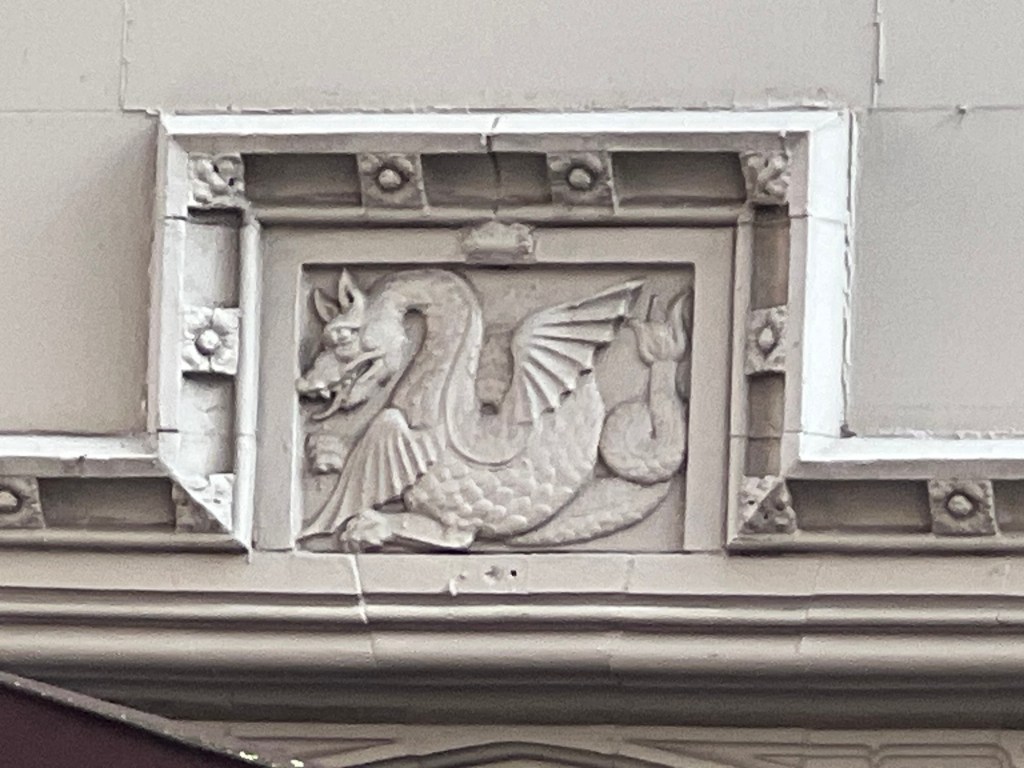
I loved this serpent carving at the entrance of 200 West 16th Street. The building was covered with all types of creatures.
t was the first of the four distinguished developments by visionary developer Henry Mandel and was designed by esteemed architects Farrar & Watmough. Farrar & Watmough harmoniously blended the Jazz Age and Gothic Revival styles creating a building with a visually striking and architecturally significant facade adorned with variegated orange brick, limestone and terracotta (Streeteasy.com)
The serpent above the doorway at 200 West 16th Street
I had to stop for some lunch and I came across a pizzeria that had been my ‘go-to’ since I started at NYU. I always enjoyed the specials for lunch and dinner. In just a year, the prices did go up a few dollars but the pizzeria is still reasonable.
J’s Pizza at 96 Seventh Avenue at the corner of Seventh Avenue and West 16th Street
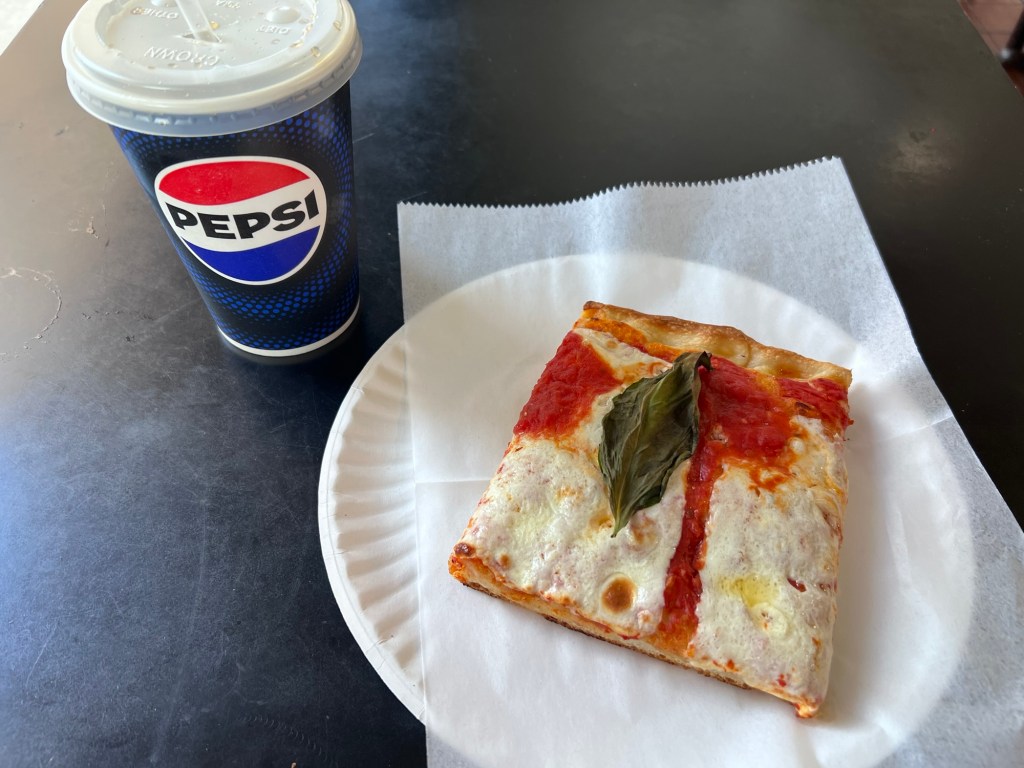
I stopped in at J’s Pizza for a quick lunch. I had not realized I had not eaten here since I had graduated from NYU in the middle of last year (did college fly by in the blink of an eye). I forgot how good their food was when I ordered my lunch. I had a slice of their Fresh Mozzarella Sicilian pizza and a Coke and it hit the spot on this hot day.
My Sicilian slice
What a great lunch and a nice break
I continued my walk down West 16th Street passing businesses and homes and noticing the changes in the neighborhood with renovations and new buildings going up. More and more this particular neighborhood is getting very desirable and the homes more expensive.
The embellishments outside of 224 West 16th Street
This interesting pre-war building was built in 1800’s (Streeteasy.com). By the mid-1840’s Timothy Phelan and his family lived in the three story, brick-faced house at 197 West 16th Street (renumbered 319 in 1859), just west of Eighth Avenue. Twenty-five feet wide, its dignified Greek Revival design reflected influences of the emerging Italianate, notably in the understated entrance above a stone stoop (DaytonianinNYC.com)
The stonework in more detail
The end of the block is dominated by the Marine Hotel and its series of high end restaurants
The Marine Hotel with its restaurant, Tao Downtown is in front
Then I saw this very unusual street art right by the Fulton Houses
The High Line Park dominates over this part of the neighborhood with its lush plantings and its interesting display of artwork. Try to walk the distance on the walkways of this incredible urban park.
As I was walking back up the street, I noticed a whole building of faces following me along the sides of 111-114 Eleventh Avenue. You have to look really closely to see the changes by each window.
Along Eleventh Avenue I had not noticed this building at all
You have to look at each window and doorway from across the street to really appreciate the beauty of this building.
The last of art that I saw on the block was this mural for the Bond Vet business around the corner by artist Jade Purple Brown. I thought the colors were so vibrant and that it really promoted this business well.
Jade Purple Brown is a Brooklyn based artist known for her vibrant portrayals of Black women in psychedelic, dreamlike worlds (Artist bio on website).
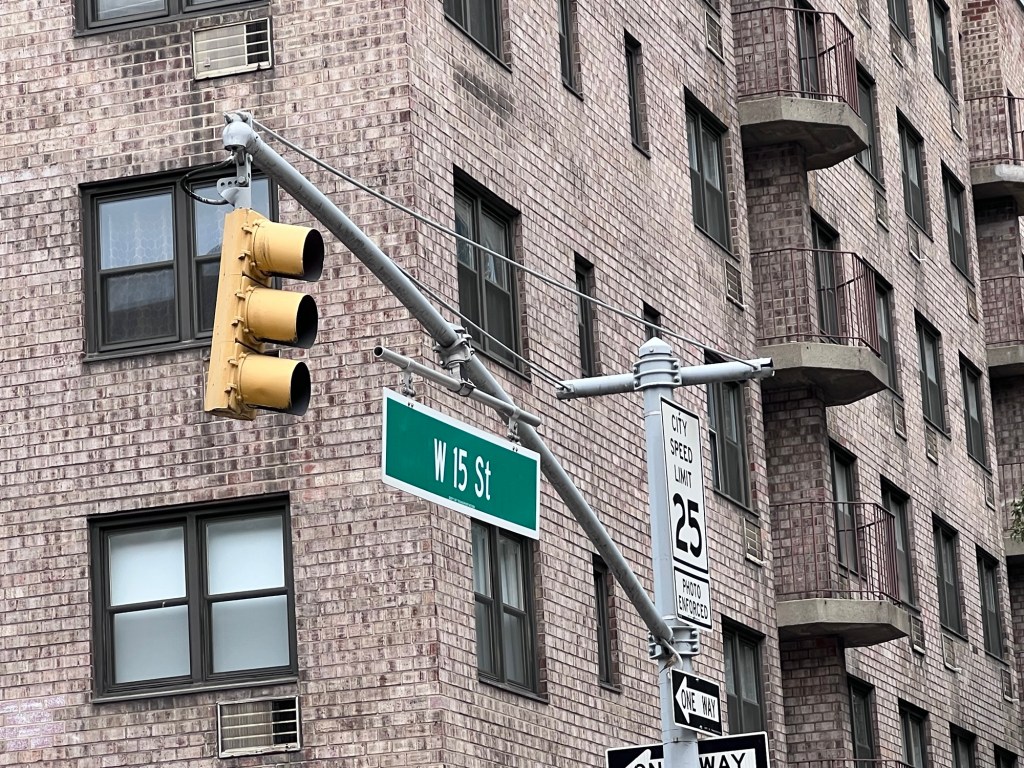
I finally rounded West 15th and Sixth Avenue in the late afternoon and breathed a sigh of relief as it was getting so hot out.
Reaching West 15th Street and the edge of both Lower Chelsea and the Meatpacking District at the end of a hot afternoon. There was a picturesque view of old New York between Sixth and Seventh Avenues. More tree lined blocks with brick townhouses.
The Old Nee York look about the blocks in Chelsea
Here and there tucked within dome of plain brick and brownstone homes, interesting carvings and embellishments can be found.
Decorated below the windows of 229 West 15th Street, I saw these interesting carvings staring back at me.
This unique pre-war building was built in 1901 (Streeteasy.com)
Face number one staring back with an evil look
Face number two just as evil
As I walked down the street, a French flag and the colors of France when I passed La Sandwicherie Chelsea, which I found out later had two small sister restaurants. I saw these festive signs for crepes and sandwiches, I stopped in to take a peek.
I was still a little stuffed from the pizza but thought a crepe might be nice to tide me through the rest of the evening.
The front of La Sandwicherie Chelsea at 239 West 15th Street
The selling point was the sign. It did remind me of Paris
The sandwiches sounded interesting too
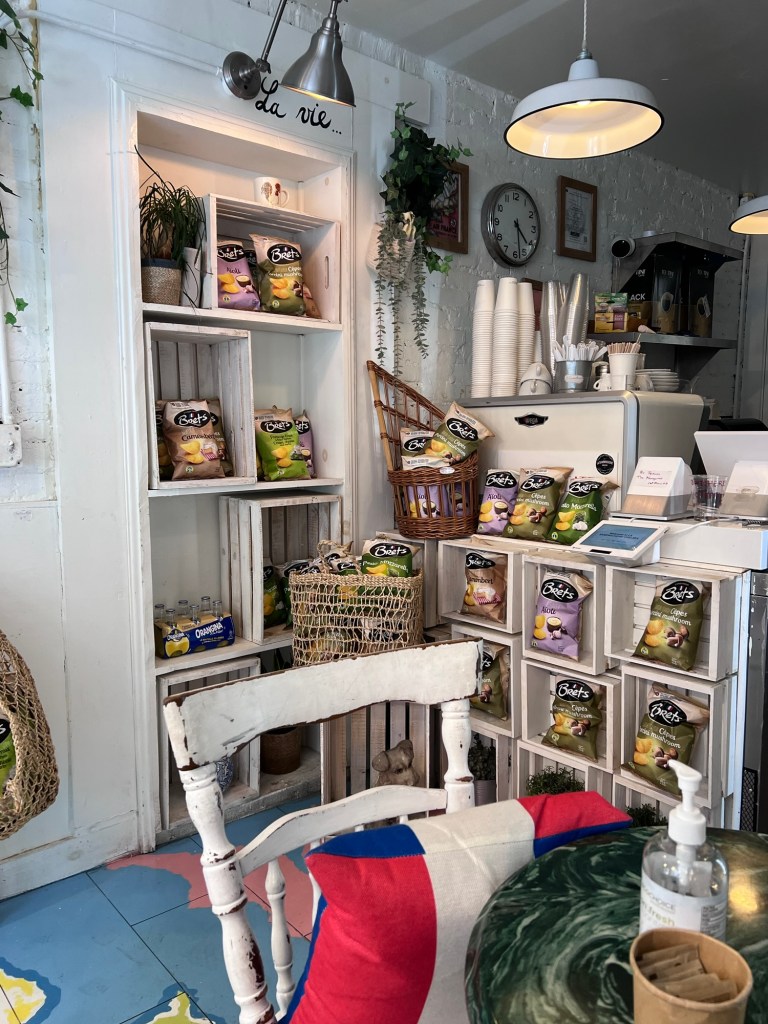
I stopped inside and I swear I was back in Paris again with the tiny chairs and tables and the French music. I was not thrilled that the price was higher inside but only by a dollar and the manager explained it to me. I was still in the mood for that crepe.
The inside of the restaurant brought me right back to Paris
The shelves were lined with the wonderful French potato chips I had tried at the food show
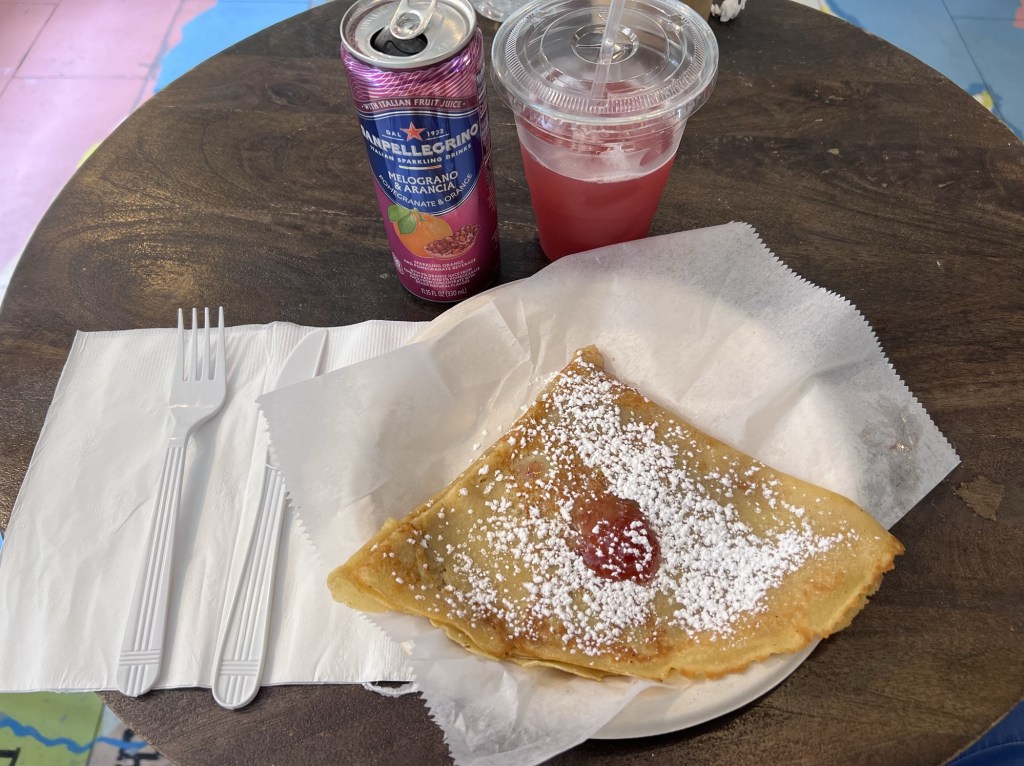
I ordered a Strawberry Crepe, which was a freshly made crepe( he even showed me the crepe batter to prove it), which was filled with strawberry jam and topped with sugar. I ordered a Pomegranate soda to have with my dessert.
The Strawberry Crepe with my soda
Yum!
Now having some more carbs and sugar to wear off, I started back down West 15th Street happy and content. The crepe brought back a lot of memories of my trip to Paris two summers ago.
I continued my walk down West 15th Street with more pairs of eyes watching me at the buildings.
What I love about this building is the extensive embellishment of faces and curvatures throughout the front of the building. Faces stare at you from all directions and passing judgement right by the front door. You have to look up and down to really appreciate this building.
There is emended detail to building
The faces staring back
Don’t pass judgement
The sister building next door at 251 West 15th Street had just as many details.
At Stonehenge Gardens, travel through the private gate and along the walkway where you will find this gem of a building setback between 14th and 15th streets. Built in 1950, this six-story building is located in the center of Manhattan’s trendiest downtown neighborhoods: Chelsea, the West Village and Union Square (From the Stonehenge website).
The private gate and gardens were locked when I was visiting the neighborhood but you could see how beautiful it was right behind the gate.
Finishing my walk down West 15th Street
The Jazz Concert that evening at the Brooklyn Botanic Gardens:
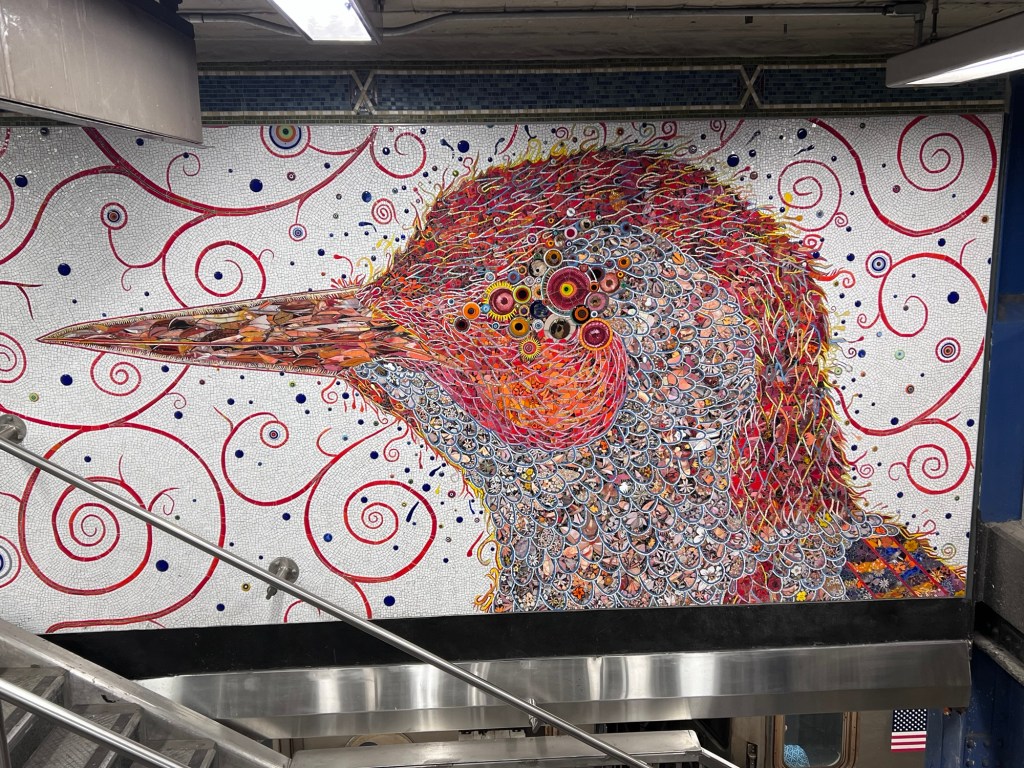
After I finished the streets of Lower Chelsea, I took the subway to Brooklyn for a Jazz Concert at the Brooklyn Botanic Gardens. On the way to the subway, I noticed these two mosaics on the wall of the subway platform. What interesting work by Brooklyn based artist Fred Tomaselli entitled “Wild Things”. These gorgeous and colorful works flank both the upstairs and downstairs of the subway station
Artist Fred Tomaselli is an American born artist best known for his highly detailed paintings on wood panels, combining an array of unorthodox materials suspended in a thick layer of clear, epoxy resin. He studied at California State University and his studio is in Brooklyn (Wiki).
It was a quick subway ride to the gardens on the express subway and I got there in record time . It was enough time to tour the gardens before the concert. The gardens were at their peak in the middle of the summer and everything was so green.
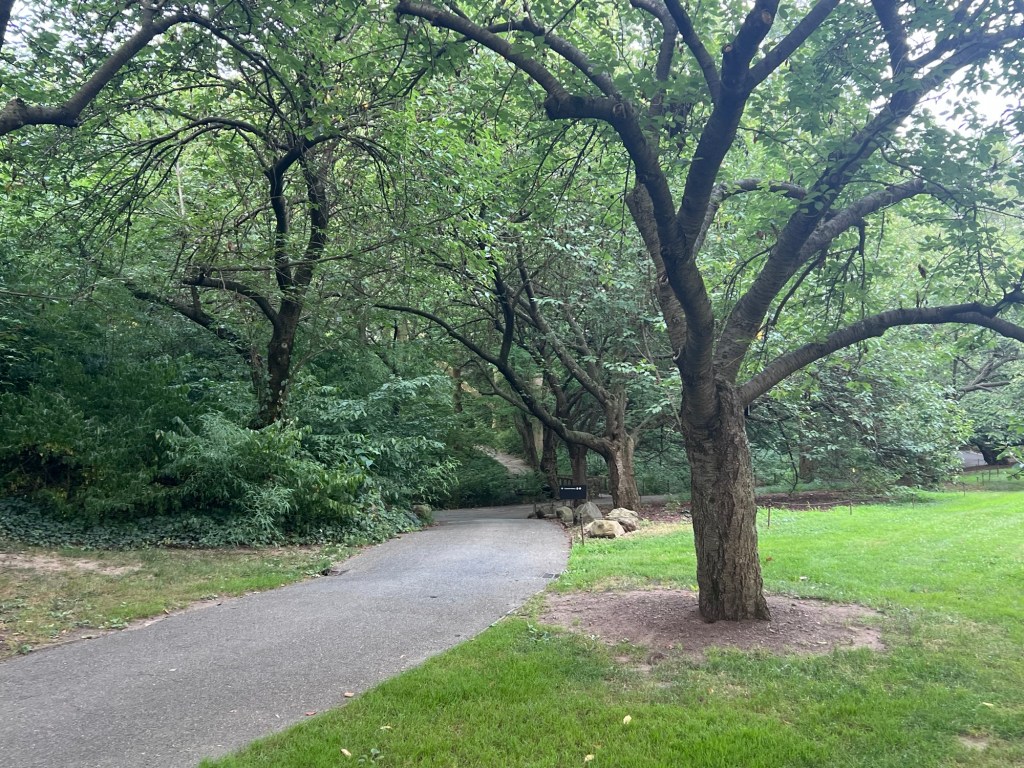
The lawn by the Cherry Bloom Gardens
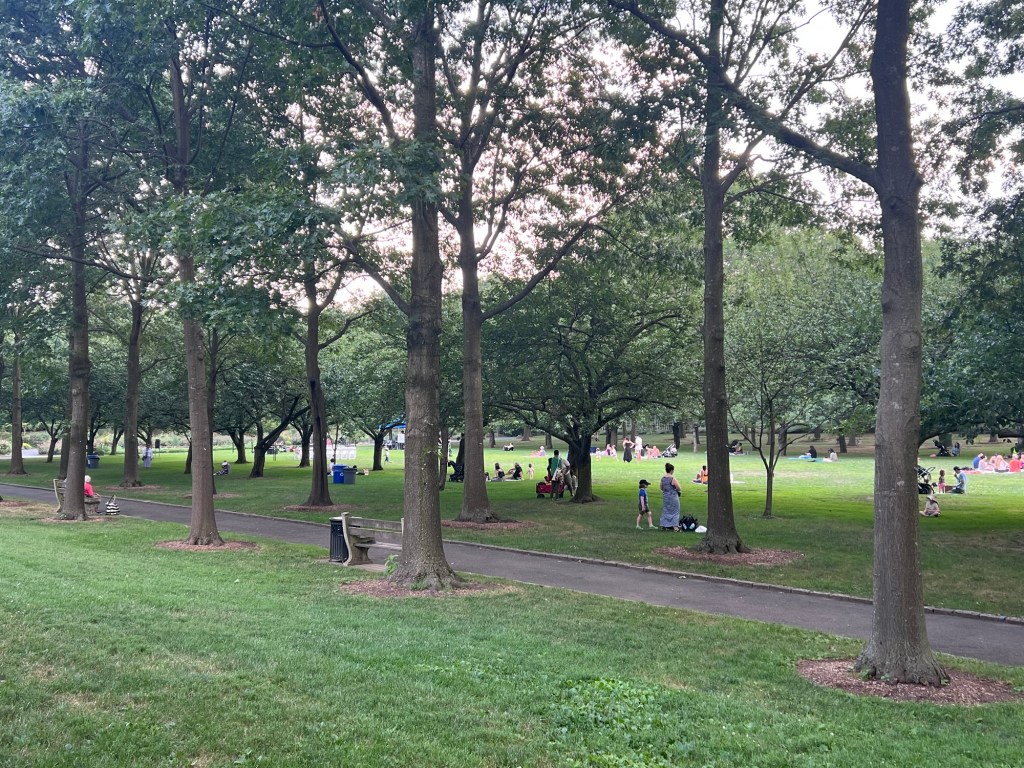
The Cherry Bloom lawn is where the concerts are held
People getting ready for the concert
Members waiting on the lawn for the concert to begin
I was sunny and warm out when I got there and just about five minutes before they were supposed to start the concert, it poured for the next twenty minutes. They end up cancelling the concert again on me. The weather played havoc that evening.
The only problem was that the moment it stopped those twenty minutes later, the sun came back and it was beautiful as the musicians were packing up. I can tell everyone hoped they would have a change of heart. They kept packing up and I decided to walk around the gardens again. There would be one more concert in the future the next week.
It did clear up after it stopped raining
The sun rose over the Japanese Gardens
So for the next hour, I just wanted to walk around and admire the flowers and the garden beds.
It ended up being a nice night and the best way to end of evening.
Even though the concert was cancelled, it still was a nice evening and I did get my share of exercise. Even as the lights turned on in the Botanic Gardens, there is still such a magic of walking along the beds and admiring the flowers and the other plantings. You should not miss the gardens during any of the seasons. There is always something to see even in the dead of winter. The true beauty though is in the late Spring and early Summer when everything is in bloom.
When you have been friends with people for almost thirty years, they can still surprise you. My best friend, Maricel, and I have known each other since our first week at the Culinary Institute of America in February of 1996. Since that moment, we have seen each other through the ups and downs of relationships, jobs and the passing of our parents. We have gone through our stages of not talking to each other and yelling matches. The typical things best friends do with one another over years of friendship.
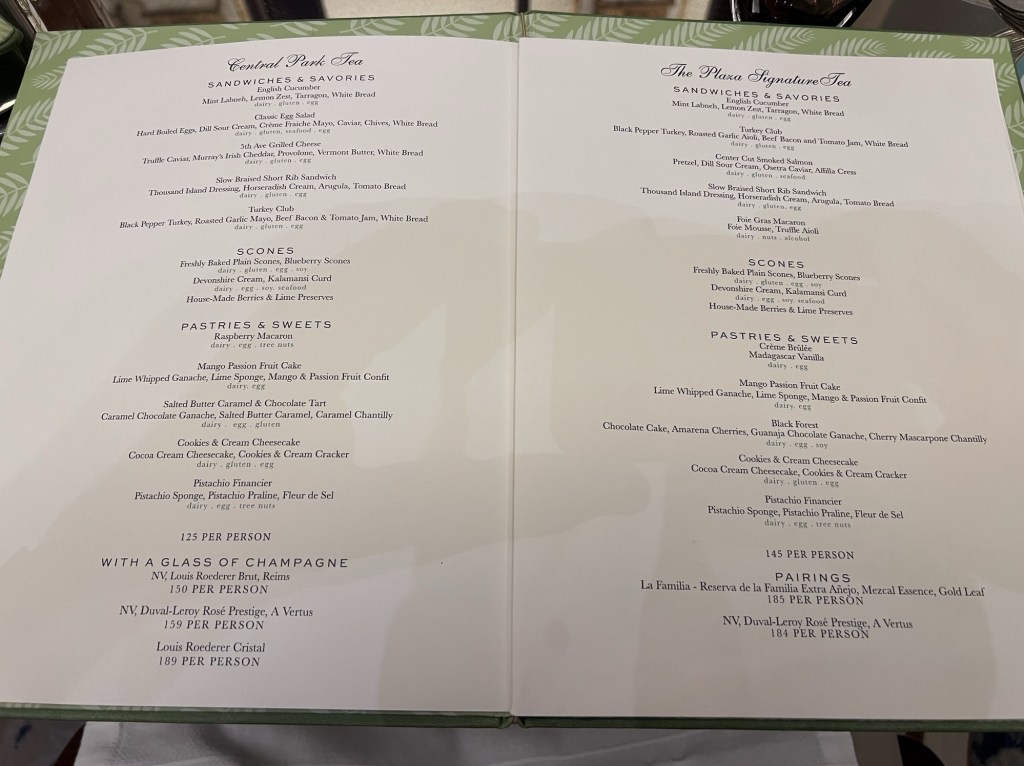
There are those times we surprise one another and right before 4th of July, she surprised both her nephew and I with Afternoon Tea at the Palm Court at the Plaza Hotel in Manhattan.
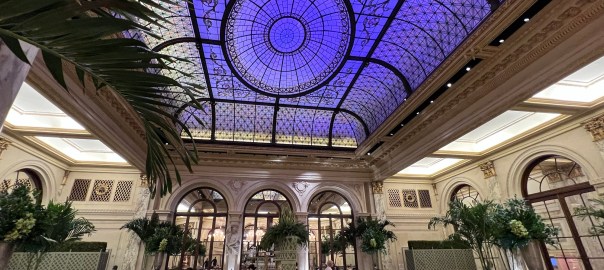
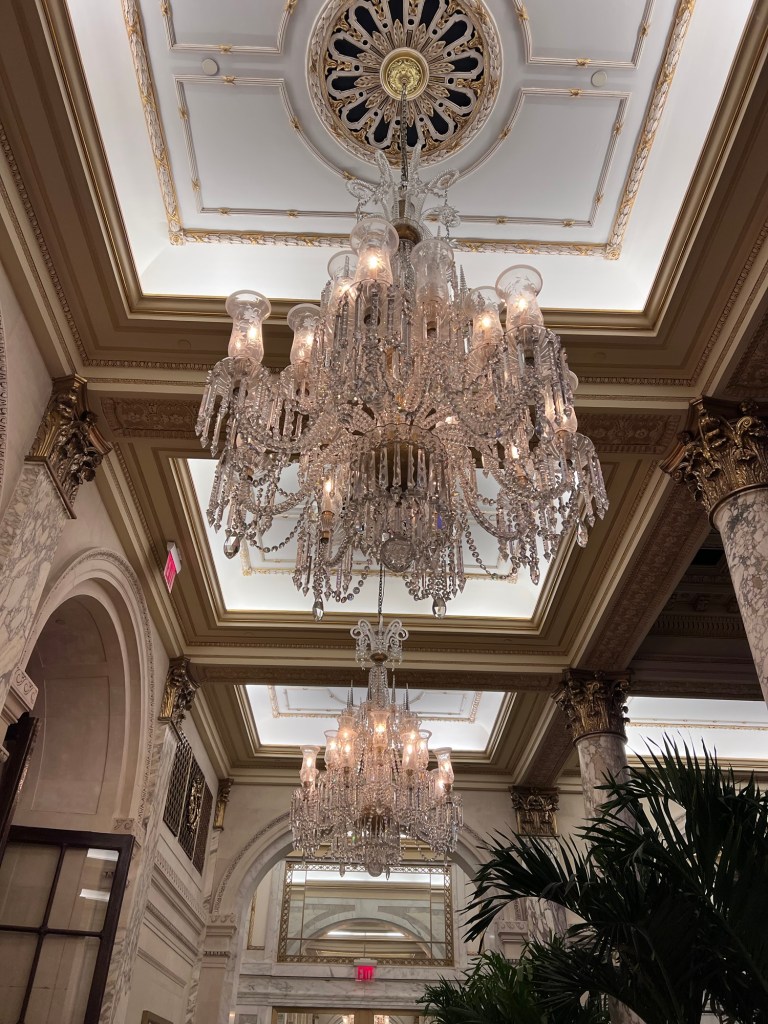
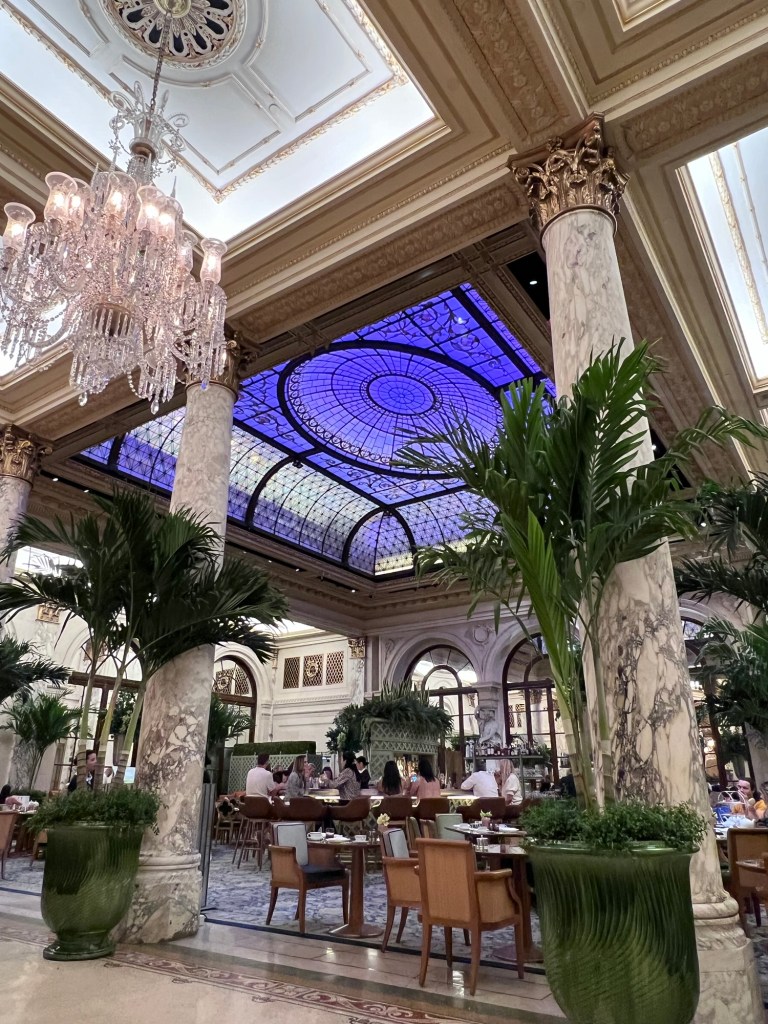
The lobby of the Fairmont Plaza Hotel
I had not had Afternoon Tea at the Plaza since 1994. I remembered this because it was just after ‘Home Alone II’ was released and everyone was talking about the hotel and its iconic lobby. I remembered the elaborate cakes and sweets and the perfect service. I also remember it being around $85.00 back then. Since that time, The Central Park Tea is now $145.00 and The Plaza Imperial Tea is now $155.00. The times have changed.
The same chandeliers Macauley Cullen saw when walking the hallway in the scene at the Plaza
The iconic scene with President Trump in 1992
For years you used to be able to walk around the lobby at Christmas time but this was before the 2006 renovation and the conversion to apartments. Now they will barely let you through the side door. This wasn’t the case that day. I just walked right into the lobby to the Palm Court.
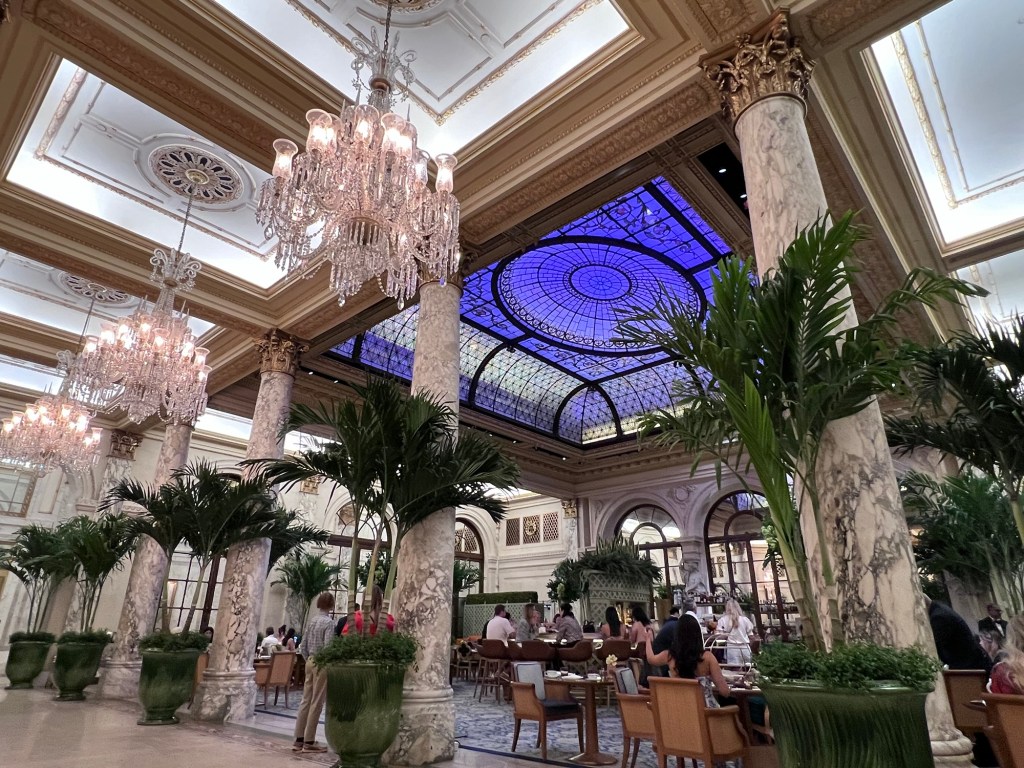
I met Maricel and her nephew, Miguel, in the lobby and I have to admit even though Maricel works there, we were all in awe of the place. The Palm Court has always been iconic to me even before the film. I have always loved the elegance of the restaurant.
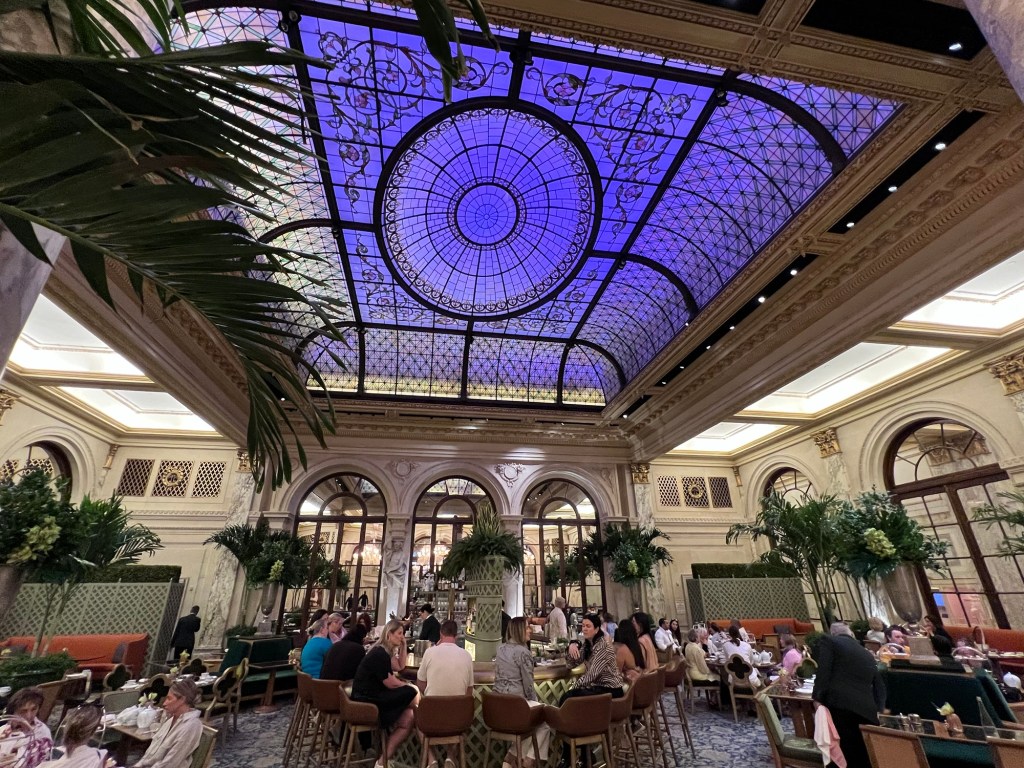
I loved the soaring skylight and all the potted palms. I just remember more of them.
We were at the last seating was at 3:00pm
Trying to figure out what tea we wanted to choose from
We chose one of each which offered a slightly different selection of sandwiches and sweets. Having tea at a New York hotel is not for the faint hearted as the prices start at $145.00 for one person. The Plaza Signature Tea and the Central Park Tea offer their own selection of goodies. The Imperial Tea offered caviar service but thank God I do not like the stuff.
After we ordered, Maricel and I were able to catch up while her nephew played with his cell phone. I had just finished classes and final exams with my Summer I Business class and Maricel found herself getting busy at the Plaza Hotel’s kitchens. She was making the very sandwiches we were eating. We were both exhausted. Then the food came out.
Maricel’s cousin digging into the sandwiches
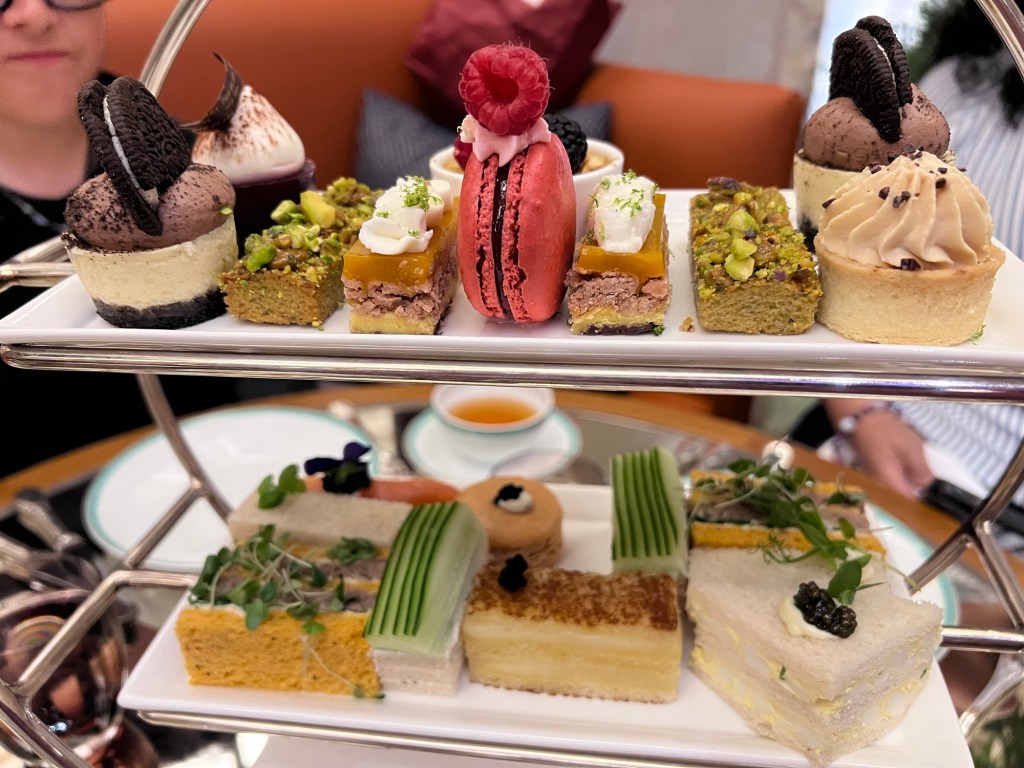
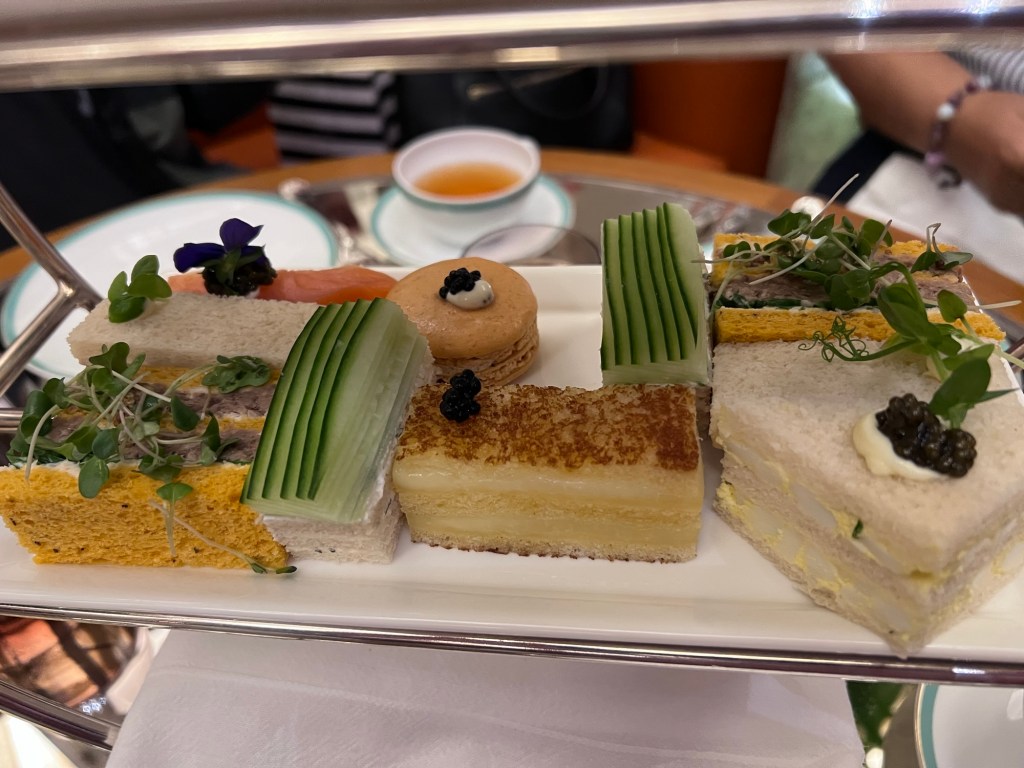
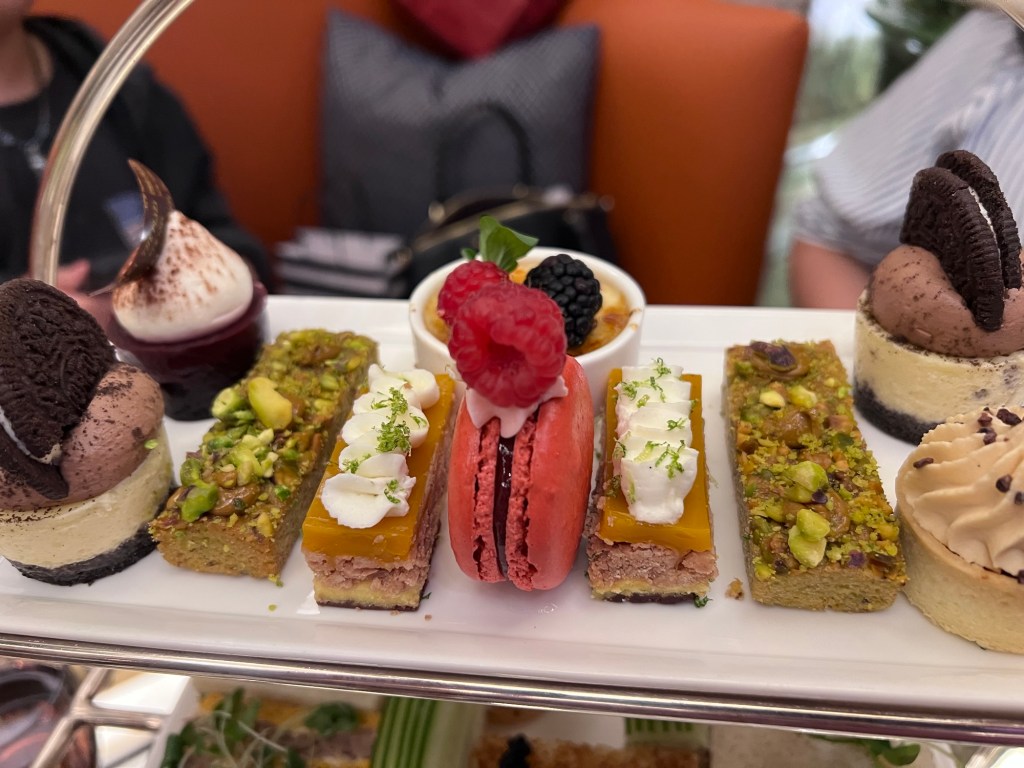
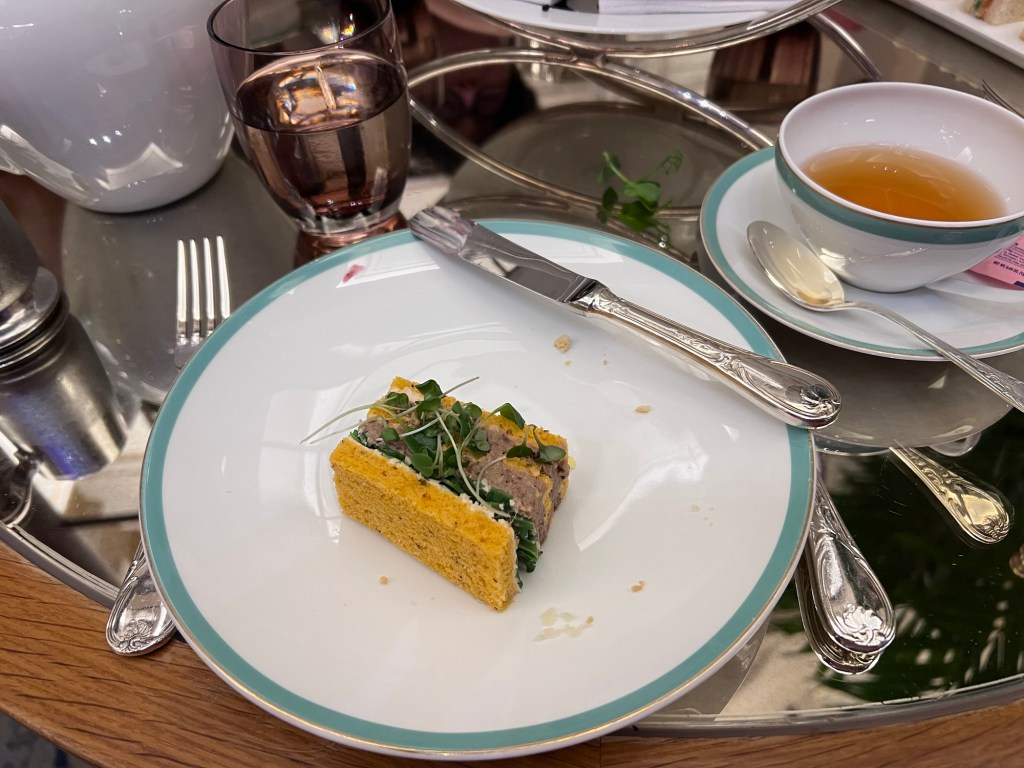
I loved the assortment of sandwiches and sweets on the tiered trays. It was a delight for both the eyes and the taste buds. There was an assortment of pastries, cakes, scones and sandwiches. I had to move quickly because Maricel’s nephew could really eat! I turned my head and half the sandwiches were gone. The food was as good as it looked.
The assortment of sandwiches, cakes, scones and sweets
The assortment of tea sandwiches
The assortment of pastries and sweets
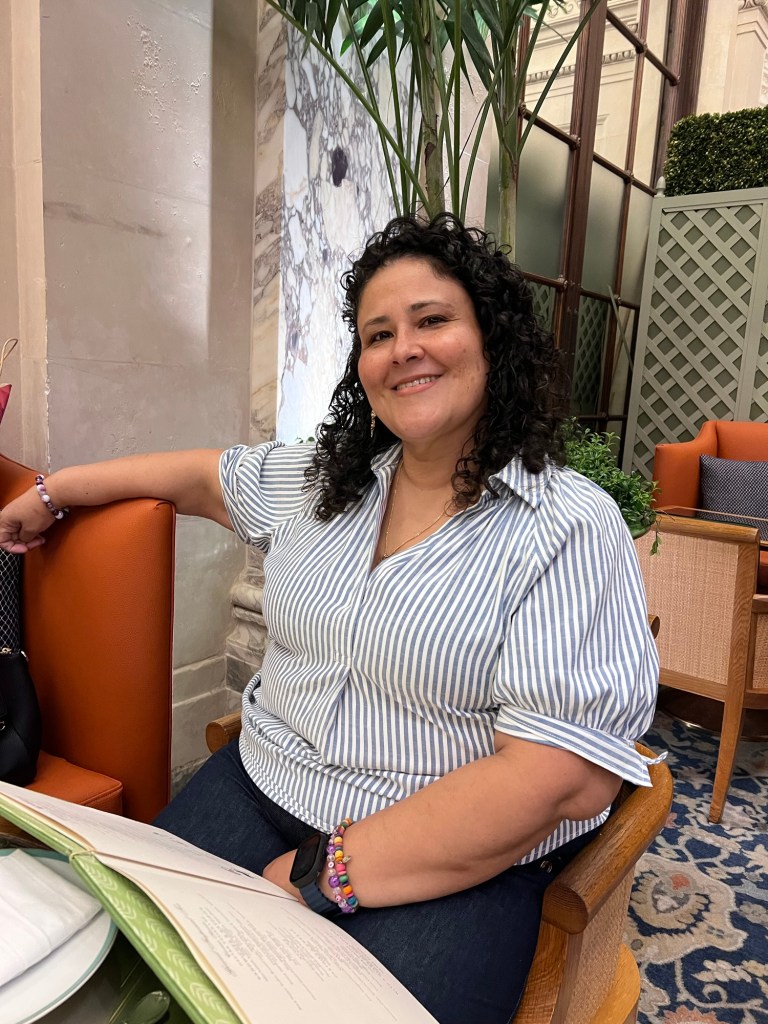
Me starting to indulge in tea
The Short-rib sandwiches were delicious
The Egg Salad sandwiches with Caviar
It was a really nice and relaxing afternoon. It was one of those things you have to do once when you are in Manhattan. I am lucky to have such a great friend who thought about this wonderful treat. She has been working at the Plaza Hotel for several months and thought I would enjoy coming here again. I have to say I did hint about it a few times.
My host and best friend, Chef Maricel
We had a great time with my best friend and her nephew. It was one of those great New York experiences.
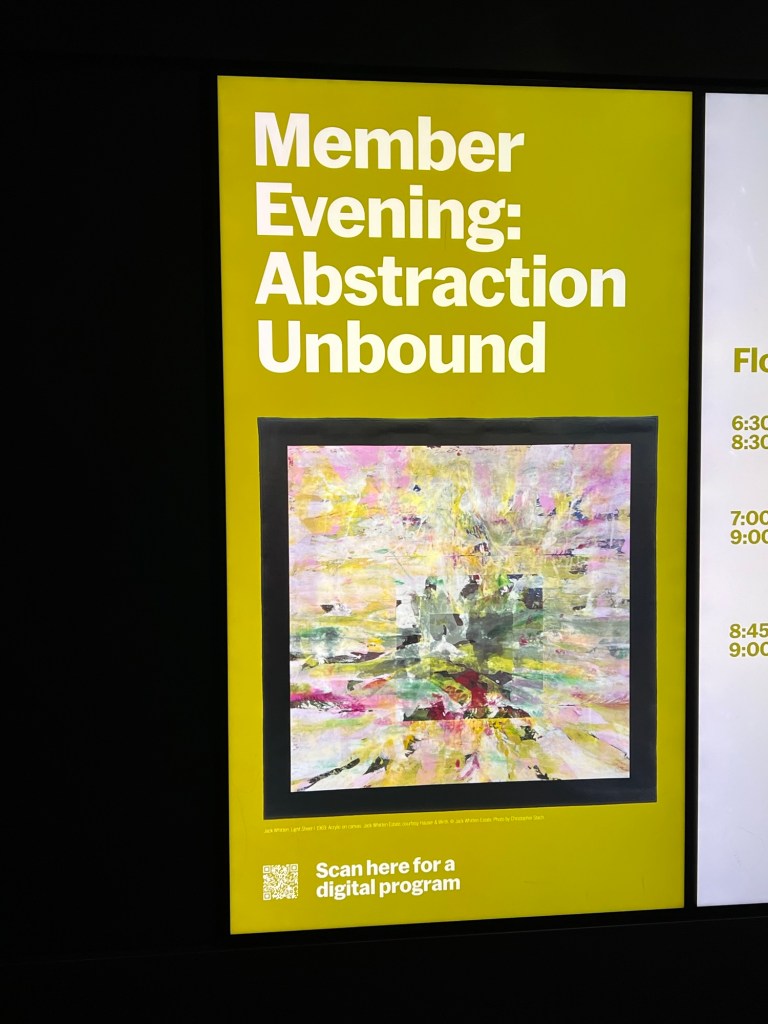
Right after the Metropolitan Museum of Art had their private members night, ‘Met After Hours’, the Museum of Modern Art countered with their event. Neither museum has the whole museum open but at least at The Met there is more than one bar open and they keep two of the restaurants open for patrons so you can have dinner at the museum.
The Museum of Modern Art (MoMA) kept only two floors open and had one very crowded bar open that evening. Still it was nice to visit the museum after hours and walk through the halls.
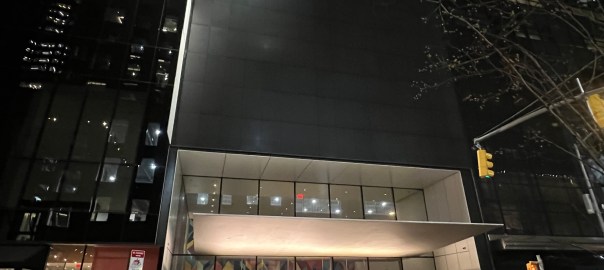
The front of the Museum of Modern Art at 11 West 53rd Street
Looking down on the bar crowd as I walked to the second floor
Listening to the music play with the artwork
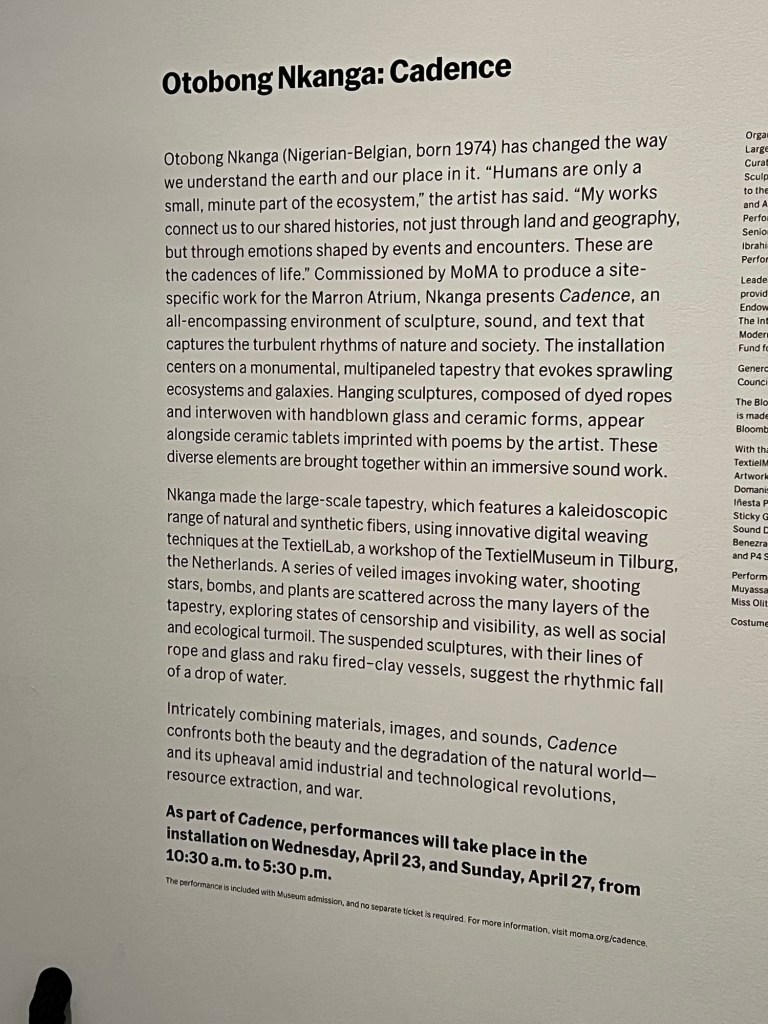
The first piece of art I saw was ‘Cadence’ by artist Otobong Nkanga. This colorful and impressive piece took up the entire second floor atrium and the interesting part of the work was that it was interactive and you could walk through the display. It looked like a volcano had exploded and the rocks that spewed out you could walk around.
The work ‘Cadence’ by artist Otobong Nkanga
The write up on the this interesting work
The work took up the second floor atrium
The rest of the second floor of the museum was closed that evening so I made my way to the fourth and fifth floor to visit the galleries.
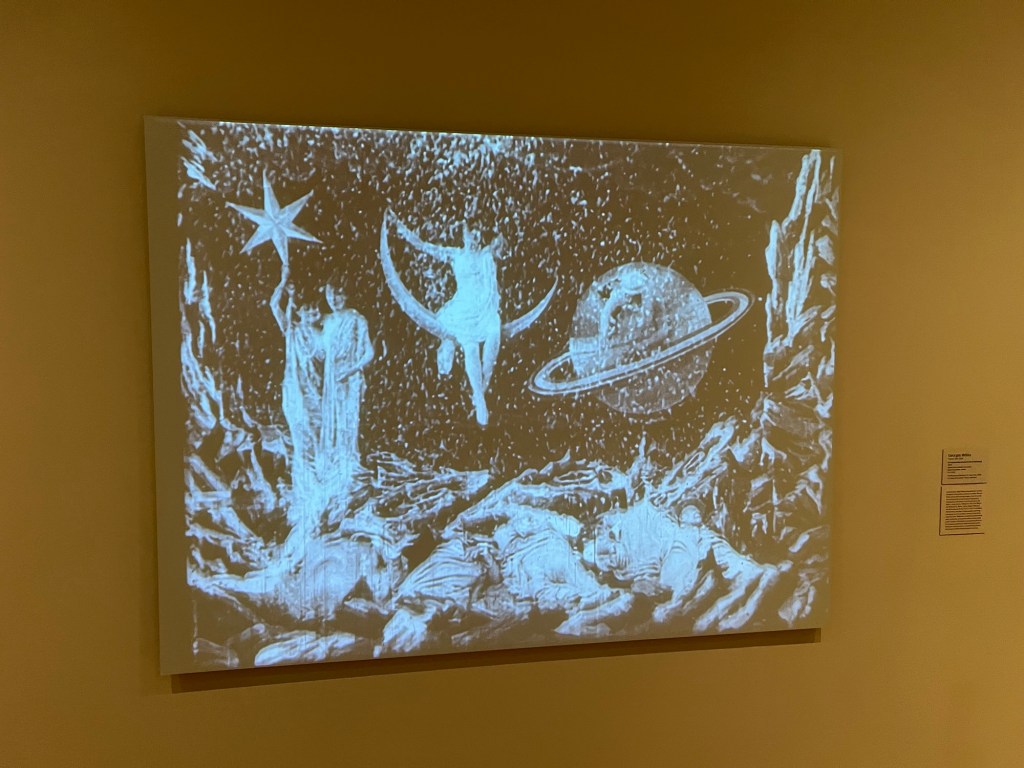
There was no special exhibition on the fourth floor so I stopped room by room to admire the art. Sprinkled amongst the paintings and sculptures, the museum had placed clips of movies, a few of them silent films. One of my favorites was showing, George Meles’s ‘Trip to the Moon’.
George Meles’s silent film ‘Trip to the Moon
The write up of the piece
The YouTube video on the movie “A Trip to the Moon”
I had first seen this film in high school and had fallen in love with the elaborate sets and the campy storyline. I never got how they thought they were going to get home. Still the movie is fun to watch and you think to seventy years later to movies like ‘2001 Space Odyssey’ and ‘Apollo 13’ and even the footage of really landing on the moon and think how far we have come.
Roaming around the Picasso gallery
Then I walked around the Contemporary Galleries and admired all the works by Picasso and Brancusi. Everyone else was still down at the bar on the first floor so I had these galleries to myself for the first forty-five minutes. I quietly walked and admired all the works.
The contemporary gallery
The works ‘Fish’ and ‘Bird in Space’
Brancusi’s works especially ‘Bird in Space’ I had studied in my Art History class at Michigan State University and zI had admired them for a long time. I had forgotten that versions of them were at the MoMA.
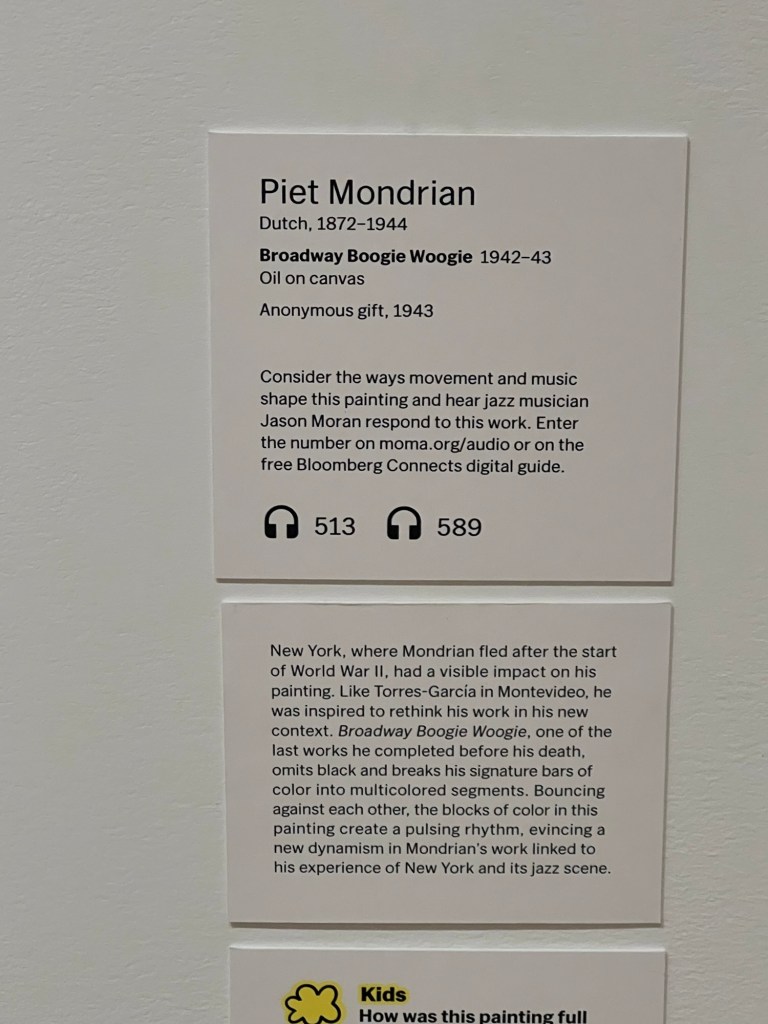
‘Broadway Boogie Woogie’ by Piet Mondrian
The signage
Then I passed ‘Broadway Boogie Woogie’, another work I had studied in college. It is amazing how many great works were at this museum. I just liked the colors and whimsy of this painting. Then I walked through the Claude Monet gallery where the famous ‘Water Lillie’s’ paintings were located.
The gallery dedicated to Claude Monet’s ‘Water Lilies’
The signage
Claude Monet’s ‘Water Lillies’
I love these immense murals either their beautiful colors and calmness to the painting.
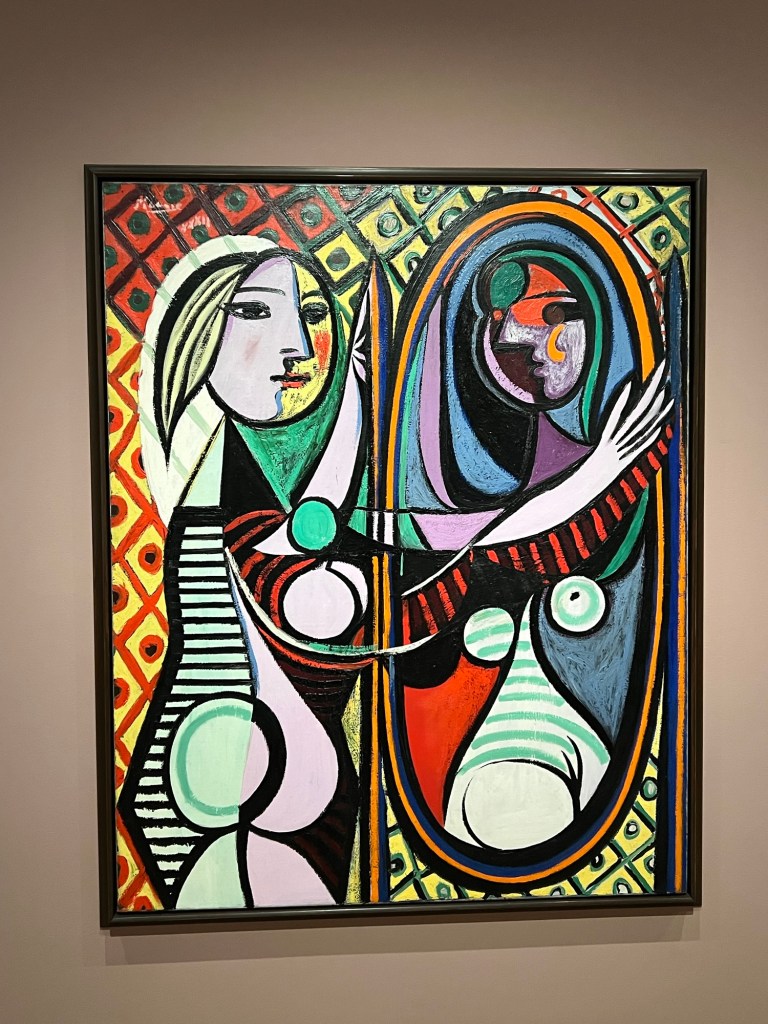
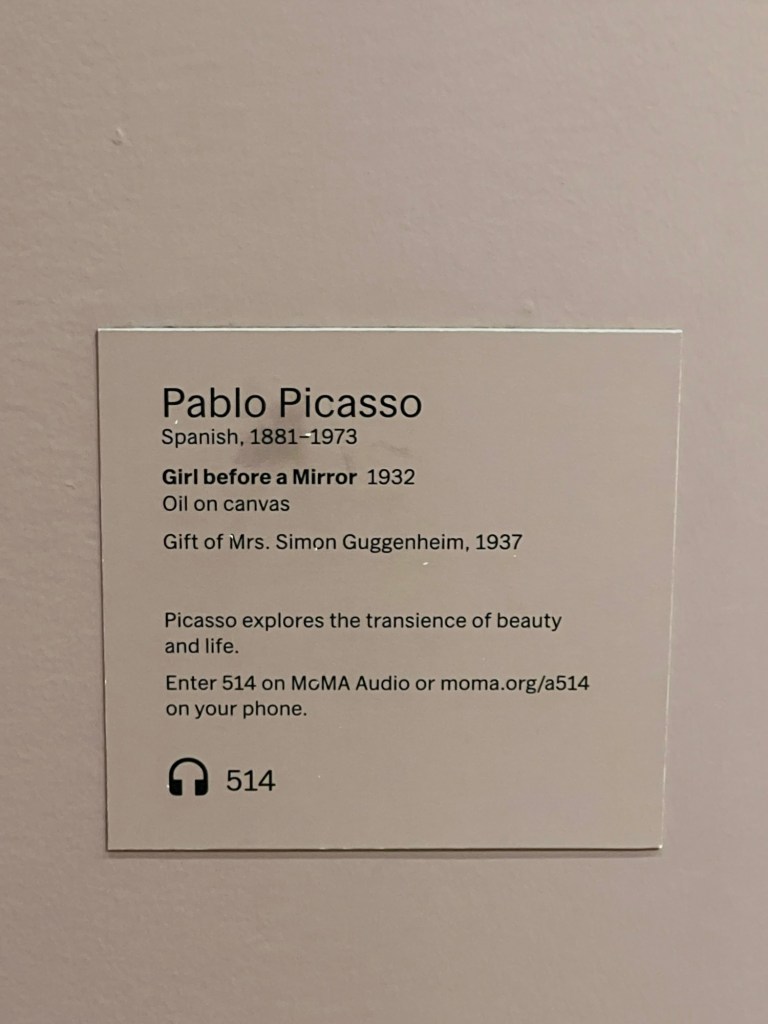
I then turned the corner and came across Picasso’s ‘Girl before the Mirror’
I had forgotten that this painting was here and I stopped for a while and just admired it. I loved the simplicity of the idea but enjoyed its bold colors and crazy cubism to it. I have been attracted to this painting since I was a kid when my mother took me to the Picasso Retrospect here when I was a freshman in high school.
The signage for the painting
As the night wore on I visited the floors that were open and it was only two floors, four and five and the second atrium that were open so I visited the bar area when I finished with the other floors.
The prices here were just as expensive as the earlier Member’s Night at The Met and the selection was not as nice, so I bypassed it. I just watched everyone from a distance.
I just enjoy watching everyone having a good
time. I makes the evening even more special.
Watching the crowd while admiring the beautiful interactive art. This work kept moving around to the music in the background
The painting would move in different directions to the music
It had been a short but relaxing evening and got my mind off everything between work and home and I guess I needed a change of pace to shake me out of it.
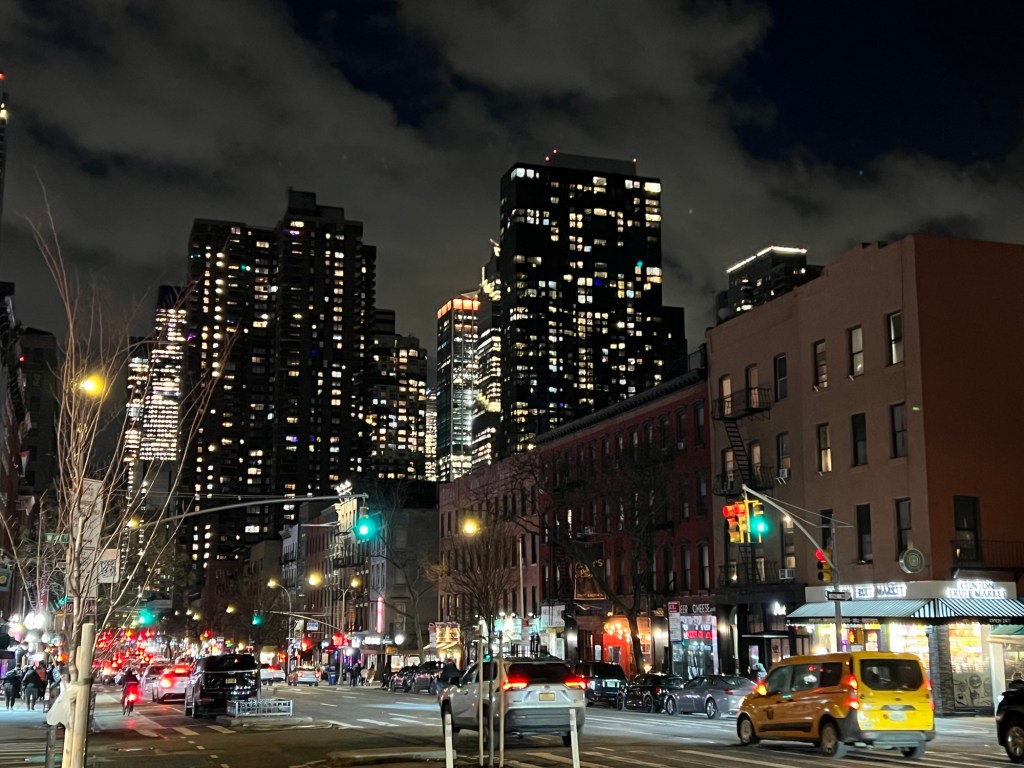
After a short visit to the gift shop, I left the museum and headed home. As I turned the corner past the museum, I stopped to admire the lights of Seventh Avenue. I sometimes forget how breathtaking Manhattan can be at night.
Seventh Avenue at night around the corner from the MoMA
I took a short walk around the neighborhood, thinking about where I could stop for a snack. None of the restaurants at the museum were open the evening and they had nothing at the bar.
I remembered a wonderful hamburger/ hot dog place near Eighth Avenue, Lucky’s Famous Burgers at 370 West 52nd Street.
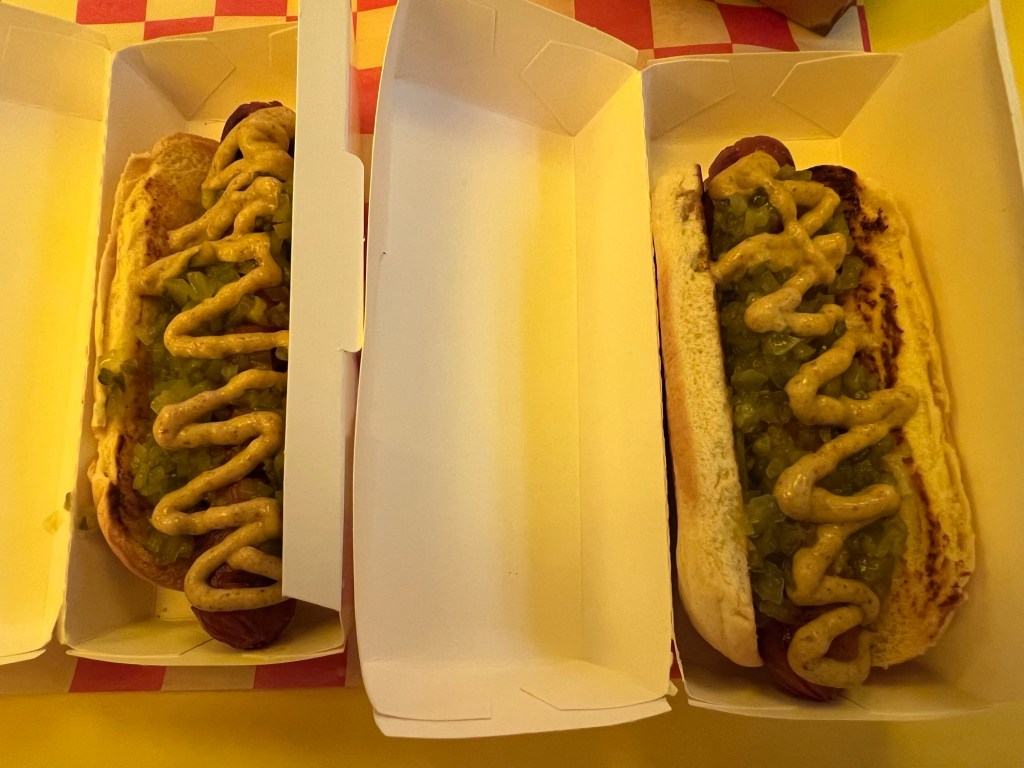
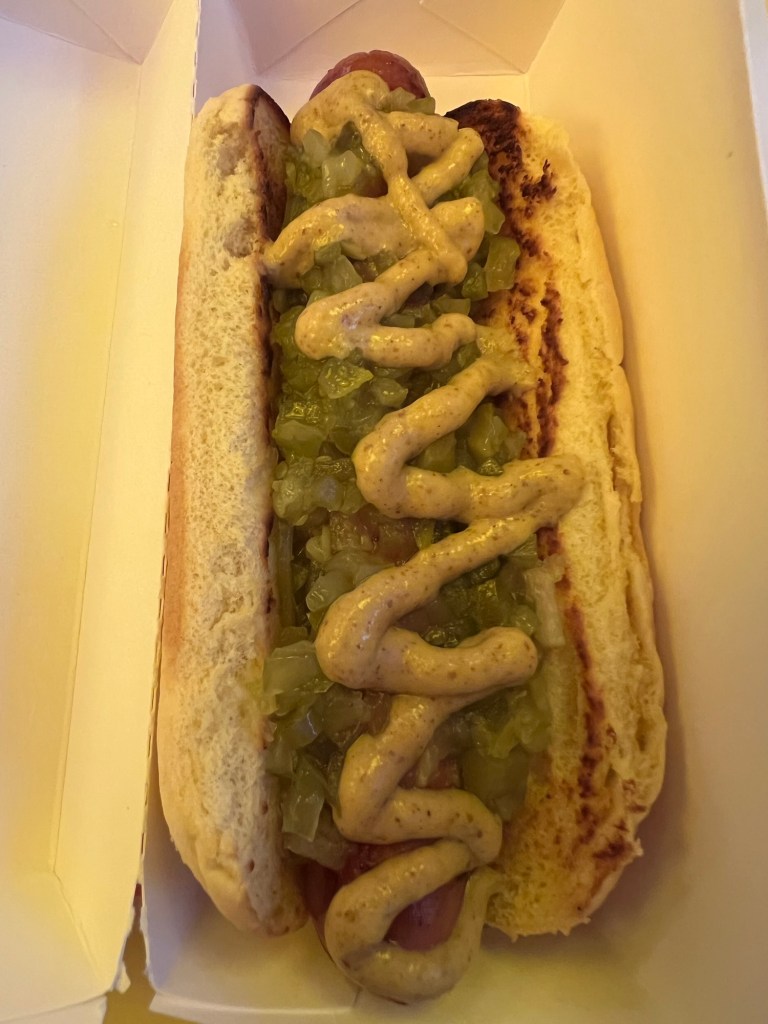
I settled on the ‘Double Dog’ special meal with two dressed hot dogs and a large size of French Fries with a large Coke. It was enough food for two people. The hot dogs here are fantastic and the French Fries are cooked to order. The meal just hit the spot and really cheered me up as had the visit to the MoMA. It was the perfect meal to cap off the evening.
The Doubledogs with French Fries meal
The delicious twin hot dogs
They were nicely decorated
What a way to end the evening
It was quick and relaxing evening and shook away the blues of the past days of gloomy weather and some of the long nights of grading papers at work. A pleasant night at the MoMA can really cheer you up!
With Graduation behind me and in between Summer classes, I am finally exploring the streets below 23rd Street. I never thought I would get here. It had been two long semesters and the Christmas from hell. I don’t think my feet ever hit the floor. I just kept going.
I finally got back to the Flatiron District. This is where the lines get a blurry with the neighborhoods. The Flatiron District overlaps with Union Square which overlaps with Gramercy Park. NoMAD mixes with the Flatiron District and Rose Hill and then Kips Bay and Gramercy Park again. It gets very confusing so I just repeat the roads in other neighborhoods. Since the official southern border of the Flatiron District is West 20th Street, I looked to the neighborhood to walk.
The Lower Flatiron District by McCreery’s Department store on 15th Street.
I decided to defy what the relators say and I cut the neighborhoods by Avenues. I decided that Lower Flatiron District would be from West 20th to West 14th Streets between Sixth and Fifth Avenues. Union Square would be from West 20th to West 14th Streets between Fifth and Irving Place. From there I would finish Gramercy Park past Irving Place and then Lower Chelsea from West 23rd to West 14th Street from Sixth Avenue to Twelve Avenue. Have I confused you yet? It is for me and I am not sure if the residents of these communities know what neighborhood association to join.
I started my walk along the northern section of the neighborhood which I had walked before the semester had started at NYU. I started on West 20th Street and it was like visiting an old friend. It was then I realized that I had not walked this neighborhood in two years and that a lot had changed in that time. I had finished walking it in 2022 before Grad school had even started.
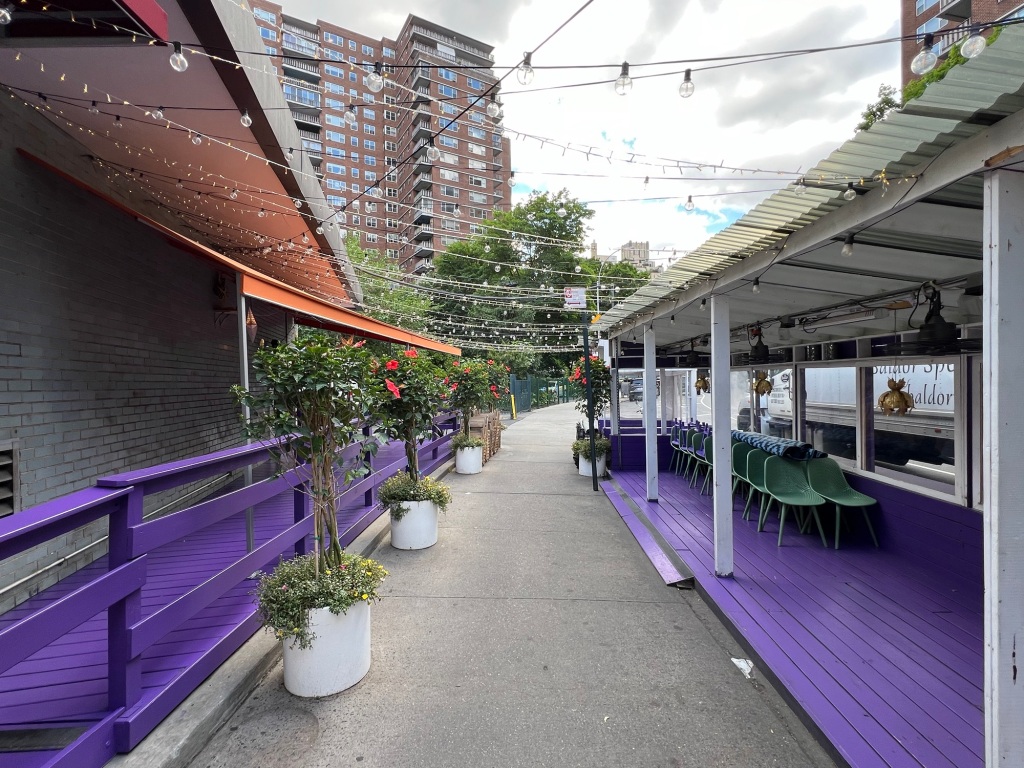
Walking through Chelsea to West 20th Street. I love how the purple in this restaurant stands out every summer. I walked through the outside seating to Shukette, a restaurant at 230 Ninth Avenue.
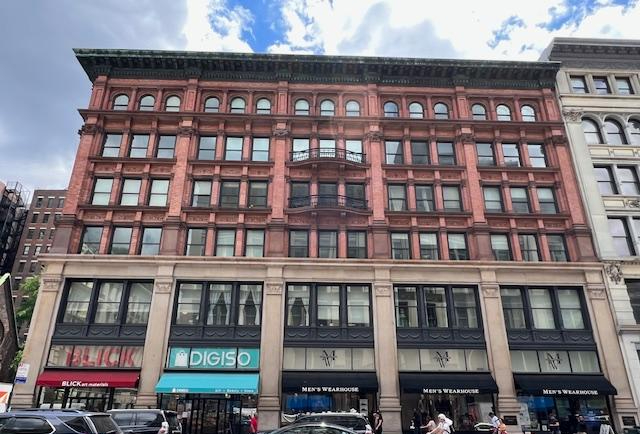
At the corner of Sixth Avenue and West 20th Street, another building got my attention at 650 Sixth Avenue. This impressive building, which is known as the Cammeyer and is located at 650 Avenue of the Americas on the southeast corner at 20th Street, was converted to a residential condominium in 2007 (Carter Horsley. CityRealty.com).
650 Sixth Avenue at the corner of Sixth Avenue and West 20th Street-Now the Cammeyer
The building was designed by Hubert, Piersson & Hoddick in 1892 for the estate of William C. Rhinelander. The red-brick, Neo-Renaissance-style building has white stone and terra cotta trim, a large copper cornice and a handsome band course beneath its top floor. It was the home of the Cammeyer Shoe Store, the one of the largest shoe stores in country (Daytonian).
The conversion was designed by Perkins Eastman for by Penterium, the residential development arm of Korean firm Kumang Housing Corp (Carter Horsley. CityRealty.com).
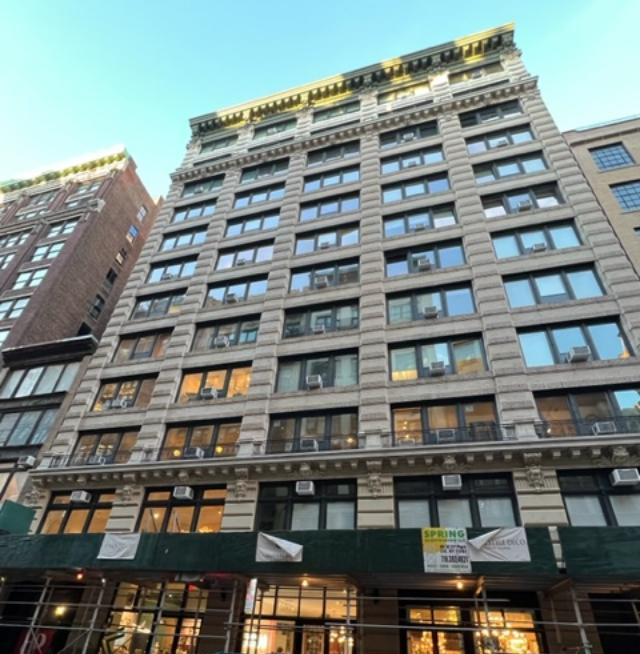
I was admiring 27 West 20th Street on my walk down West 20th Street to Park Avenue South. This detailed twelve story office building was built in 1908 and now offers loft style offices. the details of the building include elaborate stonework both around the doorways and lower windows and the top floors.
What I liked about the side streets as well as the avenues as I walked the neighborhood was that it kept its character and that these buildings had not been knocked down for the modern skyscraper. They were finding new use like the buildings in Midtown South and in NoMAD and become very desirable.
There was true beauty in the details of 20 West 20th Street that was built in 1906. The Beaux Art style details around the windows and doors accent the elegant building.
This is also the details you see in the office building of 10 West 20th Street built in 1903 with Beaux Art style details along the lower windows and doors and the upper floors of the building.
I passed 156 Fifth Avenue as I crossed the border from west to east in this part of the neighborhood and admired it for its detailed stonework carving and unusual styled roof. The Presbyterian Building was built in 1893 and was designed by architect James B. Baker and was designed in the French Gothic style. It was to be used by the Presbyterian Church as their base for domestic and foreign missions and used as office space. The Panic of 1893 changed that, and they had to lease the space out (Daytonian in Manhattan).
I then took the long walk down Fifth Avenue and all the architectural treasures it contains. This was once the core of the old ‘Midtown Manhattan’ after the Civil War and the City started its march uptown.
119 Fifth Avenue at the corner of East 19th Street in the Flatiron District neighborhood of Manhattan, New York City was built in 1905-06 and was designed by John H. Duncan in the neo-Renaissance style. It was built to be an annex to the Lord & Taylor department store buildings which took up most of the square block between Broadway and Fifth Avenue and East 19th and 20th Streets, being connected by bridge to two of them. After Lord & Taylor moved uptown in 1914, the building had multiple uses (Wiki).
The details of 119 Fifth Avenue
The details of 119 Fifth Avenue
One of the most impressive buildings in the neighborhood is the old Arnold Constable Store building that stretches from its Broadway entrance down the entire block on 18th Street to its Fifth Avenue entrance.
115 Fifth Avenue-Arnold Constable Department Store
This seven-story department store building was designed by architect Griffith Thomas in 1868 for the prominent dry-goods company of Arnold Constable & Company. ‘The Palace of Trade’ as it became known as, is located stretches between Broadway and Fifth Avenue. The stunning Second Empire building is faced in marble, brick, and cast-iron, features stacked arch orders and a prominent, two-story, pavilioned mansard roof. Arnold Constable & Co. was founded by Aaron Arnold, who opened a small dry goods store in the city in 1825 (Buildings of New England).
As the business prospered he moved into larger quarters numerous times. In 1842, James Constable, an employee, married Arnold’s daughter Henrietta and was subsequently made a partner. From this, the company was renamed Arnold Constable & Co. In its heyday, Arnold Constable & Co. was the largest dealer to the elite in New York City, supplying the latest fashions to a clientele that included the leading families in the city (Buildings of New England).
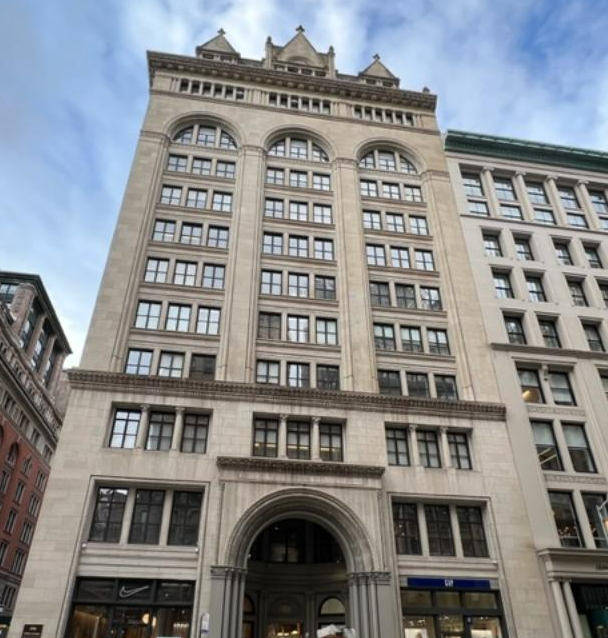
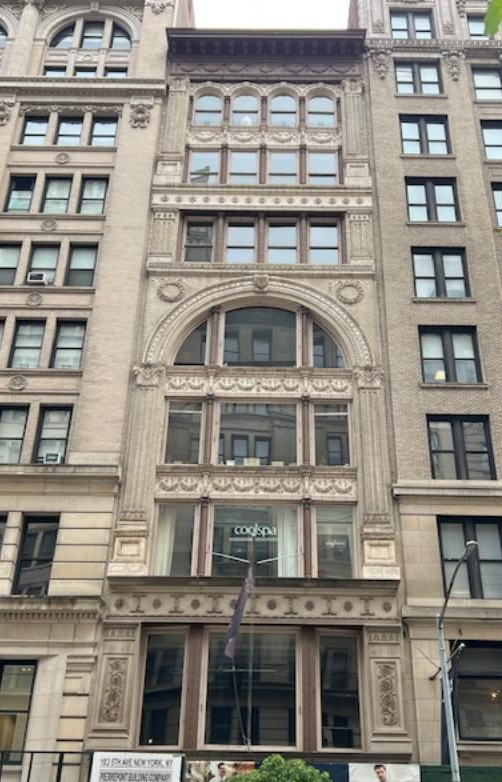
interesting history. The building was designed by architect Louis Korn and was designed in the Beaux-Arts design. It was completed in 1896 and it was named after Edwards Pierrepont, whose mansion had stood on the site before the construction of the building. When it opened the building was popular small publishing and mercantile companies (Dayonianinmanhattan.com).
The 103 Fifth Avenue details
103 Fifth Avenue embellishments
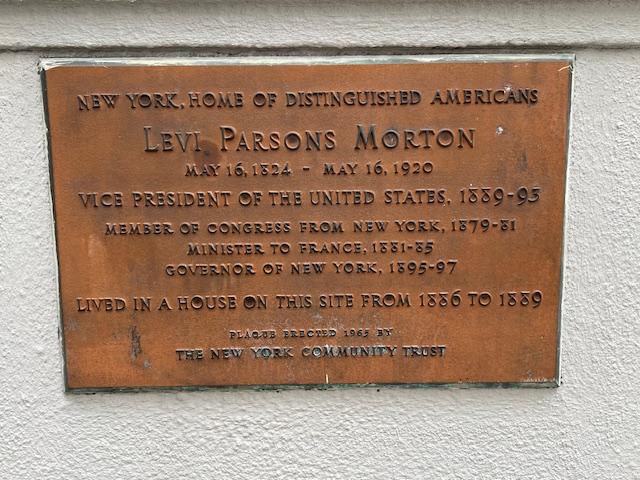
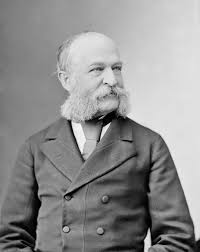
In between the buildings there was plaque to Levi Parsons Morton, the former Governor of New York State and the Vice-President of the United States under President Benjamin Harrison. This is where his home was located.
The plaque of the former Vice-President’s home on Fifth Avenue.
Vice-President and former New York Governor Levi Parsons Morton
The B. Shackman & Company sign was for the former B. Shackman & Company novelty and toy store that was located here until the 1970’s. The store once sold all sorts of novelties and gifts (Ephemeral New York.com/Consumer Grouch).
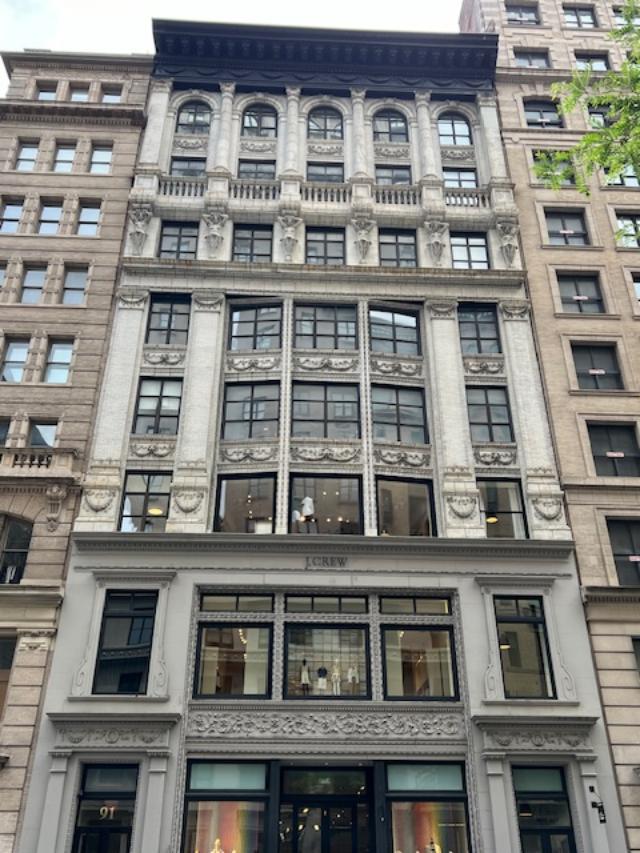
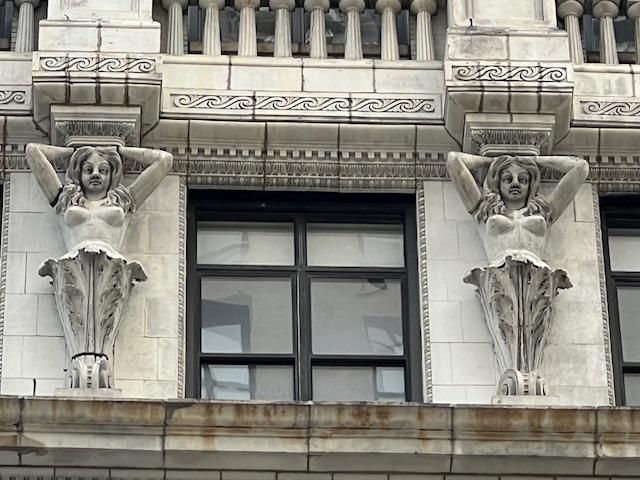
This beautiful office building was designed by architect Louis Korn for businessmen Henry and Samuel Korn in 1896. The office building currently houses small companies (Wiki).
The details of women looking down at us on the street at 91 Fifth Avenue
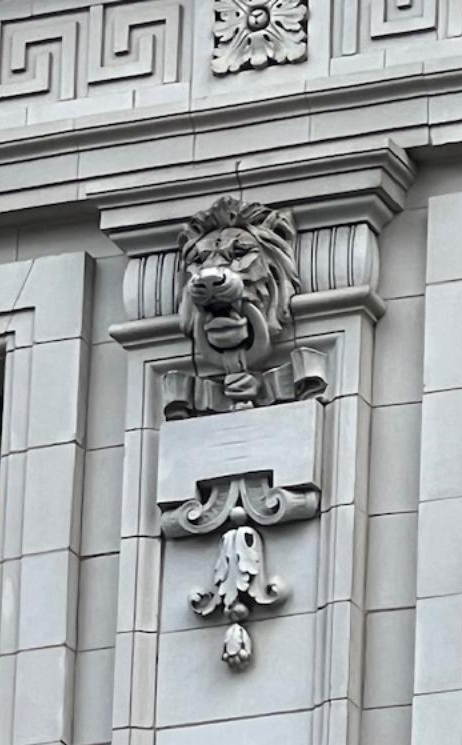
The lion details on 91 Fifth Avenue.
The last building on this part of Fifth Avenue was under an extensive renovation and I was not able to get the pictures that I wanted but still you could see the details in the building around the renovations.
Looking up Fifth Avenue from 16th Street
The Kensington Building was designed by architect Samuel Sass in the Beaux-Arts design and completed in 1906. Some of the first tenants of the building was the Milton Bradley company. The building was converted into a residential building in 1996 and were designed by architect Joseph Pell Lombardi (Landmark Branding LLC).
This part of Fifth Avenue has kept its character all these years and now that these buildings are back in vogue because of their history and design detail, they are being refitted for modern times. These were once the headquarters of companies that are now long gone but are housing the new future companies leading us into the 21st Century.
Looking up Fifth Avenue from 15th Street and the core of the Lower Flatiron District.
West 14th Street is a Hodge podge of building types and in various conditions. COVID really hit 14th Street businesses hard and between the pandemic, urban renewal of the neighborhood and changing tastes of building types, there is only a few buildings left from the era when this was a major shopping street at the turn of the last century. This was before everything moved up to the 23rd Street and Sixth Avenue area.
Much of the block between Fifth and Sixth Avenue is in the process of being knocked down, renovated or both. Still there are some architectural gems still left on the street.
On the corner of Fifth Avenue and West 14th Street is 80 Fifth Avenue.
80 Fifth Avenue is an elaborately-detailed Renaissance Revival style office building that was constructed by the architecture firm of Buchman and Fox. This building was constructed in 1908 to be used as manufacturing and office space (Kates, Ariel. Off the Grid).
Seeing better detail work on the building from the West 14th Street view.
This beautiful building’s lower and upper levels feature decorative floral and geometric ornamentation, elaborate cornices, and angled bay windows on the third floor. Ornamented pilasters are found at either side of these windows, with slightly more austere middle floors and in its arched windows and elaborate ornamentation at the top story (Kates, Ariel. Off the Grid).
The beautiful detail work on 80 Fifth Avenue.
The building’s history has a long past of companies that have worked in these offices but the most prominent had been the creation of the gay organization, The National Gay Task Force. Among the Task Force’s accomplishments during the time it was located at 80 Fifth Avenue included getting the American Psychiatric Association to end its classification of homosexuality as a mental illness; getting the federal government to end its ban on employing gay or lesbian people in any federal agencies (Kates, Ariel. Off the Grid).
Walking past buildings that are being renovating or built much of what must have been there from the turn of the last century had been torn down and that beauty in the buildings that must have been the ‘Ladies Shopping District’ in the early 1900’s. The only other building on West 14th Street that had the same characteristics and beauty is 56 West 14th Street by the corner of West 14th and Sixth Avenue.
This Neo-Classically designed building was the annex to the original Macy’s store that stood at the corner of Sixth Avenue and West 14th Street. R.H. Macy Dry Goods originally opened in a small building (since demolished) on this corner in 1858, and as its success grew it expanded into a number of neighboring buildings. No. 56 was built in 1898 by then-owners Isador & Nathan Straus. It was designed by architects William Schickel and Isaac E. Ditmars (Moskowitz, Sam Off the Grid).
The elaborate embellishments of 56 West 14th Street
The interesting details of the building.
Four years later, in 1902, the department store moved uptown to it’s present location on Herald Square, which is the current headquarters of the store.
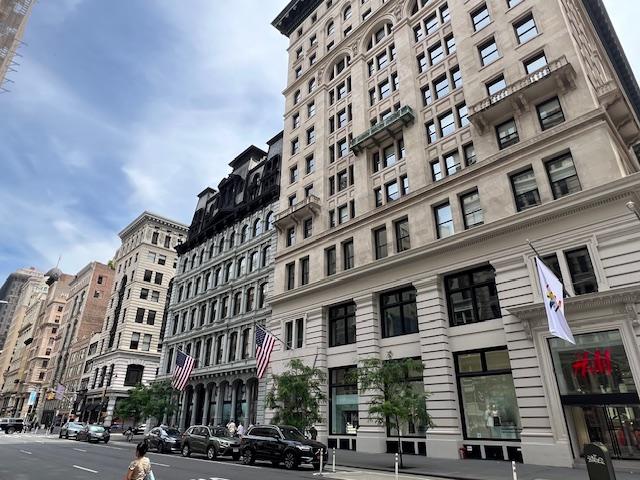
Walking up Sixth Avenue towards West 20th Street, there is again the same issue. Most of the more elaborate buildings are closer to the edge of West 20th Street. Walking back up toward the heart of the former “Ladies Garment Mile” along Sixth Avenue from West 18th Street to West 23rd Street, the lower part of Sixth Avenue is similar in look to West 14th Street. A mish-mosh architectural styles from years of knocking down the older buildings. Inside are a variety of fast food restaurants, coffee shops and small stores.
The first building left of the former shopping district is the former Pace Building at 610 Sixth Avenue.
David Price opened his first women’s clothing store, D. Price & Co. around 1887. The Price Building was built in 1910-1912 and designed by Buchman & Fox in the Beaux-Arts style (Wiki). The was the combination of the two stores, the one facing Sixth Avenue and the one facing 18th Street (DaytoninManhattan.com).
The embellishments of 610 Sixth Avenue designed by Buchman & Fox.
Next to the Price Building is what was one of the grandest of the department stores in New York City at 620 Sixth Avenue, Seigel Cooper
620 Sixth Avenue-The former Siegal Cooper Department Store
The original store design in the late 1800’s (New York Historical Society)
The Siegel-Cooper Department store was a Chicago based store that was founded in 1877 by Henry Siegel, Frank H. Cooper and Isaac Keim. They opened the New York City store in 1896 on the Ladies Mile Shopping District. The store was designed by the architectural firm of DeLemons & Cordes in the Beaux-Arts design. When it opened, it was the largest department store in the world until Macy’s opened in 1902 (Wiki).
The Siegal Cooper insignia on the building.
The window details
The details on the upper windows of the store.
Henry Siegel over-extended himself and sold the company in 1902 to an investor and the store declared bankruptcy in 1915 and closed in 1917. After the store closed, it was used as a military hospital and then as a warehouse. Today after years of being used as a warehouse, it now has several retailers located in the store space (Wiki).
Across the street from the Siegel-Cooper store is the old B. Altman & Company store before they moved to East 34th Street.
625 Fifth Avenue-The old B. Altman & Company Department Store.
B. Altman & Company was founded in 1865 as a family store that eventually came under the control of Benjamin Altman. It moved from its Third Avenue and Tenth Street location to 621 Sixth Avenue in 1877. The store expanded four times in this location to cover what is now 625 Sixth Avenue. The store was designed in the Neo-Grec design and built in four stages. First by architects David and John Jardine for the original store in 1877 and then the extension in 1880. Then by architect William Hume in 1887 and then by architects Buchman & Fox in 1910. The store moved to the corner of Fifth Avenue and 34th Street in 1906 when the shopping district moved to 34th Street (Wiki).
The last old department store on the Ladies Mile Shopping District is at 641 Sixth Avenue on the corner of Sixth Avenue and West 20th Street.
641 Sixth Avenue-The old Simpson Crawford Department Store
Simpson Crawford like many stores on Sixth Avenue had its humble beginnings on 19th Street. The store continued to grow and expand catering to the ‘carriage trade’ and selling the finest merchandise. After their new store was destroyed in a fire in 1880, they opened the store at 641 Sixth Avenue in 1899 which was designed by architectural firm William H. Hume & Son in the Beaux-Arts design (dayoninmanhattan.com).
The details of 641 Sixth Avenue.
This part of the Flatiron District feels so different from the northern part of the neighborhood. So much of it has disappeared over the years that the character has changed. It does not have the distinction of the blocks between 23rd and 20th streets. There are blocks of these types of buildings whereas the blocks of the old shopping districts of the early to late 1800’s from 14th to 18th Streets have slowly disappeared over time. Older buildings have since been replaced with modern office and apartment buildings. The buildings have even been refitted for apartments and for the growing college campuses in the area.
While there are many architectural gems in this neighborhood, it just goes to show the progression of Manhattan and how things have changed in the last 100 years. The City keeps marching on. Still this section of the Lower Flatiron District shows just how important this part of the old “Midtown Manhattan” was from the Civil War until WWI. Just look up and admire all the details on each building. There are a surprise and delight for the eyes.
The Street art on West 15th Street off Sixth Avenue “I Love New York”
Read my blog on Walking the Streets of the Lower Flatiron District:
With the warmer months upon us and the coming of the summer, new exhibitions are opening up and is the museums chance to showcase their exhibitions before they open to the public. These after hour events give the members a chance to see these exhibitions when the museum is closed for the evening.
The welcome to the Private Members Night at the MoMA.
I thought the line to the recent Private Members Night at the Metropolitan Museum of Art was long until I saw the line to get into the MoMA. It wrapped around the block to the West 53rd Street entrance. They should have had multiple entrances for this event because so many people were in line. We were lucky in that the line moved really fast and we got in the museum rather quickly.
The crowd dispersed quickly with some people intrigued by the visual display in the lobby outside the main courtyard where the concert would take place that evening.
The visual art display in the lobby of the Museum of Modern Art mesmerizes everyone.
Unlike like The Met, there is not the room in the main hall or the courtyard for all these people. Ron Carter, the famous Jazz musician was playing in the courtyard and they had to hold the line because there were too many people outside. Knowing these events, I got outside for the concert as soon as I made a trip to the bathroom (that was packed too). The courtyard was full of groups talking and waiting in line to get to the bar.
The crowds were huge at this event.
The worst part was that there were only two bars for all these people. One was in the lobby and one was in the courtyard and the lines were easily sixty deep for most of the night. There should have been a second bar both in the courtyard and maybe on the second floor of the museum to handle the flow of people. Still people did not seem to mind.
I was lucky in that I went to the courtyard first after going to the bathroom so I did not have to leave the courtyard so quick. I could see they were holding the line to get outside and the concert would only be from 7:30pm to 8:30pm. Even when I left the courtyard at 8:10pm, the line was still sizable to get outside. The concert was well worth it.
Mr. Carter’s performance was excellent. I could not believe that the first time he had been to the museum was in 1965. The last time he performed here was in 1993. For a guy in his 80’s, he looks in great shape. The concert was really good but since there was not enough seating for everyone it made it a bit in comfortable for the audience. Still I stayed through the first four numbers and enjoyed the music.
Around 8:15pm, I saw all these people peering through the window of the lobby and figured I should go see other things at the museum before it closes. About thirty other people felt the same way and a large group of us left the courtyard to the relief of another thirty who were let in. The concert only had about fifteen minutes left.
Ron Carter’s number last number when I left.
I went to explore the museum and see a few of the exhibitions that I missed the last time I was in the museum. This was the start of the Spring shows. As the concert started to wind down, the rest of the museum became busy.
One of the features of the even was scratch artist Kathie Kollwitz whose work spanned the world wars and show the plight of the working class in Germany during and in between the wars.
The paintings of Kathie Kollwitz.
Times were so rough for these people at that time and conditions not pleasant, the artwork reflected it. It was really depressing and I could see why Hitler rose to power. Her work showed how raw life was like between the wars and how bad their economy was at the time.
The other exhibition I saw was American artist Latoya Ruby Frazier, whose work representing our own working and underclass and of a population in Pennsylvania who time has passed by. The artist’s family was exposed to the problems of the steel industry and the after effects of its collapse.
The Latoya Ruby Frazier exhibition on the Private Members Night
I liked about her show was the honesty of the whole show. She showed her personal relationship with her relationship with her grandmother and her family. She also showcased her community, who had so much influence in her life. The community had been so badly affected by pollution, poverty and discrimination that it left a scar on the tight knit community of Braddock, PA.
The artist’s gallery display of her relationship with her family
When the biggest employer left, the much needed hospital, closed because their headquarters said it was losing money. This with the loss of the automotive industry caused the community to deteriorate. These are the communities that time left behind after WWII. It was really honest work.
The decline of Braddock as industry left the area.
The exhibition was heartbreaking and touching at the same time. She showed how much she cared about her community and many others in the exhibition like Flint, MI and Youngstown, PA and how one change in corporate behavior can effect the entire community.
I was able to visit other parts of the museum as well but all things do come to an end after three hours and it was time to leave. By the end of the evening, I was ready to go. What an interesting and engaging evening it was and what a great job the MoMA did creating this fantastic evening for all of us.
The skyline along Sixth Avenue.
When I left the museum for the evening, the lights of midtown came on. I never get bored on how beautiful the City is at night.
Walking back to the Port Authority at night.
It was another wonderful Member’s Night. This is why you should join the MoMA!
I finally reached another milestone in my education and in my life. I graduated with honors from New York University with a 3.813 GPA. Quite an accomplishment from someone who last graduated from Cornell University back in 2010. I was a lot of hard work and one big balancing act of time but I walked across the stage of Radio City Music Hall with the energy and enthusiasm of any undergraduate.
You can read my blog on “Grad Alley” a few days before the Graduation Ceremony:
I came a long way from the first meeting I had at the college back in October of 2019. I had visited Georgetown University the summer before and realized that it was not for me. When I got the email from New York University in the Summer of 2019 I thought, let me check this out. It is closer to home and I would be going to school in Manhattan and Greenwich Village to boot. It turned out to be one of the best decisions I ever made.
Before the Graduation Ceremony began.
The graduates settling in for the start of Graduation.
As a returning college student (I am not going to lie, this is my fifth time to college and this is the fifth college I have graduated from), I was a little intimidated by my classmates at first. I did not know what a Google Doc or a Google Slide was the first day of class. I did not even bring my computer into the class the first (I knew better from that day on) and was still using my 3G flip phone (which got a lot of chuckles from my classmates). I also was older than everyone by over twenty years but with that comes years of work experience, travel and knowledge of the ever changing Hospitality industry that keeps evolving and will continue to in the future.
Justin before the start of the ceremony.
I got up to speed really quick with a new iPhone 13 Pro (whose picture and video taking ability has transformed this blog) and a new HP computer and watched many Google YouTube videos to keep me up to speed. By the end of the first semester, I was an old pro at all of these functions and for the first time in my life got straight “A”s in my classes. It was a long time in coming that I had to prove this to myself. And at New York University no doubt (NYU).
The theater filling up with students and parents.
It had been a long journey over the last year and a half. Running in and out of New York City for classes in between my job at Bergen Community College. Countless late nights writing papers, researching subject matter and trips to libraries on both campuses to finish projects. This on top of working on Executive Boards for the Fire Department and Men’s Association in town, volunteer work that I do and squeezing in blogging on seven sites. There were times I almost had to pull an ‘all nighter’.
The stage before we started the graduation.
The video of the organist before the ceremony started:
What I found over that year and a half was a whole new way of looking at the Hospitality industry. I had never really thought about Sustainable tourism, Dark tourism, LGBTQ tourism and Diversity in tourism. I had never categorized it in the sense it was different things to different people. My professors had their way of teaching it and I had my own and going forward I used both when creating projects and my own expectations from my students. They gave me a different perspective of looking at the way a place could market itself and I took it one step further and asked of my students how can small towns and musty historical sites be made unique and interesting by marketing them in a different way. Break the mold of what they were doing and present it in a format that they might not have thought of in that light.
The NYU Bagpipers opening the ceremony.
Video of the Bagpipers entering Radio City Music Hall:
What really opened my eyes were the three GFI (Global Field Intensification) courses that I was able to experience. On my first meeting with my faculty advisor, he told me that he was planning a trip to Prague for a week and then insisted that I must come on it. He kept going and going until I finally said “yes”. I knew nothing about Prague or really where it was located. I kept thinking it was in Russia. Two Professors decided to do back to back GFI’s, the first one going to Paris and the second to Prague. Since my brother was getting married in Sicily, it gave me an excuse to go on both. It opened my eyes to a different world that changed me.
Our Dean welcoming the graduates and their parents and guests.
Paris is a more amazing city than I could have imagined. As intense and cultural as New York City but in a totally different way. The countless independent shops, restaurants, cafes and flea markets opened my eyes to a city not overrun by chain stores and each neighborhood had its own cultural identity. Every day it was a new adventure or trying new restaurants or experiencing new foods served in a way that I had not seen in the States. Since it was a Culinary Tourism class, I had to lead a tour of gourmet shops, bakeries, chocolate and candy shops and the gourmet department of a department store. I had never been to Paris before, knew nothing about the city and had not spoken the language since the 1980’s (I had three years of high school French). Somehow I charmed enough shop owners with my broken French to welcome my class in to try their products. It was a huge success (Google “Exploring Paris Block by Block”) for the details on the trip.
The ceremony was about two hours and most of that was calling names of graduates.
Then off to Prague for another wonderful experience exploring the history, food and culturally delights in the city. We visited all the touristy spots you would normally see on the tour but our tour guide, Jana, really had us exploring the city from a different perspective from someone who lived in all these areas. Everyday we experienced something new and in the time that I got to explore the city on my own, I walked the entire city as I would in Manhattan and got to pass all the local shops and restaurants and experience things as a local would living in Prague.
Then it was off to Abu Dhabi and Dubai during their Winter tourism season and that was a true eye opener. It was like going home as I discovered my Arabic roots (though they are about 400 years old and through my mother’s Sicilian heritage). All the men looked like me and that made me feel more at home. Though we had a pretty tight schedule again seeing all the sites that are popular with tourists, I had to stay an extra day because of the flights and got to explore Abu Dhabi on my own.
When the ceremony was over we were all applauded.
Me crossing the stage to finally graduate from Graduate School:
I walked the entire part of my neighborhood around the hotel and discovered the more localized view of the city through the eyes of the Omens, Saudis, Indians and other ethnic groups that made up the majority of the population that make this city run. I walked through their neighborhoods and visited their shops, restaurants, bakeries and stores and saw the city through their eyes. This was the city that I wanted to experience. That and a flat tire coming back from Al Ain left us eating at a local ‘hole in the wall’ restaurant where the site for thirty American students shocked the restaurant owner who could not believe that he had a full restaurant on a quiet Tuesday night. These were the experiences that I got in classes at NYU.
My blogs on “Exploring Abu Dhabi and Dubai Block by Block”:
As we all prepared for the excitement of graduating, I thought back to my first day of class and arriving on the NYU campus right before Labor Day weekend and having no clue what to expect. I have a clearer idea now how the world ticks and how much I had been exposed to in such a short period of time. My Professor who had taken us to Paris was now leading a class over the summer to Barcelona and I really wanted to stay to experience that as well.
The end of the ceremony at 6:00pm.
When all of the students and parents took their seats, the ceremony started on time at 4:00pm. We were greeted by the Radio City Music Hall organ player who made his appearance and then disappeared behind a wall. Then came the NYU Bagpipers who opened the ceremony for us. This was followed by a speech by our Assistant Provost and then by our Dean of our College for the School of Professional Studies.
In the hallway of Radio City Music Hall after graduation.
Then we had to endure the one thing I hate, the student speech. I have sat through countless junior high, high school and now five colleges of students saying things like “life long friendships” and “what we learned from the past will carry us into the future” and ” the people who influence us”. I have heard this same speech over and over again that I could have memorized it and bet on what she was going to talk about. I bet by the time the ceremony was over, everyone was going to part ways and many of my classmates would be traveling back to the countries they originally came from and run their tourism boards. I did not know too many of my classmates who were going to stay in New York City.
Me after graduation was over and Radio City orchestra seating had emptied out.
Then we walked on stage row by row and they called our names over the loud speaker so that family and friends could see us walk on stage. I was so thrilled to hear my name and that a got a nice applause. I was not sure that anyone noticed me as I crossed the stage. This made me feel like a million dollars. I could not believe that I had graduated from such an exclusive college like NYU and with honors. That was quite the achievement for me.
Maricel and I in Radio City Music Hall before the usher kicked us out.
As the rows and rows of classmates made their way to the stage and walked on and off, I looked behind me to see people leaving the theater before the ceremony was over. I thought it was wrong for people to not wait until all the graduates to finish but I will be honest. The second the last classmate crossed the stage, the music started, the confetti and streamers came down and then they wanted us out of there. There was a show that night and they needed to clean up. I wasn’t even out of the orchestra seating before the usher was asking us to leave so they could clean up.
One last shot when the usher turned her back for a second.
Me talking to my friend, Reema, after the ceremony.
We were able to snap some pictures before we left when the usher’s back was turned and then we had to leave. They closed the doors behind us and then the ushers kept everyone off the stairs and everyone had to leave the hallway so there was quite the crowd just outside the door. I bet the show in the evening went off without a hitch.
The end of the ceremony.
While we were outside, Maricel and I took lots of pictures around Radio City Music Hall and then finally had to go across the street because the crowds outside got to be too big as more people had to leave the entrance to the theater and make their way out to the street. It was packed with graduates and their families either taking pictures or trying to cross the street. There was grid lock for about a half hour.
Leaving Radio City Music Hall after graduation.
Outside Radio City Music Hall.
All the graduates and their family and friends had taken over Sixth Avenue and we were all over the place taking pictures. Funny enough with all the time I had been spending in the Times Square/Theater District for my blog on the Streets of Times Square, I got to know all the buildings quite well and we made our way over to 1251 Sixth Avenue to take pictures before heading back over to the hotel.
Me in front of 1251 Sixth Avenue. No one paying that much attention to us. We decided to have some fun with it.
Me as the worldly graduate.
Having some fun by the fountain.
Having some fun at graduation.
Maricel wanted to take more pictures so we went to Times Square with the other tourists but we took one more picture in front of Radio City Music Hall before we left.
My best friend, Maricel and I outside Radio City Music Hall after graduation.
We went to the TKT Booth Stairs where everyone in Times Square was hanging out and complete strangers were wishing me congratulations and well wishing me in my future. That felt really good and I appreciated it.
Me having some fun in Times Square and the ladies below were cheering me on and wishing me well in my graduation from college.
After all the picture taking (trust me there are dozens more shots of me all over Times Square), we headed back to the Marriott Marquis. I had made plans so that we would be having dinner at the Broadway Lounge, their signature restaurant, for graduation night. The views and the food are always amazing. This is where Maricel and I eat when each of us has a very special occasion in our lives.
What a wonderful dinner. The food and the views at the restaurant are just spectacular and the service is always very nice. We had to practically barge our way to a window table when the host gave our first table away. I had to calm a manager down when we took the second table. I had to explain that it was my graduation dinner and my friend wanted to be sure I had a window table. After that, he was fine with it.
While we were ordering we were taking pictures of the restaurant and then each other. Now that graduation was behind me, we could have a little fun and be silly. It was such a great meal.
Me photographing MaricelMaricel photographing me.
Then we had dinner. The Broadway Lounge on the Eighth floor of the Marriott Marquis has always been a favorite place of mine to go for dinner for a special occasion. The views are amazing and the food wonderful.
The view from the Broadway Lounge window.
We had the most amazing Graduation meal once we were seated. We started with their fiery Chicken Tenders which was a pretty generous portion for an appetizer. These lightly breaded chicken breast tenders were rolled in a hot pepper and spicy sauce and served with creamy Italian dressing.
Ryan’s Spicy Chicken: The fiery Chicken Tender with a ranch sauce
I was in the mood for a burger and Marriott does such a nice job with these. Both the regular burger and the Smashburger are excellent, and I decided on the Smashburger while Maricel had the short ribs and mashed potatoes.
The Short Ribs and Mashed Potatoes
The Broadway Smash Hit burger with French Fries
For dessert we shared the ultimate dessert treat, the Strawberry Tower, which is layers of pound cake, fresh strawberries and vanilla ice cream and strawberry sauce topped with fresh whipped cream, cheesecake bites, wafer cookies and a giant lollypop which tasted like bubblegum. With a $32.00, it was a little pricy but since it was my graduation night it was the perfect way to end the meal and it was delicious.
The Marquis Strawberry Tower at the Broadway Lounge for my Graduation dessert.
Me getting a photo op with that delicious dessert.
When I got back to the room was the ultimate surprise for me. Maricel decorated the room for my graduation. I was shocked and touched that she got this done in between the time we had arrived to check in and the time I left to get to Radio City for the 3:00pm check in for graduation. I was so touched. No one had done something like this to me before.
Maricel surprised me by decorating the room for my graduation.
The room at the hotel decorated for my graduation.
Me on my graduation night at the hotel in the room decorated for me by my best friend.
Earlier this year I had watched Cliff Richards duetting with a ghostly Olivia Newton-John after her passing for a Christmas video singing “Suddenly” from the movie Xanadu. In part of the video, I watched Olivia Newton-John wheel a cake out for his 75th birthday and totally surprising him in an earlier video. I said to myself “that is something only a real true friend does” and wished someone would do that for me in my lifetime. Maricel did this that night. When a real friend knows what you are going through and has the opportunity to react, it makes all the difference in the world to someone. Tonight, it was me!
With the beautiful views from the room of Times Square and having the ultimate view of where the ball drops directly in front of us, I could not have asked for a more perfect graduation night. I had had different experiences on the nights of my high school, Michigan State University and Culinary Institute of America graduations but this is the one I will always remember. When a friend shows you the ‘top of the world’, you could not ask for more.
The view of Times Square from our room and the famous ‘ball’.
The view of the ‘ball’ from Times Square.
The view of the room at night.
The view of Times Square from our room where the ball drops.
The next morning the Breakfast buffet was absolutely the best way to end the evening. The food was excellent and the selection was wonderful. We were able to eat Club M, the private members room that was nice. It was the perfect breakfast.
The amazing breakfast buffet the next morning.
The amazing breakfast the next morning.
The breakfast buffet was very extensive.
It was an amazing graduation and now on to new experiences to see and new ideas to embark on. It has been quite the journey.
Justin Watrel, Graduate Class of 2024 School of Professional Studies New York University with Honors.
What a true friend does:
Cliff Richards and the late Olivia Newton-John “Suddenly”.
Watch as she rolls out the 75th birthday cake for him for his ’75th Year Concert’. A real friend can only pull this off!