
I finally got into Union Square and at a nice time of the year. The park was packed with people sunning themselves, reading and enjoying the sunshine. The Farmers Market was in full swing and offered so many wonderful things for sale.
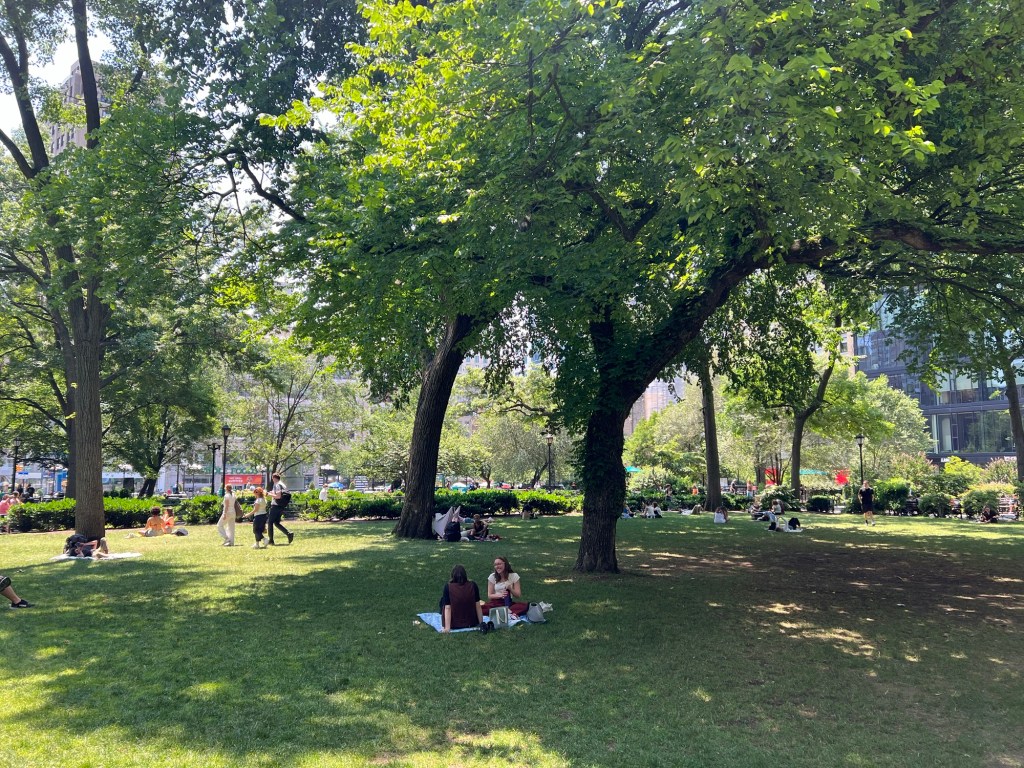
What a beautiful day to start the walk in Union Square Park
https://www.nycgovparks.org/parks/union-square-park
My review on TripAdvisor:
I was able to tour the neighborhood twice in the two day period over Father’s Day Weekend once at twilight just as the sun was setting and the lights were coming on at the cafes and restaurants and then the next morning after breakfast on a clear and sunny day. The buildings took on two different personalities at different times of the day.
The first part of the walk was revisiting lower Fifth Avenue from West 20th to West 14th Streets. Again which I had just covered for my blogs on the Lower Flatiron District. Just after the Civil War to WWI, the was the Midtown Manhattan of that era with the banking and shopping districts where you still see these traces in the beauty of the buildings. From Beaux-Arts to Neo-Classical, these former headquarters buildings were meant to impress. I started my tour passing the same Fifth Avenue buildings that share the border with the Lower Flatiron District.
I passed 156 Fifth Avenue as I walked this part of the neighborhood again and admired it for its detailed stonework carving and unusual styled roof. The Presbyterian Building was built in 1893 and was designed by architect James B. Baker and was designed in the French Gothic style. It was to be used by the Presbyterian Church as their base for domestic and foreign missions and used as office space. The Panic of 1893 changed that, and they had to lease the space out (Daytonian in Manhattan).
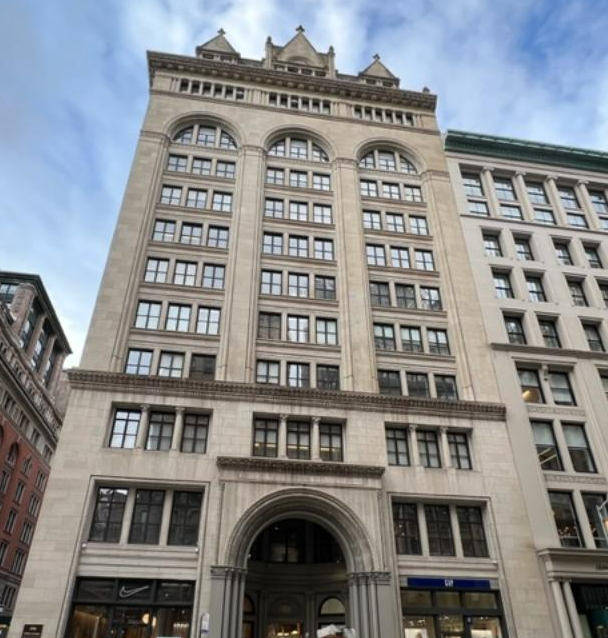
156 Fifth Avenue
https://www.loopnet.com/Listing/156-Fifth-Ave-New-York-NY/14050649/
http://daytoninmanhattan.blogspot.com/2011/02/presbyterian-building-156-fifth-avenue.html
I then took the long walk down Fifth Avenue and all the architectural treasures it contains. This was once the core of the old ‘Midtown Manhattan’ after the Civil War and the City started its march uptown.

148 Fifth Avenue
https://streeteasy.com/building/148-5-avenue-new_york
https://www.loopnet.com/property/148-5th-ave-new-york-ny-10011/36061-08210041/
This unique office building was built in 1900 as a office building. This building is currently under renovation.

The details on 148 Fifth Avenue
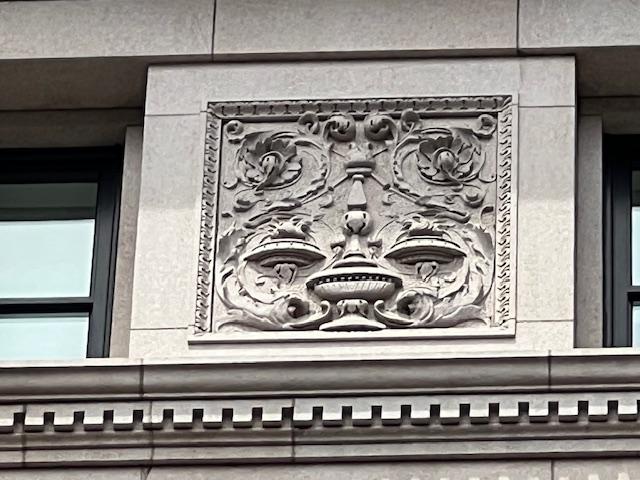
The details of 148 Fifth Avenue
The next interesting building on the walk down Fifth Avenue was 119 Fifth Avenue which had just finished being renovated.

119 Fifth Avenue
https://www.propertyshark.com/mason/Property/13021/119-5-Ave-New-York-NY-10003/
https://streeteasy.com/building/119-5th-avenue-new_york
119 Fifth Avenue at the corner of East 19th Street in the Flatiron District neighborhood of Manhattan, New York City was built in 1905-06 and was designed by John H. Duncan in the neo-Renaissance style. It was built to be an annex to the Lord & Taylor department store buildings which took up most of the square block between Broadway and Fifth Avenue and East 19th and 20th Streets, being connected by bridge to two of them. After Lord & Taylor moved uptown in 1914, the building had multiple uses (Wiki).

The details of 119 Fifth Avenue

The details of 119 Fifth Avenue
One of the most impressive buildings in the neighborhood is the old Arnold Constable Store building that stretches from its Broadway entrance down the entire block on 18th Street to its Fifth Avenue entrance.

115 Fifth Avenue-Arnold Constable Department Store
https://buildingsofnewengland.com/tag/115-fifth-ave-nyc/
https://en.wikipedia.org/wiki/Arnold_Constable_%26_Company
https://www.realtyhop.com/building/115-5th-avenue-new-york-ny-10003
This seven-story department store building was designed by architect Griffith Thomas in 1868 for the prominent dry-goods company of Arnold Constable & Company. ‘The Palace of Trade’ as it became known as, is located stretches between Broadway and Fifth Avenue. The stunning Second Empire building is faced in marble, brick, and cast-iron, features stacked arch orders and a prominent, two-story, pavilioned mansard roof. Arnold Constable & Co. was founded by Aaron Arnold, who opened a small dry goods store in the city in 1825 (Buildings of New England).
As the business prospered he moved into larger quarters numerous times. In 1842, James Constable, an employee, married Arnold’s daughter Henrietta and was subsequently made a partner. From this, the company was renamed Arnold Constable & Co. In its heyday, Arnold Constable & Co. was the largest dealer to the elite in New York City, supplying the latest fashions to a clientele that included the leading families in the city (Buildings of New England).
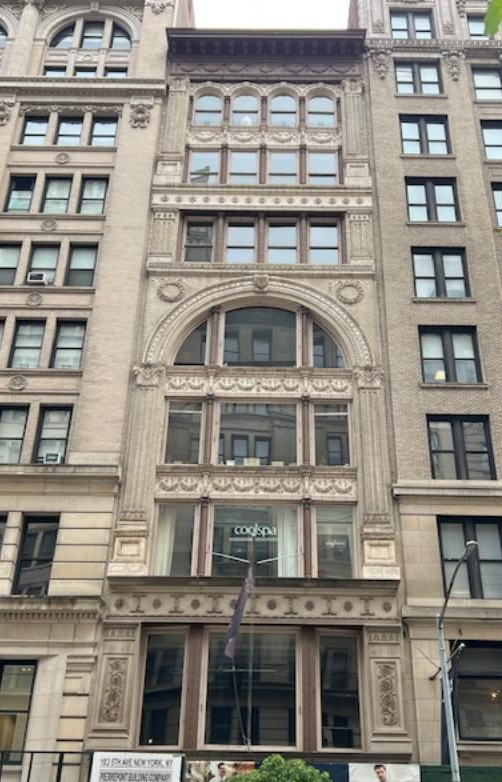
103 Fifth Avenue
https://streeteasy.com/building/103-5-avenue-new_york
https://daytoninmanhattan.blogspot.com/2011/07/1896-beaux-arts-pierrepont-building-103.html
The building had an interesting history. The building was designed by architect Louis Korn and was designed in the Beaux-Arts design. It was completed in 1896 and it was named after Edwards Pierrepont, whose mansion had stood on the site before the construction of the building. When it opened the building was popular small publishing and mercantile companies (Dayonianinmanhattan.com).
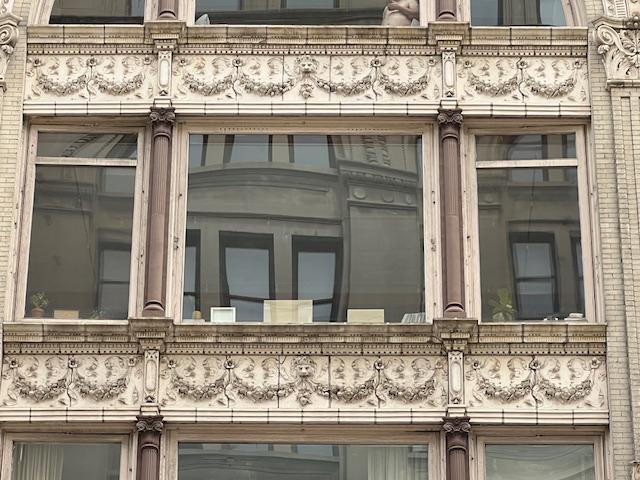
The 103 Fifth Avenue details

103 Fifth Avenue embellishments
In between the buildings there was plaque to Levi Parsons Morton, the former Governor of New York State and the Vice-President of the United States under President Benjamin Harrison. This is where his home was located.
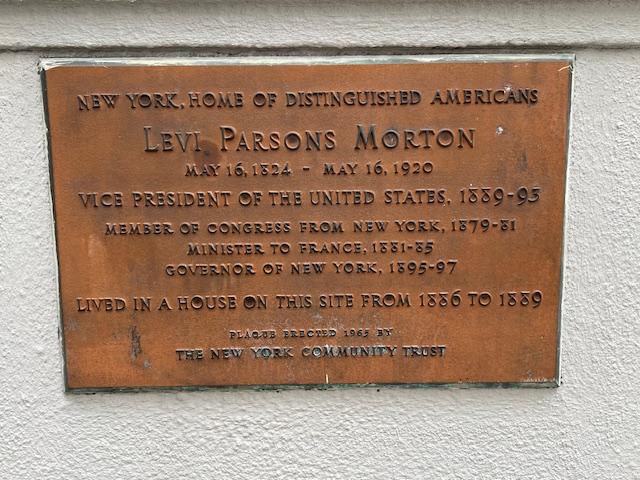
The plaque of the former Vice-President’s home on Fifth Avenue.
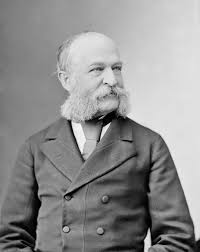
Vice-President and former New York Governor Levi Parsons Morton
https://en.wikipedia.org/wiki/Levi_P._Morton
On the building is also the B. Shackman & Company sign for a now long gone Fifth Avenue toy business.

The B. Shackman & Company sign
https://ephemeralnewyork.wordpress.com/tag/b-shackman-co/
The B. Shackman & Company sign was for the former B. Shackman & Company novelty and toy store that was located here until the 1970’s. The store once sold all sorts of novelties and gifts (Ephemeral New York.com/Consumer Grouch).
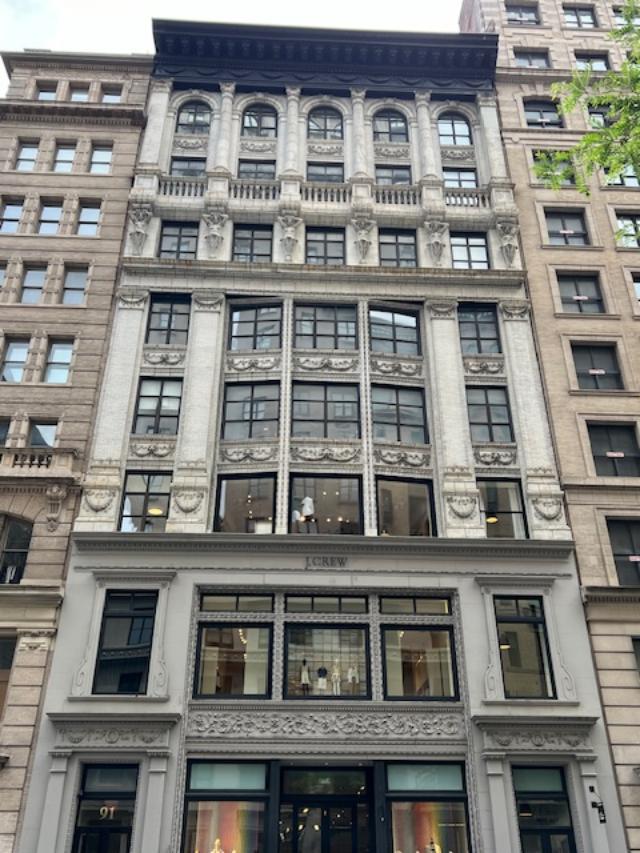
91 Fifth Avenue
https://www.propertyshark.com/mason/Property/12971/91-5-Ave-New-York-NY-10003/
This beautiful office building was designed by architect Louis Korn for businessmen Henry and Samuel Korn in 1896. The office building currently houses small companies (Wiki).
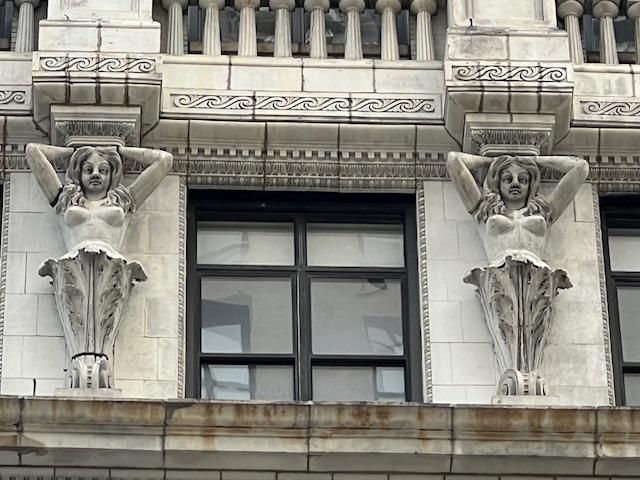
The details of women looking down at us on the street at 91 Fifth Avenue
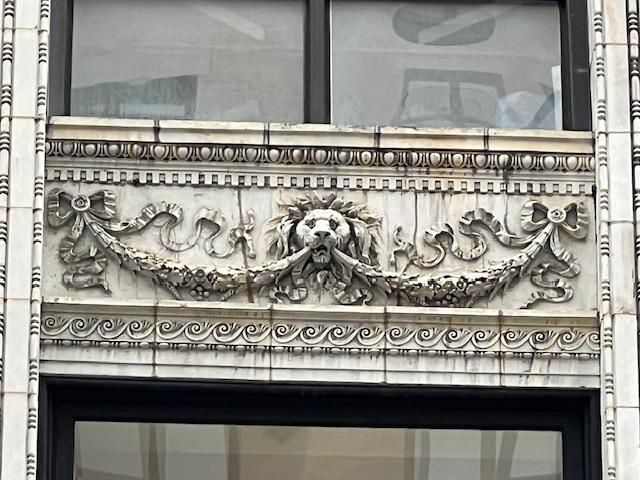
The lion details on 91 Fifth Avenue.
The last building on this part of Fifth Avenue was under an extensive renovation and I was not able to get the pictures that I wanted but still you could see the details in the building around the renovations.

Looking up Fifth Avenue from 16th Street
The Kensington Building was designed by architect Samuel Sass in the Beaux-Arts design and completed in 1906. Some of the first tenants of the building was the Milton Bradley company. The building was converted into a residential building in 1996 and were designed by architect Joseph Pell Lombardi (Landmark Branding LLC).

73 Fifth Avenue
https://www.cityrealty.com/nyc/flatiron-union-square/the-kensington-73-fifth-avenue/4044

The details on 73 Fifth Avenue
This part of Fifth Avenue has kept its character all these years and now that these buildings are back in vogue because of their history and design detail, they are being refitted for modern times. These were once the headquarters of companies that are now long gone but are housing the new future companies leading us into the 21st Century.

Looking up Fifth Avenue from 15th Street and the core of the Lower Flatiron District.
West 14th Street is a Hodge podge of building types and in various conditions. COVID really hit 14th Street businesses hard and between the pandemic, urban renewal of the neighborhood and changing tastes of building types, there is only a few buildings left from the era when this was a major shopping street at the turn of the last century. This was before everything moved up to the 23rd Street and Sixth Avenue area.
Much of the block between Fifth and Sixth Avenue is in the process of being knocked down, renovated or both. Still there are some architectural gems still left on the street.
On the corner of Fifth Avenue and West 14th Street is 80 Fifth Avenue.

80 Fifth Avenue from the corner view
https://www.loopnet.com/Listing/80-Fifth-Ave-New-York-NY/4632221/
80 Fifth Avenue is an elaborately-detailed Renaissance Revival style office building that was constructed by the architecture firm of Buchman and Fox. This building was constructed in 1908 to be used as manufacturing and office space (Kates, Ariel. Off the Grid).
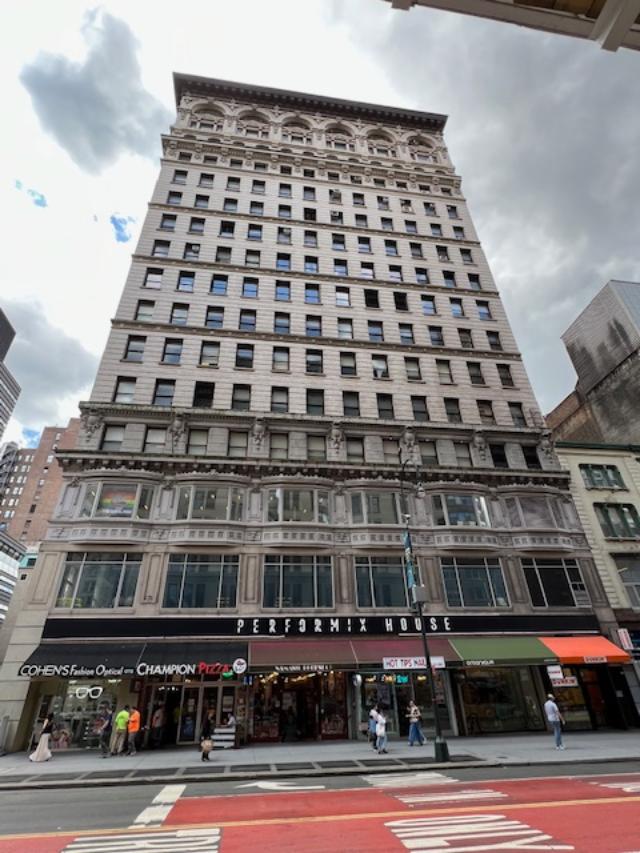
Seeing better detail work on the building from the West 14th Street view.
This beautiful building’s lower and upper levels feature decorative floral and geometric ornamentation, elaborate cornices, and angled bay windows on the third floor. Ornamented pilasters are found at either side of these windows, with slightly more austere middle floors and in its arched windows and elaborate ornamentation at the top story (Kates, Ariel. Off the Grid).

The beautiful detail work on 80 Fifth Avenue.
The building’s history has a long past of companies that have worked in these offices but the most prominent had been the creation of the gay organization, The National Gay Task Force. Among the Task Force’s accomplishments during the time it was located at 80 Fifth Avenue included getting the American Psychiatric Association to end its classification of homosexuality as a mental illness; getting the federal government to end its ban on employing gay or lesbian people in any federal agencies (Kates, Ariel. Off the Grid).
When I turned to the corner and walked down East 14th Street, I know seeing developers attempt to rid Union Square of its once seedy past. As I pass the park itself, I still remember the days when this was a major drug haven, a major methadone clinic was located here and sensible people stayed far away from Union Square Park. It took Danny Meyers and the creation of Union Square Cafe in 1985 at 101 East 19th Street and then the closing of the methadone clinic to change all that. The popularity of the Farmers Market and the renovation of the park in the late 1980’s changed the complexity of the neighborhood.

The original Union Square Cafe at 21 East 16th Street
https://www.unionsquarecafe.com/about/
My review on TripAdvisor:

My father and I on Father’s Day at the original Union Square Cafe for lunch in early 2000’s
There were also a series of buildings around the square that were knocked down and new buildings built in their place most notably the old S. Klein on the Square building replaced by a new office building, a branch of NYU opening on the southern end of the park and the Zeckendorf Towers buildings at One Union Square changed the who complexity of Union Square into a desirable neighborhood. In the 21st Century, it is now becoming a trendy neighborhood catering to the tech industry.
Even more changes are on there way:
https://www.curbed.com/2021/01/union-square-park-partnership-plan.html
As I crossed Fifth Avenue to West 14th Street towards Union Square I remembered that this was the most southern part of the old Ladies Shopping District before the Civil War. It had been the theater district as well with the Academy of Music closer to Irving Street. After the Civil War, the shopping and theater district moved uptown towards 23rd Street, then to 34th Street and then ending at 42nd Street.
Between Fifth Avenue and Broadway along the southern border of Union Square, there is not much left of that shopping district. Many of the older buildings had been knocked down in the early 1900’s for new stores and since then much of the non-landmarked buildings were again knocked down in the early 1980’s to improve the district. S. Klein stood empty from 1975, when it closed for business to 1983 when it finally was knocked down for the Zeckendorf Towers and that changed the district forever (Wiki).
Still when I walked from Fifth Avenue to Union Square there was one building that stood out amongst all the new late 20th buildings on 14th Street and that was 22-26 East 14th Street.

This impressive building at 22-26 East 14th Street built along the former Ladies Shopping Mile was once meant to impress. This was once the home for Baumann Brothers Furniture & Rugs
https://daytoninmanhattan.blogspot.com/2015/07/the-baumann-bros-bldg-no-22-26-east.html
The building was designed by architects David and Jon Jardine for successful textile merchant James McCreery in 1881. The building was designed in the Neo-Grec and Neo-Classical design and until 1897 was the home for Baumann Brothers Furniture and Carpet store. It then passed to Woolworth’s and the broken up for other retailers. It is now home to Footlocker but you can still see the beauty in this building with its elaborate embellishments (DaytonianinManhattan.com)
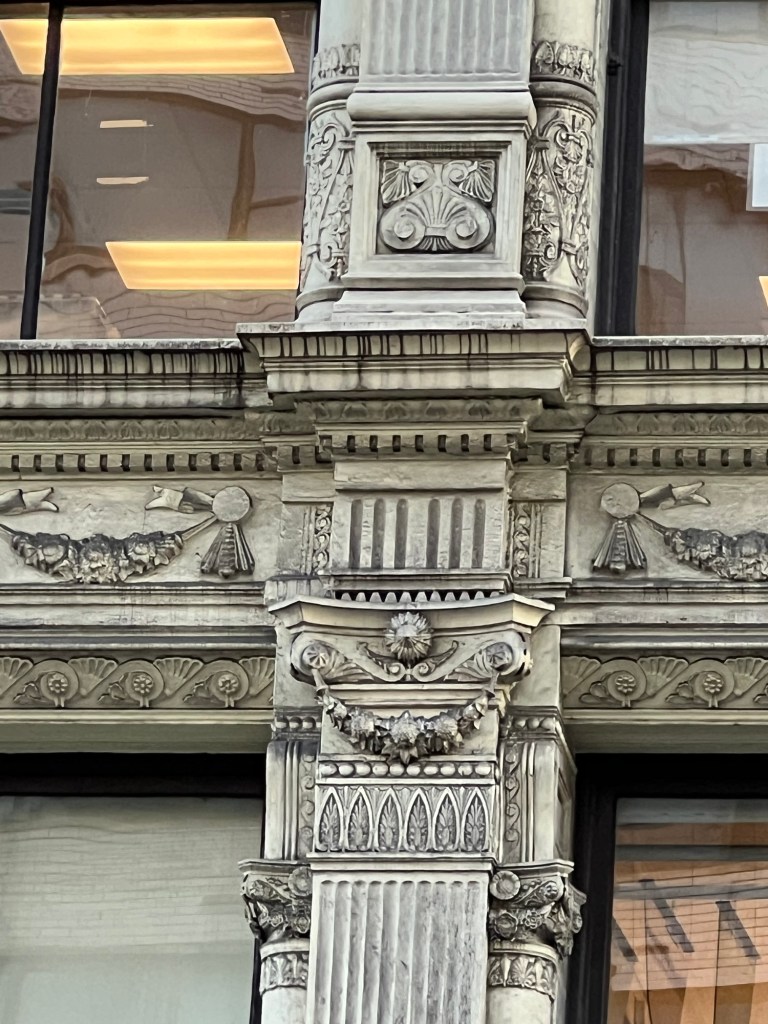
You really have to stop and look at its Neo-Classical details to really appreciate this building
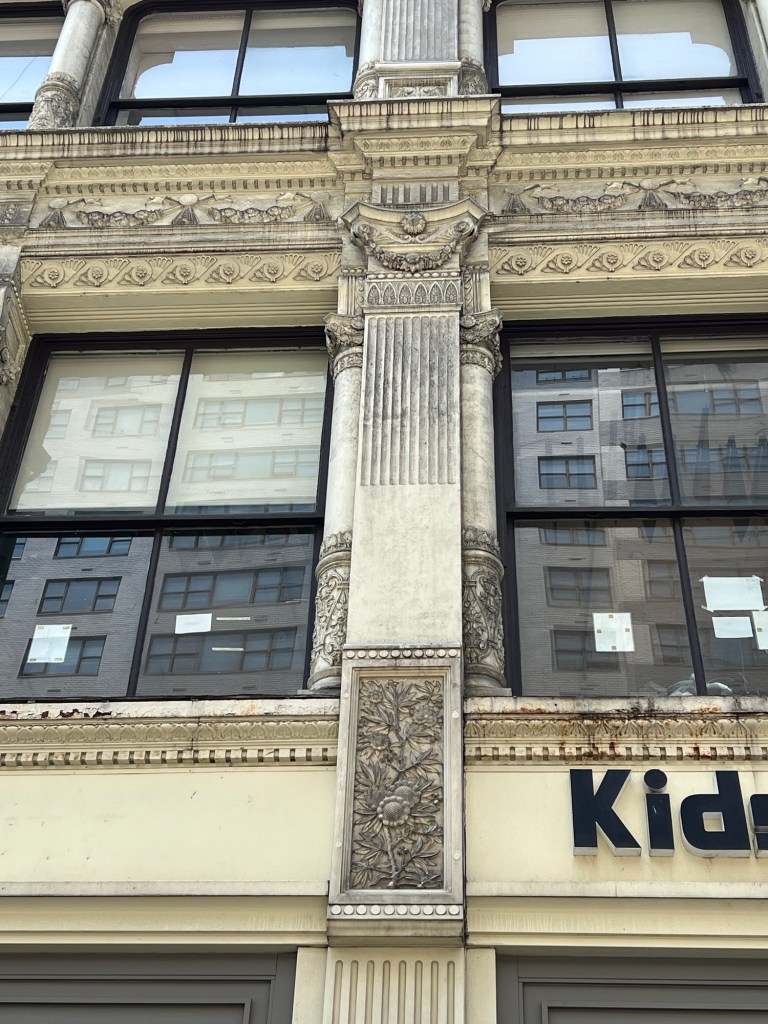
The intricate details of the McCreery Building
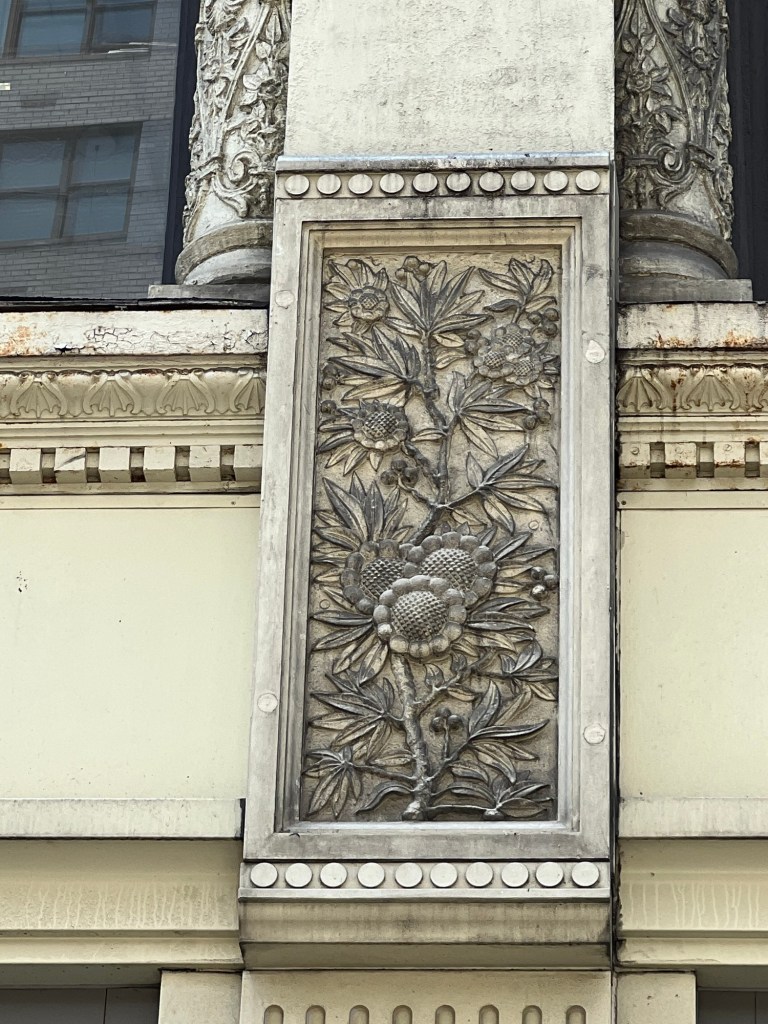
The floral details in the middle of the building
I got a chance to walk around Union Square once I finished my tours of Fifth Avenue and East 14th Street. It was a beautiful sunny day and people were outside enjoying the sun and shade in the park. The Farmers Market was going on which made it even busier. By the subway station, there were guys hustling to play chess. A typical day in Union Square Park. Thirty years ago just like Bryant Park or Madison Square Park, sensible people stayed away from these squares of green with the garbage and graffiti and drug dealing. How a City transforms itself over a period of time is confounding. From the ashes of COVID, another New York City is rising.
What impresses me the most about the park is that the crazy protestors never knocked our statues down. Inside Union Square are three very prominent and very famous statues of George Washington, Abraham Lincoln and General Lafayette.

George Washington
https://www.mountvernon.org/george-washington/

We are lucky that our statues were not knocked down like other cities in 2020. This impressive statue of General Washington sits at the entrance of Union Square.
https://www.nycgovparks.org/parks/union-square-park/monuments/1676
This impressive statue of George Washington was designed by sculptor Henry Kirke Brown and was dedicated in 1856. The moment Brown depicts is that of Evacuation Day, November 25, 1783, when Washington reclaimed the city from the British. With outstretched hand, he signals to the troops in a gesture of benediction (NYCParks.org).
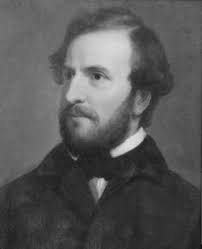
Artist Henry Kirke Brown
https://en.wikipedia.org/wiki/Henry_Kirke_Brown
Artist Henry Kirke Brown was an American born artist who had studied with artists in Italy for his training. He is best known for his figurative historical statues. He also designed the statue of Abraham Lincoln in Union Square.
On the southern part of Union Square is the Climate Clock atop the NYU Dorms at 60 East 14th Street. The facade of the building makes quite the statement above Union Square if you stop to look at its details.
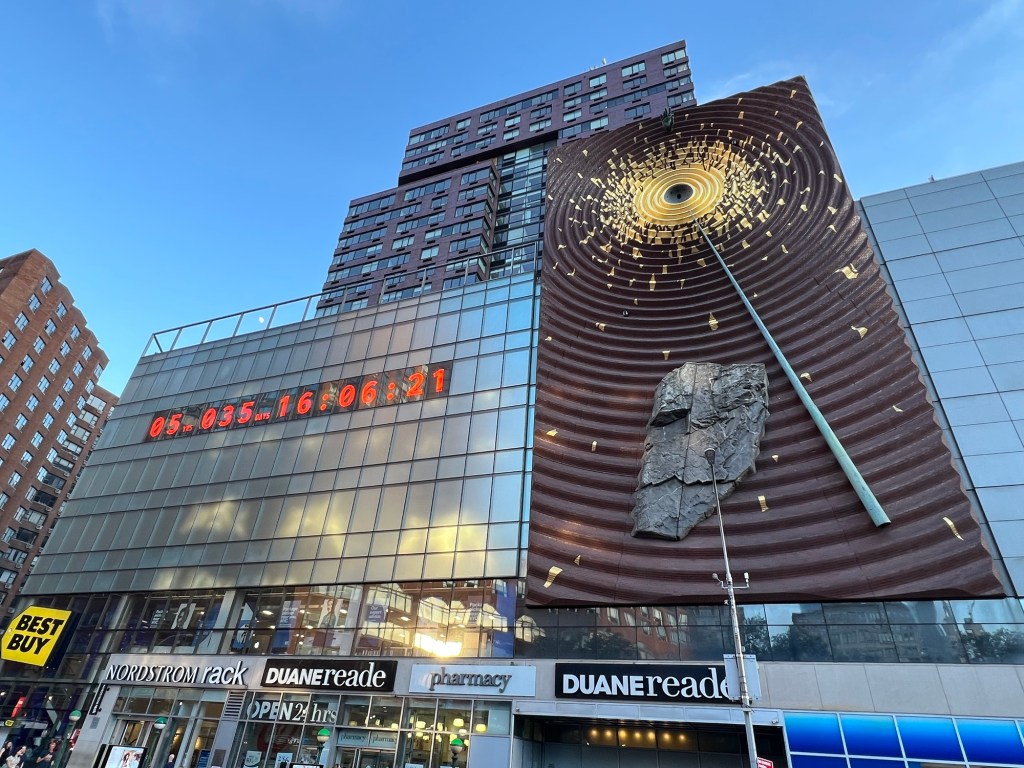
The new climate clock and NYU dorms replaced the once seedy shopping district the was Union Square at 60 East 14th Street
https://en.wikipedia.org/wiki/Climate_Clock
The view of Union Square through the ages:
The Climate Clock melds art, science, technology, and grassroots organizing to get the world to #Actin Time. The project is centered on a simple tool: a clock that counts down the critical time window to reach zero emissions (our “Deadline”), while tracking our progress on key solution pathways (“Lifelines”) By showing us what we need to do by when, the Clock frames our critical mission — a rapid and just transition to a safe climate future — and puts it at the very forefront of our attention (Climateclock.world.com).
The building that single handedly changed Union Square (outside of Union Square Cafe) was the Zeckendorf Towers. This replaced the long closed S. Klein Department store that had closed in 1975 and lead to the seediness of the area. The store had been boarded up for years and led to the downfall of Union Square in the early 1980’s.

S. Klein Department Store on Union Square East was boarded up for years
https://en.wikipedia.org/wiki/S._Klein
When the store was torn down to make way for the Zeckendorf Towers, this completely changed the area. That and the renovation of Union Square in the late 1980’s and the creation of the Union Square Farmers Market made this a desirable area once again.
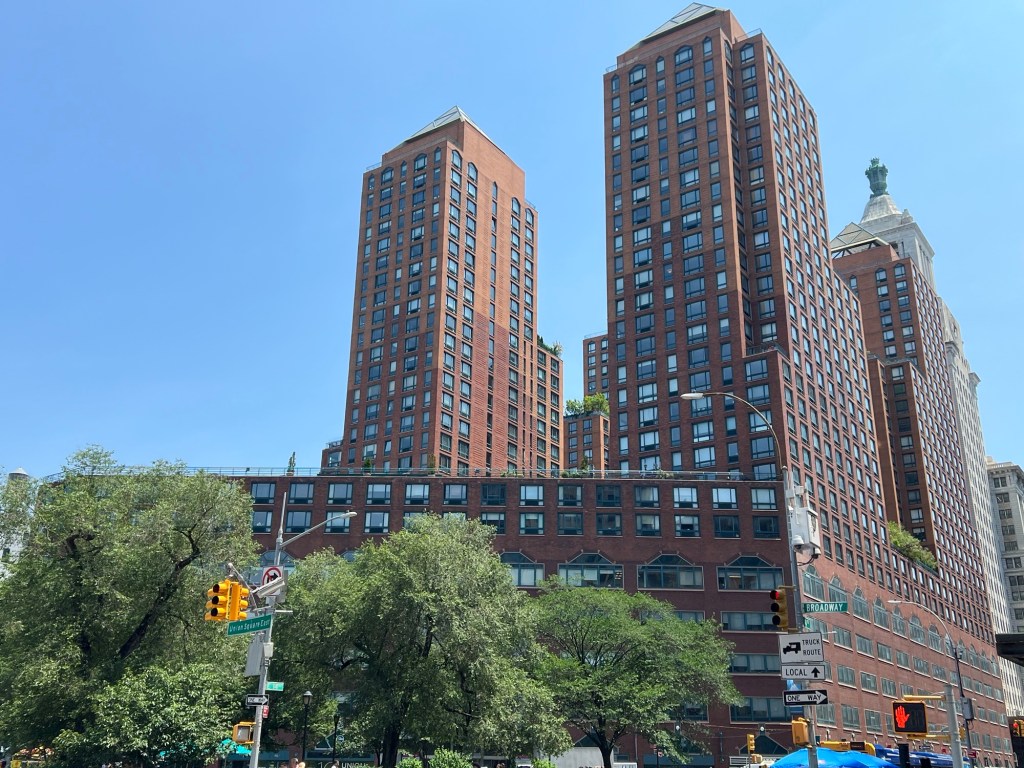
The Zeckendorf Towers at One Irving Place/One Union Square East
https://en.wikipedia.org/wiki/Zeckendorf_Towers
The success of the Zeckendorf Towers changed the complexity of the neighborhood for years to come replacing the S. Klein Department store. The residential building was designed by the architectural firm of Davis, Brody & Associates and was name for owner William Zeckendorf. The building was finished in 1987.
Tucked off in the corner of the park is the statue of General Lafayette. Why this important figure of the Revolutionary War is hidden is unfortunate.
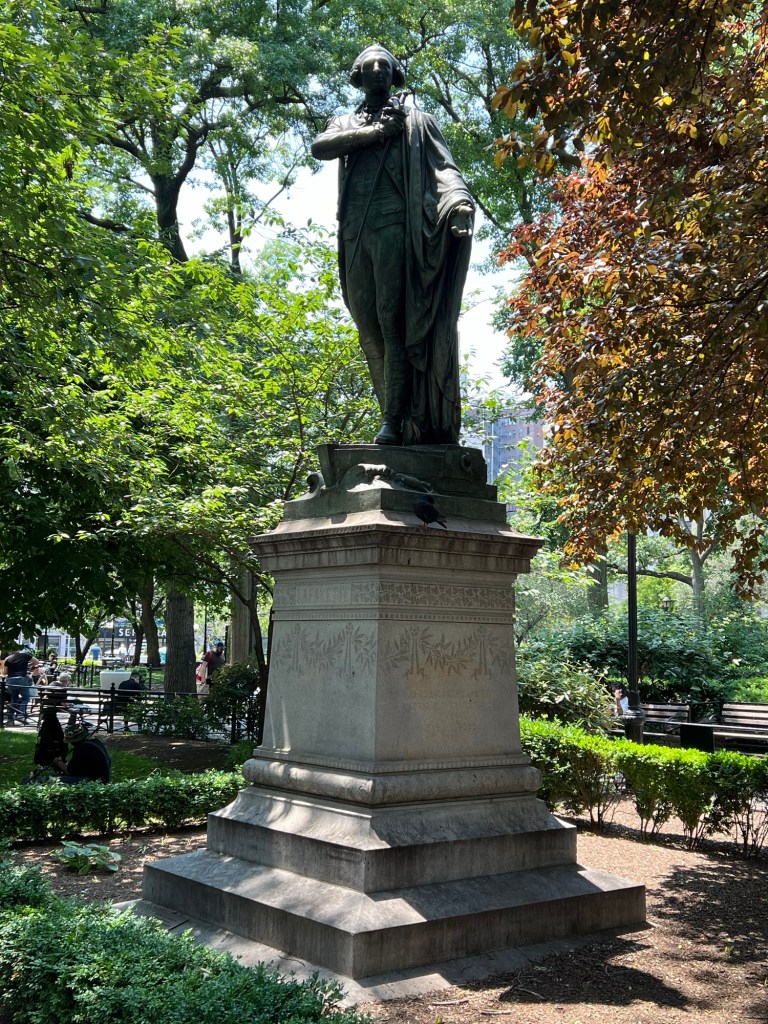
The statue of General Marie-Joseph Paul Yves Roch Gilbert du Motier de La Fayette, Marquis de La Fayette
https://www.nycgovparks.org/parks/union-square-park/monuments/884

General Marie-Joseph Paul Yves Roch Gilbert du Motier de La Fayette, Marquis de La Fayette
https://en.wikipedia.org/wiki/Gilbert_du_Motier,_Marquis_de_Lafayette
The larger-than-life-sized figure was sculpted by Frédéric-Auguste Bartholdi, who also designed the Statue of Liberty (1886), another gift from the French government that figures prominently in New York Harbor. The granite pedestal designed by H.W. DeStuckle was donated by French citizens living in New York. (NYCParks.org).

Artist Frédéric-Auguste Bartholdi
https://en.wikipedia.org/wiki/Fr%C3%A9d%C3%A9ric_Auguste_Bartholdi
Frederic Auguste Bartholdi was a French born artist best known for designing the Statue of Liberty. Bartholdi attended the Lycée Louis-le-Grand in Paris where he graduated in 1852. He then went on to study architecture at the Ecole nationale superieure des Beaux-Arts (Wiki).
As the sun started to set on this Sunday afternoon, I passed 4 Irving Place which the first couple of floors were under scaffolding. I admired the clocktower on the top of the building, the beautiful embellishments and just the elegance of the building. The building is home to Consolidated Edison (ConEd).
The was designed by architect Henry Janeway Hardenbergh and architectural firm of Warren and Wetmore in the Neo-Classical design. The first phase of the building was started in 1911 and both phases were finished by 1929. The original section of the building is in the picture with the wings of the building to both sides (Wiki).

I passed 4 Irving Place, the Con Ed Building, just as twilight hit the building and you could see the beauty in its shadows.

Its clock told the time of the early evening.

The next morning when I walked past it again, you could see the true beauty of its design.
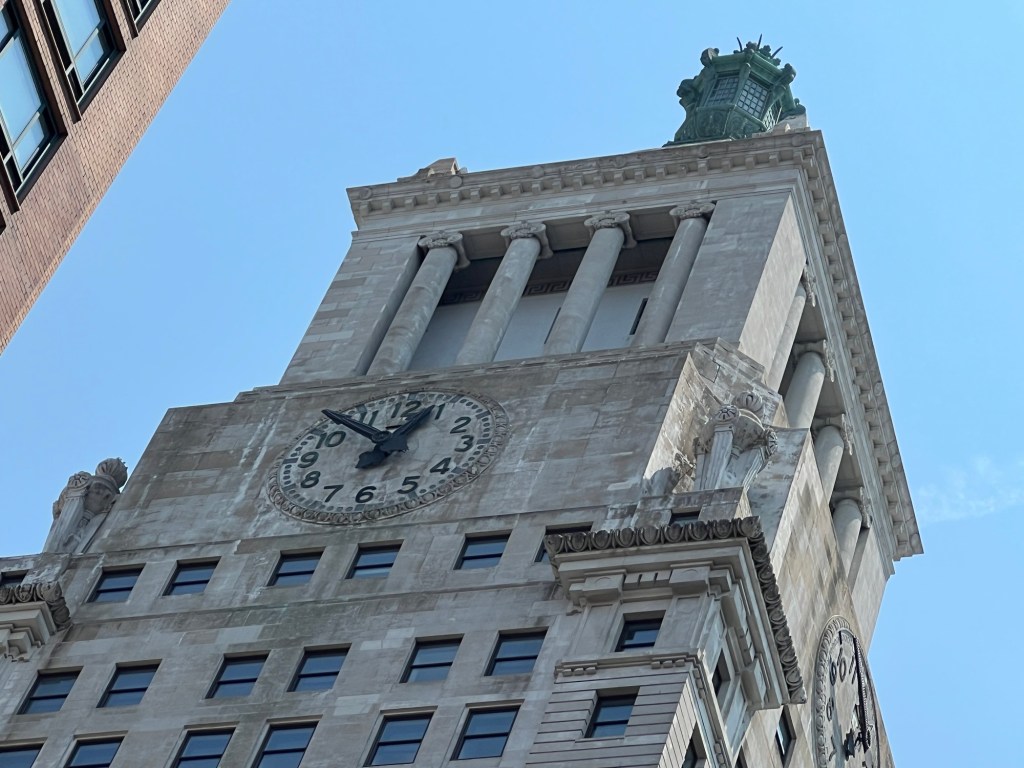
I also noticed that the roof top held a more intricate design than I noticed the night before. Look up at its intricate details to admire its beauty. This is part of the originally designed building.
Once I turned onto Irving Place, the old core of its industrial past gave way to the bohemian village it would become and stay in the future. This was once ‘THE’ neighborhood to live in and has stayed that way since even through the rough times of Union Square.
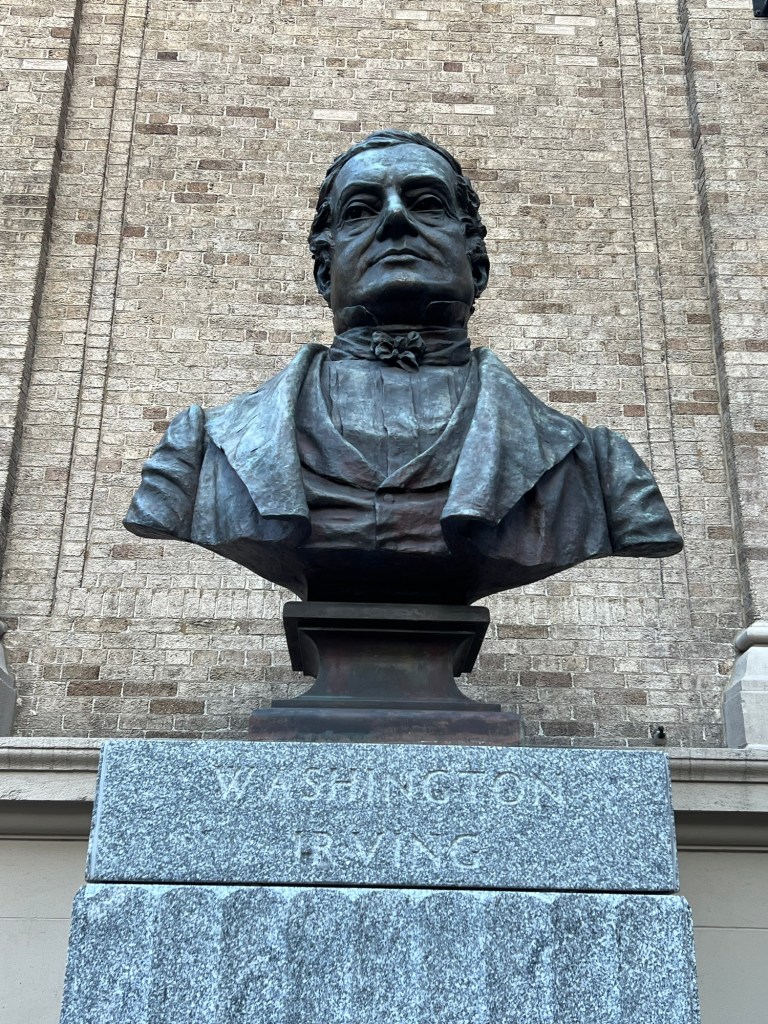
The most impressive object you will see in the neighborhood is this bust of Washington Irving that sits outside the Washing Irving Campus on Irving Place.
https://en.wikipedia.org/wiki/Washington_Irving_Campus
This bust of Washington Irving was created by artist Friedrich Beer
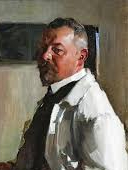
Artist Friedrich Beer
https://en.wikipedia.org/wiki/Friedrich_Beer
https://www.artprice.com/artist/112959/friedrich-beer
Artist Friedrich Beer was a German born artist known for his works on busts of famous individuals.
The neighborhood goes from commercial to more residential as you get further up Irving Place and closer to Gramercy Park. The borders of Union Square overlap with Gramercy Park and the Flatiron District between East 18th and East 20th streets so I revisited buildings that J had seen before. If people went in a Time Machine to Manhattan from 100 years ago they would still see the same buildings but with totally different uses.

The Washington Irving house at 122 East 17th Street and Irving Place (Washington Irving never lived here)
https://www.atlasobscura.com/places/the-irving-house-new-york-new-york
The “Irving House” was built by Peter Voorhis between 1843 and 1844, along with the adjacent two houses at 45 and 47 Irving Place. The original tenants of 49 Irving Place (at that time referred to as 122 East 17th Street) were Charles Jackson Martin, an insurance executive, and his wife, who would reside there from 1844 until 1852. Henry and Ann E. Coggill would live in it in 1853, and in 1854 it would become the home of banker Thomas Phelps and his wife Elizabeth, who would remain until 1863 (Atlasobsucra.com).

The front of the house facing Irving Place
The first mention in print of Irving having lived in the house came in the Sunday Magazine Supplement of the New York Times on April 4, 1897. The article is a human interest story about Elsie de Wolfe and the means and methods she used to decorate “Irving’s house.” In 1905, de Wolfe would become known as the first professional interior decorator and it appears this article is an early attempt at publicity for her. As for the information about Irving, the article takes enormous liberties (actually, it flat-out makes things up), claiming that Irving had conceived of the house himself and was very particular about the architecture and design (Atlasobsucra.com).
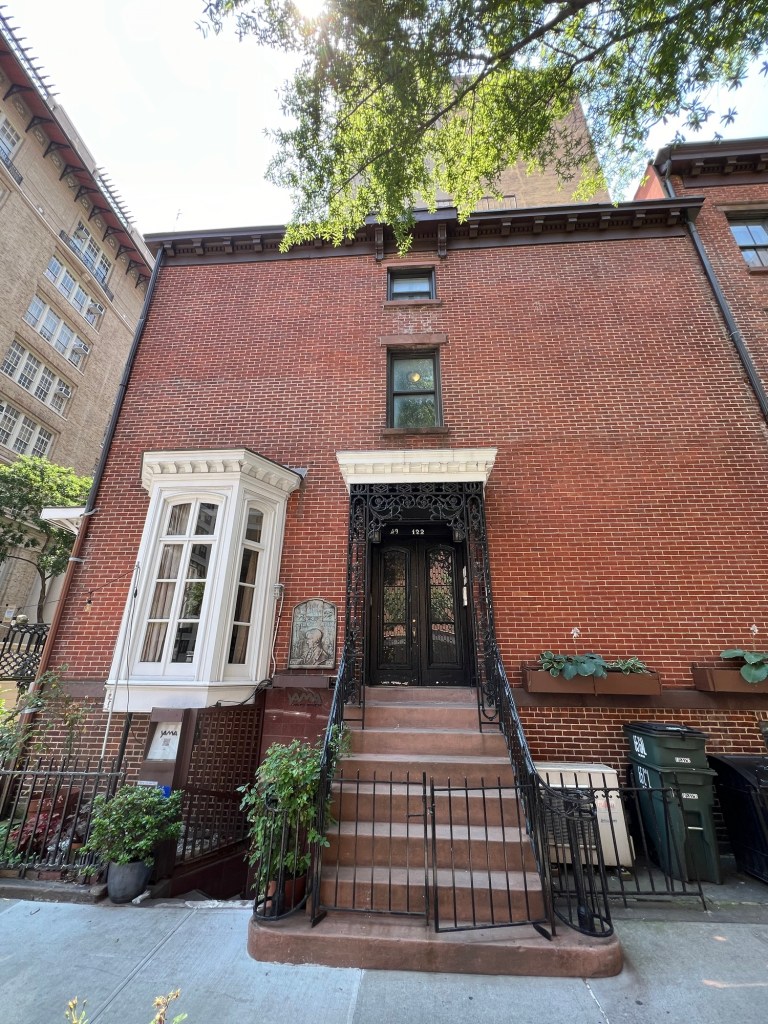
The entrance to the house at 122 East 17th street
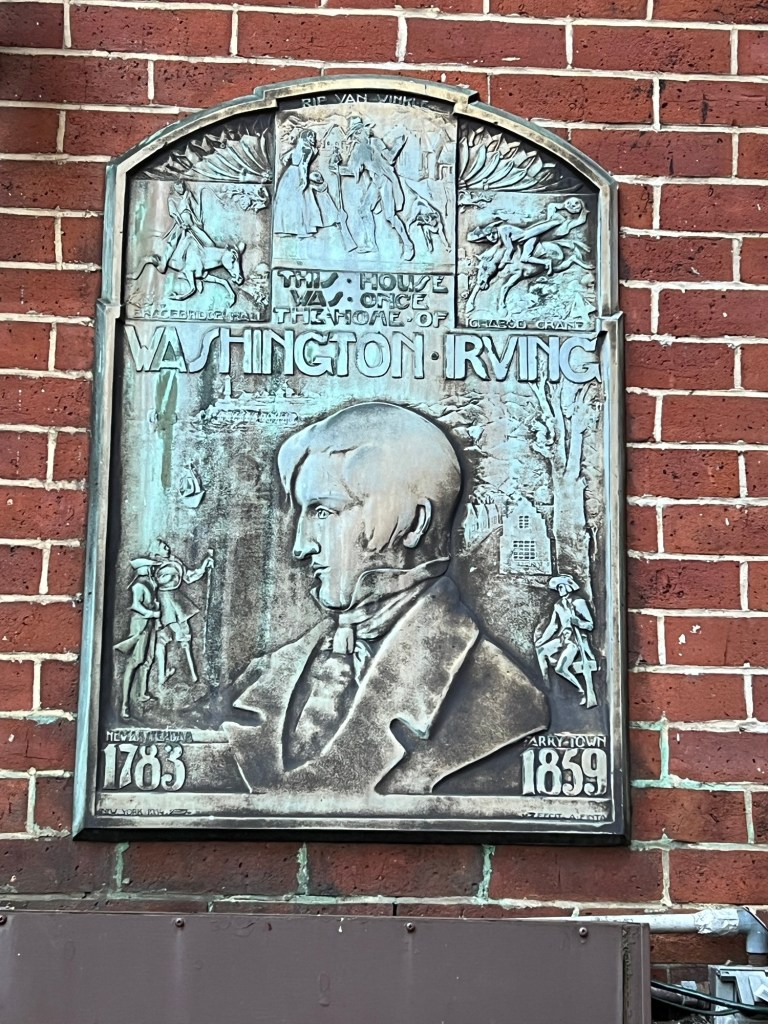
The plaque on the house dedicated to the writer created by artist Alexander Finta
In 1930, a restaurant called the Washington Irving Tea Room was operating in the basement of the building and in 1934 a plaque sculpted by Rodin-student Alexander Finta was put up on the north facade that would cement the story in the public consciousness. Today, the surrounding area remains covered in references to Irving, from the large art installations in the nearby W Hotel to the Headless Horseman pub on 15th Street(Atlasobsucra.com).
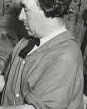
Artist Alexander Finta
https://en.wikipedia.org/wiki/Alexander_Finta
https://www.askart.com/artist/Alexander_Finta/108330/Alexander_Finta.aspx
Artist Alexander Finta was a Hungarian born artist who moved to the United States in 1923. He had studied mechanical engineering in his own country and had studied with Auguste Rodin. His is known for his elaborate busts. He spent the remainder of his career at 20th Century Fox Studios (Wiki)
All along the Irving Place corridor, the street is lined with interesting and historical buildings many of them turned into restaurants or inns. There are many historic plaques in this neighborhood and some creative architecture. The first building that caught my eye was 53 Irving Place, which is the home of Pierre Loti Wine Bar.
Review on TripAdvisor:

The home of Pierre Lotte Mediterranean Restaurant at 53-55 Irving Place was the home of O Henry
When I looked at the side of the building near the entrance, I was this historic plaque that said that this was the home of author William Sidney Porter (O. Henry). The author lived here from 1903-1907 and wrote the “Gift of the Magi” while living here and eating at Pete’s Tavern across the street (Wiki).
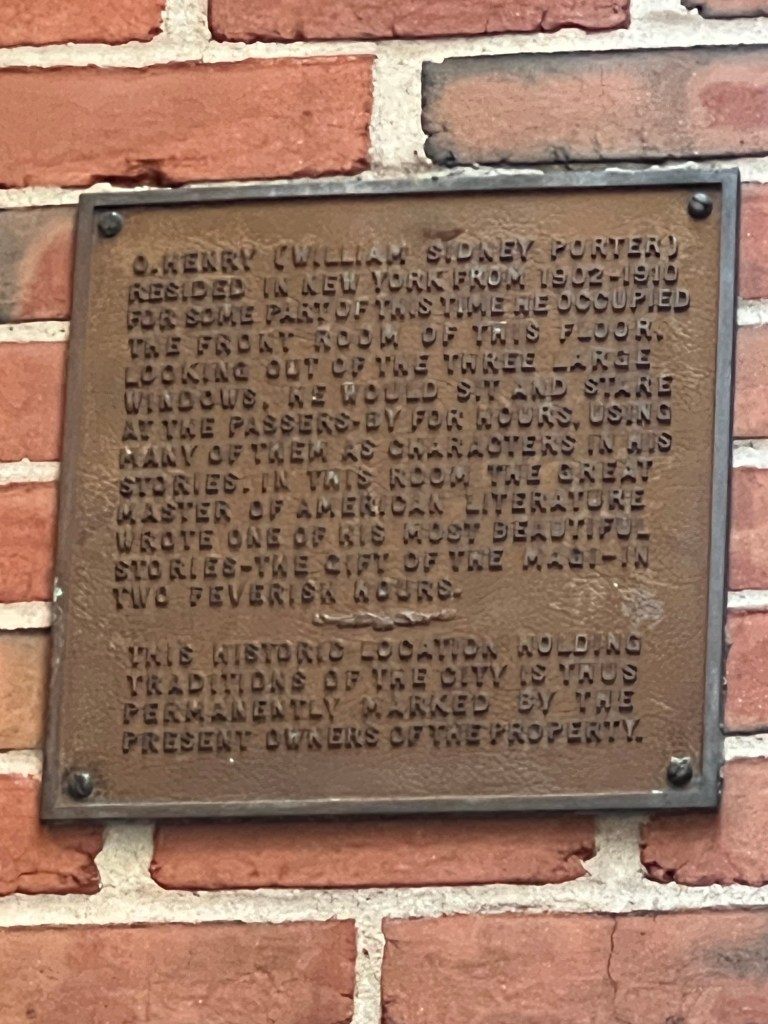
The historic plaque for author O Henry at 53-55 Irving Place
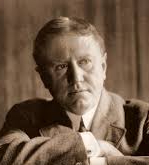
Author William Henry Porter
https://en.wikipedia.org/wiki/O._Henry
Down the road at is Pete’s Tavern, one of the most famous and the oldest literary restaurants in the City. The restaurant was founded in 1864 as the Portman Hotel and then in 1899 when changed to Healy’s Cafe when it was run by John and Tom Healy. Then in 1899, it was bought by Peter D’ Belles and renamed Pete’s Tavern. The restaurant was a ‘Speakeasy’ during prohibition and the dining rooms have not changed much over the last over hundred years (Pete’s Tavern website).
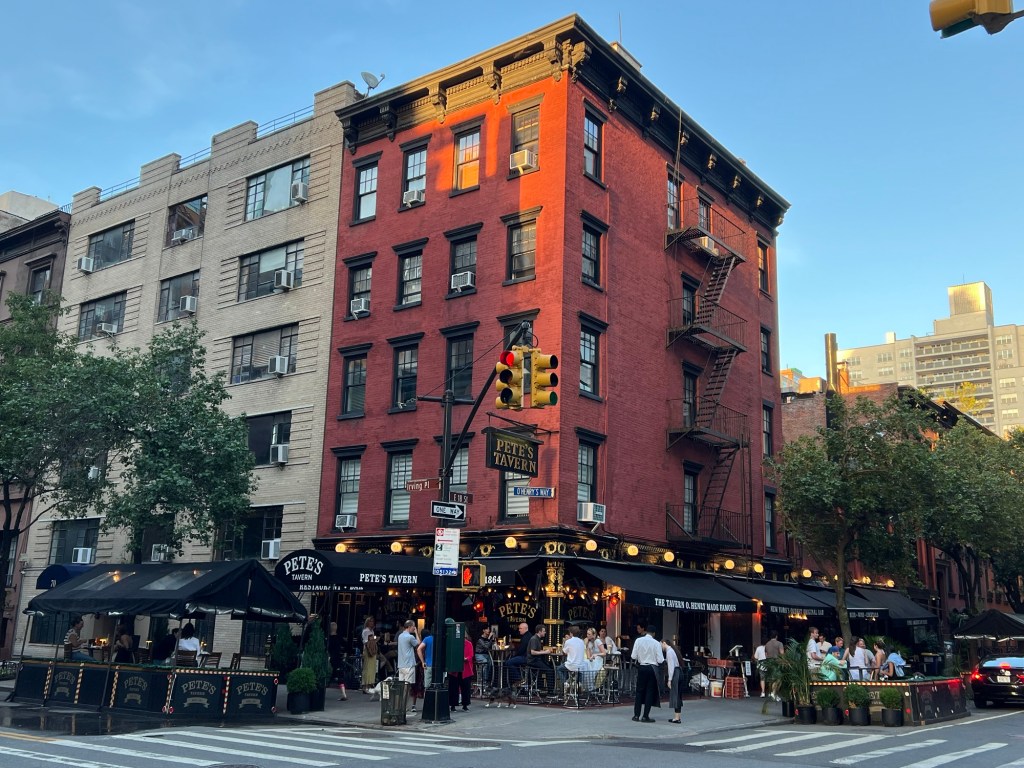
Pete’s Tavern was busy on the night of my first part of the walk.
Pete’s Tavern at 129 East 18th Street
https://en.wikipedia.org/wiki/Pete%27s_Tavern
My review on TripAdvisor:

The entrance of Pete’s Tavern

The entrance to Pete’s Tavern on Irving Place
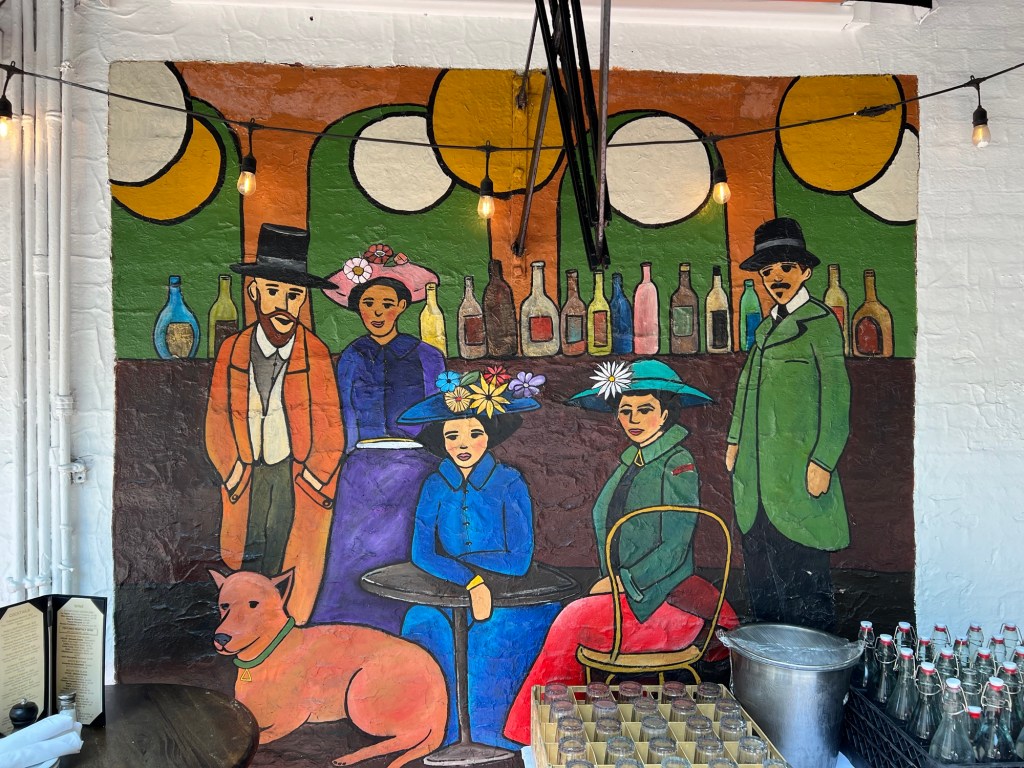
The painting outside of Pete’s Tavern of the Speakeasy years
Pete’s Tavern was busy both nights that I passed it. I had not eaten there in over a decade when I had a holiday dinner there with friends by I remember the food and service being excellent. The restaurant is really special during the Christmas holiday season from what I can remember.

My friends Barbara, Lillian and I after dinner at Pete’s Tavern in the early 2000’s
Another restaurant I went to before my friend, Barbara, moved to Florida was a Friend of the a Farmer at 77 Irving Place, a farm to table concept before it became very popular. I remember the food being wonderful but the place being a bit noisy. She lived on the fringe of Gramercy Park and had passed this restaurant many times and had wanted to try it that evening.

Another great restaurant is Friend of a Farmer at 77 Irving Place
https://www.friendofafarmer.com/
My review on TripAdvisor:
Across the street, I passed this apartment building at 76 Irving Place. I loved the outside embellishments on the building and the friendly looks you get from the statuary. The building was built in 1897 by architect Lyndon P. Smith (Corcoran Group).
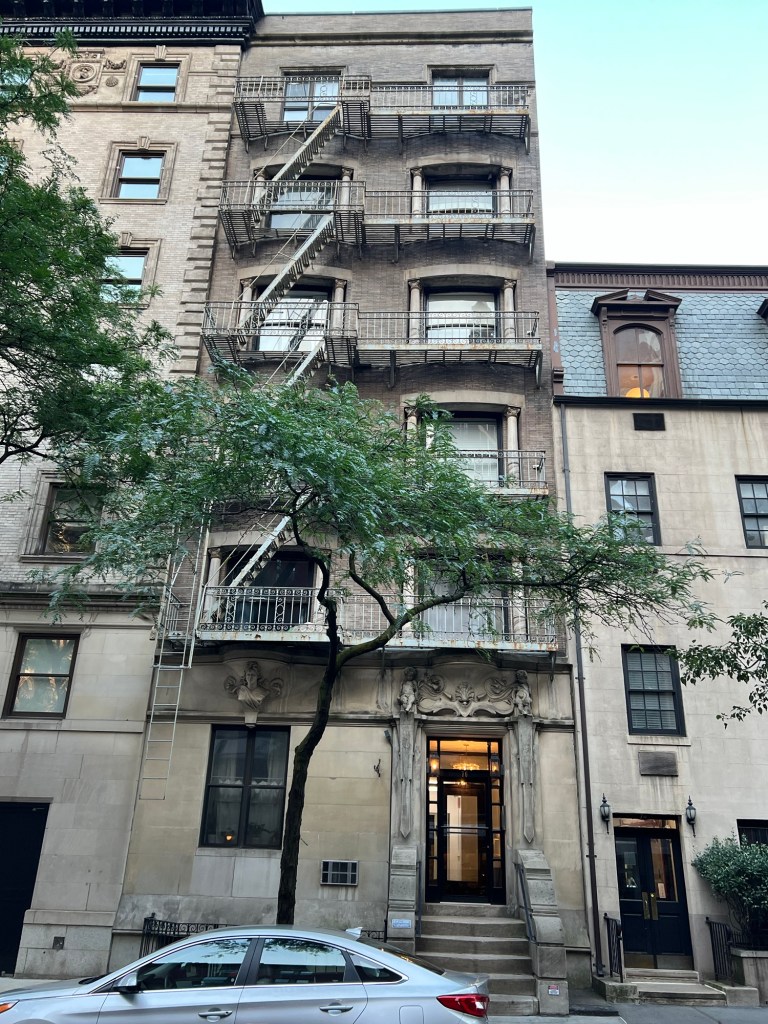
You have to look up to admire the details of 76 Irving Place
https://www.corcoran.com/listing/for-sale/76-irving-place-manhattan-ny-10003/23012133/regionId/1
https://streeteasy.com/building/76-irving-place-new_york

The entrance to 76 Irving Place with its tiny angels
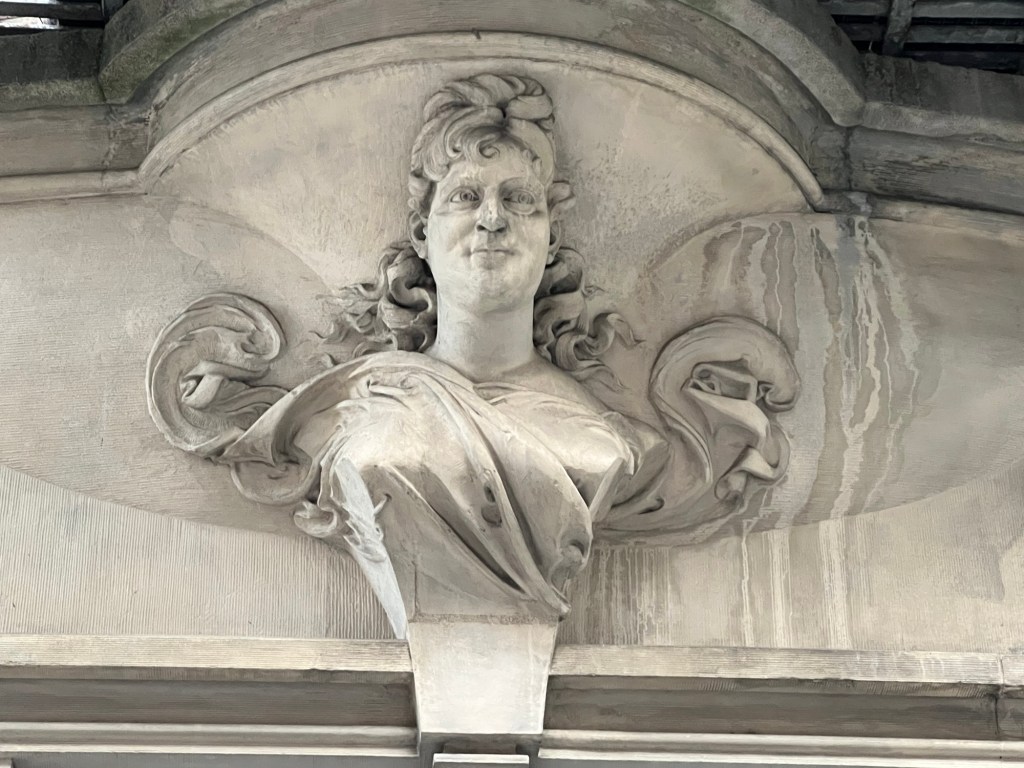
This woman greets you at 76 Irving Place
The classic architecture of the block especially as you get closer to Gramercy Park changes from smaller apartment buildings to brownstones lining the parks southern border. Gramercy Park offers some of the most interesting architecture. This ivy covered building that impressed me so much as the sun was going down is at 80 Irving Place.
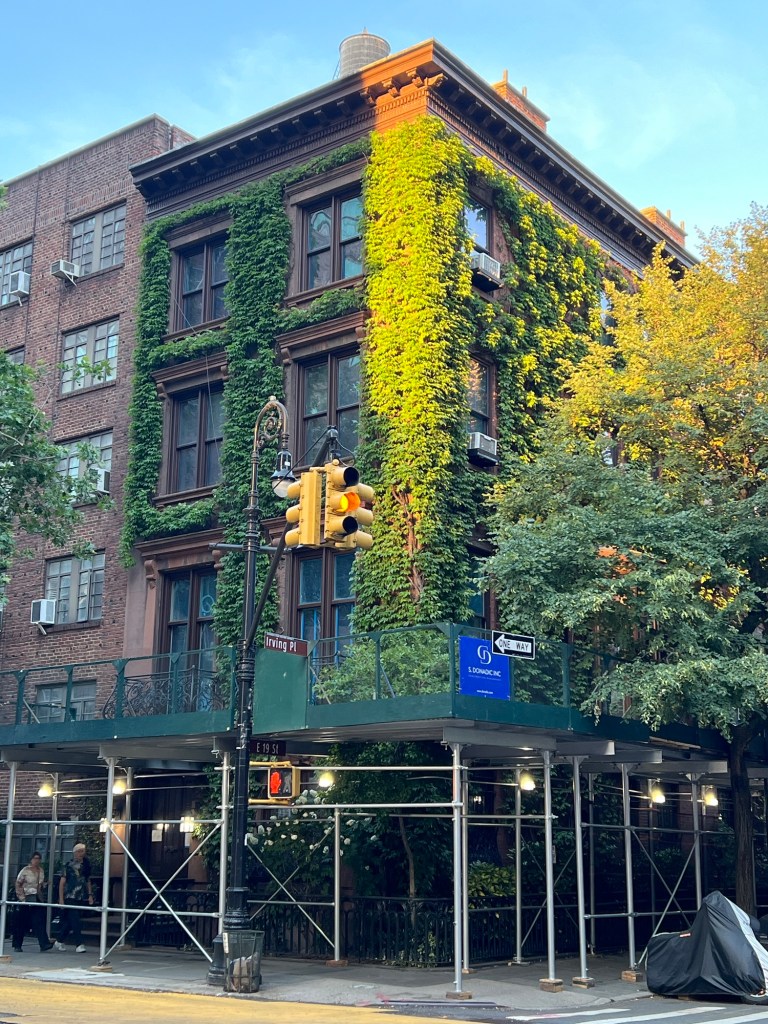
80 Irving Place is currently under renovation
https://daytoninmanhattan.blogspot.com/2014/04/the-1854-house-at-no-80-irving-place.html
https://www.trulia.com/home/80-irving-pl-new-york-ny-10003-31506439
The house was built as a single family mansion between 1853 and 1854 and had been the home of the prominent Wood family and then to actress Agnes Ethel Tracy. Since 1987, it has been a single family home again. What I thought was interesting was that the house was used in the movie “Working Girl” as Sigourney Weavers character’s home (DaytoninManhattan.com).

81 Irving Place in all its glory
https://streeteasy.com/building/81-irving-place-new_york
https://www.apartments.com/81-irving-pl-new-york-ny-unit-8a/5q6z3mp/
81 Irving Place is one of the most beautiful apartment complexes in the city that I have come across. The embellishments along the building are some of most detailed and elegant I have seen. This prewar Co-Op was built in 1929.

The embellishments of the building
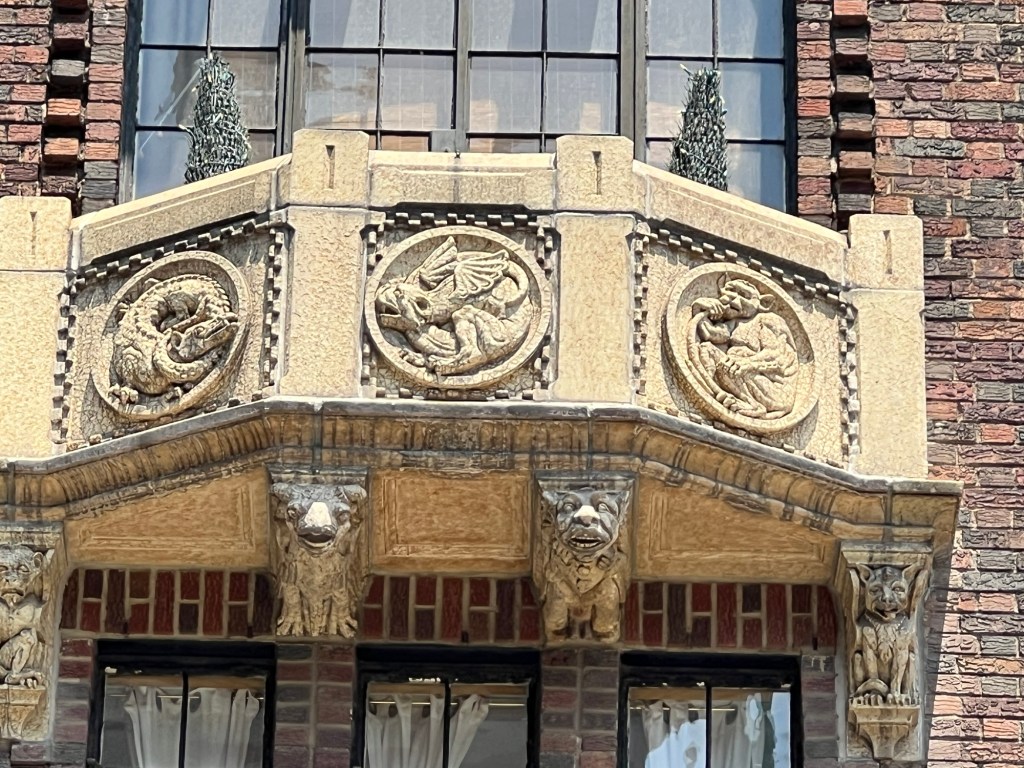
The embellishments of the building
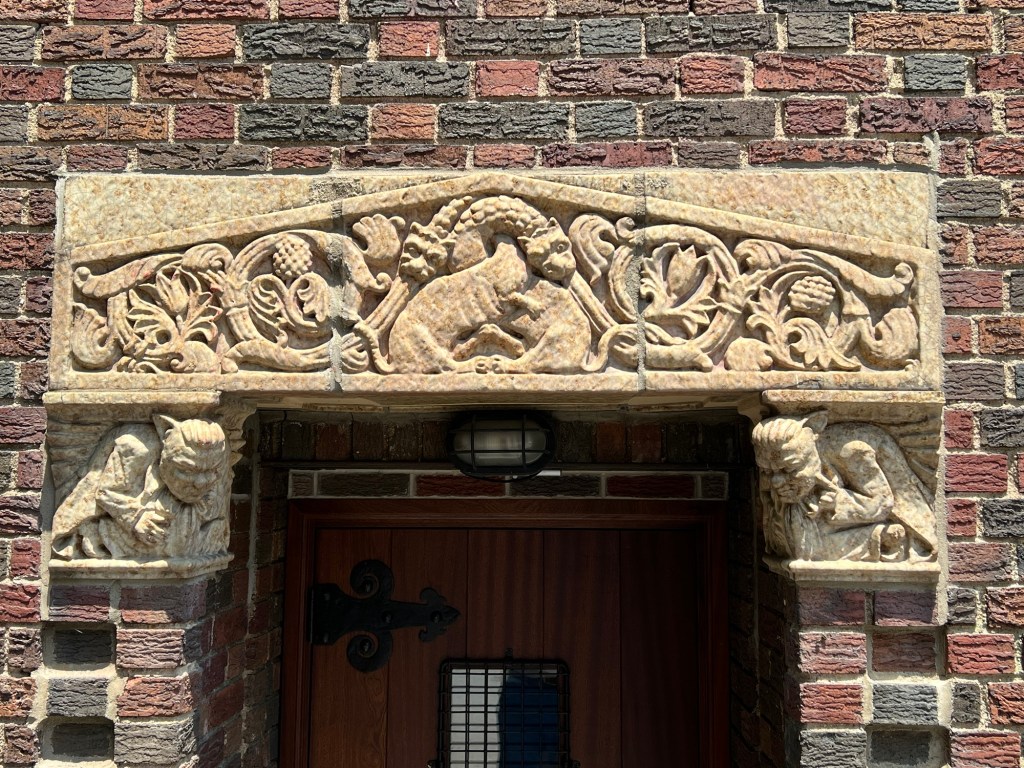
The embellishments of the building

The embellishments of the building
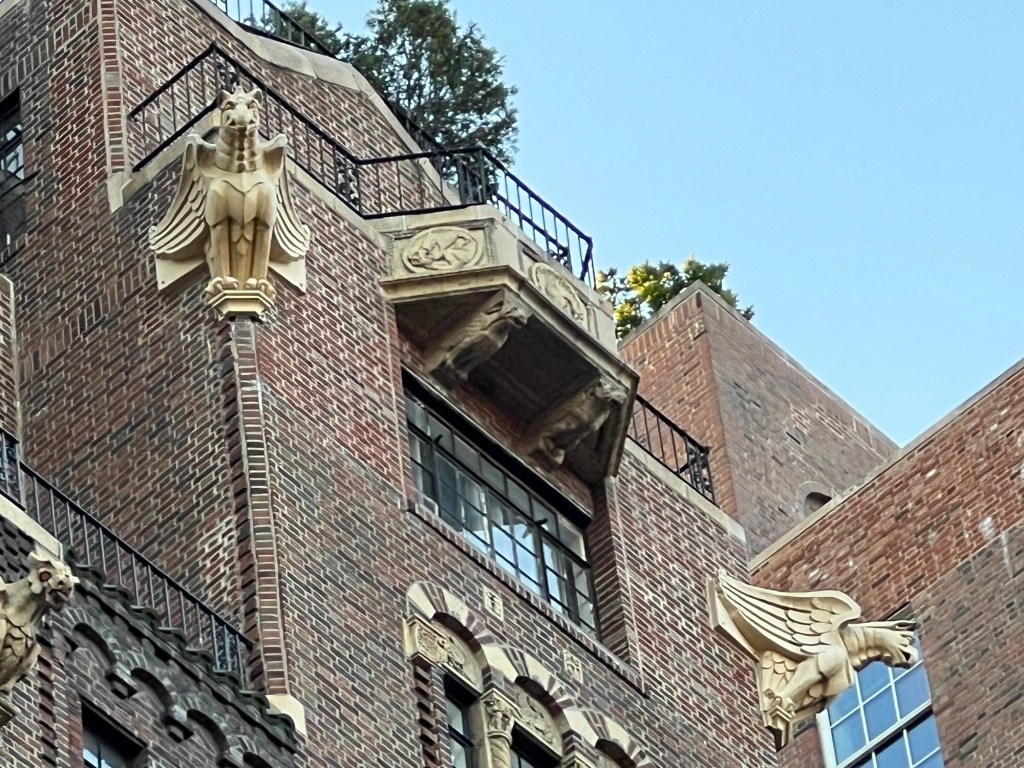
The building has a whimsical almost storybook imagine of creatures protecting their home.
Where I want my future home to be when I retire to the City and can afford it is 19 Gramercy Park South. I have always loved this building since I fell in love with the neighborhood over thirty years ago. I always wanted a home with a key to Gramercy Park. The building has that classic turn of the last century look about it and it has always been my dream to live here when I retire. I need to hurry and win the lottery.

My dream home would be at 19 Gramercy Park South with a key to the park
https://en.wikipedia.org/wiki/19_Gramercy_Park_South
I had thought this was a apartment building but it is actually a single family mansion with 37 rooms. It was built in 1845 and when the mansion was extended by Stamford White in 1887 was the home of socially prominent Stuyvesant-Fish family. It is currently back to being a single family mansion (Wiki).
As I turned the corner at East 20th Street I never tire of peering into Gramercy Park and keep wishing for that key. Gramercy Park is still one of the most beautiful and fantastical parks in New York City. It has once been part of the Stuyvesant estate and got its name from Gramercy Farm that once stood here. It is the only piece of the old Rose Hill Farm still in existence (Wiki).
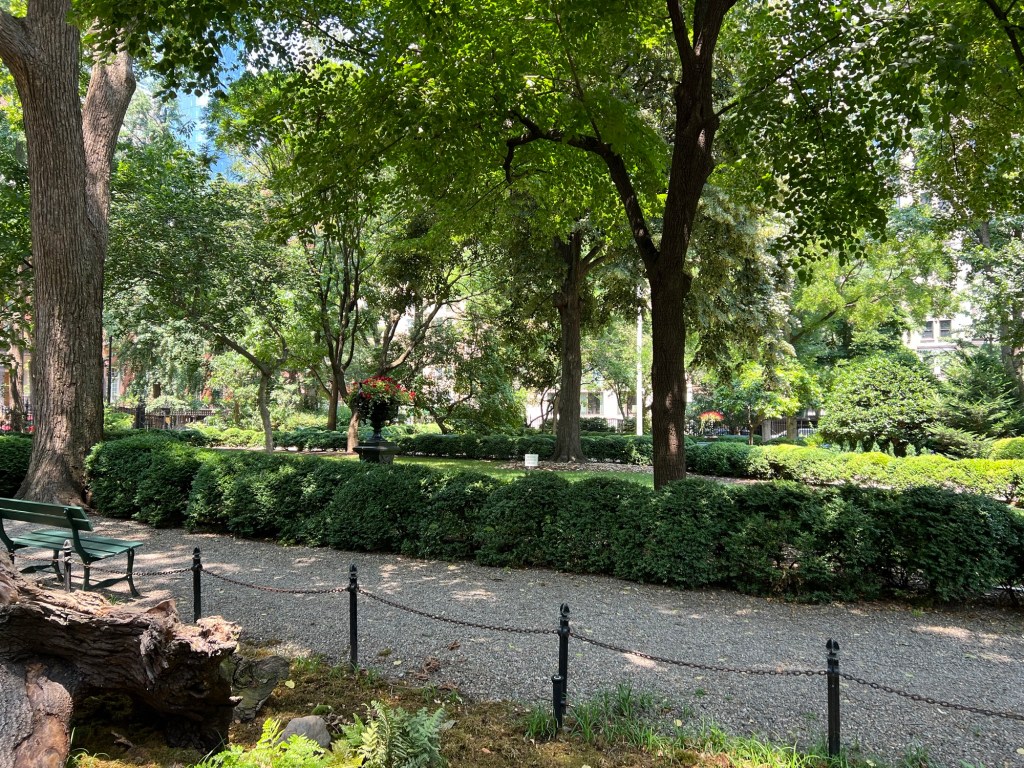
Gramercy Park on a glorious Spring day
https://en.wikipedia.org/wiki/Gramercy_Park

Another view of Gramercy Park
I love the beauty of this park. There is an English feel to this park that reminds me of London and some of the neighborhoods that I visited it there. I have never been inside the park but it would be fun to walk around. I found out from researching for another blog on the Rose Hill neighborhood is that Gramercy Park is the corner and last surviving parcel of the old Rose Hill Farm.
East 20th street across from the park has some of the most interesting brownstones in Manhattan. They add to the historic value of the neighborhood. When you turn the corner of Gramercy Park off Irving Place, you will see the classic architecture that surrounds the park. It is one of the most picturesque neighborhoods in Manhattan.

The beauty of East 20th Street across from Gramercy Park
Right across the street from the park sits one of the best known brownstones in the neighborhood housing the “Players Club”. This club was made famous by the movie “Manhattan Murder Mystery’” for the wine tasting scene.

The “Players Club” at 16 East 20th Street
https://en.wikipedia.org/wiki/The_Players_(New_York_City)
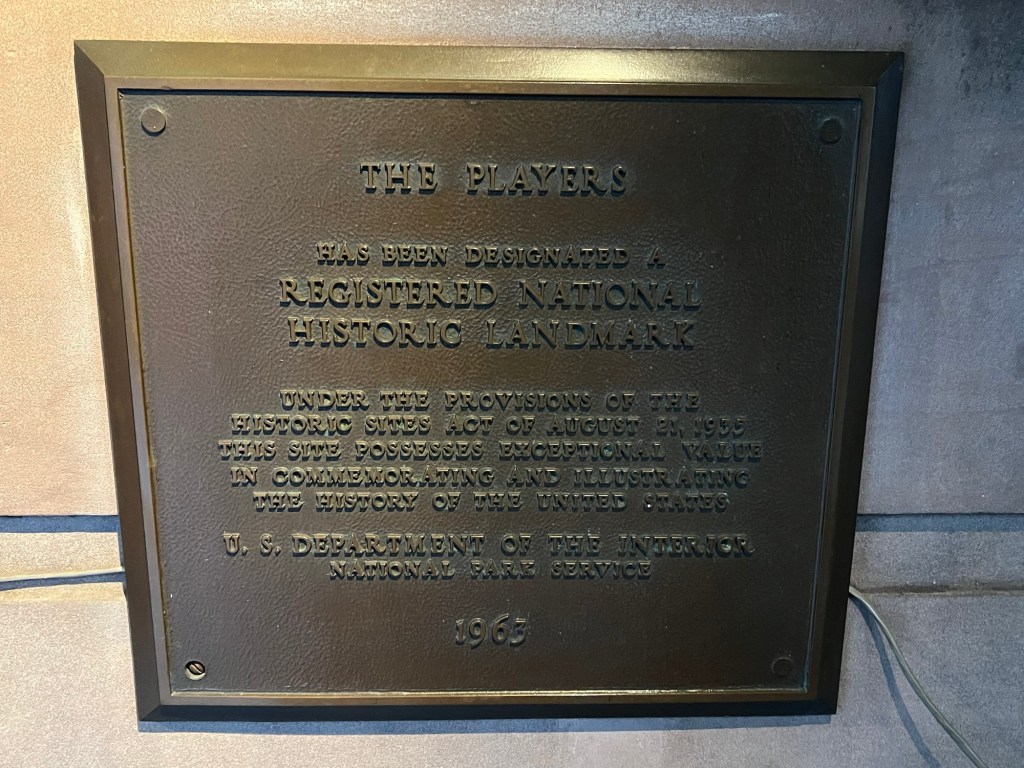
The historic plaque on the building
The scene from “Manhattan Mystery”:
The movie “Manhattan Murder Mystery” by director Woody Allen was shot in the neighborhood
The mansion was built in 1847 and was the home of Valentine G. Hall. The building was bought by actor Edwin Booth, the older brother of John Wilkes Booth who assassinated President Lincoln. He kept a suite for himself at the top of the home and then turned the rest of the building into the “Players Club” in 1888. The club now serves as a social club with artifacts of the theater arts on display and a private restaurant (Wiki).

I loved the entrance way to 13 East 20th Street
https://streeteasy.com/building/13-east-20-street-new_york
This Co-Op building was built in 1910 and has the most elegant appearance at the entrance. This really looks like old New York.

I love the elegance of 13 East 20th Street
Another historical building on the block was 10 East 20th Street which was the home of painter Robert Henri.

East 20th Street the home to painter Robert Henri
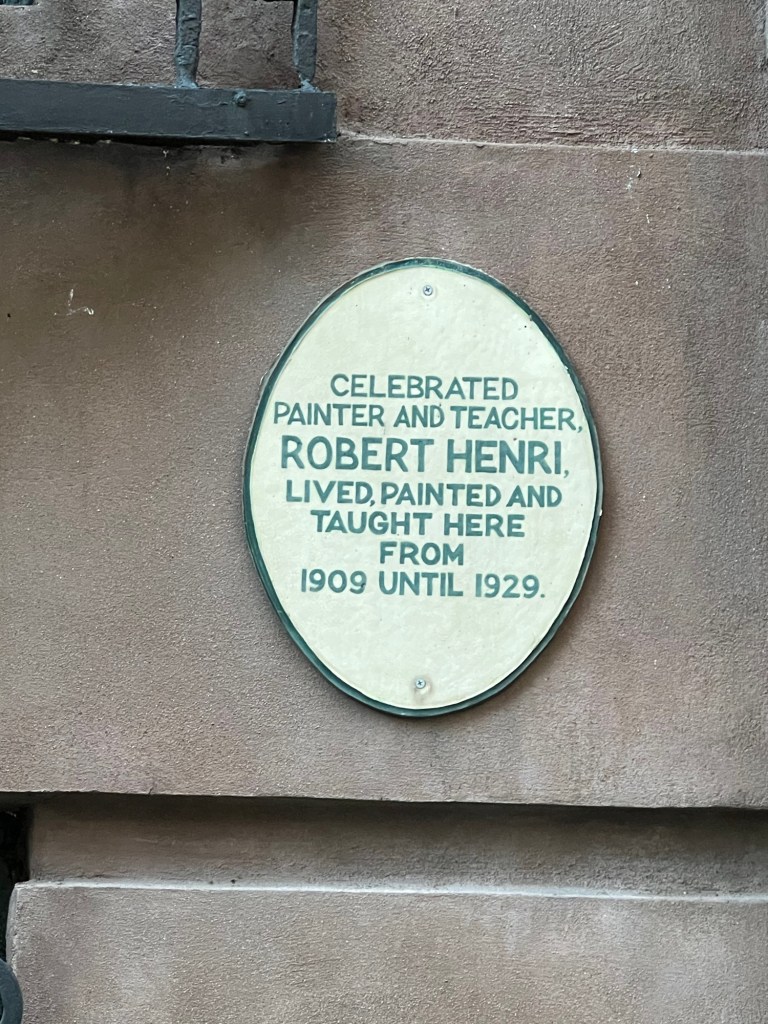
The historic marker for painter Robert Henri
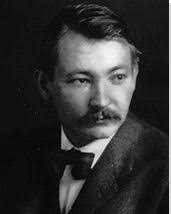
Artist Robert Henri
https://en.wikipedia.org/wiki/Robert_Henri
https://www.nga.gov/collection/artist-info.1391.html
Artist Robert Henri was an American born artist. He studied at the Pennsylvania Academy of Fine Arts Philadelphia and at the Ecole des Beaux-Arts in Paris. He is best known for his works in the Impressionism movement (Wiki).
As I crossed Park Avenue South, I entered the familiar neighborhood of the Flatiron District meeting the bottom of the Rose Hill neighborhood. This is when Manhattan neighborhood borders get confusing. Since the Union Square technically ends at East 18th Street but that would leave two blocks open without being in a specific neighborhood, I stretched it to East 20th Street. This again borders the Flatiron and Rose Hill/NoMAD section of the City. I figure that I will let the realtors figure this one out.
When you cross the border at Park Avenue South, I admired the same buildings I had seen several month earlier when I walked these streets and avenues just as Fall semester at NYU began.

The building at 250 Park Avenue South houses the restaurant Barbounia in the base of the building.
Barbounia 250 Park Avenue
Review on TripAdvisor:
250 Park Avenue South was designed by architects Rouse & Goldstone in 1911 in the Neo-Classical design.
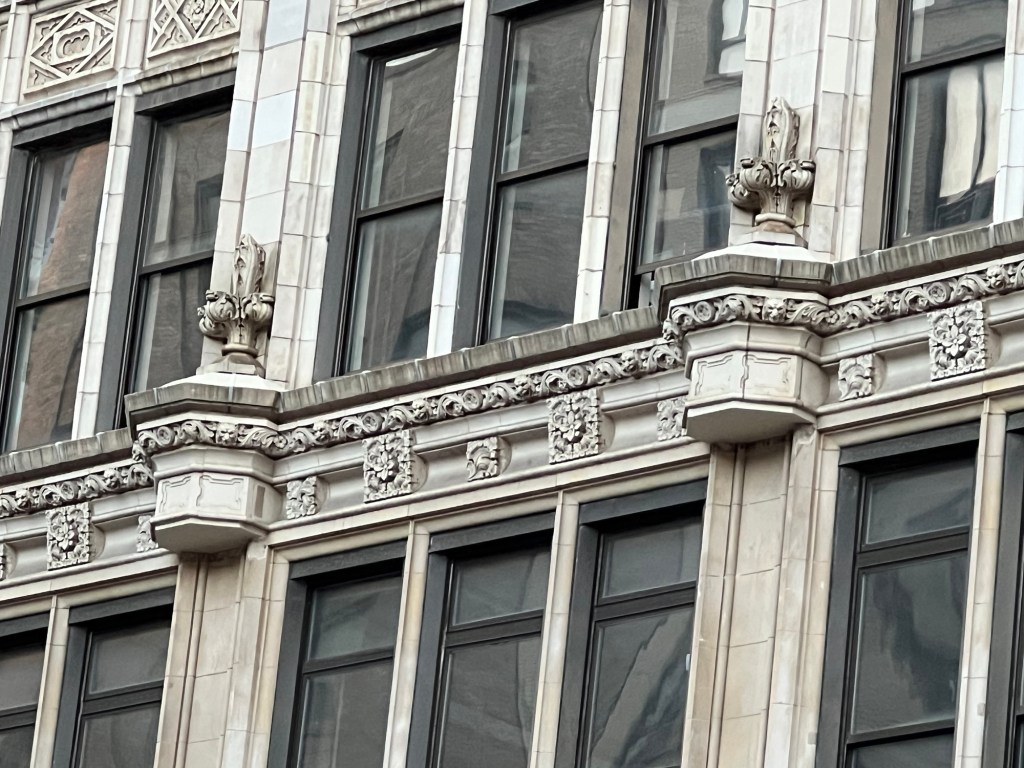
The detail work on 250 Park Avenue South
https://www.officespace.com/ny/new-york/2231029-250-park-avenue-south
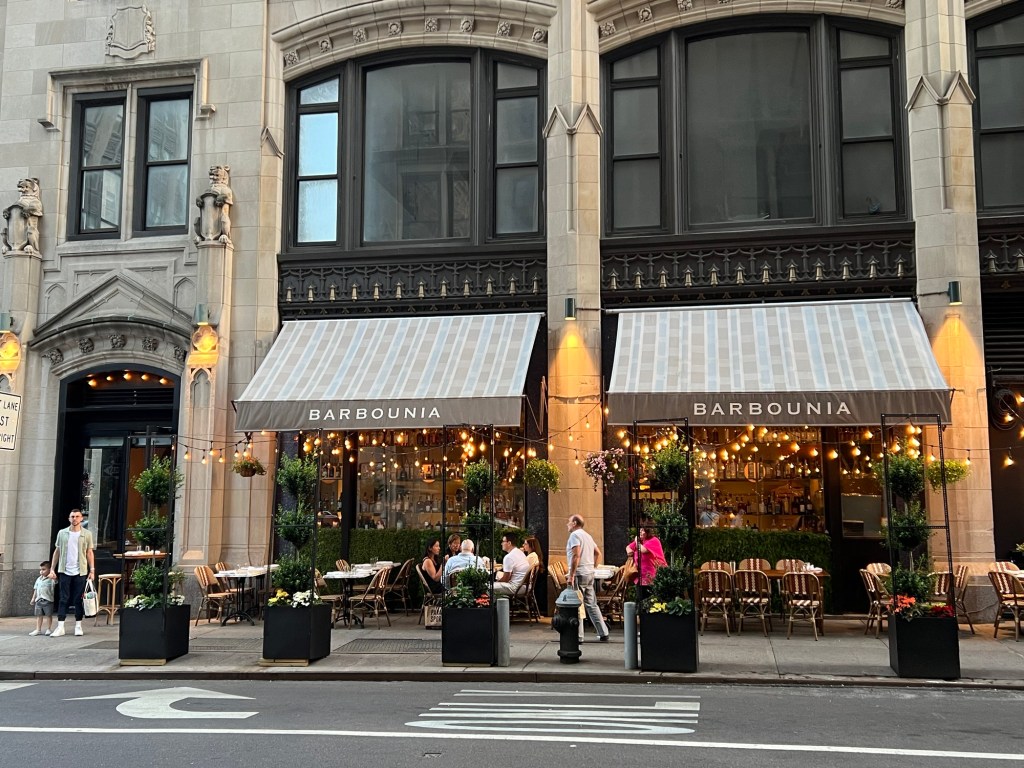
The restaurant ‘Barbounia’ at 250 Park Avenue South

The detail work above the doorway to the building
Next to this building is another beautiful historic building at 42 East 20th Street, housing another great restaurant, The Gramercy Tavern.
The Gramercy Tavern
https://www.gramercytavern.com/
Review on TripAdvisor:
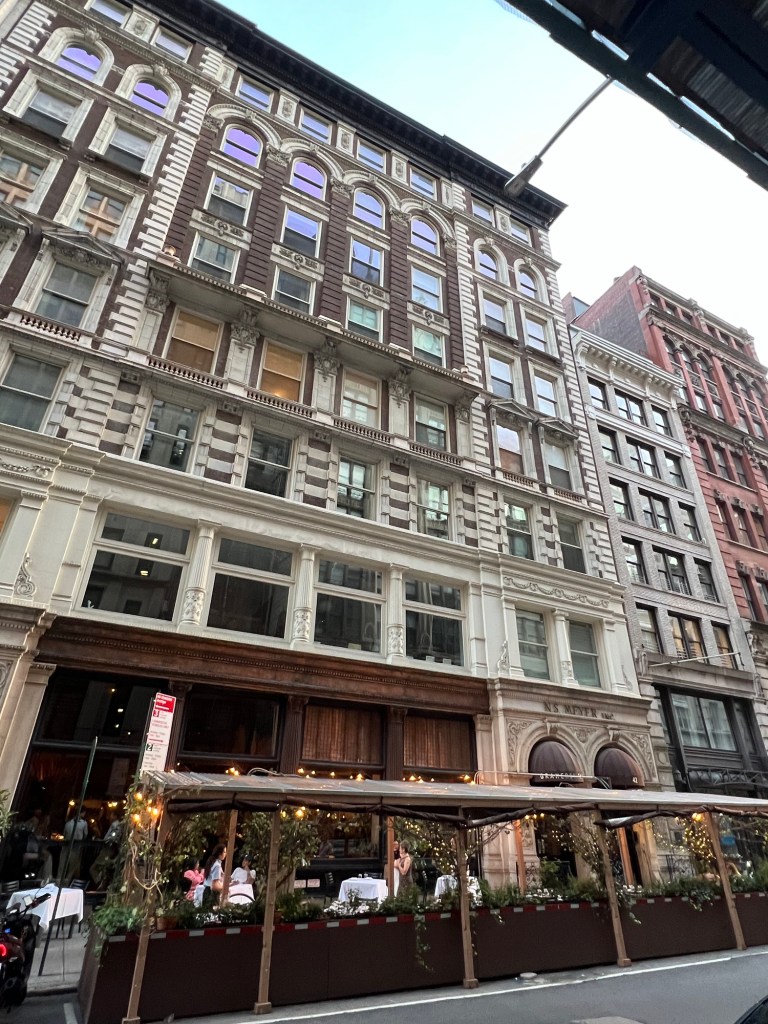
42 East 20th Street
https://www.14to42.net/20streete042.html
42 East 20th Street was designed by the architectural firm of Neville & Bagge and was built in 1890 in the Beaux-Arts design. N.S. Meyer was a military company selling Army and Navy equipment since 1868 (14to42.net).

The beauty of the NS Meyer Inc. building
Next to that is another beautiful building the at 36 East 20th Street. This commercial building was built in 1901 with Beaux-Arts details on it.
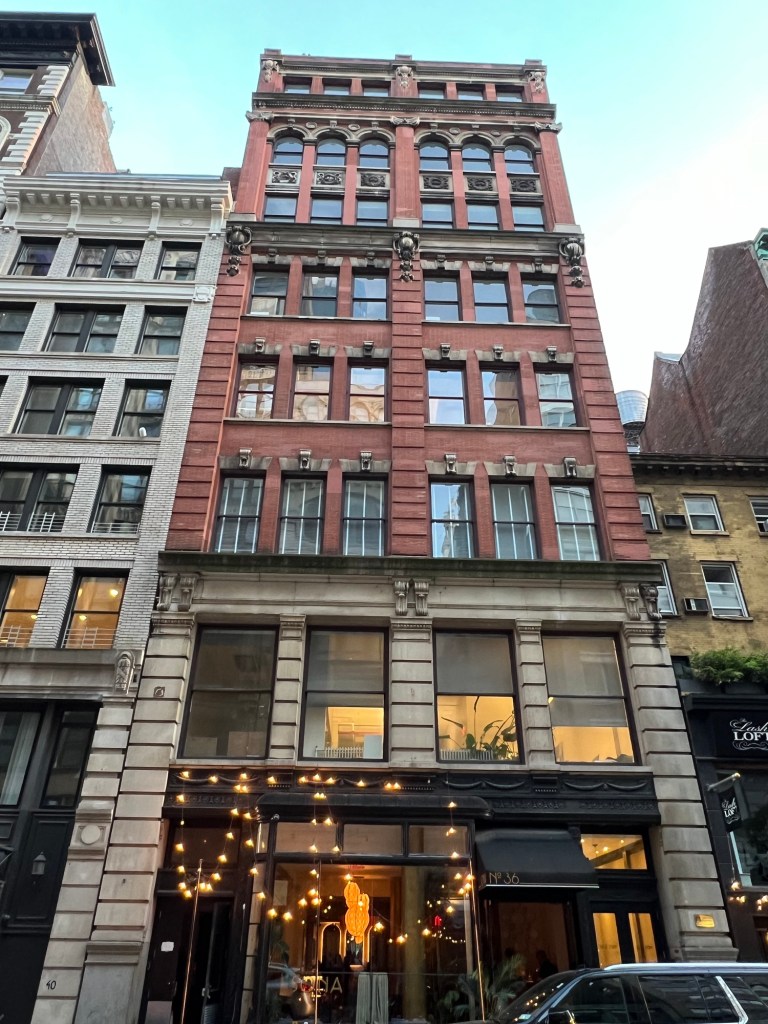
36 East 20th Street
https://streeteasy.com/building/36-east-20-street-new_york
https://www.loopnet.com/Listing/36-38-E-20th-St-New-York-NY/32032143/
The building is a commercial building that was built in 1901.

The details on the top of 36 East 20th Street
Right down the street at 28 East 20th Street is the Theodore Roosevelt Birthplace Historic Site Museum. It had been closed for so long after COVID I never thought it would open any time soon. It did finally open late last year and I thought this was one of the most interesting of the historical homes in the City. This one had been completely recreated by the family and then furnished with family heirlooms from the original house. That makes for an interesting museum.

Theodore Roosevelt
https://en.wikipedia.org/wiki/Theodore_Roosevelt

The Theodore Roosevelt Birthplace National Historic Site at 28 East 20th Street
https://www.nps.gov/thrb/index.htm
My review on TripAdvisor:
My review on VistingaMuseum.com:
At 28 East 20th Street is the Theodore Roosevelt Birthplace Historic Site, which is an exact replication of the original home that President Theodore Roosevelt was born and raised. The house that originally stood on the site was built in 1848 and was bought by the Roosevelts in 1854. Theodore Roosevelt was born there on October 27, 1858, and lived in the house with his family until 1872, when the neighborhood began to become more commercial and the family moved uptown (Wiki).

The Roosevelt House Living Room
The original building was demolished in 1916 to make way for retail space, but upon the death of Roosevelt in 1919 the lot was purchased and the house rebuilt by the Women’s Roosevelt Memorial Association, which eventually merged with the Roosevelt Memorial Association in 1953 to form the Theodore Roosevelt Association.
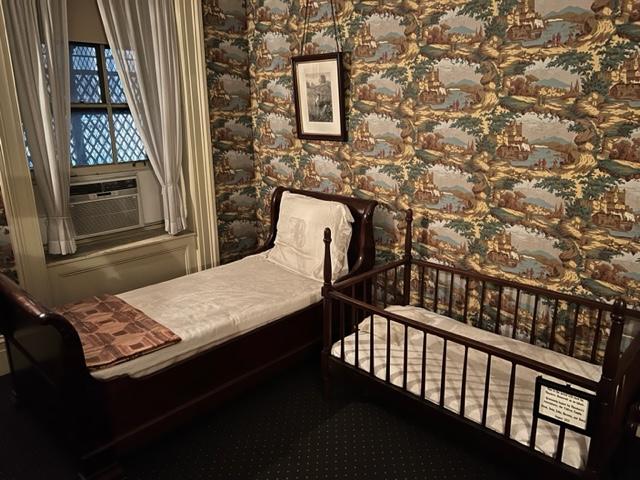
Theodore Roosevelt’s bedroom
Noted female American architect Theodate Pope Riddle was given the task of reconstructing a replica of the house, as well as designing the museum, situated next door, that serves to complete the site (Wiki).
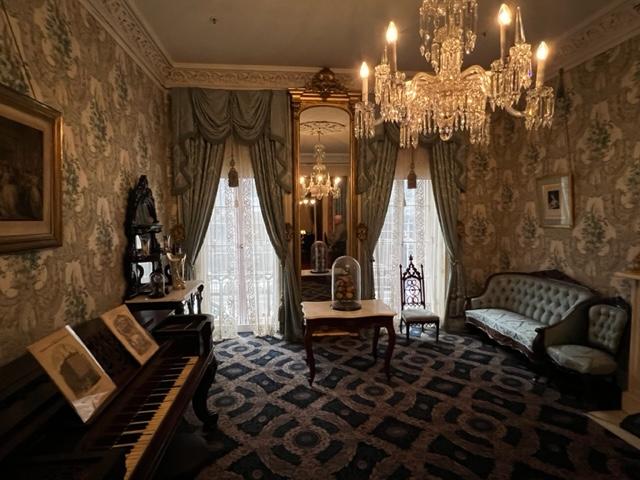
The Parlor of the house
You have to take time when the museum is open to take the independent tour. When you walk around the house you will swear that the family had just left the room to grab something. It is well worth the trip to see how the family lived before they moved uptown.
The next building on the block that is unique is 7 East 20th Street, the old Holtz Building.
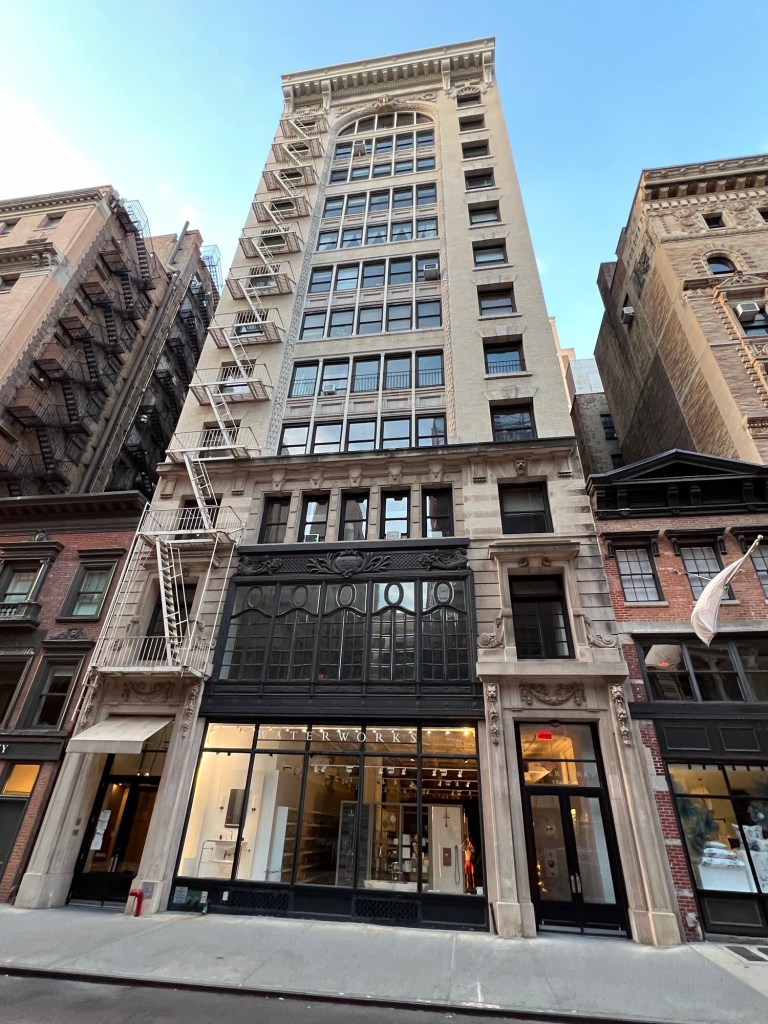
The ornate, Beaux-Arts edifice was erected in 1907 as a commercial building with the Holtz Restaurant located on the lower two floors. In the early 1900’s Phillip Braender commissioned architect William C. Frohne to design a 12-story building, with the lower two floors being specifically customized and designed to house for the Holtz Restaurant. The Holtz was a high-end establishment catering to the upper echelon of the population and converted to condo lofts in 1987 (Corcoran Group.org/Streeteasy.org)
https://www.cityrealty.com/nyc/flatiron-union-square/holtz-house-7-east-20th-street/354
https://streeteasy.com/building/7-east-20-street-new_york

The embellishments by the doorway

The Holtz Company sign at the top of the building

The elegant details at the top of the building guard over the people who work here
Another great building on the block is the Hudson Company building at East 20th Street. This is a mixed use building that was built in 1910.

5 East 20th Street used to be a former carriage house.
https://streeteasy.com/building/5-east-20-street-new_york

After I finished the walk down East 20th Street, I walked back down Fifth Avenue to Union Square Park in the mid afternoon to see what was going on. There was a smaller version of the bigger weekend Farmers Market.

The Union Square Greenmarket in full swing on a sunny afternoon
https://www.grownyc.org/greenmarket/manhattan-union-square-m
After walking through all the stands and admiring the wares and the baked goods, I wanted to cool down with a walk through the park. I never really noticed all the beautiful statuary in the park before. There is a lot of interesting and famous works in the park.

The golden plaque on the sidewalk outside Union Square Park with the original layout of the park

New Yorkers relaxing on a warm sunny afternoon in Union Square Park
When I walked around the park, I noticed more and more artwork and statuary around the park. This flagpole is located in the middle of the park. You really have to walk around the base to appreciate the details the artist created on this.

The Independence Flagstaff in Union Square Park
Although this flagstaff commemorates the 150th anniversary of the signing of the Declaration of Independence, it is also known as the Charles F. Murphy Memorial Flagpole. The intricate bas-reliefs and plaques were completed in 1926 by sculptor Anthony De Francisci and feature a procession of allegorical figures representing democracy and tyranny, the text of the Declaration of Independence, and emblems from the original 13 colonies. The enormous flagpole, said to be one of the largest in New York State, is capped with a gilded sunburst (NYCParks.org).

Artist Anthony De Francisci
https://en.wikipedia.org/wiki/Anthony_de_Francisci
https://americanart.si.edu/artist/anthony-de-francisci-1173
Artist Anthony De Francisci is an Italian born artist whose family were stone carvers by trade. He studied at Copper Union and the National Academy of Design when he moved to New York City. He is known for his known for his work as a sculptor and his design of American currency.
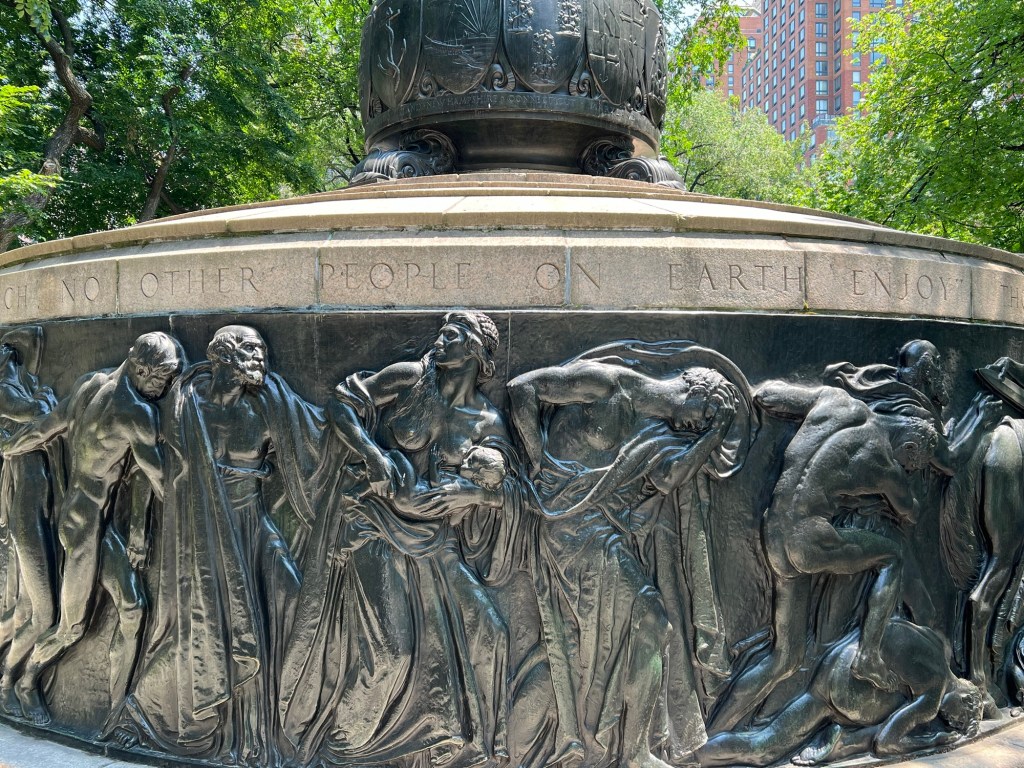
The details are amazing on the flagstaff

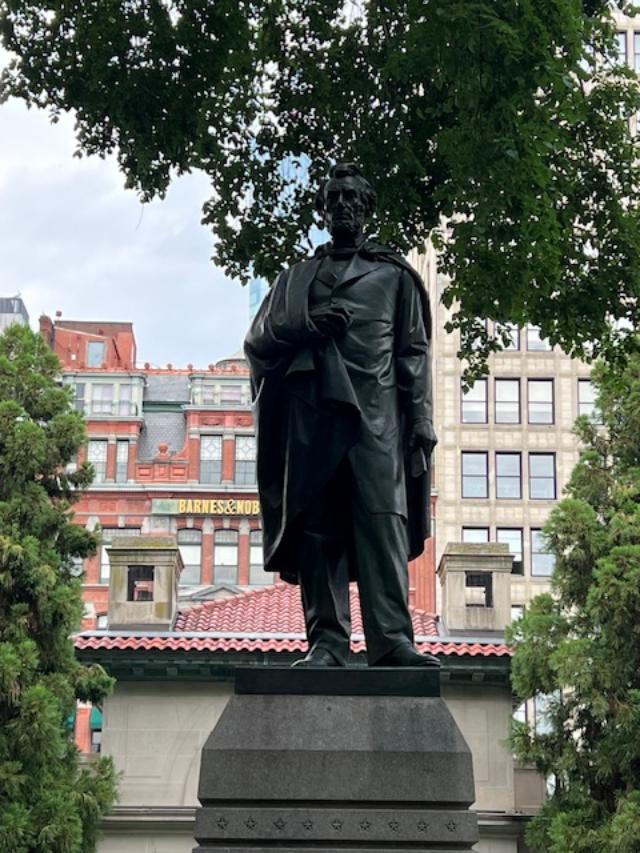
Located at the northern end of the Union Square is the prominent statue of President Lincoln. This statue stands and overlooks the lawn of the park.

Abraham Lincoln
https://www.whitehouse.gov/about-the-white-house/presidents/abraham-lincoln/
https://www.nycgovparks.org/parks/union-square-park/monuments/913
This impressive statue of Abraham Lincoln was designed by sculptor Henry Kirke Brown and was dedicated in 1870. In his statue of Lincoln, cast in 1868, and dedicated September 16, 1870, he combines a classically styled pose with a perceptive naturalism, uniting realistic detail with an idealistic stance (NYCParks.org).
Artist Henry Kirke Brown
https://en.wikipedia.org/wiki/Henry_Kirke_Brown
Artist Henry Kirke Brown was an American born artist who had studied with artists in Italy for his training. He is best known for his figurative historical statues. He also designed the statue of George Washington in Union Square.
There is a lot more to Union Square than just the park. There is interesting architecture. Historic statuary, wonderful restaurants and great selection of stores.
The amazing part about Union Square is the transformation of the area in the past thirty years from a park that everyone avoided to one that people could not live without. From the days of being home to one of the biggest methadone clinics in the City to be home to Union Square Cafe which transformed the park, Union Square has become the gateway to Uptown.

The Northern end of Union Square Park
The neighborhood has transformed itself with hip cafes, expensive lofts and a Farmers Market that is the benchmark that all others hold themselves. Just watching people sit and relax in the park reminds me of how this area had changed. You have to walk the streets to see the influences of the past and the present and how it has it has morphed to the neighborhood that it has become.

Union Square Park on that sunny warm June afternoon
As I explored the borders of the park, I came across a statue of a mother and child. I never noticed that this was an old water fountain for the park. It is always blocked off by vendors during either the Farmers or Arts Markets. With nothing in front of it, I could finally see it in its full form.
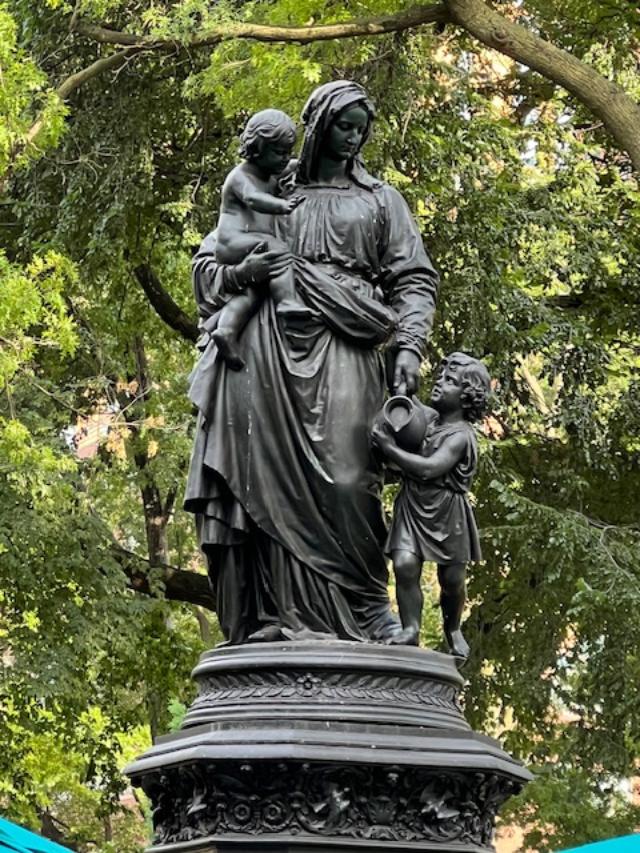
The Union Square Drinking Fountain
https://www.nycgovparks.org/parks/union-square-park/monuments/797
Consisting of a bronze statuary group atop a granite stepped pedestal, it was crafted by German sculptor Karl Adolph Donndorf and donated by philanthropist Daniel Willis James to promote public health as well as the virtue of charity (NYCParks.org).

Artist Karl Adolph Donndorf
https://en.wikipedia.org/wiki/Adolf_von_Donndorf
Artist Karl Adolph Donndorf was a German born artist know for his large realistic sculptures. He had served as an artist apprentice to further his education on sculpture (Wiki).
Just looking at old pictures online of Union Square in the 1970’s and 80’s shows me the power and resilience of Manhattan. It just goes to show you how a City can reinvent itself even in the worst of times and keep morphing!
The other blogs on the Union Square neighborhood:
Day Three Hundred and Thirteen: Walking the Borders of Union Square:
https://wordpress.com/post/mywalkinmanhattan.com/48888
Day Three Hundred and Seventeen: Walking the Avenues of Union Square:
https://wordpress.com/post/mywalkinmanhattan.com/50233
Day Three Hundred and Eighteen: Walking the Streets of Union Square:
 mywalkinmanhattan
If you had a time machine to go from 1984 to 2024 and see the changes in Union Square both the neighborhood and the park, you would be floored. What was once derelict is now hip!
LikeLiked by 1 person