The front of the Little Apple Toy Shoppe at 2484 Broadway
When I was walking my Broadway Walk, which is the 13 mile walk down Broadway from 242nd Street to the Bowling Green, I took my time and walked through many stores I found interesting. Some had colorful displays and some just had playful merchandise in the windows. Then I passed The Apple Toy Store at 2484 Broadway and saw the cheerful sign at the door and had to walk in. What a delightful, whimsical store.
The sign that greets you on Broadway
The displays inside and out of the store really showcase the merchandise and the store has that colorful, playful appeal that attracts both children and adults.
The inside of the store with interesting costumes and wooden products
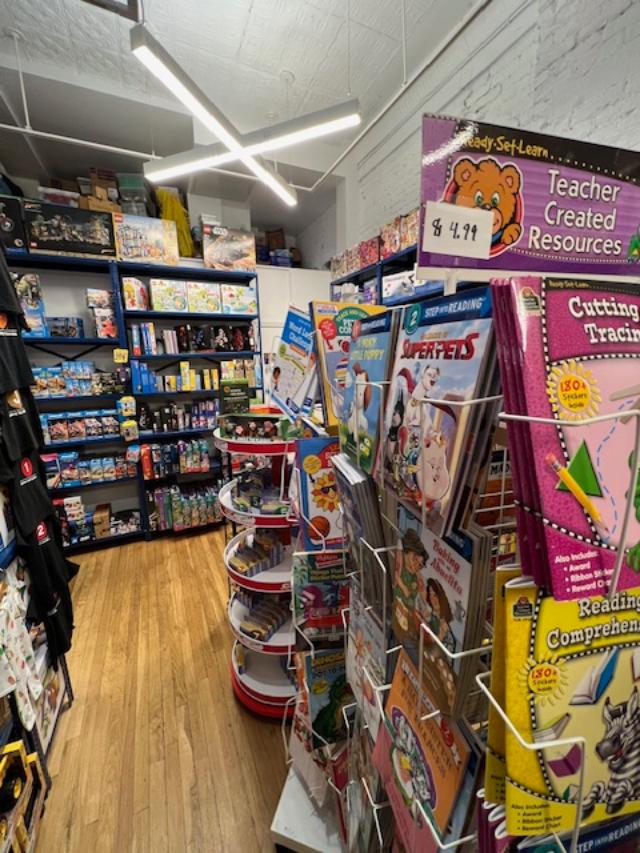
What I loved about the store was there was not a plastic toy in sight but more smaller vendor wooden toys, more toys that spark imagination and creative play. In some toy stores in the City, they are just stacked with the same toys that you see in other stores. Piles of Legos, Playmobile and construction toys that while popular and interesting and fun to play with don’t offer that unique shopping experience of seeing some of the smaller toy vendors that are not available in every toy store. This is what makes Little Apple Toy Shoppe stand out.
The unique display of costumes
The store also has an array of costumes just in time for the holidays. Halloween and Christmas are just around the corner and it will soon be dress up time. Everything is so nicely displayed and not crammed in to fit every piece in the store. There is a nice selection of sizes and varieties to both boys and girls of different ages.
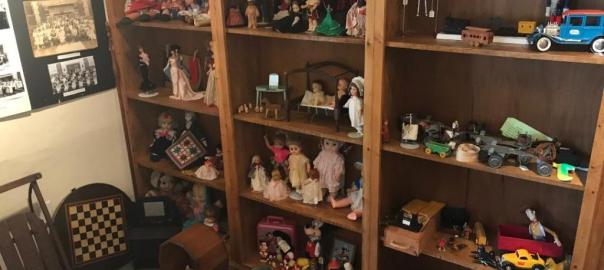
The dolls on display smile and wink at you almost asking you to take them home.
What was really nice was talking with the owner that afternoon as she just opened this shop. She had told me that West Side Kids, which was located on West 84th Street had closed their doors after Christmas of 2025 and there was no toy store in this part of the City. She wanted to fill that gap and create a store that would be part of the community. A place where families could gather and shop together. I think she is on the right path with the business with all the engaging toys and whimsical displays.
The selection of books, crafts, wooden toys and clothes
These are the type of toys I loved to receive when I was small. These are the type of playthings that enhance creativity and play and a child’s imagination.
The soft opening that day gave the owner a chance to meet people in the neighborhood and tell them about her business (she did not even have the sign over the door done yet. Just the sandwich board outside the front door). The store reminded me of the mythical store ‘Shop Around the Corner’ in the movie the movie, “You got Mail!”, creating an environment where families can meet and chat with both the owner and their neighbors.
I wish this establishment the best of luck because New York City needs more creative small businesses.
The scene in “Shop Around the Corner”
The spirit of small businesses all America and what happens when we don’t support them.
I recently visited the American Folk Art Museum in New York City for the “Made in New York City” exhibition and it is a very interesting and engaging museum. The artwork for the museum was a combination of painting, sculpture, pottery and metal work created at different periods of the City’s history. It really showed the extent of manufacturing in New York City and the craftsmanship that was once here.
The entrance to the museum
I recently visited the American Folk Art Museum in New York City for the “Nation”exhibition and it is a very interesting and engaging museum.
The main gallery of the museum with early American art
The main gallery with one of the revolving shows
The artwork for the museum was a combination of painting, sculpture, pottery and metal work created at different periods of the City’s and the Country’s history.
Some of the permanent works were made in the Tri-state area. It really showed the extent of manufacturing in New York City and the craftsmanship that was once here.
The ‘Folk Nation’: Crafting Patriotism in the United States’ exhibition
Patriotism in the United States draws from the American Folk Art Museum’s rich collections to explore links between vernacular art and the construction of an American sense of self. Introducing visitors to the concept of “folk” as a category developed in conjunction with the art and antiques markets, this exhibition positions works as multilayered in their meanings, imbued with cultural significance by not only their creators, but also their collectors and subsequent owners. Americans have long preserved objects as a way of telling stories about themselves. Beginning after the Revolutionary War and gathering momentum in the late nineteenth and early twentieth centuries, people turned to early American things to construct a national history and sense of collective identity—an impulse often driven by lingering insecurity about the young nation’s perceived cultural provinciality compared to Europe (Folk Art Museum.com).
One of the painting’s that stood out to me was more contemporary approach to the Statue of Liberty, entitled ‘Miss Liberty reaches out to the persecuted’. A different approach to folk art.
The painting ‘Miss Liberty reaches out to the persecuted’ by Reverend Benjamin Franklin Perkins
The description of the painting
Some of the interesting things you will see are the paintings by artists in both Colonial New York and from the Hudson River School of prominent New Yorkers through its first 200 years of history. You will see how the styles of art have changed over the years.
Also there is a lot of metal work in the ways of signs and rods for the front of doors and for the roofs. The woodwork carvings that once graced the front doors of merchants all over the City is now a lost art. Here you could see the works of German and Russian carvers and the craftsmanship that was put into every piece. It was interesting too to see the racial themes and stereotypes that were used in the art.
Several revolving shows were being featured on a recent trip to the museum such as ‘Nation’ and ‘Self Made’, themed shows for the 250th Anniversary of the Country.
The show ‘Self Made’ A century of inventing artists’
Self-Made: A Century of Inventing Artists takes a critical look at the historical definition of the “self-taught artist” in the United States from the early twentieth century to today. The exhibition examines how artists without academic training have depicted, conceptualized, and identified themselves on their own terms. In doing so, it aims at challenging reductive, long-standing narratives that have cast these artmakers as amateurs or isolated geniuses working out of time, without lineage, influence, or artistic networks (Folk Art Museum.com).
The sixty artists featured here largely worked outside conventional art-school, gallery, museum, and peer-exchange systems. Their practices are rooted in diverse sites of learning, from professional expertise to community-based traditions. Drawn primarily from the American Folk Art Museum’s collection, this selection of artworks brings together outstanding examples of paintings, sculptures, photographs, videos, and artists’ notebooks by key national and international figures—many of them recent or rarely seen acquisitions (Folk Art Museum.com).
The exhibition is organized around three methods of artistic “self-making” and self-fashioning: self-portraits, alter egos, and autobiographies. Each gallery unfolds chronologically, providing grounding for the artists’ intentions. The works function as primary documents: firsthand accounts of the self, authored by the self. Akin to diaries or other personal statements, they call for close attention, asking viewers to “look at me, in this way, that I have chosen.” By centering the makers’ perspectives and aesthetic choices, Self-Made shifts the focus away from the viewer’s role in completing the creative act and places it squarely on the artist’s agency (Folk Art Museum.com).
Some of the paintings that stood out seemed to be self-portraits.
The painting ‘Untitled’
The painting ‘Untitled’
The museum takes different approaches to the way art is portrayed.
Another program that the museum does well is they have afternoon Jazz Wednesdays and Free Concerts on Friday nights.
There are family programs, walking tours, curator talks and lectures as part of the museum programming so there is something for everyone.
The American Folk Art Mission:
(From the Museum website)
Since 1961, the American Folk Art Museum has been shaping the understanding of art by the self-taught through its exhibitions, publications and educational programs. As a center of scholarship and by showcasing the creativity of individuals whose singular talents have been refined through experience rather than formal artistic training, the museum considers the historical, social and artistic context of American culture. Its collection includes more than seven thousand artworks dating from the eighteenth century to the present, from compelling portraits and dazzling quilts to powerful works by living self-taught artists in a variety of mediums (Museum bio).
Self-Taught art, past and present, tells empowering stories of everyday life. The field of American folk art was first defined at the turn of the twentieth century by collectors, professional artists, critics, dealers and curators whose search for an authentic American Art seemed to be finally answered in works that presented a nuanced of national identity, faith, progress, ingenuity, community and individuality. Under the umbrella of “folk art” expanded to also include artists working in the present. For the last twenty years, the term self-taught has more regularly come to address these artists, whose inspiration emerges from unsuspected paths and unconventional places, giving voice to individuals who may be situated outside the social mainstream. Those individuals have been active participants in the shaping of American visual culture, influencing generations of artists and establishing lively artistic traditions (Museum History).
American Folk Art Museum History:
(From the Museum website)
The museum of Early American Folk Arts as it was known initially held its first exhibition in a rented space on 49 West 53rd Street in 1961. The museum’s collection was launched in 1962 with the gift of a gate in the form of an American flag, celebrating the nation’s centennial. The gift reflected the museum’s early focus on eighteenth and nineteenth century vernacular arts from the northeast America.
In 1966, after receiving a permanent charter, the museum expanded its name and mission. As the Museum of American Folk Arts, it looked beyond the traditional definitions of American folk art. Its exhibitions and collection began to reflect “every aspect of the folk arts in America-north, south, east and west.” Founding curator Herbert W. Hemphill Jr. “expanded the notion of folk art beyond traditional, utilitarian and communal expressions.” Under his direction, the museum began to champion idiosyncratic and individualistic artwork from the fields of traditional and contemporary folk art. In doing so, the museum ushered in a new era in the field of twentieth-century folk art (Museum History).
The 1990’s brought new focus to the diversity and multiculturalism of American Folk Art. Offering a more inclusive vision. the museum began to present African American and Latino artworks in their exhibitions and permanent collections. Director Gerard C. Wertikin announced American folk art’s common heritage as “promoting an appreciation of diversity in a way that does not foster ethnic chauvinism or racial division.” (Museum History).
The museum further established its broadened outlook with the 1998 formation of the Contemporary Center, a division of the museum devoted to the work of 20th and 21st century self-taught artists as well as non-American artworks in the tradition of European art brut. In 2001, the museum opened the Henry Darger Center to house 24 self-taught artist’s works as well as a collection of his books, tracings, drawing and source materials (Museum History).
The gift shop
In 2001, the museum chose its current name, American Folk Art Museum. Recognizing that American Fold Art could be fully understood in an international context, the word American functions as an indication of the museum’s location, emphasis and principal patronage rather than as a limitation on the kind of art it collects, interprets or presents. The museum’s current programming reflects this shift in focus. Past exhibits have included folk arts of Latin America, England, Norway, among other countries and continents (Museum history).
Don’t miss this amazing little museum on the Upper West Side of Manhattan.
There are times you are walking around a neighborhood and there are restaurants that just stick out to you. It might be the number of people waiting to eat there, it may be the smell of the food cooking that drives you in or just maybe you are hungry.
The afternoon I passed Kam Lai 94 Restaurant, it was all of those things and I am glad that I stopped for a late lunch. The food and the service were wonderful in this tiny take out restaurant with just a few tables.
The delicious Beef and Broccoli with Pork Fried Rice with an Egg Roll
I ordered the Beef and Broccoli combination based on seeing another customer eating it at another table. It was excellent! The rich brown sauce of Soy and Hunan sauce really brought the flavor of the beef out.
The tender beef and the well cooked broccoli was a nice combination in a dish that will sometimes not work if either is not cooked right.
The Beef and Broccoli was delicious
The Egg Rolls were wonderful
The Egg Rolls were delicious. They were filled with lots of chopped roast pork and shredded cabbage and spiced perfectly. With a little Duck Sauce it made the perfect addition to this combination lunch special.
The egg rolls here are amazing
I recently came for a late lunch after visiting a museum on the Upper West Side and ordered the General Tso’s Chicken combination platter with an Egg Roll and it was delicious. The food came out steaming hot and wafted the smell of honey, hot peppers and soy sauce.
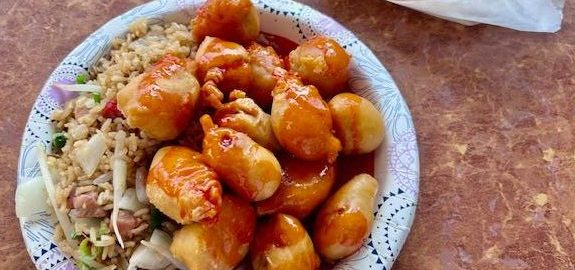
The General Tso’s Chicken combination platter with a Coke.
The chicken was steaming hot when it came to the table
The General Tso’s Chicken was a wonderful combination of sweet and savory with hints of ginger, honey, hot peppers and Hunan and Soy sauces. It was crisp and crunchy and had nice pieces of tender broccoli.
The pieces were lacquered with sauce
I love the Egg Rolls here. They are fried to a crispness and are a bit greasy but crunchy and flavorful.
The Egg Rolls are so good
They are filled with chopped cabbage and nice sized pieces of roast pork. They are really good and the perfect accompaniment.
Yum!
Don’t let the appearance of this little hole in the wall restaurant fool you. The food is excellent and the family running it is really nice. You will have a good meal here.
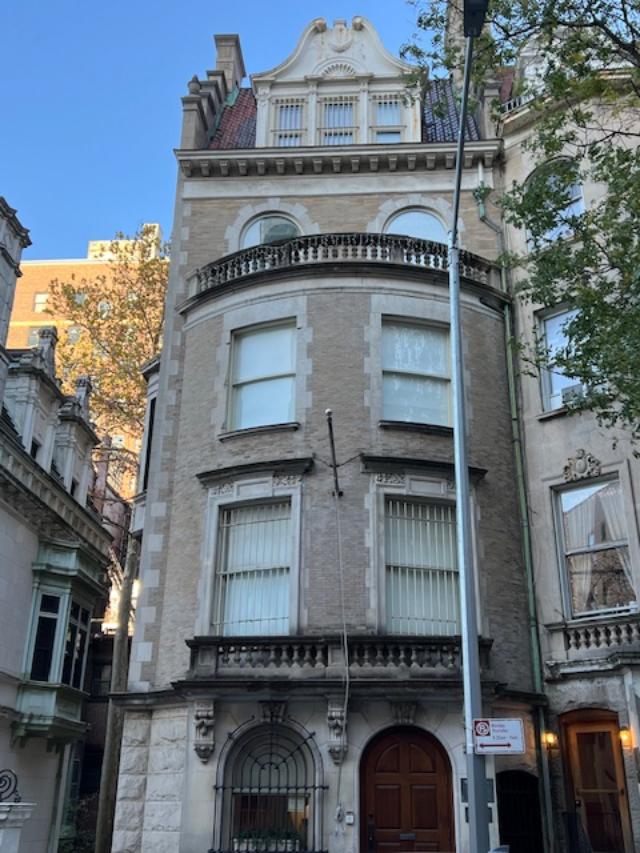
This small museum in the Upper West Side neighborhood of Manhattanville is easy to miss. It is in a small brownstone on West 107th Street right near Riverside Drive. You can see the plaque for the museum to the right of the building and there is a side door to get in. The admission is free but they do ask for a donation if you can do it.
The gallery on the second floor
The museum is a specialty collection of the works of artist Nicholas Roerich. They are mostly landscapes and religious themed that cover three floors of the museum.
The is a beauty to all his works especially the ones concentrated in the Himalayas with their colorful and spiritual themes.
The artist’s portrait of his mother on the third floor
It takes about an hour to an hour and a half to see all the floors. A nice touch they had in the afternoon that I was there was a piano player whom you could hear play throughout the brownstone. When you go, it will be a pleasant afternoon where you are not fighting the crowds of the larger museums.
The art pieces enlighten you and I felt gave you a sense of hope.
(The following information is from the museum website)
Artist Nicholas Roerich
(From the museum website)
The Nicholas Roerich Museum was founded in 1949 to house a permanent collection of over two hundred paintings by the Russian-born artist, poet, philosopher and humanitarian, Nicholas Roerich. The museum also houses a library of books and maintains an archive and a collection of artifacts relating to the areas of Roerich’s interests (Museum guide).
The Mission of the Museum:
The mission of the Nicholas Roerich Museum is essentially a narrow one: to make available to the public the full range of Roerich’s accomplishments. These, however, are not narrow; they cover the realms of art, science, spirituality, peacemaking and more. Because Roerich’s activities ranged widely, so do the museum’s.
The second floor galleries
The Museum Collection:
Nicholas Roerich is known first and foremost as a Russian-born artist. His paintings, of which there are thousands around the world, explore the mythic origins, the natural beauty and the spiritual strivings of humanity and of the world.
One of the more spiritual paintings in the collection
The museum houses approximately two hundred of these works and keeps most of them permanently on display for visitors who come from around the world. Indeed, for many of these visitors, the museum is a destination of great importance; the paintings speak to them of their own inner yearnings and possible fulfillment. For them, Roerich’s paintings are a kind of teaching-about spiritual development about culture and its role in human life and about opportunities for the achievement of peace in a fractious world.
The second floor galleries
The beautiful landscapes on the second floor
Publications & Booklist:
The museum also keeps in print a number of books by and about Roerich and his life and work and a substantial stock of postcards and reproductions of his paintings. These too are seen by many as more than just prints; they are hung in homes with a degree of appreciation that is not often given to such things.
The gallery on the first floor with some of the more religious works
Cultural Events:
In addition to these functions, the museum also maintains an active schedule of cultural activities.
The second floor galleries
It was Roerich’s fervent belief that the role of cultural development in the peace and evolution of the world is fundamental and that it is therefore the responsibility of those who work in creative and cultural fields to strive always for that peace and evolution and for those goals to be the chief impulses guiding their creative work. Information about these ideas is always available.
The second floor gallery with Asian themed art
The Roerich Pact & the Banner of Peace:
The museum sustains an ongoing effort to spread public awareness of the intermingled roles of peace and culture and the ways in which each sustains the other. Information and materials about The Roerich Pact and the Banner of Peace are always available.
The patronage of the museum through the Katherine Campbell-Stibbe Foundation
Throughout this century of wars and national struggles, the yearning of the public for ways of achieving peace has been great; the ideas of the Pact and the Banner provide a welcome answer to those yearnings.
The history of the museum through the years
As Roerich’s ideas become better known around the world, attendance at the Museum grows and requests for information and materials about him and his art and social achievements increase.
The gift shop on the first floor. The director of the museum even sells honey from the beehives on top of his building.
*This information is from the Museum’s website.
Disclaimer: This information was taken from a combination of the museum’s website and from the biography of the artist.
*Authors Note: The restaurant has been open for indoor dining since 2023. They put outdoor seating out during the summer months now.
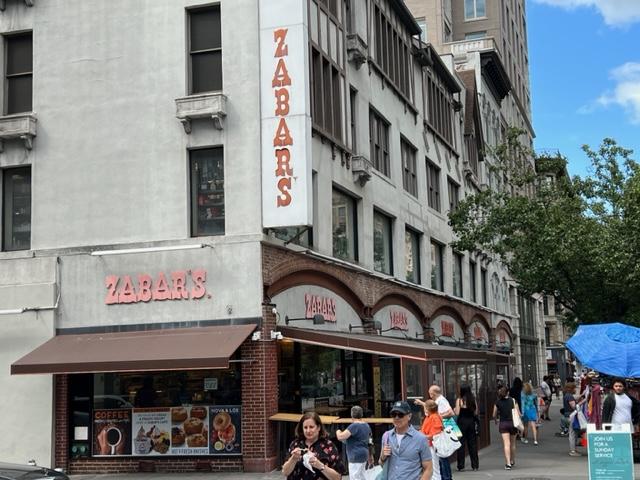
The Zabar’s Cafe is in the original Zabar’s building
Zabar’s is one of the most interesting grocery stores in New York City. Back in the late 60’s, 70’s and early 80’s, it was the only place to go for certain gourmet items, baked goods and a variety of vegetables. Their cheeses were some of the best in the city and when you needed fresh pasta, it was here or Manganario’s which went out of business about five years ago.
While other stores have gotten fancier or more expensive in their wares and grocery items, Zabar’s stays tried and true to its roots and is still a place for the average person to come and do their grocery shopping while buying high quality at a fair price. New York City has never been cheap.
I had been to the store many times in the past but even after all of these trips, I never realized that they had a cafe. I came across this when walking the Upper West Side and touring Zabar’s the many times in the neighborhood.
Zabar’s Cafe inside is for ordering
Zabar’s Cafe, according to their history, sits in the original part of the store (the store has expanded to the whole building) and is separate from the rest of the store. The one thing I like about their menu is that there is nothing over the price of $10.00. Their extensive menu which includes soups, wraps, sandwiches, pizza and pastry.
I have been there twice as while enjoying their specials for $1.00 (in early 2019). This is a special treat that you have to hit in the early afternoon while the specials are going on. The first time I ate there, I had a ham, egg and cheese croissant.
That was really good. The outside was buttery and crunchy with a nice bite to it while the inside is stuffed with scrambled eggs, chopped honey ham and cheddar cheese. Yes, worth every bite.
The menu here is very straightforward
The second time I ate there, I had their version of Sicilian pizza with some fresh tomato on top of it that was very tasty. It was more of a sauceless pizza with a just a light touch of olive oil, cheese and fresh tomato sliced on top.
I have overheard many customers rave about their homemade chicken soup as a cure all. Their cookies and pastries look delicious, sitting like gems in the display cases. I recently had one of the giant cinnamon buns which was loaded with a thick icing ($2.95) and it was worth every bite. I must have had a big smile on my face when I was walking down Broadway because everyone was staring at me enjoying myself.
The Zabar’s Cafe outside seating now is available in the warmer months
The crowd is very interesting. It is made up of older Westsider’s who claim their spots in the restaurant as their own. It is really a neighborhood hang out for a lot of these people and I hear a lot of gossip going on as well as old friends greeting one another. If you try to sit in their area, there is that distinct look you get.
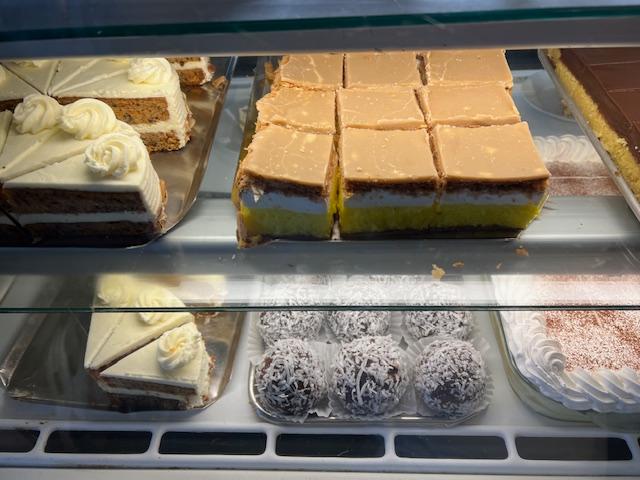
The reasonable pastries
Overall, it is a nice place to eat with reasonable food with fresh ingredients and a nice selection of simple American foods from soups and wraps to sandwiches and desserts. There is something for everyone here and the best part is you can still visit the main store to pick up more goodies right next door.
They now offer outside dining during the warmer months.
Zabar’s is one of the most interesting grocery stores in New York City. Back in the late 60’s, 70’s and early 80’s, it was the only place to go for certain gourmet items, baked goods and a variety of vegetables. Their cheeses were some of the best in the city and when you needed fresh pasta, it was here or Manganario’s which went out of business about five years ago.
While other stores have gotten fancier or more expensive in their wares and grocery items, Zabar’s stays tried and true to its roots and is still a place for the average person to come and do their grocery shopping while buying high quality at a fair price. New York City has never been cheap.
I finally was able to get back into New York City to resume my walk of the Upper West Side. It is amazing how fast the summer went. I haven’t been on this side of the island for months. Walking the lower part of the Upper East Side took many days and there was so much to return to in way of galleries, parks and restaurants that I had wanted to take my time. I hope to see the same on the lower part of the Upper West Side.
I really lucked out and it was a spectacular day, sunny and warm with blue skies. It had been a very difficult summer with the rain and the humidity and it was nice to see a pleasant fall day.
I started my day taking a seminar of the changes that will be going on with the editing system at WordPress.com (where this is printed through). It seems that they will be introducing a new editing system to our blogs that will help make them better and I look forward to improving my sites.
After class was over I visited the Museum at FIT (The Fashion Institute of Technology-see reviews on TripAdvisor and VisitingaMuseum.com) which is located at 227 West 27th Street on the corner of Seventh Avenue at 27th Street on the main campus to see some of the new exhibitions. Don’t miss their “History of Pink” exhibition on the use of the color in fashion with some clothing items dating back to the 1700’s and their “Reconstruction” exhibition of the components of fashion.
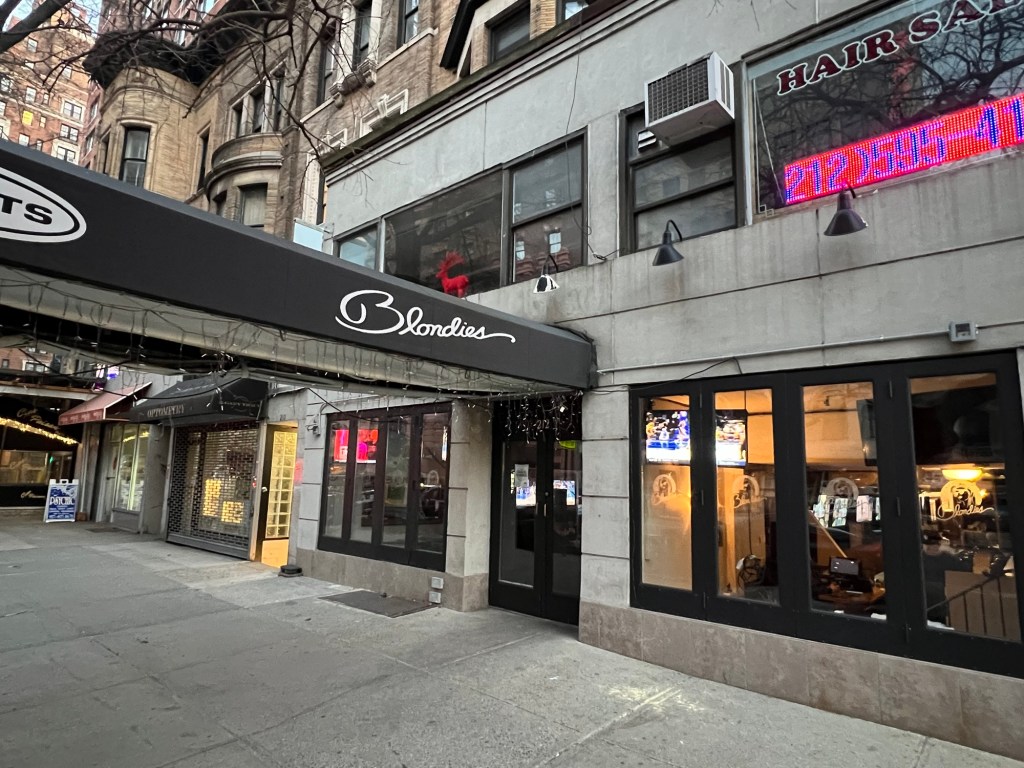
From FIT, I took the number 1 subway up to West 79th Street to continue my walk of the lower part of the Upper West Side. My first stop in the neighborhood was to join other Alumni from Michigan State University at Blondie’s Sports Bar at 212 West 79th Street to watch the Michigan State versus Western Michigan football game (we won 31-20).
Even though the score was not that high I have to admit our coach does have class and does not run up the score like other coaches do when playing a smaller school. Over a plate of chicken tenders ($8.99 for six), which were delicious (see review on TripAdvisor) I got to hear all the noisy Alumni in the back go nuts at every play. I had gotten there after half time so I had to sit through all the play by plays of the game.
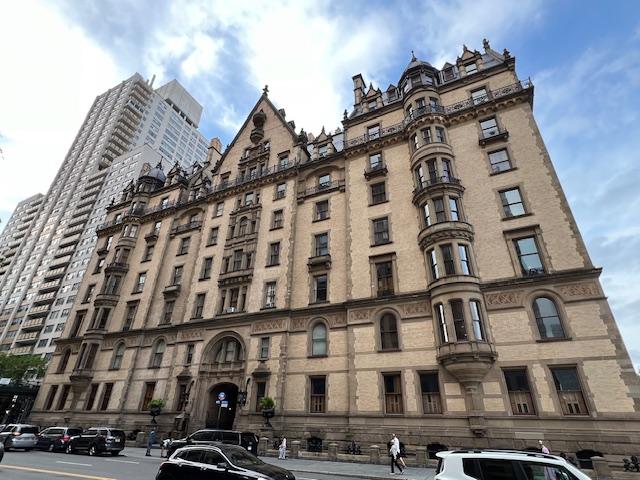
After the game it was the late afternoon but sunny, gorgeous and warm, the perfect day for a walk around the City. My starting point was West 72nd Street and Central Park West corner near The Dakota Apartments at 1 West 72nd Street, where tourists were all snapping pictures. They had just finished the outside renovation on the building and the apartment complex looks elegant and you can see all the architecture elements of the building shine. The iron work around the Dakota is interesting with all its twists and faces looking out at you.
I walked down West 72nd Street like I was visiting an old friend. I had not been on this side of the island since the beginning of the summer and there have been quite a few changes on the road. A few more of the businesses have closed and more of the buildings on the street are under scaffolding. So much is being renovated in the neighborhood.
The West 72nd Street shopping district
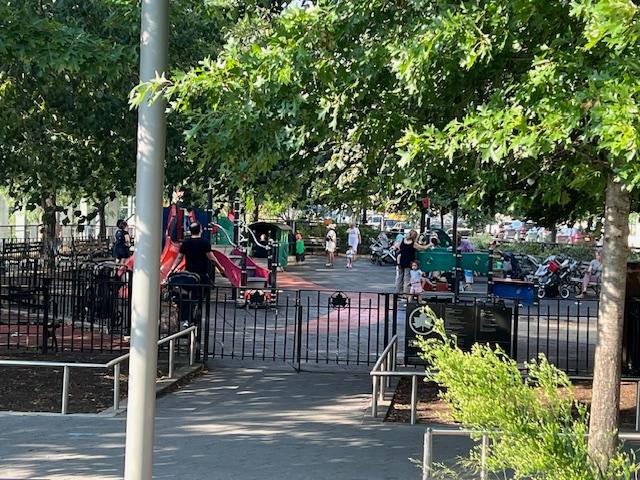
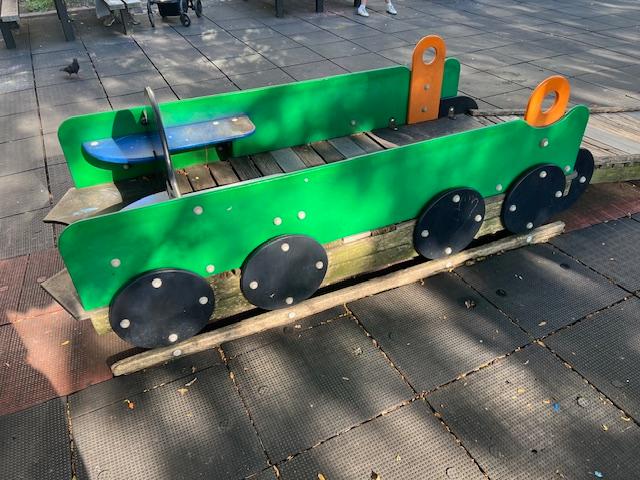
As I rounded West 72nd Street onto Riverside Drive, I came across the very busy Little Engine Playground at West 67th and Riverside Drive. This whimsical playground is part of the NYC Parks Department and the main feature of the park that the small children enjoy the is the small train that they can climb inside and on top of in the middle of the park. This popular park is on the corner of West 67th Street and Riverside Boulevard and it one of the popular parks for kids in the Riverside Park Conservatory. The afternoon I was there the kids running all over the park while the parents talked amongst themselves.
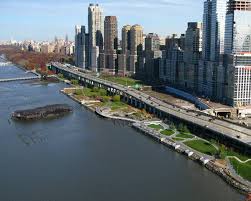
Riverside Drive and Riverside Park end at West 72nd Street but the park continues with the new Hudson River Park that currently lines the river below the Henry Hudson Parkway which itself ends at West 57th Street. This stretch of riverside is the newly landscaped park with benches, running and biking paths and a cafe, Cafe Pier One. The park is a new addition to the City that stretches down to Battery Park City.
It is a pleasure to walk along the newly reclaimed waterfront which I think was what Robert Moses wanted in the first place. This highway was needed at the time to open up the whole area to cars and now is being reclaimed as parkland. The park was conceived in the mid-90’s but construction started on parts of the park starting in the Bloomberg Administration in 2003 and still continues today to reclaim river side land and rotting piers for parkland and it the largest riverfront park in New York City and one of the largest in the country.
As I walked down Riverside Boulevard, you can see all the new sidewalks, plantings and small pocket parks that line the Boulevard from West 72nd Street to West 57th Street and the Boulevard is now lined across the street from the park with series of luxury office and apartment buildings. Everything is so new that you can see the deep green of the new sod in the park from parts of the Boulevard above.
Riverside Boulevard and Riverside Park on the Upper West Side
To get a full view of the park, I walked along both the Boulevard and the inside the parks paths to see what the vision of the Hudson River Park Trust is trying to achieve. What the park does so well it that it combines the river with the park and it blends the natural beauty of both. It also protects the park goers with large boulders so that people don’t fall into the river from the side of the park. It’s a sloped effect where the river shines on a sunny day.
Both from the street and from the paths, you get beautiful views of the cliffs on the New Jersey side of the river but still engage it via the various piers that you can walk on that jut out into the river. When you reach West 59th Street, Pier 96 and the Hudson River Pier and the boat basin giver great views of the Hudson River.
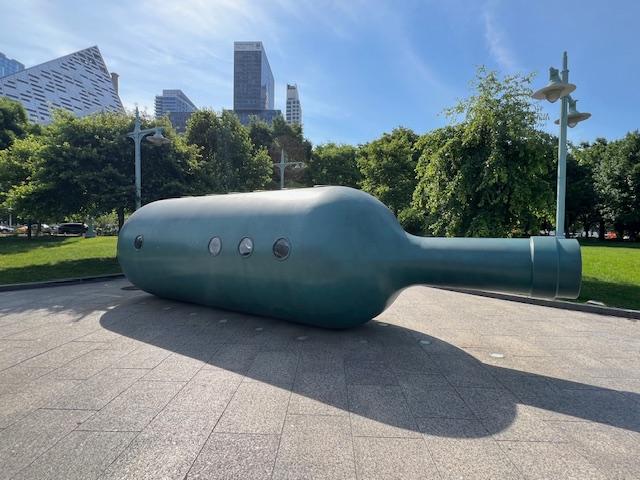
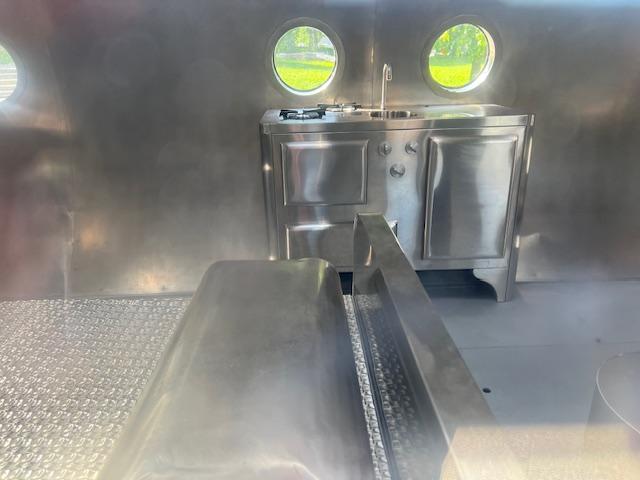
I walked around the park and saw an unusual sculpture in the shape of a bottle. The public art piece ‘Private Passage’ by artist Malcolm Cochran is a unique sculpture in that what appears to be a ship in a bottle is actually a replica of a stateroom in the Queen Mary all done in metals. At night and in bad weather I read that the piece is illuminated.
‘Private Passage’ by Malcolm Cochran
The inside of the sculpture
Malcolm Cochran is an American artist and former Art Professor at Ohio State University. A graduate of Wesleyan College, Mr. Cochran has had many solo and group shows since the 70’s and has created numerous works all over the world. ‘Private Passage’ was created for Hudson River Park in 2005 and is an engaging piece of art where the visitors have to look inside the port holes to see the art inside the bottle. It is very clever.
Another piece of art that stands out in the park is actually part of the original park when the train tracks dominated the area. At the West 63rd Street section of the park is a section of the New York Central Transfer Station elevated above the side of the park. This is all that is left of the celebrated rail line that had been built in the 1800’s. It sits majestically above the park on what is left of a rotting pier.
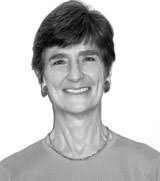
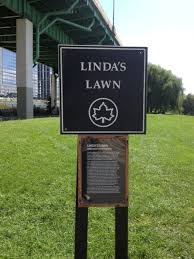
As part of the Hudson River Park is ‘Linda’s Lawn’, a piece of the newly landscaped park named after Linda Stone Davidoff, a champion of the City and one of the city planners and a member of the Parks Council who fought to have this 27 acre park as part of the West Side landscape (NYParks.org).
As I walked the park up and down from West 72nd Street back to West 59th Street, I crossed the rather difficult street path and walked down West 59th Street. Near the local school is Gertrude Ederle Playground which sits next to the Gertrude Ederle Recreation Center. This park stretches from West 59th to West 60th Street and is a very popular park with the areas families offering many whimsical playground jungle gyms and swings and a very nice field for soccer and baseball. It also offers a very nice public bathroom that is nice to have when walking around the area.
Gertrude Ederle Park
The playground
Gertrude Ederle was a champion Olympic and distance swimmer, who was a member of the 1924 Paris Olympic Games. She set over twenty world records in swimming in the early 1920’s and won a gold medal for the 400 meter freestyle relay. She swam the 22 mile harbor swim from Battery Park to Sandy Hook, NJ in a record that stood for 81 years. She also set the record for crossing the English Channel as the first American woman and received a ticker tape parade when she returned. She also appeared as herself in the 1927 romantic comedy ‘Swim, Girl Swim’. She continued to swim by teaching deaf children to swim (she had lost her hearing at this point) and lived to ripe age of 98 passing in 2003 (NYCParks.org).
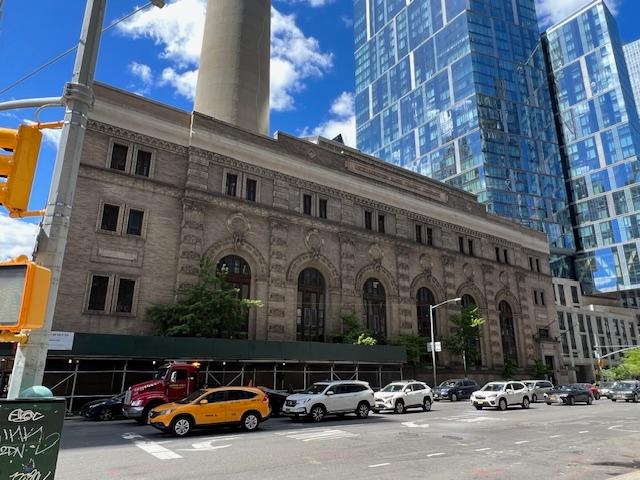
Across the street from the park is the former IRT (Interborough Rapid Transit) Powerhouse at 840 12th Avenue. This ornate building was built in 1904 and takes up the entire area from West 59th to West 58th Street between 11th and 12th Avenues. Designed by architect Stamford White, the building is used by Con Ed of New York to supply the New York Steam system. It is designed in the ‘Renaissance Revival’ and really walk around the building you can see the beautiful details of the building especially around the building . It was recently declared a Landmark Building in New York (Wiki).
I walked both sides of West 59th Street past John Jay College which stretches from 11th to 10th Avenue and then past a branch of Mt. Sinai Hospital which stretches from 10th to 9th Avenues. These buildings take up the entire city blocks between West 58th and 59th Streets and stop at the intersection of West 59th Street where Columbus Avenue turns in 9th Avenue. This leads to the back section of Columbus Circle and the new building that houses the headquarters of Time Warner and the Mandarin Hotel. This complex stretches from 9th Avenue to Columbus Circle from West 58th to 60th Streets so there is a lot of crossing streets in this area that is loaded with tourists.
I stopped in Columbus Circle Park roundabout and sat watching skateboarders who took over the southern part of the park filming their antics of flying over benches. Tourists stopped here to take pictures and film movies of the guys skateboarding.
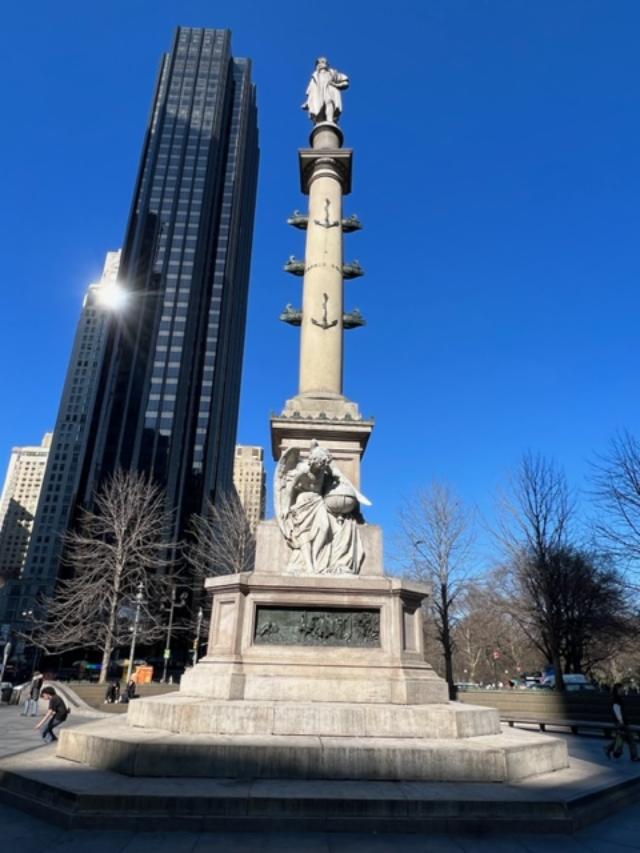
The Statue of Christopher Columbus has been part of a recent controversy that has since calmed down. There were some New Yorker’s that said that the statue should be taken down for the way Columbus exploited the Native Americans. Honestly, I don’t think they thought that way in 1492 and it shouldn’t be related to in 2018.
The statue was designed in 1892 as part of the 400 hundred anniversary of Columbus discovering America by Italian artist Gaetano Russo. Russo was an artist from Messina, Sicily who studied at the Academia de Belle Arti in Rome. In the inscription it says “To the world he gave a world”.
The 76 foot statue was designed by Italian sculptor Gaetano Russo as part of a plan to honor Columbus’s discovery of the Americas as part of the 1892 commemoration of the 400 year anniversary of the event. If you look closely at the pillar, you will see the reliefs of the Nina, Pinta and Santa Maria ships on the memorial (Columbus Memorial and Wiki).
The statue and the circle had recently been renovated in 1992 for the 500th Anniversary of the crossing and again in 2005 adding the new fountains and benches which everyone relaxes on (Wiki).
Christopher Columbus Statue at Columbus Circle
The bottom statuary of the statue.
The traffic circle had been part of the original plan by Frederick Olmstead design for the park in 1857 for a ‘Grand Circle at the Merchants Gate’ and the entrance to the park and 8th Avenue (NYCParks.org).
The roundabout is where traffic enters the Upper West Side from Midtown Manhattan and is the halfway point of the island of Manhattan. I still can’t believe that I have gotten here.
From Columbus Circle, I doubled back around the Time Warner Building and made my way back down West 60th Street crossing Columbus Avenue to West 59th with a second pit stop at the bathroom at Gertrude Ederle Park, which at this point was loaded with families climbing the jungle gyms and playing softball.
Sometimes it’s nice to sit by the fountain and just relax
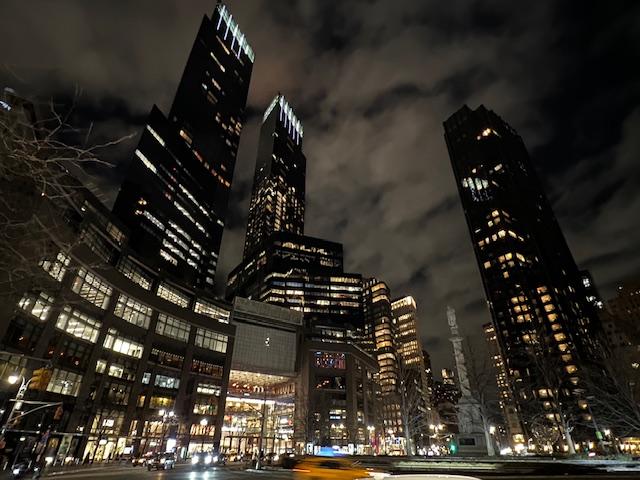
The Time Warner Building really changed the complexity and mood of the neighborhood from an working class area to one very upscale. The building replaced the old New York Coliseum which was knocked down in 2000. The building was designed by David Childs and Mustafa Kemel Abadan of Skidmore, Owings & Merrill. The complex houses many upscale shops, restaurants and offices as well as the new Mandarin Hotel (Wiki).
I made my way back up through Hudson River Park to enjoy the sunshine and walked from West 59th to 72nd Street passing familiar businesses that I had seen the last time I was in the neighborhood.
The complex at nightfall
This took me to my last leg of rounding the neighborhood by crossing the West 72nd Street border to Central Park West and making my way down past the still green trees of Central Park. There was a free concert going on in the park at the time so there was security all over the place.
I walked past the many families walking around the park at twilight and thinking to myself how it had all changed in thirty years when you would not be caught dead in the park after sunset. Now there are free concerts and walking tours after dark.
I relaxed in Columbus Circle for the remainder of the evening and watched the skate boarders do their routine and this lady dressed as a ballet dancer or could have been a ballet dancer in a tutu with Christmas lights in her dress dancing around the circle. Half way through her routine she bumped into a guy walking around the park and then they danced together.
What was amusing was when the skateboarder collided into her as she danced and the two of them bumped one another. Both of their reactions were priceless but they both got a laugh out of it. Funny for a park that could have torn a city apart that people can still laugh at their differences and find a common ground. They both talked and she continued to do her ballet around the park and the group of skate boarders continued to do their flip routines on the benches.
That’s true New Yorker’s for you!
Please read my other blogs on the Lower Part of the Upper West Side:
Day One Hundred and Twenty-One: Walking the Borders of the Lower Part of the Upper West Side:
I have found that walking the Avenues of the Upper West Side to be much easier than the Upper East Side. There are less blocks to walk and this side of the island is smaller in space than the middle of the Upper East Side which begins to jut out on that part of the island.
Each Avenue on the Upper West Side has its own uniqueness to it. Columbus and Amsterdam Avenues are more of a shopping district with Amsterdam Avenue having most of the quirky restaurants and old-time stores. Broadway is rapidly changing was the stores of the 80’s and 90’s are quickly losing their leases and with the rents jacked up is home to more chains now more than ever. It seems that another new chain restaurant and store opens up every month. Even here, I have watched the chain stores lose their leases and go away.
West End Avenue is strictly residential and the blocks between it and Riverside Drive hold a treasure trove old stone townhouses, brownstones and marble mansions with the graceful cravings, ornate stairs and potted plants outside the homes. There is an immense pride in this part of the neighborhood, and I swear probably not much as changed since the turn of the last century.
I was walking up from Soup Kitchen that afternoon and after a long day on the Bread Station holding off questions of why we do not have any pastry (none was donated) and the lack of raisin bagels (again none were donated) and why we no longer use butter for the bread (the peanut butter was donated), it was off for a long walk to the Upper West Side. Being closer to midtown, I have been walking more often than using the subway.
I have walked Central Park West, both sides many times and the biggest changes I have seen in the buildings here is that most of them are being sandblasted back to life as new owners and residents have been rapidly converting the Upper West Side into the new Upper East Side. The new residents seem much richer, less liberal and a whole lot younger.
I have never seen so many baby carriages and little dogs since walking the heart of the Upper East Side. At least here, the dogs seem less spoiled (with the multiple grooming places for dogs, the B & B for Dogs (upscale kennel) and places for doggies treats and clothes, dogs get better treated than the homeless).
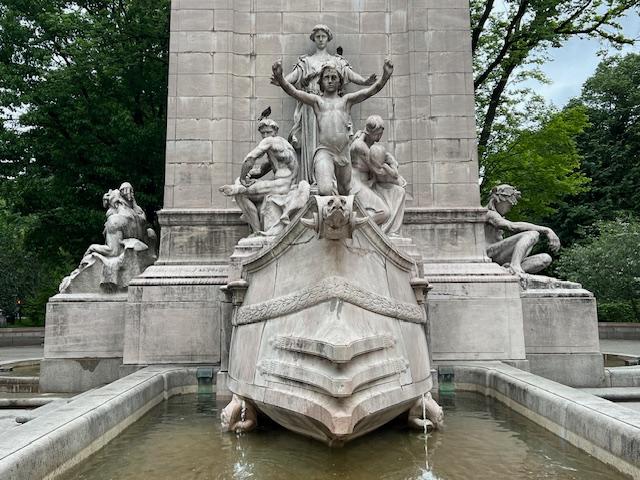
As you walk up Central Park West, the first thing you see it the statue dedicated to the members of the U.S.S. Maine that was mysteriously bombed February 15th, 1898, which started the Spanish-American War. The War started on April 25th, 1898 and would last eight months. After a series of conflicts due to the War, the Philippines and Cuba gained their Independence and we got Guam and Puerto Rico as part of the deal.
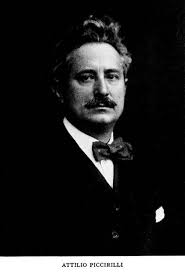
The statue, designed by sculpture Attilio Piccirilli and Charles Keck, with the help of architect Harold Van Buren Magonigle and was dedicated on May 30th, 1913. The statue was dedicated to the 261 people lost when the U.S.S. Maine exploded in Havana harbor in February of 1898. This started the Spanish-American War in April of 1898 (Wiki).
Really take time to look at this statue for its details, its plaques that line the base and the detail work. It unfortunately is now used as a bench for most people who attend the Christmas and Farmer’s Markets that now line the base of the statue. I don’t think most people today know what the Spanish-American War of 1898 was or its significance in our country’s history. If you say, “Remember the Maine” today, most people will go ‘huh’?
As I walked up Central Park West along the park side, you will see the landscape lined with trees, lawns, parks and massive rock formations which seem more prevalent ten blocks up. These formations are leftovers of the last Ice Age, and it is amazing to know that these will drag for hundreds of miles as the ice moved. I have noticed more of these rock formations on the Upper Upper West Side and in Washington Heights and it is interesting to see our connections still to the last Ice Age.
Being the time of year that it is, the whole park was winter hibernation but people using the park on a 46-degree day brings life to almost everything. The kids dominated the playgrounds after school and tourist and locals alike were walking dogs and chatting along the paths. Even in the colder months, Central Park is always busy.
When I reached the border of the neighborhood at West 72nd Street, I passed the famous Dakota Apartment Building that dominated the corner of West 72nd Street and Central Park West. Really look up at the detail work of this building. Built between 1880-1884, the building was designed by the firm of Henry Janeway Hardenbergh, the same firm that designed the Plaza Hotel. The name ‘The Dakota’ some feel came from the isolated location so far uptown at the time it was built in that the Dakota Territories were so isolated from the country at the time.
This video is on the Dakota Apartments and Rosemary’s Baby
The building is currently under renovation, but you can still peek into the side of the building to see the old courtyard where the carriages used to drop residents off and the apartments themselves were designed around the French layouts at the time with large ceilings and rooms that flowed into one another. The resident listing is a Who’s Who of the entertainment and arts industry and the filming of the movie ‘Rosemary’s Baby’ was done in the front of the building as well as the death of musician, John Lennon in the early 80’s.
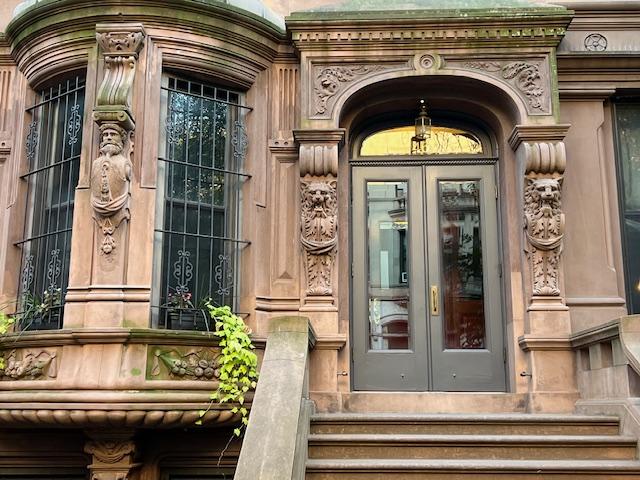
As you pass the beauty of The Dakota, West 72nd Street has an array of architectural styles of brownstones and marble homes lining the street. The carving of the stone is work that you no longer see in design and so much of the neighborhood is under scaffolding as new owners are sandblasting these buildings back to their original beauty.
Continuing the walk-up Central Park West, you continue to pass many beautiful and graceful stone apartment buildings with beautiful views of the park that are going through their own renovations.
At West 77th Street, you are at the Museum Row of the Upper West Side with the New York Historical Society at 170 Central Park West and the American Museum of Natural History located on Central Park West and West 79th Street.
New York Historical Society at 170 Central Park West
If you are reading this blog post in 2018, please remember to stop by the museum to see both the ‘Unseen Ocean’ and the ‘Senses’ exhibitions that just opened. The ‘Unseen Ocean’ explores the unknown deep of our oceans and the new species that we are discovering in the deep. It takes a look at the new development of equipment where we can explore deeper than before and the new discoveries that pop up with every trip. The ‘Senses’ exhibition explores how we react to the environment around us. These can be seen with the museum day pass.
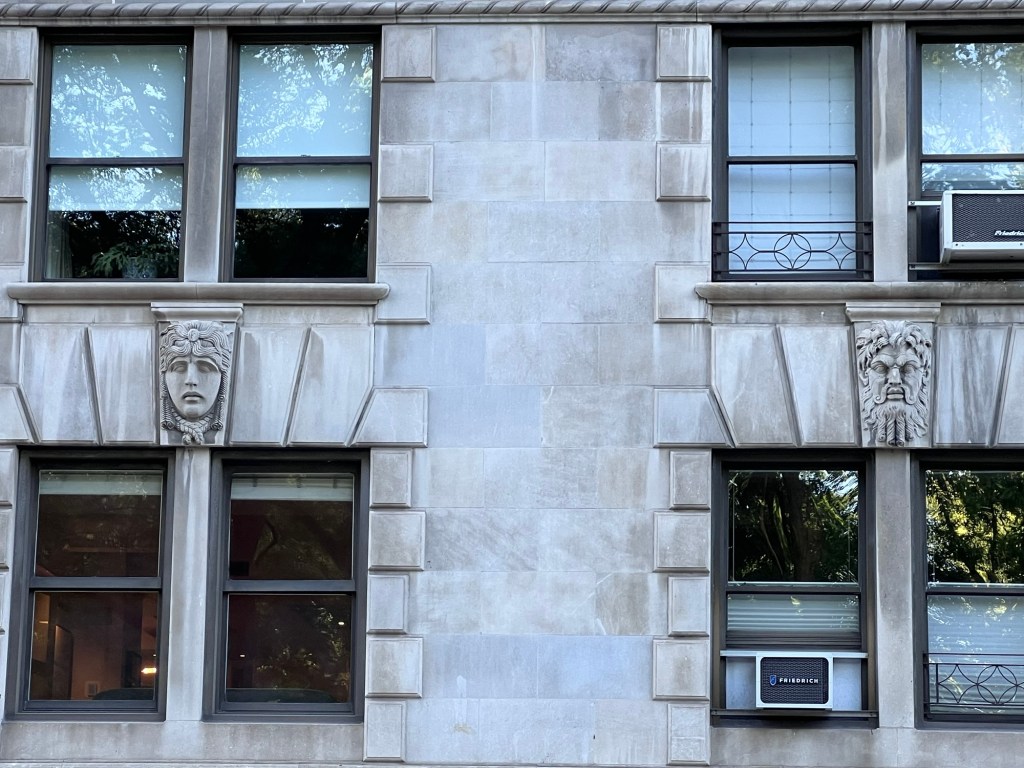
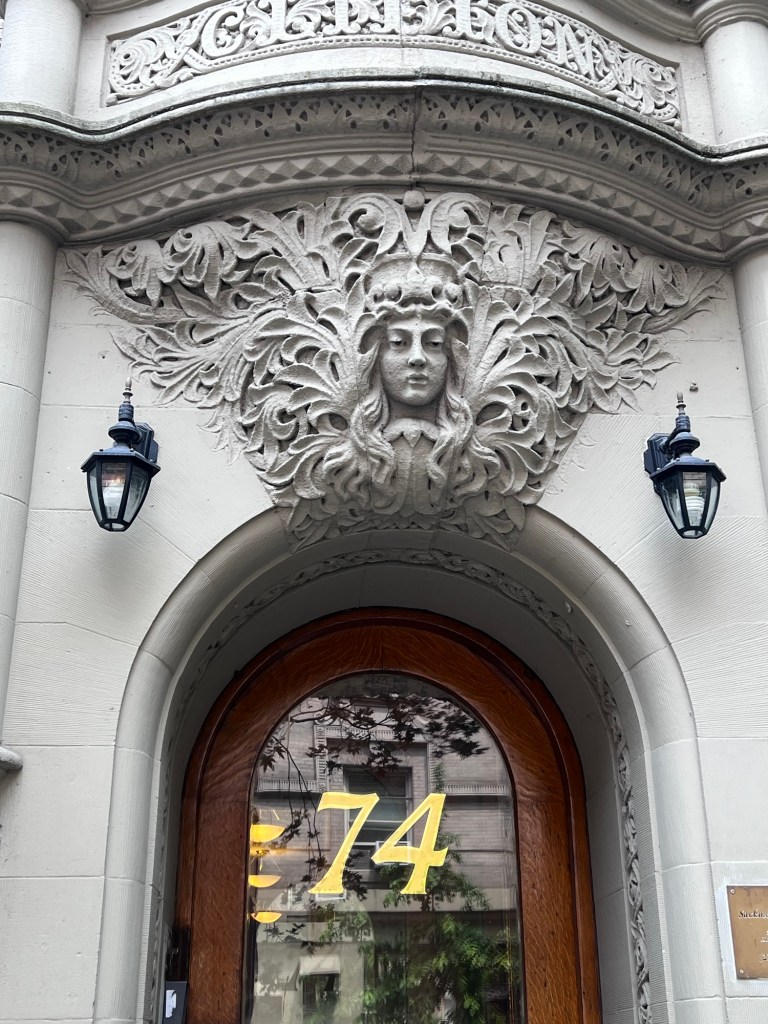
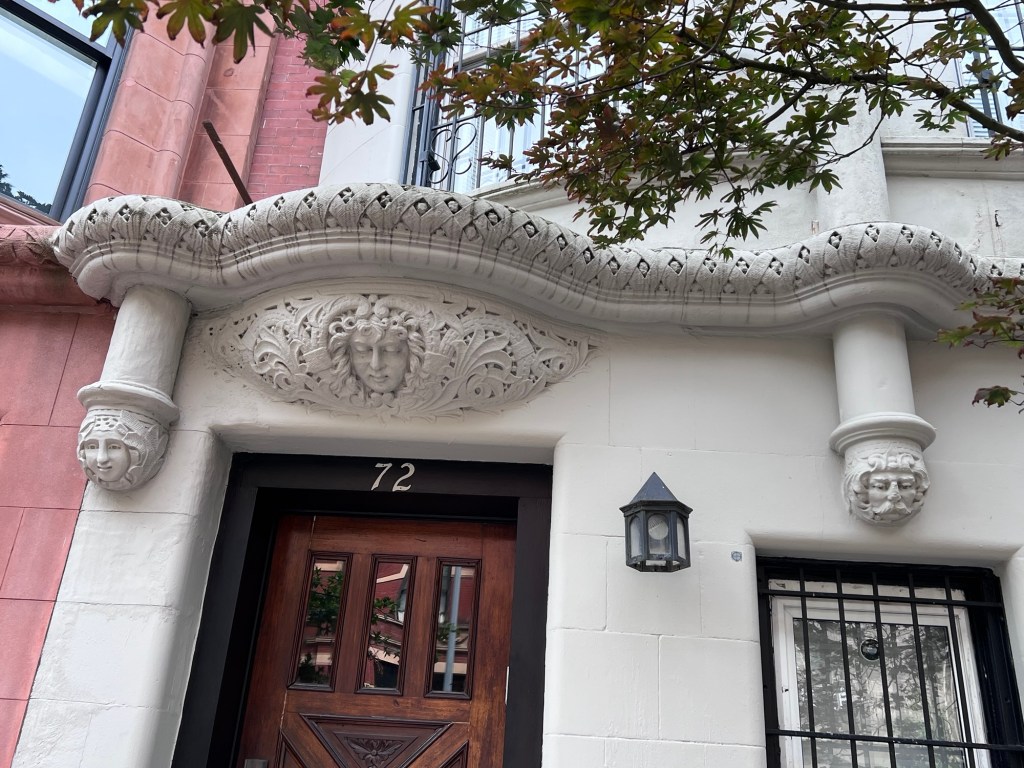
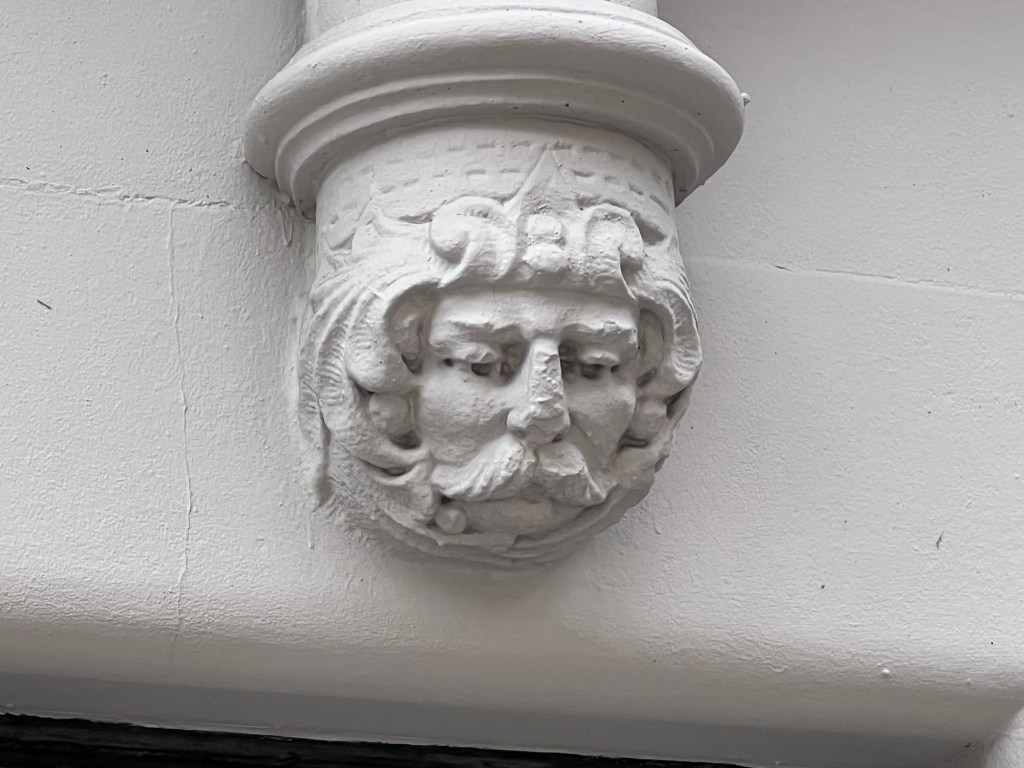
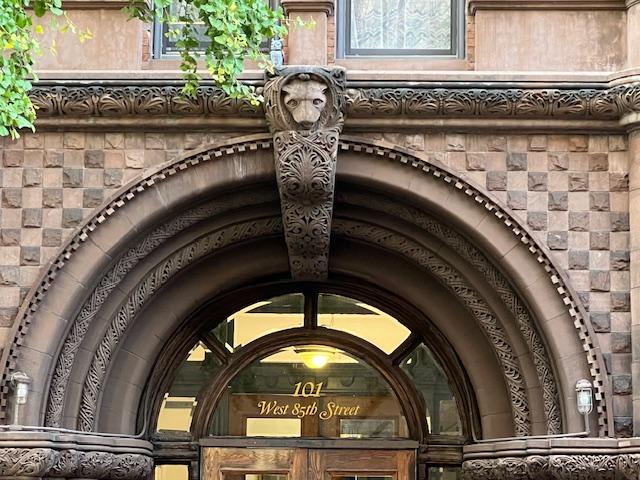
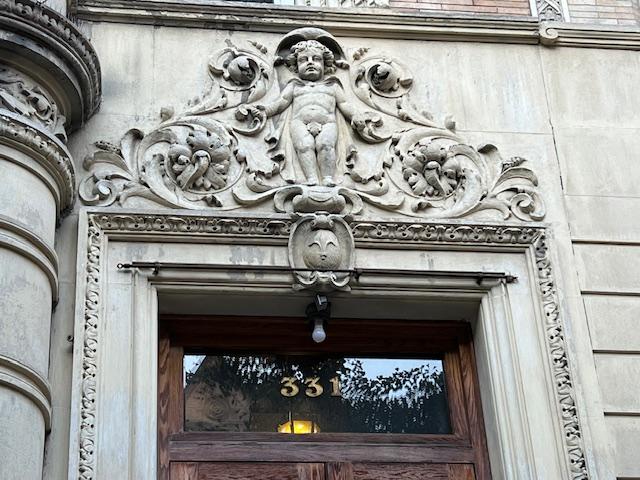
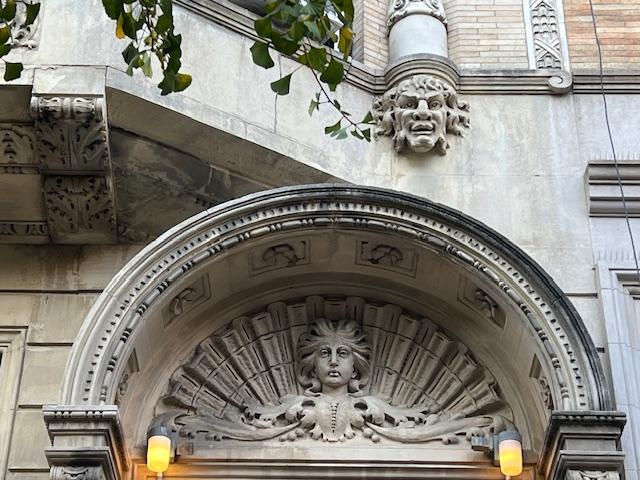
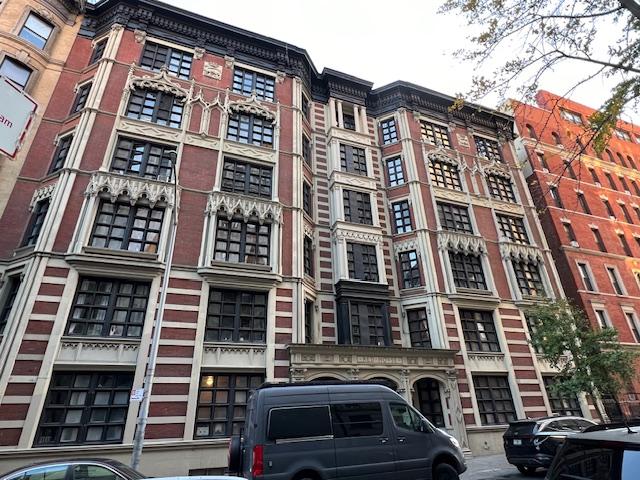
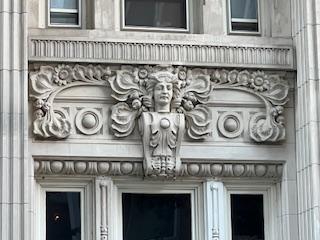
As you round West 84th Street and down the block to Columbus Avenue, really look up around you and see the faces following you down the block to the next Avenue. The carvings of faces on the buildings stare out into the abyss or look to one another. You won’t really notice it until you really look at the detail work of each building. You will be doing a lot of stopping and staring between Central Park West and Columbus Avenue.
Just look up and they all stare back
Back in 1984 to 1987, during the first really big gentrification of the Upper West Side, Columbus Avenue was a big deal, everything from 59th Street to about 86th Street was being sandblasted back to life and all sorts of new restaurants and shops were opening up left and right around the American Museum of Natural History.
Stores like the DDL Food Show (Dino De Laurentis’s Gourmet Shop), Penny Whistle Toys and the infamous Museum Café (where the Shake Shack is located now) were the topic of conversation when they opened. After the crash of 1987, most of these places had closed or where long gone and by the mid-90’s, the whole block was changing again as all the expensive stores and restaurants started to leave.
This building on West 81st Street started it all with the trendy stores on Columbus Avenue
Today Columbus Avenue between 72nd Street to 84th Street is starting to go through another change. Instead of all the expensive places kicking the reasonable places out, many store fronts have gone dark and sit empty. This is a plague that is going all not just all over the Upper West Side but all over the City. Many old-line businesses from the 70’s, 80’s and even the 90’s that I have seen for years, like Isabella’s Restaurant, on the corner of Columbus Avenue and 78th Street, where my dad and I had many a meal for his birthday and for Father’s Day, shut its doors about a year ago and now sits empty.
West 82nd Street off Columbus Avenue in the Summer of 2026
Columbus Avenue is now in a state of flux with newer more expensive places opening up here and there. I don’t think it has dawned on these landlords that not everyone wants a $16.00 hamburger. In the lower 70’s of Columbus Avenue, it is more and more chain stores and even they seem like they are struggling. You can have only so many stores selling the same merchandise that is currently on sale at Macy’s while the restaurants have similar menus. The rents are forcing, from my opinion, the merchants away from their creativity to what is safe.
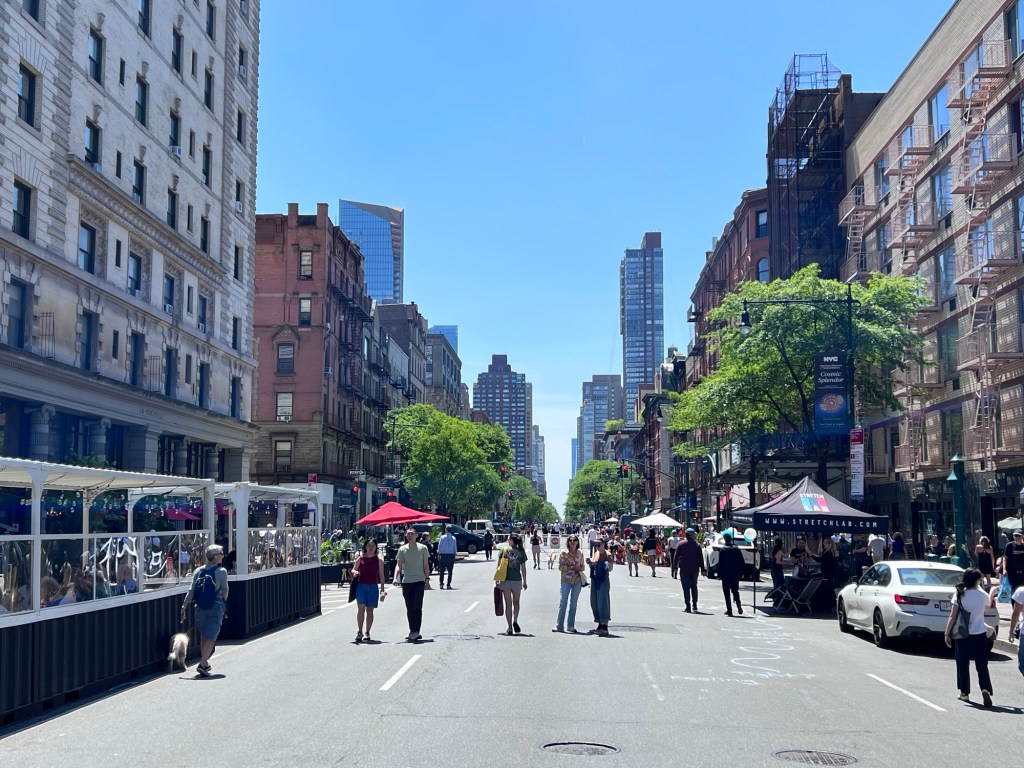
Looking down Columbus Avenue during a recent street fair
All along stretches of Columbus Avenue, especially closer to the American Museum of Natural History, the store fronts are mostly empty and looking at the current prices to buy an apartment in the neighborhood, you can see the reason why. Apartments are going for what their East Side counterparts are going for (or maybe a little less depending on the street). The street is once again changing from more expensive fashion to I am not sure what, but I can’t wait to see what happens next on Columbus Avenue between West 72nd Street and West 84th Street.
With these changes comes the changes at the museum’s as well. The American Museum of Natural History is ever renovating displays or launching new shows. “Unseen Ocean’s”, the story of the newly explored deep, is resulting in long lines at the museum. New ways to explore the bottom of the ocean with nautical looking machines that even Jules Vern could not have thought of are finding new species and showing the food network of the bottom of the sea. This museum has woken up in the last ten years.
The American Museum of Natural History’s “Unseen Oceans” exhibition
The New York Historical Society is a far cry from what it was fifteen years ago when no one entered the musty halls of that relic. Today more and more innovative programs are opening, and they even have an upscale coffee whose prices are ridiculous even for a museum.
Both museums have been sandblasted back to their original glory, have been renovated and are showing innovative programming that rivals anything of their East Side counterparts.
Amsterdam Avenue I have always felt feels like real New York with the funky stores, small independent restaurants and pocket parks that line interwoven parts of the neighborhood.
I had lunch this afternoon at Harriet’s Kitchen at 502 Amsterdam Avenue for one of their famous ‘Fried Chicken Sandwiches” (now closed). Trust me, it lived up to the hype I saw online. The sandwich was $9.95 with hand cut French Fries and a Coke made a total of $11.95 and it was worth every bite.
Harriet’s Kitchen at 503 Amsterdam Avenue (Closed in 2019)
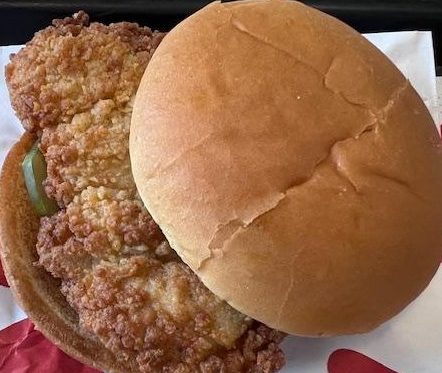
This sandwich was the perfect food item for my walk as I needed the protein. The sandwich was two large chicken breasts marinated in buttermilk and then dredged in a cornmeal crust and then fried golden crisp. It was crunchy and savory in every bite. It was one of the best chicken sandwiches I had ever eaten. The fries were good as well as they were cooked to a golden crisp as well. It was accompanied by a spicy remoulade sauce and sour pickles which added an extra kick to the sandwich. The service was really friendly and even though the place is a little dumpy, the food is no reflection of that. I have not eaten chicken this good since my tour of Harlem.
Harriet’s Kitchen Chicken Sandwich was delicious
Right next to Harriet’s Kitchen is West Side Kids at 498 Amsterdam Avenue, so I got a chance to tour the store again which was stocked to the gills with new toys. Across the street from Harriet’s Kitchen is the Urban Assembly Green Space Garden at 145 84th Street, that the students maintain on the corner of West 84th Street and Amsterdam Avenue.
This garden is used by the students for the growing season and at the height of the season they sell their fruits and vegetables to the public. Take some time to walk around this urban oasis when it is in season.
Amsterdam Avenue is like Lexington Avenue in that it is a nice mix of stores and restaurants that are more affordable to the average New Yorker. This is beginning to change in the low 70’s but like most of the neighborhood is a state of flux. I am beginning to see the same number of empty storefronts on this Avenue as well.
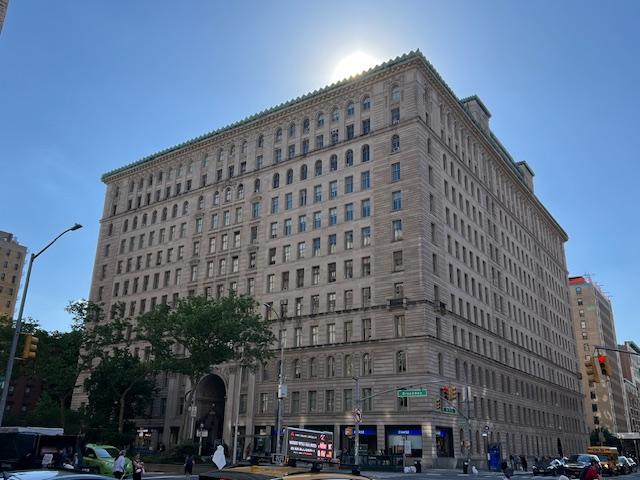
Broadway in this part of the island is designed as a French Boulevard with landscaping down an strip of island down the middle of the road with benches at each island stopover. As I had mentioned in my observation further uptown, this part of Broadway was designed for upscale living with grand apartment buildings.
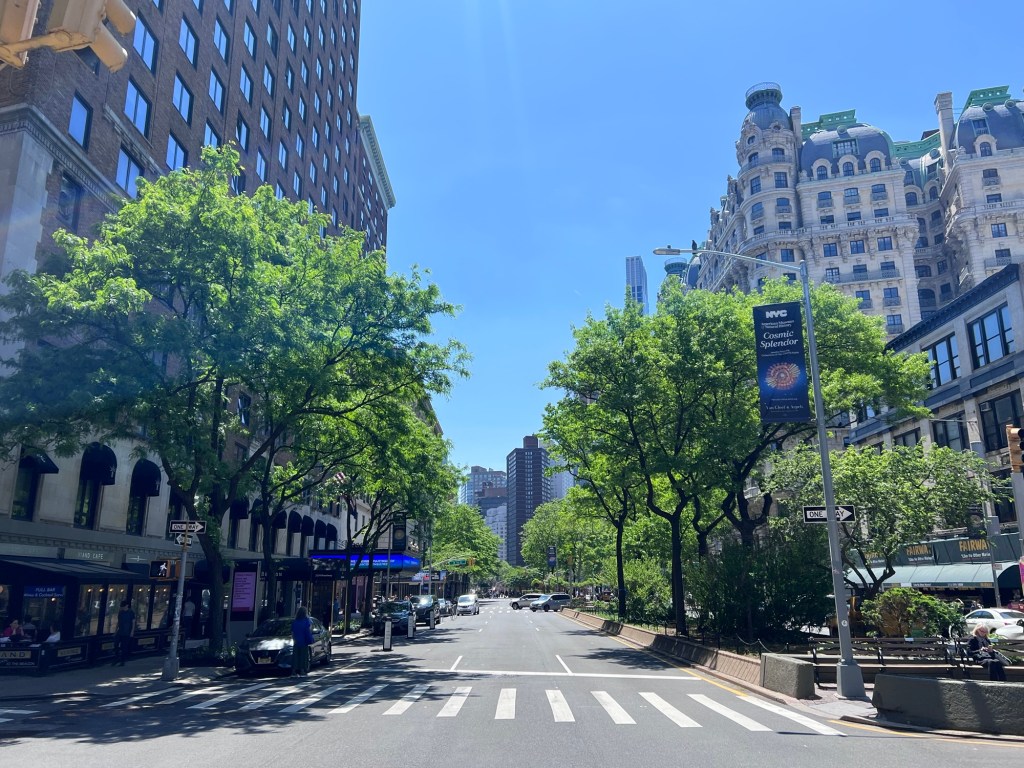
Looking downtown with the Ansonia to the right
The Ansonia Apartments at 2101-2119 Broadway was built in 1899 by architect Paul E.M. Duboy in the traditional Beaux Arts style in the Victorian Age was a residential hotel. The detail work on the outside is gorgeous with all sorts of statuary, carvings and iron work and topped with a mansard roof. The building has housed many famous people in the arts, music and politics. You can peek inside the courtyard to see where the carriages once let the residents off similar in design to The Dakota further west (Wiki).
You have to walk on the side streets to appreciate the beauty of this building
The Apthorp Apartments at 2201-2219 Broadway was built between 1906-1908 by architects Clinton & Russell for William Waldorf Astor and takes up the whole block between Broadway and West End Avenue. The building was designed in the Italian Renaissance Revival style and when you peek inside the building you can see the courtyard where carriages once a upon a time used to drop the residents off. Over-sized limestone sculptures representing the Four Seasons stand above the ventral barrel-vaulted entrance with wrought iron gates feature a pair of gazelle heads (Wiki).
The Astor Apartments at 235 West 75th Street tops Broadway with the grand apartment buildings and is currently going under a major renovation and restoration. The building is currently under scaffolding (as seems the whole neighborhood) so it hides the beauty of the building. The stores below are changing as well as even Barney’s has moved out of the neighborhood.
The building was developed in 1909 for William Waldorf Astor II by architects Clinton & Russell for the two eight story wings and the firm of Peabody, Wilson & Brown did the taller tower. The beauty in this building is in the simplicity of its elegance and the detail work along the roof.
When walking up Broadway, note that this area was built at a time when the wealthy were scaling down their lives at the turn of the last century and this form of luxury was becoming the norm. By the 60’s and 70’s, these grand apartment buildings like the rest of the neighborhood got rundown but currently all are on the process of renovation, or their completion have led the apartments to be reconnected back to their four to five room layouts.
The stores along Broadway have given way to a commercial district of chain stores but still has lots of ‘gems’ lining Broadway. Rents have risen so much in the area that a lot of these stores and restaurants might face displacement in the future. Like the rest of the city, there is a cost of doing business in NYC.
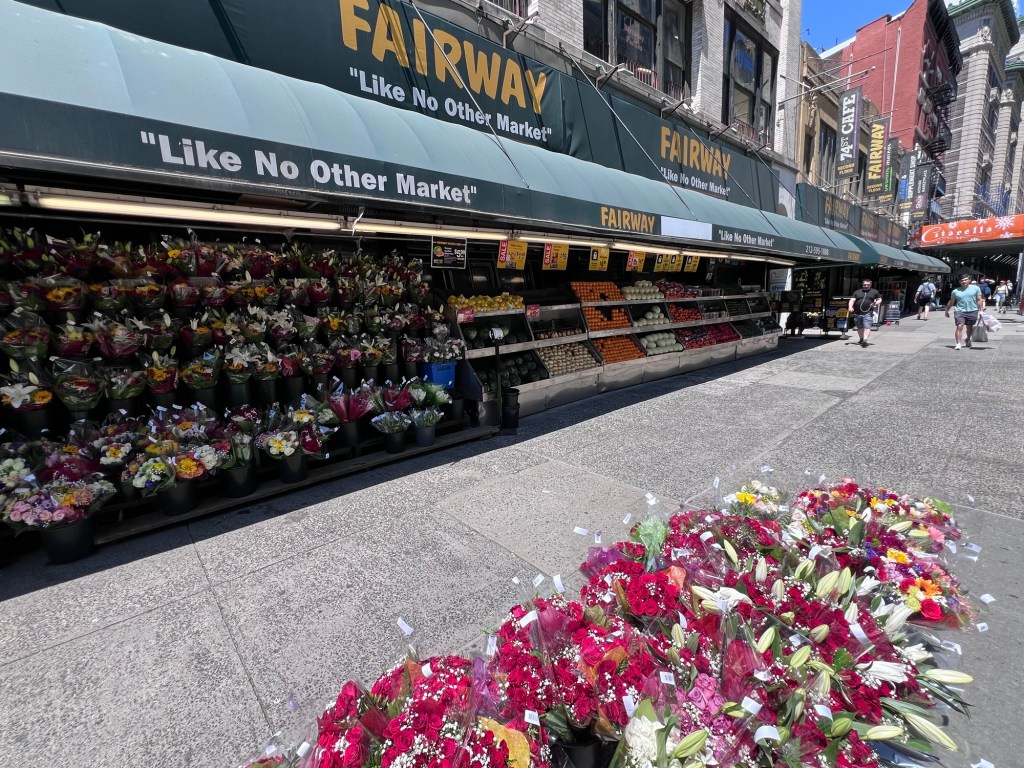
Some of the most famous stores are the great purveyors of food the most well-known being Fairway at 2131 Broadway and Zabar’s at 2245 Broadway. These are more than just grocery stores; they are institutions in New York.
The Fairway supermarket at 2131 Broadway
Fairway supermarket, which now has branches outside the city, is stocked from ceiling to floor with everything you need to fill a kitchen. When I walked through it, it seemed more like a traditional grocery store, fancy but functional loaded with every brand imaginable. It is fun to to walk around the tight aisles and look at the merchandise. They also have a nice, prepared food section with everything you need for a picnic in the park.
The Fairway stocked for the weekend
Zabar’s though, is a true New York institution. I have been coming here since the 1970’s when my mother’s bible for food was both Gourmet and New York Magazines. Anytime we went into the city, Zabar’s was a place we visited especially if she saw it one of those two magazines.
Zabar’s is broken down into sections each with their own mouthwatering smells and like Fairway, lined from top to bottom with delicacies. Their cheese department has the most wonderful aroma when walking through it and the bakery section always smells of croissant and chocolate. The prepared foods section is still one of the best in the city. They have enough for a full meal that you might make at home but ‘don’t have the time’. Just walking around is an experience. They also have a small restaurant off to the side of the building complex and it has specials during lunch (See review on TripAdvisor).
Westsider Rare & Used Books at 2246 Broadway across from Zabar’s and a little further down by West 81st Street and Broadway is piled high with used, antique and out of print books. This worn looking bookstore is what out-of-towners would say a New York bookstore should look like down to the literary looking woman who works there much like her counterpart at Westsider Records down at 233 West 72nd Street.
The people the store has working there fit the stereotype of who would work there. These two stores are fun to wonder around in especially if you grew up in the late 60’s and the 70’s and early 80’s before the ‘Yuppie’ transformation of NYC. You never know lol what treasure you will find in the stacks of these stores.
Most of the rest of Upper Broadway is quite commercial but helpful in everyday needs of shopping and entertainment. The big AMC Theater attracts people from all over the neighborhood and this area is always busy.
During a break in the walking, I stopped by the West Side Cafe at 218 West 72nd Street for the noted Sausage, Egg and Cheese bagel ($3.95) that I ate in Riverside Park. I had seen someone eating it the other day and had to have it. It was well-worth the visit and the sandwich were big and warmed me up with every bite on this cool day.
West Side Cafe & Pizza at 218 West 72nd Street (Closed in 2020)
West End Avenue like the area’s uptown is lined with graceful apartment buildings and on the side streets elegant apartment buildings and brownstones. There are a lot of beautiful churches and schools in this area of the neighborhood.
When you walk down West 84th Street (named after Edgar Allen Poe), you walk into a residential area that time has not touched (except for the sandblasting of the buildings). Most of the apartment buildings are art themselves with all the stonework, carvings and ironwork decorating them. Really take time to look at the stonework of the apartments and the brownstones lining all the streets between West End Avenue and Riverside Drive.
The Mickey Mantle Elementary School P.S. M811 sits at the corner of West End Avenue and West 81st Street at 466 West End Avenue which was named after the famous Yankee Baseball Player. The school specializes in teaching children with learning disabilities and is one of the best of its kind in the City. The school was renamed after the famous player June 4th, 2002, and its academic excellence would have made Mr. Mantle proud.
You can see the back of the Antony Apartments between West 79th and 78th Streets and still you see the grandeur of this apartment building from all sides including the courtyard. The West End Collegiate Church at 245 West 77th Street can be seen for the entire block and it picturesque in its appearance.
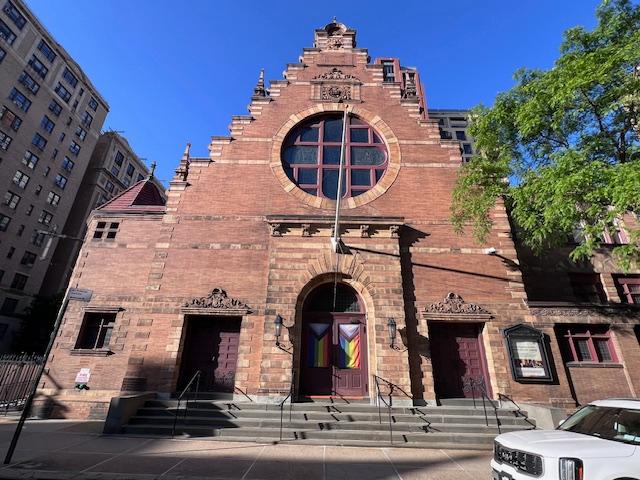
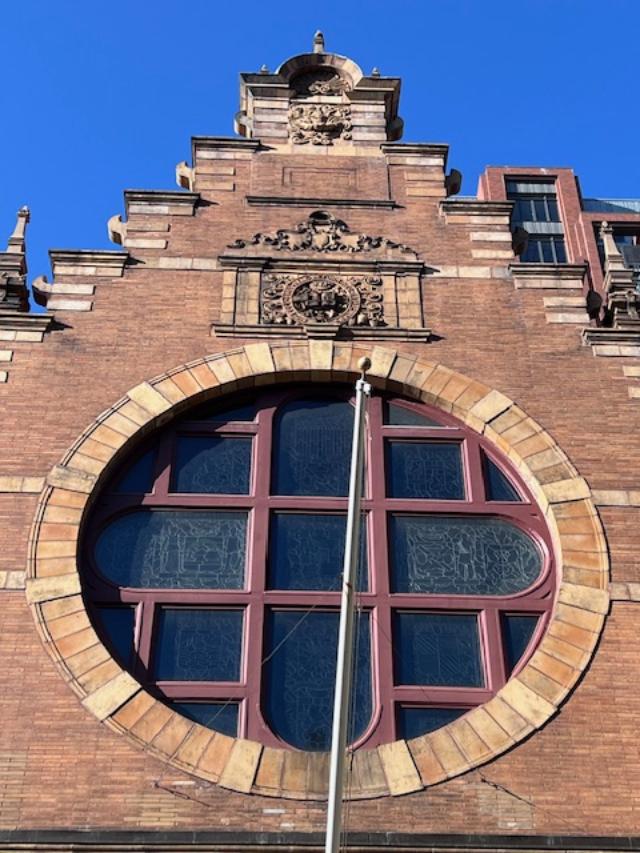
West End Collegiate Church at 245 West 77th Street
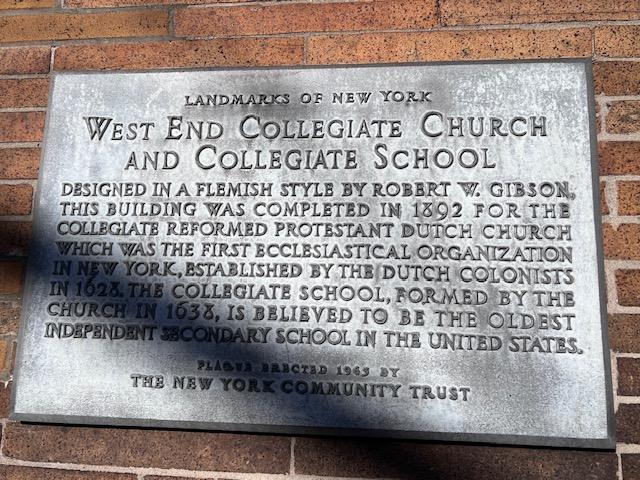
Built in 1892 by architect Robert W. Gibson, this church was designed in the Gothic Dutch-Flemish Revival Renaissance design and is a noted landmark as headquarter to the church and the Collegiate School, one of the best prep schools in the City. Walk around the church to see the brick details and the Coats of Arms of past patrons lining their walls (Wiki/Church Website). The look of the church is different from all sides.
The church from the other side of the street
The windows have beautiful details around them
The historic plaque
There is a small plaque at 440 West End Avenue dedicated to Charles Evans Hughes, the Republican Governor and great State Reformer. He had championed the eight-hour day, forty-eight-hour week for workers (under 16) and set up a Trades Act to protect workers much of what we work with today. He also served as Secretary of State under President Harding among his many accomplishments.
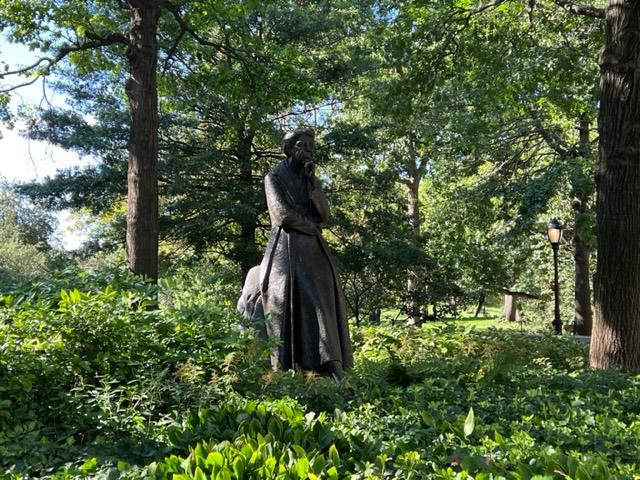
I finished my walk at the Eleanor Roosevelt statue at the end of Riverside Park and walked around this side of the park which on a cool day was relaxing. I just sat by the benches and looked at all the interesting buildings.
Eleanor Roosevelt Statue at Riverside Square Park
A close up of the statue
The statue was done by sculptor Penelope Jencks and Michael Middleton Dwyer and the architects on the project were Bruce Kelly and David Varnell. Ms. Jencks is an American artist who studied at Boston University and graduated with BFA.
The monument lies at the threshold of the Riverside Park and is one of a sequence of civic monuments along Riverside Drive honoring people of historical significance (NYC Parks.org). It’s a nice place to just relax and watch the world go by. This is also the end of Riverside Park which ends at West 72nd Street.
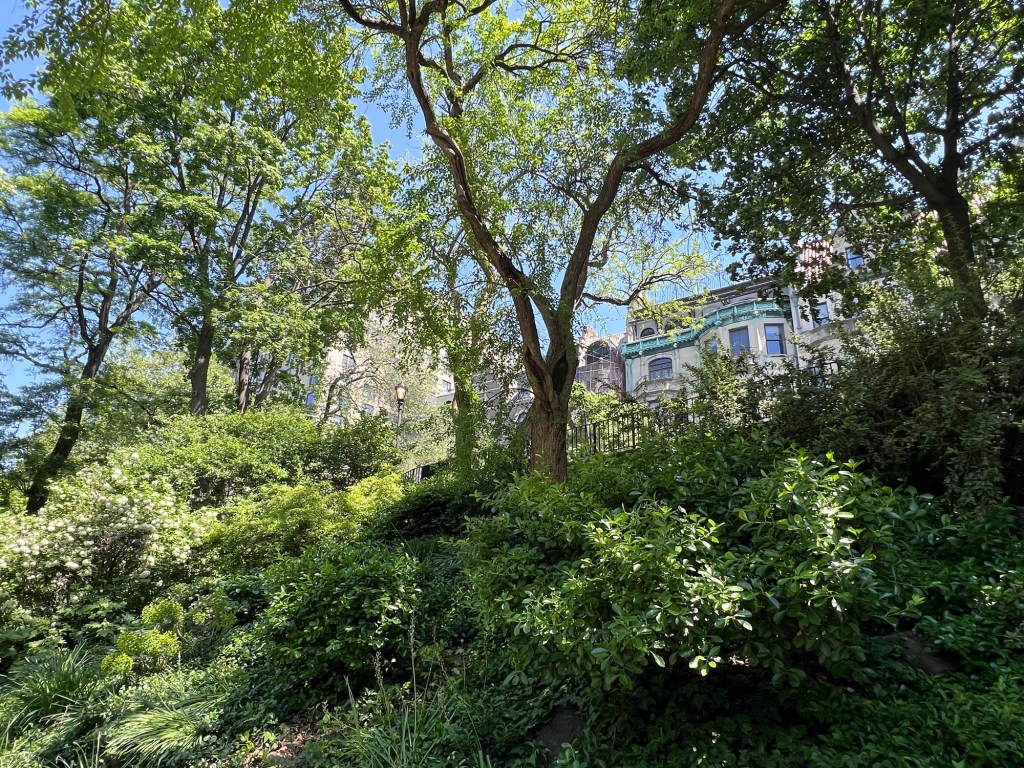
Riverside Square Park in the Spring
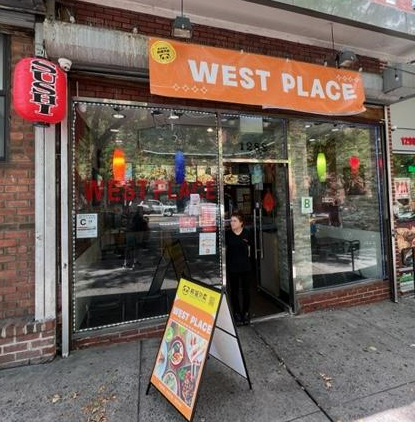
Just to add more walking in, I walked to West Place Chinese Restaurant at 1288 Amsterdam Avenue for dinner that night. I had a craving for Chinese food and still had a lot of energy left in me from the sandwich earlier and it had started to clear up, so I made the trek up Amsterdam Avenue to above the Columbia campus near West 110th Street.
I had a Chicken with Green Beans and pork fried rice combination platter dinner ($8.75) that was excellent and could have feed two people. The chicken was packed with flavor from the spicy garlic sauce and the fried rice had a decent amount of pork in it. The egg roll was pretty decent as well, filled with pork and shredded cabbage.
The Chicken and String beans are so good here.
This local hole in the wall restaurant has now become a favorite not just of people living in the public and private housing complexes that line this part of the neighborhood above Columbia University but with the students as well. I have seen the place packed with Asian students on their lunch hour much to the surprise of everyone else.
After dinner, I walked from West 108th Street to West 42nd Street back to the Port Authority to go home. It had been a long day of walking but there is so much to see and if you really stop to look at everything closely in this neighborhood there is a lot of history packed into this part of the Upper West Side.
Please read my other Blogs on walking this part of the Upper West Side:
Day One Hundred and Five: Walking the Avenues of the Upper West Side from West 84th to West 72nd Streets:
It is amazing the changes that happen in just a month! The weather changed but not the way you would think. It went from being in the 80’s in the beginning of October to the 40’s and 50’s in November. Now you might say that is normal for this time of year, but the temperatures have been all over the place.
People were dining outside as late as the day after Thanksgiving. It was 52F on the 25th of November. Nippy yes but eating outside? In the sun, it really was warm. As I walked the streets of the Upper Upper West Side, it was a pleasant and warm day.
The nice part is that it has been so warm outside lately that the leaves did not change as fast as they normally do this time of the year. The leaves did not start to change in the New York City area until about five days before Halloween. Everything was greener than it normally has been in the past. As of my last day on this part of the West Side, the trees still have changing foliage in Riverside Park, so when the sun hit some of the trees, they still cast a glow of golds and reds.
Walking past the Fredrick Douglas Housing complex
The Fredrick Douglass Houses sign
The complex in the Summer of 2026
I have seen a distinct change in the make up in the city as you cross over the 100th Street on the West Side. Once you pass the Douglas Houses, the residential area starts to change along with the stores and restaurants around it. The bodegas and cheaper restaurants start to disappear.
Things keep changing around the Douglas Houses on the Upper West Side
Children’s Aid is a professional powerhouse of solutions for young people. We are teachers and social workers, coaches and health care providers. We know what it takes to ensure children grow up strong and healthy, and ready to thrive in school and life: excellent education and health care, social-emotional support, and strong, stable families (Children’s Aid website).
The mural on the side of the building
The other side of the mural
The mural designed by Ji Yong Kim and artists and volunteers who were involved in the mural plus the volunteers from Morgan Stanley
Artist Ji Yong Kim is a Korean born artist who is based in Brooklyn and a graduate of The Rhode Island School of Design with BFA and Montclair State University with MFA. Known for his colorful murals and is interested in an intersection of traditional images/structures of Buddhist art and images/ icons from contemporary popular culture (Ji Yong Kim bio website).
The rents have been going up in this area and there is a lot of empty retail space in the Upper Upper West Side. What there is a lot of restaurants where the price of a burger will run you around $16.00. The Upper West Side is becoming a lot more like the Upper East Side.
What I have also found is many beautiful pocket parks, unusual architecture with creative details and some wonderful restaurants and shops that show that the chain stores do not dominate a city. I never realized that it would take so long to finish the area. A little thing called Halloween came into play and then the weather got colder (See all the activities you can get involved with for the Halloween holidays for next year on this blog).
I started my first day at surprising enough 127th Street. I got on the C subway train by mistake ( I should have gotten on the A Train) but it gave me a chance to see what changes have come about in Morningside Heights. I swear as the new buildings at Columbia University are ready to open soon between 125th-134th Streets, the area is quickly changing around it. All over the area surrounding the 125th subway stop on the A subway line is being ripped apart and being rebuilt.
All the buildings around 125th Street are being sandblasted and gutted back to life or are being knocked down and rebuilt. This will just be an extension of Morningside Heights within the next five years. It will be more college campus than Harlem or the traditional Harlem that people know.
I had lunch that afternoon at West Place Chinese Restaurant at 1288 Amsterdam Avenue, a small hole in the wall Chinese restaurant that I passed several times (See review on TripAdvisor and DiningonaShoeStringinNYC@Wordpress.com) and had wanted to try for a long time. The food was wonderful, and the portion sizes were plentiful.
The General Tso’s Chicken is excellent
I had an order of General Tso’s chicken with rice and Wonton Soup with a Coke for $8.00. It could have fed two people easily. The food was as good as anything in Chinatown and the quality was great.
After lunch, I walked down Broadway to 96th Street, passing through the campus that I had walked months earlier. The Columbia Campus is another part of the city that just keeps changing with new buildings being built on old ones or old buildings being sandblasted back to their original beauty. This area is becoming more desirable to live in again and as Morningside Park keeps improving, everything that surrounds it does as well. Even the parks surrounding the campus keep improving with Morningside Park receiving new plantings and Riverside Park getting a spruce up. I got to my destination, West 96th Street and Central Park West by the early afternoon.
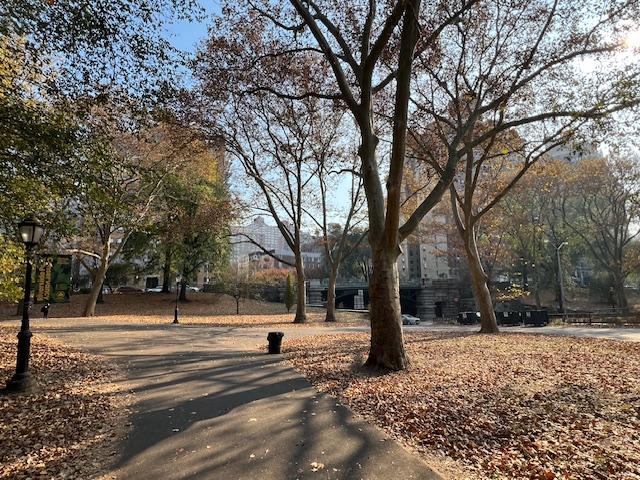
I started my day on West 96th Street on the corner of West 96th and Central Park West where some of the trees were still green even this late into the season. I swear Central Park is never not busy. Families were playing in the playgrounds and tourists still walking through the park getting a taste of the real New York. The weather has been so unusually warm this year that it is a pleasure to just walk around.
Riverside Park in the late Fall of 2024
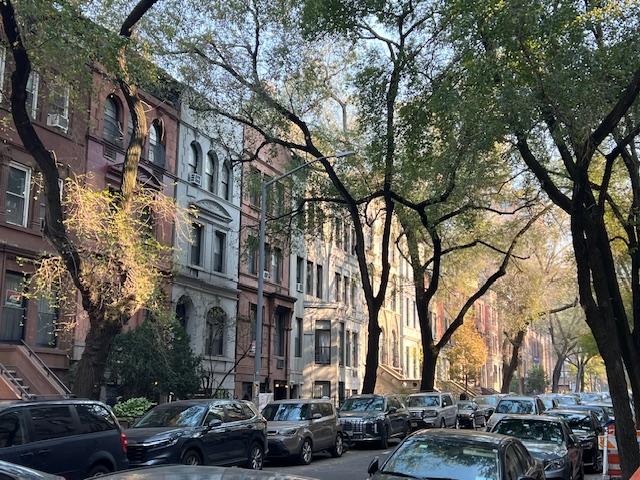
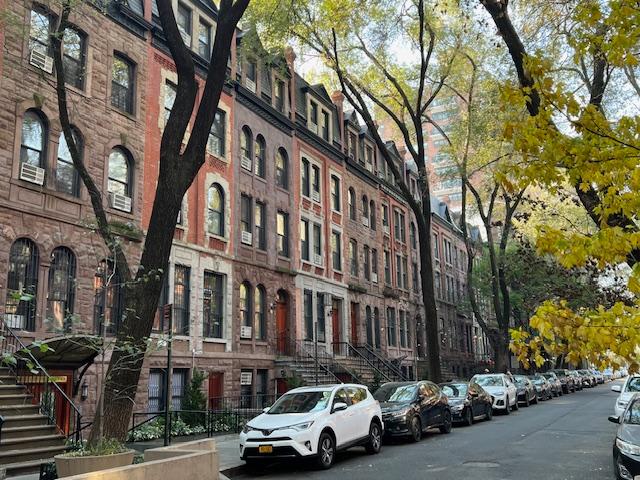
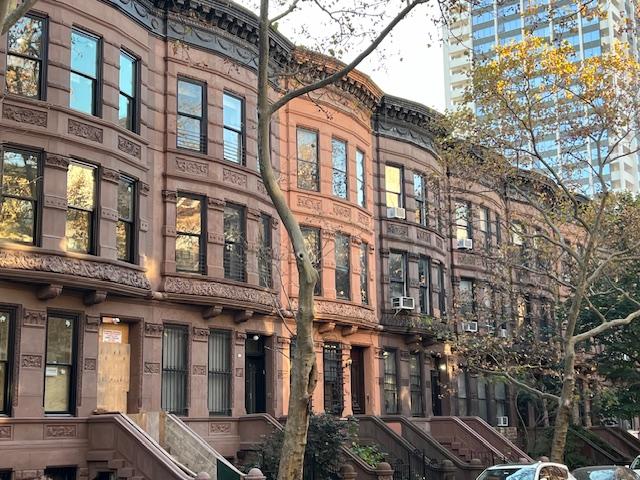
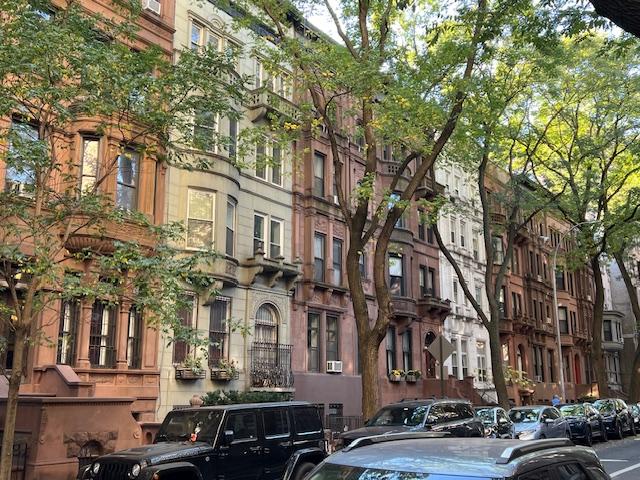
For the most part, the blocks closer to both parks, Central Park and Riverside Park, the streets are lined with beautiful brownstones. Most of the side streets between Central Park West and Amsterdam Avenue are lined with some of the most elegant architecture from the turn of the last century. It is hard to believe that up to twenty years ago, parts of this area had been bombed out.
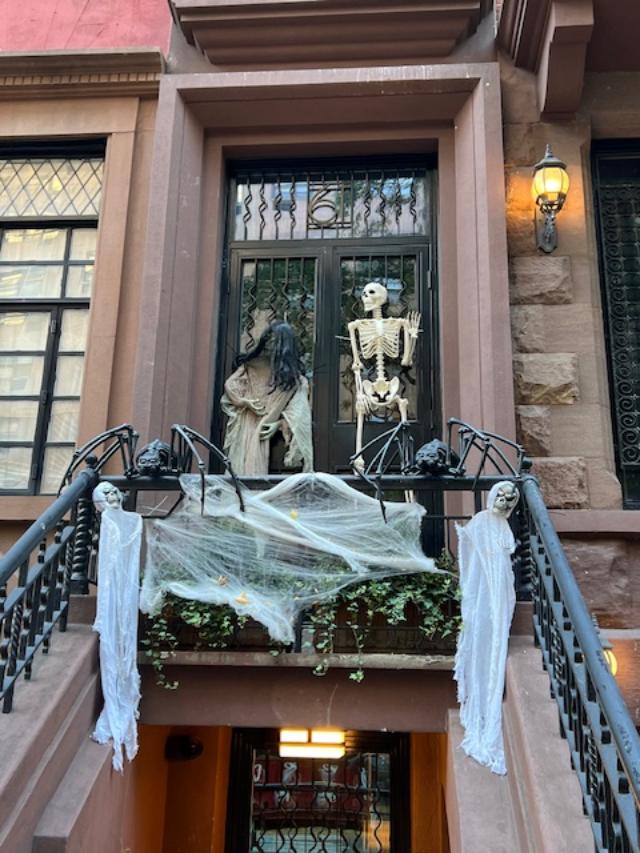
Halloween at 20 West 96th Street
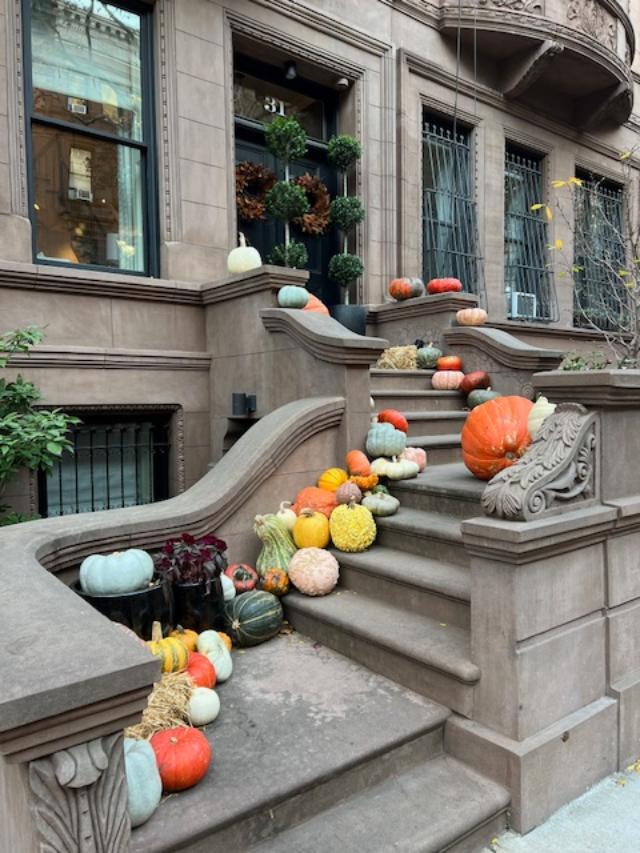
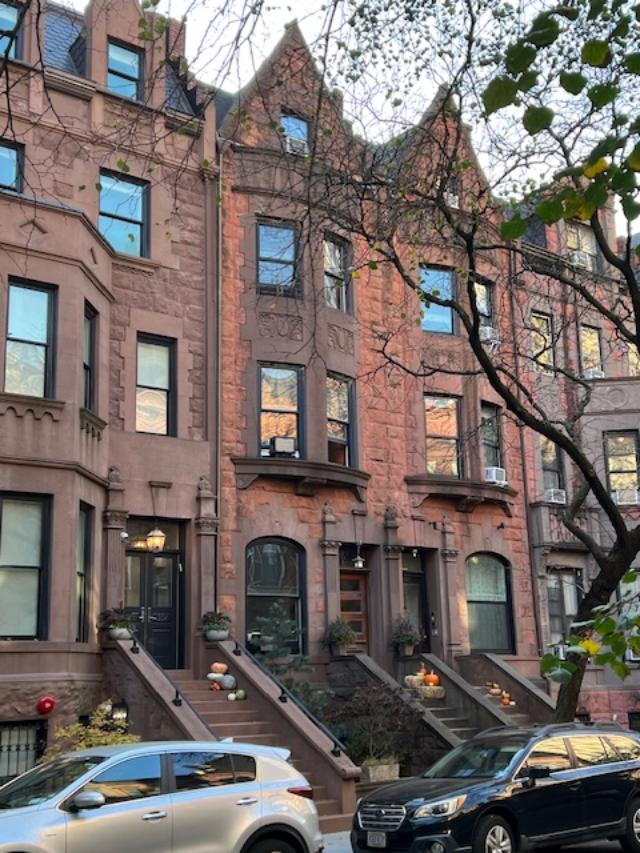
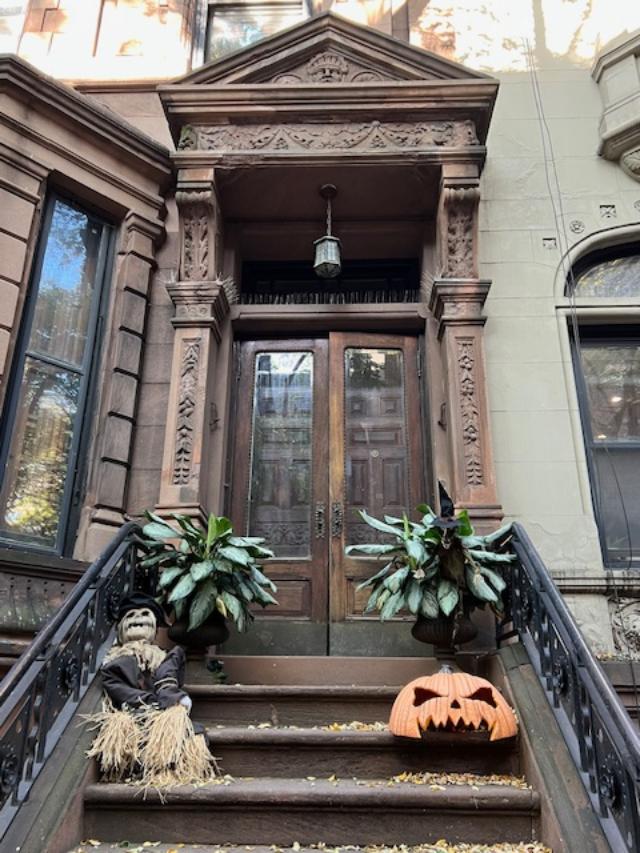
I was able to see the last of the Halloween decorations give way to fall themes decorating the brownstones. Like their suburban counterparts, people like to decorate their buildings. Pumpkins and haystacks lined the elegant brownstones and occasionally there was a ghost or witch motif decorating the front.
Brownstones decorated for the holiday
West 95th Street decorations
Some of the most beautiful buildings outside of the Central Park district were the homes between West End Avenue and Riverside Drive right next to Riverside Park. Old elegant mansions and gracefully carved apartment buildings line the streets between both Avenues.
The West 95th Street brownstones
The townhouses along West 95th Street are just beautiful
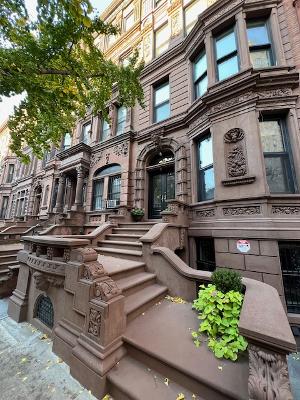
The elegant details of these townhouses
Look up at the craved stone sculptures that line the building. Graceful animals, fierce gargoyles and lattice work line the tops of these buildings. It is time to put down those silly cellphones and really notice how beautifully built these homes were and the care put into them.
Riverside Park at West 94th Street
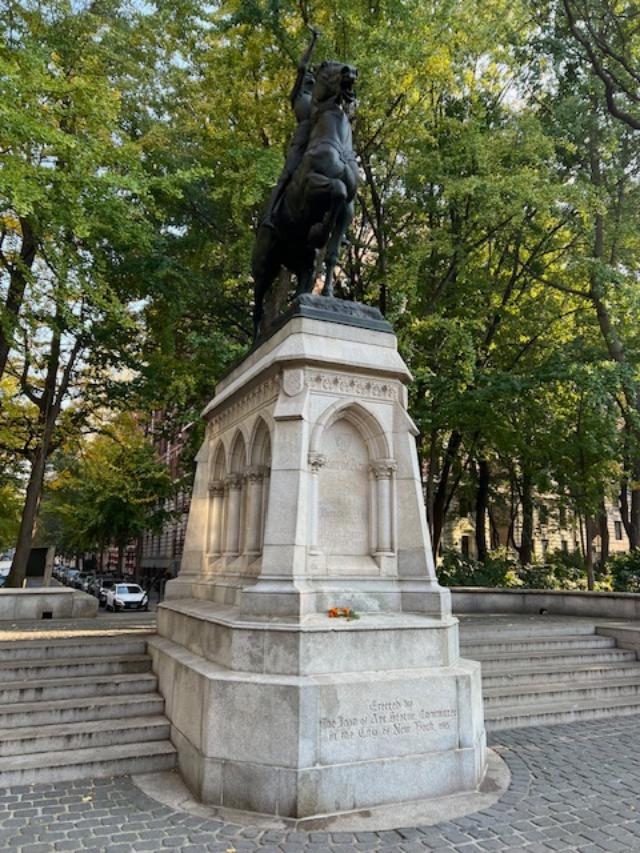
There is a lot of artworks on the Riverside Drive especially around this section of the Upper West Side. The Joan of Arc statue on 95th Street and Riverside Drive gives a description of her life and who she really was in the time of war. I didn’t realize how threatened they were by her that they had to accuse her of being a witch to get rid of her power of persuasion. The statute which was created in 1915 is in a small park within a park, “Joan of Arc Park”, that stands above Riverside Park above the paths.
Artist and art patron Anne Vaughn Hyatt Huntington created this beautiful piece. She had studied with many known artists of the time and completed her work at the Art Students League of New York and one of the first women artist inducted into the Academy of Arts & Letters (Wiki).If you want to know more about her life, stop here and read the plaques.
Joan of Arc Statue in the small park
The Joan of Arc Statue in Joan of Arc Park in Riverside Park
Joan of Arc Park on the Upper West Side
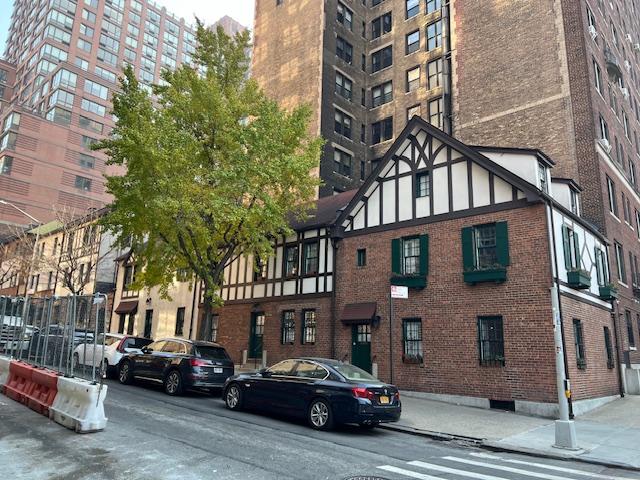
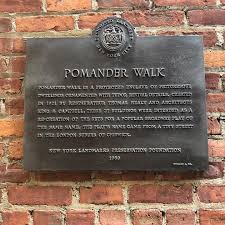
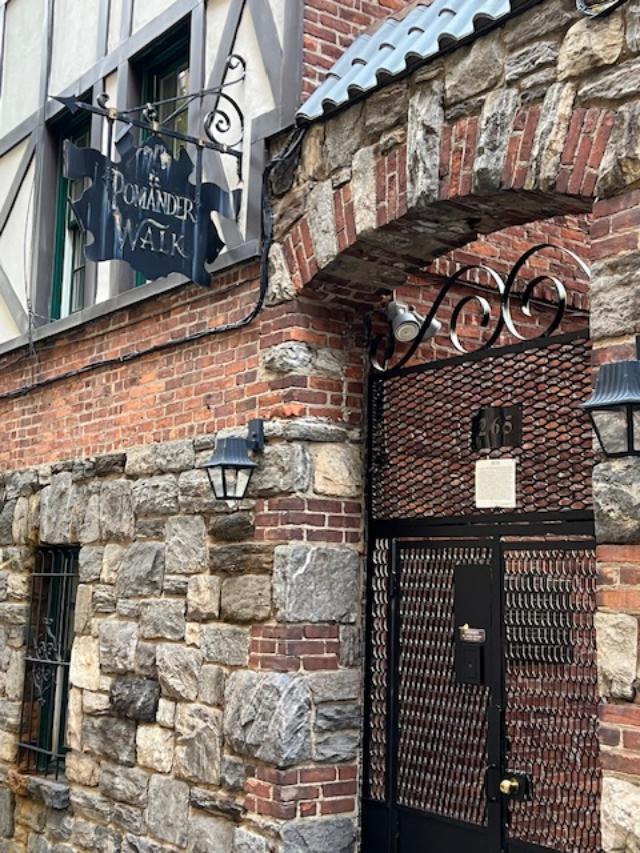
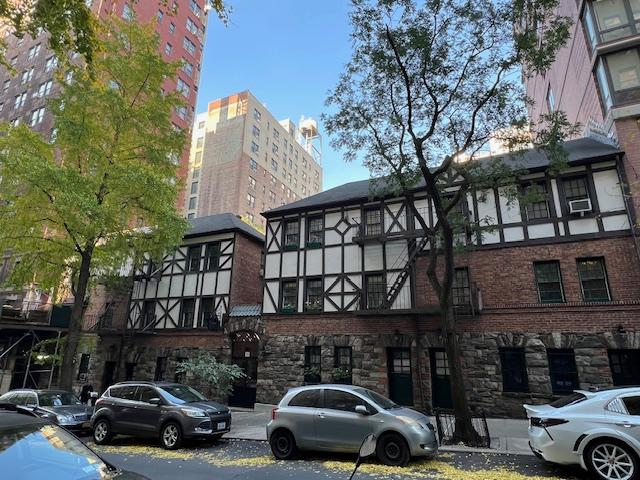
What stands out between 95th to 94th Streets off West End Avenue is the ‘Pomander Walk’, a small alley behind a large apartment building which contains a series of eight two story Tudor homes with gardens in front. This is hidden behind a gate off 94th Street.
Pomander Walk on West End Avenue
This whimsical little treasure was built between 1920-1922 by nightclub owner, Thomas Healy. He was creating income for a large hotel that he wanted to build on the property. He died in 1927 before he could find funding for the hotel and that’s why it exists today.
Pomander Walk is one of those hidden little Manhattan gems
Pomander Walk sign and entrance to the complex at 260-274 West 95th Street
I have read that today it is hard to find a home in this little strip and a recent two-bedroom apartment building sold for $700,000. Pretty good for a dolls house.
The outside of the homes can be seen in on 95th Street and look like a Swiss or German Chalet in the Alps. The detail work was under scaffolding when I first passed it and I wondered if it was a restaurant being fixed up. When you discover the gate entrance, it almost looks like a hidden ‘Land of Oz’. I could see the flowers and plants from the street. It reminded me of some of the small developments in Harlem where a small set of row homes creates its own neighborhood. You have to really look for it or you will miss it.
Pomander complex on West 95th Street
I was able to walk Riverside Park and enjoy that late foliage. The view of the Hudson River is just spectacular especially from the buffs of the neighborhood. I don’t think too many tourists appreciate this park with its beautiful vistas of the river and its great parks for kids. The trees were a combination of golds and oranges when the sun hit them. When I did the Great Saunter Walk, the 32 mile perimeter walk around Manhattan, the park looks much different with the lush gardens and everything in bloom.
Riverside Park in the spring is beautiful at West 95th Street in the Summer of 2024
Fall decorations on West 95th Street
The beautiful brownstones that line West 95th Street
The homes in the neighborhood were very detailed and showed the craftsmanship of the people who built them with such elegant details.
The walk down West 94th Street was just as nice in the middle of the Fall of 2024
I came across this interesting mural on West 94th Street
These blocks above West 84th Street were lined with blocks and blocks of beautiful brownstones ladened with interesting carvings and sculpture and wonderful decorations for Halloween and the Fall months in preparation for Thanksgiving.
As I walked down West 93rd Street for the first time in five years, I took the time to really notice the beauty in the buildings and parks. There were all sorts of wonderful carvings I had never noticed and street gardens I had passed by. Maybe some of these things had always been there but I was too in a rush to notice them to finish walking the street.
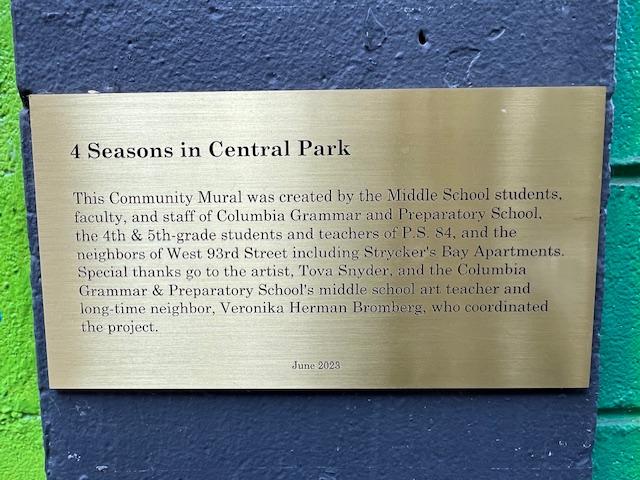
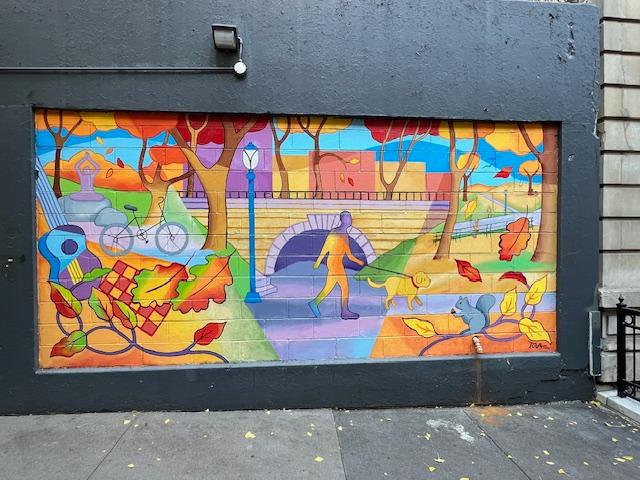
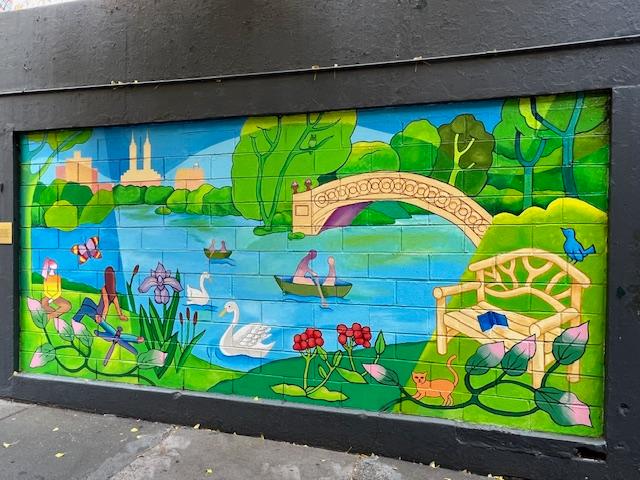
I came across the murals “4 Seasons in Central Park that was created by the students of PS 84 and the Columbia Grammar and Preparatory School. It thought this was very clever
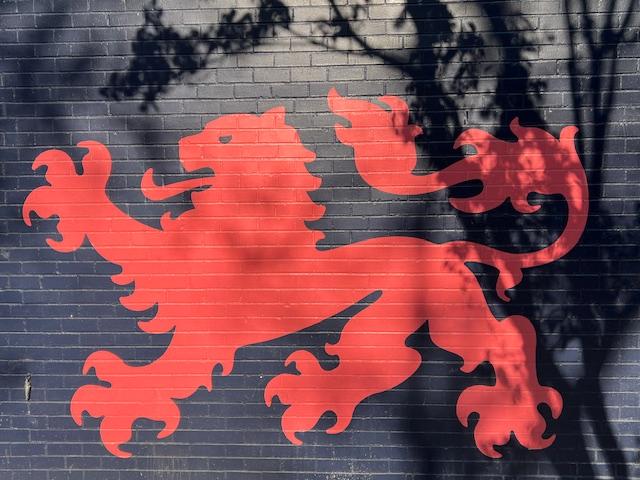
This lion looking humanoid kept looking at me on the way down West 93rd Street
The Upper Upper West is a combination apartment building built in the 1970’s and 80’s with more newer buildings being developed along Broadway but here in there in the commercial district some things do pop out at you. This is true of the former ‘Little Plantation Restaurant’ that recently closed on the corner of 93rd Street and Columbus Avenue. Attached to an apartment building, this space looks like a Southern plantation mansion fitted even with a porch swing. I am not sure how long this will last without being a restaurant but make a special trip to the building just see the detail work.
I walked down West 92nd Street to see another interesting mural that I had not noticed before. This one was closer to Columbus Avenue.
Who says you have to go to a museum when there is a whole outside full of art? What I love around this part of the neighborhood are all the public murals and outside art.
Sol Bloom Playground in the Fall of 2024 at West 91st Street
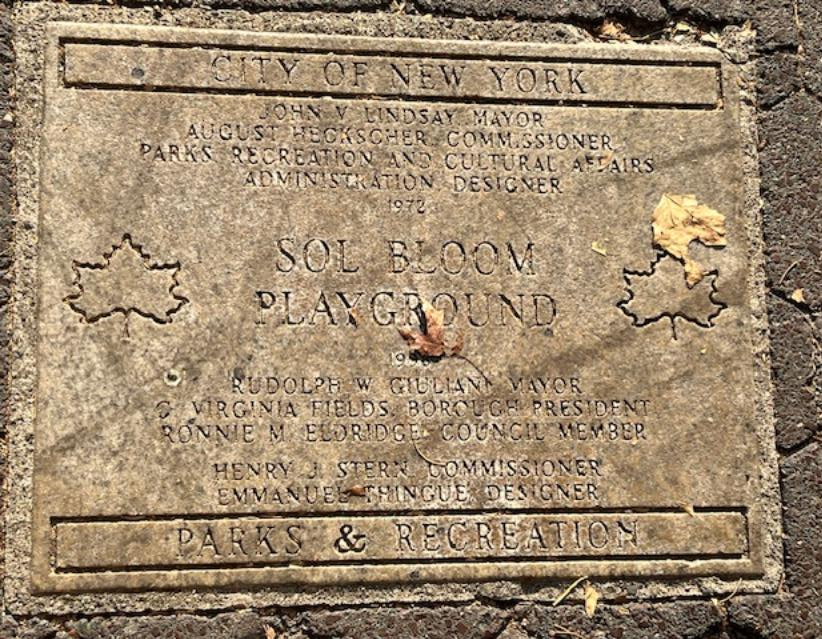
The Sol Bloom Playground sign that welcomes you to the park next to PS 84
As I rounded the corners back to Central Park West, I stopped at the Sol Bloom Playground on 92nd Street near the local school to look for a bathroom. This whimsical park on a nice day attracts kids from all over the place and their parents running all over and playing on the equipment.
The memorial sign
The park was named after Sol Bloom, a self-made millionaire. He had made his money in his music and real estate businesses. He had built several apartment buildings and both the Apollo and Music Box theaters.
I ended the day at the 86th Station totally exhausted having walk the area between 96th Street to 90th Street. The one thing that differs the Upper Upper West Side from Manhattan Valley/Bloomingdale to the north is how much newer it has gotten at the core. So many more newer apartment buildings in this area and more businesses catering to a higher end client. It just seems more like the old Upper West Side above 96th Street.
Riverside Park at West 96th Street
My second day walking the neighborhood I started after a long day at the Soup Kitchen. Working the Bread station all afternoon with the homeless asking you for pastries all morning long can be wearing. I got through it all. I started this part of the walk with lunch in Yorkville, wanting to try East Garden Chinese Restaurant at 1685 First Avenue again to see if it made the cut for my blog, ‘DiningonaShoeStringinNYC@Wordpress.com’. It did!
East Garden Chinese Restaurant really blows my mind on how good this place is for lunch. Their lunch specials are reasonable (the restaurant closed June of 2024) and you get a very large entrée with a side of rice. Add in a Coke for an extra dollar and you have lunch and dinner. The place is really clean too.
East Garden Chinese Restaurant is excellent (Closed June 2024)
I had the Chicken with Broccoli with white rice, and it was a very large portion. Both the chicken and the broccoli were perfectly, and they do give you a nice amount of chicken. The sauce is flavorful and delicious (See review on TripAdvisor and DiningonaShoeStringinNYC.wordpress.com as well). It was both lunch and dinner for me.
The Chicken and Broccoli here is excellent.
After lunch, it was across the street to Glaser’s Bakery at 1670 First Avenue for dessert (See reviews on both TripAdvisor and DiningonaShoeStringinNYC-Closed in 2018). They make a peach Danish that is out of this world! I swear this is one of the best bakeries in the city! So much for the places with the $10.00 cookies, Glaser’s is the real thing. Every bite of that Danish was like heaven!
Glaser’s Bakery at 1670 First Avenue (Closed in 2018)
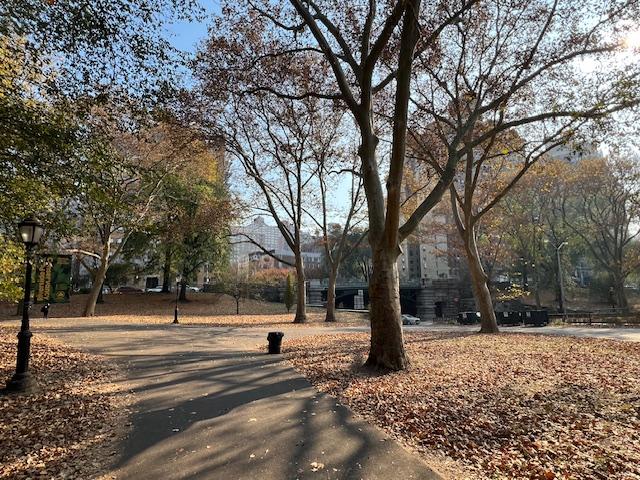
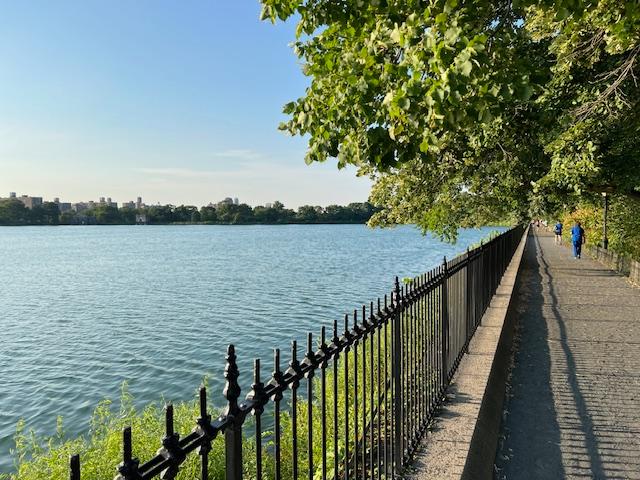
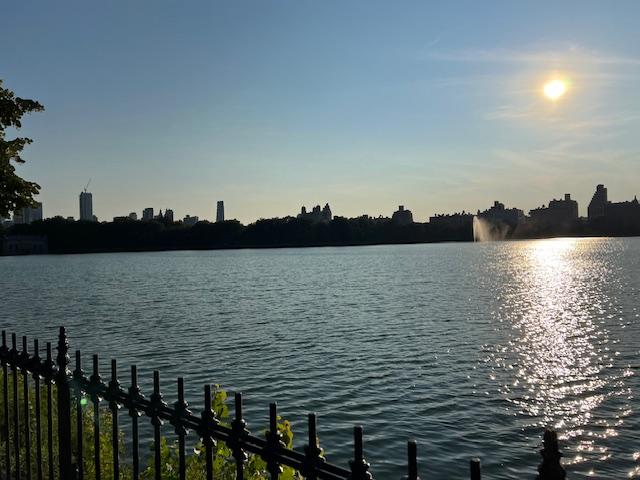
I decided to walk across the park this afternoon to get some real exercise and work off that lunch. The park in the late fall is glorious with the gold and yellow leaves and the cool but still warm breezes. I walked along the reservoir and watched the joggers pass me by. I had more than a few tourists ask to take pictures for them, but it is so much fun to see the park so alive with people and happy to be there. The park is so graceful in its own way and the fact that so much of it is being renovated by the Conservatory shows that people believe in it.
I love the winding paths and the quietness of the park. Even though these paths have been traveled many times, I felt as if I had seen them for the first time. I had never been to this part of the park before and walking these paths felt like a new adventure. It amazes me that I have been in this park a million times since I was a kid, but I still wonder at the parts of it that I have never seen.
I walked along the back paths of the lake by the low 80’s and ended up walking to West 82nd Street and Central Park West in the mid-afternoon. The trees were still brilliant with colorful leaves as November was still gripping. We had had such a warm fall that many of the trees turned late much to the benefit of those who like to walk around the neighborhood.
The new West Side Kids store at 201 West 84th Street (Closed December 2025)
I walked up to 84th Street and Central Park West to resume my walk of the neighborhood. I really like the stores in this neighborhood. They have character. I walked into West Side Kids at 498 Amsterdam Avenue and West 84th Street, to look at the toys and games. It is one of the classic stores of the city and still holds on to the tradition that kids are not all glued to their cellphones. It has a nice array of games and stuffed animals and assorted pocket Knick knacks. It is a place I would have liked to shop at when I was a kid.
West Side Kids at 201 West 84th Street is a fun store
John Koch Antiques at 201 West 84th Street (It has now moved to Long Island City and West Side Kids has taken this space) has unique window displays and in the short visit I had there had many wonderful pieces to decorate the office or your home. I liked the sailboats in the window. There was a turn of the last century feel about the place.
John Koch Antiques at 201 West 84th Street (Closed November 2022-Now in Long Island City-Now West Side Kids)
Books of Wonder at 217 West 84th Street (See review on LittleShoponMainStreet@Wordpress.com-Closed in 2021) was enjoyable except they were going through a floor move when I was there, and I only got to see the front of the store. It has an excellent selection of classic and contemporary children’s books.
Books of Wonder Book Store at 217 West 84th Street (Closed June 2021)
As you turn the corner onto West 85th Street, take time to admire 101 West 85th Street. The building has the most beautiful architecture and beautiful details and built in the 1880’s. The Red House Apartment building at West 85th Street and West End Avenue near Riverside Drive has unique details to it as well. You really have to stop and look up to admire the design of the building.
The Clifton at 74 West 85th Street is a pre-war condominium building in the Upper West Side’s Central Park West neighborhood finished in 1910 (CityRealty.com).
This townhouse was built between 1894-95 in the Romanesque Revival style by architect Adam Fischer
The details
The faces staring back
The faces staring back
I rounded West 85th Street around West 86th Street and then to West 87th Street.
The building was built in 1890 and is called the Brockholst Apartment. It was named after Brockholst Livingston, the former Supreme Court Judge who family estate the building was built on. Look close at the checkerboard stonework and iron work details (Daytonian).
101 West 85th Street; look at the details of the building
The Red House, completed in 1904, is located on 85th Street between West End Avenue and Riverside Drive. The work of the architectural firm of Harde and Short, it is a distinctive six story red brick and white terra cotta building with bold multi-paneled black painted windows, adorned with dripping Gothic screens and a terra cotta salamander & crown cartouche. The center is recessed behind a triple arched entryway. The partnership of Herbert Spencer Harde and R. Thomas Short was formed in 1901 (Streeteasy.com).
When walking up the block and turning onto West 87th Street, take time to admire the foliage at Central Park West. The park is truly beautiful on this part of block. The trees are really ablaze with color.
Central Park in the Fall of 2024
128 West 87th Street
I strolled past the West 87th Street Garden which was open for the first time that I ever walked this neighborhood. Every time I passed the gardens, they were closed to the public but the weekend I revisited in 2024, all the Public Gardens seemed to be open for planting.
West 87th Street Park & Park at 55 West 87th Street
There were so many beautiful brownstones with such interesting carvings and gardens in the high 80’s and 90’s on the West Side that I could not feature them all but here are many of my new favorites that I passed along the way.
Designed by architects Thom & Wilson in 1889, 25 West 88th Street is one of the finest renovated single-family townhouses on the Upper West Side. This triple mint home is among the first in Manhattan to receive a national designation as a Platinum Certified LEED Home and Passive Energy Certification (Leslie Garfield.org).
The old Claremont Riding Academy was built by architect Frank A. Rooke and was built in Romanesque Revival style in 1892. These were the oldest continuously operated equestrian stable in New York City and the last public stable in Manhattan (Wiki).
When I arrived at P.S. 166 on 132 West 89th Street, the Richard Rodgers School, is the Manhattan School of Art & Technology. I read the plaque that was dedicated in 2003 to the famous composer. The school was built in 1897 and is one of the few terra cotta Gothic designs in the New York Public School system. It is such an honor to a famous composer of musicals such as ‘The Flower Drum Song’ and ‘The King and I’.
The Playground 89 next to P.S. 166 adds a little life to the quiet neighborhood. Even on a slightly warm November day, there were loads of kids running around while their parents relaxed and chatted on the benches surrounding the park. It was nice to see so many families out that afternoon.
PS 166
The front of PS 166
The historic plaque
The Richard Rodger’s plaque
P.S. 166 is one of the few Terra Cotta schools in NYC
As you round the neighborhood on West 89th Street, I walked into the West Side Community Garden at 123 West 89th and Columbus Avenue. This little gem of a park is located behind an office building and is across from P.S. 166.
Westside Community Garden sign at 123 West 89th Street
Though not in the full bloom that I saw from the pictures posted in the park from the Summer Opera Program, the trees still held on to their golden hue and some of the plants had some greenery to them. It looks like the community really backs and maintains the park. In warmer months, there is a lot of special events here.
West Side Community Garden in the Fall of 2024 when the replanting was taking
In the Spring of 2026, I got to see the whole garden in full bloom. The volunteers take amazing care of the gardens and their well landscaped paths.
The historic sign
The gardens in the Spring
The entrance to the park
The pathway in the garden
The pathway in the park
The pathway near the entrance to the park
Down the street from the school and the parks is Ballet Hispanico at the corner of 167 West 89th and Amsterdam Avenue. Some of the holiday shows had been posted and looked rather interesting. The building was closed the day I was there.
The last part of my journey of the streets of the neighborhood was crossing West 90th Street for a second time and exploring the avenues. I stopped at the St. Gregory’s Playground near the corner of West 90th Street and Columbus Avenue. this little pocket park on the other side of the West Side Community Garden is in dire need of a face lift.
I can see this is something the neighborhood needs as a parent yelled out to me if I was from the NYC Parks Department (I have no clue why I look so important to people when walking around the city. Either I look like a policeman or a city official).
Since my trip back then, the park looks like it has been renovated and these interesting purple flowers have shown up in the Fall of 2024. Very Surreal!
St. Gregory’s Park at 130 90th Street
There is another small park behind the Wise Houses, a small public housing project, in this very quickly gentrifying and updated neighborhood. As I had read online and seen by walking though it (more stares from the residents), the small park has some unique fixtures yet is falling apart when you really look at it. The benches and some of the equipment is in need of repair but I could tell is well used by the residents by the kids running around. Like the St. Gregory playground, it could use a facelift.
The new Wise Park right next to the housing complex has been totally renovated and looks amazing!
The last part of the walk took me back to West End Avenue on West 90th Street and the most elegant row of brownstone homes that lined the avenue. I have noticed on my walk of this neighborhood that the individual homes along the streets between Central Park West and Columbus Avenue and Riverside Drive and West End Avenue have some of the most unique architecture in the neighborhood.
The beauty of West 90th Street
West 90th Street brownstones that line the street
West 90th Street art on the brownstones
Faces staring at you on West 90th Street
Colorful garden along West 90th Street in early November
The one apartment building that always stood out to me when walking West 90th Street was the Concord Building Apartments. The grace and the detail of the carvings makes you stop and stare at the faces staring back at you.
Built by Neville & Bagge, The Cornwall remains one of the architectural gems of the Upper West Side. Completed in 1910, The Cornwall is a 12 story building with a red-brick façade, three-story limestone base, a number of decorative balconies and impressive Art Nouveau style roofline. The apartments have fine pre-war details exhibited in gracious layouts, high ceilings, pocket French doors, intricate woodwork, onyx fireplace surrounds and glass transoms (Streeteasy.com)
The beautiful details of The Cornwall Building
The stonework is just amazing
It must have been something when the whole neighborhood must have looked like this but that is progress. In the middle of the neighborhood, the area keeps updating, modernizing and changing. It seems that the neighborhood is morphing into something a little more upscale like its southern neighbors and less like Manhattan Valley to the north. For now, not quite the traditional Upper West Side but still homey and welcoming to people moving in. I enjoyed my afternoons here.
Halloween decorations on West 90th Street
Still more decoration in the post Halloween week
Take the A or C or 1 subway trains to the Upper Upper West Side. The A train will be express from 59th Street to 125th Street.
The West 96th Street subway stop was a constant for me when visiting the Upper West Side and the views are spectacular
Read my other Blogs on the Bloomingdale/Upper West Side neighborhoods:
Day Ninety-Three: Walking the Borders of the Upper Upper West Side:
What a difference a week makes! I started the first part of my walking project last Friday night when it was 73 degrees outside and just spectacular. People had been out in the parks with their strollers and dogs and kids were playing sports all over the park even into twilight. Now it was about 43 degrees and back to being winter. The kids who were on their winter break really lucked out. They had a week of unseasonable weather to enjoy.
Riverside Drive at the park in the Spring of 2025
In March of 2024, I came back uptown for the Cornell versus Yale basketball game for the Ivy League championship. I thought we would win the whole thing. We lost by twelve points.
After the game, I decided to to walk around the neighborhood and explore since I had not been up here in about seven years. The neighborhood has changed a lot over the last couple of years. Spring was coming to the neighborhood.
Daffodils blooming at Morningside Park
I started this part of the walk on Morningside Drive walking up the hill facing the park. It is some walk but I am sure in warmer weather it would be a lot more pleasant. You really do get your exercise walking this part of the neighborhood. Going up and down hills can take a lot out of you. What I liked best of this part of SoHA was the architecture. It had a combination of college campus appeal with the classroom buildings, the quad and the dorms mixed in with the pre-war buildings which have been renovated back to their original beauty.
I think the appeal of Morningside Heights is the college atmosphere mixed into the urban setting and the fact that the area is so much safer than it was even ten years ago. This is not the urban campus of my father and my cousin, who are both Alumnus of the school. There has been a big change especially in Morningside Park which borders the neighborhood with Harlem.
Morningside Heights is an urban campus for Columbia University in the Winter
The same block in the Summer of 2026
Even in the middle of winter, the warm weather has done strange things to Mother Nature and the park was starting to bud and bloom a month and a half early. As I walked up and down Morningside Drive, I took a walking tour of the park for a second time. This ice-aged formed park really has a beauty to it when you look up closely. The rock formations mixed in with the steps and the flowers peaking up and starting to bloom early adds to the grace of the park. The park just needed some TLC.
Morningside Park during the late Winter.
The park is full of long paths through the rock formations and offer nice views of the neighborhood below. There are several paths that go up and down the hills so be prepared to walk. By the pond toward the middle of the park, there is an interesting statue donated by respected banker, Alfred Seligman ‘The Bear and the Fawn’ with a little bear overlooking a fawn playing his flute. The statue was designed by American artist Edgar Edward Walter. Before the dedication of the statue, Mr. Seligman who was head of the National Highways Protection Society, died in one of the first documented highway accidents (Daytonian).
The pond area of the park.
The detail work is beautiful and the statue is one of those things you would miss if you did not walk the length of the park. When it was a working fountain, it must have really graced the park. I walked up and down the paths and stairs before I exited the park at 110th Street.
‘The Bear and the Faun’ by artist Edgar Edward Walter which was part of the Seligman Fountain
I walked around 110th Street to Amsterdam Avenue and walked up past the Cathedral of St. John the Divine and walked around the church and its gardens and statuary.
The Cathedral of St. John the Divine at 1047 Amsterdam Avenue.
The detail work of the Cathedral of St. John the Divine
Down the long paths of plantings and around the bends of the property, I came across another interesting statue. At the center of the park, there is a breathtaking statue called the “Peace Fountain”, created in 1985 which shows a unusual look at the battle between good and evil by artist Greg Wyatt, who was an artist in residence at the church.
Mr. Wyatt has graduated from Columbia College with BA in Art History and studied at National Academy of Design. He bases his work on the philosophy of the “spiritual realism’ merging realistic images and abstract forms of space, form and energy (Wiki).
The ‘Peace Fountain’ by artist Greg Wyatt
The sign from the sculpture.
Really take some time to look over this statue and its detail work with all the animals, demons and angels. You have to see the figures from all sides to see all the characters in their stances and how it works into the battle of the forces. It is a very powerful statement of good conquering evil. It depicted the Archangel Michael versus Satan. On a warm summer day, it must be a beautiful park. It is a tough call now at the end of the winter.
Walking up Amsterdam Avenue, you hit the heart of Columbia University that runs from 114th Street to about 120th Streets. For pretty much the rest of the neighborhood until you hit 125th Street, this area is all geared to the university. The area is graced with graceful old buildings, some the turn of the last century and many pre-war apartment buildings on the side streets.
The Columbia University Quad in the northern part of the Green.
I always remember this scene of “On a Clear Day you can see Forever” that was depicted in the movie from these steps. It ended being shot on a another campus in another location.
The best is when you walk to 116th Street and that leads you in the Quad in the main part of the Columbia campus. This bustling area by the library was full of students who were socializing and sunning themselves on the warmer days. During the breaks from class, the students flooded the streets looking for something to eat or running back to their residence halls.
Outside the entrance to the Quad, just above 116th Street, there are several food trucks at night that cater to the Asian students offering Chinese, Japanese and Thai food. Take a serious stop and try the food. I had a delicious ‘pork sandwich’ that was chopped roast port on a steamed bun for $4.00, a nice treat after a long walk and I was able to eat it in the Quad. It could have used a little sauce to it but it was still loaded with pork and was a nice size. This steaming chopped pork sandwich was just one of the items that were offered at a very reasonable price to the students. There are noodle dishes and dumplings all around the $3.00-$7.00 range and at lunch and dinner the lines can get quite long. Bring cash.
I passed a small community garden, The Julia Gabriel People’s Garden at West 111th Street and it was open for touring. It was just coming into bloom.
The garden starting to bloom for the Spring in 2025
The gardens in the Spring of 2025
The gardens in the Spring in 2025
The beautiful flowers in the garden
I visited the gardens again in the Summer of 2026 and they were spectacular when they were in full bloom. They had just finished a Jazz event and the paths were still full of people walking around admiring the beds.
The garden in the summer of 2026
The side of the garden
The beautiful beds
This interesting statue I must have missed the last time I visited the neighborhood. This sits on top of the Columbia Law School. This interesting piece of work is entitled “Bellerophon Taming Pegasus” by artist Jacques Lipchitz.
This is “Bellerophon Taming Pegasus{ by artist Jacques Lipchitz
The story of Bellerophon represented the dominance of man over nature, according to Lipchitz. In Greek mythology, Bellerophon tamed Pegasus with a golden bridle from the goddess Athena and with the horse’s help accomplished a series of tests Zeus had assigned him. “You observe nature, make conclusions, and from these you make rules…and law is born from that,” the artist once said (Columbia Law School website).
Jacques Lipchitz was a Lithuanian artist who had studied at the Ecole des Beaux-Arts and Académie Julian in Paris. He was known for his Cubism in his artworks and sculptures.
War of 1812 plaque on Amsterdam Avenue at West 115th Street
In the Summer of 2026, I passed the locked Gatehouse Gardens with its unusual artwork on the side of the fencing. I could see from the outside it has some interesting art inside the community garden.
Amsterdam Avenue like its counterpart neighborhood by the CUNY campus is dotted with great restaurants and coffee shops that cater to both the locals and the students alike. I had concluded my first day walking the Morningside Heights neighborhood that evening with dinner at V & T Pizzeria, a local eating establishment located at 1024 Amsterdam Avenue (See the review on TripAdvisor). It is the typical red sauce Italian-American restaurant that you would expect from Little Italy not from uptown.
V & T Pizzeria at 1024 Amsterdam Avenue in Morningside Heights
The food was really good. I had a house salad with a creamy Italian dressing that was typical for an old-fashioned restaurant with the iceberg lettuce and chopped tomatoes but still good. I was in the mood after a long walk for a meatball hoagie. The sandwich was huge! The only problem was that the meatballs were not that good. I mean they were big and had a nice sauce but the meatballs were average with not that flavor. It was disappointing but the other food coming out looked good, so it will give a reason to come back another time.
The meatball sandwich was okay
I stopped for dessert at the Hungarian Pastry Shop at 1030 Amsterdam Avenue for some dessert. I had read and seen so many videos on the shop I wanted to try it. The lines were long all day and I had to get into the line for a half hour before I could get in.
The Hungarian Pastry Shop at 1030 Amsterdam Avenue
I tried their version of the Napoleon, which was layers of Vanilla Cream, whipped cream and a caramel topping between the flaky layers and a Apple Strudel, that was loaded with fresh apples and cinnamon. I took the desserts across the street to the park and I have to tell you that they were terrific.
The pastries are amazing!
I continued up Amsterdam Avenue touring up the sides of both the campus and the edge of the neighborhood that lined the park and you get to see the transition of the area by 123rd Street when you see the General Grant Housing Project, a huge complex that lines the edge of the neighborhood between 123rd Street to 125th Street from Broadway to Morningside Drive.
The sign for the Grant Houses
This complex as nice as it looks from the outside has its share of problems on the inside. I had to walk through the complex a couple of times when walking through 124th Street extension and when I was walking the length of LaSalle Street to Amsterdam Avenue and no problems. It looks like a complex in Miami Beach.
The General Grant Houses at 75 LaSalle Street sit at the edge of the Morningside Heights neighborhood
It is in this area the new extension of Columbia University is taking place between 125th Street and 135th Street along Broadway across from the projects. Once those buildings open this summer that will completely change this part of the neighborhood bringing more students up to this part of the area and all the restaurants along the Broadway stop of the 1 Train and along this part of 125th Street will start to change as you are seeing it now.
Old bodegas and cut-rate restaurants that catered to the people in the projects are now changing to more upscale restaurants, bars, coffee shops and shops. Broadway alone has three Starbucks and they were all full the entire time I walked the neighborhood. There are some serious changes it will make to this part of Morningside Park.
Walking down Broadway really puts you into the heart of the neighborhood and through the campus. Everything here pretty much caters to the college and the faculty and students. All the restaurants have their own uniqueness to them with the Columbia symbol prominently displayed on the windows. I found it is nice to get take out and sit in the Quad and eat while watching the students. Two days into touring the area the weather was around 60 degrees so it was nice to eat outside and relax and see the world go by. Reality set in as the winter weather set back in and it was 34 degrees again and back inside, I went.
Looking down Broadway by Barnard College
It was a quick walk-up Claremont Avenue, the heart of Barnard College, the girl’s school of the college. This is area is being rebuilt and sandblasted as the college is expanding into the neighborhood. Most of the buildings between here and Riverside Avenue are filled with prewar apartments and student housing. Just be aware to prepare to walk on the street as some of the sidewalks are closed off. When it is all done it is going to look even more beautiful with the new buildings and renovations so close to Riverside Park, which in itself was a nice walk during the summer months.
Barnard College
The College building
As I walked the upper streets of the neighborhood, you can see more money is being put into the parks and historical parks in this part of the city. Sakura Park, which is lined with flowering trees still in winter hibernation, are beginning to see the first sign of spring as the buds are bursting early. On the warm days, there were a lot of students studying or playing games. The park is dedicated to the Japanese in parts with a giant Japanese Lantern Statue by the International Building that is quite detailed.
Sakura Park at 500 Riverside Drive in the Spring months is pretty amazing
Daniel Butterfield (1831–1901) was born October 31, 1831. His father was a leader in the express mail business and helped found the American Express Company. Butterfield graduated from Union College in 1849 and became a merchant in New York City. At the outbreak of the Civil War in 1861, he served as a colonel in the 12th New York militia. Demonstrating leadership in military engagements on the upper Potomac in the Shenandoah Valley, Butterfield rose rapidly in the ranks to brigadier-general of volunteers in the 12th Infantry (NYCParks.com).
Butterfield distinguished himself as an officer, and during the Chancellorsville and Gettysburg campaigns he served as chief of staff to the Army of the Potomac. Wounded at Gettysburg, he was reassigned as General Hooker’s chief of staff at Chattanooga and the Atlanta campaign. By the war’s end, Butterfield was promoted to a major general “for gallant and meritorious conduct.” Among all his wartime achievements, he is best remembered as the composer of the mournful bugle call “Taps (NYCParks.com).
The bronze statue of the general was created by the famous sculptor American born artist, John Gutzon Borglum, better known for his sculptures of four U.S. presidents on Mount Rushmore in South Dakota. He studied at the California School of Design and Ecole des Beaux-Arts in Paris and apprenticed in New York City (Wiki).
The sign for the statue
This park leads into Riverside Park and the newly renovated Grant’s Tomb (see my review on TripAdvisor and VisitingaMuseum.com). This area for years was over-grown and vandalized with the decline of the neighborhood, which is no longer the case. The tomb has been sandblasted back to its original beauty and when I passed it over the summer was lined with American flags. It is only open at certain times of the week, so plan accordingly.
Grant’s Tomb National Memorial at 122nd Street and Riverside Drive
Next to Grant’s Tomb is a small monument called the Tomb of the Amiable Child (see my review on VisitingaMuseum.com), which should not be missed. On the path close to the park, you will see this small marble urn surrounded by fencing. It is a somber site for a small child who died in the area in the 1700’s.
The Tomb of the Amiable Child at 124th Street and Riverside Drive
In Riverside Park I was able to walk over the summer and got a feel for how beautiful the park really is as it hugs the Hudson River. It is a great place to jog, ride a bike or picnic. It has gotten more popular over the years as the park has improved itself with more TLC from the community.
The park by Grant’s Tomb
The Friends of Riverside Park have done a nice job raising funds and awareness for the care of the park and it shows in the plantings and paths that have improved over the years. In the warm months, the place is in full bloom and with the view of the Hudson River the look is quite spectacular.
When walking the lower streets of the neighborhood on the west side of the park is full of prewar apartments and resident halls for the students as well as buildings that cater to the university. I don’t think there was one bad street on this side of the park. The area is very self-contained for the university and the buildings have an ‘old New York’ feel about them being built at the turn of the last century.
For the blocks between 111th Street to about 120th Street west of Morningside Park it is all about the university with class space and offices and a small Greek Row in the middle of the neighborhood. On the Claremont Avenue section of the neighborhood just west of Riverside Park is where Barnard College, the Woman’s College of Columbia is located and is expanding. More buildings are going up or being added to as the University expands.
This expansion continues in the area above Tiemann Place near the edge of the park and the river. The University is building a new ‘glass box’ section of campus between 125th and 133rd Streets along the river and the buildings should open up within the year. That is changing the whole complexity of the neighborhood around 125th Street in this part of the neighborhood. The upper reaches of Broadway and Amsterdam Avenue’s as well as this section of 125th Street between Marginal Street to Amsterdam Avenue is either getting new restaurants and shops that are catering to the college students or are being knocked down or renovated to cater to the changing population once those four buildings open up across the street from the housing projects.
The Columbia University extension above 125th Street is changing the neighborhood
For lunch that afternoon, I ate at Koronet Pizza at 2848 Broadway for a jumbo slice of pizza (see review on TripAdvisor and DiningonaShoeStringinNYC@Wordpress.com). This slice is pizza is HUGE and could feed two hungry people very easily. The jumbo slice is part of an 32″ pizza and the pizza was delicious. It has a very flavorful and spicy tomato sauce and uses a good amount and quality of cheese. It took a awhile to devour that delicious slice of pizza. The restaurant attracts a nice mix of neighborhood people, college students and professors and has a good ‘family feel’ about it.
Koronet Pizza at 2848 Broadway has the biggest slices around
On the tip of the neighborhood between LaSalle Street and 125th Street are the Morningside Apartments and the General Grant Houses, which both look more like mixed income apartment buildings than public housing. I really toured the area on this trip. The area landscaping and playgrounds are much better than most housing projects that I have seen in the city and they look better taken care of than most of the housing projects in this area of the city.
The start of Riverside Drive from West 125th Street
This corner of the neighborhood is also home to various small parks such as The West Harlem Piers Park at 125th Street and Riverside Park with benches and paths for walking and enjoying the views of the Hudson River and the cliffs of New Jersey. This is a great area in the summer to listen to music or watch the sun set.
The St. Clair Rose Garden is located under the underpass.
The St. Clair Rose Garden is right off St. Clair Place by the underpass and steps leading to Grant’s Tomb. It will be nice to see how this garden looks in the summer months.
The West Harlem Pier Park offers amazing views of the Hudson River
As I traveled east along 124th Street, I walked the island from west to east and it does change from one side of the island to the other. I crossed the boundaries of Morningside Heights to SoHA to Spanish Harlem and you can see the difference from block to block.
Pretty much the blocks west of Fifth Avenue are a mix of pre-war apartment buildings, turn of the last century brownstones and new pocket apartment buildings with a mix of small neighborhood gardens in between the buildings.
On my third day of the walk around the neighborhood, I was able to walk the streets between 124th Street to 120th Street west of Mount Morris (Marcus Garvey) Park. This area between Mount Morris Park West to Adam Clayton Powell Boulevard (7th Avenue) is the Mount Morris Historical District, which is full of beautiful and graceful brownstones which are carefully bring renovated. A good portion of the neighborhood is under scaffolding (as most of Harlem and Washington Heights has been) as the buildings are being restored by their owners.
The stonework of most of these buildings is so detailed and unique with carvings of leaves, vines and faces gracing the outside of the buildings. Some have stained glass features around the doors and windows and the outside steps have been sandblasted and fixed to new with potted plants and an occasional Christmas feature still decorating the outside of the home.
This area is also home to many small Community Gardens which at this time of the year are still under snow. There is the ‘Our Little Green Avenue Park’ at 123rd Street, the Joyce David Wilson Garden at 123rd Street, the Five Star Garden at St. Nicholas Avenue at 121st Street and Harlem Art Park at 120th Street at 3rd Avenue. These parks are small pocket parks taken care of by the neighborhood or street associations. I did not get much of a feel for them when they were under six inches of snow.
Five Star Garden Park at 121st Street in the Summer months
To tell you how the neighborhood is diverse in its housing is when you get to 124th Street and 1st Avenue where you have a luxury apartment building across the street from the Wagner Housing Project and the entrance to the Triboro Bridge and Louis Cuvillier Park which is under a renovation. You can see where new restaurants are popping up to cater to these new residents on 1st Avenue, 124th and 125th Streets.
The Wagner Houses at 90 Paladino Avenue I hate to say is a scary area even during the day. I always felt like I was being watched by everyone from the residents, to the Con Ed guys working in the area to the police looking out for the kids leaving school on 120th Street and Paladino Avenue by the river. People just kept saying hello to me like they were trying to tell me that they saw me there or in the case of the police just watched but tried to ignore me. I see this a lot in Harlem.
Walking around the Wagner Houses at 90 Paladino Avenue can be a little intimidating
One saving grace to the whole experience by the school was the bodega, Pleasant Finest Deli, on the corner of 375 Pleasant Avenue and 120th Street (see my review on TripAdvisor), which I could tell catered to the kids coming out of school with sandwiches under $3.00 and piles of chips and snack cakes for fifty cents to a dollar. The deals at this store were amazing and the owners looked like they were happy to see me. Just listening to the foul-mouthed parents was interesting. The way they berated their children just floored me. Some of these women should never have had kids.
That evening I went to midtown to eat at the Land of Plenty Chinese restaurant by Bloomingdale’s at 204 East 58th Street (see review on TripAdvisor), a restaurant I have wanted to try for several years when it was ranked the number on Chinese restaurant in New York City by the Village Voice. The food and the service were just excellent.
The Land of Plenty Restaurant at 204 East 58th Street
I had the most delicious soup dumplings that were made for me and I did not even have to hike down to Chinatown for them. They just burst in my mouth when I bit into them. I had a Shredded Pork with a Sweet Miso sauce with scallions and their Ten Ingredient Fried Rice for my main meal which both were delicious and flavorful. The Sweet Miso sauce really had a tangy spiciness to it. The service was friendly and welcoming. A definite must when shopping at Bloomies.
Their Ten Ingredient Fried Rice is amazing
I continued on to the east side of Morningside Park, where the Morningside Heights extends as I walked the area from 125th Street to 110th Street that now extends to Fredrick Douglas Boulevard, the new ‘Restaurant Row’ of the neighborhood. This area is dominated by beautiful brownstones of many unique designs, pre-war apartment buildings and many local businesses that are in the midst of change. The neighborhood bodegas are giving way to new restaurants, art galleries and boutique bakeries that are catering to the new residents who are buying all those buildings under scaffolding and the current residents who look like they are enjoying the change.
Along the way I have seen so many gorgeous buildings being restored. The most beautiful is the Washington Irving Building at 203 West 112th Street. This graceful building has the most beautiful stonework and detailed accents to the outside it, you literally stop and just want to stare at it. I have only seen buildings like this midtown buildings on Park Avenue and in the Village.
The Washington Irving Building at 203 West 112th Street
Small pocket parks and community gardens continue to dominate the areas that once housed brownstones. These future flower and vegetable gardens are all over parts of the neighborhood such as the ‘Electric Ladybug Garden’ at 111th Street. There is a distinct elegance to the area around Adam Clayton Powell Boulevard (7th Avenue) with its tree lined island with trees and flower plantings waiting for the Spring to come.
The area that is rapidly changing the most is Fredrick Douglas Boulevard which among the new businesses is being known as ‘Central Park North’, with several businesses adopted the SoHA (South of Harlem) signature. I have never seen so many expensive restaurants with entrees over the price of $15.00 in one area. I don’t even find the menus that exciting or innovative. They just look like bars with food being served.
On my last day in Morningside Heights, I tested the boundaries and walked the entire length of 116th Street from one side of the island to the other. You see more local businesses along the 116th shopping corridor with many soul food, seafood, pizza and local chicken places dominating to a very diverse population. Closer to the Columbia campus, you have more upscale places to eat but once you cross Fredrick Douglas Boulevard and head toward Spanish Harlem, it can be anything from the latest African cooking to island cooking from Jamaica to fast food and the chain restaurants to local bakeries serving empanadas and doughnuts. You can eat your way through the entire street and it would take months to do.
On the streets from 119th-115th Streets from Morningside Park to 5th Avenue are lined with a series of brownstones and pre-war apartments which hug the ‘Mount Morris Historical District’ or just outside of it. These blocks are going through a tremendous change right now as students and recent graduates are spreading out from the traditional borders of the neighborhood, which means the west side of the park and moving into this section especially to the 5th Avenue border. Crossing Fredrick Douglas Boulevard means even pushing the traditional boundaries of the neighborhood and going into SoHA. By the time you cross Lenox Avenue below 115th Street, you hit the long line of housing projects from 112th-115 Streets and even the streets surrounding the projects are being fixed up.
I have never seen so many new restaurants and stores opening up especially opening up this economy. All of these pocket businesses are opening right next to the traditional neighborhood stores and you can see that changing for the next few years. There are so many small luxury housing projects going up in every corner of the neighborhood that will need to be catered to and the local population seems to like the additions to the many blocks as I see a diverse crowd in all the businesses. Even most of the newer businesses in the area are adopting the SoHA name.
Not everyone is happy about the SoHA name in Harlem
Pretty much everything west of Fredrick Douglas Boulevard and west to Morningside Park is considered part of the Morningside Heights area now as the last of the empty buildings are being renovated and a lot of the Mount Morris Historical area is under scaffolding. There is a lot of pride in this neighborhood as it keeps changing and improving itself.
On my last night in Morningside Heights after walking almost 28 city blocks, I indulged a little and had dinner at LaSalle Dumpling Room on 3141 Broadway (see review on TripAdvisor). Make this a stop if you are visiting Columbia campus because the food and the service are excellent. All the dumplings are made fresh on the spot per order and come out cooked as light as a feather.
LaSalle Dumpling at 3141 Broadway should not be missed
The Pork & Crab Soup Dumplings are excellent, full of juiciness and flavor and the pan-fried pork dumplings are light and delicious and were perfectly cooked. I also tried the Dong Jing Rice Bowl which was a combination of white rice, sautéed beef, egg, onions and cheddar cheese in a brown sauce and the combination worked nicely (even though the onions were not necessary). The service was excellent.
The Soup Dumplings here are excellent
This section of SoHA is catering to the large and growing population of college students and those post-graduates who want to live in the area. It is more of an extension of the Upper West Side than traditional Harlem. Take a walk around soon because it just keeps changing.
Just don’t call it SoHA to the wrong person!
Please read my other blogs on walking East Harlem: