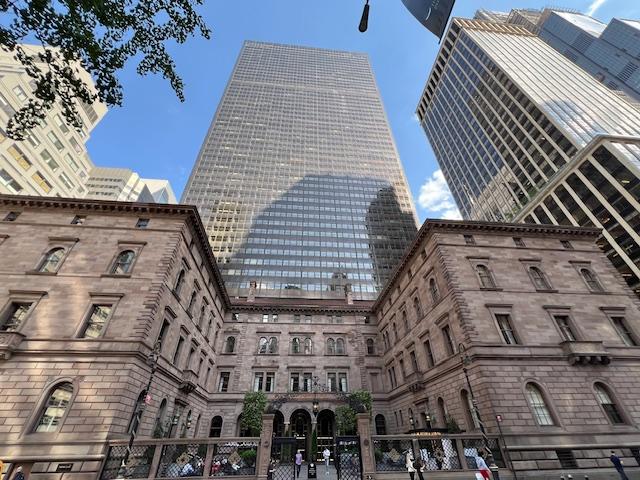
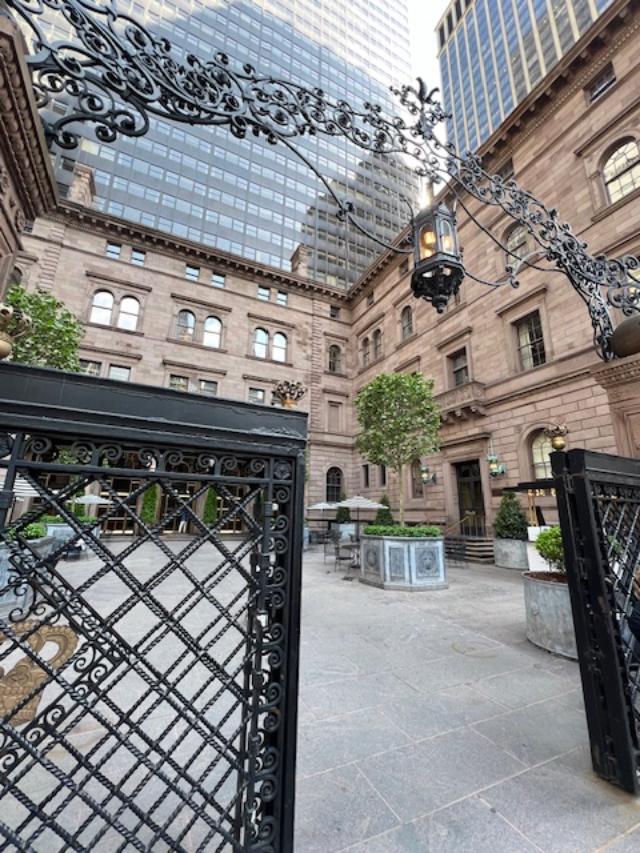
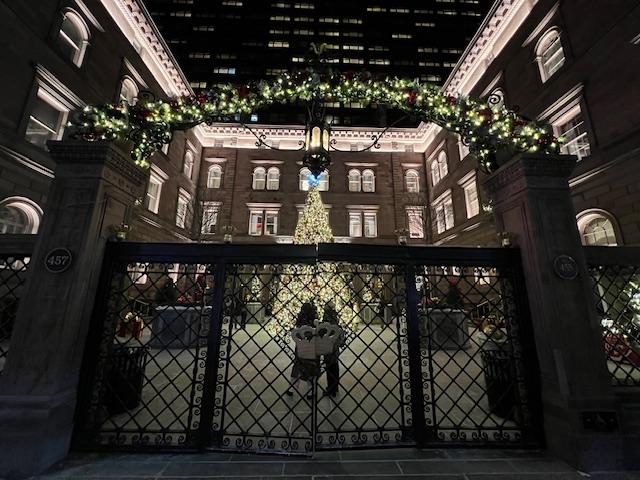
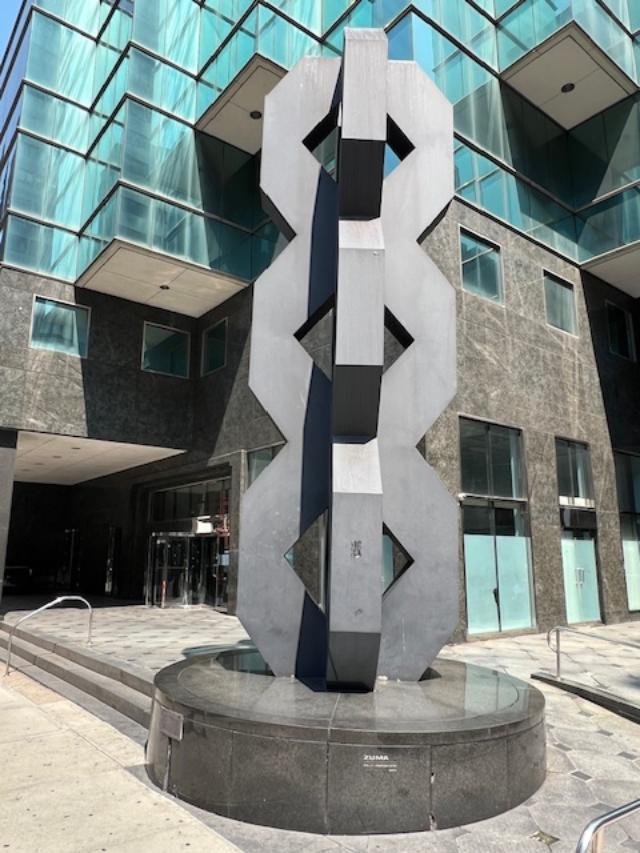
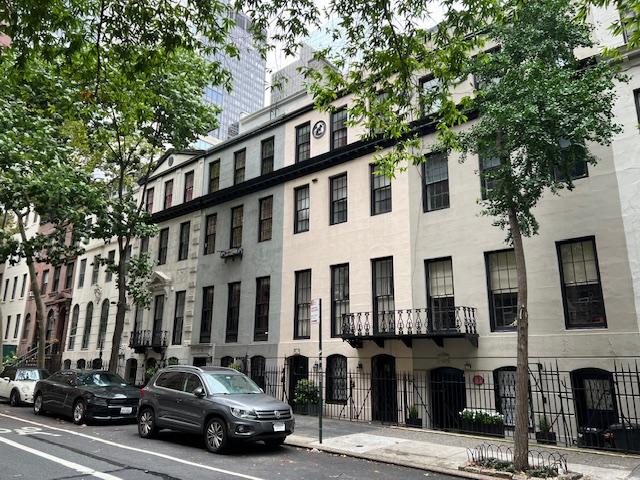
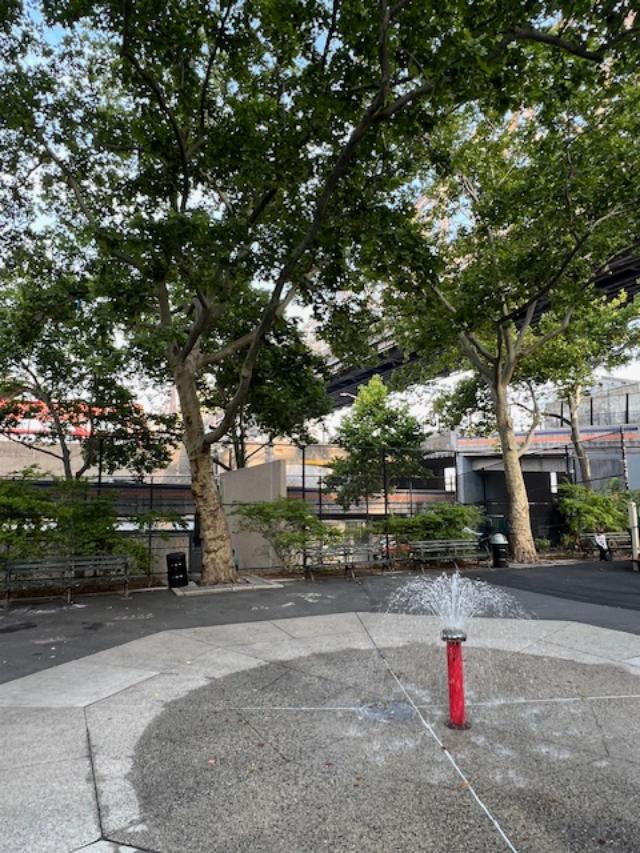
Tag Archives: Exploring Midtown East

Day Two Hundred and Sixty: Exploring the Borders of the Theater District from Eighth to Fifth Avenue and from West 54th to West 42nd Streets March 16th, 2023

I took a different direction from my walk having finished the Flatiron District (finally!). I had just started Graduate School as I was finishing the Flatiron District and had not completed the blog when classes started. Who knew it was going to be that crazy of a semester. I had not worked that hard since Wines & Menus when I was at the Culinary Institute of America.

I bypassed the whole Theater District after the COVID vaccine mandate was lifted in June of 2020 because between the riots that took place after the George Floyd incident and all the theaters being closed because of COVID (they would not open again until 2021) I skipped this section of the Manhattan. I went to Murray Hill and worked my way down to 23rd Street. The whole Theater District was loaded with police anyway guarding the theaters and the areas in between. There was literally no one walking around this neighborhood and I would have stood out. The theaters and restaurants were boarded up and homeless all over the place.

So I’m back and it makes it really easy since I just get right out of Port Authority and here I am. The Theater District has changed tremendously in the last thirty years and has gotten much better. All of 42nd Street and its seediness has pretty much gone away (but the element still lingers) and some of the most innovative new buildings have replaced all that. It made for an interesting walk before I had to meet my friend, Maricel, for her delayed birthday dinner at Virgil’s, a barbecue restaurant on West 44th Street.

Leaving the subway at 42nd Street the walls are filled with partying patrons
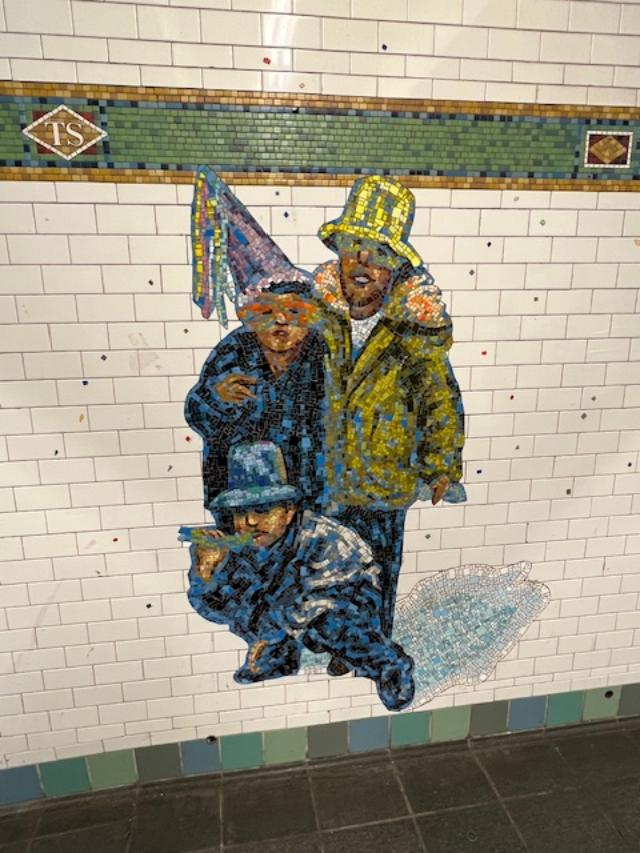
More partying patrons in the 42nd Street subway station before you get into the Theater/Times Square district

So I started on the corner of Eighth Avenue and West 42nd Street and made my way up Eighth Avenue to the northern border of the Theater District at West 54th Street. Talk about a combination of architectural structures and designs.

One of the most interesting buildings in the Times Square area is the Westin New York at Times Square at 270 West 43rd Street which stretches from West 42nd to West 43rd along Eighth Avenue. This hotel is considered one of the most innovative designed buildings in New York City when it was built.
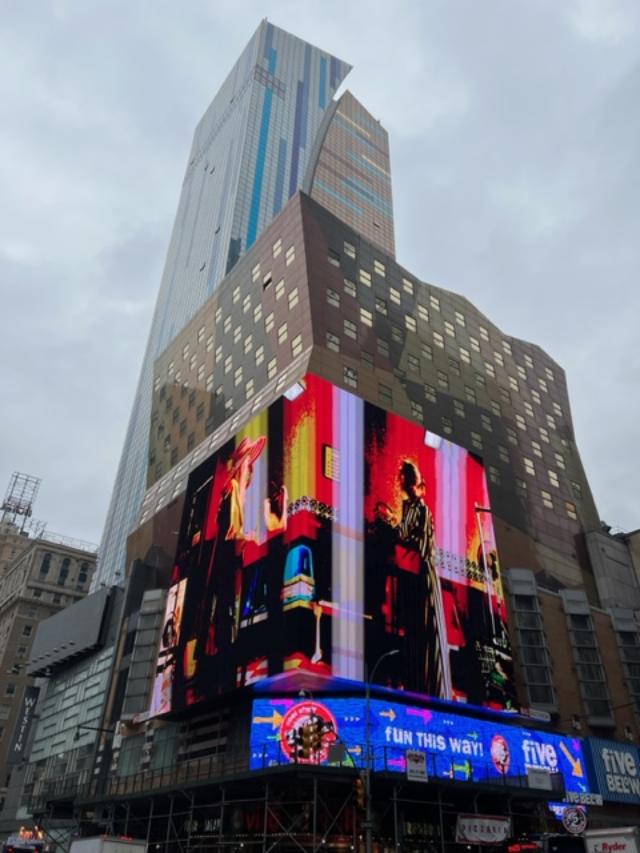
Westin New York at Times Square at 270 West 43rd Street

https://www.marriott.com/hotels/hotel-photos/nycsw-the-westin-new-york-at-times-square/

The hotel was so innovative at the time when it was built and was considered a key in the redevelopment of the West 42nd Street district. The hotel was commissioned by the architectural firm of Arquitectonica to design the building. The 863 room hotel is actually two towers merged together with a ten story midsection for retail and hotel suites. The large scale abstract design has the look of a multi-dimensional gigantic origami (Arquitectonica website). The building was designed by HKS architects and was finished in 2002.

Further up Eight Avenue is the well-known Row NYC Hotel at 700 Eighth Avenue. This hotel opened in 1928 as the Hotel Lincoln and was the largest hotel in Manhattan when it opened with 1331 rooms. In 1957, the hotel was sold and remodeled and open again as The Hotel Manhattan. It was closed in the 1960’s as the rest of the area declined. It reopened again as the Milford Plaza Hotel in 1978 and was a big theater going hotel. In 2013, the hotel was sold once again and went through another renovation and opened as the currently Row NYC Hotel (Wiki).
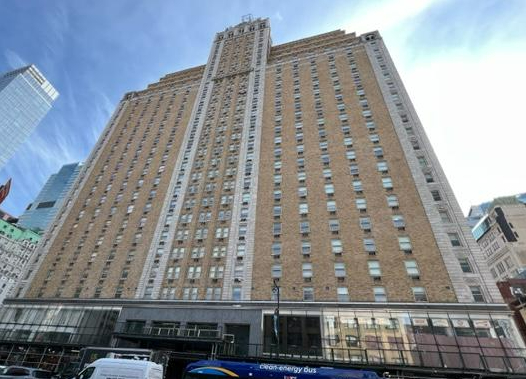
The Row NYC Hotel at 700 Eighth Avenue

https://www.rownyc.com/times-square-hotel/

The famous “Milford Plaza” commercial from 1985

As I made my way up Eighth Avenue that borders the Theater District, I passed the now reopened Smith’s Bar, which has been a fixture in Times Square for over sixty years opening in 1954. The bar had been sold to new owners in 2009 and then closed in 2014 to reopen a year later.
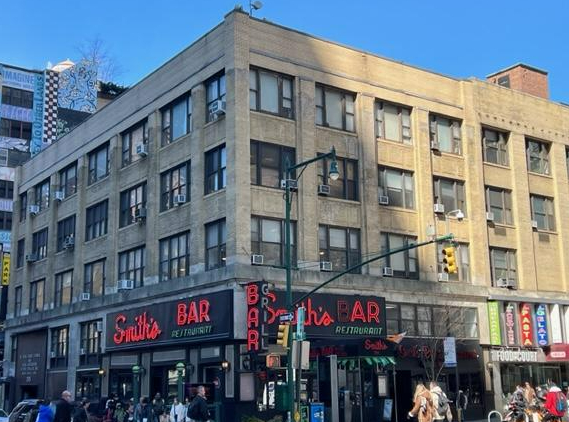
Smith’s Bar at 701 Eighth Avenue

https://www.facebook.com/Smithsbarhellskitchen/

My review on TripAdvisor:

https://www.tripadvisor.com/Restaurant_Review-g60763-d494424-Reviews-Smith_s_Bar_and_Restaurant-New_York_City_New_York.html?m=19905

This bar has seen Times Square go through a major transition over the years and was once located in one of the worst areas during the 1990’s. It has since reopened and has been very popular going into “March Madness” with college basketball in full swing.

Located between 728 and 732 Eighth Avenue are three hold out businesses to a major construction project. It still houses Daniela at 728 Eighth Avenue, an Italian restaurant, a gift shop at 730 Eighth Avenue and Playwright Celtic Pub at 732 Eighth Avenue. Frankly I think all three businesses time is coming as the land is getting too valuable in the Times Square area. Every building around these has been torn down for a new building.

Daniela Trattoria

https://danielarestaurant.com/

Review on TripAdvisor:

https://www.tripadvisor.com/Restaurant_Review-g60763-d911157-Reviews-Daniela_Trattoria-New_York_City_New_York.html?m=19905

Playwright Celtic Pub

https://playwrightcelticpubnyc.com/

Review on TripAdvisor:

https://www.tripadvisor.com/Restaurant_Review-g60763-d424620-Reviews-Playwright_Celtic_Pub-New_York_City_New_York.html?m=19905

The pillars in front of the Playwright Celtic Pub

The pillars are very detailed

The pillars of 732 Eighth Avenue

Further up the avenue on the corner of Eighth Avenue and West 46th Street is the West 46th Street SRO. This interesting building that I thought was an elegant Victorian is actually a combination of three former tenement buildings and two residences to make one building. Architects Oaklander, Coogan & Vitto PC created this interesting building with an additional shared floor topped with a mansard roof and tower. It used to house many trendy restaurants and bars but since the pandemic has been empty. By 2023 though, it is starting to fill up again (OCV Architects PC).
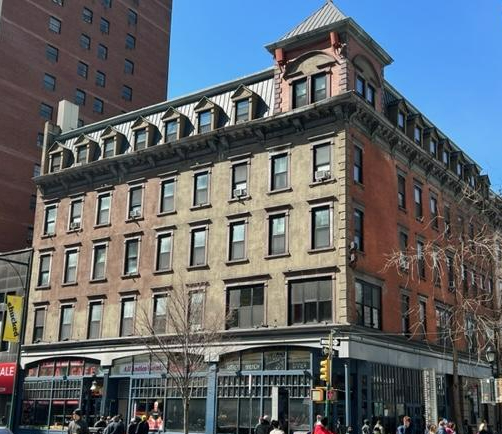
West 46th Street SRO is an interesting building

https://ocvarch.com/

I reached West 48th Street and I passed Engine 54/Ladder 4/Battalion 9, which I used to pass all the time when I worked down the road at the Java Shop on the corner of Broadway and West 46th Street at 782 Eighth Avenue. These companies were hit hard a year after I left my job on 9/11 when the Brothers of this house lost 15 members that day, their entire shift. The memorial they have to their members is really touching and the guys that work there always seem so friendly to all the tourists that pass by.
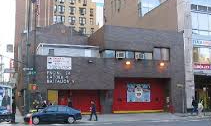
Engine 54/Ladder 4/Battalion 9 at 782 Eighth Avenue
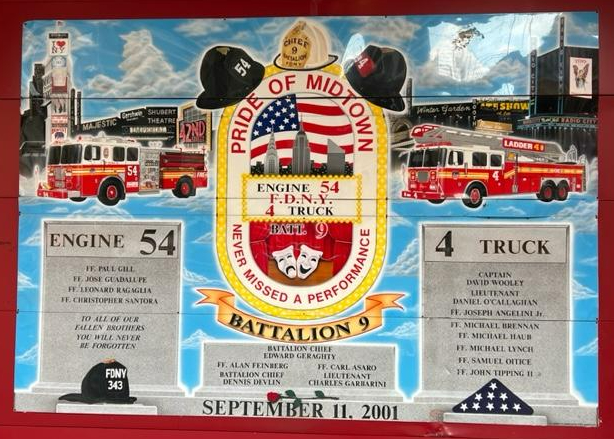
Pay respects to the Engine 54/Ladder 4 9/11 Memorial on the front of the building

The Memorials
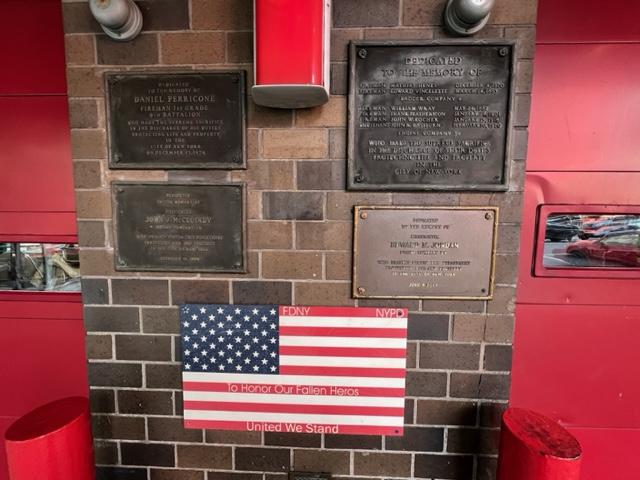
Engine 54 Plaques and Awards including 9/11
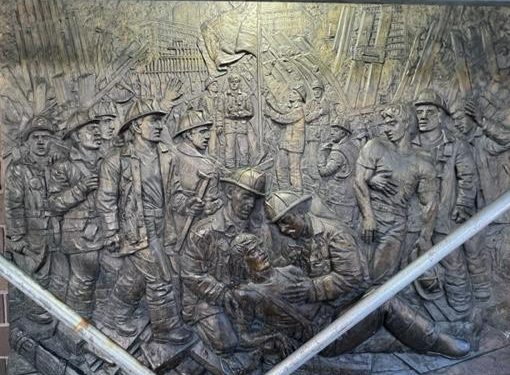
The plaque at the firehouse

There are two wonderful Chinese restaurants that I like to visit when I am in the neighborhood. One is Chef Pho & Peking Roast Duck at 858 Eighth Avenue, which has wonderful lunch specials until 4:00pm. The restaurant has some of the best egg rolls that I have tasted in a long time. I made special stops here for lunch when walking the area.
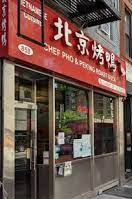
Peking Roast Duck Restaurant at 858 Eighth Avenue

http://www.chefphopekingroastduck.com/

My review on TripAdvisor:

https://www.tripadvisor.com/Restaurant_Review-g60763-d3459493-Reviews-Peking_Roast_Duck-New_York_City_New_York.html?m=19905

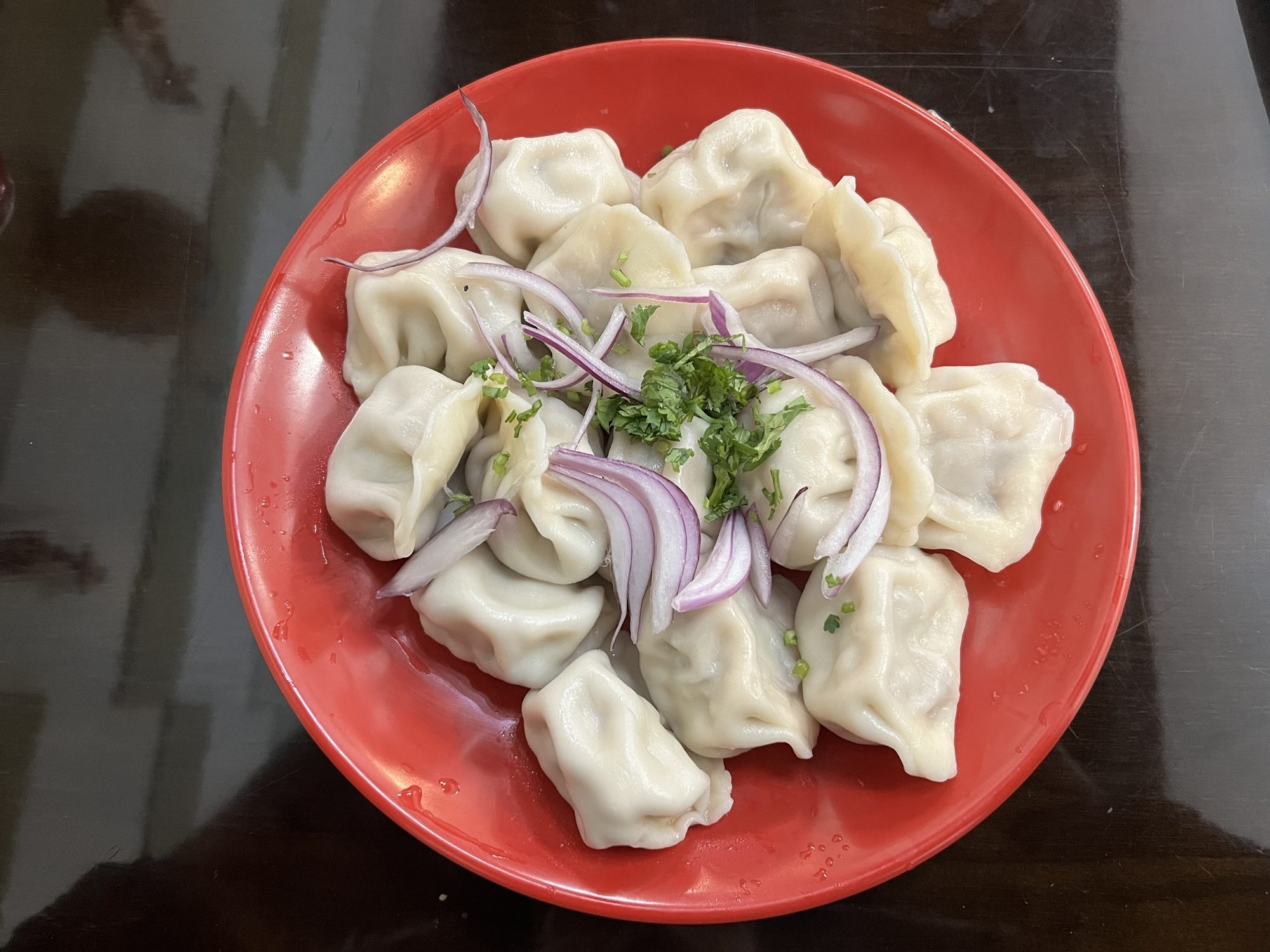
The other is Real Kung Fu Little Steamed Buns at 811 Eighth Avenue which is known for their Pork & Crab and Pork Soup Dumplings. I love their fried dumplings, Scallion pancakes with sliced beef, the pan-fried Duck Buns and the Shanghai pan-fried pork buns. Everything on the menu here is excellent and you can eat your way through the menu of delicious Dim Sum.

Real Kung Fu Little Steamed Buns at 811 Eighth Avenue

https://www.kungfulittlesteamedbunsramen.com/

My review on TripAdvisor:
https://www.tripadvisor.com/Restaurant_Review-g60763-d6872074-Reviews-Kung_Fu_Little_Steamed_Buns_Ramen-New_York_City_New_York.html?m=19905

When I turned the corner at West 54th Street, it was like visiting an old friend. Although I walk down this street all the time on the way to the MoMA (The Museum of Modern Art), in the past I never really paid attention to the buildings in the area or the architecture. When I walked down the street I saw the beauty in a lot of the townhouses that lined West 54th Street toward Fifth Avenue.

As I walked the border of the neighborhood on West 54th Street from Eighth Avenue, you can see the traces of Old Residential New York side by side with the new office towers, hotels and the extension of the Museum of Modern Art on the corner of West 54th and Fifth Avenue.

At the very edge of the neighborhood is 254 West 54th Street now the home of a theater but in the late 70’s was home to the famous ‘Studio 54’ nightclub and epicenter of the Disco era. There has never been a club before and after that can compare to it.

The club was opened  in 1977 by club owners Steve Rubell and Ian Schlager who had once opened clubs out on Long Island and to much fanfare and the party did not end until the club was raided for tax evasion and closed February of 1980. The party was over! The club continued to open over the years but the original magic was gone as the Disco era faded away in the early 80’s.

Studio 54

254 West 54th Street The famous former “Studio 54”

The history of the Rise and Fall of Studio 54

Seed54 Sculpture at the corner of Sixth Avenue and West 54th Street

On the corner is the an unusual sculpture that I first noticed when walking past a hot dog vendor on the corner of Sixth Avenue and West 54th Street in front of 1330 Sixth Avenue building. This strange looking piece of artwork resembles an open air egg is by artist Haresh Lalvani. This unusual sculpture can be interpreted many different ways. The only problem is that the hot dog vendor on the corner distracts from even looking at it and I have passed it without even noticing it over the times I have been in the neighborhood.

Seed54 Sculpture at the corner of Sixth Avenue and West 54th Street

Artist Haresh Lalvani in front of one of his “HyperSurface” works

Home

Mr. Lalvani is a professional artist and Professor at Pratt Institute in Brooklyn. His emphasis in the work is his study of morphology into nature and its effects on art. ‘Seed54′ is part of his HyperSurface’ series. Mr. Lalvani is a graduate of the Pratt Institute of Architecture (Pratt Institute).

haresh-lalvani.jpg

Artist Haresh Lalvani in front of one of his “HyperSurface” works

Home

The first building that popped out to me was The Albemarle at 205 West 54th Street. This 12 story Beaux-Arts building was built in 1903 and was once known as the Hotel Harding and then the Alba. Actress Mae West once living in the building. The hotel at one time was home to the notorious “Club Intime” run by Texas Guinan. This was a well-known Speakeasy during Prohibition (City Realty).

Take time to look at the detailed stone work and carvings along the building. It really stands out amongst its more modern neighbors.

The Albemarle Building 205 West 54th Street

https://streeteasy.com/building/205-west-54-street-new_york

In front of 1345 Sixth Avenue is a large silver globe that has always fascinated me on the walks down West 54th Street. There is no name of the artist and nothing on the planters or doorway of the building.

The silver globe in front of 1345 Sixth Avenue on the corner of West 54th Street

At 162 West 54th Street, another beautiful building stands out with faces staring and smiling at you. This recently renovated building has now been turned into luxury condos and has been sandblasted back to its original beauty for a building that was built in 1911.

162 West 54th Street

https://streeteasy.com/property/1418747-162-west-54-street-pha

https://www.cityrealty.com/nyc/midtown-west/162-west-54th-street/units-summary/6619

The building almost smiles at you

Walking further down the street, you will realize that this part of the neighborhood is home to many of the most famous ‘old line’ hotels in Manhattan. At 65 West 54th Street is the luxury Warwick Hotel.

The 36 story hotel was built by William Randolph Hearst in 1926 with the help of architect Emery Roth with the firm of George B. Post & Sons. The outside of the hotel is done with brick, granite and limestone giving it it’s unusual color scheme. Take time to look at the hotel’s detail work and old world charm in the lobby (Wiki).

The Warwick Hotel at 65 West 54th Street

The detail work around the windows of the Warwick Hotel

https://www.warwickhotels.com/warwick-new-york

As you continue to walk the border of West 54th Street closer to Fifth Avenue, you will see the back of the Museum of Modern Art which just reopened after its renovation and expansion. On the northern side of West 54th Street is a series of historical mansions each with its distinctive look.

The first home that really stood out was 35 West 54th Street. The brownstone was built right after the Civil War and was part of a series of identical brownstones built on the block. When the brownstone was bought by owner, Dr. Allan Thomas, in the late 1890’s, he stripped the front of the brownstone and gave it its current Beaux Arts facade to match architecture being built along Fifth Avenue.

35 West 54th Street

https://www.cityrealty.com/nyc/midtown-west/35-west-54th-street/7552

http://daytoninmanhattan.blogspot.com/2013/09/the-walter-tower-rosen-house-no-35-west.html

The house was then bought by Walter Tower Rosen, whose bought the house in 1916 and it stayed in the family until 1968. It is currently private apartments (Daytonian in NY).

The William Murray House 13-15 West 54th Street

https://en.wikipedia.org/wiki/13_and_15_West_54th_Street

Another mansion that stands out along West 54th Street is the William Murray House at 13-15 West 54th Street.  These twin mansions were built for Larchmont businessman William Murray by architect Henry Janeway Hardenbergh in the ‘Renaissance style’.  This section of fashionable mansions is what is left of the Gilded Age residences in the neighborhood.

a

James Gordon House at 9-11 West 54th Street

https://www.loopnet.com/property/9-11-West-54th-Street-New-York-NY-10019/36061-12700027/

The James Gordon House at 9-11 West 54th Street really stands out. James J. Gordon was the owner of the Erie Railroad and two insurance companies and was a cousin of JPMorgan, the banker. The house was designed by McKim, Mead & White in the Colonial American style. Mr. Gordon’s family had come to the United States in the 17th century and was from an old line Connecticut family. Look at the classic look of the mansion and its elegant stone and grill work. The house is now on the market for 65 million dollars (Curbed New York).

7 West 54th Street-The Philip Lehman House

https://en.wikipedia.org/wiki/7_West_54th_Street

The last home in this series of brownstones is 7 West 54th Street which was built by banker Philip Lehman in 1900. The brownstone was designed in the Beaux Arts style and after his death in 1947, his son, Robert, moved in and used the home for his art collection. He used the house until he died in 1969. It is now being used as offices (Wiki).

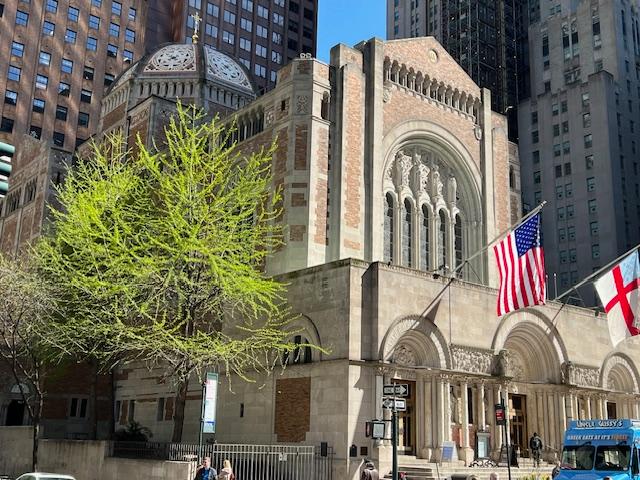
As you turn the corner to Fifth Avenue, you start to experience the old wealth of Manhattan with the University Club to your right and St. Thomas Church to the left when you enter Fifth Avenue at West 54th Street. This area also contains luxury department stores and shops, famous hotels and the Upper Crust churches that dot Fifth Avenue. The Theater District shares the borders with Midtown East, the Upper East Side, Hell’s Kitchen and the Garment District so there is a lot of overlapping with the neighborhoods.

The next block up is a combination of unique buildings back-to-back with the University Club of New York (Princeton) and the Peninsula Hotel. These buildings are so beautiful in their place on Fifth Avenue.

The University Club of New York is a private social club and is just as elegant inside as it is outside. The building was designed by the firm of McKim, Mead & White in 1899 and was designed in the Mediterranean Revival Italian Renaissance palazzo style.

The University Club on the corner of West 54th Street and Fifth Avenue

The University Club of New York at 1 West 54th Street

https://www.universityclubny.org/

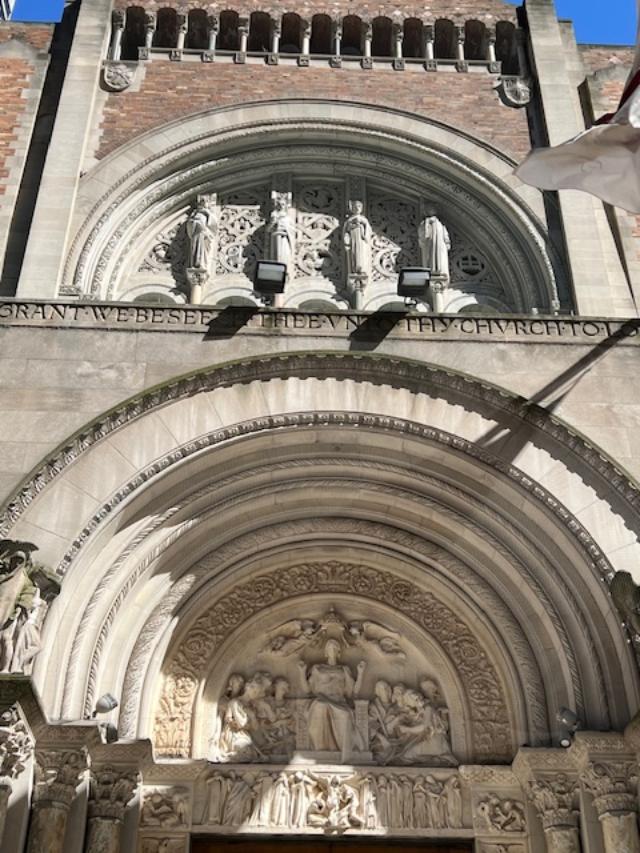
When reaching the corner of East 53rd Street another historic church, Saint Thomas Church Fifth Avenue stands guard. Though the church has been part of Manhattan since 1823, the current church was built here by 1914 and consecrated in 1916 as an Episcopal parish (Wiki).

Saint Thomas Church at 1 West 53rd Street

New Homepage

The church was designed by architects Ralph Adams Cram and Bertram Grosvenor Goodhue of the firm Cram, Goodhue & Ferguson with added sculpture by Lee Lawrie. The building is designed in the French High Gothic style and has magnificent deals (Wiki). Even if you are not Episcopalian, going to services at the church is a nice experience. The services are always very relaxed and the Saint Thomas Choir of Men and Boys is excellent. The music and songs are wonderful to hear and the concerts in the afternoon and weekends are a treat.

On the corner of Fifth Avenue and 52nd Street sits a true jewel box in the Cartier store at 653 Fifth Avenue. The store was once home to Morton Freeman Plant, the son of railroad tycoon Henry B. Plant. The home was designed by architect Robert W. Gibson in 1905 in the ‘Neo-Renaissance style’. Mr. Plant felt later that the area was getting too ‘commercial’ and moved further uptown and Cartier bought the building in 1917 (Wiki).

Cartier Fifth Avenue 653 Fifth Avenue

https://stores.cartier.com/en_us/united-states/ny/new-york/653-fifth-avenue

Cartier finished a renovation on the store in 2016 to bring back the true beauty and elegance of the store and of the building. Don’t miss the opportunity to walk around inside and see the refined displays of merchandise.

Cartier Fifth Avenue II.jpg

The Cartier store after the renovation

Next to the Cartier store at 647 Fifth Avenue is the next Versace store which is housed in the left side of the Vanderbilt ‘ marble twin mansions. The Vanderbilt family had bought the land and built twin buildings on the site at 647-645 Fifth Avenue. Designed by architects Hunt & Hunt in 1902, the homes were first leased out as homes until about 1915 when businesses and trade came to the area.

647 Fifth Avenue II

647 Fifth Avenue in 1902

After passing out the Vanderbilt family in 1922, the building went through many incarnations and 645 Fifth Avenue was torn down for the Best & Company Department store in 1945 only to be torn down again in 1970 for the Olympic Tower (which still stands in the spot). The building was renovated in 1995 by Versace as their Fifth Avenue store and spent six million dollars to create the store that greets customers today.

647 Fifth Avenue today

https://en.wikipedia.org/wiki/647_Fifth_Avenue

http://daytoninmanhattan.blogspot.com/2011/06/last-of-vanderbilt-row-no-647-fifth.html

The true catalyst and center of the luxury shopping district though is St. Patrick’s Cathedral which sits gracefully at the corner of Fifth Avenue between 51st and 50th Streets. The Diocese of New York was created in 1808 and the land for the Cathedral was bought in 1810. The Cathedral was to replace the one in lower Manhattan.

This current Cathedral was designed by architect James Resnick Jr. in the Gothic Revival style. Construction was started in 1850 and was halted because of the Civil War and continued in 1865. The Cathedral was completed in 1878 and dedicated in 1879. The Cathedral was renovated in 2013 and this shows its brilliance (Wiki).

During the holiday season the Cathedral is beautifully decorated and the music can be heard all over Fifth Avenue.

St. Patrick’s Cathedral on Fifth Avenue

https://saintpatrickscathedral.org/

Next door to St. Patrick’s Cathedral is Saks Fifth Avenue’s headquarters. The business was founded by Andrew Saks in 1876 and was incorporated in 1902. After Mr. Saks died in 1912, the business was merged with Gimbels’ Brothers Department Store as Horace Saks was a cousin of Bernard Gimbel. In 1924, they opened the new store at 611 Fifth Avenue and changed the name of the store to Saks Fifth Avenue (The old store had been on 34th Street previously and called Saks 34th). The building was designed by architects Starrett & Van Vliet and designed in a ‘genteel, Anglophile classicized design’.  (Wiki).

The store has recently gone through a major multi-million dollar renovation and is worth the time to look around the new first floor. The new cosmetic department is on the lower level along with jewelry so it is a different shopping experience. In its place, the handbag department has moved to the first floor.

Saks Fifth Avenue at 611 Fifth Avenue

https://www.saksfifthavenue.com/locations/s/newyork

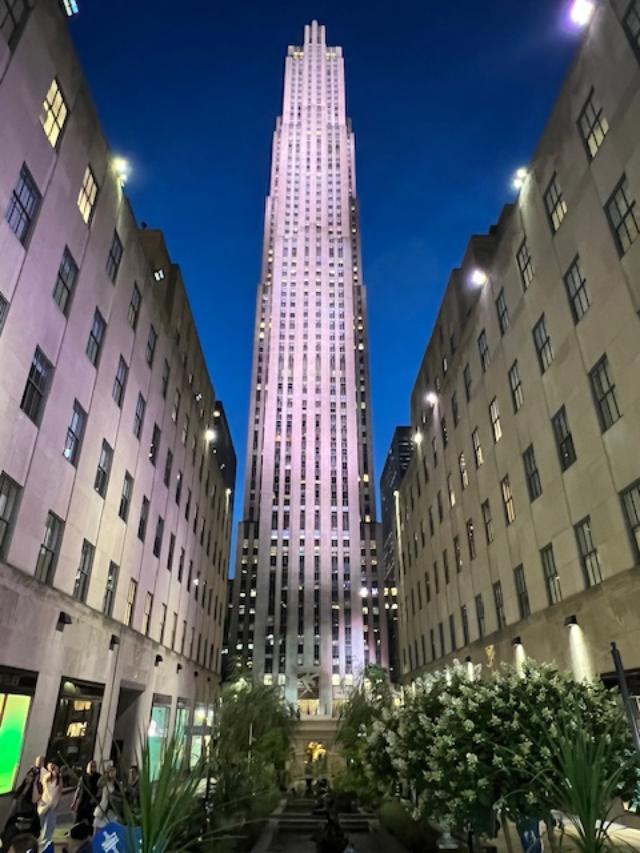
Once you get to West 49th Street things start to change when you enter Rockefeller Center which is across the street from Saks Fifth Avenue. The Rockefeller Center complex covers 22 acres with 19 buildings including Radio City Music Hall and the famous ice skating rink that is holiday tradition once the famous tree is lite. The complex stretches from East 48th to East 51st Street from Fifth to Sixth Avenues. Rockefeller Center was built in two sections, the original 16 building of the complex and then the second section west of Sixth Avenue (Wiki).
Rockefeller Center.jpg

Rockefeller Center at 45 Rockefeller Plaza on Fifth Avenue

https://www.rockefellercenter.com/

The land under Rockefeller Center was owned by Columbia University (which was later sold) and the building of the complex started at the beginning of the Great Depression. Construction started in 1931 with the first section opening in 1933 and the remainder of the complex opening in 1939 (Wiki).

The original section of the complex was built in the ‘Art Deco style’ and the extension on Sixth Avenue was built in the ‘International style’. Three separate firms were hired to design the complex with the principal architects being Raymond Hood of Hood, Godley and Fouilhoux who was a student in the Art Deco style, Harvey Wiley Corbett and Wallace Harrison of Corbett, Harrison & McMurray and to lay the floor plans for the project L. Andrew Reinhard and Henry Hofmeister of Reinhard & Hofmeister. They were working under the Associated architects so that no one person could take the credit for the project (Wiki). Two of the original tenants including Radio Corporation of America (RCA) and National Broadcasting Company (NBC) which still exist.

Rockefeller Center III

The original section of Rockefeller Center

Radio City Music Hall, known for the elaborate shows and the Rockettes, was finished in 1932 and the ice-skating rink was finished in 1933 and the first Christmas tree was erected by the workers who were doing all the building.

Rockefeller Center IV.jpg

The first tree in Rockefeller Center in 1933 with the constructions workers who erected it.

The rest of the complex went up over the next five years with extensions and renovations being done over the next fifty years. Many famous companies made Rockefeller Center their headquarters or moved their offices to the complex over the years. Still most tourists find their way to the restaurants and the famous rink at the holidays.
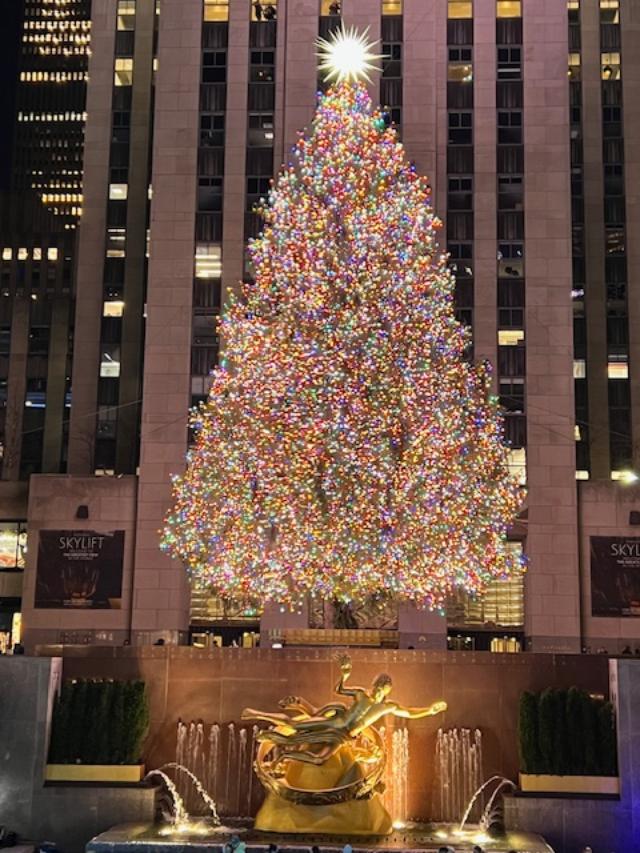
Rockefeller Center and the famous tree at Christmas 2022

Of all the beautiful artwork that line the walls and courtyards of the complex, two stand out. Prometheus is a beautiful statue that stands proud above the ice-skating rink.  This beautiful cast iron, gilded sculpture was made in 1934 by artist Paul Manship. The work is of the Greek legend of Titan Prometheus who brought fire to mankind by stealing it from the Chariot of the Sun (Wiki).

Mr. Manship was a well-known American artist who noted for his specialized work in mythological pieces in the classic style. He was educated at the St. Paul School of Art and at the Pennsylvania Academy of Fine Arts.

Paul Manship.jpg

Artist Paul Manship

https://www.britannica.com/biography/Paul-Manship

The other standout statue is of the God Atlas that guards the courtyard of the International Buildings. The sculpture was created by artist Lee Lawrie with the help of Rene Paul Chambellan. The statue was created in the Art Deco style to match with the architecture of the Center and depicts Atlas carrying the celestial vault on his shoulders.

Atlas at Rockefeller Center

Mr. Lawrie was known as a architectural sculptor whose work is integrated into the building design. His work in the Art Deco design fit perfectly into the new building. Mr. Lawrie was a graduate of the School of Fine Arts at Yale.

Lee Lawrie.jpg

Artist Lee Lawrie

https://www.leelawrie.com/

Touring around Rockefeller Center can take a full afternoon itself especially at the holidays but in the summer months with the outdoor cafe open on the skating rink it is much more open.

Framing the view of Prometheus from the Channel Gardens are Youth and Maiden, which were originally commissioned as companion figures for Rockefeller Center’s famous fire god, one male and one female, to represent humankind.

Artist Paul Manship’s ‘Maiden’

Artist Paul Manship’s ‘Youth”

Originally placed on either side of the gilded Prometheus, each figure extends one hand to receive the gift of fire. The dramatic architecture surrounding Rockefeller Center’s Channel Gardens frames a major exhibition of sculpture by American artist Paul Howard Manship (Public Art Fund 1999).

Also visit the underground walkways of shops and restaurants and visit the new FAO Schwarz that opened in the center. In the winter months, it is fun to watch the skaters on the iconic ice rink. I then headed back down Fifth Avenue again to walk through Bryant Park.

Another former business that was well known on Fifth Avenue for years was located at 597 Fifth Avenue was Charles Scribner Sons Building. It originally housed the Charles Scribner Book Store replacing the old store on lower Fifth Avenue. The building at 597 Fifth Avenue was designed by architect Ernest Flagg in the Beaux Arts style between 1912-13 (Wiki).

The bookstore moved out in 1980 and the company became part of Barnes & Noble Bookstores and the building has been sold since. It now houses a Lululemon Athletica store but you can still see the Scribner’s name on the outside of the building and the Landmarked bookshelves inside the store.

The Charles Scribner Sons Building at 597 Fifth Avenue

https://en.wikipedia.org/wiki/Charles_Scribner%27s_Sons_Building

https://www.propertyshark.com/mason/Property/20792/597-5-Ave-New-York-NY-10017/

The rest of Fifth Avenue is newer office buildings with retail space on the bottom levels some filled and some empty. When I was growing up, this part of Fifth Avenue was filled with high end stores. Today it is a combination of chain stores found in the suburbs or are just sitting empty, a trend found all over this part of Midtown East.
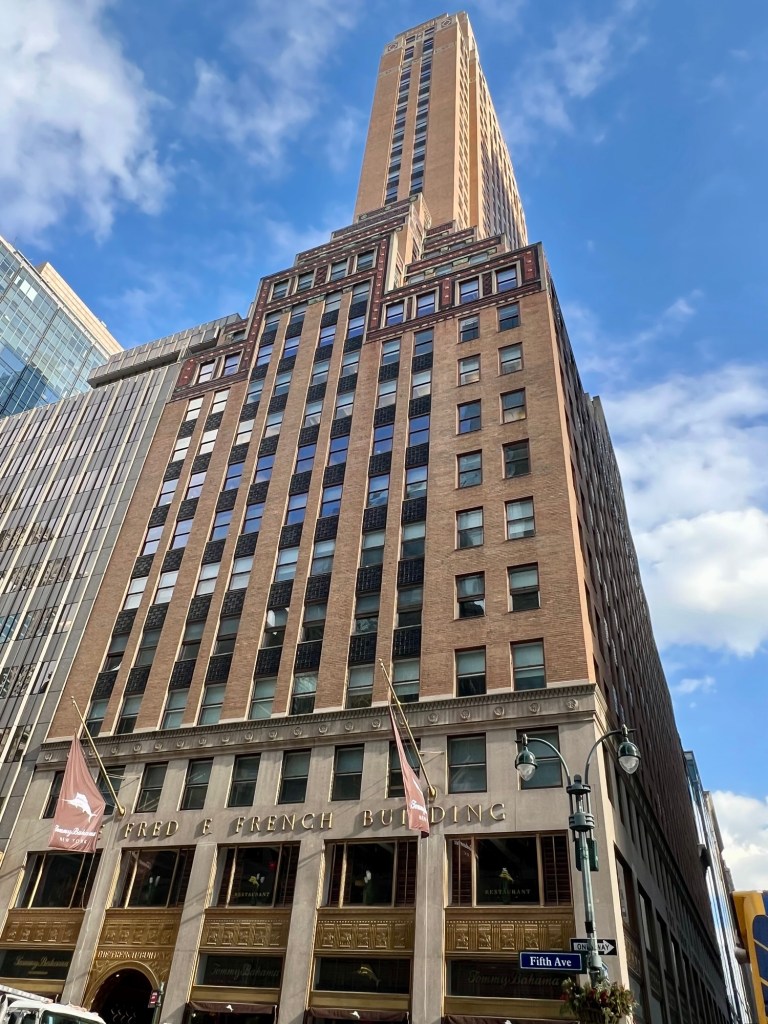
The Fred French Building at 551 Fifth Avenue

https://www.loopnet.com/Listing/551-Fifth-Ave-New-York-NY/3938685/
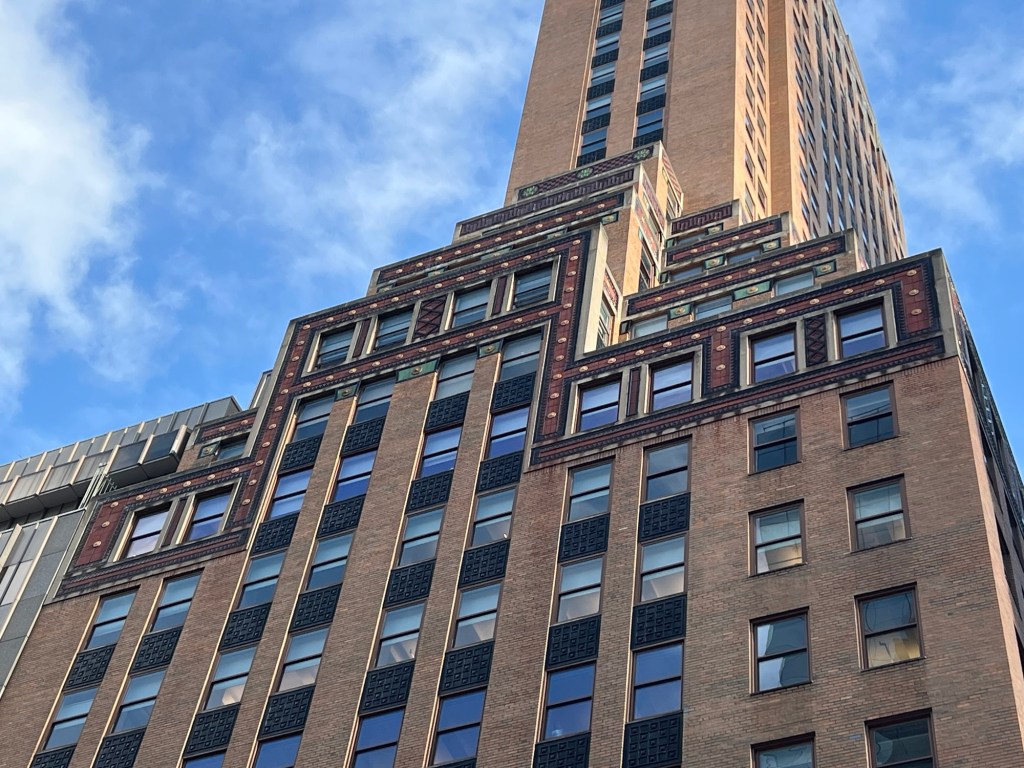
At 551 Fifth Avenue another interesting building, The Fred French Building really stands out. The building was created by architects H. Douglas Ives and Sloan & Robertson in 1927 in the ‘Art Deco Style’. Really look at the detail work all the up the building which was done in an ‘Eastern Design’ style with winged animals, griffins and golden beehives made to symbolize according to the architect ‘commerce and character and activities’ of the French companies. The outside material used on the building is faience, a glazed ceramic ware (Wiki).

Fred French Building II.jpg

The detail work on the top of the Fred French Building

From 43rd Street, I walked back up Fifth Avenue to the other side of the street and the buildings on this side of the street contains its share of architectural gems. The glass box building at 510 Fifth Avenue has always stood out to me. It was built in 1954 for the Manufacturers Trust Company. It was designed by architect Charles Evans Hughes III and Gordon Bunshaft of Skidmore, Evans & Merrill in the International style and recently has won awards for its extensive renovation. It had been used as a branch of Chase Bank until 2000 and now is used for retail stores (Wiki).

510 FIfth Avenue-Manufactures Trust/Chase Glass Box

https://www.vno.com/street-retail/property/510-fifth-avenue/3311743/landing

https://en.wikipedia.org/wiki/Manufacturers_Trust_Company_Building

The lower part of this side of Fifth Avenue is going through a transition as a lot of buildings exteriors are either being renovated or the building itself is being knocked down and a new one is rising. Many of the buildings here are quite new or just don’t stand out.

I reached Bryant Park by the afternoon and it was just beautiful that afternoon. The park has gotten more crowded with each month that the City has opened. The tables and chairs are pretty much back to normal since the years of COVID have passed into memory (it is still with us) and people are back to socializing again. It has become one of the nicest parks in New York in comparison to what it was in the late 1980’s. It also has the nicest and cleanest public bathrooms in Manhattan so it is worth the wait in line.

Bryant Park was busy that day

Bryant Park just before the ice skating rink was taken down

https://bryantpark.org/

Years ago when I worked in Manhattan in the early 90’s, Bryant Park was only used for drug dealing and criminal activity and was best avoided. What twenty years and a major renovation can do to a park. Today you can walk along the flowering paths and think you are in Paris. In the past there have been concerts and movies in the park but because of COVID-19, you can just sit in the park on a chair or bench and enjoy the sunshine and admire the flowers.
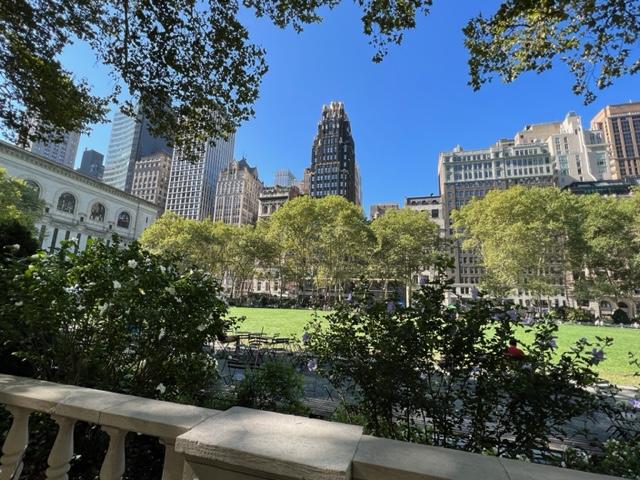
Bryant Park Summer II

Just walking along the paths of Bryant Park in the Spring and Summer months can make you forget your troubles

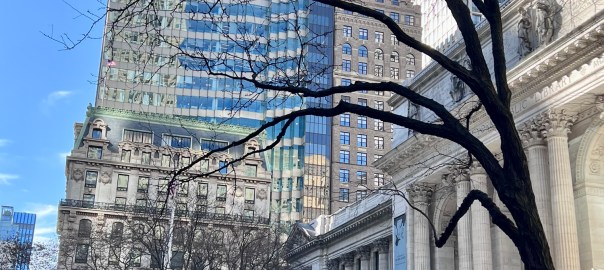
I continued my walk of the Garment District passing the New York Public Library admiring the stone carvings and statuary that is part of the entrance of the famous library. The library had just had a recent refreshing and looked magnificent with the fountains flowing and patrons filling the tables outside the building.
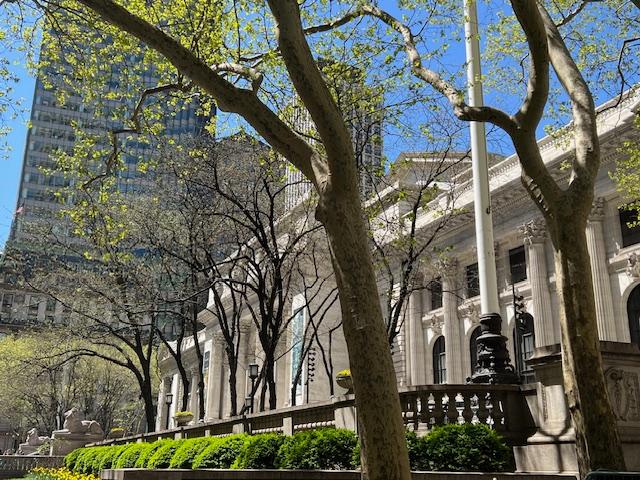
New York Public Library

The New York Public Library guards the borders of Murray Hill from Fifth Avenue (During COVID)

The NY Public Library at night

https://www.nypl.org/

This famous iconic building was designed by the firm of Carrere and Hastings in the Beaux-Arts style and opened its doors May 23, 1911. The founding for this important library came from patronage of the wealth members of society who believed in the value education and opened it to the people.

The famous lion statues that grace the entrance of the library were designed by American sculptor Edward Clark Potter and they were carved by the Piccirilli Brothers, American stone carvers whose business was based in the Bronx.

The NY Public Library Lions are iconic

Edward Clark Potter is an American born artist who studied at the School of the Museum of Fine Arts in Boston and at the Academie Julian in Paris where he studied ‘animalier’, animal sculpture.

Edward Clark Potter artist

Artist Edward Clark Potter

https://allfamous.org/people/edward-clark-potter-18571126.html

The Piccirilli Brothers were a family of stone carvers and artists in their own right who were from Massa, Italy and owned a business in the Bronx. There were responsible for many famous statues all over the City including the Maine Memorial in Columbus Circle and the Firemen’s Memorial in Riverside Park.

Artist Atillio Piccirilli

Artist Attilio Piccirillo , one of the most famous from the family

http://exquisites.org/exquisite-family/Piccirilli-Brothers-001.html

Another feature of the famous building and I had never noticed before was the elegant fountains that flank the entrance to the library. I did not realize that these fountains had just been restored in 2015 after thirty years of not functioning. They were restored with a grant from the Robert W. Wilson Charitable Trust (NYPL Site).
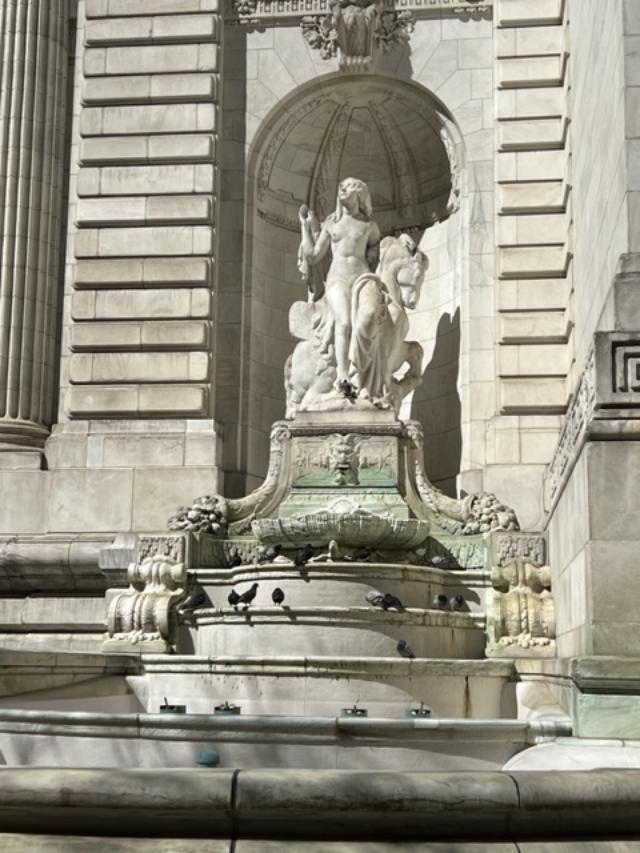
The fountain “Beauty”

The fountain “Truth”

These beautiful fountains were designed by artist Frederick MacMonnies, an American born artist who studied at the Ecole des Beaux Arts in Paris.

Frederick MacMonnies artist

Artist Frederick MacMonnies

https://americanart.si.edu/artist/frederick-macmonnies-3059

I relaxed under the trees and took a break from the walking. It is a funny thing that I have noticed at the park and it seems like no one is ever working. Everyone is either eating or talking. It has been so different since COVID started. You never see dressed business people in the park taking a break. It looks more like it is full of tourists visiting.

Enjoy the opening scene of “Ghostbusters” from 1984 shot at the NY Public Library:

Enjoy this scene from “Ghostbusters” from 1984 shot at the NY Public Library

The opening of the film “Ghostbusters” was shot inside the New York Public Library

Still when the park is in full bloom there is nothing like it. It is surrounded by classic architecture and beautiful buildings. They even were bringing back the “Bryant Park Film Festival” by the end of the summer. One Monday night I took a break from walking and watched the film “Moonstruck” which I had seen outside once at the Brooklyn Botanical Garden. Even though I had seen it hundreds of times since it came out I never tire of watching the film.

There have been many changes around Bryant Park in the last twenty years. Most of the older buildings of Times Square have been long knocked down and the area rebuilt which needed it. Now the impressive Bank of America building at 1111 Sixth Avenue (or also known as One Bryant Park) graces the corner of West 42nd Street and Sixth Avenue (trust me, no one in New York City calls Sixth Avenue “The Avenue of the Americas”).

This innovative building was designed by architect Rick Cook from the firm of Cookfox Adamson Associates. The building was designed with a clear ‘Curtain wall’ and several diagonal planes for wind resistance. The building was also awarded a LEED (Leadership in Energy and Environmental Design) for sustainable ‘green’ architecture (Wiki/Durst website).
Bank of America Building at 1111 Sixth Avenue
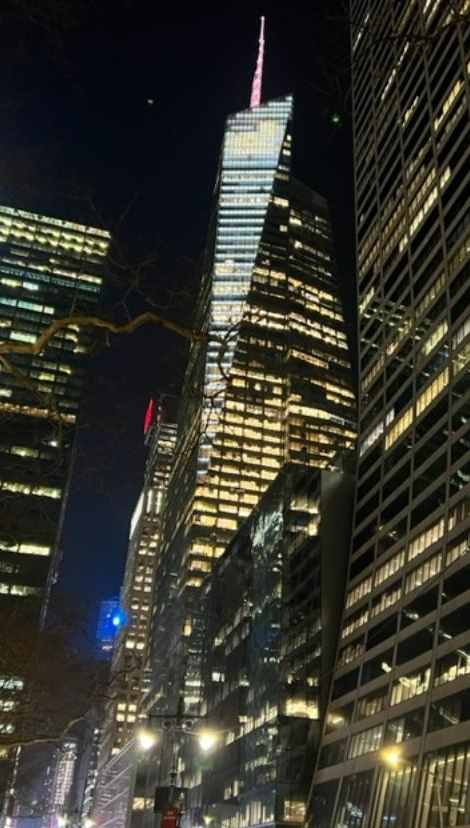
The Bank of America Building at night

https://en.wikipedia.org/wiki/Bank_of_America_Tower_(Manhattan)

https://www.durst.org/properties/one-bryant-park

The further you walk down West 42nd Street, the more you see how the block has changed in the last thirty years. All the older theaters and office buildings were knocked down and cleared out back in the 1980’s when Times Square went through urban renewal. The more historical theaters and old hotels have since been refitted and renovated.

Across the street in Three Bryant Park’s plaza is an interesting statue entitled “The Guardians: Hero” by artist Antonio Pio Saracino. This unique sculpture in made in layers and created from marble set in precision stone. The statue is done in repeated planes of marble . The sculpture is a modern representation on Michelangelo’s “David” Stoneworld/APS Designs).

“The Guardians: Hero at 3 Bryant Park

https://www.stoneworld.com/articles/87858-guardians-sculpture-in-new-york-city-is-example-of-one-of-a-kind-fabrication-on-display-in-manhattan

Artist Antonio Pio Saracino

https://en.wikipedia.org/wiki/Antonio_Pio_Saracino

Home

Artist Antonio Pio Saracino is an Italian born artist currently working in New York City. He is a graduate of Sapienza University of Rome and works as an architect and designer. He has had shows all over the world (Wiki).

At the corner of West 42nd Street and Broadway is the Knickerbocker Hotel at 6 Times Square. This hotel has had many incarnations over the years including an apartment house. As the neighborhood has improved, the historical buildings in the area have been renovated back to their former selves.

The Knickerbocker Hotel was built by John Jacob Astor IV and it opened in 1906. The hotel was designed by the firm of Marvin & Davis in the Beaux-Arts style. The outside of the hotel was built in red brick with terracotta details. The hotel was fully renovated in 2015 (Wiki).

The Knickerbocker Hotel at 6 Times Square

https://en.wikipedia.org/wiki/The_Knickerbocker_Hotel

One building that stands tall in Times Square is One Times Square known as 1475 Broadway. Once the home headquarters for the New York Times was opened in 1904. The building was designed by architect Cyrus L.W. Eidlitz. The original façade was of stone and terra cotta but this has been mostly stripped and is now home for mostly advertising. The ball still drops from the top of the building every New Year (Wiki).
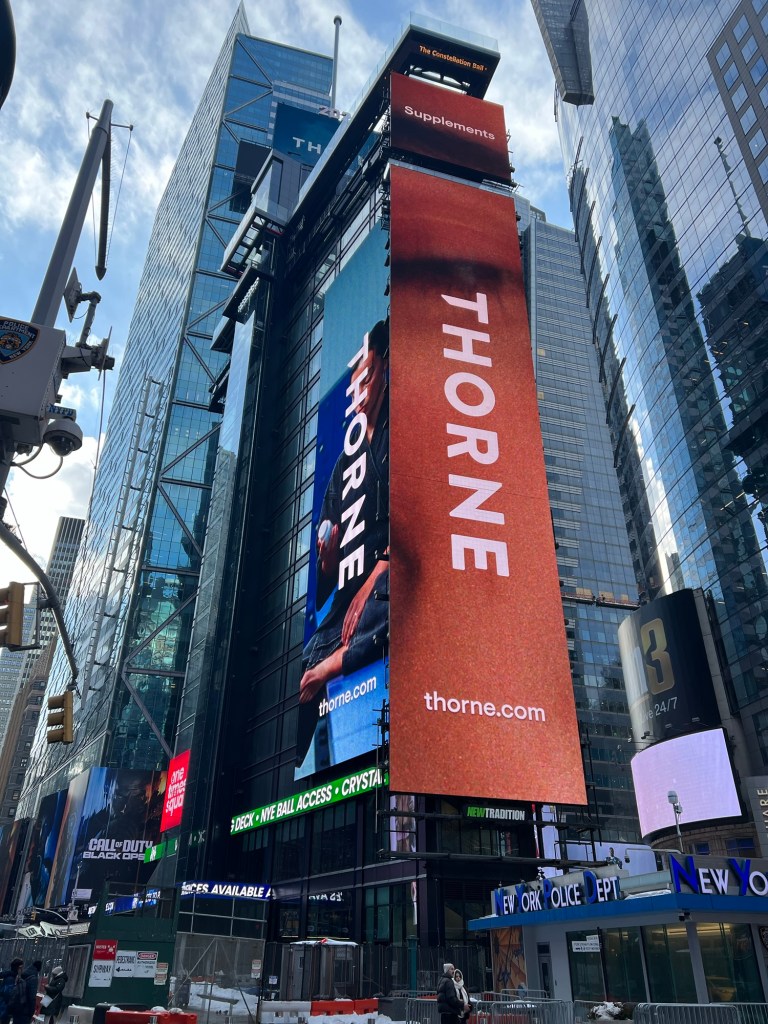
One Times Square before the scaffolding went up
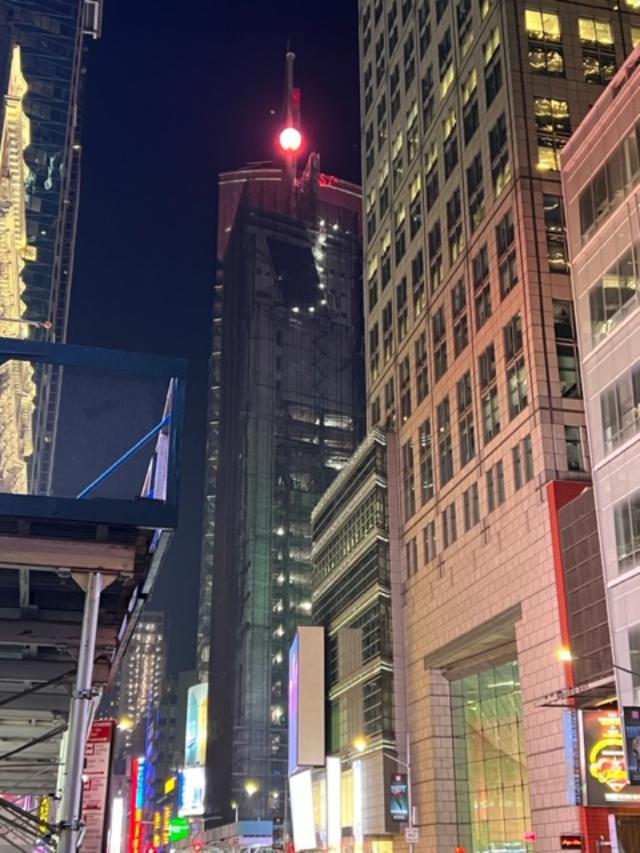
One Times Square with the lit ball for the New Year
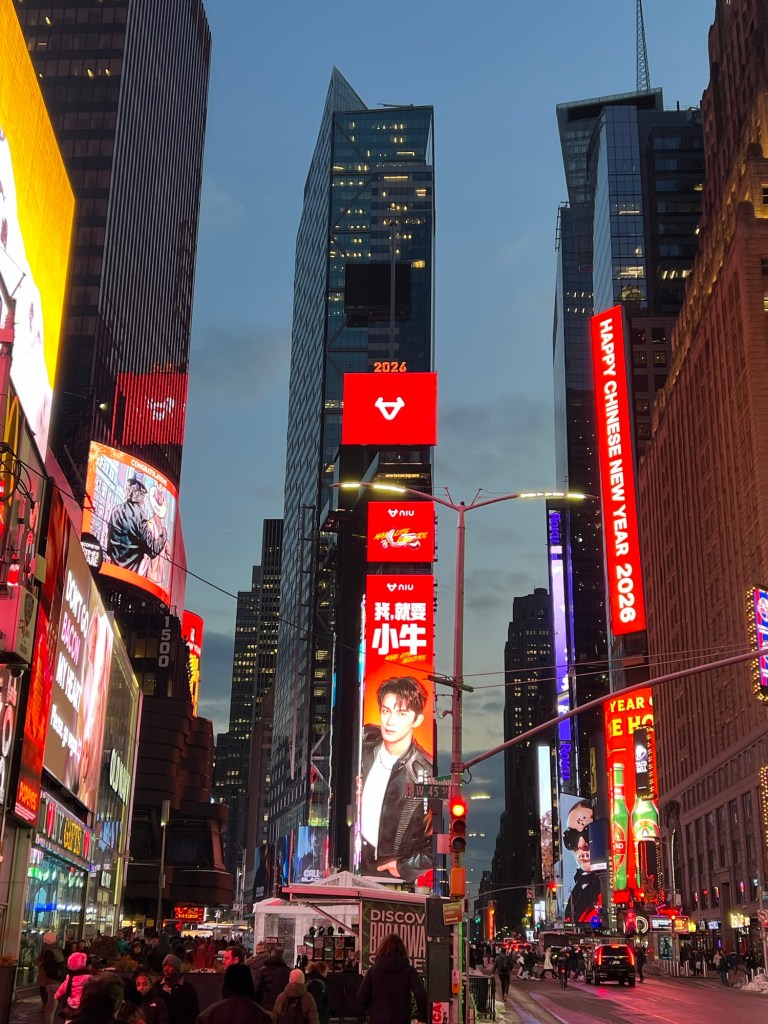
https://en.wikipedia.org/wiki/One_Times_Square

https://www.jamestownlp.com/properties/one-times-square

What is left of the old ’42nd Street’ Theater District has been renovated and refitted of its historic theaters. The rest of the block was knocked down and new office buildings were built starting in the late 1980’s and throughout the 1990’s. This is still a major gateway to the City especially from the Lincoln Tunnel and the Port Authority (NYCEDC/42nd Street Redevelopment Project).

The original 42nd Street Redevelopment project (NYCEDC)

https://edc.nyc/project/42nd-street-development-project

In the early 1980’s to the early 90’s until Mayor Rudy Giuliani took office, this area was being touted for redevelopment. It had started before the 1987 Stock Market Crash and then stalled for almost eight years. In the early 1990’s, the whole block between Seventh and Eighth Avenues along West 42nd Street were torn down, the theaters started to get renovated and new office buildings were built. If someone left New York City in 1990 and came back today, they would not recognize the neighborhood to the changes made.

The 42nd Street Renewal Plan (NYCEDC)

https://edc.nyc/project/42nd-street-development-project

Some of the changes has been the renovation and restoration of three beautiful theaters, the New Victory Theater at 209 West 42nd Street, the New Amsterdam Theater at 214 West 42nd Street and the former Empire Theater now the AMC Empire Theater at 234 West 42nd Street. Each of these architectural wonders used to be major theater houses before they became porn theaters and are now back to their original glory.

The New Victory Theater was one of the first theaters to reopen under the new plan.

New Victory Theater at 209 West 42nd Street

https://en.wikipedia.org/wiki/New_Victory_Theater

https://www.facebook.com/newvictorytheater/

The New Victory Theater was built by Oscar Hammerstein I in 1900 and was designed by architect Albert Westover. It opened as the Theatre Republic in 1900 and showed live stage shows. It did not become a movie theater until 1942 and by 1972 it became a porn theater. it resumed legitimate theater by the 1990’s when it was refurbished in 1995 and was the first theaters renovated in the 42nd Development plan (Wiki).

New Amsterdam Theater at 214 West 42nd Street

https://newamsterdamtheatre.com/

https://en.wikipedia.org/wiki/New_Amsterdam_Theatre

The New Amsterdam Theater is one of the oldest theaters in the area having been built between 1903 and 1904. The theater was built by Klaw and Erlanger for live theater and was designed by architects Herts & Tallant with a Beaux Arts exterior design and an Art Deco interior. The embellishments and details on the outside are quite elaborate (Wiki).

The theater was home to the Ziegfeld Follies from from 1913 to 1927 and hosted the elaborate shows of their day. It then was converted to a movie theater in 1937 until 1983 when it was leased to the Walt Disney company and renovated between 1995 and 1997. It is now operated by Disney Theatrical Productions for their live shows (Wiki/Walt Disney Company).

AMC Empire 25 Theater

The detail work at the AMC Empire 25 Theater

https://www.amctheatres.com/movie-theatres/new-york-city/amc-empire-25

https://en.wikipedia.org/wiki/Empire_Theatre_(42nd_Street)

http://cinematreasures.org/theaters/255

The former Empire Theater now the AMC Empire 25 was built in 1912 for producer Al H. Woods and was designed by architect Thomas W. Lamb in the Beaux Arts style. The theater was for live stage performances until 1943 when it was converted into a movie palace. It closed for good in the 1980’s as the area declined (Cinema Treasurers).

In 1998, the theater was moved from its location at 236 West 42nd Street and moved down the street to its present location at 234 West 42nd Street. The exterior was largely kept intact and the present theater interior was built inside of it enhancing the beauty of the present building (Cinema Treasurers/Wiki).

These theaters showed the testament of time and this type of architecture now is appreciated and being refitted to modern uses like the buildings I had seen in NoMAD (North of Madison Square Park) and in the Flatiron District.

A lot of the businesses on West 42nd Street heading back to the Port Authority have started opening up again. Sidewalk cafes were out with the warmer weather and customers were milling around. I saw this happening on my walks into the Hell’s Kitchen/Clinton section just north of the border of the Garment District.

The Port Authority at the edge of the Theater District is always busy.

After I reached the Port Authority, I double backed to West 44th Street to join Maricel for lunch at Virgil’s Barbecue. The restaurant was really crowded as “March Madness” had started and college basketball was in full swing. We had a group of Howard Alumni sitting behind us and by the end of lunch they looked heart broken as their team fell behind. There were plenty of other Alumni from other schools in the restaurant watching the games on the many TVs that lined the bar area of the restaurant.
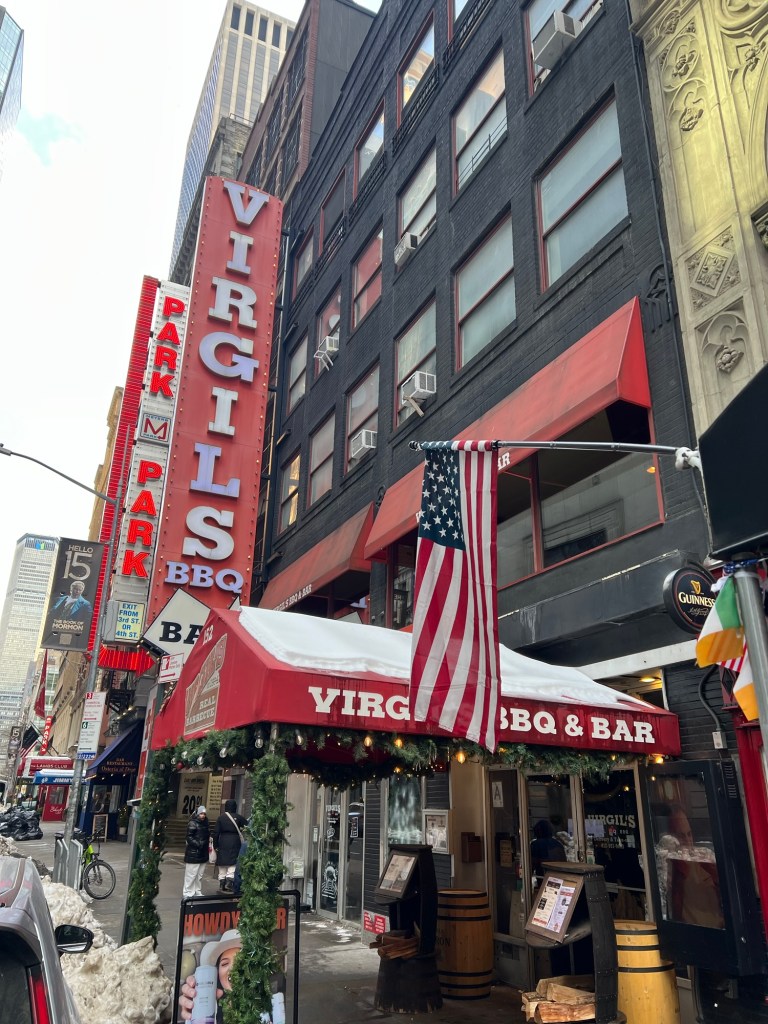
Virgil’s Real Barbecue at 152 West 44th Street

https://www.virgilsbbq.com/

My review on TripAdvisor:

https://www.tripadvisor.com/Restaurant_Review-g60763-d424440-Reviews-Virgil_s_Real_BBQ_Times_Square-New_York_City_New_York.html?m=19905

We had not been to Virgil’s since before COVID hit. We used to come here quite often so it was nice to back. Lunch was wonderful. I had a much-needed Pulled Pork Sandwich with a bowl of homemade chicken soup. Maricel could not finish her Mac & Cheese, so she gave me the rest. It was a wonderful afternoon of food and great conversation. She actually asked how my walk in Manhattan was going. I reminded her that she was supposed to be doing this project with me originally. She laughed at that one. After lunch it was perfect after a long walk around the neighborhood.
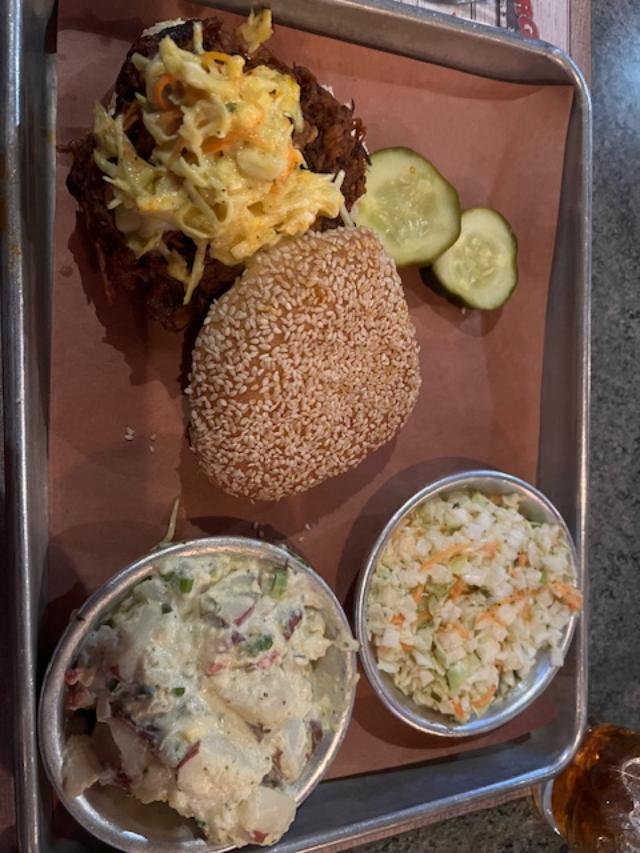
The Pulled Pork Sandwich at Virgil’s with Mac & Cheese and a biscuit

It was a nice afternoon to walk around and to spend the rest of the afternoon with a good friend over wonderful food made it even better.

It is nice to see the Theater District come to life again after a long COVID slumber. It is going to interesting to see how the area develops now that all the theaters are open, and the tourists are coming back. Talk about a drastic change in just two years!

Places to Visit:

Bryant Park

Fifth Avenue at West 42nd Street

New York, NY

(212) 768-4242

https://bryantpark.org/

https://en.wikipedia.org/wiki/Bryant_Park

Open: Sunday-Saturday 7:00am-11:oopm

My review on TripAdvisor:

https://www.tripadvisor.com/Attraction_Review-g60763-d136347-Reviews-Bryant_Park-New_York_City_New_York.html

Places to Eat:

Kung Fu Little Steamed Buns

811 Eighth Avenue

New York, NY 10019

(917) 338-2555

https://www.kungfulittlesteamedbunsramen.com/

Open: Sunday-Saturday 11:00am-10:00pm

My review on TripAdvisor:

https://www.tripadvisor.com/Restaurant_Review-g60763-d6872074-Reviews-Kung_Fu_Little_Steamed_Buns_Ramen-New_York_City_New_York.html?m=19905

Chef Pho and Peking Roast Duck Restaurant

858 Eighth Avenue

New York, NY 10019

(212) 459-3610

http://www.chefphopekingroastduck.com/

Open: Sunday-Saturday 11:00am-10:00pm

My review on TripAdvisor:

https://www.tripadvisor.com/Restaurant_Review-g60763-d3459493-Reviews-Peking_Roast_Duck-New_York_City_New_York.html?m=19905

Virgil’s Real Barbecue

152 West 44th Street

New York, NY 10036

(212) 921-9494

https://www.virgilsbbq.com/

Open: Sunday 8:00am-10:00pm/Monday-Thursday 8:00am-11:00pm/Friday-Saturday 8:00am-11:30pm

My review on TripAdvisor:

https://www.tripadvisor.com/Restaurant_Review-g60763-d424440-Reviews-Virgil_s_Real_BBQ_Times_Square-New_York_City_New_York.html?m=19905

My other walks in the Theater District:

Walking the Borders of the Theater District/Times Square: Day Two Hundred and Sixty:

https://wordpress.com/post/mywalkinmanhattan.com/31440

Walking the Avenues of the Theater District/Times Square: Day Two Hundred and Sixty One:

https://wordpress.com/post/mywalkinmanhattan.com/31763

Walking the Streets of the Theater District/Times Square: Day Two Hundred and Ninety-Nine:

https://wordpress.com/post/mywalkinmanhattan.com/4189

Gabrielle Carlson Studio

Gabrielle Carlson Studio 501 Lexington Avenue New York, NY 10017

In honor of Small Business Saturday, I am sending out some of the merchants I found on MywalkinManhattan.

Gabrielle Carlson Studio

Gabrielle Carlson Studio

Gabrielle Carlson Studio VI

jwatrel's avatarLittle Shop on Main Street

Gabrielle Carlson Studio

501 Lexington Avenue

New York, NY  10017

(917) 514-4433

GabrielleCarlson.com

http://www.gabriellecarlson.com/

When I was exploring the Turtle Bay neighborhood for my blog, “MywalkinManhattan.com” when rounding the corner by the Roger Smith Hotel  I was greeted by the beautiful vibrant colors of clothes in the window of Gabrielle Carlson Studio, which at the time was on East 47th Street and has now moved to 501 Lexington Avenue in the Roger Smith Hotel’s shops facing Lexington Avenue.

What attracted me to the store was the vibrant colors of the clothing and uniqueness of the styles and designs. Clothes were hanging from the racks in vibrant deep greens and purples and various hues of blue. There were different types of clothes to choose from including dresses, skirts, tank tops, tee-shirts, scarfs and sheen coverings in various colors and sizes. The store’s motto is “Beautiful Clothes in Your Size” and it…

View original post 498 more words

Day One Hundred and Forty-Six: Walking the Streets of Midtown East from Lexington to Fifth Avenues from East 59th to East 43rd Streets September 20th-October 4th, 2019 (Again December 21st, 2024)

Walking the streets of Midtown East is very different from all the other neighborhoods that I have walked so far. The character of the neighborhood differs so much in that it is mostly commercial with hotels, specialty shops, office buildings and more residential on the upper parts of the neighborhood than any other part of the City. When you walk down the side streets of Midtown East, you are usually passing a building that stretches from one block to the other with nothing much in between but a loading dock or garage for the employees. Most of the smaller buildings and brownstones have been long knocked down and replaced with large office buildings some of which the character lacks in these giant ‘glass boxes’.

I know in the past few years that New York City has allowed more innovation in building design and there has been more original designs then the original 1980’s ‘glass boxes’ but even now there are a lot of makeovers that are happening all over the neighborhood and you will be dodging scaffolding that I have not seen since my days walking Harlem. From block to block especially as you get closer to Grand Central Station, there are many closed sidewalks and you can only walk on one side of the street.

Grand Central Station sits at the head of this neighborhood

https://en.wikipedia.org/wiki/Grand_Central_Terminal

With that said, there are still many hidden treasures to find if you just look up and across and they just jump out on you. It is surprising in this ever-changing neighborhood of soaring towers and busy hotels that tucked here and there are public atriums with places to sit and tiny cafes inside them that cater to the busy lunch crowd. Small brownstones here and there around the neighborhood have survived the wrecking ball and now house small cottage businesses and some upscale boutiques. I even found a few waterfalls along the way. I started my walk on the corner of Fifth Avenue and 59th Street, which is becoming like an old friend. East 59th Street with its luxury shops and hotels is going through a transition itself since the domination of the internet.

Many of the luxury stores from Steuben Glass to the old FAO Schwarz Fifth Avenue have either disappeared or have moved to other parts of Midtown. Even the Barney’s New York on Madison Avenue on the edge of the Upper East Side neighborhood has filed for bankruptcy sighting changing tastes (people just don’t dress like that anymore) and the cost of doing business in a Brick & Mortar store which such high rents. I really don’t think honestly that people can afford these places anymore and if they can, will order it online not having to deal with the sometimes-indifferent service you get now in stores (I experienced this feeling in Paul Stuart when I walked in twice with shorts). The result is a lot of empty retail space.

This is changing though with the remodeling of the older office buildings with new facelifts and newer foreign stores coming into the neighborhood. Even so, look again for the open-air museum of artwork all over the streets and in the lobbies of these soaring office buildings. When walking down East 58th Street, I came across the sculpture “Rondo” by artist Tony Rosenthal in 1969 in front of 127 East 58th Street.  This interesting circular sculpture is made of welded bronze.

Rondo Sculpture.jpg

‘Rondo’ by artist Tony Rosenthal

Tony Rosenthal was known for his large ‘Monumental Public Art Sculptures’ that appeared in cities all over the United States. Mr. Rosenthal had studied at the Chicago Institute of Art and in the 1960’s concentrated on large Abstract Geometric Sculptures. With his “Rondo” series in the 1960’s, it is noted that “Tony Rosenthal finds, discovers and reports to us what we might not have seen without him” (Tony Rosenthal biography).

tony-rosenthal-artist.jpg

Artist Tony Rosenthal in New York City

Home

Take a look at the detail work of 480 Park Avenue on the corner of Park Avenue and East 58th Street. Designed by architect Emery Roth in 1929, notice the terracotta detail work all over the building. It is one of the great residential buildings where each apartment had working fireplaces and high ceilings.

Look at the detail work at 480 Park Avenue

https://www.cityrealty.com/nyc/midtown-east/the-antoinettes-480-park-avenue/7734

The details of 480 Park Avenue

Look for the faces in the design of the building.

One building that stands out on the corner of Lexington Avenue and East 57th Street is the Cohen Building at 135 East 57th Street with its soaring floors and interesting entrance with a ringed pavilion. This 31-story commercial office building has a unique circular path for vehicles up from and pillared terrace entrance. The architect is Kohn Pederson Fox Associates and was built in 1987 in the ‘Post-Modern’ design with a plaza in the front of a concave tower. The building is right across the street from Bloomingdale’s Department Store (NewYorkitecture).

135 East 57th Street The Cohen Building

The entrance of the Cohen Building.

https://www.loopnet.com/Listing/135-E-57th-St-New-York-NY/13000228/

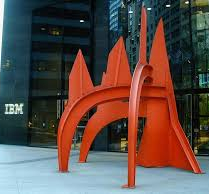
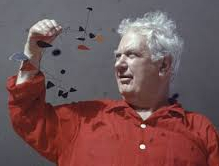
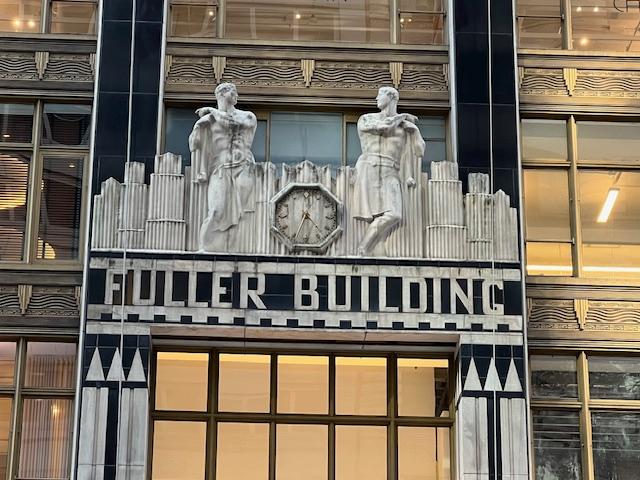
Walking past the IBM Building again, it was nice to finally discover that the sculpture outside the building was an Alexander Calder, the famous “Saurien”, that he created to emulate a reptile. This interesting and unusual sculpture deserved a second look. Other buildings that stand out in the neighborhood have been mentioned in Day One Hundred and Forty of MywalkinManhattan.com are the Fuller Building at 41 East 57th Street and 465 Park Avenue. Look up and notice their detail and artworks that line the outside of these buildings.

saurien-calder.jpg

Saurien by Alexander Calder

Alexander Calder

Alexander Calder artist

http://www.calder.org/

*This sculpture has been replaced by a sculpture by Joel Shapiro

The new Joel Shapiro work “Untitled”

The sculpture during the day.

The sign for “Untitled”

Artist Joel Shapiro

https://en.wikipedia.org/wiki/Joel_Shapiro

https://www.pacegallery.com/artists/joel-shapiro

Mr. Shapiro is an American born artist from New York City who graduated both with a BA and MA from New York University. He is best known for his sculptures of abstract human forms (Wiki).

When walking around East 57th to East 56th Streets, please be careful of the security around Trump Tower. They watch everything you do and it is best to just walk around this part of the neighborhood between Fifth and Madison Avenues. Most of the buildings on this block stretch from one block to the next.

Trump Building at 725 Fifth Avenue is where the security is tight

https://www.trump.com/residential-real-estate-portfolio/trump-tower-new-york

When walking down East 55th Street from Fifth Avenue back to Lexington Avenue, stop and notice the building at 116 East 55th Street, home to the SUNY Global Center. The building was the former mansion to the Zeigler family and was built between 1926-1927. The house was designed by architect William L. Bottomley in the ‘Neo-Georgian style’ and features Flemish blond brickwork on the outside. William Zeigler Jr., who owned the house with his wife, Helen was a businessman, sportsman and philanthropist (Wiki).

Zeigler House SUNY at 116 East 55th Street

The historical marker of 116 East 55th Street

https://en.wikipedia.org/wiki/William_and_Helen_Ziegler_House

I finished the first day of the neighborhood at East 55th Street and had dinner at Tri Dim Shanghai Restaurant at 1378 Third Avenue (see review on TripAdvisor). Their food is excellent and you have to try their Soup Dumplings that they are noted for.

Tri Dim’s Soup Dumplings are excellent

They burst in your mouth with each bite and their Classic Chicken, which is cooked in what I figure is a honey, soy and plum sauce is just excellent.

tri-dim-iii.jpg

Tri Dim’s Classic Chicken is excellent

Tri Dim Shanghai Restaurant at 1378 Third Avenue

For dessert, it was time to revisit Bon Vivant Bakery at 231 East 58th Street for dessert (See reviews on TripAdvisor and DiningonaShoeStringinNYC@Wordpress.com). I had one of their Rose Petit Fours ($4.00) and it was just excellent. A subtle sweetness with the accent of the rose extract that is used in the filling and the icing. These delightful cakes can be eaten in the two tier bakery and it is fun to watch the world go by.

Bon Vivant II.jpg

Bon Vivant at 231 East 58th Street is wonderful for desserts (Closed January 2021-Moved to Jersey City, NJ)

https://bonvivantnewyork.com

On my second day of walking the Streets of Midtown East I had just finished a busy day at Holy Apostles Soup Kitchen working in the busy Bread Station and was exhausted by the time I got to East 55th Street. I stopped along the way for a Chicken Empanada at Empanada Suprema (see reviews on TripAdvisor and DiningonaShoeStringinNYC@Wordpress.com) at the corner of East 38th Street and Broadway for a quick lunch. This little stand is open only during the week and had the most delicious chicken, beef and cheese empanadas for $2.00! I love his sign with the Caped Empanada.

Empanada stand III.jpg

Empanada Suprema at the corner of West 38th Street & Broadway

In 2024.

The empanada’s are delicious

The Chicken Empanadas are wonderful with a little hot sauce

Don’t miss admiring the famous Friar’s Club at 57 East 57th Street. This beautiful building was built for Investment Banker Martin Erdman in 1908 by architect Alfredo S.G. Taylor and was designed in the ‘English Renaissance’ style.

The Friars Club at 57 East 55th Street

https://en.wikipedia.org/wiki/New_York_Friars_Club

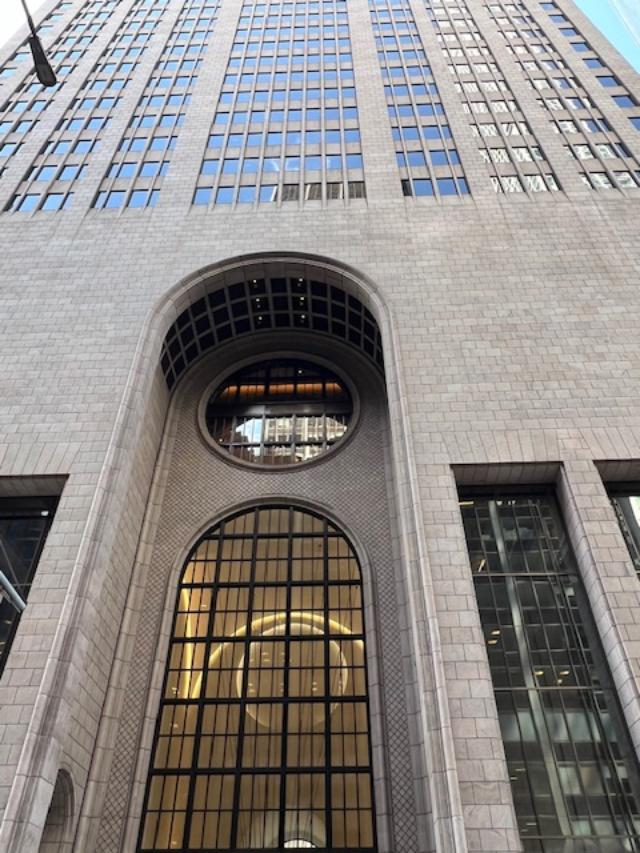
When walking the bottom of East 55th Street from Lexington Avenue, take time again to admire the former AT&T Building at 550 Madison Avenue and IBM Building at 590 Madison Avenue in the distance. These iconic buildings show the resilience and creativity of their corporate owners. They are such interesting designs (see Day One Hundred and Forty Walking the Borders of Midtown East).

Madison Avenue in the 50’s both during the day and at night

One of the most interesting little pocket parks in the neighborhood I found when I rounded the corner at East 54th Street. It was right in front of the Christie’s at 535 Madison Avenue is the Christie’s Sculpture Garden with its small tables and chairs, trees covered with white lights and interesting public art. The artist Jonathan Prince is showing his work, “Shattered I, II and III’ in the garden courtyard.

Christie's Sculpture Garden.jpg

Christie’s Sculpture Garden in front of 535 Madison Avenue with “Shattered Sculptures”

https://www.christies.com/privatesales/christies-sculpture-garden-shatter-by-jonathan-prince

The park in the early Spring of 2024.

The park in the Spring of 2024

The park in the Spring of 202( from the opposite direction

Artist Jonathan Prince is New York born and raised and holds degrees from Columbia University and the University of Southern California. Over the past twenty years, the artist has had a passion for form and material with the use of chaos in his works. His use of steel and CorTen is used in the ‘Shattered’ pieces and they have a reflective element against the white lights of the park (Artist website).

Jonathan Prince artist.jpg

Jonathan Prince in front of his “Shattered Sculptures”

http://www.jonathanprince.com/

This public garden is one of the nicest I have seen in many blocks and it is nice that Christie’s gives us an opportunity to view Public Art on sale while sitting back on the chairs on a nice day and just admire the park and people passing by.

The Kiton Store at 4 East 54th Street is the former home William Earle Dodge Stokes and his former wife, Rita. Mr. Stokes bought the land and leveled the houses that were there and had architects McKim, Mead and White design the marble mansion in 1896. The couple never lived in the house and filed for divorce soon after. The house was then bought by William H. Moore, the founder of Nabisco and his wife, Ada who movements in New York Society were well known. After Mrs. Moore’s death in 1955, the mansion was used for retail purposes (Daytonion in Manhattan).

The Kiton Store Stokes/Moore House at 4 East 54th Store

https://en.wikipedia.org/wiki/William_H._Moore_House

The detail work of the building.

http://daytoninmanhattan.blogspot.com/2010/10/1900-stokes-moore-mansion-4-east-54th.html

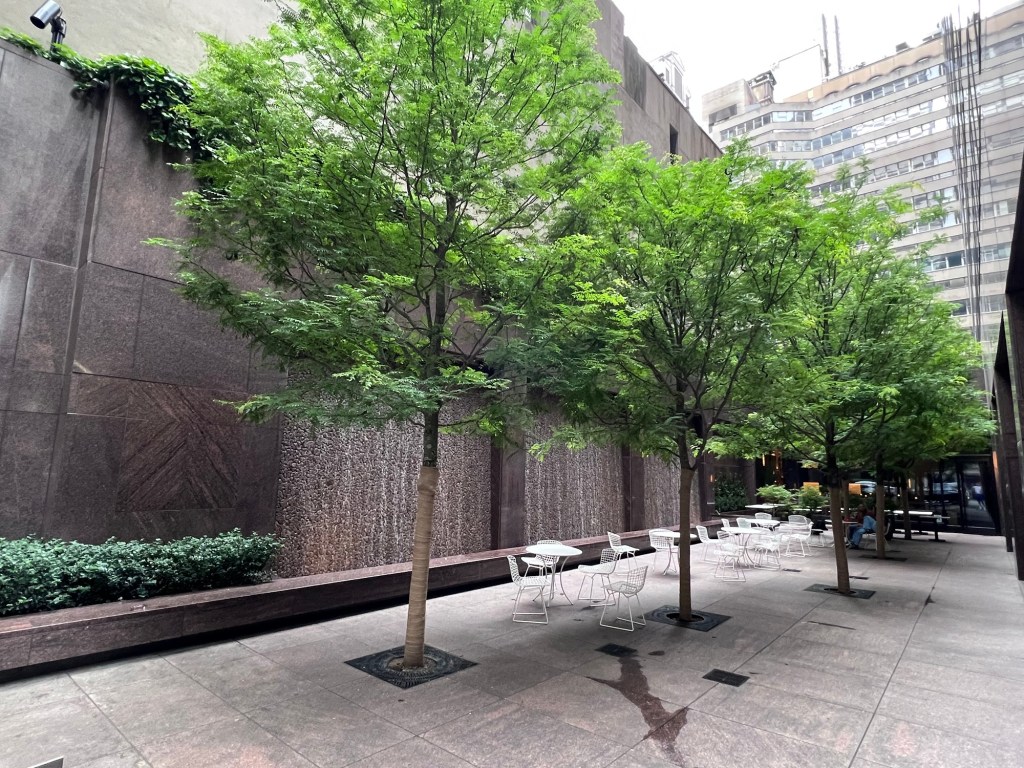
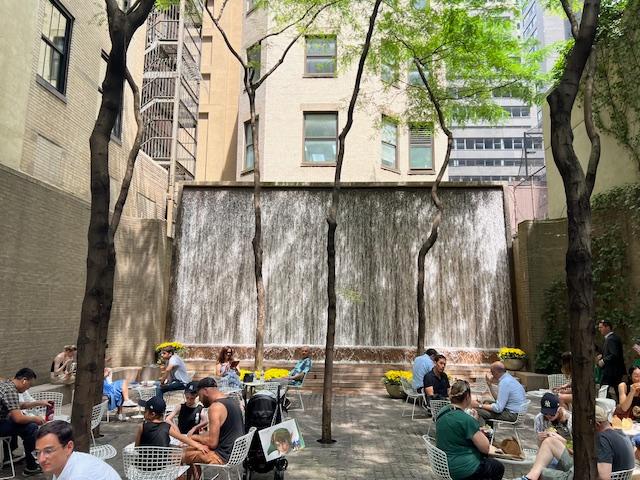
The ironic part of the former Stokes/Moore house is that right behind it when rounding the corner to East 54th Street is the Paley Garden, another small public garden with a waterfall as its centerpiece at 3 East 54th Street. The park was designed by architects Zion Breen Richardson Associates and opened in 1967. CBS Head William Paley financed the park in honor of his father, Samuel Paley (Wiki). This pristine little park is also nice to just sit and relax and listen to the waterfall and drown out the sounds of the City. The rest of East 54th Street is lined with large office buildings and the rush of people walking from one block to the next.

Paley Garden Park at East 53rd Street

https://tclf.org/landscapes/paley-park

The park under renovation in 2024

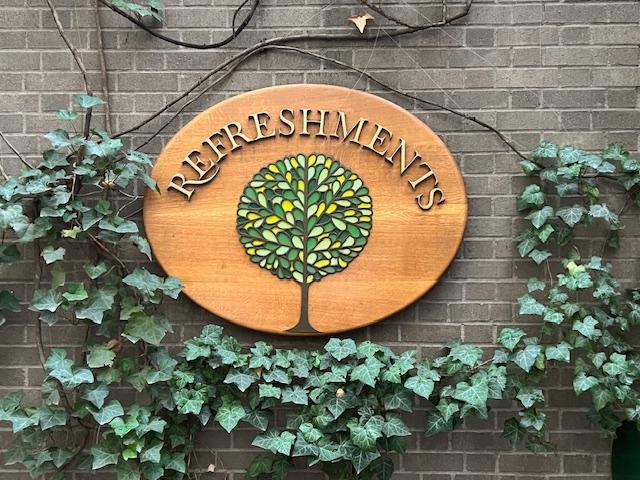
When it is open ‘in season’ don’t miss the Refreshment stand here. The food is pretty good

Rounding East 53rd Street make an effort to stop inside the lobby of 1 East 53rd Street to see the gallery display from the Studio in the School New York City. The works that line the wall of the lobby space of the building is from art students all over New York City.

The Studio in the School is the largest not for profit visual arts education organization in New York City with the mission to “foster the creative and intellectual development of youth through quality visual arts programs, directed by arts professionals. We also collaborate with and develop the ability of those who provide or support arts programming and creative development for youth both in and outside of schools. We fulfill our mission through two divisions; the New York City Schools Program and the Studio Institute” (Studio in the School mission statement).

The Studio in the School Gallery at East 53rd Street

Walking the rest of East 53rd and then onto East 52nd and East 51st is lined with large office buildings that stretch from one block to the other. Most of this part of the neighborhood was knocked down in the late 1960’s for commercial use.

This little dragon protects the museum.

The Studio in the School gallery.

When walking down East 50th Street there is a small gem of a public pocket park at the south side of East 50th Street between Madison and Park Avenues. Created by the MTA (Metropolitan Transportation Authority in 2014, this little park called the “50th Street Commons” features a water feature ‘waterfall’ that turns colors from blue to green to yellow to fuchsia. This unique little park surrounded by exotic plants is another nice place to just sit and relax (Murray Hill, Gramercy and Midtown East Paper).

The “50th Street Commons” on East 50th Street

It changes colors in front of you

https://gothamist.com/news/photos-mta-opens-adorable-pocket-park-on-east-50th-street

Across the street from the park and wedged between office buildings is the restaurant, Maloney & Porcelli, which was founded in 1996 and offers “clubby American cuisine” and harks back to an era when lunch time was taken seriously. It stands in contrast to the ever-changing neighborhood.

Maloney & Porcelli.jpg

The restaurant classic, Maloney & Porcelli at 37 East 50th Street

https://www.maloneyandporcelli.com/

When rounding East 49th Street, stop at Tower 49 at 12 East 49th Street, the home of WeWork to see the art exhibition of artist Enrico Isamu Oyama exhibition “Inside Out”. This exhibition located on all side of the lobby. This contemporary and rather unusual exhibition starts with the pillars on both East 49th and 48th Streets to invite you inside (the security at the building is really cool and nice about people looking around). The Tower 49 Gallery offers exhibitions of art free of charge and is open to the public at street level.

Tower 49 Gallery.jpg

Tower 49 Gallery at 12 East 49th Street

http://www.tower49nyc.com/

Artist Enrico Isamu Oyama

Enrico Oyama artist II

https://www.enricoisamuoyama.net/

Mr. Oyama’s work is unique at best with a lot of lines and movement. His work “Quick Turn Structure” consists of interlocking intersections of black and white shapes and the unique style replaces letters with lines, highlighting their dynamic motion through the process of repetition that subsequently creates and abstract form with angular points and three-dimensional depth (Artist Press Release).

tower-49-gallery-ii.jpg

Tower 49 Gallery

Mr. Oyama is originally from Tokyo and is now based in New York City and likes to create a visual art in various mediums that features Quick Turn Structure, the motif composed of spontaneous repetition and expansion of free-flowing lines influenced by the aerosol writing of the 1970’s-1980’s New York and beyond (Artist Press Release).

enrico-oyama-artist.jpg

Artist Enrico Isamu Oyama in front of the project

https://www.enricoisamuoyama.net/

Opening in a former upscale Italian restaurant, Joe’s Home of the Soup Dumpling at 7 East 48th Street has been packing them in in 2021. I am not sure if they are part of the former Joe’s Shanghai that used to be located in Chinatown but this restaurant is gaining a reputation for their Soup Dumplings.

Joe’s Home of Soup Dumplings at 7 East 48th Street opened in 2021

The evening I went there I just happened to come across it and decided to have dinner. The Soup Dumplings ($11.95) are amazing. These are larger than most I have had recently and were loaded with fresh ground pork and crab and steamed perfectly. I ate these six little delights quickly and enjoyed my Shanghai Wonton Soup ($5.25) and Beef Scallion Sandwich ($8.95) as well. The food and service were excellent. Another time I was there, I had the Pork and Shrimp Spring rolls ($5.95) that are excellent.

I highly recommend the Soup Dumplings here

Dinner on a recent night of Crab and Pork Soup Dumplings and Pork and Shrimp Spring rolls.

Follow the neon sign to Joe’s.

If you are in need of a public bathroom, try the fourth floor of Saks Fifth Avenue in the Men’s Department. When the store is open, this is one of the most convenient places to go to the bathroom in the area.

When proceeding down East 48th Street, take a stop in front of 4 East 48th Street, The Church of Sweden. This Neo-Gothic Church was built in 1921 for “The Bible House” and was sold to the Church in 1978. There is a library and cafe that are inside and open to the public. For the most part, the rest of East 48th Street is filled with large buildings that stretch from side to side.

Church of Sweden at 4 East 48th Street

https://www.svenskakyrkan.se/newyork/information-about-the-church

The detail work of Church of Sweden.

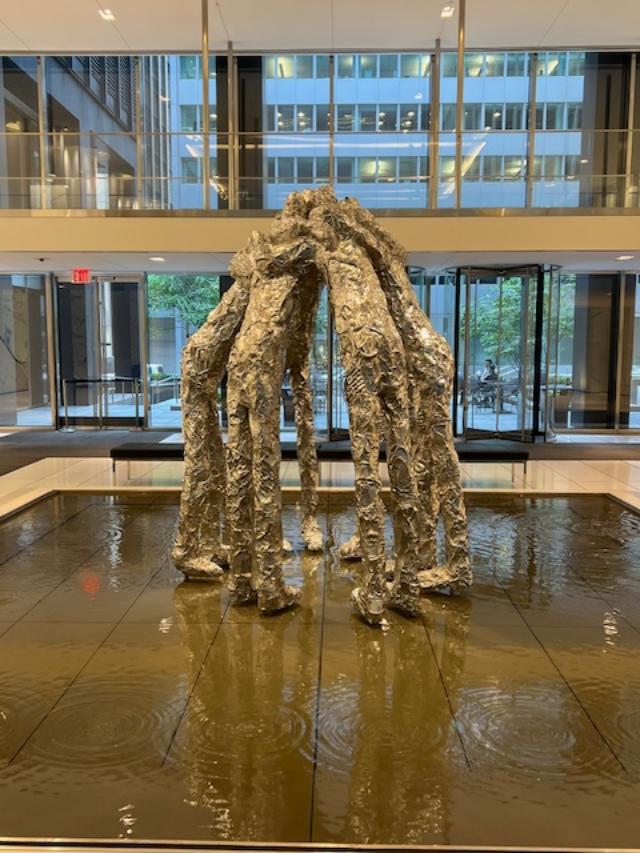
There is one stand out piece of artwork in the lobby of 280 East 48th Street of four people hunched over in a circle. As hard as I tried though I don’t know who the brilliant artist is of the work (in 2024 when I revisited the building I still could not find the plaque to the artist).

The lobby sculpture at 280 East 48th Street

Rounding East 47th Street, take a trip back in time to Manhattan of the 1970’s inside of Phil’s Stationary at 9 East 47th Street. I was talking to the gentlemen who were running the store and told them I had not seen inventory like this on sale in a long time. Hard to find things like stationary, note pads, typing paper and ribbon and even recommendations to a place to fix the typewriter. This stationary store harks back to the days when people left the office to go shopping for things needed at the last minute. They still sell pens, pencils and even the old accounting ledger books. The nice part is that it still smells like a stationery store.

Phil's Stationery

Phil’s Stationery at 9 East 47th Street

http://philstationery.blogspot.com/

Most of the Streets between East 47th to East 46th Streets are lined with larger office buildings that stretch from block to block with a smattering of small businesses here and there. One standout at 556 Fifth Avenue at the entrance of East 46th Street is the Philippine Consulate General which services Philippine nationals in the Northeast states. This unique building is one of the last holdovers from the Country buildings that used to line this part of Fifth Avenue in the 1960’s, 70’s and 80’s. The building was designed by Carrere & Hastings in 1912 for the Knoedler and Company Art Gallery.

The Philippine Consulate at 556 Fifth Avenue

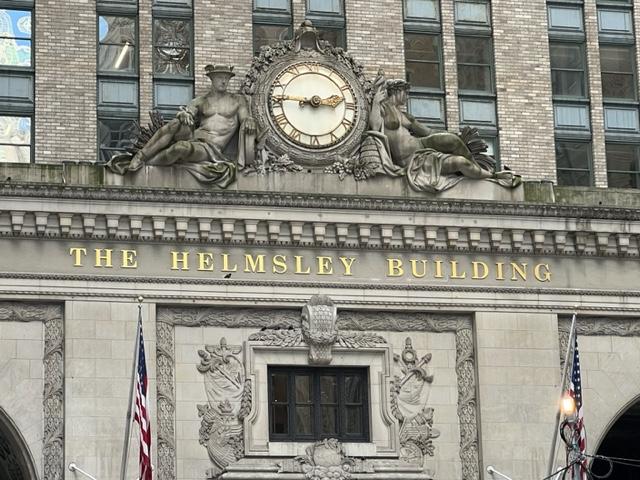
On the edge of East 46th Street sits the famous Roosevelt Hotel and the Helmsley Building which sit as the old guards to the neighborhood once known as “Terminal City”. The Helmsley Building at 230 Park Avenue was originally built for the headquarters of the New York Central Building in 1929 by Warren & Wetmore in the Beaux-Arts style. These are also the architects of Grand Central Station behind it that stands guard of the neighborhood from Turtle Bay to Midtown East.

The Helmsley Building at 230 Park Avenue stands guard over this part of Park Avenue

https://en.wikipedia.org/wiki/Helmsley_Building

The details of the Hemsley Building.

The statues in the front of the building.

The Hemsley Building historical marker

The historical marker for the walkway and drive through.

The decorations in the Helmsley Building walkway.

The Helmsley Building at night

The Roosevelt Hotel at 45 East 46 sits between East 46th and 45th Streets next to Grand Central Terminal. The hotel was designed by architect George C. Post & Son in 1924 and was once part of a series of hotels that made up “Terminal City” that stretched along both sides of Grand Central. The hotel was named for President Teddy Roosevelt and even had a childcare service in ‘The Teddy Room’.

roosevelt-hotel-1.jpg

The Roosevelt Hotel at 45 East 46th Street

http://www.theroosevelthotel.com/

The faded Roosevelt Hotel being used as an immigrant intake center in 2024.

The Roosevelt Hotel’s other faded entrance.

These embellishments stare at you when you pass the hotel.

The embellishments also take a glance at you as well.

Take time to walk around these impressive buildings and look at the outside stone carvings and elaborate lobbies. The lobby of the Helmsley Building is impressive with its marble floors and impressive chandeliers.

On the corner of Fifth Avenue and East 46th Street tucked behind the Barnes & Noble bookstore I had lunch at a new branch of Joju at 555 Fifth Avenue, which had just opened that afternoon with a soft opening. I had some of their Vietnamese spring rolls which were filled with ground pork and vegetables and were cooked to perfection.

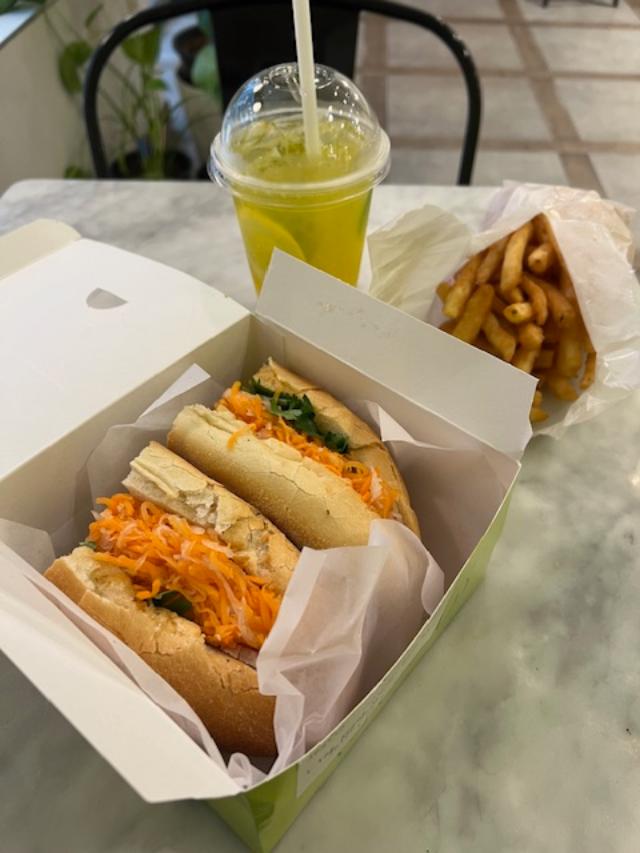
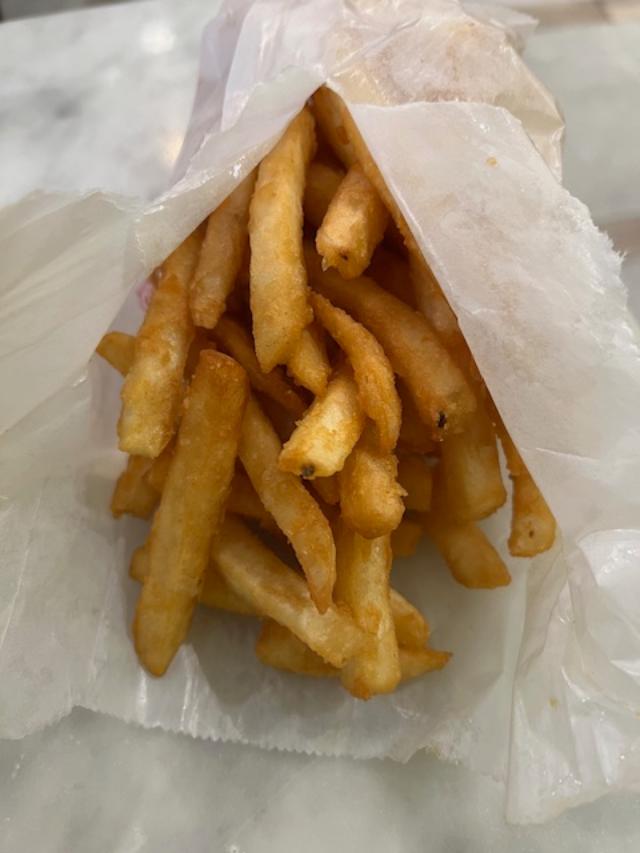
On another occasion to visit the restaurant, I had the Vietnamese sandwich with Caramel Pork and fish sauce and a side plain double-fried French Fries and a Lemon/Leechee Mojito Lunch did come to almost $22.00 but the sandwich can feed two and it is worth the indulge. The service there is really nice as well.

JoJu is a new addition to the Fifth Avenue restaurants at 555 Fifth Avenue

https://www.jojuny.com/

The inside of Joju

My Bahn Mai Sandwich with the Double Cooked Fries and a Leechee Lemon Mojito

The sandwich was delicious and so good!

The fries are excellent and so crispy

The Lemon Leechee Mojito was so refreshing on a hot day and all their drinks are so creative

Tucked into the side of the Helmsley Building at the corner of East 45th Street and Vanderbilt Avenue is Urbanspace Vanderbilt, an indoor food court with some of the most hip and innovative local restaurants in New York City.

The outside of UrbanSpace, the original in Vanderbilt Hall

The inside of the UrbanSpace at Vanderbilt Hall

https://www.urbanspacenyc.com/urbanspace-vanderbilt

My review on TripAdvisor:

https://www.tripadvisor.com/Restaurant_Review-g60763-d8726958-Reviews-Urbanspace_Vanderbilt-New_York_City_New_York.html?m=19905

These artisan and chef driven restaurants are outposts of the original neighborhood restaurants including well-known names of Roberta’s Pizza and Dough Doughnuts.

Dough at the UrbanSpace Vanderbilt

https://www.doughdoughnuts.com/location/dough-urbanspace-vanderbilt/

My review on TripAdvisor:

https://www.tripadvisor.com/ShowUserReviews-g60763-d17450439-r950268732-Dough-New_York_City_New_York.html?m=19905

The Hibiscus Doughnut at Dough is the best.

The doughnut is incredibly delicious.

The company UrbanSpace has been creating these experiences since 1993 since the company’s establishment in 1972 in Great Britain. Don’t miss the vibrancy of the atmosphere and the smells that waft through the hall at lunch time. I love going to Dough that occasional $4.00 doughnut that is well worth it. UrbanSpace food court in the corner of the Helmsley Building on East 49th Street

https://www.urbanspacenyc.com/w52nd

The rest of East 45th and 44th Streets are lined with small office buildings and stores and along Madison Avenue the headquarters of Brooks Brothers (Closed 2020) and Paul Stuart stores that cater to the City professionals and “preppie class”.

Brooks Brothers at 346 Madison Avenue (Closed 2020)

https://daytoninmanhattan.blogspot.com/2023/08/the-1915-brooks-brothers-building-346.html#google_vignette

You can still see the Brooks Brothers emblem on the old store.

Midtown East is now mostly a commercial neighborhood lined with office buildings and retail businesses but as you walk the streets here and there things still pop out and amaze you. It really shows the complexity of the City at its best and how a little creativity and renewal can change a space from one use to another.

That shows the imagination of the people who keep making Manhattan a unique experience.

Check out my other blogs on Walking Midtown East:

Day One Hundred and Forty-Three-Walking the Borders of Midtown East:

https://wordpress.com/post/mywalkinmanhattan.com/9841

Day One Hundred and Forty-Five-Walking the Avenues of Midtown East:

https://wordpress.com/post/mywalkinmanhattan.com/10332

Day One Hundred and Forty-Six-Walking the Streets of Midtown East:

https://wordpress.com/post/mywalkinmanhattan.com/10451

Places to Eat:

Empanada Suprema

A Food Cart on the Corner of West 38th Street & Broadway

Not sure of hours

My review on TripAdvisor:

https://www.tripadvisor.com/Restaurant_Review-g60763-d3617697-Reviews-Empanada_Stand-New_York_City_New_York.html?m=19905

My review on DiningonaShoeStringinNYC@Wordpress.com:

https://wordpress.com/post/diningonashoestringinnyc.wordpress.com/926

JoJu Fifth Avenue

555 Fifth Avenue

New York, NY  10036

(332) 204-2278

Open: Sunday & Saturday 11:00am-5:00pm/Monday-Friday 11:00am-7:00pm

My review on TripAdvisor:

https://www.tripadvisor.com/Restaurant_Review-g60763-d19113235-Reviews-JoJu-New_York_City_New_York.html?m=19905

Bon Vivant

231 East 58th Street

New York, NY 10022

(646) 481-4044

Open: Sunday-Monday Closed/Tuesday-Friday 9:30am-7:30pm/Saturday 9:30am-6:30pm

My review on TripAdvisor:

https://www.tripadvisor.com/Restaurant_Review-g60763-d12375755-Reviews-Bon_Vivant_New_York-New_York_City_New_York.html?m=19905

My review on LittleShoponMainStreet@Wordpress.com:

https://wordpress.com/post/littleshoponmainstreet.wordpress.com/253

Tri Dim Shanghai Restaurant

1378 Third Avenue

New York, NY  10075

(212) 585-3388

Open: Monday-Friday 11:45am-10:00pm/Sunday-Saturday 12:00pm-10:00pm

My review on TripAdvisor:

https://www.tripadvisor.com/Restaurant_Review-g60763-d13322870-Reviews-Tri_Dim_Shanghai-New_York_City_New_York.html?m=19905

Urbanspace Vanderbilt

East 45th and Vanderbilt Avenue

New York, NY 10169

(646) 747-0810

Open: Sunday & Saturday 9:00am-5:00pm/Monday-Tuesday 6:30am-9:00pm/Wednesday-Friday 6:30am-10:00pm

My review on TripAdvisor:

https://www.tripadvisor.com/Restaurant_Review-g60763-d8726958-Reviews-Urbanspace-New_York_City_New_York.html?m=19905

Joe’s Home of Soup Dumplings

7 East 48th Street

New York, NY  10017

(212) 333-3868

http://joestower49.com/

Open: Sunday 12:00p,m-8:45pm/Monday-Friday 11:00am-9:00pm/Saturday 12:00pm-8:45pm

My review on TripAdvisor:

https://www.tripadvisor.com/Restaurant_Review-g60763-d23257370-Reviews-Joe_s_home_Of_Soup_Dumplings-New_York_City_New_York.html?m=19905

Places to visit:

Christie’s Sculpture Garden

66 East 55th Street

New York, NY 10022

(413) 229-9063

http://www.jonathanprince.com/christies-sculpture-garden-1

Tower 49 Lobby Gallery

12 East 49th Street

New York, NY  10017

https://www.tower49gallery.com/

Studio in the School Gallery

1 East 53rd Street

New York, NY  10022

My review on VisitingaMuseum.com:

https://wordpress.com/post/visitingamuseum.com/4376

50th Street Commons

48 East 50th Street

New York, NY  10022

http://www.mta.info/news-east-side-access-long-island-rail-road-mta-capital-construction/2014/09/16/50th-street-commons

Paley Garden Park

3 East 53rd Street

New York, NY  10022

Open: Sunday-Saturday 8:00am-8:00pm

(212) 639-9675

https://www.pps.org/places/paley-park

Places to Shop:

Phil’s Stationary

9 East 47th Street

New York, NY  10017

(212) 688-4144

Open: Sunday & Saturday Closed/Monday-Friday 9:00am-6:00pm

http://philstationery.blogspot.com/

Saks Fifth Avenue

611 Fifth Avenue

New York, NY  10022

(212) 753-4000

Open: Sunday 11:00am-7:00pm/Monday-Saturday 10:00am-8:30pm

https://www.saksfifthavenue.com/Entry.jsp

(Great for their public restrooms during business hours)

All the buildings and street art that is mentioned in this walk is done by address and street to make it easy to find. Please note the buildings and pocket parks that you should not miss.

The Helmsley Building Clock

Day One Hundred & Forty-Five: Walking the Avenues of Midtown East Park & Madison Avenues from East 43rd Street to East 59th Streets September 5th, 2019 (again December 21st, 2024)

I have been running in and out of the City since I started teaching classes again at the college and had a ‘bucket list’ of small museums that I wanted to visit for my blog, “VisitingaMuseum.com” and restaurants I wanted to try before the Summer was over. So there was a lot of running around the last several weeks. That’s why the blogs come out a little later than usual.

I got back to finishing my walk around ‘Midtown East’ by walking the only two Avenues inside the neighborhoods borders, Madison and Park Avenues from East 43rd Street (which hugs the Turtle Bay neighborhood) and East 59th Street (which hugs the Upper East Side & Sutton Place). On the Avenues in this part of the neighborhood is mostly residential and commercial spaces with rows glass boxes on some streets and limestone and marble residential buildings one the others. There is a lot of sameness in the architecture here but don’t let that fool you. There are a lot of interesting things to see and places to visit in this very much working modern neighborhood.

My walk started on Madison Avenue’s commercial district at the start of East 43rd Street where a giant new glass box is being created right next to Grand Central Station. Probably not Mr. Vanderbilt’s vision for the area but I think he would have been impressed by the progress the area has experienced in the last 100 years.

My first stop is admiring and walking into the headquarters of Brooks Brothers Clothing store at 346 Madison Avenue, one of the most American and famous clothing stores in the United States. Stepping into Brooks Brothers is like a step back into time when shopping was still experience and customer service actually meant something. Their displays are elegant without being stuffy.

brooks-brothers-building-ii.jpg

The elegant displays at Brooks Brothers main floor (now closed)

The store was designed by architects La Farge & Morris in 1915 the Italian Renaissance design with prominent arched entrances, wrought iron arches and carved limestone details around the building. You can see the detail work in the cornices that line the top of the building.

The Brooks Brothers headquarters at 346 Madison Avenue (the now closed headquarters)

The detail work on the now closed Brooks Brothers headquarters

https://www.brooksbrothers.com/

The Golden Fleece emblem of Brooks Brothers on the front of the building.

Another great clothing store is Paul Stuart at Madison Avenue and East 45th Street. The store has been in business since 1938 and carries some of the most impressive clothing and accessories for Men and Women.

Paul Stuart Specialty Store at Madison & East 45th Street

https://www.paulstuart.com/

The store was a privately held family business until December of 2012 and then it was sold it’s long time partner, Mitsui. The store has changed a lot since the sale. It once had some of the best customer service in all the specialty stores in Manhattan but when I went to visit on this trip in my shorts and polo, the three sales people on the floor at the time ignored me. It’s not the same store with the orange carpet and older, more mature salespeople.

Paul Stuart II.jpg

The Men’s Department after the renovation

When you get to Madison and 55th Street, watch for the security as this is the back section of Trump Tower and East 55th Street between Madison and Fifth Avenues is blocked off by barriers and armed NYPD detectives and police. Only one side of the street is open here so it is best to keep walking.

Another impressive building on Madison Avenue is at 550 Madison Avenue, the old AT&T Building with its signature ‘Chippendale’ roof. This building was considered radical and innovative at the same time when AT&T built it to house their world headquarters. The 37 story building was designed by famed architect Philip Johnson  in 1984 in the postmodern design. Critics called it ‘Chippendale’ after the famed furniture due to the ‘open pediment’ look of the top of the building based on English furniture design (Wiki). The building is currently have some lobby renovations that I passed.

ATT Building.jpg

550 Madison Avenue

https://en.wikipedia.org/wiki/550_Madison_Avenue

Looking up at the building from Madison Avenue.

The entrance of the ATT Building.

The Plaza next to the old ATT Building

The beautiful atrium that you can sit and relax in between the buildings.

Next to the AT&T Building is the IBM Building at 590 Madison Avenue. This 41 story building was built in 1983 by architect Edward Larrabee Barnes & Associates and developed by IBM and designed in the post-modern design (Wiki).

IBM Building.jpg

The IBM Building at 590 Madison Avenue & East 57th Street

https://en.wikipedia.org/wiki/590_Madison_Avenue

Because of the zoning laws established in 1916, there is a beautiful and relaxing open atrium filled with food kiosks and art work for the public to enjoy on the ground level. It is a nice place to relax after a long walk. Take time to admire the art works that line the atrium.

The Atrium at the IBM Building

Artist George Rickey’s work in 2024 in the atrium.

The George Rickey piece inside the atrium “Five Lines Diagonal Jointed II”

Artist George Rickey

https://www.georgerickey.org/

https://en.wikipedia.org/wiki/George_Rickey

Artist George Rickey was an American born artist with multiple degrees and places of study. He holds a MA from B.A. (Modern History), Balliol College, Oxford, U.K. and a M.A. (Modern History), Balliol College, Oxford, U.K. He also did graduate study in Art History, Institute of Fine Arts, New York University, New York, NY. George Rickey worked as painter, muralist, and sculptor. Across his diverse body of work from the paintings of the 1920s through the final sculptures of the 2000s, there are four themes that emerge: Movement, Color, Relationships, and Scale (Artist bio).

One piece of art that stands out is the red geometric sculpture on the corner of Madison and East 57th Street is the great artist Alexander Calder “Saurien” (which is a large reptile), that was created by the artist in his studio in 1975. This is an example of Calder’s “Stoic”  work and were called ‘stabiles’ because these abstract works, unlike his floating works of art, stand strongly and firmly into the ground (Art Nerd 2018).

ibm-building-ii.jpg

The Alexander Calder sculpture, “Saurien” (now replaced by another sculpture by artist Joel Shapiro)

Walk around this wonderful work by Calder and try to take a breath and understand what the artist was trying to say. It is almost like all the ‘legs’ on the sculpture are trying to show stability and contrast.

alexander-calder.jpg

American Artist Alexander Calder

http://www.calder.org/

*This sculpture has been replaced by a sculpture by Joel Shapiro

The new Joel Shapiro work “Untitled”

The sculpture in the day.

The sign for “Untitled”

Artist Joel Shapiro

https://en.wikipedia.org/wiki/Joel_Shapiro

https://www.pacegallery.com/artists/joel-shapiro

Mr. Shapiro is an American born artist from New York City who graduated both with a BA and MA from New York University. He is best known for his sculptures of abstract human forms (Wiki).

Inside the atrium, there are two interesting pieces of artwork that standout. There are two colorful acrylic apples that are done in colorful motifs that you should not miss. The sculptures were created in 2004 for the “Big Apple Fest” to promote the City’s tourism. Companies paid $8,500.00 to sponsor  and $12,500 to keep the apples in which artists were allowed to decorate inside or outside.

One of them is entitled “A Day in the Big Apple” by an artist named Billy.

‘A Day in the Big Apple’ by artist Billy

The other is of a colorful face by artist Romero Britto entitled “New York Future”.

“New York Future” by artist Romero Britto

Romero Britto is a Brazilian born American artist whose colorful works elude the optimism the artist has on his view of the world. He uses bold and colorful patterns to enhance his works (Artist Bio).

romero-britto-artist-ii.jpg

Brazilian Artist Romero Britto

https://britto.com

When you reach the edge of the neighborhood at East 59th Street, you are greeted by the former GM Building that stretches from Fifth to Madison Avenues.  This elegant 50 story building once represented the presence of GM in New York City. It was designed by the architectural firms of Edward Durell Stone & Associates and Emery Roth & Sons in 1968. It was designed in the “International Style” and stands guard at the end of the commercial district of Midtown East and the Upper East Side.

The GM Building stands guard at 767 Fifth Avenue

https://en.wikipedia.org/wiki/General_Motors_Building_(Manhattan)

As you cross back down Madison Avenue on East 59th Street, you will notice the ever-changing retail landscape and all the empty storefronts on this part of Madison Avenue. Twenty years ago, this would not have existed, but it is a sign of the times.

The details of the Fuller Building at 41 East 57th Street

https://en.wikipedia.org/wiki/Fuller_Building

The detail work on the Fuller Building.

The Fuller Building at 41 East 57th Street

https://en.wikipedia.org/wiki/Fuller_Building

Another interesting building to admire is the Fuller Building at 41 East 57th Street on the corner of Madison Avenue. The building was created for the Fuller Construction Company in 1929 by architects Walker & Gillette in the ‘Art Deco Style’. The building’s exterior sculptures were designed by architect Elie Nadelman. Look at the interesting details not just on the outside of the building but walk into the lobby to take a look around (Wiki).

One of the great hotels in New York City stands guard at 455 Madison Avenue and 50th Street, the New York Palace Hotel (formerly the Helmsley Palace Hotel) which is a combination of an old mansion and the modern building behind it. The front of the building facing Madison Avenue is the former Villard Mansion.

New York Palace Hotel at 455 Madison Avenue

https://en.wikipedia.org/wiki/Lotte_New_York_Palace_Hotel

The front of the hotel is the “Villard Houses” created in 1882 for Henry Villard, a railroad financier, who worked with the architectural firm of McKim, Mead & White to create a series of six brownstone townhouses facing a courtyard in the ‘Italian Neo-Renaissance style’. Developer Harry Hemsley leased the houses and hired Emery Roth & Sons to create the 55 story modern hotel in the back of the houses.

The Villard Houses part of the New York Palace Hotel

The hotel at Christmas 2024

The Villard Houses at the hotel decorated for the Christmas holidays

The hotel opened in 1981 as the notorious ‘Helmsley Palace Hotel’ with hotelier Leona Helmsley in charge. Considered one of the best hotels at the time, it was a five star/five diamond hotel (with one of the most nervous staffs in New York City). The hotel has been owned by Lotte Hotels & Resorts since 2015.

NY Palace Hotel III.jpg

The inside of the New York Palace Hotel, the Villard Houses

Take time to walk through the hotel from the East 50th Street entrance to the East 49th Street exit and walk around the public rooms and admire the architectural details from the Gilded Age. There are elegant features from staircases to marble fireplaces and the most beautiful views on Madison Avenue.

I found this pardon of the Helmsley Hotel on YouTube. It is very clever.

Another older hotel that stands out is the Roosevelt Hotel at 45 East 45th Street at the corner of Madison Avenue and East 45th Street. It stands guard next to Grand Central Station.  The hotel opened in 1924 and was designed by the architectural firm of George P. Post & Son for businessman, Frank A. Dudley and it was ran by United Hotels Company from a leased agreement with the New York Central Railroad. Like the other hotels that line Lexington Avenue, there used to be a separate passageway from the railroad to the hotel (Wiki).

roosevelt-hotel.jpg

The Roosevelt Hotel at 45 East 45th Street

http://www.theroosevelthotel.com/

The Roosevelt Hotel being used as a immigration center in 2023 and 2024

This is similar hotel to take the time to walk through the lobby and look at the vaulted ceilings and the Gilded Age details of the hotels with its thick carpets and elegant staircases. The hotel has a somewhat dark, more European feel to it. There is a lobby restaurant when open that looks pretty interesting.

roosevelt-hotel-ii.jpg

The entrance to the lobby at the Roosevelt Hotel in its heyday.

As you walk around Grand Central Terminal and through the archway pedestrian tunnels that lead to Park Avenue from East 45th to East 46th Streets, you will be traveling under the Helmsley Building at 230 Park Avenue that stands guard at the beginning to the business and residential neighborhood of Park Avenue.

The Helmsley Building at 230 Park Avenue

https://en.wikipedia.org/wiki/Helmsley_Building

The Helmsley Building was built in 1929 as the New York Central Building for the rail company and was designed by architects Warren & Wetmore, who also designed Grand Central Terminal, in the ‘Beaux-Arts style’. Take time to admire the statuary around the clock that dominates its front and the beautiful stone detail work of the exterior of the building.

The beautiful details of the Helmsley Building on Park Avenue

The beautiful statuary.

The historical marker of the Helmsley Building.

The New York Central used the building as its starting point of “Terminal City”, a series of buildings and hotels that the railroad developed on the top of the rail line (Wiki). The true beauty of The Helmsley Building is at night when the owners put on a light show illuminating the building with colorful spotlights.

Helmsley Building.jpg

The Helmsley Building light show after dark

Park Avenue in the East 40’s is quite amazing at night

All along Park Avenue is a series of ‘glass boxes’ for office buildings and residential towers that line the Avenue all the way up to East 96th Street at the exit of the rail line. Along the way, there are some interesting examples of architecture that line Park Avenue.

The Waldorf-Astoria Hotel at 301 Park Avenue is currently closed and under scaffolding awaiting its new life as a small hotel and condo complex. The hotel, as mentioned in previous blogs in ‘MywalkinManhattan.com’, was built and opened in 1931. It was designed by the architectural firm of Schultz & Weaver in the ‘Art Deco style’ and is probably one of the most famous and talked about hotels in New York City outside the Plaza Hotel (Wiki). There have been so many movies and TV shows filmed and written about the hotel to count and the restaurants inside the hotel were some of the better ones in New York City. The building will open sometime in the future.

Waldorf-Astoria Hotel II.jpg

The Waldorf-Astoria Hotel at 301 Park Avenue (currently under renovation)

https://www.hilton.com/en/hotels/nycwawa-waldorf-astoria-new-york/

The only part of the hotel I could photo while under renovation in 2024.

St. Bartholomew’s Episcopal Church at 325 Park Avenue is one of the older buildings on Park Avenue and stands alone amongst the bigger buildings on this part of Avenue.  Though the congregation was started in 1835, this structure was built between 1916-17 and designed by Bertram Goodhue, who had designed the St. Thomas Church on Fifth Avenue (See Walking the Border of Midtown East-MywalkinManhattan). The church was designed in the ‘Byzantine Revival Design’ and he was required by the congregation to retain the old church portal from the former church on Madison Avenue and East 44th Street in the new church design (Wiki).

‘St. Bart’s’ Church at 325 Park Avenue

https://stbarts.org/

The detail work on the front door.

The historical plaque at St. Barts

Look at the details of the old church and the stained-glass windows. In the Summer months, there is a wonderful (yet somewhat over-priced) restaurant in the courtyard of the church and there are art markets during the Summer and Christmas holiday season that you should visit. There is also afternoon music at certain times of the year.

St. Barts NY II.jpg

St. Bart’s restaurant and terrace during the summer

One standout, innovative building on Park Avenue sits between East 52nd and 53rd Streets is the Seagram Building at 375 Park Avenue. The building and its exterior designs were created by German American architect Ludwig Mies van der Rohe with the interior Four Seasons Restaurant designed by American architect Philip Johnson.

The Seagram Building at 375 Park Avenue

https://en.wikipedia.org/wiki/Seagram_Building

Seagram Building Plaza, innovative to its time

The fountains are well known in their own right being used in TV and movies

The building was featured prominently in the first episode of “That Girl” in 1965.

This 38-story building of wonder was innovative in its time. Finished in 1958 as the corporate headquarters of Joseph E. Seagram & Sons, the building was noted for its ‘functional aesthetics’ and a prominent example of ‘corporate modern architecture’. Keeping up with modern building codes, the architect used ‘non-structural bronze I-beams and large glass windows’ to create the cool and well-toned exterior structure of the building (Wiki).

Also utilizing the 1916 building code and the new use of open public spaces, the building was one of the first in New York City to embrace the open-air plaza that was prevalent in the 1980’s and early 90’s design. It was an extremely innovative design at the time and still sets the standard for the modern ‘glass box’.

One of the last stand out buildings that I saw on Park Avenue before my walk back down the Avenue was at 465 Park Avenue, The Ritz Tower, an apartment hotel. This elegant residential building stands out because of its details on the exterior of the building and I later learned it was once home to the famous French restaurant, La Pavilion.

The Ritz Tower at 465 Park Avenue

The details of the Ritz Tower

The beautiful embellishments of the Ritz Tower.

https://en.wikipedia.org/wiki/Ritz_Tower

This elegant building was designed by architects Emory Roth and Thomas Hastings for journalist Arthur Brisbane, who was the developer. The apartment hotel was managed by the Ritz-Carlton Company. The exterior of the building has many carved stone features so look closely from the other side of Park Avenue to admire the detail work. Don’t stare too long because the doorman gets a suspicious look if you look too long. He kept looking me over as I admired the building and the read the plaques.

Ritz Tower II.jpg

Look at the elegant details of the Ritz Tower

The historical plaque of the Ritz Tower.

Up and down the Park Avenue Mall is the work of artist Alex Katz “Park Avenue Departure”, of which it looks like the back of a woman who is walking away from some place. The work is a depiction of the artist’s wife, Ada. Each of the works along the mall is changed slightly to show the sculpture in motion as if it is walking down the mall. This street art exhibition will run through November 2019 (The Fund for Park Avenue).

Alex Katz Park Avenue Departure.jpg

Alex Katz’s Park Avenue Mall exhibit “Park Avenue Departure” (closed in December 2019)

Alex Katz is an American artist

https://www.alexkatz.com/

alex-katz.jpg

American artist Alex Katz who was born in Brooklyn, NY and is a graduate of Cooper Union Art College. His long career has seen many changes in art form and today some of his concentrations are in landscape and portraiture. His work can be seen in museums all over the world.

For lunch and dinner that afternoon, I ate at Hop Won Chinese Noodle Shop at 139 East 45th Street between Lexington and Third Avenues (See reviews on TripAdvisor and DiningonaShoeStringinNYC@Wordpress.com). After a long day of walking, I treated myself to a plate of mixed roasted meats, duck and pork, with a side of rice ($9.00) and an egg roll ($1.38). Their roasted meats are a lacquered delight with the rich, crackling skin of the duck worth every bite. The food here is delicious and so reasonable for Midtown East.

Hop Won.jpg

Don’t miss Hop Won at 139 East 45th Street

https://hopwonrestaurant.netwaiter.com/

The Roasted Meats here are really good.

By the end of the evening, I got a chance to double back around the Helmsley Building and look at the detail work of that structure as well and then walked up and down the tiny Vanderbilt Avenue between East 45th and 47th Streets that line next to Grand Central Terminal. The most notable building on this block is the Yale Club at 50 Vanderbilt Avenue. The famous clubhouse was designed by Yale Alumnus and architect James Gramble Rodgers, and it opened in 1915.

yale-club.jpg

The Yale Club at 50 Vanderbilt Avenue; notice the plaque to Nathan Hale on the bottom left

https://www.yaleclubnyc.org/

The Nathan Hale marks one of the two spots where the patriot may have been hung.

Nathan Hale

https://en.wikipedia.org/wiki/Nathan_Hale

https://www.cia.gov/stories/story/nathan-hale-american-patriot-army-ranger-spy/

The most notable item outside the club is the historical mark where supposedly Patriot Nathan Hale was hung. There is a conflict to where it actually took place and there is another site on the Upper East Side (See Walking the Upper East Side Streets in MywalkinManhattan), where that plaque is outside the local Pier One. I personally like that theory better. Where else in American could a Patriot of the Revolutionary War be hung in that two hundred years later would house a retailer that sells Christmas chukkas made in China?

That’s what I love about Manhattan!

Check out my other blogs on Walking Midtown East:

Day One Hundred and Forty-Three-Walking the Borders of Midtown East:

https://wordpress.com/post/mywalkinmanhattan.com/9841

Day One Hundred and Forty-Five-Walking the Avenues of Midtown East:

https://wordpress.com/post/mywalkinmanhattan.com/10332

Day One Hundred and Forty-Six-Walking the Streets of Midtown East:

https://wordpress.com/post/mywalkinmanhattan.com/10451

I have enclosed all the addresses to the interesting buildings you should visit above to make it easier than doing them one by one.

Things to see:

Tour all the famous buildings in the neighborhood

Alex Katz “Park Avenue Departure”

http://www.alexkatz.com/

https://fundforparkavenue.org/pages/sculpture

A little video on Alex Katz’s work

Places to Eat:

Hop Won Chinese Noodle Shop

139 East 45th Street

New York, NY  10017

(212) 867-4996

https://hopwonrestaurant.netwaiter.com/

http://www.wohopchinese.com/

Open: Sunday Closed/Monday-Friday 10:00am-8:45pm/Saturday 11:00am-7:30pm

My review on TripAdvisor:

https://www.tripadvisor.com/Restaurant_Review-g60763-d4760804-Reviews-Hop_Won_Restaurant-New_York_City_New_York.html?m=19905

My review on DiningonaShoeStringinNYC@Wordpress.com:

https://diningonashoestringinnyc.wordpress.com/2019/08/10/hop-won-chinese-noodle-shop-139-east-45th-street-new-york-ny-10017

My review in MywalkinManhattan.com:

https://mywalkinmanhattan.com/tag/hop-won-chinese-noodle-shop/

Day One Hundred and Thirty-Eight: Walking the Borders of Turtle Bay from East 59th Street to East 43rd Street from Lexington Avenue to FDR Drive June 21st, 2019- June 28th, 2019 (again August 6th, 2024) (My Forth Anniversary of ‘MywalkinManhattan.com’)

I can’t believe it is my forth anniversary of my blog, “MywalkinManhattan.com”. What started out as just a simple walk through the entire Island of Manhattan has morphed into visits to the outer boroughs and to outside the City. There is countless restaurant reviews, museum visits, visits to parks and historical parks and window shopping in stores all around the Tri-State area.

These additional views of the City have inspired the extension blogs to this site, “VisitingaMuseum.com”, “LittleShoponMainStreet@Wordpress.com” and “DiningonaShoeStringinNYC@Wordpress.com” to showcase more wonderful things to do, places to see and places to eat in New York City. What started out as a small site has now morphed into a blog that explores all the wonderful things to do and see in neighborhoods all over the City.

The best part of this experience is that I thank all the input that my students have given me on the sites and all the comments that have made it more enjoyable to the reader from adding in TripAdvisor reviews to contributing pictures and videos of the areas discussed. I want to thank them for their ideas and suggestions.

Today I entered the Turtle Bay neighborhood which is located next to Sutton and Beekman Place in the neighborhood that surrounds the United Nations located next to the East River. Over the last twenty years the borders of the neighborhood have become blurred with Midtown with much of Second, Third and Lexington Avenues giving way to large apartment and office complexes. There are still pockets of brownstones with local businesses dotted on the Avenues and side streets but they are becoming few and far between.

Turtle Bay has an interesting history as part of Manhattan. ‘Turtle Bay’ was originally a cove in the East River that was shaped like a knife which the Dutch gave the name “deutal” for knife. The cove was filled in after the Civil War. The neighborhood was originally a forty acre farm named “Turtle Bay Farm” that extended from  what is now East 43rd to East 48th Street and from Third Avenue to the East River. When the street grid system was put into place after the Civil War, the hilly cove and surrounding areas was graded and filled in and subdivided for development (Wiki).

Turtle Bay history

Turtle Bay in the early 1800’s

https://en.wikipedia.org/wiki/Turtle_Bay,_Manhattan

The neighborhood changed dramatically after the Civil War until the turn of the last century when the center of the neighborhood became a brownstone section and the river portion of the area became home to manufacturing with breweries, power plants and laundries and tenement homes to house the workers. The overhead elevated trains on Second and Third Avenues added to the decline of the neighborhood (Wiki).

The rowhouses of ‘Turtle Bay Gardens’ were saved by resident, Charlotte Hunnewell Sorchan. She bought eleven of the brownstone homes and had them renovated  with stucco fronts and a common garden in the back. These have been lived in by celebrities such as actresses Ruth Gordon, June Havoc and Katharine Hepburn. It was named a historic district in 1966 (Wiki).

Turtle Bay Historic District

The historic details on the top of the homes in the Turtle Bay Historic District

The 2,800 unit Tudor City was built between 1927 to 1932 replacing the dangerous shanty town of ‘Prospect Hill’ where Irish gangs ruled and the neighborhood and the rest of the neighborhood was leveled between 1948 and 1952 for the United Nations Headquarters. When the elevated trains were torn down by 1956, it opened the neighborhood to new construction of high rises and apartment buildings (Wiki).

I started the walk at my favorite neighborhood starting point, 24 Sycamores Park on First Avenue and 60th Street, where I mapped out the walk. With schools letting out for the summer, the park was mobbed with kids with their nannies and baby sitters. It was nice to relax after a long day at Holy Apostles Soup Kitchen. They kept me busy on the hot line and we served over 800 lunches that afternoon, so I was tired. It is fun to just sit back on the benches under the trees and watch the kids chase one another and the pigeons.

24 Sycamores Park at 501 East 60th Street

https://www.nycgovparks.org/parks/twenty-four-sycamores-park/history

The park in the Summer of 2024

Since my walk of Sutton Place, East 59th’s empty store fronts are starting to fill up with new businesses again. A lot of the windows are covered with brown paper, so it looks like more businesses are coming to the neighborhood. This is how the City keeps changing. I had covered all of Second Avenue to 48th Street in my blog of Sutton Place and since technically the neighborhood does not start until East 53rd Street, I started the walk East 58th Street between Second and Lexington Avenue and then walked down Lexington Avenue to East 43rd Street and then to the United Nations by the river (I will include East 58th Street to East 54th from Second to Lexington Avenues in my Turtle Bay walks).

I started the afternoon with lunch at Lin’s Gourmet Chinese Restaurant at 1097 Second Avenue (See the reviews on TripAdvisor and DiningonaShoeStringinNYC@Wordpress.com). They have the most amazing lunch specials for between $8.00-$8.50. I had the Beef with Broccoli with a side of pork fried rice and an eggroll ($8.25).

Lin’s Gourmet Chinese Restaurant at 1097 Second Avenue

https://menupages.com/lins-gourmet-chinese-cuisine/1097-2nd-ave-new-york

The quality of the food is excellent as the beef was tender and well-seasoned with a combination of Hunan and soy sauce and the broccoli was perfectly cooked, a rarity in many of these take out places. The service is really friendly too. After lunch, it was off to walk the borders and Avenues of the neighborhood.

The Beef and Broccoli was delicious

Lexington Avenue from East 58th to East 43rd Street is pretty much a commercial district. The left side of the road is lined with famous hotels and luxury apartments. Sharing this edge with Midtown East Manhattan, this area of the neighborhood is geared towards the business world and just keeps developing. I can see more newer buildings replacing the older ones in the future. Most of the hotels have been renovated in the past decade to reflex the increase of tourists into the City.

When crossing East 58th Street from Second to Lexington Avenue, I came across a gem of bakery, ‘Bon Vivant’ at 251 East 58th Street between Second and Third Avenues (See my review on TripAdvisor and LittleShoponMainStreet@Wordpress.com). This elegant little store sells the most delicious Petit fours, pastries and beverages in an elegant atmosphere. I just walked in to see what it was like and I ended up eating a large Lavender Petit Four ($6.00), that was light and sweet with just a hint of the lavender leaves in the filling.  It’s a unique little store where the desserts are displayed like a work of art.

Bon Vivant II

Bon Vivant for pastries at 251 East 58th Street (Closed in August 2022)

https://bonvivantnewyork.com/

Having some energy from the dessert, I continued the walk over the next block to Lexington Avenue. Lexington Avenue is the border of the neighborhood and is more commercial than residential. The Avenue is lined with hotels and office buildings and home to some of the oldest and well-known hotels in Midtown.

On the corner of Lexington Avenue between East 59th and 58th Streets is the Bloomberg Tower at 731 Lexington Avenue, one of the first buildings merging the borders of Turtle Bay with Midtown East. This massive 55 story building of glass and steel was built in 2001 for the Bloomberg L.P., the home of the Bloomberg empire including the offices for the main company and Bloomberg news.

The building was designed by renowned architect, Cesar Pelli & Associates and developed by Vornado Realty Trust. The back part of the building is called One Beacon Court and is home to condos and retail businesses and have their own private entrance. This building replaced the closed but once popular Alexander’s Department Store. Security is really tight around here and the police will watch you (Wiki).

The Bloomberg Tower ushering in a new look modern look for the neighborhood

https://en.wikipedia.org/wiki/731_Lexington_Avenue

Historical buildings especially around Lexington Avenue still prevail. One of the first buildings to really pop out at me on Lexington Avenue was the Central Synagogue at 652 Lexington Avenue on the corner of 55th Street. Designed by prominent architect Henry Fernbach, the synagogue was built between 1870 and 1872 is the oldest continuing synagogue in New York City and the second oldest in New York State. The building is one of the oldest synagogues in the country. The outside of the building was designed in Moorish Revival while the inside exterior is in a Gothic design. The Synagogue practices the Reformed Jewish faith (Wiki).

Central Synagogue at 652 Lexington Avenue

https://www.centralsynagogue.org/

Central Synagogue historical marker.

The historical architecture marker on the Central Synagogue

Another beautiful building is on the corner of Lexington Avenue and East 51st Street, the former RCA Victor Building now known as the General Electric Building. It was designed and built by architect John Cross of Cross & Cross in 1931. The 50 story building was designed in the Gothic style and you really have to look at the details in the structure with the elaborate masonry and architectural figural sculpture all over the building (Wiki).

570 Lexington Avenue

https://en.wikipedia.org/wiki/General_Electric_Building

The building is decorated with lightning bolts and hands with blots in their hands to represent the growth of lightening and electricity. The edges of the building are decorated with figures representing energy and the dome of the building represents ‘Gothic tracery’, representing electricity and radio waves and lit from within at night. There is even a clock with the ‘GE’ logo on it on the side of the building (Wiki).

Look at the detail work of 570 Lexington Avenue

570 Lexington Avenue III

The Gothic Tracery tower of 570 Lexington Avenue

The GE Building historical marker

Lexington Avenue has many such historical buildings up and down the Avenue especially with hotels that dot both sides of the street. Since I started this part of the walk on June 21st, the first day of the Summer (The Summer Equinox) and the longest day of the year, there were concerts everywhere in Midtown. I stopped at 570 Lexington Avenue where they have a courtyard on the side of the building near the subway entrance.

The building was hosting part of a concert series that afternoon for people walking by while the Godiva Chocolate store in the courtyard was handing out ice cream samples to hot patrons. It was enjoyable to just relax and listen to the combo while eating that sweet, rich ice cream.

When walking down the remainder of Lexington Avenue, the street is dotted with famous hotels down to East 42nd Street. This was part of the 1916 rezoning of this part of the City when Grand Central Terminal opened to rail traffic and the City needed luxury hotels to cater to the Upper-Class customers who used the rail service. Some of the oldest and most famous hotels in New York line Lexington Avenue.

Across the street from 570 Lexington Avenue is the historic 30 story Hotel Benjamin at 125 East 50th Street. The Benjamin was the former Hotel Beverly and after a massive renovation in the late 90’s was renamed after the new owners founder, Benjamin J Denihan Sr. Built in 1926-27 by building developer Moses Ginsberg and designed by architect Emery Roth, the hotel was marketed for ‘sophisticated New Yorkers at a moderate rate’. The hotel is richly decorated in a Romanesque motif and incorporates pelican and owl sculptures and warrior head corbels (NYC Landmarks Preservation).

The Benjamin Hotel at 125 East 50th Street

The Benjamin Hotel historical marker

The Waldorf-Astoria Hotel at 301 Park Avenue between 50th and 49th Streets is currently closed and going under a massive renovation to condos. This block long hotel’s back faces Lexington Avenue. The hotel is converting from 1413 hotel rooms to 350 condos and a 350 room hotel when it is complete.

The Waldorf-Astoria at 301 Park Avenue (New York Public Library)

https://en.wikipedia.org/wiki/Waldorf_Astoria_New_York

The hotel was designed by architects Schultz & Weaver and was designed in the Art Deco design which was popular when the hotel opened in 1931. The original hotel was demolished for the building of the Empire State Building. The hotel has been home to many famous restaurants and was considered the ‘jewel’ of the Hilton Hotel empire. Countless society events and celebrity visits too extensive to name have taken place in this hotel. It will be a wait and see when it reopens in 2021.

The InterContinental Barclay Hotel at 111 East 48th Street stretches back to East 49th Street.

https://www.intercontinentalnybarclay.com/

The entrance of the Intercontinental Hotel

The front of the Intercontinental Hotel.

Intercontinental Hotel faces stare back

The InterContinental Barclay was designed by architects Cross & Cross in 1926 in the neo-Federal American Colonial style. The thirteen-story hotel was part of the concept called ‘Terminal City’ which was part of the New York Central and Terminal Corporation owned by the Vanderbilt family and contains 702 rooms. The hotel still hosts Society and corporate events.

Intercontinental Hotel faces stare back

The Hotel Roger Smith at 501 Lexington Avenue is a family run hotel that was originally called the Hotel Winthrop and gets its current name when it was part the Roger Smith Hotel Chain in the 1930’s. The hotel was designed by architects Hearn & Erich in 1926 and is made of brick with a clean look.

The Hotel Roger Smith at 501 Lexington Avenue

https://www.rogersmith.com/

The Hotel Lexington opened in 1929 one of the last hotels of the building boom on Lexington Avenue. Designed by architects Schultz & Weaver who designed the Waldorf-Astoria, the Hotel Lexington was the promise of General J. Leslie Kincaid, who was President of the American Hotel Company of ‘a modern hotel with a refined atmosphere and with exceptional service without the hassles of a large hotel.” The hotel has Normanesque terracotta decorations that adorn the outside of the hotel (Wiki).

Hotel Lexington at 511 Lexington Avenue

https://www.lexingtonhotelnyc.com/

Toward the edge of the neighborhood at East 45th and Lexington Avenue is the Grand Central Post Office Annex that was built between 1903 and 1914 under the direction of the New York Central Railroad. Architect firms of Warren & Wetmore with the collaboration with architectural firm Reed & Stern designed this annex to provide railroad related office space, shops and a network of underground tracks and tunnels.

Grand Central Postal Annex at 450 Lexington Avenue

As you round Lexington Avenue to East 43rd Street to the edge of Turtle Bay, you will enter the lobby of the Chrysler Building. The Chrysler Building has a very interesting history in Manhattan as the once ‘tallest building in the world’ opening one day before the Stock Market Crash of 1929.

The building was the brainchild of former New York Senator William H. Reynolds, who had a goal to build the ‘World’s Tallest Building’.  He hired famed architect William Van Alen to design the building which in the late 1920’s was an Art Deco design which represented the progress, innovation and modernity of the time. By the time Reynold’s sold the property to Walter Chrysler in 1928, Van Alen and his former partner at the architectural firm they once worked at, H. Craig Severance were in a race to build the World’s Tallest Building (Wiki & Chrysler Building history).

The “Race into the Sky” began between the Chrysler Building being designed by Van Alen and 40 Wall Street being designed by Severance. They kept added floors trying to top one another and, in the process, build their buildings higher than the Woolworth Building then the tallest in the world. 40 Wall Street was raised to 925 feet when it opened making it the tallest building until Van Alen secretly assembled a 125 spiral for the top of the building and in October of 1929, the spiral was raised and riveted in pieces on the top of the building making it 1046 feet. It would stand the tallest in the world until the Empire State Building was finished a few years later in 1931. The Chrysler Building was the still the World’s Tallest Steel Frame Building, with a steel frame surrounded by masonry (Wiki).

Chrysler Building at 405 Lexington Avenue

https://en.wikipedia.org/wiki/Chrysler_Building

Still the outside of the building is studded with gargoyles for five floors and there were hubcaps and fenders at the 31st floor and eagles on the 61st floor. Because of the 1916 Zoning, there are setbacks on various floors of the building (Wiki). The inside of the lobby is just as impressive.

The ceiling of the lobby

On the ceiling of the triangular shaped lobby is the mural “Transport and Human Endeavor” by artist Edward Trumball, which was painted in 1930. It represents the ‘energy and man’s application of it to the solutions of his problems’. Look to the detail work to see all the figures that the artist was trying to portray (Wiki).

The lobby of the Chrysler Building should not be missed

The ceiling of the lobby.

After the small tour of the Chrysler Building, I proceeded out the door down East 43rd Street towards the United Nations Building. West 43rd Street is an interesting block. By Second Avenue, you will begin to see the transition from the once ‘brownstone’ neighborhood on the corner of Second Avenue and 43rd Street to the more modern ‘glass boxes’ that now dominate the neighborhood. Here you can see how Midtown East is creeping into this once residential neighborhood.

The Chrysler Building historical marker

The buildings on both sides of the street are almost a juxtapose of styles and uses until you get toward the end of the block, and you are in front of the Ford Foundation Building at 320 East 43rd Street. This impressive building was built between 1963-67 and houses the Ford Foundation. 

Looking down East 42nd Street towards the Ford Foundation and the Chrysler Building.

The Ford Foundation Building at 320 East 43rd Street

The Ford Foundation Building historical plaque

It was designed by architect Kevin Roche and engineer partner John Dinkeloo who are credited for creating the first indoor tree-filled atriums in New York, which set the tone for these public spaces in modern buildings (Wiki).

The Ford Foundation Atrium at 320 East 43rd Street

https://www.fordfoundation.org/about/the-ford-foundation-center-for-social-justice/visitor-information/

What is interesting about the design of this building is that it is a perfect glass block from the outside but a created L-Shaped design on the inside because of the atrium garden. The large windows let the sunlight in so that you can walked this tiered garden on several levels. The only problem is that there is no place to sit down in the garden and just look at it.

The beauty of the gardens from the top of the stairs

Just off of the main lobby is the small Ford Foundation Gallery that is also open to the public. This was a real treat in that it really gave an interesting look at ‘controversial art’. As said by gallery director, Lisa Kim, “Guided by inclusion, collaboration and urgency that are underrepresenting in traditional art spaces. In doing so, our hope is for the Ford Foundation to be a responsive and adapted space, the one that serves the public in its openness to experimentation, contemplation and conversation.” (Ford Foundation Gallery website).

The front of the Ford Foundation Gallery

https://www.fordfoundation.org/about/the-ford-foundation-center-for-social-justice/ford-foundation-gallery/

My review on TripAdvisor:

https://www.tripadvisor.com/Attraction_Review-g60763-d615514-Reviews-Ford_Foundation_Building-New_York_City_New_York.html

The Gallery is currently showing “Radical Love” an exhibition on art from different cultures that is sending a message of love and acceptance in society.  The show’s theme is “offering love as the answer to a world in peril” and shows different artists around the world trying to portray a social median to the problems of hate and prejudice (Ford Foundation Gallery Site).

Ford Foundation Gallery.jpg

Ford Foundation Gallery “Radical Love”

https://www.fordfoundation.org/about/the-ford-foundation-center-for-social-justice/ford-foundation-gallery/

After finishing up at the Ford Foundation Gallery, I toured the indoor atrium one more time walking all the tiers of the gardens and not believing that I had never seen this all before. It is really a beautiful building that you all need time out to explore.

I walked to the end of the block only to discover Tudor City with its beautiful Gothic architecture and well landscaped grounds. Tudor City is one of the first planned middle-class housing ‘skyscraper’ complexes in New York City. Built in 1926, the complex was called Tudor City due to the Tudor Revival architecture of the complex. The complex starts right behind the Ford Foundation Building and extends between East 43rd to East 40th Street on a small cliff that overlooks First Avenue, the U.N. Complex and the tip of Roosevelt Island (Wiki).

Tudor City between East 43rd to 40th Streets overlooking First Avenue

https://www.tudorcity.com/

The complex was designed by the team lead by architect H. Douglas Ives for the Fred F. French Company, developers of modern apartment complexes and was the brainchild of Leonard Gans and Paine Edson, who bought up what had been derelict housing and manufacturing businesses. The complex did expand into the 1930’s and now contains 13 buildings and two parks that the buildings face in a ‘U’ pattern (Wiki).

You really have to look up at the buildings to see the great detail that was designed to give them that Gothic look. When Mr. Ives team designed the buildings, there was an array of towers, gables, turrets, bay windows, four centered arches and chimney stacks amongst the detail work with cast iron and terracotta details. You have to walk the entire complex and really look to the detail work which is quite amazing (Wiki and my own observations).

What was really nice was the small parks that line the inside of the ‘U’ shaped courtyard of the buildings. These two parks are now run by Tudor City Greens Inc., which has run the parks since 1987 and cares for the landscaping and maintenance.  They do a wonderful job caring for the parks which when I walked through were being replanted and watered and full of people either reading books or having group discussions.

Tudor City Greens inside the complex in Spring 2024

https://www.tudorcitygreens.org/

While walking through the building complex, I came across Azalea & Oak at 5 Tudor Place, a little boutique specializing in women’s accessories and children’s dress-up clothes and toys (see my review on LittleShoponMainStreet@Wordpress.com). This unique little store has one of the nicest selections of children’s dress items, accessories and handmade toys that I have seen in the City.

Azalea and Oak

Azalea & Oak at 5 Tudor Place (closed January 2024-online only)

https://www.azaleaandoak.com/

The salesperson told me the owner was formerly from Saks Fifth Avenue and you could see it in the detail of the store design and the quality of the merchandise. Don’t miss their selection of stuffed animals and handmade crowns and masks. This will be much to the delight of the younger set of customers. The owner also designs her own jewelry so there are unusual pieces to see.

Azalea and Oak II

The Stuffed toys at Azalea and Oak at 5 Tudor Place

I rounded 43rd Street and came back to visit Ralph Bunche Park that is at the end of East 43rd Street. It is not much a park as most of it is under scaffolding for renovations of Tudor City.  The park is named in 1979 after Ralph Bunche was the first African-American to win the Nobel Peace Prize.  Mr. Bunche was a diplomat, scientist and academic who won the award in 1950 for work on mediation with Israel.

Ralph Bunche

Diplomat Ralph Bunche who the park is named after

https://www.britannica.com/biography/Ralph-Bunche

As you are walking down the granite stairs to First Avenue, notice the quote from Isiah 2:4 carved into the wall “They shall beat their swords into plowshares and their spires into pruning hooks; nation shall not lift up sword against nation, neither shall they learn war anymore.” The stairs, now called the ‘Sharansky Steps, named after dissident Nathan Sharansky, were built and dedicated during the construction of the U.N. In front of the stairs is a 50-foot steel obelisk by artist Daniel LaRue Johnson, entitled “Peace Form One” that was created in 1980 (Wiki).

“Peace Form One” by artist Daniel LaRue

Daniel Larue Johnson

Daniel LaRue Johnson artist

https://www.artsy.net/artist/daniel-larue-johnson

Mr. Johnson has studied at Chouinard and in Paris and was part of the African American artist movement in Los Angeles that dealt with the social and political changes in the mid-Twentieth century. He had also known Mr. Bunche as well (Artist Bio).

Shransky Steps.jpg

The Sharansky Steps with the Wall of Isiah

Once down the steps, you will find yourself in front of the United Nations Building that sits on the East River and is very impressive.

The United Nations Building complex is under ‘lock and key’ and don’t bother trying to walk around the grounds. Everything is behind a fence with tons of security surrounding all sides of the building. The complex is about 18 acres that line the East River from East 42nd and East 48th Streets.

The complex was designed by architect Wallace Harrison for the firm of Harrison & Abramovitz and was completed in 1952. The whole area was cleared of manufacturing and the complex replaced blight in the neighborhood with a brand-new building and parks. The Rockefeller family was one of the biggest cheerleaders for the site and Nelson Rockefeller helped purchase the land for the site (Wiki).

The building is built in a long horizontal block that houses the meeting rooms and a tall tower in the center for the Secretariat. The building is surrounded by pathways and lawn to give the building the impression of power and with the flags of the nation’s surrounding it, an international flair. Still walking up United Nations Plaza back up to East 48th Street to where I stopped at the edge of Sutton East, there is armed security all over the place and its best to blend into the crowds.

The United Nations Building which covers the edges of Turtle Bay with the East River

https://en.wikipedia.org/wiki/Headquarters_of_the_United_Nations

I continued the walk-up United Nations Plaza up to East 48th Street and walked down the block towards Third Avenue. Once you round First Avenue, you will see less security in front of the buildings when you go back into the neighborhood.

East 48th Street is a beautiful block of old brownstones and apartment buildings and has a real neighborhood feel to it. I have discovered that the blocks above East 50th Street once you past Second Avenue are becoming more commercial with lots of large apartment and office buildings. It feels more like Midtown and once you get below East 50th Street, it looks more historical and quintessential ‘Old New York’.

I walked up and down the remainder of Second Avenue from East 43rd to East 48th Streets that border the neighborhood with Sutton East. Most of the buildings are glass boxes with commercial businesses on the bottom. There is one stand out on these five blocks in front of the Consulate General of Nigeria at 828 Second Avenue on the corner of East 44th Street and Second Avenue. It is a sculpture called ‘Zuma’ by artist Billy Omebegho.

Zuma by artist Billy Omebegho

Billy Omebegho

Billy Omebegho artist

http://www.smocontemporaryart.com/artist-details/billy-omabegho/

Mr. Omebegho is considered one of the foremost modern sculptures in Nigeria and created the work in 1991. Born in Nigeria in 1944, Mr. Omebegho studied art at both Cornell University (fellow Alumnus) and New York University. The work ‘Zuma’ was created in 1991 and is a zig-zag form to symbolizes rebirth and renewal and the snake like pattern represents air, water, heaven and earth (Culture Now). This unique sculpture had some controversy in 2005 when the Consulate was approached about replacing it but it still stands proudly at the entrance.

As I passed along Second Avenue to Third Avenue, I passed a row of brownstones on the right which are the Turtle Bay Gardens houses. These were the homes that were saved, preserved and renovated by Charlotte Hunnewell Sorchan in the 1920. The two rows of ten homes were built in the 1860’s and when they were renovated and updated now share a common garden with the homes on East 49th Street. These graceful brownstones set the tone for the neighborhood (Turtle Bay History).

Turtle Bay Gardens Historic District

As you pass Turtle Bay Gardens, another unique house stands out at 211 East 48th Street, the William Lescaze House. William Lescaze was a Swiss-born New Yorker who was credited with bringing the modernist movement in the United States by building this house in 1934. The four-story home served as his personal home and studio (Curbed NY).

William Lescaze House at 211 East 48th Street

Landmarked William Lescaze House, the first modern residence in NYC, asks $5M

As I rounded back down Second Avenue to East 43rd Street and crossed over to Third Avenue to walk from East 43rd to East 59th Streets this is another block in transition. Third Avenue has pretty much been torn down is more like Midtown than Turtle Bay. There are a few holdovers from another era meaning the 60’s and 70’s in the way of restaurants.

Tucked in between all the glass towers that have changed this part of the neighborhood there are some culinary gems that still serve customers as they have for years starting with Smith & Wollensky at 797 Third Avenue.

Smith & Wollensky Restaurant at 797 Third Avenue

Smith & Wollensky is a legendary steakhouse that has been in this location since 1977. What is interesting about this popular restaurant is that the name was taken out of the phone book. The creators of the restaurant, Allan Stillman (of TGI Friday’s fame) and Ben Benson, looked in the phone book to Smith and then Wollensky to get the name.

The restaurant was originally called Manny Wolf’s Steakhouse which had been in business from 1897 until the name change in 1977. It is now owned by the Patina Restaurant Group although the original New York restaurant is still owned by Mr. Stillman. The restaurant is known for its USDA Prime Grade beef which is all butchered in house (Wiki and Smith & Wollensky history). The building like the rest of the neighborhood is surrounded by a glass box skyscraper.

Another well-known restaurant on Third Avenue is P.J. Clarke’s at 915 Third Avenue on the corner of Third Avenue and East 55th Street. P. J. Clarke’s was established in 1884 by a Mr. Duneen and Patrick J. Clarke was one of his employees. After ten years of working at the bar, he bought the establishment from Mr. Duneen and renamed it P.J. Clarke’s. The restaurant has been known for its pub food and popular bar scene.

P.J. Clarke’s at 915 Third Avenue

https://pjclarkes.com/location/lincoln-square/

The restaurant like Smith & Wollensky’s is a holdout from the past and is surrounded by a glass office building. 919 Third Avenue was built around the restaurant in the late 60’s and the owners, the Lavezzo brothers had the owners build around their property. In an agreement, they bought the building from the two brothers and knocked the top two floors of the restaurant down. Due to financial difficulties the brothers lost the restaurant and it is now owned by new group of investors (Wiki).

P.J. Clarke’s in comparison to 919 Third Avenue showing the changes on Third Avenue

Third Avenue

Third Avenue has it pockets of the old neighborhood here and there but is now firmly establishing itself as part of Midtown with its gleaming office buildings and apartment houses giving the Avenue a modern look.

As I walked back down Third Avenue, some street art caught my attention. Outside the U.S. Post Office at 909 Third Avenue is the sculpture, Red Flying Group by artist Ann Gillen, that adds some life to the building that looks like geometric blocks.

Red Flying Group by artist Ann Gillen outside 909 Third Avenue

Ann Gillen artist

Ann Gillen artist

https://www.anngillen.com/

Ms. Gillen has been trained in Industrial design at Pratt and got her MFA from Columbia University’s School of Art. She is noted in the use of color and the structure suggests a human body in motion. She uses all sorts of materials in her art noted with metals and stone work. Red Flying Group is based on man’s sense of motion (Wiki).

The other standout on Third Avenue was the mural of the fallen fireman in honor of 9/11. The mural by artist Eduardo Kobra, who based the painting on a photo of fire fighter Mike Bellantoni, who arrived at the scene after the second tower fell. The picture was taken by New York Post photographer Matthew McDermott (NY Post 2018). The painting depicts an exhausted fire fighter on the scene.

Mural outside of 780 Third Avenue

Mr. Kobra was noted in saying of the mural “I was paying homage to the fire fighters who fought bravely that day. The helmet represents the 343 fire fighters lost that day and the colors represent one goal, to pass on the message of life, of a restart and of reconstruction.” (Time Out Magazine).

Eduardo Korba

Eduardo Kobra artist

http://www.eduardokobra.com/

Mr. Kobra is a Brazilian street artist who has a passion for street art. His use of squares and triangles bring life to his paintings. His use of photorealism and color bring life to his works of art (Wiki).

The one building that does stand out prominently on Third Avenue is on the corner of Third Avenue and 53rd Street, “The Lipstick Building” at 885 Third Avenue. The building was designed by John Burgee Architects with Philip Johnson and was completed in 1986. What stands out about this building is the oval design and color of the building. What makes the building unusual is the ‘set back’ space required by zoning laws and how the building seems to retract ‘as if it retracts telescopically’ (Wiki and Architectural firm).

The Lipstick Building at 885 Third Avenue

https://en.wikipedia.org/wiki/Lipstick_Building

It also has a usual shade of burgundy or dark pink that makes it stand out among the other office buildings in the area. At the base are large columns that act like a ‘post-modern’ entrance to the building and allow pedestrians to walk freer in the space (Wiki and Architectural firm). I just think the building has a unusual beauty to it in that it defies the contemporary design of the squarer glass boxes and its shape and color make it stand out in a neighborhood where there is too much of the same design. Buildings like this is what gives the City character.

The columned entrance to the Lipstick Building

As I rounded down Third Avenue to East 43rd Street and headed up Third Avenue again, you can see more changes in the distance in the area around Grand Central Station with new buildings soon to be open on Madison Avenue and along 42nd Street. More construction and more buildings are going up around the station.

As I traveled up Lexington Avenue to East 59th Street, I saw the after-work crowd bring more life to the neighborhood. Between the office buildings and the hotels in the area, the place was loaded with tourists and office workers milling around after a long day and the sidewalks were jammed.

I ended my day rounding East 59th Street and having dinner from Blue and Gold Deli at 1075 First Avenue. I had been in earlier to buy a lottery ticket (did not win so still walking) and noticed their menu and the very reasonable prices. I decided on a Meatball hero ($7.00) with a Coke which I took over to 24 Sycamores Park to eat. It was still light out at 8:00pm and I watched the children playing around in the park with their parents while I ate. The meatball sandwich was loaded with meatballs and a nicely spiced tomato sauce. It was good but not a standout, so it warrants another try.

24 Sycamores Park

https://www.nycgovparks.org/parks/twenty-four-sycamores-park

As I ate and watched the night sky get darker, it was fun to watch the world go by and people continue on with their business. I really wonder if they see the same things I do when walking to work or school.

24 Sycamores Park on First Avenue

Isn’t this what a neighborhood is about?

Places to Eat:

Bon Vivant New York (Closed August 2022)

231 East 58th Street

New York, NY  10022

(646) 481-4044

https://bonvivantnewyork.com/

Open: Sunday-Monday Closed/Tuesday-Friday 9:30am-7:30pm/Saturday 9:30am-6:30pm

My Review on TripAdvisor:

https://www.tripadvisor.com/Restaurant_Review-g60763-d12375755-Reviews-Bon_Vivant_New_York-New_York_City_New_York.html?m=19905

My Review on LittleShoponMainStreet@Wordpress.com:

https://wordpress.com/post/littleshoponmainstreet.wordpress.com/253

Blue & Gold Deli

1075 First Avenue

New York, NY 10022

(201) 755-5506

https://www.facebook.com/BlueAndDeli

Open: Sunday 7:00am-2:00am/Monday-Friday 5:30am-2:00am/Saturday 6:00am-2:00am

My review on TripAdvisor:

https://www.tripadvisor.com/Restaurant_Review-g60763-d15163768-Reviews-Blue_Gold_Deli-New_York_City_New_York.html?m=19905

Lin’s Gourmet Chinese Restaurant

1097 Second Avenue

New York, NY  10022

(212) 752-5586/5580

Open: Sunday 11:30am-10:30pm/Monday-Saturday 10:30am-10:30pm

My review on TripAdvisor:

https://www.tripadvisor.com/Restaurant_Review-g60763-d3455831-Reviews-Lin_s_Gourmet_Chinese_Cuisine-New_York_City_New_York.html?m=19905

My review on DiningonaShoeStringinNYC@Wordpress.com:

https://wordpress.com/post/diningonashoestringinnyc.wordpress.com/1144

Places to Shop:

Azalea & Oak

5 Tudor City

New York, NY  10017

(212) 922-0700

http://www.azaleaandoak.com

@azaleaoak

Open: Sunday Closed/Monday-Saturday 11:00am-6:30pm

My review on LittleShoponMainStreet@Wordpress.com:

https://wordpress.com/post/littleshoponmainstreet.wordpress.com/265

Places to Visit:

Ford Foundation Gallery @ The Ford Foundation for Social Justice

320 East 43rd Street

New York, NY  10017

(212) 573-5000

https://www.fordfoundation.org/about/the-ford-foundation-center-for-social-justice/

Open: Monday-Saturday 11:00am-6:00pm

My review on TripAdvisor:

https://www.tripadvisor.com/Attraction_Review-g60763-d615514-Reviews-Ford_Foundation_Building-New_York_City_New_York.html?m=19905

My review on VisitingaMuseum.com:

https://wordpress.com/post/visitingamuseum.com/2986

Places to Visit:

24 Sycamores Park

501 East 60th Street

New York, NY  10065

(212) 639-9675

https://www.nycgovparks.org/parks/twenty-four-sycamores-park/history

https://www.nycgovparks.org/parks/twenty-four-sycamores-park

Open: Sunday-Saturday 6:00am-9:00pm

Visiting the Historical Buildings in the neighborhood:

I left the addresses to visit the hotels and buildings in the neighborhood but most are private or if open to the public you have to watch security.