I started my walk on the streets of the Lower Flatiron District in between my volunteer time at Holy Apostles Soup Kitchen. I had been working in the pantry for both the morning and afternoon shifts and we finished the morning shift an hour early. I decided to walk down to the neighborhood on break and then walk as many blocks as I could that afternoon. I was able to walk from West 19th to West 17th and then walk back to Holy Apostles in time for lunch and then the next shift.
Each block offered its own surprises. A lot of new restaurants have opened in the area, and I have to say the prices were quite high on most of them. I am sure that the rents are getting higher in this very trendy area. There has also been a transition from commercial to residential in these gorgeous Beaux-Arts and Geo-Classical buildings.
These were buildings that were built to last as the headquarters for businesses that have long since passed. Even some before the Great Depression. Their legacy remains as you admire the details and embellishments of the buildings that line the streets here. Urban Renewal in the 1960’s was the fate of this neighborhood that has thankfully been rediscovered by a population that finally realizes that they ‘don’t build them like this anymore.’
Walking down West 19th Street, like most of the neighborhood was a mixture of architectural types with marble features and embellishments. The Siegel-Cooper Department store dominated most of the block from West 19th to West 18th and the beautiful details on the building were most impressive on the sides of the building as is the front of the building on Sixth Avenue.
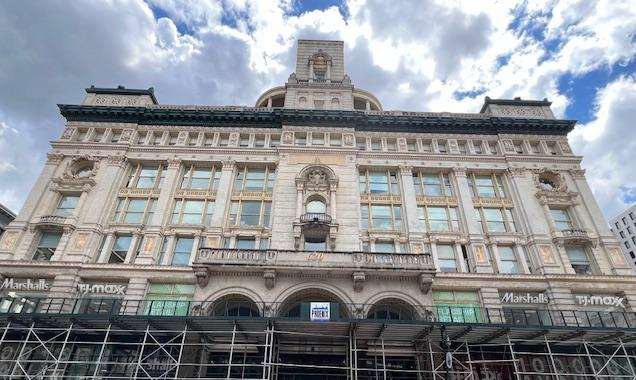
The Seigel-Cooper Department store facing Sixth Avenue.
The details of the building were just as impressive when you turned the corner on the next two blocks and were able to admire the rest of the building. This can be seen on both sides of the store on West 19th and West 18th Streets.
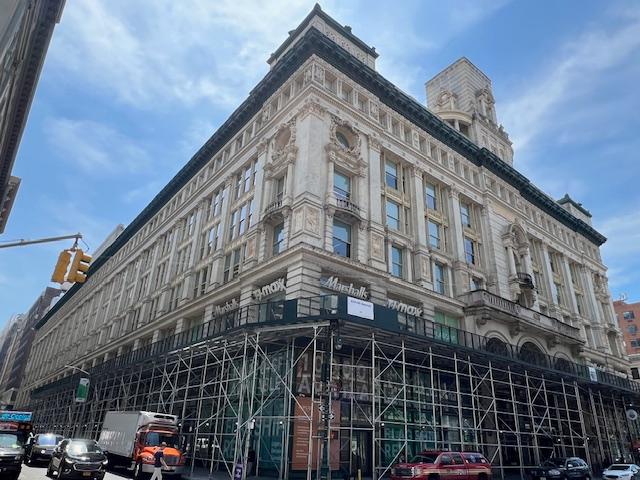
The old Siegel-Cooper Department store while walking down West 19th Street.
The Siegel-Cooper Department store was a Chicago based store that was founded in 1877 by Henry Siegel, Frank H. Cooper and Isaac Keim. They opened the New York City store in 1896 on the Ladies Mile Shopping District. The store was designed by the architectural firm of DeLemons & Cordes in the Beaux-Arts design. When it opened, it was the largest department store in the world until Macy’s opened in 1902 (Wiki).
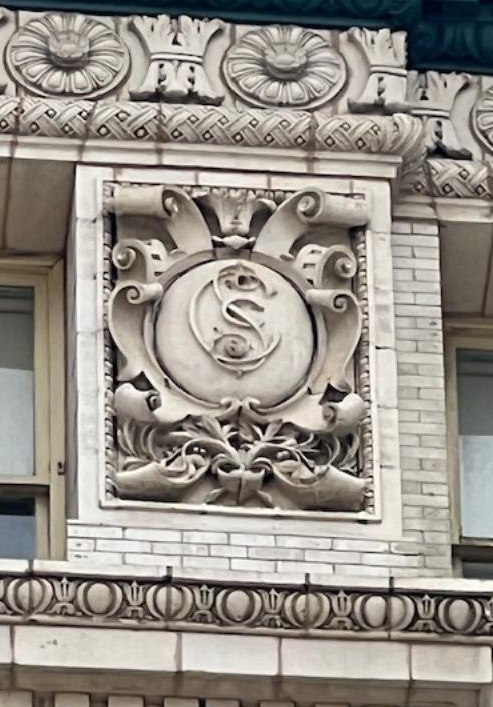
The Siegal Cooper insignia on the top and sides of the building.
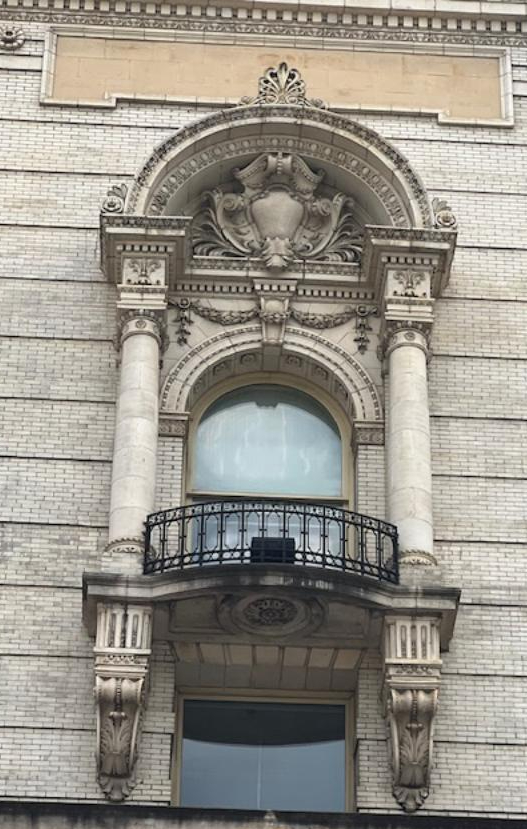
The window details in the front of the store.
The windows on the front and sides of the buildings are so elegant.
Henry Siegel over-extended himself and sold the company in 1902 to an investor and the store declared bankruptcy in 1915 and closed in 1917. After the store closed, it was used as a military hospital and then as a warehouse. Today after years of being used as a warehouse, it now has several retailers located in the store space (Wiki).
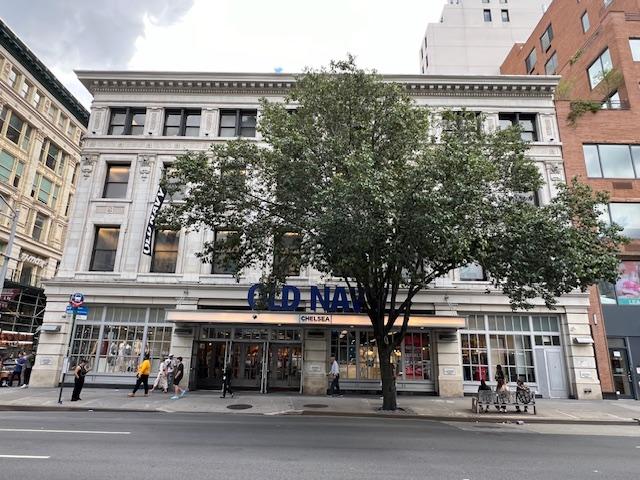
Another building that stood out on West 19th Street was 11 West 19th Street. It was built in 1904 as an office building in the Beaux Arts design. It has since been converted to apartments.
D. Price and Company was once a fancy women’s store at the turn of the last century which ceased business in the 1920’s upon Mr. Price’s death and the store moved out as the shopping district changed by the 1930’s (DaytonianinManhattan.com).
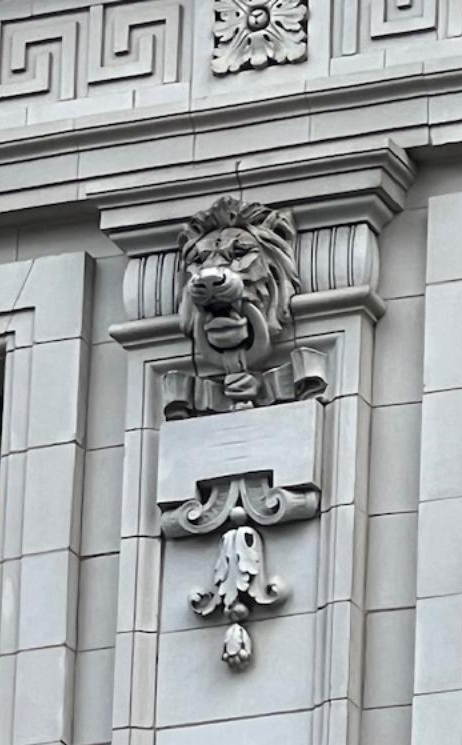
The lion design was very prominent on many of these buildings.
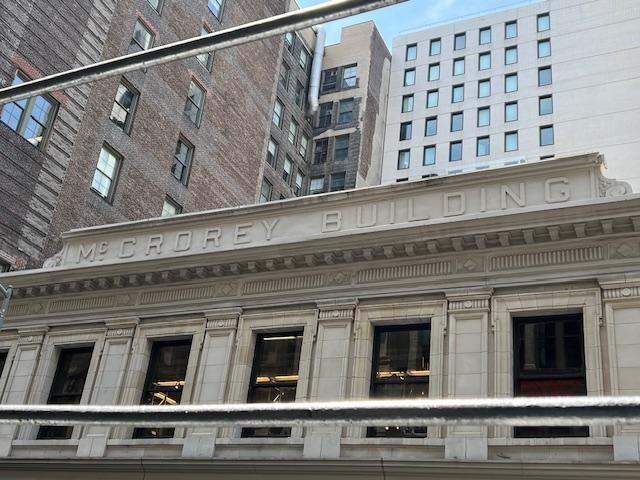
The signage was very prominent on the buildings and I even saw where McCrorey’s had their business.
McCrorey’s was a discount store that had leased part of the Price Building to gain entry to the neighborhood. It closed in the early 1930’s as the neighborhood changed (Wiki).
The I passed 3 West 18th Street which was another charming building.
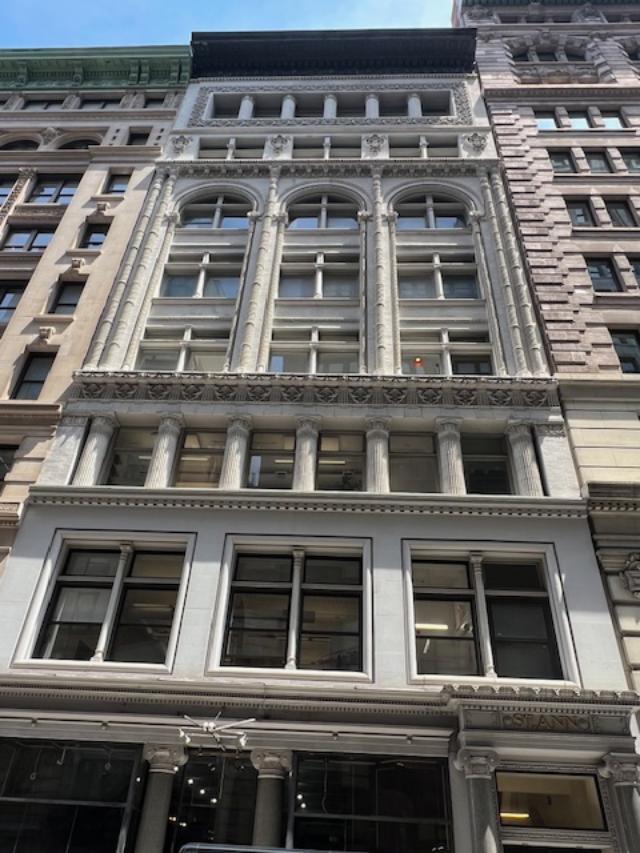
3 West 18th Street was built as a commercial building back in 1900 and is still in use for that purpose. The outside of the building has a Neo-Classical look about it.
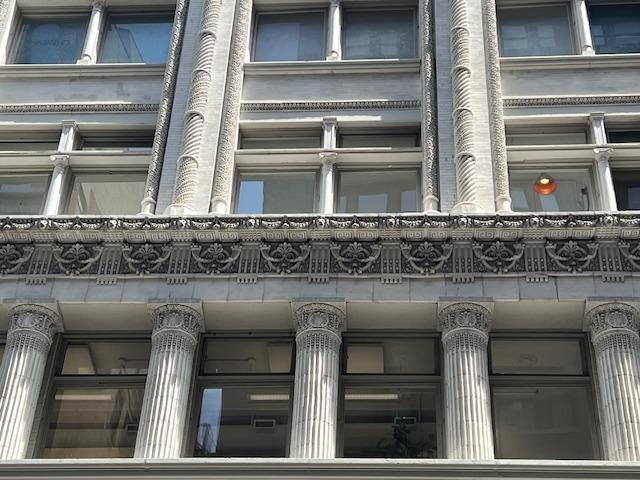
The details of 3 West 18th Street
When I was walking down West 17th Street to Fifth Avenue, I looked up and saw a series of what I thought was dogs staring down on me from above and I saw the characters from 26 West 17th Street. This is the one building on the block that really stood out.
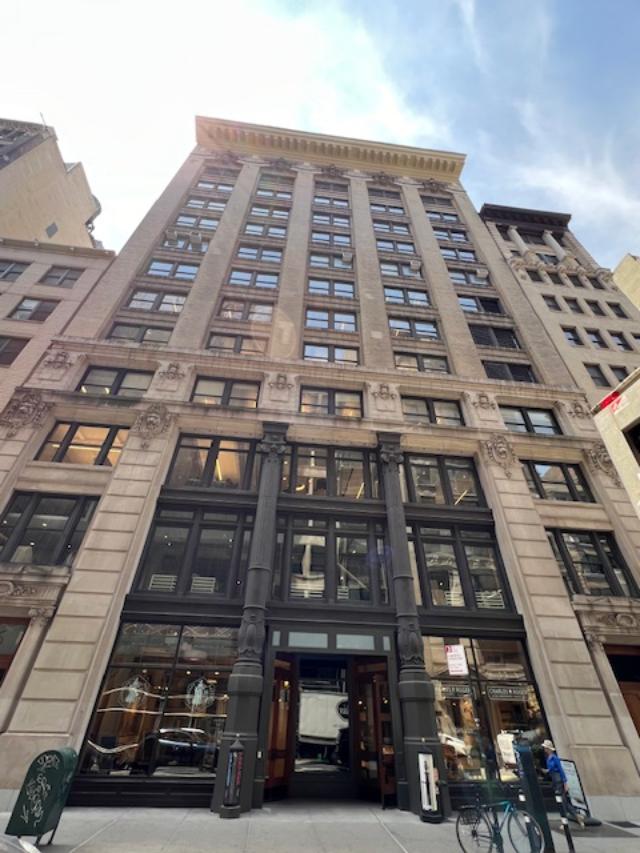
This interesting building was built in 1907 and is still being used for commercial purposes. When you look closer they were not dogs but lions staring back at you.
The details on the outside of 26 West 17th Street
The intricate detail work of the embellishments of 26 West 17th Street. The lions have a very inquisitive look about them.
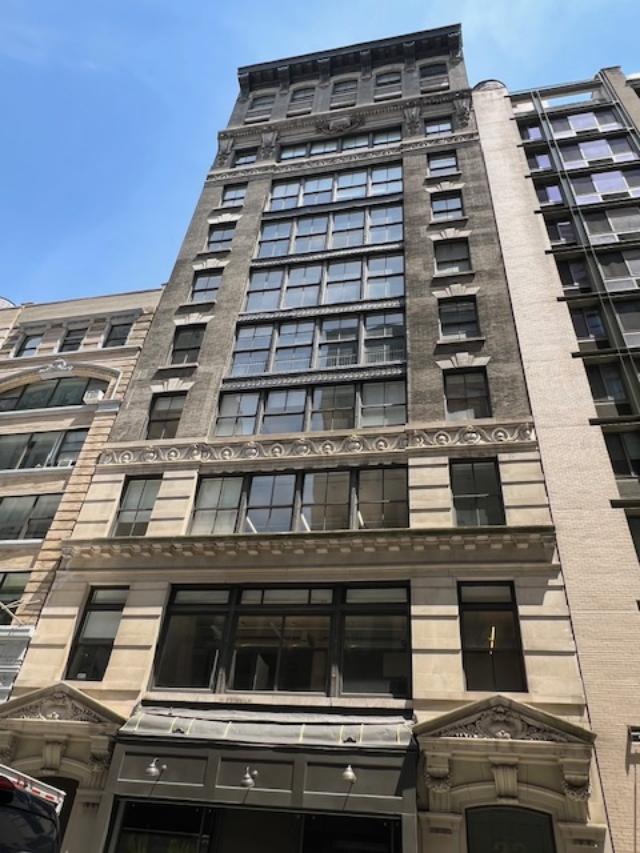
I then passed the exquisitely designed 33-35 West 17th Street. This office building was constructed in 1907 and is still being used for commercial use today.
I had to race back to the Soup Kitchen for my second shift in the Pantry so I had to wait until two days later when I was in the City to visit the MoMA for an exhibition to finish the neighborhood. Before I headed down to the Flatiron district, I revisited the Upper West Side and covered neighborhoods that I had not been to in four years. Many buildings had been under scaffolding and others I had just missed when walking through the first time.
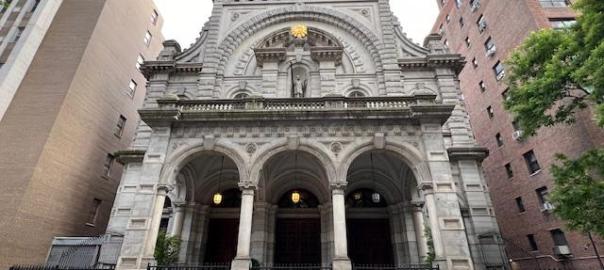
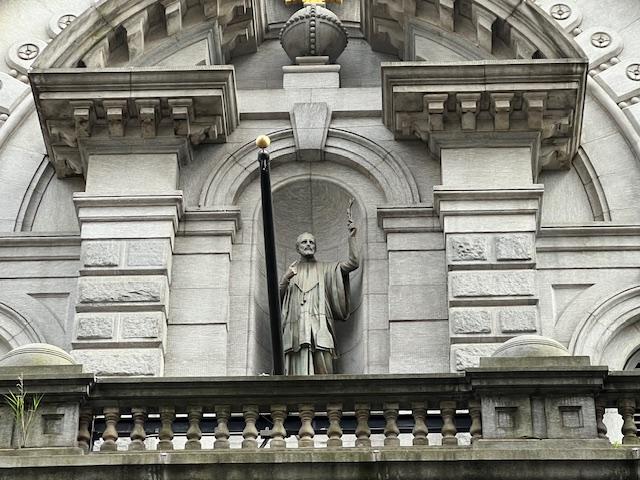
Then it was back down to West 16th Street and was floored by the detailed by the campus of The Church of Francis Xavier at 36 West 16th Street. The Church is one of the most beautiful I have seen in the City.
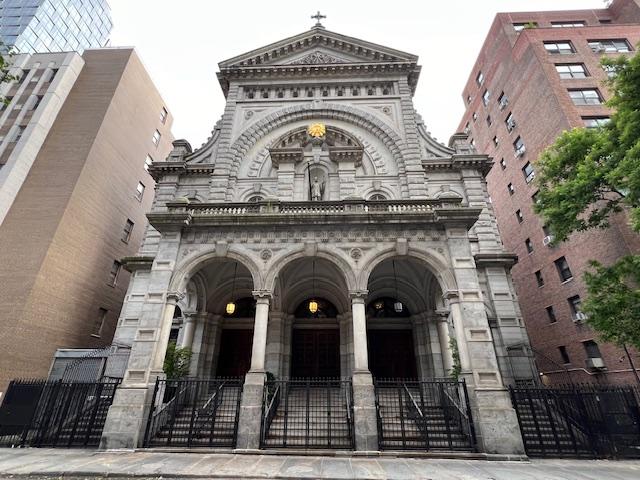
The Church of Francis Xavier at 36 West 16th Street
The church was designed by architect Patrick Charles Keely in the Roman Basilica style and the exterior of the church designed in the Neo-baroque style. The church has been in continual use since 1882 and was dedicated by the Archbishop Michael Corrigan that December (Wiki). The high school complex is attached and just down the road from the original church.
The Church of Frances Xavier High School at 30 West 16th Street
The history of the high school dates back to the early 1800’s. What was to become Fordham University opened in 1841 and was placed under the direction of the Jesuits in 1846. It was a member of that community, Fr. John Larkin, S.J., who in 1847 traveled to Lower Manhattan to found Xavier. The Regents of the University of the State of New York chartered Xavier in 1861 Francis Xavier HS website).
In 1886, the military department was established under the direction of the National Guard, beginning a lasting military heritage that continues to thrive today. 1897 saw the class systems reorganized to complete the break between college and high school departments. In 1912, the college was closed, and full emphasis was placed on secondary education. The enrollment was 338 at that time. With the National Defense Act of 1916, the Congress of the United States created a Reserve Officer’s Training Corps (ROTC) program and authorized the establishment of Junior ROTC units at secondary schools that would offer a course of military training for a minimum of three academic years. In 1935 Xavier’s military program became a JROTC unit (Francis Xavier HS website).
In 1968, Xavier was raised to the status of a military institute, offering four years of military science and training. Graduates were then eligible for two years credit towards Senior ROTC advancement and one honor cadet could be nominated for each of the major service academies. The JROTC program became optional for students in 1971 (Francis Xavier HS website).
When I was walking on the other side of the street from the high school, I noticed this unique urban garden that this homeowner created and I was struck about the choice of plants and the colors and the vibrance of the plantings. It really pepped up the block.
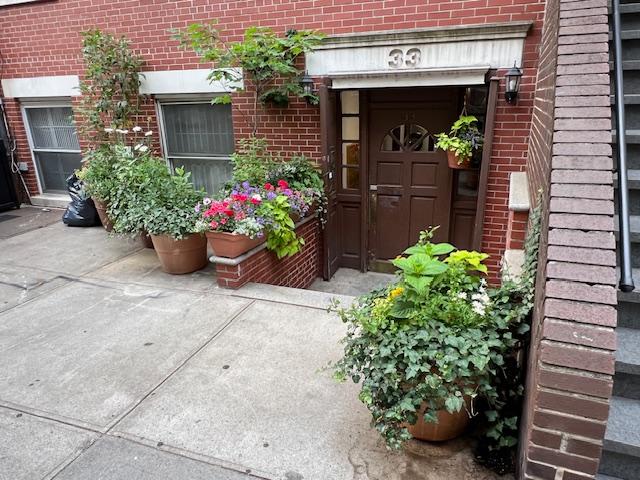
The urban garden in front of 33 West 16th Street was unique and colorful.
When I walked down West 15th Street, it was later in the afternoon and I could see shadows forming in the corners of the buildings. The back of the Francis Xavier Church and School was the Xavier Mission, which was busy with people lining up to receive food packages. The blocks below West 17th Street until you get to West 14th Street are more residential. The church complex pretty much takes up most of the blocks along West 15th and 16th Streets.
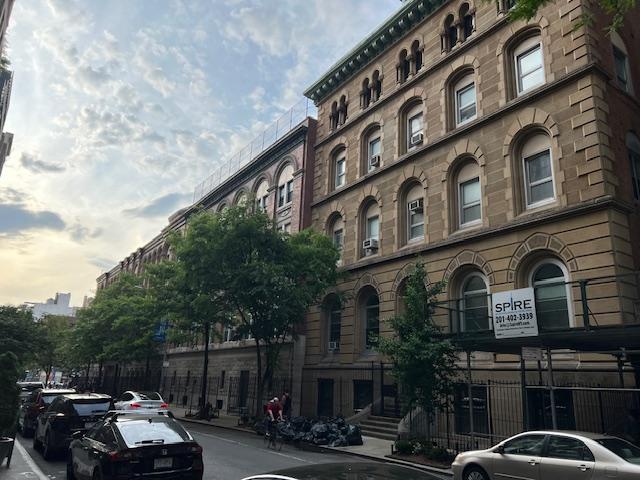
The back part of the school and church complex and the residential area of West 15th Street
Weird street art along West 15th Street
I was not sure whether this street artist was commenting on greed, making fun of those who have money or mocking the wealthy but I thought this was interesting.
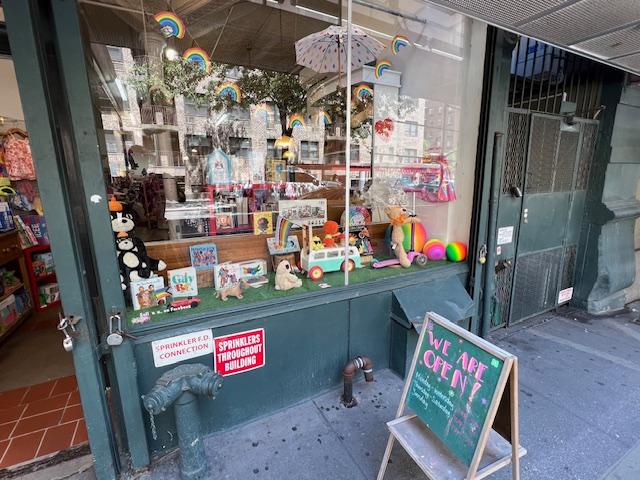
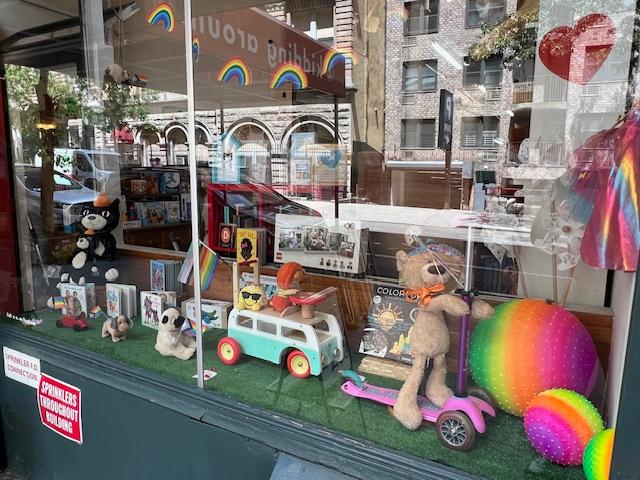
There was one standout along West 15th and it was the toy store, Kidding Around, which has been a neighborhood staple since 1993. The store was founded in 1989 on Bleeker Street and has been part of the neighborhood for over thirty years. The store’s philosophy has been “We are a local family-owned toy store founded on the idea that good toys inspire creativity and educate while encouraging family interaction and fun!” (Kidding Around website).
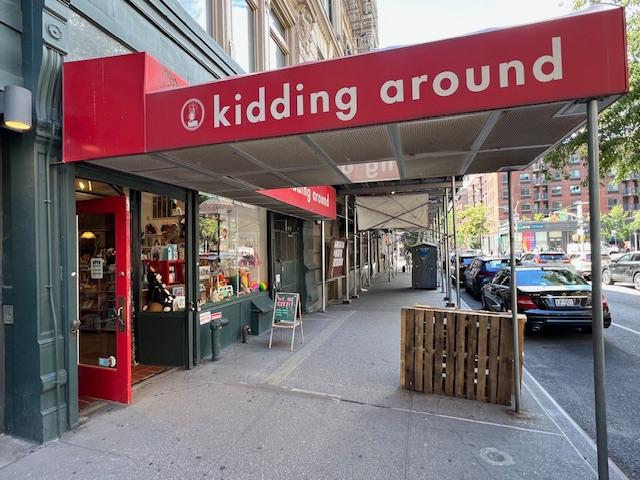
This interesting little toy store is stocked from floor to ceiling with interactive and educational toys in a whimsical environment. The displays and the signage just add to the fun. Both kids and adults alike when I was walking around were having a good time.
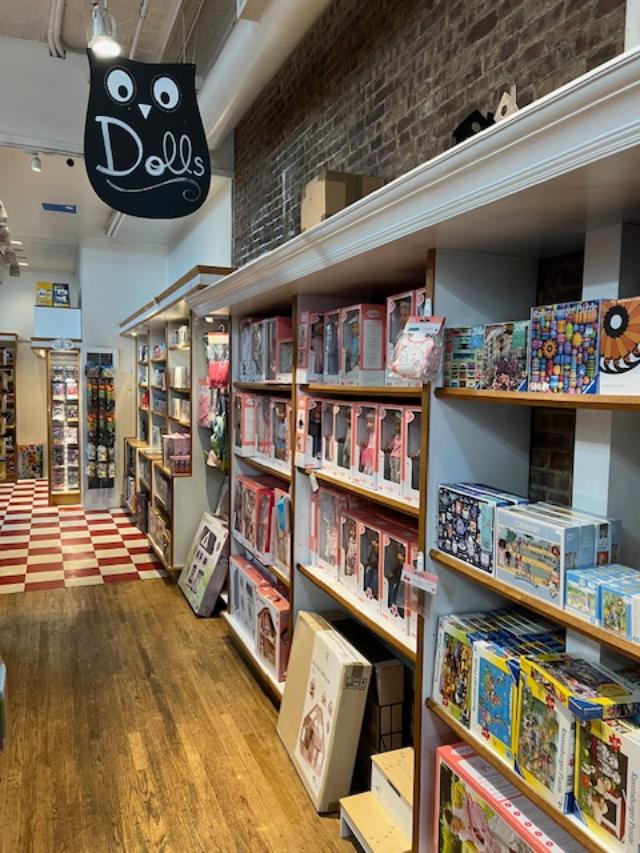
The Dolls and Board Games section of the store.
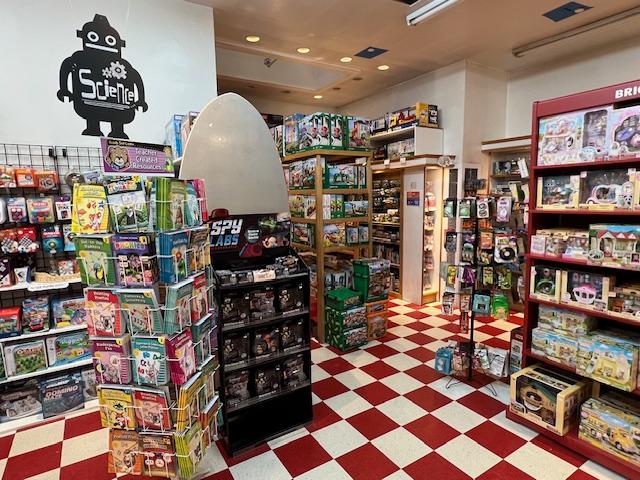
The Science and Book section of the store.
I finished my walk of the Lower Flatiron District just as it was getting dark. The sun was still peeking out but the early evening was upon me. This is a neighborhood in transition with a lot of renovation and building going on and there will be more changes in the future as these projects finish. It may not be the ‘fashionable’ shopping district of the early 1800’s but it is holding its own.
These beautiful old buildings are finding life again as condos and apartments bringing a new energy to a neighborhood that is growing to be a ‘university’ community with the New School, NYU and CUNY moving into the area. There is a certain vibe and energy happening here.
Read my blog on Walking the Borders and Avenues of the Lower Flatiron District:
The one thing I suggest getting is the Sprinkle Cookie Cake Batter Vodka Martini infused Ice Cream sandwich. Words can’t describe how good this dessert is and after a long day it will give you a nice buzz.
The Sprinkle Cookie Cake Batter Vodka Martini Ice Cream sandwich I highly recommend
With Graduation behind me and in between Summer classes, I am finally exploring the streets below 23rd Street. I never thought I would get here. It had been two long semesters and the Christmas from hell. I don’t think my feet ever hit the floor. I just kept going.
I finally got back to the Flatiron District. This is where the lines get a blurry with the neighborhoods. The Flatiron District overlaps with Union Square which overlaps with Gramercy Park. NoMAD mixes with the Flatiron District and Rose Hill and then Kips Bay and Gramercy Park again. It gets very confusing so I just repeat the roads in other neighborhoods. Since the official southern border of the Flatiron District is West 20th Street, I looked to the neighborhood to walk.
The Lower Flatiron District by McCreery’s Department store on 15th Street.
I decided to defy what the relators say and I cut the neighborhoods by Avenues. I decided that Lower Flatiron District would be from West 20th to West 14th Streets between Sixth and Fifth Avenues. Union Square would be from West 20th to West 14th Streets between Fifth and Irving Place. From there I would finish Gramercy Park past Irving Place and then Lower Chelsea from West 23rd to West 14th Street from Sixth Avenue to Twelve Avenue. Have I confused you yet? It is for me and I am not sure if the residents of these communities know what neighborhood association to join.
I started my walk along the northern section of the neighborhood which I had walked before the semester had started at NYU. I started on West 20th Street and it was like visiting an old friend. It was then I realized that I had not walked this neighborhood in two years and that a lot had changed in that time. I had finished walking it in 2022 before Grad school had even started.
Walking through Chelsea to West 20th Street. I love how the purple in this restaurant stands out every summer. I walked through the outside seating to Shukette, a restaurant at 230 Ninth Avenue.
At the corner of Sixth Avenue and West 20th Street, another building got my attention at 650 Sixth Avenue. This impressive building, which is known as the Cammeyer and is located at 650 Avenue of the Americas on the southeast corner at 20th Street, was converted to a residential condominium in 2007 (Carter Horsley. CityRealty.com).
650 Sixth Avenue at the corner of Sixth Avenue and West 20th Street-Now the Cammeyer
The building was designed by Hubert, Piersson & Hoddick in 1892 for the estate of William C. Rhinelander. The red-brick, Neo-Renaissance-style building has white stone and terra cotta trim, a large copper cornice and a handsome band course beneath its top floor. It was the home of the Cammeyer Shoe Store, the one of the largest shoe stores in country (Daytonian).
The conversion was designed by Perkins Eastman for by Penterium, the residential development arm of Korean firm Kumang Housing Corp (Carter Horsley. CityRealty.com).
I was admiring 27 West 20th Street on my walk down West 20th Street to Park Avenue South. This detailed twelve story office building was built in 1908 and now offers loft style offices. the details of the building include elaborate stonework both around the doorways and lower windows and the top floors.
What I liked about the side streets as well as the avenues as I walked the neighborhood was that it kept its character and that these buildings had not been knocked down for the modern skyscraper. They were finding new use like the buildings in Midtown South and in NoMAD and become very desirable.
There was true beauty in the details of 20 West 20th Street that was built in 1906. The Beaux Art style details around the windows and doors accent the elegant building.
This is also the details you see in the office building of 10 West 20th Street built in 1903 with Beaux Art style details along the lower windows and doors and the upper floors of the building.
I passed 156 Fifth Avenue as I crossed the border from west to east in this part of the neighborhood and admired it for its detailed stonework carving and unusual styled roof. The Presbyterian Building was built in 1893 and was designed by architect James B. Baker and was designed in the French Gothic style. It was to be used by the Presbyterian Church as their base for domestic and foreign missions and used as office space. The Panic of 1893 changed that, and they had to lease the space out (Daytonian in Manhattan).
I then took the long walk down Fifth Avenue and all the architectural treasures it contains. This was once the core of the old ‘Midtown Manhattan’ after the Civil War and the City started its march uptown.
119 Fifth Avenue at the corner of East 19th Street in the Flatiron District neighborhood of Manhattan, New York City was built in 1905-06 and was designed by John H. Duncan in the neo-Renaissance style. It was built to be an annex to the Lord & Taylor department store buildings which took up most of the square block between Broadway and Fifth Avenue and East 19th and 20th Streets, being connected by bridge to two of them. After Lord & Taylor moved uptown in 1914, the building had multiple uses (Wiki).
The details of 119 Fifth Avenue
One of the most impressive buildings in the neighborhood is the old Arnold Constable Store building that stretches from its Broadway entrance down the entire block on 18th Street to its Fifth Avenue entrance.
115 Fifth Avenue-Arnold Constable Department Store
This seven-story department store building was designed by architect Griffith Thomas in 1868 for the prominent dry-goods company of Arnold Constable & Company. ‘The Palace of Trade’ as it became known as, is located stretches between Broadway and Fifth Avenue. The stunning Second Empire building is faced in marble, brick, and cast-iron, features stacked arch orders and a prominent, two-story, pavilioned mansard roof. Arnold Constable & Co. was founded by Aaron Arnold, who opened a small dry goods store in the city in 1825 (Buildings of New England).
As the business prospered he moved into larger quarters numerous times. In 1842, James Constable, an employee, married Arnold’s daughter Henrietta and was subsequently made a partner. From this, the company was renamed Arnold Constable & Co. In its heyday, Arnold Constable & Co. was the largest dealer to the elite in New York City, supplying the latest fashions to a clientele that included the leading families in the city (Buildings of New England).
interesting history. The building was designed by architect Louis Korn and was designed in the Beaux-Arts design. It was completed in 1896 and it was named after Edwards Pierrepont, whose mansion had stood on the site before the construction of the building. When it opened the building was popular small publishing and mercantile companies (Dayonianinmanhattan.com).
The 103 Fifth Avenue details
103 Fifth Avenue embellishments
In between the buildings there was plaque to Levi Parsons Morton, the former Governor of New York State and the Vice-President of the United States under President Benjamin Harrison. This is where his home was located.
The plaque of the former Vice-President’s home on Fifth Avenue.
Vice-President and former New York Governor Levi Parsons Morton
The B. Shackman & Company sign was for the former B. Shackman & Company novelty and toy store that was located here until the 1970’s. The store once sold all sorts of novelties and gifts (Ephemeral New York.com/Consumer Grouch).
This beautiful office building was designed by architect Louis Korn for businessmen Henry and Samuel Korn in 1896. The office building currently houses small companies (Wiki).
The details of women looking down at us on the street at 91 Fifth Avenue
The lion details on 91 Fifth Avenue.
The last building on this part of Fifth Avenue was under an extensive renovation and I was not able to get the pictures that I wanted but still you could see the details in the building around the renovations.
Looking up Fifth Avenue from 16th Street
The Kensington Building was designed by architect Samuel Sass in the Beaux-Arts design and completed in 1906. Some of the first tenants of the building was the Milton Bradley company. The building was converted into a residential building in 1996 and were designed by architect Joseph Pell Lombardi (Landmark Branding LLC).
This part of Fifth Avenue has kept its character all these years and now that these buildings are back in vogue because of their history and design detail, they are being refitted for modern times. These were once the headquarters of companies that are now long gone but are housing the new future companies leading us into the 21st Century.
Looking up Fifth Avenue from 15th Street and the core of the Lower Flatiron District.
West 14th Street is a Hodge podge of building types and in various conditions. COVID really hit 14th Street businesses hard and between the pandemic, urban renewal of the neighborhood and changing tastes of building types, there is only a few buildings left from the era when this was a major shopping street at the turn of the last century. This was before everything moved up to the 23rd Street and Sixth Avenue area.
Much of the block between Fifth and Sixth Avenue is in the process of being knocked down, renovated or both. Still there are some architectural gems still left on the street.
On the corner of Fifth Avenue and West 14th Street is 80 Fifth Avenue.
80 Fifth Avenue is an elaborately-detailed Renaissance Revival style office building that was constructed by the architecture firm of Buchman and Fox. This building was constructed in 1908 to be used as manufacturing and office space (Kates, Ariel. Off the Grid).
Seeing better detail work on the building from the West 14th Street view.
This beautiful building’s lower and upper levels feature decorative floral and geometric ornamentation, elaborate cornices, and angled bay windows on the third floor. Ornamented pilasters are found at either side of these windows, with slightly more austere middle floors and in its arched windows and elaborate ornamentation at the top story (Kates, Ariel. Off the Grid).
The beautiful detail work on 80 Fifth Avenue.
The building’s history has a long past of companies that have worked in these offices but the most prominent had been the creation of the gay organization, The National Gay Task Force. Among the Task Force’s accomplishments during the time it was located at 80 Fifth Avenue included getting the American Psychiatric Association to end its classification of homosexuality as a mental illness; getting the federal government to end its ban on employing gay or lesbian people in any federal agencies (Kates, Ariel. Off the Grid).
Walking past buildings that are being renovating or built much of what must have been there from the turn of the last century had been torn down and that beauty in the buildings that must have been the ‘Ladies Shopping District’ in the early 1900’s. The only other building on West 14th Street that had the same characteristics and beauty is 56 West 14th Street by the corner of West 14th and Sixth Avenue.
This Neo-Classically designed building was the annex to the original Macy’s store that stood at the corner of Sixth Avenue and West 14th Street. R.H. Macy Dry Goods originally opened in a small building (since demolished) on this corner in 1858, and as its success grew it expanded into a number of neighboring buildings. No. 56 was built in 1898 by then-owners Isador & Nathan Straus. It was designed by architects William Schickel and Isaac E. Ditmars (Moskowitz, Sam Off the Grid).
The elaborate embellishments of 56 West 14th Street
The interesting details of the building.
Four years later, in 1902, the department store moved uptown to it’s present location on Herald Square, which is the current headquarters of the store.
Walking up Sixth Avenue towards West 20th Street, there is again the same issue. Most of the more elaborate buildings are closer to the edge of West 20th Street. Walking back up toward the heart of the former “Ladies Garment Mile” along Sixth Avenue from West 18th Street to West 23rd Street, the lower part of Sixth Avenue is similar in look to West 14th Street. A mish-mosh architectural styles from years of knocking down the older buildings. Inside are a variety of fast food restaurants, coffee shops and small stores.
The first building left of the former shopping district is the former Pace Building at 610 Sixth Avenue.
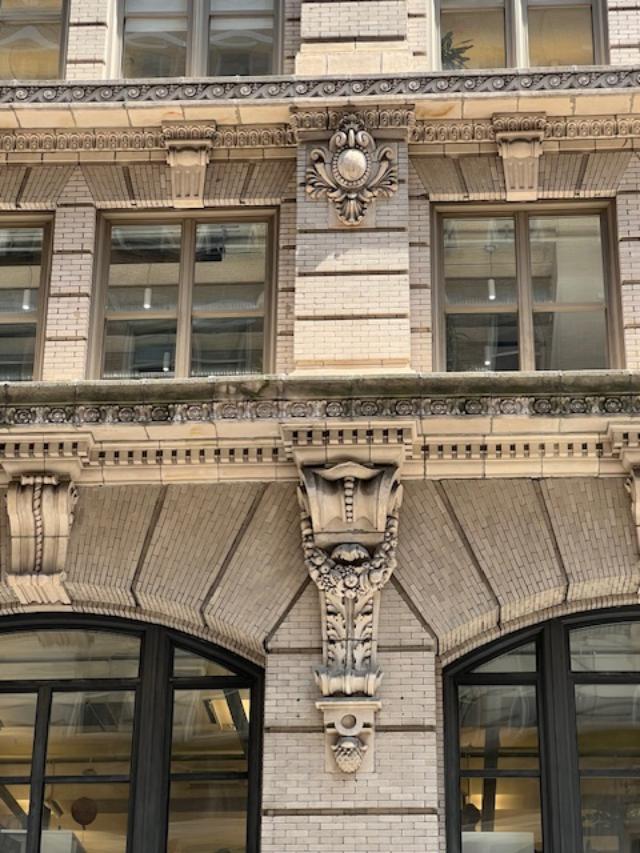
David Price opened his first women’s clothing store, D. Price & Co. around 1887. The Price Building was built in 1910-1912 and designed by Buchman & Fox in the Beaux-Arts style (Wiki). The was the combination of the two stores, the one facing Sixth Avenue and the one facing 18th Street (DaytoninManhattan.com).
The embellishments of 610 Sixth Avenue designed by Buchman & Fox.
Next to the Price Building is what was one of the grandest of the department stores in New York City at 620 Sixth Avenue, Seigel Cooper
620 Sixth Avenue-The former Siegal Cooper Department Store
The original store design in the late 1800’s (New York Historical Society)
The Siegel-Cooper Department store was a Chicago based store that was founded in 1877 by Henry Siegel, Frank H. Cooper and Isaac Keim. They opened the New York City store in 1896 on the Ladies Mile Shopping District. The store was designed by the architectural firm of DeLemons & Cordes in the Beaux-Arts design. When it opened, it was the largest department store in the world until Macy’s opened in 1902 (Wiki).
The Siegal Cooper insignia on the building.
The window details
The details on the upper windows of the store.
Henry Siegel over-extended himself and sold the company in 1902 to an investor and the store declared bankruptcy in 1915 and closed in 1917. After the store closed, it was used as a military hospital and then as a warehouse. Today after years of being used as a warehouse, it now has several retailers located in the store space (Wiki).
Across the street from the Siegel-Cooper store is the old B. Altman & Company store before they moved to East 34th Street.
625 Fifth Avenue-The old B. Altman & Company Department Store.
B. Altman & Company was founded in 1865 as a family store that eventually came under the control of Benjamin Altman. It moved from its Third Avenue and Tenth Street location to 621 Sixth Avenue in 1877. The store expanded four times in this location to cover what is now 625 Sixth Avenue. The store was designed in the Neo-Grec design and built in four stages. First by architects David and John Jardine for the original store in 1877 and then the extension in 1880. Then by architect William Hume in 1887 and then by architects Buchman & Fox in 1910. The store moved to the corner of Fifth Avenue and 34th Street in 1906 when the shopping district moved to 34th Street (Wiki).
The last old department store on the Ladies Mile Shopping District is at 641 Sixth Avenue on the corner of Sixth Avenue and West 20th Street.
641 Sixth Avenue-The old Simpson Crawford Department Store
Simpson Crawford like many stores on Sixth Avenue had its humble beginnings on 19th Street. The store continued to grow and expand catering to the ‘carriage trade’ and selling the finest merchandise. After their new store was destroyed in a fire in 1880, they opened the store at 641 Sixth Avenue in 1899 which was designed by architectural firm William H. Hume & Son in the Beaux-Arts design (dayoninmanhattan.com).
The details of 641 Sixth Avenue.
This part of the Flatiron District feels so different from the northern part of the neighborhood. So much of it has disappeared over the years that the character has changed. It does not have the distinction of the blocks between 23rd and 20th streets. There are blocks of these types of buildings whereas the blocks of the old shopping districts of the early to late 1800’s from 14th to 18th Streets have slowly disappeared over time. Older buildings have since been replaced with modern office and apartment buildings. The buildings have even been refitted for apartments and for the growing college campuses in the area.
While there are many architectural gems in this neighborhood, it just goes to show the progression of Manhattan and how things have changed in the last 100 years. The City keeps marching on. Still this section of the Lower Flatiron District shows just how important this part of the old “Midtown Manhattan” was from the Civil War until WWI. Just look up and admire all the details on each building. There are a surprise and delight for the eyes.
The Street art on West 15th Street off Sixth Avenue “I Love New York”
Read my blog on Walking the Streets of the Lower Flatiron District:
With the warmer months upon us and the coming of the summer, new exhibitions are opening up and is the museums chance to showcase their exhibitions before they open to the public. These after hour events give the members a chance to see these exhibitions when the museum is closed for the evening.
The welcome to the Private Members Night at the MoMA.
I thought the line to the recent Private Members Night at the Metropolitan Museum of Art was long until I saw the line to get into the MoMA. It wrapped around the block to the West 53rd Street entrance. They should have had multiple entrances for this event because so many people were in line. We were lucky in that the line moved really fast and we got in the museum rather quickly.
The crowd dispersed quickly with some people intrigued by the visual display in the lobby outside the main courtyard where the concert would take place that evening.
The visual art display in the lobby of the Museum of Modern Art mesmerizes everyone.
Unlike like The Met, there is not the room in the main hall or the courtyard for all these people. Ron Carter, the famous Jazz musician was playing in the courtyard and they had to hold the line because there were too many people outside. Knowing these events, I got outside for the concert as soon as I made a trip to the bathroom (that was packed too). The courtyard was full of groups talking and waiting in line to get to the bar.
The crowds were huge at this event.
The worst part was that there were only two bars for all these people. One was in the lobby and one was in the courtyard and the lines were easily sixty deep for most of the night. There should have been a second bar both in the courtyard and maybe on the second floor of the museum to handle the flow of people. Still people did not seem to mind.
I was lucky in that I went to the courtyard first after going to the bathroom so I did not have to leave the courtyard so quick. I could see they were holding the line to get outside and the concert would only be from 7:30pm to 8:30pm. Even when I left the courtyard at 8:10pm, the line was still sizable to get outside. The concert was well worth it.
Mr. Carter’s performance was excellent. I could not believe that the first time he had been to the museum was in 1965. The last time he performed here was in 1993. For a guy in his 80’s, he looks in great shape. The concert was really good but since there was not enough seating for everyone it made it a bit in comfortable for the audience. Still I stayed through the first four numbers and enjoyed the music.
Around 8:15pm, I saw all these people peering through the window of the lobby and figured I should go see other things at the museum before it closes. About thirty other people felt the same way and a large group of us left the courtyard to the relief of another thirty who were let in. The concert only had about fifteen minutes left.
Ron Carter’s number last number when I left.
I went to explore the museum and see a few of the exhibitions that I missed the last time I was in the museum. This was the start of the Spring shows. As the concert started to wind down, the rest of the museum became busy.
One of the features of the even was scratch artist Kathie Kollwitz whose work spanned the world wars and show the plight of the working class in Germany during and in between the wars.
The paintings of Kathie Kollwitz.
Times were so rough for these people at that time and conditions not pleasant, the artwork reflected it. It was really depressing and I could see why Hitler rose to power. Her work showed how raw life was like between the wars and how bad their economy was at the time.
The other exhibition I saw was American artist Latoya Ruby Frazier, whose work representing our own working and underclass and of a population in Pennsylvania who time has passed by. The artist’s family was exposed to the problems of the steel industry and the after effects of its collapse.
The Latoya Ruby Frazier exhibition on the Private Members Night
I liked about her show was the honesty of the whole show. She showed her personal relationship with her relationship with her grandmother and her family. She also showcased her community, who had so much influence in her life. The community had been so badly affected by pollution, poverty and discrimination that it left a scar on the tight knit community of Braddock, PA.
The artist’s gallery display of her relationship with her family
When the biggest employer left, the much needed hospital, closed because their headquarters said it was losing money. This with the loss of the automotive industry caused the community to deteriorate. These are the communities that time left behind after WWII. It was really honest work.
The decline of Braddock as industry left the area.
The exhibition was heartbreaking and touching at the same time. She showed how much she cared about her community and many others in the exhibition like Flint, MI and Youngstown, PA and how one change in corporate behavior can effect the entire community.
I was able to visit other parts of the museum as well but all things do come to an end after three hours and it was time to leave. By the end of the evening, I was ready to go. What an interesting and engaging evening it was and what a great job the MoMA did creating this fantastic evening for all of us.
The skyline along Sixth Avenue.
When I left the museum for the evening, the lights of midtown came on. I never get bored on how beautiful the City is at night.
Walking back to the Port Authority at night.
It was another wonderful Member’s Night. This is why you should join the MoMA!
The “Met After Hours” sign inside the museum that evening.
How beautiful and welcoming the Met always looks on Private Members Nights.
After the weekend of my graduation from NYU and the activities of the graduation, I had almost forgotten that the Metropolitan Museum of Art was having one of their ‘Private Members Nights’ the next Monday. Between the last days of classes at both colleges and my graduation, it was nice to have a break and get my mind off everything.
‘Private Members Nights’ are a special night that happens usually on Monday when the museum closes early and a large portion of the museum is open exclusively to just members and a guest. They are a great to spend an evening touring the museum at a slower pace. Only certain parts of the building are open as well as the exhibitions so it gives everyone a chance to see particular exhibitions.
What is nice is that they have a Members Bar and the restaurants open so the members can relax and have dinner or a drink or both. There an also music so it makes it a very festive and social evening. This was a very crowded section of the museum
The Members Bar and Music on the Private Members Night.
Since I had just been in the museum the other week to see the ‘Harlem Renaissance’ exhibition and a couple of the other exhibitions, I decided to see two others I was interested in ‘Weaving Abstraction’ and ‘Sleeping Beauties’, an exhibition on Vintage clothing and the memories and personality left behind by their former owners.
The entrance to the ‘Weaving Abstraction’ exhibition.
In the exhibition for ‘Weaving Abstraction’ the art is a comparison of ancient Pre-Columbian Art and modern artists equivalents. The comparison and the quality of the artwork was intriguing. Sometimes I could not tell what was ancient and what was new.
The description of ‘Weaving Abstraction’
The work took a modern approach to how each artist interpreted the art. What I found interesting with the art and this is without looking at the signs is what was ancient and what was modern.
Some of the current pieces in the collection.
Some of the modern pieces in the collection mixed in with Pre-Columbian art.
Some of the more modern pieces in the exhibition.
The Loincloth was one of my favorite pieces in the exhibition.
The Loincloth was one of the most interesting and colorful pieces in the exhibition.
I was able to relax and have a drink at the bar before I headed up to the ‘Sleeping Beauties’ exhibition. The line was long and moved quickly showing that the exhibition was really popular.
The ‘Sleeping Beauties’ exhibition is a different angle at looking at clothing. Rather than its history, it looks at the personality of its prior owner. The means the smells that the owners left with things like perfume and smoking. Near most of the clothing there were scent beads to better represent the smells.
This detailed evening cape I thought was beautiful.
The description of the Cape made by Gucci.
This beaded jacket I thought was one of the nicest pieces in the collection.
Some unusual displays took center stage at the exhibition.
The collection of vintage clothing on display from different eras.
This dress studded with beads and embellishments was influenced by insects and bugs.
The description of this evening dress by the House of Lanvin.
By the time I had finished viewing the exhibition, it was almost time to leave. The lines had been so long to see “Sleeping Beauties” (this had been extremely popular that evening) that it was almost ten o’clock when I left.
The evenings are when the museum shows its true magic when it is all lit up. Here is the outside of the museum at the end of the evening.
The Met at the end of the evening.
The courtyard outside the museum at night.
The fountain lit for the evening had almost a musical appearance.
The Members entrance as I was leaving for the evening. This is the true beauty of the Metropolitan Museum of Art.
It was a relaxing evening of music and great art. Just what I needed after a long semester and my graduation from college.
I finally reached another milestone in my education and in my life. I graduated with honors from New York University with a 3.813 GPA. Quite an accomplishment from someone who last graduated from Cornell University back in 2010. I was a lot of hard work and one big balancing act of time but I walked across the stage of Radio City Music Hall with the energy and enthusiasm of any undergraduate.
You can read my blog on “Grad Alley” a few days before the Graduation Ceremony:
I came a long way from the first meeting I had at the college back in October of 2019. I had visited Georgetown University the summer before and realized that it was not for me. When I got the email from New York University in the Summer of 2019 I thought, let me check this out. It is closer to home and I would be going to school in Manhattan and Greenwich Village to boot. It turned out to be one of the best decisions I ever made.
Before the Graduation Ceremony began.
The graduates settling in for the start of Graduation.
As a returning college student (I am not going to lie, this is my fifth time to college and this is the fifth college I have graduated from), I was a little intimidated by my classmates at first. I did not know what a Google Doc or a Google Slide was the first day of class. I did not even bring my computer into the class the first (I knew better from that day on) and was still using my 3G flip phone (which got a lot of chuckles from my classmates). I also was older than everyone by over twenty years but with that comes years of work experience, travel and knowledge of the ever changing Hospitality industry that keeps evolving and will continue to in the future.
Justin before the start of the ceremony.
I got up to speed really quick with a new iPhone 13 Pro (whose picture and video taking ability has transformed this blog) and a new HP computer and watched many Google YouTube videos to keep me up to speed. By the end of the first semester, I was an old pro at all of these functions and for the first time in my life got straight “A”s in my classes. It was a long time in coming that I had to prove this to myself. And at New York University no doubt (NYU).
The theater filling up with students and parents.
It had been a long journey over the last year and a half. Running in and out of New York City for classes in between my job at Bergen Community College. Countless late nights writing papers, researching subject matter and trips to libraries on both campuses to finish projects. This on top of working on Executive Boards for the Fire Department and Men’s Association in town, volunteer work that I do and squeezing in blogging on seven sites. There were times I almost had to pull an ‘all nighter’.
The stage before we started the graduation.
The video of the organist before the ceremony started:
What I found over that year and a half was a whole new way of looking at the Hospitality industry. I had never really thought about Sustainable tourism, Dark tourism, LGBTQ tourism and Diversity in tourism. I had never categorized it in the sense it was different things to different people. My professors had their way of teaching it and I had my own and going forward I used both when creating projects and my own expectations from my students. They gave me a different perspective of looking at the way a place could market itself and I took it one step further and asked of my students how can small towns and musty historical sites be made unique and interesting by marketing them in a different way. Break the mold of what they were doing and present it in a format that they might not have thought of in that light.
The NYU Bagpipers opening the ceremony.
Video of the Bagpipers entering Radio City Music Hall:
What really opened my eyes were the three GFI (Global Field Intensification) courses that I was able to experience. On my first meeting with my faculty advisor, he told me that he was planning a trip to Prague for a week and then insisted that I must come on it. He kept going and going until I finally said “yes”. I knew nothing about Prague or really where it was located. I kept thinking it was in Russia. Two Professors decided to do back to back GFI’s, the first one going to Paris and the second to Prague. Since my brother was getting married in Sicily, it gave me an excuse to go on both. It opened my eyes to a different world that changed me.
Our Dean welcoming the graduates and their parents and guests.
Paris is a more amazing city than I could have imagined. As intense and cultural as New York City but in a totally different way. The countless independent shops, restaurants, cafes and flea markets opened my eyes to a city not overrun by chain stores and each neighborhood had its own cultural identity. Every day it was a new adventure or trying new restaurants or experiencing new foods served in a way that I had not seen in the States. Since it was a Culinary Tourism class, I had to lead a tour of gourmet shops, bakeries, chocolate and candy shops and the gourmet department of a department store. I had never been to Paris before, knew nothing about the city and had not spoken the language since the 1980’s (I had three years of high school French). Somehow I charmed enough shop owners with my broken French to welcome my class in to try their products. It was a huge success (Google “Exploring Paris Block by Block”) for the details on the trip.
The ceremony was about two hours and most of that was calling names of graduates.
Then off to Prague for another wonderful experience exploring the history, food and culturally delights in the city. We visited all the touristy spots you would normally see on the tour but our tour guide, Jana, really had us exploring the city from a different perspective from someone who lived in all these areas. Everyday we experienced something new and in the time that I got to explore the city on my own, I walked the entire city as I would in Manhattan and got to pass all the local shops and restaurants and experience things as a local would living in Prague.
Then it was off to Abu Dhabi and Dubai during their Winter tourism season and that was a true eye opener. It was like going home as I discovered my Arabic roots (though they are about 400 years old and through my mother’s Sicilian heritage). All the men looked like me and that made me feel more at home. Though we had a pretty tight schedule again seeing all the sites that are popular with tourists, I had to stay an extra day because of the flights and got to explore Abu Dhabi on my own.
When the ceremony was over we were all applauded.
Me crossing the stage to finally graduate from Graduate School:
I walked the entire part of my neighborhood around the hotel and discovered the more localized view of the city through the eyes of the Omens, Saudis, Indians and other ethnic groups that made up the majority of the population that make this city run. I walked through their neighborhoods and visited their shops, restaurants, bakeries and stores and saw the city through their eyes. This was the city that I wanted to experience. That and a flat tire coming back from Al Ain left us eating at a local ‘hole in the wall’ restaurant where the site for thirty American students shocked the restaurant owner who could not believe that he had a full restaurant on a quiet Tuesday night. These were the experiences that I got in classes at NYU.
My blogs on “Exploring Abu Dhabi and Dubai Block by Block”:
As we all prepared for the excitement of graduating, I thought back to my first day of class and arriving on the NYU campus right before Labor Day weekend and having no clue what to expect. I have a clearer idea now how the world ticks and how much I had been exposed to in such a short period of time. My Professor who had taken us to Paris was now leading a class over the summer to Barcelona and I really wanted to stay to experience that as well.
The end of the ceremony at 6:00pm.
When all of the students and parents took their seats, the ceremony started on time at 4:00pm. We were greeted by the Radio City Music Hall organ player who made his appearance and then disappeared behind a wall. Then came the NYU Bagpipers who opened the ceremony for us. This was followed by a speech by our Assistant Provost and then by our Dean of our College for the School of Professional Studies.
In the hallway of Radio City Music Hall after graduation.
Then we had to endure the one thing I hate, the student speech. I have sat through countless junior high, high school and now five colleges of students saying things like “life long friendships” and “what we learned from the past will carry us into the future” and ” the people who influence us”. I have heard this same speech over and over again that I could have memorized it and bet on what she was going to talk about. I bet by the time the ceremony was over, everyone was going to part ways and many of my classmates would be traveling back to the countries they originally came from and run their tourism boards. I did not know too many of my classmates who were going to stay in New York City.
Me after graduation was over and Radio City orchestra seating had emptied out.
Then we walked on stage row by row and they called our names over the loud speaker so that family and friends could see us walk on stage. I was so thrilled to hear my name and that a got a nice applause. I was not sure that anyone noticed me as I crossed the stage. This made me feel like a million dollars. I could not believe that I had graduated from such an exclusive college like NYU and with honors. That was quite the achievement for me.
Maricel and I in Radio City Music Hall before the usher kicked us out.
As the rows and rows of classmates made their way to the stage and walked on and off, I looked behind me to see people leaving the theater before the ceremony was over. I thought it was wrong for people to not wait until all the graduates to finish but I will be honest. The second the last classmate crossed the stage, the music started, the confetti and streamers came down and then they wanted us out of there. There was a show that night and they needed to clean up. I wasn’t even out of the orchestra seating before the usher was asking us to leave so they could clean up.
One last shot when the usher turned her back for a second.
Me talking to my friend, Reema, after the ceremony.
We were able to snap some pictures before we left when the usher’s back was turned and then we had to leave. They closed the doors behind us and then the ushers kept everyone off the stairs and everyone had to leave the hallway so there was quite the crowd just outside the door. I bet the show in the evening went off without a hitch.
The end of the ceremony.
While we were outside, Maricel and I took lots of pictures around Radio City Music Hall and then finally had to go across the street because the crowds outside got to be too big as more people had to leave the entrance to the theater and make their way out to the street. It was packed with graduates and their families either taking pictures or trying to cross the street. There was grid lock for about a half hour.
Leaving Radio City Music Hall after graduation.
Outside Radio City Music Hall.
All the graduates and their family and friends had taken over Sixth Avenue and we were all over the place taking pictures. Funny enough with all the time I had been spending in the Times Square/Theater District for my blog on the Streets of Times Square, I got to know all the buildings quite well and we made our way over to 1251 Sixth Avenue to take pictures before heading back over to the hotel.
Me in front of 1251 Sixth Avenue. No one paying that much attention to us. We decided to have some fun with it.
Me as the worldly graduate.
Having some fun by the fountain.
Having some fun at graduation.
Maricel wanted to take more pictures so we went to Times Square with the other tourists but we took one more picture in front of Radio City Music Hall before we left.
My best friend, Maricel and I outside Radio City Music Hall after graduation.
We went to the TKT Booth Stairs where everyone in Times Square was hanging out and complete strangers were wishing me congratulations and well wishing me in my future. That felt really good and I appreciated it.
Me having some fun in Times Square and the ladies below were cheering me on and wishing me well in my graduation from college.
After all the picture taking (trust me there are dozens more shots of me all over Times Square), we headed back to the Marriott Marquis. I had made plans so that we would be having dinner at the Broadway Lounge, their signature restaurant, for graduation night. The views and the food are always amazing. This is where Maricel and I eat when each of us has a very special occasion in our lives.
What a wonderful dinner. The food and the views at the restaurant are just spectacular and the service is always very nice. We had to practically barge our way to a window table when the host gave our first table away. I had to calm a manager down when we took the second table. I had to explain that it was my graduation dinner and my friend wanted to be sure I had a window table. After that, he was fine with it.
While we were ordering we were taking pictures of the restaurant and then each other. Now that graduation was behind me, we could have a little fun and be silly. It was such a great meal.
Me photographing MaricelMaricel photographing me.
Then we had dinner. The Broadway Lounge on the Eighth floor of the Marriott Marquis has always been a favorite place of mine to go for dinner for a special occasion. The views are amazing and the food wonderful.
The view from the Broadway Lounge window.
We had the most amazing Graduation meal once we were seated. We started with their fiery Chicken Tenders which was a pretty generous portion for an appetizer. These lightly breaded chicken breast tenders were rolled in a hot pepper and spicy sauce and served with creamy Italian dressing.
Ryan’s Spicy Chicken: The fiery Chicken Tender with a ranch sauce
I was in the mood for a burger and Marriott does such a nice job with these. Both the regular burger and the Smashburger are excellent, and I decided on the Smashburger while Maricel had the short ribs and mashed potatoes.
The Short Ribs and Mashed Potatoes
The Broadway Smash Hit burger with French Fries
For dessert we shared the ultimate dessert treat, the Strawberry Tower, which is layers of pound cake, fresh strawberries and vanilla ice cream and strawberry sauce topped with fresh whipped cream, cheesecake bites, wafer cookies and a giant lollypop which tasted like bubblegum. With a $32.00, it was a little pricy but since it was my graduation night it was the perfect way to end the meal and it was delicious.
The Marquis Strawberry Tower at the Broadway Lounge for my Graduation dessert.
Me getting a photo op with that delicious dessert.
When I got back to the room was the ultimate surprise for me. Maricel decorated the room for my graduation. I was shocked and touched that she got this done in between the time we had arrived to check in and the time I left to get to Radio City for the 3:00pm check in for graduation. I was so touched. No one had done something like this to me before.
Maricel surprised me by decorating the room for my graduation.
The room at the hotel decorated for my graduation.
Me on my graduation night at the hotel in the room decorated for me by my best friend.
Earlier this year I had watched Cliff Richards duetting with a ghostly Olivia Newton-John after her passing for a Christmas video singing “Suddenly” from the movie Xanadu. In part of the video, I watched Olivia Newton-John wheel a cake out for his 75th birthday and totally surprising him in an earlier video. I said to myself “that is something only a real true friend does” and wished someone would do that for me in my lifetime. Maricel did this that night. When a real friend knows what you are going through and has the opportunity to react, it makes all the difference in the world to someone. Tonight, it was me!
With the beautiful views from the room of Times Square and having the ultimate view of where the ball drops directly in front of us, I could not have asked for a more perfect graduation night. I had had different experiences on the nights of my high school, Michigan State University and Culinary Institute of America graduations but this is the one I will always remember. When a friend shows you the ‘top of the world’, you could not ask for more.
The view of Times Square from our room and the famous ‘ball’.
The view of the ‘ball’ from Times Square.
The view of the room at night.
The view of Times Square from our room where the ball drops.
The next morning the Breakfast buffet was absolutely the best way to end the evening. The food was excellent and the selection was wonderful. We were able to eat Club M, the private members room that was nice. It was the perfect breakfast.
The amazing breakfast buffet the next morning.
The amazing breakfast the next morning.
The breakfast buffet was very extensive.
It was an amazing graduation and now on to new experiences to see and new ideas to embark on. It has been quite the journey.
Justin Watrel, Graduate Class of 2024 School of Professional Studies New York University with Honors.
What a true friend does:
Cliff Richards and the late Olivia Newton-John “Suddenly”.
Watch as she rolls out the 75th birthday cake for him for his ’75th Year Concert’. A real friend can only pull this off!