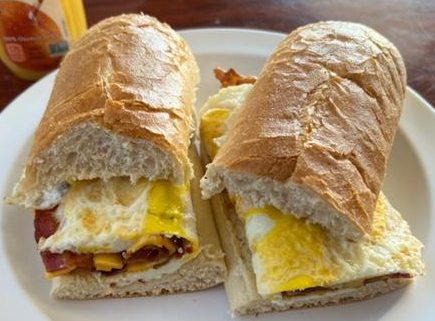
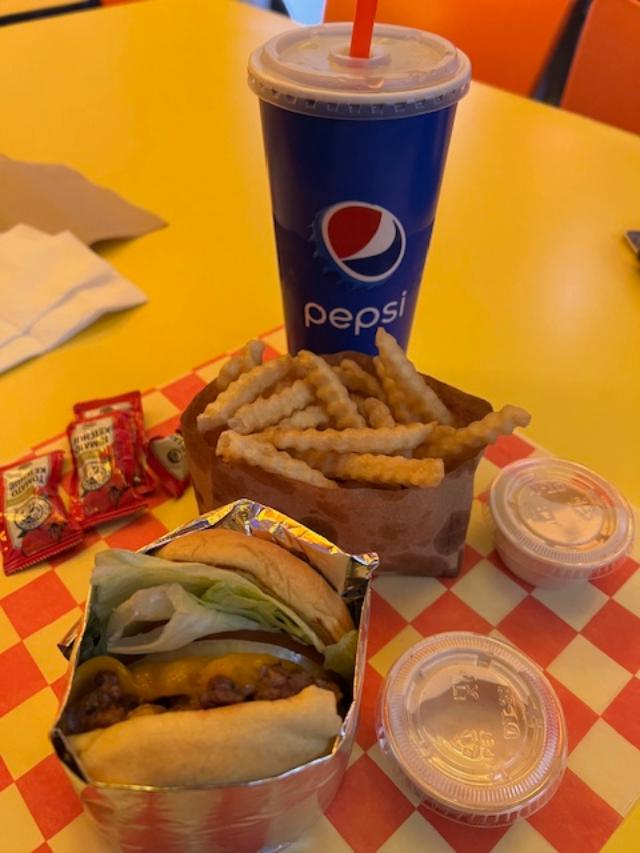
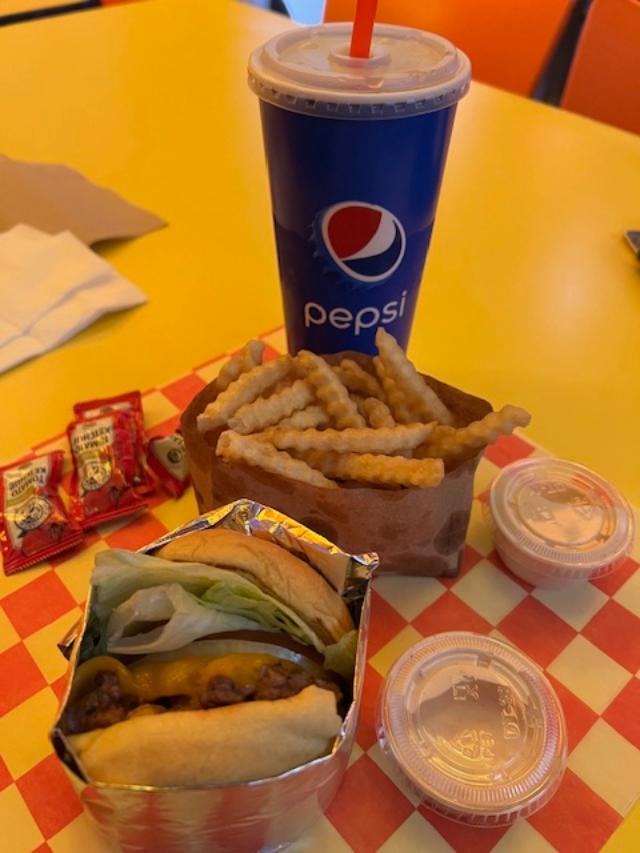
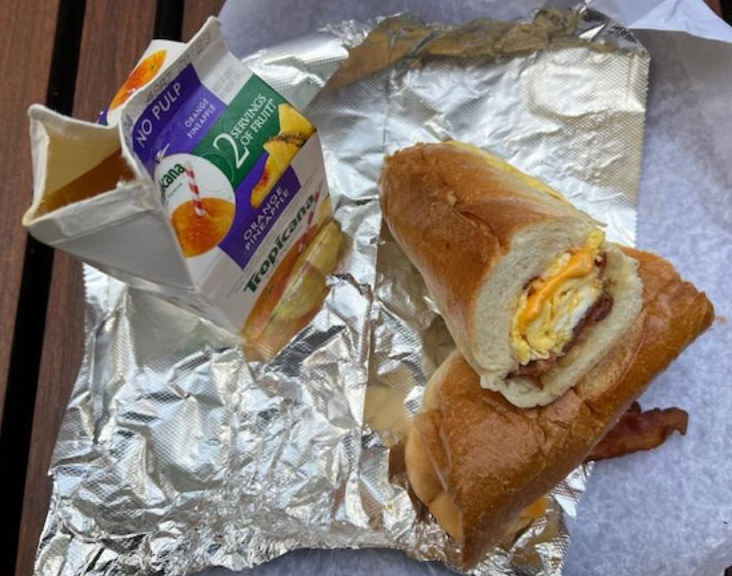
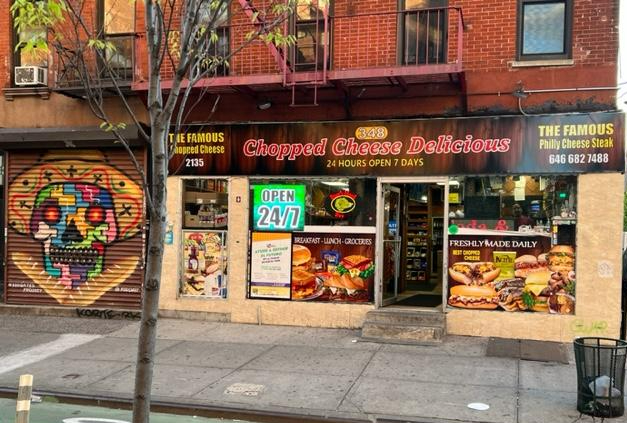
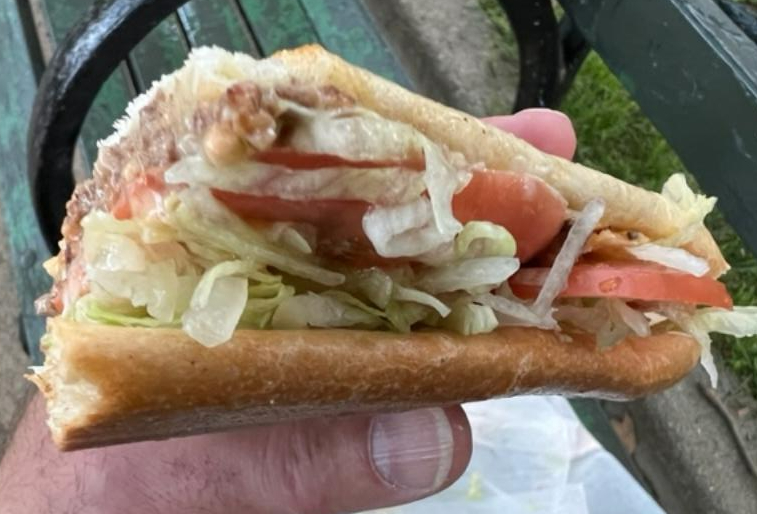
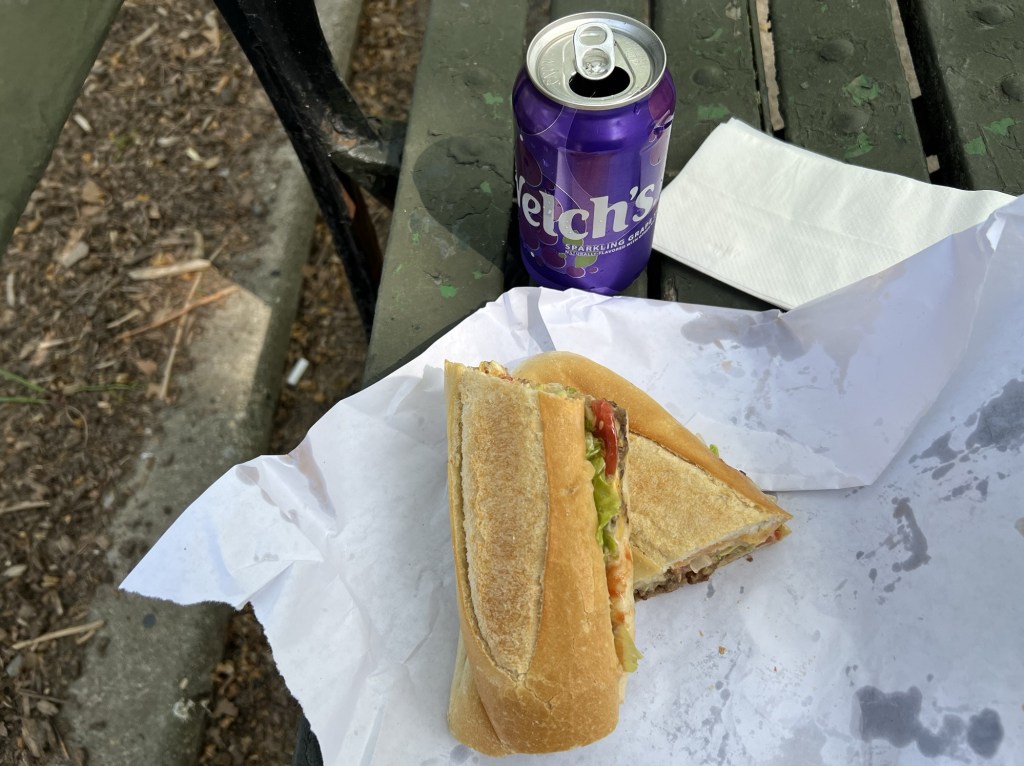
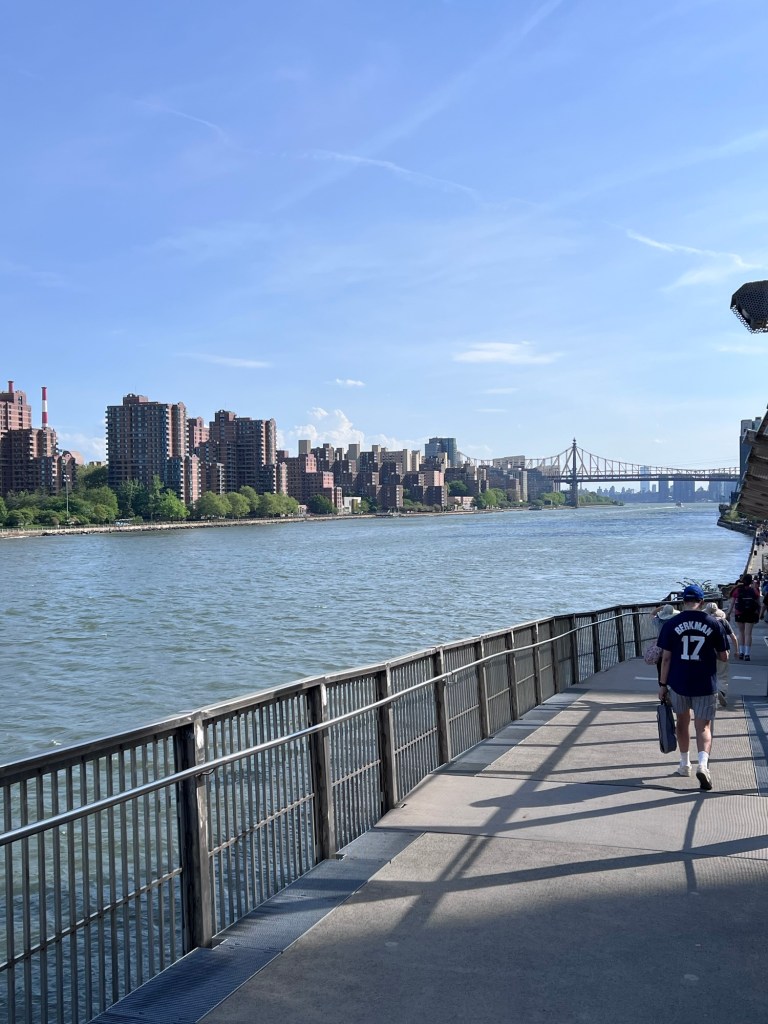
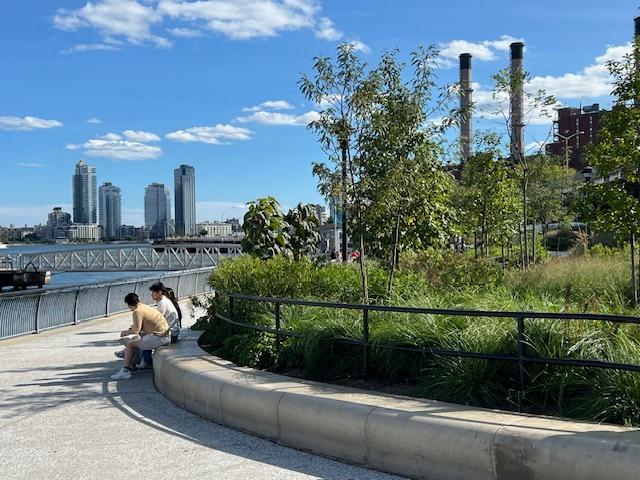
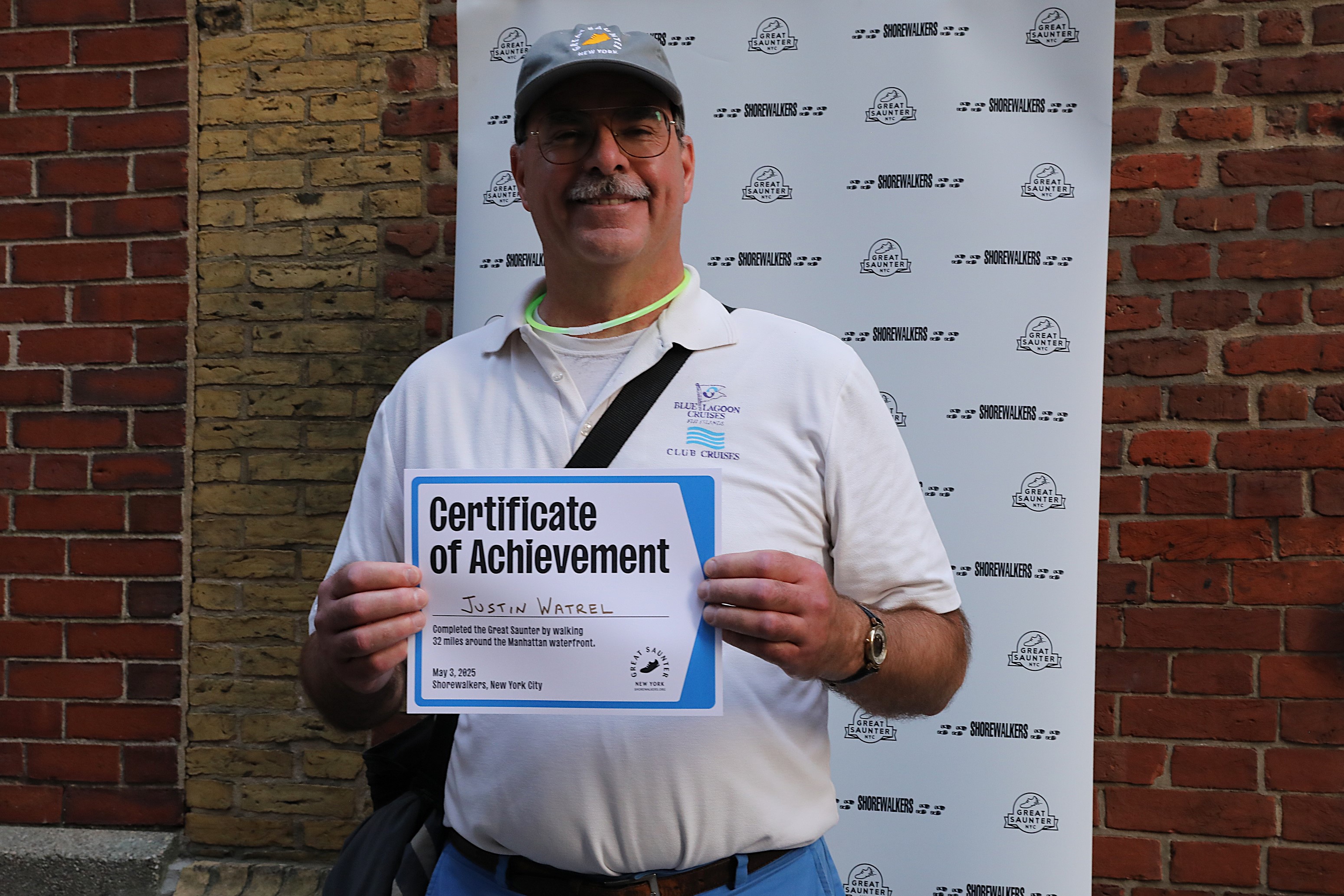
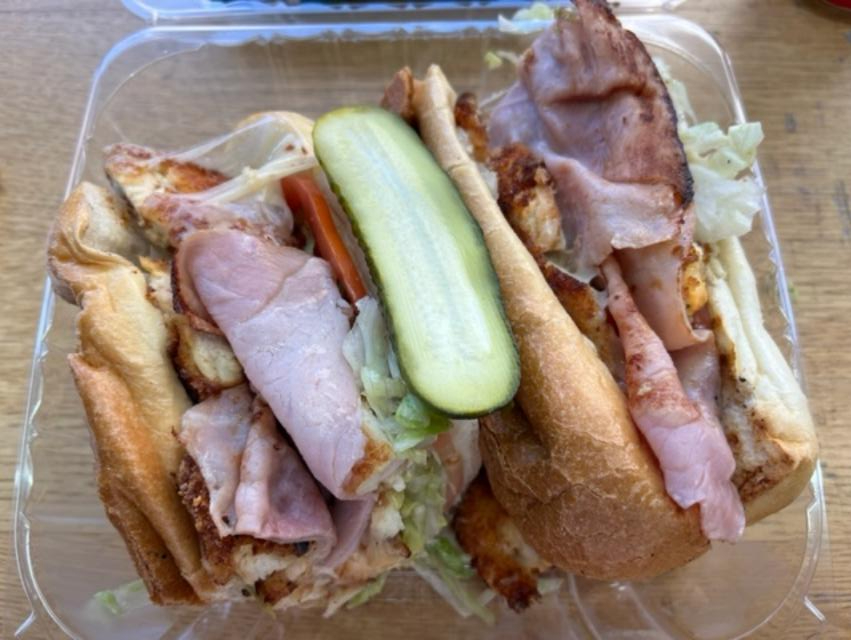
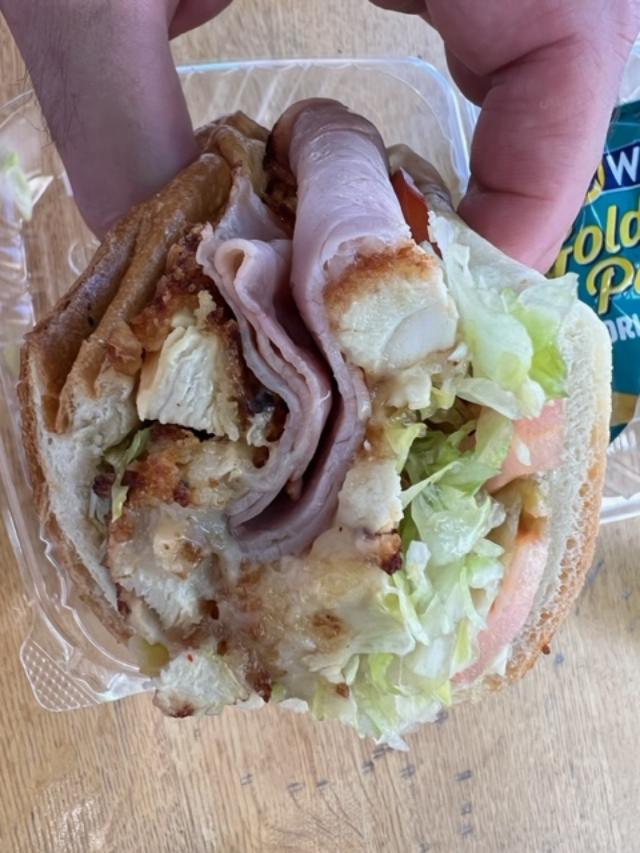
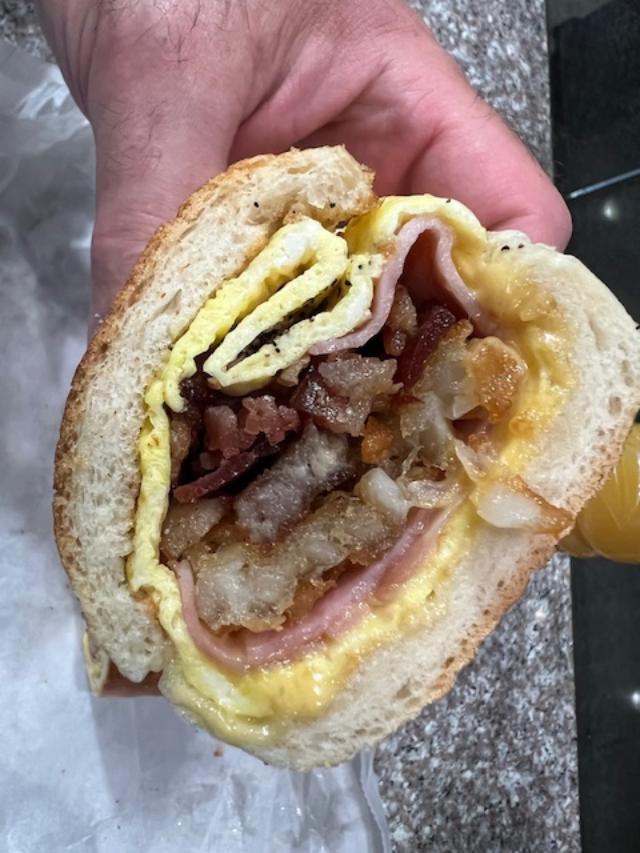
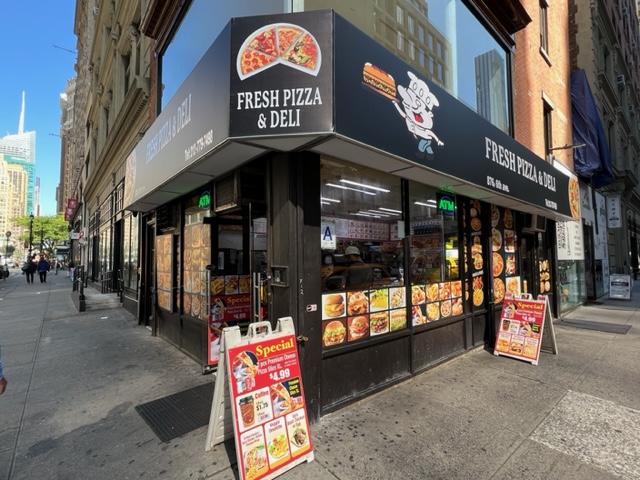
I always order the same thing here, the Bacon, Egg and Cheese on a hero roll ($6.50) and it is one of the best in Manhattan. They scramble two fresh eggs and then tuck it into a soft chewy hero roll lined with American cheese. Then they top it with several pieces of crisp bacon. The combination of flavors is amazing, and the portion size is enough for breakfast and lunch.
The Bacon, Egg and Cheese on a soft roll is amazing
What I really like about Park Terrace Deli is not only do they have an extensive menu of sandwiches and wraps for breakfast, lunch and dinner but they are also very fair with their prices. All the sandwiches are under $10.00. With the size and quality of their food that is very fair at a time when everyone is raising their prices out of reach to most customers. The deli knows who their customers are and caters to them.
What I also like is the service is always very friendly and accommodating. Everyone has been very nice when ordering food, no matter how busy it is in the deli. They also get the food out promptly as most of the customers are in the trades and are eating on the go. No matter how quick they are the quality is always consistent.
My recent trip made me question it though when the guy at the register overcharged me by a $1.00 and then gave me attitude. Rather than making a fuss (I was not sure what his problem was), I just paid it and left. I chalked it up to someone having a bad day.
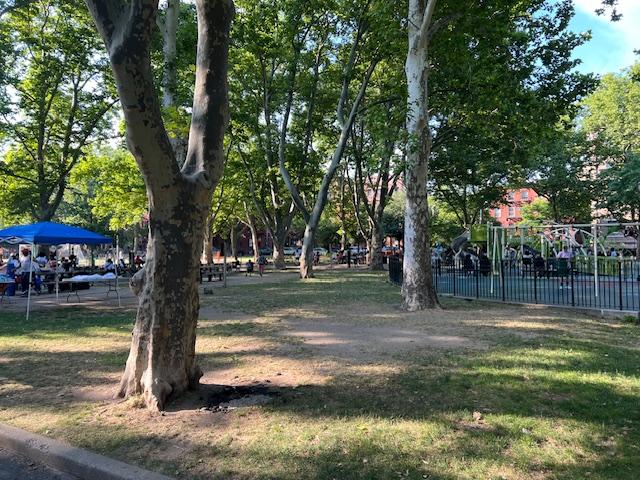
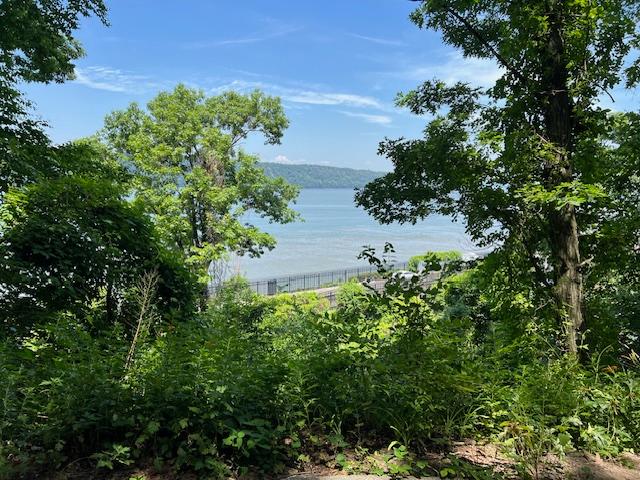
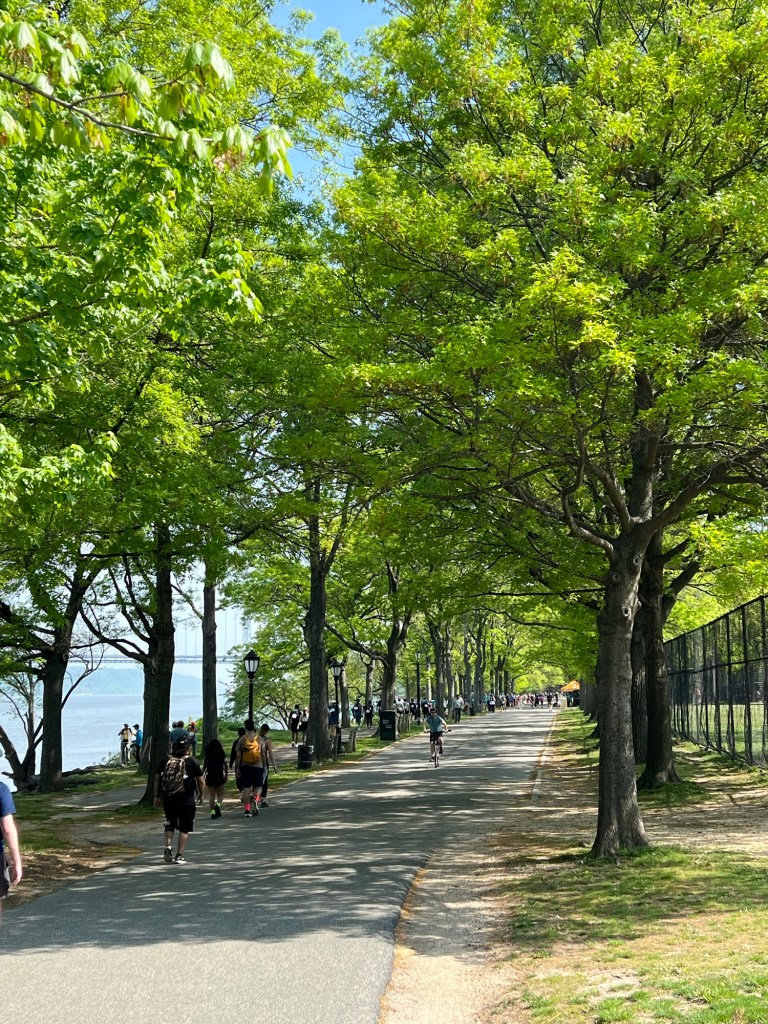
The nice part is that you can take your order to go order to Moscato Marsh, a small park down the block from the deli or Inwood Park down the road. On a beautiful warm and sunny day, it is the nicest place to eat and is better than any restaurant.
On game day when I come up for the Cornell-Columbia football game at Baker Stadium, it is still my ‘go to’ place when I am hungry. It is right down the road from the stadium and a nice alternative to the expensive concession stand (they charge $8.00 for a hot dog).
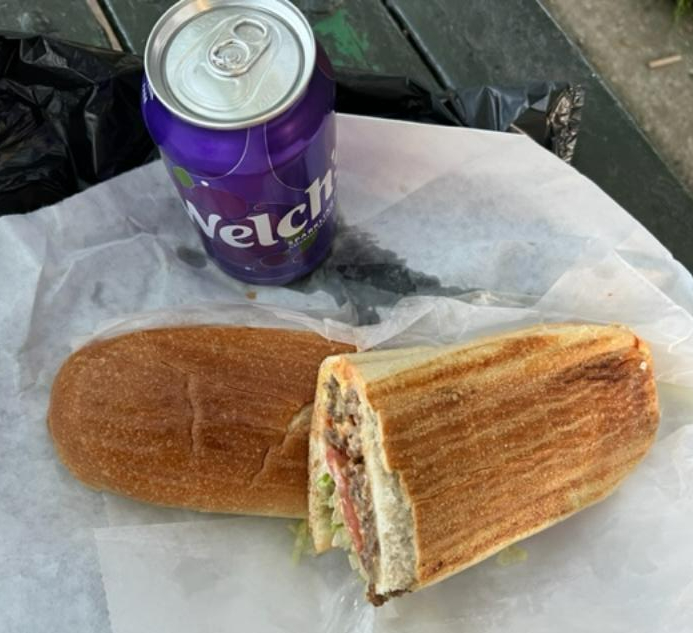
On a cool afternoon, I ordered the perfect meal, a Cheeseburger Deluxe. This large juicy burger was the ultimate comfort meal for lunch. The burger was perfectly cooked and had about three sliced of cheese on it. With the Dr. Brown Cherry soda, there is nothing like it.
The guy must have not been listening because I ordered a Cheddar cheese omelet and somehow got a Feta Cheese omelet. Not the same but still good.
My Broadway walk breakfast
The omelet was huge
It came with a mountain of spiced hash browns which were really good. I also should have gotten rye toast instead of wheat but it still made a good sandwich. So it was two breakfasts in one.
You have to make a sandwich with it for two breakfasts
Even though the order was screwed up, the food was still delicious and I tried something new. It was such a beautiful day, I took my breakfast down to Muscato Marsh down the road, ate outside and enjoyed both the weather and the views.
Park Terrace Deli has been one of my go to places to eat uptown for a few years. I came across the deli when I was walking “The Great Saunter”, the 32 mile walk around Manhattan and needed an additional breakfast for extra protein and carbs. They did not disappoint me.
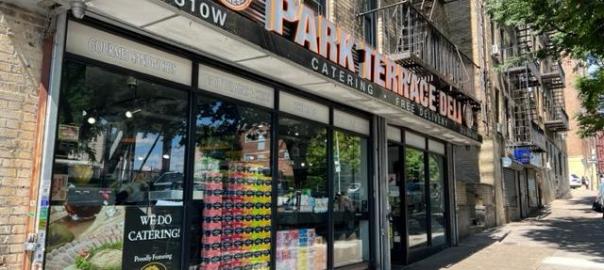
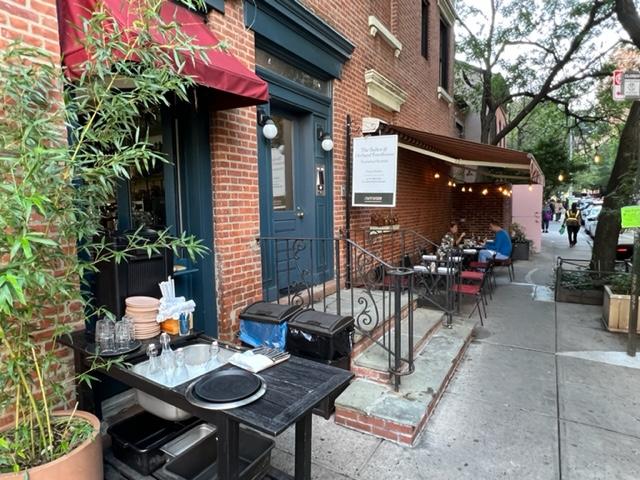
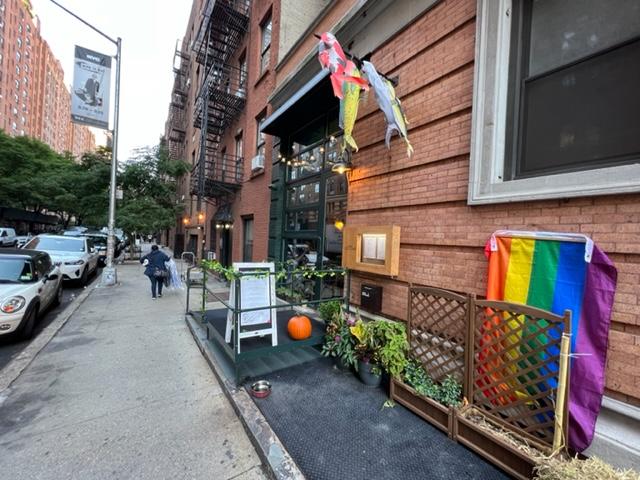
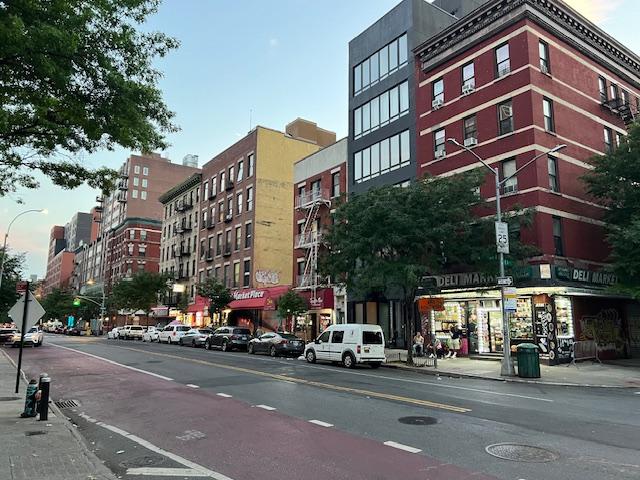
Park Terrace Deli at 510 West 218th Street
I always order the same thing here, the Bacon, Egg and Cheese on a hero roll ($6.50) and it is one of the best in Manhattan. They scramble two fresh eggs and then tuck it into a soft chewy hero roll lined with American cheese. Then they top it with several pieces of crisp bacon. The combination of flavors is amazing, and the portion size is enough for breakfast…
The weather finally broke and it was goreous today. It was a crazy morning before I left for the City and I got in early before I had to work at the Soup Kitchen. The numbers keep growing and we are getting busier and busier. We are now packing a thousand bags of food for the growing number of people visiting Holy Apostles.
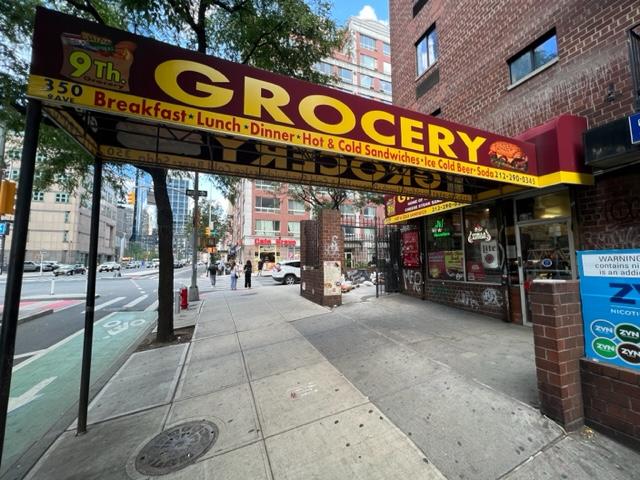
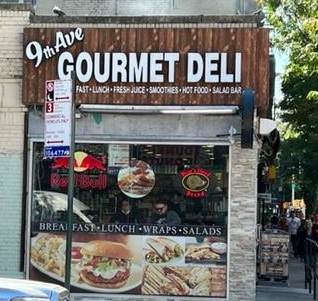
I needed some extra energy before I got to the church and decided to stop at 9th Avenue Grocery, a tiny deli a block from the church for a Bacon, Egg and Cheese sandwich. I must have passed this place a hundred times over the last twenty years but never stopped in. With all the construction going on in the neighborhood, I have noticed more signs outside for the deli with their specials to bring these guys in.
9th Avenue Grocery at 350 Ninth Avenue (Closed January 2024)
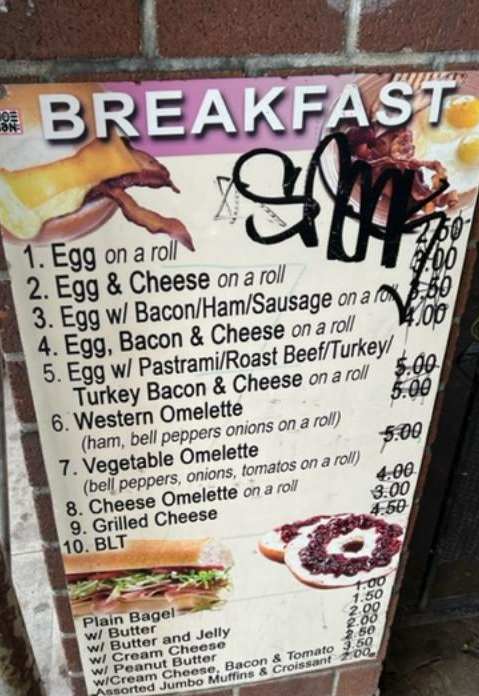
The Breakfast menu at 9th Avenue Grocery (prices have changed)
I have to tell you the Bacon, Egg and Cheese on a soft roll ($4.50) was not only was reasonable but delicious. The roll was so fresh and chewy, but they gave you a nice portion of eggs to bacon which must have been two or three per order. What I liked about their menu was that almost all their hot foods were under $10.00.
The Bacon, Egg and Cheese at 9th Avenue Grocery is worth the trip dodging construction workers
When I finished breakfast, it was time to go to work and we spent the rest of the morning packing food bags to go with the hot food lunch we were serving that morning. We worked in coordination and packed 800 bags this morning so that the Monday staff had something to work with that day. Five of us got this done in two and a half hours.
After we finished, it was time to to explore the Streets of the Chelsea neighborhood. I lucked out and it was a beautiful sunny afternoon with blue skys and about 82 degrees. That’s when these walks are fun.
I have to tell you that this, Chelsea in this section of the neighborhood is a juxtapose of different styles of architecture and reflects how the area is reinventing itself from an old shipping and receiving/distribution business to the modern-day tech companies. Not only has there been a reuse of these buildings, but the historical brick townhouses have been brought back to their glory with extensive renovations. With every block it just keeps changing with a new business filling the stores that once had ‘For Rent’ signs.
I walked around the block from Holy Apostles Church to start the walk from Twelve Avenue and then continued down West 27th Street. You are going to find that most of the buildings between Twelfth and Tenth Avenues which were probably once garages and car washes have now been refitted into art galleries. You can see the art peering out from the glass windows. You will also notice that it is one of the few streets in the City with cobblestones. It is rare to see this anymore.
The cobblestone streets of West 27th Street off Twelve Avenue
From Tenth to Ninth Avenues, you pass Chelsea Park, which looked like it was busy on the soccer field with a gym class from the Avenues World School on one side, the kids screaming and yelling all over the playground equipment from P.S. 33 Chelsea Prep and the homeless who just finished their lunch from Holy Apostles lying around the benches in the middle of the park. It is never a dull moment in that park and it has become very much alive with the warmer weather and probably the anticipation of school ending.
For security reasons, you will have to walk around the Penn South Complex down West 26th Street and around to reach Ninth Avenue and the entrance to the Fashion Institute of Technology campus at West 27th Street.
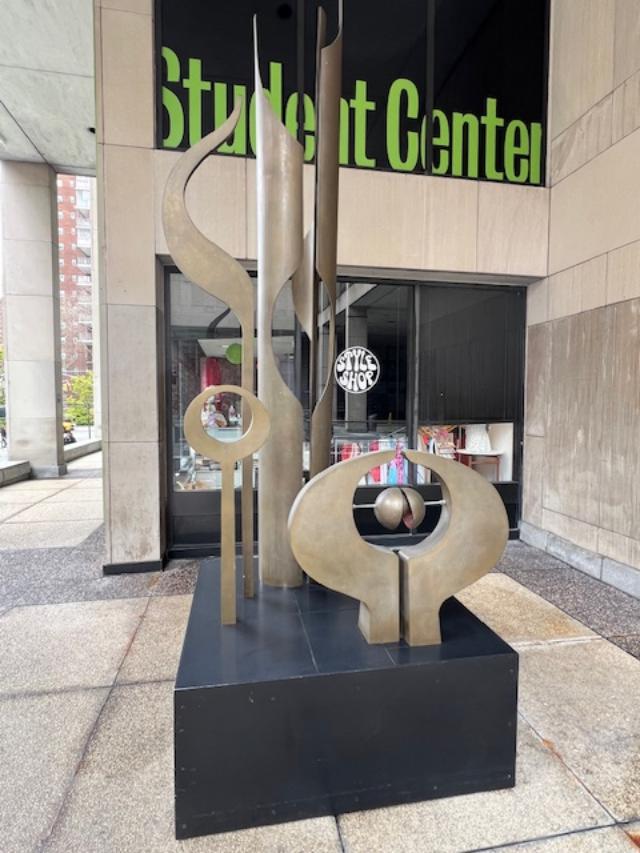
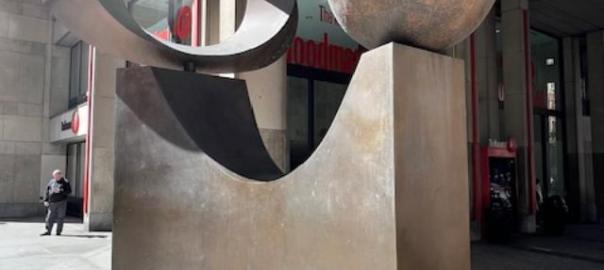
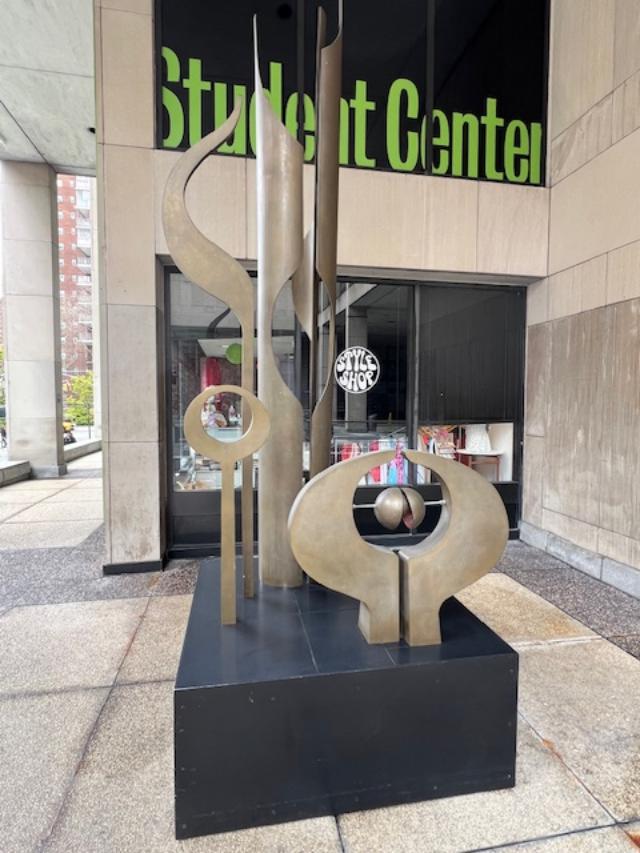
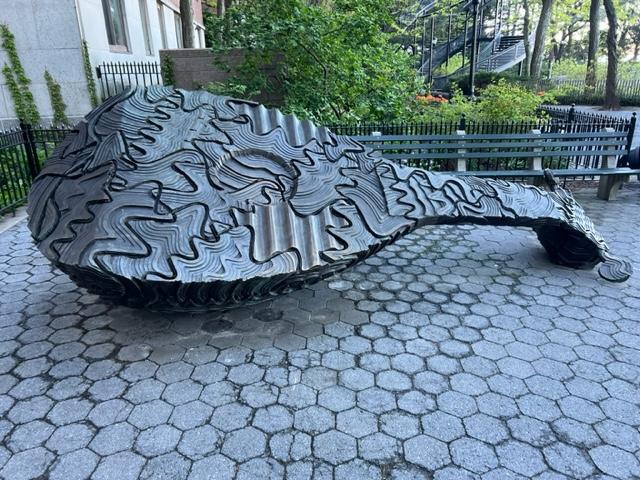
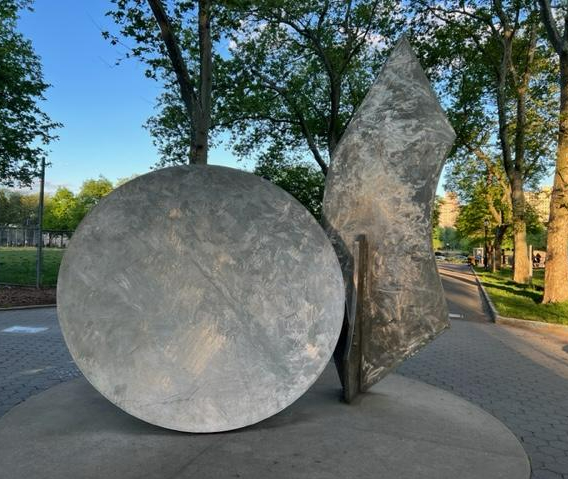
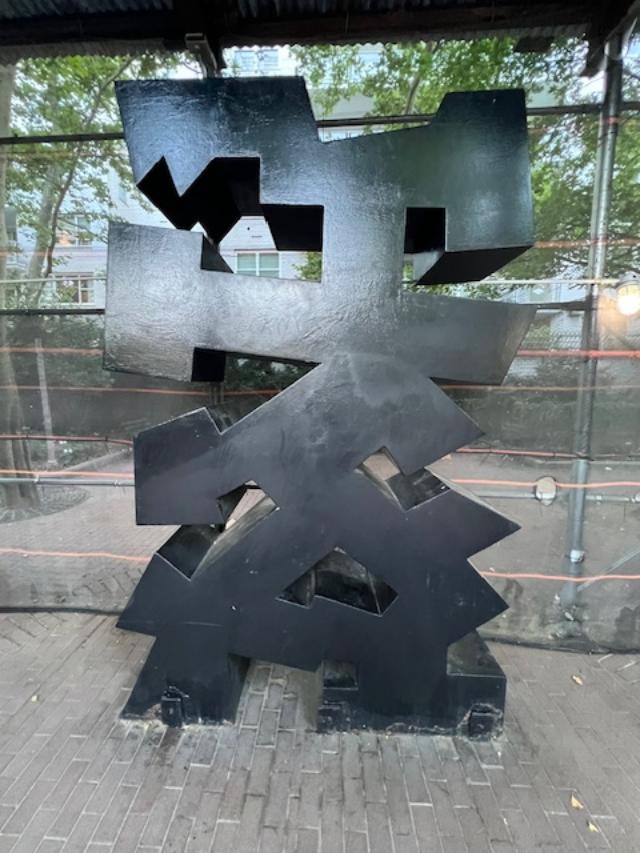
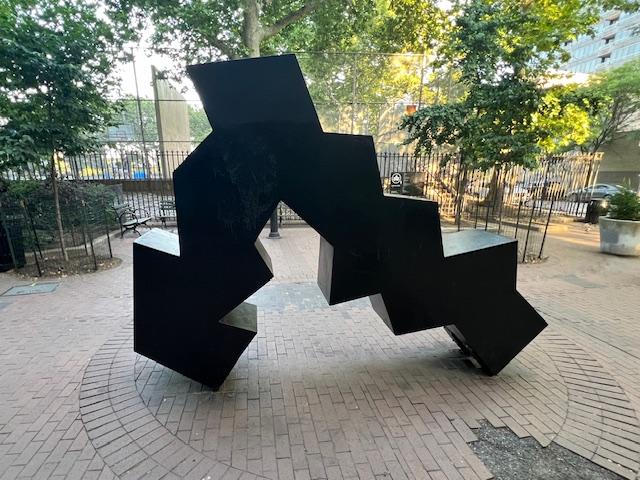
“Untitled” by Ami Shamir
The campus was really quiet as summer classes were probably going on right now. I noticed tucked in front of the Dubinsky Building is the sculpture “Untitled” by artist Ami Shamir. This work appears to represent a figure group of fashion industry-related tools (Hue Magazine). The piece dates back to the 1970’s.
Ami Shamir is an Israeli American born artist was a noted sculpture and stained-glass artist whose works were related to Jewish themes and the Holocaust. The work was part of the Public Art Movement of its time (Hue Magazine).
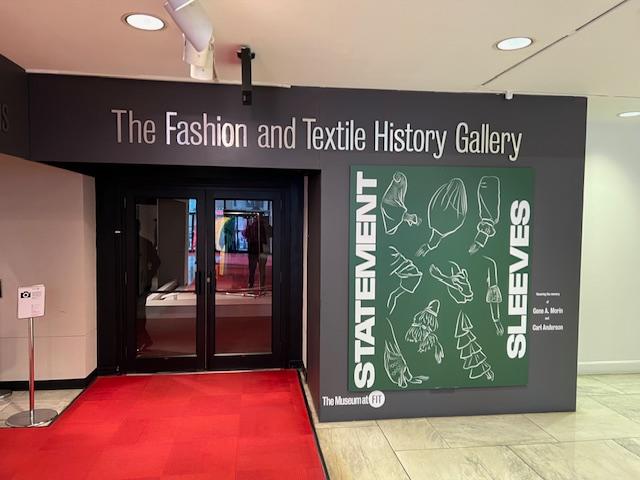
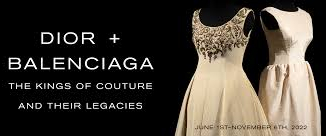
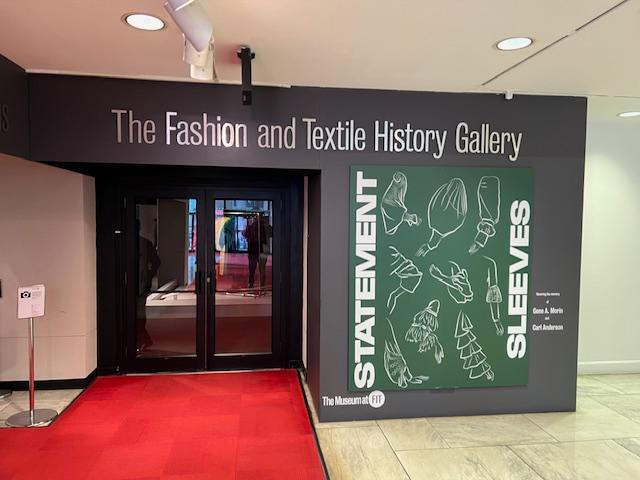
On the corner of West 27th Street and Seventh Avenue is the Museum of FIT at 227 West 27th Street. This wonderful and unique museum showcases the clothing, shoes and accessories of the Fashion Institute of Technology collection. I stopped in earlier to see the new exhibition “Dior + Balenciaga-Kings of Couture and their Legacies” which was the current show.
The “Dior + Balenciaga: Kings of Couture and their Legacies” show
The show compares and contrasts both designers both on how their work was perceived and how it compares to the fashion represented in their ‘Houses’ today. The museum does a wonderful job mounting a show and it should not be missed. It is also open free to the public.
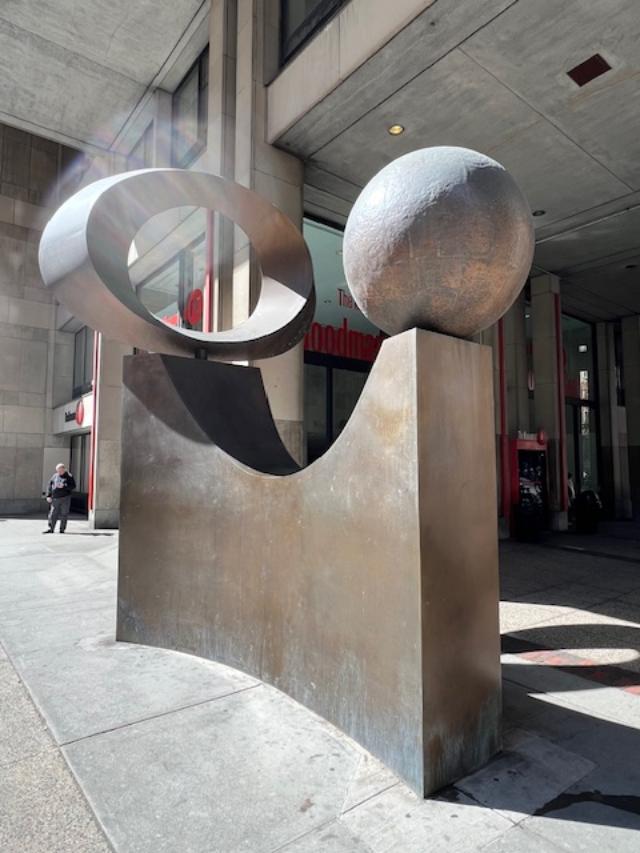
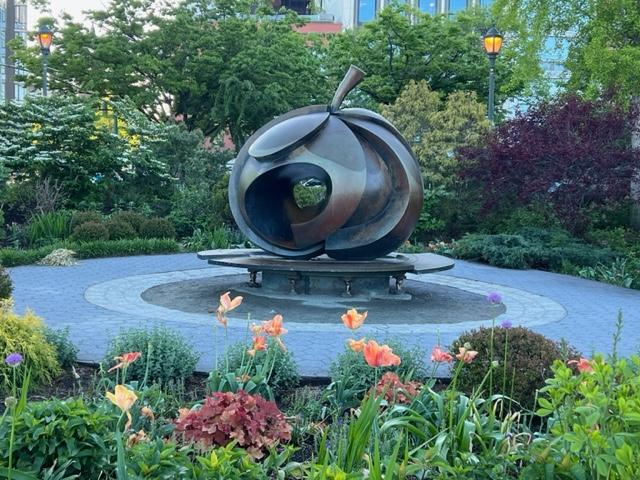
When you arrive at the corner of campus at Sixth Avenue, you are greeted by one of the most iconic sculptures in the City, The ‘Eye of Fashion’ by artist Robert Cornbach. This was designed by the artist in 1976 and just returned to the campus after a major renovation.
“The Eye of Fashion” by artist Robert Cornbach
Robert Cornbach was an American born artist from St. Louis, who was educated at the St. Louis Academy of Fine Arts and the Pennsylvania Academy of Fine Arts. He was known for his large abstract artworks that includes sculptures and fountains (NYTimes.com/Obituary). He also created works for the WPA for the Government’s Federal Art Project (Wiki).
When you cross Seventh towards Sixth Avenue, you see the last traces of the old Garment/Wholesale District with many of those old wholesale businesses being replaced by trendy stores and hotels. The area is shared with the very desirable NoMAD (North of Madison Park) neighborhood that is slowly expanding to this neighborhood. Reaching Sixth Avenue, it was like revisiting an old friend since I had not visited NoMAD/Koreatown in a few months.
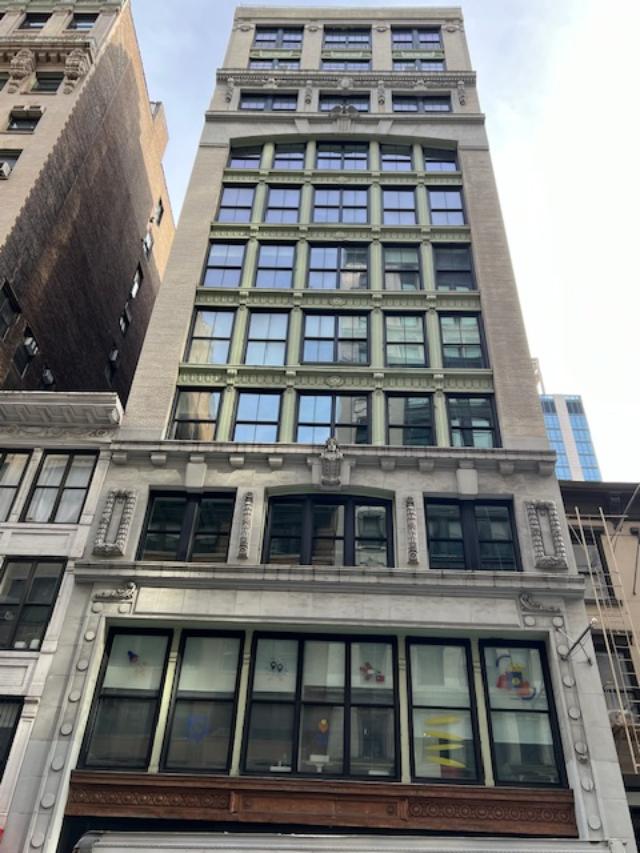
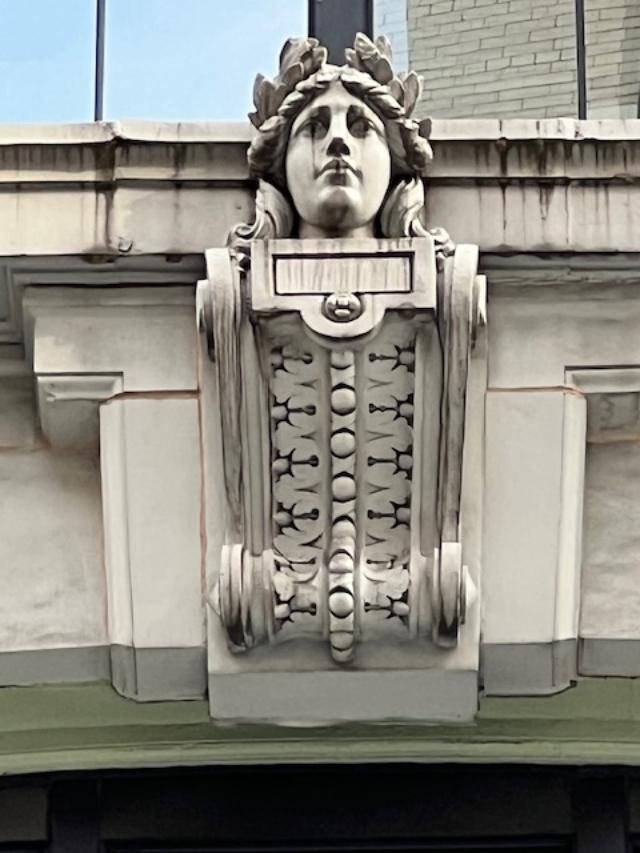
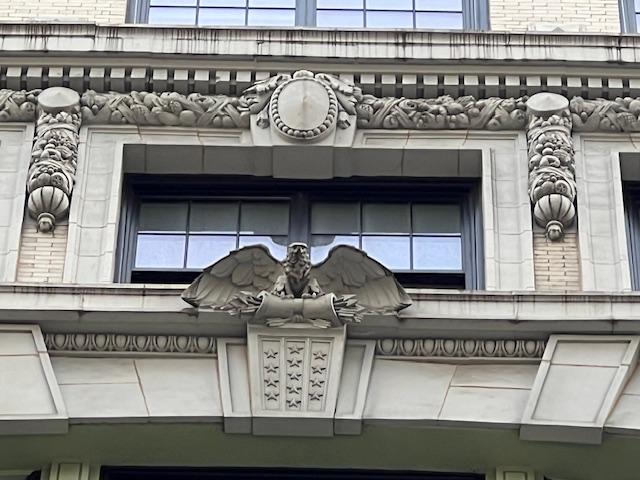
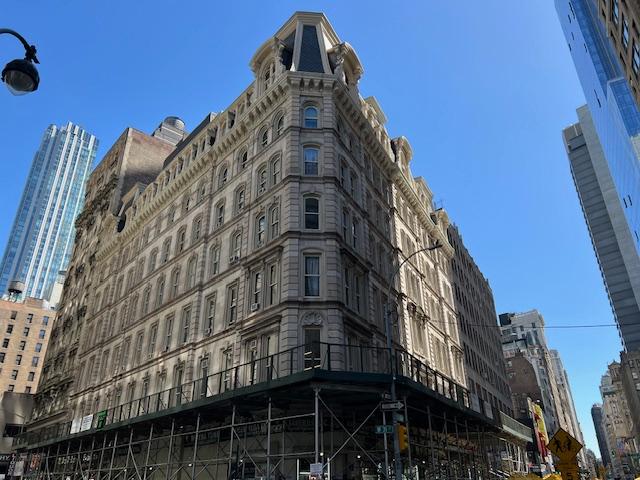
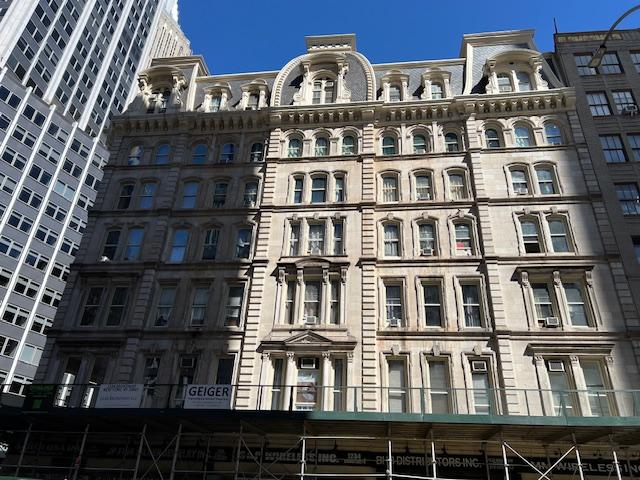
As you are walking back down the street, you will notice the beauty of 109 West 27th Street amongst the smaller buildings in the old Wholesale District. Some relators will say this is NoMAD and some will say the Garment District. The building was built in 1908 and you really have to look at the upper floors to see the detailed stone carvings and embellishments that adorn the buildings.
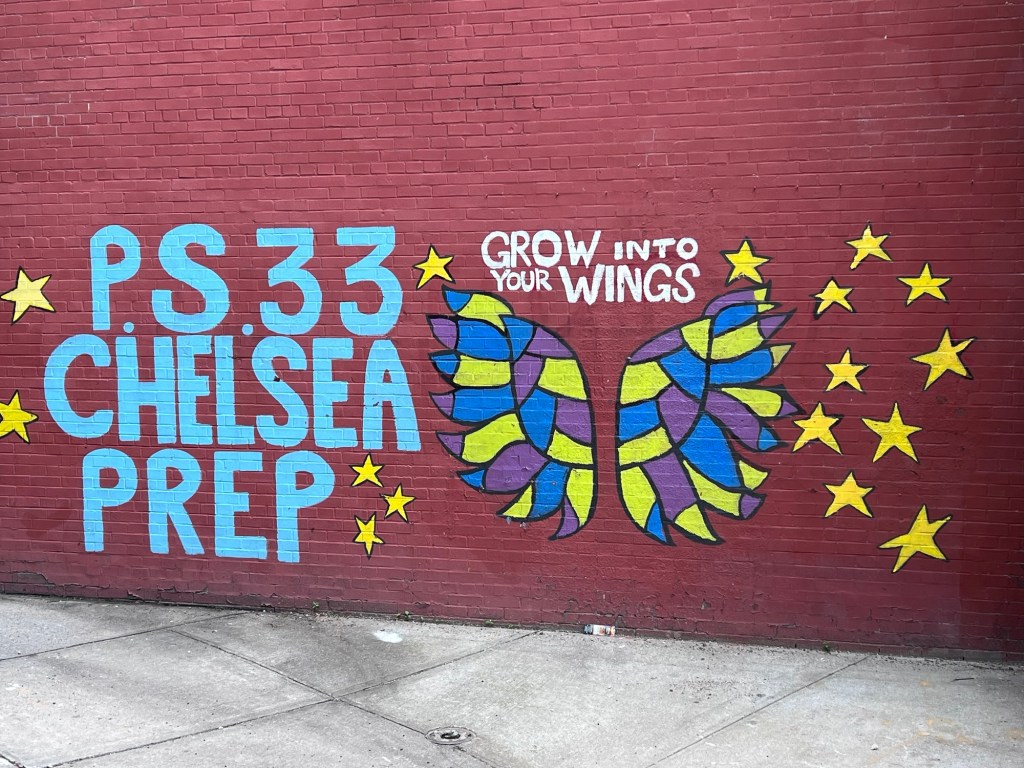
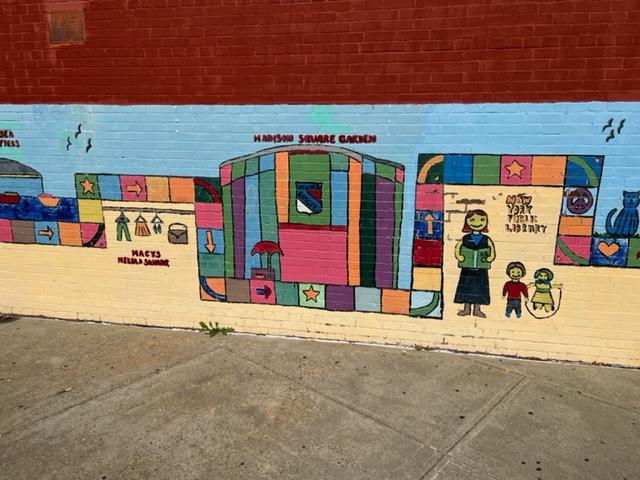
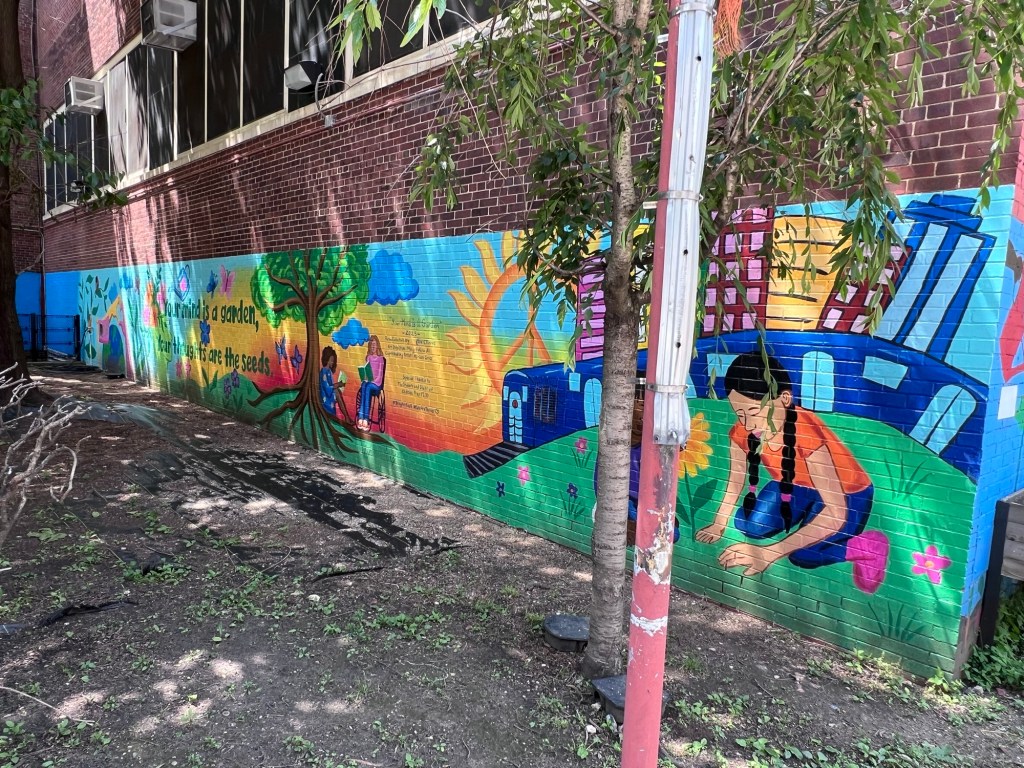
PS 33 Chelsea Prep mural at the back of the school
The front of the school and its engaging murals
On the walk back, you will start to notice this transition with all the empty ‘For Rent’ signs on the buildings. COVID really affected this part of the neighborhood and just accelerated the gentrification.
The Chelsea School PS 33 artwork on the school
Chelsea School Art
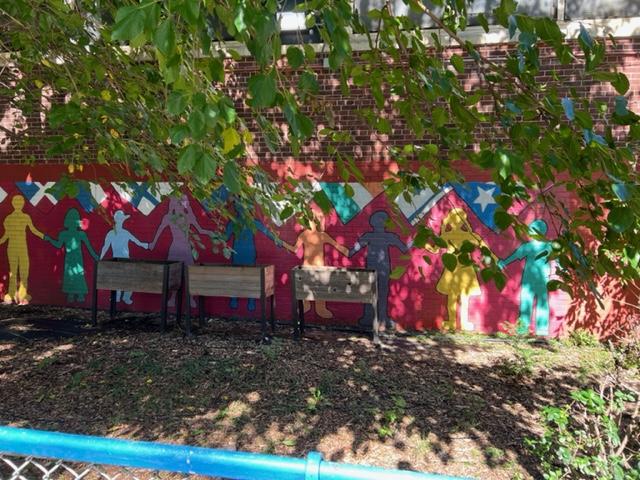
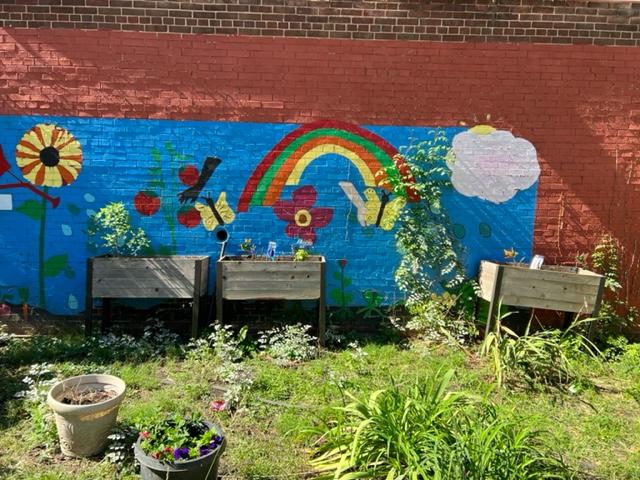
Chelsea School Artwork in the Garden
Just be sure that when you are walking back through Chelsea Park, it is at school time and not after dark. The park can get a little seedy at twilight. Also take time to look at the nice vegetable garden the kids at PS 33 planted behind the school. They did a good job.
I found this cute production of “Singing in the Rain” that the students of P.S. 33 Chelsea Prep performed
As you are walking back towards Twelvth Avenue, you will be greeted by the most unusual women faces and creatures the move and swirl. These are the works of artist Jordan Betten that line the door fronts of the building facing West 27th Street.
Artist Jordan Betten’s artwork on West 27th Street entitled “Sleep No More” is located on the south side of the street
Artist Jordan Betten is a Miami based American born artist who works include painting, sculpture and design. With unique application and use of colors, his art captures a feeling of freedom and strength. He shows his love of the streets with sophistication and modernism (Artist Bio).
Video on artist Jordan Betten’s work
West 26th Street has a similar feel for the first two blocks as well with many of the building housing art galleries. A crew was filming a movie, so I had to move around the street as I was walking through it and there is a lot of construction on the street with renovations of these old buildings so be careful.
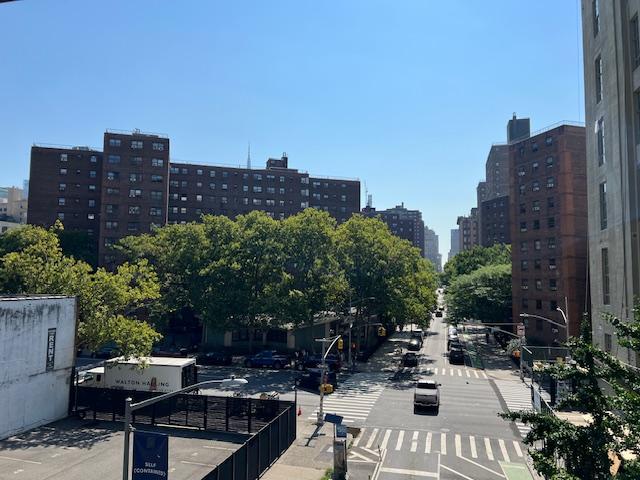
When crossing the street at Tenth Avenue, you will be walking through the middle of the Chelsea-Elliott Houses so please be aware of who is around you. My advice is to walk through this area when either school is out for a break or just after school. It can get a little shady in the early evenings. Some of the residents will really look you over if they feel you don’t belong, and this is on the sidewalk that rims the complex.
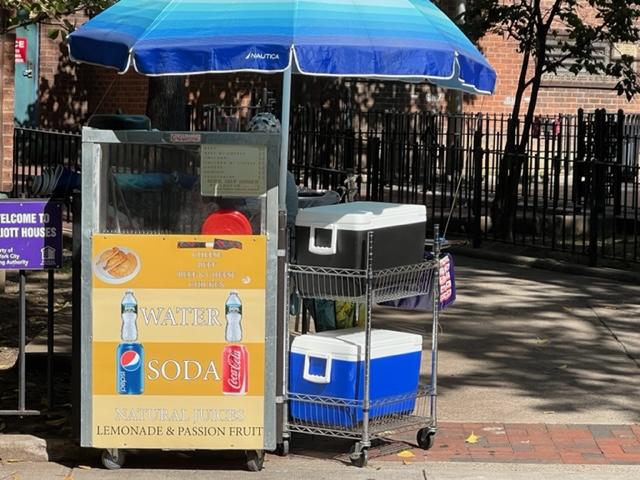
Still there are a few bright points when you walk through the projects. Senoria Pastilito, a woman who sells freshly fried chicken and beef pastelitos, a Dominican empanada and icy sodas. This little stand is open around the time school lets out. Do not miss these delicious pastelitos, filled with chopped and well spiced meats that she fries fresh in front of you. I ate them right by the little park where her stand is located, and she is busy when school lets out.
Senoria Pastelito at the Chelsea-Elliott Houses
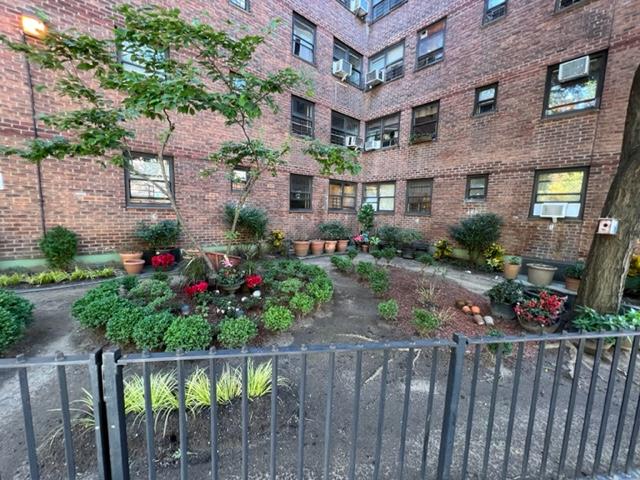
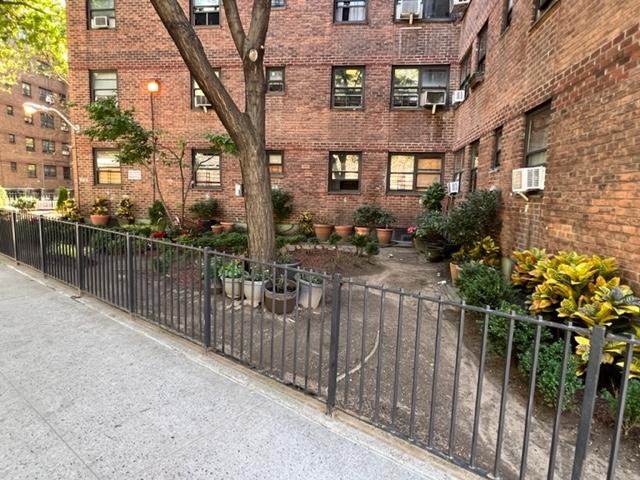
Also, tucked into the side of the building is a beautiful flower garden where dozens a of red rose bushes were in bloom, and someone planted flower beds between the building and the sidewalk.
The Chelsea-Elliott Houses Gardens
The Chelsea-Elliott Houses Gardens
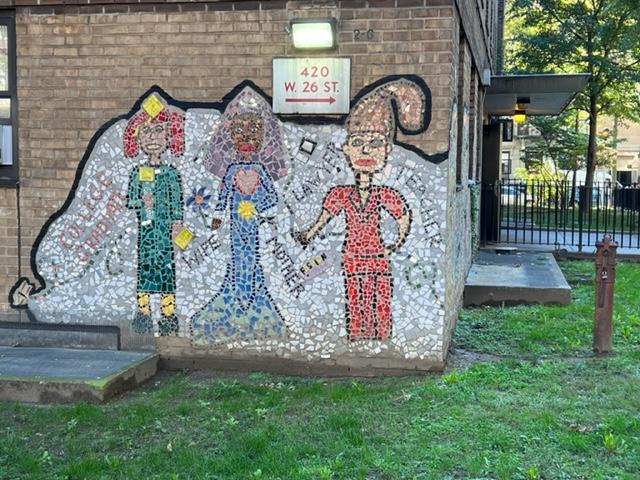
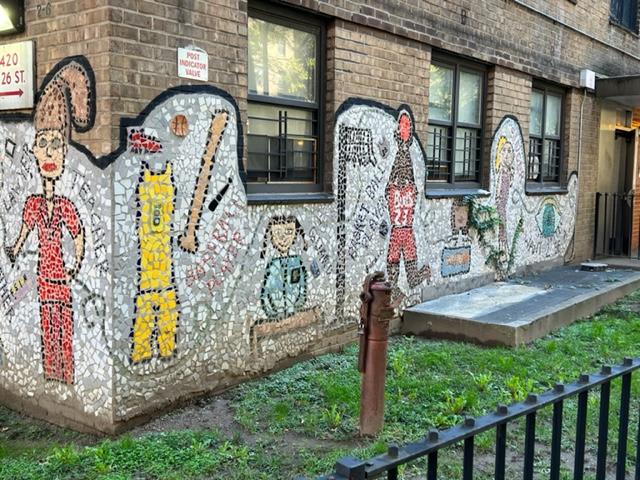
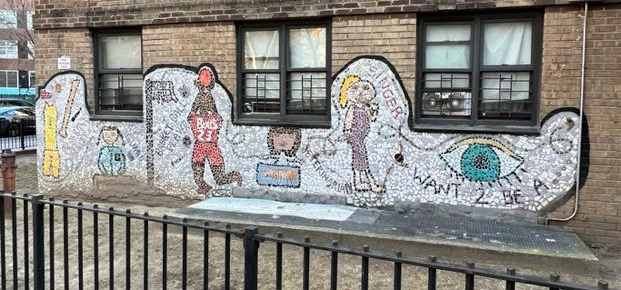
It just shows that there are people in public housing that really do care about their homes and take pride in its appearance. There is also interesting tile art on the side of one of the buildings that is really interesting. I was not sure what it meant though.
The tile art at the Chelsea-Elliott Houses
The tile art at the Chelsea-Elliott Houses
The tile art at the Chelsea-Elliott Houses
Changes in the neighborhood
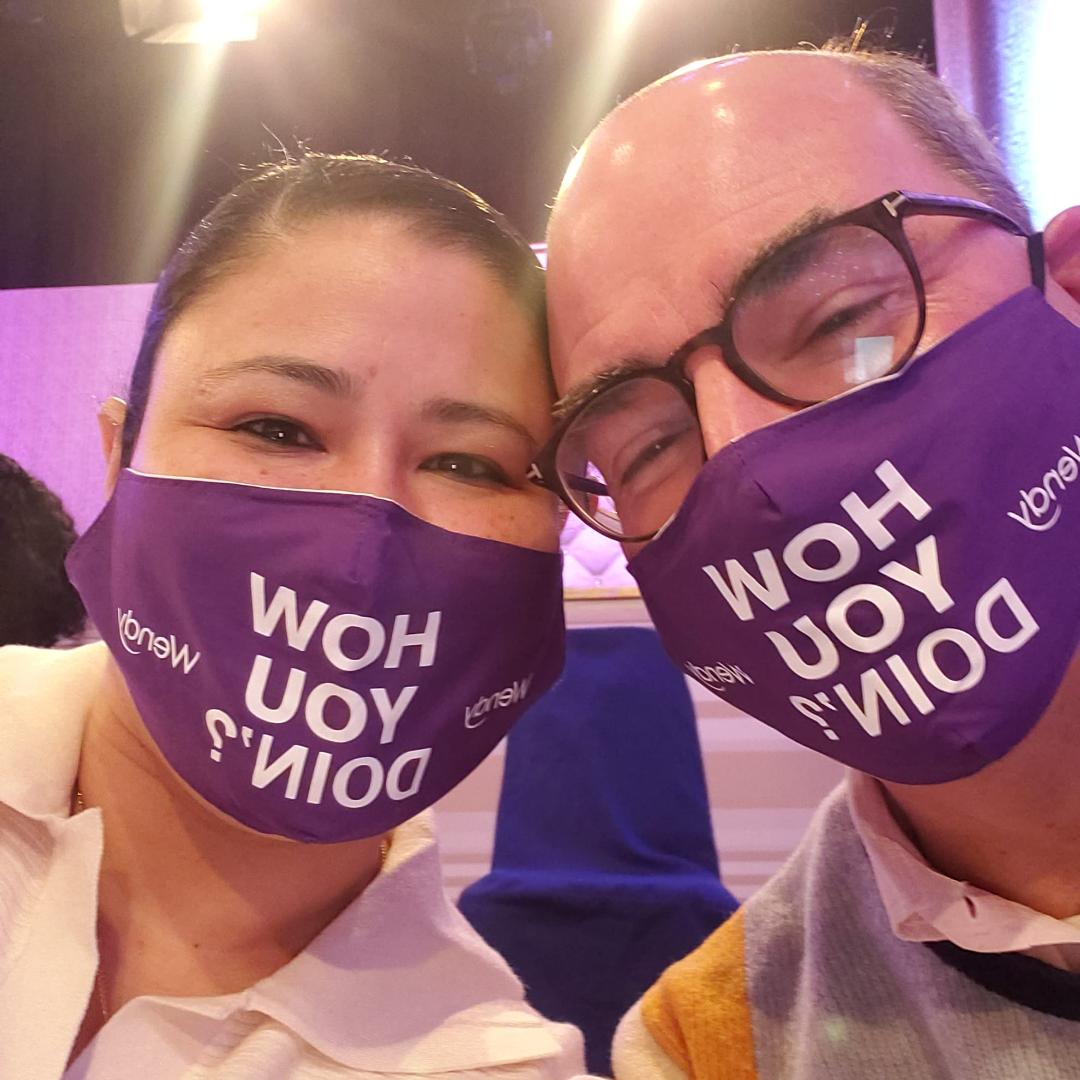
Further down the road towards the southern part of the Fashion Institute of Technology campus is the studio for the Wendy Williams Show, where my best friend, Maricel and I attended the show back in March. The theater is at 221 West 26th Street and when I passed it I could not believe so much time had gone by. The worst part is I heard on the Internet that the show is closing after 13 seasons.
My best friend Maricel and I at the ‘Wendy Williams Show’
As you travel to the other side of Seventh Avenue, you will see the constant change over of the neighborhood from the old Garment District to the fashionable NoMAD with small restaurants and shops tucked into former wholesale shops. COVID closed a lot of the older businesses that used to be on the block.
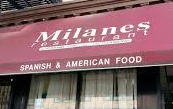
West 25th Street is very similar to the other blocks with lots of art galleries on the first two blocks from Twelve to Tenth Avenues taking space that was formerly used for shipping or car repair. When you crossover to Seventh Avenue, I was bummed to see that Milanes at 168 West 25th Street closed for business. That’s where Maricel and I ate after attending the Wendy Williams Show and I ate when I was in the neighborhood. It was funny in that it was always busy when I ate there.
Milanes at 168 West 25th Street (Closed in June 2022)
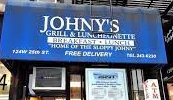
The COVID economy takes another victim. Its too bad as this restaurant had quite the following. Their business seems to be have been taken up by Johny’s Lunchonette at 124 West 25th Street, a small lunch counter business a few doors down.
Johny’s Grill and Lunchonette at 124 West 25th Street
This looks like another winner that I will have to try in the future.
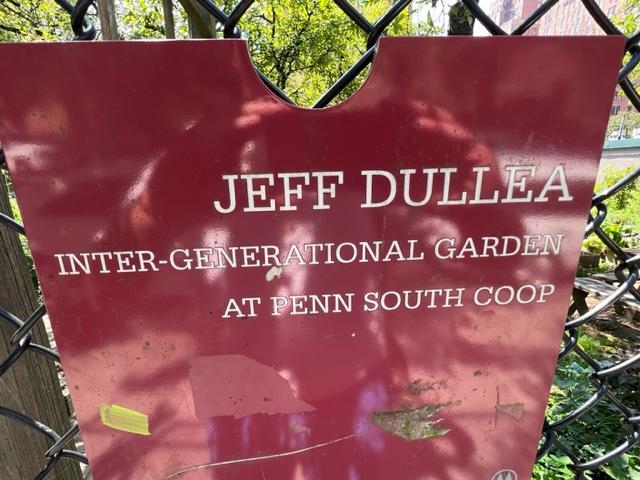
The Jeff Dullea Inter-Generational Garden
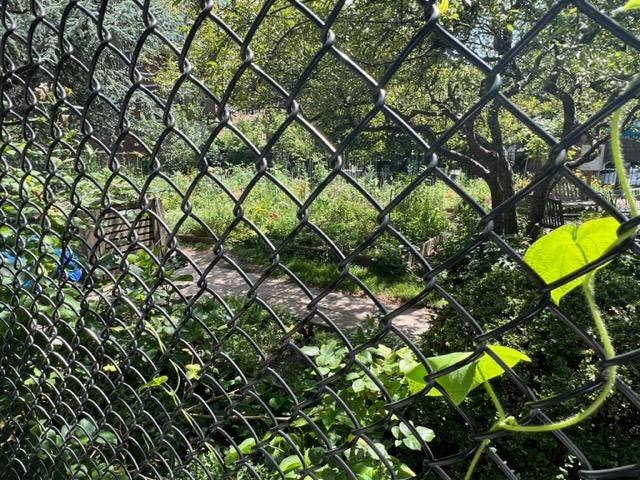
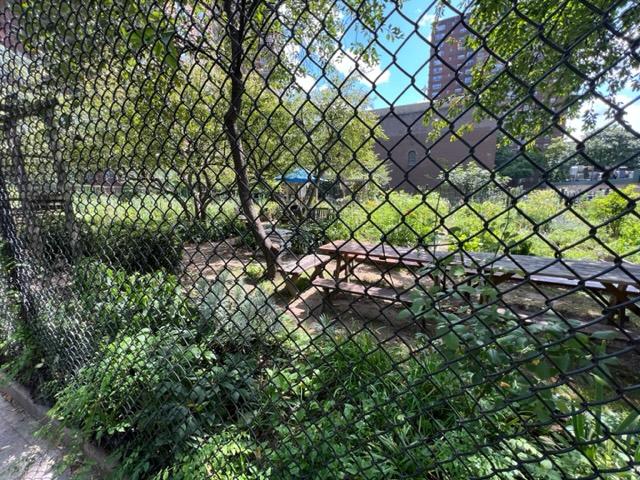
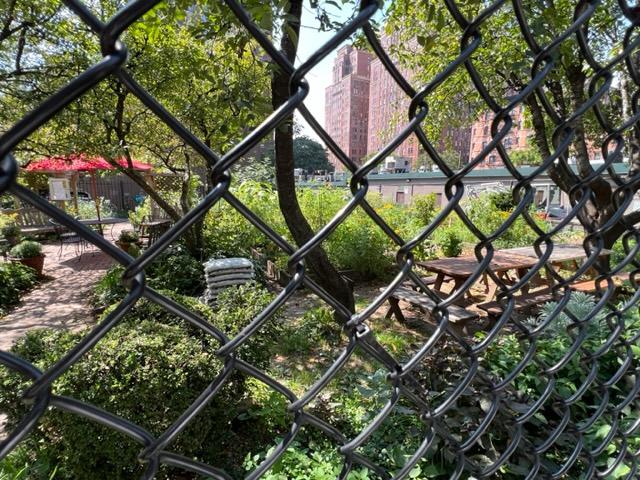
On the way back from Sixth Avenue and tucked into the southern part of the Penn South complex is the Jeff Dullea Generational Garden at 365 West 25th Street just before your get to Ninth Avenue. This tiny garden was locked but in full bloom with vegetable beds and wildflowers growing all over garden. Mr. Dullea had been a founding member of the Green Guerillas.
The Jeff Dullea Intergenerational Garden at 365 West 25th Street
The ‘Green Guerillas’ are a group that uses education, organizing and advocacy to to help people cultivate community gardens, sustain grassroots groups, grow food, engage youth and address critical issues of food justice and urban agriculture (Green Guerillas).
The gardens in full bloom
When turned the corner and started my walk down West 24th Street from Twelfth Avenue, I noticed all the former shipping buildings have all been converted to art galleries. Each building had its own look with the artwork shining from the large glass windows where you can peer in.
When you reach Tenth Avenue, you reach the historical district of the neighborhood which lines Tenth Avenue from West 25th to West 24th and the from Tenth to Ninth Avenues. These blocks are lined with late 19th century townhouses with detailed grillwork and small front gardens. This is one of the nicest sections of the neighborhood to walk.
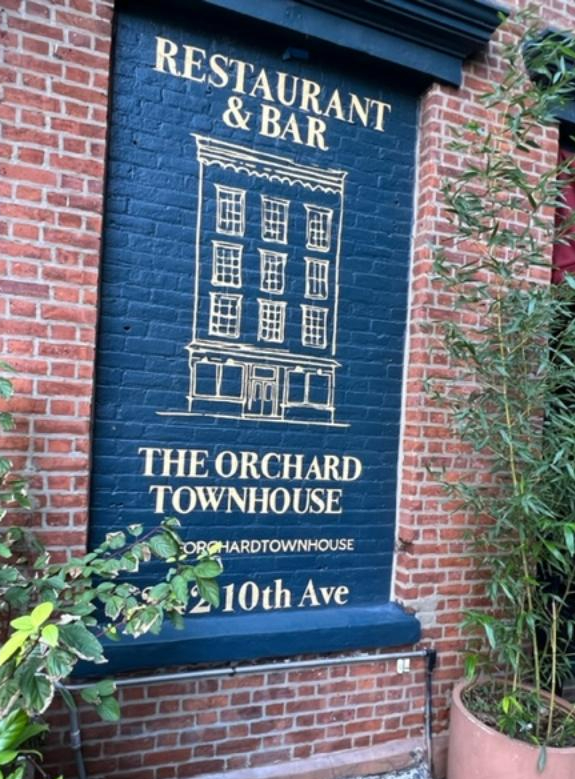
On the corner of Tenth Avenue and West 24th Street is Orchard Townhouse, a small restaurant and inn. Talk about quaint. The restaurant has indoor and outdoor dining with a small garden that flows to the sidewalk. It has that historic ‘inn’ look about it and an interesting menu for lunch. A mostly American and Continental menu and something to try in the future.
The Orchard Townhouse at twilight (Orchard Townhouse) at 242 Tenth Avenue at West 24th Street
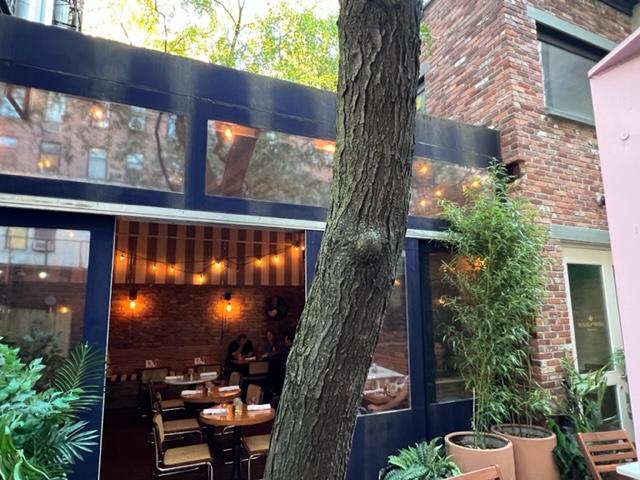
The courtyard of the Orchard Townhouse (Orchard Townhouse)
The courtyard of the Orchard Townhouse (Orchard Townhouse)
The House of Waris at the Old Orchard
This historic district extends from the southern side of West 25th Street and the northern side of West 24th and offers a glimpse at early 1880-90’s architecture at its finest. Back then, this was meant to be upper class housing but ended up being for a middle class resident. Today, you can’t buy one of these townhouses for under two million dollars. It would be interesting to know the builders perspective on that a hundred and thirty years later.
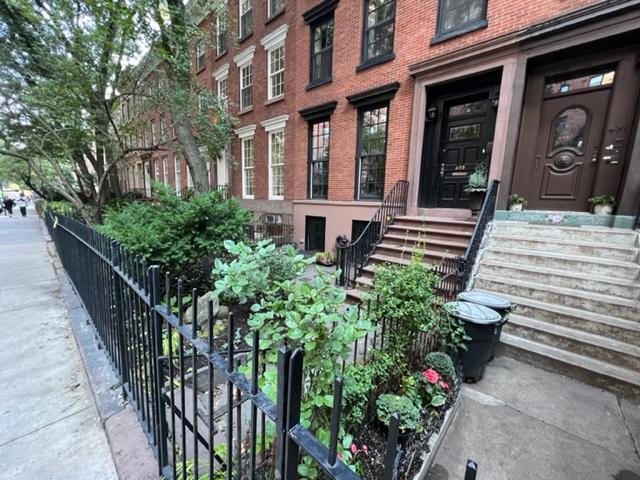
Chelsea Historic District at West 24th Street
West 24th Street offers a juxtaposed mix of architectural designs of buildings depending on the block. From Twelfth Avenue to Tenth Avenue it is a combination of old shipping and garage buildings that have now been converted like the rest of the neighborhood into art galleries, the historic district stretches from Tenth to Ninth Avenues and from Ninth to Sixth Avenues there is a mixture of the old residential district mixed into the commercial district that it has become.
Chelsea Historic District at West 24th Street
Here and there small brick townhouses mix in with larger commercial businesses that themselves have transformed from manufacturing to digital and tech companies and a growing number of restaurants. Businesses are closing and opening all over the street but it does look like the worst of the COVID problems are behind us (for now).
New restaurant opening at West 24th Street
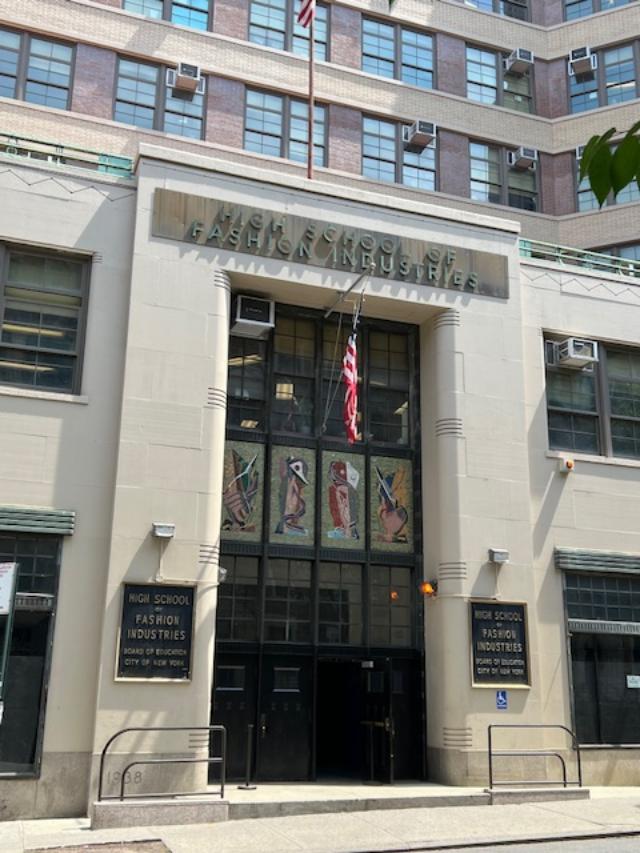
One stand out was the Fashion Industries High School at 225 West 24th Street where the windows were decorated with the students fashion ideas and I was figuring their final projects of the semester. They had some interesting looks pictured in the windows.
Fashion Industries High School at 225 West 24th Street
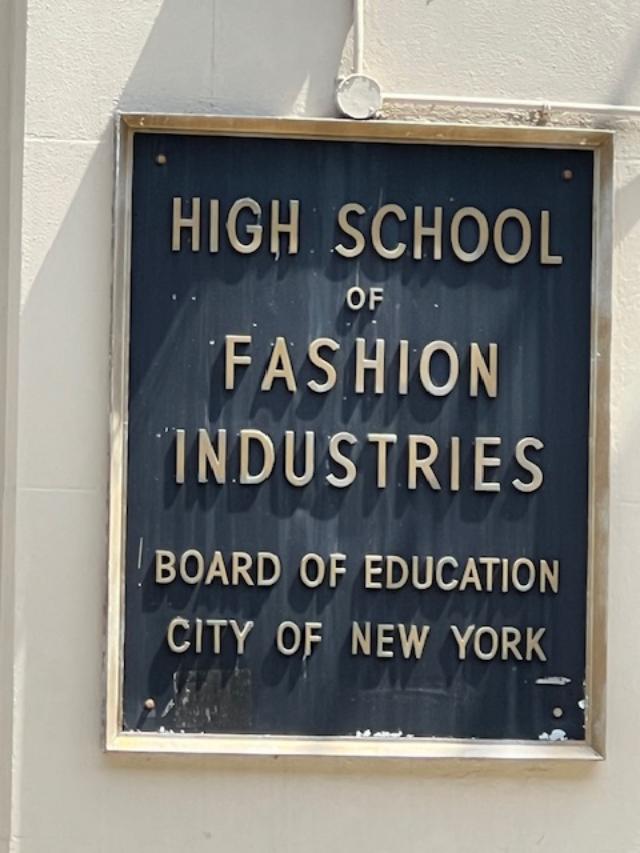
The school plaque for the High School of Fashion Industries
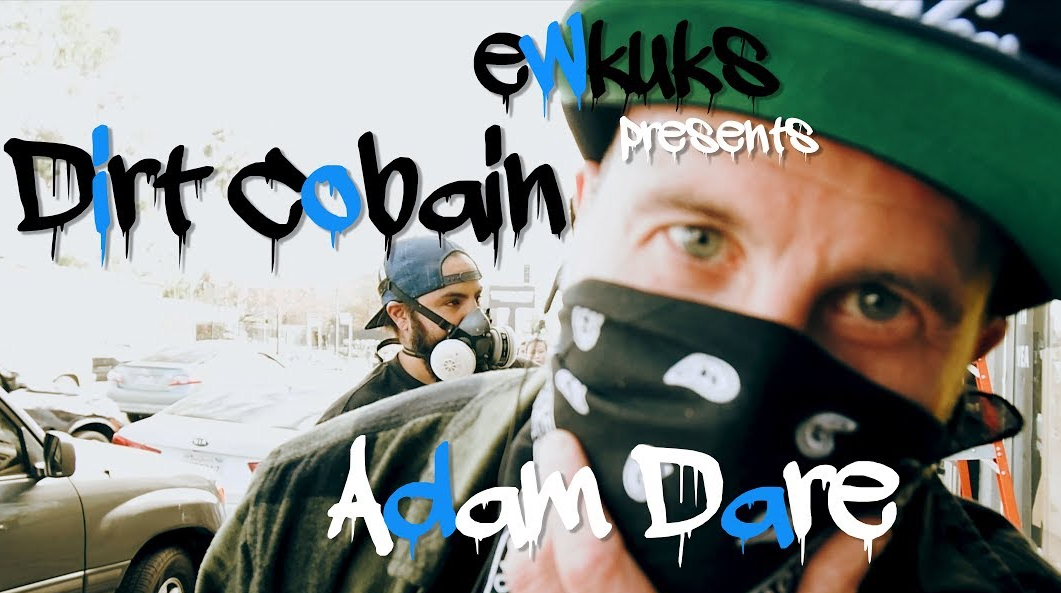
The one thing that did stick out at the very edge of the neighborhood on the wall of The Corner Cafe at the corner of 729 Sixth Avenue was the New York City painting by artist Dirt Cobain (now gone).
The New York City street art by artist Dirt Cobain on the side of The Corner Cafe at 729 Sixth Avenue (painted over December 2022)
Artist Dirt Cobian is an American born artist who started started with a spray can when he was a teenager. He creates the most interesting and eye opening street art. He currently lives in Brooklyn (Artist bio).
A video on who the artist is and what he represents.
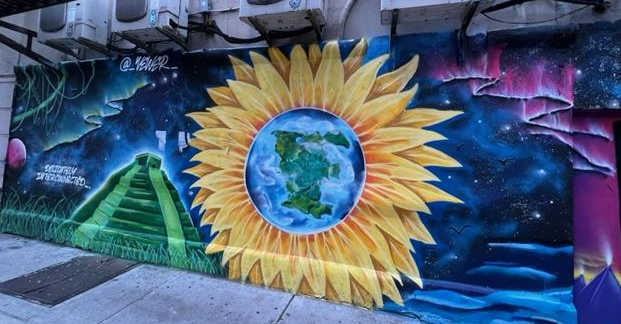
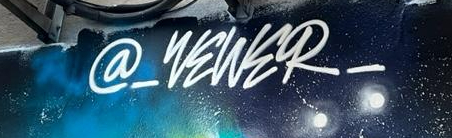
This new piece of art appeared in 2022 by artist
The artist Wewer
I could not find any information on the Internet about the artist
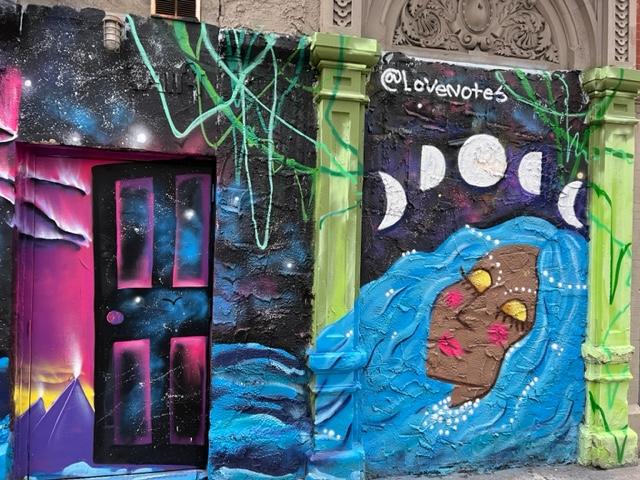
This was painted right next to it by artist Lola Lovenotes
Artist Lola Lovenotes is a self-taught graffiti artist from New York City who was heavily influenced by growing up in the Bronx. She also works as a teaching artist in Manhattan and the Bronx (Artist Bio).
I finished the walk back at Twelve Avenue admiring the art from the windows of the galleries and then relaxed in Hudson River Park and admired the view across the river. New Jersey looks very different on this side of the Hudson River. More intriguing.
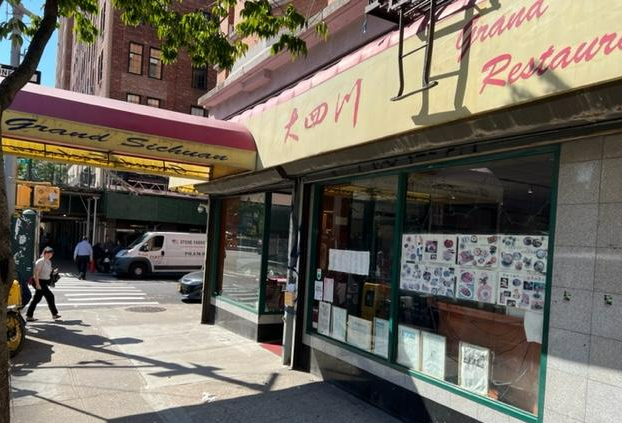
I finished the afternoon with lunch at the Grand Sichuan Restaurant at 229 Ninth Avenue. I had passed the restaurant many times when walking around the neighborhood and they have some interesting (and very reasonable) lunch specials that I wanted to try. Walking this whole neighborhood I began to notice that there was not too many reasonable (i.e. cheap) places to eat in Chelsea and thought this would be a nice place.
Grand Sichuan Restaurant at 229 Ninth Avenue (Closed in 2023)
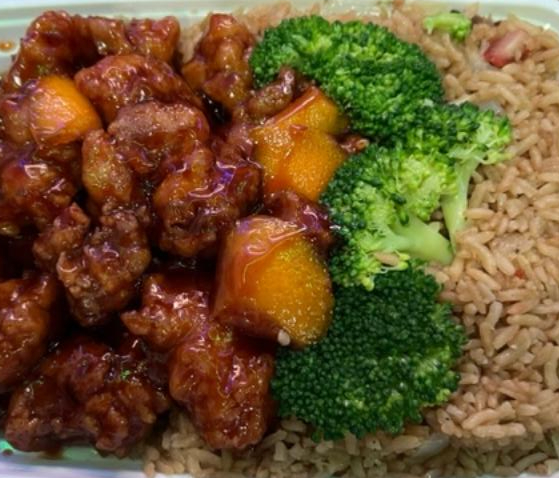
The Grand Sichuan I have to admit could use a good makeover as it is a little dated and theadbare but the food and the service are really good and are worth the visit. Wanted to try something different I had the Orange Flavored Beef Special with Fried Rice and an Egg Roll. The whole meal was delicious.
The Orange Flavored Beef was wonderful
The one thing I liked about the lunch specials ($9.95) at the Grand Sichuan Restaurant is that the portion sizes are very fair and everything was freshly cooked and spiced extremely well. The beef really loaded with chilis that gave it a good pinch. The egg roll was loaded with shredded cabbage and nice pieces of roast pork.
It really was an interesting walk of the neighborhood. Not just on learning the history of the area but passing the open air museum that the area has become. With the renovation of the local parks and new building going on there is more changes on the way. As we leave enter the hopeful post-COVID era where we enter the new normal you are going to see a lot of development on all sides of this neighborhood.
Just like the rest of Manhattan it just keeps morphing.
See my other blogs on Walking North Chelsea/Flower District:
Day Two Hundred and Thirty Seven: Walking the Borders of North Chelsea/Flower District:
The weather finally started to cooperate, and it was a beautiful day today. I started my day at the Holy Apostles Soup Kitchen, helping pack a thousand bags of snacks to serve with the meals to our guests and then worked in Social Services helping people with their mail and getting them toiletries. Everyone had me running in the morning.
After lunch with the other volunteers, I set off to walk the Avenues of the Chelsea neighborhood and explore the neighborhood more in depth. Since I have been working for the Soup Kitchen all these years, I know most of the neighborhood from walking the streets in the past. In all the years that I worked at Macy’s and did my graduate work at the Fashion Institute of Technology, I knew the Sixth and Seventh Avenue areas quite well.
I have noted the changes many times to the Flower District which was much bigger and much different before all the apartment buildings went up along Sixth Avenue. There is a small section still left between Sixth and Seventh Avenues along West 28th Street. Even the Garment District has been shrinking with the rezoning of the neighborhood. New hotels and apartment complexes have replaced the commercial businesses of the neighborhood and with that changing the complexity of the neighborhood to a more residential area.
I started my walk strolling down Eleventh Avenue from the edge of the Hudson Yards neighborhood to the border of Chelsea at West 23rd Street. As I have said in previous blogs, everything between Twelveth and Eleventh Avenues is being knocked down and rebuilt as well as parks are being renovated. These city blocks are becoming the new ‘Gold Coast’ being so close to companies like Google’s New York City campus.
There has been a renaissance of the buildings along this part of the Hudson River. Old storage facilities and shipping buildings are being or have been renovated for office and hospitality use along with former garages becoming art galleries.
The first building that I passed was the Terminal Warehouse at 261 Eleventh Avenue. The Terminal was built in 1891 and designed by architect George Mallory. It has been used in the past as a train terminal and distribution center for the New York Central Railroad . In the 1980’s and early 90’s, it was used as the famous nightclub “Tunnel” and then use as self-storage facility. The Terminal Warehouse is now going through a multi-billion dollar renovation to convert the warehouse from a distribution center to a modern office complex (Columbia Property Trust/69th Street).
When it is finished, the building will house multi-office space, retail and restaurants all while bordering the Hudson River and the Highline Park.
Next to the Terminal Warehouse is the Starrett-Leigh Building at 601 West 26th Street. This interesting complex was built in 1931 by architectural firm of Cory & Cory. It had been originally used as a freight transportation center. Since the creation of the Highline Park and the demand for office space in this area, it has been a leader in the creation of the Tech Center “Silicon Alley”.
The Starrett-Leigh Building at 601 West 26th Street
The building was a partnership between the Starrett Corporation and the Leigh Valley Railroad when it was built. By 1944, the Leigh Valley Railroad had pulled operations out of the building and by 1966, the last of the rail lines were pulled out. The building is currently going through another major renovation to convert it into first class office space (RXR).
The desirability of working and living in this once shipping and rail area of the neighborhood keeps changing the complexity of area between the Hudson River, Twelveth and Eleventh Avenues. It is becoming the center of the tech and creative industries of New York City. As you walk up Eleventh Avenue, you will observe large buildings whose future might change.
Tenth Avenue starts the more residential part of Chelsea and where you can see the transition of the neighborhood from the old commercial area to an upscale residential place with new restaurants, galleries and shops.
As you walk down Tenth Avenue from the kids playing soccer on the fields of Chelsea Park, on one side of the Avenue is the combination of the Chelsea-Elliott Public Housing project and on the other side is the Avenues School, an innovative private school for kids all over New York City. This was the subject of an HBO Documentary “Class Divide”, on the changes of demographics and economics in New York City.
The documentary “Class Divide” by HBO
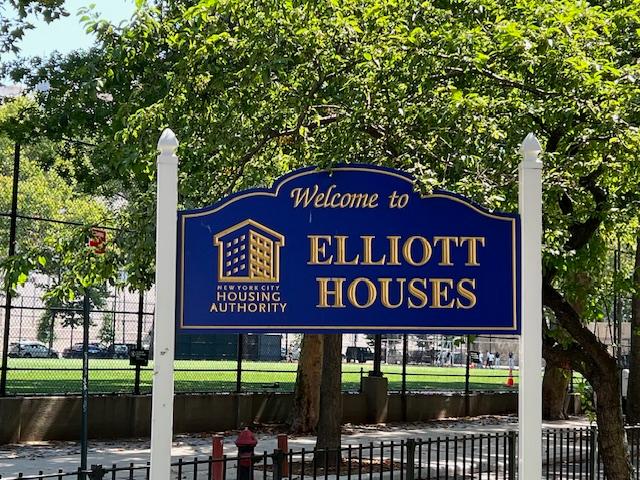
The Chelsea-Elliott Houses are located between West 25th and 27th Streets between Ninth and Tenth Avenues (but not the full block) and were designed by architect William Lescaze. They were the first houses to be designed in the high rise with a park concept (Wiki).
The Elliott Houses
The inside rose gardens created by residents
Chelsea-Elliott Houses between West 25th and 27th Streets off Tenth Avenue (Wiki)
On the opposite side of Tenth Avenue sits the Avenues The World School, one of the most innovative and progressive new schools in New York City. Branches of the school have already opened in South America and China. They will also be opening branches in Miami and Silicon Valley.
An education at Avenues concentrates on a global outlook with courses being taught in English, Spanish or Mandarin Chinese starting in nursery school. The school believes in technology and a group approach to learning. It is also almost $40,000 a year (Avenues.com).
With these changes in education and in the whole makeup up of this part of the neighborhood, you can see why the documentary was made in its context. A whole section of society is advancing towards the future and another is being left behind.
I thought about all this as I passed the projects on my way back up Tenth Avenue from West 23rd Street, observing the kids who were going from Avenues into the playground at the Chelsea-Elliott Houses playground to play. The documentary really stuck home.
Tenth Avenue does have its contrasts on the other side of the avenue as well as from West 25th to 24th Streets still have the historical character of the old neighborhood with the old brownstones and townhouses on one side of the avenue. It just shows how Manhattan keeps reinventing itself and you can see this block by block in Manhattan.
Chelsea Historic District at West 24th Street
Ninth Avenue is where my start off point was from the entrance of Holy Apostles Church. What I did learn from walking the neighborhood was more about the history of The Church of the Holy Apostles. The Church of the Holy Apostles was built between 1845 to 1848 and was designed by architect Minard Lafever with the stained-glass windows designed by William Jay Bolton (Wiki).
The church has always been progressive, and it was rumored to be part of the Underground Railroad during the Civil War. The church had been an extension of the Trinity Church downtown for the working-class people in the area. Now it also runs the second largest Soup Kitchen in the United States. The biggest is in San Franciso (Wiki).
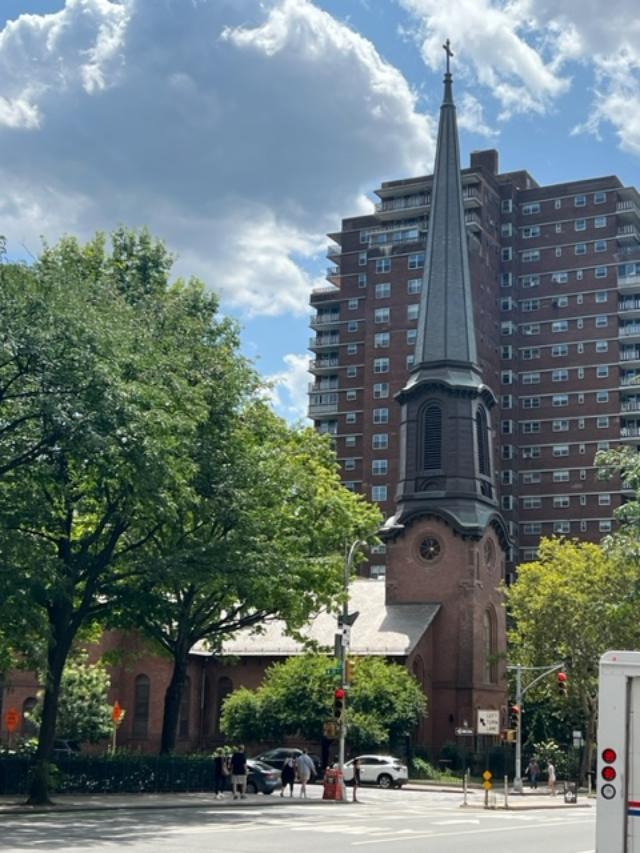
The Church of the Holy Apostles at 296 Ninth Avenue feels like a second home to me
It was also convenient in that it was where I needed to start my walk on Ninth Avenue where the church is located right across from Chelsea Park south of the northern section of Hudson Yards and right across from the Lower Garment District (please read my blogs on walking these parts of Manhattan as well).
What I never noticed in the almost 17 years that I have been volunteering at the Soup Kitchen was that it was a park. Chelsea Park is located across the street at the corner of Ninth Avenue and between West 28th and 27th Streets. I had always thought this was part of P.S. 33, the elementary school next door complex. There is a whole separate park behind that corner.
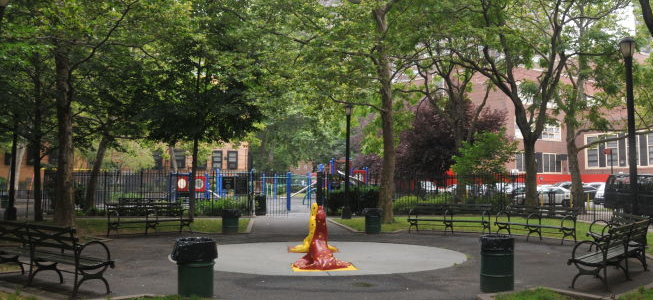
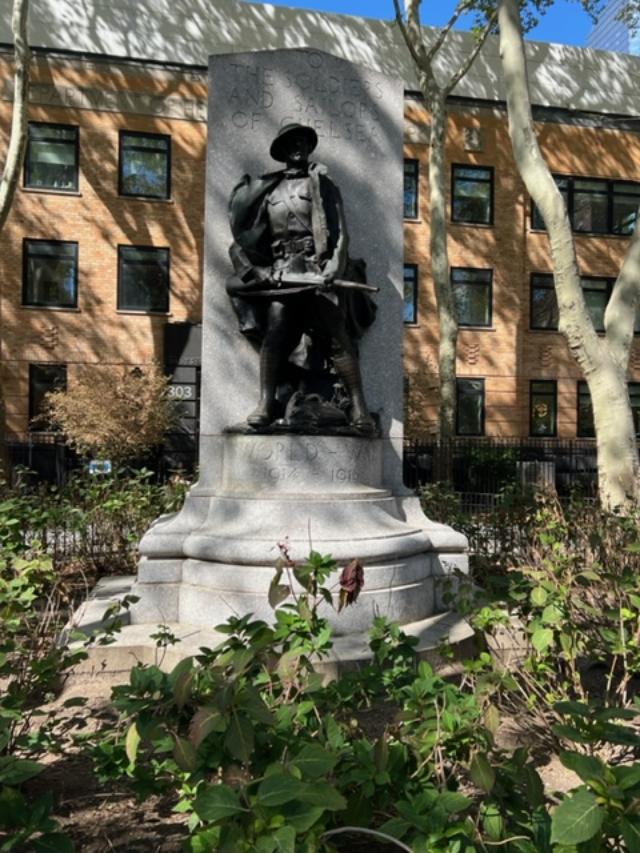
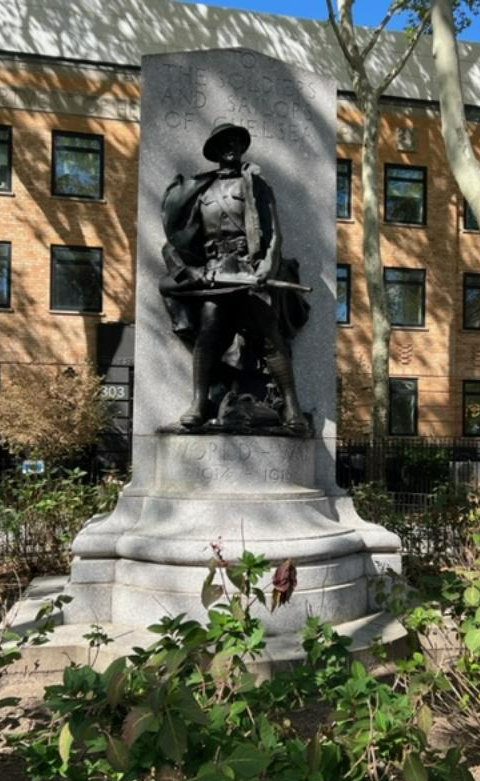
Chelsea Park extends all the way to Tenth Avenue with soccer and basketball courts and places for people to not just run but relax under the blanket of trees in the summer. Facing Ninth Avenue in a small courtyard is the statue of the ‘Chelsea Doughboy’.
The statute was designed to honor the war veterans of WWI. The term “Doughboy” no one is too sure where it originated. Some think from the fried dough dumplings that the soldiers eat or maybe from the way their uniforms looked which were a little baggy or from the dough clay that they used to clean their uniforms (NYCParks.org).
Artist Philip Martiny was a French born American artist who settled in New York when he immigrated here in 1878. He was a contemporary of artist August Saint-Gaudens and known for his decorative styles in the Beaux-Arts fashion. He created many sculptures for buildings in New York City and Washington DC (Wiki)
PS33 Chelsea Prep has always been a big supporter of Holy Apostles. The kids here are great.
The front of Chelsea Prep and their engaging murals on the school
The murals at PS 33 Chelsea Prep
As I continued my walk down Ninth Avenue, I could see that the Chelsea Prep School was out for a break and the kids were screaming and yelling all over the playground. I have to say that the playground could use some work and the amount of homeless guys hanging out around the kids I don’t think is the smartest thing as well.
The interesting paintings at the Chelsea School PS 33
When passing West 25th to 23rd Streets on the right side, you will see the fringes of the historic district mixed in with the commercial area with shops and restaurants. Really look up and admire the architecture of the old townhouses and apartment buildings before they start to disappear.
Eighth Avenue is an unusual mix of residential buildings with the Penn South complex on one side of avenue and the Fashion Institute of Technology campus on the other side. Penn South was built for the workers of the International Ladies Garment Union and were designed by architect Herman Jessor (Wiki). The buildings are surrounded by series of parks and paths.
The rest of the block is a commercial district of stores and restaurants. There are a few standouts when you reach the corner of Eighth Avenue and West 23rd Street. What I love about Chelsea is that it is a treasure trove of reasonable restaurants that dot the street all the way to Sixth Avenue.
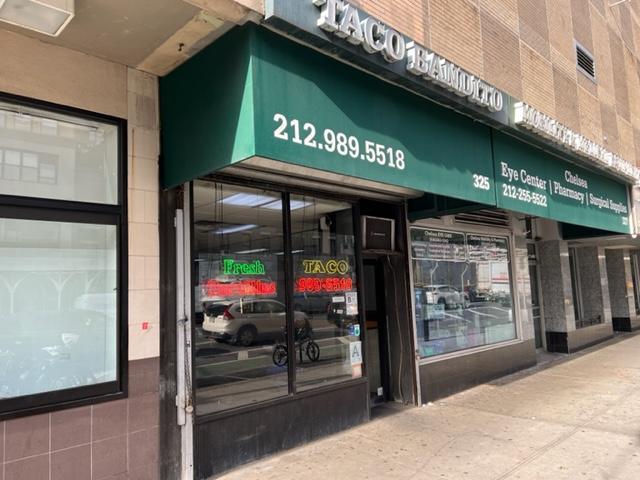
Right in the center of the avenue, across from the Fashion Institute of Technology at 335 Eighth Avenue is the McDonald’s. I spent many a afternoon and evening at both when I was attending school here and after Soup Kitchen when I did not want to eat the lunch. I still love their McDoubles and the breakfasts. Right next door is Taco Bandito at 325 Eighth Avenue for authentic and very cheap Mexican food (See my reviews on TripAdvisor and DiningonaShoeStringinNYC@Wordpress.com).
Taco Bandito at 325 Eighth Avenue (Closed December 2022)
Taco Bandito and McDonalds are right around the corner from The Fashion Institute of Technology at 325 and 355 Eighth Avenue respectively (McDonalds closed in January 2023).
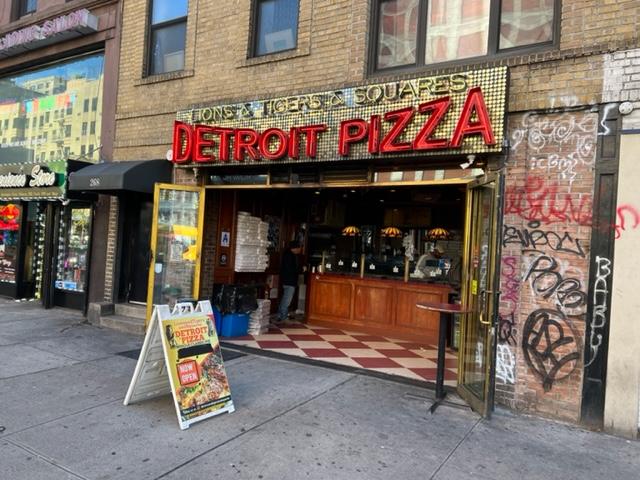
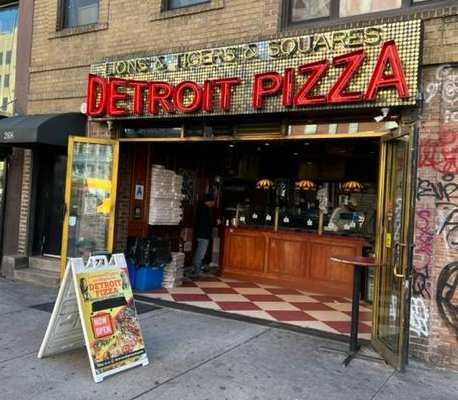
Just off the corner of Eighth Avenue is Lions & Tigers & Squares at 268 West 23rd Street, which has the best Detroit style pizza that I have tasted in New York City. The sauce and cheese are baked into the sides of their pizza, and they really load down on the toppings.
Lions & Tigers & Squares at 268 West 23rd Street (Closed May 2025)
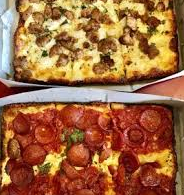
Don’t miss their sausage or pepperoni pizza which has a heavy covering of spicy sliced pepperoni and the sweet sausage that is topped with maple syrup. Their pizza has a crisp outside and a pillowy inside.
The Sausage and Pepperoni Pizza here is just excellent
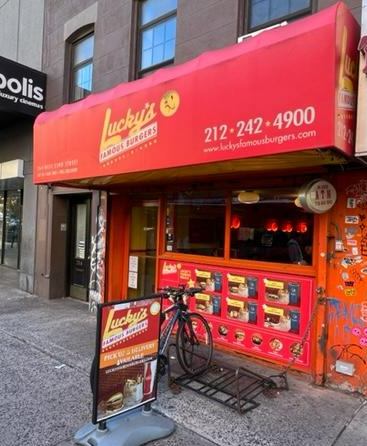
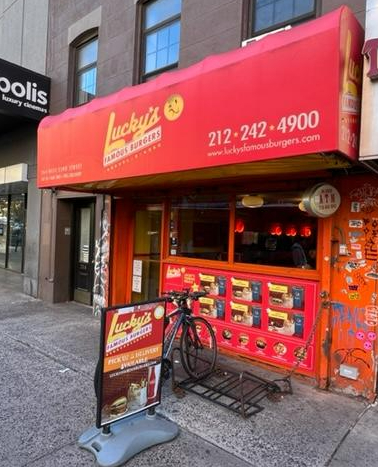
Just next to Lions & Tigers & Squares is Lucky’s Famous Burgers at 264 West 23rd Street. This amazing little restaurant serves the best burgers and chicken fingers. Their French Fries come in a little sack that can serve two people.
Lucky’s Famous Burgers at 264 West 23rd Street (Closed June 2023)
When I had lunch there recently when I was finishing my walk around West Chelsea/Hudson Yards, I had the juiciest twin Cheeseburgers and a bag of fries. Their burgers are so fresh and well-cooked and topped with lots of fresh vegetables. They are so well caramelized on the outside that the burgers have such a good flavor when combined with the toppings.
The Mini Cheeseburgers with fries are excellent at Lucky’s Famous Burgers
Seventh Avenue is mostly commercial with a smattering of residential here and there above the businesses and some of the newer apartment buildings that are going up. The Garment District as I had mentioned in previous blogs has been slowly disappearing and being replaced by a combination of new office space and hotels.
In the years since I worked on Seventh Avenue, I have seen some major changes in the neighborhood with older commercial buildings coming down for new office space. Then there is the disappearance of the Flower District for new apartments and what is left is concentrated between Sixth and Seventh Avenues on West 28th Street.
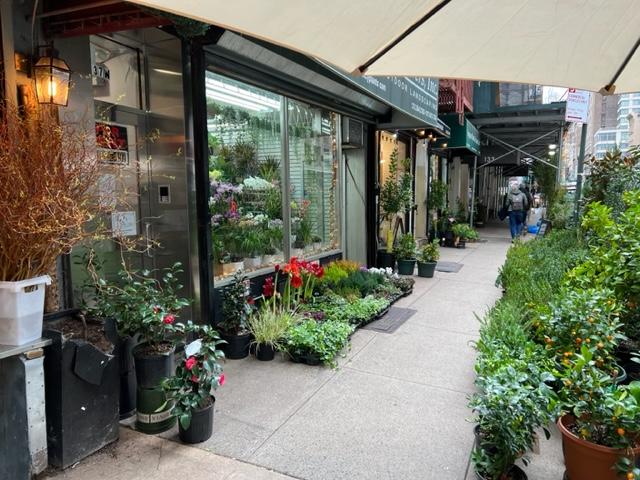
The Flower District around West 28th Street
Seventh Avenue’s businesses were also hit hard by the pandemic, especially surrounding the Fashion Institute of Technology, which had stopped classes and went virtual by March of 2020. That affected all the restaurants around the college that had once catered to all the students and staff. During 2020 and most of 2021, the area was plagued with graffiti filled buildings that stood empty for almost two years. Now with the college reopened, businesses have reopened in their place and things are started to look vibrant again.
The Fashion Institute of Technology is on Seventh Avenue between West 28th and 26th Streets and sits in the center of the Garment District. The college is part of the SUNY system of colleges of the State of New York and was founded in 1944. The Colleges emphasis is on Fashion, the Arts, Design and Business and been founded to serve the growing Garment Industry that once surrounded it (Wiki).
The Fashion Institute of Technology at 227 West 27th Street
When you arrive on the front of campus, you are greeted by one of the most iconic sculptures in the City, The ‘Eye of Fashion’ by artist Robert Cornbach. This was designed by the artist in 1976 and just returned to the campus after a major renovation.
“The Eye of Fashion” by artist Robert Cornbach
Robert Cornbach was an American born artist from St. Louis, who was educated at the St. Louis Academy of Fine Arts and the Pennsylvania Academy of Fine Arts. He was known for his large abstract artworks that includes sculptures and fountains (NYTimes.com/Obituary). He also created works for the WPA for the Government’s Federal Art Project (Wiki).
Located on the Fashion Institute of Technology campus is one of the most underrated college museums, the Museum of FIT at 227 West 27th Street located right inside the Shirley Goodman Building.
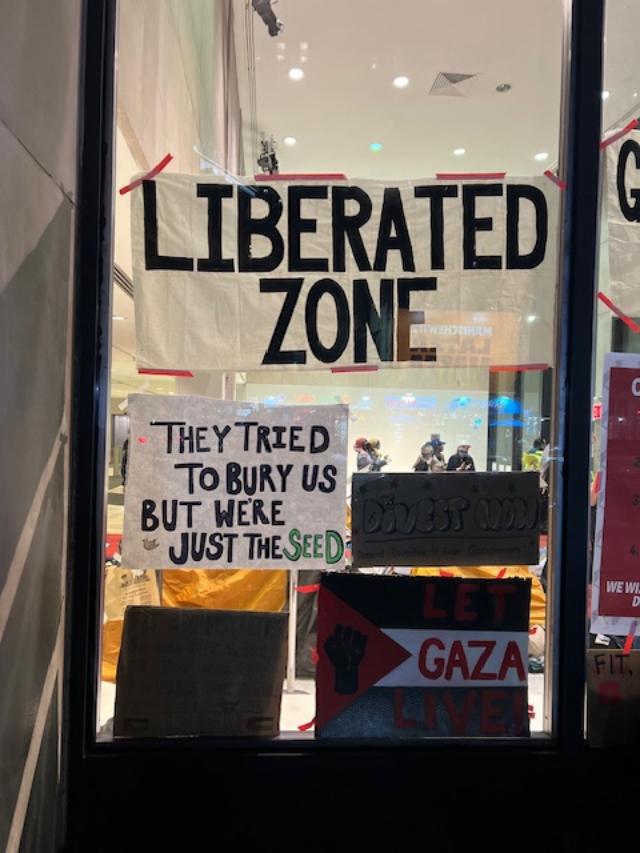
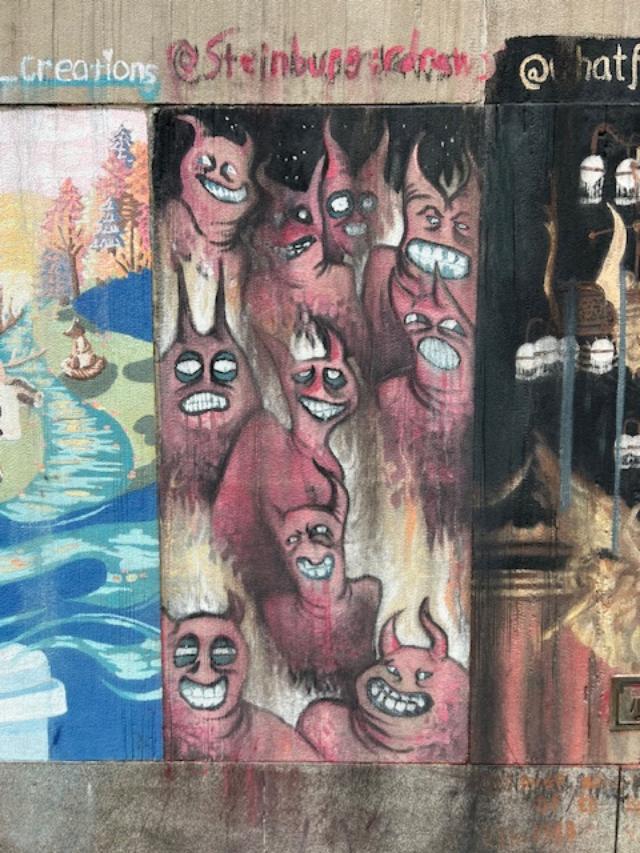
Painting on the FIT wall outside the main building April 2024. Just a hint due to the unrest on campus.
The Museum at FIT (MFIT) was founded in 1969 and is the only museum in New York City dedicated solely to the art of fashion. Best known for its innovative and award-winning exhibitions, the museum has a permanent collection of more than 50,000 garments and accessories dating from the eighteenth century to the present, MFIT is a member of the American Alliance of Museums. Its mission is to educate and inspire diverse audiences with innovative exhibitions and programs that advance knowledge of fashion.
The museum’s current exhibition is ‘Dior + Balenciaga-Kings of Couture and their Legacies’, which studies both designers work after WWII at a time when people wanted luxury and elegance at the end of the war years. They also resurrected the French fashion scene after the war (The Museum at FIT).
The museum was founded in 1969 as a Design Lab and became a full museum in 1994. The museum shows are taken directly from the collection and from pieces borrowed.
After you pass the campus and continue walking south towards West 23rd Street, there are three wonderful restaurants side by side. All of them very reasonable and the food is delicious.
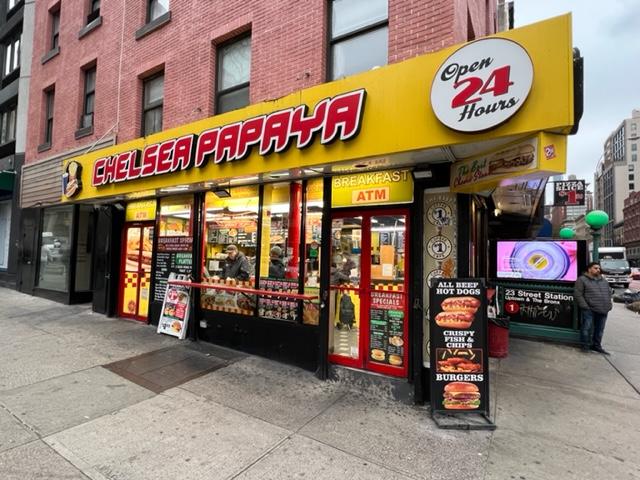
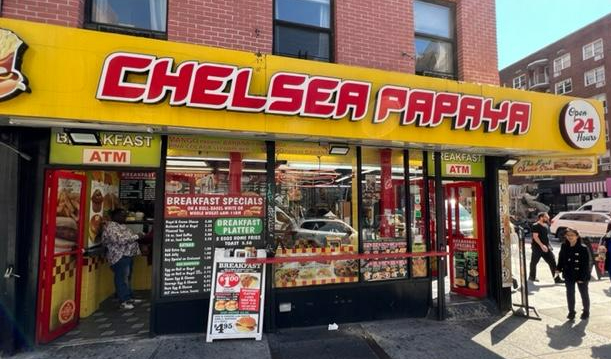
On the corner of Eighth Avenue are three restaurants I have noted many times in this blog for either their creative cooking or their cheap eats. These are real neighborhood restaurants. The first one being Chelsea Papaya at 171 West 23rd Street, which was the starting point when I had breakfast last summer when I started “The Great Saunter” walk on Father’s Day.
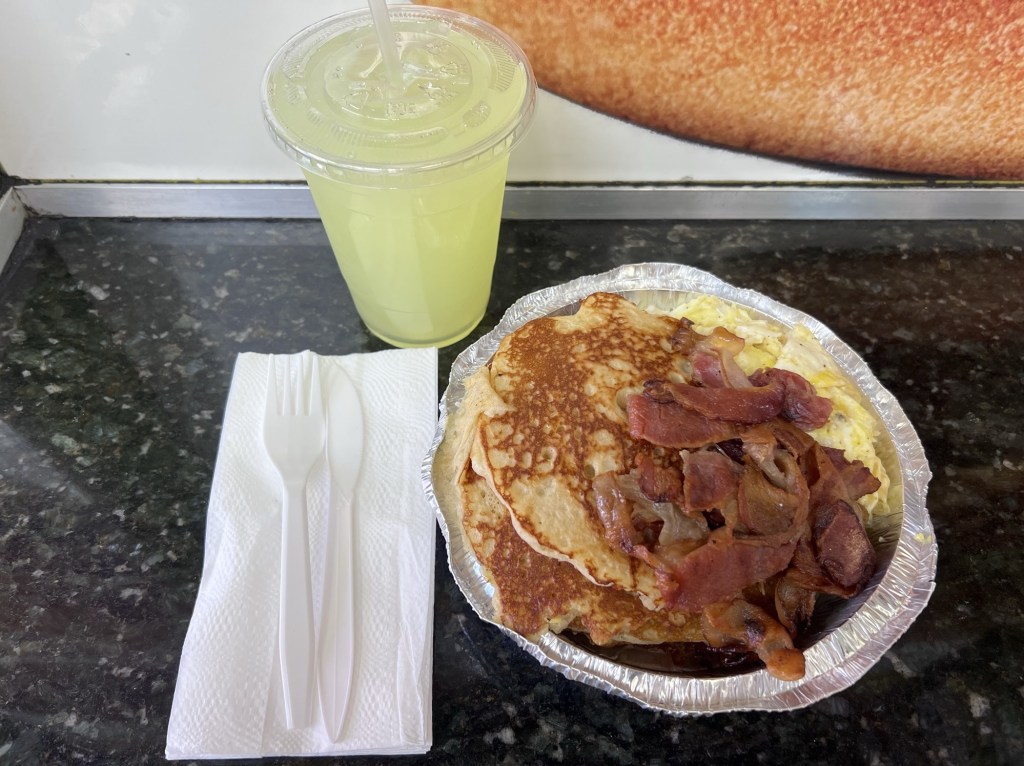
The pancake, eggs and bacon breakfast
The breakfasts here are amazing
The breakfasts here are just amazing. The pancake platter was out of this world and their breakfast sandwich Bacon Egg and Cheese was delicious.
Chelsea Papaya at 171 West 23rd Street is great for all meals
Next door to it is Pizza Gaga at 171 West 23rd Street for $1.50 slices and $1.00 cans of soda. This is my ‘go-to’ place when I need a quick snack and then need to dash on the subway to go somewhere else.
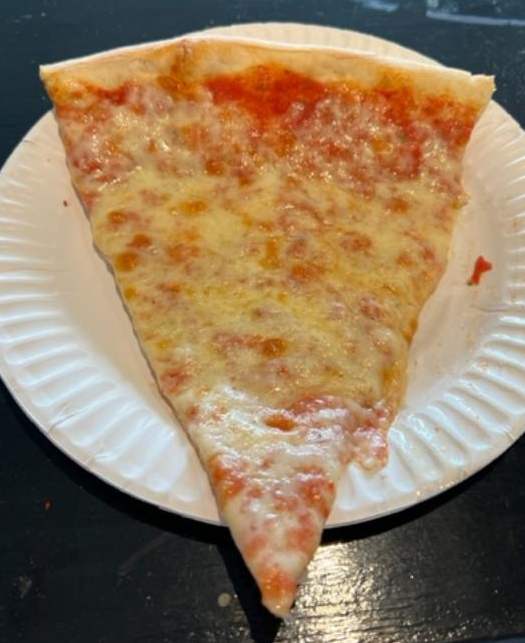
The cheese pizza at Pizza Gaga at 171 West 23rd Street is really good
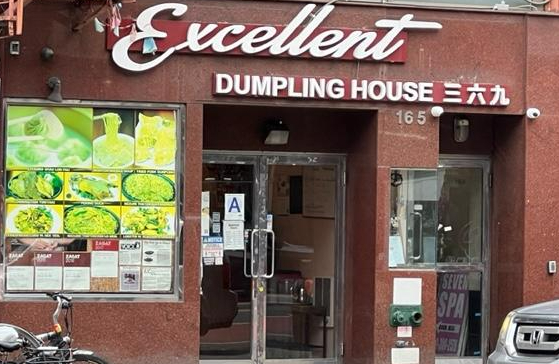
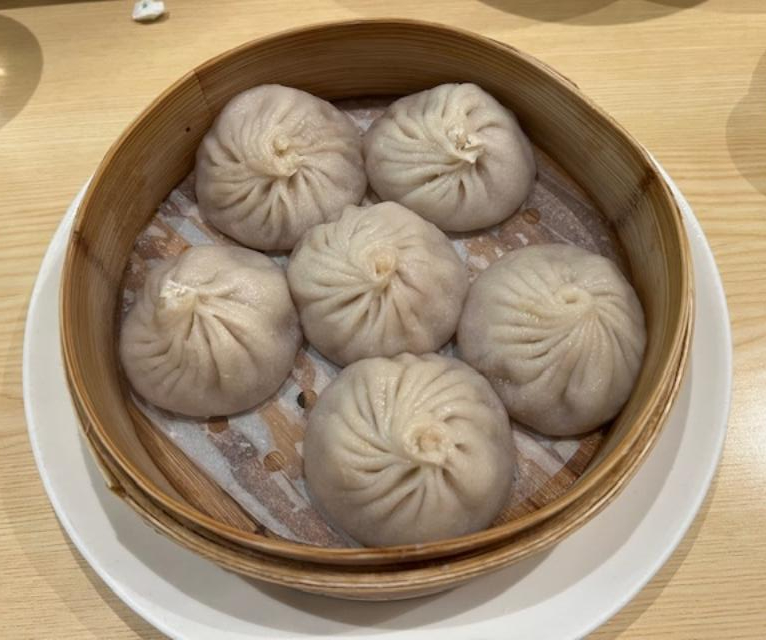
A few doors down is Excellent Dumpling House at 165 West 23rd Street. I have only eaten there once but the food was pretty good that evening but it still warrants a second trip because the raving that it got online did not live up to the hype of the food. The Soup Dumplings I had that night were large but did not have that much flavor.
On my way back up Seventh Avenue, I noticed the vibe that was returning to the area with students returning to the campus and workers to the offices and garment manufacturers back to the showrooms. This area looked like a graffiti ghost town for too long. There are still traces of it here and there but with all the scaffolding on Seventh Avenue I can see that something new will arise from the ashes.
Chelsea and its overlapping with both the ever shrinking Garment District and the ever growing Hudson Yards is bursting with new construction and new businesses ready for the next stage post-COVID.
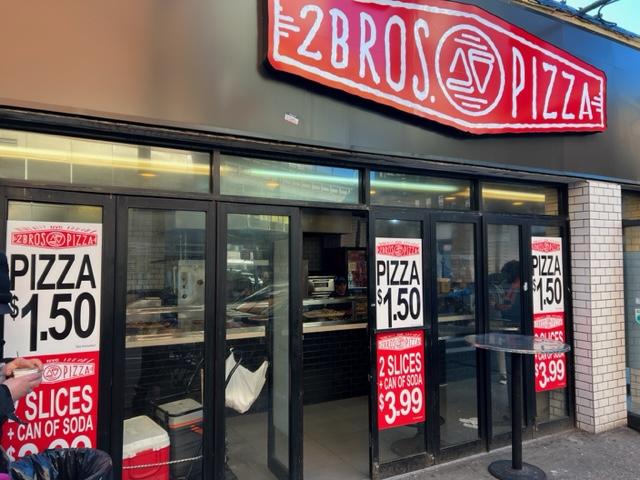
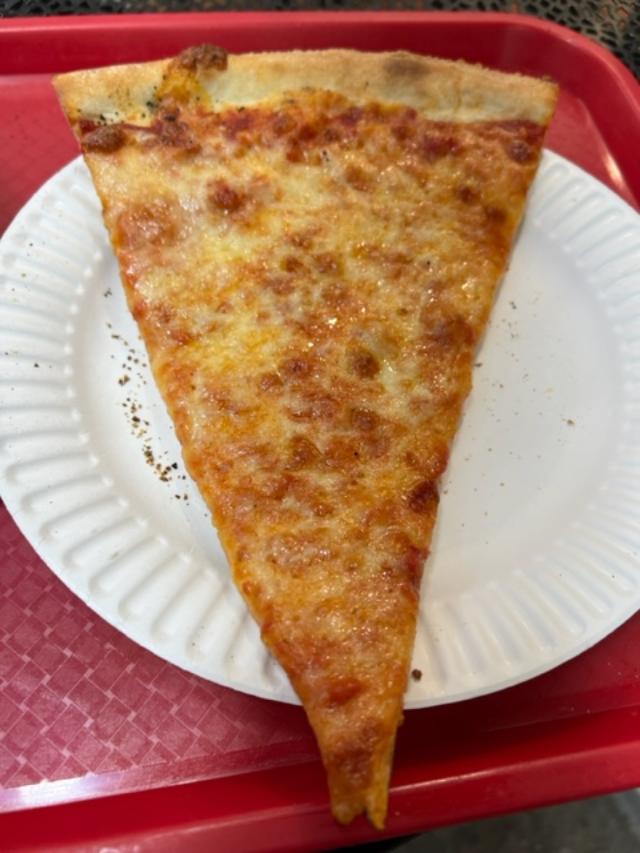
Before I left the City that night, I took a quick walk up Ninth Avenue and stopped for a slice at Two Brothers Pizza at 542 Ninth Avenue. It is my ‘go-to’ spot on my way home when I want a quick snack. As usual, it was packed with people who like their ‘dollar’ slices as well.
Even now as I was eating my slice, I could see the changes with all the new hotels surrounding Port Authority that the neighborhood was changing and getting better. This is all within the last ten years. The only problem is that they now charge $1.50!
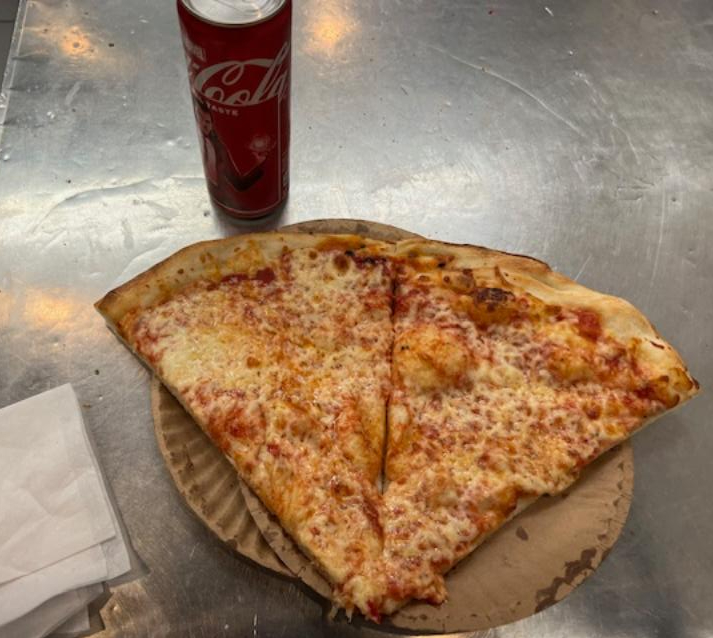
Even for $1.50, the pizza is pretty good. The place is always busy
It is going to be interesting to see what arises when the scaffolding comes down.
See my other blogs on Walking North Chelsea/Flower District:
Day Two Hundred and Thirty Seven: Walking the Borders of North Chelsea/Flower District:
After a few weeks of touring around New Jersey for a historical weekend, traveling to see my mother for Mother’s Day and running in and out of the City with me finally returning to Soup Kitchen and posting my grades on my class’s successful group project on “Rocking it in Rutherford”, I was finally able to get in Manhattan and continue my walk around the island. I finally was able to get into the main part of the Chelsea neighborhood.
After a long morning in the Soup Kitchen, I planned the entire day out. We were really busy that day as we have increased the productivity by a hundred bags to give away with the food distributed to the homeless. I was told that the need is getting bigger, and we had to increase the numbers. It is a sad state of this economy right now. These lines are just getting longer. This is the one thing I like about volunteering here is that you are part of a solution rather complaining about the problem.
After I was finished for the day and a little snack to tide me over, I started my walk around the border of the northern part of the Chelsea neighborhood. What was nice was it was right out the door of the church, and I started the walk down West 28th Street which it shares with the border of Hudson Yards/West Chelsea. I got to revisit this part of the neighborhood again.
What I did learn from walking the neighborhood was more about the history of The Church of the Holy Apostles. The Church of the Holy Apostles was built between 1845 to 1848 and was designed by architect Minard Lafever with the stained-glass windows designed by William Jay Bolton (Wiki).
The church in the summer of 2025
The church has always been progressive, and it was rumored to be part of the Underground Railroad during the Civil War. The church had been an extension of the Trinity Church downtown for the working-class people in the area. Now it also runs the second largest Soup Kitchen in the United States. The biggest is in San Franciso (Wiki).
The Church of the Holy Apostles at 296 Ninth Avenue feels like a second home to me
It was also convenient in that it was where I needed to start my walk on the edge of West 28th Street where the church is located right across from Chelsea Park south of the northern section of Hudson Yards and right across from the Lower Garment District (please read my blogs on walking these parts of Manhattan as well).
What I never noticed in the almost 17 years that I have been volunteering at the Soup Kitchen was that it was a park. Chelsea Park is located across the street at the corner of Ninth Avenue and between West 28th and 27th Streets. I had always thought this was part of P.S. 33, the elementary school next door complex. There is a whole separate park behind that corner.
Chelsea Park extends all the way to Tenth Avenue with soccer and basketball courts and places for people to not just run but relax under the blanket of trees in the summer. Facing Ninth Avenue in a small courtyard is the statue of the ‘Chelsea Doughboy’.
The statute was designed to honor the war veterans of WWI. The term “Doughboy” no one is too sure where it originated. Some think from the fried dough dumplings that the soldiers eat or maybe from the way their uniforms looked which were a little baggy or from the dough clay that they used to clean their uniforms (NYCParks.org).
Artist Philip Martiny was a French born American artist who settled in New York when he immigrated here in 1878. He was a contemporary of artist August Saint-Gaudens and known for his decorative styles in the Beaux-Arts fashion. He created many sculptures for buildings in New York City and Washington DC (Wiki).
I walked past Chelsea Park on the way to Tenth Avenue and walked all along the borders of the park. The park is becoming a homeless encampment. I have not seen anything like this since Mayor Guiliani closed Thompkins Square Park in the East Village and then fenced it off to the homeless and renovated it. There were people sleeping all over the place even by the small playground that the kids were playing in. It really is beginning to show the state of the City now. The bathrooms were even locked to the patrons.
The track area was pretty much empty and what was really a shocker is how the neighborhood again changes at the Tenth Avenue border. This part of the neighborhood has gotten extremely expensive that was documented in the documentary “Class Divide” on the changes of the neighborhood due to the Highline.
“Class Divide” by HBO. The sound is muted but you can see it with subtitles
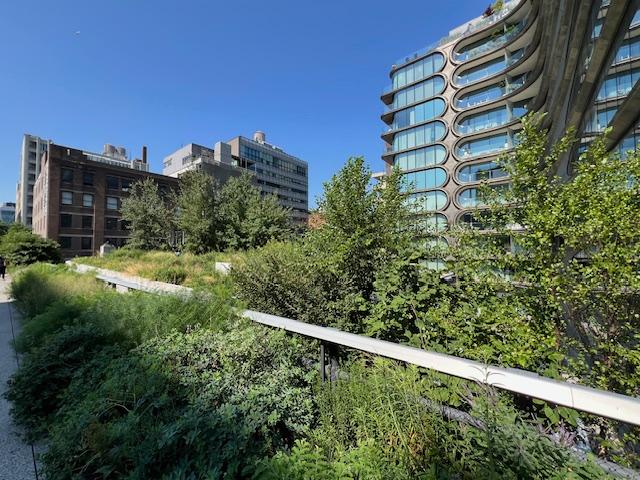
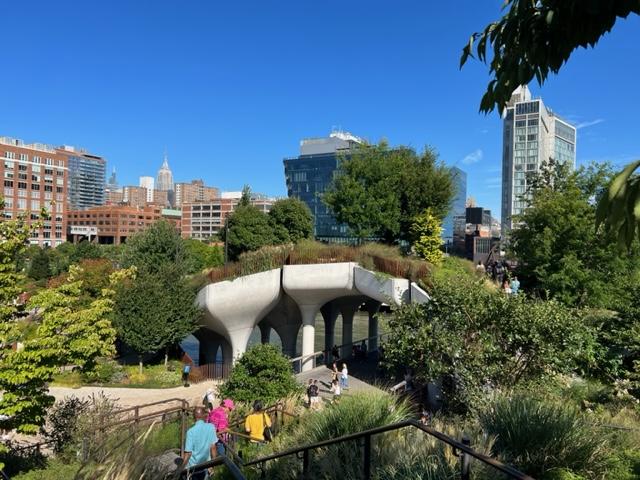
On the other side of Chelsea Park is some of the newest and most expensive real estate in Manhattan, a lot due to the Highline. The Highline is an elevated walkway that starts on West 30th Street and extends to West 19th Street and has in recent years set the tone for this part of the neighborhood.
The Highline Park was created from a remnant of the former New York Central railroad spur that was elevated above the roads below. In 2006, there was a neighborhood effort to save it and create an urban park. Now the 1.45-mile park supplies an elevated greenery above the neighborhood which has created expensive real estate on all sides of the park (Wiki).
The Highline Park was designed by James Corner Field Operations, Piet Oudolf and Diller, Scofidio and Renfro.
As I passed the Highline Park, I passed the most unusually designed building at 520 West 28th Street. The building is a residential complex known as the Zaha Hadid Building after the architect who designed it Zaha Hadid. It was one of her only residential complexes that she designed and one of the last buildings she created before her death. The building is designed with curvilinear geometric motifs (Wiki).
520 West 28th Street-The Zaha Hadid Building (Streeteasy.com)
You will be passing a lot of construction going on by the time you get to Twelve Avenue. Buildings are being renovated and rebuilt and all new buildings are popping up on the edge of this now very trendy neighborhood. What was once dock yards and parking lots is becoming high end office buildings for “Silicon Alley” as the Tech industry is called in New York City.
At the end of the block is Hudson River Park, a strip of green park created on this side of Manhattan under the Bloomberg Administration (God are we now missing those years!). This little strip of park at the end of West 28th Street has some interesting views of Edgewater, NJ. The afternoon I visited the park, there were a few joggers and dog walkers making their way through the park. The strip gets smaller along Twelve Avenue until you walk to about West 42nd Street by the Circle Line boat ride.
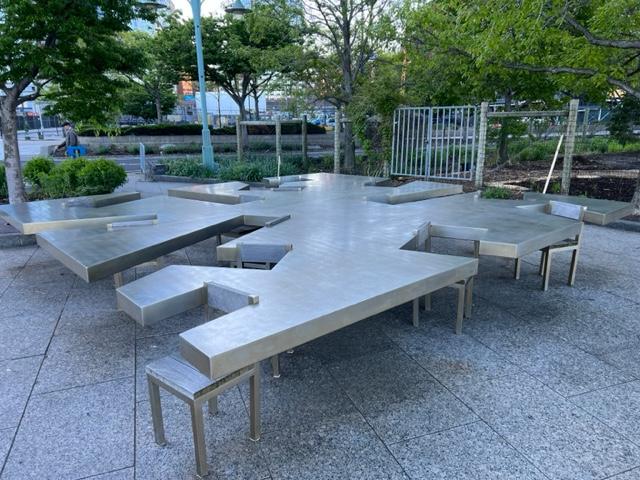
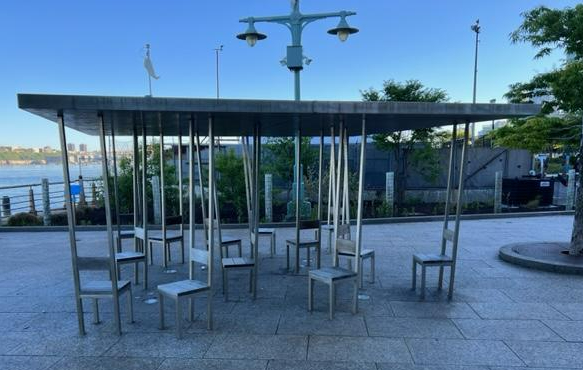
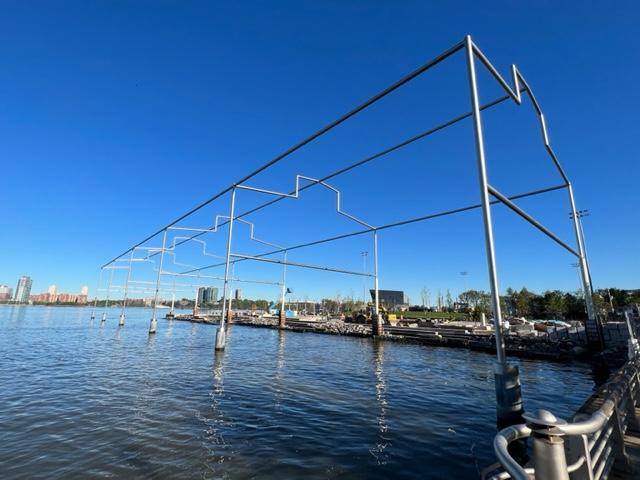
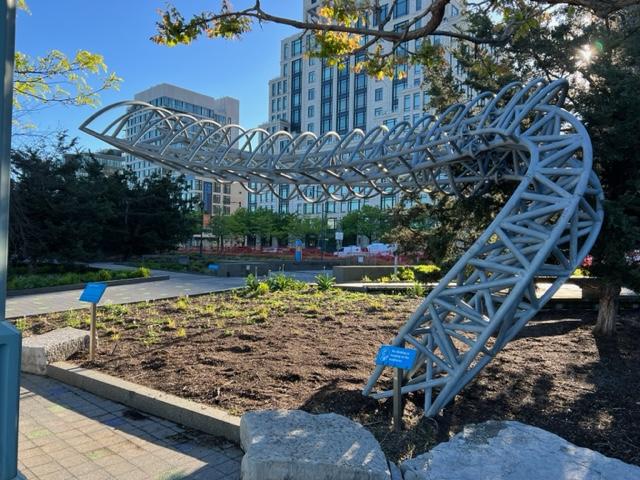
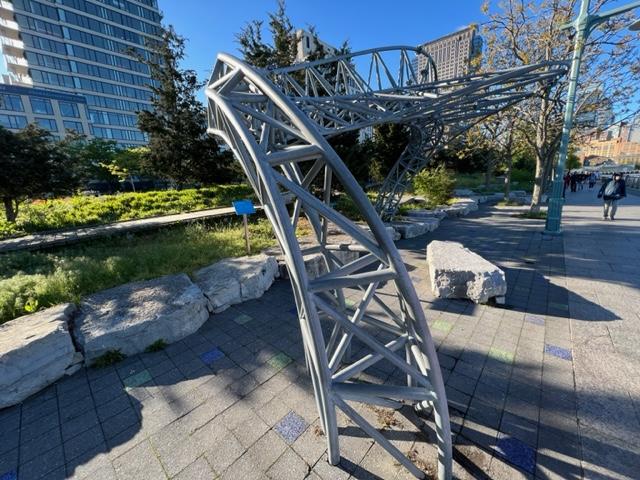
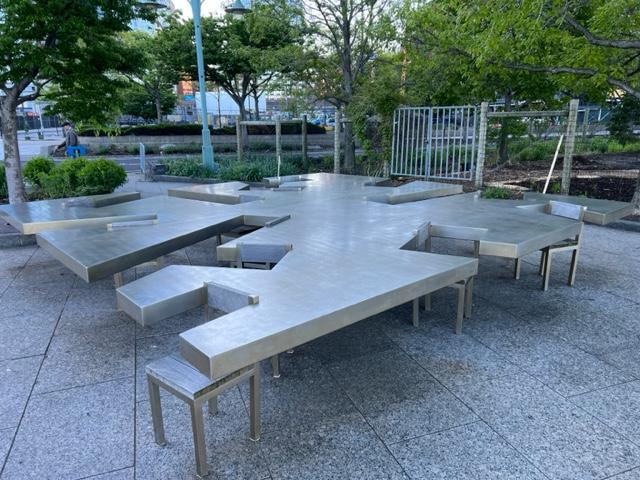
As you enter the park, there is a very unusual set of sculptures entitled ‘Two Too Large Tables’ by artists Allan and Ellen Wexler. Two Too Large Tables consists of two elements. Each is constructed of brushed stainless steel and Ipe wood.
One piece has thirteen chairs extended up to become columns that raise sixteen square feet plane seven feet off the ground. In the second piece, the same chairs act as supporters to lift a sixteen square feet plane 30 inches off the ground. The first functions as a shade pavilion, the second as a community table. As people sit, they become part of the sculpture. People sitting together, forming unusual pairings because of the chair groupings (Artist bio).
Two Too Large Tables in Hudson River Park (Artist bio)
Artist Allen Wexler is an American born artist from Connecticut and studied at Rhode Island School of Design where he received his BFA and BS in Architecture. He studied and earned his MS in Architecture from the Pratt Institute. He is known for his multiple disciplines in art (Wiki).
The trip up Twelve Avenue is less than exciting. There is a tiny strip of park along the river that is mostly behind fencing. On the other side of the street is construction holes and fences from all the planned buildings that will start raising along the avenue.
The one place where there was some action was BLADE Operations at the Hudson River Park where helicopters were flying in. It reminded me of the opening scene of the Peter Bogdanovich film “They All Laughed” that I had just seen at the retrospect of the director’s work at the MoMA.
“They All Laughed” trailer by Peter Bogdanovich is a true Manhattan film
I made the turn down Twelve Avenue and here you have to watch because of the all the construction going on. There is so much building going on along the avenue just watch out for scaffolding and unpassable sidewalks along the Hudson River waterfront.
You will pass some very impressive buildings that are part of New York’s “Silicon Valley” including the well-known Starrett-Lehigh Building that has changed the complexity of the businesses in this neighborhood.
The Starrett-Lehigh Building at 601 West 26th Street
The building was built and finished in 1931 for the Starrett Corporation and the Leigh Valley Railroad as a freight terminal. The building was designed by the architectural firm of Cory & Cory and in 1998 went through a renovation as a office building. It is currently going through another renovation that will be completed in 2023 (Wiki/Starrett-Leigh website).
As I crossed the street from Hudson River Park, I passed the renovations of Chelsea Waterside Park. This is the park where last year I started “The Great Saunter Walk” last year on the Summer Solstice. The park had a ‘Butterfly Garden’ that people were working the morning that I started the walk. The park is going through a full make over and the plans for it look amazing.
Chelsea Waterside Park at 557 West 23rd Street (Hudson River Park Archives)
When you walk through Hudson River Park, it is the nicest place to take a rest and sit under a tree to cool off. The park has the most amazing breezes and views of the river and neighboring New Jersey.
As I was walking around one of the wooded piers admiring the view, I came a across a grouping of stones that looked unusual with the way that they were set. The grouping was a sculpture garden by artist Meg Webster entitled “Stonefield”.
“Stonefield” by artist Meg Webster
This landscape sculpture consists of large stones chosen from quarries in New York State and the northeast corner of Pennsylvania. They were selected for their special shapes and unusual sculptural qualities. Some are colorful, some are concave, some craggy, one is very tall. The artist views each stone as special and arranged each to showcase its unique characteristics and individual “being-ness” (Hudson River Park.com).
Ms. Webster is an American born artist who has a BA from Old Dominion University and MFA from Yale University. She works with natural materials such as salt, sand and earth known for her Post-Minimalism and the Land Art Movement. She is known for her sculpture and installation work (Wiki).
Artist Meg Webster talks about her artwork
As you pass the fencing of the renovations, watch out for the traffic with its lots of busses, cars and bicyclists. It is almost as if no one sees traffic lights or pedestrians. Look both ways when you cross from the park to West 23rd Street.
West 23rd Street is a combination of new construction and historic buildings showing how the neighborhood is transitioning but with a historic element. Not only a residential but interesting commercial strip with engaging shops and very reasonable restaurants and take-out places. It is a real New York neighborhood.
Between Twelve and Eleventh Avenues, you are seeing the development around the High Line Park. All the new modern structures are being built around the pathway park which is influencing this part of the neighborhood.
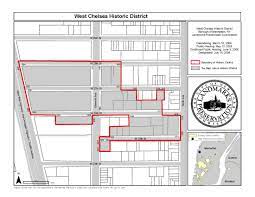
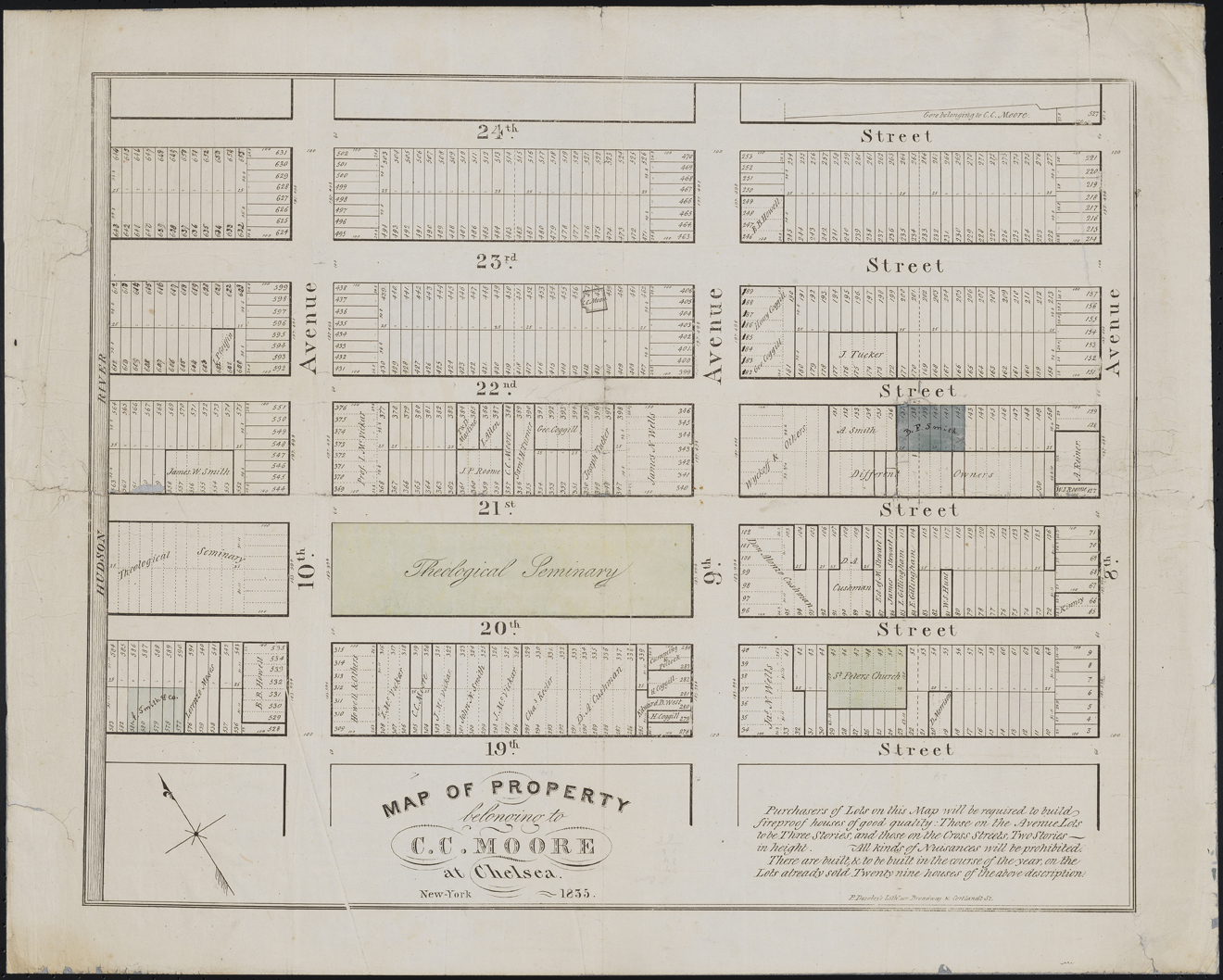
When you reach between Tenth and Ninth Avenues, you arrive at the brownstones of the Chelsea Historic District, which was once part of the Captain Thomas Clarke estate that was separated into townhouse lots that have been changed and altered since the original parcels were created in 1835. His descendant, Clement Clarke Moore, created the neighborhood plots for the townhouses.
The creation of the neighborhood of “Chelsea” from the Captain Thomas Clarke Estate
This block of the neighborhood is a combination of interesting stone townhouses on one side of West 23rd Street and the other side of the street is turn of the last century apartment buildings. When you are walking west towards the Hudson River, take the time to admire these last 19th Century buildings. The official historic district does start one block below on West 22nd Street.
Part of the Chelsea Historic District at West 24th Street
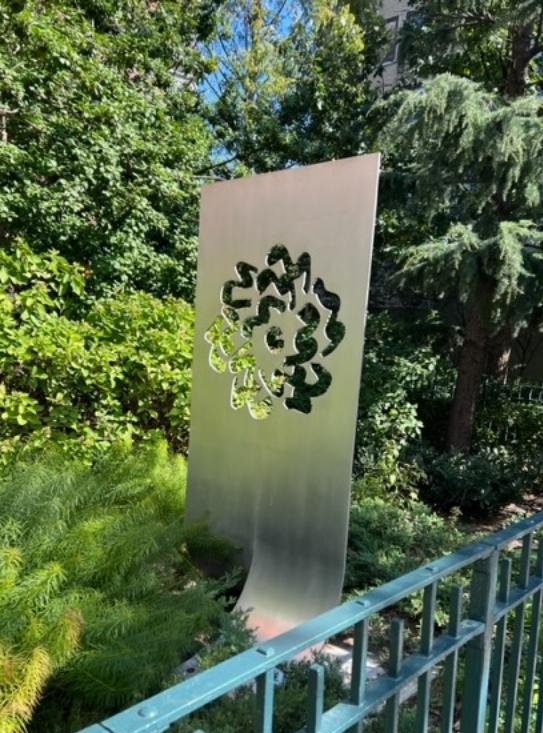
When I crossed over Ninth Avenue as I passed SVA Theatre at 333 West 23rd Street and the small park next to the theater. When I looked inside the park, I saw an interesting looking piece of artwork and wondered who created it. It is the theater logo.
The SVA Theatre logo I thought was a piece of artwork
Once you cross over Eighth Avenue, the rest of the street is a combination of commercial businesses with a mixture of residential either on top or to the side of these establishments. What I love about Chelsea is that it is a treasure trove of reasonable restaurants that dot the street all the way to Sixth Avenue.
Just off the corner of Eighth Avenue is Lions & Tigers & Squares at 268 West 23rd Street, which has the best Detroit style pizza that I have tasted in New York City. The sauce and cheese are baked into the sides of their pizza, and they really load down on the toppings.
Lions & Tigers & Squares at 268 West 23rd Street (Closed May 2025)
Don’t miss their sausage or pepperoni pizza which has a heavy covering of spicy sliced pepperoni and the sweet sausage that is topped with maple syrup. Their pizza has a crisp outside and a pillowy inside.
The Sausage and Pepperoni Pizza here is just excellent
Just next to Lions & Tigers & Squares is Lucky’s Famous Burgers at 264 West 23rd Street. This amazing little restaurant serves the best burgers and chicken fingers. Their French Fries come in a little sack that can serve two people.
Lucky’s Famous Burgers at 264 West 23rd Street (Closed June 2023)
When I had lunch there recently when I was finishing my walk around West Chelsea/Hudson Yards, I had the juiciest twin Cheeseburgers and a bag of fries. Their burgers are so fresh and well-cooked and topped with lots of fresh vegetables. They are so well caramelized on the outside that the burgers have such a good flavor when combined with the toppings.
The Mini Cheeseburgers with fries are excellent at Lucky’s Famous Burgers
In between the blocks there was some unique buildings that stood out amongst the more modern apartment and post WWII buildings. Tucked in here and there are traces of the Victorian past of the neighborhood.
film-history-and-modeled-clay.html
At 244 West 23rd Street is a beautifully embellished building in brick and cream colors was built in 1900 by developer Isidor Hoffstadt. Decorations of garlands adorn the windows and top of the building and some of the upper floor windows are surrounded by archways. It now contains twelve lofts with multiple bedrooms (Daytonian in Manhattan).
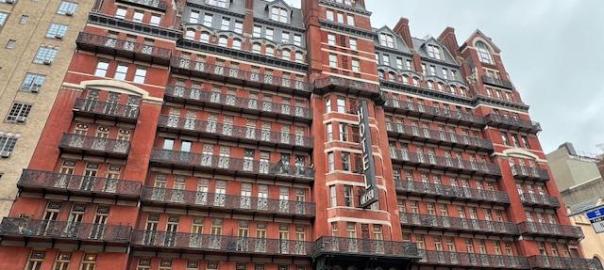
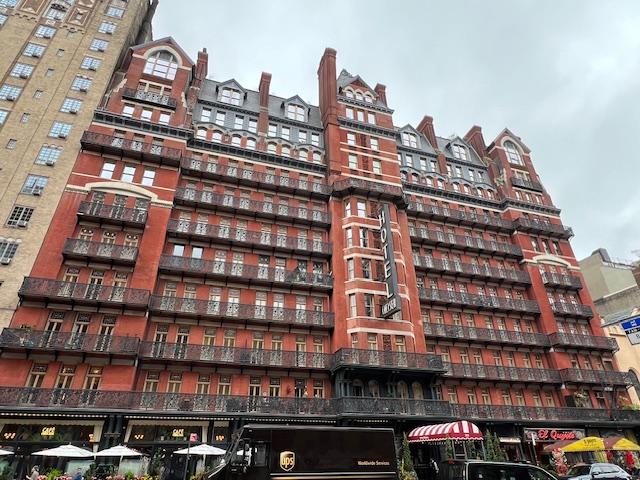
A few doors down are one of the most famous hotels still under scaffolding after a few years of renovations. The Chelsea Hotel at 222 West 23rd Street was built between 1883 and 1885 and was designed by architect Philip Hubert from the firm of Hubert, Pirrson & Company. The hotel is designed in the Queen Anne Revival with a combination of American Gothic (Wiki).
The hotel had originally opened as a cooperative and a home to artists and members of the theater community, but the concept changed in 1905 when it reopened as a hotel. The hotel has gone through several management changes over the years. In early 2022, the Chelsea Hotel reopened again as a hotel when the interior renovations were finished.
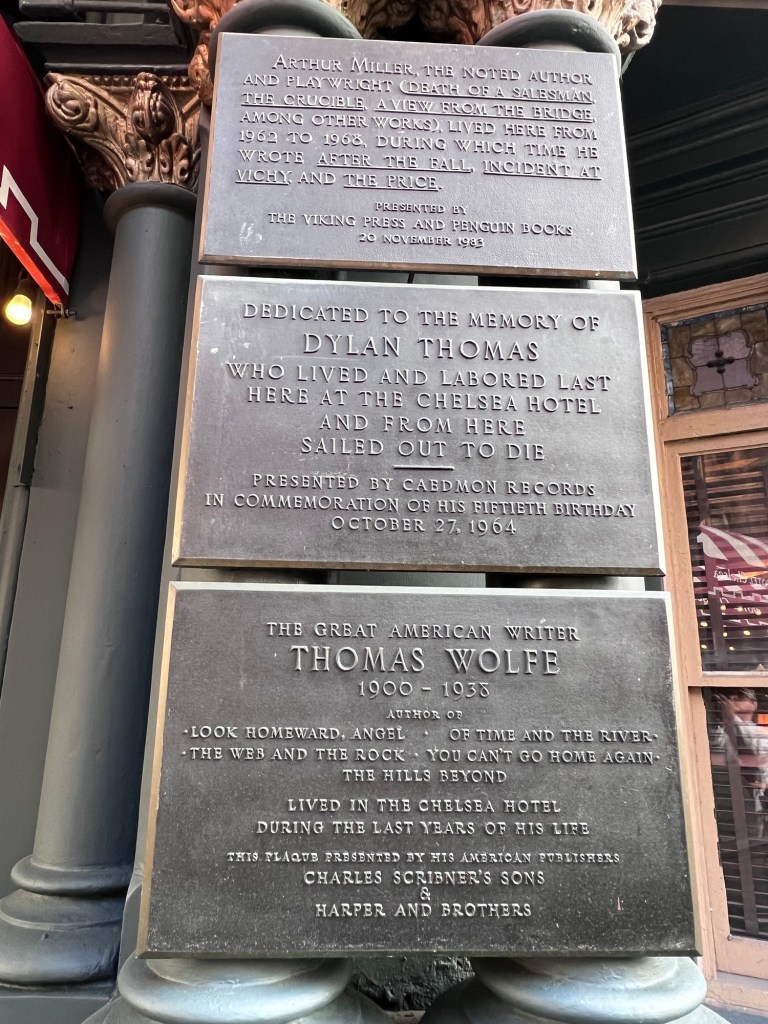
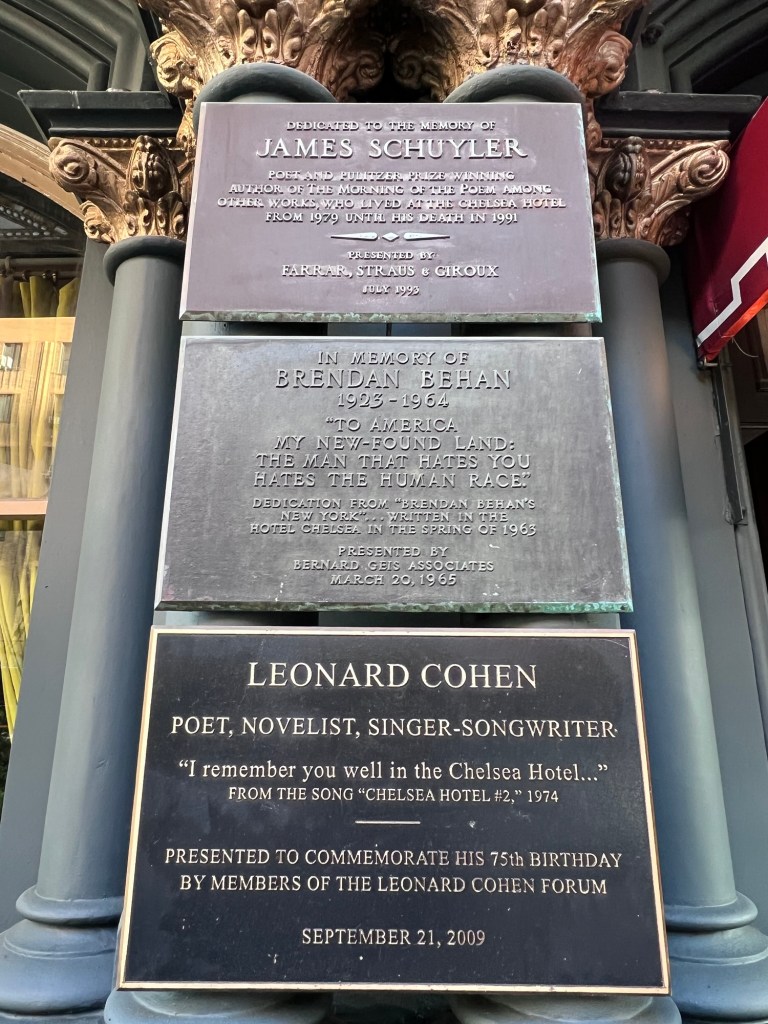
What has made the Hotel Chelsea so famous over the years are the artists and theater people who have lived at the hotel over the years and have used the hotel for their own creativity. Music, books, movies and story lines have been written here over the years by some of the most creative minds in history.
The historic plaque of the hotel
The hotel was a catalyst for the creative set. Notable famous residents included Mark Twain, Dylan Thomas, Allen Ginsberg, and Joseph O’ Neil, who when living here with his family was influenced by the hotel when he wrote ‘Neverland’. Film stars including Dennis Hopper, Elliot Gould and Warhol star Edie Sedwick had stayed at the hotel at various times. Musicians and singers Madonna and Janis Joplin both resided in the hotel and Sid Vicious’s girlfriend, Nancy Spungen was found stabbed (Wiki).
The history of the hotel
The history of the hotel
The history of the hotel
On the corner of Eighth Avenue are three restaurants I have noted many times in this blog for either their creative cooking or their cheap eats. These are real neighborhood restaurants.
The first one being Chelsea Papaya at 171 West 23rd Street, which was the starting point when I had breakfast last summer when I started “The Great Saunter” walk on Father’s Day. The breakfasts here are just amazing.
The pancakes here are delicious
The breakfasts are wonderful here
The pancake platter was out of this world and their breakfast sandwich Bacon Egg and Cheese was delicious.
Chelsea Papaya at 171 West 23rd Street is great for all meals
Next door to it is Pizza Gaga at 171 West 23rd Street for $1.50 slices and $1.00 cans of soda. This is my ‘go-to’ place when I need a quick snack and then need to dash on the subway to go somewhere else.
The cheese pizza at Pizza Gaga at 171 West 23rd Street is really good
A few doors down is Excellent Dumpling House at 165 West 23rd Street. I have only eaten there once but the food was pretty good that evening, but it still warrants a second trip because the raving that it got online did not live up to the hype of the food. The Soup Dumplings I had that night were large but did not have that much flavor.
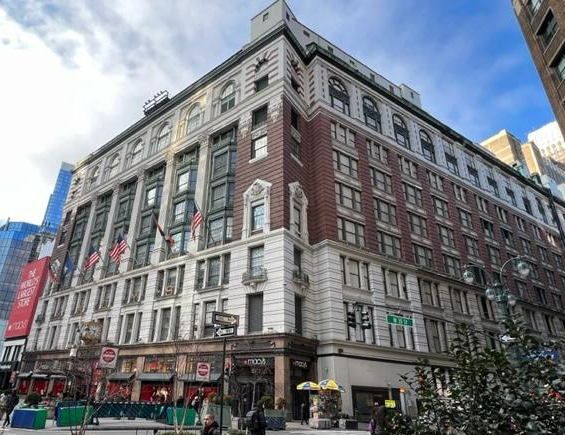
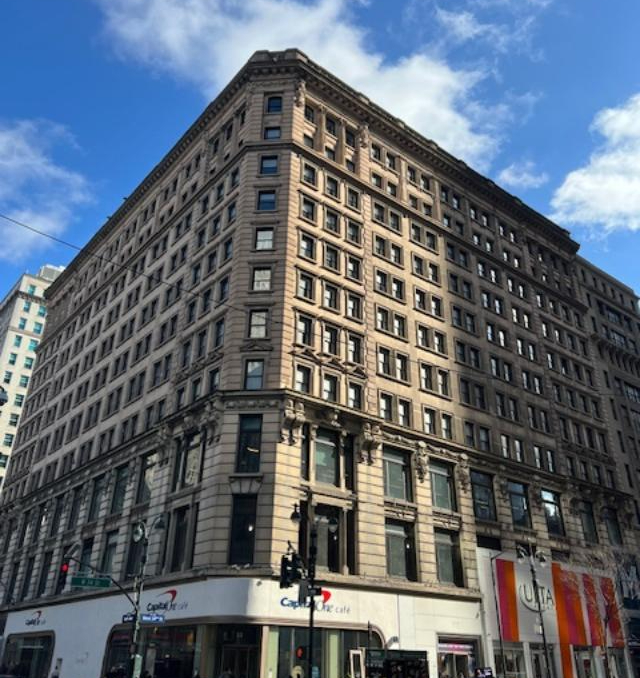
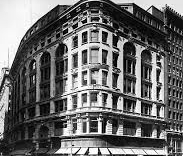
At the corner of the neighborhood on Sixth Avenue and West 23rd Street at 100 West 23rd Street is the second Macy’s Department Store building. This was on the very edge of the Ladies Shopping Mile that once stretched along Sixth Avenue.
The building was built in 1871 and you can see all the elaborate embellishments on it with interesting stone carvings and elegant window design and some wrought iron details on different parts of the building. It was the last location of the store before it moved to its current location at 151 West 34th Street.
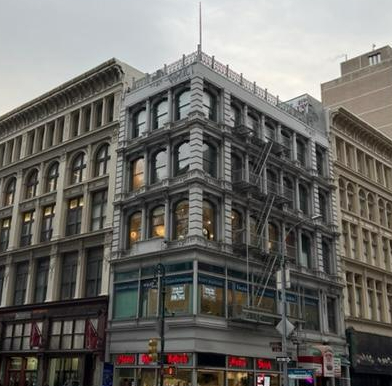
100 West 23rd Street (Renthop.com) is an old Macy’s
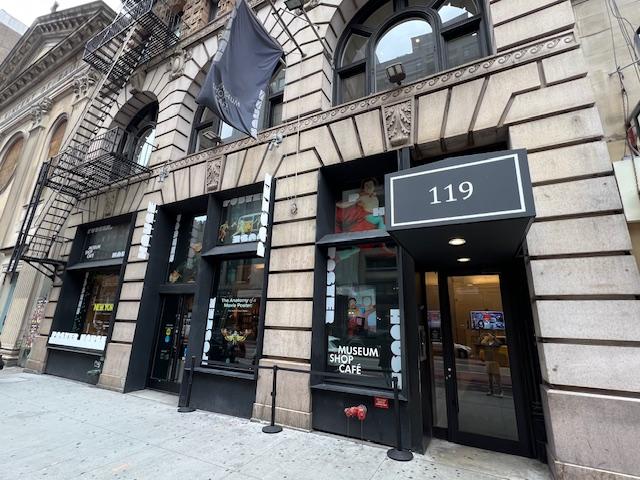
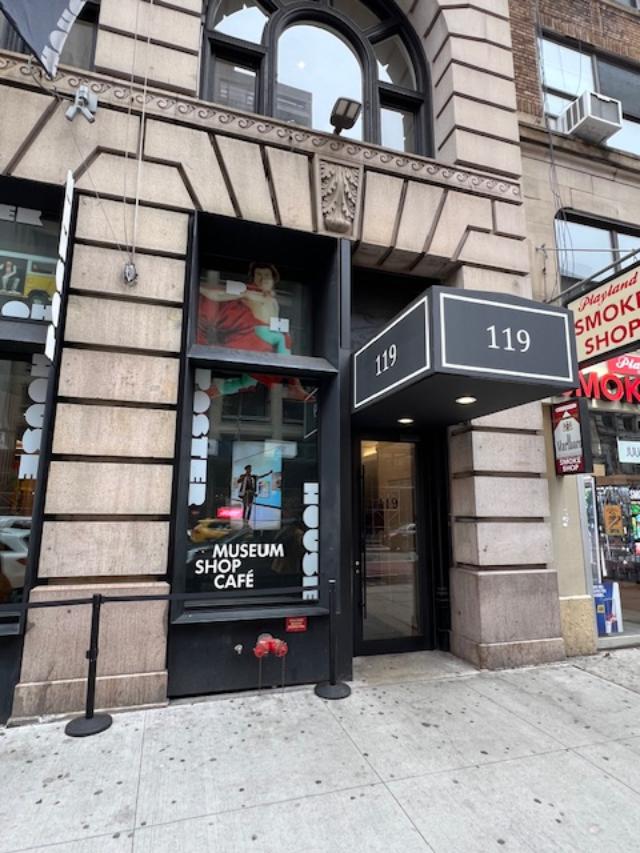
At almost the very corner of the block and hidden behind some scaffolding at 119 West 23rd Street is the Poster House Museum. This interesting museum I had never noticed before on my many trips walking down West 23rd Street.
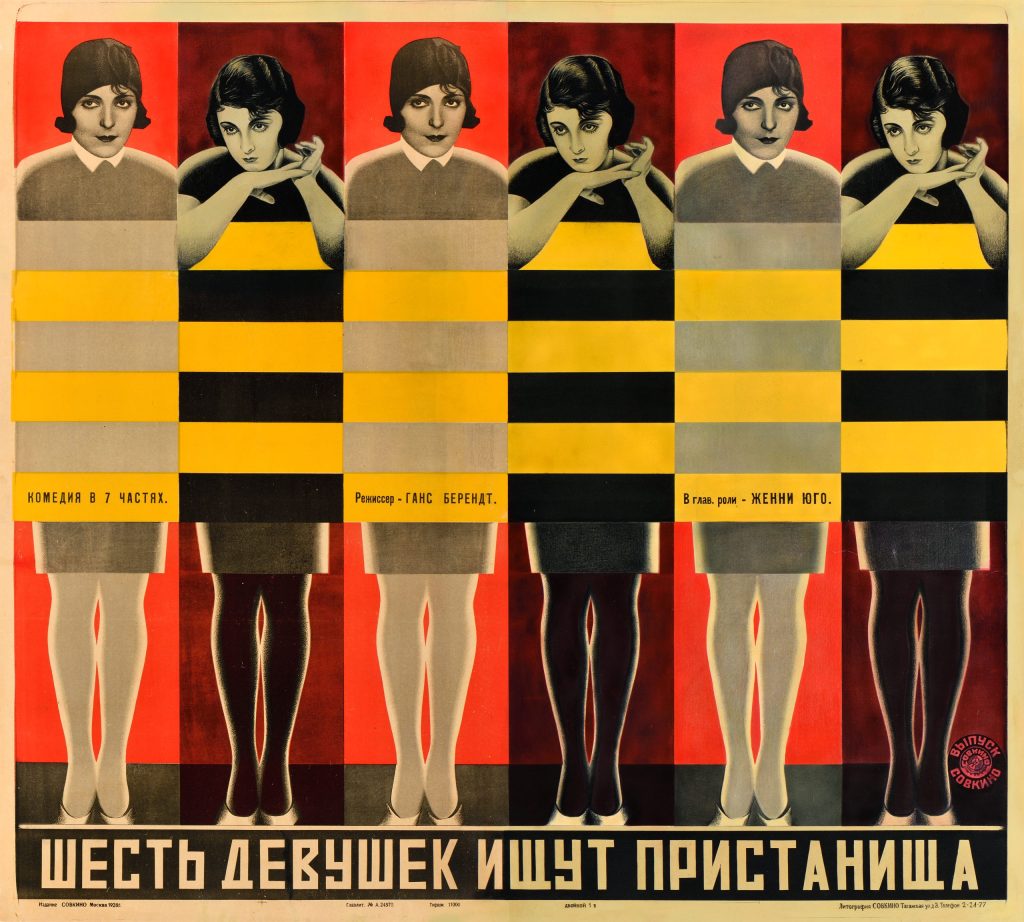
The Poster House is a small museum dedicated to the impact, culture and design of the poster (Museum website) and the first museum in the United States that focuses on posters. I recently attended three exhibitions at the museum including “The Utopian Avante-Guard: Soviet Film Posters of the 1920’s” that included many Silent Film posters.
The “Utopian Avante-Guard: Soviet Film Posters of the 1920’s” exhibition
When you walk up Sixth Avenue, which Chelsea shares with the border of NoMAD (North of Madison Sqaure Park) was once the Flower District. This part of Manhattan used to be lined with whole vendors up and down the Avenue. When I was working at Macy’s in the early 1990’s, most of this neighborhood was rezoned for residential. Practically every block from West 35th to West 23rd Street was knocked down and rebuilt with new apartment buildings. So, the character of the neighborhood changes until you walk the side streets.
The edges of Chelsea share the border of what’s left of the Flower District, NoMad and Koreatown so when you turn the corner of Sixth Avenue to walk down West 28th Street, you walk right into what is left of the old Flower District. I walked from one side of West 28th to the other and made it back to Holy Apostles to go to the bathroom and then headed back down West 28th Street to sees sites and stores that I had visited when walking the neighborhood when exploring NoMad.
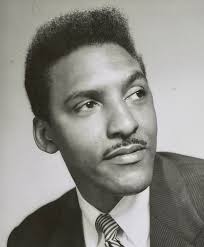
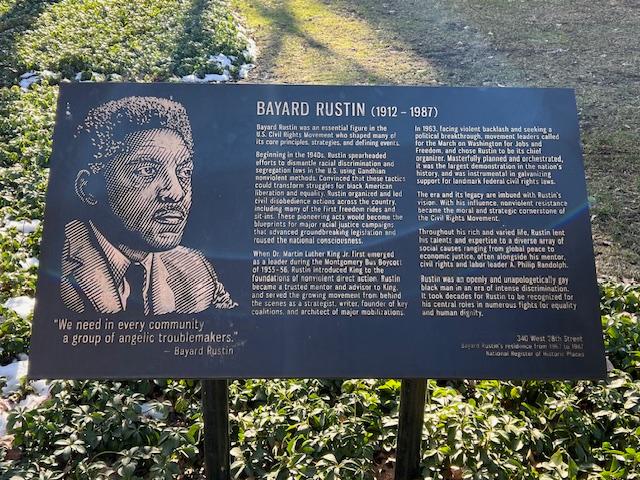
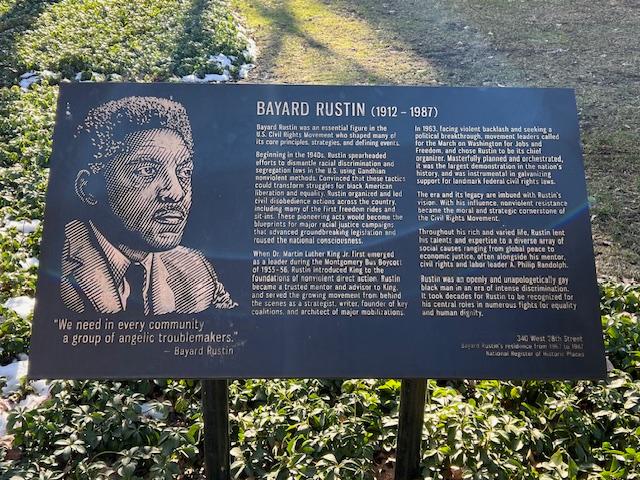
Behind the church is the housing that formally union housing for the International Ladies Garment Union housing, now known as “Penn South”, that was created in the 1950’s for housing for union workers. Contruction started in 1960 and these ten building still house some of the elderly members of the union. In the courtyard of building Seven is dedicated to Bayard Rustin, a civil rights and union member who lived there. There is a memorial plaque to him in the courtyard Wiki).
The plaque dedicated to the activities is outside Building Seven between Eighth and Seventh Avenues
As I traveled the border of the neighborhood on West 28th Street from Ninth to Sixth Avenues, I have never seen so much transition on a street. On one side of the street is the back part of my Alma Mater ‘The Fashion Institute of Technology’. It seems that the college is taking the back loading dock area and building an addition to the college.
On the other side of the street between Eighth and Seventh, the entire street has either been knocked down and rebuilt or older buildings renovated but the entire block between the two avenues is brand new. Since my initial trip almost two years ago, the entire block between Eighth and Seventh Avenue has been rebuilt with new buildings and the few remaining older buildings have been renovated for business offices.
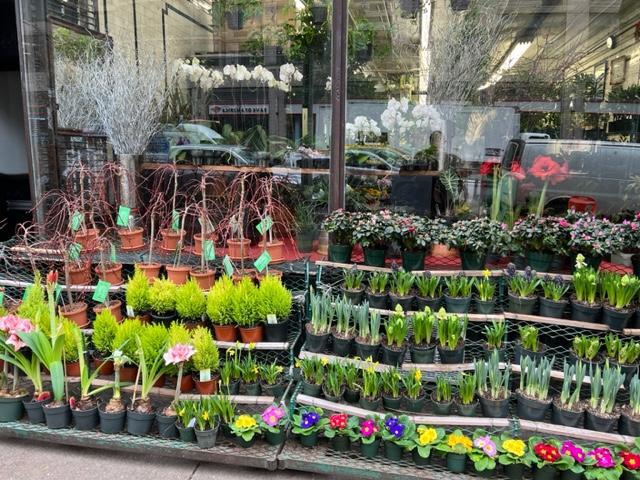
As you cross Seventh Avenue at West 28th Street are the last remnants of the former “Flower District” which dominated these blocks here and along Sixth Avenue until the area was rezoned in the 1990’s. Now Sixth Avenue in this area is now apartment buildings and hotels. Still there are many commercial flower shops here and some amazing floral businesses along this block.
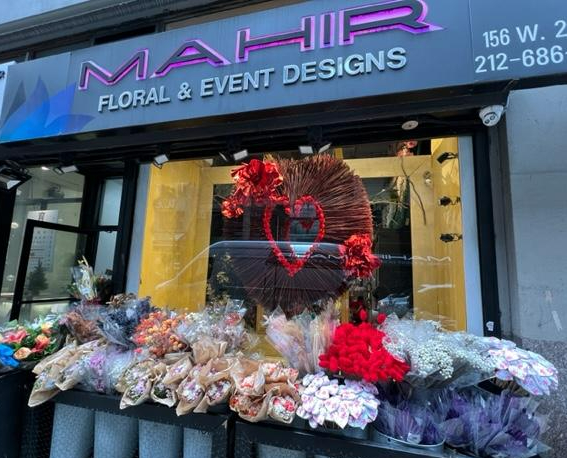
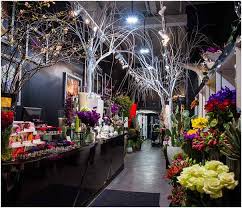
Mahir Floral & Event Designs at 156 West 28th Street is one of the nicest flower shops in the district (See my review on LittleShoponMainStreet@Wordpress.com). The store is so beautifully designed to showcase not only the flowers but the decorative items that they sell along with the plants and flowers.
Mahir Floral & Event Designs at 156 West 28th Street
There are all sorts of interesting design pieces that not only make the perfect gift but also to create the perfect event.
The store is so beautifully designed to showcase their items
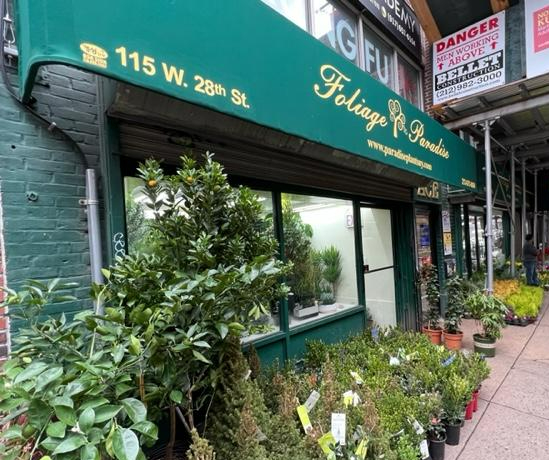
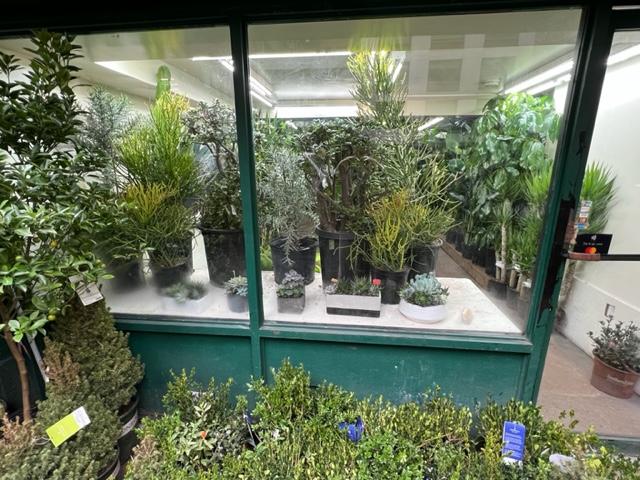
Another wonderful store is Foliage Paradise at 113-115 West 28th Street. What I love about the store is the way it is designed when you walk through it. It is like walking through an enchanted tropical garden with paths down exotic trees and flowers on all sides. They have a big commercial and retail business according to the salesperson I talked to that day.
In the front of the store when the weather is warm, it is lined with the most seasonal flowers and plants. When you walk through the store, it is like walking through an Amazon jungle in a warm climate at any month of the year. Just touring this store is fun.
Walking through Foliage Paradise is an experience
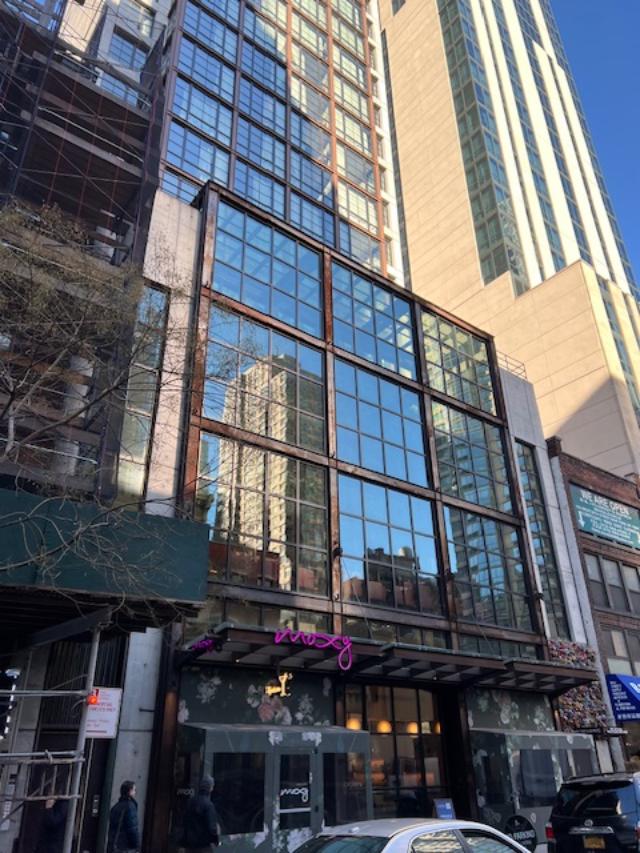
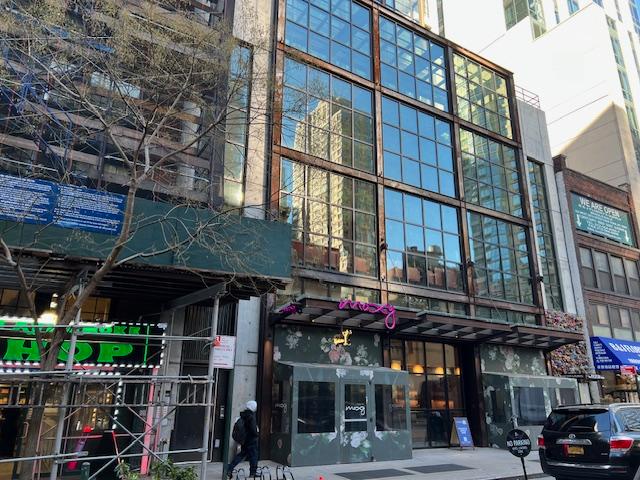
What brought back a lot of good memories when I walked down West 28th Street was walking past the Moxy Hotel at 105 West 28th Street. This was my starting point of my morning of walking “The Great Saunter Walk”, the 32-mile excursion around the Island of Manhattan over the summer of 2021 (before I pulled my back out).
The Moxy Hotel at 105 West 28th Street has the most amazing views
I had the most interesting room on the 10th floor with the most breathtaking view of Midtown Manhattan. I would just sit on the bed looking at the views before going to sleep. You have never seen a site than Midtown all lit up at night.
The Lower Garment District shares the border with the NoMAD and Koreatown neighborhoods and even over the last few months I have noticed some significant changes in the blocks that I had explored for the blog. Many buildings had been finished that were under construction or were in the process of being renovated. They still looked empty but there were better days ahead when they will be filled with the latest tech and advertising companies. Sixth Avenue is becoming a big commercial and residential neighborhood.
The Flower District in Manhattan is slowly shrinking
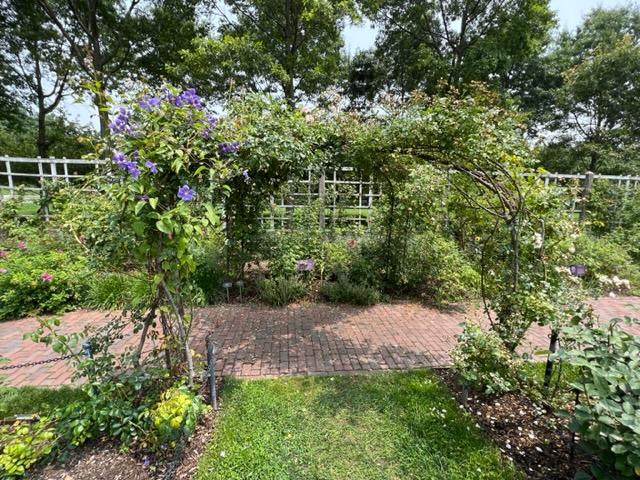
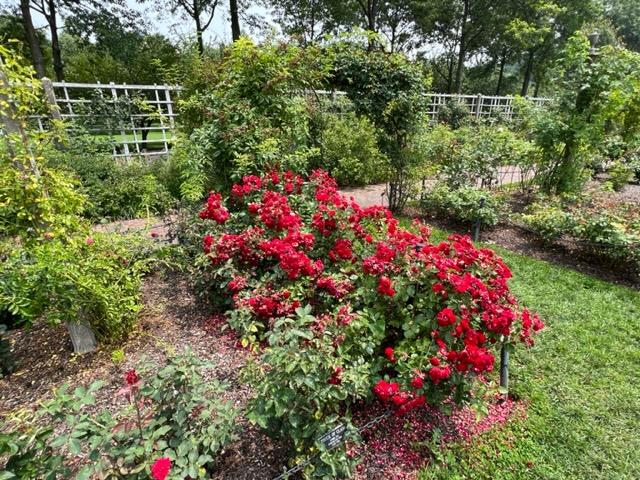
When I finished the walking the borders of the neighborhood, I doubled back to outside the Fashion Institute of Technology and took the subway to the Brooklyn Botanical Garden to see the Crawford Rose Garden which was in full bloom. All the flowers have been blooming two weeks in advance and with a series of rainstorms on the way I wanted to see the roses before the knocked all the petals off like it did with the Cherry Blossoms.
I took the 45-minute trip to the Gardens and walked around the rose garden, admiring the flowers colors and smells. The Cranford Rose Garden is one of the oldest sections of the Gardens and when they are in full bloom, they are just amazing to look at and wonder around. This is why you have to see them before the rains come. Roses have about a two-week blooming cycle.
The Cranford Rose Garden at the Brooklyn Botanic Gardens
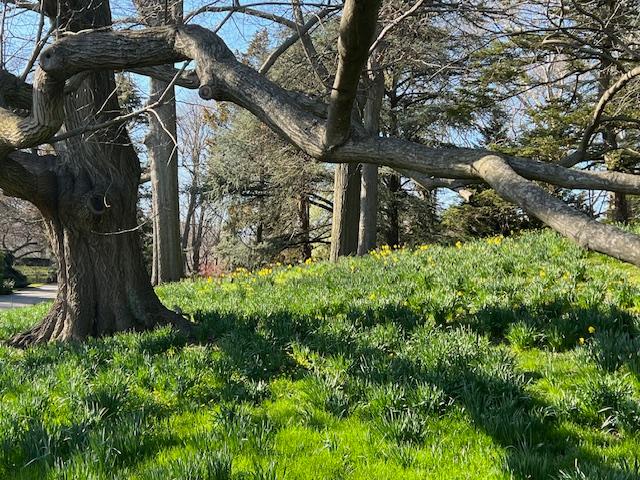
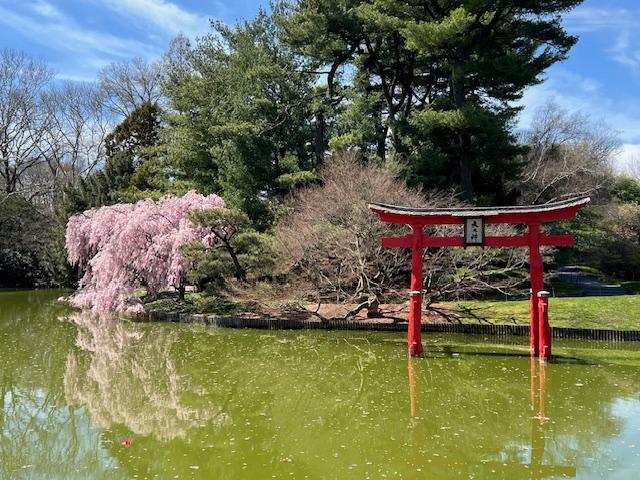
After walking all over the rose garden, I explored the rest of gardens, admiring the Children’s Garden with all its plantings and the beauty of the Japanese Gardens even after the Cherry Blossoms were gone. You never tire of these gardens.
The Cranford Rose Garden in bloom
The heat had been getting to me all day and it was 93 degrees when I got to the gardens. When I reached the Cherry Blossom Tree lawn, I just stopped and laid down on the grass and just relaxed. I ended up falling asleep under one of the trees and just relaxed for an hour. I was exhausted from a long week.
The roses in full bloom
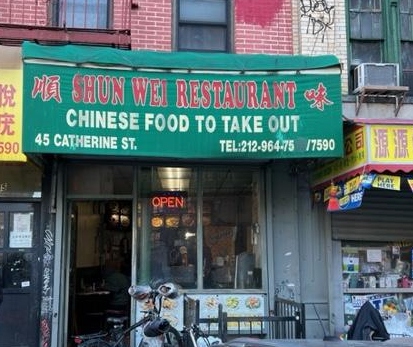
After I left the gardens for the afternoon, I headed to Chinatown for a quick dinner. I have been watching all thirteen episodes of the Fung Brothers “Cheap Chinatown Eats” videos and I remembered this restaurant their friend mentioned on Catherine Street on the outskirts of Chinatown, more in the Three Bridges neighborhood, Shun Wei at 45 Catherine Street. So, I decided to go there.
Cheap Chinatown Eats Part 9 that mentions Shun Wei
By the time I got to Chinatown from Brooklyn, it was rather late in the day, so I ordered my meal and ate it in the park across the street. Sounds innocent enough but I could see the underlining stares that I got from the restaurant owners, patrons and patrons in the park.
I went to Shun Wei which had been mentioned in the “Chinatown Cheap Eats” video and I thought why not give it a try? I had passed the place many times when I was eating at Catherine Deli right next door (See review on TripAdvisor and DiningonaShoeStringinNYC@Wordpress.com), so I gave it a try.
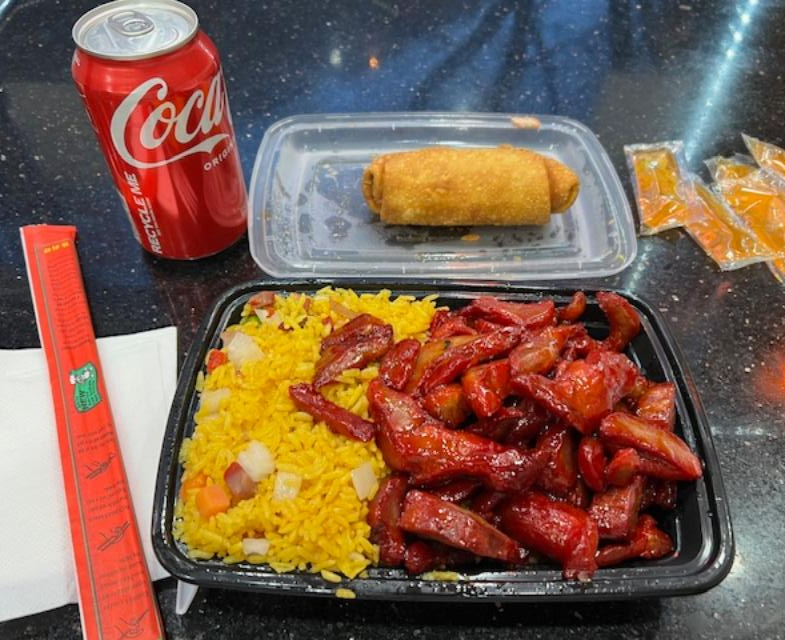
I did not want to order Chicken Wings but when I walked in there was a picture in the front window of a Boneless Roast Pork with Roast Pork Fried Rice and an Egg Roll for $9.95 and it looked really good. I also ordered a side of Fried Dumplings. So, I ordered that and waited for my order. The one thing about the restaurant is that it is located across the street from the Alfred E. Smith Houses and the Hamilton-Madison Houses and caters to the people who live there.
The Roast Pork with Pork Fried Rice was delicious
As I waited for my order to come out, I could see slight stares from the cooks making my food and from the other customers who walked in to get their orders. I guess people had not seen a 6:3 guy before. I just ignored it all and went to Alfred E Smith Park across the street from the restaurant to eat my meal. I figured with all the families in the playground and people sitting on the benches, there would not be any problems.
The business district around Alfred Smith Houses at dusk. This is where Catherine Deli & Bagels and New Shun Wei are located
I noticed the same thing again. It was like I could see out of the corner of my eye people were doing their best in the park not to look at me, but I could see the subtle stares. I just enjoyed my dinner and watched it get darker in the park. I have to tell you that I really enjoyed the food, and they gave you plenty of it. I was stuffed when I was finished and even had to bring the egg roll home with me.
After dinner, I left the park and toured around Chinatown and its fringes. It is really getting scary that even before I went to Shun Wei most of the restaurants were half full or the ones on the fringes were almost empty on a Tuesday night. As I passed through East Broadway, Henry Street, Division Street and then walked up Eldridge Street and then crossed onto Canal Street and walked back into Chinatown. At 9:00pm, everything was shutting down for the evening. I can see what the pandemic has done to this neighborhood.
Chinatown at night
Some of these restaurants used to closed at 11:00pm and some to even 2:00am to cater to the restaurant workers getting off. With more restaurants closing and “For Rent” signs in the windows, I can see the trickle-down effect of all of this. That and all the galleries moving into former restaurant and market spots, I have a feeling it will be in the near future we will be calling this “NoLoChi”, No Longer Chinatown.
As I said before, Manhattan just keeps morphing.
See my other blogs on Walking North Chelsea/Flower District:
Day Two Hundred and Thirty Seven: Walking the Borders of North Chelsea/Flower District:
This was the first year that “The Great Saunter Walk”, the 32-mile perimeter walk around the entire island took place since 2019. Since I had done the walk twice on my own, actually doing more of the walk than was required. This year I wanted to make it official.
I officially finished “The Great Saunter Walk” in May of 2022
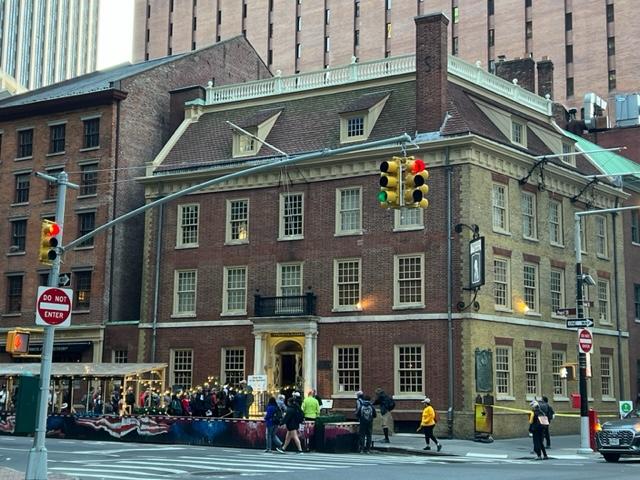
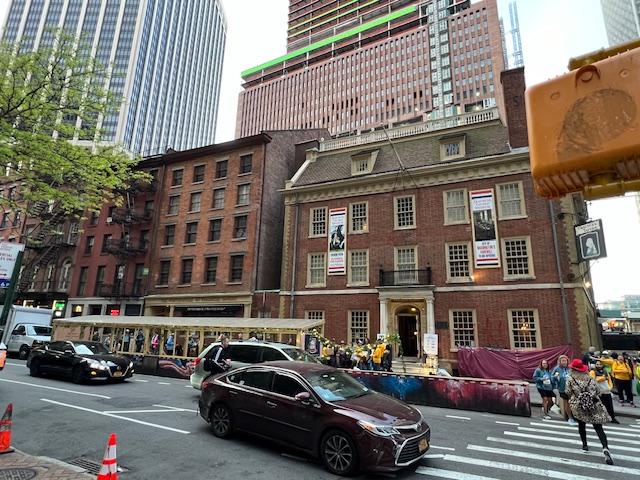
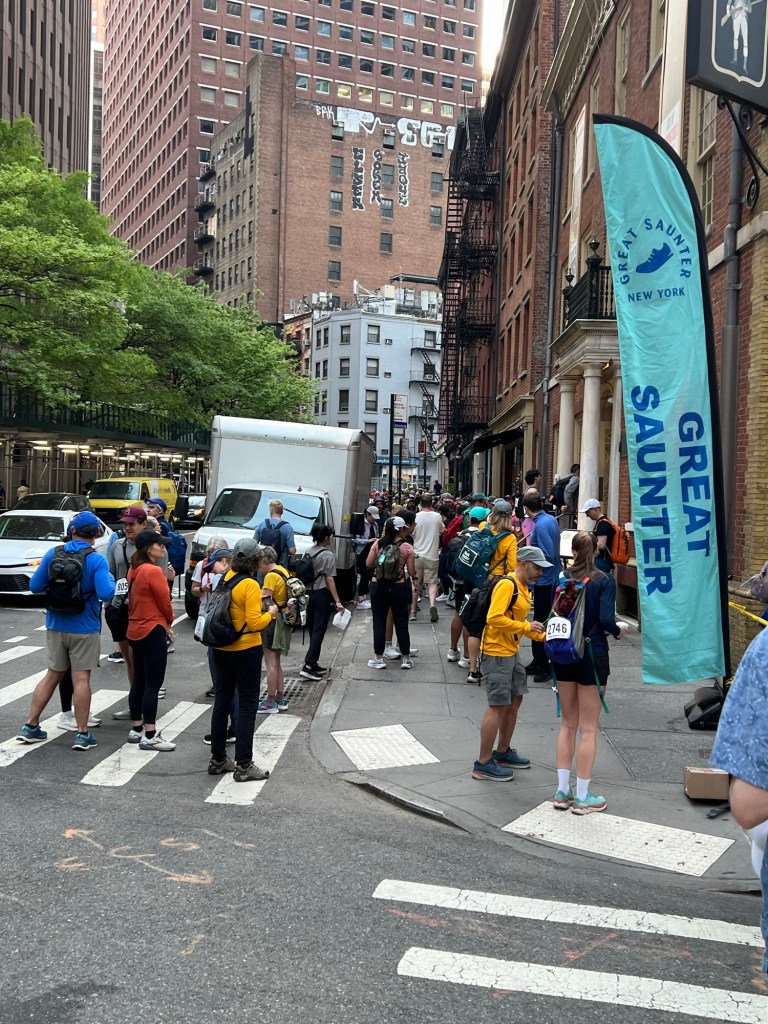
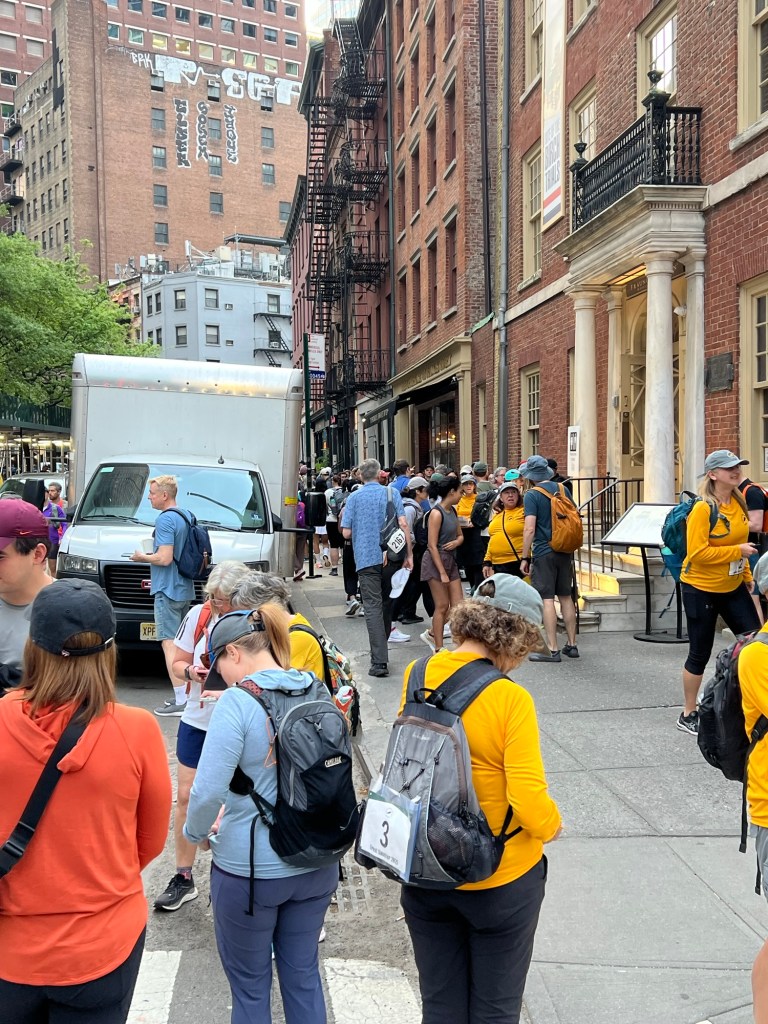
The problem was by the time I wanted to sign up for the walk, it was completely sold out. So, I was put on a waiting list. With a prediction of rain all day (and it did rain all day!), many people dropped out before the event occurred, so I got to sign up. On a very gloomy Saturday morning, I got to the Frances Tavern at 7:30am to register and start the walk by the entrance of the Staten Island ferry.
Rather than rewrite the whole day, I updated the blog that I have written over the last two years and added to it. I hope you all enjoy my journey around the most famous island on earth on the gloomiest and rainy day ever. I hope you enjoy the journey!
I wanted to complete the walk again in the Summer to look at if from another perspective and walked the island perimeter again on July 15th. It took another three and a half hours to do the walk. This is due to meal breaks and just exhaustion due to the heat.
Normally I walk “The Great Saunter” in June around the time of either Father’s Day or the Summer Solstice, so that I have plenty of light. The problem was I was so busy in June that I had to push it back to July and the biggest problem was the heat. In the morning when I started the walk, it was cool and in the high 70’s due to the clouds. When they broke around 10:00am, it started to get hotter and went to the mid 80’s. It would not have been so bad, but the humidity plays a role in the walk. When I did the official walk in May, it was so cold and wet we never stopped for a long break as we all just wanted to get it done and go home.
In the warmer months, I like to stop and relax at various parks like Jefferson Park in East Harlem or Carl Schulz Park on the Upper East Side and let my legs relax. The reason why we finished the walk in May quicker is because the businessman who I was walking with in the last leg of the walk around Stuyvesant Cove just wanted to finish as well so we never stopped.
There were a lot more people in the parks that day, so it made maneuvering a bit harder and, in some cases, like in Jefferson Park, people were all over one another. I have noticed one thing and it is not just in New York City, people’s courtesy has gone way down. People were riding their electric bikes and motorcycles in the paths of the park and on the sidewalks practically knocking people down. One very over-weight woman rode a moped through the main path of Jefferson Park chasing her dog and nearly ran over two little girls who had just finished swimming. That was something!
The nice part of the walk in July was the clear sunny day it had been and being able to enjoy the breezes and the sunshine. It is much nicer to do the walk on a pleasant day than in the rain.
My first ‘Selfie” of myself at the start of “The Great Saunter” in May of 2023. I for the life of me can’t understand the thrill people have of doing this. I now know why people think I’m a Fed all the time!
The Second Official walk of “The Great Saunter” on May 6th, 2023:
I have to admit that I thought walking in the rain was an interesting way to do “The Great Saunter”. This year I had to add in a three-hour class that I had to take for my NYU graduate program for my upcoming trip for a class in Paris.
To make the walk easier this year, I decided to stay in the City so that I could get a good night’s sleep and be closer to the start point so that I could walk as much of the West Side of the Island before I had to leave for class at 9:00am.
I was in the middle of final exams for both my college and my graduate work at NYU so Friday night before the walk, I had to write my section of a research paper on tourism between Philadelphia and Boston, grade my students end of the semester papers, update some blogs that I was working on and work on other projects.
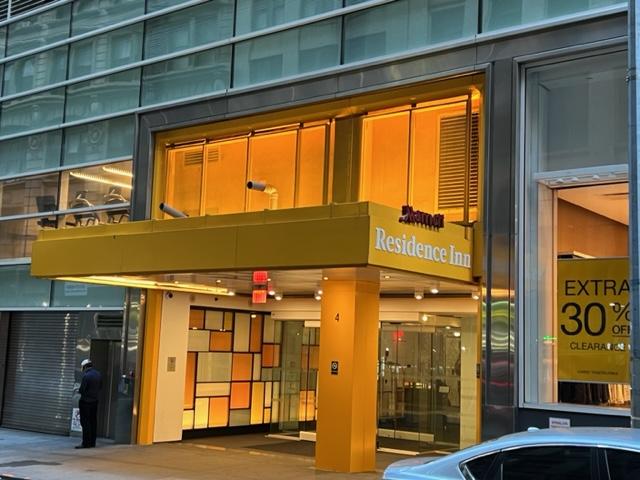
We had just finished my Business Communications class final at NYU and after lunch with my classmates and Professor, I headed downtown to get checked in at the Residence Inn in Lower Manhattan. The hotel is just a few blocks from Fraunces Tavern, which is the starting point for “The Great Saunter”. It would be an easier start for me since I had to stop and leave for class. I spent the rest of the afternoon at the hotel doing homework, reading and grading papers and working on updating my blogs. I ended up taking a long nap after all the work was done.
The Residence Inn Downtown Manhattan was our base for official “The Great Saunter” in 2023 and for the unofficial June 2024 walk:
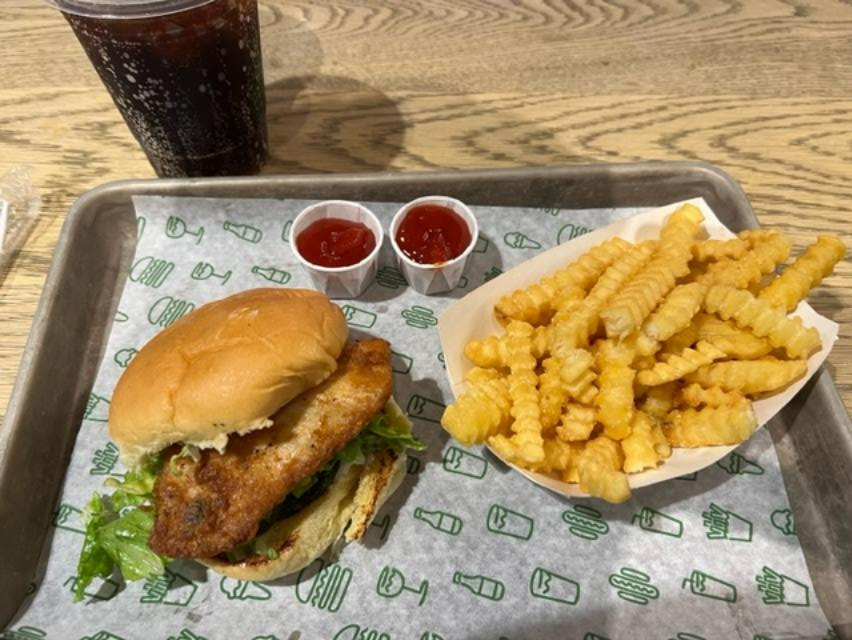
Later that evening while I waited for my friend, Maricel to join me after work, I went to the Shake Shack in the Fulton Mall off Broadway for some dinner. I could not believe that a Shake Shack was so filthy, and the staff looked like they could care less about the food or decor. I could not believe how this restaurant was being run like there was no manager there. The Dining Room and tables needed a good cleaning and sweeping and the guy working there spent most of his time on his cell phone. I ate my dinner and left. Even though the food tasted good, visually speaking it was not up to the standards that I have seen at every other Shake Shack that I have eaten at over the years (See review on TripAdvisor).
The Chicken sandwich and French Fries at Shake Shack at the Fulton Mall
When Maricel arrived from work, we talked for about an hour and caught up. It had been a while since we could spend some time with each other. I think I lasted about an hour and then fell asleep. Later she told me that she was in the middle of talking to me and I went out like a light.
In 2024, I stayed at the Moxy Downtown, a hotel so hip that it was annoying. If you like to hang around with a bunch of 20 year old’s, it is the perfect hotel to stay at for the night. The rooms were really small, the bar was really noisy and the food very expensive for what you got in return. It was nice for the night but I am not much of a fan of the Moxy concept.
The Moxy Downtown at 26 Ann Street in Lower Manhattan.
The funny thing about the Moxy Hotel concept is that you know who they are catering too and even they do not seem to like it that much. I felt like I was with a bunch of undergraduates. There was not view from the room (no big deal I was there to sleep), the room was a bed with a room around it and a busy bar attracting people who looked like they had just come from a ball game. What I found really annoying was they tag on a $25.00 ‘Resort Fee” and make you spend it at the hotel.
The bed with the room around it.
I have to admit though the bar was pretty nice. The bartender mixed an excellent drink. Their ‘Piscos Colata’ was pretty powerful and made me feel pretty good after a long semester in both colleges. At $18.00, the Pork Sliders were good but not worth the money.
The bar “Recreation” at the Moxy Downtown. Hipster Central!
I was so relaxed that I ended up getting back to the room, hit the pillow and was out like a light at 10:00am. I did not wake up again until 3:30am and then at 5:00am. I decided to just get up, pack and get ready for the walk around the island.
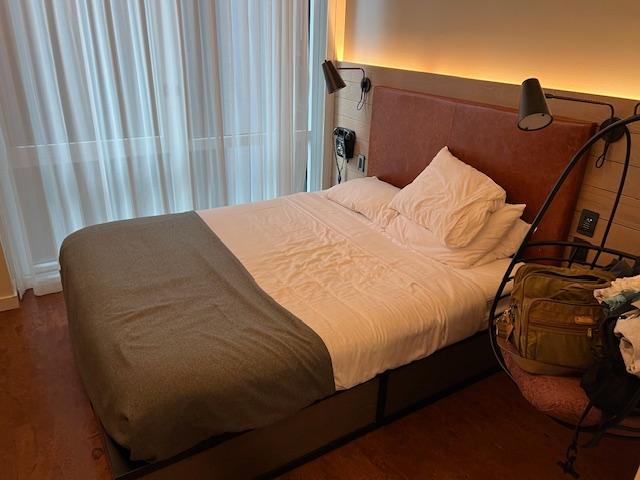
Things were different in 2023, when I stayed at the Residence Inn. The next morning, I woke up and I had one of the best night’s sleeps in a long time. I had not felt that refreshed in a long time. I swear that the Marriott mattresses are worth their weight in gold. I had to get dressed and ready to go for the all day walk. Since I knew that I had to stop around 8:45am, I wanted to get started exactly at 7:00am.
While Maricel slept, I got shaved, showered and on my way. I stopped at Traders Express Deli at 22 Beaver Street which was the only place open at that time to get breakfast. All the fast food places were still closed, the hotel breakfast did not open until 7:00am on the weekends and all the coffee places just served coffee. This was an opportunity that Fraunces Tavern is losing to serve breakfast to a large crowd.
Trader’s Express Deli at 22 Beaver Street in Lower Manhattan
I ordered a Sausage, Egg and Cheese that I highly recommend. What I liked about the place was the friendliness of the staff and the fact that everyone seemed to be regulars. The sandwich was excellent and was the perfect breakfast to start the walk.
Eating my breakfast sandwich across from the start point
The Sausage, Egg and Cheese was yum!
In 2024, I could not find this place again. Either I was on the wrong street or it had closed. So I went to Garden City Deli which is right on the entrance to the “Stone Street” district of old buildings in the Wall Street area. This little place just changed ownership and was wonderful.
Garden City Deli at 77 Pearl Street right by the “Stone Street” complex
The breakfasts were just as good. I had a Bacon, Egg and Cheese on a hero roll for $7.99 that was excellent. Three eggs, three pieces of bacon and two large piece of American Cheese tucked into a soft chewy hero roll. I that and some orange juice and relaxed across the street from the start site. It was so good and the perfect combination of carbs and proteins.
The delicious Bacon, Egg and Cheese sandwich at Garden City Deli.
Yum! The calories you will need for the trip.
As I was walking to the starting spot, I passed one of the side streets and saw two paintings along the walls of a building. These were quite interesting. I could not figure out who the artists were but that will be for another day.
Painting One
Painting Two
After breakfast I got in the already growing line of about a hundred people and we got ready to go. At exactly 7:00am, off we went. We collected our hats and pins and were on our way up through Battery Park along the Hudson River West Side of the island. We lucked out this year as the weather was sunny, warm and just crisp enough in the morning to walk comfortably.
The start of “The Great Saunter” Fraunces Tavern in May 6th, 2023
Us lining up for “The Great Saunter” on May 6th, 2023
In 2024, we lucked out again and the weather was cool but sunny and clear for most of the morning. After breakfast was over, I enter the line at 6:50am. There had been a line of people at 6:30am but Shorewalkers let them start a half hour early so there was no line to wait in when I finished eating. I got my hat, the map and off I went to start the walk. It was a cool day so it was nice to walk around. There was construction all over the island along the way so it made this walk more interesting.
Lining up a year later at 6:30am in the morning May 4th, 2024.
Lower Manhattan the morning of The Great Saunter May 4th, 2024.
In 2023, we lucked out this year versus last year when it rained all day. I had never been so drenched. This year it was so nice. It was bright, sunny and crisp in the morning, perfect to start the walk. When we began at 7:00am, I got my hat, pin and off I went. Since I had the new iPhone to take pictures, I was stopping by all the statuary so that I could update my older blogs on “The Great Saunter” and on walks in those neighborhoods. I got some really great shots in of sculptures along the West Side of the Island of Manhattan.
The start of “The Great Saunter” on May 6th, 2023
It was funny that another blogger said he recognized me on the walk from a previous walk and he sent me a copy of the video. It was me walking around Lower Manhattan.
Angel sent me this video of myself starting the walk right in front of him until I stopped to take a picture of lower Manhattan.
I was making excellent timing getting through the Battery, but I kept stopping to take pictures of all the sculptures that I had passed on previous walks, and I wanted better pictures this time. The day was sunny and blue, so it was perfect for taking pictures around the city. I could not believe the beautiful views that I saw of Liberty Island, Jersey City and Hoboken. Even the shots of lower Manhattan were amazing and so vivid.
Lower Manhattan that morning when I stopped to take a picture.
Passing Lady Liberty in the harbor that morning
For most of the walk until I hit 60th Street, I stopped every ten minutes to take pictures. At 8:45am though, I had to head back down to the NYU Campus to present my walking tour in Paris in three weeks (be on the lookout for “My walk in Paris” segment of this blog) and it went by really well. So well, that the professor wanted more from me so there will be some adjustments.
The view from the Battery at the riverfront of Jersey City, NJ in the background
I kept on track for walk through the Battery and kept pace with everyone else mostly passing people on my way up through Battery Park. I was making good time enjoying the warm weather and the beautiful sites that was a pleasure from the cold miserable weather from last year.
As I walked through Battery Park, I had to stop at each of the sculptures that I admired so much in all the walks that I have done in the past. It is an open-air museum in that part of the City. The first thing I passed was Castle Clinton, which once upon a time was the place immigrants registered when they came to this country before they went to Ellis Island. It also was once home to the New York Aquarium until Robert Moses dismantled it. Now it is used as a museum and a place where you buy your tickets to the Statue of Liberty and Ellis Island to the museums.
As we rounded the park in the Battery Park City, I saw a series of statues that I had seen many times on the walk. The first was the American Merchant Mariners’ Memorial. This is kind of a creepy statue as it stares at you from the bay. This was based on an incident from WWII.
The American Merchant Mariners’ Memorial at Battery Park
Ms. Escobar was born in Paris and raised in Venezuela and moved to New York in the 1950’s. She is known for her highly stylized boxy sculptures (NYCParks.org). She studied art at the Jepson Art Institute, the Ecole des Beaux Arts and Art Students League of New York (Wiki).
The signage for the statue
The next statue I remembered was the NY
Another sculpture I missed on my first two walks around the island was the New York Korean Memorial by artist Mac Adams.
The statue is one of the first monuments to the Korean conflict built in the United States and the void in the sculpture represents the absence and loss of the war and a metaphor for death (NYCParks.org).
Artist Mac Adams is a British born artist who now lives in the New York area. He holds an MFA from Rutgers University. He is known for his large public works and for the use of ‘space between images’ (Wiki/Artist Bio).
I have been on this walk around the island many times now and I do not know how I missed this statue of Gianni Verrazano that sits in Battery Park. This dynamic statue sits at the northern part of the park and was one of the few exits out of the park during its renovation.
The Giovanni Verrazzano statue by artist Ettore Ximenes
Artist Ettore Ximenes was an Italian born artist who had studied at the Palermo Academy of Fine Arts and then worked with several artists as an apprentice. He was known for his life sized sculptures. This statue was dedicated in 1909 (NYCParks.org/Wiki).
I left Battery Park and entered into the newer extension of Robert Wagner Jr. Park next to Battery Park City. In the front part of the park, I came across these unusual musical instrument sculptures that graced the entrance of the park.
The art entitled “Resonating Bodies” were created by British born artist Tony Cragg, whose work I had seen uptown many times. The sculptures resemble a lute and a tuba. The work is based on the concept that all physical bodies including we are constantly enveloped by various energy forms (NYCParks.org).
“Resonating Bodies” at Robert Wagner Jr. Park in Battery Park City
Mr. Cragg is a British born artist from Liverpool and studied at the Gloucestershire School of Art, received his BA from the Wimbledon School of Art and his MA from the Royal School of Art. He has been showing his works since 1977. He is best known for his contemporary sculptures (Artist Bio/Wiki).
Another work I saw along the walkway was “Cosmic Portal” by artist Tyler Schrader. Very unusual art.
Artist Tyler Schrader is an American born artist based in Upstate New York. He earned a BA in Drawing and Design. He transitioned into sculpture and design, embracing woodworking as his primary medium for the last decade. Inspired by the tactile and visual qualities of wood, he employs techniques such as intarsia, steam bending/lamination, lathe work, and carving to create intricate, organic forms (Artist Bio/website).
Once I passed through Robert Wagner Jr. Park at Battery Park City, I continued up the West Side Promenade on my way up the west side of Manhattan making great time. I got a better view of downtown Jersey City, NJ and could not believe how beautiful the skyline is at that time of the day.
Downtown Jersey City, NJ in all its glory
Manhattan looks so vibrant at this time of the morning. There is not a lot of action at 7:30am in the morning so you can see the City at its best. As we walked though Battery Park City and the park on our way up the West Side, I had to keep taking shots of familiar sites and the famous skyline.
Battery Park City in all it “Oz” glory at 8:00am in the morning
While in Battery Park, there were many art installations along the way. The first one I saw was Justice Reflected by artist James Yaya Hough. This was part of the ‘Art for Justice Fund’ series.
Artist James Yaya Hough is an American born artist who works out of Pittsburgh, PA. He is part of the “Lifelines Project”. LifeLines is a media and cultural project conducted in extensive, long-term collaboration with people serving Life Death By Incarceration (also known as Life Without Parole) sentences in Pennsylvania. The project uses interviews, visual art, creative media interventions, and sound installations to support the statewide campaign to abolish Death By Incarceration (Lifelines Project website).
A new piece of art appeared after the May 2024 walk. Either that or I had not noticed it when I walk around the area.
The sculpture of “The Eyes” by Louise Bourgeois appeared in Battery Park in June 2024 or I have just missed it
Artist Louise Bourgeois was a French born artist married to an American Art Professor who settled into New York City after her marriage. She was a graduate of the Sorbonne and continued to study art at the Ecole des Beaux-Arts and Ecole du Louvre and the Arts Student League of New York when she moved to the States. Starting as a painter she moved to sculpture on the recommendation of a colleague and known for her large sculpture works (Wiki).
Another piece of art that I came across that I missed in the last two trips is “Apple” by artist Stephen Weiss. The piece was part of the ‘Larger than Life” series of the artist and symbolized the heart and core of life in New York City (Hudson River Park).
“The Apple” by artist Stephen Weiss in Hudson River Park
Artist Stephen Weiss was a New York born artist who had attended the Pratt Institute. He had worked for his family company and was the husband of designer, Donna Karan. He was known for his family company and was the husband of designer, Donna Karan. He was known for his sculpture works (RoGallery).
As we were heading up the west side, I never noticed a sign that says “I want to Thank You” on the pier. I thought that was interesting in that I never noticed it before on my walks through Hudson River Park. I did not know if this was a piece of art work or just a message to someone.
The “I want to Thank You” sign in Hudson River Park
The last piece of art that stood out to me on this trip through Battery Park was entitled “Days End” by artist David Hammons. It looked like the shell of an empty building and struck a nerve as the sun started to set on the New Jersey side of the Hudson River. It is an ‘Open Air’ sculpture that explores the history of the neighborhood (Whitney Museum).
Mr. Hammons is an American born artist who studied at the Chouinard Art Institute (CalArts) and at Otis Art Institute. He is known for his Body Prints and sculpture work (Wiki/Artnet.com).
I headed up the thin stretch of park along Hudson River Park, I passed all the piers again that had become such a familiar site for me for not just The Great Saunter but for the neighborhood walks. I was able to judge where I was by the artwork and by the part of the park I had walked through. Since I have covered the whole island to 23rd Street, many of these sites I had remembered at previous times.
While I was walking through the parks, a few pieces of park sculpture stood out to me as I reached Hudson River Park in Chelsea. The long trek up Joe DiMaggio Highway made me more aware of my surroundings as I had to stop again. I came across the ‘Serpentine Sculptures’, these large twisting metal concoctions that graced the riverfront walkway.
These interesting, twisted sculptures are by American artist Mark Gabian who holds a BA in Art History and BFA in Sculpture from Cornell University (my Alma Mater!). Mr. Gabian’s sculptures can be seen all over the world. The artist has been quoted as saying he created monumental site-specific commissions in two or three dimensions’ (the artist’s website).
As I walked up Hudson River Park, I kept passing group after group of people on my way through the park. Everyone was pacing themselves but there are always those people that start jogging which I do not understand. They act like this is a contest and it is not the New York Marathon where we get judged for the time we keep. We just make it back to Fraunces Tavern and get our certificate.
Around the Meatpacking District, I walked through the LGBTQ Memorial which I had not noticed before.
The LGBTQ Memorial in Hudson River Park
This small garden was dedicated to those who lost their lives in the Pulse Nightclub of Orlando shooting back in 2016.
When I reached West 13th Street near Pier 53, I passed the latest attraction in Manhattan, “Little Island”, a whimsical park that had just opened the year before and I still have not visited. I was going to take a detour for a bit and walk inside the park but I wanted to make it as far as I could up the West Side that morning. Still, it is place that I want to visit and is on my bucket list.
The “Little Island” looks like visiting “Whoville” in the “Grinch who stole Christmas” in the summertime. This well landscaped park is now two years old, and I still can’t believe that I have not visited it. For another day I told myself and made a mental note of it.
My visit to Little Island with NYU just before school started in 2023.
Walking up Little Island
The Little Island Lawn
The view of lower Manhattan from Little Island that I had just walked.
As I passed West 23rd Street, there were more pieces of art that I remembered from when I was walking these neighborhoods. When you enter Hudson River Park from West 23rd Street, there is a very unusual set of sculptures entitled ‘Two Too Large Tables’ by artists Allan and Ellen Wexler. Two Too Large Tables consists of two elements. Each is constructed of brushed stainless steel and Ipe wood.
One piece has thirteen chairs extended up to become columns that raise sixteen square feet plane seven feet off the ground. In the second piece, the same chairs act as supporters to lift a sixteen square feet plane 30 inches off the ground. The first functions as a shade pavilion, the second as a community table. As people sit, they become part of the sculpture. People sitting together, forming unusual pairings because of the chair groupings (Artist bio).
Two Too Large Tables in Hudson River Park (Artist bio)
Artist Allen Wexler is an American born artist from Connecticut and studied at Rhode Island School of Design where he received his BFA and BS in Architecture. He studied and earned his MS in Architecture from the Pratt Institute. He is known for his multiple disciplines in art (Wiki).
The trip up Twelve Avenue is less than exciting. There is a tiny strip of park along the river that is mostly behind fencing. On the other side of the street is construction holes and fences from all the planned buildings that will start raising along the avenue.
The one place where there was some action was BLADE Operations at the Hudson River Park where helicopters were flying in. It reminded me of the opening scene of the Peter Bogdanovich film “They All Laughed” that I had just seen at the retrospect of the director’s work at the MoMA.
“They All Laughed” trailer by Peter Bogdanovic is a true Manhattan film
You will pass some very impressive buildings that are part of New York’s “Silicon Valley” including the well-known Starrett-Lehigh Building that has changed the complexity of the businesses in this neighborhood.
The Starrett-Lehigh Building at 601 West 26th Street
The building was built and finished in 1931 for the Starrett Corporation and the Leigh Valley Railroad as a freight terminal. The building was designed by the architectural firm of Cory & Cory and in 1998 went through a renovation as a office building. It is currently going through another renovation that will be completed in 2023 (Wiki/Starrett-Leigh website).
As I crossed the street from Hudson River Park, I passed the renovations of Chelsea Waterside Park. This is the park where last year I started “The Great Saunter Walk” last year on the Summer Solstice. The park had a ‘Butterfly Garden’ that people were working the morning that I started the walk. The park is going through a full make over and the plans for it look amazing.
The renovations are in the works right now
The Pier 25 Playground after the renovation.
Chelsea Waterside Park at 557 West 23rd Street (Hudson River Park Archives)
When you walk through Hudson River Park, it is the nicest place to take a rest and sit under a tree to cool off. The park has the most amazing breezes and views of the river and neighboring New Jersey.
As I was walking around one of the wooded piers admiring the view, I came a across a grouping of stones that looked unusual with the way that they were set. The grouping was a sculpture garden by artist Meg Webster entitled “Stonefield”.
“Stonefield” by artist Meg Webster
This landscape sculpture consists of large stones chosen from quarries in New York State and the northeast corner of Pennsylvania. They were selected for their special shapes and unusual sculptural qualities. Some are colorful, some are concave, some craggy, one is very tall. The artist views each stone as special and arranged each to showcase its unique characteristics and individual “being-ness” (Hudson River Park.com).
Ms. Webster is an American born artist who has a BA from Old Dominion University and MFA from Yale University. She works with natural materials such as salt, sand and earth known for her Post-Minimalism and the Land Art Movement. She is known for her sculpture and installation work (Wiki).
Artist Meg Webster talks about her artwork
As I passed the Hudson Yards complex at West 30th Street, it gleamed like “Oz” in the distance. This complex has now opened in full force since the Pandemic and the mall and all the parks have large crowds that I have not seen since most of it had been finished. I could tell the tourists have come back to the City.
The Hudson Yards complex in all its glory that morning
From West 23rd Street to West 57th Street I accelerated my walking as I wanted to get to my goal of West 60th Street before 9:00am. I passed many familiar sites from previous walks including the Circle Line at West 42nd Street where I started my first walk in 2020 and where I had spent my birthday pre-pandemic wanting to see the exterior of Manhattan, which was a real eye opener. The Intrepid Museum had just reopened a year and a half before and I made another mental note that I wanted to see that too (see my previous blog above on “The Great Saunter”).
Another familiar piece of art that I stopped to admire by Pier 96 was Malcolm Cochran’s artwork “Private Passage” again. I came across this sculpture when visiting the park two years earlier. The piece is a giant bottle and when you look in the port hole you will see a state room of the former Queen Mary. It is an interesting piece of artwork that is not hard to miss and take time to look in the port holes.
The artist is originally from Pittsburgh, PA and is graduate of Wesleyan College who specializes in large sculptures.
Further up the park, I saw the old New York Transfer Station piece in Riverside Park. This is a relic of the old West Side Railroad tracks that were once part of the New York Central Railroad that the park and buildings behind it are built on. This transfer bridge once was used to attach railroad cars to the freight tracks that once ran up and down this part of the island (Forgotten New York).
The New York Central Transfer Station
It is interesting to see this now as a piece of art instead of a functioning part of the railroad, but it is fascinating to see how we use the parts of the past as a piece of art in the present. This shows the current park visitor how we have made new uses of the riverfront for recreation and pleasure which was not true during the early parts of the last century.
The New York Central Railroad Car is also in the park.
What was nice about having the new iPhone was that I was able to take much better pictures of all these wonderful sites and record them for the blogs. When I got home, I updated all the pictures on previous blogs, and they really showcase all these wonderful works in the West Side parks.
Hudson River Park was getting crowded with dog walkers and joggers by 8:30am and people were really out and about. We had to share a thin strip of walkway with everyone including the bikers who kept yelling at us to get out of the way. There are just too many people enjoying these parks at once. Still, I got some great shots in and made excellent time. By 8:45am, I made it to West 60th Street and stopped to head back to the hotel and get to class. I had to present my proposal for my NYU class to Paris this summer and did not want to go all sweaty and needed my computer as well.
So, I went to the Columbus Circle stop and headed back down to lower Manhattan where Maricel was still asleep. As I walked through the subway terminal, I passed the Underground Market, which is the food court that was so popular pre-COVID. After the City opened up, this food court was practically dead as most of the restaurants had closed due to the lack of people visiting and working in the area. It looked like it had finally started to come back (another mental note to visit it).
The Turnstyle Underground Market has reopened and filling up again at the West 60th Columbus Circle subway stop.
I ran back to the hotel, changed my clothes and went to class at West 12th Street. i presented my walking project for the Left Bank of Paris, explained what we were doing and then listened to my classmate’s presentations. We finished by 1:00pm and I ran back to the hotel, changed back into my clothes, said goodbye to Maricel and checked my luggage and took the subway back to Columbus Circle. By the time I got up to the station, walked down West 59th Street and got back to Hudson River Park, it was past 2:00pm.
I resumed the walk at 2:30pm on the dot back on West 60th Street. The weather was still amazing, and I was convinced that I could finish the walk around 10:00pm. Oh, the day I had ahead of me was going to be a long one. The weather was utterly amazing so walking up the west side of the island was not so bad. It was not that hot, so it made walking pleasant in the later afternoon. I just don’t remember it taking that long to get to Inwood Park, which I would not get to until 5:00pm.
Riverside Park at 60th Street
Along the way as I walked up Hudson River Park to Riverside Park at West 72nd Street, I saw a couple of people who had quit the walk. A couple with their baby must have gotten as far as Inwood Park and then made their way back down the West Side. They just smiled at me as I passed them.
In 2024, there were more art installations along the way in all the parks. This is why I always say that New York City is like an ‘open air museum’. Between all the public and street art you will see along the route you never have to visit a museum. There is so much to see and experience. The first was “Hope” by artist Helen Draves and the second was “Life Dance” by artist Susan Markowitz Meredith. This was part of the “Art in the Parks” exhibition that runs every year.
Artist Helen Draves is a South Korean-born artist who has resided and pursued my artistic career in New York for over 25 years. Her father, who was an artist and an art professor in South Korea, inspired her as a child to explore my creativity through crayons, pencils, and paper. She was enamored with the process of creating something on a blank canvas, and this passion led her to earn a Bachelor of Fine Arts degree from Ewha Women’s University in Seoul in 1993. She continued to pursue my artistic education in the United States, obtaining a Master of Fine Arts degree from the prestigious Pratt Institute in New York in 1996. As an artist, her work often reflects the aging of life, particularly through the metaphor of wrinkled, aging hands. (Artist bio website).
Artist Susan Markowitz Meredith is an American born artist who has a BS in Art from Skidmore College and an MA from University of North Colorado. She has been developing my skills as a sculptor since 2011 when she began taking classes in wood and stone carving at The Art Students League of New York. She has supplemented her technical knowledge with outside coursework and training in woodworking. Her explorations have led her to pursue a range of other materials including metals, plastics, paper, and lighting. These educational experiences have cemented her commitment to sculpting and helped her clarify her own particular artistic approach (Artist bio website).
The walk through the park was pleasant as usual. The weather was really on our side before 1:00pm with sunny, clear weather. It was pleasant to walk along the Hudson River and catch the breezes, enjoy the art tour and talk with an occasional passerby. There are a lot of twists and turns around this route and the views are just spectacular. Who says New Jersey is boring?! This part of the Palisades is amazing to look at from this side of Manhattan.
Then at the extension of Dyckman Avenue by West 207th, in 2023 as my day was just getting started, I saw a group of four people who looked like they had just finished lunch and by their body language I could tell were done for the day. I passed them too. After that I did not see anyone on the walk until I got to Jefferson Park on the other side of the island in East Harlem as I was eating my dinner.
Not only was the weather very pleasant for the walk, so was walking through the parks. Everything was either in full bloom or had buds out and the parks looked really green. It was so beautiful to walk through them on this warm sunny day.
I made it up to West Harlem Piers Park 3:30pm and it was pretty busy on the sunny day. People were out walking their dogs, fishing on the pier or reading books at the benches. The park was not as messy as it normally is but the parks department people were out in full force the entire time I walked on the West Side so the parks were really clean. I stopped to take more pictures.
I passed the unusual sculptures, Voice One and Voice Two by artist Nari Ward, a New York based artist who likes to use objects found in his own neighborhood (artist website). They have become a marker for this walk on how far I have traveled. They are quite unique.
These unusual silver sculptures I almost interpreted as people trying to speak and it was interesting that the sculptures were called Voice I and Voice II. I was not sure of what the artist was trying to communicate with his artwork, but it does stand out in the park. The unfortunate part of it was that there was so much garbage in the park you could not get up close to see them.
Voice I
Voice II
Voice III
I really enjoy this park. It has wonderful breezes and excellent views and plenty of places to sit down and relax. It offers such nice views of the river and as the morning progressed, I started to see more sailboats and water boats out cruising up and down the Hudson River.
While walking down the walkway to Fort Washington Park in 2023, I noticed these flock of seagulls in the cement barrier that I had noticed many times before. I did not realize how detailed they were until I really looked at them. This is what happens when you take your time to observe everything on this walk and not just rush by.
The seagulls wall
The seagulls wall
Passing this part of the park leads to the underpass that you have to walk through to get to Fort Washington Park, so you have a rather strange part of the walk near the treatment plant. If you can travel up to the sports facility, it is worth the trip. It really provides the neighborhood with all sorts of things to do. It also has a great snack shop, and their burgers are really good. When I entered Fort Washington Park, it was in full swing with barbecues and parties going on that afternoon. It is very different in the morning hours when the parks people are there cleaning up from the parties the night before.
Walking through Fort Washington Park during the walk in 2023
In 2024, the City was promoting their “Art in the Park” exhibition as they had done in the past. I saw some unusual art in the park that was on the lawn before you entered the pathways. It is so nice that Manhattan has these ‘Open Air Museums’ for us to enjoy all over the City.
Artist Sophie Kahn is an Australian born artist who lives in Brooklyn who has a BA in Fine Arts from the University of London and MFA from the School of Art Institute of Chicago. A sculptor and digital artist, Kahn utilizes technology—in its successes and failures—to analyze the complexity and poetics of capturing the human body in the digital age. Working from a 3D scan of musician and artist tiger west, Portrait of t. brings the digital, private realm into the public through a glitched body scan cast in bronze (Student Art League.com).
Artist Marco Palli is an Venezuelan born artist with MFA from the New York Studio School of Sculpture and MFA from the New York Academy of Arts both in sculpture. Expanding beyond the personal, Palli’s sculpture presents an opportunity for audiences to engage with the narratives of local versus foreign and the sense of belonging within the United States. Our Gates is a celebration of New York City and its diverse communities (Student Art League. com).
It was unusual but very interesting art. I was just surprised to see in a location that not too many people visit. It would have been nicer if placed further downtown on the Upper West Side, where people might appreciate it more.
The George Washington Bridge in the distance when walking Fort Washington Park
Making my way to the George Washington Bridge
I got to Fort Washington Park around 4:00pm and was able to visit the Little Red Lighthouse which I had visited many times on my trips to the park. With everyone else being on the other side of the island at this point, the park was relatively quiet, and I got to take lots of pictures.
The George Washington Bridge with the Little Red Lighthouse below it. It inspired the children’s book, “The Little Red Lighthouse and the Great Gray Bridge” by author Hildegarde Swift.
The Little Red Lighthouse at Fort Washington Park
I continued on into Fort Washington Park to see the Little Red Lighthouse, which I had not visited in almost three years since my last walk in the neighborhood. Many tourists were by the site just under the George Washington Bridge, taking pictures by the lighthouse and enjoying the sunny weather.
The Little Red Lighthouse had been constructed in 1889 and moved from Sandy Hook, New Jersey in 1917 and moved here in 1921. It was decommissioned in 1948 after the construction of the George Washington Bridge in 1931. What had saved the lighthouse from destruction was the book “The Little Red Lighthouse and the Great Gray Bridge” by author Hildegarde Swift in 1942 (Wiki).
The Little Red Lighthouse and the Great Gray Bridge by Hildegarde Swift
The park was really quiet, so I got to enjoy the views on my own this time. I was able to finally take the pictures that I wanted and take my time exploring the park. It also has one of the few decent bathrooms in this area of the City. I looked downtown the area I had covered and was making very good time on this side of the island.
The view from under the George Washington Bridge from the Little Red Lighthouse to Lower Manhattan
On the way to Inwood Park from Fort Tyron Park, I passed the remnants of the old Tyron Hall estate. There is not much left but the entrance ways across the street and this balcony that looks over the river. You could tell at one time this must have been a very grand estate. It now makes up the framework for Fort Tryon Park where The Cloisters Museum is now located.
The Balcony of the old “Tryon Hall”
When you reach Fort Tyron Park by foot along the Henry Hudson Parkway, you will see two large stone columns that look like the entrance to an estate and then across the street there is a pillared overlook to the Hudson River. These are remnants of the former C.K.G. Billings estate, “Tryon Hall”.
The old entrance to the estate is covered with brush
The old entrance to the estate under brush
Mr. Billings, the Chairman of Union Carbide, owned most land of which the park is located, and these small relics are the remains of the great estate. I had never been in this part of the park before and thought it interesting that these pieces of the estate were left.
The archway and drive are still part of the park, and you can see them closer to The Cloisters Museum. The old driveway to the estate is still used inside the park.
The entrance to the old “Tryon Hall” estate in Inwood Park in 2023
I made the long trip up the hill from the park to enter the beginnings of Inwood Park and walked down to Dyckman Street to the Dyckman Street Beach and harbor area. People were out washing their cars and blasting music, and, in the distance, you could hear the yells of the baseball and softball games going on. I walked up the pier to take a better look at the beach and at least this time there was no garbage on it.
The Dyckman Street Beach is a small street of land on the Hudson River. I would not swim in it.
As I made my way through the bottom of Inwood Park, I stopped to take in the view of the Hudson River. I don’t think too many people know of the views from these parks on this part of the island, but they are really amazing.
The beauty of the Hudson River from Inwood Park
I made my way over the foot bridge in Inwood Park to the main part of the path and could not believe how beautiful the views were from the hills. When it rained last year, you could not enjoy it. All everyone wanted to do was get to the pavilion in Inwood Park so that we could dry off a bit and have something to eat and drink. Since I did not get there until 5:00pm, everyone was long gone (they closed this area down by 2:30pm).
I took my time snapping pictures, enjoying the view and admiring the Hudson River and the trees as they swayed by. The park was at its best at this time with the sun right above us. The paths and the lookouts were so picturesque.
The view from the top of the hill at Inwood Park
As I walked up and down the paths of Inwood Park, I took time to enjoy the views that Mother Nature offered me. I figured I was not racing with anyone to the finish line and would have plenty of time to get down to Fraunces Tavern.
Another view from the top of the hill path at Inwood Park
Heading down the pathway
The rock formations that make up the mountain stream
Following the path to the bottom of the hill
As I exited the park’s long hilly path, I arrived with this woman who tagged along with me to the halfway point. Right near the Shorakkopoch Rock, there was another usual sculpture right before it by artist Rose Simpson entitled “
Artist Rose Simpson is an American born artist who works out of New Mexico. She has a BFA from the Institute of American Indian Arts and has a MFA from both the Rhode Island School of Arts and the Institute of American Indian Arts. She is a mixed-media artist whose artwork investigates the complex issues of past, present and future aspects of humanity’s tenuous survival in our current ecological condition (Wiki/Artist Bio).
When I got to the bottom of the pathways and exited into the lawn area of the park, I saw a familiar giant boulder which is one of the most historic objects on the Island of Manhattan, the Shorakkopoch Rock.
The spot where Manhattan was bought by the Dutch
The rock is the legendary location of where Peter Minuit bought Manhattan from the Reckgawawang Indians for what is today $24.00 of household goods and trinkets.
In 2023, I bypassed the rest of the park and made my way past all the basketball and softball games and went to the pavilion to see if anyone was left there and everyone was gone. When I looked at the schedule of the map, they had closed up at 2:30pm and it was now 5:00pm. I knew it would be getting dark by 7:45pm and I did not want to be walking through Harlem at night, so I made my way through Inwood and Washington Heights following the path set by the map. I stopped for a quick Coke and made my way down 10th Avenue to Dyckman Street.
In 2024, I got to Inwood Park and the halfway point by 11:45am, a new record for me and was able to relax for about a half hour. I got to talking with a few women along the way and they tagged along with me. By the time I got out of the bathroom, they were both gone and I was able to finally relax on my own. I just vegged and ate the cookies, chips and power drinks they had for us and they had plenty of supplies which was nice.
Inwood Park halfway point in 2024.
The Farmers Market was there both years until 5:00pm and this is when it started to get gloomy outside. In 2024, the weather started to go in and out with the clouds and by the time I hit East 155th Street, it started to get cloudy and cooler. Still take time to walk around the Farmers Market in Inwood. It is really nice.
The Inwood Farmers Market is popular even on a gloomy day.
All the street vendors were in full swing, selling everything on a busy weekend. I was going to stop at one of the bakeries, but I did not want to sway too far off the path, so I decided to stop at my favorite pizzeria on East 145th Street so I decided to wait to eat lunch there.
On the way down 10th Street, I saw a lot of interesting street art. I don’t know who the taggers were, but their work was very creative.
This was just off 10th Avenue near 203rd Street
More Details of the artwork.
More details of the artwork.
I thought this was really creative in the right corner of the painting
I saw this on the side of condo and thought someone was really talented.
A new piece of art showed up next to it during the June 2023 walk.
I made my way past Dyckman Houses, which are always interesting because I keep thinking that someone is watching me from there. I always get that sinking feeling, so I make my way fast this development and get to the park to walk down the path along the East River. I got here by 5:30pm so I was making good progress.
As I walked down the Harlem River Drive pathway in Highbridge Park, the traffic was still really packed as people looked like they were still trying to leave the City for the weekend. At the beginning of the park, many people were having barbecues and birthday parties. All the tables were with families enjoying themselves. Once I passed all of them, the park was quiet. I noticed across the river in the Bronx how much of the waterfront had been built up with new condos and apartment buildings. I could not believe how much the developers were changing the waterfront.
The long curves of the park, the lush woods and rock formations show what was once the former shoreline of this part of the island. From this location it looks alike Inwood Hill Park with clean paths and virgin plantings. From a distance it looks really pretty.
The reality of the park is that if you walk through the park you are faced with the over-grown paths, the graffitied rocks and garbage that parts of the park suffer from. When you walk through the paths on the other side of the park, you see how far the park has gone down and the work that still needs to be done. Abandoned cars and garbage still plaque parts of the park from the park side paths. Still the City is doing a lot to improve the park blocking off parts of te park to renovate it with seedings and new plantings.
The approach to the High Bridge Water Tower in High Bridge Park in 2023
I passed the old High Bridge Water Tower that I heard has finally reopened. The water tower and the bridge are the lasting remnants of the way water used to travel into New York City from upstate in the late 1800’s. The tower was built in 1872 and was part of the old Croton Aqueduct system of moving water into Manhattan.
This part of the park had no activity and, on the path, leading down to the old Polo Grounds there was not much activity. What always makes me nervous is walking around the Polo Ground Houses that run from West 165th Street to about West 155th Street. The complex is a tired looking set up public housing with one building looking exactly like the other and a small patch of green in the middle.
The Polo Ground Tower Housing Complex as you approach it from High Bridge Park
All I kept thinking about is the activities that go on there and I zig-zagged my way down the sidewalk until I hit the part of the fence that was covered with trees and vines. Out of site from the prying windows. Ever since I read about the complex on the internet, I have never felt comfortable in this part of the City. This was before I walked all around the complex four years ago when I walked Harlem and didn’t think much about it. I walk around quickly in this neighborhood. Before I crossed the street, I looked at the John T. Brush staircase that used to bring people from the subway to stadium. I thought no one today except a few older New Yorkers would know the significance of this.
The John T. Bushman Staircase that used to lead to the Polo Grounds
I crossed the street and walked down Edgecombe Avenue on the upper side of Jackie Robinson Park. On the corner of the edge of the street is the John Hooper Fountain at 155th Street and Edgecombe Avenue. The fountain was designed by architect George Martin Huss and is a ornamental horse fountain and lantern. It was dedicated in 1894 and donated to the park by businessman John Hooper (NYCParks.com/MichaelMinn.net). It was used by the horses for drinking when carriages and horse riding at that time.
The John Hooper Fountain is at the corner of Edgecombe Avenue and 155th Street in 2024
The Hooper Fountain was working that afternoon for the walk in 2024
I finally got down to the Polo Grounds Public Housing and was able to get through that area pretty quickly. Hearing rumors about this place as well, I wanted to get past it and get to Edgecombe Avenue as soon as possible. The funny part about this area was pre-Pandemic this neighborhood was really gentrifying with many of the CUNY students moving into this area. It looked to me like it has retrenched a bit for now.
As I passed the benches by Jackie Robinson Park down the steps from this road, I saw small groups of people who made it their business to ignore me or were smoking pot and finding ways to try to hide it. It has been made legal, so I did not care. I finally made it to East 145th Street and made the turn and walked down the street.
East 145th Street has shown some real changes. Pre-Pandemic this was one of the fastest gentrifying areas of the neighborhood with new buildings going up, lots of new and more expensive restaurants and renovations of the old townhouses and brownstones. Having the students go virtual really put an end to it and the neighborhood has retrenched for now. There is still renovations going on but not like before where I would see CUNY students on their blankets in Jackie Robinson Park. That must have freaked out the neighborhood. CUNY will soon dominate this neighborhood again with a new apartment complex they want to build on the corner of East 145th Street and Sixth Avenue (Malcolm X Boulevard).
I stopped for a quick lunch at King Pizza of Harlem at 110 West 145th Street for a snack. I knew that I wanted a chopped cheese for dinner as I had for the last two years but again, I was starved. When I walked in, there was the same owner in the same place where I ordered my lunch. I just sat and relaxed. I have been coming here for lunch on my walks in 2022, 2023 and 2024.
King Pizza of Harlem at 110 West 145th Street (Closed May 2025)
The cheese pizza is excellent. The sauce is so well spiced and topped with loads of mozzarella cheese. The slice was rather large and made a great snack. It was just pleasant to sit down and relax.
The slices at King Pizza are excellent! Don’t miss their delicious Cheese Pizza. Where I eat my lunch on my walks.
My lunch in June in 2023 when I visited the second time.
The Ground Beef pizza is amazing! This has been my go to place for my last four walks around the island.
The relaxation did not last very long as there was some big commotion outside the restaurant, and I saw about four police cars surround this group of kids who started to run in every direction. There were kids of all ages yelling and running across the street in front of the restaurant. No one in the restaurant flinched at the whole thing so I figured the owner had seen all this before and was prepared if someone came into the pizzeria to cause problems. It was like watching a movie as the police cars pulled up in front of the pizzeria and groups of kids screaming at one another as they passed the window. That was my excitement for the afternoon.
In June of 2024, I returned to King Pizza when I realized that Sweet Mama’s around the corner had closed permanently. I was not in the mood for pizza and wanted something different. Since there were no calzones available, I had their homemade meatball sandwich. That was really good and very reasonable at $8.50.
The Meatball Parmesan hero was a delicious meal for a late lunch. I never had to stop for dinner
The hero was amazing
As I made my way down Fifth Avenue from 143rd Street, I stopped again to look at the obelisk that is located on a tiny triangle near the corner of Fifth Avenue and West 142nd Street. The Monument is the 369 Infantry Regiment Memorial dedicated to the all-black unit that fought so valiantly in World War I with the Fourth French Army. It sits on a small triangle as you are crossing the bridge to get to the riverfront promenade. I don’t think many people even notice it.
I passed the memorial and walked across the street to the bridge that led to Harlem River Park, a small stretch of river promenade that goes to East 135th Street. Since the park looked like it was getting a small renovation, I got off earlier at East 138th Street and walked down Madison Avenue to East 135th Street where I saw the same homeless guy from last year panhandling people coming off FDR Drive. He was still standing in the same dangerous location where he could be hit by a car at any time. I could not believe he was still in the same spot at the same time as last year. Things don’t change.
The Street Art at Harlem River Park that I admired the year before
Words of Wisdom on the wall in Harlem River Park
The paintings on the wall at Harlem River Park
The close up shot of the paintings
The paintings along the pathways in Harlem River Park are very creative
The Paintings along the walls of Harlem River Park
The Creative Artists who did this work
I made a turn into the courtyard of the Lincoln Houses to see the statute of Abraham Lincoln with Child statute at 2120-2122 Madison Avenue. No one was around so I was able to take some good pictures of the statue. The last time I had stopped to see it a group of kids just gave me a funny look when I entered the public housings walkway, so I did not venture in. This time around there was no one there and I got this excellent picture of the statue.
Lincoln and Child at 2120-2122 Madison Avenue in the Lincoln Houses in 2023
The statue was designed by artist Charles Keck. Mr. Keck was an American born New York artist who studied at the National Academy of Design and the Arts Students League of New York. He was best known for his work on statues and monuments.
I got down Fifth Avenue rather quickly and made my way to East 128th Street where I walked to Second Avenue. It was funny how everyone did everything they could to ignore me. It was really funny. All the people on the street watched me through the corner of their eyes but did everything they could to turn away from me. It was very subtle.
On the way down the street, I passed P.S. 30 and its wonderful painting on the side of the school. I thought the kids were really creative. The schools were all closed today, and the area was really quiet. When I walked this neighborhood about five years ago during the school year this place is bustling with kids and parents especially with after school programs.
The painting on the side PS 30
As I turned the corner and made my way down Second Avenue, I passed the Taino Towers which look like they are still under a renovation of the complex. Still, you can see this wonderful mural from a distance on the side of the building.
The sign that welcomes you to the complex
Artist Don Rimx painted a mural of Nuyorocan poet Jesus ‘Tato’ Laviera. The painting had been unveiled in 2017 (long after my visit to the neighborhood) and 123rd Street was renamed after the poet (Street Art NYC).
The mural of Jesus ‘Tato’ Laviera at Taito Towers at 122nd Street and Second Avenue
Mr. Rimx was born and raised in San Juan, Puerto Rico and in 2009 moved to Brooklyn and then in 2014 to Florida. He graduated from Central High School of Visual Arts and Escuela Des Arts Plasticas. He is known for his use of styles in art and culture and known for his murals (Artist Bio).
I crossed Second Avenue to the Wagner Houses complex. People were having all sorts of picnics and barbecues inside and outside the Wagner Houses. The lawns of this complex are always busy. The funny part of this neighborhood again like other sections of Harlem before the Pandemic was in full gentrification mode.
All the brownstones were under scaffolding when I passed the last time, and they were still there. All the new buildings around the Wagner Houses started look old and it was getting seedy again. It did not look like that before the Pandemic.
The Wagner Houses
I passed the monument to Robert Wagner Sr. which had not been damaged during the riots in 2020. I guess people had other things to worry about at the time. It still stands like a guard on the complex.
Georg John Lober was an American artist from Chicago who studied at the Beaux-Arts Institute of Design and worked for the New York City Municipal Art Commission for seventeen years.
Pleasant Avenue was once home to the East Harlem “Little Italy” and the ‘Dance of the Giglio’ takes place here every August outside the Shrine Church of Our Lady of Mount Carmel (See Day Eighty-Four The Feast of Our Lady of Carmel and the Dancing of the Giglio). Now it is becoming a gentrified neighborhood and I saw many people eating in outdoor cafes or shopping at the local mall.
I stopped for lunch in both 2020, 2021,2022 and 2023 at Blue Sky Deli (now Chopped Cheese Delicious) at 2135 First Avenue for a Chopped Cheese. I swear I make any excuse to come up here and have that sandwich.
The Chopped Cheese Delicious (Blue Sky Deli) has a cult following
The ‘Chopped Cheese’ is a cult sandwich made up of two chopped hamburgers topped with American cheese, chopped lettuce and tomato with salt, pepper and spices and then pressed. It is like heaven with every bite. I took my sandwich into Thomas Jefferson Park, which is currently under renovation and ate my sandwich. After I was finished, I had the energy to continue the walk downtown.
I stopped in Thomas Jefferson Park to have my dinner and people watch. There were parties all over the park at this time. It was just about 6:45pm when I sat down for dinner and could see the sun patterns changing. I took my time to eat but I wanted to get on my way. I wanted to be at Midtown before it got dark. I enjoyed every bite of my sandwich.
The Chopped Cheese Sandwich at Blue Sky Deli (Harlem Taste Deli)
The delicious Chopped Cheese Sandwich
Before I left Thomas Jefferson Park, I came across another piece of art that I had not noticed on my many visits to the park. The sculpture located in the middle of the park is entitled “Tomorrow’s Wind” by artist Melvin Edwards. The sculpture is made of welded steel and is tilted so that it reflects the sun. The piece was placed in the park in 1995 (NYCParks.org).
Mr. Edwards is an American born artist from Texas. He is known for his known for his abstract steel sculptures. He graduated with a BFA from University of Southern California and studied at the Los Angeles Art Institute.
Artist Brower Hatcher is an American born artist who studied engineering in Nashville, then received an undergraduate degree in industrial design from Pratt Institute, Brooklyn. Following graduate studies at St. Martin’s School of Arts in London in the late 1960s, he became one of the faculty members at that prestigious institution. Hatcher later taught at Bennington College in Vermont until 1985, and in subsequent years has continued to serve as a visiting artist and lecturer at numerous college campuses. He received an honorary PhD from the State University of New York. During his career, now spanning more than thirty years, Hatcher has been commissioned to create many major works for public sites
I left the park around 7:00pm and made my way down the East Side Promenade. By this point, I figured everyone who had done the walk was all already down at Fraunces Tavern. My goal was to get there by 10:00am but to walk the entire East Side in three hours would be a lot. I was determined to get the job done.
The only problem with doing this walk at this time of night is that all the public bathrooms are closed by 6:00pm so it made for an uncomfortable walk after a while. I was lucky I went to the bathroom before I left Jefferson Park, but I knew by the time I got to Carl Schulz Park on East 81st Street the bathrooms might be closed.
I was passing Hell Gate before getting to Carl Schulz Park
When I arrived at Carl Schulz Park, the bathrooms were closed, and I found out most of the park’s bathrooms would be closed all the way down the East Side. I knew this would eventually be a problem. For right now, it would be smooth sailing down the East Side, and I was making good time.
As twilight hit, I saw the lights come on at Roosevelt Island
Lighthouse Park on Roosevelt Island stood in the distance.
The trip down the East side to York Avenue via the promenade was not problem and then down to John Jay Park at East 78th Street and then down York Avenue to Sutton Place and then down to East 53rd Street to First Avenue and again smooth sailing. Then it really started to get dark outside as it was now almost 9:00pm and the streetlights came on. This is when the trip became interesting.
The East Side Promenade by the United Nations at 42nd Street was closed, and I could not get in. So, I had to walk down to East 35th Street and take the East Side Promenade for about two blocks and then I was back on First Avenue. This is when the fun began. With all the promenades closed for renovations, I made my way down the main roads, and I tried to get to the parks lining the river.
The last picture I took of the lower East Side before all the fun began
Later when I got home, I reread the emails sent to me by Shorewalkers and did not realize that all these promenades were closed and there would be people to direct us. At this time of night, they were long gone, and I was on my own. I ran into two guys at that I had seen get on at East 110th Street when I left Jefferson Park and saw them again at the East 23rd Street entrance to the promenade there. It was fenced off and being landscaped. He asks me, “What do we do now?” “Head South and walk down,” I said as I made my way what I found out later on was Avenue C. I walked Avenue C by myself in the dark until I hit East 13th Street and figured I would go east and head to the promenade from there. I did not realize the whole thing was closed.
I found myself walking down Avenue D from East 13th Street until I hit East Houston Street eleven blocks down the street. This is when I felt like Griffin Dunne in the movie “After Hours”. The walk from here could not be more surreal.
This is the way the rest of the evening went for me!
If you don’t know what Avenue D is like in ‘Alphabet City’ in the East Village, it is where people used to and probably still do go to to score drugs. Walking past the Con Ed Power plant at 9:30pm at night was bad enough with how dark it was but to walk next to the projects being 6:3 in a green polo and a number stuck to my shorts, I must have stuck out to these people, and they seemed to disappear. I was oblivious to how quiet the streets were getting until I looked at the street sign and realized I was on Avenue D. I did everything I could to walk as fast as I could down the street without making it look obvious.
Avenue D was less scary at twilight on a Thursday night at 6:30pm than at 9:30pm on a Saturday night in June 2024
I was parched at this point, and I needed something to drink, and I had to stop and get a Coke. I stopped in a bodega to something to drink and did I get a look from the guy at the counter. He looked at me like ‘where did you come from?” Then he went back to the couple arguing about the price a pack of water. I bought the Coke and was drinking it outside when two very young NYPD officers were standing a few doors down watching me. They said hello to me and I said hi back. The looks on their faces were interesting too.
On my June 2024 walk through Avenue D, it was a lot more civil. I got to Avenue D just as it was getting dark and it was on a Thursday night so there were not as many people outside. School had just let out for the summer so there were not too many kids around as the park was still full with people socializing (including the hipsters). I did get to the same deli as last year and still got the same looks but the price of a Coke is still $1.00 so I can handle anything at that point. I never realized there were so many reasonable deli’s on this block. I will be back to try them out.
I finally got to East Houston Street and tried to walk to the end of it toward the park but again there was not entrance to the park anywhere. I gave up with that and decided to head south to get around this area and get to the South Steet Seaport. This is when the more fun began because I had not been in this part of the East Village since 1994, I did not know the street names and my Google Maps on my phone was not working. So, I took the first street, which was Baruch Street and walked down that. Talk about desolate.
There was no one on the street and walked down this gloomy dark street until there was a section where the lights were on, and I walked faster. I finally made it to Delancey Street and finally started to recognize the street names. I saw the lights of the bridge and figured to go the other way. Don’t ask me how, I must have gotten mixed up in the darkness and walked down Ridge Street and ended up near the police station. I then did a turnaround and found myself walking down Broome which I did not realize was Broome and walked north.
Somehow, I ended up walking north on Avenue C and then got caught up in all the bars, where at this time at night drunken college undergraduates were spilling out of all the bars and restaurants and had to dodge them for a few blocks walking fast and ended back up on Houston Street. I was completely confused by this and had to get my bearings straight because I had just walked a few blocks north. I then walked across 2nd Street and ended up on the bar scene on Avenue B not realizing that I was there. More drunk college students surrounded me and then I walked south and finally ended up back at Delancey Street.
I walked to the end of Delancey Street to see if there was an entrance to the promenade but there was nothing here either, so I walked down Colombia Street and finally reached Grand Street and knew where I was, so I walked west and made it to East Broadway. Knowing now it was after 10:00pm and walking down by the river would not be safe (like walking down Avenue D and all through the Public Housing Projects was), walked the length of East Broadway to get to Chinatown, which the fringes have been gentrified and had to endure more drunk college students and hipsters.
In 2024, I just followed Avenue D to Grand Street, which the roads finally opened up over the last year which made the trip on the official walk in May and my walk in June so much easier. Still there were some pretty shady characters around the neighborhood who did not know what to make of me so they kept away. One guy recommended a pizzeria and then kept his distance from me.
On my official walk in 2023, I walked down south to Pearl Street and then to the City Hall area going south. It got quiet again and then made my way down Pearl Street to Water Street and finally got into Fraunces Tavern at 11:30pm. I could not believe I made it dodging homeless people in the shadows, freaked out cops and drunken college students only to get to Fraunces Tavern and everyone being gone.
I talked to two bartenders and both of them looked at me like I was nuts. The first one did not know what I was talking about when I asked if any representatives were left from The Great Saunter walk. The second said there were a few people in the bar who had been on the walked but could not tell me who was who. So, I went to the bathroom and left.
That was not the worst. Since Maricel could not get the room another night, I had to walk back to the hotel, grab my things which were in storage and the door was locked. I had to show the guard my old room key, grab my luggage and make my way back to the Oculus and take the subway back to Port Authority to take the 12:50am bus back home. Well, the A and E were not working that night because of repairs so I had to take the J to 14th Street and then take the A which was running on a different line back to Port Authority.
It gets even better because the 12:50am bus never came and the 1:00am bus left from the basement door not the third floor. Everyone who was waiting with me upstairs now had to go to the basement to catch the 1:20am bus. I made the bus lugging all my luggage with me. I did not get home until two in the morning, and this is after 33 miles around the island through all the craziness of the last two hours.
I got to bed at 3:00am and did not wake up until 9:45am the next morning. The silver lining was I survived and walked my fifth time around the island and completed The Great Saunter after all that. I will attempt it again in the summer.
In the May 2024 official walk, things were much better. I got to Inwood Park at 11:45am and than left at 12:15pm which was excellent time for me. I finished lunch at 1:30pm and felt more refreshed on finishing. I got to Fraunces Tavern at 5:45pm and completed the walk in ten hours and forty-five minutes, a new record for me! I got to relax on the outside tables and relish in the fact I just finished this walk for the third time officially and seven times overall.
It was fun to watch the people who completed it for the first time and how happy they were in finishing. This woman Emily, who I met on the way down in the East Village who looked like she was ready to give up walked up to me and thanked me for helping her finish. This is the second person who credited me in finishing the walk. I had met her in the East Village at Avenue D when I caught up with the two women who left me behind in Inwood Park (I ironically met them at the Tenth Street Bridge. I left them in the East Village and completed the walk a half hour before them).
That made me feel good as well as watching the euphoria of those who were finishing. It was fun to watch. Well, until June, it was another great walk and I felt really good after this one. It was the best one yet!
Me finishing the Great Saunter for the third time officially at 5:45pm May 4th, 2024.
The walk I did later on June 21st, 2023-The Summer Solstice:
Things were much better when I redid the walk in June of 2023. It was the Summer Solstice, so it was the longest day of the year guaranteeing me sunlight until 9:00pm. This made the walk a lot easier and I could plan the day better. I started the day at 7:00am and got on the bus for Manhattan. I started the walk at West 42nd Street at the Circle Line. I prefer starting the walk downtown but figured that I could get home quicker when I just have to walk three blocks to Port Authority instead of a subway ride exhausted. I also did not have to run to class in-between the walk.
I started at the Circle Line Terminal as I did the first time I did the walk.
I officially started this walk at 8:30am and finished back at the Circle Line Terminal at 9:20pm. I had done this once before and I have to admit that physiologically it is the same difference in length but when you have to walk from the Battery to West 42nd Street it seems much better.
There was not much of a difference in the walk on the West Side of the island. The weather broke and it was sunny outside for most of the afternoon. The parks were more in bloom and things were greener a month later. I was also able to get some great pictures in now that I was not racing to finish like I was in May. It was a much quicker walk for me that I did not have to stop midway through. I got to Inwood Hill Park by noontime.
Riverside Park was in full bloom now.
Inwood Hill Park was in full bloom as well and all the trees were sprouting leaves. I felt like I left the City for the wilds of Upstate New York but on the tip of Manhattan there still is a little virgin forest left. Since it was during the week, this part of the park was quiet, and I did not see many people on the paths. Once I got to the open field area, I realized that school was officially over, and the summer campus and soccer teams were out in full force as the kids were out of school for the summer.
Inwood Hill Park during the first day of the summer
Walking through the paths of Inwood Hill Park was just so relaxing. It was so quiet, sunny and you could hear the birds chirping and the only rustle you heard was a squirrel passing through. I forgot how wonderful this park really is in the summer months.
Which path do you take?
I had already toured Muscato Marsh when I walked the Broadway walk that Sunday for Father’s Day so I stopped in park to go to the bathroom before I proceeded on through Inwood and Washington Heights (See my blog on the Length of Broadway walk-Day One Hundred & Thirty Nine):
Being such a beautiful day, I stopped in Sherman Creek Park, which I had not toured in years and walked around the park for a half hour. There a was not too many people in the park so I got some great pictures in of the restoration as I made my way down FDR Drive down to the turn off at 155th Street by the Polo Grounds Houses, not one of my favorite stops.
Sherman Creek Park is a wonderful little oasis from the hustle and bustle of Inwood
I could not believe how long it took to get from Inwood to Harlem. I left Inwood Hill Park at 12:15pm and got to my lunch destination King Pizza by 2:00pm. By that point, I needed another break. I was lucky unlike the official walk day no one was around.
The waterfall at Sherman Creek Park
It was either the last day of school or the first day of the summer break for kids and the streets were empty but the parks were full. This made getting around the neighborhood easier than on a Saturday.
King Pizza at 110 West 145th Street has been my go to place for lunch when I have done the last three walks around the island and I look forward to their pizza every time I am in the neighborhood. I was going to try this one Chinese restaurant around the corner from the pizzeria but there were some shady looking people inside and decided to go back to King Pizza.
The pizza is always excellent and the slices are huge. They may be a bit more than the traditional slice but the quality is there and their sauce is delicious. I had a slice of plain and one of ground beef and both were freshly made and tasted wonderful. The Ground Beef slice was so well spiced that I liked the combination of tastes.
The only problem with eating a lunch this big was that it slowed me down a bit as I was digesting. I started to get sluggish around West 135nd Street as I exited the bridge. It is amazing to see the same homeless guys begging at the exit of the overpass. There are now three of them.
I stopped by the Lincoln statue at the Lincoln Houses and admired the statue of President Lincoln wondering how it survived all the statues being knocked down after the George Floyd riots around the country. I guess no one really noticed it before. It was done by a famous artist so it value is almost irreplaceable. I quickly made my way down Madison Avenue past the Lincoln Houses and then crossed over to East 128th Street and then down Second Avenue to East 120th Street and crossed down Pleasant Avenue to Thomas Jefferson Park. Here I relaxed for a half hour before the long walk down the Upper East Side. I needed a rest.
The worst part was my battery went dead so there were no more pictures to take. Not much had changed in this part of the city as it had in Washington Heights and Harlem with all the building going on in those neighborhoods. Thomas Jefferson Park is a nice little oasis before you leave Harlem, and it was fun watching all the barbecues and picnics going on in the park. I guessed many of the kids finally were off from school and this was the beginning of the summer for them.
I headed down the East Side Promenade and enjoyed the breezes. I made a final pit stop at Carl Schulz Park before I continued down the East Side and nothing on the route had changed since May. You still had to head south down York Avenue to Sutton Place and then down First Avenue to West 38th Street where you have to exit out of the tiny part of the East River Promenade that is open.
I got back down to East 14th Street where my last trip became surrealist and made my way around East 13th Street and the Con Ed complex to prove to myself that Avenue D was not as bad as I thought it was plus, I had to look for the entrance to the East River Park which I knew had to exist. They did not close the park down for renovations.
Ironically when I got to Avenue D and 10th Street, I saw a bunch of hipster joggers running through the housing the complex and I followed the over the bridge into the park. I knew that there had to be entrance to that park! The only problem was that post COVID they were still working on the renovations of the park, and you could only exit out of East Houston Street. In May, that entrance was not open. So now I knew why it was so tough to maneuver around during the night. There was one way in and one way out.
From there it was still a lot of twist and turns down the side streets of the Lower East Side. From FDR Drive to Delancey Street and from Lewis to Grand Street I finally figured out the directions from May and made the turn on Cherry Street to Jackson Street and finally to the familiar FDR Drive East River Greenway through the Two Bridges/Chinatown neighborhood. I was finally on my way to Fraunces Tavern again.
Even thought it was not the starting point, the Fraunces Tavern was my goal before nightfall.
The only problem was that I was getting tired. After cutting the lawn, trimming all the bushes and then walking the length of Broadway plus coming back from Europe just a week earlier it was all catching up to me. I was really worn out!
Then something struck me as inspirational. I was under the underpass of FDR Drive when I saw a group of 60- to 70-year-old Chinese women dancing in unison. They were just dancing to the beat and I stopped to watch them until they finished their routine. The woman that led the group knew exactly what steps to take and she led this group of women who could have been from the disco era. They were having a ball without a care in the world or what people thought of them, they just kept dancing.
I found this so enlightening that I just kept going all the way back to West 42nd Street. No matter how much I wanted to stop the music from the dance group kept with me. I just kept humming the song that they danced to and just walked. Tired as I was, I made it back to the Circle Line stop at 9:20pm in the evening. It took thirteen and a half hours to complete 33 miles (I walk more of the route up in Inwood than is required. Then I walked back to the Port Authority, and I was home by 11:00pm. A pretty good walk!
It was dark by then but it was nice to see the boats of the Circle Line in the distance.
The Circle Line at West 34th Street was the start and stop point for two walks on my own. Easier access to the Port Authority and the way home.
My walk in June 2024 unofficially:
What I like about doing the walk on my own is that I have the time to stop, take pictures, relax when I want to and not have a group of people dictating how fast I should go (or maybe I put that pressure on myself). I also don’t have annoying other walkers breathing down my back like in the May 2024 walk. I was able to stop where I needed to when there was an interesting photo opportunity. Also, more was in bloom during the June walk.
I stayed at the Residence Inn again at 170 Broadway again and my best friend arranged for me to have the room when I returned that day for another evening so there was no pressure to lug bags and go home like last year. I could relax when I back to the room, take a shower and sleep.
I got up around 6:00am on the Thursday morning and had a good breakfast at the hotel, something I did not have time for the last time we stayed at the hotel. The Breakfast Room did not open until 6:30am so when I got there it was really quiet. There were only about seven of us there eating.
The Residence Inn at 170 Broadway is the perfect place to stay for The Great Saunter
Breakfast is the most important meal when you are doing this walk and you need your share of proteins and carbs to make this walk successful. You need that good breakfast also because you don’t want to stop for snacks all the time. You had better bring water and bagged snacks with you for the trip.
The Breakfast Room at the Residence Inn
The Breakfast at the Residence Inn Downtown
My suggestion to anyone taking this walk is a good breakfast and take at least two bottles of water with you that you freeze the night before so when they melt you have cold water through your walk.
The renovated parts of Battery Park were open and in bloom that morning
I started my walk at 7:30am when it was still about 77 degrees outside so it was really a pleasure to walk in this weather. I knew that I needed to get to Inwood Park by 12:30pm as it would be 97 degrees by that point and I would need the rest and shade.
The Battery Park Pollinator Garden was new and I noticed its elegant gate to the gardens
The walk up the west side of Manhattan is a straight run and the trip to Inwood Park is the easiest part of the walk of the island with the exception of going up the hill by the Little Red Lighthouse but that is doable if you pace yourself well. Unlike the New York Marathon, which many of the walkers have done too, here you pace yourself and do the walk as you feel comfortable. During the official race, the Shorewalkers Inc. officials are at Fraunces Tavern until 10:30pm the night of the walk. When I do it on my own, I take my time, take lots of pictures and stop in parks to observe the views and small delis and bodegas to get snacks and meals. This is a time to explore the neighborhoods as well.
The view up the West Side of the island with Jersey City in the background
Since I did the walk on a Thursday morning and afternoon on the Summer Solstice, the crowds were not there blocking the way. I always have to maneuver around the slower walkers. This day it was walking around the early morning joggers and dogwalkers. It often amazes me how many people today are not at work by 9:00am. Things have really changed in the last twenty years as people work freelance and remotely.
This beautiful prism fence lit up some of the pollinator gardens as you walk through the South Cove
I also came across more outdoor art that I had either never noticed before or had been moved due to the renovation of the Battery Park. With a big portion of the park under renovation a lot of the art was moved to more open spaces and in all the walks I have taken since 2020, they never came to light. I swear you do not have to go to a museum to see famous works of sculpture and graffiti art. It is all outside for you to observe.
As I walked from park to park, there was a lot to admire on the New Jersey coastline of the Hudson River. You travel from Jersey City and Hoboken to Fort Lee and the Palisades. Then it is all park up the coast line. Along the way you observe the famous cliffs that were used for filming the “Perils of Pauline” the famous silent film shot back in the early teens.
The Cliffs of the Palisades
The “Perils of Pauline” and climbing those same cliffs in 1914
I continued up the coastline of the West Side of Manhattan on a beautiful sunny day that got progressively hotter.
Inwood Park
Inwood Park
I got up to Inwood Park in record time at 12:45pm and relaxed in the park for forty-five minutes. The worst part about being in the park is that there are no longer any outlets to charge your phone. I relaxed outside forty-five minutes before I asked one of the parks guys where I could charge my phone and he said that the City has covered everything up because of the homeless and ebikes. He told me good luck trying to find one.
I walked down the road from the park and stopped in the church of the Good Sheppard and relaxed in the very stuffy church (no air-conditioning) and charged my phone for an hour. Very spiritual yes on such an important day in my life but hot and sticky in the church. Still it felt like I should have visited there and I said a prayer to my father.
I was able to charge my phone in the church and say a prayer for my father
After I left the church, I stopped for a Coke at Luna Grocery on Sherman Street and continued down Sherman Street to 10th Avenue and made my way down Dyckman Avenue to FDR Drive and continued the journey to West 155th Street on a quiet afternoon. The sun was really out by this point and it did get hot. By this point in the afternoon, it was 96 degrees.
Luna Grocery is my ‘go to’ place for soda and snacks in Inwood which is on the path for The Great Saunter at 264 Sherman Avenue as you head through to 10th Avenue
From here, I followed the path that I took the last seven times doing this walk, visiting the same parks and viewing some of the same street art as the above walks. Not just sculptures and statuary but graffiti art as well that has some profound messages. Here and there though I noticed a few new works that I thought were inspiring:
Street art by 10th Avenue and Dyckman Street near the Dyckman Houses. A message
When I finished eating at King Pizza and made my way down East 143rd Street, I came across the most interesting artwork. I was not sure if it was artwork or just part of the building complex as there were no signs of what the artists name was or what the name of the piece was but I thought it was interesting.
The artwork on West 143rd Street outside the Bethune Towers
The artwork on West 143rd Street just outside the entrance to Bethune Towers
I never noticed how much artwork was on the walls of Harlem River Park. I had taken a few pictures of it in the past but either it has grown or I had to keep walking. You have to stop and admire these artists when walking past the bridge it is painted on. They keep expanding the artwork along the walls and it gets more interesting as you pass by.
The artwork in Harlem River Park
The painting’s artists
The paintings
The paintings
You have to admire these artists creativity. The murals keep growing.
Getting out of the park was pretty waring in that the homeless have camped themselves on the 128th Street Bridge and let’s just say I saw some things that I am glad that many out of towners did not have to experience when dealing with homeless with mental problems.
I know the path from Harlem River Park to 110th Street to Jefferson Park very well and I try to get through this section of Manhattan pretty quickly. No one bothers me but the cops always give me funny looks when they come across me.
What really surprised me is the hyper gentrification of Harlem seems to have slowed down a bit. I could not believe that by the Wagner Houses that all the buildings stopped being renovated. This section of Harlem pre-COVID was all under scaffolding.
East 120th Street across from the Wagner Houses
This section of Harlem around Second Avenue was all under scaffolding before COVID and I thought the whole area around the Wagner Houses was going to be the next big neighborhood. It still looks a bit run down in 2024. I still think this stretch of Harlem will be big deal one day and be the latest hip neighborhood.
I got down to Jefferson Park and could not believe how crowded it was for a weekday. People were out and about on this hot afternoon having picnics and barbecues. They were even preparing the pool for its summer opening. I just snapped a few pictures of the statuary and of the people enjoying themselves and off I went down the East River Esplanade trying to get to Carl Schulz Park while the sun was still out and not beating down on me. Even with all the smells of barbecued food, I was still stuffed from the meatball sandwich from King Pizza.
Just as I was passing East 100th Street and making the turn for the Upper East Side, another piece of artwork caught my eye.
The artwork along the fence between East 100th-98th Streets by artist Carmen Paulino “We care for Harlem”
This creative work was all colors of the rainbow and showed the creative spirit of the neighborhood. Still it is an engaging piece of art and you need to look at each panel of the fence to appreciate it.
Carmen Paulino is a Manhattan-based mixed media, fiber artist, or yarn bomber, who uses her art to beautify and strengthen the community (Artist bio).
When I got to Carl Schulz Park by East 84th Street, the park was just as beautiful as was in the early Spring. Being later in the day, the pack was packed with families. This is where I freshen up a bit and refill the water bottles. The water fountains here have the coldest water and they always work! Their bathrooms are some of the best in the City.
Carl Schulz Park
Carl Schulz Park
I continued my trip down the East River Esplanade to the stop at John Jay Park near the entrance to Sutton Place. The views were amazing and the day was so crystal clear.
Looking over Carl Schulz Park during the walk
I headed down the East Side Esplanade with the most beautiful views of Brooklyn.
The Hell Gate overlooking Queens from Carl Schulz Park
John Jay Park was in full swing when I passed it that afternoon. The families were out in force. By that point, school was out for the day and the kids were running all over the park. The pool was filled as it was getting ready for the opening.
John Jay Park in the late afternoon
I had not traveled through the park in a long time, just walked fast around it. I had not seen these sculptures by artist Douglas Abdell in a long time. When I passed through the park, some small child was hitting them with a pole. These are museum quality sculptures and people do not know what they are or how valuable they are worth.
Artist Douglas Abdell is an American born artist who graduated with a degree in Fine Arts from Syracuse University. In the last 30 years his work has been devoted to political and social themes related to the Mediterranean Countries and their history more specifically Phoenician and Arabic with their specific symbols and languages.[3] The materials of these works are cast bronze, carved stone and etchings (Wiki).
I got down to Sutton Place in record time. Walking down York Avenue to the UN is a pretty straight run and I got down to the turn by the East River Promenade again. When I turned the corner at East 35th Street to go to the East River Promenade, I came across a series of paintings on the local school that I had not noticed in all the previous walks. They must have been put after the May walk. The works are entitled “Towards Wisdom” and are very interesting.
Artist Jesse Bransford is a New York-based artist whose work is exhibited internationally at venues including The Carnegie Museum of Art, the UCLA Hammer Museum, PS 1 Contemporary Art Center and the CCA Wattis Museum among others. He holds degrees from the New School for Social Research (BA), Parsons School of Design (BFA) and Columbia University (MFA). A professor of art at New York University, Bransford’s work has been involved with belief and the visual systems it creates since the 1990s (Artist bio).
This time around it was light our when I got to the lower East Side and East River Park. This time around it was not as scary. It was still light out and everyone from school groups to families to hipsters playing baseball were in the park. This time around I got over the 10th Avenue Bridge as fast and I could and walked down Avenue D while it was still light out. On a Tuesday night at twilight is very different from 9:30pm on a Saturday night.
I followed the path I had through the Twin Bridges neighborhood and through the twists and turns of the Seaport and Chinatown. All along South Street there was every obstacle you could imagine that was not there a month earlier. Construction signs, barrels, closed roads and everything under FDR Driver was cordoned off where it was not before. I swear that everything the Shorewalkers said to me the day of the official walk was true. You have to keep walking this route because every day it changes.
There was a small section of South Street that was open but not all the way. Here though, I got some of the most beautiful pictures of the Brooklyn Bridge, Downtown Brooklyn and South Street as well as Lower Manhattan.
The view of Brooklyn from Stuyvesant Cove around twilight
Downtown Brooklyn at dusk
The Brooklyn Bridge and Downtown Brooklyn at dusk
The Brooklyn Bridge
Passing the busy South Street Seaport
I finished the walk independently in 2024 at 9:45pm, three hours later than the official walk. The stops to charge my phone added on about two hours and it was 97 degrees that day. It made the walk much slower than a 80 degree still. Still, no problems with the walk. Thirty-three miles in one day. Wait until next year.
I finally finished for the day just as it was getting dark but stopped to take pictures as night fell.
Me at the end of the unofficial walk in June 2024 at 9:45pm. It took longer but the pictures I got were fantastic!
I lucked out because Maricel arranged for me to have another night at the Residence Inn and I got back to the room, showered and then fell fast asleep. I had a late check out at 4:00pm so I just ate breakfast the next morning and went back to bed and then read until I left at 4:00pm that afternoon. That was a better way to do then leaving after the walk.
Another great three walks for The Great Saunter! I don’t think Griffin Dunne could have done better! (Still my hero in that great film and we both got out of Lower Manhattan!).
The Official Walk on May 3rd, 2025:
I could not believe that a year went by so quickly. I had been so over-whelmed with classes and work and things to do around the house, I almost forgot about it. I could not find a reasonable place to stay in the City that night, so I got up at 4:00am and got ready to leave on the 5:40am bus into Manhattan. I could not believe how packed that first bus was the morning.
I took the Number One subway to lower Manhattan and joined the line in front of Frances Tavern at twenty to seven. Then off I went to start the walk around the island at 7:20am officially.
The Map of Manhattan at the South Ferry subway stop in Manhattan
Arriving in lower Manhattan that morning around the corner from Frances Tavern
The start of the line at The Great Saunter in 2025
All of us preparing for the 32 mile walk around the island
Since I got there so late, I got to the back of the line that wrapped around the corner and down the block
Before I got into line, I stopped in Queen Elizabeth II 9/11 Park to gather my thoughts before the long walk and take some pictures.
The plaque inside the park
The Queen Elizabeth II 9/11 Garden in the early spring
The park was so quiet that morning
Me taking my selfie that morning
Me entering the line at 7:00am on the dot
One last picture at the start line at 7:20am. I would finish thirteen hours later
Our part of the line starting the walk. There were so many people ahead of us it took time to give us hats and maps.
The snack of the line by Queen Elizabeth II 9/11 Garden and Park
The official time I started the walk was at 7:25am
Me finally getting through the line. I got my official hat and map and then started the long walk.
I finally got to break away from the pack around 7:30am and got into Battery Park City Park. There was no rain in sight (it was supposed to rain all day but the storm did not arrive until 11:00am) as predicted and the views were amazing that morning. Here is the skyline of Jersey City in the distance.
The skyline of Jersey City along the river
Since I was so busy walking and hSven taken so many pictures before of the area, I concentrated on the shots I had missed on previous walks.
North Cove of Battery Park City in the early morning hours
One of the beautiful gardens in Battery Park City
The beauty of One World Trade Center in the morning as I was leaving the Battery. The ghosts of 9/11 behind us.
I made really good time going up the West Side. I passed most everyone in my group that I started with back in the Battery and I got to Little Island at West 14th Street before 9:00am.
Passing Little Island Park at West 14th Street
The weather really cooperated this year as well. The reports said that it was supposed to rain all day and it ended up being sunny and warm in the morning and early afternoon but by 11:00am it really started to get hot.
When I got up to Riverside Park around West 72nd Street, the City had new pieces of art on the lawn for ‘Annual Art in the Park’. Two new pieces had been installed and I have to admit they were interesting.
Art in the Parks is an interesting way to see the artists work in an outdoor setting and really get up close to the works. Each year I continue to see the innovations of these artists.
As I was walking through Riverside Park, I noticed that the recent warm weather finally got all the buds opening on the trees and flowers and the lawns became more lush. The park was really taking the appearance that Spring had finally arrived.
The lush Riverside Park the morning of The Great Saunter
Even the old piers looked like artwork
As I passed West 95th Street, I saw the gardens sweeping down the stairs towards the river walkway. The members of their Conservatory were really taking good care of their park.
The beautifully maintained and landscaped entrance to the West 95th section of the park
I made it up the Upper West Side of the island in record time pacing myself well. I got to Fort Washington Park by 11:00am and as I entered the park, I saw more artwork around the southern entrance near the tennis courts.
This is “Hourglass” by Artist Patricia Espinosa
Artist Patricia Espinosa
The sign for “Hourglass”
The other piece being displayed in the park was also pretty unusual.
This is the piece “Moonfinder” by Artist Malin Abrahamsson
I think the City does a great job finding these artists and it is fun taking this walk as it is like an open air museum when you walk around these parks.
The walk through Fort Washington Park was spectacular and sunny
Someone took over the rock art for artist
As you enter the heart of Fort Washington, you get the most breathtaking views of the George Washington Bridge. This location is where you see the bridge in its most amazing sense.
Then came the walk up the hill through the park to the path that lined the highway. This walk is not for the faint hearted.
The walk up the hill we take from Fort Washington Park to Inwood it pretty strenuous up that hill. You have to walk forward to get up and around that hill and you have to be in good shape.
Once we got on the path that lead to Route 9A, we had to take a detour across the West 181st Bridge to West 181st Street to walk up Cabrini Boulevard and we had to cut through Fort Tryon Park past the Met Cloisters Museum. The bridge was covered with the most unique yarn art. This detour was a real treat.
Crossing the 181st Street Bridge
The artwork along the 181st Street bridge
The views of the Bridge from West 181st Street are magnificent
We had to cut through Fort Tryon Park this time as the repairs were going on the paths below and it was just at the time all the gardens were in bloom. It was gorgeous.
The entrance to Fort Tryon Park in full bloom
The gardens were in full bloom and colorful
The gardens on that sunny day. Alice did not have it this good in Wonderland.
I walked through Fort Tryon Park to the other side of the park and we came out on Dyckman Avenue near the entrance to Inwood Park. When we did this volunteer had the most clever sign.
The sign for ‘Upstate Manhattan’. Very clever!
I got through Inwood Park pretty quickly and found myself getting tired. Unlike the other Saunters I had walked recently, I had not had to work as much plus getting up so early to get into the City took its toll on me. I just wanted to get to the rest stop and sit down.
Walking through the winding paths of Inwood Park
This is my video of walking through Inwood Park
I got to Inwood Park at exactly 12:00pm and had to sit down. Getting up too early really did a number on me. They had all sorts of drinks and snacks for us and many people just relaxed under the shade trees. It was starting to get really hot outside. I could also see that some people were dropping off as one partner in the group did not want to continue on.
Everyone resting at the Inwood Park rest stop, the halfway point of the walk.
It was just nice to sit and rest. It had gotten in the 80’s by this point and no one had expected the weather to be like this. It has been supposed to be raining the rest of the day and it was sunny and clear. We really lucked out.
I got back to the walk around 12:45pm and made my way around both Inwood and down 10th Avenue towards the Dyckman Houses until I stopped for a moment and admired the murals at the school. They must have been new as I had never noticed them before.
P.S. 278 sign
The colorful murals on the school
This was fun artwork
We followed the path down FDRDrive and there were some bottle necks along the way. The only thing that I find annoying about the Saunter is that when groups of friends walk with one another, they walk horizontally and block the paths so you cannot pass.
The beautiful views of High Bridge Park along FDR Drive during the walk
I managed to get to 155th Street pretty quickly and then made my way down Edgecombe Street towards East 145th Street. This is when I discovered that my favorite lunch spot on the Saunter, King Pizza was closed percent. The whole block is being knocked down for a new apartment building. Some had to continue walking. They changed the route through Harlem and we no longer made all the twists and turns we once did in the neighborhood.
The Savoy Apartments
The apartments during the early Spring
You can see the changes in Harlem but they are a lot slower than they were before. I passed the Savoy Apartments at West 139th Street who have a very mixed reputation. They still look like public housing to me.
Then I passed P.S. 197 and admired the mural on their school
A group of us continued our way through Harlem which was more of a straight run than in the past. I got down to 125th Street in record time and then down Second Avenue to 120th Street and then to Pleasant Avenue to Jefferson Park. This is when I had to stop again. My feet were killing me and I was starved. You cannot make lunch out of goldfish and Cheezits.So I stopped into Blue Sky Deli at 110th Street for a Chopped Cheese sandwich which I had not had since the year before.
The deli was really busy and the cook was behind with the number of Chopped Cheeses he had to make . People were even calling their orders in.
Inside Blue Sky Deli/Chopped Cheese Delicious Deli
Me promoting the deli once I got my sandwiches
I just relaxed in Jefferson Park for an hour and enjoyed my sandwich and watched all the families having barbecues and playing soccer. It was such a nice day outside. My sandwich was really good.
You have to have a Chopped Cheese sandwich with a Welsh’s Grape Soda
The sandwich is so good!
The best sandwich in New York City
I really enjoyed this lunch and just relaxing on the bench
Me talking about my lunch
After a long rest and a good lunch and just enjoying the sunshine, it was time to start the walk again. I was now up for the challenge and I left 110th Street refreshed and ready to go.
Getting down to Carl Schulz Park before my phone died. This is the last picture I took that day
I continued my walk down the East Side Esplanade to about East 78th Street by John Jay Park and continued down York Avenue to Sutton Place and then made the turn at East 53rd Street in front of the United Nations and continued down First Avenue to East 35th Street around St. Vartan Park and then turned again after a bathroom break (these are the last bathrooms for a while and you have to stop here) and then enter the Esplanade again at East 35th Street and then rounded the roads beneath that.
They had finished the East Side Green way around Stuyvesant Cove now and I could avoid the whole East Village (I remember that crazy night two years ago trying to get out of the East Village and having to walk down Avenue D late at night. I still can remember those two cops faces!!).
Stuyvesant Cove is really beautiful when things are in bloom
The view of the East River and Brooklyn by Stuyvesant Cove
From there, we just followed the paths through the park and then crossed over the walkway to Houston Street and then walked down the road through some of the side roads in lower Manhattan until we got to the Pier 42 Park where we lost most people who had to go to the bathroom.
Then a group of us passed the piers and then South Street Seaport, where all the tourists were treated to all of us walkers coming in exhausted at that point. On the last leg, I passed most of the other groups as I was pacing myself as I normally do and arrived back at the Fraunces Tavern at 7:20pm, thirteen hours on the dot from the time I started. It was two hours and fifteen minutes later than last year but I figured we started a half hour later than last year, me starting at 6:45am. Then there was the extra hour rest in Jefferson Park (well worth it) and the fact that I was not walking back and forth to the NYU campus from Port Authority as I had the last two years so I was not in the same shape as before.
Still it was better than the fourteen hours on my own but then I like to stop and take lots of pictures when I do it on my own.
Me finished the walk at The Fraunces Tavern at 7:20pm on May 3rd, 2025
My trip officially on May 2nd, 2026:
I was a little leery about the walk in 2026 as the weather conditions kept changing by the hour. At first, it was supposed to rain all day, then conditions were supposed to be mixed and then again there might be some sun.
Here is how the weather conditions were: it had rained the night before, which was perfect for me as I had just finished cutting and seeding the lawn. I had finished the back yard two days before and then we had a downpour that night. Friday morning and afternoon the day before the Saunter, it was sunny and beautiful and I cut, edged and added more seed to the front yard. Then it rained that night and stopped just as I woke up. It was gloomy in the morning but you could see that the storm was moving out when I got on the bus to the City.
By the time I got downtown, the clouds started to clear and it was cool but a partly sunny morning. By the time I got to around 60th Street, the skies opened up and it was a sunny but cool morning and it got warmer by the time I got to Inwood Park around 12:20pm. It ended up being a beautiful and perfect day for the walk, sunny but cool which made conditions perfect for the 33 mile walk around the Island.
The start of the Saunter
The crowds milling around
Getting our hats and maps
There were far more people this year than in previous years. It used to be capped at 2500 people, then 3500 people as per the previous two years. This year I think there were 4000 people as I looked at the numbers pinned on the back side of everyone’s jackets. The numbers keep growing. I could see this by the clumps of groups heading up the West side of the island. There just felt like more people. The event is so well organized though, you would have never known it.
Getting ready to start the Saunter
That is the one nice thing about the Saunter, it has the nicest group of volunteers. Having done the walk five times, I am beginning to see the same group of people at the same stops. From the guy with the beard by Inwood Park to the English women by West 23rd Street by St. Vartan Park who takes our pictures before we head down the esplanade, they really are a nice group of people.
And we are off
We started our day at the New York Vietnam Veteran’s Memorial Plaza, which they had switched locations because the sheer amount of people doing the walk had grown so much and they couldn’t handle those numbers outside of Fraunces Tavern. I got there at 7:00am having to take the 6:00am bus to the City and then the A train downtown. After a couple of hiccups, I got there to see the place packed with people, some who had already started the walk.
Walking through Battery Park
I got my hat, pin and map and started on my way at 7:20am. I finished at 7:00pm that evening, eleven hours and forty minutes after the start of the walk which is my second best time. I did take two half hour breaks for lunch and relaxing in Jefferson Park.
All these people who just kept continuing on without a break like they were boasting while they passed me, I saw taking a break and rubbing their feet by the time we got to Carl Schurz Park by East 84th Street. Sorry folks, you need a couple of ‘cool down’ breaks along the way. This is the 10th time I have done this and you need breaks to relax the body.
Jersey City looms in the distance that morning
Starting the walk through Battery Park City
The Children’s Park in Battery Park City
I really had a good start to the Saunter and as soon as I could pass the first wave of people, I got better timing in. The problem was people came with groups of their friends and co-workers and then they blocked the paths by ‘fanning out’ and blocking when you wanted to pass them because they were spending so much time chatting.
Passing the ‘The Apple’ sculpture with the gardens in full bloom
Walking up the Upper West did not take me that long. I went from Battery Park City Park to Riverside Park in about three hours. I passed Riverside Park around the low West 80’s and I like seeing the annual changes of public art that I see in the park. Every year there is two new pieces of art featured here. These were the pieces in May of 2026, “Untitled” by Montana Simone and “All One” by Jason McCormack, two New York City based artists.
Montana Simone is an French-American born artist based out of Brooklyn. She has a BSFA from Georgetown University and a MS in Sculpture from Yale University. She has created many different types of bold contemporary art pieces, working in found and industrial materials to create site-specific installation and sculpture that relates to the body within systems of power. (Artist bio/Art in the Park.com).
Artist Jason McCormack is native born New York City resident. Jason McCormack (J Made That) is a draftsman and sculptor who explores the depths of our humanity in search of beauty, harmony, and truth. Jason’s work reflects his love of the human figure as well as his commitment to social justice (Artist bio).
The views from Riverside park on the West Side were amazing
I thought the views on the west side were amazing. The clouds started to clear out and the weather got nicer as we walked up Riverside Park.
Walking along Riverside Park
I saw so many people on the way up who I thought were ahead of me, that ironically enough were way behind by the time I got to Inwood Park for the first long break.
At different spots of the path, especially at Riverside Park around West 50th Street and at Fort Washington Park at the bend before the Tennis Courts, a revolving display of art pieces you pass along the route. I always seem to notice them when I walk through the park and it is fun to stop and look them over. I like the choices that they chose. It always amazes me that I am the only one who stops to look them over. I never treat The Great Saunter like a race.
The art works being featured by “Works in the Park” were by artist Kenneth Doherty’s work “The Raft” and Artist Aseel Sawalha’s work “Library for All”.
Kevin John Doherty is an American born multi-media artist based out of Bloomfield, New Jersey. Doherty’s work overlays personal and collective memories and experiences in a reflection on greater societal criticisms. Working primarily in resin, Doherty utilizes the transparency of the medium to preserve, magnify, and encase objects and materials (Artist bio).
Artist Aseel Sawalha is a Jordan born, American based Professor and Artist. She has a BA English and an MA in Anthropology from Yarmouk University in Jordan and a PhD Cultural Anthropology from CUNY (Artist Bio).
Her mixed-media art work takes the form of flat, relief, and standing pieces, hybrid restructurings of found books and print matter modified by hand rolling and quilling, weaving, and paint, which mesh forms from modern and post-modern visual arts with techniques from traditional Arabic handicrafts (Artist Bio).
“Library for All”
After admiring the outdoor museum, I made my way up the pathway with about a hundred other people towards Fort Washington Park. I noticed this a lot that there were crowds of people bunched up along the paths. It was not until we got to Inwood Park that the crowds thinned out a bit more and it was easier to pass.
Walking through Fort Washington Park
Walking through Fort Washington Park
As I walked towards the George Washington Bridge, I looked over the sculpture that used to be part of the landscape here, “The Sisyphus Stones”, that used to lie by the waterfront. This was a piece of ongoing art by artist Uliks Gryka. The first couple of years that I used to do the Saunter on my own, I would see him up here adding and fixing the work. It has fallen in disrepair over the years but I still see stones stacked here.
Fort Washington Park as it was clearing up that afternoon
Reaching the Little Red Lighthouse by the George Washington Bridge
The Little Red Lighthouse
Walking along Route 9 on the Upper West Side by Inwood Park
Reaching Inwood Hill Park on the Upper West Side when we reach “Upstate Manhattan”. I love that sign!
Along the way up, I made several stops for picture taking as the weather cleared and the sun came out. It ended up being such a beautiful and perfect day for the event, I decided to pace myself. I made my way up the Upper West Side Park system and got to Inwood Park at 12:20pm on the dot, exactly five hours from the start time downtown. I was making good stride with my time and the walk. The day also started to get warmer and sunnier as the afternoon arrived.
Me during the Great Saunter in Inwood Park taking a break
While I was waiting, the Saunter photographer caught me relaxing and taking a quick snooze. It has been a long semester and to do the walk right before Finals week and after all the presentations took place was a lot on me. Still the snacks were really good and I stayed for about a half hour.
I did not stay long in Inwood Park as I wanted to get on my way so I continued to walk down the other side of Manhattan on the side of FDR Drive. I got to High Bridge Park in about a half hour. If the pathway were not so full of people, I could have gone faster. This is where I started to see people turn around and give up. Small crowds of people would start turning around while they were on the walkway going down to the park. I would have thought they would have quit by East 155th Street where they could have taken the subway home.
Getting to Highbridge Water Tower in Highland Park
Reaching the old fountain by 155th Street
I finally stopped for lunch at 7th Heaven Pizza at 2496 Seventh Avenue. The snacks at Inwood Park were not going to sustain me for the rest of the walk. I needed lunch and with King Pizza being closed and not wanting to wait until 110th Street for a Chopped Cheese, I decided to try this new pizzeria. The pizza is wonderful.
The excellent over-sized slice of Cheese Pizza for lunch that afternoon.
The Cheese pizza is here great and they really give you a nice sized slice for the money. I highly recommend it. What is sad is that most of the places I used to eat in Harlem have since closed over the years as the neighborhood is constantly either being knocked down or renovated.
I stopped for a snack at Mama’s Restaurant at 2347 Second Avenue. I had been there years ago for Jamaican beef patties under another owner and they were terrific. They were very good under this owner too but they gave me the strangest look when I came in to get one.
Don’t pass by this place. The Beef patties are really good and the food on the hot line looks delicious.
The Beef patties here are the best!
I finally arrived at Jefferson Park at East 110th Street and had to stop. My feel were killing me and I needed to rest for a bit. I loved some of the looks I got from my fellow Saunters, that amusing smirk of people practically saying with their eyes “Oh, are you tired?” I would see them later at Carl Schurz Park on East 84th Street, all rubbing their feet with their shoes and socks off. Some of them looked done by that point while I was refreshed eating the mandarin oranges they have for us at this stop.
Taking a break in Jefferson Park
Leaving Jefferson Park to walk down the Upper West Side
I left Jefferson Park trying to find a place to recharge my phone. By this point it is always ready to die. There is no place to charge your phone anywhere unless you stop at a restaurant and find an outlet. I left the park after a half hour rest and continued the walk down the East River Pomanade.
Then my phone was ready to die as I reached the Upper East Side. I could not find a place to recharge my phone without stopping at a restaurant. The battery died around East 42nd Street near Sutton Place.
Still it was a smooth walk down through the Lower East Side and I got back to Fraunces Tavern by 7:00pm and I finished the walk in eleven hours and forty minutes. It was another good walk.
Me finishing The Great Saunter at 7:00pm in Eleven hours and forty minutes
I finished the walk in eleven hours and forty minutes, my second best time behind 2024 which was ten and a half hours. I did a half hour cool down period as I watched people walking to Fraunces Tavern arrive. I had passed them over an hour earlier and they were now just coming in. See what a couple of quick stops to relax can do for the body? Wonders!
Now just waiting until June 21st to do the walk on my own and then it will be waiting time again until May 2027.
*This blog is dedicated to Lucy, whose input and cheerleading for this blog has been much appreciated and to another memorable lunch!
I have been volunteering at Holy Apostles Soup Kitchen for almost nineteen years and over the years you become friends with the other volunteers. Lucy and I have gotten to know one another over the years. Last Spring, we had gotten together for an amazing lunch over pizza from Lions & Tigers & Squares on West 23rd Street.
Maybe it was the pizza, maybe it was the weather or maybe it was just the view of the Flatiron Building in the background as we were eating lunch by the plaza next to Madison Square Park or maybe all of the above. It was just an amazing lunch.
Over the Fall and Winter months we had kept in touch and the conversation always went back to that amazing lunch and just the beautiful view of the Flatiron Building in the background while we ate. I had commented to her that all over the world people wished they could be in the very spot that we were in eating lunch and here we were eating there. There is sometimes a moment in time that are just perfect.
When Lucy came in again, I had been through a lot lately losing my friend, Barbara and some family issues. So, it was nice to have someone nonpartial to listen. I was going through a lot at one time.
Having had pizza the night before and for lunch the day before that, I really did not want to go back to Lions & Tigers & Squares at 268 West 23rd Street (See reviews on TripAdvisor and DiningonaShoeStringinNYC@Wordpress.com) so we on a whim tried S & A Gourmet Deli at 240 Eighth Avenue (See reviews on TripAdvisor and DiningonaShoeStringinNYC@Wordpress.com) for a sandwich.
Talk about another excellent lunch. The sandwiches there are excellent. S & A Gourmet Deli does a great job with their food. I ordered Chicken Cordon Bleu sandwich ($8.99), which was two freshly fried chicken cutlets topped with Swiss Cheese and Ham topped with spicy mustard on a fresh hoagie roll. Each bit was amazing.
The Chicken Cordon Bleu sandwich at S & A Gourmet Deli
The two of us had a nice afternoon talking about what was going on in our lives and just enjoying the warm weather. What was strange was only about an hour before it was pouring down rain and then as we met it cleared up. By the time we finished lunch, it was almost the same weather as the time we had lunch last year, sunny and warm and in the 70’s. I guess God was listening.
Having lunch outside with the Flatiron Building in the background is amazing!
After lunch was over, we said our goodbyes and I was off to the Brooklyn Botanic Garden to see the Magnolia trees blooming and the breathtaking Daffodil Hill, where thousands of daffodils would be blooming at one time around a 100-year-old Oak Tree.
With everything going on, I am getting a little leery about traveling by subway but off I went. The ironic part is that the trip was smooth and quiet and non-eventful. I found out later on that evening that the N Line earlier the morning had been hit with a smoke bomb and a shooting. Talking about shattering an imagine. Thank God I did not know all this on the trip down to Brooklyn.
The Entrance to the Brooklyn Botanic Garden at 990 Washington Avenue
The weather was even better when I got up the stairs on the Number 2 line outside the Brooklyn Museum. It had gotten even warmer. The Brooklyn Botanic Garden was the busiest it had been all season with people taking pictures of the now blooming Cherry trees and Japanese Garden coming to life in the early Spring months.
Daffodil Hill was just as spectacular as the many years before. The daffodils were in full bloom and the hill on the other side of the Japanese Garden next to the flowering Magnolia trees which were also in full bloom. The scents were wonderful with scents of sweet jasmine and candy.
There are very few places in the world that are perfect but the bench by Daffodil Hill is one of those spots. To sit there and just admire Mother Nature at work at her best is just something. I look forward to this every year and is one of the main reasons why I keep renewing every year. For one afternoon, I just want to sit at that exact bench and admire Mother Nature’s handywork.
The Japanese Gardens are starting to bloom
The Cherry Trees in the Japanese Gardens on the other side of the hill were just coming into bloom as well and the whole effect showed that Spring is here and not a moment too soon. Everyone needed the warm weather to come and relax us. It has been a long Winter.
I ended spending over two hours just walking around the gardens and relaxing under a tree like everyone under the Cherry Tree Esplanade that has not bloomed yet. The soft grass and the relaxing sounds of contemporary music on every half hour was a nice way to spend the late afternoon.
Once left the gardens, I was going to go to the Brooklyn Museum, but it was closed and the weather being so beautiful I decided to walk to Downtown Brooklyn and see how the reconstruction of the Fulton Mall was going. So I took the long walk around the circle and walk down Flatbush Avenue towards Downtown Brooklyn. I made a few detours along the way and explore Brooklyn.
As I got to the turn off to Atlantic Avenue just off Flatbush Avenue near the Barclay’s Center, I decided to make the turn and explore a neighborhood I knew well. This part of Brooklyn I had used for my novel, “Firehouse 101” and I spent many a day exploring the streets of Boreum Hill and Cobble Hill for my book, noting the streets, parks and businesses. There are lot of memories of me walking this neighborhood almost twenty years ago.
My novel “Firehouse 101” set in Boreum Hill and Cobble Hill Brooklyn
I can’t tell you how many times I walked Atlantic Avenue, Flatbush Avenue, Smith Street and Court Street for inspiration. Many of the observations of those afternoons were written into the book as I tried to make it as real as possible.
When I got to the corner of Atlantic Avenue and Smith Street, I made the right turn and walked the length of Smith Street in the Cobble Hill section of Brooklyn. It also amazes me how a neighborhood keeps changing as new businesses keep opening and closing changing the complexity of a neighborhood and how the long-time businesses still chug along and watch it all happen. There are those family-owned enterprises that make the City unique.
As I rounded Smith Street, admiring all the new gift boutiques, gourmet shops and small restaurants, I crossed over Degraw Street to walk the ‘border’ of the neighborhood in my novel and walked to Court Street and walked up the street. I needed to stop a few times at some bakeries that I had been to many times on my walks here.
As I walked all over Atlantic Avenue, I saw all the new little boutique bakeries with their $5.00 cookies and $7.00-$9.00 pies that looked delicious but were not worth the money. No pie that is about three bites is worth $7.00. When I visited the longtime neighborhood favorite, Monteleone’s Bakery at 355 Court Street the woman at the counter reminded me why this bakery has been around for 100 years. Quality and service.
The pastries at Monteleone’s Bakery are delicious
The prices and selection are also a nice part of the bakery. Their miniature pastries which are nice sized sell for $2.00 a piece and the selection of them is extensive. I bought a pastry stuffed with cannoli cream and a mini cream puff with vanilla cream. I had the woman put them in a bag so that I could eat them along the way. They both lasted barely a block.
When I mentioned to the woman about the $7.00 pies and $5.00 cookies at the bakeries on Atlantic Avenue, she just laughed and said this is the reason why Monteleone’s is so popular and has been around so long. They know their customers. I know that I will be back when I visit the neighborhood again.
I was still hungry as I walked down Court Street to the Fulton Mall and downtown, so I stopped at the Court Pastry Shop at 298 Court Street for another pastry. I love my sweets and had not been there in a few years. It is funny that the Court Pastry Shop was used in a very funny scene in my book “Firehouse 101” so I always remember my trips there in the past when I was doing location spots for my book. Their cream puffs and eclairs are delicious.
I eyed my favorite eclair in the case and bought one immediately ($3.50). I swear it had been at least three or four years since I had had one and they are still the best. They had such a thick layer of chocolate icing on them and filled with the most delicious vanilla cream.
Now being full of sweet snacks, I continued up Court Street to the Brooklyn Court House and then walked back down Fulton Street to the Fulton Street Mall. At this point most of the Fulton Street Mall has been demolished and replaced with new apartment and office buildings. This was part of the Bloomberg Administration’s plan to revitalize downtown Brooklyn with a broader retail selection and replace many of the older buildings.
It is not quite done yet but within five years most of Downtown Brooklyn should be redeveloped. It looks so much different from even two years ago. This was documented in film “My Brooklyn”.
The film on Downtown Brooklyn “My Brooklyn”
It was such a nice afternoon, and I was enjoying the sunshine so much and I had a lot of energy with all the desserts in me, I decided to walk over the Brooklyn Bridge, which I have done many times and never tire of looking at the view.
Talk about the perfect afternoon to walk over the Brooklyn Bridge. It was clear, sunny and about 70 degrees. It really looked like the tourists were back because people were taking pictures all over the bridge from every angle including ready to fall off the bridge because they were leaning so much over the rails. The view of Lower Manhattan was just spectacular.
Walking over the Brooklyn Bridge is fantastic at twilight
By the time I got to the Manhattan side of the bridge, I was starved. I decided that I had the energy to walk to Chinatown which is only a few blocks away from the bridge entrance. By the time I got to Chinatown, it was almost seven in the evening and found that most of the smaller places were closed (it was a weekday). So, I walked all over Mott Street, East Broadway, Catherine Street, Henry Street and the Bowery and decided on an old standby which I love Dim Sum Go Go at 5 East Broadway.
I was hungrier than I thought. I started with Shrimp and Mango Rolls ($5.95), Duck Spring Rolls ($5.95), Pork Soup Dumplings ($6.95) and Steamed Shrimp Dumplings ($5.95). After devouring all of that, I ordered the Pan-Fried Pork and Chive Dumplings ($5.95) and the Steamed Roast Pork Buns ($6.95). Everything was so delicious and fresh and came out steaming hot. Even on a weeknight I was surprised by how full the place was and it seemed that people were ordering more than me.
I especially loved the Shrimp and Mango rolls with the breaded and fried ground shrimp mixture with a piece of fresh mango in the center. It had a nice sweet/savory flavor to it and was fried perfectly golden brown. All of the dumplings were cooked to perfection and the pork and chive dumplings had a nice flavor to them (See review on TripAdvisor).
The Soup Dumplings at Dim Sum Go Go are excellent
By this point it was twilight and just getting dark, but it was still so nice out that I decided I wanted to walk through the East Village to see how busy it was that night and to see how many NYC students were out and about. Plus, I wanted to see if the Anthology Film Center was still open on Second Avenue (it was closed that night). I walked up Second Avenue past all the trendy little restaurants and closed shops which were packed with students. I could not believe how busy the area was this time of night, but it was still in the 60’s and just a nice night to mill around.
By the time I reached 14th Street, I figured I might as well walk back to Port Authority and walked up a combination of Second, Third and then by East 23rd Street, up Lexington Avenue through Kips Bay and ‘Curry Hill’ which I had visited a year ago. All of the Indian restaurants were busy as well and the smells of cumin and curry wafted through the air. I always love walking through this neighborhood.
I walked across East 34th Street and arrived at the doors of Macy’s and Herald Square was just as busy as the rest of Manhattan with people walking around the plazas of Herald and Greeley Squares. Koreatown on West 32nd Street off Broadway was also packed with students and tourists going out to dinner and enjoying the dessert restaurants. The restaurants serving Bubble Teas and Korean Cheesecakes has long lines to them.
I finally arrived at the Port Authority at almost 10:00pm and could not believe how far my journey took me. From the Brooklyn Botanical Garden to the Port Authority. This is the power of wonderful warm weather, a nice evening breeze and good food. It gives you the energy to keep going.
Well, I finally returned to Holy Apostles Soup Kitchen after an over two-year absence. The last time I had been there as you may have read from my blogs from 2020 was March 8th, 2020, the week before the country shut down before COVID hit New York City. These were the days when we were serving almost a seven hundred people a day (the numbers today are even higher) a hot sit-down meal. Now everything is to go.
I worked in Social Services, and I helped people with their mail, find clothes, get them hair cut vouchers and give them toiletries. They had me running all morning and I was pooped when I was finished. Still, it was nice to feel needed again and it was such a pleasure to see old familiar faces that I had not seen in two years.
When I started the walk of the lower Hudson Yards, I never thought of the neighborhood changes just on this border. You go from the Lower Garment District to Hudson Yards to Chelsea just in a block. The lines are getting blurred thanks to the real estate agents. This area was once solidly Chelsea now it is becoming part of Hudson Yards as the neighborhood is fast developing.
What I did learn from walking the neighborhood was more about the history of The Church of the Holy Apostles. The Church of the Holy Apostles was built between 1845 to 1848 and was designed by architect Minard Lafever with the stained-glass windows designed by William Jay Bolton (Wiki).
The church has always been progressive, and it was rumored to be part of the Underground Railroad during the Civil War. The church had been an extension of the Trinity Church downtown for the working-class people in the area. Now it also runs the second largest Soup Kitchen in the United States. The biggest is in San Francisco (Wiki).
The Church of the Holy Apostles at 296 Ninth Avenue feels like a second home to me
It was also convenient in that it was where I needed to start my walk on the edge of West 28th Street where the church is located right across from Chelsea Park south of the northern section of Hudson Yards and right across from the Lower Garment District (please read my blogs on walking these parts of Manhattan as well).
What I never noticed in the almost 17 years that I have been volunteering at the Soup Kitchen was that it was a park. Chelsea Park is located across the street at the corner of Ninth Avenue and between West 28th and 27th Streets. I had always thought this was part of P.S. 33, the elementary school next door complex. There is a whole separate park behind that corner.
Chelsea Park extends all the way to Tenth Avenue with soccer and basketball courts and places for people to not just run but relax under the blanket of trees in the summer. Facing Ninth Avenue in a small courtyard is the statue of the ‘Chelsea Doughboy’.
The statute was designed to honor the war veterans of WWI. The term “Doughboy” no one is too sure where it originated. Some think from the fried dough dumplings that the soldiers eat or maybe from the way their uniforms looked which were a little baggy or from the dough clay that they used to clean their uniforms (NYCParks.org).
Artist Philip Martiny was a French born American artist who settled in New York when he immigrated here in 1878. He was a contemporary of artist August Saint-Gaudens and known for his decorative styles in the Beaux-Arts fashion. He created many sculptures for buildings in New York City and Washington DC (Wiki).
I walked past Chelsea Park on the way to Tenth Avenue and walked all along the borders of the park. The park is becoming a homeless encampment. I have not seen anything like this since Mayor Guiliani closed Thompkins Square Park in the East Village and then fenced it off to the homeless and renovated it. There were people sleeping all over the place even by the small playground that the kids were playing in. It really is beginning to show the state of the City now. The bathrooms were even locked to the patrons.
The track area was pretty much empty and what was really a shocker is how the neighborhood again changes at the Tenth Avenue border. This part of the neighborhood has gotten extremely expensive that was documented in the documentary “Class Divide” on the changes of the neighborhood due to the Highline.
“Class Divide” by HBO. The sound is muted but you can see it with subtitles
On the other side of Chelsea Park is some of the newest and most expensive real estate in Manhattan, a lot due to the Highline. The Highline is an elevated walkway that starts on West 30th Street and extends to West 19th Street and has in recent years set the tone for this part of the neighborhood.
The Highline Park was created from a remnant of the former New York Central railroad spur that was elevated above the roads below. In 2006, there was a neighborhood effort to save it and create an urban park. Now the 1.45-mile park supplies an elevated greenery above the neighborhood which has created expensive real estate on all sides of the park (Wiki).
The Highline Park was designed by James Corner Field Operations, Piet Oudolf and Diller, Scofidio and Renfro.
As I passed the Highline Park, I passed the most unusually designed building at 520 West 28th Street. The building is a residential complex known as the Zaha Hadid Building after the architect who designed it Zaha Hadid. It was one of her only residential complexes that she designed and one of the last buildings she created before her death. The building is designed with curvilinear geometric motifs (Wiki).
520 West 28th Street-The Zaha Hadid Building (Streeteasy.com)
You will be passing a lot of construction going on by the time you get to Twelve Avenue. Buildings are being renovated and rebuilt and all new buildings are popping up on the edge of this now very trendy neighborhood. What was once dock yards and parking lots is becoming high end office buildings for “Silicon Alley” as the Tech industry is called in New York City.
At the end of the block is Hudson River Park, a strip of green park created on this side of Manhattan under the Bloomberg Administration (God are we now missing those years!). This little strip of park at the end of West 28th Street has some interesting views of Edgewater, NJ. The afternoon I visited the park, there were a few joggers and dog walkers making their way through the park. The strip gets smaller along Twelve Avenue until you walk to about West 42nd Street by the Circle Line boat ride.
As you enter the park, there is a very unusual set of sculptures entitled ‘Two Too Large Tables’ by artists Allan and Ellen Wexler. Two Too Large Tables consists of two elements. Each is constructed of brushed stainless steel and Ipe wood.
One piece has thirteen chairs extended up to become columns that raise sixteen square feet plane seven feet off the ground. In the second piece, the same chairs act as supporters to lift a sixteen square feet plane 30 inches off the ground. The first functions as a shade pavilion, the second as a community table. As people sit, they become part of the sculpture. People sitting together, forming unusual pairings because of the chair groupings (Artist bio).
Two Too Large Tables in Hudson River Park (Artist bio)
Artist Allen Wexler is an American born artist from Connecticut and studied at Rhode Island School of Design where he received his BFA and BS in Architecture. He studied and earned his MS in Architecture from the Pratt Institute. He is known for his multiple disciplines in art (Wiki).
The trip up Twelve Avenue is less than exciting. There is a tiny strip of park along the river that is mostly behind fencing. On the other side of the street is construction holes and fences from all the planned buildings that will start raising along the avenue.
The one place where there was some action was BLADE Operations at the Hudson River Park where helicopters were flying in. It reminded me of the opening scene of the Peter Bogdanovich film “They All Laughed” that I had just seen at the retrospect of the director’s work at the MoMA.
“They All Laughed” trailer by Peter Bogdanovich is a true Manhattan film
I arrived back at Javits Center by the mid-afternoon. As I rounded West 34th Street at Twelve Avenue and passed the empty Javits Center in front of me like the mythical land of Oz was the Hudson Yards, a series of new office and apartment buildings including an upscale mall. It is just breathtaking when the sun hits all the buildings with its brilliance of the reflection of the sun. It also offers really nice public bathrooms that are open throughout the day.
West 34th Street is in the middle of major construction changes as the Hudson Yards complex spills over to almost Seventh Avenue now as old buildings from the Garment District and over the rail yards are being replaced by shiny new office and apartment complexes bringing in new businesses and residents into what was once a barren area after 5:00pm. The whole look of the neighborhood is changing.
The Hudson Yards development
I walked to Bella Abzug Park, which was being partially renovated at the time and walked through the three sections from block to block. Part of the park is being renovated but the other parts look like they are ready to open in the warmer weather with cafes and seating. The park spreads over three blocks that are fully landscaped.
Bella Abzug Park with the Hudson Yards rising like Oz in the background during the summer months (NYCParks.org). The park was named after famous activist and politician Bella Abzug.
One thing stuck out as I got to the edge of the park and that was a giant red apple with seating in it. What looks like an elaborate bus stop is a work of art done by artist Felix Marzell. It looks like a place to sit and relax while waiting for the next bus.
‘The Big Apple” by Artist Felix Marzell (Gone as of December 2022)
I was surprised that such a talented artist did not have much written about his early life or schooling, but I can see that he has moved around a lot and has many talents.
Please watch his video (in French) about Industrial Design
As you cross over West 34th Street where bridge covers the highway, there is an interesting piece of art entitled “Art by Ashley”, which is a colorful display on the cement barriers protecting the road. The work was done by New York based artist Ashley-Simone McKenzie. Her works spread to the barriers all around the entrance to the Lincoln Tunnel.
The work was created by Queens based artist Ashley-Simone McKenzie who is an educator and multidisciplined in paintings, illustration and animation.
Watch her interview on this interesting piece of art
Her work on the barrier of West 34th Street
I admired the beauty if St. Michael Roman Catholic Church at 424 West 34th Street. I needed to relax and get some time in spiritually during the walk. Seeing all the problems that the City is facing at this time, I needed some time to reflex. It is such a beautiful church inside with the elegant pews and large pipe organ.
The church parish was founded in 1857 and the first building was built between 1861 and finished in 1868. It was destroyed by fire in 1892. A new structure was built but that was torn down in 1904 with the building of the Pennsylvania Railroad. The current structure was designed by architect Napoleon LeBrun & Sons in the Romanesque style using some of the previous buildings artistic details with stonework and the stain glass windows (Wiki).
St. Michael Roman Catholic Church at 424 West 34th Street
Just after you past the entrance to the Lincoln Tunnel on West 34th Street is the Webster Apartments, a residence that was created for women who were entering the retail industry. The apartments were created by Charles and Josiah Webster, who were cousins of Rowland Macy, who owned Macy’s Department store.
The apartment house opened in 1923, offering a room, three meals and other amenities that a young woman could need when entering the workforce. Outside the fact that the rates have risen over the years and the apartments updated, the concept has not changed and still caters to women making under $60,000 a year (Atlas Obscura).
Walking down Ninth Avenue, you can see how the neighborhood is transiting from the former working-class neighborhood and docks to the upscale office and apartment buildings of the Hudson Yards to the west. Little by little the small brownstone buildings are disappearing and being replaced by shiny new glass structures.
Between One Manhattan and Two Manhattan West in the Hudson Yards complex between 389 and 395 Ninth Avenue is the Citrovia display. I was trying to figure out if this was a company display or an artist’s display. There were all sorts of lemons all in the trees and in the gardens. During the summer, these must be an amazing place to sit but between the snow and the winds that sunny day, I just walked through the display.
The Citrovia display at One Manhattan West on Ninth Avenue (Manhattan West Website)-Now Closed in 2022
Citrovia is a fantastic outdoor interactive outdoor installation that transports the visitor to a sprawling citrus garden of whimsical displays, a sitting area with a lemon tree forest and I swear when you walk through the whole thing you can smell fresh lemon (Manhattan West website). It is almost like the ‘Land of Oz” or “Wonderland” with lemon trees and slices all over the place. It is a whimsical journey through the lemon display.
I walked through the Manhattan West complex, and it really dawned on me how the neighborhood has changed so much in the last decade. They took a run-down neighborhood and made it shine with modern buildings housing new tech companies and a series of restaurants, shops and hotels. It is a neighborhood onto itself.
Manhattan West complex (Manhattan West.com)
The complex again during the holidays and at night
In 2023, when walking down Nineth Avenue outside the complex, I saw the sculpture “Adam and Eve”, added by artist Charles Ray, these sit just outside the building. They just seem to stare at you as your walk by. Across the street from the Manhattan West complex old meets new with the former NYC Post Office, which is now finishing its renovation and is now the Patrick Moynihan Train Station, The James A. Farley building.
The “Adam and Eve” sculptures were added in 2023 by artist Charles Ray
Artist Charles Ray is an American born artist. He studied sculpture at the University of Iowa School of Art and Art History and currently heads the Sculpture Department at UCLA. He is known for his strange and enigmatic sculptures that draw the viewer’s perceptual judgments into question in jarring and unexpected ways (Wiki).
The painting is being displayed inside of Two Manhattan West just inside the building that is very unusual.
The James A. Farley Building was designed by the firm of McKim, Mead & White and was designed in the Beaux Arts style, the sister building to the former Penn Station (where the current Madison Square Garden now sits). The current renovation of the building to turn the dream into a reality is by the architectural firm of Skidmore, Owings & Merrill (Wiki).
I was able to walk the halls and staircases of the complex that afternoon and the interiors are still not finished with a few of the restaurants now opened but the polished floors and new artwork is in full view. The public bathrooms are a nice change from the ones in Penn Station. The rest of the complex will be open by the spring.
The new rendering of the James A. Farley Building to the Patrick Moynihan Train Hall (Vno.com)
I arrived back at West 28th Street at Holy Apostles by the late afternoon. Everything was closed up for the evening. For the next trip soon. I am now going on my nineteenth-year volunteering at the Soup Kitchen and it’s nice to be part of something that is actually helping the homeless situation in New York City without pandering to everyone.
I had lunch in Chelsea at Lucky Burger at 264 West 23rd Street. I had visited their Hell’s Kitchen restaurant when walking that neighborhood and nothing was lost on the food at this location as well. It was an excellent lunch.
Lucky Burger at 264 West 23rd Street (Closed in June 2023)
I had their Chicken Finger Lunch Special which consisted of a large bag of deep-fried chicken fingers, a bag French fries and a Boylan grape soda (See my reviews on DiningonaShoeStringinNYC@Wordpress.com and TripAdvisor). They give you so much food that I could barely finish it.
The portion size of the Chicken Fingers special is large
The Chicken Tenders are delicious
They must have given me about a pound of chicken that was nicely breaded and well fried served with a honey mustard and barbecue sauces. They also gave me about a pound of fries. I sweat the meal could have fed two people.
I spent the rest of the afternoon walking around Madison Square Park and then back through familiar neighborhoods that I had visited before. It is amazing how things keep opening and closing in Manhattan.
Madison Square Park in the Spring in 2024
I am more than halfway done now with the walk of the Island of Manhattan.
Please read my other blogs on walking the Lower Part of the Hudson Yards/West Chelsea:
Day Two Hundred and Twenty-Eight-Walking the Borders of the Lower Hudson Yards/West Chelsea:
This is one difficult neighborhood to walk around in. Most of the upper part of the neighborhood is covered with unpassable roads and sidewalks leading into the Lincoln Tunnel. And just to remind you that you are entering the tunnel and to be careful, there are plenty of traffic cops from the NYPD watching your every move.
This interesting mural recently appeared right at the entrance of the Lincoln Tunnel at Eleventh Avenue and West 41st Street
The mural was created for the site by “Street Art for Mankind” and depicts a life that is disappearing. The mural was painted by artist Carlos Alberto (West42ndStreet.nyc).
There are unpassable sidewalks closer to the tunnel that will have them wondering what you are up to. I realized that when I was walking around from West 40th to West 41st by Eleventh Avenue. Be careful.
The Street Art on West 41st Street by Eleventh Avenue
Friday afternoon was one of the nicest days of the week with the sun shining and clear skies. The weather really broke, and I could walk around and catch some sunshine while I was walking. The convention that was going on at the Javits Center was on its last afternoon and there were not a lot of people milling around Eleventh and Twelve Avenues. Closer to West 34th Street it was mostly construction workers attending to the new buildings, tourists and locals shopping at Hudson Yards Mall and taking selfies in the park and people rushing to take the subways. For the most part the rest of the streets were quiet.
The Street Art on West 41st Street is very treacherous to walk
As I said before, Dyer Avenue leads to the entrance of the Lincoln Tunnel to New Jersey starting at the entrance of West 34th Street near the Webster Apartments and when walking down West 35th Street from Twelve Avenue you will see cars whizzing by at crazy speeds who stop suddenly when they realize that they can’t go faster.
Dyer Avenue is right behind the Port Authority and one of the most hazarders parts of the City to walk
Unless you have a reason to walk around this neighborhood in that you live there, this is not the most walkable part of the City. You will be dodging a lot of traffic especially at rush hour and this can start as early as 5:00pm.
Dyer Avenue by West 34th Street you have to watch both ways
I got off to a late start this afternoon after a morning of running errands, so I got into Manhattan at 3:00pm. Since I had wanted to visit the New York Transit Museum at Grand Central Terminal for my blog, VisitingaMuseum.com, first (see link to blog below), I did not start the walk until 4:00pm. I pretty much had the streets to myself, and each street had its own unique aspects.
The New York Transit Museum Gallery at 89 East 42nd Street
Walking down West 35th Street, you have to start the walk along Eleventh Avenue in front of the Javits Center. The center pretty much was quiet that afternoon with mostly security wrapping up whatever convention finished that day. Bella Abzug Park was still being finished in some parts of the neighborhood and the construction workers were taking a break in groups when I walked around the park.
Bella Abzug Park is still not totally finished but has become a meeting place for residents, tourists and workers for this area and has some interesting playgrounds for kids and plantings with seating for everyone else to sit and relax. It is one of the only green areas in the neighborhood.
The Bella Abzug Park, which was being finished at the time, I walked through the three sections from block to block. Part of the park is being renovated but the other parts look like they are ready to open in the warmer weather with cafes and seating. The park spreads over three blocks that are fully landscaped.
Bella Abzug Park with the Hudson Yards rising like Oz in the background during the summer months (NYCParks.org). The park was named after famous activist and politician Bella Abzug.
Mostly still under construction, Hudson Yards buildings are still rising and not yet finished so there are cars and trucks and scaffolding everywhere so be careful when you are walking around the streets of the complex. It is rising like the magically land of Oz and when Hudson Yards is finished, it is going to be quite a site. A series of office buildings and apartments with a beautiful shopping complex that will rival anything in Midtown.
Be careful though as you are walking towards Ninth Avenue as this is the entrance to the Lincoln Tunnel entry ramps and the traffic is crazy all day long and the drivers are not watching what they are doing most of the time.
The McKenzie works at West 35th Street
The McKenzie works with Midtown in the back at West 35th Street
Walking back from Ninth Avenue I came across a tiny park behind a fence and was able to peer inside this small playground. ‘Bob’s Park’ is a tiny spot of refuge on this busy street with a small fenced in playground and park. The park was developed by the Clinton Housing Development Company (Clinton Housing Development Company).
The park is named after Robert Kennedy, a third-generation resident of the community who was very active in the neighborhood affairs. The park is located next to 454 West 35th Street where his grandmother lived. The park is very popular with the neighborhood (HMDB.org).
Bob’s Park at 454 West 35th Street
Right down the block is the Nero Wolfe Plaque, based on the mythical private detective Nero Wolfe by author Rex Stout. The mythical author’s home was supposed to be located on West 35th Street near Ninth Avenue and in the middle by the Hudson River (The Wolfe Pack).
The plaque on the building at 454 West 35th Street
All along the cement barriers that lead to the Lincoln Tunnel from West 34th through West 36th Streets is the colorful and creative art of artist Ashley-Simone McKenzie. This really is the bright spot of being stuck in traffic as you enter the tunnel.
The McKenzie work at Dyer Avenue leading to the Lincoln Tunnel
Where bridge covers the highway and down Dryer Avenue, there is an interesting art entitled “Art by Ashley”, which is a colorful display on the cement barriers protecting the road. The work was done by New York based artist Ashley-Simone McKenzie.
The work was created by Queens based artist Ashley-Simone McKenzie who is an educator and multidisciplined in paintings, illustration and animation.
Watch her interview on this interesting piece of art
Rounding the corner at West 36th Street, you will pass the main artery of the Lincoln Tunnel so be very careful but like many blocks there is a little gem of a park as you get closer to Ninth Avenue.
The McKenzie Works at West 36th Street
The works are very colorful and dominate the cement barriers
The Metropolitan Community Church at 446 West 36th Street has the most unusual painting above the entrance way.
The Metropolitan Community Church at 446 West 36th Street
The beautiful heart painting outside the church welcomes the people here. I could not see the signature that well to see who painted it.
I walked down West 36th Street to Ninth Avenue to a small park that I passed when walking the borders of the Garment District a few months earlier. This little park called “The Canoe” Plaza is part of the Hudson Yards/Hell’s Kitchen Alliance and is at the corner of Ninth Avenue and West 37th Street. This was the creation of the design team of Design Wild and was convert the block to a flowery heaven right at the entrance of the Lincoln Tunnel (Hudson Yards Alliance/Design Wild).
Jordan Baker-Caldwell is an American born artist from New York City and is the youngest artist in the history of New York to have a permanent public sculpture. The artist’s work has been noted as evoking questions about gravity, structure, balance and the human body in relation to space (Artist’s bio).
Please watch the video of the artist describing his work in the park
This little park defines how small spaces are being used in Manhattan for the pleasure of the residents of that neighborhood. It shows what a little creativity can create in a tiny area right next to an extremely street.
West 37th Street was mostly dodging cars as the afternoon got busier and the traffic around the arteries to the tunnel got busier. I have noticed that people have gone back to honing their horns for no reason again. That had disappeared for almost twenty years. Probably the result of COVID frustration.
When walking down West 38th Street, you will be walking over an elevated walkway over all the entrances to the tunnel. In the midst of all the building and the new neighborhood rising around it, is the firehouse Engine 34/ Ladder 21 which sits like a holdover to another era of the neighborhood. Its solid brick building is surrounded by the encroaching Hudson Yards development with its shiny towers and office complexes that it protects. Here is a section of the City that has changed night and day in twenty-five years.
Ladder 21 was founded in 1890 and when the Lincoln Tunnel was built the original building was knocked down and the new building with Engine 34 was built in 1939. It is one of the busiest houses in Manhattan (9/11 Lesson). I stopped to admire the memorial that the house created in honor of the members lost on 9/11. As a fellow fire fighter, it really touched me.
At the corner of West 38th Street and Twelfth Avenue is a colorful mural appeared that I never saw before. Either that or I just missed it when I was walking the last time I was in the neighborhood. It was at the back of a building facing the Javits Center at 555 West 38th Street.
The new mural at 555 West 38th Street is very impressive and makes a powerful statement. I could not see who the artist was from the painting.
Watch where you are walking when travelling down West 39th Street from Ninth to Twelve Avenues because like the rest of the neighborhood, the roads got busier during the rush hour. It got harder to walk around this part of the neighborhood.
One small patch of green is located in the neighborhood surprisingly is Astro’s Dog Run, a tiny little park that is members only near the entrance of the Lincoln Tunnel at Tenth Avenue and West 39th Street. This tiny stretch of property offers a safe place for neighborhood pooches and their masters a place to stretch out and run around.
Years ago, I have known it as a Community Garden, but things change over the years. Still, it is one of the only patches of green in this part of the neighborhood and a gathering place for dog lovers from the community. They have extended the green down the block as well.
The Astro Community Dog Run at West 39th Street was a community garden at one time
Be careful when walking under Dyer Avenue at the West 40th Street overpass as there were some not too legal activities going on under the streets after dark. Just walk fast and ignore everyone. Be careful when crossing the street as traffic is coming in all directions. Walking down the street towards Twelve Avenue, there are parts of the sidewalk you will not be able walk. That and the traffic cops will stop you from walk around the street. There are cars everywhere.
The most interesting part of walking down West 41st Street is the St. Raphel’s Catholic Church Croatian Parish at 502 West 41st Street. The church is the last of the holdovers of the old neighborhood as the area quickly changes around it.
St. Raphael’s Catholic Church Croation Parish at 502 West 41st Street
St. Raphel’s Catholic Church was founded in 1886 and the church started construction in 1901. The church was designed by architect George H. Streeton in the French Gothic style. The church has been the seat of the Croatian parish since 1974 and services are performed in both English and Croatian Wiki).
The church is one of the most beautiful buildings left as a reminder of this neighborhood is reinventing itself for the modern era. Detailed and gorgeous architecture like this is a testament to a time when craftsmanship was part of the building process and that these buildings were meant to last. Take time to admire the detail work from across the street.
I spent the last part of the afternoon as I finished my walk watching the traffic cops’ direct traffic out of Manhattan and back to New Jersey. It fascinated me that all the years that I have come in and out of the City, I never walked around the very neighborhood that houses the building that thousands of New Jerseyan’s travel through everyday. Now that I have walked all around it, I will look at it differently every time I travel in and out of the Manhattan knowing all its secrets. It is a unique neighborhood that will keep changing over the next ten years.
I stopped at 9th Avenue Gourmet Deli at 480 Ninth Avenue for a sandwich (See my review on TripAdvisor) that evening. The food here is wonderful and very reasonable. I had one of their Chicken Salad Club Sandwiches ($10.95) and it was delicious. Layers of chunky chicken salad with crisp bacon on toasted bread hit the spot after a long walk around the neighborhood.
9th Avenue Gourmet Deli at 480 Ninth Avenue should not be missed
So is their Hungry Man Breakfast sandwich with three different types of breakfast meat
I watched from the window bar seat six police cars stop right outside the window. I thought they saw what I saw under the overpass, but it was just another drunk person causing problems.
The Hudson Yards on a nice day
That’s New York City for you. Always jumping!
The area can be quite magical at night
Please read my other Blogs on walking Hudson Yards:
Day Two Hundred and Twenty-One-Walking the Borders of the Hudson Yards:
I started my walk today with the threat of a major snowstorm. When I went outside, it was cold but blue skies and sunny. There were two times that the skies got cloudy with a small snow flurry and that was it. So much for an “Artic Plunge” in New York City. That lasted about twenty minutes each. So much for the big storm. It ended up being sunny and cold the rest of the afternoon.
I journeyed back to the Lower Garment District to walk the side streets and see what has developed in the neighborhood. Lots of renovations and new construction are part of the neighborhood fabric as this section of Midtown South is going to be redeveloped with new office buildings and apartments. Most of the building stock is rather old and needs a renovation.
The blocks between Ninth Avenue and Sixth Avenue along West 33rd and 32nd Streets is dominated by several older buildings: The former Farly Building is now the Moynihan Train Hall, the former Penn Station is now Madison Square Garden, the Hotel Pennsylvania is now being demolished for an office building and the former Gimbel’s Department is now the Manhattan Mall. New uses for classic buildings that is a trend in many neighborhoods in Manhattan.
The James A. Farley Building was designed by the firm of McKim, Mead & White and was designed in the Beaux Arts style, the sister building to the former Penn Station (where the current Madison Sqaure Garden now sits). The current renovation of the building to turn the dream into a reality is by the architectural firm of Skidmore, Owings & Merrill (Wiki).
I was able to walk the halls and staircases of the complex that afternoon and the interiors are still not finished with a few of the restaurants now opened but the polished floors and new artwork is in full view. The public bathrooms are a nice change from the ones in Penn Station. The rest of the complex will be open by the spring.
The new rendering of the James A. Farley Building to the Patrick Moynihan Train Hall (Vno.com)
Daniel Patrick Moynihan was a former politician and diplomat.
The new Moynihan Building at night
Across the street from the Moynihan Train Hall is Madison Square Garden, one of the most famous sports areas in the country. It is what replaced the famous Penn Station that was knocked down in 1968.
Madison Square Garden is one of the most controversial buildings in the City when it replaced the old Penn Station. The majestic building that was designed by McKim, Mead & White in the Beaux-Arts style and opened in 1910 was closed in 1963 and knocked down for the current building. The outcry from this started the Historic Preservation Movement in the City and prevented future buildings from demolition. These types of buildings are now protected under New York City’s Landmark Preservation Act. The biggest problem cited at the time was that the rail service was declining, and the building was getting too expensive to maintain (Wiki).
Madison Square Garden at 4 Pennsylvania Plaza
The former Penn Station that was knocked down in the 1960’s
With the reconfiguration of these grand train depots today not just at Grand Central Station (see my blogs on Midtown East and Murray Hill) as well as Penn Stations in Philadelphia and Washington DC, I could only imagine what it would be like today. We are now seeing it in the new Moynihan Train Hall in the former James A. Farley Post Office building.
The Hotel Pennsylvania was built in 1919 by the Pennsylvania Railroad and was designed by architect William Symmes Richardson from McKim, Mead & White. It was designed by the firm who designed Penn Station across the street and the limestone facade mirrored that of the station. The hotel has gone through many ownerships over the last one hundred years and returned to the name Hotel Pennsylvania in 1991. The hotel closed for business in April 2020 and is in the process of being demolished. There will be a new series of office buildings built in the area (Wiki).
The Hotel Pennsylvania at 401 Seventh Avenue (Wiki)
We will always have Glenn Miller though. Pennsylvania 6-5000.
Song “Pennsylvania 6-5000” by Glenn Miller
Behind the hotel is the old Gimbel’s Department Store building that closed in 1986, a year and a half before I started at Macy’s. Gimbels had always been considered our rival for years, but I think because of the sheer size of Macy’s I have a feeling that we beat them in sales. Gimbels had come to New York City by way of Philadelphia by the Gimbel’s family. It was founded by Adam Gimbel in 1887. The store in Herald Square opened in 1910 in the classical style by architect Daniel Burnham (Wiki). The store stretches from West 33rd to West 32nd Streets along Broadway.
Gimbel’s Department Store at Sixth Avenue and 33rd Street
When the store closed in 1986, it was renovated and was called A & S Plaza when that store moved into the space. When A & S closed in the mid 1990’s when it merged with Macy’s, the store was renovated again and now is called Manhattan Mall. It is mostly office space now (Wiki).
In the middle of this former shopping district and just south of Herald Square is Greeley Square named after Horace Greeley, the editor of the New York Tribune. The square was acquired by New York City in 1846 and turned into the park. The statue that dominates the southern end of the park was designed by sculptor Alexander Doyle in 1890 (NYCParks.org).
Greeley Square was named after Horace Greeley, who published the first issue of The New Yorker magazine and established the New York Tribune. He was also a member of the Liberal Republican Party where he was a congressman and ran for President of the United States after the Civil War.
Publisher and Politician Horace Greeley famous for his quote “Go West, young man, Go West”
The Horace Greeley statue is located in the park just south of Herald Square in Greeley Square.
The statue was created by artist Alexander Doyle. Alexander Doyle was an American born artist who studied in Italy with several artists. He is best known for his marbles and bronze sculptures of famous Americans including many famous Confederate figures that have come under fire recently.
Once you leave Greeley Square and walk south you will be entering what is left of the old Wholesale district where once buyers used to come into these stores to commercially buy goods for their businesses. Slowly all of these businesses as well as most of the Flower District is being gentrified out with new hotels, restaurants and bars replacing the businesses. It seems that most of the district is being rebuilt or renovated or gutted.
The Broadway side of the park opposite the old department stores starts some of the most beautiful architecture in South Midtown. This portion of Broadway until you reach the Battery has the most unique stonework and embellishments on the buildings that show the craftsmanship of another era when companies-built headquarters that were meant to last. These surround the whole square and are always fun to admire.
One building that faces Greeley Square is 1270 Broadway at the corner of West 33rd Street.
1270 Broadway, known once as the Wilson Building, was built between 1912 and 1913 in the class Beaux Arts style. It now serves as an office building. You have to look up from the square to admire its beauty.
Next to the building is across the street at 1265 Broadway, the former Browning, King & Company building. The building was built in 1910 by developer William R.H. Martin for commercial use. The building was designed by architects Townsend, Steinle & Haskell in brick, stone and terra cotta. The interesting decorative top was designed for the Men’s retail company Browning, King & Company. You have to look up at the detail work and the eagle at the roof of the building (Daytonian).
1265 Broadway-The Browning, King & Company building
Another building that stands out and sadly boarded up at this time is the former Martinique Hotel at 49 West 32nd Street (1260-1266 Broadway). This was also built by William R. H. Martin in 1898 with the design by architect Henry Janeway Hardenbergh in the French Renaissance style. The hotel had a notorious reputation in the 1970’s and 80’s as a welfare hotel that closed in 1988. It is now a Curio Hotel of Hilton Hotels (Wiki).
I remember this hotel well when I worked for Macy’s in the late 1980’s and all the people yelling and screaming outside the hotel with fire trucks all over the place. The hotel had been nothing but a problem for almost twenty years. It has since been bought by the Hilton Group and is now a historical luxury hotel.
1260 Broadway-49 West 32nd Street-The Martinique Hotel
A couple of buildings that stand out when walking down Broadway are 1234 Broadway on the corner of Broadway and West 31st Street, an elegant Victorian building with a standout mansard roof and elaborate details on the roof and windows. I did not realize that it was the Grand Hotel built in 1868 as a residential hotel. The hotel was commissioned by Elias Higgins, a carpet manufacturer and designed by Henry Engelbert. Currently it is being renovated into apartments (Daytonian). It shows how the City keeps morphing over time as this area has become fashionable again.
1234 Broadway in all its elegance, the former Grand Hotel
After rounding the southern part of Greeley Square, I headed back down Sixth Avenue to West 30th Street, the southern border of the neighborhood with the ever-changing NoMAD (North of Madison Square Park). This southern section of South Midtown as I have mentioned in other blogs is being gutted, knocked down and rebuilt into a hip area of the City with trendy hotels, restaurants and stores.
When I made my way back down West 32nd Street past all the construction and then made my way down West 31st Street. There were some interesting buildings in the neighborhood. As I passed the southern parts of the larger buildings and walked down the street between Seventh and Sixth Avenues, I had to stop when I saw the beauty of St. Francis of Assisi Church at 135 West 31st Street. The building was so elegant and decorative with its interesting architecture and art details.
St. Francis of Assisi Church at 135 West 31st Street (Church Photo)
The church has an extremely interesting history and has been subject to the changes of the neighborhood. The parish was founded in New York City in 1844 and the church found that it was outgrowing it’s building. In 1890, the parish started plans for a new church. The church was designed by architect Henry Erhardt, and it was designed in the Gothic Revival style and was completed in 1892 (Wiki).
What I had not realized that this was the parish of Father Mychal Judge who was the Fire Chaplain for the FDNY. He had rushed down to the site on 9/11 and had been giving last rights to a victim when he was hit by debris and killed instantly. He had sacrificed so much that day to the men and women of New York City (Wiki).
FDNY Chaplain Mychal Judge the way he should be remembered (Wiki)
Next to the stairs leading to the church was a spooky and very realistic statute of someone who looks like they are begging. The work is entitled “When I was hungry” by artist Timothy P. Schmalz.
Artist Timothy P. Schmalz is a Canadian born artist and is known for his large-scale works. His work is considered spiritual, and the artist says that “he is devoted to creating art that glorifies Christ” and that an artist “needs an epic subject to create epic art” (Artist Bio). The artist attended the Ontario College of Art.
Timothy P. Schmalz YouTube video
On my way back from Sixth Avenue, I stopped at 4 Boys 99Cent Pizza at 252 West 31st Street for a slice of pizza (see my review on TripAdvisor). The pizza here is very good and made a nice snack to warm me up as I continued to walk down the street.
The pizza at 4 Boys 99Cent Pizza at 252 West 31st Street is very good
I made my way back done West 31st Street admiring the architecture of the Moynihan Train Hall and looking at the detailed work done on the building. They really brought this building back to life making it look like it had when it had opened.
West 30th Street takes you more in the heart of what is left of the Garment District with the last of the small furrier shops when this used to be the Fur District forty or fifty years ago. The Fur District still has about a dozen stores scattered between West 30th and 29th Streets just off Seventh Avenue between Seventh and Eighth Avenues. The fact that women are not wearing fur the way they did fifty or sixty years ago, and rising rents are pushing a lot of these businesses out of the area.
I passed this interesting piece of street art on the corner of West 30th Street and Eighth Avenue
(Totem art was the artist and I could not find anything on them)
There are several beautiful and interesting buildings as you walk down West 30th Street. Another elegant church is St. John’s the Baptist Roman Catholic Church at 213 West 30th Street. The congregation started in Manhattan in 1840 and had a rough start in its history. The current church was built between 1871 and 1872 in the French Gothic style and was designed by architect Napoleon LeBrun. Mr. LeBrun is noted for designing many churches in New York City at the time (Wiki).
St. John’s the Baptist Roman Catholic Church at 213 West 30th Street at night.
The grounds of the church during the Spring of 2024.
The beauty of the church over the Summer of 2024
The summer foliage in 2024
The entrance to the church in the Summer of 2024
The Garment District Church during Christmas 2025 decorated both inside and outside.
The church at Christmas
The church at Christmas time
Greeley Square at Christmas in 2026
Another fascinating building that is part of the street fabric is the former 23rd Precinct Building at 138 West 30th Street. It really looks like an old police station. The precinct building was built in 1907-1908 and designed by architect R. Thomas Short of Harde & Short. The area was once known as the ‘Tenderloin’ and was one of the most dangerous neighborhoods in the City. It is now being used as the Traffic Control Division of the NYPD (Wiki).
Another building right down the block is ‘The Cass Gilbert” building at 130 West 30th Street. Originally called the S.J.M. Building for fur trader Samuel J. Manne, the building had been designed by architect Cass Gilbert and was built in 1928. The building’s decorations include friezes of animal reliefs and winged beasts at the entrance of the building. It had been originally built as offices and showrooms (Wiki).
“The Cass Gilbert” building at 130 West 30th Street
As you walk back to Ninth Avenue, you will notice how much more residential that blocks are between Eighth and Ninth Avenues along both West 30th and West 29th Streets. This is where the last of the small intimate brownstones and low-level apartment houses still exist.
This area had become very gentrified over the last twenty years, and I would watch the renovations happening especially on the block of West 29th Street, where all the brownstones lining the park that is part of the Penn Apartments. It is a colorful line of buildings facing the park.
Most of the block has non-descript buildings and a slew of smaller hotels. In a few years, I predict that most of these blocks will be knocked down to build new office high rises and leave most of the Garment District behind. There are still a few furriers closer to Seventh Avenue left, holding guard for those who still enjoy mink and ermine coats. It is a thrill to see all the high-quality coats and hats that are still popular amongst customers who still appreciate this type of clothing.
The Fashion Institute of Technology had some interesting paintings on the back part of the campus that have disappeared with the new construction of the campus. Still the students do an interesting job decorating the walls around the building.
The interesting paintings at FIT
The paintings around the back part of The Fashion Institute of Technology,
The creativity of the FIT students
One building does stick out and that is located at 214 West 29th Street. This unusual building was built in 1925 as an office building and now serves as a We Work office space. The unusual decorations at the entrance include strange statues of grinning males (or could be females as i could not get close enough without the doorman looking at me).
I sat down and relaxed in Greeley Square and watched as the few tourists sat down or were taking pictures of Macy’s and Herald Square just above the park. On the other side of the square is Koreatown (please see my blog on that neighborhood) and there is always a lot of bustles on that side of the park with its slew of great restaurants and now traffic due to the opening of the Martinique Hotel again after another renovation.
There are two wonderful restaurants at the Hotel New Yorker one of them is the Tick Tock Diner at 481 Eighth Avenue
That evening I finally made a trip inside the Hotel New Yorker inside of using the hotel as a starting point for my walks in this neighborhood. I ate at the Tick Tock Diner, the corner restaurant of the hotel at Ninth Avenue and West 34th Street (see my review on TripAdvisor). This busy deli is part of the hotel so you can see what the lobby looks like as well and see the other restaurants in the hotel.
I was starved and ordered a Turkey Club Sandwich with fries ($16.95) and a Pepsi. The food at Tick Tock is really good but pricey (see review on TripAdvisor). The club sandwich was really good, and the sandwich was layered with freshly roasted turkey and fresh lettuce and tomato. The portion size was very generous, and I enjoyed the meal. I even saved room for a piece of Apple Pie A la Mode ($9.95), which the waitress said was homemade at the restaurant but tasted more frozen and baked there.
The turkey club was delicious
The restaurant was still a nice experience and a great way to end the day. What we are seeing now in the Lower Garment District is a neighborhood is total transition and in the next ten years will probably mirror the changes that are going on in the Hudson Yards. This will be the lower extension of Midtown and with the new train hall a new hub of the City.
Have you ever walked around Manhattan when it is 25 degrees outside? When the picks up, it gets cold!
My best friend thought I was nuts when I started to walk the lower part of the Garment District on a sunny but cold Saturday. This part of the neighborhood is bound by the campus of the Fashion Institute of Technology in the middle of the neighborhood and what remains of the Flower District on the eastern border with NoMAD (North of Madison Square Park) neighborhood and the new Hudson Yards neighborhood to the west. In all parts of the neighborhood, old is mixing with new as this area of Manhattan continues to change.
As I crossed the border into the neighborhood at West 34th Street, I was greeted by Golden City Chinese Restaurant near the corner of West 34th Street
Golden City Chinese Restaurant at 423 Ninth Avenue (closed January 2025)
This is the restaurant I braved the cold last Christmas to pick up my best friend, Maricel and I’s Christmas dinner. Over orders of Lemon Chicken, Roast Pork Lo Mien, Hot & Sour Soup and egg rolls, we chowed down our dinner in our hotel room toasting Santa. The food is very good here and they have reopened their inhouse dining.
Their Lemon Chicken combination platter.
Walking down Ninth Avenue, you can see how the neighborhood is transiting from the former working-class neighborhood and docks to the upscale office and apartment buildings of the Hudson Yards to the west. Little by little the small brownstone buildings are disappearing and being replaced by shiny new glass structures.
Between One Manhattan and Two Manhattan West in the Hudson Yards complex between 389 and 395 Ninth Avenue is the Citrovia display. I was trying to figure out if this was a company display or an artist’s display. There were all sorts of lemons all in the trees and in the gardens. During the summer, these must be an amazing place to sit but between the snow and the winds that sunny day, I just walked through the display.
The Citrovia display at One Manhattan West on Ninth Avenue (Manhattan West Website)
Citrovia is a fantastic outdoor interactive outdoor installation that transports the visitor to a sprawling citrus garden of whimsical displays, a sitting area with a lemon tree forest and I swear when you walk through the whole thing you can smell fresh lemon (Manhattan West website). It is almost like the ‘Land of Oz” with lemon trees and slices all over the place. It is a whimsical journey through the lemon display.
I walked through the Manhattan West complex, and it really dawned on me how the neighborhood has changed so much in the last decade. They took a run-down neighborhood and made it shine with modern buildings housing new tech companies and a series of restaurants, shops and hotels. It is a neighborhood onto itself.
Across the street from the Manhattan West complex old meets new with the former NYC Post Office, which is now finishing its renovation and is now the Patrick Moynihan Train Station, The James A. Farley building.
The James A. Farley Building was designed by the firm of McKim, Mead & White and was designed in the Beaux Arts style, the sister building to the former Penn Station (where the current Madison Sqaure Garden now sits). The current renovation of the building to turn the dream into a reality is by the architectural firm of Skidmore, Owings & Merrill (Wiki).
I was able to walk the halls and staircases of the complex that afternoon and the interiors are still not finished with a few of the restaurants now opened but the polished floors and new artwork is in full view. The public bathrooms are a nice change from the ones in Penn Station. The rest of the complex will be open by the spring.
The James A. Farley Building to the Patrick Moynihan Train Hall (Vno.com) (Christmas 2023)
Daniel Patrick Moynihan was a former politician and diplomat.
The new Moynihan Building at night
When I reached the border of the neighborhood at West 28th Street, I saw that I was across the street from the Church of the Holy Apostles at 296 Ninth Avenue, where I volunteer for the Soup Kitchen. I realized that afternoon that I have not been there in almost two years. The last time I had volunteered was the Friday before the government shut the country down on March 13, 2020. It dawned on me how long COVID has been going on.
What I never noticed in the almost 17 years that I have been volunteering at the Soup Kitchen was Chelsea Park across at the corner of Ninth Avenue and between West 28th and 27th Streets. I had always thought this was part of P.S. 33, the elementary school next door complex. This was a whole separate park.
Chelsea Park extends all the way to Tenth Avenue with soccer and basketball courts and places for people to not just run but relax under the blanket of trees in the summer. Facing Ninth Avenue in a small courtyard is the statue of the ‘Chelsea Doughboy’.
The statute was designed to honor the war veterans of WWI. The term “Doughboy” no one is too sure where it originated. Some think from the fried dough dumplings that the soldiers eat or maybe from the way their uniforms looked which were a little baggy or from the dough clay that they used to clean their uniforms (NYCParks.org).
Artist Philip Martiny was a French born American artist who settled in New York when he immigrated here in 1878. He was a contemporary of artist August Saint-Gaudens and known for his decorative styles in the Beaux-Arts fashion. He created many sculptures for buildings in New York City and Washington DC (Wiki).
Across the street is the Church of the Holy Apostles, where I have been volunteering for years in the Soup Kitchen (mentioned in many of my blogs between 2015-2020 before the COVID shutdown). The Church of the Holy Apostles was built between 1845 to 1848 and was designed by architect Minard Lafever with the stained-glass windows designed by William Jay Bolton (Wiki).
The church has always been progressive, and it was rumored to be part of the Underground Railroad during the Civil War. The church had been an extension of the Trinity Church downtown for the working-class people in the area. Now it also runs the second largest Soup Kitchen in the United States. The biggest is in San Franciso (Wiki).
The Church of the Holy Apostles at 296 Ninth Avenue feels like a second home to me
Behind the church is the housing that formally union housing for the International Ladies Garment Union housing, now known as “Penn South”, that was created in the 1950’s for housing for union workers. Contruction started in 1960 and these ten building still house some of the elderly members of the union. In the courtyard of building Seven is dedicated to Bayard Rustin, a civil rights and union member who lived there. There is a memorial plaque to him in the courtyard Wiki).
The plaque dedicated to the activities is outside Building Seven between Eighth and Seventh Avenues
As I traveled the border of the neighborhood on West 28th Street from Ninth to Sixth Avenues, I have never seen so much transition on a street. On one side of the street is the back part of my Alma Mater ‘The Fashion Institute of Technology’. It seems that the college is taking the back loading dock area and building an addition to the college. On the other side of the street between Eighth and Seventh, the entire street has either been knocked down and rebuilt or older buildings renovated but the entire block between the two avenues is brand new.
As you cross Seventh Avenue at West 28th Street are the last remnants of the former “Flower District” which dominated these blocks here and along Sixth Avenue until the area was rezoned in the 1990’s. Now Sixth Avenue in this area is now apartment buildings and hotels. Still there are many commercial flower shops here and some amazing floral businesses along this block.
Mahir Floral & Event Designs at 156 West 28th Street is one of the nicest flower shops in the district. The store is so beautifully designed to showcase not only the flowers but the decorative items that they sell along with the plants and flowers.
Mahir Floral & Event Designs at 156 West 28th Street
There are all sorts of interesting design pieces that not only make the perfect gift but also to create the perfect event.
The store is so beautifully designed to showcase their items
Another wonderful store is Foliage Paradise at 113-115 West 28th Street. What I love about the store is the way it is designed when you walk through it. It is like walking through an enchanted tropical garden with paths down exotic trees and flowers on all sides. They have a big commercial and retail business according to the salesperson I talked to that day.
In the front of the store when the weather is warm, it is lined with the most seasonal flowers and plants. When you walk through the store, it is like walking through an Amazon jungle in a warm climate at any month of the year. Just touring this store is fun.
Walking through Foliage Paradise is an experience
What brought back a lot of good memories when I walked down West 28th Street was walking past the Moxy Hotel at 105 West 28th Street. This was my starting point of my morning of walking “The Great Saunter Walk”, the 32-mile excursion around the Island of Manhattan over the summer of 2021 (before I pulled my back out).
The Moxy Hotel at 105 West 28th Street has the most amazing views
I had the most interesting room on the 10th floor with the most breathtaking view of Midtown Manhattan. I would just sit on the bed looking at the views before going to sleep. You have never seen a site than Midtown all lit up at night.
The Lower Garment District shares the border with the NoMAD and Koreatown neighborhoods and even over the last few months I have noticed some significant changes in the blocks that I had explored for the blog. Many buildings had been finished that were under construction or were in the process of being renovated. They still looked empty but there were better days ahead when they will be filled with the latest tech and advertising companies. Sixth Avenue is becoming a big commercial and residential neighborhood.
Sixth Avenue from West 28th to West 34th Streets has been going through a big transition over the last twenty years as the flower industry has moved mostly to Hunts Point and new apartment buildings have sprung up along the avenue. Many of the Beaux Arts buildings have been or in the process of being renovated as this are served as Midtown from the Civil War to the end of WWI. Not much has changed along the Broadway corridor.
I started my walk on the 34th Street border of the neighborhood by looking at Macy’s window displays along Broadway to see if much had changed since the holidays. They never were the most exciting displays even when I was working there. Lord & Taylor and B. Altman’s had better windows. Long gone now. I am amazed at the change of the department store scene in New York City since I worked there in the 1990’s. I could see it from the corner of West 34th and Broadway.
I started my walk from the front door of Macy’s and walked down Sixth Avenue from West 34th to West 30th Street. Things have changed so much in thirty years. The whole area has gotten so much better. It was so run down when I worked there. Also the retail scene was so much different. Where the H & M is now used to be Herald Center, an upscale mall that never did well and the concept closed two years later when I returned to work in the buying offices. The only thing that survived was the food court on the top floor.
At the very edge of the neighborhood on the corner of Sixth Avenue and West 35th Street is the most interesting piece of artwork on a building that once housed the Desigual flagship store. The work is by Spanish artist Okuda San Miguel and entitled “Multicultural Freedom Statue” and was created in 2019. It is a tribute to multiculturalism in New York City (Artist Bio). The store has since closed.
The painting at Sixth Avenue at West 35th Street by artist Okuda San Miguel (now painted over in 2023)
Artist Okuda San Miguel was born in Spain and known for his colorful geometric styles in painting. He graduated from the Complutense University of Madrid with a BFA and has shown his work all over the world (Wiki).
The last building I noticed for its beauty was on the corner of Sixth Avenue and West 34th Street, 47 West 34th Street (1378 Broadway or 2 Herald Square) the Marbridge Building. The Marbridge Building was by architects Townsend, Steinle & Haskell in 1909 in the Classical Beaux Arts style and has been used as an office building since its opening (Wiki/Photo/Street).
Before 1965, this was home to Saks 34th Street before its move to its current Fifth Avenue location. The store was founded by Andrew Saks and opened its doors in Herald Square in 1902 just five weeks before Macy’s opened their doors. The store was designed by architects Buchman & Fox in the Classical style. The store was bought by the Gimbel family in 1923 and that is when it was moved to its current location at 511 Fifth Avenue. The original store is now covered with new siding to give it its modern look for H & M (NYC Circa). The building stretches from West 34th to West 33rd Street along the Broadway corridor.
The Saks 34th Street Building on the corner of West 34th Street and Broadway
Next door to that was the old Gimbel’s Department Store building that closed in 1986, a year and a half before I started at Macy’s. Gimbel’s had always been considered our rival for years but I think because of the sheer size of Macy’s I have a feeling that we beat them in sales. Gimbel’s had come to New York City by way of Philadelphia by the Gimbel’s family. It was founded by Adam Gimbel in 1887. The store in Herald Square opened in 1910 in the classical style by architect Daniel Burnham (Wiki). The store stretches from West 33rd to West 32nd Streets along Broadway.
Gimbel’s Department Store at Sixth Avenue and 33rd Street
When the store closed in 1986, it was renovated and was called A & S Plaza when that store moved into the space. When A & S closed in the mid 1990’s when it merged with Macy’s, the store was renovated again and now is called Manhattan Mall. It is mostly office space now (Wiki).
There still is a trace of the Gimbels sign on the old building
When I worked at Macy’s in the early 1990’s, Herald and Greeley Squares were places to avoid until about 1994 when the parks were renovated and new plantings and French metal café tables were added. Now it is hard at lunch time to find a table. In the process of the renovations, the City also restored the statues dedicated to James Gordon Bennett and Horace Greeley.
The statue dedicated to James Gordon Bennett and his son James Gordon Bennett II in the Summer of 2026
Herald Square Park at lunch hour
The statue is to Minerva, the Goddess of Wisdom and Invention and two blacksmiths who flank a bell that once topped the Herald Building where the New York Herald, which was founded by James Gordon Bennett in 1835. The statue was dedicated in the park in 1895 (NYCParks.org).
Antonin Jean Carles was born in France and was a student of the Ecole des Beaux-Arts de Toulouse. He was known for his monument sculptures.
In the middle of this former shopping district and just south of Herald Square is Greeley Square named after Horace Greeley, the editor of the New York Tribune. The square was acquired by New York City in 1846 and turned into the park. The statue that dominates the southern end of the park was designed by sculptor Alexander Doyle in 1890 (NYCParks.org).
Greeley Square was named after Horace Greeley, who published the first issue of The New Yorker magazine and established the New York Tribune. He was also a member of the Liberal Republican Party where he was a Congressman and ran for President of the United States after the Civil War.
Publisher and Politician Horace Greeley famous for his quote “Go West, young man, Go West”
The Horace Greeley statue is located in the park just south of Herald Square in Greeley Square.
The statue at Christmas time
The statue was created by artist Alexander Doyle. Alexander Doyle was an American born artist who studied in Italy with several artists. He is best known for his marbles and bronze sculptures of famous Americans including many famous Confederate figures that have come under fire recently.
Once you leave Greeley Square and walk south you will be entering what is left of the old Wholesale district where once buyers used to come into these stores to commercially buy goods for their businesses. Slowly all of these businesses as well as most of the Flower District is being gentrified out with new hotels, restaurants and bars replacing the businesses. It seems that most of the district is being rebuilt or renovated or gutted.
The Broadway side of the park opposite the old department stores starts some of the most beautiful architecture in South Midtown. This portion of Broadway until you reach the Battery has the most unique stonework and embellishments on the buildings that show the craftsmanship of another era when companies built headquarters that were meant to last.
One building that faces Greeley Square is 1270 Broadway at the corner of West 33rd Street.
1270 Broadway, known once as the Wilson Building, was built between 1912 and 1913 in the class Beaux Arts style. It now serves as an office building. You have to look up from the square to admire its beauty.
Next to the building is across the street at 1265 Broadway, the former Browning, King & Company building. The building was built in 1910 by developer William R.H. Martin for commercial use. The building was designed by architects Townsend, Steinle & Haskell in brick, stone and terra cotta. The interesting decorative top was designed for the Men’s retail company Browning, King & Company. You have to look up at the detail work and the eagle at the roof of the building (Daytonian).
1265 Broadway-The Browning, King & Company building
Another building that stands out is the former Martinique Hotel at 49 West 32nd Street (1260-1266 Broadway). This was also built by William R. H. Martin in 1898 with the design by architect Henry Janeway Hardenbergh in the French Renaissance style. The hotel had a notorious reputation in the 1970’s and 80’s as a welfare hotel that closed in 1988. It is now a Curio Hotel of Hilton Hotels (Wiki). It looks like it recently opened for guests as the lobby was lit and people were milling around.
I remember this hotel well when I worked for Macy’s in the late 1980’s and all the people yelling and screaming outside the hotel with fire trucks all over the place. The hotel had been nothing but a problem for almost twenty years. It had once been one of the most notorious welfare hotels in the 1980’s.
1260 Broadway-49 West 32nd Street-The Martinique Hotel
A couple of buildings that stand out when walking down Broadway are 1234 Broadway on the corner of Broadway and West 31st Street, a elegant Victorian building with a standout mansard roof and elaborate details on the roof and windows. I did not realize that it was the Grand Hotel built in 1868 as a residential hotel. The hotel was commissioned by Elias Higgins, a carpet manufacturer and designed by Henry Engelbert. Currently it is being renovated into apartments (Daytonian). It shows how the City keeps morphing over time as this area has become fashionable again.
1234 Broadway in all its elegance, the former Grand Hotel
After rounding the southern part of Greeley Square, I headed back down Sixth Avenue to West 30th Street, the southern border of the neighborhood with the ever changing NoMAD (North of Madison Square Park). This southern section of South Midtown as I have mentioned in other blogs is being gutted, knocked down and rebuilt into a hip area of the City with trendy hotels, restaurants and stores. Even in the era of COVID, the streets were hopping and most of the hotels were still open. Broadway has even been closed off for outdoor dining.
In the middle of this new ‘hipness’ there is an old standby, Fresh Pizza & Deli at 876 Sixth Avenue (see my review on TripAdvisor and DiningonaShoeStringinNYC@Wordpress.com). I needed a slice of pizza and with the budgets being tight, a dollar slice is always nice on a cold day.
After my snack, I walked back down West 34th Street to Ninth Avenue, passing new construction and scaffolding along the way. As I have noted in many of my blogs, West 34th Street from Broadway to Ninth Avenue has changed tremendously in the twenty-five years since I left Macy’s. Blocks that we would have never walked on then are vibrant and full of shoppers and diners now.
I made it back to the Hotel New Yorker by the end of the afternoon. The Hotel New Yorker like a Grande Dame guarding the Garment District. The Hotel New Yorker on the corner of Eighth Avenue and West 34th Street at 481 Eighth Avenue. The hotel was designed by architects Sugarman and Berger and designed in the Art Deco style. The hotel was constructed in 1928 and opened in 1930. The hotel now managed by Wyndam Hotels put the hotel through a full renovation in 2006 to bring it back to its glory years now reflected the resurgence of the neighborhood (Hotel New Yorker History website/Wiki).
I think the lower part of the Garment District like the rest of the area is in a state of transition. There is so much change and building going on you would never have thought that COVID was on the radar.
I think the City is ready for people to come back to work.
Please read my other blogs on walking the Lower Garment District:
Day Two Hundred and Seventeen: Walking the Borders of the Lower Garment District/Flower & Fur Districts: