Over twenty years ago, I had joined the Hasbrouck Heights Fire Department in Hasbrouck Heights, NJ in June 2005. Some of the guys had started to tell me their stories about going to the piles one night as a Department while we on standby at the firehouse. I asked if anyone ever wrote an article on all this and they said no. I could not believe that no one bothered to tell their story so I got as many of the guys together that were there that day to talk about it for an article I wrote for both The Hasbrouck Heights Gazette and the Hasbrouck Heights Observer in 2006 for the Fifth Anniversary of the attacks. These are their stories:
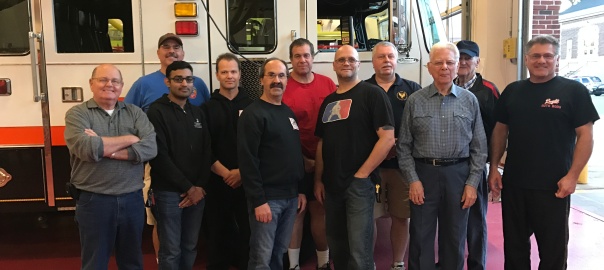
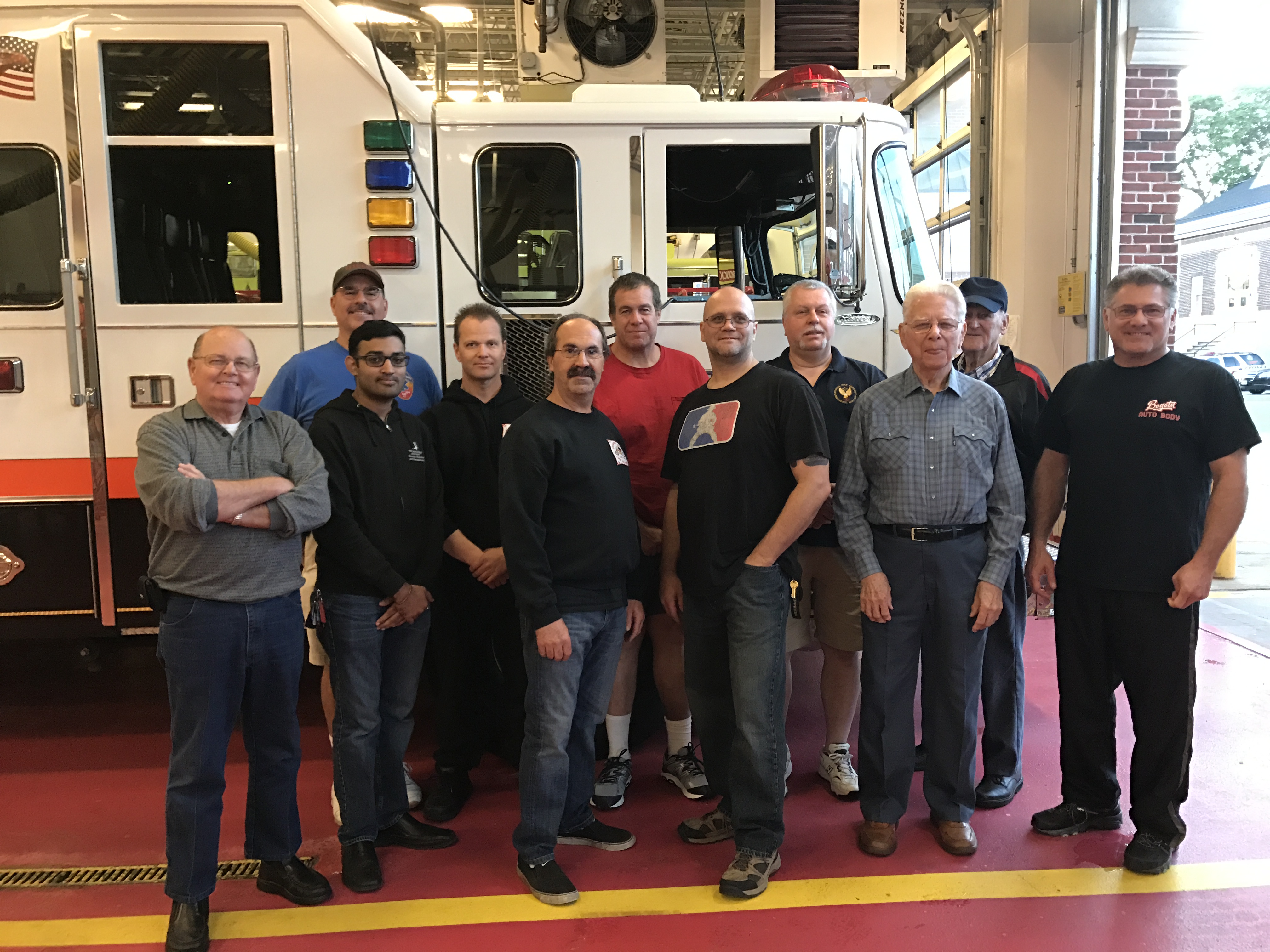
I do not have a picture of all the guys together as none could get together for a group picture back then. This is a picture of us at an Engine One barbecue at the firehouse Summer of 2017 of which many of the guys attended. Firefighter Ed Carter is forth to the left, Firefighter Bob Pietz is fifth to the right and Chief Tim Moots is is first on the right.
Several Hasbrouck Heights Firefighters Recall 9/11
By Justin Watrel
*I wrote and published this article in September 2006 for the Fifth Anniversary of the Attacks on the World Trade Center for both the Hasbrouck Heights Observer and the Hasbrouck Heights Gazette. Many of the firefighters in the article have since retired or moved on from the Department with Firefighter Greg Rubino being the only current firefighter active on the Department. This is their story from the day of Recovery.
I want to thank the following Hasbrouck Heights Firefighters for assisting in this very moving article: Retired Chief Joe Taylor and Retired Firefighter Tom and Current Firefighter Greg Rubino, Firefighter and former Lieutenant Bob Pietz, Firefighter and Retired Chief Tim Moots and Firefighter and Retired Captain Ed Carter III. Thank you all for your dedication to the Hasbrouck Heights Fire Department.
Author’s Note: I updated this slightly to reflect today but the conversations are verbative from the original article. To keep the flow of the article, I kept the firefighters’ positions in current form through most of the article.
It is hard to imagine that 25 years has passed since the tragic events of September 11, 2001. Since that time, the site has been cleaned up, new buildings have gone up and One World Trade Center (formerly the Freedom Tower) has been built with views overlooking the once devastated City, where all this once happened. The whole configuration of downtown has changed since that time from a business to residential neighborhood. The vibe of the City has changed since that time.
Behind the scenes though, there are the lingering memories of what happened that horrible day 25 years ago and how it touched us as a community. Even though we are only eleven miles from Midtown Manhattan, it seems like a world away.
What many people don’t know is the contribution Hasbrouck Heights made in the recovery process. Our schools and parishes raised money and lent support to many agencies in the City that needed help. In the fire service, several of our members took time out of their busy work schedules to help on the piles with the recovery and help search for victims.
Some of them will never forget what they saw in those days following the tragedy in New York City. The Hasbrouck Heights Fire Department, a volunteer department, sent the following members over to work the piles, former Chief of the Department Joe Taylor Jr., Firefighter Tom Rubino and his son and current member, Greg, retired Firefighter Edmund Carter III and former Firefighter Bob Pietz. Former Chief Tim Moots went over with the Teaneck Fire Department. Many of these brave men shared their experiences that they encountered the days that followed when they helped work the piles years ago.
Former Chief Joe Taylor had been a member of the Department for over twenty years and been a former EMT in Hackensack, NJ said, “I was home watching TV that morning when I turned on the set and saw the towers on fire. I immediately reported to the firehouse for further instructions.”
Retired Firefighter Tom Rubino, a nursing instructor at Bergen Community College, said back then, “We were in classes when the plane hit,” Tom said. “Classes just stopped and everyone was watching TV. There were questions about terrorists but no one was sure. Classes were later suspended because everyone wanted to go home.”
His son Greg, who was at work at Hackensack Hospital said, “From the hospital, we could see smoke coming from the first tower then saw the second plane hit the building. The hospital then went to Code Yellow and we were on standby.”
Retired Firefighter Tim Moots, then a member of the Teaneck Fire Department, was at his home in Fort Lee at the time, when his then wife called to tell him what had happened. “About an hour later, I was called to the Teaneck Firehouse. We were on standby near the George Washington Bridge until 4:00pm. We were then sent over to Hoboken to help with HAZMAT. We were part of the DECON Team hosing people off, who were still arriving from the City at 4:00am.”
Former Fire Fighter Bob Pietz said, “I was working at the hospital installing an air conditioner when the first plane hit. I ended up having to leave the job. When I got back to Heights, the ambulance was called into service and I was on standby with other members of the Fire Department. As a Task Force, we headed to the City but were rerouted by the George Washington Bridge and were released a couple of hours later.”
Retired Firefighter Edmund Carter III was home asleep after a long shift at work, when his then wife informed him that the first tower had been hit. “My initial reaction like everyone else’s was that it was a plane that lost its way, but she informed me that a second plane hit. I then got up, showered and reported to the firehouse, where a lot of members were awaiting further instructions.”
Heading to the Scene:
Everyone on the Department had different reasons for helping in the recovery. All of them wanted to make the best contribution they knew how. Retired Chief Taylor said, “There was a lot of concern from each firefighter for both the City’s citizens and their fellow Brothers in the FDNY. I put out the call and asked members to help.”
Ed Carter said, “I felt I had an obligation to do so. I was given a chance to help in the best way I knew how and was not going to give that opportunity up.” Retired Firefighter Tom Rubino added, “When the call comes out, you respond.”
What they saw at the site still haunts many of the members of the Department. “It was the worst thing I ever saw,” Firefighter Bob Pietz said. “I never saw the magnitude of the destruction.” Chief Taylor added, “I could not believe it. You just could not fathom the destruction.”
Firefighter Tom Rubino explained, “The boat trip over was eerie. The lights were on where the job was being done. The smells were unbearable from the rotting flesh and dust in the air.” It was complete chaos,” his son, Firefighter Greg Rubino added. “I had never seen anything like it. It was like the end of the world.”
“It was only a ten-minute ferry ride over but it felt like forever,” said Firefighter Bob Pietz. “So much smoke was coming from the site.”
When the firefighters reached the site, the initial reaction to the site and the enormity of the situation took hold. Firefighter Tom Rubino explained, “It was like a different world. My first reaction was misbelief and anger.” Firefighter Greg Rubino added, “The smell was unbearable and there was dust, smoke and twisted beams all over the place.”
“It was like a war scene,” said Chief Taylor. “You could not fathom what you were seeing. There in front of you were 110 stories of two towers that stood only a couple of days before.” “It didn’t seem real,” Chief Moots said. “Even when you walked around, it just didn’t sink in that fast. The whole scene was just so overwhelming.”
“You experienced what the media showed and it was worse than what was reported,” added Firefighter Ed Carter. “The smoke hung over everything. I felt anger that fellow firemen, police and citizens from around the area had been killed from the assault on the City.”
Chief Taylor added, “You could not believe what you were seeing. There were cement slabs and bent “I” beams all over the place twisted like pretzels. It was amazing to see police cars and fire trucks smashed, twisted and flattened to nothing. The dust coated everything and the smell of rotting flesh was in the air.”
Some of the men said that while they were arriving at the site, there were still boatloads of civilians leaving the City covered in dust. They would be headed over to the HAZMAT Center, where first responders like Chief Moots would be working with the Teaneck Fire Department. Chief Moots said, “At 10:00pm, it was tough to hose the survivors down, especially after what they had been through. Some were angry, some were hurt and some were still in shock. The comments were heard were, ‘Thank you for all of your help’ and ‘You are so brave for going over there.” “They couldn’t have been more respectful,” Chief Taylor added.
We had a job to do
Even with the enormity of the site, there was a job to do and the men pitched in to do their part. The mood of the work site stuck all of them.
“Everyone was very focused.” Firefighter Bob Pietz said. “Everyone was working as hard as they could and no one was fooling around. The frustration of not finding any survivors was on everyone’s mind.”
“It was very somber,” Chief Moots added. “People had a job to do and there was not much personal conversation. People worked as best they could for as long as they could.”
“People were working with their game faces on determined to do the best job they could,” Chief Taylor said.
“We walked through the site where part of the tower had bent and sagged as shown on TV and we walked past the jagged edge of the wall to reach the area we had to work,” said Firefighter Carter.
While on the site, all the men were given jobs to do, working along side the FDNY and members of other volunteer departments. Some worked on the bucket brigades, while others worked cutting “I” beams and helping move debris.
Firefighter Greg Rubino because of his size, was asked to search through small crevices and assist with searches under the rubble with specially trained dogs to find pocket where people might have been. “With the spotlights and the tower lights you saw everything. You had to be focused so that you were not hurt while helping out.”
“We passed bucket after bucket. Buckets were being passed as fast as we could move,” Chief Taylor described. “I found pencils in sharpeners and receipts from “Windows on the World”, while we were digging. There was a great deal of cooperation, for example: There was a two foot “I” beam that we needed to pass and we immediately got help to cut it.”
Firefighter Carter described, “We dug past part of the building and found a piece of the plane. We notified the people in charge and members of the FBI immediately removed it as evidence.”
Later that evening, an FDNY firefighter’s helmet was found and then his body. “When we came across the fireman’s helmet, everything stopped. The whistle was blown and everyone stopped working. There was silence as the body was wrapped in an American flag and carried out of the site while everyone stood at attention.” Firefighter Carter said.
“I could not believe it when we found the body of the firefighter,” Firefighter Pietz said. “There was silence, then everyone took their helmets off.”
Chief Taylor added that it was done with the utmost care. “People got a little emotional when they saw that. The body was carried out with respect and attention. Then the men went back to work.
Personal Experience
When the men described their overall experience, each one had a different story to tell. Chief Moots describes, “There was an outpouring of thanks. There were loads of supplies, water, tools and food for the people working on the piles. The support volunteers who helped with the supplies were extremely thankful. I will never forget that.”
“I did not want to go back,” Firefighter Carter said. “I was too angry to go back there again. The more I experienced, the more I would carry the scar of the incident.”
Firefighter Pietz added, “It was amazing how everyone came together to help with what was happening on the scene. It was a great feeling that people had for one another, It was the true meaning of brotherhood.”
Chief Moots said, “People can pull together when there is a catastrophe and the expression, ‘here today, gone tomorrow’ is very true. You can almost relate to the experiences that our parents went through during WWII.”
“My main priority was to be with my men,” Chief Taylor said. “I didn’t want anyone to get hurt. When they wanted Greg Rubino to go into certain voids, I had to disagree. I was there as a firefighter but still looked out for my guys. Everyone wanted to do as much as they could during those days.”
Firefighter Greg Rubino added, “You never thought it could happen here but it did. You see a picture of the skyline now that the towers are not there and you realize how different the world is today.” His father added, “I think I am more tolerate toward my fellow man. People have to learn to appreciate life because in a minute it can all change. You never know when it can be taken away.”
Firefighter Carter summed it up best when he said, “The encounter was different from the time we got there until the time we left. The people who risked their lives in the line of duty are truly what heroism is all about. If I could have rescued one life, I would have done it.”
Will it happen again?
When asked if we are prepared for a next time, most of the men felt the same way. Most felt we would never be prepared because you can’t prepare for everything.
Chief Taylor said, “Will it happen again? It is a probability. You never know what you are getting yourself into in these situations. The people that helped out that day will never forget. You have to be mentally prepared for what might happen. We have made strides but you can never be fully prepared.”
“There will be a lot of chaos if it happens again,” Tom Rubino added. “Have you ever sat down to plan an escape route? Do you know that Route 17 might be like if we had to escape this area? It would be like a parking lot. What preparation we do have now is good but not good enough. People are just not prepared.”
“It could be hard to stop a threat,” his son, Greg added. “You just can’t predict what can happen next. You have a strong feeling that something might happen, you have to prepare yourself for the future.”
“There have been many improvements since 9/11.” Chief Moots explained. “So much time and resources have been dedicated to better preparation but we have to prioritize.”
Chief Taylor concluded our interview with, “People tend to forget over time. You can’t prepare for everything. Things are tough when Homeland Security funding is being cut in this area of the country. The one thing I can say is that the City called our small town and asked us to help. We responded to the call and gave it our best.”
Author’s Note: As a nineteen-year veteran of the Hasbrouck Heights Fire Department, I wanted to thank my Brothers for sharing their story twenty years ago. Many have since retired from the department but their legacy lives on in the younger firefighters. I was very proud to tell these men’s story and we should appreciate how our town of Hasbrouck Heights responded that day when we were needed. Thank you!
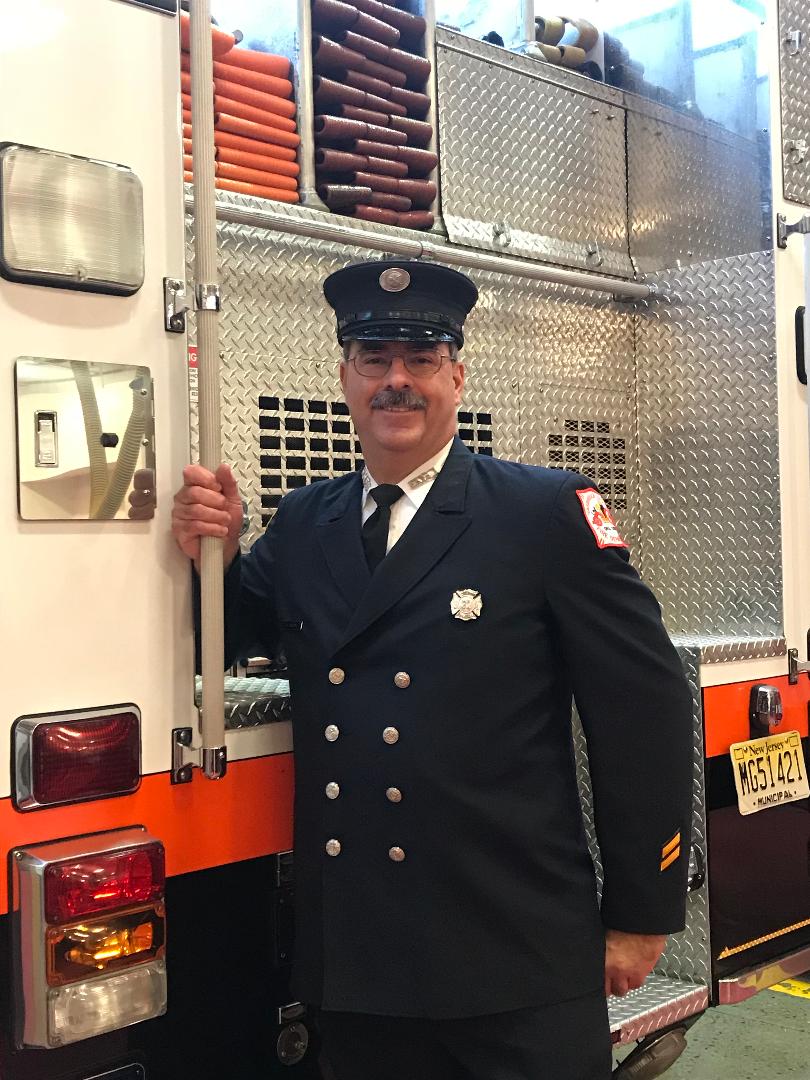
Author and Retired Firefighter Justin Watrel (Author Justin Watral)
I had a five week break from the college when my first Summer class was cancelled. So I concentrated on traveling through New Jersey and New York, both the City and Upstate for my blog. I wanted to revisit many historical sites that I had seen during the holiday season (was Christmas six months ago?) or in the past. There were places like Central Park, where I had not seen certain sections in the Spring. This lead to me being part of many walking tours of gardens during the month of June.
With all the wet weather we had in the Spring, the gardens in June were lush with flowers and flowering trees and plants. Pathways lined with color and walled gardens beautifully laid out. It was interesting to see how these were planted, designed and maintained.
The entrance to the Brooklyn Botanic Garden in June 2026
All the rain we had in April and May and the warm days of early June had awakened the Cherry Blossoms and I visited as many locations to see them in full bloom.
Please read my blog on visiting the Cherry Blossoms:
Once they were finished, gardens came to life all over the tri-state area and many historical homes and parks came to life in a sea of color and smells that showed the power of Mother Nature to make things beautiful. I was impressed with the work of many volunteer staffs and their dedication in taking care of these sites for all of us to enjoy.
Visiting to Amour-Steiner House for the Spring Garden Tour:
The Amour-Steiner House the day of the Garden Tour
The beds were in full bloom when we toured the gardens
The colors of the flowers were patriotic red, white and blue
In between the hedges, there was elegant statuary and potted urns with colorful flowers blooming with bright hues.
The urns were filled with bright colors of the season
Statuary representing the arts and music lined the hedges
The flowers were so brilliant that afternoon
I enjoyed looking at the statuary
The gardens were so beautiful with the house in the background
As we left the gardens, I admired the ornate Fox and the Glove gate on the way out
We then crossed the lawn to tour the greenhouse, where many of the flowers were and still are grown for decorating the house both inside and out.
The landscaping has a romantic spin on it as the property was planted to accent not just the property but the house as well giving it a natural but balanced look to it.
Touring the formal greenhouse
Even the working greenhouse had a romanticized look about it that reflected the house
The inside of the greenhouse. Each side of the counters seasonal flowers are grown for the property. This greenhouse is used all year long supplying the house with a steady stream of flowers.
In the middle of the greenhouse was a beautiful Victorian aquarium that was lined with more flowers. There were no fish at this time.
I loved the beautiful flowers that lined the counters
The Spring colors were breathtaking
We then started the tour of the house starting with the outside veranda that held more urns and planters of fresh flowers
The beautiful veranda lines the entire house
The beautiful colors from the potted and hanging plants
The veranda decorated for the upcoming ‘250th Anniversary of the United States
The hanging plants
The potted plants
We even admired the birdhouse that matched the house
We then went inside to tour the house. It would be interesting to see the house without all the Christmas decorations that I saw the last time I toured the house.
The triangle room off the foyer once used as the Receiving Room
The beautiful foyer to the second floor
The main Parlor/Living Room used for entertaining
The formal Dining Room
The decorative sideboard
The other decorative sideboard
The Dining Room table set for a Spring dinner
We then started the tour of the second floor which started in the game room at the top of there landing. I remember the big Christmas tree being here when the house was decorated for the holidays.
I liked the room was the way it is here
Then we toured the bedrooms which were not that elaborate but functional and comfortable as they are today.
One of several bedrooms on the second floor
The bathroom which is considered normal today was ahead of its time with flushing toilets and hot and cold running water
The office off the side in one of the Octagon corners
The Egyptian Room was the height of fashion with travel and new discovers in Egypt at the time.
The ceiling and decorations of Egyptian Room
The decor of the Egypt
The beautiful porcelain in the room
Then we toured the Curio Room. I thought the room was a lot of fun with small objects that people would have collected from their journeys at that time.
The shelves, counters and walls were filled with all sorts of interesting objects
Many types of object’s
The Victorian Terrarium that was becoming fashionable at the time
The fold out desk with small objects in each slot
A Victrola and Terrarium
The last part of the tour was of the newly renovated kitchen. The shelves were lined with a collection of shiny pots and pans.
The ‘modern’ Victorian kitchen
When the tour was over, I visited the gift shop and looked over the kitchen once more. It is interesting to see how ‘modern’ back then is ‘contemporary’ today. Victorians set the tone for the modern American home of today and the expectations of the American dream.
Before I left the grounds, I visited the gardens once more. It was such perfect weather to walk around and I enjoyed the beauty of these gardens. Mother Nature creates this all this.
Walking around the grounds of the home
I enjoyed walking around the gardens that day
I found this tour one of the most relaxing I have taken in a long time. The beauty of both the house and the gardens was wonderful. Just sitting on the veranda and looking over the grounds was the perfect way to spend the afternoon.
Taking the Clermont Garden Walking Tour 2026:
I returned in the Spring of 2026 for the an updated walking tour of the gardens “Gardens and Grounds: Evolving Landscaping of Clermont”, where the State of New York horticulturalist who had just been hired to maintain the gardens, explained to us the developments and goals that the State wanted for the direction of the landscaping on the property. They wanted it brought back to the 1930’s blueprint of what Alice Livingston had originally envisioned for the estate when she returned from Europe.
Arriving to the Clermont estate at 1 Clermont Avenue in Germantown, NY
We started the tour with a history of the house and Alice Livingston’s return from Europe to create her famous gardens
The front of the mansion in the Spring of 2026
We started the tour at the Walled Garden which was just finished being restored. The back wall had just been finished and the site’s main horticulturalist explained that she was working with a group of volunteers to maintain the gardens.
The Walled Garden designed by Alice Livingston
The Walled Garden in the Spring of 2026
The inside to the entrance of the Walled Garden
The back part of the Walled Garden
The next garden we toured was the Wilderness Garden which included wildflowers and a fish pond
The Wilderness Garden sign
The back part of the Walled Garden leads to the Wilderness Garden
The entrance to the Wilderness Gardens
The lecture on the design and plantings of the Wilderness Garden
The colorful wildflowers that line the grass paths
The fish pond in the Wilderness Garden
We then followed the path and walked up and toured the Cutting and Children’s Garden. These colorful gardens once supplied the house with an assortment of fresh flowers. It also taught the Livingston girls the attributes of gardening.
The Cutting Garden and Greenhouse sign
The main Cutting Garden
The Cutting garden
The Cutting Garden in the late Spring
The in season flowers in the Cutting Garden
The Children’s Playhouse and Garden is next to the Cutting Garden
The Children’s Garden in the Spring
Touring past the old Greenhouses
Part of the former greenhouse
The tour through the grounds with my group
The pathway back to Clermont
Touring along the river
The former roadway between the house and the river
The South Spring Garden
Our last garden toured was the one closest to the house and that was the South Spring Garden of which Alice could see from her window. When the porch was removed from the home and Alice developed plans for other gardens, this garden went ‘native’.
The South Garden
The South Garden in bloom
The views from the South Garden
The flower planters near the South Garden
The planters filled with Spring geraniums
Walking back after the tour was over and looking at the beautiful grounds
Ending the tour that day with a walk along the river
It was a beautiful day to walk the gardens and the perfect way to spend the afternoon. Each time I take a tour of the gardens, I am amazed how different they seem. I love the different times of the year and how it changes these gardens.
I returned to Manhattan the next week and as I was working in Inwood and Washington Heights neighborhoods, I took a tour of Isham Park with the Bruce Reynolds Gardens and Fort Tyron Park with the Heather Gardens, when they were in full bloom. It was breathtaking with the back drop of the Hudson River on a sunny afternoon.
In Isham Park, I toured the Bruce Reynolds Gardens, which is in the center of the park. They were in full bloom when I walked around the gardens and relaxed under the shade trees.
The new Bonnefont Restaurant is open for lunch and brunch
The restaurant was closed that afternoon but I was able to look at the menu online and it is an interesting menu. The cuisine is a mixture of French and Contemporary cooking.
Walking back through the gardens to the Fort Tryon location
Walking to the Fort Tryon site
The Fort Tryon site
Visiting the Brooklyn Botanic Garden before Rose Night in 2026:
I got an email from the Brooklyn Botanic Garden saying that the Cranford Rose Garden was at its peak of blooming and that I should see it while it was at its prime. I was busy at work and was able to travel down to down to the gardens a few days later. Talk about perfect timing as the petals just started to fall.
The Cranford Rose Garden at peak is one of the most beautiful sites. The colors and the fragrances are just amazing. I could not attend “Rose Night” in 2026 because of a prior commitment plus it would be a gloomy night with the threat of rain. So I went the Friday afternoon before the event, which would be held the next Wednesday. By that point, the flowers would be out of peak.
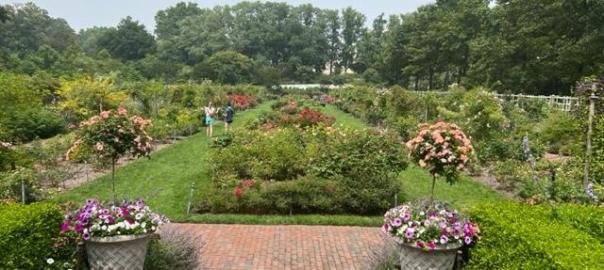
The Cranford Rose Garden in bloom at the Brooklyn Botanic Garden
The Cranford Rose Garden is amazing from every angle and the views from the top of the hill overlooking the garden shows the extensive amounts of roses planted and the array of colors.
The beds of roses of all colors and species
The entrance to the Cranford Rose Garden is full of an array of different types of colorful flowers
The beautiful and diverse flowers in the Cranford Rose Garden
The beauty of flowers up close
All sorts of roses line the trellis borders of the Rose Garden
What I love about walking around is that you can see the diversity of the roses. The garden is planted with different species so they bloom at different times giving the beds an array of colors at different times. Along the beds and trellis everything bloomed so vibrantly.
The beautiful orange roses that lined the trellis
The colorful trellis pathways
The reds and pinks in full bloom
Roses lining the lamppost
Admiring the beds of roses at the Cranford Rose Garden
Purple reins supreme
Walking through the trellis pathways of red
The beauty of the trellis
The back part of the garden
The back terrace of the Cranford Rose Garden
The elegant statuary of the rose garden and the sun dial
The back Terrace area
The back of the Cranford Rose Garden is lined with all sorts of flowering plants having a rainbow of colors.
Walking through the terrace gardens
The beautiful roses in the back of the garden
The roses in the back of the Cranford Gardens
Walking out the back of the gardens
The back path of the Cranford Rose Garden
The fountain in the back of the Cranford Garden
Visiting the Cranford Rose Garden when it flowering is one of the most interesting collection of colors and scents. This is why I try to time my visits around the blooming of the flowers.
The Tour of the Gardens at The Cloisters in the Spring 2026:
One of my favorite places with in the Metropolitan Museum of Art to visit is The Cloisters in any season. One of my favorite places when it is decorated for the Christmas holiday season, the Spring and Summer offer such beautiful displays of historical plants that try to match the theme of each Cloister and its historical background.
The docent led a very large group of us through each Cloister and told us of the way the curators plant the gardens to represent what may have been planted during the Medieval era for medical and nutritional functions of those peoples lives.
(From the Museum website)
The gardens of the Middle Ages included both real and ideal gardens. Poets and artists delighted in the depiction of fantasy gardens like the Garden of Love or of Paradise, but no real garden of the time remains to us. Historical records are rare and incomplete; the ninth-century plan for the monastery of St. Gall, with its carefully drawn and labeled garden beds, is unique. Archaeological excavations are yielding valuable new evidence, but we still know more about infirmary gardens of medicinal plants and aristocratic pleasure gardens than we do about humble kitchen plots of potherbs and vegetables (Met.org).
The gardens of the Museum, planted in reconstructed Romanesque and Gothic cloisters, evoke those that provided sustenance and spiritual refreshment within the medieval monastery. Designed as an integral feature of the Museum, the gardens have been a major attraction of The Cloisters since its opening in 1938, enhancing both the setting in which the Museum’s collection of medieval art is displayed and the visitor’s understanding of medieval life. The gardens are designed and maintained by a horticultural staff actively engaged in researching and developing the living collection (Met.org).
The Cloisters at 99 Margaret Corbin Drive in Fort Tryon blooming in the late Spring
We walked through the Cloister discussing how plantings were determined by medical and religious purposes
The flower beds in the Cloister
The view of the Hudson River was amazing
The flowers in bloom
Flowers in bloom
Flowers in bloom
Flowers in bloom
We moved the next Cloister looking over the medical plants and flowers
The Cloister in bloom
Walking around the Cloister
The plants around the sills of the Cloisters
Touring the Cloisters and admiring the flowers
Everything in bloom
We toured the last Cloister while the tour guide explained the plantings
The last Cloister we toured
The garden in full bloom
The growth of the hops growing on a trellis
The hops planting up close
The flowers in bloom in the Cloister
Video on “Art and Gardens at the Met”
We ended the tour admiring the art in the Tapestry Room and having a discussion about the use of plants and flowers in Medieval art.
‘The Hunt of the Unicorn’ tapestry discussion
I then visited the ‘Creatures of Myth and Imagination-European and the Americas’ exhibition.
This exhibition was an interesting look at mythical beasts of the era of great exploration from European to the Americas. It reminded me of the book “In Search of Ancient Astronauts” with many golden creatures that look like they are visitors from another planet, Ancient Gods to worship and one civilization’s outlook on the unknown. The artwork was a cross between mysticism and respect.
The exhibition sign for “Creatures of Myth and Imagination: Europe and the Americas”
Set in the evocative atmosphere of The Met Cloisters, Creatures of Myth and Imagination: Europe and the Americas sheds light on a selection of works created on either side of the Atlantic Ocean between 500 and 1500 CE. The exhibition’s exploration of hybrid creatures deepens our understanding of their apparent necessity among diverse peoples. In the Americas, a complex gold pendant by a Tairona artist of northern Colombia, depicting a confrontational figure with hands on hips, a crocodile-like head, and an enormous headdress, would have reflected and expressed the wearer’s status and power. In Europe, ferocious dragons such as the one depicted on a monumental fresco from the monastery of San Pedro de Arlanza, Spain, took center stage to convey a multiplicity of meanings both sacred and profane (Met.org).
The exhibition gallery
Unusual mythical creature
(From the museum website)
For as long as humans have told stories, we’ve imagined creatures that transcend the natural world. Fantastical beings combining the features of animals, humans, and even plants appear across cultures, emerging in the most ancient myths and enduring in contemporary epics. The widespread presence of these supernatural beings, possessing the power to transform and be transformed, reflects a global impulse to make sense of both known and unknown worlds. Visual artists have given form to these imaginary creatures, resulting in some of the most fearsome, beloved, and extraordinary works of art ever made (Met.org).
Small gold ancient Gods
Ritual Knives
Double pendants
Earth Deity
I took one last tour of the museum gardens before I left for the afternoon. On the balcony overlooking the Hudson River offered beautiful views and beautiful potted plants.
Walking out of the back Cloister
The back Cloister
The beautiful white flowers
The balcony overlooking the Hudson River
The potted plants by the doorway
The view of the Hudson River
Looking north up the Hudson River
The tour of the Gardens was amazing and the exhibition on the Pre-Columbian art interesting. It was a wonderful tour of the Cloisters.
I had a private function at the Museum of the City of New York across the street from the Central Park Conservatory Gardens. When the event was over, I took a walk around the gardens when they were in full bloom.
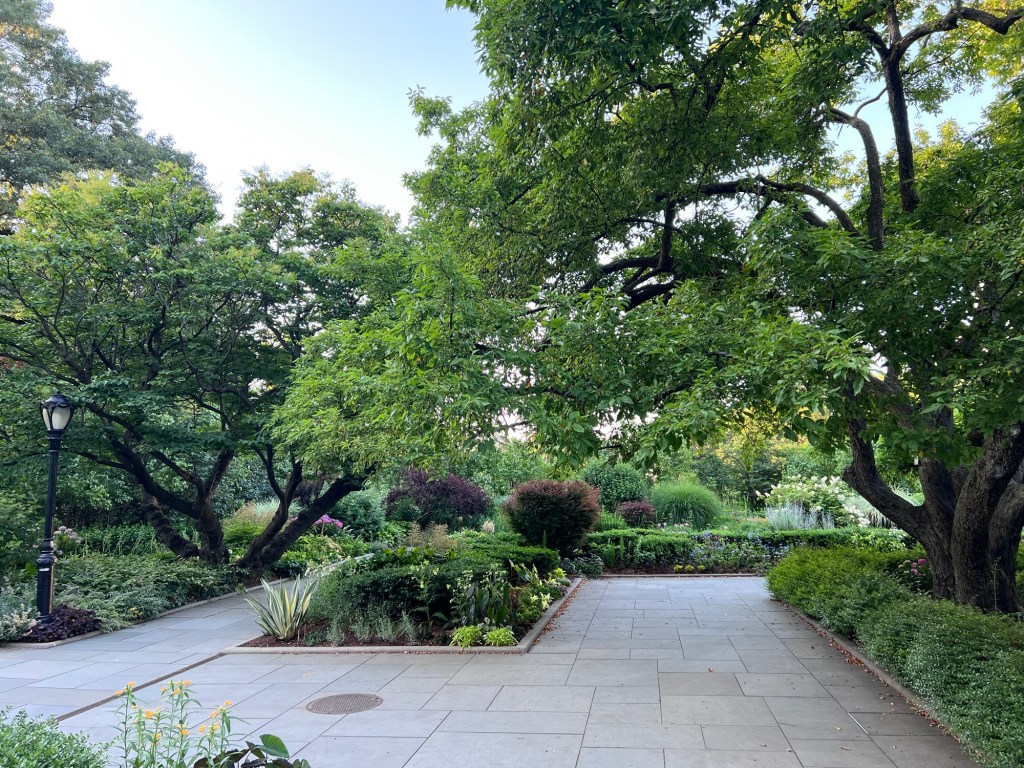
The gardens just went through a major renovation and each of the paths had rows of colorful flowers that were beautifully taken care of and designed to bloom at different stages of the growing season so there was always color in the gardens. The effect was amazing.
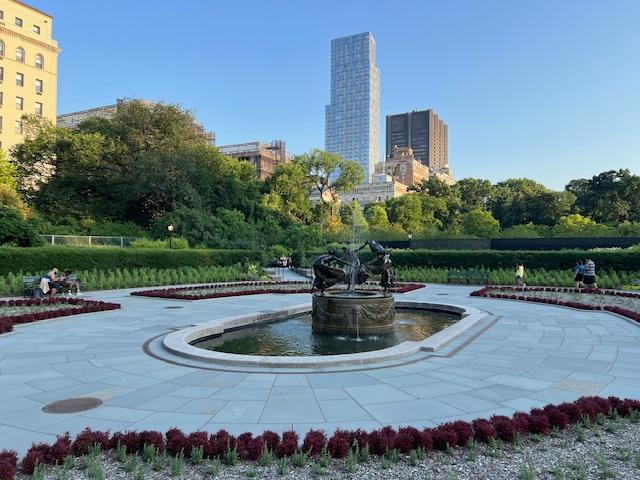
The entrance of the Central Park Conservatory lawn and fountain
The fountain and the geometric garden
Central Park Conservatory gardens at the entrance
The entrance of the gardens from the Harlem Meer area
The entrance to the flower gardens from the Central Park Conservatory lawn
The Central Park Conservatory garden beds
The gardens in full bloom in the Summer of 2026
The flower beds in the central of the gardens
The Central Park Conservatory Fountain and Lotus pools
I walked behind Hippo Park in Central Park one afternoon to discover a beautiful floral garden that was the 91st Street Garden that I had missed on previous walks in the park. The Garden did not look like this in the Fall.
The 91st Street Garden in the Summer of 2026
Then I remembered the scene in “You Got Mail” and remembered that this was the garden where they met. I always thought it was closer to Riverside Drive than it was here in the park.
The sign for the garden
As I passed the garden, I remember this was the garden in the last scene of the movie, “You Got Mail” when Meg Ryan realizes that her secret email pal is Tom Hanks. It was such a great scene and the perfect end to a great Rom-Com.
The end of the movie “You Got Mail” with Meg Ryan and Tom Hanks
The Gardens from the front
The flowers in full bloom
The flowers in full bloom in July 2026
All I could think about was this scene as I walked around the garden. The funny part is this was the first time I had ever visited this garden as I did not know where it was located. I knew it was on 91st Street but could never figure out where. You have to walk on the path behind the Hippo Playground and follow it to the other path.
The gardens from the front
Walking back up through Riverside park from the Hippo Playground
Walking in Riverside Park in the 90’s
You have to find your way through Riverside Park to find the garden but in the Spring and Summer it is worth the walk up and down the hill.
These are just some of the places that I am still visiting as the Summer season begins and there are more historical sites to see and more smaller gardens to visit. Let’s see what the rains produce in the coming months.
Places to Visit:
*Bloggers Note: the prices of these sites vary from season to season and can change from year to year. This is the same with the hours depending on what season you visit.
Fee: Adults $30.00/Seniors $17.00/Children $12.00/Members & Patrons and Children under 12 are free (prices do fluctuate). NY, NJ and CT students and NY residents Pay as you wish.
Museum Hours:
Hours: Open 7 days a week
March-October 10:00am-5:15pm
November-February 10:00am- 4:45pm
Closed Thanksgiving Day, December 25th and January 1st.
*Some galleries may be closed for construction or maintenance.
Fee: Adults $30.00/Seniors/Students $17.00/Children $12.00/Members & Patrons and Children under 12 are free (prices do fluctuate). NY, NJ and CT students and NY residents Pay as you wish.
Museum Hours:
Hours: Open 7 days a week
March-October 10:00am-5:15pm
November-February 10:00am- 4:45pm
Closed Thanksgiving Day, December 25th and January 1st.
*Some galleries may be closed for construction or maintenance.
I went on the Spring Garden tour at the Cloisters Museum with a discussion on Spring plantings and the use of those plants during Medieval times. The museum studied what plants were used for religious and medical practices.
We started the discussion of the plantings out in the first Cloister by the Hudson River
The Tour of the Gardens at The Cloisters in the Spring 2026:
(From the Museum website)
The gardens of the Middle Ages included both real and ideal gardens. Poets and artists delighted in the depiction of fantasy gardens like the Garden of Love or of Paradise, but no real garden of the time remains to us. Historical records are rare and incomplete; the ninth-century plan for the monastery of St. Gall, with its carefully drawn and labeled garden beds, is unique. Archaeological excavations are yielding valuable new evidence, but we still know more about infirmary gardens of medicinal plants and aristocratic pleasure gardens than we do about humble kitchen plots of potherbs and vegetables (Met.org).
The gardens of the Museum, planted in reconstructed Romanesque and Gothic cloisters, evoke those that provided sustenance and spiritual refreshment within the medieval monastery. Designed as an integral feature of the Museum, the gardens have been a major attraction of The Cloisters since its opening in 1938, enhancing both the setting in which the Museum’s collection of medieval art is displayed and the visitor’s understanding of medieval life. The gardens are designed and maintained by a horticultural staff actively engaged in researching and developing the living collection (Met.org).
The plantings of the first Cloister we visited
We walked through the Cloister discussing how plantings were determined by medical and religious purposes
The flower beds in the Cloister
The view of the Hudson River was amazing
The flowers in bloom
Flowers in bloom
Flowers in bloom
Flowers in bloom
We moved the next Cloister looking over the medical plants and flowers
The Cloister in bloom
Walking around the Cloister
The plants around the sills of the Cloisters
Touring the Cloisters and admiring the flowers
Everything in bloom
We toured the last Cloister while the tour guide explained the plantings
The last Cloister we toured
The garden in full bloom
The growth of the hops growing on a trellis
The hops planting up close
The flowers in bloom in the Cloister
We ended the tour admiring the art in the Tapestry Room and having a discussion about the use of plants and flowers in Medieval art. The artists at that time thought of the natural world with awe and respect. They admired the beauty of the natural world where in some points was still feared,
‘The Hunt of the Unicorn’ tapestry discussion
I then visited the ‘Creatures of Myth and Imagination-European and the Americas’ exhibition.
This exhibition was an interesting look at mythical beasts of the era of great exploration from European to the Americas. It reminded me of the book “In Search of Ancient Astronauts” with many golden creatures that look like they are visitors from another planet, Ancient Gods to worship and one civilization’s outlook on the unknown. The artwork was a cross between mysticism and respect.
The exhibition sign for “Creatures of Myth and Imagination: Europe and the Americas”
Set in the evocative atmosphere of The Met Cloisters, Creatures of Myth and Imagination: Europe and the Americas sheds light on a selection of works created on either side of the Atlantic Ocean between 500 and 1500 CE. The exhibition’s exploration of hybrid creatures deepens our understanding of their apparent necessity among diverse peoples. In the Americas, a complex gold pendant by a Tairona artist of northern Colombia, depicting a confrontational figure with hands on hips, a crocodile-like head, and an enormous headdress, would have reflected and expressed the wearer’s status and power. In Europe, ferocious dragons such as the one depicted on a monumental fresco from the monastery of San Pedro de Arlanza, Spain, took center stage to convey a multiplicity of meanings both sacred and profane (Met.org).
The exhibition gallery
Unusual mythical creature
(From the museum website)
For as long as humans have told stories, we’ve imagined creatures that transcend the natural world. Fantastical beings combining the features of animals, humans, and even plants appear across cultures, emerging in the most ancient myths and enduring in contemporary epics. The widespread presence of these supernatural beings, possessing the power to transform and be transformed, reflects a global impulse to make sense of both known and unknown worlds. Visual artists have given form to these imaginary creatures, resulting in some of the most fearsome, beloved, and extraordinary works of art ever made (Met.org).
Small gold ancient Gods
Ritual Knives
Double pendants
Earth Deity
I took one last tour of the museum gardens before I left for the afternoon. On the balcony overlooking the Hudson River offered beautiful views and beautiful potted plants.
Walking out of the back Cloister
The back Cloister
The beautiful white flowers
The balcony overlooking the Hudson River
The potted plants by the doorway
The view of the Hudson River
Looking north up the Hudson River
The tour of the Gardens was amazing and the exhibition on the Pre-Columbian art interesting. It was a wonderful tour of the Cloisters.
Interesting video on YouTube on “Gardens and Art at the Met”
The weather has been so strange over the last few months. We had one of the coldest winters since the 1990’s and one of the snowiest. It seemed like the cold air and frigid temperatures would never end. Then came a small break in the weather when it turned 52 degrees in the middle of March.
Branch Brook Park in Newark, NJ during the start of New Jersey’s Cherry Blossom festival
The 52 degree day got even better when the ‘Spring Thaw‘ came during our Spring Break from the college and I was able to resume my walk exploring Alphabet City. The tough part of visiting the neighborhood was that the countless community gardens were either closed or just starting their ‘budding process’, where the warm weather was bringing plants back to life from their Winter slumber. It had been such a cold and miserable Winter.
My search for the flowers and the Cherry Blossoms of the Tri-State area started at the Brooklyn Botanic Garden during the last week of March just after the heat spell. The crocuses came out about two weeks earlier then they normally did and I wanted to see ‘Crocus Hill’ at the Brooklyn Botanic Garden, so I visited the Gardens in the last week of March to see the beginnings of Spring.
The Japanese Gardens in March 2026
The Japanese Gardens in the beginning of Spring
The Snowdrops in full bloom
The flowering plants peaking out in the early Spring
The Fragrance Garden in the early Spring
The early Daffodils in full bloom
The daffodils in full bloom
The Snowdrops in full bloom representing the beginning of Spring
Crocus Hill in the early Spring
Crocus Hill in bloom
The last of the Crocuses in bloom on the hill
I walked around the gardens and got to see so much of the plants and trees in bloom.
The first Cherry trees in bloom in the watershed lawn
Crossing the bridge in the with the first of the flowers
The snowdrops were beautiful at this time of year
The Willow Tree in full bloom in the watershed lawn
Walking around the Rock Garden
The colors were so vibrant in the Rock Garden
Walking along the paths towards the Cherry Blossom Lawn
Walking through the Cherry Blossom Lawn waiting for the magic to appear
Walking through the Cherry Blossom pathways waiting for more to come
I would take the next four weeks exploring the City and the outskirts in search of the perfect Cherry blossoms. I would be coming back to the Gardens four more times to see how the rest of the garden would progress. The changes in three weeks was Mother Nature work her magic!
The Brooklyn Botanic Garden in the first week of Spring. It would not stay this way long!
My own yard started to come back to life with the first crocuses of the season popping out of the ground early. All that planting in the Fall really paid off. After all that snow and a bitterly cold Winter, it was nice to see the first traces of Spring.
The first crocuses of the season popping up in the yard
My daffodils coming to life
All the hard work of the Fall paid off in the Spring as my gardens came back to life. Crocuses, Daffodils and Rose Bushes were all coming back to life.
In the first week of April, my best friend and I had been planning to go to the NY Botanical Garden for ages and on an unplanned afternoon, we just decided to go and see the Annual Orchid Show that everyone was talking about. I was blown away by the beautiful arrangements and displays.
I had never been to the NY Botanical Gardens before so it was a double treat for me. We got to walk up to the Conservatory when the daffodils were at peak bloom and these gorgeous white and yellow flowers just swayed in the wind as we passed.
Some of the Cherry Blossom trees were in full bloom early in the season so the view of the park was spectacular.
The Conservatory in the Spring
The turn of the Century Conservatory
The Orchid Show:
(From the Garden’s website)
New York City has never bloomed like this. At The Orchid Show: Mr. Flower Fantastic’s Concrete Jungle, orchids collide with concrete in a dazzling reimagining of the Big Apple, from stoops and slice shops to the subway itself. Step into a breathtaking fusion of nature and cityscape artistry in the Enid A. Haupt Conservatory, and experience the flair and style of New York transformed by thousands of flowers.
The entrance to the Orchid Show
The sign welcoming us to the show
The inside of the Conservatory
The magnificent orchids
The orchids in the beginning of the show
The inside of the Conservatory
The beauty of the potted plants
The beautiful potted plants
They were more beautiful up close
The inside display of the Conservatory
The flowers lined the paths
Then we walked through the fountain area and got to see the beautiful turn of the century fountains. We walked all through the Conservatory that afternoon and these were the breathtaking plants that we saw that day. I had not seen this many orchids out of Hawaii.
The fountain elegantly decorated for the event
The fountain area in full bloom
All sorts of beautiful orchids lined the pools
They came in all colors and sizes
The Tropical display
The orchids in full bloom
The colors were fantastic
Then we walked through the desert display at the end of the Conservatory which was really nice.
The Desert display
The Desert Display
The start of some interesting displays at the end of the show
The Pizza display where I did really think we could order lunch
Blogger Justin Watrel in front of the car washing display
My best friend, Maricel, who toured with me
Blogger Justin Watrel at the end of the Orchid display
The end of the Orchid Show display
The Orchid Show was amazing and I will have to come back next year. I loved the displays and the sheer colors of the flowers.
Then we walked the grounds. The New York Botanical Garden’s version of Daffodil Hill is not the same as the Brooklyn Botanic Gardens but still beautiful.
Leaving the Conservatory towards the other gardens.
The path outside the Consrvatory
The beautiful Cherry Blossoms in the gardens that day were in full bloom
We headed to the NY Botanical Garden’s Daffodil Hill display after the Orchid Show and walked down paths of flowering Cherry Trees. It was quite a site as everything was coming into bloom in the park.
The pathway to Daffodil Hill
The pathways to Daffodil Hill
The daffodils were just starting to come in and some were at peak bloom. Though not as impressive as the display at the Brooklyn Botanic Garden it is still impressive and had just come into bloom when we arrived that day. It is a nice place to walk around.
Daffodil Hill at the New York Botanical Garden’s version
Another section of Daffodil Hill
Walking back to the front of the gardens
The next Friday, I visited Newark, NJ’s Branch Brook Park which was in full bloom and at its peak of their famous Cherry Blossoms. Since it was going to rain on that Sunday and I knew the park was going to be packed on Saturday for that reason plus all the activities planned for the weekend I thought it would be easier to visit on Friday after work.
So I got there at 4:00pm and the park was packed people who must have thought the same thing. I know how to park here since I have been coming here for years. You never try to park in the parking lot up in the park and always try to park as close to Bellville as you can and then turn yourself around so that you can get out of the park.
The traffic in the park that afternoon was near impossible and I parked by the bridge and was able to get out and enjoy the park and the beautiful trees.
The Cherry Blossom Festival in Newark in April 2026
I visited the Cherry Blossoms in Branch Brook Park in Newark on a Friday afternoon, thinking the park would be quiet. With the Cherry Blossom trees at peak flowering, the park was packed. People were lining the paths and picnicking and taking pictures.
Walking along the busy paths during a Friday afternoon
The paths at the beginning of the park near Bellville
Walking along the pathways
Walking along the catch basin
The catch basin of the river is always so picturesque. The trees were just starting to release their petals and yellow flowers were in full bloom.
Walking along the catch basin
Walking along the catch basin
Walking along the catch basin
Walking along the catch basin on my way to the main part of the park was breathtaking.
The Cherry Blossoms were at full peak when I visited
The catch basin in full form
The catch basin in full bloom
These beautiful yellow flowers line the basin
The views are amazing
The basin near the bridge
The rock formations on the other side of the street
The Cherry Blossoms in full bloom
Walking towards the main part of the park
Walking up to the main part of the park
Walking through the pathways of the park
The main part of Branch Brook Park was a dazzling array of colors of the different types of flowering trees.
Walking through the main section of the park
The cherry trees in full bloom in Branch Brook Park
The pathways along park
The Cherry Blossoms in full bloom
As I walked back to the car, I passed the bridge again and the views were spectacular. A burst of colors dazzled the pathways.
The view from the bridge
The on the walk back to the car
The view under the bridge
The catch basin near my car
I was only in the park for about an hour and a half and the park was getting busier in the early evening. I guess people were like me and did not want to deal with the crowds that would besiege the park in the early evening. I was glad to have the time to take these amazing pictures before the petals would start to fall the next week. You have to time your visits to see Cherry Blossoms in bloom very carefully. I learned that from trips to Washington DC.
While everyone else was in Newark seeing the Cherry Blossoms with massive crowds (trust me, I have experienced Branch Brook Park on a Saturday during Cherry Blossom season and it is not a pleasant experience dealing with all those cars and people. You also you can’t get the pictures you want).
That Saturday, I took an extensive tour of both the Brooklyn Botanic Gardens and Central Park to see more of trees and gardens coming to life with the warmer weather.
I started at the Brooklyn Botanic Garden when they announced that Daffodil Hill was at full peak. The Cherry Blossoms in the Japanese Gardens which were the first one to bloom were also at full peak and I wanted to see both. It is when the gardens show their true beauty.
Walking to the Japanese Gardens
The Japanese Gardens in full bloom
The view of the pond in full bloom
The crowds each trying to get pictures in of the Japanese Gardens
Both the Cherry and Magnolia trees were in bloom at the same time
The beauty of the Japanese Gardens which
The Magnolia Court was just at peak and the flowers were brilliant
The different species of Magnolias like the Cherry Blossoms bloom at different times with different colors
I have seen Daffodil Hill when it was at peak flowering but never this vibrant before. All the flowers were blooming to perfection and I had never seen it this colorful before. (It worked out perfectly as a few days later and we’re got hit by a 90 degree heat wave for three days, which affected these very sensitive plants. By the next weekend, they were gone).
The most beautiful view of the park and the reason why keep joining year after year. Just to see Daffodil Hill in full bloom.
Daffodil Hill
Daffodil Hill
This is something no one should miss
Daffodil Hill
The tour of Daffodil Hill
After I finished my tour and picture taking at the Brooklyn Botanic Garden, I took the subway back to Manhattan and decided to head up to Central Park to see the Cherry Blossom trees there as well.
I had read that they were at peak as well and had never seen them in bloom before. This was a real treat!
Walking through Central Park in the Spring
Central Park in the afternoon
Walking through the Cherry trees in Central Park
The beautiful potted plants along the pathways
Central Park in all its beauty on a Spring day
I had never seen the Cherry trees in Central Park fully in bloom before and I was spellbound by the beauty of the park in the Spring. I had missed this for so many years due to time or weather.
The pond was packed with people who rented sailboats where the ‘Big Kids’ played with the ‘Small Kids’ and families were having a good time.
The Central Park pool in the Spring of 2026
The boats sailing in the ponds
Some of the statues that surround the Conservatory Pond are the famous ‘Alice in Wonderland’ located in the Margaret Delacourt Memorial that was built in 1959 by Spanish born American artist Jose de Creeft. The artist studied at the Academie Julian in Paris and studied under artist Mariano Benlliure at the Artistic Foundry of Masriera Campins.
It was commissioned by George Delacourt for his wife, Margarita, who loved to read the book to her children. It is one of the most popular statues in Central Park (Central Park Conservatory).
Alice in Wonderland Statue
The famous poem by the statue
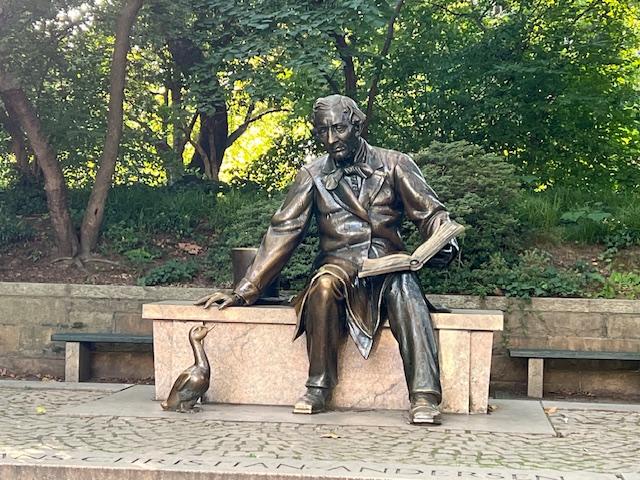
‘Hans Christian Anderson’ statue that faces the other side of the pond. This statute was created in 1958 by artist Georg John Lober for the 150th Anniversary of the author’s birth. It had been commissioned by the Danish American Women’s Association in his honor. Georg John Lober was born in Chicago and was based later on out of New York City. He studied at the Beaux Arts Institute of Design and National Academy of Design working under artist Gutzon Borgium. In his later years, he worked for the New York Municipal Art Commission (Wiki).
You should take some time to walk around the pond and see both statues especially the detail work of the ‘Alice in Wonderland’. These are the favorite of many adults and children alike (Central Park Conservatory).
Hans Christian Anderson Statue
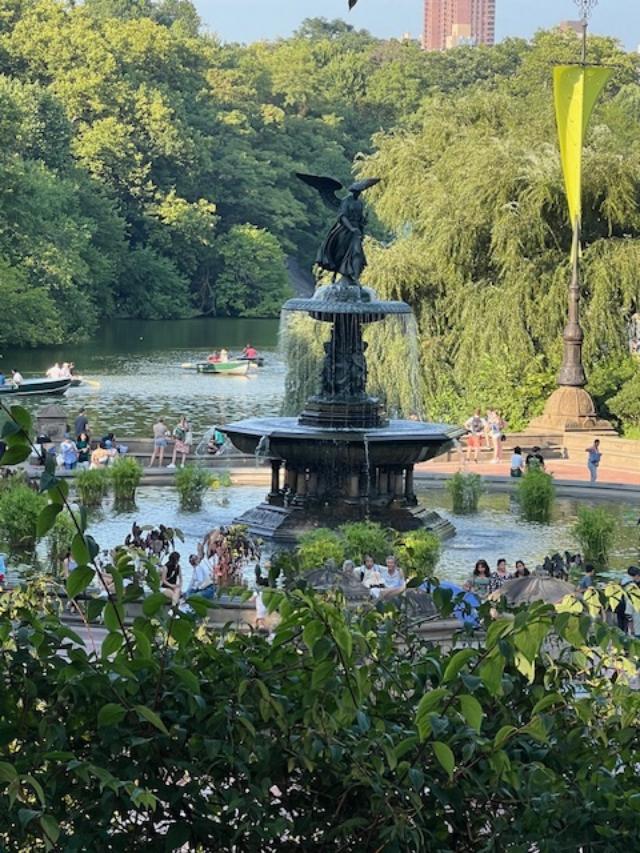
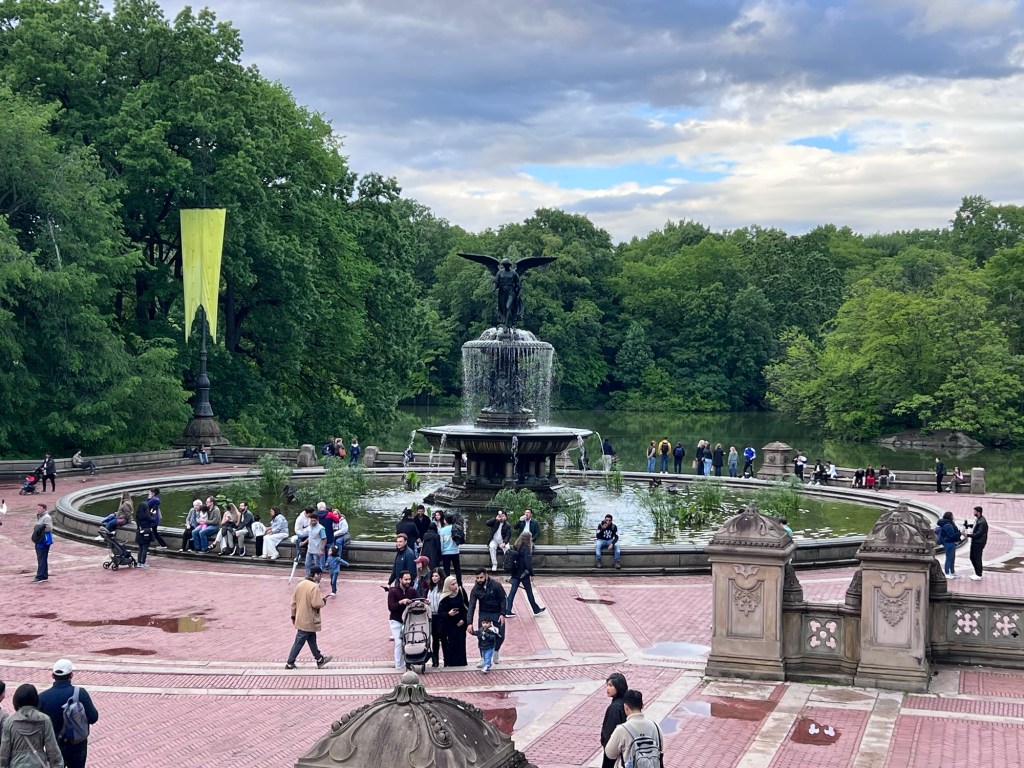
I walked a little further into the park and followed the path and the crowds of people enjoying their time in the park. I got to Bethesda Fountain in all its glory. The fountain was busy with street musicians playing and tourists dancing around. I never get tired of this part of the park.
The Bethesda Fountain is just as glorious as it is now as it was in the Gilded Age. The statue was dedicated in the park in 1873.
The fountain was so beautiful in the Summer of 2024
The area around the fountain was crowded with visitors taking pictures and enjoying the Cherry Blossoms
The fountain in the Spring of 2026
The statue was designed by artist Emma Stebbins, who was an American born and a native New Yorker. She studied at the National Academy of Design and spent most of her professional career in Rome. She was know for her neo-classical works and public sculptures both large and small (Wiki/NY Post/Artist Bio).
Central Park during the Spring of 2025
The band shell in the Spring of 2026
Central Park in the Spring of 2026
The park was packed with locals and tourists enjoying the warm weather and the blossoming Cherry Blossoms. It was fun to watch the City come to life around me. The skaters and dancers were enjoying a Michael Jackson tune from his “Off the Wall” album and with everything going on in the world, it was nice to see people just enjoying themselves.
Central Park in the Spring
Walking around Central Park in the Spring
Watching skaters and dancing
Watching skaters and dancers
Central Park in the Spring of 2026. The colors were amazing!
While touring Central Park, I walked all through the park by the lake area and Boro Bridge to see the park in full bloom with all sorts of Cherry Blossom trees at peak, and daffodils and tulips in showing their brilliant colors. The park was so amazing and everyone was enjoying the Spring weather. It is what everyone thinks of when they think of New York City.
The fountain by the lake
The Cherry trees by the lake
Boro Bridge in the distance
The view of the lake by Boro Bridge
The lake in all its beauty on a Spring day
Walking around the park admiring the Cherry trees
Capturing a couple singing the song ‘Suddenly’, a different version than what I had heard before.
What a delight to hear in Central Park! Talent is everywhere! This guy could really belt out a song!
I went back to the Brooklyn Botanic Garden for my forth time of four weeks of visits there on a Friday night, to see the Cherry Blossoms, one of the most beautiful displays of the trees not just in New York City but the East Coast.
Entering the Brooklyn Botanic Garden the first weekend in April through the Eastern Parkway entrance.
Walking through the entrance to the gardens was so beautiful. Everything was in full bloom and the sheer vibrance of the colors of all the flowers and trees just stood out. I had never seen the garden at such a peak bloom.
The flowering bushes by the entrance
The tulips in full bloom by the entrance
These tulips were so colorful
The tulips lining the garden walls were so colorful
The flowering trees coming into bloom at the entrance
The flowering bushes at the entrance
The beauty of the trees in the early Spring
Walking down the pathways, the first Cherry Trees were just amazing.
The Lilac Garden was in bloom filling this part of the gardens with the most amazing fragrance
The Rose Garden was just coming into its own as the plants were starting to bud. In a few weeks this garden will have the most amazing colors and smells
All the Cherry Blooms were starting to open or were at full peak when I visited. I got there when the buds were open beautifully and had never seen them so vibrant.
By this fourth trip that I made on the Friday night before they started to charge people to enter the gardens for ‘Members Picnic Night’, I was able to finish all my work and travel to Brooklyn to see the Cherry Blossoms at their absolute peak.
Just like Daffodil Hill two weeks earlier, I had never seen the trees so full, fluffy and vibrant. There was supposed to be rain in the forecast for three days so I wanted to get there before that happened and wrecked the petals. The view of the trees was just spectacular.
The Cherry Blossom lawn on an early Friday night
I had never seen the blossoms this full before
The crowds on the Cherry Blossom lawn could not stop taking pictures and videos
It was a spectacular evening to walk through the lawn. I think people were just as spellbound by the beauty of the trees as I was that evening.
I walked down the pathway off to the side and under all these beautiful trees
You have to join me for these amazing walk under the Cherry trees
The pathways were so vibrant with color
Then I walked through the lawn and took pictures as well
I could not believe how beautiful the trees looked and how fluffy the flowers were that day. This is what a Cherry Blossom looks like when it is absolutely perfect!
I think people were spell bound
The fountain at the edge of the Cherry Blossom lawn
Walking back up the pathway to see other parts of the garden
Then I took the back path through the Japanese Garden and it is amazing what a week can do in these gardens in the Spring. Most of the Cherry trees had turned green and another series of flowers had bloomed. You can see this from the beginning of this blog until now.
The back path of the Japanese Garden from Cherry Blossom lawn
The Japanese Gardens
Entering the Japanese Gardens through the back path gives you a better perspective of the garden
Walking along the path of the Japanese Gardens
The waterfall in the Japanese Garden I never noticed before
The garden is so beautiful in the Spring
Looking at the platform from the other side of the gardens
The Cherry trees had turned green when I made this visit
After I finished the tour of the Japanese Gardens, I walked around the Watershed Lawn and the Fragrance and Shakespeare Gardens again to see the flowers blooming. What a site!
The Watershed Lawn
The Watershed lawn
The Fountain at the Shakespeare Garden
The tulips along the pathways
I had never seen this flowering plant before
The Fragrance Garden in bloom
The Fragrance Garden in bloom
It was a spectacular trip and shows how beautiful New York City is in the Spring. The dazzling display of color and delightful smells of the flowers and trees with the promise of more to come as ‘Rose Night’ in the gardens approaches in June.
To see how the parks and gardens work their magic in a one month period goes to show that all is not bad in the world. Maybe we just have to look for the good in it all.
The Cherry trees as I was passing the Brooklyn Museum that evening
Even my backyard was looking much better after the harsh Summer and Winter months
One night later on I found a deer nibbling in my garden. I do not know how he found his way into Hasbrouck Heights but this was different.
I was finally able to get back into the City for a short break the day after Thanksgiving. I had spent my day before at the Macy’s Thanksgiving Day Parade and instead of going to Christmas tree drop off with the Hasbrouck Heights Men’s Association (I decided to give it a rest after 25 years), I worked in Holy Apostles Soup Kitchen serving a post-Thanksgiving Dinner. Talk about busy! They kept me running all morning and afternoon.
After lunch was over, I felt something nagging at me and instead of going home to rest, I decided it was time to finish walking the streets of Alphabet City. It was cooler than it was back in August, so it gave me a different perspective of the neighborhood with all the Community Gardens closed and the trees bare.
Holy Apostles treats people who are struggling with respect and I recognize that after over twenty years of volunteering there.
Plus I figured whatever it was that was trying to take a foothold in me would stop with lots of fresh air and exercise. It worked. After the walk, I not only felt better but was in a much better mood. A brisk walk on a sunny but cool day is the best thing in the world.
I started the walk on the corner of Avenue A and East 13th Street
Alphabet City is a neighborhood in transition. By Avenue A near the edges of the NYU campus, there is much gentrification going on where the bars and restaurants are getting more expensive to Avenue D where the projects are located and there is a massive renovation. I have never seen such changes.
Looking down East 13th Street in the late Fall
I had finished the borders and Avenues of the neighborhood in August before the Fall semester started and tried to finish the streets but this is a big neighborhood and there just was not the time. So I split my time on the neighborhood doing the top part just after Thanksgiving and the rest during a cold snap on Spring Break in mid March. The community gardens may have been dormant at the time but in March you could feel the coming of Spring.
It’s all about creativity and the unique street art
The memorial by artist
(I don’t know the artist)
Sometimes it’s just what a tagger creates that’s unique and fun
What I love about Alphabet City is the combination of creative street art that dominates all the walls and buildings making the whole neighborhood an open air museum.
Another thing I noticed was the vast amount of community gardens that dominated every block. This was the biggest concentration of them I had seen so far in the City. Many gates were locked during the colder months but during my Spring Break with 70 degree weather, the gates flung open and volunteers were preparing beds and clearing the brambles of the previous Fall. Spring flowers were on their way.
The unique paintings on the Roberto Clemente Family Guidance Center at 540 East 13th Street
Ms. Heathcote is an American born artist who graduated from the Rhode Island School of Design. Her love of nature and animals is the main theme of her work. She is now based in Vermont (Artist bio).
I have seen this artist’s work all over the City. This is closer to Avenue D right across from the Con Ed complex.
(not sure who the tagger artist is)
The Con Ed complex dominates the core of the Northern section of the neighborhood at the top of Avenue D and East 13th Street. Nothing glamorous about living next to a power plant yet across the street between East 14th and East 13th Streets luxury housing is being developed. Only in Manhattan!
I then passed the Relaxation Garden at 208 Avenue B and East 13th Street. I never really understood this garden. While all the others in the neighborhood have beautiful plantings, artwork and flowers, this one still looks like a garbage strewn lot.
This particular garden I could see needed a lot of work and I could see by many of the articles online that a lot was being done to clean it up again. The garden is one to look to in the future. Right now the garden is full of trash and there is not much to it.
The garbage strewn lot that needs a little TLC
All over the blocks I explored there was so much street art to admire that it was like an open air museum.
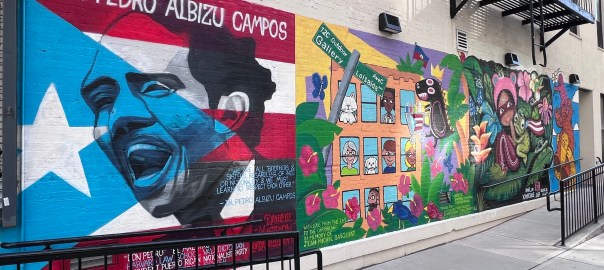
This was my favorite piece of art work from the side of the mural on the Roberto Clemente building
“Chico” is the tag name for American/Puerto Rico born, New York City based artist Antonio “Chico” Garcia. “Chico” is known for his colorful murals and graffiti art, many of the works displayed on the Lower East Side (Wiki/Artist bio).
The name Dias y Flores (Days and Flowers) is taken from a hauntingly beautiful song about hope and growing bySilvio Rodriguez. ArtistBob Lasherhas created the bottle and brick pathway. On this site was once a fully occupied building; abandoned by its owners in the early 1970’s, it slowly fell prey to disrepair and drug trade. The City seized the building and cemented up the doors and windows before eventually tearing it down in 1976 and leaving a rubble-strewn lot–and an open invitation to garbage dumping of all kinds (Dias y Flores website).
In 1978, the13th Street Block Associationenvisioned in its place a community lot, with a garden and a playground, and began the labor-intensive work of clearing out the brick, rubble, and trash–from broken hypodermic needles to refrigerators and car parts–all by hand. Dias y Flores from its earliest days was graced with several experienced gardeners and horticulturalists as members. Along with the help ofGreenthumb, most of the trees and shrubs were planted by 1981. (Dias y Flores website).
The inside of Dias Y Flores Garden in the late Fall
Most of the Community Gardens are now closed for the season and won’t open up to the public again until April. In the summer when I was walking the borders and Avenues of the neighborhood, the gardens would open to the public on the weekends. I will have to wait a few months.
Rounding East 12th Street
Walking down East 12th Street was interesting in the contrasts to the different side of Alphabet City that you live on. Closer to Avenue A you are near the quickly gentrifying East Village with the NYU and Pratt students or closer to the river near the renovation of the housing projects and the park and its overhaul. It is going to be an interesting Great Saunter this year.
The artwork of artist Felix Morelo lines the walls of this restaurant
Artist Felix Morelo is American born artist now living in New York City. He has studied at the Parsons School of Design and Art Students League of New York City. He is known for his creative street art and his ‘chalk circles’ which promote dialogue (Artist website).
By March 2026, the artist painted over his work on the wall
All along East 12th Street, there are all sorts of creative street art in various forms. It seems that there are two things that dominate the neighborhood, street art and community gardens.
The memorial mural
I am not sure what happened to Nugget
(Could not find the artist on the work)
As I passed PS 34 School, I noticed the fascinating metal work of then building’s playground and had to stop and admire it. I was not sure if this was artwork or just design to protect the windows.
The ironwork art outside the playground of PS on East 12th Sttreet
I was not sure who created it but I thought it was interesting enough to stop and admire it . I thought the affect was interesting.
This is one of my favorite series of murals that I passed again when I was walking through the neighborhood. This sits on the side wall of PS 34 on East 12th Street.
The murals by Avenue C created by a series of artists from the Thrive Cooperative
The panel that lined the school created by artists from the Thrive Collective
Danielle Mastrion is a Brooklyn-born, New York City based painter and muralist who specializes in large scale, brightly colored murals. She holds a BFA from Parsons School of Design (Artist website)
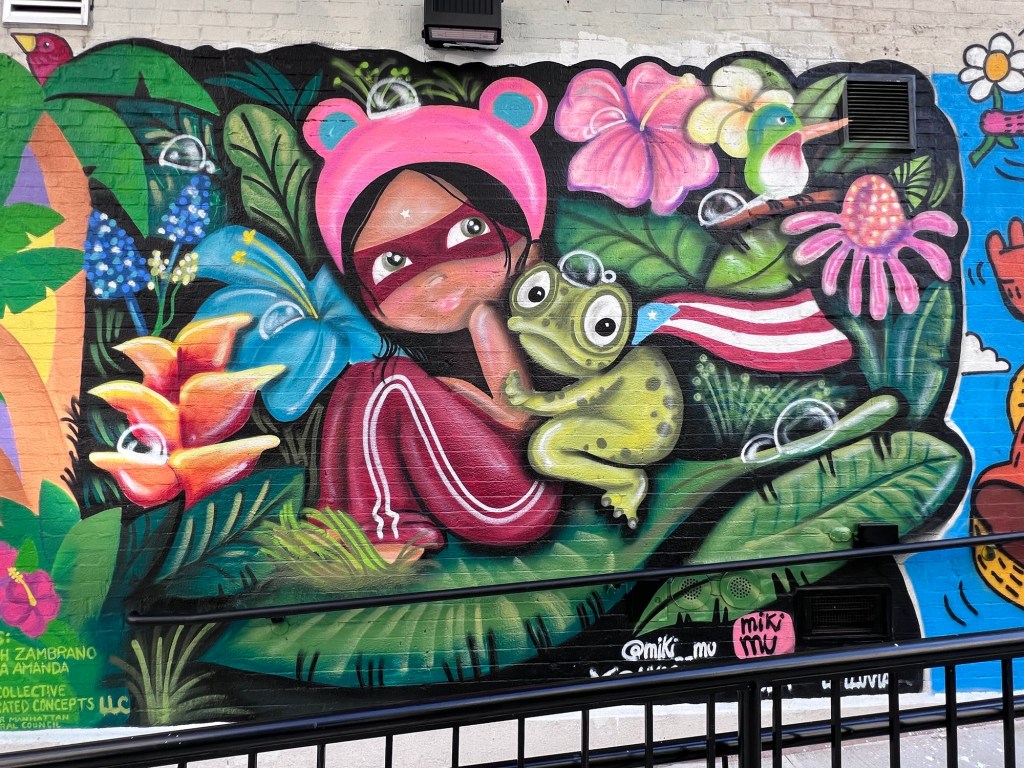
I loved this whimsical school painting by artists Savannah Zambrano and Andrea Amanda
Savannah Zambrano is a freelance sequential artist thathosts workshops and panels, does face painting and caricatures, and works with Traditional and Digital Media (Artist Bio website).
The artists sign with the Thrive Collective
I loved this mural with the Puerto Rican flag by artist Miki Mu
Michela Muserra is an international muralist and illustrator based in Brooklyn. A graduate ofAccademia di Bella Artiin her hometown of Foggia, Italy. The artist has worked as a teaching artist with Thrive Collective since January 2017 (Thrive Collective website).
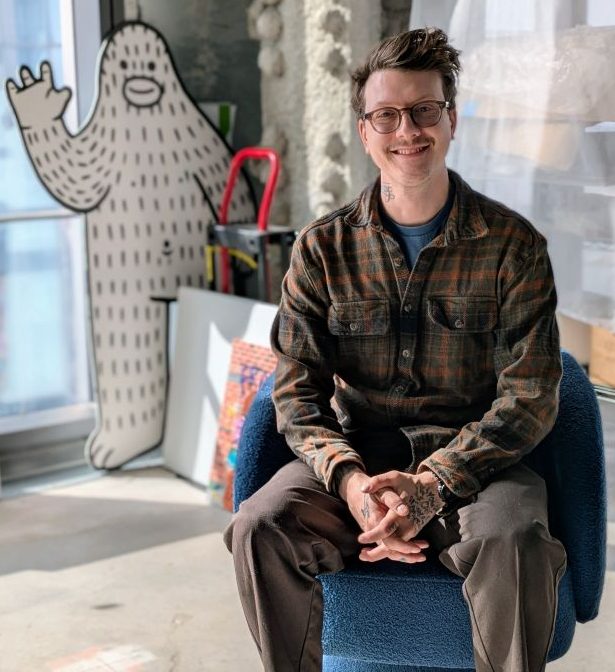
I love this colorful display of positive behavior of Frank Ape by artist Brandon Sines
Artist Brandon Sines was exposed to many cultures while growing up simultaneously in New York City, Toronto, and Los Angeles. He mixes Pop Art’s mass culture, Surrealism’s private associations, and inventive paint handling to create dreamlike environments. His mark making ranges from experimental techniques to illustrative precision. Parts of the paintings are crystal clear, and other parts reach abstraction.
I loved his video on how he creates his work!
I could not find the artist who created this piece
Some of the taggers really know how to decorate the corners of walls and doors
The Campos Community Garden at 640 East 12th Street
The Campos Community Garden was an empty lot until 1982 when the lot was cleared and the it was an active garden enjoyed by the community. When the main organizer moved away, it had fallen into neglect for years until it was revived in 2004 by a group of neighbors. A Children’s Garden was added in 2006 and was rebuilt after Hurricane Sandy. It is now a thriving garden enjoyed by the community and fruits and vegetables are raised to benefit everyone (The Campos Garden website).
The inside of the Campos Community Garden in the late Fall of 2025
The Down to Earth Garden is at 546 East 12th Street and was also closed for the season
The Down to Earth Garden was established in 1993 when a building was knocked down, leaving an empty lot. It was originally called the Children’s garden but changed its name in 2020. It is now part of the GreenThumb program and is part of the NYC Parks Division (Down to Earth Garden website).
The next park was the Joseph C. Sauer Playground at
The sign for the Joseph C. Sauer playground at 532 East 12th Street
Joseph C. Sauer was born in Pittsburgh, Pennsylvania. His family moved to the Lower East Side of New York City when he was an infant. Sauer graduated from the Redemptorist Parochial School and excelled in athletics, especially track. He worked for the Western Electric Company, and following the death of his grandfather, Sauer and his mother took over the family’s basket manufacturing business. He worked there until he entered the United States Army on September 28, 1917 (NYCParks.org).
The history of the playground
The Sauer playground in the Fall of 2025
The last of the parks and gardens I either passed or explored on East 12th Street was the El Sol Brillante Garden. Though the gardens were closed for the season, you could see the extensive plantings through the beautifully wrought iron gates created by local artist Julie Dermansky.
The sign for the El Sol Brillante garden at 522 East 12th Street
The garden and the beautiful wrought iron gates
(From the El Sol Brillante website)
El Sol Brillante Community Garden rose from the ashes of a demolished lot of four burnt-out buildings in the Lower East Side of Manhattan in 1977. Residents organized to create a garden that would revitalize the neighborhood, unite local leadership, and improve the quality of their environment. The original group of forty, with the help of a resident architect, the Horticultural Society of New York (gardening advice), the Cornell Cooperative Extension Service (gardening advice), and the CETA Summer Youth Corps (labor and jobs for kids) designed plans and with very little money and a great deal of sweat equity, a garden was born. In 1978, with the assistance of the Trust for Public Land, a nonprofit land trust was created and the lot was acquired in 1980. A once rubble-filled lot became a thriving 1,000 square foot, 40-plot vegetable garden, a meeting place, and a preserved natural space for its members and their community.
Artist Julie Demansky is an American born artist. She graduated from Tulane Newcomb University with a concentration in ceramics and sculpture and was awarded the Watson Fellowship. She is known for her large scale metal work projects (NYC.gov).
A full view of those beautiful gates
As I walked down the street there were several small restaurants and gourmet shops that caught my attention. I did not have a chance to stop having eaten at another restaurant in the area for lunch. These will be for another visit.
I passed this cute little bakery that warrants a visit.
Turning on East 11th Street
When I turned onto East 11th Street, it was like an open air art museum with various tags and paintings that were both creative and colorful along the walls of the neighborhood.
East 11th Street in the Fall of 2025
I thought this bird piece by Grilla was pretty interesting on this window
Artist Grilla
(I could not find any information on this tagger/artist online)
I loved this tag. I thought it was pretty creative
On the side of this building on East 11th Street was another mural painted by artist Lesley Heathcote.
The mid nautical scene was created by Artist Lesley Heathcote
In 2007, Toyota provided funding to transform this site from a basic vegetable garden into an outdoor children’s learning experience, commissioning landscape architect Michael Van Valkenburgh for the design.
To prepare the garden for restoration, New York Restoration Project construction crews performed demolition and grading procedures on the site, cleared debris and garbage and installed various hardscape features. Over the course of six months, NYRP horticulture and design teams worked hand-in-hand with local residents and Van Valkenburgh to realize the community’s vision for this newly renovated gem, which includes four distinct habitat areas that NYRP and New York City educators can use to present environmental education programming to neighborhood youth.
Walking down East 11th Street on a crisp late Fall day
The weather got a little warmer in the afternoon and I was enjoying the weather. The leaves on the trees were changing as the weather got cooler and more brisk. The streets were quiet on this holiday week day.
The next park I passed was the Dry Dock Playground at Szold Place on 11th Street
The sign at the entrance of Dry Dock Playground on 11th Street
The playground had been very active with basketball games, birthday parties and barbecues when I was exploring the neighborhood in the summer months. There was non stop activity until September but very silent in the colder Fall months. I did not see anyone there except when I returned in March during my Spring Break visit and it was in the 70’s. Kids were out playing basketball.
The murals behind the closed gates
(I could not get a close enough view to see who the artist was on this mural)
The park sitting quiet in the colder months but comes alive with all sorts of neighborhood activity in the summer
The last garden I passed on the block as I finished was the 11 BC Serenity Garden at 626 East 11th Street.
The garden behind closed gates in the Fall of 2025
It was one of the few locked gardens on all three of my walks in the neighborhood. I could see the garden was going through the season change and would have to visit the garden again in the warmer months.
I got to East 10th Street by the late afternoon. I could see the changes of the late fall on the parks and gardens in the neighborhood.
Rounding East 10th Street near Tompkins Square Park for the last part of the walk that day
I walked through the empty Dry Dock Playground a couple more times as I rounded the neighborhood, through the quiet paths. The sounds of children and of adults barbecuing and birthday parties are the sounds I will hear in a few months when the warm weather comes.
The Dry Dock Playground by Avenue D in the quiet cooler months. It is a mob scene in the warmer months on the weekends.
The large ‘El Bohio Murals’ created by the Thrive Collective on the outside of the old public school
Thrive Collective creates hope and opportunity through arts, sports, and mentoring in and around public schools. Our core programs – Murals; RHYME (Rhymes Help Young Minds Excel); Media; Mentors; Festivals, and Sports – connect artists, youth workers, and volunteers with local schools as teaching artists, art directors, coaches, and mentors. Project based learning and accredited curriculum integrate life and art skills in four kinds of experiences: in-school electives, after school clubs, seasonal intensives, and weekend warriors.
My favorite section of the mural created by this talented group of artists
I came across this taggers art on one of the doorways
I came across this nature scene on the corner of East 11th Street
I thought this was really original and was beautifully designed and colored by the artist. It is also one of the few murals in the neighborhood that has not be covered over by other artists.
Joel Chico is an Actor, Writer, Director from Toronto, Ontario, Canada. He is the creator of JMC Creative Endeavors, an artistic platform for his projects as a musician, poet, painter, photographer, and spiritual wisdom keeper. He is currently in the process of writing a poetry anthology, and his Cosmic Trilogy Feature screenplays (Artist bio).
I crossed Avenue D into the housing projects and came across the murals that were painted on the first floor of the housing complex. These colorful works were created by a series of artists working with Thrive Collective (see above) to decorate these rather plain walls in the housing complex.
The mural along the housing complex
The mural by Artist Miki Mu
Artist Miki Mu
Michela Muserra(known as “Miki Mu”) is an international muralist and illustrator based in Brooklyn. A graduate ofAccademia di Bella Artiin her hometown of Foggia, Italy, Michela launched Thrive Collective’s Private Murals Collection as an advanced apprenticeship for our most promising School Murals students and artists. Michela has worked as a teaching artist with Thrive Collective since January 2017 (From the artist website on Thrive Collective).
The last part of the mural on the other side of the building
This was my favorite part of the mural
This was painted by artist bebebsmbu88
The project is inspired by a sacred ceremonial mask carved from a coconut shell in the island of Puerto Rico. It’s called “Vejigante,” and it’s an important and iconic character portrayed in the carnival celebrations in the island. The artwork pays tribute to the HipHop and Caribbean culture presenting the characters in a modern context. The Coconut Mask is a metaphor for our ancestral connection to nature and spirituality (From the artist’s website website).
Artist Bebe Bambu88 (real name Gabriel Rosario Mongil)
The artist is originally from Santurce, Puerto Rico. Artist Gabriel Rosario Mongil aka Bebe Bambu is a designer and recording artist. Originally known for his graffiti work and slam poetry, being the author of several murals in Puerto Rico and Monterrey, MX. He graduated from the University of Puerto Rico in Rio Piedras and received a scholarship to do his masters degree in graphic design and graduated from the University of Monterrey, MX in 2013/15. During this; he had his second solo exhibition, recorded his first solo album and started offering workshops for children in communities in need (From the artist’s website)
I finally reached the end of East 11th Street in the projects. Years ago you would never dream of walking through Jacob Riis complex. Now it is the cut through to East River Park by the hipsters and college students who have moved into the area.
I then rounded the corner and I was on East 10th Street and found myself in front of Topkins Square Park to passed peak foliage. Both during the holiday weekend and on my Spring Break, the park was busy. The park has come a long way since the 1980’s when it was all drugs and homelessness. It is now the center of the community for skateboarders, dog walkers, seniors getting rest and new parents spending time with their kids.
The brownstones and tenements around Tompkins Square
Tompkins Square Park was once one of the most notorious parks in New York City between the homeless and the drug dealing. Now it is mostly college students from the downtown schools and the neighborhood residents gentrifying the neighborhood. It was in the final stages of the fall foliage. This is where I would stop in November. It was a big neighborhood to walk.
Once the weather got colder and I got busier with the holidays so I had to put the walking in Alphabet City on hold for a few months. Who knew it was going to be one of the coldest winters in recent memory. I was not able to get back to walking the neighborhood until March of 2026 during my Spring Break from the college when the temperatures hit 75 degrees.
Between the cold weather and the recent snow storms with the foot of snow, who could or wanted to walk around New York City? Then Spring Break came at the college just as the Spring thaw started and the weather really warmed up. It seemed for two days the whole City, tired of the cold weather and snow, played hooky and were in Tompkins Square Park enjoying the weather.
From March 9th through the 10th in 2026, the weather warmed up into the mid 70’s and it gave me a chance to finish walking the neighborhood. The temperatures would go right back down to the 30’s and 40’s after that until mid-April. The warm weather gave me the opportunity during my Spring Break to finish walking the streets of the neighborhood.
I walked East 12th and 11th Streets again to get a feel for the neighborhood and see if anything changed. There was a lot I missed back in November as I had more time, with better sunlight and warm weather to take my time to explore the neighborhood.
I revisited some of the streets that I had walked over the Thanksgiving break and noted all the artwork and architecture that I missed on the first trip walking all the streets of the neighborhood.
I had not seen the mural of Run DMC on the wall of the apartment building on West 12th Street.
This meticulously designed garden features vibrant floral displays, tranquil pathways, and cozy seating areas, making it an ideal spot for relaxation and reflection. With its blend of nature and artful landscaping, 11 BC Garden invites everyone to enjoy a moment of peace amidst the city’s energy (From MapQuest.com)
The 11 BC Serenity Garden in the late winter months
The Gardens were just coming into bloom when I visited during my last visit. The temperatures were about 75 degrees at the time and things had just started to bloom.
I love the street art on the neighborhood walls. The heart cheered me up!
It is funny how just small painting could make you so happy. Paintings like this were located all over the neighborhood.
The Toyota East Children’s Learning Garden was one of the many gardens open during the warm spell
The Toyota East Children’s Learning Garden on a warm
Most of the gardens I visited, most were still coming into bloom. The Toyota East Children’s Garden was opened for about an hour when I visited. The park was quiet at the time while some volunteers were maintaining the gardens.
(History of the Garden from the New York Restoration Project)
In 2007, Toyota provided funding to transform this site from a basic vegetable garden into an outdoor children’s learning experience, commissioning landscape architect Michael Van Valkenburgh for the design.
To prepare the garden for restoration, New York Restoration Project construction crews performed demolition and grading procedures on the site, cleared debris and garbage and installed various hardscape features. Over the course of six months, NYRP horticulture and design teams worked hand-in-hand with local residents and Van Valkenburgh to realize the community’s vision for this newly renovated gem, which includes four distinct habitat areas that NYRP and New York City educators can use to present environmental education programming to neighborhood youth (NYRP).
While I was walking down East 11th Street, I noticed how much the neighborhood had changed over the years. The whole block was gentrified and looked really nice. What I was amazed by this was how expensive everything was in the neighborhood. As I was walking around the neighborhood, I noticed how expensive the bars and restaurants were around Tompkins Square Park. I thought they would be much cheaper in this part of the neighborhood.
Looking down 11th Street at Avenue A in the Winter. It was 76 degrees during the Spring thaw
After a long walk enjoying the sunshine while revisiting the last blocks I had visited before the holidays, I turned the corner on Avenue A and started to walk the remainder of the neighborhood.
While Alphabet City does not have the classic architecture or statuary of neighborhoods to the north, it’s streets are lined with creative and interesting street art and pocket neighborhood gardens showing the dedication of residents to better their community.
This is what gives the neighborhood its charm and why it has gotten more expensive to live here. I noticed in between all the former tenement buildings, there are plenty of luxury buildings that dot the neighborhood even at the borders of the once notorious Avenue D.
Turning the corner at Avenue A an East 10th Street
I rounded East 10th Street, I noticed this giant Buddha head outside someone’s home in their front garden. I thought this was quite unique.
Passing interesting art in people’s front gardens along East 10th Street
I walked through Tompkins Square Park several times watching the skateboarders performing their feats and college students sunning themselves. It seemed like the whole City had called out sick and just wanted to enjoy the weather in the park.
I walked past the rows of apartment buildings and small businesses and then walked around the park several times to see how people were Lo enjoying their afternoon. I then started my walk down East 9th Street past many more community gardens.
The Francisco ‘Pancho’ Ramos Community Garden at 703 East Ninth Street
The Lower East Side of the 1970s was a hard place with little green. Local residents noticed the abandoned, littered lot at the corner of Ninth Street and Avenue C and began to sow seeds and plants along the chain link and among the debris, and so the Ninth Street Community Garden & Park was founded in 1979. Today Pancho’s Garden hosts community events including music, art, and gardening workshops (Ramos Garden website).
The garden is half an acre of gorgeous flowerbeds, and vegetable gardens. Meandering pathways crisscross the park, follow them to the koi and turtle pond, fig arbor, or one of many quiet nooks that offer a cool quiet spot to read a book, have a chat with a friend, enjoy a cup of coffee, or just sit and enjoy a respite from The City (Ramos Garden website).
The Ramos Garden was open that afternoon to walk around as the gardeners were preparing the beds for the Spring. There was a lot going on around the small beds and gardens that lined the pathways. This garden stretched from East 10th to 9th Streets.
Walking along the pathways of the Ramos Community Garden on a sunny warm day
The artwork in the park
More of the interesting artwork in the garden
The Ramos Community Garden during the Spring Thaw was very active
While I continued my walk down the street, I saw how the neighborhood was reacting to the recent ICE raids going on not just in the City but all over the country. There were signs and graffiti all over Alphabet City and the border with the Lower East Side.
Artworks about ICE dotted the neighborhood
All over the place
As I walked down the street, I came across more street art dotting the walls of buildings around the neighborhood. This mural was with the theme of the Old West and Doc Holliday.
I thought this piece of street art with Doc Holiday and his crew was interesting
Joel Chico is an Actor, Writer, Director from Toronto, Ontario, Canada. He is the creator of JMC Creative Endeavors, an artistic platform for his projects as a musician, poet, painter, photographer, and spiritual wisdom keeper. He is currently in the process of writing a poetry anthology, and his Cosmic Trilogy Feature screenplays (Artist bio).
I then rounded the corner and walked down East 9th Street as the weather got warmer. It got to 78 degrees by the mid-afternoon.
Walking down East 9th Street
Tompkins Square Park had gotten even busier in the late afternoon as dog walkers, skateboarders and seniors talking amongst themselves filled the park. It was funny how all the benches were filling up and it looked like everyone had called in sick at work. It was the first really warm day since the beginning of November of 2025 and everyone was enjoying this warm and sunny day.
Walking through Tompkins Square Park during the Spring Break
I stopped in the bathroom at the park, which is a good pit stop being one of the few places where there is a public bathrooms. While I was relaxing, I watched this singer in a Mondrian kimono perform David Bowen hits. I have to admit it was a bit strange but this is Alphabet City and the guy was very entertaining.
Pinc Louds’ lead singer, Claudi (all pronouns accepted), moved from Puerto Rico to NYC in 2015 to fulfill their dream of playing in the subway. This immersion into the city’s underground, performing daily for a steady stream of New Yorkers, sculpted the sound and look of the project (Band website).
Through the “litteral” underground, Claudi met the musicians (keyboard/bassist Marc Mosteirin and drummer Matt Dallal) and other artists that would turn Pinc Louds into the full-blown spectacle they are today. Busking in the parks and tunnels opened many doors for the band, who quickly gained a cult following and by 2018 were selling out shows in such NYC venues as (le) Poisson Rouge, Market Hotel and Joe’s Pub, as well as tours throughout the US, Puerto Rico, Europe and Chile (Band website).
It was an interesting concert
The David Bowie song ‘I just Dancing’
I sat in the park listening to the concert for about a half hour and relaxed through a few songs. I swear, this guy held this concert for over an hour because everytime I walked back through the park, crisscrossing through the various streets, he was still there singing.
I walked back and forth down the various streets, ending at Avenue D and walking through various parts of the complex. Most of public housing was under renovation so I was trying to avoid any scaffolding.
The corner of Avenue D and East 9th Street. How things have changed from the 1970’s and 80’s. The housing projects were under scaffolding around the entire complex. There were changes throughout the Jacob Riis Complex.
La Plaza Cultural de Armando Perez Community Garden was founded in 1976 by local residents and greening activists who took over what was then a series of vacant city lots piled high with rubble and trash. In an effort to improve the neighborhood during a downward trend of arson, drugs, and abandonment common in that era, members of the Latino group CHARAS cleared out truckloads of refuse. Working with Buckminster Fuller, they built a geodesic dome in the open “plaza” and began staging cultural events. Green Guerillas pioneer Liz Christy seeded the turf with “seed bombs” and planted towering weeping willows and linden trees. Artist Gordon Matta-Clark helped construct La Plaza’s amphitheater using railroad ties and materials reclaimed from abandoned buildings (La Plaza website).
Later, block residents tilled the western portion of the space and planted vegetables, flowers, and fruit trees. During the 1980s, the garden came under attack by developers seeking to build on the space. After numerous court battles, La Plaza was finally preserved in 2002 as part of the terms of a legal settlement. In 2003, La Plaza was renamed in memory of Armando Perez, a CHARAS founder and former District Leader of the Lower East Side who was killed in 1999 (La Plaza website).
The Armando Perez Community Garden was one of the larger community gardens in the neighborhood
I walked all through the garden, watching the planting and seeding and cleanup going on. In the two days I visited the neighborhood, almost all the Community Gardens had opened their gates and volunteers could not wait to tackle the damage done by all the recent winter storms.
The inside of the gardens in the winter
Walking through the gardens in the winter
The view of the top of the garden in the winter time
The history and importance of these Community Gardens on these neighborhoods
As I left the Community garden, I walked past a series of interesting and creative pieces of street art along the walls and doors of the various buildings on the block.
A stand pipe with colorful works
I thought this was interesting
This stood out against the wall
I was not sure what this meant
In the late afternoon, I got to Avenue A and St. Mark’s Place (East 8th Street) and walked around the ‘Restaurant Row’ that was going strong between lunch and dinner. The bars were filled with college students from Pace and NYU enjoying the weather and all the outdoor cafes were set up. This was going strong from about 2:00pm until I left the neighborhood around 6:00pm.
Making the turn on St. Marks Street/East 8th Street
As I walked down Avenue A, I took a longer tour of Tompkins Square Park and saw the singer in the Mondrian kimono still singing. This guy put on an all day concert!
The concert was still going on over an hour later
It got even warmer that afternoon and someone said that it topped 75 degrees. I think more people played hooky that afternoon as the park was packed with students gossiping and dog owners watching their pooches play. The look of the park said ‘end of winter’ but the mood was ‘Yeah, Spring is finally here’. (It would go back down into the 30’s by the end of the week).
Tompkins Square Park in the afternoon
It was so nice to get the first glimpse of Spring before the temperatures would drop again at the end of the week.
People socializing in Tompkins Square Park
Whether it was listening to music, playing with their dogs or just reading a book or conversing with neighbors, people from the neighborhood were enjoying the snap of 70 degree weather as much as possible. They enjoyed being outside and wanted to enjoy it as much as possible.
Turning the corner of Avenue A and East 8th Street
The street art along East 9th Street is unique
The De Colores Community Yard & Cultural Center at 313 East 8th Street
De Colores Community Yard & Cultural Center is a vibrant community space located in New York NY. It serves as a hub for cultural activities gardening and educational programs fostering a sense of community and inclusivity. Visitors can enjoy a variety of events workshops and green spaces designed to celebrate diversity and promote environmental awareness (MapQuest.com).
The inside of the Community Garden
The garden was going through a major clean up the day I was there and the volunteers were leaving for the afternoon.
The Earth People Community Garden at 333 East 8th Street
Earth People Garden is a serene urban oasis located in New York, NY, designed to celebrate nature and community. This park features lush greenery, vibrant flower beds, and tranquil pathways, making it an ideal spot for relaxation and reflection. Visitors can enjoy various activities, from gardening workshops to community events, all while embracing the harmony between people and the environment (Mapquest.com)
The inside of the Community Garden in the winter
The Earth People Garden like most of the gardens in the neighborhood was closing for the evening as the volunteers were giving the garden a cleaning from the Winter storms. The garden was just starting to come back into bloom.
LaCasitaCommunity Garden, established in 1990, is primarily used by the community as an event and gathering space. To that end, the garden’s renovation in September 2014 included the installation of a raised, round stage where performances can be held; a new grill and picnic tables for barbecuing; a shaded seating area; and two sheds for storage. The backdrop of the stage is a chalkboard that can be used by the local elementary school for an outdoor classroom or even as a movie projection screen (NY Restoration website).
Funded by generous support from The Geraldine Stutz Trust, the Trust aims to remember Geraldine Stutz’s significant contribution to the fashion industry, her love of theatre as well as her passion for gardening. A fashion retail groundbreaker, Stutz served 29 years as president of Henri Bendel, the upscale women’s store (NY Restoration website).
The inside of the Community Garden
I was able to walk around this garden but there was not much to see at this point. I am going to have to return to the neighborhood in two months when things start growing again.
Street art along East 9th Street
This little devil was in the detail of this work
I thought this was very clever as these small works of art are tucked here and there on walls and doors on buildings all over the block.
The Green Oasis Community/Gilbert’s Garden at 372 East 8th Street
The gardens all over the neighborhood were open as everyone was enjoying the 75 degree weather and were working in these Community Gardens getting ready for the Spring. This garden was particular busy.
The signs were all out and people were enjoying the Spring weather
As the volunteers were cleaning the beds and trimming bushes and trees, I was able to walk around the gardens. They must be very impressive when they are in full bloom. This is one of the larger gardens in the neighborhood.
The History of the Garden:
(From the Green Oasis Community Garden website)
The New York City neighborhood known as the East Village experienced massive arson and destruction during the 1960s and 1970s. The area had been compared to Dresden, Germany after World War II. Rubble from bulldozed buildings lay in mounds, and garbage accumulated. Cars were abandoned. Rats were rampant. Drug use reached epidemic proportions. Drugs and crime made the neighborhood unsafe, but few areas were worse than the neighborhood east of Avenue B (Green Oasis Community Garden website).
The inside of the garden in the winter
Normand Valle moved to East Seventh Street between Avenues C and D. From his window, he looked down upon one of these blighted lots, and decided to do something about it. In 1981, Valle, an ex-Marine, and his life partner, Reinaldo Arana, began to undo the mess one brick and one piece of garbage at a time. At the same time, Gilbert Ingram (who lived nearby on 8th Street) had taken control of another piece of that same large lot, creating a sculpture garden where he carved found wood and stone and hosted friends and neighbors who dropped by for barbecues and sculpting lessons. Both gardens engaged neighborhood children to help with the clean-up and ultimate creation of a combined garden with communal and private vegetable plots; beehives; a grape arbor; a koi pond; dozens of now huge trees, flower beds of perennials and annuals and an iconic gazebo.Thus were Green Oasis and Gilbert’s Sculpture Gardens born (Green Oasis Community Garden website).
The signs outside the gates
From the beginning, the sister gardens’ mission has been to provide a safe, green haven for all people, but especially for the children who lived in that inhospitable environment. Mr. Arana was particularly interested in the theatre, so theatrical events abounded. Plays for children were written and performed. The first generation of Nuyorican poets read poetry; music was performed; the well-known Butterfly Release ceremony was held here during the all-garden pageant The Rites of Spring until its demise in 2006 (Green Oasis Community Garden website).
The beds in the gardens were being prepared for the season
The garden pays homage to the memory of Martin R. Celic (1952-1977), a young member of Ladder Company 18 who lost his life fighting a fire in the tenement that once stood here.
The Community Garden in the Winter
The Firemen’s Memorial Garden was closed for the day but I was able to take a peak inside before it got dark. Another garden to revisit in the Spring.
I got a kick out of this written on the wall but was not sure of who it referred to
Turning the corner of East 7th Street and Avenue A
I arrived in the middle of the neighborhood by the early afternoon and continued walking past the statue of Samuel Cox, who was making his presence known for all the neighborhood to see. I just don’t think anyone knew how he was anymore but the pigeons.
The statue of Samuel S. Cox stands guard at the southwest entrance of Tompkins Square Park
Samuel Sullivan “Sunset” Cox was born in Zanesville, Ohio, and served his home state as a Democratic Congressional representative from 1857 to 1865 before being unseated. After moving to New York in 1866, Cox served again in Congress for several terms from 1869 until 1889. Although Cox once publicly declared that his most satisfying contribution to public service was championing the Life Saving Service—founded in the 1840s to patrol the coasts and save imperiled boaters during bad weather, the group was absorbed into the Coast Guard in 1915—this statue is sponsored by U.S. Postal Service workers because of Cox’s support for their quality-of-life issues (NYCParks.org).
Artist Louise Lawson was an American born artist who studied at the Art Academy of Cincinnati and Cooper Union. She worked as an apprentice under several famous sculptures and was one of the first American female sculptures to have a professional career. She is known for her Neoclassical sculptures (Wiki).
Starting the walk down East 7th Street
I thought this was a beautiful detail on 193 East 7th Street
The Clyde Romero Memorial Garden at 213 East 7th Street
When Christine Datz and Clyde Romero met in 1986, they shared a deep passion for the environment and improving their neighborhood. With a people-powered approach to sustainability they launched the Lower East Side Ecology Center in 1987. Six years before New York City implemented a citywide recycling program, the Ecology Center was already leading the way. We established a community drop-off site at the 6th Street and Avenue B Garden, where locals could recycle paper, metal, glass, and plastic (LES website).
By 1990, we leased four city-owned, rubble-filled lots on East 7th Street. These 15,000 square feet became home to one of the city’s first community composting programs. Neighbors dropped off fruit and vegetable scraps, while volunteers collected food waste from health food stores and restaurants (LES website).
Over time, we transformed the lots into an attractive garden, demonstrating how the composting of food waste can improve quality of life and ecology on a community level. Now known as the Clyde Romero Memorial Garden, it is a 6,000 square-foot protected community garden (LES website).
The inside of the gardens in the winter time
The garden like most of the ones I visited that day were still in the stages of late Winter, awaiting Spring to come soon. A lot of work was being done in here.
Admiring the street art that lined East 7th Street
I saw this beautiful butterfly on the side of a school I don’t know why but it really cheered me up.
The butterfly sculpture
Walking down East 7th Street near Avenue D. It tells you how the neighborhood has changed.
I noticed one thing about the neighborhood, as you got to the lower streets there was more newer luxury housing mixed in with the old brownstones and apartment buildings. The streets had that classic ‘New York’ look to them.
The Sam & Sadie Koenig Garden at 237 East 7th Street
This small garden was one of the few that had been really maintained and looked like it had gotten its cleaning done already. The gates were locked in the early afternoon but you could still see through the gates.
As I was walking back to Avenue A, I passed a series of colorful and interesting street art, created by both commercial and street artists. This made the block look like an open air art gallery. There was lots of interesting street art to admire and try to interpret. There are some talented artists in the neighborhood.
Michi Meko is an American born artist whose work spans painting, sculpture, and installation, activating spray paint and found objects to create layered compositions. His gestures reflect an interplay between beauty and violence, rebellion and reflection, and past and future. Meko’s art interrogates themes of identity and resilience by offering an exploration of light, texture, and form (Mariane Ibrahim Gallery website).
The term TCK in the context of the Lower East Side most frequently refers to the TCK Crew, a prolific graffiti and street art collective. While the crew is widely known for their work in Berlin. The TCK Crew is primarily recognized for “non-stop train” graffiti and raw, urban style writing (Brooklyn Street Art website)
I finally reached East 6th Street by the late afternoon and it got hotter outside. It got to 75 degrees on the Monday of my Spring Break and I was tempted to wear shorts the next day. It was so weird in that it was 36 degrees the week before. This weather was a result of the annual Spring Thaw and God knows we needed it.
The corner of East 6th Street and Avenue A
As I rounded East 6th Street, I saw this beautiful mural on the side of a restaurant but I could not find any artist name on the painting. It is a nice painting and I thought it was a nice compliment to the building.
The street art the lined the side of a restaurant on the corner of Avenue A and East 6th Street
As I walked down East 6th Street, it was a whirlwind of street art and tagging. Some the most unique art filled the walls, doorways and stairs of many of the buildings, especially the store fronts that stood empty. The neighborhood is still going through that transition but you are reminded there is still a creative vibe here.
The interesting street graffiti on the doors of buildings
This was on a garbage can cover
This tagging was on one of the doors
This was along one of the walls
The I passed 630 East 6th Street which stood out among the small buildings in the area. This is the former Pencer House Building that was built in 1900. It is a now a rental building (Street Easy.com).
The building was originally one of the Children’s Aid Society’s schools, donated by Emily Sloane Vanderbilt, the granddaughter of the Commadore. the Society turned to the architectural firm of Vaux & Radford, which would eventually design 12 Children’s Aid Society projects.Calvert Vaux, best known for his work in designing Central Park, had partnered with George Kent Radford in 1872.The Sixth Street School building would follow the same lines as their other Children’s Aid Society buildings—a blend of Victorian Gothic and Flemish Revival styles (DaytonianinManhattan.com).
The beautiful architecture really stands out among the other buildings on the block. The building has now been fully renovated and the outside restored. As I walked further down the street, more community gardens were tucked here and there on the block.
The 6BC Garden on East 6th Street between Avenues B and C more than lives up to the standards of its neighborhood. Founded in 1981, the garden began as a traditional organization – its members maintained their own plots while contributing to community spaces. A shift in leadership and the decision to incorporate, led to changes in 1995 (6BC Garden website).
6BC became an official botanical garden, the first and only one in Manhattan devoted to bio-diversity, horticultural education, neighborhood beautification, and community programming. 6BC was assigned to parks in 1999, a move that safeguards the land’s status as a green space while leaving administration, leadership and maintenance of the garden in the hands of its members (6BC Garden website).
The 6B Botanical Garden in the Winter
I was able to take a quick walk around the garden before the volunteers called it an afternoon. I really liked the paths of plants and artwork. Another place to visit in the Spring.
Walking down East 6th Street
I liked the classic look of East 6th Street. It is so classic ‘Old New York” with new stores and restaurants opening all over the place.
Our garden began as this tenement building at 530 East 6th St. It’s the building in this circa 1940 photo with the stairway and the truck parked in front. Through the 50’s and early 60’s several buildings on this block became abandoned. Some were renovated, some homesteaded and a few were totally demolished. The building that occupied our site burned in the early 70’s and was demolished soon thereafter. Immediately following, the land was marked for a community garden and in 1978 opened as the Creative Little Garden (Creative Little Garden website).
In the early 80’s Françoise Cachelin started the garden and under her leadership the lot was leased to the Parks Department and Greenthumb. She was an outspoken and staunch supporter of individual and community rights, and without her our garden would not be here today. Françoise passed away in 2003, but we continue to take inspiration from this former member of the French Resistance and spirited advocate for the rights of downtown residents (Creative Little Garden website).
The Creative Little Garden in the Winter
The garden’s gates were open but I didn’t see anyone. I ventured in to look around. I liked the organized beds and places to sit. This will be a fun place to visit when the weather gets warmer.
Walking through the Creative Little Garden in the Winter time
What I liked about this garden was the contemporary artwork that lined the walls. I thought this was really interesting.
Artwork in the Garden
I also liked the way it was landscaped. I liked the paths and rock gardens. The trees and bushes were awaiting the warmer weather to fully bloom.
The garden is so nicely designed and fun to walk through in the Winter
I rounded East 5th waiting to see what interesting things I would find on this block. It was early evening as the sun started to go down. Daylight Savings time had started and it was still light out around 7:00pm. I was also getting tired. I walked down the first two blocks before I called it quits. I passed a series of community gardens dotted the block.
The Sage Garden Community Garden at 281 East 4th Street
The Sage Community Garden is a vibrant green space nestled in New York, NY, offering a peaceful retreat amidst the bustling city. This community-driven garden is dedicated to fostering collaboration and sustainability, where local residents come together to cultivate various plants, flowers, and vegetables. With its colorful blooms and lush greenery, the garden provides a welcoming environment for relaxation, learning, and community gatherings (Mapquest.com).
The Sage Community Garden in the Winter
The Sage Garden was closed for the evening that I was there but I was able to peek through the fence and see what was going on.
I quit around 6:30pm. I was exhausted and out of shape because of the Winter of not walking around. The last traces of snow were melting during the first real day of the thaw and I decided to head down to Chinatown for dinner and continue the next morning. It was going to be in the high 70’s and a perfect day for the walk. Chinatown was busy for a Monday as people had the same idea that I had about being outside. I knew where I was heading for lunch.
Mott Street in Chinatown in the early evening on a 70 degree evening
I decided to return to North Dumpling at 23 Division Street for an early evening snack. I ordered their delicious homemade Wonton Soup and an order of their Steamed Pork and Chive Dumplings. This has become my new ‘to go’ place. I love both the food and the prices.
Dinner that evening at North Dumpling at 23 Division Street
My early dinner hit the spot as the soup really warmed me up and had a rich chicken taste. The homemade wontons were light as air.
The homemade Wonton Soup at North Dumpling
The Steamed Pork and Chive Dumplings are made right in front of you behind the front counter
After dinner, I stopped at a new bakery on Division Street that I had not noticed before on Division Street, Cardio Bakery at 51 Division Street. I just needed something sweet to complete the meal. I settled on a moist and chewy sugar doughnut. I loved the selection of baked goods here and plan on returning soon.
My review on DiningonaShoeStringinNYC@Wordpress.com:
The selection at Cardio Bakery in the early evening
I needed something sweet after dinner and I didn’t want to walk to the other side of the neighborhood to some of my favorite bakeries. That is until I walked down the block from the restaurant and came across Cardio Bakery. It must have just opened because I had not noticed it before. There was so much to choose from but I was still stuffed from dinner so I settled on a sugar doughnut. It was an excellent choice.
My selection, a sugar doughnut
Yum!
After a whole afternoon of looking at street art all over Alphabet City, I walked around Chinatown and admired the street art in Chinatown. These are some of my favorite ones that I saw as I enjoyed my dessert. There are so many talented taggers in the neighborhood.
This was on one of the doors
I thought this was unique
I took the subway home that evening. I had not realized how out of shape I was after a winter of not walking around. I shoveled plenty of snow but not done much walking. The moment I sat down, I stiffened up and it was a long walk through the Port Authority.
I felt much better Tuesday morning and it really warmed up and the weather topped 78 degrees and sunny that day. I was off and running early to get back in the City and enjoy the sunshine while finishing walking the neighborhood. I started where I left off.
Finally making it to East 5th Street
I had walked all of East 5th Street the night before which is an unusual block because they built an elementary school at Avenue B that cuts one part of the neighborhood from the other. Then a series of low rise public housing was built that surrounds the back of the school. So you have to walk a combination of both East 5th and East 4th Streets.
Walking down East 5th Street on a sunny, warm morning
Passing the Secret Garden at 293 East 4th Street as I had to walk around East 4th Street to get to the extension of East 5th Street
I start the second day of my walk back at the Secret Garden which was closed for the day but I could again peek through the fencing. Spring had not come to the garden but it will soon.
The Secret Garden in the Winter
You have to walk around the Lower East Side II complex to complete the neighborhood. This is built around M 364 The Earth School.
Walking around the Lower East Side II housing behind the M364 School
Alfredo Bennett, professionally known as The Royal “Kingbee” is a NYC artist. He was born in Harlem and raised in The Bronx in the early 70’s. He began his career painting graffiti on walls until gathering recognition and eventually being commissioned to perform his artistic abilities all throughout the city of New York. The artist went to JF Kennedy High School in the Bronx (BX 200 Artist.com).
The art was not just limited to the murals that looked more professionally done. The taggers showed their creativity on the closed gates of the businesses and the walls of the buildings around the Avenue.
The Garden of the Humanities at 270-272 East 4th Street
The Generation X Cultural Garden, located in the Lower East Side of Manhattan, is a community garden that was founded in 1971. The garden features Geoblock paving for all-ability access, a masonry retaining wall for additional planting areas, and a mini urban orchard with nectarine, pear, peach, and apple trees. The garden also hosts cultural programming related to the Latino community and collaborates with Greenmarket farmers, Youth market displays, and TAiNO arts and crafts (Mapquest.com).
The garden in the winter time
The snow was still melting in the back of the garden as temperatures hit about 80 degrees that day.
The ‘Success’ mural in the schoolyard
I was not about to get close enough to see how the artist was on this interesting mural at the track at PS 15.
Admiring the street art on East 5th Street
It was a return and straight run down East 4th Street, having just covered most of it walking around the elementary school. The weather at this point had just hit 78 degrees, making it very pleasant to walk around without a jacket on. Mother Nature was tricking us with this early Spring weather during the Spring Thaw but with the number of people hanging out in Tompkins Square Park, it looked like most of the neighborhood was playing ‘hooky’ from work.
Turning the corner at East 4th Street
East 4th Street like most of the neighborhood was like an open air museum. There was a lot of interesting street art to see.
The interesting street art along the wall at East 4th Street
The Memorial Murals along East 4th Street
(I could not find the artist on this piece)
The Memorial Murals along East 4th Street
(I could not find the artist on this mural)
The back of the El Jardin Del Paraiso Community Garden at 710 East 5th Street
(From the El Jardin Del Paraiso Community Garden website)
The stage is set for the reemergence of community gardens during this time due to three factors: a large influx of immigrants, predominantly from agrarian cultures; the movement of many city-dwellers to the suburbs; and the deactivation of many fire houses due to dwindling city budgets. The result of the is a dramatic increase in burned-out vacant lots. These empty lots become the territory of drug dealers and the dumping grounds for rubble and toxic wastes and yet they bring a new openness to this area of Manhattan (El Jardin website).
Two movements worked to bring green spaces to the neighborhood of the Lower East Side: the homesteading and the gardening movements. Homesteaders work to rehabilitate buildings. Gardeners removed the rubble and turn the soil, reclaiming the vacant lots. El Jardín del Paraíso is founded by these two groups who were inspired by the idea that the space was large enough to be a park and a community garden.1973 — Liz Christy founds the Green Guerillas, a grass-roots organization dedicated to aiding neighborhoods and providing guidance and education in the of new community gardens. The organization recognizes the need for city involvement and lobbies for formal recognition. It is believed that Liz planted El Jardín del Paraíso’s existing two Weeping Willow trees (El Jardin website).
Walking along a very gentrified stretch of Alphabet City along East 4th Street
I came across the very colorful mural on the side of Public School 15 at 333 East 4th Street. I thought this was really interesting and I bet no one really notices it.
This was all done in tiles and I thought this was very interesting. The only thing I could find out about it was it was created in the early 1980’s by some local artists.
Reaching the edge of the neighborhood at Avenue D. I could not believe how this neighborhood has changed in thirty years.
Walking down the street, I could not believe how many luxury condos have been built on the side streets of the neighborhood about a block from the housing projects. How things have changed in this neighborhood since the first time I walked in it in 1994. There have been so many improvements in the last twenty years.
The Orchard Alley Community Garden at 350 East 4th Street
Orchard Alley is a quaint establishment nestled in the heart of New York City, offering a unique blend of artisanal goods and services. With a focus on community engagement and sustainability, Orchard Alley provides a welcoming space for individuals to connect, create, and explore (Mapquest.com).
The inside of the garden in the winter
The Orchard Ally Community Garden was also closed that day but I could see it from the fence and see the work going on in the garden. The next garden I passed was the Parque de Tranquilidad Garden at 314-318 East 4th Street. It was also locked that afternoon but I could see the garden through the gates.
The Parque de Tranquilidad Community Garden at 314-318 East 4th Street
(From the Parque de Tranquilidad Community Garden website)
The garden was started in 1979 when neighbors cleared out the lots and started the garden by planting vegetables and flowers. Parque de Tranqilidad was purchased together with other sixty three gardens city wide by the Trust for Public Land. In 2004 it became one of the fourteen gardens when The Manhattan Land Trust was founded. Garden Members take care of this little park all year long.
The inside of the garden
You could see the coming of Spring through the fencing.
I have seen this artist’s work all over the City
I saw this interesting mural along East 4th Street by Avenue A “Teach One Teach One”
I loved the details on the mural
Another look at the mural
I could not find the artist for this work but I thought it was one of the best murals that I had seen on my walk in Alphabet City. I loved the vibrance of the colors.
It looked a fairy peeking through of the woods
Rounding the East 3rd Street at the end of the day
Walking down East 3rd Street
East 3rd Street is the last full block of the neighborhood with just part of East 2nd Street extending into the neighborhood. The Los Amigos Community Garden at 221 East 3rd Street was also closed for the afternoon but I could see it through the fence.
The Los Amigos Community Garden at 221 East Third Street
The American Community Gardening Association (ACGA) is dedicated to the promotion and support of community gardening efforts across the United States. With a focus on networking, education, and resource sharing, the ACGA serves as a vital hub for community gardeners and leaders, fostering resilience and collaboration within urban ecosystems (Mapquest.com).
The Los Amigos inside
It looked like people had been working that afternoon. This was the same with the Brisas Del Caribe Community Garden at 237 East 3rd Street. It was locked in the later afternoon.
The Brisas Del Caribe Community Garden at 237 East 3rd Street
The Brises del Caribe Garden is a 90 x 24 plot of land located at 237 East 3rd Street on Manhattan’s Lower East Side. In 1986 this land was an abandoned city owned lot inhabited by rats, drug addicts and dealers, and strewn with refuse and toxic wastes. The garden was born thanks to the efforts of Mary and Angel Aponte, a neighborhood couple, who cleared out the garbage and told the addicts to go elsewhere (Earth Celebrations website).
The community group Green Guerrillas gave a lot of assistance to the Apontes in the beginning. In addition, they received many letters and petitions of support from the community board, the Church and other local community groups. When Operation Green Thumb and the City saw what had been accomplished in the garden, they agreed to a year-to-year lease for the Apontes, claiming it could only be year-to-year because the City might decided to sell the land (Earth Celebrates website).
The gardens in the early Spring
The garden was closed for the day when I walked the neighborhood as was the All People’s Garden at 293 East 3rd Street. Most of these gardens would be open in late April and early May when things would be blooming again.
The All People’s Garden Community Garden at 293 East Third Street
All People’s Garden Inc. was created as a not for profit organization in 1978 by former VISTA volunteer Olean Cowart For a community organizer who work with the neighborhood community development organization known as Interfaith Adopt-A- Building, Inc. The garden was fashion out of a vacant site owned by the City of New York, and was strewn with discarded rubbish. With the help of the community and other volunteers, slowly remove the debris and create the beginning of a community garden space (All People’s Garden Inc. website).
In 1979 with the support of the Council on The Environment of the City of New York (now known as GROWNYC), a plan to open the garden for community use was also supported by the then Mayor Ed Koch and Ms. Liz Chrystie the pioneer for the first community garden on East Houston Street and the Bowery. All People’s Garden is the first Grow NYC’s PLANT-A-LOT garden in New York City. At the opening Mayor Ed Koch with Liz Chrystie plant a ceremonial Rose Bush. The ceremony was conducted to symbolize the working coordination of the City of New York in the beginning of the redevelopment of the Lower East side community open space and housing (All People’s Garden Inc. website).
Street art along East 3rd Street
I continued my walk down East 3rd Street admiring all the street art. There were so many interesting pieces to see all over the block. Just look at all the walls as you past the buildings.
Kenkeleba House was founded in 1974 by Joe Overstreet, Corrine Jennings and Samuel C. Floyd to support African American culture. Kenkeleba began its work on The Bowery near Delancey in New York City with experimental projects to assist African American, Caribbean,and African artists in developing and documenting their work. Early projects included exhibitions and experiments with poetry, music, visual arts, workshops in dance, theater, children’s programs and African markets. The name, Kenkeleba is derived from that of the Seh-Haw plant grown in West Africa, and known for its spiritual, nutritional and healing values (Kenkeleba House website).
The inside of the garden
The garden was also closed that afternoon but I could see the artwork in the garden.
When I stopped to get a Coke at a deli around the corner, I saw this mural of the Ramones that I thought was so cool. I know that they had played clubs around here so it was the perfect honor for the singing group now that most have them have passed away.
Ireland born artist Solus found creativity key to keep him inspired and on the right track. Embracing natural talent and keen eye using spray paint as his main medium, leaving his mark in Europe, America, and Asia on walls, canvas and sculpture. He has exhibited in various international solo shows in America, Canada, and Paris (Artist Bio).
The artist Solus
I passed even more community gardens along East 3rd Street, most of the closed during the day. Like of other gardens, some volunteers were cleaning out the gardens and preparing the beds for seeding.
Miracle Garden is a unique establishment in New York, NY that offers a serene and enchanting environment for visitors to explore. With its diverse collection of flora and carefully curated landscapes, Miracle Garden provides a peaceful retreat for individuals seeking a moment of tranquility amidst the bustling city (Mapquest.com).
The inside of the garden in the early Spring
The Miracle Garden was being cleaned during my walk in the neighborhood.
Walking down East 3rd Street near Avenue A
Street art by Avenue A
(I could not find the artist to this work or it may be multiple artists)
Walking down East 2nd Street
I finally got down to the last street of the neighborhood, the extension of East 2nd Street. I was tired by the time I got to this last block.
Walking down East 2nd Street
Walking down my last block in Alphabet City, East 2nd Street. This block borders Little Italy, Chinatown, the Bowery and the Lower East Side once you cross Houston Street.
One of the street murals on East 2nd Street
The Kenkeleba House Garden at 212 East Third Street on the back side of the gardens
The garden facing East 2nd Street in the early Spring
I then passed the neighborhood firehouse and its memorial to my fellow Brothers who died on 9/11. This was very touching and still pretty raw to me.
The one thing I admired was the dedication to the brave members who lives were lost on that tragic day. I was not sure who the artist was on this work but I think it was firefighter Michael “Mikey” Borriello, who is also the resident artist at Engine 28, Ladder 11. He has created art all over the firehouse.
Their touching tribute to their fallen brothers on 9/11
Peach Tree Garden is a quaint and charming establishment nestled in the heart of New York City. Specializing in providing a serene and peaceful environment for guests to relax and unwind (Mapquest.com).
The garden in the early Spring
This was one of the few community gardens that looked like it was ready to start blooming.
Looking down Avenue D at East 2nd Street. How things have changed since the 1970’s and 80’s
I finally made it to the edge of Alphabet City. This is looking up Avenue D from East 2nd Street and the edge of East Houston Street.
Walking down the tiny section of East 2nd Street
The park lining East 2nd Street was still in Winter mood when I passed it in March. It was in full bloom when I was walking the Avenues back in August so it was nice to see the contrasts in the seasons.
262 East 2nd Street was one of the more distinct buildings in the neighborhood
One of the few buildings that stood out in the neighborhood among the low rise tenement buildings, brownstones and new luxury building was 262 East 2nd Street with its elegant embellishments and faces staring back at you. I had not seen this since I left the Flatiron District a year ago. You have to look up to see all the beautiful stonework. This unique looking building was built in 1920 and recently was converted to luxury condos (Streeteasy.com).
The detail work the windows all around the building
I wrapped up the visit to the neighborhood by walking the very edges of the area, seeing the locked gates of the community gardens and an abundance of street art.
It was established in 1996 by artists Peter Cramer and Jack Waters, who wanted to create a queer public space in the city. Peter Cramer and Jack Waters had been artistic collaborators in New York since the 1980s. They became co-directors of ABC No Rio space after curating an art exhibition there together and both joined theVisual AIDScollective. The garden site on 2nd Street had been an auto chop shop before that was demolished. Cramer and Waters built the garden together, in 1996 (Wiki.org).
The inside of the garden
The garden was being prepared for the Spring and I was able to sneak a peek inside to see some of the artwork that was pretty interesting. It will be cool to see it when it is in full bloom and get to see some of the other art up close.
The artwork around the fencing
Walking down the block was lined with all sorts of metal works and murals heading back towards Avenue A and the heart of the East Village. Various artists works boldly displayed on the walls of businesses and buildings. Unique works that stood out.
The metal work on one the buildings
Artwork on the sidewalk
The mural on the corner of East 2nd Street and Avenue A
The artist Slim Storm
(I could not find any information on the artist)
The Heart of NYC
The artist Bio TATS Cru
Wilfredo “Bio” Feliciano is also a founding member of the world famous art collective known as Tats Cru “The Mural Kings” originally known as TAT Cru founded by Brim, Mack and Bio in the eighties.
Wilfredo “Bio” Feliciano’s work has been featured in many publications, movies, music videos and documentaries throughout his career. He has also painted in numerous countries over the past 30 years, invited by different organizations. Bio has collaborated with many of the top graffiti artists in the world from past to present day. He has also lectured at M.I.T. and various universities in the United States.
I finally finished walking the entire Alphabet City neighborhood around 5:00pm. It had been a long but productive two days. I could not believe the number of community gardens in the neighborhood. I was lucky it had been warm out so I got to see many of them but will have to revisit when everything comes into bloom. Right now they still hold tight to the end of Winter but I have seen in the neighborhood in August when everything is green.
For dinner that evening, I went to Two Boots Pizzeria, where I had not eaten in a decade. I went there years ago with my best friend when the neighborhood was a bit more scratchy. This is a neighborhood institution and the pizza was still wonderful. (I just read though that the original location will be closing on May 26th, 2026 after an agreement on the rent with the landlord fell through and the owner will be moving to a new location soon).
Two Boots Pizzeria at 42 Avenue A. This is its original location of the current chain of pizzerias. (It will be closing on May 26th, 2026).
I forgot how funky this place looked inside. One thing I remember was how good the pizza was and the selection of pizzas they had available that evening were rather interesting.
The pizza selection in the case
I looked through the case at the different toppings of pizza and I eyed the Cajun slice which was topped with gumbo ingredients items such as spicy sausage and shrimp. The pizza has a brown sauce instead of the traditional red tomato sauce. It was out of this world! I never had such a unique slice than this.
Finally able to sit down and relax
A slice of Cajun Pizza with a Coke
I chose a slice of Cajun pizza with sauteed shrimp and andouille sausage with Cajun seasonings. It had the most amazing flavor and one of the best slices of pizza I had had in a long time.
The Cajun Pizza was amazing and so full of flavor
Yum!
I had an interesting time in Alphabet City. It reminded me of how much the City has changed in thirty years. It never looked so good. Was that good for a neighborhood with such a storied past? It shows how the City just keeps changing.
While the neighborhood is much cleaned up since I remember it in the 1990’s, it still retains that funky independent vibe to it . Let’s see what happens in the future in an ever changing City as the tentacles of NYU keep stretching over this neighborhood. Will they adapt to it or will the neighborhood adapt to them? Just like every other neighborhood in Manhattan, I will just keep walking.
I had never been to the New York Botanical Garden before. Being a member of the Brooklyn Botanic Garden, I never saw the purpose until my best friend invited me to see the Orchid Show which had been heavily advertised, I jumped at the chance.
The entrance to the Gardens:
It was a cool April afternoon when we arrived. The first wave of Japanese Cherry trees were in bloom as well as the daffodils.
We started our tour of the Gardens at the Conservatory where the Orchid Show was taking place. The Cherry Trees were coming into full bloom. I had never been to the NY Botanical Gardens before. Being a member of the Brooklyn Botanic Garden for over twenty years, I just never saw a reason to come up here. Now I will be making many future trips (I also found out that my membership with the Brooklyn Botanic Garden gets me in here as well).
We visited two areas of the Gardens that day, the Conservatory where the Orchid Show was taking place and Daffodil Hill, their section of the Gardens were all the daffodils were starting to bloom at that point of the Spring.
The Garden’s Mission:
(From the Garden’s website):
The New York Botanical Garden is an advocate for the plant world. The Garden pursues its mission through its role as a museum of living plant collections arranged in gardens and landscapes across its National Historic Landmark site; through its comprehensive education programs in horticulture and plant science; and through the wide-ranging research programs of the International Plant Science Center.
The Conservatory
The Conservatory in the Spring
The turn of the Century Conservatory
Visiting the Orchid Show in 2026:
(From the Garden’s website)
New York City has never bloomed like this. At The Orchid Show: Mr. Flower Fantastic’s Concrete Jungle, orchids collide with concrete in a dazzling reimagining of the Big Apple, from stoops and slice shops to the subway itself. Step into a breathtaking fusion of nature and cityscape artistry in the Enid A. Haupt Conservatory, and experience the flair and style of New York transformed by thousands of flowers.
The entrance to the Orchid Show
The sign welcoming us to the show
The inside of the Conservatory
The magnificent orchids
The orchids in the beginning of the show
The inside of the Conservatory
The beauty of the potted plants
The beautiful potted plants
They were more beautiful up close
The inside display of the Conservatory
The flowers lined the paths
Then we walked through the fountain area and got to see the beautiful turn of the century fountains. We walked all through the Conservatory that afternoon and these were the breathtaking plants that we saw that day. I had not seen this many orchids out of Hawaii.
The fountain elegantly decorated for the event
The fountain area in full bloom
All sorts of beautiful orchids lined the pools
They came in all colors and sizes
The Tropical display
The orchids in full bloom
The colors were fantastic
Then we walked through the desert display at the end of the Conservatory which was really nice.
The Desert display
The Desert Display
The start of some interesting displays at the end of the show
The Pizza display where I did really think we could order lunch
Blogger Justin Watrel in front of the car washing display
My best friend, Maricel, who toured with me
Blogger Justin Watrel at the end of the Orchid display
The end of the Orchid Show display
The Orchid Show was amazing and I will have to come back next year.
Then we walked the grounds. The New York Botanical Garden’s version of Daffodil Hill is not the same as the Brooklyn Botanic Gardens but still beautiful.
Leaving the Conservatory towards the other gardens.
The path outside the Consrvatory
The beautiful Cherry Blossoms in the gardens that day were in full bloom
We headed to the NY Botanical Garden’s Daffodil Hill display after the Orchid Show and walked down paths of flowering Cherry Trees. It was quite a site as everything was coming into bloom in the park.
The pathway to Daffodil Hill
The pathways to Daffodil Hill
The daffodils were just starting to come in and some were at peak bloom. Though not as impressive as the display at the Brooklyn Botanic Garden it is still impressive and had just come into bloom when we arrived that day. It is a nice place to walk around.
Daffodil Hill at the New York Botanical Garden’s version
Another section of Daffodil Hill
Walking back to the front of the gardens
The Garden Library from the turn of the last century
We even saw a cardinal eating a snack on the side of the sidewalk. He was happy pecking away at an apple core.
The cardinal snacking
He even started to watch us
History of the Gardens:
(From the Gardens website)
The New York Botanical Garden has been a connective hub among people, plants, and the planet since 1891. We’re rooted in the cultural fabric of New York City, here in the heart of the Bronx—its greenest borough. For more than 130 years, we’ve invited millions of visitors to make the Garden a part of their lives, exploring the joy, beauty, and respite of nature. NYBG’s 250 acres are home to renowned exhibitions, immersive botanical experiences, art and music, and events with some of the most influential figures inplant and fungal science, horticulture, and the humanities. We’re also stewards of globally significant research collections, from the LuEsther T. Mertz Library collection to the plant and fungal specimens in the William and Lynda Steere Herbarium, the largest such collection in the Western Hemisphere.
At NYBG, we’re plant people—dedicated horticulturists, enthusiastic educators, and scientific adventurers—committed to helping nature thrive so that humanity can thrive. We believe in our ability to make things better, teaching tens of thousands of kids and families each year about the importance of safeguarding our environment and healthy eating. Our expert scientists work across the city, the nation, and the globe to document the plants and fungi of our world—and find actionable, nature-based solutions to our planet’s dual climate and biodiversity crises. And our eyes are always looking forward as we train the next generation of botanists, gardeners, landscape designers, and environmental stewards, ensuring a green future for all. At NYBG, we know that it’s nature—or nowhere.
That got us thinking about lunch and we were both starved. So I took Maricel out for a much delayed lunch at Virgil’s in Times Square. It was my treat to her for taking me to the Botanical Garden that afternoon. This is one of our favorite places to have both lunch and dinner.
She enjoyed a some appetizers of Barbecued Wings and we shared these Pastrami Nachos, which I finished the next day they were so big. The food here is amazing!
The Chopped Pastrami Natchos
I had the Pulled Pork sandwich which I love but rarely have anywhere else. There is nothing like it and Virgil’s I consider the best place for barbecue in New York City.
The Pulled Pork sandwich with Potato Salad and Coke Slaw
Yum!
It was a wonderful afternoon out. The Orchid Show was a real eyeopener!
The entrance to the Central Park Conservatory Garden in Winter 2023 (The Vanderbilt Gates)
I love walking around the Central Park Conservatory at any time of the year especially in the early Spring when all the flowers are in bloom. It is a wonderful experience to go in the early morning when it is quiet and you have the park to yourself (which is very rare). The whole garden just went through a major restoration and it has really changed. The whole Conservatory is refreshed and in bloom. It is quite a site!
The sign at the entrance of the Gardens
The entrance to the gardens
This time of the year (Spring) the Central Park Conservatory is in full bloom and its magnificence is at its finest in the Spring and Summer months. In May, the tulips and daffodils are just finishing their flowering and the lilacs are just finishing their blooming and still fragrant the garden. The lawns are all a deep green and the dogwood trees are just starting to bloom around the rings of the gardens.
The newly renovated pathways
Don’t miss walking around the Gardens off to the side closest to the Harlem Meir as they are open through the renovation. You will see beds of flowers along the fountain’s edge and can admire all the sculpture. What is most impressive is that in-between the Gardens is a vast green lawn surrounded by trees. The lawn of the Conservatory is nice to just admire with the trees lining it on all sides.
Central Park Conservatory Garden Spring 2025
The best time to come to the Conservatory Gardens is in early to late Spring and the early Summer when everything is in full bloom. This is when Mother Nature shows us her great magic.
The beauty of the Central Park Conservatory is that it blooms all year around except the winter and even then, there is a quiet elegance to the garden.
The gardens in full bloom in Summer 2025
The restored fountain in all of its glory
History of The Central Park Conservatory:
(Information comes from a combination of NYC Parks.org and Wiki)
The Central Park Conservatory Garden is the only formal garden in Central Park, New York City and is located approximately between 104th and 106th Street on Fifth Avenue in NYC. The Garden consists of about six acres of formal landscaping of trees, shrubs and flowers. The formal garden is divided into three smaller gardens each with a distinct style: Italian, French and English. The Central Conservatory Garden is an officially designated Quiet Zone and offers a calm and colorful setting for a leisurely stroll and intimate wedding.
The Central Park Conservatory in the Spring 2025
It takes its name from a conservatory that stood on the site from 1898 to 1934. The park’s head gardener used the glasshouses to harden hardwood cuttings for the park’s plantings. After the conservatory was torn down, the garden was designed by Gilmore D. Clarke, landscape architect for Robert Moses, with planting plans by M. Betty Sprout and constructed and planted by WPA workers, it was opened to the public in 1937.
The Garden is composed of three distinct parts, skillfully restored since the 1980’s and is accessible through the Vanderbilt Gate at Fifth Avenue and 105th Street, a quarter south of the park’s northeast corner.
The Vanderbilt Gate at the Central Park Conservatory
The Vanderbilt Gate once gave access to the forecourt of Cornelius Vanderbilt II’s chateau designed by George Browne Post, the grandest of the Fifth Avenue mansions of the Gilded Age, at 58th Street and Fifth Avenue, sharing the Plaza with Plaza Hotel. The wrought iron gates with cast iron and repousse details, were designed by Post and executed in an iron foundry in Paris.
The fountain at the Central Park Conservatory
To the left of the south side is the garden of mixed herbaceous borders in wide concentric bands around The Secret Garden water lily pool, dedicated in 1936 to the memory of Frances Hodgson Burnett with sculpture by Bessie Potter Vonnoh.
The Fountain in the Spring of 2025
Some large shrubs, like tree lilac, magnolias, buddleias and Cornus alba ‘elegantissima’ provide vertical structure and offer light shade to offset the sunny locations, planted by Lynden Miller with a wide range of hardy perennials and decorative grasses, intermixed with annuals planted to seem naturalized. This garden has seasonal features to draw visitors from April through October.
To the right of the central formal plat is a garden also in concentric circles, round the Untermyer Fountain, which was donated by the family of Samuel Untermyer in 1947. The bronze figures, Three Dancing Maidens by Walter Schott (1861-1938) were executed in Germany about 1910 and formed a fountain at Utermyer’s estate “Greystone” in Yonkers, New York.
This section of the Conservatory Garden has two dramatic seasons of massed display of tulips in the spring and Korean chrysanthemums in the fall. Beds of satolina clipped in knotted designs with contrasting bronze-leaved bedding begonias surround the fountain and four rose arbor gates are planted with reblooming ‘Silver Moon’ and ‘Betty Prior’ roses.
The French Gardens at the Central Park Conservatory in Summer 2025
After the Second World War the garden had become neglected and by the 1970’s became a wasteland. It was restored and partially replanted under the direction of horticulturist and urban landscape designer Lyden Miller to reopen in June 1987. The overgrown, top-heavy crabapples were freed of water shoots and pruned up to a higher scaffold for better form. The high-style mixed planting was the first to bring estate garden style to urban parks, part of the general of Central Park under Elizabeth Barlow Rogers of the Central Park Conservancy.
The Conservatory in the early Spring of 2025
This is the fountain up close
The Central Park Conservatory Gardens in the Summer of 2026:
I revisited the Gardens again in the Summer of 2026 after a walking tour and Members Morning at the Museum of the City of New York. The Gardens were in full bloom and the care and dedication of caring for the Gardens really showed in the dazzling colors while walking amongst the beds.
The entrance of the Central Park Conservatory lawn and fountain
The fountain and the geometric garden
Central Park Conservatory gardens at the entrance
The entrance of the gardens from the Harlem Meer area
The entrance to the flower gardens from the Central Park Conservatory lawn
The Central Park Conservatory garden beds
The gardens in full bloom in the Summer of 2026
The flower beds in the central of the gardens
The Central Park Conservatory Fountain and Lotus pools
The Fountain statues
The flowers beds around the paths
The orange flowers that line the paths
The vibrant purple flowers
The gardens that line the paths
The beautiful flowers that line the paths
The flowers are lining the paths
The flowers lining the paths
The flowers were so vibrant in the Summer of 2026
The gardens were spectacular that afternoon and I took my time to walk all the beds and enjoy all the beautiful flowers.
(This information directly from Wikipedia and has many sources)
The front of George’s Pizzeria at 726 West 181st Street
There are pizzerias all over Manhattan, some good and some bad and some indifferent. Some just stand out for the excellent food, service and price and George’s Pizzeria is one of them. I came across this wonderful little hole in the wall when I was walking the Washington Heights neighborhood for my blog, MywalkinManhattan.com. What stood out were the reasonable prices and the excellent food. The staff here also has a good repour with their customers and I think that is very important.
The inside of George’s Pizzeria
I just had a simple piece of Cheese pizza on my first two trips to George’s and the pizza is amazing. The sauce they use has so much flavor and I think this is the body of the pizza. The slice was perfectly cooked and even when it is warmed up, the pizza is consistently excellent.
George’s delicious Cheese Pizza
The Cheese Pizza here is excellent
When I came back another time during my Broadway walk, I tried the Cheese and Sausage Calzone and what a gooey delight. This overstuffed Calzone had three cheeses and lots of sliced sausage inside of it. It was served with a side of their homemade red sauce.
The Sausage and Cheese Calzone with an icy Coke
The Calzone was really nice sized and perfect for lunch
It was the perfect size for lunch and just right for the 13 mile walk down Broadway. It was a delicious meal.
Yum!
It was the perfect size for lunch and just right for the 13 mile walk down Broadway. It was a delicious meal.
Yum!
When I was walking around the neighborhood after a tour at the Cloisters, I stopped in for lunch and needed a slice of pizza. I chose the Chicken Parmesan and it was so good. I keep forgetting how great their pizza sauce is and you can taste the spices with every bite.
My lunch, a slice of Chicken Parmesan pizza and a side of Garlic knots
The Chicken Parmesan pizza is loaded with chicken and cheese
The garlic knots are a nice addition for a dollar
The pizza was really good and the sauce which is the body of the pizza is the best. The pizza is loaded with flavor.
I was so happy with the pizza at lunch that I came back for a slice at dinner and had the Margarita pizza with a Coke. It was a nice mozzarella base with red sauce on top.
I have to admit that I have had a love affair with Coney Island since my first trip there at four years old. My parents took us there with our cousins in 1974 and I still remember my first Nathan’s hot dog and crinkle cut fries (which still taste the same fifty years later). I still remember riding Deno’s Haunted Mansion ride (I rode it three years ago and it was still the same cheesy ride) and I always remember all the times I have dipped my feet into that polluted beach (I have only swum on it once).
I even wrote my senior paper in both high school and Grad School at NYU on Luna Park with a group of apathetic classmates, some of whom made me do all the work. Yet I still come back for more. I don’t know why I love Coney Island so much.
I had not attended the Mermaid Parade since the late 1990’s and had wanted to come back but it was one thing after another just to get down here that weekend. I had to plan it like D-Day almost two months in advance. I started my day early I was finishing my walk of the Avenues of lower Chelsea (this is on a separate blog) and all my classwork, housework and bills were already finished, so my day was open.
The poster for the Mermaid Parade this year
The Mermaid Parade in 2025:
I left early for the City and started my day with breakfast at 9th Avenue Deli at 769 Ninth Avenue, one of my favorite late-night places that also makes a wonderful breakfast. It’s been all about the pictures recently when dining out, so I needed a picture of their special French Toast platter. They make it so good.
The French Toast Platter at 9th Avenue Gourmet Deli is the best
Everything I have ever ordered here has been terrific and the prices are so fair. The platters can feed two people easily and their cooks do such a good job especially at breakfast.
They make enough food for two people to share
I figured a large breakfast would keep me going for the rest of the day. They give you four large slices of French Toast, two Scrambled eggs and four pieces of bacon. It was a great breakfast and enjoyed the meal. I was fine through dinner.
I took the Q express outside of Macy’s Herald Square and got down to Coney Island by noon. I had already checked out the parade route and settled by the Cyclone Roller Coaster and the entrance of Luna Park, far away from the subway entrance. The best part of being by Luna Park you got to see the parade as it turned to the Boardwalk. Plus, I wanted to visit the Aquarium later that afternoon.
Looking down Surf Avenue before the parade
Surf Avenue by the Coney Island Museum and other amusements
The entrance of Luna Park on Surf Avenue before
In some ways, the parade reminded me of the Halloween Parade with all its craziness. The energy level and the excitement just build as the parade starts. The initial part of the parade was the police and the fire departments making a big entrance with all the bells and whistles. They brought a lot of excitement to the start of the parade.
The video of the beginning of the parade with the NYPD and the FDNY opening the parade.
Then a group of skaters followed them and got the crowd all excited as they skated past us. The kids were going nuts over this.
The video of everyone was cheering the skaters when they performed down the street.
About twenty minutes later, the opening of the parade started with music, cheers and well wishes. Stupid me had the perfect view and I didn’t turn my camera on while I was filming the beginning of the parade. This video captures the excitement of the parade as it started.
The video of the start of the parade
I was able to catch my mistake and film the rest. Still the excitement built and it was a grand opening of the parade. The performers and drag queens brought so much creativity and excitement to the beginning of the parade.
The video of the opening of the parade
The costumes and make up were amazing.
The parade turning on Tenth Street right by the Cyclone, which was running every ten minutes with people screaming all the time.
The costumes and floats gave the parade a Carnival atmosphere.
The costumes were fantastic
Everyone really got into it.
Some revelers got really creative
All the floats were so full of energy and the music was great!
Revelers dancing on the floats
The parade goers dancing by the floats were having such a good time on this beautiful day
Mermaids dancing down Surf Avenue
The Jellyfish on display
The Jellyfish dance on Surf Avenue was so much fun.
All I could think about was Shirley Temple singing the “Codfish Ball” when she was a toddler. Funny enough, I think Shirley Temple would have loved this parade.
“At the Cod Fish Ball” with Shirley Temple
The parade continued on with all sorts of dance teams, drum bands and costumed people walking down Surf Avenue. The crowds really swelled as the parade went on and it was tough to maneuver for elbow room.
By the middle of the parade, the crowds kept growing.
The costumes got more and more elaborate. I did not remember the parade like this but then a lot has changed in thirty years. You could tell that people put a lot of thought into their outfits.
A purple octopus leading assorted sea creatures down Surf Avenue
A sea of mermaids
The NY Aquarium had an interesting float
Followed by an assortment of fish
The video of one of the drum lines. It looked like they were having so much fun.
More mermaids walking down the street
Greeting the parade goers
Performances with the Hula Hoop
Jugglers
More mermaids walking down the street
The mermaids greeting parade goers
More bands and costumes
The floats got very elaborate
A video of the puppets joining the parade and led by the L Train band. This reminded me so much of the Halloween Parade in the Village on Halloween Night. It was our version of Mardi Gras!
Some of the Mermaid costumes were so creative
Whole families really dressed up for this
Towards the end of the parade, the energy just got bigger as the party continued to the Boardwalk.
The last of the floats coming down Surf Avenue
This video of the drum line led us down the Surf Avenue and up to the Boardwalk for the ‘Unlocking of the Sea’ ceremony.
The floats had to turn off on Surf Avenue and 12th Street, but the marchers made their way to the Boardwalk and the partying and music continued to make its way down to the Parachute Drop where the ‘Unlocking of the Sea’ would take place. This would open the beaches for the Summer Season (the Summer Equinox was the day before)
I had enough time to grab a Pineapple-Lime ice, and it was the best $5.00 I spent my money on. It cooled me inside and out. These ices vendors have the best desserts!
The parade continued down the Boardwalk to the beach
A video of these festive Mermaids, ‘The Tail Shakers’, who led the way down the Boardwalk who energized the crowds. This is when you have to stop letting the ills of the world get you down and just have fun! With all the craziness going on in the world this was such a fun distraction. Our part of the world was having so much fun. ‘1999’ was such an ironic song for this moment!
The parade led to the Parachute Drop and the Steeplechase Pier where the rest of the service took place at 4:00pm. The ‘Unlocking of the Sea’ was an old tradition on Coney Island. It was to open the beaches at the beginning of the Summer and since the Solstice was the night before this was the first full day of summer. There are old pictures had King Neptune and Miss Coney Island opening the beaches in Coney Island’s past. All I know is that the lifeguard had to keep shooing the crowds away as the excitement built at the cermony.
The key to ‘Unlock the Beaches’
The key and the bands approaching the sea
The Key Ceremony led by the bands
The ‘Sea Unlocking’ at the beach with the beach bathing beauties.
The ceremony was a mob scene and as soon as the ‘unlocking’ was over the crowds started to disperse. This was much to the relief of the poor lifeguard, who must have been glad we were gone.
After the ceremony was over, I walked around Coney Island to get something to eat. Talk about crowded! There were lines everywhere and forget about Nathan’s. The lines were still thirty deep in every direction. Even the little pizzeria by the subway jacked all their prices up and a pizzeria on Neptune Avenue would not let you eat inside. I did not want to be ripped off that afternoon for a meal. I was going to stop in Chinatown on the way back into Manhattan, but I wanted to stay in Coney Island longer, so I explored beyond the area off the Boardwalk.
I finally found a new Chinese restaurant that opened a block from the beach on the Coney Island shopping strip on Neptune Avenue called Famous Rotisserie & Grill at 1525 Mermaid Avenue.
Walking around the Midway trying to find something to eat but every place was packed with people or the prices had been inflated.
Famous Rotisserie & Grill at 1525 Mermaid Avenue was once a Spanish Chicken restaurant
I had a combination platter of their version of Lemon Chicken and Pork Fried rice. The food was good, and the portion size was large. It fit what I was looking for that afternoon (after I had finished, I wished I had gone to Chinatown).
The Lemon Chicken and Pork Fried Rice combination platter
The food was good and they give you a nice portion size for $10.00.
The inside of the restaurant
Their current menu and prices
The one thing that stood out about this late lunch/early dinner was the service. The woman who ran this restaurant was so friendly and accommodating to her customers I was really amazed by it. She catered more to the local resident than to tourist trade.
After lunch was over, I took one more walk around the amusement area before I left for the day. The crowds were still all over the place from the restaurants to the boardwalk. Between the parade, the beach and the weather, it was wall to wall people everywhere. By this point the Aquarium had closed.
While walking through Deno’s Wonder Wheel Park, I came across the small museum, the Coney Island History Project at 3059 West 12th Street, which is inside the park. This small gallery tells the history of the development of Coney Island as an amusement area. From its development to its decline to its current rebirth, the area has had so many ups and downs.
This interesting little gallery/museum tells the stories of various times of Coney Island’s history. The museum displays a variety of artifacts in different points of the island’s history (I have attached several videos that will best explain each section of the museum and of the island’s history).
The outside display of Coney Island in its heyday in the early 1940’s
The front gallery with amusement artifacts
These pieces of former rides show the creativity of Coney Island rides and attractions. This is the nostalgia that visitors remember.
The history of Steeplechase Park, the second major amusement park after Sea Lion Park
Steeplechase Park of the past, the Steeplechase ride for which the park was named after
The history of Steeplechase Park and Luna Park of the past
Coney Island of the 1970’s and decline of the island
This video from the 1970’s contains many of the artifacts that the museum now has on display
The video from the movie “The Warriors” which what many thought Coney Island had turned into in the 1970’s.
Many thought the island of the movie ‘The Warriors’ in the 1970’s and that was not far off but like the rest of New York City, it keeps morphing and changing. It keeps surprising you. Trust me, it is not a Disney theme park.
The history of Deno’s Wonder Wheel Park
The Miss Coney Island robot that dances.
Outside of the museum, there were murals on the history of Deno’s Wonder Wheel Park.
The history of the park
The map of the park
As I left the island around 6:30pm, it was time to go. The Freak Bar at Coney Island USA was in full force with revelers after the parade. It looked like everyone was having a good time.
I took one last walk down the Boardwalk at twilight. Coney Island is a pretty amazing place. It still has complexities and wonders. It can be seen from many different aspects. I see the wonder that generations have seen here. Coney Island is not just a place, it’s an idea of the mid and an imagine. While it might never reach the heights it did before the Dreamland Fire of 1911, each generation has their Coney Island memories. I know I do.
Coney Island Boardwalk at the end of the day
CBS This Morning: ‘The People’s Playground’
The day was a lot of fun, and you have to experience Coney Island once in your life if you are from out of town.
The Mermaid Parade in 2026:
Arriving at Surf Avenue subway
I returned in 2026 for the parade again and what a spectacularly sunny and warm day for a parade. When I first got there, there was no one along Surf Avenue but within a half hour of the parade, the whole place was packed. I learned from the previous year, the best place to view the parade is right in front of the Cyclone by the entrance of Luna Park where the parade turns off. You get the best pictures from this location.
Arriving on Surf Avenue the morning of the Mermaid Parade
The start of the parade on Surf Avenue
The opening of the parade with a parade of antique cars and mermaids
A Model T Ford at the start of the parade
The opening of the parade is always exciting
A sea of mermaids walking down Surf Avenue
Mermaids taking over Surf Avenue
A pink mermaid showing off her stuff
Elvis Mermaid
Golden Mermaid
The creativity of the costumes is incredible
Summers and dancers
The guy from the Coney Island Freak Show
Coney Island Polar Bear Club
Mermaids wth little mermaid
Pink Mermaid and her court
Family of mermaids
Deep sea fishing in gold lame
Under water green mermaid
String Ray float
Toy soldier mermaid
The band plays on
The silver mermaid
A female sea monster
Playful crabs
Parade Day coming down Surf Avenue on a sunny afternoon
Aquaman
Sea monster balloon
Sea monster queen
The International High School float
Sea creature with the marching band
For lunch that afternoon, I had to get away from the crowds and Nathan’s both on the Boardwalk and on Surf Avenue were mobbed so I went to Pizza on the Run by the subway station which is a block away.
My lunch, a Grandma Sicilian slice, Garlic Twist and a Pepsi
I have eaten at Pizza on the Run a few times when Nathan’s was packed from events and the food here is wonderful. There is no place to eat but you can take your food and enjoy it on the many of the Boardwalk seats.
The Grandma slice was delicious
The delicious Garlic Twists
After lunch, I went back to watching the remainder of the parade. The parade as it finished even more creative costumes were displayed and the floats were filled with vibrant music and independent bands. People really brough their creative to the parade and made it the special event it was that morning and afternoon. The party continued on the Boardwalk as the costumed characters were routed south down the Boardwalk.
Metro Card man
The Coney Island Bayou at the end of the parade
The Octopus float that ended the parade
After the parade on Surf Avenue was over, I took a long walk on the beach to cool my feet. While the water at Coney Island is sketchy, it felt wonderful as the small waves passed under my feet. The cool water felt wonderful after a long week of walking around the City.
After my late lunch, I worked it off with a long walk on the beach
In the background, I could hear the band from the parade playing on the beach for the ‘unlocking of the sea’ ceremony. By the time I got there, they were leaving the beach so I followed the crowds back to the Boardwalk. It was packed.
I also took a long walk on the Boardwalk, weaving through crowds of people who were enjoying their afternoon.
After the ceremonies and parade were all over, I spent the rest of the afternoon walking around the Boardwalk and weaved through businesses. The lines never stopped, they never went down at Nathan’s the whole time I was there, all the restaurants on the Boardwalk were full of lines and even the bars were packed. It looked like no one wanted to go home.
At the end of the evening, I stopped in Chinatown for a quick snack. I stopped at Jin Wen Dumplings on Henry Street, who makes the best Pork and Chive Fried Dumplings. The best part was that the line was small.
For $5.00, they give you more than ten dumplings that are perfectly cooked and with some soy sauce, make the best meal. They are delicious.
The Fried Pork and Chive Dumplings
I sat in the park around the corner from the restaurant, eating dinner, watching kids play basketball and ride their scooters around the park while the sun was going down. Talk about the perfect evening to conclude the perfect day.
Chinatown at twilight at the end of a wonderful day
After the holidays were over and I returned from my trip to Cape May for three days, exploring all the museums and historic sites that were open while enjoying the extension of the holidays, I got to visit a few of the local “Lightshows” on the last weekend they were open before the Epiphany. These are interactive exhibitions of lights and museum that should not be missed and are fun to walk through.
These started in Cape May and continued on through my last walk through Brooklyn on the last night of “Lightscapes” on one of the coldest nights of the New Year. Even with the weather turning bitterly cold, some of the nights there was not wind and made these nights out a true delight. You get caught up in the beauty of all the lights and music.
My adventure of lights began after Christmas with my annual trip to Cape May, NJ. Cape May is one of the most dazzling towns to celebrate Christmas. The only town to rival it is Rhinebeck, NY and they are neck in neck for the holiday season. The parks, hotels and the downtown Washington Street Mall are always decked out for the holidays.
The Park in downtown Cape May, NJ
Cape May Park in Downtown Cape May, NJ
I love this annual lightshow because it is free and part of the holiday magic that makes Cape May, NJ so special. This walk through the ‘Village Green’ of Cape May is part of what is so wonderful and shows the holiday spirit of Greater Cape May during the Christmas holidays.
The glittering tree in the park
The park glitters and shines
The Gazebo is always brilliant at the holidays
The Christmas tree is always amazing in Downtown Cape May
The decorated homes of Cape May, NJ near the beach
The houses in Cape May lit up for the holidays
Washington Mall in Downtown Cape May lit for the holidays
Washington Mall in Downtown Cape May
The Washington Mall during the later evening in Cape May
The beautiful Christmas lights and decorations continued at The Congress Hotel just off the downtown. The hotel is always so beautifully decorated like the town and is a wonderful place to stay at Christmas time (I stayed here in 2017 for Christmas and loved it). I ended up eating at the hotel for both breakfast at the Blue Pig and dinner at the Boiler Room (you can see these reviews in my Christmas blog from 2017 updated in 2024):
The inside of the hotel’s foyer always decorated to the hilt for the holidays
The Courtyard of the hotel decorated for the holidays
The beautiful Christmas tree in the courtyard is always a treat to look at every holiday
After I left the hotel, I just walked around Cape May and there is always a light show to see. So I walked around town, had dinner and just enjoyed the lights for two nights.
The light tree in one of the parks in Cape May
I ate at Viggiano’s at Sunset 109 Sunset Boulevard for dinner my last night in Cape May after touring around town
I started the meal with a delicious Italian Wedding Soup
This was followed by a delicious Spaghetti Carbonara
The food at the restaurant is very homey and delicious. The dinner was a perfect way to end my tour of Cape May’s downtown area and all the decorated homes. The two days I spend there always refresh me after the holidays.
When I arrived home from the Christmas holidays with my family, I had the week off before the college I work at resumed classes. I had not planned too many activities so I decided to update some of my older blogs by visiting places I had once visited during the holidays and planned to visit some of the popular light shows in the tri-state area.
The first thing I did when I returned home was visit the Christmas tree at Rockefeller Center. The crowds started to go down after the holidays and I got to visit it later in the evening so I could take better pictures. There is nothing like Rockefeller Center at Christmas time. It is in a league all its own.
Visiting Rockefeller Center at Christmas is always exciting
You have not experienced anything at the holidays until you have seen the tree at Rockefeller Center
Across the street, Saks Fifth Avenue was decked out for the holidays. The decorations and lights were beautiful and made up for their windows which were decorated with just clothes this year.
Saks Fifth Avenue at 611 Fifth Avenue at Christmas time
There were three light shows I wanted to visit on the last weekend of the holidays and it took some coordinating. On New Year’s Eve, I took the train down to Center City Philadelphia to see the lightshow at the old Wanamaker’s store which is now Macy’s (Thank God I did as they announced after the holidays that Macy’s will be closing this location in March 2025). This is always a treat. I had not seen it since 2016.
See my Blog on visiting Philadelphia at Christmas in 2016:
The front of the store made famous by the movie ‘Mannequin’
The trailer for “Mannequin”
The windows at Macy’s Center City
The opening of the movie “Mannequin”:
The inside of Macy’s Center City in the movie “Mannequin”
The beautiful decorations of Macy’s Philadelphia at Christmas
Preparing for the lightshow in the main Rotunda
The magnificent decorations on the first floor
The famous eagle on the first floor
I saw the Lightshow twice, once to take pictures and once to film it. It is the same show I have seen several times, narrated by Julie Andrew’s but I never get bored from it. It really is a holiday tradition.
The start of the show that takes place every two hours
The start of the show with the Introduction
The start of Part One of the show
The video of Part One:
The video of the start of the show with a scene from ‘The Nutcracker’
The second part of the show with the clocks
The Video of Part Two:
The video of the Clock Show and Snow falling
The Sleigh Ride and the Snow Falling
The visit from Rudolf the Red Nosed Reindeer
Video of Part Three:
Taking a Train trip to a Winter Wonderland
Welcoming Frosty the Snowman
Welcoming the Snowfall
Video of Part Four:
The Finale with the sounds of the organ is always a treat
The Finale
The Video of Part Five: The Finale
The Finale always gets an applause
After the Light-show was over, I walked around Macy’s. It is not the same store it was when it was Wanamaker’s when all the floors were open and they had all the magnificent restaurants. Wanamaker’s was top notch. Still I saw traces of the old store here and there. You can still see all the beautiful architecture and lighting.
The Rotunda after the Lightshow
Macy’s at Christmas
Macy’s at Christmas time
After I left Macy’s, I walked around Center City Philadelphia and walked around the City Hall complex. This was pretty much the last week of decorations and the holidays before they started to take this down.
City Hall in Center City
The lights continued with the Philadelphia Christmas tree downtown
On the other side of City Hall was the last day of the Christmas Mart
The outside Christmas Mart had its own gardens and Christmas lights
After I had toured both the store and the downtown area, I headed over to Reading Market for lunch. I love coming here for meals when I am in Philadelphia. There are so many places to choose from.
One of my favorite places to eat when it is open is the Dutch Eating Place inside the Reading Market. I love their breakfasts, their burgers but especially their Hot Turkey Platters. They are the best. Sitting at the counter, you can always have a nice conversation with someone.
The food at the Dutch Eating Place is always top notch and very homey. The Hot Turkey Sandwich was the Thanksgiving dinner that I did not have this year.
After my tour of the Reading Market, a short walk around downtown Center City and tour through Macy’s (with almost no merchandise on the shelves in certain departments, it was signaling to me that there was a problem in the store), it was time to head home. There were even more beautiful Christmas lights at Penn Station with their Christmas tree.
The Christmas tree at Penn Station in Philadelphia
After the holidays were over, Macy’s announced that the Center City store would be closing in March. So much for coming back or a ‘Mannequin’ remake.
Macy’s closing their downtown store in Philadelphia in March 2025
Over the weekend of the Epiphany, I arranged to see three more walking tours before they all closed for the season. One was the Holiday Lights tour at the Bronx Zoo, another was the Christmas Walking tour of the Armour-Stiner House in Irvington, NY and the last was one of my favorites, The Lightscape tour at the Brooklyn Botanical Garden. Each of these were more beautiful then the next with the only problem being is how cold it got those evenings.
The well lit welcome to the Bronx Zoo at the entrance by Astor Court
The fountains by Astor Court
Astor Court dazzling that evening
The wonderland of lights by Astor Court
The Christmas Tree light show just off Astor Court
The Light-show is captivating
This holiday light presentation was ongoing and beautiful. I just wished the music could have been louder. The main Christmas tree had so many unusual light displays.
The beautiful lights during the show
The main Christmas tree
I loved all the lights on the tree
I ended up watching the show three times for over a half hour and it still keep changing to something new
The tree display
The tree lights were captivating
After I left Astor Court, I just followed the pathways around the zoo and enjoyed the lights and displays. The show either seemed bigger than I remembered or I missed a lot on my last trip in 2019.
Walking along the pathways with all the displays
The pathways lit to create a Fantasyland
What I love about this show is the different themed sections of the show and how the zoo sets the show up. The Nautical displays were on the side of the Zoo that I entered and were the first set of lights I saw.
The nautical lights
The Nautical lights
Stingrays in the Nautical lights
The fish display
The Jellyfish display
The seals were one of the bigger displays in the zoo
One of the indoor displays was interactive
The multi lights and interactive puppets by the zoo sign
I liked the light structures
The giraffe sculptures
The reindeer lighting the way
The colorful flowers lining the paths
The light sculptures line the paths of the zoo
The puppet masters entertained us in the park
Then I headed down paths to visit all sorts of exotic animals and their colorful habitats lined the paths.
The flamingoes
The Turtles
The ant eater
The colorful parrots
The penguins
The Emu
The Alligator
The crowds are sparse at this time of the year and this is the best time to take pictures
It was the weekend of the Epiphany when I visited so the holiday decorations were still up
The park was so nicely decorated for the holidays
The beautiful snow flakes
I next went to the jungle themed part of the park and visited all the animals in the wild. This is where all the bigger displays were located and you got to see all the zoo related animals.
Where the wild animals were located
The friendly giraffes
The friendly faces of the giraffes
The playful monkeys
The elephants
The Rhinos
Lions and tigers
Walking down the well lit paths
The Rainbow tunnel
The Wild Wolves
The Green Tree by the Dancing Crane Cafe
I had to stop for a while to warm up and have something to eat. I tried to stop before I got to the zoo but there are only delis that surround the park. I had not eaten here years and the food had always been pretty good.
The Chicken Fingers here were excellent and the portion size was very fair
The fries were really good as well and had just come out of the fryer
I have to say that I was very impressed by the food and the service. Everyone could not have been nicer and it was a very pleasant and relaxing dinner.
As I resumed my walk down the paths of the zoo, I walked through the most amazing colorful tunnel, where everyone was taking pictures.
When you can walk through this alone it is really amazing
My part of the zoo I traveled through was the Magical Rain Forest with its colorful flowers and exotic animals.
The beautifully lit Totem pole
The colorful flowers lined the paths
The colorful butterfly’s
The colorful flowers in the Rain Forest
The beauty of the walkways
This was such a colorful frog
Another playful frog in the Rain Forest
I thought the frog with the toad was very clever
These colorful birds lined the path
The colors of the frogs in the Rain Forest were amazing
This beautiful Diamondback turtle was last animal I saw before I left the Rain Forest
The temperature really started to drop this evening and it was in the thirties when I left the Bronx Zoo. Still it was an amazing night. The show was so dazzling that night and dinner was surprisingly good that night that I did not mind.
The 125th sign all lit when I left the park that night
The Swan Gate as I was leaving
It got really cold at the end of the evening but it was such a great night. The displays were amazing and the musical light shows were a lot of fun. It is something everyone should see once. It is even better later in the season when there are no crowds and you can take great pictures.
The decorated Rhino was one of the last thing J saw when I left the park
On the Sunday of the last day of the Christmas season, I visited the Brooklyn Botanic Garden to see their lightshow ‘Lightscape’ which I had seen a few years earlier. It was the last night to see it and it was crowded and really cold.
The problem was that the weather had turned really cold and it was in the low thirties even in the early evening. So I really had to bundle up for these visits. The show itself was well worth the trip.
The map would take us all over the gardens
The lit tree army the entrance of the gardens
Then I entered the ‘Canopy of Light’ with its magical lights and music
At the entrance of the show was the breathtaking ‘Canopy of Light’
The beautiful multi lights with music
The lights moved to ‘Let it Snow’
I continued down the path to the Japanese Garden and saw the most spectacular light and water show in the lake of the garden.
The colors and fountains swayed to the music
What gorgeous colors
The movements and music were wonderful
The amazing water show in the Japanese Garden
The end of the show was beautiful
I ended up seeing the water show twice because I knew they would not let me turnaround to see it again. The I turned down the path.
The lights in the trees were amazing
The field of white lit roses
A closer look at the white roses
I continued down the path to the next display
I next moved on to the main lawn where the sculpture ‘Singularity’ was displayed. You could not stare at it too long or it could hypnotize you.
The sculpture ‘Singularity’
The sculpture ‘Singularity’
I walked around the Water Lilly ponds whose flowers would bloom again in the summer but had sculptures of Butterflies floating around in them.
These were called ‘Butterfly Effect’
The ‘Butterfly Effect’
I love the way the sculptures swayed and moved in the pond to the music. The Yellow Magnolia, the Garden’s restaurant was open that evening and was packed with people eating dinner. There was no way of getting in so I moved on down the path.
The pathways were lit with all sorts of colors
The next sculpture was ‘One Small Thing’ and the sculpture ‘Halo’ that lit the way in the back of the Gardens.
‘One Small Thing’
The lights alone the path for ‘One Small Thing’
The came the sculptures for ‘Halo’
The next interactive and musical sculpture was ‘Alumine’ which looked like trees in a Dr. Seuss book. Colorful and fun!
Walking through the ‘Alumine’ sculptures
The experience of walking through ‘Alumine’ is like walking through ’Whoville’ in the winter
The lights here changed color every minute and were so amazing.
As I left ‘Alumine’, the next series of sculptures were light shows with dazzling colors and music. This is what made this show stand out more than the shows of the past.
The beautiful lights lit the path through dormant trees
The colors kept changing
As I walked down the path, I entered ‘Rainbow Road’ with it colorful disco lights and energetic soundtrack.
The outdoor lights and music makes you feel like you are in a discotheque
I stayed here the longest to listen to the 70’s soundtrack
The music was fantastic that night
I moved on to the area of the gardens between where the crocuses will grow in two months and near Daffodils Hill was another amazing display entitled ‘Anemonia’. These sculptures looked like futuristic lamps.
The ‘Anemonia’ sculptures
The ‘Anemonia’ lit beautifully
The next light display rivaled the ‘Happy Waters’ was ‘Interface’, a display of memorizing lights and music. I stayed for three shows as it was so dazzling.
The ‘Anemonia’ sign
The lights and sounds of ‘Interface’
The sights and sounds of ‘Interface’
The show ended with some of the spectacular lights
I then walked through the ‘Neon Network’ to get to where the Cherry Blossom Esplanade dazzled everyone in April with its beautiful, fluffy pink blossoms. It was other bright colors showcasing this part of the gardens.
The ‘Neon Network’ sign
Walking through the ‘Neon Network’
The ‘Neon Network’
Walking through the ‘Neon Network’
The ‘Neon Network’ led to the last spectacular displays of lights in the Cherry Blossom Esplanade, ‘Winter Reflection’, a celebration of lights, trees and snowflakes.
The colors of ‘Winter Reflections’
The colors of ‘Winter Reflections’The
Video on ‘Winter Reflections’:
The tree brightly lit in ‘Winter Reflections’
The dazzling colors of ‘Winter Reflections’
To really appreciate the shoe of ‘Winter Reflections’ you had to walk up the pathways overlooking the Esplanade.
The pathway through the Cherry Esplanade was spectacular
The lightshow for ‘Winter Reflections’ was most entertaining from the top of the hill
The video of the show from the top of the hill show it’s true beauty and entertainment:
One of the most memorable show off ‘Lightscapes’
After I saw the show twice before I headed out of the gardens. I walked through the ‘Winter Cathedral’ which had been the biggest part of the light show a couple of years ago. This is most impressive.
The ‘Winter Cathedral’ at the end of the tour
The lights are so spectacular in the evening
The last display before I left the park was the ‘Lantern Garden’ at the original area of the gardens entrance.
The sign for ‘The Lantern Garden’
The ‘Lantern Garden’ at the end of the garden
The ‘Lantern Garden’
I exited the gardens after almost two hours of walking around and it started to get cold outside. It was still really busy in the gardens as the later ticket holders will still coming in.
The exit of the show at the Eastern Parkway entrance
Before I returned to Manhattan, I had a quick dinner at Bahn Mi Sandwich on Washington Avenue. Their Vietnamese sandwiches are always wonderful.
After cold night in the gardens, I stopped to have a sandwich and eat inside the restaurant. It was so nice and warm and the sandwich was excellent. I ordered the Shredded Chicken Banh Mi and it was delicious. Lots of steamed chicken tucked inside a chewy bun with fresh vegetables. I really enjoy their sandwiches.
The sandwich was a perfect way to end the evening
Before I left Manhattan for the evening, I walked through Bryant Park on the way back to Port Authority. The Christmas tree was still up surprisingly and the most of the food vendors around the skating rink were still open.
The Skating Rink at Bryant Park at the end of the holidays
The food vendors were still open at the end of the season
The Christmas tree was still ablaze at the end of the 12 Days of Christmas
Bryant Park is so spectacular during the holidays
For anyone who says New York City or even Philly for that matter are boring during the holidays have not walked the parks and streets. There are so many beautiful and spectacular things to do and see.
You all have to experience them for yourself in eleven months!
Post Christmas visit during the Philadelphia Flower Show 2025:Macy’s Closing
What was sad though when I returned two months later for the Flower Show, it was announced that Macy’s was shutting down the downtown store as part of the store cuts as Macy’s was downsizing the company.
Macy’s Closing at the Wanamaker’s Building
Almost all the inner city stores like Brooklyn and Philadelphia were going to join stores like Pittsburgh and Minneapolis. It was a sad day for Philly.
Macy’s during my day of touring
Sad day in Philly
It reminded me of when B. Altman closed in New York City
The display windows said it all but had been very festive just two months earlier
The once elegant Men’s Department
The mannequins for sale
Me with the ‘Mannequins’ on the first floor
Me with the decorations that once adorned the first floor during Christmas
It’s so sad to see where John Wanamaker once walked and Andrew McCarthy and Kim Cattrall once danced down the aisles has now been reduced to thisbargain sale
The empty cases were once filled with beautiful jewels and fancy perfumes
All the Christmas decorations from two months before were all sold
The beautiful atrium where I watched the light show a few months before
The Accessories Department
No one was near the Eagle that day
The back part of the Atrium
The sadness of the Clothing Department
The Cosmetics Department had nothing left
The beautiful embellishments around the Cosmetics Department of the Eastern States. This is of Massachutes
This is the New Jersey emblem
Where Kim Cattrell and Andrew McCarthy danced in the film
The lion guarding the stairs
The actors dancing in the film “Mannequin”
The front of the old Wanamakers store where the opening scene of ‘Mannequin’ was shot
Not what John Wanamaker envisioned for his store
It is a sad day as this was once one of the most beautiful and creative stores in the country now reduced to a bargain sale.