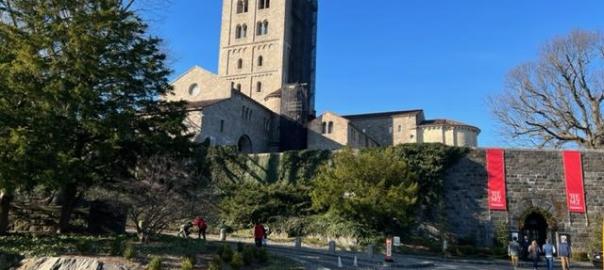
I love the holidays in New York City. There are so many Christmas themed events to go to and decorated homes to visit. One of my favorite tours is at the Met Cloisters for their Christmas themed walking tours that take place from December through early January.
The Cloisters Museum & Gardens: A Branch of The Metropolitan Museum of Art
To finish my weekend of holiday festivities before the Epiphany, I took the annual Christmas walking tour of the Met Cloisters. The museum hosts an interesting walking tour of the history of the holidays during the Medieval era. Each tour has a different theme to it. There is the history of Christmas in that era, the use of plants and flowers in the decorating of the religious sites and the historic significance of the visit of the Three Kings.
Each tour guide incorporates the artwork, architecture and plants into the discussion. On average you will have about forty people on the tour.
The entrance of the Cloisters decorated for the holidays
The entrance of the gift shop decorated for the holidays
The archways were decorated with seasonal plants and fruits. I read online that the volunteers went into Fort Tyron Park and collected ivy from the wild to decorate the museum. Every day the museum is open during the holidays these are replaced on a daily basis.
The entrance to the galleries decorated for the holidays
We started the tour with a discussion of plants that once decorated churches and ministries
With the change in attitude towards the Christmas holidays during the Middle Ages and its incorporation into church traditions, decorating for the holidays came back into style. The use of holly, evergreen and mistletoe became part of the Christmas tradition and to justify the decorating, they were related to Christian symbols.
The beauty of the life plants in winter
Each of the Cloisters were lined with fresh greens and potted plants giving each of the Cloisters its own special mood.
One of the Cloisters bright with plants
The stairs leading into the chapel decorated for the holidays
The chapel on the main floor decorated for the holidays
The colorful floral displays lining the window sills of the chapel
This led to a discussion about what each plant, flower and fruit meant in the Christian tradition, a clever way to justify decorating and celebrating during the holidays. Ivies, pine, winter flowers and even late season apples not only lined places of worship but gave a festive look and district smell to these buildings. A symbol of life in the cold winter months while they waited for the arrival of Spring.
The plant types that decorated the houses of worship
The flowers and plants lining the chapel
The decorative candle stands lining the walls of the chapel
We then toured the main Cloister, closed for the Winter but was lined with plants, flowers and greens brighting every corner of the building. These were examples of plants and flowers that would have decorated these halls at the holidays.
Walking the halls of the Cloisters
Touring the halls of the Cloisters with flowers and plants to celebrate the season
Walking the halls of the Cloisters
The flowering plants of the Cloisters
The flowering plants and vines that would have decorated churches in Medieval times
We then toured the Tapestry Room and discussed the use of plants in art form and the use of the detail as symbolism in art. These tapestries were meant to cover the drafty walls of palaces and bring in color and decoration to the stone walls.
The famous ‘Hunt of the Unicorn’ tapestry
We then took a detour to the outside gardens that are enjoying their winter slumber. These gardens were used by the cloisters for food, medicines and decorative use. They will start coming to life in a few months.
The Cloisters Gardens
The garden terrace over looking the Hudson River
The terrace gardens in the winter waiting to come to life
Then we went back inside for a discussion of the Three Kings and the Epiphany and its symbolism in art at the Cloisters. These are some of the works featured on the ‘Christmas Tide’ tour to symbolize that visit.
Some of the woodwork from that era
The Visitation of the Three Kings
The Visitation of the Three Kings depicted in stained glass
The Visitation of the Three Kings depicted in statuary
We visited the last of the Cloisters and discussed some of the plants in the collection
We were admiring the plants and flowers
A candelabra in the hallway of the Cloisters
As I exited the building that afternoon, there were potted plants at the entrance of the Cloisters. It was a real treat to walk around the building at the holidays.
The potted plants outside the entrance of the museum
On my way down the stairs and out the door to Fort Tryon Park, I took another walk down the stone steps and walked through Ann Loftus Park. This popular playground was quiet this time of year, awaiting the Spring and the wonderful warm afternoons ahead.
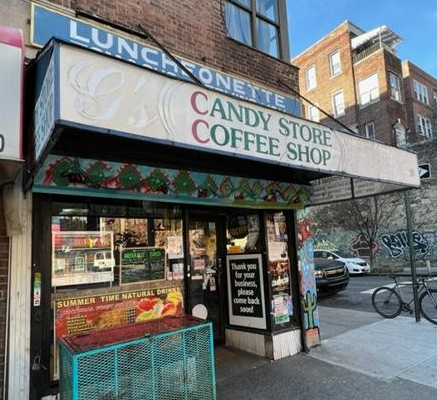
I love coming for breakfast at G’s Coffee Shop after a tour of The Cloisters. The food and service of this small ‘hole in the wall’ diner is wonderful. The meals are so reasonable and when you dine at the counter, you can watch the food cooked right in front of you. I had a wonderful Bacon, Egg and Cheese sandwich with a side of golden pancakes. What a great meal on a cold winter morning.
The Bacon, Egg and Cheese sandwich
The breakfast sandwiches here are so good
The pancakes were wonderful. The perfect comfort food on a winter day.
It was a really great tour, and it was fun to walk around the neighborhood through the parks and seeing all the post-Christmas decorations. Inwood is a really beautiful section of Manhattan with lots to do and see. It is the perfect place to spend the Christmas break.
The front of George’s Pizzeria at 726 West 181st Street
There are pizzerias all over Manhattan, some good and some bad and some indifferent. Some just stand out for the excellent food, service and price and George’s Pizzeria is one of them. I came across this wonderful little hole in the wall when I was walking the Washington Heights neighborhood for my blog, MywalkinManhattan.com. What stood out were the reasonable prices and the excellent food. The staff here also has a good repour with their customers and I think that is very important.
The inside of George’s Pizzeria
I just had a simple piece of Cheese pizza on my first two trips to George’s and the pizza is amazing. The sauce they use has so much flavor and I think this is the body of the pizza. The slice was perfectly cooked and even when it is warmed up, the pizza is consistently excellent.
George’s delicious Cheese Pizza
The Cheese Pizza here is excellent
When I came back another time during my Broadway walk, I tried the Cheese and Sausage Calzone and what a gooey delight. This overstuffed Calzone had three cheeses and lots of sliced sausage inside of it. It was served with a side of their homemade red sauce.
The Sausage and Cheese Calzone with an icy Coke
The Calzone was really nice sized and perfect for lunch
It was the perfect size for lunch and just right for the 13 mile walk down Broadway. It was a delicious meal.
Park Terrace Deli has been one of my go to places to eat uptown for a few years. I came across the deli when I was walking “The Great Saunter”, the 32 mile walk around Manhattan and needed an additional breakfast for extra protein and carbs. They did not disappoint me.
Park Terrace Deli at 510 West 218th Street
I always order the same thing here, the Bacon, Egg and Cheese on a hero roll ($6.50) and it is one of the best in Manhattan. They scramble two fresh eggs and then tuck it into a soft chewy hero roll lined with American cheese. Then they top it with several pieces of crisp bacon. The combination of flavors is amazing, and the portion size is enough for breakfast…
When I finally finished walking Sutton and Beekman Places, I finally decided to take the long walk down Broadway that I had planned for two years. As you can see by the blog, I like to take one neighborhood or section of the City at a time and concentrate on getting to know it. What is the history of the neighborhood? What is there now? Who are the shop keepers and the restaurant owners? What is the neighborhood association doing to improve the area? I like to become part of the neighborhood when I walk around it.
But recently I have noticed people on the Internet have been posting that they walked the entire length of Broadway and bragged about it like they were ‘performing brain surgery’. So I put aside my next walk and decided to see what the fuss was about walking up and down Broadway. I am…
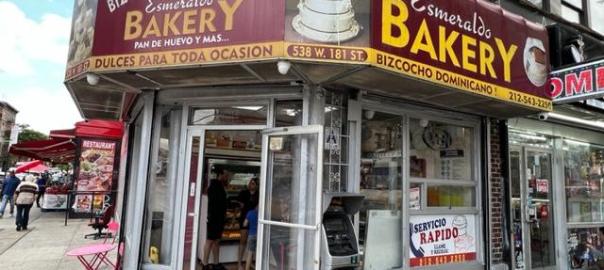
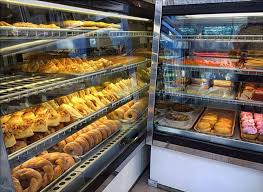
Esmeraldo Bakery is one of my ‘go-to’ spots when I am up in Washington Heights in Upper Manhattan. This Dominican bakery is very popular in the neighborhood and is in the middle of the busy shopping district between Broadway and Audubon Avenue along the 181st Street corridor. It has the nicest selection of baked goods and hot and cold snacks to choose from. The one nice thing I love about the bakery is that almost everything is a dollar or around that.
The cases are full of delicious doughnuts, turnovers and pastries
I have been the bakery on many occasions and have had a chance to ‘munch’ through a lot of the pastries. The Chocolate and Vanilla topped doughnuts ($1.00) are light, fluffy and have a nice chewy consistency. …
In honor of Small Business Saturday, I am featuring wonderful reasonable restaurants in New York City. Don’t miss the delicious baked goods and empanadas at this bakery! It’s worth the trip uptown.
The selection of baked goods at 5 Star Estrella Bakery is extensive.
I have been to 5 Star Estrella Bakery Corporation about ten times since my project, “MywalkinManhattan” has taken me to this part of the city. Washington Heights has all sorts of bodega’s and deli’s on every corner of the neighborhood but this one stands out. Everything here is very reasonable and delicious (See my reviews on TripAdvisor).
I have to admit that the baked goods can be a little hard later in the afternoon but the taste is still wonderful. I have had their vanilla and chocolate doughnuts and they are big, puffy rings with a thick layer of icing ($1.25). In the early morning, they have a soft pillowy consistency and in the afternoon, they can be a little harder but still good.
They have wonderful Pastellitos (similar to empanadas) filled…
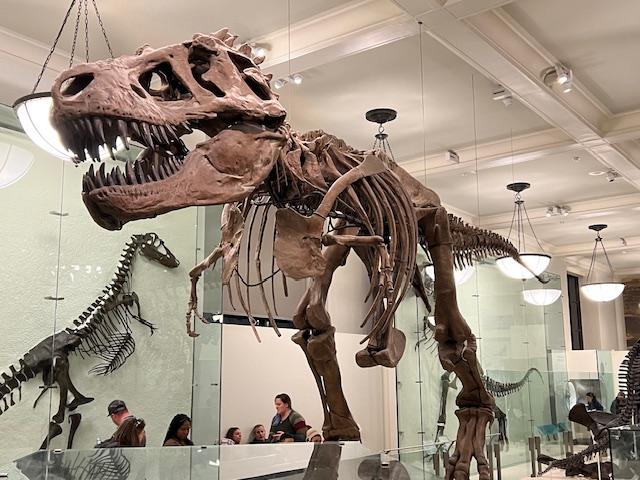
I went to the Museum of Natural History this morning for a walking tour called “The History of Sharks” that took us through several galleries as the tour guide explained the history of sharks from pre-historic times to present day.
‘The History of Sharks’ exhibition at the American Museum of Natural History
How we live with sharks, how their DNA developed over the years and a discussion on the famous attacks on the New Jersey shore in 1916 to the movie ‘Jaws’.
The Museum of Natural History
The museum runs these special tours for members and it was nice to explore the museum as a small group. Their volunteers do a wonderful job explaining things and the museum, in anticipation of a major rainstorm that never happened, was packed to the gills. I never see it that busy.
The Dinosaur Hall
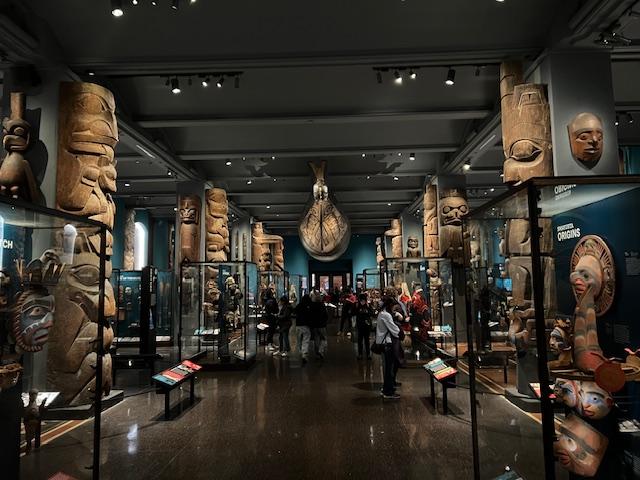
The Native American Wing just after the renovation of the hall
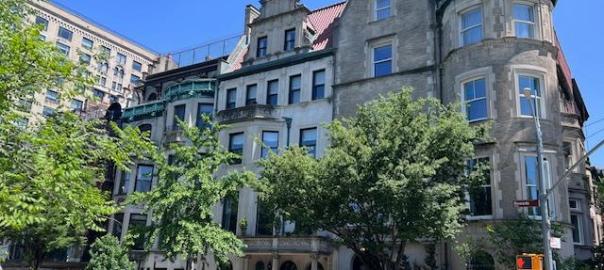
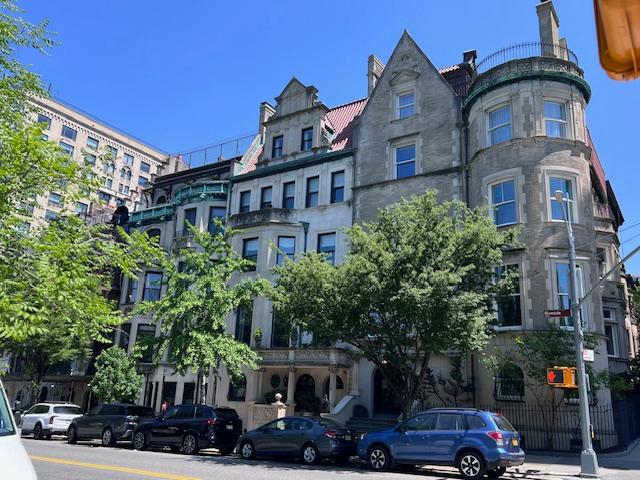
After my visit to the museum, I decided to take a walk up Riverside Drive. It was such a beautiful day with no sign of rain coming, I walked the length of Riverside Drive from 86th Street to 155th Street, crossed over 155th Street to St. Nicholas Avenue and walked down the street to 145th Street to get a better look at the brownstones and mansions and then back up to 155th Street and back down the other side of Riverside Drive to 110th Street and across to the subway station the corner of Central Park. This part of the walk took me past many historical sites and statues, past pocket parks and mansions and the beauty of Riverside Park.
The mansions that line Riverside Drive
First there is nothing like walking around the west side of Manhattan along Riverside Park. It is a truly wonderful park with people jogging, biking, sunbathing and picnicking. Everyone was really enjoying this clear, sunny Summer afternoon. On a quiet Sunday, the park is mostly yours depending on where you are walking.
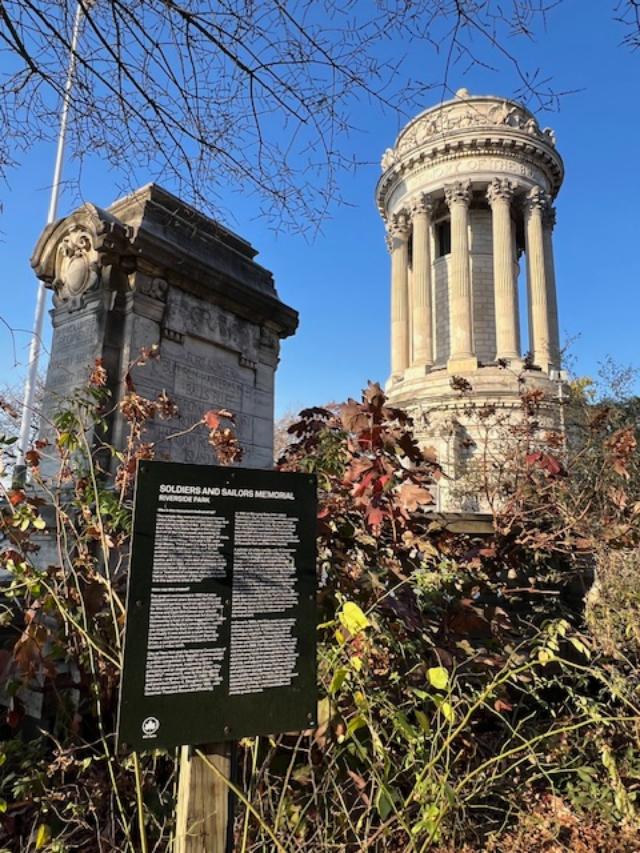
All along the way uptown, Riverside Park and Drive are lined with many memorials and statues. I was amazed on many were in the area of the drive. My first stop along the way was the Soldiers’ & Sailors’ Monument at West 89th Street that was dedicated to the Union Army soldiers and sailors who contributed in the American Civil War.
The Sailor’s & Soldiers Monument in the Fall of 2024
This structure was completed in 1902 and President Theodore Roosevelt presided over the opening. A very impressive structure that I can see most people miss. Part of the structure is still in disrepair but you can still walk around the pillared structure and gaze at its beauty.
Soldier’s & Sailors Monument on Riverside Drive near West 89th Street
I took a turn and swung into Riverside Park to visit a small playground and a very lively birthday party. I dropped into Hippo Park at 91st Street, a lively little playground with tons of kids running around, climbing on playground structures and actually acting like kids. I see far too many children obsessed with the cell phones not paying attention to what is going on around them. The kids were obviously having fun while the parents handed out food and gossiped amongst themselves.
Hippo Park is part of the Riverside Park Conservatory and run by volunteers in the neighborhood that also provides entertainment during the summer with outdoor concerts and a newly renovated playhouse for parties. Check out their website for details.
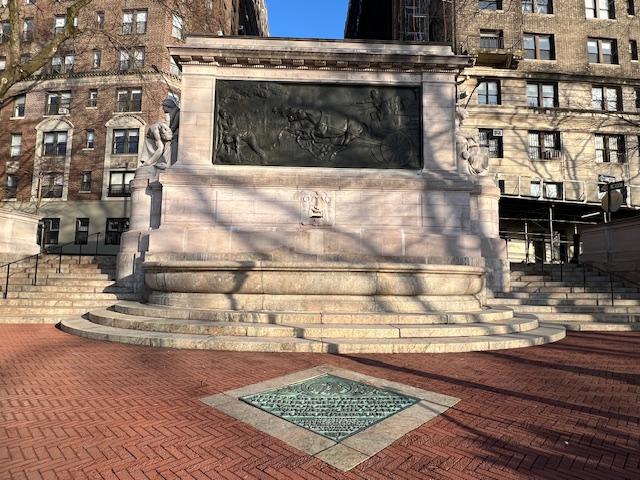
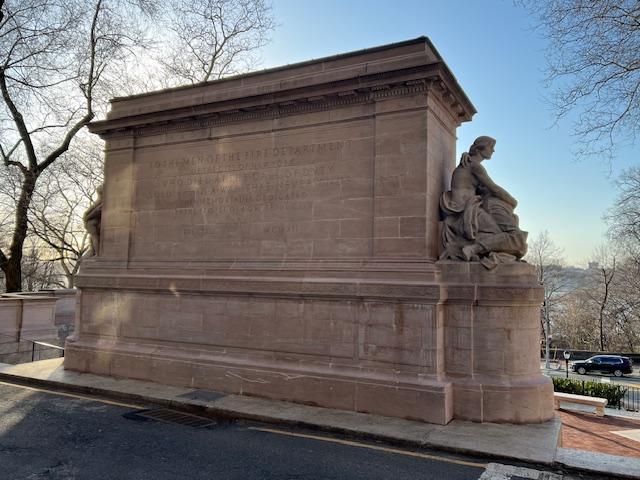
The next monument that I passed was the Firemen’s Memorial at 100th Street and Riverside Drive. This is a very quiet and relaxing sculpture that is dedicated to the members of the Fire Department who have lost their lives in the line of duty. This sculpture was dedicated in 1913 and has been renovated a few times since. During the tragedy of 9/11 in 2001, this became a vigil site for those morning the loss of so many members of the FDNY. This stop is a must for all fire fighters.
Firemen’s Memorial
The Firemen’s Memorial on Riverside Drive
My next stop was at the Franz Sigel Statue at West 106th Street. The majestic statue of a Major General in the Union Army during the Civil War. He encouraged many then German-Americans to fight for the Union. After the war, he became a proud New Yorker. This small park faced Riverside Drive on the other side of the street.
Franz Sigel Statue
As I continued the walk up further, the monuments continued with the statue of Samuel Tilden, a former Governor of New York located at West 112th Street. Tilden’s career was illustrious with fights against the Tweed stronghold in NYC and some saying that he had the Presidential election stolen from him with the Electoral College by Rutherford Hayes. His large estate and book collection helped found the New York Public Library.
Samuel Tilden Statue
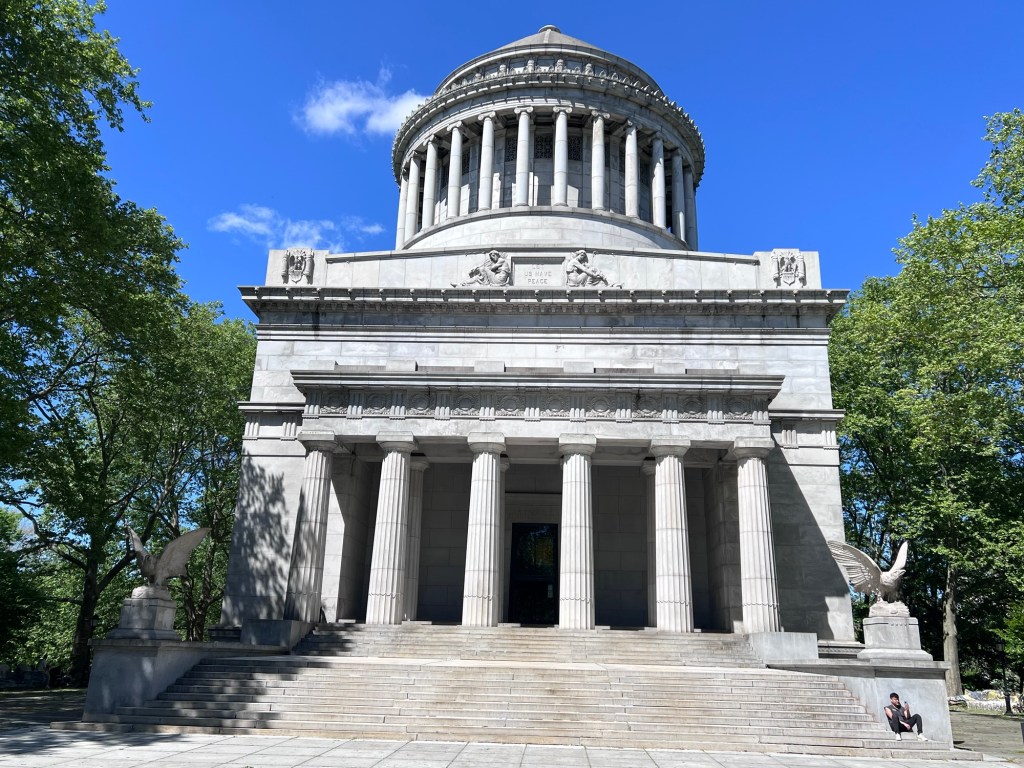
I finally made it to one of my goals for the day, Grant’s Tomb (see the reviews on TripAdvisor and VisitingaMuseum.com), the final resting place of our 18th President Ulysses Grant and his wife, Julia. This monument has had a love-hate relationship with the city. The President died of throat cancer in 1885 and his wife recommended that his burial place be in New York City over West Point and Washington DC as President Grant and his wife made this their home for the last years of their life.
The monument was finished in 1897 and the President’s remains were moved here before the dedication. His wife died in 1902 and was buried along side her husband. In 1958, the National Park Service took the monument over and was given a small budget to oversee it. In the 70’s and 80’s as the city had declined, this part of the park was a mess and the monument was vandalized to the hilt.
The graves of President Grant and his wife
It had gotten so bad at one point where the descendants of the family threatened to pull the bodies out of the tomb because of neglect. Since the 90’s, the monument and the park have been restored and it is open to the public for limited times during the week.
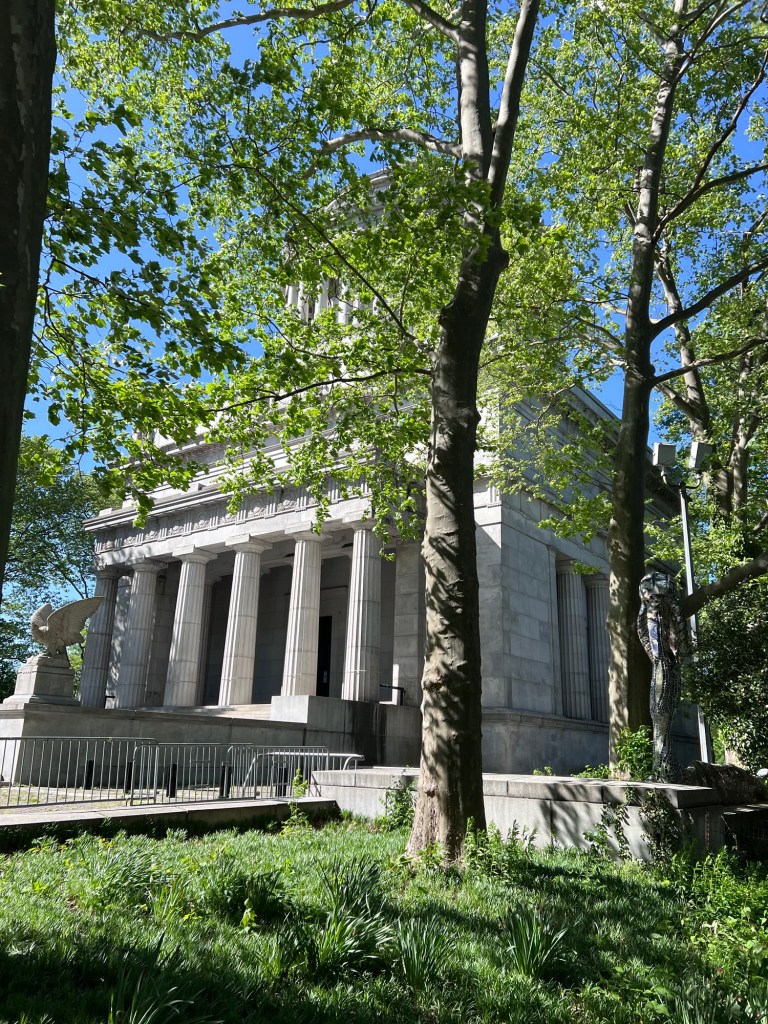
The side view of the tomb facing the park
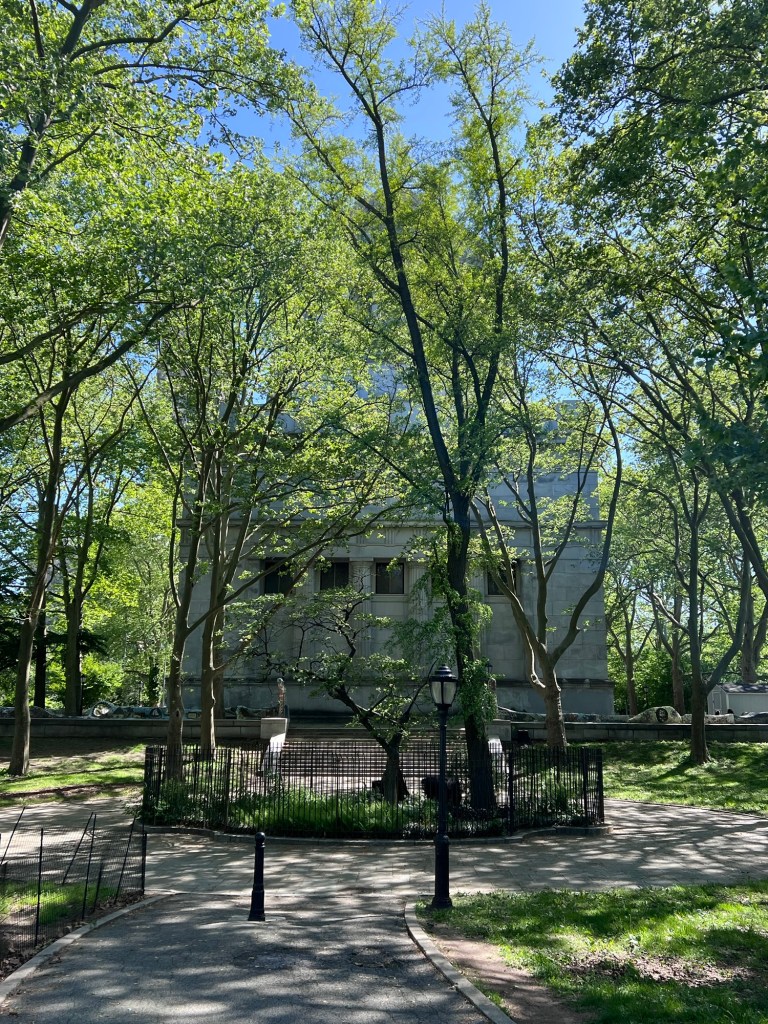
The park now is used for picnicking and parties as many were going on as I walked through the park. The tomb itself was closed for the day and was fenced off to the public. Not a good sign for the parks system for such an important piece of the city’s history.
The park behind Grant’s Tomb
The park near the tomb
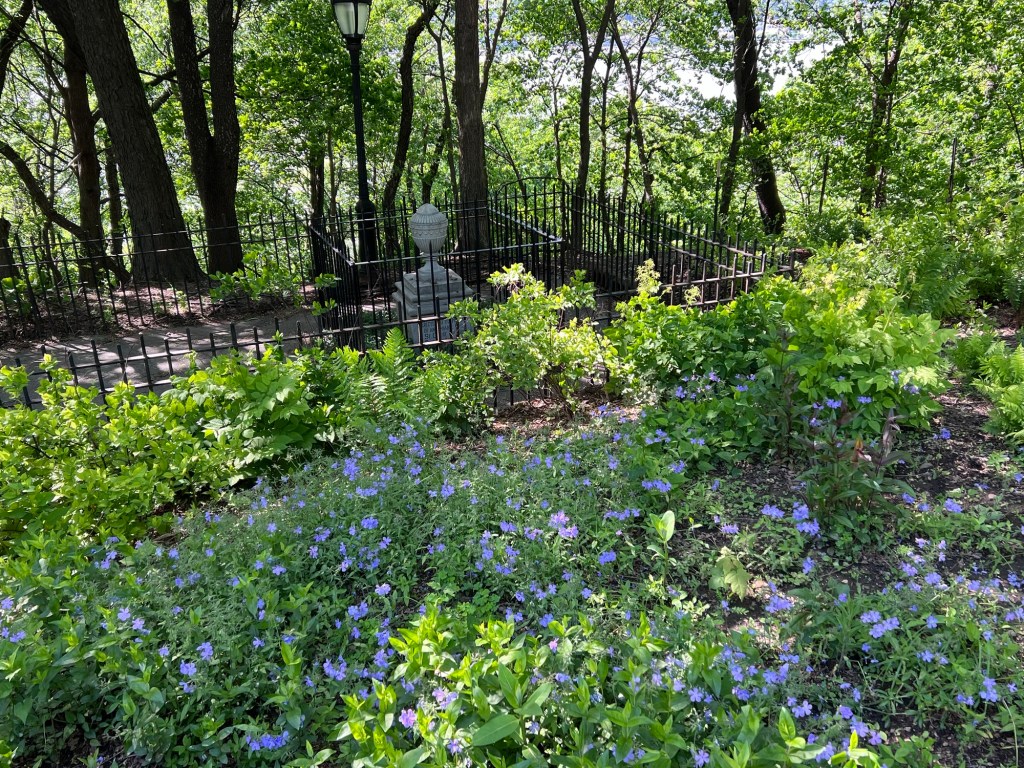
Off to the side of the monument, inside Riverside Park next to the path, is the Amiable Child Memorial (See review on VisitingaMuseum.com), the resting place to St. Clair Pollock. This touching little monument is dedicated to a child who died in 1797 in the fifth year of his life from a fall from the cliffs somewhere in the current park. It is one of the private graves located on public land. This small stone funeral urn is on a pedestal marking the grave. It is a very touching grave to a small child. I left a coin there as many have in the past.
I continued the walk up through the park until I hit Riverbank Park on 145th Street, one of the unique parks I have ever seen. The 28 acre park is built on the top of a water treatment plant that was inspired by parks built on roof tops in Japan. This park has everything. It has a pool, basketball courts, tennis courts, soccer field, baseball field, a cool off fountain and ice skating rink. It has it all and has the neighborhood embraced this park. The place was packed in all venues. It was a truly democratic park as all races play here.
I was most impressed by the number of families having parties and barbecues in the park. There must have been about a dozen birthday parties going on at once. The smells of barbecue meats and vegetables wafted in the air and the sounds of laughter and singing was all over the place. Even on a hot day, nothing stops people from having a good time.
I was most impressed by the Snack Bar located in the park’s main building. For $6.00, I got a cheeseburger, fries and a Coke and for a park snack bar they were really good. The portion size was generous and I can tell you for fact that the fries are excellent. Even if you don’t like sports make a special trip to snack bar and you won’t be disappointed. (See review on TripAdvisor)
After a 45 minute detour of this amazing park, I walked the rest of the way through Riverside Park until I hit Trinity Cemetery again and crossed 155th Street to St. Nichols Avenue again. I wanted to take a better look at the mansions at 150th Street in Sugar Hill. This section of Sugar Hill I did not have time to take a good look at the last time I was walking St. Nichols Avenue.
The Sugar Hill section is located in the Harlem neighborhood.
Sugar Hill Brownstones
The homes and brownstones in this area are just gorgeous and give you a totally different prospective of Harlem. Most of these buildings have been sandblasted and restored or in the process of being done. The mansions on the corner of 150th Street and Edgecomb Avenue hark back to a time when this was a very fashionable avenue and don’t miss the Bailey House that is fully restored.
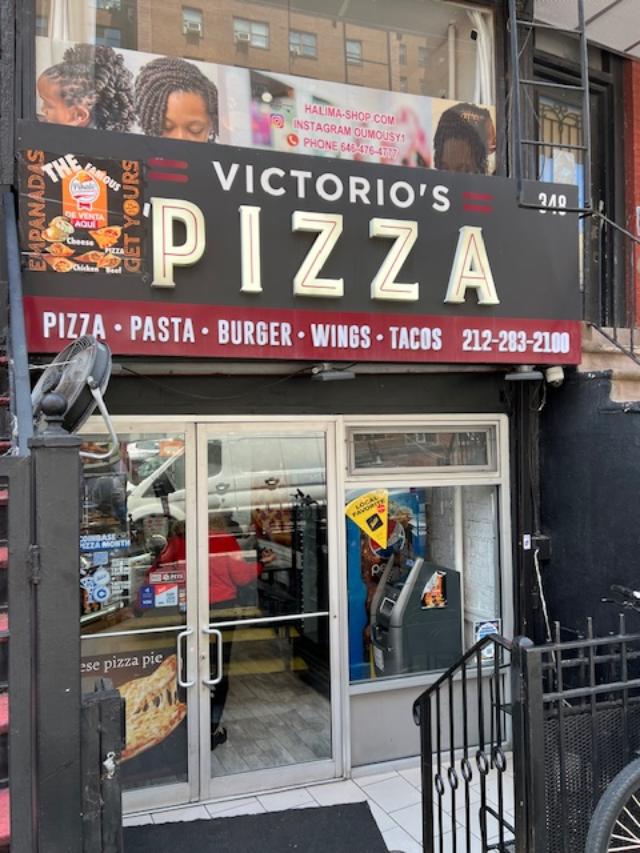
I took a pit stop and stopped for a quick slice of pizza on 145th Street at Victorio’s Pizza Plus at 348 West 145th Street and one of the best slices of pizza I have ever had for $1.00. The pie had just come out of the oven and it was a thin crust made with fresh mozzarella and it was heavenly. Flavorful sauce and the right amount of cheese that was cooked perfectly at any price the pizza was delicious. This is a must for all the CUNY students. (See TripAdvisor review)
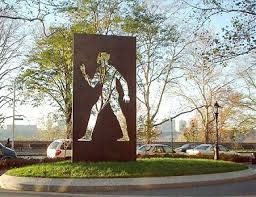
The walk took me back across 155th Street and back down Riverside Drive. The park, even at twilight is busy. There were so many bikers, joggers and walkers that you had to move a lot on the sidewalks. My last structure I saw as I walked down Riverside Drive was the Ralph Ellison art piece “Invisible Man” (the picture above) done by sculpture Elizabeth Catlett at 150th Street. Ms. Catlett was a artist who themes were the struggles of the Black experience with race and feminism. Her work was influences by Primitivism and Cubism (Art.net).
It was dedicated to the novelist work on his book “The Invisible Man” about his experience as a Black man during the Civil Rights Movement in NYC. Ralph Ellison lived in the area before he died in 1994. It really is quite the statue.
As I passed Grant’s Tomb, there were about three parties going on in the park. I don’t think the President even partied that much in one evening when he lived in the city. I could not believe that the park around the tomb would be this busy at eight at night. There were colorful lights all over the trees and a grill going.
I got to 110th Street around 8:30pm and as I rounded Riverside Drive to 110th Street the neighborhood which had been on the fringe for many years has completely changed. The area by Riverside Park had always been nice but as I walked further down the street this area has been sandblasted and rebuilt. Many parts of uptown that had been ignored for years look more like the Upper East Side.
I even saw people walking into Morningside Park which when I was working in the city in the 90’s was a death trap that you would not walk anywhere near but like the rest of the parks like Tompkins Square in the Lower East Side and Bryant Park behind the main library time has passed and they have been fixed up, cleaned up and the area around them now is priced higher.
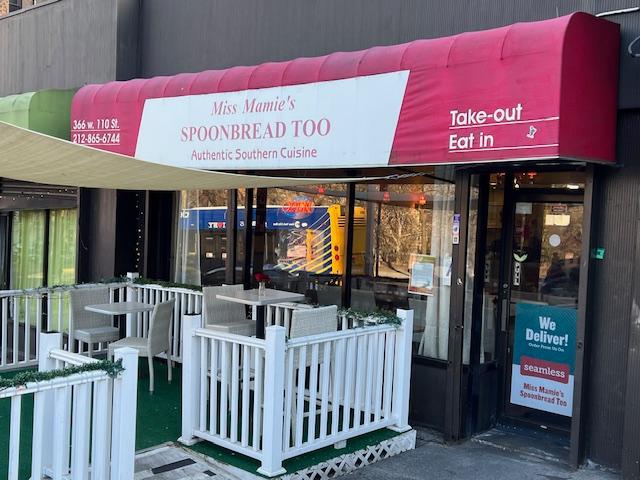
My last stop of the evening was Miss Mamie’s Spoonbread Too at 366 West 110 Street. This neighborhood staple has been around for years and in a much gentrifying neighborhood that seems to be getting away from its Harlem roots. I hope owns the building. The food and service were just excellent. The biggest problem I had with the restaurant is that I over thought how hungry I was that night. After a big lunch at 5:00pm and a slice of pizza by the time the food came I was barely hungry.
Miss Mamie’s Spoonbread Too at 366 West 110th Street
Miss Mamie’s is not to be missed. They had a dinner special that was $19.99 for a salad that was one of the best restaurant salads I had had in years. It was crisp with fresh lettuce and tomatoes with a light dressing, for the entrée was freshly fried chicken that was crisp on the outside and moist on the inside and the chicken had so much flavor to it. I had it with mac and cheese and candied yams, not the most healthy choices but after a five mile walk I figured I had burned off a few calories. It was so much food that I had to take half of it home with me along with the Peach Cobbler dessert that was included in the meal (See the review on TripAdvisor).
Miss Mamie’s Spoonbread Too
The service was friendly with out being overwhelming. I must give off certain vibes in this neighborhood because the waitress asked me if I was a lecturer for Columbia. I laughed at the one and asked why. She said I looked smart. I don’t know what looking smart is but I took it as a compliment. Usually above 110th Street every assumes that I am either a cop or DEA. Amazing what being tall is to people.
I ended the evening totally exhausted and took the subway from the 110th Street and Central Park West. Another sign of changes in the neighborhood is that I saw people jogging into the northern park of Central Park at 9:30pm. Things have really changed up here.
The weather finally broke and it was a nice day to continue the walk. It has been a mild winter but it is hard to find time to do much with work and my volunteer activities plus the job search to keep me busy. Wednesday brought a sunny, warm day to New York City and I was going to take full advantage of it. After a busy morning at the Holy Apostles Soup Kitchen, I took the A Train up to 207th Street and was about to complete the last leg of Washington Heights. I walked the entire stretch of Dyckman Street leading to Harlem River Drive to FDR Drive which covers the whole east side of the river. This part of my walk took from 1:45pm to 7:15pm. I walked fifty-two blocks both ways with stops in all parts of High Bridge Park.
The Dyckman Houses as you are walking towards Highbridge Park
First off, there are many changes going on all over Washington Heights since I started the walk in June. There is scaffolding all over the place and many businesses are starting to change hands.
The Dyckman Street Shopping District by the Dyckman Houses
There have been more upscale looking restaurants opening up all over the neighborhood, more renovations in the parks and more white residents jogging in the parks and walking their dogs is telling me that the neighborhood is transitioning. So many apartment buildings and brownstones are being renovated that the whole look of the neighborhood is changing.
High Bridge Park is under renovation
I started the walk on Dyckman Street walking by the very top of High Bridge Park by Fort George Hill right across from the Dyckman Houses. This part of the park could be quite pretty if it were not so full of trash. The beautiful rolling hills and trees are loaded down with garbage. It’s sad in that this part of the park is in such bad shape since it gives the impression of what Manhattan must have looked like when the Dutch arrived with rock formations and hanging trees. If cleaned up and properly landscaped, it could be breathtaking.
The entrance to High Bridge Park by Dyckman Street and the Dyckman Houses
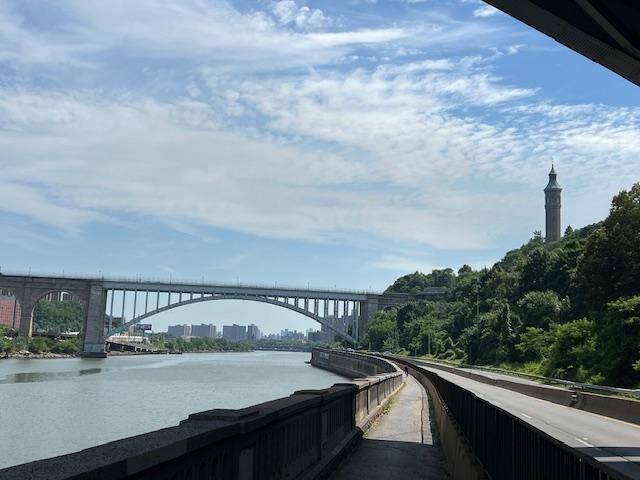
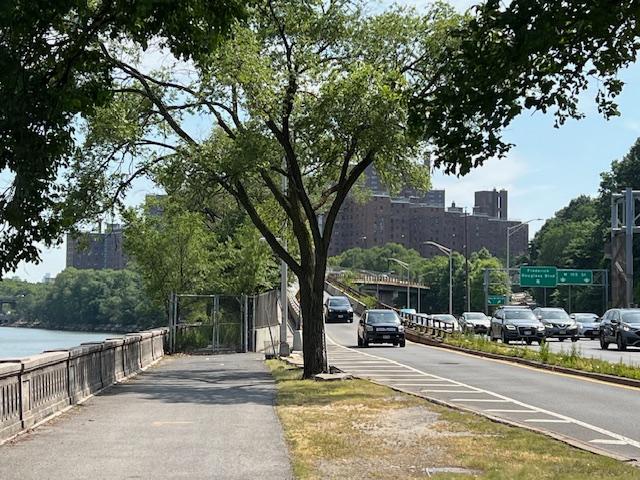
I walked down Harlem River Drive making stops inside High Bridge Park along the way. It is sad that most of the park is full of trash and not well maintained. All along the highway though interesting rock formations and flowering trees enhanced what you really saw by walking next to it.
By the time you get to 175th Street, you can’t walk any farther and you have to make your way into the park, which I had been through many months before the Fall. The parks system is working on the pathway from 175th Street to about 170th and then it stops again. You will have to walk down Amsterdam Avenue to about 166th Street where the park meets the local school parks and then take the path extension through High Bridge Park.
The beginning of High Bridge Park by Dyckman Avenue
During the day, I would trust this path but I would not venture through it after twilight. As you wind down the paths, go off the beaten track around 170th Street and you will see all the natural cliffs that overlook the Bronx. This winding pathways can be rugged so make sure you have comfortable walking shoes when venturing off the paths. The natural rock formations are unusual and there are many places to view the surrounding area.
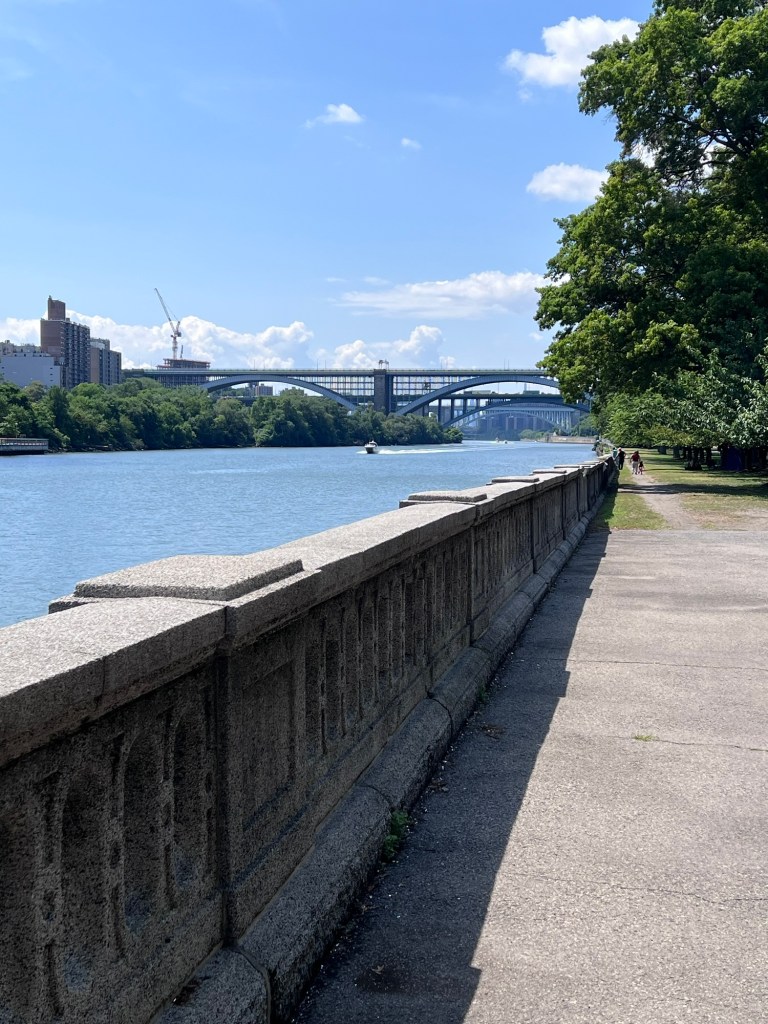
Walking the path down High Bridge Park by the East River
What was fascinating was the graffiti art work by the overpass at 175th Street. This form of tagging is all over Upper Manhattan and rather than a hindrance, the artists (or ‘taggers’) have an interesting display of faces and animals that would belong in any inventive gallery. The ‘x’ed out eyes on some of the cartoon like work hark back to the work of Keith Haring in the 80’s. Since these band of ‘gangs’ often paint over each other’s work, these pieces of art are in a constant state of flux and are ever changing.
High Bridge Park in not so good light
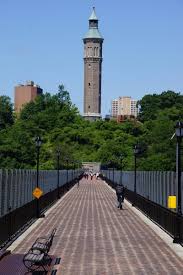
The famous High Bridge Water Tower that is located in the park between West 173rd and 174th streets was built in 1866-72 to help meet the increasing demands on the city’s water system. The 200 foot octagonal tower was designed by John B. Jervis in a mixture of the Romanesque Revival and Neo-Greco styles and was accompanied by a 7-acre reservoir.
The High Bridge Water Tower from the park
The High Bridge system reached its full capacity by 1875. With the opening of the Croton Aqueduct, the High Bridge system became less relied upon; during World War I it was completely shut down when sabotage was feared. In 1949, the tower was removed from service and a carillon was installed in 1958. The tower and the cupola were rehabilitated and restored in 1989-90 and the tower was designated a NYC landmark in 1967. Located behind the Highbridge Play Center, it is fenced off and you can only see it from a distance. (Wikipedia).
The Water Tower in High Bridge Park at 173rd Street
The Highbridge Play Center located at West 172nd and West 174th Streets was built between 1934-36 in the Art Moderne style. It was built on the site of the reservoir and features a very large swimming pool that has been closed since the Summer. It was designated a NYC Landmark in 2007. (Wikipedia).
These two landmarks are located once you exit the path off Harlem River Drive and take some time to walk around this part of the park. Another landmark you should not miss is the High Bridge, which is the oldest standing bridge in NYC. Built in 1848, it was built to carry the Old Croton Aqueduct over the Harlem River. (Wikipedia).
The bridge is fun to walk over and offers the most beautiful views of the river and the surrounding park. On a clear day, you can see for miles around and once the foliage comes back a nice view of the park.
The Bridge at 173rd Street
The pathway brought me back to the Morris-Jumel Mansion park, which I had visited right after the holidays and to the end of the park at 155th Street. I exited the park at 158th Street and walked down the Historic Brush Staircase.
Walking towards the Polo Grounds Houses
Named after John T. Brush, the owner of the New York Giants baseball team that used to play in the Polo Grounds, the stairs were built in 1913 and were used to go from the ticket booth that was located on the top of Edgecombe Avenue to the stadium below. When the Giants moved out and the stadium was knocked down in 1967 to be replaced by a public housing project in 1968, the stairs were in a state of disrepair. (Google).
Brush Staircase at 155th Street leading to the Polo Grounds
Renovated in 2014 and rededicated, the stairs takes you from the top of the park at 158th Street back down to Harlem River Drive. The stairs are a steep walk so remember to hold onto the rail on the way down. At the bottom of the stairs is a very scary vendor selling Spanish food that looks like it has not passed inspection so avoid it and maybe grab a coke like I did that afternoon. Make sure to look at the inscription on the stairs as it harks back to a time when this was a major sports area and a footnote in NYC sports.
I ended the afternoon by crossing 155th Street and walking down the stairs by the bridge into the lower part of 155th Street where the public housing was located. I have to say that I was pretty naïve to walk through this area with my ‘CIA’ hat on (Culinary Institute of America where I am an Alumni).
The Polo Ground Towers are a 15.5 acre parcel of land in which four 30 story towers were built on the site of the old stadium. It was a scary part of the walk as even the cops that were located by the Community Center would not get out of their car. It was funny though in that no one looked at me weird or even bothered my but I could see that the firemen on the fire truck exiting the projects and the police looked at me strange.
Everyone who lived there just went upon their business without even noticing me and I just walked around the projects down 155th Street and up and around Fredrick Douglas Drive and around Harlem River Drive West. There is a series of supermarkets, convenience stores and small restaurants. The area is isolated and pretty self-contained. I have to admit it is not the most pleasant place to live and looks plagued with problems.
The funny part is that when you cross the street onto 154th Street, you can see where the buildings are starting to renovate and it looks like new residents are moving into the area just one block away. I made my rounds down Fredrick Douglas Boulevard around the block and headed around the projects on my way back to Harlem River Drive and then crossed over to the overpass where the sidewalk started to go back up Harlem River Drive across from the end of the projects. That was another interesting part of the walk.
Walking by the path on the East River
As you walk up the left side of the highway facing the river, you will realize the true beauty of Manhattan island by way of the river. Many pleasure boats, rowing teams and flocks of birds habitat this area. It has a whole culture just based on the river and from across the street you don’t see the faults of High Bridge Park. Just the visuals of the park and the rock formations jutting out.
The Dyckman Beach at the end of Dyckman Avenue
As I finished the walk at Dyckman Street and crossed over Broadway, all the upscale outdoor cafes were open and loaded with customers signaling that the warm weather was back, and winter might finally be over. Mother Nature has a way of toying with us, but it looks like the cold days are behind us and we are looking forward to a warm Spring ahead.
Before I could finish my walk of Washington Heights, there were a few sights I wanted to see before it got too cold. So on a mild but brisk afternoon after a long morning in the Soup Kitchen, I visited the Little Red Lighthouse and the Morris-Jumel Mansion. I missed seeing these spots during the summer.
My first part of the trip lead me to 181st Street and the long walk down the street to Riverside Park. I was amazed of how beautiful 181st Street is at all seasons. It is still breathtaking in the winter as it is during the summer except you can see more. You could view more of the formations on the riverside cliffs at this time of the year.
The shoreline by the Little Red Schoolhouse.
Even in the short time since the summer ended, there have been many changes in the neighborhood. More buildings are under scaffolding and being sandblasted. A lot of storefronts are empty and the mom-and-pop businesses that I passed over the summer have closed their doors showing that the neighborhood is in transition. Slowly more expensive restaurants and shops are opening east of Broadway.
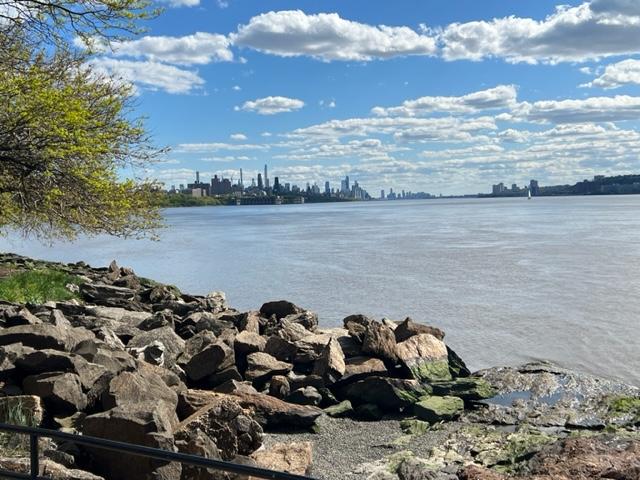
The view of lower Manhattan from Fort Washington Park in 2023
View of the George Washington Bridge from the park
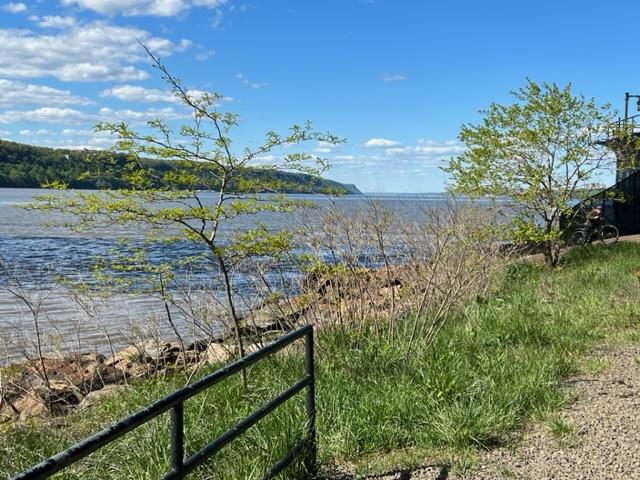
The park view in the early Spring
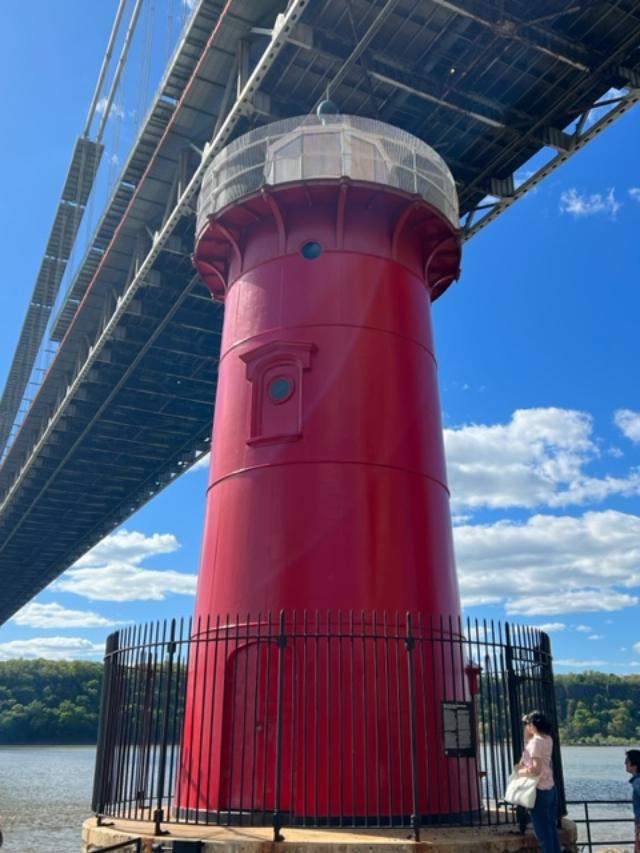
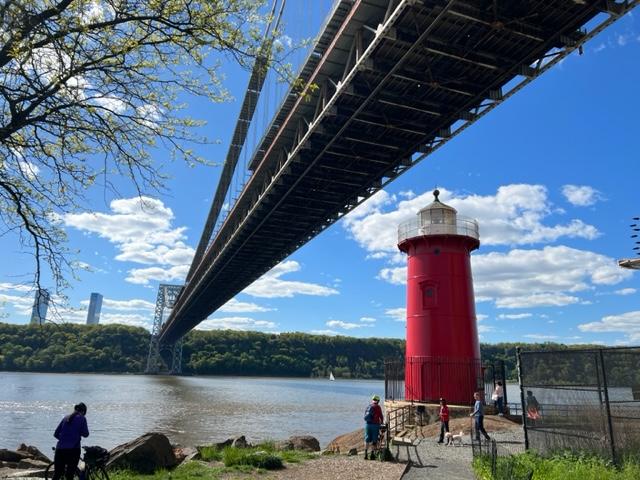
The walk down the path through Fort Washington Park is quite steep so make sure that you have comfortable shoes on and do your best to avoid the bike riders who speed by. At the end of the path, turn the corner and you will see the small lighthouse hidden behind a leg of the bridge.
The Pollinator Garden at the Little Red Schoolhouse.
It is rather unusual spot for a lighthouse, but it has a rather colorful past. Located underneath the George Washington Bridge along this treacherous section of the Hudson River once known as Jeffrey’s Hook, this is one of the few surviving lighthouses in New York City.
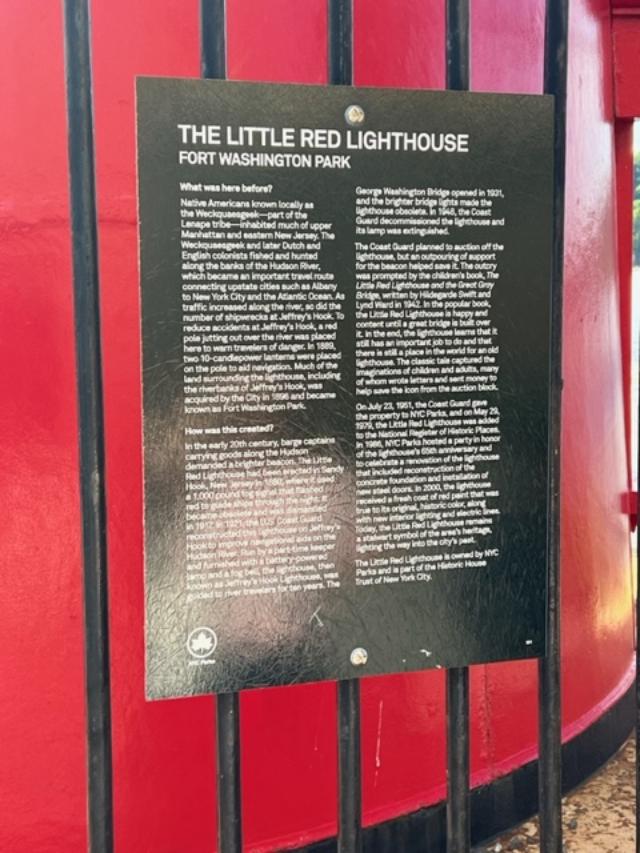
As traffic increased along the Hudson River, so did the number of shipwrecks at Jeffery’s Hook. In an attempt to reduce accidents, a red pole was placed at Jeffery’s Hook jutting out over the river to warn travelers of danger. In 1889, two 10-candlepower lanterns were placed on the pole to aid navigation. Much of the land surrounding the lighthouse, including the riverbanks of Jeffery’s Hook, was acquired by the City in 1896 and became known as Fort Washington Park.
The park in the late Summer
The Little Red Lighthouse had been erected on Sandy Hook, New Jersey in 1880, where it used a 1000-pound fog signal and flashing red light to guide ships through the night. It became obsolete and was dismantled in 1917. In 1921, the U.S. Coast Guard reconstructed this lighthouse on Jeffery’s Hook in an attempt to improve navigational aids on the Hudson River. Run by a part-time keeper and furnished with a battery-powered lamp and a fog bell, the lighthouse was an important guide to river travelers for ten years. The George Washington Bridge opened in 1931 and the brighter lights of the bridge again made the lighthouse obsolete.
The Little Red Lighthouse below the George Washington Bridge
The Coast Guide planned to auction off the lighthouse but an outpouring of support for the beacon helped save it. The outcry from the public was prompted by the children’s book, ‘The Little Red Lighthouse and the Great Gray Bridge’, written by Hildegarde Swift and Lynd Ward in 1942. In the popular book, the Little Red Lighthouse is happy and content until the great bridge is built over it. In the end, the lighthouse learns that it still has an important job to do and that there is still a place in the world for an old lighthouse. People then sent money to save the icon from the auction block.
The book “The Little Red Lighthouse and the Great Gray Bridge by Hildegarde Swift
In 1951, the Coast Guard gave the property to the parks and in 1979 it was added to the National Register of Historical Places.
(New York City Department of Parks & Recreation)
The path leading up from the park.
It is a neat little park under the bridge and should not be missed when visiting this part of Riverside Park.
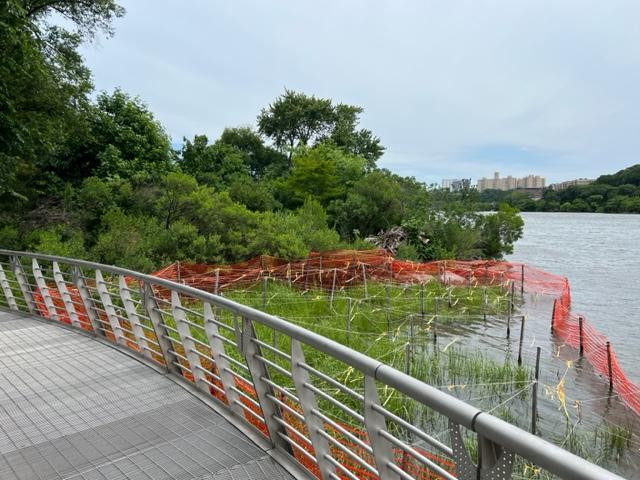
Instead of climbing back up the long path, I took a stroll down the paths of Fort Washinton Park and walked by the river that was so close that you could put your hand into it (don’t!). It was a beautiful walk to be so close to the river and see the vistas of the cliffs of New Jersey and view the river both up and down stream. On this cool winter day, the park had a few joggers but not too many other people.
My walk took me back to 160th Street and the cross bridge that took me back to the neighborhood that I had visited earlier this summer. This extension of Riverside Drive leads back to Broadway and I crossed back up to 161st Street to my destination of the Morris-Jumel Mansion located in Jumel Terrace right off High Bridge Park.
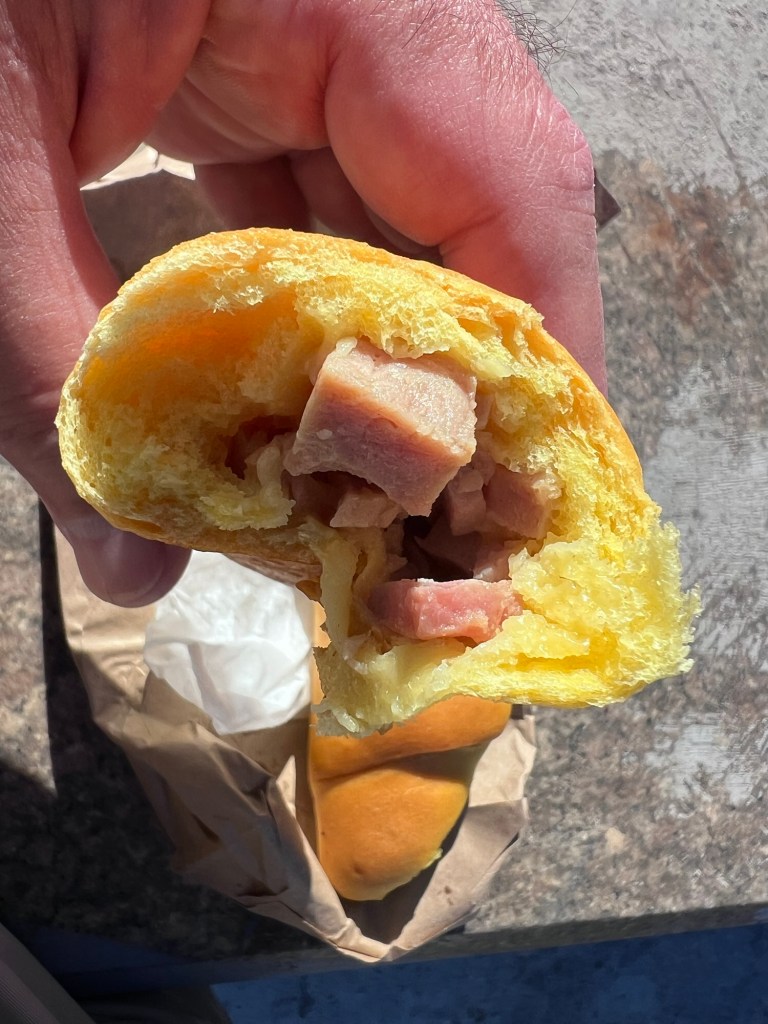
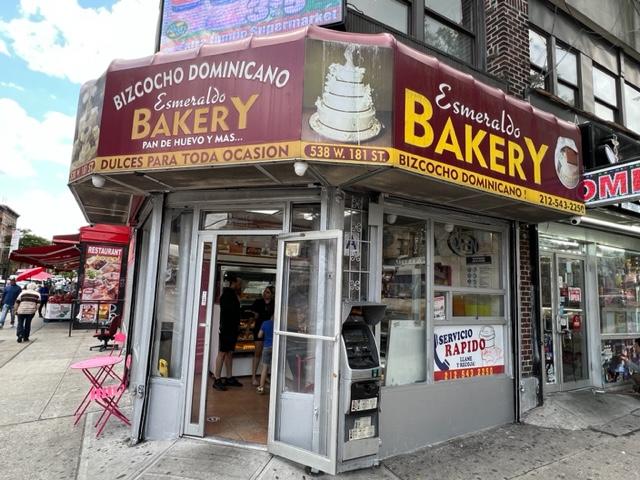
I made a pit stop for a snack at Esmeraldo Bakery on Broadway at 538 West 181st Street (see review on TripAdvisor and DiningonaShoeStringinNYC@Wordpress.com) for their Cubanitos, a sweet meat pie and Rellenas, a mashed potato meat pie that are deep-fried. They are so good and at 2 small Cubanitos for $1.00 and the Rellena for $1.25, it is quite a steal. Their doughnuts are really good as well. They are also $1.00. The staff always tolerates my broken Spanish.
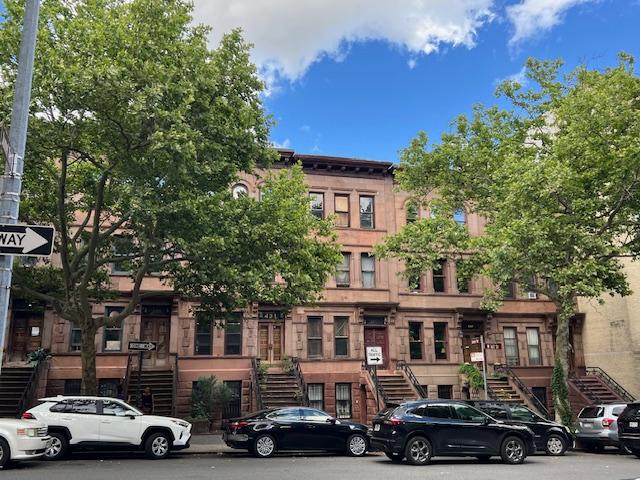
Jumel Terrace which is located between 162nd Street and 160th Streets located on a bluff overlooking the Harlem River on its own park like setting with great views of both the Bronx and other parts of Manhattan. It is surrounded by a neighborhood of beautiful, renovated brownstones, some still having their lights and decorations up from the holiday. It must have been beautifully decorated for Christmas.
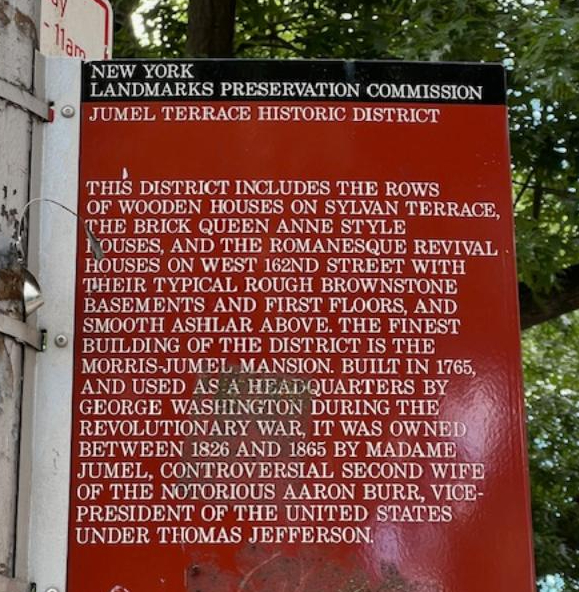
The Jumel Terrace Historic District in the Summer
The Morris-Jumel Historic District in the Spring of 2024
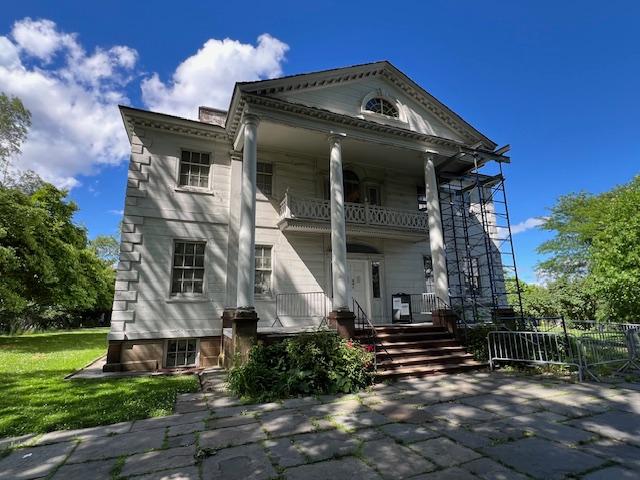
The Morris-Jumel Mansion, located at 65 Jumel Terrace, is the long surviving Colonial residence left in Manhattan. The mansion was built as a summer ‘villa’ in 1795 by the British Colonel Roger Morris and his American wife Mary Philipse, it originally commanded extensive views in all directions. It viewed New York harbor and Staten Island to the south; of the Hudson and Harlem rivers to the west and east and of Westchester County to the north.
Morris-Jumel Mansion at 65 Jumel Terrace
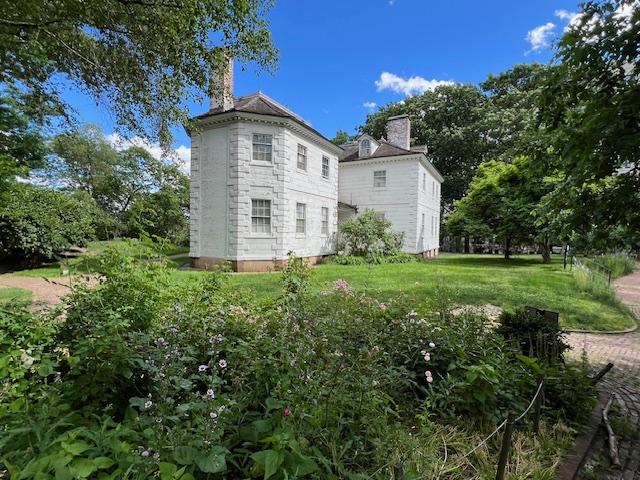
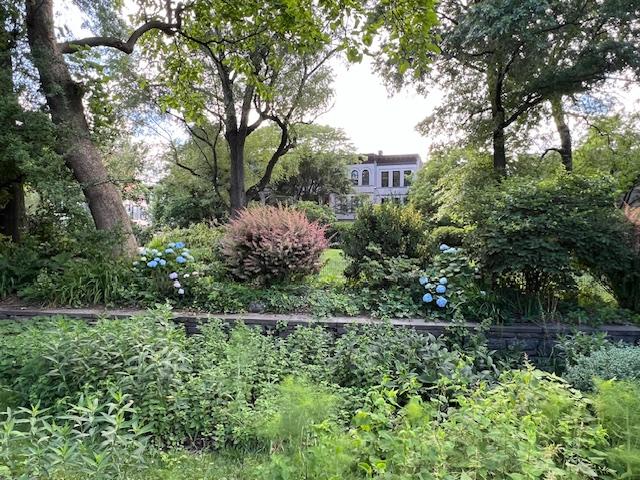
The grounds of the Morris-Jumel Mansion at the back of the mansion
Colonel Morris was the son of the famous architect Roger Morris, a fact which may explain the extremely innovative features of the mansion such as the gigantic portico and the rear wing which was the first octagon built in the colonies.
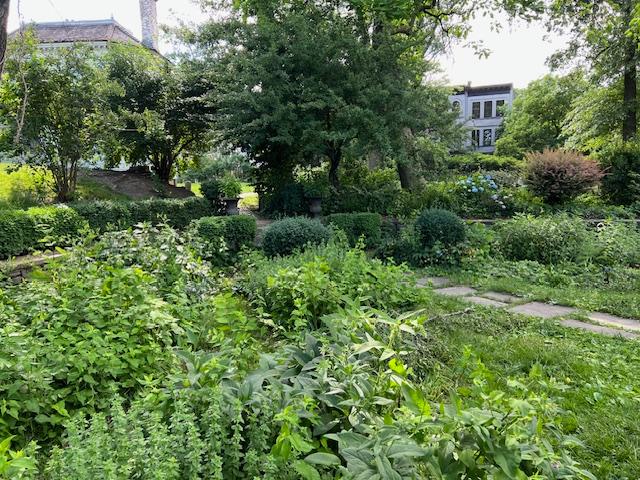
The Morris-Jumel Mansion Gardens in early Spring
The house’s situation and large size made it ideal as military headquarters during the Revolution and it was occupied successively by Washington, General Sir Henry Clinton and the Hessian General Baron von Knyphausen. As the Morris’s were loyal to Britain during the Revolution, their property was seized and sold after its conclusion. In 1790, Washington returned for a cabinet dinner at which he entertained Jefferson, Adams, Madison, Hamilton and Colonel Knox among others.
The Morris-Jumel Gardens with crocuses peeking out
The later history of the house centers on the Jumel’s. Stephen Jumel was a wealthy French émigré who married in 1804 his beautiful and brilliant mistress, Eliza Brown. They bought the mansion in 1810. In 1815, they sailed to France and offered Napoleon safe passage to New York after Waterloo. Although he eventually declined the offer, they did acquire from his family many important Napoleonic relics, some of which can be seen in the Blue Room on the second floor. Stephen died in 1832 and Eliza married the ex-Vice-President Aaron Burr in the front parlor one year later. They were in the process of a divorce a few years later when he died on the day the divorce was finalized. On Eliza death in 1865, she was considered one of the wealthiest women in America.
Spring flowers peeking out in the gardens
The History of the Mansion:
(Morris-Jumel Mansion welcome Guide)
The house tour is self-guided and you are able to walk all around the first and second floors as well as the kitchen in the basement. The mansion had just finished having all the holiday decorations packed up for the season, so the mansion was in a little disarray. The kitchen is really interesting with all the period cooking tools in which we take the electronic ones so much for granted today. The antique waffle iron is really interesting.
The kitchen at the Morris-Jumel Mansion
The kitchen was set for the summer harvest
The upstairs bedrooms have been restored and you get to see where Aaron Burr slept. Eliza had adopted her niece and she became Eliza’s daughter and her children her grandchildren, which by the painting in the house she must have been very fond of growing up.
The historical account of Aaron Burr
Aaron Burr’s Bedroom
The historic description of Eliza Jumel’s bedroom
Eliza Jumel’s Bedroom
William Chase, Mrs. Jumel’s grandson’s room
William Chase’s bedroom
In the summer months, the gardens are really nice to walk around in and are nicely landscaped. On a cool winter afternoon, it was nice to sit outside but there was not much to see. The mansion is definitely best either during the holidays or in the warmer months.
The entrance hall with the portrait of King George’s brother
The French Parlor historic sign
The French Parlor on the first floor of the home.
The Dining Room historical sign
The Dining Room off the main hallway
George Washington’s War Room on the second floor when he stayed at the house.
George Washington’s War Room and Office during the Battle of Harlem
The second floor hallway
It was nice to visit these sites as I missed them most of the summer and both are worth checking out. If you need to have dinner before leaving the neighborhood, Broadway is lined with many interesting Dominican restaurants that are reasonable and have nice menus.
When I revisited the mansion in June of 2024, the mansion was open for touring and walks on the grounds. They were also getting ready for a concert later that afternoon so I was able to tour the whole house in about an hour.
The Morris-Jumel Gardens in the Spring of 2024
The mansion and the grounds need a lot of work but you can see where the restoration has been coming along. There is still work to be done on the house to bring it back to its former glory.










































 mywalkinmanhattan