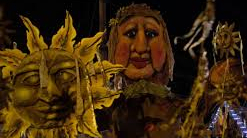
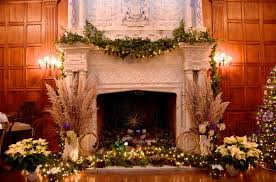
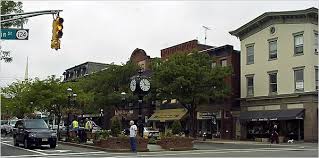
There has been a lot of visits to my other blog on my visit to Woodstock, NY for Christmas. I wanted to share this earlier one with everyone as well. The parade on Christmas Eve should be experienced once and you will see the magic of Woodstock, NY at the holidays. It is amazing!
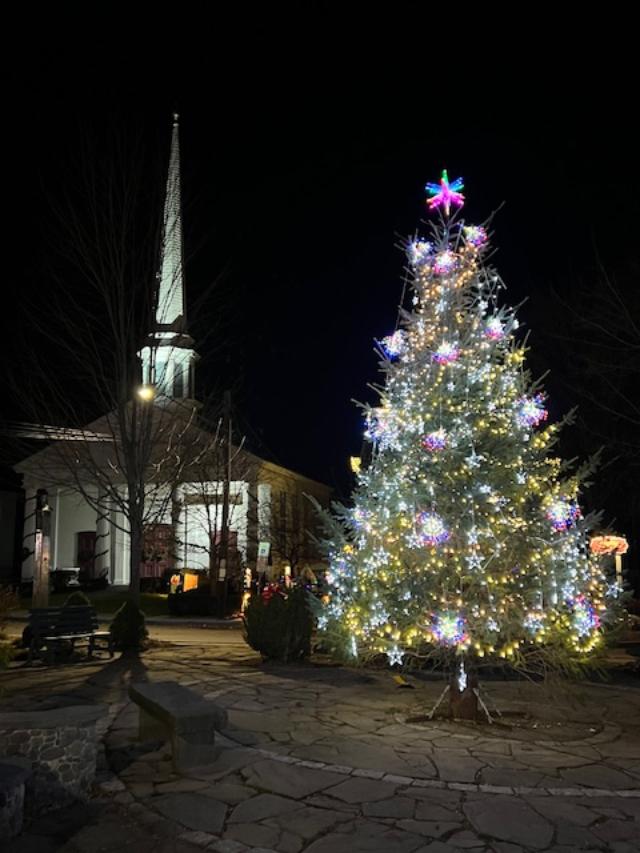
The Woodstock Square at Christmas time after the parade and lights are over. A relaxing evening after everything is over. The parade ends by 6:45pm and church services at the Dutch Reformed Church end by 8:00pm. Then all is quiet outside.
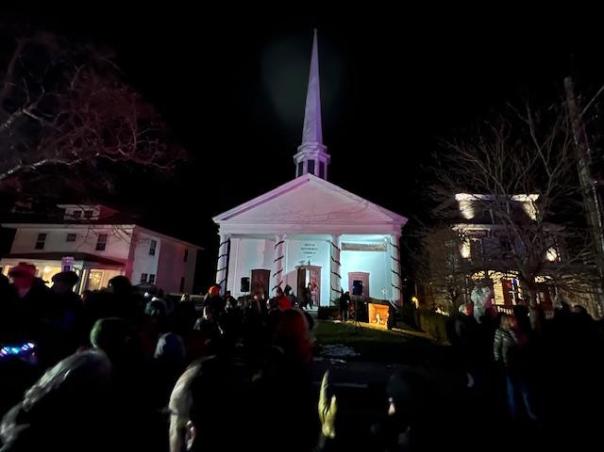
The Woodstock NY right before the start of the Christmas Parade
There is always excitement in the air from the crowds that come to see the parade and how Santa will make his appearance. I look forward to this like everyone else in the crowd.
I put my walking project in Manhattan on hold to participate in other activities that I was organizing during the month of December. Trips in the city became day trips to the museums, walking tours and many holiday events that was I was invited to or helped organize for other people.
Some of the memorable events I had was organizing my holiday party at work. I work with the disabled who are a very active bunch of people. I make sure that there is always exercising, stimulating speakers and lively engaging conversation. These are not people who will ever sit on the back of the bus if I can help it. I always want them to know you can get better and make better of any situation.
We had a lively party with exercise, music and good food. As I do every year, I have the Bamboo House 28 South…
This annual Dutch Christmas festival has become part of my Christmas tradition since I visited Rhinebeck for the event in 2010. Rhinebeck, New York is the true Currier & Ives town at Christmas time and one of the most quintessential Hudson Valley town that retains it charm being so close to the City. I love coming up here not just for the event but as you have noticed by my most current blogs, I have spent a lot of time here in the Summer and Fall letting readers know of all the wonderful events and happenings in the area.
I have to say I was not used to Christmas creeping up on me like this. It had only been five weeks since we had the Halloween Parade in the City and puppet rehearsals had only been five and a half weeks earlier when I visited Rokeby. That and it had been 71 degrees on Halloween night and Sinterklass night it was more like 25 degrees. I could really feel the drop in temperature that evening.
Having just returned from Florida over the Thanksgiving break, I had been in class giving a quiz to my students that morning and reviewing over their group project and various chapters in the book for the upcoming exam. So I did not head Upstate until almost noon. I got up to Rhinebeck at 2:00pm and that is when it set in that the snow storm that had hit New Jersey was very different from the one Upstate. The storm had been worse Upstate than it had been in New Jersey and there was still a foot of snow in Rhinebeck. I didn’t get to the main street until 2:30pm.
The side streets were closed off on one side because the snow was still piled high. So it was an eight block walk on snowy paths to the Main Street of Rhinebeck which had fully cleaned up for the parade. What was nice this year was the first three blocks of the downtown area were closed off so you could enjoy the bands and acts walking around.
Rhinebeck when the sun goes down at Christmas
The Rhinebeck Christmas tree
It was a cold afternoon and I noticed that the crowds were not as large as they usually were for the event. Still Rhinebeck at Sinterklaas is festive and engaging environment. There were crowds weaving in and out of the restaurants and stores and the windows were decked out for the holidays with interesting holiday displays and lit stars from the parade. All around town there bands playing, people on stilts singing and grumpuses (Sinterklaas’s helpers) dancing around and chanting. You could see that people were freezing but still having a really good time.
The Grumpuses, Sinterklaas’s helpers dancing in Downtown Rhinebeck, NY
I was able to get to see some of the musical performances at the churches before the start of the parade and warm up. Even the audiences did not seem as busy as they had in the past but still people were enjoying the performances and stopped shivering.
Don’t miss this performance of Uptown Lowdown in downtown Rhinebeck that afternoon. The ladies were wonderful!
Sitting in the church pews and listening to groups was enjoyable. There was only about two hours before meeting at the Starr Library for the parade so I chose my shows by groups I had not heard in the past.
I started at 3rd Evangelical Lutheran Church listening to the Bard College Georgian Choir, who sang traditional Georgian Christmas music, which was interesting. I did not understand the words but the music was enjoyable. The students did a nice job.
This is some of their work at another concert
After that, I took a short walk to the other side of the downtown and heard the Vassar Devils at the Reformed Church Sanctuary. They were lively, peppy bunch that sang traditional Christmas carols with a jazzy spin.
This is the Vassar Devils at the 2015 Sinterklaas event
After the concerts, it was a quick walk to the Starr Library to get ready for the Sinterklaas Parade. There is always a lot of excitement to the beginning of the parade and getting ready to march down the hill. For some reason, I don’t remember it getting so cold so early in the season.
The temperature dropped as the sun went down. Everyone was excited as we lined up for the parade and got ready for the walk through the downtown. All I could think about is how fast the year had gone and how I had this conversation with myself when I walked the parade last year. Were the years getting quicker between the parades?
There is an exhilaration when the parade progresses down the hill into Downtown Rhinebeck and the whole town is lit with white Christmas lights and illuminated stars that represent the parade. It may have seemed quiet in town that afternoon but the crowds were out for the parade. There must have been about a thousand people lining the street on both sides. It was a big crowd filming the parade.
There is always such excitement to this parade. Similar to the Barnacle Parade that I attended in October (Day One Hundred and Fifty One The Barnacle Parade see below), this is a home grown parade that just keeps getting bigger. When I first starting coming to the Sinterklaas Parade back in 2010, it was more local people. Now you have people coming from many states to join in the festivities. Even the cold kept people from the day’s activities, they came for the parade.
Marching toward the end of the parade with Mother Nature, this is the second year of carrying the ‘star forest; puppet (I am not pulling my back out for something heavier as in the past), we get to see the other puppets, floats and bands head down the hill. You can see the multiple lights from the other puppets and the raging sounds of the bands and the Chinese Dragons as they head down the hill to town.
You can see me in the corner holding the Star Forest puppet by Mother Nature with my Cornell Pom-Pom hat on marching to keep warm. It is an exciting night!
There is always a delay as you get to the Route 9 crossing near the Beekman Arms Hotel for the performance of the “Wild Women of Rhinebeck”, who perform their annual dance and for the ‘Dragon Dance’ that the Chinese dancers perform. It is really fun to see up close if you get the chance.
When we entered the downtown, all the kids were excited to see the Mother Nature float winding by. The parents were just as excited as they high-fived Mother Nature as they passed by groups of people. The drum line was going in full beat just behind us followed by a large group of parade goers marching in the parade with their lit stars. It was exhilarating and fun to watch from the marcher’s point in the parade. On such a cold night (by this point it was 25 degrees), I could not believe that many people were lining the parade route.
As we rounded the corner into the Rhinebeck Municipal lot to end the parade and drop the puppets off, we were greeted by a huge roar of people and the announcements from the stage for the final part of the parade. I just dropped my puppet off and enjoyed the stage show as the drum line passed by.
The stage performance was with all the main characters of the parade, Sinterklaas, Mother Holly, the Snow King and Queen, the Mermaid Queen, the Midnight Moon Princess and various members of the Sinterklaas Parade Committee who run the parade. it is a ceremony that honors the children, ‘The Kings and Queens of Sinterklaas’, for the evening.
The Closing ceremony
There were musical performances, dancing, prayer and then the fire jugglers entertaining us. The audience had thinned out by this point and about a hundred and fifty people were standing in the parking lot watching the ceremony. It was getting even colder by the time the fire jugglers started. After the last announcement for the parade events next year, the crowd started to disperse. It did not take long to watch crowd leave as it got so cold.
I walked around downtown Rhinebeck for about twenty minutes letting the crowds thin out and the traffic leave but by that point the town really quieted down and most of the cars were gone as I did not see that much traffic.
It was fun to walk the town one more time and admire the beautiful Christmas windows of all the stores and the sparking white lights that lined the trees on both sides of the main street of Rhinebeck. It is really is picturesque.
Downtown Rhinebeck is so beautifully decorated for Christmas
I had full day of work the next day that including decorated houses to visit, historical society events to attend, an Afternoon Tea at the Newark Museum (see review on TripAdvisor and VisitingaMuseum.com) and then an evening selling Christmas trees for the Hasbrouck Heights Men’s Association (see blogs on Christmas on MywalkinManhattan.com) so staying overnight in Rhinebeck was not possible this year. It was going to be a long ride home.
It was worth it and a lot of fun!
Happy Sinterklass and Merry Christmas!
Check out the videos online on the Sinterklaas Parade on YouTube. It is an exciting night!
My Halloween Blog on the Halloween Parade in October:
In honor of Small Business Saturday I am sending out merchants I have found on MywalkinManhattan. Don’t miss this unique toy store. A real one of a kind.
I discovered this store for the first time on my walking project, ‘MywalkinManhattan.com’, when I was walking the Upper East Side. Coming from the Toy Industry (I worked for FAO Schwarz for four years in both main New York store on Fifth Avenue and the Minneapolis store for four months in 1987), I recognized the beauty and fun of the Tiny Doll House.
When I walked in I was greeted by a woman who explaining the store to another customer. One side of the store has all sorts of things to decorate a dollhouse that were all handmade like dolls, food, furniture and accessories that would be the envy of any home. Even the paints to put over a doll house mantle were hand painted (or at…
Note: The Skylands Manor is decorated for the holidays during the first week of December and only for one weekend as it used for a banquet facility the rest of the time and as a hotel. The first weekend of December is when local Gardening groups are assigned one room to decorate and they have one week to put it together, display their ideas and explain how they did it to the public.
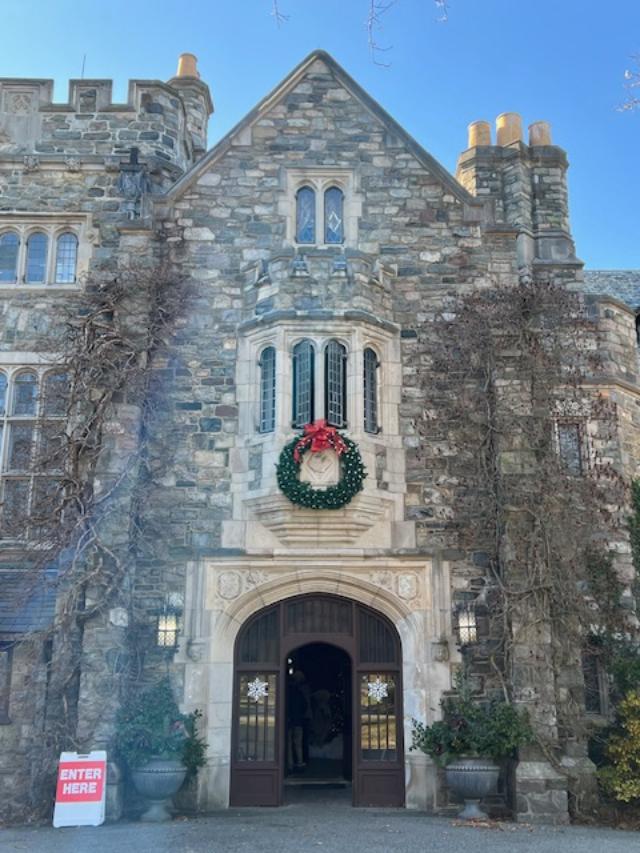
The front of the Skylands Manor during Christmas time.
The best day to go is the Thursday afternoon opening as it is the quietest day of the four day event with Saturday being the busiest. The best time on Thursday to come is in the morning.
In 2019, the decorations were not as elaborate as the previous two years. The snow storm before the event may have put a damper on a few of the groups decorating. Still the best day to visit the manor is Thursday afternoon as it is the quietest time and you can take the best pictures.
The two best rooms in the manor in 2019 were the Entrance Hall and Grand Staircase decorated by the Magnificent Seven, a group of volunteers whose theme was ‘The Secret Life of Gnomes’ and the trees and staircases were studded with gnomes, large and small, on the trees and wreathes surrounding the stairs.
The other room that was very impressive was the Center Hall whose theme was the “Enchanted Forest, full of little fairies and painted rocks and jeweled winged ornaments. When you looked at the detail work of the trees and table displays you could see the work that went into the decor. Each little fairy on the stands and trees had immense detail and took a lot of time. This display was done by the Friends of Laurelwood Arboretum in Wayne, NJ.
The rest of the rooms in the manor were really pared down from 2018 and did not have the same elaborate details to them. The Library and Study did not have half of the display items that they did in the past.
The Carriage House was used as a restaurant and a gift shop during the event.
The fee to enter the home is still $10.00. The carriage house is being used for a cafe with Chicken Salad sandwiches and hot dogs with toppings. There are all sorts of crafts for sale.
The menu at the pop-up restaurant at the Skylands Manor.
Watch the calendar for 2024 in early December for the next display.
The Display in 2023:
It was just breathtaking!
This was the first time I had visited the mansion and I was able to visit on Thursday morning and the crowds were very small. This is the best time to come to the Skylands Manor.
The house looked amazing as usual and because I came the first day in the morning, it was the perfect time to visit the manor while the crowds were away.
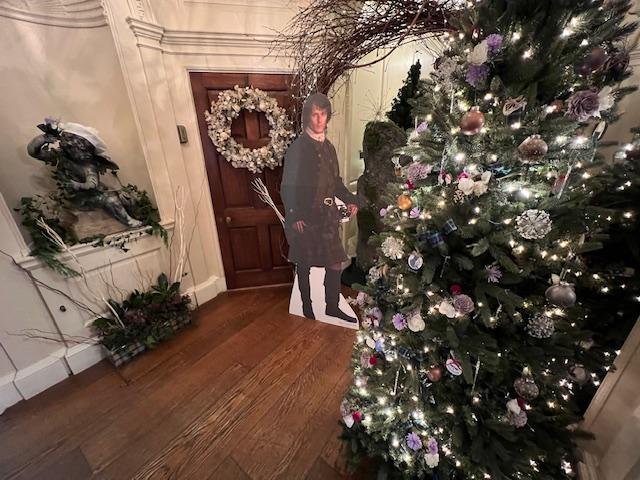
The entrance to the house was decorated by the Passaic County Parks and Recreation. This display was based on the magic of the Scottish Highlands.
After passing through the entrance of the house, it was off to the Ladies Parlor of the home and the decorations of the Garden Club of Teaneck. Then off to the Dining Room that was decorated by the Master Gardeners of Bergen County.
The Master Gardeners of Bergen County were very detail orientated with their display spreading the Christmas cheer as you entered the house. The next room was the Breakfast Room with beautiful sunlight coming into the room and views of the gardens that are dormant at this time.
The theme of the Breakfast Room was that of enchanted forests with sacred fairy springs and moss covered meadows. The Breakfast Room was decorated also by the Master Gardeners of Bergen County.
As I left the Breakfast Room, I entered The Center Hall where the many faucets of Robert Burns, the Scottish author of “My Heart is in the Highlands” themed room was decorated by the Ringwood Garden Club.
The Back Porch of the house just off the Center Hall.
The room was done with the theme “We wish you Blythe Yule as you enter a pastoral view of Holidays in the Highlands”.
The next room I visited the was The Great Hall, which is a Jacobean style interior designed to impress with its arched beams, paneled walls and spectacular stained glass windows (Skylands pamphlet).
The Great Hall decorations by the fireplace off to the side.
I next walked through The Octagonal Hall, that is the transition room between The Great Hall and The Withdrawing Room/Living Room. This was transformed into a boutique lounge with custom made furniture and decor. Festive pops of pattern and color create a merry, modern vibe (Skylands pamphlet). The Octagonal Hall was designed by Stephanie Graham and Diane Simon.
The Living Room was decorated to celebrate a Hip Highland Holiday and transformed into a boutique lounge with custom made furniture and decor. The Living Room/Withdrawing Room was designed by local artists Nicole Cohen (Teaneck), Brenda Gallagher (Upper Saddle River) and Lisa Williamson (Ridgewood).
Transitioning out of the Living Room into the The Study, this room with its window seat is the perfect place to curl up with a good book or share stories of Christmas on a snowy afternoon. The study was designed by artist Linda Karen.
The last room on the tour was The Library that is resplendent with the holiday tree decorated with hundreds of lights and a myriad of ornaments representing the Scottish heritage of its owners (Skylands pamphlet). This room was designed by the Master Gardeners of Passaic County.
The Living Room was the last decorated room in the manor home for the holidays. I exited by the back door and then explored the grounds and the dormant gardens and look out areas of the estate that must look quite spectacular in the Spring and Summer months. I headed back to the Carriage House to look at the menu and explore the gift shop. This display is only open the first weekend of December and then for the rest of the year, the manor house is used for banquets and meetings and as a B & B. Until next year.
Clarence McKenzie Lewis bought Skylands in 1922 from the estate of Francis Lynde Stetson, who founded Skylands in 1891. Mr. Lewis was educated in England and Germany. While he was there, his widowed mother, Helen Forbes Lewis married William Salomon, founder of the New York banking house. Upon his return, Lewis attended Columbia University, where he received a Civil Engineering degree in 1898. In 1908, he married and bought a country place in Mahwah; it was there that Lewis became interested in horticulture.
Helen Lewis Salomon, the mother of Clarence Lewis, was widowed in 1919. Not only thereafter, she and her bereaved son agreed to a joint project; she wanted a Tudor-style showplace; he wanted plants and gardens. Mrs. Salomon worked closely with the architect on Skylands Manor but she died in 1927 before its completion.
John Russell Pope (1874-1937) “an architect born to work, in the grand style” was educated at City College, Columbia University, the American Academy in Rome and the Ecole des Beaux Arts in Paris. He trained under Bruce Price, the master builder of Tuxedo Park. Pope designed many outstanding public buildings, such as the Jefferson Memorial and the National Gallery of Art.
The estate gardens overlooking the mountains and the valley below.
Tutor Architecture originated in England in the late Gothic period and continued to be popular into the Renaissance. It features half-timbering on the exterior, crenelated walls, large groups of rectangular windows, oriel or bay windows and intricate chimney complexes The interiors usually had large central halls, wood paneling, molded plaster ceilings and elaborately carved staircases. Tudor Revival became a popular style for the elegant country houses of wealthy Americans.
The builder of Skylands was the Elliot C. Brown Co., of New York City, which also built the country homes of Franklin Delano Roosevelt at Hyde Park and E. Roland Harriman (Arden House).
Samuel Yellin (1885-1940) decorative metal designer and craftsman, who performed to call himself “the blacksmith”, fashioned the lanterns. electrical fixtures, lamps, gate, and spiral staircase rail for Skylands Manor.
The side of the estate that afternoon in the late fall.
Native Granite for the exterior walls of Skylands was quarried at Pierson Ridge above Emerald Pond in the eastern part of the property in Bergen County.
Mrs. Salomon purchased a collection of antique Stained Glass Medallions from an English collector. The 16th century German, Bavarian and Swiss panes were set in leaded windows by Heinegke & Smith of New York City.
Disclaimer: This information on the details of the history of Skylands Manor was taken directly from their pamphlet and I give them full credit for it. Please call the manor for times that it is open as it is used a banquet/catering facility and a B & B.
The NJ Botanical Gardens just off the Manor House Fall 2026:
I visited the NJ Botanical Gardens in the Fall of 2026 just as all the Fall flowers were in bloom. With the foliage in the background mountains, it gave the whole garden colorful effect on the late afternoon. I will have to remind myself to visit the gardens again in the Spring and early Summer next year. There is a real complexity to these gardens during each season. I will have to visit again in the Spring and early Summer of 2027.
The Skylands Manor is decorated for the holidays during the first week of December and only for one weekend as it used for a banquet facility the rest of the time and as a hotel. The first weekend of December is when local Gardening groups are assigned one room to decorate and they have one week to put it together, display their ideas and explain how they did it to the public. The best day to go is the Thursday afternoon opening as it is the quietest day of the four day event with Saturday being the busiest.
In 2018:
Each of the eleven rooms that were decorated for the event were amazing each with their own decor, docents and gardeners and theme to the room. The Entrance Hall was elegant with its garland and potted…
On November 30th, 2019, small businesses all over Main Streets and Downtown’s all over the country celebrated the Ninth Anniversary of “Small Business Saturday”, a shopping day dedicated to individual and small business owners.
Harbs on the Upper East Side of Manhattan
My blog. LittleShoponMainStreet@Wordpress.com honors those business owners first in New York City and now all over the Eastern Seaboard whose business owners offering interesting one of kind merchandise, unique merchandising design and placement of their goods and interesting window displays that showcase their stores.
Amado on Third on the Upper East Side of Manhattan at Halloween
Each store featured in this blog showcases the store’s individuality of the owner and the excellent customer service you will receive when you walk in. The in-personality of the big department stores demoans their failure but I think it is just corporate America answering what they think customers want. I think interesting…
I have been running in and out of the City since I started teaching classes again at the college and had a ‘bucket list’ of small museums that I wanted to visit for my blog, “VisitingaMuseum.com” and restaurants I wanted to try before the Summer was over. So there was a lot of running around the last several weeks. That’s why the blogs come out a little later than usual.
I got back to finishing my walk around ‘Midtown East’ by walking the only two Avenues inside the neighborhoods borders, Madison and Park Avenues from East 43rd Street (which hugs the Turtle Bay neighborhood) and East 59th Street (which hugs the Upper East Side & Sutton Place). On the Avenues in this part of the neighborhood is mostly residential and commercial spaces with rows glass boxes on some streets and limestone and marble residential buildings one the others. There is a lot of sameness in the architecture here but don’t let that fool you. There are a lot of interesting things to see and places to visit in this very much working modern neighborhood.
My walk started on Madison Avenue’s commercial district at the start of East 43rd Street where a giant new glass box is being created right next to Grand Central Station. Probably not Mr. Vanderbilt’s vision for the area but I think he would have been impressed by the progress the area has experienced in the last 100 years.
My first stop is admiring and walking into the headquarters of Brooks Brothers Clothing store at 346 Madison Avenue, one of the most American and famous clothing stores in the United States. Stepping into Brooks Brothers is like a step back into time when shopping was still experience and customer service actually meant something. Their displays are elegant without being stuffy.
The elegant displays at Brooks Brothers main floor (now closed)
The store was designed by architects La Farge & Morris in 1915 the Italian Renaissance design with prominent arched entrances, wrought iron arches and carved limestone details around the building. You can see the detail work in the cornices that line the top of the building.
The Brooks Brothers headquarters at 346 Madison Avenue (the now closed headquarters)
The detail work on the now closed Brooks Brothers headquarters
The Golden Fleece emblem of Brooks Brothers on the front of the building.
Another great clothing store is Paul Stuart at Madison Avenue and East 45th Street. The store has been in business since 1938 and carries some of the most impressive clothing and accessories for Men and Women.
Paul Stuart Specialty Store at Madison & East 45th Street
The store was a privately held family business until December of 2012 and then it was sold it’s long time partner, Mitsui. The store has changed a lot since the sale. It once had some of the best customer service in all the specialty stores in Manhattan but when I went to visit on this trip in my shorts and polo, the three sales people on the floor at the time ignored me. It’s not the same store with the orange carpet and older, more mature salespeople.
The Men’s Department after the renovation
When you get to Madison and 55th Street, watch for the security as this is the back section of Trump Tower and East 55th Street between Madison and Fifth Avenues is blocked off by barriers and armed NYPD detectives and police. Only one side of the street is open here so it is best to keep walking.
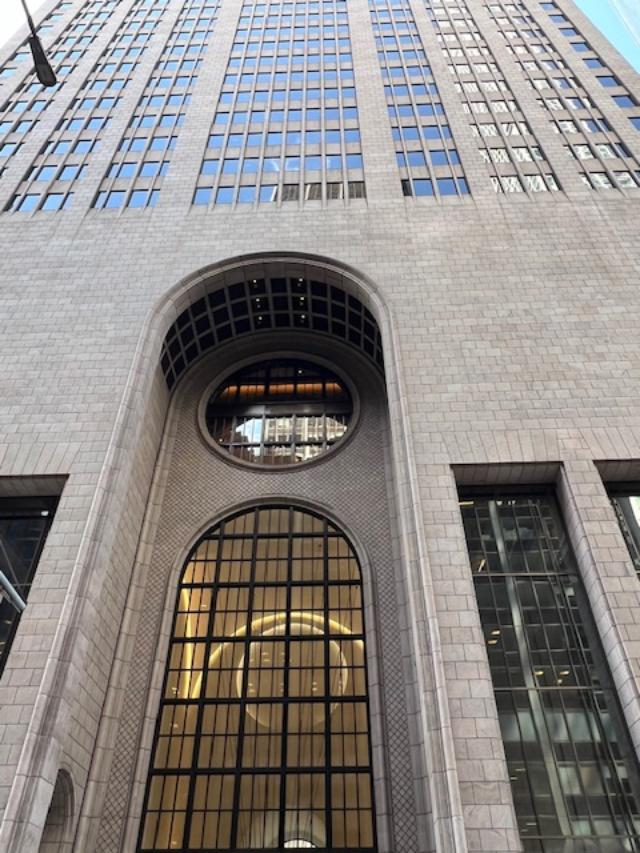
Another impressive building on Madison Avenue is at 550 Madison Avenue, the old AT&T Building with its signature ‘Chippendale’ roof. This building was considered radical and innovative at the same time when AT&T built it to house their world headquarters. The 37 story building was designed by famed architect Philip Johnson in 1984 in the postmodern design. Critics called it ‘Chippendale’ after the famed furniture due to the ‘open pediment’ look of the top of the building based on English furniture design (Wiki). The building is currently have some lobby renovations that I passed.
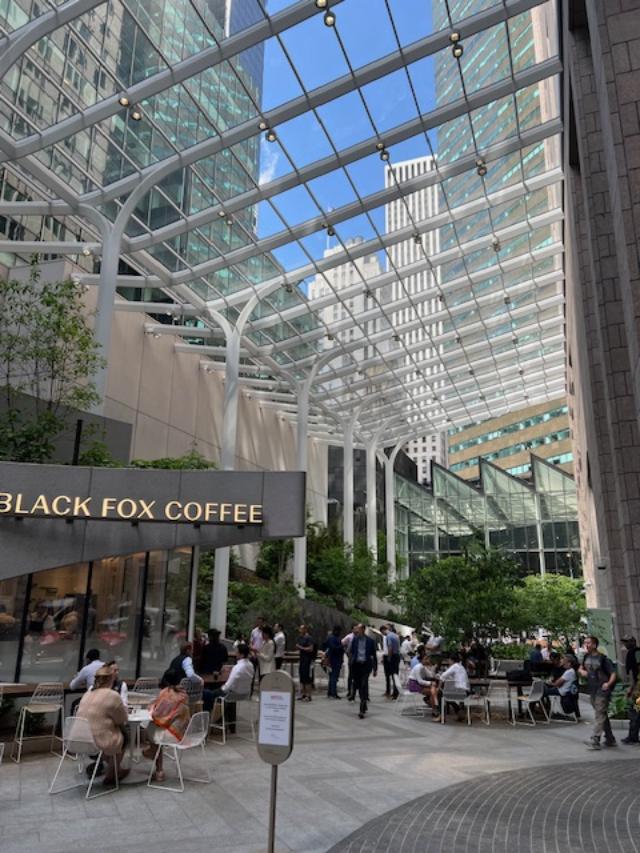
The beautiful atrium that you can sit and relax in between the buildings.
Next to the AT&T Building is the IBM Building at 590 Madison Avenue. This 41 story building was built in 1983 by architect Edward Larrabee Barnes & Associates and developed by IBM and designed in the post-modern design (Wiki).
The IBM Building at 590 Madison Avenue & East 57th Street
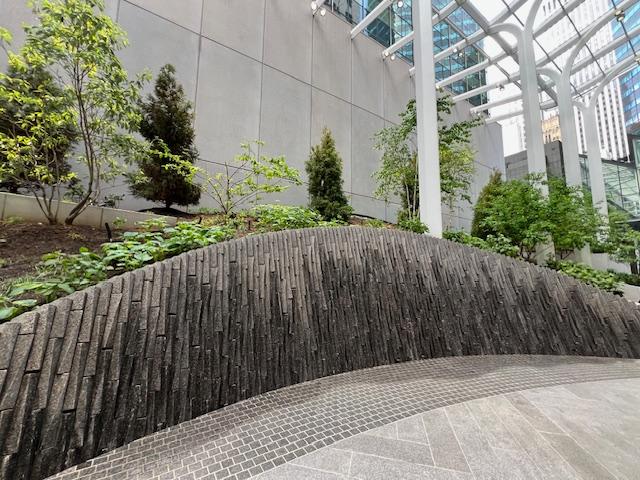
Because of the zoning laws established in 1916, there is a beautiful and relaxing open atrium filled with food kiosks and art work for the public to enjoy on the ground level. It is a nice place to relax after a long walk. Take time to admire the art works that line the atrium.
The Atrium at the IBM Building
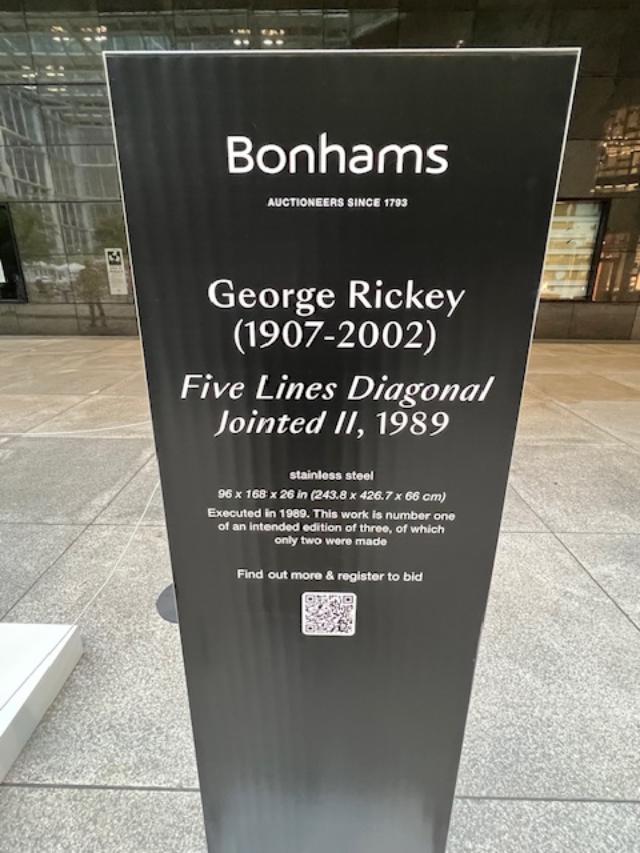
Artist George Rickey’s work in 2024 in the atrium.
The George Rickey piece inside the atrium “Five Lines Diagonal Jointed II”
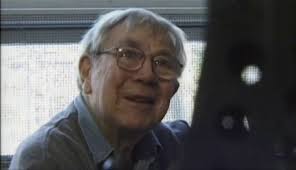
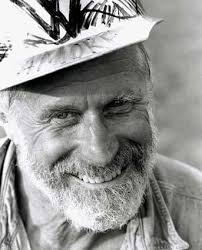
Artist George Rickey was an American born artist with multiple degrees and places of study. He holds a MA from B.A. (Modern History), Balliol College, Oxford, U.K. and a M.A. (Modern History), Balliol College, Oxford, U.K. He also did graduate study in Art History, Institute of Fine Arts, New York University, New York, NY. George Rickey worked as painter, muralist, and sculptor. Across his diverse body of work from the paintings of the 1920s through the final sculptures of the 2000s, there are four themes that emerge: Movement, Color, Relationships, and Scale (Artist bio).
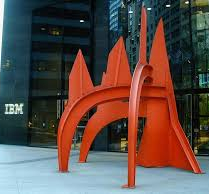
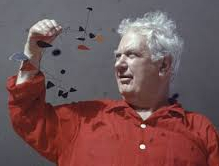
One piece of art that stands out is the red geometric sculpture on the corner of Madison and East 57th Street is the great artist Alexander Calder “Saurien” (which is a large reptile), that was created by the artist in his studio in 1975. This is an example of Calder’s “Stoic” work and were called ‘stabiles’ because these abstract works, unlike his floating works of art, stand strongly and firmly into the ground (Art Nerd 2018).
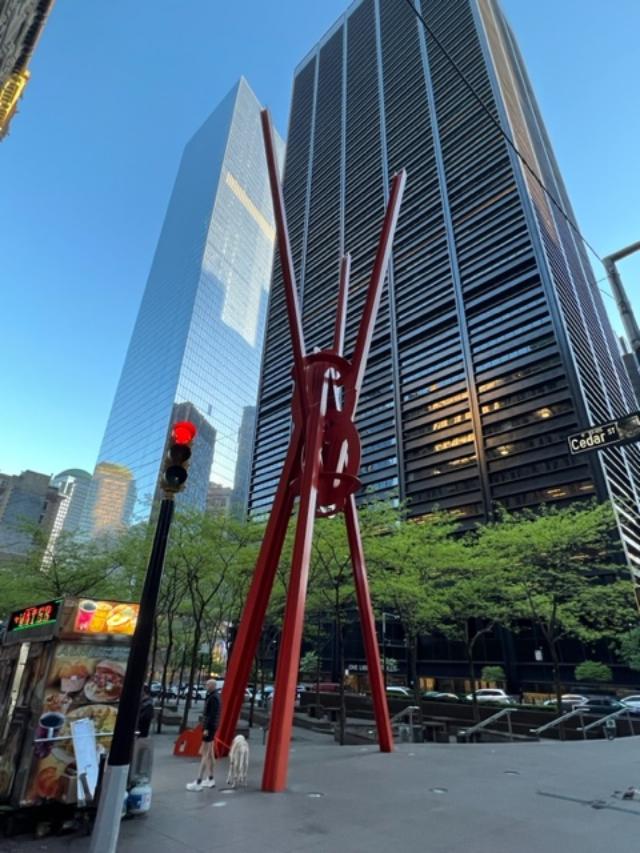
The Alexander Calder sculpture, “Saurien” (now replaced by another sculpture by artist Joel Shapiro)
Walk around this wonderful work by Calder and try to take a breath and understand what the artist was trying to say. It is almost like all the ‘legs’ on the sculpture are trying to show stability and contrast.
Mr. Shapiro is an American born artist from New York City who graduated both with a BA and MA from New York University. He is best known for his sculptures of abstract human forms (Wiki).
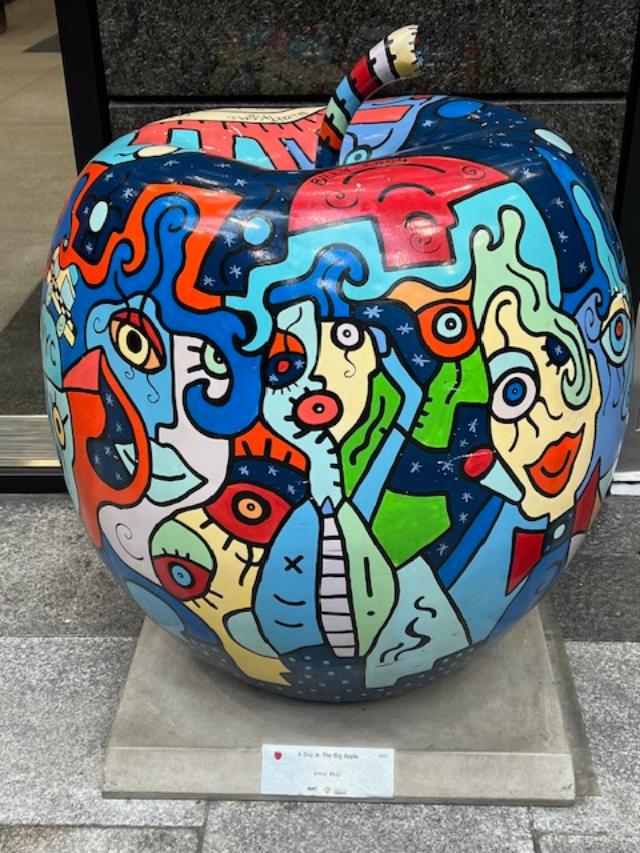
Inside the atrium, there are two interesting pieces of artwork that standout. There are two colorful acrylic apples that are done in colorful motifs that you should not miss. The sculptures were created in 2004 for the “Big Apple Fest” to promote the City’s tourism. Companies paid $8,500.00 to sponsor and $12,500 to keep the apples in which artists were allowed to decorate inside or outside.
One of them is entitled “A Day in the Big Apple” by an artist named Billy.
‘A Day in the Big Apple’ by artist Billy
The other is of a colorful face by artist Romero Britto entitled “New York Future”.
“New York Future” by artist Romero Britto
Romero Britto is a Brazilian born American artist whose colorful works elude the optimism the artist has on his view of the world. He uses bold and colorful patterns to enhance his works (Artist Bio).
When you reach the edge of the neighborhood at East 59th Street, you are greeted by the former GM Building that stretches from Fifth to Madison Avenues. This elegant 50 story building once represented the presence of GM in New York City. It was designed by the architectural firms of Edward Durell Stone & Associates and Emery Roth & Sons in 1968. It was designed in the “International Style” and stands guard at the end of the commercial district of Midtown East and the Upper East Side.
As you cross back down Madison Avenue on East 59th Street, you will notice the ever-changing retail landscape and all the empty storefronts on this part of Madison Avenue. Twenty years ago, this would not have existed, but it is a sign of the times.
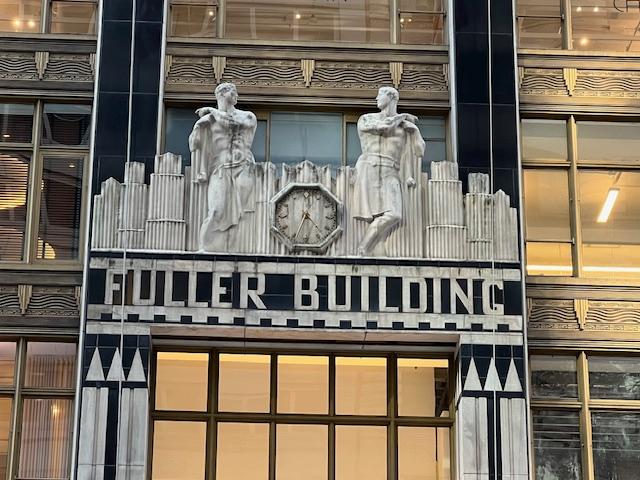
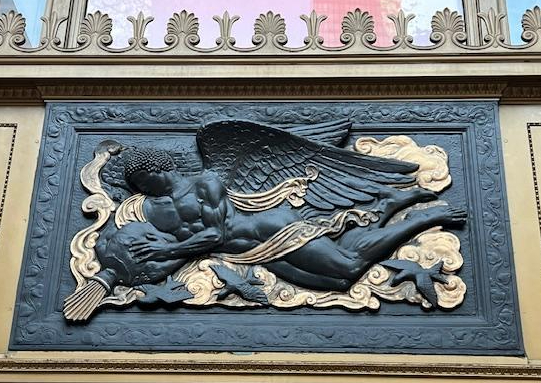
The details of the Fuller Building at 41 East 57th Street
Another interesting building to admire is the Fuller Building at 41 East 57th Street on the corner of Madison Avenue. The building was created for the Fuller Construction Company in 1929 by architects Walker & Gillette in the ‘Art Deco Style’. The building’s exterior sculptures were designed by architect Elie Nadelman. Look at the interesting details not just on the outside of the building but walk into the lobby to take a look around (Wiki).
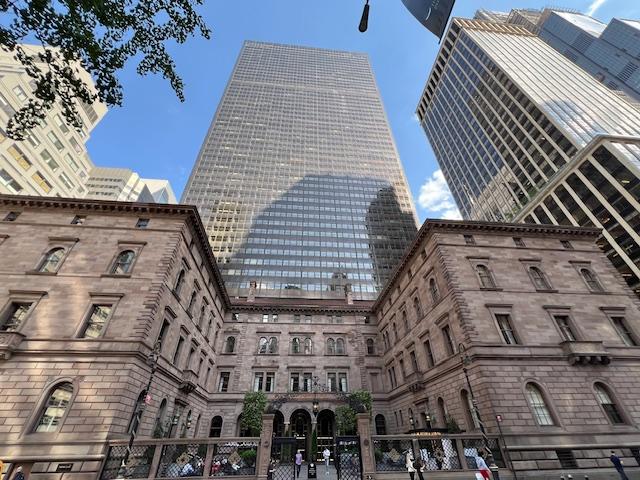
One of the great hotels in New York City stands guard at 455 Madison Avenue and 50th Street, the New York Palace Hotel (formerly the Helmsley Palace Hotel) which is a combination of an old mansion and the modern building behind it. The front of the building facing Madison Avenue is the former Villard Mansion.
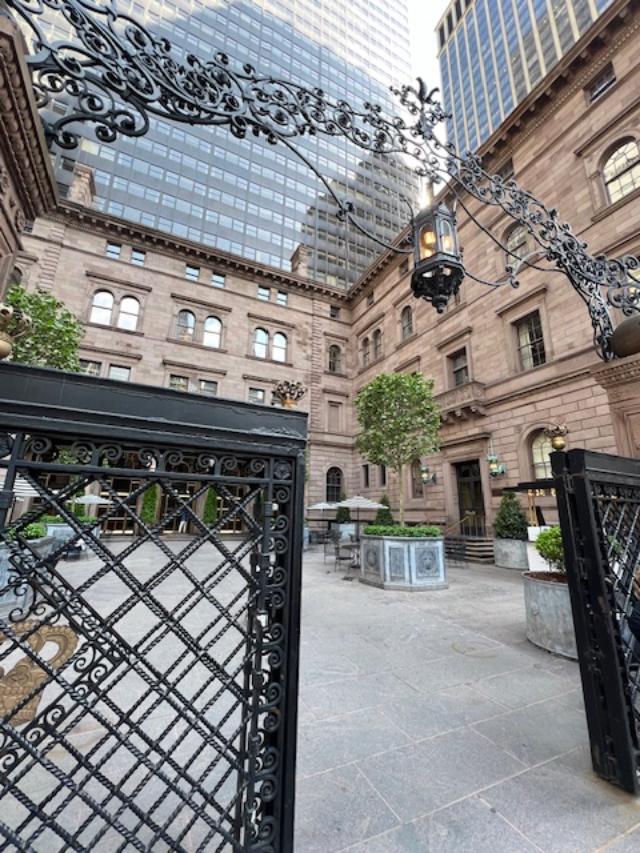
The front of the hotel is the “Villard Houses” created in 1882 for Henry Villard, a railroad financier, who worked with the architectural firm of McKim, Mead & White to create a series of six brownstone townhouses facing a courtyard in the ‘Italian Neo-Renaissance style’. Developer Harry Hemsley leased the houses and hired Emery Roth & Sons to create the 55 story modern hotel in the back of the houses.
The Villard Houses part of the New York Palace Hotel
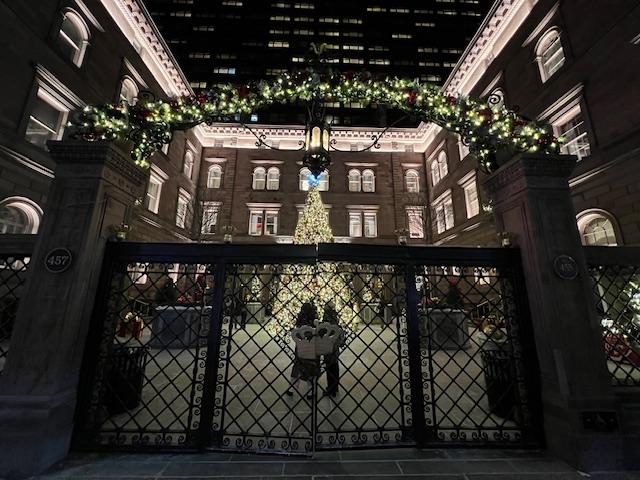
The hotel at Christmas 2024
The Villard Houses at the hotel decorated for the Christmas holidays
I passed the hotel again during Christmas of 2025 and the decorations were even more elaborate during the day. The hotel looks amazing at the holidays.
The front of the Palace Hotel at Christmas
The beautiful wreathes that lined the fence
The Christmas tree at the Palace Hotel
The hotel opened in 1981 as the notorious ‘Helmsley Palace Hotel’ with hotelier Leona Helmsley in charge. Considered one of the best hotels at the time, it was a five star/five diamond hotel (with one of the most nervous staffs in New York City). The hotel has been owned by Lotte Hotels & Resorts since 2015.
The inside of the New York Palace Hotel, the Villard Houses
Take time to walk through the hotel from the East 50th Street entrance to the East 49th Street exit and walk around the public rooms and admire the architectural details from the Gilded Age. There are elegant features from staircases to marble fireplaces and the most beautiful views on Madison Avenue.
I found this pardon of the Helmsley Hotel on YouTube. It is very clever.
Another older hotel that stands out is the Roosevelt Hotel at 45 East 45th Street at the corner of Madison Avenue and East 45th Street. It stands guard next to Grand Central Station. The hotel opened in 1924 and was designed by the architectural firm of George P. Post & Son for businessman, Frank A. Dudley and it was ran by United Hotels Company from a leased agreement with the New York Central Railroad. Like the other hotels that line Lexington Avenue, there used to be a separate passageway from the railroad to the hotel (Wiki).
The Roosevelt Hotel being used as a immigration center in 2023 and 2024
This is similar hotel to take the time to walk through the lobby and look at the vaulted ceilings and the Gilded Age details of the hotels with its thick carpets and elegant staircases. The hotel has a somewhat dark, more European feel to it. There is a lobby restaurant when open that looks pretty interesting.
The entrance to the lobby at the Roosevelt Hotel in its heyday.
As you walk around Grand Central Terminal and through the archway pedestrian tunnels that lead to Park Avenue from East 45th to East 46th Streets, you will be traveling under the Helmsley Building at 230 Park Avenue that stands guard at the beginning to the business and residential neighborhood of Park Avenue.
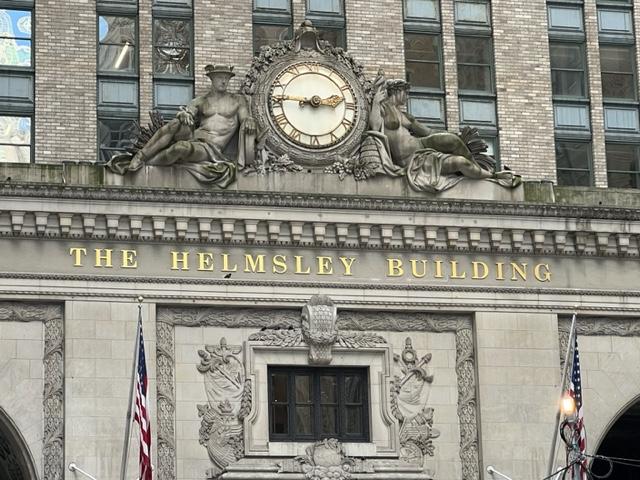
The Helmsley Building was built in 1929 as the New York Central Building for the rail company and was designed by architects Warren & Wetmore, who also designed Grand Central Terminal, in the ‘Beaux-Arts style’. Take time to admire the statuary around the clock that dominates its front and the beautiful stone detail work of the exterior of the building.
The beautiful details of the Helmsley Building on Park Avenue
The beautiful statuary.
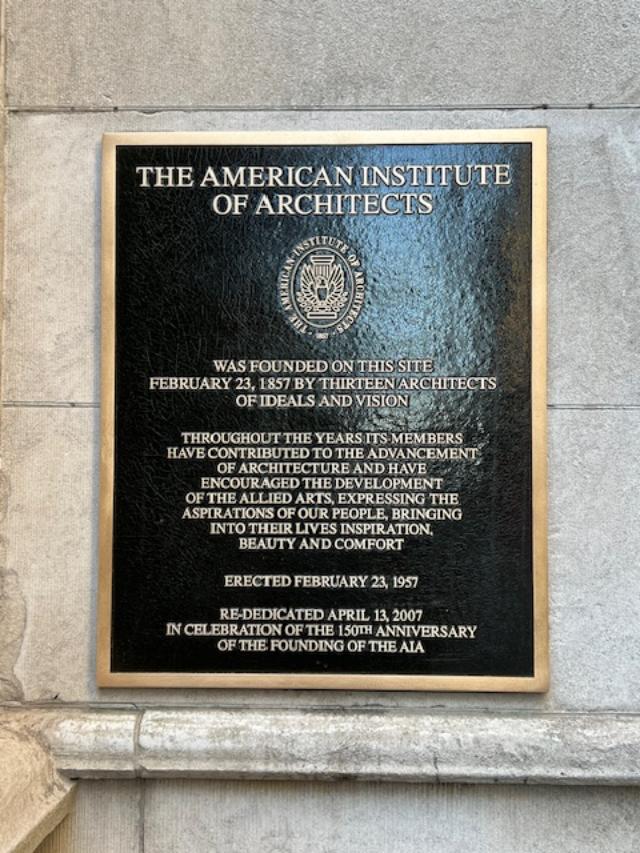
The historical marker of the Helmsley Building.
The New York Central used the building as its starting point of “Terminal City”, a series of buildings and hotels that the railroad developed on the top of the rail line (Wiki). The true beauty of The Helmsley Building is at night when the owners put on a light show illuminating the building with colorful spotlights.
The Helmsley Building light show after dark
Park Avenue in the East 40’s is quite amazing at night
All along Park Avenue is a series of ‘glass boxes’ for office buildings and residential towers that line the Avenue all the way up to East 96th Street at the exit of the rail line. Along the way, there are some interesting examples of architecture that line Park Avenue.
The Waldorf-Astoria Hotel at 301 Park Avenue is currently closed and under scaffolding awaiting its new life as a small hotel and condo complex. The hotel, as mentioned in previous blogs in ‘MywalkinManhattan.com’, was built and opened in 1931. It was designed by the architectural firm of Schultz & Weaver in the ‘Art Deco style’ and is probably one of the most famous and talked about hotels in New York City outside the Plaza Hotel (Wiki). There have been so many movies and TV shows filmed and written about the hotel to count and the restaurants inside the hotel were some of the better ones in New York City. The building will open sometime in the future.
The Waldorf-Astoria Hotel at 301 Park Avenue (currently under renovation)
The only part of the hotel I could photo while under renovation in 2024.
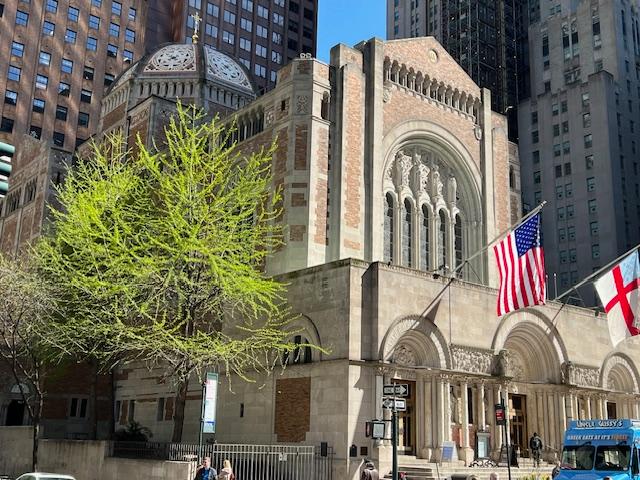
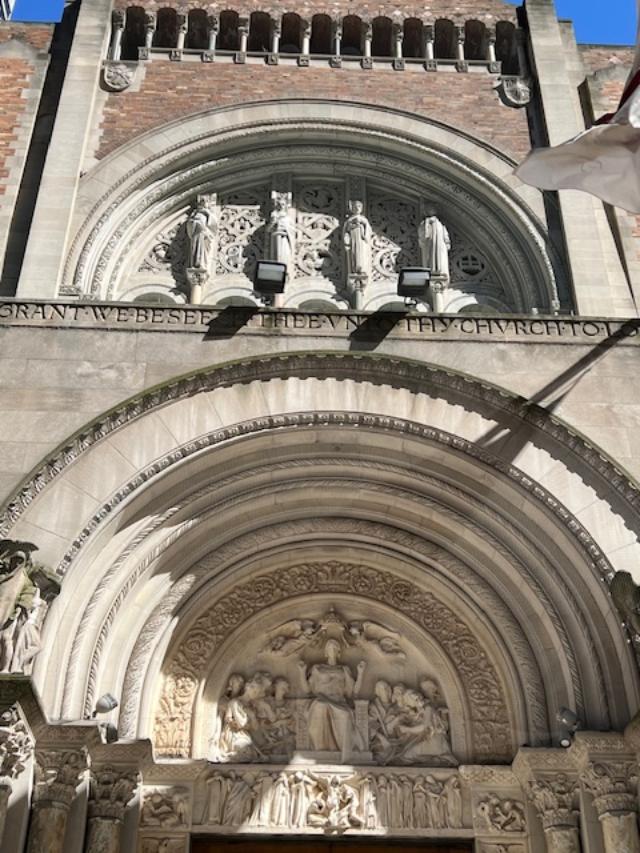
St. Bartholomew’s Episcopal Church at 325 Park Avenue is one of the older buildings on Park Avenue and stands alone amongst the bigger buildings on this part of Avenue. Though the congregation was started in 1835, this structure was built between 1916-17 and designed by Bertram Goodhue, who had designed the St. Thomas Church on Fifth Avenue (See Walking the Border of Midtown East-MywalkinManhattan). The church was designed in the ‘Byzantine Revival Design’ and he was required by the congregation to retain the old church portal from the former church on Madison Avenue and East 44th Street in the new church design (Wiki).
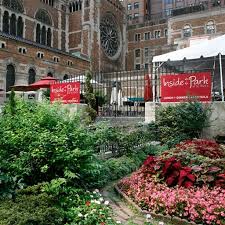
Look at the details of the old church and the stained-glass windows. In the Summer months, there is a wonderful (yet somewhat over-priced) restaurant in the courtyard of the church and there are art markets during the Summer and Christmas holiday season that you should visit. There is also afternoon music at certain times of the year.
St. Bart’s restaurant and terrace during the summer
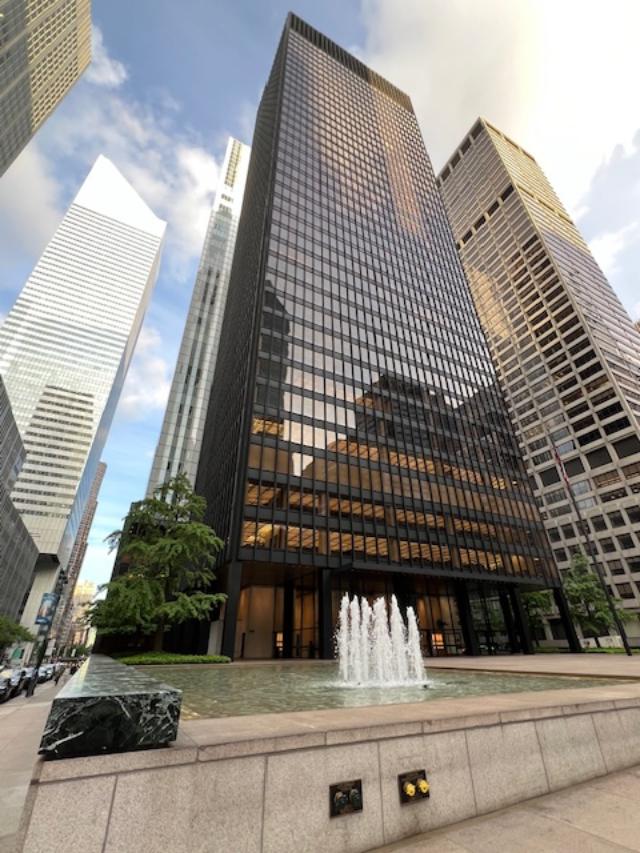
One standout, innovative building on Park Avenue sits between East 52nd and 53rd Streets is the Seagram Building at 375 Park Avenue. The building and its exterior designs were created by German American architect Ludwig Mies van der Rohe with the interior Four Seasons Restaurant designed by American architect Philip Johnson.
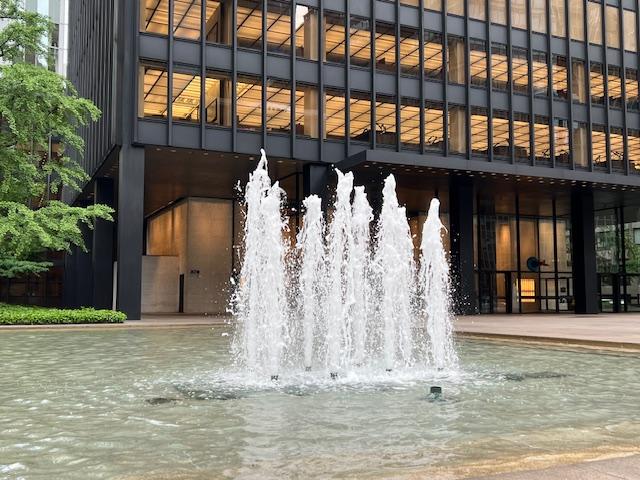
The fountains are well known in their own right being used in TV and movies
The building was featured prominently in the first episode of “That Girl” in 1965.
This 38-story building of wonder was innovative in its time. Finished in 1958 as the corporate headquarters of Joseph E. Seagram & Sons, the building was noted for its ‘functional aesthetics’ and a prominent example of ‘corporate modern architecture’. Keeping up with modern building codes, the architect used ‘non-structural bronze I-beams and large glass windows’ to create the cool and well-toned exterior structure of the building (Wiki).
Also utilizing the 1916 building code and the new use of open public spaces, the building was one of the first in New York City to embrace the open-air plaza that was prevalent in the 1980’s and early 90’s design. It was an extremely innovative design at the time and still sets the standard for the modern ‘glass box’.
One of the last stand out buildings that I saw on Park Avenue before my walk back down the Avenue was at 465 Park Avenue, The Ritz Tower, an apartment hotel. This elegant residential building stands out because of its details on the exterior of the building and I later learned it was once home to the famous French restaurant, La Pavilion.
This elegant building was designed by architects Emory Roth and Thomas Hastings for journalist Arthur Brisbane, who was the developer. The apartment hotel was managed by the Ritz-Carlton Company. The exterior of the building has many carved stone features so look closely from the other side of Park Avenue to admire the detail work. Don’t stare too long because the doorman gets a suspicious look if you look too long. He kept looking me over as I admired the building and the read the plaques.
Look at the elegant details of the Ritz Tower
The historical plaque of the Ritz Tower.
Up and down the Park Avenue Mall is the work of artist Alex Katz “Park Avenue Departure”, of which it looks like the back of a woman who is walking away from some place. The work is a depiction of the artist’s wife, Ada. Each of the works along the mall is changed slightly to show the sculpture in motion as if it is walking down the mall. This street art exhibition will run through November 2019 (The Fund for Park Avenue).
Alex Katz’s Park Avenue Mall exhibit “Park Avenue Departure” (closed in December 2019)
American artist Alex Katz who was born in Brooklyn, NY and is a graduate of Cooper Union Art College. His long career has seen many changes in art form and today some of his concentrations are in landscape and portraiture. His work can be seen in museums all over the world.
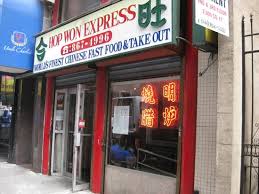
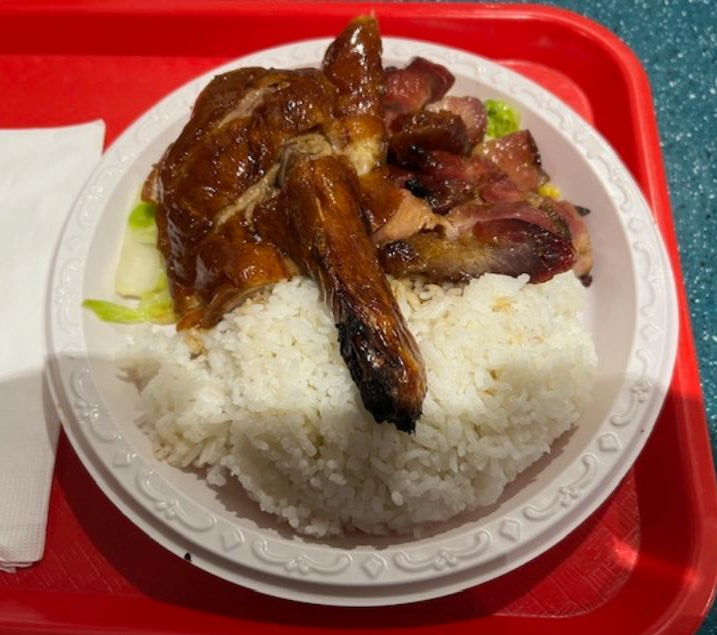
For lunch and dinner that afternoon, I ate at Hop Won Chinese Noodle Shop at 139 East 45th Street between Lexington and Third Avenues (See reviews on TripAdvisor and DiningonaShoeStringinNYC@Wordpress.com). After a long day of walking, I treated myself to a plate of mixed roasted meats, duck and pork, with a side of rice ($9.00) and an egg roll ($1.38). Their roasted meats are a lacquered delight with the rich, crackling skin of the duck worth every bite. The food here is delicious and so reasonable for Midtown East.
By the end of the evening, I got a chance to double back around the Helmsley Building and look at the detail work of that structure as well and then walked up and down the tiny Vanderbilt Avenue between East 45th and 47th Streets that line next to Grand Central Terminal. The most notable building on this block is the Yale Club at 50 Vanderbilt Avenue. The famous clubhouse was designed by Yale Alumnus and architect James Gramble Rodgers, and it opened in 1915.
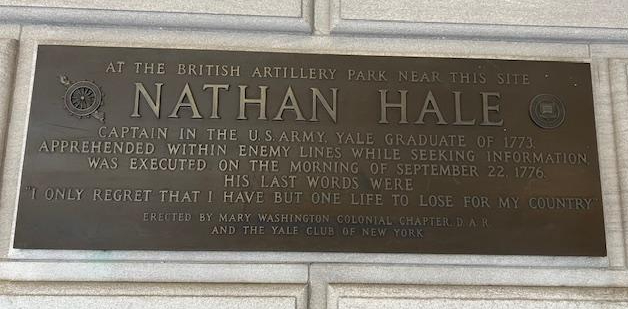
The Yale Club at 50 Vanderbilt Avenue; notice the plaque to Nathan Hale on the bottom left
The most notable item outside the club is the historical mark where supposedly Patriot Nathan Hale was hung. There is a conflict to where it actually took place and there is another site on the Upper East Side (See Walking the Upper East Side Streets in MywalkinManhattan), where that plaque is outside the local Pier One. I personally like that theory better. Where else in American could a Patriot of the Revolutionary War be hung in that two hundred years later would house a retailer that sells Christmas chukkas made in China?
That’s what I love about Manhattan!
Check out my other blogs on Walking Midtown East:
Day One Hundred and Forty-Three-Walking the Borders of Midtown East:
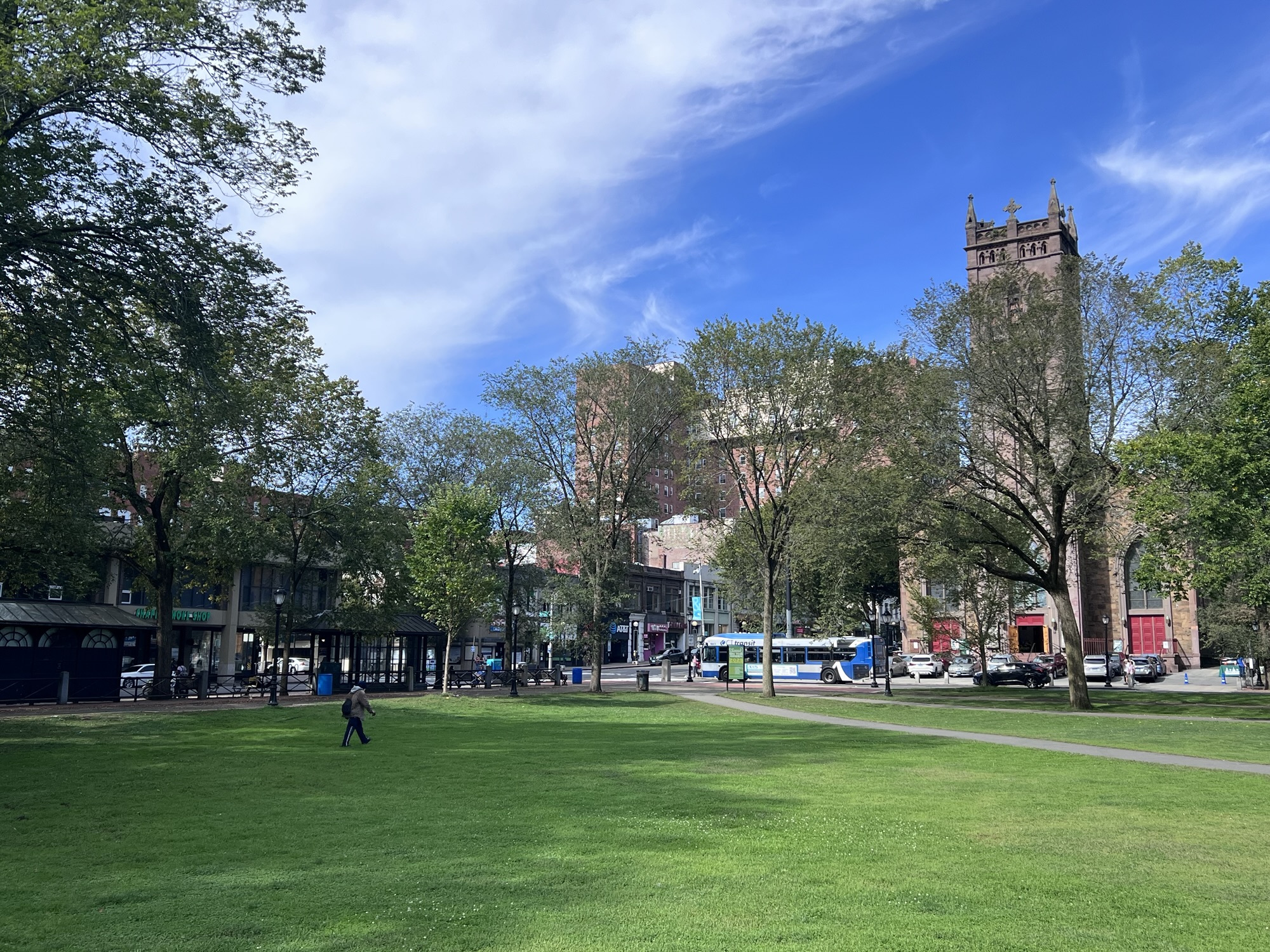
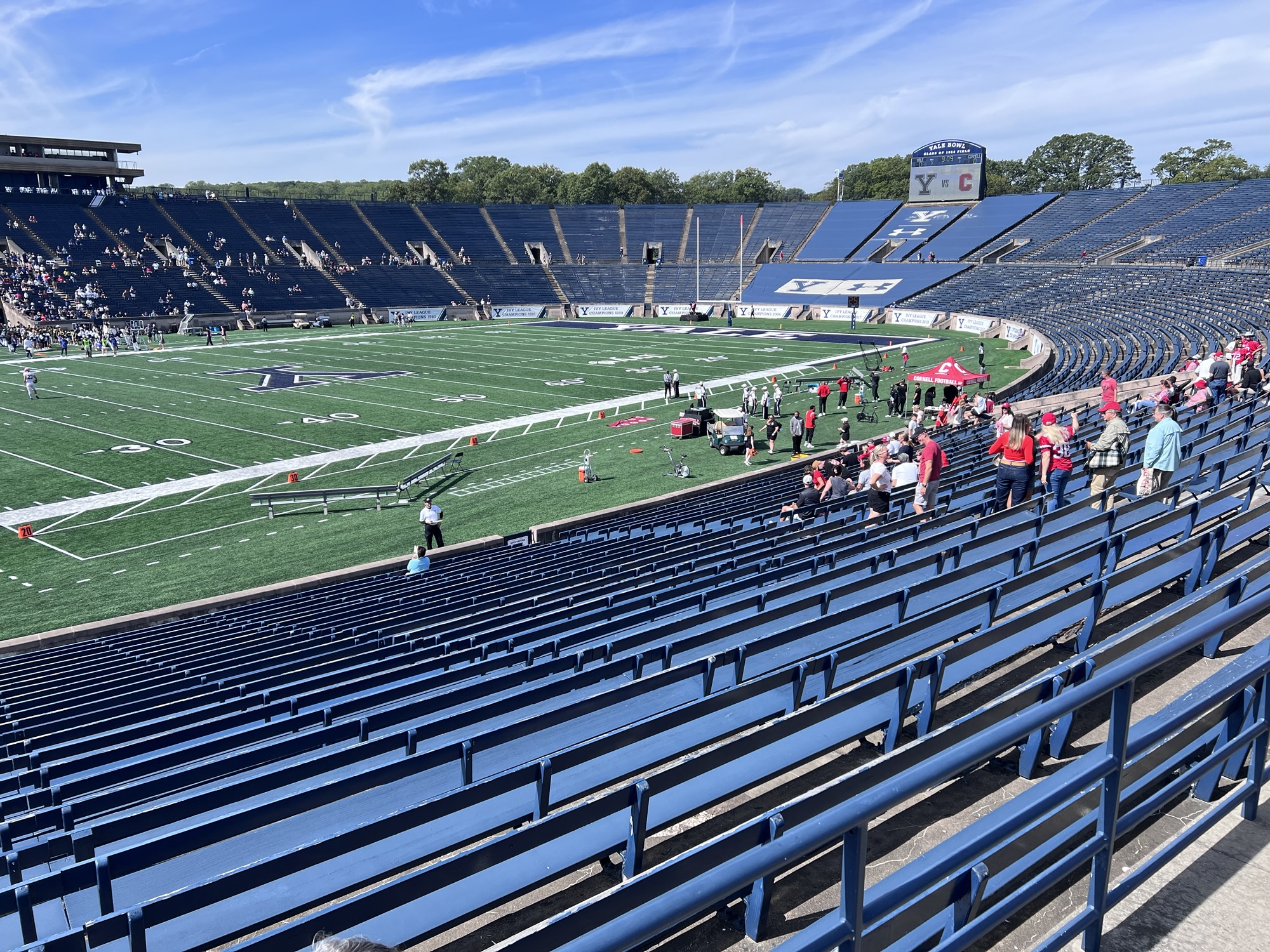
I updated my trip to New Haven blog because of yesterday’s visit for the 2019 Cornell-Yale football game. There are a lot of improvements in the town today and a lot more life there then when I lived there.
I took time from my walk to be a supportive Alumni and go up to New Haven, Connecticut for the Cornell versus Yale game on September 30, 2017. I also watched us get our butts kicked with the score 49-24. I swear, every time I thought we would catch up, we fell behind. We kept going through quarterbacks throughout the game.
It was even worse for the September 2019 game. We were tie with Yale, who does not look that good either, at 3-3 at half (I thought that was bad enough) but in the third quarter were lead 10-3 with an 85 yard run touchdown and looked really good. Then our quarterback through an interception that lead to a Yale touchdown and at 10-10 he was so rattled by that, the game was never the same. He threw three more interceptions and we botched an onside kick (Cornell is…
Check out Village Pizza III on my Christmas blogs and when you visit the Hudson River Valley in Upstate New York. The food is excellent and service is friendly.
I came across Village Pizza III when I was visiting Red Hook, NY on a stop through on my way back from President Martin Van Buren’s home in Kinderhook, NY. I had want to visit the town to see of there had been any changes in the town over the last three years since my visit in the Christmas season of 2015.
The sauce on their pizza and pastas is amazing
I had just stopped in for a quick slice of pizza ($1.25) that afternoon and the pizza was amazing. The sauce on the cheese pizza was perfectly spiced and had a rich tomatoy flavor to it. You could taste the high quality tomatoes in the sauce. It…
When I finally finished walking Sutton and Beekman Places, I finally decided to take the long walk down Broadway that I had planned for two years. As you can see by the blog, I like to take one neighborhood or section of the City at a time and concentrate on getting to know it. What is the history of the neighborhood? What is there now? Who are the shop keepers and the restaurant owners? What is the neighborhood association doing to improve the area? I like to become part of the neighborhood when I walk around it.
Recently I have noticed people on the Internet have been posting blogs that they walked the entire length of Broadway and bragged about it like they were ‘performing brain surgery’. It always amazes me when I read about a new person who does this walk online and acts like they are the first person to do it. You would think some of these people invented something new or came across something radical. Its a walk down a street folks! Yet it is one great walk and everyone should do it at least once a year.
So, I put aside my next walk and decided to see what the fuss was about walking up and down Broadway. Everyone is right about one thing, it is an amazing walk through the Manhattan’s history, you get great exercise and the parks and historical sites you will see are beyond the tourist destinations.
I am not sure about everyone else, but it was a long trip that took a little over eight hours and I highly recommend the exercise. It was a lot of fun and I felt terrific afterwards. The walk goes by very quickly as there is so much to see and do. Try to start the walk between 9:00am-10:00am depending on the season so you get the maximum light for taking pictures.
What I like about taking the walk down Broadway is that watching the seasons change. This is why you have to take this walk several times especially in the late Spring, late Summer and as the leave change in October. Then you see the true complexity of Manhattan.
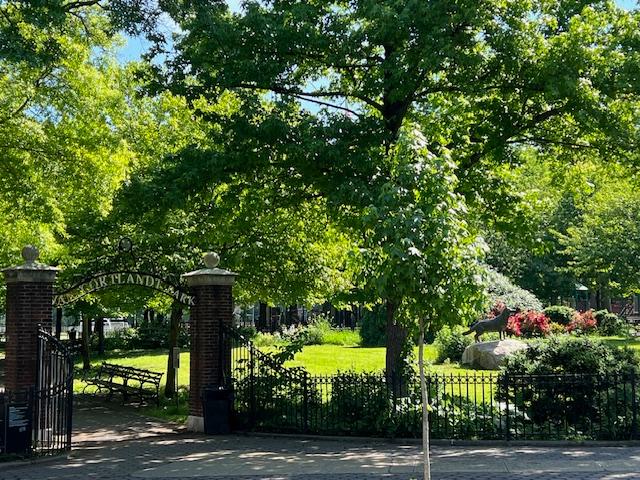
The entrance to Van Cortlandt Park in the Bronx at 242 Street in the Summer of 2025
The entrance to the park during the Fall of 2025
I got to visit neighborhoods that I had not seen in about two to three years. The most striking thing I had discovered especially walking through Harlem and Washington Heights is how many of the old businesses I had either passed or had eaten at had closed. Just like the rest of the City, these areas are going through a lot of change and are being gentrified.
It seems like the college campus neighborhoods are leading the way especially around Columbia’s new campus above 125th Street and SUNY between 145th Street to 130th Street. The shifts in neighborhoods are changing very fast and more and more buildings are under scaffolding or being knocked down and replaced.
Since the walk down Broadway from 242nd Street to Bowling Green Park is so extensive, I will not go into the intense detail of historical sites and parks along the way. More detail can be found on my sister sights, VisitingaMuseum.com, DiningonaShoeStringinNYC@Wordpress.com and LittleShoponMainStreet@Wordpress.com. On these three sites I will discuss more on each site and a more detailed history. More information on each neighborhood can be found section by section of Manhattan on my blog, MywalkinManhattan.com. I have added as many links to the information as possible.
With the COVID-1 pandemic going on especially the months from March to July 2020 when the City started to reopen for business, I wanted to see how Manhattan has changed in just six months and the findings were pretty shocking. It was like someone put Manhattan into a time machine and brought us back to 1989 or 1990. I felt like I went through a time warp.
Now New York City admittingly was having its problems with the cost of apartments and rents on stores but this is something different. The mood of the City has changed from optimism to walking the streets being scared again. I have not seen this since the Dinkins’s Administration when it was dangerous to walk the streets during the day and night and all the racial problems in Crown Heights. It just seems that the progress of the last thirty years has been wiped out in a few months. I was pretty shocked at the changed I saw while walking down Broadway.
I also have been tired of the controversy with statues all over the United States, so I decided to take a better look at all the public artworks along Broadway and feature in more detail the statues, their meaning and their artists. We should not be wiping out our history but have dialogue about it.
During the recent 2021 walk, I have noticed that things are going back to normal with the exception of a lot of businesses closing over the last year, but construction still persists, and renovations of older historic buildings have gained steam as well as new restaurants opening in place of the older ones. New York City is again reinventing itself.
During the walk in 2022, almost a year later, I found Manhattan bouncing back in its own way. Older stores and restaurants have been replaced by new ones and businesses that were able to hold on during the pandemic are open for business much to the delight of the local residents and tourists who are slowly making their way back to New York City.
I also noticed on my walk in June 2022, the number of people in Manhattan has increased. The sidewalks and tourist spots were much busier than before. Even the restaurants were getting crowded. People are up and about with very few masks in site. The vaccines are obviously working, and people are going about their lives again.
In the Spring of 2024, I took the walk again a few weeks after the official walking of the “The Great Saunter” so I had a lot of practice time in. The walk took nine and a half hours this time due to two meal breaks where I had to charge the phone from all the pictures I was taking. It was the perfect day to take the walk with a 71 degree start.
In the Summer of 2025, it was a rather humid day with a 81 degree start and a 90 degree finish. The humid was not bad that day but it did get hot by the time I got to West 80th Street and I had to walk in the shade whereever I could.
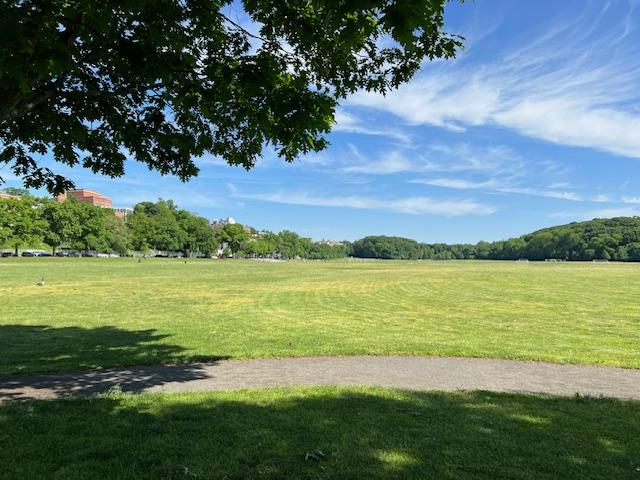
The start of the walk in Van Cortlandt Park, the old Van Cortlandt estate in the Bronx.
The History of Broadway:
Broadway itself as an Avenue has a very interesting history. Broadway is the English-language literal translation of the Dutch name, ‘Brede-wey’. Broadway was originally the Wickquasgeck Trail that was carved into brush of Manhattan by the Native American inhabitants. ‘Wickquasgeck means “birch-bark country” in Algonquian language. The trail originally snaked through swamps and rocks along the length of Manhattan Island (Wiki).
Manhattan in Colonial Times
When the Dutch arrived, the trail became the main road through the island with the colony of Nieuw Amsterdam at the southern tip. The word ‘Brede-wey’ was translated when the British took possession of the island, they changed the name to ‘Broadway’. Known in the past as ‘Broadway Street’, ‘Kingsbridge Road’ and ‘Bloomingdale Road’ in parts around the island, it officially became ‘Broadway’ in 1899 when the whole street from the top of Manhattan to the bottom was named for one long road (Wiki).
The entire length of Broadway through Manhattan from Inwood to the Battery is 13 miles and the length in the Bronx is 2 miles. There is an additional 18 miles that runs through Westchester County all the way to Sleepy Hollow, NY where it ends. I just concentrated on the subway route from the 242nd Street Subway exit to the Bowling Green at the tip of Manhattan.
The walks down Broadway:
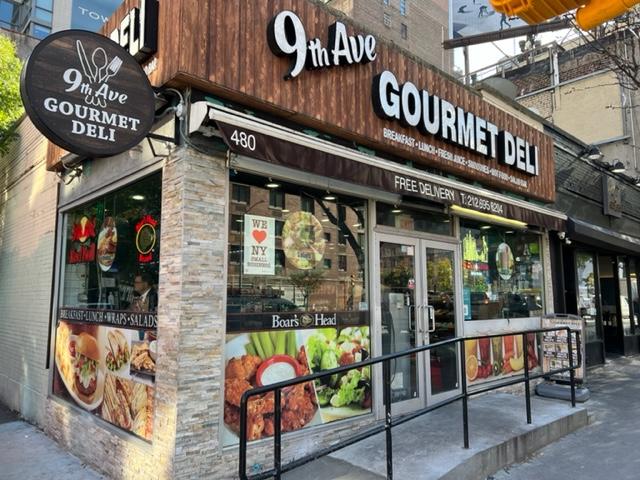
I started my mornings in 2019 and 2020 at 5:30am getting up and stretching. The sun shined in my room and that was a good start to the day. The weather was going to be in the high 70’s with a touch of clouds and the weather really cooperated. In 2019, I got into New York City at 8:15am and started my day with breakfast at my favorite deli in the Garment District, 9th Avenue AM-PM Deli (or Juniors AM-PM Deli as it also known by (See reviews on TripAdvisor and DiningonaShoeStringinNYC@Wordpress.com). In 2023, having just come back from Europe, I was not sure I was ready for the walk. It ended up being no problem. I got to the Van Cortlandt House by 10:00am.
What I love about 9th Avenue AM-PM Deli is the generous portions at a very fair price. I started one day with a French Toast platter ($4.99). I had four very nice sized slices of French Toast that were nicely caramelized and just a hint of cinnamon. On my second time on the walk, I ate here again ordering one of their Hungry Man Hero’s ($9.75), which is three eggs, potatoes, ham, bacon and sausage on a soft hero roll with mayo. Laden with calories yes but taste wise wonderful. It had all the calories and carbs for a 15-mile walk.
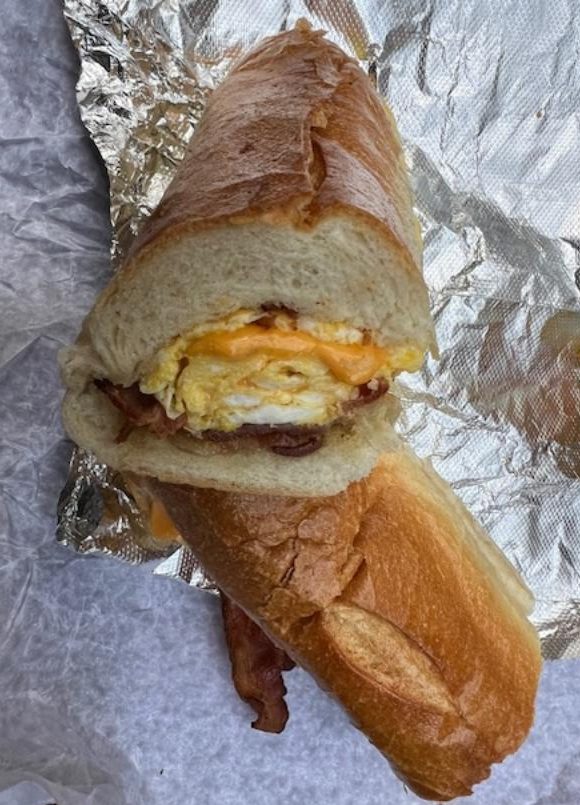
Their Bacon, Egg and Cheese on a hero roll is one of the best in the City.
It is always nice to grab one of the stools and eat by the window and watch the world go by. Just remember to get here early before all the construction workers from the Hudson Yards come over for their half hour union break. Then it really gets busy.
After breakfast, it was off to Times Square to take the Number One Subway up to 242nd Street-Van Cortland Park stop to start the walk. Manhattan actually starts lower than that but on such a nice day, I thought it would be nice to start at the very top of the subway route.
On the trip to Van Cortlandt Park in 2020, the subway was practically empty. There were about five of us on the car and the funny thing was that people sat near one another on an empty car. So much for socially distancing from people. They all sat near me! In 2022, the subway was empty of everyone, and I travelled alone to the last stop. In 2023, being Father’s Day, I found the whole city quiet and there was just a few of us on the train. In 2024, all the colleges had let out for the summer, but the schools were still in session with Memorial Day being next week and the City seemed quiet during the day (with the exception of Times Square). In 2025, I had to change subways to take the bus because of repairs on the subway so I got a late start that morning. No matter, the weather cooperated and the trip went by well.
The first stop on this journey is the 242nd Street stop at the end of the Number One line
Starting the walk in the same position in Fall 2025
Interesting street art on the subway
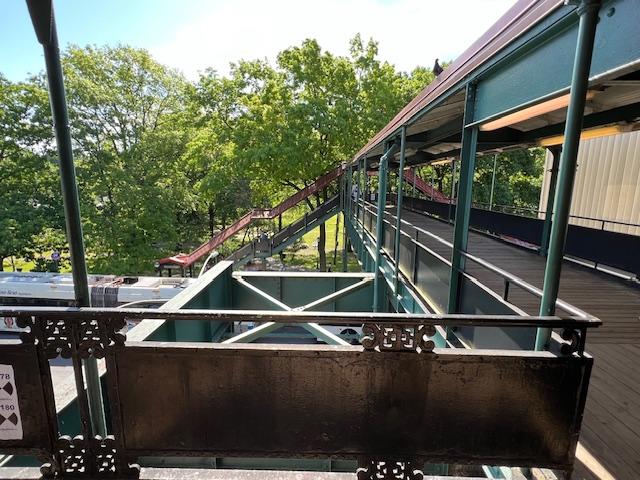
The Summer of 2026 the views from the subway platform were breathtaking in the park. The views from the subway platform at the Van Cortlandt Park exit were beautiful with everything in full bloom.
Looking North on the subway platform in 2026
Looking from the subway in 2026
Looking at the start from the subway platform in 2026
I had not been to the Van Cortlandt House Museum (See VisitingaMuseum.com and TripAdvisor for my reviews) since right after the holidays to see the house decorations and not seen the park ever in the warmer months.
I got to my destination at 9:00am and had to go to the bathroom. What is nice about Van Cortlandt Park is that the public bathrooms are right near the subway exit and there is another set right next to the Van Cortlandt House Museum so that is covered when you enter the neighborhood.
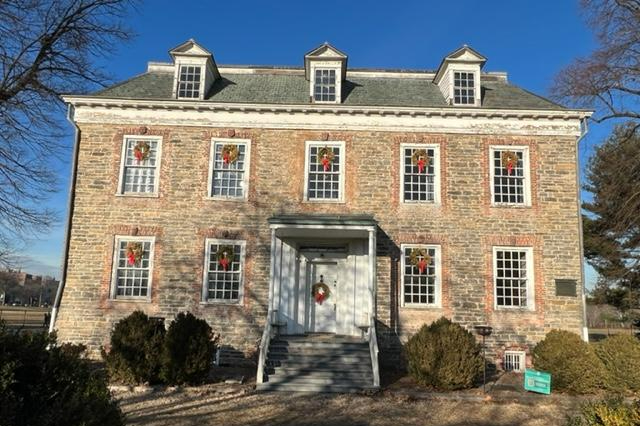
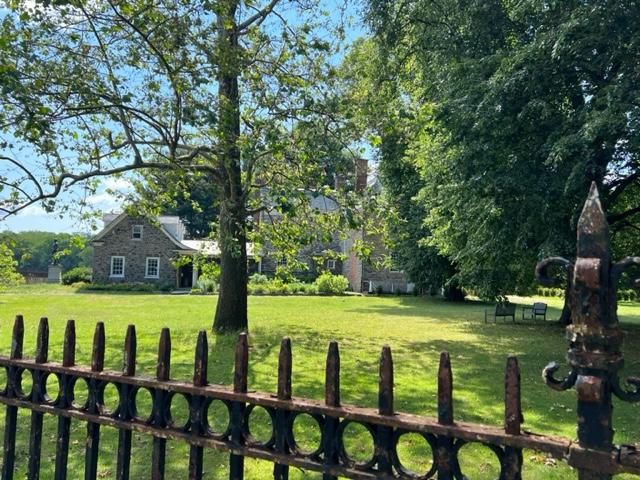
The Van Cortlandt Manor House in the late Spring
Make sure to take a bathroom break now because the options get slimmer until about 207th Street at the Ann Loftus Playground (and in 2022 those bathrooms are closed for renovations). The bathrooms at the park were even cleaner in 2020 with new park regulations for COVID-19 so the hand sanitizers were all full and the hand blowers were fixed. That was nice. Both the bathrooms at the 207th Street stop and at the manor house are really well maintained.
The Van Cortlandt House in the Fall of 202
I started my adventure by walking into the park and visiting the museum grounds. Van Cortlandt Park is a beautiful park that was once the Van Cortlandt estate. The last time I had been here was to tour the house for Christmas and to see the decorations.
The Van Cortlandt Manor at Christmas time in 2022
Van Cortlandt Manor gardens and house in 2022
The house was closed when I got to the park (in the summer months it does not open until 11:00am), so I just walked around the grounds to stretch a bit and admire the foliage. It was nice to see the trees with leaves on them and the gardens surrounding the house were in full bloom (the house is open-Check the website for hours).
Van Cortlandt Park and the Manor House in the Spring of 2024.
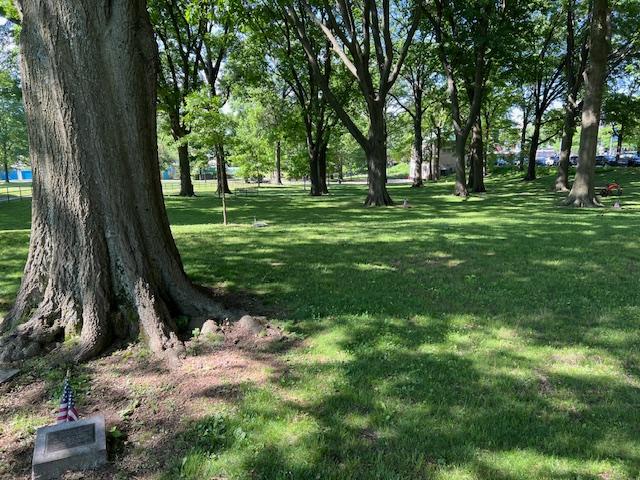
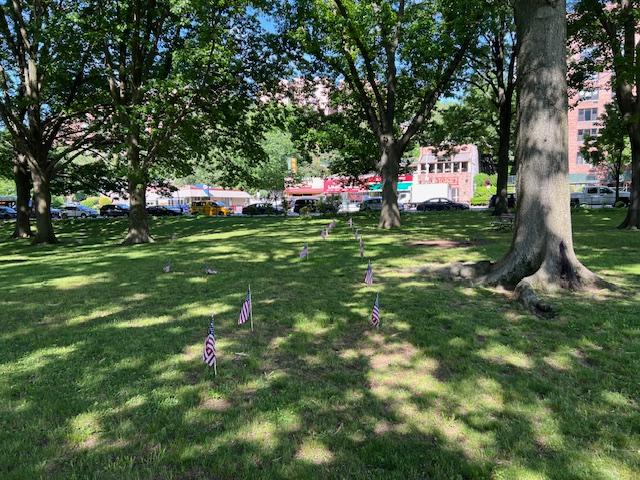
Don’t miss when exiting the park to stop and see Memorial Grove, a small section of the park dedicated to 21 servicemen who gave their lives in World War. There are twenty-one oak trees that were planted by the graves which are now fully grown. It is a somber but quiet place to reflect on what these men gave for our country.
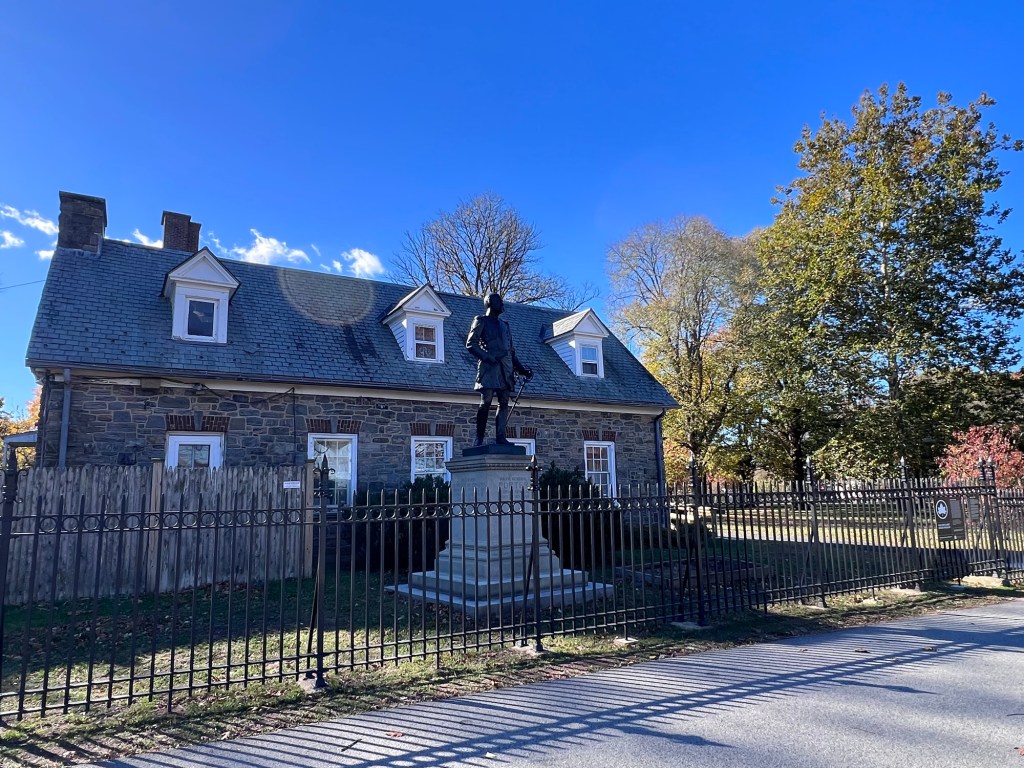
I always start my walk at the statue of General Josiah Porter, a Civil War hero who is memorialized just outside the entrance to Van Cortlandt Mansion. Every year I salute him before I start the walk. I consider him my guardian angel on this walk. I swear in 2024, I could have sworn that the statue moved his head in my direction when I saluted him. In 2025, I saluted the General again for good luck on the walk.
This elegant statue was created by artist William Clarke Nobel in 1902. He was commissioned by the National Guard Association of New York to create the statue and it was placed in front of the parade grounds inside Van Cortlandt Park.
General Porter lead the 22nd Regiment of the National Guard of New York during the Civil War. His contributions to the war effort helped the North win. After the war, he had been promoted to Colonel in 1869 and then was promoted again 1886 to Major General, the highest-ranking position in the New York National Guard (NYCParks.org).
General Josiah Porter in front of the Van Cortlandt Mansion
This is the reason why I started at the Van Cortlandt Mansion. To the see the condition of statues along the route of Broadway. There are so many historical monuments on the way down that I wanted to note them in the updated blog. With all these idiots knocking down statues all over the country, New York City has not seen much of this. I am sure that art historians and the police are just waiting to pounce on these people.
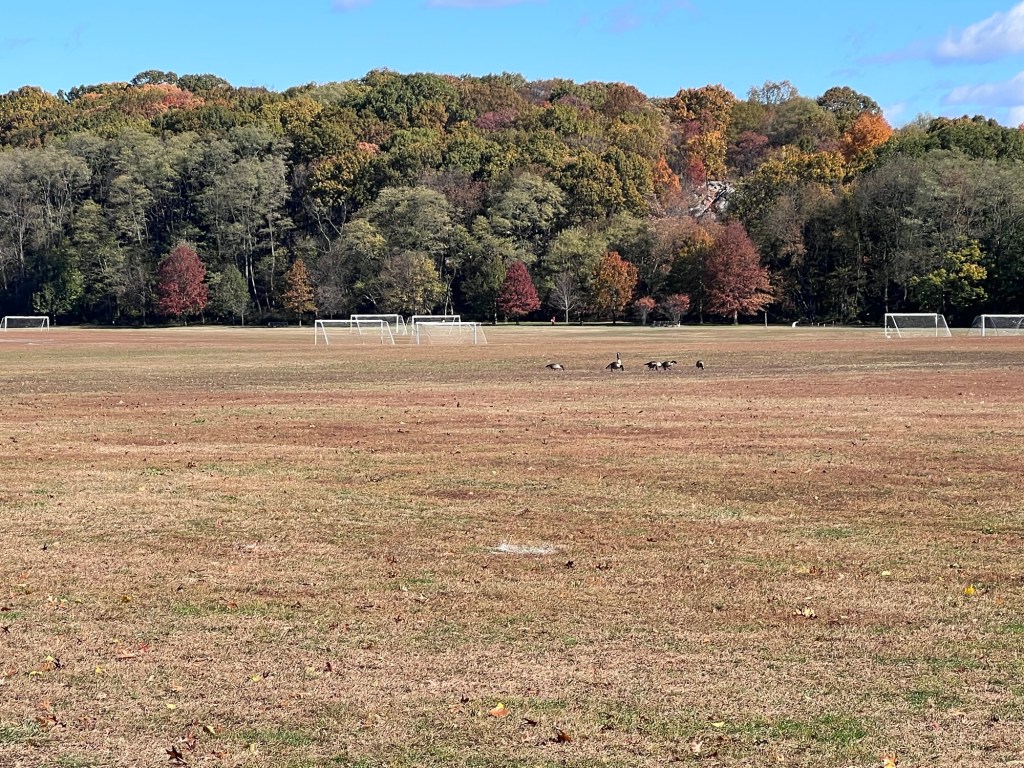
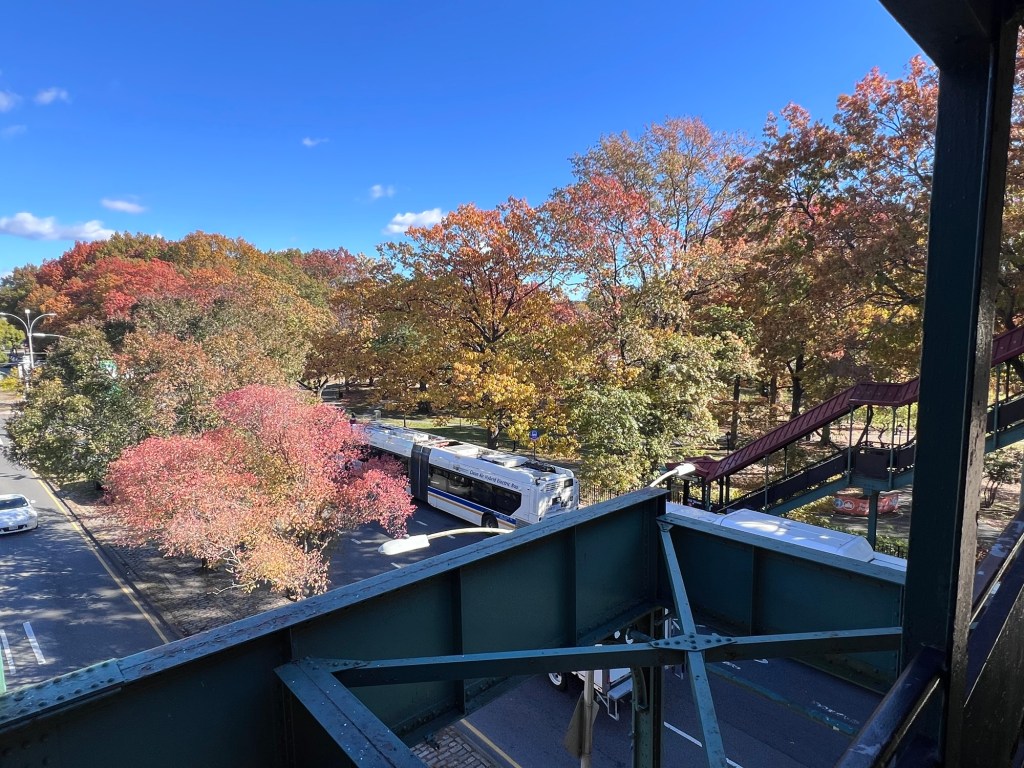
In 2025, Van Cortlandt Park was just passing its peak in foliage and the park was spectacular to look at from all aspects.
Van Cortlandt Park in the Fall of 2025
Van Cortlandt Park in the Fall
Van Cortlandt Park in the Fall
The park in the Fall when the leaves change colors
When visiting the park in the Summer of 2026, it was a different story with lush greens with all the rain we had recently. It may have been September but it was still just near the end of the Summer.
Van Cortlandt Park in the Summer of 2026
Van Cortlandt Park at the end of the Summer in 2026
Once I left the park, I started the walk on the west side of Broadway and the plan was to walk the west side the first day and then the east side the second time so that I could see the buildings along the way and see what restaurants had opened, closed and what looked interesting. Plus, where to find public bathrooms along the way. This was the interesting part of the walk was trying to find bathrooms when you needed them.
Since I have visited most of the neighborhoods already from 59th Street up to the tip of Inwood and wrote about historical sites, buildings, gardens and museums that I have visited along the way in other blogs, I won’t be mentioning these in as much detail as you can see them in other entries.
*I will refer to the other sites DiningonaShoeStringinNYC@Wordpress.com, LittleShoponMainStreet@Wordpress.com, VisitingaMuseum.com and other entries of MywalkinManhattan.com for more details to read on each neighborhood.
Also, to make the walk more enjoyable and include all the wonderful places to visit and see along the way, I will be blending many days of walks down Broadway experiences into one blog so I can make stopping points that visitors should take time to see. The walks took just over eight hours and please watch the humidity. There was a big difference doing this walk in 70-degree weather versus 85-degree weather with humidity. You should also give yourself stopping time for bathroom breaks and time to rest in some of the small parks along the way.
I needed more liquids in me and more time to sit down. Suggestion after four trips down this route is two water bottles frozen the night before. This way they melt on route, and you always have cold water until you hit the next park. This makes all the walking easier. Still, it was great exercise, and you will never be bored.
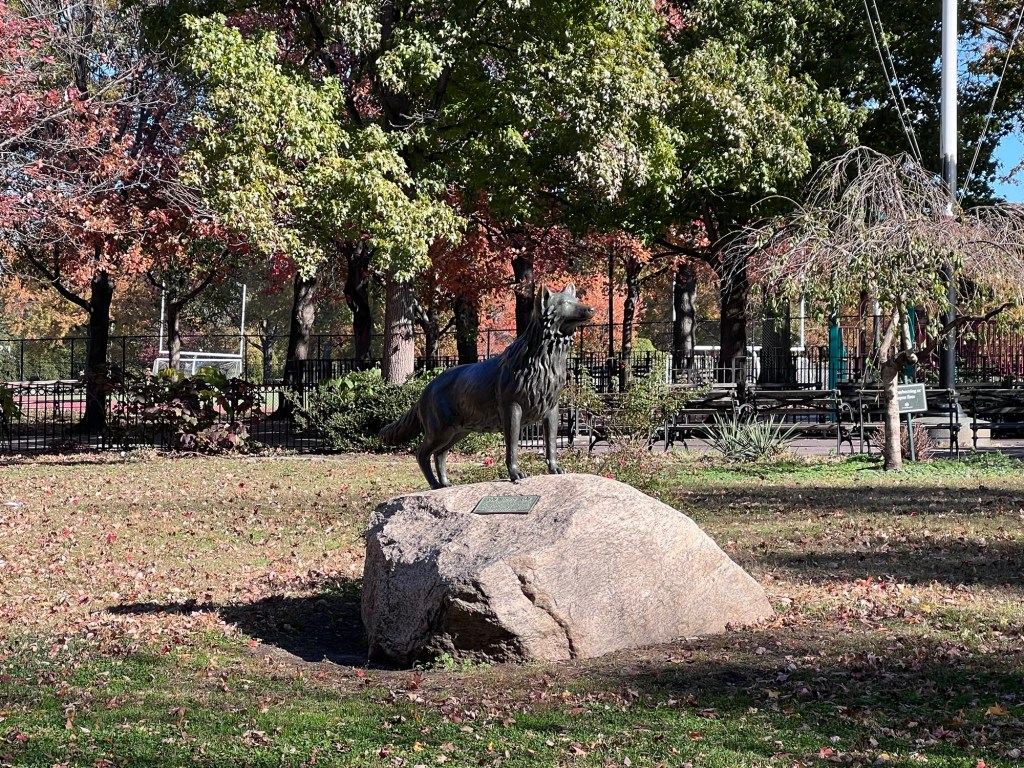
When I passed the entrance of Van Cortlandt Park by Van Cortlandt Avenue, another statue at the entrance of the park caught my eye. It was of a coyote guarding the front entrance. It seems that coyotes were wild back then and are still being seen today in the park system.
The statue known as “Major Coyote” is a symbol of coyote sightings in the park as late as 1995. This statue guards the main entrance and gardens of the park.
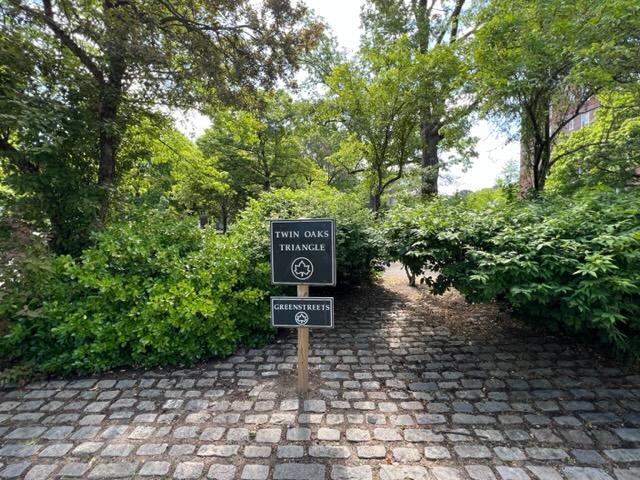
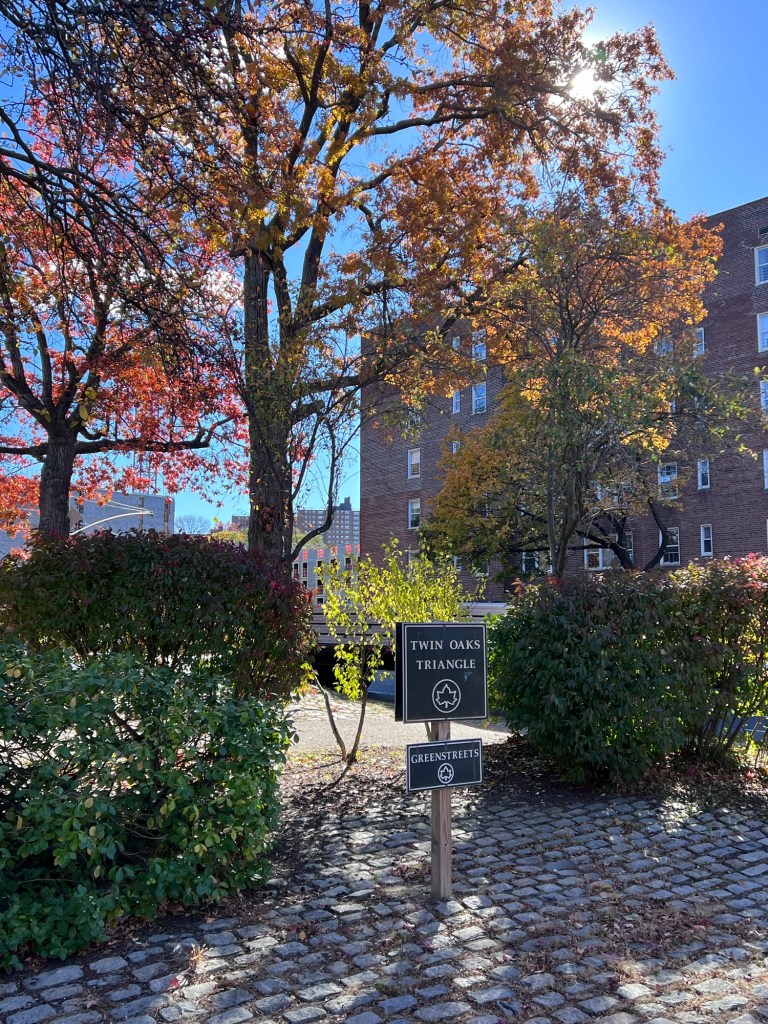
Once I left Van Cortlandt Park, I walked through Twin Oaks Square, a small park outside the park which is a nicely landscaped. It is picturesque and looking at from the street gives a beautiful entrance way to the park.
Twin Oaks Triangle
The Twin Oaks Triangle in the Fall of 2025
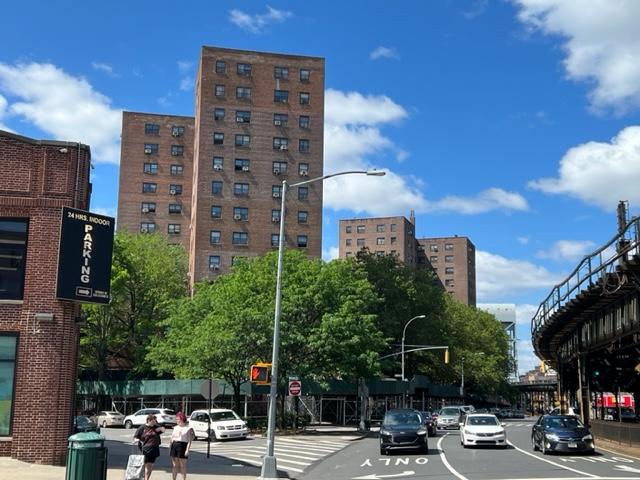
I continued walking down through the commercial district of the Bronx along the Broadway corridor which is loaded with chain stores and malls of all sorts. So much for people saying the Bronx is dead. There was so much shopping going on that you never had to leave for the suburbs to find a chain store. This part of the walk was still vibrant proving that the chain stores still have the staying power. Even during COVID and when the City reopened, these areas the stores remained open.
At each subway stop station I did notice clusters of small family run businesses and here you can find some interesting restaurants and pizzerias. There are a lot of family run bakeries as well but none that stood out. The fact that the area was still so vibrant in 2020 showed the resilience of the area.
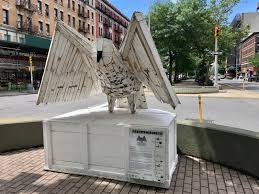
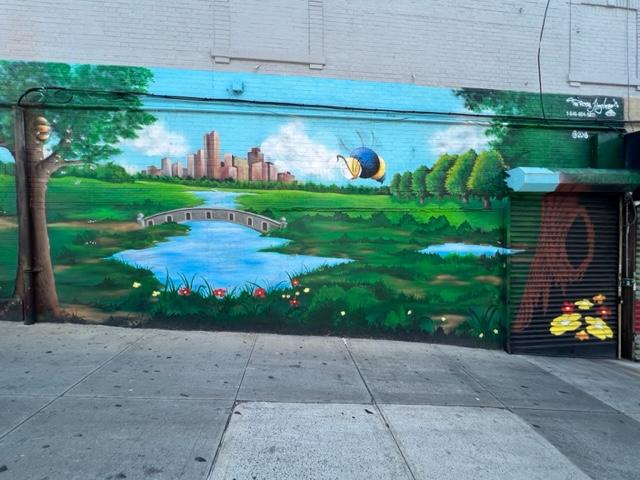
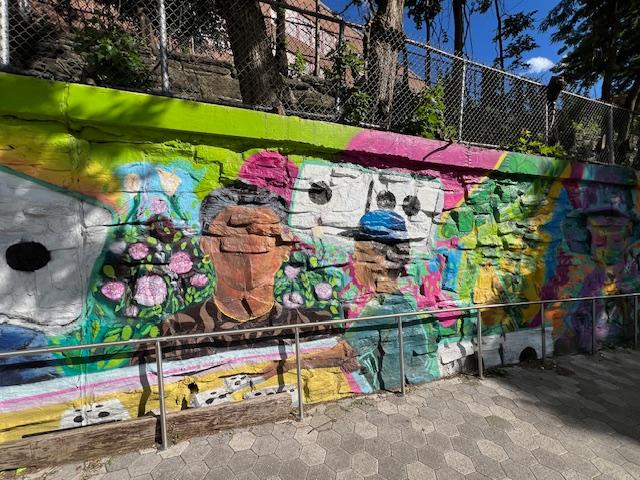
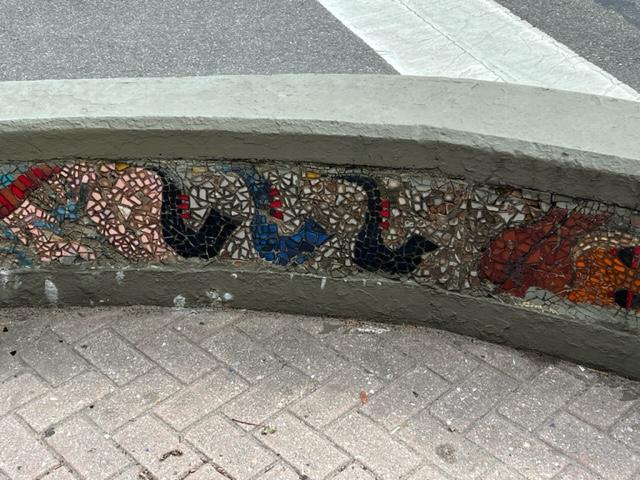
As I was leaving the Bronx on the way to Marble Hill, I noticed a lot more sidewalk and street art all around the neighborhood. Here is some that stood out to me on my 2025 walk.
Sidewalk art on Broadway
Sidewalk art on Broadway
Sidewalk art on Broadway
Street art on Broadway
Street art on Broadway
When you reach the edge of Marble Hill (the Northern most part of Manhattan), you will pass the Marble Hill Houses. I had more whistles and yells when I passed the projects on my many trips in the neighborhood. I am not sure what about me screams cop.
The Marble Hill Houses in the Summer of 2023
The Marble Hill Houses in the Fall of 2025
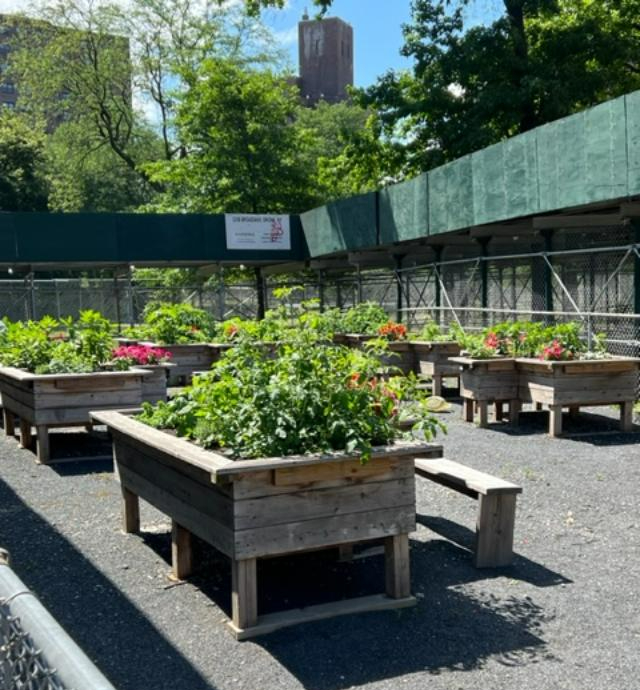
Even so as I walked in the front walks of the houses, I noticed that the residents were growing gardens that were part of the ‘Outer Seed Shadow Project’, a program of growing crops on the project’s lawns in raised beds. I thought it will be interesting when everything gets harvested. Some of the plants were fully grown when I visited this early in the season.
The Outer Seed Shadow Project at the Marble Hill Houses
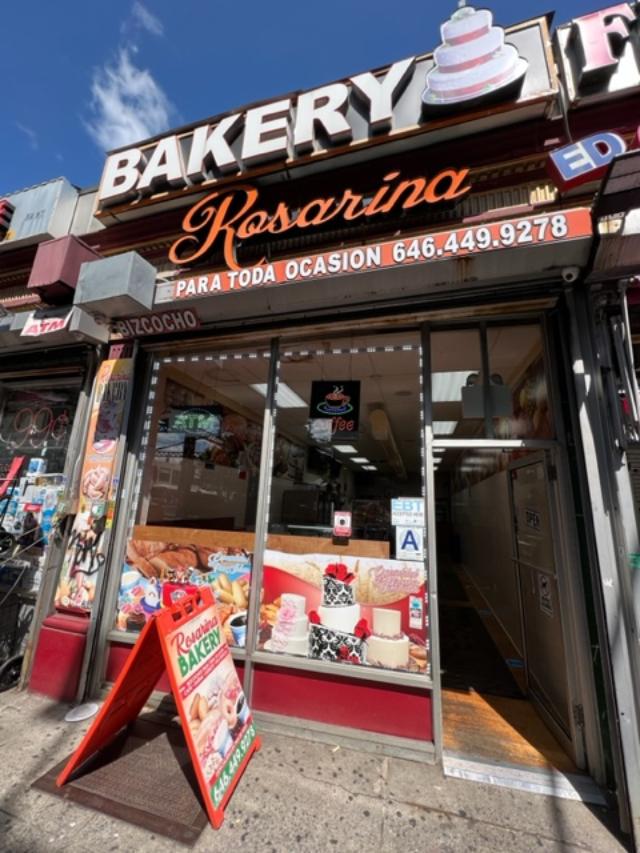
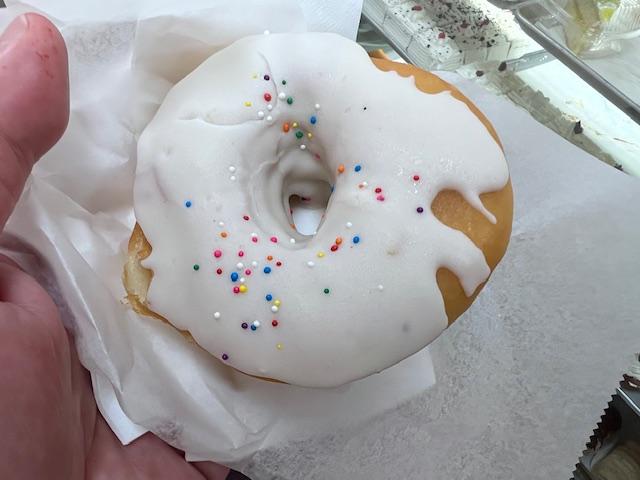
For breakfast the morning of my June 2025 walk down Broadway, I revisited Rosarina Bakery at 5215 Broadway. I have been coming here since the first day of the walking project in 2015 and the baked goods here can be hit or miss. Sometimes they are really delicious and sometimes that can be hard. This time around I had one of their Vanilla Doughnuts and it was really good. It was cake like and sweet with a thick Vanilla icing. Enough sugar to start the walk.
After enjoying the sweet treat, it was off for the walk down Broadway crossing over the bridge from Marble Hill to the Island of Manhattan. I stopped at the Columbia Campus to look at the boathouse and admire the parks. One a beautiful day in the summer, there is nothing like the Inwood Parks.
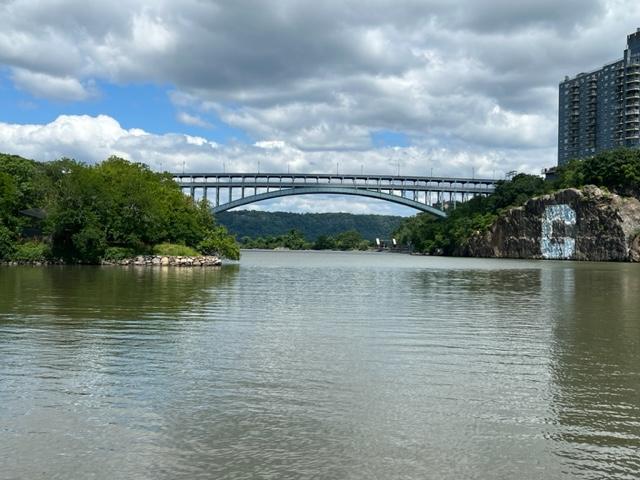
The crossing from Marble Hill into Inwood with Muscato March in the background.
The foliage was especially beautiful in the Fall of 2025. I passed the bridge, and the views were just spectacular in the morning.
The cross in the Fall of 2025
The cross in the Fall of 2025
It was when you will cross the bridge at 225th Street in the Bronx to the tip of Manhattan in Inwood is where it all starts to change as you enter the northern Columbia University campus and pass the football stadium.
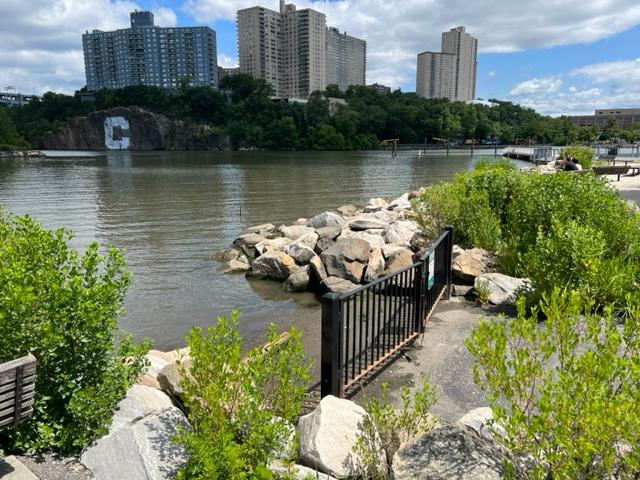
The Columbia University ‘C’ when you exit Marble Hill and go over the bridge to the Island of Manhattan in the Summer of 2024
The same view in the Fall of 2025
The interesting part of this part of Inwood is that on tip of Manhattan is nothing at the end of it. Here we have bus stations, garage trucks and delivery vans. This is one of the most commercial parts of Manhattan I have ever seen outside parts of the Garment District. The area has been rezoned so there will be a lot more changes up here in the future. Once you cross the bridge from the Bronx, you feel the difference in the neighborhoods depending on what side of Broadway you are on.
Crossing the bridge means that you have entered Columbia University territory and to the right is Columbia Stadium which is pretty much shut down this time of year. There were some football players on the field, but the Ivy League season starts later so it was not that busy. On my second trip down the east side of Broadway, I made two pit stops in Inwood past the stadium that I think tourists and residents alike should see.
Columbia Stadium at 533 West 218th Street was locked for the summer but there was a Summer Camp going on
During my trip pass the college in 2020, everything is locked tight. Columbia University’s football season I believe has been cancelled. In 2022, the field was being prepared for the football season and some students were out on the field. In 2023, again the field was being prepared for the upcoming football season (Cornell will be playing them home in 2023).
Please read my blog on the Columbia-Cornell rivalry and the football games at the stadium:
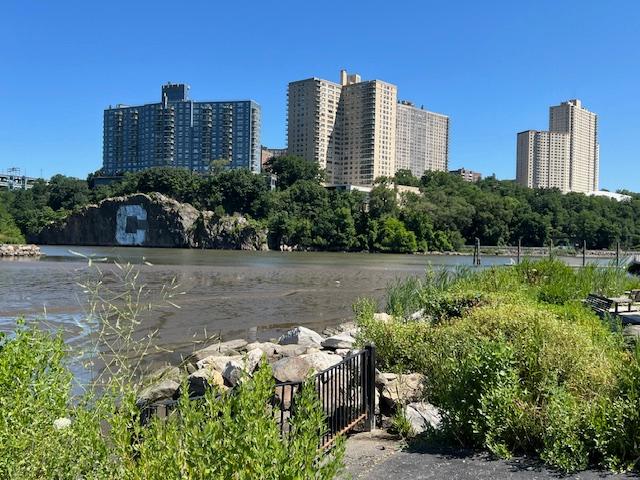
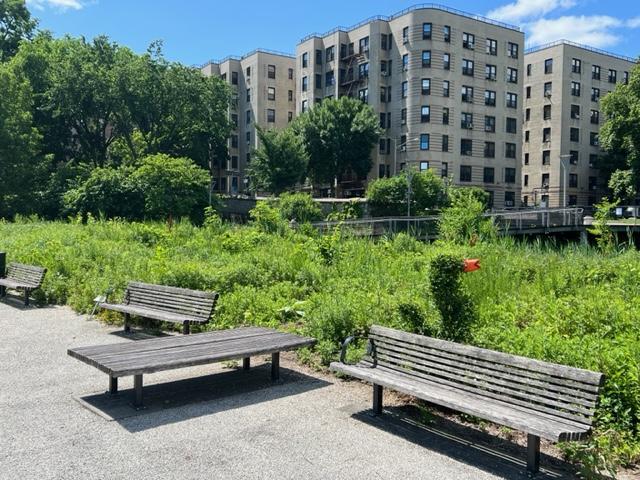
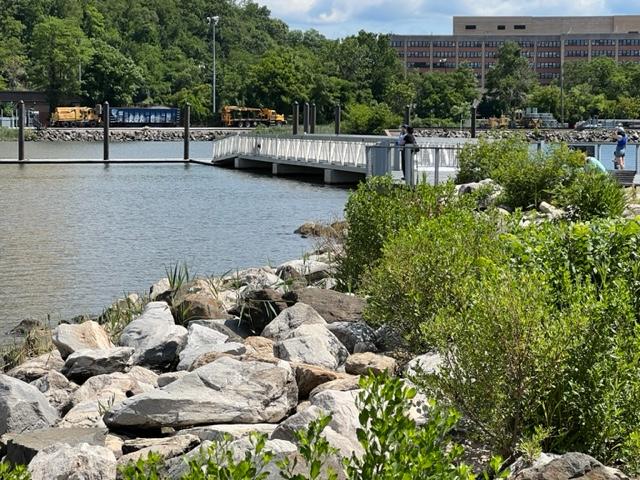
Still there are a lot of sites to see around Inwood Hill Park. The first is Muscota Marsh at 575 West 218th Street (See review on VisitingaMuseum.com) right behind Columbia Stadium that faces the shores of Marble Hill. This interesting marsh is one of the few in the City and one of the only ones in Manhattan that I know of, and it is a great place to just sit and relax.
The marsh takes on a different look in the Fall of 2025 with all the leaves changing colors and the skies so clear. On a warm Fall Day, the park looked amazing.
Muscato Marsh
Muscato Marsh
Muscato Marsh
Muscato Marsh
The views of the marsh and Inwood Park in the Fall of 2025
The Muscota Marsh is right next to the Columbia Boathouse where their rowing team set their boats off and right next to the Columbia Football stadium. On a sunny morning or afternoon, it is a nice place to just sit back and watch the boaters and people on jet ski’s zoom by. It is nice to just sit by the flowers and relax.
There were a lot of local residents relaxing in the park on all afternoons that I visited. Each year I see that more people have discovered this little hidden gem. In 2025, it was my stop off point to cool down for a bit.
Muscota Marsh is right next to the Columbia Boathouse
In 2026, the park is where I ate my second breakfast of the day. By the time I got into the City and started the walk, I reached the football field and I got hungry again. So I decided to stop here for a bit and relax and enjoy the beautiful weather.
Muscato Marsh in the Summer of 2026
Muscato Marsh flowers were in full bloom that afternoon
The birds were watching me through the rocks and weeds
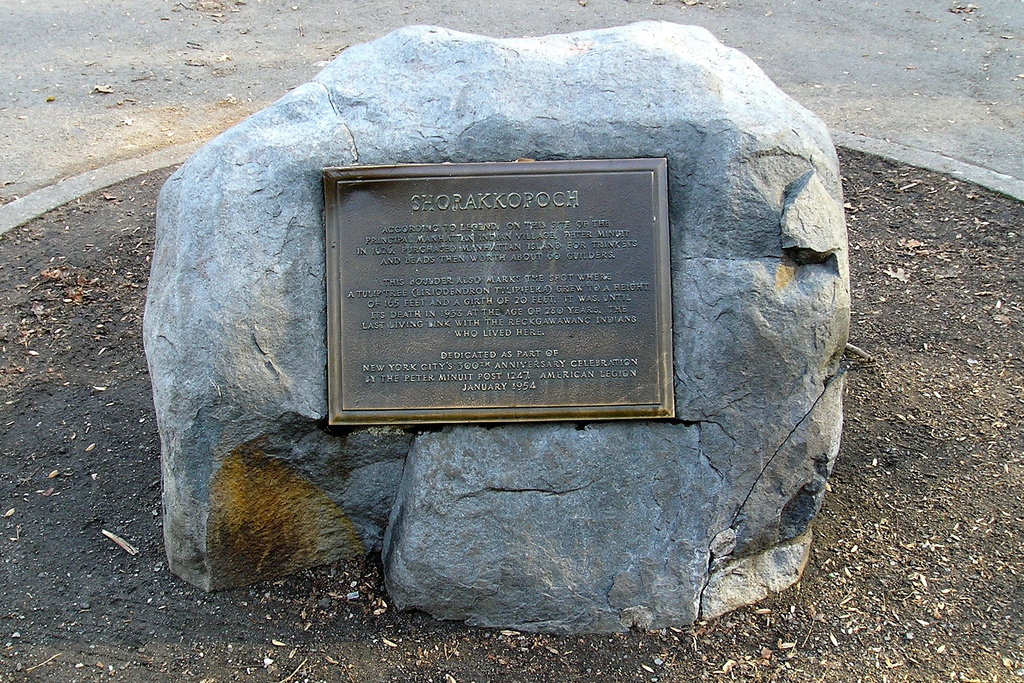
If you want to walk a little further into Inwood Park, visit the Shorakkopoch Rock the place where it has been said that Peter Minuit had bought the island of Manhattan from the Native Americans. This is where a three-hundred-year-old tulip tree had once stood, and legend stated that the event had taken place under a tulip tree in clearing on the island. No one is too sure if this is the right place but to really understand the history of Manhattan. this is the spot where to begin.
Shorakkopoch Rock the site of the purchase of Manhattan Island by Peter Minuit
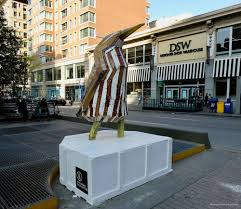
On the way of exploring Broadway in 2019, I followed the path of artwork by artist Nicolas Holiber and his bird sculptures that lined Broadway similar to the art by Joy Brown and Bernadette Myers. So, traveling from 165th Street to 59th Street searching for bird artwork. There were still a few of the sculptures still up during the Summer of 2020 but no one seemed to notice them. Still, that was the fun of walking down Broadway, trying to search for the sculptures to find them all.
As I left Inwood Park, I watched as kids participating in summer camps were playing games and running around in 2019. Parts of the park were closed to reseeding so you can see that money was being put into the park and renovations were starting. When I did the Broadway walk in 2021, the lawns had been reseeded and green with lots of kids running all over the place.
As I walked down Broadway the few times, I have visited the area since my initial walk in 2015, I have noticed so many businesses open and close which is almost an epidemic all over Manhattan. Broadway for almost the entire length is no different.
In 2021, I had read an article about Borough President Gale Brewer walking the length of Broadway in Manhattan and saying that about 200 store fronts were empty. This is not good and is showing what is going on not just in the economy but how the landlords are beginning to gouge small businesses with rent increases. So many small Dominican businesses I have watched close to be replaced by Hipster restaurants who are also not making it with these rent increases.
In the Summer of 2020, what a difference a year makes. The COVID-19 pandemic and the stalling of the economy has changed the neighborhoods along Broadway even more. I have never so many businesses close along the route both Mom & Pop and chain stores alike. It looks almost like the Upper West Side of the early 1990’s with all the empty store fronts and a lot more homeless milling around the area.
In the Summer of 2021, things were opening back up and changing. On the walk in 2022, you can see that many businesses have reopened, and new restaurants and shops are opening in many of the closed spaces. Still there are still quite a few vacancies between West 96th and West 72nd Streets.
On the Father’s Day walk in 2023, the whole neighborhood was starting to come back to life. New York City especially Manhattan was slowly coming back. Maybe not to 2019 but was getting better. The storefronts were filling up all over Broadway. On both walks in 2024, Manhattan was back in business and the empty storefronts were starting to fill up again.
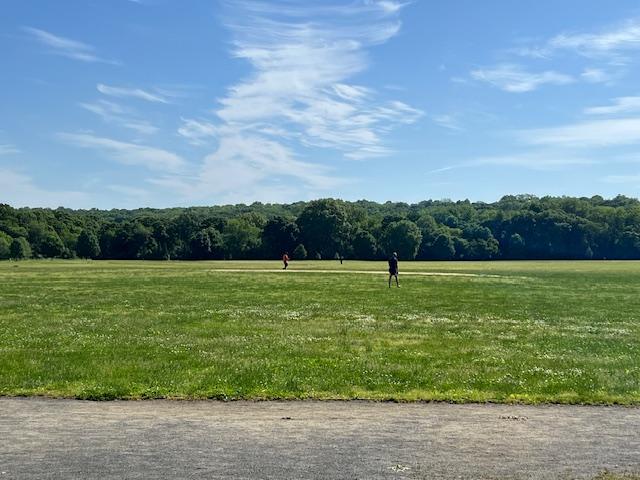
When I walked down Broadway in the Summer of 2025, it was as if COVID never existed. The shopping areas and restaurants were back in full swing, everything was open. When I started the walk up in Van Cortlandt Park, groups of men were playing cricket in the ball fields and lots of people jogging and walking their dogs. It was just another day but the park was really busy early in the morning. The walk down Broadway has seen new businesses open and a vibrant shopping district in each neighborhood.
Still there are many businesses that are thriving along the Broadway corridor and a lot of great restaurants to stop and visit along the way. Even after a big breakfast, I needed to take snack breaks along the way and the restaurants in the Washington Heights area are reasonable and have great travel food.
My first stop after visiting the Muscota Marsh was Twin Donut at 5099 Broadway (permanently closed July 2021 and still sitting empty in 2022 and 2023) for a donut and a bathroom break. You will need to know which public bathrooms are good along the way and for the price of a donut it was well worth the visit. Their donuts are around a $1.75 depending on the type but go for one of their jelly or custard filled. They are really good. This is one of the first places I used to visit during the Cornell/Columbia Football games.
Rumor has it by 2021, it will turn into a residential building. In the Summer of 2022, the building is still there but is long closed. They have not started construction on the residential tower that was supposed to go there. In 2023, the building was behind fencing and nothing been done. In 2025, the building still sits there awaiting development.
Twin Donut was formerly at 5099 Broadway (Closed in 2021-it still sits empty in 2025)
As I passed Isham Park, which is a beautiful Inwood Park with lots of rock formations, I stopped to look at the Church of the Good Shepard at 4967 Broadway. I had never really noticed it on previous walks, but I had walked around the church when I visited the Farmer’s Market two months earlier when I walked “The Great Saunter”.
The church was built in 1930 and designed by architect Paul Monaghan in the Romanesque style. The church is a combination of limestone and granite and has the most beautiful gardens planted that were in full bloom on the corner of Isham Street and Broadway. During the warmer months, there is a terrific Farmers Market that lines Isham Street by the park with all sorts of fruits, vegetables, baked goods and flowers to buy.
As you are traveling down Broadway, take some time to walk the side streets into the heart of ‘Little Dominica’, Inwood’s Dominican community of stores, restaurants and bakeries. The first stop should be walking down 207th Street to the subway stop on 10th Avenue. While the street is full of all sorts of restaurants, stop at the street vendors for fresh juice and pastilitos, the Dominican version of the empanadas.
These usually run about $2.00. There are all sorts of street vendors selling their wares along the sidewalks. On my second trip down I stopped at a vendor for fresh chicken pastilitos and there is nothing like them when they are just out of the fryer.
Fresh Pastilitos at the stands in the shopping district at 207th Street to Tenth Avenue
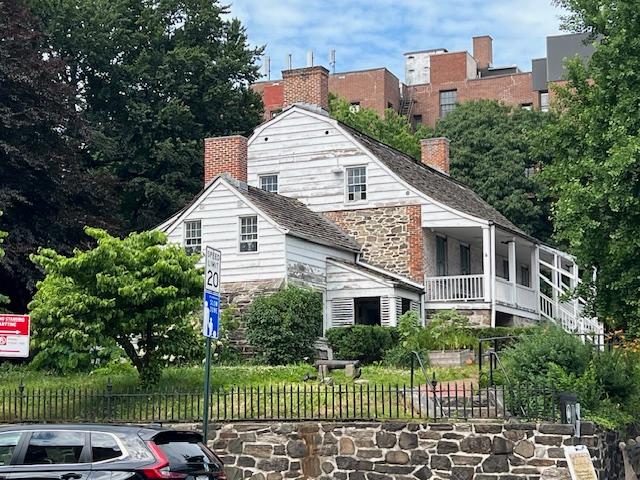
As I traveled through Inwood, I stopped at the Dyckman Family Farmhouse (See reviews on TripAdvisor and VisitingaMuseum.com), which is the oldest home on the Island of Manhattan. The Dyckman Farmhouse was built in 1785 and was once part of a 250 acre that stretched to the tip of Inwood. The house now sits on a bluff overlooking Broadway and Washington Heights on about an acre of land.
The house is still impressive to walk through and when you have time, take the formal walking tour of the home and hear about the history of how the farm worked and about the Dyckman family (the site has now opened up for tours outside in 2022 and the house will open this summer).
As you pass the Dyckman House and walk south also take a side trip down Dyckman Avenue to visit more Dominican restaurants, bakeries and stores from Broadway to Nagle Avenue. There are some interesting places to have a snack but again check out the street vendors first especially on the weekends when the weather is nice. More people are out walking around.
Walking down Isham Park on the way to Ann Loftus Park offered more beautiful views of the foliage.
Broadway by 213th Street
Broadway by 212th Street
Broadway by Isham Park
Walking by Isham Park in the Summer of 2026
The Dykman House in 2025
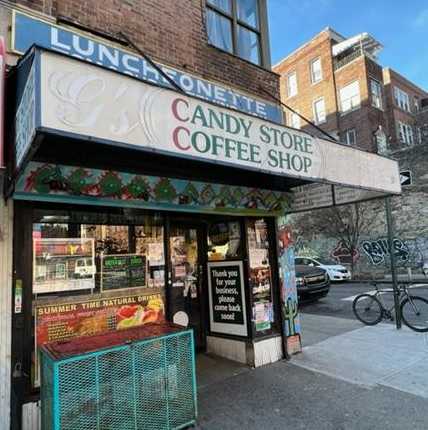
In 2021, I stopped back at G’s Coffee Shop at 634 West 207th Street, one of my favorite places to eat when I am visiting The Cloisters. Their food is excellent and so reasonable.
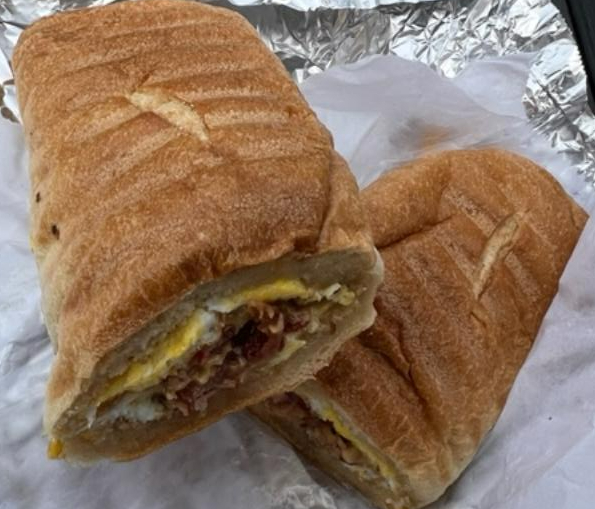
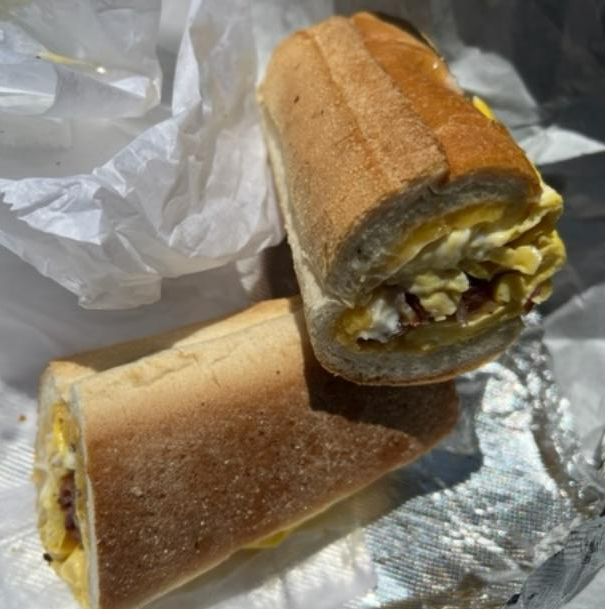
In 2023, I had a Bacon, Egg and Cheese on a hero roll, and it carried me through walking through Washington Heights. Talk about a sandwich as it was stuffed with loads of eggs and bacon and had that nice buttery taste of the grill (see my reviews on DiningonaSheStringinNYC@Wordpress.com and TripAdvisor)
Their Bacon, Egg and Cheese is really good
In 2024, I had a Bacon and Cheese Omelet with Home Fries and Rye Toast that was wonderful.
The breakfast in 2024 was spectacular and gave me the energy of the 13 mile walk.
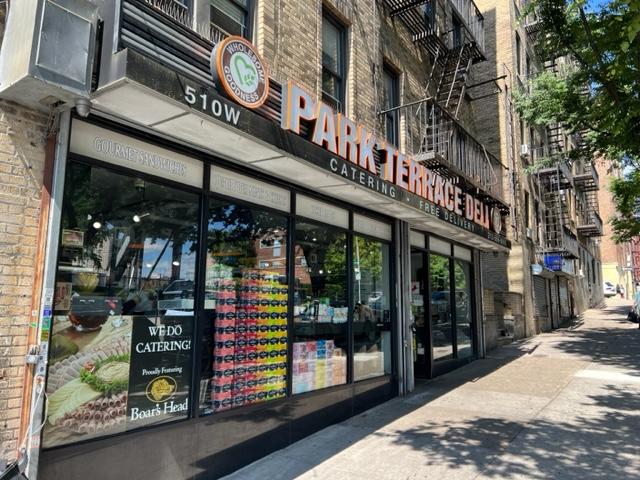
In 2023, I stopped at the Park Terrace Deli where I had the same sandwich. I love the Bacon, Egg and Cheese when I am doing this walk and it fills me up for the afternoon. Park Terrace Deli offers all sorts of breakfast and lunch sandwiches at very reasonable prices. Their hamburgers and cheeseburgers are excellent too.
I took my breakfast and ate at Muscota Marsh on the benches and just watched the water drift by on the river. What a beautiful morning to be outside. it is the nicest place for excellent views of the Hudson River.
Muscato Marsh was so pretty that morning
The Hudson River looms in the distance
The park in the summer of 2025
On my most recent walk down Broadway in the Summer of 2026, I stopped in for breakfast wanting to try one of their breakfast platters. I chose a Cheese Omelet with Cheddar Cheese.
The breakfast menu
The guy must have not been listening because I ordered a Cheddar cheese omelet and somehow got a Feta Cheese omelet. Not the same but still good.
My Broadway walk breakfast
The omelet was huge
It came with a mountain of spiced hash browns which were really good. I also should have gotten rye toast instead of wheat but it still made a good sandwich. So it was two breakfasts in one.
You have to make a sandwich with it for two breakfasts
Even though the order was screwed up, the food was still delicious and I tried something new. It was such a beautiful day, I took my breakfast down to Muscato Marsh down the road, ate outside and enjoyed both the weather and the views.
Talk about the best place to eat breakfast with those views
Balancing out this huge omelet outside
The one nice thing about eating meals in Muscato Marsh is the views on a beautiful, sunny afternoon. I enjoy just relaxing on a warm morning or afternoon and enjoying my meal as I watch the birds fly by or watching people boating in the river.
The shopping district on Broadway in Inwood is always changing with a selection of restaurants and shops constantly changing. You go from Spanish bodegas to fancy restaurants and then back again. I have been doing this walk for almost a decade and keep watching how the neighborhood keeps changing with the economy,
Shopping district in Inwood in 2026
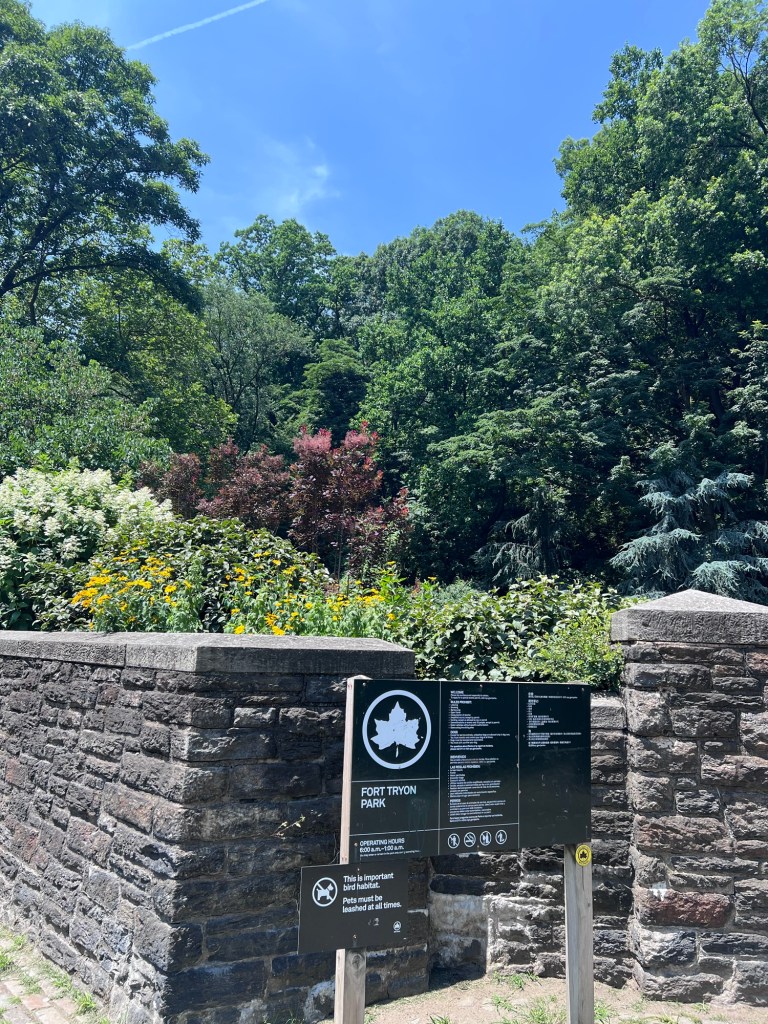
Looking down Broadway to Fort Tyron Park in the Summer of 2026
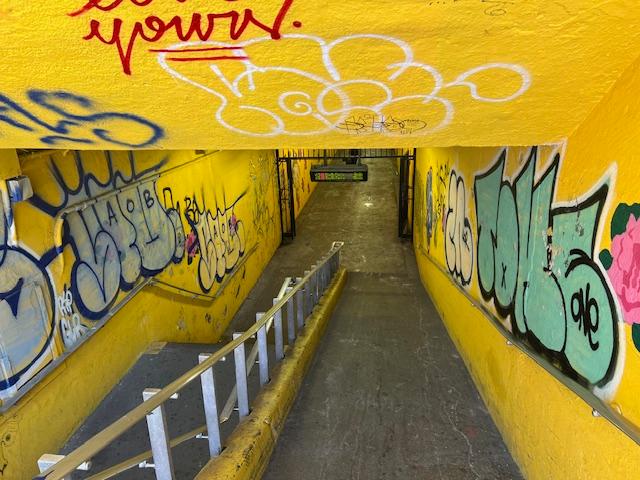
Inwood Street art near 207th Street
Street art in Inwood
When you cross Dyckman Street, Ann Loftus Playground at 4746 Broadway (named after a local community leader) will be to the right and there are nice public bathrooms and water fountains here. There are also benches under shade trees to sit under and on a warm day, there are vendors selling Dominican ices for $2.00. Go for the mango/cherry or the rainbow. On a hot day, they are very refreshing (The Ann Loftus Playground is closed for renovations in the summer of 2022 and I ended up having my mango-cherry ice at 110th Street after lunch).
Ann Loftus Playground is part of the extensive Fort Tyron Park that runs from Riverside Drive to Broadway from Dyckman Street to 190th Street.
The park in the Fall of 2025 offered many different colors of red, gold, orange and still some green on the leaves. The walk through the park was beautiful.
Ann Loftus Park
An. Loftus Park
Ann Loftus Park
Sidewalk art by a creative child artist
Ann Loftus Park in the Fall
Ann Loftus Park in the beginning of the Fall
Ann loftus park
Fort Tryon Park in the Fall of 2025
If you want to take a walk through the park, not only are there beautiful views of the Hudson River along the stone paths but it leads up to The Cloisters Museum at 99 Margaret Corbin Drive which is part of the Metropolitan Museum of Art that features Medieval Art including the ‘Hunt of the Unicorn’ tapestries.
The park also has many colorful flower gardens and paths along the river with amazing views. There is a lot of walking up and down hills in Fort Tyron Park but trust me the views are breathtaking and the paths lead to amazing gardens and lawns. There are also nice public bathrooms to stop at here.
Fort Tryon Park
Fort Tryon Park Gardens
When I visited the park in 2020, the NYC Parks Department has issued new cleanliness standards for the bathrooms, so they were much cleaner on this trip with soap and working hand blowers. I would find this in all bathrooms along the route. In 2022, there is a complete renovation of the park and the bathrooms so be prepared to hold it in until you hit the McDonalds at 183rd Street. In 2025, I found the bathrooms needed a really good cleaning again.
Inside and outside of Ann Loftus Playground, there are always local merchants selling pastilitos and ices on hot days. The prices have gone up slightly since COVID but the food is always wonderful. Two freshly made pastilitos (Dominican Empanadas) and flavored ices are the best meal when you are on the go and trust me, those ices cool you down both inside and out.
At 207th Street, the pastelito vendor has been my favorite snack place while I begin my journey downtown. I eat these on a nice day in Ann Loftus Park.
For $2.00 they make the perfect snack and he makes these so good!
In Ann Loftus Park, there was also a vendor selling the Dominican ices and a rainbow ice on a hot day there is nothing like it.
As you leave the park and continue walking down Broadway, you will be in the heart of Washington Heights so on a warm day expect to see people sitting on the benches socializing, playing checkers and dominoes and listening to music. There is a lot of life on these sidewalks.
As you pass Fort Tyron Park, take a peek at the street artwork inside the 190th Street Station and take some time to walk the corridor. It is its own museum in constant change and the street taggers do some interesting work.
The subway station at 190th Street in 2024.
The decorations are quite interesting
The weather was hot and humid in the summer of 2025 and I tried to stay in the shade as much as possible. The walk down Broadway next to Ann Loftus Park was especially nice as the weather was clear and sunny and everything was in bloom in the park.
Broadway at West 212th Street
Ann Loftus Park and Fort Tryon Entrance
The playground in the summer of 2025
When walking into the streets between 187th and 160th, there are some wonderful Spanish restaurants catering mostly to Dominican families, but the menus are extensive, and the prices are reasonable. There are a lot of restaurants especially clustered around the George Washington Bridge Depot.
In 2020, I stopped for breakfast and lunch at the Chop Cheese Deli at 4234 Broadway. Having eaten breakfast at 5:45am, I was hungry for another breakfast and could not decide what I wanted to eat. So, I ordered both the Egg and Cheese on a roll ($2.95) and their signature Chopped Cheese on a roll ($4.95). Both were really good, but the Chopped Cheese should have had shredded lettuce not chopped lettuce, so it was a little soggy but still good. The deli’s prices are excellent and there is nothing over $10.00 in the hot food’s menu (In just three years they have expanded to four delis).
The Chopped Cheese on a roll here at Chopped Cheese Deli at 4234 Broadway is really good
I must have built up some appetite because I made on pit stop on the 2021 walk and wanted to revisit a few places from previous walks on 118th Street. My first stop was Papi’s Pizza at 1422 St. Nicholas Avenue. I had passed by here many times when walking Washington Heights and never got a chance to try it. The cheese slice was very good and really large. It made a nice addition to the sandwich I had just eaten. In 2023, they were closed for the day (the restaurant closed permanently at the end of 2023).
Papi’s Pizza at 1422 St. Nicholas Avenue (Closed December 2023)
I then stopped at Esmeraldo Bakery at 538 West 118 Street for something sweet to tide me over and I just love this bakery. There prices are not just reasonable, but the selection of interesting desserts is hard to come by. I love their guava pastries, their iced doughnuts and their glazed twists. I settled on a powder covered cream horn and it was delicious. Sweet and flaky with each bite.
The wonderful selection at Esmeraldo Bakery
In 2022, I stopped here again for a quick early lunch. I had a Ham and Cheese roll that just came out of the oven, and I had a Cinnamon Raisin Pinwheel was dessert. The Ham and Cheese roll was really good with chunks of ham and melted cheese in every bite. Esmeraldo’s is always a staple with me when I am in the neighborhood, and I love the quality of their baked goods.
In 2023, I was back again. I decided I needed something sweet after the breakfast sandwich and settled on an apple turnover and a sugar doughnut. The apple turnover needed some more apples inside, but the sugar doughnut was excellent. It was soft and sweet and loaded with granulated sugar. Each bite had an extra sweetness to it.
The sugar doughnuts at Esmeraldo Bakery are excellent
Esmeraldo’s Apple and Pineapple turnovers were delicious as well on my walk in 2024
New street art has shown up in Washington Heights and the artists are extremely talented. I love going in search for new murals that seem to go up every year.
Street Art in Washington Heights on 182nd Street
Street art in Washington Heights on 175th Street
Street art in Washington Heights
Street art in Washington Heights
The shopping district on Broadway at 180th Street
As you walk further down the shopping district there are better and reasonable restaurants. Three standouts that I highly recommend are La Dinastia at 4059 Broadway (at 171st Street) for Dominican Chinese food and 5 Star Estrella Bakery at 3861 Broadway (at 161st Street) for pastries, pastilitos and all sorts of hot snacks. George’s Pizza at 726 West 181st Street is also excellent.
The restaurant row around 181st Street has a nice selection of restaurants
The active shopping district on 181st Street is the heart of Little Dominica
181st Street decorated for the upcoming holiday season in the Fall of 2025
Washington Heights shopping district
Broadway in Washington Heights in the Fall of 2025
On the other side of West 181st Street in the Summer walk of 2025, I stopped at George’s Pizza at 726 181st Street. I had not been there for a while, and the pizza was still excellent and very reasonable.
My review on DiningonaShoeStringinNYC@Wordpress.com:
The inside of George’s Pizza
The pizza is amazing
Yum!
When you get to 172nd Street, La Dinastia has a reasonable lunch menu and I recommend having the Chicken Cracklings, a type of batter fried chicken patty with their Special Fried Rice which contains shrimp, sausage, eggs and vegetables (See review on TripAdvisor).
La Dinastia at 4059 Broadway
A lunch special here can run about $15.00 with a Coke and tip and you will be full for the rest of the afternoon. The nice part about the restaurant is that it has Chinese food with a Spanish influence with rice, beans and salads on some of the entrees.
The inside of La Dinestia during lunch time
Chicken Cracklings with Fried Rice
The lunch
Yum!
La Dinastia’s at 4059 Broadway’s Chicken Cracklings and Special Fried Rice lunch special
Before you leave this area, check out the former Coliseum Cinema on the corner of Broadway and 181st Street before they tear it down. It was built in 1920 as an old vaudeville theater and famous actors including the Marx Brothers and Harold Lloyd performed there. The building is slated for demolition due to its structure concerns and will be replaced by housing and a retail mall. In 2020, a church group is now using it.
The Coliseum Theater at 181st & Broadway has interesting detail work
Palace Theater in 2024. The details on the building are amazing.
I noticed that on my trip in 2020 that the shopping districts in Washington Heights have been devastated by the COVID-19 crisis. I saw a lot of closed and empty businesses in the 207th and 181st shopping districts and a lot of popular delis and stores have closed along the Broadway corridor of Washington Heights. This made the lines at the places that were still open even longer.
In 2022, when I took the walk down the 181st Street shopping corridor, I noticed that there were still some empty storefronts but not as many as two years ago. Some older restaurants have been replaced by chains and there is a new Chick fil A on the block. It seems that the chain stores have now discovered the shopping area so expect to see more changes. With the changes in the neighborhood’s demographics, I expect to see more chain stores here in the future. In 2025, many new Latino cuisine restaurants have opened to replace the ones that have closed and the chain restaurants have discovered the district as well. The areas population is changing with the shifts in the neighborhood.
There is a small park across from the Columbia Presbyterian Medical Center, Mitchell Square, at the corners of Broadway and St. Nichols Avenue at 168th Street, that features the Washington Heights-Inwood War Memorial by artist Gertrude Vanderbilt Whitney. It was dedicated in 1922 for members of the community who fought in WWI. I found it very touching. It features two soldiers assisting another wounded one.
Washington Heights-Inwood War Memorial by artist Gertrude Vanderbilt Whitney
Street art of birds on the store front of Broadway and West 167th Street (I could not figure out the name of the artist)
Also check out some of the Dominican bakeries in the area. 5 Star Estrella Bakery is near the corner of 161st Street and Broadway. Everything at the bakery is delicious and I have never had one bad thing to eat here (See reviews on DiningonaShoeStringinNYC@Wordpress.com and TripAdvisor).
Their chicken and beef pastilitos are cooked perfectly and stuff full of filling ($1,50), their doughnuts are light and slathered in thick icing ($1.00) and their cinnamon buns ($2.00) are the best. They are light, chewy and sugary. Another item that stands out is a type of potato croquette that is filled with meat ($1.50). If they are available, grab one. Totally delicious!
The Cinnamon Swirl pastry here is excellent
The lines in 2020 were the longest I have ever seen with about 15 people waiting outside for service. I had a Raisin Swirl doughnut ($2.00) and a chewy fried doughnut ($2.00) which I ate on the way down Broadway. Even in 2022, the lines were long and I was still stuffed from my earlier snack.
As you reach the small pocket park, the IIka Tanya Payan Park at 157th Street, you will come across the first piece of Broadway Art by artist Nicolas Holiber for his “Birds on Broadway” Audubon Sculpture Project exhibit which is a partnership he has with Broadway Mall Association, NYC Parks, NYC Audubon and the Gitler Gallery.
Ilka Tany Payan Park at Edward Morgan Place and Broadway
The park is named after the Dominican actress from the 1960’s and 70’s who later became an AIDS activist and Lawyer.
The park in the Summer of 2025
The park in the Fall of 2026
The park in the Fall of 2026
These interesting sculptures bring attention to birds’ species that are endangered by climate change. These birds are either native to New York or do a fly by when in season. They are made of 100% reclaimed or recycled wood (Nicolas Holiber website).
The Wood Duck by artist Nicolas Holiber (the sculpture is still up in 2020)
The first sculpture on the walk that I saw was the Wood Duck. It was an interesting piece that unfortunately was being walked on by a couple of kids that did not seem to know the significance of the work. These rustic pieces really do stand out though and I like the write ups with each one which gives a short story on each bird.
When I was walking through IIka Tanya Payan Park in 2022, there was a very strange looking sculpture that looked like a shell formation called “Gifting Angel” by artist Jon Isherwood for the project “Broadway Blooms: Jon Isherwood on Broadway”, part of the Broadway Mall Association project with eight sculptures along Broadway. This exhibition opened in 2020 and has been extended to July 2022.
The “Gifting Angel” sculpture by artist Jon Isherwood sits in IIka Tanya Payan Park in 2022
Mr. Isherwood is an English born American artist and a graduate of Canterbury College of Art in England and holds an MFA from Syracuse University. He has had exhibitions all over the world and is known for his public art and large sculptures.
Boricua College Campus where both museums are located
As you pass the sculpture and continue south to the right is the Audubon Terrace at 155th Street and Broadway, which is home to Boricua College, the Hispanic Society of America Museum (See reviews on TripAdvisor and VisitingaMuseum.com) which is currently closed for renovation and the American Academy of Arts & Letters (See review on TripAdvisor and VisitingaMuseum.com) which just recently closed and is only open twice a year to exhibitions. Both museums are only open at select times of the year, so you have to visit their websites for more information.
The American Academy of Arts & Letters at 633 West 155th Street
The inside of the museum in 2025 after the long renovation
Inside the Hispanic Society Museum in the summer of 2025
In 2021 when I revisited the college, the college was hosting the Latinx Diaspora exhibition with artwork and musical displays. Artists Danny Pegresso, Carla Torres, Dister Rondon and FEEGZ displayed their works outside the building in the courtyard.
The Latinx Diaspora Exhibition at the Hispanic Society Museum & Library
The exhibition displayed several works of art in galleries that spanned three buildings. I got to see many local artists display their work as well as seeing an exhibition on the progression of the musical “Hamilton” from local theater to the smash hit on Broadway. It was interesting to see how the show progressed. It also gave an interesting perspective on what is going on in the world by younger artists. The exhibition will be open until August 2021.
In June of 2022, there was an exhibition outside entitled “Art of Solidarity” by artist Andrea Arroyo. The exhibition touches on the themes of immigration, gender rights, love and peace, gun violence and environment crisis (Artist website).
Ms. Arroyo is known for her paintings, illustrations, public art and site-specific works and a noted lecturer, curator and speaker (Artist bio).
The college abuts the Trinity Church Cemetery that holds the graves of many prominent New Yorkers including John Jacob Astor IV and Mayor Ed Koch. It is interesting to walk along the paths of the cemetery during the day and look at the historic tombstones. When visiting the grave of Mayor Koch, be prepared to find lots of stones along the grave site as a sign of respect for the dead. Take some time out when visiting the cemetery to pay your respects to one of New York City’s greatest mayors.
As you pass the borders of 155th Street into Harlem there is a distinct change in the street life. It is a lot quieter when you reach the borders of Washington Heights and Harlem. There are less people on the sidewalks here. In Washington Heights, there is music on the sidewalks, families playing games and men debating issues. It is a lot quieter I noticed when you cross the 155th Street border between the neighborhoods.
The cemetery at the Church of the Intercession is the border of Washington Heights and Harlem.
The General Washington plaque on Broadway and 155th Street.
The entrance to the cemetery at 155th Street
Broadway in Washington Heights in the Fall of 2025
The cemetery at 155th Street
155th Street by the cemetery with a view of New Jersey
Another church I had not really taken a good glimpse at over the last few walks is the Church of the Intercession at 550 West 155th Street. This elegant church sits in front of the cemetery, holding guard on the gravesite.
The Church of the Intercession at 550 West 155th Street (Church Website)
The Church of the Intercession was founded in 1846 and the current building was built in 1915. It was designed by architect Bertram Grosvenor Goodhue from the firm of Cram, Goodhue & Ferguson and was designed in the Gothic Revival style with a combination of English Perpendicular style (Wiki).
As you past the church and the Trinity Cemetery, you enter the heart of Washington Heights though some would consider it upper Harlem. This part of the neighborhood was dealing with hyper gentrification before the pandemic started and I noticed that a lot of stores and restaurants were opening and closing before the pandemic. The closer you got to the CUNY campus that stretches from West 142nd Street to the border of West 129th Street, the businesses started to become more geared to the college students. That has since slowed, and a lot of bars have closed.
Street art a Bird on the building at 145th Street
There is also a difference in the types of restaurants and shopping as slowly CUNY is starting to spread its wings and more businesses catering to students and faculty are opening in this area. More pizzerias, wing shops and bakeries gearing to both the neighborhood and the college students have opened in the old businesses place since 2022. More and more businesses are behind brown paper so we will see in the next few months before college resumes in six weeks what comes out of it.
I kept following the path of Broadway artwork. The next stop was to see Nicolas Holiber’s Snowy Owl at 148th Street. This was one of the more whimsical pieces in the exhibit and was unique with its outlaying wings.
The Snowy Owl by artist Nicolas Holiber at 148th Street
Street art on Broadway
The Beeagloo artwork on West145th Street
My next stop for a snack was at Olga’s Pizza at 3409 Broadway (See review on TripAdvisor). Olga’s, I had just stumbled across as I had a craving for a slice and the pizza is delicious. The secret to a good pizza is a fresh tasting and well spiced sauce and Olga’s hits both marks on this. It is a little pricey at $2.50 a slice but she is catering to the CUNY students who venture from campus to the restaurants on Broadway for meals. I got to meet Olga herself in the pizzeria who was working alongside of her parents, and she seemed please that I liked her pizza so much (Olga’s Pizza is closed in 2020).
To the right of Olga’s just down the block is Montefiore Square Park, which is always a nice place to take a break and sit down to rest under the trees. It is a real mixture of neighborhood families, college students and teenagers who are eating at the local McDonald’s or one of the food trucks that line the park in the warmer months. Just north of the park at 139th Street is the third sculpture in the Nicolas Holiber exhibit, the Hooded Merganser.
The Hooded Merganser by artist Nicolas Holiber at 136th Street (still here in 2020)
Montefiore Square Park has since gone through a renovation closing off the Hamilton Place Road extension and bricking up the road to make it a pedestrian park. It is now full of small vendors and food carts catering to the people of the park but again the college students are moving into this area, and it is starting to change again.
One surprising thing I found at the corner of Broadway and 135th Street was a Pediatric office that housed in the front of it the Martinez Gallery at 3332 Broadway. The gallery features in the front waiting room an array of street art. This was interesting for a doctor’s office.
The Martinez Gallery at 3332 Broadway (Closed in 2025)
The inside artwork at the Martinez Gallery. Very unassuming doctor’s office (because of COVID the gallery looked closed to visitors and then closed permanently in the Summer of 2025)
Once you pass 135th Street, you enter the new extension of the Columbia University campus and because of the growth of the campus to this section of Harlem especially around the 125th Street corridor, it is changing fast. I have never seen so many new restaurants and shops going up right across the street from the Manhattanville Housing Projects. It is becoming a real extreme in this part of the neighborhood.
Passing the impressive 3333 Broadway on my way to the Columbia campus in the Summer of 2026.
In 2021, the campus is now stretching from the corner of 132nd Street with more new buildings under construction to the 125th Street shopping district. All around this area the housing is being renovated and newer stores catering to students are starting to open up. I walked the streets again on the campus and it is expanding to the Hudson River parks.
In 2022, most of the buildings have been finished and opened. New pocket parks have opened on this side of Broadway. More construction is going on as Columbia University marches northward to meet up with the CUNY campus.
Columbia University’s new Manhattanville campus that stretches from 125th to 132nd Streets
The new extension to Columbia is changing the neighborhood
The Manhattanville campus in 2024.
The one thing I can say about the new campus is that they have a study area that is open to the public where you can go to the bathroom and charge your phone which is very helpful. I will let you know that you have security all over the place watching what is going on.
The view of Old Broadway and the Manhattanville Housing in the Fall of 2025
I took a walk back down 125th Street to West Harlem Piers Park at Marginal Street which stretches up to 132nd Street. The park is one of the nicest to visit on a warm sunny afternoon and offers the coolest breezes and the most beautiful views of New Jersey. It is a nice place to take a break and just enjoy nature.
In 2020, this became my place of rest on this walk as well as a stopping point on “The Great Saunter” in May. The views are just spectacular in this small Hudson River Park and the breezes on a hot day will cool you down. It is just nice to sit and admire the views. I just like to admire the views of New Jersey and watch the boats go by.
West Harlem Piers Park between Marginal Street from 125th to 132nd Streets
As I made my way back down 125th Street, I came across the very much renovated St. Clair Rose Garden which sits just under the bridge at corner of 125th Street and Riverside Park. The last time I had seen the garden two years ago, it had been infested with weeds.
The St. Clair Rose Garden was fixed up during COVID and is now maintained
Ángel Toren is a contemporary artist known for his vibrant and thought-provoking street art. Hailing from Spain, Toren has garnered attention for his ability to blend traditional graffiti techniques with modern artistic elements. Toren’s art explores themes such as identity, social issues, and human emotions, often portraying these subjects through surreal and abstract imagery (Artist Bio).
Once you cross 125th Street on this part of Broadway, you enter Morningside Heights and the home of Columbia University. This part of 125th Street and Broadway has really changed since I started the walk of the island. There is a more established ‘Restaurant Row” that stretches from 125th Street to 122nd Street on Broadway that contains such restaurants as LaSalle Dumplings at 3141 Broadway (currently moving to West 113th Street as of this writing in 2020) and Bettolona at 3143 Broadway (Closed in January 2022) that I have tried in previous entries on this blog and check them out on my blog on Morningside Park. They are both excellent and I highly recommend them.
Bettolona at 3141 Broadway is where I spent my birthday lunch when visiting the neighborhood (and I just found out closed in January 2022-it was empty when I passed it)
As soon I arrived on the Columbia University campus at 125th Street the mood of Broadway changed again from the streets of Harlem to a collegiate atmosphere. Don’t miss a break at the Columbia University commons around 116th Street. It is a lot of fun when school is in session and even during these quiet times of the summer, there still is a lot of energy here. It is a nice place to gather your thoughts and relax.
What is also nice is all the food trucks outside the commons that cater to the Asian students. You can get fresh dumplings, pork pancakes, noodle dishes and fresh soups for very reasonable prices and you can relax in the commons on a nice day and enjoy your lunch (these were gone when school was not in session in 2020).
Right next to the campus on East 117th street is the third in Nicolas Holiber’s sculptures, the Common Goldeneye. This is one of the nicer locations for the work as there is plenty of seating in much less congested area of Broadway. You can sit back and just admire the work.
The Common Goldeneye by artist Nicolas Holiber at 117th Street
Don’t miss the beautiful Union Theological Seminary building at 3041 Broadway. This non-denominal Christian Seminary is affiliated to Columbia University. The building was finished in 1910 and was designed by the architectural firm Allen’s & Collins in the English Gothic Revival design (Wiki).
The Union Theological Seminary building at 3041 Broadway
After taking a break in the commons and watching the summer students reading and chatting amongst themselves or so involved in their cell phones that they would not look up at a zombie attack. Still, it is a nice place to take a break and relax on the stone benches. The commons is open to the public but with school out and many people out of the City, it was really quiet. I just like to find a shady spot and look at the buildings and let life pass by.
The Columbia University Commons is open and a nice place to relax
The Quad was going through a renovation when I visited
The Columbia Quad in the afternoon.
In 2024, the campus was padlocked down after the Pro-Palestinian protests and the campus was closed for the summer break. If you were not a Columbia student living on campus, you were not entering that campus. In 2025, you can no longer go into the Columbia Quad without a Columbia student ID and there is security all around the campus. The days of ‘just walking around campus’ are over!
The Columbia campus padlocked down in May of 2024 after the protests.
I headed back to Broadway to cross into the Upper West Side. It is amazing how everything between 125th and 110th have changed over the past few months and even from 110th to 100th Streets the changes have been constant in a twenty-year period. Businesses are opening and closing at a rapid rate and with the students gone from campus and may not come back for the Fall of 2020, it will hurt the area more. The locals though are filling the outdoor dining and making do with masks and all. In June of 2020, the masks were all but gone even indoors. In the summer of 2025, it was like it never existed but still you see some masks outside with older people.
The gardens by the older part of campus in the Summer of 2026
I needed a lunch break by the time I reached West 110 Street and spent some time searching for old restaurants on my DiningonaShoeStringinNYC@Wordpress.com blog to see if they were still open. Hunan Chens Kitchen, a tiny Chinese take-out place at 1003 Columbus Avenue A closed during the pandemic and is now empty. West Place Chinese Restaurant at 1288 Amsterdam Avenue A is still open but only for takeout and delivery. That’s when I stopped at Koronet Pizza at 2848 Broadway for lunch in 2022.
I was starved and needed one of their giant slices of pizza that takes up three plates. At $5.50 a slice, it is well worth the money. The slice could easily feed two people and even when you fold it, it is hard to maneuver but it is so good! The sauce is so well spiced, and it is loaded with cheese and was so fresh. It tasted like it just came out of the oven.
The giant slice at Koronet Pizza is well worth the $5.50 price tag (Yum!)
I just sat outside on the tables they set up and chopped away. God did that pizza hit the spot. This is the perfect college pizzeria, and I can see why this is their major location. They have two more in the City. It was just nice on a sunny day to sit back and watch the world go by.
Tom’s Restaurant in Morningside Heights at 2880 Broadway made famous by the TV show “Seinfeld”.
Before I left the edges of Columbia University, I found my ices lady at the corner of Broadway and West 110th Street. These Dominican women own the ices carts, and it is now $2.00 for small Mango-Raspberry ice but she loaded on the scoops for me, and I said a big “Thank you” in Spanish. I could tell she was happy that I was so happy. It was so sweet and cooled me down on a hot day’s walk.
The Columbia campus on Broadway
By West 120th Street in the Fall of 2025
When you need to take a break from the heat, Straus Park which is between 107th and 106th Streets. This shady and well landscaped little pocket park was name after Isidor and Ida Straus who were once the owners of Macy’s and died in the Titanic sinking. The park’s beautiful fountain is centered in the park with the statue “Memory” by artist Augustus Lukeman and architect Evarts Tracy who designed the statue and fountain and dedicated it in 1915.
The Statue “Memory” by Augustus Lukeman in Straus Park
Artist Augustus Lukeman was an American born artist from Virginia and raised in New York who studied at the National Academy of Design and Cooper Union with continued studies in Europe and at Columbia University. He was known for his historical monuments (Wiki).
There is a beautiful memorial to them in the park. Friends of the Park maintain it with the city so it is always beautifully planted. On a hot day, it is such a nice place to take a break and since The Friends of Straus Park maintain it, the gardens and statuary is always in perfect shape.
The Entrance to Straus Park and the Straus Park plaque
Look closely or you will miss it is the ‘Art for Art Sake’ dedication to Duke Ellington on the Broadway Island on West 106th Street. The work is done in tiles, and you have to look down to see the work as it on the bottom park of the cement island facing the bench. I guess most people miss this interesting piece of street art.
One of my favorite bakeries in Manhattan is located right near the park at West 105th Street and Broadway, Silver Moon Bakery at 2740 Broadway (See review on TripAdvisor and DiningonaShoeStringinNYC@Wordpress.com-Closed March 2025). I love coming here for all the creative pastries and buns that the bakery created, and I have the most delicious blueberry Danish ($3.50) and cinnamon bun ($3.25) for a snack.
Don’t be shy in this bakery and try several items. Everything I have ever ate there was wonderful. With so many businesses closing in the City, when I walked Broadway in 2020, the lines were out the door. People obviously needed comfort food in these troubling times. Even in 2022, the lines were still out the door, and I could not get in for a snack.
Silver Moon Bakery at 2740 Broadway (new location at 2664 Broadway called Silver Moon Bakery Buttercup)
The new bakery that just opened at 2664 Broadway (new owner and same staff)
Their delicious Crumuffin is what they are known for. It is a delight!
When I got to 103rd Street, I saw the next part of the Birds on Broadway exhibit with the Double Crested Cormorant that stood proud on the Broadway Island looking over the neighborhood.
The Double crested Cormorant by artist Nicolas Holiber at 103rd Street
In 2022, the sculpture was “Chances Wish” by artist Jon Isherwood at the 103rd Street stop
“Chances Wish” at Broadway and West 103rd Street
Another little pizzeria that you might miss is Cheesy Pizza at 2640 Broadway (See reviews on TripAdvisor and DiningonaShoeStringinNYC@Wordpress.com). The food is really reasonable and their personal pizza ($5.00) and pizza special (Two slices and a Coke for $5.00) are a real steal and their sauce is delicious and so well spiced (the restaurant is still open but with new owners and prices as of 2020 and in 2022 it got more expensive). They no longer have those wonderful reasonable lunch specials.
On the corner of West 103rd Street and Broadway is a beautifully detailed building at 203 West 103rd Street, the Edinboro Building. The apartment building was built in 1888 by architect E.L. Angell and the stone carvings and designs standout on all parts of the building (CityRealty/Voorhis-Architect paper).
The detail work on the entrance of 230 West 103 Street
When you finally cross over past West 100th Street, you enter the Upper West Side which has been extensively traveled on this blog. There are dozens of shops and restaurants that line Broadway on this stretch of Broadway and sadly a lot of empty store fronts. This seems to be an epidemic all over the City with landlords jacking up rents every month. It really is changing this stretch of Broadway. In 2020, the COVID-19 pandemic has not helped matters in this area as businesses are closing left and right.
At West 96th Street and Broadway is the next “Birds on Broadway” piece, the “Brant Goose”. This part of Broadway enters into the traditional boundaries of the Upper West Side and there are many changes along this stretch of Broadway as well. It was almost like the mood in 2020 harked back to 1989 or 1990 with the store closures and the homeless taking over the streets.
The Brant Goose at West 96th Street
Another interesting building located at West 85th and Broadway at 2350 Broadway is Bretton Hall which once was a residential hotel. The building was complete in 1903 by architect Harry B. Mulliken of Mulliken & Moeller and was designed in the Beaux Arts style. The detail work with its stone carvings is very elaborate with cornices and (Wiki/CityRealty).
When walking on Broadway in the West 80’s, don’t miss walking through Zabar’s at 2245 Broadway near 80th Street. It is fun to wander around the store and smell the aromas of cheese, olives, freshly baked breads and chocolate. Don’t miss their café at the corner of West 80th Street (See my reviews on TripAdvisor and DiningonaShoeStringinNYC@Wordpress.com). There is a nice assortment of pastries and soups at a reasonable price and on certain days they have specials that are reasonably price. They have the most delicious pastries and pan pizza.
In the summer of 2020, the café was closed because of the pandemic but the supermarket part was still open for business. In 2021, the Café has now reopened but only to outside dining and delivery. The once lively comradery of the customers has moved to the sidewalk tables. In 2022, the Zabar Cafe is open for business, but they still have the outdoor cocktail tables where you have to stand while eating your food.
Zabar’s Café is the original place where Zabar’s started at 2245 Broadway
The Zabar’s Cafe is one of my favorites for a nice snack.
You will also see the next sculpture by Nicolas Holiber at West 79th Street, the “American Brittern”, which stands majestically on Broadway.
“The American Brittern” by artist Nicolas Holiber at West 79th Street
Still when you reach the West 70’s there are many beautiful apartment buildings that I admired that were built at the turn of the last century when builders were trying to woo the wealthy in the late 1890’s to the early 1900’s. The area itself is going through building boom and is changing all the time. At West 79th Street, look to the Broadway Island again to see Nicolas Holiber’s “Scarlet Tanager” sculpture. These playful little birds are fun to look at.
The Scarlet Tanager by artist Nicolas Holiber at West 86th Street
Broadway has a series of churches that are really beautiful in design and in the details like the stonework and the stained-glass windows. One church that stands out is the First Baptist Church 265 West 79th Street. It was built between 1890-93 and was designed by architect George M. Keister. The large window facing Broadway depicts Christ as the center of the New Testament Church (Wiki).
Some of the apartment buildings are quite spectacular. The Apthorp Apartments at 2211 Broadway (that stretches back to Broadway) is one of the most beautiful, enclosed buildings with an elegant courtyard in the center. This building was built in 1908 and is the largest type of apartment of its kind in New York City. If you can take a peek inside the gates, it is worth it.
The next spectacular building was the Hotel Belleclaire. One of Manhattan’s oldest luxury hotels, Hotel Belleclaire debuted on the Upper West Side in 1903 with its Beaux-Arts architecture blended with Art Nouveau-Secessionist style. Designed by legendary architect Emery Roth, the building’s brick and limestone facade have been brilliantly restored to its original splendor, which have earned the Hotel Belleclaire its landmark status. Once home to writers Mark Twain and Maxim Gorky, as well as, a residence for Babe Ruth, Hotel Belleclaire continues its legacy of historic hospitality into the 21st century (Hotel Belleclaire website).
William Waldorf Astor hired architects Clinton and Russell to design the two southern towers of The Astor in 1901. In 1914, William Waldorf Astor hired Peabody, Wilson & Brown to design a third tower for The Astor. The third tower, completed within a year, is structurally and aesthetically similar to both original towers. All three wings are connected at the base and have gray brick facades above a limestone base (Wiki). The architectural firm of Pembrooke & Ives has done the renovations of the current building (Astor.com).
The Ansonia Apartments at 2109 Broadway is one of the biggest and grandest of the Victorian age apartment buildings on the Upper West Side. Built between 1899 and 1904 the outside of the building is studded with beautiful stonework, interesting torrents and a Mansard roof. Take time to walk around the building and admire the stonework.
The details at the top of the Ansonia. This looks like a confectionary.
The details of the Ansonia
The details on the Ansonia
Another building that stands out in the neighborhood is the Dorilton Apartments at 171 West 71st Street that was built in 1902. This elegant building is in the Beaux-Arts style and is another building that sets the tone for this part of the neighborhood.
The Dorilton just finished a multi-million dollar renovation and the building looks amazing. It was brought back to life.
The Dorilton Apartments at 171 West 71st Street
The outside of the Dorilton
The detail work of the windows at the Dorilton
The details around the windows at The Dorilton apartments
In the Summer of 2025, the Dorilton Apartments were done with the outside renovation and the building looks spectacular now. You can see all the stone details.
In the 2021 walk, I made it to Verdi Park on the corner of West 72nd Street and was able to relax. The small park has gone through a recent renovation and now has upscale umbrella cart businesses selling coffee and pastries. The park was named after Giuseppe Fortunino Francisco Verdi, one of the most famous composers in the late 1800’s (NYCParks.org).
I was able to relax for a bit and listen to a sax player play “New York New York”. It is a nice place to cool down and people watch as they race in and out of the subway.
Verdi Square Park between West 73rd to 72nd Streets (Guiseppe Verdi Statue)
The details on the Apple Savings Bank (the former Central Savings Bank Building.
The Apple Bank Building is another older building that has a lot of charm. Constructed as a branch of the Central Saving Bank, now Apple Bank, from 1926 to 1928, it occupies a trapezoidal city block bounded by 73rd Street to the south, Amsterdam Avenue to the east, 74th Street to the north, and Broadway to the west. The Apple Bank Building was designed by York & Sawyer in the Renaissance Revival and palazzo styles, patterned after an Italian Renaissance-style palazzo (Wiki).
This is where the Upper West Side has changed so much. This area has become so expensive, and the once notorious “Needle Park” Sherman Square is now a nicely landscaped park with a coffee vendor and young mothers with strollers. It is amazing how the City just keeps changing itself.
Sherman Square; the once “Needle Park” in the Fall of 2025
Right by the subway stop at West 72nd Street is the next sculpture the “Peregrine Falcon”.
“The Peregrine Falcon” at West 72nd Street
Once you pass the borders of West 72nd Street, you will begin to see the magic of former Parks Director and major City Planner, Robert Moses. In the mid-1960’s, the City decided the area was dilapidated and pretty much leveled the neighborhood to build the Lincoln Center complex and branches of the local colleges so you will see more modern architecture on the western side of Broadway.
The Van Dyke Apartment Building at 175 West 72nd Street embellishments
Both Harry Mulliken and Edgar Moeller graduated from Columbia University’s School of Architecture in 1895. Mulliken opened his own practice around the turn of the last century and in 1902 he and Moeller went into partnership as Mulliken & Moeller. The two specialized in apartment hotels like the Bretton Hall Hotel, the Hotel York, and the violet-colored Lucerne Hotel (Miller, Tom Landmark West).
On July 29, 1905 the Real Estate Record & Guide reported that Mulliken & Moeller, “are making revised plans for the 12-story 34-family apartment house” on the northeast corner of 72nd Street and Amsterdam Avenue for developers Ripley Realty Co. The Van Dyke, as it would be known, would have a near twin, the Severn, on the southeast corner of 73rd Street and Amsterdam, separated by a service alley (Miller, Tom Landmark West).
The entrance of 2020 Broadway is the only interesting part of the building but it is so beautiful.
This pre-war apartment building was built in 1901 and it now a rental building.
Interesting grill work on one of the renovated buildings
In the small park triangle park across from Lincoln Center there was a statue of opera singer Richard Tucker that I had never noticed in all my trips down Broadway. It sits in the middle of this small park with tables and chairs where people enjoy coffee and snacks on a warm sunny day.
The Richard Tucker statue in the small park across from Lincoln Center
Richard Tucker had started off as a Cantor who in 1945 made his operatic debut with the Metropolitan Opera, where he stayed on with the company until his passing in 1975. The bust of him by artist Milton Hebald that graces the park was donated to the park system by his wife, Sarah, in 1975.
By the time you get to West 67th Street, you will see Julliard School, some of the buildings in the Lincoln Center complex and then Lincoln Center itself between West 65th and West 62nd Streets. On a theater night, the complex is so full energy and it is always a nice trip to see the ballet, opera or the philharmonic. The groundbreaking for this complex was in 1959 with President Eisenhower present and the complex was developed between 1962 and 1966 with current renovations still occurring in 2005. Take time to walk the courtyard and admire the fountains and the artwork that are around the buildings.
While passing Lincoln Center, you will see Dante Park across the street and the stately Empire Hotel. Here in Dante Park which is named after the Italian Poet, Dante Alighieri.
The statue of Dante Alighieri in Dante Park with the Empire Hotel in the background in the summer.
The statue of Dante Alighieri was designed by artist Ettore Ximenes for the Dante Alighieri Society for the 50th Anniversary of Italian unification in 1912
Ettore Ximenes was an Italian born artist who studied at the Palermo Academy of Fine Arts and the Naples Academy. His works captured the themes of Realism and Neo-Renaissance. He was also known for his big, commissioned works.
Dante Park in the Summer of 2026
Dante Park in the Summer of 2026
This beautiful little pocket park sits across from Lincoln Center and has been a place to relax on my walks down Broadway. This is also the location of the last sculpture on the “Birds on Broadway” tour, the “Red Necked Grebe with Chicks”. This whimsical piece shows the mother grebe with her little ones on her back.
The Red Necked Grebe with Chicks by artist Nicolas Holiber at West 64th Street
The Empire Hotel sits right across from the park and Lincoln Center. These were some of the historical buildings. In 1889, a seven-story building rose from the ground that would later become The Empire Hotel. Herbert DuPuy purchased this building in 1908. In 1922, DuPuy decided to tear the original structure down and build a 15-story building. On December 5, 1923, The Empire Hotel opened with its iconic red neon signage reading “Hotel Empire” erected on the rooftop (Wiki).
During the 2020 walk down Broadway, Lincoln Center has been closed down for all performances for the rest of the 2020 season and not slated to open up until 2021. Because of the riots in the City in early June, the complex has been cordoned off and you can only walk through the complex to the fountain. It is surreal how empty this seems for a complex normally full of either arts patrons or tourists. Even the fountain in the middle of the complex was not at full capacity.
In 2021, things were still pretty quiet as the complex waited for the official opening date. In 2022, the Center is fully open for business but going through a renovation in the courtyard. I had seen a Christmas concert there in December 2021 with Kristin Chenoweth.
“Christmas with Kristin Chenoweth” concert in December 2021. She brought down the house with this song “Why couldn’t be Christmas Everyday?”
As you head down Broadway, you will reach the Time Warner Building with its upscale shops and restaurants and Columbus Circle with its impressive statue of Christopher Columbus and the soaring fountains that surround it. This is one of the best places in Manhattan to just sit back and relax and people watch. The statue was recently part of a controversy on statues of specific people and history and happily that seems to have gone away for now. This is because of the twenty police vans and high police presence on Columbus Circle.
In 2021, with the election long behind us there is still a pretty big police presence in this area. The guard fencing is still surrounding the park but at least now you can walk into the park with its elaborate fountains. It is a nice place to converse and relax. In 2022, the fountains are up and running but the barriers are still there. I don’t think anyone even notices the Christopher Columbus statue now.
The Time Warner Building in Columbus Circle is heavily guarded now
Since the Trump World Hotel and the famous statue of Christopher Columbus are located in the same spot, it is a lot more difficult to walk around here and the NYPD is on guard in this area of the city. In 2020, rioters have been tearing down statues of Christopher Columbus in parks across the nation so now monuments all over the United States have been protected.
Columbus Circle at West 59th Street
The famous statue of Christopher Columbus dedicated in Columbus Circle and the start of the annual Christopher Columbus Parade in Manhattan was designed by artist Gaetano Russo, the famous Italian artist for the 400 anniversary of the discovery of America in 1892. A procession from Little Italy to Columbus Circle of over 10,000 lined the streets for this gift from the Italian community to the City of New York (Wiki)
The statue of Christopher Columbus right next to the Time Life Building in the background
Gaetano Russo is an Italian born artist who studied at the Academia del Belle Arti whose works in historical sculpture were well known. The statue of Christopher Columbus in New York is one of the most famous of his works.
On the other side of the Columbus Circle when making the left is the Maine Monument by artist Attilio Piccirilli. The monument is a dedication to the victims of the USS Maine which was the navel disaster that started the Spanish American War. You really have to look at the details all around the statue for a full appreciation
The most interesting part of the statue is the stone figures that flank the front of the monument that are noted to be “The Antebellum State of Mind: Courage awaiting the flight of Peace and fortitude supporting the Feeble” which gives the meaning that peace still could have reigned before war was declared (Diane Durant article on the Maine Monument).
Attilio Piccirilli was an Italian born American artist who worked for his family’s company Piccirilli Brothers in the Bronx as a sculptor, stone carver and modeler. He is known for many historical monuments.
The Globe Sculpture by artist Kim Brandell
Artist Kim Brandell
Mr. Brandell is an American artist with 50 years in the art field.
This statue hides in the courtyard of Trump World Hotel
As you pass Columbus Circle and enter into Midtown Manhattan, notice to the south the Museum of Art & Design at 2 Columbus Circle. This innovative little museum has the top floors of the building has a interesting exhibition of “Punk Rock” art and music going on right now. (See my write up on it on VisitingaMuseum.com.)
One building that needs to be noted on the way down to Times Square is the Brill Building at 1619 Broadway. Built in 1931 by builder Abraham E. Lefcourt the building was originally known as the Alan E. Lefcourt Building and got its current name from a haberdasher store front in the building. The building was known to play a major role in the music industry housing music studios and music company offices. Performers such as Carole King and Burt Bacharach had their offices here (Wiki).
You have to see the details at the top of the building
As I was walking down Broadway through the theater district, I noticed a small statute in the middle of the sidewalk. It was Jim Rennert’s “Walk on a Tightrope” at Broadway and West 54th Street.
Jim Rennert’s “Walk on a Tight Rope” at Broadway and West 54th Street (Artist Bio)
Mr. Rennert is an American born artist who is known for his large figural sculptures of the everyday man. He attended Brigham Young University but concentrated on his business interests. He became a sculpturer later in life focusing on his passion of drawing and art (Wiki).
At 1170 Broadway, I saw a Disney looking Hippo statue that I thought I saw in Midtown.
The Hippo statue outside of 1170 Broadway (no longer there)
The sculpture labeled the Hippo Ballerina was created by Danish artist Bjorn Okholm Skaarup. The placement of the sculpture was coordinated with the New York City Art in the Park program. The sculpture was inspired by the dancing hippos in the movie “Fantasia”.
Okholm Skaarup is a Danish born artist. Skaarup holds a PhD from the European University Institute in Florence from 2009 and is a member of The Royal British Society of Sculptors. He has created a contemporary bestiary, or classical book of animals, in bronze. Each sculpture presents a whimsical story or allegory to decipher, with sources ranging from ancient fables and art history to music and modern animation (Artist bio).
Things start to get busier as you get to Times Square and the heart of the Theater District. The crowds get larger the closer you come to the 42nd Street Mall. This part of Broadway near the TKTS for Broadway shows becomes crowded as these four blocks of Times Square is now an open-air mall with seating and loads of costume characters who beg for pictures and money with tourists.
It has gotten really crowded and annoying and the quicker you get through it the better. This is where the Ball drops on New Year’s Eve, and you can see it up above the One Times Square building (the building is currently going through another renovation in 2022).
One Times Square Building where ‘the ball’ drops on New Year’s Eve.
Still get through Times Square, especially on a Saturday or Sunday as quick as possible. Even in 2020 during the COVID-19 crisis, tourist still flock to this area. I think people like the energy. In 2022, Times Square is really one of the busiest sections of Manhattan.
Broadway during the day.
The one thing that is important to know is that the bathrooms at the Marriott Marquis at 1535 Broadway are free and it is a good pit stop before heading further downtown. They are located on the Eighth floor and are clean and very nice. They also have some good restaurants in the hotel like the Broadway Bar (See review on TripAdvisor) to eat at but wait until you head further downtown (I did not visit the bathrooms on the 2020 walk so I am not sure if they are open now).
Even during the COVID-19 pandemic, Times Square was still pretty busy with out of towners and mostly locals and businesspeople as the City has opened back up again. Costume characters were fighting for customers all over the square and even the “Naked Cowboy” a staple in Times Square was out again. He was still there singing and dancing in 2022.
Video of the Naked Cowboy from the movie “New York Minute” with the Olsen Twins.
While in Times Square there are a few more sculptures that I missed on previous walks. The statue of Father Duffy sits erect on “Duffy Square” the northernmost part of the Times Square triangle. This is dedicated to “Father Francis P. Duffy”, a Canadian American priest in the New York Archdiocese and on the faculty of the St. Joseph’s Seminary. He gained fame in World War I as an army chaplain and was noted for his bravery and leadership during the war with the 69th New York.
The Father Duffy Statue in Times Square’s “Father Duffy Square”
The statue was created by artist Charles Keck and was dedicated in 1937. Charles Keck is an American artist who studied at the National Academy of Design and the Art Students League of New York.
Another statue that most people miss is the statue of composer, actor, and theater performer George M. Cohan, one of our great American artists. The artist wrote some of the most famous songs of that era including “Over There”, You’re a Grand Old Flag” and “Give my regards to Broadway”.
The George M. Cohan statue in Times Square
The statue in Times Square of the composer was designed by artist Georg John Lober and was dedicated in 1959 in Father Duffy Square. Artist Georg John Lober was an American sculptor who studied at the Beaux-Arts Institute of Design and the National Academy of Design and was part of the New York Municipal Arts Commission from 1943-1960.
As you head down past Times Square you will notice that not much has changed on this part of Broadway. Most of the buildings are pre-war and been around since the 30’s and 40’s. Here and there new buildings have creeped in.
Stop in the lobby at 1441 Broadway, the Bricken Textile Building that was built in 1930 to see the “Nurturing Independence Through Artistic Development” art exhibition (2019). It is quite creative. The whole lobby was full of modern art. There was a very interesting piece by artist Daniel Rozin who created a ‘Software Mirror’ where when you looked into it, it then looked back at you.
Artist Daniel Rozin demonstrating how the piece works
A piece of art that appeared on my walk in May of 2024 was the work of artist Chakaia Booker, Shaved Portions. The work was created from used tires and the theme of the work covered many issues. This work was part of the Spring 2024 Garment District Alliance program.
The sign on the exhibition from the Garment District Alliance.
Artist Chakaia Booker is an American born sculptor known for creating monumental, abstract works from recycled tires and stainless steel for both the gallery and outdoor public spaces. She holds a BA in Sociology from Rutgers and MFA from City College of New York (Artist Bio).
In 2025, the exhibition on Broadway changed and it is now “New York Roots” by Artist
American artist Steve Tobin is an American born artist with a BS in Mathematics from Tulane University. The artist draws his inspiration from nature and he twists and welds repurposed steel pipes to create New York Roots, a series of modernist forms that evoke gatherings of figures, families, and community. The works seem to grow from the earth, telling stories of relationships, and prompting viewers to reflect on their own life histories and roots (from the Broadway Alliance website)
After wondering through the outdoor art show, I stopped in Frankie Boys Pizza at 1367 Broadway for a slice and a Coke and just relaxed. I was starved by this point of the walk. Their pizza is very good (See review on TripAdvisor) and was crowded that afternoon with people having a late lunch (Closed in 2024 and is now a Joe’s Pizza).
After I finished my lunch, I continued the walk to Herald Square the home of Macy’s at 151 West 34th Street, whose store still dominates the area and is one of the last decent department stores in New York City. It is fun to take a quick pit stop in the store to see the main lobby and there is another public bathroom both on the lower level and on the Fourth Floor.
Macy’s at 151 West 34th Street’s Broadway entrance
The Macy’s Broadway part of the store was designed in 1902 and is a historical landmark in the City. It was designed by architects Theodore de Lemos and A. W. Cordes and has a Pallidan style façade, which is a classical style based on Greek and Roman symmetry. The additions of the building along West 34th Street are more in the Art Deco design.
Macy’s Broadway side of the store
Macy’s is now open for business so take a peek in and see what the store has in store. It has been pretty busy since it has opened. After that, cross the street into Herald Square Park to take a rest under the shade tree. People packed the park during lunch hour (socially distanced) as they normally do to avoid the heat.
Macy’s at the start of the holiday season in Fall 2024. It was getting dark by 4:00pm
When I worked at Macy’s in the early 1990’s, Herald and Greeley Squares were places to avoid until about 1994 when the parks were renovated, and new plantings and French metal café tables were added. Now it is hard at lunch time to find a table. In the process of the renovations, the City also restored the statues dedicated to James Gordon Bennett and Horace Greeley.
The statue dedicated to James Gordon Bennett and his son James Gordon Bennett II
Herald Square in the evening in the Spring of 2024.
The statue is to Minerva, the Goddess of Wisdom and Invention and two blacksmiths who flank a bell that once topped the Herald Building where the New York Herald, which was founded by James Gordon Bennett in 1835. The statue was dedicated in the park in 1895 (NYCParks.org).
Antonin Jean Carles was born in France and was a student of the Ecole des Beaux-Arts de Toulouse. He was known for his monument sculptures.
Greeley Square was named after Horace Greeley, who published the first issue of The New Yorker magazine and established the New York Tribune. He was also a member of the Liberal Republican Party where he was a congressman and ran for President of the United States after the Civil War.
Publisher and Politician Horace Greeley famous for his quote “Go West, young man, Go West”
The statue was created by artist Alexander Doyle. Alexander Doyle was an American born artist who studied in Italy with several artists. He is best known for his marbles and bronze sculptures of famous Americans including many famous Confederate figures that have come under fire recently.
When I visited in 2025 during the start of the Fall, the area had been decorated for the upcoming Christmas holidays. It was getting dark by 4:00pm and the area lit up like a Christmas tree. It never looked like this when I worked at Macy’s in the 1990’s.
Greeley Square in the Fall of 2025
Herald Square in the Fall of 2025
Broadway by Greely Square
The singer Piatt Pund and his band playing in Greely Square
In September of 2026, I attended a performance by performer Piatt Pund that was a lot of fun and the group was really good. He sounded like a version of singer John Meyer. This kid is going to huge in the future!
Piatt Pund singing “My Awkward” which he sang that afternoon
Once you leave Herald Square and walk south you will be entering what is left of the old Wholesale district where once buyers used to come into these stores to commercially buy goods for their businesses. Slowly all of these businesses as well as most of the Flower District is being gentrified out with new hotels, restaurants and bars replacing the businesses. It seems that most of the district is being rebuilt or renovated.
One building that stands out is 1200 Broadway, the former Gilsey House Hotel with its Victorian architecture and the details of the clock at the top of the building. Gilsey House was designed by Stephen Decatur Hatch for Peter Gilsey, a merchant and city alderman. It was constructed from 1869 to 1871 at the cost of $350,000, opening as the Gilsey House Hotel in 1872. The cast-iron for the facade of the Second Empire style building was fabricated by Daniel D. Badgar, a significant and influential advocate for cast-iron architecture at the time. The extent to which Badger contributed to the design of the facade is unknown (Wiki).
1200 Broadway finally emerging from the scaffolding.
The clock that sits above the building that you have to walk across the street to admire.
A couple of buildings that stand out walking by is 1234 Broadway on the corner of Broadway and West 31st Street, a elegant Victorian building with a standout mansard roof and elaborate details on the roof and windows. I did not realize that it was the Grand Hotel built in 1868 as a residential hotel. The hotel was commissioned by Elias Higgins, a carpet manufacturer and designed by Henry Engelbert. Currently it is being renovated into apartments (Daytonian). It shows how the City keeps morphing over time as this area has become fashionable again.
1234 Broadway in all its elegance, the former Grand Hotel
Another beautifully designed building is 1181 Broadway the former Baudouine Building built by furniture manufacture Charles Baudouine in 1896. The building was designed by architect Alfred Zucker and is ten stories of office space (Wiki and Daytonian).
The unique feature of this building is the Greco-Roman temple structure on the room and the terra cotta details along the outside and windows of the building.
The roof of 1181 Broadway, the Baudouine Building
The building has some very strange stories of tenants who have leased there and it has not always been that pleasant. The unusual history of 1181 Broadway:
Another standout building was at 1133 Broadway, The St. James Building. The building was finished in 1896 and was designed by architect Bruce Price in the Renaissance Revival style (Metro-Manhattan.com).
The details of 1133 Broadway-The St. James Building
I got down to Worth Square by Madison Square Park in the early evening and admired the William Jenkins Worth monument. General Worth was a military hero during the War of 1812 and the Mexican American War. The monument was designed by James Goodwin Batterson and when General Worth died in 1849, his remains were buried under the monument.
Another sculpture that is in Madison Square Park is the statue of William Henry Stewart, the former Governor of New York State, US Senator and Secretary of State during the Civil War. He also negotiated the Alaskan Purchase in 1867.
Governor William Henry Stewart statue in Madison Square Park
Governor Sewart statue in Madison Square Park in the Spring of 2024.
Governor William Henry Sewart, who negotiated the Alaskan Purchase “Sewart’s Folly”
The statue was designed by artist Randolph Rogers an American born sculptor who studied in Italy. He was a Neoclassical artist known for his famous historical commissions.
The Shake Shack in Madison Square Park in the Spring of 2024
Madison Square Park is noted for its beautiful plantings, shaded paths and for being home to the first Shake Shack, a Danny Meyers restaurant and popular upscale fast-food restaurant.
The very first Shake Shack is in Madison Square Park
Looking at the sunset in the Fall of 2025 where I had seen ‘Manhattanhenge’ a few months earlier
As you look down further on the square, you will see the Flatiron Building one of the most famous and most photographed buildings in New York City. The building was designed by Daniel Burnham as a Renaissance Palazzo with Beaux-Arts style. The original name for the building was the “Fuller Building” for the Company. The name “Flatiron” comes from a cast iron clothes iron from the turn of the last century. (Wiki)
The ‘Flatiron’ Building at 175 Fifth Avenue at 23rd Street
As you pass the Flatiron Building and continue the walk south between 23rd and 14th Streets, take a look up to admire the buildings that once help make up the “Ladies Shopping Mile”, once the most fashionable neighborhood after the Civil War for shopping, hotels and entertainment (See my blog in MywalkinManhattan.com “Walking the Ladies Shopping Mile”).
My Christmas Blog on “Victorian Christmas in New York City”: Day One Hundred and Twenty-Eight:
The buildings that line Broadway from the Flatiron Building until you get to Bowling Green Park at the tip of Manhattan are some of the most beautiful and detailed examples of Victorian architecture and were built between 1870 to about 1915. You really need to put the cellphone down and look up when walking south on both sides or you might miss the details of these buildings.
The Warren Building is another example of turn on the last century elegance. Designed by Stanford White of McKim, Mead & White in 1896, the building was designed in the Neo-Renaissance style (Daytonian).
One of the most elegant buildings on this part of Broadway is the former “Lord & Taylor” building at 901 Broadway. The building was constructed for the department store in 1870 and was the main store until 1914. It is now the Brooks Brothers Red Fleece store. Really take time to look at the detail work of the store and step inside. The Mansard Roof is an amazing touch. In 2020, the branch of Brooks Brothers has since closed. In 2022, it is now a restaurant on the lower level.
901 Broadway “Lord & Taylor” building from 1870-1914
I had not really noticed this building as much on my last couple of visits down Broadway as I was too busy looking across the street. 889 Broadway is the former Gorham Manufacturing Building and was built between 1883-84 and was designed by architect Edward Hale Kendall. it was designed in the Queen Anne style and the first two floor was their retail store with the remaining floors converting to offices in later years (Wiki).
Across the street at 888 Broadway is the ABC Furniture and Rugs store housed in the old W. & J. Sloane Store when in its day was one of the upscale carriage trade merchants as well. The store was completed in 1892 and was designed by architect William Wheeler Smith. It had a mixture of Renaissance, Baroque and Gothic styles coining the phase “Commercial Palace Style” (Daytonian in Manhattan.com). The upper floors the building was recently sold and renovated for office space (888 Broadway).
889 Broadway-The Gorham Manufacturing Building
888 Broadway-W & J Sloane Building/ABC Building (888 Broadway.com)
Another beautiful building along the “Ladies Mile” is 881-887 Broadway with its graceful Mansard roof and elaborate details was built in 1896 by architect Griffin Thomas. It served as the second location for the Arnold Constable & Company department store.
881-887 Broadway was the second location for Arnold Constable & Company 1869-1914
Another interesting building is 873-879 Broadway with its Victorian details was built in 1868 for merchant Edwin Hoyt, a partner of Hoyt, Spragues & Company. The retail company also used architect Griffins Thomas to design this building as well. The company went out of business in 1875 and other businesses moved in over the years (Daytonian).
The Roosevelt Building at 841 Broadway was built in 1893 and was designed by architect Stephen D. Hatch. It was designed in the Renaissance Revival style and when you look up at the details you can see the decorative touches and ornamental designs with faces staring back at you. Look at the elaborate designs around the roof and windows (VillagePreservation.org).
Finally reaching Union Square at Broadway and 14th Street, I was able to relax on a bench under a shade tree. I stopped at the Farmers Market, that is there every Wednesday and Saturday, and pick up some fruit and a couple of cookies from one of the stands. This is a lot of fun in the warmer months and don’t miss it September and October when the produce really comes in.
As you venture inside Union Square Park to enjoy a meal or just relax, you have to admire the statue of Abraham Lincoln which is tucked among the shade trees. For all the controversy with President Lincoln these days no one in the park seemed to make a full about it especially all the people sitting by it eating their lunch.
The Abraham Lincoln statue in Union Square Park
The statue was designed by artist Henry Kirke Brown and was dedicated in 1870. The statue was a commission of the Union League Club after Lincoln’s assassination (NYCParks.org)
The statue was created by artist sculptor Horatio Greenough (1805- 1852), known for his huge classical marble portrait of Washington. Simultaneously, the committee also invited Henry Kirke Brown to submit a design, though it was unclear whether he was to assist Greenough or compete with him for artistic selection (NYC Parks.org).
Artist Horatio Greenough was American artist who studied at Harvard and with various artists. He was best known for his government commissions including this important work.
As you leave Union Square and head south again, you will be entering the campus of New York University and all over you can see classrooms, stores and restaurants that cater to the students. Sometimes I think these kids are trying so hard to look cool it becomes outlandish. The way some of them dress is over the top.
At the bend on Broadway, another church stands out in the neighborhood. Grace Episcopal Church at 802 Broadway on the corner of Broadway and East 10th Street sits at a bend in Broadway and makes an impressive statement in the neighborhood. The church was designed by architect James Renwick Jr. in the French Gothic Revival style and started construction in 1843 (Wiki).
Grace Church at 802 Broadway
The beauty of the front of Grace Church in Greenwich Village.
Grace Church in the evening well lit and elegant at night.
Walking south, stop in front of both 770 Broadway between 8th and 9th Street, the former home of John Wanamaker Department Store and 693 Broadway at 4th Street, the Merchants Building. These two buildings stand out for their beauty and design.
770 Broadway was built between 1903 and 1907 by architect Daniel Burham as the annex for the main store of Wanamaker’s which was next door. There was a skyway that once connected the two stores. The company closed for business in 1954. (Wiki)
770 Broadway, the former Wanamaker’s Department Store Annex
One Astor Place, which faces Broadway is another building that you have to admire from the other side of the road. You will see the beauty in the details when you look up and admire the faces staring back.
The former Schermerhorn Building at 700 Broadway is another beauty on the Broadway corridor. The building was designed by architect George C. Post in 1891 and designed in the Romanesque Revival style (New York Architecture).
The historic plaque to 700 Broadway
Stop at 693 Broadway to admire the design of the building. Built in 1908 by architect William C. Frohne the building is studded with interesting stone carvings and ornamentation.
693 Broadway Merchant’s Building
What really stands out is all the owls that decorate the building (Greenwich Village Preservation).
684 Broadway is a 12-story, 22-unit cooperative built in 1905 and designed in the Renaissance Revival style by Frederick C. Browne.
Don’t miss the beauty of 642 Broadway with its elegant windows and doorways. This unique building is at the corner of Broadway and Bleeker Street. I could not find any information on who built it online, but it must have been built in the late 1880’s.
Looking up at the scaffolding of 611 Broadway, The Cable Building, it is not hard to miss the detail work of this graceful building. The stonework like a lot of the buildings on lower Broadway has beautiful, detailed stonework adorning it. The building was designed by architect Stanford White of McKim, Mead & White and was designed in the Beaux-Arts design of “American Renaissance”.
The building was once home to the Metropolitan Traction Company, one of New York’s big Cable Car companies. In the last twenty years it has been home to the Angelika Film Company and Crate & Barrel home store. (Wiki)
555 Broadway was built in 1890 and has been sandblasted back to its original glory. It was designed by Aldred Zucker as a store for Charles Broadway Rouss (LoopNet).
530 Broadway is a unique property comprised of what was originally three adjacent structures530, 532-534, and 536-538 Broadway on SoHo’s most coveted corner at Broadway and Spring. These loft-style buildings have been treated as a single property since 1904 (SoHo Initiative).
The buildings are emblematic of the neighborhood’s fourth wave of development around the turn of the 20th century: designed by notable local architects, Brunner & Tryon, Ralph S. Townsend, and De Lemos & Cordes for New York real estate developers, constructed out of brick, limestone, and terra cotta with Classical elements, and specifically configured with large, operable windows and high ceilings to comfortably accommodate workers engaged in light manufacturing in the textile and dry goods industry (SoHo Initiative).
Walking further down Broadway, take time to admire 495 Broadway. This early example of Art Nouveau architecture was designed in 1893 for the New Era Printing Company. The building was claimed to be designed by architect Alfred Zucker for client Augustus D. Julliard (Wiki).
Another interesting SoHo building is 487 Broadway the former “Silk Exchange Building” built in 1896 by developer and architect John Townsend Williams. The exterior is done in limestone and terra cotta details along the edges of the building.
The beauty of this building is almost matched by 451-433 Broome Street which stretches to Broadway with its main entrance on Broome Street. The building was designed by John Townsend Williams and built in 1896.
Because of the businesses housed here in the middle of the luxury fabrics, the building was known as the “Silk Exchange Building”. It is now housing luxury condos (SoHo Loft.com).
The former Grosvenor Home at 385 Broadway is another interesting piece of the past in this part of the neighborhood. The home was built in 1875 and was owned and managed by two sisters, Matilda and Charlotte Grosvenor. It was later used for manufacturing when the area stopped being residential and is now used for retail space (Real Estate Weekly/LoopNet).
I took a break when taking the walk in 2020 at Joey Pepperoni Pizzeria at 381 Broadway which had just reopened. This small reasonable pizzeria is quite good and the prices are very fair. The pizza really has a nice flavor to it and the sauce is well spiced. You can buy two slices and a Coke for $2.99.
Joey Pepperoni at 381 Broadway (closed August 2023)
Take some time to admire 366 Broadway, a former Textiles Building built in 1909. Designed by Fredrick C. Browne, the building was designed in Edwardian commercial architecture and look at the detail work of the pillars, stone carved faces and other decorative stonework. The building once housed the Royal Typewriter Company then moved on in its later life to house textile firms including Bernard Semel Inc. (where the signage comes from on the outside), who was a former clothing jobber. Now called The Collect Pond House is a coop in Tribeca neighborhood (Tribeca History News).
The former New York Life Insurance Company/Clocktower Building was built between 1894-1898 and was designed by McKim, Mead & White on plans by architect Stephen Decatur Hatch. The marble exterior is done in the Beaux Arts style and the building is now a residential condo (Wiki).
The details of 346 Broadway
The close up beautiful detail work on the corner of 346 Broadway.
Tucked under all the construction of the Federal Building at 290 Broadway stands a very lonely sculpture that had been hidden from all my walks that I just noticed on a recent trip to the neighborhood.
The statute at Ted Weiss Federal Building at 290 Broadway. This has been hidden behind construction. This is part of the African Burial Ground site.
African Burial Ground Monuments outside the museum.
One stands out building at 280 Broadway is the former home to the A. T. Stewart Department Store and the New York Sun Building headquarters for the well-known newspaper. Known as the “Marble Palace” in its retailing days, it was considered one of the most famous department stores of its day. It was designed by the firm of Trench & Snook in 1850-51 in the ‘Italianate Style’. When the store moved further uptown, the building was acquired by the New York Sun in 1917.
280 Broadway is the former “Marble Palace” A. T. Stewart Department Store and Sun Building
The Sun Times Clock at 280 Broadway-The Former Sun Building and Marble Palace.
Heading downtown I passed 277 Broadway, the “Broadway-Chambers Building”. The building was designed by architect Cass Gilbert and was built between 1899-1900. The building was designed in the Beaux-Arts style and has many detailed decorations around the lower doorways, windows and especially around the cornice at the top of the building. The building was built with granite and terra cotta embellishments (Wiki/Daytonian in Manhattan.com).
The Woolworth Building at 233 Broadway is one of the most famous buildings on Broadway. The former headquarters for F. W. Woolworth & Company was once the tallest building in the world when it was constructed in 1913 and stayed the tallest building until 1930 when the Chrysler Building was finished on Lexington Avenue in 1930. The building was designed by architect Cass Gilbert in the neo-Gothic style and was a representation of the time as a “Cathedral for Commerce”. The lower floors are clad in limestone and the upper floors in glazed terra-cotta panels (Wiki). The lobby is one of the most detailed and ornate in New York but ask security first if you can walk around.
Across the street from the Woolworth Building is the very popular City Hall Park home to the to the 1803 built City Hall (Tweed Hall) and the seat of government for the City of New York. The park has always been used as some form of political function since the beginning in the Colonial days as a rebel outpost to its current function. It has had a prison, public execution site and parade ground on the site.
The unique detail work of the Woolworth Building.
The view of Downtown from the City Hall Park entrance
Since the renovation in 1999 under then Mayor Rudy Giuliani, the City Hall Park at Broadway and Chambers Street has been a place for people downtown to gather and relax by its fountain and beside the beautifully designed gardens. There are about a dozen statues in the park to admire so take time to enjoy a walk in the park (NYCParks.org).
The historical marker next to City Hall. Where City Hall stands near the park was once the British Barracks during the Revolutionary War.
In 2020, the park had just been cleaned up from an “Occupy City Hall” protest so the police presence in the area is high and the entire park is closed off for patrons. There is heavy metal fencing all around the park to prevent people from coming back in.
City Hall Park during “Occupy City Hall” July 2020
In 2022, the park was in full bloom and everyone in the park was walking around with no masks. The park was beautifully landscaped, and it is so nice to just sit by the fountain and relax. The fountain is elegant and detailed. It was designed by Jacob Wrey Mould, who designed the Bethesda Fountain in Central Park in 1871. It was returned to the park after its renovation in 1999 after it had been moved to the park in the Bronx in 1920.
The Jacob Wrey Mould City Hall Fountain in City Hall Park (NYCParks.org)
Cannupa Hanska Luger is an American born artist who has a BFA from the Institute of American Indian Arts. He is known for his sculptures and performance art that address environmental justice and gender violence issues (Wiki/Artist bio)
Downtown at night
So many of the buildings on lower Broadway are now being converted into apartments so there is a lot of scaffolding in the area. This building at 21 John Street stood out just below City Hall Park.
This building is on the site of the John Street Theater, once the main theater of Manhattan in the late 1700’s and the street is one of the oldest in the City (Wiki).
Another historic church that played a big role in the recovery of the World Trade Center events of 9/11 is the St. Paul’s Chapel of Trinity Church at 209 Broadway. The Church was built in 1766 and is the oldest surviving church in Manhattan and is designed in the late Georgian church architecture by architect Thomas Mc Bean and crafted by Andrew Gautier (Wiki).
St. Paul’s with the new World Trade Center in the background. The contrast of old and new New York City in Spring 2024.
The view at night in the Fall of 2025
George Washington worshipped here on his Inauguration Day in 1789 and continued to worship here when New York City was the capital of the country. The church had been spared by a sycamore tree on the property that absorbed the debris from the World Trade Center site and became a place of recovery and reflection in the aftermath of the events on 9/11 (Wiki).
195 Broadway-The former AT&T/Western Union Building
The detail work on 195 Broadway is beautiful but you have to look up and around the building to really enjoy it.
The former AT&T Building at 195 Broadway has a very historical past. The building was built between 1912-1916 when AT&T acquired the Western Union Company in 1909. Designed by William W. Bosworth the building has a Greek inspired ornamentation with Doric and Ionic styles of columns. It was where the first transatlantic, transcontinental and Picturephone phone calls took place (Wiki). It now houses the new headquarters and flagship store for Brooks Brothers.
The embellishment details are incredible and they do not decorate buildings like this anymore.
The embellishment details
The embellishment details
The embellishment details
The embellishment details of 195 Broadway have a Greek tone and theme around the building. You really have to walk around the building to appreciate the details of 195 Broadway.
The Equitable Building at 120 Broadway was designed by architect Ernest R. Graham in the Neoclassical style and was completed in 1915 to replace the previous building that had burnt down. The building was designed in three horizontal sections with a design of a column with a base, shaft and capital (Wiki).
The founding of The American Institute of Architects plaque at 120 Broadway
Another building to admire is 108 Broadway at Leonard Street. This beautiful Italian Renaissance Revival building was designed by McKim Mead & White and has been refitted for apartments.
Upon reaching Zuccotti Park which is right near the World Trade Center sight and the home of the “Occupy Wall Street” movement that traveled around the world after the 2008 meltdown of the New York Stock Market. The movement and occupation of the park, which is private property, began in September of 2011. The park which is owned by Brookfield Office Properties was named after the Chairman of the company, John Zuccotti in 2011. (Wiki)
Zuccotti Park at twilight at Broadway and Cedar Streets
Zuccotti Park during its days of “Occupy Wall Street”
This interesting sculpture was installed in the park in 2006 and features “four open-ended tetrahedrons”. (Wiki)
“Joie de Vivre” by artist Marc di Suvero
Another historic statue located in Zuccotti Park is the sculpture “Double Check Businessman” that had survived the attacks on 9/11. The sculpture by John Seward Johnson II was created in 1982 and depicted a businessman reading himself to enter the World Trade Center nearby when it was made. It survived the attacks of 9/11 and was a symbol of those businesspeople who died that day.
“Double Check Businessman” by John Seward Johnson II
Artist John Seward Johnson II is an American born artist and a member of the Johnson & Johnson family. A self-taught sculptor he is known for his life like cast sculptures. This famous statue was formerly in Liberty Plaza Park by the World Trade Center.
Across the street from Zuccotti Park in the plaza of the Brown Brothers Harriman Building is the sculpture “Red Cube” by artist Isamu Noguchi. This interesting sculpture stands on one edge of the cube.
Artist Isamu Noguchi was an American born artist of an American mother and a Japanese father. After dropping out of Columbia Medical School, he concentrated on sculpture maintaining a studio in New York and Tokyo. He is known for his large-scale modern sculptures and was considered one of the most important artists of the Twentieth Century (Artist Bio).
As you pass Zuccotti Park and head down the last stretch of Broadway, look around at the buildings on both sides of Broadway as they have not changed much since the early 1900’s.
Just as you leave Zuccotti Park at 111-115 Broadway right next to Trinity Church is the Trinity & US Realty Building. This elegant and detailed building was designed in the “Neo-Gothic” style by architect Francis H. Kimball in 1905.
113 Broadway
115 Broadway
111-115 Broadway is the Trinity & United States Realty Building
Another building with an interesting history is The American Surety Building at 100 Broadway. The building was designed by architect Bruce Price in the Neo-Renaissance style between 1894 and 1896 and when finished it was the second tallest building in the world at its time (Wiki).
The details are amazing
The exterior is of Maine Granite and the ornamentation of the building was designed by J. Massey Rhind. The building was one of the first to use the new steel frame technology of the time (Wiki).
The last historic church I have visited and have walked past many times when in the neighborhood is Trinity Church, an Episcopal church at 75 Broadway. The first church on the site was built in 1698 and burned during the Revolutionary War during the Great Fire of 1776 when two thirds of the City burned after a fire started in tavern and left most of New Yorkers homeless (Wiki).
The true beauty of the church in the Fall of 2025. This is at 5:45pm at night
The details on the church
The current church was built in 1839 and finished in 1846 and was built in the Gothic Revival design by architect Richard Upjohn. It was the tallest building in the United States until 1869. The church has played important roles in recent history as a place of refuge and prayer during the attacks on 9/11. It also was part of the Occupy Wall Street movement in 2012 as a place of refuge and support to the protesters (Wiki and Church History).
The Macomb Mansion that once stood at 39 Broadway.
Just outside of 39 Broadway is the marker to the Macomb Mansion, where President George Washington lived when he first became President of the United States. New York City served as the first Capital of the United States as Washington DC was being planned out. The mansion was built for merchant Alexander Macomb, who leased the house first to the French Ministry and then to George Washington when he moved from another part of the City at One Cherry Street. The mansion was demolished in 1940.
26 Broadway in the front.
26 Broadway-“The Standard Oil Building” (fineartamerica.com)
One of the most elegant buildings in lower Manhattan is the Cunard Building, the former home of the Cunard Shipping line. The building was designed by architect Benjamin Wistar Morris and opened in 1921. The company sold the building in 1971 and has different tenants now.
I finally got to my designation of Bowling Green Park on the first trip down Broadway at 5:45pm (starting time again 9:00am) just in time to see all the tourist lined up by The Bull statue (see my review on VisitingaMuseum.com). The statue was designed by artist Arturo de Modica and was installed as ‘renegade art’ meaning he did not have permission from the City to place it there. It has been a big tourist attraction since its installation, and I could not see a reason for the City to move it from its location. At 7,100 pounds they can move it too far.
The Charging Bull at Bowling Green Park by artist Arturo de Modica
The Charging Bull has many meanings now but it depends on how you interpret the statue.
I reached the end of Broadway at 5:45pm the next few walks and relaxed in Bowling Green Park (See review on VisitingaMuseum.com) for about a half hour. It was so nice to just sit there watching the fountain spray water and watching the birds as they pecked around.
The end of Broadway by Bowling Green Park in the Spring of 2024.
Bowling Green Park at Broadway and Whitehall Street has a rich history as a park. It was designed in 1733 and is the oldest park in New York City. It was here that the first reading of the Declaration of Independence was read and then the toppling of the Statue of King George III in defiance.
The historic plaque on the Bowling Green fence.
You can still see where the citizens at the time cut off the small crowns on the fencing that surrounds the park. This is another place that was rumored to be the site of where the Dutch bought Manhattan. The park is the official start of Broadway.
Bowling Green Park at Broadway and Whitehall Street at the height of its beauty in the Spring of 2024.
The tulips coming into bloom in Bowling Green Park in Spring 2024.
The park in the Summer of 2025
I walked from the Bowling Green Park and sat by the harbor in Battery Green Park and watched the ships go by. It is a nice place to relax and watch the sun set and the lights go on in all the buildings in lower Manhattan and watch the Statue of Liberty illuminate. It is quite a site. Look at the lights of Jersey City and Governors Island.
Bowling Green Park in 2024
I always try to relax at the end of the walk in Bowling Green Park but by the time I get down there, usually around 7:00pm, they are ready to close the park.
Bowling Green Park
Bowling Green Park
Bowling Green Park
Bowling Green Park
Gardens in Bowling Green Park in the Summer of 2026
This ends the walk with the exception of walking into Battery Park to see the lights turning on all over the harbor. It is another walk finished.
Me finishing the Broadway walk for my ninth time in July 2024 at 7:45pm
The view from Battery Park in 2025
Me finishing the walk down Broadway at 6:20m in 2025. In six hours and twenty minutes.
I arrived downtown at Bowling Green Park at 6:38pm and completed the Broadway Walk in the Fall of 2025 in eight hours and fifteen minutes. It had gotten pitch black by this point at around 7:00pm and I thought it was 9:00pm. Still the lights came on and this is when Manhattan truly shines.
Bowling Green Park in the Fall of 2025
Battery Park in the Fall of 2025
Bowling Green Park in the Fall of 2025
Lower Manhattan at the end of the walk in 2026
Lower Manhattan in the Summer of 2026 after I finished my walk
For dinner that night in 2019, I walked from the Battery into Chinatown and went to Chi Dumpling House (See reviews on TripAdvisor and DiningonaShoeStringinNYC@Wordpress.com) at 77 Chrystie Street in Chinatown. They have the most amazing menu that is so reasonable. Ten steamed dumplings for $3.00 and a bowl of Hot & Sour Soup for $1.50. In 2020, with most of Chinatown shut down because of the COVID-19 pandemic (which is bleeding Chinatown NYC), this is always my ‘go to’ place for dumplings and noodles.
Chi Dumpling House at 77 Chrystie Street (Closed January 2023)
For dessert that evening I came across Gooey on the Inside at 163 Chrystie Street (See review on TripAdvisor) for the most soft and gooey homemade cookies. I saw a bunch of people smiling as they left this basement business raving about the cookies, and I had to investigate. I have to admit that they are pricey ($5.00 and higher) but the cookies are amazing. The Chocolate Chunk was loaded with large pieces of chocolate and the Birthday Cake is filled with icing and is soft and chewy. The best way to end the evening.
Gooey on the Inside Birthday Cake Cookies at 163 Chrystie Street
On my second day of walking down Broadway, I stopped at Pranzo Pizza at 34 Water Street (See reviews on TripAdvisor and DiningonaShoeStringinNYC@Wordpress.com-now located at 44 Water Street) for dinner. I had arrived later in the evening and did not realize they closed at 8:00pm. The food, which is normally excellent, had been sitting for a while and was not that good. I had a Chicken Parmesan and spaghetti special that was dried out. Not their best work.
Pranzo Pizza at 34 Water Street (moved to 44 Water Street in 2021)
After dinner, I returned to Battery Park to admire the lights on Governor’s Island and the illuminated Statue of Liberty. There is nothing like this site in the world and only off the. Island of Manhattan can you see it this way. The crowds have started to get bigger in 2020 and 2021.
In 2021, I decided to take off early and dined near the Port Authority at Chef Yu’s Chinese Restaurant for dinner. After a very forgettable meal where the food has gotten mediocre since the reopening, I wished I had just walked to Chinatown that evening. In 2023, I had no appetite for dinner and just headed home after relaxing for an hour. I finished the walk at 7:00pm and just wanted to go home and relax.
Things are changing in 2020 during the COVID-19 crisis and will keep changing in NYC. Keep watching this entry for updates over the next year or so. In 2021, things are still morphing, and I plan on making the Broadway walk part of the ongoing walk in Manhattan.
In 2024, I was so tired and so hot from the walk I decided I wanted a small dinner and wanted some dumplings. I went to Dumplings at 25B Henry Street.
I was lucky that they were still open for the evening. When I got there, all the hipsters were in line for their dumplings and all the steamed dumplings were gone, so I order the Roast Pork Buns. This order is $5.00!
The Roast Pork Buns that I had that evening. I needed the carbs to get me through the rest of the evening.
I did the same thing in 2025. After all that walking and snacking along the way, I just wanted some Fried Dumplings and that was it.
The Fried Dumplings are wonderful too.
The Fried Dumplings here are excellent and there is a nice park around the corner to eat
I sat in the tiny park down the road from the takeout place on Catherine Street which is across from the Al Smith Houses. I relaxed and watched the kids playing basketball and tag while it got dark outside. When I finished I walked around for a bit and then headed home. Another walk done well.
Some of my favorite restaurants in Chinatown are across from the park
In the Fall of 2024, I decided to go to Dim Sum Go Go on 5 East Broadway for dinner. I was starved at this point and wanted something special for dinner. So I ordered two courses of Dim Sum for dinner. I started with the Shrimp and Pork Shu Mai and the Pork Soup Dumplings.
The first course
The Shrimp Shu Mai
The Pork Soup Dumplings
I was still hungry, and I ordered the second course of Dim Sum and then I ordered dessert. They did not have the Egg Custards I loved so much so I tried the Mango Pudding. Excellent choice by the waiter.
The Second Course
The Second Course
The Second course of dinner I ordered Duck Spring Rolls, Fried Shrimp Balls, Fried Pork Dumplings and for dessert I had the Mango Pudding. It was an amazing meal and I really enjoyed it. Perfect food for a perfect walk!
The Duck Spring rolls
The Fried Shrimp Balls
The Fried Pork Dumplings
The Mango Pudding
When I finished my recent Broadway walk in the Summer of 2026, I stopped in for dinner North Dumpling at 21 Division Street and had the Fried Pork & Chive Dumplings and the fresh Noodles with Julienne and Pork, which were spicier than I thought. It was the perfect meal and just enough food.
My dinner of the Fried Pork and Chive Dumplings and the fresh Noodles with Julienne and Pork at North Dumpling at 21 Division Street in Chinatown
The pork mixture is really spicy and make sure you order a water or a Coke to drink with it. All of these are made right in front of you by the ladies taking the order.
After dinner, I walked around Chinatown and for the first time was really tired after this walk. I must be getting rusty with not walking as much in the City as I had in the past. I have to get back to the neighborhoods more. I still have to finish Alphabet City as of Fall of 2025. I highly recommend Dim Sum Go Go for dinner or just for a snack. I love the assortment.
Chinatown at night in 2024
Downtown Manhattan at the end of the walk in 2024. It was just about twilight.
*Bloggers note: this blog will continue to be built on trip after trip and there will be more walks down Broadway to see the many changes and developments that are happening along the way.
The Broadway Mall Art Exhibition: (some sculptures still up in July 2020)
The Birds of Broadway by artist Nicolas Holiber:
Artist Nicolas Holiber in front of his sculptures for the “Birds on Broadway” show
*Authors Note: All the hours for these establishments have changed with COVID-19. Please check their websites and call them first before visiting. They may change again after the City reopens. Also too, the prices keep changing as well, so please check with the restaurants.
On Saturday, December 15th, I met with other members of the Cornell Club to travel back to the Victorian Era and learn about the traditions of the Christmas past. We explored the Gramercy Park, Union Square and lower Sixth Avenue sections of the City to visit where a New York Victorian Christmas would be celebrated and honored.
We would be walking the old “Ladies Shopping Mile” that had been built up right after the Civil War when the disposable income for Middle and Upper Middle-Class residents had increased after the Civil War and people wanted to spend their money at the newly built department stores, shops and restaurants. The Industrial Revolution was in full swing and shopping had changed with the development of the department store.
The tour took us past brownstones, parks, restaurants and old department stores that line the streets of Manhattan between East and West 21st Street to 23rd Street and along that stretch of Sixth Avenue which is lined with the old buildings that once housed some of New York City’s great department stores.
The tour started on a sunny morning in Gramercy Park just off East 21st Street right near the Gramercy Park Hotel at the Cyrus Field House at One Lexington Avenue. The plaque was laid on the side of the old home dedicated to the man who laid out the first Atlantic cable in 1858. Cyrus West Field was a self-made man who founded his own business and retired at 33 with a fortune of $250,000 (about 6 million today).
He and his brother, David, an attorney had built twin mansions side by side facing Gramercy Park which was then being developed into a private park for the neighborhood in 1844 by Samuel Ruggles.
Cyrus West Field along with Fredrick Newton Gisborne, a Canadian inventor and electrician had laid out the first undersea cables. Partnering up, they laid the first successful cable line to Europe in 1866 after two other failed tries. Even with his successes, when his wife, Mary died in 1891 and his son’s banking business failed and his partner’s daughter in law was his sister, Grace who took ill and died later that year. Cyrus Field was vacationing in his summer home when he died as well (Wiki & the tour guide).
Both his and his brother’s house were purchased by another banker who renovated them into one mansion. His business would later fail and he also was forced into bankruptcy. The houses were part of an ever-changing New York neighborhood and were demolished and replaced by the Italian Renaissance apartment building that sits there today with the plaque neatly presented on the side of the building. A very interesting place for a colorful family history.
After we left the site of the Field Mansion, we toured the sides of Gramercy Park, which was created in 1844 by Samuel Ruggles, who developed the area as an exclusive enclave. The 22-acre site was once a swamp and the farm of James Duane, the son of the Mayor of New York and a direct descendant of Peter Stuyvesant, called ‘Gramercy Farm’. The park was enclosed by a fence in 1833 and the parcels surrounding it were developed in 1840. The park’s landscaping was done by James Virtue and the park was surrounded by 39 lots whose owners had access to the private park. Today only those people residing in the 39 lots surrounding the park can have a key to it and help in the maintenance of the park (Wiki).
As we passed the park which looked a little sparse due to the time of the year with the exception of the pines and the Christmas Tree in the center of the park. Still, you can see the elegance of the park and the constant upkeep of the landscaping. Behind the locked doors, it is almost a secret garden almost waiting to be discovered. Even today, you still need that key to open the door to the park and you have to live in the area to get in.
While we were at the park, the tour guide gave us a little history of a Victorian Christmas and the rules and etiquette of the holidays under the rule of Queen Victoria and her marriage to Prince Albert who was from Germany.
When the marriage took place, Prince Albert had brought many of his traditions with him and introduced the Pagan tradition of bringing evergreen trees into the house. Since it was the only tree that was green during the long winter months, the Pagans brought it into the warmth as a sign of life. It was later decorated with sweets and small gifts then got more elaborate with candles and ornaments. Ornaments started to appear in 1853.
The idea of the Christmas card came in 1843 when Henry Cole created the first card with a simple message. By the 1880’s, the Victorians were sending out the cards in great numbers due to the advancement of the postal services, many of them handmade by the children of the house. Decorating the house got more and more elaborate. What had started with a simple tree and garland to decorate the doors and windows became more detailed with decorations.
Gift giving was once relegated to New Year’s Day but as Christmas became the more predominate holiday, gifts were given either Christmas Eve or Christmas Day. Initial gifts were things like small handmade trinkets and sweets and then moved to store bought gifts from the developing department stores that could be placed under the tree.
The Christmas Dinner had its roots in Medieval times but became more elaborate after the Civil War. During the Revolutionary War, Christmas Day meal was a family affair after church services but by the 1880’s as the Industrial Revolution started to change the way we lived, it became the feast we celebrate today.
Roasted meats like goose and duck were some of the things served but later turkey became a favorite for dinner. It became predominate on a middle-class family table because the average turkey could feed a family nicely for dinner. Even Christmas crackers, which were invented by Thomas Smith in 1848 on an idea he saw in Paris on the way bon-bons were wrapped. He perfected them to ‘pop’ when they opened and were then filled with candies and small toys. This became part of the place setting.
Since the holiday was now being based around the family, things like parlor games and Christmas carols became family favorites. Carols had started during Medieval times and had been brought back by the Victorians. The family was the center of the holiday, and a family was only restricted by their budget.
There were also strict rules on visits during the preparation for the holiday. Our guide pointed out that when you visited a home leading up to the holidays, etiquette stated you stayed for about ten minutes and you only partook in the food that was laid out, such as a plate of Christmas cookies and you did not linger. The host had lots to do to prepare for the holiday and she did not want you stay and take up her time.
As we rounded the corner and the tour guide discussed the attributes of the park, he also talked about the history of the architecture that surrounds it. Many structures have a long and very interesting history.
At 4 Gramercy Park West is the James Harper House, which almost resembles something you would see in New Orleans with its decorative iron work and graceful porches. The homes were built in 1846 for the James Harper, the Mayor of New York and one of the founders of Harper-Collins Publishing. The house was a Greek Revival design with an iron lace terrace with a mirror image of the home next to it with the exception of the lamps outside the house.
History has said that the lanterns in front of the home are a throwback to the Dutch era when lantern bearers accustomed to escort the Burgomaster home with the proper dignity from the city tavern or another place of entertainment. The Dutch custom of placing special lamps at the mayor’s door was an aid to finding his house at night but by Harper’s Day, it was just ceremonial. The customer ended with the establishment of Gracie Mansion as the Mayor’s residence (Ephemeral New York).
Harper died in 1869 and the house stayed in the family until 1923. It was known also for being the rumored home townhouse for the book “Stuart Little” and again achieved fame for being on the cover of Bob Dylan’s 1965 album cover for ‘Highway 61 Revisited’ (Ephemeral New York & the tour guide).
From the Harper House, we visited the Samuel Tildon House at 15& 16 Gramercy Park South around the corner from the Harper House. This historic townhouse was built in 1845 and the home of former New York Governor Samuel J. Tilden who was a fierce opponent of the Tweed Ring and the losing Presidential candidate in the 1876 election. He lived in the house until his death in 1886 (Wiki & tour guide).
The house was combined and redesigned by Calvert Vaux with the row house next door to make the building it is today. The brownstone was considered the height of Victorian Gothic in residential architecture with Italian Renaissance style elements. Since 1906, it now serves at the National Arts Club (Wiki & tour guide).
The home at 16 Gramercy Park South, now the home of the Players Club has an interesting past as well. The home was bought by Edwin Booth, one of the great Shakespearean actors of the 19th Century and one of the founders of The Players Club. He was the brother of John Wilkes Booth, the assassin of Abraham Lincoln. He turned over the deed to the house in 1888 to the club (Wiki & tour guide).
From the square of scandals and shame we moved to look inside the park where a statue of Edwin Booth stands. It was an interesting twist of events that he landed in New York City. The whole area was designated as the Gramercy Park Historical District in 1966 (Wiki & the tour guide).
Our next place to visit was the famous Pete’s Tavern at Irving Place at 129 East 18th Street. This famous bar/restaurant has been around since 1864 and has been a major watering hall for the neighborhood. The building was originally known as the Portman Hotel and was built in 1829. It was known as a ‘grocery & grog” store and may have been serving alcohol since 1852 (Wiki).
The writer O. Henry lived down the block at 55 Irving Place from 1903 to 1907 when the place was called Healy’s after Tom and John Healy, who bought the restaurant in 1899. The famous writer included the name of the bar in a short story entitled “The Lost Blend” under the name “Kenealy’s”. It has been rumored that he wrote the well-known story “The Gift of the Magi” in the second booth from the front but it cannot be proved (Wiki & the tour guide).
The Irving House
Around the corner from Pete’s Tavern is 11 Commerce Street, the Irving House, the former home of Washington Irving’s sister. The Federalist style home was built in 1826 and was rumored to be where he wrote part of the book “The Legend of Sleepy Hollow”. No one was too sure where Washington Irving Jr. came from because Washington Irving did not have any children.
We left the Gramercy Park District which is slowly changing on the fringes of the Historic District from residential to modern hotels and apartments refigured into the older buildings of the neighborhood to the very modern and updated and hip Union Square Park.
Union Square Park was once the cross-roads from the old commercial part of Manhattan to the residential part of the island. When Manhattan was surveyed by John Randel for the Commissioner’ Plan of 1811 to create the grid of the island, Broadway angled away from the Bowery that would have been awkward to build on and it was decided to create a square at the union of the two streets. Samuel Ruggles, who had created Gramercy Park renamed the are ‘Union Square’ from its former name, ‘Union Place’. It was Ruggles who developed the area with streets and plantings at the park (Wiki & the tour guide).
At first the area was a fashionable residential area surrounded by brownstones and mansions but after the Civil War, the area gave way to a commercial shopping district that included Tiffany & Company and FAO Schwarz Toy Store. The area is now home to many upscale merchants and restaurants once again. It also has one of the biggest Farmer’s Markets in the City.
Union Square today facing the once fashionable shopping district
From Union Square, our group walked to Sixth Avenue down West 17th Street to the start of the Ladies Mile Historic Shopping District. Today the area is still going through changes from discount superstores to advertising and communications companies but between the Civil War and World War I, the district was home to some of the most famous department and specialty stores of the time, places of worship and performance venues like the Academy of Music and Steinway Hall (Wiki & the tour guide). It is here where Victorian Christmas roots began.
We started the tour on West 17th Street and walked our way up Sixth Avenue while admiring the old department store buildings. One point that the tour guide wanted us to all note was the big windows on the second and sometimes third floor of the buildings. This was done when the old ‘Sixth Avenue El’ subway line used to travel down the avenue before the war so that people could see the clothes and fashions from the elevated subway cars. We walked up Sixth Avenue, and we noted all the stores we passed and a little on the history of each store.
The old B. Altman & Company building located at 625 Sixth Avenue between West 18th and 19th Streets was once a luxury department store that catered to the strictly ‘carriage trade’ clientele of the time. It had been founded in 1865 by the Altman family on the lower East Side and progressed uptown to this location in 1877. It was originally designed by David and John Jardine, a New York architectural firm.
The store had been known for couture merchandise and fine furniture. As the clientele changed and moved uptown after World War I, the company moved the new store to Fifth Avenue and East 34th Street in 1906. The company went bankrupt in 1990 (Wiki, History of Department Stores & the tour guide).
B. Altman & Company store at 625 Sixth Avenue & West 18th Street
Our next stop was at the old Siegel-Cooper Company Department store at 620 Sixth Avenue at 18th Street. The company was founded in 1887 by Henry Siegel, Frank Cooper and Isaac Keim in Chicago and opened their store on State Street.
Their second store opened in New York City in 1896 at 620 Sixth Avenue between West 18th and West 19th Streets. The store used innovative steel-framing, the first department store in New York to use this construction, to create the world’s largest store at the time (to be surpassed by Macy’s Herald Square). The offered a wide variety of dry-goods and shops including a art gallery, conservatory selling plants, a photo studio and a 350-seat restaurant. The store was designed by the firm of DeLemos & Cordes in the Beaux-Arts style (Wiki & the tour guide).
The Siegel-Cooper Company store at 620 Sixth Avenue
The main floor featured a copy of David Chester French’s statue, The Republic inside a marble enclosed fountain on the first floor which the phase “Meet me at the Fountain” became the store slogan (Wiki & the tour guide).
The fountain that was at Siegel-Cooper
Yet by 1902, Henry Siegel sold the store, and the company went bankrupt in 1915 and the store closed in 1917 and became a military hospital during World War I. Today the store is home to Marshall’s and TJ Maxx. Its ornate outside is really hidden now.
We next moved on to the Simpson-Crawford Department Store at 641 Sixth Avenue between West 19th and 20th Streets, which once catered to the wealthy elite of Manhattan and beyond. The store was established in 1878 by Richard Meares and William Crawford as Richard Meares & Company. Meares left the firm a year later and William Crawford then partnered with Thomas and James Simpson to create Simpson, Crawford and Simpson. When Thomas Simpson died in 1885, the store became known as Simpson-Crawford (Daytonian in Manhattan).
Simpson-Crawford Store today at Sixth Avenue between West 19th and 20th Streets
When James Simpson died in 1894, William Crawford became the sole owner and in 1899 with the rise of the great stores on Sixth Avenue, Crawford designed a new store of marble designed by William H. Hume & Son. The exterior of the store shined with polished marble and granite (Daytonian in Manhattan & the tour guide).
The store had many innovations at the time. It had the first escalator in the city, the first display windows with mannequins and large display windows that had to be created for the store. The store was stocked with the finest imported clothes, furs and laces and on the top floor was a restaurant that catered to 1200 guests (Daytonian in Manhattan & the tour guide).
Before the store opened, William Crawford retired and sold the store to Henry Siegel across the street who kept the tradition of the store going. When Siegel-Cooper Company collapsed in 1914, Simpson-Crawford was kept closed for three weeks and then reopened. Both stores closed one year later, and the store was converted to mail order warehouse. Today it holds various stores (Daytonian in Manhattan).
Our next stop was in front of Hugh O’Neill’s Dry Goods Store at 655 Sixth Avenue between West 20th and 21st Streets. It was built by the firm of Mortimer C. Merritt in the neo-Greco style who built the four stages of the building between 1887-1890 (Wiki & the tour guide).
Hugh O’Neill had started a small dry goods business right after the Civil War in 1865 with a small store around Union Square. In 1870, he decided to build a trade on the middle market customer and offered discounts on goods. The four floors of merchandise contained laces, ribbons, clocks and on the upper floors women’s and children’s clothing (Wiki).
When O’Neill died in 1902, the shopping area had just begun its decline and in 1906 it merged with Adams Dry Goods up the block. A year later they both went out of business as the area gave way to manufacturing. The building today has been converted into condos.
The Hugh O’Neill store today
Our last store that we looked at and discussed was the former Adams Dry Goods Store at 675 Sixth Avenue between West 21st and 22nd Street.
Samuel Adams, a merchant who had been selling upscale clothing and furnishing to customers in the area decided to open a store on Sixth Avenue. He used the architectural firm of DeLemos & Cordes, who had designed the Seigel-Cooper Department Store and the six-story building opened in 1902. The store was the first in New York City to use the new Pneumatic tubes to transport money and messages throughout the store (Wiki).
The problem with the store was its location. He built the store at the very edge of the neighborhood as the business changed. As the shopping area started to decline in the early 1900’s, Adams sold the store to Hugh O’Neill Dry Goods Store and they merged the two companies together, converting three floors of the Adams Dry Goods store to furniture. This concept was not popular as well and the businesses failed, and the store closed in 1913 (Wiki & the tour guide).
Adams Dry Goods Store today at Sixth Avenue between West 21st and 22nd Streets
The beautiful details of Adams Dry Goods can still be seen
The store has gone through a manufacturing stage and in the 80’s became part of the change to large box retailing. The building now houses eBay and several stores including Trader Joe’s and Michael’s. As we could see on the tour, the old department stores are finding new life in retailing.
Between West 22nd and West 23rd Streets located between the old Adams Dry Goods and next to the former Macy’s store was Ehrich Brothers Department Store at 701 Broadway. The building was constructed in 1889 by architect William Schickel & Company with additions by Buchman & Deisler and Buchman & Fox in 1889 (Wiki).
Ehrich Brothers Department Store building at 701 Sixth Avenue (Wiki)
The terra cotta ‘K’ of the J. L. Kesner Department store still on the building
Another addition was added by Taylor & Levi in 1911 when the store was leased to J.L. Kesner. They added the terra cotta “K”s that can still be seen from the top of the storefront. The store folded in 1913 and then was used for manufacturing and offices as the shopping district moved to 34th Street and the Fifth Avenue area (Wiki).
The last part of our tour discussed one of the most famous Christmas poems, “A Visit from St. Nicolas” or known as “Twas the Night Before Christmas”, which was one of the first mentioning’s of Santa Claus in a modern form, written in 1822 and published in 1823 anonymously. Some saw the poem as a social satire on the ‘Victorianization’ of Christmas (Wiki & the tour guide). Our tour guide said you really have to read into the poem to see what it is really saying about the times that it was written in. He noted really read the line “Had just settled our brains for a long winter’s nap” as the stress of the holidays and child rearing was even back then.
It was in 1837 that poet Clement Clark Moore claimed to be the author. Even today there is a controversy of who really wrote the poem, Clement Clark Moore or Major Henry James Livingston Jr. This discussion is still being debated today (Wiki).
How the poem mixed well into the tour is that Clement Moore’s family owned an estate here on the area on West 23rd Street between Hudson River and Eighth Avenue from West 24th Street to West 19th Street. His home was at 348 West 23rd Street. He developed the area after donating a large portion of the estate to his church and created a residential neighborhood that still stands today.
The Clement Clarke Moore estate when he sold it into real estate parcels
I walked the entire neighborhood after we said our goodbyes on Ninth Avenue by the subway and discovered an ever-gentrifying neighborhood of brownstones and small mansions. The one home that stood out amongst the brownstones was the James Wells Mansion at 400-412 West 27th Street.
The James Wells Mansion in Chelsea one of the most beautiful homes on the block
James N. Wells was a real estate broker and built the house in 1835 when Clement Clarke Moore developed this part of his estate. He built the grand house for his family. Sometime in 1866 after the Civil War, the house was renovated, and a mansard roof was added to the house. It must have not stayed in the family too long after this as it was turned into a home for the aged in 1867 (Wiki). Today it has been restored by its owners to its grand glory.
The last part of the tour I visited the only spot that still carries the name of the family to know that the estate was located here, and it was the Clement Moore Park at West 23rd to 22nd Streets on Tenth Avenue. The park was initiated by the West 400 Block Association to turn a neglected lot into a park and in 1965 it was opened to the public. When I visited the park that afternoon and others to complete the walk of the neighborhood, the park was closed for renovations.
This is where I ended the tour that day. I walked this part of West 23rd Street from Sixth Avenue to Tenth Avenue on my own to see the development of the estate and how the gentrification of Chelsea was progressing. Let me put it this way, the Clement Clarke Moore brownstone was on the market in 2016 for 8.7 million dollars. I wonder how he would feel about that today.
Check out my Christmas blogs this year (2018) and my busy holiday season that stretched from the Hudson River Valley in New York State to Rehoboth Beach, Delaware. I swear my feet never touched the ground the whole holiday season.
Merry Christmas and a Happy New Year everyone!
I want to add these two new Christmas songs by the late jazz artist Al Jarreau and current up and coming artist Lindsey Webster for you all to enjoy. They got me through my Christmas Holiday season: