The Van Bushkirk Burial Ground behind the residence at 45 East Saddle River Road
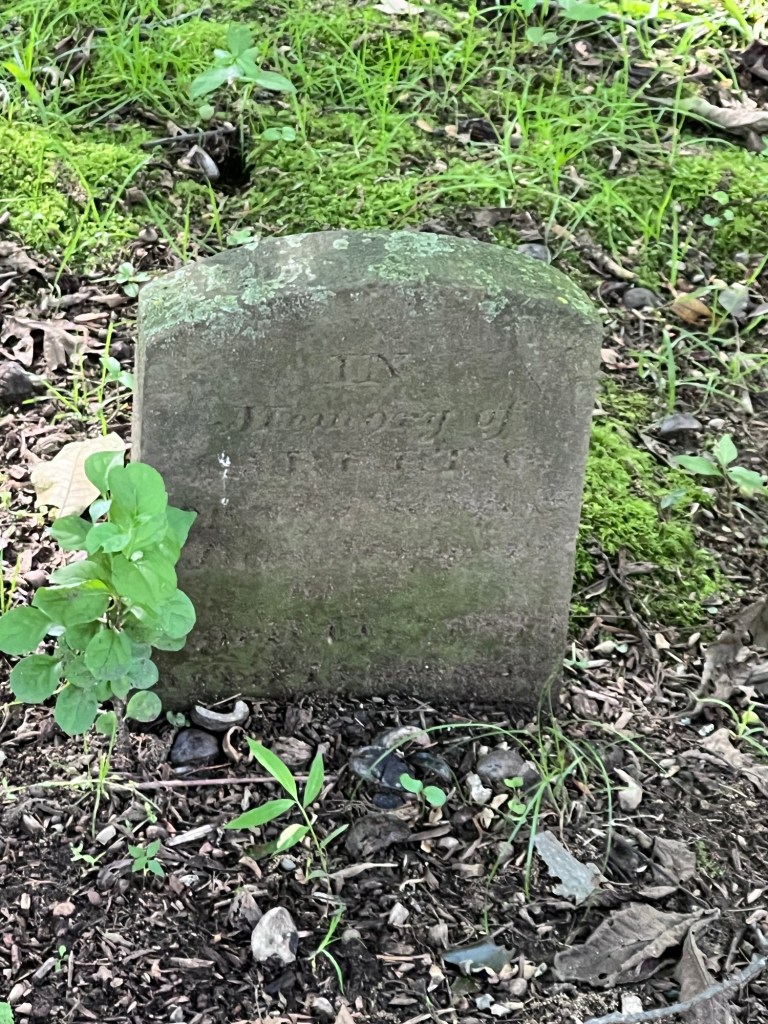
The Van Bushkirk Burial Ground is part of the history of Saddle River, NJ’s early settlement period. The burial ground has about 40 tombstones that are arched and shaped. These are some of the first residents both of Saddle River and Bergen County, NJ.
The burial ground lies next to a creek off East Saddle River Road and can only be accessed by going through private property of the residents living at 45 East Saddle River Road. Please do not enter without permission of the owner of the home. These pictures were taken with a long distance camera from the street.
The Van Bushkirk Burial Ground at 45 East Saddle River Road
The History of Saddle River:
(from the Saddle River Town website):
In 1675, Lenni Lenape tribal leaders sold a large amount of land on the Eastern side of the Saddle River (known as Werimus) to Albert Zabriskie. In 1708, Zabriskie sold this tract of land to Thomas Van Buskirk. The first house in Saddle River was built by the Van Buskirk family in 1709. The original Van Buskirk homestead still stands at 164 East Saddle River Road across from Borough Hall.
In 1709, the Lenni Lenape sold the land on the west side of the Saddle River to the English as part of the Ramapo Tract. Property on the west side of the Saddle River was acquired from this Tract throughout the 1700’s. The Ackerman Family was the most prolific buyer of these early Saddle River parcels and first settled on the West side of the Saddle River in 1745 when Johannes Ackerman acquired 245 acres.
The graves of George and Margaret Achenbach
Saddle River continued to grow and populate during the 18th century. Families such as the Van Buskirk’s, the Ackerman’s, the Achenbach’s, the Hopper’s, the Zabriskie’s, the Stilwell’s and the Baldwin’s farmed and developed the area.
The grave of George Achenbach
The first of many Saddle River mills was built in 1714 and the first school was constructed in 1720. Another early 18th century business was the blacksmith shop operated by the Ackerman family. Over the years, these 1st families built the quintessential “Old Dutch Homesteads” from actual sandstone that was found in town.
The Revolutionary War era tombstones
The Revolutionary War was a horrendous time for the residents of Saddle River. The townsfolk had spent the entire 18th century developing the area into a well established community and all growth essentially stopped during the war. Since the Jersey Dutch initially considered the revolution to be an English issue, it was particularly shocking when the fighting came to their backyards. From December 1776 until the end of the war, both American and British forces traveled through Saddle River and many times set up camp in the center of town.
Residents were in constant fear of the British employed Hessian soldiers who would terrorize families by raiding the houses for food and then burning the fields before leaving. Although no major battles took place in Saddle River, there were small skirmishes to fend off raids and the Blue Mill on East Saddle River Road was destroyed. Even George Washington, the future father of our country, passed through Saddle River on multiple occasions and tradition has him staying overnight at the Ackerman Homestead on the East road.
When the Revolutionary War ended, Saddle River residents picked up right where they left off in terms of community and industry development. The Ackerman’s built a Foundry on what is now Waterford Gardens. Tice and Berdan both opened stores in town and the Bulls Head Tavern opened its doors to weary travelers in 1802. Old mills were re-opened and new ones such as Van Riper’s Saw Mill and Basket Factory were established. The post war growth continued for decades and culminated in the 1820s with the construction of the Zion Lutheran Church in 1821 and a new schoolhouse behind the church in 1825.
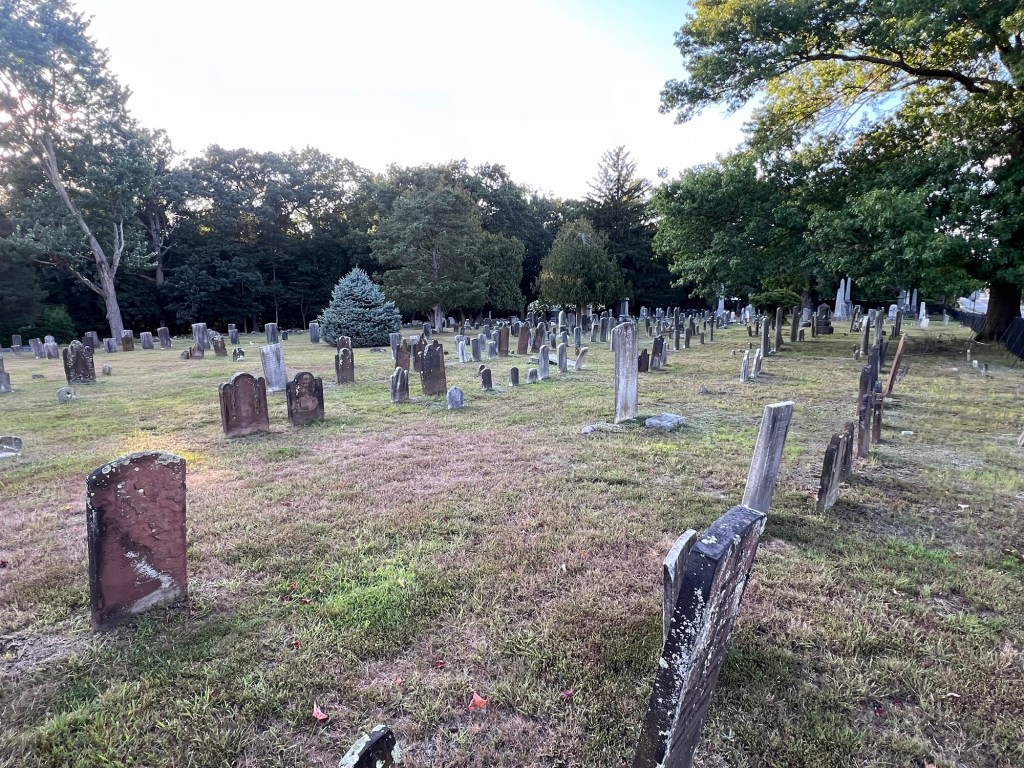
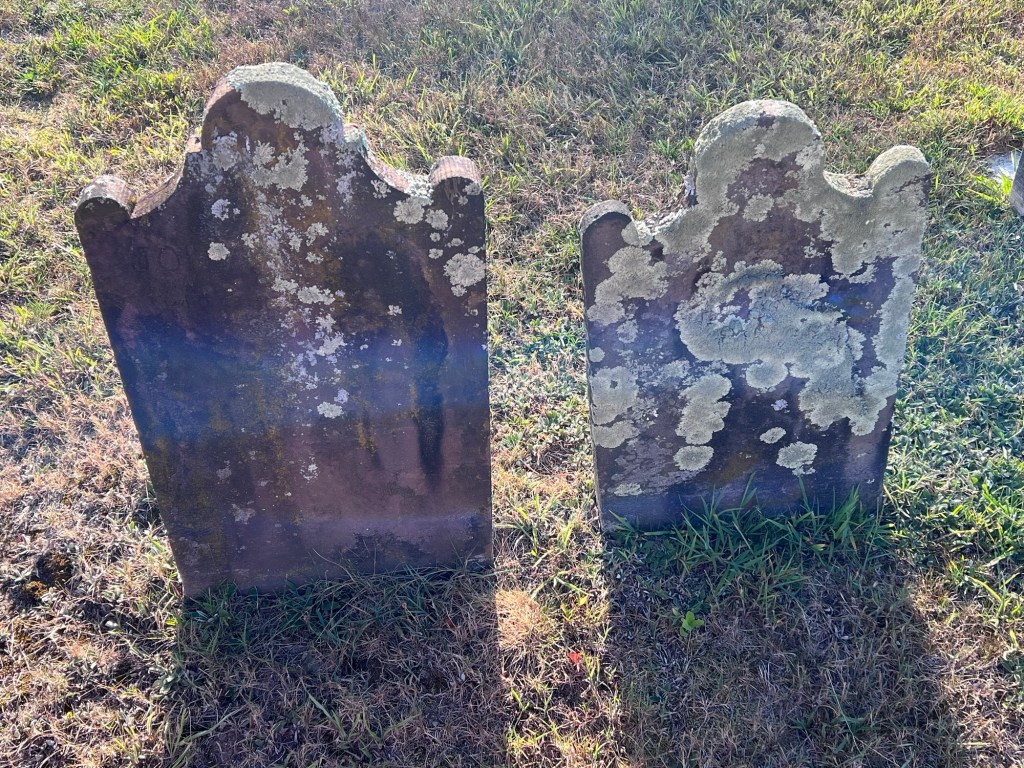
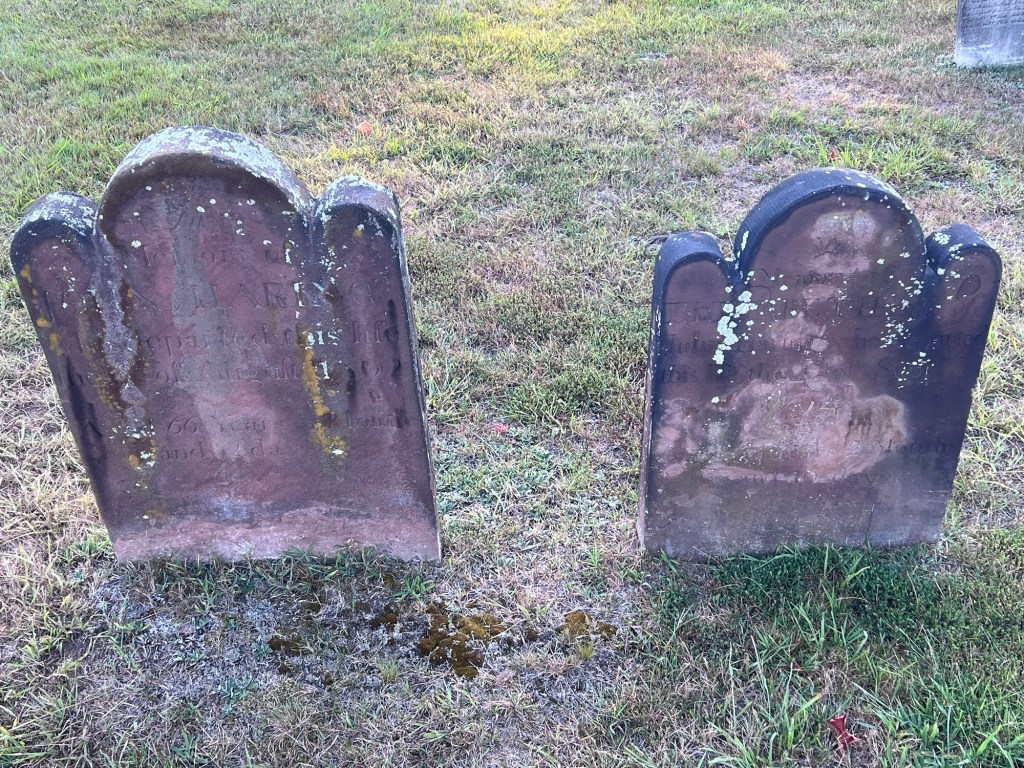
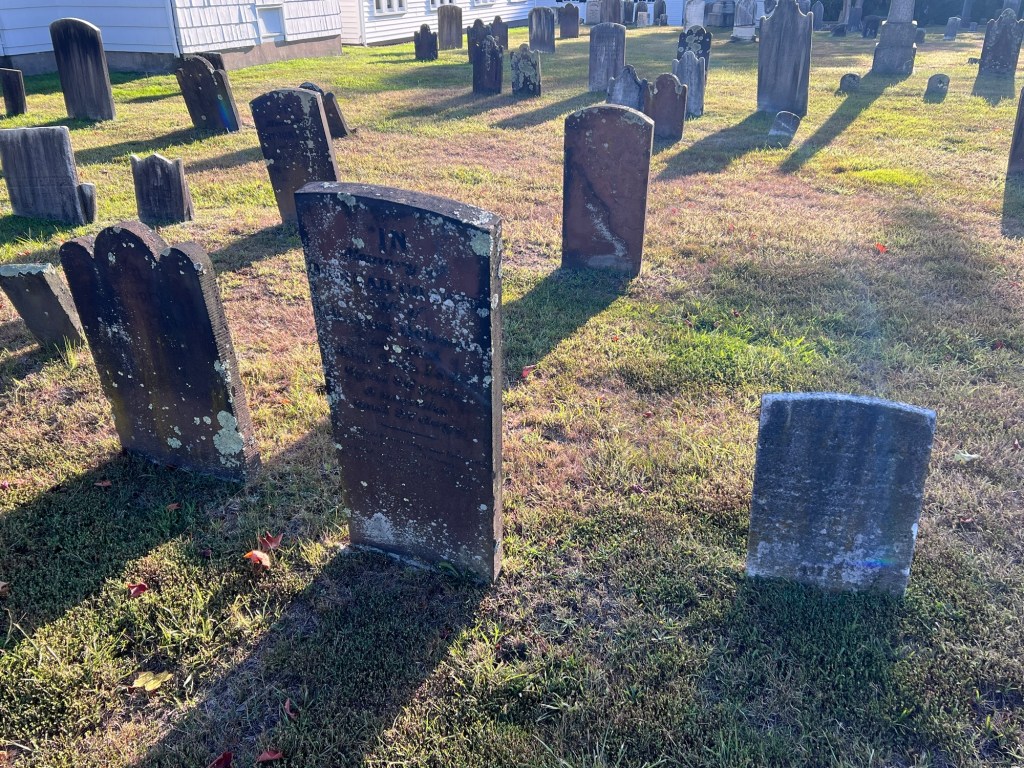
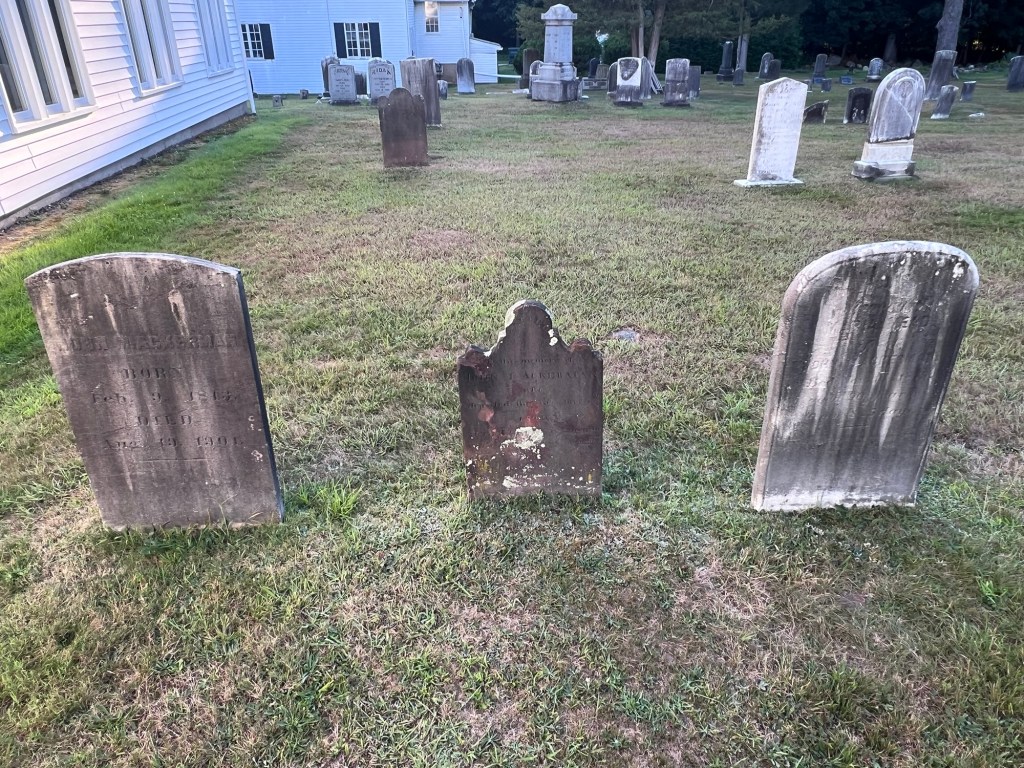
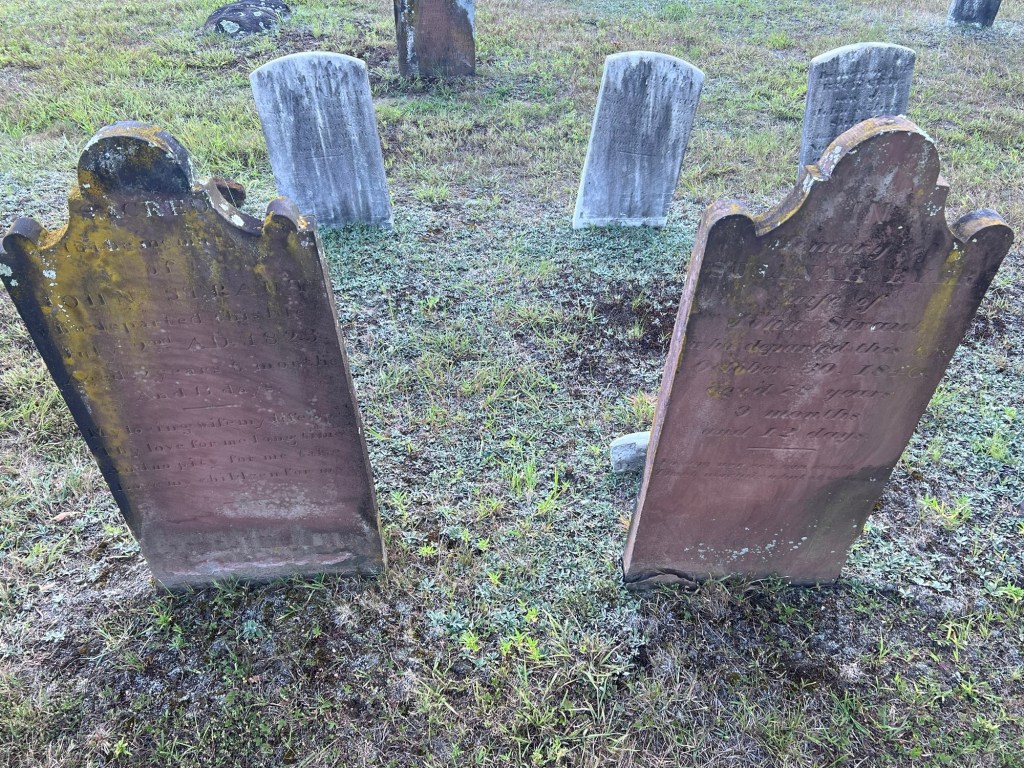
The worn tombstones in the cemetery
History of the Van Bushkirk family in Bergen County during the Revolutionary War:
(From the Bergen County Historical Society website):
Loyalists in Bergen County came from all backgrounds, religions and economic classes. At the beginning of the war, a number were officers in the militia, the military force composed of all able-bodied males maintained by each province, and later the states. The lieutenant colonel of the militia was John Zabriskie of New Bridge. Zabriskie understood the sentiments of many of his neighbors, particularly those of Abraham Van Buskirk, whose property was directly across the bridge in Teaneck. Van Buskirk was a surgeon in the militia under Zabriskie, and with whom he served on Bergen County’s Committee of Correspondence, an entity established to keep in touch with other New Jersey counties and the events occurring there.
The Van Houton Family Cemetery at 108 Delaware Lane on what was once the family farm
The historic Marker from 1822
The family plot from the entrance of the cemetery
About five generations of Van Houton’s have been buried in this spot, with an impressive list of family members who have served in all the nation’s wars.
From the Revolutionary War up to World War II, the family’s contribution extends not just to Bergen County but our entire country.
The family extends to other older ‘first families’ of Bergen County, such as the Snyder’s, the Demarest’s, DeBuan’s and the Van Ripper’s.
This multi-generational cemetery is still used today by the descendents of John Van Houten, who left the property in his will. The grounds of the cemetery are well maintained. A metal fence around the property could use some minor repairs. Unfortunately a couple of the obelisk markers have fallen off their bases.
In the August 1992 Cemetery Inventory Booklet, published by the Bergen County Department of Parks, Division of Cultural and Historic Affairs, they listed Andrew Schaaf as a contact person for the cemetery, with an address of 749 High Mountain Road, Franklin Lakes, NJ 07417. The same publication mentions that an inventory of the cemetery was done by John Neafie in 1911.
In the 17th century, Lenape Indians traveled the land we now call Franklin Lakes. They made winter camp in the “Clove” near Buttermilk Falls and fished in Micharagrape Pond ( now Franklin Lake).
Slowly, the Dutch settlers made their way west from the Hudson River Valley. In 1701 the East Jersey Proprietors confirmed to Michael Hawden the land around the Pond. In 1772 Franklin Township was formed and included much of northwestern Bergen County. Farming was the major occupation of the early inhabitants, mostly Dutch with the names of Van Winkle, Van Houten, Ackerman, Pulisfelt, Van Blarcom, etc. They built solid farmhouses of sandstone and fieldstone. Fourteen of these historic homes still stand in our Borough.
Some of the original family member tombstones in the cemetery
Mills sprang up along the creeks: sawmills, gristmills, tanneries and forges. Daniel Youman’s Grist Mill on Franklin Lake was probably the first business established (it later served as a saw mill and a cider mill).
The 1876 Walker Atlas showed Franklin Lakes had about 100 residences, 5 mills, 1 tannery, 3 schools, 4 blacksmith and wagon shops, 1 church, 2 hotels, 1 store, and 2 railroad depots.
The railroad stations were built in 1869 when the New Jersey Midland Railroad was extended to Oakland. One station stood at Campgaw on Pulis Avenue, the other at Crystal Lake on High Mountain Road. Residents used the train for commuting, moving goods and mail.
Around the turn of the century, estate houses and mansions began to appear in the area. The industrial revolution brought wealth, and many of the wealthy became “gentleman farmers,” sometimes living here only in the summer. Examples of these houses include the Bartholf-Hughes house on Somerset, the Post-Terhune house on Franklin Lake Road, and the Atterbury-Brockhurst house on Ewing Avenue.
Eventually, the Campgaw section became the civic center of our Borough. In 1922 Franklin Lakes separated from Franklin Township, incorporated, and elected William V. Pulis as its first Mayor.
Edward May built three lakes and started the Shadow Lake Swim Club, which evolved into Shadow Lakes Estates. On the other side of the Borough, J. Nevins McBride purchased land around Franklin Lake and began building single-family homes in Urban Farms.
When Route 208 was extended to Oakland in 1959, Franklin Lakes became more accessible, and by 1980 there were more than 8,500 residents. The completion of Interstate 287 in the early 1990’s stimulated another boom in building. Today, the population of our Borough is 10,422.
From a sleepy rural community to an affluent metropolitan suburb, Franklin Lakes has changed extensively, continuing to be a desirable place to live and raise families.
The Franklin Lakes Historical Society was created to help preserve our Borough’s rich history, while at the same time looking to the future of our unique community and those who choose to make this their home.
The family still uses the cemetery into the twenty-first century
Part of the cemetery into modern times
Multiple family members are often buried together
The cemetery in modern times
The children of Ralph Van Houten who passed within a few years of one another
The grave of Abraham Van Houton and his wife, Bridget
The front part of the cemetery shows the different branches of the family and when they were buried.
The back part of the cemetery is rather old
The Snyder branch of the family
Another branch of the Van Houten family is buried together here
Members of the Ackerman and Cooper side of the family
Conrad and Elizabeth Van Houten
Jacob and Elizabeth Van Houten
Some of the modern graves of the Van Houten’s and Ackerman sides of the family
Many of these small family plots sit on buffs and have the most amazing views. It is as if the final resting place was to be a place of beauty and contemplation.
Unfortunately the family farm is long gone and the cemetery is now surrounded by McMansions. Talk about progress!
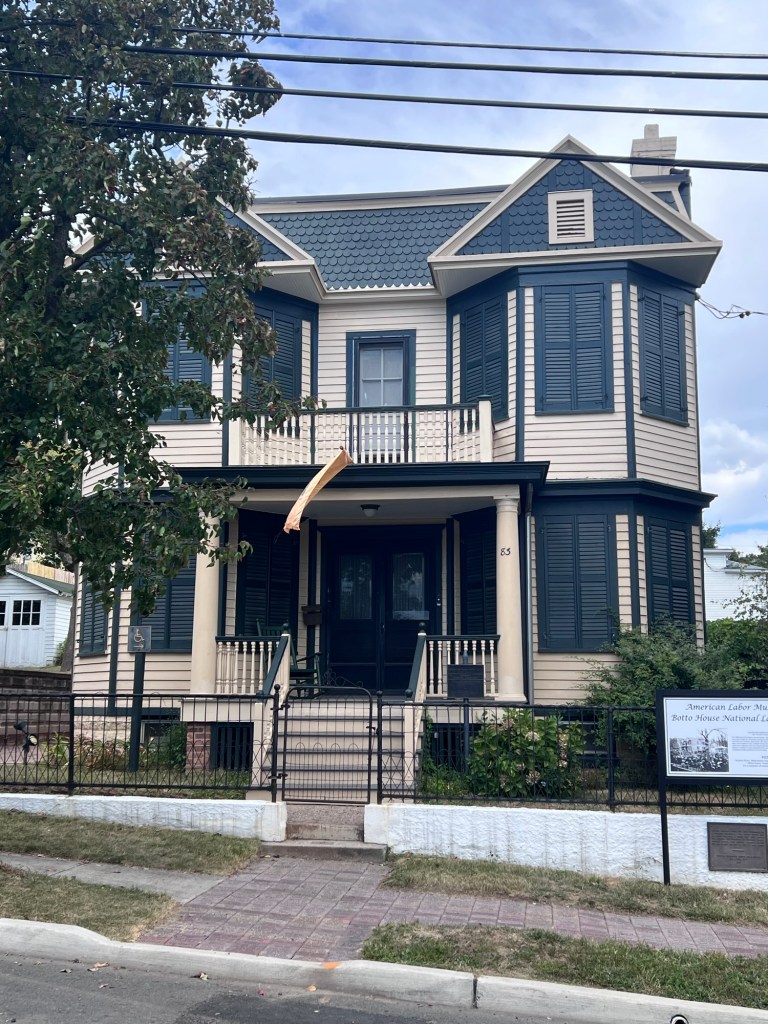
I recently visited The American Labor Museum/Botto House National Landmark for the afternoon and learned a lot about the American Labor Union formations and the rights we now take for granted.
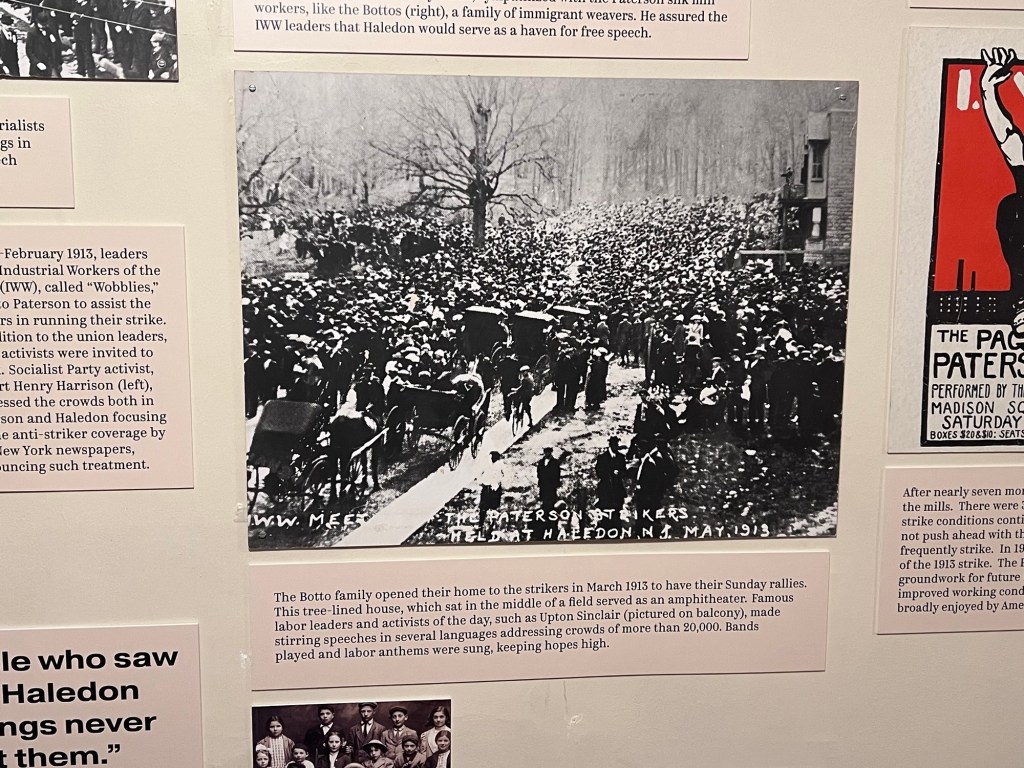
A group of us took the tour of the Botto House and learned of its history and its place in the Paterson Silk Strikes of 1913. The first floor which serves as the meeting room has pictures of the Paterson Silk Strike which lasted just over five months and since the Mayor of Paterson at the time would not let the strikers meet, the Botto’s agreed to let the strikers meet at their home which at the time was in a isolated section of Haledon.
The history of the Silk Strike in Paterson
The Mayor of Haledon was sympathetic to the Union cause and let them meet in the town. Their house was situated in the middle of a field so that the strikers could gather around the home and listen to speakers.
The Botto House during the Paterson Silk Strikes
From their balcony, speakers could talk to the strikers and keep everyone abreast of the situation. Here people gathered and picnicked together and worked together to get their rights heard.
From the main display room, you will tour the home of Pietro and Maria Botto. First stop is the kitchen where Mrs. Botto ran her household. She made extra money selling food to the strikers and arranging meals for Mr. Botto’s co-workers. The family family did what it could to make money for the family.
Mrs. Botto’s kitchen
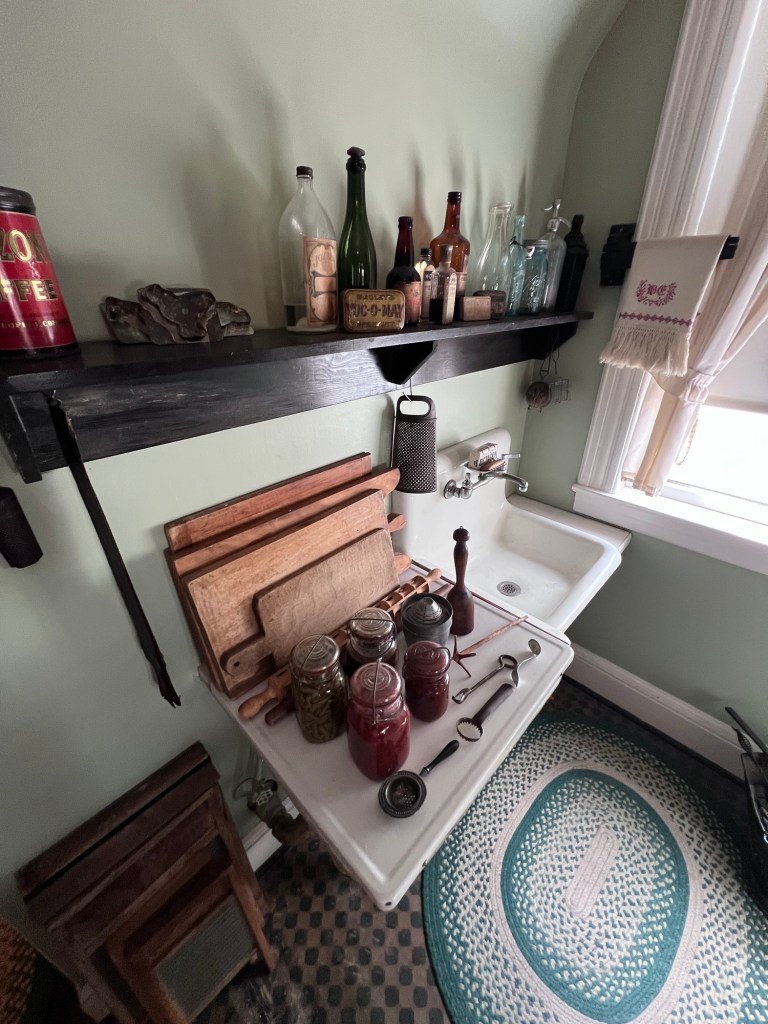
The sink area
Here she made meals for her family, did her jarring and preserving and the washing was done. Then a tour of the dining room, bedroom and the palour area where the family met and greeted people. The upstairs was formerly two apartments that were built to help ‘pay the bills’.
The Botto House Kitchen
The upstairs is now the display space where a display on the Dock Workers Union is currently being shown. We got to stand on the second floor balcony where so many speeches were made.
The backyard area
We took the back stairs to the backyard where the family had the grape arbor, root cellar where the preserves were kept and the boccie ball court. It seemed the family was very social at the time and self-sufficient.
The root cellar and Vineyard
Things turned bad for the family when both Mr. And Mrs. Botto both passed away two years after the strike. The strike could have taken its toll on the family or the fact that Mr. Botto could not find a job after the strike was over. No one knows.
It is an interesting tour of how one family opened their home to an important cause and it made a difference in the success of the strike and getting it resolved.
The history of the Botto’s:
The museum headquarters was the home of an immigrant family of industrial workers whose story is a fascinating one. In many ways, the telling of their saga is a doorway for museum visitors to step through and make connections with their own ethnic backgrounds.
The European Heritage:
Pietro and Maria Botto hailed from the region of Biella, Piedmonte, Italy. This area, at the foothills of the Alps, was a leading textile producer of linen and wool. The mountainous area was home to a fiercely independent people who, for centuries, wove cloth in their homes on looms which they owned.
The Industrial Revolution forced weavers to give upon cottage-based production to seek employment in large shops or mills. the displacement of workers by mechanized looms and weavers’ lack of economic independence caused people in Biella (as in other European textile areas where Paterson’s workforce originated) to embrace new ideas about worker rights and to be a vocal workforce wherever they roamed.
Pietro decided to leave Italy because he was made eligible for a second draft into the army at the recently united Kingdom of Italy (Italy had quadrupled its army at that time to strengthen unification and to acquire African colonies). A skilled weaver who also painted church interiors, Pietro brought his wife, Maria and daughter, Albina (born 1889) on the long voyage to America in 1892.
The Botto’s settled in crowded West Hoboken, New Jersey (today’s Union City), where they worked in silk mills for 15 years until they had saved enough money to afford a home for their growing family. The family now included three more daughters, Adelia (born 1894), Eva (born 1895) and Olga (born 1899). In 1908, the Botto’s moved to Haledon, a tiny community, growing up along the streetcar line from Paterson, where many other country folk from Biella had already settled.
The Botto’s home became a focal point for a dramatic slice of history in 1913 when the epic Paterson Silk Strike broke out. Pietro was on strike with 24,000 fellow silk workers when massive and constant arrests forced the workers to consider the independent borough of Haledon as a location for great outdoor rallies. Mayor William-Brueckmann guaranteed the safety of the workers and Pietro offered his home as a meeting place for the strikers.
The Botto’s courageous stand allowing their home to be so closely identified with the strike stemmed from a belief in the rights of the common man. During the strike, Pietro and his family played host to the social and labor leaders who were the idols of the working person at that time. After the strike, the family had to very circumspect about employment in the mills, with one of the daughters denying her family name to avoid blacklisting by an employer.
The large house and spacious hillside gardens are a tribute to the family’s combined labor. Pietro and his daughters worked 10-12 hour days, 5 1/2 days a week in the mills. The eldest daughter began mill work at age 11 and the youngest at age 13.
On Sundays, the usual day of rest, the girls helped their mother serve patrons of the resort aspect of the property. Maria ran a large household, feed boarders during the week and the scores of people on Sunday and did piecework from mills; she died in 1915 at the age of 45.
Pietro lived until 1945, a beloved father and grandfather to a growing clan.
History of the House and Land:
The house in Haledon, NJ
The total environment of the Botto House National Historic Landmark reflects the ethic origin of this family of silk workers from the Piedmonte (Biella) area of Italy and the development of housing in early streetcar suburbs. It is representative of the sensitive use of small landholdings in American urban areas by various European immigrant groups.
The Botto family purchased Block X, Lots 38, 39 and 40 in 1907 from Alexander King, a real estate speculator. King himself purchased a large parcel of land from the Cedar Cliff Land Company, a group of Paterson industrialist and business leaders who were quick to see the advantages of selling cheap land to workers in Haledon. The completion of a horse-drawn trolley line in 1872 allowed for expansion of residential and recreational areas outside of the City of Paterson, a major American industrial center.
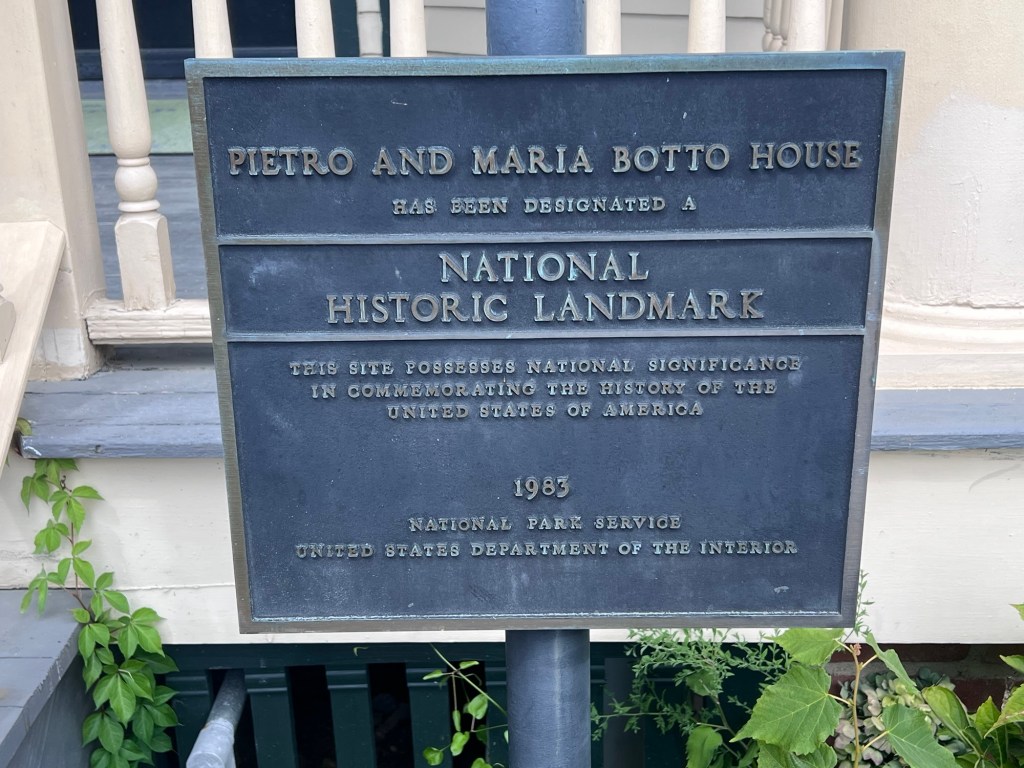
The Botto House sign
(Information from American Labor Museum: Botto House National Landmark, a Brief History)
The Period Rooms:
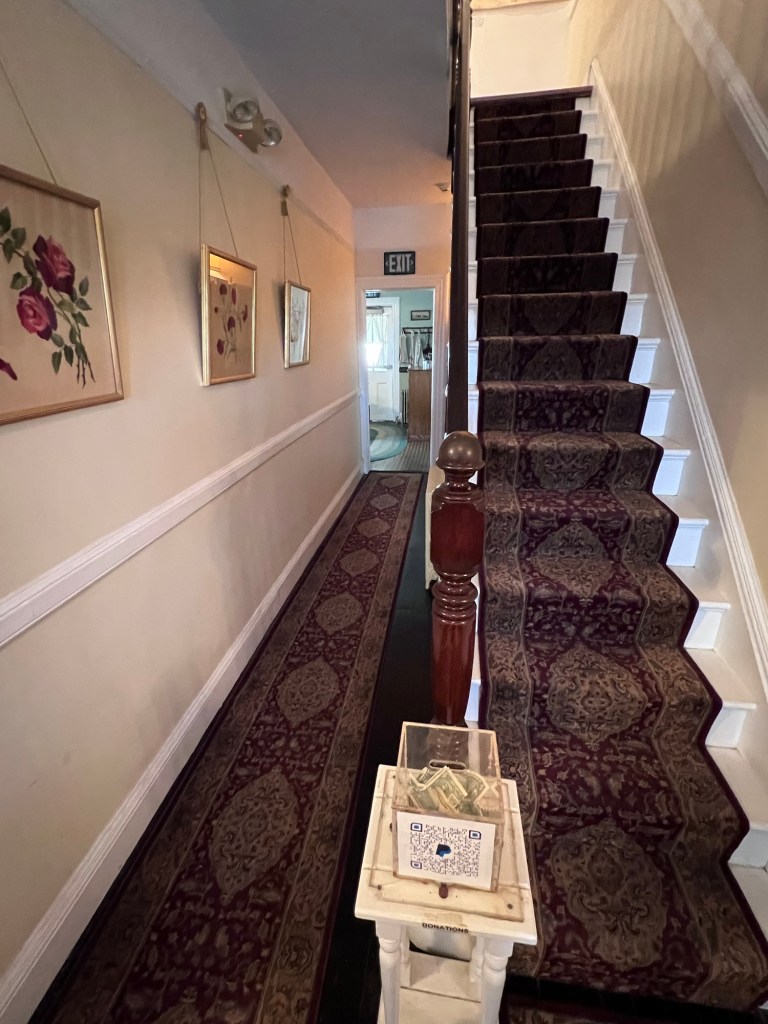
The Front Hall
The front entrance hall light fixture is original to the house. One of the restoration tasks yet to be carried out is the replacement of embossed wallpaper on the walls which was made to look like the carved leather coverings in the homes of the rich.
The front hallway
The Kitchen:
The kitchen was a major center of activity in the household. The large coal and gas range dominates the room. It was used as a heating source as well as for cooking foods. A table provided the space for food preparation; a cupboard stored pots, pans and dishes; an icebox kept food items cold (the root cellar, located in the garden was also used for cold food storage) and a sink for dishes and a tub for laundry utilities indoor plumbing-certainly a recent innovation for working class households.
The kitchen
Even with the convenience of indoor plumbing and the gas range, the kitchen was the scene of virtual non-stop labor for Maria Botto and her daughters. In addition to meals prepared for the family, the Botto’s fed a noon meal to extra people during the week, there were workmen without families, who rented rooms and come from the mills for a hot dinner.
On Sundays, the Botto women prepared food for as many as 100 people who came to recreate on the property. This, of course, provided on additional income for the family.
The Botto family’s foodways reflected their home region of Biella, Piedmonte, Italy. Piedmontese cooked scorned tomato sauce, preferring wine and chicken broth to accompany such staple foods as polenta (corn meal), risotto (rice) and tortellini, a pasta. Generally, rosemary, sage, and other herbs were used in cooking and grown outside in the garden. The herbs also had medicinal uses.
The kitchen sinks
Some of the artifacts placed around the kitchen are the copper put used to cook polenta (purur), meat grinder, fish scale, orange juice squeezer, coffee grinder (from a German immigrant household), rug beater, mousetrap and wall calendars which were used by working people as decorations.
The Botto women were generally charged with kitchen duties. Maria Botto hired a German woman to do the wash. One special job was reserved for Pietro, stirring the polenta and cutting it with a string.
The Dining Room:
The dining room was another work area for the family. Here the family and the ‘boarders’ dined. Here Maria ‘picked’ silk on a frame, located in the corner of the room under the window, examining the bolts of broadsilk brought from the mill for imperfections.
The Dining room
This was another task to bring income to the household. Maria used the sewing machine to make clothes. The table reflects a setting for the family and ‘boarders’, placed with dishes, silver-plated utensils and a condiment set.
The Dining Room
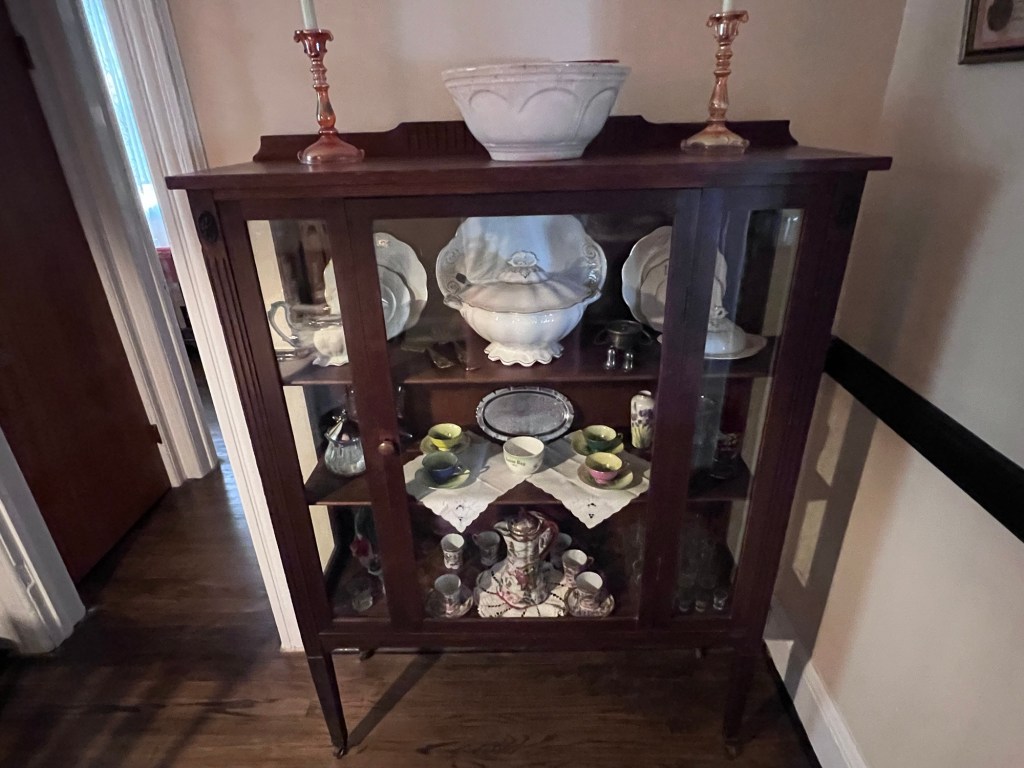
The sideboard, table chairs and sewing machine are family pieces. The lighting fixtures in this room as in the rest of the house were powered by gas. As is typical in the area, paintings were hung by string from a picture rail as the walls were made of plaster.
The Sideboard
The small painting shows sheep, which provide the wool upon which textile manufacture was based, against the backdrop of the Alps. The large sketched portrait of Pietro Botto in later years was produced by his grandson and professional artist, Richard Botto. On the side of the room hang pictures of the Botto daughters in their wedding attire.
The Dishes in the sideboards
The Bedroom:
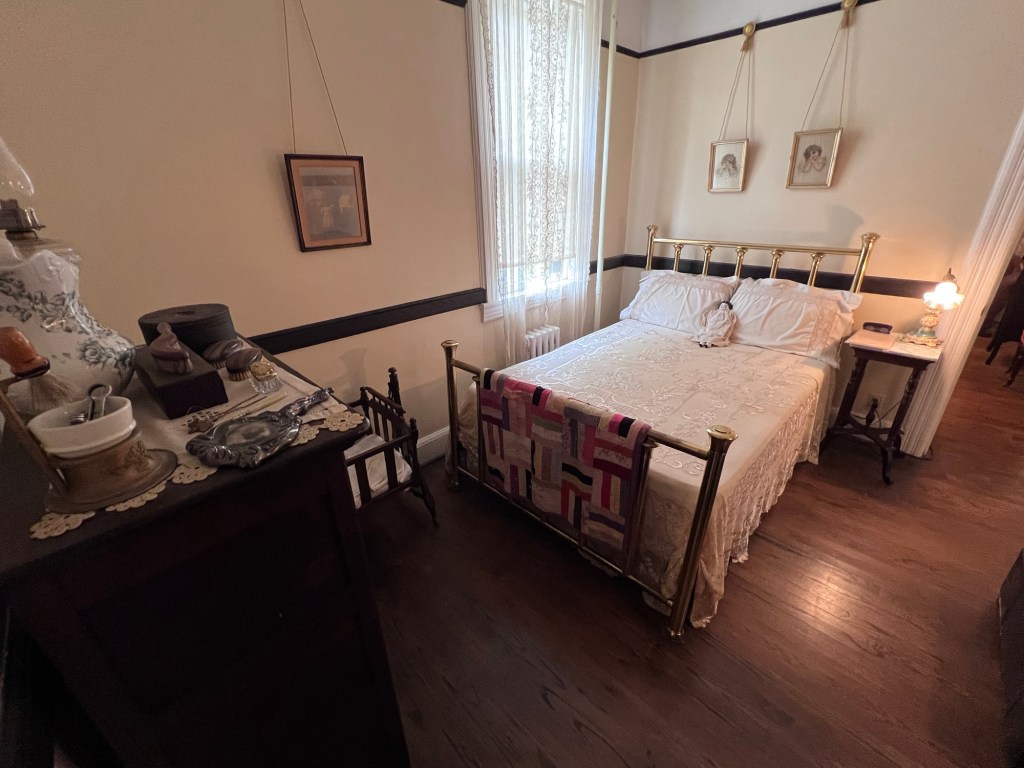
This room, which was actually the girls bedroom has been recreated to resemble where Maria and Pietro slept. The dresser is set with brushes, combs and mirrors that are from the period. The Botto’s slept in a brass bed.
The bedroom at the home
Swimsuits and other clothing hang in the wardrobe. A travelling trunk rests on the floor next to the wardrobe. Next to the window hangs a photograph of Mr. and Mrs. Guala of Biella, Italy. Next to the wardrobe hangs the elaborately framed photograph of Adalgiso Valle of Paterson, NJ, a jacquard card cutter.
The Bedroom
The Parlor:
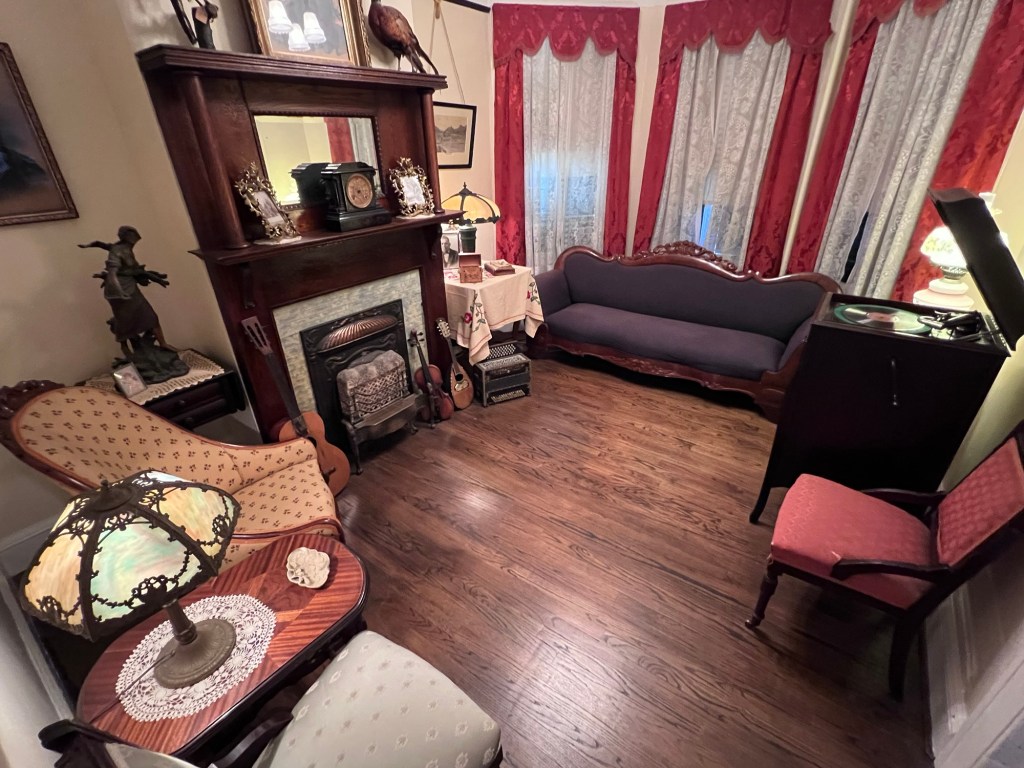
The most formal room in the house, the parlor was used for guests, weddings and wakes. Dominating is the oak mantle with its columns and mirror top. It surrounds a fireplace where, in the winter, a gas heater was attached to a pipe behind the hearth. The clock had to be wound every day and chimes on the half-hour.
The parlor
The photographs on the shelf are Maria’s sisters in Italy (right) and the three eldest Botto daughters (left). Members of the Bocchio family of Biello, Italy are pictured in the photograph to the left of the mantle.
The Parlor and decorations
The furnishings in the house
Other Rooms:
The area making up the library on the first floor was a sitting room and bedroom for the family. The Botto daughters rented the two apartments upstairs when they first married and started their families and other non-family members served as renters through the years. The bathroom on the first floor is the approximate size of the original but today has modern fixtures and is not meant to be part of the restoration.
(From the American Labor Museum/Botto House National Landmark)
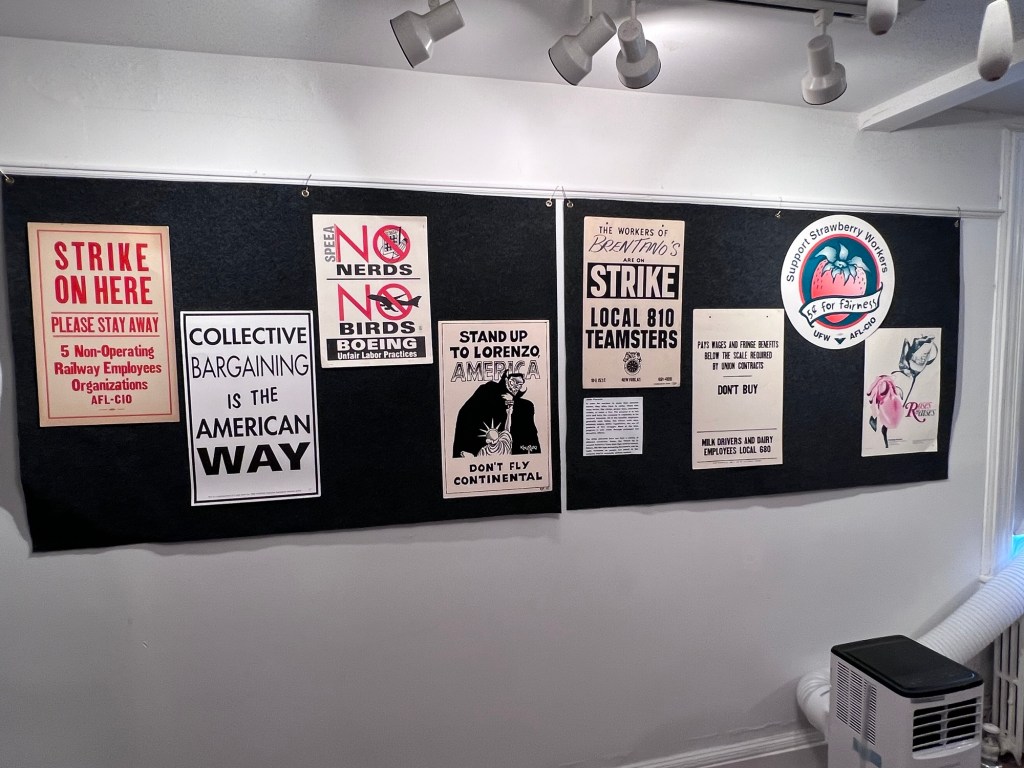
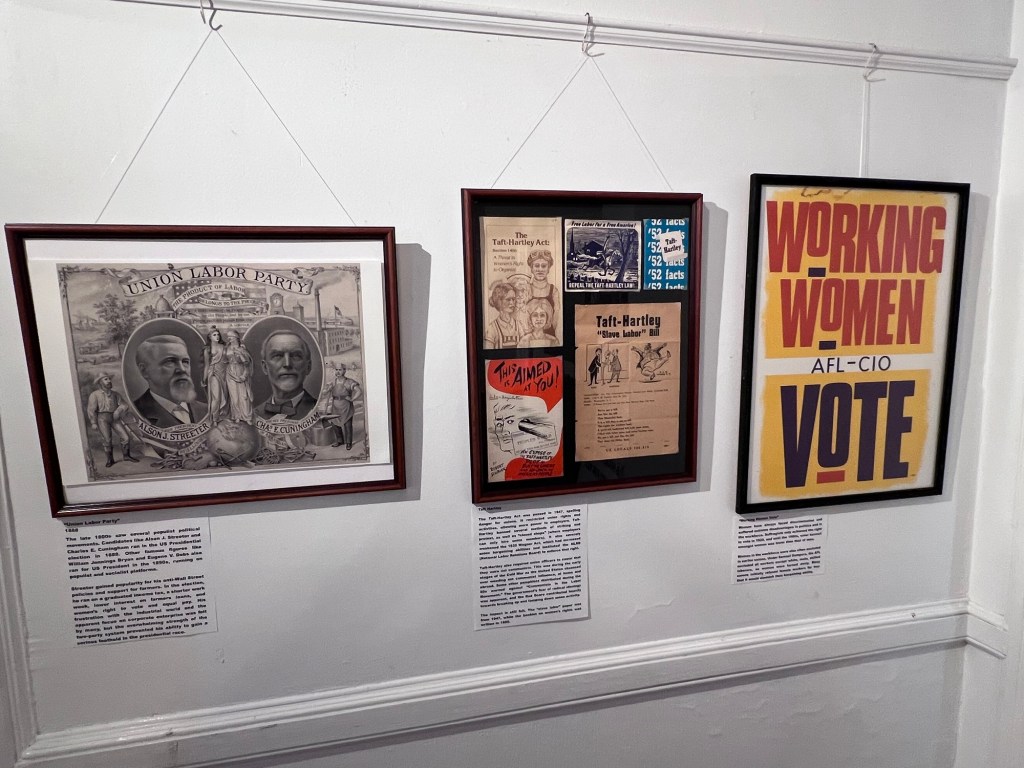
The Labor Day display of the Union history:
Labor display
Labor Display
History of Paterson:
The City of Paterson was founded in 1792 as America’s first planned industrial city. Alexander Hamilton, Elias Boudinot and other members of The Society for the Establishment of Useful Manufactures chose the Great Falls of the Passaic River as the ideal site for a manufacturing center. The Falls provided water power, while the river provided transportation upstream and down.
During the 19th Century, Paterson flourished. It became known as “Silk City” and “The City” with an Arm of Iron in a Sleeve of Silk for the silk mills and locomotive works that made their homes here. Immigrants flocked to the city at first from England, Switzerland. Germany and France and later from Southern and Eastern Europe. Many found jobs in the mills and a few took their place among the captions of industry.
(Mill Worker…Mill Owner-Botto House Museum)
The gift shops
Disclaimer: This information was taken directly from The American Labor Museum/Botto House National Landmark pamphlets. This museum is one of the few historical sites dealing with the Labor Unions in the United States and plays a huge role in workers rights today.
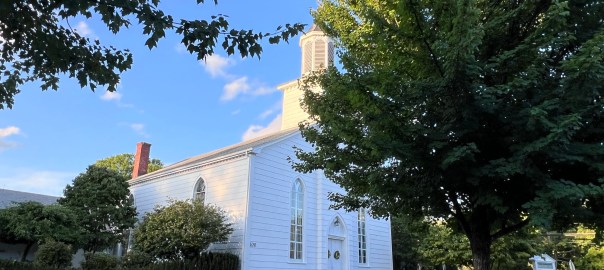
Formerly The Ramapo Meeting House was organized in 1785 and built in 1798
In 1713, a small group of eleven German Lutheran families settled at the “Island,” so named because of extensive marshlands surrounding high, dry land. They formed a congregation in 1715, and c. 1720 built a log church. Prior to 1739, they built a larger, frame church.
Dutch, French, English and Scottish settlers of the Reformed faith came to the Island about mid-century and attended church in Paramus, 10 miles distant. In 1785, they organized The Ramapo Dutch Reformed Congregation at Ramapough in Bergen County.
After the Revolutionary War (1776-1783), the first task of the new nation was to repair the damages of war and neglect. Neither the Lutheran nor the Reformed congregation at the Island had sufficient means to build a new church. In spite of having fought on opposing sides during the War, they agreed to jointly repair and use the old Lutheran church. The arrangement was so successful that in 1798, they agreed to build the present church together.
Construction began on June 4th, and was finished in November. The last items purchased were “one lock and two keys” on December 12, 1798. The two congregations shared the church for fifty years until 1848, when the Lutherans sold their interest and moved to Airmont, NY and established the present Christ Evangelical Lutheran Church.
As soon as its doors opened to the public in 1798, the new Ramapough Meeting House became the heart of the daily activities. Social gatherings and civic meetings were held here all week long, and personal and official notices were posted on the doors. But on the Sabbath (from sundown Saturday to sundown Sunday) the building became a sacred place.
Ramapough – or Bellgrove, as it was called at this time – had four mills, several blacksmith shops, a general store, a stagecoach stop, and U.S. Post Office, one of the earliest in New Jersey (1797). The old Kings Highway of 1703 or Ramapough Road (Island Road) was part of the ancient 150-mile Albany Post Road from Paulus Hook (Jersey City) to Albany, NY. Dobbin & Tustin, est. 1797, ran a passenger and mail stage line on this road, right past the door of the Ramapough Meeting House.
In 1798, when pews and people were smaller, the Meeting House held 385 people. (Today, it holds 250). Though the old box-type pews are gone from the sanctuary, the gallery seats above still exist. The Island Church held an important place in the railroad hamlet of Mahwah throughout the 1800s. It was known simply as the Community Church until the 1950s, when suburbanization brought many other faiths to Mahwah.
One of the earliest public schools in the area, c. 1815, was operated on the church property until 1906, when the church sold land to the Township for the Commodore Perry School. In the cemetery is a roadbed of the old Kings Highway.
The Ramapo Reformed Church is the oldest public building in Mahwah, and a repository of more than 200 years of local and regional history. It is the older of only two remaining frame Federal-period churches in Bergen County, and is on the National Register of Historic Places.
The modern church sign
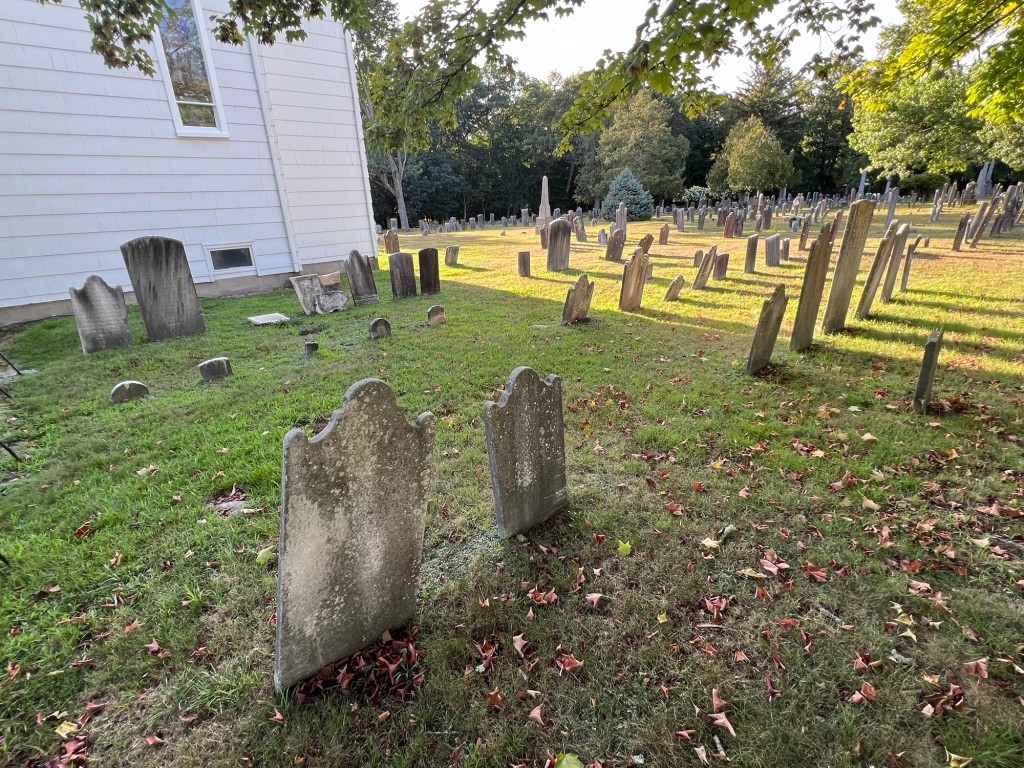
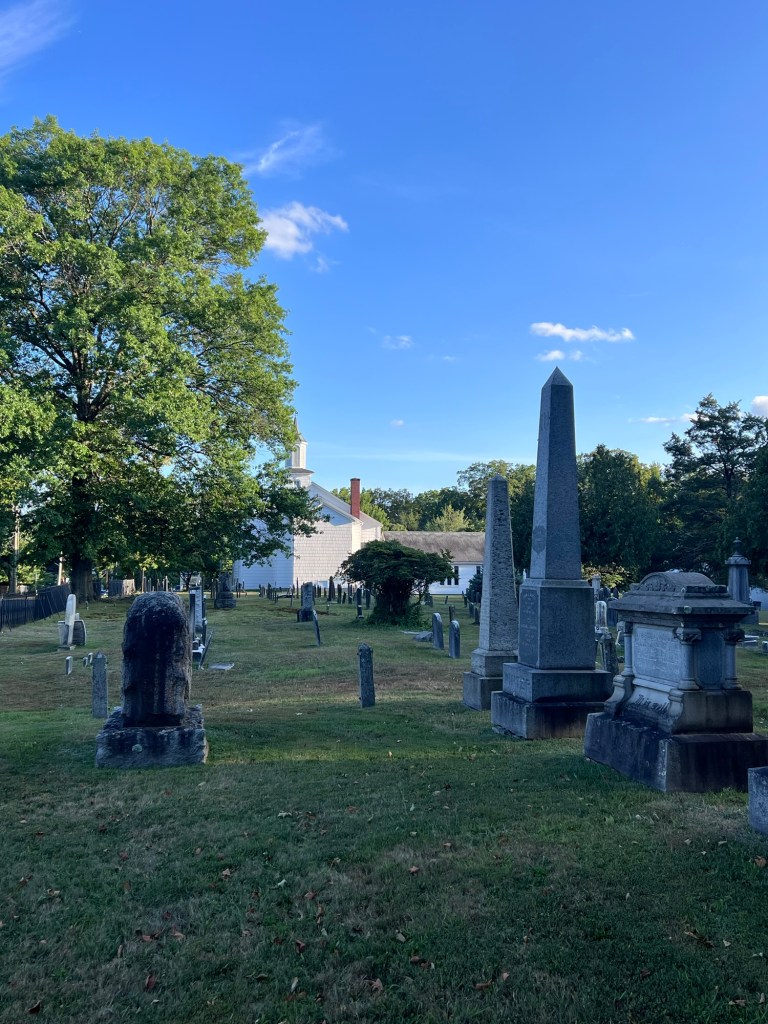
I walked through this quiet and reserved graveyard in search of ghosts from the past. The graveyard at the Ramapo Reformed Church, like many of these former Dutch churches, are steeped in memories of the past.
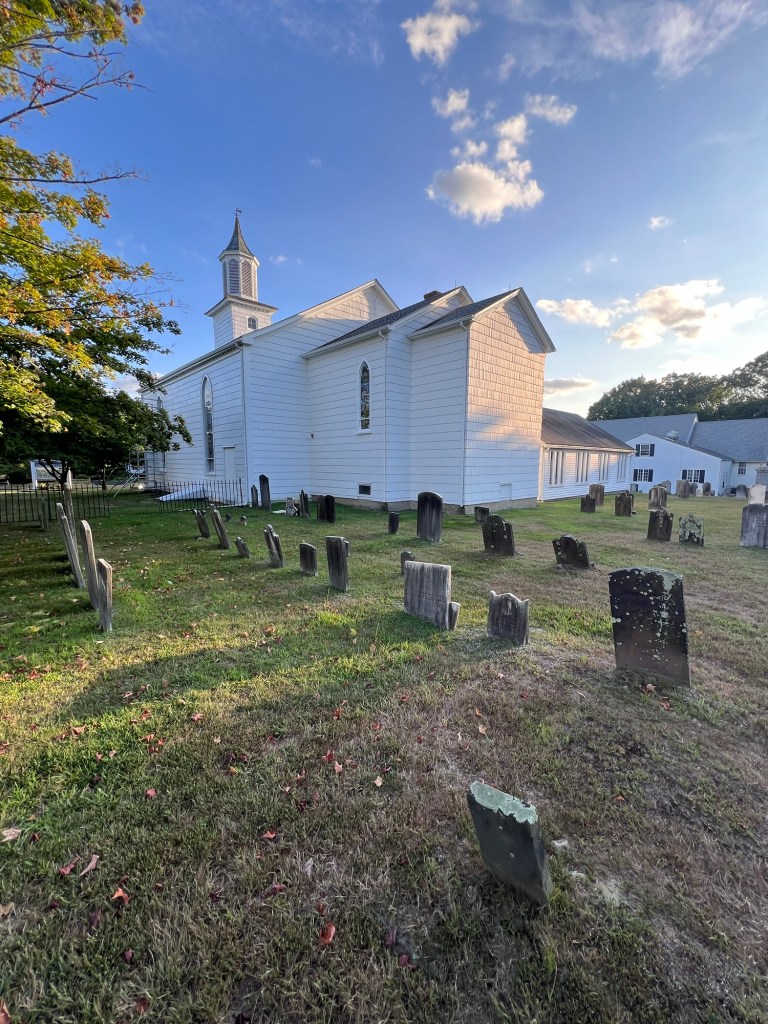
The historic graveyard in the back of the church
In the unique graveyard are the places of rest of many of the first families of Bergen County, NJ who not just shaped the county, but the State of New Jersey and the United States as well.
The oldest part of the graveyard surrounds the church
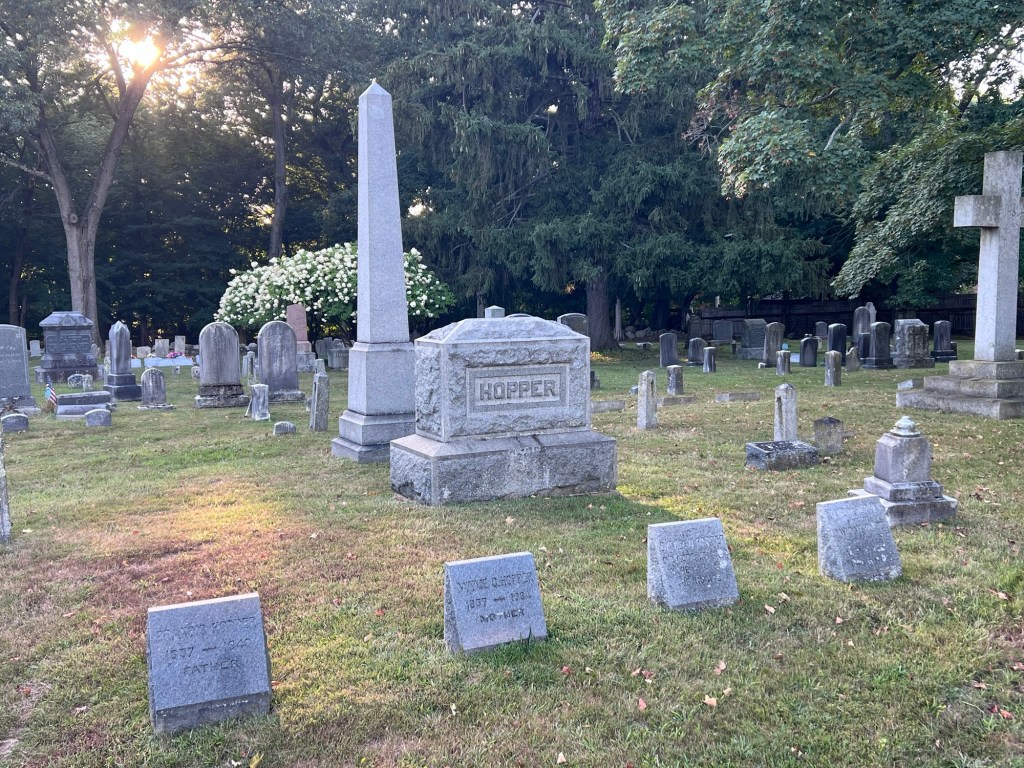
While the names Haring, Christie, Blauvelt, Demarest, Ramsey, Sutherland, Fox, Hopper, Van Ripper, DeBaun, Terhune and Tice may not similar to most people, to a generation of us were the names of farming families in Bergen County.
Their farms supplied us with fresh fruits and vegetables when in season and places for us to go during Halloween and Thanksgiving for our baked goods and much needed apple cider.
The 1980’s real estate boom put an end to many of these traditions but those names still live in the memories of an older generation. We see some of these traditions still hold tight at Demarest Farms in Hillsdale where hayrides and apple cider and fritters are still part of that experience.
For this trip though, I was in search of graves of our brave veterans of the American Revolution and in the faded tombstones surrounding the church, I found most of them.
The oldest part of the graveyard wraps itself around the church or faces the road, which at one time must have been a country lane.
Some of the oldest families from the community are buried closest to the church building
The graveyard is filled with family plots of most of the first families of the area once surrounded by old fences.
The graveyard is full of families and their memories. In some parts of the graveyard, family plots are organized by generations. To so the progression of mother and father to their children and grandchildren. The history of these families is in the rows of names and the intermarriages of all these families to one another.
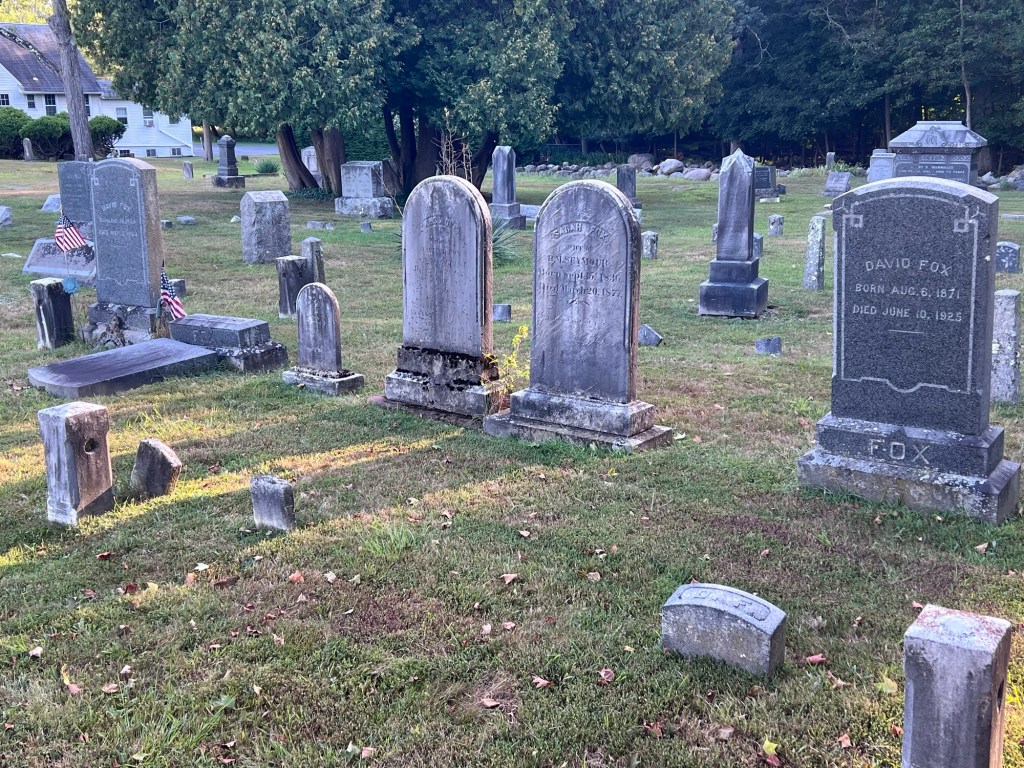
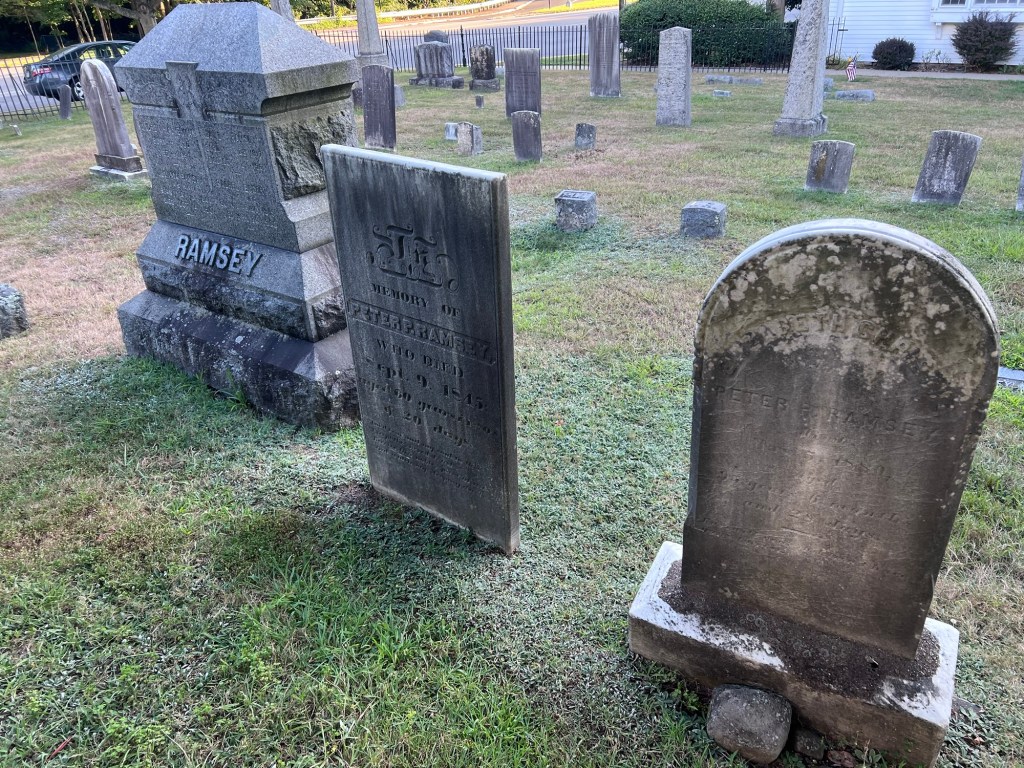
The Fox family plot, where one of the members of the family was a veteran of the Civil War
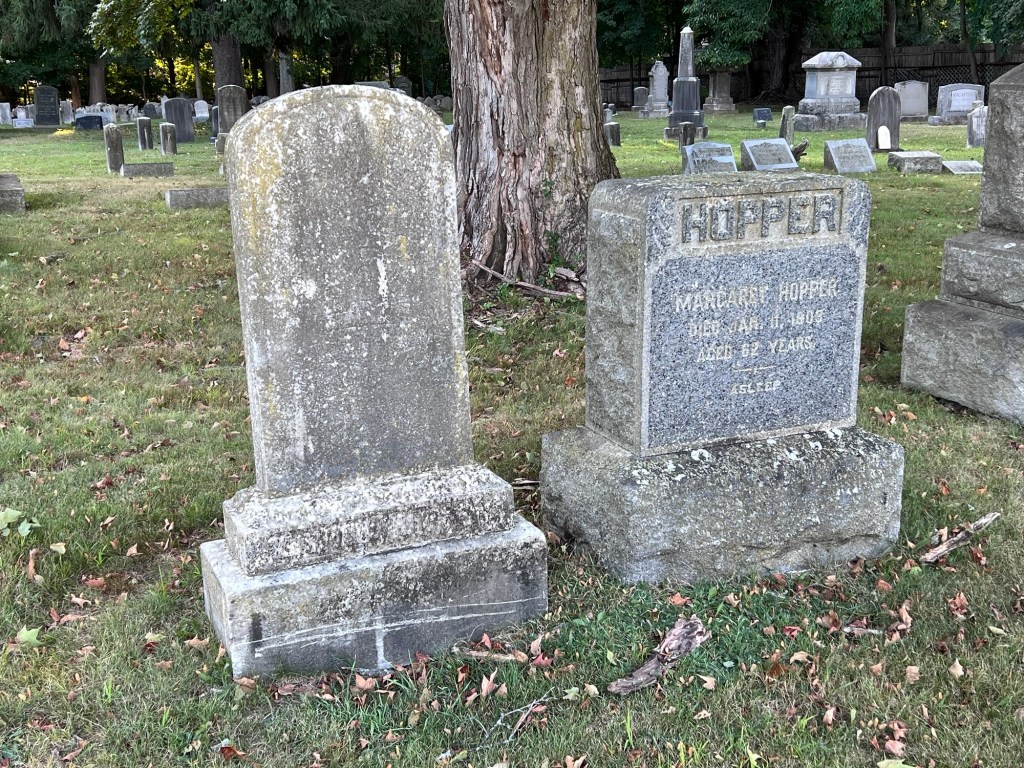
Peter J. Ramsey was born on 23 November 1804, in Bergen, New Jersey, United States. He married Margaret Hopper in 1828, in Hohokus Township, Bergen, New Jersey, United States. They were the parents of at least 4 sons and 5 daughters. He died on 10 May 1852, in Ramapo, Bergen, New Jersey, United States, at the age of 47, and was buried in Mahwah Township, Bergen, New Jersey, United States (Family Search.org).
Closer to the church, I discovered the graves of our brave soldiers from the Revolutionary War whom I had been searching for.
The grave of John Suffern, who fought in the Revolutionary War and whose family the County of Suffern was named after
When John Suffern was born on 23 November 1741, in County Antrim, Ireland, his father, William Suffern, was 27 and his mother, Margaret Templeton, was 19. He married Mary Myers on 1 January 1766, in Burlington, New Jersey, British Colonial America. They were the parents of at least 7 sons and 4 daughters. He lived in Rockland, New York, United States in 1820 and Ramapo, Rockland, New York, United States in 1830. He died on 11 November 1836, in Suffern, Ramapo, Rockland, New York, United States, at the age of 94, and was buried in Ramapo Reformed Church Cemetery, Mahwah Township, Bergen, New Jersey, United States (Familysearch.org).
The graves of John Suffern and his wife
The Christie family plot, where John and James Christie who fought in the war were buried
When John W Christie was born on 7 May 1754, in Schraalenburgh, Bergen, New Jersey, British Colonial America, his father, William James Christie, was 33 and his mother, Catalijntje Demarest, was 32. He married Annatie Hannah Brinkerhoff about 1773, in New Barbadoes Township, Bergen, New Jersey, United States. They were the parents of at least 4 sons and 8 daughters. He died on 11 September 1815, in Bergen, New Jersey, United States, at the age of 61, and was buried in Bergenfield, Bergen, New Jersey, United States (Familysearch.org).
When James Willem Christie was born on 20 August 1744, in Bergen, New Jersey, British Colonial America, his father, William James Christie, was 24 and his mother, Catalijntje Demarest, was 22. He married Maria Banta about 1772, in Schraalenburgh, Bergen, New Jersey, British Colonial America. They were the parents of at least 5 sons and 5 daughters. He died on 23 July 1817, in Bergenfield, Bergen, New Jersey, United States, at the age of 72 (Familysearch.org).
The grave of Lawrence Sutherland another Revolutionary War Veteran
When Lawrence Sutherland was born on 12 June 1763, in Harrington Township, Bergen, New Jersey, United States, his father, James Sutherland, was 21 and his mother, Marietje, was 19. He married Elizabeth Sutherland in 1786, in New Hampstead, Rockland, New York, United States. They were the parents of at least 2 sons and 3 daughters. He died on 9 October 1846, in New Hampstead, Rockland, New York, United States, at the age of 83, and was buried in Mahwah Township, Bergen, New Jersey, United States (Familysearch.org).
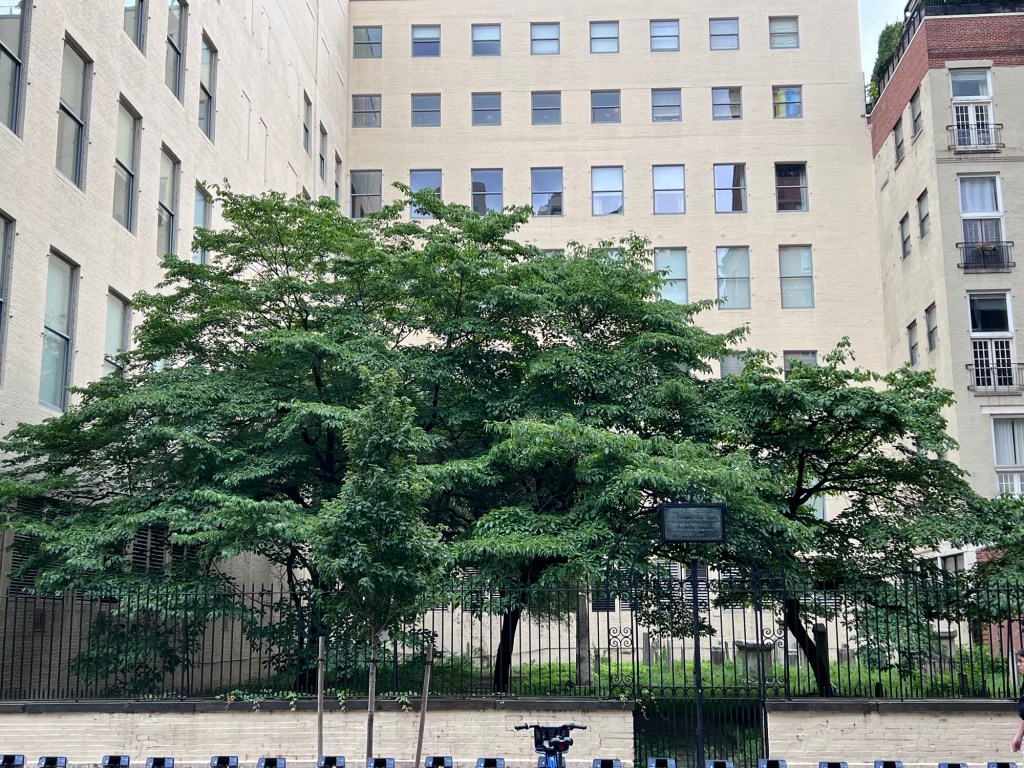
The cemetery sits behind the former ‘Ladies Shopping District’ department stores
The front of the cemetery
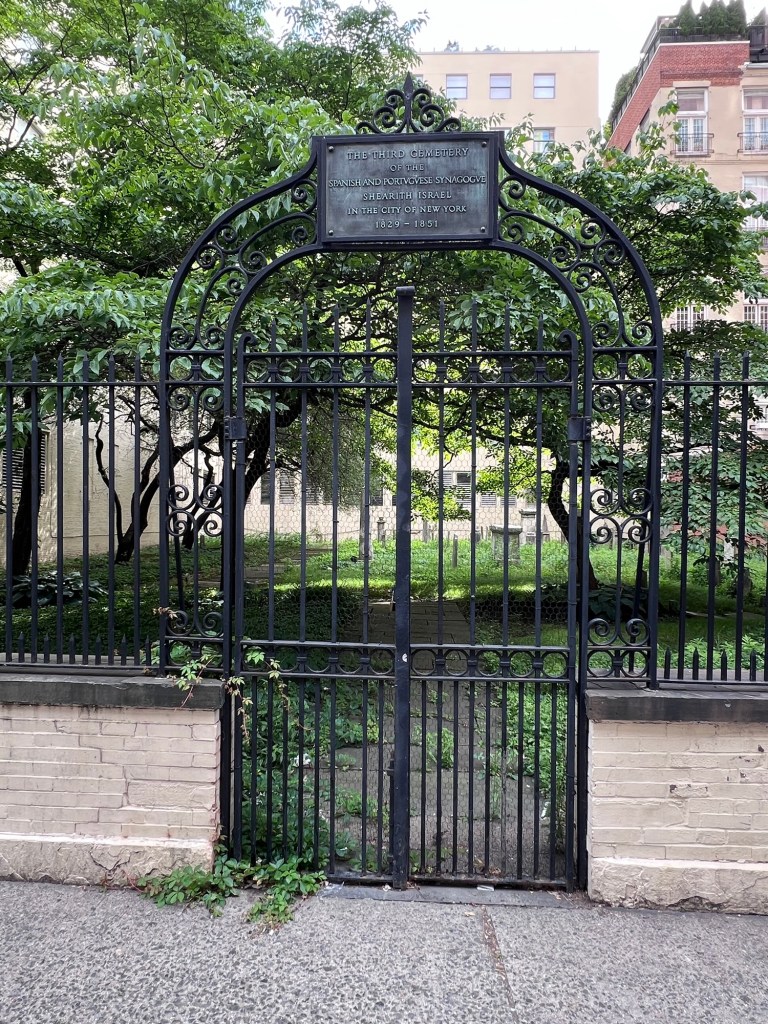
When I was finishing my walk of the streets of Lower Chelsea, I came across this quiet and respectful cemetery in the middle of a busy neighborhood. This small graveyard was the third of series of moves that Shearith Israel made to bury their dead since the original cemetery open on the edge of what is today Chinatown.
Like its earlier counterparts, the cemetery is locked to visitors. So you can only admire it from a far. The graves date back to the early 1800’s.
The History of the cemetery:
(From the New York City Cemetery Project and Find a Grave)
This cemetery is located on 21st Street between 6th and 7th Avenues, in use 1829-1851. Shearith Israel, the first Jewish congregation in North America, was formed in 1654 by Spanish and Portuguese Jews who journeyed from Recife, Brazil, seeking refuge from the Inquisition.
The entrance to the cemetery is always locked
The sign for the cemetery
While New Amsterdam’s city fathers did not recognize freedom of worship, they respected the Jews’ right to their own consecrated burial ground. Shearith Israel purchased the cemetery plot on West 21st Street in 1829 for $2,750. It, too, was on the outskirts of the expanding city, which for sanitary reasons had prohibited interment below Grand Street after the yellow fever epidemic of 1822.
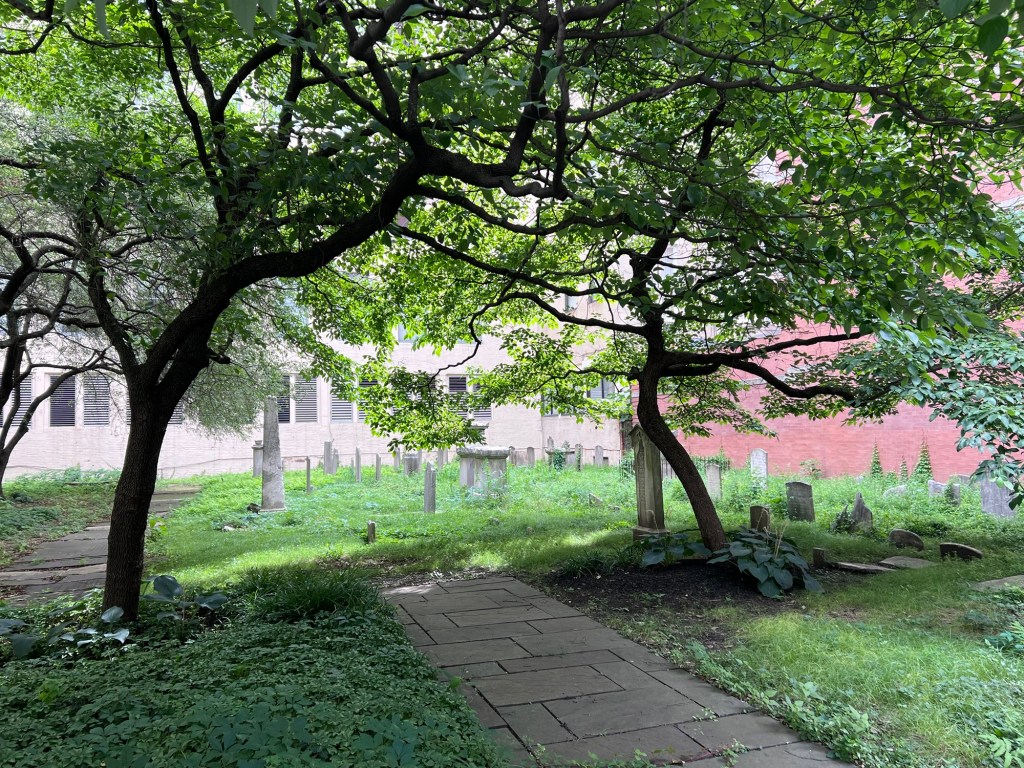
The view of the cemetery from the fence
In 1832 the congregation bought land extending the cemetery east to Sixth Avenue and south to 20th Street. Fifty years later the land was sold to Hugh O’Neal, who built a dry goods store there. Shearith Israel used the cemetery for burials until 1851.
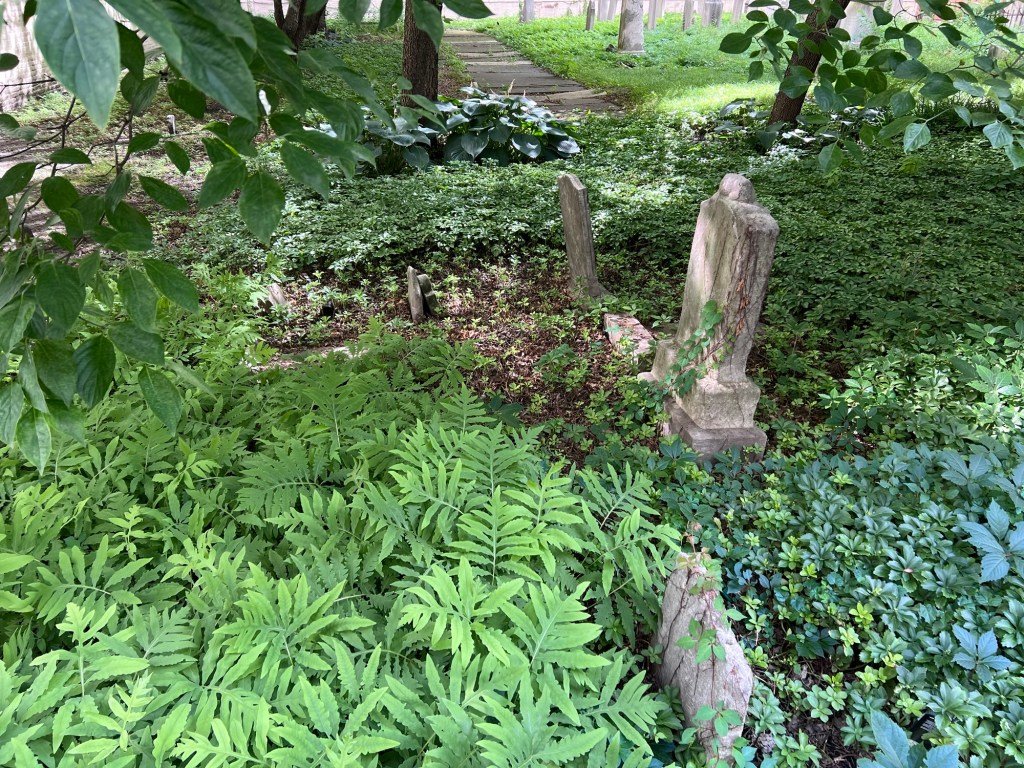
The graves are from the early 1800’s
That year, New York City prohibited burials south of 86th Street and the establishment of any new cemeteries within city limits (Find a grave.com).
The side section of the cemetery and pathway
The view of the cemetery and its quiet respect to those buried there
The history of the Cemetery from the Congregation of Shearith Israel The Spanish & Portuguese Synagoge website:
According to rules of ritual purity, Cohanim are prohibited from coming into contact with the deceased (except for their immediate family.) This means that ordinarily Cohanim cannot participate in any of the mitzvoth related to burial. One particularly commendable priest, Mr. Lewis I. Cohen, realized that the consecration of a new and unused cemetery afforded him an opportunity to participate in a mitzvah usually off limits to Cohanim. So it was Mr. Cohen who volunteered to dig the first grave for the first burial of the new cemetery in November 1829.
Some of the notable persons laid to rest in the 21st Street cemetery were Moses Levy Maduro Peixoto and Isaac Seixas, ministers of our congregation, and Harmon Hendricks, founder of one of America’s first great industrial companies and whose descendants are still members of our congregation today. Perhaps the most influential person to be buried in the 21st Street cemetery was the great Jewish diplomat and proto-Zionist, Mordecai Manual Noah.
In 1851, the city prohibited burial in Manhattan below 86th Street. Rather than continue to look north (as Trinity Church did), the Congregation searched outside of Manhattan for its next burial ground. Together with Bnai Jeshurun and Shaarei Tefila, the congregation purchased a large plot of land in Ridgewood, Queens.
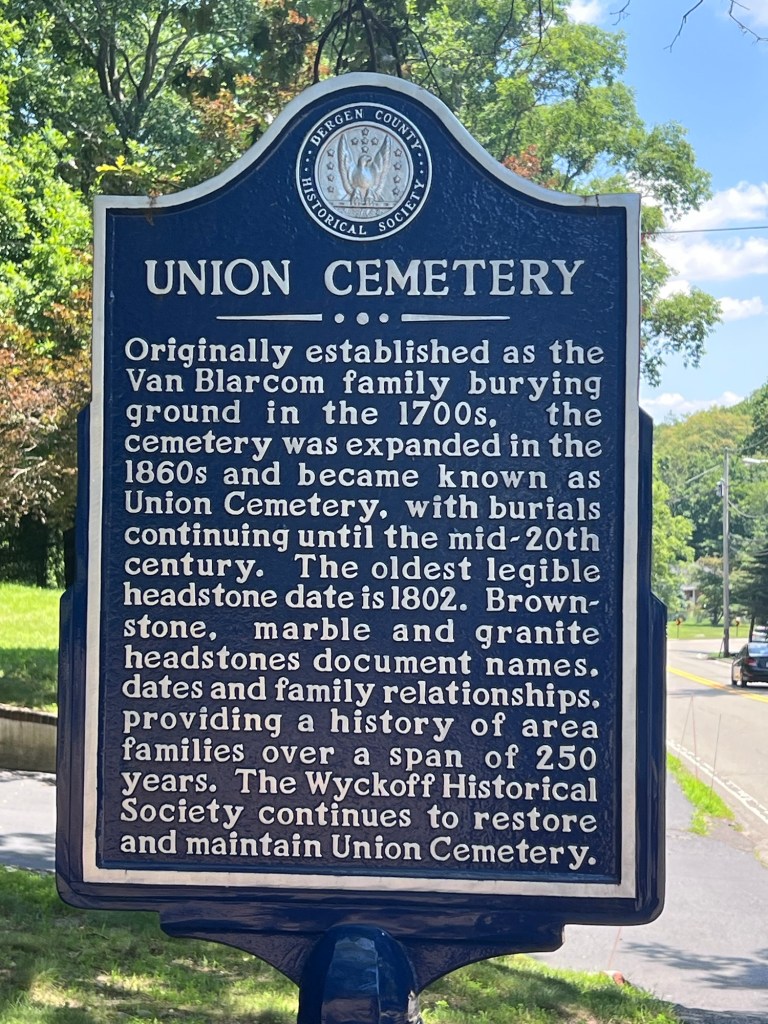
The historical sign for the Union Cemetery at 151 Franklin Avenue in Wyckoff, NJ
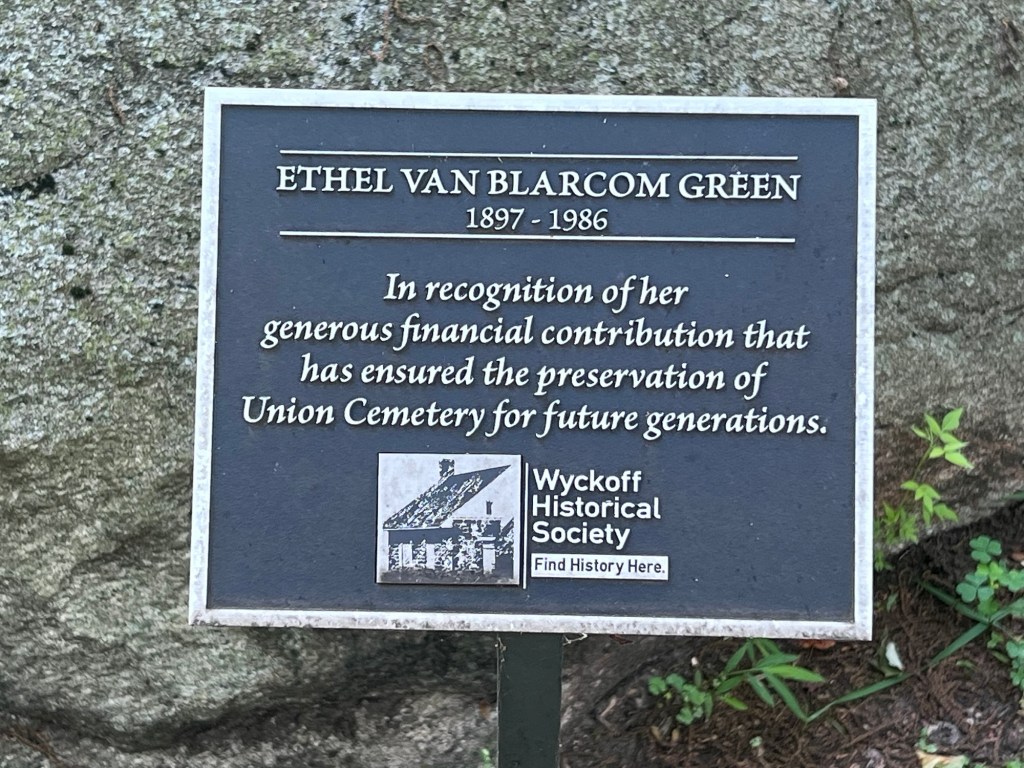
The marker sign put up by the Wyckoff Historical Society
The walled garden just outside the cemetery in bloom
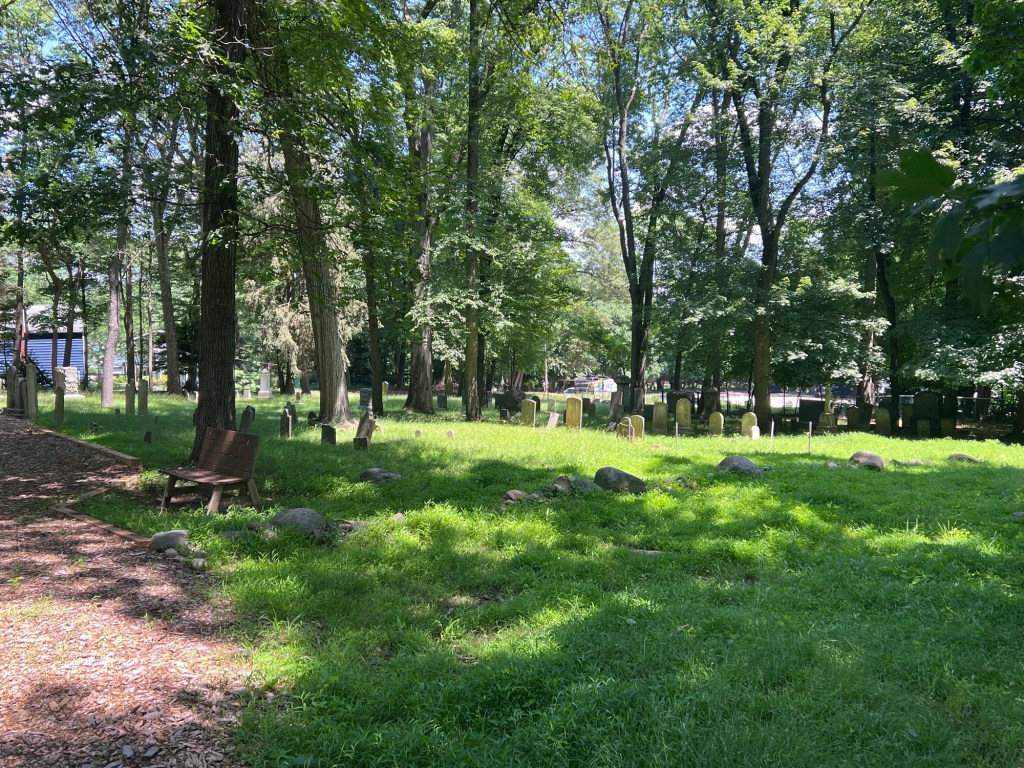
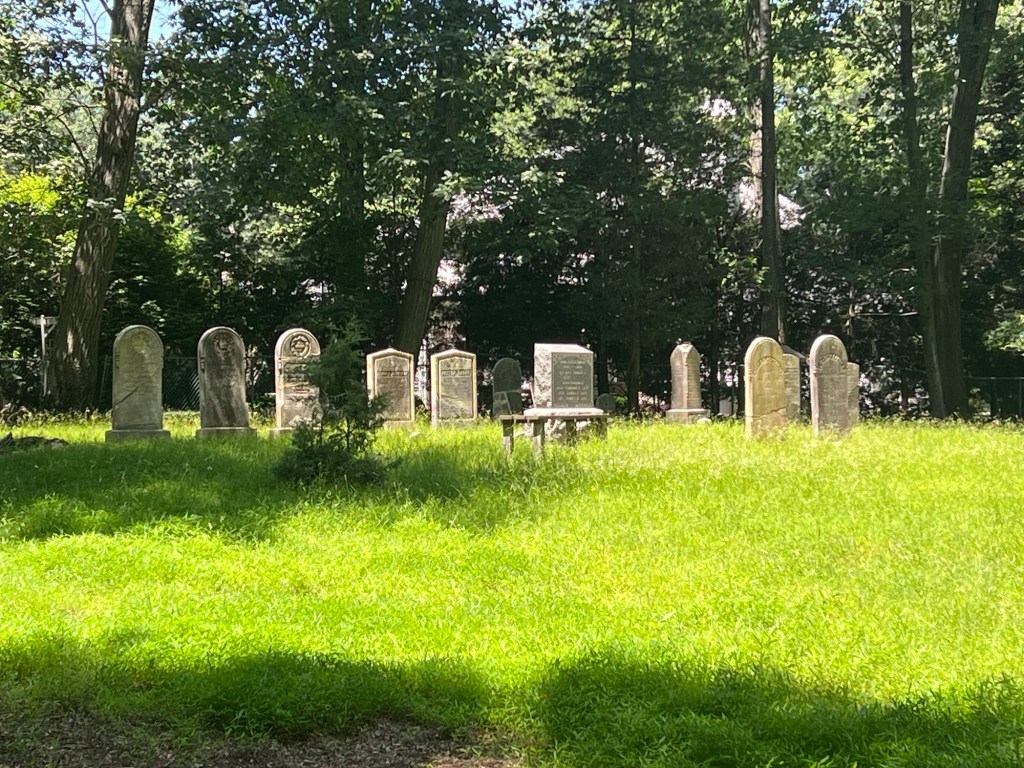
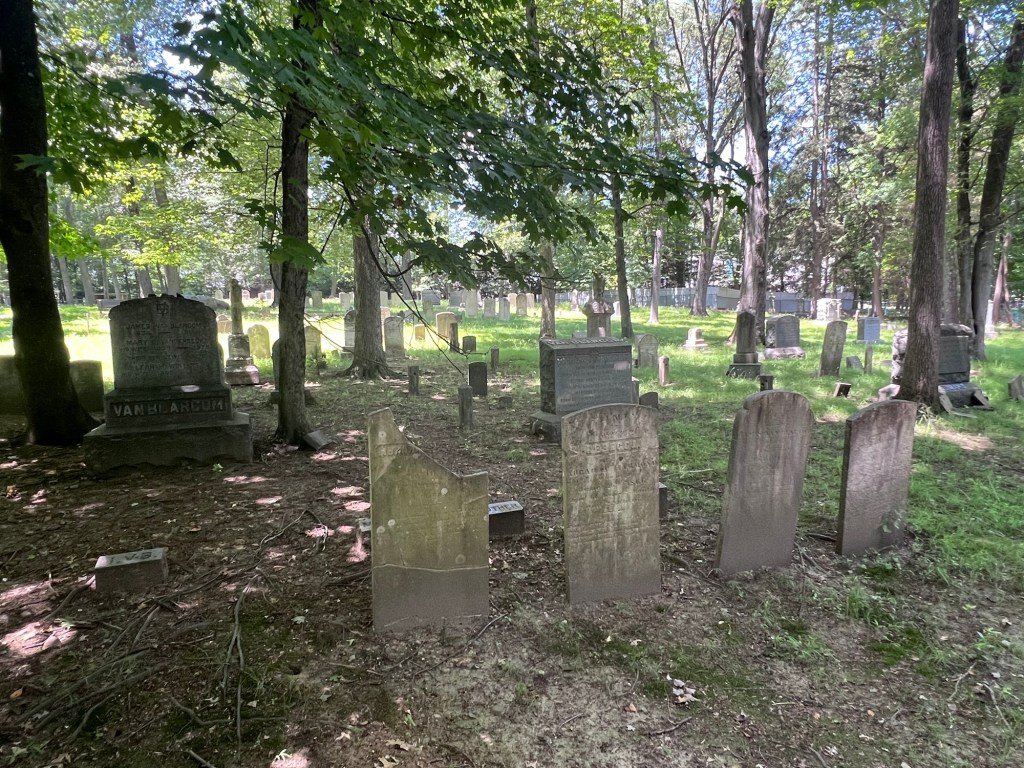
The Union Cemetery was originally the resting place of the Van Blarcom family and the right hand side of the cemetery has the Van Blarcom family plot
One of the descendants of the family, Ethel Van Blarcom Green donated money for the preservation of this family plot.
The Biography of Ethel Van Blarcom Green:
(From the Wyckoff Historical Site)
If you at all familiar with the Wyckoff Historical Society’s recent activities at Union Cemetery, you may know that the 250 year-old site was the original Van Blarcom burial site. The name can be traced to the early 1700s when the first Van Blarcom family settled in New Jersey. The oldest legible headstone dates to 1764.
What you may not know, is that Ethel Van Blarcom, a direct descendant, bestowed a significant financial contribution to the Society beginning in 1978, with her wish that her beloved family cemetery be maintained. Although she lived in California for most of her adult life, Union Cemetery obviously held a special place in her heart, and she wanted to see it survive. The Society has Ethel’s hand-written letters that confirm her generous donation. She also continued to renew her Society membership until 1984.
However, it wasn’t until 2019 that the current trustees decided it was time to use the funds for its intended use, and honor Ethel’s wishes. Several headstones were repaired, new fencing is being installed, and yearly grounds maintenance is conducted, thanks, in part, to Ethel’s generosity.
It was at this time that Society trustees, Doris Noerr, Melanie Long, and Linda Vreeland, dove into genealogy websites and Society archives to learn more about Ethel’s life and to particularly find a photograph of her.
“After several week of research, we obtained Ethel’s death certificate which led to contacting her niece Naomi who is now 92,” said Society president, Lynn Groel-Lynch. “To our delight, she had a photo of Ethel and her husband, Roy Green that we believe is her 1916 wedding photo.”
Ethel was born in Paterson in 1897 and lived to the age of 89. She and Roy moved to the Los Angeles, California area most likely around the time of her mother’s death in 1933. The couple had no children.
“We are still in the process of contacting a few descendants, and those we’ve spoken to have been happy to share what they know about Ethel,” said Melanie Long. “We also will install a plaque in her memory near where her father, Edward is buried in Union Cemetery. There are thousands of Van Blarcom names as they were the one of the prominent families in our area’s farming community, and after all these years, the Society is thrilled to finally honor the legacy of one very important Van Blarcom, Ethel Van Blarcom Green. As they say, ‘It’s never too late’”.
The current history of the Union Cemetery:
(Wyckoff Historical Society website)
The original Grange sign from the 1960s at the Franklin Avenue entrance of Union Cemetery was weathered and fragile. The Wyckoff Historical Society recently replaced the old sign with one that is also hand-lettered, and includes the Grange logo which was barely visible on the old sign. Two new posts display the new sign.
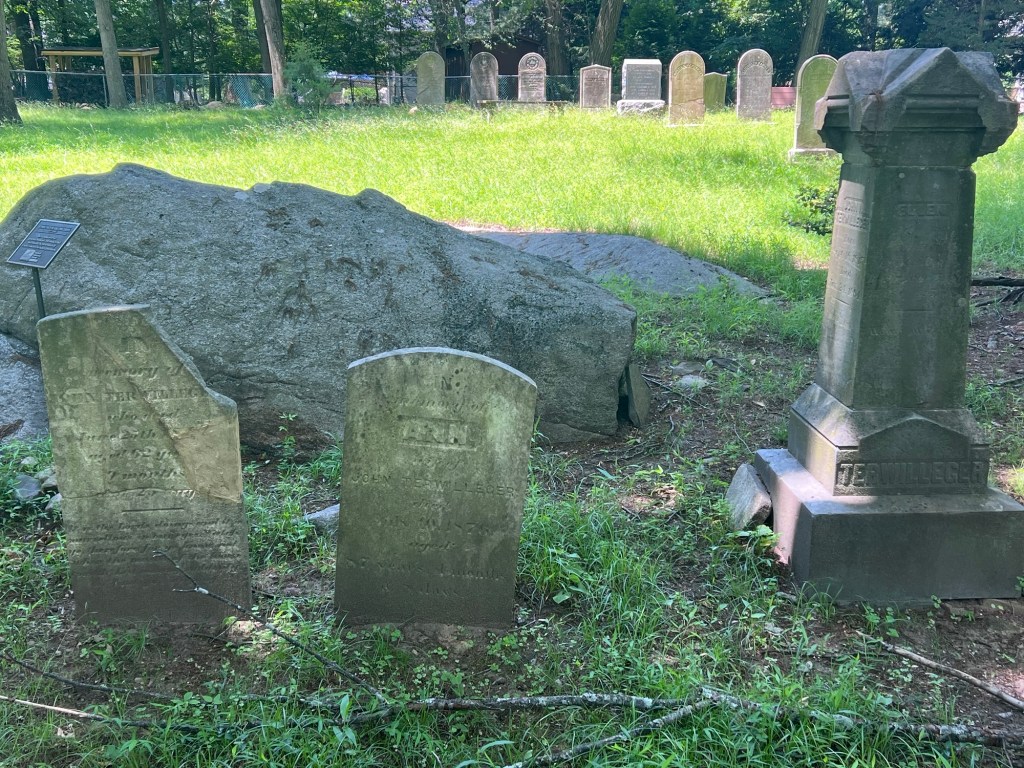
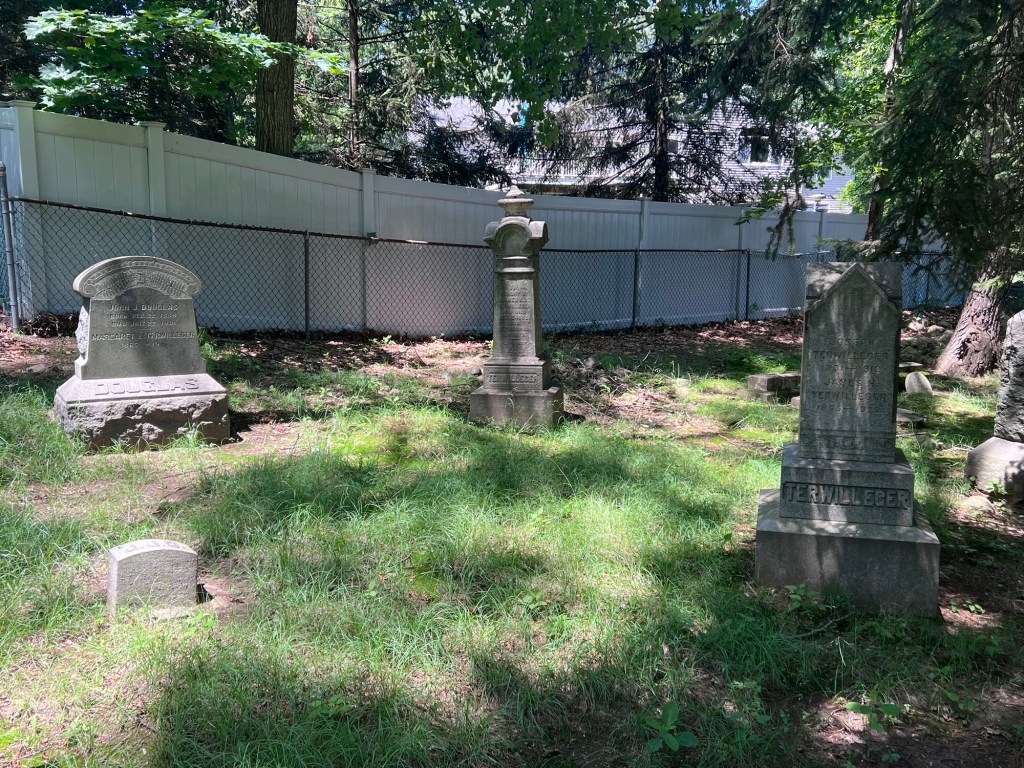
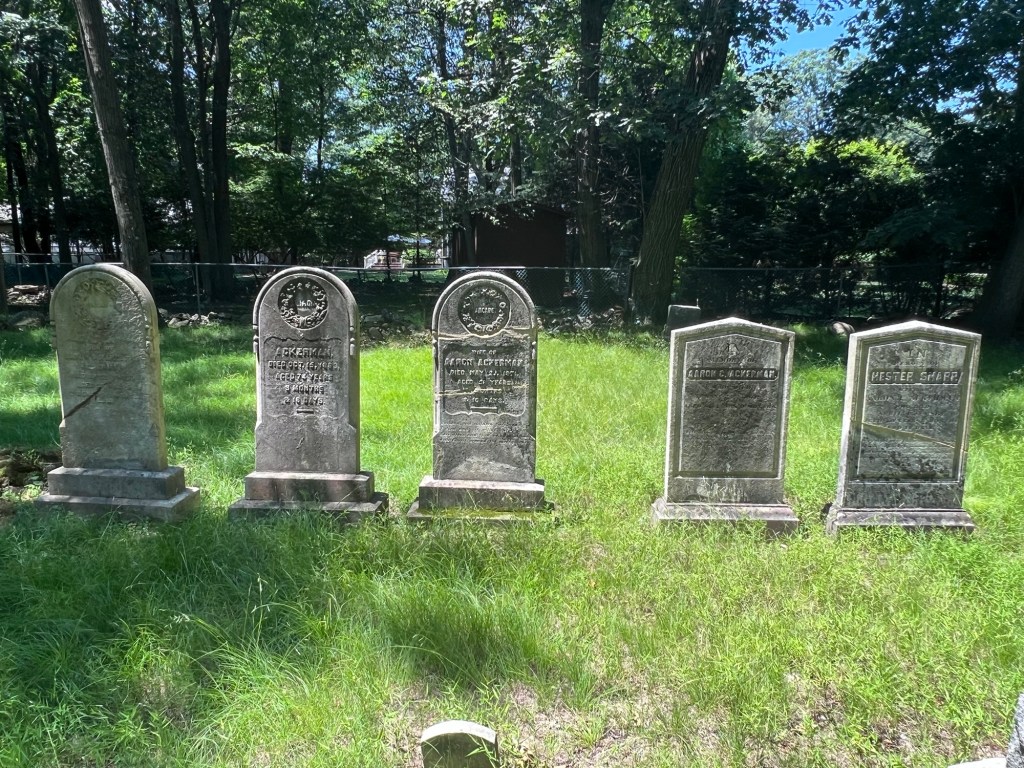
The Ackerman and Terwilliger families are buried to the left/northern side of the cemetery
The Terwilliger family plot
The resting place of James Terwilliger’s tombstone
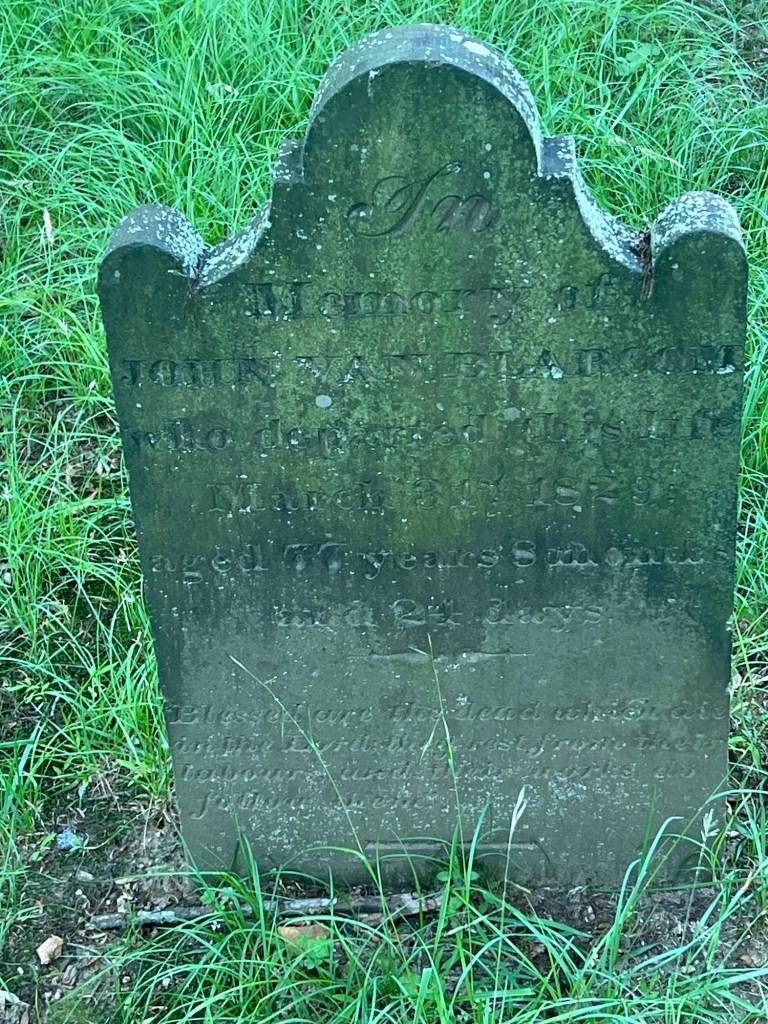
To the right of the pathway around the cemetery to the south is the Van Blarcom family plot where on the oldest graves is that of John Van Blarcom, a veteran of the Revolutionary War.
The resting place of Revolutionary War veteran, John Van Blarcom
The original section of the Van Blarcom family plot dating back to the Revolutionary War
The later burial section of the Van Blarcom family
The resting place of Daniel and Rebecca Van Blarcom
The Terwilliger family has two sections of the family plot in the northern section of the cemetery
The Ackerman family’s plot is to the middle most northern end of the cemetery
The Mallinson/Westervelt family has the further most family plot of the cemetery
The cemetery is so peaceful and relaxing to walk around. The Wyckoff Historical Society has done a wonderful job maintaining the property. Even though it is the resting place of many family plots, it’s still a very welcoming place and you can feel it as you walk the paths. There is a respect of remembering the people of the past that can be felt here
As you walk the pathways, you visit the people who have contributed to the growth and history of Bergen County and the surrounding area. They shaped their communities from before the Revolution War to today.
My video of visiting the cemetery and the families that rest here.
The History of the Cemetery:
(From the Wyckoff Historical Society website)
The Union Cemetery on Franklin Avenue dates back to the first half of the 1700s, when Johannes Van Blarcom set aside an area of his property to become a burial place. The earliest readable stone is from 1764 and thought to mark the grave of a slave girl because there is no surname given. Johannes Van Blarcom’s daughter, who died in 1725, is alleged to be buried there also. Various community groups have volunteered to maintain the cemetery, including the Wyckoff Historical Society. In 2018, dead trees, underbrush, and poison ivy were removed.
Most are early Van Blarcom family members as the cemetery was one of the original family cemeteries.
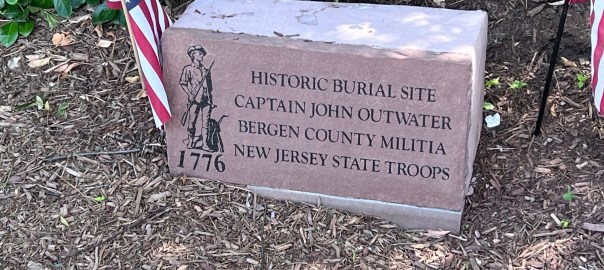
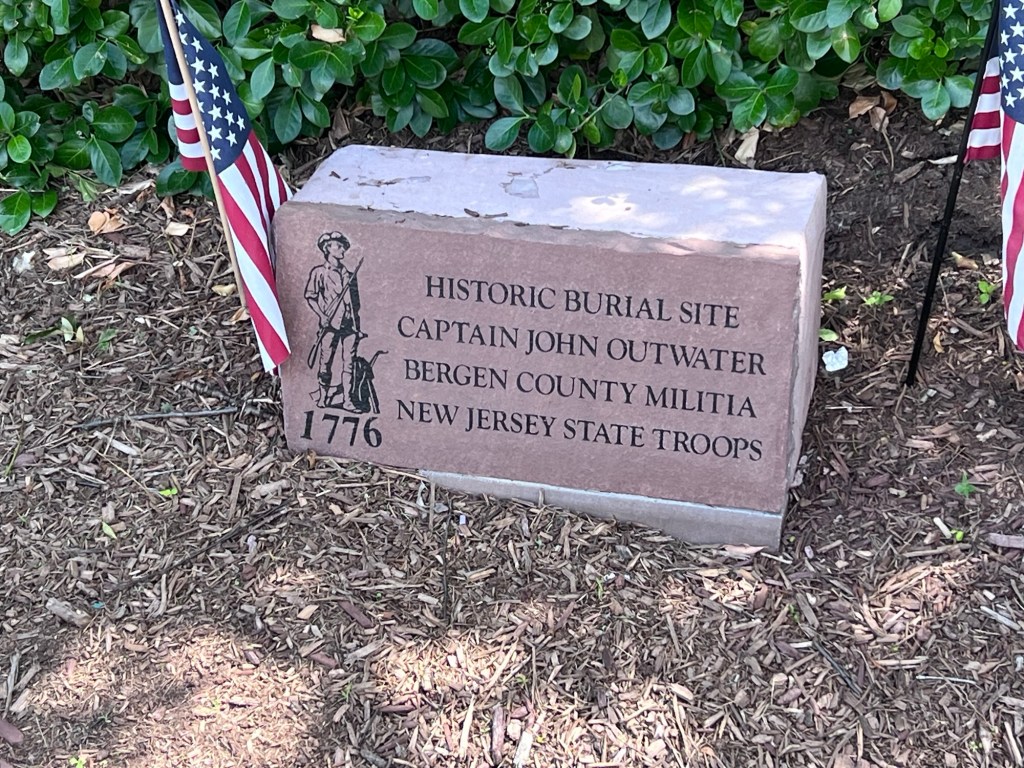
The stone marker sign at the entrance to the family cemetery. This cemetery is the final resting place of Captain John Outwater from the local militia who fought in the Revolutionary War and his family.
The memorial to Captain Outwater in the center of the cemetery dedicated to his contributions to Revolutionary War
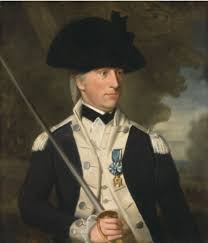
Captain John Outwater during the Revolutionary War
When John J. Outwater was born on 9 February 1780, in Hackensack, Bergen, New Jersey, United States, his father, Captain John Outwater, was 33 and his mother, Hendrickje Dirck Lozier, was 34. He married Cathalina Van Bussum on 1 February 1813, in Old First Reformed Church, Passaic, Passaic, New Jersey, United States.
They were the parents of at least 4 sons. He died on 25 September 1842, in Wilson, Wilson, Niagara, New York, United States, at the age of 62, and was buried in Glenwood, Lewiston, Lewiston, Niagara, New York, United States.
The original entrance to the cemetery must have been on Moonachie Avenue in the distant past.
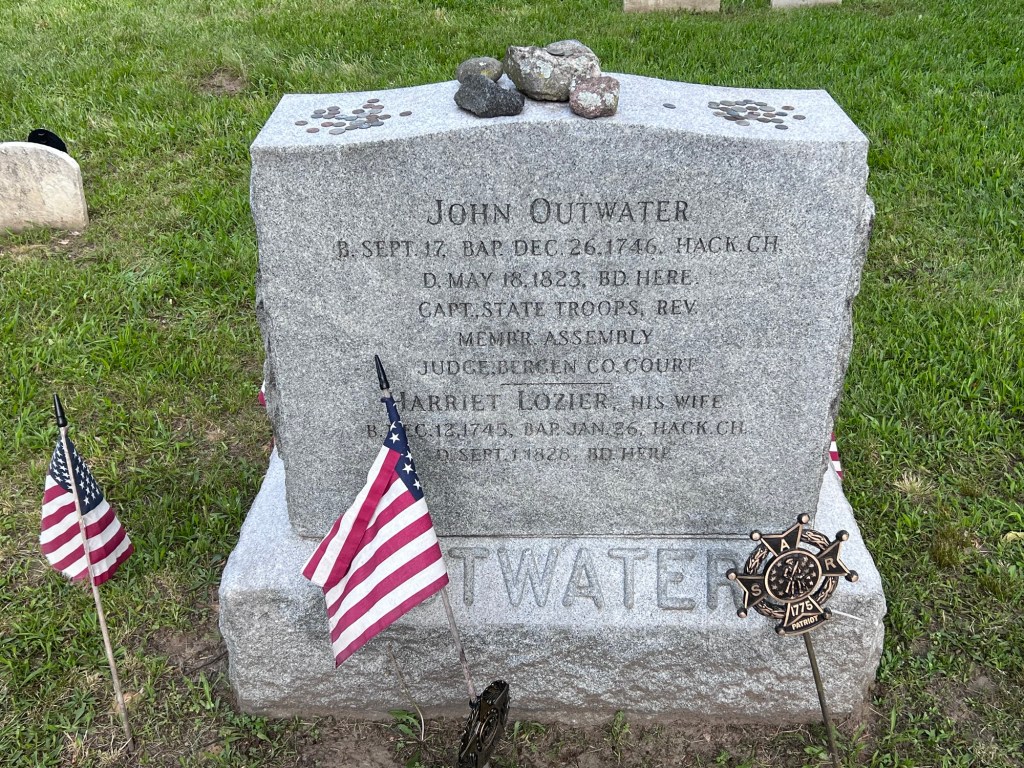
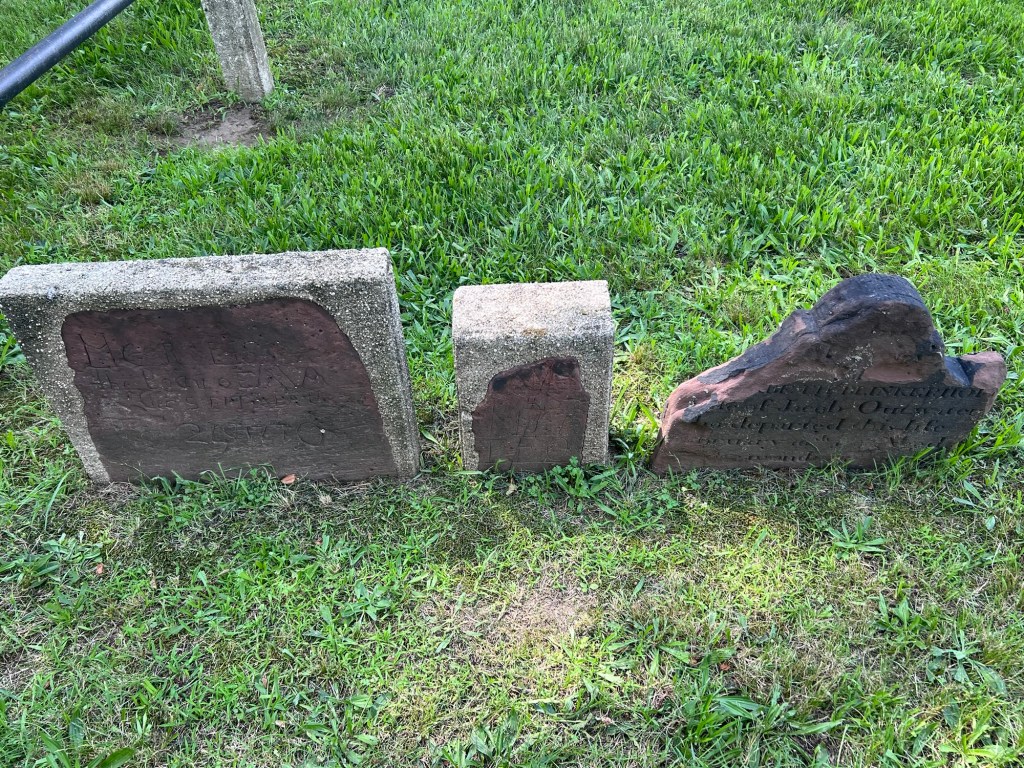
The original graves of Captain John Outwater and his wife, Louise Lozier
Across from their graves is the memorial to the family
Various members of the Outwater family including parents, brothers and sisters and children are buried here.
The grave of Jacob Outwater and his family
The tombstone of Jacob Outwater
The grave of Jacob’s son who died as an infant
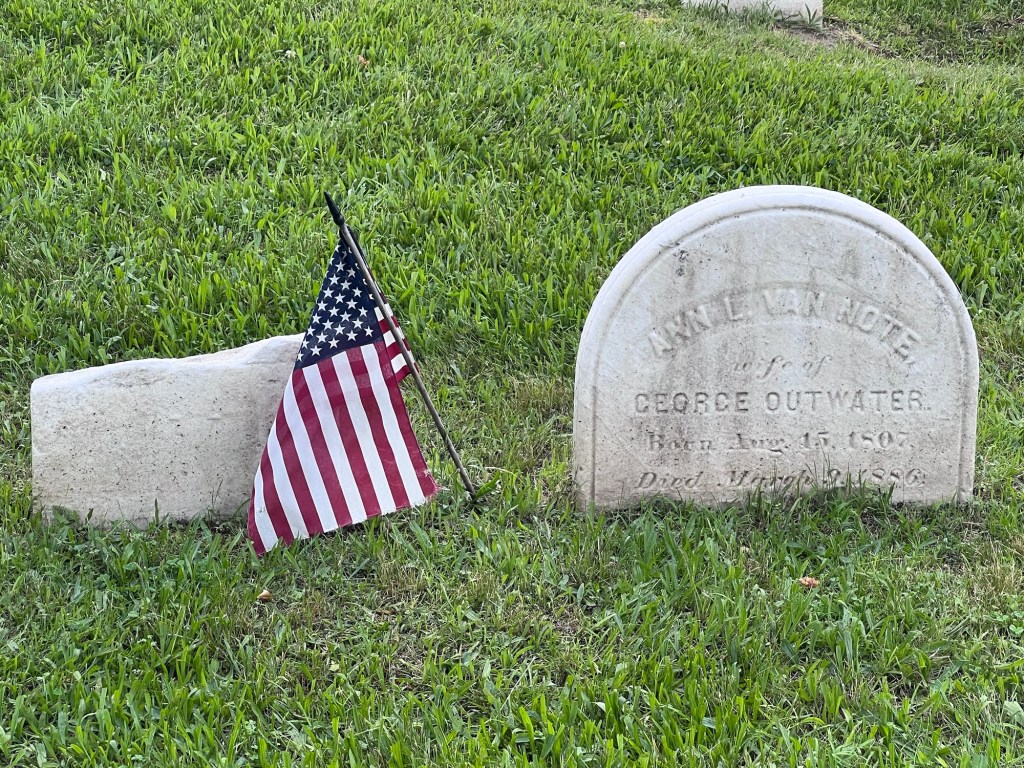
The graves of George Outwater and his wife, Ann Van Note
I think this is the grave of George Outwater’s first wife, Mary
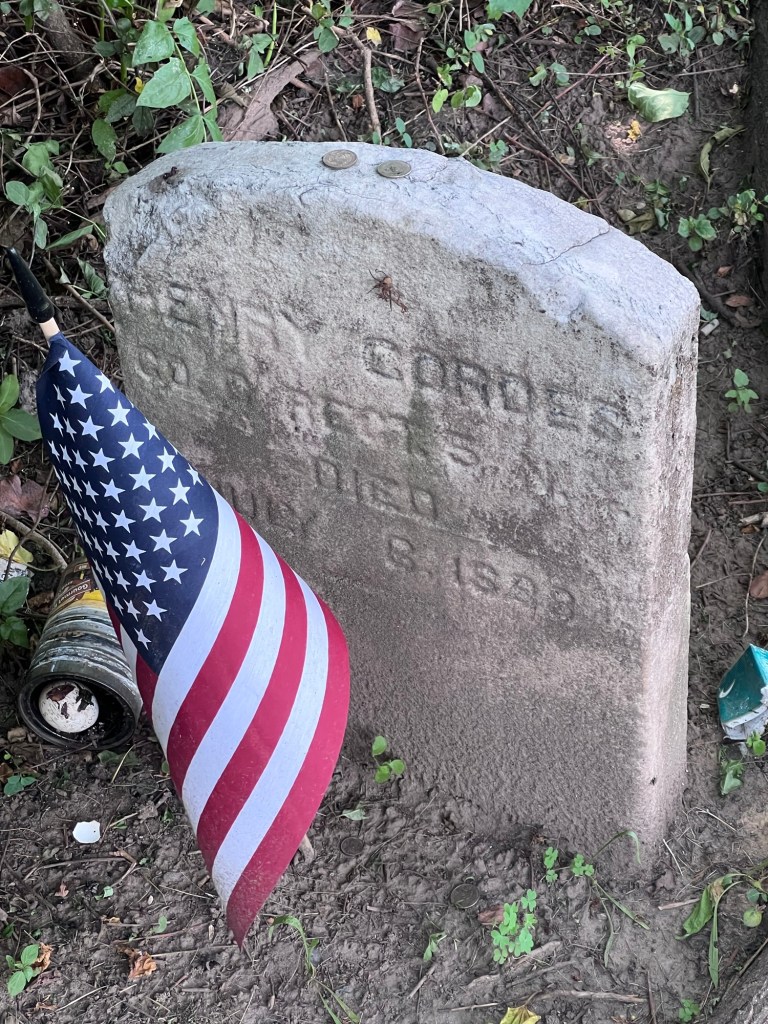
Buried outside the family plot is the grave of Henry Cordes
The Outwater family cemetery sits on a small hill overlooking a Quick Check store and gasoline station. Talk about modern progress.
I took a quick tour of the cemetery:
My video of the Outwater Family Cemetery and the grave of Captain John Outwater of Revolutionary War fame.
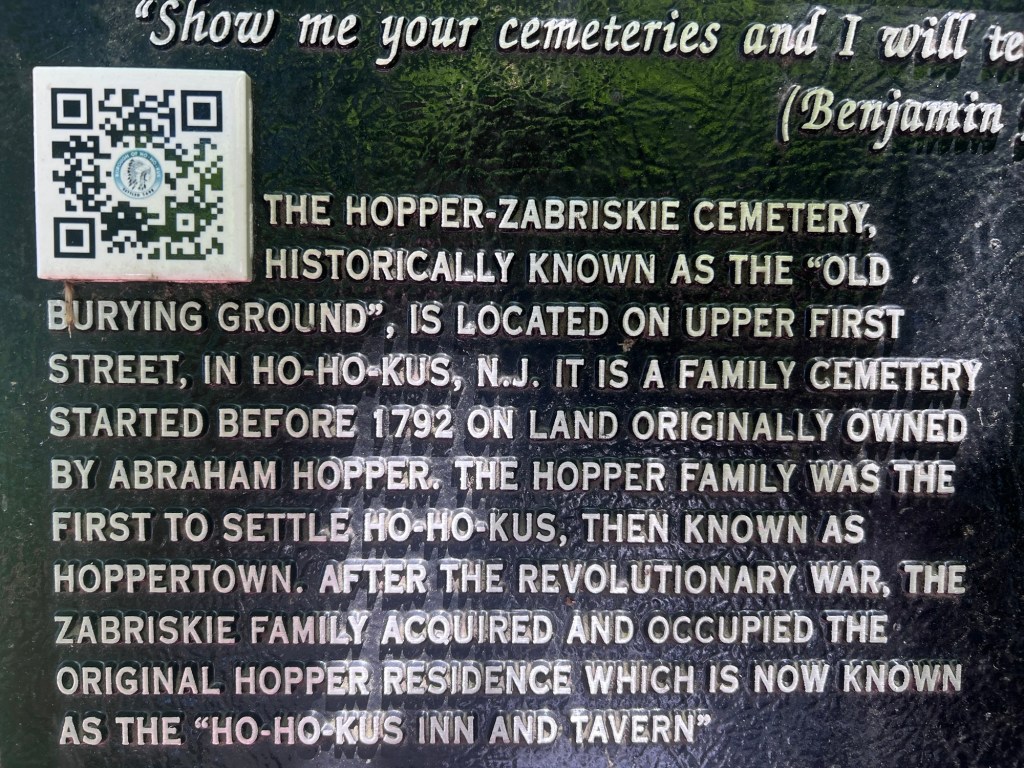
It is a family cemetery started before 1792 on land originally owned by Abraham Hopper. The Hopper family was the first to settle Ho-Ho-Kus, then known as Hoppertown. Many Dutch families also settled the area including the Zabriskie, Ackerman, Blauvelt, Bamper, Banta, and Terhune families. Most were members of the Old Paramus Reformed Church nearby.
While family members were commonly interred in the church graveyard, some chose to bury family members in small local plots closer to their residences. Such was the case with the Ackermans who had a plot on the northeast side of town near the Saddle River, and the Hopper and Zabskie families who were buried in the small plot in Hoppertown near the Ho-Ho-Kus brook.
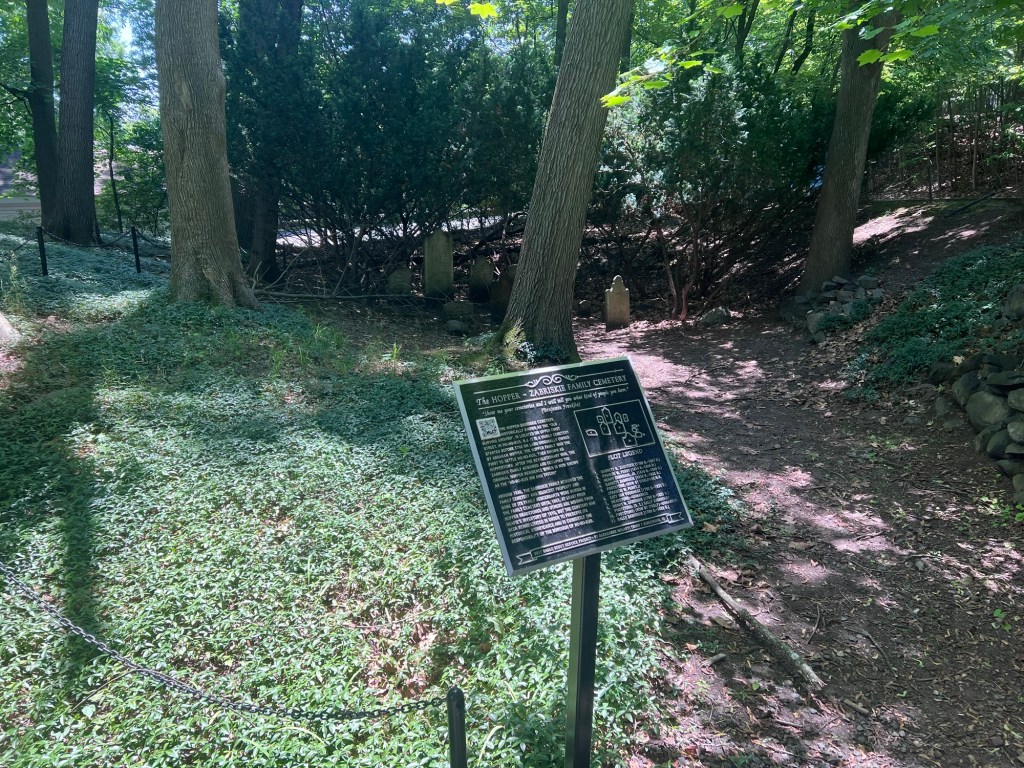
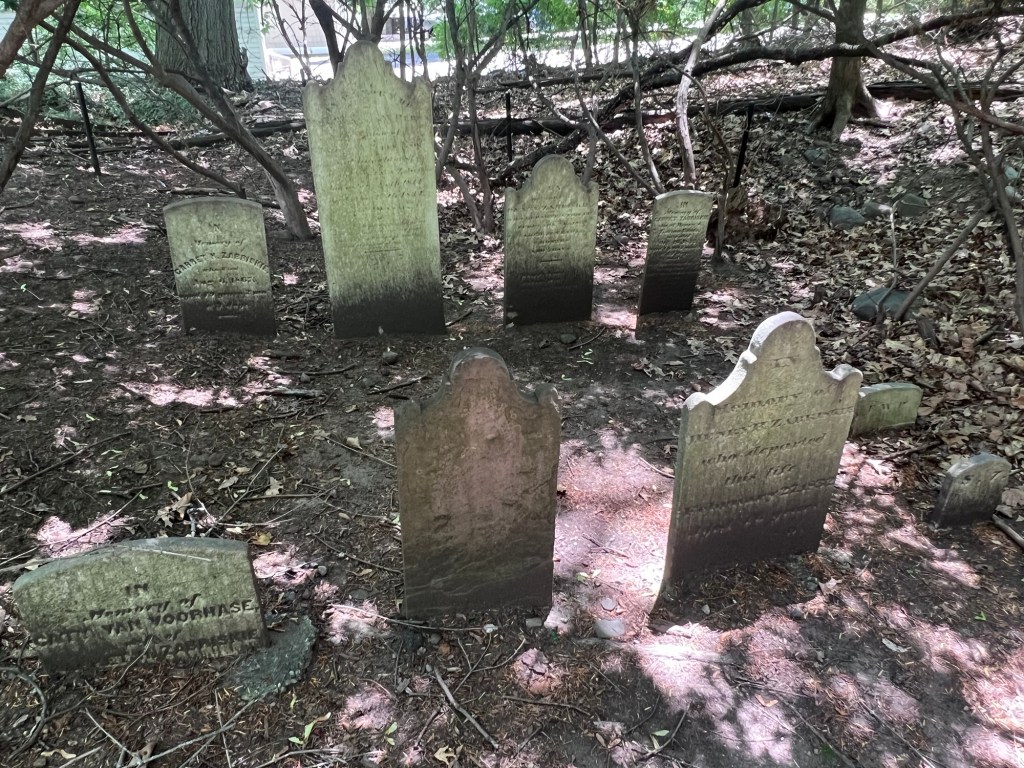
The small cemetery
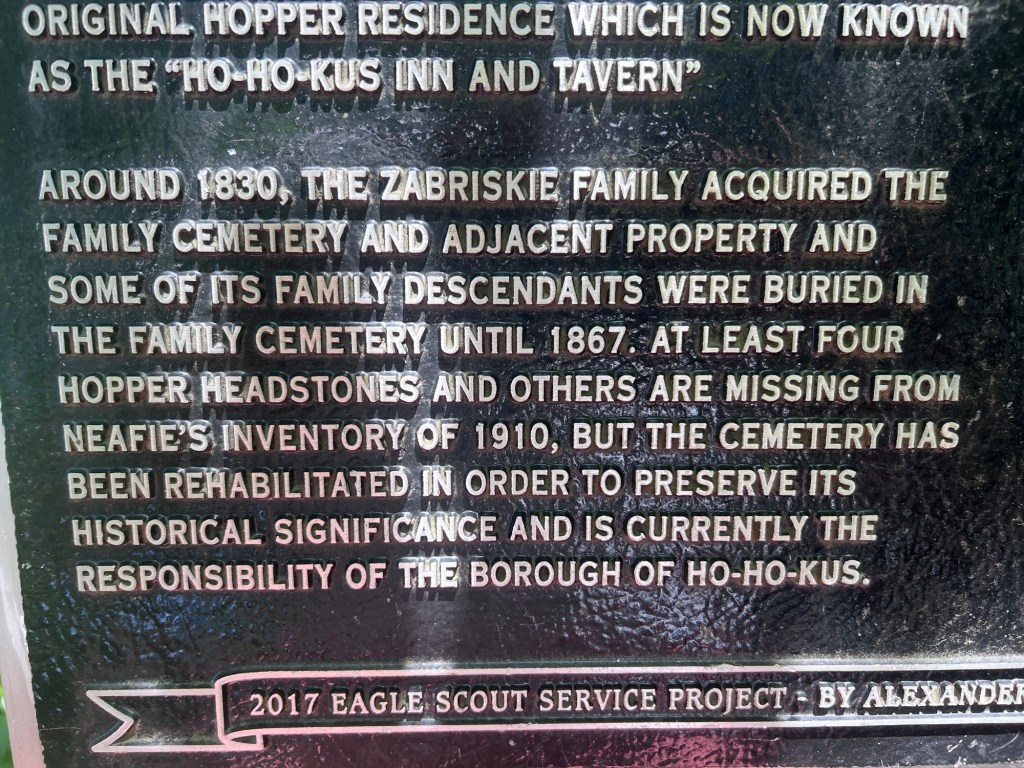
The historic sign
The original family cemetery of the Hopper family when the original name of the area was ‘Hoppertown’ for the family whose land dominated the area. While some would bury their loved ones at the family church’s graveyards, some preferred their loved ones closer and would be buried on the family farm. Some families picked the highest point, usually a small hill that would over look the land. This particular cemetery is located in a small cove at the bend of the road.
This small historical cemetery is another example of history lost in time. The generations of distant family members no longer care for this historical spots and they were left for the elements. This cemetery was cared for by Veterans of the Wars and the Boy Scouts who put a lot of care in it. Now it is under the Borough of Ho Ho Kus, NJ.
The history of the cemetery
The history of the Zabriskie family
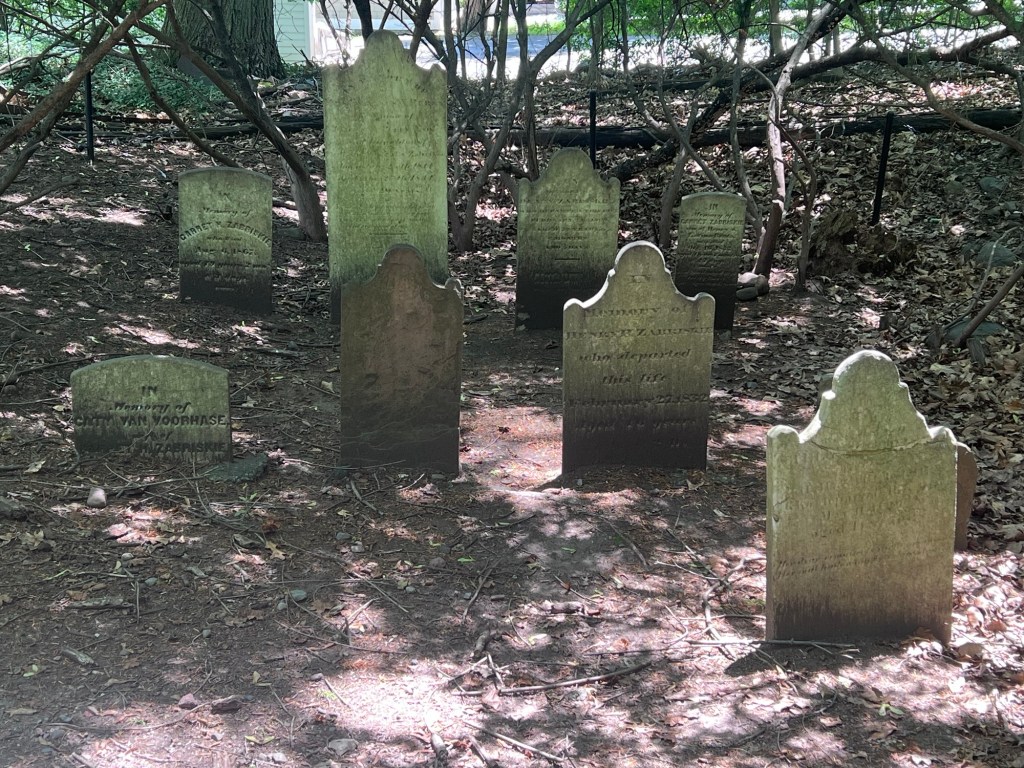
The family plot map of the tombstones.
The small family burial plot common to farms in Bergen County at that time.
Who is buried here:
(From the Borough of Ho Ho Kus, NJ website)
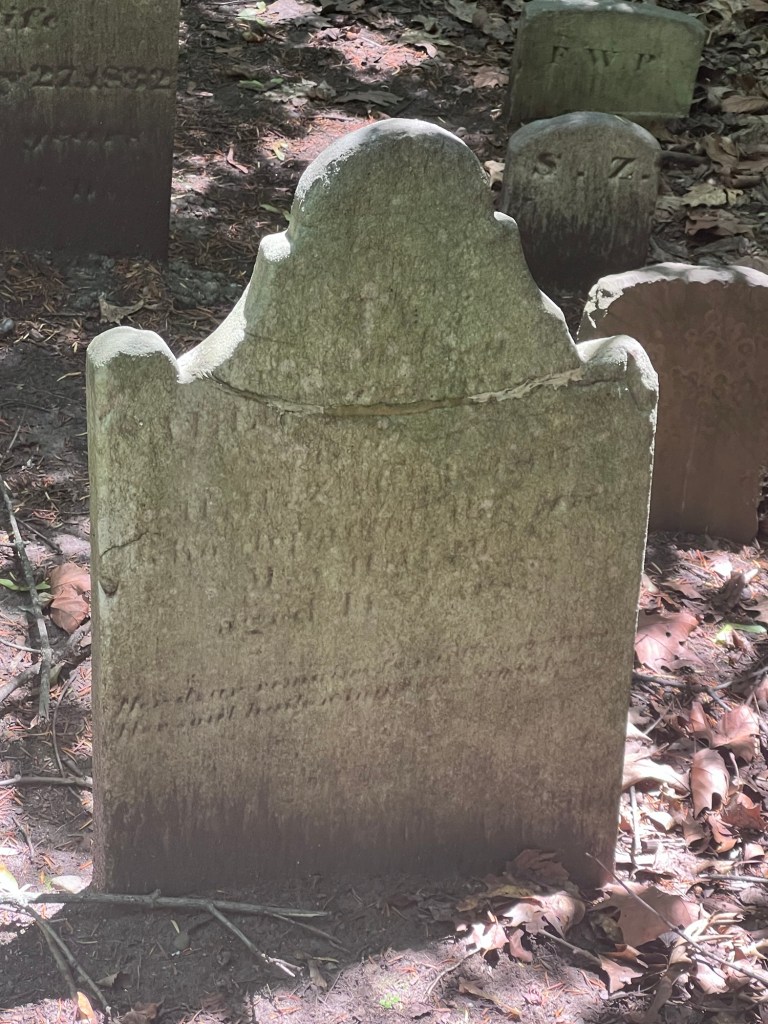
There were a number of descendants from the Hopper and Zabriskie families who were interred in the small cemetery between 1792 and 1867. In 1910, an archivist named John Neafie from New York City cataloged the names on the headstones and provided a copy to the Bergen County Historical Society. Some of those appearing in this catalog included:
Garret Hopper, died Feb.17, 1792, age 69 years
Elsey Hopper, wife of Garret Hopper, died March 8, 1816, age 89 years
Mary Zabriskie, wife of Henry Zabriskie, died June 3, 1821, age 69 years
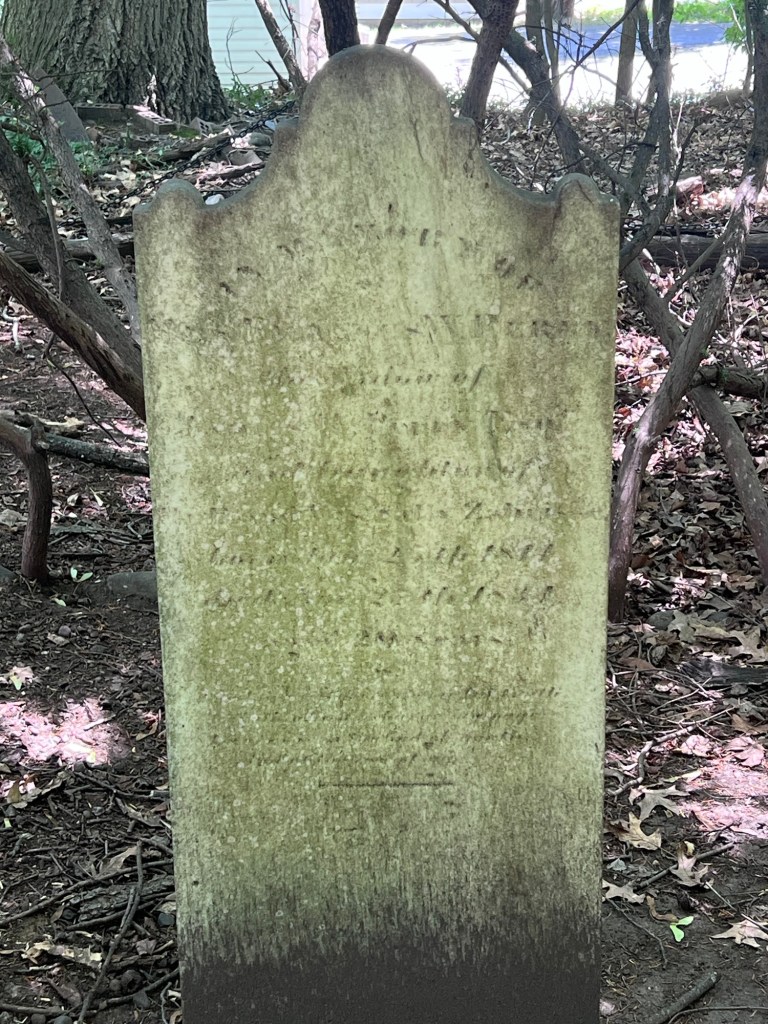
Francis W. Perry, wife of James H. Perry Esq. and daughter of H. and Sally Zabriskie, born June 25, 1814, died Nov. 27, 1834
Henry Zabriskie, died Feb.23, 1839, 22 years
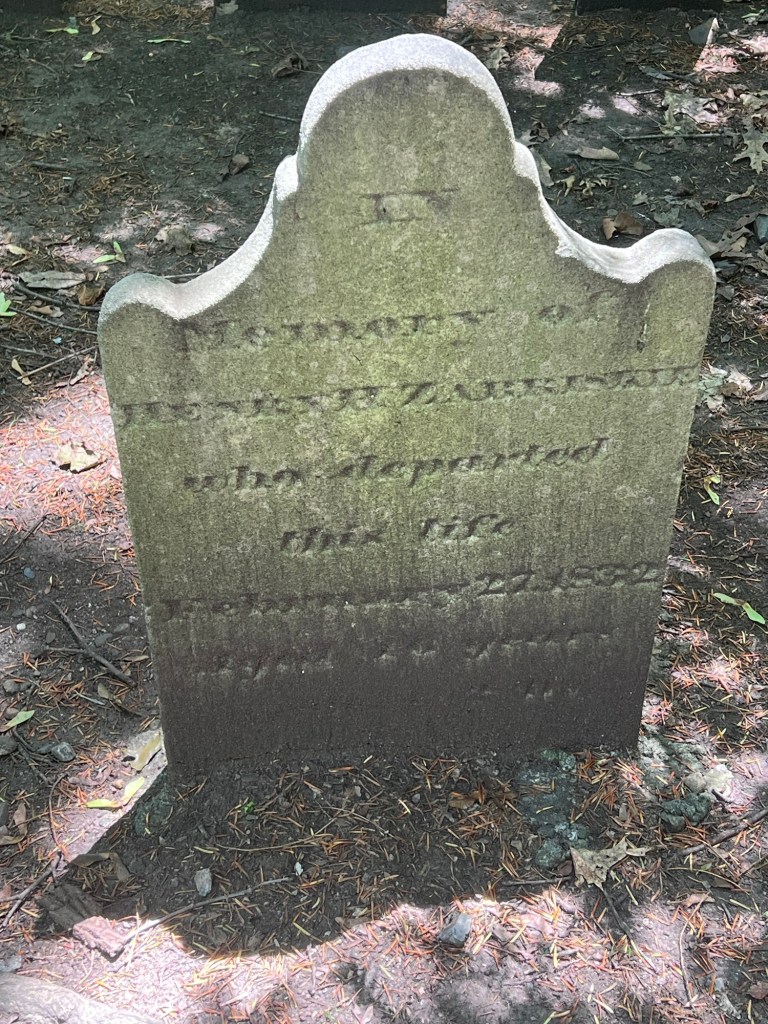
Henry H. Zabriskie, died Feb. 27,1832, age 46 years
Sally Zabriskie, wife of H.H. Zabriskie, died May 11, 1829, age 41 years
Garret H. Zabriskie, died Aug. 6, 1867, age 79 years
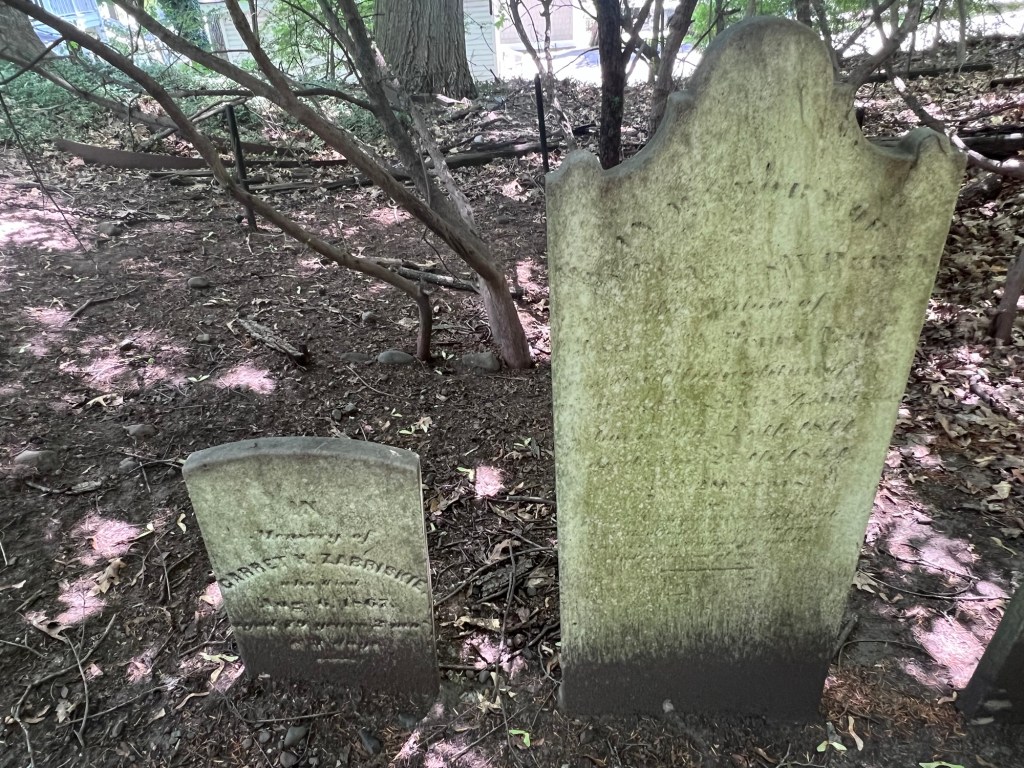
Caty Van Voorhase, wife of Garret H. Zabriskie, died Nov. 6, 1833, age 41 years
Garret Zabriskie, son of Henry and Lavinia Banta, died Oct. 16, 1832, age 4 years
Ann Bamper, wife of Jacob Bamper, died Feb. 26, 1844, age 90 years
C.I.Z. (probably refers to Casparis, son of Mary Zabriskie)
The grave of Henry Zabriskie
The graves Henry and Garrett Zabriske
The graves Garrett Zabriske and Francis Perry
The grave of Caty Van Voorhase
The grave of Sally Zabriskie
The grave of Francis Perry
The cemetery is a testament to the family and their love of the land they owned.
The History of the Hopper and Zabriskie families in the area:
(From the Borough of Ho Ho Kus, NJ website)
The Hopper’s owned homesteads in the center of town on both sides of the brook and operated a grist mill. During the American Revolution, they were committed to the patriot cause and served with the Bergen County Militia. The British made several raids into Hoppertown during the war while foraging for military stores, farm animals, and other goods. One notable siege took place at Hoppertown on April 16, 1780. John J. Hopper was seriously wounded. His home and those of his brothers were burned down. The grist mill on the brook was also destroyed. The Zabriskie family would later acquire and occupy the original Hopper residence which was placed under siege. The building is now known as the Ho-Ho-Kus Inn & Tavern. Materials from John Hopper’s original house razed during the raid are believed to be incorporated into the foundation of the inn.
Around 1830, John J. Zabriskie took up residence in the former Hopper home, which became known as the Mansion House. The Zabriskie’s owned several farms and buildings nearby and built a dam and mill on the brook. The Zabriskie family also acquired the Hopper family cemetery on the hillside adjacent to the mill. When the first Zabriskie mill dam breached in 1862, John Jacob would build a much grander dam out of brownstone blocks to create Sylvan Lake while at the same time expanding cotton mill operations.
The Hopper Farm Family Cemetery is a reminder of what happens when time passes you by and the world changes around you. I went in search for the grave of Andrew Hopper, a veteran of the Revolutionary War. I could not find it.
This historic cemetery is hidden from the road behind two large homes on a tiny hill in the back woods. The only way to access the cemetery is to walk down the utility road off the main road, walk through the woods and walk up through the bush to back of two families back yards.
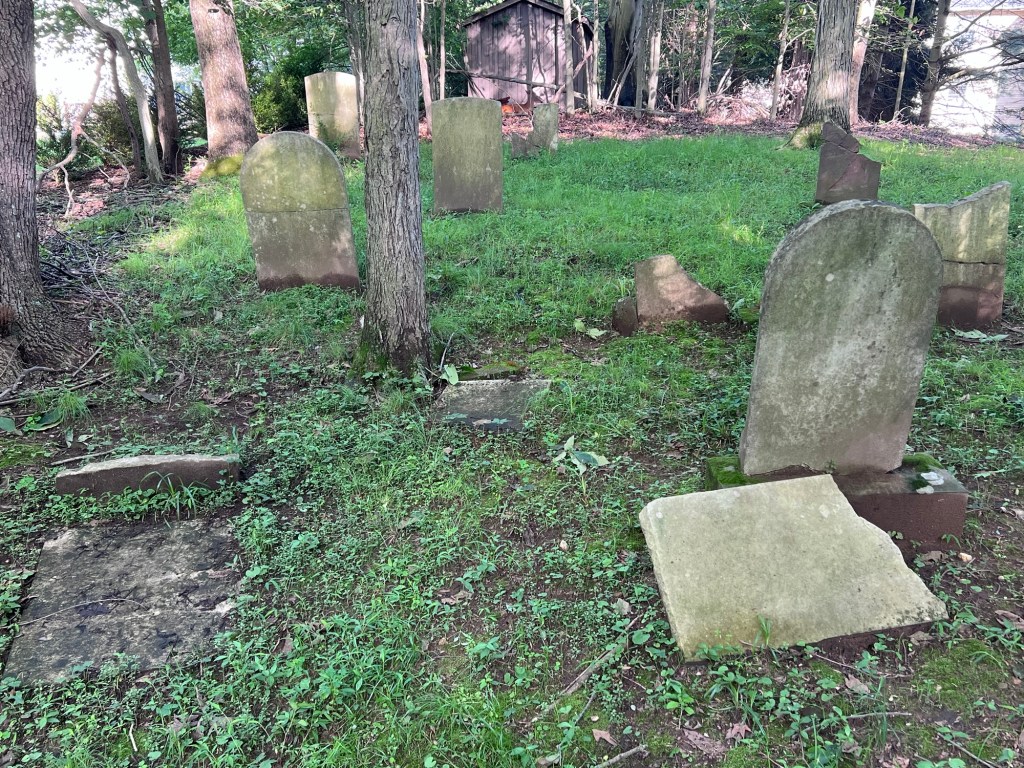
You can tell by the rotting fallen fence that this cemetery was once enclosed but the fence has since fallen and the cemetery in disarray. Still there is a quiet elegance to it.
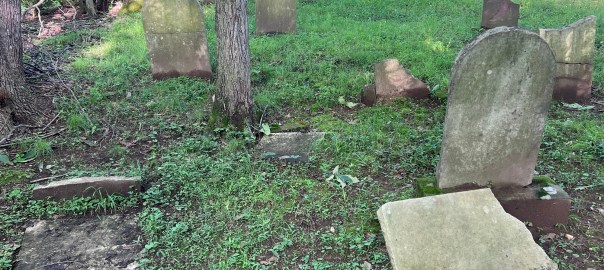
The cemetery is in desperate need of clean up and repair as tombstones are broken, fallen and discolored.
Some of the family tombstones have fallen. Still you can see members of the Hopper and Demarest families buried here.
Members of the Vanderbryck family Maryann and Rachel
The grave of David Hopper
The grave of Susan Storms, wife of one of the family members buried here.
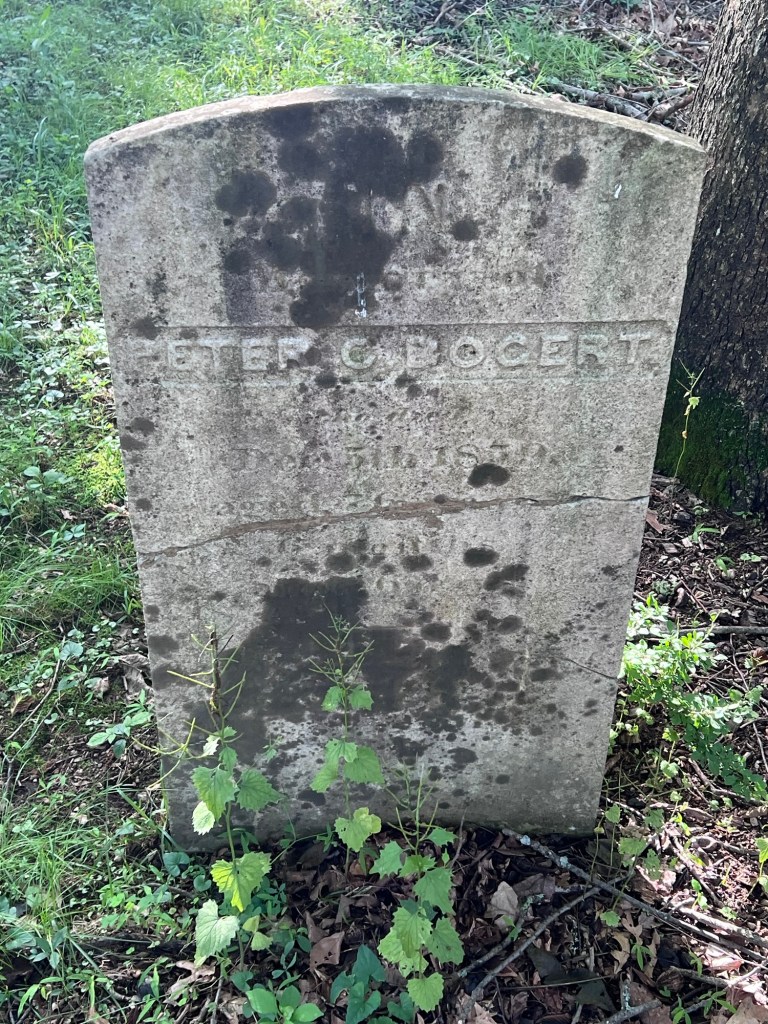
The grave of Peter Bogart, a member of the extended family
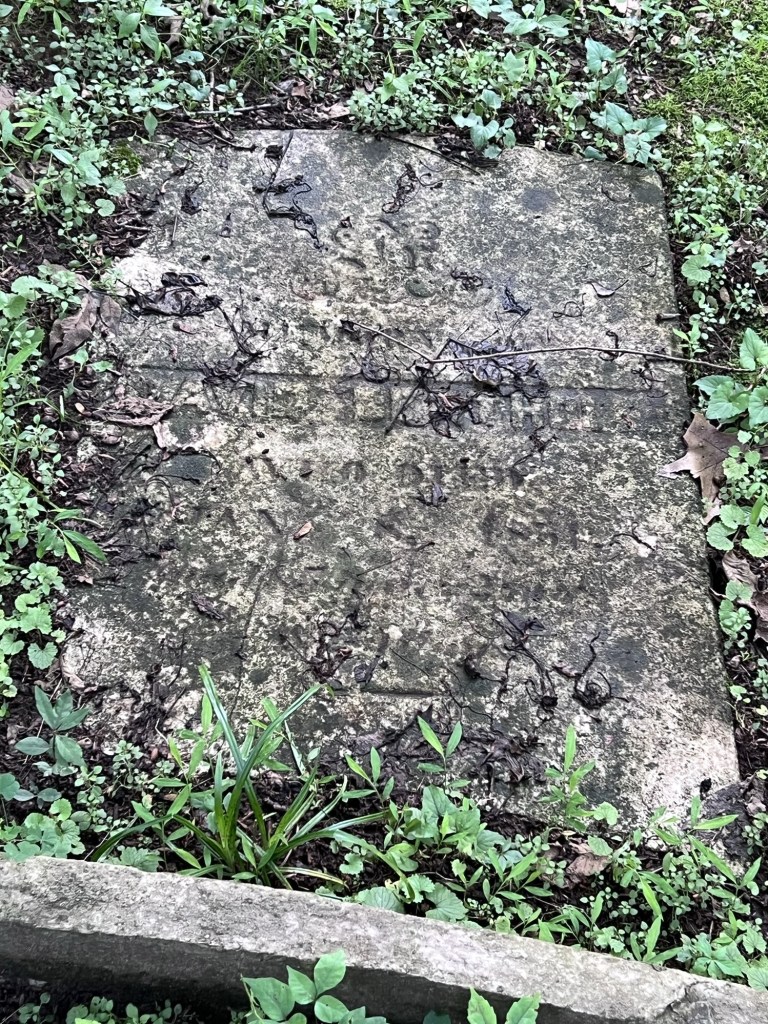
One of the broken tombstones that I could not read
Another tombstone in loving memory of a name I could not read
The broken stone of Fredrick Storms grave
The family cemetery sits quiet and neglected in the woods. Most of the tombstones broken and discolored and hard to read.
I took one last look as I walked down the hill and said a prayer to these forgotten people. One what must have once been the family farm sits a development of extremely large and well maintained McMansions. This is the irony of this once prominent family.
The family buried at this cemetery:
(Bergen County Genealogical Society website)
Copied July 4, 1913, By John Neafie New York City.

    1.  Abraham Verbryck, d. Jan. 8, 1843 ae. 63-11-8.
    2.  John P. Ackerman, d. Feb. 24-1829 ae. 34-1-4.
    3.  Rachel, wife of John P. Ackerman, d. Oct. 4,1844
        ae. 49-11-22.
    4.  Martha Ann, d. Apr. 6, 1835 ae. 1 yr. 8 da.
    5.  Martha Ann, d. Feb. 5, 1837 ae. 2 mos. 7 da.
    6.  Rachel Ann, d. July 12,1838 ae. 6 mos.
    Children of
    Abraham and
    Susan Hopper.
    7.  Peter G. Bogert d. 5 Dec. 1859 ae. 76-6-16.
    8.  Mary his wife d. 5 April 1866 ae. 72-6-21.
    9.  David Berthoif d. 8 Jan. 1851 ae. 85-2-29.
    10. Catharine Storms his wife d. 19 June 1864 ae. 87-2-5.
    11. Peter, son of Stephen D. and Eliza Berthoif, d. 19 Nov.1843
        ae. 1-7-2.
    12. Elizer L. Ramsey (My Mother), wife of Stephen D. Bertholf
        d. 18 Dec. 1876 ae. 56-7-5.
    13. Stephen S. Berthoif (Brother), d. 28 Oct. 1875
        ae. 21-11-17.(same stone as above.)
    14. Frederick Storms d. 20 Feb. 1826 in 54th yr.
    15. Alice, widow of above, d. 6 Jan. 1859, ae. 81-6-25.
    16. John, son of Frederick and Alice Storms d. 29 Apr. 1852
        ae. 37-7-10.
    17. Susan B. Storms, wf. of Stites Miller d. at San Francisco,
        Cal. 16 Dec. 1863 ae. 60 y.
    18. Eliza, wf. of Philip Vantassel d. 10 Sept. 1830
        ae. 29 y.21 d.
    19. Samuel V. Codington b. 19 Jan. 1824 d. 30 Oct. 1834.
    20. Mary Ann Verbryck, wf. of William Codington b. 9 Sept.1802
        d. 17 Feb. 1835.
    21. Samuel Verbryck b. 15 Nov. 1780 d. 16 June 1847.
    22. Rachel his wife b. 5 Aug. 1778 d. 13 Dec. 1864.
    23. Conrod Lines d. 20 Dec. 1839 ae. 66-2-8 (footstone C. L.)
    24. Garret G., son of Philip and Jane Hopper, d. 17 Apr. 1833
        ae. 15 mos.
    25. Rachel Bogert d. 22 Oct. 1793 ae. 70 y. 22 d.
        widow of Lucas Bogert.
    26. Rachel dau. of Lucas Bogert d. 21 Feb. 1791 ae. 30-10-4.
    27. Lucas Bogert d. 2 Sept. 1777 ae. 57 y. 4 m.
    28. Maria Mandevil, wf. of Steven Bartolf, b. 26 May 1736
        d.22 Feb. 1813 ae. 76-8-27.
    29. Aaron G. son of Patrick and Sarah M. Cronk d. 25 Nov.1861
       ae. 6 m. 29 d.

























































 mywalkinmanhattan