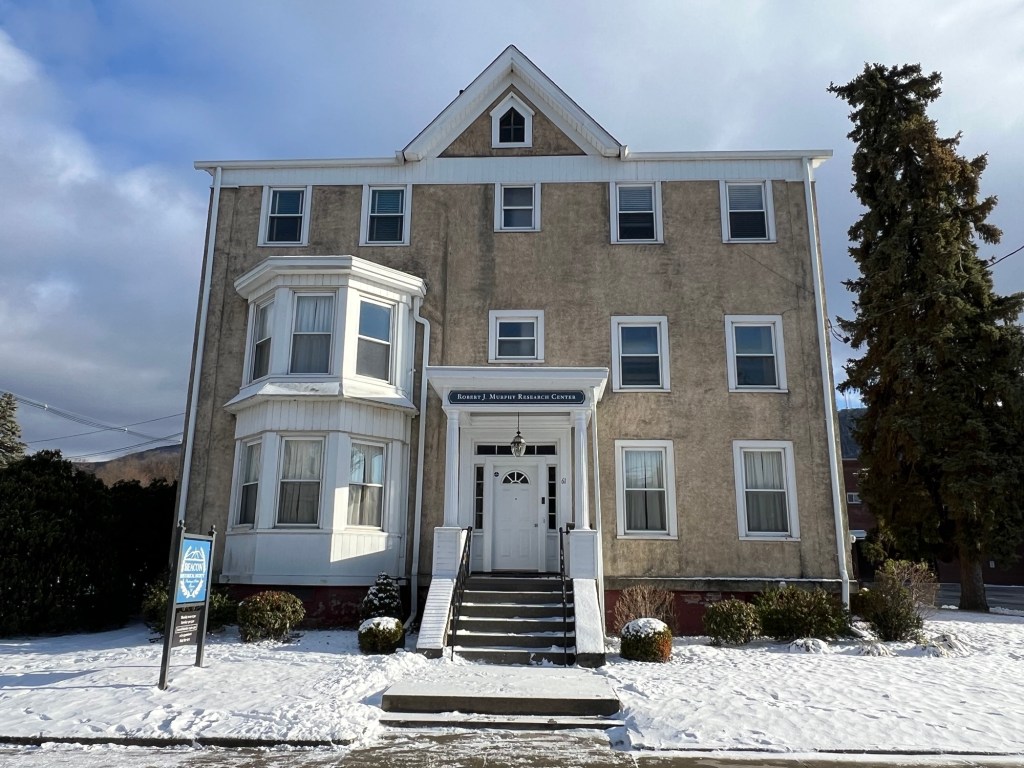
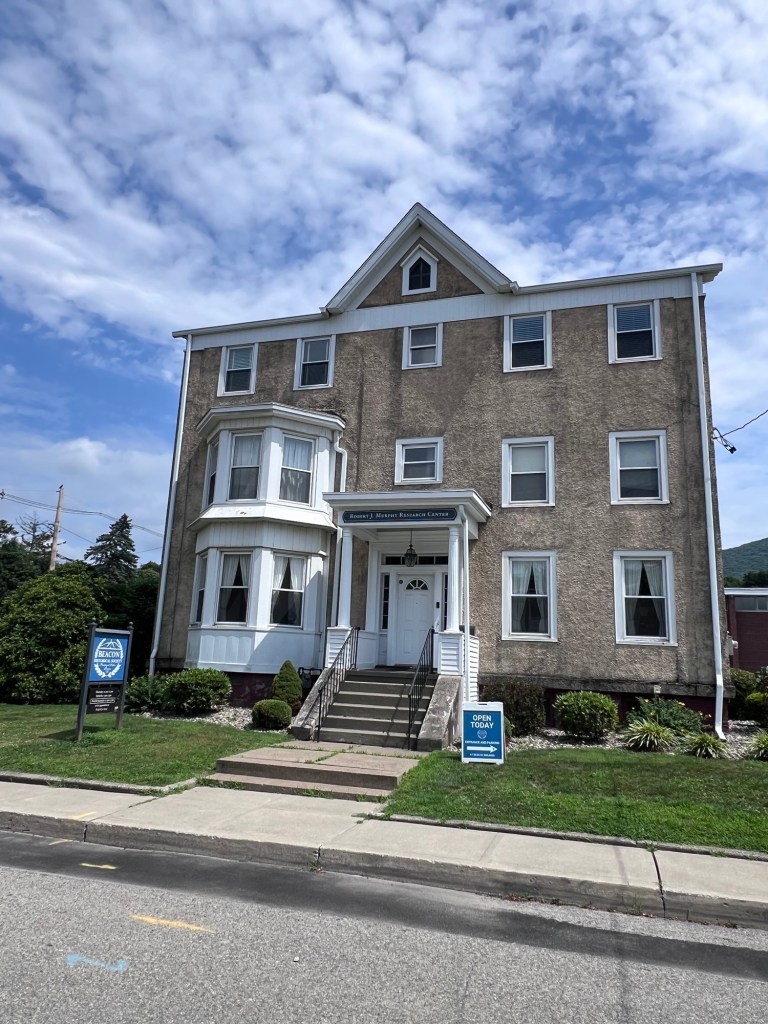
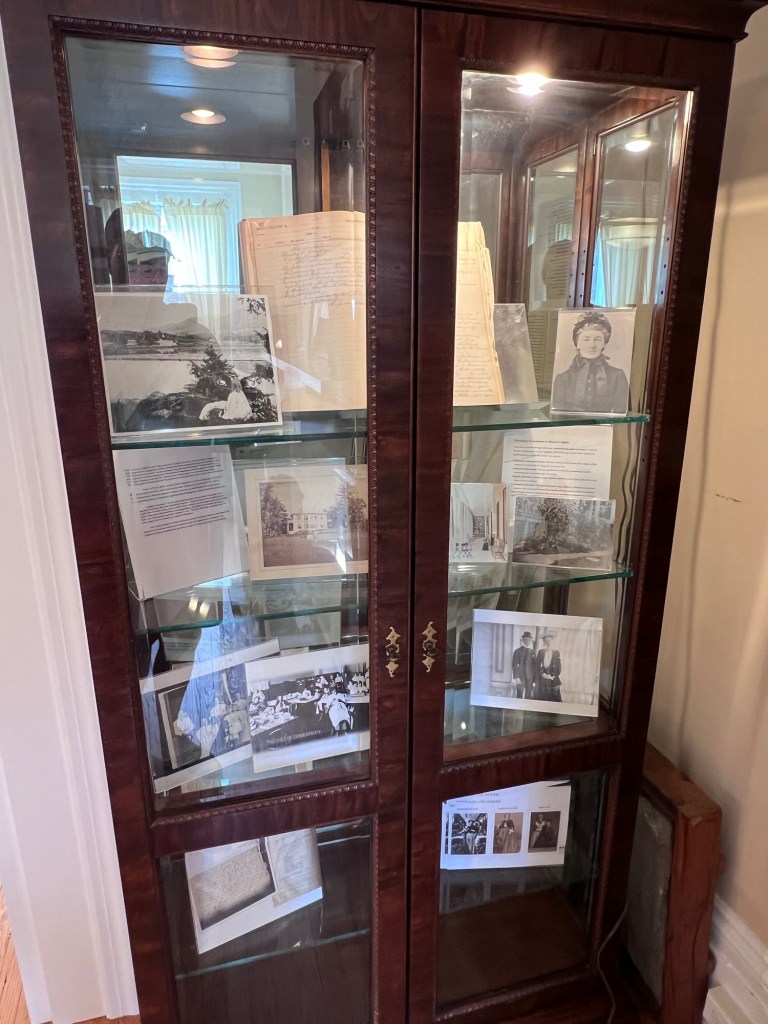
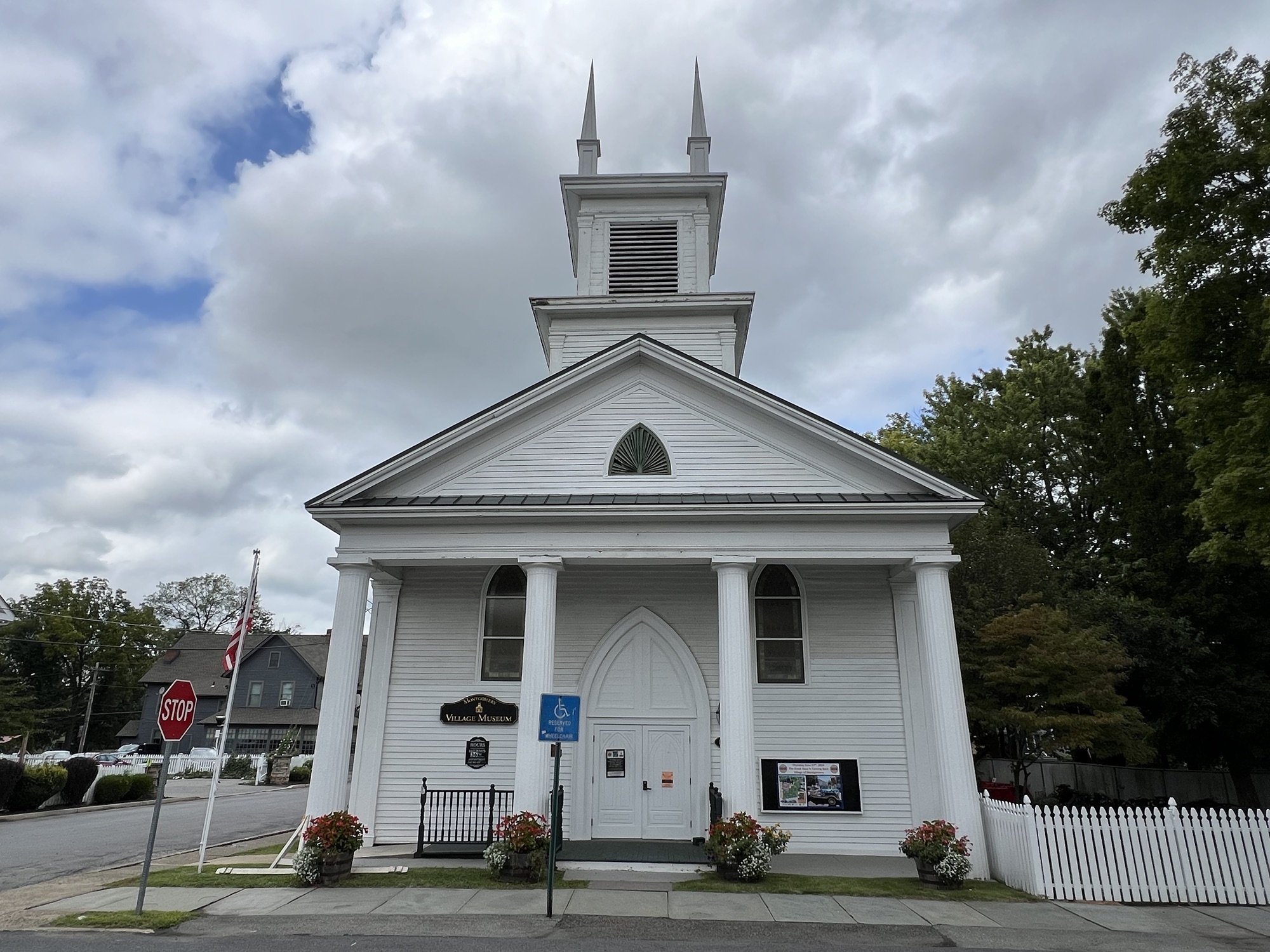
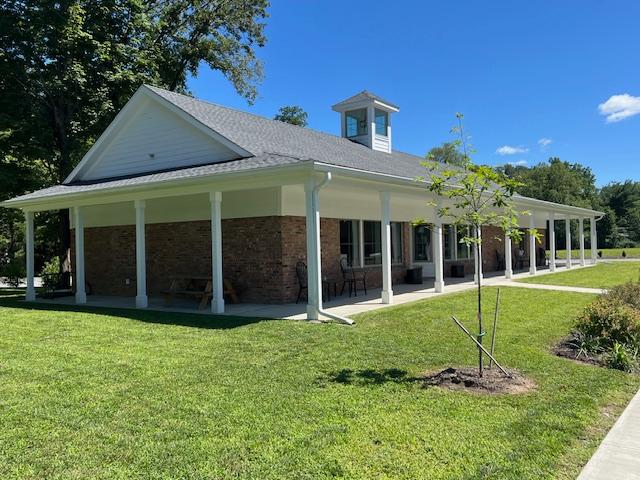
The Shandaken Historical Museum began as the second school house of Pine Hill, District #10. There were two school rooms on the second floor. Where the office of the museum is now located was the library. The rooms were divided by a cloak room used by both rooms. The room to the right was used by the upper grades.
When they started to send high school children to Fleischmanns High School their room was closed. The large room on the left them housed grades 1-8. Downstairs was the gym. On the west end was a stage that folded up against the wall. The stage was used for recitals and at Christmas time, a play was put on for the whole town. For most of the year it was the gym, the favorite sport was basketball (TSHS website).
The old school could tell some pretty good tales. It has housed a coat factory, a furniture stripping business, a community center, as a village building it held Boy Scout meetings, Red Cross gatherings as well as free vaccination clinics and is now the Town of Shandaken Historical Museum (TSHS website).
The museum sign that greets you outside
The Museum’s Mission:
The museum displays a fascinating collection of 19th and 20th Century tools, machinery, clothing, letters and artifacts relating to the Town of Pine Hill and the surrounding hamlets of Allaben, Big Indian, Bushnellsville, Chichester, Highmount, Mt. Pleasant, Mt. Tremper, Oliverea, Phoenicia, Pine Hill, Shandaken and Woodland.
The inside of the main gallery showcases the best of the surrounding hamlets. Each small town surrounding Pine Hill history is displayed town by town with artifacts from each community.
Pine Hill’s history is prominently displayed in the front starting with a display of an old classroom. It is amazing how things stay the same over the years.
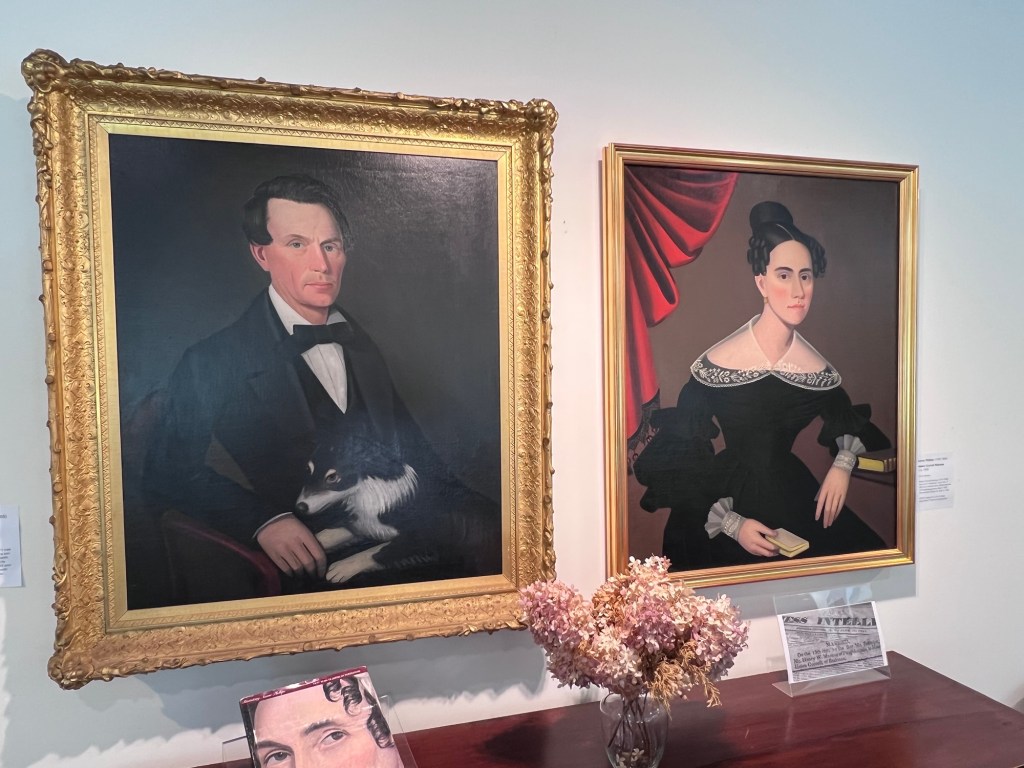
Each of the displays have interesting details in all the artifacts that being showcased in each section. There are all sorts of photos, historical objects, artworks and personal affects of local citizens.
The classrooms of the past are similar to today
Local artifacts from the town
Each of the small hamlets surrounding Pine Hill had their own displays of artifacts ranging from local history, schools, fire and police departments, local events and residents and their day to day lives. Many of the residents from these communities have donated their or their family’s personal affects to the museum to build this collection.
When you visit some of these communities and look at the pictures on the wall, you can see in some cases not much has changed in these Upstate towns.
The museum celebrated the 250th Anniversary of the United States with an interesting display of the history of the Country and New York’s contributions.
The New York State display of the 250th Anniversary of the Country
The lower level of the museum is a reflection of life on the farm and an agrarian society from the turn of the last century. The funny part is that only being two hours out of New York City, many small towns in New York State still have that feel.
The lower level Farm Living Galleries
The first set of artifacts are dedicated to the home, family and faith. Everyday living to most families in the small farming communities of Upstate New York. These artifacts reflect homelife from the late 1880’s to the 1930’s.
Home and Living on the farm
The kitchen tools and equipment to run a household
The tools of the trade for the life in these rural communities was based on what they could grow and trade with other farmers. Before WWII, you can see the life of the rural housewife was tedious with growing, preserving, pickling, baking and canning for the winter months long before modern supermarkets and refrigeration. It was a lot more work to get meals on the table and took a lot of grit and a budget of both money and time.
The Baking and Jarring on the farm to prepare for the Winter Season
The workings of the farm kitchen
Children’s playthings and cribs
Children’s play was based around the household and work in the future.
The family and faith
The items in a household that make it function
The workings of the home and farm
Life and functions of the Upstate Farm
The communities of Upstate New York still have agriculture as a base and even though electronic gadgets still help, many of these ‘tools of trade’ are still being used. These are the tools that built the farming industry Upstate through the 1970’s.
Tools of the Trade
The farm tools
Farm and field equipment
The equipment of the Farm
Small businesses were part of the community and the druggist was very important
The museum touches on life in small and large Upstate New York towns and the challenges they still face in a economy where farming and tourism are dependent on the economy. Though many of these communities are only two hours outside New York City, they might as well be a world away.
The displays are an interesting look of how communities develop and how they sustain themselves over time and we can see how COVID and the transplants from New York City and beyond are still shaping these communities.
I had a five week break from the college when my first Summer class was cancelled. So I concentrated on traveling through New Jersey and New York, both the City and Upstate for my blog. I wanted to revisit many historical sites that I had seen during the holiday season (was Christmas six months ago?) or in the past. There were places like Central Park, where I had not seen certain sections in the Spring. This lead to me being part of many walking tours of gardens during the month of June.
With all the wet weather we had in the Spring, the gardens in June were lush with flowers and flowering trees and plants. Pathways lined with color and walled gardens beautifully laid out. It was interesting to see how these were planted, designed and maintained.
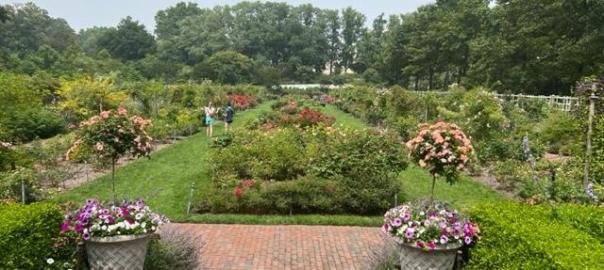
The entrance to the Brooklyn Botanic Garden in June 2026
All the rain we had in April and May and the warm days of early June had awakened the Cherry Blossoms and I visited as many locations to see them in full bloom.
Please read my blog on visiting the Cherry Blossoms:
Once they were finished, gardens came to life all over the tri-state area and many historical homes and parks came to life in a sea of color and smells that showed the power of Mother Nature to make things beautiful. I was impressed with the work of many volunteer staffs and their dedication in taking care of these sites for all of us to enjoy.
Visiting to Amour-Steiner House for the Spring Garden Tour:
The Amour-Steiner House the day of the Garden Tour
The beds were in full bloom when we toured the gardens
The colors of the flowers were patriotic red, white and blue
In between the hedges, there was elegant statuary and potted urns with colorful flowers blooming with bright hues.
The urns were filled with bright colors of the season
Statuary representing the arts and music lined the hedges
The flowers were so brilliant that afternoon
I enjoyed looking at the statuary
The gardens were so beautiful with the house in the background
As we left the gardens, I admired the ornate Fox and the Glove gate on the way out
We then crossed the lawn to tour the greenhouse, where many of the flowers were and still are grown for decorating the house both inside and out.
The landscaping has a romantic spin on it as the property was planted to accent not just the property but the house as well giving it a natural but balanced look to it.
Touring the formal greenhouse
Even the working greenhouse had a romanticized look about it that reflected the house
The inside of the greenhouse. Each side of the counters seasonal flowers are grown for the property. This greenhouse is used all year long supplying the house with a steady stream of flowers.
In the middle of the greenhouse was a beautiful Victorian aquarium that was lined with more flowers. There were no fish at this time.
I loved the beautiful flowers that lined the counters
The Spring colors were breathtaking
We then started the tour of the house starting with the outside veranda that held more urns and planters of fresh flowers
The beautiful veranda lines the entire house
The beautiful colors from the potted and hanging plants
The veranda decorated for the upcoming ‘250th Anniversary of the United States
The hanging plants
The potted plants
We even admired the birdhouse that matched the house
We then went inside to tour the house. It would be interesting to see the house without all the Christmas decorations that I saw the last time I toured the house.
The triangle room off the foyer once used as the Receiving Room
The beautiful foyer to the second floor
The main Parlor/Living Room used for entertaining
The formal Dining Room
The decorative sideboard
The other decorative sideboard
The Dining Room table set for a Spring dinner
We then started the tour of the second floor which started in the game room at the top of there landing. I remember the big Christmas tree being here when the house was decorated for the holidays.
I liked the room was the way it is here
Then we toured the bedrooms which were not that elaborate but functional and comfortable as they are today.
One of several bedrooms on the second floor
The bathroom which is considered normal today was ahead of its time with flushing toilets and hot and cold running water
The office off the side in one of the Octagon corners
The Egyptian Room was the height of fashion with travel and new discovers in Egypt at the time.
The ceiling and decorations of Egyptian Room
The decor of the Egypt
The beautiful porcelain in the room
Then we toured the Curio Room. I thought the room was a lot of fun with small objects that people would have collected from their journeys at that time.
The shelves, counters and walls were filled with all sorts of interesting objects
Many types of object’s
The Victorian Terrarium that was becoming fashionable at the time
The fold out desk with small objects in each slot
A Victrola and Terrarium
The last part of the tour was of the newly renovated kitchen. The shelves were lined with a collection of shiny pots and pans.
The ‘modern’ Victorian kitchen
When the tour was over, I visited the gift shop and looked over the kitchen once more. It is interesting to see how ‘modern’ back then is ‘contemporary’ today. Victorians set the tone for the modern American home of today and the expectations of the American dream.
Before I left the grounds, I visited the gardens once more. It was such perfect weather to walk around and I enjoyed the beauty of these gardens. Mother Nature creates this all this.
Walking around the grounds of the home
I enjoyed walking around the gardens that day
I found this tour one of the most relaxing I have taken in a long time. The beauty of both the house and the gardens was wonderful. Just sitting on the veranda and looking over the grounds was the perfect way to spend the afternoon.
Taking the Clermont Garden Walking Tour 2026:
I returned in the Spring of 2026 for the an updated walking tour of the gardens “Gardens and Grounds: Evolving Landscaping of Clermont”, where the State of New York horticulturalist who had just been hired to maintain the gardens, explained to us the developments and goals that the State wanted for the direction of the landscaping on the property. They wanted it brought back to the 1930’s blueprint of what Alice Livingston had originally envisioned for the estate when she returned from Europe.
Arriving to the Clermont estate at 1 Clermont Avenue in Germantown, NY
We started the tour with a history of the house and Alice Livingston’s return from Europe to create her famous gardens
The front of the mansion in the Spring of 2026
We started the tour at the Walled Garden which was just finished being restored. The back wall had just been finished and the site’s main horticulturalist explained that she was working with a group of volunteers to maintain the gardens.
The Walled Garden designed by Alice Livingston
The Walled Garden in the Spring of 2026
The inside to the entrance of the Walled Garden
The back part of the Walled Garden
The next garden we toured was the Wilderness Garden which included wildflowers and a fish pond
The Wilderness Garden sign
The back part of the Walled Garden leads to the Wilderness Garden
The entrance to the Wilderness Gardens
The lecture on the design and plantings of the Wilderness Garden
The colorful wildflowers that line the grass paths
The fish pond in the Wilderness Garden
We then followed the path and walked up and toured the Cutting and Children’s Garden. These colorful gardens once supplied the house with an assortment of fresh flowers. It also taught the Livingston girls the attributes of gardening.
The Cutting Garden and Greenhouse sign
The main Cutting Garden
The Cutting garden
The Cutting Garden in the late Spring
The in season flowers in the Cutting Garden
The Children’s Playhouse and Garden is next to the Cutting Garden
The Children’s Garden in the Spring
Touring past the old Greenhouses
Part of the former greenhouse
The tour through the grounds with my group
The pathway back to Clermont
Touring along the river
The former roadway between the house and the river
The South Spring Garden
Our last garden toured was the one closest to the house and that was the South Spring Garden of which Alice could see from her window. When the porch was removed from the home and Alice developed plans for other gardens, this garden went ‘native’.
The South Garden
The South Garden in bloom
The views from the South Garden
The flower planters near the South Garden
The planters filled with Spring geraniums
Walking back after the tour was over and looking at the beautiful grounds
Ending the tour that day with a walk along the river
It was a beautiful day to walk the gardens and the perfect way to spend the afternoon. Each time I take a tour of the gardens, I am amazed how different they seem. I love the different times of the year and how it changes these gardens.
I returned to Manhattan the next week and as I was working in Inwood and Washington Heights neighborhoods, I took a tour of Isham Park with the Bruce Reynolds Gardens and Fort Tyron Park with the Heather Gardens, when they were in full bloom. It was breathtaking with the back drop of the Hudson River on a sunny afternoon.
In Isham Park, I toured the Bruce Reynolds Gardens, which is in the center of the park. They were in full bloom when I walked around the gardens and relaxed under the shade trees.
The new Bonnefont Restaurant is open for lunch and brunch
The restaurant was closed that afternoon but I was able to look at the menu online and it is an interesting menu. The cuisine is a mixture of French and Contemporary cooking.
Walking back through the gardens to the Fort Tryon location
Walking to the Fort Tryon site
The Fort Tryon site
Visiting the Brooklyn Botanic Garden before Rose Night in 2026:
I got an email from the Brooklyn Botanic Garden saying that the Cranford Rose Garden was at its peak of blooming and that I should see it while it was at its prime. I was busy at work and was able to travel down to down to the gardens a few days later. Talk about perfect timing as the petals just started to fall.
The Cranford Rose Garden at peak is one of the most beautiful sites. The colors and the fragrances are just amazing. I could not attend “Rose Night” in 2026 because of a prior commitment plus it would be a gloomy night with the threat of rain. So I went the Friday afternoon before the event, which would be held the next Wednesday. By that point, the flowers would be out of peak.
The Cranford Rose Garden in bloom at the Brooklyn Botanic Garden
The Cranford Rose Garden is amazing from every angle and the views from the top of the hill overlooking the garden shows the extensive amounts of roses planted and the array of colors.
The beds of roses of all colors and species
The entrance to the Cranford Rose Garden is full of an array of different types of colorful flowers
The beautiful and diverse flowers in the Cranford Rose Garden
The beauty of flowers up close
All sorts of roses line the trellis borders of the Rose Garden
What I love about walking around is that you can see the diversity of the roses. The garden is planted with different species so they bloom at different times giving the beds an array of colors at different times. Along the beds and trellis everything bloomed so vibrantly.
The beautiful orange roses that lined the trellis
The colorful trellis pathways
The reds and pinks in full bloom
Roses lining the lamppost
Admiring the beds of roses at the Cranford Rose Garden
Purple reins supreme
Walking through the trellis pathways of red
The beauty of the trellis
The back part of the garden
The back terrace of the Cranford Rose Garden
The elegant statuary of the rose garden and the sun dial
The back Terrace area
The back of the Cranford Rose Garden is lined with all sorts of flowering plants having a rainbow of colors.
Walking through the terrace gardens
The beautiful roses in the back of the garden
The roses in the back of the Cranford Gardens
Walking out the back of the gardens
The back path of the Cranford Rose Garden
The fountain in the back of the Cranford Garden
Visiting the Cranford Rose Garden when it flowering is one of the most interesting collection of colors and scents. This is why I try to time my visits around the blooming of the flowers.
The Tour of the Gardens at The Cloisters in the Spring 2026:
One of my favorite places with in the Metropolitan Museum of Art to visit is The Cloisters in any season. One of my favorite places when it is decorated for the Christmas holiday season, the Spring and Summer offer such beautiful displays of historical plants that try to match the theme of each Cloister and its historical background.
The docent led a very large group of us through each Cloister and told us of the way the curators plant the gardens to represent what may have been planted during the Medieval era for medical and nutritional functions of those peoples lives.
(From the Museum website)
The gardens of the Middle Ages included both real and ideal gardens. Poets and artists delighted in the depiction of fantasy gardens like the Garden of Love or of Paradise, but no real garden of the time remains to us. Historical records are rare and incomplete; the ninth-century plan for the monastery of St. Gall, with its carefully drawn and labeled garden beds, is unique. Archaeological excavations are yielding valuable new evidence, but we still know more about infirmary gardens of medicinal plants and aristocratic pleasure gardens than we do about humble kitchen plots of potherbs and vegetables (Met.org).
The gardens of the Museum, planted in reconstructed Romanesque and Gothic cloisters, evoke those that provided sustenance and spiritual refreshment within the medieval monastery. Designed as an integral feature of the Museum, the gardens have been a major attraction of The Cloisters since its opening in 1938, enhancing both the setting in which the Museum’s collection of medieval art is displayed and the visitor’s understanding of medieval life. The gardens are designed and maintained by a horticultural staff actively engaged in researching and developing the living collection (Met.org).
The Cloisters at 99 Margaret Corbin Drive in Fort Tryon blooming in the late Spring
We walked through the Cloister discussing how plantings were determined by medical and religious purposes
The flower beds in the Cloister
The view of the Hudson River was amazing
The flowers in bloom
Flowers in bloom
Flowers in bloom
Flowers in bloom
We moved the next Cloister looking over the medical plants and flowers
The Cloister in bloom
Walking around the Cloister
The plants around the sills of the Cloisters
Touring the Cloisters and admiring the flowers
Everything in bloom
We toured the last Cloister while the tour guide explained the plantings
The last Cloister we toured
The garden in full bloom
The growth of the hops growing on a trellis
The hops planting up close
The flowers in bloom in the Cloister
Video on “Art and Gardens at the Met”
We ended the tour admiring the art in the Tapestry Room and having a discussion about the use of plants and flowers in Medieval art.
‘The Hunt of the Unicorn’ tapestry discussion
I then visited the ‘Creatures of Myth and Imagination-European and the Americas’ exhibition.
This exhibition was an interesting look at mythical beasts of the era of great exploration from European to the Americas. It reminded me of the book “In Search of Ancient Astronauts” with many golden creatures that look like they are visitors from another planet, Ancient Gods to worship and one civilization’s outlook on the unknown. The artwork was a cross between mysticism and respect.
The exhibition sign for “Creatures of Myth and Imagination: Europe and the Americas”
Set in the evocative atmosphere of The Met Cloisters, Creatures of Myth and Imagination: Europe and the Americas sheds light on a selection of works created on either side of the Atlantic Ocean between 500 and 1500 CE. The exhibition’s exploration of hybrid creatures deepens our understanding of their apparent necessity among diverse peoples. In the Americas, a complex gold pendant by a Tairona artist of northern Colombia, depicting a confrontational figure with hands on hips, a crocodile-like head, and an enormous headdress, would have reflected and expressed the wearer’s status and power. In Europe, ferocious dragons such as the one depicted on a monumental fresco from the monastery of San Pedro de Arlanza, Spain, took center stage to convey a multiplicity of meanings both sacred and profane (Met.org).
The exhibition gallery
Unusual mythical creature
(From the museum website)
For as long as humans have told stories, we’ve imagined creatures that transcend the natural world. Fantastical beings combining the features of animals, humans, and even plants appear across cultures, emerging in the most ancient myths and enduring in contemporary epics. The widespread presence of these supernatural beings, possessing the power to transform and be transformed, reflects a global impulse to make sense of both known and unknown worlds. Visual artists have given form to these imaginary creatures, resulting in some of the most fearsome, beloved, and extraordinary works of art ever made (Met.org).
Small gold ancient Gods
Ritual Knives
Double pendants
Earth Deity
I took one last tour of the museum gardens before I left for the afternoon. On the balcony overlooking the Hudson River offered beautiful views and beautiful potted plants.
Walking out of the back Cloister
The back Cloister
The beautiful white flowers
The balcony overlooking the Hudson River
The potted plants by the doorway
The view of the Hudson River
Looking north up the Hudson River
The tour of the Gardens was amazing and the exhibition on the Pre-Columbian art interesting. It was a wonderful tour of the Cloisters.
I had a private function at the Museum of the City of New York across the street from the Central Park Conservatory Gardens. When the event was over, I took a walk around the gardens when they were in full bloom.
The gardens just went through a major renovation and each of the paths had rows of colorful flowers that were beautifully taken care of and designed to bloom at different stages of the growing season so there was always color in the gardens. The effect was amazing.
The entrance of the Central Park Conservatory lawn and fountain
The fountain and the geometric garden
Central Park Conservatory gardens at the entrance
The entrance of the gardens from the Harlem Meer area
The entrance to the flower gardens from the Central Park Conservatory lawn
The Central Park Conservatory garden beds
The gardens in full bloom in the Summer of 2026
The flower beds in the central of the gardens
The Central Park Conservatory Fountain and Lotus pools
I walked behind Hippo Park in Central Park one afternoon to discover a beautiful floral garden that was the 91st Street Garden that I had missed on previous walks in the park. The Garden did not look like this in the Fall.
The 91st Street Garden in the Summer of 2026
Then I remembered the scene in “You Got Mail” and remembered that this was the garden where they met. I always thought it was closer to Riverside Drive than it was here in the park.
The sign for the garden
As I passed the garden, I remember this was the garden in the last scene of the movie, “You Got Mail” when Meg Ryan realizes that her secret email pal is Tom Hanks. It was such a great scene and the perfect end to a great Rom-Com.
The end of the movie “You Got Mail” with Meg Ryan and Tom Hanks
The Gardens from the front
The flowers in full bloom
The flowers in full bloom in July 2026
All I could think about was this scene as I walked around the garden. The funny part is this was the first time I had ever visited this garden as I did not know where it was located. I knew it was on 91st Street but could never figure out where. You have to walk on the path behind the Hippo Playground and follow it to the other path.
The gardens from the front
Walking back up through Riverside park from the Hippo Playground
Walking in Riverside Park in the 90’s
You have to find your way through Riverside Park to find the garden but in the Spring and Summer it is worth the walk up and down the hill.
These are just some of the places that I am still visiting as the Summer season begins and there are more historical sites to see and more smaller gardens to visit. Let’s see what the rains produce in the coming months.
Places to Visit:
*Bloggers Note: the prices of these sites vary from season to season and can change from year to year. This is the same with the hours depending on what season you visit.
Fee: Adults $30.00/Seniors $17.00/Children $12.00/Members & Patrons and Children under 12 are free (prices do fluctuate). NY, NJ and CT students and NY residents Pay as you wish.
Museum Hours:
Hours: Open 7 days a week
March-October 10:00am-5:15pm
November-February 10:00am- 4:45pm
Closed Thanksgiving Day, December 25th and January 1st.
*Some galleries may be closed for construction or maintenance.
I was finally able to get back into the City for a short break the day after Thanksgiving. I had spent my day before at the Macy’s Thanksgiving Day Parade and instead of going to Christmas tree drop off with the Hasbrouck Heights Men’s Association (I decided to give it a rest after 25 years), I worked in Holy Apostles Soup Kitchen serving a post-Thanksgiving Dinner. Talk about busy! They kept me running all morning and afternoon.
After lunch was over, I felt something nagging at me and instead of going home to rest, I decided it was time to finish walking the streets of Alphabet City. It was cooler than it was back in August, so it gave me a different perspective of the neighborhood with all the Community Gardens closed and the trees bare.
Holy Apostles treats people who are struggling with respect and I recognize that after over twenty years of volunteering there.
Plus I figured whatever it was that was trying to take a foothold in me would stop with lots of fresh air and exercise. It worked. After the walk, I not only felt better but was in a much better mood. A brisk walk on a sunny but cool day is the best thing in the world.
I started the walk on the corner of Avenue A and East 13th Street
Alphabet City is a neighborhood in transition. By Avenue A near the edges of the NYU campus, there is much gentrification going on where the bars and restaurants are getting more expensive to Avenue D where the projects are located and there is a massive renovation. I have never seen such changes.
Looking down East 13th Street in the late Fall
I had finished the borders and Avenues of the neighborhood in August before the Fall semester started and tried to finish the streets but this is a big neighborhood and there just was not the time. So I split my time on the neighborhood doing the top part just after Thanksgiving and the rest during a cold snap on Spring Break in mid March. The community gardens may have been dormant at the time but in March you could feel the coming of Spring.
It’s all about creativity and the unique street art
The memorial by artist
(I don’t know the artist)
Sometimes it’s just what a tagger creates that’s unique and fun
What I love about Alphabet City is the combination of creative street art that dominates all the walls and buildings making the whole neighborhood an open air museum.
Another thing I noticed was the vast amount of community gardens that dominated every block. This was the biggest concentration of them I had seen so far in the City. Many gates were locked during the colder months but during my Spring Break with 70 degree weather, the gates flung open and volunteers were preparing beds and clearing the brambles of the previous Fall. Spring flowers were on their way.
The unique paintings on the Roberto Clemente Family Guidance Center at 540 East 13th Street
Ms. Heathcote is an American born artist who graduated from the Rhode Island School of Design. Her love of nature and animals is the main theme of her work. She is now based in Vermont (Artist bio).
I have seen this artist’s work all over the City. This is closer to Avenue D right across from the Con Ed complex.
(not sure who the tagger artist is)
The Con Ed complex dominates the core of the Northern section of the neighborhood at the top of Avenue D and East 13th Street. Nothing glamorous about living next to a power plant yet across the street between East 14th and East 13th Streets luxury housing is being developed. Only in Manhattan!
I then passed the Relaxation Garden at 208 Avenue B and East 13th Street. I never really understood this garden. While all the others in the neighborhood have beautiful plantings, artwork and flowers, this one still looks like a garbage strewn lot.
This particular garden I could see needed a lot of work and I could see by many of the articles online that a lot was being done to clean it up again. The garden is one to look to in the future. Right now the garden is full of trash and there is not much to it.
The garbage strewn lot that needs a little TLC
All over the blocks I explored there was so much street art to admire that it was like an open air museum.
This was my favorite piece of art work from the side of the mural on the Roberto Clemente building
“Chico” is the tag name for American/Puerto Rico born, New York City based artist Antonio “Chico” Garcia. “Chico” is known for his colorful murals and graffiti art, many of the works displayed on the Lower East Side (Wiki/Artist bio).
The name Dias y Flores (Days and Flowers) is taken from a hauntingly beautiful song about hope and growing bySilvio Rodriguez. ArtistBob Lasherhas created the bottle and brick pathway. On this site was once a fully occupied building; abandoned by its owners in the early 1970’s, it slowly fell prey to disrepair and drug trade. The City seized the building and cemented up the doors and windows before eventually tearing it down in 1976 and leaving a rubble-strewn lot–and an open invitation to garbage dumping of all kinds (Dias y Flores website).
In 1978, the13th Street Block Associationenvisioned in its place a community lot, with a garden and a playground, and began the labor-intensive work of clearing out the brick, rubble, and trash–from broken hypodermic needles to refrigerators and car parts–all by hand. Dias y Flores from its earliest days was graced with several experienced gardeners and horticulturalists as members. Along with the help ofGreenthumb, most of the trees and shrubs were planted by 1981. (Dias y Flores website).
The inside of Dias Y Flores Garden in the late Fall
Most of the Community Gardens are now closed for the season and won’t open up to the public again until April. In the summer when I was walking the borders and Avenues of the neighborhood, the gardens would open to the public on the weekends. I will have to wait a few months.
Rounding East 12th Street
Walking down East 12th Street was interesting in the contrasts to the different side of Alphabet City that you live on. Closer to Avenue A you are near the quickly gentrifying East Village with the NYU and Pratt students or closer to the river near the renovation of the housing projects and the park and its overhaul. It is going to be an interesting Great Saunter this year.
The artwork of artist Felix Morelo lines the walls of this restaurant
Artist Felix Morelo is American born artist now living in New York City. He has studied at the Parsons School of Design and Art Students League of New York City. He is known for his creative street art and his ‘chalk circles’ which promote dialogue (Artist website).
By March 2026, the artist painted over his work on the wall
All along East 12th Street, there are all sorts of creative street art in various forms. It seems that there are two things that dominate the neighborhood, street art and community gardens.
The memorial mural
I am not sure what happened to Nugget
(Could not find the artist on the work)
As I passed PS 34 School, I noticed the fascinating metal work of then building’s playground and had to stop and admire it. I was not sure if this was artwork or just design to protect the windows.
The ironwork art outside the playground of PS on East 12th Sttreet
I was not sure who created it but I thought it was interesting enough to stop and admire it . I thought the affect was interesting.
This is one of my favorite series of murals that I passed again when I was walking through the neighborhood. This sits on the side wall of PS 34 on East 12th Street.
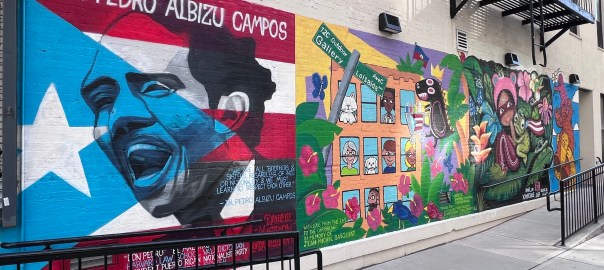
The murals by Avenue C created by a series of artists from the Thrive Cooperative
The panel that lined the school created by artists from the Thrive Collective
Danielle Mastrion is a Brooklyn-born, New York City based painter and muralist who specializes in large scale, brightly colored murals. She holds a BFA from Parsons School of Design (Artist website)
I loved this whimsical school painting by artists Savannah Zambrano and Andrea Amanda
Savannah Zambrano is a freelance sequential artist thathosts workshops and panels, does face painting and caricatures, and works with Traditional and Digital Media (Artist Bio website).
The artists sign with the Thrive Collective
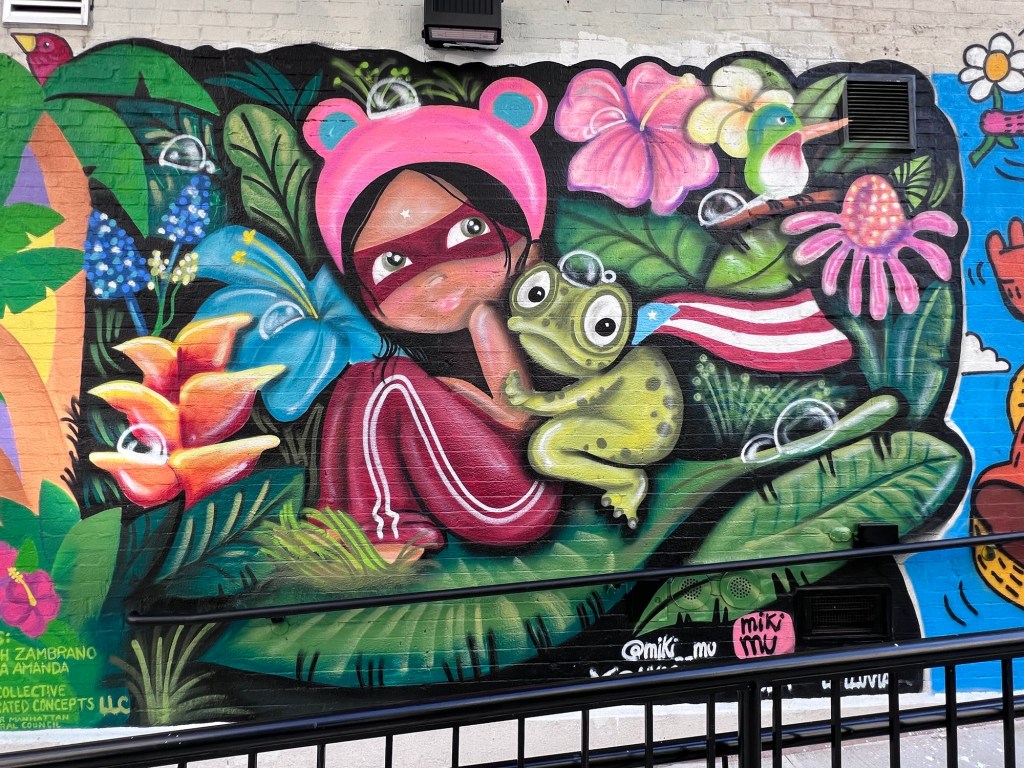
I loved this mural with the Puerto Rican flag by artist Miki Mu
Michela Muserra is an international muralist and illustrator based in Brooklyn. A graduate ofAccademia di Bella Artiin her hometown of Foggia, Italy. The artist has worked as a teaching artist with Thrive Collective since January 2017 (Thrive Collective website).
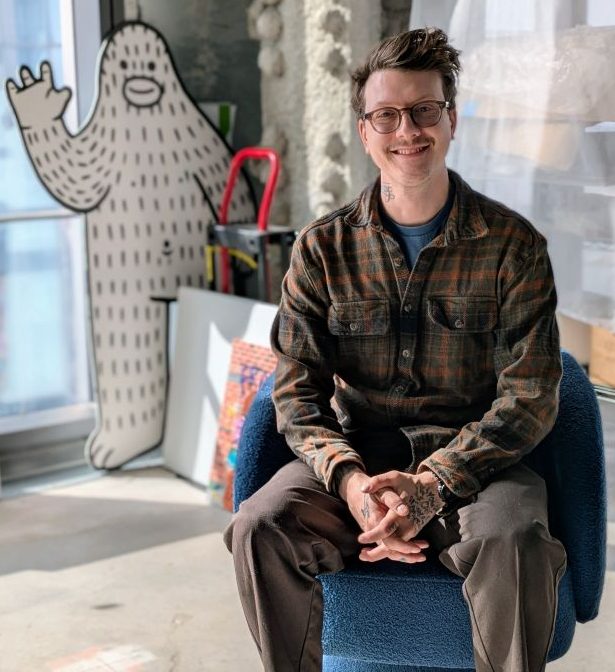
I love this colorful display of positive behavior of Frank Ape by artist Brandon Sines
Artist Brandon Sines was exposed to many cultures while growing up simultaneously in New York City, Toronto, and Los Angeles. He mixes Pop Art’s mass culture, Surrealism’s private associations, and inventive paint handling to create dreamlike environments. His mark making ranges from experimental techniques to illustrative precision. Parts of the paintings are crystal clear, and other parts reach abstraction.
I loved his video on how he creates his work!
I could not find the artist who created this piece
Some of the taggers really know how to decorate the corners of walls and doors
The Campos Community Garden at 640 East 12th Street
The Campos Community Garden was an empty lot until 1982 when the lot was cleared and the it was an active garden enjoyed by the community. When the main organizer moved away, it had fallen into neglect for years until it was revived in 2004 by a group of neighbors. A Children’s Garden was added in 2006 and was rebuilt after Hurricane Sandy. It is now a thriving garden enjoyed by the community and fruits and vegetables are raised to benefit everyone (The Campos Garden website).
The inside of the Campos Community Garden in the late Fall of 2025
The Down to Earth Garden is at 546 East 12th Street and was also closed for the season
The Down to Earth Garden was established in 1993 when a building was knocked down, leaving an empty lot. It was originally called the Children’s garden but changed its name in 2020. It is now part of the GreenThumb program and is part of the NYC Parks Division (Down to Earth Garden website).
The next park was the Joseph C. Sauer Playground at
The sign for the Joseph C. Sauer playground at 532 East 12th Street
Joseph C. Sauer was born in Pittsburgh, Pennsylvania. His family moved to the Lower East Side of New York City when he was an infant. Sauer graduated from the Redemptorist Parochial School and excelled in athletics, especially track. He worked for the Western Electric Company, and following the death of his grandfather, Sauer and his mother took over the family’s basket manufacturing business. He worked there until he entered the United States Army on September 28, 1917 (NYCParks.org).
The history of the playground
The Sauer playground in the Fall of 2025
The last of the parks and gardens I either passed or explored on East 12th Street was the El Sol Brillante Garden. Though the gardens were closed for the season, you could see the extensive plantings through the beautifully wrought iron gates created by local artist Julie Dermansky.
The sign for the El Sol Brillante garden at 522 East 12th Street
The garden and the beautiful wrought iron gates
(From the El Sol Brillante website)
El Sol Brillante Community Garden rose from the ashes of a demolished lot of four burnt-out buildings in the Lower East Side of Manhattan in 1977. Residents organized to create a garden that would revitalize the neighborhood, unite local leadership, and improve the quality of their environment. The original group of forty, with the help of a resident architect, the Horticultural Society of New York (gardening advice), the Cornell Cooperative Extension Service (gardening advice), and the CETA Summer Youth Corps (labor and jobs for kids) designed plans and with very little money and a great deal of sweat equity, a garden was born. In 1978, with the assistance of the Trust for Public Land, a nonprofit land trust was created and the lot was acquired in 1980. A once rubble-filled lot became a thriving 1,000 square foot, 40-plot vegetable garden, a meeting place, and a preserved natural space for its members and their community.
Artist Julie Demansky is an American born artist. She graduated from Tulane Newcomb University with a concentration in ceramics and sculpture and was awarded the Watson Fellowship. She is known for her large scale metal work projects (NYC.gov).
A full view of those beautiful gates
As I walked down the street there were several small restaurants and gourmet shops that caught my attention. I did not have a chance to stop having eaten at another restaurant in the area for lunch. These will be for another visit.
I passed this cute little bakery that warrants a visit.
Turning on East 11th Street
When I turned onto East 11th Street, it was like an open air art museum with various tags and paintings that were both creative and colorful along the walls of the neighborhood.
East 11th Street in the Fall of 2025
I thought this bird piece by Grilla was pretty interesting on this window
Artist Grilla
(I could not find any information on this tagger/artist online)
I loved this tag. I thought it was pretty creative
On the side of this building on East 11th Street was another mural painted by artist Lesley Heathcote.
The mid nautical scene was created by Artist Lesley Heathcote
In 2007, Toyota provided funding to transform this site from a basic vegetable garden into an outdoor children’s learning experience, commissioning landscape architect Michael Van Valkenburgh for the design.
To prepare the garden for restoration, New York Restoration Project construction crews performed demolition and grading procedures on the site, cleared debris and garbage and installed various hardscape features. Over the course of six months, NYRP horticulture and design teams worked hand-in-hand with local residents and Van Valkenburgh to realize the community’s vision for this newly renovated gem, which includes four distinct habitat areas that NYRP and New York City educators can use to present environmental education programming to neighborhood youth.
Walking down East 11th Street on a crisp late Fall day
The weather got a little warmer in the afternoon and I was enjoying the weather. The leaves on the trees were changing as the weather got cooler and more brisk. The streets were quiet on this holiday week day.
The next park I passed was the Dry Dock Playground at Szold Place on 11th Street
The sign at the entrance of Dry Dock Playground on 11th Street
The playground had been very active with basketball games, birthday parties and barbecues when I was exploring the neighborhood in the summer months. There was non stop activity until September but very silent in the colder Fall months. I did not see anyone there except when I returned in March during my Spring Break visit and it was in the 70’s. Kids were out playing basketball.
The murals behind the closed gates
(I could not get a close enough view to see who the artist was on this mural)
The park sitting quiet in the colder months but comes alive with all sorts of neighborhood activity in the summer
The last garden I passed on the block as I finished was the 11 BC Serenity Garden at 626 East 11th Street.
The garden behind closed gates in the Fall of 2025
It was one of the few locked gardens on all three of my walks in the neighborhood. I could see the garden was going through the season change and would have to visit the garden again in the warmer months.
I got to East 10th Street by the late afternoon. I could see the changes of the late fall on the parks and gardens in the neighborhood.
Rounding East 10th Street near Tompkins Square Park for the last part of the walk that day
I walked through the empty Dry Dock Playground a couple more times as I rounded the neighborhood, through the quiet paths. The sounds of children and of adults barbecuing and birthday parties are the sounds I will hear in a few months when the warm weather comes.
The Dry Dock Playground by Avenue D in the quiet cooler months. It is a mob scene in the warmer months on the weekends.
The large ‘El Bohio Murals’ created by the Thrive Collective on the outside of the old public school
Thrive Collective creates hope and opportunity through arts, sports, and mentoring in and around public schools. Our core programs – Murals; RHYME (Rhymes Help Young Minds Excel); Media; Mentors; Festivals, and Sports – connect artists, youth workers, and volunteers with local schools as teaching artists, art directors, coaches, and mentors. Project based learning and accredited curriculum integrate life and art skills in four kinds of experiences: in-school electives, after school clubs, seasonal intensives, and weekend warriors.
My favorite section of the mural created by this talented group of artists
I came across this taggers art on one of the doorways
I came across this nature scene on the corner of East 11th Street
I thought this was really original and was beautifully designed and colored by the artist. It is also one of the few murals in the neighborhood that has not be covered over by other artists.
Joel Chico is an Actor, Writer, Director from Toronto, Ontario, Canada. He is the creator of JMC Creative Endeavors, an artistic platform for his projects as a musician, poet, painter, photographer, and spiritual wisdom keeper. He is currently in the process of writing a poetry anthology, and his Cosmic Trilogy Feature screenplays (Artist bio).
I crossed Avenue D into the housing projects and came across the murals that were painted on the first floor of the housing complex. These colorful works were created by a series of artists working with Thrive Collective (see above) to decorate these rather plain walls in the housing complex.
The mural along the housing complex
The mural by Artist Miki Mu
Artist Miki Mu
Michela Muserra(known as “Miki Mu”) is an international muralist and illustrator based in Brooklyn. A graduate ofAccademia di Bella Artiin her hometown of Foggia, Italy, Michela launched Thrive Collective’s Private Murals Collection as an advanced apprenticeship for our most promising School Murals students and artists. Michela has worked as a teaching artist with Thrive Collective since January 2017 (From the artist website on Thrive Collective).
The last part of the mural on the other side of the building
This was my favorite part of the mural
This was painted by artist bebebsmbu88
The project is inspired by a sacred ceremonial mask carved from a coconut shell in the island of Puerto Rico. It’s called “Vejigante,” and it’s an important and iconic character portrayed in the carnival celebrations in the island. The artwork pays tribute to the HipHop and Caribbean culture presenting the characters in a modern context. The Coconut Mask is a metaphor for our ancestral connection to nature and spirituality (From the artist’s website website).
Artist Bebe Bambu88 (real name Gabriel Rosario Mongil)
The artist is originally from Santurce, Puerto Rico. Artist Gabriel Rosario Mongil aka Bebe Bambu is a designer and recording artist. Originally known for his graffiti work and slam poetry, being the author of several murals in Puerto Rico and Monterrey, MX. He graduated from the University of Puerto Rico in Rio Piedras and received a scholarship to do his masters degree in graphic design and graduated from the University of Monterrey, MX in 2013/15. During this; he had his second solo exhibition, recorded his first solo album and started offering workshops for children in communities in need (From the artist’s website)
I finally reached the end of East 11th Street in the projects. Years ago you would never dream of walking through Jacob Riis complex. Now it is the cut through to East River Park by the hipsters and college students who have moved into the area.
I then rounded the corner and I was on East 10th Street and found myself in front of Topkins Square Park to passed peak foliage. Both during the holiday weekend and on my Spring Break, the park was busy. The park has come a long way since the 1980’s when it was all drugs and homelessness. It is now the center of the community for skateboarders, dog walkers, seniors getting rest and new parents spending time with their kids.
The brownstones and tenements around Tompkins Square
Tompkins Square Park was once one of the most notorious parks in New York City between the homeless and the drug dealing. Now it is mostly college students from the downtown schools and the neighborhood residents gentrifying the neighborhood. It was in the final stages of the fall foliage. This is where I would stop in November. It was a big neighborhood to walk.
Once the weather got colder and I got busier with the holidays so I had to put the walking in Alphabet City on hold for a few months. Who knew it was going to be one of the coldest winters in recent memory. I was not able to get back to walking the neighborhood until March of 2026 during my Spring Break from the college when the temperatures hit 75 degrees.
Between the cold weather and the recent snow storms with the foot of snow, who could or wanted to walk around New York City? Then Spring Break came at the college just as the Spring thaw started and the weather really warmed up. It seemed for two days the whole City, tired of the cold weather and snow, played hooky and were in Tompkins Square Park enjoying the weather.
From March 9th through the 10th in 2026, the weather warmed up into the mid 70’s and it gave me a chance to finish walking the neighborhood. The temperatures would go right back down to the 30’s and 40’s after that until mid-April. The warm weather gave me the opportunity during my Spring Break to finish walking the streets of the neighborhood.
I walked East 12th and 11th Streets again to get a feel for the neighborhood and see if anything changed. There was a lot I missed back in November as I had more time, with better sunlight and warm weather to take my time to explore the neighborhood.
I revisited some of the streets that I had walked over the Thanksgiving break and noted all the artwork and architecture that I missed on the first trip walking all the streets of the neighborhood.
I had not seen the mural of Run DMC on the wall of the apartment building on West 12th Street.
This meticulously designed garden features vibrant floral displays, tranquil pathways, and cozy seating areas, making it an ideal spot for relaxation and reflection. With its blend of nature and artful landscaping, 11 BC Garden invites everyone to enjoy a moment of peace amidst the city’s energy (From MapQuest.com)
The 11 BC Serenity Garden in the late winter months
The Gardens were just coming into bloom when I visited during my last visit. The temperatures were about 75 degrees at the time and things had just started to bloom.
I love the street art on the neighborhood walls. The heart cheered me up!
It is funny how just small painting could make you so happy. Paintings like this were located all over the neighborhood.
The Toyota East Children’s Learning Garden was one of the many gardens open during the warm spell
The Toyota East Children’s Learning Garden on a warm
Most of the gardens I visited, most were still coming into bloom. The Toyota East Children’s Garden was opened for about an hour when I visited. The park was quiet at the time while some volunteers were maintaining the gardens.
(History of the Garden from the New York Restoration Project)
In 2007, Toyota provided funding to transform this site from a basic vegetable garden into an outdoor children’s learning experience, commissioning landscape architect Michael Van Valkenburgh for the design.
To prepare the garden for restoration, New York Restoration Project construction crews performed demolition and grading procedures on the site, cleared debris and garbage and installed various hardscape features. Over the course of six months, NYRP horticulture and design teams worked hand-in-hand with local residents and Van Valkenburgh to realize the community’s vision for this newly renovated gem, which includes four distinct habitat areas that NYRP and New York City educators can use to present environmental education programming to neighborhood youth (NYRP).
While I was walking down East 11th Street, I noticed how much the neighborhood had changed over the years. The whole block was gentrified and looked really nice. What I was amazed by this was how expensive everything was in the neighborhood. As I was walking around the neighborhood, I noticed how expensive the bars and restaurants were around Tompkins Square Park. I thought they would be much cheaper in this part of the neighborhood.
Looking down 11th Street at Avenue A in the Winter. It was 76 degrees during the Spring thaw
After a long walk enjoying the sunshine while revisiting the last blocks I had visited before the holidays, I turned the corner on Avenue A and started to walk the remainder of the neighborhood.
While Alphabet City does not have the classic architecture or statuary of neighborhoods to the north, it’s streets are lined with creative and interesting street art and pocket neighborhood gardens showing the dedication of residents to better their community.
This is what gives the neighborhood its charm and why it has gotten more expensive to live here. I noticed in between all the former tenement buildings, there are plenty of luxury buildings that dot the neighborhood even at the borders of the once notorious Avenue D.
Turning the corner at Avenue A an East 10th Street
I rounded East 10th Street, I noticed this giant Buddha head outside someone’s home in their front garden. I thought this was quite unique.
Passing interesting art in people’s front gardens along East 10th Street
I walked through Tompkins Square Park several times watching the skateboarders performing their feats and college students sunning themselves. It seemed like the whole City had called out sick and just wanted to enjoy the weather in the park.
I walked past the rows of apartment buildings and small businesses and then walked around the park several times to see how people were Lo enjoying their afternoon. I then started my walk down East 9th Street past many more community gardens.
The Francisco ‘Pancho’ Ramos Community Garden at 703 East Ninth Street
The Lower East Side of the 1970s was a hard place with little green. Local residents noticed the abandoned, littered lot at the corner of Ninth Street and Avenue C and began to sow seeds and plants along the chain link and among the debris, and so the Ninth Street Community Garden & Park was founded in 1979. Today Pancho’s Garden hosts community events including music, art, and gardening workshops (Ramos Garden website).
The garden is half an acre of gorgeous flowerbeds, and vegetable gardens. Meandering pathways crisscross the park, follow them to the koi and turtle pond, fig arbor, or one of many quiet nooks that offer a cool quiet spot to read a book, have a chat with a friend, enjoy a cup of coffee, or just sit and enjoy a respite from The City (Ramos Garden website).
The Ramos Garden was open that afternoon to walk around as the gardeners were preparing the beds for the Spring. There was a lot going on around the small beds and gardens that lined the pathways. This garden stretched from East 10th to 9th Streets.
Walking along the pathways of the Ramos Community Garden on a sunny warm day
The artwork in the park
More of the interesting artwork in the garden
The Ramos Community Garden during the Spring Thaw was very active
While I continued my walk down the street, I saw how the neighborhood was reacting to the recent ICE raids going on not just in the City but all over the country. There were signs and graffiti all over Alphabet City and the border with the Lower East Side.
Artworks about ICE dotted the neighborhood
All over the place
As I walked down the street, I came across more street art dotting the walls of buildings around the neighborhood. This mural was with the theme of the Old West and Doc Holliday.
I thought this piece of street art with Doc Holiday and his crew was interesting
Joel Chico is an Actor, Writer, Director from Toronto, Ontario, Canada. He is the creator of JMC Creative Endeavors, an artistic platform for his projects as a musician, poet, painter, photographer, and spiritual wisdom keeper. He is currently in the process of writing a poetry anthology, and his Cosmic Trilogy Feature screenplays (Artist bio).
I then rounded the corner and walked down East 9th Street as the weather got warmer. It got to 78 degrees by the mid-afternoon.
Walking down East 9th Street
Tompkins Square Park had gotten even busier in the late afternoon as dog walkers, skateboarders and seniors talking amongst themselves filled the park. It was funny how all the benches were filling up and it looked like everyone had called in sick at work. It was the first really warm day since the beginning of November of 2025 and everyone was enjoying this warm and sunny day.
Walking through Tompkins Square Park during the Spring Break
I stopped in the bathroom at the park, which is a good pit stop being one of the few places where there is a public bathrooms. While I was relaxing, I watched this singer in a Mondrian kimono perform David Bowen hits. I have to admit it was a bit strange but this is Alphabet City and the guy was very entertaining.
Pinc Louds’ lead singer, Claudi (all pronouns accepted), moved from Puerto Rico to NYC in 2015 to fulfill their dream of playing in the subway. This immersion into the city’s underground, performing daily for a steady stream of New Yorkers, sculpted the sound and look of the project (Band website).
Through the “litteral” underground, Claudi met the musicians (keyboard/bassist Marc Mosteirin and drummer Matt Dallal) and other artists that would turn Pinc Louds into the full-blown spectacle they are today. Busking in the parks and tunnels opened many doors for the band, who quickly gained a cult following and by 2018 were selling out shows in such NYC venues as (le) Poisson Rouge, Market Hotel and Joe’s Pub, as well as tours throughout the US, Puerto Rico, Europe and Chile (Band website).
It was an interesting concert
The David Bowie song ‘I just Dancing’
I sat in the park listening to the concert for about a half hour and relaxed through a few songs. I swear, this guy held this concert for over an hour because everytime I walked back through the park, crisscrossing through the various streets, he was still there singing.
I walked back and forth down the various streets, ending at Avenue D and walking through various parts of the complex. Most of public housing was under renovation so I was trying to avoid any scaffolding.
The corner of Avenue D and East 9th Street. How things have changed from the 1970’s and 80’s. The housing projects were under scaffolding around the entire complex. There were changes throughout the Jacob Riis Complex.
La Plaza Cultural de Armando Perez Community Garden was founded in 1976 by local residents and greening activists who took over what was then a series of vacant city lots piled high with rubble and trash. In an effort to improve the neighborhood during a downward trend of arson, drugs, and abandonment common in that era, members of the Latino group CHARAS cleared out truckloads of refuse. Working with Buckminster Fuller, they built a geodesic dome in the open “plaza” and began staging cultural events. Green Guerillas pioneer Liz Christy seeded the turf with “seed bombs” and planted towering weeping willows and linden trees. Artist Gordon Matta-Clark helped construct La Plaza’s amphitheater using railroad ties and materials reclaimed from abandoned buildings (La Plaza website).
Later, block residents tilled the western portion of the space and planted vegetables, flowers, and fruit trees. During the 1980s, the garden came under attack by developers seeking to build on the space. After numerous court battles, La Plaza was finally preserved in 2002 as part of the terms of a legal settlement. In 2003, La Plaza was renamed in memory of Armando Perez, a CHARAS founder and former District Leader of the Lower East Side who was killed in 1999 (La Plaza website).
The Armando Perez Community Garden was one of the larger community gardens in the neighborhood
I walked all through the garden, watching the planting and seeding and cleanup going on. In the two days I visited the neighborhood, almost all the Community Gardens had opened their gates and volunteers could not wait to tackle the damage done by all the recent winter storms.
The inside of the gardens in the winter
Walking through the gardens in the winter
The view of the top of the garden in the winter time
The history and importance of these Community Gardens on these neighborhoods
As I left the Community garden, I walked past a series of interesting and creative pieces of street art along the walls and doors of the various buildings on the block.
A stand pipe with colorful works
I thought this was interesting
This stood out against the wall
I was not sure what this meant
In the late afternoon, I got to Avenue A and St. Mark’s Place (East 8th Street) and walked around the ‘Restaurant Row’ that was going strong between lunch and dinner. The bars were filled with college students from Pace and NYU enjoying the weather and all the outdoor cafes were set up. This was going strong from about 2:00pm until I left the neighborhood around 6:00pm.
Making the turn on St. Marks Street/East 8th Street
As I walked down Avenue A, I took a longer tour of Tompkins Square Park and saw the singer in the Mondrian kimono still singing. This guy put on an all day concert!
The concert was still going on over an hour later
It got even warmer that afternoon and someone said that it topped 75 degrees. I think more people played hooky that afternoon as the park was packed with students gossiping and dog owners watching their pooches play. The look of the park said ‘end of winter’ but the mood was ‘Yeah, Spring is finally here’. (It would go back down into the 30’s by the end of the week).
Tompkins Square Park in the afternoon
It was so nice to get the first glimpse of Spring before the temperatures would drop again at the end of the week.
People socializing in Tompkins Square Park
Whether it was listening to music, playing with their dogs or just reading a book or conversing with neighbors, people from the neighborhood were enjoying the snap of 70 degree weather as much as possible. They enjoyed being outside and wanted to enjoy it as much as possible.
Turning the corner of Avenue A and East 8th Street
The street art along East 9th Street is unique
The De Colores Community Yard & Cultural Center at 313 East 8th Street
De Colores Community Yard & Cultural Center is a vibrant community space located in New York NY. It serves as a hub for cultural activities gardening and educational programs fostering a sense of community and inclusivity. Visitors can enjoy a variety of events workshops and green spaces designed to celebrate diversity and promote environmental awareness (MapQuest.com).
The inside of the Community Garden
The garden was going through a major clean up the day I was there and the volunteers were leaving for the afternoon.
The Earth People Community Garden at 333 East 8th Street
Earth People Garden is a serene urban oasis located in New York, NY, designed to celebrate nature and community. This park features lush greenery, vibrant flower beds, and tranquil pathways, making it an ideal spot for relaxation and reflection. Visitors can enjoy various activities, from gardening workshops to community events, all while embracing the harmony between people and the environment (Mapquest.com)
The inside of the Community Garden in the winter
The Earth People Garden like most of the gardens in the neighborhood was closing for the evening as the volunteers were giving the garden a cleaning from the Winter storms. The garden was just starting to come back into bloom.
LaCasitaCommunity Garden, established in 1990, is primarily used by the community as an event and gathering space. To that end, the garden’s renovation in September 2014 included the installation of a raised, round stage where performances can be held; a new grill and picnic tables for barbecuing; a shaded seating area; and two sheds for storage. The backdrop of the stage is a chalkboard that can be used by the local elementary school for an outdoor classroom or even as a movie projection screen (NY Restoration website).
Funded by generous support from The Geraldine Stutz Trust, the Trust aims to remember Geraldine Stutz’s significant contribution to the fashion industry, her love of theatre as well as her passion for gardening. A fashion retail groundbreaker, Stutz served 29 years as president of Henri Bendel, the upscale women’s store (NY Restoration website).
The inside of the Community Garden
I was able to walk around this garden but there was not much to see at this point. I am going to have to return to the neighborhood in two months when things start growing again.
Street art along East 9th Street
This little devil was in the detail of this work
I thought this was very clever as these small works of art are tucked here and there on walls and doors on buildings all over the block.
The Green Oasis Community/Gilbert’s Garden at 372 East 8th Street
The gardens all over the neighborhood were open as everyone was enjoying the 75 degree weather and were working in these Community Gardens getting ready for the Spring. This garden was particular busy.
The signs were all out and people were enjoying the Spring weather
As the volunteers were cleaning the beds and trimming bushes and trees, I was able to walk around the gardens. They must be very impressive when they are in full bloom. This is one of the larger gardens in the neighborhood.
The History of the Garden:
(From the Green Oasis Community Garden website)
The New York City neighborhood known as the East Village experienced massive arson and destruction during the 1960s and 1970s. The area had been compared to Dresden, Germany after World War II. Rubble from bulldozed buildings lay in mounds, and garbage accumulated. Cars were abandoned. Rats were rampant. Drug use reached epidemic proportions. Drugs and crime made the neighborhood unsafe, but few areas were worse than the neighborhood east of Avenue B (Green Oasis Community Garden website).
The inside of the garden in the winter
Normand Valle moved to East Seventh Street between Avenues C and D. From his window, he looked down upon one of these blighted lots, and decided to do something about it. In 1981, Valle, an ex-Marine, and his life partner, Reinaldo Arana, began to undo the mess one brick and one piece of garbage at a time. At the same time, Gilbert Ingram (who lived nearby on 8th Street) had taken control of another piece of that same large lot, creating a sculpture garden where he carved found wood and stone and hosted friends and neighbors who dropped by for barbecues and sculpting lessons. Both gardens engaged neighborhood children to help with the clean-up and ultimate creation of a combined garden with communal and private vegetable plots; beehives; a grape arbor; a koi pond; dozens of now huge trees, flower beds of perennials and annuals and an iconic gazebo.Thus were Green Oasis and Gilbert’s Sculpture Gardens born (Green Oasis Community Garden website).
The signs outside the gates
From the beginning, the sister gardens’ mission has been to provide a safe, green haven for all people, but especially for the children who lived in that inhospitable environment. Mr. Arana was particularly interested in the theatre, so theatrical events abounded. Plays for children were written and performed. The first generation of Nuyorican poets read poetry; music was performed; the well-known Butterfly Release ceremony was held here during the all-garden pageant The Rites of Spring until its demise in 2006 (Green Oasis Community Garden website).
The beds in the gardens were being prepared for the season
The garden pays homage to the memory of Martin R. Celic (1952-1977), a young member of Ladder Company 18 who lost his life fighting a fire in the tenement that once stood here.
The Community Garden in the Winter
The Firemen’s Memorial Garden was closed for the day but I was able to take a peak inside before it got dark. Another garden to revisit in the Spring.
I got a kick out of this written on the wall but was not sure of who it referred to
Turning the corner of East 7th Street and Avenue A
I arrived in the middle of the neighborhood by the early afternoon and continued walking past the statue of Samuel Cox, who was making his presence known for all the neighborhood to see. I just don’t think anyone knew how he was anymore but the pigeons.
The statue of Samuel S. Cox stands guard at the southwest entrance of Tompkins Square Park
Samuel Sullivan “Sunset” Cox was born in Zanesville, Ohio, and served his home state as a Democratic Congressional representative from 1857 to 1865 before being unseated. After moving to New York in 1866, Cox served again in Congress for several terms from 1869 until 1889. Although Cox once publicly declared that his most satisfying contribution to public service was championing the Life Saving Service—founded in the 1840s to patrol the coasts and save imperiled boaters during bad weather, the group was absorbed into the Coast Guard in 1915—this statue is sponsored by U.S. Postal Service workers because of Cox’s support for their quality-of-life issues (NYCParks.org).
Artist Louise Lawson was an American born artist who studied at the Art Academy of Cincinnati and Cooper Union. She worked as an apprentice under several famous sculptures and was one of the first American female sculptures to have a professional career. She is known for her Neoclassical sculptures (Wiki).
Starting the walk down East 7th Street
I thought this was a beautiful detail on 193 East 7th Street
The Clyde Romero Memorial Garden at 213 East 7th Street
When Christine Datz and Clyde Romero met in 1986, they shared a deep passion for the environment and improving their neighborhood. With a people-powered approach to sustainability they launched the Lower East Side Ecology Center in 1987. Six years before New York City implemented a citywide recycling program, the Ecology Center was already leading the way. We established a community drop-off site at the 6th Street and Avenue B Garden, where locals could recycle paper, metal, glass, and plastic (LES website).
By 1990, we leased four city-owned, rubble-filled lots on East 7th Street. These 15,000 square feet became home to one of the city’s first community composting programs. Neighbors dropped off fruit and vegetable scraps, while volunteers collected food waste from health food stores and restaurants (LES website).
Over time, we transformed the lots into an attractive garden, demonstrating how the composting of food waste can improve quality of life and ecology on a community level. Now known as the Clyde Romero Memorial Garden, it is a 6,000 square-foot protected community garden (LES website).
The inside of the gardens in the winter time
The garden like most of the ones I visited that day were still in the stages of late Winter, awaiting Spring to come soon. A lot of work was being done in here.
Admiring the street art that lined East 7th Street
I saw this beautiful butterfly on the side of a school I don’t know why but it really cheered me up.
The butterfly sculpture
Walking down East 7th Street near Avenue D. It tells you how the neighborhood has changed.
I noticed one thing about the neighborhood, as you got to the lower streets there was more newer luxury housing mixed in with the old brownstones and apartment buildings. The streets had that classic ‘New York’ look to them.
The Sam & Sadie Koenig Garden at 237 East 7th Street
This small garden was one of the few that had been really maintained and looked like it had gotten its cleaning done already. The gates were locked in the early afternoon but you could still see through the gates.
As I was walking back to Avenue A, I passed a series of colorful and interesting street art, created by both commercial and street artists. This made the block look like an open air art gallery. There was lots of interesting street art to admire and try to interpret. There are some talented artists in the neighborhood.
Michi Meko is an American born artist whose work spans painting, sculpture, and installation, activating spray paint and found objects to create layered compositions. His gestures reflect an interplay between beauty and violence, rebellion and reflection, and past and future. Meko’s art interrogates themes of identity and resilience by offering an exploration of light, texture, and form (Mariane Ibrahim Gallery website).
The term TCK in the context of the Lower East Side most frequently refers to the TCK Crew, a prolific graffiti and street art collective. While the crew is widely known for their work in Berlin. The TCK Crew is primarily recognized for “non-stop train” graffiti and raw, urban style writing (Brooklyn Street Art website)
I finally reached East 6th Street by the late afternoon and it got hotter outside. It got to 75 degrees on the Monday of my Spring Break and I was tempted to wear shorts the next day. It was so weird in that it was 36 degrees the week before. This weather was a result of the annual Spring Thaw and God knows we needed it.
The corner of East 6th Street and Avenue A
As I rounded East 6th Street, I saw this beautiful mural on the side of a restaurant but I could not find any artist name on the painting. It is a nice painting and I thought it was a nice compliment to the building.
The street art the lined the side of a restaurant on the corner of Avenue A and East 6th Street
As I walked down East 6th Street, it was a whirlwind of street art and tagging. Some the most unique art filled the walls, doorways and stairs of many of the buildings, especially the store fronts that stood empty. The neighborhood is still going through that transition but you are reminded there is still a creative vibe here.
The interesting street graffiti on the doors of buildings
This was on a garbage can cover
This tagging was on one of the doors
This was along one of the walls
The I passed 630 East 6th Street which stood out among the small buildings in the area. This is the former Pencer House Building that was built in 1900. It is a now a rental building (Street Easy.com).
The building was originally one of the Children’s Aid Society’s schools, donated by Emily Sloane Vanderbilt, the granddaughter of the Commadore. the Society turned to the architectural firm of Vaux & Radford, which would eventually design 12 Children’s Aid Society projects.Calvert Vaux, best known for his work in designing Central Park, had partnered with George Kent Radford in 1872.The Sixth Street School building would follow the same lines as their other Children’s Aid Society buildings—a blend of Victorian Gothic and Flemish Revival styles (DaytonianinManhattan.com).
The beautiful architecture really stands out among the other buildings on the block. The building has now been fully renovated and the outside restored. As I walked further down the street, more community gardens were tucked here and there on the block.
The 6BC Garden on East 6th Street between Avenues B and C more than lives up to the standards of its neighborhood. Founded in 1981, the garden began as a traditional organization – its members maintained their own plots while contributing to community spaces. A shift in leadership and the decision to incorporate, led to changes in 1995 (6BC Garden website).
6BC became an official botanical garden, the first and only one in Manhattan devoted to bio-diversity, horticultural education, neighborhood beautification, and community programming. 6BC was assigned to parks in 1999, a move that safeguards the land’s status as a green space while leaving administration, leadership and maintenance of the garden in the hands of its members (6BC Garden website).
The 6B Botanical Garden in the Winter
I was able to take a quick walk around the garden before the volunteers called it an afternoon. I really liked the paths of plants and artwork. Another place to visit in the Spring.
Walking down East 6th Street
I liked the classic look of East 6th Street. It is so classic ‘Old New York” with new stores and restaurants opening all over the place.
Our garden began as this tenement building at 530 East 6th St. It’s the building in this circa 1940 photo with the stairway and the truck parked in front. Through the 50’s and early 60’s several buildings on this block became abandoned. Some were renovated, some homesteaded and a few were totally demolished. The building that occupied our site burned in the early 70’s and was demolished soon thereafter. Immediately following, the land was marked for a community garden and in 1978 opened as the Creative Little Garden (Creative Little Garden website).
In the early 80’s Françoise Cachelin started the garden and under her leadership the lot was leased to the Parks Department and Greenthumb. She was an outspoken and staunch supporter of individual and community rights, and without her our garden would not be here today. Françoise passed away in 2003, but we continue to take inspiration from this former member of the French Resistance and spirited advocate for the rights of downtown residents (Creative Little Garden website).
The Creative Little Garden in the Winter
The garden’s gates were open but I didn’t see anyone. I ventured in to look around. I liked the organized beds and places to sit. This will be a fun place to visit when the weather gets warmer.
Walking through the Creative Little Garden in the Winter time
What I liked about this garden was the contemporary artwork that lined the walls. I thought this was really interesting.
Artwork in the Garden
I also liked the way it was landscaped. I liked the paths and rock gardens. The trees and bushes were awaiting the warmer weather to fully bloom.
The garden is so nicely designed and fun to walk through in the Winter
I rounded East 5th waiting to see what interesting things I would find on this block. It was early evening as the sun started to go down. Daylight Savings time had started and it was still light out around 7:00pm. I was also getting tired. I walked down the first two blocks before I called it quits. I passed a series of community gardens dotted the block.
The Sage Garden Community Garden at 281 East 4th Street
The Sage Community Garden is a vibrant green space nestled in New York, NY, offering a peaceful retreat amidst the bustling city. This community-driven garden is dedicated to fostering collaboration and sustainability, where local residents come together to cultivate various plants, flowers, and vegetables. With its colorful blooms and lush greenery, the garden provides a welcoming environment for relaxation, learning, and community gatherings (Mapquest.com).
The Sage Community Garden in the Winter
The Sage Garden was closed for the evening that I was there but I was able to peek through the fence and see what was going on.
I quit around 6:30pm. I was exhausted and out of shape because of the Winter of not walking around. The last traces of snow were melting during the first real day of the thaw and I decided to head down to Chinatown for dinner and continue the next morning. It was going to be in the high 70’s and a perfect day for the walk. Chinatown was busy for a Monday as people had the same idea that I had about being outside. I knew where I was heading for lunch.
Mott Street in Chinatown in the early evening on a 70 degree evening
I decided to return to North Dumpling at 23 Division Street for an early evening snack. I ordered their delicious homemade Wonton Soup and an order of their Steamed Pork and Chive Dumplings. This has become my new ‘to go’ place. I love both the food and the prices.
Dinner that evening at North Dumpling at 23 Division Street
My early dinner hit the spot as the soup really warmed me up and had a rich chicken taste. The homemade wontons were light as air.
The homemade Wonton Soup at North Dumpling
The Steamed Pork and Chive Dumplings are made right in front of you behind the front counter
After dinner, I stopped at a new bakery on Division Street that I had not noticed before on Division Street, Cardio Bakery at 51 Division Street. I just needed something sweet to complete the meal. I settled on a moist and chewy sugar doughnut. I loved the selection of baked goods here and plan on returning soon.
My review on DiningonaShoeStringinNYC@Wordpress.com:
The selection at Cardio Bakery in the early evening
I needed something sweet after dinner and I didn’t want to walk to the other side of the neighborhood to some of my favorite bakeries. That is until I walked down the block from the restaurant and came across Cardio Bakery. It must have just opened because I had not noticed it before. There was so much to choose from but I was still stuffed from dinner so I settled on a sugar doughnut. It was an excellent choice.
My selection, a sugar doughnut
Yum!
After a whole afternoon of looking at street art all over Alphabet City, I walked around Chinatown and admired the street art in Chinatown. These are some of my favorite ones that I saw as I enjoyed my dessert. There are so many talented taggers in the neighborhood.
This was on one of the doors
I thought this was unique
I took the subway home that evening. I had not realized how out of shape I was after a winter of not walking around. I shoveled plenty of snow but not done much walking. The moment I sat down, I stiffened up and it was a long walk through the Port Authority.
I felt much better Tuesday morning and it really warmed up and the weather topped 78 degrees and sunny that day. I was off and running early to get back in the City and enjoy the sunshine while finishing walking the neighborhood. I started where I left off.
Finally making it to East 5th Street
I had walked all of East 5th Street the night before which is an unusual block because they built an elementary school at Avenue B that cuts one part of the neighborhood from the other. Then a series of low rise public housing was built that surrounds the back of the school. So you have to walk a combination of both East 5th and East 4th Streets.
Walking down East 5th Street on a sunny, warm morning
Passing the Secret Garden at 293 East 4th Street as I had to walk around East 4th Street to get to the extension of East 5th Street
I start the second day of my walk back at the Secret Garden which was closed for the day but I could again peek through the fencing. Spring had not come to the garden but it will soon.
The Secret Garden in the Winter
You have to walk around the Lower East Side II complex to complete the neighborhood. This is built around M 364 The Earth School.
Walking around the Lower East Side II housing behind the M364 School
Alfredo Bennett, professionally known as The Royal “Kingbee” is a NYC artist. He was born in Harlem and raised in The Bronx in the early 70’s. He began his career painting graffiti on walls until gathering recognition and eventually being commissioned to perform his artistic abilities all throughout the city of New York. The artist went to JF Kennedy High School in the Bronx (BX 200 Artist.com).
The art was not just limited to the murals that looked more professionally done. The taggers showed their creativity on the closed gates of the businesses and the walls of the buildings around the Avenue.
The Garden of the Humanities at 270-272 East 4th Street
The Generation X Cultural Garden, located in the Lower East Side of Manhattan, is a community garden that was founded in 1971. The garden features Geoblock paving for all-ability access, a masonry retaining wall for additional planting areas, and a mini urban orchard with nectarine, pear, peach, and apple trees. The garden also hosts cultural programming related to the Latino community and collaborates with Greenmarket farmers, Youth market displays, and TAiNO arts and crafts (Mapquest.com).
The garden in the winter time
The snow was still melting in the back of the garden as temperatures hit about 80 degrees that day.
The ‘Success’ mural in the schoolyard
I was not about to get close enough to see how the artist was on this interesting mural at the track at PS 15.
Admiring the street art on East 5th Street
It was a return and straight run down East 4th Street, having just covered most of it walking around the elementary school. The weather at this point had just hit 78 degrees, making it very pleasant to walk around without a jacket on. Mother Nature was tricking us with this early Spring weather during the Spring Thaw but with the number of people hanging out in Tompkins Square Park, it looked like most of the neighborhood was playing ‘hooky’ from work.
Turning the corner at East 4th Street
East 4th Street like most of the neighborhood was like an open air museum. There was a lot of interesting street art to see.
The interesting street art along the wall at East 4th Street
The Memorial Murals along East 4th Street
(I could not find the artist on this piece)
The Memorial Murals along East 4th Street
(I could not find the artist on this mural)
The back of the El Jardin Del Paraiso Community Garden at 710 East 5th Street
(From the El Jardin Del Paraiso Community Garden website)
The stage is set for the reemergence of community gardens during this time due to three factors: a large influx of immigrants, predominantly from agrarian cultures; the movement of many city-dwellers to the suburbs; and the deactivation of many fire houses due to dwindling city budgets. The result of the is a dramatic increase in burned-out vacant lots. These empty lots become the territory of drug dealers and the dumping grounds for rubble and toxic wastes and yet they bring a new openness to this area of Manhattan (El Jardin website).
Two movements worked to bring green spaces to the neighborhood of the Lower East Side: the homesteading and the gardening movements. Homesteaders work to rehabilitate buildings. Gardeners removed the rubble and turn the soil, reclaiming the vacant lots. El Jardín del Paraíso is founded by these two groups who were inspired by the idea that the space was large enough to be a park and a community garden.1973 — Liz Christy founds the Green Guerillas, a grass-roots organization dedicated to aiding neighborhoods and providing guidance and education in the of new community gardens. The organization recognizes the need for city involvement and lobbies for formal recognition. It is believed that Liz planted El Jardín del Paraíso’s existing two Weeping Willow trees (El Jardin website).
Walking along a very gentrified stretch of Alphabet City along East 4th Street
I came across the very colorful mural on the side of Public School 15 at 333 East 4th Street. I thought this was really interesting and I bet no one really notices it.
This was all done in tiles and I thought this was very interesting. The only thing I could find out about it was it was created in the early 1980’s by some local artists.
Reaching the edge of the neighborhood at Avenue D. I could not believe how this neighborhood has changed in thirty years.
Walking down the street, I could not believe how many luxury condos have been built on the side streets of the neighborhood about a block from the housing projects. How things have changed in this neighborhood since the first time I walked in it in 1994. There have been so many improvements in the last twenty years.
The Orchard Alley Community Garden at 350 East 4th Street
Orchard Alley is a quaint establishment nestled in the heart of New York City, offering a unique blend of artisanal goods and services. With a focus on community engagement and sustainability, Orchard Alley provides a welcoming space for individuals to connect, create, and explore (Mapquest.com).
The inside of the garden in the winter
The Orchard Ally Community Garden was also closed that day but I could see it from the fence and see the work going on in the garden. The next garden I passed was the Parque de Tranquilidad Garden at 314-318 East 4th Street. It was also locked that afternoon but I could see the garden through the gates.
The Parque de Tranquilidad Community Garden at 314-318 East 4th Street
(From the Parque de Tranquilidad Community Garden website)
The garden was started in 1979 when neighbors cleared out the lots and started the garden by planting vegetables and flowers. Parque de Tranqilidad was purchased together with other sixty three gardens city wide by the Trust for Public Land. In 2004 it became one of the fourteen gardens when The Manhattan Land Trust was founded. Garden Members take care of this little park all year long.
The inside of the garden
You could see the coming of Spring through the fencing.
I have seen this artist’s work all over the City
I saw this interesting mural along East 4th Street by Avenue A “Teach One Teach One”
I loved the details on the mural
Another look at the mural
I could not find the artist for this work but I thought it was one of the best murals that I had seen on my walk in Alphabet City. I loved the vibrance of the colors.
It looked a fairy peeking through of the woods
Rounding the East 3rd Street at the end of the day
Walking down East 3rd Street
East 3rd Street is the last full block of the neighborhood with just part of East 2nd Street extending into the neighborhood. The Los Amigos Community Garden at 221 East 3rd Street was also closed for the afternoon but I could see it through the fence.
The Los Amigos Community Garden at 221 East Third Street
The American Community Gardening Association (ACGA) is dedicated to the promotion and support of community gardening efforts across the United States. With a focus on networking, education, and resource sharing, the ACGA serves as a vital hub for community gardeners and leaders, fostering resilience and collaboration within urban ecosystems (Mapquest.com).
The Los Amigos inside
It looked like people had been working that afternoon. This was the same with the Brisas Del Caribe Community Garden at 237 East 3rd Street. It was locked in the later afternoon.
The Brisas Del Caribe Community Garden at 237 East 3rd Street
The Brises del Caribe Garden is a 90 x 24 plot of land located at 237 East 3rd Street on Manhattan’s Lower East Side. In 1986 this land was an abandoned city owned lot inhabited by rats, drug addicts and dealers, and strewn with refuse and toxic wastes. The garden was born thanks to the efforts of Mary and Angel Aponte, a neighborhood couple, who cleared out the garbage and told the addicts to go elsewhere (Earth Celebrations website).
The community group Green Guerrillas gave a lot of assistance to the Apontes in the beginning. In addition, they received many letters and petitions of support from the community board, the Church and other local community groups. When Operation Green Thumb and the City saw what had been accomplished in the garden, they agreed to a year-to-year lease for the Apontes, claiming it could only be year-to-year because the City might decided to sell the land (Earth Celebrates website).
The gardens in the early Spring
The garden was closed for the day when I walked the neighborhood as was the All People’s Garden at 293 East 3rd Street. Most of these gardens would be open in late April and early May when things would be blooming again.
The All People’s Garden Community Garden at 293 East Third Street
All People’s Garden Inc. was created as a not for profit organization in 1978 by former VISTA volunteer Olean Cowart For a community organizer who work with the neighborhood community development organization known as Interfaith Adopt-A- Building, Inc. The garden was fashion out of a vacant site owned by the City of New York, and was strewn with discarded rubbish. With the help of the community and other volunteers, slowly remove the debris and create the beginning of a community garden space (All People’s Garden Inc. website).
In 1979 with the support of the Council on The Environment of the City of New York (now known as GROWNYC), a plan to open the garden for community use was also supported by the then Mayor Ed Koch and Ms. Liz Chrystie the pioneer for the first community garden on East Houston Street and the Bowery. All People’s Garden is the first Grow NYC’s PLANT-A-LOT garden in New York City. At the opening Mayor Ed Koch with Liz Chrystie plant a ceremonial Rose Bush. The ceremony was conducted to symbolize the working coordination of the City of New York in the beginning of the redevelopment of the Lower East side community open space and housing (All People’s Garden Inc. website).
Street art along East 3rd Street
I continued my walk down East 3rd Street admiring all the street art. There were so many interesting pieces to see all over the block. Just look at all the walls as you past the buildings.
Kenkeleba House was founded in 1974 by Joe Overstreet, Corrine Jennings and Samuel C. Floyd to support African American culture. Kenkeleba began its work on The Bowery near Delancey in New York City with experimental projects to assist African American, Caribbean,and African artists in developing and documenting their work. Early projects included exhibitions and experiments with poetry, music, visual arts, workshops in dance, theater, children’s programs and African markets. The name, Kenkeleba is derived from that of the Seh-Haw plant grown in West Africa, and known for its spiritual, nutritional and healing values (Kenkeleba House website).
The inside of the garden
The garden was also closed that afternoon but I could see the artwork in the garden.
When I stopped to get a Coke at a deli around the corner, I saw this mural of the Ramones that I thought was so cool. I know that they had played clubs around here so it was the perfect honor for the singing group now that most have them have passed away.
Ireland born artist Solus found creativity key to keep him inspired and on the right track. Embracing natural talent and keen eye using spray paint as his main medium, leaving his mark in Europe, America, and Asia on walls, canvas and sculpture. He has exhibited in various international solo shows in America, Canada, and Paris (Artist Bio).
The artist Solus
I passed even more community gardens along East 3rd Street, most of the closed during the day. Like of other gardens, some volunteers were cleaning out the gardens and preparing the beds for seeding.
Miracle Garden is a unique establishment in New York, NY that offers a serene and enchanting environment for visitors to explore. With its diverse collection of flora and carefully curated landscapes, Miracle Garden provides a peaceful retreat for individuals seeking a moment of tranquility amidst the bustling city (Mapquest.com).
The inside of the garden in the early Spring
The Miracle Garden was being cleaned during my walk in the neighborhood.
Walking down East 3rd Street near Avenue A
Street art by Avenue A
(I could not find the artist to this work or it may be multiple artists)
Walking down East 2nd Street
I finally got down to the last street of the neighborhood, the extension of East 2nd Street. I was tired by the time I got to this last block.
Walking down East 2nd Street
Walking down my last block in Alphabet City, East 2nd Street. This block borders Little Italy, Chinatown, the Bowery and the Lower East Side once you cross Houston Street.
One of the street murals on East 2nd Street
The Kenkeleba House Garden at 212 East Third Street on the back side of the gardens
The garden facing East 2nd Street in the early Spring
I then passed the neighborhood firehouse and its memorial to my fellow Brothers who died on 9/11. This was very touching and still pretty raw to me.
The one thing I admired was the dedication to the brave members who lives were lost on that tragic day. I was not sure who the artist was on this work but I think it was firefighter Michael “Mikey” Borriello, who is also the resident artist at Engine 28, Ladder 11. He has created art all over the firehouse.
Their touching tribute to their fallen brothers on 9/11
Peach Tree Garden is a quaint and charming establishment nestled in the heart of New York City. Specializing in providing a serene and peaceful environment for guests to relax and unwind (Mapquest.com).
The garden in the early Spring
This was one of the few community gardens that looked like it was ready to start blooming.
Looking down Avenue D at East 2nd Street. How things have changed since the 1970’s and 80’s
I finally made it to the edge of Alphabet City. This is looking up Avenue D from East 2nd Street and the edge of East Houston Street.
Walking down the tiny section of East 2nd Street
The park lining East 2nd Street was still in Winter mood when I passed it in March. It was in full bloom when I was walking the Avenues back in August so it was nice to see the contrasts in the seasons.
262 East 2nd Street was one of the more distinct buildings in the neighborhood
One of the few buildings that stood out in the neighborhood among the low rise tenement buildings, brownstones and new luxury building was 262 East 2nd Street with its elegant embellishments and faces staring back at you. I had not seen this since I left the Flatiron District a year ago. You have to look up to see all the beautiful stonework. This unique looking building was built in 1920 and recently was converted to luxury condos (Streeteasy.com).
The detail work the windows all around the building
I wrapped up the visit to the neighborhood by walking the very edges of the area, seeing the locked gates of the community gardens and an abundance of street art.
It was established in 1996 by artists Peter Cramer and Jack Waters, who wanted to create a queer public space in the city. Peter Cramer and Jack Waters had been artistic collaborators in New York since the 1980s. They became co-directors of ABC No Rio space after curating an art exhibition there together and both joined theVisual AIDScollective. The garden site on 2nd Street had been an auto chop shop before that was demolished. Cramer and Waters built the garden together, in 1996 (Wiki.org).
The inside of the garden
The garden was being prepared for the Spring and I was able to sneak a peek inside to see some of the artwork that was pretty interesting. It will be cool to see it when it is in full bloom and get to see some of the other art up close.
The artwork around the fencing
Walking down the block was lined with all sorts of metal works and murals heading back towards Avenue A and the heart of the East Village. Various artists works boldly displayed on the walls of businesses and buildings. Unique works that stood out.
The metal work on one the buildings
Artwork on the sidewalk
The mural on the corner of East 2nd Street and Avenue A
The artist Slim Storm
(I could not find any information on the artist)
The Heart of NYC
The artist Bio TATS Cru
Wilfredo “Bio” Feliciano is also a founding member of the world famous art collective known as Tats Cru “The Mural Kings” originally known as TAT Cru founded by Brim, Mack and Bio in the eighties.
Wilfredo “Bio” Feliciano’s work has been featured in many publications, movies, music videos and documentaries throughout his career. He has also painted in numerous countries over the past 30 years, invited by different organizations. Bio has collaborated with many of the top graffiti artists in the world from past to present day. He has also lectured at M.I.T. and various universities in the United States.
I finally finished walking the entire Alphabet City neighborhood around 5:00pm. It had been a long but productive two days. I could not believe the number of community gardens in the neighborhood. I was lucky it had been warm out so I got to see many of them but will have to revisit when everything comes into bloom. Right now they still hold tight to the end of Winter but I have seen in the neighborhood in August when everything is green.
For dinner that evening, I went to Two Boots Pizzeria, where I had not eaten in a decade. I went there years ago with my best friend when the neighborhood was a bit more scratchy. This is a neighborhood institution and the pizza was still wonderful. (I just read though that the original location will be closing on May 26th, 2026 after an agreement on the rent with the landlord fell through and the owner will be moving to a new location soon).
Two Boots Pizzeria at 42 Avenue A. This is its original location of the current chain of pizzerias. (It will be closing on May 26th, 2026).
I forgot how funky this place looked inside. One thing I remember was how good the pizza was and the selection of pizzas they had available that evening were rather interesting.
The pizza selection in the case
I looked through the case at the different toppings of pizza and I eyed the Cajun slice which was topped with gumbo ingredients items such as spicy sausage and shrimp. The pizza has a brown sauce instead of the traditional red tomato sauce. It was out of this world! I never had such a unique slice than this.
Finally able to sit down and relax
A slice of Cajun Pizza with a Coke
I chose a slice of Cajun pizza with sauteed shrimp and andouille sausage with Cajun seasonings. It had the most amazing flavor and one of the best slices of pizza I had had in a long time.
The Cajun Pizza was amazing and so full of flavor
Yum!
I had an interesting time in Alphabet City. It reminded me of how much the City has changed in thirty years. It never looked so good. Was that good for a neighborhood with such a storied past? It shows how the City just keeps changing.
While the neighborhood is much cleaned up since I remember it in the 1990’s, it still retains that funky independent vibe to it . Let’s see what happens in the future in an ever changing City as the tentacles of NYU keep stretching over this neighborhood. Will they adapt to it or will the neighborhood adapt to them? Just like every other neighborhood in Manhattan, I will just keep walking.
Hours: Tuesday-Saturday: 11:00am-6:00pm/Closed on Sunday and Monday
Admission: Free
My review on TripAdvisor:
New York School of Interior Design at 170 East 70th Street
I came across the Gallery of the New York School of design when walking the Upper East Side for my project, ‘MywalkinManhattan.com’ when covering the lower part of the Upper East Side.
The entrance to the Gallery
The New York School of Interior Design was displaying their Senior projects as most the college galleries I visited were doing at this time (this takes place between May and June around graduation time). It was interesting to see how the seniors at the college reused space in old buildings for new purposes. The seniors use their creativity to recreate these spaces. It is the student’s project to take a space and redesign it for a new purpose.
The entrance sign to the gallery
We had done similar projects in college but did not have the computer technology that students do today and they really went above and beyond the things we did back then. You can take this project into 3-D if you want and how real it looks. These kids are so talented that their creativity reminds me of us when we were in school. If only we had what they have today.
The Student Projects line the walls
Take time to look at the detail work and space design of each project. Some of the students even include samples of fabrics and stone/wood work that will be used for the surfaces.
The Gallery is located on the Upper East Side in the back of the school’s building on the first floor. The admission is free and the Gallery is open when the school is open. There are only two shows a year. You just have to show your ID to get into the galleries.
The student project along the walls
The student project along the walls
What I like about the museum is that you get to see the student creativity and how they imagine the space will be designed. The use of color and shape play a roll in all the designs. It looks like the students get to choose their own space to design.
The best part is the you get to go in for free with you ID and just enjoy the show and see the students creativity.
History of the Gallery/Museum at the College:
The New York School of Design’s gallery presents two public exhibits yearly on design and architecture. Exhibitions have included ‘Paris in the Belle Epoque’, rare photographs from the years 1880-1914; Perspective on Perspective, an exploration of artistic technique; ‘The Great Age of Fairs; London, Chicago, Paris, St. Louis’, selective coverage from the first World’s Fair in 1851 to the last in 1904; ‘Venice’s Great Canal’, architectural drawings of the buildings along the famous thoroughfare; ‘Stanford White’s New York’, a survey of that classicist’s many metropolitan buildings and ‘Vanishing Irish Country Houses’, a look into the preservation crisis facing these not infrequently grand structures.
The gallery’s Thursday-evening lectures have included ‘Palladio’s Villas’; ‘Beaux-Arts New York’ and a survey of the Grands Projects undertaken in Paris during the tenure of French President Francois Mitterrand.
Open: The Second and Forth Saturday of the month when in season. Please visit the website for the days open. The cabin is open from 12:00pm-4:00pm when in season.
My review on TripAdvisor:
The entrance to John Burroughs ‘Slabsides’
The entrance to Slabsides is located on a local country road off another local country road off Route 9. Use your Google Map carefully when visiting or you will miss the turn off. The parking lot is really small and holds only about eight cars so please make the turn around on the road above and park facing down from the parking lot (word of advice on parking).
The pathway from parking lot to the house is really beautiful and lush in the summer. It seemed more desolate in the cooler months and just empty. Still it is only about a five minute walk from the parking lot to the cabin.
The original cabin “Slabsides” from the pathway. This one room cabin was used by Naturalist John Burroughs as a home away from home to write and to think.
The lawn outside the cabin
The historic sign outside the cabin
The porch of Slabsides in the summer
John Burroughs work area inside the cabin and his kitchen
John Burroughs work station overlooked the woods and rock formations
The fireplace and resting area
The kitchen area in the back of the cabin
The bedroom and sleeping area of the cabin
The bedroom of the cabin
The pictures of Walt Whitman and John Burroughs in the bedroom
John Burroughs was one of the most popular authors of his day and is credited with creating the modern nature essay. Using easily understood prose, he described nature that was familiar and local, bringing the natural world to his readers. He encouraged them in the art of observation by sharing a sense of place and purpose in the land. Burroughs wrote more than three hundred articles published in leading magazines and in twenty-seven books over sixty years. Through his writings and friendships with influential leaders he had a profound impact on the emerging conservation movements.
Born in the Catskill Mountains in 1837 he settled on a nine-acre fruit farm on the west bank of the Hudson River north of Poughkeepsie that he named “Riverby.” Poet Walt Whitman and Burroughs tramped through its surrounding woods during Whitman’s several visits, moving Burroughs to call these woods “Whitman Land.” In 1895 he purchased a nearby tract of land and built a two-story cabin as a place to write and entertain, calling it “Slabsides.”
Though Burroughs was a writer particular to the Hudson Valley region, his travels were widely known and celebrated. In 1899 he joined the Harriman Expedition to Alaska and wrote the “Narrative” of the expedition. He accompanied Roosevelt into the wilderness of Yellowstone, telling the story in Camping & Tramping with Roosevelt, which provided the narrative for a segment of Ken Burns’s The National Parks. Burroughs also traveled to the Grand Canyon and Yosemite with John Muir and went on elaborate camping trips with his industrialist friends Henry Ford, Thomas Edison and Harvey Firestone. Accounts of these events are in Burroughs’ journal archived at Vassar College.
Burroughs received honorary doctorates from Yale, Colgate, and the University of Georgia, and the Gold Medal of the American Academy of Arts and Letters.
The ceiling of the cabin
The stairs to the upstairs loft
The cabin was small and is pretty much one full room with one or two walls partitioning the rooms. This seems more like a summer cabin. Still it had its charm.
We then finished the tour outside along the trails outside the cabin.
I admired the outside woods from the patio
(From the John Burroughs Association website)
The land around Slabsides informed many of his essays in which he described nature close at hand. Through works written here, John Burroughs inspired national leaders to preserve land and its wildlife and generations of readers to head out-of-doors. For nearly three decades Slabsides drew devoted readers and prominent friends. There are nearly seven thousand signatures in his Slabsides guest books. Among the early signers were ornithologists Frank Chapman and William Brewster, conservationist John Muir, leader of the Arts and Crafts movement Gustav Stickley, and his friends Theodore Roosevelt and Henry Ford, who gave him a series of three Ford cars. The young journalist Theodore Dreiser interviewed Burroughs at Slabsides.
The trail outside the cabin which Aldo served as the lawn when it is not full of vegetation from all the recent rain.
The trail signs
Looking down the trails outside the cabin
The rock formations outside the cabin on the trails
One last look back at the cabin before I left that morning
Walking along the trails outside back to the car
Walking along the trails bank to the car
Walking along the trails
Walking along the trails
The parking lot before I left that day
It was a wonderful private tour with Joan, who is the President of the organization. She explained who John Burroughs was, his significance in writing and his life. It was a very interesting tour.
The pathways were so beautiful and there is a full series of trails to follow throughout the property to explore.
The Beacon Historical Society at 61 Leonard Street at Christmas time
The outside of the building in the Summer
The sign for the Beacon Historical Society at Christmas time
The outside sign in the Summer
The Mission of the Society:
(From the Society pamphlet
The Beacon Historical Society was founded in 1976 to preserve, collect and interpret the rich history of the City of Beacon and its predecessor Villages of Fishkill Landing and Matteawan.
History of the Society:
(From the Museum website)
Established in 1976, the Beacon Historical Society showcases Beacon’s history through exhibitions, collections, programs, books and an informative monthly newsletter. The Beacon Historical Society is proud to serve as Beacon’s repository of rare photographs, paintings and prints, Hudson River ship models, objects and ephemera from local factories and Main Street businesses, records of local cemeteries and Civil War veterans, maps of Beacon, Fishkill Landing and Matteawan.
I recently did a walking tour of Downtown Beacon, NY and was impressed by the numbers of restaurants, bars and stores in the downtown area. It is an impressive downtown with very few empty stores and impressive and lively street life. On my first trip to the Beacon Historical Society I learned this was not always the case.
I recently visited this small historical society packed with information on the history not just of the City of Beacon but the surrounding Hudson River area. The museum gives an in depth view of the industrial history of the area and the highs and lows of many of the river communities. These small communities have seen a renaissance over the last decade especially during COVID and many of the older towns have seen new life being breathed into them.
The first exhibition I looked at was the Photographer Patrick Prosser exhibition (being shared with the Howland Cultural Center) ‘Work in Decay: The City of Beacon NY’.
Photographer Patrick Prossner was born and raised in Beacon and a graduate of Beacon High School and SUNY New Paltz with BFA. His work on this project started in 1982 photographing the decay of his home town (Author’s Bio on BHS website).
The photographer moved to the area in the early 1980’s during a time when Beacon’s mills and factories were closing and the downtown was boarded up. It shows what the downtown business district looked like and the changes that were made to shape it today.
The sign for the exhibition
Pictures of the former industrial zone
The pictures showed a once vibrant industrial community and the changes once these factories closed.
The changes in the surrounding area
The exhibition really shows the transformation of these towns from the once industrial hubs to the artsy communities filled with galleries and bars that many of them have become.
Downtown Beacon today filled with art galleries, shops and small restaurants
The former mill is now a luxury hotel and restaurant overlooking the same waterfall that used to power the mill
These small communities factories have now become hotels, lofts and in some cases new cottage industries have moved in. Time transforms areas and what is old becomes new again.
The first floor gallery
The second exhibition that I walked through was the ‘From Haverstraw to Beacon: Inside the Brickyards the built New York City’, an extensive look at the brickyards and the clay deposits that once lined the Hudson River that build most buildings in the City in the end of the Eighteenth, Nineteenth and early Twentieth centuries.
The exhibition sign
The map of the location of the brickyards along the Hudson River. This depended on the location of the clay deposits.
Transportation of freight and people for both recreation and business was described in this display of different boats down the Hudson River.
The display of understanding the brick business
Display of the different companies and processes of making bricks
The display of people that make up the industry
The process of mining, making, drying and creating the bricks that would end up in New York City
Some of the bricks and the companies from the New York market that were created in the region
Another display on the companies
More of the companies and processes to making bricks
The exhibition was a very interesting look at what was once a dominant industry in the area but like any industry as the clay ran out and building materials changed, the industry diminished in the area and that way of life changed. With it as well was the transformation of the area.
The former brick factories
The Brockway Brick Company that built Macy’s original building in Manhattan
There were smaller exhibitions as well all over the two floors of displays. First there was a handmade dollhouse on the first floor that is a favorite of the elementary school students.
The handmade dollhouse on the first floor
On the seconded floor is a display is the socially prominent Van Nydeck family. The family donated their family tree and many family heirlooms and portraits.
Part of the Schenck Van Nydeck family tree
The Van Nydeck family heirlooms
There was also artwork and artifacts from the surrounding community on display all over the museum.
The painting is by a local artist and the pottery is locally made
The window is a Tiffany window from a local church that the Historical Society saved for the museum
The first floor gallery
The docent told me after I toured the exhibition that there are more exhibitions being planned for the future.
Touring Downtown Beacon, NY:
After the trip through the Historical Society, I ventured and walked Downtown Beacon. The neighborhood has certainly changed since the early eighties.
Downtown Beacon today
Downtown Beacon today with Mount Beacon in the distance
The beautiful floral arrangements in the downtown today