My nephew, Kyle, created this interesting pumpkin as a birthday present to me and represent Halloween 2026
I still can’t believe that Halloween is over. I swear I blinked my eyes on the Forth of July and I am now seeing Christmas decorations. One moment it is sunny and eighty degrees and the next the leaves changed colors early and there was October, which seemed to zoom by. What is funny is that Grace, who I report to in the parade, contacted me in July to see if I was volunteering and that made time go faster.
Arriving in Manhattan to a pop up Halloween store in the subway station at 42nd Street
I knew it would be a busy time for me so I glad the goal at work that all my exams and papers would be done and graded for my students so could enjoy the Halloween weekend as well and just relax. It would be full steam ahead for them as well. All the days leading up to the holiday were busy so there were a lot of late nights. I could relax and just be part of the parade on Halloween night.
Don’t be fooled by the holiday. Halloween is the new start to the Christmas holidays and people spend big money on decorations, parties, costumes and entertainment and not just in the City. The suburbs where I live Halloween decorating of homes is huge and for four years I ran our Men’s Association Halloween House Decorating Contest to showcase our residents work.
My blogs on the Hasbrouck Heights Men’s Association Halloween House Decorating Contest:
My across the street neighbor just loves pointing him in my house’s direction all through Halloween. The funny part is that when you Google “Giggles” the scarecrow, he now has his own byline on the Internet. Funny how things work out!
You really have to tour our town on Halloween Night to really experience the lights and decorations. People really spend a lot on decorations and some homes really decorate to the hilt. This house is decorated right near my bus stop when I return home from the City. You should see it at Christmas time as well.
My neighbors house by the bus stop into the City decorated on Halloween night
The decorations at the bus stop from Manhattan when I returned home on Halloween night
I had to be in Manhattan by 3:00pm to report to my Marshaling duties at Dominick Street in lower Manhattan so I left early for the City and ate lunch in Chinatown before I arrived at the Village. We have lucked out with the weather every year as a warm spirt seems to arrive just before Halloween and it was a beautiful but cool day that got warmer as the sun rose.
My first stop was Dumplings (Jin Mei) at 25B Henry Street in Chinatown for their fried dumplings. This place is really catching on as the line was ten deep when I got there and twenty deep when I got to the front of the line. Their dumplings are worth it. Fifteen for $5.00 in this economy make them very popular right now. That and they are really good!
My lunch before the parade. Fried dumplings and a Coke
The Pork and Chive Fried Dumplings are so good
This was the view from the park that I eat at when I am in Chinatown just off Catherine Street
I walked to the parade route from Chinatown and I could see the City was preparing for both the Halloween Parade and the Marathon on Sunday. It was going to be a very busy weekend in the City. There was sidewalk barriers all over Lower Manhattan and the police were being placed for the night’s activities. I also saw lots of people in costume arriving in Chinatown preparing to walk in the parade.
Arriving on Dominick Street where the heart of the parade and puppet rehearsals
Preparing the puppets to start the parade
Dominick Street is where the magic of the parade starts as the puppets that were created in the Hudson Valley studios are assembled and then the puppeteer’s who perform in the parade practice before they head uptown at the beginning of the parade. Most of these puppets you will see later on YouTube at the beginning of the parade.
Lining the puppets up before the volunteers arrive
I was not too sure what this was meant to be but it really was creative
The puppets lined up in a row
These maiden witches have participated in many parades
While I checked in and started my duties for the parade, volunteers and entertainers started to arrive and thus people were trying to start to sneak into the parade. This went on all night long as it usually does. Everyone ‘lives in the building in the parade route’ or everyone is ‘going to dinner’ just ‘across the street’ knowing full well the streets are blocked off and it is chaos in the streets behind us. I am not sure what they think we are trying to hide.
The puppet volunteers arrived between 4;00pm and 5:00pm to practice
The day turned into night as time zipped by and the frantic behavior of getting inside that parade route went on from 5:00pm to 7:30pm. Trying to get performers and musicians and their friends who do not have passes inside takes a lot of coordinating. We had stragglers still trying to get in at 8:00pm when their floats were long gone.
The park on Sixth Avenue and Dominick Street
We were finally able to shut the street operations at Dominick Street by 8:45pm. The parade had started at 7:00pm and most of the floats had already headed uptown. One woman was crying at 8:00pm that her friends texted her to join their float and she did not have a pass to get in. We told her to go home. These are the things I listen to all night long.
The staging area on Spring Street for all the floats
The staging is where the magic comes to life and one of the most chaotic areas of the parade. I can’t understand why people want to sneak to see it here. It is so busy and the volunteers here have a lot on their hands. Everyone is trying to get all the entertainment organized in the parade and get them uptown all while letting all the costumed people into the parade to fill in around the floats.
Letting the bands into the parade takes a lot of work
The costumed characters entering the parade at Spring Street
This part of the parade route is trying to keep things organized and not a place where the public should be standing around gawking. The whining and complaining I hear every year from these people trying to sneak in thinking that they are going to sit down on some grand stand and watch the beginning of the parade is a pipe dream. There is so much going on to run this parade and there is no place to sit down.
Our favorite coordinator in his annual costume dressed as little pig
Getting the floats ready to travel uptown
The floats on Spring Street heading uptown
I had to do everything from being in everyone’s way to get some pictures in. For people reading this blog on the Halloween Parade, this is NOT the area to best see the parade so stop trying to sneak in. Go four blocks uptown and you will see much more.
The floats kept leaving the Shute to head up Sixth Avenue
The float heading uptown
The crowds heading uptown
The crowds heading uptown
The costumed crowds heading uptown
The crowds and floats heading uptown
The costumes were so creative.
The crowds continued their route uptown
The Balloon women
Skaters making their way uptown
Looking downtown at the last of the floats heading uptown
The costumed characters heading uptown
The costumes were really creative this year
The Central Park skaters heading uptown
The last of the costumed characters heading uptown before I left at the parade route to head uptown for the Volunteers Dinner.
The last float heading uptown at the end of the parade
I walked uptown through the parade up Sixth Avenue and could not believe the crowds that night. People were packed along the parade route. The crowds thinned a bit in the Village as people saw the end of the parade coming.
The crowds in the restaurants all over lower Manhattan were crowded with people. There was not one restaurant, bar, fast food place or pizzeria anywhere around the parade that was not busy. Even the neighborhood Walgreens had lines ten deep with people buying snacks and drinks. I think with everything going on from the economy to the wars to politics and justly general life, people were here just wanted to blow off some steam.
As I passed Christopher Street and the Stonewall bar, the birthplace of the Gay Liberation Movement, the place was packed with people both inside and outside the bar restaurant
I saw this painted on the wall as I walked
The decorations on top of the buildings on Christopher Street
The scary skeleton on the side of that building
The witch in one of the display windows off Christopher Street
People all over the Village devoted their homes for the Halloween holiday
I walked the entire way up to da Umberto’s Italian restaurant for our Volunteer dinner and the restaurant was already packed with volunteers who were starved from a long day working the parade. I was glad I had the dumplings earlier that day because I was now ready for dinner. The food here is wonderful and we are always grateful to the sponsors who donate this dinner to us.
Arriving at da Umberto’s at 107 West 17th Street for dinner
Joining the rest of the volunteers at the parade for dinner
Enjoying the buffet dinner. Here we have the Roasted Potatoes with Rosemary and Olive oil
The staff at da Umberto’s does a nice job and the service here is always so friendly. The food is really good here and I really enjoyed the buffet dinner they provided especially the Chicken Parmesan and the Squash Ravioli.
Here we have the pastas on the buffet line Penne Vodka and Fall squash
My dinner that night
The biscotti for dessert
After dinner was over and a nice conversation over dinner with other volunteers at the table, it was time to head home. Some people were heading for Brooklyn for the big ‘After Party’ at Industrial City. I was exhausted between work, Midterms, yard and housework and laundry, I just wanted to head home.
I walked from 16th Street up Seventh Avenue to Port Authority and I can tell you the City was packed that evening. All the restaurants above 23rd Street were just as mobbed as the ones that surrounded the Village. This was the largest crowd I have seen for the parade since before COVID when it was 72 degrees in 2019. From West 16th Street to West 42nd Street, there was not one eating establishment that did not have a crowd. Even the $1.50 Pizza Slice places had long lines long after the parade was over. The pizzeria in Port Authority, which is never that busy, had a line with people eating before they went home (their food is really quite good).
The lights of Midtown
I walked by Bryant Park and just enjoyed the views. All the lights were on in the buildings surrounding the park. It was just the perfect night to walk around. This is when the City works its true magic.
Looking downtown on Fifth Avenue to the Empire State Building
Looking up at Fifth Avenue
I walked around Bryant Park on the way back to Port Authority. The night lights around the park are dazzling.
The lights in Bryant Park
The lights around the park
The New York Public Library at night
The fountain in the park
The face in the fountain gushing that evening
With mild 60 degree weather and clear starry skies, it was a spectacular night in Manhattan for both the parade and for Halloween. The streets were packed all along the way and even around Port Authority, all the restaurants and bars were packed with people wanting to have a good time. I have never seen the City so busy on Halloween night. People were desperate for a good time and I am sure they had one. It looked like people just wanted to blow off some steam. What a night for the parade!
It is the week of Halloween in New York City and the Museum of Modern Art opened its door for a Members get together.
The MoMA was haunted on a pre-Halloween Night and members of the museum were looking for a fright!
On October 28th, the Museum of Modern Art held their annual Members Night with a Halloween theme “It’s Alive”. They asked members to dress up and carried the Halloween theme throughout the museum with entertainment, refreshments and art lectures on spooky looking art. It was a fun evening out on a warm October night.
The Costumed guests at the Museum of Modern Art
The guests were greeted at the museum with a DJ playing and a pumpkin carving display being created. On the second floor, there were arts and crafts for adults and children, while a spooky silent film played in a darkened hall. The theme of the evening was “It’s Alive” and the museum came to life with each member arriving.
Members mingling among the ghosts and ghouls and things that go bump in the night
The sign welcoming us for the Members Evening “It’s Alive”
Many of the museums were having their Members Nights before the start of the holidays but nothing beats a night at the MoMA before Halloween night. This was no ordinary night of Trick role Treating at the museum. There was a costumed DJ spinning tunes as we entered and the whole lobby was filled with people in costume.
The lobby was the heart of the party
I love the art in the lobby
There was a pumpkin carving demonstration on the first floor when we walked in
The museum planned an array of activities to enjoy from the DJ spinning to the to the dancing and music on the first floor. Pumpkin carving and artwork to enjoy with our creative side to a spooky silent film to watch and then tour the haunted halls of the museum looking for sinister art. Movies and music on the patio as the sun set and the moon rose in the night sky.
Our directory of the evening
My first stop was the outside patio and it was just beautiful this evening with the weather warm at 65 degrees and such a pleasant night to be outside. The cool weather finally gave way to a warm week leading into Halloween. Surrealist movies were playing on the screen while the Beauty of Midtown lights gleaned in the background.
The patio was busy with people chatting and enjoying the nice weather
My video on the patio
The patio fountains were lit for the evening
I then made my way to the second floor to watch a silent horror film, ‘The Cat and the Canary’
The beginning of the film
The movie in full
The silent film “The Cat and the Canary”
Watching the silent film
The silent film “The Cat and the Canary”
While we were watching the film, the tables were set with play dough and paper to create what inspired us. I created my version of Mr. Bill. It was fun being a kid again!
The table setting our spooky instructions
The spooky instructions
My version of Mr. Bill doing the scream
My creative artwork
After my time with the arts and crafts , I sat down to watch the full film which had lots of twists and turns on it.
I needed a drink after the film was over and with it being Midterms week at work, I really needed one to relax me. I eyed the Blood Orange Margarita and watch it get mixed. They even put a small gummy eye at the bottom of the drink.
The Blood Orange Margarita sounded good after a long week of running around
The margarita looked cute but not for $17.00. I thought it was a bit small with too much ice. The candy eyeball was cute though.
As I was enjoying my drink and listening to the music, the museum laid out trays of Halloween candy like M & M’s and Tootsie rolls, which got devoured quickly. As I walked around the lobby, the main floor turning into a dance floor of witches and ghosts and many costumed characters.
The make shift dance floor on the first floor
The party continued on the first floor
I continued the evening walking the galleries of the Fifth Floor looking for Halloween art. There were talks and tours all night and I joined other members on the Fifth Floor and I found many ‘haunting’ objects in the halls of the MoMA.
Artwork on the Fifth Floor
The spider like Alexander Calder piece
The colorful surreal pieces of the Fifth Floor
A missing mysterious magician
A headless Spector rooming the halls
Colorful art dominating the Fifth floor
The party continued into the later evening with the dance floor going strong.
The costumed characters on the dance floor on the first floor
I took a break from the festivities and relaxed on the patio enjoying the warm night and admiring the lights of Midtown. With everything going on in the world today, the MoMA tricked us in for a real treat at the museum that night.
Relaxing in the patio at the end of the evening
The haunted pools of the patio relaxed me that evening.
All good things come to an end and the museum started to close down by 9:00pm. I could tell many of the party goers did not want to leave but out into the darkness we went only to be treated by the array of lights to Midtown Manhattan.
Looking at the MoMA from a distance down Seventh Avenue
Decorating for Halloween has become a big business and all signs of the Fall were around us. Unfortunately with Halloween on Saturday I was already seeing the signs of Christmas lurking in the background. Designers were putting up pine displays and decorations you could see just waiting for Halloween night to end. Still for tonight, Midtown was a haunting display.
Pumpkins lining an office building on Sixth Avenue
The Fall leaves are falling along the sides of West 55th Street
Looking down 8th Avenue at night
It was fun to walk around the City on this warm October night and enjoy the pre-Halloween festivities. Trick or Treat everyone!
Located on 14 acres along the Black River, the Gristmill is the only restored water-powered mill in New Jersey and is listed on the State and National Registers of Historic Places. It’s a living example of the state’s transition from an agricultural to an industrial economy. Costumed staff lead guided tours of the mill, running restored machinery to harness the power of the Black River to grind grains, using two sets of massive 2,000-pound mills
The Nathan Cooper Gristmill
The sign welcoming you to the site
I spent an afternoon walking the grounds of the Nathan Cooper Gristmill after a trip to Hacklebarney Park and was able to tour the outside of the mill and the pathways around the property.
The historic sign welcoming you to the site
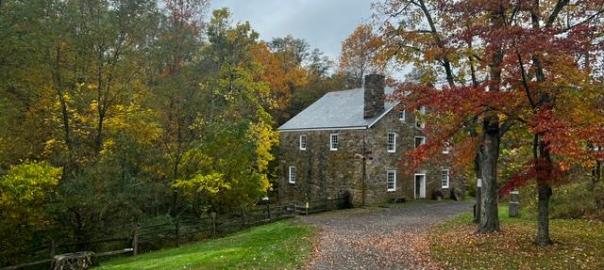
The front of the mill building
The front of the old mill had been decorated for the “250th Anniversary” of the nation and the grounds were really beautiful. The mill lined the Black River in the back of it and the lawns were filled with lush trees. The mill was not open for the day but you could walk around the grounds.
The Washington Turnpike historic sign
The front grounds and the water pump
The water pump marker in the front of the building
The water pumps at the front of the mills were closed off at this point but must have been used as a water source for the people working there at the time.
The stairway to the back of the mill
The pump by the front of the stairs
The back of the building is where the water wheel is located by the Black River water source. When I took the tour later the next month, the tour guide showed me how it worked. The mill is still a functioning mill and they still do produce flour for sale but on a limited basis.
The waterwheel that moved all the equipment inside
The Waterwheel and the water source to power it
The waterwheel
The history of the Water Wheel:
The Fitz water wheel was made in 1927 for a mill in Pennsylvania that burned down before it could be installed. It was then purchased for a mill in Pottersville, NJ in 1935 and powered until 1955. In 1974, the wheel was donated to the Morris County Park Commission and moved to the Cooper Gristmill (Cooper Gristmill pamphlet).
The video of the waterwheel working:
The historic sign on the waterwheel and the water source
The pathway to the Black River and the trails
The back trails of the gristmill have the most beautiful views of the river and the steams around the property. At the end of the Summer of 2026, it offers the most amazing views of the grounds. All the trees were still in bloom and the trails take you far back into the park. I just walked to the river stream and looked at the small waterfalls. This was the water source that powered the mill.
The historic sign on the Black River
The grounds and paths along the river are really picturesque but watch the paths when the paths are wet. It can be a muddy experience.
The Black River from the trails
The Black River water source
Video of my walk along the river:
The history of the Cooper Gristmill:
(from the site pamphlet)
A gristmill was apparently built at this site in the early 1700’s by the first Europeans to settle the Chester area. Records show that is was offered for sale in 1761. Later in the 18th century, it was owned by Ellis Howell. The property was purchased by Nathan Cooper in 1825 and then Cooper rebuilt the mill in 1826, since the original structure had been damaged by an earlier fire. This is the mill building that remains standing.
Following the death of Nathan Cooper in 1826, the mill was passed to his nephew, Nathan A. Cooper. The younger Cooper, who became one of Chester’s wealthiest and most important citizens, owned the mill property until his death in 1879.
Mills were built at close intervals. In 1832, the town of Chester reported five sawmills and three gristmills. Surrounding these mills were small settlements that developed followed by good roads so that the farmers could haul their grain to the site. Soon it was followed by a blacksmith shop and a general store. This was the beginning of the town of Milltown, later called “Milldale”.
Once in the forefront of technology and economic progress, village gristmills had become largely obsolete by the end of the 19th century. By then, milling had become a vast factory enterprise and the dynamic railroad system made it possible to ship grain and flour over great distances. No longer the bustling centers of activity, mills like the Cooper Gristmill came to be viewed as relics of a bucolic past.
In modern times and now restored, the mill once again hums with activity. The water wheel has been replaced and some of the mill’s mechanical equipment has been put back into place and now operates. In the place of farmers with wagon loads of grain, busses filled with school children arrive to see the millstones once again grinding flour. Cooper Gristmill and the Village of Milltown are good examples of the many small agricultural and industrial communities that once dotted the landscape of Morris County, NJ.
The back pathway to the front of the site
The first floor:
When I toured the facility a week later when the museum was open, I got a glimpse inside the mill’s past and how it was the economic engine of the area during Colonial times. The inside of the mill was in working shape and was still being used to produce flour when in season.
The first floor of the mill
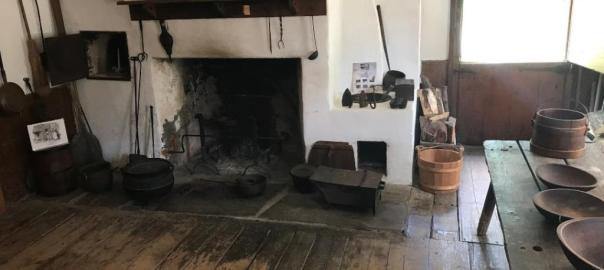
The inside entrance to the mill on the first floor with the fireplace to the left and the millstones to the right. The stairs led to three floors of the workings of the mills from grinding to bagging and shipping of the flour produced by local wheat.
The inside framework of the mill in the process of milling wheat
The large gears that made these rocks special waterwheel work that harnessed the Black River power source. The river and lake that have been dammed are across the street.
The millstones for the grinding of wheat
The millstones on the first floor of the mill
The millstones used to process flour
The second floor:
The second floor of the mill displays contain the office of the manage of the mill, the flour separating area for the grades of flour and the old bagging area of the flour product for shipping.
The recreation of the manager’s office
The milling and bagging area
The flour processing machine
The flour grade sorting machine is off to the left. The machine would sort the grades of flour based on the weight and bulk.
The machines processing and sorting the milled wheat
Pieces of millstones
Pieces of the millstones used in the production. The pieces would be shipped individually and then assembled when they arrived at the mills because of their sheer weight.
The attic room
The Attic:
The attic was the last part of the tour and where a lot of the inner workings of the mill were located. Just watch your head.
The Visitors Center:
When I finished the inside tour of the mill museum, I returned to the Visitors Center with the tour guide where a small museum on historic Morris County and the county’s rural past and development was displayed.
The small museum inside the Visitors Center
The inside of the museum tells the story of the development of Morris County, NJ
The small gift shop inside the museum
After the tour of the inside of the mill and museum was over, I explored the grounds of the property and admired the foliage. I decided to explore the power source of the mill on the advice of the tour guide who was preparing to close up for the day.
The grounds of the mill building and the beautiful surrounding foliage
The tunnel under the road taking you to the damned river and the lake on the other side of the road.
The video of the walk through the tunnel:
The path underneath the tunnel lead to the lake that was the original and still the power source to the mill. It still makes the water wheel run and is its source of power.
The lake and the waterfall are the source of power for the mill
The Water source of the Cooper Gristmill:
(from the Cooper Gristmill site pamphlet)
Unlike the electric machinery of today. the water powered gristmill drew upon the natural environment for its power. The miller chose a location close to a water course that has a drop in elevation. A dam was built to form a pond that would store the water needed to power the mill even in the dry summer months.
A sturdy building was required to support the water wheel and its associated machinery. The water was brought from the pond in a wooden trough, headrace or flume. The height from which the water would fall when it reached the mill was called the ‘head’. It determined the amount of power that could be generated. A tailrace carried the water away from the wheel and returned it to the stream. The turning shaft of the water wheel transferred its mechanical power into the mill. The gears and belts then transmitted the power throughout the building. The four sets of millstones at the Cooper Gristmill originally required two water wheels to operate.
The mill was often the social center of an agricultural community and the miller was a community leader. The miller lived nearby in order to attend to the constant stream of customers and keep his machinery in good order.
The beautiful foliage on this side of the road
I walked through the pathway and looked into the pond to see the small waterfalls in the distance. The foliage colors on the background of the water was quite spectacular.
The Visitors Center and the mill complex from the other side of the road
It was a very interesting visit to see part of New Jersey’s manufacturing past and how it was still being utilized in the present. The tour guide explained that at certain times of the year, they still mill flour and sell it to the public.
So it is still a working mill in production and you can still see that production in the warmer months. You can also buy the finished product on premise.
Not only is it an interesting tour but the surrounding foliage in the Fall is breathtaking. It really was a fascinating tour of New Jersey’s past.
Take you time and enjoy the paths and trails around the mill building
In the whole time I toured the gristmill did the tour guide say the place was haunted. I never saw or felt anything but according to many videos, the place is haunted.
I can’t believe that a whole year passed and I am back to Wildwood for the NJ State Firemen’s Convention. Time just keeps zipping by each year.
Just before the Convention, I left a couple of days before and visited my mother and her partner since I will not see them again until the Christmas holiday. This is when I give them both the first part of their Christmas present and take them to dinner at a restaurant of their choice. They chose Blue Coast in Rehoboth Beach as their present, the same restaurant we celebrated Mother’s Day. The food was really good but the service was a little off. I do not think they had enough help that evening. Still we had a very nice time.
Blue Coast at 30115 Veterans Way in Rehoboth Beach, DE
The food at Blue Coast is always wonderful and I am glad they made the choice. With the Christmas holidays here before you know it, getting one Christmas present out of the way makes things easier. Plus we had a ball!
My mother and I at dinner for her ‘early Christmas’ present
The Fried Calamari we shared
The food was really a standout. My mother’s partner and I shared the Fried Calamari, which they make really well and was perfectly cooked and not greasy and for my main entree, I had the Fried Shrimp with French Fries. I had not eaten this much fried food in one sitting in a long time and I considered it a rare treat.
The Fried Shrimp entree
Before I left my mother’s house for the Convention, she prepared an amazing French Toast breakfast for me while they enjoyed all the doughnuts and pastries I brought from Mills bakery. My mother still likes to spoil me at my age. This is when it is fun to have parents who care!
Having breakfast with my mother before the Convention and we talked through the meal
The Raison Bread French Toast was delicious
The it was off to the Lewes-Cape May Ferry Terminal for my annual trip from Lewes, DE to Cape May, NJ. The trip takes about an hour and forty-five minutes and on a nice sunny not only is quicker but the views are amazing. Dolphins traveling along side of us made the trip more interesting as the whole ferry moved to one side of the boat every time they passed by. I think they just wanted the attention and know what we were doing.
The Lewes Cape May Ferry Terminal on the Lewes, DE side of the ride
It was a beautiful day that morning and many of the patrons were either at the bar or eating an early lunch at the restaurant. It was also enjoyable to listen to music at the bar. I think many of the locals enjoy eating here just for the views and watching the ferries coming and going.
The restaurant and bar were really busy that afternoon
The ferry looks so graceful as it enters the port in Lewes, DE
My video on the ship arriving
I swear everyone makes a B line to the concession stand for snacks when I get on one of these ferries. During the holidays when I take the ferry over to Cape May, I have enjoyed their egg sandwiches.
They really stock this place and have a nice selection of snacks
Depending on the weather, it can take between an hour and a half to get to Cape May from Lewes or when the water is rough like in December, two hours. The views are beautiful
Entering the Cape May coastline during the late summer of 2026
The concert continued into the early evening and the end of the Summer brought darkness earlier in the evening. I could not understand why it was getting dark around 7:30pm. I was used to it at 8:30pm. The crowds kept getting busier as the evening wore on.
The Ramble in the evening
The audience really grew
The Ramble
I loved the performance of ‘Let My Love Open the Door” at the Howard Street Rumble
I was not hungry after such a big breakfast and a snack, so I just wanted a slice of pizza but not much was open this late at night so I walked around the beach after the concert was over and found Blue Moon Pizza open late. It was really quiet and it must have been quiet for a while because the counter guy and the owner/pizza maker looked bored.
My dinner that night and the Cheese pizza was quite good for a slice that was warmed
The strange part of the meal was it was about 10:00pm when I finished and it looked like the restaurant had been quiet for a while. While I was eating a party of four came in and ordered a large pizza, then another gentleman walked in and ordered four slices to go and then another couple came in and ordered another four slices and they needed to make another cheese pie for the case. When I left, there were seven people eating in the pizzeria and another couple walked in as I was leaving. The owner came out into the dining room to see what was going on and then gave me a big smile like I brought all these people into his pizzeria. Even I was surprised by all this at this time of night.
I just walked along the shore line for the rest of the evening and then through Washington Mall (Cape May’s Downtown) before going to bed. I was exhausted both from work and the trip and needed a little R & R. When I got back to the hotel, it was later in the evening and it had that creepy, ominous look about it. Sometimes it looks like ‘The Overlook Hotel’ from ‘The Shining’.
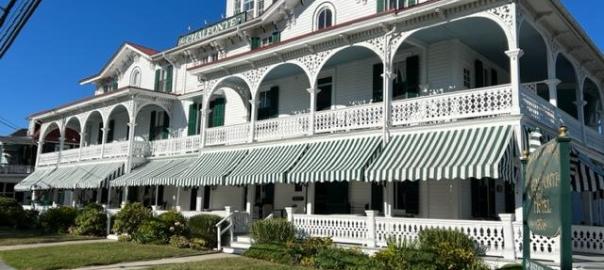
The Chalfonte Hotel at night after ‘The Ramble’ was finished.
I was staying in one of the back rooms on the second floor. I felt like I was walking down haunted halls.
Especially with old pictures of the hotel and faded bathing beauties line the walls of the hallway. Late in the evening, you feel like you are in the “Overlook Hotel” in the “The Shining”
Touring the Haunted halls of the Chalfonte Hotel
My comfortable room for the next three days of the Convention
I slept like the dead that night and even if there were a ghost haunting the halls they could not have woken me up. I slept for a solid eight hours and woke up to a beautiful sunny morning.
The morning of the Convention I got up at eight and got ready to head over to Wildwood. I had time before our 11:00am meeting a so I decided to treat myself to breakfast on the Veranda at The Magnolia Room, the hotel’s signature restaurant. It was a beautiful, sunny morning so it was perfect to eat outside.
Dining on the Veranda of the hotel on the first morning at The Magnolia Room
They have a nice but limited breakfast menu. I miss their breakfast buffet
I ordered the Challah bread French Toast with bacon
Though I miss the old Breakfast Buffet at the Magnolia Room before COVID, the breakfasts on the porch are part of my first day meetings ritual. On a nice warm morning, there is nothing like it and the French Toast was really good.
It did not look like a lot but I was stuffed after breakfast
The French Toast was excellent and I highly recommend ordering it
It was nice to just sit back and enjoy breakfast on this warm sunny morning before a long day of meetings. With all the grading, scheduling and driving and running around between the prior week and this week, I needed this break.
This is the way to dine in the morning
I got to the Convention Center early and checked in and wondered into the empty Convention Hall before the meeting. To start the meeting, the Wildwood Fire Department Honor Guard and the Bergen County Pipe and Drum performed to open the meeting along with a very loud and heartfelt ‘Pledge of Alliance”. You have never heard it recited until you are with over a thousand firefighters reciting it all at once.
The start of the meeting as the Wildwood Color guard entered with the Bergen County Pipe and Drum
The video of the Pipe and Drum and Color Guard
One of the main speakers was Donna Busch’s, whose husband the Buschio Exam is named after who helps so many firefighters with full medical exams.
After several hours in the meeting, we finished for the day and I walked down the Boardwalk for lunch. I knew where all wanted to go and made a beeline to Franconi’s Pizzeria on the Boardwalk.
Walking on the Boardwalk in Wildwood, NJ after the first Convention meeting
What really surprised me that afternoon was how quiet the Boardwalk was for lunch. Normally the Boardwalk is bustling with people but for some reason only the restaurants closest to the Convention Center were busy and that was it.
Walking around the Morey Piers whose staff was preparing for that evening when it opened at night
The second bend of the Boardwalk was very quiet that Friday afternoon
What was crazy was the number of restaurants loaded with food on their cases and extra staff all sitting around with cellphones waiting for people to come. I had never seen this before at a Convention meeting afternoon.
There was not a lot of people on the Boardwalk and when I got to Franconi’s Pizza. I was one of three customers at the restaurant after hundreds of guys had just attended meeting down the Boardwalk.
Franconi’s Pizzeria at Oak Avenue and the Boardwalk
I stopped in for lunch after the first set of meetings. I did not want to have a huge lunch because I had plans for dinner. So I thought I will just order sausage calzone. Big mistake, the thing was huge!
When the waitress brought it out, I thought she brought me the large one. This is the small!
I wondered how I would finish this thing
This calzone was the size of a small pizza
The calzone was filled with lots of cheese and sausage and came with the restaurants delicious red sauce. This could have fed two people.
It was delicious and what a lunch
After a meal like this, I needed a long walk on the Boardwalk and then walked the length of the Boardwalk to North Wildwood and back. When I walked back it seemed emptier than before.
I took a pit stop through Douglas Candies on the Boardwalk when I saw the candy demo in the window and the festive Halloween displays.
The one product I really like at the store is their candy bars especially their milk chocolate. They are a bit pricy but a once in a while treat is a good thing. You can always taste the richness in freshly made chocolate and their chocolate bars are the best. Their moi taffy was delicious too when they were sampling it.
The delicious taffy and assorted candies
The decorated Candy Apples
Each counter has a different type of candy and even in early September, the store was being decorated for Halloween. This smiling witch greeted customers at the door. There was all sorts of products being packaged for the Halloween when I was there and the store was creatively decorated for the holidays.
The store decorated for Halloween
The store was decorated early for Halloween
After I was finished with my walk of the Boardwalk, I planned on coming back later in the evening after dinner. I just wanted to get back to the hotel and relax for awhile.
When I got to Cape May, I put my feet in the ocean and enjoyed my walk along the beach. It was one of those beautiful sunny late afternoons. The water was a little rough as a Nor’easter was supposed to be heading up the coast later next week but for now the perfect late Summer afternoon.
Walking along the beach in Cape May
My video of the shore
The beach was perfect and the water was so warm and because most of the kids were back in school at this point it was quiet on the beach.
The waves were so relaxing
My video on the waves
The Ravioli House at 102 East Bennett Avenue in Downtown Wildwood, NJ
For dinner that evening I kept with my annual tradition on the first night of Convention and it was a trip to the Ravioli House in Downtown Wildwood. I dined there for a late dinner and ordered the Lasagna with a side of meatballs and came with bread and a House Salad. The meal was excellent.
The House Salad with fresh bread that I enjoyed before my Lasagna dinner
The Lasagna at Ravioli House is the type you might find in the Emilo-Romano section of Italy. It is layered with two different types of meat, two different types of cheese and slices of hard-boiled eggs baked between the homemade lasagna sheets and then topped with their homemade red sauce. It is decadent and delicious. They served it with two homemade Pork Meatballs that were excellent.
The Lasagna dinner also came with two homemade meatballs
They give you a sizeable slice of Lasagna loaded with meats, cheese and sliced hardboiled eggs
Yum!
The restaurant closes for the season on October 13th, so there will be no more trips until next year so I planned on dining here both nights of the Convention.
I was so stuffed from dinner, I had no interest in dessert and more interested in a long walk on the Boardwalk to work off both lunch and dinner. The lights had come on and the whole Boardwalk takes on a fantasyland look to it.
The Boardwalk was busier in the evening
The Boardwalk was much busier in the evening than it had been in the afternoon but still not what it once was in years past. It’s a sign of the times with this economy. I am used to it being much more crowded with families.
It got busier by the Morey Amusement Piers, where the park was celebrating Octoberfest
The Morey family extends their season for the Firemen’s Convention and the park was pretty busy that night with the young families. All the rides were full force and there was such an energy on this part of the Boardwalk. It is almost bittersweet because after this weekend, the piers close until next May.
The piers were lit like a fantasyland that evening
Video of the pier at night
The rides were so colorful on that Friday night
The Garage bands they had that evening were good but not great. Some of the singers were a bit off key but still some of them brought energy to the park and it was a lot of fun that night. They really had the crowd moving around the dance floor in front of the stage.
The opening of ‘Octoberfest’ that evening
My video on the concert with the group singing “I’m a Believer” by the Monkeys
I stayed until about 9:00pm and then wanted to head back to the hotel. We had voting in the early morning and then after that I had to head up to Vineland to visit the Vineland Historical Society Museum in Downtown Vineland, NJ. So I had some running around to do the next day.
It was another good night’s sleep at the hotel and then back to Wildwood for breakfast and voting. It was another beautiful sunny morning and I love the drive between Cape May and Wildwood through the marshes.
The Chalfonte Hotel in the early morning. The wedding party who were in house the night before had filled up the patio for breakfast.
The drive between the two towns is beautiful in the late summer with the tall grasses and green trees. Fall had not hit yet so the last vestiges of Summer were still here. You have stop and look at their gracefulness. You can see all the birds digging for their breakfast.
The local highway between the two towns along the shoreline
The marshes in the late Summer
The views of the marshes are spectacular in the early morning
I got to the Convention Center for voting at 8:00am and was able to take a picture of the Wildwood Boardwalk when it was quiet.
The Boardwalk and the beach are quite beautiful in the early morning
I got to the Convention Center which I could not believe was that busy that early in the morning. I guess everyone else had the same idea to vote early and start their day as well.
The entrance to the Wildwood Convention Center in the morning
After I left voting and got back to the Boardwalk to go have breakfast, everyone on the Boardwalk stopped as they played the National Anthem at 9:00am sharp. If you want to see patriotism, watch hundreds of firefighter s and their families stop, remove their hats and sing ‘God Bless America’. It is quite a site.
Everything stopped for the National Anthem
I have to say that I was very impressed and proud to be a member of the fire service. With all the problems we have in this country, it is nice to see that some people still believe in it. The whole Boardwalk stopped for this.
This led to two more patriotic songs and then everyone went back to their morning. I walked down the Boardwalk to Franconi’s Pizzeria, who was having their annual Firefighters specials for breakfast.
I loved the Lorax sign on the Boardwalk
I love coming to Franconi’s for any meal. The food is so reasonable, the service always so welcoming and meals excellent. In all the years I have been coming here, I have never had a bad meal.
Franconi’s Pizzeria at 3300 Boardwalk on the second bend of the Boardwalk
The lunch was so good that I stopped in for breakfast the next morning. I had one of the Firemen’s Special Breakfast’s that had three eggs, your choice of bacon or sausage, hashbrowns and two blueberry pancakes (I paid three dollars extra for these but well worth it).
The Firemen’s Special of Three Eggs with Sausage and Hashbrowns and two large Blueberry pancakes
They did not skip on the blueberries in the Blueberry Pancakes
The Scrambled eggs were excellent and everything on the plate was perfectly cooked and spiced
I don’t what it is about Franconi’s that makes it so special to eat here. Maybe it is the location on the boardwalk so close to the beach and the sea air or the sounds of the ocean and the boardwalk or just people enjoying themselves.
What a breakfast!
I walked the Boardwalk for a bit since it was such a beautiful morning and then headed out to Vineland, NJ for a visit to the Vineland Historical Society Museum. The Museum Director had reached out to me about a year earlier to come for a visit and everytime I tried to go, it just did not work out. Before I left for Wildwood, I had Googled the museum for hours and it just happened to be open the weekend of the Convention so off I went up the back highways to Downtown Vineland, NJ.
I had not been to Vineland since my father had worked for Vineland Industries back in 1974, so it had been a long time and I hardly remember it. Downtown Vineland is still vibrant in some ways but could use some more businesses. The historical society was located just off the downtown area and located in a beautiful building that had been built for the museum around the turn of the last century.
The front of the Vineland Historical Society Museum at 108 South Seventh Street in Downtown Vineland, NJ
On my off time from the Firemen’s Convention after voting, I had planned to visit a group of small museums in Cumberland and Glouster Counties in New Jersey. Most of the small ones were closed or had changed their hours online but the Vineland Historical Society was open for touring and was having a speaker that day. I had been invited to come by the President of their Board of Directors about a year earlier so I was glad that I was able to visit this weekend where the schedules matched up.
What an interesting museum with its focus not just on the history of the Town of Vineland but of the surrounding communities and the impact that Vineland had and has on Urban Design, Farming, Manufacturing and Inventions that contribute to the whole country.
About the Museum:
The museum had been designed as a Historical Museum for community leaders who wanted to share their love of historical objects and the past history of the community. This is what built the collection over the years. Each section of the museum tells a different part of Vineland’s history from the community events like its “100th Anniversary” of the town, the history of the Police, Fire and Veterans of Foreign Wars, members of the community who contributed to Women’s Suffrage and to the number of everyday products we use like Grape Juice and Marshmallow Fluff that were invented here. Each section of the museum tells an interesting story.
The museum is a stop on the Woman’s Suffrage Tour
The Mission of the Museum:
The Vineland Historical and Antiquarian Society is the oldest local historical society in New Jersey and its museum is the oldest purpose-built museum in the State of New Jersey. The Society is dedicated to collecting and preserving artifacts and records related to Vineland and the South Jersey region, and to sharing that material with visitors through exhibits, programs and other appropriate venues. Vineland has a rich, culturally-diverse past that is reflected through our collections. To learn more, please contact us or make an appointment to visit.
The Rain Garden outside the museum
The Rain Water Garden sign
The Rain Water Garden outside the museum was in full bloom at the Summer and you could see that the garden was trying to attract butterflies and other insects that would help pollinize the garden. It must be very colorful during the Spring.
The first floor of the museum is the lecture room, the library and the gift shop along with local artifacts and the Glass Manufactured Gallery
The main gallery was set for a lecture later that afternoon. On all sides of the museum tell the story and the timeline of Vineland and the surrounding communities. There is the City of Vineland and Vineland Borough and Landis Township in 1952. So you see the artifacts of the farming communities and those of the developing City (Wiki).
The early views of the museum with the original heating unit and turn of the century shell art
Historical community information
The First floor collection of artifacts
The bust of Charles K. Landis, who founded the town
The display of the early Women’s Suffrage Movement in town, which helped women earn the right to vote. New Jersey was an early pioneer in the Movement.
The photo of Portia Kellogg Chase, an early leader in the Women’s Suffrage Movement in Vineland, NJ
Made in Vineland: A Celebration of Local Inventors and Their Creations:
The exhibition highlights the remarkable people and ideas born right here in Vineland. From everyday household items to groundbreaking innovations in transportation, food, tools, and telecommunications, this special 2026 exhibit tells the stories of local inventors whose creations shaped daily life far beyond our city. Visitors are invited to explore these inventions and the fascinating individuals behind them during our Open House held every third Saturday of the month.
The ‘Made in Vineland’ exhibition:
The inventions of the Flower vase, the Woodruff Train Car and the Self Adjusted Plane
The inventions of Angel Food Cake Marshmallow fluff
The inventions of the Grape Juice industry and Skee-ball game
The post office desk from the turn of the last century
Just off the side of the main room is the Blown Glass Room. The area is known for special sand that is used for glass making. This made the State of New Jersey one of the leading manufacturers of glass in the country at the time.
Each of the cases displays glass for different purposes and for different industries made by different companies. The museum has a very extensive collection of glass.
The Blown Glass Room
The Blown Glass Room
Since the other museums closed around 1:00pm, I decided to head back to Cape May. I would have to visit these small local museums on my next trip to the area. Both the Matchbox Road Museum at 15 Pearl Street in Newfield, NJ and the Clayton Historic Museum at 29 East Avenue in Clayton, NJ both had limited hours that I missed on my trip to the area. For the next time.
The Matchbox Road Museum at 15 Pearl Street in Newfield, NJ
Along the local highway coming back from the Clayton Historic Museum, I passed Twin Kiss, a small restaurant and ice cream stand that looked like time had passed by. One of these little establishments that dot parts of New Jersey that once well travelled roads.
The Twin Kiss Drive Inn at 25 South Delsea Drive in Clayton, NJ
Twin Kiss Drive In, at 25 S. Delsea Drive, has been a Clayton icon since 1955, when George W. and Mary Lillian “Lilly” Kasper opened the ice cream franchise. The couple borrowed $5,000.00 and bought into the brand-new Twin Kiss franchise, opening several locations throughout Pennsylvania, coming to CLAYTON opening that stand on May 19, 1955 .
In 1959, when Twin Kiss developed a sandwich unit, Lilly joined George full time, and they worked side by side for over 40 years. They ran it for 46 years until retiring in 2001. New owners, John and Stacey Chamberlin, took over in 2001.
Twin Kiss Drive Inn and their Mission Statement:
(from the restaurant website)
Welcome to Twin Kiss Drive-In, a beloved local staple in Clayton, New Jersey, where great food and classic drive-in charm come together.
Proudly owned and operated by Stacy and John Chamberlain, Twin Kiss Drive-In is built on a simple idea: serve quality food, create a welcoming atmosphere, and give the community a place to gather and enjoy. Whether you’re stopping by for a quick bite, bringing the family for a casual night out, or reliving a bit of nostalgia, Twin Kiss offers an experience that feels both timeless and uniquely local.
For years, Twin Kiss has been known for its friendly service, classic American favorites, and that unmistakable drive-in vibe. Stacy and John are hands-on owners who take pride in maintaining the tradition while continuing to make the space feel fresh, inviting, and community-focused.
More than just a place to eat, Twin Kiss Drive-In is a part of Clayton’s story—a spot where memories are made, from summer nights and after-game stops to everyday moments worth savoring. We’re grateful to be part of this community and look forward to serving you.
The front of the restaurant
The ice cream and dessert menu
The sandwich and sub menu
The delicious Salted Caramel with Pretzel Ice Cream I had that day and this was a small!
Twin Kiss Drive Inn is one of those classic New Jersey restaurants that every town should have in them. After my visit to Twin Kiss for dessert, I drove back to Cape May through the back roads, visiting towns that I had never been to and driving down roads that once had been the major highways in this region.
The funny part about traveling some of these local highways is that I felt like I wasn’t even in New Jersey anymore. I felt like I was in small towns in Alabama or something. This is the way I feel sometimes when I visit small towns in the Hudson River Valley.
Once you leave the more ‘popular’ tourism towns like Rhinebeck, you visit these more ‘local’ towns and you feel like you are visiting the place that time forgot. I will have to make a special road trip back next month to visit some of the local museums.
I got back to Cape May with plenty of time to walk around. Unfortunately the hotel was hosting another wedding and I just wanted to get away from that. Cape May was really busy that night now that the Convention meeting was over so couples and families were running around the town.
I changed my clothes and went back to Wildwood for dinner and to walk the Boardwalk to work off meals. My goal was to go to the Ravioli House for dinner one last time because I knew it would be closing in two weeks.
The town had quieted down since the Firemen’s Parade was over and I think a lot of people had headed home. I just wanted another night at the shore to relax now that my work was done. I had another excellent evening.
I was so happy with dinner the night before, that I decided to have dinner there again my last night at the shore. The restaurant closes for the season on October 13th, so there will be no more trips until next year.
What I really enjoy about the restaurant is starting with their house salad with homemade dressing
The salads are so crisp and fresh
Dinner was the Shrimp Scampi with homemade linguine
After several days of fried foods and heavy sauces, I decided to order something lighter and ordered the Shrimp Scampi, which came with a lemon and wine sauce. It blended in wonderfully with the fresh cooked pasta. The sauce had a creamy consistency.
The jumbo shrimp were perfectly cooked and were sweet and tender
The meal was delicious and the seafood was so fresh
After dinner was over and I was thoroughly stuffed from both the meal and dessert, I enjoyed another night of walking the Boardwalk and enjoying the lights.
I watched part of Michigan State-Notre Dame football game on the big screen TV at the Morey Pier. They kept it on low and I watched enough to goal at Notre Dame’s last touch down against us. It was depressing but we held our own for a team that is going through a rebuild.
The lights dazzled my last night on the Boardwalk
Before I left the Boardwalk that evening. I stopped by the Douglass Pavilion for some ice cream. I had never noticed this before and when the menu, it carried such unusual flavors.
The store has a complete ice cream store to compliment the sale of the pints of ice cream in the Douglass Candy store across the Boardwalk. This way you can taste the flavors before you buy them. The store was getting ready for the Halloween holiday season so it was all about pumpkins and Jack-0-Lanterns.
The Douglas Creamery is across the Boardwalk from the store
The menu and flavors of the ice creams that you can choose from. The ice creams are homemade and themed with some of the candy items in the store
I loved the selection of flavors and some included the candies that they sell in the store. The flavors were also geared toward the Fall with Pumpkin and Apple Cider Doughnut flavors.
The tables and the store were decorated for Halloween
I chose the Molasses Paddy (which is a candy they are known for) and the Apple Cider Doughnut ice cream
The ice cream is rich and delicious and they give you nice sized scoops
The store is getting ready for Halloween
I got back to the hotel as the wedding broke up and the hotel had that eerie late evening look to it. I love the look of this old hotel. It looks like the ghosts from the past still visit it.
The Chalfonte Hotel on my last evening
I woke up the next morning like I slept for a year. I got nine hours of sleep. It was overcast that morning and I was still full from dinner and the ice cream the night before. Since I didn’t foresee coming back to the shore, I decided to just have a piece of pastry at the Ravioli House Pastry Shop, take another quick walk on the Boardwalk and then head home.
The Wildwood Boardwalk on the last day of my trip
The Morey Pier was quiet in the early morning and I believe was closed for the season
My video of watching the Ferris Wheel
I stopped at the Ravioli House for breakfast on my last morning of the Convention. I was getting tired of Pancakes, Bacon and Eggs and wanted something different. I had seen pastries in the case I had always wanted to try so I returned one last time before I headed home.
The Ravioli House Bake Shop has a wonderful assortment of bakery treats
The seating area in the pastry shop allows people to talk amongst themselves
Since my dinners were so filling, I never got a chance to try two of the desserts I had wanted in the last two visits to the restaurant so I stopped in the bakery and had breakfast here ordering a Cassata Cake and a Napoleon with fruit. I could just about finish the Cassata Cake because the pastry was so large and very sweet that I brough the Napoleon home.
The Napoleon and the Cassata Cake with some hot tea with lemon
The Cassata Cake at Ravioli House is very dense and rich and should be shared
The dessert is filled with a mixture of cake, nuts and liquors
The Napoleon I saved for later
I was on a major sugar high on the way home that morning. I knew this would be going on the three hour trip home. I was surprised how quickly I got home that afternoon. I figured everyone else had checked out the day before.
It was another successful trip for my Fire Department Convention work and my blogging for all the Travel sites. I got a lot accomplished this weekend. We got the voting for the Convention done that we wanted and I had another set of museums that I had visited or planned to visit in the future. Now on to Halloween.
The Shandaken Historical Museum began as the second school house of Pine Hill, District #10. There were two school rooms on the second floor. Where the office of the museum is now located was the library. The rooms were divided by a cloak room used by both rooms. The room to the right was used by the upper grades.
When they started to send high school children to Fleischmanns High School their room was closed. The large room on the left them housed grades 1-8. Downstairs was the gym. On the west end was a stage that folded up against the wall. The stage was used for recitals and at Christmas time, a play was put on for the whole town. For most of the year it was the gym, the favorite sport was basketball (TSHS website).
The old school could tell some pretty good tales. It has housed a coat factory, a furniture stripping business, a community center, as a village building it held Boy Scout meetings, Red Cross gatherings as well as free vaccination clinics and is now the Town of Shandaken Historical Museum (TSHS website).
The museum sign that greets you outside
The Museum’s Mission:
The museum displays a fascinating collection of 19th and 20th Century tools, machinery, clothing, letters and artifacts relating to the Town of Pine Hill and the surrounding hamlets of Allaben, Big Indian, Bushnellsville, Chichester, Highmount, Mt. Pleasant, Mt. Tremper, Oliverea, Phoenicia, Pine Hill, Shandaken and Woodland.
The inside of the main gallery showcases the best of the surrounding hamlets. Each small town surrounding Pine Hill history is displayed town by town with artifacts from each community.
Pine Hill’s history is prominently displayed in the front starting with a display of an old classroom. It is amazing how things stay the same over the years.
Each of the displays have interesting details in all the artifacts that being showcased in each section. There are all sorts of photos, historical objects, artworks and personal affects of local citizens.
The classrooms of the past are similar to today
Local artifacts from the town
Each of the small hamlets surrounding Pine Hill had their own displays of artifacts ranging from local history, schools, fire and police departments, local events and residents and their day to day lives. Many of the residents from these communities have donated their or their family’s personal affects to the museum to build this collection.
When you visit some of these communities and look at the pictures on the wall, you can see in some cases not much has changed in these Upstate towns.
The museum celebrated the 250th Anniversary of the United States with an interesting display of the history of the Country and New York’s contributions.
The New York State display of the 250th Anniversary of the Country
The lower level of the museum is a reflection of life on the farm and an agrarian society from the turn of the last century. The funny part is that only being two hours out of New York City, many small towns in New York State still have that feel.
The lower level Farm Living Galleries
The first set of artifacts are dedicated to the home, family and faith. Everyday living to most families in the small farming communities of Upstate New York. These artifacts reflect homelife from the late 1880’s to the 1930’s.
Home and Living on the farm
The kitchen tools and equipment to run a household
The tools of the trade for the life in these rural communities was based on what they could grow and trade with other farmers. Before WWII, you can see the life of the rural housewife was tedious with growing, preserving, pickling, baking and canning for the winter months long before modern supermarkets and refrigeration. It was a lot more work to get meals on the table and took a lot of grit and a budget of both money and time.
The Baking and Jarring on the farm to prepare for the Winter Season
The workings of the farm kitchen
Children’s playthings and cribs
Children’s play was based around the household and work in the future.
The family and faith
The items in a household that make it function
The workings of the home and farm
Life and functions of the Upstate Farm
The communities of Upstate New York still have agriculture as a base and even though electronic gadgets still help, many of these ‘tools of trade’ are still being used. These are the tools that built the farming industry Upstate through the 1970’s.
Tools of the Trade
The farm tools
Farm and field equipment
The equipment of the Farm
Small businesses were part of the community and the druggist was very important
The museum touches on life in small and large Upstate New York towns and the challenges they still face in a economy where farming and tourism are dependent on the economy. Though many of these communities are only two hours outside New York City, they might as well be a world away.
The displays are an interesting look of how communities develop and how they sustain themselves over time and we can see how COVID and the transplants from New York City and beyond are still shaping these communities.
I had never heard of the Hill-Hold Museum and I happened to come across it when I saw a sign on the local highway that the museum was open that day. I thought it was a very interesting home and grounds with historical homes and buildings. Some came from other parts of Orange County, NY.
There are group tours on the hour with the last tour at 3:00pm. I took the last tour by myself with the tour guide and got a one on one tour of the house and grounds. The tour takes you into a step back in time to an agricultural society that no longer exists and times were slower and more structured.
The Hill-Hold Museum
The estate in the background
The Hill-Hold Museum:
A Farm for Two Centuries. This stone farmhouse was built in 1769. This museum reflects the life of the Bull-Jackson family spanning over 200 years. Hill-Hold Museum has circa 1830 Furnishings, a one room School House, a historic 1870 barn, Goosetown Gift Shop, picnic benches, and parking (Museum website).
The house on the estate grounds
The Mission Statement:
(From the museum website)
The Friends of Hill-Hold and Brick House Museums serve to preserve and enhance the preservation of history in Orange County, by maintaining, furnishing and operating programs at both these exemplary 18th century houses. These museums include portraits, memorabilia, photographs, and furnishings pertinent to them, the county and the past ages that touched each house (Museum website).
The front of the Hill-Hold Museum at the start of the tour
History of the Hill-Hold house museum:
(From the museum website)
Visit Hill-Hold museum and see what life was like on a Hudson Valley farm in the 1830s. This was still the era of candlelight, fireplace heat, homegrown food, and homespun clothing. The stone farmhouse was built in 1769 with wide plank floors, handsome paneling, and huge fireplaces (Museum website).
It was the home of a prosperous farmer, Thomas Bull, and his family. Original furnishings range from a prized old mahogany sideboard to made-on-the-farm pieces. Most of the rural family’s needs – food, clothing, fuel came directly from the farm. The property was gifted to the County in 1968 by Eleanor Jackson and the house went through an extensive restoration in the 1970’s to return it to how it appeared when it was originally built in the 18th century. (Museum website).
The Hill-Hold farm served the Bull-Jackson family for more than two hundred years. Now visitors are welcome to tour the farm. As we wander through Orange County, reveling in its rolling farmland scenery, we can go back to when the early Americans brought the gracious living and energetic husbandry to this unique part of the Hudson Valley (Museum website).
The Parlor-sitting room on the first floor was once a bedroom
We started the tour in the formal parlor, which the tour guide told me was once a bedroom along with the Living Room before the house was expanded. The house is filled with Bull family heirlooms that were donated back to the house by distance family members.
The family portrait’s in the Parlor-sitting room with the family piano that was used in the evening for entertainment
The portrait below is of the last member of the Bull family to live in the house before it was donated to the State of New York.
A portrait of the last family member to live in the house
The room was used by the family for entertainment, relaxation and for every evening activities. The room was used for pursuits such a sewing, needlepoint, conversation and with a piano in the room, evening activities with the family. With so much going on the farm, people retired in the evening early as the morning brought a lot of work on this working farm.
The spinning wheel by the fireplace
The Dining Room again was a former bedroom that was expanded for a formal eating as the both the house was expanded as well as the family. Breakfast and a late lunch/supper were served in this room. The Dining Room table, chairs, sideboards and china were pieces that part of the house donated back by the family.
The family dining room
The family China in the sideboard cub-bard in the Dining Room
The complete formal china set was displayed in the china closet as if ready to be used for a formal dinner party.
The sitting area in the Dining Room
The upstairs bedroom
We toured the master bedroom on the second floor of the home. Each of the rooms had fireplaces to keep them warm in the long winter nights with a canopy bed to keep the warmth inside. I could not believe how small people were at this time. This would have barely held one person today.
The canopy bed in the upstairs bedroom
The other bedroom would have been used by the children of the family. Now it contains sewing and weaving machines as well as spinning wheel to create the family clothing.
The second bedroom
The Sewing Room on the second floor with the oven/heater and family spinning wheels
Fabric and clothing was created in the home. Whether flax and wool, material was spun on the farm and the family wardrobe was created here.
The family spinning wheels
The sitting area on the second floor
The last part of the house tour was of the family kitchen in the main house. The Summer kitchen was on the other side of the garden outside. The main kitchen inside the house had the fireplace, cooking materials, the family pewter and everything you would need to cook a complete meal.
The family kitchen
The family table set for cooking
Items for bread and dessert baking, butter making, roasting and stewing and all the items needed to cook three meals a day. The bounty of the Spring, Summer and Fall had to supply the long winters when there was no grocery shopping available.
The equipment for washing clothes and other household chores
Wash Day was a whole day reserved for sorting, boiling, scrubbing and hanging clothing to dry. Until the more modern machines were invented in the 1920’s after WWII, this was the weekly ritual for the farm housewife or the staff.
The open hearth and cooking equipment
The cooking equipment
The family pewter set
After we finished the house tour, we explored the outer buildings which included a Summer Kitchen, a smoke house, the vegetable and flower gardens. These buildings were spread around the main house.
The Summer Kitchen
The inside of the Summer kitchen
This Summer Kitchen came from a different property but the use is still the same. As the warmer months of the Summer were upon them, cooking was done in a separate building to keep the house cooler.
Some of the cooking and baking equipment
The flower beds on the side of the house
The flower and vegetable beds on the side of the property and the smoke house
Outside the main house were the vegetable, fruit and flower gardens. Items used in the household for meals, decorations and entertaining.
The barn, the outhouse and the smoke house in the distance
The inside of the smoke house where meats once hung used for family meals
All the family meats were placed in here for cooking and smoking for the family meals. The process took much longer than it does today.
The well in the middle of the property
They also moved an old school house to the property and it was furnished as a complete turn of the last century school house. It was used until 1936.
The schoolhouse on the property
The inside of the school room
The classrooms of the 1700’s and 1800’s to today have not changed much. With the exception of modern heating and air conditioning, the class room set up has not changed much. There is still a board in the front of the room, chairs facing the teacher, who is in charge and books lining the walls.
The teachers desk and the furnace that kept the room warm in the cold months
Games and amusements that were used in recess
Wheels and bikes were part of the games children played at the turn of the last century
Before modern electronics took over starting in the 1970’s, bicycles, hoops and games such as tag and hopscotch were part of playground activities. Playing outside has not changed much throughout the centuries.
Looking over the grounds at the end of the tour
Before I left for the afternoon, I was able to tour the gift shop before the museum closed for the day.
The Goosetown gift shop at the museum entrance at the end of the tour
The Goosetown Gift Shop at Hill-Hold features books, gifts, toys, craft items, and souvenirs. The shop is operated by the Friends of Hill-Hold, Inc., a not-for-profit organization, which aids in the operation of Hill-Hold and Brick House museums (The Museum website).
It really is an interesting tour and a step back in time for a glimpse into the life of a Upper Middle Class farming family.
I had a five week break from the college when my first Summer class was cancelled. So I concentrated on traveling through New Jersey and New York, both the City and Upstate for my blog. I wanted to revisit many historical sites that I had seen during the holiday season (was Christmas six months ago?) or in the past. There were places like Central Park, where I had not seen certain sections in the Spring. This lead to me being part of many walking tours of gardens during the month of June.
With all the wet weather we had in the Spring, the gardens in June were lush with flowers and flowering trees and plants. Pathways lined with color and walled gardens beautifully laid out. It was interesting to see how these were planted, designed and maintained.
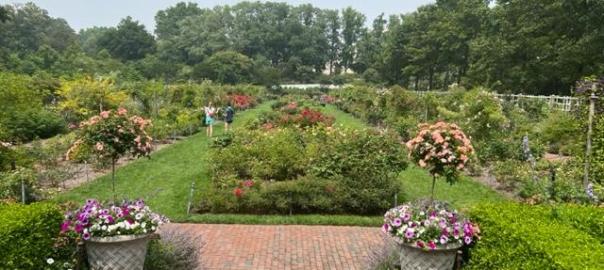
The entrance to the Brooklyn Botanic Garden in June 2026
All the rain we had in April and May and the warm days of early June had awakened the Cherry Blossoms and I visited as many locations to see them in full bloom.
Please read my blog on visiting the Cherry Blossoms:
Once they were finished, gardens came to life all over the tri-state area and many historical homes and parks came to life in a sea of color and smells that showed the power of Mother Nature to make things beautiful. I was impressed with the work of many volunteer staffs and their dedication in taking care of these sites for all of us to enjoy.
Visiting to Amour-Steiner House for the Spring Garden Tour:
The Amour-Steiner House the day of the Garden Tour
The beds were in full bloom when we toured the gardens
The colors of the flowers were patriotic red, white and blue
In between the hedges, there was elegant statuary and potted urns with colorful flowers blooming with bright hues.
The urns were filled with bright colors of the season
Statuary representing the arts and music lined the hedges
The flowers were so brilliant that afternoon
I enjoyed looking at the statuary
The gardens were so beautiful with the house in the background
As we left the gardens, I admired the ornate Fox and the Glove gate on the way out
The video on the walking tour of the gardens:
The tour
We then crossed the lawn to tour the greenhouse, where many of the flowers were and still are grown for decorating the house both inside and out.
The landscaping has a romantic spin on it as the property was planted to accent not just the property but the house as well giving it a natural but balanced look to it.
Touring the formal greenhouse
Even the working greenhouse had a romanticized look about it that reflected the house
The inside of the greenhouse. Each side of the counters seasonal flowers are grown for the property. This greenhouse is used all year long supplying the house with a steady stream of flowers.
In the middle of the greenhouse was a beautiful Victorian aquarium that was lined with more flowers. There were no fish at this time.
I loved the beautiful flowers that lined the counters
The Spring colors were breathtaking
We then started the tour of the house starting with the outside veranda that held more urns and planters of fresh flowers
The beautiful veranda lines the entire house
The beautiful colors from the potted and hanging plants
The veranda decorated for the upcoming ‘250th Anniversary of the United States
I walked the veranda before the tour to show the view of the property.
My tour of the patio
The hanging plants
The potted plants
We even admired the birdhouse that matched the house
We then went inside to tour the house. It would be interesting to see the house without all the Christmas decorations that I saw the last time I toured the house.
The triangle room off the foyer once used as the Receiving Room
The beautiful foyer to the second floor
The main Parlor/Living Room used for entertaining
The formal Dining Room
The decorative sideboard
The other decorative sideboard
The Dining Room table set for a Spring dinner
We then started the tour of the second floor which started in the game room at the top of there landing. I remember the big Christmas tree being here when the house was decorated for the holidays.
I liked the room was the way it is here
Then we toured the bedrooms which were not that elaborate but functional and comfortable as they are today.
One of several bedrooms on the second floor
The bathroom which is considered normal today was ahead of its time with flushing toilets and hot and cold running water
The office off the side in one of the Octagon corners
The Egyptian Room was the height of fashion with travel and new discovers in Egypt at the time.
The ceiling and decorations of Egyptian Room
The decor of the Egypt
The beautiful porcelain in the room
Then we toured the Curio Room. I thought the room was a lot of fun with small objects that people would have collected from their journeys at that time.
The shelves, counters and walls were filled with all sorts of interesting objects
Many types of object’s
The Victorian Terrarium that was becoming fashionable at the time
The fold out desk with small objects in each slot
A Victrola and Terrarium
The last part of the tour was of the newly renovated kitchen. The shelves were lined with a collection of shiny pots and pans.
The ‘modern’ Victorian kitchen
When the tour was over, I visited the gift shop and looked over the kitchen once more. It is interesting to see how ‘modern’ back then is ‘contemporary’ today. Victorians set the tone for the modern American home of today and the expectations of the American dream.
Before I left the grounds, I visited the gardens once more. It was such perfect weather to walk around and I enjoyed the beauty of these gardens. Mother Nature creates this all this.
Walking around the grounds of the home
I enjoyed walking around the gardens that day
I found this tour one of the most relaxing I have taken in a long time. The beauty of both the house and the gardens was wonderful. Just sitting on the veranda and looking over the grounds was the perfect way to spend the afternoon.
Taking the Clermont Garden Walking Tour 2026:
I returned in the Spring of 2026 for the an updated walking tour of the gardens “Gardens and Grounds: Evolving Landscaping of Clermont”, where the State of New York horticulturalist who had just been hired to maintain the gardens, explained to us the developments and goals that the State wanted for the direction of the landscaping on the property. They wanted it brought back to the 1930’s blueprint of what Alice Livingston had originally envisioned for the estate when she returned from Europe.
Arriving to the Clermont estate at 1 Clermont Avenue in Germantown, NY
We started the tour with a history of the house and Alice Livingston’s return from Europe to create her famous gardens
The front of the mansion in the Spring of 2026
We started the tour at the Walled Garden which was just finished being restored. The back wall had just been finished and the site’s main horticulturalist explained that she was working with a group of volunteers to maintain the gardens.
The Walled Garden designed by Alice Livingston
The Walled Garden in the Spring of 2026
The inside to the entrance of the Walled Garden
The back part of the Walled Garden
The next garden we toured was the Wilderness Garden which included wildflowers and a fish pond
The Wilderness Garden sign
The back part of the Walled Garden leads to the Wilderness Garden
The entrance to the Wilderness Gardens
The lecture on the design and plantings of the Wilderness Garden
The colorful wildflowers that line the grass paths
The fish pond in the Wilderness Garden
We then followed the path and walked up and toured the Cutting and Children’s Garden. These colorful gardens once supplied the house with an assortment of fresh flowers. It also taught the Livingston girls the attributes of gardening.
The Cutting Garden and Greenhouse sign
The main Cutting Garden
The Cutting garden
The Cutting Garden in the late Spring
The in season flowers in the Cutting Garden
The Children’s Playhouse and Garden is next to the Cutting Garden
The Children’s Garden in the Spring
Touring past the old Greenhouses
Part of the former greenhouse
The tour through the grounds with my group
The pathway back to Clermont
Touring along the river
The former roadway between the house and the river
The South Spring Garden
Our last garden toured was the one closest to the house and that was the South Spring Garden of which Alice could see from her window. When the porch was removed from the home and Alice developed plans for other gardens, this garden went ‘native’.
The South Garden
The South Garden in bloom
The views from the South Garden
The flower planters near the South Garden
The planters filled with Spring geraniums
Walking back after the tour was over and looking at the beautiful grounds
Ending the tour that day with a walk along the river
It was a beautiful day to walk the gardens and the perfect way to spend the afternoon. Each time I take a tour of the gardens, I am amazed how different they seem. I love the different times of the year and how it changes these gardens.
I returned to Manhattan the next week and as I was working in Inwood and Washington Heights neighborhoods, I took a tour of Isham Park with the Bruce Reynolds Gardens and Fort Tyron Park with the Heather Gardens, when they were in full bloom. It was breathtaking with the back drop of the Hudson River on a sunny afternoon.
In Isham Park, I toured the Bruce Reynolds Gardens, which is in the center of the park. They were in full bloom when I walked around the gardens and relaxed under the shade trees.
The new Bonnefont Restaurant is open for lunch and brunch
The restaurant was closed that afternoon but I was able to look at the menu online and it is an interesting menu. The cuisine is a mixture of French and Contemporary cooking.
Walking back through the gardens to the Fort Tryon location
Walking to the Fort Tryon site
The Fort Tryon site
Visiting the Brooklyn Botanic Garden before Rose Night in 2026:
I got an email from the Brooklyn Botanic Garden saying that the Cranford Rose Garden was at its peak of blooming and that I should see it while it was at its prime. I was busy at work and was able to travel down to down to the gardens a few days later. Talk about perfect timing as the petals just started to fall.
The Cranford Rose Garden at peak is one of the most beautiful sites. The colors and the fragrances are just amazing. I could not attend “Rose Night” in 2026 because of a prior commitment plus it would be a gloomy night with the threat of rain. So I went the Friday afternoon before the event, which would be held the next Wednesday. By that point, the flowers would be out of peak.
The Cranford Rose Garden in bloom at the Brooklyn Botanic Garden
The Cranford Rose Garden is amazing from every angle and the views from the top of the hill overlooking the garden shows the extensive amounts of roses planted and the array of colors.
The beds of roses of all colors and species
The entrance to the Cranford Rose Garden is full of an array of different types of colorful flowers
Touring the Rose Gardens in June 2026:
The tour
The beautiful and diverse flowers in the Cranford Rose Garden
The beauty of flowers up close
All sorts of roses line the trellis borders of the Rose Garden
What I love about walking around is that you can see the diversity of the roses. The garden is planted with different species so they bloom at different times giving the beds an array of colors at different times. Along the beds and trellis everything bloomed so vibrantly.
The beautiful orange roses that lined the trellis
The colorful trellis pathways
The reds and pinks in full bloom
Roses lining the lamppost
Admiring the beds of roses at the Cranford Rose Garden
Purple reins supreme
Walking through the trellis pathways of red
The beauty of the trellis
The back part of the garden
The back terrace of the Cranford Rose Garden
The elegant statuary of the rose garden and the sun dial
The back Terrace area
The back of the Cranford Rose Garden is lined with all sorts of flowering plants having a rainbow of colors.
Walking through the terrace gardens
The beautiful roses in the back of the garden
The roses in the back of the Cranford Gardens
Walking out the back of the gardens
The back path of the Cranford Rose Garden
The fountain in the back of the Cranford Garden
The fountain in the back of the Cranford Garden
Visiting the Cranford Rose Garden when it flowering is one of the most interesting collection of colors and scents. This is why I try to time my visits around the blooming of the flowers.
The fountain in the peak of the rose season
Visiting the Cranford Rose Garden when it flowering is one of the most interesting collection of colors and scents. This is why I try to time my visits around the blooming of the flowers.
The Tour of the Gardens at The Cloisters in the Spring 2026:
One of my favorite places with in the Metropolitan Museum of Art to visit is The Cloisters in any season. One of my favorite places when it is decorated for the Christmas holiday season, the Spring and Summer offer such beautiful displays of historical plants that try to match the theme of each Cloister and its historical background.
The docent led a very large group of us through each Cloister and told us of the way the curators plant the gardens to represent what may have been planted during the Medieval era for medical and nutritional functions of those peoples lives.
(From the Museum website)
The gardens of the Middle Ages included both real and ideal gardens. Poets and artists delighted in the depiction of fantasy gardens like the Garden of Love or of Paradise, but no real garden of the time remains to us. Historical records are rare and incomplete; the ninth-century plan for the monastery of St. Gall, with its carefully drawn and labeled garden beds, is unique. Archaeological excavations are yielding valuable new evidence, but we still know more about infirmary gardens of medicinal plants and aristocratic pleasure gardens than we do about humble kitchen plots of potherbs and vegetables (Met.org).
The gardens of the Museum, planted in reconstructed Romanesque and Gothic cloisters, evoke those that provided sustenance and spiritual refreshment within the medieval monastery. Designed as an integral feature of the Museum, the gardens have been a major attraction of The Cloisters since its opening in 1938, enhancing both the setting in which the Museum’s collection of medieval art is displayed and the visitor’s understanding of medieval life. The gardens are designed and maintained by a horticultural staff actively engaged in researching and developing the living collection (Met.org).
The Cloisters at 99 Margaret Corbin Drive in Fort Tryon blooming in the late Spring
We walked through the Cloister discussing how plantings were determined by medical and religious purposes
The flower beds in the Cloister
My video of the Garden Tour in the Summer of 2026:
The video
The view of the Hudson River was amazing
The flowers in bloom
Flowers in bloom
Flowers in bloom
Flowers in bloom
We moved the next Cloister looking over the medical plants and flowers
The Cloister in bloom
Walking around the Cloister
The plants around the sills of the Cloisters
Touring the Cloisters and admiring the flowers
Everything in bloom
We toured the last Cloister while the tour guide explained the plantings
The last Cloister we toured
The garden in full bloom
The growth of the hops growing on a trellis
The hops planting up close
The flowers in bloom in the Cloister
Video on “Art and Gardens at the Met”
We ended the tour admiring the art in the Tapestry Room and having a discussion about the use of plants and flowers in Medieval art.
‘The Hunt of the Unicorn’ tapestry discussion
I then visited the ‘Creatures of Myth and Imagination-European and the Americas’ exhibition.
This exhibition was an interesting look at mythical beasts of the era of great exploration from European to the Americas. It reminded me of the book “In Search of Ancient Astronauts” with many golden creatures that look like they are visitors from another planet, Ancient Gods to worship and one civilization’s outlook on the unknown. The artwork was a cross between mysticism and respect.
The exhibition sign for “Creatures of Myth and Imagination: Europe and the Americas”
Set in the evocative atmosphere of The Met Cloisters, Creatures of Myth and Imagination: Europe and the Americas sheds light on a selection of works created on either side of the Atlantic Ocean between 500 and 1500 CE. The exhibition’s exploration of hybrid creatures deepens our understanding of their apparent necessity among diverse peoples. In the Americas, a complex gold pendant by a Tairona artist of northern Colombia, depicting a confrontational figure with hands on hips, a crocodile-like head, and an enormous headdress, would have reflected and expressed the wearer’s status and power. In Europe, ferocious dragons such as the one depicted on a monumental fresco from the monastery of San Pedro de Arlanza, Spain, took center stage to convey a multiplicity of meanings both sacred and profane (Met.org).
The exhibition gallery
Unusual mythical creature
(From the museum website)
For as long as humans have told stories, we’ve imagined creatures that transcend the natural world. Fantastical beings combining the features of animals, humans, and even plants appear across cultures, emerging in the most ancient myths and enduring in contemporary epics. The widespread presence of these supernatural beings, possessing the power to transform and be transformed, reflects a global impulse to make sense of both known and unknown worlds. Visual artists have given form to these imaginary creatures, resulting in some of the most fearsome, beloved, and extraordinary works of art ever made (Met.org).
Small gold ancient Gods
Ritual Knives
Double pendants
Earth Deity
I took one last tour of the museum gardens before I left for the afternoon. On the balcony overlooking the Hudson River offered beautiful views and beautiful potted plants.
Walking out of the back Cloister
The back Cloister
The beautiful white flowers
The balcony overlooking the Hudson River
The potted plants by the doorway
The view of the Hudson River
Looking north up the Hudson River
The tour of the Gardens was amazing and the exhibition on the Pre-Columbian art interesting. It was a wonderful tour of the Cloisters.
I had a private function at the Museum of the City of New York across the street from the Central Park Conservatory Gardens. When the event was over, I took a walk around the gardens when they were in full bloom.
The gardens just went through a major renovation and each of the paths had rows of colorful flowers that were beautifully taken care of and designed to bloom at different stages of the growing season so there was always color in the gardens. The effect was amazing.
The entrance of the Central Park Conservatory lawn and fountain
The fountain and the geometric garden
Central Park Conservatory gardens at the entrance
The entrance of the gardens from the Harlem Meer area
The entrance to the flower gardens from the Central Park Conservatory lawn
The Central Park Conservatory garden beds
My video of touring the gardens in Summer 2026:
The tour
The gardens in full bloom in the Summer of 2026
The flower beds in the central of the gardens
The Central Park Conservatory Fountain and Lotus pools
I walked behind Hippo Park in Central Park one afternoon to discover a beautiful floral garden that was the 91st Street Garden that I had missed on previous walks in the park. The Garden did not look like this in the Fall.
The 91st Street Garden in the Summer of 2026
Then I remembered the scene in “You Got Mail” and remembered that this was the garden where they met. I always thought it was closer to Riverside Drive than it was here in the park.
The sign for the garden
As I passed the garden, I remember this was the garden in the last scene of the movie, “You Got Mail” when Meg Ryan realizes that her secret email pal is Tom Hanks. It was such a great scene and the perfect end to a great Rom-Com.
The end of the movie “You Got Mail” with Meg Ryan and Tom Hanks
The Gardens from the front
The flowers in full bloom
The flowers in full bloom in July 2026
All I could think about was this scene as I walked around the garden. The funny part is this was the first time I had ever visited this garden as I did not know where it was located. I knew it was on 91st Street but could never figure out where. You have to walk on the path behind the Hippo Playground and follow it to the other path.
The gardens from the front
Walking back up through Riverside park from the Hippo Playground
Walking in Riverside Park in the 90’s
You have to find your way through Riverside Park to find the garden but in the Spring and Summer it is worth the walk up and down the hill.
These are just some of the places that I am still visiting as the Summer season begins and there are more historical sites to see and more smaller gardens to visit. Let’s see what the rains produce in the coming months.
Places to Visit:
*Bloggers Note: the prices of these sites vary from season to season and can change from year to year. This is the same with the hours depending on what season you visit.
Fee: Adults $30.00/Seniors $17.00/Children $12.00/Members & Patrons and Children under 12 are free (prices do fluctuate). NY, NJ and CT students and NY residents Pay as you wish.
Museum Hours:
Hours: Open 7 days a week
March-October 10:00am-5:15pm
November-February 10:00am- 4:45pm
Closed Thanksgiving Day, December 25th and January 1st.
*Some galleries may be closed for construction or maintenance.
Fee: Adults $30.00/Seniors/Students $17.00/Children $12.00/Members & Patrons and Children under 12 are free (prices do fluctuate). NY, NJ and CT students and NY residents Pay as you wish.
Museum Hours:
Hours: Open 7 days a week
March-October 10:00am-5:15pm
November-February 10:00am- 4:45pm
Closed Thanksgiving Day, December 25th and January 1st.
*Some galleries may be closed for construction or maintenance.
I went on the Spring Garden tour at the Cloisters Museum with a discussion on Spring plantings and the use of those plants during Medieval times. The museum studied what plants were used for religious and medical practices.
We started the discussion of the plantings out in the first Cloister by the Hudson River
The Tour of the Gardens at The Cloisters in the Spring 2026:
(From the Museum website)
The gardens of the Middle Ages included both real and ideal gardens. Poets and artists delighted in the depiction of fantasy gardens like the Garden of Love or of Paradise, but no real garden of the time remains to us. Historical records are rare and incomplete; the ninth-century plan for the monastery of St. Gall, with its carefully drawn and labeled garden beds, is unique. Archaeological excavations are yielding valuable new evidence, but we still know more about infirmary gardens of medicinal plants and aristocratic pleasure gardens than we do about humble kitchen plots of potherbs and vegetables (Met.org).
The gardens of the Museum, planted in reconstructed Romanesque and Gothic cloisters, evoke those that provided sustenance and spiritual refreshment within the medieval monastery. Designed as an integral feature of the Museum, the gardens have been a major attraction of The Cloisters since its opening in 1938, enhancing both the setting in which the Museum’s collection of medieval art is displayed and the visitor’s understanding of medieval life. The gardens are designed and maintained by a horticultural staff actively engaged in researching and developing the living collection (Met.org).
The plantings of the first Cloister we visited
We walked through the Cloister discussing how plantings were determined by medical and religious purposes
The flower beds in the Cloister
The view of the Hudson River was amazing
The flowers in bloom
Flowers in bloom
Flowers in bloom
Flowers in bloom
We moved the next Cloister looking over the medical plants and flowers
The Cloister in bloom
Walking around the Cloister
The plants around the sills of the Cloisters
Touring the Cloisters and admiring the flowers
Everything in bloom
We toured the last Cloister while the tour guide explained the plantings
The last Cloister we toured
The garden in full bloom
The growth of the hops growing on a trellis
The hops planting up close
The flowers in bloom in the Cloister
We ended the tour admiring the art in the Tapestry Room and having a discussion about the use of plants and flowers in Medieval art. The artists at that time thought of the natural world with awe and respect. They admired the beauty of the natural world where in some points was still feared,
‘The Hunt of the Unicorn’ tapestry discussion
I then visited the ‘Creatures of Myth and Imagination-European and the Americas’ exhibition.
This exhibition was an interesting look at mythical beasts of the era of great exploration from European to the Americas. It reminded me of the book “In Search of Ancient Astronauts” with many golden creatures that look like they are visitors from another planet, Ancient Gods to worship and one civilization’s outlook on the unknown. The artwork was a cross between mysticism and respect.
The exhibition sign for “Creatures of Myth and Imagination: Europe and the Americas”
Set in the evocative atmosphere of The Met Cloisters, Creatures of Myth and Imagination: Europe and the Americas sheds light on a selection of works created on either side of the Atlantic Ocean between 500 and 1500 CE. The exhibition’s exploration of hybrid creatures deepens our understanding of their apparent necessity among diverse peoples. In the Americas, a complex gold pendant by a Tairona artist of northern Colombia, depicting a confrontational figure with hands on hips, a crocodile-like head, and an enormous headdress, would have reflected and expressed the wearer’s status and power. In Europe, ferocious dragons such as the one depicted on a monumental fresco from the monastery of San Pedro de Arlanza, Spain, took center stage to convey a multiplicity of meanings both sacred and profane (Met.org).
The exhibition gallery
Unusual mythical creature
(From the museum website)
For as long as humans have told stories, we’ve imagined creatures that transcend the natural world. Fantastical beings combining the features of animals, humans, and even plants appear across cultures, emerging in the most ancient myths and enduring in contemporary epics. The widespread presence of these supernatural beings, possessing the power to transform and be transformed, reflects a global impulse to make sense of both known and unknown worlds. Visual artists have given form to these imaginary creatures, resulting in some of the most fearsome, beloved, and extraordinary works of art ever made (Met.org).
Small gold ancient Gods
Ritual Knives
Double pendants
Earth Deity
I took one last tour of the museum gardens before I left for the afternoon. On the balcony overlooking the Hudson River offered beautiful views and beautiful potted plants.
Walking out of the back Cloister
The back Cloister
The beautiful white flowers
The balcony overlooking the Hudson River
The potted plants by the doorway
The view of the Hudson River
Looking north up the Hudson River
The tour of the Gardens was amazing and the exhibition on the Pre-Columbian art interesting. It was a wonderful tour of the Cloisters.
Interesting video on YouTube on “Gardens and Art at the Met”
The weather has been so strange over the last few months. We had one of the coldest winters since the 1990’s and one of the snowiest. It seemed like the cold air and frigid temperatures would never end. Then came a small break in the weather when it turned 52 degrees in the middle of March.
Branch Brook Park in Newark, NJ during the start of New Jersey’s Cherry Blossom festival
The 52 degree day got even better when the ‘Spring Thaw‘ came during our Spring Break from the college and I was able to resume my walk exploring Alphabet City. The tough part of visiting the neighborhood was that the countless community gardens were either closed or just starting their ‘budding process’, where the warm weather was bringing plants back to life from their Winter slumber. It had been such a cold and miserable Winter.
My search for the flowers and the Cherry Blossoms of the Tri-State area started at the Brooklyn Botanic Garden during the last week of March just after the heat spell. The crocuses came out about two weeks earlier then they normally did and I wanted to see ‘Crocus Hill’ at the Brooklyn Botanic Garden, so I visited the Gardens in the last week of March to see the beginnings of Spring.
The Japanese Gardens in March 2026
The Japanese Gardens in the beginning of Spring
The Snowdrops in full bloom
The flowering plants peaking out in the early Spring
The Fragrance Garden in the early Spring
The early Daffodils in full bloom
The daffodils in full bloom
The Snowdrops in full bloom representing the beginning of Spring
Crocus Hill in the early Spring
Crocus Hill in bloom
The last of the Crocuses in bloom on the hill
I walked around the gardens and got to see so much of the plants and trees in bloom.
The first Cherry trees in bloom in the watershed lawn
Crossing the bridge in the with the first of the flowers
The snowdrops were beautiful at this time of year
The Willow Tree in full bloom in the watershed lawn
Walking around the Rock Garden
The colors were so vibrant in the Rock Garden
Walking along the paths towards the Cherry Blossom Lawn
Walking through the Cherry Blossom Lawn waiting for the magic to appear
Walking through the Cherry Blossom pathways waiting for more to come
I would take the next four weeks exploring the City and the outskirts in search of the perfect Cherry blossoms. I would be coming back to the Gardens four more times to see how the rest of the garden would progress. The changes in three weeks was Mother Nature work her magic!
The Brooklyn Botanic Garden in the first week of Spring. It would not stay this way long!
My own yard started to come back to life with the first crocuses of the season popping out of the ground early. All that planting in the Fall really paid off. After all that snow and a bitterly cold Winter, it was nice to see the first traces of Spring.
The first crocuses of the season popping up in the yard
My daffodils coming to life
All the hard work of the Fall paid off in the Spring as my gardens came back to life. Crocuses, Daffodils and Rose Bushes were all coming back to life.
In the first week of April, my best friend and I had been planning to go to the NY Botanical Garden for ages and on an unplanned afternoon, we just decided to go and see the Annual Orchid Show that everyone was talking about. I was blown away by the beautiful arrangements and displays.
I had never been to the NY Botanical Gardens before so it was a double treat for me. We got to walk up to the Conservatory when the daffodils were at peak bloom and these gorgeous white and yellow flowers just swayed in the wind as we passed.
Some of the Cherry Blossom trees were in full bloom early in the season so the view of the park was spectacular.
The Conservatory in the Spring
The turn of the Century Conservatory
The Orchid Show:
(From the Garden’s website)
New York City has never bloomed like this. At The Orchid Show: Mr. Flower Fantastic’s Concrete Jungle, orchids collide with concrete in a dazzling reimagining of the Big Apple, from stoops and slice shops to the subway itself. Step into a breathtaking fusion of nature and cityscape artistry in the Enid A. Haupt Conservatory, and experience the flair and style of New York transformed by thousands of flowers.
The entrance to the Orchid Show
The sign welcoming us to the show
The inside of the Conservatory
The magnificent orchids
The orchids in the beginning of the show
The inside of the Conservatory
The beauty of the potted plants
The beautiful potted plants
They were more beautiful up close
The inside display of the Conservatory
The flowers lined the paths
Then we walked through the fountain area and got to see the beautiful turn of the century fountains. We walked all through the Conservatory that afternoon and these were the breathtaking plants that we saw that day. I had not seen this many orchids out of Hawaii.
The fountain elegantly decorated for the event
The fountain area in full bloom
All sorts of beautiful orchids lined the pools
They came in all colors and sizes
The Tropical display
The orchids in full bloom
The colors were fantastic
Then we walked through the desert display at the end of the Conservatory which was really nice.
The Desert display
The Desert Display
The start of some interesting displays at the end of the show
The Pizza display where I did really think we could order lunch
Blogger Justin Watrel in front of the car washing display
My best friend, Maricel, who toured with me
Blogger Justin Watrel at the end of the Orchid display
The end of the Orchid Show display
The Orchid Show was amazing and I will have to come back next year. I loved the displays and the sheer colors of the flowers.
Then we walked the grounds. The New York Botanical Garden’s version of Daffodil Hill is not the same as the Brooklyn Botanic Gardens but still beautiful.
Leaving the Conservatory towards the other gardens.
The path outside the Consrvatory
The beautiful Cherry Blossoms in the gardens that day were in full bloom
We headed to the NY Botanical Garden’s Daffodil Hill display after the Orchid Show and walked down paths of flowering Cherry Trees. It was quite a site as everything was coming into bloom in the park.
The pathway to Daffodil Hill
The pathways to Daffodil Hill
The daffodils were just starting to come in and some were at peak bloom. Though not as impressive as the display at the Brooklyn Botanic Garden it is still impressive and had just come into bloom when we arrived that day. It is a nice place to walk around.
Daffodil Hill at the New York Botanical Garden’s version
Another section of Daffodil Hill
Walking back to the front of the gardens
The next Friday, I visited Newark, NJ’s Branch Brook Park which was in full bloom and at its peak of their famous Cherry Blossoms. Since it was going to rain on that Sunday and I knew the park was going to be packed on Saturday for that reason plus all the activities planned for the weekend I thought it would be easier to visit on Friday after work.
So I got there at 4:00pm and the park was packed people who must have thought the same thing. I know how to park here since I have been coming here for years. You never try to park in the parking lot up in the park and always try to park as close to Bellville as you can and then turn yourself around so that you can get out of the park.
The traffic in the park that afternoon was near impossible and I parked by the bridge and was able to get out and enjoy the park and the beautiful trees.
The Cherry Blossom Festival in Newark in April 2026
I visited the Cherry Blossoms in Branch Brook Park in Newark on a Friday afternoon, thinking the park would be quiet. With the Cherry Blossom trees at peak flowering, the park was packed. People were lining the paths and picnicking and taking pictures.
Walking along the busy paths during a Friday afternoon
The paths at the beginning of the park near Bellville
Walking along the pathways
Walking along the catch basin
The catch basin of the river is always so picturesque. The trees were just starting to release their petals and yellow flowers were in full bloom.
Walking along the catch basin
Walking along the catch basin
Walking along the catch basin
Walking along the catch basin on my way to the main part of the park was breathtaking.
The Cherry Blossoms were at full peak when I visited
The catch basin in full form
The catch basin in full bloom
These beautiful yellow flowers line the basin
The views are amazing
The basin near the bridge
The rock formations on the other side of the street
The Cherry Blossoms in full bloom
Walking towards the main part of the park
Walking up to the main part of the park
Walking through the pathways of the park
The main part of Branch Brook Park was a dazzling array of colors of the different types of flowering trees.
Walking through the main section of the park
The cherry trees in full bloom in Branch Brook Park
The pathways along park
The Cherry Blossoms in full bloom
As I walked back to the car, I passed the bridge again and the views were spectacular. A burst of colors dazzled the pathways.
The view from the bridge
The on the walk back to the car
The view under the bridge
The catch basin near my car
I was only in the park for about an hour and a half and the park was getting busier in the early evening. I guess people were like me and did not want to deal with the crowds that would besiege the park in the early evening. I was glad to have the time to take these amazing pictures before the petals would start to fall the next week. You have to time your visits to see Cherry Blossoms in bloom very carefully. I learned that from trips to Washington DC.
While everyone else was in Newark seeing the Cherry Blossoms with massive crowds (trust me, I have experienced Branch Brook Park on a Saturday during Cherry Blossom season and it is not a pleasant experience dealing with all those cars and people. You also you can’t get the pictures you want).
That Saturday, I took an extensive tour of both the Brooklyn Botanic Gardens and Central Park to see more of trees and gardens coming to life with the warmer weather.
I started at the Brooklyn Botanic Garden when they announced that Daffodil Hill was at full peak. The Cherry Blossoms in the Japanese Gardens which were the first one to bloom were also at full peak and I wanted to see both. It is when the gardens show their true beauty.
Walking to the Japanese Gardens
The Japanese Gardens in full bloom
The view of the pond in full bloom
The crowds each trying to get pictures in of the Japanese Gardens
Both the Cherry and Magnolia trees were in bloom at the same time
The beauty of the Japanese Gardens which
The Magnolia Court was just at peak and the flowers were brilliant
The different species of Magnolias like the Cherry Blossoms bloom at different times with different colors
I have seen Daffodil Hill when it was at peak flowering but never this vibrant before. All the flowers were blooming to perfection and I had never seen it this colorful before. (It worked out perfectly as a few days later and we’re got hit by a 90 degree heat wave for three days, which affected these very sensitive plants. By the next weekend, they were gone).
The most beautiful view of the park and the reason why keep joining year after year. Just to see Daffodil Hill in full bloom.
Daffodil Hill
Daffodil Hill
This is something no one should miss
Daffodil Hill
The tour of Daffodil Hill
After I finished my tour and picture taking at the Brooklyn Botanic Garden, I took the subway back to Manhattan and decided to head up to Central Park to see the Cherry Blossom trees there as well.
I had read that they were at peak as well and had never seen them in bloom before. This was a real treat!
Walking through Central Park in the Spring
Central Park in the afternoon
Walking through the Cherry trees in Central Park
The beautiful potted plants along the pathways
Central Park in all its beauty on a Spring day
I had never seen the Cherry trees in Central Park fully in bloom before and I was spellbound by the beauty of the park in the Spring. I had missed this for so many years due to time or weather.
The pond was packed with people who rented sailboats where the ‘Big Kids’ played with the ‘Small Kids’ and families were having a good time.
The Central Park pool in the Spring of 2026
The boats sailing in the ponds
Some of the statues that surround the Conservatory Pond are the famous ‘Alice in Wonderland’ located in the Margaret Delacourt Memorial that was built in 1959 by Spanish born American artist Jose de Creeft. The artist studied at the Academie Julian in Paris and studied under artist Mariano Benlliure at the Artistic Foundry of Masriera Campins.
It was commissioned by George Delacourt for his wife, Margarita, who loved to read the book to her children. It is one of the most popular statues in Central Park (Central Park Conservatory).
Alice in Wonderland Statue
The famous poem by the statue
‘Hans Christian Anderson’ statue that faces the other side of the pond. This statute was created in 1958 by artist Georg John Lober for the 150th Anniversary of the author’s birth. It had been commissioned by the Danish American Women’s Association in his honor. Georg John Lober was born in Chicago and was based later on out of New York City. He studied at the Beaux Arts Institute of Design and National Academy of Design working under artist Gutzon Borgium. In his later years, he worked for the New York Municipal Art Commission (Wiki).
You should take some time to walk around the pond and see both statues especially the detail work of the ‘Alice in Wonderland’. These are the favorite of many adults and children alike (Central Park Conservatory).
Hans Christian Anderson Statue
I walked a little further into the park and followed the path and the crowds of people enjoying their time in the park. I got to Bethesda Fountain in all its glory. The fountain was busy with street musicians playing and tourists dancing around. I never get tired of this part of the park.
The Bethesda Fountain is just as glorious as it is now as it was in the Gilded Age. The statue was dedicated in the park in 1873.
The fountain was so beautiful in the Summer of 2024
The area around the fountain was crowded with visitors taking pictures and enjoying the Cherry Blossoms
The fountain in the Spring of 2026
The statue was designed by artist Emma Stebbins, who was an American born and a native New Yorker. She studied at the National Academy of Design and spent most of her professional career in Rome. She was know for her neo-classical works and public sculptures both large and small (Wiki/NY Post/Artist Bio).
Central Park during the Spring of 2025
The band shell in the Spring of 2026
Central Park in the Spring of 2026
The park was packed with locals and tourists enjoying the warm weather and the blossoming Cherry Blossoms. It was fun to watch the City come to life around me. The skaters and dancers were enjoying a Michael Jackson tune from his “Off the Wall” album and with everything going on in the world, it was nice to see people just enjoying themselves.
Central Park in the Spring
Walking around Central Park in the Spring
Watching skaters and dancing
Watching skaters and dancers
Central Park in the Spring of 2026. The colors were amazing!
While touring Central Park, I walked all through the park by the lake area and Boro Bridge to see the park in full bloom with all sorts of Cherry Blossom trees at peak, and daffodils and tulips in showing their brilliant colors. The park was so amazing and everyone was enjoying the Spring weather. It is what everyone thinks of when they think of New York City.
The fountain by the lake
The Cherry trees by the lake
Boro Bridge in the distance
The view of the lake by Boro Bridge
The lake in all its beauty on a Spring day
Walking around the park admiring the Cherry trees
Capturing a couple singing the song ‘Suddenly’, a different version than what I had heard before.
What a delight to hear in Central Park! Talent is everywhere! This guy could really belt out a song!
I went back to the Brooklyn Botanic Garden for my forth time of four weeks of visits there on a Friday night, to see the Cherry Blossoms, one of the most beautiful displays of the trees not just in New York City but the East Coast.
Entering the Brooklyn Botanic Garden the first weekend in April through the Eastern Parkway entrance.
Walking through the entrance to the gardens was so beautiful. Everything was in full bloom and the sheer vibrance of the colors of all the flowers and trees just stood out. I had never seen the garden at such a peak bloom.
The flowering bushes by the entrance
The tulips in full bloom by the entrance
These tulips were so colorful
The tulips lining the garden walls were so colorful
The flowering trees coming into bloom at the entrance
The flowering bushes at the entrance
The beauty of the trees in the early Spring
Walking down the pathways, the first Cherry Trees were just amazing.
The Lilac Garden was in bloom filling this part of the gardens with the most amazing fragrance
The Rose Garden was just coming into its own as the plants were starting to bud. In a few weeks this garden will have the most amazing colors and smells
All the Cherry Blooms were starting to open or were at full peak when I visited. I got there when the buds were open beautifully and had never seen them so vibrant.
By this fourth trip that I made on the Friday night before they started to charge people to enter the gardens for ‘Members Picnic Night’, I was able to finish all my work and travel to Brooklyn to see the Cherry Blossoms at their absolute peak.
Just like Daffodil Hill two weeks earlier, I had never seen the trees so full, fluffy and vibrant. There was supposed to be rain in the forecast for three days so I wanted to get there before that happened and wrecked the petals. The view of the trees was just spectacular.
The Cherry Blossom lawn on an early Friday night
I had never seen the blossoms this full before
The crowds on the Cherry Blossom lawn could not stop taking pictures and videos
It was a spectacular evening to walk through the lawn. I think people were just as spellbound by the beauty of the trees as I was that evening.
I walked down the pathway off to the side and under all these beautiful trees
You have to join me for these amazing walk under the Cherry trees
The pathways were so vibrant with color
Then I walked through the lawn and took pictures as well
I could not believe how beautiful the trees looked and how fluffy the flowers were that day. This is what a Cherry Blossom looks like when it is absolutely perfect!
I think people were spell bound
The fountain at the edge of the Cherry Blossom lawn
Walking back up the pathway to see other parts of the garden
Then I took the back path through the Japanese Garden and it is amazing what a week can do in these gardens in the Spring. Most of the Cherry trees had turned green and another series of flowers had bloomed. You can see this from the beginning of this blog until now.
The back path of the Japanese Garden from Cherry Blossom lawn
The Japanese Gardens
Entering the Japanese Gardens through the back path gives you a better perspective of the garden
Walking along the path of the Japanese Gardens
The waterfall in the Japanese Garden I never noticed before
The garden is so beautiful in the Spring
Looking at the platform from the other side of the gardens
The Cherry trees had turned green when I made this visit
After I finished the tour of the Japanese Gardens, I walked around the Watershed Lawn and the Fragrance and Shakespeare Gardens again to see the flowers blooming. What a site!
The Watershed Lawn
The Watershed lawn
The Fountain at the Shakespeare Garden
The tulips along the pathways
I had never seen this flowering plant before
The Fragrance Garden in bloom
The Fragrance Garden in bloom
It was a spectacular trip and shows how beautiful New York City is in the Spring. The dazzling display of color and delightful smells of the flowers and trees with the promise of more to come as ‘Rose Night’ in the gardens approaches in June.
To see how the parks and gardens work their magic in a one month period goes to show that all is not bad in the world. Maybe we just have to look for the good in it all.
The Cherry trees as I was passing the Brooklyn Museum that evening
Even my backyard was looking much better after the harsh Summer and Winter months
One night later on I found a deer nibbling in my garden. I do not know how he found his way into Hasbrouck Heights but this was different.
Open: Monday-Saturday 8:00am-6:00pm/Closed on Sundays
My review on TripAdvisor:
What I love best when walking into Zeze Flowers in the Sutton Place neighborhood of Manhattan is the beauty in their window displays. They really greet you with a quiet elegance and a whimsical touch.
The store in full bloom
From the outside of the store where colorful potted plants and garden flowers such as pansies and violets line the walk ways and potted rhododendrons and hydrangeas encase the look by the doorway, you are greeted into the sites and smells of this elegant florist on Sutton Place. Even the Man in the Moon is smiling at you when you walk in.
The window display in the front of the store
Once inside, the shelves are lines with all sorts of vases, bowls and elegant flower containers that are ready to be filled with their beautiful flowers. There is a variety of sizes and shapes you can buy to create the perfect display or use a house or host present for your next dinner party.
The inside of the store display
All along the tables, desks and counters there are small exquisite ceramic and metal objects in the shapes of animals, mythic figurines and geometric shapes for the holidays. There is an array of bowls, platters and candy dishes ready to boxed and wrapped for the next event.
Some of the decorative items mixed in with the flowets
The most beautiful aspect of the store is that all the shelves around the store are lined with colorful orchids of many different varieties. The rare and gorgeous plants will run about $100.00 for a small one up to the fully grown ones with the shades of pink, red and blue. They stand like guardians of the flower shop.
Beautiful Spring flowers in bloom
The back work area is where the magic takes place. The employees make wonderful and creative displays of all sorts of flowers. These arrangements come small and large depending on the occasion and where your budget can take you.
Decorative China items in the cases
I have seen small gift arrangements for housewarmings being created in front of me to larger dinner table centerpieces made to a dramatic dining room effect. The color schemes work perfectly and the array of colors and flowers I can tell must make a lasting impression.
Stylish pieces under glass
The store is just fun to walk into and see all the interesting gifts and colorful flowers and watch as the magic is made by the employees here. It almost looks like a museum of flowers.
I loved the way they merchandise the store
The best part is that you can buy the pieces and take them home to enjoy. Just walking in the store is an experience.