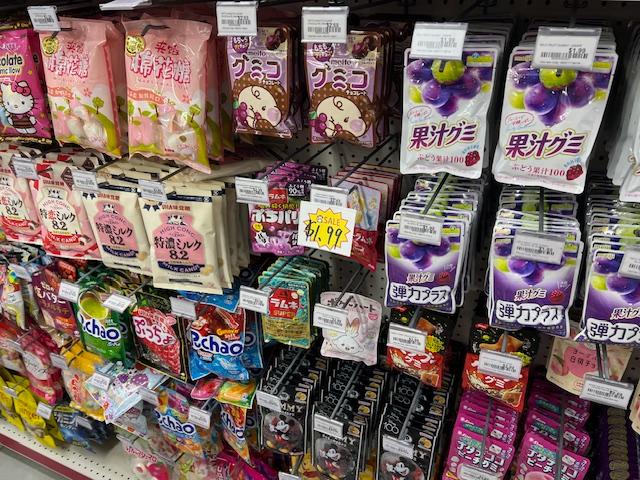
Don’t underestimate the quality and taste of Mrs. Freshley’s products. I pack them for my journeys around Manhattan for my walking project. It brings back that taste of childhood during recess, for a bag lunch dessert or coming home after school. Even as an adult, I love snack cakes.
When I roam the aisles of the Dollar Tree, I am always looking for snack foods to bring to work with me to save on the ever rising prices at the vending machines. A snack cake can cost now $1.50 for one piece. When you have a craving for something sweet, you need to bring it from home.
This is when recently, I came across Mrs. Freshley’s Swiss Rolls on the shelve. A box of eight twin packs is a $1.00 instead of the Hostess brands that will run between $3.50 to $4.00 a box. The quality and taste are very similar.
I have only had the Swiss Rolls, which is a thinly rolled chocolate sponge cake with a sweet creamy filling. These light desserts are then dipped in…
Having been to many food shows over the last few years, I have come across so many new food items that are not seen in the larger supermarkets. You see those niche products that end up either at fancy gourmet stores, specialty grocery stores or you might see at select Whole Foods. Packaging and pricing will depend on what grocery shelves they end up on.
It is nice to see so many vendors that are American made and some made locally in the Tri-State area. Some are priced for the high end, but others are reasonable and will hopefully be found in many outlets.
This site was actually inspired from a trip to my local Dollar Tree. People really underestimate this store. Our local branch in Lodi, NJ is an amazing store. Not only does it have ample parking, always clean, well merchandised and well stocked but has the most diverse selection of smaller food vendors and American made products in their frozen food and grocery sections.
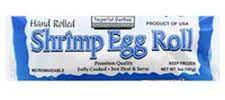
Imperial Garden Egg Rolls
The Dollar Tree buys from vendors that sell in smaller qualities or package their products differently so that it caters to single customer. You won’t find the big box items or a lot of the name brand products here unless they are packaged dissimilarly with smaller portion sizes.
These smaller manufacturers produce a quality item that competes on a lesser scale with the bigger names and since their production levels are smaller, their retail base is not as extensive as the name brands like Coke or Kellogg’s.
Having found products like Mrs. Freshley’s Snack Cakes and Imperial Garden Egg Rolls, I have enjoyed the taste of new companies making their way into the large grocery industry. I will share with you all the grocery items that you will want to add to your grocery list in the future.
Mrs. Freshley’s Snack Cakes
I will also feature all American made brands to support our manufacturing base in this country. This way we know not only are we supporting products made here in the United States but connecting with local channels of distribution that need support.
The Garment District is an unusual neighborhood. It is a mixture of manufacturing, tourism from all the hotels that have opened in the last twenty years and office lofts of former manufacturing and showrooms. The Advertising, Marketing and Tech companies that are now quiet due to the pandemic. During the weekends, it is especially quiet in the area due to the lack of tourists after the holiday season. The most amount of people on a warmish day are concentrated around Bryant Park.
It has also been so cold lately that it has been no fun walking around Manhattan. When you have those rare days when there is no wind and it is around 40 to 50 degrees it makes it bearable. I am not much of a winter person but it is only two more months. The weather finally broke one afternoon and I was able to start the lower part of the neighborhood on a 45-degree day that was sunny with no wind. It made for nice walking weather.
I started my walk on a late sunny afternoon. I had tickets for a movie at the MoMA that evening and wanted to walk a few blocks before I left for the museum. I now understand what pandemic has done for small businesses all over Manhattan. It is getting spooky how the domino effect of closed offices has had on restaurants and shops not just in this area of the City. There were so many empty store fronts and, in some cases, open restaurants with staff sitting around on their cellphones. It reminded me of Chinatown in March of 2020.
Walking West 35th Street was like seeing where magic is created as most of the buildings are the backs of hotels and current and former department stores. On the corner of Eighth Avenue and West 35th Street is the most unglamorous part of the Hotel New Yorker with the loading dock and the employee entrance, the loading docks of Macy’s that stretch from Seventh Avenue to Broadway and the loading docks of the former Ohrbach’s department store that are now part of the office building that stretch from Broadway to Fifth Avenue. There are lots of delivery trucks going back and forth.
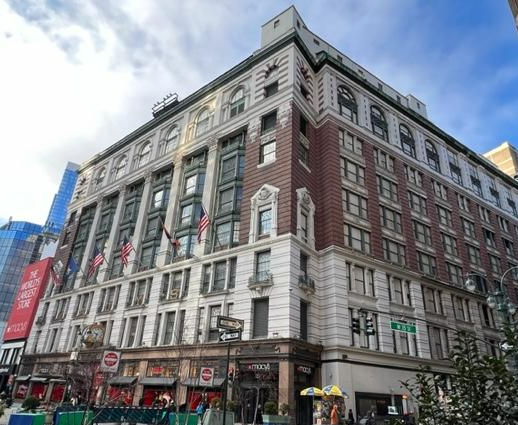
Macy’s facing Broadway and West 35th Street and Herald Square ay 151 West 34th Street hides it loading dock.
Here and there small hotels have been created in the spaces between the office buildings and these have changed the character and the foot traffic of the neighborhood. They have brought some life to a quiet block. What impressed me was that there are still a lot of fabric and clothing wholesalers left in the neighborhood. Between rezoning and the pandemic, so many of the fabric, button and zipper businesses have closed their doors.
What stands out is the restaurants that dot the street. There are so many reasonable restaurants that are surviving on the garment and the office workers that are still in the area and the shoppers at Macy’s. Some are also really popular on TripAdvisor and Yelp so that helps them as well.
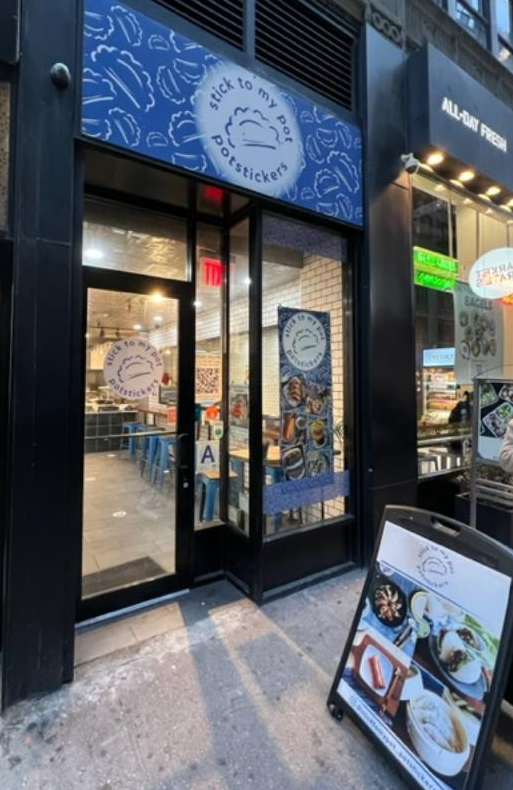
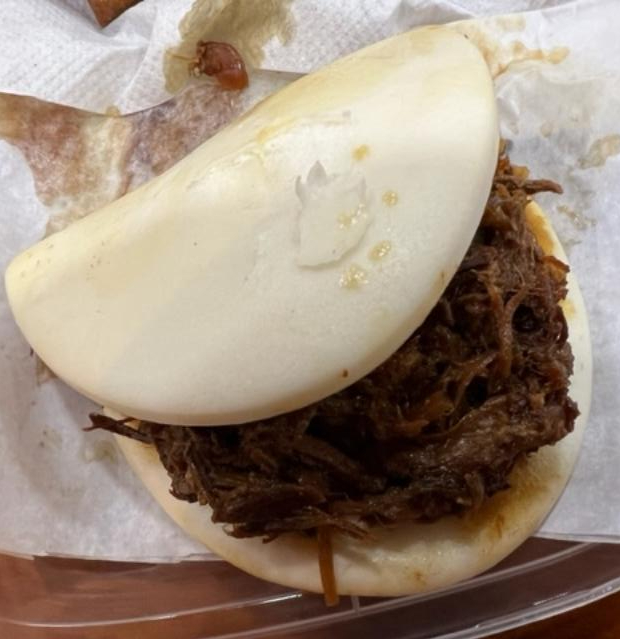
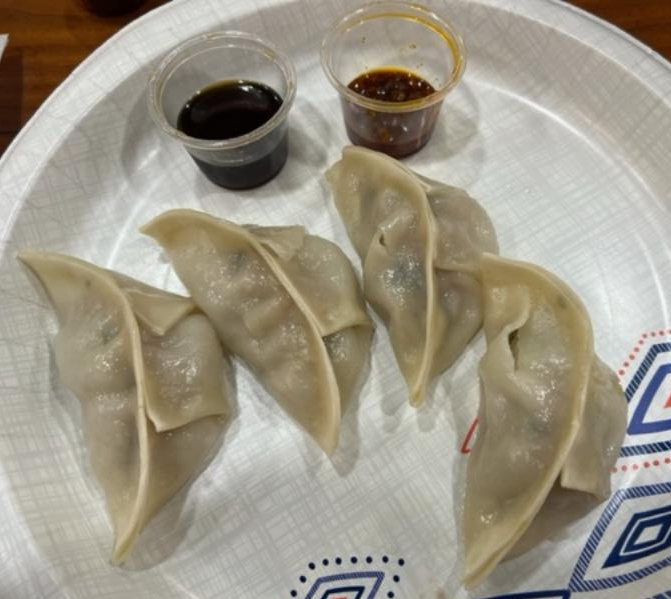
Stick to My Pot Potstickers at 224 West 35th Street has been catering to both the garment and office workers since it opened two years ago. I love coming here for reasonable meals and snacks when I am in the area. The Fried Pork and Chive dumplings and the Roast Pork Bao Buns are just excellent (see my reviews on TripAdvisor and DiningonaShoeStringinNYC@Wordpress.com).
Stick to my Pot Potstickers is at 224 West 35th Street
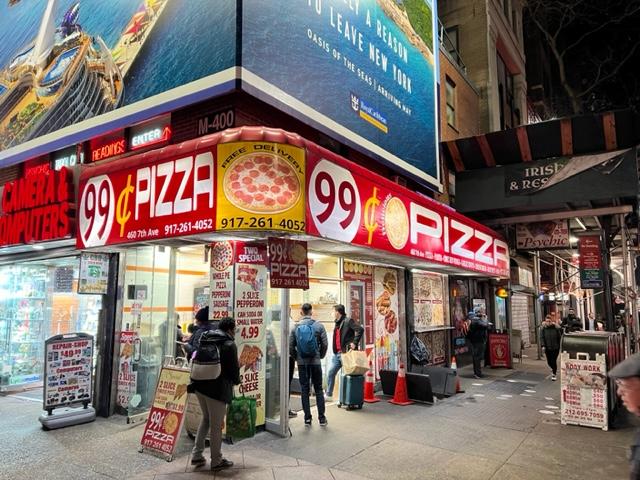
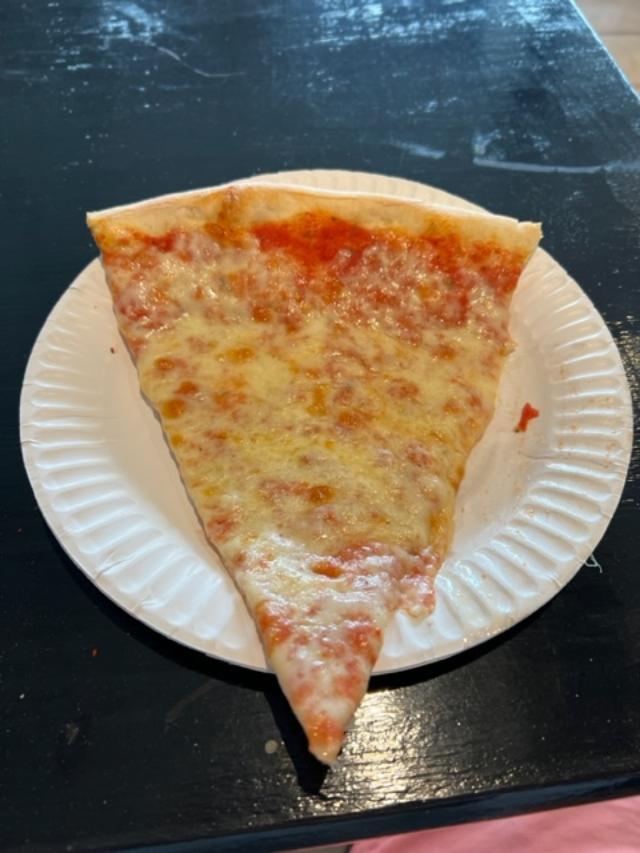
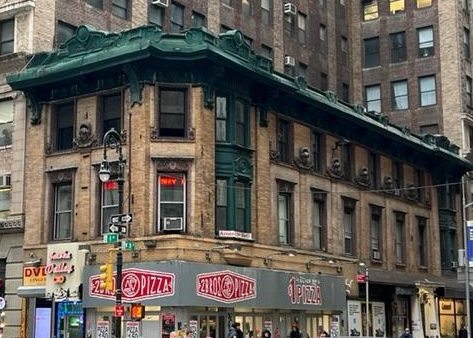
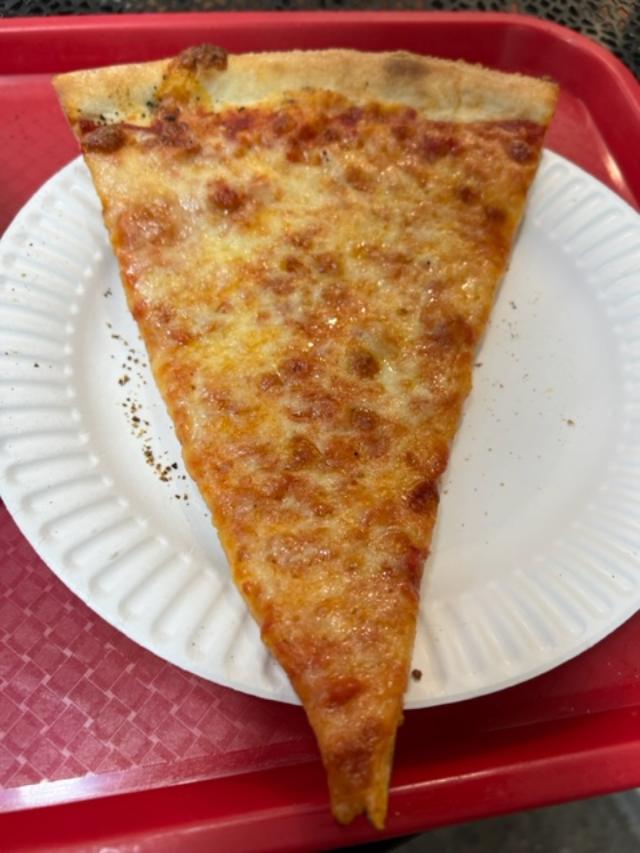
A few doors down another reasonable take-out place just opened 99 Cent Delicious Pizza at 460 Seventh Avenue. They have the most amazing cheese pizza at $1.00 a slice.
99cent Pizza at 460 Seventh Avenue has been popular since it opened (it is also now $1.50)
The pizza is now $1.50 in 2026 but still delicious and always fresh
I cannot believe how popular this place has become with both the tourists and local office workers.
99 Cent Delicious Pizza makes an excellent slice
Crossing the street, you will see how the innerworkings of Macy’s loading docks with the street loaded with trucks unloading all sorts of treasures that will be on display in the store in the coming days.
Herald Square was busy the afternoon I was there with shoppers and tourists relaxing on the chairs in the plaza outside the store and in the park. The park has dramatically improved since I worked at Macy’s. When I worked at Macy’s in the early 1990’s, Herald and Greeley Squares were places to avoid until about 1994 when the parks were renovated and new plantings and French metal café tables were added. Now it is hard at lunch time to find a table.
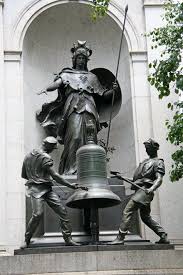
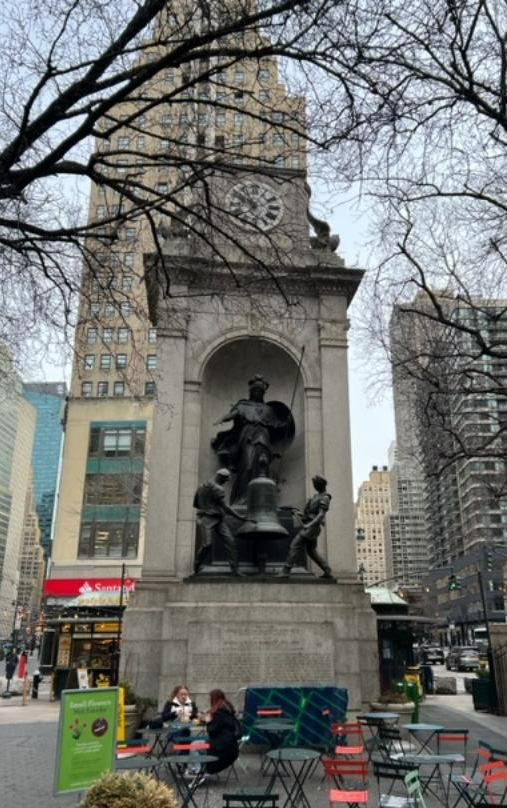
In the process of the renovations, the City also restored the statues dedicated to James Gordon Bennett and Horace Greeley.
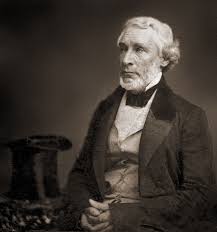
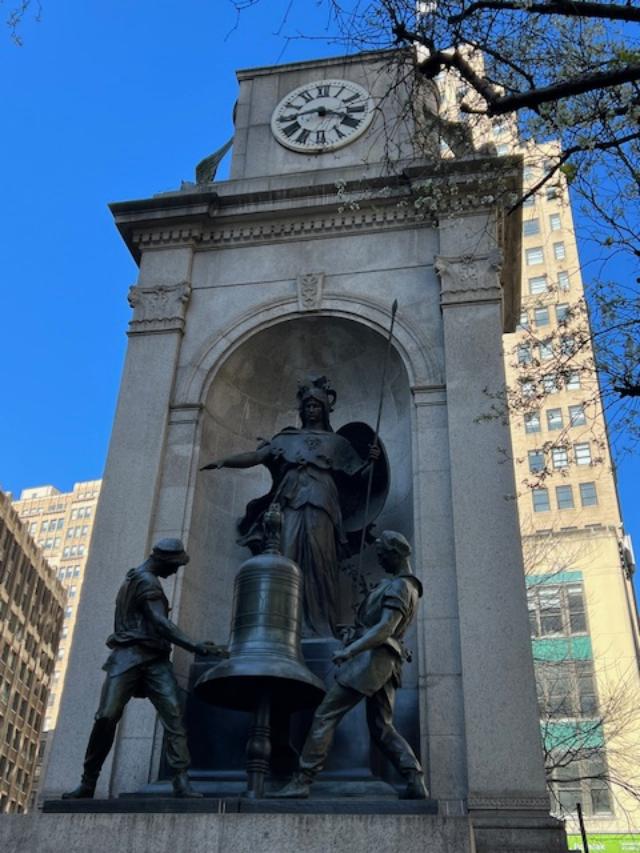
The statue dedicated to James Gordon Bennett and his son James Gordon Bennett II
Herald Square Park during lunch
The statue is to Minerva, the Goddess of Wisdom and Invention and two blacksmiths who flank a bell that once topped the Herald Building where the New York Herald, which was founded by James Gordon Bennett in 1835. The statue was dedicated in the park in 1895 (NYCParks.org).
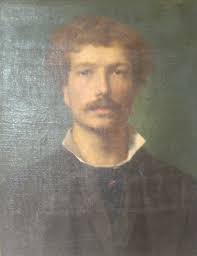
Antonin Jean Carles was born in France and was a student of the Ecole des Beaux-Arts de Toulouse. He was known for his monument sculptures.
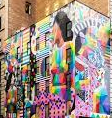
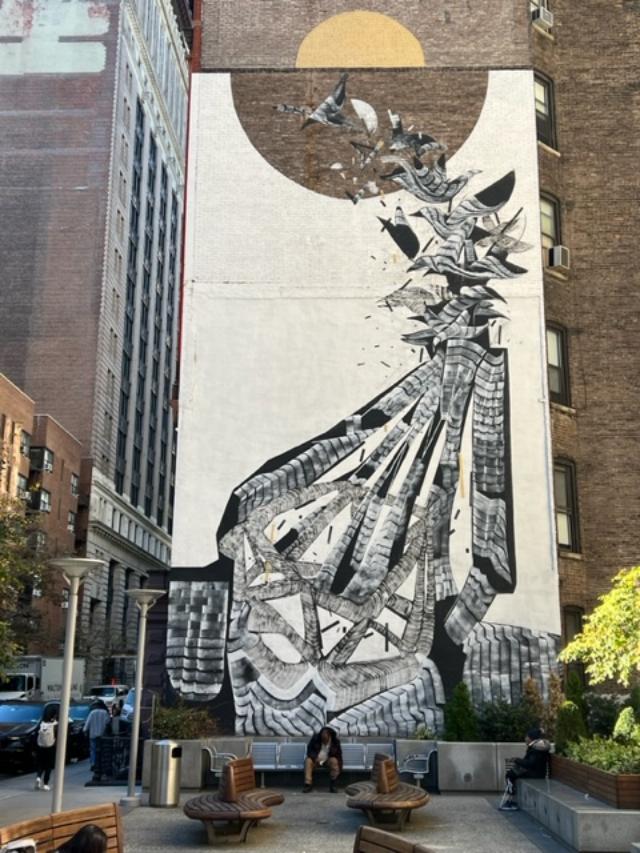
Across the park is an impressive mural at the corner of West 35th Street and Sixth Avenue on a building that once housed the Desigual flagship store. The work is by Spanish artist Okuda San Miguel and entitled “Multicultural Freedom Statue” and was created in 2019. It is a tribute to multiculturalism in New York City (Artist Bio). The store has since closed.
The painting at Sixth Avenue at West 35th Street by artist Okuda San Miguel (now painted over in 2023)
Artist Okuda San Miguel was born in Spain and known for his colorful geometric styles in painting. He graduated from the Complutense University of Madrid with a BFA and has shown his work all over the world (Wiki).
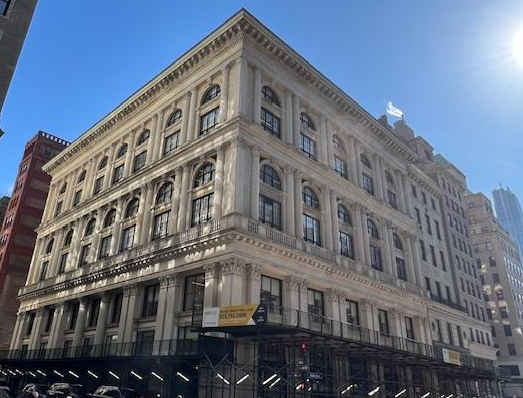
The rest of the block is the northern most edge of Koreatown and has some interesting restaurants that have been here for over thirty years. In between the restaurants there are more small hotels that have been part of the neighborhood for years. Then you reach the border of the neighborhood at Fifth Avenue and you are facing the formerly grand B. Altman & Company on the corner of Fifth Avenue and East 35th Street.
The B. Altman Building at 361 Fifth Avenue was built by Benjamin Altman for the new location for his ‘carriage trade’ store. The store was designed by architects Trowbridge & Livingston in the “Italian Renaissance Style” in 1906. The palatial store was home to couture clothing, fine furniture and expensive art work.
The former B. Altman Department Store at 361 Fifth Avenue
I walked back down West 35th Street towards Ninth Avenue and the only really section of the street that was busy was in front of the Midtown Precinct South. It was going through their shift change in the afternoon. I rounded the corner and made my way down West 36th Street. Again as I was walking down the street it amazed me to see so many clothing and fabric businesses still in business. Here and there are traces of the old neighborhood mixing into what is developing since the rezoning.
West 36th Street is again a mix of the old and the new. Loft office buildings mix in with the new smaller hotels that line the street which surprisingly are all open. On a recent trip down Lexington Avenue in Midtown East, many of the larger grand hotels that line the avenue are still closed but these smaller commuter hotels are still filled with tourists and industry people. It is showing the resilience of the area.
Architecture wise, it is extremely bland with mostly buildings from the post WWII era that catered to the growing Garment industry. There are some conversions to new hotels and office buildings and some residential as well. Still there are some surprises along the walk.
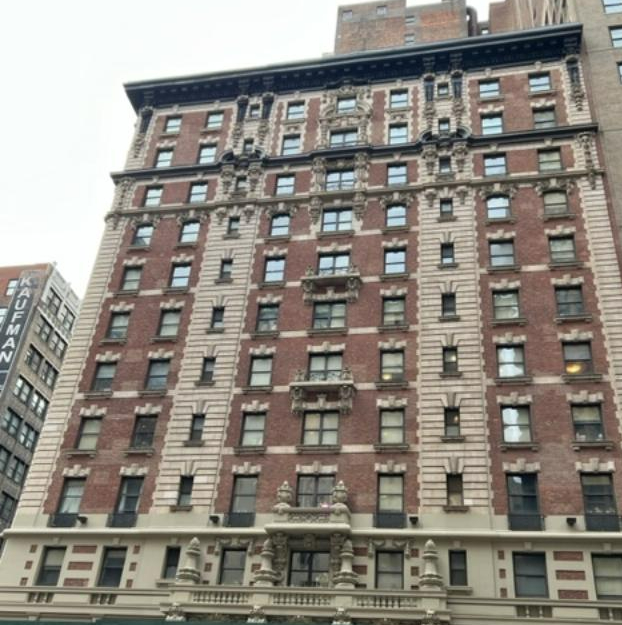
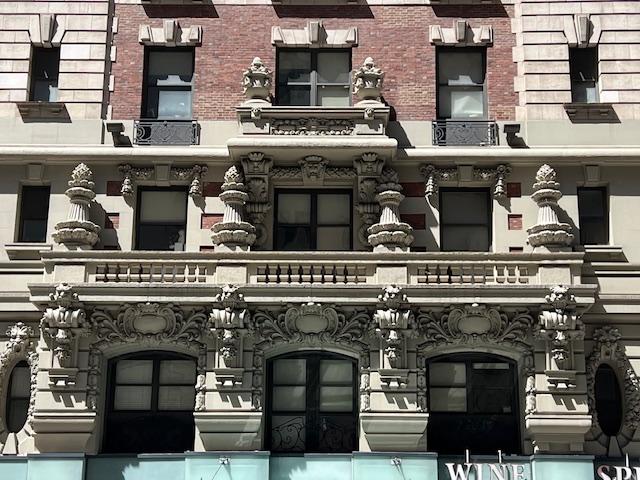
488 Seventh Avenue was built as the Hotel York in 1903 by brothers James and David Todd, who had an interest in building luxury hotels. They commissioned architect Harry B. Mulliken, who had designed the Hotel Aberdeen on West 32nd Street for the brothers, with his new partner, Edger J. Moeller, who formed the firm of Mulliken & Moeller. The York Hotel was their first commission together. The hotel was designed in the Beaux-Arts style with elaborate carved decorations (Daytonian in Manhattan).
The Hotel York was a residential and transient for most of its existence attracting the theater crowd when 34th Street was the Theater District of the time. As this moved uptown, the hotel was bought in 1986 and was renovated for residential and commercial use (Daytonian in Manhattan). The Tokian Group now owns the building and it is luxury apartments.
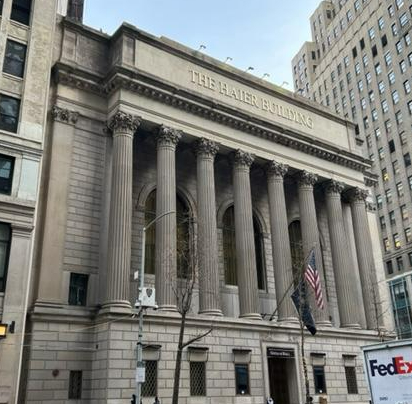
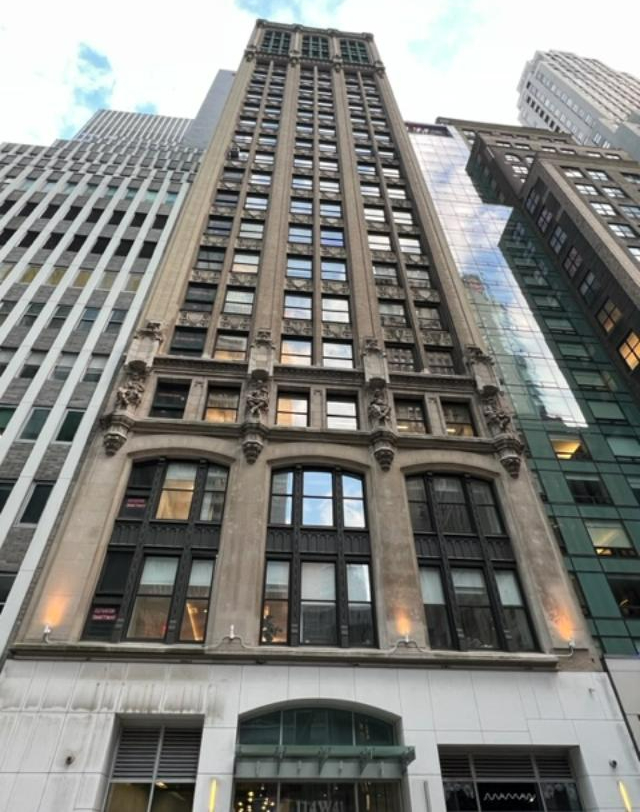
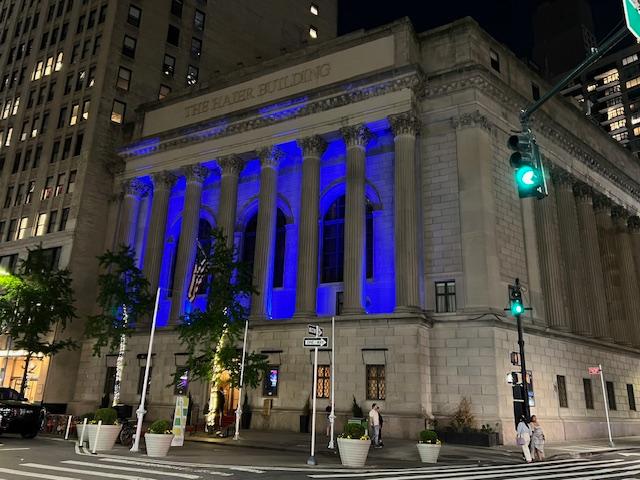
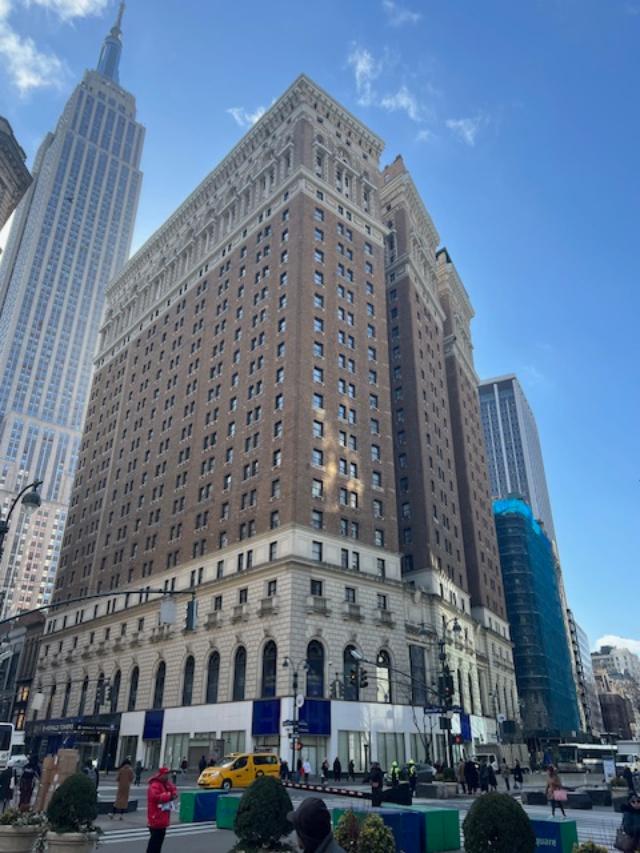
Walking towards Broadway most of the buildings are relatively new but one does stand out that being the Haier Building at 1356 Broadway. The Haier Building was built by architects from York & Sawyer in the Neo-Classical Revival style. The building was completed in 1924 and was the headquarters for Greenwich Savings Bank. The building is built with limestone and polished granite and features Roman Corinthian Columns (Wiki).
1352 Broadway-The Haier Building (Former Greenwich Savings Bank-Wiki)
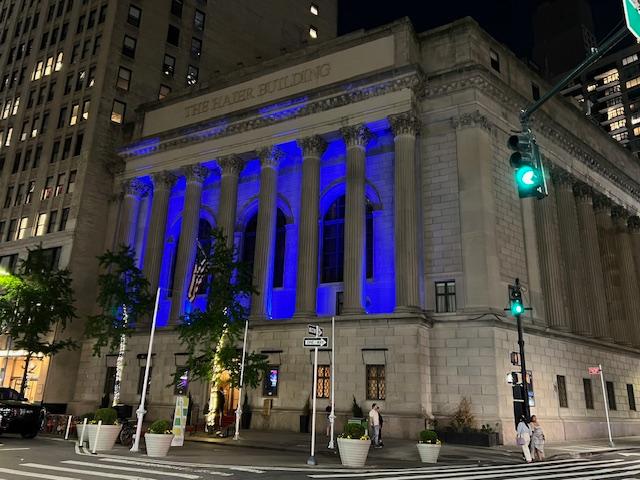
The Haier Building is especially beautiful at night.
The Haier Building stretches from Broadway to Sixth Avenue and is impressive on both sides of the building. The building was used by Greenwich Savings Bank from 1924 until 1981 when the bank went out of business (Wiki).
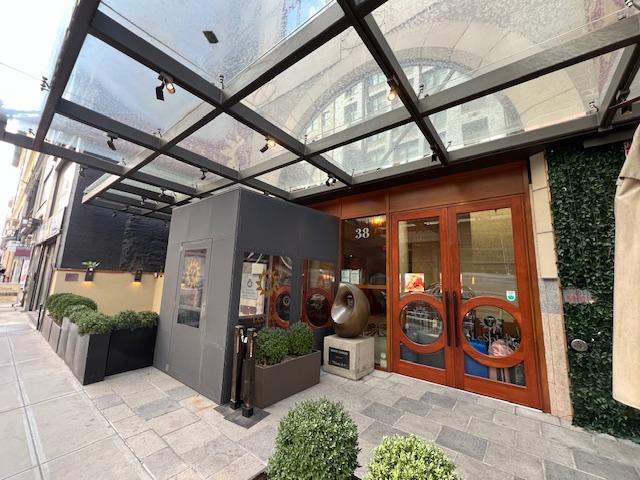
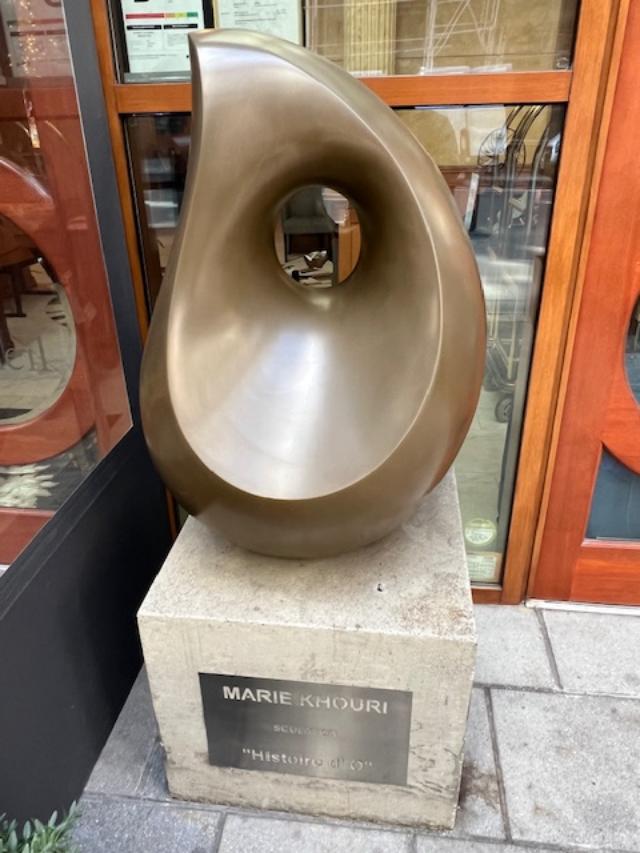
In front of the Executive Hotel Le Soleil New York at 38 West 36th Street, there is an interesting sculpture on the front terrace by artist Marie Khouri that looks like a tear drop. The sculpture. “Histoire d’O”, was created in 2016 and there are many different versions of it all over the world, this one prominently sitting in front of the hotel. Its beauty is in its curvature.
The Executive Hotel Le Soleil New York at 38 West 36th Street
Artist Marie Khouri was born in Egypt and raised in Lebanon and through a series of moves around the world is now based in Vancouver. She was classically trained in sculpture at L’Ecole du Louvre in Paris and has developed a vast range of cultural and historical influences within her practice. Her sculptures blend and extend metaphors of language, form and the body to propose an inextricable link to a life deeply affected by the complex history of the Middle East (Artist’s Bio).
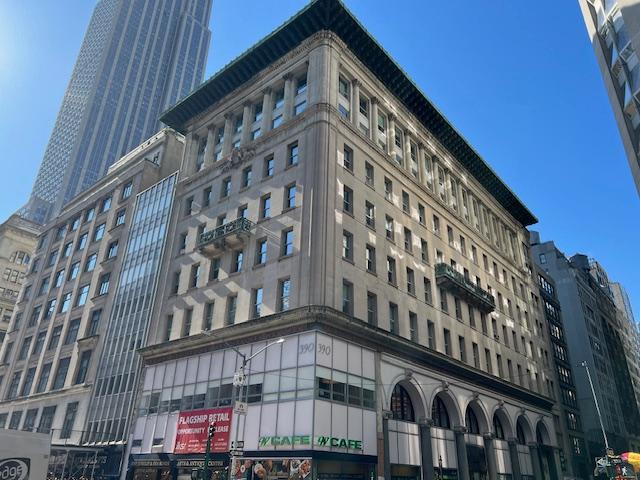
When I reached the edge of West 36th Street, at the corner of Fifth Avenue and West 36th Street is 390 Fifth Avenue that was designed by the architectural firm of McKim, Mead & White for the Gorham Manufacturing Company of fine silver products in 1903. It was designed in the “Italian Renaissance Style” and was used for manufacturing and their showroom. It later became Russeks Department store and has now found other uses.
390 Fifth Avenue-The Gorham Manufacturing Building
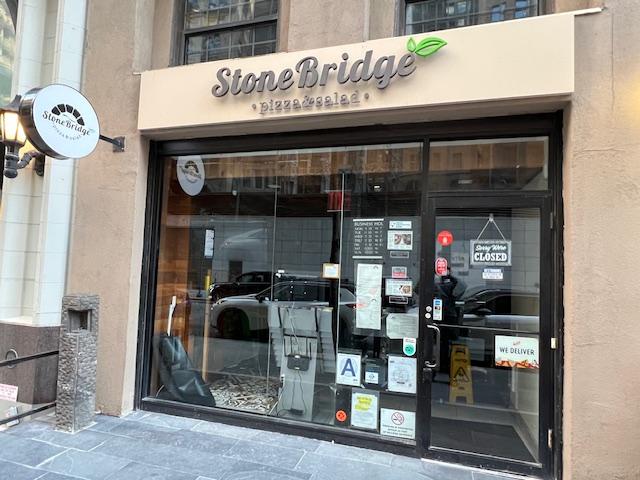
It was getting dark when I arrived back at Ninth Avenue and I decided to call it a night. Before I left for the MoMA to see my film, I went to Stone Bridge Pizza at 16 East 41st Street for dinner. I have to say that their personal Cheese Pizza ($10.95) is excellent and very simple. The sauce is fresh tomatoes, garlic and olive oil topped with fresh mozzarella and baked until crisp (See review on TripAdvisor). With an unlimited soda fountain dispenser of Boylan’s sodas, it makes for the perfect meal on a cool night.
Stone Bridge Pizza & Salad at 16 East 41st Street (now closed 2022)
I made a second trip into Manhattan that Saturday. My plan was to walk the rest of the neighborhood, then go to the Met for the afternoon to see the Surrealist exhibition and then visit a few of the stores and restaurants that the internet had said had closed.
Walking the Garment District took longer than I thought walking back and forth between West 37th to West 41st Streets from Ninth to Fifth Avenues. It did not help that it was 28 degrees outside. Still, it was sunny with no wind and I found the crisp winter day the perfect time to walk the empty streets of the Garment District.
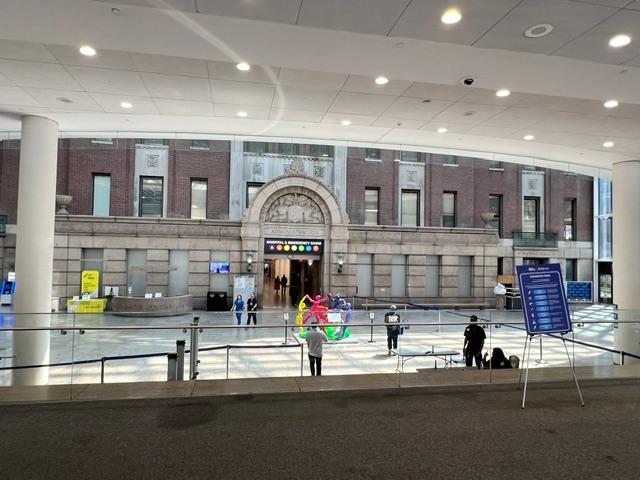
While buying my ticket for the return trip home, I passed a sculpture of passengers getting on a bus that before I had never given a second thought to and took a moment to look it over. It is the sculpture “The Commuters” by artist George Segal.
It really does depict what it is like to wait for a bus at the Port Authority after a long day at work. You are exhausted and worn out from work and then have to wait in a long line of other tired people while traffic backs up in the Lincoln Tunnel to leave Manhattan. The sculpture is true to form.
“The Commuters” by Artist George Segal (Wiki) in the Port Authority Bus Terminal
George Segal is an American born Native New Yorker who was raised in New Jersey and lived his whole life. He attended the Pratt Institute, Cooper-Union and graduated with a degree in teaching from New York University. Known mostly for being a painter, the artist gained fame with his realistic sculptures. “The Commuters” was installed in 1982 (Wiki).
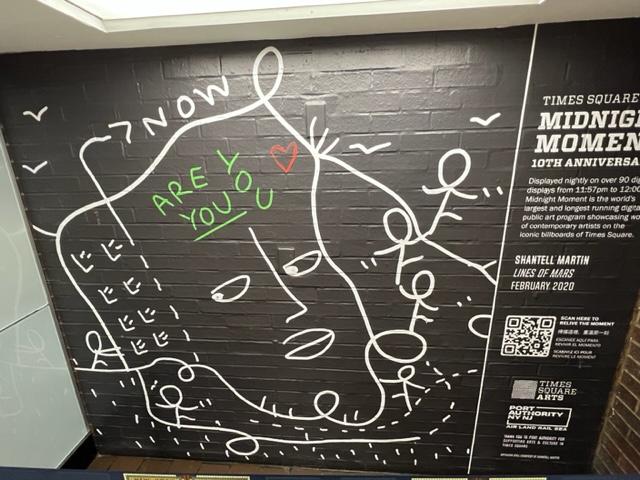
Artist Shantell Martin is a British born artist now working out of Los Angeles, CA. She holds a BA from Central St. Martins, University of Arts out of London. She is best known for her art that explores themes like intersectionality, identity, and play (Artist Bio).
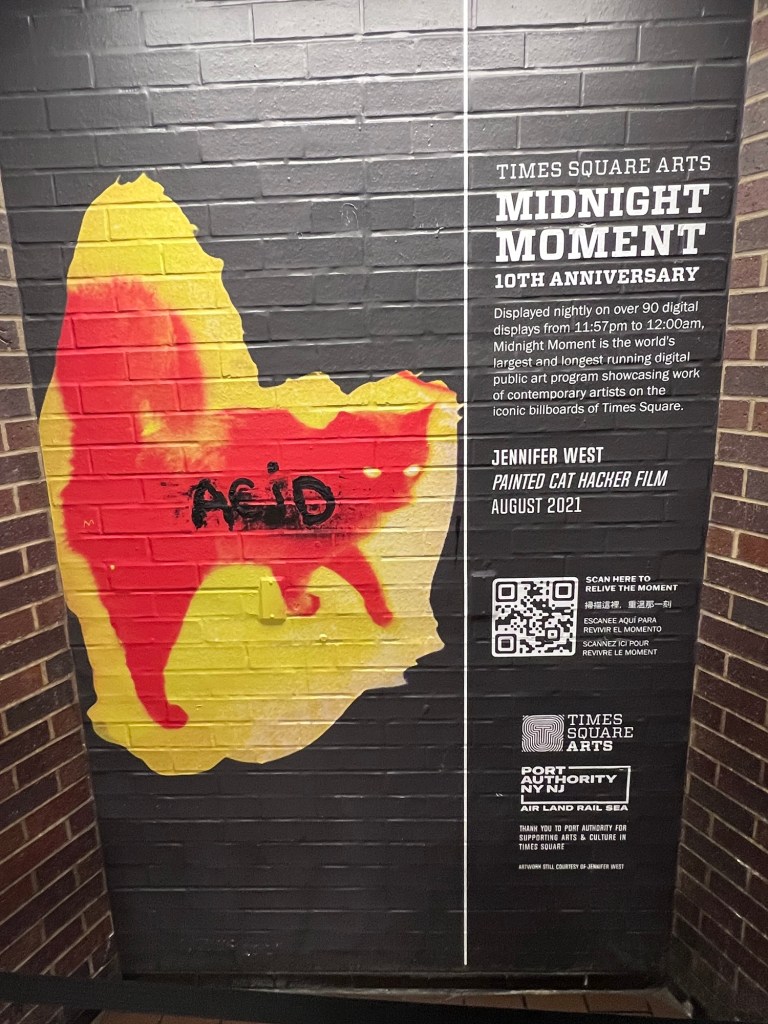
Artist Jennifer West is a American born artist who works in California. She had a BA from Evergreen State College and a MFA from Art Center in California. Her works in film, installation, sculpture, film quilts, photo, performance and artist books are based in the archaeology of media, memory, place and recuperation (Artist bio).
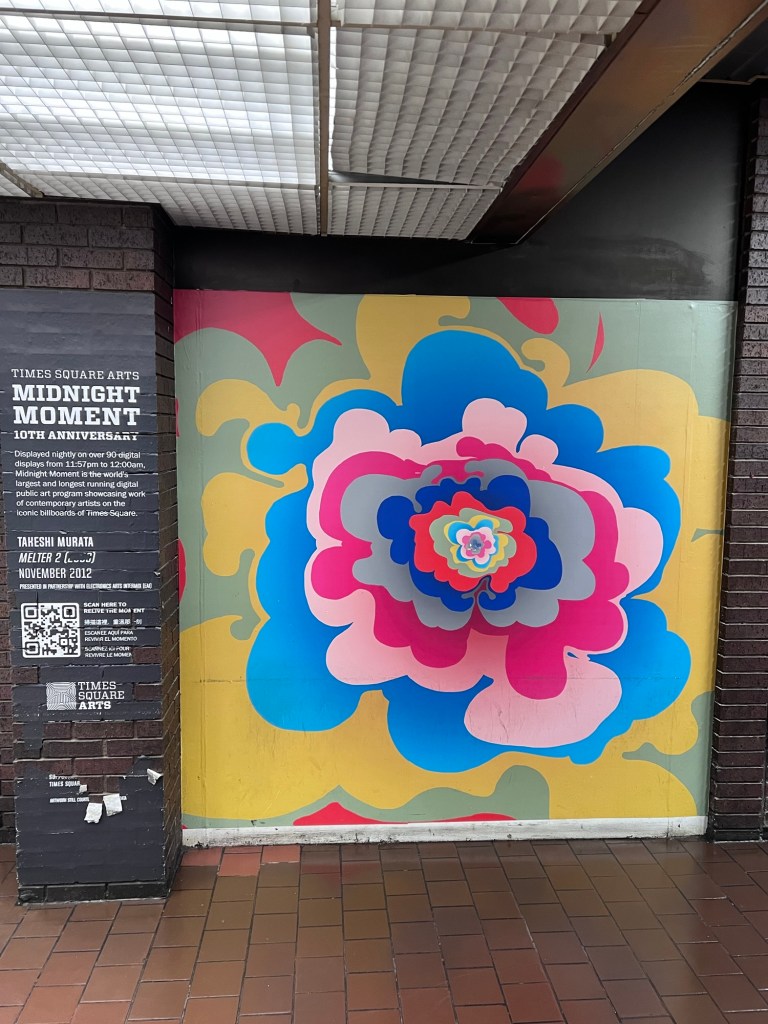
Artist Takeshi Murata is an American born artist. The artist graduated from the Rhode Island School of Design in 1997 with a B.F.A. in Film/Video/Animation. He is an American contemporary artist who creates digital media artworks using video and computer animation techniques (Artist bio).
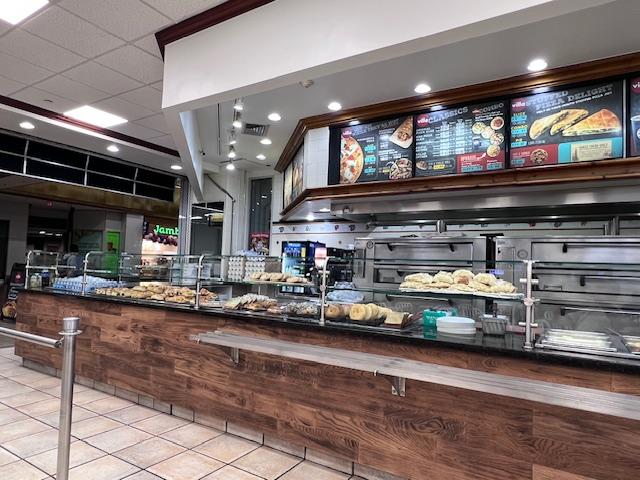
One morning before I left for my walk around the area and to Coney Island for the afternoon, I stopped at Villa Pizza on the main level of the Port Authority for breakfast.
Villa Italian Kitchen in the Port Authority first floor wing at 625 8th Avenue
I know that they served breakfast and I passed by here many times and never stopped. I had a slice of pizza here once years ago and it was good but I had not eaten here in over a decade. I needed a quick breakfast and stopped in for one of their breakfast strombolis.
The inside of the line of breakfast and lunch items. Scrambled eggs next to Spaghetti
The combination of breakfast and lunch items
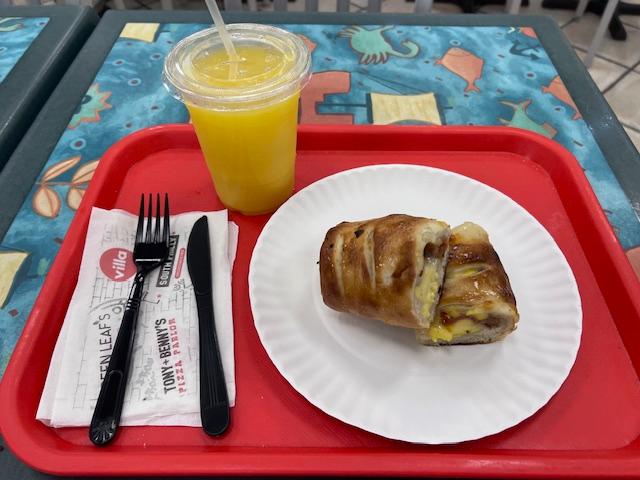
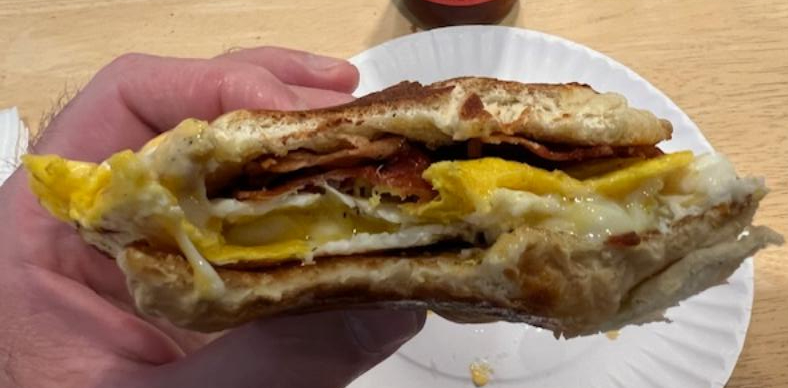
The Breakfast Stromboli’s were pretty good. They were made of pizza dough and had a combination of bacon, scrambled eggs and cheese inside and then baked golden brown. It made a nice breakfast. It just seemed strange eating breakfast in the Port Authority.
The delicious Breakfast Stromboli’s
My Bacon, Egg and Cheese Stromboli that morning
Yum!
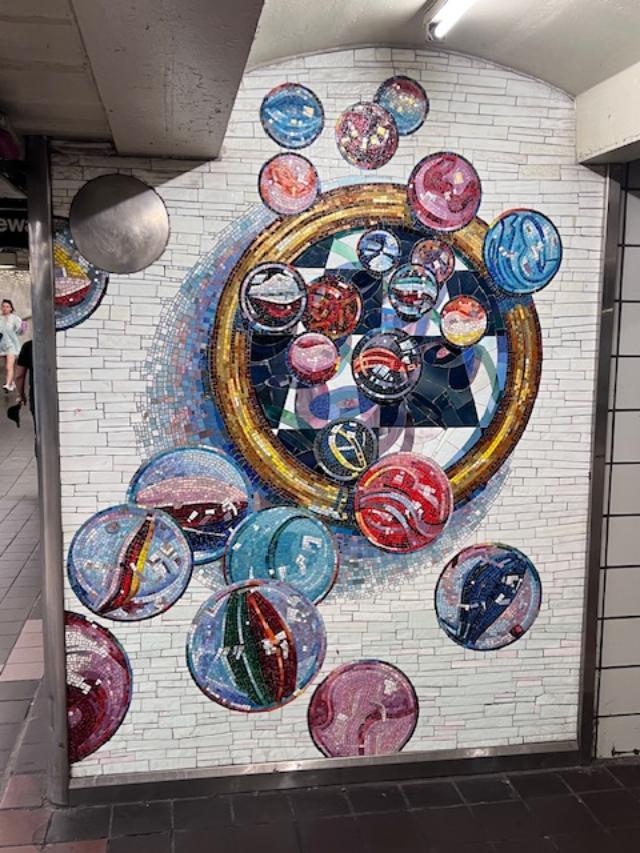
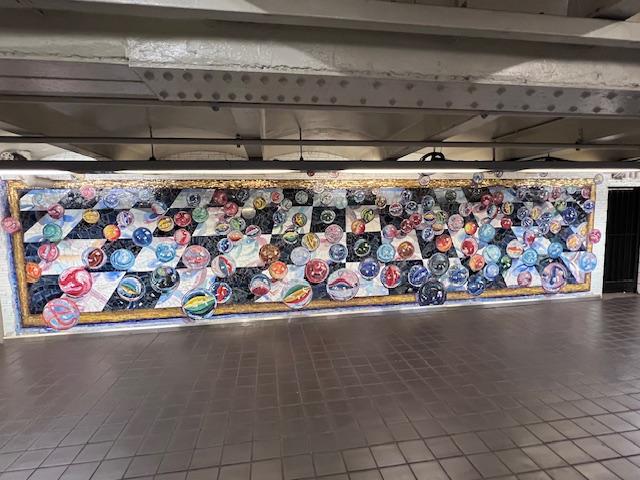
On the way down to Coney Island after breakfast, I noticed this piece of art that sits just outside the entrance to the subway in the Port Authority by Artist Lisa Dinhofer “Losing My Marbles”, which I had passed dozens of times but never really stopped to look at closely.
The sign for artist Lisa Dinhofer’s Losing My Marbles
Artist Lisa Dinhofer is an American born artist whose background is in painting, draftswomanship, and printmaking. She earned her BA with honors from Brandeis University and an MFA from the University of Pennsylvania (Artist bio).
“Losing my Marbles” located at the entrance to the subway at West 42nd Street
“Losing my Marbles” in the subway station at West 42nd Street
To see this magnificent piece of art in the Garment District, you have to travel by subway so try not to miss it at the entrance.
This piece of art spreads all around the entrance to the subway from the Port Authority
I rewalked West 36th Street to be sure that I had not missed anything as the other day it started to get dark early, and I rushed walking the street. I thought the side streets of the Garment District were quiet during the week. Try walking in the neighborhood on a weekend day when most of the businesses are closed. Most of the streets with the exception of around Herald Square and Bryant Park were desolate. I saw mostly bored shop keepers in the fabric stores and empty hotel lobbies.
One piece of art I missed on my first part of the walk down West 36th Street was just outside Vito’s Pizzeria at 464 Ninth Avenue. Just around the corner is an interesting painting on the wall on the side of the business by artist Chem Dogg Millionaire. The creative geometrics on the mural brighten up the side of the building.
Painting by artist Chem Dogg Millionaire (no bio on artist)
It was so quiet when I walked down West 37th Street from Ninth Avenue. The cold was keeping people inside but there were still the adventurous ones walking their dogs and just wanting some fresh air.
I passed M & T Pretzels at 349 West 37th Street which distributes vending and concession products all over the City and you can see all their carts that are the fabric of the food service industry. Their pretzels are a New York institution.
West 37th Street in not known for its architectural creativity or street art but where it lacks in these it makes up in reasonable places to eat and some great restaurants. The Garment District has some of the best places to eat when you are on a budget.
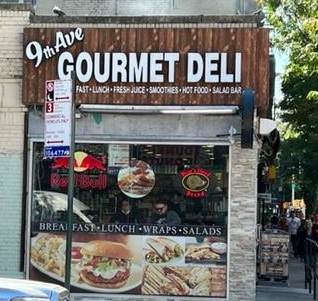
On the corner of Ninth Avenue and West 37th Street is 9th Avenue Deli (the former AM-PM Deli), which I think is one of the best delis in Manhattan. I have stopped by for breakfast, lunch and dinner and the food has always been consistently delicious.
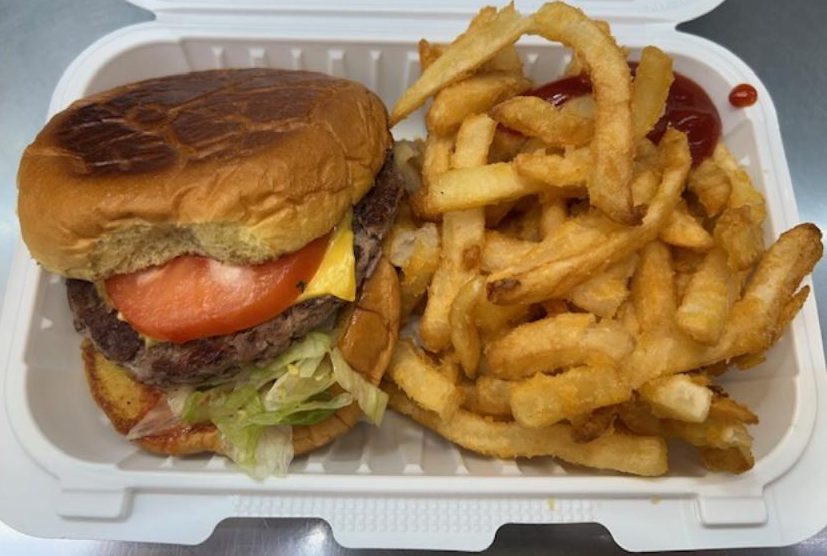
I have mentioned this deli many times on my walks. It is where I have had breakfast to fill up with carbs before my thirteen-mile Broadway walks and have stopped here when walking the “Great Saunter Walk” around the perimeter of the island. Their ‘Meat Lovers” breakfast sandwich with bacon, sausage, and ham with three eggs helps carry me through one side of the island and their bacon cheeseburgers are the best.
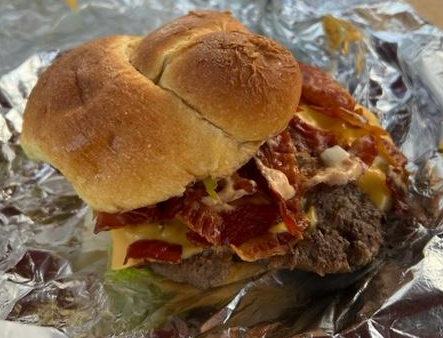
The Cheeseburgers at 9th Avenue Deli are wonderful.
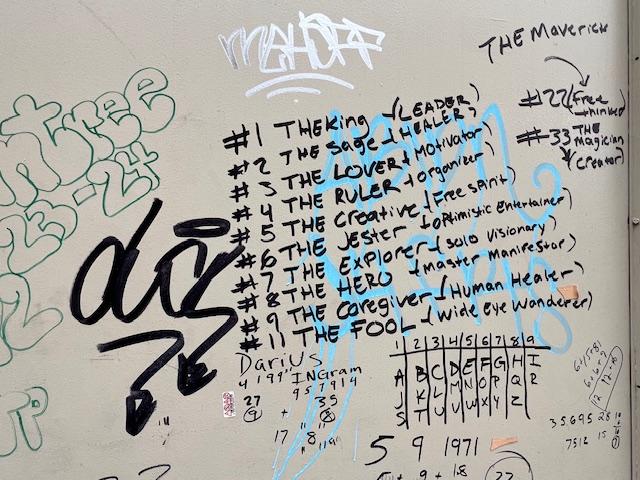
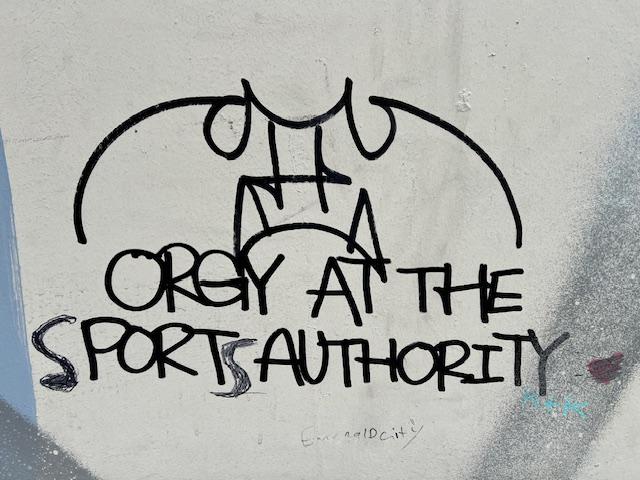
There has been some interesting graffiti work showing up on the walls of this area as well.
This popped up on West 37th Street.
This was right next to it.
Very clever and a nice way to cover it.
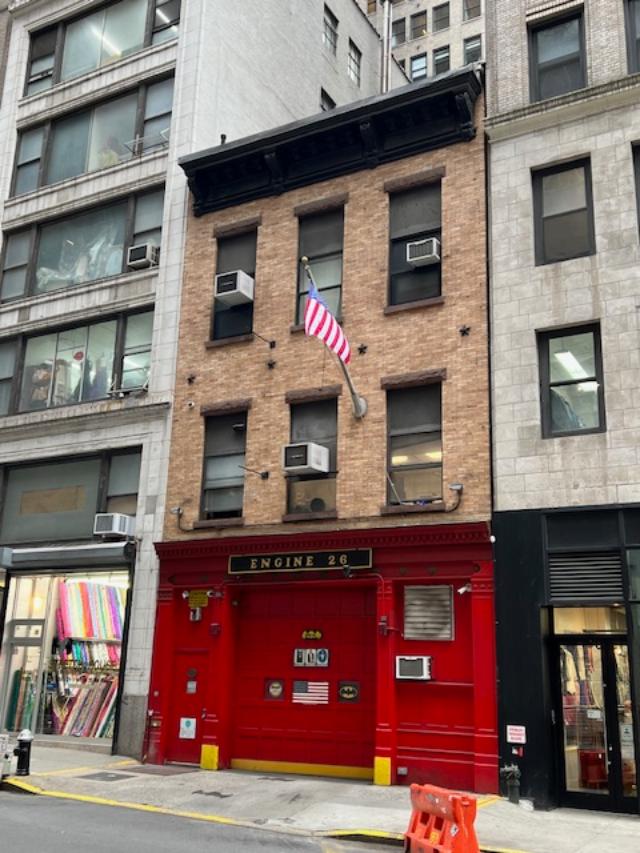
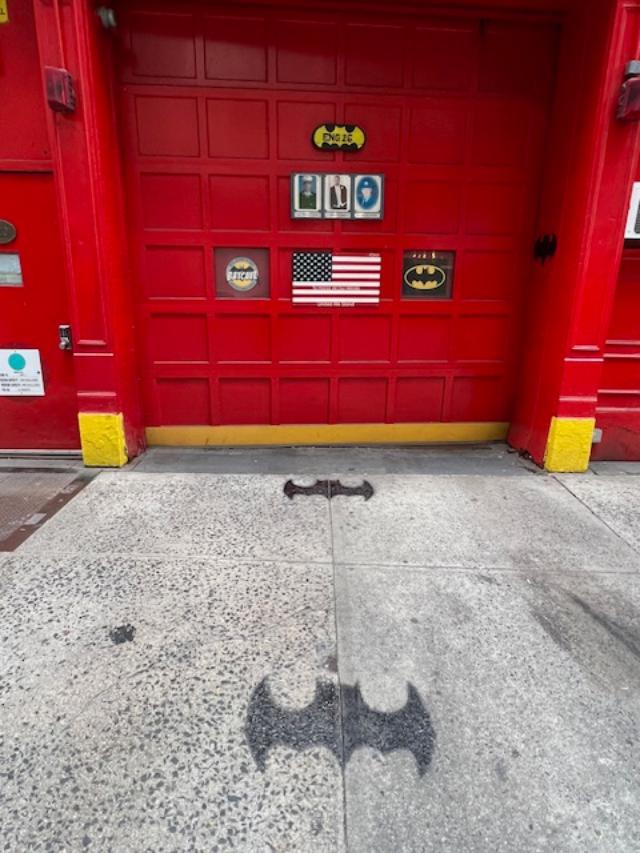
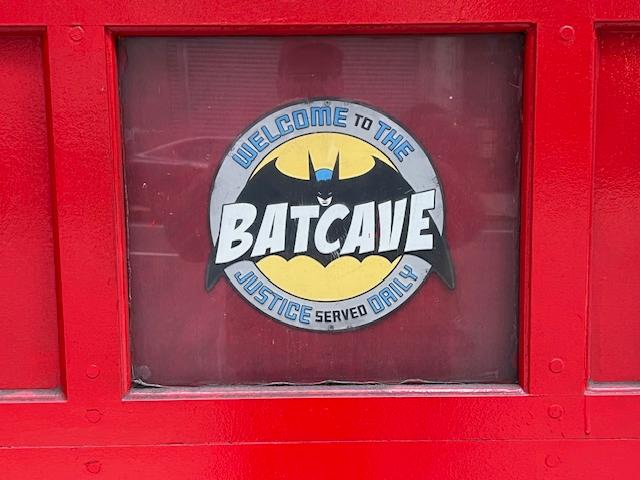
At West 26th Street is the FDNY Firehouse called the “Batcave” which is Engine 26. This firehouse has been active in the system since 1865 and had originally been part of an extensive volunteer network before the FDNY was established. It is the oldest active firehouse in the FDNY system (Foursquare and Manhattan Sideways).
Engine 26 in Midtown “The Batcave” at 222 West 37th Street.
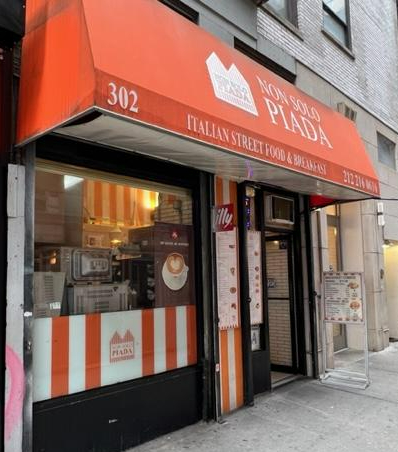
Non Solo Piada at 302 West 37th Street just off Eighth Avenue is another wonderful place to dine. This tiny store front specializes in Roman street food with dishes such as Piadizze, which is a crispy thin pizza with multiple toppings and Cassoni, which is a smaller version of a Calzone, which is filled with cheeses and meats. They have wonderful desserts and when the weather is warmer, they have tables and a counter outside the store and it is nice to eat outside on this quiet block.
Non Solo Piada at 302 West 37th Street off Eighth Avenue (Closed in January 2025)
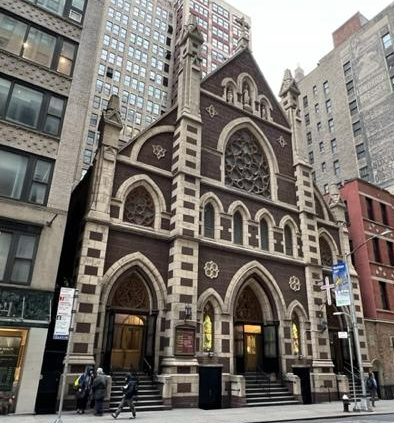
Amongst all the large office buildings and manufacturing companies is a tiny church tucked in the middle of all this commerce. The Shrine and Parish Church of Holy Innocents is at 128 West 37th Street and stands out for its beauty in design and the fact that it was still decorated for Christmas.
The Shrine and Parish of Holy Innocents at 128 West 37th Street
The church was built in 1870 when the area around Herald Square was still rural and the church was designed by architect Patrick C. Keely in the Gothic-Revival style. The fresco inside the church was designed by noted artist Constantino Brumidi, who later painted the rotunda at the U.S. Capital (Wiki).
As the area has changed over the last hundred and fifty years, the congregation has changed with it from the rural farmers then to the tenement dwellers, the theater and hotel crowd and now to office workers and shoppers who dominate the area during the week. The church still has its challenges with the poor but is optimistic in serving the community (Church history).
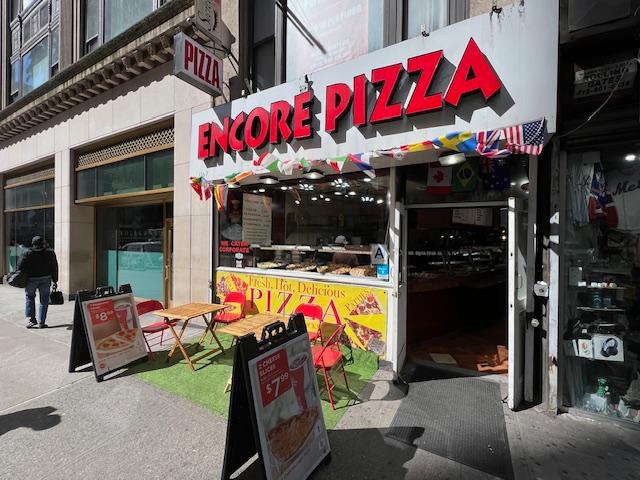
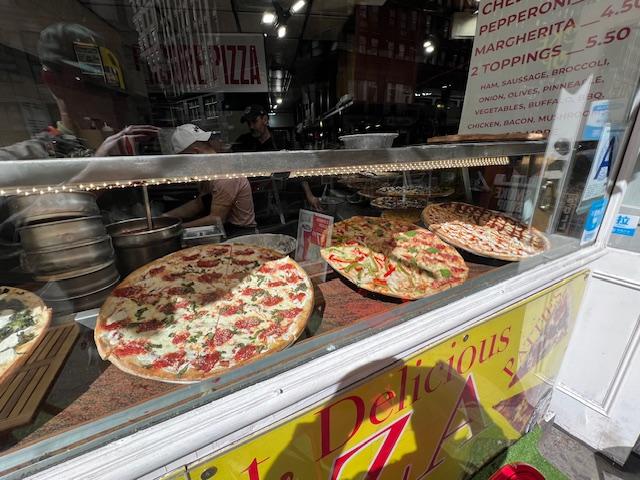
Just off West 37th Street on Broadway is an interesting little pizzeria Encore Pizza at 1369 Broadway. I have eaten here many times on my walk down Broadway and they make a nice pizza.
Encore Pizza at 1369 Broadway (Closed in June 2024-now a Little Italy Pizza)
Try to get there though when a fresh pie comes out of the oven.
Encore Pizza at 1369 Broadway
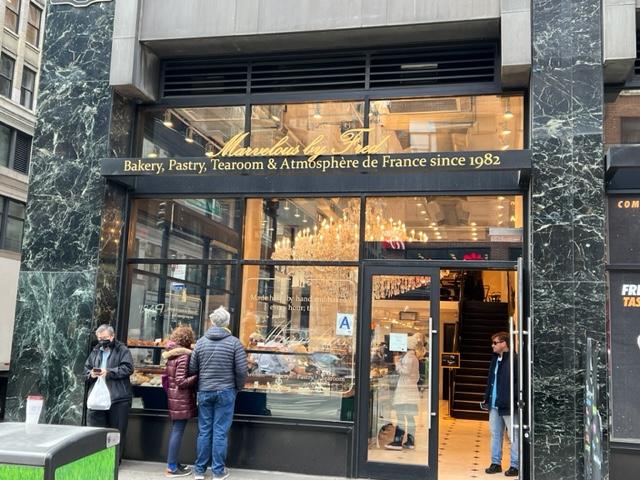
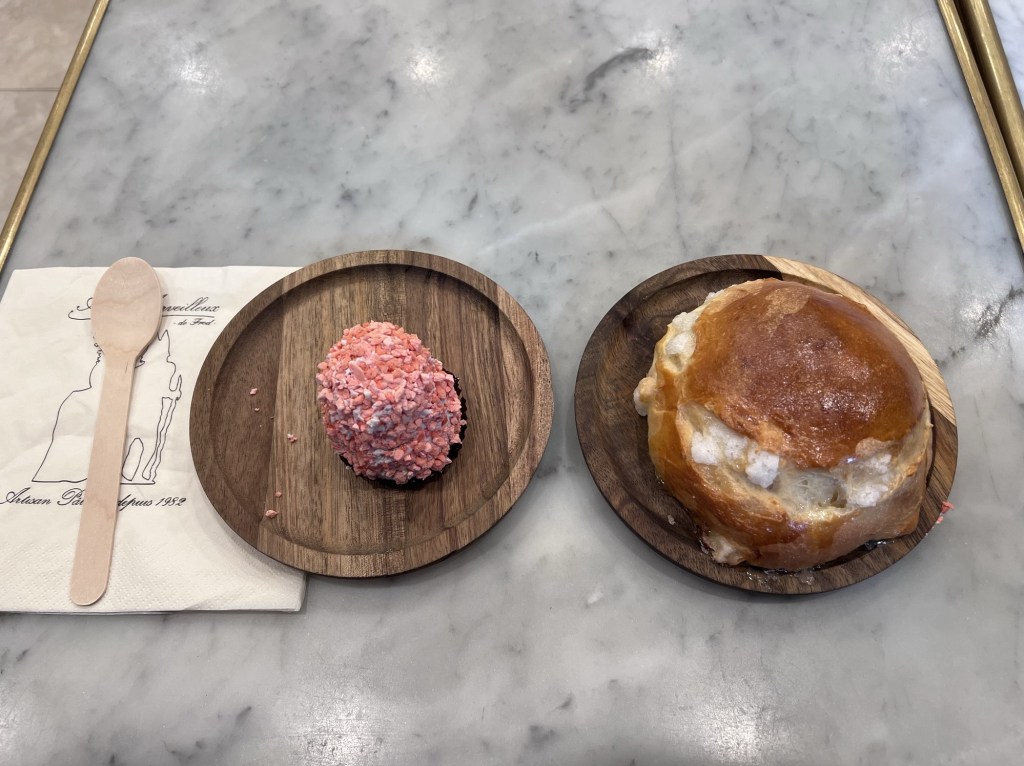
A new and very impressive addition to the neighborhood, Marvelous by Fred (Aux Merveilleux de Fred), opened a gluten free meringue bakery at the corner of Sixth Avenue and West 37th Street at 1001 Sixth Avenue. Not only are the pastries mind-blowingly good but the just watching the bakers prepare them in the open kitchen window make you want to walk inside (especially with how cold it has been).
I have to admit that the bakery is not cheap especially for this section of the City and during COVID but it is a welcome addition in high quality pastries and when you need a guilty pleasure, trust me it is helpful and so enjoyable.
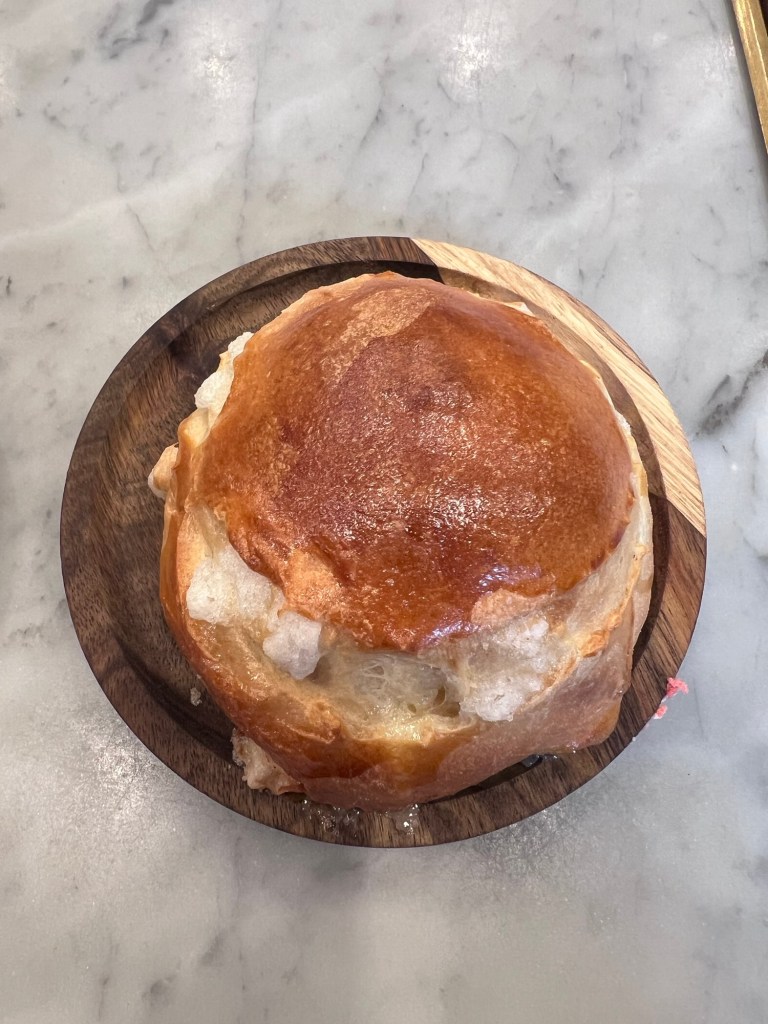
The sugary Brioche with a sweet crunchiness
I had a Brioche with a sugary filling that was still warm when I bought it and each bite was a treat with a rich buttery. The sugary filling bursting in my mouth and on a cool afternoon, really warmed me up.
The Brioche and the Merveilleux
I also ordered a mini Merveilleux, called a ‘L’Exentrique’, which is two small meringues filled with a creamy mixture and then rolled in cherry crunchies.
The ‘L’Exdntrique’
This sweet creamy pastry melts in your mouth when you bite into it and you have to eat it quickly when walking or otherwise it is a gooey mess. Both pastries were well worth the money and put a big smile on my face.
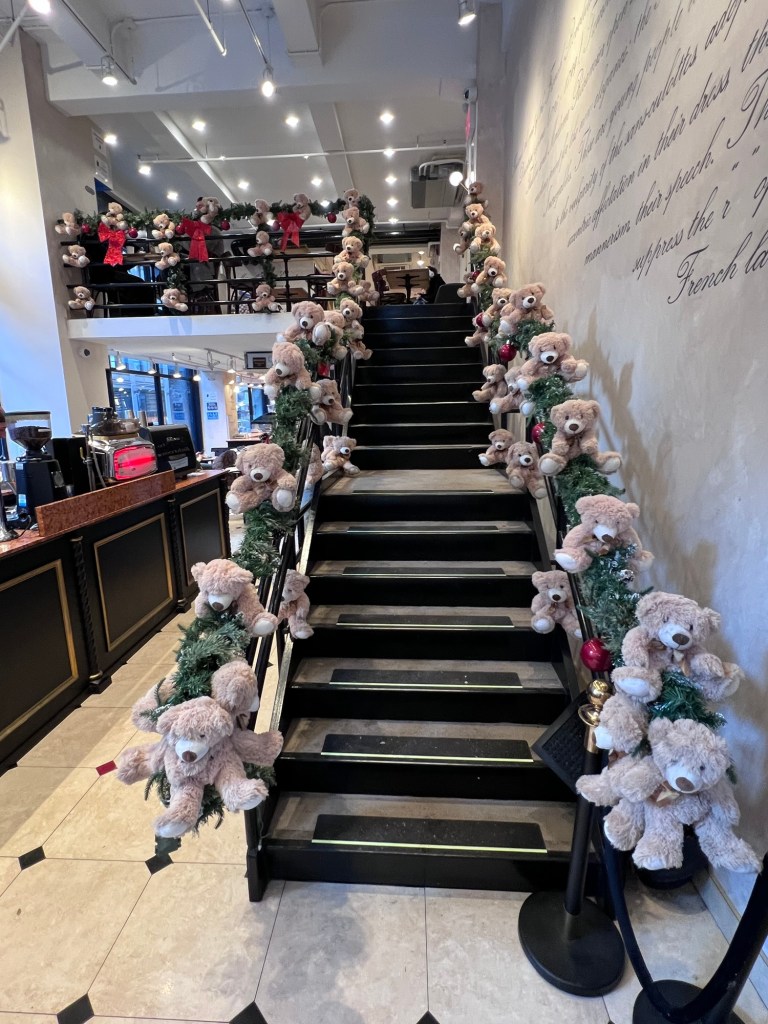
The inside of the bakery at Christmas
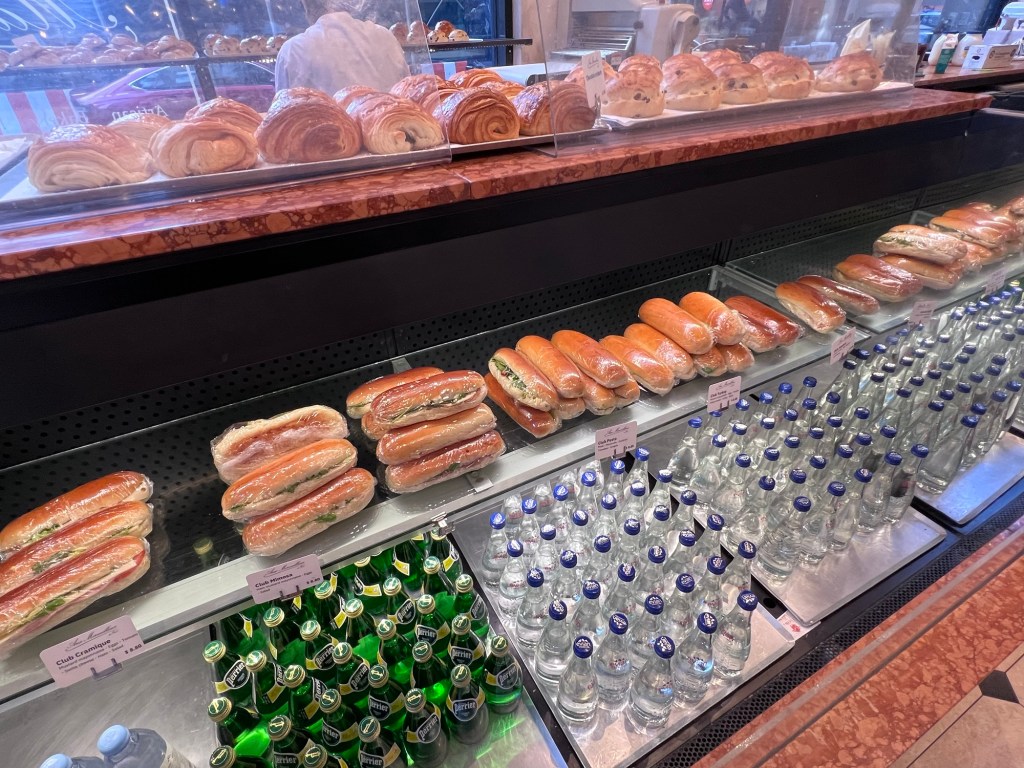
The marvelous pastries and sandwiches at the bakery
I was a very happy traveler when I reached Fifth Avenue to see the warm sunshine covering the block. Fifth Avenue has changed since my walk around Murray Hill in 2020. A lot of the buildings are either being renovated or have ‘For Rent’ signs in the windows as small businesses in the area have suffered from lack of office workers and tourists.
Across the street is 401 Fifth Avenue, the former home to Tiffany & Company before the operations moved to East 59th Street. The impressive building stands guard still on lower Fifth Avenue as a testament to when the shopping district was below 42nd Street.
401 Fifth Avenue-The former Tiffany & Company building (Wiki)
The building was designed by Stanford White of McKim, Mead & White and was completed in 1905 as the company headquarters and stayed here until the move uptown in 1940. The design was based on the Palazzo Grimani de San Luca in Venice, Italy (Wiki).
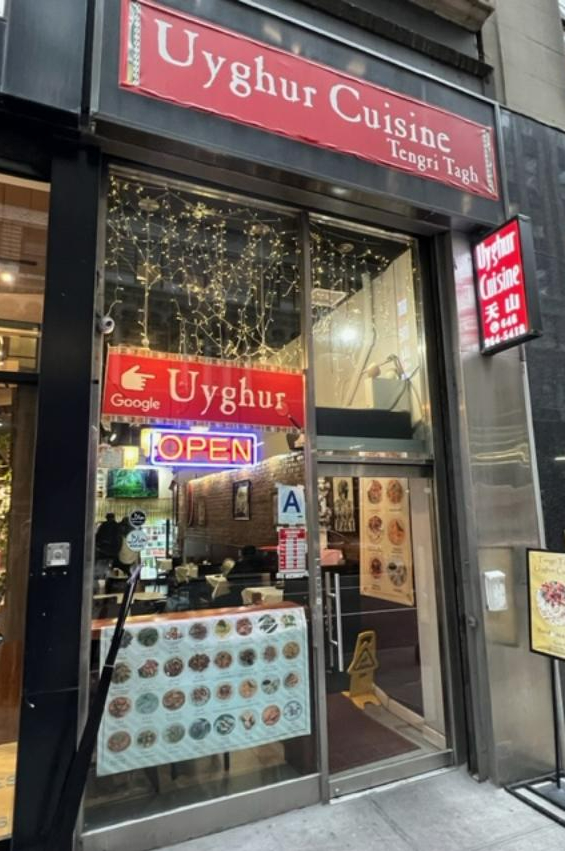
On the way back down West 37th Street, I passed another restaurant on the other side of the street that I really had not noticed and crossed to take a look at it. Tengri Tagh Uyghur Restaurant is at 144 West 37th Street. The cuisine was Uyghur, which is an interior section of China that most of the residents were being interred by the Chinese. I remember reading that the food has more Turkish and Indian influences and the smells coming out the restaurant were amazing. You could almost taste the spices in the air. I knew where I was eating dinner that night.
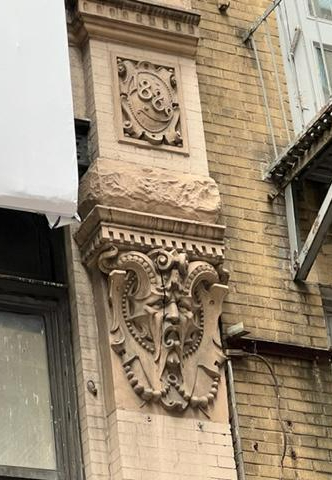
One of the architectural gems of the neighborhood is covered with demon-looking faces. It sits at 301 West 37th Street, which has the most unusual carvings of gargoyles all over the sides and inside the window ledges. It gives the building almost a creepy, demonist look to it. The building was built in 1915 and is currently going under a gut renovation.
As I walked around to West 38th Street, I was greeted by an old friend in the family business of Esposito Meats at the corner of West 38th and Ninth Avenue at 500 Ninth Avenue. Esposito Meat Market has been in business since 1932. You can see the selection of meats and different cuts from the window. The one time I walked in you could smell the aroma of the freshly cut meats. The store prides itself on always delivering quality (Esposito Meat Market website).
West 38th Street to me is the Garment District’s ‘Restaurant Row’.
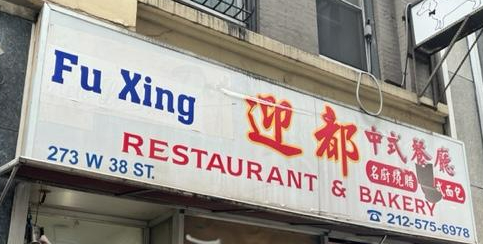
Just off the corner of Ninth Avenue and West 38th Street is the now closed (and hopefully to be opened soon again) Fu Xing at 273 West 38th Street (Closed in 2021). The restaurant was my go-to place for Roast Pork, Custard, Pineapple and Cream buns ($1.25) when I volunteered at the Soup Kitchen or when I needed a quick lunch and was in the area (see my reviews on TripAdvisor and DiningonaShoeStringinNYC@Wordpress.com).
The roast pork buns here were the best
This little hole in the wall catered to the Asian garment workers but somehow found its way to tourists and office workers all over the area.
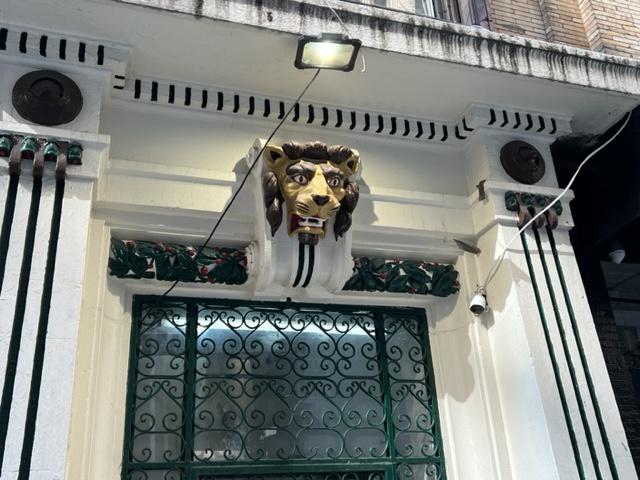
On the corner of Eighth Avenue and West 38th is another building beautiful in detail but has been sadly neglected over the years is 557 Eighth Avenue. The Beaux-arts’ designed building was built in 1903 by architect Emery Roth who was part of Stein, Cohen & Roth. It was run as a residential hotel for most of its history and now houses commercial space in the upper floors and fast-food restaurants on the bottom (Daytonian in Manhattan.blogspot/Loopnet.com).
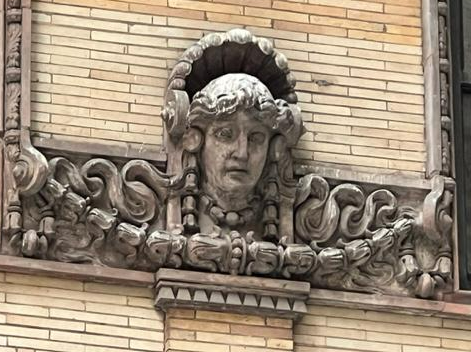
You have to really look up or you will miss the beauty of the building with its detailed carvings around the windows and the portraits of women carved between the windows.
The side entrance of the building at 302 West 38th Street
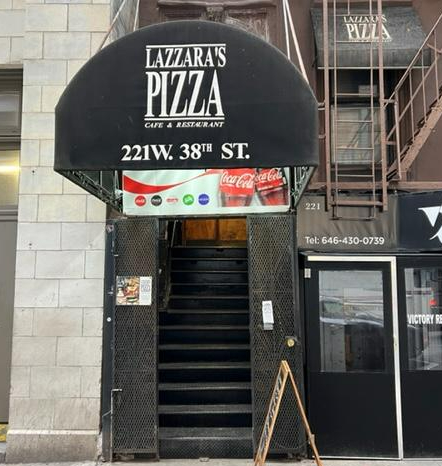
Further down the street towards Seventh Avenue is Lazzara’s Pizza Cafe at 221 West 38th Street #2, which is known for their lasagna pizza (see my review on TripAdvisor) which was lunch for us many an afternoon when I was a in the Buying line at Macy’s. These deep-dish pizzas are wonderful and the service has always been so friendly over the years.
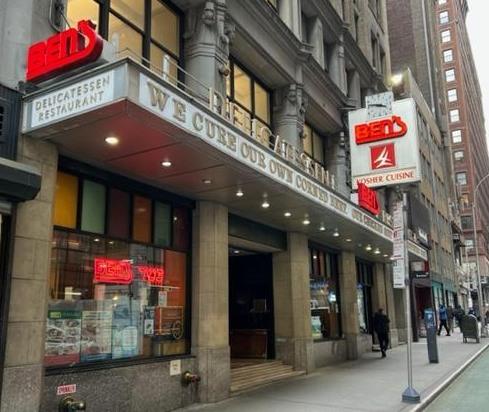
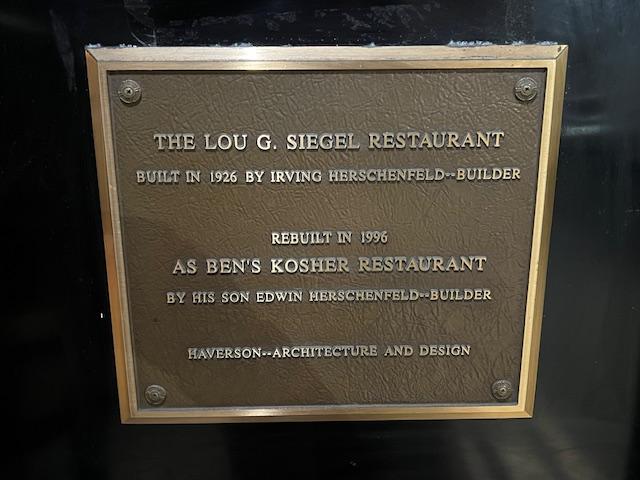
A few doors down is Ben’s Kosher Restaurant, the former Lou G. Siegel’s, that is known throughout the Garment industry as the place for piled high pastrami sandwiches and matzo ball soup. The original restaurant had been in business for over 79 years before being bought out by Ben’s in 1996 (Ben’s Kosher History).
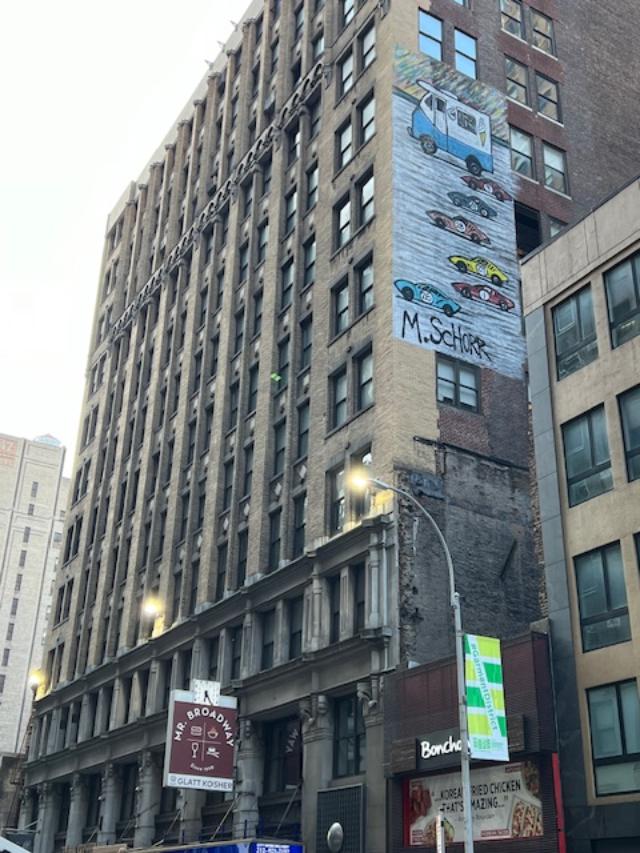
Ben’s Kosher Restaurant Manhattan at 209 West 38th Street (now called Mr. Broadway in 2024)
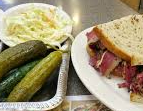
The interesting family fact is that both myself and my grandfather both ate at Lou G. Siegel’s when it was open thirty years apart. My grandfather had worked as an officer in the Ladies Garment Union and this is where they used to have lunch back in the 1950’s. I still love to dine there, always ordering the Double Dip ($16.99), a Pastrami on Rye with a side of Matzo Ball soup and a Potato pancake. There is nothing like it (see my review on TripAdvisor).
Don’t miss the Double Dip at Ben’s Kosher Restaurant
Ben’s Kosher Historical Marker as the original Lou Siegel Restaurant (his father’s) and is now called “Mr. Broadway Restaurant”.
Unless I had missed this before but there was a new mural at the top of the building. This was very unusual how this got up so fast but it was really interesting.
The work at the top of the Mr. Broadway Restaurant building by artist M. Schorr.
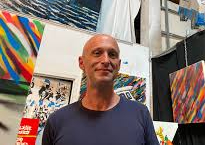
Artist Mitchell Schorr is an American born artist from New York City and is best known for his urban mural paintings. This is one of many in New York City and around the world (Artist bio).
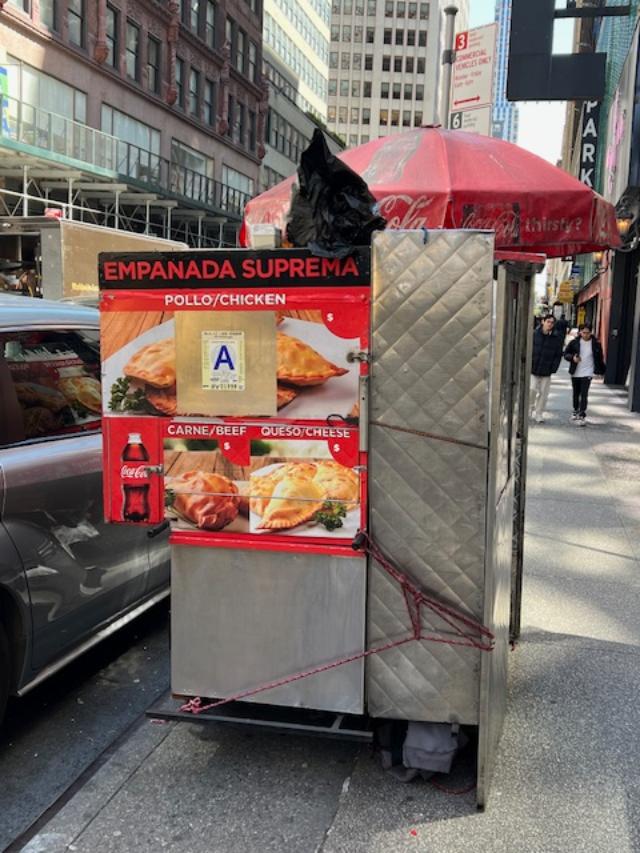
During the week, there is a tiny cart right off Broadway, Empanada Suprema, with the little empanada with a cape as its symbol. This little cart makes the freshest empanadas in Mid-Town with cheese, chicken and beef fillings made right in front of you and fried fresh at the cart. With a little hot sauce, two of these make the perfect lunch and I love munching on them on a cold day.
The Empanada Suprema cart at West 38th Street. Look for the capped empanada
My review on DiningonaShoeStringinNYC@Wordpress.com:
Artist Thea Lanzisero Thea is an American born artist and has a MFA in Visual Arts, is an adjunct professor and has taught art at CUNY Brooklyn & CUNY BMCC & SUNY Farmingdale in NY. As a polymedia artist from Huntington, NY, Thea Lanzisero creates public art, community engagement through interactive sculptural installations and placemaking structures at art museums, art parks, art fairs, galleries and art in unusual spaces in the US and Abroad (Artist Bio).
The piece pays tribute to the historic garment district where the hotel is located in the center of the former Garment District.
Walking towards Fifth Avenue, the architecture starts getting interesting and at 63 West 38th Street is the Refinery Hotel. This beautiful and interesting looking hotel was built in 1912 and was the former Colony Arcade Building. It had been home to a 19-century milliner and a tearoom (Refinery Hotel history). The hotel has two excellent restaurants one being on the roof top looking over the Bryant Park neighborhood.
The Refinery Hotel at 63 West 38th Street (The Refinery Hotel)
Arriving finally at Fifth Avenue is the famous former department store Lord & Taylor, once a New York institution in women’s high fashion. The former Lord & Taylor headquarters store that opened in 1914 just recently closed with a sale to the now imploded WeWorks company and was just sold to Amazon for 985 million dollars.
This former ‘grand carriage trade’ store replaced the former headquarters store at Broadway and 20th Street by Union Square and opened at this location at 424-434 Fifth Avenue. The 11-story building was designed by architects Starrett & Van Vleck in the ‘Italian Renaissance Revival’. The store closed for business in January of 2019 after over one hundred years in the location (and a recent store renovation).
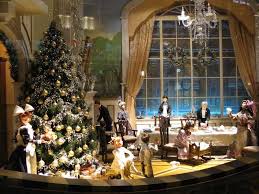
Lord & Taylor was founded in New York City in 1826 and has moved around the City several times in its long history. I will miss walking around the store and wondering through the store at Christmas time which was always magical in the store’s heyday. I like everyone in the City will miss their Christmas windows.
I’m not sure if Amazon will continue this tradition at the holidays
As I made my way back down West 38th Street, I finally saw a bit more foot traffic off Fifth and Sixth Avenues as the afternoon crowds went to lunch or were heading in the direction of Macy’s. There was another one of their big sales and it was attracting late shoppers.
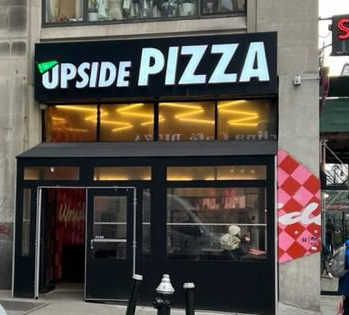
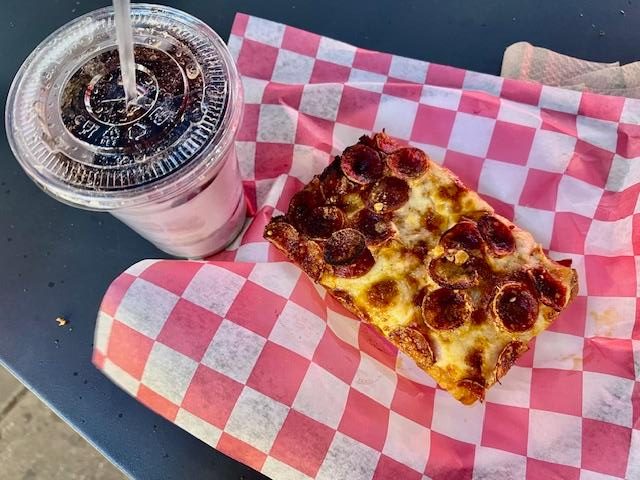
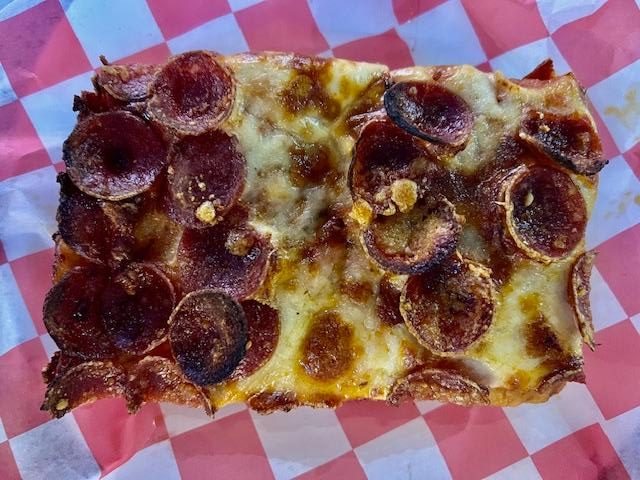
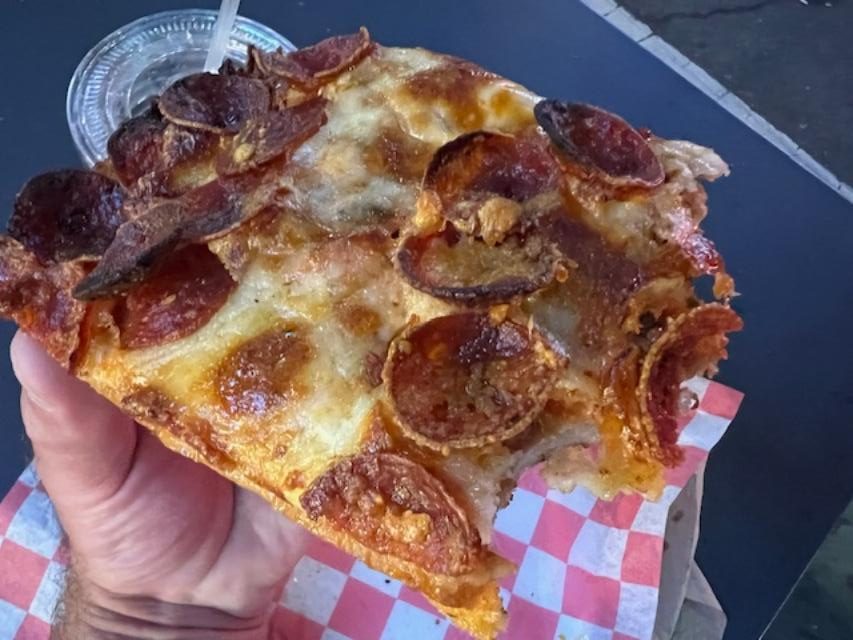
On the corner of West 39th Street is one of the best places for deep-dish pizza in Manhattan at the ever-growing Upside Pizza (which now
The Detroit deep dish Pepperoni is the best
has two more locations) at 598 Eighth Avenue. The pizzeria makes delicious deep-dish cheese and pepperoni pizza and their regular cheese pies are terrific too. The Sicilian pies are a cross between traditional Sicilian and Detroit deep-dish.
I recently visited late night and had a slice of their Detroit Cheese pizza and it is amazing. The crispy cheese was baked right into the crust. The pizza slices here are delicious.
The front of Upside Pizza
The Detroit Cheese pizza
The Detroit Cheese Pizza
As I made my way down West 39th Street, I passed more fabric and small wholesale stores proving that the Garment District businesses are alive and well, maybe not in the numbers as in the past but still going strong. Tucked in between buildings are more national chain hotels and restaurants that keep opening and closing with the traffic of the area. There are a lot of empty store fronts as you get to Seventh Avenue. Business from the surrounding office buildings has indeed slowed down.
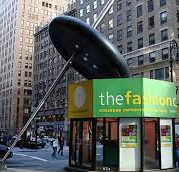
When arriving at the corner of West 39th Street and Seventh Avenue in front of the Chase Bank at 551 Seventh Avenue is the very iconic sculpture of the Needle Threading the Button that is part of the Welcome Booth on Seventh Avenue.
The Button and Needle Sculpture is actually part of the information booth (NYPL.org)
The Needle and Thread has now been replaced by a new sculpture in 2023
According to the New York Public Library, the sculpture of the needle and button is actually part of the Fashion Center Information Kiosk that has been closed for a few years. The sculpture was designed by Pentagram Architectural Services in 1996 and was inspired by artist Claes Oldenburg’s sculptures. The district is currently looking into replacing this kiosk (New York Public Library Research Department).
Artist Claes Oldenburg was a Swedish born American artist. He was born in Stockholm and moved to the United States with his parents. His father was a Swedish Diplomat who was stationed in Chicago and he studied art at Yale University and The School of the Art Institute of Chicago. He was known for his large art installments. Even though this was not designed by him, the work was inspired by his sculptures (Wiki).
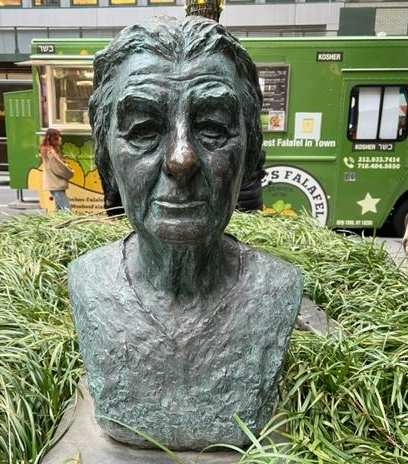
In front of the Chase Bank at 1411 Broadway is Golda Meir Square with an open plaza. Tucked into a garden almost hidden from view by the plants is a bust of Golda Meir by artist Beatrice Goldfine. It looked like from old pictures the original pedestal is now beneath the planter. It was unveiled in 1984 (Wiki).
The bust of Golda Meir by artist Beatrice Goldfine in Golda Meir Square is now hidden in a garden.
Artist Beatrice Goldfine is an American artist born in Philadelphia and studied at the Barnes Foundation and the Pennsylvania Institute of Fine Arts.
When walking back down West 39th Street, I noticed another small Chinese restaurant named Bao Bao Cafe at 214 West 39th Street that has an interesting menu. This is one to check out in the future.
On West 40th Street is where you really start to see interesting architecture on the fringe of the old shopping district. The buildings on the southern edge of Bryant Park, which had once a upon a time had been just ‘old buildings’, now have become the symbol of the park and some of the most classic examples of Beaux Arts and Art Deco architecture.
The walk from the Port Authority on Ninth Avenue is remnants of the ‘bad old days’ of Times Square that have not been torn down yet. This area was in the process change before COVID and is still being developed.
As you cross Sixth Avenue with Bryant Park on one side, there is a line of beautiful buildings between Broadway and Fifth Avenue that make it quite an impression. The enormous detail to these structures is evident along the sides and top of the buildings.
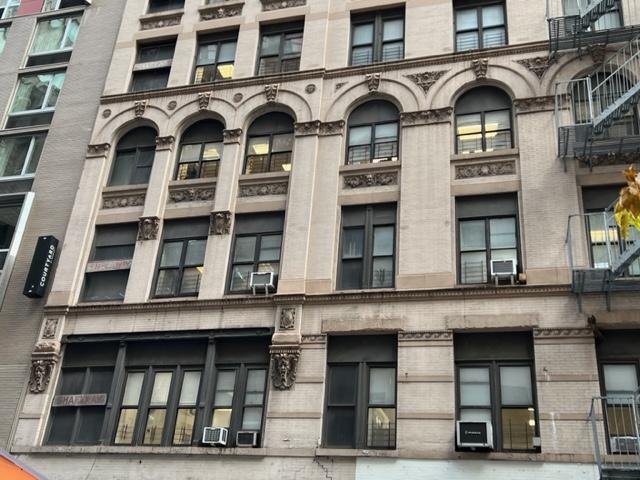
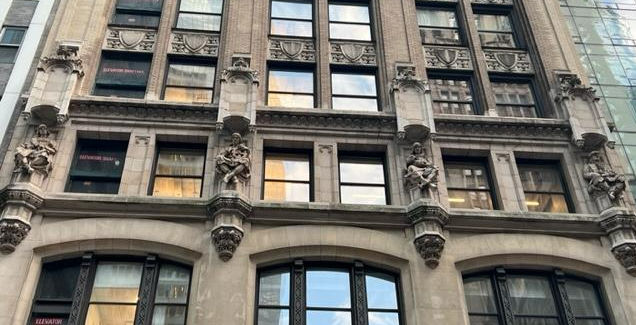
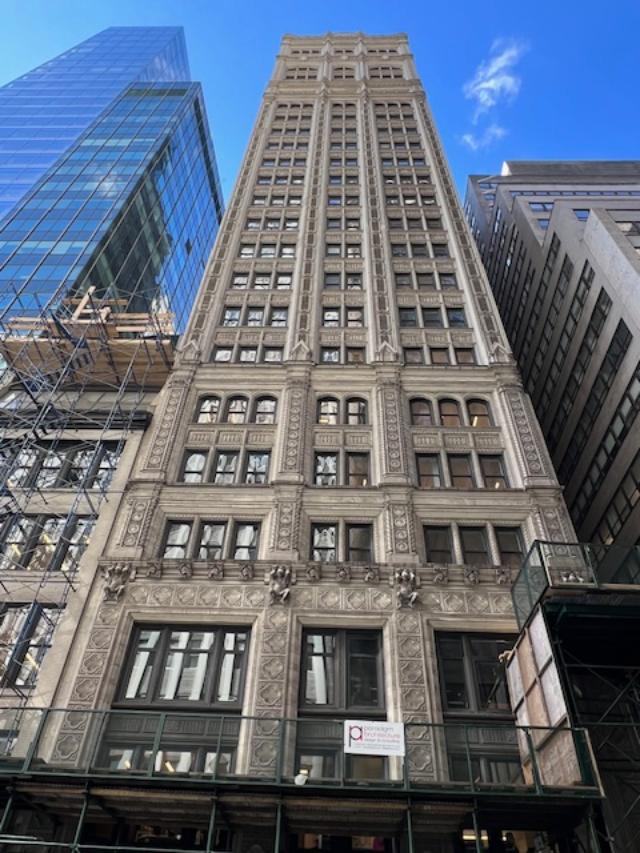
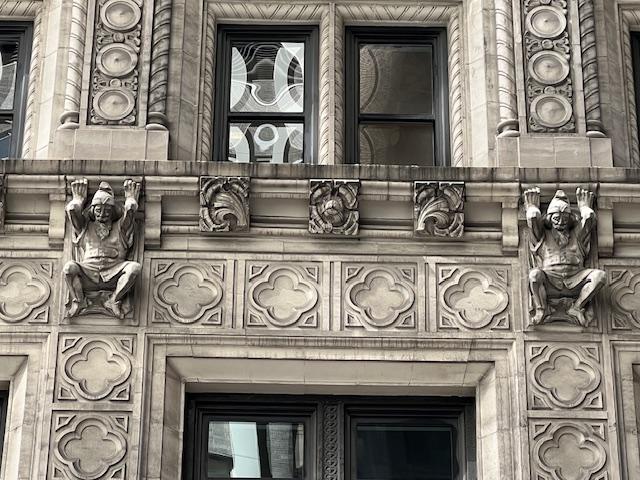
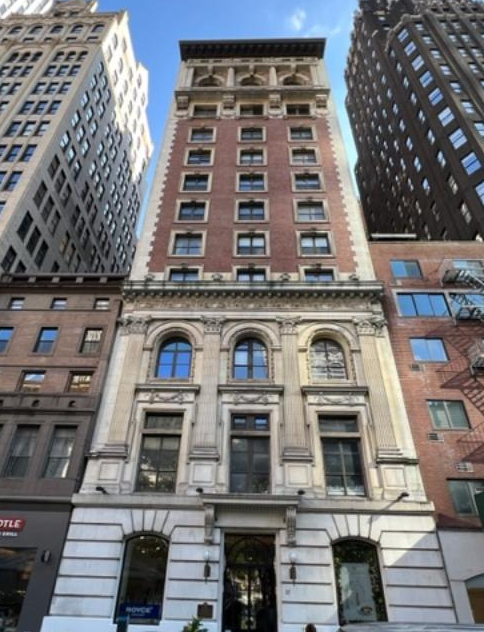
The details on 119 West 40th Street (the other side of the building is 114 West 41st Street) are unique. The building was built in 1913 by Philip Lewisohn with the architectural firm of Manike & Franke with the purpose of designing a loft type building. What makes the building so unique is the Gothic figures above the curved windows (Daytonian in Manhattan/Emporis).
The second is 110 West 40th Street. The building was designed by architect Edward S. Browning of the firm of Buchman & Fox and was built in 1914. It was known as the World Building. Browning has designed the building so that all four sides were equally detailed (MetroManhattan.com).
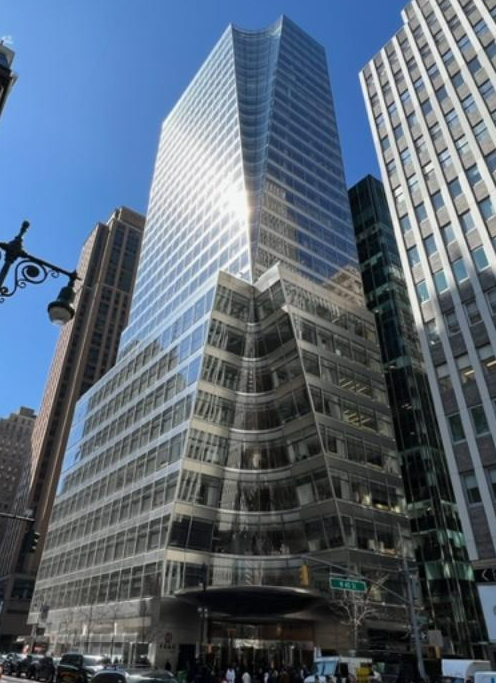
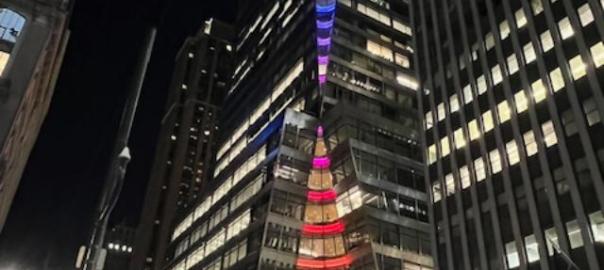
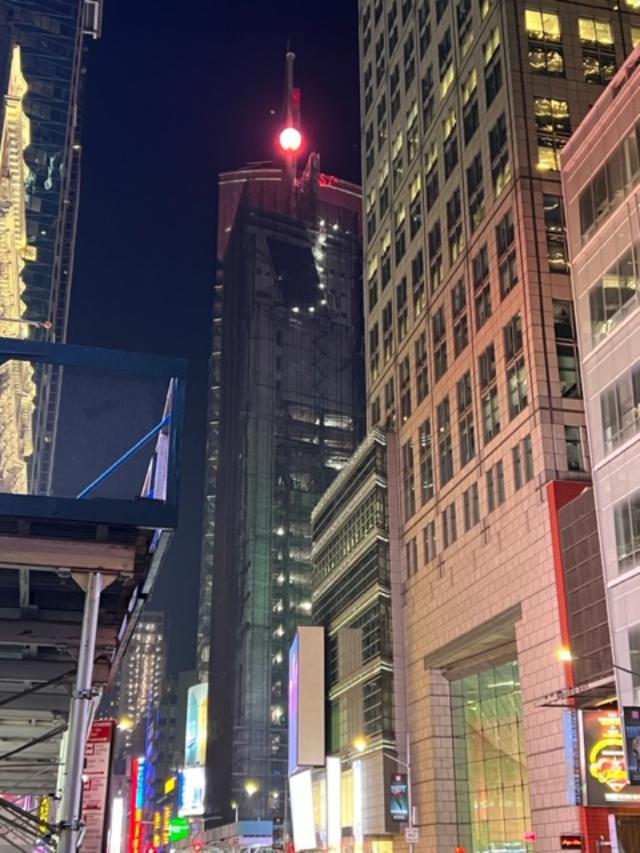
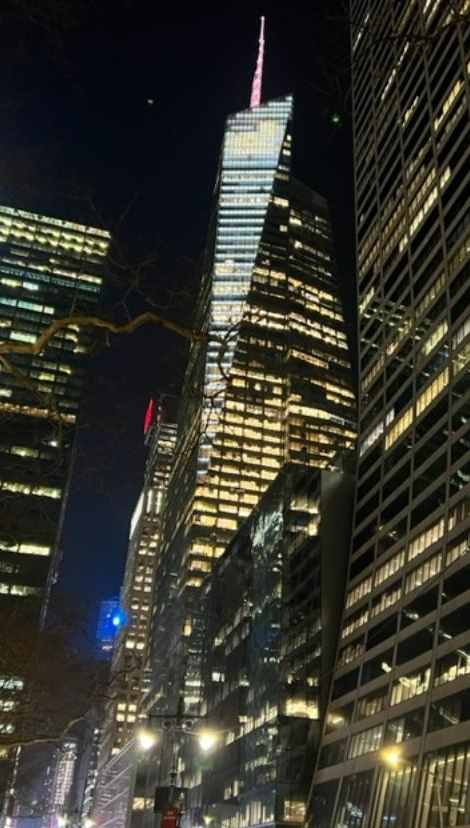
On the corner of Sixth Avenue and West 40th Street I saw the green and red lights still blinking of the new Bank of China building at 1045 Sixth Avenue (or 7 Bryant Park). This building is interesting for its shape and its ongoing light show. The second day of visiting the neighborhood, the lights of the holidays were gone.
The building was completed in 2016 and was designed by architects Henry N. Cobb and Yvonne Szeto from the firm of Pei Cobb Freed & Partners and it was interesting on why they designed the building in an ‘hourglass’ design. The firm stated that “they wanted to enrich the experience of the park while at the same time make its relationship to the park a clear expression of its identity (Pei Cobb Freed & Partners). The building is the New York home of the Bank of China.
Bank of China Building at 1045 Sixth Avenue (7 Bryant Park)
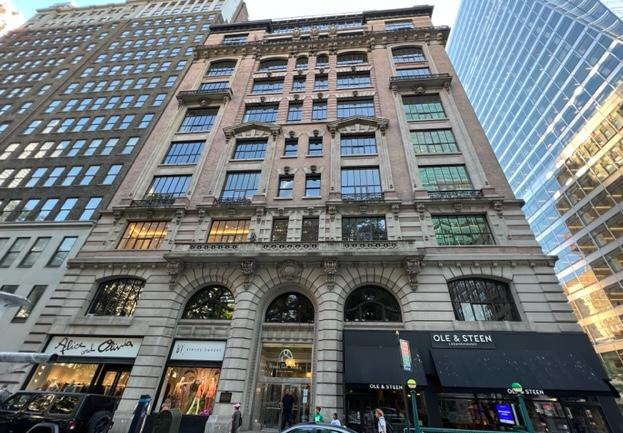
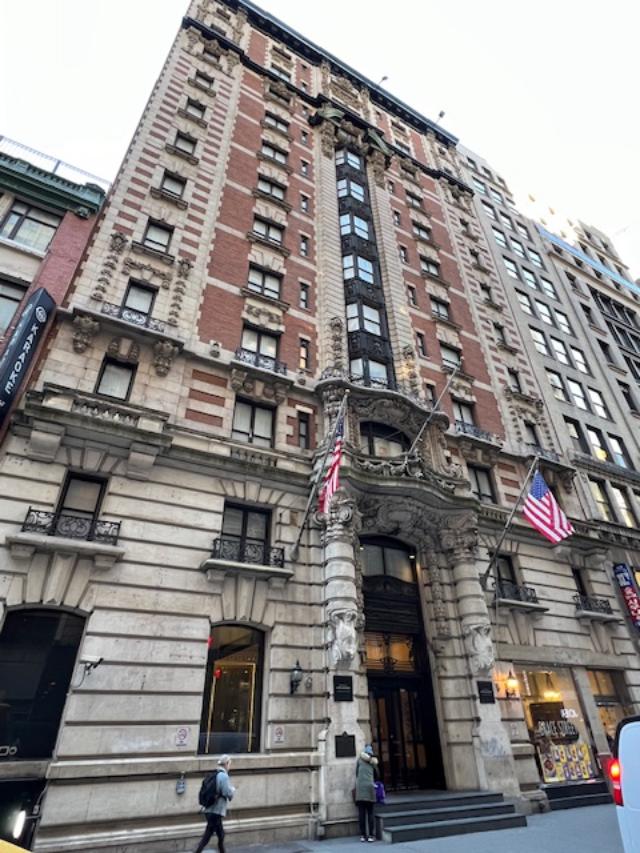
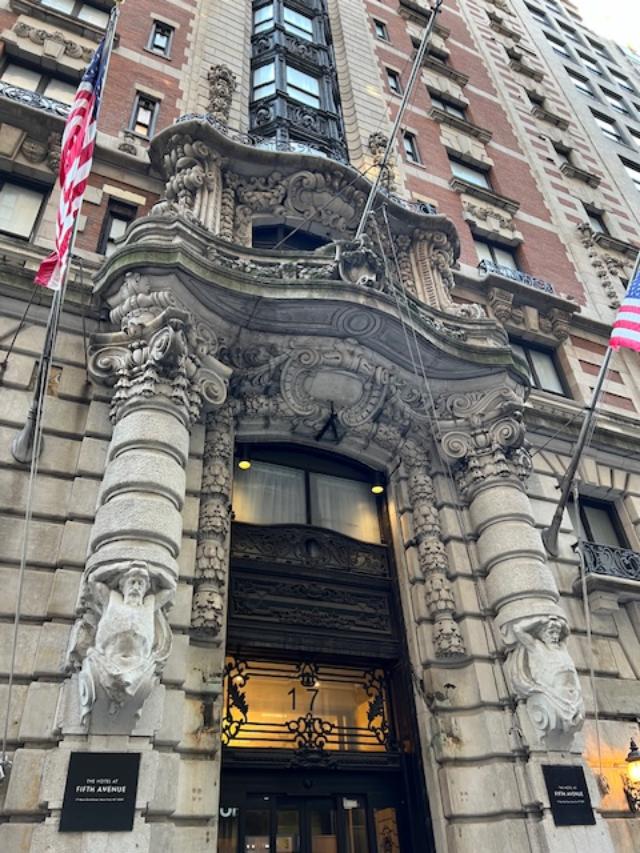
Across from Bryant Park to its south are a grouping of beautifully designed buildings. On the corner of West 40th Street and Sixth Avenue is 80 West 40th Street, ‘The Bryant Park Studios’. The building was built in 1910 as showrooms for artists. The building was designed in the Beaux-Arts style by architect Charles A. Rich (Daytonian in Manhattan).
The Bryant Park Hotel at 40 West 40th Street is another standout that sits on the edge of the park. The hotel was built in 1924 for the American Radiator Company and known as the American Radiator Building (it was renamed the American Standard Building).
It was designed by architects John Howells and Raymond Hood who designed it in a Gothic Modern style with black and gold bricks, the black bricks symbolizing coal and the gold bricks symbolizing fire. The style of the building is a combination of Neo-Gothic and Art Deco. In 1988, the building was sold and the Bryant Park Hotel was born (Bryant Park Hotel History).
The Bryant Park Hotel at 40 West 40th Street (Bryant Park Hotel)
A few doors down from the hotel is 32 West 40th Street, the former Engineers Club Building. The building was designed by architects Henry D. Whitfield and Beverly S. King of the firm of Whitfield & King and was built in 1907. The building was designed in the neo-Renaissance style with Corinthian style capitals. The building was partially funded by Andrew Carnegie for a new club house for the Engineers Society that had been founded in 1888 (Wiki).
Making my way back to the border of Garment District at Fifth Avenue sit two impressive buildings of the bygone era from this was a major shopping district, the Knox Building and the Arnold Constable Building.
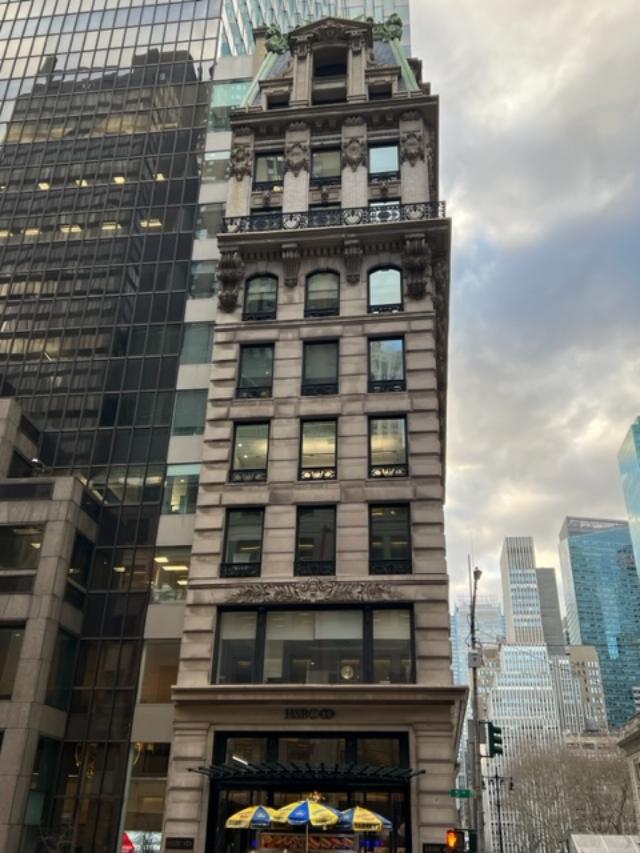
The building at 452 Fifth Avenue, the former home to Knox Hat Company, was incorporated into the HSBC Tower in 1984. The glass tower was built around the Beaux Arts building for the HSBC and it was considered an architectural marvel when it opened. The Knox Building was built in 1902 and is considered one of the finest examples of ‘Beaux Arts style’ in Manhattan.
452 Fifth Avenue-The Knox Hat Company Building part of the HSBC Building
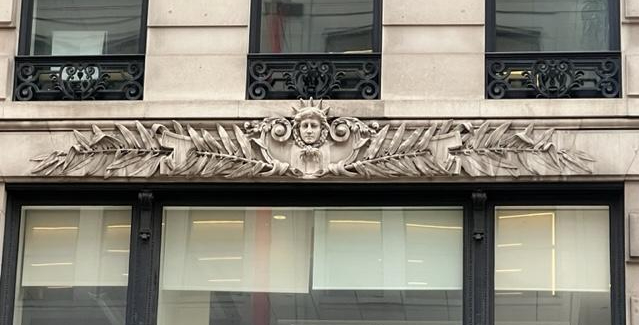
The detail work of the Knox Building at 452 Fifth Avenue.
The Knox Hat Company was considered one of the finest hat companies for men when it was founded in 1838. It once had 62 retail stores and was sold in all the finest stores. It did not survive the Great Depression and was merged with three other companies in 1932 to form Hat Corporation of American (Hat Co) (Bernard Hats history).
The last interesting building I saw before returning to Bryant Park to relax by the fountains was 454 Fifth Avenue at 40th Street, the old Arnold Constable & Company department store.
Fifth Avenue at 40th Street-Arnold Constable & Company Department store
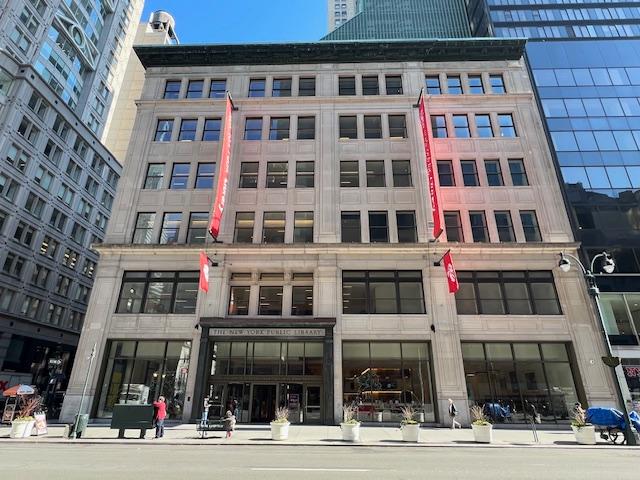
The building opened in 1915 and closed when the company went out of business in 1975. It is now part of the New York Public Library. Arnold Constable & Company was founded in 1825 and was considered one of the oldest stores in New York City. The building was created as the shopping district moved further uptown. The company closed for business in the 1990’s.
As I finished the edge of the neighborhood walking West 41st Street, most of the buildings were either the front or back of old theaters or large new office buildings that were the result of the final demolishment of the blocks around Times Square (which was much needed at the time).
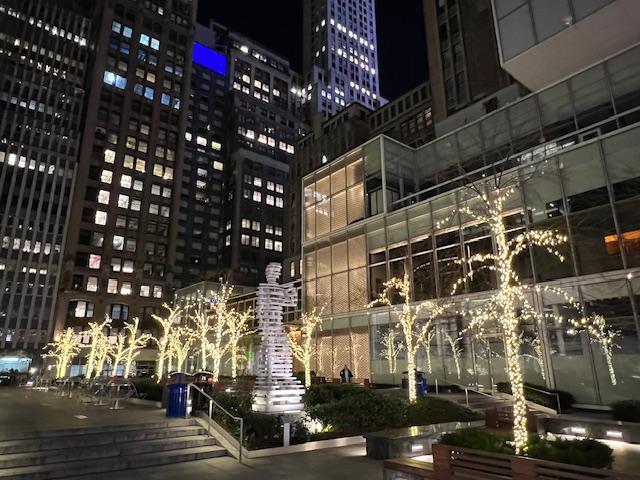
As a result of these large buildings compacted into one area, there needed to be setbacks for the public in the way of small parks and one of them is just behind the new Whole Foods at 1095 Sixth Avenue (Three Bryant Park). Inside the park near the stone benches, I admired a rather strange statue entitled “The Guardian-Superhero” by artist Antonia Pio Saracino.
Guardian-Superhero at Three Bryant Park (Antonio Pio Saracino)
The statute was created by the artist in mirrored stainless steel. The artist uses a digitally generated architectural composition (Frameweb.com).
Artist Antonio Pio Saracino is an Italian born artist based in New York City. He is a graduate of the La Sapienza University of Architecture with a master’s degree. The artist is multi-talented in sculpture, building and furniture design (Wiki).
I finally was able to relax in Bryant Park for a bit before I continued the walk to Kips Bay. I had read online that DiDi Dumpling in Kips Bay had closed, and I wanted to check it out for my blog. I walked through the side of Bryant Park that faced West 40th Street and admired some of the statuary and the tiny Merry go Round that was closed for the season.
The first statue that I admired was Goethe Monument inside the path. The Gothe statue is of author Johann Wolfgang von Goethe and is a replica of a copy by artist Karl Fisher. It was presented to the park by The Goethe Society of America in 1876 and it was moved to Bryant Park in 1932 (NYCParks.org).
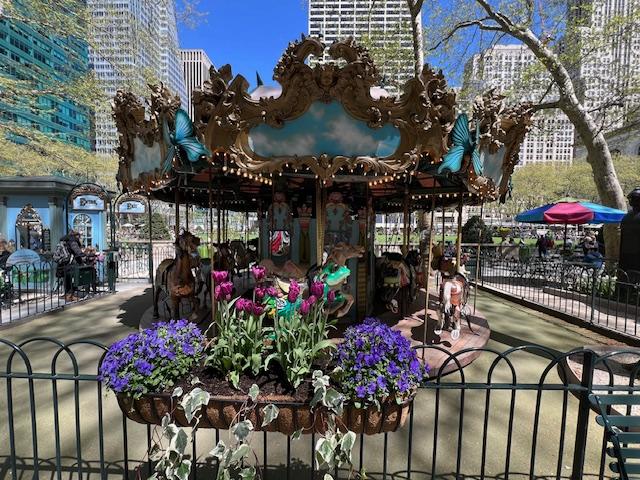
I passed the tiny French Merry go Round, Le Carrousel, that brought into the park after the renovation to give the park the Parisian feel that it had. It was created for the park by the Fabricon Carousel Company of Brooklyn, NY and many interesting creatures for children and adults (I did ride it once when it first came to the park. I am too big for this thing).
The Bryant Park Carrousel on the south side of the park (NYCParks.org)
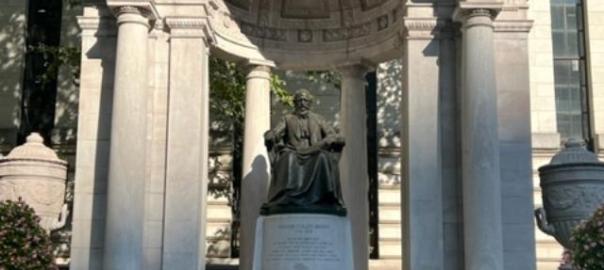
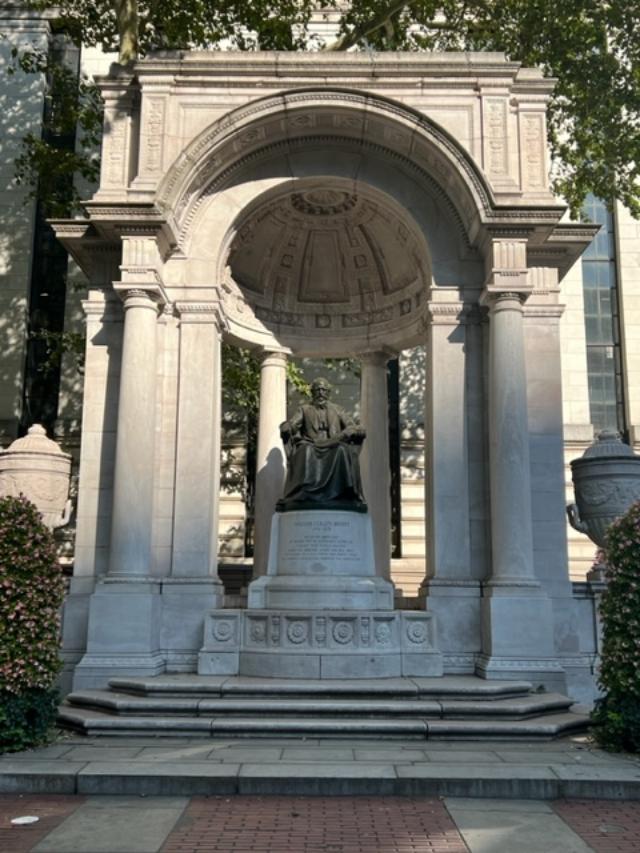
The last statue that I admired in the park was of the park’s namesake, William Cullen Bryant, from artist Herbert Adams and designed by Thomas Hastings of the architectural firm of Carrere & Hastings in 1911 (The firm that designed the New York Public Library). The statue was of poet, journalist and editor of The New York Evening Post Willaim Cullen Bryant (NYCParks.org).
The statute of William Cullen Bryant (NYCParks.org)
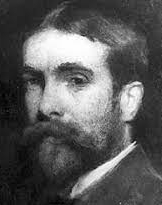
Herbert Adams was an American born artist. Born in Vermont, he was raised in Massachusetts, He studied art at the Massachusetts Normal Art School. He opened a studio in New York City and in his time, he created over 200 public works of art and is considered one of America’s best sculpturers (Wiki).
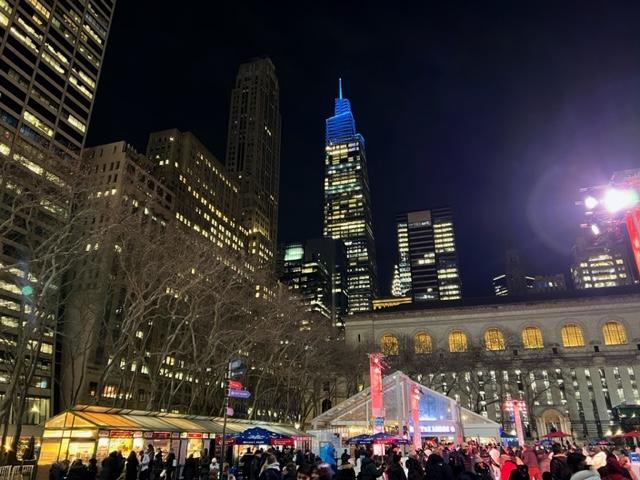
As the last traces of the Winter Villages Christmas decorations have disappeared, I walked all around the skating rink and the open restaurants. I could not believe how busy the park was at this time of day and was not sure if it was all tourists or just locals having a good time. With all the gloom and doom in the news lately, these people deserved it!
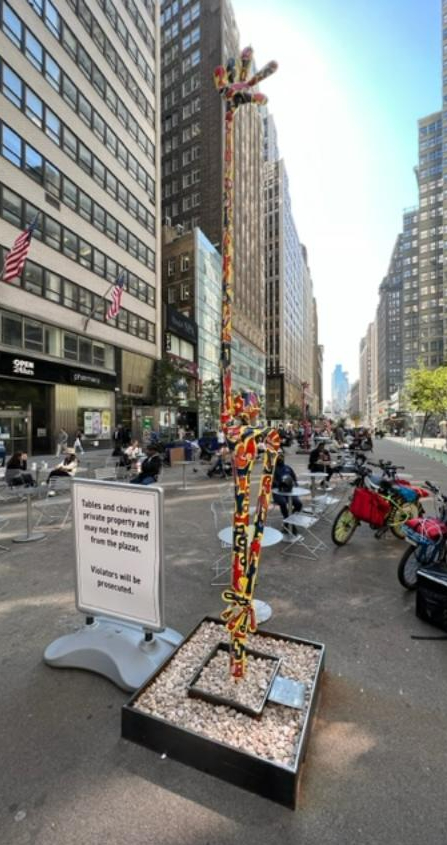
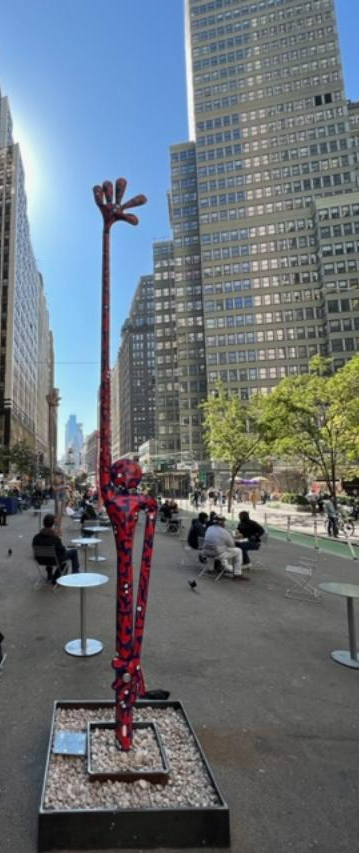
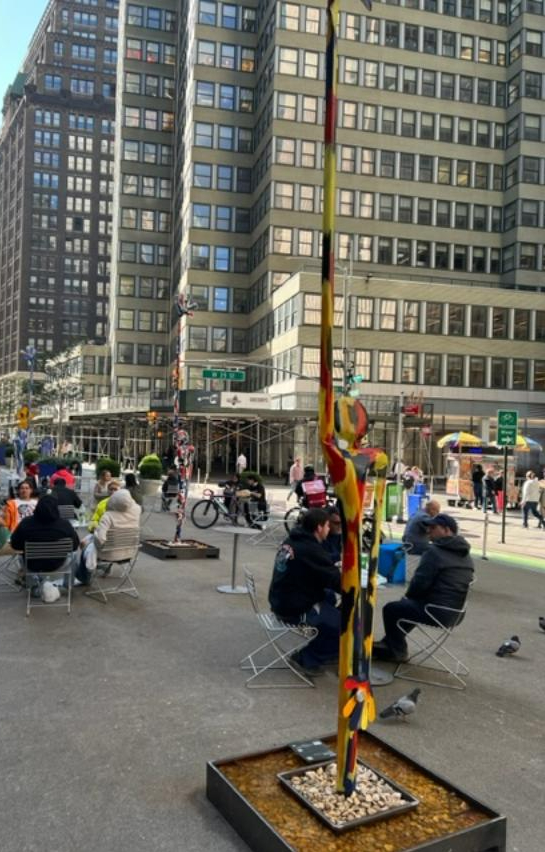
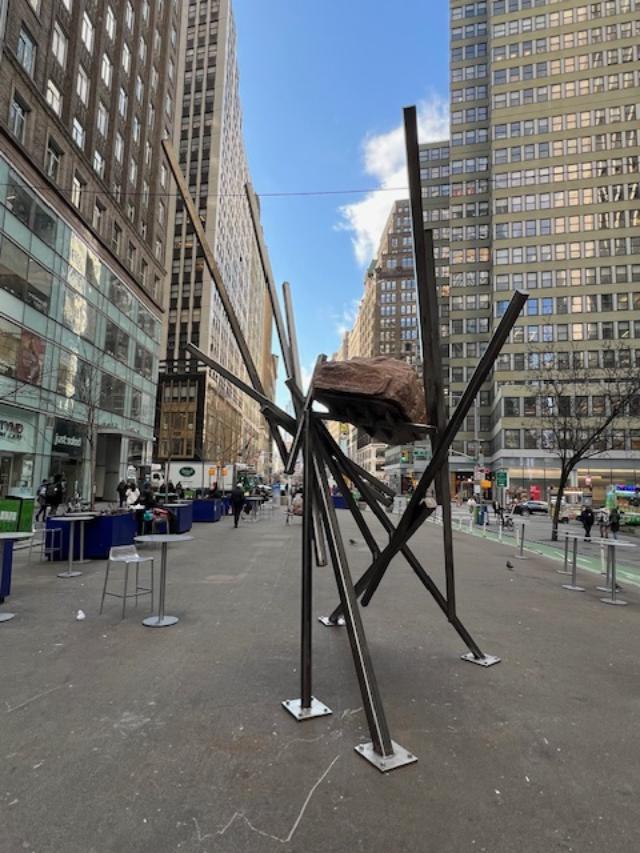
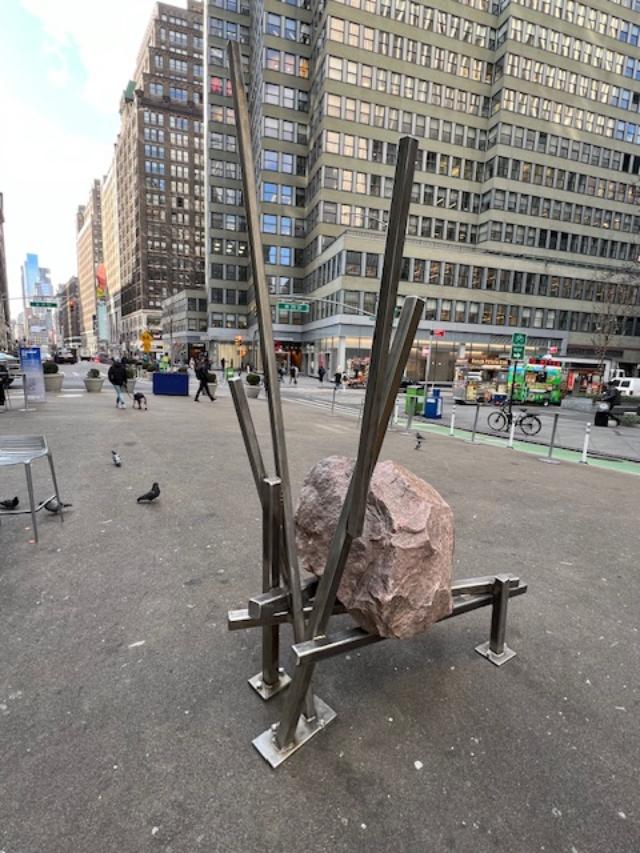
On the way back towards Broadway I came across an interesting set of artwork by artist Santi Flores that lined the Broadway Mall. These interesting works reached for the sky. These interesting little sculptures looked like they were raising their hands for attention (“Here” ended October 22nd, 2022).
The Broadway pop-up of Artist Santi Flores display “Here”
Artist Santi Flores at the street exhibition “Here”
Artist Santi Flores is a Spanish artist who is also a musician and visual artist. His creativity shows no limits (Artist Bio).
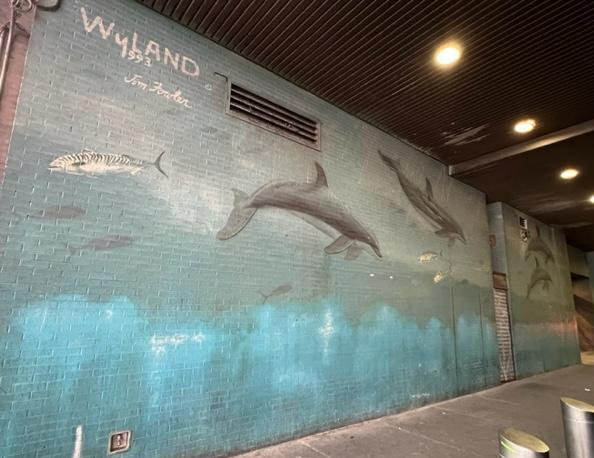
As I walked back down West 41st Street towards the Port Authority, I walked in between the terminals on my way back and forth from Ninth to Eighth Avenues and rediscovered the Robert Wyland paintings that had been done in the 1990’s. It was ironic that he had painted them because I had just visited his galleries in both Waikiki and in Maui.
The Robert Wyland mural “Inner City Whales” on the side of the Port Authority wall at Eighth Avenue and West 41st Street in 1993 (Part of his “Whaling Walls” series across the United States)
The Robert Wyland Mural on the inside wall of the Port Authority at West 41st Street is easy to miss with all the traffic and noise. I was not sure why he would place this wonderful piece of art in such an odd place that most people miss.
Mr. Wyland is an American born from Detroit. His works have been inspired by nature when he visited the ocean for his first and his love of diving. In 1993, he started his foundation, and started to paint murals in major cities. He is known for his conservation as well as his art(Artist bio).
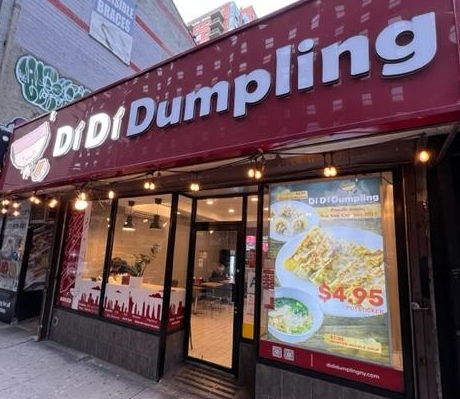
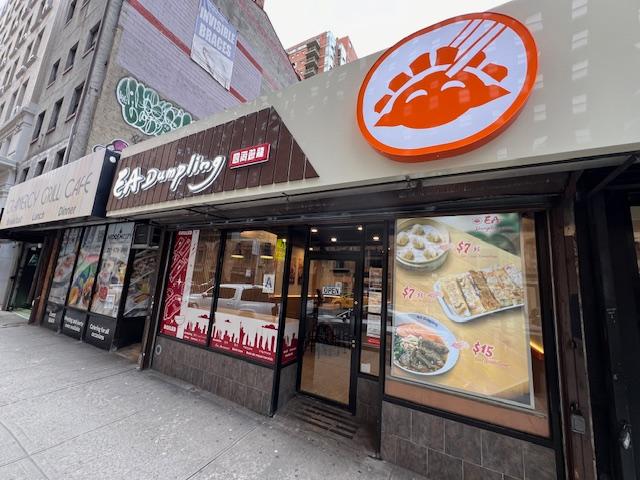
I finished the streets of the Garment District in the early afternoon, and it was still light out, so it was time to travel to other parts of Manhattan to check other businesses from my blogs to see if they were still opened. This meant a trip down Lexington Avenue to DiDi Dumplings at 38 Lexington Avenue.
DiDi Dumpling is one of my go-to places on my blog, DiningonaShoeStringinNYC@Wordpress.com for delicious meals of steamed dumplings and fried potstickers. Google had posted that they closed but I had to check this out for myself. Not only were they still open but really busy. So, I stayed for some Steamed Shrimp Dumplings ($5.75) with a Coke. After all that walking, I felt I earned it.
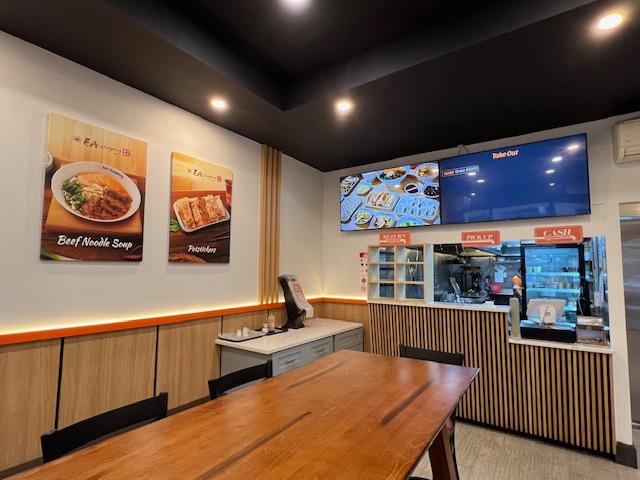
DiDi Dumpling at 38 Lexington Avenue (closed in January 2024)
The Fried Potstickers were a bit overcooked but still good
The Soup Dumplings here are pretty good but not the same when it was DiDi Dumpling
Now that I was rested and well fed (God those dumplings hit the spot on a cold day), I walked to my next location, La Crosta Pizza on East 72nd Street and First Avenue. I took Lexington Avenue and walked up a combination of that and Madison Avenue. On my way up to the Upper East Side, it was shocking to see how many businesses were shut and all the empty storefronts. These being victim to the economy and COVID.
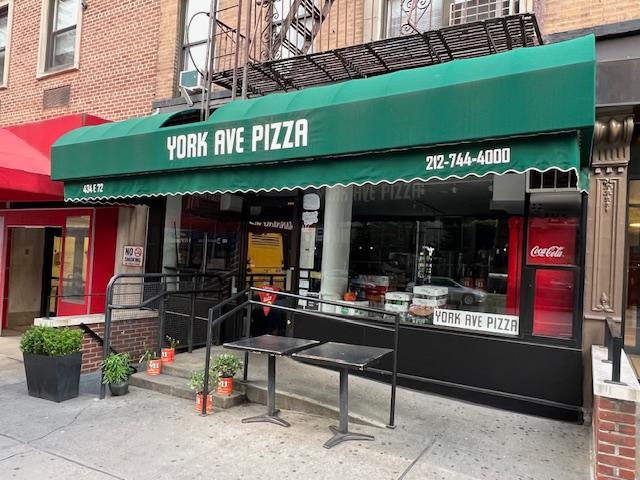
I made it to 436 East 72nd Street and indeed La Crosta Pizza is now closed. I was really bummed in that they had wonderful lunch specials, excellent food (their pizza and calzones were the best) and the guys that worked there could not have been nicer. It was a big place to eat with the people at the hospital. The sign says that it is being replaced by York Pizzeria. I will have to revisit when they open but I could see by the inside menu that the prices have doubled.
The pizzeria is now names York Avenue Pizza but the prices are much higher.
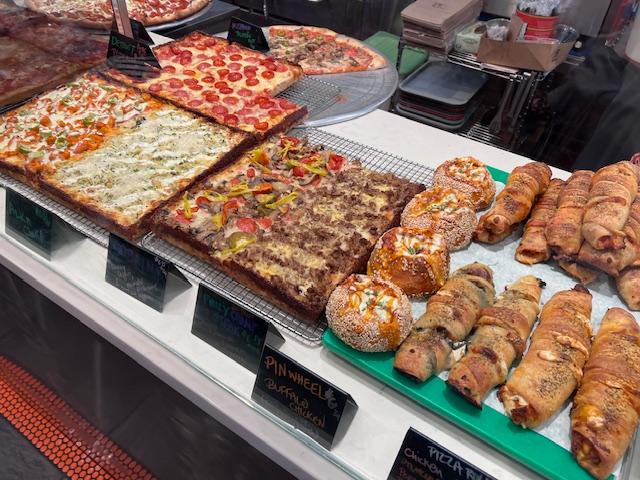
The delicious items at York Pizza made by the same cooks as La Crosta
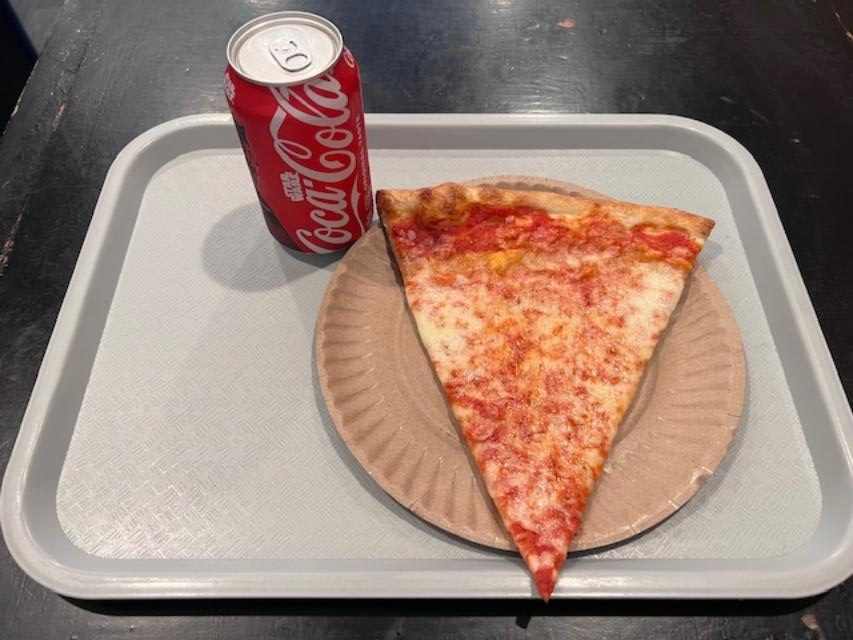
The pizza at both versions of the restaurant were excellent
As I walked back down from the Upper East Side to the Garment District again, I crisscrossed the avenues going from First to Second then walking down Lexington to Park Avenues looking at store fronts and dark apartment buildings and hotels and wondered how many of these people have come back to the City. It still seemed quiet after the holidays.
I ended the walk that evening back at the Uyghur Restaurant Tengri Tagh at 144 West 37th Street. I kept watching from the window all the interesting dishes coming to the tables and it fascinated me that this tiny hole in the wall restaurant was so busy.
I later found out when I got home that they just had three back-to-back excellent reviews on the internet. The food really warms you up on a cool night.
Uyghur Restaurant Tengri Tagh at 144 West 37th Street
When I got there at 6:30pm, it was quiet. There were only two other tables full. By the time my dinner started to arrive at the table, the place was packed. I could not believe this small restaurant on a side street and a gloomy one at that was so busy.
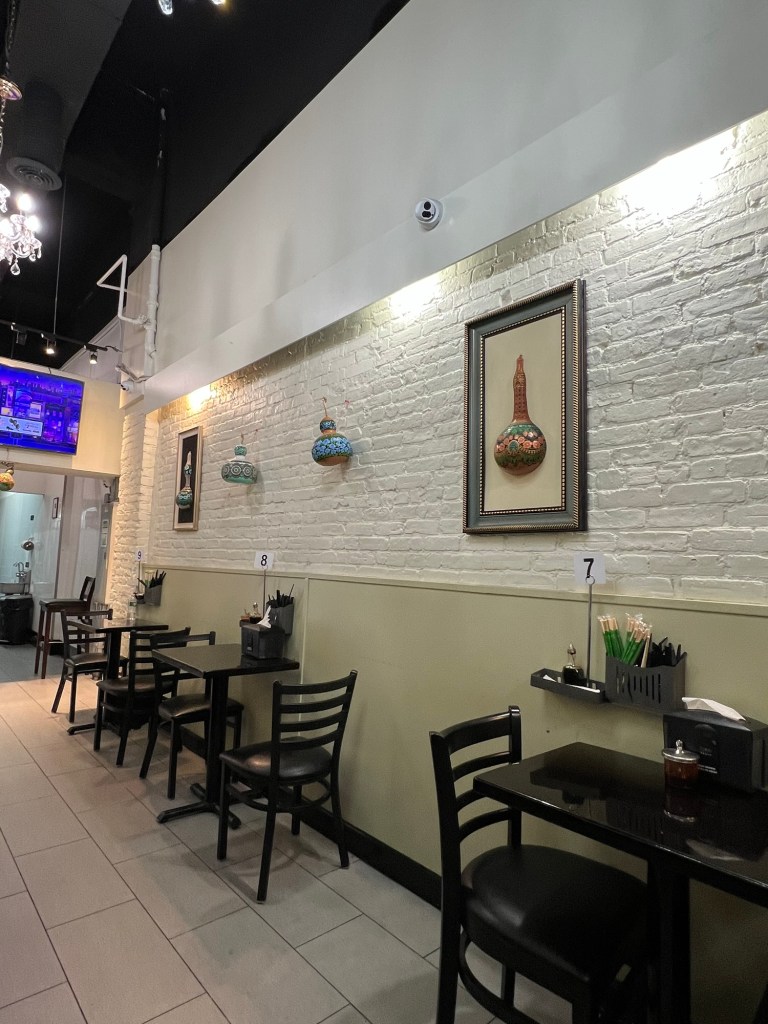
The inside dining room and decorations
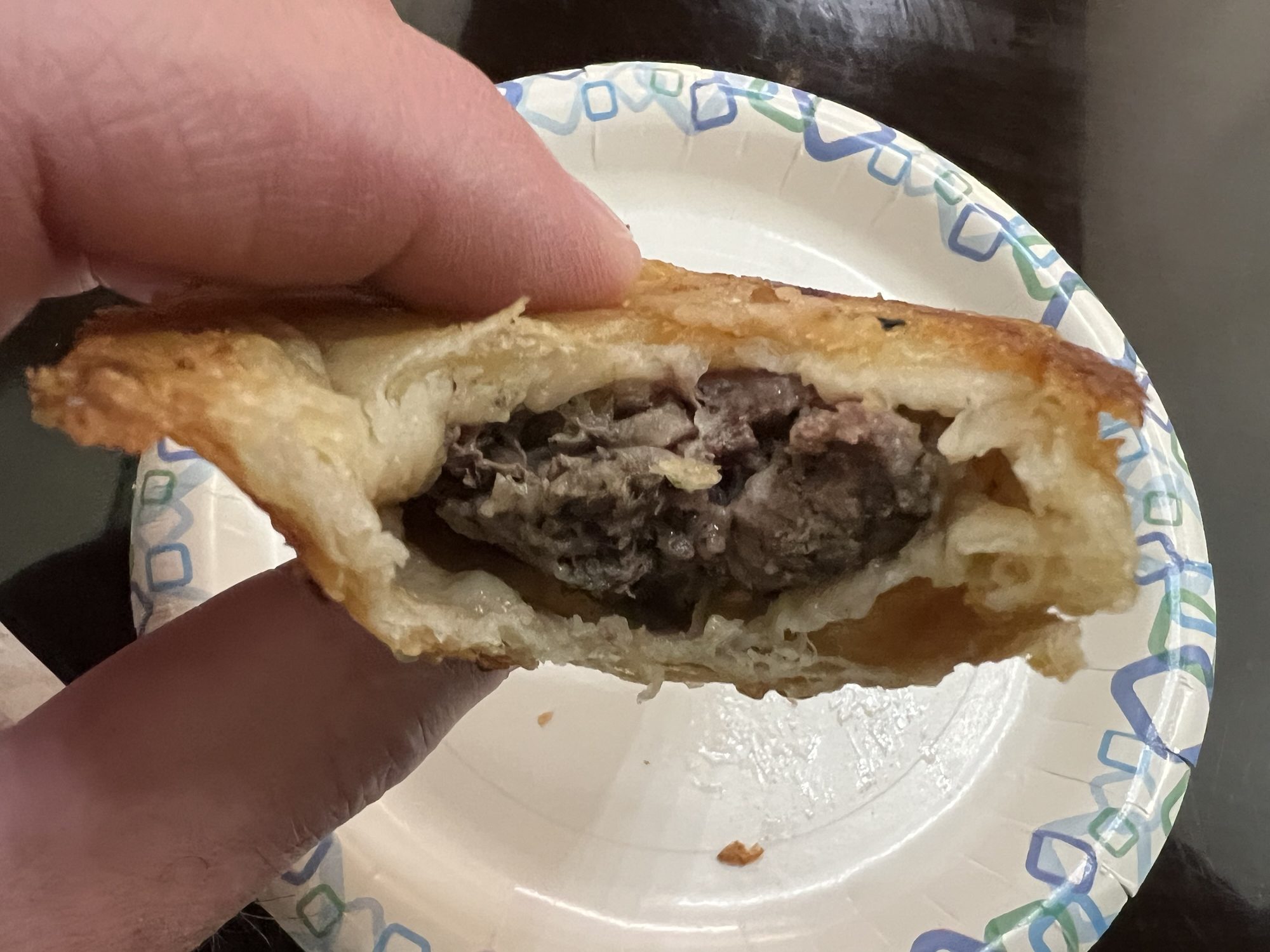
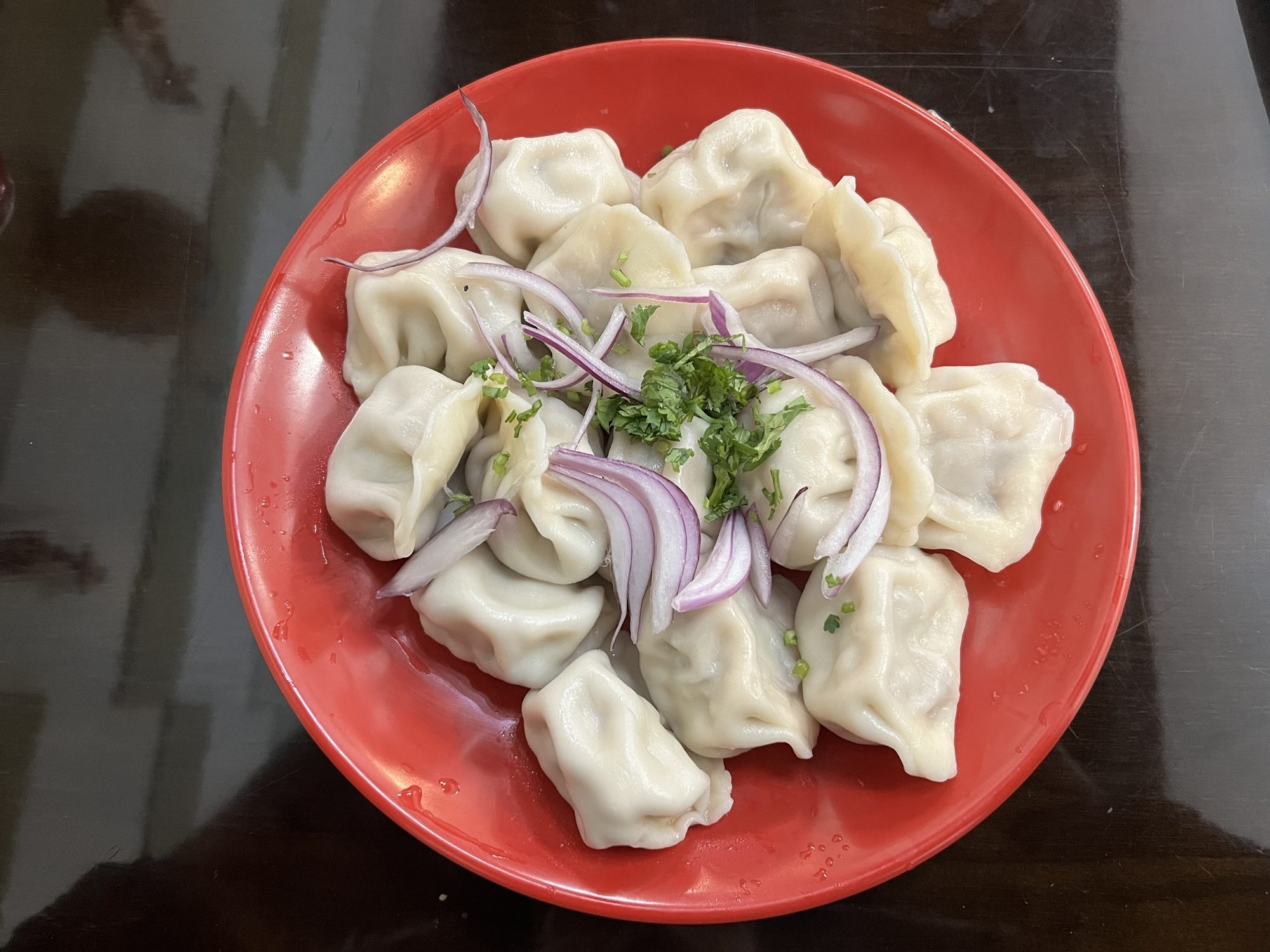
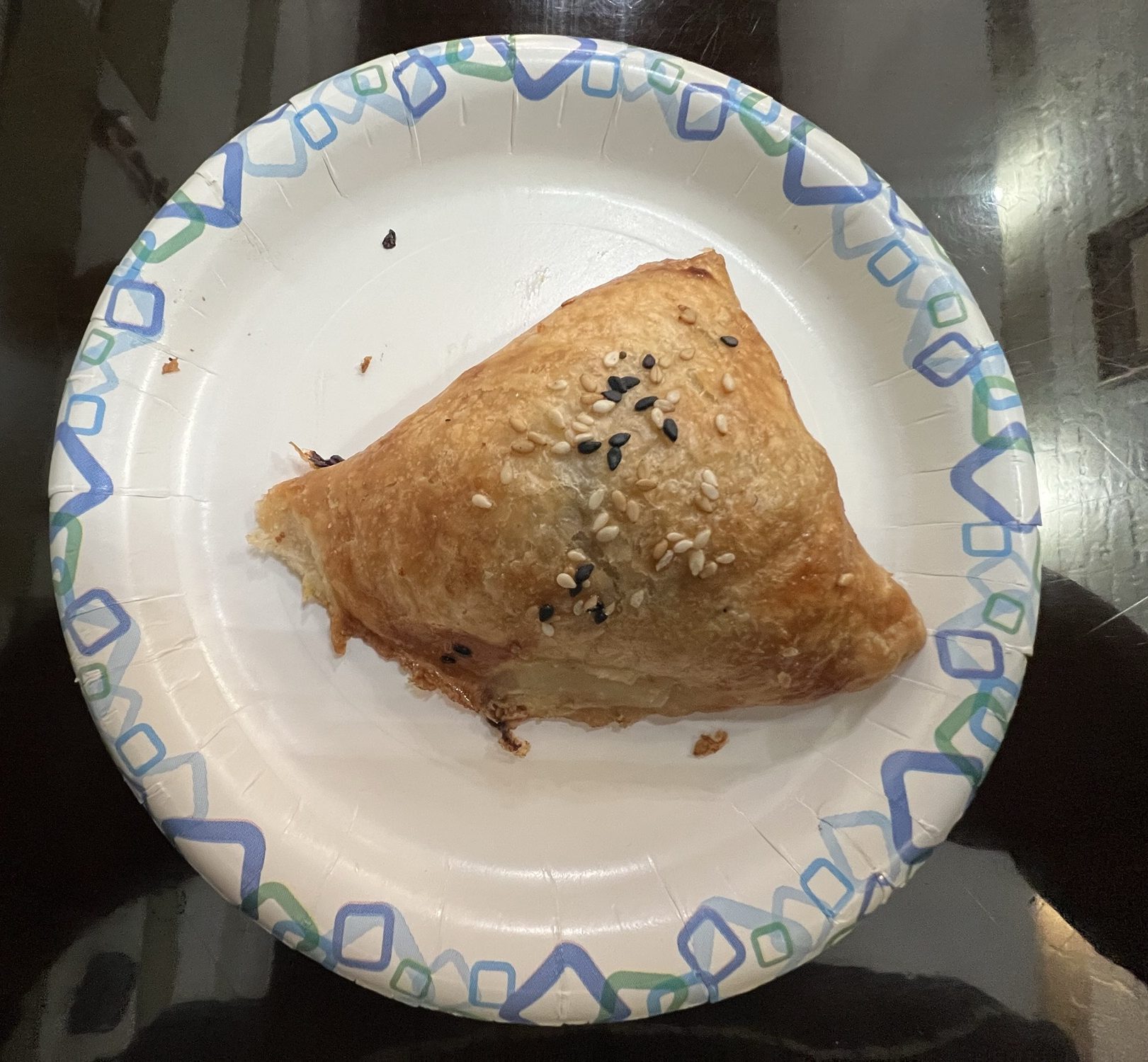
I kept it simple and ordered a dish of dumplings, a baked bun and an opened faced meat and vegetable bun. When it all came out, it was more than enough food. The baked bun was filled with a spicy lamb and cumin mixture that with each bite brought warmthinside my body. The food is really spicy here.
The buns here are really good
The open-faced Lamb and Cumin Bun was filled with a combination of ground lamb and vegetables and a very hot sauce. It really had some kick to it and it did not need any additional sauces. The order of dumplings was almost a double order from the usual Chinese restaurants I go to and are perfect for sharing.
The Dumplings are amazing
They were also filled with a spicy lamb mixture and an extra kick was added with the hot oil that they brought to the table. It was more than enough food for one person. The hot tea that the waiter brought to the table helped cool my stomach down. The waiter could not have been nicer.
The Baked Buns are excellent
After a relaxing dinner and some much needed sitting it was back to the sidewalks and the walk back up Eighth Avenue to Port Authority. Talk about a walk. I must have covered at least five miles. When I finally got on the bus that evening, I could not believe all the changes in the neighborhood since I worked there twenty-seven years ago. It has gotten so much nicer than what it had been even with COVID.
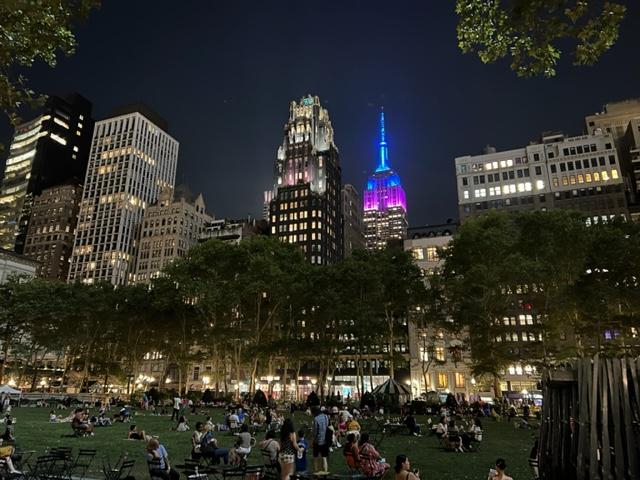
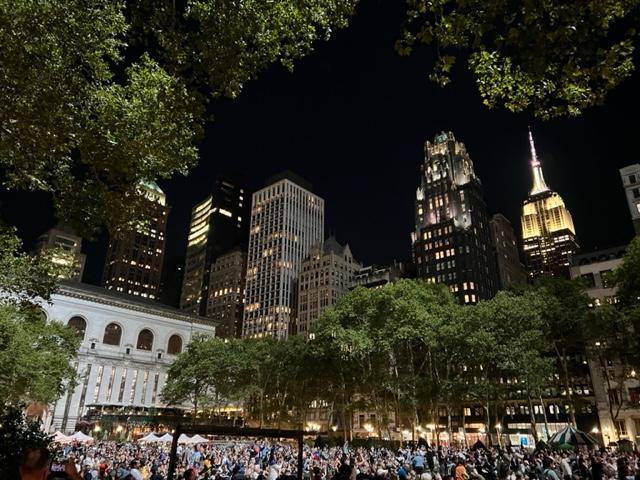
Bryant Park at night when all the buildings are lit.
This area may be down a bit, but it is not out!
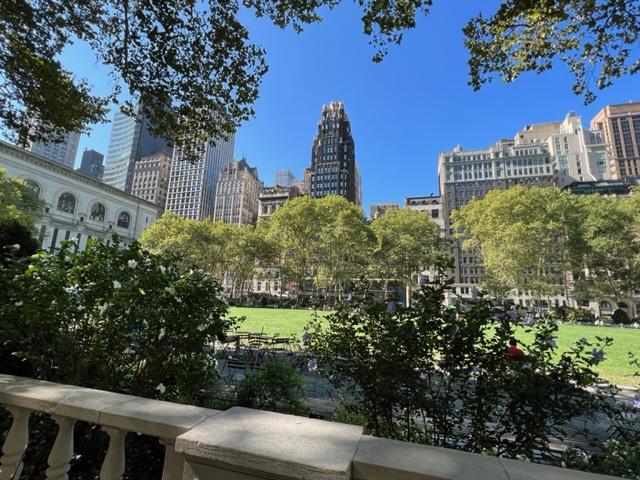
Bryant Park in the summer of 2023.
Please visit my other blogs on the Garment District:
Day Two Hundred and Three: Walking the Borders of the Garment District:
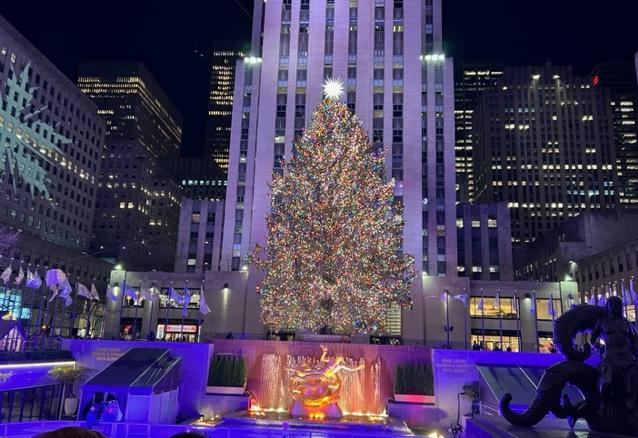
After all the running around of the holiday season (and I ran from one part of the state to another), I finally got back into New York City to resume my walk of the Garment District. With a new variant spreading around the City, you would think the Manhattan would be quiet but that did not stop the tourists from coming to the museums and seeing the Rockefeller Center Christmas tree that was still up into the first week of January. It was business as usual just more people wearing masks outside.
The Rockefeller Center Christmas tree was still packing them in after Christmas was over
Manhattan is resilient when it comes time for the pandemic. More restaurants, stores and businesses have opened up and like everyone else, you wear your mask to stay safe. I don’t mind showing my ID and my vaccination card if it means I can still enjoy doing the things I want to do, stay safe and support New York City businesses that desperately need the money.
I have to say one thing, everyone from stores to streets took down their Christmas decorations in record time. When I was in the City at the MoMA for a “The Contender’s Night” movie, I saw department store display windows being changed, the decorations outside Cartier being taken down on Fifth Avenue and most outdoor decorations gone even before the Epiphany. I thought that was strange but I guess it is time to move to Valentine’s Day and to Chinese New Year. Hope fully things will get better as it gets warmer in three months.
When I started my walk of the Avenues of the Garment District, some streets were busier than others. The core of the Garment District is still so quiet with most of the manufacturing that still goes on in the area shut down and even some of the hotels that have now been built in the area had a lack of guests. When I moved to the side streets in the afternoon, talk about no people and this is in the afternoon.
The thing about this part of Manhattan is that these buildings were built in post-war years and replaced most of the turn of the century buildings that I saw when you walk below 34th Street. These were built for the growing clothing businesses for manufacturing and showrooms which are now being refitted for offices of Tech and Advertising firms with most of the manufacturing being zoned out of the area during the Bloomberg Administration.
Even so some of these buildings have been torn down for new office and apartment buildings that are changing the whole Times Square/Garment District area. It is more of an extension of Midtown stretching down to 34th Street and then the historic older Midtown section begins with NoMAD (North of Madison Square Park) and the Flatiron District. Still here and there tucked into corner of the streets and avenues, there are architectural gems and interesting artwork.
Another thing that the Garment District is known for is the bevy of reasonable restaurants that cater to the garment and office workers in the area. This has really been affected by COVID and several have closed for business, while others have finally reopened from their months of slumber. It is nice to see these businesses reopen and bring vibrance back to the area again.
I started my walk on Eighth Avenue exiting the Port Authority onto a crowded street with cars and cabs all over the place. For all the problems with COVID, New York City still seems very alive to me. From walking down Broadway to visiting the Christmas Tree in Rockefeller Center, there are tourists all over the place.
The Port Authority Bus Terminal is the main artery for people from New Jersey and Pennsylvania at 625 Eighth Avenue
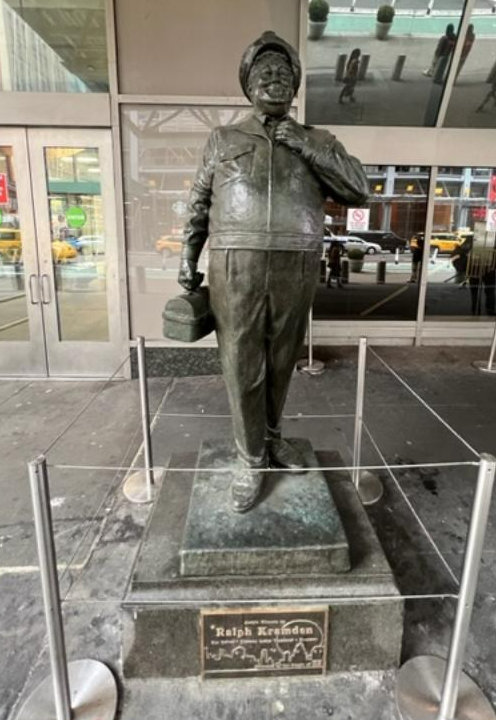
As I was exiting the building to West 40th Street, I took a long look at the Ralph Kramden statute that sits just outside the Port Authority. I passed this sculpture many times over the years but when you really stop and admire it, you can see the detail work of the statute. The statue was dedicated in August of 2000 and was a gift from TV Land to the City of New York. It was thought at the time this would be the perfect spot as the character was a bus driver (CBS News 2000).
The “TV Land” sculpture of Jackie Gleason as ‘Ralph Kramden’ by artist Lawrence Nowland
Lawrence Nowland is an American born artist from Philadelphia, PA and was a graduate of Millersville University in Pennsylvania and did his graduate work at the New York Academy of Art School of Figurative Art and was known as a Figurative artist.
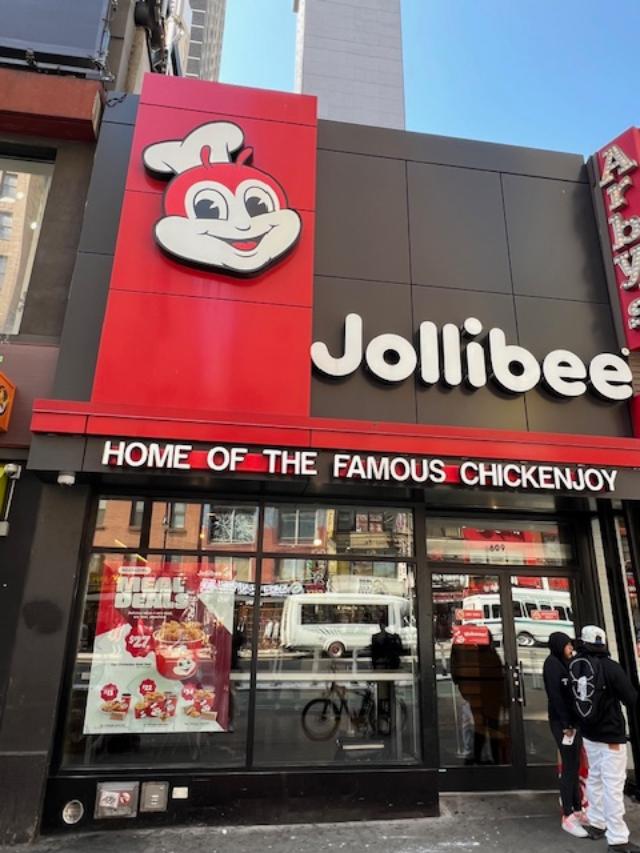
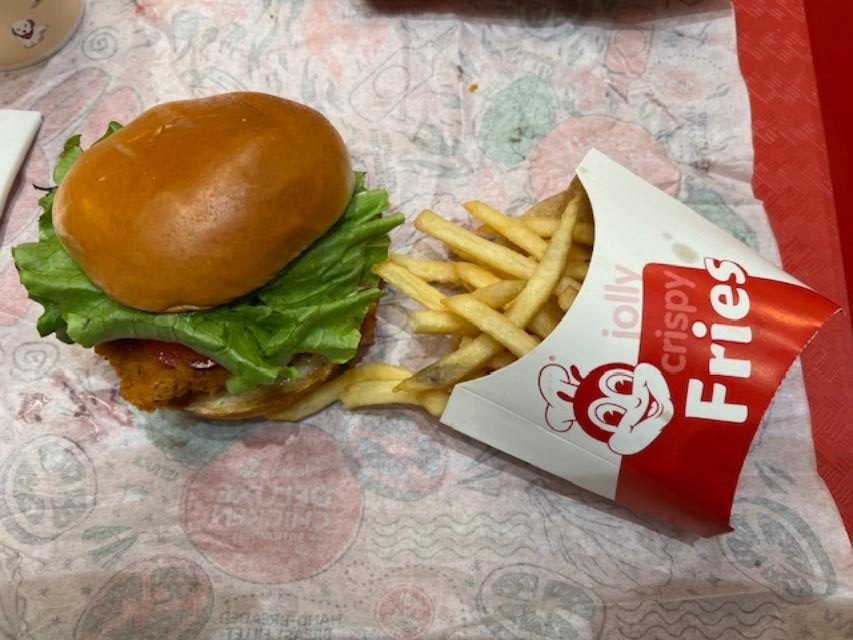
Walking down the block from the Port Authority, you will find one of the only branches of the Philippine based Jollibee fast food restaurant at 609 Eighth Avenue, one of five in the tri-state area. You can hooked on their Fried Chicken sandwiches and their peach/mango pie. The place has been crowded since its opening and made one of the quickest comebacks after everything opened up last June. I try to stop in every once in a while for lunch or a snack.
The chicken sandwiches are excellent here and the peach/mango pie are excellent
The food is very high quality and the service is very nice
Walking down Eighth Avenue is a little gloomy during the week since COVID hit. This used to be such a bustling area with the manufacturers and showrooms in full swing. Now most of the streets are quiet from the offices being closed down. I can see how it is affecting the small clothing and fabric shops that still dot the side streets. Even with Fashion Institute of Technology reopening, it is still quiet.
Although not architecturally exciting, there are still a few gems located in the corners of the block. There are many small buildings in the neighborhood that I have passed for years on my way to work at Macy’s and I never really looked at them closely. You might miss them if you don’t look up and look at the details.
The first one is 301 West 37th Street which has the most unusual carvings of gargoyles all over the sides and inside the window ledges. It gives the building almost a creepy, demonist look to it. The building was built in 1915 and is currently going under a gut renovation.
Just off Eighth Avenue is Non Solo Piada, a wonderful little Italian restaurant that specializes in Roman street food. Every time I have eaten here the food is terrific. The restaurant specializes in a type of calzone/turnover called a “Cassoni” and crisp pizzas called a “Piadizze”. I have tried the Cassoni Napolento filled with sausage and potatoes in a pastry crust and the Piadizze Margherita with fresh tomato sauce and mozzarella. The food and service are excellent and so reasonable.
Non Solo Piada at 302 West 37th Street (Closed June 2025)
The other building that is grand in detail but has been sadly neglected over the years is 557 Eighth Avenue. The Beaux-arts’ designed building was built in 1903 by architect Emery Roth who was part of Stein, Cohen & Roth. It was run as a residential hotel for most of its history and now houses commercial space in the upper floors and fast-food restaurants on the bottom (DaytonianinManhattan.blogspot/Loopnet.com).
You have to really look up or you will miss the beauty of the building with its detailed carvings around the windows and the portraits of women carved between the windows.
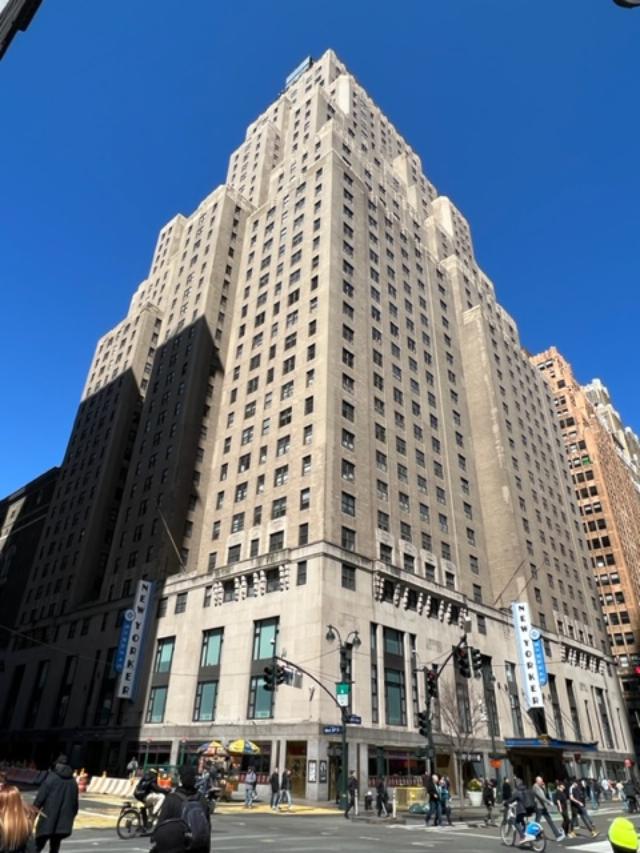
At the end of the block stands the Hotel New Yorker like a Grande Dame guarding the Garment District. The Hotel New Yorker on the corner of Eighth Avenue and West 34th Street at 481 Eighth Avenue. The hotel was designed by architects Sugarman and Berger and designed in the Art Deco style. The hotel was constructed in 1928 and opened in 1930. The hotel now managed by Wyndam Hotels put the hotel through a full renovation in 2006 to bring it back to its glory years now reflected the resurgence of the neighborhood (Hotel New Yorker History website/Wiki).
This is where I am noticing that the neighborhood is changing during COVID. They are knocking down a lot of the West 34th corridor and rebuilding it especially around Madison Square Garden. This area really needed it. When I was working at Macy’s, this was not the safest area to walk around in. This was an area of cut-rate stores and depressing office buildings. It still amazes me how the City reinvents itself and the area is now a desirable for office workers and residential living. Being right near the subways, LIRR and shopping, it is showing the changes in the old Midtown district.
Walking back up Eighth Avenue, the architecture is mostly older loft buildings that are still used for light manufacturing and showrooms but on this avenue is a stretch of great restaurants that cater to the workers that are so reasonable.
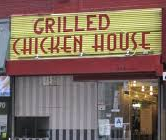
Grilled Chicken at 230 West 36th Street is a great little hole in the wall that caters to many of the Garment workers and the delivery guys speeding all over the City with other restaurants orders. The food is plentiful and reasonable. They make the best Fried Shrimp and rice and their Banh Ma sandwiches with Fried Shrimp and Grilled Pork are just excellent. This places really surprises you when you dine here.
Grilled Chicken House at 230 West 36th Street (Closed December 2022)
Another great place to eat is the original Upside Pizza at 598 Eighth Avenue. On many a cold night I have been warmed up by their Pepperoni Detroit pan pizza and their regular cheese slices are so rich and flavorful. They really loaded on the cheese and the pepperoni on to their slices and then bake them to a gooey delight.
COVID has really changed this part of Eighth Avenue around where the New York Times building is located and Times Square since the shutdown. Many restaurants and stores have closed but slowly new ones are opening or reopening. Traffic in this area is pretty consistent so businesses change hands a lot now.
As the movie theaters slowly open again and Broadway is opened on a limited basis show by show, the area is beginning to get busy again but not to the levels pre-Pandemic. During the week when I am walking these blocks, I see a difference in the number of tourists and residents walking around the Port Authority area.
Seventh Avenue is still always busy. This area has changed a lot in the twenty-five years since I worked in the area. When I worked on 34th Street, the buildings were filled with showrooms and designer headquarters. It is a more diverse group of businesses today and I swear much better restaurants and stores. It has gotten more upscale.
Sitting at the top of Seventh Avenue like a guardian is the Times Square Building at 1 Times Square or 1475 Broadway. This building is known to many New Year’s Eve revelers as where the ball drops.
One building that stands tall in Times Square is One Times Square known as 1475 Broadway. Once the home headquarters for the New York Times was opened in 1904. The building was designed by architect Cyrus L.W. Eidlitz. The original façade was of stone and terra cotta but this has been mostly stripped and is now home for mostly advertising. The ball still drops from the top of the building every New Year (Wiki).
It is amazing to see the radical changes in this area of Manhattan since I started to work there in 1988. It is almost night and day in its appearance of not just the buildings but the parks and businesses that line Seventh Avenue. When I had worked there twenty-five years ago, you really did not choose to walk on Seventh Avenue after 8:00pm when most office workers went home. It was not the safest or well-lit avenue especially below Times Square. How thirty years and a whole development of the area change things.
When I walked down Seventh Avenue today, it is like walking through a haunted house that is less scary. I remember my years as a young executive in the City trying to maneuver around the area and sometimes feeling safer walking down the old 42nd Street with the porn theaters and head shops. At least I knew there were police milling around. Today, there has been such an improvement in the cleanliness of the area and the more expensive stores and restaurants that has spread to Broadway as well but even this is being upended by COVID. It will be interesting to see how this plays out.
Again, most of the buildings in this area were built after the WWII for the Garment industry and have that loft-box look to them but like Eighth Avenue, there are still a few standouts that have survived the wrecking ball or renovation. One being the elegant 488 Seventh Avenue.
488 Seventh Avenue was built as the Hotel York in 1903 by brothers James and David Todd, who had an interest in building luxury hotels. They commissioned architect Harry B. Mulliken, who had designed the Hotel Aberdeen on West 32nd Street for the brothers, with his new partner, Edger J. Moeller, who formed the firm of Mulliken & Moeller. The York Hotel was their first commission together. The hotel was designed in the Beaux-Arts style with elaborate carved decorations (Daytonian in Manhattan).
The Hotel York was a residential and transient for most of its existence attracting the theater crowd when 34th Street was the Theater District of the time. As this moved uptown, the hotel was bought in 1986 and was renovated for residential and commercial use (Dayton in Manhattan). The Tokian Group now owns the building and it is luxury apartments.
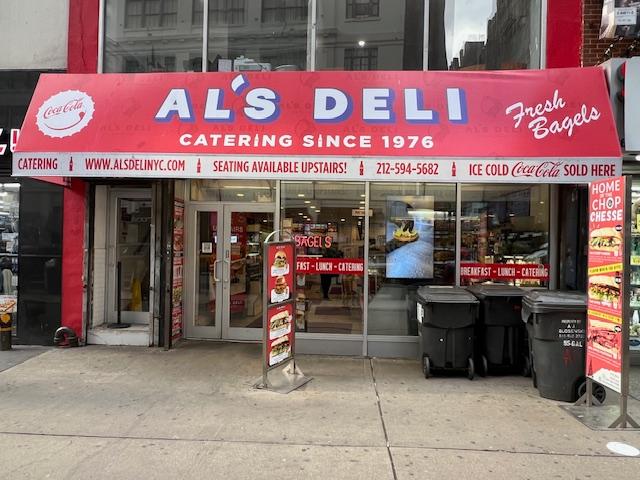
Towards the edge of the neighborhood is one of my favorite deli’s and known to thousands of Macy’s Alumni, Al’s Deli at 458 Seventh Avenue. I have been eating at Al’s Deli since 1988 and only recently in the last two years since exploring this section of Manhattan again have come back.
Al’s Deli at 458 Seventh Avenue is a Macy’s favorite
It still makes some of the best hamburgers and cheeseburgers in the City and their breakfast sandwiches are still oversized and delicious. Their Bacon, Egg and Cheese on a hoagie is still something that warms and fills me up in the mornings. Don’t miss their Chicken Parmesan Sandwich as well.
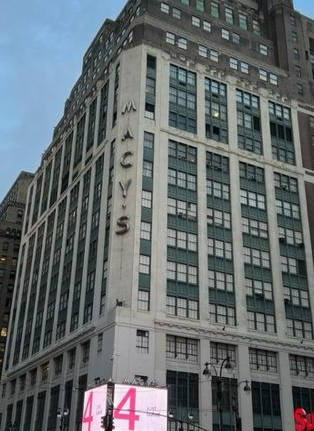
Across the street from Al’s Deli on the corner of Seventh Avenue and West 34th Street is the Grande Dame of the department store industry and my home away from home for seven years in the beginning of my career, R.H. Macy at 151 West 34th Street. When I started working at the store in 1988 it was funny but the locker rooms and cafeteria featured in the movie “Miracle on 34th Street” had not changed one bit, at least as I remembered it.
Macy’s New York on the Seventh Avenue side of the store in Art Deco Style (Wiki)
The Seventh Avenue side of the building was added in 1931 making Macy’s the world’s largest store. The building was designed by architect Robert D. Kohn in the Art Deco style that was popular in the day (Wiki). The entrance is still iconic to shopping enthusiasts who are looking for the perfect gift.
Walking up Seventh Avenue, also known as the Fashion Mile to many in the retail industry, is the Fashion Walk of Fame plaques that line the avenue from 35th Street above Macy’s up to 42nd Street. You have to look at the sidewalk to see some 30 plaques honoring some America’s most celebrated designers including Halston, Ralph Lauren and Calvin Klein.
The honor was started by the Fashion Center Business Improvement District and these are chosen by a group of fashion panelist each year since 2000 (The Vintage Traveler.Wordpress.com).
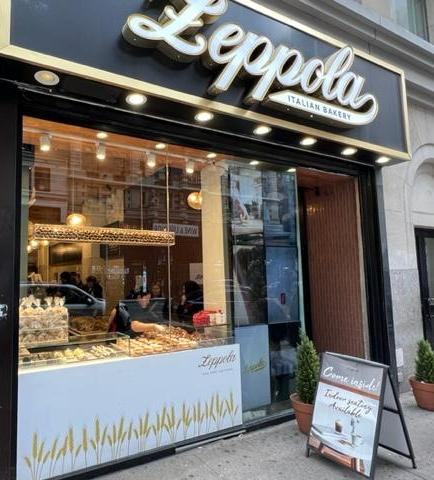
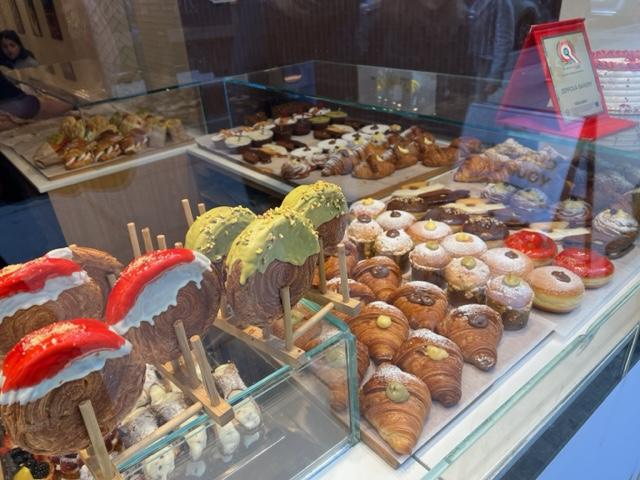
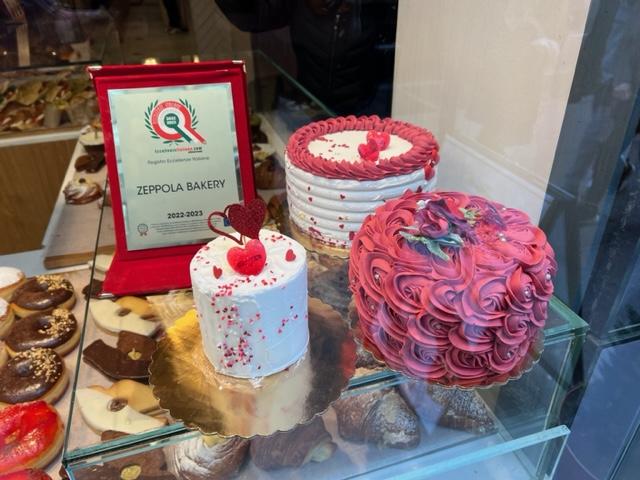
I stopped at Zeppola Bakery at 499 Seventh Avenue for a quick snack. Everything looks so inviting from the fluffy doughnuts to the stuffed sandwiches. The bakery for all its visuals is on the expensive side and a small heart doughnut filled with raspberry jelly cost $3.95. Delicious but a little pricey.
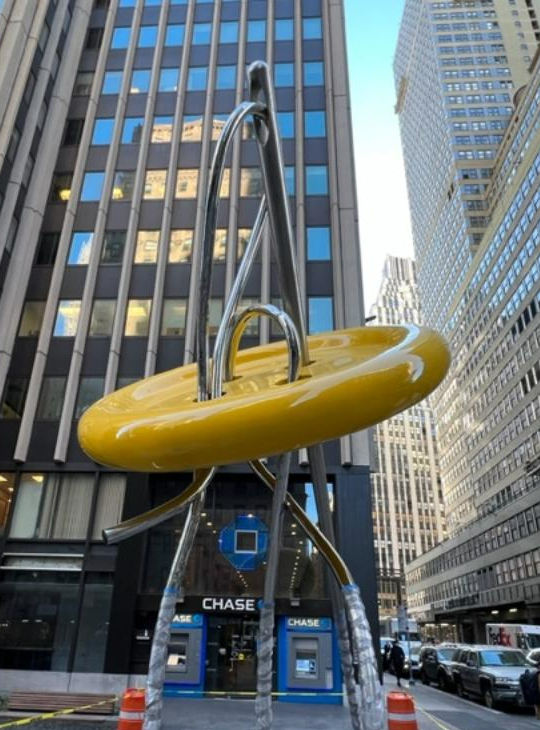
When arriving at the corner of West 39th Street and Seventh Avenue in front of the Chase Bank at 551 Seventh Avenue is the very iconic sculpture of the Needle Threading the Button that is part of the Welcome Booth on Seventh Avenue.
The Button and Needle Sculpture is actually part of the information booth (NYPL.org)-the old one
The new Garment District sculpture in 2023-the new one
According to the New York Public Library, the sculpture of the needle and button is actually part of the Fashion Center Information Kiosk that has been closed for a few years. The sculpture was designed by Pentagram Architectural Services in 1996 and was inspired by artist Claes Oldenburg’s sculptures. The district is currently looking into replacing this kiosk (New York Public Library Research Department).
Artist Claes Oldenburg was a Swedish born American artist. He was born in Stockholm and moved to the United States with his parents. His father was a Swedish Diplomat who was stationed in Chicago and he studied art at Yale University and The School of the Art Institute of Chicago. He was known for his large art installments. Even though this was not designed by him, the work was inspired by his sculptures (Wiki).
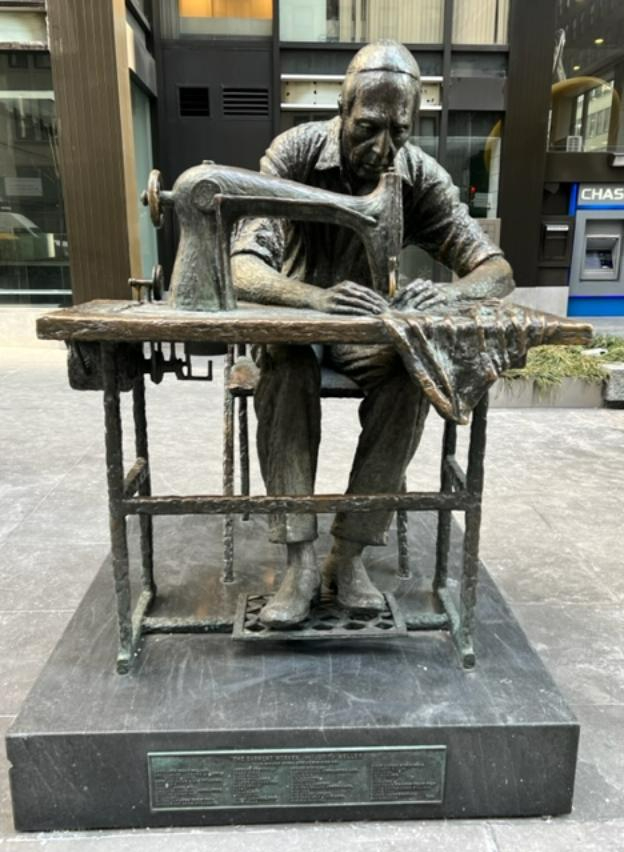
The other sculpture next to the kiosk is of a garment employee working on a sewing machine. This sculpture by artist Judith Weller was of her father who worked in the Garment Industry entitled “Garment Worker”. The sculpture was created by the artist in honor of her father, a machinist in the garment trade and to Jewish garment workers who were the backbone of the community. It was created in 1984-85 for the Public Art Fund (Public Art Fund).
The “Garment Worker” by artist Judith Weller
The Mission of the Public Art fund that was funded in 1977, is to bring dynamic contemporary art to a broad audience in New York City and offer powerful public experiences in art (Public Art Fund).
Artist Judith Weller is an Israel born New York artist who is known for her genre of work dedicated to the laboring people all over the United States (Ask Art.com).
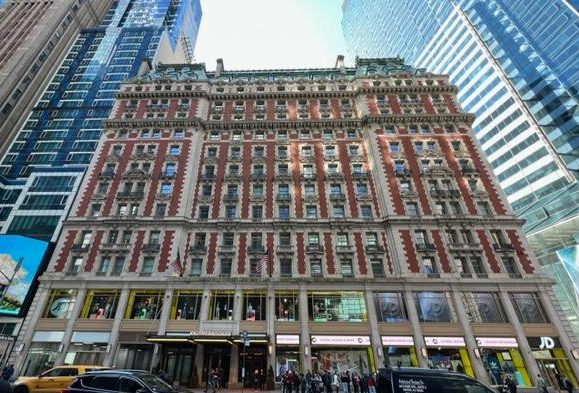
Crossing over to Broadway from the busy 42nd Street Mall I was greeted by the recently reopened Knickerbocker Hotel at 6 Times Square. For most of the recent history of this property it had been falling apart and was offices in the times I worked in Manhattan.
The Knickerbocker Hotel was built by John Jacob Astor IV and it opened in 1906. The hotel was designed by the firm of Marvin & Davis in the Beaux-Arts style. The outside of the hotel was built in red brick with terra cotta details. The hotel was fully renovated in 2015 (Wiki).
In front of the Chase Bank at 1411 Broadway is Golda Meir Square with an open plaza. Tucked into a garden almost hidden from view by the plants is a bust of Golda Meir by artist Beatrice Goldfine. It looked like from old pictures the original pedestal is now beneath the planter. It was unveiled in 1984 (Wiki).
The bust of Golda Meir by artist Beatrice Goldfine in Golda Meir Square is now hidden in a garden.
Artist Beatrice Goldfine is an American artist born in Philadelphia and studied at the Barnes Foundation and the Pennsylvania Institute of Fine Arts.
On the way back towards Broadway I came across an interesting set of artwork by artist Santi Flores that lined the Broadway Mall. These interesting works reached for the sky. These interesting little sculptures looked like they were raising their hands for attention (“Here” ended October 22nd, 2022).
The Broadway pop-up of Artist Santi Flores display “Here”
Artist Santi Flores at the street exhibition “Here”
Artist Santi Flores is a Spanish artist who is also a musician and visual artist. His creativity shows no limits (Artist Bio).
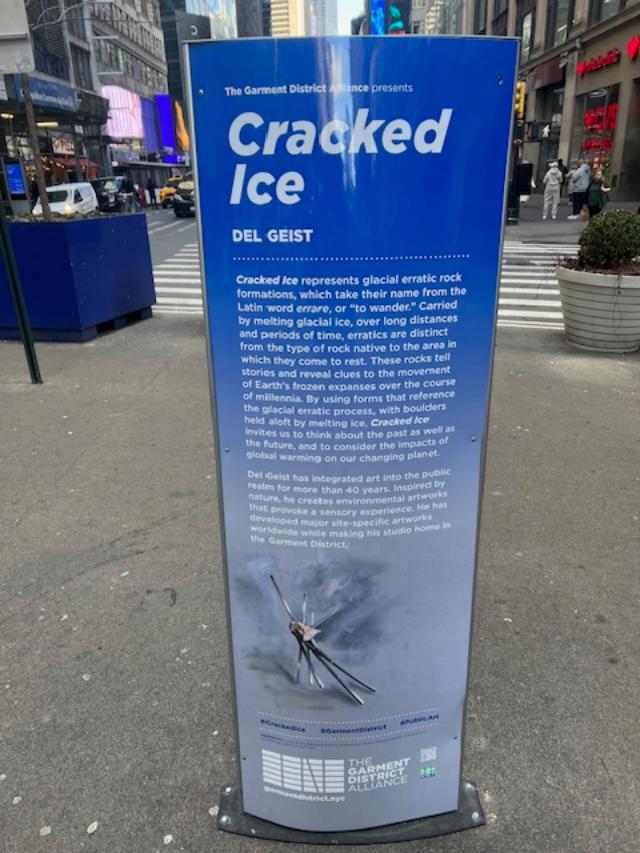
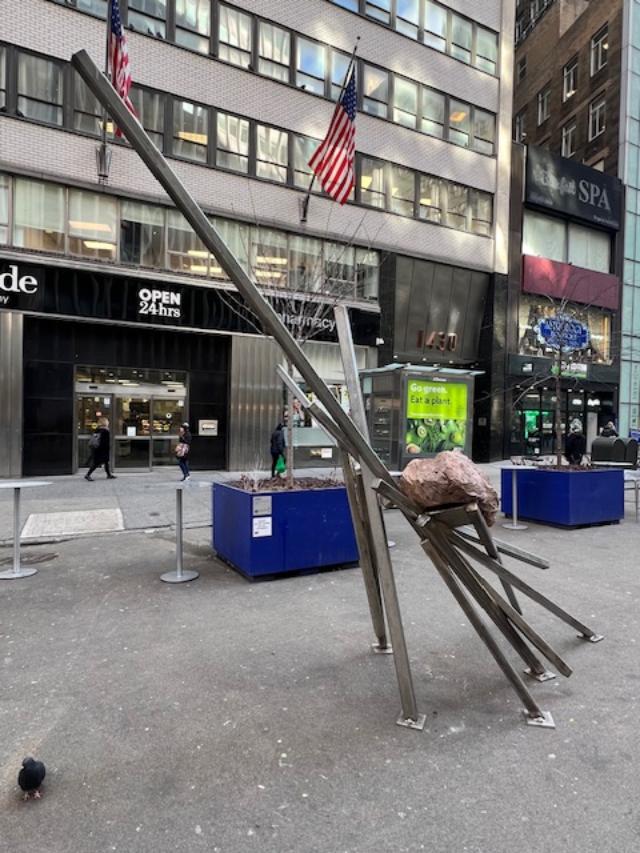
In 2024, the new exhibition was called “Cracked Ice” by
“Cracked Ice” by artist Del Geist
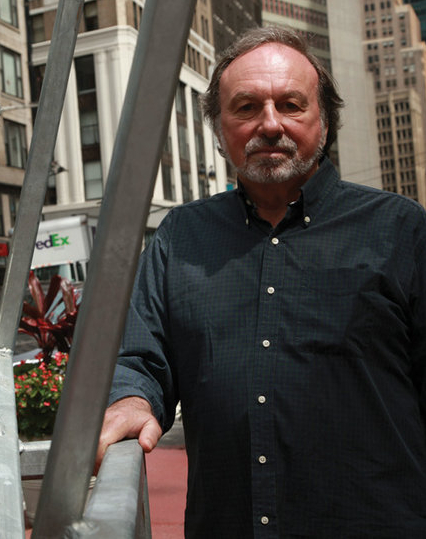
Del Geist has integrated art into the public realm for more than 40 years. As an artist, using the natural sciences as a palette, he has developed major site-specific artworks worldwide (Del Geist website)
Walking down Broadway most of the buildings are relatively new or been built after WWII but two really do stand out. One being the Haier Building at 1356 Broadway. The Haier Building was built by architects from York & Sawyer in the Neo-Classical Revival style. The building was completed in 1924 and was the headquarters for Greenwich Savings Bank. The building is built with limestone and polished granite and features Roman Corinthian Columns (Wiki).
1352 Broadway-The Haier Building (Former Greenwich Savings Bank-Wiki)
The Haier Building stretches from Broadway to Sixth Avenue and is impressive on both sides of the building. The building was used by Greenwich Savings Bank from 1924 until 1981 when the bank went out of business (Wiki).
The other impressive building on this side of Broadway is the Macy’s New York Broadway building facing Herald Square. The store was built between 1901-1902 by architects Theodore de Lemos and A. W. Cordes of the firm of De Lemos & Cordes in the Palladian style a form of classic Roman and Greek temple style (Wiki).
Macy’s New York at 151 West 34th Street on the Broadway side of the building
Herald Square has dramatically improved since I worked at Macy’s. When I worked at Macy’s in the early 1990’s, Herald and Greeley Squares were places to avoid until about 1994 when the parks were renovated and new plantings and French metal café tables were added. Now it is hard at lunch time to find a table.
In the process of the renovations, the City also restored the statues dedicated to James Gordon Bennett and Horace Greeley.
The statue dedicated to James Gordon Bennett and his son James Gordon Bennett II
Herald Square Park
The statue is to Minerva, the Goddess of Wisdom and Invention and two blacksmiths who flank a bell that once topped the Herald Building where the New York Herald, which was founded by James Gordon Bennett in 1835. The statue was dedicated in the park in 1895 (NYCParks.org).
Antonin Jean Carles was born in France and was a student of the Ecole des Beaux-Arts de Toulouse. He was known for his monument sculptures.
Walking back up Broadway, it started to get colder as the afternoon went on but I came across an unusual sculpture that had just been put up entitled “Passage” by artist Serge Maheu. This interesting piece of street art you could actually walk through and as you walked through it, the colors changed.
“Passages” by Artist Serge Maheu (Artist’s bio)
It was like walking through a tunnel of hula hoops. The artist was going for a “transformative, playful experience” during an otherwise gloomy time in winter (Patch.com).
According to the artist, “Passage” explores the emotional connections between light and sound (Serge Maheu bio).
Artist Serge Maheu is from Quebec, Canada and graduated with a degree in Computer Engineer, he has taken a path down the creative route to become a multimedia director. He specializes in film, animation, photography, sound and music (Serge Maheu bio).
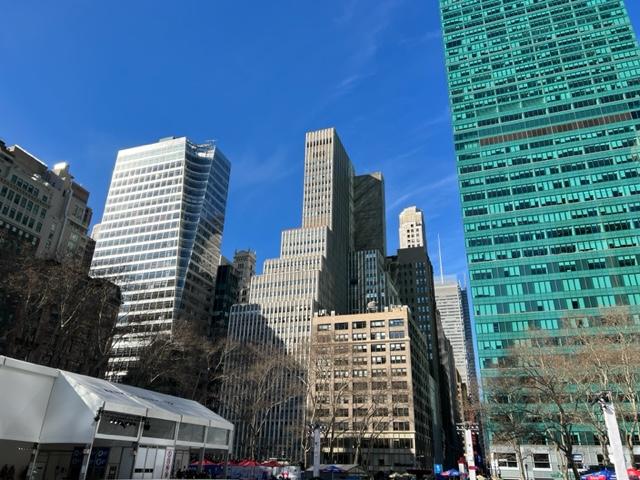
By the time I reached Bryant Park, the sun started to come out again and it cleared up slightly. The park was filled with people ice skating or eating. The tables were mostly filled on this cool day which I was surprised at considering the weather. It does not take long to see how the changes in the park have led to change in the building here.
Standing guard at the edge of the neighborhood is the new Bank of America building. This innovative building was designed by architect Rick Cook from the firm of Cookfox Adamson Associates. The building was designed with a clear ‘Curtin wall’ and several diagonal planes for wind resistance. The building was also awarded a LEED (Leadership in Energy and Environmental Design) for sustainable ‘green’ architecture (Wiki/Durst website).
Bryant Park is another interesting park. In 1988, you would never go into this park unless you wanted drugs or wanted to get mugged. The park was surrounded by bushes and it was in extremely bad shape. When the New York Public Library was going through a renovation, money was allocated to fix the park. It is night and day from when I passed the park in the early 1990’s. Talk about a difference that twenty-five years makes.
Bryant Park in all its glory
The original park opened in 1870 as Reservoir Square after the Croton Distributing Reservoir that was once located on the eastern side of the park. In 1884, the park was renamed for New York Evening Post Editor William Cullan Bryant (Wiki).
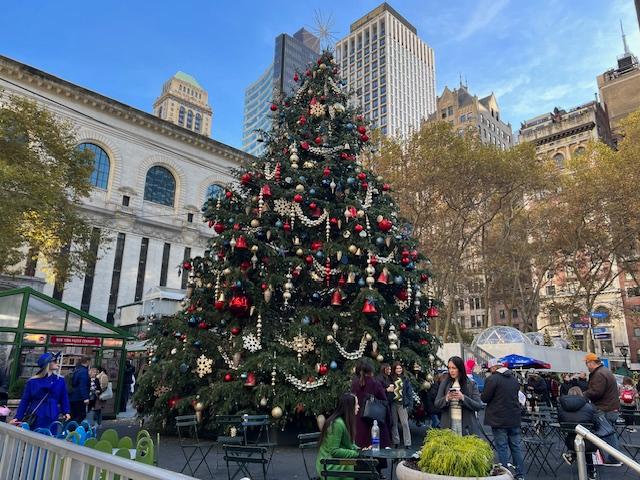
The park has suffered from neglect in the past including times in the 1930’s and the 1960’s and 70’s and had been through past renovations but in 1980 the Bryant Park Restoration Group was founded and took over park services. Since then, the park was fully renovated in 1992 and continues to improve with continued maintenance. Now there are events like ‘Movies in the Park’ and ‘Winter Village’ with a skating rink, rows of boutiques and the Christmas tree (Wiki).
Bryant Park in Christmas past
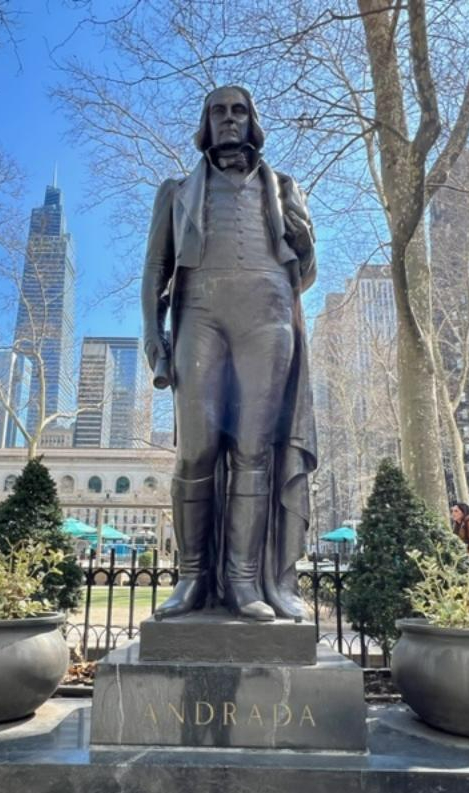
Lining the park on Sixth Avenue side of the park is a series of interesting statuary that I think most people miss when walking by the park. The first one is the statue called the “Andrada Monument” or also known as the statue of Jose Bonifacio de Andrada e Silva, the Brazilian statesman. Every September, the Consulate General of Brazil commemorates Andrada and Brazilian Independence Day by hosting a small ceremony at the monument (Wiki).
The statue was created by artist Jose Otavio Correia Lima. The artist was born in Brazil and attended the National School of Fine Arts in Rio de Janeiro. He taught and ran the college until 1930 (Wiki).
Jose Bonifacio de Andrada was a Brazilian Statesman who was also a college professor and naturalist who was one of the most important mentors of Brazilian independence (Wiki/Britannica).
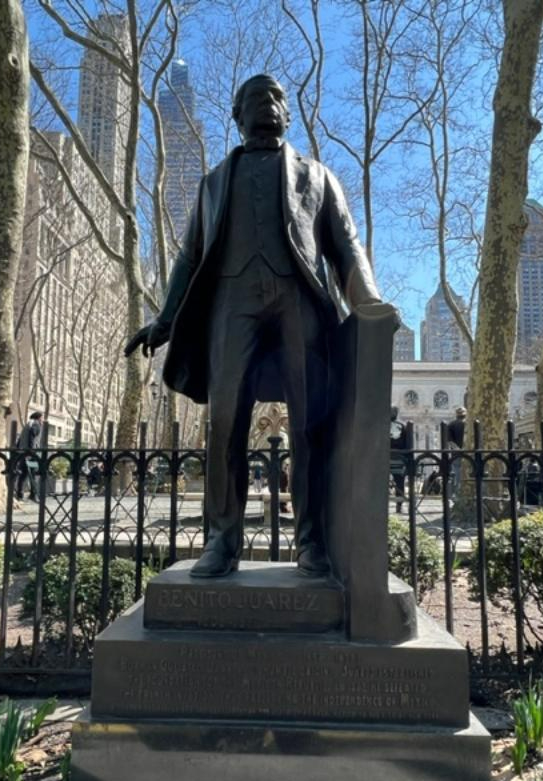
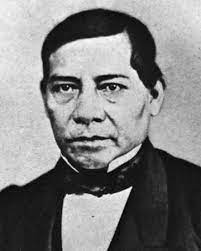
The other statue on the opposite side of the park is of Benito Juarez, the former President of Mexico and its first indigenous President serving twice. The statue was created by artist Moises Cabrea Orozco and is the first Mexican to be commemorated in the park system.
Artist Moises Cabrea Orozco was born in Mexico and studied at the La Esmeralda School of Painting and Sculpture and San Carlos Academy. He is related to social realist painter Jose Clemente Orozco.
Benito Juarez was a lawyer and statesman who served as the President of Mexico twice. He also served on the Mexican Supreme Court.
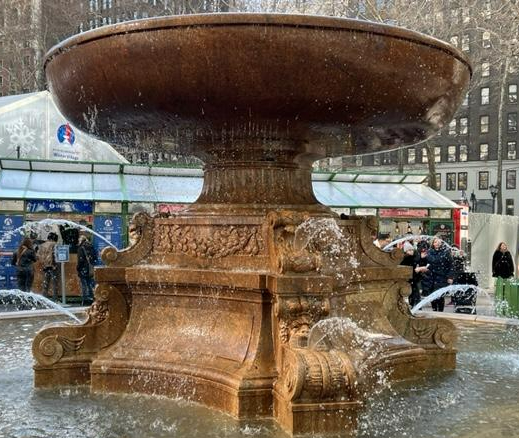
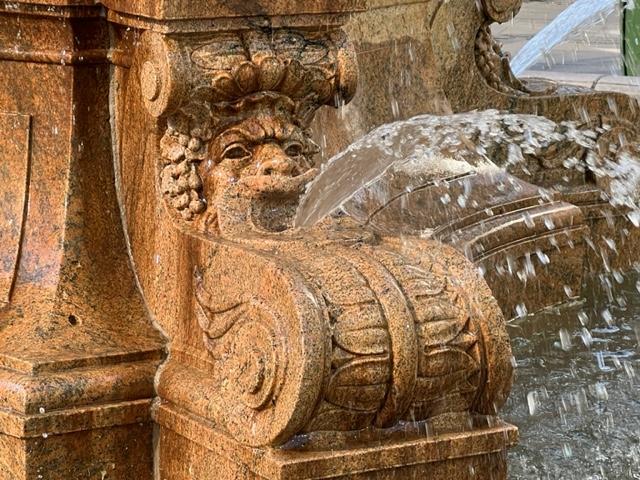
In between these two statues at the western side of the park as you walk up the steps to enter the park is the Josephine Shaw Lowell Memorial Fountain, one of the most beautiful pieces of art in Bryant Park. This fountain is one of the nicest places to sit by on a sunny warm day and there is not a time that I do not make a wish in the fountain.
Artist Charles A. Platt was born in New York City and studied at the National Academy of Design and the Students Art League. He was known as a landscape designer, artist and architect of the American Renaissance Movement (Wiki).
The fountain was designed by architect Charles A. Platt in granite and bronze and has the most interesting details to it. It is the first major memorial dedicated to a woman in New York City. The fountain was dedicated to activist Josephine Shaw Lowell (Wiki).
Josephine Shaw Lowell was born in Massachusetts and moved to New York with her family in the 1840’s. She was committed to social charities and was named the Commissioner of New York State Board of Charities, the first woman to hold the position. She also founded many charities (Wiki).
This time of the year Bryant Park is taken up by the skating rink and the restaurants that surround it. Most of the Christmas Village was closed and it looked they were going to take it down. The Christmas tree was surprisingly still up and lit and at night makes the park festive.
Across from Bryant Park to its south are a grouping of beautifully designed buildings. On the corner of West 40th Street and Sixth Avenue is 80 West 40th Street, ‘The Bryant Park Studios’. The building was built in 1910 as showrooms for artists. The building was designed in the Beaux-Arts style by architect Charles A. Rich (Daytonian in Manhattan).
Further down Sixth Avenue is where one of the first Chick-fil-A in Manhattan opened at 1000 Sixth Avenue in 2015. I remember the lines and the mob scene when this first came to New York. It was crazy for almost a year.
It was also their largest outlet at the time with three floors. The place had lines wrapped around the block during its first several months until more outlets opened around the City. I hate to say it but for all the controversy about the restaurant, I really do love their chicken sandwiches.
Chick-fil-A at 1000 Sixth Avenue (the first in Manhattan)
The Chick Fil A is really good and the chicken sandwiches are delicious
Their chicken sandwiches are outstanding
Another interesting building that stands out is an old home at 966 Sixth Avenue which is the former J. E. Winterbottom Funeral Home. The business moved in 1885. Before that the post-Civil War house was constructed in the Second Empire style with a Mansard roof. It was once a private home before the business moved in (Daytonian in Manhattan). According to current records, it is going to be Manhattan’s first Sonic restaurant. It will be the first urban Sonic to open outside the one on Staten Island (Patch.com).
At the very edge of the neighborhood on the corner of Sixth Avenue and West 35th Street is the most interesting piece of artwork on a building that once housed the Desigual flagship store. The work is by Spanish artist Okuda San Miguel and entitled “Multicultural Freedom Statue” and was created in 2019. It is a tribute to multiculturalism in New York City (Artist Bio). The store has since closed.
The painting at Sixth Avenue at West 35th Street by artist Okuda San Miguel (painted over December 2022)
Artist Okuda San Miguel was born in Spain and known for his colorful geometric styles in painting. He graduated from the Complutense University of Madrid with a BFA and has shown his work all over the world (Wiki).
The last building I noticed for its beauty was on the corner of Sixth Avenue and West 34th Street, 47 West 34th Street (1378 Broadway or 2 Herald Square) the Marbridge Building. The Marbridge Building was by architects Townsend, Steinle & Haskell in 1909 in the Classical Beaux Arts style and has been used as an office building since its opening (Wiki/Photo/Street).
For dinner on the way back up Sixth Avenue, I ate at the Kyoto Spot Mochinut at 1011 Sixth Avenue. They had the most unusual combination of a Potato Half and Half ($7.95), which was half a hot dog and half a mozzarella stick rolled in rice flour and chopped potatoes and then deep fried and they served it with a spicy type of duck sauce. I also had one of their Ume Mochinut doughnuts which were made out of rice flour but tasted like a funnel cake. It was utterly amazing.
On my second trip exploring the avenues, I had dinner at Main Noodle House at 1011 Sixth Avenue. The food and the service were excellent. I had a traditional eggroll and it was one of the best I have had in a long time. For the entree, I had the Cantonese Wonton Soup ($10.95) with roast pork, wontons and lo mien noodles. It was the perfect meal on a cool winter night. It was a meal within itself.
The dinner was wonderful and it was nice to just relax. I had the window seat so I got to see the world pass by.
The inside of Main Noodle House.
Looking over their extensive menu.
Their Cantonese Roast Meat Wonton Soup with Roast Pork, Wontons and Noodles is a full meal.
The wontons are amazing.
It was late when I finally arrived back at Bryant Park in time to see the Christmas tree in full blaze and hear the music and laughter of the skating rink. Across the street I saw the green and red lights blinking of the new Bank of China building at 1045 Sixth Avenue (or 7 Bryant Park). This building is interesting for its shape and its ongoing light show.
The building was completed in 2016 and was designed by architects Henry N. Cobb and Yvonne Szeto from the firm of Pei Cobb Freed & Partners and it was interesting on why they designed the building in an ‘hourglass’ design. The firm stated that “they wanted to enrich the experience of the park while at the same time make its relationship to the park a clear expression of its identity (Pei Cobb Freed & Partners). The building is the New York home of the Bank of China.
Bank of China Building at 1045 Sixth Avenue (7 Bryant Park)
Being right across the street from the Bryant Park Studios at 80 West 40th Street shows the contrast that this neighborhood is going through now with a combination of the old and the new and showcasing its beauty. These buildings are adding character to an area of Manhattan that was not so nice just twenty years ago.
This part of the Garment District is the reason why we are seeing less of a Garment District but more of a commercial core that surrounds Times Square and promotes how a City can change for the better with a game plan. All around the core of a park that you would not dare set foot in for almost thirty years.
Talk about transformation!
Bryant Park at nighty
This is not the Bryant Park of the past.
Check out my other blogs on the Garment District:
Day Two Hundred and Three: Walking the Borders of the Garment District:
Sometimes you walk through a neighborhood and you come across a little shop that is just so cute and interesting that you have to stop in to see what they carry. This is the attraction of Epices Bakery on West 70th Street, a small French pastry shop with beautiful and delicious desserts. Not only is the selection nice but the sights and smells when you enter of freshly made coffee and buttery baked goods greet you when you walk in.
There is a nice variety of baked goods in the glass cases to choose from. One side of the store is dedicated to pastries like eclairs, cream puffs and fruit tarts and the other has savory breakfast items like ham and cheese croissants, small quiches…
Exploring Boonton, NJ is an ongoing Downtown project that I enjoy. As current President of the Bergen County Firemen’s Home Association, I go out to the home at least six times a year for meetings. Before I head to the home, I always like to stop in the Downtown and explore all the new businesses, restaurants and shops and see the changes going on. The first wave of art galleries that I had visited in 2017 has given way to a collection of unique boutiques and spas, new art galleries and a collection of interesting street art. Like most of the downtowns featured on this blog, Boonton just seems to be growing and changing all the time.
Working with the Bergen County Firemen’s Home Association at the NJ State Firemen’s Home in Boonton, NJ:
In August of 2021, it had been a tough summer. I pulled a muscle and it has been hard to do long walks around Manhattan so I kept it to short walks around my neighborhood. As I have improved, I have been able to get more done and have started to drive again. I was able to make the trip to Boonton, NJ for the Bergen County Firemen’s Home Association Barbecue.
The members of the Bergen County Firemen’s Home Association at their June 2024 barbecue.
So off I went adjusting the car seat higher with a pillow and an ice pack. It was a short trip with no traffic and the pain has now subsided with more walking. When I arrived at the home for the barbecue, I had to walk around the property to loosen up a bit. When I came back in 2023, 2024 and 2025 for our two barbecues, I felt so much better and was ready to go.
Still it was a marvelous day and the most beautiful weather sunny and clear and 72 degrees. The residents loved being outside to enjoy the fresh air, music and food and the members liked that we still could socially distance and converse with the residents outside as long as there were not too many gathering (we want to keep our retired firefighting brothers safe too). Please check out my blog on the August BCFHA Barbecue:
Me finally sitting down to lunch after serving everyone else
The Bergen County Firemen’s Home Association August Barbecue at the NJ Firemen’s Home August 15th, 2021:
After the barbecues were over, I decided to head back to Downtown Boonton to explore the downtown on a weekend and get some stretching for my legs and back in before the long ride home. Downtown Boonton, which has been discovered by the artists and hipsters is going through a major change as we speak. There is so much to see and do.
Since then, I have visited the downtown and watched it grow from a rather sleepy downtown to a destination with galleries, coffee shops, music venues, upscale stores and eclectic restaurants.
The barbecue feast was amazing at the June 2024 Barbecue
The members of the Bergen County Firemen’s Home Association at the 2025 Picnic with member George Steiger on his 102nd birthday
Our blog on the 2025 barbecues:
It started off as a gloomy and misty day for the Bergen County Fireman’s Association June Barbecue. The weather forecast for the week was for rain but we lucked out with conditions. There was a light rain with breaks between so that residents could come outside and enjoy lunch under the tents.
The grounds of the NJ State Firemen’s Home during the late Spring
With all the rain we had been having the grounds of the home looked so beautiful and lush. The flowers were all in full bloom and the gardens looked amazing.
The gardens and fountains the day of the barbecue. I thought the fire hydrant fountain was pretty good.
Under the direction of Chef Prince of the NJ State Firemen’s Home and our member, NJ Firemen’s Association President Bob Ordway, they cooked up a feast for the residents, their guests and members and families.
NJ State Firemen’s Association President and Bergen County Firemen’s Home Association member Bob Ordway manning the grill.
Chef Prince of the NJ State Firemen’s Home cooking up a storm.
The wonderful lunch that everyone enjoyed
Our entertainment that afternoon was singer Kelly Carpenter, who had entertained at many of our functions in the past. She sang popular show tunes, rock hits and country tunes.
Touring Downtown Boonton, NJ after events and on my own time:
Downtown Boonton, New Jersey is showing a new rebirth from the local shops of the past to new restaurants, galleries and shops popping up all over the downtown. Known for the local ironworks that once made this a company town, somehow this small hamlet was discovered by artists and galleries have been popping up on the main street.
Downtown Boonton in Fall 2022
Downtown Boonton in the Summer of 2025
What I like about Boonton’s downtown is the diversity of old and new mixed together and that the main street is a sloped and curving so that you can see the remains of the iron works and the park below. The views of the mountains and trees lined valley’s are spectacular in the summer with swaths of green trees all over.
The entrance to the main part of Downtown Boonton and the historical district of downtown
Plank Road in Downtown Boonton leads to the historic district of the old Morris Canal and ironworks
I discovered Downtown Boonton by accident when I decided to drive around when I had time to spare before an event in 2021. I had read something about the Boonton Historical Society in a magazine (See my review on TripAdvisor and VisitingaMuseum.com). So I visited the Historical Society after our April meeting in 2019 and attending their Open House for Christmas. That was a nice event with docent tours, light refreshments and musical performances. Since then I have been back a few more times to explore the shopping district.
I have started many trips at the Boonton Historical Society located at 210 Main Street. This interesting little museum is a treasure trove of local history with displays on the history of the local Iron Works, the Trolley Car industry and its role in the development of transportation in the area and displays on the history of the local police, fire and local schools. There are also some interesting pictures of the changes in the downtown area. They also run great walking tours.
Boonton Historical Society at 210 Main Street at the Christmas Open House in 2022
The Boonton Historical Society is the old Taylor House
I have visited the museum during both the 2019 and 2022 Christmas Open House which was an interesting afternoon of Docent tours of the museum’s Trolley and Railroad exhibition memorabilia and then a wonderful concert from a local musician with refreshments following. COVID had stopped this for two years and people were glad that it came back
Santa arrived at the Boonton Historical Society
One of the Board members performed at the Christmas Open House in 2022
In the Summer of 2021, I took a walking tour of the old Iron Works factory with a local historian. We toured all the spots in Grace Lord Park that had been built up to support the factory along with ruins of the old structures of the complex. It was sad that these will be knocked down for a new condo complex (see my review on TripAdvisor and VisitingaMuseum.com).
The inside of the Boonton Historical Society “Say Yes to the Dress” exhibition
The inside of the Boonton Historical Society “Small Business” exhibition
The historical section of the museum
Walking the Downtown in all seasons:
On my last three trips exploring the downtown, I have been admiring the statues of dogs and cats that line the street and flank all the buildings. The Boonton Arts Creative Placemaking Initiative organization in partnership with Boonton Main Street Inc. has been showcasing artists who have created these works.
Dog sculpture in Downtown Boonton, NJ
The Boonton Post Office is flanked by dog statues
The Dog Days of Summer & Some Cool Cats’ is a public art exhibition showcasing artist’s customer designs on life sized statues displayed on the main street. Artists are sponsored by the public.
“Dog Days of Summer & some Cool Cats” exhibition downtown
The Dog Days of Summer sculptures in 2025:
The sculptures in 2025
The sculptures in 2025
The sculptures in 2025
Once the artist received a sponsor, they get the opportunity to bring their design to life. For the duration of the summer, the sculptures will be available for adoption on the Boonton Arts Etsy page. The project has now raised $70,000 for local animal shelters and over $6,000 for local schools (Boonton Arts).
“Dog Days of Summer & Some Cool Cats” outside one of the coffee shops downtown
Across the street from the Historical Society at 309 Main Street is Eric’s Jamaican Cuisine which serves breakfast, lunch and dinner. It specializes in roasts, stews, fish dishes and the patties look amazing. The smells of food cooking and spices from the background grill will make your mouth water.
I stopped in on a recent visit and had a Beef and Cheese Jamaican patty ($2.50) and it was delicious. The crust was so light and flaky and had a nice portion of filling inside. The Chicken and Jerk Chicken patties were sold out so I tried one of the Fried Dumplings ($1.00). It was a round deep fried crisp dough that was perfect with a little jam.
The service could not have been nicer and the woman working the counter went over the menu with me. I love the smell of the spices when you enter the restaurant.
The downtown shopping district has an eclectic mix of the restaurants and shops. One of the first places I ate lunch at when I was touring the downtown on my first trip was Pasquale’s Pizza at 307 Main Street #1. I stopped in for a slice of pizza and a Coke and the pizza here is really good. The slice was full of flavor with a nice gooey consistency.
The cheese pizza here is excellent!
The service was very pleasant and on a cool Sunday afternoon was one of the few places that was open. The service is very friendly.
I recently dined at Pasquale’s Pizza for lunch and decided I did not want any pizza even though it looked really good and was in the mood for a deli sandwich. I ordered a half of an Italian hero and was floored when the sandwich came out. It was a half a sandwich that most people would have considered a whole. It was so huge that I had to take half of it home and it made two other meals. It was delicious.
The ‘half’ Italian hero sandwich at Pasquale’s Pizza
It was delicious and everything was so fresh on the sandwich. This is a great place for lunch.
Walking up the hill from the train tracks, you will look up at the winding main street at an interesting mix of historical buildings that are in the process of renovation or have been brought back to their original beauty.
Street art tucked here and there
For lunch one afternoon, I ate at Wah Yan Kitchen at 601 Main Street. This little hole in the wall take out restaurant services delicious Cantonese food at very reasonable prices for lunch. The afternoon I was there I had a Shrimp Lo Mein with a side of Pork Fried Rice and an egg roll.
The one thing that differed Wah Yan Kitchen from many of the take out places I have eaten at is the entree was very large and the dish did not skip on the ingredients. There was lots of chopped roast pork in both the fried rice and in the egg roll. Everything was wonderful that I have ordered here in the past. The family who runs the restaurant could not have been nicer to me.
On my recent trip to the restaurant I had the sudden craving for Sweet and Sour Pork and had that for lunch which I thoroughly enjoyed.
The Sweet and Sour Pork combination lunch
The Sweet and Sour Pork was wonderful
The restaurant’s lunch specials are really good and I enjoy coming here when I am in town. Their prices and portion sizes are very fair and the food is really good.
I like their painting against their wall. It is very clever!
I made two trips to Egg’s City for breakfast ordering the same meal and the food and service are consistently excellent.
Egg City at 605 Main Street and Wah Yah Kitchen at 601 Main Street
The fresh chips and homemade hot sauce to start your meal. They are good!
On a recent trip to Boonton, I stopped at Egg City at 605 Main Street for a late breakfast. It was a beautiful sunny day and I sat by the widows watching the world go by. I ordered the Eggs with Chorizo which came with a side of potatoes and wheat toast. The scrambled eggs came in a hard scramble with plenty of spicy Chorizo sausage chopped inside the eggs. Adding some of the hot sauce provided on the table, it added an extra zing to the dish.
My breakfast on both trips to Egg’s City. The food is wonderful
The Scrambled eggs with Chorizo Sausage makes a nice combination
Boonton at one time must have been a very cultural center for the arts in the region having a theater, opera house and a well established library all located within the downtown area. With the Morris Canal cutting through the town and the Ironworks at the bottom of the hill, the traffic in the downtown at the turn of the last century was extremely busy being a place of trade and shipping.
The Darress Theater at 615 Main Street has been closed during the COVID pandemic but was still open in late 2019 when it was showing some classic films. It was closed when I visited the town over the last year and a half though.
The theater was opened in 1919 as a vaudeville house with many famous names on the circuit visiting the town like Burns & Allen and Abbott & Costello. After WWII, the theater became a movie house showing first run movies until the local malls took that business away in the 1980’s. Before it closed due to COVID, it had been showing classic films and live shows (NJ Daily Record).
As you make your way up the hill, you will pass the picturesque Boonton Library at 621 Main Street. The library opened in this building in 1894 in a small section of the structure. The property was bought from the Iron Company in 1849 by Eliza Scott and was used for stores. Then the building was bought by local resident James Holmes in 1856 and in 1870 and was converted into the family homes. Upon his death in 1893, he willed the building and a sum of money so that the building could be used as a town library (Best Public Libraries/History of Boonton Library).
The Boonton Public Library at 621 Main Street (next to the Darress Theater)
The impressive old building holds a periodical area, a Children’s and Teen Library and a sitting area for patrons. You can still see from of the impressive details of the old building when walking around the library.
The library does a nice job decorating for the holidays. Halloween seems to be a favorite.
The library Halloween weekend in 2025
The pumpkins and ghosts
The ghosts and ghouls and things that go bump in the night
This little creature protected the front of the library
Another wonderful restaurant that I tried one afternoon after a long walking tour of Grace Lord Park was Roma Pizzeria & Restaurant at 709 Main Street. They have the most delicious cheese pizza and their garlic knots are really good. The pizza has the most amazing sauce that tastes of fresh tomatoes, garlic, a bit of hot pepper and olive oil. It really gave each bit a rich flavor. The family that runs the pizzeria is really nice too and I was able to eat at one of the outdoor tables and admire the view of the area.
Right down the road is the old Engine/Hose Company One firehouse at 713 Main Street. This original firehouse of the Boonton Fire Department was built in the 1890’s. It was renovated in 2012 and was formerly Maxfield’s Restaurant. The building is currently empty but you can still admire the stonework of the old building and the details that showed its once fire fighting past (LoopNet.com).
The old Engine/Hose Company One at 713 Main Street
Next to the firehouse is another reminder of Boonton’s cultural past is the Boonton Opera House at 715 Main Street. This architectural gem was built in 1850 as Independence Hall which was used for various functions. Then in 1890, the owner added a third floor and christened it “Mrs. Green’s Opera House”. The building was fully renovated in 2016 by business owners in the area and now houses offices and retail space (Daily Record). Check out the buildings details on the other side of the street.
The Boonton Opera House at 715 Main Street (next to the firehouse)
After my walking tour of the Iron Works Company with the Historical Society and a nice lunch at Roma Pizzeria & Restaurant, I sampled Scoop House at 813 Main Street. Scoop House is an old fashioned ice cream parlor with homemade ice cream and unusual flavors. The menu includes all sorts of sundaes, shakes, ice cream sandwiches and waffle & ice cream combos.
I had an unusual flavor called “Cookie Monster”, which was a purple ice cream with cookie dough batter in it and crushed chocolate chip cookies. Talk about different and delicious! The prices are also very fair at a time when other ice cream shops are charging premium prices.
The Scoop House in 2025 changed owners and names and is now known as Meli’s Sweet Shop.
Meli’s Sweet Shop at 813 Main Street
The inside of the shop and the delicious ice creams
The inside of the shop
The artwork inside
I loved the dog outside the shop
What I loved about Meli’s Sweet Shop is that they kept everything that was best about Scoops and added onto it.
Then I had to walk it all off and decided to explore the park.
I passed other businesses that were closed on most weekends and made my way to Grace Lord Park which is located at the top part of Downtown Boonton. From the sidewalks you can see the river path through the park and as you get closer to the bend, the waterfall near the bridge. This relaxing little park was once part of the Iron Works Company and where we started our walking tour of the area with the Boonton Historical Society.
Grace Lord Park in Boonton, NJ and the great playground they have in the park.
The front part of the park as you enter from the downtown is lined with paths, a children’s playground, a wooded area, historical signs of the site, the gazebo where concerts take place and our meeting ground for the tours and the falls.
The Falls of Grace Lord Park in Boonton, NJ
The waterfall in the Spring of 2024
On a perfect sunny day, a group of us joined the Historical Society of Boonton, NJ on a tour of the former Iron Works Company and of a section of the Morris Canal that ran through the town during the turn of the last century.
The street art on the walls of the park is interesting
On my more recent trips to the park, I just enjoy walking around the Falls area and taking a short hike down the paths into the woods and admire the river. On a nice day, there are plenty of families running around the park.
The Gazebo at Grace Lord Park
The lake and fountain in the park in the Fall
The park in the summer of 2025
The playground in 2025
The car in the playground
Whether it is Spring, Summer, Winter or Fall, Grace Lord Park is really beautiful at any season. I just love walking down the paths along the river and then watching the waterfall by the paths.
The beauty of the park in the Summer
The pathway to the ironworks in the Summer 2025
The pond in the Spring of 2026
The pond in the Spring of 2026
The waterfall
The video of the waterfall
It’s really beautiful in this park in the summer
In the summer months, there are all sorts of concerts in the park and on the weekends there is the Farmer’s Market.
The Farmer’s Market in Boonton has a nice selection of vendors.
I visited the Farmers Market on the Saturday on Labor Day weekend but the town cancelled the market at the last minute. Still there were a few vendors that had set up and I was able to sample their wares. The Schieferstein Farm from Clark, NJ had all of their fruits and vegetable lined up in bins and they had the most flavorful white peaches for a dollar. It was juicy and sweet and there is nothing like a Jersey Peach when it is in season.
Don’t miss the Schieferstein Farm stand for the sweetest Jersey Peaches
The selection of farm produce at the Farmer’s Market
The wares at the Farmers Market change with every season
I returned the next week and there were many more vendors selling all sorts of wares at the Farmers Market. I visited Gizmo’s Pet Products for gourmet pet treats, Race Farms out of Blairstown, NJ for another sweet juicy yellow Jersey Peach ($1.00) and Urban Gypsy Arts by artist Vicki Stafford who sells handmade knit and crocheted hats and scarves, handmade earrings and pins.
A Crocheted Voodoo doll by artist Vicki Stafford, the perfect gift for Halloween
Along the way there were other vendors selling Empanadas, Italian dinners, gourmet cheese, homemade pickles and freshly baked breads and pastries. There really is something for everyone at this Farmer’s Market. There was guitar band performing that morning for the patrons with original songs and a small play area with a Cornhole set up for the kids. The Boonton Farmers Market is a nice way to spend an early Saturday morning.
I visited the Boonton Farmers Market in August of 2026 on a beautiful sunny morning before a function at the NJ State Firemen’s Home. This is the time of year when the produce is at its peak for the Summer and the variety was immense. They also had a very interesting band playing that morning.
The Boonton Farmers Market
The Farmers Market on a sunny Sunday morning
The wonderful selection of booths
The delicious produce at the peak of the season from local farms
Jersey Corn in abundance
Fresh Polish foods at the Zabka Polish Deli booth
The entertainment that morning
On my way back up the hill through the downtown area, there are several bakery and gift shops you have to explore and have a quick dessert before you leave town.
Heavenly Temptations at 712 Main Street is a perfect place to duck into when it rains as it did on two afternoons when visiting Boonton. It has a extensive bakery section with cupcakes, muffins, scones, cookies and croissants. The shop also has an extensive collection of gift baskets, books, local art products and other assorted gifts. It is also a big meeting place for locals (Heavenly Temptations website).
There are several places to get desserts in the downtown area. Another is Creations by Sabrina that adds a touch of elegance to their dessert selections.
Creations by Sabrina is located at 706 Main Street
Creations by Sabrina is like walking into a bakery that treats their bakes goods like displayed jewels in a the case with beautiful and elegant looking cupcakes and cookies for sale. Each cupcake has its own unique look and flavor.
The business has now changed its name and direction of the business to Bagels and Crumbs
Bagels and Crumbs
Another establishment to enjoy pastries with a Spanish flair is Pergamino’s Bakery & Café at 720 Main Street.
As of 2024, Pergamino’s closed and this new Columbian Bakery, Tentaciones Bakery, opened in its place. The pastries are still very similar.
I had ducked into Pergaminos during a rainy afternoon when they were closing down for the afternoon and the people working there no only let me walk through while they were cleaning up but I could buy what I liked and they would not rush me out.
What attracted me to Pergamino’s was the Columbian pastries and hot foods that the bakery restaurant carried. On my first trip, I tried a Guava Plate, which was a flaky pastry split into two and filled with cream cheese and guava jelly. It was flaky and sweet but I was not crazy about the cream cheese in the dessert.
I was also able to try their Beef and Cheese Empanadas, which I ended up taking home with me. They warmed up in the oven perfectly and I liked the spiciness of the beef which was accented by the home made hot sauce they gave me.
On the second trip, I tried one of their Apple Turnovers, which from what the staff said were really popular and I could see why. Surrounded by a sugary puff pastry, these sweet apples are rolled in cinnamon sugar and butter and baked until a golden brown.
When you reach the middle of the downtown area, you can see the remnants of the old Morris Canal that used to run through town.
Where the old canal was located
When I was taking my tour of the Boonton Iron Works, this section of the canal was filled in years ago but at the turn of the last century, the canal was busy taking iron and other raw materials from the area to market. This is what made Boonton Boonton.
The sign for the Morris Canal
This section of the canal was called Morris Canal Inclined Plane 7 East for the machine that allowed the boats to navigate the canal to overcome changes in the elevation (Boonton Historical Marker).
Morris Canal Inclined Plane 7 East that parallels the downtown
As I made my way down the hill, back to the car, I passed the popular Don’s Sandwich Shop and music store. I stopped in one morning after visiting the Farmer’s Market and had a Bacon, Egg and Cheese sandwich on a soft chewy roll. It was the perfect breakfast on a cool morning.
They made the sandwich with provolone cheese instead of the the traditional American cheese and with a little mayo added the perfect zing to the sandwich. The couple that runs the shop could not have been nicer to me.
The Bacon, Egg and Cheese on a roll is really good here
There is even a music shop within the store, Drummer’s Corner, which is located in the corner of the sandwich shop.
Adding to the many historical sites in Downtown Boonton is the Boonton Civil War monument located in the middle of the shopping district.
The beautiful historic buildings by the Civil War Memorial
This interesting piece of town history was erected in 1876 and was “In grateful remembrance of their fellow citizens who volunteered in defense of The Union of the War of 1861-1865 Honor to the Brave 1876” (Monument). This touching monument is a tribute for those who were lost in the Battle of the States.
As I walked back to my car, I took time to glance at the scenic views from the main street of the foliage and mountains that make the backdrop of the downtown area. I can see why the artists are starting to move into town and the amount of art galleries that are starting to open (most were closed on the weekends on my last two visits).
Downtown Boonton, NJ in Fall 2022
The edge of Downtown Boonton to the north during the Fall 2022
Take time to walk east of the downtown to visit the historic homes of former factory workers of the Iron Works which are now being snatched up and renovated. When I drove through the downtown one last time and made my way up the hill, I drove past Grace Lord Park.
Up the hill through the Essex Street neighborhood above downtown were blocks of old Victorian homes and mansions line the streets overlooking the park.
The Hill section of Downtown Boonton in the Fall
The Hill section of Downtown Boonton in the Fall
The Hill section of Downtown Boonton in the Fall
The Hill section of Downtown Boonton
The Hill section is also beautiful in the summer when everything is in bloom
The Victorian homes in the summer months
The Hill section in the Summer
The Hill section in the summer
There is so much to see and visit when walking Downtown Boonton and with the influx of new residents and the energy of the present ones, it is making Boonton, NJ a vibrant and interesting town to visit.
On the Sunday of Labor Day weekend, I stayed to watch the Boonton Fire Department Labor Day Parade and that was a lot of fun. The Department marched in the parade and fire departments from all over the County joined in with their fire apparatus. It was a beautiful day for the parade.
The Boonton Fire Department had their classic apparatus in the parade
I also visited right before Halloween in 2022 and there was a lot going on in the downtown area. There was a festival going on in the park during the weekend and the park was decorated with all sorts of ghouls and goblins.
The “Trick or Treat Trail” event in Grace Lord Park
The Goblins in the park
the Goblins in the park
The Ghouls of the park
The beauty of Grace Lord Park in the Fall
The beauty of Grace Lord Park in the Fall
Halloween decorations in 2023 that were all over the downtown for the holidays:
Space Alien
Characters by the library.
More characters by the library.
Odd little creature in the downtown.
“Deadhead” in Downtown Boonton, NJ.
In honor of “Friday the 13th”
Mr. Pumpkin Head in Downtown Boonton
Guarding the library steps during a recent Mariachi concert at the library.
I also visited again in 2025, right before Halloween and the town was decorated for the start of the holiday celebration.
The horrible ghoul in the center of downtown
The town was not decked out for the Halloween and Fall holidays. It was not just the Halloween holidays but the beauty of the change of seasons and the Fall foliage.
The Hill section of Boonton
The Hill section of the town in October
The beauty of the Victorian homes
Each street was so beautiful
The homes were the colors of gold, red and copper
The businesses did a nice job with the scarecrows this year. The ghosts and ghouls dotted the downtown.
The Annabelle doll
The ghouls are out
The cat in the hat
Pumpkin head
Mars Attacts outside a restaurant
This strange Teddy was outside the library
Boonton does a wonderful job of decorating during both the Halloween and Christmas holidays. The downtown is decorated with all sorts of interesting and creative artwork and beautiful lights. I recently walked around the Downtown at the start of the holiday season and it was really festive.
During Christmas time, Downtown Boonton is also beautifully decorated.
The Municipal Building decked out for Christmas
There is something for everyone in Downtown Boonton, NJ. Santaland in Grace Lord Park seems to be very popular.
The entrance to Santaland
The reindeer decorations in Santaland
The set up for Santaland
The Christmas decorations in Santaland
The entrance to Santaland and to visit Santa
Leaving a message with Santa
Leaving Santaland after a walk through
I walked around Downtown Boonton during the very start of the holiday season and admired the decorations.
Downtown Boonton is becoming quite the arts community
The wreaths were adorning all the lampposts and buildings
The beautiful wreaths that adorn the lampposts
I never noticed this sign in the post office parking lot
When I doubled back to leave that afternoon, I noticed the lights coming on in the gazebo. It was quite the sight at dusk.
Grace Lord Park at dusk
The beauty of the gazebo at the holidays
Grace Lord Park as well as the rest of Downtown is brilliant at the holidays. Don’t miss the beauty of Downtown Boonton at any season.
The town has attracted a sizable LGBT community of artists, residents and business owners who show their pride in the downtown
There’s always something happening and changing in Boonton, NJ!
Don’t miss this quirky fun store in the heart of Midtown West/ Clinton/Hell’s Kitchen for fun merchandise and personal service from the owners of the store.
Even in the era of COVID, it is nice to see stores still hold their creativity and vitality in such a hard time. While I was walking around the Midtown West/Clinton/Hell’s Kitchen section of Midtown Manhattan I came across this wonderful little store, Domus at 413 West 44th Street. Sometimes there are little things that set a store apart from another like the window displays or the sign that directs you in the door. Domus has both. The first time I visited the store it was closed for the day but I would visit it another day.
Domus at 413 West 44th Street has eclectic window displays
As I finished by Borders and Avenue walk of the Midtown West/ Clinton/Hell’s Kitchen neighborhood for my blog, “MywalkinManhattan.com”…
I have experienced many cold but sunny days when I finished walking the Streets of Koreatown/Midtown South/NoNaNe. I have never seen so many named neighborhoods overlap one another in Manhattan. The one major thing I did observe is how the whole neighborhood is going through a rebirth and either being gutted, sandblasted or rebuilt. For a City in the throngs of COVID, I have never seen such building activity. The City continues to roll ahead without the businesspeople and will look different when they return.
Koreatown during the day
I returned to the neighborhood a few days after exploring the borders of the neighborhood on a sunny afternoon. On a cool Sunday Koreatown was in full swing a big difference from the downtown streets of Chinatown which seems to have been forgotten by office workers and tourists. It is the proximity to the southern part of Midtown, the shopping district of 34th Street, the location near Penn Station and location next to Macy’s Herald Square that keeps this area of the City vibrant. Plus a lot of Koreans who live and work near the neighborhood keep the restaurants and shops filled at all time of the day.
My day started with organizing notes in Greeley Square and using one of the few decent public bathrooms in the area where you do not have to eat anything (the other being the lower level Men’s Store at Macy’s). Still I want to let readers know that it closes by 4:30pm. Even in Greeley Square in the cold afternoons that I was there every seat was taken and as the restaurants have started to open indoor dining not every restaurant was doing it so people had to take their lunches outside in 43 degree weather.
I started my walk of the Streets of Koreatown at West 31st Street having walked the borders of West 30th Street so many times that I could start naming the buildings. Being on the cusp of Midtown South, the area transitions from the old Beaux Arts style buildings to the newer Art Deco styles that started to come in the 1930’s. This is as businesses started to move uptown.
As I rounded Sixth Avenue onto West 31st on my way to Lexington Avenue, I passed the beauty of 1234 Broadway again. This amazing Victorian building is currently being renovated back to its original glory.
1234 Broadway in all its elegance, the former Grand Hotel
1234 Broadway on the corner of Broadway and West 31st Street, a elegant Victorian building with a standout mansard roof and elaborate details on the roof and windows. I did not realize that it was the Grand Hotel built in 1868 as a residential hotel. The hotel was commissioned by Elias Higgins, a carpet manufacturer and designed by Henry Engelbert. Currently it is being renovated into apartments (Daytonian). It shows how the City keeps morphing over time as this area has become fashionable again.
Walking west to east down 31st Street revealed a treasure trove on interesting buildings and hotels with graceful architecture and richly embellished features. The first building I passed was 38 West 31st Street which I discovered is the back part of the same building. I had read some horrible reviews on TripAdvisor that this was an operating hotel. The reviews were scary to say the least.
You really have to look at the beauty of 38 West 31st Street that was built in 1890. The interesting details of the building really standout.
The outside details of 38 West 31st Street
Another old hotel with interesting design was at 19 West 31st Street The Luxe Life Hotel New York. This elegant building was originally the Life Magazine Building and was designed by architects Carrere & Hastings in the Beaux Arts style and built in 1895 for the magazine’s offices. The gilded design of the cherub “Winged Life” above the doorway was the symbol of the magazine. The magazine left the building during the Great Depression and was left as a residence hotel. It was renovated in 1988 as the Herald Square Hotel and now serves as the Luxe Life Hotel (Daytonian).
Another hotel stands out down the block with the beautiful and graceful Hotel Wolcott at 4 West 31st Street. This elegant hotel was built in 1904 by architect John H. Duncan in the French Beaux Arts and French Neo-Classical styles and was named after businessman Henry Roger Wolcott. In the beginning of its illustrious history famous guest lived here such a dancer Isadore Duncan and socialite Doris Duke. It also has a reputation of being haunted. Since 2020, it has been turned into a transitory hotel (Wiki).
Reaching Fifth Avenue I noticed the beauty of 303 Fifth Avenue on the corner of Fifth Avenue and East 31st Street. This interesting building was designed by architect Buchman & Fox in the Beaux Arts style and was built in 1909. Known as the ‘Jewelry Building’, it has been home to many prominent retailers in the past such as FAO Schwarz and now serves as office and retail space (MetroManhattan).
Another impressive hotel is the Hotel Chandler at 12 East 31st Street. The hotel was built in 1905 by architects Buchman & Fox as the Hotel Le Marquis. The hotel was designed in the Beaux Arts style and served as a high end hotel going through major renovation in 2012. It now serves as a homeless shelter for City families during the pandemic (Hospitality History).
The Chandler Hotel embellishments on the building.
As I walked back towards the border of the neighborhood with Kips Bay at Lexington Avenue, I passed Hotel 31 at 120 East 31st Street. This recently renovated hotel was built in 1902 and was designed in the Beaux Arts style it had opened as The Dunsbro, a resident hotel. The hotel has had an interesting history until its renovation in 2007 to the Hotel 31 (Daytonian). The hotel is an interesting addition to the block of small brownstones on this tree lined block.
At the end of the block as you head towards Lexington Avenue that shares the border with Kips Bay are all the old brownstones that line this part of East 31st Street. It is a reminder that it is still a residential neighborhood.
As you back down East 31st Street to Greeley Square, you pass two more impressive buildings. At 35 East 31st Street is a beautiful apartment building that was built in 1914. It looked more like it was once an office building but has been sandblasted back to life as a luxury apartment building. Look at the interesting details of this Neo-Classical Beaux Arts building.
The final building that impressed me in their treasure trove of architectural styles was 35 East 31st Street. Built in 1904, this intricate building now houses renovated apartments.
I needed a break after walking back and forth to Kips Bay again and I stopped by my new favorite restaurant in the neighborhood Fresh Pizza and Deli at 826 Sixth Avenue and ordered an vegetable Samosa (see my review on TripAdvisor and DiningonaShoeStringinNYC@Wordpress.com).
For a dollar, it made an amazing snack that packed with flavors of the well spiced ingredients. I took my snack and relaxed in Greeley Square watching the people snake in and out of the park, heading for the Korean restaurants that line West 32nd Street. It was nice to just relax and soak up the sunshine.
Chicken samosa
The Samosas here are really good
When I revisited the neighborhood during the Spring Break in 2026 (the weather was a balmy 72 degrees), I stopped in for a quick breakfast/lunch before I started my walk. I had a Bacon, Egg and Cheese sandwich on a roll with a Coke. This was so good and the perfect amount of calories to start the day.
My lunch, a Bacon, Egg and Cheese sandwich on a hard roll
The Bacon, Egg and Cheese sandwich here is so good!
I headed down West 32nd Street next following the crowds into the heart of Koreatown. As I walked out of Greeley Square I saw to the left the scaffolding of the old Martinique Hotel. It brought back a floor of memories and not such good ones of the days when this was a welfare hotel and was nothing but problems for the neighborhood. I remember one evening when I was working in Training Squad at Macy’s that there was a line of fire trucks in front of the hotel with people screaming out the windows at them and then all the crime at the store that was talked about. Now it sits idle awaiting it current renovation to be finished.
The former Martinique Hotel is at 49 West 32nd Street (1260-1266 Broadway). This was also built by William R. H. Martin in 1898 with the design by architect Henry Janeway Hardenbergh in the French Renaissance style. The hotel had a notorious reputation in the 1970’s and 80’s as a welfare hotel that closed in 1988. It is now a Curio Hotel of Hilton Hotels (Wiki).
1260 Broadway-49 West 32nd Street-The Martinique Hotel
Next to The Martinique Hotel is the Stanford Hotel with its Beaux Arts design and intricate details. The hotel was built in 1896 by architect Ralph S. Townsend and opened as the Hotel Pierrepont. In 1986, the whole received a gut renovation and opened as the Hotel Stanford (Wiki).
Once you pass the hotels, you are in the heart of Koreatown with all its interesting restaurants and shops. One of my favorite places to go for a snack is the Food Gallery 32 at 11 West 32nd Street.
Ever since the City reopened indoor dining and the weather has gotten nicer, this food court has been very busy. It is so much fun to walk around and see the sites and smells of all the food vendors. You could spend about two hours just watching everyone cook and then observe what people are ordering making it harder to choose.
Many of the booths offer Korean dishes and barbeque but there is also please to buy simple but amusing looking desserts in the shape of fish and the vendor by the front door offers churro desserts and ice cream in whimsical shapes and colors. They are desserts for the senses. I am slowly eating my way through the food court.
My first visit to the Food Gallery, I made an exploration trip just to see what was available and took some mental notes and then on the second trip I knew where my first stop would be and I chose MaMa K-food, a stall that sells buns, croissants, Matcha Taiyaki a type of fish shaped waffle that is filled with either red bean paste, custard, cream cheese or Nutella chocolate and Delimanjoo which is a smaller version of the fish shaped treat in original or chocolate filled.
I chose the Matcha Taiyaki filled with custard ($6.50-see review on TripAdvisor).The waffle was good but it was not as creamy as I thought it would be. Still it warmed me up on a cool afternoon.
The Cream and Nutella fish
MaMa K Food at Food Gallery 32
My third trip to the food court I visited Sweet Churro for their specialty the Churro Dog ($6.50-see review on TripAdvisor). I have never had something so simple and so mind blowingly good. The stall takes a hot dog, cooks it and then wraps it in sweet churro batter and then deep fries it. When it comes out, the churro is crisp and golden brown and the hot dog crackles. Then they dip the churro in cinnamon sugar and tops it with a honey mustard glaze. I took it into Greeley Square to eat and I swear that people were observing me have a good time untangling it and happily chomping it down. It is a great combination of sweet and savory flavors.
Sweet Churros is located to the left as you walk into the Food Gallery 32
The Churros and Korean hot dogs.
I love the food here. I recently came to lunch and had to get my fix of fried food. I had one of the Potato encrusted Mozzarella stuffed Hot Dogs and a Fruitti Pebble Churro. They were both delicious and made for a wonderful lunch. Admittingly I can’t do this everyday but every once in a while it tastes really good and is a treat.
My Lunch at Sweet Churro in Koreatown
The Potato Encrusted Hot Dog
I highly recommend this hot dog for lunch or dinner (but only every once in a while).
The Passion Fruit Lemonade is so refreshing on a hot day.
The Frutti Pebble Churro
The Fruitti Pebble Churro that you have to try when you are in Koreatown.
My first week at New York University for Graduate School on September 7th, 2022, I took a food walking tour of Koreatown, and returned to the area for lunch but this time with classmates (who were all thirty years younger than me). I ordered my lunch from BBQ Chicken at 25 West 32nd Street.
This was a group shot of all of us at the tour ordering lunch at the Food Gallery.
Group shot of us from NYU for the Koreatown walking tour on September 7th, 2022
We joined each other for lunch in the Broadway sitting area that borders West 33rd and 32nd Streets. This is next to Greeley Square Park. It was a nice way to introduce myself to other students in the SPS Program. I felt less nervous about school. Martin, our tour guide was really nice and really took us around Koreatown and learning about the restaurants in the neighborhood.
Us from NYU at lunch during the Koreatown walking tour
It was nice to visit the neighborhood again that afternoon. It brought back good memories of visiting the area a few years earlier for lunch.
The Fried Chicken here is excellent
The Fried Chicken dishes here are so good. I had the Honey Garlic Chicken both times I came here, and it is just excellent. The portion sizes here are very generous and I was stuffed after lunch.
The Honey Garlic Chicken
The chicken here is the best!
For dessert, I stopped at Paris Baguette at 6 West 32nd Street. I never knew that Paris Baguette was a Korean chain. The pastries were much different from the other branches they have. I had the most interesting apple doughnut there. You need to check them out here.
After eating my lunch that warmed me up, I continued walking down West 32nd Street past all the busy restaurants and people happily eating both outside and inside on this cool day. It was nice to spend the afternoon with my future classmates.
As I made my way to Fifth Avenue that splits the neighborhood from west to east, I passed the elegant 315 Fifth Avenue.
The building is known as “The Rock Building” and was built in 1907 for owner Mathias Rock, a local merchant and tailor who made a fortune in his trade and had this building built for his business. The architects for the building were Maynicke & Franke and the building was a hybrid of French Classical and Beaux Arts trim with cast iron show windows and heavy decoration are the room and around the top windows (Daytonian). The beauty of this building is that it is tall and narrow and the way it fits into its space on Fifth Avenue.
Located in the bottom level of 315 Fifth Avenue is the museum/cafe Ginseng Museum Cafe by CheongKwanJang. This unique little museum/retail store has the most beautifully wrapped merchandise and tells the history, production and trade of Ginseng Tea (Closed August 2025).
Ginseng Museum Cafe by CheongKwanJang at 315 Fifth Avenue (closed August 2025)
Sitting at the end of the block between East 32st and East 33nd is the Design Building on Lexington Avenue at 200 Lexington Avenue on the border with Kips Bay. You have to walk the width of this building to appreciate its beauty.
The New York Design Center Building at 200 Lexington Avenue stands out for its detailed beauty and its embellishments that accent the outside of the building. It was built in 1926 and designed by architect Ely Jacques Khan as the New York Furniture Exchange. The building was to cater to furniture and department store buyers. It now caters to the full interior design experience with furniture, lighting and textiles.
What I love about this building is the beautiful merchandise you can see in its windows and the displays of furniture. The upper part of this neighborhood has a lot of design and home furnishings stores on the side streets.
The embellishment on the Design Building.
On the way back down the block I passed the the HG Hotel at 34 East 32nd Street, one of the Small Luxury Hotels in the World. The hotel was built in 1920 as the St. Louis Hotel and was designed in the Beaux Arts style (HGU Hotel History and StreetEasy).
As I walked further down the street, I peeked over some of the scaffolding to see another interesting building being renovated at 29 East 32nd Street, The Grolier Club building. This was the second home of this private club now located at 87 East 60th Street. This building was the second home for the club and was built in 1890 and designed by architect Charles W Romeyn in the Romanesque Revival design. The club left this building in 1917 for its new home uptown (Wiki and Daytonian).
The historic plaque for The Old Grolier Club at 32 East 32nd street
29 East 32nd Street-The old Grolier Club buildings
Two other hotel buildings stood out on the walk back down to the west side of 32nd Street. The first one being at 15 West 32nd Street, The Hotel at Fifth Avenue. This was the former Aberdeen Hotel. This beautiful hotel was designed by architect Harry B. Mulliken in the Beaux Arts style with immense detail and opened in 1904 as an ‘apartment hotel’ (Daytonian).
Crossing the street, I took a detour back to Keki Modern Cakes (now a Hokkaido Bakery) at 315 Fifth Avenue, a small Korean bakery that sells cream puffs and fluffy cheese cakes. I had to try one of their Milk flavored cream puffs.
At $4.00, these were a little pricey but the quality is excellent. The outside is crisp and sweet and the inside is a silky creamy filling. I was so impressed that I came back at second time to try the Ube version of the cream puff and was told that it is a type of sweet potato. This version had a sweet purple cream inside.
Keki Modern Cakes at 315 Fifth Avenue (Closed December 2025)
Having a little sugar inside me gave me that extra boost of energy and turned the corner to walk down West 33rd Street. Here’s where the architecture starts to change from the beautiful Beaux Arts buildings of the lower 30’s to the more Art Deco style and contemporary designs of the progress of the neighborhood.
There were still the holdouts with the Herald Towers, the old Hotel McAlpin, 1282-1300 Broadway once the largest hotel in the world. The hotel was built in 1912 by architect Frank Mills Andrews for hotelier General Edwin A. Alpin. The hotel had the most modern touches of its era and remained a hotel until it was converted into apartments in the 1980’s (Wiki).
1282-1300 Broadway-The Herald Towers/McAlpin Hotel
1270 Broadway, known once as the Wilson Building, was built between 1912 and 1913 in the class Beaux Arts style. It now serves as an office building. You have to look up from the square to admire its beauty.
Still the most amazing building in the neighborhood is the Empire State Building on the corner of Fifth Avenue between West 33rd and 34th Streets. It’s the most impressive and well known building in the neighborhood is the former tallest building in the world at 102 floors, the Empire State Building at 2-20 West 34th Street.
The Empire State Building is probably the most famous building in New York City outside of maybe Rockefeller Center and one of the most prominent. The building sits on the side of the former Astor Mansion and the first Waldorf-Astoria Hotel before the current one was built in the 1930’s on Park Avenue.
The Empire State Building was inspired during the “Race to the Sky” movement in New York City during the 1920’s prosperity with builders vying for the “World’s Tallest Building” title. This was going on in cities all over the US at a time of great innovation in building. The building was conceived in 1929 long before the Stock Market Crash of 1929 as 40 Wall Street and the Chrysler Building were being constructed (Wiki).
The building is known just by its appearance and is probably best known for the movie “King Kong” back in the 1930’s and most recently “Sleepless in Seattle” in the 1990’s. The movies don’t do the building justice from its sky decks with views of Manhattan and beautiful Art Deco details on the elevators and in the lobby. The 102 story building is one of the ‘Seven Wonders of the Modern World’ and was the tallest building in the world until the World Trade Center opened in 1970 (Wiki). It is now the second tallest building in New York City.
The famous clip of the original “King Kong”
The security has gotten tighter around the building lately so you have to move quickly if you are going to take pictures. The Skydeck and the Museum at the Empire State Building just reopened and is opened with timed tickets.
I ended back at Lexington Avenue on the other side of the Design Building and then turned around as it started to get dark that evening. This is where the neighborhood starts to modernize with newer buildings along Park and Madison Avenue and the parts in between East 33rd Street.
I got back to Greeley Square as the sun started to go down. On my first night in the neighborhood before indoor dining opened, I stopped at BBQ Chicken Ktown at 25 West 32nd Street for dinner.
They have a nice assortment of to go dinners, and I grabbed a box of their Honey Garlic Glazed Chicken. It was delicious and on a cold night was the perfect dinner. The only problem was I had to eat it on stone barrier in Greeley Square and it must have been 32 degrees and windy that night. Still the sticky sweetness of the chicken pieces warmed me up as the wind whipped by.
The Honey Garlic Glazed Chicken is delicious. It is a real treat!
On another trip to finish the neighborhood, I stopped at Teso Life at 1265 Broadway just off Greeley Square. This small but unique Japanese department store carries all sorts of cosmetic and care products on the first and second floor. On the second floor, it has a snack and small grocery department where they have the best assortment of unusual bagged snacks.
I grabbed two bags of snacks, Wagaya Corn Hot & Salty puffs ($1.39) and Sanko Karikari Twist Cheese Swirls ($1.99). They were salty and savory and I devoured both bags in record time. I love it when you find such unique places to shop.
The Snack department at Teso Life Department store. The different flavors of chips.
When visiting Koreatown/Midtown South it offers such a distinct amount of experiences. You are seeing the old mix with the new in this ever changing neighborhood. Koreatown has expanded its original borders from West 32nd and 33rd Streets from Sixth to Fifth Avenues to almost Park Avenue with some new restaurants bordering Lexington Avenue.
NoMAD (North of Madison Square Park) is expanding as well to what was once called Herald Square and Greeley Square with the ongoing renovation of the older buildings for newer businesses. The neighborhood is coming full circle again as the center for the Tech and Media industries and the expansion of the City’s colleges.
The old is becoming new again!
Koreatown at night
Koreatown is still expanding across Fifth Avenue towards Lexington Avenue. There are more shops and restaurants opening along Fifth Avenue and the side streets from East 34th to East 32nd Streets. The popularity of the neighborhood during lunch and dinner time has gotten a lot busier since the pandemic ended and people want to enjoy the neighborhood.
Read my other blogs on Exploring Koreatown/Midtown South/NoNaNe:
When you think of the words ‘rural’ and ‘farmland’ these are not terms you hear a lot in Bergen County, NJ, one of the heaviest populated counties to surround New York City. Yet the county has a rich history in farming and agriculture from the late 1600’s up into the 1970’s when development pressures got too strong and most of what was left of the farms of the area got plowed over for development.
Early in our county’s history, the Dutch and then the English supplied much of the fruits and vegetables for the New York City markets. Much did not change until the suburban expansion after WWII and many strawberry, celery and potato farms were plowed under for shopping malls and housing developments. Since that time and with the help of the Right to Farm Act, The Open Space Act and Farmland Preservation of the State of New Jersey, it is helping many small farmers in the state preserve their land for agriculture.
“From Revolution to Renewal” our Historical Bergen County project
This is why in Bergen County we revere our farms and our agricultural past. Last semester when I taught Marketing at Bergen Community College, I had my students create an extensive project describing and promoting our Colonial Heritage and our agricultural past. This included promoting many of our remaining farms.
Our small farms in Bergen County do more than just provide fruits and vegetables for our tables. They are open air classrooms to our agricultural past, places to buy fresh produce and baked goods to support local family farm stores and for interesting special events and outings for families. During the holiday season, some of these farms have haunted hayrides, turkey pardons and visits from Santa all while selling Christmas trees and wreaths.
This lead me to explore many of the small farms that make up the fabric of Bergen County all while seeing how the owners are reinventing the way they do business with today’s consumer. How do we react with nature and the great outdoors? So I walked through farm stands and fields and across parking lots looking for our rural past in the year 2020.
The Farm Cafe for wonderful breakfasts and lunches
I drove to Closter, NJ on my first stop to Old Schraalenburgh Farm and Farm Stand at 40 Old Hook Road and the Abram Demaree Homestead at 110 Schraalenburgh Road on the corner of Schraalenburgh Road. For years I had passed this farm and never gave it much thought until two summers ago I noticed the sign for the ‘farm burger’ and had to stop to see what it was all about. What a burger! (see my review on TripAdvisor).
Old Schraalenburgh Farm in the warmer months of fall 2022
The Corn Maze in fall 2022
I have since have had lunch here many times mostly when the weather is warmer. What I love about the Old Schraalenburgh Farm is that it is under the radar from most of the commercial farms in the county like Abma and Demarest farms which have all the family activities like hayrides and pumpkin and apple picking events.
The farm in the fall months
Old Schraalenburgh has a smaller restaurant and bakery and in the summer months tables outside to eat breakfast and lunch while admiring the fields of flowers and the barns and chicken coops.
The wonderful selection of gourmet items at Old Schraalenburgh Farm
The farm items are various at the farm stand
The Sweet and Savory pies
What I love about their restaurant is the quality of the food here. The ‘Farm Burger’ which they tout so much is much worth the ride here. This juicy burger loaded with cheese and fresh vegetables and a mayo type sauce and is a mouthful in each bite. Bring your appetite because this burger is large! (see review on TripAdvisor).
The “Farm Burger” at the Old Schraalenburgh Farm Stand restaurant
Their chicken pot pie is another lunch item I would recommend. They make them fresh here and bake them with a golden crust and when you let it cool is a mouthful of creamy sauce, hunks of chicken and fresh vegetables. You won’t need dinner after this entree.
The Chicken Pot Pie at the farm is delicious.
Digging into the layers of Chicken and Vegetables of the Pot Pie.
I recently stopped at the Farm Cafe for breakfast after an appointment and their well known Bacon, Egg and Cheese sandwich ($5.95). It was amazing. The eggs used on the sandwich were fresh from their chicken coops and picked up daily. Topped with crisp bacon and American cheese on a toasted brioche bun it was heaven.
It was nice to just take my sandwich and eat it on one of the picnic tables overlooking the fields that were in the process of beginning to grow this seasons crops. On a sunny morning, there is nothing like this.
The Bacon, Egg and Cheese here is excellent
For dessert though, even with the options of their fresh brownies and homemade ice cream, you have to try their freshly baked fruit pies and pie cookies. The chocolate and fruit filled pie cookies resemble small fruit filled deep dish pies and are a delight in every bite.
The blueberry pie cookies
The bakery also has something called “Burnt Cookies” (.50 cents) that are in jars near the register. I thought someone made a mistake and overcooked them. The woman at the counter said “Oh no. People like a crisper cookie.” I still say they were selling a mistake but they were really good! I had the sugar, chocolate chip and an oatmeal cookies and they were really crisp.
To tell you how popular they are I dropped a piece at the chicken pen and the chickens and roosters got all excited and ran out of their pen to eat the piece that had fallen on the ground. That’s an endorsement.
The chicken coops are busy when you feed the chickens
During the summer months, it is fun to walk through the fields and admire all the beautiful rows of flowers growing and visiting the barn and chicken coops. During the holiday months, the store and restaurant were decorated for Christmas and were stocked with handmade gifts and artwork. The bakery section had a selection of meat and fruit pies for the holidays.
The bakery case at the farm
Walking across the street to the Abram Demaree Homestead and Farm across the street from the farm stand, the main house and barn were also decorated for the holidays. All the tables, counters and shelves were stock with all sorts of decorative objects, antiques, furniture and artwork. These treasures can decorate any home contemporary or historical.
The antiques and holiday decorations at the Abram Demaree Homestead
Off to the side of the main building, they were selling Christmas trees and holiday decorations for the home. The buildings with Christmas retro items and tree ornaments really put me into the holiday spirit. The homestead is fun to walk around in to see how our Colonial past played a part in the growth of Bergen County.
The beautiful old buildings on the farm
The beautiful old antiques on sale
During Halloween, the farm was busy with visitors buying preserves and jellies, baked products for home and people eating lunch on a warm afternoon.
The Skeletons guard the farm at Halloween at Old Schraalenburgh Farm
History of the Old Schraalenburgh Farm and the Abram Demaree Homestead:
In 1677, David Des Marest, a French Huguenot, purchased a large tract of land from the Tappan Native American tribe. This land passed from Dutch control to British rule and through the American Revolution, which produced an uncertain concept that became the United States.
In 1769, Abram Demaree, David Des Marest’s grandson, bought the house and ran it as a General Store and Tavern at the crossroads of one of the busiest intersections of colonial roads in Bergen County. His son, David, added to the house in 1809. The conjoined Demaree house along with a colonial Dutch-style barn, servants house and blacksmith shop form the original Abram Demaree Homestead (Farm History website).
The Abram Demaree Homestead in the Summer months
In the 1970’s, the house and property was falling apart and a group of citizens fought to get the homestead on the National Register of Historic Places. Since then, the home and farm have been part of a non-profit, The Demaree Homestead & Farm, with all the proceeds going to restoring and maintaining the home and farm. The farm and farm stand cafe are open to the public and the profits go to maintenance of the property. The Farm Stand Cafe features in season items grown right on the farm (Farm History website).
Across Old Hook Road from the Demaree Homestead is their working farm, The Old Schraalenburgh Farm, which has been continuously farmed since the 18th Century. Every Spring, the farm plants corn, tomatoes, lettuce, peppers, apples, blueberries and pumpkins, among other fruits, vegetables and flowers (Farm History website).
My Team Project Promoting the Old Schraalenburgh Farm through Bergecco-Parc Consulting Inc.:
Leaving the Old Schraalenburgh Farm, I headed down Old Hook Road on my way back to Westwood and stopped at the Old Hook Farm Stand for a look at their Christmas trees. The Old Hook Farm Stand is at 650 Old Hook Road in Emerson.
The Old Hook Farm at 650 Old Hook Road in the fall months
Old Hook Farm in the Fall
What I like about the Old Hook Farm is the selection of grocery products in their General store. They have an assortment of organic meats, dairy products, vegetables and baked goods that include delicious looking freshly baked pies, breads and cider doughnuts.
The Fall bounty is on sale at Old Hook Farm
Their shelves are stocked with all sorts of jellies, jams and condiments along with dry and snack goods that are accented by antiques and farm paraphernalia. This gives the store a feel of a turn of the last century General store that used to dot the towns of rural Bergen County.
The Old Hook Farm grocery section of the General store
In the Spring and Summer, the greenhouse stocks all sorts of decorative plants, flowers and garden supplies and I am sure is better stocked in the summer months for lawn care and landscaping. In the Spring, the tables are stocked with all sorts of seedlings for gardens, decorative plants for the home and gardening supplies and landscaping decorations including stones and layerings.
All sorts of decorative plants available in the Fall
In the Fall, the farm is awash with pumpkins, gourds and decorative plants for designing the house in a festive mood. There are all sorts of items for the Halloween holidays.
Blogger Justin Watrel at Old Hook Farm for the Halloween season
During the holiday season, there were all sorts of wreaths, cemetery blankets and Christmas trees to choose from. The perfect assortment to ‘deck the halls’ for the holidays.
Like everyone else in the County, when I got there, there was only a few trees to choose from. They had sold out early in a year when everyone wanted a fresh tree. Still the atmosphere with the atmosphere of fresh pine and snow gave the farm that old fashioned ‘1970’s feel’ when I used to visit the farms in Bridgewater, NJ growing up. Things seemed a lot slower then and you could just relax and enjoy the sites and smells of a farm.
The Christmas trees were pretty much sold out when I visited
From a distance behind the greenhouse, you could see under the snow that had just fallen, the fields where the crops are grown in the warmer months. The old farmhouse on the property was decorated for Christmas as well and looked like a home out of a Currier & Ives print.
History of the Old Hook Farm:
The town of Emerson did not exist during the Native American origin. The name ‘Old Hook’ on the east side of the town came from the Dutch word ‘Hoek’ meaning ‘angle’ or ‘corner’. The angle of the land was created by the three connecting water ways, the Hackensack River, the Pascack Brook and the Musquapsink Brook. The first person to make their home here was William Rutan, who settled on a parcel of land just west of today’s ‘Old Hook Farm’ sometime around 1748 (Emerson Town History).
The current ‘Old Hook Farm’ was bought by current owner, Bruce Marek’s grandfather in 1925 as a weekend getaway. He rented the farm and the farm house to a local resident for 35 years and the family had a large garden on the property until about 1948. Then his father took over the land and cleared the fields and had Soil Conservation come in and do contours and started to grow in the greenhouse. When his father died in 1973, he took over the farm and within eight years, reopened the garden store and started to experiment and grow organic crops (Bruce Marek’s interview with ‘Bergen Save the Watershed Action Network’).
The old farm house at Old Hook Farm
I next ventured to Hillsdale, NJ, two towns away to visit one of the most beloved farms in Bergen County, Demarest Farms at 244 Werimus Road, right off the Garden State Parkway. I have been visiting the farm since the early 1970’s when I used to visit my family who lived just two blocks away. Back then it was just a small farm stand just outside the family homestead. In 1991, they build the big store across the street.
The Demarest Farm Store at 244 Werimus Road
The farm stand building is always a buzz with people coming and going. People buying sandwiches, soups, hot entrée items and baked goods for lunch and dinner. There is a large selection of in season produce (which is a little pricer than most supermarkets) as well as jams and jellies.
Fall decorations at Demarest Farms in 2022
Where the market really shines is their bakery filled with cookies, brownies, freshly baked pies and their well-known cider doughnuts. They also have great potato pancakes that taste good hot or cold (in the era of COVID the food has been toned back a little from the past).
Demarest Farm store carries an array of fruits and vegetables at all times of the year
Demarest Farms in October 2022
The stand also has a nice garden section during the Spring and Summer seasons with everything you need for lawn care and for landscaping your home or decorating inside. During the Fall, there is all sorts of decorative items for the Thanksgiving and Christmas holiday season.
Demarest Farms right before Halloween 2021
During every season, Demarest Farms is always full of activities. During the Summer months (Pre-COVID), there was the big barbecues that the farm sponsored that got so popular that they had to have the police direct traffic into the complex. These ‘All You Can Eat” affairs were so much fun. It was like a throw back to the 1970’s when families used to dine out together in the Summer months. You could listen to a local band play while chomping on endless hot dogs, barbecue chicken, fresh corn on the cob, baked beans, salad and watermelon for dessert. There were also be chests of ice full of Coke, Sprite and Bottled waters (see reviews on TripAdvisor). Eating at the farm is fun.
Dining at Demarest Farms is a treat on a warm afternoon. I recently stopped in for some apple cider and decided to stay for lunch. I have the most delicious Chicken Salad sandwich with one of their potato pancakes which they are know for. I had a pint of their wonderful Apple Cider to finish the meal and everything was great. It is so nice to sit out on the tables and just watch everyone come back from their hayrides laughing and having fun.
My lunch that afternoon: A Chicken Salad sandwich on a roll, their well-known potato pancakes and their house made Apple Cider.
Demarest Farms is known for their Potato Pancakes,
The farm is known for their Apple Cider.
The Chicken Salad here is excellent (See TripAdvisor review)
During the Fall months, there would be Hayrides through the orchards, Pumpkin and Apple Picking that are so popular you need a reservation and Haunted Halloween events that have people driving from all over Northern New Jersey to attend.
Getting ready for Halloween at Demarest Farms
The farm was packed with people during Halloween 2022 with the weather being in the sixty degree area. The farm had hayrides, pumpkin picking, apple picking and a maze for the children. The lines to get into the farm stand were fifty deep and traffic was crazy. One of the employees said that people were traveling as far as Long Island to come to the farm.
The maze at Demarest Farm Halloween 2022
Pumpkins of all sizes at Demarest Farms 2022
This Christmas, in the era of COVID, the farm really outdid itself ringing in the holiday season. The farm stand sold an array of Christmas trees, wreaths and cemetery blankets, all sorts of holiday treats in the store including cookies, pies and jams and jellies. There was also a nice selection of holiday decorations. By the last week before Christmas, most everything was sold out.
What I thought was fun and it was the first time the farm had done this was the “Holiday Light Show” through the Demarest Farm orchard which is across the street from the farm stand. This show was sold out every night for almost three weeks ending on January 3rd.
Demarest Farm Store decorated for Halloween and the Fall
The tour started at the farm stand where you could buy S’ mores to roast at the fire pit next to the nursery ($6.50). I thought it was a little expensive for two graham crackers, two marshmellows and a small bar of chocolate but people scooped them up and were roasting away. There were also cut outs from the holidays to take pictures and there was a small light show of singing reindeer performing all the classic Christmas songs.
Then it was time to take the drive through the orchard. We started the tour at farm stand and then drove across the street to the family homestead which was ablaze with colorful lights on the house and the surrounding trees. I took a slow drive through the orchard carefully following the cars in front of me to keep pace.
The apple and pear trees were decorated with multi color lights, Santa’s and Snowmen winked and greeted you at every turn. The barns were decorated with white lights and there was a tunnel of flashing lights to greet you and exit from. All along the way I listened to the Classical music channel to enhance the mood of the trip. It may have only been a half an hour but it was mesmerizing trip through a fantasy land of lights that put me back into the Christmas spirit. Demarest farms seems to have that effect at the holidays.
The History of Demarest Farms:
The Demarest family has been present in the New York area since David DeMarest arrived to New Amsterdam in 1663. The current farm has been in the Demarest family from Bergen County since 1886. In the 1970’s, Peter Demarest and his wife, Marsha introduced the pick your own apples and pumpkin business and eventually added peaches to the mix.
The Demarest Family history at the farm
In 1991, the family opened the current farm store on what had once been corn fields. The store today has evolved into a selection of fresh produce, prepared foods, baked goods, apple cider, jams and jellies and homemade crafts (Demarest Farm website).
The flowers at Demarest Farm are colorful
In 2014, Peter Demarest decided to retire and the sold the farm stand and farm to longtime employees Jason DeGise and Jim Spollen. The farmland had been preserved under the Farmland Preservation Fund and by the Open Space Trust Fund. The 27 acres are to be preserved as farmland and can only be used for agriculture (NJ.com).
Demarest Farms put out this wonderful promotional video on the event
Leaving Demarest Farms, I headed north taking the turns on Route 17 and Route 208 and headed up to Wyckoff. My first stop was the Goffle Road Poultry Farm at 549 Goffle Road. The farm which once must have taken up much more area has been reduced down to a few acres with chicken coops and hatcheries and the farm store.
The parking lot was a mob scene of people trying to get in and out of the driveway and being directed by one man in a mask. When I finally was able to get out of my car and park, I asked him if they were giving money away. He just laughed and said, “I wish”. He quickly said to me it was busier at Thanksgiving and they had lines going down Goffle Road.
Goffle Road Poultry Farm at 549 Goffle Road
I just walked in the store to look around passing all the people in line who were waiting to pick up their pre-orders. The store is stocked with all things poultry with fresh eggs. whole roasters and butchered chicken parts. In the freezer there were crab cakes, chicken nuggets and chicken and turkey pot pies, all of which they are known for and sought out.
The stand at Goffle Road Poultry Farm
Here there are no hayrides or special events although they told me Santa had already visited the farm. Just high quality food and excellent service done by a staff that looked very over-whelmed at the holidays.
When I returned recently to the Goffle Road Poultry Farm, I was able to buy some of their brown jumbo eggs ($2.95) and one of their frozen Chicken Pot Pies to bring home with me. There really is a difference in the fresh eggs versus the commercial ones. There is a richer flavor to the taste when you have them scrambled and in a omelet.
The Brown eggs at Goffle Farms have a richer flavor
The Chicken Pot Pie tasted more like a chicken pie, which has less chicken gravy in it, but it pretty much follows the same Bisquick recipe that I have at home with a mixture of vegetables and canned cream of chicken soup as its base. Still, it cooked up nicely and a flaky golden crust. It is worth it to stop and do some shopping here.
The Goffle Farm Pot Pie is more like a Chicken Pie
History of Goffle Road Poultry Farm:
The Goffle Road Poultry Farm has been a family owned and operated business for four generations. Joseph and Rose Silvestri came over from Italy in 1920 and started Belmont Poultry in Paterson, NJ in the 1930’s. In 1948, Joseph and Rose’s son, Dominic, started Goffle Road Poultry Farm of Wyckoff, NJ. To this day, the Goffle Road Poultry Farm is operated as a family owned business by the current owner and grandson, Joseph Silvestri and great grandson, Brian Silvestri. The family has found it hard to keep up with demand on such a small plot and is now partnering with Amish farmers in Pennsylvania who share the same standards of raising animals (Goffle Road Poultry Farm website).
Goffle Road Poultry Farm at the Halloween Holidays
My last stop on this journey was the largest farm of them all, Abma’s Farm at 700 Lawlins Road in Wyckoff, NJ. Abma’s is an impressive working farm with many greenhouses, large fields, a gift shop, nursery, and a farm store. They also have a large petting zoo to amuse children and adults alike.
The Abma Farm at 700 Lawlins Road in Wyckoff
I have to admit that I have only visited the farm in the cooler months and with COVID going on, the petting zoo was closed the day I was there and it looked like you needed a reservation to get in. The price is $3.00 unless you join their Barnyard Loyalty Program by accumulating 30 points from their farm store and nursery.
The greenhouses were pretty empty the afternoon I visited. What was left of wreaths and Christmas trees dotted the the nursery area. I am sure it was totally stocked with all sorts of items to decorate the house. There was still a nice assortment of wreaths to choose from and garland to decorate the banisters and hallways with for Christmas. The Christmas tree selection was down to about ten trees and they were very sad looking. Being right before Christmas, the selection was limited.
Abma Farm during the Fall of 2022
In the Summer months, the greenhouses were full of flowers and decorative plants and the fields are ablaze with colors. It will be about four months before we see that again but Spring is not that far away.
Halloween at the farm
The farm store was buzzing with people and it was hard to find a parking spot after the snow storm we had just had. Some of the drifts made parking tough but there was someone in the lot who made it easy to park.
Abma’s Farm Market & Garden Center in the Fall of 2021
The farm store at Abma Farm is full of fresh vegetables and fruits, a whole selection of bakery products including cookies, brownies, freshly baked pies and cider doughnuts. The prepared food section has all sorts of salads and sandwiches available and there is a selection of soups. There are also crafts available for sale.
The Abma Farm Store stocked with delicious foods
Though some of the special events on the farm have been cancelled because of COVID, they did have a socially distanced “Story with Santa” program and “You Pick” events for strawberries, potatoes, pumpkins and tomatoes during the different seasons. Events like pony rides and Easter themed events have been put on hold for the time.
The farm stand with fruits and vegetables
What I really enjoy about visiting Abma Farm is just walking around the farm itself. I was able to walk through some of the greenhouses and see the trees and decorative items, look at the vast field and can’t wait to return in the Spring when we can see the fields of growing produce and greenhouses full of flowers and plants.
The History of Abma Farm:
The Abma Farm
First generation of the family, Barney Abma, was born on April 25th, 1901. He came to America for the first time in 1917 when he was 17 years old searching for a new beginning. After spending a few years out west, then a short stay in Pennsylvania, he went back to Holland to marry. Barney and his new wife, Anna, settled in Wyckoff at the present location of Abma’s Farm in the late 1920’s (Abma Farm History website).
The front of the farm stand
The couple began working for the ‘Yeoman Farm’ and rented out part of the original farmhouse from owner, Daniel Yeoman. The farm was next passed on to Mr. and Mrs. George Fox (nee Yeoman). Barney Abma bought the farm from the couple in 1932 for $6,000. Part of the 50 acre farm was sold off and it is now the current 32 acre farm that it is today (Abma Farm History website).
The farm is now under the ownership of the forth and fifth generations of the Abma family under Barney and Anna’s son, James and his family.
I love this video on the family and about the farm.
There are also a few smaller farms in the County I was not able to visit before they closed for the season. Also most farm stands have closed for the Winter so there will be a lot to visit in the warmer months.
Still the holidays at the farms in Bergen County, NJ have a special place in our lives and have become part of the traditions of many families.
Have a Merry Christmas and Happy New Year and look forward to updates in the Spring!
Spring and Summer of 2021:
As the weather has gotten warmer, I have been revisiting the farms that were closed right after the holidays . As the warmer months have come upon us, April has ushered in warmer weather and the bounty of Spring has arrived. The greenhouses are starting to fill with plants and shrubs and the farm stands.
The entrance to Stokes Farm at 23 DeWolf Road
I made my first trip to Stokes Farm at 23 DeWolf Road in Old Tappan, NJ. The farm stand has just opened since it has closed up shop right after Christmas. The shelves of the farm were starting to fill with fresh produce from the warmer states and there were all sorts of colorful fruits and vegetables.
Stokes Farm in the fall of 2022
The farm stand also has a bakery that has pies, cookies and cider doughnuts. The problem is that because of COVID all the items were prepackaged in large packages and you could not buy individual pieces. The woman at the counter said things will go back to normal business once all of this passes. By 2022, the bakery was up and running in full force.
The Stokes Farm Stand bakery area
The delicious pies and Bundt cakes
Still the refrigerator cases are lined with fresh eggs, Amish butter, honey and cheese from the Amish Country in Pennsylvania and the shelves are full of jellies, jams, salsas and pickles that are made for the farm.
The private label sauces, syrups and jellies
The farmstand is just opening and there will be more to come as we move into the warmer months.
All sorts of delicious items line the shelves
The inside of the farm stand
I made my way out to the greenhouse in the back where plants are being grown for planting and for decorating the house. Most of the plants are still so small but as May and June arrive, these greenhouses will burst of all sorts of plants.
The plants and greenhouses
The front of the greenhouses
The flowers in the greenhouses
The colorful potted plants
Though the part of the farm that you can visit is small, you can see that the farm is lined with greenhouses going back many acres and next to the stand is a farmhouse that was built in 1890. It is nice to just walk around and enjoy the fresh air at the farm.
The farm was getting ready for Halloween
The History of Stokes Farm:
In 1873, Isaiah Stokes headed out on a ship to America from his home in England. When he arrived, he purchased 40 acres of land in Old Tappan, NJ where he started a farm. He thought this would be a good location for selling produce, as Old Tappan is very close to New York City, as well as many established towns along the Hudson River.
His products included chickens, eggs, milk, hay, asparagus, beets and other assorted vegetables. As time went on, his son, Joseph Stokes took over the farming. The Stokes family continued sowing and growing into the early 1900’s. Joseph Stokes and his wife, Anna, worked very hard and soon developed a produce route through Piermont, Nyack and points further north along the river. They were one of the first farms to have a truck in the area when farms were still powered by men and horses.
The Greenhouses and gardens
Joseph Stokes had one child, Madeline, who married Ernie Binaghi in 1927. Madeline ran the farm and Ernie was a carpenter. The farm carried on through WWII. Madeline and Ernie had one child, Ronald, who after dropping out of NYU Music School in the early 1950’s , came home to help out with the chores. Ron married Jean and she moved into the farmhouse to become a farmer too.
The Stokes farmstead
In 1955, they opened a roadside farm stand, which was a four post open air shed. The stand did well, selling from the five acres of strawberries, five acres of tomatoes, in addition to peppers, eggplant and asparagus.
The garden plants for sale outside
As the years went on, Ron and Jean started selling produce at the Paterson Farmers Market. It was here that a farmer could sell his produce directly to the consumer or to wholesalers. The farm stand was rebuilt in 1966.
In the early 1970’s, the energy crunch started and the farm stand began to flounder. It was then that Bob Lewis came to visit Ron and Jean with a proposal. He asked them to participate in the first NYC Greenmarket at 59th and Second Avenue. So in 1976, Ron and his sixteen year old son, Ron Jr. ventured into the big city. Their lives changed that day. After the people bought everything on the truck, Ron Sr. was heard to say, “Is there a famine in this City?” Ron Jr., then sixteen started selling produce at the now famous Union Square market on 17th Street and it seemed that this type of market suited the farm quite well. Greenhouses were built in the 1980’s and the bedding plant business started to thrive.
The Stokes Farmstand and the farmstead behind it
High tech growing coupled with practical family values, helped the farm to grow steadily into the 1990’s. Ron Jr. and his wife, Jeanine, took over the day to day operations of the farm and the Greenmarket stands, while Ron Sr. and Jean continued to run the farm stand.
Grocery items at Stokes Farm
In 2000, Ron Jr. was named “Outstanding Young Farmer of the Year” for the State of New Jersey. This award is given to a farmer who has made his farm better over the years and also is active in his community. Ron went to Indiana to the national competition, where he placed fifth in the nation.
Ron Binaghi Jr. at Stokes Farm in Old Tappan, NJ
Today the farm is seventeen acres with 40,000 square feet of greenhouses. It is the goal of the farm to grow the best possible product to keep the customers healthy and happy and to keep the land as a farm for future generations.
The extensive amount of produce and baked goods are perfect for the holidays
Another farm that I missed during the holiday season was DePiero’s Farm at 156 Summit Avenue in Montvale, NJ. I have been coming to DePiero’s Farm for years at the old farm stand where the current Wegmans Supermarket and mall now stands.
Halloween at DePiero’s Farm
Haunted happenings at DePiero’s Farm Stand
Here used to be the large farm stand building that had everything from produce and baked goods to arts and crafts items and gardening equipment. That was torn down in the early 2000’s. I thought that they had closed for business until I rediscovered it again.
Depiero’s Farm Stand at 156 Summit Avenue . This is the original farm sign.
When I visited recently, I asked the woman who was working the counter about the history of the farm. She said that she had worked for the DePiero family for years and told me that this was the original farm stand until the family built the larger one down the road. When that was torn down to make way for the market strip mall, they moved the operations back to the original stand on the original farmland. I thought that was interesting.
The original farmstead building is currently being renovated and expanded. The tables around the store are ladened currently with fresh produce from the Hunts Market (until the summer when local produce will be offered), there is a small bakery area with fresh pies ($18.00-$20.00), fresh pickles and peanut butter from the Amish Country. The shelves are lined with honey and fresh jellies that are made for the farm.
Early Fall at DePiero’s Farm
Outside the farm stand, there is a large greenhouse with rows of tables lined with all sorts of flowering plants and small vegetable plants growing. The larger greenhouse is surrounded by smaller greenhouses growing more plants. It is a large operation.
The greenhouse at DePiero’s Farm is full of flowers and decorations for the Fall
What amazes me is how the farm has survived with all the suburban sprawl surrounding it. On land that was once the farm, all sorts of new condos are going up, the second farm stand is now a mall and office buildings surround the whole small patch of farm.
DePiero’s Farm Stand decorated for Halloween
The History of DePiero’s Farm:
The DePiero Farm has been an owned and operated farm since 1924. The original farm was about 250 acres that stretched from Montvale, NY to New Paltz, NY. In 1987, the opened the original farm store that was popular for years. That facility closed in 2015 and has since been replaced with a new shopping complex anchored by a Wegmans.
The family has since reopened the original farm stand which is farmed on limited basis where they sell farm products, baked goods and Christmas items like wreaths and Christmas trees.
The outside of the original family farm stand
(NJ.com-Myles Mia 2015-“Longtime Montvale Farm closes its doors”)
My last farm that I did not have a chance to visit during the Christmas holidays but had opened on April 1st was Secor Farms at 85 Airmont Avenue in Mahwah, NJ. I would consider Secor Farms more like a giant nursery. Both on the outside and inside the greenhouses, you can walk around rows of flowers, decorative plants and seedlings for the vegetable gardens. The greenhouses are fun to walk in as you can see plantings at different stages of growth. It will be interesting to come back towards the summer to see how many of these plants progress to full form.
Secor Farms greenhouse is laden with flowers and plants
There is also a small shop to make your purchases. Here they sell gardening supplies, decorative objects for the home, hand creams and soaps, honey and candies and their homemade cider doughnuts that are unfortunately only packaged in bags of six ($5.95). Still they smell so good and the girl working the counter said that they are made fresh daily. I could see by the signs when the fresh produce starts to come in during the summer and fall that they sell this in the gift shop as well.
The Cider Doughnuts and other treats on sale at Secor farms in the Fall
Outside the gift shop, the parking lot is laden with bags of mulch and soil for garden beds awaiting their Spring cleaning. The lot is well stocked as we are just starting the gardening season.
Secor Farms in Mahwah, NJ
Ready for Halloween at Secor Farms in Fall 2021
The spooky entrance to Secor Farms at Halloween 2021
In the Fall especially around Halloween, the whole farm looks like Disneyland with Haunted Hay Rides, Pumpkin Picking, Fall decorative items for sale and the general atmosphere that welcomes in Halloween with a bang. The whole place was filled to the brim with cars ready for a long day at the farm.
Pumpkin picking at Secor Farms in Fall 2021
All of these farms in Bergen County, NJ have their own attributes so try to visit them all when you are visiting the area.
The History of Secor Farms:
Begun by Darryl Secor’s great grandfather when he moved to the area from Paterson nearly 80 years ago, the farm originally consisted of 50 acres in Upper Saddle River. In 1973, the family expanded into Mahwah.
The Secor Farm at the Fall Holidays
Secor Farms not only has been a famous landmark passed down through three generations: The Secors themselves have been extremely active in supporting the town (Mahwah-Ramsey Daily Voice 2017).
Fall at Secor Farms in Mahwah, NJ
The Fall produce at Secor Farms during the Halloween 2021 holiday weekend
Visiting the Closter Farm & Livestock Company in Closter, NJ that is tucked between developments and small estates. This small farm is a true gem in a town that I never thought I would find this. What a great place to visit on warm sunny day.
The farm logo
I thought I knew all the farms in Bergen County, NJ and where Trey were located. I recently went to Alpine, NJ to visit an old cemetery for another blog I was writing and as I arrived at my destination, I passed the Closter Farm & Livestock Company. It was almost closing time so when I finished back at the cemetery, the gates were closed and I had to make the trip another day.
The entrance to the farm
The entrance to the farm
What I discovered was a small picturesque farm tucked in between a suburban development offering wonderful organic produce and meats. The farm even supplements what they don’t grow or produce by working with other organic farms in the area.
History of the Farm:
(From the Farm’s website)
Jon Friedland and his family spent many weekend afternoons driving from their home in Manhattan to the movie theater in Closter. They loved Closter and the community reminded Jon of the Ohio suburb where he grew up. When the farm became available they saw the opportunity to have a direct hand in creating the food, health and environmental practices they have long believed in, and to learn and participate directly as a family in the labor and care required to operate an Organic farm. It has been a massive learning experience to get the farm up and running and we are grateful to have the opportunity to continue learning and growing with the Closter community (Closterfarm.com).
The farm stand store
The Closter Farm
The fields are not just beautiful to look at but produce an assortment of produce that is organic and sustainable. On a warm Spring or Summer day, walking next to the fence and below the shade trees, you can a glimpse of the upcoming crops that will line the farm stand a few weeks in the future.
The Philosophy:
(From the Closter Farm website)
We believe that the healthiest, best tasting, most beautiful vegetables and livestock are grown when they are a symbiotic product of whole farm health. Every action we take is focused on fostering a diverse, resilient, verdant ecosystem whose natural byproduct is intense soil fertility and natural pest resistance (Closterfarm.com).
The fields of fresh vegetables growing
Equally important to us is that our approach follows sustainable environmental best practices by sequestering carbon in our soil and minimizing or eliminating the water and air pollution associated with conventional agriculture and its reliance on synthetic chemicals (ClosterFarm.com).
The fruits and vegetables grown in the farm
The selection of fresh fruits and vegetables available for sale
Honey, cut flowers, grass-fed and grass-finished beef, pasture-raised and heritage pork, Organic mushrooms, Organic and pasture raised eggs, Corn and soy-free eggs, Organic milk, cheese, kefir, as well as heritage breed turkeys for Thanksgiving.
The selection of plants for sale
The flower selection
The farm barn
The barn and the fields that support the farm
The Farm Store:
The Closter Farm store carries a selection of freshly grown products seasonally, from other organic farm proveyors and vendors who supply similar products that meet the farm’s standards.
The entrance of the farm store with a selection of fresh flowers and organic seeds
The flower sign
The selection of farm grown products
The outside meat cooler
The outside cooler of organic beef, chicken and fresh eggs
The inside of the store carries a more of the same products, nicely packaged and reasonably priced quality products. These are the type of quality you would expect from fine dining establishments in the area, which you can prepare at home.
The selection of meat, poultry, eggs and dairy products
The selection of fruits and vegetables from the farm’s fields and partner farms
A selection of fresh vegetables and flower ms and fresh pies from Noble Pies of New York State.
A selection of farm fresh products like fresh honey and organic products
What is nice about the Closter Farm is the picturesque environment tucked in a suburban environment. You drive through entrance and are taken back to a world of Bergen County before WWII when the County was an agrarian society.
Places for children to play without cellphones
The property reminds me of the farms in the more rural parts of Southern and Western New Jersey with their corn mazes and decorated barns. Here they have small cut outs for children’s pictures and from a distance you can see the farmhouse.
The farmhouse on the property that some of the farm hands live
The farm offers families not just quality products and welcoming service, but a chance to step back for an afternoon to a time when things were much slower and afternoons were about appreciating the experience without trying to record every moment of it.
When I was visiting Closter again in the late Fall for a study of historic cemeteries, I visited the Nagel/Auryansen Cemetery. On the next block over, the original family farmhouse still exists at the Metropolitan Farm at 119 Hickory Lane. The family farmhouse and nursery are still part of the community. It is one of the oldest continuous farms in the State of New Jersey.
The Metropolitan Farm is home to the Resolvert Nagel Farmhouse and farm
The historic marker to the home
The entrance to the Metropolitan Farm at 119 Hickory Lane in Closter, NJ
Started in 2012, our farm is located on the property which is the oldest working farm in the State of New Jersey. Every year, we are improving our ability to help you and make it more convenient to access our 70.000 perennials.
Our perennial growers have been working with perennials in Northern New Jersey for over 30 years. In that time, they have discovered what works the best and what thrives in our hot summers and survives our bitter cold winters. We overwinter all our perennials that we carry and our products are ready to be planted and enjoyed wherever you may place them.
The original section of the Nagel family farmhouse
The History of the farmhouse:
(from the Metropolitan Farm website)
The Stone Farmhouse dates back to the early 1700’s. The Auryansen/Naugle family lived here for generations and owned over 1000 acres from the hudson river to the farm. (Currently parts of Alpine and Closter). It was sold to several other families and was put into the Historic Commission in 1980. The house was sold to the current owners in 2012 along with the rest of the property and was renovated to restore some of its original beauty and architecture. Part of the current family lives there now.
The modern farmhouse today with modern addition
The Metropolitan Farm and Nursery
The outside plants at the farm
The outside plant and shrubs
The perennials for sale on the farm
The greenhouse flowers
The greenhouse flowers and plants
The inside of the farm store
Inside the farm store
The beautiful flowers on sale at the store
The outside grounds and the property left of this historical farm in Closter, NJ
Another Farm/Nursery that I just recently came across is when I was leaving Dumont and heading down River Road in New Milford, NJ, The New Bridge Farm & Garden that is located at 563 River Road.
The New Bridge Farm & Garden is more of large nursey than a traditional farm
The nursery sits on the bend of River Road as you exit New Milford and according to one of the signs, was the original home of the Perrone Farm from 1677. The property contains many greenhouses where tropical plants, flowering bushes and trees and lines of potted flowers are grown and then displayed outside.
The nursery and farm is on the site of the historic Perrone farm
The Fresh and Fancy section of the farm
Their selection of potted plants and flowers
In the Spring of 2026, the farm was lined with all sorts of vibrant and colorful plants and shrubs for sale.
The selection of plants and flowers by the giant chicken
There is even a small pen of ducks, hens and chickens in the back clucking away and drinking water.
The ducks, chickens and hens on the
The History/Mission of the New Bridge Farm & Garden:
(from the Farm website)
New Bridge Farm and Garden is a small, independently owned farm and garden center offering a wide selection of seasonal plants, shrubs, trees, and flowers. From pumpkins and mums in the fall to Christmas trees in the winter, we have everything you need for your gardening and landscaping needs.
It is interesting to see how the legacy of this family still lives on in the Twentieth century as a nursery farm but it shows how it has matured and adapted to today’s population. Some of the descendants of these families still call Bergen County home and are also names we see on streets, towns and schools in the area.
Bergen County is more than just a bedroom community of New York City. Tucked here and there in many of the communities is a reminder of our agrarian past and of a time not too long ago before WWII opened our towns up for development and by the 1970’s changed the fabric of Bergen County. Still there are plenty of places for homemade jellies, fresh fruit and vegetables and baked items that are still produced ‘on the farm’.
Farms to Visit:
Old Schraalenburgh Farm Stand and Abram Demaree Homestead
177 Schraalenburgh Road
Closter, NJ 07624
(201) 289-3627
Open: Farm Stand Cafe: Wednesday-Friday 11:00am-5:00pm/Saturday and Sunday 11:00am-7:00pm
As the warmer days of the Fall are coming to a close, the Christmas decorations are starting to come out and I can see that the City is really gearing up for the holidays. The office buildings and stores decorated far earlier than they normally do. It is like Thanksgiving is just a way station for Christmas once Halloween was over. Halloween was a bigger deal this year but the activities had to be done on a smaller scale with less people. That still did not prevent groups of people from running around that night and the COVID situation has gotten worse. Even New York and New Jersey are bracing to see what the results of Thanksgiving and Christmas will be in the upcoming weeks.
I noticed this as I continued to walk Kips Bay on this sunny Thursday afternoon. The City seemed much more quiet as the cooler weather was upon us. I was surprised that the City was so empty since the beginning of December. When it had been warmer in November there were more people around. I also noticed how clean the streets were that day. I mean really clean. I had never seen them like this.
I had started my day at the Metropolitan Museum of Art. It is the one museum that I have been visiting a lot since the museums opened back up since June. I went into the museum to see the “About Time: Fashion and Duration” which was extremely popular and had long lines when it first opened and I revisited the “Making of the Met-150 year Anniversary”. I had gone on a quiet day during the mid-week so there were no lines to get in.
The Metropolitan Museum of Art at 1000 Fifth Avenue
This was the third time I had seen the “Making of the Met” exhibition and everytime I see it, I either learn something new or see something in a different light. This shows you the complexity and the size of these exhibitions in that you continue to notice new aspects of the exhibition.
“Making of the Met” exhibition
The “About Time” exhibition compared fashions through the ages with contemporary fashion of recent years and the exhibit showed me how much fashion does not change or comes back into style over time. Most of the displays showed “black on black” fashions where all the clothes comparisons were in black. A lot of morning clothes. It was an interesting way to look at fashion.
“About Time” exhibition
It boggled my mind how quiet the museum was that afternoon so close to Christmas. The Christmas tree was up in but it had been moved from the Medieval Galleries to Petrie Court section of the museum where there would be more ‘social distancing”. It was a better move safety/health wise but did not have the same effect. I thought we were lucky that the Met is still open as museums around the country are closing fast.
The Christmas Tree at the Metropolitan Museum of Art in its usual home in the Medieval Galleries
After I visited the museum, I walked around the Upper East Side neighborhood for a bit and realized how much was changing here too. Some old time buildings have come down to be replaced by more luxury condos/co-ops. Many small businesses were gone and there was a lot of empty retail space even before the pandemic. I will have to revisit these neighborhoods in the future to see the changes. For now, there was a lot of decorating going on for the holidays and that put me in the Christmas spirit.
I took the Number 6 subway back downtown to Park Avenue and East 34th Street and started my walk again of the Streets of Kips Bay. I was lucky that the weather broke and it was a crisp but sunny day and a real pleasure to walk around the neighborhood. It is amazing the transformation that the neighborhood is still making before my eyes. So many buildings are coming down or being renovated. Closer to the First Avenue my thoughts were that this was accommodating the expansion of the hospital complex and the colleges.
I started my journey on East 33rd Street walking from Lexington Avenue to as far on FDR Drive as I could go. By First Avenue, either the NYU Langone or Bellevue Hospital complexes will stop you from walking any further to FDR Drive and the East River. That complex of hospitals pretty much stretches the neighborhood from East 34th to East 23rd Streets. If you want to tour the river, you would have to walk along the ‘East River Greenway’ walkway.
East 33rd Street has a lot of charms and transitions to it. As I had discussed in many of my blogs on my walks on the East Side of Manhattan Island, most of these neighborhoods are being knocked down and rebuilt with office buildings sharing the borders with Midtown and between Third Avenue and First Avenue you will see the traces of “Old New York” with the brownstones and low rise commercial buildings on the side streets.
Even in Kips Bay like the lower parts of Murray Hill, First and Second Avenues are making way for bigger buildings and the character of these neighborhoods are changing. Here and there are those ‘little gems” tucked on side streets and in between buildings that you will have to walk past to really appreciate what Kips Bay has to offer.
I started my walk on Seventh Avenue and West 34th Street at the giant Macy’s Herald Square store. After five years at working at this store in the early 90’s, it is still home to me. I wanted to see the Christmas decorations at the store. First I started with another old Macy’s tradition, having breakfast at Al’s Deli at 458 Seventh Avenue. I had not eaten here in almost twenty-five years. I needed a breakfast sandwich to start the day of walking.
I had one of Al’s Sausage and Egg sandwich’s on a roll. There was nothing like it on a cool morning. Two soft scrambled eggs with a spicy sausage patty on a fresh hard roll. Each bite was like heaven with the complexity of flavors warming me up inside. Nothing had changed in twenty-five years. Even the price at $3.00 had not changed much.
This is the way to start the day with a Sausage, Egg and Cheese sandwich
I then cut through Macy’s Herald Square to look over the Christmas decorations and admire the displays. Things had been toned down in the store for various reasons but it was still elegantly decorated for the holidays and people were shopping in the store. That’s the one thing about Macy’s. People do still shop there and bags do leave the store.
“Santaland” on the Eighth floor was closed because of COVID but the giant Christmas department on the Ninth Floor was decorated to the hilt. After I toured the store and admired the decorations and display windows, I walked down West 34th Street to Lexington Avenue and started my walk along the streets of Kips Bay at the corner of Lexington Avenue and East 33rd Street. It really is an interesting neighborhood.
Macy’s Broadway entrance decorated for Christmas
The Streets of Kips Bay like Murray Hill is a combination of residential and commercial buildings with the more historical buildings being closer to the Midtown border and whats left of the tenement housing closer to First Avenue near the hospital complex.
On the corner of East 33rd Street and Third Avenue there is an interesting mural by street artist Smufo of the customers at the Stickey’s Chicken Joint that faces Third Avenue.
The mural must have been commissioned by the restaurant and I thought was very clever.
Smurfo is an American born, native New Yorker from Brooklyn who works out of his hometown borough and specializes in ‘street art’. His vibrant colorful art is not just featured on the streets of New York but in independent galleries as well.
While walking around this part of Kips Bay, I was noticing what I had discovered when I was walking the Avenues and Border of the neighborhood, that the urban renewal project of the late 50’s and early 60’s really did change the complexity of this neighborhood. The side streets between parts of Third Avenue and the blocks between Second and First still have that small brownstone charm to them. After that, most of the blocks are changing fast with new office towers and hospital and school extensions.
Tucked into the block between Second and First Avenues at 242 East 33rd Street between two brick apartment buildings is a unique little brownstone with a sunken stairs and a small court yard that shows how different the neighborhood must have been in the early 1900’s as the home was built in 1901. With its small garden and flower potted line stairs, it shows such character.
Heading back to Lexington Avenue, I also passed P.S. 116, the Mary Lindley Murray School named after the prominent Murray family member who stopped the British troops in their tracks with song, entertainment and pleasantries while the Patriot forces escaped (Murray Hill Neighborhood Association and Wiki).
Mary Lindley Murray entertaining the British troops at her home
The elementary school that bears her name has quite a good reputation with parents and the neighborhood. It is a progressive elementary school with good test scores and advancement for children. The school also has a strong PTA and the parents seem to care at the school.
The school is so beautifully designed and you have to really be up close to see the detailed stonework and ironwork on the entrance to the building. It is one of the most beautiful schools that I have passed on this project.
P.S. 116 The Mary Lindley Murray School in the Summer of 2026
Boy practicing Science is one of the four details above the doors of the school
Boy reading and practicing English
Girl reading and practicing English
Girl practicing music and the arts
This part of the main school was built in 1924 and this five story addition was designed by architect William H. Gompert in the Renaissance Revival style. The three story wind was added in 1960 and it was designed by architect Samuel Juster (Wiki).
As I made my way back down the street, I noticed how quiet the block was that afternoon. The school must be closed for now since the increases of COVID in the City. Usually you would see lots of children running around and yelling and screaming in the playground but there was no one around.
East 32nd Street was almost similar but the neighborhood starts to change with the large Kips Bay Tower complex that was built during the urban renewal changing the configuration of the area. The classic look of this section of the City especially between Third and Second Avenue starts to change.
Kips Bay Towers was part of the 1950’s Urban Renewal project
Those small tenement buildings start to end by Second Avenue. One unique building does stand out is an old brownstone that sits alone in the back of the playground like a lost sole. It looks like what was previously an old mansion when the neighborhood was once fashionable. With its beautiful detail work, it stands out amongst the plainer buildings.
Architect Robert T. Lyons had been hired to design a new clubhouse on the site. The 28-year old architect had produced a four-story brick and stone confection that pretended to be a French townhouse. A rusticated limestone base sat a few steps above the sidewalk and the stone stoop was flanked by two cast iron lampposts. A stone balcony stretched the width of the second floor, matched by another at the fourth floor (DaytonianinManhattan.com).
The historic marker for the Milton Glaser historical marker
Here on the second floor New York magazine was founded by Milton Glaser and Clay Felker in 1968. Milton Glaser remains in the building in the form of W.B.M.G., Inc. (the initials of Walter Bernard and Martin Glaser), and Milton Glaser, Inc. (DaytonianinManhattan.com)
One unique feature of East 31st Street once I rounded the corner was the painting of the logo of the now closed Vino Tapa at 201 East 31st Street. The restaurant had been opened for outdoor dining when I first started to walk the neighborhood and was going strong but by my second trip the restaurant had shut its doors during the pandemic. It’s logo sits proud on the wall near the entrance.
The Vino Tapa Logo outside the restaurant at 201 East 31st Street
The standouts on both East 31st and East 30th Streets are the brownstones and tenement buildings that sit between Second and Third Avenues. Many people decorated their homes early for the holidays and all the wreaths and garland with lights on coming on in twilight really put you in the festive spirit.
Another building that had beautiful detail work carved into it is 160-164 Lexington Avenue, The Dove Street Marketplace, which offers floor after floor of high end goods. This building sits on the corner of East 30th and Lexington Avenue.
The detail work is amazing on 160-164 Lexington Avenue-The Dove Street Market
The building has the most beautiful detail work on all sides. It was built in 1909 as the New York School for Applied Design for Women. It was designed by one of the school’s instructors, architect Wiley Corbett, to resemble a Greek Temple (Forgotten New York).
Across the street from the Dover Street Market at 154 Lexington Avenue is the First Moravian Church. The building was started in 1849 and finished in 1852 at the Rose Hill Baptist Church designed in the Lombardian Romanesque style. In 1869, the church was sold to the First Moravian Church which had been located at Sixth Avenue and 34th Street (Daytonian in Manhattan).
The First Moravian Church at 154 Lexington Avenue was built in 1854
When I rounded the corner again down Lexington Avenue at East 29th Street, I found myself back in “Curry Hill” and all the wonderful South Asian restaurants and stores. I ate at Curry Express at 130 East 29th Street for a late lunch. They kept advertising a lunch special for $6.99 for lamb kebobs and Naan Bread and it sounded really good.
The “Curry Hill” section of Lexington Avenue
The food was really good but the only problem was that they microwaved the kebobs and that made them a little hard. Still they had a nice garlicy taste to them with a combination of ground lamb and spices. The naan bread was freshly baked and very good (see review on TripAdvisor). What really stood out at lunch was the Chicken Patties that they had. They are delicious. Ground spicy chicken wrapped in a flaky pastry. They make a great snack while walking around.
Curry Express at 130 East 29th Street (Closed in 2022)
The one thing I enjoyed about the restaurant is that the customers with me were not boring. They were an interesting bunch of characters that reminded me of why Manhattan and New York City in general was so interesting. They dressed usually, made the strangest comments to the owners and complained about nothing.
Walking back through East 29th, you will see impressive wooden home at 203 East 29th Street which is one of the oldest homes in the City. The house sits on what was once the “Rose Hill Farm” that dated back to 1747 (The Rose Hill section of Manhattan overlaps between Third and Lexington Avenues with Kip’s Bay). The house itself is not part of the original estate but must have been moved to this location when the street grid was laid out in the mid-1800’s. The house is said to have been built around 1790 (Wiki & Manhattan Sideways).
203 East 29th Street is one of the oldest houses in Manhattan
I also journeyed into Vincent Albano Jr. Playground again. I was able to relax on the benches while I was watching a few of the neighborhood kids play in the playground. I guess the parents needed to get out of the apartments as well during the week. This small park has an interesting history.
The Vincent F. Albano Jr. Playground at 523 Second Avenue is tucked into a corner of Second Avenue and East 39th Street. This quaint little park is full a charm with a small playground and shade trees all around it.
The park was finally opened in the Summer of 2026 after a long renovation
The park was designed by architect M. Paul Friedberg in the late 1960’s and has gone through several renovations since that time. The park was named after Vincent F. Albano, a Republican district leader who lived in the neighborhood until his passing in 1981. He helped preserve the park when the neighborhood was going through all the construction changes (NYCParks.org).
The park in the Summer of 2026
On my three trips to Kip’s Bay, I was able to see the park at different times of the seasons, with the last stages of the warmer months giving way to the holiday season. The park has its own Friends organization so the park is well maintained and very popular with the residents.
When walking towards First Avenue, you will run into the historical and massive Bellevue Hospital complex. The side streets between East 30th and 26th Streets is pretty much monitored by the security of the hospital and there is not much to see. On East 30th Street where the Men’s Shelter is located there is a lot of people walking around at all hours of the day.
The Bellevue Hospital complex runs from East 30th to 25th Street
The elegant stonework at the top of the old entrance
As I rounded the corner to East 28th Street, I noticed how dark it was getting and I decided to stop for my first day. It is hard to walk the streets of the neighborhood when you can’t see much. Since it was getting dark, I stopped at a unique clothing store whose display windows captured my attention, Vintage India at 132 Lexington Avenue.
Vintage India is a clothing store that carries all sorts of men’s, women’s and children’s clothing and accessories. There are many traditional clothing choices both vintage and modern and there are some contemporary outfits with a British influence. The men’s clothing selection has some colorful jackets with interesting designs and patterns. The jewelry selection for weddings is extensive and I love the designs of the items.
Vintage India has an amazing selection
I started walking Kip’s Bay again about a week later after I had given my last quiz and the last two research papers for my class were distributed out to the students. I had some time to break away from school and it was nice to just wonder the streets of New York again.
I started where I had left off at the corner of East 28th Street and Lexington Avenue admiring the windows of Vintage India again. The store is pretty amazing and it is worth the visit to see the beautifully designed clothes.
Walking East 28th Street is a neighborhood again in transition by the time you reach Second Avenue. The big Kip’s Bay Court complex dissects the street from old tenement housing to the glossy new complex. The one attribute is Bellevue Park South that is hidden away in the middle of the complex. By this point all the leaves were gone and the park seemed pretty barren with not that many people in the park. There were a few playing basketball but outside that not much action.
The large Kips Bay Court complex at 490 Second Avenue, that stretches from East 26th to East 29th Streets and when you walk through the complex you will find the oasis of Bellevue South Park. As Fall was progressing, the park was ablaze with what was left of the gold and reds of the leaves of the trees that surrounding the park.
Kips Bay Court Apartments stretch from East 26th to East 29th Streets on the east side of Second Avenue
Bellevue South Park is a nice break for all the people working in the area and for people living in the apartment complex. The park was created in 1966 when this whole part of the neighborhood went through urban renewal in the 1950’s that ran from East 23rd to East 30th between First and Second Avenue. The park is full of playground equipment and long paths and has some interesting artwork.
What really caught my eye when walking around the park was the sculpture “Scagerrak” by artist Antoni Milkowski. The three interlocking steel blocks was created by the artist for the park in 1970.
Mr. Milkowski is an American born artist from Illinois but moved to New York City as a child and is a graduate of Kenyon College and Hunter College in New York. He started to get involved with art in the early 1960’s and started to create contemporary pieces. The work was donated to the Parks system through the Association for a Better New York whose goal it was to enliven parts of the City. The work moved around until places in Bellevue South Park in the mid-1970’s (NYCParks.org).
Walking back through the neighborhood a few unique buildings stood out. The brick apartment between 218-225 East 28th Street was built around 1900 (Daytonian/Cityrealty.com) and has faces staring back at you in all directions with a beautiful geometric looking cornice. You have to walk on the other side of East 28th Street to admire its beauty.
219-225 East 28th Street and the detail work above the doorway.
Another interesting building is The Epiphany School at 141 East 28th Street. The building dates back to 1888 and the new building was built in 1902 by architect Elliott Lynch in the Beaux-Arts style (Daytonian). You have to walk on the opposite side of the street to admire the true beauty of the stone carvings and the multi layer designs. I wondered if the students that go to the school ever stop to admire it.
The Epiphany School School has a lot of interesting details.
The unique details on the front of the building.
Turning the corner at East 27th Street the architecture on this block starts to get interesting so remember to look up and around or you might miss something. The first building that stands out is the brick building at 218-222 East 27th Street with its faces that follow you and their devilish looks.
I am not sure if the architect was trying to scare the residents at 218-220 East 27th Street
The faces outside glare at you.
The faces
The faces.
I was struck by the sculpture on the corner of East 27th Street in the courtyard across from Bellevue Hospital. Here is the sculpture “Sentinel” by artist Theodore Roszak. It was designed and dedicated to all people involved in public health. The sculpture is somewhat hidden now under scaffolding during a current renovation of the building next to it.
Mr. Roszak was an Polish born American artist who grew up in the Polish section of Chicago. He was mostly self-taught. He studied both at the Chicago Art Institute and in Europe. He created this sculpture in 1968 and it studied the struggle between man and nature (Art@Site).
Another interesting piece of architecture is the original Bellevue Hospital Building that now has the new entrance of the hospital surrounding the original building. You can try to sneak in to the hospital but there are guards all over the entrance. I was able to walk in during one of their breaks and see the lobby. It once had a beautiful entrance but modern architecture has taken over. Take some time to see this interesting stonework and carvings.
The original Bellevue Hospital entrance by McKim, Mead & White
The original building which was designed by architects McKim, Mead & White in 1930 housed the oldest continuous public hospital in the United States founded in 1794. The hospital was built on the original Belle Vue farm (thus its name) and today is one of the most innovative hospitals in the world. It still have the stigma though of being a “nut house” when it is far more doing so much innovative work in medicine (Bellevue Hospital History).
The original Bellevue Hospital built by McKim, Mead & White in 1930
On the way back down street, I passed the Gem Saloon again on the corner of Third Avenue at 375-377 Third Avenue. These buildings were built in 1910 and was once the old Rodeo Bar that had been a staple in the neighborhood for 27 years. The restaurant was still offering outdoor dining even though it was getting cool out.
I stopped by La Delice Pastry Shop at 372 Third Avenue again. There is a reason why this bakery has been around since 1935 is the consistency of their baked goods. I got a black and white cookie and munched on it on the way back to Lexington Avenue (see review on TripAdvisor).
La Delice Pastry Shop at 372 Third Avenue has been there since 1935
The wonderful pastries that the have in the cases.
I was getting tired when walking down East 26th Street and had to stop in Bellevue South Park again. This time of the afternoon there were more people in the park, sitting on the benches talking and there were a few people walking their dogs around the park. It really is a nice place to relax and just people watch.
I was tempted to stop at Tipsy Scoop at 217 East 26th Street for alcohol infused ice cream sandwiches so I stopped on another visit to Kips Bay to try it (see review on TripAdvisor). I had one of their Confetti Cookie Ice Cream Sandwiches ($7.00), which were two rather large Confetti Cookies with Cake Batter Vodka Martini Ice Cream in the middle. I did not get much of a buzz but felt it later.
Booze infused ice cream at Tipsy Scoop at 217 East 26th Street
The Cake Batter Vodka Martini Ice Cream sandwich is beyond mind-blowing. It is so nice to get a buzz from a dessert after a long day
This Ice Cream sandwich is huge!
Yum!
The second time I walked the neighborhood, I had the Raspberry Sorbet with Red Wine. Now that also gave me a buzz
The sorbets with alcohol can relax you on a hot day
When I got to First Avenue again it was tough to walk the side streets between First Avenue and FDR Drive because they were either closed off access or loaded with security so I had to walk around them. There is not much to see on these side streets.
On the way back I passed 226-228 East 26th Street and noticed more faces staring back at me. This building was constructed in 1900 and you have to look up at the detail work to appreciate all the stonework and multiple looks you get from the carvings.
Walking by the glassed in hospital entrance, the building was really busy that afternoon. People were milling around the lobby and rushing off to where they had to rush off too. I decided to stop staring in the lobby as I could tell that security was watching the tall guy with the tinted glasses.
By East 26th Street, I passed “Little India” and was in front of the 69th Regiment Building at 68th Lexington Avenue. This beautiful building is the home to the New York Army National Guard’s 69th Infantry Regiment, known as the “Fighting Irish” since the Civil War (Wiki).
The building was designed by architects Hunt & Hunt in the Beaux Arts style and was completed in 1906. It has been home to many events and show including the controversial 1913 Armory Show of contemporary art (Wiki). You really have to walk around the building to admire its beauty and history.
The historic plaque from the building.
As I rounded Lexington Avenue towards East 25th Street, I stopped off to the side to admire the mural of artist Yuki Abe “Urban Ocean”, a colorful painting that sits on the wall opposite next to the entrance of Jenna Optical at 50 Lexington. The colorful portrait has a whimsical look to it.
As I walked along the blocks on East 25th and East 24th Streets I noticed a distinct change in the neighborhood getting closer to the commercial district of East 23rd Street. Baruch College which is part of the CUNY system is starting to take over this section of the street and NYU is building up their campus closer to First Avenue. The older buildings of the area are giving way to modern glassy administration and classroom space for the college.
The one stand out on East 25th Street will have even more faces staring at you at 208-214 East 25th Street. Between the glaring looks and the mansard roof on part of the building it gives it almost an eerie look to it. Even though it has a Victorian look to it the building was constructed in 1930 (Realty.com).
I took another walk through the Asser Levy Park watching the few people working out on the track. The park was pretty much empty and closed at this time of the day.
208 East 28th Street decorations
208 East 28th Street decorations
Asser Levy Park tract on East 25th Street
The Baths and Park was named for Asser Levy, a Jewish trailblazer in colonial times when Mr. Levy and 23 Jews fled from Brazil in 1654 to seek refuge in New Amsterdam. He challenged Governor Peter Stuyvesant when he tried to evict the Jews from the colony. He was the first Jew to serve in the militia and own property in the colony (NYCParks.org).
The street art is also interesting on this part of Lexington Avenue. One the corner of East 24th Street & Lexington Avenue is the Friends House New York, a housing unit.
The Friends House at East 24th Street at Lexington Avenue
Painted on the wall is a very unique painting by Italian street artist, Jacopo Ceccarelli (painted over in 2026).
Painting by artist Jacopo Ceccarelli
The mural is on the corner of East 24th & Lexington Avenue-The St. Francis Residence Building (painted over in 2026)
The Milan born street artist, who goes by the name “Never 2501” hones his skills after moving to San Paolo, painting murals with an edge that got global recognition. He uses geometric forms in his work with circles and lines creating the abstract(Do Art Foundation).
I ended my walk reaching the new Student Plaza being constructed at Baruch College and relaxing in a small park by the East Midtown Housing complex that sits between East 23rd and East 24th Street between Second and First Avenues. On a cool winter evening there were only a few residents milling around but it is a nice place to relax and catch you breath.
I can only imagine the area is like when school is in session and the place is swarming with college students but for now the few CUNY and NYU students who are walking around get to where they are going with masks on as the campus building look shut for the semester.
The future “Baruch College Clivner-Field Student Plaza at East 25th Street off Lexington Avenue
The afternoon ended with lunch and a much needed break at Awesum Dim Sum at 160 East 23rd Street. It was one of the last times I was able to eat inside a restaurant before the City shut indoor dining down again due to COVID in early December 2020.
I had their Fried Rice Dumplings and their Roast Pork Buns with a Coke and that was more than enough after a long walk. The food was excellent as usual (see reviews on TripAdvisor and DiningonaShoeStringinNYC@Wordpress.com). The restaurant has been my new ‘go to’ place since visiting this neighborhood and Murray Hill and will probably carry on into exploring “Rose Hill” and “Gramercy Park”.
The restaurant has also been discovered by the Baruch and NYU students who were dining both inside and outside on the cool but crisp evening. Nothing stopped anyone from having their Dim Sum.
The Baked Roast Pork Buns here have a sweet dough when you bite into them. The food here is excellent.
After having to fight off everyone in the restaurant for a seat “socially distanced” I ended my evening with a much needed back massage in Chinatown. (I will discuss the fact the Chinatown looks like a ‘ghost town’ now with its blocks of ‘for rent’ buildings and empty restaurants in a later walk. I don’t want to have to describe how bad things have gotten down here.)
All the selling of Christmas trees, yard work and snow shoveling did a number on my back and I needed an hour of work of them pulling and pushing into my lower back to get it back to normal. It would take two weeks for it to heal.
I stopped in Little Italy to end the evening for a couple of slices of pizza at Manero’s Pizza at 113 Mulberry Street. The pizza here is amazing (see review on TripAdvisor) being crisp on the outside and on the crust and the most delicious tomato sauce with fresh mozzarella. The pizza here is like heaven.
Manero’s Pizza at 113 Mulberry Street (Closed June 2026)