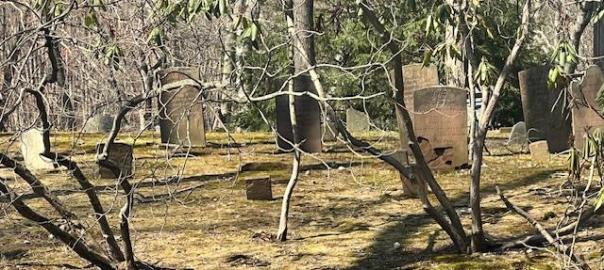
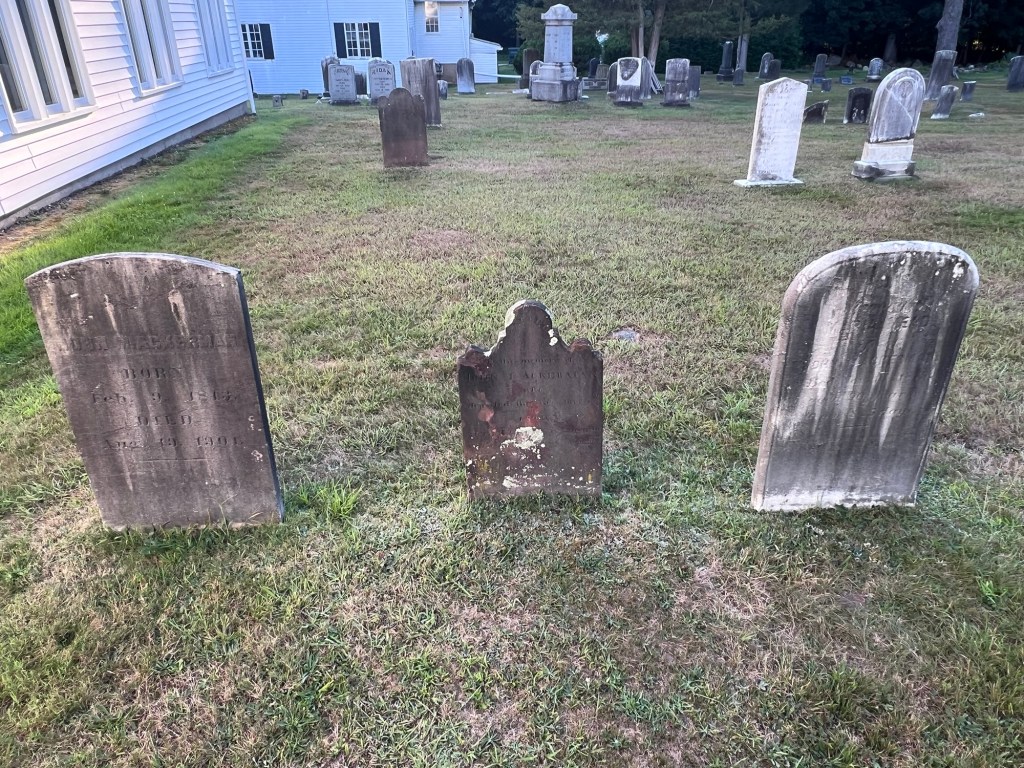
The Van Bushkirk Burial Ground behind the residence at 45 East Saddle River Road
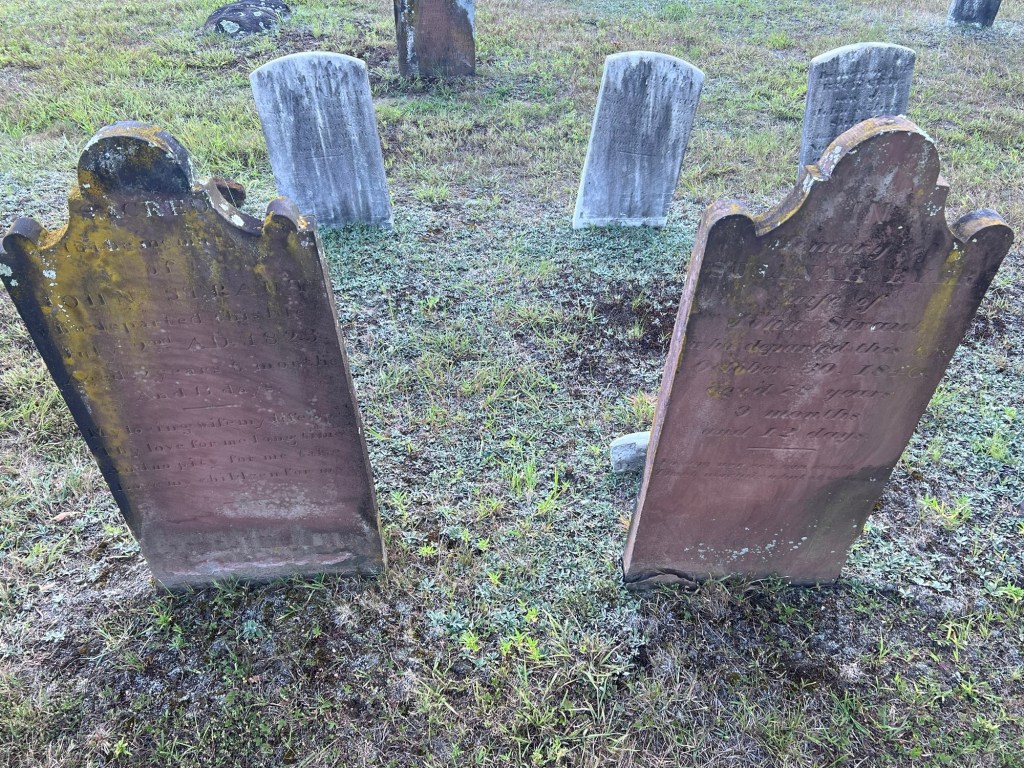
The Van Bushkirk Burial Ground is part of the history of Saddle River, NJ’s early settlement period. The burial ground has about 40 tombstones that are arched and shaped. These are some of the first residents both of Saddle River and Bergen County, NJ.
The burial ground lies next to a creek off East Saddle River Road and can only be accessed by going through private property of the residents living at 45 East Saddle River Road. Please do not enter without permission of the owner of the home. These pictures were taken with a long distance camera from the street.
The Van Bushkirk Burial Ground at 45 East Saddle River Road
The History of Saddle River:
(from the Saddle River Town website):
In 1675, Lenni Lenape tribal leaders sold a large amount of land on the Eastern side of the Saddle River (known as Werimus) to Albert Zabriskie. In 1708, Zabriskie sold this tract of land to Thomas Van Buskirk. The first house in Saddle River was built by the Van Buskirk family in 1709. The original Van Buskirk homestead still stands at 164 East Saddle River Road across from Borough Hall.
In 1709, the Lenni Lenape sold the land on the west side of the Saddle River to the English as part of the Ramapo Tract. Property on the west side of the Saddle River was acquired from this Tract throughout the 1700’s. The Ackerman Family was the most prolific buyer of these early Saddle River parcels and first settled on the West side of the Saddle River in 1745 when Johannes Ackerman acquired 245 acres.
The graves of George and Margaret Achenbach
Saddle River continued to grow and populate during the 18th century. Families such as the Van Buskirk’s, the Ackerman’s, the Achenbach’s, the Hopper’s, the Zabriskie’s, the Stilwell’s and the Baldwin’s farmed and developed the area.
The grave of George Achenbach
The first of many Saddle River mills was built in 1714 and the first school was constructed in 1720. Another early 18th century business was the blacksmith shop operated by the Ackerman family. Over the years, these 1st families built the quintessential “Old Dutch Homesteads” from actual sandstone that was found in town.
The Revolutionary War era tombstones
The Revolutionary War was a horrendous time for the residents of Saddle River. The townsfolk had spent the entire 18th century developing the area into a well established community and all growth essentially stopped during the war. Since the Jersey Dutch initially considered the revolution to be an English issue, it was particularly shocking when the fighting came to their backyards. From December 1776 until the end of the war, both American and British forces traveled through Saddle River and many times set up camp in the center of town.
Residents were in constant fear of the British employed Hessian soldiers who would terrorize families by raiding the houses for food and then burning the fields before leaving. Although no major battles took place in Saddle River, there were small skirmishes to fend off raids and the Blue Mill on East Saddle River Road was destroyed. Even George Washington, the future father of our country, passed through Saddle River on multiple occasions and tradition has him staying overnight at the Ackerman Homestead on the East road.
When the Revolutionary War ended, Saddle River residents picked up right where they left off in terms of community and industry development. The Ackerman’s built a Foundry on what is now Waterford Gardens. Tice and Berdan both opened stores in town and the Bulls Head Tavern opened its doors to weary travelers in 1802. Old mills were re-opened and new ones such as Van Riper’s Saw Mill and Basket Factory were established. The post war growth continued for decades and culminated in the 1820s with the construction of the Zion Lutheran Church in 1821 and a new schoolhouse behind the church in 1825.
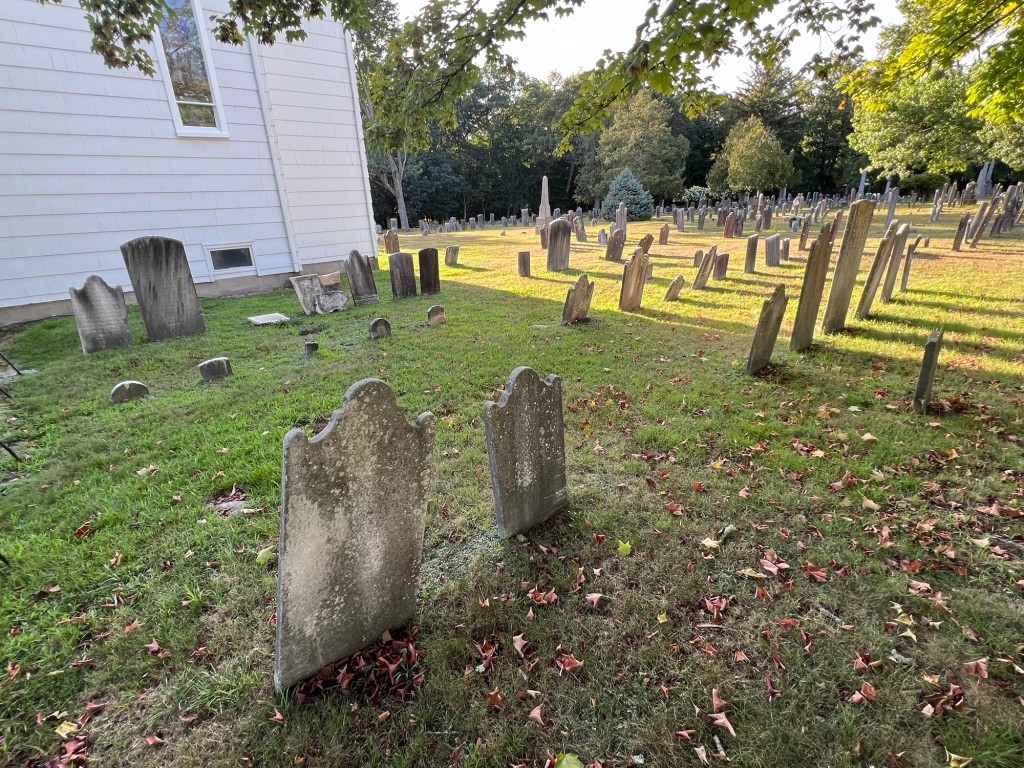
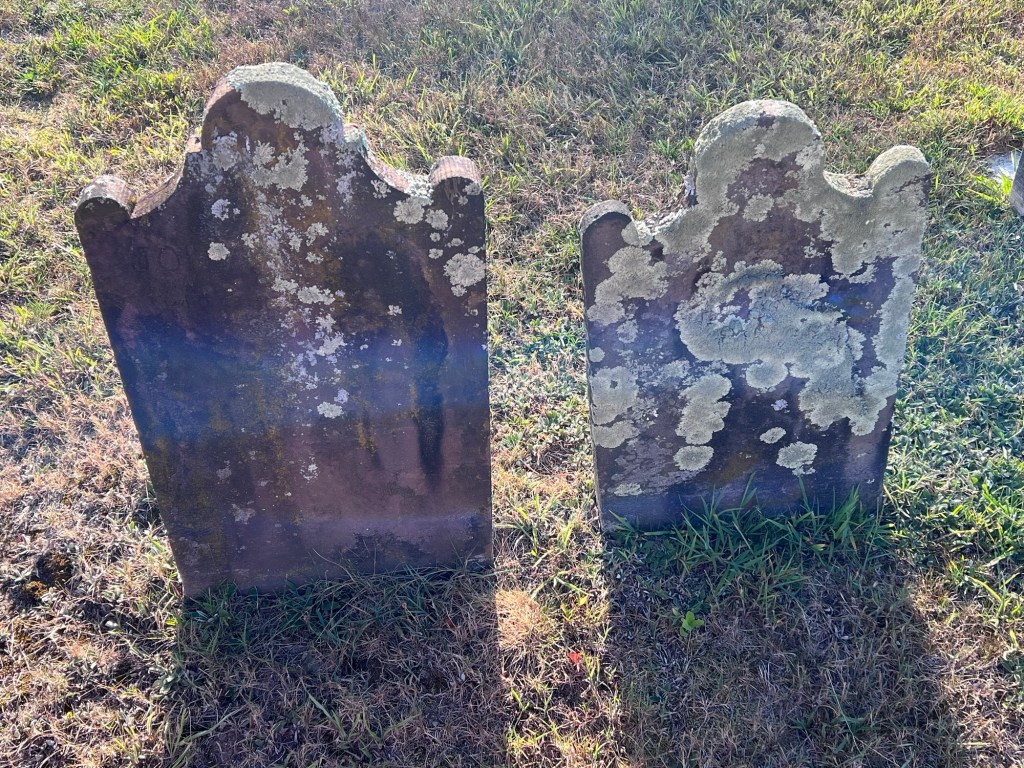
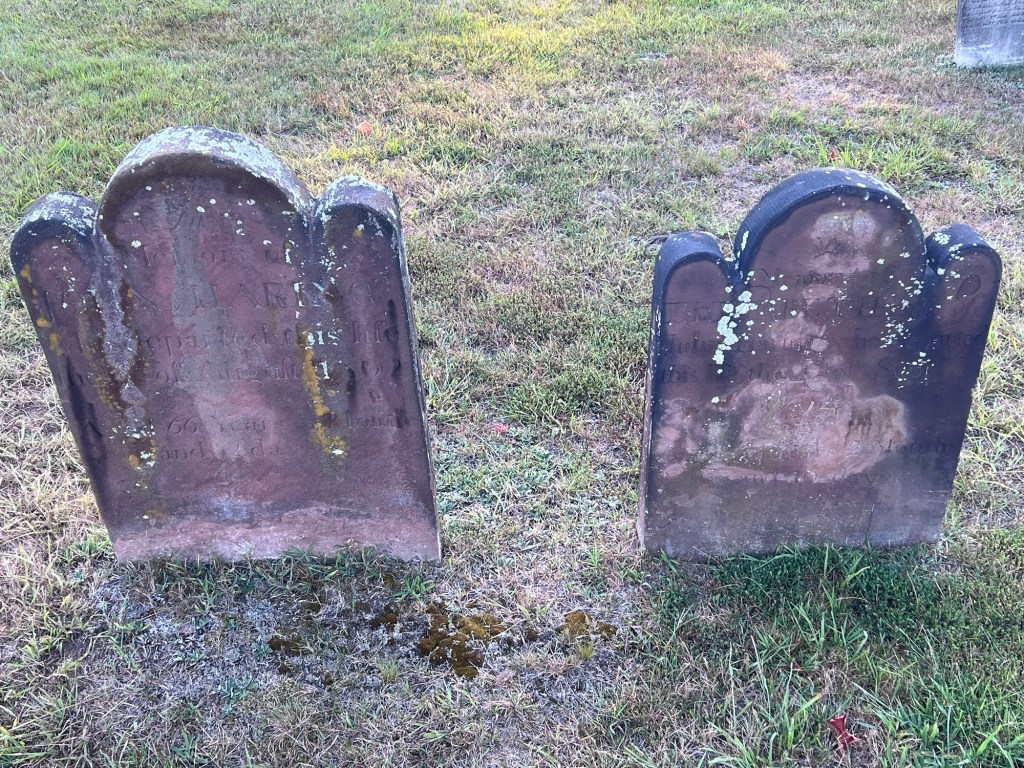
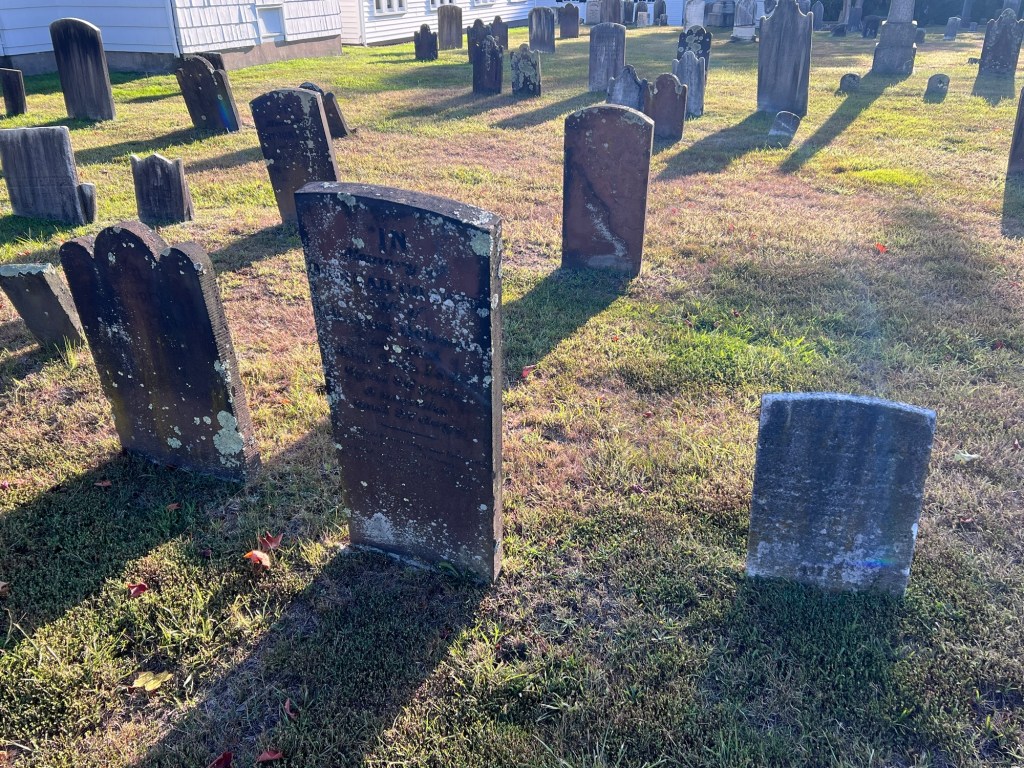
The worn tombstones in the cemetery
History of the Van Bushkirk family in Bergen County during the Revolutionary War:
(From the Bergen County Historical Society website):
Loyalists in Bergen County came from all backgrounds, religions and economic classes. At the beginning of the war, a number were officers in the militia, the military force composed of all able-bodied males maintained by each province, and later the states. The lieutenant colonel of the militia was John Zabriskie of New Bridge. Zabriskie understood the sentiments of many of his neighbors, particularly those of Abraham Van Buskirk, whose property was directly across the bridge in Teaneck. Van Buskirk was a surgeon in the militia under Zabriskie, and with whom he served on Bergen County’s Committee of Correspondence, an entity established to keep in touch with other New Jersey counties and the events occurring there.
The Van Houton Family Cemetery at 108 Delaware Lane on what was once the family farm
The historic Marker from 1822
The family plot from the entrance of the cemetery
About five generations of Van Houton’s have been buried in this spot, with an impressive list of family members who have served in all the nation’s wars.
From the Revolutionary War up to World War II, the family’s contribution extends not just to Bergen County but our entire country.
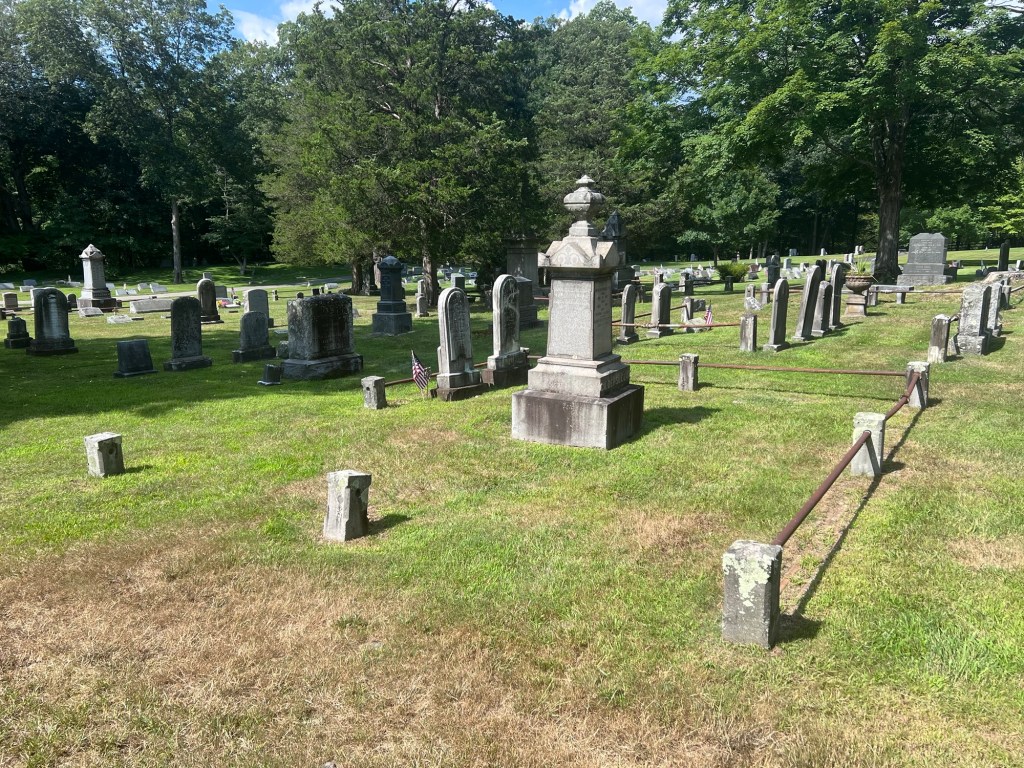
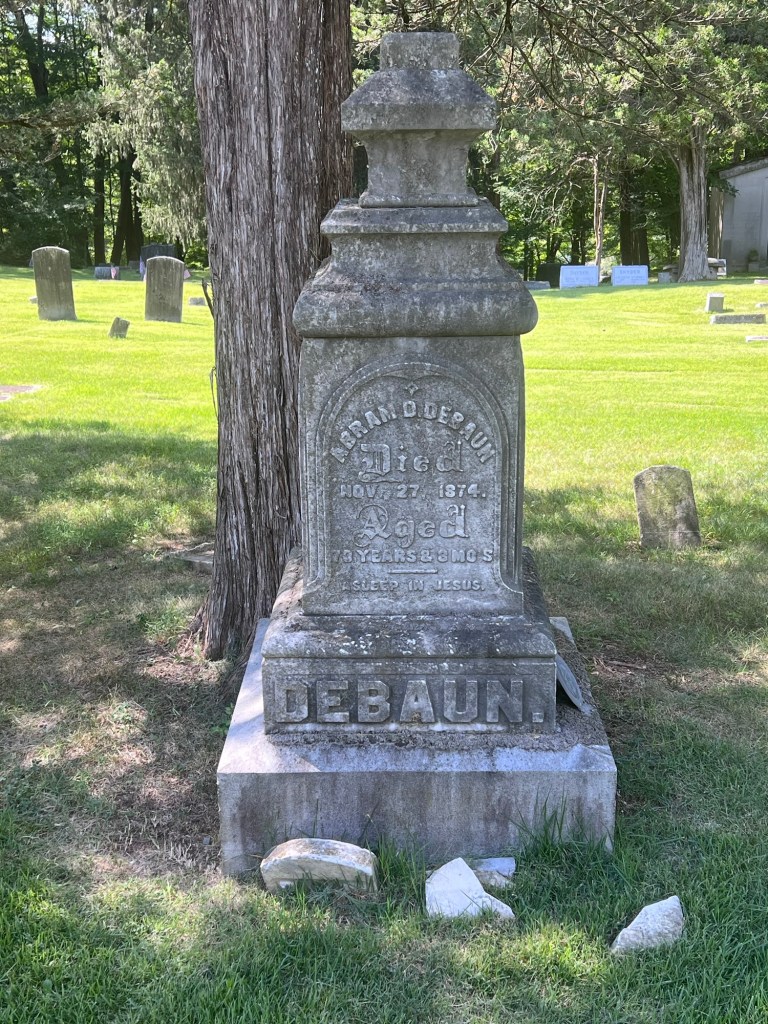
The family extends to other older ‘first families’ of Bergen County, such as the Snyder’s, the Demarest’s, DeBuan’s and the Van Ripper’s.
This multi-generational cemetery is still used today by the descendents of John Van Houten, who left the property in his will. The grounds of the cemetery are well maintained. A metal fence around the property could use some minor repairs. Unfortunately a couple of the obelisk markers have fallen off their bases.
In the August 1992 Cemetery Inventory Booklet, published by the Bergen County Department of Parks, Division of Cultural and Historic Affairs, they listed Andrew Schaaf as a contact person for the cemetery, with an address of 749 High Mountain Road, Franklin Lakes, NJ 07417. The same publication mentions that an inventory of the cemetery was done by John Neafie in 1911.
In the 17th century, Lenape Indians traveled the land we now call Franklin Lakes. They made winter camp in the “Clove” near Buttermilk Falls and fished in Micharagrape Pond ( now Franklin Lake).
Slowly, the Dutch settlers made their way west from the Hudson River Valley. In 1701 the East Jersey Proprietors confirmed to Michael Hawden the land around the Pond. In 1772 Franklin Township was formed and included much of northwestern Bergen County. Farming was the major occupation of the early inhabitants, mostly Dutch with the names of Van Winkle, Van Houten, Ackerman, Pulisfelt, Van Blarcom, etc. They built solid farmhouses of sandstone and fieldstone. Fourteen of these historic homes still stand in our Borough.
Some of the original family member tombstones in the cemetery
Mills sprang up along the creeks: sawmills, gristmills, tanneries and forges. Daniel Youman’s Grist Mill on Franklin Lake was probably the first business established (it later served as a saw mill and a cider mill).
The 1876 Walker Atlas showed Franklin Lakes had about 100 residences, 5 mills, 1 tannery, 3 schools, 4 blacksmith and wagon shops, 1 church, 2 hotels, 1 store, and 2 railroad depots.
The railroad stations were built in 1869 when the New Jersey Midland Railroad was extended to Oakland. One station stood at Campgaw on Pulis Avenue, the other at Crystal Lake on High Mountain Road. Residents used the train for commuting, moving goods and mail.
Around the turn of the century, estate houses and mansions began to appear in the area. The industrial revolution brought wealth, and many of the wealthy became “gentleman farmers,” sometimes living here only in the summer. Examples of these houses include the Bartholf-Hughes house on Somerset, the Post-Terhune house on Franklin Lake Road, and the Atterbury-Brockhurst house on Ewing Avenue.
Eventually, the Campgaw section became the civic center of our Borough. In 1922 Franklin Lakes separated from Franklin Township, incorporated, and elected William V. Pulis as its first Mayor.
Edward May built three lakes and started the Shadow Lake Swim Club, which evolved into Shadow Lakes Estates. On the other side of the Borough, J. Nevins McBride purchased land around Franklin Lake and began building single-family homes in Urban Farms.
When Route 208 was extended to Oakland in 1959, Franklin Lakes became more accessible, and by 1980 there were more than 8,500 residents. The completion of Interstate 287 in the early 1990’s stimulated another boom in building. Today, the population of our Borough is 10,422.
From a sleepy rural community to an affluent metropolitan suburb, Franklin Lakes has changed extensively, continuing to be a desirable place to live and raise families.
The Franklin Lakes Historical Society was created to help preserve our Borough’s rich history, while at the same time looking to the future of our unique community and those who choose to make this their home.
The family still uses the cemetery into the twenty-first century
Part of the cemetery into modern times
Multiple family members are often buried together
The cemetery in modern times
The children of Ralph Van Houten who passed within a few years of one another
The grave of Abraham Van Houton and his wife, Bridget
The front part of the cemetery shows the different branches of the family and when they were buried.
The back part of the cemetery is rather old
The Snyder branch of the family
Another branch of the Van Houten family is buried together here
Members of the Ackerman and Cooper side of the family
Conrad and Elizabeth Van Houten
Jacob and Elizabeth Van Houten
Some of the modern graves of the Van Houten’s and Ackerman sides of the family
Many of these small family plots sit on buffs and have the most amazing views. It is as if the final resting place was to be a place of beauty and contemplation.
Unfortunately the family farm is long gone and the cemetery is now surrounded by McMansions. Talk about progress!
My logo for “Smile! You’re Visiting New Jersey!” created my very creative nephew, Artist Kyle McFarlane
I have found that the way we market the State of New Jersey boring. Most of the tourism books created by the state tourism board and the local county tourism boards just don’t capture all the wonderful things to do and see in the State of New Jersey. From our quirky beach communities to our unique small downtown based towns, each section of the state is so different.
When most tourists think of New Jersey, they think of the opening scene of “The Soprano’s”, with the glimpses of Newark Bay and the skyline of lower Manhattan or the more urban sections of the state that have their share of problems. What we miss about our great state is that every part of the state has so much to offer. We even run into the paradox of North and South Jersey, where part of our state roots for New York teams and the other for Philadelphia teams and never the two should meet (except over the summer when I was in Cape May when Philly played the Mets to a very mixed crowd of fans).
We range from big cities, university towns and commuter townships to historical small towns and Revolutionary War era villages that rival anything in Vermont or New Hampshire with their town squares and “Greens” to the 18th century architecture with signs that read “Washington Slept here”. Don’t write off communities such as Newark or Paterson, which have a host of great things to do and experience. We have so much to offer.
So from this point, I have created this site to mirror the work I am doing on blog “MywalkinManhattan.com, which is walking every inch of the Island of Manhattan and surrounding parts of New York City, to creating this site to do the same with every corner of the State of New Jersey.
I have recategorized all my New Jersey based blogs from museums and cultural sites to festivals and special events that I have experienced and walking tours that I have enjoyed that I want to share with readers. This also includes great restaurants, delis and bakeries that dot our great state. If you have not been to New Jersey then you are missing a lot.
So join me as we explore the great State of New Jersey and say “Smile! You’re Visiting New Jersey!”
I thought this was an interesting video to describe the state. I hope you enjoy it.
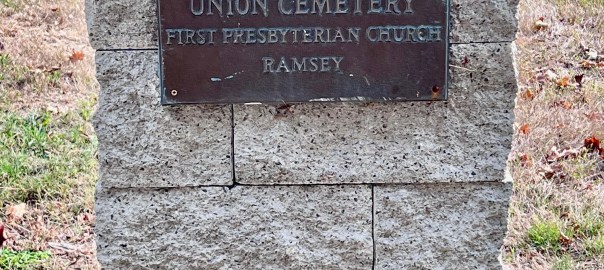
The Union Cemetery of The First Presbyterian Church of Ramsey, NJ
History of the Cemetery:
(from the church website)
Union Cemetery is a religious cemetery located at 316 Darlington Ave. in Ramsey, NJ. The cemetery is owned and managed by the First Presbyterian Church in Ramsey. As a religious cemetery, the cemetery is restricted under New Jersey state law and is not open to the general public. Only members of a Christian church and their immediate relatives may be interred at the cemetery.
The historic cemetery from the road. To the left is the oldest part of the cemetery
Entering the cemetery from Darlington Avenue
The newer part of the cemetery is to the right of the driveway
I was visiting the Union Cemetery in search of veterans of the Revolutionary War and found an interesting cemetery with a deep history in Bergen County. Many first families of Bergen County are buried here and veterans not just from the Revolutionary War but the Civil War all the way up to today are buried in this active town cemetery.
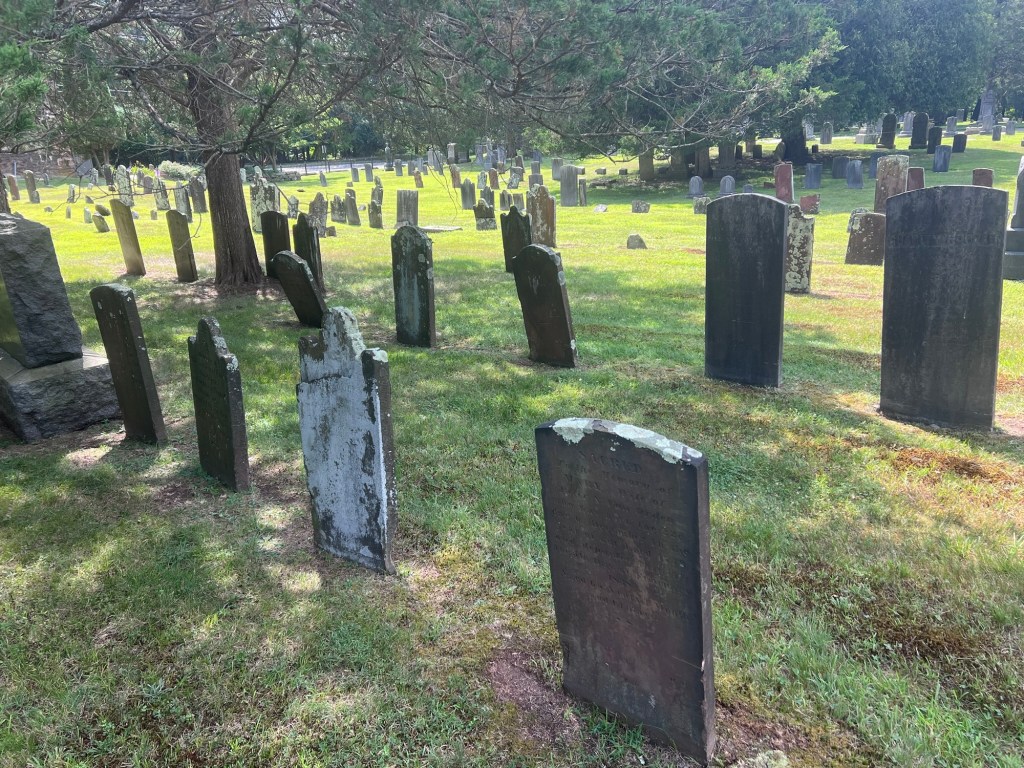
The older part of the cemetery is to the left of the driveway. These tombstones are from the early 1800’s.
The older part of the cemetery dates back to before the Revolutionary War
Many of the early family plots are located here with well known names like Hopper, Christie, Ackerman and the town’s namesake, the Ramsey family, whose family plot is in the oldest section of the cemetery.
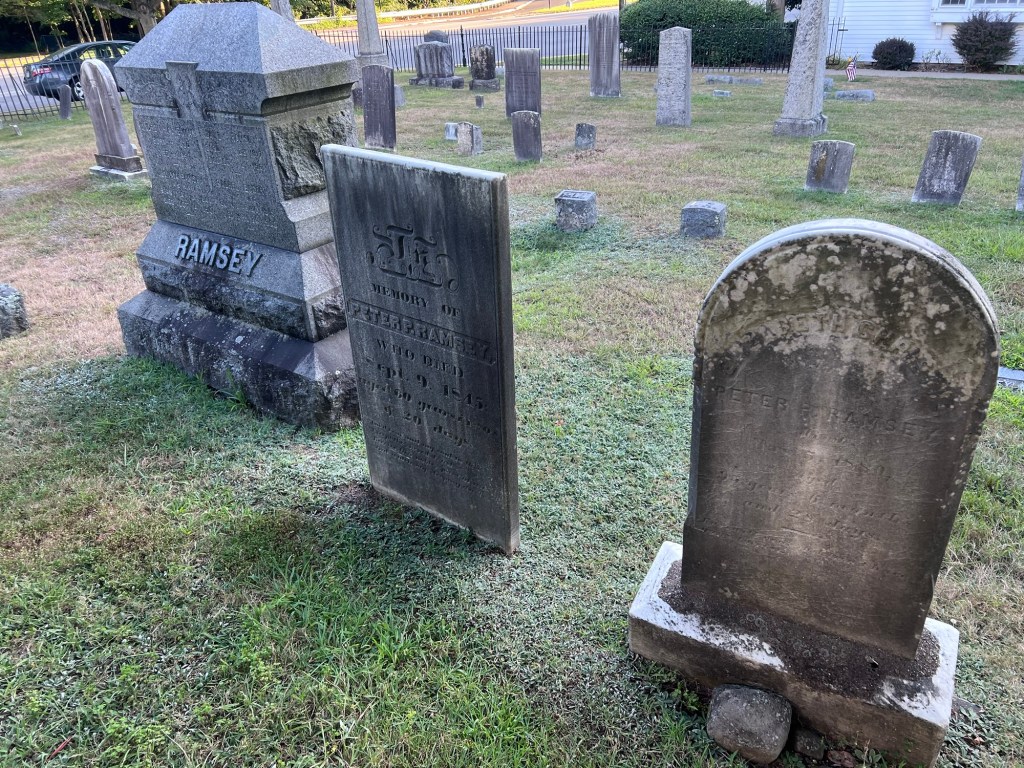
The grave of Hannah Jane Ramsey in the Ramsey family plot
Part of the Ramsey family plot
The Ramsey family plot
The Union Cemetery to find the graves of Revolutionary War veterans and found some but not all of them. The tombstones are so worn after over two hundred years that they either had disappeared or were so worn you could not read them.
The oldest section of the cemetery where many veterans both from the Revolutionary and Civil War are buried. It was hard to read many of the tombstones. Some the veterans were buried in their family plots, others with their spouses separately. The burials were concentrated in the oldest part of the cemetery. Most of the veterans have been honored with American flags.
The first tombstones I found were from Ackerman family members
I could not make out the name of this Ackerman member but I figured it was one of the brothers wife
The grave of veteran John P. Post
The Post family history:
(from the Saddle River Historical Society website)
The Post family was of Dutch descent. The first Post was a soldier, who came here to protect the new settlements along the Hudson. They soon turned to milling; the name Post is attached to several mills in Bergen and Rockland Counties. Joseph Post, born in 1775, built a mill on the west branch of the Saddle River about 1800. He also opened a tavern and store on what is now West Saddle River Road, just north of Parker Place, across from the entrance to the mill.
The graves of members of the community at that time including the grave of John P. Post
The grave of veteran William Vanderbeck
The grave of a member of the Van Blarcom family, who was married to James Ramsey
I was not too sure who this was but by the veteran’s flower I am assuming the grave of veteran John Van Blarcom
The grave of Hannah (I believe Ackerman)
The Christie family plot
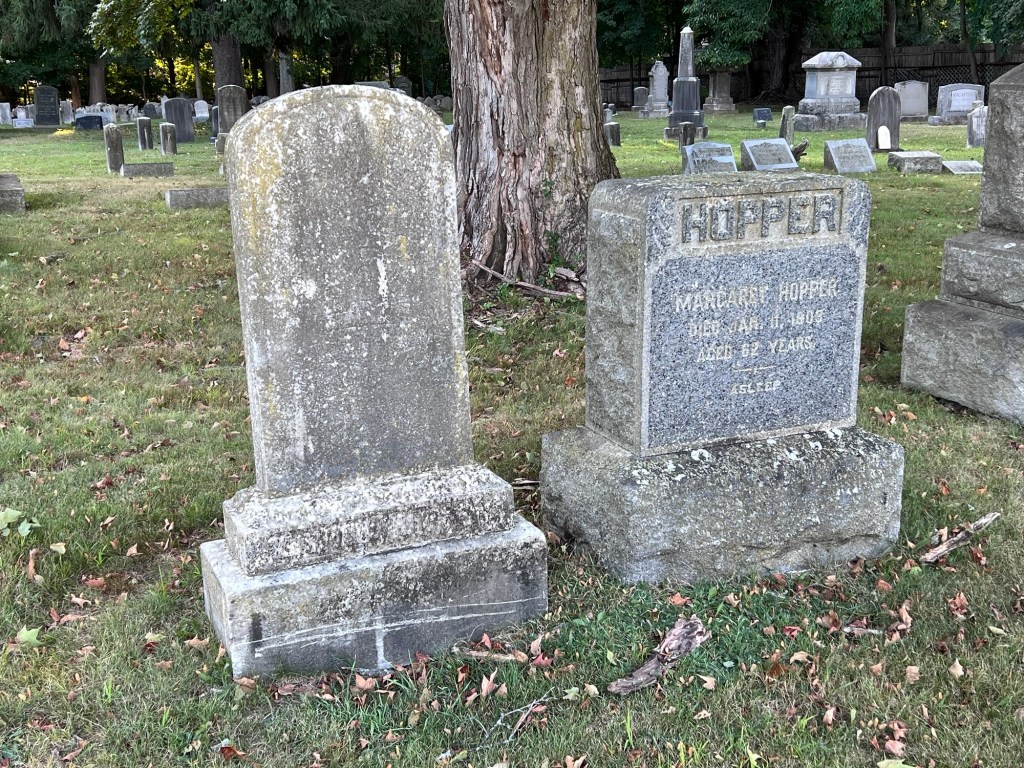
The Hopper family plot
The Hopper Family history:
(from the Saddle River Historical Society website)
The Hopper family is one of the oldest of European descent in Bergen County. Andries Hopper came from the Netherlands to New Amsterdam in the 1640’s. His widow and her son Hendrick were in the Polifly area (Hackensack) by the late 1600s. There was land to be had in the unsettled areas of what became Bergen County. Hendrick’s two oldest sons, Andries and Jan settled in the HoHoKus area (part of Paramus) around 1712. The Hopper name appears on many old homes and mills on early maps of the area. It was two of Andries’ children, Abram and Jan, who settled sometime around 1730 along the Saddle River in what is now Upper Saddle River.
Formerly The Ramapo Meeting House was organized in 1785 and built in 1798
In 1713, a small group of eleven German Lutheran families settled at the “Island,” so named because of extensive marshlands surrounding high, dry land. They formed a congregation in 1715, and c. 1720 built a log church. Prior to 1739, they built a larger, frame church.
Dutch, French, English and Scottish settlers of the Reformed faith came to the Island about mid-century and attended church in Paramus, 10 miles distant. In 1785, they organized The Ramapo Dutch Reformed Congregation at Ramapough in Bergen County.
After the Revolutionary War (1776-1783), the first task of the new nation was to repair the damages of war and neglect. Neither the Lutheran nor the Reformed congregation at the Island had sufficient means to build a new church. In spite of having fought on opposing sides during the War, they agreed to jointly repair and use the old Lutheran church. The arrangement was so successful that in 1798, they agreed to build the present church together.
Construction began on June 4th, and was finished in November. The last items purchased were “one lock and two keys” on December 12, 1798. The two congregations shared the church for fifty years until 1848, when the Lutherans sold their interest and moved to Airmont, NY and established the present Christ Evangelical Lutheran Church.
As soon as its doors opened to the public in 1798, the new Ramapough Meeting House became the heart of the daily activities. Social gatherings and civic meetings were held here all week long, and personal and official notices were posted on the doors. But on the Sabbath (from sundown Saturday to sundown Sunday) the building became a sacred place.
Ramapough – or Bellgrove, as it was called at this time – had four mills, several blacksmith shops, a general store, a stagecoach stop, and U.S. Post Office, one of the earliest in New Jersey (1797). The old Kings Highway of 1703 or Ramapough Road (Island Road) was part of the ancient 150-mile Albany Post Road from Paulus Hook (Jersey City) to Albany, NY. Dobbin & Tustin, est. 1797, ran a passenger and mail stage line on this road, right past the door of the Ramapough Meeting House.
In 1798, when pews and people were smaller, the Meeting House held 385 people. (Today, it holds 250). Though the old box-type pews are gone from the sanctuary, the gallery seats above still exist. The Island Church held an important place in the railroad hamlet of Mahwah throughout the 1800s. It was known simply as the Community Church until the 1950s, when suburbanization brought many other faiths to Mahwah.
One of the earliest public schools in the area, c. 1815, was operated on the church property until 1906, when the church sold land to the Township for the Commodore Perry School. In the cemetery is a roadbed of the old Kings Highway.
The Ramapo Reformed Church is the oldest public building in Mahwah, and a repository of more than 200 years of local and regional history. It is the older of only two remaining frame Federal-period churches in Bergen County, and is on the National Register of Historic Places.
The modern church sign
I walked through this quiet and reserved graveyard in search of ghosts from the past. The graveyard at the Ramapo Reformed Church, like many of these former Dutch churches, are steeped in memories of the past.
The historic graveyard in the back of the church
In the unique graveyard are the places of rest of many of the first families of Bergen County, NJ who not just shaped the county, but the State of New Jersey and the United States as well.
The oldest part of the graveyard surrounds the church
While the names Haring, Christie, Blauvelt, Demarest, Ramsey, Sutherland, Fox, Hopper, Van Ripper, DeBaun, Terhune and Tice may not similar to most people, to a generation of us were the names of farming families in Bergen County.
Their farms supplied us with fresh fruits and vegetables when in season and places for us to go during Halloween and Thanksgiving for our baked goods and much needed apple cider.
The 1980’s real estate boom put an end to many of these traditions but those names still live in the memories of an older generation. We see some of these traditions still hold tight at Demarest Farms in Hillsdale where hayrides and apple cider and fritters are still part of that experience.
For this trip though, I was in search of graves of our brave veterans of the American Revolution and in the faded tombstones surrounding the church, I found most of them.
The oldest part of the graveyard wraps itself around the church or faces the road, which at one time must have been a country lane.
Some of the oldest families from the community are buried closest to the church building
The graveyard is filled with family plots of most of the first families of the area once surrounded by old fences.
The graveyard is full of families and their memories. In some parts of the graveyard, family plots are organized by generations. To so the progression of mother and father to their children and grandchildren. The history of these families is in the rows of names and the intermarriages of all these families to one another.
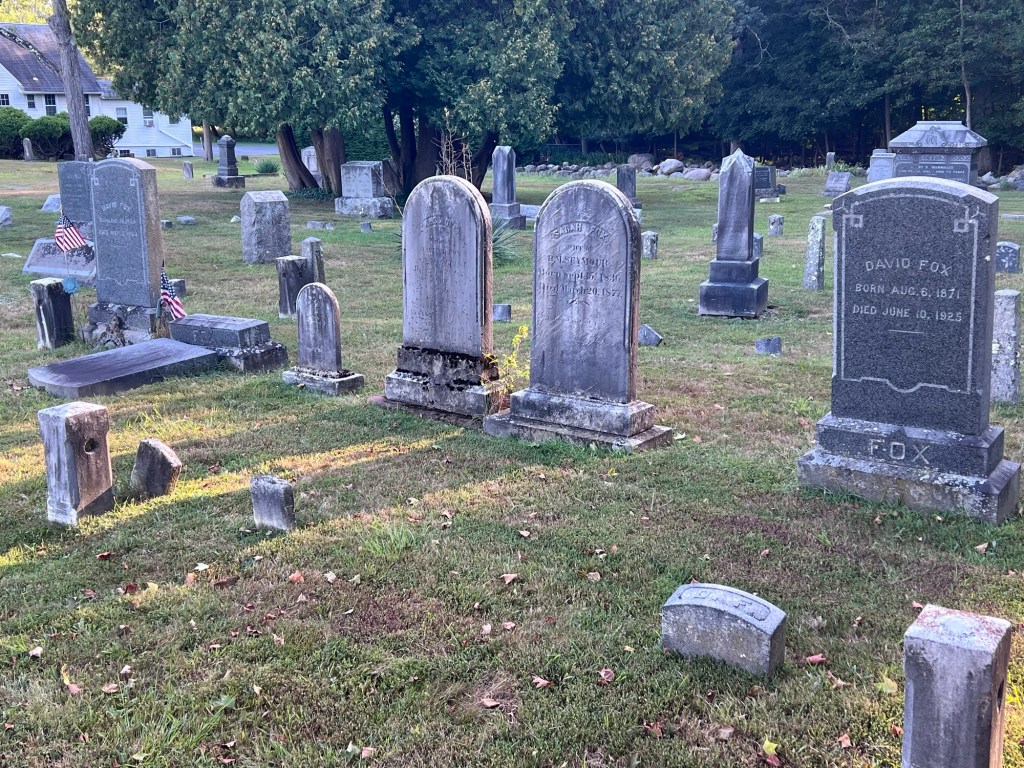
The Fox family plot, where one of the members of the family was a veteran of the Civil War
Peter J. Ramsey was born on 23 November 1804, in Bergen, New Jersey, United States. He married Margaret Hopper in 1828, in Hohokus Township, Bergen, New Jersey, United States. They were the parents of at least 4 sons and 5 daughters. He died on 10 May 1852, in Ramapo, Bergen, New Jersey, United States, at the age of 47, and was buried in Mahwah Township, Bergen, New Jersey, United States (Family Search.org).
Closer to the church, I discovered the graves of our brave soldiers from the Revolutionary War whom I had been searching for.
The grave of John Suffern, who fought in the Revolutionary War and whose family the County of Suffern was named after
When John Suffern was born on 23 November 1741, in County Antrim, Ireland, his father, William Suffern, was 27 and his mother, Margaret Templeton, was 19. He married Mary Myers on 1 January 1766, in Burlington, New Jersey, British Colonial America. They were the parents of at least 7 sons and 4 daughters. He lived in Rockland, New York, United States in 1820 and Ramapo, Rockland, New York, United States in 1830. He died on 11 November 1836, in Suffern, Ramapo, Rockland, New York, United States, at the age of 94, and was buried in Ramapo Reformed Church Cemetery, Mahwah Township, Bergen, New Jersey, United States (Familysearch.org).
The graves of John Suffern and his wife
The Christie family plot, where John and James Christie who fought in the war were buried
When John W Christie was born on 7 May 1754, in Schraalenburgh, Bergen, New Jersey, British Colonial America, his father, William James Christie, was 33 and his mother, Catalijntje Demarest, was 32. He married Annatie Hannah Brinkerhoff about 1773, in New Barbadoes Township, Bergen, New Jersey, United States. They were the parents of at least 4 sons and 8 daughters. He died on 11 September 1815, in Bergen, New Jersey, United States, at the age of 61, and was buried in Bergenfield, Bergen, New Jersey, United States (Familysearch.org).
When James Willem Christie was born on 20 August 1744, in Bergen, New Jersey, British Colonial America, his father, William James Christie, was 24 and his mother, Catalijntje Demarest, was 22. He married Maria Banta about 1772, in Schraalenburgh, Bergen, New Jersey, British Colonial America. They were the parents of at least 5 sons and 5 daughters. He died on 23 July 1817, in Bergenfield, Bergen, New Jersey, United States, at the age of 72 (Familysearch.org).
The grave of Lawrence Sutherland another Revolutionary War Veteran
When Lawrence Sutherland was born on 12 June 1763, in Harrington Township, Bergen, New Jersey, United States, his father, James Sutherland, was 21 and his mother, Marietje, was 19. He married Elizabeth Sutherland in 1786, in New Hampstead, Rockland, New York, United States. They were the parents of at least 2 sons and 3 daughters. He died on 9 October 1846, in New Hampstead, Rockland, New York, United States, at the age of 83, and was buried in Mahwah Township, Bergen, New Jersey, United States (Familysearch.org).
The graveyard at the church dates back to before the Revolutionary War. The graveyard has veterans from all the wars since the Revolutionary War to the current wars.
The Wyckoff Reformed Church was built with local fieldstone in 1806. The carpentry inside was done by Daniel Baldwin. The style features vernacular Early Republic, Federal architecture and the windows are done in the Gothic Revival style (Wiki).
The historic graveyard in the back of the church
The back of the graveyard that reaches further back into town
The part of the graveyard from the mid to late 1800’s. There are Civil War veterans buried here.
The back of the church from the 1800’s
The graveyard from the 1800’s
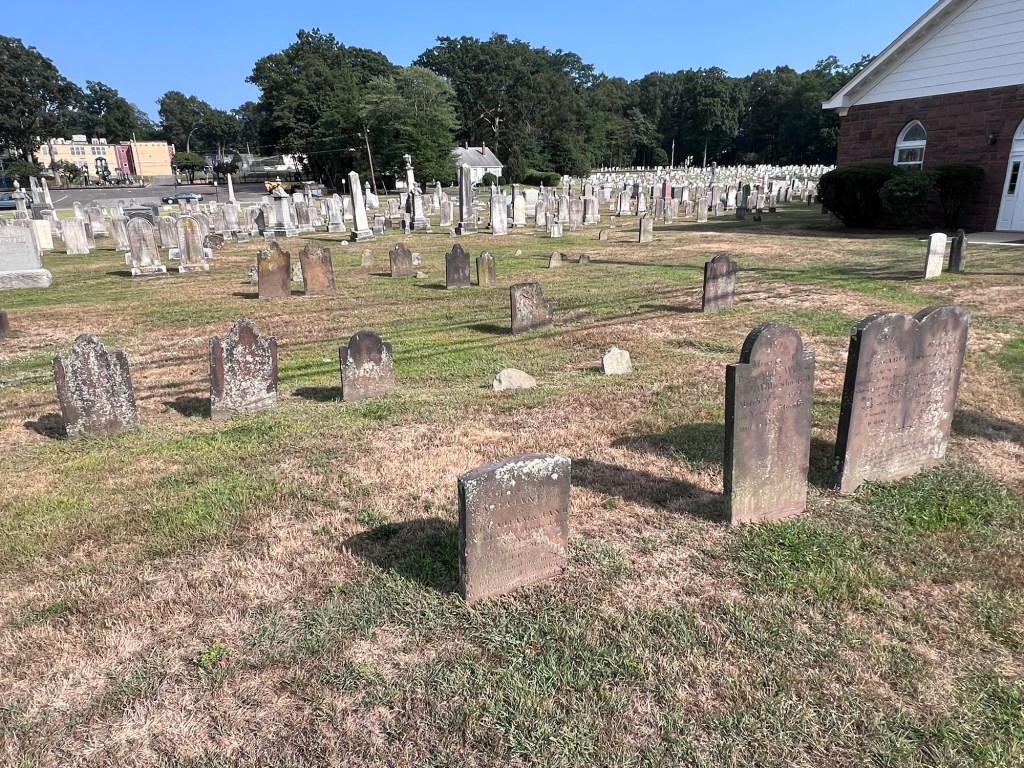
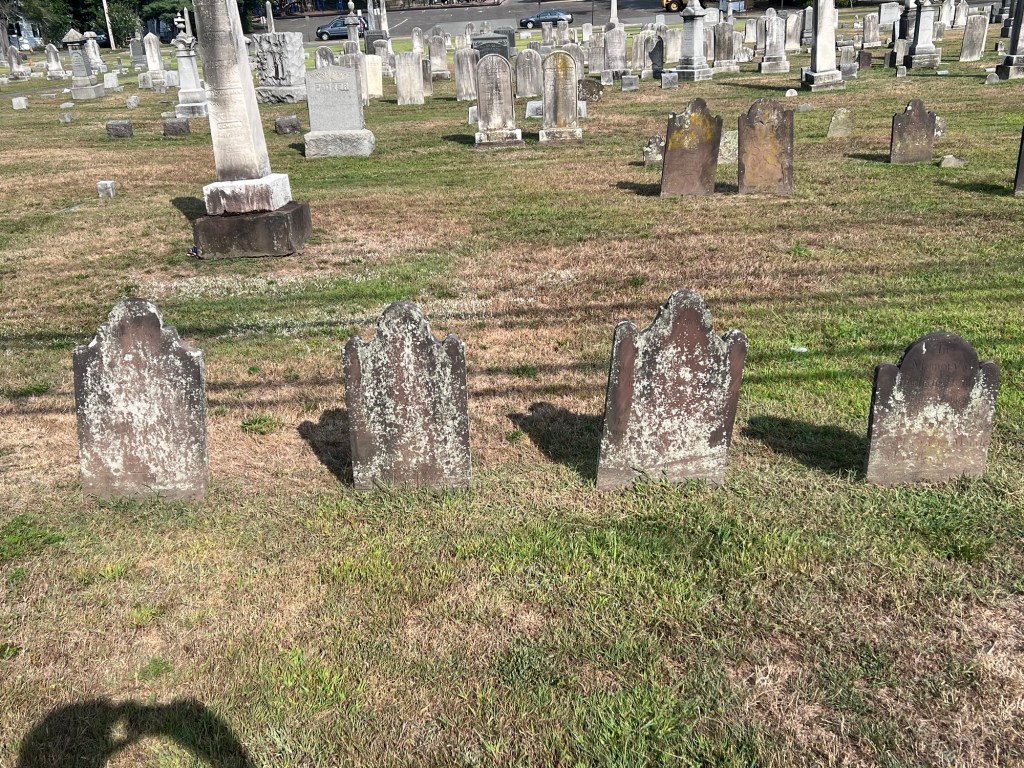
The Revolutionary War era section of the graveyard
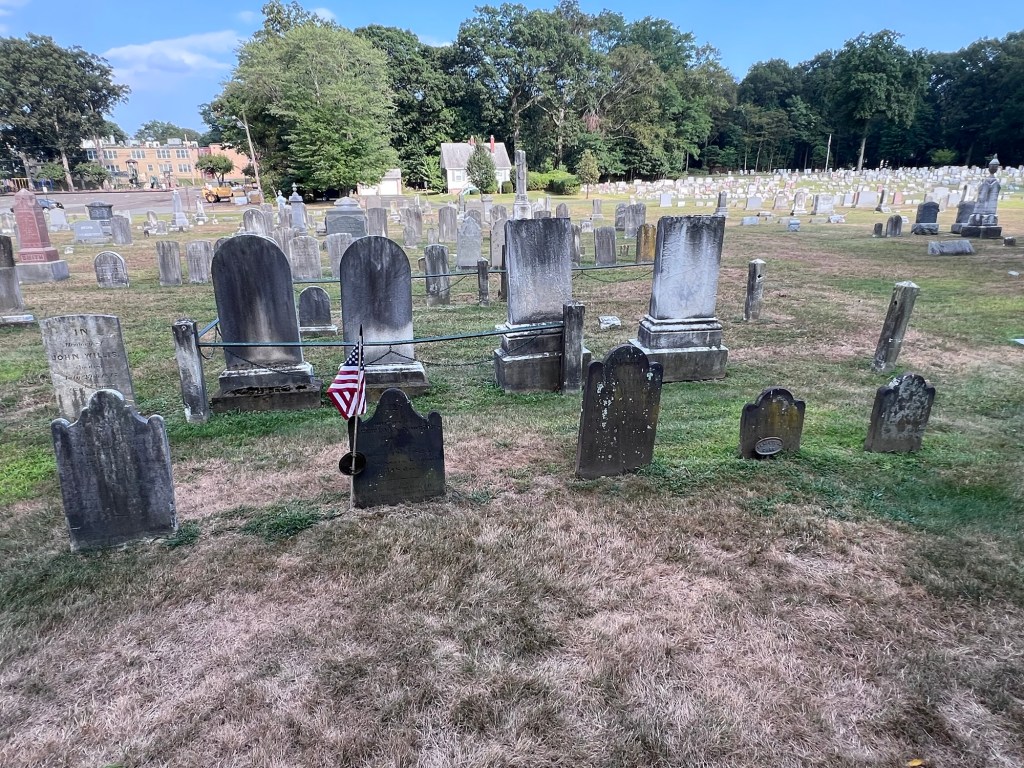
The graves of the Revolutionary War veterans
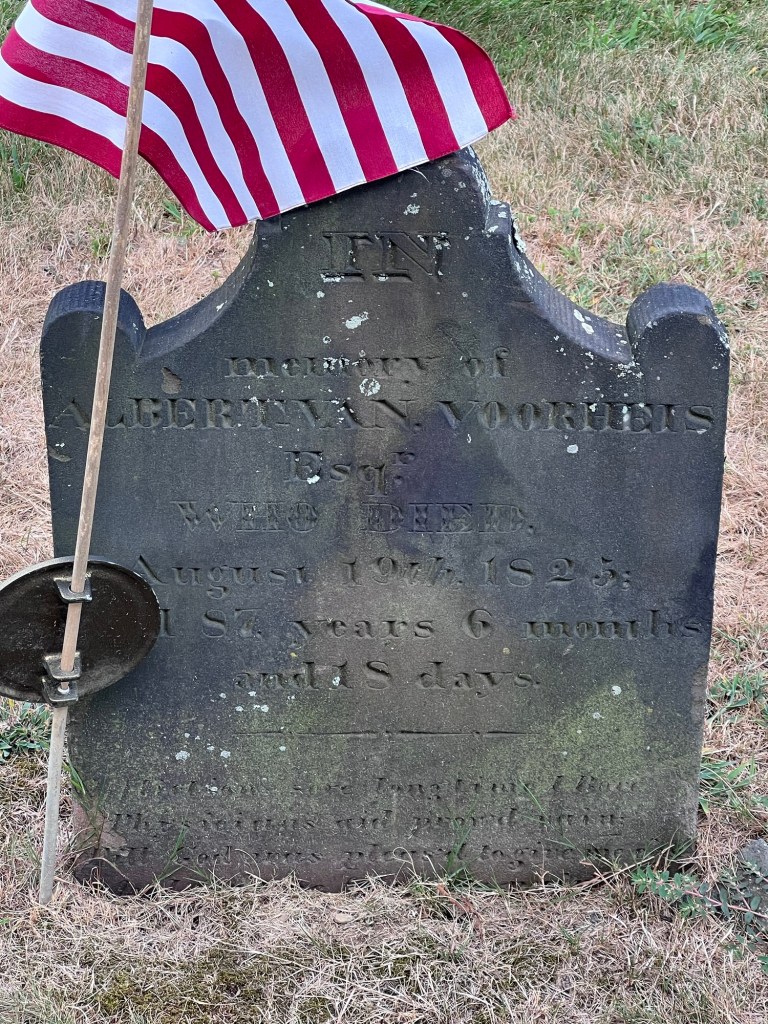
The grave of Revolutionary War veteran Albert N. Van Voorheis
When Albert Voorhees was born on 24 July 1759, in Bergen, New Jersey, British Colonial America, his father, Albert Van Voorhees, was 54 and his mother, Cornelia H. Van Gieson, was 42. He married Rachael Hopper on 26 July 1788, in Acquackanonk Township, Passaic, New Jersey, United States. They were the parents of at least 5 sons and 6 daughters. He died on 17 October 1820, at the age of 61 (FamilySearch.com).
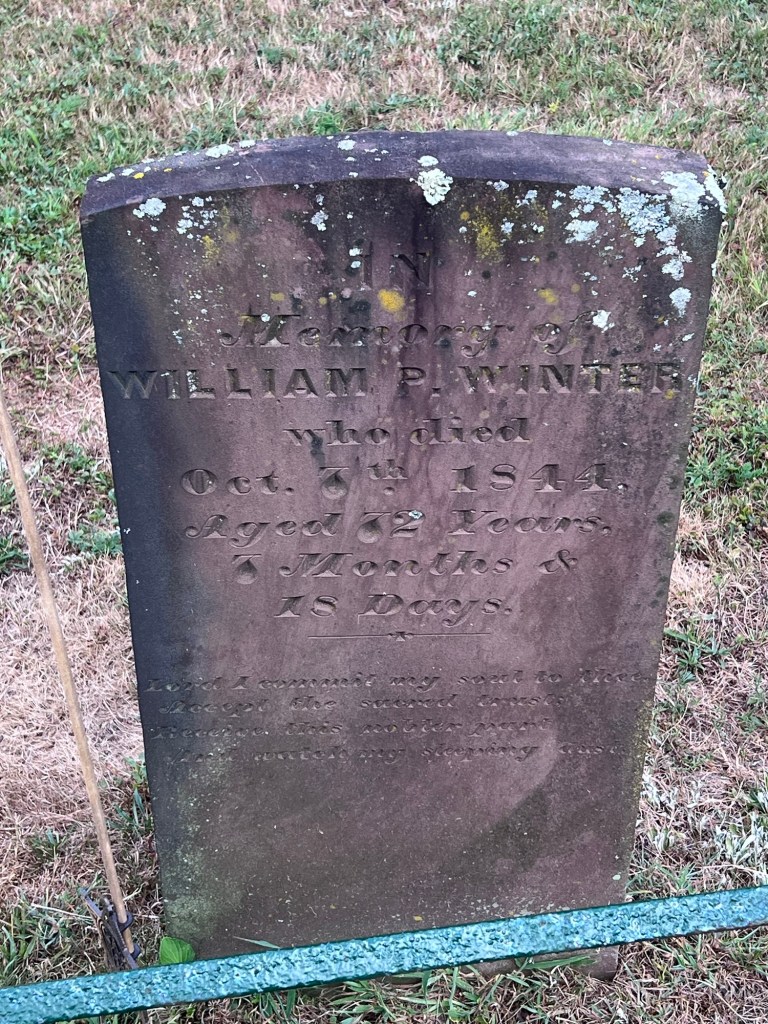
The grave of William P. Winter
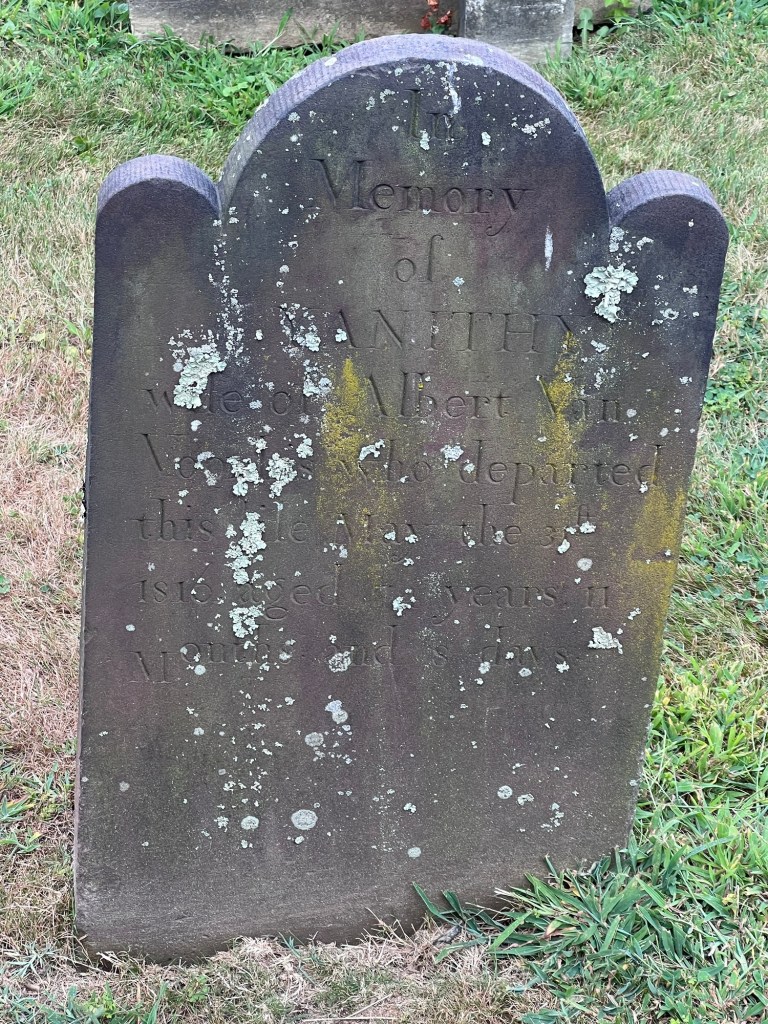
The grave of Vanithy Van Voorheis, the wife of Albert Van Voorheis.
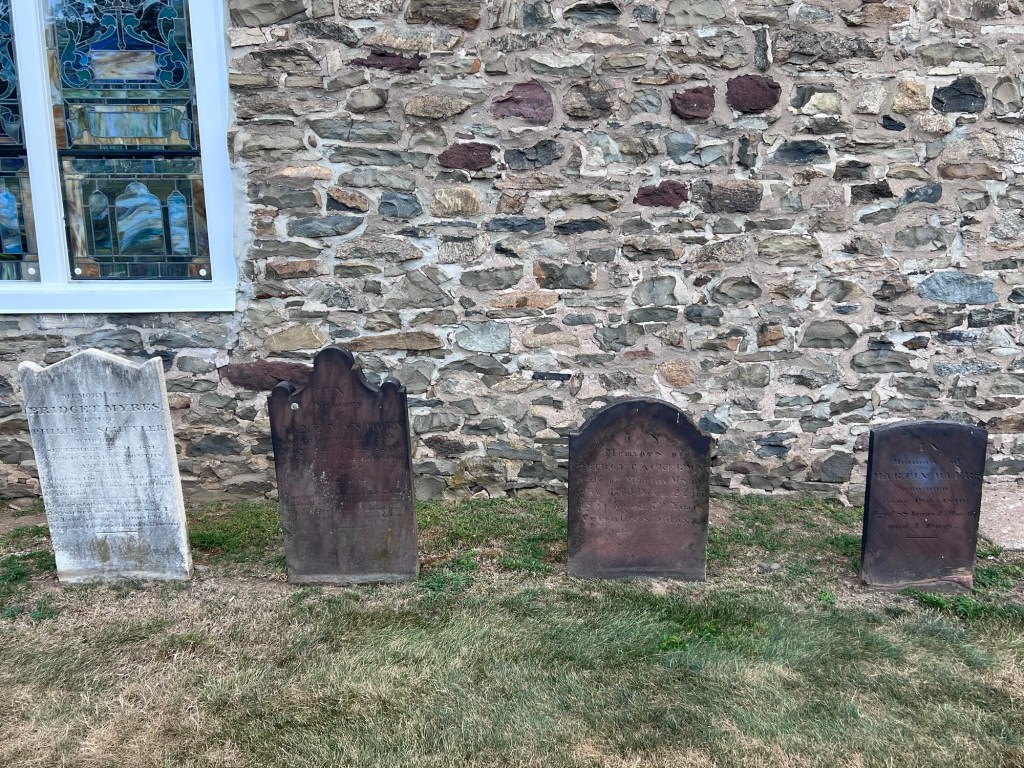
The historic part of graveyard right behind the church
The graves of Bridget Ackerman and Martin Myers
The graves of Jack Van Saun and his wife, a descendant of the Van Ripper farm family
The graves of the Van Ripper family
The family plots
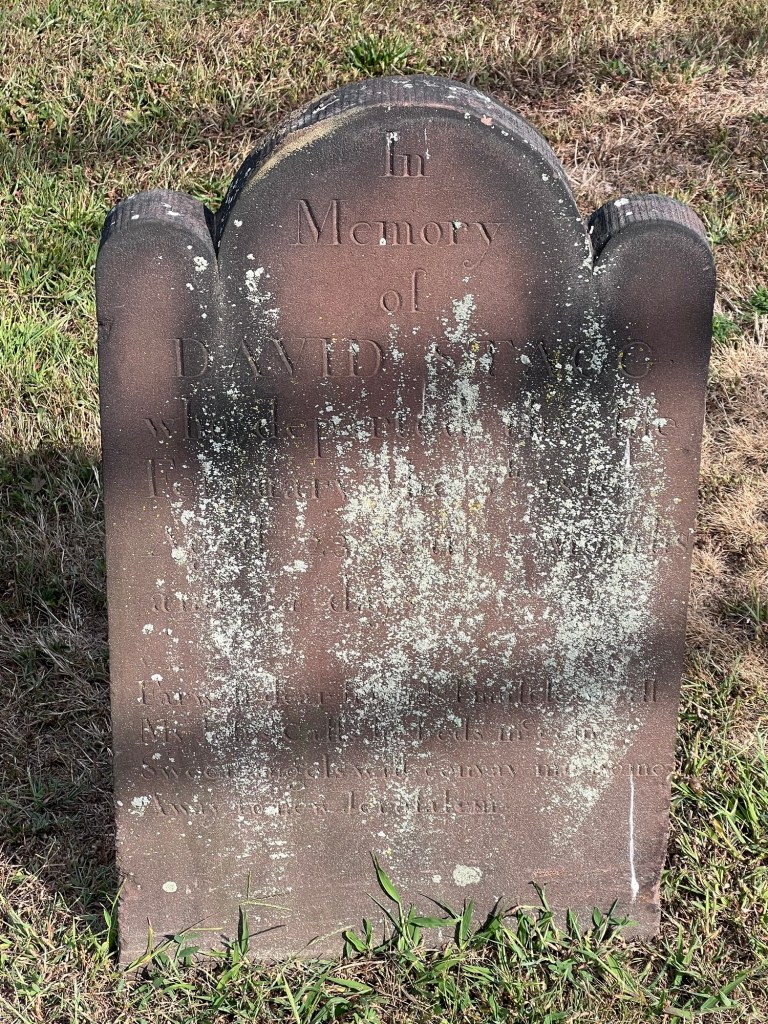
The grave of David Stagg
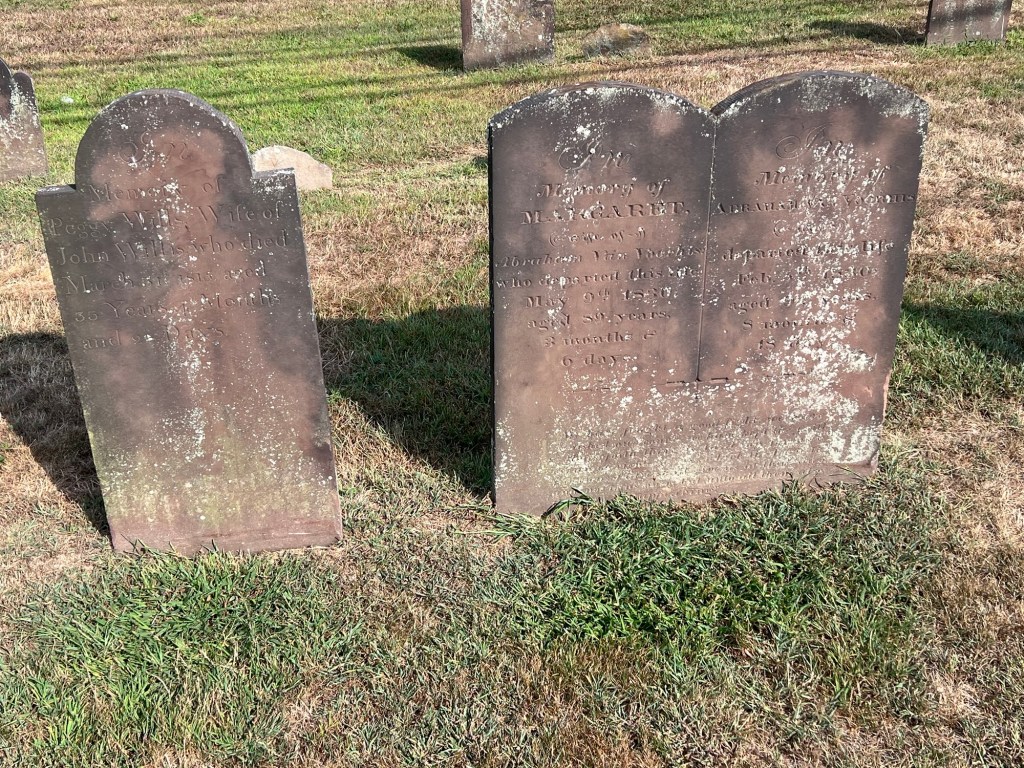
The graves of Peggy Willis and Margaret and Abraham Van Voorheis
The graves of the Mickler family
The graves Abraham and Sara Ann Quackenbush
This historic church and graveyard are really interesting to walk around. It is a glimpse into the past of Bergen County, NJ and the entire State of New Jersey
Open: Sunday 9:00am-12:00pm/Monday-Saturday Be Appointment
My review on TripAdvisor:
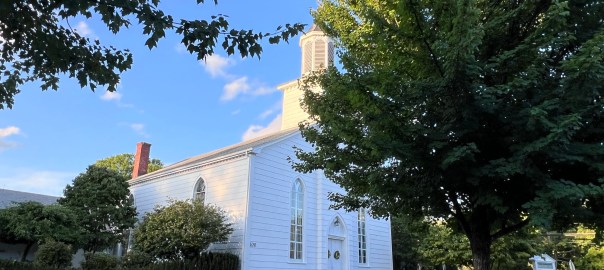
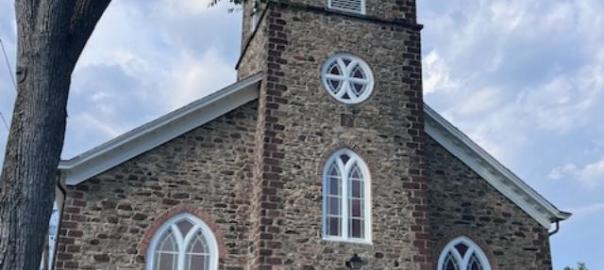
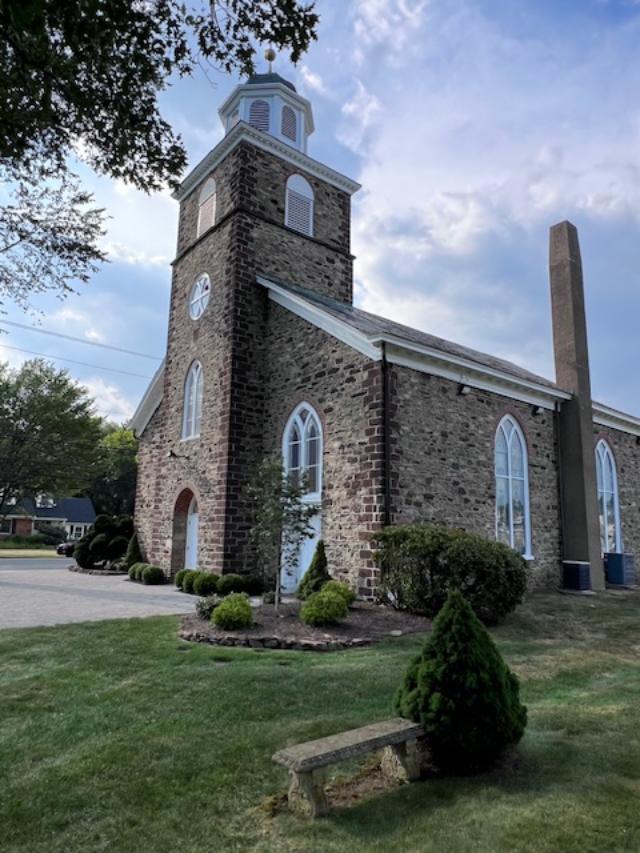
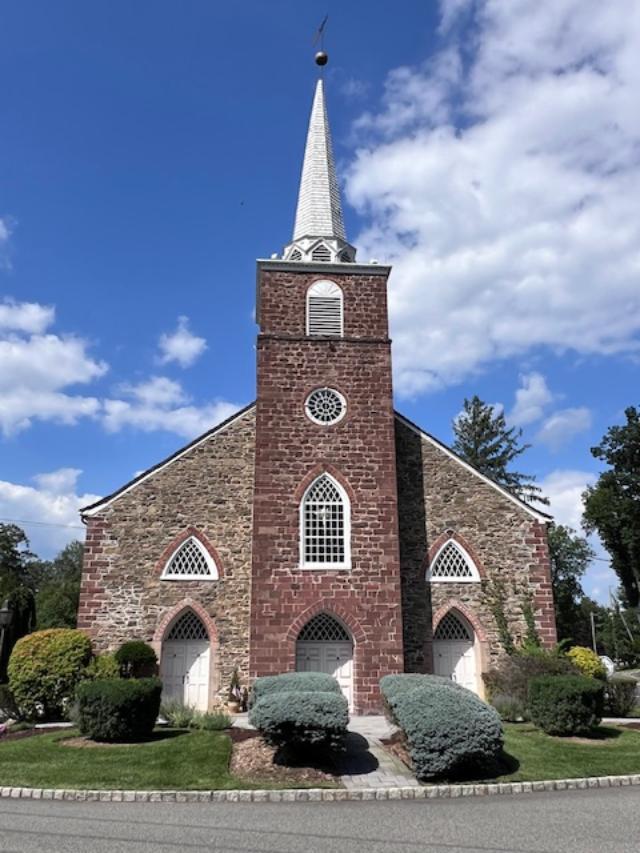
The Saddle River Reformed Church at 481 East Saddle River Road in Saddle River, NJ is also known as the “Old Stone Church”
The historic marker of the church
I visited the ‘Old Stone Church’ in Saddle River, one of the oldest churches in the state and was taken not just by the beauty of the church but by the respect the church has for the people who are buried here. There is much recognition for the contributions of the soldiers and the armed forces not just for the Revolutionary War soldiers but current ones as well.
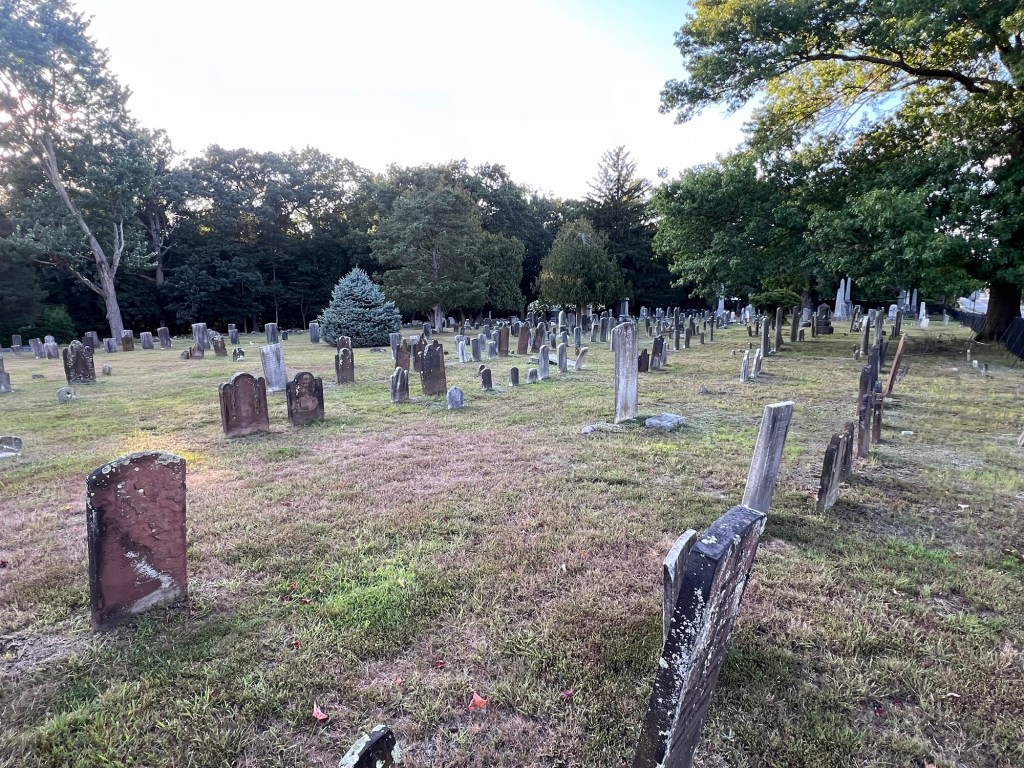
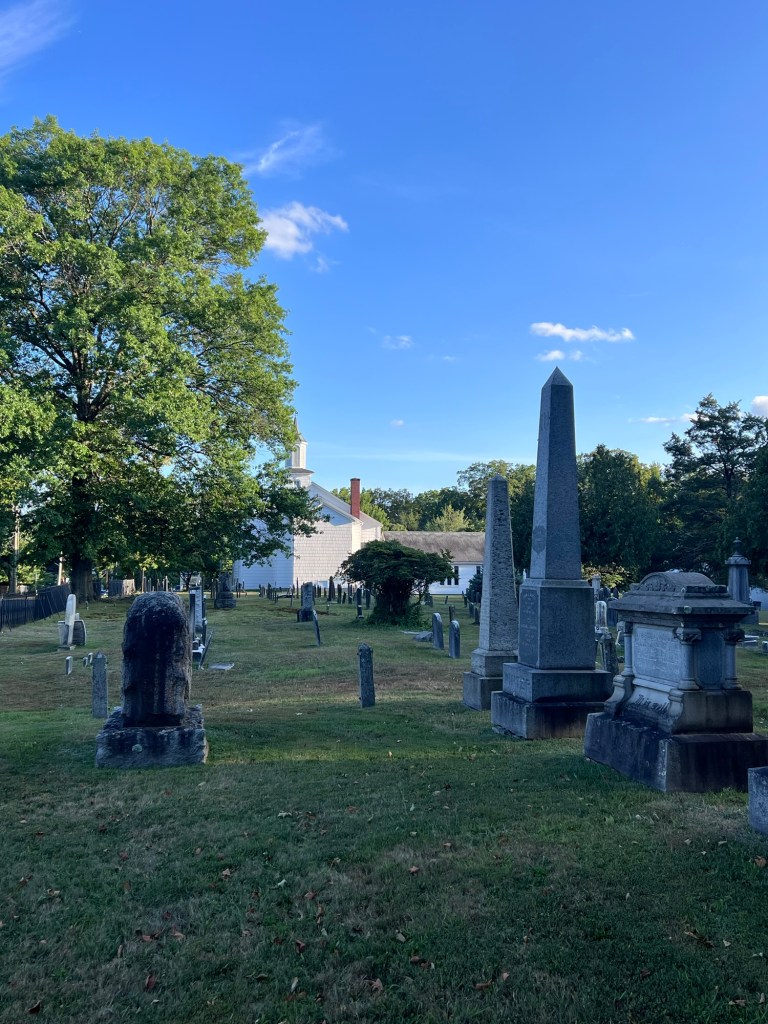
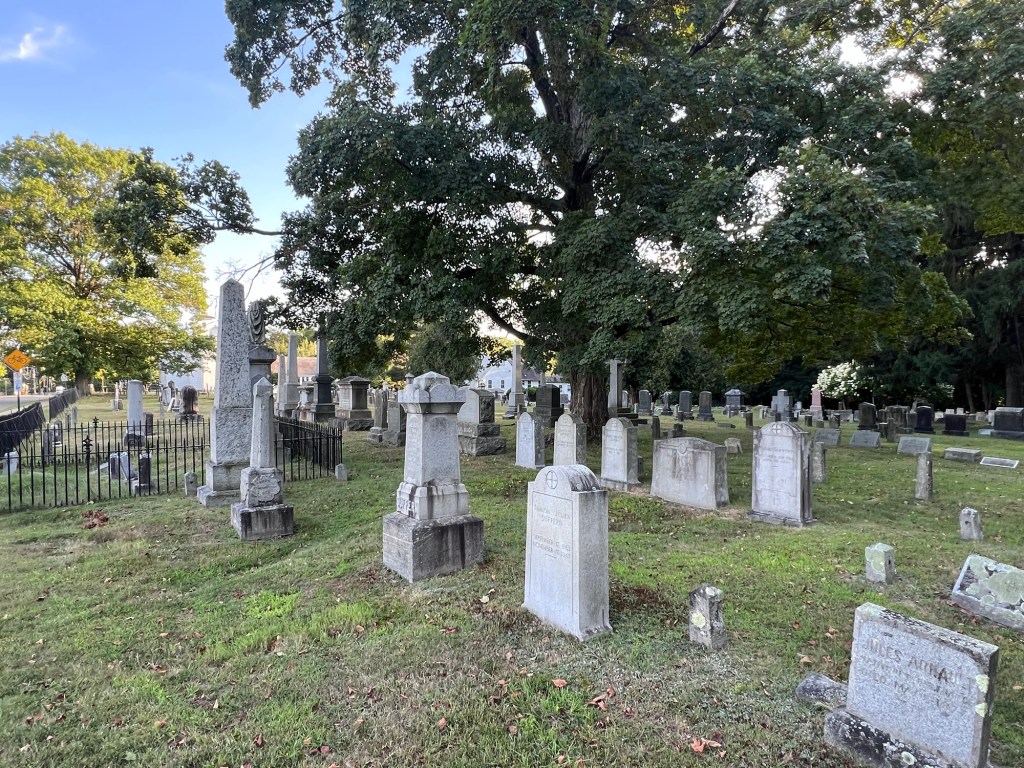
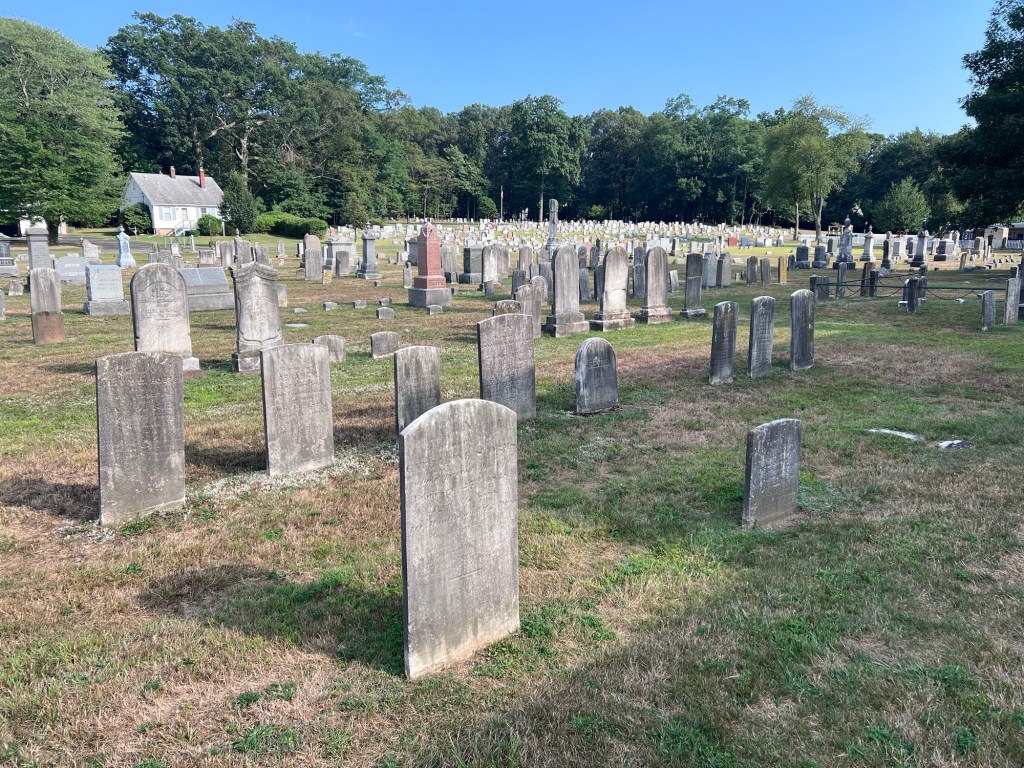
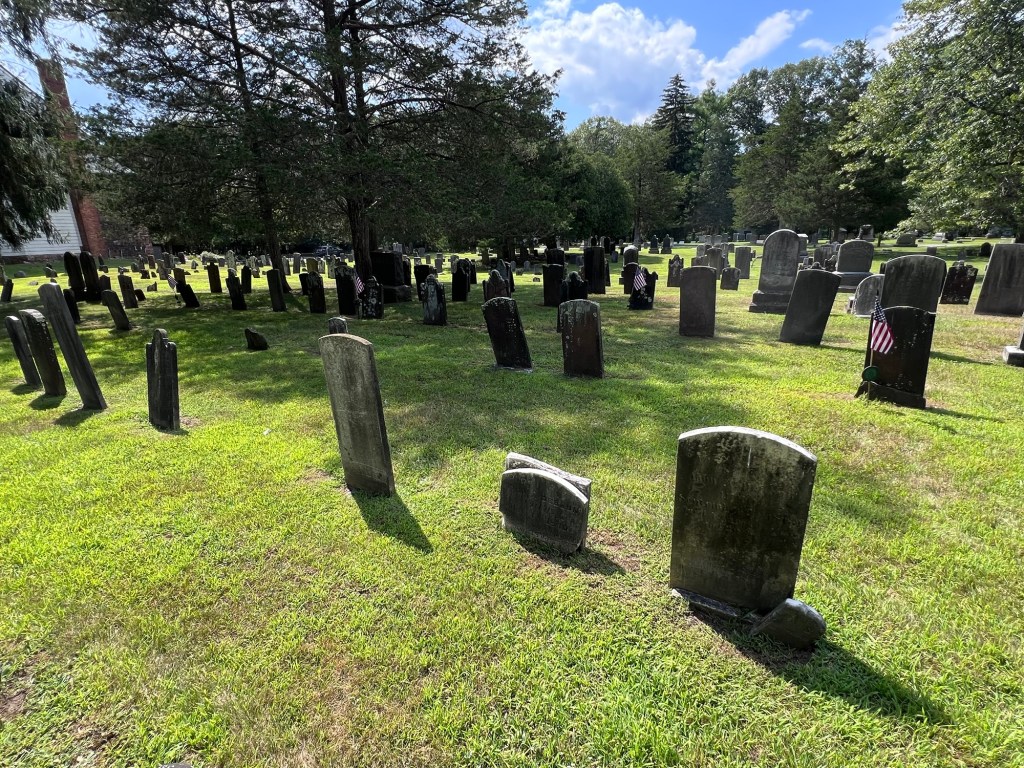
The oldest part of the cemetery is the closest to the church
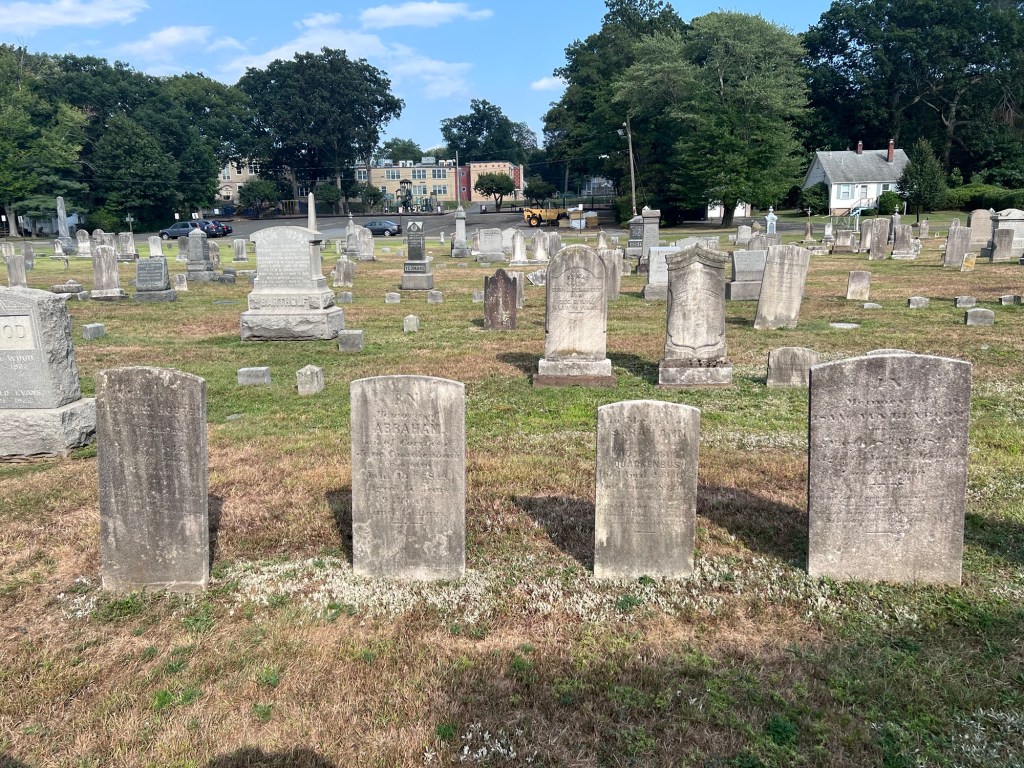
The oldest part of the cemetery contains names like Demarest, Haring, Hopper, DeBraun, Eckerson, Terhune and Zabriskie. These are the first settlers of the area whose families owned farms in Saddle River. Many of the families have family plots in the cemetery.
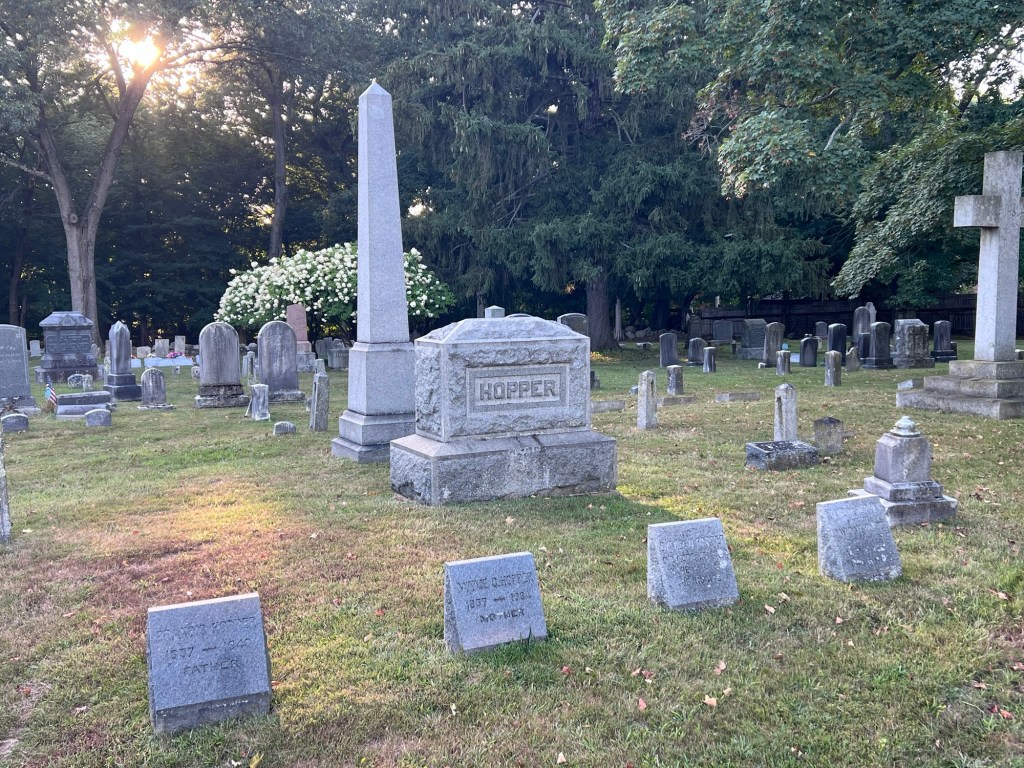
The Hopper family plot
The Zabriskie family plot
The Gilderston family plot
The DeBraun family plot
The oldest part of the cemetery holds so much history of the founding members of the Saddle River and Bergen County community.
The History of the Church:
(from the Saddle River Reformed Church website)
Our church, known to many as the Old Stone Church, was organized in 1784 as a daughter church of the Old Paramus Church. It is a part of the Reformed Church in America, a denomination which traces its roots to the Dutch colonists.
While there is evidence that the original church building was erected in 1789, our present sanctuary was built in 1819. An extensive renovation in 1971 – 1972 recreated the appearance of the original structure.
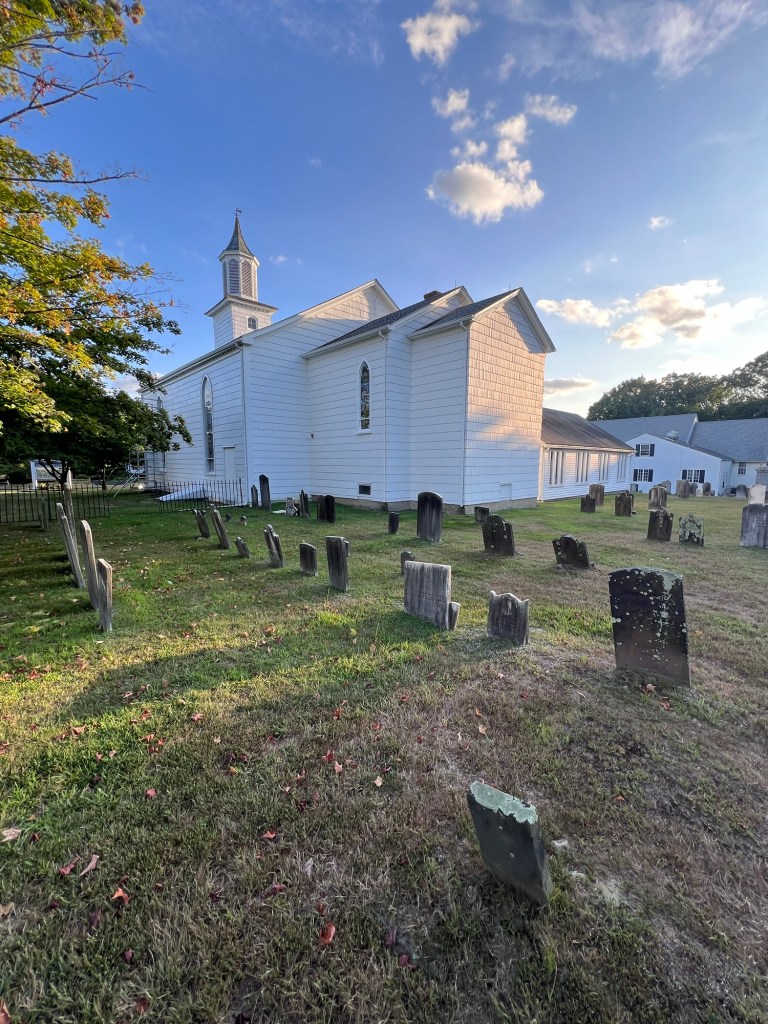
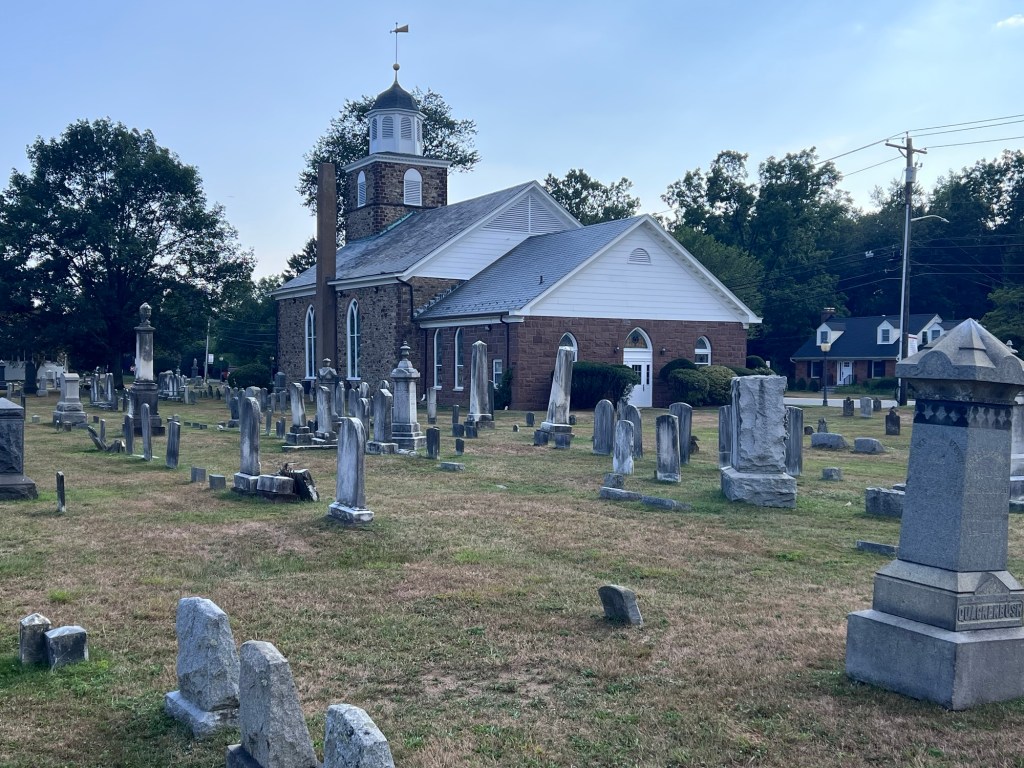
The Old Stone Church and the historic Revolutionary War Cemetery that is located behind it.
The History of the Cemetery:
(From the Saddle River Reformed Church website):
Our cemetery is the resting place of numerous American Revolution and Civil War Veterans. Church records indicate that the following veterans have been buried at our historic site.
The Saddle River Reformed Church Cemetery is one of the most historic in this part of the country. Our cemetery is over 230 years old and is the burial ground of nine known Veterans of the American Revolution. Tracing back to the founding of this nation, these resting places designate the cemetery as an historic spot of great significance, with a special interest to historians and antiquarians. Surrounded by mature and lush foliage, its peaceful setting by the banks of the Saddle River make for an esteemed and hallowed resting place for your loved ones.
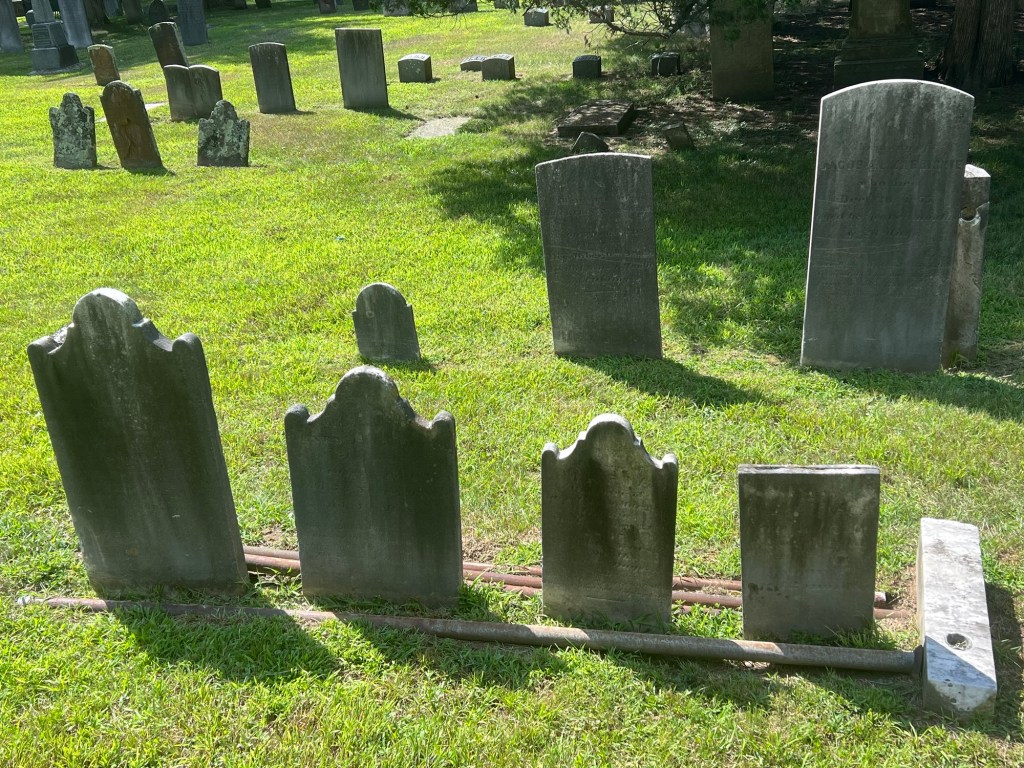
Some of the most fascinating part of the cemetery is its historical section
With the Bergen 250-The 250th Anniversary of the Revolutionary War next year, I wanted to point out the veterans buried here from the war.
David DeBaun was born in Schraalenburg (Bergenfield) in 1759 to Abraham DeBaun and Bridget Ackerman. About 1770 the family moved to Hempstead in New York. David served as a private in the Second Regiment of Hay’s Militia, Captain Garret Ackerson’s Company. He married Hannah Forshay, b. 1868, d. 1836. David died in New Hempstead, NY in 1820. He was tax officer of Hempstead in 1811 and 1812; supervisor of Haverstraw 1811-1814. An enclosed plot in the Upper Saddle River Cemetery is the resting place of his entire family.
John Tallman
(from the church website)
John Tallman was a Sergeant in Hays Regiment of Militia, Orange County, NY Militia, Company of Captain Hogenkamp, William Sickles, and Aurie Smith, and is listed on the Revolutionary War pension records. He was born in Tappan, the son of Jan Tallman and Helena Gerritse Blauvelt. He married Margrietje Forseur (Forshay). He died in New Hempstead, NY in 1839.
David Eckerson
(from the church website)
David Thomas Eckerson, was born in Schraalenburgh (Bergenfield) in 1738. He married Angenetye Vanderbeek and they had a sons Thomas, Paul, Jon, David and Aurie and daughters Hannah, Mary and Angenetye. He is on the Revolutionary War rolls in Rockland County. Revolutionary War veteran Peter van Orden was an executor to his will.
Thomas Eckerson
(from the church website)
Thomas Eckerson, 1745-1818, was married to Cornelia Eckerson. They had children, Thomas Eckerson, Edward T. Eckerson, Maria Eckerson Crouter, and Jacob Eckerson. He is listed as a Private, New Jersey Regiment. He also served in the War of 1812.
Abraham Haring
(from the church website)
Abraham G. Haring was born in 1755 in Tappan, Orange, NY to Garret J. Haring and Cornelia Lent. He married Elizabeth Blauvelt. He died in 1832 in Hempstead, Rockland, NY. He served in the Revolutionary War 1775-1783, Coopers Regiment, NY Militia.
John Terhune
(from the church website)
John A. Terhune, 1753-1805, was the son of Albert A. Terhune and Elizabeth Doremus. He inherited the stone house on the sw corner of Lake Street and West Saddle River Road, known as the Terhune-Hopper house. He married Catherine Lutkins, daughter of Harman Lutkins of Paramus. He is on the SAR list.
Jacob Zabriskie
In the modern day, I wanted to point out a hero to the Bergen Country Firefighting Community and former Saddle River Fire Chief Larry Rauch and his wife, Sherry who both contributed so much to the firefighting community.
Many members of the Revolutionary, Civil, war of 1812 to WWI and II to Desert Storm are buried here. These church treats our veterans with great respect.
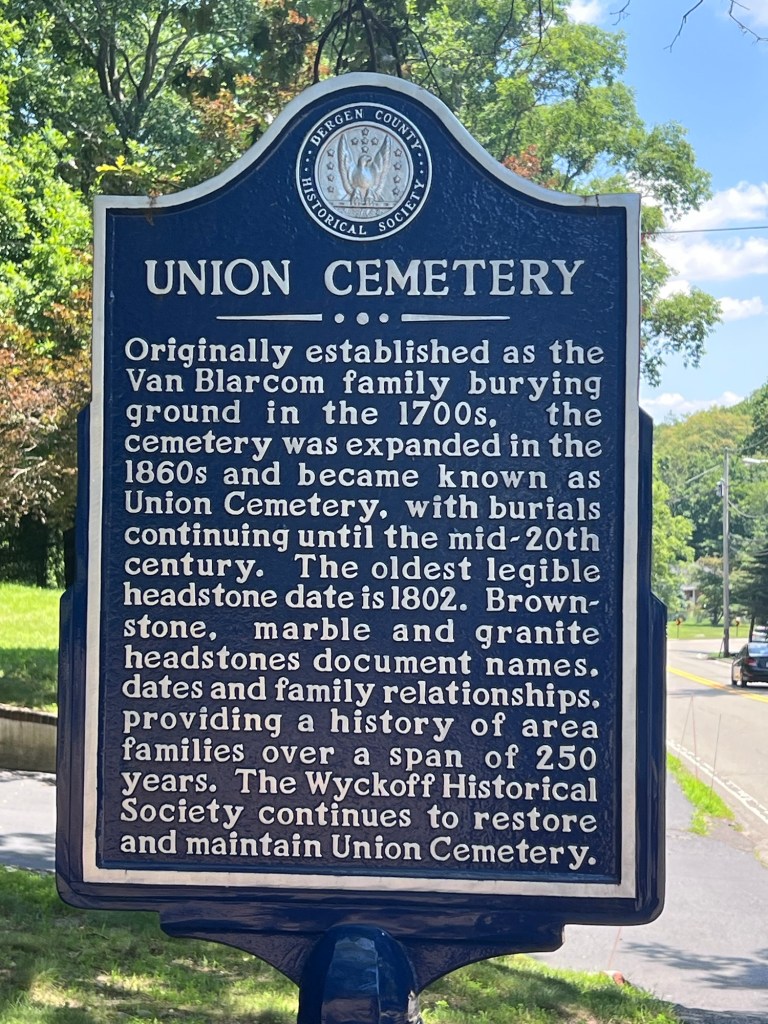
The historical sign for the Union Cemetery at 151 Franklin Avenue in Wyckoff, NJ
The marker sign put up by the Wyckoff Historical Society
The walled garden just outside the cemetery in bloom
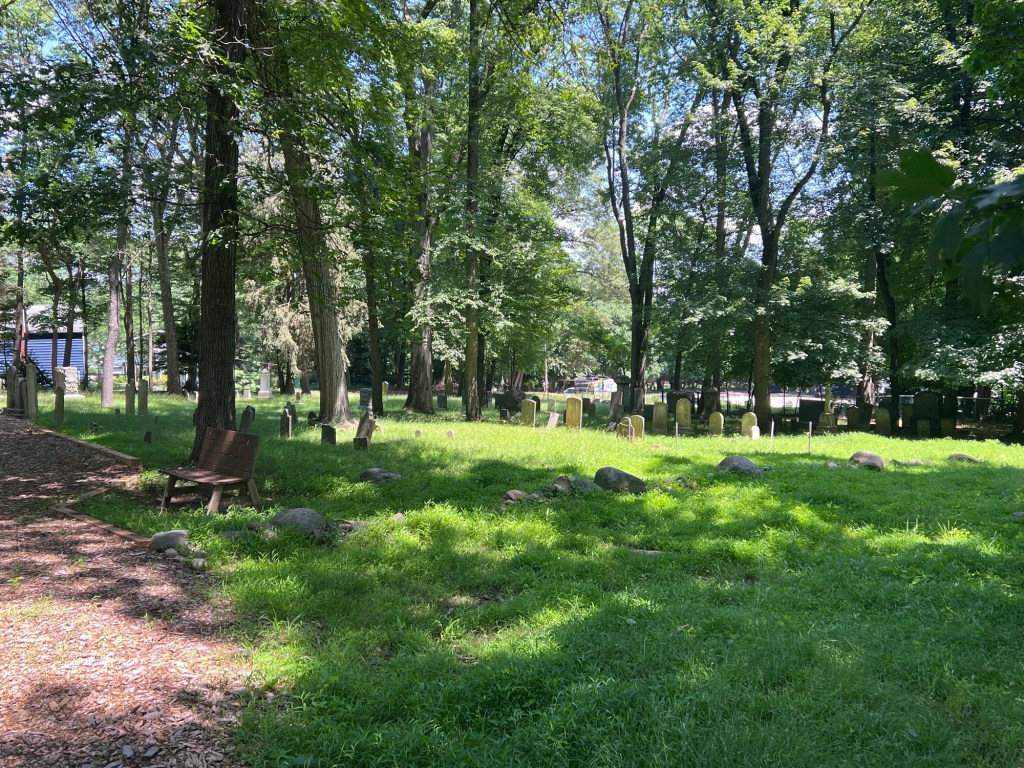
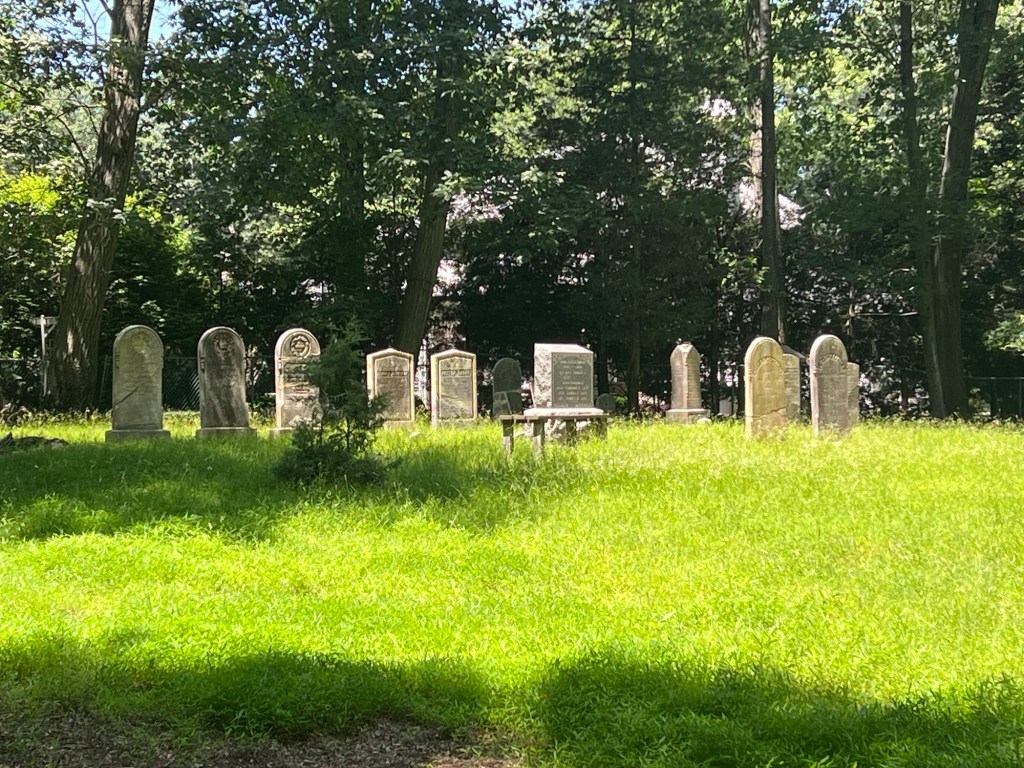
The Union Cemetery was originally the resting place of the Van Blarcom family and the right hand side of the cemetery has the Van Blarcom family plot
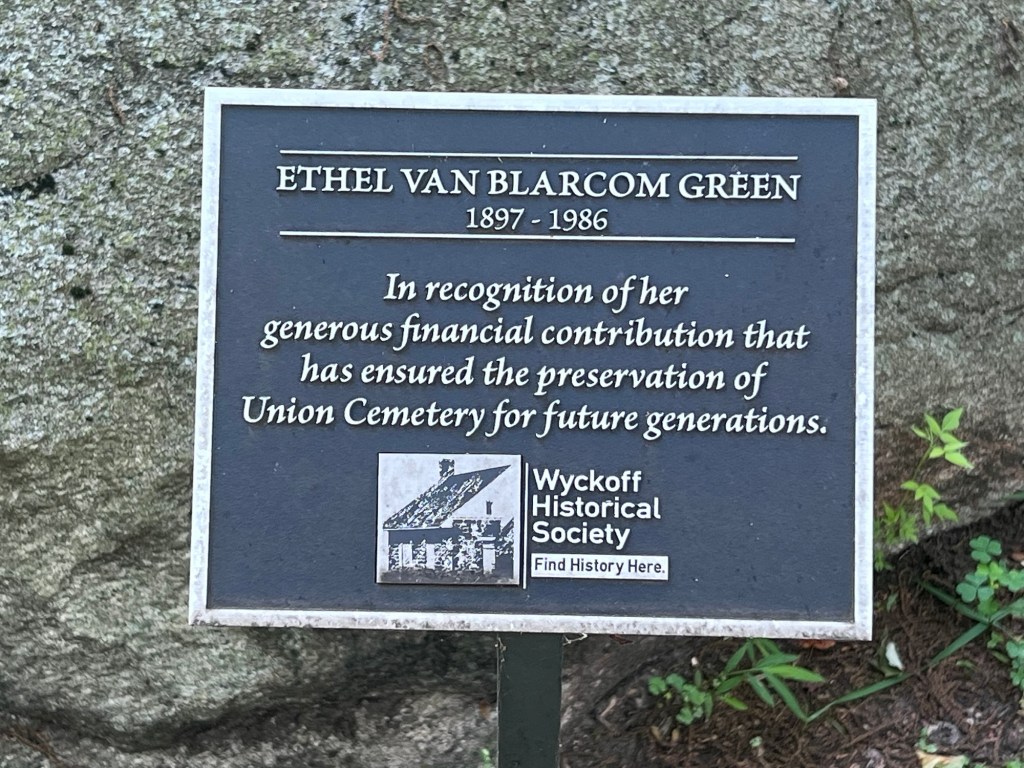
One of the descendants of the family, Ethel Van Blarcom Green donated money for the preservation of this family plot.
The Biography of Ethel Van Blarcom Green:
(From the Wyckoff Historical Site)
If you at all familiar with the Wyckoff Historical Society’s recent activities at Union Cemetery, you may know that the 250 year-old site was the original Van Blarcom burial site. The name can be traced to the early 1700s when the first Van Blarcom family settled in New Jersey. The oldest legible headstone dates to 1764.
What you may not know, is that Ethel Van Blarcom, a direct descendant, bestowed a significant financial contribution to the Society beginning in 1978, with her wish that her beloved family cemetery be maintained. Although she lived in California for most of her adult life, Union Cemetery obviously held a special place in her heart, and she wanted to see it survive. The Society has Ethel’s hand-written letters that confirm her generous donation. She also continued to renew her Society membership until 1984.
However, it wasn’t until 2019 that the current trustees decided it was time to use the funds for its intended use, and honor Ethel’s wishes. Several headstones were repaired, new fencing is being installed, and yearly grounds maintenance is conducted, thanks, in part, to Ethel’s generosity.
It was at this time that Society trustees, Doris Noerr, Melanie Long, and Linda Vreeland, dove into genealogy websites and Society archives to learn more about Ethel’s life and to particularly find a photograph of her.
“After several week of research, we obtained Ethel’s death certificate which led to contacting her niece Naomi who is now 92,” said Society president, Lynn Groel-Lynch. “To our delight, she had a photo of Ethel and her husband, Roy Green that we believe is her 1916 wedding photo.”
Ethel was born in Paterson in 1897 and lived to the age of 89. She and Roy moved to the Los Angeles, California area most likely around the time of her mother’s death in 1933. The couple had no children.
“We are still in the process of contacting a few descendants, and those we’ve spoken to have been happy to share what they know about Ethel,” said Melanie Long. “We also will install a plaque in her memory near where her father, Edward is buried in Union Cemetery. There are thousands of Van Blarcom names as they were the one of the prominent families in our area’s farming community, and after all these years, the Society is thrilled to finally honor the legacy of one very important Van Blarcom, Ethel Van Blarcom Green. As they say, ‘It’s never too late’”.
The current history of the Union Cemetery:
(Wyckoff Historical Society website)
The original Grange sign from the 1960s at the Franklin Avenue entrance of Union Cemetery was weathered and fragile. The Wyckoff Historical Society recently replaced the old sign with one that is also hand-lettered, and includes the Grange logo which was barely visible on the old sign. Two new posts display the new sign.
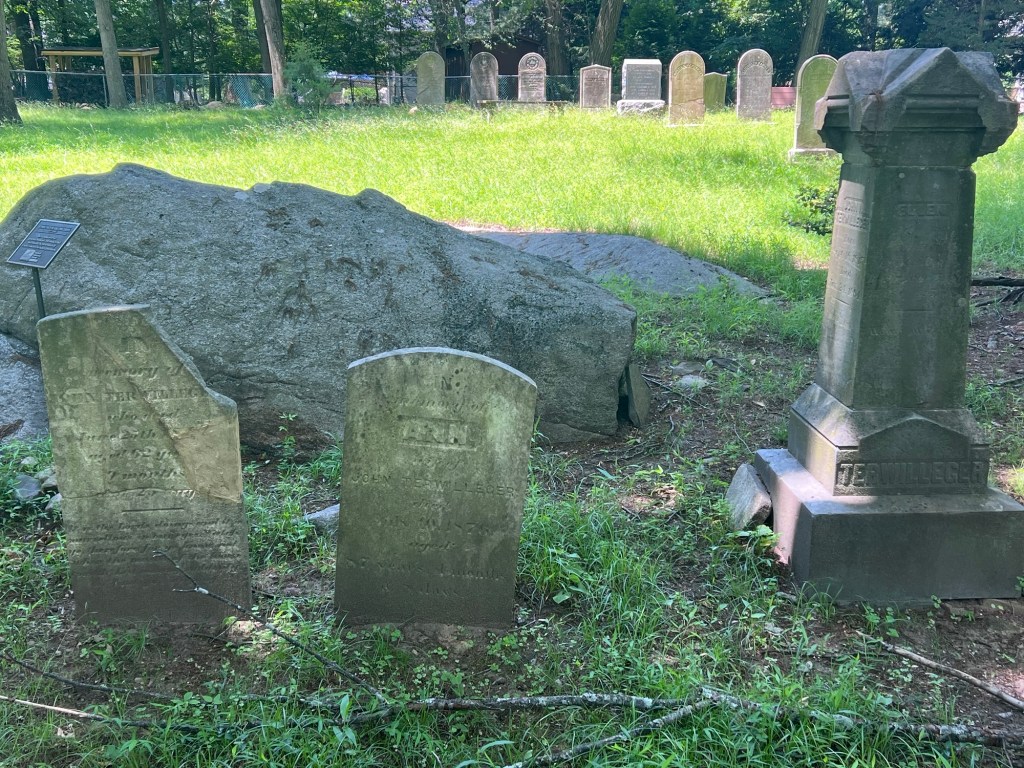
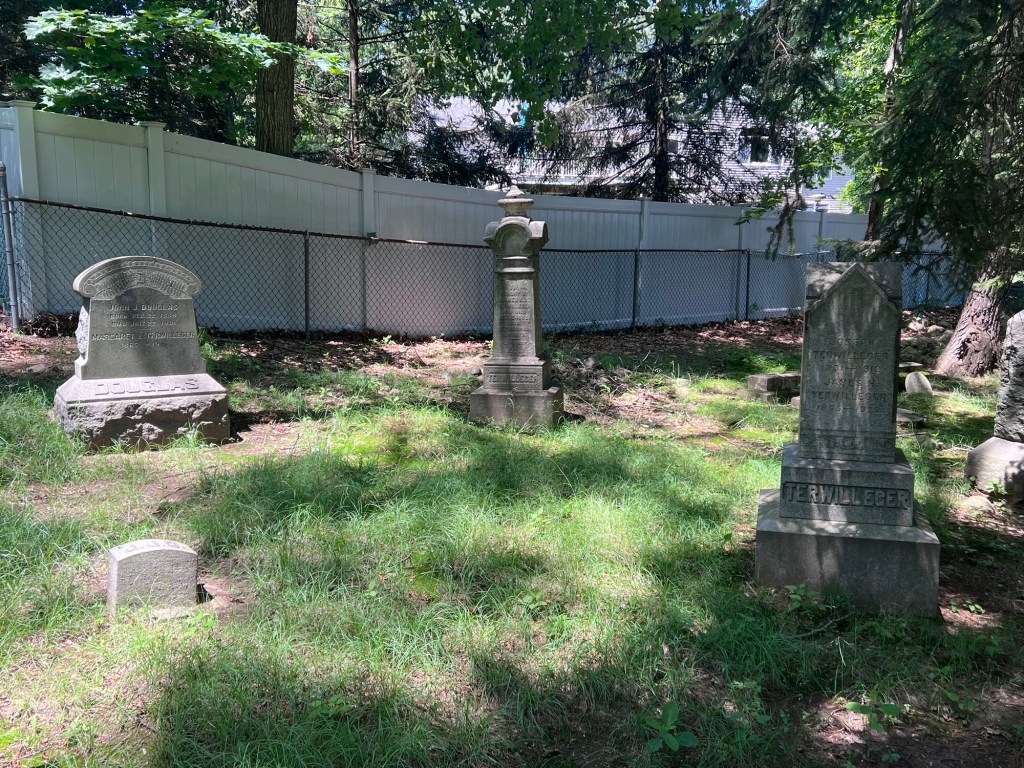
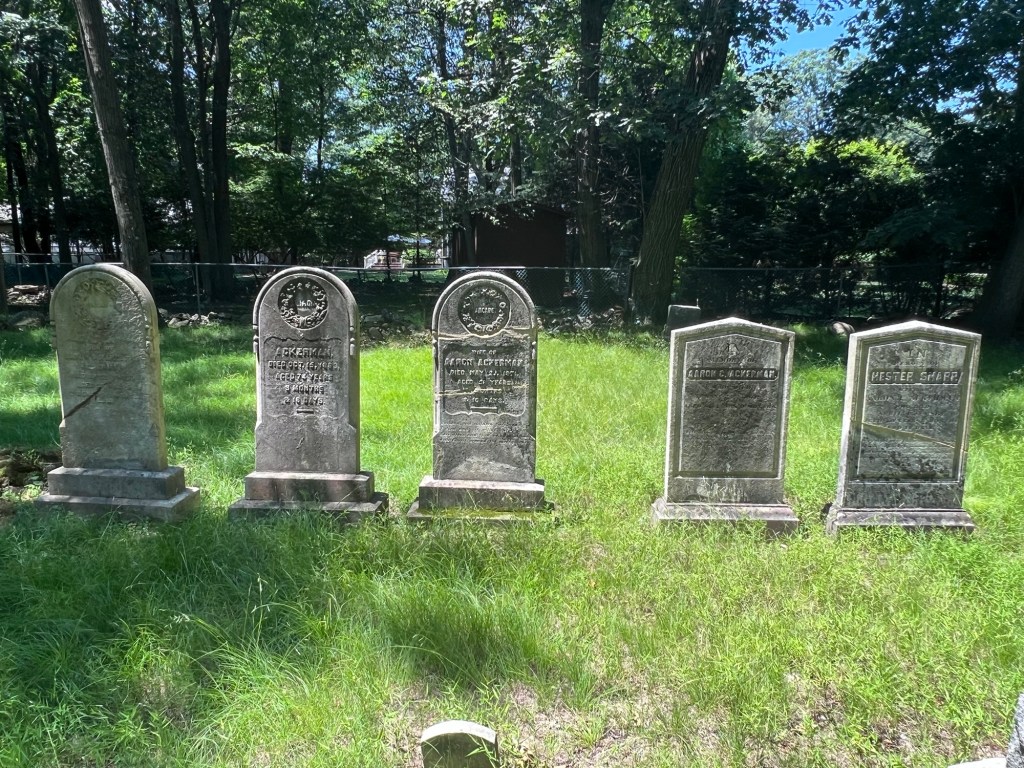
The Ackerman and Terwilliger families are buried to the left/northern side of the cemetery
The Terwilliger family plot
The resting place of James Terwilliger’s tombstone
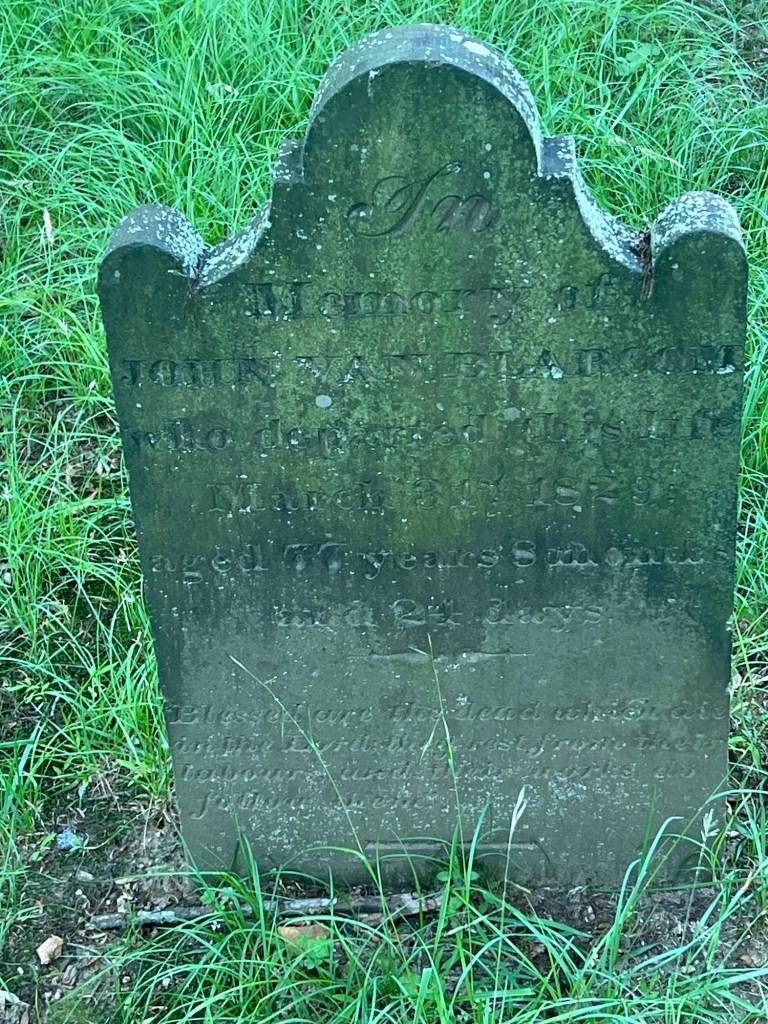
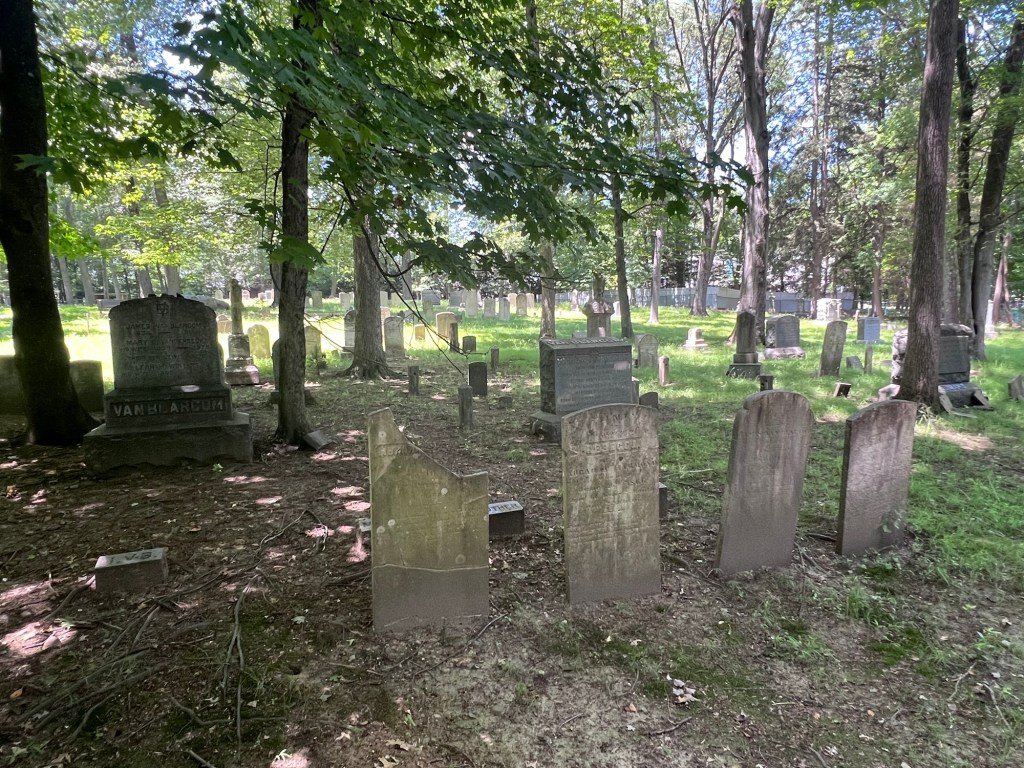
To the right of the pathway around the cemetery to the south is the Van Blarcom family plot where on the oldest graves is that of John Van Blarcom, a veteran of the Revolutionary War.
The resting place of Revolutionary War veteran, John Van Blarcom
The original section of the Van Blarcom family plot dating back to the Revolutionary War
The later burial section of the Van Blarcom family
The resting place of Daniel and Rebecca Van Blarcom
The Terwilliger family has two sections of the family plot in the northern section of the cemetery
The Ackerman family’s plot is to the middle most northern end of the cemetery
The Mallinson/Westervelt family has the further most family plot of the cemetery
The cemetery is so peaceful and relaxing to walk around. The Wyckoff Historical Society has done a wonderful job maintaining the property. Even though it is the resting place of many family plots, it’s still a very welcoming place and you can feel it as you walk the paths. There is a respect of remembering the people of the past that can be felt here
As you walk the pathways, you visit the people who have contributed to the growth and history of Bergen County and the surrounding area. They shaped their communities from before the Revolution War to today.
My video of visiting the cemetery and the families that rest here.
The History of the Cemetery:
(From the Wyckoff Historical Society website)
The Union Cemetery on Franklin Avenue dates back to the first half of the 1700s, when Johannes Van Blarcom set aside an area of his property to become a burial place. The earliest readable stone is from 1764 and thought to mark the grave of a slave girl because there is no surname given. Johannes Van Blarcom’s daughter, who died in 1725, is alleged to be buried there also. Various community groups have volunteered to maintain the cemetery, including the Wyckoff Historical Society. In 2018, dead trees, underbrush, and poison ivy were removed.
Most are early Van Blarcom family members as the cemetery was one of the original family cemeteries.
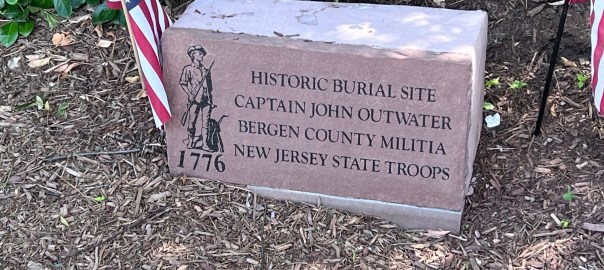
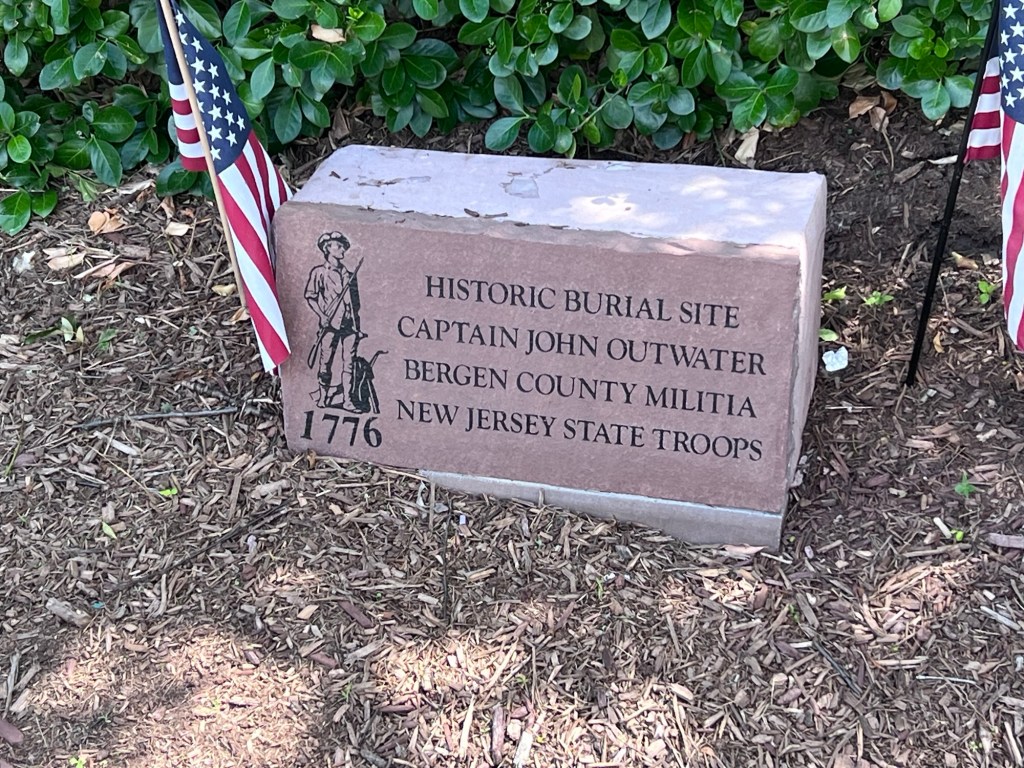
The stone marker sign at the entrance to the family cemetery. This cemetery is the final resting place of Captain John Outwater from the local militia who fought in the Revolutionary War and his family.
The memorial to Captain Outwater in the center of the cemetery dedicated to his contributions to Revolutionary War
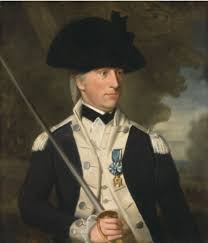
Captain John Outwater during the Revolutionary War
When John J. Outwater was born on 9 February 1780, in Hackensack, Bergen, New Jersey, United States, his father, Captain John Outwater, was 33 and his mother, Hendrickje Dirck Lozier, was 34. He married Cathalina Van Bussum on 1 February 1813, in Old First Reformed Church, Passaic, Passaic, New Jersey, United States.
They were the parents of at least 4 sons. He died on 25 September 1842, in Wilson, Wilson, Niagara, New York, United States, at the age of 62, and was buried in Glenwood, Lewiston, Lewiston, Niagara, New York, United States.
The original entrance to the cemetery must have been on Moonachie Avenue in the distant past.
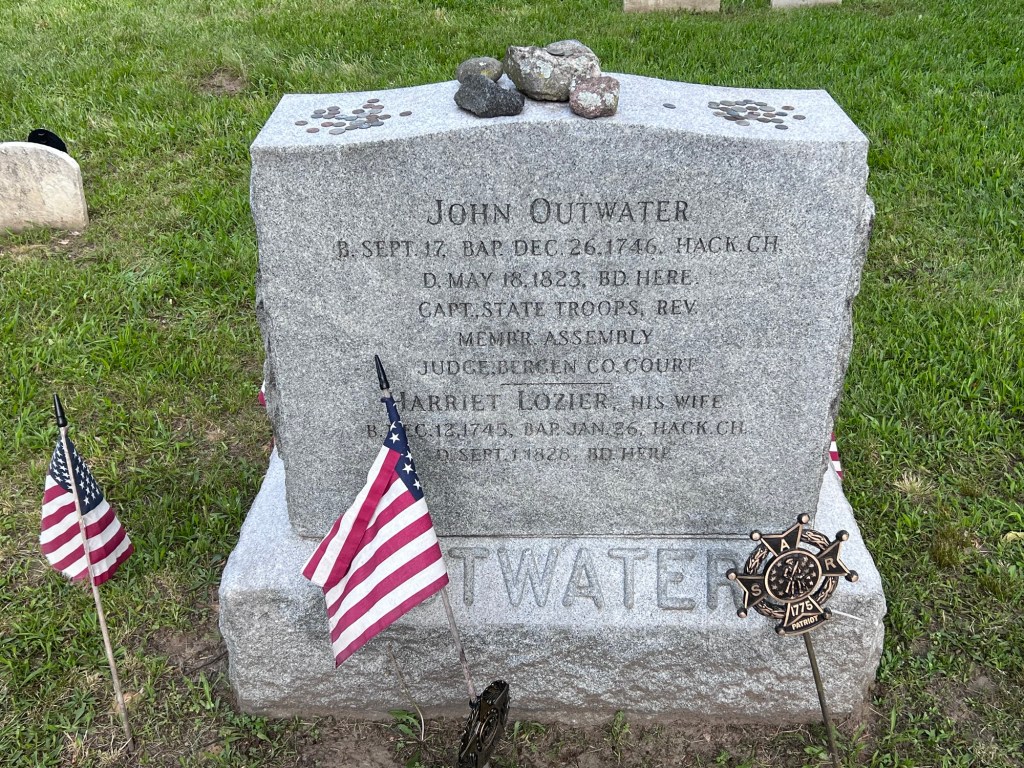
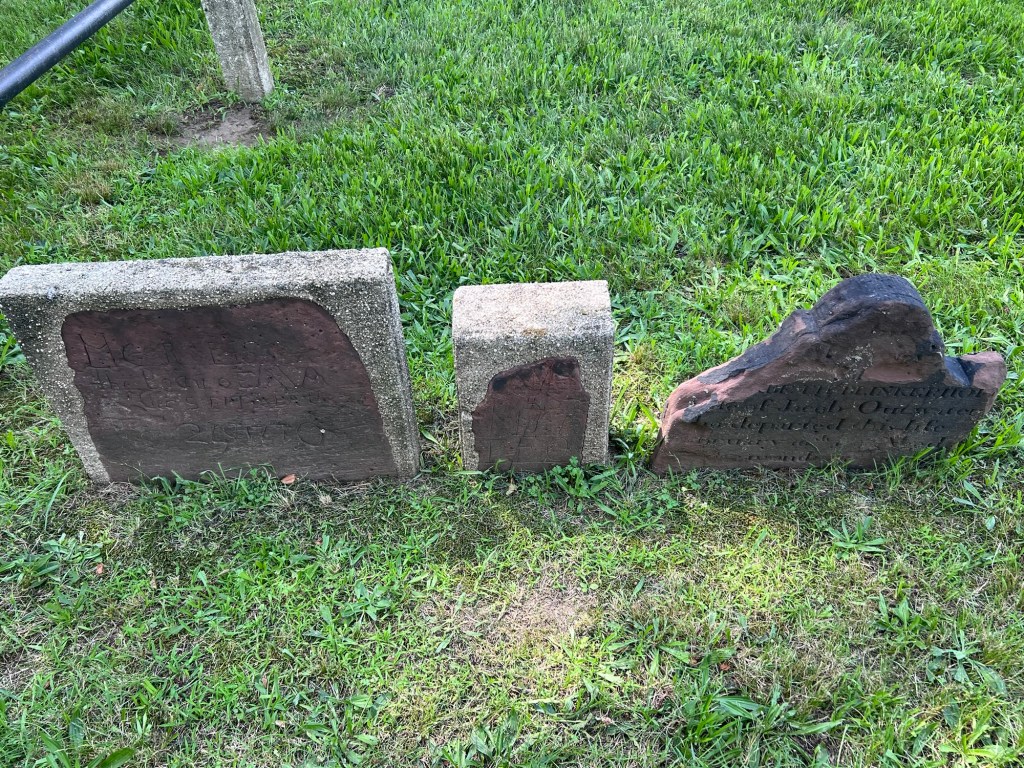
The original graves of Captain John Outwater and his wife, Louise Lozier
Across from their graves is the memorial to the family
Various members of the Outwater family including parents, brothers and sisters and children are buried here.
The grave of Jacob Outwater and his family
The tombstone of Jacob Outwater
The grave of Jacob’s son who died as an infant
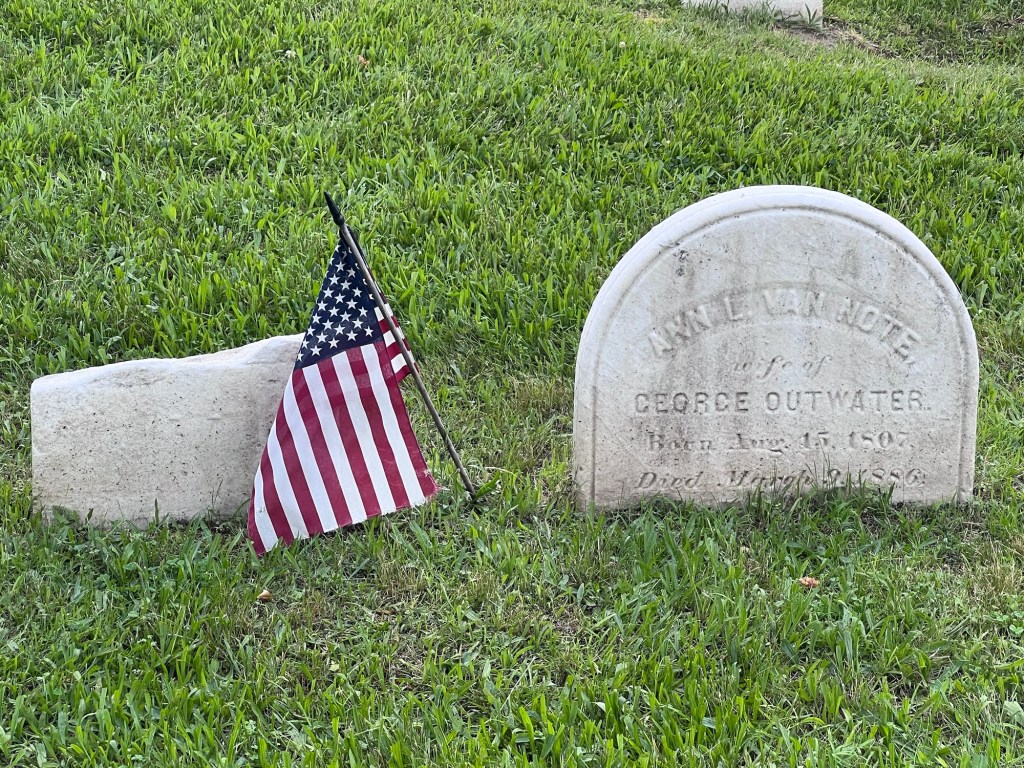
The graves of George Outwater and his wife, Ann Van Note
I think this is the grave of George Outwater’s first wife, Mary
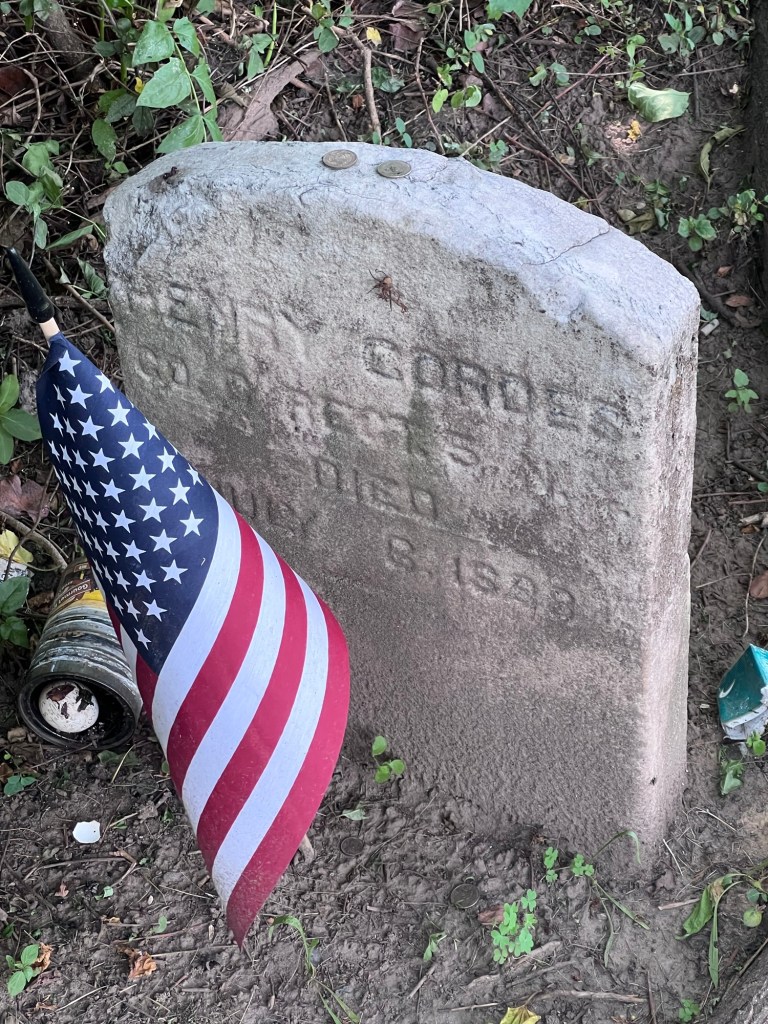
Buried outside the family plot is the grave of Henry Cordes
The Outwater family cemetery sits on a small hill overlooking a Quick Check store and gasoline station. Talk about modern progress.
I took a quick tour of the cemetery:
My video of the Outwater Family Cemetery and the grave of Captain John Outwater of Revolutionary War fame.
Open: During the hours of the Nursery that surrounds it.
My review on TripAdvisor:
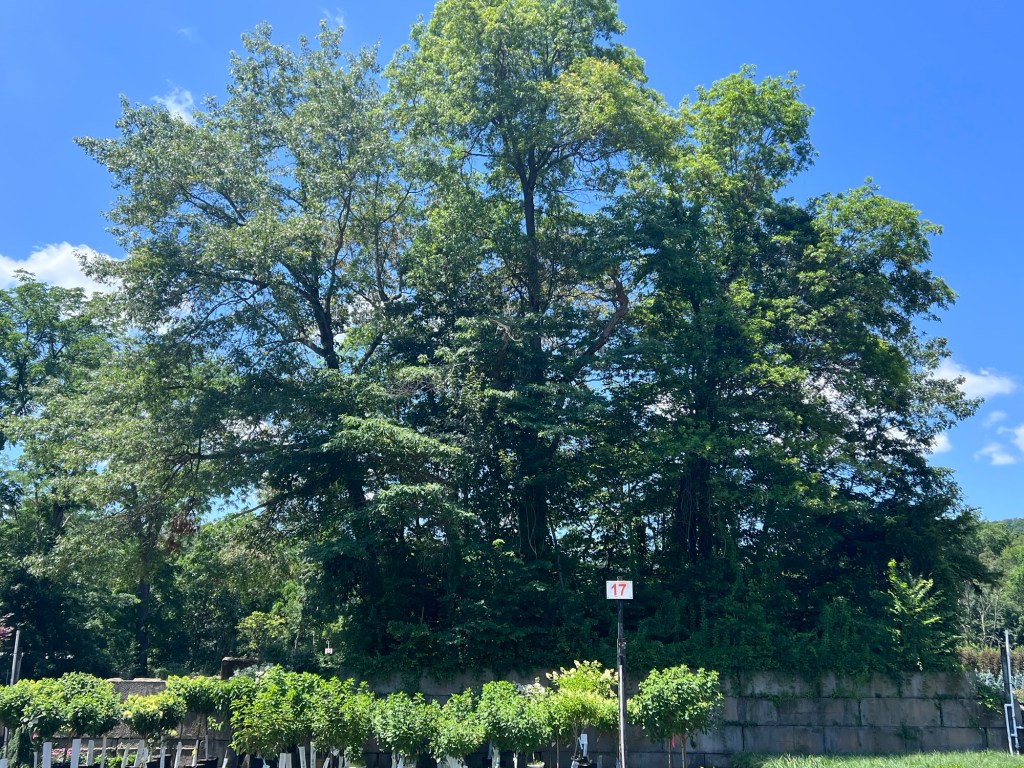
The Demarest Family Cemetery sits on a small embankment surrounded by trees and a cement island. You can only access it from one side and there is no stairs. Totally forgotten burial site.
The fencing and locked door with a rusty lock surrounds the cemetery. There is no way to access it. I was able to walk up the cement embankment and was able to walk around the fence. The trees have taken over the cemetery and have knocked over the tombstones.
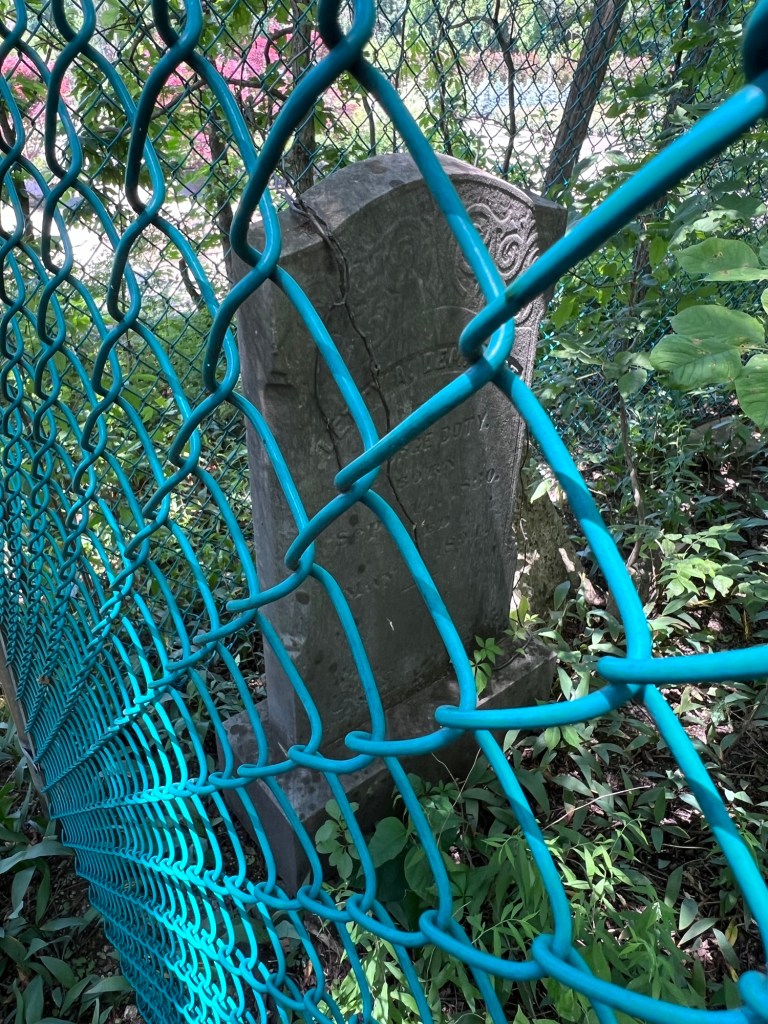
You can see some of the fallen tombstones from neglect at the fence
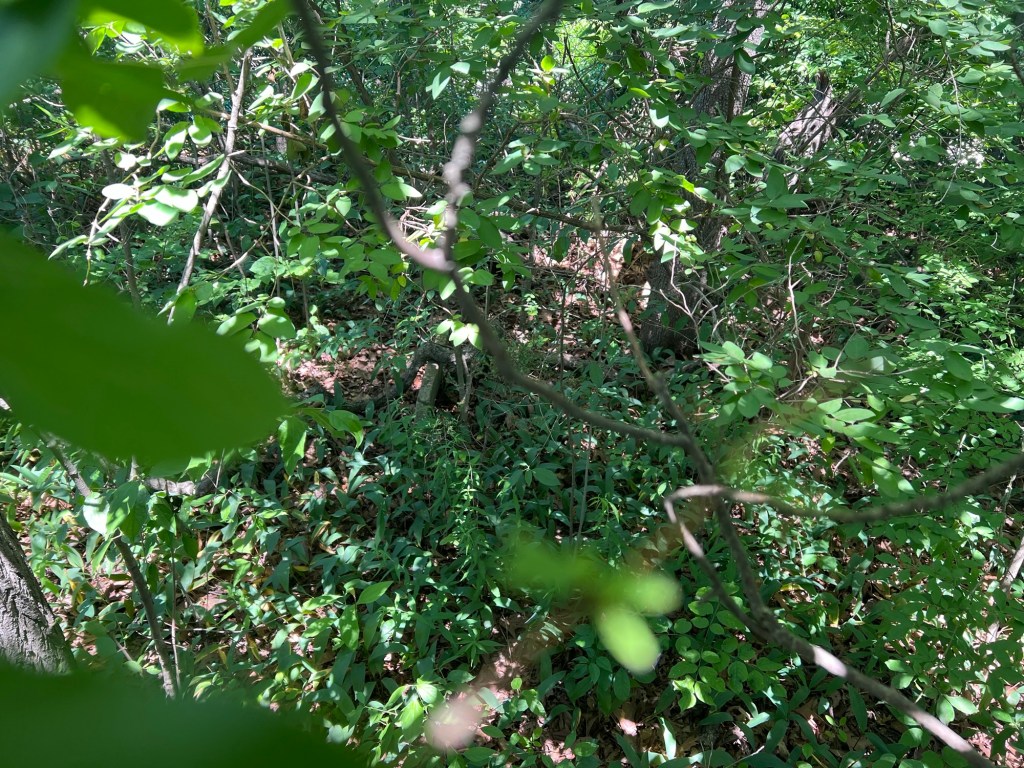
The growth surrounding the burial site
Some of the historic tombstones are still standing like this one of the burial sites of Lettya Ann Demarest who was born in 1830. She had inherited the house in 1863.
Most of the historic tombstones have fallen down
The fallen and forgotten tombstones have growth surrounding them.
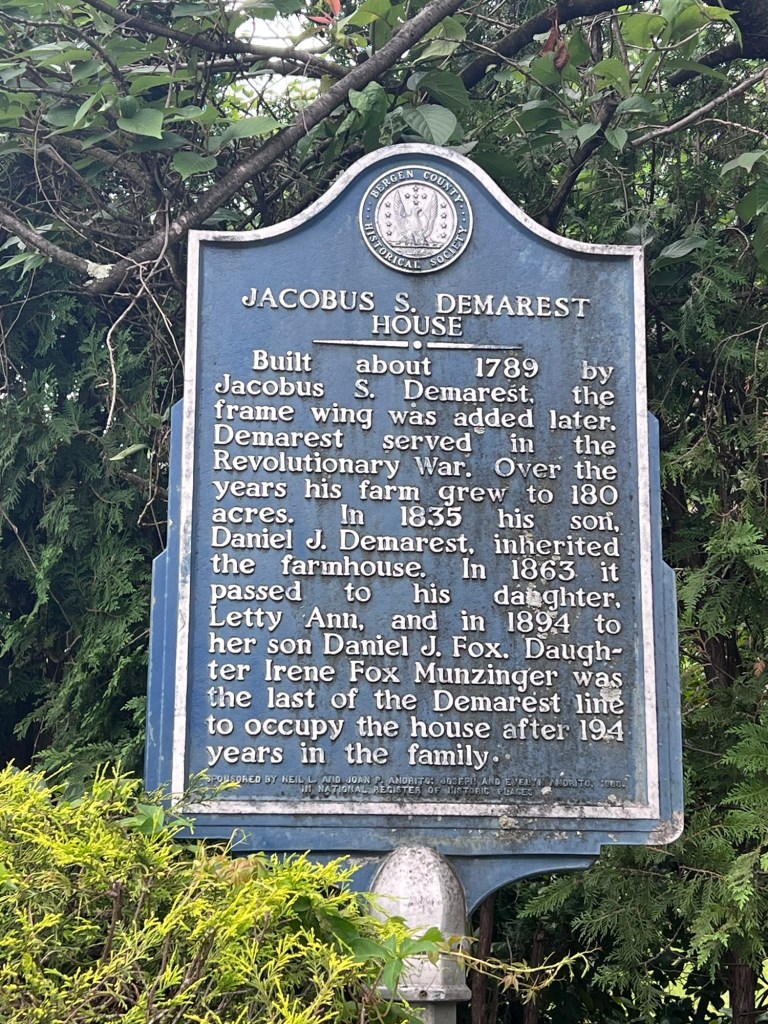
The historic Demarest homestead was around the corner from the nursery. The house had been in the family for 194 years almost five generations.
The family homestead still exists up the road around the corner from the nursery.
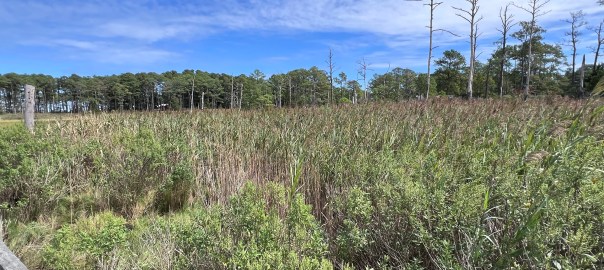
This tiny historical and very forgotten and neglected cemetery was once part of this branch of the Demarest family. The small cemetery sits on a small hill not far from the house. Once the farm was sold off and the town grew around it, this small cemetery sits still in its original spot in the middle of nursery.
When I talked with one of the workers there, he said the owner was very careful to built around it and let it intact. He also said that no one seems to own it. It is the final resting place of James S. Demarest, who fought in the Revolutionary War.
With all the growth, I could not find it. It has been lost to time.
















































 mywalkinmanhattan