Tag Archives: Walking around Manhattan

Day Three-Hundred and Sixty-Six Attending the Macy’s Day Parade. November 27th, 2025

It has been almost a decade since I attended the Macy’s Thanksgiving Parade. The last time I attended the parade, it was when my best friend came in from the Midwest as part of a four day band trip that the local high school sponsored as they were performing in the parade. We had a really nice time.

My blog on Thanksgiving in NYC in 2015:

https://mywalkinmanhattan.com/tag/macys-parade/

For the next several years it was either spending time with a friend out on the island or family commitments or the weather that kept me away. Last year it down poured on the parade. This year it would be hit or miss with the weather but the rainstorm the day before went out to sea and it ended up being a sunny cool day.

My spot on the corner West 46th street and Sixth Avenue for the start of the Macy’s Thanksgiving Day Parade

https://www.macys.com/s/parade/lineup/

I got there early leaving the house at 7:00am to a packed bus. I was lucky to get a seat and I am at the beginning of the route into the City. We just passed all the stops on the way into the City as we zoomed through the Lincoln Tunnel, a first in a long time.

The crowds at 8:00am on Sixth Avenue

I had read that the route had moved from Broadway to Sixth Avenue, so I walked a couple of blocks uptown to get away from the Times Square crowds. I figured that was where all the tourists were headed. I settled on West 46th Street, which has an incline near one of the office buildings and offered a better view.

The crowd just kept growing around me at the start of the parade.

The parade started uptown at 8:30am and made its way down Broadway until 59th Street and turn on Sixth Avenue and made its way down Sixth Avenue to Macy’s on West 34th Street. I was around the halfway point. Around 9:15am, we heard the first band coming down the Avenue and Tom Turkey, one of the oldest floats in the parade that I could remember from my years in the parade.

The Tom Turkey float used to house the grand marshal of the parade. My first year with the parade in 1988 it was a freezing cold Clint Black, the country singer.

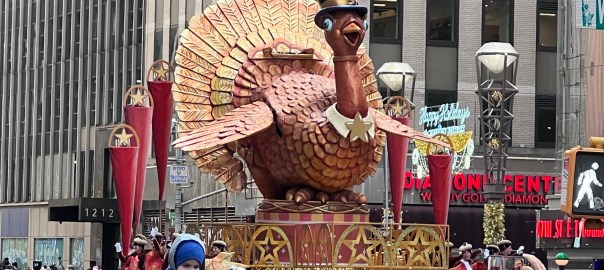
Tom Turkey passing West 46th Street

As the float passed by there was no one on top. Maybe it was too cold or maybe they were on a different part of the float. That height can freak people out.

The start of the parade passing all of us on West 46th Street. The crowds and the excitement started to build. We could see Tom Turkey coming down Sixth Avenue to start the parade. People started to cheer as the parade passed us by.

The start of the parade with the Macy’s logoed gold balloons, which have been part of the parade since I volunteered in the early 1990’s.

The Macy’s balloons at the start of the parade

After this, it was a series of balloons and floats that passed by. The funny part was I thought there were more marching bands in the past.

The Super Mario balloon passing by

The Super Mario passing by

Doria the Explorer balloon

Doria the Explorer passing by our spot

The SpongeBob SquarePants balloon

The Sesame Street float passing by

The Diary of a Wimpy Kid balloon

The Green Giant float passing by

The Disney Float passing by with Micky Mouse

The Spiderman float makes an impact on the parade

The Spider-Man float passes by

The Minon passing us and looking everyone over

The Stuart the Minon balloon passes by

The Golden Turkey float passes by with rapper Busta Rhyms

The balloons Gabby and Panda Paw balloon pass by

Cool & the Gang on the Bronx Zoo float

The Smokey the Bear balloon

The Snoopy float, one of the many that have graced the parade for years

Snoopy passing by

Snoopy has been part of the parade in different forms since the early 1990’s. This is the latest version of the balloon.

The Pac Man Balloon passing by

The Marshall from Paw Control balloon passes

The Buzz Lightyear balloon passes by

The Silver Macy’s Balloon

The parade passed by in intervals as the parade had to stop for performances further down the route.

The Jolly Polly Pirate Ship passes by with Mr. Fantasy. I did not know who he was.

The balloons moved down Sixth Avenue

Here comes the Shrek Onion Carriage balloon in the distance

The Shrek Onion Carriage balloon

The Goldbear balloon

The Bluey the Dog balloon

The Counting Sheep Dream float passing by with performer Debbie Gibson, a singer from the 1980’s.

The Noorah balloon

The Palace of Sweets float

The Pillsbury Doughboy then passed us

The Pillsbury Doughboy passing us in the parade

The Deck the Halls float passed us with Ms. Christmas herself, Darlene Love, whose Christmas song, ‘Nobody aught to be alone on Christmas’ is played every year in the movie, ‘Home Alone II’.

Darlene Love on the Christmas float as it passed by

Then Minnie Mouse made her appearance towards the end of the parade

Then the ‘Believe’ balloons came down Sixth Avenue to announce the arrival of Santa

Here comes Santa, which basically opens the shopping season snd Christmas

Santa waving at the crowds

Santa waving to us as he passed by

Santa saved my way as we all waved to him

Santa on his sleigh marking the end of the parade as it passed West 46th Street

Then the parade ended by us as it made its way to West 34th Street to join the crowds at Macy’s. There all the performers would perform clips from their shows.

Sixth Avenue at the end of the parade

After the parade was over, I spent some time in Midtown getting some work on previous blogs and creating new ones.

After work was over at the club, I headed down to Chinatown for my Thanksgiving dinner. I had been feeling the sniffles trying to come in, so I had my dinner at Wonton Noodle Garden for an early dinner.

I felt I needed the excise and the fresh air to fight this thing so I walked from East 44th Street to Chinatown. I figured a several mile walk would get rid of this thing. I got some great pictures in along the way. All the parks on the way to Chinatown still had foliage left on the trees and the parks were also decorated for the upcoming Christmas holiday season. This is when you get to see the City at its best.

Herald Square Park decorated for the holidays

https://www.nycgovparks.org/parks/herald-square

Madison Square Park in the late Fall

https://madisonsquarepark.org/

Washington Square Park by NYU decorated for the holidays

https://www.nycgovparks.org/parks/washington-square-park

The park looked so festive in the late Fall

I loved the decorations on the gate

When I was attending NYU, I never realized how close Chinatown was to campus and I made my dumpling runs as many times as I could. I wanted to be supportive to Chinatown businesses. I decided earlier I would go to Wonton Noodle Garden (Mei Lai Wah) on Bayard Street for Thanksgiving.

Wonton Noodle on 62 Bayard Street

My review on TripAdvisor:

https://www.tripadvisor.com/Restaurant_Review-g60763-d26997229-Reviews-Mei_Lai_Wah-New_York_City_New_York.html?m=69573

My review on LittleShoponMainStreet@Wordpress.com:

I thought Chinatown and Little Italy would be closed down for Thanksgiving and I would not have much of a choice of places to eat. Wrong! Chinatown was mobbed with both locals and tourists and all the restaurants would be packed until 6:00pm.

When I got to the restaurant, it was packed with diners. I sat in the counter area by the kitchen, which I enjoy. You get quicker service and I like talking to the staff.

My Thanksgiving dinner, Cantonese Wonton Soup with Roast Pork, Egg Noodles and Pork Wontons and a order of Fried Wontons

This is the best dinner and the cure all when you have a cold. It cleans out all the cold in your system. The food and the service here are excellent. I have coming here since the original restaurant opened on Mott Street back when I was in Junior high.

The Cantonese Wonton Soup chicken broth is so rich in flavor

The Fried Wontons are the perfect accompaniment to the soup, crisp and served with a sweet sauce

The Wontons are so good

The staff is so funny here. They can never believe my appetite. I had had only a quick breakfast and no lunch so this served as both lunch and dinner. I was still hungry after lunch. I knew where to walk for dessert.

I stopped down at Great Taste Bakery on 53 Catherine Street for dessert.

https://www.instagram.com/explore/locations/402220001/great-taste-bakery-inc/

My review on TripAdvisor:

https://www.tripadvisor.com/Restaurant_Review-g60763-d26903712-Reviews-Great_Taste_Bakery-New_York_City_New_York.html?m=69573

My review on DiningonaShoeStringinNYC@Wordpress.com:

Not only were they open but still baking. I got two egg custards that were still hot out of the oven. The tables were filled with local residents talking with their neighbors in Chinese.

The egg custards at Great Taste Bakery

This is one of the last reasonable holdouts in Chinatown for excellent desserts and cheap prices. It caters to the older locals and the hipsters who are flooding the neighborhood.

After dinner, I decided to walk back to Port Authority since it was such a nice night. Most people think I am crazy when I do this but it really is a nice walk.

Walking through Chinatown around 5:30pm Thanksgiving night

Chinatown at night near East Broadway

https://welcometochinatown.com/

Midtown with the Empire State Building lit for Thanksgiving

The Empire State Building in all its glory

It really was a great afternoon and a wonderful Thanksgiving. This was fun just seeing the parade on a sunny afternoon and the perfect dinner in Chinatown.

Happy Thanksgiving everyone!

The complete Macy’s Thanksgiving Parade 2025:

The Macy’s Thanksgiving Day parade in 2025

Day Three Hundred and Sixty-Five Artist Party-Ruth Asawa-Member’s Night at the MoMA November 22nd, 2025

The front of the Museum of Modern Art on 11West 53rd Street

https://www.moma.org/

My review on TripAdvisor:

https://www.tripadvisor.com/ShowUserReviews-g60763-d105126-r1040038069-The_Museum_of_Modern_Art_MoMA-New_York_City_New_York.html?m=19905

There is always a lot of excitement when a new art exhibition is ready to open. It is even better when the museum opens it to its members first before the public gets a glimpse. The lines always wrap around the corner from the museum.

The long line of MoMA members waiting to get into the museum for the opening night of Artist Ruth Asawa’s exhibition

I noticed this year especially and right before Thanksgiving, all the museums are throwing open their doors for Member’s Nights. I have been invited to five Members Nights at museums all over the City. You can’t attend them all but when you can, it is a lot of fun.

The excitement the museum creates for these evenings

Video of entering the museum at the start of the opening with 80’s Japanese Pop Music

I think in an economy like this, these Members Nights are one of the best ways to engage with the membership for both donations and renewals of memberships especially before the holiday season. Plus it gives the members a wonderful night out to see the exhibitions ahead of time and enjoy the evening after a long week at work.

The opening of the Ruth Asawa Retrospect

Artist Ruth Asawa

https://en.wikipedia.org/wiki/Ruth_Asawa

The biography of the artist and her works

https://www.moma.org/artists/21-ruth-asawa

Biography of Artist Ruth Asawa:

(from the Museum of Modern Art website)

Born on a farm in Southern California, Asawa began her arts education when she was a teenager and she and her family were among the thousands of persons of Japanese descent who were forcibly incarcerated by the US government during World War II. It was at the internment camp that Asawa began taking classes in painting and drawing. After her release, Asawa studied to be a teacher but was unable to get a license because of her Japanese heritage, so she enrolled at Black Mountain College, an experimental art school in North Carolina. Asawa took classes from and worked alongside fellow artists Josef AlbersRobert RauschenbergMerce Cunningham, and R. Buckminster Fuller. Black Mountain was also where she met her husband, the architect Albert Lanier.

I loved her wire woven sculptures. They were the real standouts of the show.

The wire woven sculptures were the standouts of the exhibition

I thought these were a unique design

I liked here colorful paintings, these are of her child’s footprints. I loved the idea that her children were involved with the art

The patrons enjoying the art

The display of the wire art

The displays were impressive and graceful

The colorful faces looked tired

The look of nature in the wire art in the form of trees

I loved her works of food

At the end of the exhibition and the evening, I joined everyone on the main floor where the bar and gift shop were located. The main floor was the busiest part of the museum. I wondered if some of these people even went upstairs to see the exhibition or just stayed downstairs to socialize.

The main floor of the museum is always packed with people

Share in the excitement of the Membership opening

These evenings always get my mind off the stress of life. It is nice to just be in Midtown Manhattan and be in the moment. It is nice to see art, hear music and walk through the museum.

Day Three Hundred-Fifty-Nine Walking through the Feast of San Gennaro September 21st, 2025

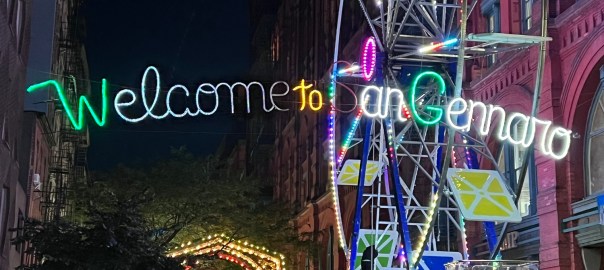
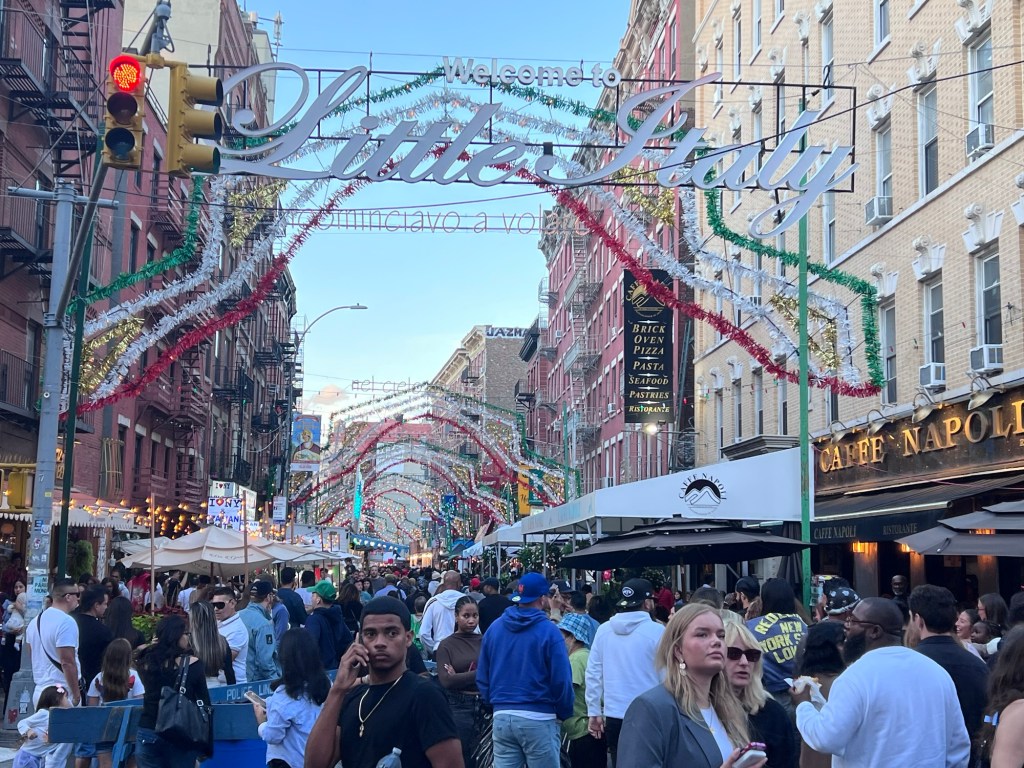
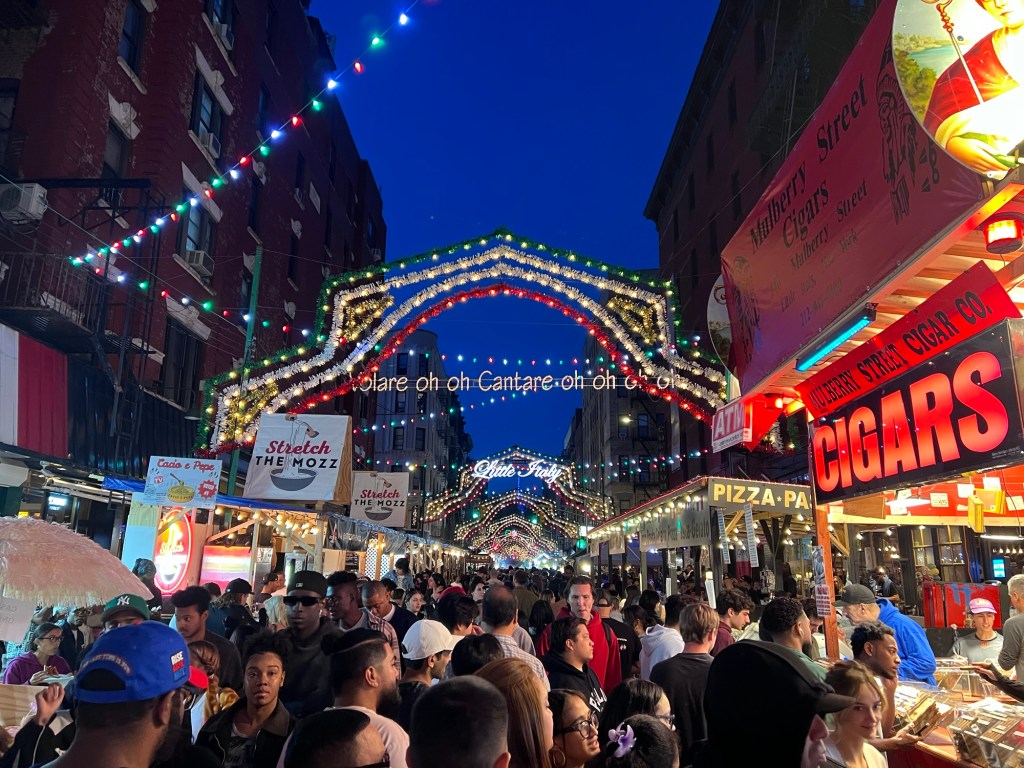
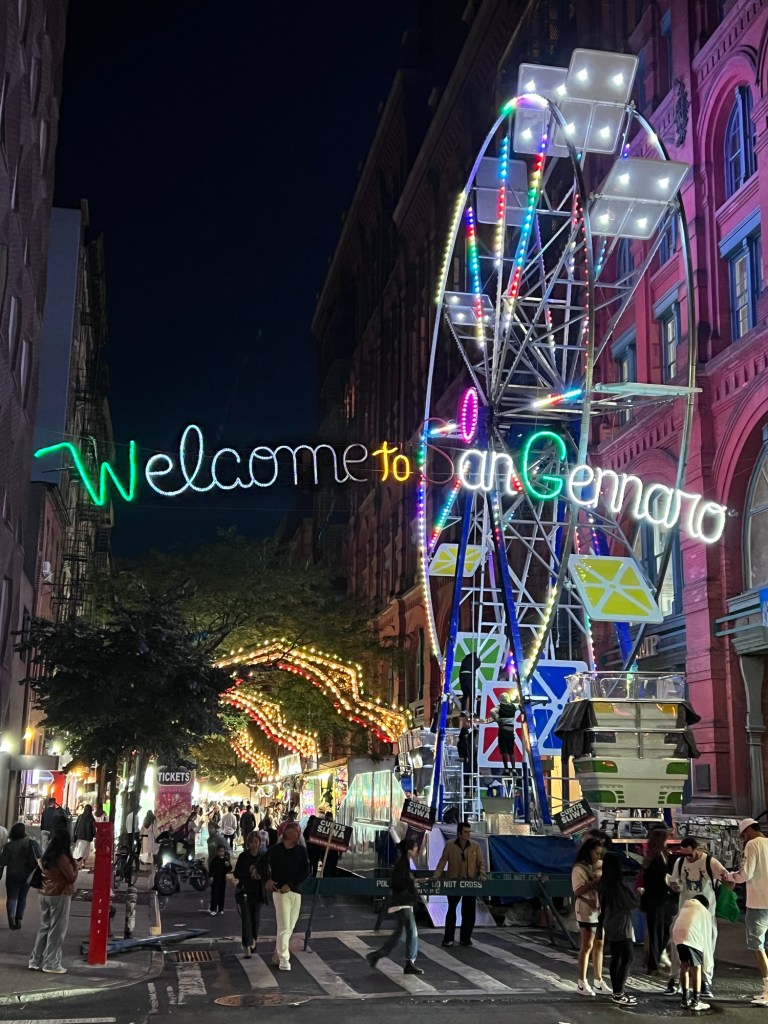
Entering Little Italy through the Canal Street entrance at 6:00pm for the Feast of San Gennaro

I had not been to the Feast of Gennaro in about fifteen years, not since my father got sick. I think 2010 was the last time I came to Little Italy for the Feast. The crowds were just as nuts as they were then.

The place was mobbed and made worse by everyone Instagramming the whole event.

The History of the Feast:

(From the Feast website)

At the turn of the 20th century when Italian immigrants settled on the lower east side of Manhattan each region settled on a different street. The Neapolitans settled on Mulberry Street. In 1926 with keeping their Neapolitan traditions they decided to have a one day block party for their patron saint and protector of Naples, San Gennaro, which continued year after year something that has now and for decades become not only a New York icon. This world renown 11 day event, which stretches throughout 11 blocks of the Little Italy neighborhood.

For generations this feast has always been an important part of our neighborhood not only representing the Saint Himself but also representing our ancestors, our culture and our traditions. This collection of booths of food and merchandise is enjoyed by both locals and tourists alike.

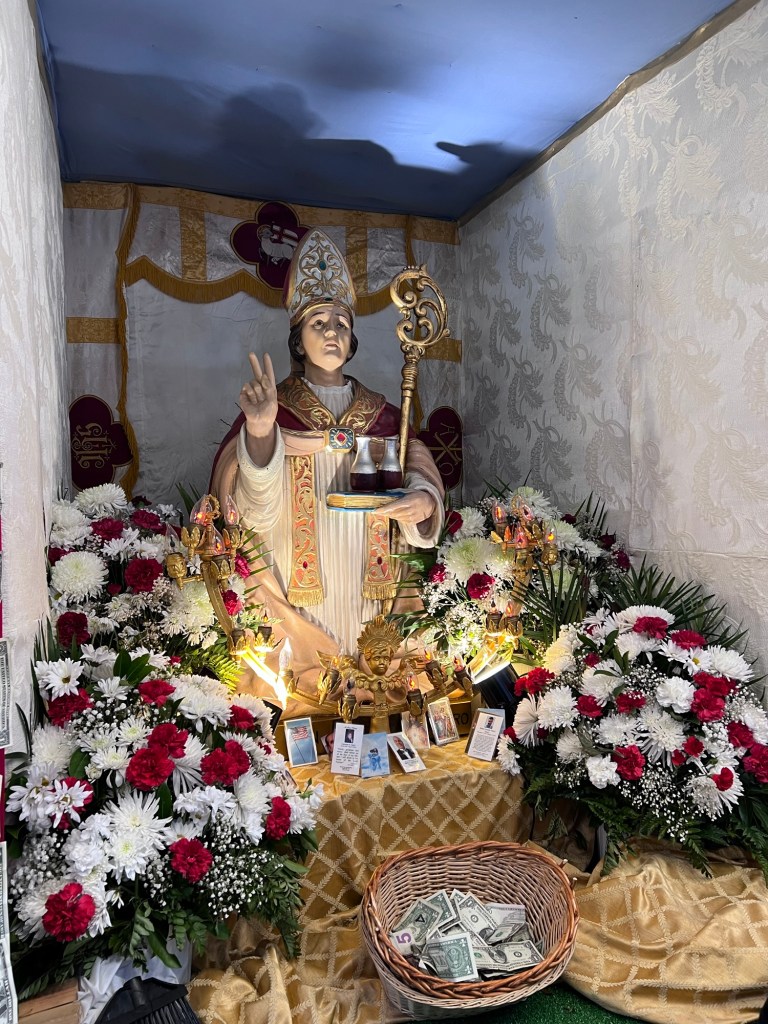
The patron Saint of San Gennaro sits in front of the condo building where the old church one stood. I still can’t believe they knocked the church down.

The Story of San Gennaro:

(from the Feast website)

Saint Gennaro was Bishop of Benevento, Italy, and died a martyr in 305 AD during the persecution spearheaded by Emperor Diocletian. He signed his death warrant when he visited the deacons, Sosso and Proculo, and the laymen, Eutichete and Acuzio, in jail.

The Proconsul, Timothy, had Gennaro arrested. He underwent torture without wavering in his resolution to remain loyal to Christ. He was thrown headlong into a furnace, but by the grace of God, he come through unscratched.

Furious, the agents beheaded him. His body and the severed head still dripping blood were gathered up by an old man who wrapped them reverently in a cloth. An old Neapolitan lady collected the blood with a sponge and filled a phial with the precious liquid. The body of Saint Gennaro is preserved in Naples, where he is honored as the city’s principal patron.

The Neapolitans pray to him for protection from fires, earthquakes, plagues, droughts and the eruption of Mt. Vesuvius. In every emergency Saint Gennaro is their powerful champion and universal helper.

Things have gotten worse with the foot traffic between everyone filming and photographing and Tik Toking it and the excessive amount of baby carriages (who would bring an infant to these things? It’s noisy, crowded and late!) makes getting down Mulberry Street even harder.

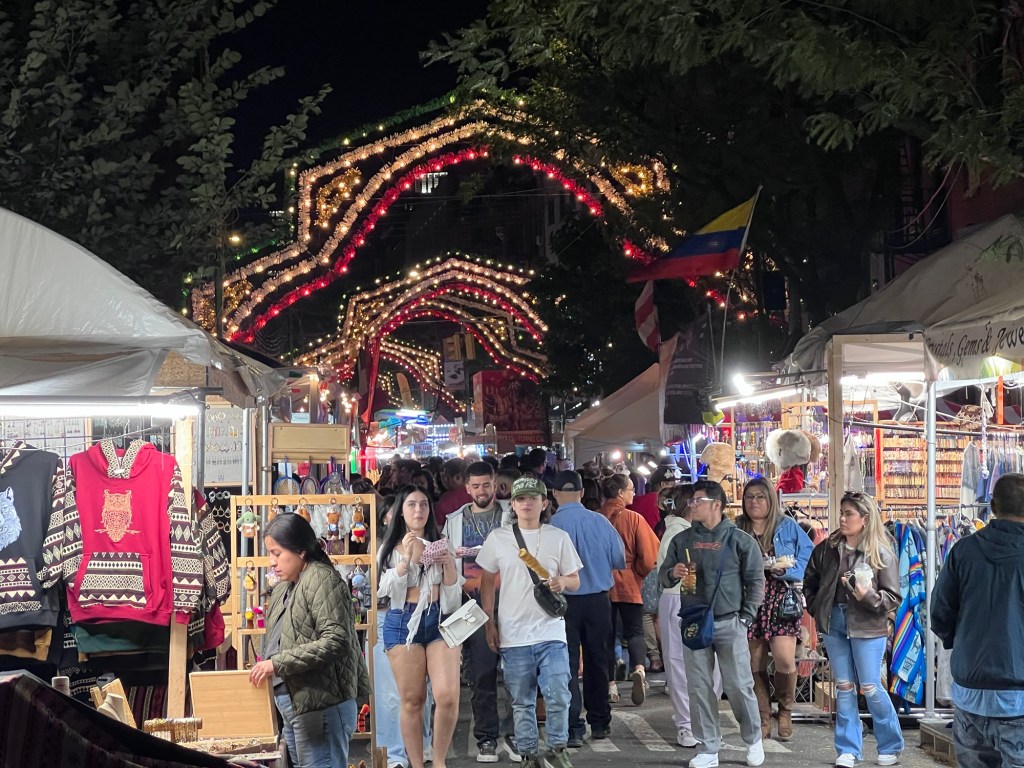
The crowds on the side streets were just as bad

The food is the same as usual with sausage sandwiches, meatball subs, rice ball’s and plenty of Zeppole.

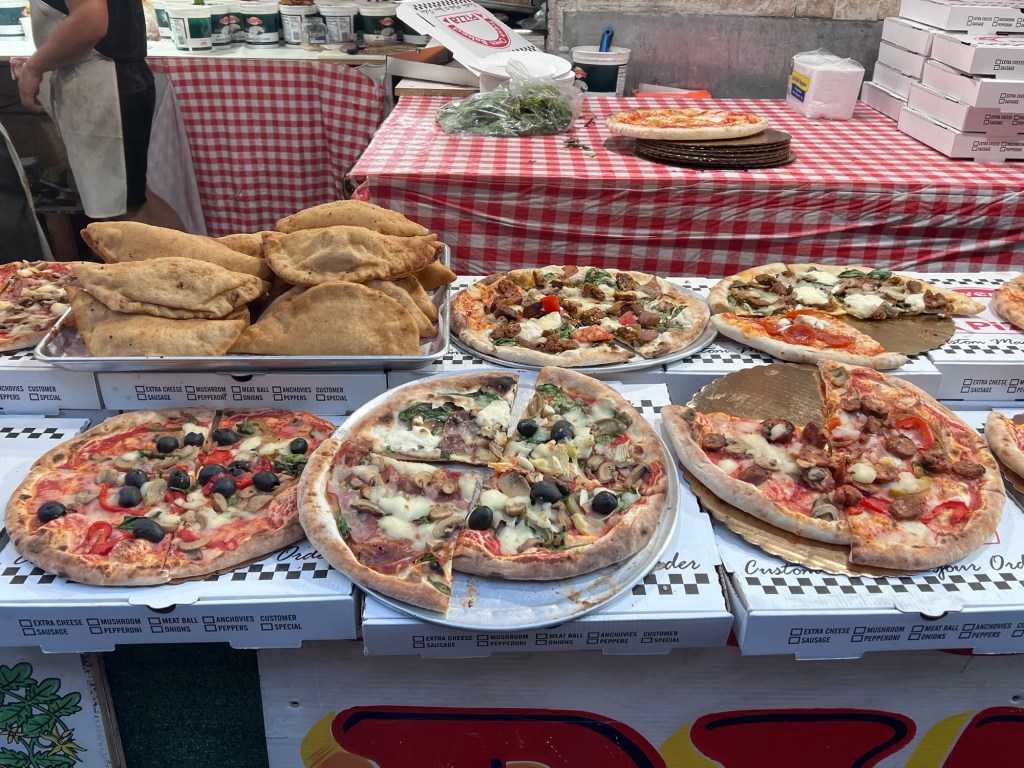
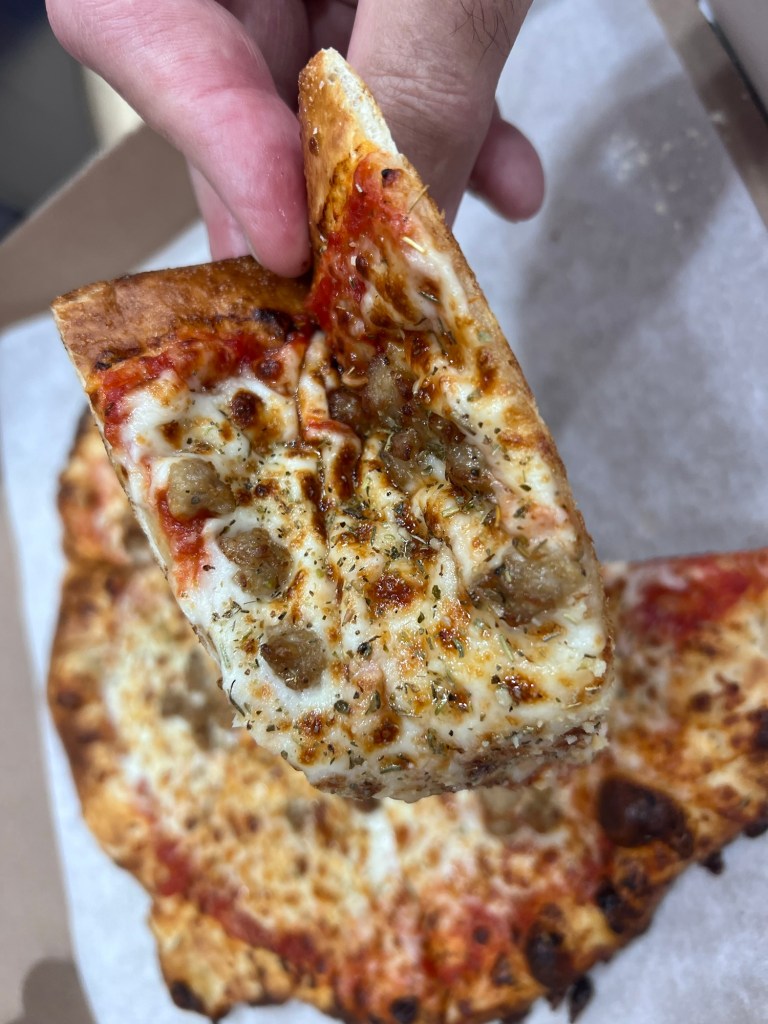
Pozzuoli Pizza was one of the vendor’s at the feast

https://www.facebook.com/pozzuoli.pizza.party/mentions/

The pizzas at Pozzuoli Pizza

Looking at all the food and sandwiches, I heard music in the back of one of the side streets and stopped to listen to the music of Jenna Esposito, who was performing that evening.

Jenna Esposito performing the night

Jenna Esposito sign and contact information: What a Talent!

https://www.jennaesposito.com/

https://www.facebook.com/jennasparkle/

Before she left on break, she sang ‘Volare’ which brought down the house. It was great way to end that part of show.

Jenna Esposito and her band singing ‘Volare’

The Feast as it started to get dark

I continued to walk down Mulberry Street and was dying for some zeppole, small pieces of fried pizza dough ladened with powered. I found a place and they looked like they were freshly frying them.

It was not until I ordered them and they were lukewarm and a little greasy. The woman said the were closing up shop and she gave me what seemed like twenty. Even though they were large and tasted good nothing is worse than zeppole’s when they get cold.

I thought these had been freshly made but were like warm. The only benefit was she gave me about 20 for $5.00. I was stuffed when I finished the entire bag of them. It must have been two pounds of fried dough that I consumed.

I walked through the mountains of crowds as this was the last night of the feast and a beautiful night. I took it as tourists and locals alike wanted to enjoy the evening. Again the worst was people pushing baby carriages through the streets of the feast.

I am sorry everyone, I do not think infants should be subjected to this type of noise and light this late into the evening.

The crowds around 8:00pm

The organizers of the feast brought the festival back to its original border of Houston Street so the there was room to stretch. These later blocks were not as crowded as those closer to Canal Street and had more retail vendors than food vendors.

Reaching the border of the feast at East Houston Street

When I used to attend the feast back in the 1990’s, the Feast would stretch the entire length of Mulberry Street straight into Chinatown and the whole street from East Broadway to Houston Street would be packed with food vendors, games and retail vendors. It shows how both the neighborhood and the Feast have changed.

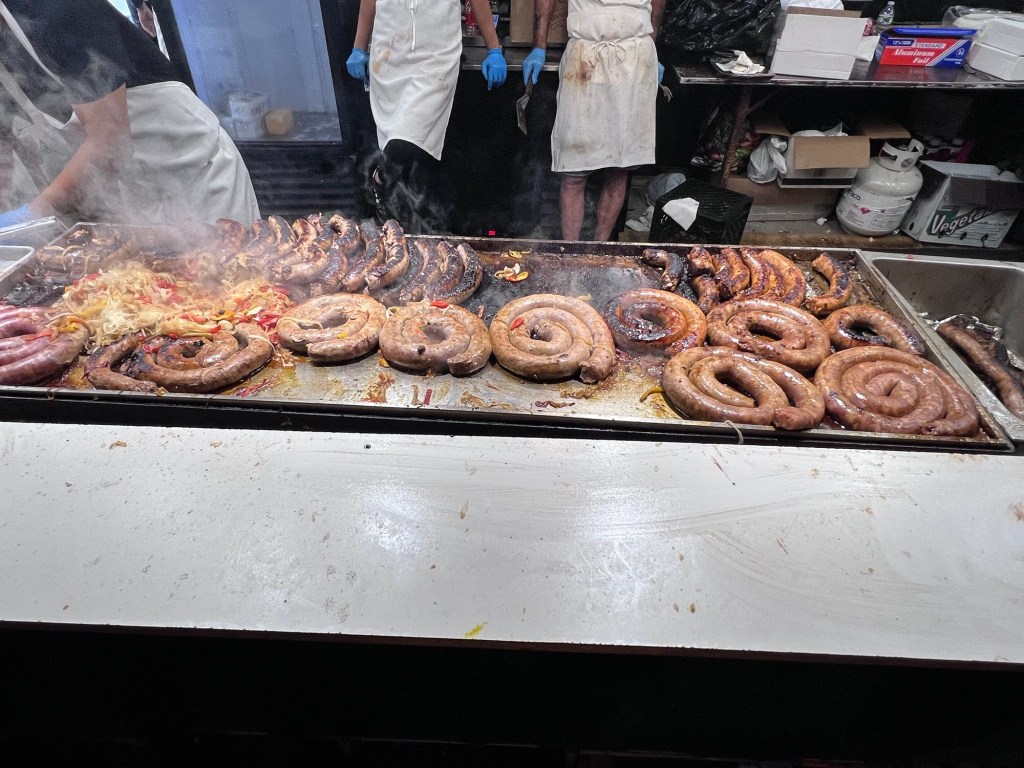
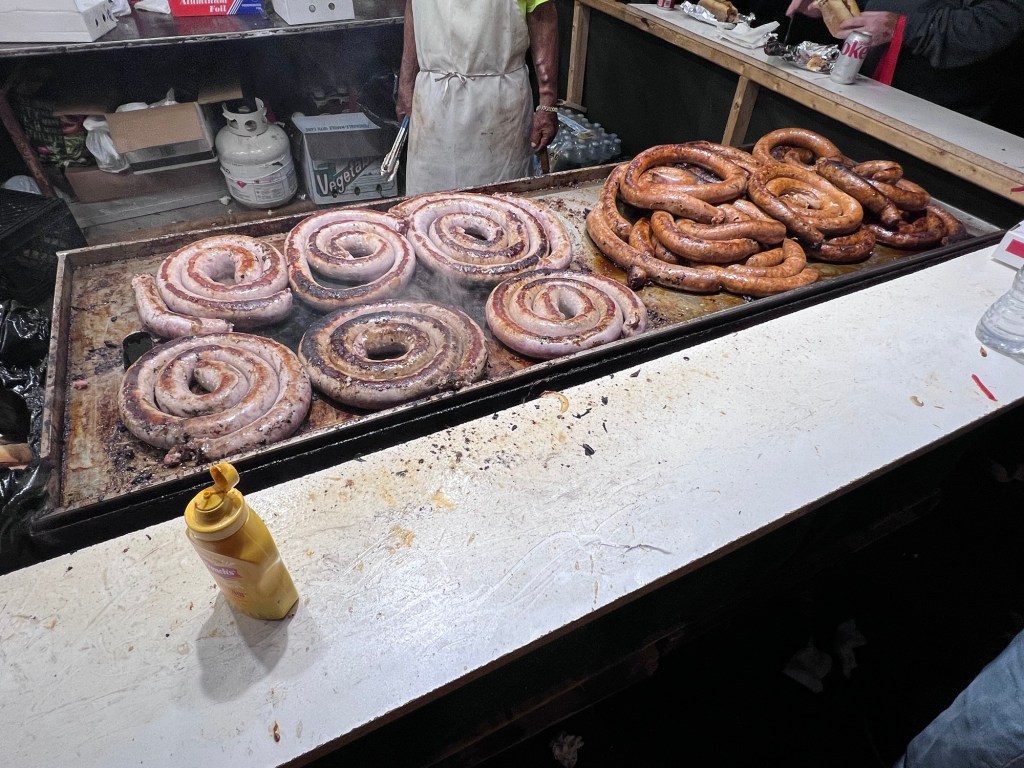
Passing the Sausage and Pepper vendors walking back to Canal Street

The sausages always look so good

I was not too sure how many people were going to eat this much sausage at 8:40 pm at night.

All good things have to come to an end as the evening got late and by 8:15pm, a lot of vendors started to close up as the feast was closing by 9:00pm on the last night.

The crowds started to thin out by the time I got to Canal Street and it was easier to walk through the Feast. It was a lot of come to come back after all the years. I just forgot how crowded it was on Mulberry Street.

Walking back to the E subway on Canal Street

The Feast of San Gennaro takes place every year the week after Labor Day in New York’s Little Italy

The History of the Feast:

Day Three Hundred and Fifty-Six Walking the Meatpacking District August 9th and 15th, 2025

I finally finished walking Lower Chelsea which means that I have now walked 2/3 of Manhattan island. It has taken a decade to do this since my initial start but life does get in the way. I hope to all you readers you have been enjoying the journey.

The streets of Lower Chelsea took so much time because here in this corner and there in that corner I kept finding more interesting things I wanted to share with everyone. It makes this journey even more fun.

I started my journey in the Meatpacking District in the early afternoon of a glorious summer day. It was clear, sunny and warm and the perfect 80 degree day.

Ninth Avenue and West 14th Street

I started the walk on the corner of West 14th Street and Ninth Avenue, which was once all slaughter houses up until about twenty years ago. Some converted to clubs in the 1980’s and then funky shops and over the last twenty years has seen a change in upscale dining, shopping and living.

There are still meatpacking businesses and distribution centers on the edges of the neighborhood but I am sure that won’t last forever with the cost of real estate in this neighborhood. It’s just funny to see the meat distribution centers sitting across the street from stores selling $1000.00 leather jackets. In just a decade period, I have never seen a neighborhood change as dramatically as this one.

This was one of the scenes of “Sex and the City” where I saw the Meatpacking District change.

Once they featured this neighborhood in ‘Sex and the City’, it was already past trendy. Now most of the streets are lined with ultra chic and expensive stores. I have never seen so many stores lined next to the vestiges of meat wholesale businesses.

The edge of the Meatpacking District at the corner of West 14th Street and Ninth Avenue

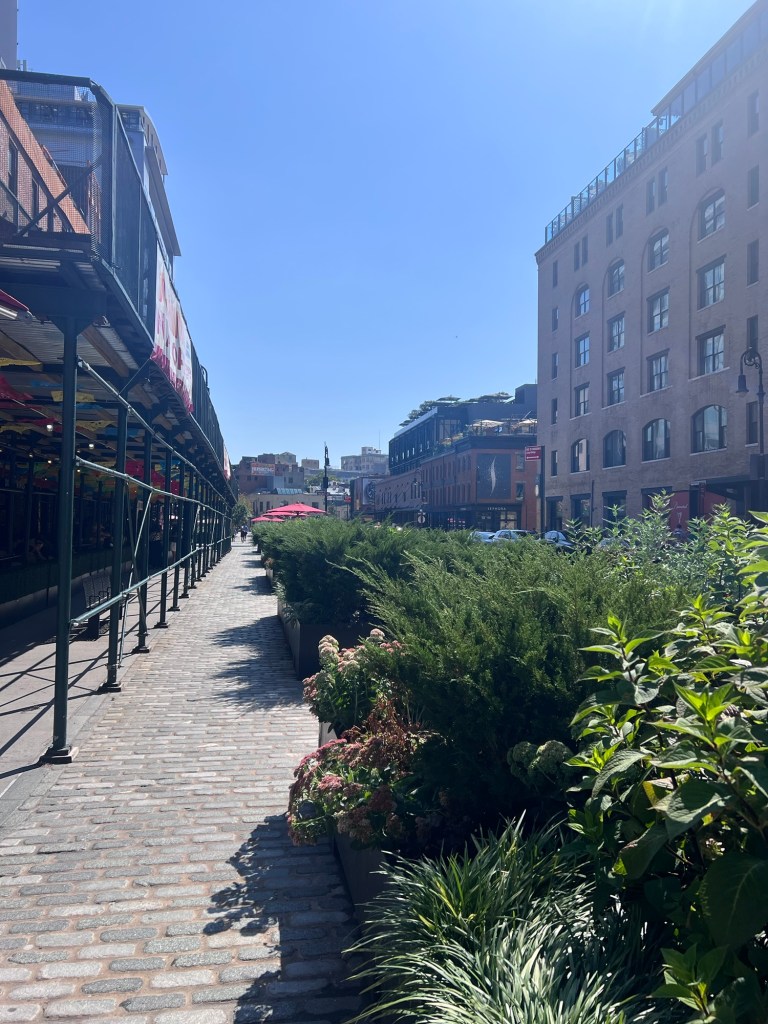
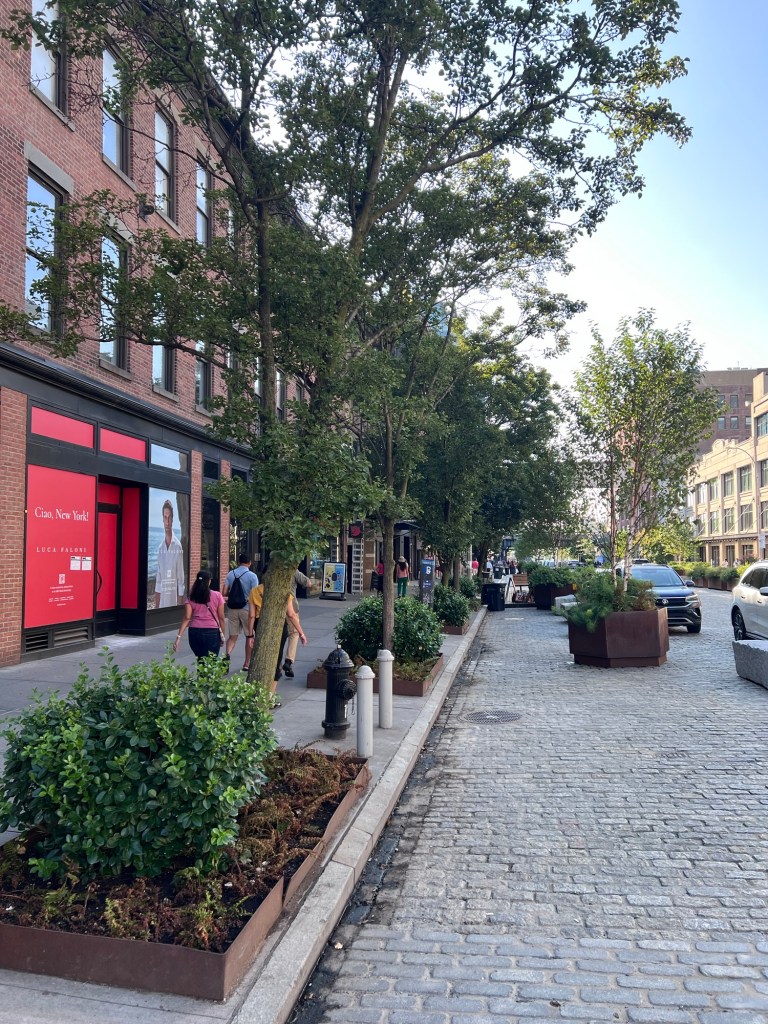
Walking down Ninth Avenue to Ganesvoort Street seems to be one long Mexican restaurant. The street is lined with chain restaurants next to luxury condos. The cobblestone streets and plantings though give it a real picturesque look.

Walking down the cobblestone street of Ninth Avenue

Once you reach Gansevoort Street there is nothing left of the neighborhoods storied past

Looking down Gansevoort Street and its cobblestone look

Looking down Gansevoort Street seems like seeing a combination of what was old being converted to new plus a lot of new construction with very innovative design tucked in between. I love the hodge podge of architecture and how it all blends into the neighborhood.

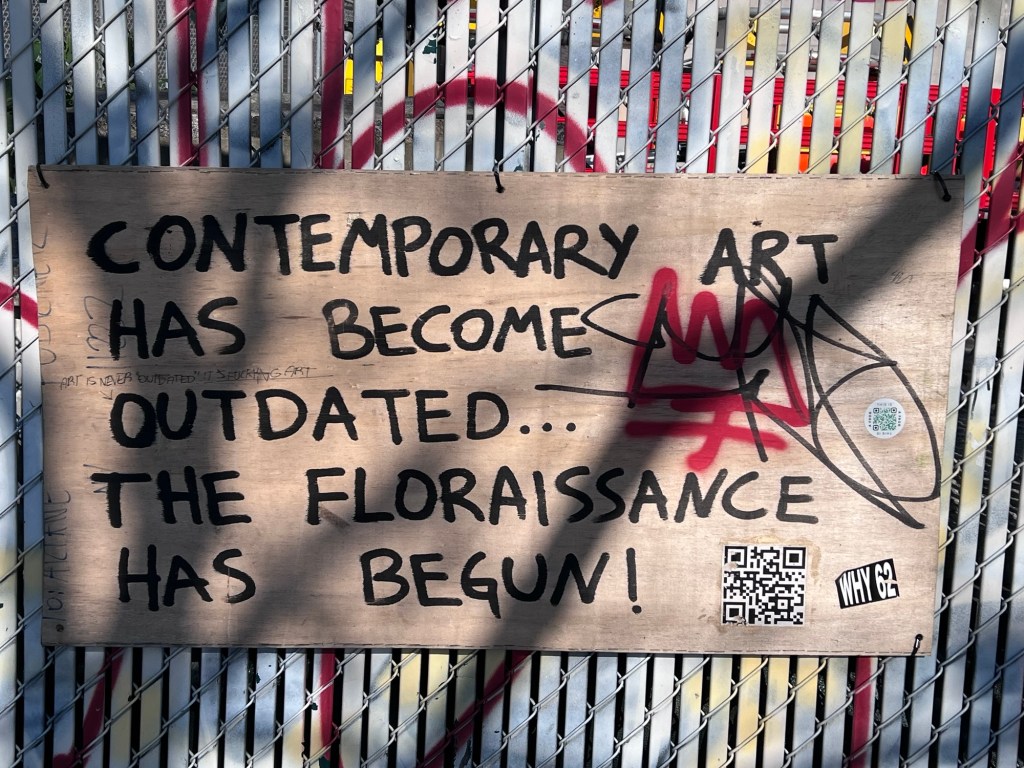
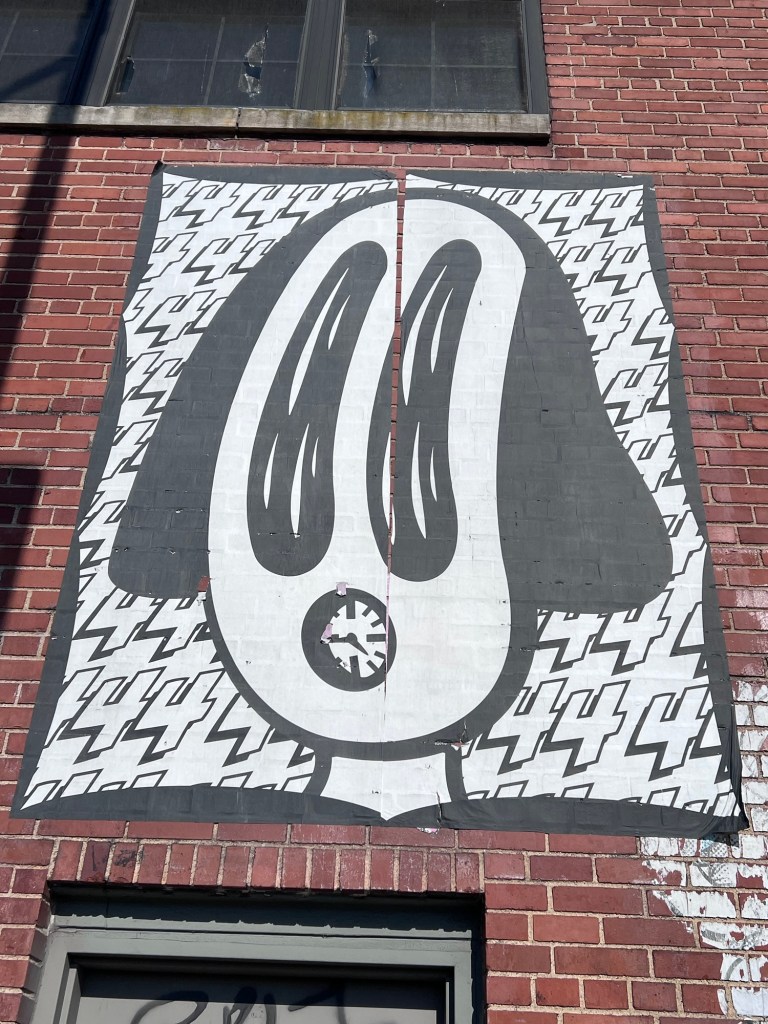
Very whimsical street art along Gansevoort Street

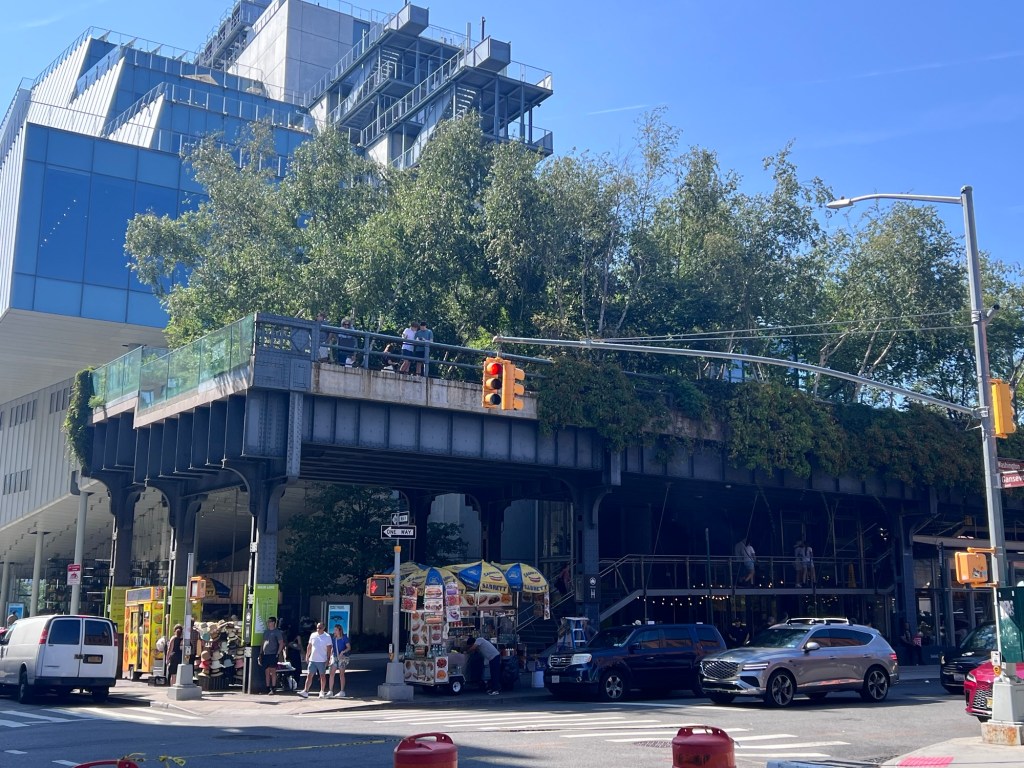
The High Line Park ends on the edge of Ganesvoort because once upon a time these were the famous Washington Markets. The line was used to get produce and other foods transported out of the area.

The new Whitney Museum is at the very edge of the neighborhood and is a catalyst for tourists

https://whitney.org/

My review on TripAdvisor:

https://www.tripadvisor.com/Attraction_Review-g60763-d106189-Reviews-Whitney_Museum_of_American_Art-New_York_City_New_York.html

When I was visiting the neighborhood for the second time to finish Hudson Street, I stopped at the Whitney Museum and found out that after 5:00pm on Friday nights, the museum is free for entry. That and being an NYU Alumni, I got in that night and was able to tour the museum and all the exhibitions for two hours.

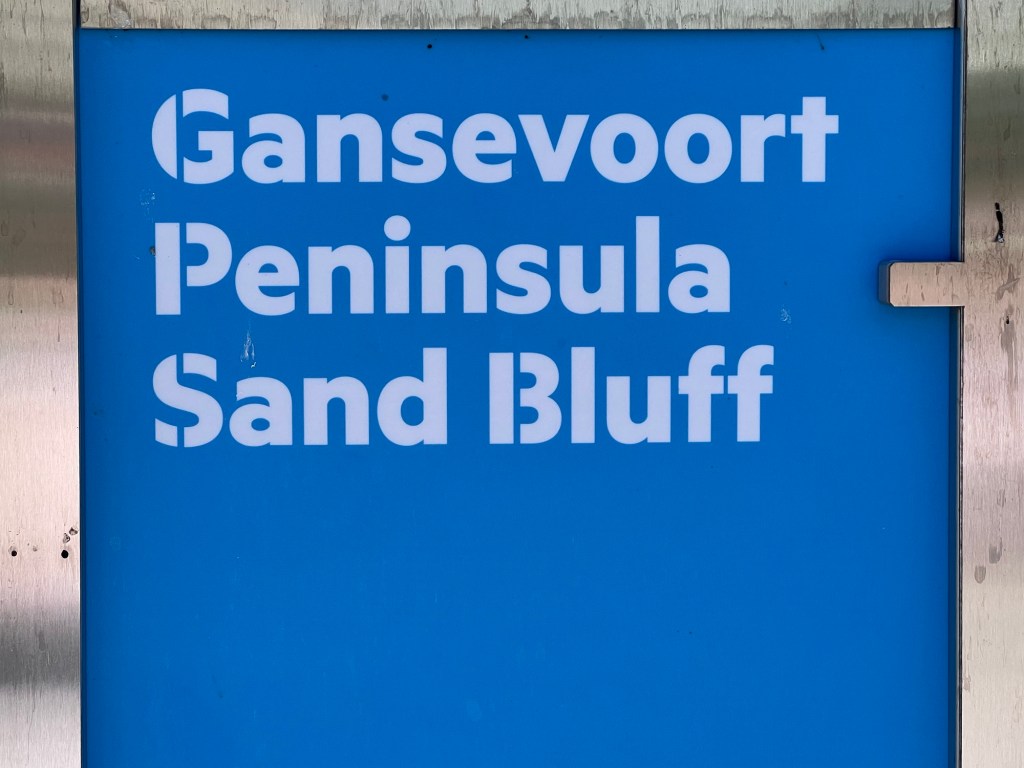
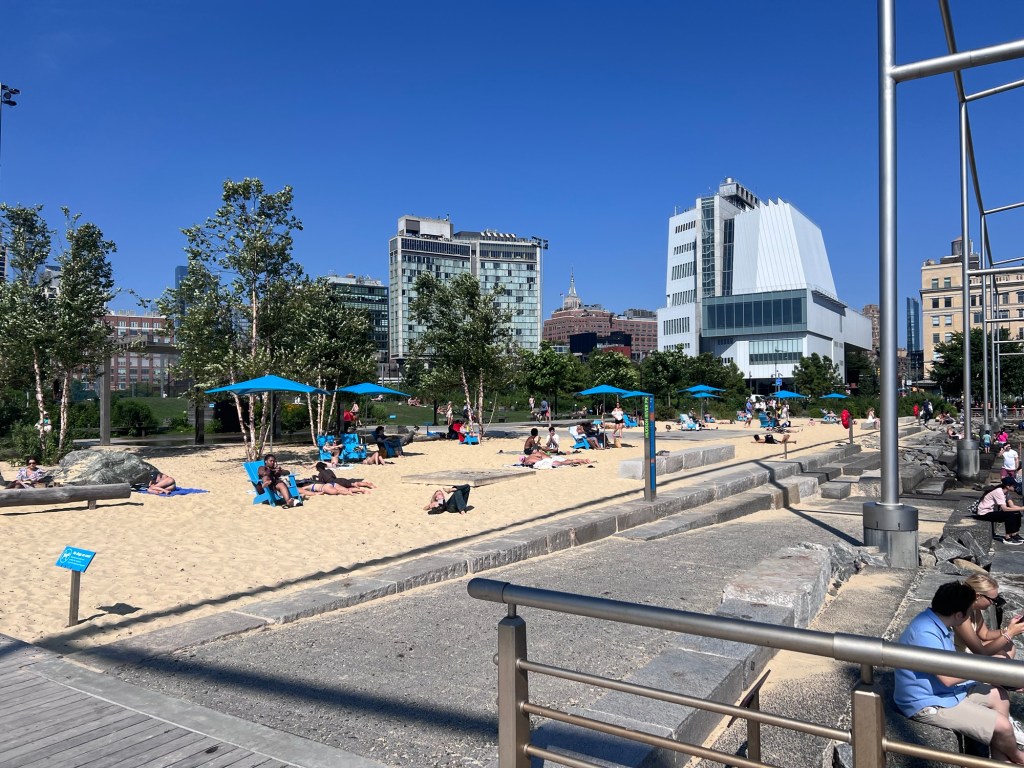
On the very edge of Hudson River Park sits one of the few man made beaches in New York City , the Gansevoort Peninsula Sand Bluff that is part of the most southern part of Hudson River Park. This wonderful and relaxing park became my ‘go to’ spot when I wanted to relax after a long day of walking. The views are spectacular and if you can snag one of the lounge chairs either on the beach area or facing the Hudson River, it is even better.

Entering the park from Eleventh Avenue, the Gansevoort Peninsula Sand Bluff

The Gansevoort Peninsula Sand Bluff sign

https://hudsonriverpark.org/locations/gansevoort-peninsula/

My review on TripAdvisor:

https://www.tripadvisor.com/Attraction_Review-g60763-d26727487-Reviews-Gansevoort_Peninsula-New_York_City_New_York.html

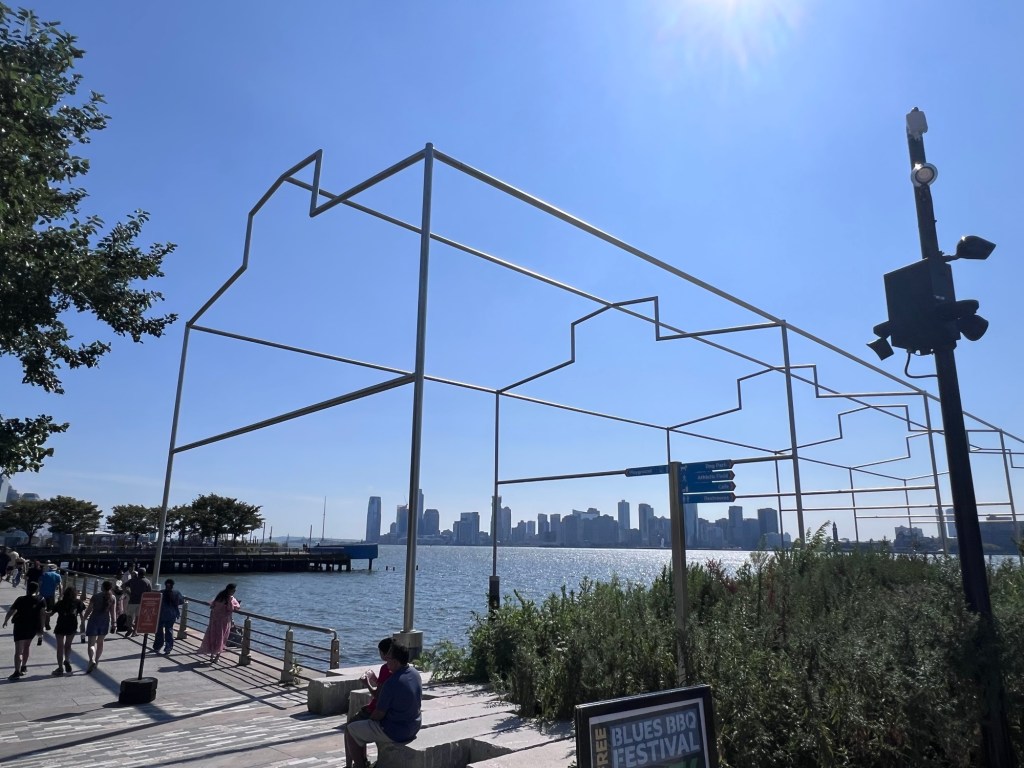
The amazing artwork along the beach ‘Days End’ by artist David Hammons

This fascinating piece of art is entitled “Days End” by artist David Hammons. It looked like the shell of an empty building and struck a nerve as the sun started to set on the New Jersey side of the Hudson River. It is an ‘Open Air’ sculpture that explores the history of the neighborhood (Whitney Museum). This sits right at the entrance of the park.

Artist David Hammons

David Hammons

https://en.wikipedia.org/wiki/David_Hammons

http://www.artnet.com/artists/david-hammons/

Mr. Hammons is an American born artist who studied at the Chouinard Art Institute (CalArts) and at Otis Art Institute.  He is known for his Body Prints and sculpture work (Wiki/Artnet.com).

Underneath it is the amazing and very busy beach

The pathway along Hudson River Park

The beautiful plantings along the pathways

The colorful flowers in season in Hudson River Park

The very edge of the dock in the late afternoon looking over Lower Manhattan

The views from the dock section are fantastic and have the most breathtaking views of both Jersey City and Lower Manhattan. It really shows the growth of these areas for business and residential over the last twenty years.

The view of the beach with everyone looking so relaxed

The view looking up from Tenth Avenue

I rounded Gansevoort Street and walked down little 12th Street , which itself is making a lot of changes from business to both retail and residential.

Making the turn on Little 12th Street

The mural above Golden Goose at 812 Washington Street

https://www.goldengoose.com/us/en/stores/new-york/395

The view of the High Line Park from Little 12th Street

I thought the front of 12 Little 12th Street was quite unique

Little 12th Street like most of the neighborhood is in transition right now. Stores and restaurants have been opening and closing in the neighborhood and right now there are quite a few empty storefronts. The effects of COVID are still being felt all over the City.

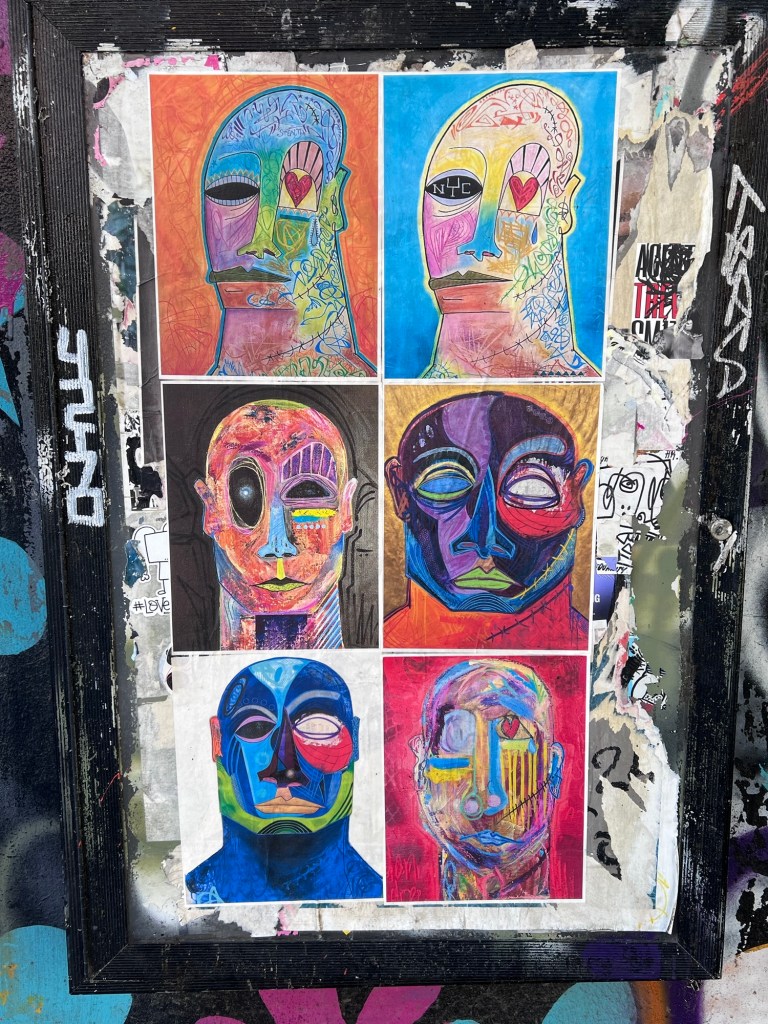
On the contrary though, the empty store fronts are producing some interesting Street Art on the windows and doors of these establishments. These were some of my favorites.

I thought this was amusing

This looked like something out of the movie ‘Just can’t Wait’

This artist I was seeing all over the neighborhood

I love the irony of politics

Interesting art

I loved the little cents guy

This work was really creative

There is all sorts of public street art like this all over the neighborhood.

Turning on to West 13th Street,, I saw the last vestiges of the Meatpacking and Distribution industries. Some companies are still holding on in the area and their buildings prominently display their signs.

On some buildings, the signs have been kept as a reminder to the areas past and house expensive stores. The neighborhood has not totally gentrified yet and still has a grasp on the food industry, probably catering to the local restaurants and hotels.

Turning onto West 13th Street is a small look into the neighborhood’s past.

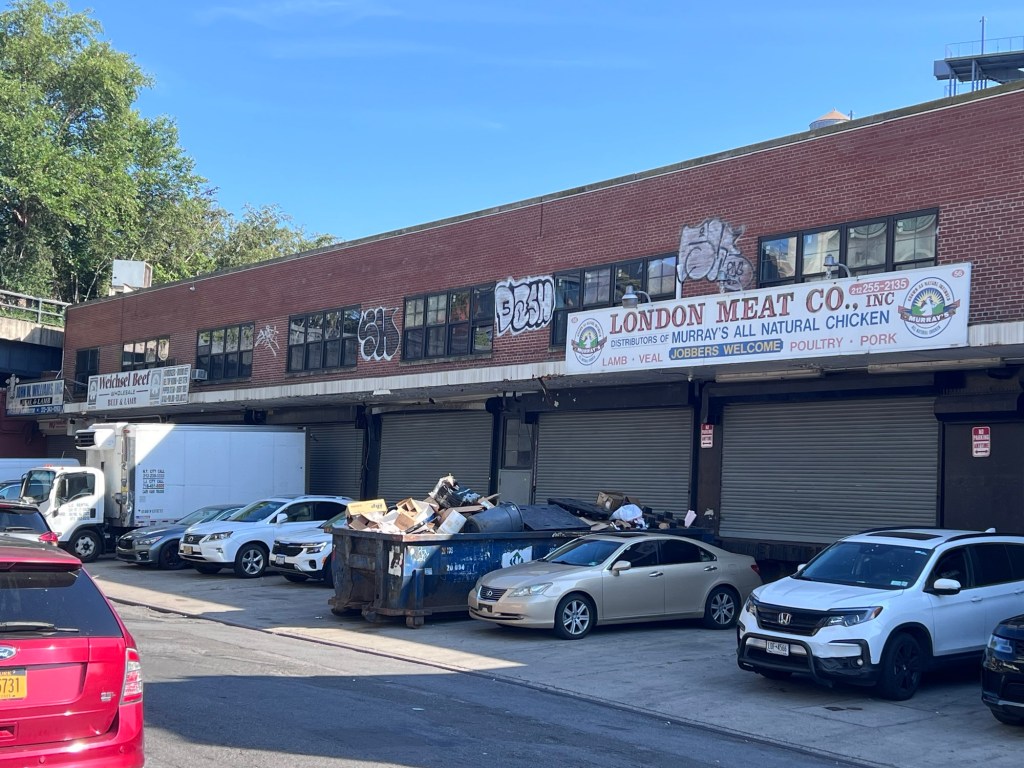
The Meat distributors who still operate in the neighborhood are becoming less and less. The London Meat Company and the Weichsel Beef Company still stand strong with their building on Little West 12th Street. These companies are the last holdouts of the old neighborhood. I have a funny feeling with the land worth millions that this will be a luxury condo or hotel in about five years.

What I read about the Meatpacking District is that this area was zoned for the Food Wholesale Markets going back to a deed from the Astor family when they owned this area. This tiny section of the neighborhood is still on that deed and many of these companies still have long term leases. How long before the real estate industry buys them out is anyone’s guess.

The London Meat Company at 56 Little 12th Street

https://londonmeats.com/?srsltid=AfmBOoqoHaUq1O0feW9ZGCAlscnR6ZGelrr2-U4U1DRbtrJBbF9-aiFh

Weichsel Beef Company at 826 Washington Street

https://www.instagram.com/explore/locations/9701751/weichsel-beef/?hl=en

This was a very odd art display across the street

West 13th Street has transitioned from meatpacking to galleries to high end stores and residences. The old cobblestone streets have been repaired.

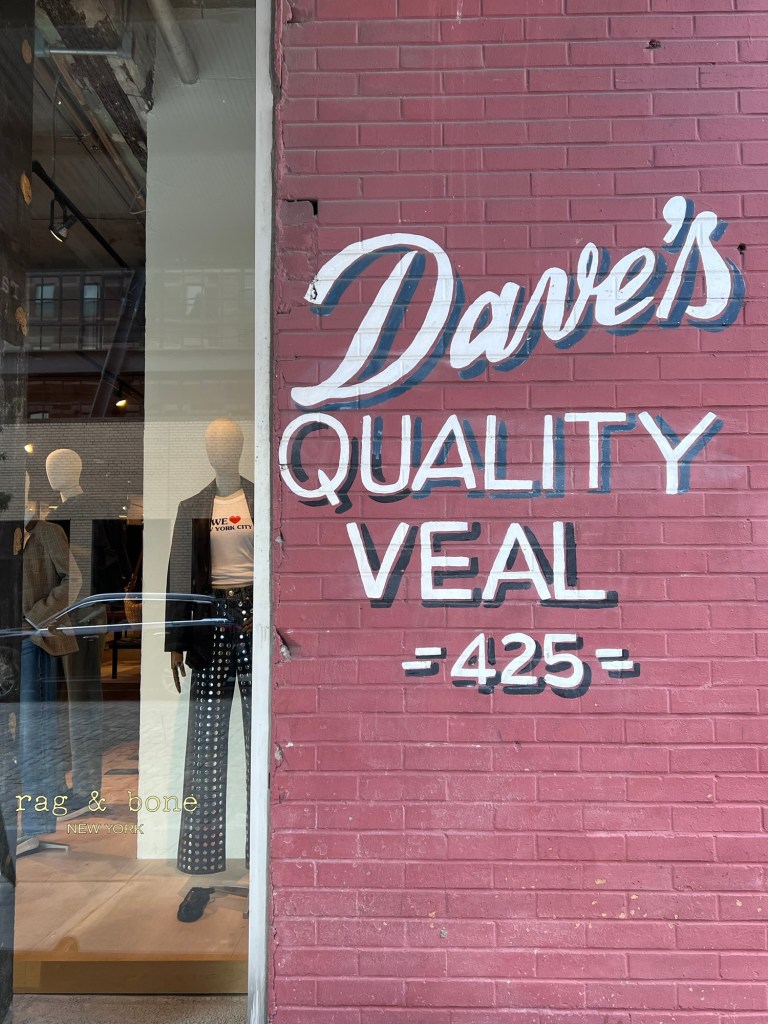
Old signs still flank the entrances to high end establishments

The sign for Dave’s Quality Veal sits outside the Rag & Bone store at 425 West 13th Street

https://www.rag-bone.com/store-details?storeID=stores-new-york-west-13

https://meatpacking-district.com/rag-bone

This tulip street art was all over the neighborhood

The stonework outside the old P. F. Collier & Son building on West 13th Street which I think are condos and shops now

https://en.wikipedia.org/wiki/Peter_Fenelon_Collier

https://www.arthur-conan-doyle.com/index.php/P.F._Collier%26_Son

https://daytoninmanhattan.blogspot.com/2019/08/the-p-f-collier-co-building-416-424.html

The Collier company was a producer of high end books and magazines and produced the publications in this building to up until the 1960’s. The building was designed by architects Trowbridge & Livingston in 1901 in the Neo-Classic style (Daytonianinmanhattan.com).

Looking at the view down West 13th Street and its future in upscale shopping and residences.

The cobblestone streets on the corner of West 13th Street and Hudson Street

I took a long turn around the neighborhood and walked up Tenth Avenue from the park on Gansevoort Street and walked up this still seedy stretch of the neighborhood.

I have been seeing this artist’s signs all over lower Manhattan

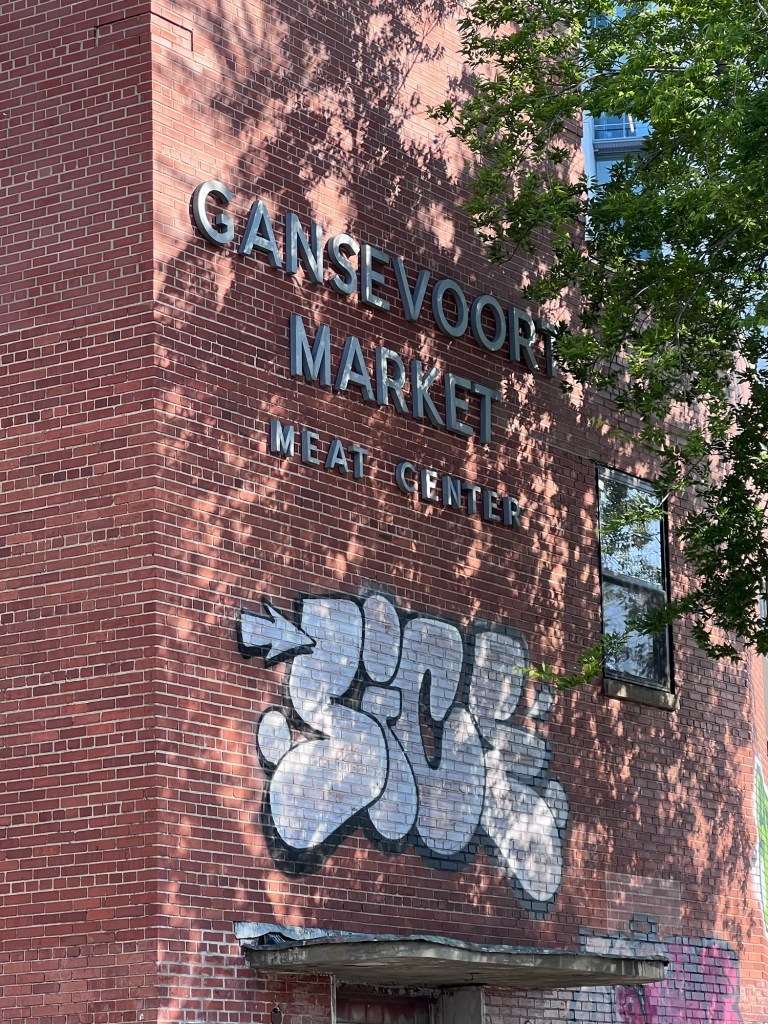
The Gansevoort Market Meat Center is in a state of transition eight now located on 10th Avenue

https://meatpacking-district.com/district/public-markets-as-a-place-in-the-citys-history

The last of the meat distributors line this part of 10th Avenue with Interstate Foods at 565 West Street

https://interstatefoodsinc.com/

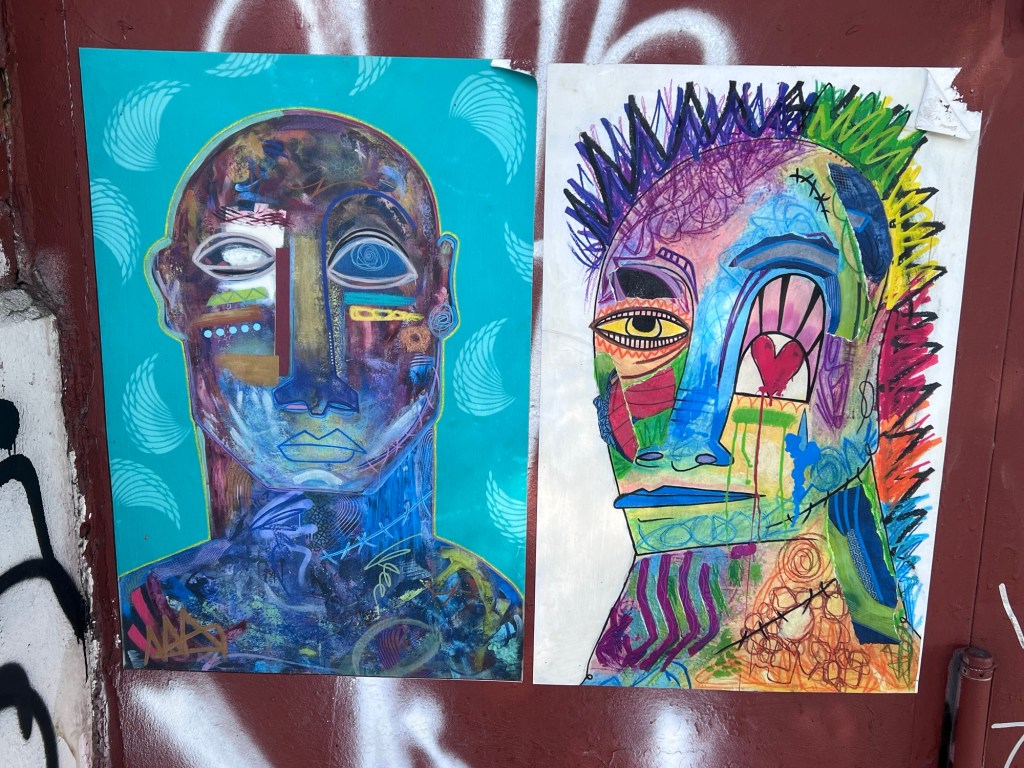
Surprisingly, the building has become a haven for street artists. These were some of the works on the building that I thought stood out. It is like an open air contemporary art gallery.

I loved the cartoon like character of this work

I love seeing this artist’s work

This artwork I thought was unique

This was on one of the garage doors

This poster was prominently shown on one of the walls

The signs along 11th Avenue still remind you that this is an area of food distribution.

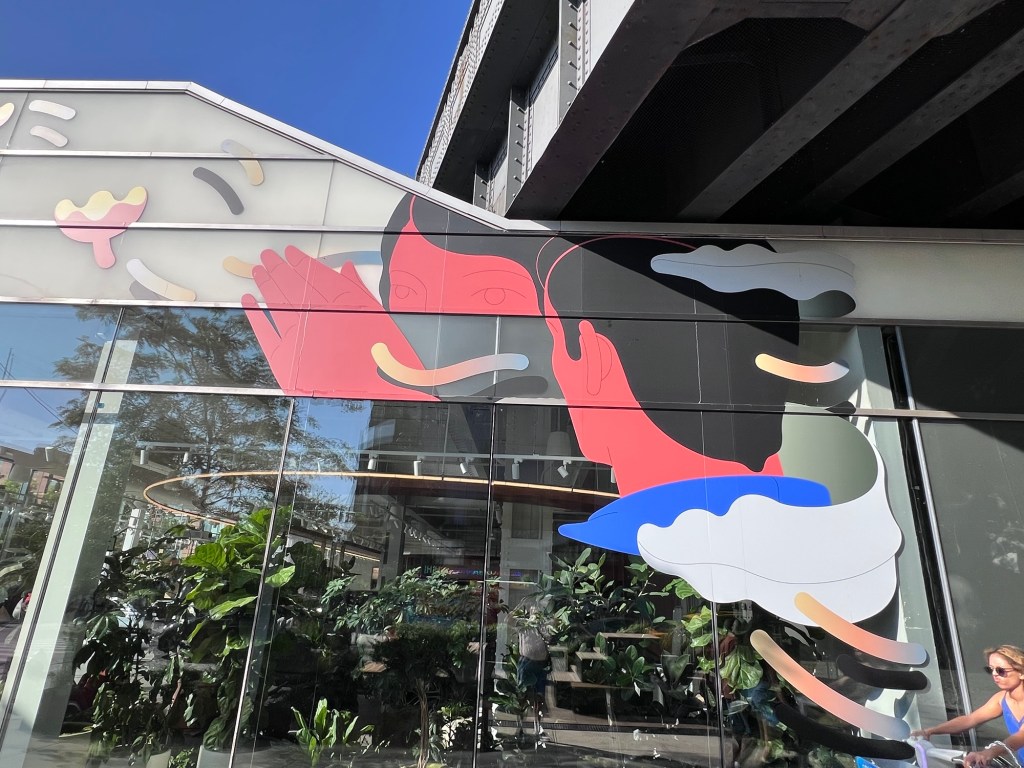
I never noticed this interesting piece of art on the Rivian Building at West 14th Street

The Rivian Showroom at 461 West 14th Street

https://rivian.com/spaces/new-york

https://stories.rivian.com/nyc-concept-space-2025

The Rivian Company Concept:

(From the company website)

To give both our longtime followers and those new to our brand a chance to connect with a distinct facet of who we are, we’re introducing yearly, rotating concepts that will come to life through immersive design, content, events, and programming. The first concept, “Adventure Is In Us,” tells the stories of people who embody this spirit in their daily lives, including real Rivian owners. While adventure is core to our brand, it doesn’t always mean scaling cliffs or going off-roading. It can also mean starting something new or pursuing a creative path. “Adventure Is In Us” is about celebrating that broader, more inclusive view of adventure and inspiring visitors to embrace it too (Rivian website).

The last block I walked was down the tiny stretch of Washington Avenue that was the ‘Avenue of extremes’.

The upscale shops across from the meat distributors

On one side you had the back of the meat distribution building and on the other side of the street were boutiques selling $1000.00 sweaters and jackets.

The changes in the neighborhood from manufacturing and distribution I staggering. The front of Louis Zucker & Company still stands guard at 830 Washington Street

https://b.assets.dandb.com/businessdirectory/louiszuckercoinc-newyork-ny-2989277.html

I thought this guy was really cool

The neighborhood still showing its grit with the Louis Zuckerberg & Company distributor across the street from ironically enough a new Shake Shack all underneath the High Line Park.

I loved the messages on the garage doors

The view of the transition of 9th Avenue and views of the Highline Park

The tiny cafe tables across the street from the meat distributors and right under the High Line Park

On the second day of the walk around the Meatpacking District, I finished the small corner around Hudson and Gansevoort Streets on the very edge of the neighborhood that it shares with the West Village.

The corner of Gansevoort and Hudson Streets

Looking up Hudson Street

Street Flower boxes on Hudson Street

The hip Starbucks at 687 Hudson Street

https://meatpacking-district.com/places/starbucks

https://www.ubereats.com/store/starbucks-678-hudson-street/lni-k_T1S7WaZvw3Bhnj-A?srsltid=AfmBOoqBcdPs4GtUPQbNNjafC3m7ESVoT65Hvw0DpOlXk5r9xD8JgIrz

Review on TripAdvisor:

https://www.tripadvisor.com/Restaurant_Review-g60763-d4114358-Reviews-Starbucks-New_York_City_New_York.html?m=69573

The colorful mural outside Starbucks

I loved this colorful mural outside of Starbucks but I could not find the artist. I am not sure if it is independently painted or is a corporate painting by the store.

The change in the neighborhood at Hudson and West 14th Street

I walked down 10th Avenue again to see if any of the distributors were still open but they had closed at this time of the evening.

What is left of West Street off 10th Avenue on Gansevoort Street

I realized this is where my grandfather back in the 1930’s owned his garage in side the old Washington Markets. I had a lively conversation via text with my brother that I wished our family still owned the building what we might be worth today. He laughed and said where it stood is an upscale condo. To have a crystal ball!

In the late afternoon, as I was walking back down Gansevoort Street, I noticed that the Whitney Museum was having a free Friday night and I used my NYU pass to get in. What a breathtaking museum with interesting contemporary art and gorgeous views of the Hudson River.

The Whitney Museum at 99 Gansevoort Street

https://whitney.org/

My review on TripAdvisor:

https://www.tripadvisor.com/Attraction_Review-g60763-d106189-Reviews-Whitney_Museum_of_American_Art-New_York_City_New_York.html

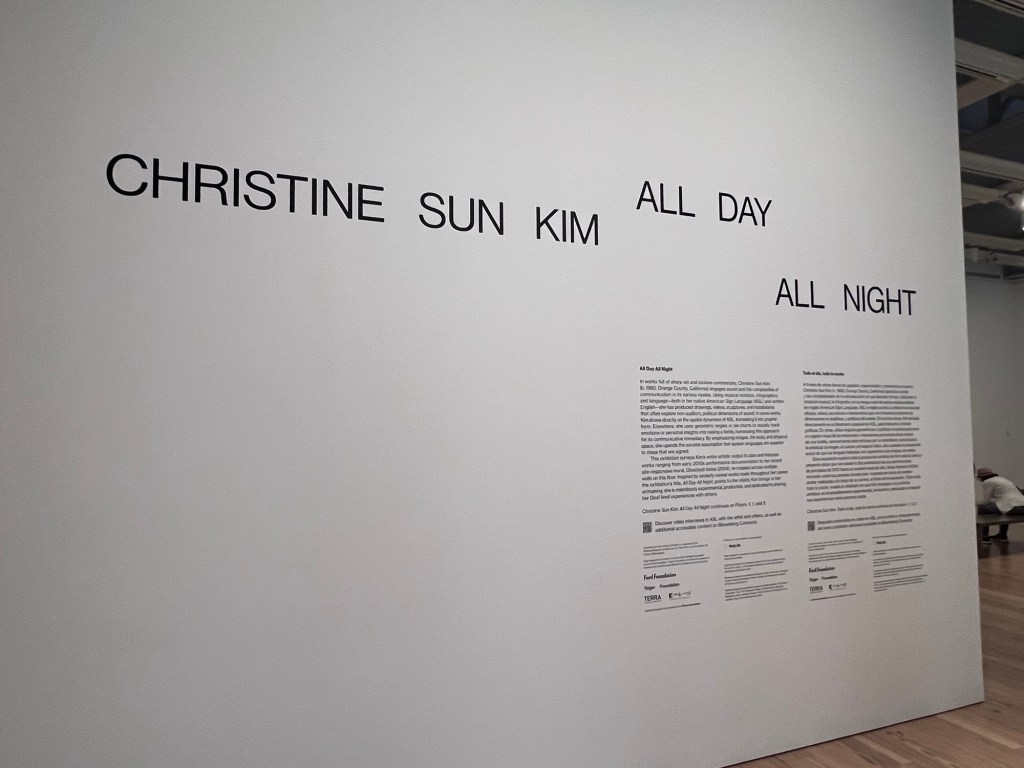
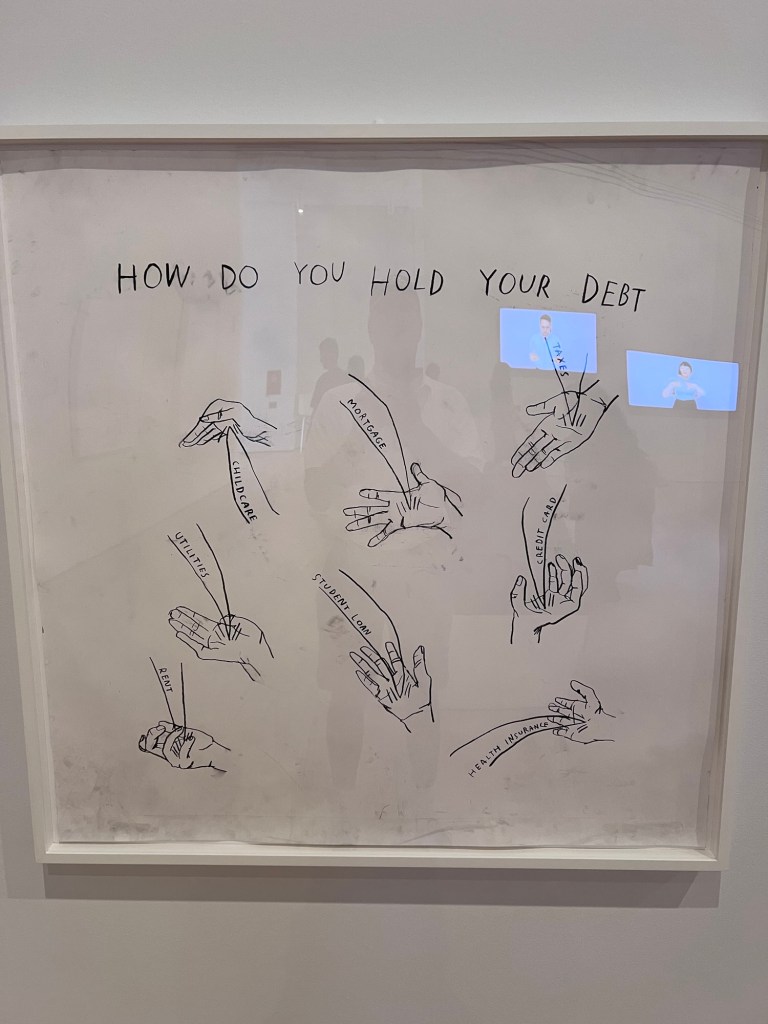
I traveled floor by floor from the top to ground floor and explored the museum. There was a special exhibition with artist Christine Sun Kim, whose art reflects the artist’s view on being deaf. I thought her art told a good story on how she has been treated.

The Christine Sun Kim exhibition

Artist Christine Sun Kim

https://en.wikipedia.org/wiki/Christine_Sun_Kim

https://whitney.org/exhibitions/christine-sun-kim-all-day-all-night

From the Whitney Museum website:

In works full of sharp wit and incisive commentary, artist Christine Sun Kim, engages sound and the complexities of communication in its various modes. Using musical notation, infographics, and language—both in her native American Sign Language (ASL) and written English—she has produced drawings, videos, sculptures, and installations that often explore non-auditory, political dimensions of sound. In many works, Kim draws directly on the spatial dynamism of ASL, translating it into graphic form. By emphasizing images, the body, and physical space, she upends the societal assumption that spoken languages are superior to those that are signed. 

The Sun Kim exhibition

This exhibition surveys Kim’s entire artistic output to date and features works ranging from early 2010s performance documentation to her recent site-responsive mural, Ghost(ed) Notes (2024), re-created across multiple walls on the eighth floor. Inspired by similarly named works made throughout her career, the exhibition’s title, All Day All Night, points to the vitality Kim brings to her artmaking; she is relentlessly experimental, productive, and dedicated to sharing her Deaf lived experiences with others (Whitney Museum website).

One of the pieces of relatable art

Then I toured all the floors to see the different exhibitions of art and some of the restaurants and bars in the museum. Food here is very expensive.

The bar on the Eighth Floor

The American flag on the Seventy Floor

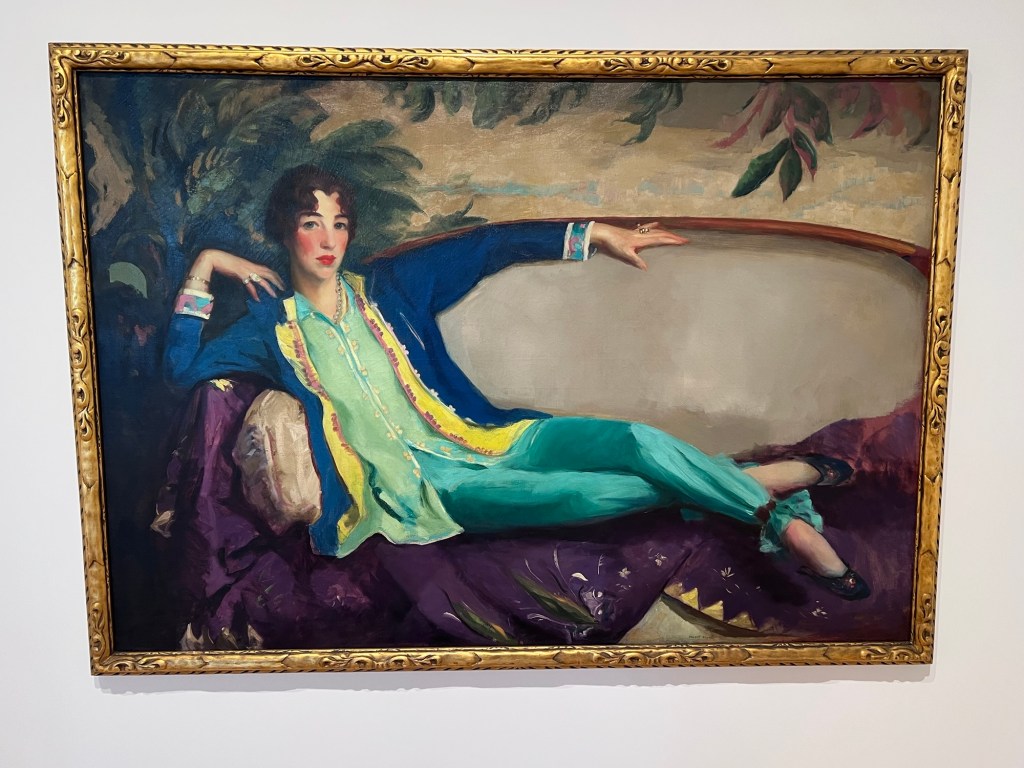
The picture of Gertrude Whitney , the founder of the museum

https://en.wikipedia.org/wiki/Gertrude_Vanderbilt_Whitney

Contemporary art on the Seventh Floor

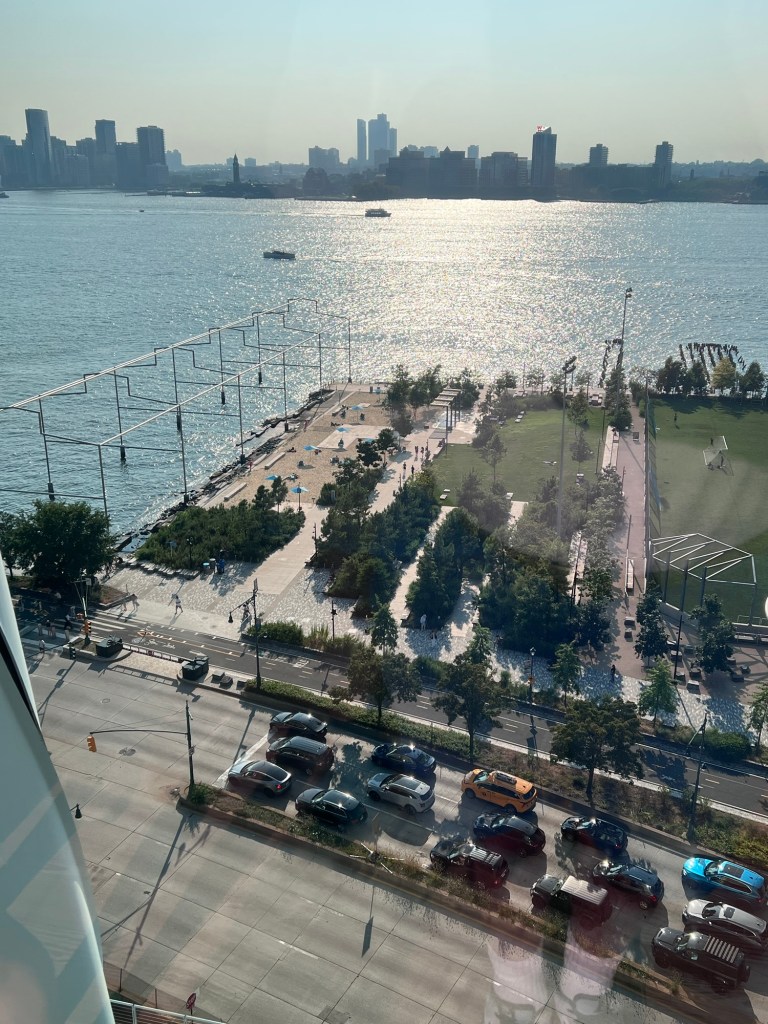
The view of the Hudson River from the Seventh Floor staircase

The lower floors had large scale pieces or were closed for the new exhibitions being mounted for the Fall. So I headed for the first floor to visit both the gift shop and restaurant.

The Gift Shop

https://shop.whitney.org/?srsltid=AfmBOooCdITD9TU08DJAU2YWW8mg3nTU0IhT82XRo0YkjbBWZkov0obD

The Bakery and Restaurant on the first floor

https://whitney.org/visit/dining

Review on TripAdvisor:

https://www.tripadvisor.com/Restaurant_Review-g60763-d32948543-Reviews-Frenchette_Bakery_At_The_Whitney-New_York_City_New_York.html?m=69573

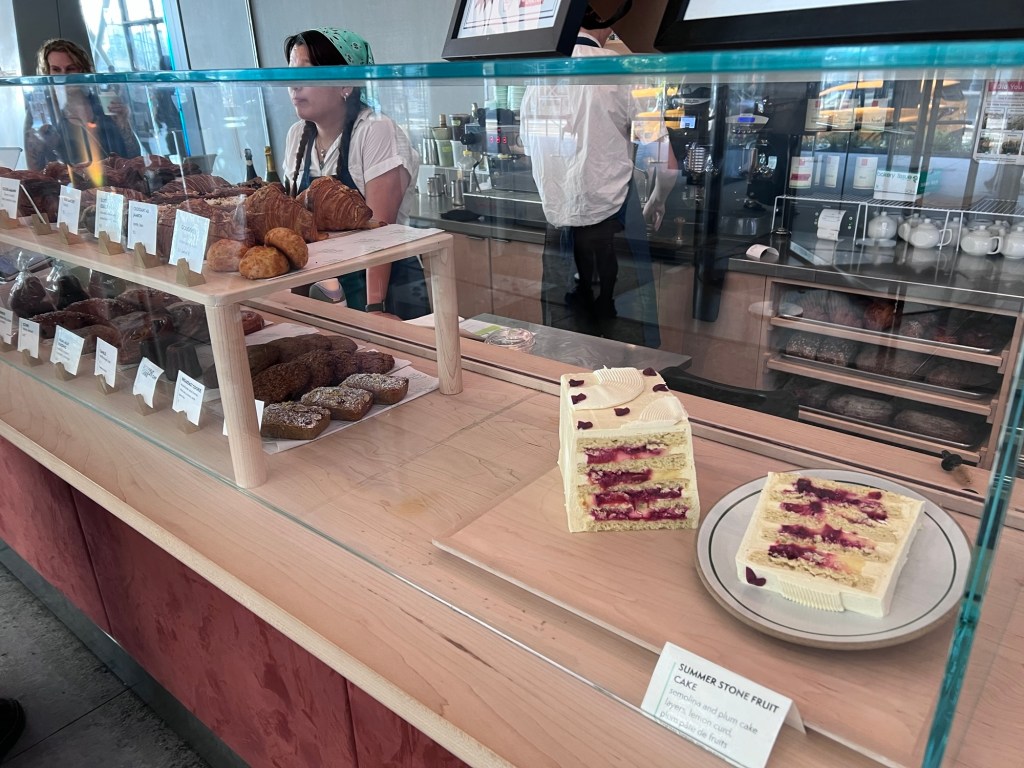
The very pricy pastries

The restaurant, as pretty as it is and as nice as the pastries look, is extremely expensive and I think $14.00 for an eclair is a bit much. I was there on a busy Friday night and no one was in the restaurant. Since it was a free night for patrons, they probably did not get their usual crowd. This is considering it was a lot of tourists and local New Yorkers that night.

The exhibitions will be closing in two weeks to prepare for the fall shows so much of this art will be moved around. What I like about the new Whitney Museum versus the old one on the Upper East Side is the openness and airiness of the galleries and balconies that over look the neighborhood. It feels more inviting and less confined and elitist as the old building. The new museum is so inviting and easy to view. I saw the whole museum in about an hour.

It was still sunny when I got out of the museum at 6:00pm and I went back over to the Gansevoort Beach again. It was clear, sunny with no humidity and a slight breeze, perfect to sit by the river and relax.

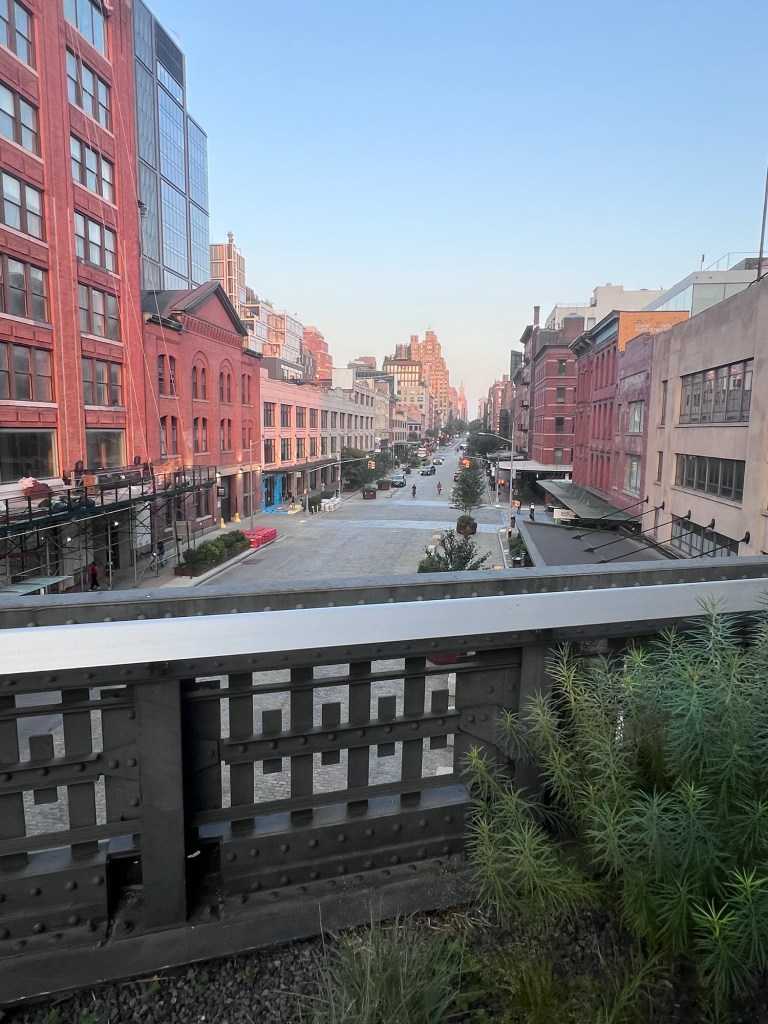
I first decided to visit the beginning of the High Line Park, that starts on Gansevoort Street which was once the center of the Washington Markets. They sent produce and farming items to places all over New York City.

The start of the walkway of the High Line Park at Gansevoort Street

High Line Park

https://www.thehighline.org/

My review on TripAdvisor:

https://www.tripadvisor.com/Attraction_Review-g60763-d519474-Reviews-The_High_Line-New_York_City_New_York.html

The view from High Line Park overlooking the Hudson River at twilight

The sculpture ‘Urmodern’ by artist Brittany Marakatt-Lana

Artist Brittany Marakatt-Labba

https://en.wikipedia.org/wiki/Britta_Marakatt-Labba

https://www.instagram.com/brittamarakattlabba/?hl=en

Artist Brittany Marakatt-Labba is a Swedish Sami textile artist, painter, graphic artist, and a member of the Maze Group.  She is a BA in Textile Art from the Art Industrial School. While Marakatt-Labba works with numerous types of media, it is primarily her narrative embroidery using motifs from the Sámi culture and mythology that she is known for around the world (Wiki).

The sign of sculpture “Urmodern”

The view of the High Line Park at 14th Street

The view of West 14th Street from the High Line to the Hudson River

The of West 14th Street border of the neighborhood, which is undergoing massive renovations

After exploring the remainder of the neighborhood and touring the beginning of the High Line, I finished my day relaxing by the Gansevoort Beach and sitting on one of the wooden lounge chairs by the Hudson River. There is nothing like the breezes and the views by the Hudson River.

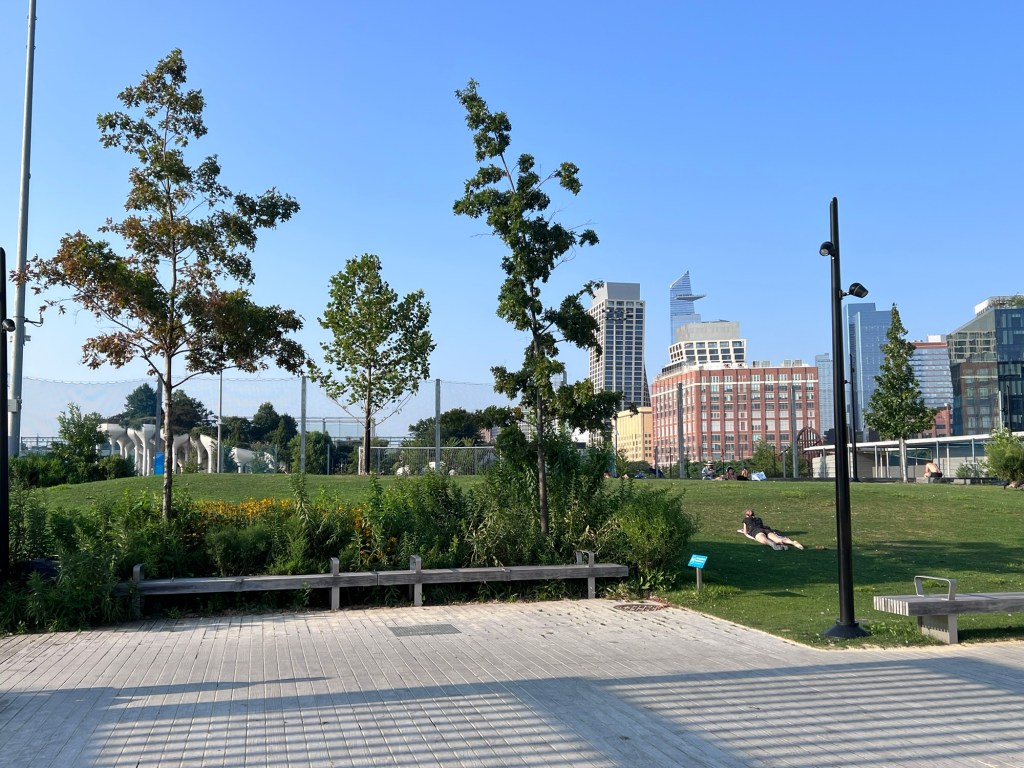
The most southern part of Hudson River Park

Looking north to Little Island

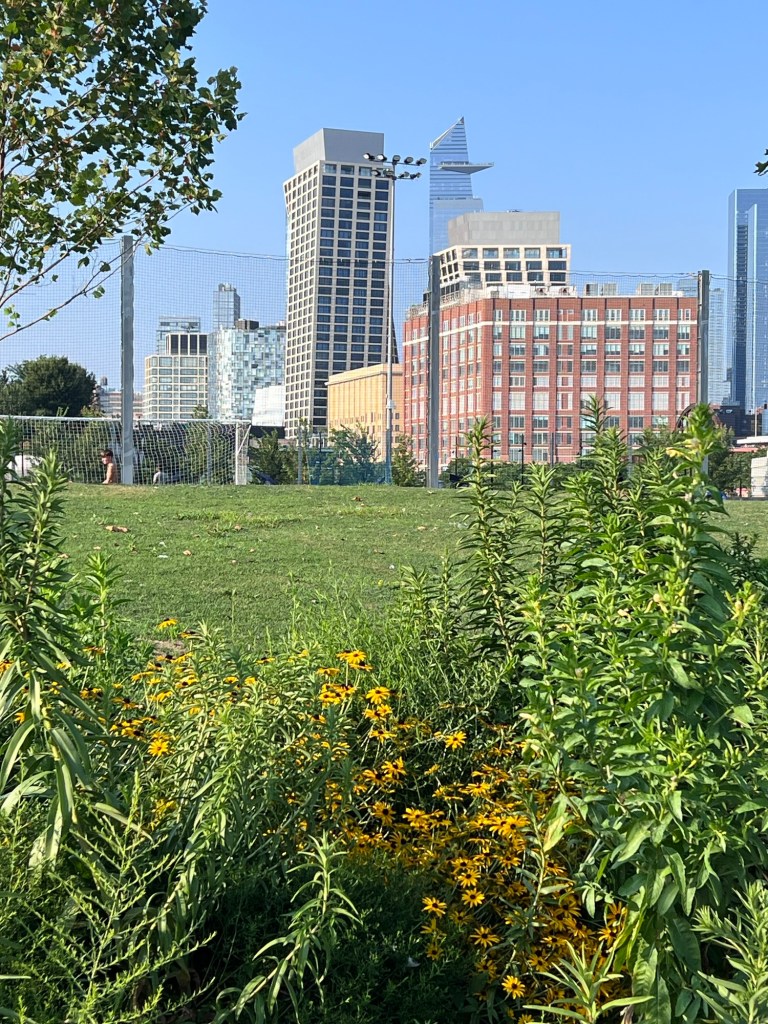
Walking around the park with a view of the Hudson Yards in the background

The view of the skylines of Lower Manhattan and Jersey City

Enjoying a beautiful sunny day by the Hudson River

A video of the sun and river

The one New Yorker who found the perfect spot in New York City

Video of walking along the pier

The Meatpacking District has so much to offer from interesting architecture to wonderful restaurants at funky street art, there is something for everyone here. You just have to walk around and enjoy the views.

Some much is changing in this neighborhood so we will wait and see what happens next.

Day Three Hundred and Forty-One Walking the border of Lower Chelsea from West 23rd Street to West 14th Street from Sixth Avenue to Twelfth Avenue May 24th, 2025

After six months of classes and finishing Graduate school, I am finally back to walking the neighborhoods again. This time to finish Lower Chelsea, which has changed from a neighborhood of manufacturing and shipping to one of the now more exclusive neighborhoods in Manhattan. I started my walk at Sixth Avenue and West 23rd Street.

I found the City a little quieter than on other weekends but figured those who get out of New York City were probably at their weekend homes either at the shore or in the country.

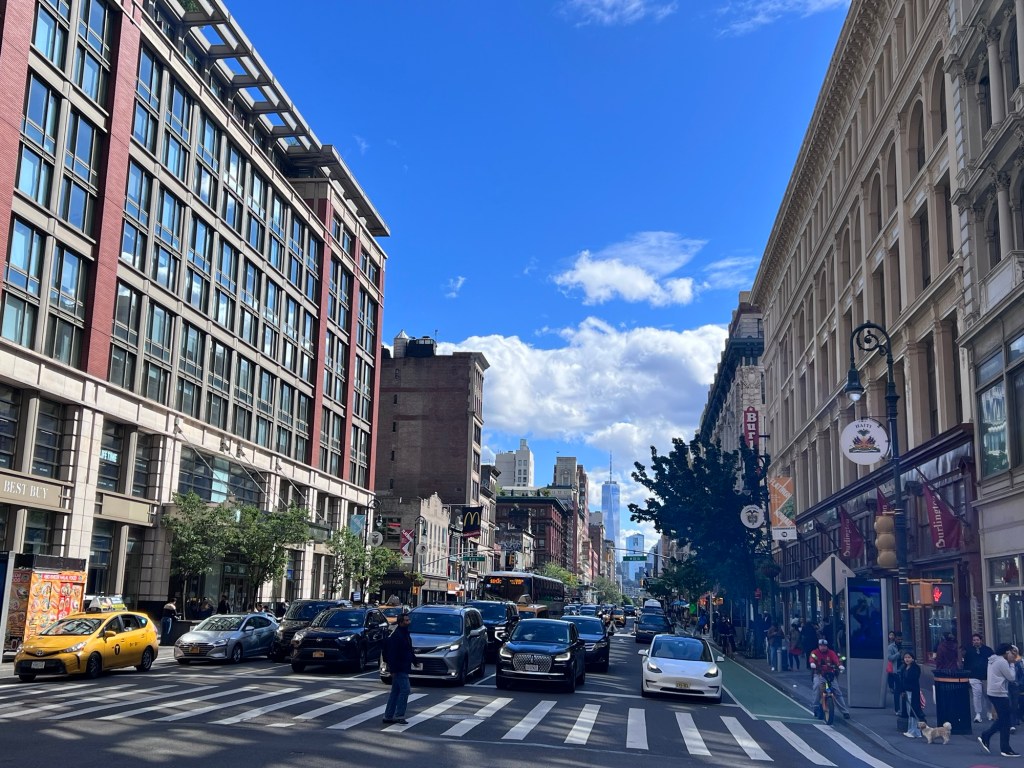
The corner of Sixth Avenue and West 23rd Street

I started the walk where I left off last November walking the streets of the Lower Flatiron District on the corner of Sixth Avenue and West 23rd Street. This is the border of the Lower Flatiron District and Lower Chelsea. These neighborhoods overlap so much I am not sure where on neighborhood starts and the other stops.

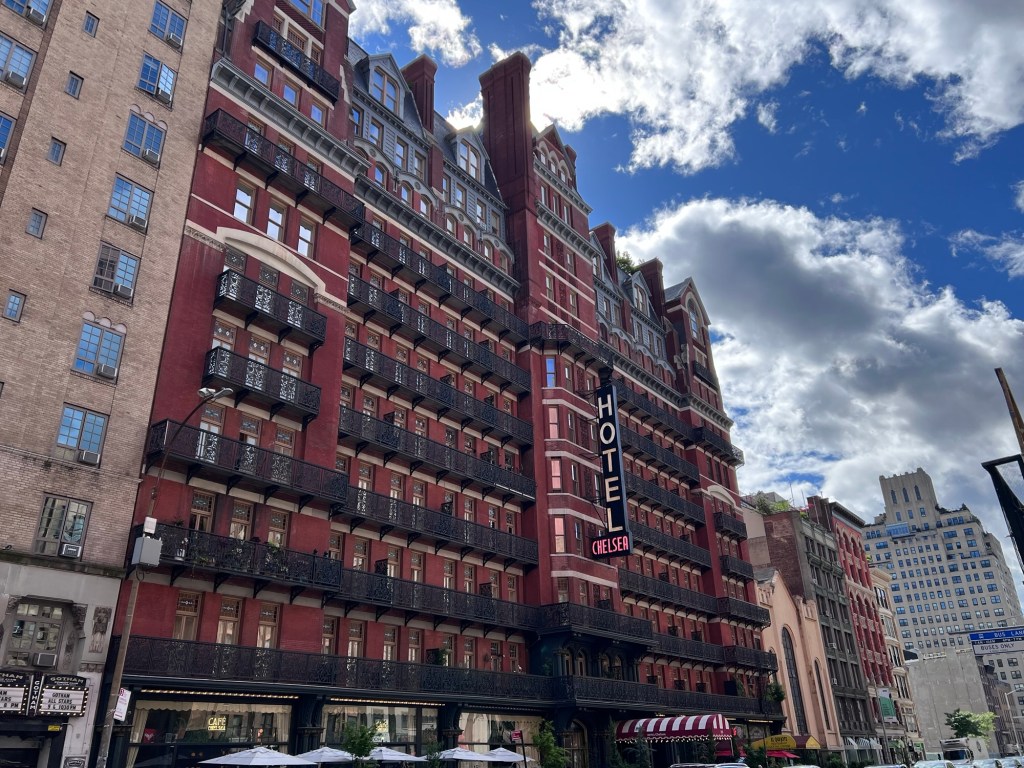
Much of West 23rd Street over the last several years has been torn down and rebuilt with new apartment buildings or older more historical buildings have been renovated for the same purpose. The neighborhood has become that desirable especially with the creation of the High line Park. The first building that always stands out in the neighborhood is the Chelsea Hotel at 204 West 23rd Street.

The historic Chelsea Hotel at 204 West 23rd Street

The one building that always impresses me is the Chelsea Hotel. This former Residential hotel is now a combination of residential apartments and a traditional independent hotel.

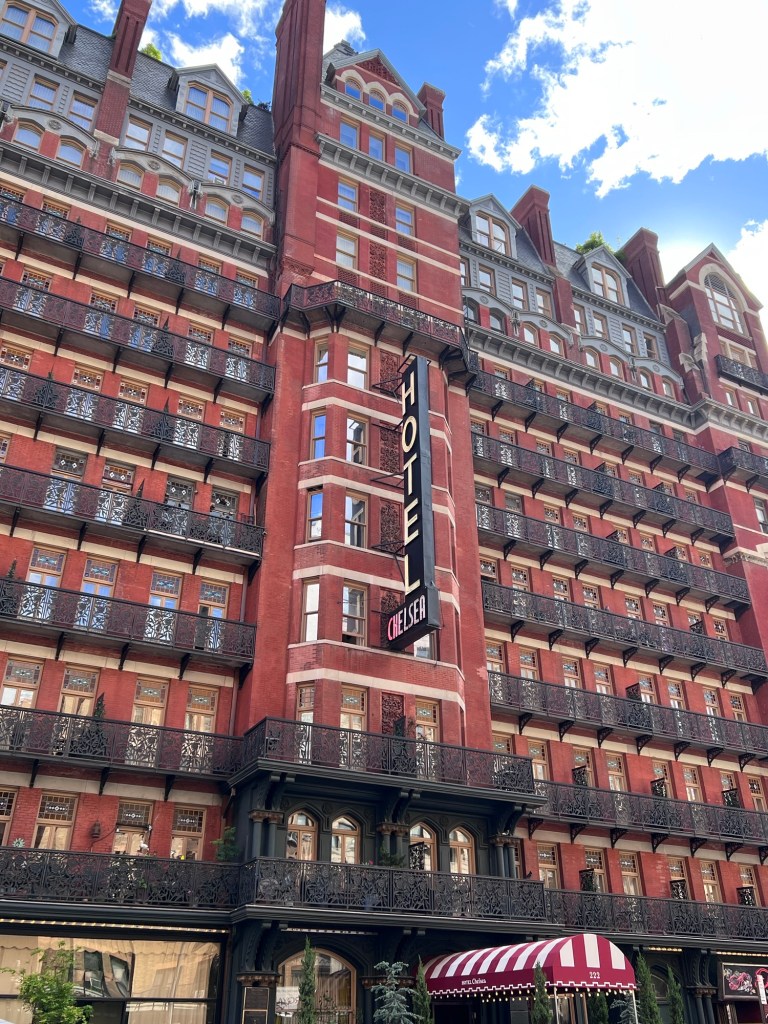
The details of the Chelsea Hotel

https://hotelchelsea.com/

https://en.wikipedia.org/wiki/Hotel_Chelsea

Review on TripAdvisor:

https://www.tripadvisor.com/Hotel_Review-g60763-d23887495-Reviews-The_Hotel_Chelsea-New_York_City_New_York.html?m=19905

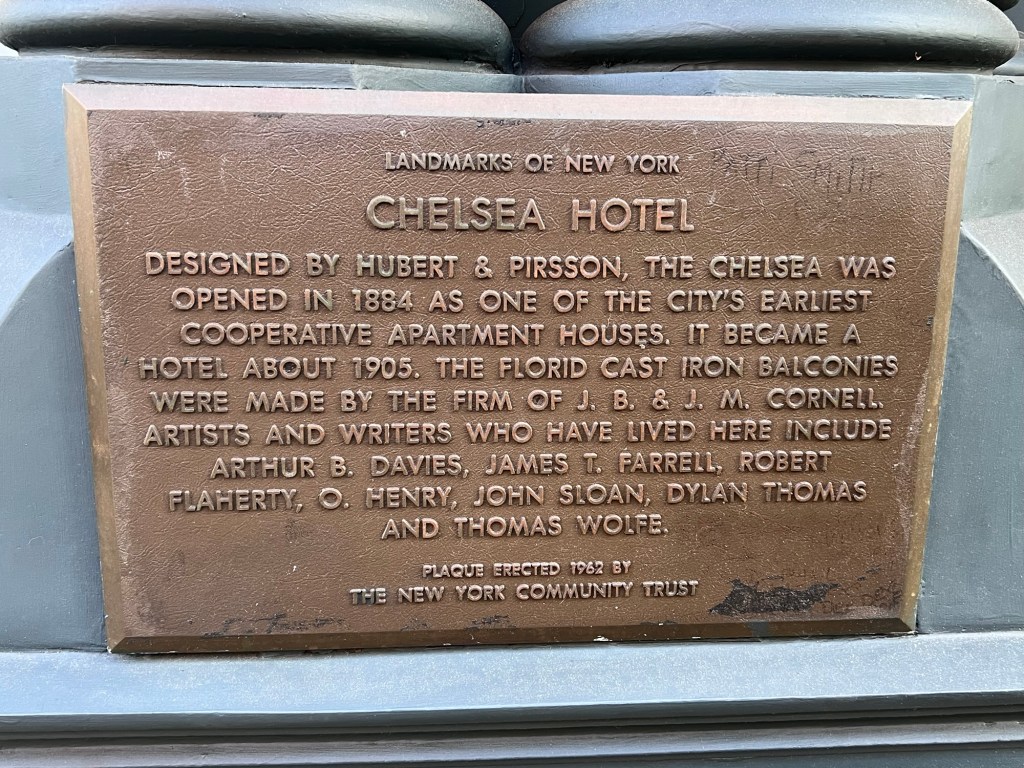
The Chelsea Hotel at 222 West 23rd Street was built between 1883 and 1885 and was designed by architect Philip Hubert from the firm of Hubert, Pirrson & Company. The hotel is designed in the Queen Anne Revival with a combination of American Gothic (Wiki).

The hotel had originally opened as a cooperative and a home to artists and members of the theater community, but the concept changed in 1905 when it reopened as a hotel. The hotel has gone through several management changes over the years. In early 2022, the Chelsea Hotel reopened again as a hotel when the interior renovations were finished.

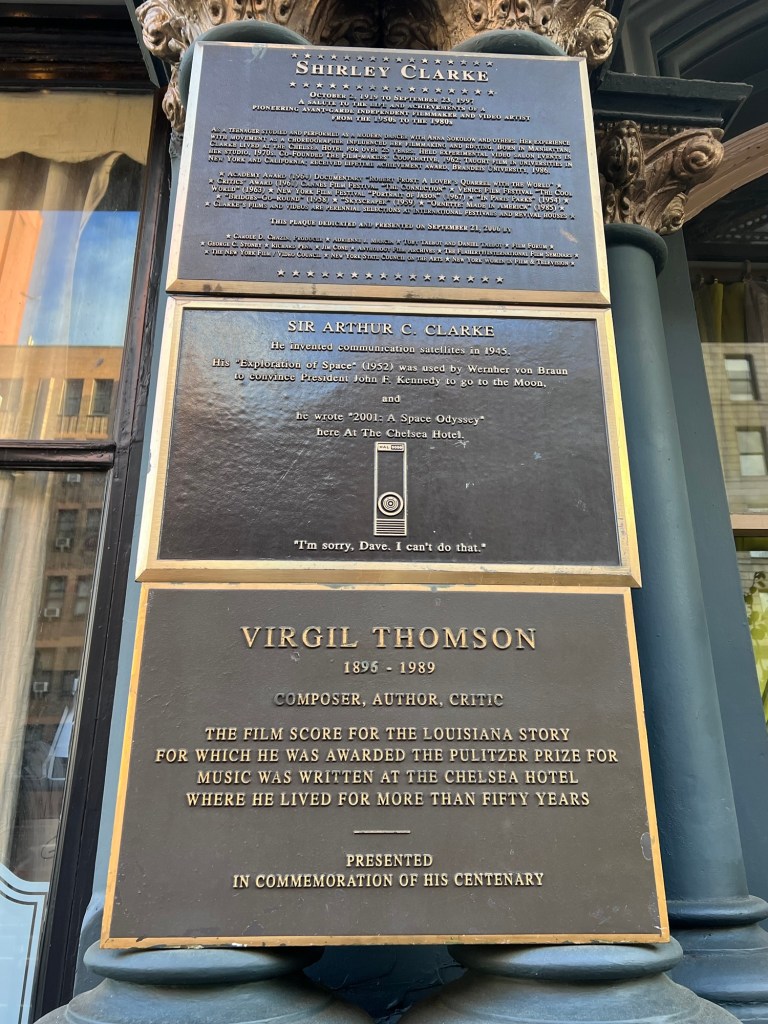
The historic plaques at the hotel

The hotel has such a celebrated past with all the famous people who have stayed here. I think all the plaques on the front of the hotel don’t even touch the number of well known names who resided here.

The historic plaque

The historic plaque

The historic plaque

This is just a small portion of the famous people who have resided here.

The hotel went through a massive renovation recently and is now open as a regular hotel. Many older residents still live there but as their numbers dwindle that rest of the building will probably become a regular hotel.

At 244 West 23rd Street is a beautifully embellished building in brick and cream colors was built in 1900 by developer Isidor Hoffstadt. Decorations of garlands adorn the windows and top of the building and some of the upper floor windows are surrounded by archways. It now contains twelve lofts with multiple bedrooms (Daytonian in Manhattan).

244 West 23rd Street is amazingly detailed

The embellishments on the building

https://streeteasy.com/building/244-west-23-street-new_york

http://daytoninmanhattan.blogspot.com/2012/05/sports-film-history-and-modeled-clay.html

West 23rd Street by Eighth Avenue

While the core of West 23rd Street has changed with gleaming new buildings as residential and office space, as you get closer to Eighth Avenue the neighborhood has that classic ‘old New York’ look to it.

Walking down West 23rd Street near Eighth Avenue

I walked the length of West 23rd Street from Sixth Avenue, the border of the lower Flatiron District to Riverside Park. The weather just kept changing going from really sunny to cloudy and rainy the entire time I walked the neighborhood. One comment it was raining and the other it would be dazzling sunshine.

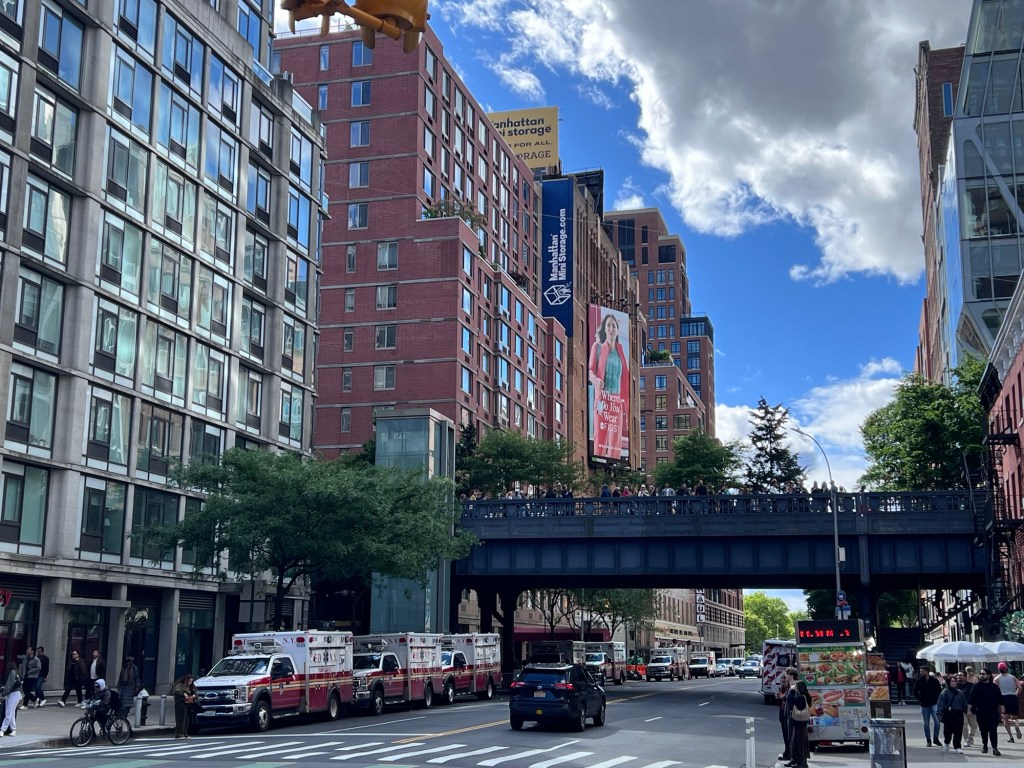
West 23rd Street by Tenth Avenue and the Hi Line Park

https://www.nycgovparks.org/parks/the-high-line

My review on TripAdvisor:

https://www.tripadvisor.com/Attraction_Review-g60763-d519474-Reviews-The_High_Line-New_York_City_New_York.html

At the end of West 23rd Street starts Chelsea Waterside Park and Hudson River Park, which lines the entire side of the Upper West Side. The gardens were at the height of their bloom and it was a beautiful display of flowers.

This was the legacy of the Bloomberg Administration’s ‘Million Tree’ initiative. Between these parks that lined the waterways and the High line Park, it just made the neighborhood more desirable.

https://en.wikipedia.org/wiki/Million_Tree_Initiative

https://en.wikipedia.org/wiki/Chelsea_Waterside_Park

My review on TripAdvisor:

https://www.tripadvisor.com/Attraction_Review-g60763-d17695733-Reviews-Chelsea_Waterside_Park-New_York_City_New_York.html

Chelsea Water Park on a sunny day

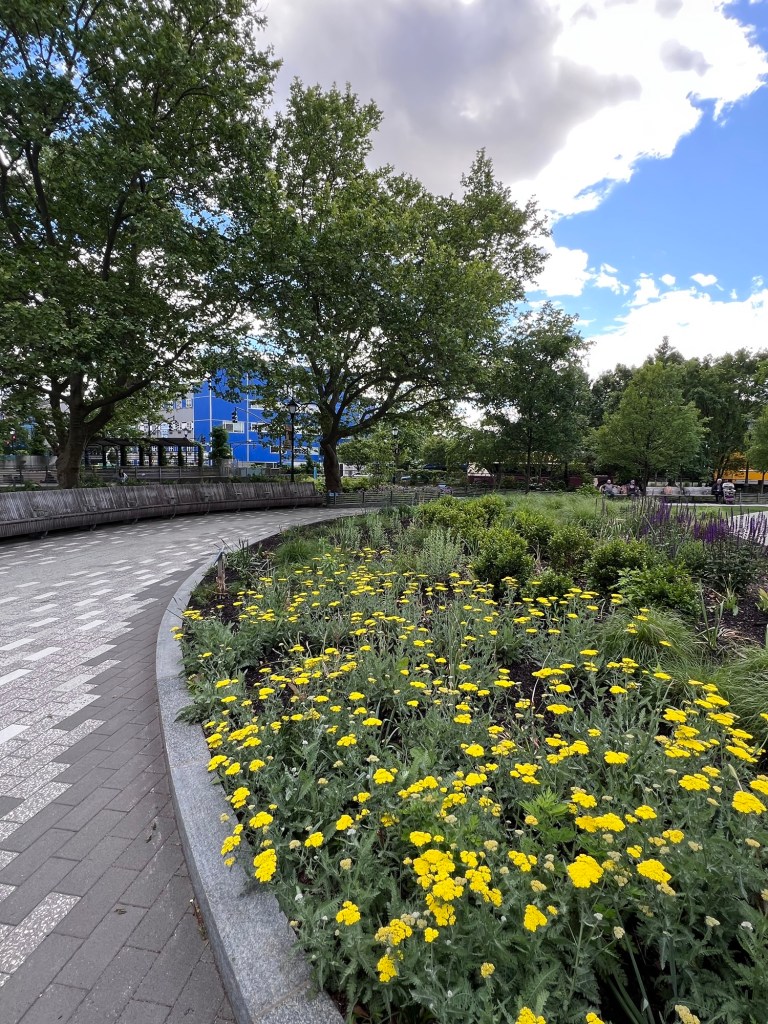
The beauty of the park in full bloom

Taking a moment to sit and enjoy the view

Funny how the weather went from sunny to rainy in ten minutes on Memorial Day weekend. By the time I walked to Hudson River Park, it got gloomy again. Still, it did not affect the beauty of the parks and helped water all the beautiful flowers blooming.

The flower beds were in full bloom

The park was in full bloom in the late Spring and was dazzling. Their Friends groups and gardeners are doing a wonderful job maintaining these flower beds.

Walking into Hudson River Park

https://parks.ny.gov/parks/hudsonriverpark/details.aspx

https://hudsonriverpark.org/

My review on TripAdvisor:

https://www.tripadvisor.com/Attraction_Review-g60763-d4545669-Reviews-Hudson_River_Park-New_York_City_New_York.html

Walking through the park as the clouds rolled in

The flower beds in full bloom

The park looked amazing

The true beauty of the gardens

Running for cover as the clouds rolled in

As I walked the piers, the clouds kept rolling in and out and it sprinkled off and on that afternoon.

Admiring the view as I was waiting for the clouds to clear

The skyline of Jersey City was gloomy and impressive at the same time

Then the clouds broke again and the sun came out. This would be the weather all day long. The clouds then the sun then the clouds then rain and then the sun. It made for an interesting walking day.

The sun finally came out on Pier 57

The view of the Hudson Yards was just spectacular when the clouds passed by

The path led from the Hudson River Park to Pier 57 and I took the pathway through the Pier and all the recreation buildings that now make up the complex. I had never seen it from the river side of the pier.

Pier 57 from the waterfront side of the complex with all the pleasure boats

Review on TripAdvisor:

https://www.tripadvisor.com/Attraction_Review-g60763-d24041415-Reviews-Pier_57-New_York_City_New_York.html

As I walked through the passageway, I learned the history of the pier and all the famous ships that had docked or left the pier. There was a display of pictures of famous arrivals and departures from the pier that I stopped to read about. It was a interesting look at the past of these piers,

The people at the dock were waiting for the Carpathian to arrive with the Titanic survivors in 1914.

The Carpathian arriving at New York harbor with the Titanic survivors.

The Lusitania leaving New York harbor for its final voyage. It would be torpedoed before it arrived in Europe.

The modern Chelsea Piers of today

Walking down Eleventh Avenue when the rain cleared

Along past the new construction along Eleventh Avenue

For all the building and changes this neighborhood has been through and so many luxury buildings replacing the docks of the past, there is still a little influence of the old neighborhood that still pops up from time to time. The graffiti art is still fantastic all over the City.

Some of the street art on the construction site on Eleventh Avenue

Some of the street art along the fence of the new construction

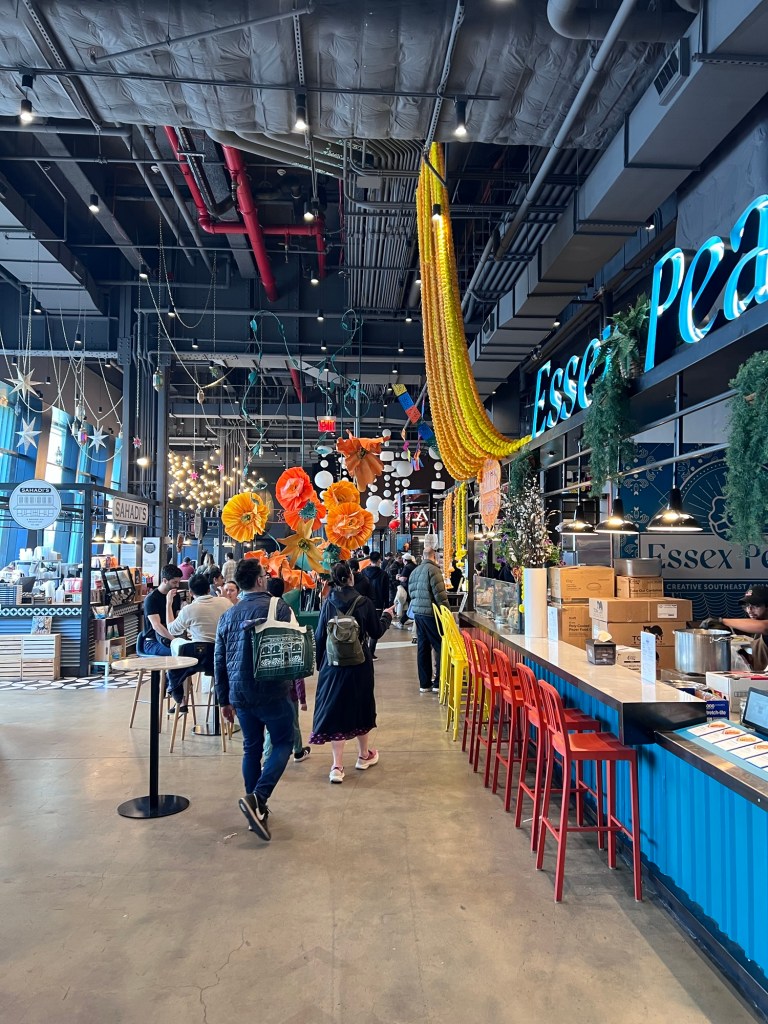
I followed Eleventh Avenue down the sidewalk to the Food Court at Pier 57. That was interesting with all the sounds and smells of different cuisines cooking.

The Food Court at Pier 57 should not be missed

The Food Court at Pier 57 really has some wonderful restaurants. There is an interesting mix of Spanish, Italian and Asian cuisines in the food court but it can be a bit pricey. The smells are amazing and you could almost taste the spices in the air. The couple of times I have been here the place is always busy.

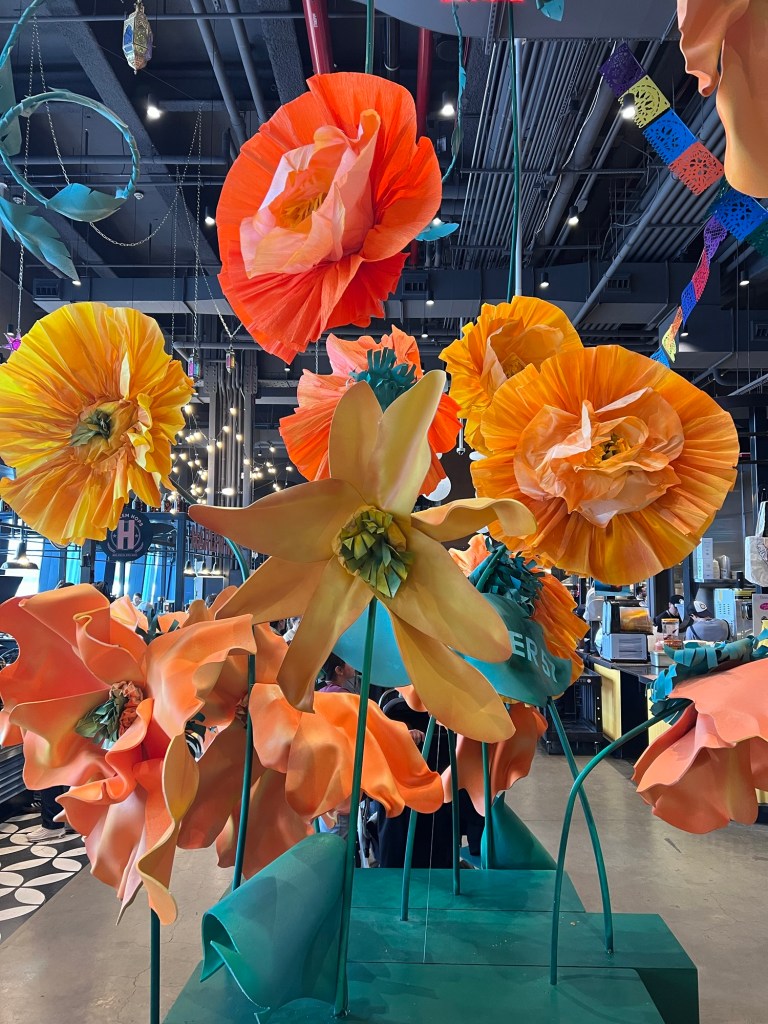
The excitement of entering the Pier 57 Food Court

The floral decorations in the middle of the food court. I love the decorations here. They are really festive. The only bad part of the food court is the prices are really high so be prepared to spend money on lunch and dinner.

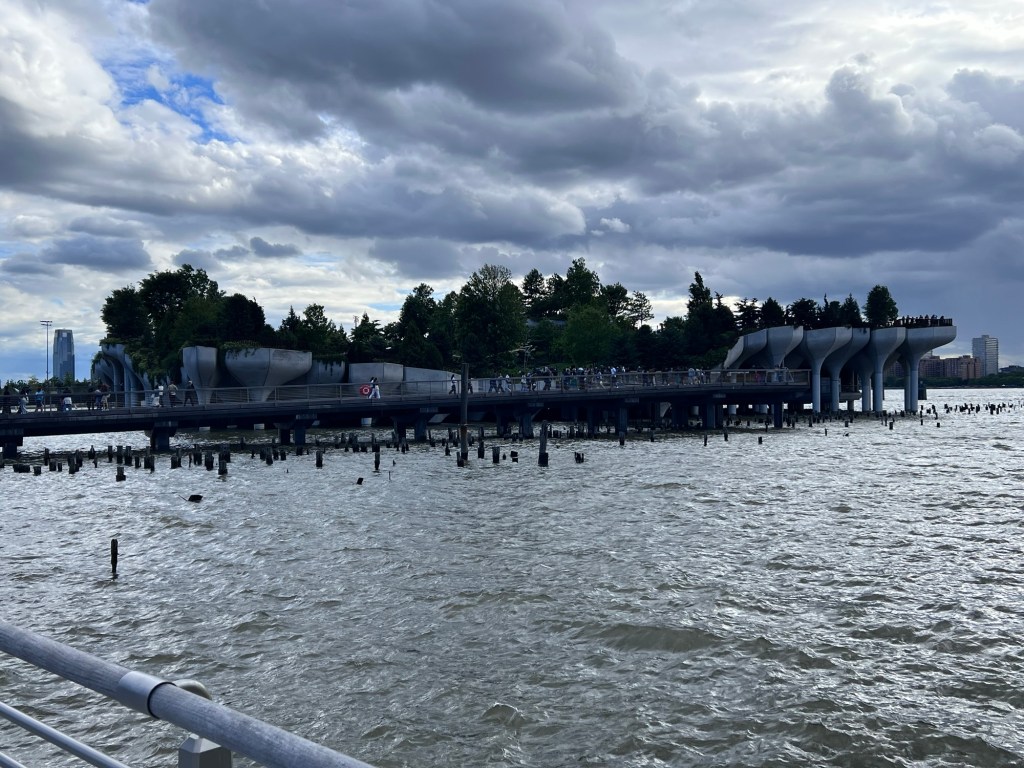
I left my tour of the food court as the clouds rolled in again and I arrived at Little Island Park, one of the newest and most innovative parks in New York City. The whole park is built on this innovative type of piling that come together to create this whimsical park. Something out of “Whoville”.

My trip to Little Island and the Chelsea Market with my NYU class:

At the very corner of the neighborhood was ‘Little Island Park’ at . This very unique structure has been captivating both New Yorker’s and tourists since it was built.

My review on TripAdvisor:

https://www.tripadvisor.com/Attraction_Review-g60763-d23418324-Reviews-Little_Island-New_York_City_New_York.html

The structure of Little Island

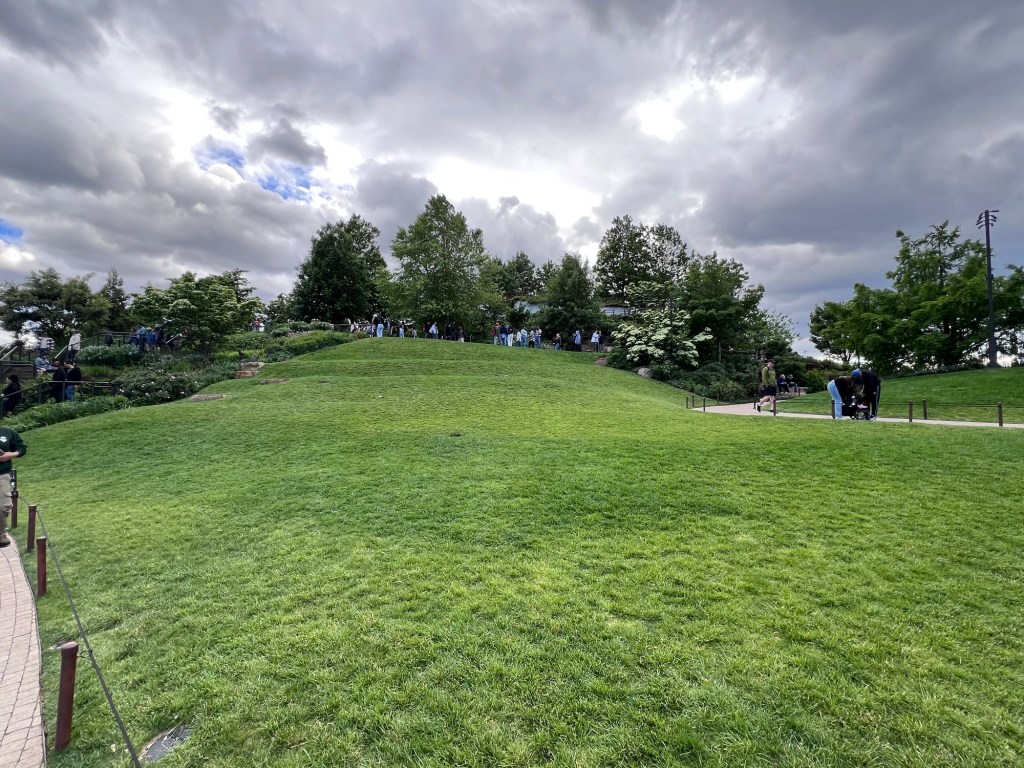
The great lawn on the off again on again

I then took the time to walk all over Little Island. I explored all the paths and stairs and explored all the beautiful gardens and terraces. What views! As the clouds passed by, we had moments of brilliant sunshine and at times it looked like it was going to down pour.

The gardens in full bloom on Little Island

The views from the very top of the terraces as the clouds finally cleared

Walking back down the stairs

The view from the pathway on the way down towards the exit

The view from the exit of Little Island as the clouds rolled by

The rest of the afternoon was on again off again clouds. I crossed over Eleventh Avenue to West 14th Street into the borders of Chelsea and the Meatpacking District (where at this point all the meatpacking companies are gone). In their place now are gleaming new apartment buildings that surround the High Line Park.

Eleventh Avenue at West 14th Street

I crossed the street to see 14th Street Park in full bloom. This park represents this new neighborhood with its gleaming towers and expensive stores. The lawn was perfectly manicured and the flowers were in full bloom. I did not even see any homeless people in the park. Just young couples walking their dogs.

The gardens in 14th Street Park as you cross onto West 14th Street from Eleventh Avenue

The gardens in full bloom at the park on West 14th street

Crossing onto West 14th Street by the Meatpacking District near 11th Avenue

I have been walking around this neighborhood since the 1980’s and talk about change. What used to be buildings that were geared to the docks and shipping, then became clubs in the 1980’s and early 90’s are now lofts and luxury stores. I have really seen this City change.

Walking down West 14th Street

Walking down West 14th Street near the Meatpacking District

Walking in Meatpacking District by Tenth Avenue

This border that Chelsea now shares with the Meatpacking District (which no longer has any more meatpackers) has become one of the trendiest and innovative neighborhoods in the City. Aldo judging by the prices at the restaurants and stores, one of the most expensive.

West 14th Street in the Meatpacking District

Walking down West 14th Street

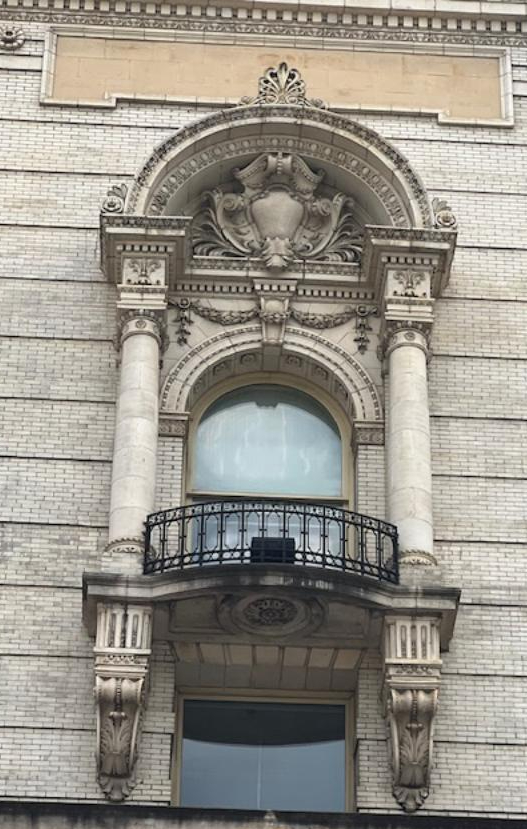
As you walk further away from the parks along the river coastline and further down West 14th Street, more modern buildings pop up on both sides of the street. Still here and there, details of the old neighborhood still pop up such as at 200 West 14th Street, with its stoic faces and immense detail in the doorway.

The unique sculptures on outside of 200 West 14th Street

https://daytoninmanhattan.blogspot.com/2010/06/jeanne-darc-200-west-14th-street.html

https://www.villagepreservation.org/tag/200-west-14th-street/

The building was marketed with the sophisticated-sounding name “French Flats,” one of the very first of these was built by Jersey City businessman Henry Meinken at the corner of 14th Street and 7th Avenue.  Meinken called on James W. Cole to design his new building in 1888.  Cole was a favorite of the Astor family and he built several factory, warehouse and apartment buildings for them, several a few blocks west on 14th around Hudson and 9th Avenues (Daytonianinmanhattan.com).

It was completed in 1889 and given the cultured name “The Jeanne d’Arc.”   The five-story brick building with brownstone trim had commercial space on the street floor and 8 commodius apartments above — two apartments per floor.  To set the building apart from the baser tenements, Cole added an attractive pressed metal cornice and carved brownstone sills and lintels (Daytonianinmanhattan.com). 

The street art along West 14th Street was very interesting as well. I loved this version of lady liberty. This was painted outside of a pharmacy.

The street art outside the pharmacy by Artist Shira One

Artist Shiro One in front of her work

https://shiro1.com/

Shiro’s artwork is an exploration of classic New York urban history through the lens of an artist who reveres Hip Hop culture. Her artwork is a prime example of the fusion of Japanese aesthetics and old school New York graffiti art. In 2002, she moved to New York alone, and after living between Japan and New York, she obtained an US American artist visa in 2013, acquired an US artist green card in 2021, and is currently based in New York (Artist Shiro1 website).

Another great mural that sits on the side of a building on West 14th that stands out entitled “Mural on 14th Street, New York” by Brazilian artists brothers Gustavo and Otavio Pandolfo known as ‘Osgemeos’. This colorful and engaging piece of artwork towers over the street and shows an exaggerated image of everyday New Yorkers.

The mural makes quite a statement and is very creative.

The painting “Mural on 14th Street, New York” by artists Gustavo and Otavio Pandolfo was created in 2017.

Artists Gustavo and Otavio Pandolfo in front of their mural

https://www.lehmannmaupin.com/news/osgemeos2

https://www.lehmannmaupin.com/artists/osgemeos/biography

The word ‘Osgemeos’ is translated as “the twins” in Portuguese, is a collaborative art duo comprised of twin brothers Gustavo and Otavio Pandolfo. It was in the 1980’s with the invasion of hip-hop, and the explosion of Brazilian culture that the brothers began to use art as a way of sharing their dynamic and magical universe with the public. Combining traditional, folkloric, and contemporary elements of Brazilian culture with graffiti, hip-hop, music, dreams and international youth culture, the artists have created an expansive body of work that includes murals, paintings, sculpture, site-specific installations, and video (Lehmannmaupin.com website).

This is what I love about walking around Manhattan. You do not even have to step foot in a museum to enjoy great artworks that are tucked into corners of every neighborhood on walls, telephone poles, on the street and in courtyards. You just have to look for it.

As I walked further down West 14th Street, between all the new construction going on and the gleaming glass towers that seemed to be changing the face of the neighborhood a few buildings stood out for the beauty and details in their architecture.

The first one was the Church of Our Lady of Guadalupe at 229 West 14th Street. I was attracted the elegant look of the church.

Church of Our Lady of Guadalupe at 229 West 14th Street

https://guadalupestbernard.org/

The church opened in 1902 and was designed by architect Gustave E. Steinback in both the Baroque Revival and the Spanish Baroque style of architecture (Wiki).

The Church of Our Lady of Guadalupe was founded in 1902, and became the first parish in New York City to serve the swelling numbers of Hispanics.  During this time the Archdiocese was ill-staffed with priests who could not speak Spanish and those who were willing to reach out to the newcomers and learn their language and their ways were preoccupied with other important ministries. Our Lady of Guadalupe parish was established as a national parish, responsible for the spiritual care of all Hispanics of the city. (Church of Our Lady of Guadalupe website).

The details of the Church stood out for their beauty and elegance

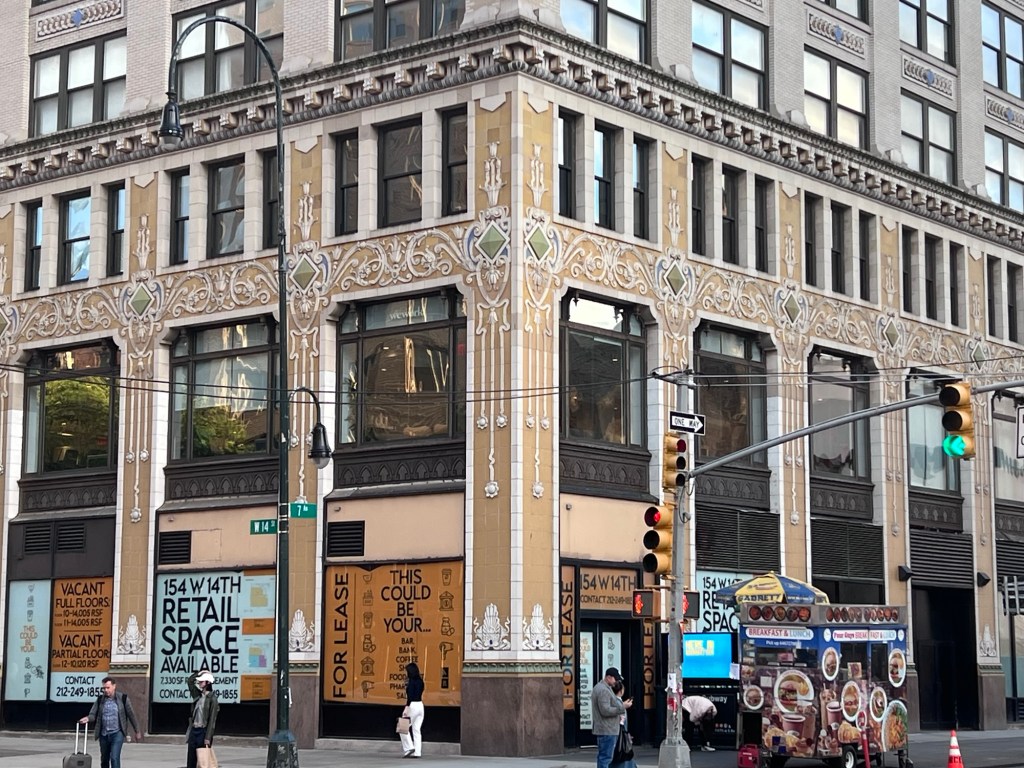
Another standout building on the corner of West 14th Street and Seventh Avenue is 154 West 14th Street. Arranged in a tripartite base-shaft-capital composition with large window areas, this building is a striking and unusual example of a large loft building partly clad in terra cotta, on the three-story base, on the spandrels between the white-brick piers of the midsection, and on the upper portion. The building was designed by architect Herman Lee Meader and was built between 1912-1913 (The Historic District Council Website).

154 West 14th street

https://marketplace.vts.com/building/154-west-14th-street-new-york-ny

The details on the building are so unusual and you really have to look at the building close to appreciate its beauty.

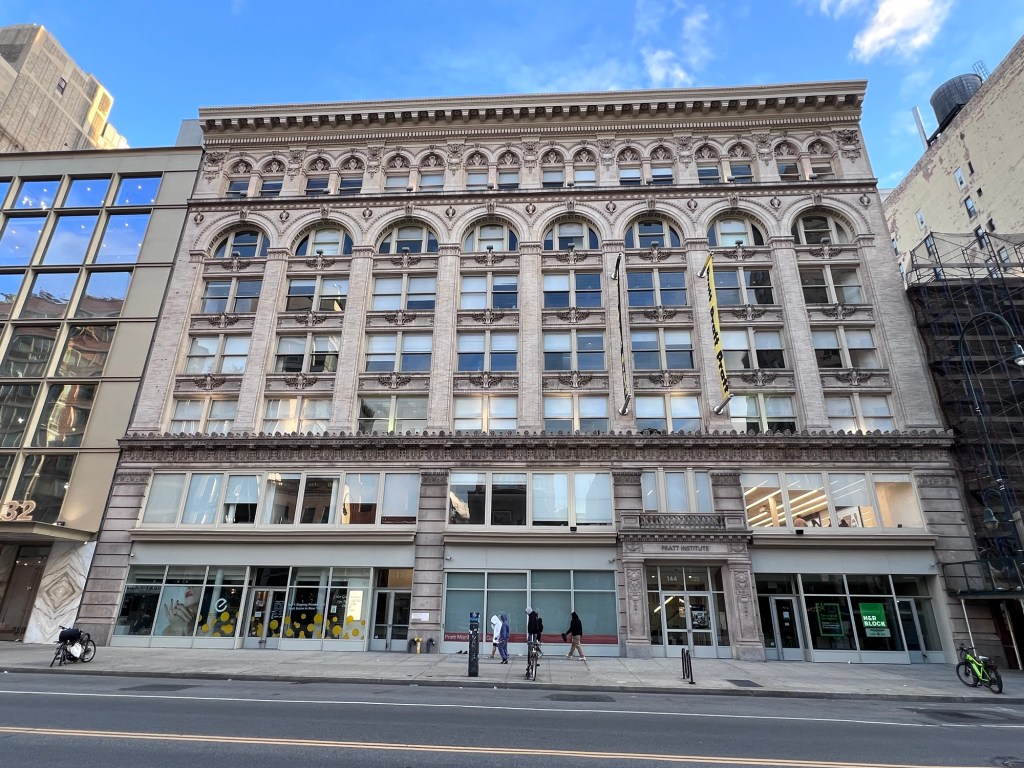
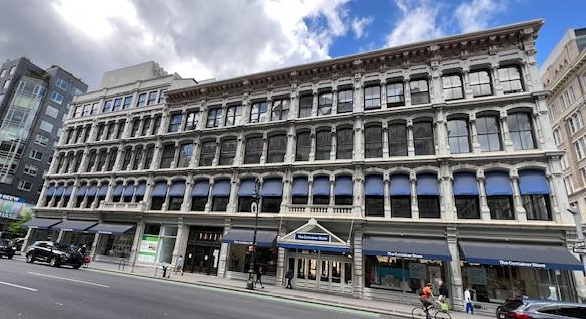
Another building that stands out on West 14th Street is 144 West 14th Street which is part of the Pratt College today but has an interesting past. Pratt bought the building in 1999.

The beautifully detailed building at 144 14th Street

https://daytoninmanhattan.blogspot.com/2011/11/bicycle-academy-silversmiths-and.html

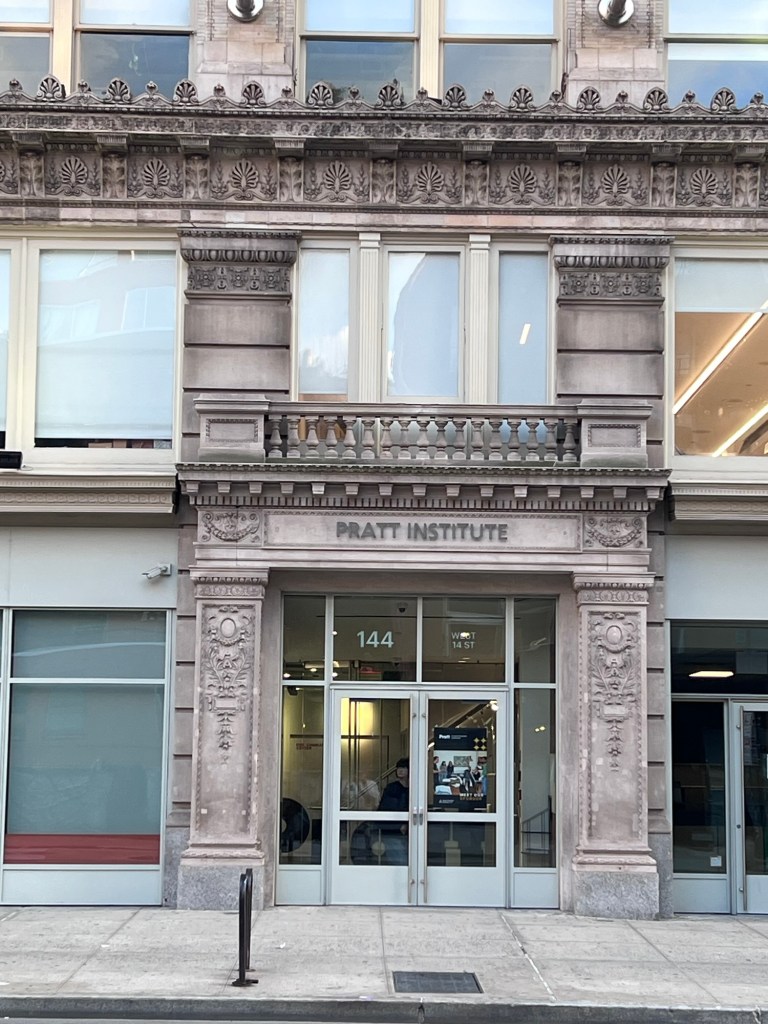
144 West 14th Street is a grandly-proportioned Renaissance Revival-style loft building. It is faced with limestone, tan brick and terra cotta and was designed by the prominent architects Brunner & Tryon in 1895-96. It is seven stories tall and has a street façade articulated through a series of monumental arches embellished with neo-classical ornament (Historic District Council website).

The detail work at 144 West 14th Street

Though the building reminded me of one of the department stores from the post Civil War period, the building was actually used for manufacturing, one the tenants of the building being Macy’s (DaytonianinNYC website).

Turning the corner onto to Sixth Avenue that Chelsea shares with the Lower Flatiron District, you enter what was once the next great shopping area of the late 1880’s to about 1920 when the “Ladies Shopping District’ moved from 14th Street after the Civil War to Sixth Avenue between West 20th Street to West 23rd Street to create “The Ladies Shopping Mile”.

It would then move to West 34th Street where Macy’s resides today and the ghosts of B. Altman, Stern’s, Orbach’s and Franklin Simon buildings still remain to the last holdout of Lord & Taylor on Fifth Avenue that closed a few years ago that used to line the blocks. Most of the older smaller buildings have been torn down and gleaming new towers are starting to line parts of West 14th Street between Eighth to Fifth Avenues and up along the Avenues.

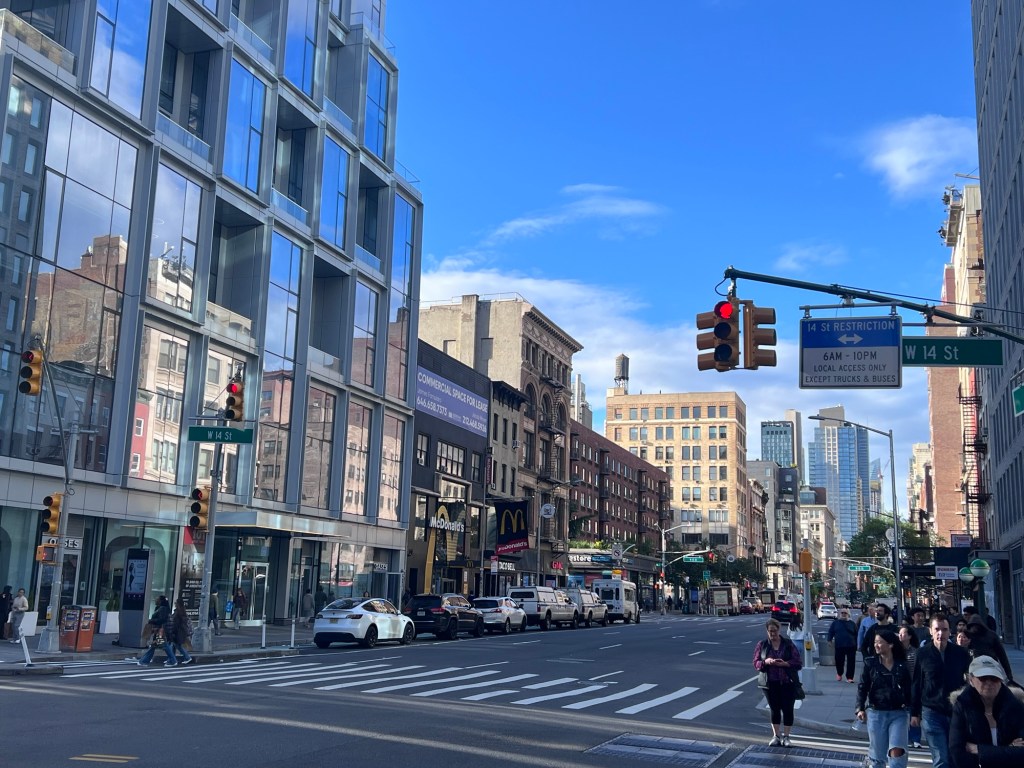
West 14th Street by Sixth Avenue

Looking up Sixth Avenue and 19th Street, the eastern border of Chelsea

Walking up Sixth Avenue towards West 20th Street, most of the more elaborate buildings are closer to the edge of West 20th Street. Walking back up toward the heart of the former “Ladies Shopping Mile” along Sixth Avenue from West 18th Street to West 23rd Street, the lower part of Sixth Avenue is similar in look to West 14th Street. A mish-mosh architectural styles from years of knocking down the older buildings. Inside are a variety of fast food restaurants, coffee shops and small stores.

The first building left of the former shopping district is the former Pace Building at 610 Sixth Avenue.

610 Sixth Avenue-The former Price building

https://daytoninmanhattan.blogspot.com/2018/06/the-price-buildling-604-612-sixth-avenue.html

David Price opened his first women’s clothing store, D. Price & Co. around 1887.  The Price Building was built in 1910-1912 and designed by Buchman & Fox in the Beaux-Arts style (Wiki). The was the combination of the two stores, the one facing Sixth Avenue and the one facing 18th Street (DaytoninManhattan.com).

The embellishments of 610 Sixth Avenue designed by Buchman & Fox.

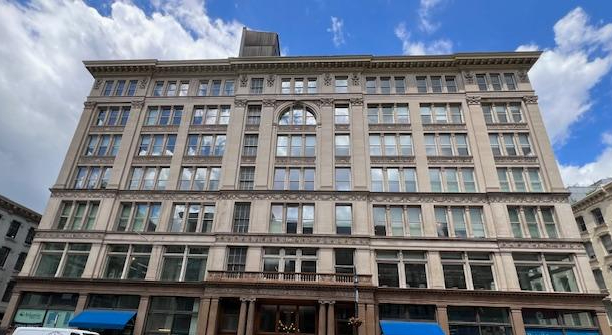
Next to the Price Building is what was one of the grandest of the department stores in New York City at 620 Sixth Avenue, Seigel Cooper

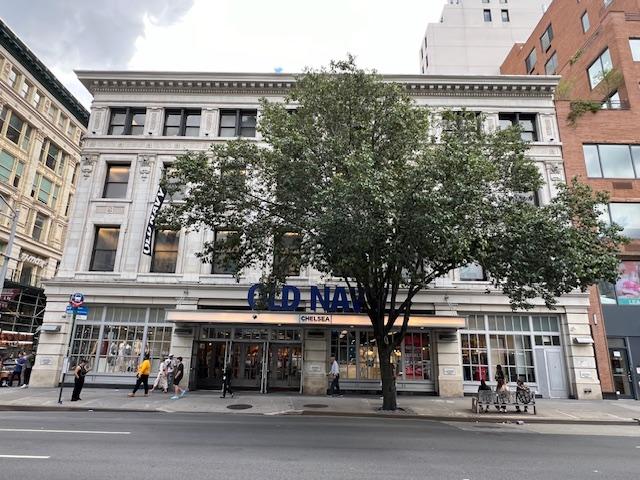
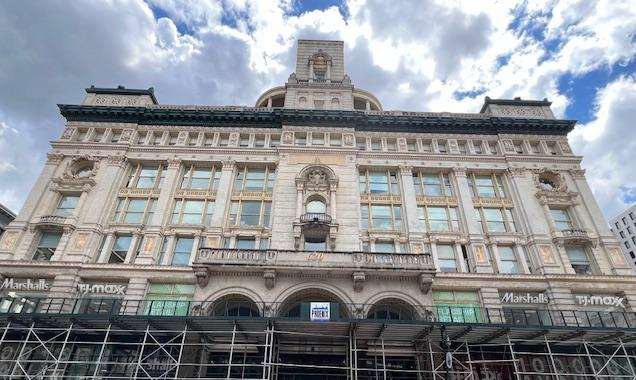
620 Sixth Avenue-The former Siegal Cooper Department Store

https://en.wikipedia.org/wiki/Siegel-Cooper_Company

https://daytoninmanhattan.blogspot.com/2010/08/big-store-1896-siegel-cooper-department.html#google_vignette

The original store design in the late 1800’s (New York Historical Society)

The Siegel-Cooper Department store was a Chicago based store that was founded in 1877 by Henry Siegel, Frank H. Cooper and Isaac Keim. They opened the New York City store in 1896 on the Ladies Mile Shopping District. The store was designed by the architectural firm of DeLemons & Cordes in the Beaux-Arts design. When it opened, it was the largest department store in the world until Macy’s opened in 1902 (Wiki).

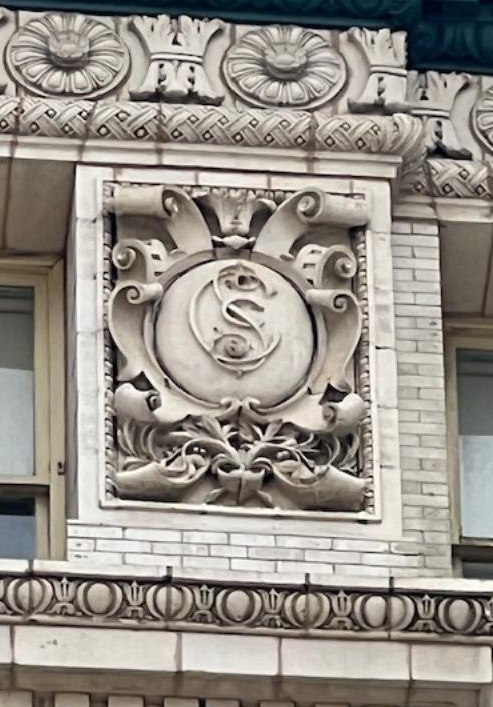
The Siegal Cooper insignia on the building.

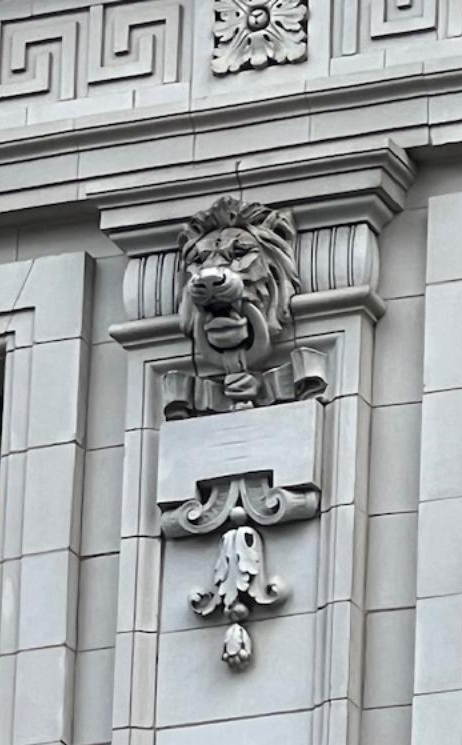
The window details

The details on the upper windows of the store.

Henry Siegel over-extended himself and sold the company in 1902 to an investor and the store declared bankruptcy in 1915 and closed in 1917. After the store closed, it was used as a military hospital and then as a warehouse. Today after years of being used as a warehouse, it now has several retailers located in the store space (Wiki).

Across the street from the Siegel-Cooper store is the old B. Altman & Company store before they moved to East 34th Street.

625 Fifth Avenue-The old B. Altman & Company Department Store.

https://en.wikipedia.org/wiki/B._Altman_and_Company

https://untappedcities.com/2021/10/20/lost-new-york-city-department-store-b-altman/

B. Altman & Company was founded in 1865 as a family store that eventually came under the control of Benjamin Altman. It moved from its Third Avenue and Tenth Street location to 621 Sixth Avenue in 1877. The store expanded four times in this location to cover what is now 625 Sixth Avenue. The store was designed in the Neo-Grec design and built in four stages. First by architects David and John Jardine for the original store in 1877 and then the extension in 1880. Then by architect William Hume in 1887 and then by architects Buchman & Fox in 1910. The store moved to the corner of Fifth Avenue and 34th Street in 1906 when the shopping district moved to 34th Street (Wiki).

The last old department store on the Ladies Mile Shopping District is at 641 Sixth Avenue on the corner of Sixth Avenue and West 20th Street.

641 Sixth Avenue-The old Simpson Crawford Department Store

https://daytoninmanhattan.blogspot.com/2011/12/exclusive-1902-simpson-crawford-dept.html#google_vignette

Simpson Crawford like many stores on Sixth Avenue had its humble beginnings on 19th Street. The store continued to grow and expand catering to the ‘carriage trade’ and selling the finest merchandise. After their new store was destroyed in a fire in 1880, they opened the store at 641 Sixth Avenue in 1899 which was designed by architectural firm William H. Hume & Son in the Beaux-Arts design (dayoninmanhattan.com).

The details of 641 Sixth Avenue.

This part of the Flatiron District feels so different from the northern part of the neighborhood. So much of it has disappeared over the years that the character has changed. It does not have the distinction of the blocks between 23rd and 20th streets. There are blocks of these types of buildings whereas the blocks of the old shopping districts of the early to late 1800’s from 14th to 18th Streets have slowly disappeared over time. Older buildings have since been replaced with modern office and apartment buildings. The buildings have even been refitted for apartments and for the growing college campuses in the area.

While there are many architectural gems in this neighborhood, it just goes to show the progression of Manhattan and how things have changed in the last 100 years. The City keeps marching on. Still this section of the Lower Flatiron District shows just how important this part of the old “Midtown Manhattan” was from the Civil War until WWI. Just look up and admire all the details on each building. There are a surprise and delight for the eyes.

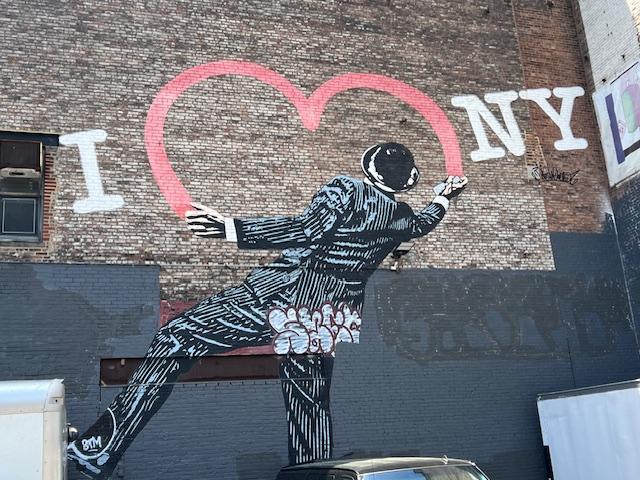
The Street art on West 15th Street off Sixth Avenue “I Love New York”

Read my blog on Walking the Streets of the Lower Flatiron District:

https://wordpress.com/post/mywalkinmanhattan.com/47757

While I was walking around Chelsea, I was trying to figure out where to go for dinner. A guy was sampling slices of pizza outside of a new branch of Pizza Studio on West 14th Street. It was delicious and I decided to eat there for dinner.

Pizza Studio at 364 West 14th Street

https://www.pizzastudio.com/

My review on TripAdvisor:

https://www.tripadvisor.ie/Restaurant_Review-g60763-d33221936-Reviews-Pizza_Studio_Chelsea-New_York_City_New_York.html?m=69573

The inside of Pizza Studio

The menu for the make on the spot pizzas

I thought that the prices were very fair and you got a delicious 12 inch pizza for $10.00 and a lemonade. The whole bill with an extra tip was around $12.50, which was reasonable for all the food. Plus the pizza was delicious.

The ingredients to choose from

The Sausage pizza I ordered that evening

The pizza was wonderful

The pizza served with the Blue Lemonade

What was really nice after the day walking around the neighborhood was the lemonade was so refreshing. You got a choice between Watermelon Lemonade and the Blue Lemonade above and you got free refills. Talk about quenching your thirst on a hot day. It was a great dinner.

Walking past Holy Apostles Church at night

The Empire State Building lit for the holiday

A beautiful site of the Empire State Building

On each corner of the neighborhood, surprises and changes keep this neighborhood in a continuous flux. It just keeps reinventing itself.

Please read my other blogs of Lower Chelsea:

The Borders of Lower Chelsea:

The Avenues of Lower Chelsea:

The Streets of Lower Chelsea:

Day Two Hundred and Fifty-Six Touring Grand Central Terminal and all its secrets with the Cornell Club members January 28th, 2023

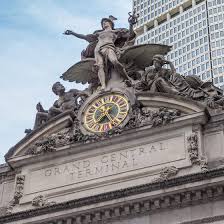
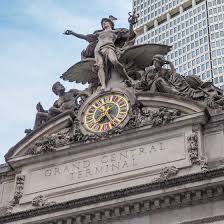
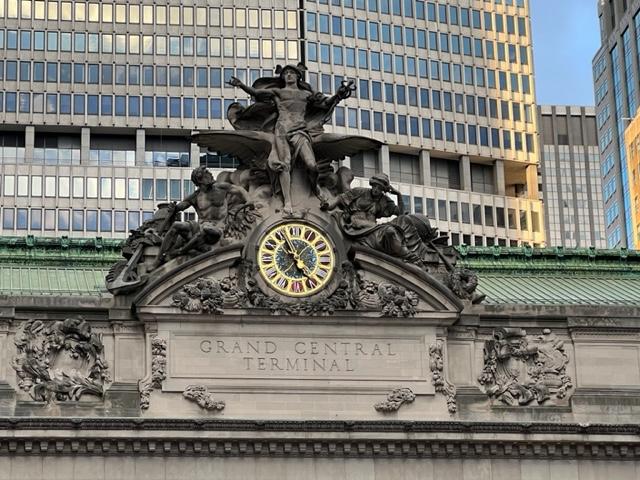
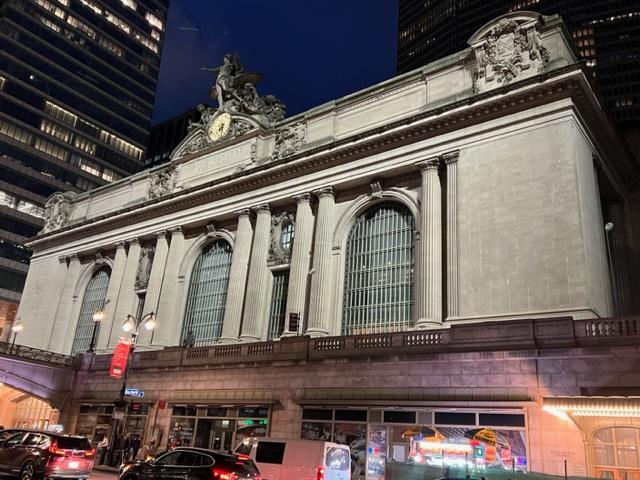
Grand Central Terminal entrance at East 42nd Street

History

One of the nicest events we have as members of the Cornell Club is the walking tours that the club offers during the year. It really does give you an interesting perspective of New York City. I have toured the historic bars and saloons of Lower Manhattan, walked through historic Midtown Manhattan for a Victorian Christmas through the Ladies Shopping Mile, walked through the haunted historic sites of lower Manhattan and toured Chinatown through some of its oldest buildings and then lunch at a local restaurant. I even got to sit next to the gentleman who helped the President of Bloomingdale’s organize the big “China at Bloomingdales” exhibition. Now that was interesting.

The latest tour I went on was the “Secrets of Grand Central Station” tour on a recent Saturday. A group of about 25 of us met at the club to tour Grand Central Station and learn about various points of the history of the building. The tour guide was over an hour late so everyone on the tour got to know one another before we left the club.

When the tour guide arrived, we took the two block walk to the club and started at the staircases as you enter the building at Vanderbilt Avenue.

The Grand Central Terminal is right around the corner from the club

The terminal was not that busy that Saturday morning and we were still able to walk around with no problems. We started the tour at the top of the stairs leading into the Great Hall of Grand Central Station. We were able to admire the room from a distance and all the activity that train travel brings.

As the tour guide explained, Grand Central Terminal was meant to impress a visitor when they arrived into New York City from wherever they were traveling from. You entered the room to see the elegance and vibrancy of Manhattan.

Though splendid in its day, the original Grand Central Depot of 1871 had become a 19th century relic struggling to meet the demands of a 20th century city. Its 30-year-old rail tunnels couldn’t handle the steadily increasing traffic. The building lacked modern conveniences and signaling technology, as well as the infrastructure for electric rail lines. And having been designed for three independent railroad companies—with three separate waiting rooms—the terminal was badly outdated, crowded, and inefficient.

On top of that, the old station no longer reflected its surroundings. In 1870, 42nd Street was still a relative backwater. By 1910, it was the vibrant heart of a dynamic, ambitious, and swiftly growing New York City (Grand Central Terminal History).

The new Grand Central Terminal was built between 1903-13 and opened in 1913. This beautiful rail station was designed New York Central Vice-President William J. Wilgus and the interiors and some exteriors by architects Reed & Stem and Warren & Wetmore in the Beaux Arts design. The exterior façade of building including the famous  “Glory of Commerce” were designed by French artists and architects Jules Felix Coutan, Sylvain Salieres and Paul Cesar Helleu (Wiki).

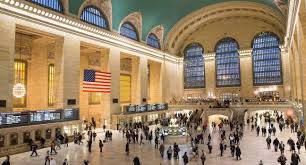
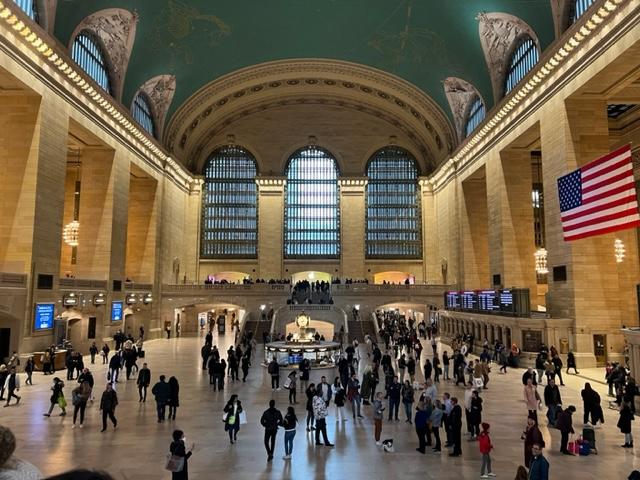
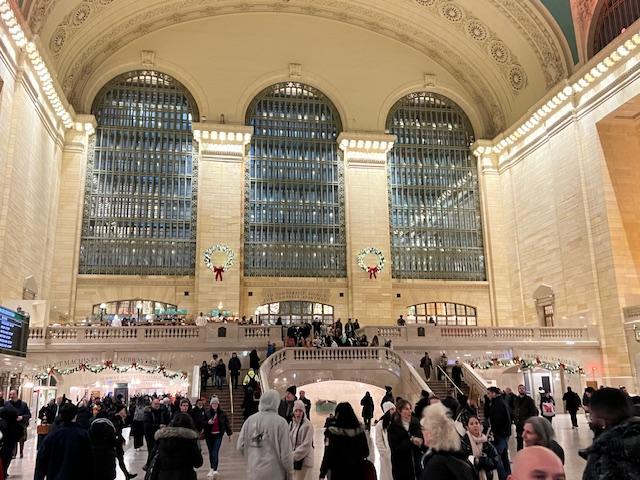
Grand Central Terminal Great Hall

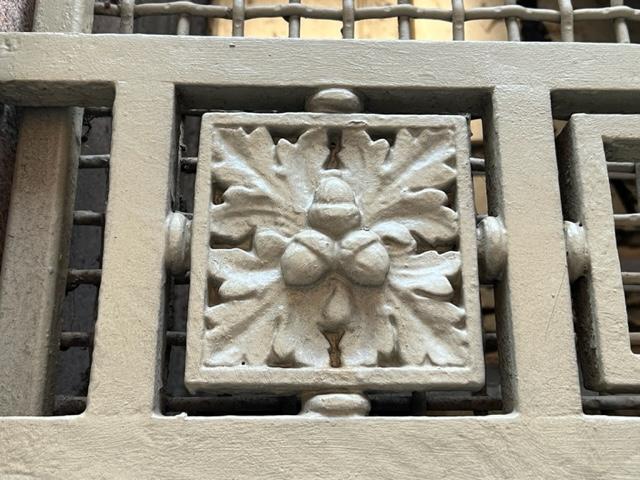
The architects brought in Parisian artist Sylvain Saliéres to craft bronze and stone carvings, including ornamental inscriptions, decorative flourishes, and sculpted oak leaves and acorns (symbols of the Vanderbilt family.) Playful carved acorns festoon the Main Waiting Room’s chandeliers. The architects specified Tennessee marble for the floors, Botticino marble for wall trim, and imitation Caen stone for the walls (History of Grand Central).

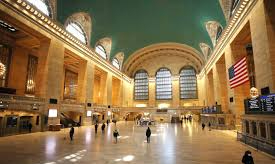
The Great Hall of Grand Central Terminal right before COVID 2020

The view of the Great Hall from the stairs at the Vanderbilt entrance

The Landmarks Preservation Commission protected Grand Central from demolition, but the dilapidated terminal was still ailing. Restoring its former glory required an owner that recognized the station’s beauty and potential, craftsmen able to renovate its battered décor, and strong public support. It also required money. In 1982, Metro-North took over the terminal—now primarily a commuter hub—and launched a four-year, $12 million repair program that stopped further deterioration but didn’t erase decades of decay (Grand Central Terminal History).

In 1990, Metro-North announced ambitious plans to restore the station’s structural, architectural, and decorative glory. Peter E. Stangl, Metro-North’s first president and later Chairman of the MTA, led these efforts. Metro-North’s vision went far beyond simply refurbishing the building. Its master plan reimagined Grand Central as a vibrant shopping and dining destination, reclaiming its role as New York’s town square (Grand Central Terminal History).

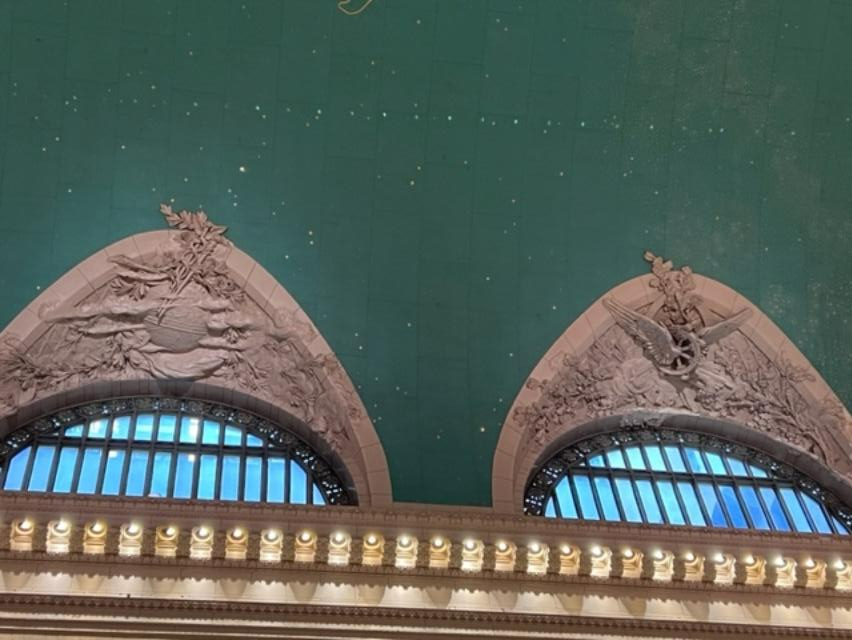
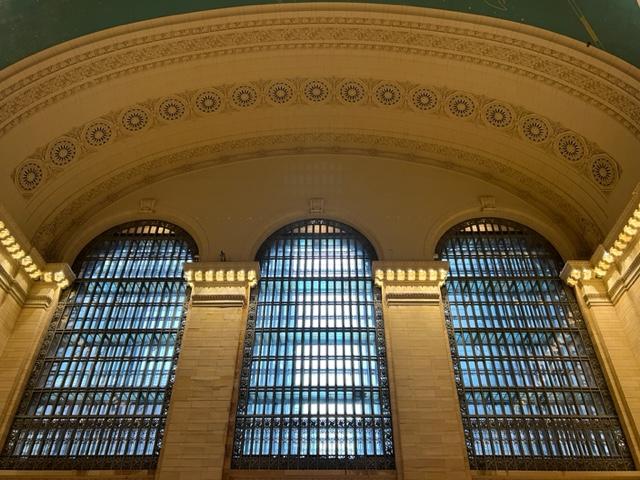
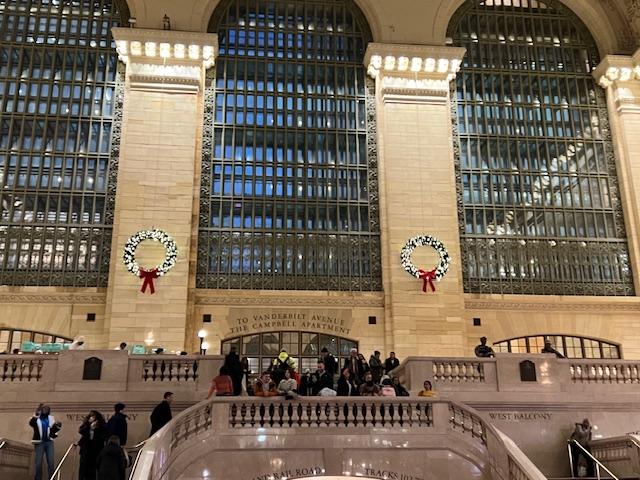
The windows and the ceilings of the Great Hall

All the art on the window arches is dedicated to travel. The friezes were dedicated to travel, motion and speed. The theme of the sculptures was travel. The sculptures were designed by Sylvain Salières, who designed many other decorations around the terminal.

https://en.wikipedia.org/wiki/Sylvain_Sali%C3%A8res

Artist Sylvain Salieres was born in France. He studied at the Ecole des Beaux-Arts, Paris. He taught at Carnegie Institute as a Professor of Art.

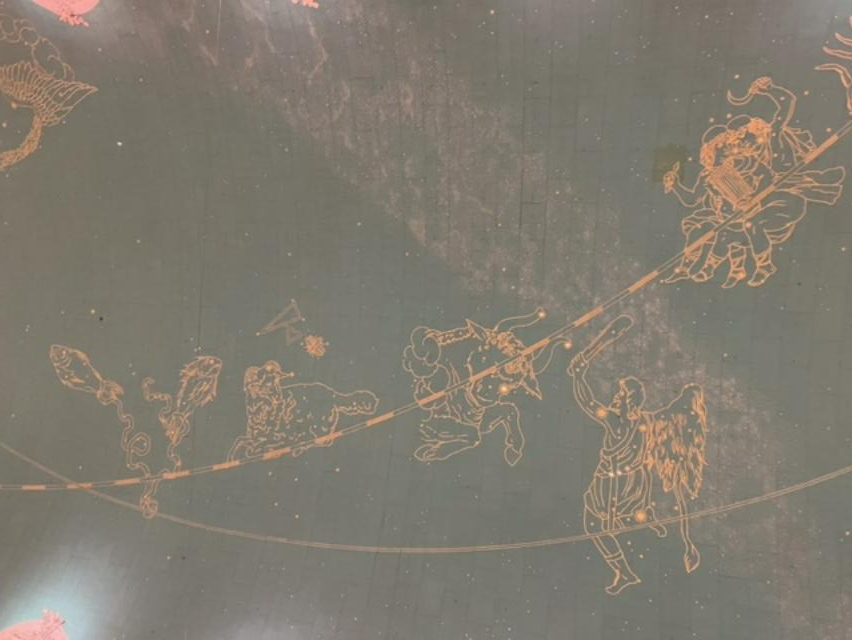
The interior of the building is just as spectacular. When you walk into the building and stare from the top of the stairs, you see the power and bustle of New York City. When you look up you will see the famous ‘Constellation’ ceiling cleaned and lit with all the stars in the sky. There is still a small portion of the ceiling that was not cleaned to show how dirty it once was before the renovation.

The ceiling of the Great hall shows all the constellations

The ceiling had been designed with the help of a professor from Columbia University who taught astrology. The tour guide told us it was after the completion of the ceiling that the constellations were upside down and backwards (which was also noted in the video as well). Still you can see its magnificence in the details and the fact that it is lit up with lightbulbs to represent the stars.

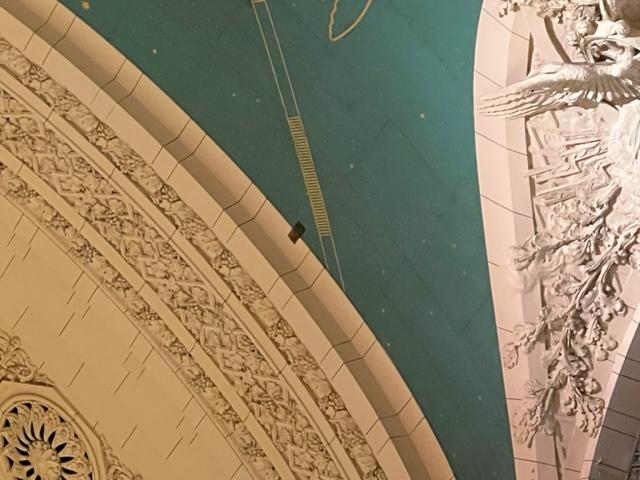
The dirt on the ceiling

This small spot left in the ceiling in the corner was what was left after they finished cleaning the ceiling and renovating the rest of the terminal in the early 1990’s. Both the tour guide and the video said that this was from years of allowing smoking in the terminal. That was banned in the late 1980’s and early 90’s by both the Giuliani and Bloomberg Administrations.

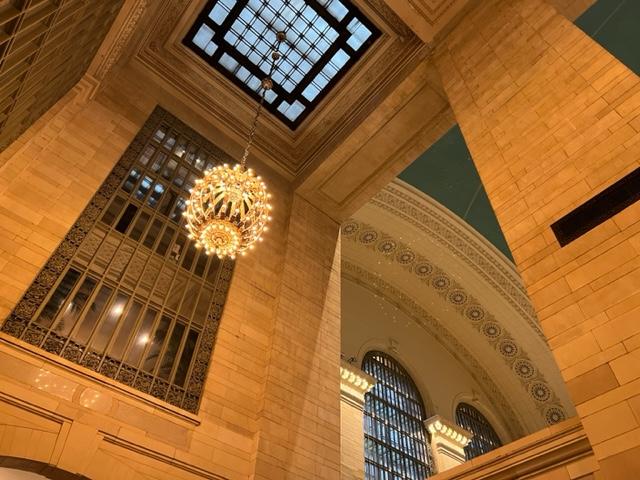
The windows of the Great Hall which have walkways going across balconies

The tour guide explained to us that the windows were also skyways where people could walk across them. I did not believe it until I looked up and actually saw people walking across the windows. They are actually skylights that are double paned and there are three levels of walkways for people who work in the building to walk across.

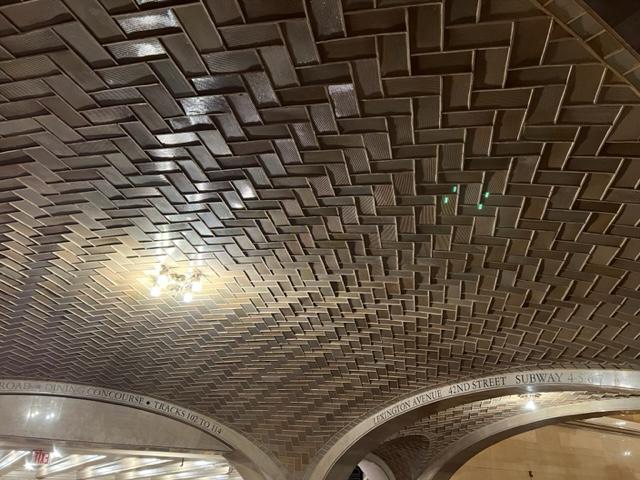
The tile ceilings of the “hallways”Whispering Hall” of Grand Hall

In all the years I have been visiting Grand Central Terminal the “Whispering Hall” was the most fascinating part of the tour. You can stand on one side of the hall and hear someone talking on the other side of the room. It was fun testing it out and it really does work.

This remarkable acoustic oddity is caused by the unusually perfect arches, which are a version of Catalan vaults, that compose the gallery. The distinctive tile work in the gallery is known as “Guastavino” tiles, named for the patented material and methods of Spanish tile worker Rafael Guastavino in 1892, whose meticulous work and herringbone patterns can be admired here and elsewhere in the city (Atlas Obscura/Wiki).

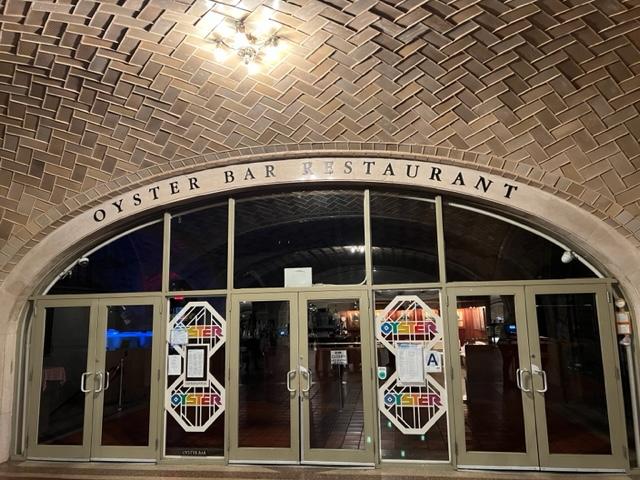
The Grand Central Oyster Bar Restaurant inside the main terminal

My review on TripAdvisor:

https://www.tripadvisor.com/Restaurant_Review-g60763-d484602-Reviews-Grand_Central_Oyster_Bar_Inc-New_York_City_New_York.html?m=19905

The Grand Central Oyster Bar was closed that day but is one of the oldest restaurants in the city and was located there for the commuters who came and went from the terminal. It has been there since the beginning.

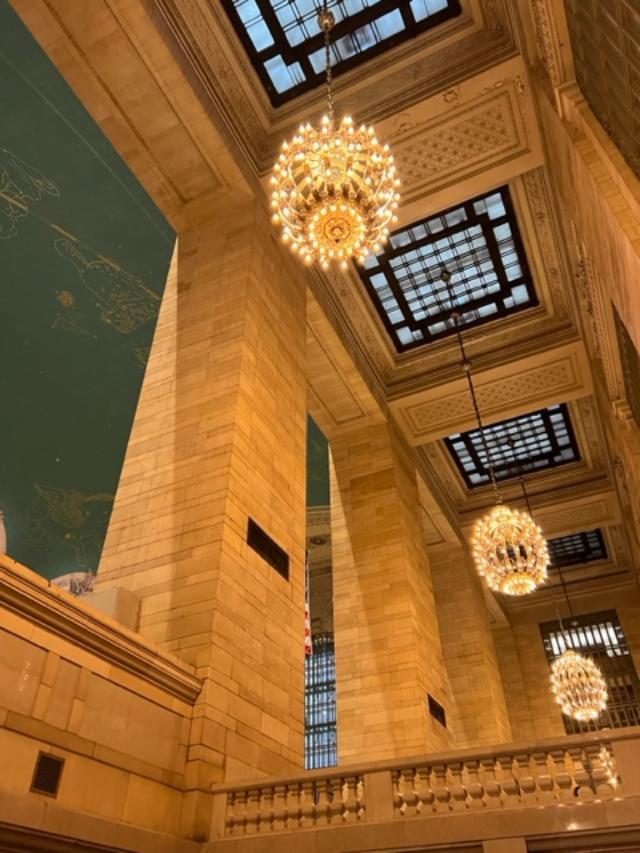
The chandeliers of Vanderbilt Hall make quite a statement. These were created to show off the new modern technology of electricity which was new back in 1913 when they were installed. The modern light bulb replaced gas lamps and candles of an earlier era. The Vanderbilts wanted to show how progressive they were with the railroads so these were created to dazzle the modern train rider.

The first part of the use electricity with these chandeliers

The vaults and chandeliers on the side of the Great Hall

A combination of soaring ceilings and modern lighting were to show the progress of the rail system and to dazzle customers as they came into New York City. These halls were meant to impress travelers when they entered this part of the Terminal.

The Vanderbilt’s wanted travelers to know that Grand Central Terminal was electrified which was unusual at the time when the building was built. This was very important as they wanted travelers to know that they were in the modern age of travel.

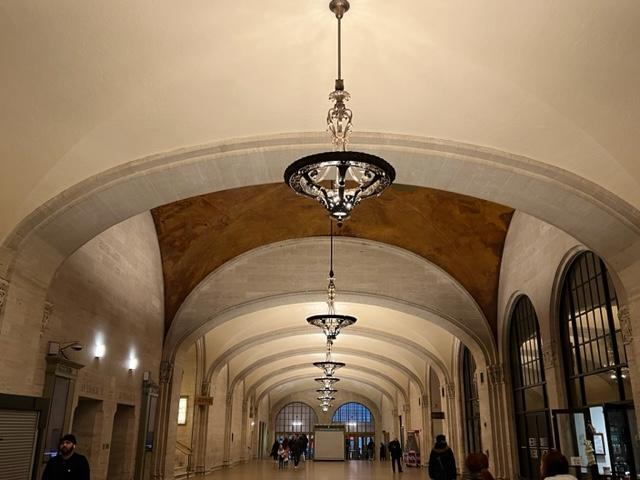
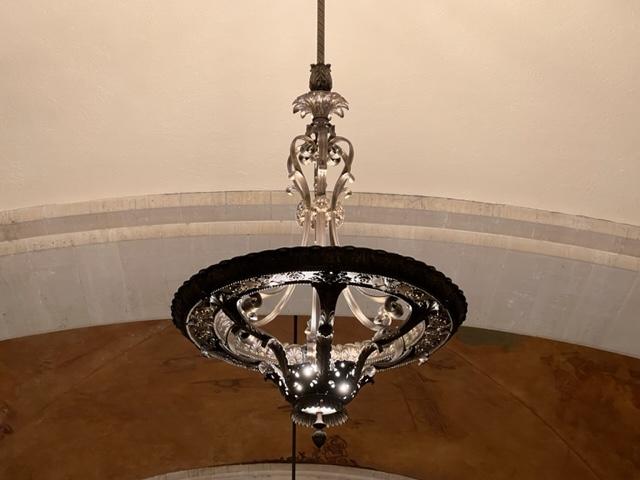
Next we toured the Graybar Passage Way which is part of the Graybar building that is part of Grand Central Terminal. The tour guide noted the very decorative chandeliers that lined the passageway.

The Graybar Passageway of Grand Central

The details of the chandelier in the Graybar Passageway

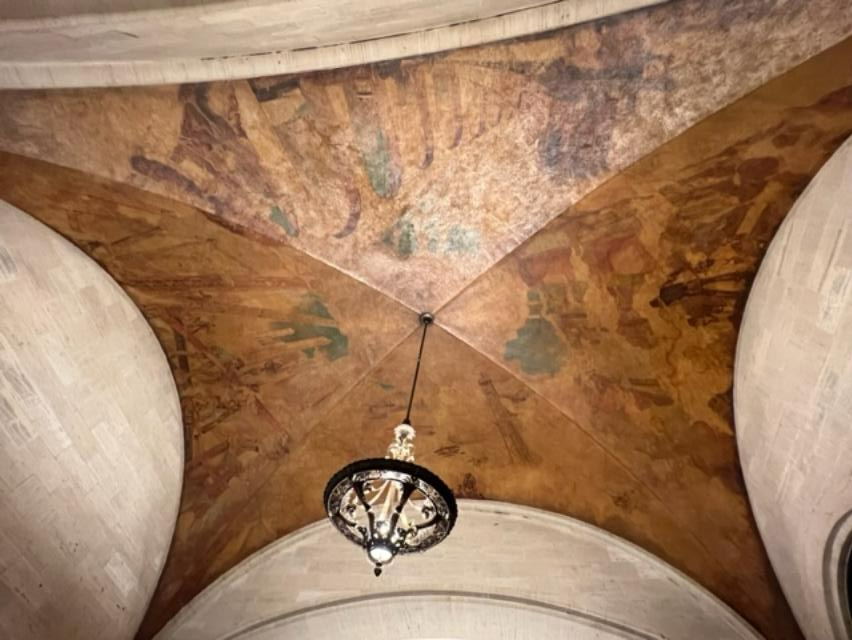
The mural on the ceiling

The tour guide and the video you can listen to below both explained that this mural was part of the original terminal from 1913. The mural is a bit faded and I had walked these hallways before and never noticed it. It is a depiction of train transportation. The video said that at the time murals should represent what the building was all about (Grand Central Terminal Video). I thought that was very interesting. It is very easy to miss.

The Food Court

We took a quick tour of the Food Court area in the lower level and some people had to go to the bathrooms. This is one of the many money making parts of the terminal and the profits help with the continuous renovation and upkeep of Grand Central Terminal. Since COVID, this are is still not at 100% of what it was pre-COVID but is still slowly making its way back. It has a lot of popular restaurants that are convenient to commuters, tourists and office workers alike.

The Food Court like most of the retail spots in the Terminal was created to bring in income for the renovation and upkeep of the Terminal. We headed back up the ramps to the main room and headed up the ramp and out the door. We stopped first in the Jacqueline Kennedy Onassis Foyer. This was dedicated to the former First Lady.

The Jacqueline Kennedy Onassis Foyer leading to East 42nd Street

Notice the lamp in the shape of an acorn. This was part of the Vanderbilt coat of arms. The coat of arms symbolized “from an acorn a mighty oak will grow”.

This entrance way was dedicated to Jacqueline Kennedy Onassis who with members of the Municipal Art Society and the City helped save this treasured building. With the recent destruction of Penn Station, the former First Lady lent her celebrity to helping save and preserve Grand Central Terminal.

Jackie Kennedy Onassis with Bess Myerson and Ed Koch in front of Grand Central (The Attic 2020) trying to save this landmark

Grand Central was symbolic of old Manhattan, a city her grandfather, James T. Lee, had helped build (highlights include 740 Park Avenue). Onassis also cared about historic preservation, having restored the White House to its former glory and saved Washington’s Lafayette Square from being replaced by ugly government office buildings in the early 1960s (Bloomberg 2013).

She was the star of a press conference in Grand Central’s Oyster Bar. “If we don’t care about our past we can’t have very much hope for our future,” she said into a bank of microphones over the din of flashbulbs popping. “We’ve all heard that it’s too late, or that it has to happen, that it’s inevitable. But I don’t think that’s true. Because I think if there is a great effort, even if it’s the eleventh hour, then you can succeed and I know that’s what we’ll do.” (Bloomberg 2013).

Jacqueline Kennedy Onassis Plaque in the foyer

This entrance was dedicated to her for all her work in preserving the building for future generations.

When we walked outside, the tour guide pointed at the grill work that surrounds the building. I never really thought of it because I had never looked at it before. All over the grill work is tiny acorns and leaves, the Vanderbilt coat of arms that was created by Alice Vanderbilt. They were all in the details of the grill work. This was a symbol of the Vanderbilt’s influence at that time.

The Grill Work on the outside of Grand Central Terminal

The Acorn Coat of Arms of the Vanderbilt family

Acorns and Oak Leaves are all over the Terminal as a symbol of the Vanderbilt family and the lasting of the family business. Within one generation the railroads and the family fortune would be gone.

The Statue of Mercury and the famous Grand Central clock “The Glory of Commerce”

Jules Coutan

Jules Felix Coutan artist

https://www.artsy.net/artist/jules-felix-coutan

There is a true beauty to the statuary and stone carvings on the outside of the building. Each of these were done by different artists. Some of the statuary was taken from the original railroad terminal such as the statue of Commodore Vanderbilt and the Eagle statues on both side of the front of Grand Central Terminal.

The Commodore Vanderbilt Statue

The statue was designed by artist Ernst Plassman a German born American artist who moved to New York in 1853. The artist studied under many famous artists in Europe before founding the “Plassman’s School of Art” in New York City in 1854.

Ernst Plassman

Artist Ernst Plassman

https://www.artprice.com/artist/197879/ernst-plassmann/biography

Cornelius Vanderbilt

Cornelius Vanderbilt

https://en.wikipedia.org/wiki/Cornelius_Vanderbilt

The Eagle statues were taken from the previous terminal.

They are two of the 11 or 12 eagle statues that ornamented the terminal’s predecessor, Grand Central Station. In 1910, when the station was demolished to build Grand Central Terminal, the eagles were dispersed throughout the city and New York State (Wiki). These two statues now are located on both sides of the Terminal. This eagle was returned to the Terminal in 2004.

The Eagle Statue on the outside of the front of the Terminal

The Vanderbilt Eagle plaque in the Vanderbilt Plaza

The terminal housed the New York Central Railroad and some of the busiest routes. It now houses the New Haven, White Plains and Poughkeepsie lines and stop overs for some Amtrak lines. In 2020, it was house the new lines of the Long Island Railroad.

The new Grand Central Madison Avenue Concourse:

The Grand Central Madison Avenue is a brand new terminal that is situated deep underneath Manhattan’s East Side. In the next few months, 296 LIRR trains per day will be rolling in and out of the terminal. This will mean more frequent train service to Long Island and better access to the East side of Manhattan.

The project was first proposed back in the 1960’s and then began in the 1990’s. After 25 years, the project was finally finished with an 11 billion dollar price tag. The project delays were because of budget cuts, 9/11, Hurricane Sandy and other issues that the City was dealing with over the last forty years. The terminal finally opened fully in March of 2023 (Tour Guide/Wiki).

This is the new Madison Avenue Concourse to the Madison Avenue Terminal

In the lower terminal, steel and glass creates a sleek, modern feel. As passengers rise toward the 350,000 passenger concourse and street level, however, visual references to Grand Central’s Beaux-Arts style will create a smooth transition to the century-old landmark above. The Grand Central Madison Terminal provides eight new miles of track to connect Long Island Rail Road to Grand Central Terminal. Transportation efficiency meets energy efficiency! Green design at the new LIRR concourse and terminal will combine maximum comfort with minimal power and water use (Grand Central Terminal History and tour guide). 

The new artwork that dots the terminal and all the hallways is just beautiful. Many artists were commissioned to decorate the new rail terminal. These glass mosaics decorate the halls and subway entrances to the new part of the terminal.

“River Light” by artist Kiki Smith

Artist Kiki Smith

https://en.wikipedia.org/wiki/Kiki_Smith

Kiki Smith  is a West German-born American artist[1] whose work has addressed the themes of sex, birth and regeneration. Her figurative work of the late 1980s and early 1990s confronted subjects such as AIDS, Feminism and Gender but her most recent works concentrate on the human condition and how it relates to nature. She studied at the Hartford Art School and is a member of Collaborative Projects, an artist collective (Wiki).

Further down the hall, we were greeted by this delightful and whimsical wall of surrealist images of happy and playful pictures. These engaging images were by artist Yayoi Kusama.

The artwork on the hallways of the new terminal area by Japanese artist Yayoi Kusama “A Message of Love, Directly from My Heart unto the Universe 2022”

“The other part of the artwork”A Message of Love, Directly from My Heart unto the Universe 2022” . The other side of the piece.

Artist Yayoi Kusama

https://en.wikipedia.org/wiki/Yayoi_Kusama

https://en.wikipedia.org/wiki/Yayoi_Kusama

http://yayoi-kusama.jp/e/information/

Artist Yayoi Kusama is a Japanese born artist who studied at the Kyoto School of Arts & Crafts and is known for her installments and sculptures but also works in film, performance art and fashion among other mediums and is known for influence in ‘Pop Art’ . She is currently the most successful living female artist in the world and is still going strong in her early 90’s. She currently is working on a second line of merchandise with Louis Vuitton (Wiki/Artist Bio).

Please watch the video of Yayoi Kusama

On the lower levels at each subway platform entrance, there is a new piece of art by Artist Kiki Smith, who continues to show here creativity in a series of local points of nature as she interprets it. Each work of art has a different theme and use of creativity and color.

The artwork at each track entrance “The Sound” by Artist Kiki Smith

The artwork at the track entrance “The Spring” by Artist Kiki Smith

The artwork at the track entrance “The Presence” by Artist Kiki Smith

The artwork at the track entrance “The Water’s Way” by artist Kiki Smith

“I made images from nature that hold affection and personal significance to me as I hope they will for others,” Smith said. “I am very honored to be included in the tradition of artists making work for the MTA, particularly as I have rarely had the opportunity to make something that lives within the public realm.” (6SqFt 2023)

We finished our tour at the last piece of artwork and then made our way back to the Cornell Club. I stayed for a half hour taking more pictures around the terminal and admiring the architecture one more time now knowing its history in more detail. It is amazing to walk around a building your whole life and never really know its history or its details. It was a wonderful tour.

The new modern entrance is now open for business and people can enjoy these wonderful pieces of art created for them to enjoy on their way to their trains and subways.

Grand Central Terminal at night

When I left for the evening, I got to see Grand Central Terminal at night and it really is nicely lit. You get to see the building at its best. It really is a beautiful building.

This was the closest tour I could find online of what I experienced:

Listen to the YouTube video while you are reading the blog. We had the same tour as on this video.

What is even more beautiful in Grand Central Terminal is it decorated for Christmas. Walking through the Great Hall with its towering wreaths and garland adorning the hallways.

Grand Central Terminal during the Christmas holiday season in 2023.

The beautiful wreathes adorn the walls of Grand Central Terminal. Christmas is such a special time at Terminal.

Alexis Bittar Store 125 Greenwich Avenue New York, NY 10014

Don’t miss the beauty and elegance of the Alexis Bittar stores.

The inside of the Alexis Bittar store in Greenwich Village

The elegant window displays at the store.

jwatrel's avatarLittle Shop on Main Street

Alexis Bittar Store

125 Greenwich Avenue

New York, NY 10014

(917) 365-5718

https://www.alexisbittar.com/

Open: Sunday 12:00pm-6:00pm/Monday-Saturday 11:00am-7:00pm

My review on TripAdvisor:

There are just some stores that stand out when you walk by them. Whether it is the merchandise in the window, the store displays or just window display itself that draws you inside. This is how the Alexis Bittar store is 125 Greenwich Street in Greenwich Village. It is just so impressive from the elegant displays in the window, the beautiful merchandise in the displays and when you walk in the very personal service and attention you receive. You do not see this much anymore.

Alexis Bittar at 125 Greenwich Avenue

What drew me in initially was the beautiful window displays which are surprisingly hiding under the scaffolding of the building which is being renovated.

The windows at Alexis Bittar showcase all the beautiful merchandise

The elegant styles of…

View original post 296 more words

Rosecrans 7 Greenwich Avenue New York City, NY 10014

Don’t miss this wonderful little shop in the heart of Greenwich Village.

Don’t miss visiting Rosecrans in Greenwich Village on a warm day for a drink and pastry and people watching.

Inside and out you can admire beautiful flowers

Don’t miss a relaxing breakfast at Rosecrans of Scrambled eggs with Chives and Cheddar on sourdough bread and a sweet Teddy Madeline on the side with freshly squeezed Orange juice. The breakfast I had recently was delicious.

For lunch, do not miss their Three Cheese Grilled Cheese with a Fresh Ice Tea. It is the perfect meal.

The quiet corner to dine in the store.

The amazing Three Cheese Grilled Cheese sandwich.

jwatrel's avatarLittle Shop on Main Street

Rosecrans

7 Greenwich Avenue

New York City, NY 10014

(646) 504-6864

https://www.facebook.com/people/Rosecrans/100063571299072/

https://www.instagram.com/rosecrans/?hl=en

Open: Sunday-Saturday 8:00am-8:00pm

My review on TripAdvisor:

https://www.tripadvisor.com/Restaurant_Review-g60763-d19402656-Reviews-Rosecrans-New_York_City_New_York.html?m=19905

The outside of Rosecran’s Florist Shop and Cafe in late October 2022

Ever since I started Graduate School at New York University, I walk to school every day from Port Authority to the Greenwich Village to get exercise and clear my head before classes start. This gives me a chance to walk around the Village and explore the shops and all the wonderful concepts that people are developing in their stores with creative merchandising and wonderful window displays. What lured me into Rosecran’s was all the beautiful floral displays in the window and the beautiful little cafe that was outside that seemed to be popular with the locals in the neighborhood.

The entire outside of the store was surrounded by flowers and plants and on a warm September or…

View original post 524 more words

J’s Pizza 96 Seventh Avenue New York, NY 10011

Don’t miss the wonderful lunch and dinner specials at J’s Pizza.

Don’t miss the pizzeria on the corner of Seventh Avenue

The wonderful selection at J’s Pizzeria

The Lasagna Dinner Special at J’s Pizza is excellent. The garlic knots are included in on the $9.00 special.

jwatrel's avatarDining on a Shoestring in the New York City area and beyond.

J’s Pizza

96 Seventh Avenue

New York, NY 10011

(646) 760-8120

https://www.jspizzamenu.com/

Open: Sunday-Saturday 11:00am-8:30pm

My review on TripAdvisor:

https://www.tripadvisor.com/Restaurant_Review-g60763-d4432818-Reviews-J_s_Pizza-New_York_City_New_York.html?m=19905

J’s Pizza at 96 Seventh Avenue

I have been coming to J’s Pizza for many years and had eaten here in the past after viewing the Halloween Parade in October. I just rediscovered it again when I started grad school in the neighborhood and forgot how good the food was when I dined here. The pizza slices are generous in size and their marinara and pizza sauces you can tell are freshly made and not from a can.

The sauces for all the meals here from the pizza, to the spaghetti and meatballs to the sauce that is the side to the many rolls and calzones is well spiced and has so much flavor to it. It really makes the dishes.

J’s Pizza counter is lined with pizzas and calzones

View original post 260 more words

Pane Pasta 58 West 8th Street New York, NY 10011 (Closed July 1st, 2025)

Don’t miss the delicious pizzas and pastries at Pane Pasta. Just walking in and looking at the cases will make you hungry.

Pane Pasta at 58 West 8th Street

https://www.instagram.com/panepastanyc/?hl=en

The shop closed July 1st, 2025

jwatrel's avatarLittle Shop on Main Street

Pane Pasta

58 West 8th Street

New York, NY 10011

(646) 891-0006

Open: Sunday-Saturday 9:00am-9:00pm

My review on TripAdvisor:

https://www.tripadvisor.com/Restaurant_Review-g60763-d20021095-Reviews-Pane_Pasta-New_York_City_New_York.html?m=19905

Pane Pasta at 58 West 8th Street

I found this wonderful combination bakery and gourmet shop when walking home from school one afternoon and exploring Greenwich Village. All the delicious pizzas and pastries in the window lured me in.

I had just eaten my lunch, so I was not that hungry and just wanted a snack. I saw the small doughnuts in the windows called Bombolones, which are yeast doughnuts filled with chocolate or vanilla cream fillings and then rolled in granulated sugar. The small one is $2.15 and the large one was $5.00. Don’t let the price deter you as it is a sweet and filling little dessert. The fresh vanilla cream played beautifully off the sweet dough and sugary topping. Each bite was wonderful, and it was…

View original post 559 more words