Sometimes you are in the right place at the right time and something wonderful and fun happens. My weekend up in the Hudson River Valley was like that when I was on a recent business trip. It was restful and I got my mind off school and work. I had to go to the Culinary Institute of America to talk to one of my old chefs for a project I was working on for my Innovations in Tourism class at NYU.
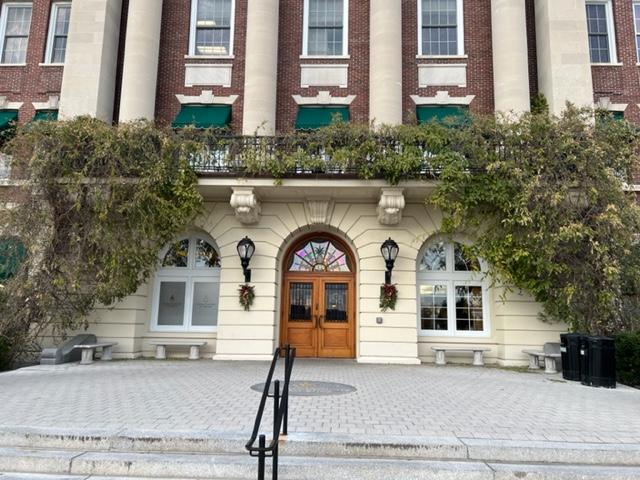
Roth Hall during Christmas time 2022
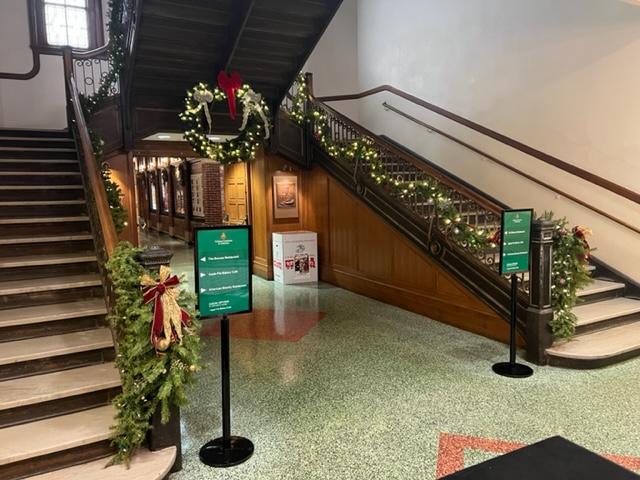
It was a step back in time for me walking around campus and talking to students in their chef’s gear. It reminded me of when I was attending the CIA and visitors asking me what it was like to be a student there. Roth Hall where I took all my classes was decked out for Christmas which I never experienced when I was on campus because I left campus in October when it was still warm and worked in Hawaii during the holiday season.
The inside entrance of Roth Hall decorated for Christmas
The outside of Roth Hall decked out for Christmas
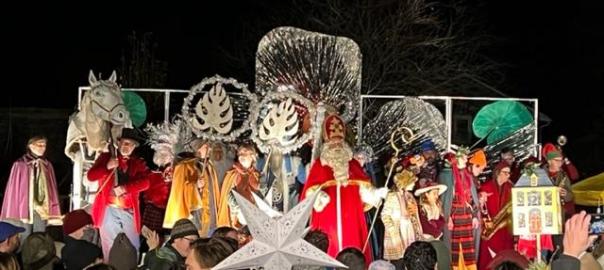
While on campus, I noticed in the paper that there was going to be a small Christmas celebration in Downtown Kingston, the “Snowflake Festival” from 6:00pm-8:00pm that evening so I thought I would just visit Kingston after I settled in the hotel.
My chef was not available that afternoon but it gave me a chance to walk around the campus and visit parts of campus that I had not visited since pre-COVID. It got to see some of the new buildings and renovations of the old ones. I forgot how beautiful the campus is on the Hudson River.
The campus was quiet because most of the students were in their night classes so the restaurants were preparing for evening dinner shift. Visitors were taking tours of campus so I took time to explore all the restaurants and see what they looked like. It was a step back in time to see that not too much had changed but the course levels and curriculum kept evolving.
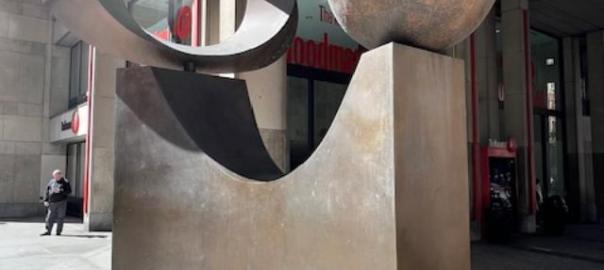
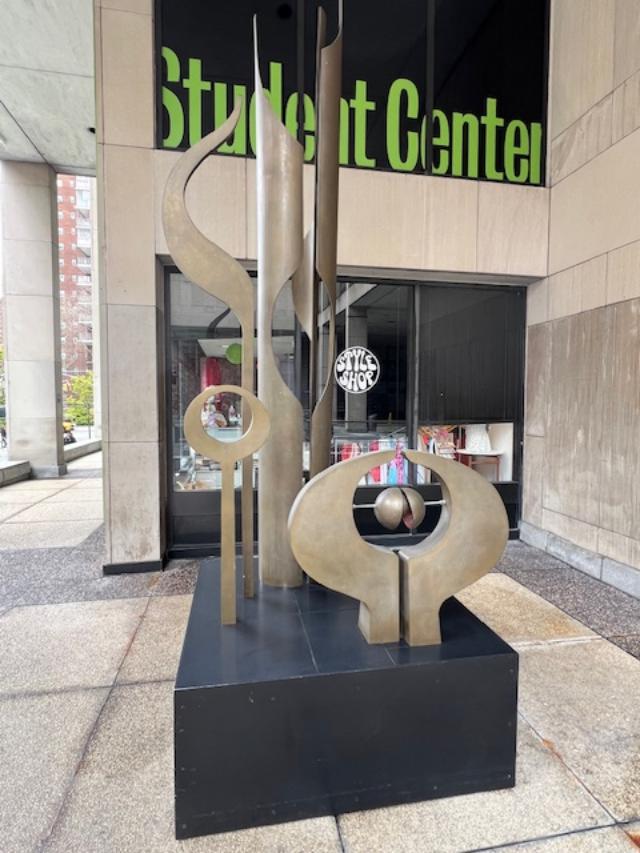
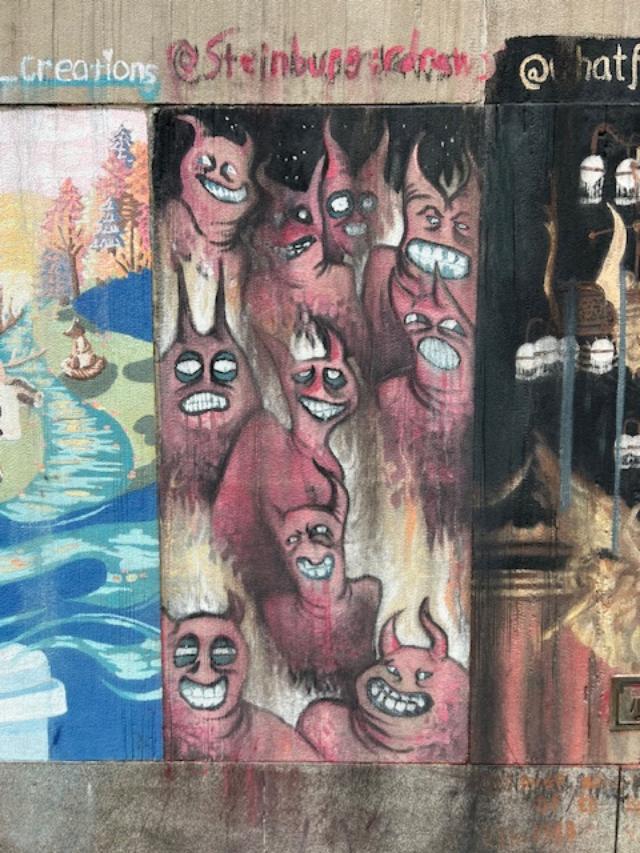
The artwork on campus is interesting
After a long tour of the building, I walked around the grounds of the campus. I visited the new Student Center and the Recreation Building to see all the happenings. They now have more clubs than ever and a series of sports teams. We never had those things when I was on campus. I walked through the “Egg”, which is the big cafeteria for the students and then the path outside the building following the Hudson River.
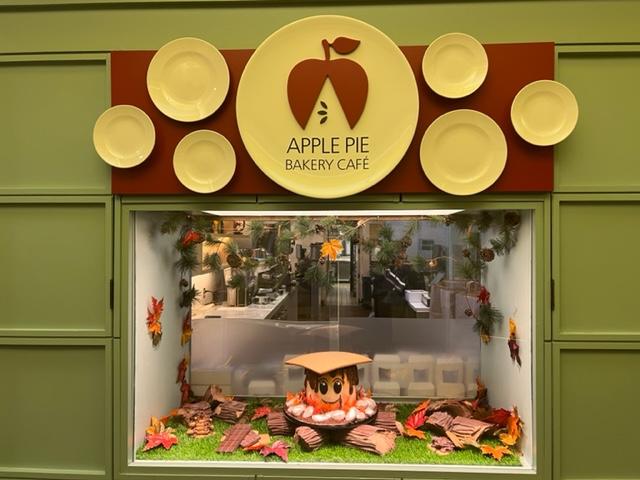
I knew that it was going to be a long day so I stopped for some lunch at the Apple Pie Cafe, which had not opened until I graduated. The Apple Pie Cafe is a Panera type restaurant featuring soups, sandwiches, small entrees and desserts. It is really popular with all the tourists.
The Apple Pie Cafe on the first floor of Roth Hall
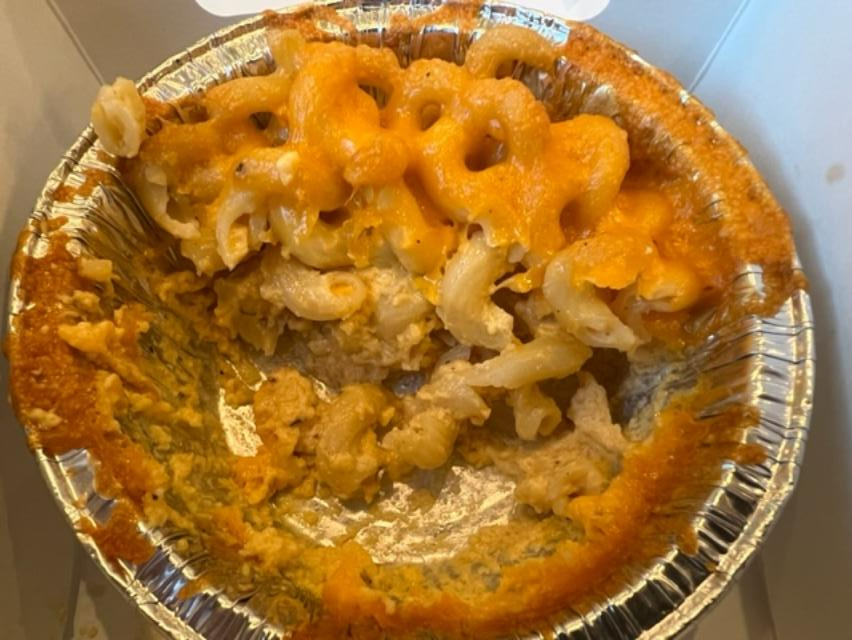
I got there near closing time so the menu was limited. I decided on the Mac & Cheese and an Apple Cider donut. Everything was delicious but then I would not have expected anything else. The Mac & Cheese was made of Cheddar, Asiana and Parmesan. It had been sitting so it was firm on the outside but still tender and cheesy on the inside and the flavor was excellent.
The Mac & Cheese is baked until crisp on the outside and tender on the inside
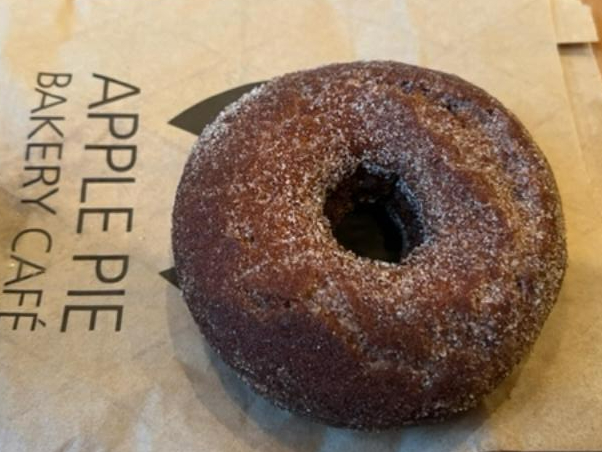
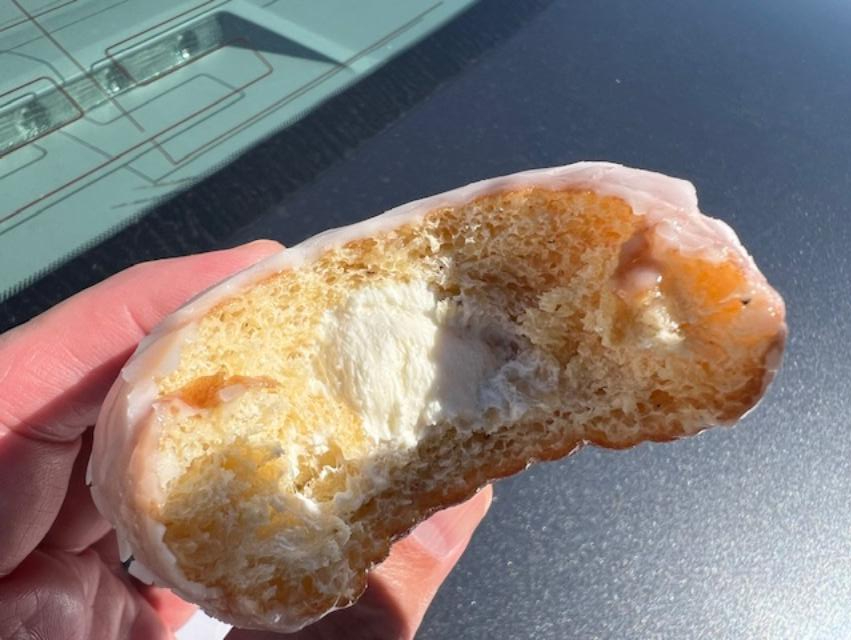
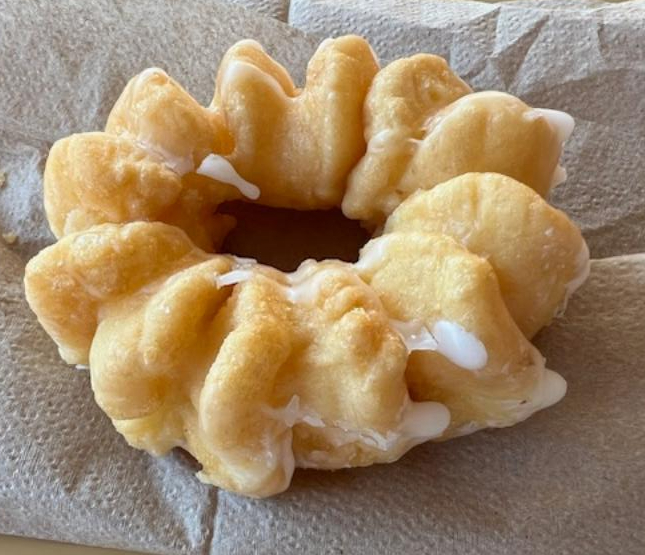
For dessert, I had one the Apple Cider Cake donuts and it was wonderful. The donut was freshly fried and then it was almost poached in a reduction of Apple Cider so the top was firm and the bottom was dipped in the reduction giving the bottom of the donut a sweeter taste.
The Apple Pie Cafe at 1946 Campus Drive on the Culinary Institute of America campus in Hyde Park, NY
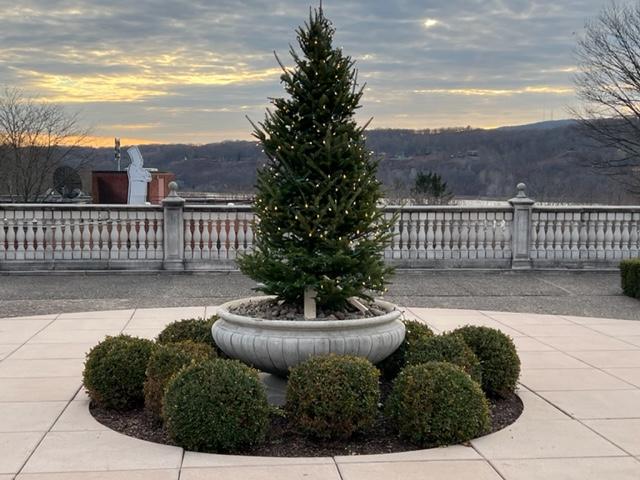
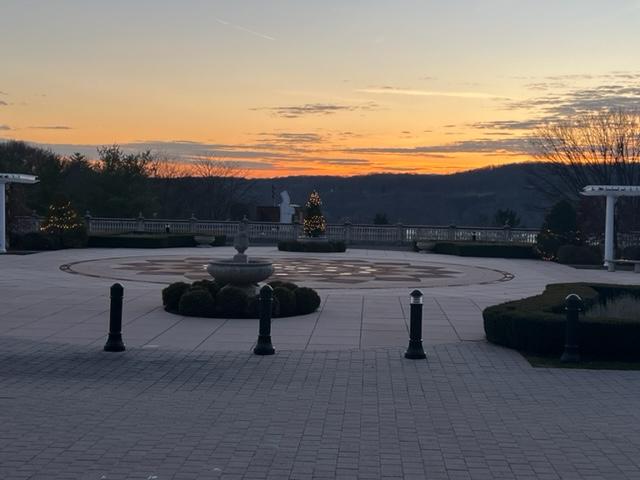
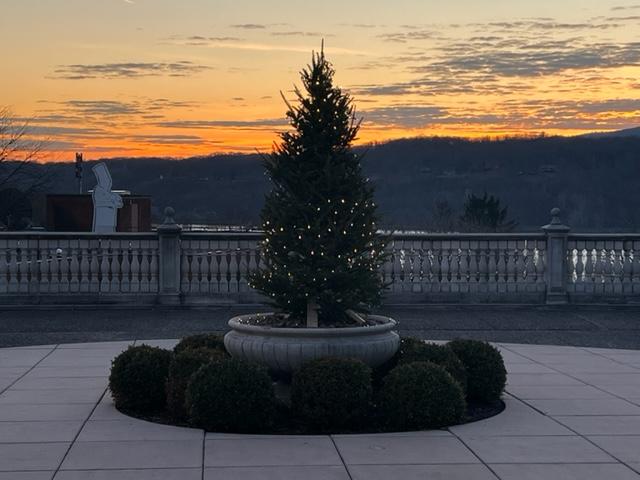
The whole meal was delicious and they let us continue eating after the restaurant was closed. They were just cleaning up the kitchen around us. After I finished that wonderful lunch, I got back to Heinz Plaza as twilight was happening and the sun was receding along the Hudson River. The Christmas trees were lit in the plaza and it looked very festive.
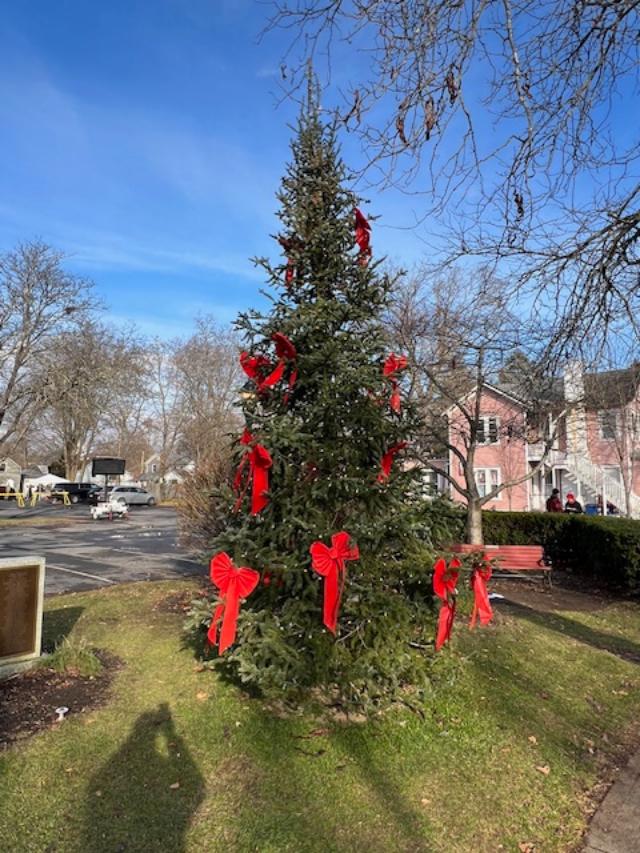
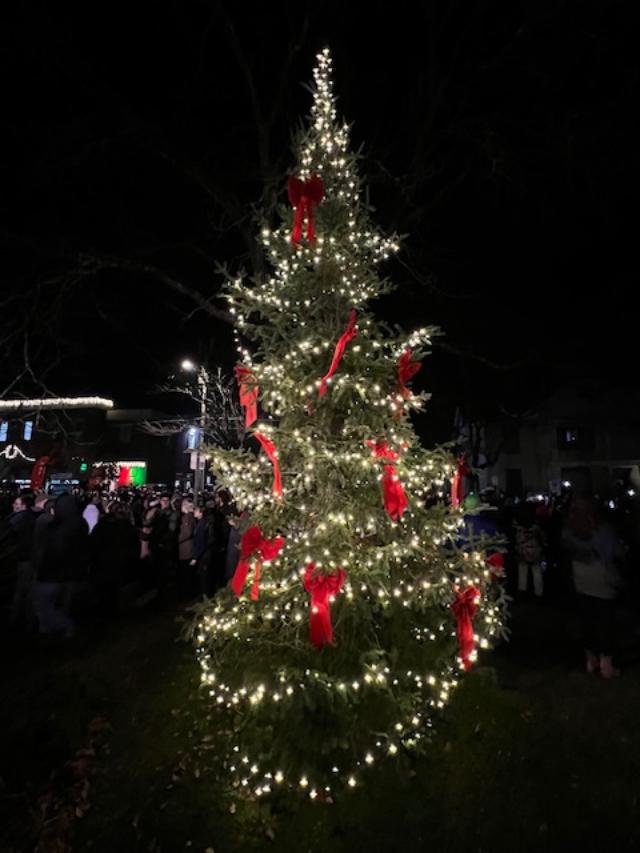
The Christmas Tree in the Courtyard was lit for the evening and the site of the Tree was wonderful.
I went back outside to see the Christmas tree in the courtyard lit. The whole effect was very beautiful.
I left campus that day refreshed after a good lunch and a long walk and wanted to relax at the hotel before I left for Kingston. It was just nice to sink into the bed of the Quality Inn in Hyde Park. The rooms are so comfortable and the beds are soft and firm. I just relaxed in the room for about an hour and just took it easy. It had been a long week of classes at both colleges.
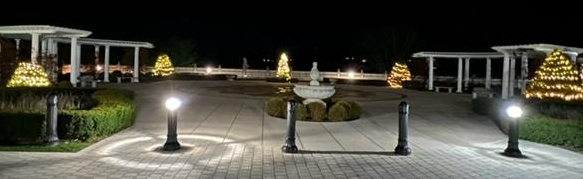
The Courtyard at night
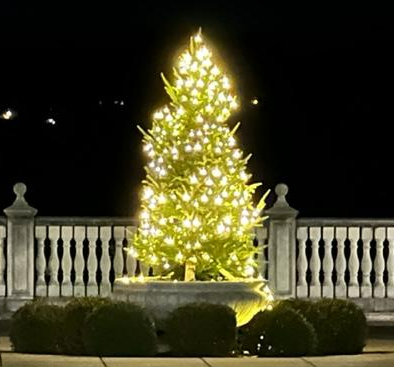
The campus Christmas tree was fully lit when I returned to talk to Chef Zearfoss
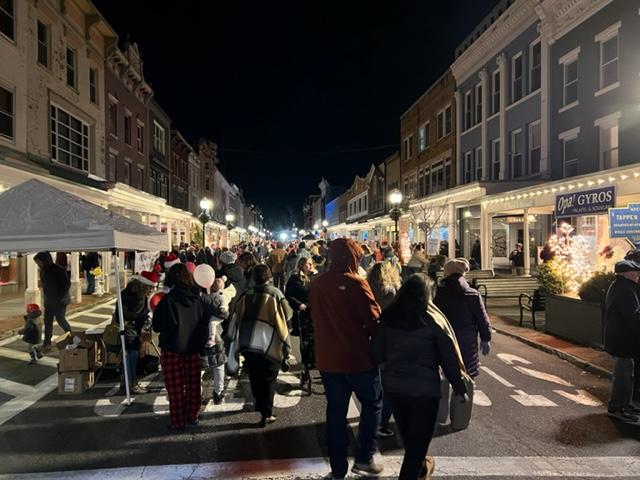
I left for Kingston, NY across the river and got to the Stockade section of the City around 6:00pm when things were just starting up. The weather was perfect and it was around 50 degrees when I got there so the streets were really busy with people walking around to hear the bands.
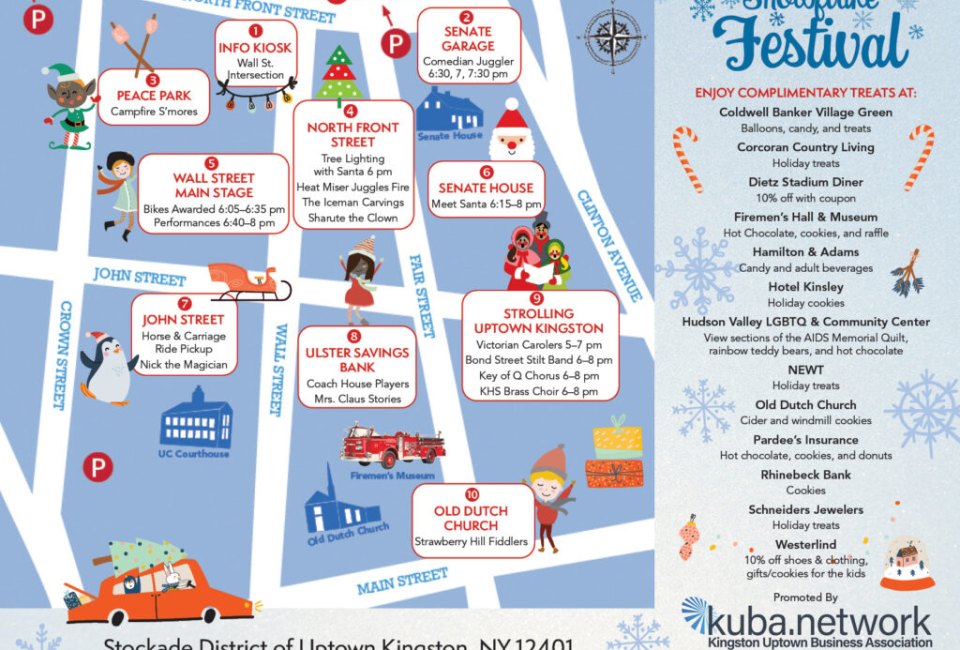
The “Snowflake Festival” in Downtown Kingston, NY
The town had a lot of activities going on that night
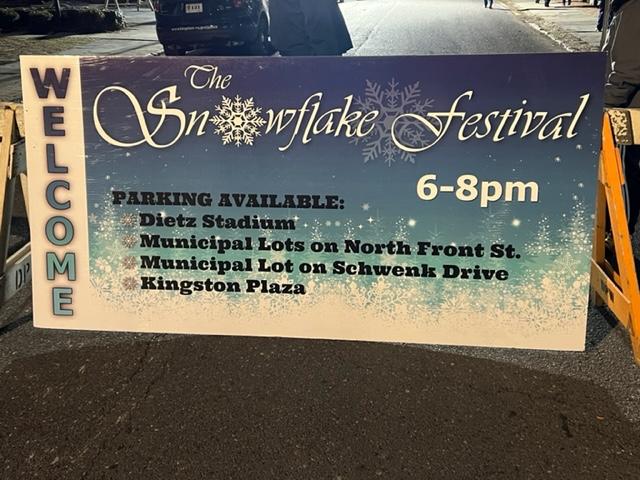
I was greeted by this festive sign welcoming people to the festival
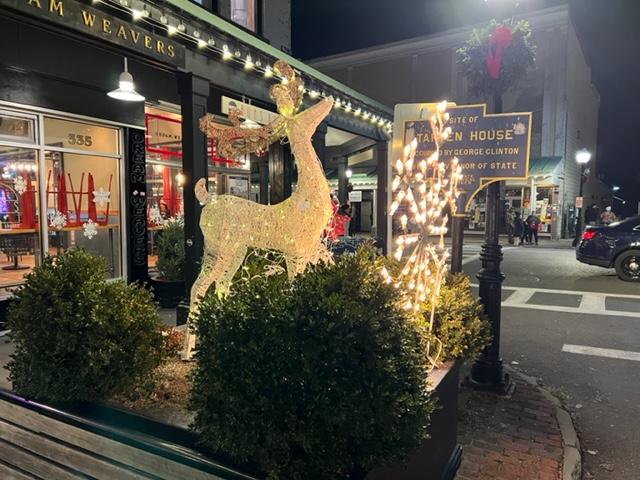
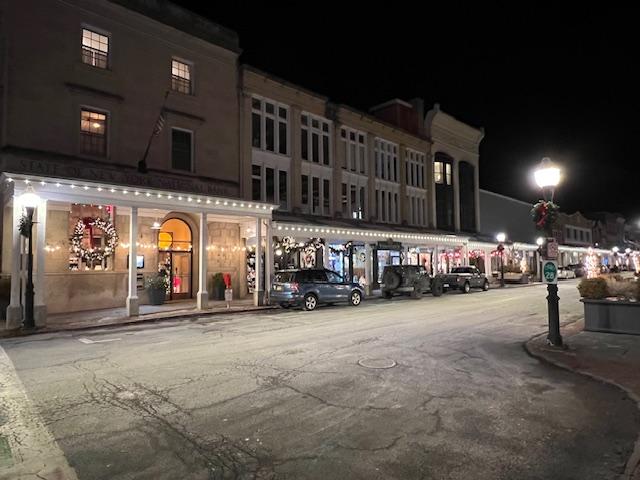
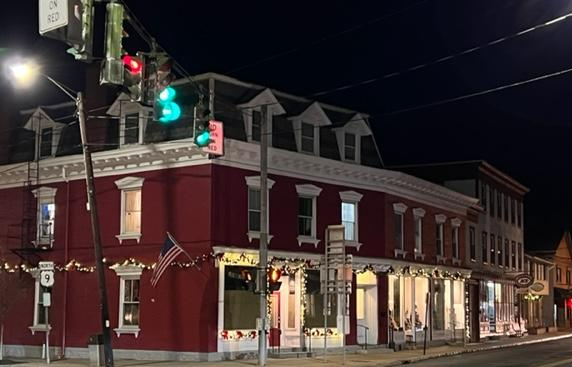
Downtown Kingston’s Stockard section was beautifully decorated for the holidays
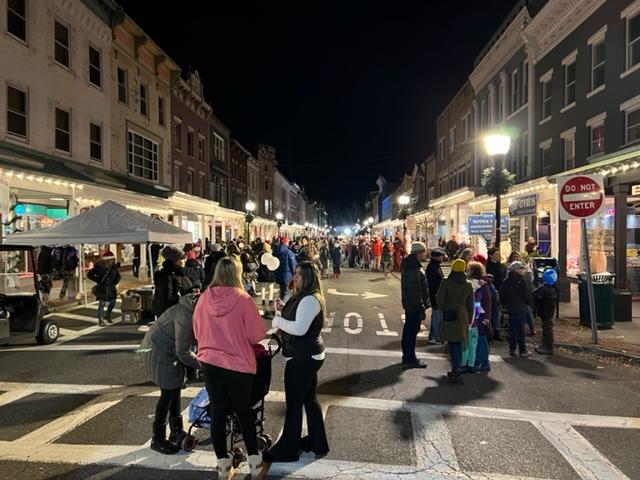
I got the Stockade neighborhood in the oldest part of Kingston by 6:30pm so people were just starting to arrive when I got there to join in the festivities. The crowds were starting to grow as the evening progressed as it was a crisp but pleasant December evening. It was not too hot and not too cold. It was the perfect 48 degree evening.
People arriving in the Stockage section of the City of Kingston, NY
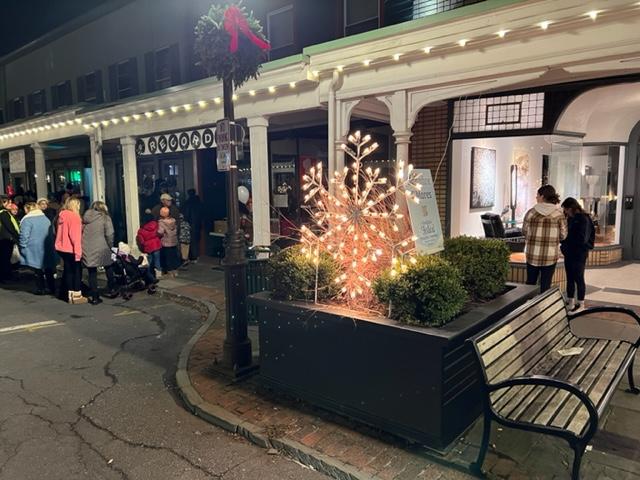
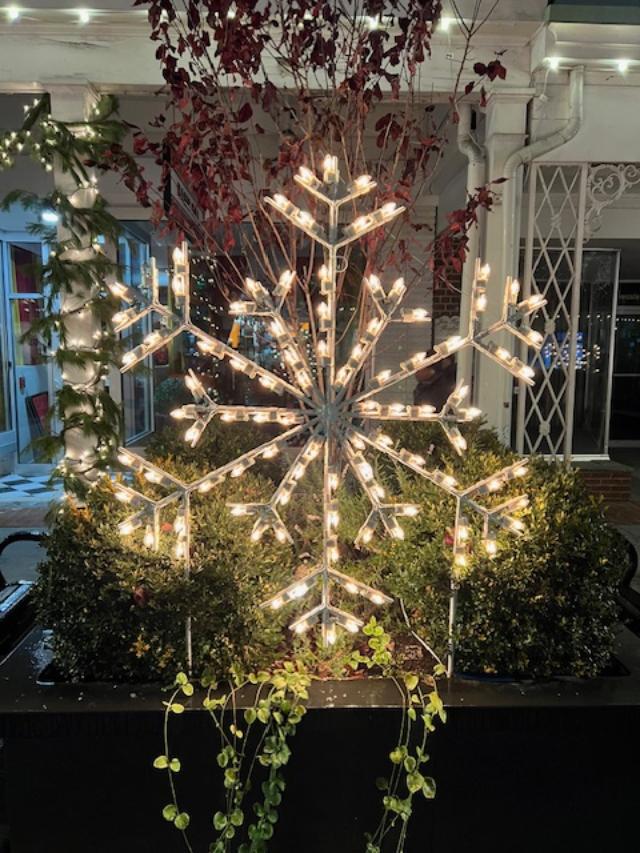
Snowflakes decorated the whole downtown area
The crowds kept growing through the evening
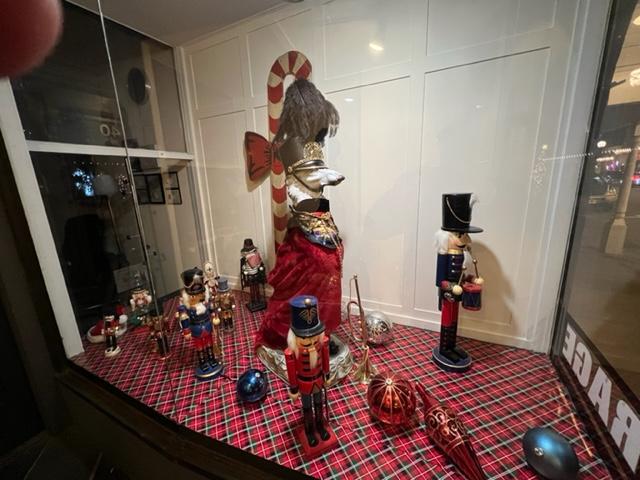
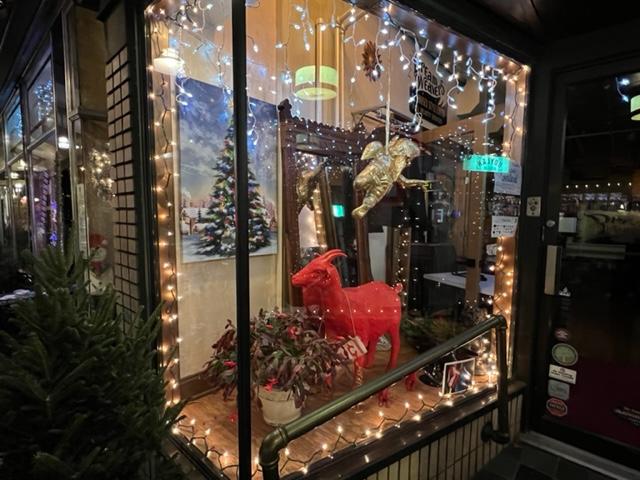
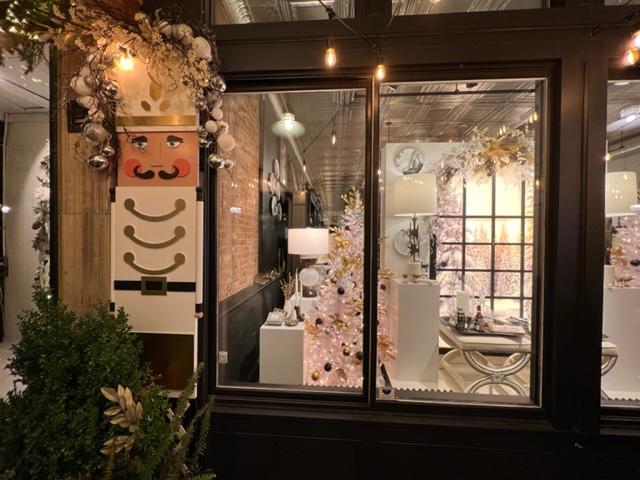
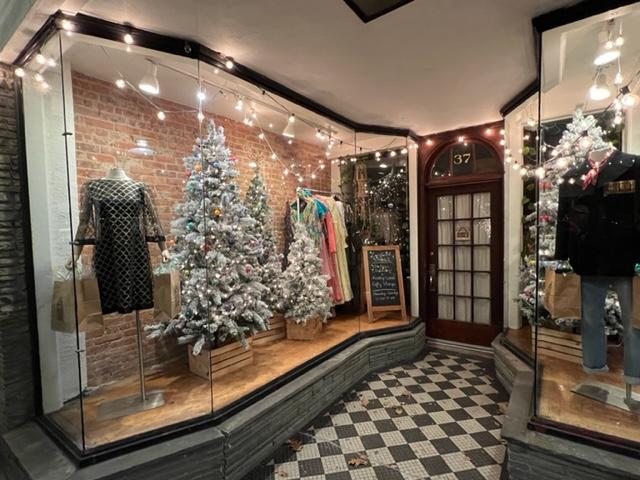
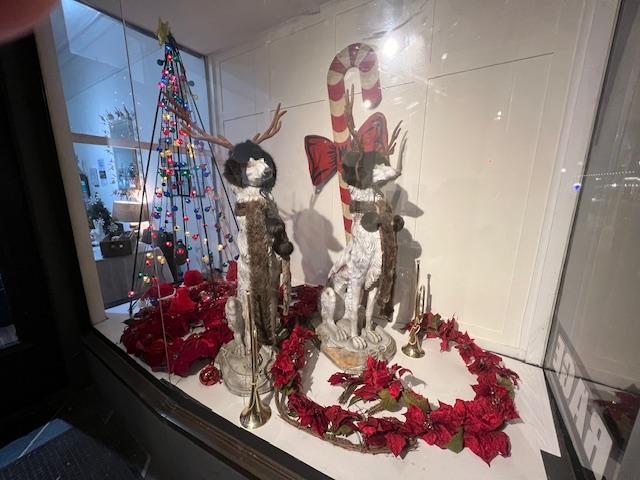
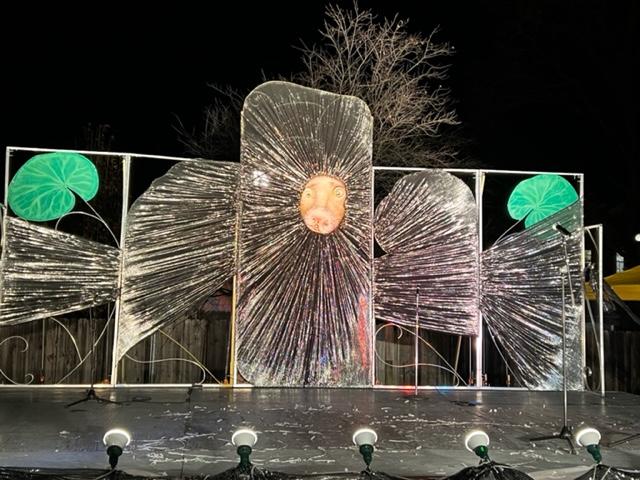
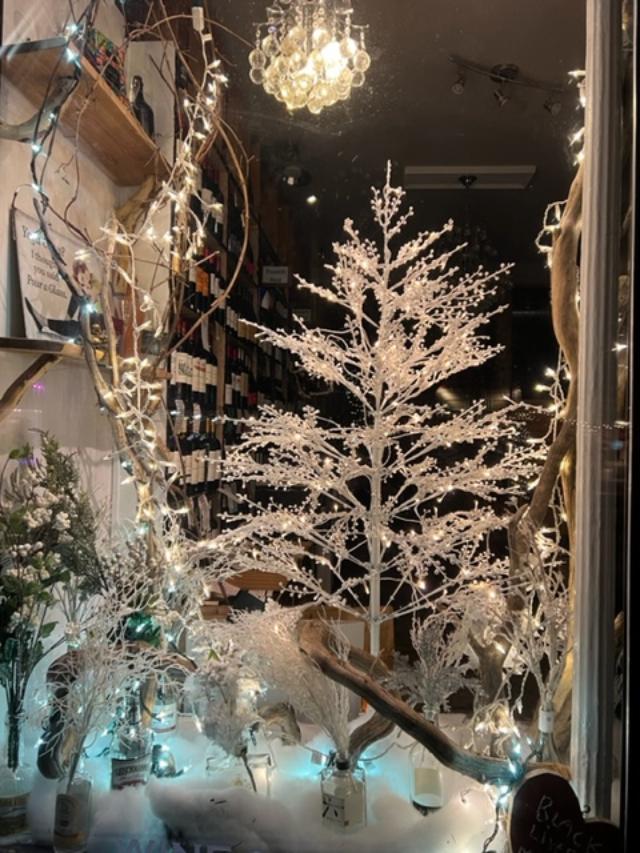
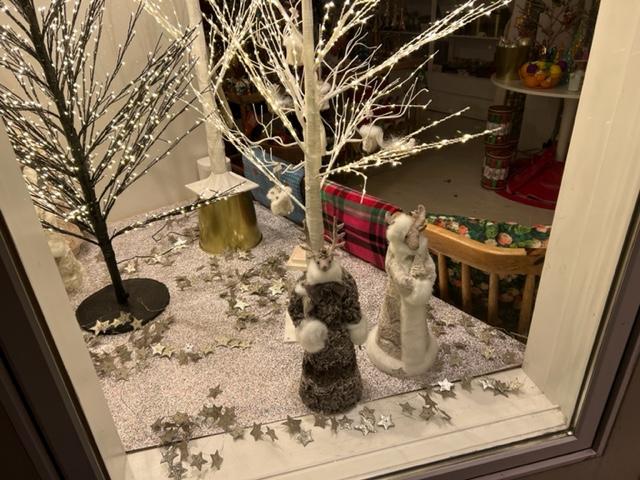
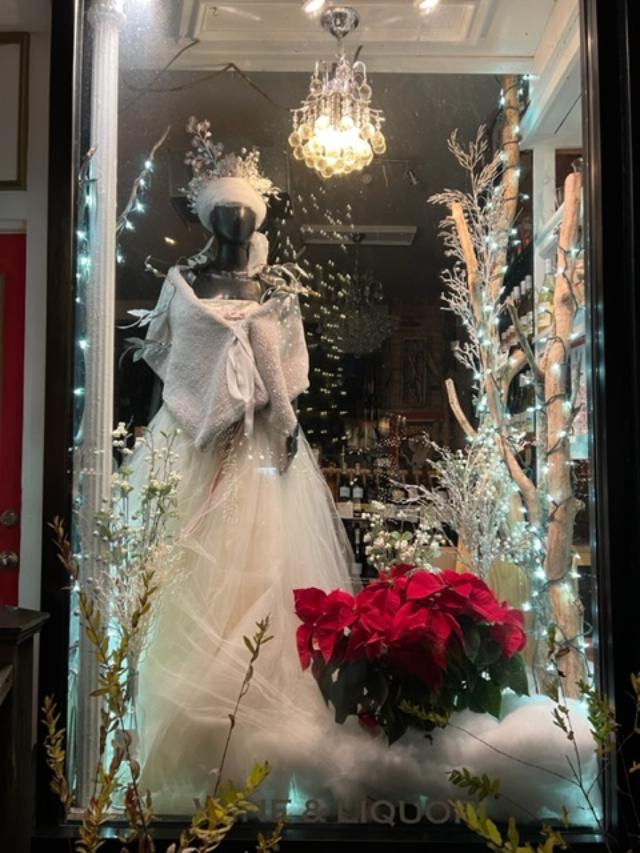
It was really a fun evening. The City of Kingston had a lot of activities planned all over the downtown and people were walking all over the decorated downtown. All the lights were on all over the streets and the main streets were lined with Christmas lights and snowflakes. The display windows of the business were decorated to the hilt for the holiday season.
Downtown merchant window display
Downtown merchant window display
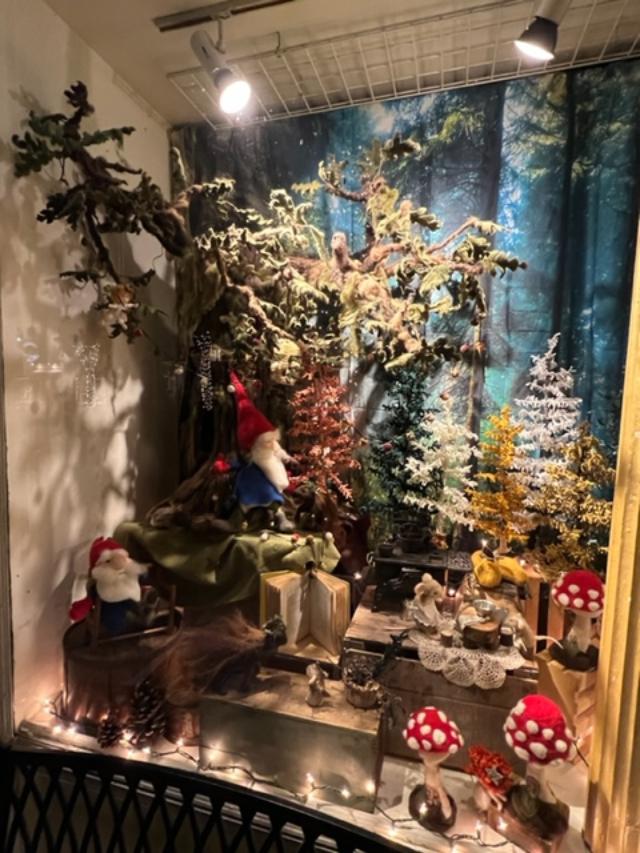
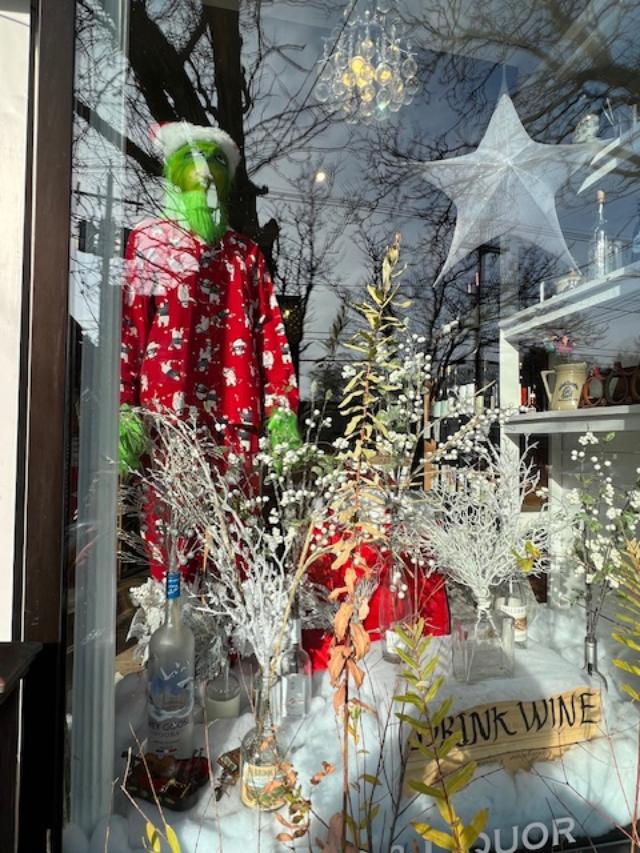
My favorite window display was a home furnishing store on the main street
The merchants of Kingston really went all out for the holidays
The merchants in Kingston really got into the spirit of it all
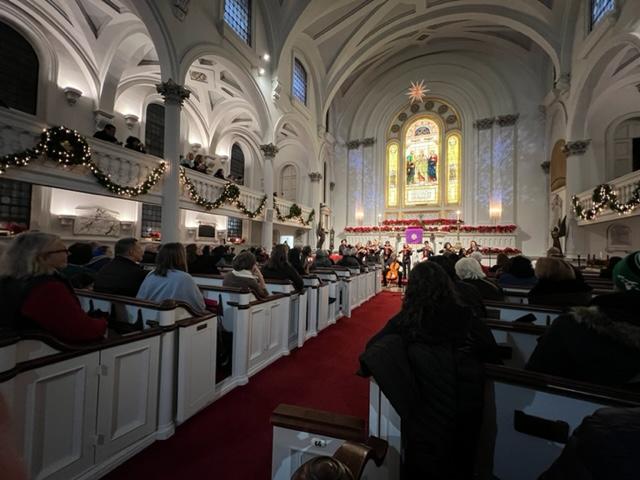
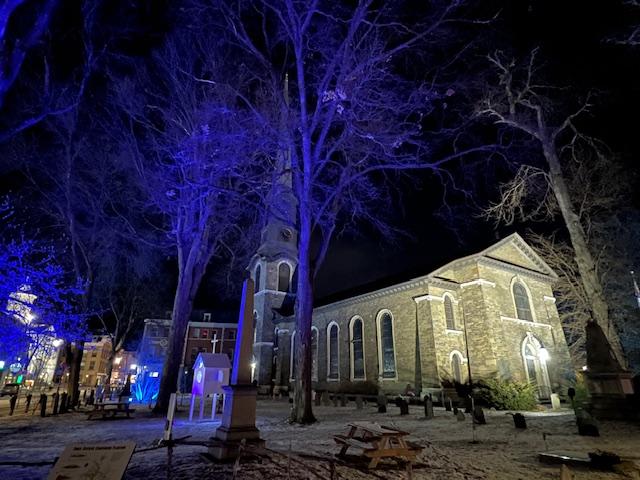
I first wondered around the downtown on where to start first and just walked all the streets of the downtown area to see what was going on. My first stop was the Dutch Reformed Church were they were going to have a series of concerts. I had been there many times for Sinterklaas fundraisers in the past but had not been there for this event.
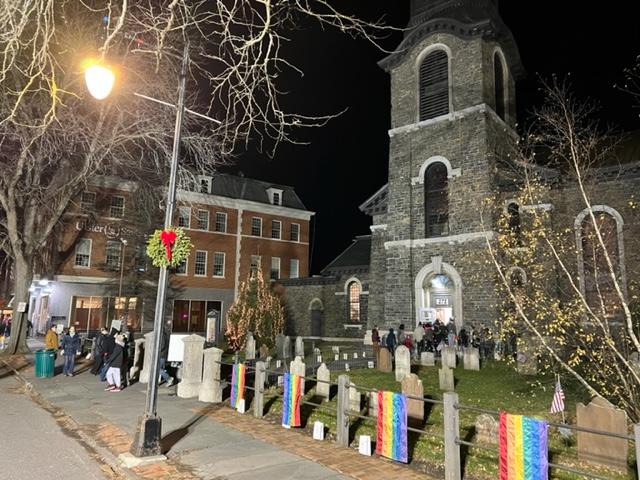
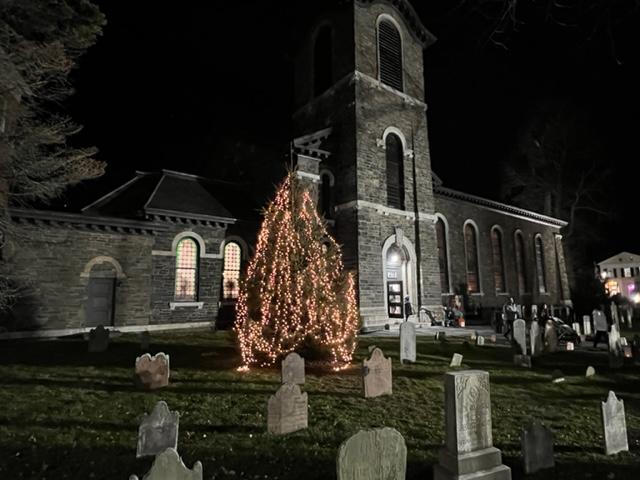
The church was all decked out with garlands and lights for the Christmas holiday season. I love these old churches when they are decorated for the holidays. There is such a beauty to them and so many traditions that they are a part of in the community. This church is in the center of old Kingston and always has such interesting events.
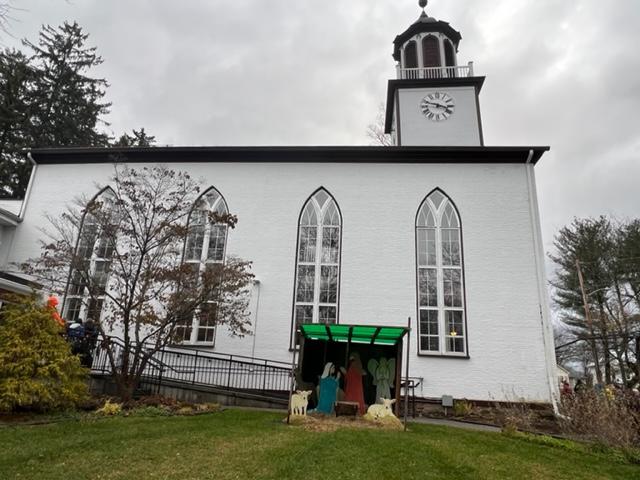
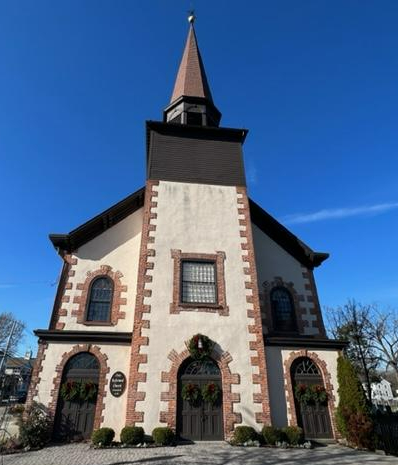
The outside of the Dutch Reformed Church of Kingston at 272 Wall Street was very festive with garland and lights
I had been in the church before for Sinterklaas fundraisers but never in the main part of the church where services took place. It is one of those old 19th century churches with the wooden pews, the elaborate stained glass windows and the high pulpit above the congregation.
The church was decorated with lights, bows, holly and garland all over the pews and aisles. It is amazing how secular these churches are getting for the holidays. The concert was a lot of fun and very festive. They not only performed classic hits, contemporary music but also some traditional Christmas songs. It really got everyone in the mood for the holidays.
The concerts were very lively
After visiting the church, I walked around the grounds. It is amazing how short the distance is between Halloween and Christmas but the lines are getting more blurred every year. It seems that time is flying by between the two holidays. I even see some of the Halloween merchandise still sitting on the shelves in stores.
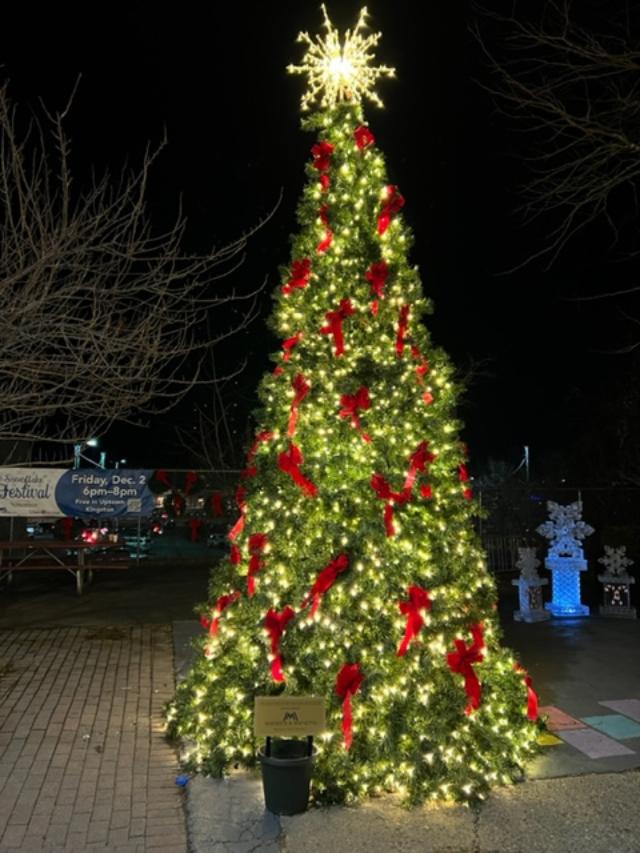
I followed the carolers around the downtown area and took several pictures by the Kingston Christmas tree. Their tree was very impressive this year and beautifully lit for the holidays. Downtown Kingston was very beautiful that evening as I admired all the buildings that were being renovated and all the new stores opening up.
The Downtown Kingston Christmas Tree on Main Street
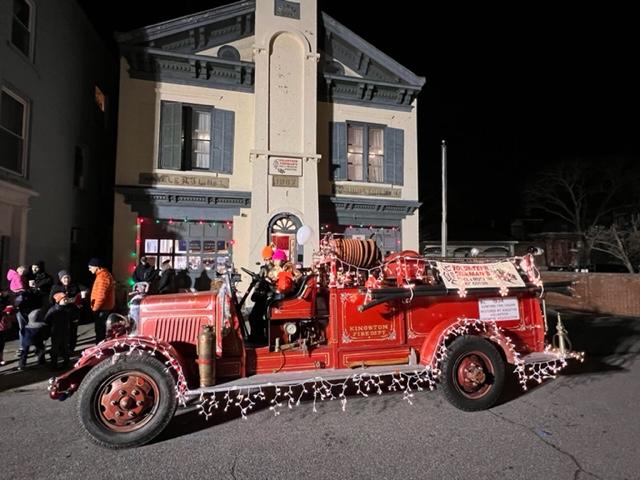
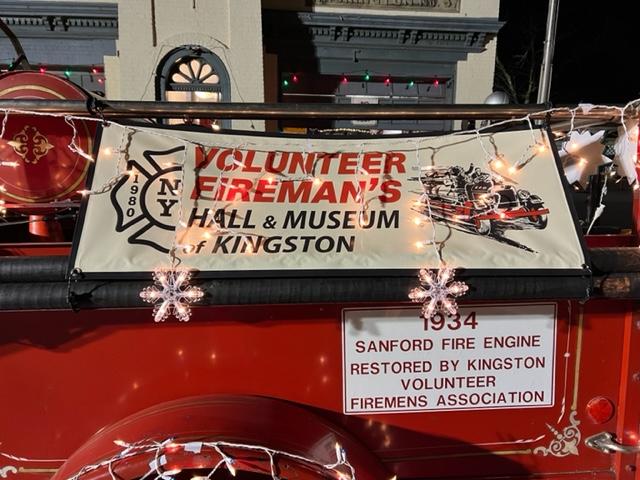
I walked around the streets and I came to the Kingston Volunteer Firefighters Museum that was open and decorated for the holidays. They even had an antique fire engine in the front of the museum decorated with lights.
The Volunteer Firemen’s Hall and Museum at 265 Fair Street
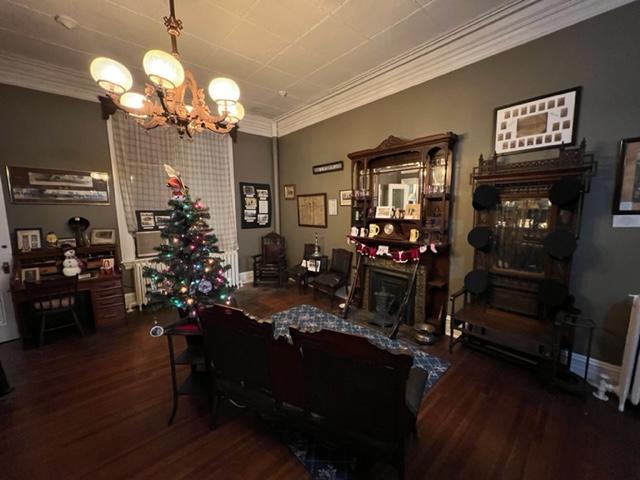
The retired firefighters from the former volunteer companies really did a great job dressing the museum up for the event. In the upstairs Chief’s office, there was garland and a Christmas tree.
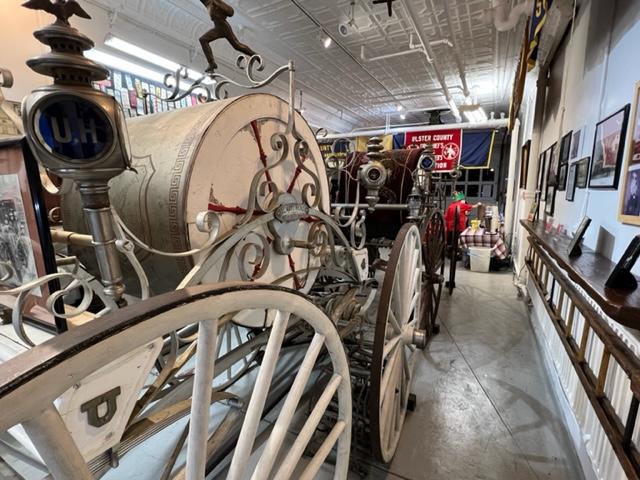
All the equipment was shined up for the open house and all the firemen were swapping stories with those of us in the fire service who understood what we were talking about. They had some pretty good stories to tell. What I like about visiting this museum is all the antique equipment they have on display.
I love the parade hose beds that the museum has on display. These elaborate pieces are the pride of these fire companies and were out for every parade.
Before I left though, I had the worst (I mean worst) cup of hot chocolate that I ever drank. It tasted like it was cooked in a burnt pot. I had to throw that out and find something else to drink.
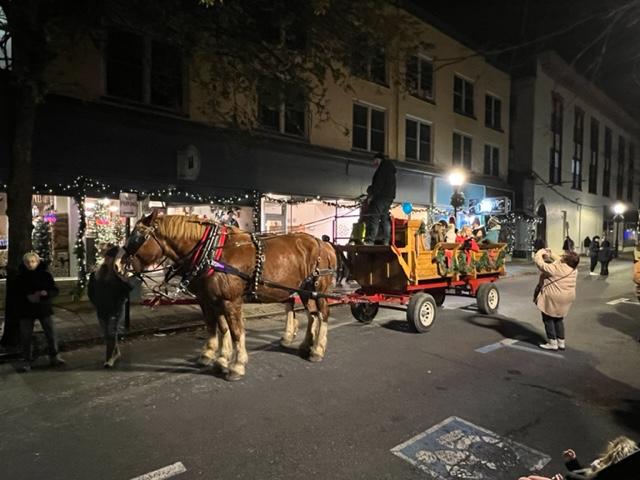
After the fire museum, I turned the corner to see the horse drawn carriage rides that were available. I loved the look of the carriage with the horses decked out for the holidays and the driver in a top hat. The only problem was there was one driver and the line even towards the end of the event was fifty deep. I did not know how they were going to get through all those people before it was time to go.
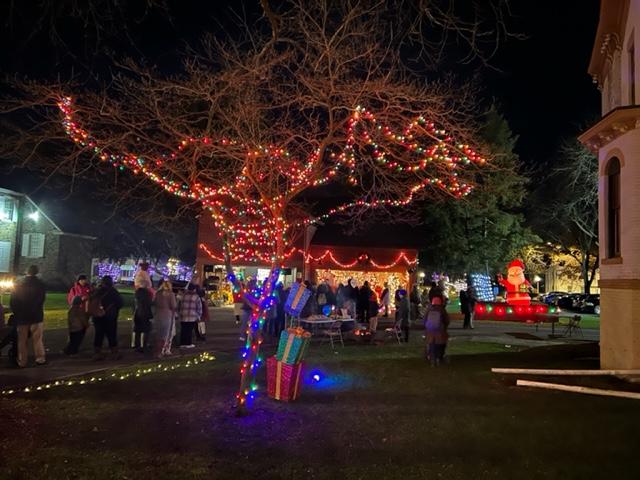
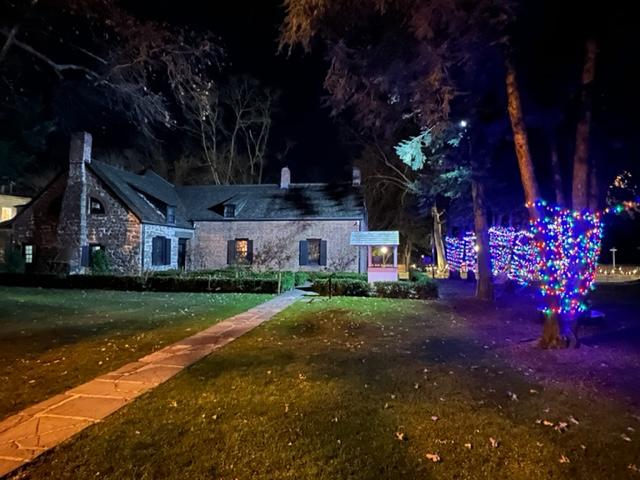
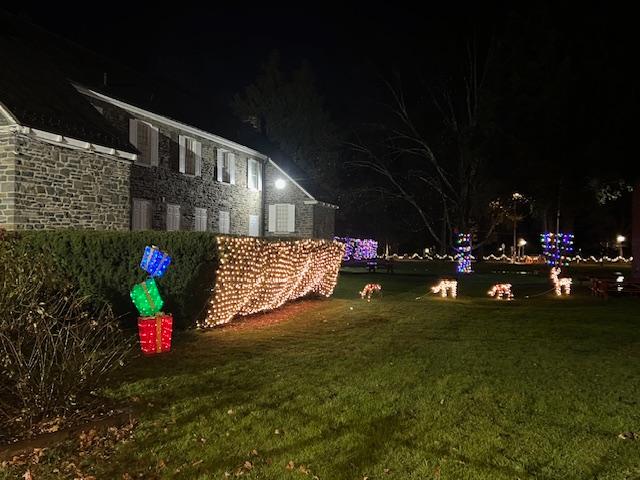
My last visit for the evening was to the Senate House in the historic area of downtown. The lawn and all the trees were lit with Christmas lights and the buildings covered in garland.
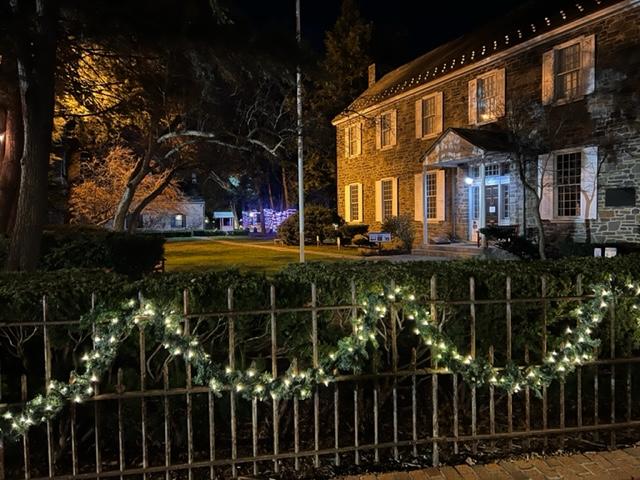
The Senate House Complex at 295 Fair Street was beautifully decorated that night
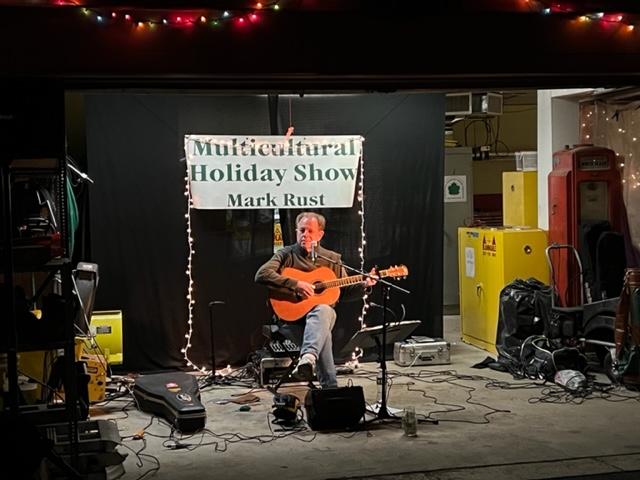
Here a performer was singing Christmas songs and leading sing a longs while Santa wished everyone well and listened to what everyone wanted for Christmas.
Singer Mark Rust at the Senate House lawn for the Snowflake Festival
The lines to see Santa were also fifty deep as everyone was trying to see Santa before the event ended. I just was a casual observer.
Santa was really busy that night. I don’t know how he handled the crowds
The event winded down rather quickly at 8:00pm and when I started to turn the corners of the downtown again especially on main street, they were starting to pack things up. 8:00pm meant 8:00pm! The strange part was that it looked like all the restaurants were closing at 8:00pm as well. It was as if the whole downtown was rolling up its sleeves. By 8:30pm. the downtown looked like a ghost town.
The Snowflake decorations in Downtown Kingston, NY
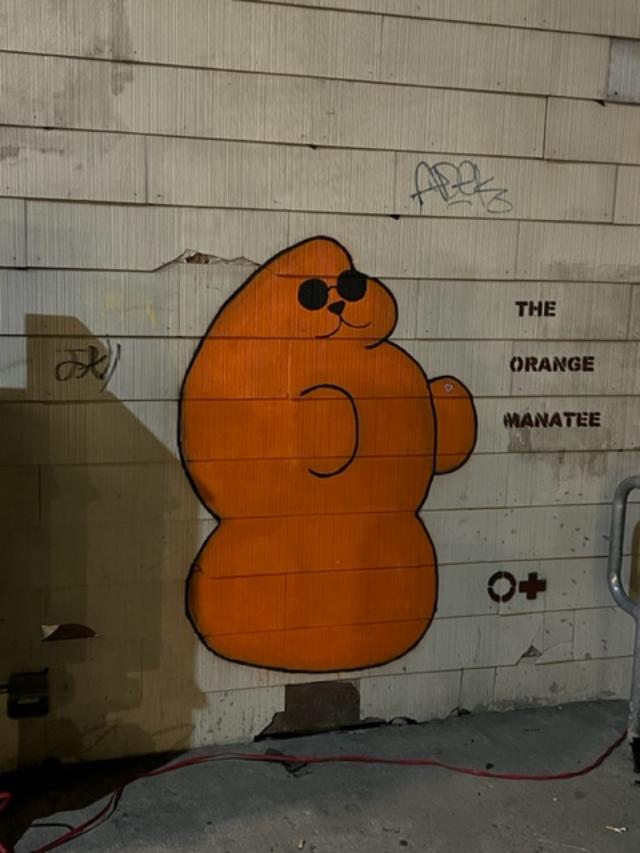
Street art in Downtown Kingston, NY by the Christmas tree
In 2023, it was a different story. Though the weather was on the warm side, it was drizzling when I got there at 6:00pm. I had been touring the Ringwood Manor earlier in the day and it was cloudy and miserable when I left. I checked into my hotel, The Hampton Inn Poughkeepsie and then made my way across the river to the Snowflake Festival. It was just getting in full swing when it started a light rain. I walked around for a bit watching the fire eaters and admiring the decorations before I decided to head back to Dutch Reformed Church to relax inside and hear the entertainment. That’s when it started to rain.
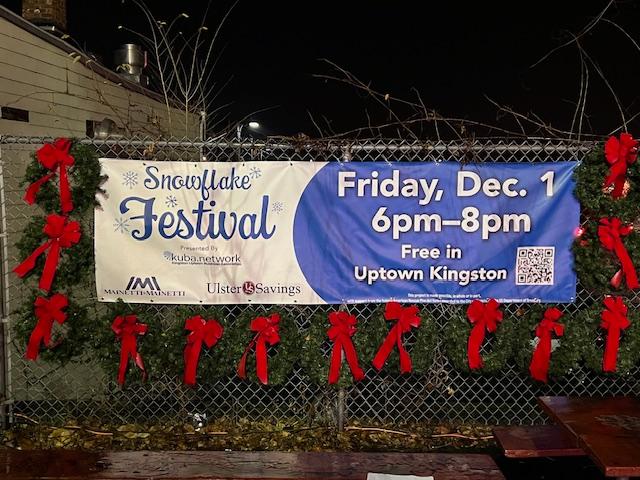
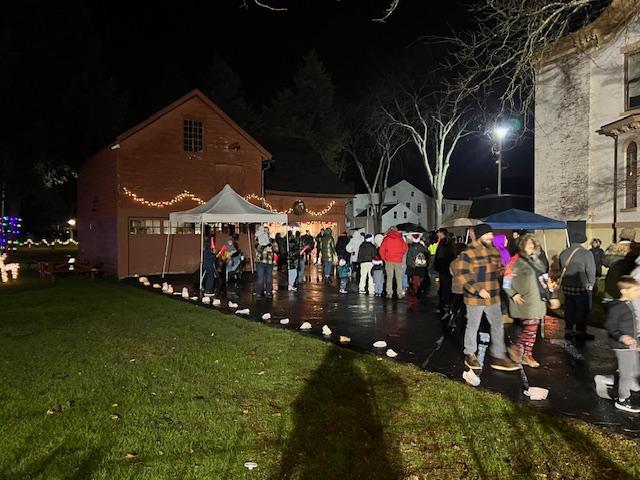
The “Snowflake Festival” on Friday, December 1st in Kingston, NY.
In 2023, the weather had been gloomy all day and misty so it was not the best conditions for an outdoor festival. It was to my surprise that when I got there at 6:00pm it was really busy. They may have been a light drizzle but that did not keep people away.
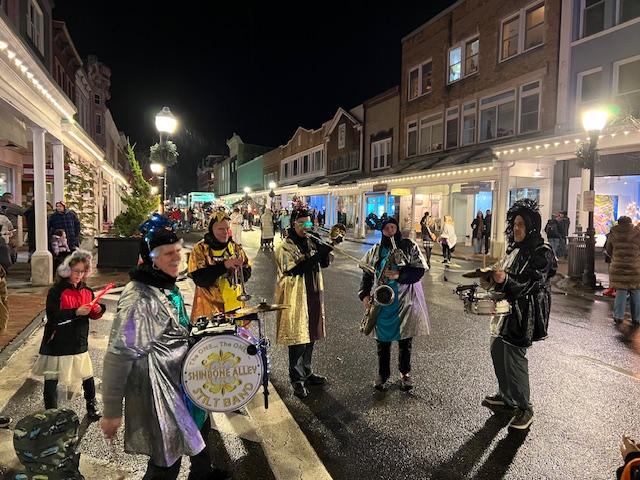
The crowds on that misty Friday night were very large.
I walked all of Front Street in Downtown Kingston Stockade section admiring all the Christmas windows of the merchants and the snowflake decorations all around the downtown.
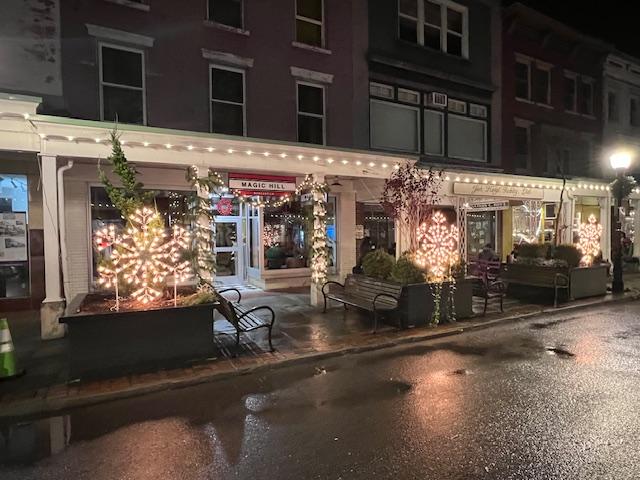
Downtown Kingston in the rain the night of the 2023 Snowflake Festival
The snowflakes that adorned the downtown.
As I walked through town, I passed crowds of people walking through the drizzle and watching a fire eater perform. So many people did not have umbrellas and the drizzle started to get worse. I figured I wanted to go someplace warm and headed over to the Dutch Reformed Church. I did not have the agenda yet but I wanted to go someplace that was inside.
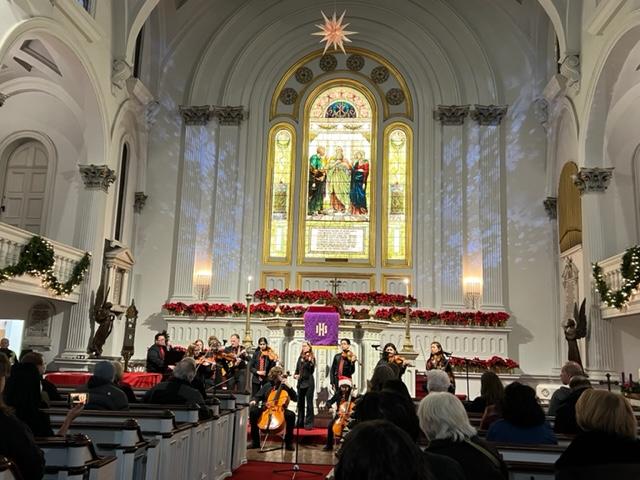
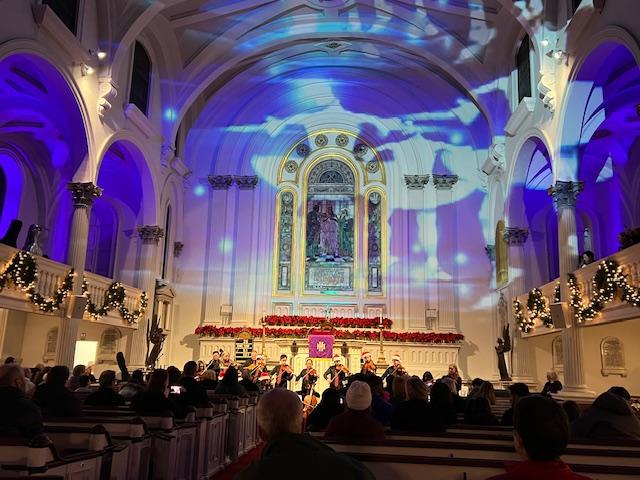
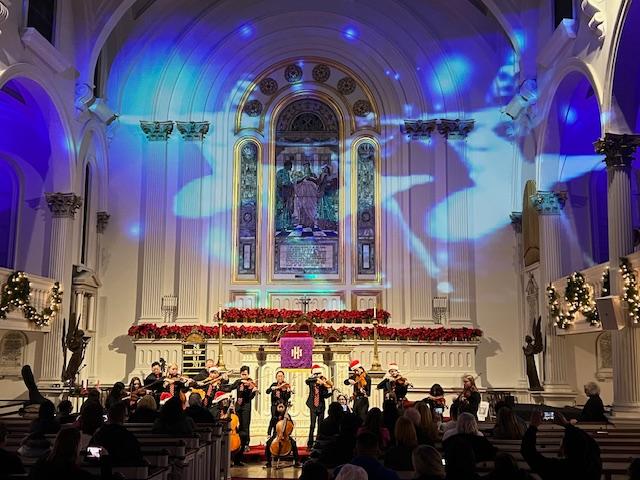
When I got to the church it was once again beautifully decorated with garland and lights and the stage was rocking with violinists who were performing in sync. The concert was awash with lights and holograms dancing overhead.
The Strawberry Fiddlers performed that evening in the Dutch Reformed Church
The Strawberry Hill Fiddlers performing that night.
I stayed for four songs and it was really nice to just relax and enjoy the music. I really enjoyed the concert and I found it really engaging and entertaining. After this, I wanted to see more of the festival and hoped that the rain had stopped. No such luck as the rain continued and got worse as I left the church. I was able to sneak some Dutch cookies and cider before I left and the sugar gave me more energy.
The irony of it all was as I left the church and the rain continued, over the loud speaker near the picture taking booth, Gene Kelly singing “Singing in the Rain” from the iconic film “Singing in the Rain” came on and it synced perfectly with the rain and I had to take a video of it as it matched perfectly with the rain coming down but people still having a good time.
The video of the rain storm during the festival when “Singing in the Rain” was played on the loudspeaker. Talk about irony:
I walked around the church and was back at the Kingston Volunteer Firefighting Museum and I stopped in as the rain started to stop. I wanted to dry off again. I had toured the museum the last two years and I just took a short tour of the museum. Christmas lights adorned the museum and the antique fire truck outside the museum that the kids were able to climb.
The nicely decorated firetruck outside the museum that evening.
As I passed the museum, I could not believed that people were taking horse drawn rides in the rain but they did and they looked like they were having a good time. I walked down Fair Street where the Senate House was nicely decorated for the holidays to see Santa. That line was the longest as the mist continued. I bypassed even seeing him but I could see him entertaining the families waiting in line to see him.
Even in the rain the lines to see Santa were long and people waited patiently to see him.
The Senate House decorated for the holidays.
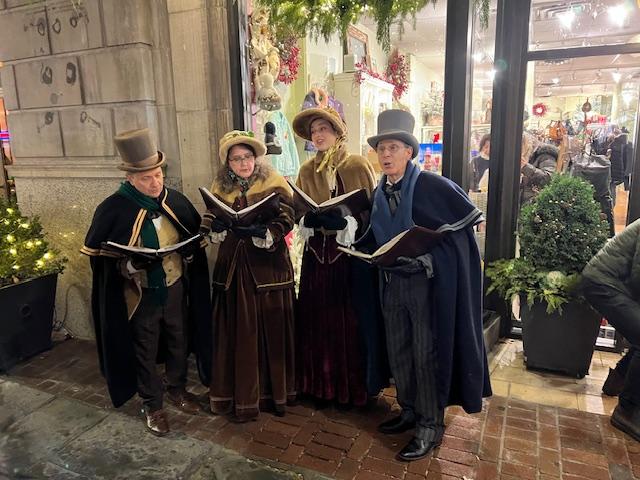
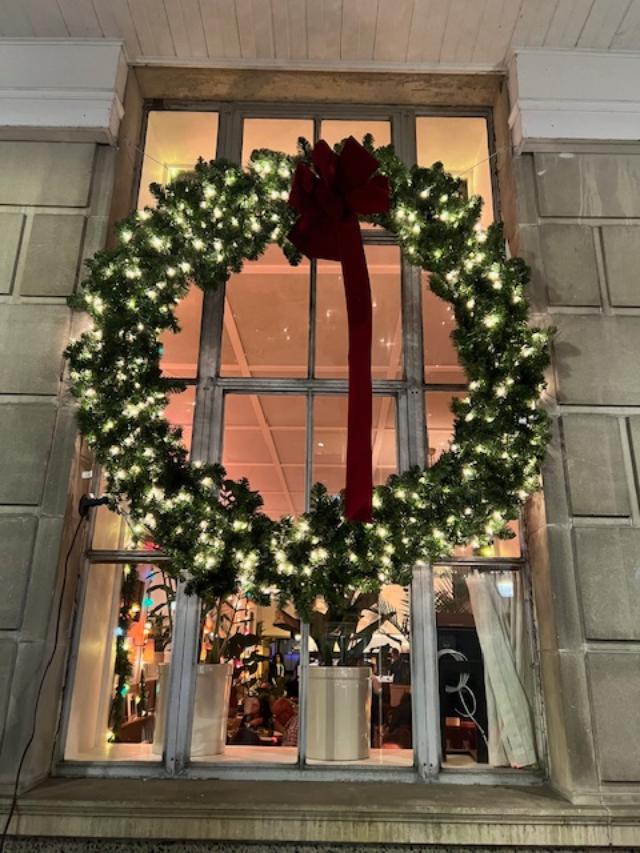
I walked around the downtown watching the musicians and entertainers as the rain started to subside later that evening and they had a group of Victorian carolers performing by the bank on Wall Street right by the most beautiful wreath I have seen this holiday season on the historical building. The effect was quite nice.
The Victorian Carolers performing by the old bank building.
The wreath on the bank building was quite spectacular against the stonework.
It was getting colder that evening as I was walking around and the rain stopped and I knew from last year where to get some hot chocolate. So I went over to the Ulster Savings Bank Lobby and had a cup with some cookies that the bank every generously sponsors each year for the event.
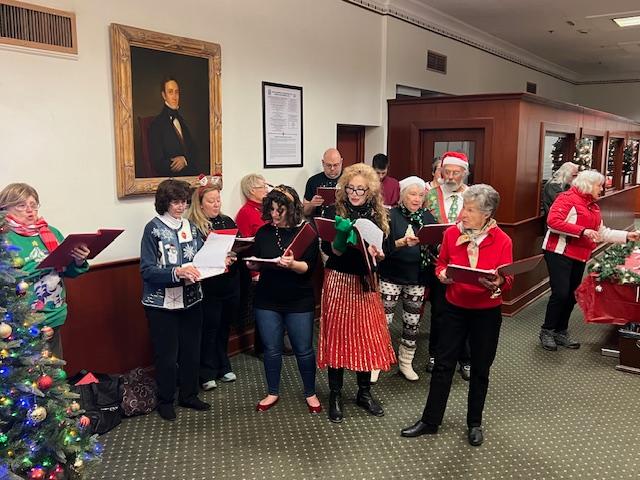
While I was there I was listening to Mrs. Claus tell stories to the kids and this woman really looked like Mrs. Claus. While she was telling stories, the Coach Street Players choir was singing Christmas carols. It was a nice way to spend the end of the evening. I was getting hungry after a long trip and even longer day of classes and I wanted to relax.
Mrs. Claus was just finishing to a crowd of children for storytime.
The Coach House Players at the Ulster Savings Bank lobby performing.
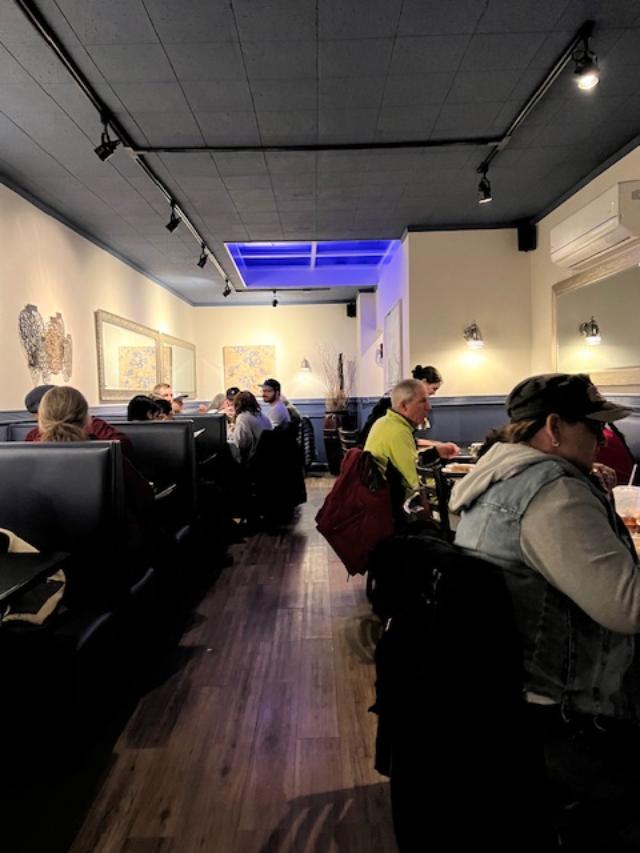
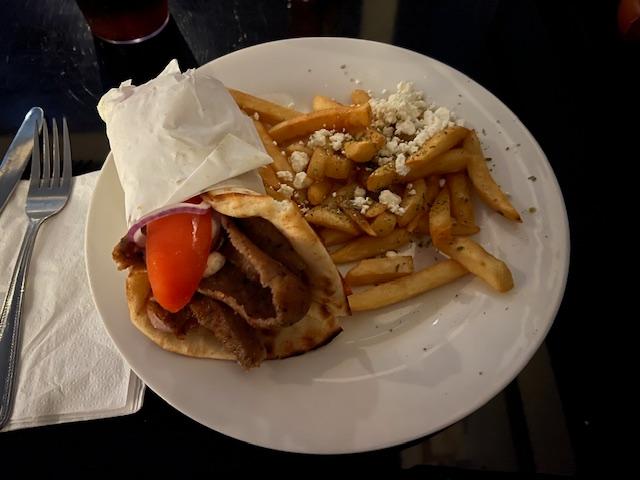
By 7:30pm, things were starting the wrap up and the weather was clearing. Most of the bars and restaurants were packed that night or closing for the evening. Wing Shi, the Chinese restaurant I love in Kingston, still does not have any seating inside and there was no place to sit outside so I went to Opa Gyros Greek Restaurant at 333 Wall Street in downtown Kingston. I have wanted to eat here last year watching them serve gyro meat last year on platters but by the time I walked in at the end of the festival last year, they closed at 8:00pm. I went in at 7:30pm for dinner this time and had a wonderful meal.
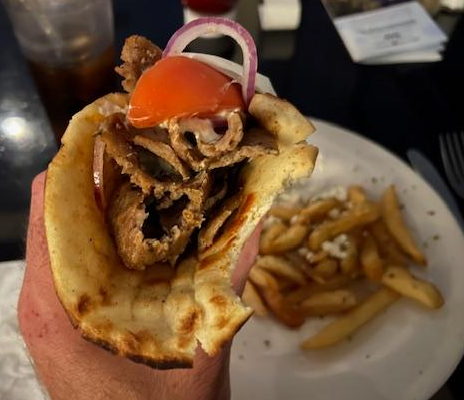
The sandwich was delicious and I really enjoyed the food and service.
After dinner was over, it was about 8:15pm and the festival wrapped up really quickly. By the time I turned the corner, most of the businesses had closed and the people were gone. All the activities were over and even Santa had left by that point. There were some people milling around but by 8:30pm, the town was quiet. I was able to walk around the downtown one more time and then I left for my hotel as I had to be in Rhinebeck early the next morning to help with the Sinterklaas parade. I slept very soundly at the Hampton Inn in Poughkeepsie.
Christmas windows in Kingston, NY in 2023.
Christmas windows in Downtown Kingston in 2023
Downtown Kingston during the holiday season in 2024:
I was not able to attend the Snowflake Festival in 2024 because I was in Salem and Woodstown, NJ for a series of Holiday house walking tours but I went up to Kingston later in the month to see the decorations in the downtown. Here are some of the pictures from my trip to Kingston, NY during Christmas time in 2024:
The beautiful quiet of Downtown Kingston, NY in 2024
A late night in Downtown Kingston, NY during Christmas time
The Kingston Christmas tree
It just felt like Christmas
Passing the Senate House decorations
The decorations around the Senate House
Walking back down the street after visiting the Christmas tree. A light snow fell
The window shopping was fun
Window shopping in Downtown Kingston
All the buildings were so beautifully decorated for the holidays
Kingston Dutch Reformed Church in Downtown Kingston
The beauty of the church after the snow storm. Christmas was coming
The front of the church during the holiday season
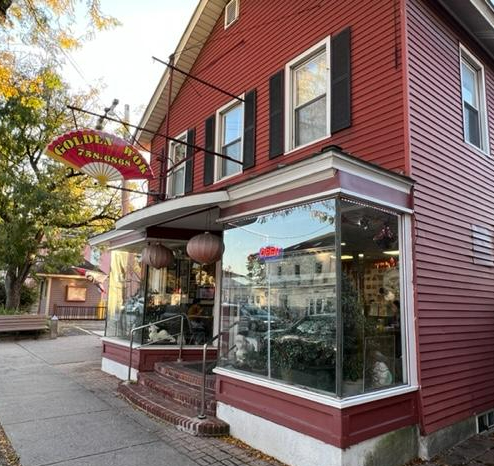
In 2022, I tried to find a place to eat that evening but literally most every place was closed and the only Chinese restaurant that was open did not have a place to sit down so I left Kingston to cross the river again. I knew that Golden Wok in Red Hook was open late so I decided to head to Red Hook, NY for dinner.
Red Hook like the other towns in the Hudson River Valley is so picturesque during the holidays and is one town that is not geared towards tourists as opposed to the local citizens. Their restaurants are reasonable and the town is not overloaded with expensive gift shops like Rhinebeck and Woodstock are in their downtowns. It is also so beautifully decorated with garland and white lights all over the buildings downtown.
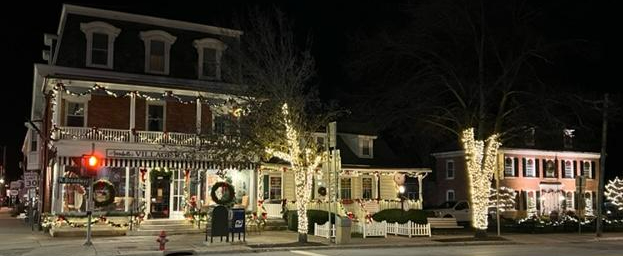
Downtown Red Hook, NY was decked out for the holidays
Downtown Red Hook, NY decked out for the holidays
Downtown Red Hook, NY
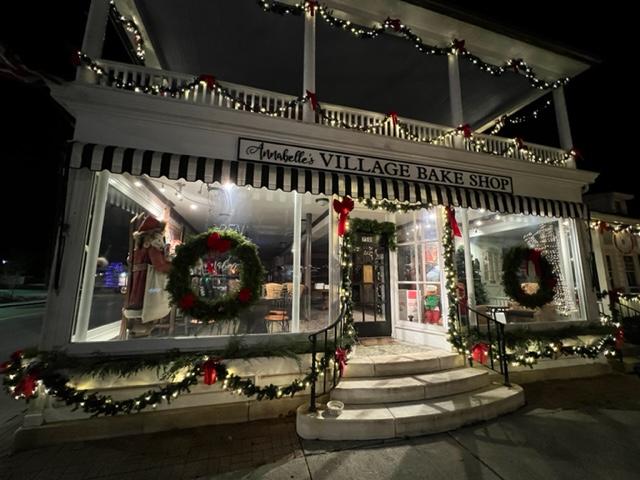
Annabelle’s Village Bake Shop really decorated to the hilt for Christmas
It was also quiet in Red Hook as well and I was the only one walking around the downtown. I walked around for a bit, admiring the lights and looking over their town Christmas tree which just a few weeks earlier had been a Fall display for Halloween.
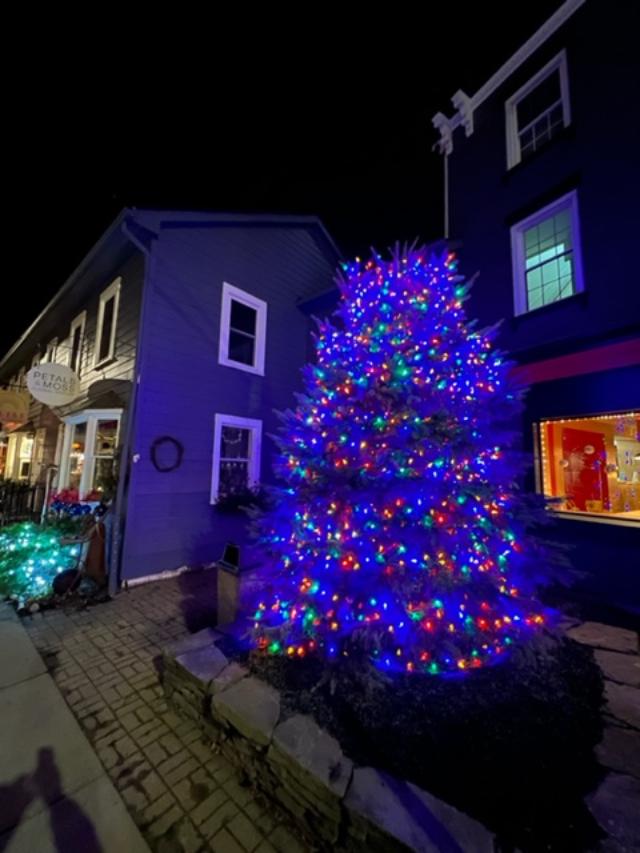
Downtown Red Hook, NY Christmas tree
Things move fast in these towns.
I was Golden Wok’s only customer at that time so I ate in at the front table and just watched the traffic go by. The food at the restaurant is just amazing. For a small take out place, they do a wonderful job with their dishes.
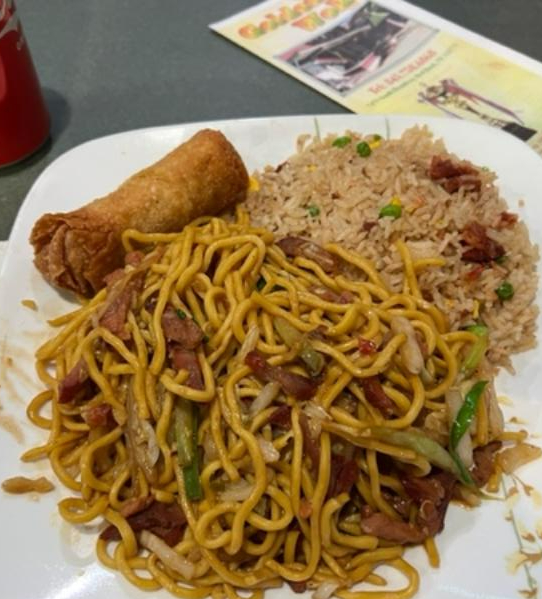
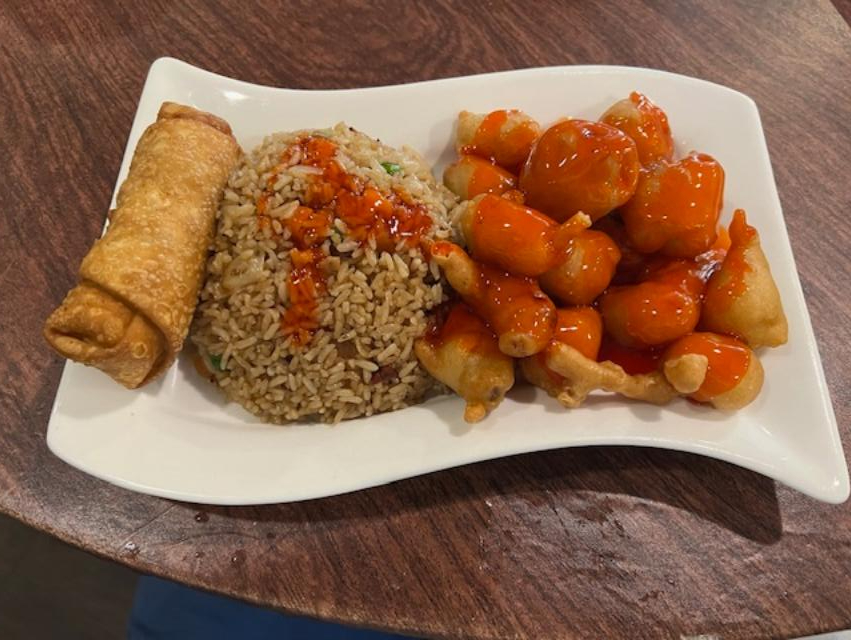
I had the most delicious Roast Pork Lo Mein with Pork Fried Rice and an Egg Roll for dinner. Not only was the food good but the portion sizes were very generous. I just sat back and relaxed and ate realizing that I did not have to be anywhere or race to do anything. That was a nice feeling. It was just nice to eat and admire all the Christmas decorations. The restaurant got a little busier as people saw me eating in the front of the restaurant and I guess figured that it was open and started to come in. They got a bit of a rush after that
.
The Roast Pork Lo Mein and Fried Rice are delicious at Golden Wok
Snowflake Festival 2025:
They had to cancel Sinterklaas again this year again, so I rearranged my schedule around it. I decided to come up to the Hudson River again for the Snowflake Festival and for the opening of the BFA/MFA show at the Dorsky Museum on the SUNY New Paltz campus. This afternoon a long day at work. I had my students create the Holiday Project for Bergecco-Parc consulting Inc., my class project. I swear I never sit still.
After another long week at work, it was going to be another long weekend of activities as I had the Snowflake Festival in Kingston, the Cape May Historical Walking Tour and their Christmas Parade and then the Bergen County Firemen’s Home Association Christmas Party for the residents followed by a Sinterklaas event at the historical Van Allen House, home to the Oakland Historical Society. I would be in the car all weekend.
After a long day with my students, who did their Bergecco-Parc Consulting Holiday Party project for extra credit. The project is creating a holiday invitation, menu with an appetizer, entree, dessert and signature holiday drink and then film a greeting. We had our share of hiccups in the project but the kids looked like they had a lot of fun with it.
The students really earned their strips with me that day. We had our share of hiccups but that is what a trial run is all about. It was Ann interesting Friday afternoon.
I had gotten an email from the Dorsky Museum on the SUNY New Paltz campus that the BFA/MFA Student Opening Show was going to be that night. I decided to attend before I went to the Snowflake Festival in Downtown Kingston. Don’t ask me how but I attended both events with plenty of time to spare.
I got up to New Paltz in record time and had time before the art opening to visit Historic Hugenot Street, the complex of historic homes in the historic district in the downtown area.
Some of the homes were decorated with simple wreaths and not much else but the snow from the recent storm offered a picturesque view with a Christmas feel.
The decorations outside the Dubois House
The historic Dubois House
The Janet Hasbrouck House
The historic Presbyterian Church decorated for the holiday
As it got darker, I made my way to the SUNY campus and to the art museum. It really was a good show with a nice reception and interesting art. While the students were devouring the food at reception, I had the whole gallery to myself to look at the art.
I have to admit that some of the art was quite unusual. The students did have a streak of creativity to them.
The Dorsky Museum Gallery
Some of the unique pieces
Once the students devoured the Reception buffet, everyone came in to see the exhibition
This is the one piece that really stuck with me at the show
The gallery at the museum is rather small do I got through the whole show in less than an hour. I had a quick snack with what was left on the buffet table, which was not much. The food was really good and a snared the final meatball.
Just enough of a snack to get through the next two hours
I only stayed at the Gallery opening for about an hour and then it was back on the road again and up I 87 I went to downtown Kingston to the Annual Snowflake Festival. The weather was cold but at least it was not raining like the previous year. The crowds were beginning to grow that night.
The crowds that evening on East Front Street
The decorations in downtown Kingston, NY for the Annual Snowflake Festival
The first entertainer at the beginning of the event I saw was the Fire Thrower and she did an amazing job interesting us. She really got the crowd engaged.
The Fire Thrower engaged the crowds downtown
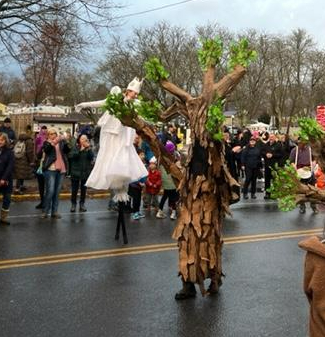
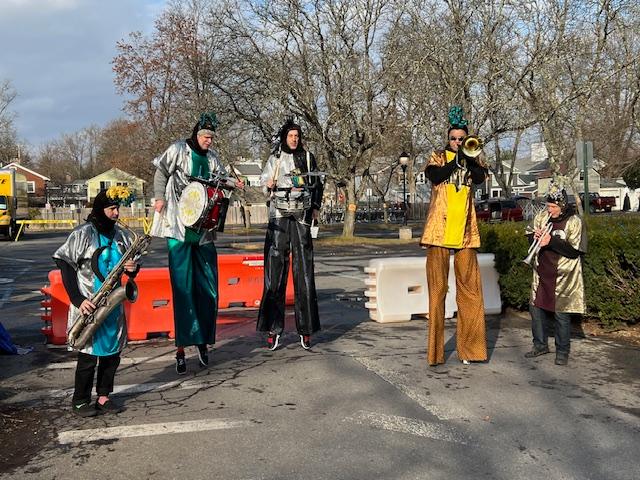
The next group of entertainers I saw was the band on stilts, whom I have seen at Sinterklaas for years. They got the crowd motivated.
The guys do a marvelous job every year
Even their Christmas songs are fun. Here are them performing ‘Rudolf the Red Nosed Reindeer’
I made my way around the downtown this year to try to enjoy everything in the festival, which meant running from one thing to another.
Main Street where the stage was and the core of the entertainment
My first stop was the bank with all its entertainment and things to do. They really kept the crowds entertained.
There was a group of singers performing Christmas carols. I thought they were the bank staff.
They had all sorts of desserts and hot beverages like Hot Cider and Chocolate for the crowds
Mrs. Claus was entertaining all of us with puppets and stories. There was also crafts for the kids
Mrs. Claus posing for me. It took me a half hour to finally email this picture to here.
Then I headed over to the Dutch Reformed Church to hear the fiddlers. The church is always so beautifully decorated for the holidays.
The inside of the Dutch Reformed Church that evening
The start of the concert with the Strawberry Fiddlers performing
Here you get to see the true beauty of the church
I then got a close up shot of the fiddlers
The Strawberry Fiddlers performing that night. They really got the crowds going. I heard two songs performed before I moved on to the next thing to do.
Walking through the well lit downtown where freshly fallen snow the night before made it look more picturesque.
The downtown was amazing at night
My next stop was the Kingston Volunteer Museum’s display of antique fire trucks.
I didn’t go inside because the crowds packed the place and I remembered from both years how God awful their hot chocolate was and bypassed it this year. Still the fire trucks were the big lure and festively decorated with Christmas lights.
The decorated trucks outside the museum
As the evening wore on, I had never seen an evening fly by. My last stop of the evening was the Senate House, which was closed that evening, but in the barn Santa and Mrs. Claus were receiving visitors and a guitarist was performing.
The line to see Santa was about sixty deep and I really did not have time to see them. I had seen Mrs. Claus already.
Santa and Mrs. Claus greeting guests that night
So I listened to the guitarist, who I seen perform before. He performed all sorts of classic Christmas songs.
The singer performing on that cold night. I do not know how he did it.
Here he is performing ‘Dominick, the Italian Christmas Donkey’
The musical performance of ‘Dominic, the Italian Christmas Donkey’
The last thing I did that night after the performance was get in line for the horse drawn carriage around the downtown. The line had been fifty deep most of the night. It ended up I was the last person allowed in line as it was the last ride of the night.
The horse drawn carriage rides that night
Everyone was trying to get on the last ride of the night and begged because they had kids. I love it when parents use their kids as pawns. Even so just as we were to get on the carriage a group of people snuck out of a restaurant and took the spots of the family in front of me and myself and we could not get on.
They were so pissed. The police were just starting to reopen the downtown roads and the carriage guys said he had no control over it. So the carriage guy said he would take us on a ride back to the other side of downtown to load up these very cold horses.
The temperature had really dropped at this point. We got the best ride because we got to see more of downtown and see it lit up for the evening.
The very last ride on the horse drawn carriage through the downtown. It was the best trip of the night!
By this point the event was over. It was past 8:00pm and when this event ends, it ends! The roads opened up and the crowds disappeared. I turned around and everyone was gone.
Like last year, most of the restaurants close at 8:00pm on the dot. I am not sure why. One of the few restaurants open that night downtown was Vincenzo’s Pizza at 305 Wall Street. It was packed when I arrived.
The inside was crowded as there was barely anything open after 8:00pm
I needed something to warm me up and carry me over before the two hour ride home and pizza would not do. So I ordered a Meatball sub. Was that ever good on a cold night.
The best comfort food that night
Yum!
After dinner was over, the crowds were gone and I had to head home. I stayed for just a little bit longer to admire the decorations one more time and visit their Christmas tree.
This downtown display replaced the Pumpkin man from a month ago
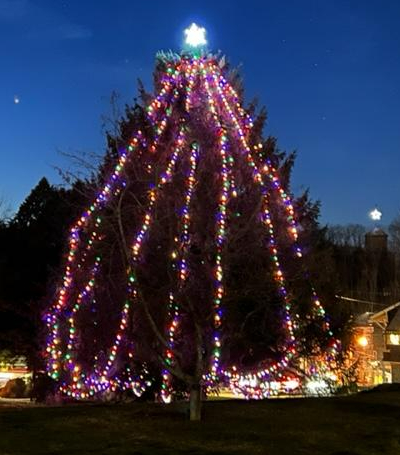
The Kingston Christmas tree downtown
I headed back to the car and managed to get home in an hour and forty-five minutes. There was no traffic on the road that night. I was happy as I had to turn around early that next morning for my trip to Cape May for the Christmas Walking tour. The Sinterklaas Parade had been cancelled for another year (now in 2024 and 2025), so it gave me this opportunity to finally go to Cape May for their Holiday House Walking tour.
In 2023, I headed back to my hotel to get some rest. I had to be up the next morning to help with the Sinterklaas Parade. During the Sinterklaas weekend, I always stay at the Quality Inn in Hyde Park, NY which is near the Culinary Institute of America campus. It is the halfway point between all the towns that I visit and not that far from Rhinebeck so it is a quick trip for set up the next morning.
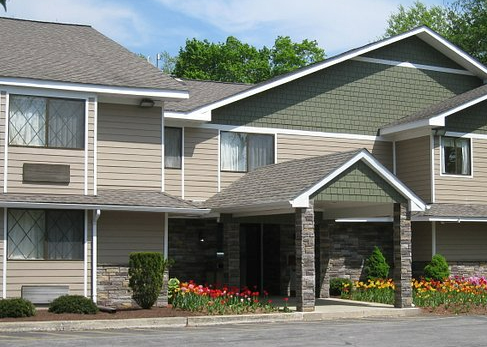
The Quality Inn Hyde Park at 4142 Albany Post Road
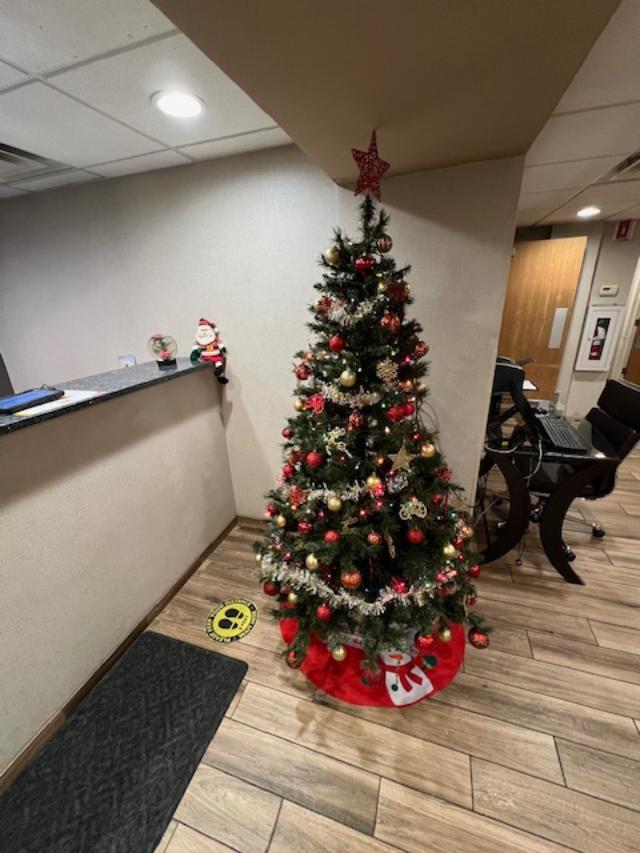
The Christmas tree at the hotel is always so festive.
Since we had the Bergen County Firemen’s Home Association party for the residents on Sunday morning and afternoon in Boonton, NJ, I arranged to stay for two nights. One top of the loads of homework I had for graduate school, I also was taking pictures for my blogs as well and trying to catch up the visuals on my VisitingaMuseum.com site. I had to get settled into the hotel and ended up staying up until almost one in the morning getting work done for school.
The next morning could not have been more miserable. It was cold and rainy when I got up for the Sinterklaas parade. They said it was going to rain all day and that did not make me happy. I had walked in the Sinterklaas Parade in the past in the rain and it is no fun!
I made a big mistake and got up really early and ate my breakfast early and got to the Starlight Library in Rhinebeck by 8:30am thinking I would be late. I forgot that this is when I used to leave home to get to Rhinebeck. The set up was usually at 10:00am and I forgot. So I sat there making phone calls until 10:30am wondering where everyone was that morning. I was not the only one as another volunteer did the same thing. We both ended up back downtown in Rhinebeck asking what was going on.
I ended up that the parade organizers decided to wait until 11:00am to start setting up. By that point, I was starved again and went to Peter’s Famous for an early lunch and decided to go to opening ceremonies before heading back to the library. It was there I heard that they were setting up at the library by 11:00am. I decided to stay and head up after.
I have been participating and/or attending the Sinterklaas Parade since 2010 when my dad and I went up to Rhinebeck, NY when I was interviewing Jeanne Fleming for an article I was working on for the Soup Kitchen. We loved it so much that we continued to go for years even after my father got sick. We made the best of the whole experience.
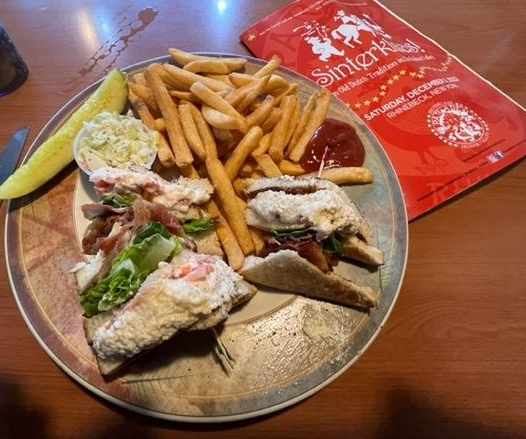
Since I was not too sure what was going on, I decided I wanted to see the opening ceremony first so I had a quick lunch at Pete’s Famous in Rhinebeck at 34 East Market Street #1. I was in the mood for one of their club sandwiches and ended up indulging in their homemade Chicken Salad Club Sandwiches ($11.99) with French Fries and a Coke
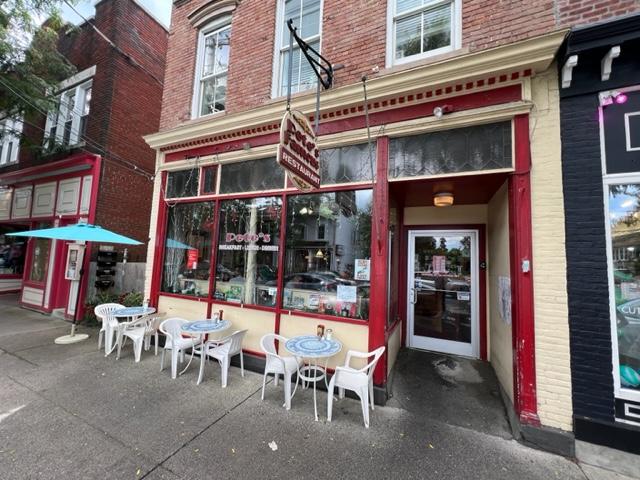
Pete’s Famous at 34 East Market Street in Rhinebeck, NY
Did that sandwich hit the spot and kept me going for the rest of the afternoon. The chicken salad was delicious and the sandwich was so filling. The French Fries really warmed me up on this cool gloomy morning and the service is always so friendly.
The Chicken Salad Club at Pete’s Famous is a ‘must try’ when dining here
After lunch was over, I headed over to the Beekman Arms where in the banquet room they had the opening ceremony for Sinterklaas.
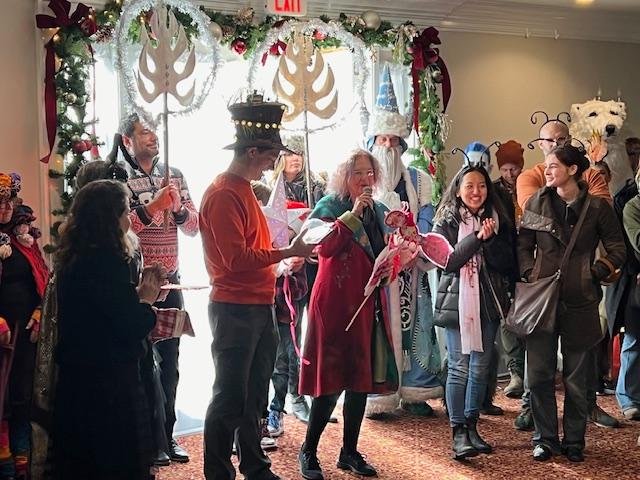
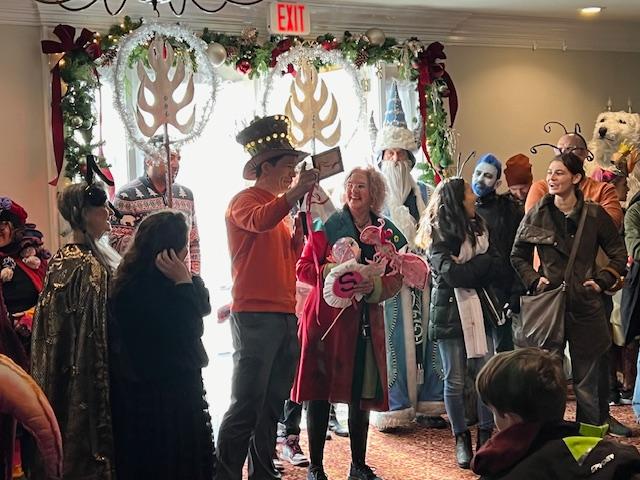
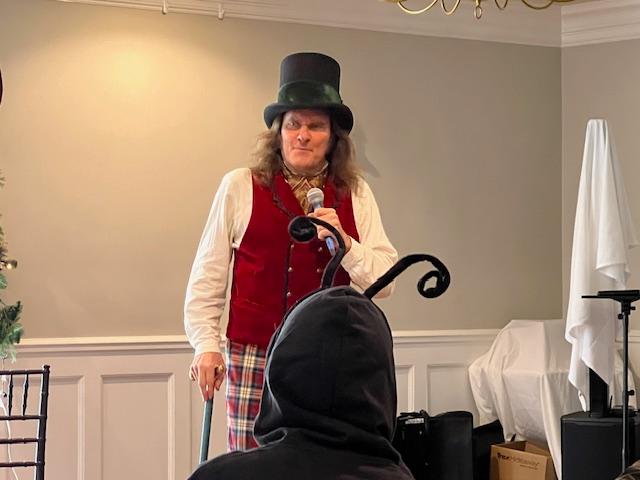
Sinterklaas Director and founder Jeanne Fleming at the opening ceremony
The Mayor of Rhinebeck, NY welcoming everyone to the event
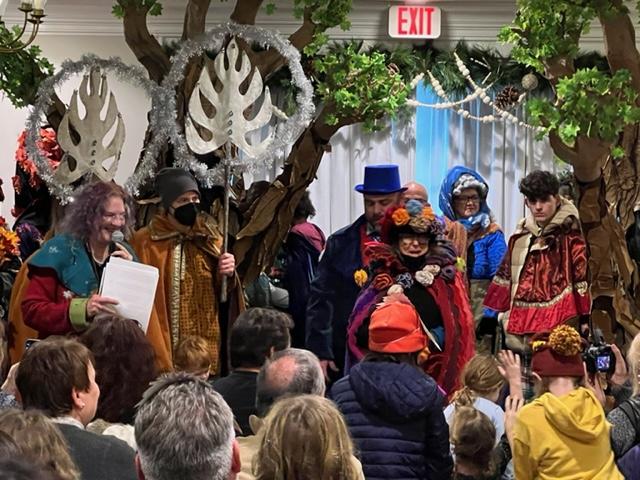
Jeanne Fleming welcoming the Pocket Lady to the event
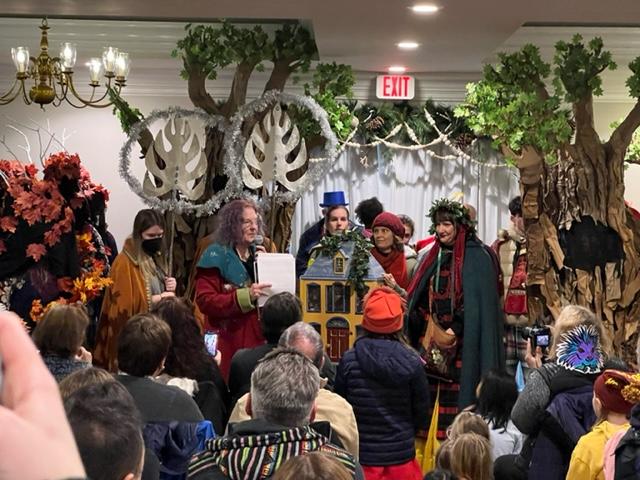
Jeanne Fleming welcoming Mother Holly and her story book to the event
Jeanne Fleming welcoming the evil “Gadfly” to the event
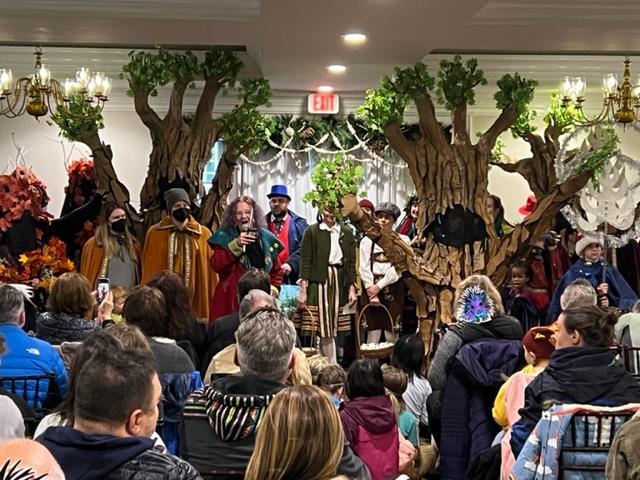
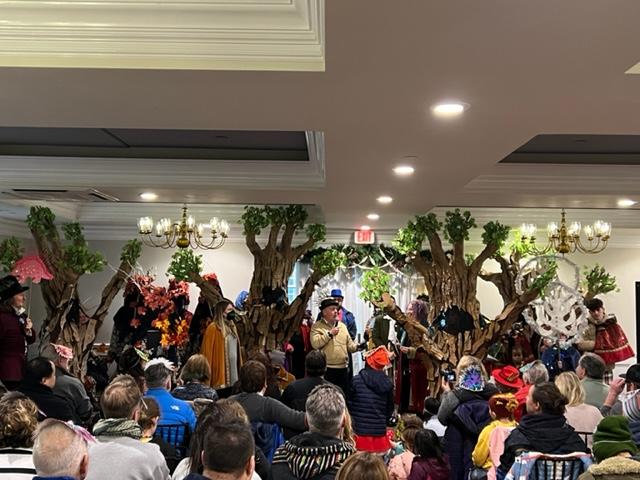
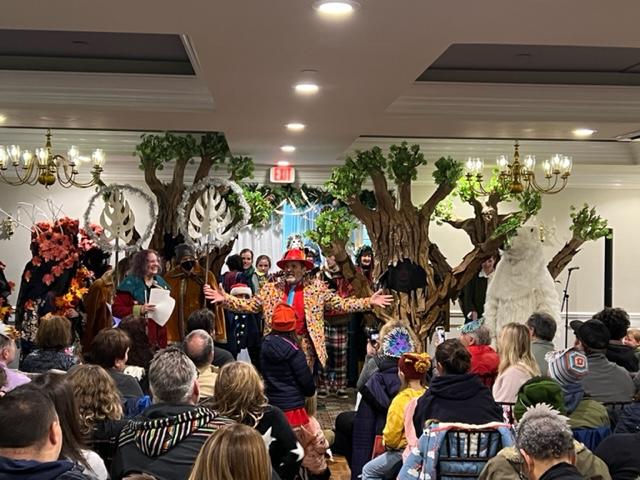
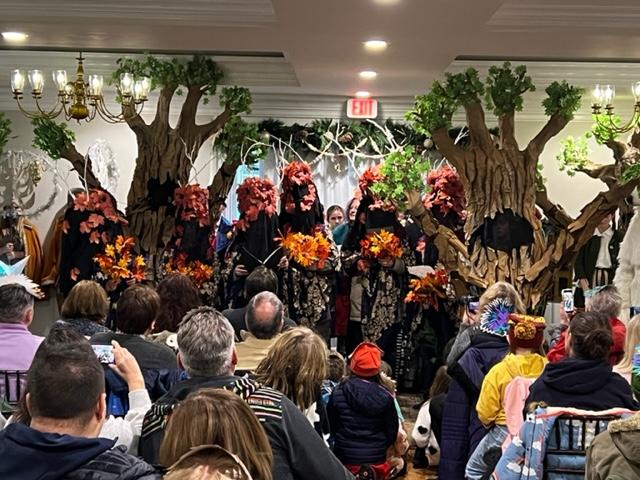
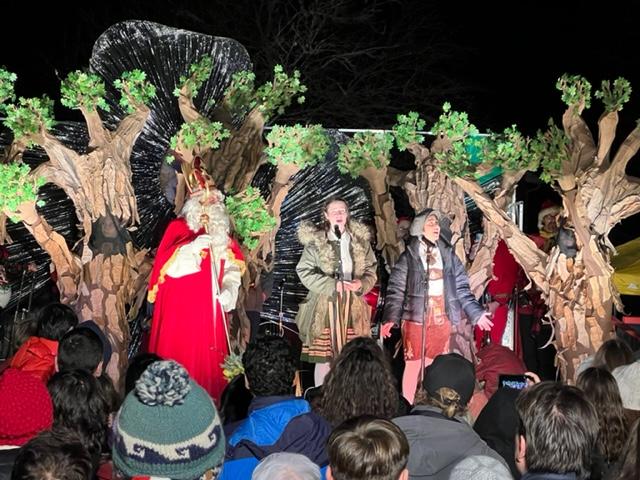
The Grove of Trees of the magic forest
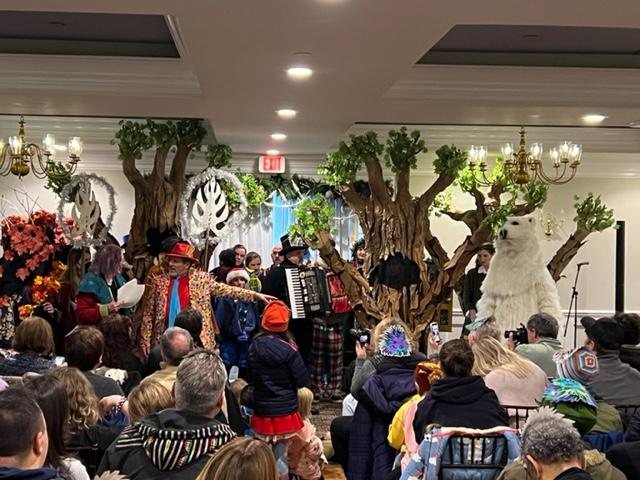
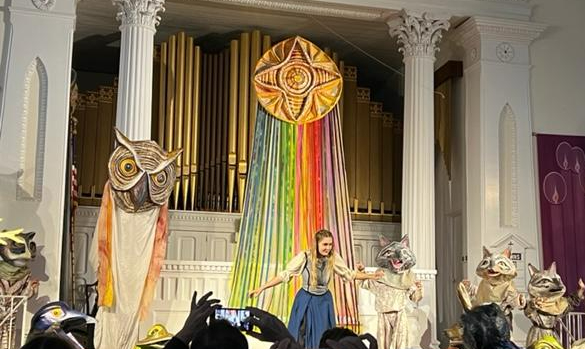
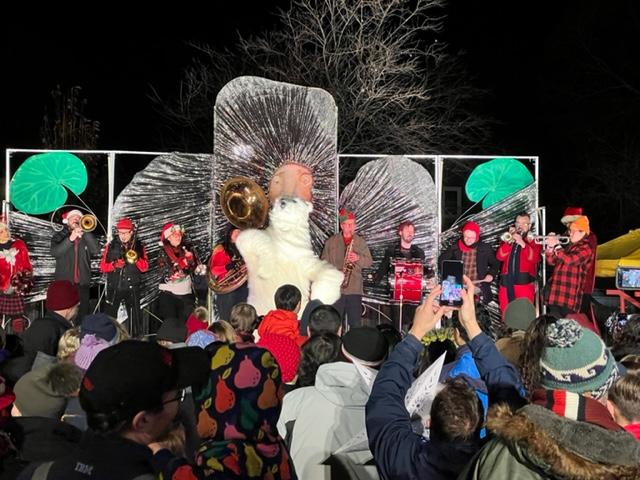
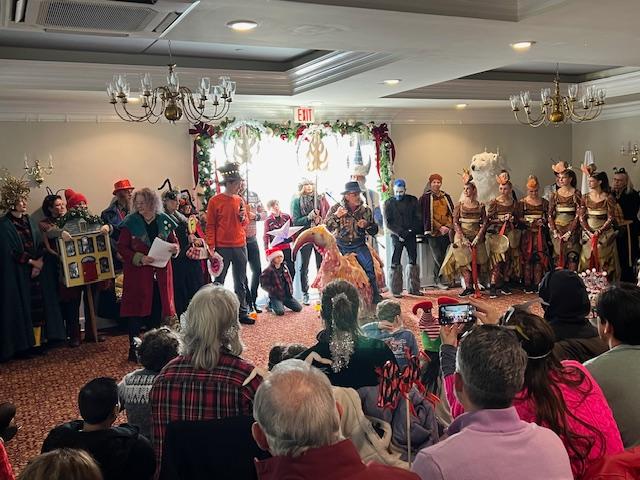
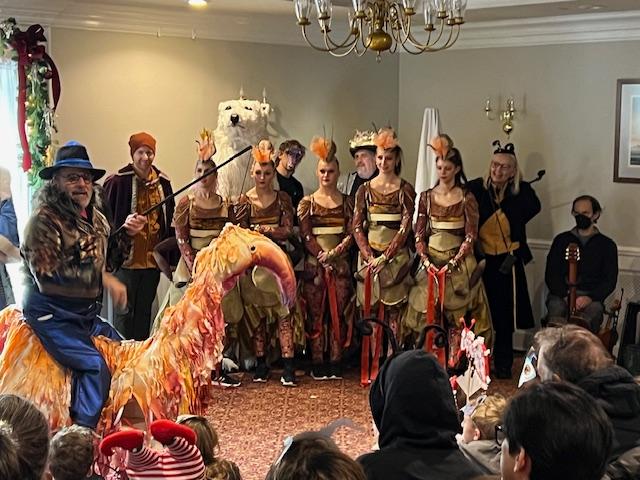
The musical polar bear enters the room to bring cheer to the crowd
The meddlesome Gadfly jealous of the polar bear
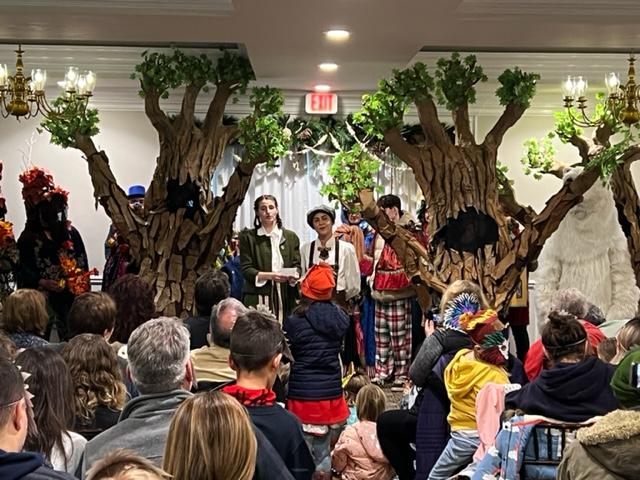
Hansel and Gretel close the ceremony with a song
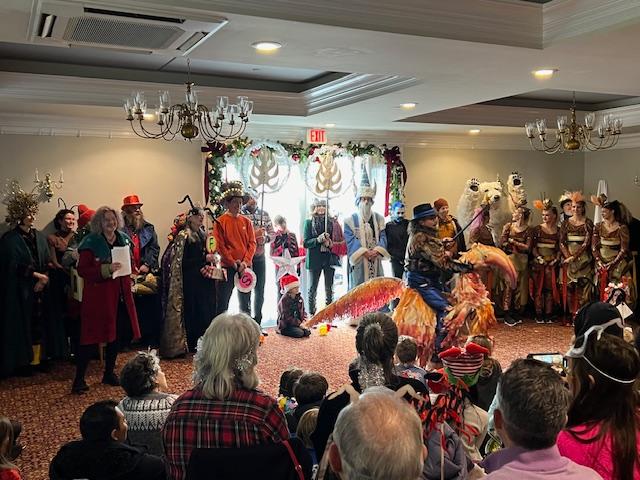
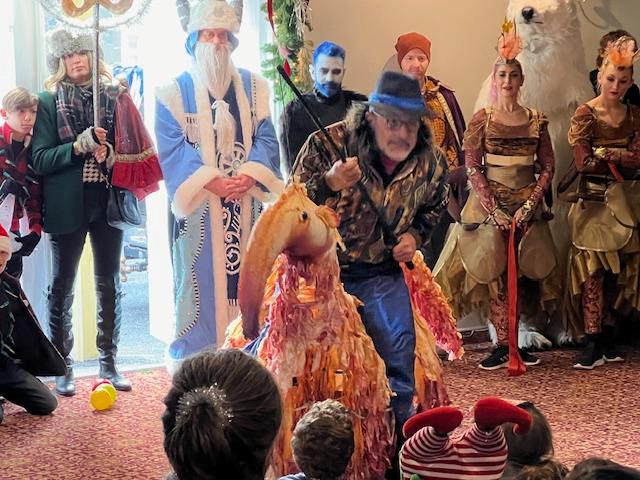
The Opening Ceremony was about an hour long and we got to meet all the characters of Sinterklaas. There was the Pocket Lady who shares a gift with all the good little children from her series of pockets, Mother Holly (who is always feeling jolly), the Queen Bee (Oh!), the Dancing Musical Polar Bear and the evil Gadfly. The Mayor of Rhinebeck, NY welcomed everyone to the annual event and wished everyone a happy and safe holiday season.
The Polar Bear danced down the aisle high fiving everyone much to the Gadfly’s dismay and he started to kvetch about it. Only when he was shushed by the crowd did he calm down. Then the dancing trees took their place on stage to be followed by a song by Hansel and Gretel, who closed the ceremony with a lively song. Everyone was wished a Happy Sinterklaas and some people stayed to listen to storyteller Jonathan Kruk tell the story of Sinterklaas while I went out to enjoy the festivities.
When I got outside the Beekman Arms, I saw the first musical group performing on the lawn of the Beekman Arms. I stopped for a bit to watch them perform and then I rushed to the library to see if there was anything left to do for the parade. When I got there, the last touches were being put on the puppets for the parade and there was not much left to do. The weather started to clear so it looked like the parade was on for later that evening.
The first group was performing on the lawn of the Beekman Arms
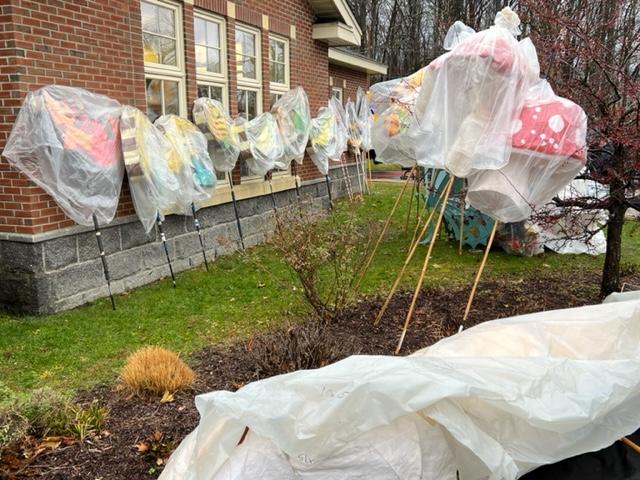
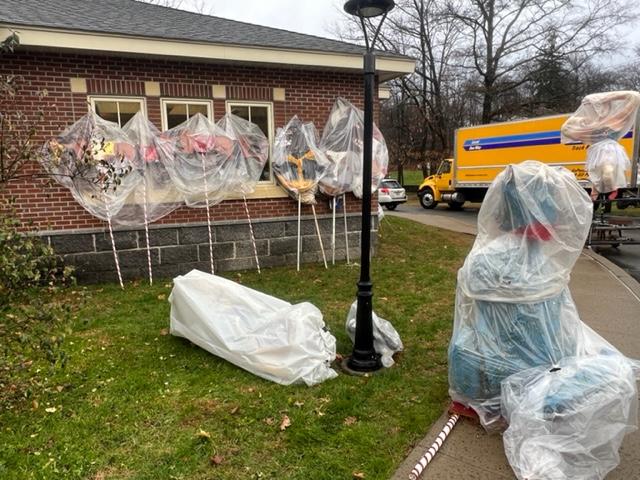
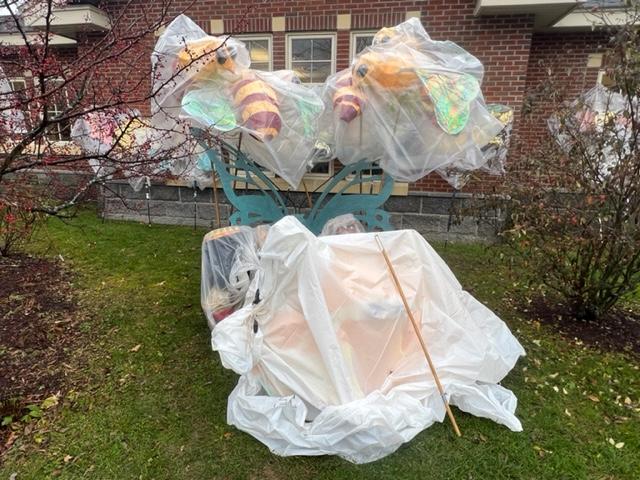
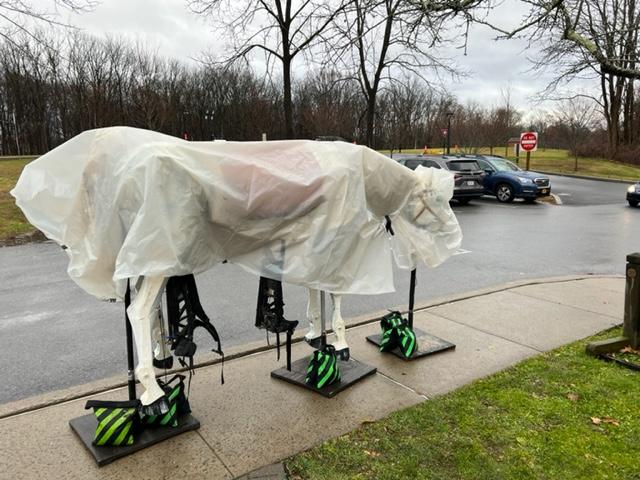
I looked over all the puppets like they were close friends seeing these puppets over the years and watching them being created by our puppet masters, Alex and Sophia, who have been running this part of the parade for years. Their ingenuity is what creates these masterpieces every year. Everything was wrapped in plastic waiting to see if the rain would clear for the evening (it did and was a clear and starry night).
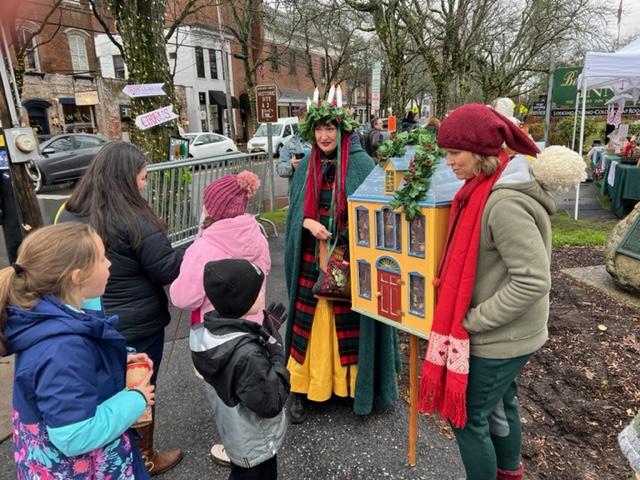
Mother Holly welcoming children to her story house
With the parade set up wrapped up, I did not have to be back to help until 4:00pm, I decided to head back down the hill and join everyone else in all the celebrations around Rhinebeck. The weather was slowly clearing and I could see some blue peeking out of the clouds.
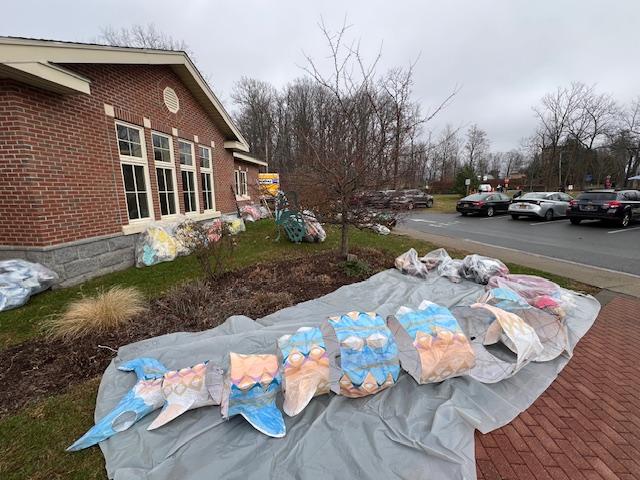
The Parade under wraps
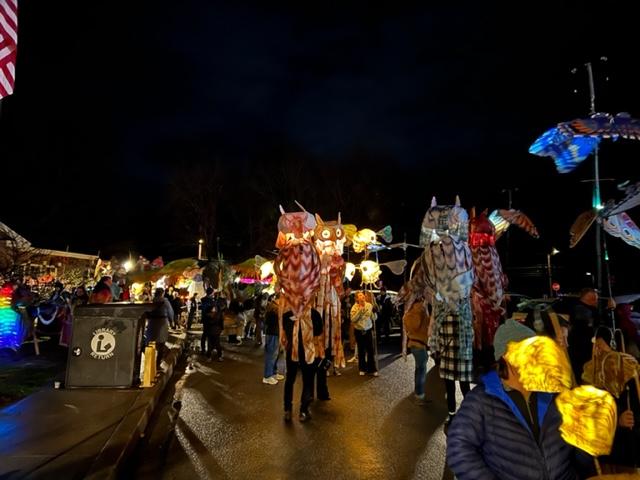
The Owls awaiting for their parade
Getting ready for the parade
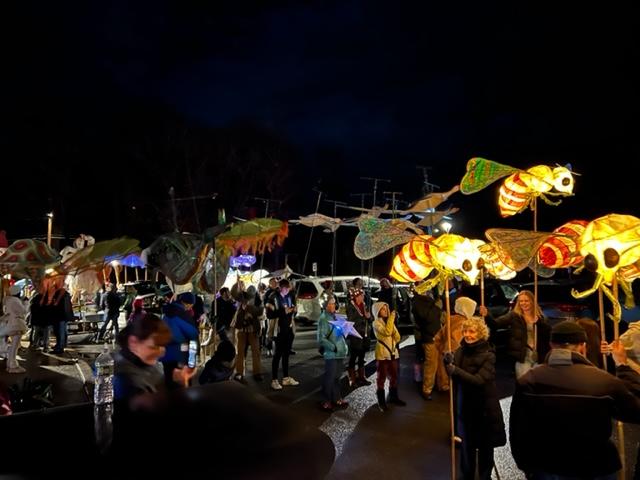
The bees are buzzing for the parade
The Dragon awaits opening
The stars are kept under wraps
When I left the library, the weather report said it was going to clear and when I reached downtown, the blue of the sky was there. More people started to show up for the activities. Not like last year but people were crowding the sidewalks and enjoying the festivities.
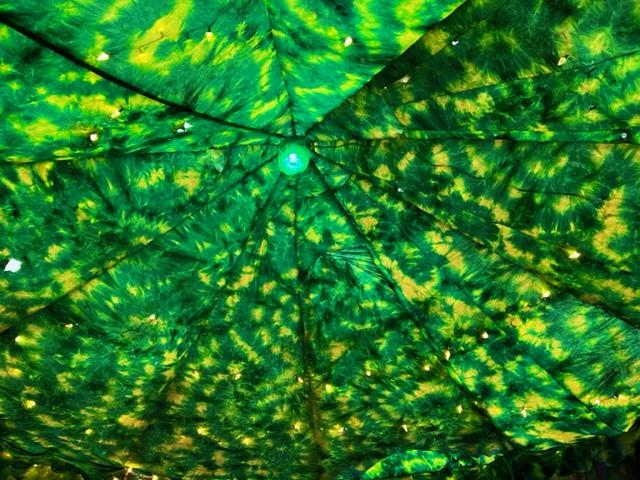
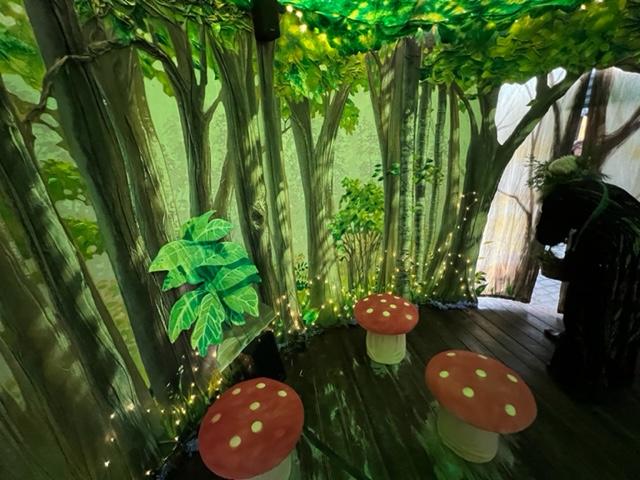
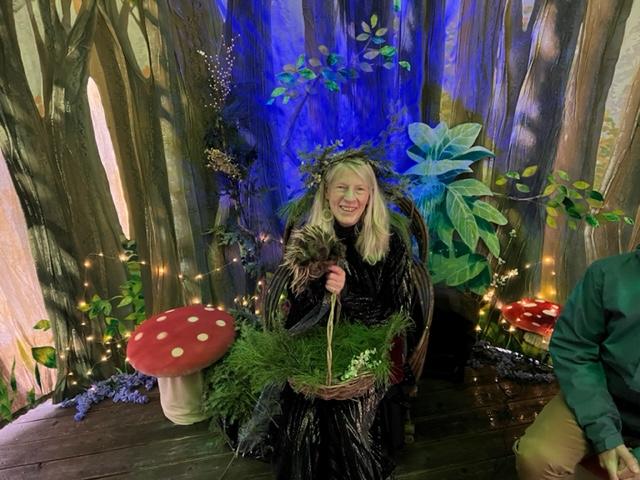
I decided to head to the ‘Porcupine Grove’ where a mysterious woman was doing the reading of the porcupine. It was an unusual home and place to visit but the creativity of the person who designed it was immense. We were told the story of the Porcupine, the representative of this year’s parade.
The Porcupine Grove ceiling to his home
The porcupine’s mushrooms were our seats for the talk
Here we heard the tail of “The Porcupine” by a wise woman
I was lucky that I got to the porcupines home first because as soon as I exited the line to get in was twenty deep and counting. It looked like I was the first one there with my group of visitors.
After the talk in the porcupine’s home, I walked all over Downtown Rhinebeck as the festivities were starting and decided my next stop would be at the Reformed Church to see the “Into the Light” show that I had not seen in years. The church location had changed and it was now in the Reformed Church Sanctuary. This is where I met up with my ‘cousin’ Marc Schuyler, who was working the door to control crowds. We got to catch up on the Halloween Parade that I was not able to attend because of classes that night at NYU.
Myself and Marc at the Halloween Parade a couple years ago
I had not seen the show in a couple of years and stared at the girl who was performing the lead role. She a little too developed to play the role of a young girl in the play. Come to find out this was the same girl I had seen in the show ten years earlier and she was still playing it.
The Reformed Church on Route 9
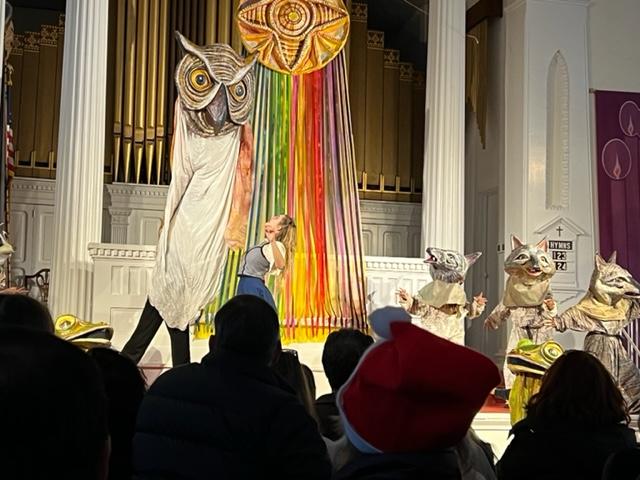
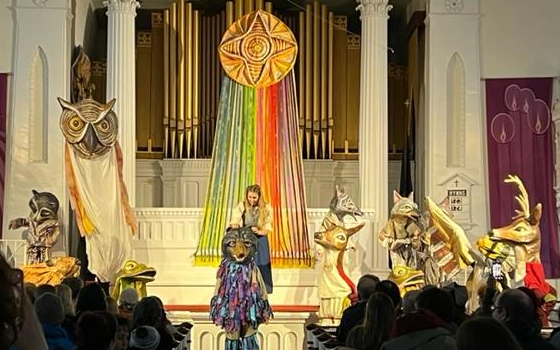
“Into the Light” is the story of a young girl’s journey throughout the world searching for the light. It features giant puppets and music. The kids did a nice job on the show.
The “Into the Light” show
The “Into the Light” show at the Reformed Church
The “Into the Light” show
The cast taking their bows
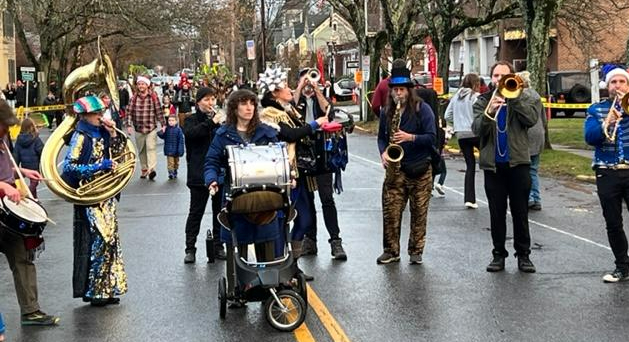
After the “Into the Light” show, I said my goodbyes to Marc and told him I would see him (if I do not have class that night) on October 31st, 2023 for the next Halloween Parade. I was off walking to my next stop, the United Methodist Church to hear the brass bands play. What was ironic was that most of these groups had been at the Dutch Reformed Church the night before in Kingston so I got to hear them perform again.
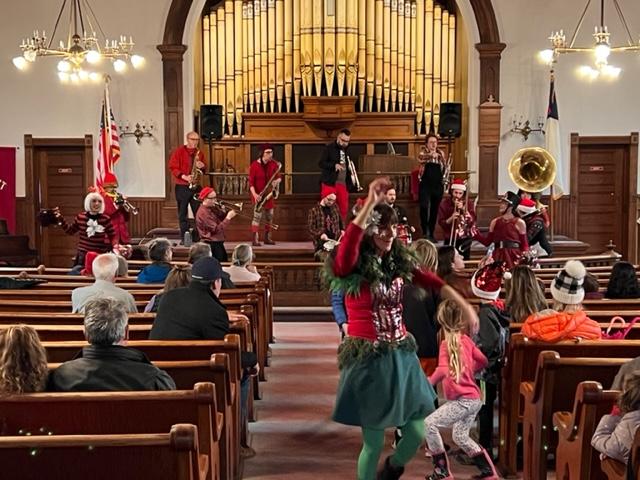
People were dancing in the aisles at the United Methodist Church to the brass bands
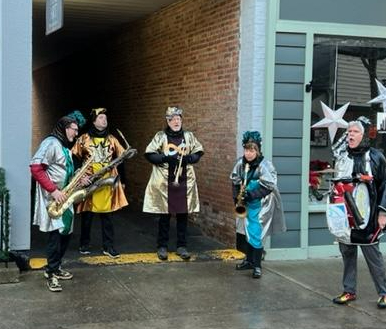
There were also musical groups outside the church as well
As the weather cleared during the afternoon, outside the church got lively.
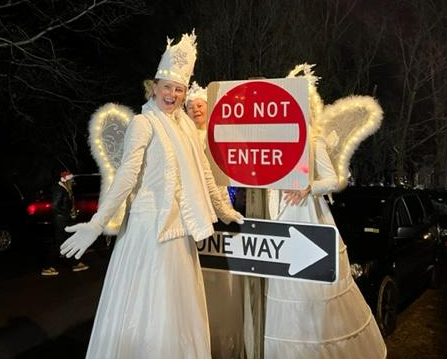
I was only able to stay for two shows and then I had to head back up to the Starlight Library to help with the set up of the parade route and help get volunteers to where they needed to go. The streets got more lively as the weather got sunnier and clear. There were all sorts of musicians walking around, the Gumpuses were performing before the crowd (many of these guys I have seen over the years), angels on stilts dancing to the bands, our friend, the Polar Bear, was dancing around everyone. It really lively on the Main Street.
The Gumpuses dancing around town
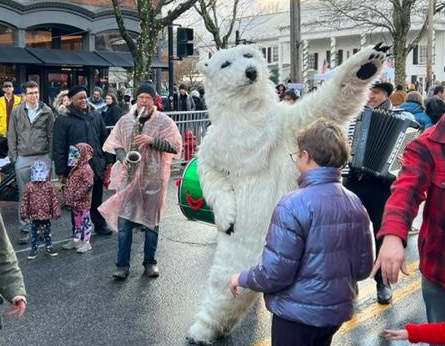
The Polar Bear dances to the musical beat
The Angel’s on stilts lead the magical forest around town
Musical bands played all over the main street
Different bands were playing all over the downtown area as the weather cleared
I walked up to the library after watching all the bands perform and every one was having such a nice time. As the weather got better, the crowds really started to arrive and I guest people figured with the weather getting better and the parade night clearing up, it is a perfect time to come out and see it.
I loved how decorated the town was for the event. Downtown Rhinebeck is one of the most beautiful downtown’s during the Christmas holidays. All the merchants and home owners decorate to the hilt and the whole town is covered in garland, bows, white lights and Christmas decorations that give it a festive appearance and put you in the holiday spirit.
The homes and businesses were beautifully decorated
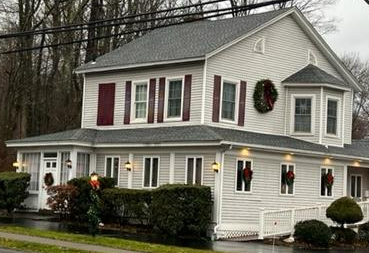
I always admire this house on my walk back up to the Starlight Library
When I got to the Starlight Library, all the volunteers were preparing for the rest of the parade volunteers to arrive. We got to eat some dinner provided by the Parade committee and then we had to get to work making sure everyone was where they needed to be. People wanted to test out their puppets and walk around. I have never seen an evening zoom by so fast and soon it was time to start the parade and get lined up and ready to go. It is always exciting to take that trip down the hill.
The Angels on stilts were exciting about leading the parade
As darkness came, it was time to light up the puppets and get the parade started. It is the most exciting time of the night as the puppet prepare for the lineup.
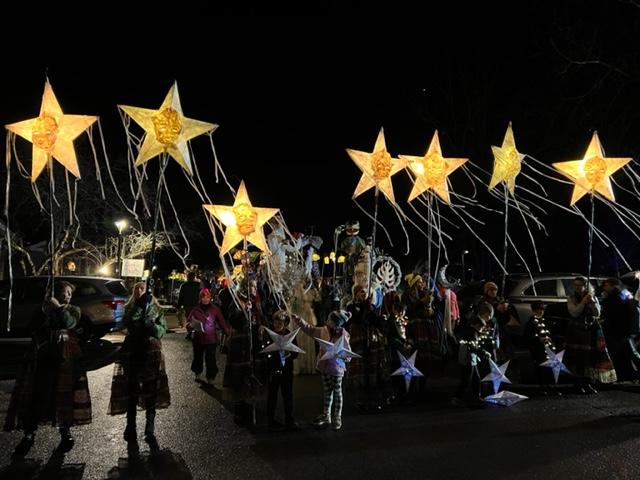
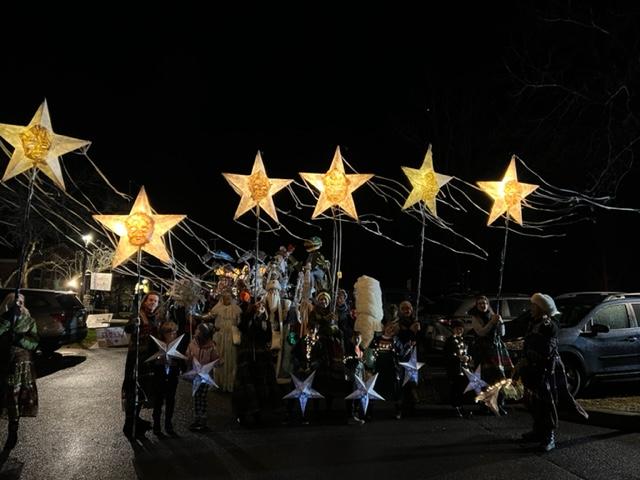
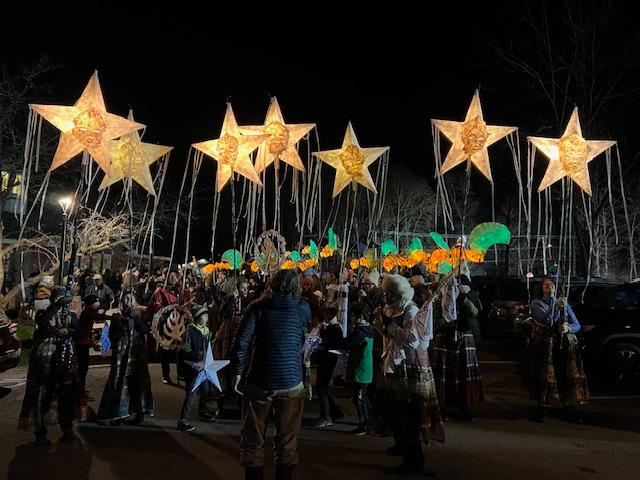
The Star Puppets lead the way each year and light the path of the parade
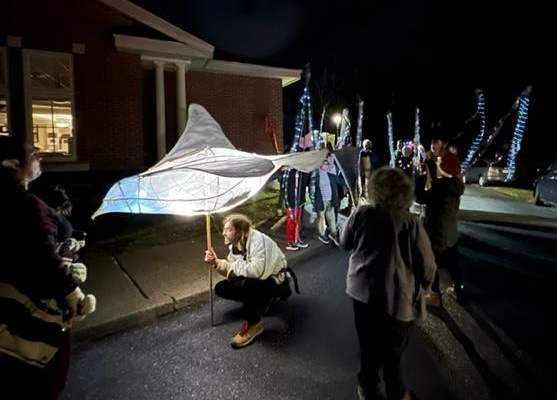
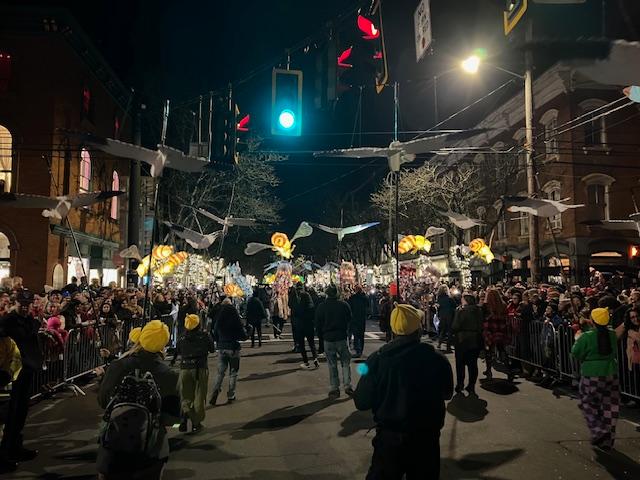
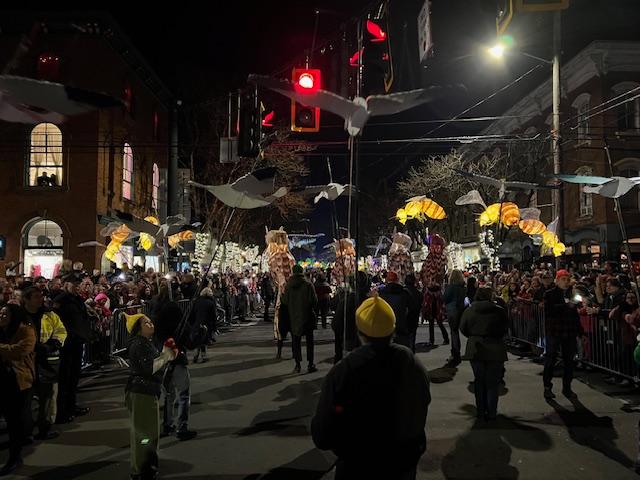
The Christmas Dove in the parade
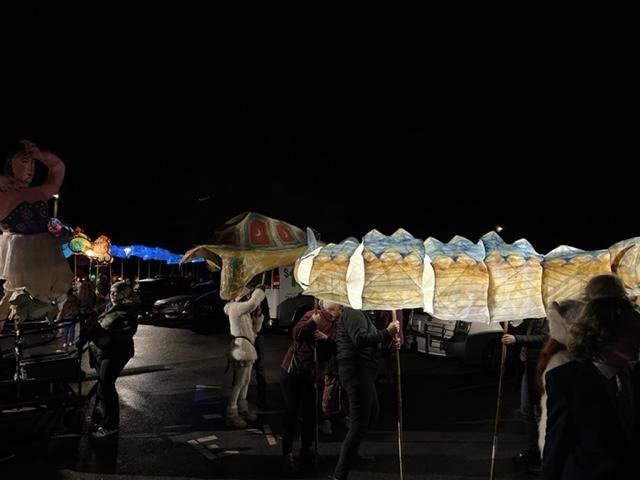
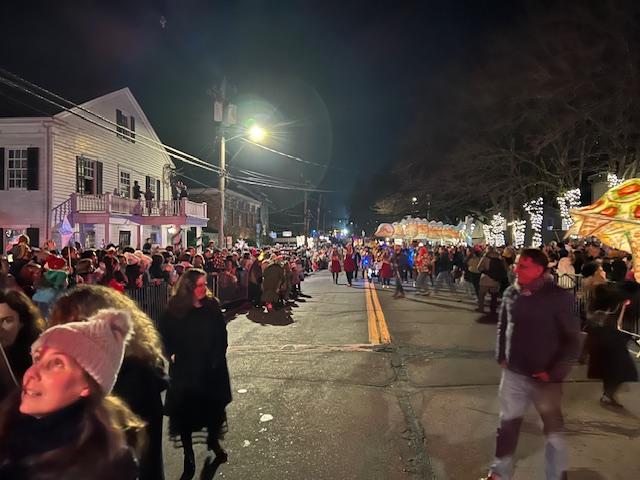
The serpents leading the way both at the Halloween and Sinterklaas Parades
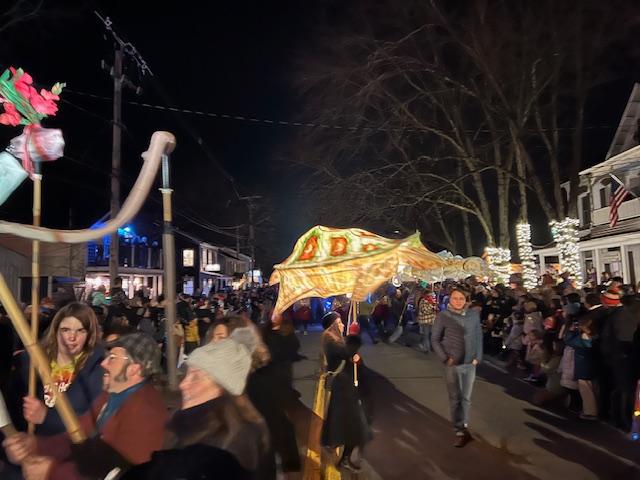
The Dragon lighting the way
The Bees have been lighting the way for years
The wise old owls enter the parade route
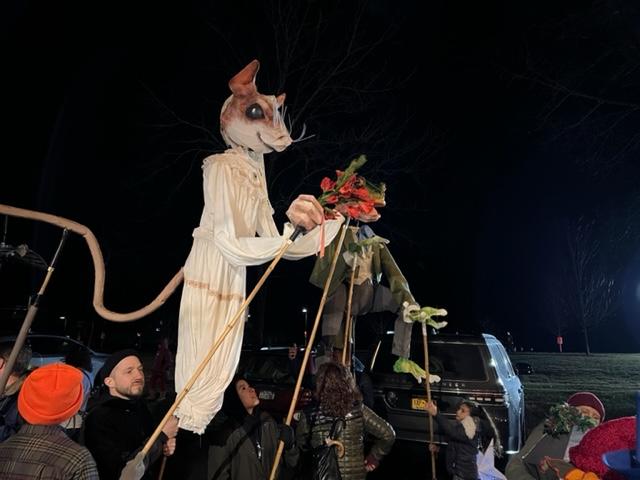
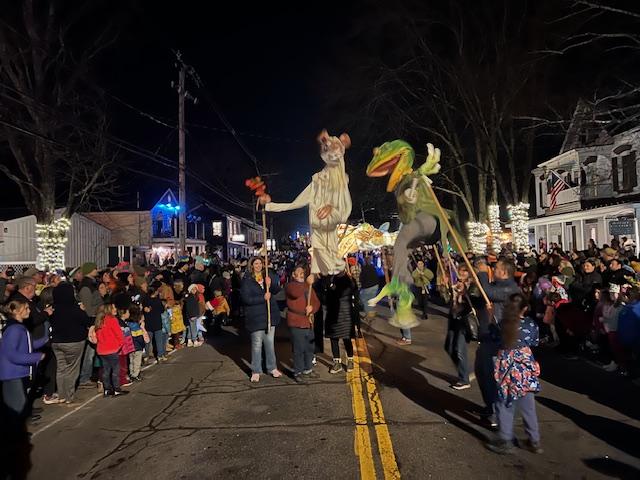
Miss Mouse enters the parade
The Star puppets lead the way down the hill to Downtown Rhinebeck, NY
The Start of the Parade at the Starlight Library. You can see me holding the banner at the end of the parade.
Because of the weather earlier in the morning, we did not have the crowds we had last year and in 2019 but still everyone lined the Main Street on the way to the community parking lot on our way to the Closing Ceremonies. People were so excited when the parade came down the hill. It is quite a event with all the lights and music and puppets dancing around the streets.
I was behind the stars and the dove and had the drummers behind me. I could not hear for most of the parade.
The parade moving down the hill towards downtown
The parade in the heart of Downtown Rhinebeck, NY is really exciting!
The parade slowed down as we entered the Community Parking lot as the puppets were being dropped off and the Closing Ceremony started. By the time I got to the parking lot, everyone had pretty much dropped off their puppets but the Stars and Bees who lingered a bit longer.
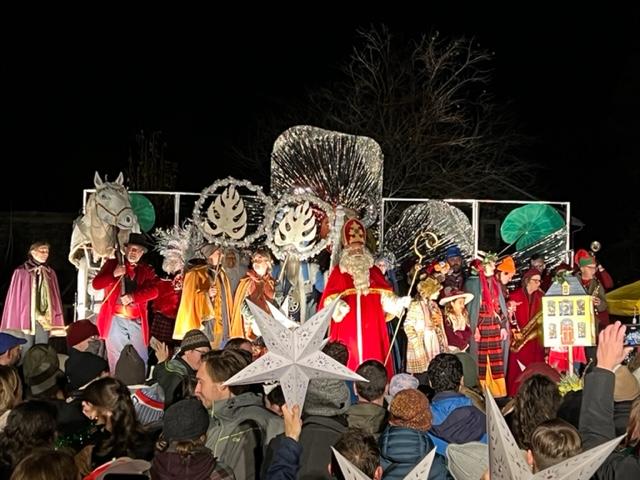
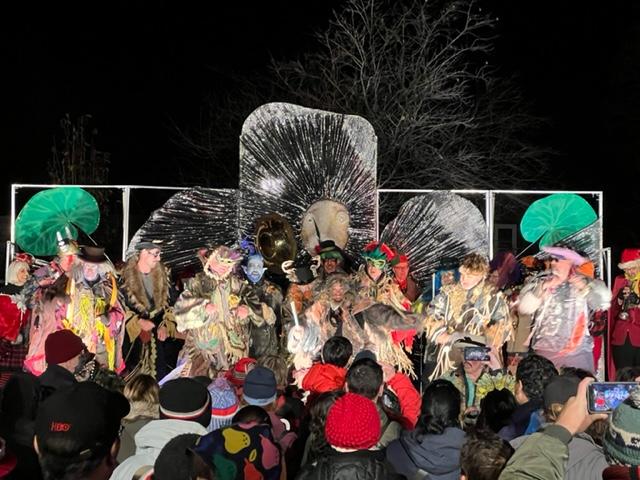
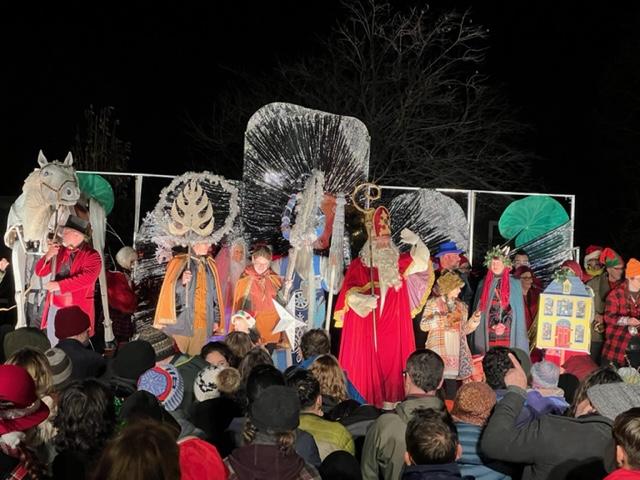
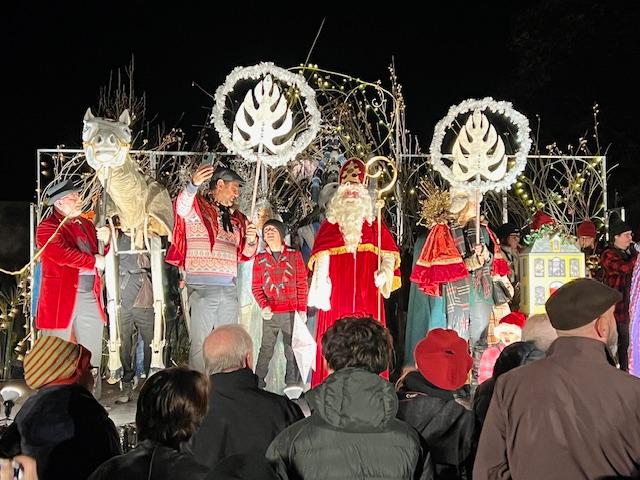
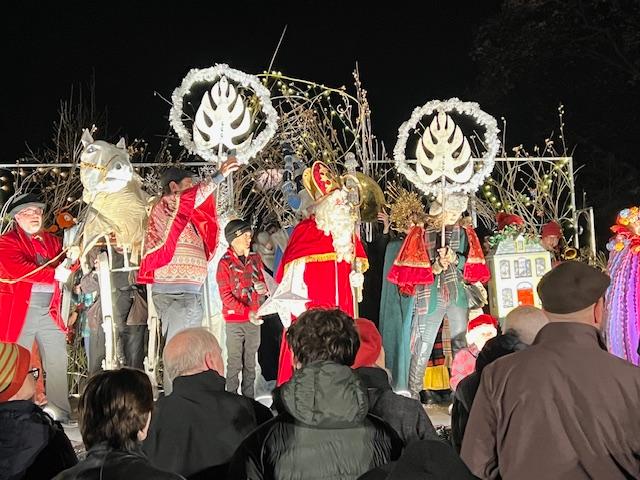
Than we started the Closing Ceremonies where all the main characters are introduced one more time before they make their exit from the parade awaiting next year. Everyone was so excited and the stage really breamed with artists having a good time.
The closing ceremony with Sinterklaas and his court of people helping him that day.
The Grumpuses perform their last dance of the day on stage.
The Polar Bear was leading the dance at the end of the parade
Hansel and Gretel singing and dancing at the parade.
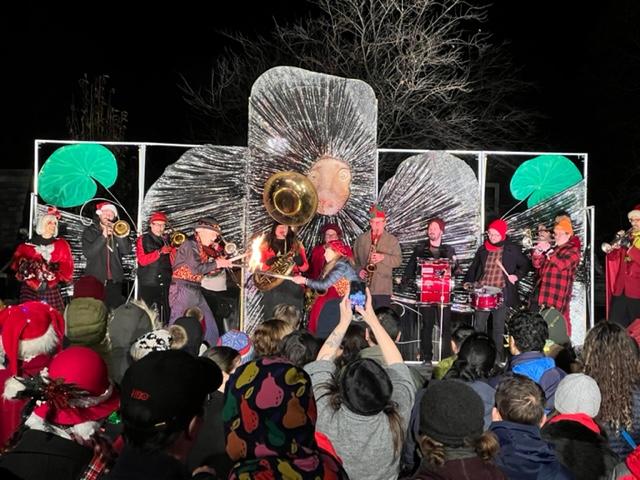
The band plays on at the closing ceremonies
The flame throwers performed at the end of the Closing Ceremonies.
The stage after the performances were over. It was really creatively done.
After the Closing ceremonies, I walked around the downtown area and spent time admiring the window displays at the stores and admiring the artwork around the trees. It got very quiet in Downtown Rhinebeck. Within an hour of the parade, you would have never known there was a parade.
The merchants in Downtown Rhinebeck really decorated their stores to the hilt for the holidays
The display windows in Downtown Rhinebeck were amazing
Merchant’s window at Christmas
Merchant’s windows at Christmas
Merchant’s windows at Christmas
The night had cooled down but you could see all the beautiful stars in the sky when the weather cleared and in the background I could hear the saxophonist who always plays at night. The Christmas songs he was playing really put me in the Christmas spirit.
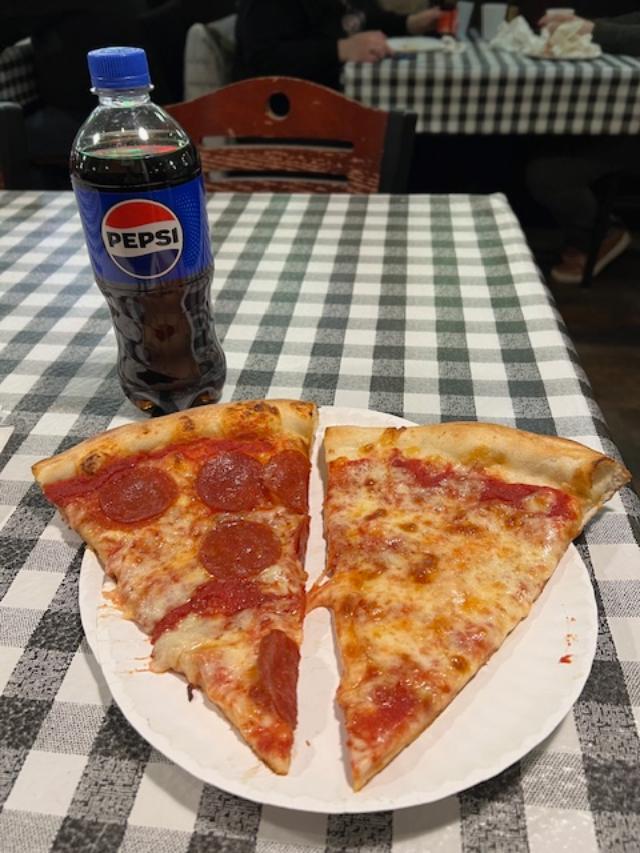
I ended the evening with a couple of slices of pizza at Village Pizza. I can’t tell you how good that pizza tasted at the end of the evening. I was talking with the staff there and they said they were consistent that day but not like the two previous years when they did not sit still. The rain at the beginning of the day put a damper on everything.
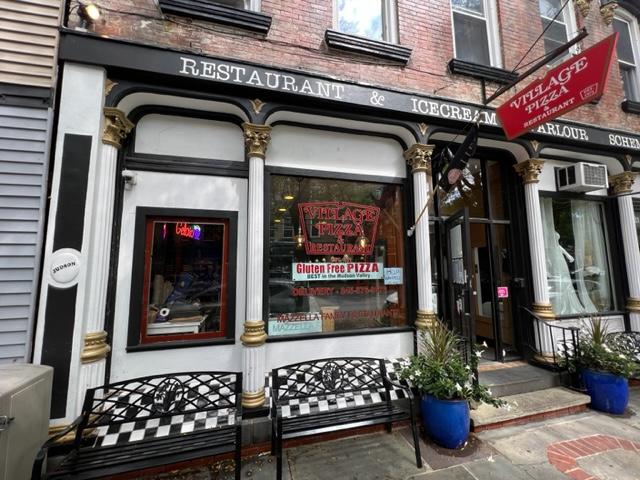
Village Pizza at 19 East Market Street in Rhinebeck, NY during Sinterklaas
The pizza is excellent at Village Pizza. My Sinterklaas dinner every year.
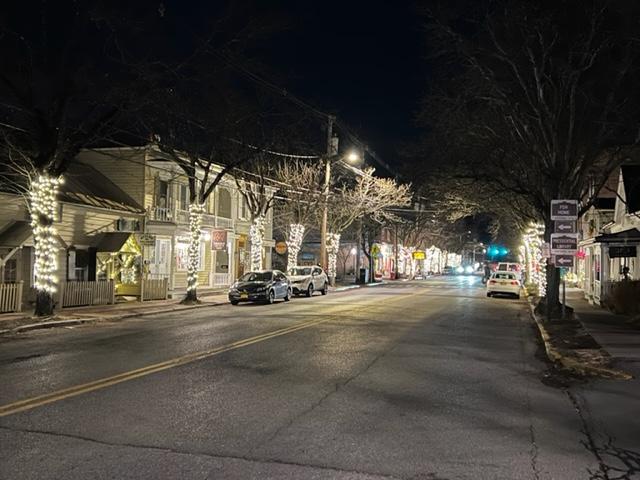
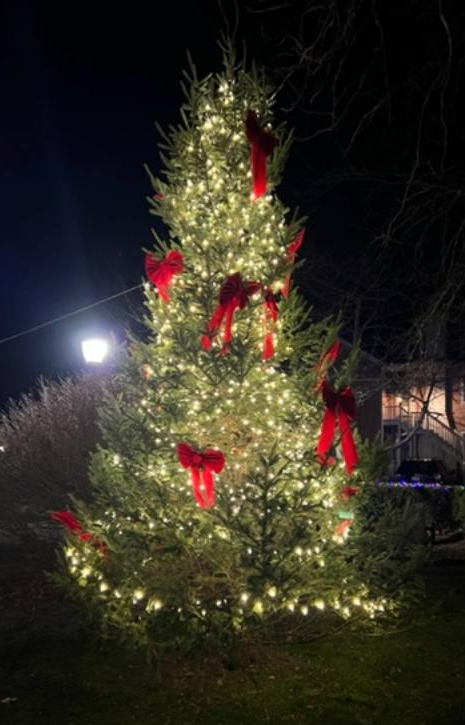
After dinner, I walked around Downtown Rhinebeck, which to me outside of Cape May, NJ is one of the beautiful town’s to spend Christmas in. The whole downtown was beautifully decorated and the Christmas tree was amazing.
Downtown Rhinebeck, NY after the Sinterklaas Parade
Downtown Rhinebeck, NY at Christmas time
The Christmas tree in Downtown Rhinebeck, NY
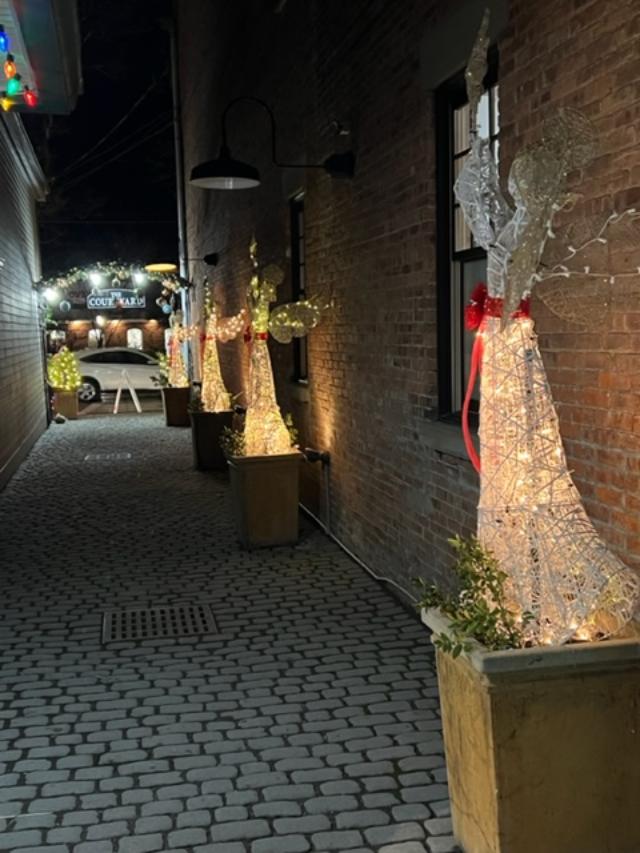
The angels in the alleyway
The angel in the alleyway
I got back to the hotel and went right to bed. I slept so soundly that evening. Between the heat of the room and how comfortable the bed was I got one of the best night’s sleep in a long time. With all the stress of school and having to bring work with me, I just needed this evening to relax.
The view from my room the next day. It was sunny and warmer.
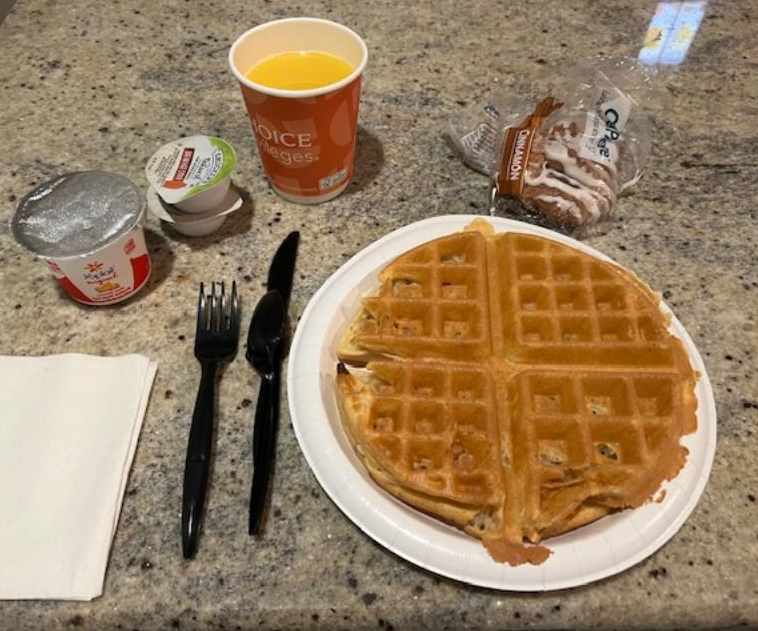
The waffles at breakfast are always a treat at the Quality Inn in Hyde Park, NY.
In 2023, there was a threat of rain too but by noon time the sun started to peek out from the clouds and it cleared for the rest of the day. The weather became a balmy 53 degrees which is unusual for this time of the year and we had a nice day for the event. I got to the Starr Library at 10:00am on the dot to start set up for the parade and it was a nice morning. We had plenty of people and we got the job done in about an hour. Set up was easy when you have the same people to help every year.
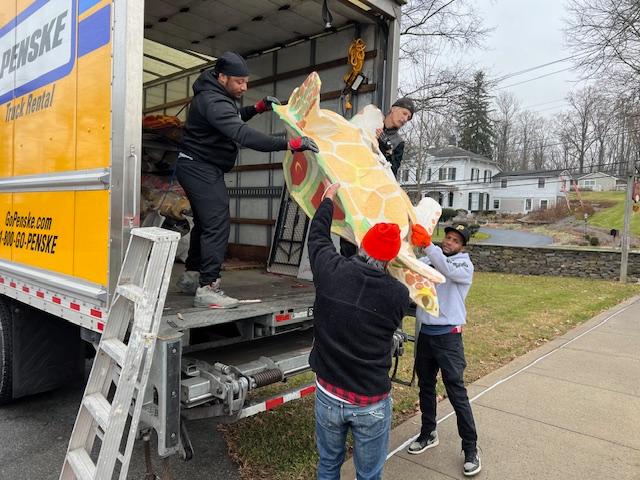
We started to unload the puppets at 10:00am.
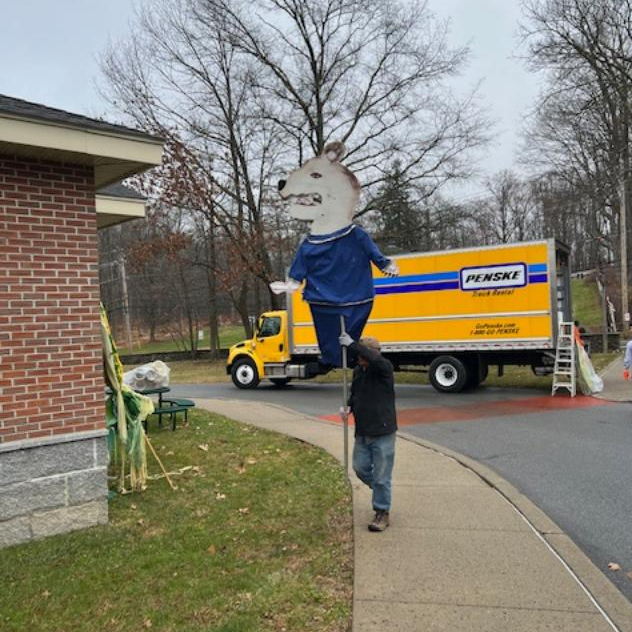
Unloading the puppets took about 45 minutes.
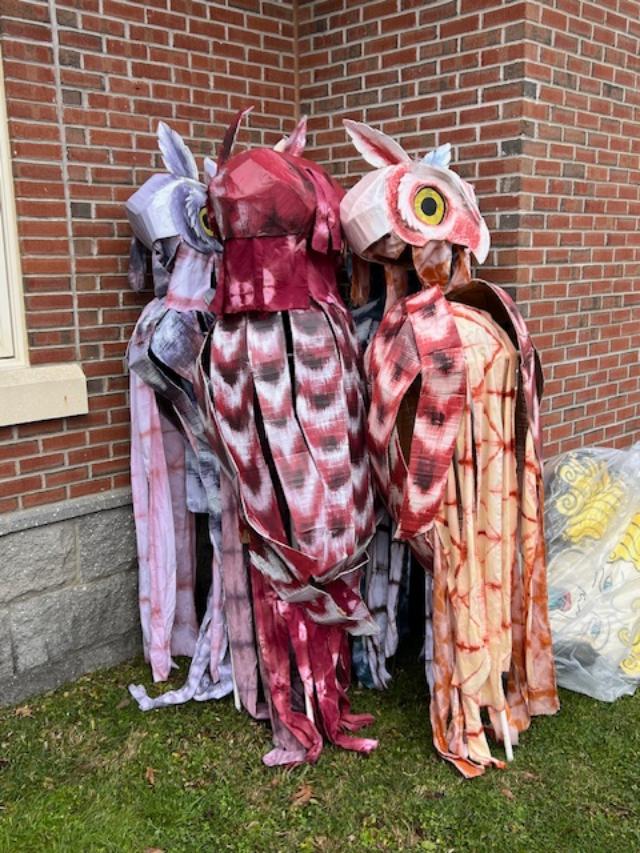
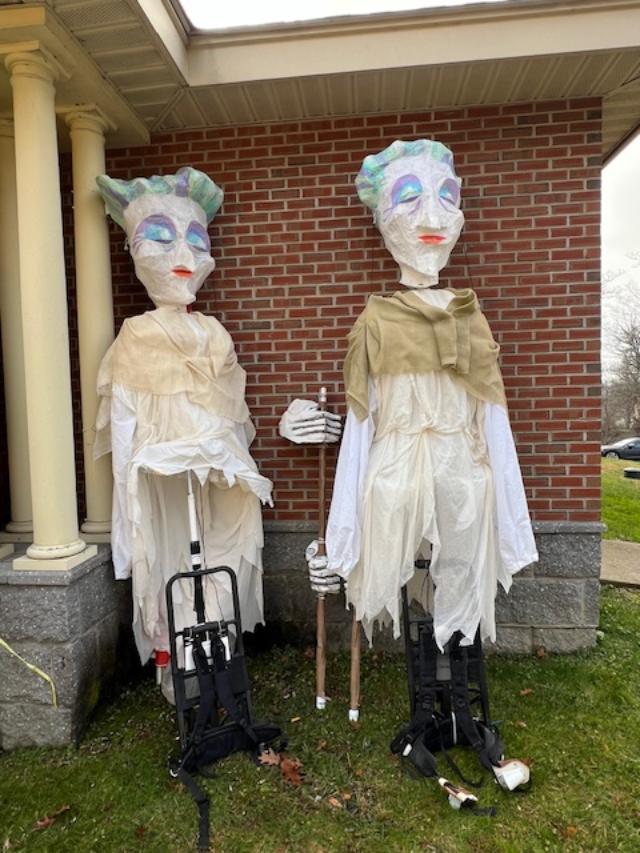
The Owls are like old friends to me
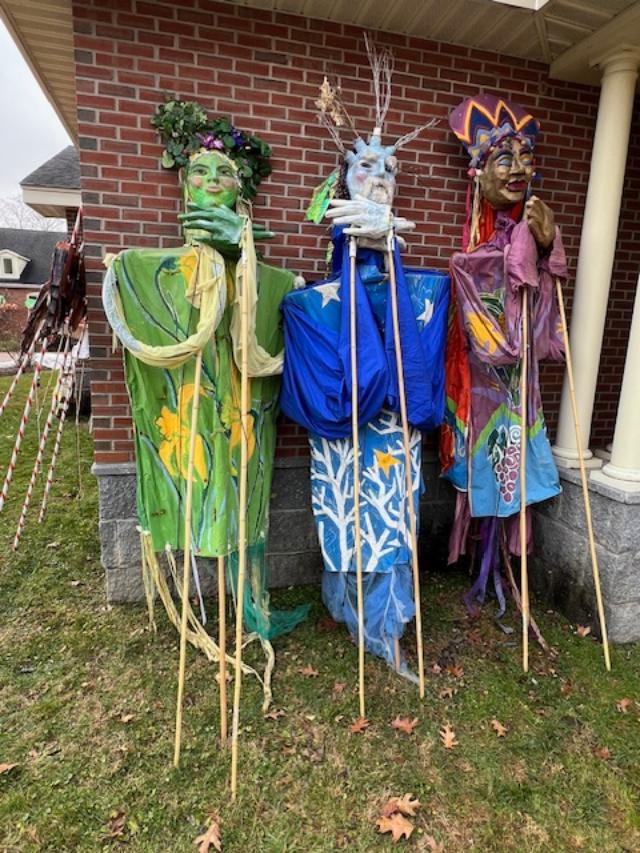
The Four Seasons standing guard
The Sweepers were new puppets this year.
Setting up the serpent was my first job that morning.
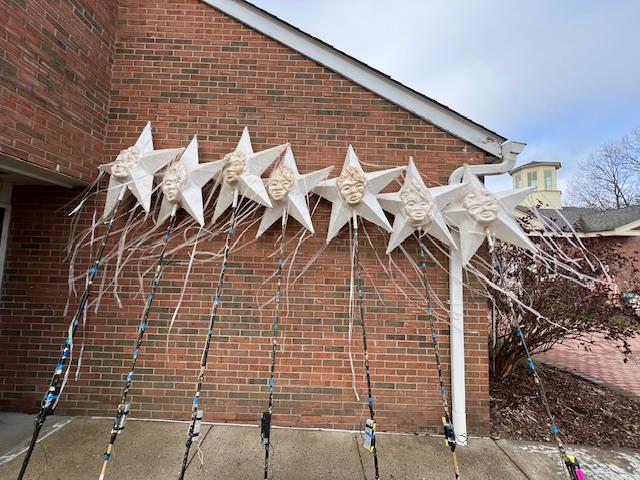
I have been setting up the stars since my first year in 2014 helping out with the parade.
We were done setting up for the parade by 11:30pm and we had to meet back at the library by 3:00pm for the parade staging and get the volunteers to their puppets. That’s when the fun begins with that. I walked downtown to go to the Opening Ceremony which had started at noon and was able to watch the last 45 minutes of the Opening Ceremony at the Beekman Arms Ballroom. That is always interesting.
The Opening Ceremony in 2023 with the Anteater and his court.
The Opening Ceremony at the Beekman Arms with Coordinator Jeanne Fleming.
The Opening Ceremony at the Beekman Arms
The ‘evil’ anteater was the ‘Gadfly’ last year.
The Anteater on the prowl at the Opening Ceremony.
After the Opening Ceremony was over, I stayed to hear story teller, Jonathan Kurk, tell the story of Sinterklaas and the story of the miracle of Christmas.
Storyteller Jonathan Kurk entertains at the Opening Ceremony
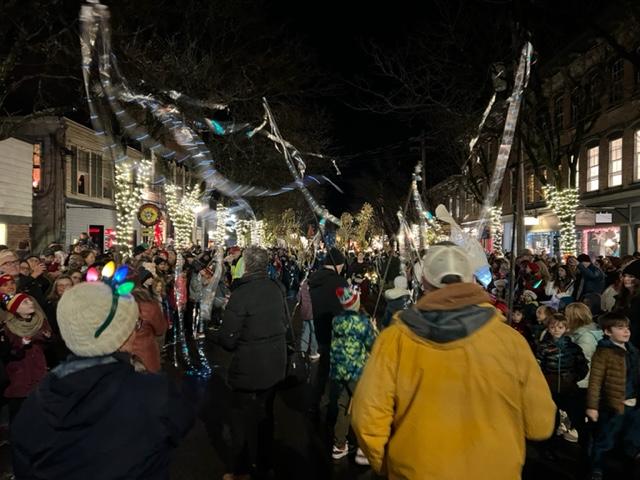
After the Opening Ceremony completed, I decided to explore the town. I walked around downtown Rhinebeck which is always amazing at Christmas time. It is a wonderland of lights and sounds and delicious smells as all the charities and local organizations try to sell baked goods and hot dogs all over Main Street to raise money of their organizations.
The musicians on stilts are always a favorite at Sinterklaas.
The musicians are out in full force playing on stilts and walking around the town engaging the crowds of people. Since it was a nice day this year, the downtown was getting packed earlier than it had in previous years. After listening the musicians on stilts, I figured I should go visit the Ant Queen before it got too busy. I visited her just in time as after I left the line, it got even longer behind me.
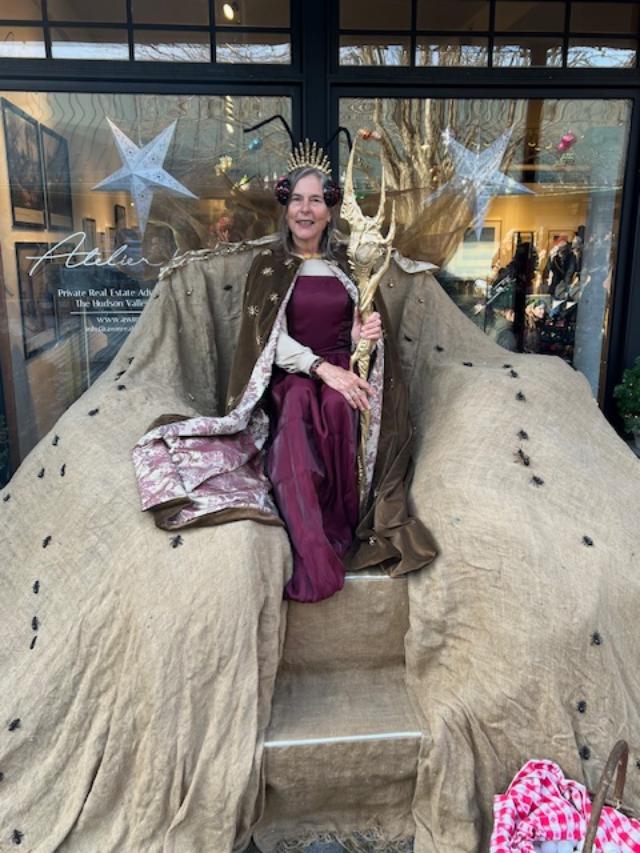
The Ant Queen on her hill in the Courtyard.
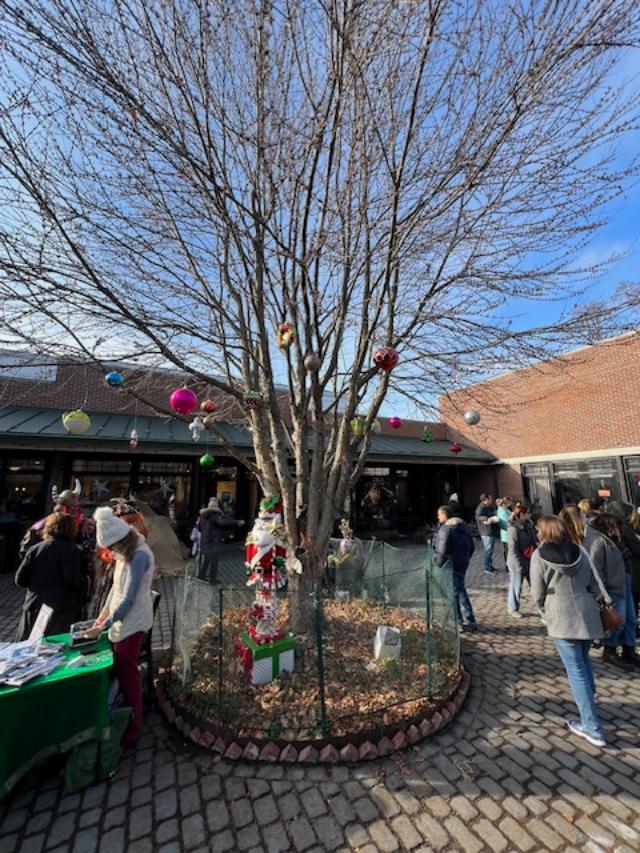
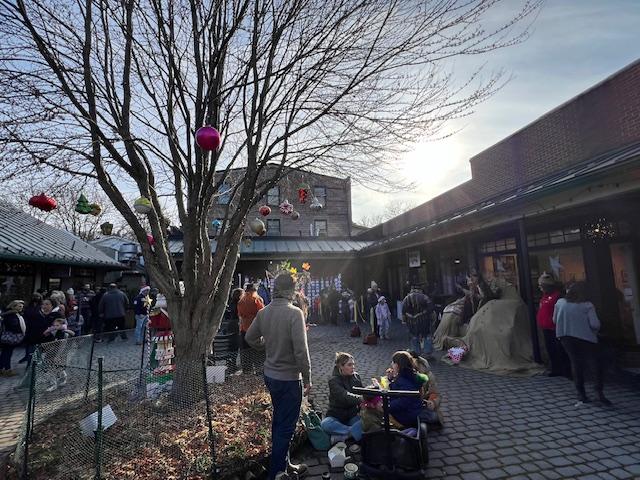
The Courtyard got really busy when I was finished visiting the Ant Queen.
The Ant Queen in the Courtyard with the crowds growing that afternoon.
After I left the Courtyard, I walked around for a bit and then realized that I had to get checked into my other hotel that night so I walked back to the library, got my car and left to go to Quality Inn in Hyde Park where I was staying that evening. After I checked in, got my room and settled in I headed back up to Rhinebeck. The crowds grew even larger in the hour that I left and all the parking spots by the library were now gone as well as most spots in the downtown. I had to park six blocks into town near the exit to the fairgrounds. That would be fun when the parade was over walking back to that.
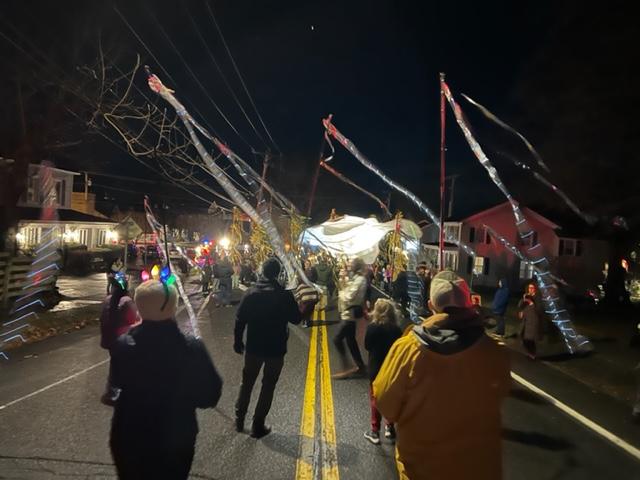
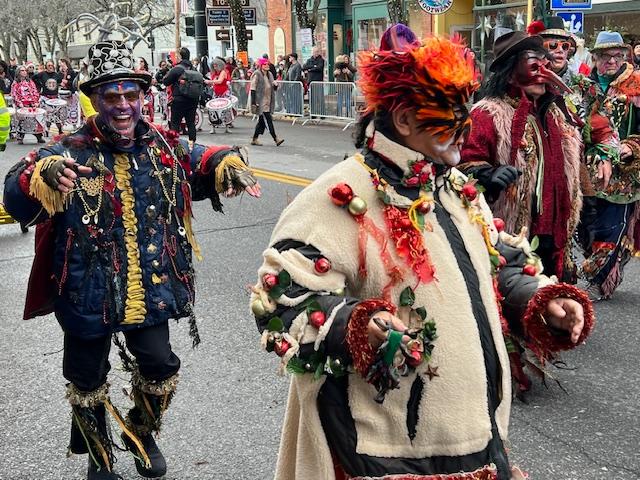
As I entered the downtown, the Gumpuses started their dance.
The Gumpuses dancing down the Main Street.
The Gumpus dance
The Gumpus Dance
The Gumpus Dance
After I saw the Gumpus dance in the downtown, I was able to walk around for a bit before getting back to the library. I saw some of the roaming musicians, the Dancing Bear and the Pocket Lady roaming around the Downtown. Between checking into my hotel, looking for parking and just walking back to the Main Street, I did not have much time to enjoy the entertainment this time around.
Downtown Rhinebeck got busy during the day.
Downtown Rhinebeck got busy during the day.
Admiring the Christmas windows at the stores.
The Christmas Tree by day
After I got back from the hotel and parked some nine blocks away. I walked through the town again looking at the all the performers and bands going in and out of the now closed Main Street. The crowds had really grown once the clouds cleared and it was sunny again. As the last of the sunshine disappeared by 5:00pm, the lights came on and that is when Rhinebeck truly shines. This started with the town Christmas tree which lit brightly by the main parking lot.
The Christmas tree was brightly lit when I left the downtown area for the library.
I made my way back to the Starr Library and that is where the real magic starts. Getting ready for the parade. Every year, I come back to the library at 3:30pm and help get everyone to their puppet. The parade line up starts at 6:30pm and then the parade heads down the hill. It is the most magnificent site.
The Geese and Bee puppets as we enter Downtown Rhinebeck, NY.
The parade in full swing in Downtown Rhinebeck, NY.
The crowds were huge the night of the parade.
The whole town comes out for the Sinterklaas Parade.
As we entered the parking lot to end the parade, the crowds arrived to the main stage where the Closing Ceremony takes place. I could not believe that another parade had ended. I will blink my eye and it will be here again. It is so funny how fast it all goes.
The backdrop of the stage after the Closing Ceremony was over.
All the puppets walked by the main stage and we dropped them off with Alex and Sophia. I then watched the rest of the ceremony and then the closing remarks. Another parade was over. The fire throwers came on and did their routine and that ended the parade. I said my goodbyes until next year and then proceeded to Village Pizza for a slice before I went back to the hotel.
The owner I could tell was exhausted. He waited at the door of his restaurant and asked people what they wanted to order. I thought that was rude but figured he was protecting his bathrooms. The restaurant was still busy almost 45 minutes after the parade was over and remained busy throughout the time I enjoyed my pizza. They limited the slice menu to just plain and pepperoni so it made it an easy choice. I was exhausted by the time I got back to my hotel, took a quick shower and had the best night’s sleep in weeks. I was tired!
After breakfast the next day, it was off to Boonton, NJ to the New Jersey Firemen’s Home to volunteer for the Bergen County Firemen’s Home Christmas Party. It was the first time in three years we had had the full party with entertainment and dropping off presents. The members had time before the party to socialize with each other and I even got better acquainted with the Firemen’s Home resident dog, Wells.
Our article on the Bergen County Firemen’s Home Association website:
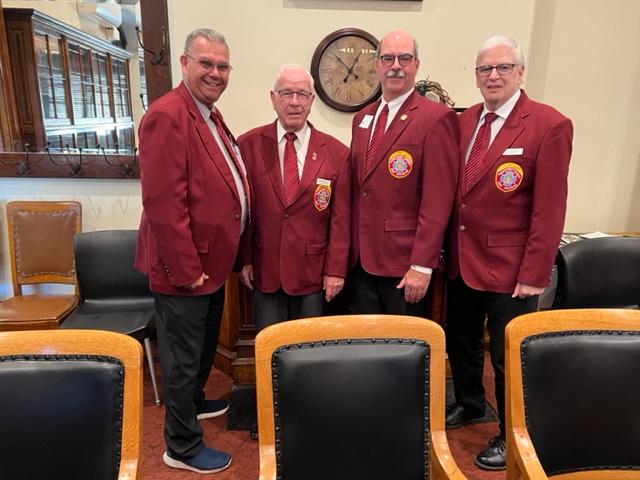
The Bergen County Firemen’s Home Association Executive Board, Tom Simpson, George Heflich, Justin Watrel, John Kinner.
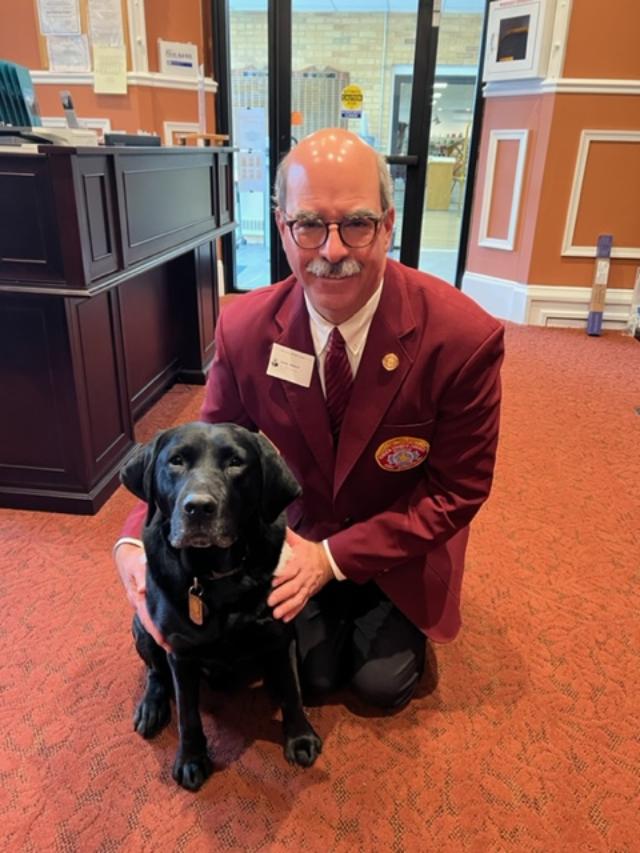
Vice-President Justin Watrel with resident dog, Wells.
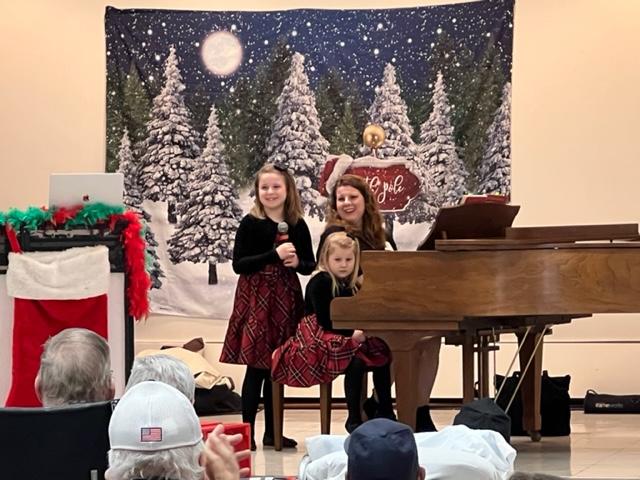
Member Jerry Naylis’s daughter and grandchildren were part of the entertainment again this year and really charmed the residents.
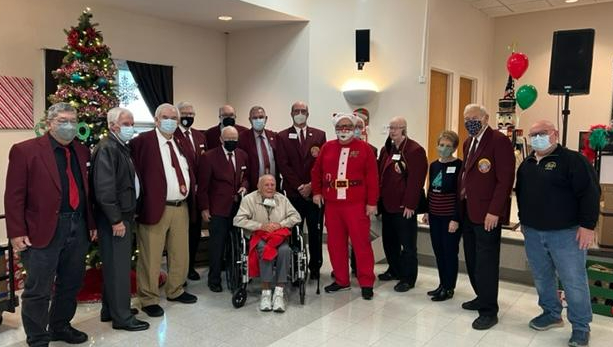
The members of the Bergen County Firemen’s Home Association gathered together for our annual membership picture after the party was over.
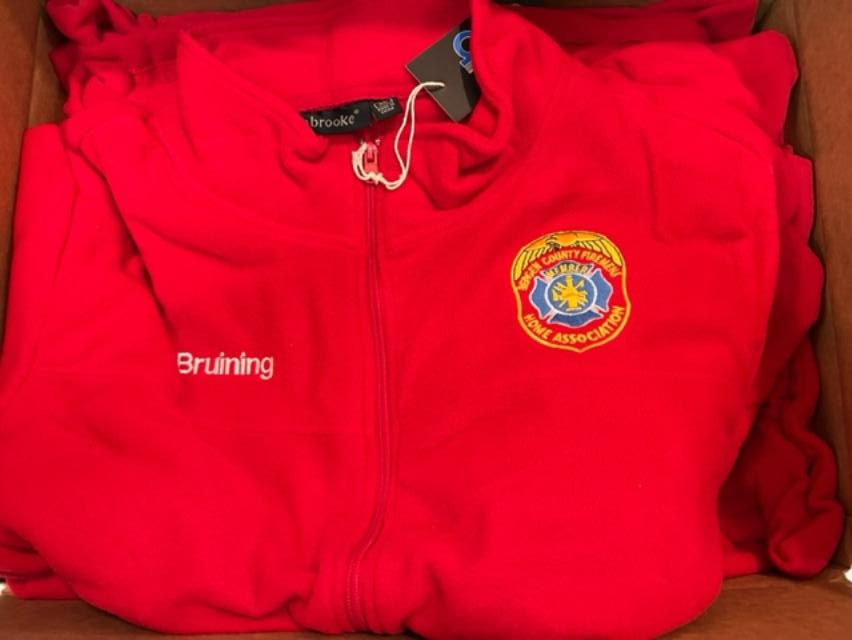
After the entertainment was over, we handed out our presents to the residents which was a beautiful red fleece jacket with the residents name on it. I could tell that all the residents were touched by the gift and it really meant something to all of them to be remembered at the holidays.
Our Christmas present to the residents
While the entertainment carried on for the next 45 minutes, some of the members stopped for dinner at the Columbia Inn in Montville, NJ and just relaxed. It had been a long day for everyone and a good meal was a nice way to end the day. I had the most wonderful Chicken Rollatini special that really warmed me up on this cool early evening. It was nice to catch up with the other members before the holidays went into full force.
It had been a long weekend and when I got home, it was getting ready for classes again, finishing my White Page for my Trends in Tourism class, my Metaverse paper for Innovations in Tourism class and our Mapping project for my Data Analytics class. This on top of all the work I had to finish in my own classes at Bergen Community College. It was going to be a long next three weeks before Christmas and both colleges would keep me busy.
In 2023, we did the same thing without masks and both the guests and all of us enjoyed it more. It made for a more engaging environment. It had been a long evening the night before with the end of Sinterklaas and that very busy parade. I slept so soundly at the hotel that I felt refreshed and ready to go.
After having my waffle breakfast at the Quality Inn, which is my tradition every year, it was off to the NJ Firemen’s Home again. It was a really gloomy day and I had to spend my morning wondering why the WIFI was not working.
When I got to the home, it really got dark outside and rainy. Talk about no fun being outside. Inside though, the NJ Firemen’s Home was decked out beautifully for the holidays. Talk about festive and jolly, with several Christmas trees all over the home and garland everywhere.
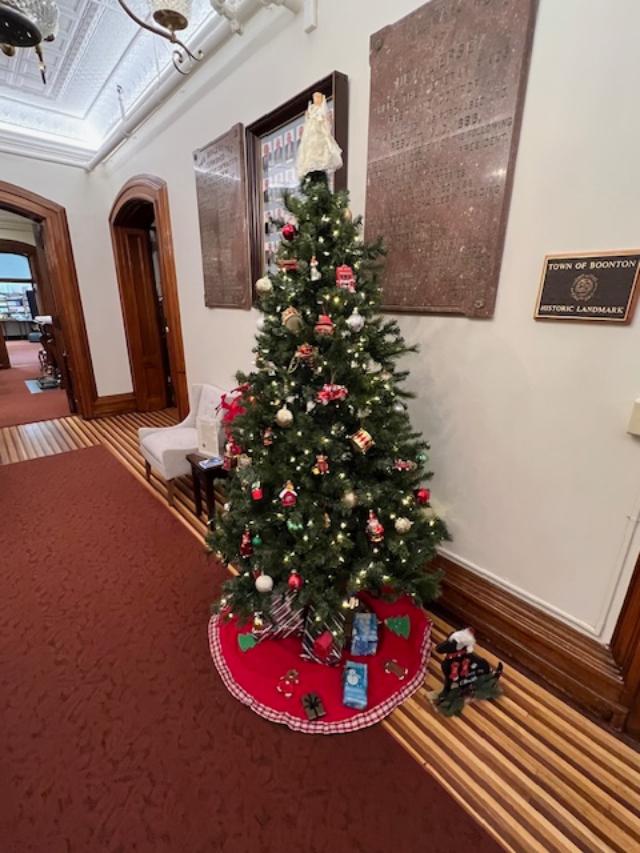
One of the many Christmas trees at the NJ State Firemen’s Home.
We enjoyed Sweet Rolls and Crumb cake for a late Continental Breakfast before the entertainment and had a nice time just catching up with one another before the craziness of the holidays started. Everyone was running around at parties and get togethers.
Signs of the season were everywhere as the home was decorated to the hilt for the holiday season. This was our last event of the season as the Bergen County Firemen’s Home Association held its Annual December Meeting and Entertainment afternoon at the NJ State Firemen’s Home in Boonton, NJ.
Even the fire hydrant display was decorated.
The sign welcoming people to the party.
We had our annual Christmas Party at the NJ State Firemen’s Home and it was nice to be back. Masks were a thing of the past and we were able to see everyone again. It made for a more engaging afternoon.
The home’s Christmas tree with our gifts to the residents, a embordered jacket.
We started our day with a get together of the members before the entertainment began. It was nice to just sit back and talk to the other members before the entertainment began. Our President brought us the most delicious crumb cake and glazed raison buns and these devoured very quickly by the members.
We even got a chance to bond again with the resident dog of the NJ State Firemen’s Home, Wells, who was a former seeing eye dog that has now found a home here keeping our retired firefighters comforted and engaged. He walks around having everyone spoil him with petting and treats. Even he has to watch his weight at the holidays. All I know is that he loves being loved by everyone and likes to spread that love.
NJ Firemen’s Home resident, Wells with BCFHA Vice-President Justin Watrel.
Our entertainment for the afternoon was Dana and Daddy O, a singing duo who sang Christmas songs and told jokes. They were were good.
Dana and Daddy O performed that day for the residents and us.
Member Jerry Naylis asked his daughter and grandchildren perform again this year (Jerry was away on a conference). Daughter Stephanie Naylis-Quirk and her daughters, Regan and Riley Quirk , played the piano and sang to the residents of the home. The children sang lively Christmas songs and led the room in a sing a long with favorites “Jingle Bells” and Regan’s solo, “Silent Night” and Riley’s solo, “I saw Mommy kissing Santa Claus”.
Stephanie Nayles-Quirk with daughter Riley and Regan, who sang so nicely that afternoon.
After the ladies took their bows, it was time to hand out the Christmas presents from the Bergen County Firemen’s Home to the residents. This year the gift to the residents of the home was a beautiful ‘firemen’ blue jacket that had each resident’s name on it. It was a very personal and touching gift to our fellow retired firemen who we wanted to remember at the holidays. They were very touched by this.
BCFHA Vice-President Justin Watrel with NJ State Firemen’s Association President and BCFHA member Bob Ordway handing out gifts at the Christmas Party.
While members were handing out gifts, other members were serving desserts and other refreshments to the residents. Everyone had a delicious treat that afternoon after they had their lunch. The home provided delectable cupcakes both regular and sugar free to satisfy everyone’s sweet tooth.
BCFHA members Peter Devries and Glenn Corbet serving desserts to the residents.
After the day of entertainment was over, the members got together and took our annual member group shot. It was a fun afternoon for everyone involved. We have managed to provide the residents with all sorts of entertainment, barbecues and special events while never losing the spirit of helping our fellow fire fighters.
Merry Christmas and Happy New Year to all of our firefighters, retired and still active from the Bergen County Firemen’s Home Association!
In 2025 The Bergen County Firemen’s Home Association Party:
In 2025, we were back at the home again for one of our best Christmas party’s for the residents that I can remember. We had such a good time.
The weather had gotten cooler and Halloween was behind us. The smell of pine is in the air and it seems the holiday decorations are coming out quicker and quicker even before Halloween is over. It was time for the members of the Bergen County Firemen’s Home Association to host our annual Christmas lunch and resident party at the NJ State Firemen’s Home in Boonton, NJ. This is our most popular party of the year and an event that the residents of the home look forward to every year.
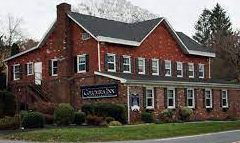
The NJ State Firemen’s Home Association in Boonton, NJ decorated for Christmas
The home was decorated so festively and put everyone in the mood for this afternoon. Is it what the holidays are all about?
The decorations around the home to create a festive environment
The holiday cheer around the building
In December our organization does not have a formal meeting but rather a members lunch shared by both the members and the staff so that we all could share in the successes we had this year. It was a productive and profitable year of fundraising and that will help us sponsor more programming at the home for our fellow firefighters who reside here.
This afternoon buffet is a way for members and their family and for the hardworking staff at the home to know how much we care for all their love and support of the residents who live here. None of us could do what we do without them.
Our buffet luncheon cooked by the Home’s in-house chef Prince
The delicious sandwiches and salads at lunch
After lunch was over, we joined the residents in the main recreation room for entertainment and our visit from Santa.
The recreation room decorated for the holidays
Our DJ and Master of Ceremony for the event, BCFHA member John McLoghlin was who was joined with the musical talents of member, Jerry Naylis’s granddaughters and resident favorite, Gigi in an afternoon of Christmas carols and songs.
Entertainer Gigi with Master of Ceremony BCFHA member John McLoghlin
Jerry Naylis’s granddaughters are a big favorite with the residents
Accompanied by their mother on the piano, it was a festive afternoon of songs and hymns
The girls singing “Rudolf the Red Nosed Reindeer”
The girls singing “Walking in a Winterland”
The girls singing “Silent Night”
The girls singing “We wish you a Merry Christmas”
After the girls performance, entertainer Gigi rocked the room with a series of popular Christmas songs and warm holiday wishes to all the residents and their family members in the audience.
Gigi performing for the residents
In the middle of the concert, we had a quick pause as a very special visitor arrived from the North Pole as Santa led our break in the concert for gift gifting.
Santa arrived to help us distribute gifts to the residents
As the afternoon rolled to a close, we were treated by both Gigi and Santa a sing a long of ‘I’m dreaming of a White Christmas’.
The sing a long lead by Gigi and Santa with the song “Walking in a Winter Wonderland”. There was so much energy in the room!
All good things come to an end plus Santa had to make his trip back to the North Pole and the afternoon wrapped up. The membership of the Bergen County Firemen’s Home Association took our annual group picture. I couldn’t ask for a greater group of men who are so dedicated to making the lives of our Brothers at the home so comfortable. We never want to forget the firefighters who came before us and set the tone for the Brotherhood!
The membership at the end of the festivities
We could not do all of this without the best Executive Board who are so dedicated to this organization. Thank you guys for everything!
The Executive Board of the Bergen County Firemen’s Home Association
John Kinner, Tom Simpson, Justin Watrel and Roy DeYoung
Merry Christmas everyone and a very Happy New Year!
It was another wonderful weekend in the Hudson River Valley. Merry Christmas everyone!
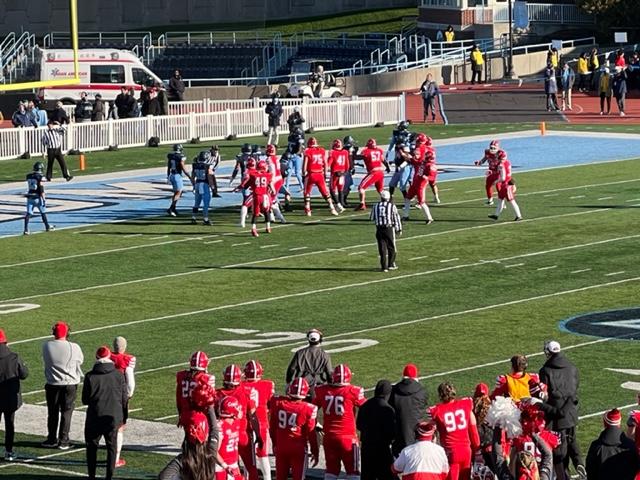
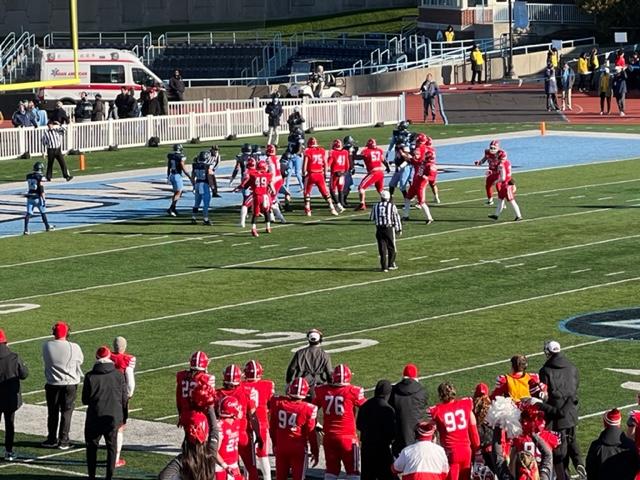
Do you know how horrible it is to lose to Columbia University in football? It’s when you lose to them by over twenty points. Both of our teams were 5-4 and the team that won not only won the Empire State Award (big deal) but had a winning record. I knew that we were in trouble when we fell behind 21-0.
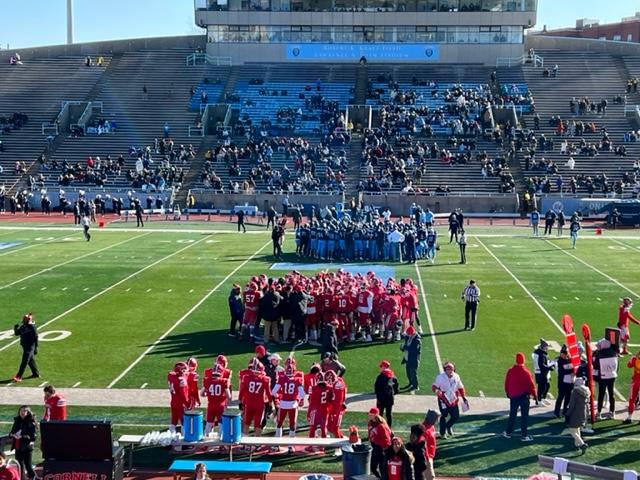
Getting ready for the game
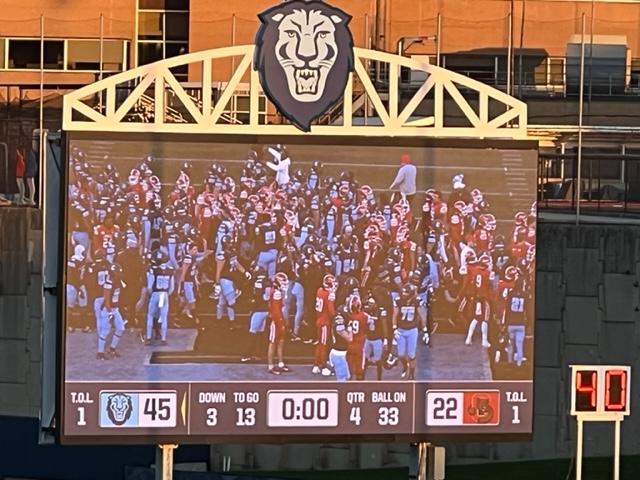
It was finally jubilant when we scored a touchdown and then it was 21-7. It was just meant to be as we fell behind again and again. The worst was toward the end of the game when we were at 38-22 and we kicked an onside kick. That is always a big mistake because it always ends with the other team getting a touchdown. Columbia got a touchdown immediately and the final score was 45-22. That was embarrassing.
The end of the game Columbia 45-Cornell 22 not our best game
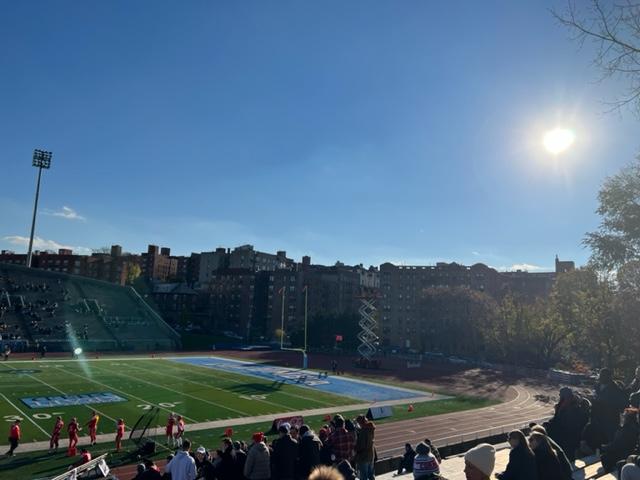
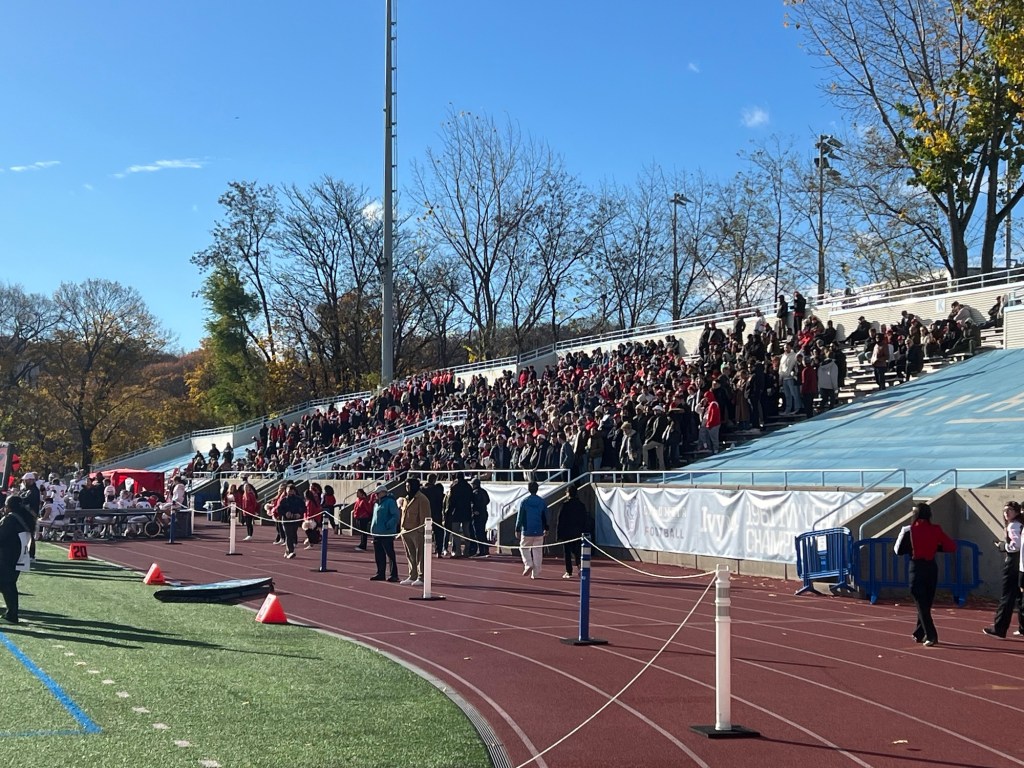
It had been a nice afternoon in the stadium with clear blue skies and the weather was cool and crisp at between 48 to 50 degrees. I could not believe the crowd of alumni at the game. Even though Columbia is considered our rival I never took it much as a rivalry.
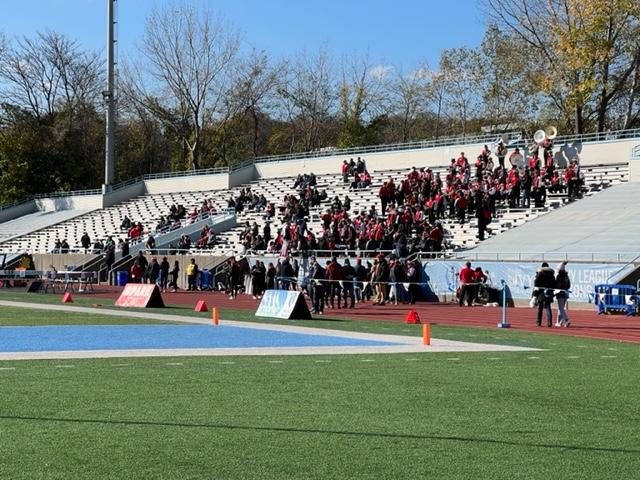
Cornell Alumni filling the stands at Columbia; we always outnumber them
Both of our teams in all the years that I have been coming to the game have not been that good. It’s just nice to go to a game and cheer someone on. It amazes me how every year no matter who wins we have more people in the stands than Columbia does.
It was beautiful in the stadium as long as the sun was out (then we got cold as darkness came)
Preparing to enter the stadium with great hopes of a blowout against Columbia
We came out so enthusiastic and ready to play ball, but it just did not look good when we could not score on the first play. We just did not look like we have a game plan. Then Columbia just kept scoring on us.
The start of the game
Even at half time, our band could not play on the field because one of the alumni said that they had a hazing problem at the Columbia band (which is so small I do not know what type of problems that they could have) and they banned them from campus. Then they banned other Ivy League teams from playing on their field as well. Let me put it this way, it was not the most exciting game. If it had not been for the group of alumni behind me cracking jokes and having fun, I would have been bored. The game became subdued when they left at the beginning of fourth quarter.
Going in for our first touchdown Columbia 21-Cornell 7
What also got to me was that it got dark in the stadium early. By the end of third quarter, the sun really moved across the sky, and it not only got dark, but it started to get cold in the stadium as well. For most of the game, it was clear, sunny and crisp and was pleasant in the stadium.
Going in for our third touchdown Columbia 38-Cornell 22
Then I noticed how fast the sun was moving in the sky and you could feel the evening chill. It must have dropped fifteen degrees by the time we left the stadium at the end of the game.
The last play of the game
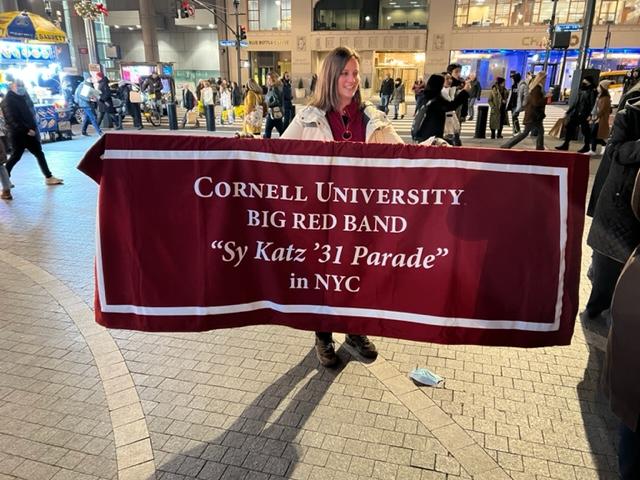
After the game was over, I headed down to the Cornell Club on West 44th Street for the Annual Sy Katz Parade. In previous years, I had seen complete subway cars filled with alumni leaving the game. This time around there were only a handful of us on the Number One downtown. I thought that was strange.
Our teams are civil even after a loss
When I got to Rockefeller Center where the parade traditionally begins there was no one there. The two couples I came downtown with were there but then they disappeared. After waiting for about a half hour, I headed down to the Cornell Club on East 44th Street to see what was going on.
The end of the game
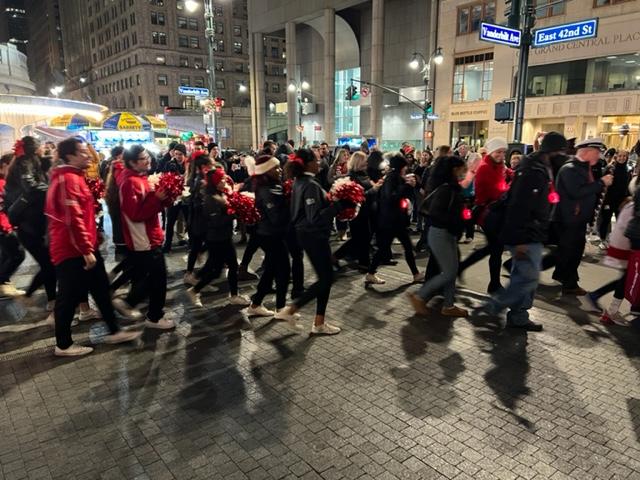
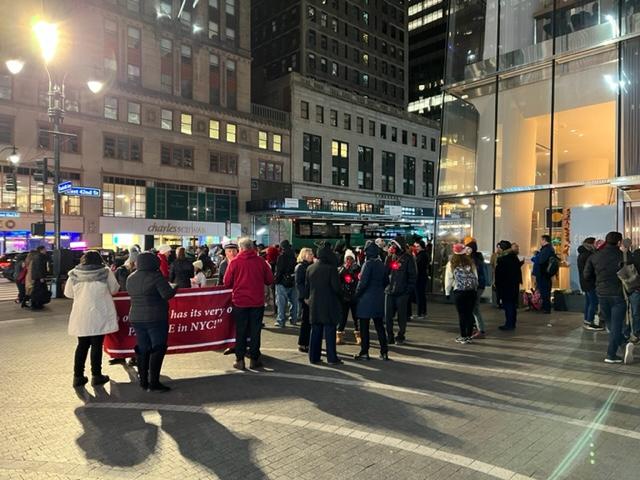
When I got to the club, I found out that they had to change the route of the parade due to permit problems and we started in front of One Vanderbilt Avenue between Grand Central Terminal and the office building in the plaza. It was funny to hear that somehow the two busses of band members and alumni heading back to campus got lost somewhere in New Jersey and had to head back into Manhattan. So, the rest of the alumni had to wait in Vanderbilt Plaza in the cold until they arrived about a half hour later. Then the fun began.
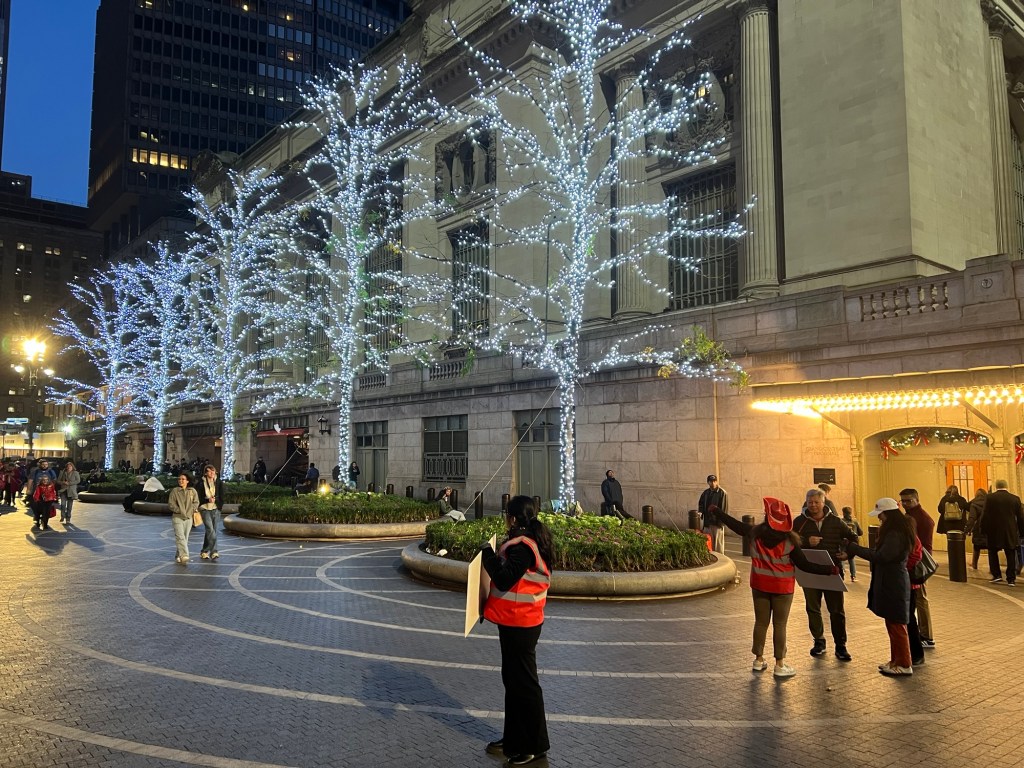
Preparing for the Sy Katz Parade in Vanderbilt plaza on Vanderbilt Avenue outside Grand Central Terminal
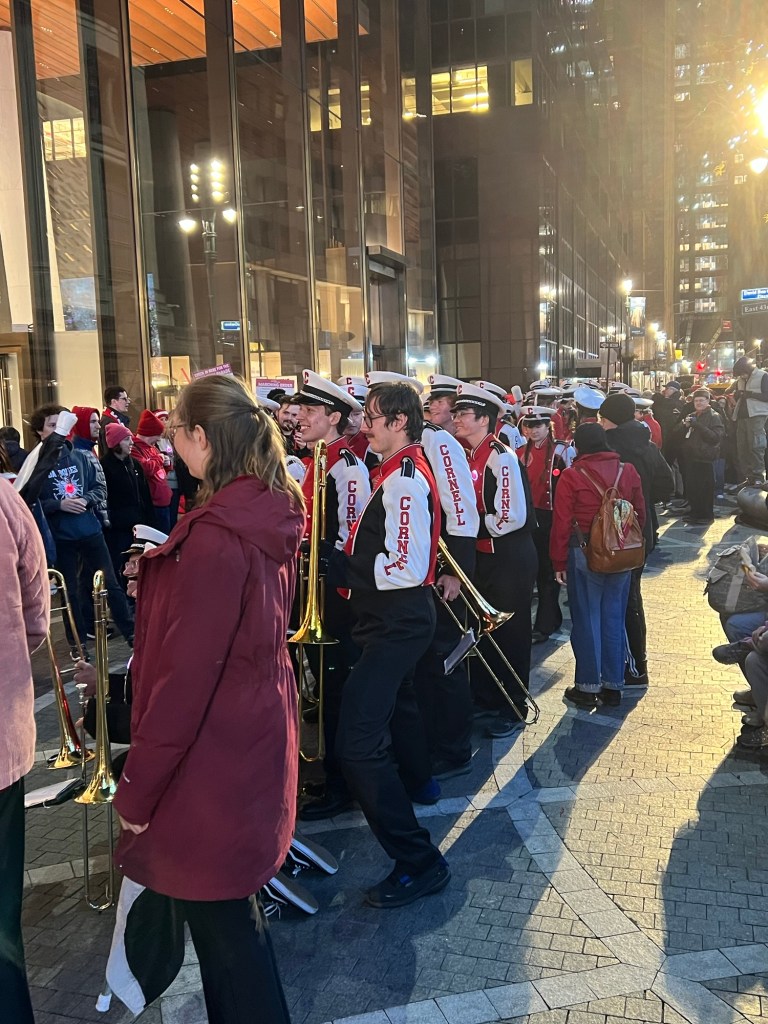
The Cornell Marching Band really got everyone revved up and the Cornell Cheerleaders and Dance Team really got everyone in the spirit (even though we got our asses kicked earlier in the day) and we had a good time as we made our way up Vanderbilt Avenue. We ended at the entrance of the Cornell Club on East 44th Street.
The Cornell Marching Band preparing for the parade from Vanderbilt Avenue
Cornell Alumni marching in the parade
Alumni marching to the Cornell Club where the pep rally is held every other year
The Band played all the school fight songs, the Alumna Mater and then traditional fight songs from the games. Since I was not an undergraduate at Cornell (I went for the PDP Graduate Program), I never learned the songs. I have to watch the YouTube videos on “On the Shores of Lake Cayuga” to learn the words. It has taken years to perfect it. Not like the Spartan songs from Michigan State (we were also having a bad football year) and I will do not know all the words to “MSU Shadows”.
Cornell School Song
‘Give my Regards to Davey’ (I never got this song)
The alumni were all excited and joined in the singing of the songs, watching the band hold their own traditions with marches and songs and then Sy Katz’s daughter, Alice, gave a speech in front of the club to wish everyone well. Her and her family were so happy that so many people came out to the parade. She and her family greeted the crowd so warmly that the alumni cheered her on as well. It was a nice crowd of enthusiastic people who sang and cheered.
Alice Katz welcoming the crowds at the Cornell Club on East 44th Street
Someone shot this at the parade in 2022
The Parade in 2018 pre-COVID
Our mascot also sang and danced at the parade
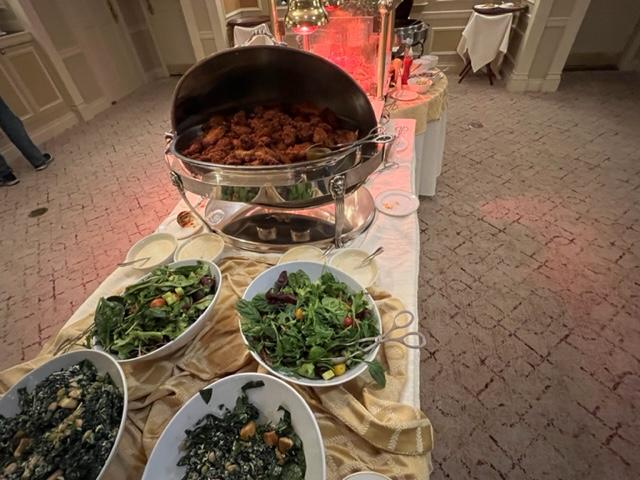
After the parade was over and most of the Alumni left for the evening, I joined everyone else in the Cayuga Room for a post-Alumni Tailgate dinner. It was really nice but I have to admit that the food tasted like it had been sitting for a bit.
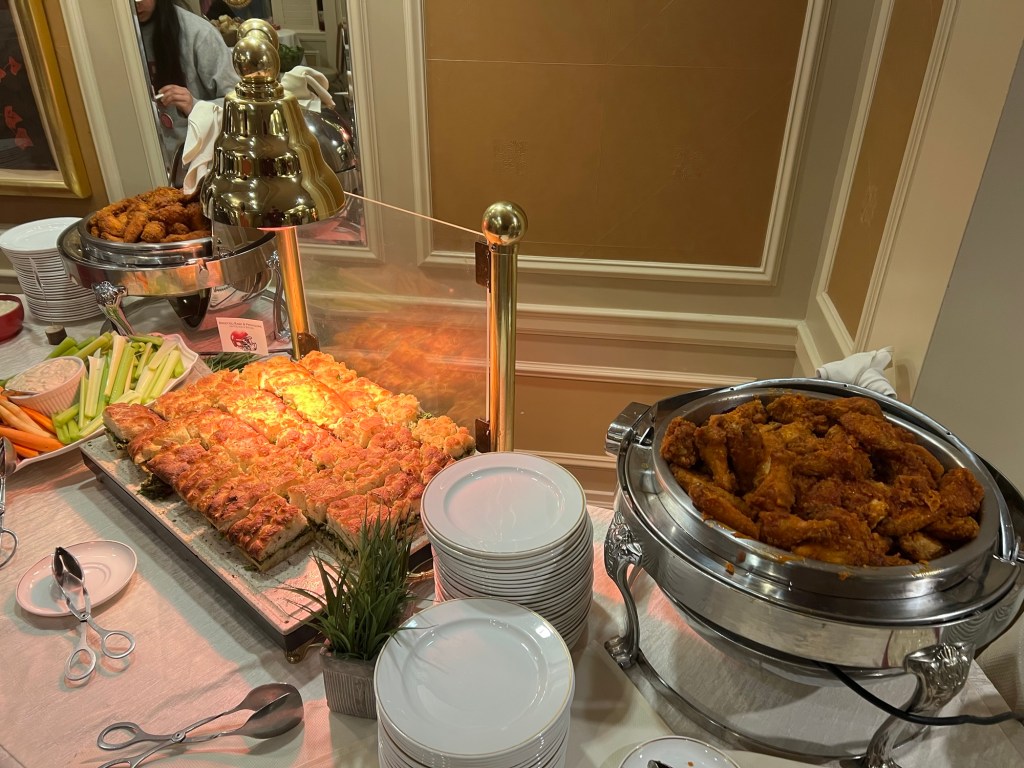
The Hot Chicken Wings and the fresh salads were the best part of the tailgate
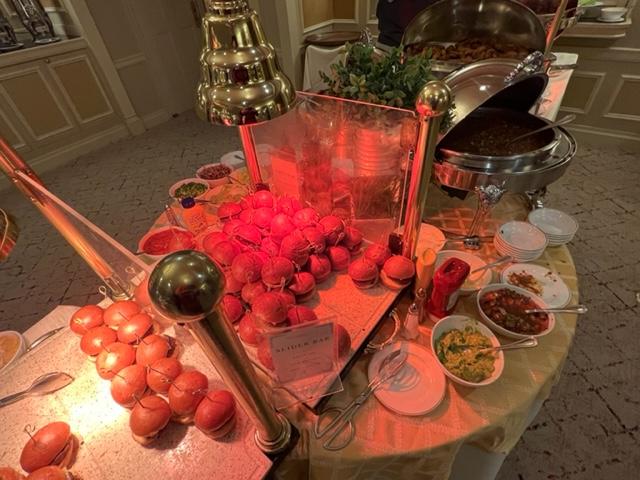
The Hamburger Sliders were hard and the buns crunched when you bit into them. The Chicken Fingers were good but tepid. The rest of the food was wonderful. They had two green salads, a Chili Bar with sides, a Meatball dish with a sweet sauce, a vegetarian sandwich and the best were the Hot Chicken Wings which were the best I have tasted in a while. We ended up going through two trays of those while I was in the room eating.
The sliders had been under the heat lamp or the warmer too long
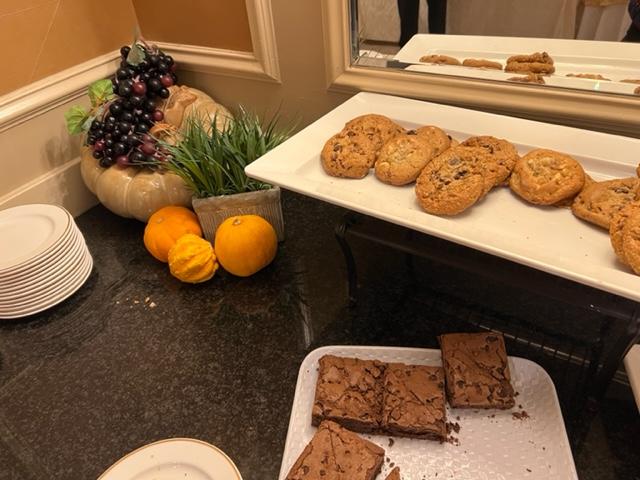
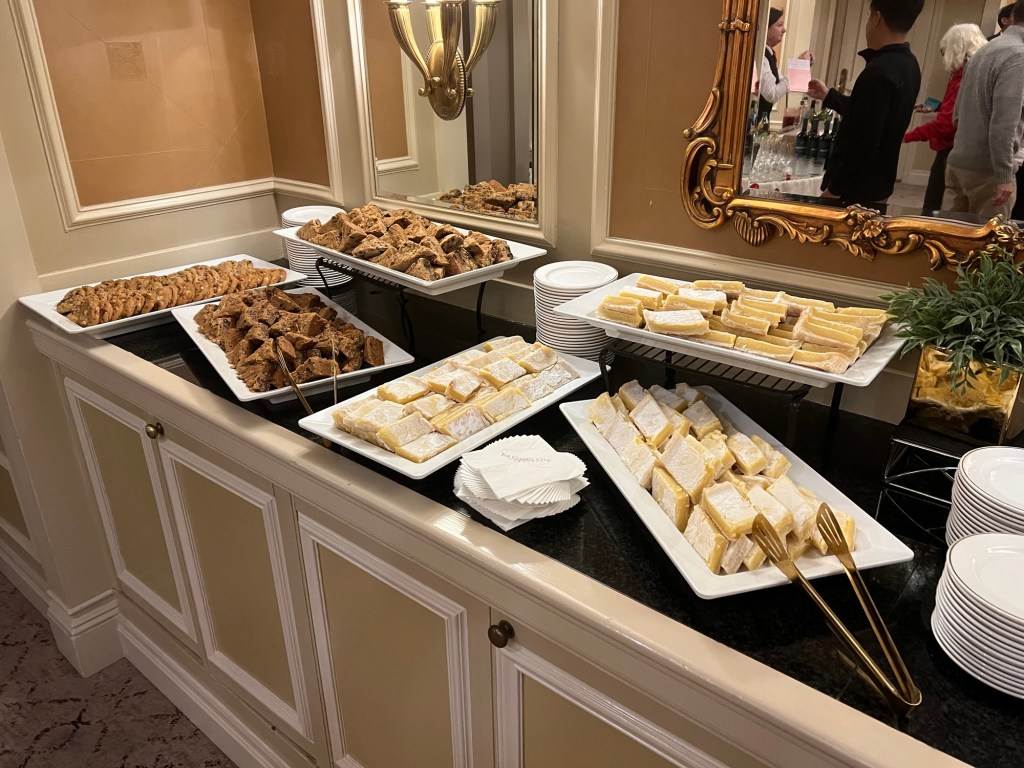
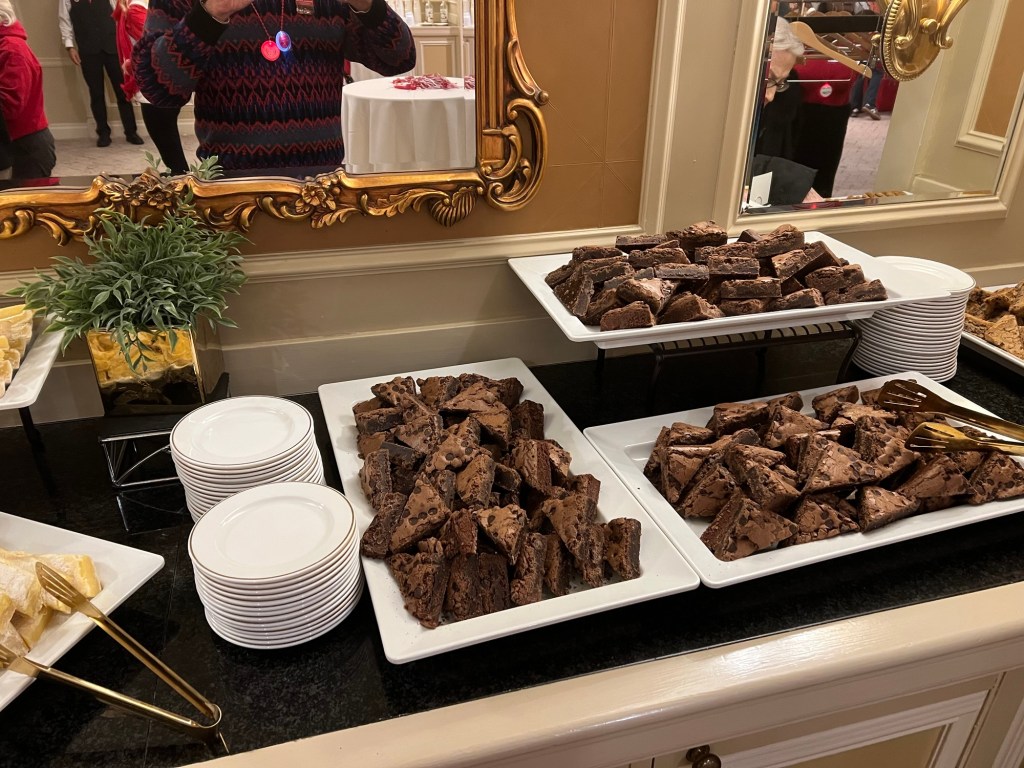
For dessert, they had assorted cookies and brownies with tea, coffee and hot chocolate which was perfect when I was trying to warm up after it being so cool outside.
The desserts at the club are always wonderful
As I talked with other Alumni, I was amazed that I was the only one at my side of the table who went to the game. Everyone else had come in for the parade and tailgate. The one thing everyone said to me at the table when I discussed us getting our asses kicked was “You went to the Game?” I then replied, “Didn’t you?” and it was the same answer, “No, I do not go to that.” I took it as the alumni that went to the game were not the same ones that went to the parade. Oh well!
I had a wonderful time and it was so nice to have this event since the last time in 2018. So it will be until 2024 the next time I go again. I could not believe that I have been coming to this for over a decade.
I’m the dedicated Alumni! Go Red!!!!!
Game Day November 2024:
Another great disappointment as we played lousy again and lost 17-9. It really was not much of a game. It boggles my mind that we have so many Alumni come out for the game, and we still always lose. We have so much promise with a new coach and a new way of playing the game. This was the last game of the season, and it was not much of a season. When we got blown out by Colgate who was 0-3 and lost the next two games after us, I knew we were in trouble. To beat Yale and Princeton, their teams must have been pretty bad. Still, I love this game.
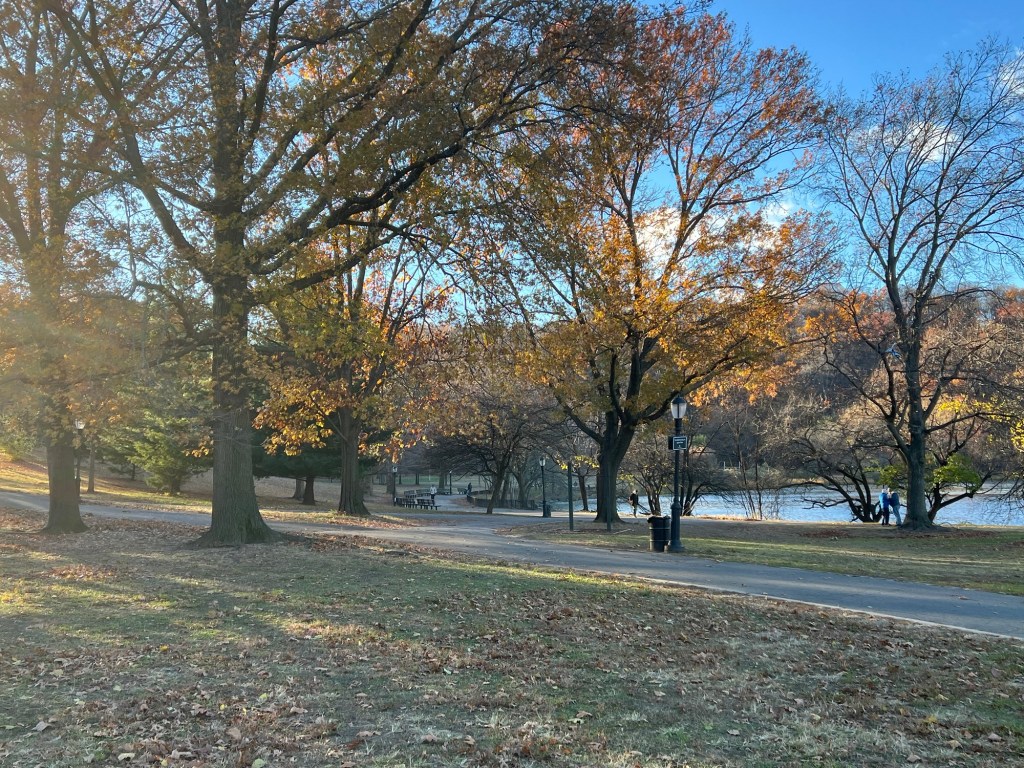
Inwood Park foliage was beautiful, it is in the City, and I love the Sy Katz Parade and the tailgate afterwards. It is worth the money and the trip into the City and up to Inwood Park. The sad part is the team itself. We never win. In the last three times I have com to the game in six years, we have never won this rivalry game and that makes the tailgate more depressing. The funny part is that most of the people who come to the tailgate go to the Sy Katz Parade and never the game.
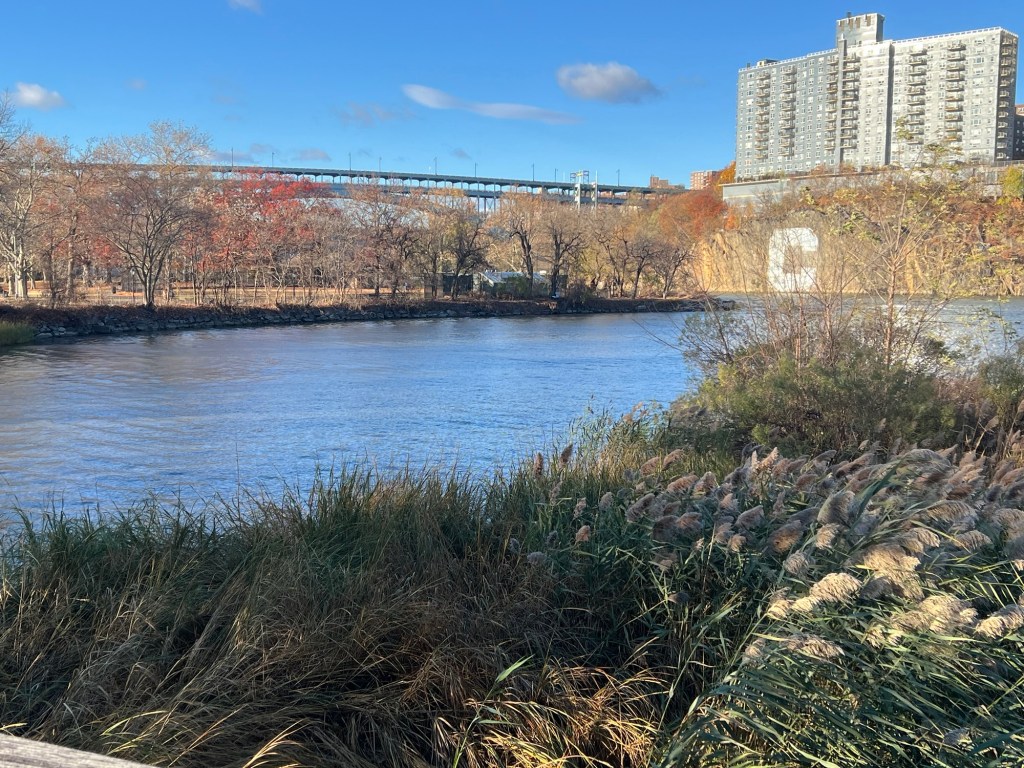
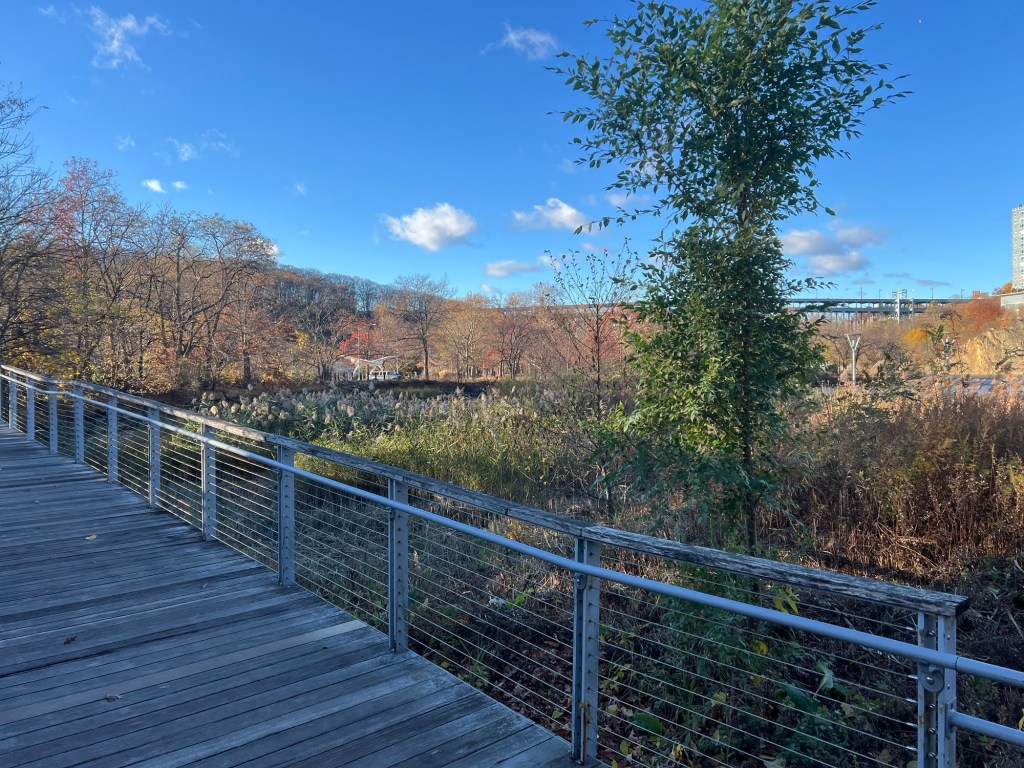
The Muscato Marsh the day of the game
Even with the wildfires in this area, the foliage was still so beautiful in Muscato Marsh, which is right next to Baker Field and in Inwood and Isham Park.
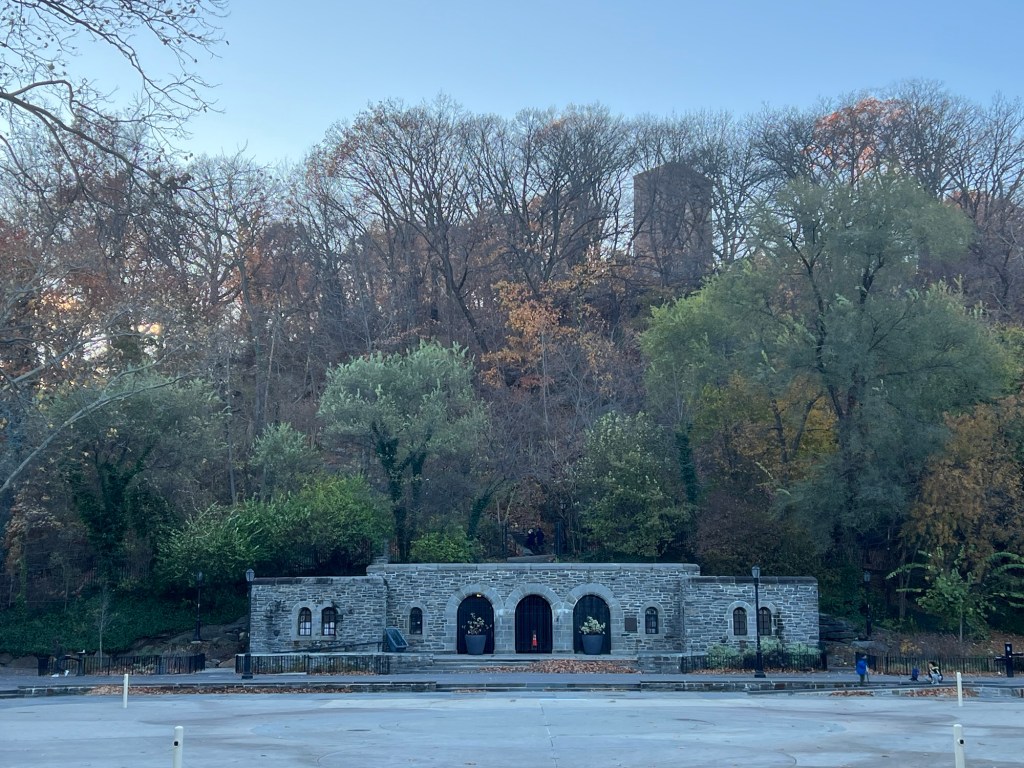
Isham Park in the early morning of the game
The stairs leading to Isham Park
I got uptown with just enough time to walk around the neighborhood for a bit and get some nice pictures of the foliage.
The day started out pretty gloomy and cool as a much needed rain storm finally passed by. The sun would start to peak our around half time creating a typical Fall day for football.
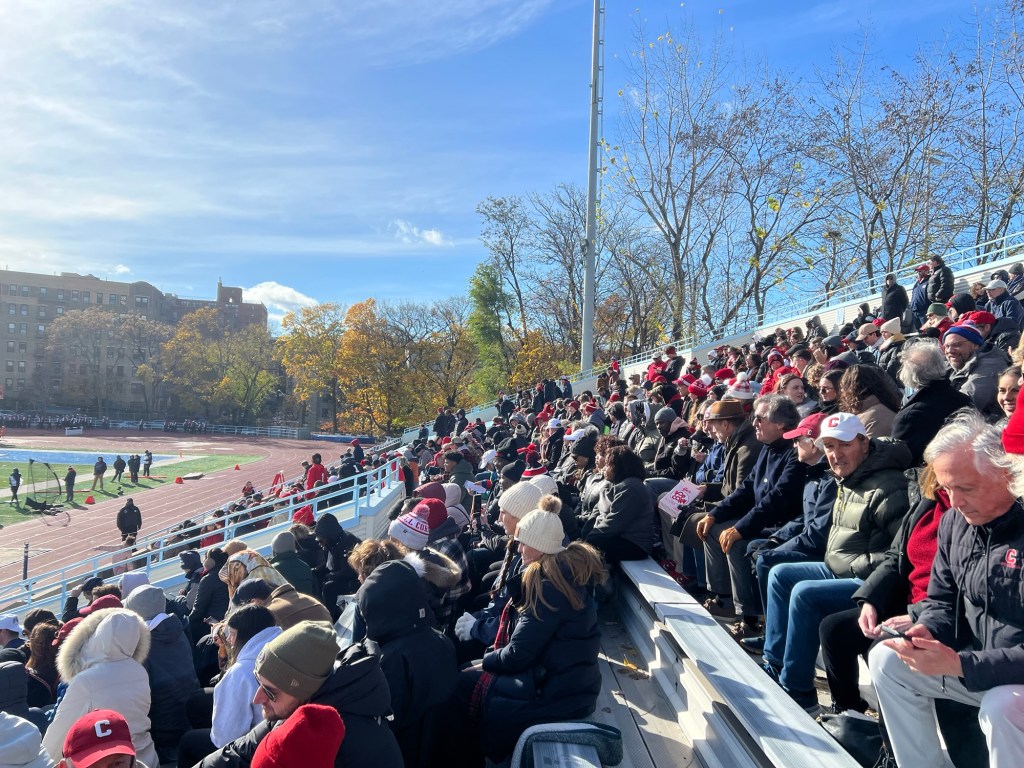
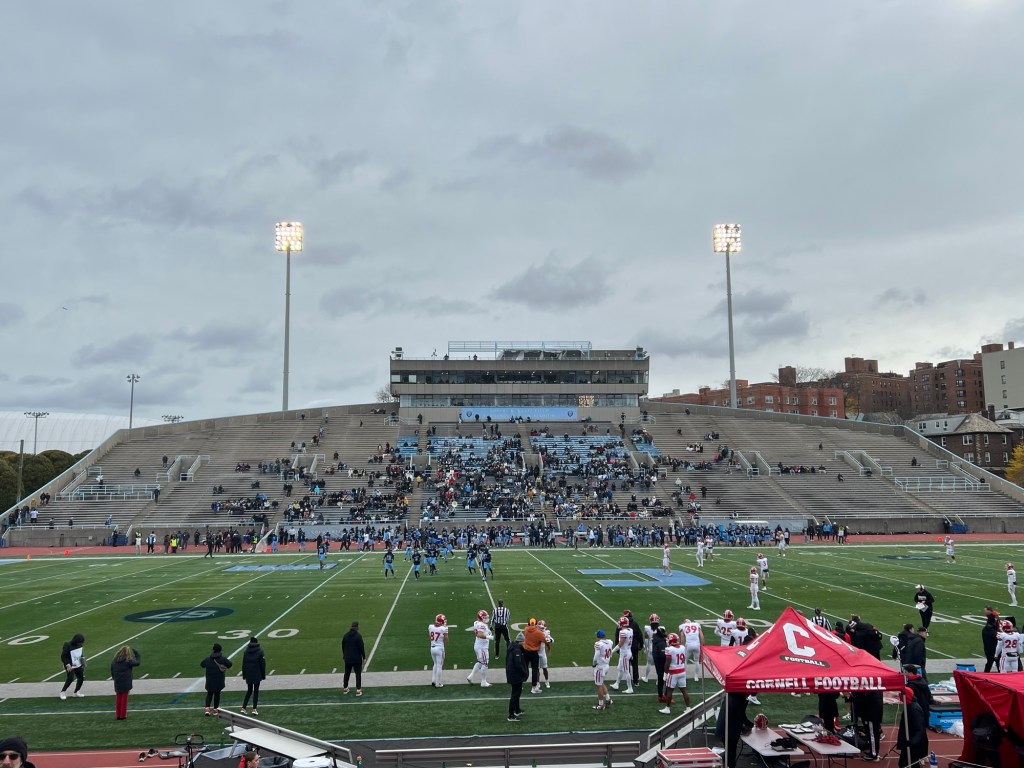
The Alumni and parents staying to fill the stands at Baker Stadium that afternoon
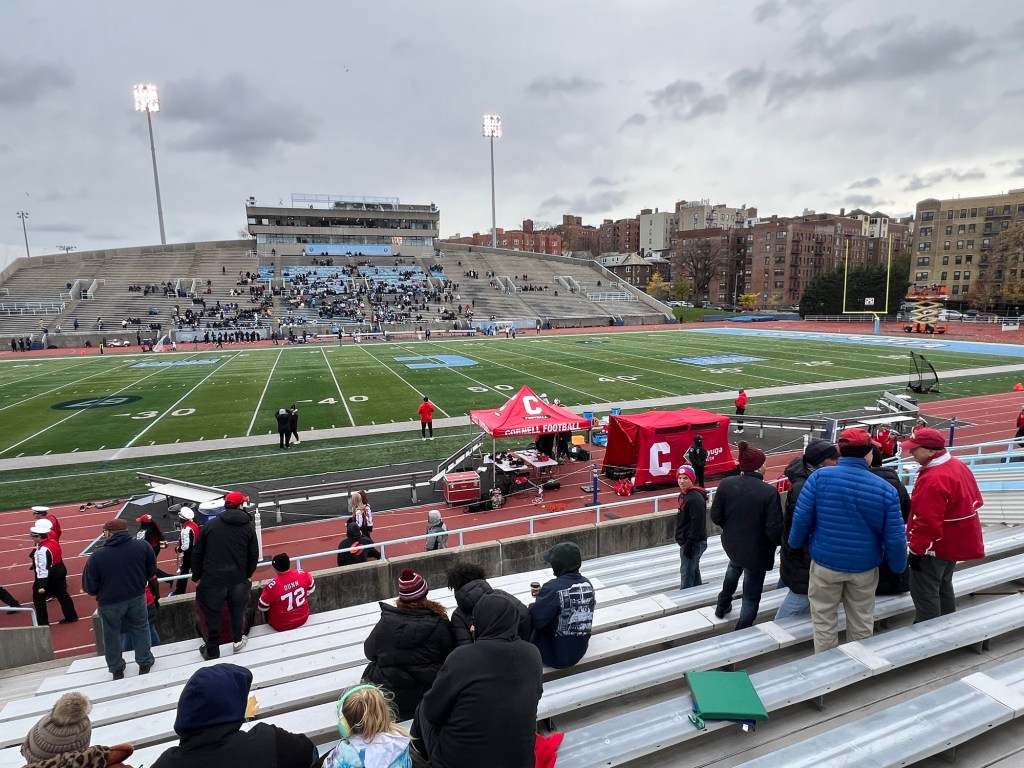
Looking down on the field before the start of the game
I hate to say it but it is a bit pathetic when the visiting team has more fans than the home team. I have been coming to this rivalry game for over a decade and I never see the Columbia side of the stadium ever full. Even when they have a good record.
Even at the start of the game more of our college’s fans kept coming.
We filled our side of the stadium to the brim
The Columbia side of the stadium. It got smaller as the game went on.
Our side of the stadium after our first field goal. We were losing 7-3. It would not be a high scoring game.
The first half of the game literally flew by and then we were at half time with the score of 7-3. I could not believe how bad both teams were playing. Neither side played that well the first half.
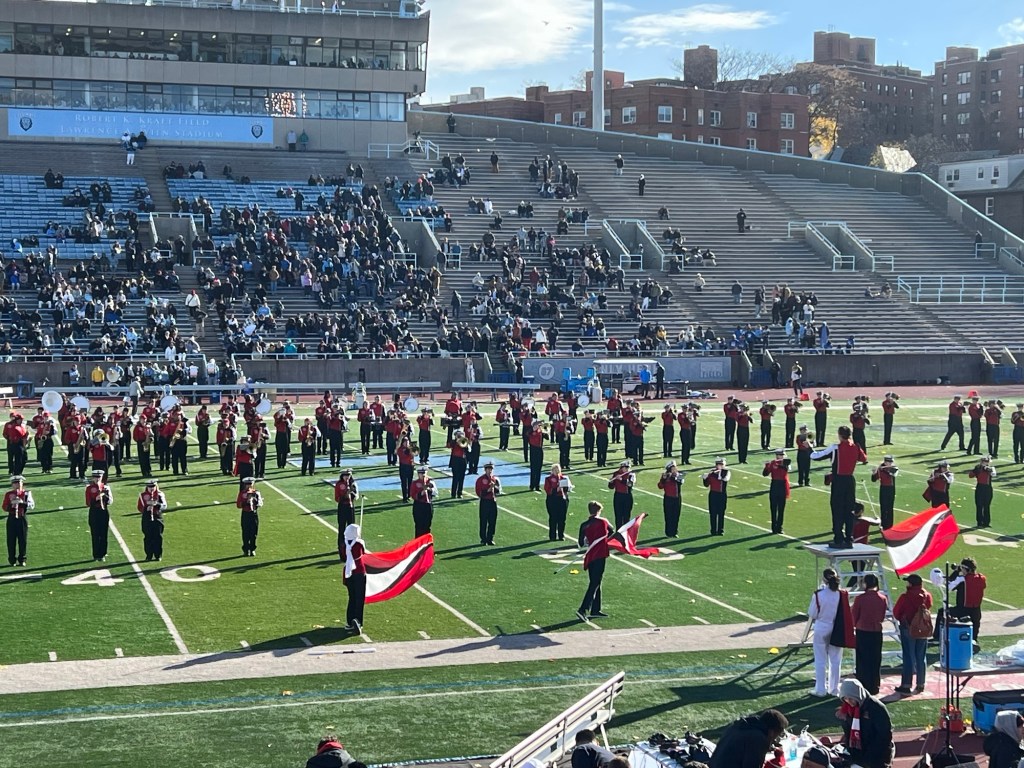
I stayed around for most of half time. We had to watch the Columbia Pep Band and that was not fun. I had heard Junior High performances better than that. Then we came on with ten minutes left and it was an enjoyable performance.
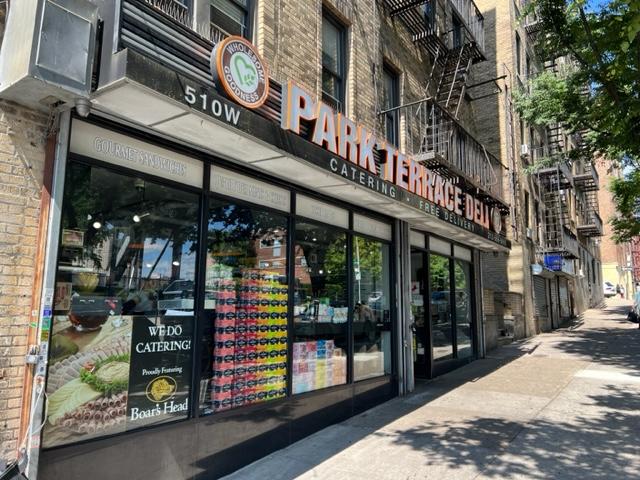
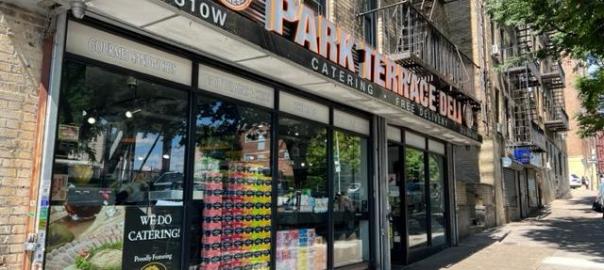
At the start of third quarter, I left to get some lunch. The stadium prices were so expensive ($8.00 for a hot dog?). I walked down the street and ate at Park Terrace Deli at 510 West 218th Street (see my review on TripAdvisor and DiningonaShoeStringinNYC@Wordpress.com). I have been coming here for years when doing the Broadway walk and the Great Saunter and the food is always wonderful and so reasonable.
The place was mobbed with people from the game who had the same idea that I had. I was going to order a breakfast sandwich but all these burger deluxe kept coming out and then I craved a Cheeseburger Deluxe and it hit the spot.
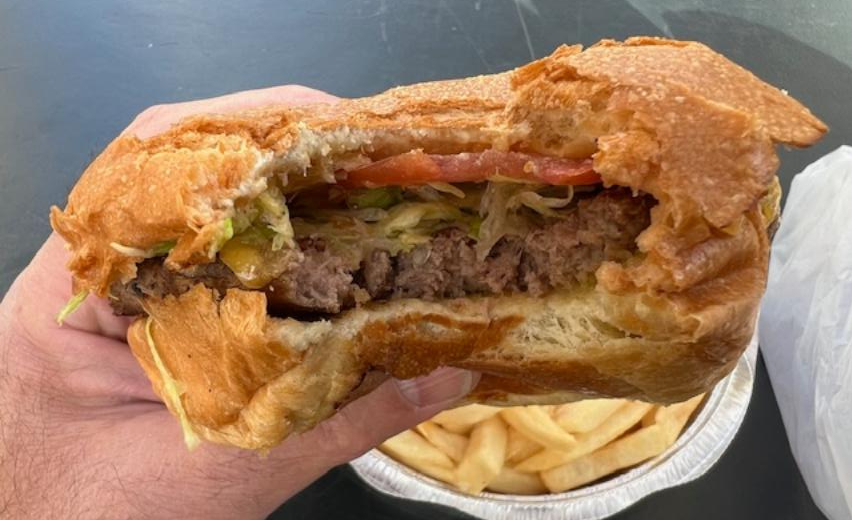
The Cheeseburger was over-sized and so juicy. You could tasted the caramelized meat inside the fresh bun accented by the lettuce and tomato. And lots of ketchup and pickles. It was so good on a cool afternoon. I took my lunch and ate it at the stadium much to the looks of the people eating the expensive hot dogs and pretzels.
The Cheeseburger Deluxe at Park Terrace Deli is caramelized and juicy
Yum!
I got back into the stadium at the very end of the Third Quarter and the score was still the same. This game was pretty bad.
When I walked back in there were even more fans
This was the Cornell side of the stadium at the end of the Third Quarter even with these scores
The weather when it finally cleared
All of us cheering at another accomplished field goal
Columbia would score again making it 14-6 so it was not too bad and I thought we could catch up. We just can’t close out a game.
Us going in for an attempted touchdown with the score now 17-6. It was not meant to be. When the player ran in for the touchdown and was open, he would hit the goal post.
We then went in for the field goal and we made that for the score of 17-9. It would stay that way.
The end of the game was even more painful as there were almost no fans left on the Columbia side as their football player paraded around the ‘New York Bowl’ to an empty crowd and our legions of fans walked out again with another losing season. I really felt for our new coach. He is going to have to really rebuild this team from ground up.
After the game was over, I had about two hours before the Sy Katz Parade would begin so I walked around Inwood Park and admired the foliage at sunset. It was just magnificent.
The Muscato Marsh after the game
The Muscato Marsh in the late afternoon
The inlet in Inwood Hill Park
The brilliance of the sun on the park
The sun in the late afternoon
It was really beautiful sad the sun started to set
I walked down Broadway to 207th Street to see all the foliage. Even Ann Loftus Playground still had the beautiful hues of the trees.
Ann Loftus Playground at 207th Street
I took the A train back to midtown and met all the other Alumni in Vanderbilt Plaza by Grand Central Terminal as we waited for the band to show up. t least this year the bus driver did not get lost and the band showed up pretty promptly.
Arriving at Vanderbilt Plaza
Admiring the beauty of this part of the City as the sun set
Admiring Grand Central Terminal
Getting ready to start the Parade as the band arrived
The band brought a new energy to the parade. They did not seem to care that we just lost our last game of the season. They were too busy having a good time.
The band getting into position to start the parade
Everyone getting ready to start the march to the Cornell Club
We got to the front of the Cornell Club where everything was set up for our Pep Rally and because the weather had gotten much nicer by the end of the evening, we had a big crowd.
Then Elaine Katz, Sy Katz’s daughter got up and gave a beautiful speech about her dad and his love of the college. It was very touching.
Elaine Katz honoring her father, who founded this parade
Then the played the last song of the evening, the Alma Mater before closing the parade
After the song was over and there was a lot of loud cheers and applause, it was time to eat and that meant the ‘Tailgate Dinner’ in the Cayuga Room.
The ‘Tailgate Dinner’ in the Cayuga Room
I was able to arrive before most of the Alumni started to arrive for dinner and was able to take pictures around the Cayuga Room, where the dinner was taking place.
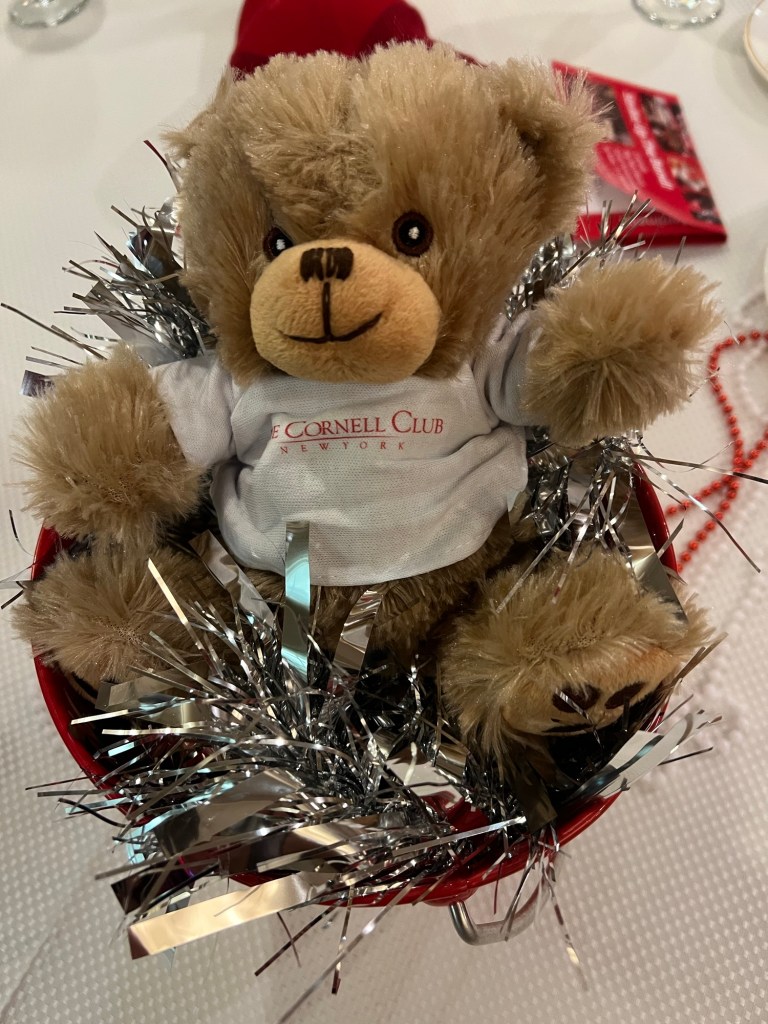
The room was really festive with red and white decorations around the room and centerpieces with tiny Cornell bears smiling back at us.
The centerpieces at dinner
The ‘Tailgate Dinner’ was really nice and the food was excellent. They created a nice menu for us of popular dishes and the food kept coming as we had a packed house after the parade was over.
The Salad Bar with Kale Salad and Mixed Greens was by far the most popular station. Everyone enjoyed the salads.
For the entrees, we started the meal with Vegetarian Chili and fresh rolls and Pork Meatballs with barbecue sauce.
The next station had Potato Skins with all the toppings and Pulled Pork sliders with their topping which we put together ourselves.
The hot station also had Vegetarian sandwiches, which were not the popular and the Buffalo Chicken Wings, which were meaty and delicious. The chicken was really popular on this cool night.
The Dessert Bar was laden with all sorts of freshly baked goodies that included Lemon Bars, Brownies and Blondies and freshly baked Oatmeal Raison, Chocolate Chip and White Chocolate cookies.
The Brownies and Blondies on the Dessert Bar
It was a really nice evening and the perfect way to sallow our loss at the game with lots of sweet desserts. I had a nice time making chit chat with other Alumni.
This is the best way to drown your sorrows
It was another fun afternoon and evening and see everyone again in 2026 and hopefully our new coach will do some positive recruiting in the off season and we can win this one again. Until then, another football season is behind us.
This was the first time I had been to City Island since 2008 when I visited the island for research for my third book “Dinner at Midnight” in which one of the main characters is a witch that moves to City Island. I had walked every street on the island trying to get a feel for what it might be like to live on the island and what the character may experience. There is a very important scene in the book where her boss comes to the island to search for her and notes to close proximity to Hart Island, New York City.
One of the two houses that I was impressed with on the island
The other house that impressed me overlooked the Long Island Sound.
He comes searching for the truth about his unusual employee and finds out too much. I will just leave this as a spoiler as I have not finished the last two chapters of the book yet. You can read the first book in my New York City trilogy, “Firehouse 101” that is available at IUniverse.com and Google Books.
My first book in the New York Trilogy “Firehouse 101”
On top of research for my book, “Dinner at Midnight”, I wanted to visit the City Island Nautical Museum for my blog, “VisitingaMuseum.com” as I had not been to the museum since I visited the island again in 2008. That was when I stayed at La Refuge, an inn that is now a private home. To add to the creepiness of the storyline, is that when I stayed at the inn for two nights, the first night in the first room there was no problem.
The former “La Refuge Inn” is now a private home and I think is haunted
The former “Pell Mansion” is hidden from the street in parts.
When for some reason the second night they made me move to a back room, I could not sleep all night. I kept thinking that someone was in the room with me, and I finally had to sleep with the lights on. I never stayed or came back to the inn before it closed a few years later. I never felt that way before staying in an inn or B & B, and I have stayed in a lot of old houses.
The former “Pell Mansion” hidden from the street
Before I visited the museum, I had to stop for something to eat. I had a very early breakfast wanting to get to City Island early so I got hungry again. I was surprised that the pizzeria around the corner from the museum was closed and the diner near the museum was closing soon as well. I found the Sea Breeze Deli at 325 City Island Avenue just down the road from the museum and stopped there.
I felt like I had walked into time warp as the place looked like it was from the 1970’s. Even thought it was a bit dated inside, I ordered a Bacon, Egg and Cheese on a roll ($4.00) and it was terrific (See review on TripAdvisor) and hit the spot where I was ready for a long day of exploring.
The Bacon, Egg and Cheese on a roll is terrific at Sea Breeze Deli
The City Island Nautical Museum located at 190 Fordham Street, had not changed much from that visit. The museum is located on a quiet, residential street just off the main strip of City Island Avenue. It is located in what was the old PS 17, the island’s elementary school. Loaded with information but a bit jumbled with historic artifacts all over the place. Still, it is a great little museum.
The City Island Nautical Museum at 190 Fordham Street
Each room in the museum has a different theme to it with more information lining the hallways (See my review on VisitingaMuseum.com). The Community Room toward the back of the museum shows the history of the City Island starting with the Native Americans and the Dutch and how the settlement grew. Lining the walls were signs and memorabilia from businesses that once dotted the island and a little about their history. There are all sorts of ads and items once carried by the merchants.
The Main Hallway at the City Island Nautical Museum is filled with the history of the America’s Cup races.
The Schoolroom had the history of PS 75 and PS 175 which were the public schools located on the island as well as St. Mary’s, the recently closed Catholic school. It had old class photos, pictures of the school at various times and a complete schoolroom set up. The rooms that dealt with Ship Building and the Nautical past were the most interesting.
The City Island Nautical Museum’s Schoolroom Gallery
City Island has a rich history in ship building, sail making and fishing it is reflected in the collection of materials in the museum and its archives. The museum really details the growth and history of the boating industry on the island and its importance in the local economy. What I found interesting was the rich history of the creation of the sailing ships for the America’s Cup tournament and how all the winning boats up until the 1980’s were built on the island and the one that lost the cup for us against Australia was the first one not built on the island.
The Nautical Room at the City Island Maritime Museum
Even Ted Turner’s boat “Courageous” was built on the island. There was a picture of the reunion of the boat winning twice at the museum with the crew’s signatures (The tour guide even said how he ‘freaked out’ members of the New York Yacht Club who did not consider him one of their own). All the sailing vessels lined the walls of the hallway of the museum.
The Nautical Room’s Americas Cup Race display
The display of winner of the Americas Cup award
Each room of the museum was dedicated to a different theme. When I toured the Community Room in the back of the museum, it held the records of a lot of old businesses of City Island with pictures and items that were once part of the businesses. There was a small FDNY display, a small WWII display about local residents who fought in the war, wedding garments, maps of the island and a small display of arrowheads.
The Community Room Gallery at the museum
Household items and clothing in the Community Room Gallery
The City Island Business items in the Community Room
In the School Room, the concentration was on PS 17, which the museum is now housed in and its history with all the classroom group shot pictures, graduation pictures and a small classroom set up. There were more records and event items of the current PS 175, which is the K-8 school that the residents attend. There were also records and pictures of St. Mary, Star of the Sea School, the former Catholic school that used to be on the island as well.
The School Room Gallery with information on the education field of City Island
The School Room display in the gallery
The Nautical Room needed an overall as there was too much going on in the room with pictures all over the walls, equipment for navigation and for fishing and records of the ship building companies that used to dot the island. There were boats in various shapes and sizes on display and the companies that built them like Wood Yacht, Nevins Yacht and Minneford Yacht. There was also the history of shipbuilding and sail making on the island. The tour guide told me there were no more ship builders on the island, but one sail maker left.
The Nautical Room Gallery at the museum
The Library where all the research is done on the island and on the families and businesses that were once here was dominated by yachting pictures and nautical photography. It held all the City Island records and even the ship building plans.
The City Island Nautical Museum Library
The museum has a lot to see but it needs to be a bit more organized to really showcase the collections properly. Still, it is one of the best museums I have seen with a nautical history theme. The best part is that you can see the whole museum in about an hour and this leaves you time to tour the island and see how the museum better explains why the island is the way it is right now.
The City Island Nautical Museum sign when I was leaving.
After I left the museum, I decided to tour the whole island and started with a tour down Fordham Street which lead me to the new apartment complex and their little walled park. It went in a spiral pattern and then I turned myself around back to the street and stood and admired the views. You get the most spectacular views on the Long Island Sound and the mysterious Hart Island from here.
The view of the mysterious Hart Island in the book.
I then took a tour of King Street and passed the beautiful but eerie Pelham Cemetery. It just sat in front of the beautiful backdrop of the bay still giving you a look of longing. I wanted to walk through it but the cemetery was locked and there was no trespassing signs all over the place. I just admired it from the gate looking for family names.
The Pelham Cemetery on King Street in City Island also mentioned in the book.
The cemetery during the day. It does not seem creepy during the daylight hours.
The Cemetery overlooking the sound.
As I walked up both King and Minneford Streets, I admired the hodge-podge of architecture of the homes on the island. There are rows of bungalows and elegant Victorians with their large porches and shade trees again with the bay in the background in some cases.
A nice little bungalow right across the street from the museum.
Another interesting house in the neighborhood.
As I rounded up Terrace Street and got to the northern tip of the island, I saw the house that I used in the book as the home of the mysterious and sinister Serena Platt, the spell bounder in my novel. I set her apartment in this house and thought it had the right mood as a place that would be here home. I saw a couple of kids playing basketball on the property and did not want to stay too long to stare at it.
The original house that that I thought might make an interesting movie scene.
As I walked back down King and Minneford Streets, I saw another Victorian home with a dark colored paint job that might fit the mood of her home as well. I had not noticed this house when I was walking around the island years earlier on a scouting trip. With its dark tones and wrap around porch, it looked like something you would find in New England or Salem, MA.
The City Island Avenue Business District
As I made my way down Cross Street back to City Island Avenue, I wanted to walk the whole street to see what stores and restaurants were there from I visited last. Most of the seafood restaurants were still there but the smaller antique and clothing stores were now gone. Many of the little unique stores had long since closed someone told me at a store I visited. Between the economy and the pandemic, they had taken their toll on business owners.
As I walked through the business district passing some of the old time businesses and seeing the new ones that have opened since last summer, I took a side detour and saw another historical site on the island, the Delmour’s Point home at 21 Tier Street. This beautiful old home has been used for many photo and film shoots and like a lot of historical sites on the island has keep out signs.
As I walked down City Island Avenue, I passed more familiar sites that had opened up since the previous year. I passed Licky Split, an ice cram shop that I had tried in the past when visiting the island. I love their whimsical way they attract people. The ice cream store has always been popular on all the trips I have made to the island.
Next to the ice cream store is Hawkins Park, a great place to relax and enjoy your ice cream on a hot day. I enjoy just siting down and relaxing in the shade. It is such a popular park with everyone of all ages.
Hawkins Street Park and the Soldiers Memorial is at 281 City Island Avenue
The very cute Hawkins Street Park is a nice place to relax on a hot day.
Off to the side of the island before I got to the point of the island where some of the most popular restaurants were located, I stopped to look at the historic Belden House which was just to the right of the restaurants.
The weird part of the historical sites on City Island is that they are sectioned off with signs of trespassing if you get too close to them but are on the island’s literature. Does not make much sense to me.
That may have been with the traditional businesses but not with the restaurants. As I walked down City Island Avenue from north to south, it seemed that every restaurant was getting a crowd especially as I walked further down the road.
The 9/11 Memorial just off City Island Avenue.
The City Island Grace Episcopal Church at 116 City island
Sammy’s Fish Box at 41 City Island Avenue seemed to dominate the street with its various outlets. They have really grown even more since I on the island the last time. They must have had four different buildings. I could not remember if I had eaten there the last time I visited. At the tip of the island are Johnny’s Reef and Tony’s Pier, two extremely popular seafood restaurants that I do remember eating at then I visited years ago.
The Sammy’s Restaurant complex of restaurants at 41 City Island Avenue
When I walked into Tony’s Pier at 1 City Island Avenue, the parking lot was jammed with cars and the line was about 50 deep with customers. I was like ‘no way’ with this wait. It was too long, and everyone was getting antsy in the line. It was going by really slow.
Then I walked over to Johnny’s Reef at 2 City Island Avenue which I had dinner at the first night I visited the last time I came to City Island and the prices had gone up, but the portion sizes were still huge. The fried shrimp platters had not changed one bit. The only problem was the place was just as busy as across the street. It was really mobbed on this sunny warm night.
Between the two restaurants, there is the small Belden’s Point Park with views of the Long Island Sound and Long Island in the distance on a sunny day. It was mostly being used by people waiting to get into the restaurants or who had already eaten.
It was a nice place to relax but the smell of all the frying food and the grease got to be too much. As I left the park I walked around the dining room of Johnny’s Reef and was overwhelmed by all the crowds in the dining room.
The sight of people eating all that fried food really turned me off, so I decided to try a restaurant that had been reviewed on my Dining Around club. In the summer of 2023, they said the Fella’s Bar and Grill was where locals ate and socialized, so I decided to try it. It was closer to the middle point of the island near Bridge Park closer to the northern tip of the island. I was very impressed.
The bartender greeted me very warmly and gave me a lot of recommendations for dinner. She mentioned the Chicken Quesadilla and how terrific of it and that the burgers were really good. Then she mentioned how good the pulled pork was and that she had just tasted it. She sold me on that.
The Pulled Pork sandwich with a side of French Fries was excellent. The pork was perfectly cooked, and the sauce was a combination of honey, chilis and tomato for a rich barbecue taste. It was served on a chewy bun with a side of fries that were just out of the fryer (I needed some fried foods), and they were hot and crisp that snapped when you bit into them. I ordered an icy Coke, and it was the perfect meal after a long walk around the island (See my review on TripAdvisor).
While I was eating, I got to talk with the bartender about what was going on the island and about the over-whelming crowds of the restaurants on the southern part of the island. She just laughed and told me that they were really popular with people who lived off the island. I told her I could not understand this as the food was so good here. Then I just watched the game on TV.
The Pulled Pork Sandwich and Fries was fantastic
In the summer of 2023, Fella’s was no longer on the Dine Around Program but a new restaurant named Little Frida’s Eatery at 415 City Island Avenue. I was not sure of what they served at the time but I found out they served homemade Mexican food where the parents cooked and the daughter worked the front of the restaurant. The meal was wonderful.
This brand new restaurant specializes in Mexican and Mexican-American dishes and has a nice selection to choose from. I wanted something different and ordered the Chipotle Chicken Quesadilla on the recommendation of the owners daughter and she was right. It was wonderful.
The quesadilla was really large and could have fed two people and was filled with very spicy meat that she said had been marinading for 24 hours. It was served with fresh lettuce and tomato and a homemade red hot sauce that brough some kick to the dish. I enjoyed my lunch on one of the outside tables and relaxed and enjoyed the sunshine and the breeze.
The Chipotle Chicken Quesadilla with hot sauce and lettuce and tomato was delicious
After I finished my meal, I was walking up City Island Avenue and noticed the large number of cars entering the island over the bridge probably coming for dinner. I walked past the busy Sea Shore Restaurant at 591 City Island Avenue and saw the cars pile into their parking lot and people coming and going.
The Sea Shore Restaurant at 591 City Island Avenue
Just past that was the calm of Bridge Park-Catherine Scott Promenade at 549 City Island Avenue. Talk about views of the bay!The sun was just starting to set so there was a beautiful glow to the Long Island Sound, and you could see all the boats sailing by and people waterskiing around the harbor. In the distance, you could see the skyline of lower Manhattan. It has the most dazzling effect of seeing New York from this standpoint.
The Bridge Park-Catherine Scott Promenade at 549 City Island Avenue
It was like visiting Cape May and crossing the bridge to a small New England fishing village. City Island is the same way escaping to a beach community with a rich shipping and fishing history and showcasing its nautical past.
Bridge Park at 549 City Island Avenue on the northern tip of City Island
The bay on the sunny afternoon with the view of Manhattan in the background.
I had come to the island to search for a witch and why she chose to live here and found my answers in the beautiful homes, wonderful parks and spectacular views of the bay. City Island is unique New York neighborhood where you do not realize that you are still in New York City.
*Be on the lookout for “Dinner at Midnight” when it gets published in the future.
I found this wonderful combination bakery and gourmet shop when walking home from school one afternoon and exploring Greenwich Village. All the delicious pizzas and pastries in the window lured me in.
I had just eaten my lunch, so I was not that hungry and just wanted a snack. I saw the small doughnuts in the windows called Bombolones, which are yeast doughnuts filled with chocolate or vanilla cream fillings and then rolled in granulated sugar. The small one is $2.15 and the large one was $5.00. Don’t let the price deter you as it is a sweet and filling little dessert. The fresh vanilla cream played beautifully off the sweet dough and sugary topping. Each bite was wonderful, and it was…
I love visiting the Hudson River Valley so any event or tour that I can go on is an excuse to come up here. I had visited all the sites that I wanted to see on a trip two weeks earlier but wanted to see them in more detail plus I wanted to take some pictures. The weather finally broke, and it was a much more pleasant 83 degrees as opposed to the 96 degrees the trip before. That makes the trip much nicer.
I asked my aunt along so that we could share in the experience, and I could use her phone to take pictures of the all the sites. It is a much nicer trip when you have someone along who enjoys these things. The one nice thing about traveling to the Fishkill, New York area is that it is only an hour away and a straight run up the New York Thruway to Route 84 and then to Route 9. Just a couple of quick back streets and you will be there.
On my first trip up, I got there so early that no one was at the first site, The Brinckerhoff Homestead Historical site, the home of the East Fishkill Historical Society at 68 North Kensington Drive in Hopewell Junction, NY. I double back and stopped for a quick snack at G & R Deli Cafe, a small deli at 2003 Route 52 in a strip mall near the old IBM campus. I needed a snack. This was my go to place both in the summer and when I came back for Christmas. The owners are really nice and the food is excellent.
Since I already had dinner plans, I ordered a Sausage, Egg and Cheese on a roll ($5.95) which was a bit more expensive than in the City but it was delicious. The sausage had a nice taste of sage and gave it a lot of flavor. I just relaxed outside in the parking lot and ate breakfast. Another time that I visited, I had the same version with bacon and both times the sandwiches were excellent.
The breakfast sandwiches at G & R Deli are excellent
After my snack, I got back to the Brinckerhoff Homestead at 12:00pm when it was supposed to open but around 12:30pm there was still no one there and I kept knocking on the door. That’s when one of the county members let me know that they did not open until 1:00pm. Since I had a list of places to visit that day and the time had been posted all over the internet, I asked if we could please start early. He agreed and I got a personal tour of the house. When I came back two weeks later, I better timed it for the 1:00pm opening to take pictures.
The Brinckerhoff family is prominent in the Fishkill area and family members still visit the homestead so the house’s history is ongoing. The house is broken down into three sections as you can see by the picture. The original part of the home was built by John G. Brinckerhoff in 1755 and it consisted of the “Everything Room” on the lower floor with the hearth for cooking, a beehive oven and the large room upstairs for family living.
As John Brinckerhoff’s family grew, they moved out of the house and his brother, George G. Brinckerhoff moved into the home with his family. After the Revolutionary War was over and George G.’s assignment was over in the army, he returned to the house and in 1785 added the middle main addition of the house with four additional rooms. The larger rooms and high ceilings showed the family affluence in that they could heat the home.
When George died in 1812, his brother John and his family moved back into the house. In 1814, the family sold the house to the Purdy family. They lived in the house for the next 60 years and added the final addition onto the house to the left with a summer kitchen and an outdoor oven. It remained in the family until 1875 when it was sold to the Palen family who used it again as a farm. It was then again sold to the Moore family in 1926 and lastly sold to East Fishkill Historical Society in 1974 by developer Gustav Fink who was a developer in the area (East Fishkill Historical Society).
The rooms are decorated in period furnishings and when we started the tour, you begin in the oldest section of the home with the original kitchen area.
The “Everything Room” in the Brinckerhoff Homestead
This is where the family would cook, eat, do their work on farm affairs and socialize. There was also a small general store on the property as well. The upstairs was closed to the public.
You next moved into the main rooms of the 1785 addition which brought it the into then modern era with high ceilings and larger rooms so that the family had more living space and could entertain.
The Main Dining Room of the home which was set for Hot Chocolate service which again showed the family’s affluence as chocolate was very expensive then
We also toured the Living Room which was set for socializing and work women did for the home with needlepoint, weaving, and clothes making. There was still room for people to gather and entertain.
The Living Room of the 1785 addition to the home
Along the main corridor of the home in the addition was all sorts of artifacts from the Revolutionary War period and items from the time.
Our last part of the tour was the latest addition by the Purdy family when we toured the ‘Summer Kitchen”, which showed how the home had progressed over the years. Little by little each family brought it into the next ‘modern era’.
Both times I got to tour the grounds and the beautiful gardens that the volunteers maintained. Rock gardens and flower beds line the three acres of land around the house. Along with the flower beds, several historical buildings have been moved to the property including the one room schoolhouse from District 9 in East Fishkill that was built in 1826, the 1870 Icehouse which once supplied another home with its ice for the home to keep food fresh before the advent of refrigeration.
The Schoolhouse and the Icehouse and gardens
Another building that is still in use and is open when the house is open for touring is the John Hyatt Blacksmith shop from 1880. It still has some of the original tools and the blacksmith on duty still works the fire and performs tasks in the building.
The last building on the property is the Van Wyck Carriage Barn from 1845. It had been built by Judge Theodorus Van Wyck for his home that was built in East Fishkill that was torn down by the development of the IBM Campus in 1984. IBM paid to have the carriage house dismantled and moved to this property.
The East Fishkill Historical Society with the Brinckerhoff home in the center, the schoolhouse to the right and the blacksmith shop and the carriage house to the left
We took our time to tour the house and the grounds and on my initial visit I got to tour the schoolhouse, the ice house and the blacksmith shop to see the inner workings of these buildings and how they operated.
The docents had told me that they had recently held a ‘Strawberry Festival’ recently promoting the local fruit crops and serving complimentary strawberry shortcake that everyone enjoyed and was gone quickly.
I took what they said to heart and had planned to go to the Strawberry Festival the next year. Who knew it would be another three years before I attended the event (other things happened along the way like travel and Grad school), but in June 2025 I finally was able to attend the event. What a nice time.
The Strawberry Shortcake at the Strawberry Festival in the Fall of 2025
The grounds set up for the Strawberry Festival
The weather was a bit gloomy and cool for June but it ended up being a really nice day. They had all sorts of activities for visitors to watch and participate in. There were demonstrations in the Blacksmith Building and in the barn.
The demonstration in the Blacksmith shop
The Blacksmith during the demonstration
The wood and saw demonstration in the barn
There was wonderful entertainment on the patio of the house as a guitarist entertained the ever growing crowds that attended the event.
The guitarist on the deck playing music from the 1960’s and 70’s
A clip of the entertainment
I took a tour of the house and the schoolhouse as well. I never realized that things have not changed over the last two hundred years.
The old schoolhouse on the property
The inside of the school
Books and games
Maybe the current education system would benefit from this
Walking around the grounds that afternoon
Walking around the grounds that afternoon
The Strawberry Shortcakes were the star that afternoon and I had to say that the strawberries they used were so juicy. I had to practically elbow my way into getting one but it was well worth it.
The homemade biscuit and the sweet juicy strawberries
They really put a lot of strawberries in the bowl
Yum!
Before I left that afternoon, the Historical Society had a hayride around the property. I had not been on one in years, so I waited for the second trip. It was crowded on every trip it took and I forgot how much fun these were in the past.
The hayride around the neighborhood
Us on our turn on the hayride
The video of the start of the hayride
The video of the conclusion and everyone having a good time
I really enjoyed attending the Strawberry Festival and highly recommend if you can attend it in the future. It was an event I would have enjoyed as a kid and I did not see too many cellphones in site.
The Petting Zoo that afternoon
There are also Revolutionary War reenactments done on the property and for the holiday season the home will be decorated for the period Christmas holidays with an open house, so there will be things to do and see in the future.
When I returned in December of 2022, the curator invited me back to see the house decorated for Christmas. So while I was up seeing the decorated mansions of the Hudson River Valley the first, second and third weekends of December (read my blog on visiting the Hudson River Valley-Day Two Hundred and Fifty-Five-Christmas Again?):
The whole Brinkerhoff Homestead site was decorated for a Revolutionary era Christmas and the tables were set for an Afternoon Tea Fundraiser. The displays showed both a Revolutionary War and Victorian theme. With the fire places blazing, it made the whole house smell of oak and pine.
The Brinckerhoff Homestead decorated for Christmas
The Brinckerhoff Homestead Christmas tree
The Christmas display case at the Brinckerhoff House of Victorian toys
Santa does visit the first weekend of December
Our next stop on the tour of homes was the Van Wyck Homestead Museum at 504 Route 9, the old Albany Post Road. The house had stood on the main transportation line during the Revolutionary War period and it had served as General George Washington’s northern supply depot during the war because of this location.
Van Wyck Homestead Museum at 504 Route 9 (the Old Albany Post Road)
In 1732, Cornelius Van Wyck bought 959 acres of land from the original Rombout Patent and built the smaller section of the home to the right in 1732. As the family gained affluence in farming and trade, the larger section of the home to the left was built in 1757 with larger rooms and higher ceilings again to show a family’s wealth.
Because of the location of the house in Fishkill on the main road of transportation and the strategic location near the mountains to the south, General George Washington requisitioned the home as the northern supply depot for the Continental Army in October of 1776. Here supplies were run through, army regiments passed and people were buried who died during the war. The house was also used as the headquarters and court marshals and punishments took place on the property (Van Wyck Homestead Museum pamphlet). After the war was over, the house and farm was returned to the family.
The historical marker of the original home
The way the house was furnished was slightly different from the Brinckerhoff Homestead that looked more like you were walking into someone’s actual home. The old Living Room of the Van Wyck Homestead is being used as a meeting room and a place to display items from the Revolutionary War.
The Living Room and Meeting Room at the Van Wyck Homestead
The Revolutionary War Collection at the Van Wyck Homestead
Towards the back of the home is a Library/Research area and we were able to see all the old books and records that are part of the home’s collection. This is where most people do their genealogy work and family research.
The Research Library at the Van Wyck Homestead
What both my aunt and I thought was interesting was when we entered the older part of the house and the old Dining Room area. Many of the artifacts were old Van Wyck family heirlooms that had been donated over the years.
The Dining Room of the Van Wyck Homestead
Some of the recent additions were the crib which had been in the family for five generations and had just been donated to the home as well as the painting over the fireplace had just been collected by the home. Like the Brinckerhoff Homestead, there are many members of the Van Wyck family who come back to visit and still live in the area.
The Colonial kitchen and hearth are in the oldest section of the home from 1732. This is where the “Everything Room” was located. Back when this was the only section of the home, this is where all the cooking, dining, family business and social activities were located. All sorts of kitchen equipment lined the walls and shelves to show life in colonial times. It was funny that much of it has not changed over the years, just modernized.
The original family kitchen in the 1732 section of the Van Wyck Homestead
Outside the home, the organization planted the outside gardens and there is a recreation of the old beehive oven aside the home. It gave you a glimpse of how food came about for these large families before supermarkets.
The Van Wyck Gardens showed how the house was self-sufficient at one time
After touring the grounds, we walked back to see the displays one more time. On my initial trip, the tour guide let me see the upstairs rooms. In the newer part of the home, they had been turned into storage and offices for the docents. In the older part of the home, the old loft area was used for storage, and it was pretty dusty. The house was closed for Christmas but will reopen in the Spring.
After touring these two homes, we were off to Wappinger’s Falls further up Route 9 to visit the Mesier Homestead in Mesier Park just off the beginning of Downtown Wappinger’s Falls. There was a concert going on in the park and my aunt said she needed a break from visiting these old homes. Too many arrowheads and Revolutionary War furniture so she stayed and listened to the concert while I toured the home.
The Mesier Homestead is the home of the Wappinger Falls Historical Society, who maintains the home. The Mesier home is much like the other homes in that it had been added onto as the family grew and became more affluent. The original part of the home is currently going through a renovation and the President of the Wappinger Falls Historical Society explained that they just discovered the old hearth and oven and are currently restoring the historic windows.
The original part of the home is currently under renovation
Starting the tour at the front entrance of the home that leads to the formal Living Room that is decorated with Victorian decor. Again the large rooms and high ceilings showed the family affluence by showing how they could afford to heat their home.
The Living Room at the Mesier Homestead
The copies of the Mesier family portraits in the Mesier Living Room
The Living Room leads to the back Library where many additions of older books are held and where visitors can do research on their family history in the Wappinger Falls. Many are trying to trace their family’s history.
The Mesier Homestead Library and Research Room
The back area of the house is closed for renovations, but you can climb the stairs to the old bedrooms on the second floor. Here is where both the family and the family slaves then servants lived on the same floor.
The Adult’s Bedroom set during Victorian times
A woman’s boudoir during Victorian times
The rooms also showed a child’s place in the family where during Victorian times were treated like ‘little adults’ being trained for their future lives. Toys not just sparked the imagination but also prepared children for domestic life
Children’s playthings during Victorian times spurred imagination
On top of the recreations of the family life in both Colonial and Victorian times that the family lived through, there was an extensive collection of Native American items showing the original settlers of the region when the Lenape Indians lived, fished and hunted in this area before the arrival of the Dutch in the late 1600’s.
The Native American collection on the second floor of the Mesier Homestead
The last part of the tour ended in the formal Dining Room where the entertainment was done and the family took their meals. When I asked why these homes seemed so much smaller than homes like the Vanderbilts and Mills families, it was explained that these families were older, more established and did not have to show off their wealth. Since these were God fearing individuals, it was not acceptable to be ‘showy’. People knew they were affluent so they could show off but not flaunt it.
The formal Dining Room at the Mesier Homestead set for dinner
During the Christmas holiday season, the house is beautifully decorated for a Victorian Christmas with garlands and bows and period decorations. Most of these old homes are elegantly decorated as the families once had done during the holidays.
The Living Room at the Mesier Homestead at Christmas
During Colonial times, Christmas meant church services in the morning or afternoon and then a formal dinner in the afternoon. You might have pine, garland and berries decorate the house whereas during Victorian times, it was a much more elaborate affair. There would be a Christmas tree, garland and pine all over the home and gift giving. Christmas cards would have also decorated the home as well.
The Mesier Homestead foyer decked at Christmas time
The Dining Room table was decorated for Christmas lunch
After the tour, I took a quick walk into downtown Wappinger Falls which has a great downtown with terrific restaurants and a great view of the river and falls.
Downtown Wappinger Falls has such a unique look to it.
During Christmas time, the downtown had a quaint look to it with garland and wreaths decorating people’s homes.
Downtown Wappingers Falls during Christmas
The Christmas tree in the Wappingers Falls square downtown
The Bandstand decorated at night
Our last part of the tour was visiting the First Reformed Church of Fishkill at 717 Route 9 at the beginning of Downtown Fishkill, NY. This elegant old church with its historic cemetery was built in 1732 on land that had been set aside for the church.
The Fishkill First Reformed Dutch Church at 717 Route 9 with the DuBois House next door
The church was closed for the afternoon as services are at 10:00am on Sundays so I toured around the church and the cemetery. What was interesting about the cemetery is all the family plots and who was intermarried into whose families.
The cemetery behind the church is full of family plots including the Brinckerhoff and Van Wyck families
The cemetery in the Spring of 2025
Walking through this quiet but I intriguing cemetery
After touring the church and the cemetery grounds, I took my time and walked Downtown Fishkill which is lined with small but interesting restaurants and stores. The street had been lively the two times that I visited with people enjoying the outdoor dining and the perfect 80-degree weather.
The church was closed at that time as services had been at 10:00am but I did take the time to walk around its historic cemetery.
The Terboss family plot in the historic cemetery
The historic cemetery with familiar family names
The church just proved to me how time passes by and how some of these places are forgotten. The cemetery slopes down to the woods and highway.
The role these churches once played in the community as not just a place of worship but as a meeting and gathering place for friends and neighbors has changed over the last hundred years.
During Christmas time, I revisited the First Reformed Church of Fishkill and it was tastefully decorated for Christmas and for holiday services.
The church was decked with wreaths and garland
The church doorway looked like something out of a Christmas Card
Downtown Fishkill, NY decorated for Christmas
CIty Hall decorated for Christmas
I searched that entire downtown from one end to another and I could not find the Fishkill Town Christmas tree.
While walking around Downtown Fishkill, I came across the Fishkill Creamery at 1042 Main Street and needed a quick snack on a hot afternoon. The store was really busy with people eating outside on the benches and tables. I stopped in and had a scoop of Strawberry Cheesecake and a scoop of Birthday Cake ice cream. Did it hit the spot! The Strawberry Cheesecake was especially good with chunks of fresh strawberries in it.
The Fishkill Creamery at 1042 Main Street in Downtown Fishkill
After the ice cream, it was time for dinner (I always believe in saving room for dessert). Both times I tried Antonella’s Pizzeria & Restaurant at 738 Route 9 in Fishkill. You really have to search for the restaurant as it is located in the strip mall in the Shoprite Mall.
The food here is really good. When I came up on my own, I just wanted something small, and I ordered the Cheese Calzone ($8.95). The thing was huge! The Calzone was so large that it could have fed two people easily. It was loaded with Ricotta, Mozzarella and Parmesan cheeses and they make a terrific marinara sauce that accompanied it. By the time I finished devouring the thing, I was stuffed. This after all that ice cream.
We returned to Antonella’s when my aunt and I returned to Fishkill for the touring since I was so impressed with the food and service. My aunt had the Sausage, Pepper & Onion Roll ($8.50) and I had the Stromboli Roll ($8.50) which had ham, salami, pepperoni, Ricotta and Mozzarella cheeses wrapped in a perfectly baked pizza dough.
The Stromboli at Antonella’s
Both were served with their flavorful marinara sauce. After a long day of touring, it was just what we needed. We also took plenty of time to relax and digest on this trip.
The Italian Meat Stromboli at Antonella’s are excellent for lunch and dinner
Yum!
It was really a nice day and there is so much to see and do in this part of the Hudson River Valley. I had not really explored Fishkill, NY so it was fascinating to see all these old homes and historic sites and know their place in history. Take the time to tour these homes and hear the family stories.
Remember to head back during the Christmas holiday season and explore these homes and the downtowns when they are decorated for the season. There is a special magic in the Hudson River Valley during the holiday season. Check their websites for more activities during the year.
When I returned in the summer of 2023, I was finally able to visit the Hopewell Junction Depot Museum at 36 Railroad Avenue in Hopewell Junction, NY. This tiny museum tells the story of the growth of the local railroads and their impact not just on the local community but the country as well as farm produce and dairy products were able to be shipped all over the country.
The Hopewell Junction Depot Museum at 36 Railroad Avenue
The entrance of the museum and the old Waiting Room
The museum is broken down into three sections: the Old Waiting Room area with the working potbelly stove and gift shop, the Train Station Manager’s Office and the Western Union communications office and the back gallery where the old Ticket Booth was located. This is filled with all sorts of railroad memorabilia from old railroad lamps to a display from the Borden Dairy Company whose plant used to be located across the street.
The back gallery of the museum
The Borden Dairy display
In the back of the museum, there is an old caboose that the volunteers are working on restoring. It is not finished as of this writing but they let me take a peek inside to see how the work progress is coming along.
The old caboose that is being restored on the grounds of the museum.
The old sleeping area of the caboose
The museum has lots of local and county information on the growth of these lines and their effects on the New York State economy. The museum has a lot to do and see.
(Please read the accompanying reviews on VisitingaMuseum.com to see a full description on these homes).
Places to Visit:
Brinckerhoff House Historic Site/East Fishkill Historical Society
I always order the same thing here, the Bacon, Egg and Cheese on a hero roll ($6.50) and it is one of the best in Manhattan. They scramble two fresh eggs and then tuck it into a soft chewy hero roll lined with American cheese. Then they top it with several pieces of crisp bacon. The combination of flavors is amazing, and the portion size is enough for breakfast and lunch.
The Bacon, Egg and Cheese on a soft roll is amazing
What I really like about Park Terrace Deli is not only do they have an extensive menu of sandwiches and wraps for breakfast, lunch and dinner but they are also very fair with their prices. All the sandwiches are under $10.00. With the size and quality of their food that is very fair at a time when everyone is raising their prices out of reach to most customers. The deli knows who their customers are and caters to them.
What I also like is the service is always very friendly and accommodating. Everyone has been very nice when ordering food, no matter how busy it is in the deli. They also get the food out promptly as most of the customers are in the trades and are eating on the go. No matter how quick they are the quality is always consistent.
My recent trip made me question it though when the guy at the register overcharged me by a $1.00 and then gave me attitude. Rather than making a fuss (I was not sure what his problem was), I just paid it and left. I chalked it up to someone having a bad day.
The nice part is that you can take your order to go order to Moscato Marsh, a small park down the block from the deli or Inwood Park down the road. On a beautiful warm and sunny day, it is the nicest place to eat and is better than any restaurant.
On game day when I come up for the Cornell-Columbia football game at Baker Stadium, it is still my ‘go to’ place when I am hungry. It is right down the road from the stadium and a nice alternative to the expensive concession stand (they charge $8.00 for a hot dog).
On a cool afternoon, I ordered the perfect meal, a Cheeseburger Deluxe. This large juicy burger was the ultimate comfort meal for lunch. The burger was perfectly cooked and had about three sliced of cheese on it. With the Dr. Brown Cherry soda, there is nothing like it.
The guy must have not been listening because I ordered a Cheddar cheese omelet and somehow got a Feta Cheese omelet. Not the same but still good.
My Broadway walk breakfast
The omelet was huge
It came with a mountain of spiced hash browns which were really good. I also should have gotten rye toast instead of wheat but it still made a good sandwich. So it was two breakfasts in one.
You have to make a sandwich with it for two breakfasts
Even though the order was screwed up, the food was still delicious and I tried something new. It was such a beautiful day, I took my breakfast down to Muscato Marsh down the road, ate outside and enjoyed both the weather and the views.
Park Terrace Deli has been one of my go to places to eat uptown for a few years. I came across the deli when I was walking “The Great Saunter”, the 32 mile walk around Manhattan and needed an additional breakfast for extra protein and carbs. They did not disappoint me.
Park Terrace Deli at 510 West 218th Street
I always order the same thing here, the Bacon, Egg and Cheese on a hero roll ($6.50) and it is one of the best in Manhattan. They scramble two fresh eggs and then tuck it into a soft chewy hero roll lined with American cheese. Then they top it with several pieces of crisp bacon. The combination of flavors is amazing, and the portion size is enough for breakfast…
*This blog is based on the pamphlet “South Jersey Early America Historical Trail”-Over 300 years of history in three South NJ Counties-Cape May, Cumberland and Salem Counties”
I started my adventure exploring South Jersey in the Summer of 2022 and since then I wanted to visit every museum, cultural site and interesting park between the three Counties of Cape May, Cumberland and Salem. At first I followed the Historical Trail map of the historical spots that dealt more with the Revolution and Civil Wars but it has since expanded to really exploring each County on its own. Since this blog covers all four seasons and several years, it jumps around from County to County. Join me on exploring Southern New Jersey.
Honoring my father on Father’s Day:
The one thing I refuse to do on Father’s Day is to spend the day at the cemetery. I know that is some people’s idea of honoring one’s family members but it is not mine. I went on Friday and paid my respects to my father (whom this blog is dedicated to) and spent time remembering some of the good times we had in past. I dropped some cut flowers from our gardens (some of which he planted) and said a small prayer. Then I left.
My idea of honoring my father and spending Father’s Day with him is to do something that we would have shared together. We were always running around somewhere and exploring something new and doing something fun. That is how I wanted to honor him. By being active and giving him a toast at Sunday dinner.
The original trip has led to many visits over the years:
Since that initial visit on Father’s Day a few years ago, I have revisited the three counties of Salem, Cumberland and Cape May and followed the map of the South Jersey Early America Historic Trail, visiting every site in the pamphlet. With that, many restaurants, coffee shops, bakeries and stayed at many hotels and B & B’s along the way. This part of New Jersey is steeped in history from before the Revolutionary War to its role in the Underground Railroad and through Victorian times and WWI. There are so many fascinating things to do and see and experience that the list just keeps getting longer.
I had gotten a pamphlet, the Historical Sites of Southern New Jersey, on the historical sites of Salem, Cumberland and Cape May Counties last summer when I was visiting Cape May County and the Jersey Shore for the NJ Firemen’s Convention that is every September (See blogs on Trips to Cape May for the NJ Firemen’s Convention and for the Christmas Holidays-the other historical sites are noted there).
This had led to many trips down to these three Counties, exploring their architecture, attending their special events at all the holidays and exploring their historical homes and museums. There is so much to see and do when you take the highway from Cape May to Pennsville and back again. Don’t blink your eye or you will miss something. I always seem to start in Cape May, one of the most beautiful towns on the Eastern Seaboard. This starts with an overnight at the Chalfonte Hotel on Howard Street.
The Southern New Jersey Historical pamphlet has taken me to historical sites all over the three counties, many of them open only at certain times of the year and for special occasions and private tours. This blog is dedicated to many trips throughout Salem, Cumberland and Cape May Counties over the last five years. I hope you enjoy touring me these wonderful sites from the Summer months through Halloween and Christmas.
The historic Chalfonte Hotel at 301 Howard Street in Cape May, NJ
I had to have to the famous Fried Chicken Dinner at the hotel on my last visit
The homemade Snow Pie dessert made by the owner’s wife
The Magnolia Room at the Chalfonte Hotel should not be missed for breakfast or dinner
An overnight stay at the Chalfonte is a wonderful experience and then a quick walk to the beach to hear the relaxing waves it a treat
Many historical sites visited in Cape May County are mentioned on these blogs:
(This includes the Cape May Historical Society-Colonial House Museum, The Cape May Lighthouse, The Cape May WWII Tower, Sunset Beach, The Harriett Tubman Museum, Cape May Fire Department Museum, Emlen Physick Mansion Museum, Historic Cold Spring Village, Cape May Zoo, Wildwood Historical Society, Stone Harbor Museum, Avalon Historical Society Museum and the Hereford Inlet Lighthouse. More are always being added).
Day Two Hundred and Eleven: Christmas in the Blink of an Eye:
I thought what might be a nice trip is to explore the southern part of New Jersey and spend some time learning about the history of this part of the state. There were so many sites to visit and they spread from Pennsville, NJ in Salem County to Cape May in Cape May County. There would be too much to try to see in two days plus I wanted to take a trip to see Woodstown, NJ, a small town that had an interesting looking historical downtown when I visited it two or three years ago.
I had seen almost all the sites in Cape May County (The Cape May Firemen’s Museum, the Cape May Historical Society/Colonial House, the Cape May Lighthouse, the Cape May Zoo, Cold Spring Village, WWII Tower, Sunset Beach, The Emil Physick Estate and the Wildwood Aviation Museum) with the exception of a few smaller places and figured that I could see them during my time at this year’s NJ Firemen’s Convention after the meetings were over at 1:00pm. Over the years I have visited many of these sites multiple time. It is tough sometimes as their hours can be sporatic.
Downtown Cape May is rich with small historical societies and museums and no lack of things to do. The Cape May Colonial House at 653 1/2 Street is one of those unassuming little museums that has a lot to see. They have now opened the whole house for touring and when it is open, it is a great little site to visit.
The Cape May Historical Society in the summer of 2023.
What an interesting visit I had to the Cape May Historical Society’s Memucan Hughes Colonial House. This tiny museum is only open between June 15th-September 15th and after that only for special events.
It is an fascinating little home that was built somewhere between 1730 to 1760. The original house no one is too sure if it had been built for the original owner or had been there and added on to as the records for the age of the house are unclear.
The welcoming sign at Christmas
The sign in the summer of 2023.
The home consists of two small downstairs room filled with period furniture and decorations and there is an upstairs with three small rooms that have just opened up to the public. The front room Mr. Hughes used as a tavern that he kept open until almost the 1800’s. He had catered to a growing whaling industry that needed some form of entertainment in this quiet town that was isolated from the rest of the state.
The Pub in the front room of the house for meals and conversation.
The Front Room of the house served as a pub for visiting travelers.
The room was set up for dining and amusements. The Lincoln Crib is in the background.
The Lincoln crib was built by Abraham Lincoln’s father.
The Arrowhead and Pipe collection in the Pub Room.
The front of the house is decorated as tavern to greet guests. There were tables filled with games and items that would have catered to the trade but still you knew you were in someone’s home. There are vintage card tables, board games and some household items.
The Living room at the Cape May Historical Society
The back room is a closed off kitchen with a fireplace and spinning wheels and wash tubs, all the things to run a household. There were also children’s toys, kitchen and garden gadgets and family items to personalize the house.
The narrow stairs lead to the upper bedrooms and the attic loft.
The upstairs bedrooms and the attic room were open in the summer of 2023, and I got to see the whole house. The upstairs is supposedly haunted, but I did not see anything. What I did see was how large the house really was and why the family of eight were able to live in this small house.
The upstairs bedroom
The upstairs bedroom
Right down the block is the Cape May Fireman’s Museum and that is a nice part of the history of Cape May with all the historical equipment and artifacts to see and visit. During the Firemen’s Convention, this little gem at 643 Washington Street is always popular with firefighters and their families.
The museum in the summer of 2023
When I was in Cape May, NJ recently and came across the Cape May Fire Department Museum when walking around the town. It is interesting little museum that tells the history of the Cape May Fire Department.
The museum decorated for Christmas 2022
The museum showcases the history Cape May Fire Department since its creation in the late 1880’s. There have been some serious fires over the years that have destroyed sections of the Cape May resort community.
Hotel fires displayed at the Cape May Fire Museum
Some of the resorts oldest and grandest hotels that were made of wood have been leveled by spectacular fires. The department has framed the articles around the building.
The inside of the Cape May Museum
There is also large collection of patches from fire departments all over the country, displays of equipment from all eras of firefighting and some displays that are dedicated to retired firemen from the department with their equipment.
Patches and Bunker gear
Some fascinating old fire equipment is on display as well. All of this is marked accordingly along the walls. In the middle of the museum there is an antique pumper to admire that has been fully restored. All the pieces of equipment are dated and described so that you can see the transition in fire fighting over the years.
The Chief’s desk
On the other side of Cape May is the Historic Cape May Lighthouse at 215 Light House Avenue had some of the most amazing views and has been part of the fabric of the town since 1859.
The Cape May Lighthouse
This historic site has been restored and administered by the Mid-Atlantic Center for the Arts & Humanities in conjunction with N.J. Department of Environmental Protection Division of Parks & Forestry.
The Cape May Lighthouse: Climb the 199 steps of this 1859 vintage tower for a breathtaking view of the Jersey Cape, where the Delaware Bay meets the Atlantic Ocean.
The History of Lighthouses in New Jersey
Over the past 30 years, MAC has totally restored the Cape May Lighthouse. A fully accessible Visitors Center is located in the adjacent Oil House as well as a Museum Shop stocked with lighthouse and maritime must haves.
The view of the beach from the lighthouse
The Cape May Lighthouse
Lighthouse information story boards
Lighthouse FAQ: Frequently asked questions about the Cape May Lighthouse:
*How Tall is the lighthouse? The lighthouse is 157 feet 6 inches tall from the ground line to the ventilator.
*How many steps are there to the top? There are 217 steps from the ground to the top with 199 steps in the tower’s cast iron spiral staircase.
The staircase going to the lighthouse lens
Looking down the stairs on the way back down
* How old is the Lighthouse? The Cape May Lighthouse was built in 1859 and is the third fully documented lighthouse to be built at Cape May Point. The first was built in 1823; the second in 1847. The exact locations of the first two lighthouses are now underwater due to erosion.
*How thick are the brick walls? The Lighthouse actually has two separate walls. The outside wall is cone-shaped and is 3 feet 10 inches thick at the bottom and 1 foot 6 inches thick at the top. The inside wall is a cylinder with 8.5 inch thick walls which support the spiral staircase. The walls were designed to withstand winds several times above hurricane force.
The view on the way up the lighthouse
*Is the beacon still working? Yes, The Coast Guard continues to operate the light as an active aid to navigation. The light is visible 22 miles out to sea and flashes every 15 seconds. A lighthouse’s flash pattern is called its ‘characteristic’, every lighthouse has its own light characteristic and exterior paint scheme (called a daymark) so that ship captains can tell them apart.
The lighthouse lens
The lighthouse lens
*What were the two small rooms on either side of the entrance hallway used for? They were storage rooms that held tools, implements and fuel for the lantern before the Oil House was built. The keeper also used one as a small office.
The lighthouse office
Another site in Cape May that is interesting to visit when it is open during the season is Cold Spring Village. This site shows what life was life was like in the early 19th Century. It has a lot things to do during their special events.
Historically clothed interpreters demonstrate blacksmithing, pottery, printing, basket weaving and more! Visit an Early American schoolhouse, take part in hands-on activities and crafts and sample historic games and horse-drawn wagon rides on weekdays.
The Visitor’s Center at Historic Cold Spring Village
The village is also home to an organic farm complete with a horse, chickens, sheep and more! Visitors will also find a Welcome Center, Country Store, Bakery, Ice Cream Parlor, Cold Spring Grange Restaurant and Cold Spring Brewery.
The Map of the Village
Historic Cold Spring Village is a non-profit, open air living history museum dedicated to preserving the rich heritage of southern New Jersey. During the summer months, interpreters and artisans in period clothing preserve the trades, crafts and heritage of “the age of homespun.” From October-May, the emphasis is on teaching history through school trips to the Village, classroom visits by the education department and interactive teleconferences with schools throughout the U.S.
The Visitor’s Center exhibition is open in off season.
Our Education Program relates the history of the region to the broader scope of New Jersey, American and World History. Historic Cold Spring Village offers programs for students of all ages and programs can be adapted to any grade level. Please contact the Village for a more detailed description of each program.
Historic Cold Spring Village’s educational offerings are designed to comply with the 2009 New Jersey Core Curriculum Content Standards for Social Studies as established by the New Jersey Department of Education.
The Visitor’s Center exhibitions at Historic Cold Spring Village.
I wanted to visited more of the historical sites along the barrier islands in the towns of Ocean City, Sea Isle City, Avalon, and Stone Harbor. I started my journey at the top of the barrier island at Ocean City, NJ.
When I was visiting Ocean City recently, I got to visit the US Life Saving Station 30. What I asked myself was why it was so far inland from the ocean and the tour guide immediately told me this was the result of storms that hit the barrier island over the last 100 years and now it sits three blocks from the sea. That is the Jersey shore for you.
The front of the museum
The front sign of the building
Short History of the Museum:
(from the museum website)
Also known as the U.S. Coast Guard Station No. 126, this is the only life-saving station (now museum) of its design in NJ (1 of 6 in the country) still in existence. The designer and architect was James Lake Parkinson in a Carpenter Gothic style. This building is one of 42 stations built in New Jersey. It was also the workplace of the brave surfmen who were the beachfront First Responders of the day.
The anchor outside the building
The historical plaque outside the building
The History of the Building and Museum:
(from the State of NJ Historic website)
The U.S. Life Saving Station in Ocean City is significant as an example of a significant type of life saving station and for its association with the activities of the U.S. Life Saving Service. The building was constructed in 1885 in what was referred to as the “1882 type.” There were 25 life-saving stations constructed in this style. In 1905 the building’s footprint was expanded to nearly twice its original size. The expansion was done in a style unique to New Jersey Life Saving Stations.
In 1915 the U.S. Life Saving Service and the Revenue Cutter Service were combined to form the U.S. Coast Guard. The Coast Guard continued to utilize the building until it was decommissioned during the 1940s and sold. It was used as a private residence until the City purchased it in May 2010.
The first room inside was the formal dining room where guests who visited or who had been rescued had dined. It was a rather formal affair.
I visited the museum on a weekend day to learn of the rescue procedures and the job these men did on a day to day basis. The first thing I learned was how shifting tides can change an island.
This building which now sits about four blocks inland was once at the shoreline a hundred years ago. Talk about change and Mother Nature’s role in this.
The first room I visited was the formal dining room in the newer extension of the building. This would be where the officers and men would entertain guests and visitors to the building. It could be a casual or formal affair.
The first floor formal dining room
The entertainment for the evening was either board games or a music box
Some of the items salvaged from the sea
The Life Guard officer formal outfit was worn for formal affairs
The officers would be dressed formally to receive guests
The next room over was the Rescue room and door where the boats and other equipment would be held when the alarm sounded.
The docent discussed how the doors were opened and the boats needed to be pulled out on a stormy night. Everything you needed had to be close by, in good shape and ready to go.
The rescue boats and pulleys that would be used in the sea
The ropes and pulleys used to assist in the rescue
Another wonderful museum to visit in Ocean City Is the Ocean City Historical Museum which is located in the Municipal Building at 1735 Simpson Avenue. The museum really discusses in depth the history of the resort and its development not just as a resort but as a vibrant beach community.
The entrance to the museum is inside the Municipal Building and Library 1735 Simpson Avenue
The original map of Ocean City, NJ
I made a trip to many of the beach towns at the Jersey Shore recently visiting the small historical societies that explain the history and development of these small towns. It is amazing to see how they have developed in just 150 years from Native American fishing villages to thriving vacation spots and permanent residential districts. Ocean City, NJ itself has an interesting history.
The entrance gallery with the history of the town
As you enter the museum from the back of the library, you are warmly greeted by a docent who will explain the museum to you. Then you will follow a semicircle through the exhibitions in a genealogical order from when the town was founded to modern times and events.
The first exhibition is called “From Hunting Ground to the Modern Resort:
The early history from the time the Native Americans used the shore line for fishing and hunting to the history of the Miller family who owned parts of the island. The exhibit explained how the Miller family owned this section the island and how it was developed. These were the early years of the island until the coming of the Methodist colony.
The original map of the barrier island and artifacts of the local Native American tribes
The second Exhibition was “The Founders and the Early Years”:
In 1879, four Methodist ministers came to Ocean City to develop a Summer Colony and resort for their members based on Christian values. This lead to the development of the “Blue Laws” in which some traces are found today. The displays discussed the how the resort moved into modern times and how this development shaped the resort as it is today. There are interesting pictures of the development of the Camp in the turn of the last century.
The early growth of the island as a resort
Early Motel sign
The early Bathing exhibition
The third Exhibition was “The Boardwalk”:
The development of the first Boardwalk in 1887 to give access to the shoreline lead to early development around it. You could follow the developments of many versions of the Boardwalk over the years due to storms and development. There were displays of old movie theaters that used to dot the Boardwalk along with other family businesses that opened over the years. Old hotels that have since closed or being used for other uses had their histories told. The Flanders Hotel’s history was displayed.
The Boardwalk rebuilt into its present form
The Boardwalk in the beginning
The Beach Patrol display
The Beach Patrol sign
The Ocean Patrol exhibition and artifacts
The forth Exhibition was “The Sindia”:
The Sindia was a shipwreck off the coast of Ocean City that ran aground in 1901. It still lies off the coast but many of the artifacts of the wreck are displayed here. There is all sorts of bottles, dishware and other household and decorative items displayed here. There is also an interesting display of model ships.
The Porcelain artifacts
The model ship display
I next visited the small beach town of Sea Isle City and the Sea Isle City Historical Museum.
The Sea Isle City Historical Museum is located inside the Sea Isle Library at 4800 Central Avenue just off Downtown Sea Isle City, NJ
I set out to visiting many of the historical societies that tell the histories of these towns and how they have progressed from small Native American fishing villages to the resort and residential towns of today. Each of these small beach towns had their own story to tell.
The entrance of the museum from the hallway of the library
The Sea Isle City Historical Museum at 4800 Central Avenue is located in the back of the Municipal Building right next to the Sea Isle City Library. This small museum that is manned by volunteers is packed with local historical artifacts, pictures and exhibitions of the items in the museum. You have to walk to the back of the building to find the museum just off the library entrance.
The entrance of the museum
When you walk into the museum, you are greeted by an exhibition of ‘Wedding Dresses through the Ages’, created by curator the late Marie Thompson Stafford, which shows various styles of wedding dresses from 1880 until current day that were worn by brides from Sea Isle City, NJ. Each dress was accompanied in most cases by the owner on her wedding day and gives a unique view of the changing of styles over the last century.
“Wedding Dresses through the Ages”
The back part of the museum is broken down into sections. Part of the museum is an on-going library of the history of the families have lived in town over the generations. What I thought was interesting about this was that each family had their own notebook binder to contribute family history and pictures of the family events. They could update their notebook by coming into the Historical Society and personally adding to the book. There have been 30 years of donations to the museum according to the volunteers.
The main gallery of the museum
The family history binders and the hat collection of the museum
There were also shelves of books on the Sea Isle City School district, the fire department, the police department and the Municipal departments of the town. These featured old pictures of the departments, artifacts over the years and documents of what happened in the town.
The Sea Isle City Police Department history
The Sea Isle City Fire Department history
There was a section on the old hotels and restaurants of Sea Isle City at the turn of the last century until today. Various clapboard Victorian hotels used to line the shores here but many had succumbed to either fires or beach erosion. Several of the old restaurants like Cronecker’s Restaurant had just closed over time.
The founders of the Croneckers Hotel
There was an interesting exhibition on the Sea Isle City Beach Patrol and the members who made up the squad. This is a very important part of the culture of the shore towns and their competitions are a very big deal. You can see the bragging rights of the towns over decades of summers. These lifeguards take their jobs very seriously.
The Beach Patrol display
The next beach community was Avalon, NJ and a visit to the Avalon History Center. This small museum is packed with information on the community of Avalon and the surrounding beach towns.
The Avalon History Center is at 215 39th Street in Downtown Avalon, NJ
These interesting little museums are packed with information on the history and development of these towns. The progress of these towns from fishing and hunting villages for the Native Americans to the modern day resorts and permanent residence’s have a fascinating history.
The early history of Avalon display with the development of the hospitality industry in the town
When you enter the building, the rooms are broken down in section by display. The Avalon Police Department has a wonderful exhibition of the history of the department. There are all sorts of police gear, mannequins with old uniforms and all sorts of police gear and pictures of the department through the ages. Near that is the Brendan Borek High Tide Memorial Fund.
The Early Avalon Room contains the history of the many hotels that used to dot the town during the Victorian era that have either burned down or succumbed to the ocean currents. Of all the hotels that existed only the Sea Lark B &B (See my review on TripAdvisor) still greeting guests. There are all sorts of dishware from the old hotels, menus and silverware that show the opulence of the time when pleasure travel lasted longer than present day.
The history of the Hotel Industry in Avalon with artifacts like menus, china and wonderful pictures of the old hotels. One of the hotels, the Sealark Hotel, still operates as a bed and breakfast. I had stayed there in 2017 for the Firemen’s Convention and had a excellent stay.
The Sealark B &B at 3018 First Avenue in Avalon, NJ
There was a section on the Founding of the town and its development over time. The town used to be Native American place to fish and hunt to the Victorian resort it became with the railroads. There was extensive history of the Railroad system that was so important to the growth of these shore towns. This was until 1937 when the rail system became obsolete with the advent of the automobile. There was a nice display of the old Avalon Pier.
The detailed display of businesses that made Avalon the place to go and party
The Mascot for Pudgie Pelican
The back of the building was dedicated to local businesses that have since closed, This shows old signs, pictures and menus of watering holes that were popular for generations. There was an interesting display from the Avalon Hotel’s ‘Phil’s Bongo Room’, a popular place for bands.
The artifacts from Jack’s
Memories from a forgotten bar scene
On the other side of the front of the museum is an interesting display on the Avalon Shore Patrol, a much dedicated group of men and women that play such an important role in a shore community. The museum displayed an restored patrol boat surrounded by other artifacts. Pictures of generations of Beach Patrol members proudly line the walls.
The Beach Patrol display
The Beach Patrol display
The last community I visited on the barrier island of the Town of Stone Harbor. For a small beach community, it is packed with cultural sites and historical museums. The first museum I visited was the Stone Harbor Museum which is located in the downtown area.
The entrance to the Stone Harbor Museum at 9410 Second Avenue
On a recent trip to the Jersey Shore, I took an long drive down the coastline visiting small historical museums of the shore towns and they gave me an interesting perspective of how these towns were developed from the time of Native American fishing and hunting villages to the advent of railroads and Victorian hotels to the modern development of the town today. Stone Harbor, NJ has had an interesting path since its development in the late 1800’s.
The Stone Harbor Museum display from the Women’s Civic Club of Stone Harbor
The Stone Harbor Museum was founded in 1996 by a group of involved residents who wanted to showcase their town’s history. The current museum was opened in 2016 and has many different exhibitions going on, some permanent and others are seasonal and keep rotating within the museum. When you walk in, the museum is divided by sections and displays of their museum.
The Stone Harbor Museum Historical Window
Leading into the entrance, there was a very interesting exhibit on “9/11” for the Twentieth Anniversary of the event by a Chief from the Stone Harbor Fire Department. It was a series of articles from local and national papers, some artifacts and information on the fire service. It was a very touching reminder of what fire fighters did that horrible day.
The Stone Harbor Fire Department display in 2024 (the 9/11 exhibit closed a year later)
There were many displays on the history of Stone Harbor with the Stone Harbor School System and the Borough of Stone Harbor exhibiting artifacts. Interesting pictures and items of the Stone Harbor Beach Patrol were proudly displayed which I noticed from my many stops at various historical societies on the Jersey Shore is very much a part of the town culture. These teams take their competitions amongst the towns very seriously with events like boating and swimming.
The Stone Harbor Beach Patrol display
There were many pictures of old homes at a time when the town was a Victorian beach resort and people came to the Jersey shore for extended vacations. You could see the progression of the town over a century from a seaside resort to a permanent residential town. The architecture has significantly changed over the years to slightly smaller homes but no less impressive all over the town.
The Stone Harbor Hotels
There were extensive pictures and displays of the importance of the rail system and the role it played in the growth of the area and to all shore communities. Its history pretty much ended with the advent of the Model T and the growth of cars to the Jersey shore. Soon the modern highways made the rail system obsolete.
Still there are many displays of ‘fun in the sun’ and the growth of beach activities and recreation with the growth of sun bathing, swimming, boating and fishing. People’s leisure time was growing and the Jersey shore filled their time with sun bathing and swimming. The changes of attitude in swimwear have been tremendous especially from the one piece and hats to the modern bikini in just 80 years.
Swimwear at the turn of the last century
There were pictures and artifacts from various shipwrecks off the coast of the town. It showcased the maritime history of the town and of the Jersey shore in general. It showed the importance of the town in a era of trade that is long gone. This shipping lines too became obsolete as rail service replaced them.
The main gallery of the museum
There was a interesting collection of items entitled Church and Faith of all the churches in the town that played such a important role in the social life of the turn of the last century. This was a time before TV, radio, the advent of movies and especially the Internet. This was at time when people’s social life revolved the social life of places of worship.
The Office Display
In the center of the museum there is an extensive library with shelves lined with notebooks full of pictures and historical details neatly bound. This is the records of the town and the citizens who have lived here over the years.
Artifacts from the town
The two big displays right now for kids has been the Taylor Swift, the famous singer, display of items that her family donated to the museum. It seems that she summered here as a child and played in the local clubs. The other was the dinosaur bone display of items found locally in the area and around New Jersey. The museum has a popular scavenger hunt for the kids where they have to find items on display.
The new Taylor Swift display on the years she vacationed here
The Taylor Swift exhibition
The next site I visited in Stone Harbor is just off the downtown district and closer to the shore is the Stone Harbor (Tatham) Life Saving Station Museum which also serves as the American Legion Post 331.
The Stone Harbor Life Saving Station at 11617 Second Avenue
(From the Stone Harbor Museum website)
American Legion Post 331 represents both Avalon and Stone Harbor, but also includes many members from outside the area. The Post occupies the old Tatham Life Saving Station, the oldest building in Stone Harbor, and is dedicated to the memory of PFC Stephen C. Ludlam, of Stone Harbor, New Jersey (1925-1945). Stephen was the recipient of the Distinguished Service Cross (our nation’s 2nd highest award) and Purple Heart for heroic action during the Battle of the Colmar Pocket in World War II (Stone Harbor Museum website).
The historic Life Saving Boat
The historic signs
The historic signs
The historic signs
The museum is open for limited hours Monday-Wednesday and on Fridays from 10:00am-2:00pm during the summer months and then by appointment only during the rest of the year. The building is used for the local Veterans VFW meeting place so the building is used all year round.
The outside painting of the rescue team on the outside of the old bay
(From the Stone Harbor Museum website)
Murals in the building depict the history of the building, use of life saving equipment during the 1900s and honor to our fallen soldiers. All murals were created by artist and member Mr. James J. Thompson. Memorabilia available includes the life saving surf boat, steering oars, historic photos of the Life Saving Service and wall panels describing in detail the various aspects of life saving operations. The murals, wall panels and surfboat restoration were funded by the Cape May County Board of Chosen Freeholders. Also of interest is the view from the tower which presents an excellent panorama of Stone Harbor, the ocean, Hereford Inlet and the bay (Stone Harbor Museum website).
The second painting
I took a guided tour on a recent Friday and one of the veterans gave me a very though tour of the museum and all the displays. If you like this depth of the history of both the Coast Guard, the Jersey Shore Rescues and this history of all the wars especially WWI and WWII, this museum shows that history in depth with artifacts from both local residents and members of the military from New Jersey.
The Rescue painting from the old rescue bays
We started the tour on the first floor with the history of the building, how the Jersey Shore Rescue units worked and the early formation of the Coast Guard from the earlier Rescue Units.
The painting in the lobby is rescued
The beginnings of the US Coast Guard
The building is named after local resident , Stephen Ludham. The memorial to Private First Class Stephen Ludham is located in the first room.
The memorial Stephen Ludlam
The picture of Stephen C. Ludlam
(From the American Legion Post 331 website)
The American Legion Post 331 was chartered on March 30, 1946. At the time of our organization, we received permission from Mr. and Mrs. Jesse D. Ludlam of Stone Harbor to name the new post in honor of their son, Private First Class (PFC) Steven C. Ludlam. PFC Ludlam was killed in action at the age of 19 near Ostheim, France on January 23, 1945. For his heroic action on that date, he was posthumously awarded the Distinguished Service Cross, an award second only to the Medal of Honor. His brother, John Ludlam an Army Air Corps member, was a charter member of the new post (American Legion Post 331 website).
Post 331 is unique primarily because it is fortunate enough to have been able to purchase and restore a deactivated U. S. Coast Guard (USCG) station that was formerly an 1895 U. S. Life-Saving Service (USLSS) station as its Post building. The building not only serves as a meeting place for legionnaires, but it also houses a life-saving museum on its first floor and a military museum on its second floor. The building’s tower offers a panoramic view of the southern part of Seven Mile Island (formerly Seven Mile Beach). American Legion Post 331 and Sons of The American Legion (S. A. L.) Squadron 331 members provide free tours of the historic building five days a week during the summer (American Legion Post 331 website).
Post 331 is also unique among many Posts because it services the summer resort communities of Avalon and Stone Harbor whose populations, to include active legion members, drastically fall during the off-season months. As a result, the Post is closed during the months of February and March. The Post has a membership of over 200 members. Our membership is comprised of past and present members of our nation’s military services: Army, Navy, Marine Corps, Coast Guard, Air Force and in the future US Space Force. As members of The American Legion, they carry out our goal of veterans helping veterans and our local communities (American Legion Post 331 website).
The main room on the first room where the VFW meets, there is all sorts of artifacts and pictures along the walls.
The main meeting room of the building
The beach live Guarding stations in this part of the shore district
The Rescue Stations used to line the coastline along a certain amount of miles that could be covered by Teams with the technology of the time. As modern rescue practices were developed after WWI, we saw the formation of the current US Coast Guard.
The uniform and the award to Charles M. Wright, along with his memos.
What the site looked like in the early part of the last century before Stone Harbor grew up around it.
The next memorial was to Seaman Stephen Tieser along with his uniform.
The memorial to Stephen Tieser
Stephen Teiser’s Sailor’s uniform
The uniforms and the group shot of the ‘Manning Station’, the men of the life guarding station
Down the road from the Life Saving Station is the Stone Harbor Bird Sanctuary at 11400 Third Avenue, which along with the Wetlands Institute on the road out of town are the two natural sites in Stone Harbor. These take some walking but give you a perspective on the natural preserves in the town.
The sign welcoming you
The History of the Stone Harbor Bird Sanctuary:
(from the park’s website)
The Stone Harbor Bird Sanctuary is a wonderfully preserved microcosm of what the barrier islands of New Jersey looked like hundreds of years ago. As you walk along Sanctuary paths, it is easy to imagine the Lenni-Lenape Indians wandering through the maritime forest, crossing wind swept sand dunes, past groves of white cedar, birch, pine, holly and sassafras trees, taking time to drink water from a spring fed freshwater pond and then, fishing in the salt water meadows surrounded by herons and songbirds.
As early as the 1870’s and 1880’s, the Sanctuary area was recognized as a “veritable paradise of birds” for ornithologists. The primary attractions were Little Blue Herons, Black-crowned Night Herons, Green Herons and egrets. Once the 96th Street Bridge opened in 1911, those who wanted to study, hunt or collect the eggs of birds no longer had to walk across four miles of marsh. Easy access to the heronry was a boon to birders but also a threat to birds whose plumes and eggs were valued.
In 1941, the Stone Harbor Bird Club was organized in the home of Lillian R. Leuallen. The Bird Club was renamed in 1946 as the Witmer Stone Club to honor Witmer Stone, one of the first ornithologists to document birds in the Sanctuary area. With considerable foresight, the Witmer Stone Club proposed early in 1947 that the Borough of Stone Harbor establish a “sanctuary”. In October of 1947, the Borough Council passed Ordinance #208 which preserved 31 acres of land as a wildlife sanctuary. Subsequent to expert study in 1961 which demonstrated that no birds were nesting on the beach side sanctuary acreage, the Stone Harbor Borough Council sold ten acres to the east of Second Avenue. The remaining 21 acres bounded by Second Avenue to the East, Third Avenue to the West, 111th Street to the North and area between 116th and 117th on the South represents the Sanctuary as we know it today. The Sanctuary remains one of the few bird sanctuaries in the world that are completely within municipal boundaries.
One can’t overstate the foresight and commitment of the residents and Borough officials to conservation as well as the preservation of open space and wildlife in 1947, 1961 and every year since. This commitment was reinforced by the United States Park Service in 1965 when it designated the Sanctuary as a National Natural Landmark.
Over the years, the Sanctuary has been home to thousands of birds and visited by more than a million people representing all fifty states and most countries in the world. It has been estimated that Sanctuary visitors spend more than $5 million each year, locally. Although some like the New York Times in 1960 glorify the Sanctuary, referring to it as “The Everglades of New Jersey”, Stone Harbor residents think of the Sanctuary as a symbol of the character of this quiet, single family town which respects the nature and wildlife that surrounds them while placing a premium on livability, aesthetics and serenity.
The front of the sanctuary from 3rd Avenue
I took a walk when I was in Stone Harbor through the town’s Bird Sanctuary to hopefully view some rare birds. While I did not see much, I heard a lot of singing and scrawling as I walked the path through the trees.
The front gardens in the sanctuary
The gardens were still in bloom in the late Summer and many colorful wildflowers attracted all sorts of butterflies and other insects.
The sign greeting you about the experience
The front path of the sanctuary
You head over the bridge to the paths that take you into the woods
Walking down the pathways through the woods
The path takes you into a deep wooded area in the middle of the town and by the time you get to the middle of the path, you can hear the mating calls of many birds. It’s funny to note that we are a couple of blocks from the shore.
Walking through the pathways
Reaching the middle of the beach woods
The middle of the bird sanctuary noisy with bird calls
When I left town the last time I was in town, I left town by Stone Harbor Boulevard to get to the Garden State Parkway and came across the Wetlands Institute. Entering from the highway, I was surprised at this interesting place of nature and how the Institute is not just part of the community but how it integrates itself into the fabric of helping understand how Mother Nature plays a part in benefiting everyone in this shore community from cleaning the water, sustaining wildlife and preventing flooding.
The front of the Wetlands Institute at 1075 Stone Harbor Boulevard in Stone Harbor, NJ
The back of the Institute from the salt marshes
The sign that welcomes you inside
You would almost miss the Institute without the sign
The beautiful gardens in the front during the summer months
The Institute’s gardens in the front of the building during the summer months
The History of the Wetlands Institute:
(From the Institute’s website)
The Wetlands Institute was founded by Herbert Mills in the late 1960s, thereby fulfilling his life-long vision of creating a world-class research, education and conservation center at the Jersey Shore that would educate people of all ages about the beauty and wonders of the coastal environment, and the importance of that environment to their daily lives. His dream was to inspire everyone to want to conserve and sustain that environment forever.
Herb loved birds and nature all his life. In fact, he joined the National Audubon Society at the age of seven. Many of his maturing years were spent as an executive in the glass and canning industries of South Jersey. During those years he further developed his abiding interest in conservation issues, so much so that he left the business world in 1967 to became the Executive Director of the World Wildlife Fund. In 1969, under his leadership, the World Wildlife Fund purchased 6,000 acres of salt marsh in Middle Township. 34 of those acres became the site of the Wetlands Institute’s facility. The rest were held by the World Wildlife Fund until being transferred to New Jersey’s Green Acres Program. Herb also raised the funds for the design and construction of our main building which was designed by Malcolm Wells, a world-renowned and environmentally-oriented architect.
Our building was officially dedicated on September 16, 1972. Herb Mills’ friend and the international president of the World Wildlife Fund, Prince Bernhard of The Netherlands was the keynote speaker (the Institute website).
The bird exhibition at the entrance of the Institute
The other bird exhibition in the hallway
Later History:
(from the Institute Website)
In its earliest years the Institute was run by Lehigh University under a dollar-a-year lease. That relationship continued beyond Herb Mills’ untimely death at the age of 62 on October 21, 1972 while addressing an ornithology meeting at Cornell University, barely a month after the Institute’s dedication ceremony.
After a few years, however, the Institute and Lehigh parted company amicably. The late Marion Glaspey, a shy but very determined woman, succeeded Herb Mills as Chairman of the Board and guided the Institute for several difficult years as the Institute struggled to become a self-sustaining, independent entity, and garner and maintain the kind of financial support that is vital to any nonprofit organization. In addition to being totally dedicated to the Institute, Marion was a talented artist and photographer, teaching classes in both subjects, and–most significantly–she was a passionate gardener (she’s the “Marion” for whom our Marion’s Garden is named). She remained on our Board of Trustees until her death in 2000.
Through Marion’s leadership and that of her successors, the Institute has evolved to become a leader in coastal environmental education, research, and conservation. At present the Institute is supported almost entirely by funds from private sources, receiving only an occasional government grant for a special project.
My visit to the Institute in the Summer of 2024:
The first stop on the tour of the facility was walking up to the observation deck at the top of the building to view the salt marshes below. It gave an overview of the area that the Institute is trying to protect. The top floor observation gives a clear view of the marshes that surround the town of Stone Harbor and how these acres of area help both the natural population as well as the human population both residing in this beach community.
The view of the Wetlands between the barrier islands and the mainland
The Wetlands closer to the main road
The view of the front of the building and its colorful gardens
The Wetlands that line the highway out of Stone Harbor
I continued this journey through all four seasons going back and forth between Cape May County through Cumberland County and then on to Salem County, stopping at every cultural site and part that covered the three counties. This covers a lot of area and the roads are mostly one or two lane highways in this part of the state. I just kept researching and trying to find when they were all open. It has taken many years to see everything.
Trying to find a hotel room for one night during the college graduation season was trying at best. Most of the chain hotels like Holiday Inn, Hampton Inn and Fairfield Inn by the Turnpike which I expected to choose from had gotten horrible reviews online as dated and dirty so those were out. There were no Airbnb rooms anywhere in south Jersey and the only two B & B’s in the immediate area were both booked for the weekend.
I was ready to give up until I Googled small hotels in South New Jersey and I found The Salem River Inn (formerly the Inn at Salem Country Club) at 91 Country Club Road, a small inn that was just south of Downtown Salem, which was my starting point for the tour that weekend. I called the innkeeper, Yvonne that afternoon and was surprised that the room that I wanted, The Meadow Room, was open for Saturday night and was listed as $125.00 a night. I immediately booked the room and planned the trip.
The Salem River Club at 91 Country Club Road in Salem, NJ
The one catch was they were hosting a graduation party at the inn and could I check in on Friday morning. That was perfect for me as I wanted to start my trip visiting Woodstown, NJ and walk around the downtown. So, finishing all my projects at home, off I went at 7:00am in the morning for my trip to South Jersey.
I had decided to get off the New Jersey Turnpike earlier and head down the local Route 45 and take it down to Woodstown and drive through farm country. It was such a spectacular sunny and clear morning that I decided to make a few stops along the way with enough time to check in.
My first stop was at Rosie’s Farm Market Stand at 317 Swedesboro Road in Mullica Hill, NJ. This small farm stand has everything you need for the perfect picnic or to bring to someone’s home for a party. There are all sorts of fruits, vegetables and snacks and beverages to choose from. It has that classic “Jersey Market” look even though it is now surrounded by development.
The colorful and fresh Jersey product is prominent at Rosie’s
Rosie’s was getting ready for Halloween when I visited in 2024
All the wonderful things offered at Rosie’s stand
The farm was getting ready for Halloween
After I walked around Rosie’s looking for something I could not find in our own farmstands in Bergen County (same items), I headed down the road, turned the corner and headed south down Route 45. I drove through the cute little town of Mullica Hill. I did not have time to stop and explore the town but noted to come back this way so that I could walk around the downtown.
The greeting from Rosie’s in the Summer of 2024
This is a great little farm stand
Then I continued the drive down Route 45 on my way to Woodstown and then onto Salem. Route 45 is one of the most picturesque roads that I had been on with its rolling farms and lush landscapes. Things were just beginning to grow, and you could see the fields of corn and plants with an occasional winery popping up here and there. It shows that crops are changing in New Jersey farmland. With all the TV and movies, you see about New Jersey, this is the part of the state that they never show. You can forget sometimes how rural the state really an hour from my house.
I reached Downtown Woodstown, NJ by 9:00am and stopped to look around. I had driven through Woodstown when I went to visit mom after the Firemen’s Convention and thought it a unique and interesting little town with all the Victorian architecture. I walked around the downtown businesses and walked around the neighborhood admiring the care families have renovated these old homes.
I walked through some of the businesses that opened early like the flower shop and independent bookstore. The owners were super friendly, and they were explaining their businesses to me. I thought that was very nice of them. Most of the restaurants with the exception of the diner were closed. It was nice to see all the beautiful homes and cultural sites so close to the downtown.
On the edge of Downtown Woodstown, I saw the Pilesgrove-Woodstown Historical Society that sits on the very edge of the business district. It was closed when I visited in June and September when I visited the area both times but in September is opened up on the promised Saturday and I toured the house with Trudy, who was one of the board members of the historical society and she gave me a personal almost two hour tour of the home.
The Samuel Dickeson House
The Mission of the Pilesgrove-Woodstown Historical Society:
To preserve and advance interest in and awareness of the history and heritage of the Borough of Woodstown and Pilesgrove Township by properly procuring, preserving and maintaining the art, artifacts and documents that relate to the cultural, archaeological, civil, literary, genealogical and ecclesiastical history of the local community. We welcome researchers and provide them with any available material.
On the site is the 1840’s one room schoolhouse that was moved from Eldridge’s Hill in the 1970’s and is open for touring during museum hours. The organization hosts quarterly presentations and participates with the Candlelight Tour on the first Friday of December.
Touring the house is a wonderful experience and I got an excellent tour from a member of the Board of Directors who took me on a full tour of the house and grounds. She explained that the volunteers take a lot of pride in the home, the displays and the artifacts and antiques that make up the décor of the house. The tour starts in the Library which is to the right of the entrance. This is where people can research their families and the towns’ histories. The house was originally owned by the Dickerson family and had changed hands many times over the years.
The Library:
This display has the portrait of John Fenwick and the family tree
The Library:
The Library:
The collection of books and manuscripts is held in the library of the home. Patrons can do their research on their family trees and on the local towns here.
The Living Room:
The Living Room:
The Living Room:
The Living Room:
The Living Room of the old house.
When I visited Woodstown in December, most of the special events and open houses were over by that point. The big tour for Christmas was on the first weekend of December. Still the historical society was decorated for the holidays and looked very festive.
The Pilesgrove-Woodstown Historical Society at Christmas time.
The Pilesgrove-Woodstown Historical Society during the Christmas Walking Tour
The Upstairs of the Historical Society decorated for Christmas
The upstairs decorated for the Christmas Walking Tour
The Historical Society decorated for Christmas during the walking tour
Down the road from the Woodstown Historical Society is the historic Shrivers House, which is open by appointment only or when the town has a special event. I got a private tour by the home, Gregg Perry and he gave me a very thorough tour of the home.
The front of the Shivers House Museum at 68 Main Street from across the street
I got a personal tour of the Shivers House Museum and the Sign of Key Tavern, which is attached to the main house of the Shivers Family. The first part of the tour was of the Sign of Key Tavern, which consisted of The Hearth Room, where all the cooking took place and the Cage Bar room, where meals would be eaten and used for socialization.
I could see that the family business was very popular at the time when transportation was slower and these areas in the early 1700’s were barely populated. So this became the focal point of the communities. These taverns were part of the communication and transport systems of the country up until the Revolutionary War.
Later, family members built the the main house of which the tavern would be attached and thus began the home’s transformation to modern times. The house from the outside has a more symmetrical appearance but these changes on the outside altered the historic inside.
The History of the Shivers House:
In 1668, John Shivers at the bequest of King George of England was given thousands of acres to promote the hamlet development with what was then known as West Jersey.
Upon arrival, Shivers constructed on the property, utilizing Native American labor, a dam and saw mill on what would become Woodstown Lake. From here he milled the timber for his tavern. The tavern, The Sign of the Key, operated for 65 years on the corner of what is today Routes 40 and 45. Travelers could sleep, eat meals, communicate and trade furs from the area. After Shivers death, it was moved to its present location by his son, Samuel, as an addition to the current house.
The Shivers family owned the house through marriage through the Nineteen century.
The outside sign of the house
The first part of the house tour I took was of the old tavern section of the house. This had once been in a different area and moved here by the family and connected to the newly built house around 1726 when Tavern owner, John Shivers died.
The Cage Bar/ Dining room
The Dining Room area
The pewter materials in the Dining Room
The tavern was open in 1669 for business. The tavern has been here open for business from 1669 to 1720 until John Shivers died. The first part of the building served as the Kitchen area with an open hearth for cooking and serving. Meals were prepared here as well as keeping the building warm for guests who might stay overnight upstairs.
The second part of the building served as the Dining Room for the old Tavern. Visitors would have their meals served here and converse and socialize in this room. There is a rebuilt Cage Bar for serving alcohol. The old Tavern section of house has since been restored and has period furnishings and decorations.
The Cage Bar in the Tavern Room
The Tavern kitchen
The Hearth of the Kitchen is eleven feet wide by three feet deep by five feet high in opening containing two mobile cranes. The back firebox bricks are laid in a herringbone style pattern. A tavern hearth of this dimension would have allowed the cook to have multiple fires going in the firebox (Gregg Perry research).
The Kitchen of the Tavern
This is the room where all meals were prepared and served. It was also used as the central heating for the tavern in colder weather. It is decorated in period furnishings and pewter ware decorates the walls. This would have been used in serving at that period in the 1700’s.
The pewter materials
For the price of a penny today, a patron could have his choice of a tankard of ale or hard cider and a plate of whatever the entree was of the day as well as have the option to spend the night on the floor of the second floor with a burlap blanket. They could also have the horse fed and boarded if needed. The tavern had been in business in one form or another until the 1930’s when it closed for business during the Great Depression (Gregg Perry research).
The Main Part of the house was build 1723. This section of the home was built by John Shivers, whose portrait sits above the mantle.
The Grand Reception Room
The Grand Reception Room was built to impress visitors to the house and for entertaining for this prominent family. As the family accumulated wealth and social prominence in the area, the house was meant to impress people with its large fireplaces and tall ceilings.
The Portrait of John Shivers in the Grand Reception Room
The Grand Room
Much of the period furniture of the room has been restored back to its original form and the woodwork to the room is from the original house. Period clocks and decorations are from that period and part of the owners collection. The tour was really interesting and the house was an excellent example of early Colonialism.
The town of Woodstown was decorated all around the downtown area and the homes surrounding the Society were especially beautiful.
The historic bank building in the middle of downtown with the Santa waving at people.
The beautiful Victorian Homes just outside of downtown.
The Victorian Homes of Woodstown, NJ decorated for the holidays.
Downtown Woodstown, NJ decorated for Christmas.
Snowmen lined the downtown district.
The snowmen gave such a cheerful welcome to Woodstown.
The Pilesgrove-Woodstown Historical Society Christmas House Tour:
(check out my blog on the event under the Pilesgrove-Woodstown Historical Society blog)
During Christmas of 2024, I decided to visit both Woodstown and Salem for their Annual Christmas House Walking Tours, which I highly recommend. The owners of the houses and the businesses involved could not be more generous showing off their homes and providing refreshments to visiting guests. The places are so beautifully decorated for the holidays and the atmosphere could not be more festive. The problem was it really cold out those two days and when the sun went down it got colder (See my write up on the event on the Pilesgrove-Woodstown Historical Society blog):
Santa and I at the start of the Woodstown part of the tour at the Creekside Inn Visitors Center:
I started the tour at the Creekside Inn where we had to check in and then take our 3:00pm bus tour into Pilesgrove to see some of the historic houses and estates. While I was at the Visitors Center, I had time to talk to Santa about some things that were bothering me about society today. I have to admit after talking to him, I really do still believe in him.
The tour started at the Seven Stars Tavern home which was once part of the stagecoach line to Bridgeton
Inside the Seven Stars Tavern
The Christmas tree inside the Seven Stars Tavern house
Touring the Catalpa Farm
The Dining Room decorations at the Catalpa Farm
The Zigo Farm when we arrived:
The decorations from Zigo Farm’s stables
Arriving back in Woodstown to tour that evening was a delight of lights and decorations and homes so festive for the holidays. I only had about two hours to tour the houses and businesses downtown but it was still fun to talk to the home owners as the evening progressed.
The decorations at houses in Woodstown
The Video of the Christmas tree lights on the side of this house:
I joined the rest of the crowds on the walking tour of town and all the beautiful historical homes that were decorated for the Christmas holidays. Each one was nicer than the other, some open and some were not. Even though, some people just sat outside socializing with each other even though it was so cold.
The Bobbitt House was beautifully decorated for the holidays and very popular on the tour
The inside of the Bobbitt House
One of the houses decorated for the holidays in Downtown Woodstown
This home was not open for the tour but had this welcoming Gingerbread man in the front and a young woman playing the piano on the porch many Christmas songs. Here she is playing “Have yourself a Merry Little Christmas”:
The last house I visited that evening before I had a quick dinner was the Bowdin House which was decorated to the hilt by its owner, who just happened to be an Interior Designer.
The Bowdin House decorated for the holidays
The Bowdin House Christmas tree
If ever there were events that put you in the holiday spirit, it was both the Pilesgrove/Woodstown Christmas House Walking tour and the Salem Yuletide Holiday Walking Tour. The homes are so beautifully decorated, the hosts so friendly and generous with both their time in their homes and refreshments and just the sheer beauty of these historic homes during Christmas. Santa would never miss these houses.
Downtown Woodstown at Christmas
Downtown Woodstown at Christmas after the tour was over
In June when I visited, I planned on coming back later that weekend, so my next stop was downtown Salem. Again you go from a downtown area to farmland again and it is so scenic along the highway with the large fields and watching cows’ feed. Here and there you see new construction but for the most part the area has not changed much since my initial visit six years ago.
The funny part of Downtown Salem is that it just jumps out at you when you cross the bridge. It goes from farmland to the small city of Salem. When you drive it, you start to see all the beautiful historical homes and architecture that reflex the city’s past. Most of the homes are either Victorian or Federalist in design but as you drive past City Hall and the government buildings, you see how run down the city really is now.
The last time I had been here was about four years ago on my way to see my mother and it is still rundown. If Salem was located in Bergen County, you could not touch these homes or any of these buildings for under a million dollars. People all over town assured me that this was not true here.
Downtown Salem, NJ by the Salem County Historical Society is the nicest section of the Downtown
I could not believe that the town still looked this bad when I drove through it to get to the inn which was located by the Delaware Bay. When you drove through the south side of the downtown, the further you got away from the downtown core, the better the neighborhoods got until you hit farmland and marshes closer to the bay. Off a very obscure road I found the Inn at the Salem Country Club at 91 Salem Country Club Road.
The Inn at the Salem Country Club at 91 Salem Country Club Road
I have to say that I was impressed by the entire stay at the Inn from the check in to the check out. My host, Yvonne, could not have been more welcoming and friendly and made the early morning check in easy. I got the key, got my luggage into the room, let her know that I would return after the party planned that evening was over and went on my way for the afternoon. It would an afternoon of a lot of running around. The one piece of advice she gave me was NOT to eat in Downtown Salem. She recommended either Pennsville or Woodstown for dinner that evening. I would discover later that evening what she was talking about.
The view from the porch of the hotel at breakfast time
After settling everything in at the Inn, I headed back up to Downtown Salem to my first three sites that I wanted to visit on the historical listing, The Friends Burial Ground and the Oak Trees, The Salem County Historical Society and the Salem Fire Museum plus I wanted to walk around the downtown area to see any progress in gentrification (there was none).
When I stayed in the area again in the summer of 2023, I could not get into the Inn and I stayed at the Barrett’s Plantation House in Mannington, NJ just up the road from Salem. The B & B is an historical home on one of the sleepy back roads just outside downtown Salem and the host could not have been nicer and more hospitable to me. The home was antique filled and I had a wonderful time. They said that the house was haunted but if there were any ghosts in the house, I must have driven them crazy because I was up so late working.
The Barrett Plantation House at 203 Old Kings Highway
I really had a nice time at the B & B. The hosts invited me downstairs for a drink and light snacks while we talked in front of a fireplace. The room was a step back in time. Over a glass of white wine, I found out that my hosts were very involved in Salem and the Salem Historical Society.
The meat and cheese tray with a glass of wine starts the conversation with the hosts in the evening in front of a cracking fire
It was ironic that my host played one of the characters on the ‘Ghost Walk’ I had taken the previous year.
We relaxed in the Living Room of the old Plantation house.
The Dickerson Suite where I stayed. I did not see any ghosts.
After drinks, I headed upstairs and worked until one in the morning on paperwork and projects for both school and work. The only time I ever felt anything was when I put my bags on an empty chair. Like someone who was watching me jumped up. Then the feeling went away, and I never felt anything after that. I guess the ghosts could not stand me working all night.
The Dining Rom where I ate my breakfast by candlelight and by the fire.
The next morning, I had the most amazing breakfast by myself in the Dining Room by candlelight with a fire going in the fireplace. My host made me a Cheese Omelet with fresh eggs from a local farm and cheese from a local dairy. The pepper bacon came from a farm not too far away and there was fresh banana bread. It was a nice way to cap off my visit before a long day of touring more historical sites.
The start of the breakfast feast, fresh fruit with local honey.
The fresh banana bread with hot English tea.
The Cheese Omelet with fresh Pepper Bacon and a ripe Jersey Tomato.
I really enjoyed my breakfast, but it was a little lonely being the only guest at the B & B that night. It would have been nice if the host’s had eaten breakfast with me. I had to get on the road quickly if I wanted to get back down to the East Point Lighthouse and work my way back up again before getting the Lower Alloway’s Historical society’s special event, the Machine Engine display. Before I left that house, I toured the gardens and enjoyed the nice sunny morning on the property.
The outside gardens of the Barrett Plantation House before I left that morning for touring.
When I stayed at the Barrett Plantation during the Christmas Walking Tours in Salem and Woodstown, not only did I get to tour the whole house but they had musicians in the main room entertaining us. It was a really nice evening.
(Check out my blog on the Salem County Historical Society for all the details and pictures of the tour)
The Violinist
The Barrett Plantation House during the Salem ‘Yuletide Walking Tour’
Touring the Barrett Plantation House during the walking tour
When the tour was over, I got my things and relaxed with my hosts and the other guests. Gayland, one my hosts, prepared a nice Shrimp Cocktail and a Roast Beef sandwich with Red Potato Salad for a snack when I arrived.
This time around I stayed across the hall in the Dickerson Suite and there were not ghostly happenings here. I slept well until the alarm awoke me at 4:00am by mistake and since I had to be at the Alloways Historical Museum at 8:00am, I just got up and did some work. Still the bed was so comfortable I did not want to get out of it.
This time around I stayed in the Dickerson Suite; No ghosts here!
The Dickerson Suite for Christmas in 2024
Breakfast was wonderful when I came back from the museum. We had a later breakfast because everyone wanted to sleep in while I was at the museum. It was nice to eat a little later and what a nice breakfast we had that morning.
We started with a wonderful fresh fruit salad with local honey and freshly squeezed orange juice
Then we were treated to Amish Honey Bread
The main dish was a Sunday Casserole with a side of hash browns that was excellent
It was such a relaxing morning, I did not want to leave. Between the Barrett Plantation House and the Salem River Inn, I felt more relaxed than I had in a long time. It was such a long semester and I needed this weekend of touring to just clear my mind.
In the Summer of 2024, I was back at the Salem Inn Country Club but this time because of a problem with the reservation and a mix up, the Inn put me up in the bigger Tower Room this time and the room and its views are spectacular! I highly recommend booking this room and splurging.
The Inn at Salem Country Club in the Summer of 2024
The Tower Room is a really treat to stay in when you visit
The most wonderful bed to relax in for the overnight stay
The most incredible views from the deck that you will see
The view of the sunset from the back lawn
The beautiful view of the sunset of the backyard at the Inn
The best part of the stay at the Inn at Salem Country Club that is included the next day. The table is set for you with a beautiful view of the bay. In the warmer months, this is a real treat. The breakfast of a Egg and Cheese Omelet with fresh Jersey tomatoes, juice, fresh fruit and Hot Tea is a nice way to spend the morning. You will never want to leave!
Breakfast on the deck is the way you should spend any morning
My breakfast that morning
This was a real treat!
The best part after breakfast was visiting the neighbor’s pet goats who make a lot of noise in the morning greeting you. They are so excited to make new friends and could not have been nicer to me.
The neighbors goats are so friendly and welcoming. They acted like humans!
This little guy became my new best friend
All these wonderful hotels are run with that wonderful Jersey hospitality. I enjoy staying here when I am visiting the area and then take my time visiting the local historical sites.
What surprised me was the Internet was wrong about all the hours and days. All the sites were supposed to be open by 9:00am and they were all open that day. The Salem Fire Museum which I had looked forward to seeing was not open that day, the Burial Ground’s gate was locked but I was able to walk in on the side of the cemetery and the Salem Historical Society did not open until noon. At this point it was 10:30am.
Since the cemetery I could access by the side of an old house, I was able to spend the first part of the morning walking amongst the historic tombstone and graves of the ‘first families” of Salem, NJ. As I walked amongst the headstones of each row, I began to recognize the names of the families with the names of homes in the area and streets I had just traveled down in Salem.
Friends Burial Ground at West Broadway in Downtown Salem
The family names of Reeves, Thompson, Abbotts, Wister, Bacon, Griscom, Waddington, Sickler, Lippencott, Goodwin, Bullock, Woodnutt and Bassett were arranged by family plots and neatly buried in rows. Many families were buried by generation so that you could the transition from father to son and mother to daughter. It was sad to see so many children who passed before their parents.
The Salem Oak Cemetery in the Fall
The old Oak Tree that once dominated this cemetery fell in 2019 and all that was left of it was a stump where it once stood. Smaller offshoots of the tree that are now about 200 years old still line parts of the cemetery and hold their own natural elegance in its place.
The Salem Oak before it fell
I finished walking through the cemetery and walking through this part of the downtown (Downtown Salem is so impressive but totally falling apart), I still had an hour before the other museums opened. Having not eaten since 6:00am that morning, I needed another breakfast.
The family tombstones at the Salem Oak Cemetery
I stopped in the Salem Oak Diner at 113 West Broadway is a small diner across the street from the cemetery. I thought it looked a little dumpy from the outside, but it is the traditional diner experience when you go inside with the loud waitresses and the big menu.
The menu was reasonable, and the waitress was really nice. I ordered the French Toast and Scrambled eggs which was delicious. The eggs were scrambled in clarified butter and had that rich flavor to them. They gave me three big slices of French Toast which was loaded with Cinnamon and caramelized perfectly and served with plenty of butter and syrup. God, it hit the spot and I devoured the whole thing. I think the waitress was impressed on how fast I ate it.
After breakfast was over, I worked off the second breakfast walking this part of downtown. It was really quiet in the downtown area, and I could see why. There were no stores or other restaurants either open or there. So many store fronts in this downtown are empty which is so sad because not only is it a county seat but such a beautiful downtown.
My next stop was the Salem Fire Museum at 166 East Broadway, but it was still closed. I found out later that the museum was only open once a month on the first Saturday of the month. When I was in Salem for the December Salem Historical Society Yuletide Tour, the museum was open right before and after the Christmas Parade.
Salem Fire Museum at 166 East Broadway at Christmas time
The Salem Fire Museum is a great way to look at the fire service at all stages of its history. The museum has all sorts of artifacts both antique and current that show how a fire department works and how it has progressed over the last two hundred years.
The main gallery of the Salem Fire Museum with the antique pumper
The second floor of the Salem Fire Museum with the headquarters offices and equipment
The entrance of the museum with an honor the Salem Fire Chief
My next stop when it opened at noon was the Salem County Historical Society at 83 Market Street which I had visited a few years before. This is such a wonderful historical society and one of the best I have ever seen. Their displays are so well put together and such interesting exhibitions. When I had visited it the first time, I have about a half hour to run around. I had plenty of time to visit on this trip.
The Salem County Historical Society at 83 Market Street
The Society is housed in two connecting homes with an interesting core of the house that was originally built in the early 1700’s. The Society has two floors of displays and an extensive library that people use in search of town and family history (See reviews on TripAdvisor and VisitingaMuseum.com).
The dress Sarah Hancock Sinnickson wore to George Washington’s Inaugural Ball
What I found impressive about the Society is the extensive number of important artifacts that the museum houses. I took a highlights tour with one of the members and he really pointed out some interesting items to look at in the collection that was on display.
They have an impressive collection of Revolutionary War items including belt and shoe buckles and a ring with a lock of George Washington’s hair. They were several artifacts from the locally prominent Hancock family including the dress that Sarah Hancock Sinnickson wore to the ball of George Washington’s inauguration.
There was an exhibition of local ice cream companies including an early Bassett family display of the family that still runs their ice cream company out of Philadelphia.
Salem Historical Society Ice Cream display
There was an early cylinder phonograph of Edison’s that still had all the cylinders.
Edison Cylinder Phonograph was an interesting addition to the museum
Upstairs there was an interesting clock display where I learned the meaning of why the Roman numerals were created for the clocks the way they were (they wanted the four to be IIII instead of IV because it looked symmetrical).
“The Keeping Room” at the Salem County Historical Society
Downstairs I toured “The Keeping Room” which was the original section of the house from the early 1700’s. This is where all the cooking and work was done for the house as it was not just the heat source for the home but the light as well during the darkest months of winter. When I had been there at Christmas a few years earlier, this was decorated for the holidays with a tree and garland.
I am just impressed with the work that the Society did during the lockdown to make this such an interesting museum. They really put a lot of effort into the displays and explanations of the artifacts.
The Revolutionary War artifact room
During Christmas in 2023, the Society does a nice job decorating the museum for the holidays. The original part of the house, the “Keeping Room” always had a beautiful tree and the outside was decorated as well.
The entrance to the Salem Historical Society doorway.
The Keeping Room at Christmas time.
The Keeping Room at Christmas time.
The Society went with a Victorian tree in 2023.
The decorated staircase at Christmas time.
For Halloween 2022, I returned to Salem for the Salem Historical Society’s Annual “Haunted Halloween Walk”. The ‘Annual Salem Walking Ghost Tour’ which tours the historic homes of the Salem Historic District and the church cemeteries of the downtown.
At each stop, we got to hear tales of the haunted houses of the district and the owners in the afterlife still are involved in their current owners lives.
We started the night with a concert at St. John’s Episcopal Church with organist Erik Meyer, who played music that we relate to Halloween.
St. John’s Episcopal Church on Market Street the day of the concert.
The concert highlights:
Traditional spooky music associated with Halloween
The “Tunes from the Crypt” concert was right before the walking tour.
The concert featured five musical numbers that are classic to all horror films. The music being played is what you might hear in a popular horror film or something to do with Halloween. It seemed a little strange to be in a church but the organist told us that a lot of churches are using this for a fundraiser.
Erik Meyer who was the organist at the concert before the walk
He dressed like a vampire which I thought was strange for a church. These concerts have brought people back to these churches and even the priest said that he had not seen crowds like this on Sundays. The church was packed that evening.
The inside of the St. John’s Episcopal Church for the concert
The beautiful stained glass windows the night of the concert
After the concert, we walked down the antique store where the tour started. We stopped at various parts of the historic district to tales of woes, travels and ghosts still haunting the homes they loved so much.
One of the decorated porches on the Haunted Walking Tour
The Historic District of Market Street
A resident of the house talking about his haunted home the night of the walking tour
No walking tour is complete with a trip to the cemetery
The cemetery during the day
The cemetery looks less creepy during the day
The walking tour really was interesting and residents talked about their experiences in their homes that they say are haunted. The tour was about an hour but is really worth the trip. It was interesting to see how Salem, NJ developed over the years. The tour takes place before Halloween every year and tickets do sell out fast. This was one of the highlights of the Halloween season.
During the Christmas season in 2023, I visited again in late December just before Christmas when visiting the Pennsville Historical Society’s decorations. The Federalist homes that lined the historic district were decked out of the holidays and the Historical Society was decorated as well.
The neighborhood had that ‘turn of the century’ feel to it and you can see the effort all the neighbors put into decorating their homes. The competition yielded wonderful results and the whole historical district looked very festive.
The Historic Courthouse was decked for Christmas.
When I visited Salem in December 2024 for the Yuletide Tour, I was able to visit the Salem Courthouse during walking tour. It was interesting to know this is the second longest utilized Courthouse in the United States.
The inside of the Salem Courthouse during the Yuletide tour
The inside of the Salem Courthouse during the Yuletide Tour
The Salem Courthouse was built in 1735 and in 1774, the courthouse was the site of a county petition to King George III to address various colonial grievances (South Jersey Early America Historical Trail pamphlet).
The Salem County Christmas Parade 2024:
What is nice about the “Yuletide Tour” is that it gives a visitor a chance to visit so many locations in Downtown Salem that are not ordinarily open during the other times of the year. I didn’t even know there was a parade held in Salem that weekend.
Downtown Salem at Christmas
I didn’t even know that Salem had an Annual Christmas Parade the day of the “Yuletide Tour” and had blocked off the streets before I got to the downtown. So I had to travel through all the back roads of Downtown Salem and park a block away from the intersection. This is when I realized what beautiful homes were in the the downtown and what potential Salem has if the right people moved in to fix all these homes up what the downtown could look like and be in the future. I was amazed all these beautiful homes were in such bad shape.
Downtown Salem, NJ during Parade Day
The Start of the Salem Christmas Parade
The Start of the Parade with the Salem Fire Department
The Salem Christmas Parade
The Salem Christmas Parade
The Salem Christmas Parade
The Salem Christmas Parade
The Salem Christmas Parade
The Salem Christmas Parade
The Salem Christmas Parade
The homes of the Historical District
Salem Historic District at Christmas.
The beauty of the historic district at Christmas time.
The beauty of the historic district in Downtown Salem at Christmas time.
Downtown Salem’s Historic District at Christmas time.
The Historic District of Salem, NJ was beautifully decorated for the Christmas holidays and people did a wonderful job showcasing their homes in 2023.
The Annual Salem “Yuletide Tour” of the decorated homes and businesses 2024:
In 2024, with Sinterklaas cancelled in Rhinebeck this year, I decided to change plans and take the two house tours, the one with the Pilesgrove-Woodstown Historical Society and then the Salem ‘Yuletide Tour” the next day. Lots of houses with garland and lights and tray after tray of Christmas cookies and hot cider.
The decorations at 24 Market Street in Downtown Salem, NJ
The decorations at 24 Oak Street
The decorations at 40 Market Street
The decorations at 40 Market Street
The refreshments at 40 Market Street. So many homes were so generous with cookies and drinks during the tours
The beautiful tree at 43 Market Street
The Bank of Art in Downtown Salem decorated for the holidays
After the Yuletide Tour was over, they had the Tree Lighting Ceremony in Downtown Salem and that was a lot of fun. It was so old out that the crowd was not that big but the group that was there was having fun. We waited for Santa who arrived on the Salem Fire Truck. As soon as he arrived, he and the Parade Queen lit the tree and led singing Christmas carols. It was so cold that this lasted about three songs and then everyone started to leave.
The Salem Tree Lighting Ceremony
The Video of Santa arriving on the Salem Fire Truck:
The Salem Christmas tree lit in 2024 after the ceremony was over
Salem is a pretty amazing place both at Halloween and Christmas. I don’t what it is about this town that is so magical but there really a holiday spirit here that I can’t quite put my finger on when you visit here.
In the summer of 2022, after I visited the three sites in town, I went down Route 49 to my next stop driving through the outskirts of Salem, the city. I could not believe how run down the homes were in the neighborhoods. Such beautiful Victorian and Federalist homes just rotting away. The whole city looks so sad.
Just when you think you have seen everything, you cross this one road, and you are out in the farming community again. Then its rows and rows of fields and farmhouses. Talk about extremes.
Just after the turnoff to the Hancock House Museum that I was going to visit next, I stopped at the historical site of the old Quinton’s Bridge. The bridge had held an important place in transportation of goods for the area and into Philadelphia. The patriots had to hold this bridge to cut off supplies to the British. As small as the creek is today, you did not have the modern transportation of today back in the late 1700’s so controlling this bridge was important. We lost many people, but we held the bridge (See review on TripAdvisor and VisitingaMuseum.com).
Today it is just a modern bridge in an isolated place in the middle of nowhere. There is a small town just south of the bridge, but you have to use your imagination back to a time when this was the only road in the area and the major hub of transportation in a vibrant farming community.
I doubled back down a few country roads and visited the Hancock House at 3 Front Street in the small community of Hancocks Bridge. The town consists of a few roads of small turn of the century homes and surprisingly no businesses in what was once downtown.
The Hancock House used to sit on the busiest road in the area as it made its way through towns like Greenwich and Bridgeton. I assume before Route 49 was built; this was the only way to travel through this area as part of the home was a tavern for travelers.
The tavern part of the house faces the road and the home itself is across the street from the old Hancock Bridge. This once vibrant home and farm was an important part of the Revolutionary War history as the family played a big role in business and politics in the area.
The house itself needs a lot of work. The State of New Jersey runs the park and it needs a good painting and plastering. It also needs someone to come in and work with the decor and displays. There are some rooms that have period pieces and the furniture matches what would have been in the house but some of the rooms are barely furnished.
There are no family heirlooms in the house and the tour could have been a little more interesting as the state tour guide could not answer my questions. When another couple came in to take the tour, I took a guidebook and walked the grounds myself. I learned more about the family this way.
The Hancock House at 3 Front Street in Hancocks Bridge, NJ
I walked the grounds of the house and could see why this road was so important. Like any other area of the state, when a new highway is built, the old one and what was located on it become part of the past.
Halloween events at the Hancock House in October 2022
Outside the tourists and the people that live in the town, I am sure that no one ventures here. There was not even a restaurant in the area to eat at in town.
The Halloween Pumpkin Patch at the Hancock House at Halloween
The Revolutionary War Display at the Hancock House
The Dining Room at the Hancock House
Displays of artifacts at the Hancock House
After visiting the Hancock House, I took the small country backroads that were once a major part of transportation in the area down to Greenwich, NJ, a small town south to visit their treasure trove of historical sites and homes. There were a lot of twists and turns down these quiet roads before you get to Greenwich, a town of an interesting mix of historical homes.
I was very impressed by the Nicholas Gibbon House when I took a tour one Saturday afternoon both in 2022 and 2023. There were no large crowds to deal with and the parking is perfect with plenty of room to move around (which I can’t understand because Greenwich, NJ has such great little museums and historical sites to tour).
The grounds are beautifully landscaped with all sorts of seasonal flowers surrounding the house. When I visited, I thought I was mistaken, and it was someone’s home. There was a lot of care put into both the exterior and interior of this home.
The fields around the Gibbon House.
Nicolas Gibbon was a local merchant who moved to Greenwich in 1730 and continued to live here until the 1760’s. The tour guide explained to me that the townspeople would not let him build a church here (it was a Quaker region) so he and his wife decided to move out of the area. Richard Wood and his family moved into the house in 1760 and lived in the house until the 1920’s. Over that time, parts of the house were modernized and rebuilt. The Wood family later in the generations founded the WaWa store chain.
With the exception of the Nicolas Gibbon’s nephew and his wife’s portraits, all of the furnishings are not originally from the house. The downstairs is set up with a formal dining room and parlor area fully furnished in Victorian era furniture, paintings, rugs and silver. The silver collection of the house is very elaborate and some of the pieces came from the Hershey family of Pennsylvania.
The family portraits of the Gibbon nephew and his wife.
The library and study have rare books that were used for research as well as a working fireplace that was used for both light and heat. Downstairs is the kitchen with a large hearth and all the equipment and serving items for kitchen and dining use for the home.
The Parlor of the Gibbon House.
The Library at the Gibbon House.
The tour guide explained to me that during some of the past fundraisers, the hearth was used to cook foods of the time period that were served for events.
The Kitchen of the Gibbon House was used for cooking fundraisers.
The Kitchen Hearth is quite large.
Upstairs you have an elaborate master bedroom with all sorts of formal furnishings for an upper middle-class family living in the area.
The Upstairs bedroom
The Master Bedroom upstairs at the Gibbon House.
What was the interesting part of the second floor of the home was the “Everything Room”, which contained an extensive collection of toys and dolls, Civil War historic items, period clothing, bonnets, top hats and parasols, an extensive collection of quilts and Hair Art which was a Victorian tradition of making art from the hair of the dead.
The Everything Room at the Gibbon House has all sorts of Victorian artifacts.
In the summer of 2023, I finally got to visit the Lower Alloways Historical Society for one of their rare special events when they are open. The sad part was their programming was wonderful and very interesting, but the museum is in such a remote location that many people do not visit them. It is a really great museum.
The Lower Alloways Historical Society building that is part farmhouse and part log cabin at 736 Smick Road.
Part of the house is an old log cabin with an addition added on later. Although the date of the original construction is unknown, the cabin has been restored and reconstructed in much the same manner as local Quakers would have lived in the 1700’s. Because the air had deteriorated so many of the logs, it was impossible to save the entire original structure.
The log cabin section of the house.
All the wood used in the reconstruction of this cabin came from the woods in Lower Alloways Creek that are owned by the Township. The hand-hewn logs are white oak. The wide floorboards are pine The fireplace and foundation were built from Jersey sandstone that had been donated by John Hassler.
The inside of the log cabin and hearth.
The Historical site also features a log cabin, carriage shed and barn, many antique farm implements, a two-seater “outhouse” and an old fashion hand water pump.
The Outhouse
The hearth of the log cabin
The loft section of the log cabin on the second floor of the home.
There is also an original Can House, with a working line shaft, a floating cabin, both of which were originally built in Lower Alloways Creek.
The historic Can House.
When I visited during their special event “Old time engines: South Jersey Gas Engine Club proudly presents their collection of “Hit or Miss” engines”, it was a look at how gas engine powered items around the farm at the turn of the last century. On display in both the barns, the house and on the driveway were all sorts of equipment running on these engines. It was really fascinating to see how thing ran back then.
The Farm equipment and working engines at the “Old Time Engine Day” in September 2023 was an interesting mix of old farm equipment, household equipment and everyday items run by an engine in the early 1900’s. It was a very interesting display on how we have come in manufacturing and the museum did a nice job on the displays.
The working farm equipment at the Lower Alloways Creek Historical Society
The Farm Engine equipment.
I also got the tour the farmhouse and see how people lived in the late 1880’s to early 1900’s in a rural farming community.
History of the house:
The main house is very unique. The addition to the house was built in the mid 1800’s and is furnished from that time period. This was added to the log cabin that has been reconstructed on the site.
The first-floor parlor
The Kitchen in the main house
Washing clothes in the house
The second-floor bedroom.
I visited the museum in November 2025 and got to watch the volunteers cook all sorts of goodies in the fire during “Pie Day”. It is interesting how foods were cooked and tested for doness over a wooden fire. The coordination of cooking times and temperatures.
The Log Cabin goodies that afternoon
Visitors choose from Apple or Pumpkin pies, Roasted Chestnuts, Buttery Popcorn, Chocolate Chip cookies or Stuffed Cabbage Soup, all cooked fresh in the pots on the open fire hearth which also warmed the house on a cool afternoon. The museum was even selling a cookbook, Down Jersey Cookbook on some of the recipes being used in this part of New Jersey.
Cooking pies, soup, chestnuts and popcorn in the fireplace
The pies, Chestnuts and soups being cooked in the Open Hearth
It was interesting how the pies were cooked in the cast iron equipment and then laid out to cool. They came out of the oven steaming hot and sat to cool before being sliced.
The freshly baked Pumpkin pie
Freshly baked Apple pie
Freshly baked Apple pie. Yum!
Stuffed Cabbage Soup in a cast iron pot
The thick Stuffed Pepper Soup
I finally got to the Alloways Historical Society in December of 2024 on my post-Christmas trip. This took a lot of planning and I had to get the owner of the Barrett Plantation to help me arrange this as they were both involved with the Salem County Historical Society and the Alloways Historical Society. The Alloway Township History Museum’s mission is to preserve the history and memories of Alloway, NJ (Alloways Historical Society website).
What is now Alloway was originally inhabited by Lenni Lenape Native Americans and its name is thought to be derived from Allowas, a local Lenni Lenape Chief. Located in Salem County, NJ, Alloway Township was formally incorporated as Upper Alloways Creek Township by a Royal Charter granted on June 1767 (Alloways Historical Society website).
The public is invited to come in and enjoy or collections, share your stories, photos, objects and ephemera to help maintain the history of Alloway. We welcome researchers and provide them with any available material.
The main gallery of the museum
The main gallery of the museum
When you enter the museum, it showcases the rich history of this small community. Each of the show cases tell the story of the small New Jersey community.
As you enter the museum, the displays describe the rich history of the building
The local businesses of the town are emphized
The museum displays many aspects from the community from its Native American past to its prominence in ship building, farming and agriculture and then localized manufacturing and glassworks.
Some of the businesses noted in the community
The Train display and the advent of changes this community saw with the rail system in New Jersey
The Train display
The museum displays lots of interesting artifacts from the community past from Military items to school related artifacts
During one of the six time that the house is open for special events and there will be two more before the holidays, one of them making pies in the old log cabin hearth, take time to visit the farm location and walk around the property. It is an interesting look at our rural past. The it was off to a trip to Greenwich, NJ, just south of the Alloways, to visit more historical sites.
Going to Greenwich, NJ is a real treat. It is not just a treasure trove of historic housing, beautiful gardens and small parks but many great historical museums. I took my chances to see if the Nicholas Gibbon House would be open and I lucked out in that it had just reopened for tours that month (See reviews on TripAdvisor and VisitingaMuseum.com). I toured the house first before moving onto the Greenwich Tea Burning Monument site, the John DuBois Maritime Museum and then the Alan Carman Museum of Prehistory. The touring the town is fun too in the summer and fall months with all their historical homes and beautiful landscaping.
Having toured the Gibbon Home first, it was off the Greenwich Tea Burning Monument and an important part of New Jersey’s past that has been long forgotten. I never knew of this historic event and I thought I knew New Jersey history pretty well.
Greenwich Tea Burning Monument at Ye Greate Street and Market Lane
The Greenwich Tea Burning Monument was fascinating in that I never knew this existed or even happened. About a year after the Boston Tea Party, a small handful of citizens, including a future Governor of New Jersey from Greenwich burned a shipment of tea that was being stored in the town. I had come to find out that there were five instances of this radicalism on the East Coast.
The dignified Greenwich Tea Burning Monument
The dignified sculpture was dedicated in 1908 in honor of this heroic act before the start of the Revolutionary War. I took my time to study what happened and never realized what New Jersey’s role was in trade before the war. I opened the small gate and paid my respects to these brave men who risked a lot to protest the “Tea Tax”.
The names of those patriots who risked it all for freedom of tax.
Just down the road from the monument is the Museum of Prehistory at 1461 Bridgeton Road, which I had a small amount of time to visit before it closed for the evening. This little museum was a real surprise because it was not even on my list of places to visit.
I just made it to the Museum of Prehistorical History after visiting the Nicolas Gibbon House. This small but unique museum is housed in one big room of the building and each section has a different artifact featured.
The main gallery of the museum.
The was an extensive display of Lenape and Native American artifacts in one case line showing off the collection of arrowheads, spear tips and fishing and stone cooking equipment. There was a collection of fossils of fish, bone and plants and a selection of pottery. There were even fossils of dinosaur eggs.
The Dinosaur eggs and bones that were found in New Jersey.
The dinosaur eggs and nest on display at the museum.
The gentleman working there that day let me stay extra before closing and was a student studying paleontology, so he was able to give me an explanation on the specimens. From what he was telling me that the museum was looking for more space and may be moving in the future.
Another place I visited during my journey in 2023 was the newly reopened John DuBois Nautical Museum at 949 Ye Greate Street. This small museum is packed with artifacts from New Jersey’s seafaring past. From fishing to ship building, this little museum covers it all especially with the local history around Greenwich, NJ.
The John DuBois Maritime Museum at 949 Ye Greate Street in Greenwich, NJ.
I visited the John DuBois Maritime Museum when I was visiting the Gibbon House and the Carman Prehistoric Museum when I was visiting Greenwich, NJ. What a nice little museum explaining the maritime history of not just New Jersey but the local area as well.
The museum is one large gallery broken down into sections of the history of the area. The main gallery is well organized by section to explain the shipping history of the region.
The decoys and rafts that are part of the collection.
The nautical instruments to guide your way through the stars. These were part of the long voyage.
The Shipping display.
Exhibited are tools used to carve ribs, planking, masts and booms. Also displayed are many blocks, ‘deadlines’ and ‘rigging’. The museum is proud to have one of the largest collections on the East Coast of caulking tools. Videos are available to view by the New Jersey network on oyster schooners including an interview with John DuBois who donated most of the artifacts in the museum.
Also exhibited are early maritime engine parts, most from the Hettinger’s of Bridgeton, one of the first manufacturers in America of marine motors. The cases are really well organized by artifacts and themes and tells an interesting story of seafaring in our colonial past.
I passed the Historic Bethel Othello African Methodist Episcopal Church on afternoon touring around Greenwich. This had once been an important stop on the Underground Railroad during the Civil War, even as New Jersey was the last state in the North to give up slavery.
The sign for the the Bethel Othello African Methodist Episcopal Church in Greenwich, NJ
The Bethel Othello African Methodist Episcopal Church
The church itself is built of New Jersey sandstone covered with a mortar parge – a thin coat of mortar. The belfry was added in 1885. Springtown and its Bethel A.M.E. Church were involved in the Underground Railroad and included several members who led the Abolitionist movement in the 19th century. The community was an important destination for fugitive slaves leaving Delaware and the eastern shore of Maryland. Greenwich and Springtown were perfected located geographically for this purpose as they are were settled on a peninsula between the Cohansey River and the Delaware Bay providing numerous routes by water for incoming runaway slaves (Cumberland Historical Sites website).
For some it was a temporary destination before moving on while for others it was the end of their running, and their presence swelled the size of Springtown and strengthened it as a force for abolition (Cumberland Historical Sites website).
I explored around Greenwich, NJ and admired all the beautiful homes that had since been renovated and restored and could not believe how beautiful the town is and nicely landscaped the homes are in the area.
Downtown Greenwich, NJ
From Greenwich, I took a local country road that took me through the back roads and farm country to the big city of Bridgeton, NJ where I explored their now rundown downtown and then explored the crown jewel of the community, the Old Presbyterian Church and Cemetery. The church stands out like a stately jewel in the middle of the town and is so beautiful and graceful at any time of the year especially in the late Spring and the early Fall when it is perfect for taking pictures. I love its historic cemetery.
The Old Presbyterian Church and Cemetery at 54 West Avenue South in Bridgeton, NJ
Visiting the Old Presbyterian Church and Cemetery was an interesting experience. Trying to get from Greenwich to Bridgeton should have been a straight run but there were no names on the signs, and you just had to figure it out. I found the right road and it led me right to the cemetery.
The Presbyterian Church is only used now for special occasions and events but is an elegant building that sits on top of a bluff overlooking the downtown area. During the daylight hours you are allowed to roam around the cemetery looking at the gravesites (See my reviews on TripAdvisor and VisitingaMuseum.com). So many famous politicians, war heroes, founding fathers of the City of Bridgeton and entrepreneurs at the turn of the last century are buried here.
The church and the historic cemetery.
What I found interesting about the cemetery was the family plots with the generations of people buried next to one another and their stories. It was sad when the parents buried their children and then died a few years later. Trying to figure the narrative of these families can be heartbreaking.
The family plots at the cemetery
The really sad part of such a historic cemetery is that it is so overgrown. I was walking through in some parts a foot of weeds. I know that taking care of a cemetery this size must be hard, but I would think there would be more care of the dead considering this is a destination for historians.
The historic cemetery in the Summer of 2024
When I finished touring the church grounds, I took a tour of the Bridgeton Historical Downtown. It was such a waste to see a bunch of old buildings falling apart and most of the businesses closed or small run-down businesses located in them. A block away was a more modern downtown with newer buildings. The shopping district caters to the very large Hispanic population that lives here and is great if you are looking for provisions for a picnic.
The one place that did stand out for me was the Century Bakery at 525 North Pearl Street in Downtown Bridgeton. They have some of the best and most creative doughnuts around. I could never make up my mind.
Century Bakery at 525 North Pearl Street in Downtown Bridgeton
The bakery just smells good when you walk in and the staff could not be nicer and more accommodating. I could barely make up my mind with all the delicious doughnuts to choose from.
I could not make up my mind with all these delicious choices. I finally decided on a Glazed Cream filled doughnut that was just mind blowing. It was so delicious. I had wanted to go back for another but did not want to ruin my appetite for lunch. For another trip.
This was like biting into a piece of heaven
When I visited Bridgeton in the Fall of 2024 for Halloween, I took the time to visit the Cohanzick Zoo and that was an interesting detour. The Zoo is part of the Bridgeton Park system like it is up in Bergen County. It is a small County zoo that takes about an hour to visit.
The zoo has an old fashioned feel with smaller rescue animals and equally not too large cages. The zoo is mostly comprised of smaller animals who were rescued from either being poached, illegally transported or had been used as pets, many of them being neglected and abused.
The sign that welcomes you to the park at the Cohanzick Zoo
Throughout the park amongst the cages of wildlife are strolling gardens and animal related statuary.
The pathways and gardens were still in bloom the afternoon that I was there and it is a nice way to spend do the afternoon.
The Elephant statuary at the entrance of the zoo
The status of how some animals found their home here
The first resident I finished was the Raccoon House, where it looked like the raccoon was taking a snooze. He really looked out of it when J passed the cage.
The Raccoon House
The Raccoon Crossing sign
This poor little guy was out like a light
The zoo is one of the smaller more localized ones that I have visited so you can see the whole zoo in about an hour. Then you can walk leisurely around the paths and revisit the exhibitions again. Some of the animals like the peacock family, just wonder around the park and do their thing.
This gorilla sculpture that greets you in the back part of the zoo
Following the walkway to the back pens where a lot of the small animal and bird displays were located
The next exhibition that I visited was the Sand Hill Crane and I read that the poor little guy had been injured. He seemed a bit more optimistic when I passed the cage. I think that the animals just want some attention.
The Sand Hill Crane display
The Crane was watching all of us as we passed his cage
The next small animal that I visited was the Fennec fox and the two that I saw were fast asleep on this warm afternoon. They must have had a busy morning.
The Fennec fox cage
The foxes that I saw that day were fast asleep
After I left Bridgeton, it was almost 6:00pm and I headed back up Route 49 to head back to Salem. I was trying to figure out where to go for dinner and taking the advice of the Inn, I planned on heading back up Route 45 to Woodstown to find a place.
Hudock’s has that old Jersey feel about it
On the ride back up the highway, I passed Hudock’s Frozen Custard stand and saw all the people outside enjoying hot dogs and ice cream and I had to stop. It was so classic Jersey that I had to see what it was all about and trust me, it is worth the stop. Their food is delicious and extremely reasonable.
I just wanted a snack to tide me over as I was traveling around and had no lunch. So, I ordered a foot long hot dog and a Coke. Trust me, when they said foot long, they meant it. The hot dog was really big, split down the middle and grilled and they topped it with mustard and relish. It was out of this world and just what I needed after a long day.
At Hudock’s Custard Stand, a foot long hot dog is A FOOT LONG!
I took my hot dog and Coke and sat outside with all the families enjoying their meals and just sat and watched the field sway by and enjoyed the sunshine. Talk about a perfect early evening treat. The hot dog was perfectly grilled and crisp when I bit into it.
When I went back again in September in 2023 and 2024, the weather was just as nice, and I stopped again for lunch on my way to Pennsville to visit Church Landing Farm. This time I had a hamburger and French Fries with a Coke.
The burgers at Hudock’s are delicious. Crisp and juicy inside and out
The burgers are caramelized on the outside and juicy on the inside
Yum!
That hit the spot after a long day of driving. The burger was cooked fresh for me, and the fries just came out of the fryer and still sizzled. I just sat at one of the picnic benches and relaxed under the shade of a tree.
Relaxing and eating your lunch under the trees on the picnic tables at Hudock’s is wonderful!
It was nice watching the few cars drive by and admiring the farm that surrounded the hot dog stand. The restaurant is the perfect outdoor restaurant to just relax and watch the world go by. It takes you back to a time when you just stopped, ate and enjoyed the view.
The views of the farm across the street
Later that afternoon, I stopped back at the Custard stand they have and had two scoops of their homemade Peach Ice Cream. For $3.85, I thought that was very fair. You got two very large scoops of ice cream in a paper cup made with homemade peaches that were still in season. Yum! Hurry quick because Hudock’s closes the first week of October for the season.
The ice cream stand part of Hudock’s is a real treat. Don’t miss their homemade ice creams!
It was nice to just relax and watch the other people having such a nice time talking and eating. For a moment I felt like it was 1975 again and I was a teenager. This is how nostalgic the place makes you feel. When you see a free showing of “Jaws” coming soon I felt like I was stepping back in time. It was nice to just sit for an hour and just relax.
Hudock’s Custard Stand is going to become part of my visits to southern New Jersey in the future if for anything just a moment where I can just relax and eat and worry about nothing else but a warm sunny afternoon.
Hudock’s Ice Cream & Custard menu 2022
The menu at Hudock’s is very reasonable (2022 menu)
Hudock’s Ice Cream menus and specials
Hudock’s full Ice Cream menu in Fall 2024 just a week before closing for the season in October
The heavenly Peach Ice Cream with bits of Fresh Jersey peaches in it. This is one of their signature homemade ice Creams
Yum!
Hudock’s October 2024 just before closing for the season
Sitting at the picnic tables at Hudock’s October 2024
Hudock’s nearing sunset October 2024
I agreed with the Innkeeper when I got back into Salem a little after 7:00pm. It was still sunny and bright but the crowds outside both the only Chinese take-out place and pizzeria in downtown Salem looked pretty shady so off I went back up Route 45 to Woodstown and decided on Papa Luigi’s at 39 North Main Street for dinner.
I was surprised on how both the restaurant and the downtown were so quiet that night. I know it was Father’s Day weekend, but it was not like a major holiday, and I would have thought people would have been out and about.
Papa Luigi’s at 39 North Main Street in Woodstown, NJ
The restaurant decorated for the Christmas holidays
I was the only one eating at the restaurant that evening and the waitress could not have been nicer. It was the two of us and the delivery person and one other person outside the two cooks that evening. I ordered a Cheesesteak with Cheese Wiz and one of the best I have had outside of Philly. They really loaded in the meat for me, and the Wiz is the best way of topping it. I just sat there reviewing my notes of the day and planning the next morning starting with my first lighthouse visit.
Papa Luigi’s makes an excellent Cheesesteak with Wiz
As I was driving back from Woodstown to Salem at 8:30pm, the sun started to go down and I wanted to see it before it totally set on the Delaware Bay. What was breathtaking was as I drove down Route 45, I could see the sun starting its descent over the fields of corn and wheat and the sunshine against the farmhouses. I made it back into Salem and then driving south to the bay area, I got the last glimpses of the sun as the party was cleaning up.
I stood on the lawn of the Inn watching the last of the sun peek under the horizon of the Delaware and the dazzling colors that it made. The sun fully set around 9:00pm (God, I love the Summer Solstice time) and watched as the stars started to come out. What a view! With all the craziness in the world and all the radical strife, this is what should get people to think about how Mother Nature can still surprise us with her magic.
The dazzling Delaware Bay view from the Inn’s lawn
I did not stay up too long after that driving so much during the day and slept soundly all night. I could not believe it the next morning when I had slept over eight hours which I never do. I was showered, shaved and up and adman by 9:00am and got packed and ready for breakfast. That was another wonderful part of the stay.
After I was packed up, I stopped downstairs for breakfast. Since there are no cooking facilities on the property and events are catered, they ordered in breakfast for me from the Diamond Grill at 534 Salem Quinton Road, a diner located down the highway from Salem. The order came in pretty quickly and I ate on the patio of the Inn overlooking the bay. Since there were only three rooms at the Inn and everyone else was gone, I had the patio to myself that morning.
I just had a simple breakfast of pancakes and fresh fruit with some orange juice (Yvonne lets you order what you wish off the menu provided in your room the night before) and had the table set up for me on the corner of the patio. The food was delicious, and the pancakes were large and had that nice, malted flavor. In 2024, the Inn provided breakfast which is so much nicer and the meal was delicious.
Eating on the back deck is a real treat
While I ate, I got to watch the boats pass by and birds sway over the bay. I did not leave until the check-out time of 11:00am because it was so relaxing to enjoy breakfast and not have to rush anywhere.
The view from the lawn of the bay is amazing!
I stopped in Millville, NJ to visit some sites that I had missed the last few trips I had made to the area. I visited both the Millville Historical Society and the Millville-Army Air Field Museum both gems of the community. They both show the influence and history of the surrounding area.
The Millville Historical Society at 200 Main Street in Downtown Millville, NJ
The inside of the Millville Historical Society’s Dunn House which is next door to the main building
The Millville Historical Society has three buildings, the main building that was once a bank, the Dunn House next store and the Wood House, the former home of the Wood Family and the founders of WaWa stores on the other side of town and historic schoolhouse. The houses were decorated for the holidays and the Wood House nicely decorated for a recent holiday party.
The Wood Mansion decorated for the holidays
The Christmas tree in the Wood family home Parlor
I also stopped at the Millville Army Airfield Museum at 1 Leddon Street at the Millville Airport
The entrance to the Millville Army Air Museum at 1 Leddon Street
The roots of the Millville Army Air Field Museum go back to the early 1970s. Millville Airport manager Lewis B. Finch had just completed eliminating the last apartments in former base buildings and looked forward to major industrial development at the airport. Most people in the community were aware the airport had been an army base, but knew no details of its history. This was Millville Airport when teenager Michael T. Stowe learned of some underground bunkers just south of the airport (from the museum website).
Museum founder, Michael T. Stowe and Frances Burt, examine her father’s leather “A-2” flying jacket. Her father, Second Lieutenant Lee L. Pryor Jr, died in an P-47 accident near Cedarville on May 2, 1945.
Stowe explored those bunkers and surrounding areas and later began to find related artifacts. For nearly ten years, he continued to collect artifacts and information, and in 1983 he approached city officials about a permanent place at the Millville Airport to display his collection. Stowe’s original collection of artifacts and airfield data remains the cornerstone of the Millville Army Air Field Museum (museum website).
The museum’s collection has grown through donations of time, effort, and artifacts from surrounding community and the community of veterans who served at the Millville Army Air Field. Today, both the museum and Millville Airport continue to grow and prosper through the Delaware River & Bay Authority’s management of the airport and the museum gaining recognition as a leader in World War II and post war aviation history.
The main gallery of the front part of the museum
Models of all the aircraft during the wars
The fire department brigade that protected the airport
Uniform gallery and objects from modern warfare
Artifacts from the beginning of WWII
In the Summer of 2026, I added a visit to the Vineland Historical Society Museum to my list of places that I visited. This is one of the oldest Historical Societies in the State of New Jersey.
The front of the Vineland Historical Society Museum at 108 South Seventh Street in Downtown Vineland, NJ
On my off time from the Firemen’s Convention after voting, I decided to visit a group of small museums in Cumberland and Glouster Counties in New Jersey. Most of the small ones were closed or had changed their hours online but the Vineland Historical Society was open for touring and was having a speaker that day. I had been invited to come by the President of their Board of Directors about a year earlier so I was glad that I was able to visit this weekend where the schedules matched up.
What an interesting museum with its focus not just on the history of the Town of Vineland but of the surrounding communities and the impact that Vineland had and has on Urban Design, Farming, Manufacturing and Inventions that contribute to the whole country.
The museum had been designed as a Historical Museum for community leaders who wanted to share their love of historical objects and the past history of the community. This is what built the collection over the years. Each section of the museum tells a different part of Vineland’s history from the community events like its “100th Anniversary” of the town, the history of the Police, Fire and Veterans of Foreign Wars, members of the community who contributed to Women’s Suffrage and to the number of everyday products we use like Grape Juice and Marshmallow Fluff that were invented here. Each section of the museum tells an interesting story.
About the Museum:
The museum is a stop on the Woman’s Suffrage Tour
The Mission of the Museum:
The Vineland Historical and Antiquarian Society is the oldest local historical society in New Jersey and its museum is the oldest purpose-built museum in the State of New Jersey. The Society is dedicated to collecting and preserving artifacts and records related to Vineland and the South Jersey region, and to sharing that material with visitors through exhibits, programs and other appropriate venues. Vineland has a rich, culturally-diverse past that is reflected through our collections. To learn more, please contact us or make an appointment to visit.
The Rain Garden outside the museum
The Rain Water Garden sign
The Rain Water Garden outside the museum was in full bloom at the Summer and you could see that the garden was trying to attract butterflies and other insects that would help pollinize the garden. It must be very colorful during the Spring.
The first floor of the museum is the lecture room, the library and the gift shop along with local artifacts and the Glass Manufactured Gallery
The main gallery was set for a lecture later that afternoon. On all sides of the museum tell the story and the timeline of Vineland and the surrounding communities. There is the City of Vineland and Vineland Borough and Landis Township in 1952. So you see the artifacts of the farming communities and those of the developing City (Wiki).
The early views of the museum with the original heating unit and turn of the century shell art
Historical community information
The First floor collection of artifacts
The bust of Charles K. Landis, who founded the town
The display of the early Women’s Suffrage Movement in town, which helped women earn the right to vote. New Jersey was an early pioneer in the Movement.
The photo of Portia Kellogg Chase, an early leader in the Women’s Suffrage Movement in Vineland, NJ
Made in Vineland: A Celebration of Local Inventors and Their Creations:
The exhibition highlights the remarkable people and ideas born right here in Vineland. From everyday household items to groundbreaking innovations in transportation, food, tools, and telecommunications, this special 2026 exhibit tells the stories of local inventors whose creations shaped daily life far beyond our city. Visitors are invited to explore these inventions and the fascinating individuals behind them during our Open House held every third Saturday of the month.
The ‘Made in Vineland’ exhibition:
The inventions of the Flower vase, the Woodruff Train Car and the Self Adjusted Plane
The inventions of Angel Food Cake Marshmallow fluff
My next stop the second morning was a trip down both Route 49 to Route 41 for my first stop, The East Point Lighthouse in Heislerville, NJ at the edge of Cumberland County. The lighthouse was located on the westernmost part of the natural preserve on the shoreline. Getting to it took a lot of twists and turns down the road but at the end of the road it offered the most amazing views of the ocean.
This little lighthouse is one of the best I have seen in a long time. There is so much care put into this historical site. When I parked at the end of the street, I noticed on all sides of the lighthouse were barriers protecting it on all sides from the advancing bay.
The bunker that protects the lighthouse.
After you buy your tickets at the Gift Shop, you walk along the dunes that protect the lighthouse that are nicely landscaped with sea grass, tiger lily’s and black-eyed Susan’s. The gardens are really beautiful at the beginning of the summer. It is a short walk to the lighthouse from here. The lighthouse was closed in 2024 for some political reason but I hope for everyone’s sake this wonderful spot in open again.
The Dining Toom at the East Point Lighthouse.
The lighthouse itself is nicely furnished with period furniture and antiques and each room reflects what the family’s role was in the lighthouse function. There was a lighthouse keepers office, a complete kitchen with pot belly stove and a living room on the first floor.
The kitchen at the East Point Lighthouse.
The second floor is the bedrooms where you can see where the family slept, and the children conducted themselves with their own social life. The rooms contained a lot of period furniture and clothing, and the children’s bedroom was loaded with all sorts of toys from different eras. There was even a handmade dollhouse with homemade furniture that decorated it and a picture of the man who made it.
The Children’s Room at the East Point Lighthouse.
In real life, no child would have this many toys in this era, but the tour guide explained to me that after they finished renovating the lighthouse, they put out the word for donations for furnishings for the lighthouse. They were over-whelmed with donations. People must have been downsizing their family heirlooms.
The famous dollhouse at the East Point Lighthouse.
Each room in the lighthouse was nicely decorated and reflected the times. On the top floors were the functions of the lighthouse and an explanation of how the lighting worked. This is still a functioning lighthouse so educational to see how it worked and how it functioned today. The tour guides are really good at explaining how everything worked.
The working light at the lighthouse.
After the tour of the lighthouse and walking the grounds (See my reviews on TripAdvisor and VisitingaMuseum.com), I left as the site was getting busier and headed up the highway to Mauricetown (pronounced “Morristown” like its northern counterpart) and headed up to visit the Mauricetown Historical Society.
The Mauricetown Historical Society like many of the spots on the historical listing is only open for a few hours twice a month so you have to plan your trip here accordingly. Make sure to take the hour-long tour as they cover not just the history of the house but how it was furnished, decorated and the story of the people who lived here. It really makes the house come to life.
The Mauricetown Historical Society
The Mauricetown Historical Society at 1229 Front Street
What is interesting about the town and the neighborhood is that it was an old fishing, shipping and trade village and all the homes on this side of town that faced the Maurice River were the Ship Captain’s so the homes are bigger and more elaborate than the ones further in town. Still after driving through the town, it is a picturesque and quaint looking town with rows of historical homes and colorful landscaping.
The historical Ship Captain’s homes in Mauricetown, NJ
The tour of the Mauricetown Historical Society was very informative on the life of a sea captain and his family and the history of Mauricetown and its business functions for the area. This town was a big shipping area during and after the Revolutionary War and its location made it perfect for restocking and ship building. Sea Captains made their fortunes here and their homes reflected that affluence. This was the home of Captain Edward Compton.
The front of the Mauricetown Historical Society.
When you enter the Mauricetown Historical Society, you are greeted into the parlor area of the home and a display of military items including uniforms, weapons, and equipment used for battle. They even had one of the earliest artifacts with a pair of sharpshooter glasses that had just been developed.
The Military display at the Mauricetown Historical Society
The living room had been redecorated to reflex the time after the Revolutionary War and its changes at the start of the Victorian era. Early wallpaper had been found underneath the paneling that had been placed on top and new one had been recreated to match the original. Period furnishings and instruments decorated the room.
The Living Room/Parlor at the house
The room is so beautifully recreated by the Historical Society
The upstairs had bedrooms that were decorated to reflex the Victorian era with heavy furniture and a collection of quilts. Their collection of quilts was really interesting in that they had one they displayed with the names of the sea captains and their family members. Genealogists used the quilt so that families could trace their ancestors back to that time. They also had another quilt of all things found in nature.
The beautiful quilts in the bedroom display
There was a display to Captain Bacon, a local resident and his wife, Carolyn and their life together in town. There was another display of pictures of the town through the years and how it developed. There was a display of period clothing from the Victorian era to the 1920’s. I could see that even though it was a bit more formal, times have not changed that much.
The history of the town in the upstairs gallery
They displayed the Oyster and Fishing Industry, and they had all sorts of equipment on display including the rakes and even had the bridge key for the old Maurice River Bridge to show how they turned the bridge to let the boats through. The last display was a wonderful collection of children’s toys and dolls (all of these homes have big displays of toys) and you could tell by the quality how lucky some of these children were because these playthings were not cheap even then.
The oyster and ship building businesses in the area
The Shipping business in the town
In the backyard was a cookhouse that was kept separate from the house that was built in the 1880’s. A modern kitchen was not added until the 1940’s. Also in the backyard is the Abraham and Anna Hoy House, a small house that was considered an example of the average person’s home in the early 1800’s. Over the years it has been added to but the Society brought it back to its original early 1800’s design. You can see where the cooking facility was located and the loft sleeping space above it for the children of the house who used it in the cold months of the year.
The historical buildings on the Mauricetown Historical Society’s back lawn
The stove in the Cookhouse
The tour gave a very detailed explanation of life at that period and the tour guide gave a wonderful description of the time and life in the house. After the tour, I took time to explore the grounds around the house and of the surrounding neighborhood to admire the other old homes. It is an interesting town to explore.
The Hoy House in the backyard of the Historical Society
The Hoy House inside main room
The Hoy House inside bedroom
My favorite room at the Historical Society is still the Toy Room
The Mauricetown Historical Society is so beautifully laid out and a pleasure to tour.
On the first day of my trip in September, I stopped at the Dennisville Township Historical Society Old School House at 681 Petersburg Road in the town of Woodbine, NJ. This small one room schoolhouse is packed with all sorts of artifacts.
The Dennisville Township Historical Society Old School House at 681 Petersburg Road
There are displays on businesses that used to be in the area such as the Mason Basket Company, who used to make all the baskets for apples and peaches for the local farms, the local shingle factory that prided itself on making the shingles for Congress Hall in Philadelphia and the local cranberry blogs.
The basket business for the farming community at the Dennisville Historical Society.
The main gallery at the Dennisville Historical Society.
There are pictures of the historic Methodist Camp that was located here, a display on local Veterans and their artifacts, pictures of home management on the farm and in rural New Jersey, an antique pipe organ and pictures of the local renovation of the Ludlam family cemetery. There is a little bit of this and a little bit of that displayed at the museum and well organized in this former one room schoolhouse. The docents were also really nice.
On my trip to the area during the Christmas holidays in 2024, I took a side trip up to Tuckahoe to visit some of the smaller historic sites in the area. I visited the J.W. Grady Farmstead and the Tuckahoe Railroad Station both of which were closed for the season. Still on the this cold December day I was able to see view what will be another trip in the Spring.
The J. W. Grady Farmstead sign
The J.W. Grady Farmstead at 26 Tyler Road in Greenfield, NJ
When a returned for the private tour in the summer, it was a different story. The grounds were lush and in full bloom. It was really interesting to see how the farmstead was in the different seasons. Members of the board arranged it so that I could see all three sites: the Gandy Farmstead, the Tuckahoe Train Station and the Friendship School House. On each tour I got to take my time and really see and tour the properties.
The same grounds in the summer
The history of the house
The front of the house during the summer
When you walk inside the Gandy Housr on the first floor, you are welcomed into the kitchen and pantry area plus some of public areas of the house. Here meals were prepared and guests were greeted.
The pantry area of the kitchen
Wood was stored for heat and cooking and herbs were drying for the winter months for cooking and daily use.
The fire wood and herb s drying
The pantry and larders for daily cooking and baking for the daily meals. All meals were cooked from scratch and large breakfasts and lunches were part of farm life. All meals were cooked in the open hearth so meals had to be properly timed and cooking and baking had to be coordinated for the family meals.
The larders were filled with the items that were in season
Cooking over a wood burning fire was part of everyday meals in the farm kitchen. Various pots and pans were in use to cook the family meals.
The inside of the kitchen area that heated the main room
Meals were coordinated for the day with cereals and soups cooking first, baked items going into the oven when it was warm enough followed by roasts and stews.
The days cooking over a hot stove
There were early morning breakfasts on the farm and then a late lunch/ early supper when the afternoon work was done.
The other half of the main room was used for dining and the families social space. Here meals were served and the family relaxed.
Everyday family objects of the household
The front part of the room faced the road and the comings and goings of the surrounding community.
The side bench and family objects
The most interesting part of the tour of the first floor is the view of the construction of the home. Behind the glass frame showed how the home was built and of what.
The construction of the home behind the glass frame
The family quarters on the second floor show the chores that followed during the day with spinning yarn, making and mending clothes and dying fabrics.
The spinning wheels and the making of quilts
The landing and the first floor rooms
I returned two weeks later after the tour to attend the Annual Apple Festival that the Upper Cape May Historical Council sponsors every Fall. I got to the Apple Festival around noon and the parking lot was packed with people. One of the members said later that afternoon that he could not believe the consistent crowds as it was still busy at 2:15pm (the festival was over by 3:00pm).
My blog on Attending the Apple Festival and my weekend in Ocean City, NJ:
The crowds were filled with several generations of family members who I am sure were traveling from one event to another on this spectacular sunny morning. People were still arriving even as the event was winding down that afternoon.
The sign welcoming you to the event
When I arrived at the festival, the parking lot was still filling up so I had to park way in the back so I could get in and out easily.
After the tour of the car show and watching the families have fun on the trains, I headed across the street to the Gandy House for the tours and activities. There were all sorts of craft vendors, food and entertainment. The music duo was performing the James Taylor song “How Sweet it is to be loved by You” when I arrived.
The back of the Gandy Farmstead with crafts and entertainment
Entering the Apple Festival with a Farmers Market and Apple sale
The Farmers Market of locally grown produce
There was a stand that was a mini Farmers Market with locally grown apples, pumpkins, squash and tomatoes on top of other produce. It was so nicely displayed and the prices were really reasonable.
They had a wonderful duo interesting the crowds that afternoon
There were all sorts of crafts stands around where the entertainment was performing
The local crafts people were really talented and included crocheted, painters, floral arrangers and jewelry markers. There were all sorts of handmade items and there were stands to buy homemade jellies and pickles and the prices were not like North Jersey, where a jar of jam at a Farmers Market will run you $15.00. The prices here were closer to $5.00 for certain items, which I thought was very fair.
One woman sold flowers from her gardens and arranged bouquets
This woman painted her own crafts and did beautiful work for both Halloween and Christmas
Here beautiful holiday crafts
I loved this Santa tree and was going to get it for my mom
This woman had the most beautiful handmade doll clothing and knit items for the holidays
What is an Apple Festival without food? I went to the concession stand for lunch and ordered a hot dog with a glass of locally made Apple cider and had an homemade Apple Shortcake, which I found out later the members had made the night before.
The concession stand where all the food was made
Enjoying my lunch. Both the hotdogs and apple cider were locally made and that’s why it tasted so good! The apple cider was from a local farm and I wished they had sold this at the festival. I think the farmer would have sold out!
It was a wonderful family event and I told Carol, the President of the organization that I would try to return in the Spring for the Strawberry Festival. The reason I had not attending this year was it fell on Memorial Day weekend and it was a rather gloomy day and the trip would have been hard even without the threat of rain.
After the tour of the Gandy Farmstead, I then visited Downtown Tuckahoe, NJ with its small historic downtown buildings and searched for the Tuckahoe Railroad Station, which is in the middle of nowhere. I was amazed that this was once a very busy spot for travel in the area. Things do change in 100 years.
The Tuckahoe Railroad Station Museum historic sign
The Tuckahoe Railroad Station Museum historic sign
I came back in 2025 for a full tour of the train station and the grounds. The Board members of the Upper Cape May County Historical Society had arranged this enjoyable tour of all the rooms.
The station again in 2025
The train station history
The Summer of 2025:
My tour of the train station started with the history of the station and the development of the train station and transportation to the area. The coming of the railroad meant the development of the area as a resort town bringing hundreds of visitors each summer.
The tour started at the inside of the station and took me through the first and second floors of he old station house.
The first floor of the Tuckahoe Train Station
The Ticket a room is now the gift shop
The display cases of memorabilia from the station days
The classic train sets
Ticketing and travel materials
The entrance to the baggage Room
The Baggage Room
The old Ticketing Room
The Ticketing window
The old seating area in the Ticket Room. The tour guide told me that unions version of the benches was built brand new to match the antique one. I could not tell the difference.
Both the Grady Farmstead and the Tuckahoe Railroad Museum are historic landmarks in Upper Cape May Township. These sites are open for special events in the Spring, Summer and early Fall and the train station opens up for train trips with Santa around the holidays.
The last site I visited was the Friendship School House which is open for private tours only and arranged visits like mine. This tiny school house is a glimpse into a time when education was a privilege for children and not the norm. The planting season in farm country came first and families had to work together during the busy Summer and Fall seasons. This is a look into early education both in the beach and farming communities.
The front of the schoolhouse
The entrance to the property
The historic marker
The outside sign
The Friendship School was an interesting look at early rural education where students of various ages would be educated together.
The hours would vary with the growing seasons and students would be educated in the basics to educate them to the next level.
During the school day, children would have various chores to do such as gather wood, collect water, mind the fire and watch the day’s lunch. It would be a full day for both the teacher and the students.
My tour guide confirmed that nothing was easy during the school day and children had a lot of responsibility for what went on in their lives.
The tour was an interesting look at the lives of children of that period of time and the education they received.
The history of the Friendship School:
(from the Museum’s website)
This historic property contains the circa 1930 Friendship School, a circa 1900 privy, and a circa 1917 coal storage shed. The Friendship School was originally donated in 1976 by William Wells, grandson of Enoch Clouting to the Upper Township Bicentennial Committee during a time when Upper Township was particularly interested in its earliest buildings.
The historic plaques
The school’s hand pump
The committee, headed by the late Curtis T. Cordon, evolved to become the nucleus of the Historical Preservation Society of Upper Township (HPSUT) in 1977. Virginia M. Wilson was its’ first President.
The history of the Friendship School begins when it was incorporated in May of 1831 with Jonathon Corson, Lewis Corson, and Seth Young as trustees. The students’ tuition was paid for by parents in 1830, but by 1869, public funding for schools was established. In the 1862-63 school year, 52 students crowded into this 15’x 20’ structure, and of those students in the teacher’s roll book, 24 were Corsons!
The grounds of the school grounds
The school itself is standing on its fourth known location! It was originally located 6 houses southeast of its present location. It was used for classes until it was replaced with a larger building in the 1860’s.
The abandoned school house later owned by resident, Lot Corson, became known as “Lot’s Temple” because church services were held there. Then, it was moved to Enoch Clouting’s farm where a corn crib was placed on one side. It is Enoch’s grandson who kindly donated the school.
The barn on the grounds
The school building was in extreme disrepair when it was moved from the Clouting property to the corner of Ocean Ave. and Shore Road. According to an undated news article, “mere fragments of the (original) building remained” although “some of the heavier corner posts were salvaged.”
The school’s outhouse (pricey)
The historic sign
Nevertheless, restoration of this Friendship School was researched and planned by Kyle Fleetwood of Tuckahoe and James Wilson of Marmora; with assistance from Matt Unsworth, Robert Entirkin, Curtis Corson III, Somers Corson, Marshall “Ted” Behr, Guy Himmelberger, Harry “Hap” Folger and other members of the Bicentennial Committee. It was completed in 1980.
All replacement wood matched the original in size and material and great care was taken to restore it to its original appearance. Locally sourced materials for the restoration/reconstruction came from the Van Vorst sawmill in Petersburg, the Hess sawmill in South Seaville and the Brewer sawmill in Dennisville. Benches donated by Myra Clouting Biggs, were reproduced by Matt Unsworth.
The inside of the school house
The teacher’s desk is a reproduction also made by Matt Unsworth. Hardware for the building was hand-wrought by Robert Entrikin of Petersburg. Although it does not qualify for the State and National Registers listing because it retains little original historic building fabric, the building is important to the historical time line of Upper Township.
The schoolbooks and school equipment
Also on this site are two old frame buildings: a circa 1900 privy donated from the property of the Seaville School on Kruk Drive and a circa 1917 coal/storage shed donated from the Palermo School on Route 9. The coal storage shed, was donated by Wes and Doris Nickerson with Jim and Nancy Siegrist helping with its restoration. It was added to the property in 1993. Three three-seat privy (outhouse) from the old unused Seaville School was donated by Sharon Kruk in honor of her father, and was restored by Lewis Albrecht and Jim Siegrist. It is a work of art (with a French style roof), but is non-functional.
As part of the same day tour of the three sites at the Upper Cape May County Historical Society, I visited the Endicott-Reardon Family, a wonderful museum filled with the family heirlooms of two local families who married into one another, the Endicott family and the Reardon family.
The front the museum
The sign welcoming you the the Endicott-Reardon Family museum
The original Endicott-Reardon Homestead that sits in the front of the museum
The entrance to the museum dedicated to the lives of both the Endicott and Reardon families.
The family artifacts and heirlooms at the museum as you enter the museum
The Endicott family display at the entrance
The museum is a real surprise as entire set of displays is dedicated to the lives of the local Reardon and Endicott families and their family items. A fascinating look of the lives of these early New Jersey families for over a hundred years. This is the collection of Harriot Reardon Baily and her family. All these wonderful items were saved over the last 100 years and now it was time to share them with the world.
The various family items are organized by sections categorized by lifestyle and collection.
I was given a personal tour that I had arranged with the current curator who had known and worked with the owner of this extensive collection. It had been her dream to open a museum to share her collection with the public.
This beautiful, well lit and displayed collection of family heirlooms and personal items gives a glimpse of the lives of an upper middle class family in Southern New Jersey. It is organized and displayed as a household would be at that time.
The first section of the museum was dedicated to items from the kitchen and preparations.
The family Living room furnishings and decorations
The family piano that once graced their Living Room
A decorative toy car used in the Living Room
The kitchen area and artifacts of the cooking and washing done in the house
Another wonderful museum that should be open more but you have to arrange a visit is the Museum of Cape May County which has an extensive collection of artifacts not just in the main house but in the barn as well. It is an interesting look at early Cape May County history.
The Museum of Cape May County at 504 North Route 9
In 2023, The Museum of Cape May County changed their hours the week before and now it is only open on Wednesday and Friday afternoon, so I had to plan to visit it another time when I was in the area. I was a little bummed because it had nice grounds that I took a moment to walk.
In the Summer of 2024, I was finally able to tour the museum’s buildings and grounds. When you get on the tour, it really is an information tour and the four buildings you will tour have an interesting collection of artifacts.
The front of the Historical home on the grounds of the Cape May County Museum
The inside of the historical home
The inside of the home’s Dining Room
The Carriage House had a interesting collection of carriages and buggies.
The history of burials and tombstones at the museum show its agricultural past
On my way back up Route 41, I debated stopping in Millville but there was no time if I wanted to get back to Pennsville to see the Church Landing Farm. I had tried twice to stop in to see the Potters Tavern in Bridgeton but then double checked the guide and found out that it is only open on Sundays in July from 1:00pm-4:00pm. Finally in the Summer of 2024, Potter’s Tavern opened for touring and is now open on Sundays. It is well worth stopping and touring this important part of our Revolutionary War history.
Potters Tavern at 49-51 West Broad Street in Bridgeton, NJ
The upstairs of the Potter’s Tavern was the overnight accommodations
The lower level of Potter’s Tavern
On a recent trip to Bridgeton, I was able to finally see the Bridgeton Liberty Bell.
The Bridgeton Liberty bell is located in the lobby of the Bridgeton Courthouse which is open only during the week. The bell was cast in Massachusetts in 1765 and was a source of information.
The Bridgeton Liberty Bell
It was used to call people together for important news and meetings when hanging in the courthouse in the Courthouse that was built in 1760-61. It rang for liberty when the Declaration of Independence was signed and as a warning signal for the War of 1812 (South Jersey Early American Historical Trail pamphlet).
A close up look at the bell
In 2024, I made another overnight stop at the Charlesworth Hotel in Florencia, NJ so that I could spend more time exploring this part of the state. This small hotel in a small town on the Delaware Bay has the most spectacular views and the most amazing dining room with a dinner menu with the most delicious food. I had one of the best dinners I had in a long time and the prices were very fair. For everything I ate, I thought it was very reasonable.
The sign welcoming you to the Charlesworth Hotel & Restaurant at 224 New Jersey Avenue
The Charlesworth Hotel when I arrived that evening
The deck surrounding the hotel on the sunny afternoon that I arrived
My room at the Charlesworth was rather simple compared to the rooms that faced the bay
The Charlesworth Hotel & Restaurant is a small hotel with only four rooms (mine was the only one that did not face the bay but was the only one that was open when I booked it) and the restaurant. It is the restaurant that everyone travels down this back and twisted roads to come and dine. Believe me, this is definitely a destination restaurant.
The Charlesworth Dining Room the night I ate dinner there
The table set for dinner
The views
The views
The food matched the views and was just another wonderful aspect of this excellent restaurant. I have not enjoyed a formal meal this much in a long time. Everything from the food to the service was top quality (that is until a new busboy took away my unfinished Lemonade with his finger in the glass but it was quickly replaced).
I had read the menu online before I had gotten there so I knew exactly what I wanted to order that evening but when I heard descriptions of other food items, I ordered items that sounded good as well. What I really liked about the restaurant was the prices were very fair for the quality of the food and service. The Charlesworth is not gouging its guests like so many restaurants are in New Jersey, New York and New York City. The first decision I made when I got there was the frozen mocktail, which was a combination of Blueberry and Mango frozen drink. After a long drive, this was very refreshing and cleared my palate to start the meal.
The frozen drink
For my drink with dinner, I wanted something non-alcoholic. I knew a glass of wine with dinner would put me under with all the driving that I had done over the past three days plus I just wanted to relax and enjoy the view. I chose the Homemade Lemonade with Cane Sugar. I had never had lemonade this good before. It was so cool, sweet and refreshing and the taste was out of this world. I ended up with three glasses of it.
The Homemade Lemonade with Cane Sugar
The rolls that were served at the beginning of dinner were made in house from scratch and served with a honey butter. You will want to devour several of these.
The freshly Baked Rolls
I love New England Clam Chowder and this soup was so thick, rich and delicious studded with the right amount of clams and cream and perfectly seasoned. Whether the weather is hot or cold, this is the appetizer to start with when dining here.
The Clam Chowder studded with fresh bacon bits and finished with cream
The Clam Chowder looked like a picture
The Clam Chowder was utterly amazing both in taste and texture!
As part of my meal, I decided rather than the traditional entrees, I would have a series of appetizers this way I could sample as the things I wanted and not break the bank in the cost of the meal. So I decided to have a Spinach Salad with Bacon and Toasted Almonds for the second course of my meal. The bacon had been freshly fried, the apples were crisp and sweet and the almonds were sweet but did not taste like candy. The spinach was fresh and crisp and it was mixed on the plate with a homemade vinaigrette. The effect was mindblowingly good.
The Spinach Salad
The Spinach Salad
To save money and be able to taste more of the menu, I ordered the Stuffed Shrimp Appetizer which had three shrimp instead of six. These were served with a crab mixture which was mostly crab. With a little bit of cocktail sauce, I can not explain how good these were and it was just enough after a soup, salad, and two rolls.
The Stuffed Shrimp with Crab appetizer
I had debated dessert because there were so many wonderful things on the menu to choose from. There was a Chocolate Chip cookie pie that looked good and the Key Lime Pie with fresh Key Lime but what was recommended to me was the Peach Cobbler with fresh local Jersey peaches with a homemade cinnamon biscuit and homemade vanilla ice cream. There was not a drop of ice cream or a crumb left in that dish when I was finished.
The Homemade Peach Cobbler with Fresh Jersey Peaches
The views from the restaurant before dinner time
The views from the restaurant before dinner time
The views of the Delaware Bay before dinner were breathtaking! You could never tire of these views
I slept like the dead that night with it being so quiet and not seeing any of the other guests. The only problem with my room was that the air conditioner could have used a good cleaning because it smelled strange. When I turned it down, it was better. The bed was soft and firm and I slept soundly.
The next day I awoke to the sound of the bay and beautiful sunny views before my travels to see other historical sites. I had to find breakfast up at the highway because there is no restaurant between the hotel and the highway. Before I left I took a series of pictures of the beach at the bay and the breathtaking views of the Delaware Bay.
The view from the deck
The view of the beach at the end of the road
The beach at the end of the road in Fortescue, NJ
The trip back to the highway I got lost three times in the twists and turns of these tiny back roads. I have to give all diners some advice about dining at the Charlesworth Hotel. If you DO NOT know the area, please spend the night at the hotel. The roads are very easy to get lost in during the day let alone in the dark even with Google Maps and GPS. Still the trip was well worth the money and time for the rest and relaxation and the excellent food. I was so happy I stayed here and extended the trip to travel properly. Now it was to WaWa for breakfast and the next set of museums and cultural sites.
Between the traffic and the distance and not being able to find the cross street, I did not get to the Pennsville Township Historical Society until ten minutes to 4:00pm and no one would answer the door. I knocked on both with four cars outside hoping that I would catch someone to give me a tour of the home but to no avail. I was able to see inside at some of the antique furnishings but that was it.
Church Landing Farm-Pennsville Historical Society sign
I was able to walk the grounds of the farm and it was spectacular. You really have to see the views of Delaware Bay and the fantastic views. The grounds have all the separate buildings on it that were closed as well but at least I got to view everything. For the next trip.
The Pennsville Township Historical Society-Church Landing Farm at 86 Church Landing Road
When I visited in September, I made it a priority to visit the museum and arranged my Sunday schedule so that the Church Landing Farm was my last stop on the way home. After lunch at Hudock’s, I made my way up Route 49 to the museum. What was nice was I was the only visitor at the time, so it was just me and the two docents touring the house and grounds.
The Farmhouse estate from the parking lot
What an interesting tour of the house and of the displays in the sheds that are on the property. The farmhouse was built by the Garrison family between 1840-1845 and was the home of lawyer and gentleman farmer, Donald Garrison. The house was lived in by generations of Garrisons until 1973 when the last living member of the family, Anna Locuson died. At this point, the house was in disarray.
The view of the Delaware River and the Delaware Memorial Bridge
In 1991, with the help of Atlantic City Electric, the Pennsville Township Historical Society was formed and has maintained the house since. The artifacts in the house are all donations and are of the period that the family lived in the house over the years with the exception of family portraits on the first floor. The upper floors are displays of a children’s room and the room of an adult. They also have a nice research library on town and family history.
On the grounds there is a series of sheds with different themes and displays to see. As they unlock each shed, they show you the magic of their artifacts. There is one shed with a Floating Fishing Cabin, one with artifacts from the fire and police departments and the military, another of high school memorabilia, another is a wash house and my favorite, one of the Pennsville Beach Park, a former amusement park that was located in the current park until 1969. It has all sorts of signs, rides and former parts of rides and attractions. These sheds were the highlight of the trip. Everything is so well maintained and displayed on the property.
The outer display buildings on the estate
I also walked the grounds again and admired the view of the Delaware Bay and the Delaware Memorial Bridge. It must have been something before all these things were built and it just had a view of the bay.
At Christmas time, the Pennsville Historical Society really shines when the whole estate is decorated from top to bottom for Christmas. This is one of the nicest Christmas displays you will see around.
The Pennsville Historical Society at Christmas time.
The front of the house at Christmas time.
The Kitchen Christmas tree
The Living Room
The Music Room
(For more pictures of the Pennsville Historical Society, please check out the link below for more pictures on the site).
Not only was the house fully decorated but the small buildings with all the displays of the Historical Society as well. The Amusement and Military buildings were decorated to the hilt with trees and other decorations.
The Amusement Park building.
The Amusement Park building.
The Santa Room where Santa greeted guests.
Santa and Mrs. Claus during my visit to the Open House at Pennsville Historical Society in 2024
Me telling Santa my wishes in 2024 at the Christmas Open House
After visiting the Pennsville Historical Society in October 2024, I finally got to see the Penns Grove Historical Society in Downtown Penns Grove and that was a treat. I got to see the main exhibition “How We Used to Dress”. What a wonderful exhibition.
The Penns Grove Historical Society at 48 West Main Street
This was when the museum was decorated for Christmas in 2023
The Penns Grove Historical Society sign that welcomes you to the museum
After almost two years of trying to visit this small historical society, the trips aligned and J was able to visit the Penns Grove Historical Society and delightful and very engaging exhibitions. What was sad was that people missed this wonderful well thought out museum when visiting the area. The museum has so much charm and such interesting exhibitions to walk through.
Entering the museum and the sign for the main exhibition ‘The Clothes we Wore’
There were three exhibitions showing when I came to visit. One was “On the Waterfront” on the Penns Grove waterfront. This describes the shipping and fishing industry that the town had before the building of the factories and the Delaware Memorial Bridge. Each display case has different aspects of the industries.
The seafarer and shipping artifacts
This exhibit shows how much the Delaware Bay has changed over the last 100 years.
The pictures and description of the native coastline around the Delaware River
Pictures of the Fishing Industry that was once part of the fabric of the town
The next was the exhibition, “The Clothes We Wore” was an extensive look at the retail community of Downtown Penns Grove, NJ before the coming of the malls and changes of traffic patterns into town. It is also a look at the changes in the way we dress not just to go out but how we dress every day.
When you walk the exhibition you can see the array of stores from shoe stores to hats that people used to don until the mid 1960’s and the coming of ‘Flower Power’. Each store had its specialty and catered to a specific client. It is interesting how each stores had it own display of wares and its use in our wardrobes. It also shows a very vibrant downtown that is now part of its past.
Each store had its own display along with the advertising in a time when shopping was leisurely and we took time out to try things on. Pride in appearance was a big part of who we are as people.
Dresses and suits were once part of our everyday wardrobe
The Millinery shop where hats and gloves were part of the wardrobe
Shoes shined for work every day were part of the uniform
Accessories built the character of our wardrobe
More hats that showed the personality of the wearer
The different advertising for the various merchants that made up the downtown
A glimpse of the downtown in its heyday
The infant and children’s clothing was a bit more formal even at public school
We pampered babies even back then. Their wardrobes were always special
Poland’s Department Store downtown was the place to shops before malls took over
The history of the Penns Grove School system in the exhibition “It’s Elementary”
The history of early schools in Penns Grove
The corner stone of the Penns Grove School
A classic trip to Washington DC and Mount Vernon were part of the school traditions even in the 1920’s
The trolley system between Penns Grove and Pennsville all the way out to Salem, the County Seat were part of the way people travelled before cars became part of the fabric of our society.
The old trolley system
The main gallery of the museum
The museum has a lot to offer in such a small space . It packed with interesting information on a community that no longer exists but is part of its not so distant past. It shows how a community keeps progressing and writes its own future.
After the tour of the Penns Grove Historical Society, it was time to eat and that meant the trip to some of my favorite places in Pennsville when I visit the area.
I needed to stop for a quick snack, and I noticed that on this Father’s Day Sunday not much was opened around the area. I came across Four Seasons Doughnuts, an old-fashioned doughnut shop on Route 49 and stopped in.
Four Seasons Doughnuts at 275 North Broadway
I got the most delicious sugar topped jelly doughnut and devoured it quickly. The doughnut selection that time of the day was not as big, but it was enough to tide me over until dinner. I was ready to see my last site of the day. On another visit, I indulged in a glazed doughnut.
When I took my tour during Halloween, I had to stop by again for a quick snack before dinner. I indulged in a French Cruller and it was so good when it was pulled apart with the rich layer of glaze on it. Don’t underestimate how good the doughnuts are here.
I went back again on my Christmas tour of the area in 2024 and had the Cherry Cake and Chocolate Delight doughnuts. The bakery is so reasonable and their doughnuts are always fresh and delicious. They are so much better than going to Dunkin down the street and you are supporting a local merchant.
The Glazed Doughnut at Christmas time
The French Cruller at Halloween
The Cherry Cake Doughnut at Christmas time
The Chocolate Delight at Christmas time
Four Seasons Doughnuts delicious selection of doughnuts
In September, I doubled back to Hudock’s to the custard stand for ice cream. It was only fifteen minutes away from the site. I ordered some homemade peach ice cream and just relaxed on the picnic tables again. It was such a beautiful day, and I did not want to leave that spot. Looking at the farms was just so nice (see prices and pictures above).
Hudock’s for ice cream is so nostalgic.
When I visited the area again for the NJ State Firemen’s Convention and toured the sites again Hudock’s was closed, so I finished my day with dinner at The Orient Chinese Restaurant at 414 South Broadway in Pennsville, NJ. I had wanted to try the restaurant in the past but I either never had the time or was too stuffed from another restaurant I tried for the trip. The food and the service were excellent at this very underrated Chinese restaurant.
The food and service were excellent. I had the Beef and Broccoli combination platter with Hot and Sour Soup and an egg roll. The food was delicious, and the portion sizes were very generous. I can’t wait to come back.
The Hot and Sour Soup with noodles.
I really enjoyed my dinner, and the food was a real treat.
When I returned in October, I revisited the restaurant and the food and service are consistently delicious. It has become my new ‘go to’ for Chinese food when visiting Southern New Jersey.
You have to start the meal with their Fried Noodles. I love this old tradition
On this trip I had to try the Wonton Soup
On my second trip, I had a craving for Sweet & Sour Pork which they serve with Pork Fried Rice and a delicious egg roll
The Egg Rolls are amazing
Don’t let this little restaurant fool you from the outside. The food and the service are excellent and is a real hidden gem. The food is also very reasonable for the quality of the food and the portion size they serve. It is also close to all the historical sites in the area.
I got to Fort Mott State Park by 5:00pm and it was still bright and sunny outside. I love these long summer days when it is light out until 9:00pm. By the time I got to the Finn’s Point Lighthouse, the Visitors Center was closed but it looked like it had not been open. The stairs were overgrown, the sign on the door was dated 2019 and the fence around the lighthouse had a lock that looked rusty. So, I only got to admire it from a distance. It really is an interesting lighthouse as it slender and further away from the water than the other lighthouses that I had seen before. I read that you cannot walk in if it is too cold outside or too hot. I traveled further into the park.
Finn’s Point Lighthouse at Fort Mott and Lighthouse Road
Fort Mott State Park was a real treat. I never knew this place even existed. I had never heard of the fort before today. Fort Mott State Park is interesting in that it was designed after the Civil War facing the State of Delaware across the bay and was designed to protect Delaware Bay. Most of the construction happened after 1897 and gun emplacements were located the below concrete and earthen embankment.
Fort Mott Welcome sign
There is also a fire tower, guard house, former warehouses and battery’s protecting the fort. By the end of WWI, the fort was considered obsolete and by 1943 was decommissioned. The State of New Jersey bought the land in 1947 and by 1951 it was opened as a park.
The Fort Mott Gun embankments
I was able to tour through the gun embankments and climb the stairs to see where the guns were once based on. The views were amazing of the bay, and it was a clear shot if boats tried to come into the bay. I passed the fire tower that was closed for tours that day and I visited what was the Ordnance Warehouse which is now the gift shop and a small museum of artifacts from the old fort. This includes equipment, pictures and photos of when the fort was in service. This part of the park should not be missed as it is fascinating to see how the fort was run and its role during the war.
The best part of the park is to just stroll along the long grass lawn that leads to the views of the Delaware Bay. The views are spectacular and on a sunny day, it is just a please to look out at the bay and enjoy the views. There are also nice picnic grounds that were full of families enjoying the early evening of Father’s Day. I spent time here relaxing before my long trip home soaking up the sunshine.
After my trip to Fort Mott State Park, since the sun was still high in the sky and it would not get dark until almost 9:00pm, I decided to double back through Salem, go back up to Woodstown to have dinner and see the farmland one last time before leaving the area. It is such a scenic trip home and I wanted to see all of it one more time before leaving the area.
Fort Mott views
After Fort Mott, I stopped in Pennsville again to try the Pennsville Custard Stand at 338 North Broadway for some frozen custard. I ended up have a small dish of their homemade ice cream. Their Pineapple Swirl and Cake Batter are delicious.
This is part of the Pennsville Farmers Market, which is part of the same complex. The Farmer’s market was open but at this time of the year had very little produce on the shelves. Still, it was worth the stop for the ice cream.
The Pineapple Swirl and Cake Batter Ice creams were amazing!
The Pennsville Farmers Market has just opened for the season
I stopped in Woodstown and walked around the downtown one last time. A lot was closed on Sunday, and I was surprised that more restaurants were not open. I decided on a quick slice of pizza at Gus’s Pizzeria at 14 Main Street. It was okay but I would not make a special trip to go there. There are other places to eat.
Downtown Woodstown, NJ
My last stop of the trip back up was stopping in Millica Hill, the quaint little town I first encountered when I got off Swedesboro Road to go down Route 45. I stopped and looked at all the old buildings and restaurants that they had. Most everything was closed for the day and only one restaurant was open and there was only one couple there. They also had a Historical Society in the downtown area that I noted for my next trip to the area.
Downtown Mullica Hill
My last part of the tour during my trip in December 2023, was a drive and picture taking tour of Downtown Mullica Hill. Like the rest of these small historic towns in this part of New Jersey, it was beautifully decorated for the holidays and looked so picturesque.
Downtown Mullica Hill at Christmas time.
The Downtown Mullica Hill Business District at Christmas time 2023.
The Downtown Mullica Hill business district at Christmas time.
Downtown Mullica Hill at Christmas time
When I came out for an early October weekend in 2024, the mood was just as festive for the upcoming Haunted Walk that the museum was sponsoring that evening. I was making my way through Mullica Hill that was preparing the evening of the Haunted Walk when I made a few detours.
The Mullica Hill Ghost Walk in Mullica Hill, NJ started the Halloween season
I was coming back from the Firemen’s Convention and was staying in Salem River when visiting museums for my blog and I saw the sign for the Mullica Hill Ghost Walk and back to South Jersey I went. I had to take my mind off the first month of school, so I took the weekend to get away.
As I made my way down to Bridgeton to start a series of visits to historical sites on my bucket list for my blog I took a local detour down local roads and came across Moods Farm with a very festive looking pumpkin looking at me and smiling. I had plenty of time for a detour and visit the farm. What a treat!
The farm was really active that morning with people going on hay rises through the fields, walking through the corn maze and enjoying apple cider and cider doughnuts. That last one I was planning on doing.
The very festive female pumpkin greets you at the gate
Moods Farm Market at was very busy that morning and was even busier when I left
The entrance to the market where they were selling tickets to hay rides and the maze
The farm created such a relaxing and enjoyable environment when welcoming you. I felt like I was taking a step back to the 1970’s when there was time to stop and take a breather and enjoy a sunny afternoon. I really like the farm stand with the multiple fruits and vegetables and homemade jams.
The fruits and vegetables from the farm
There were lots of things to choose from at the stand
I was in search of a good cider doughnut. I was bummed that they were selling them by the pack. That was until I stopped and talked with the girl at the counter and she said I could buy them individually. They were just coming out of the fryer and they were warm. There is nothing like a fresh cider doughnut with fresh apple cider.
The doughnuts were just out of the fryer and were so delicious
The Apple Cider was made from Honey Crisp apples
I took my cider doughnut and my apple cider and sat at the picnic tables over looking the farm. With all the rushing around in my life, it was to just stop and enjoy a sunny morning.
I was watching the rides through the fields
While I was at the picnic tables, I read the trivia questions in the large pumpkin while watching the tractors drive by.
The Pumpkin Trivia board
The questions and answers were really cute. I thought it was an interesting game.
The questions
The answer
It was just nice to watch people on the rides and having a good time. It is nice to see all this on a sunny early afternoon.
Looking over the farm in the early afternoon
Watching people have fun on the hay rides
The wooden pens of animals for kids to play with at all ages
I took a chance on a recent visit to Elmer, New Jersey to see if there Historical Society was open and I lucked out. On a beautiful early October day, they were sponsoring their annual Harvest Festival and the museum was open. What an interesting little museum. The collection reflects life in a small rural community and how it has grown in the modern time.
The outside of the museum on the day of the Harvest Festival
The museum is housed in an old Catholic Church
The building was built in 1894 as St. Ann’s Catholic Church that was organized in 1892. The church was built Adam Kandle at the cost of $1800. The cornerstone was donated by marble cutter Joseph Gibson. In November 2017, the former church building was donated to the Greater Elmer Area Historical Society to be used as their headquarters (Society pamphlet).
The shine to Saint Ann just outside the door
The inside gallery of the museum still has a feel of the church mixed with the modern era
The town progressed from a sleeping community of hunting and fishing for the Lenape to the coming of the Dutch, French, English and various waves of new immigration to the area.
The Early Settlement sign
The museum may be small but it packed with information on the history of Elmer, the local industries and farms, the Native American population and local population. Each section of the museum has a different theme to it.
The Native American artifacts
The Arrowhead collection at the museum
It seems that many of these artifacts were found in the local farm fields. The area had been a big settlement for the Lenape tribes, who probably found the same benefits as the settlers.
The Arrowhead Collection
The museum had an interesting collection of artifacts from local businesses from the area.
Artifacts from the Native Americans
With colonization, and the growth of agriculture ( which is still strong today), the business and manufacturing communities grew in the area and prospered even before the railroads came.
Early Industries of Elmer, NJ:
The growth of the area and the progress of a small town
The businesses of early Elmer included glass making, broom manufacturing and agriculture
The artifacts of the past of Elmer, NJ
The Registration Book of the Elmer Lake Hotel shows how the area changed to add leisure as work changed
The museum had a lot of unique things to see and explore. The history of Elmer and the surrounding area was displayed here. After the tour of the museum, I enjoyed Elmer Harvest Day, an annual event that the museum hosts in town every October. With the weather being as beautiful as it was, the place was mobbed.
Elmer Harvest Day 2024: (I attended the event)
The tractors on display on Elmer Harvest Day October 5th, 2024
The streets were mobbed with residents and visitors on Elmer Harvest Day
The creativity of the crafts vendors
It was not even Halloween yet and here comes Christmas
These were some of the most unusual crafts at the festival. I loved the Mummy Bowl Fillers. Very clever!
After this relaxing detour at the farm, I continued my trip down the back roads to Bridgeton, passing other farms and fields of corn. After a trip to Bridgeton and a stop over at the hotel to drop my things off for an overnight stay at the Salem River Inn, I made my to the Haunted walk.
The museum was going to be open later that evening so I headed to the starting point for my tour at 6:20pm. That was the best time to go on the walk because I got to see the town as the sun was setting so I got the warm part of the evening at sunset and then as we got to the haunted establishments, it had gotten dark out and you could see the stars. It is funny when it gets dark earlier after a long summer. It really does throw you off.
Downtown Mullica Hill the night of the walk
The downtown was dotted with scarecrows
The foliage was just starting to change but like Octobers in the past five years it has been warmer and greener further into the month.
The tee shirts of the event being sold at the start of the tour
Our tour guide at the start of the tour
The scarecrows on the tour
We walked many stops in the downtown that was steeped in history even before the Revolutionary War.
The Hanging Barn where a worker hung himself
The history of the 12th Infantry some buried in the town
The Haunted St. Stephen’s Church downtown
The inside of the church where angels were seen
The graveyard talk in the back of the church
The Haunted House where multiple ghosts have been seen
Another haunted house
The Mullica family home is haunted
Another haunted house in town
After the tour was over, I toured the Mullica Hill Historical Society after the tour to see the new ‘Taverns and Temperance’ exhibition on the local watering holes of the 18th and 19th centuries of which only two exist.
The Last Call exhibition
The history of taverns and their purpose
The interesting artifacts from the exhibit
The ‘Last Call’ exhibition was a look on how taverns were such an important part of socialization at a time when there were no movies, internet, phones and newspapers were limited. Still there was a strong resistance to people drinking which still reflects to our Puritan past.
There was nothing wrong with having a drink but there was a sense of taking it too far. Still this attitude is reflected today. It is still interesting though how one or two of these taverns have carried over into the Twenty First century. They are still welcoming guests today and that proves the socialization of these establishments and how important they are in our lives.
After a nice dinner out, I headed back to the hotel for a relaxing evening. The next day I headed home.
As I finally got to the New Jersey Turnpike, the sun was setting in the distance. As I said before, it is so nice to have these long days to drive and explore. It was an eye-opening trip and I saw so many interesting places and got a better grasp of our state’s history and its place in both the Revolutionary and Civil Wars.
I was an interesting and relaxing weekend and the best way to spend Father’s Day. It was a trip that my dad would have enjoyed. The weekends have also been enjoyable in the Summer months and at Halloween and Christmas. There is so much to see and do in Southern New Jersey and try not miss any of the stops.
The weather finally started to cooperate, and it was a beautiful day today. I started my day at the Holy Apostles Soup Kitchen, helping pack a thousand bags of snacks to serve with the meals to our guests and then worked in Social Services helping people with their mail and getting them toiletries. Everyone had me running in the morning.
After lunch with the other volunteers, I set off to walk the Avenues of the Chelsea neighborhood and explore the neighborhood more in depth. Since I have been working for the Soup Kitchen all these years, I know most of the neighborhood from walking the streets in the past. In all the years that I worked at Macy’s and did my graduate work at the Fashion Institute of Technology, I knew the Sixth and Seventh Avenue areas quite well.
I have noted the changes many times to the Flower District which was much bigger and much different before all the apartment buildings went up along Sixth Avenue. There is a small section still left between Sixth and Seventh Avenues along West 28th Street. Even the Garment District has been shrinking with the rezoning of the neighborhood. New hotels and apartment complexes have replaced the commercial businesses of the neighborhood and with that changing the complexity of the neighborhood to a more residential area.
I started my walk strolling down Eleventh Avenue from the edge of the Hudson Yards neighborhood to the border of Chelsea at West 23rd Street. As I have said in previous blogs, everything between Twelveth and Eleventh Avenues is being knocked down and rebuilt as well as parks are being renovated. These city blocks are becoming the new ‘Gold Coast’ being so close to companies like Google’s New York City campus.
There has been a renaissance of the buildings along this part of the Hudson River. Old storage facilities and shipping buildings are being or have been renovated for office and hospitality use along with former garages becoming art galleries.
The first building that I passed was the Terminal Warehouse at 261 Eleventh Avenue. The Terminal was built in 1891 and designed by architect George Mallory. It has been used in the past as a train terminal and distribution center for the New York Central Railroad . In the 1980’s and early 90’s, it was used as the famous nightclub “Tunnel” and then use as self-storage facility. The Terminal Warehouse is now going through a multi-billion dollar renovation to convert the warehouse from a distribution center to a modern office complex (Columbia Property Trust/69th Street).
When it is finished, the building will house multi-office space, retail and restaurants all while bordering the Hudson River and the Highline Park.
Next to the Terminal Warehouse is the Starrett-Leigh Building at 601 West 26th Street. This interesting complex was built in 1931 by architectural firm of Cory & Cory. It had been originally used as a freight transportation center. Since the creation of the Highline Park and the demand for office space in this area, it has been a leader in the creation of the Tech Center “Silicon Alley”.
The Starrett-Leigh Building at 601 West 26th Street
The building was a partnership between the Starrett Corporation and the Leigh Valley Railroad when it was built. By 1944, the Leigh Valley Railroad had pulled operations out of the building and by 1966, the last of the rail lines were pulled out. The building is currently going through another major renovation to convert it into first class office space (RXR).
The desirability of working and living in this once shipping and rail area of the neighborhood keeps changing the complexity of area between the Hudson River, Twelveth and Eleventh Avenues. It is becoming the center of the tech and creative industries of New York City. As you walk up Eleventh Avenue, you will observe large buildings whose future might change.
Tenth Avenue starts the more residential part of Chelsea and where you can see the transition of the neighborhood from the old commercial area to an upscale residential place with new restaurants, galleries and shops.
As you walk down Tenth Avenue from the kids playing soccer on the fields of Chelsea Park, on one side of the Avenue is the combination of the Chelsea-Elliott Public Housing project and on the other side is the Avenues School, an innovative private school for kids all over New York City. This was the subject of an HBO Documentary “Class Divide”, on the changes of demographics and economics in New York City.
The Chelsea-Elliott Houses are located between West 25th and 27th Streets between Ninth and Tenth Avenues (but not the full block) and were designed by architect William Lescaze. They were the first houses to be designed in the high rise with a park concept (Wiki).
The Elliott Houses
The inside rose gardens created by residents
Chelsea-Elliott Houses between West 25th and 27th Streets off Tenth Avenue (Wiki)
On the opposite side of Tenth Avenue sits the Avenues The World School, one of the most innovative and progressive new schools in New York City. Branches of the school have already opened in South America and China. They will also be opening branches in Miami and Silicon Valley.
An education at Avenues concentrates on a global outlook with courses being taught in English, Spanish or Mandarin Chinese starting in nursery school. The school believes in technology and a group approach to learning. It is also almost $40,000 a year (Avenues.com).
With these changes in education and in the whole makeup up of this part of the neighborhood, you can see why the documentary was made in its context. A whole section of society is advancing towards the future and another is being left behind.
I thought about all this as I passed the projects on my way back up Tenth Avenue from West 23rd Street, observing the kids who were going from Avenues into the playground at the Chelsea-Elliott Houses playground to play. The documentary really stuck home.
Tenth Avenue does have its contrasts on the other side of the avenue as well as from West 25th to 24th Streets still have the historical character of the old neighborhood with the old brownstones and townhouses on one side of the avenue. It just shows how Manhattan keeps reinventing itself and you can see this block by block in Manhattan.
Chelsea Historic District at West 24th Street
Ninth Avenue is where my start off point was from the entrance of Holy Apostles Church. What I did learn from walking the neighborhood was more about the history of The Church of the Holy Apostles. The Church of the Holy Apostles was built between 1845 to 1848 and was designed by architect Minard Lafever with the stained-glass windows designed by William Jay Bolton (Wiki).
The church has always been progressive, and it was rumored to be part of the Underground Railroad during the Civil War. The church had been an extension of the Trinity Church downtown for the working-class people in the area. Now it also runs the second largest Soup Kitchen in the United States. The biggest is in San Franciso (Wiki).
The Church of the Holy Apostles at 296 Ninth Avenue feels like a second home to me
It was also convenient in that it was where I needed to start my walk on Ninth Avenue where the church is located right across from Chelsea Park south of the northern section of Hudson Yards and right across from the Lower Garment District (please read my blogs on walking these parts of Manhattan as well).
What I never noticed in the almost 17 years that I have been volunteering at the Soup Kitchen was that it was a park. Chelsea Park is located across the street at the corner of Ninth Avenue and between West 28th and 27th Streets. I had always thought this was part of P.S. 33, the elementary school next door complex. There is a whole separate park behind that corner.
Chelsea Park extends all the way to Tenth Avenue with soccer and basketball courts and places for people to not just run but relax under the blanket of trees in the summer. Facing Ninth Avenue in a small courtyard is the statue of the ‘Chelsea Doughboy’.
The statute was designed to honor the war veterans of WWI. The term “Doughboy” no one is too sure where it originated. Some think from the fried dough dumplings that the soldiers eat or maybe from the way their uniforms looked which were a little baggy or from the dough clay that they used to clean their uniforms (NYCParks.org).
Artist Philip Martiny was a French born American artist who settled in New York when he immigrated here in 1878. He was a contemporary of artist August Saint-Gaudens and known for his decorative styles in the Beaux-Arts fashion. He created many sculptures for buildings in New York City and Washington DC (Wiki)
PS33 Chelsea Prep has always been a big supporter of Holy Apostles. The kids here are great.
The front of Chelsea Prep and their engaging murals on the school
The murals at PS 33 Chelsea Prep
As I continued my walk down Ninth Avenue, I could see that the Chelsea Prep School was out for a break and the kids were screaming and yelling all over the playground. I have to say that the playground could use some work and the amount of homeless guys hanging out around the kids I don’t think is the smartest thing as well.
The interesting paintings at the Chelsea School PS 33
When passing West 25th to 23rd Streets on the right side, you will see the fringes of the historic district mixed in with the commercial area with shops and restaurants. Really look up and admire the architecture of the old townhouses and apartment buildings before they start to disappear.
Eighth Avenue is an unusual mix of residential buildings with the Penn South complex on one side of avenue and the Fashion Institute of Technology campus on the other side. Penn South was built for the workers of the International Ladies Garment Union and were designed by architect Herman Jessor (Wiki). The buildings are surrounded by series of parks and paths.
The rest of the block is a commercial district of stores and restaurants. There are a few standouts when you reach the corner of Eighth Avenue and West 23rd Street. What I love about Chelsea is that it is a treasure trove of reasonable restaurants that dot the street all the way to Sixth Avenue.
Right in the center of the avenue, across from the Fashion Institute of Technology at 335 Eighth Avenue is the McDonald’s. I spent many a afternoon and evening at both when I was attending school here and after Soup Kitchen when I did not want to eat the lunch. I still love their McDoubles and the breakfasts. Right next door is Taco Bandito at 325 Eighth Avenue for authentic and very cheap Mexican food (See my reviews on TripAdvisor and DiningonaShoeStringinNYC@Wordpress.com).
Taco Bandito at 325 Eighth Avenue (Closed December 2022)
Taco Bandito and McDonalds are right around the corner from The Fashion Institute of Technology at 325 and 355 Eighth Avenue respectively (McDonalds closed in January 2023).
Just off the corner of Eighth Avenue is Lions & Tigers & Squares at 268 West 23rd Street, which has the best Detroit style pizza that I have tasted in New York City. The sauce and cheese are baked into the sides of their pizza, and they really load down on the toppings.
Lions & Tigers & Squares at 268 West 23rd Street (Closed May 2025)
Don’t miss their sausage or pepperoni pizza which has a heavy covering of spicy sliced pepperoni and the sweet sausage that is topped with maple syrup. Their pizza has a crisp outside and a pillowy inside.
The Sausage and Pepperoni Pizza here is just excellent
Just next to Lions & Tigers & Squares is Lucky’s Famous Burgers at 264 West 23rd Street. This amazing little restaurant serves the best burgers and chicken fingers. Their French Fries come in a little sack that can serve two people.
Lucky’s Famous Burgers at 264 West 23rd Street (Closed June 2023)
When I had lunch there recently when I was finishing my walk around West Chelsea/Hudson Yards, I had the juiciest twin Cheeseburgers and a bag of fries. Their burgers are so fresh and well-cooked and topped with lots of fresh vegetables. They are so well caramelized on the outside that the burgers have such a good flavor when combined with the toppings.
The Mini Cheeseburgers with fries are excellent at Lucky’s Famous Burgers
Seventh Avenue is mostly commercial with a smattering of residential here and there above the businesses and some of the newer apartment buildings that are going up. The Garment District as I had mentioned in previous blogs has been slowly disappearing and being replaced by a combination of new office space and hotels.
In the years since I worked on Seventh Avenue, I have seen some major changes in the neighborhood with older commercial buildings coming down for new office space. Then there is the disappearance of the Flower District for new apartments and what is left is concentrated between Sixth and Seventh Avenues on West 28th Street.
The Flower District around West 28th Street
Seventh Avenue’s businesses were also hit hard by the pandemic, especially surrounding the Fashion Institute of Technology, which had stopped classes and went virtual by March of 2020. That affected all the restaurants around the college that had once catered to all the students and staff. During 2020 and most of 2021, the area was plagued with graffiti filled buildings that stood empty for almost two years. Now with the college reopened, businesses have reopened in their place and things are started to look vibrant again.
The Fashion Institute of Technology is on Seventh Avenue between West 28th and 26th Streets and sits in the center of the Garment District. The college is part of the SUNY system of colleges of the State of New York and was founded in 1944. The Colleges emphasis is on Fashion, the Arts, Design and Business and been founded to serve the growing Garment Industry that once surrounded it (Wiki).
The Fashion Institute of Technology at 227 West 27th Street
When you arrive on the front of campus, you are greeted by one of the most iconic sculptures in the City, The ‘Eye of Fashion’ by artist Robert Cornbach. This was designed by the artist in 1976 and just returned to the campus after a major renovation.
“The Eye of Fashion” by artist Robert Cornbach
Robert Cornbach was an American born artist from St. Louis, who was educated at the St. Louis Academy of Fine Arts and the Pennsylvania Academy of Fine Arts. He was known for his large abstract artworks that includes sculptures and fountains (NYTimes.com/Obituary). He also created works for the WPA for the Government’s Federal Art Project (Wiki).
Located on the Fashion Institute of Technology campus is one of the most underrated college museums, the Museum of FIT at 227 West 27th Street located right inside the Shirley Goodman Building.
Painting on the FIT wall outside the main building April 2024. Just a hint due to the unrest on campus.
The Museum at FIT (MFIT) was founded in 1969 and is the only museum in New York City dedicated solely to the art of fashion. Best known for its innovative and award-winning exhibitions, the museum has a permanent collection of more than 50,000 garments and accessories dating from the eighteenth century to the present, MFIT is a member of the American Alliance of Museums. Its mission is to educate and inspire diverse audiences with innovative exhibitions and programs that advance knowledge of fashion.
The museum’s current exhibition is ‘Dior + Balenciaga-Kings of Couture and their Legacies’, which studies both designers work after WWII at a time when people wanted luxury and elegance at the end of the war years. They also resurrected the French fashion scene after the war (The Museum at FIT).
The museum was founded in 1969 as a Design Lab and became a full museum in 1994. The museum shows are taken directly from the collection and from pieces borrowed.
After you pass the campus and continue walking south towards West 23rd Street, there are three wonderful restaurants side by side. All of them very reasonable and the food is delicious.
On the corner of Eighth Avenue are three restaurants I have noted many times in this blog for either their creative cooking or their cheap eats. These are real neighborhood restaurants. The first one being Chelsea Papaya at 171 West 23rd Street, which was the starting point when I had breakfast last summer when I started “The Great Saunter” walk on Father’s Day.
The pancake, eggs and bacon breakfast
The breakfasts here are amazing
The breakfasts here are just amazing. The pancake platter was out of this world and their breakfast sandwich Bacon Egg and Cheese was delicious.
Chelsea Papaya at 171 West 23rd Street is great for all meals
Next door to it is Pizza Gaga at 171 West 23rd Street for $1.50 slices and $1.00 cans of soda. This is my ‘go-to’ place when I need a quick snack and then need to dash on the subway to go somewhere else.
The cheese pizza at Pizza Gaga at 171 West 23rd Street is really good
A few doors down is Excellent Dumpling House at 165 West 23rd Street. I have only eaten there once but the food was pretty good that evening but it still warrants a second trip because the raving that it got online did not live up to the hype of the food. The Soup Dumplings I had that night were large but did not have that much flavor.
On my way back up Seventh Avenue, I noticed the vibe that was returning to the area with students returning to the campus and workers to the offices and garment manufacturers back to the showrooms. This area looked like a graffiti ghost town for too long. There are still traces of it here and there but with all the scaffolding on Seventh Avenue I can see that something new will arise from the ashes.
Chelsea and its overlapping with both the ever shrinking Garment District and the ever growing Hudson Yards is bursting with new construction and new businesses ready for the next stage post-COVID.
Before I left the City that night, I took a quick walk up Ninth Avenue and stopped for a slice at Two Brothers Pizza at 542 Ninth Avenue. It is my ‘go-to’ spot on my way home when I want a quick snack. As usual, it was packed with people who like their ‘dollar’ slices as well.
Even now as I was eating my slice, I could see the changes with all the new hotels surrounding Port Authority that the neighborhood was changing and getting better. This is all within the last ten years. The only problem is that they now charge $1.50!
Even for $1.50, the pizza is pretty good. The place is always busy
It is going to be interesting to see what arises when the scaffolding comes down.
See my other blogs on Walking North Chelsea/Flower District:
Day Two Hundred and Thirty Seven: Walking the Borders of North Chelsea/Flower District:
I have been to Lucky Larry’s Luncheonette, which is one town over from me, for both breakfast and lunch and I have to say that the food, service and atmosphere are very homey and down to earth. It is a real neighborhood spot, one of those places that the locals hang out to meet one another and catch up on town gossip.
The Lucky Larry’s logo
Blog under the old Lucky Larry’s:
It is more of a deli than a restaurant so there is limited seating but that does not stop the crowd of diners from eating and relaxing there. They will even bring your order to the…
In the Spring of 2022, I had been sent the notice that the County of Morris, New Jersey was having a two-day Open House of many of their historical sites for touring and for special events for a program entitled “The Pathways of History: Museum and Site Tours of Morris County, NJ”.
The “Pathways to History” event takes place every May
The weekend event spread to small museums, historical homes and cemeteries all over the County with walking tours and lectures at various sites. Having never been or even heard of many of these sites, I was interested in visiting as many as I could for my blog, “VisitingaMuseum.com” which is here on WordPress.com as well.
I plotted my two days of the event and tried to organize the trip so that we could see as many sites as we could. The event asked the sites to open one of the two days as most of these sites are small and have a tough time getting volunteers. So, I tried to coordinate the sites I had wanted to visit with visiting other places along the way such as farm stands I wanted to visit and restaurants I wanted to try.
The map of historical sites that I wanted to visit
I recruited my aunt to help me take pictures of the sites and travel with me to get her opinions on each of the sites. She also wanted to get out of the house and travel with me so off we went. We started the day with a good breakfast at the Blue Cafe at 273 Valley Boulevard in Wood Ridge, NJ (See my reviews on TripAdvisor and DiningonaSheStringinNYC@Wordpress.com). I like the hometown atmosphere and service of the restaurant.
The Blue Cafe at 273 Valley Boulevard in Wood Ridge, NJ
Not wanting to snack along the way, both my aunt and I had a large breakfast. She had an Egg White Omelet with bacon and tomatoes with a side of hashbrowns and toast ($8.95). I had the Pancake Platter which came with two pancakes and two scrambled eggs with a side of link sausage ($8.95). I have to say that everything came to the table promptly and was delicious. The portion sizes were very fair, and the service could not have been nicer.
We needed a good breakfast at Blue Cafe for the long journey
My pancakes were perfectly cooked and had that nice, malted taste and the scrambled eggs had a nice taste of clarified butter. The sausage had a nice spicy sage taste to it. My aunt could not finish her eggs and asked me to take some. They were delicious as well. The flavors of the bacon and the tomatoes had a nice complexity to them and the hashbrowns were well seasoned and crisp.
My pancakes and eggs that morning was delicious
With a nice breakfast behind us and a warm sunny day, we both looked forward to visiting the sites without stopping much. We travelled down Route 80 and then down Route 206, which once upon a time was one of the only highways to travel through the State of New Jersey. It took us down to Route 24 through the rolling hills of Chester, NJ and to our first stop, the Obadiah La Tourette Grist & Mill at 12 East Mill Road in Long Valley, NJ.
East Mill Road lead into a quaint little town that looked like something out of the early 1800’s with older clapboard homes and historic churches with old cemeteries surround them in a highly wooded spot. It reminded me of my trips through the Hudson River Valley.
The Obadiah La Tourette Grist & Mill at 12 East Mill Road
The Grist Mill was fascinating. The mill has been a working mill from the early 1800’s until about the late 1930’s, during the Depression when they needed to expand operations. The place had pretty much been abandoned until the 1980’s when it had been falling apart by the side of the road and concerned citizens got together to save it. It is now going through a renovation.
What the mill looked like in 1993
When I toured both the upstairs and the downstairs, upstairs was all the equipment to move the wheat and bundle it for processing and for milling. I even saw amongst the equipment the old portion size bagging attachment where the final packaging took place.
On the lower level of the mill, you could see the stream under the building and the turbine wheels of the old mill still placed in the stream and along the side of the mill. You could view from the deck the workings of the equipment and how the stream powered the mill itself. You could also see the flow of the stream and how it is now affecting the structure of the building.
It is amazing how we survived with just Mother Nature at one time
The staff takes immense pride in the building structure and how the renovation is coming along as well as its unique history. The tour guides could not have been more enthusiastic about explaining to myself, my aunt and the other visitors about the history of the mill, the way they milled the flour and the ongoing structure improvements. It was also so picturesque with the small flowing stream and woods that surrounded it.
We walked along the property back to the car and please to all readers, watch yourself on the road because for some reason everyone was speeding that morning and there is no sidewalk. Remember to walk to the back of the buildings to view the stream, the woods and all the historical homes in this little hamlet.
Our next stop was on the other side of the stream and around the corner from the mill. We visited the Union Schoolhouse & Union Church and Burial Ground at 6 Fairview Avenue in Long Valley, NJ. The Union Schoolhouse has been converted into Washington Township Historical Society building housing its collection. The Union Church burned down years earlier and was left is a stone structure that you can view inside and out. The church is surrounded by the old cemetery where prominent members of the community are buried.
The Washington Township Historical Society at 6 Fairview Avenue
The Union Schoolhouse/Washington Township Historical Society is a well-organized two-story building, that houses a collection of antique objects from the community. There was a set up a school room, selection of quilts, old dishware, antique furniture and on the first floor a complete display of the Welsh Farms Ice Cream Company and Dairy.
The second-floor school room reflects the buildings past as a schoolhouse
The original ice cream factory (no longer exists) used to be right down the road from the old schoolhouse and members of the Welsh family are buried in the cemetery. I thought that was fascinating as I never knew it had been started here.
The local Welsh family started the Welsh Farm Dairy and Ice Cream factory down the road
The Welsh Family cemetery plot
I toured through the old church with another patron and the tour guide while my aunt, who did not want to walk on the uneven ground of the cemetery got her own verbal tour with one of the members of the historical society. We got to walk through the cemetery and see the graves of the prominent families that were once members of the church. We also got to see how the staff used tombstone cleaner to make the tombstones brighter.
The Union Church and Cemetery
What was also impressive about the building was the beautiful flower garden that lined the stone wall between the schoolhouse and the cemetery. One of the local Garden Clubs must have planted and taken care of the gardens because they were so well pruned and planted. It was so colorful with an array of flowers line with blooming tulips along the path.
The old Washington Township Schoolhouse is now the museum
On the way back down Route 24, my aunt and I decided to stop for a snack. We stopped at an old favorite mine that I have been visiting since the early 1970’s, the Hacklebarney Farm Cider Mill at 104 State Park Road which is right outside Hacklebarney State Park, which I had also visited many times as a child for walks and barbecues.
Hacklebarney Farm is always busy especially on the weekends
The Hacklebarney Cider Mill Farm at 104 State Park Road
I love coming to Hacklebarney Farm Cider Mill at all times of the year. It is especially best in the late Spring and in the Fall months when the leaves are changing, and all the Halloween events are happening. The farm had opened their hot dog stand early on customer demand the owner explained to us as well as made sure the bakery was well-stocked for visitors on the tours.
The hot dog stand and the work buildings remind you that this is a working farm and not a tourist trap
The Apple Cider Doughnuts are delicious here
We toured through the bakery, and I ordered a Cider doughnut and a Fruit Dumpling for dessert, and we shared a Chicken and Cheese Quesadilla and two Cokes for our lunch (See my reviews on TripAdvisor and DiningonaShoeStringinNYC@Wordpress.com). It was so nice to just sit and relax and enjoy the weather.
The wonderful baked goods at the Hacklebarney Farm bakery
The Quesadilla was well made and stuffed with lots of chicken and cheese and the salsa had a nice spicy flavor to it. I love the crispiness of their Cider doughnuts with lots of cinnamon sugar on top of them. The Fruit Dumpling was filled with fresh blueberries and strawberries and had nice buttery sweetness to it. We devoured everything in record time, and I could not believe how hungry we both were that afternoon. Maybe it was all the driving or maybe it was just looking over all the rolling hills and the soft breezes from the field.
Enjoying the farm on a warm day
We got a chance to talk to the owner again when she came over with an old picture of the farmhouse that her great-grandparents had built and the pride that they took in all their baked goods. She told us that everything is made from scratch in their kitchen and all the fruits are hand peeled for their desserts. In the Fall, I have watched them make their apple cider on property and you can watch the steps to make the cider you will buy inside (when it is in season, make the trip out here for it. It is well worth the trip).
The Hacklebarney Farm family farmhouse
The gourmet items in the farm shop are always a treat
After a relaxing afternoon of relaxing, playing with their dogs and walking around the farm, we left for Downtown Chester, which is located right down Route 24 and on the other side of Route 206. We passed the old shell of a building that was once Larison’s Turkey Farm Inn which closed in 2009.
The old Larison’s Turkey Farm building is a reminder of changing times
Closed for 15 years the buildings are beginning to rot and fall down
I had eaten here a few times with my family over the years and you used to be able to get a full turkey dinner for a reasonable price. Forget trying to visit the place at Thanksgiving. The place is now falling apart, and I read online that they want to knock down this historic landmark for a strip mall. It would not be a bad thing as the building looks like it is going to fall down on its own. Notice the roof is rotting.
Our next site on the listing was the Chester Historical Society or otherwise known as the Chester’s Rockefeller Center at 137 Main Street. Main Street Chester was a madhouse on Saturday as there was a food truck festival going on in the park downtown and traffic was all over the place. We must have circled the downtown three times looking for the Historical Society.
The soon to be Chester Historical Society at 137 Main Street
We finally found the empty building that was falling apart right next to the park. All that the historical society was an empty building that had been moved to the park and a kiosk that was closed off by the food truck festival. When we were able to stop and talk to the members who were there, they were closing up shop for the afternoon.
They said they were showing the plans for the renovation of the building and how they wanted to store the collection. That is what amounted to their current historical society. It was a work in progress. The little building was built in 1897 and was ordered from the Sears & Roebuck Company.
The Chester Historical Society is just beginning to be established
We quickly got out of downtown Chester and headed back up Route 206 North and took some back roads to our final destination that afternoon, the Silas Riggs Saltbox House/The Roxbury Township Historical Society at 213 Main Street in Ledgewood, NJ and the King Canal Store and the King Victorian Home at 209 and 211 Main Street right next store to the house. The sites were closing up shop for the afternoon, but they were nice enough to stay open so that we could have a long visit.
I am so happy that we could visit the sites as the people running them were so interesting and they took such good care of the sites. A few of the volunteers said that this always happens that someone comes late, and they were hoping to close on time, but they take such pride in all these sites that they did not mind staying for us.
Our first stop was the King Canal Store. The store had been sealed off after the death of Albert King by his wife, Emma. After his passing, she followed his wishes and closed the store down only opening it during the Great Depression when locals needed supplies.
After Mrs. King’s death in 1975, the store and her home, the King Homestead were bought by the Rotary Club of Roxbury, NJ and they set out to renovate and restore the site. The King Canal Store was left untouched and is a step back in time when the Morris Canal was a major form of transportation in the state. The store had been open since the Civil War and closed on the eve of the Great Depression even though the family had been seeing declining sales since the closing of the canal to traffic.
The King Canal Store is a step back in time when this was the neighborhood gathering place
Next to the King Canal Store at 211 Main Street is the King Homestead built in the Queen Ann style by Albert King for his family. The house was closed by that point, but I was able to walk the grounds and on the porch. It is a spectacular home.
The last place on the tour before we ended the first day of touring sites was the Silas Riggs Saltbox House at 213 Main Street. The home had been Emma Riggs King’s parents and it had been moved to this site when it was threatened with demolition. The home is a perfect example of the “Saltbox” architectural style.
The Silas Riggs Saltbox House/The Roxbury Historical Society at 213 Main Street
I loved touring this smart little house. Talk about well taken care of and well appointed. The home is well decorated with vintage antiques and artifacts and when you walk in the door you have this welcoming feeling. The house is so warm and cosey that volunteers have commented that people feel that they could move in here.
The front room of the Silas Riggs Saltbox House
What I enjoyed about the Silas Riggs Saltbox house is that the home was decorated in period furnishings that all worked to welcome you into the home. It was almost like the people who lived there just left for the afternoon.
What I really liked about the house was the back-room kitchen with the open hearth. Not only was it a perfect place to cook but it must have been the gathering place for the family and also heated the house. One of the volunteers told me that they had a successful “Soup Dinner” fundraiser during the holidays where they made homemade soup from scratch and homemade cornbread as well. It must be nice to eat a hearty meal in this period home during Christmas as the family once did.
The rustic kitchen at the Silas Riggs Saltbox House
After the house closed for the after, all the other sites had closed at 4:00pm as well and we made our way down Route 10 just off the old main street and then back on to Route 46 East to head home. It had been getting warmer all day and we both needed a snack before dinner. It was by coincidence that we just happened to pass the Dover Dairy Maid Ice Cream store at 240 East Route 46 and stopped for a cone.
Never having travelled down this part of Route 46 East before, I had never seen this popular place for ice cream and all of a sudden, I turned the car and needed some ice cream. There are times in life that you take a different bend in the road, and this was one of the more popular ones. Their homemade ice cream was amazing.
The Dover Dairy Maid at 240 East Route 46 is the best
While my aunt tried the Mint Chocolate ice cream, I had a yearning for something more fun and I got a bowl of Cotton Candy ice cream and at $5.45 for two large scoops, it was a reasonable trip. It is nice that a business not only does not gouge a customer but offers that personal service was reflective of when I was a kid in the 1970’s when this business opened. I felt like it was a step back in time when things were simpler. We even at our ice cream out on the benches in the back of the store. Talk about 70’s! Between here and Hacklebarney Farm I felt like a kid again.
In 2024, I indulged in a Butterscotch Sundae at Dover Dairy Maid
There was no traffic on Route 46 East that evening and got home in record time. My aunt and I needed some recovery time, so I dropped her off and met her for dinner later that evening. We finished off the evening at Napoli Pizzeria at 25 Washington Street #2 in Lodi, NJ for dinner. Napoli’s food is consistently excellent, and I love their pizza. The best part is that the parking is always plentiful and never have to travel far to go.
Napoli Pizzeria at 25 Washington Street #2 is wonderful for lunch and dinner (Closed December 2025)
It was a nice evening chatting over a cheese pizza ($10.95) and a glass of wine. We talked about all the sites we had visited and the ones that we could not and made plans to revisit some of the sites in the future. There was a lot more to see and do in Morris County. It was a nice way to end the first day of touring and it had been such a perfect sunny day that it was a pleasure to stop and really enjoy each site.
The historical marker at the Ayres-Knuth Farm at 25 Cooper Street
On the second day of the “Pathways’ tour, my aunt was busy, so I started early with a quick breakfast at home and was on my way back to Morris County for a second day of adventure. My first stop on the tour was the Ayres/Knuth Farm (The Ayres/Knuth Farm Foundation Inc.), a former working farm just off Route 10.
The main farmhouse on the Ayres/Knuth Farm
Not only was the site open for touring but they also had a mini car show with antique cars and fire trucks owned by some of the members. Seeing some of these Model T Ford’s and Steam Engine Fire Trucks in perfect condition shows American quality motorship at its finest.
What interested me about the farm is that it had been a working farm up until the last fifty years and showed the progression that the farm took in its almost 100 years in the county. The farm itself dates back to pre-Revolutionary War days with the farm being purchase in either 1735 or maybe 1759 by Obadiah Lum. The property itself was settled and developed by Daniel Ayres, who was born in New Jersey in 1778 (The Ayres/Knuth Farm Foundation).
The Ayres-Knuth Farm and the outer buildings
105 acres of land was given to him by his father-in-law, David Garrigus upon the marriage of his daughter, Hanna in 1803. His son, William took over the farm in 1856 upon the death of his father in 1856, changing the farm to add husbandry and fruit cultivation. When William retired in 1896, none of his children wanted the farm and it was sold. Changing hands many times, it was bought by Martin and Anna Knuth in 1906. The farm was taken over by two of their children and it remained in the family until the 1990’s upon both of their passings. In 1996, the Township of Denville purchased 52 acres of the original farm and it is now managed by the Ayres/Knuth Foundation Inc. (The Ayres/Knuth Farm Foundation).
On this clear and sunny Sunday morning, it was fun to walk around the former working farm to see how it developed. Both families learned to modernize and add to the operation. I was able to tour the smaller tenet farmhouse (built in 1895), the barn (built in 1895 (and the various outer buildings like the chicken coops (built in 1895), outhouse (built in 1930) and the Smokehouse (built in 1825). The small well was built in 1797 and was the oldest structure left on the property.
What got my attention is that there still are tenant farmers on another tract on the property still working the land and the property is protected by grants from Morris County. So, it still is technically a working farm. A lot of care was taken to preserve the farm as is and the volunteers told me that there were plans to fix up the other buildings. The Tenant House needed a lot of work and was run down but the main Farmhouse had been renovated and was closed that day.
After having a nice conversation with many of the volunteers about the development on the farm, I was off to the next site, The Whippany Railway Museum at 1 Railroad Plaza in Whippany, NJ. I usually don’t get excited by railway museums one looking like another but the care and dedication of the volunteers of this museum is just mesmerizing. They really care about the detail and condition of every railcar and artifact that comes into possession of this museum, and it shows by the way its displayed.
The Museum was so well organized and told the story of the rail systems not just in New Jersey but their development all over the country.
The inside of the museum
Unlike some rail museums that I have been to where they put dishes, lanterns and tickets all the same shelves, the Whippany Railway Museum took a lot of pride in setting up their displays more as a progression to how the railways evolved over time starting with coal, then to steam and then electric.
The Whippany Railway Museum
Not only that it was the way people traveled and how dining and then First Class tried to rival the growing Jet Age travel to keep customers. Each case line told a story. The cases show a progression in communication, ticketing, uniform, dining and equipment used on the trains. Take time to look over the information supplied in the cases as well. They also have a nice gift shop inside the museum.
The history of the Pullman Car
It was the hour-long walking tour that really blew me away. This volunteer named Mike walked around the museum asking people if they would like to take a tour at noon and then for the next hour and a half, we toured all the train cars.
The Whippany Railway Museum grounds
Each of the train cars were at different stages of renovation and some were fully restored. Mike explained to our small tour group that different members of the museum had special skills, and everyone had a hand in restoring the cars. The volunteers all dressed like period conductors and would be stationed at each car to describe the railcar to us.
The Whippany Railway Museum grounds
Where the museum really shines and where I saw the most pride is in the rail cars that have come to the yard over the years and have been carefully restored. The Southern Railway No. 385 built in 1907 for faster freight service, the Texaco Fireless Cooker No. 7240 built in 1937 for industrial switching duty and one of the newest steam locomotives still surviving, the U.S. Army No. 4039 built in 1942 for WWII service are just some of the cars on display (Whippany Railway Museum pamphlet).
The inside of the luxury car
The railcar that most impressed me was the Lackawanna Railroad Subscription Club Car No. 2454 that was once known as the “Millionaires Express” (Whippany Railway Museum). The mahogany paneled car carried businessmen from New York City through towns in the middle of New Jersey.
The inside of the car
What I thought was interesting was the people who rode it (Christie Todd Whitman’s father was a member) and the fact that you had to ‘buy’ the seat, which meant that no one could ever sit in ‘your chair’ if you were not there. This car ran for 72 years finally retiring out in 1984 (probably due to the recession and changing times).
The outside of the Lackawanna luxury car
After the extensive tour was over, I visited the model trains that were riding around the outside of the rail cars and talking with other volunteers on what the future plans of a new railcar that just arrived. I also walked up to their snack shop that is at entrance of the museum site and was bummed when they did not have any of the large pretzels in stock.
The snack shop at the museum
The woman said that they are their most popular item and had not arrived for the tour day. I then moved on to my third site, The Whippany Burying Yard at 325 Route 10 East.
The Whippany Burying Yard historic marker
The Whippany Burying Yard was also having a tour that I just made when I arrived. It was given by a retired college professor who had lived in town all of his life and knew the history of the cemetery quite well. The old cemetery is steeped in history as one of the oldest cemeteries in New Jersey and home to many Revolutionary and Civil War veterans. As we learned on the tour later on, the only people that can be buried there now are former Mayors of the Town of Whippany who have died.
The entrance to the cemetery
Two of the founding families of the town have many family members buried here, the Tuttle’s who still have relatives living in the area and the Kitchel’s. The guide for the afternoon took us on an hour tour of the cemetery, pointing out prominent members of the war years including Timothy Tuttle (died 1754), a founding judge of Morris County, Keturah Tuttle Platt (died 1850), who was a Charter member of the First Presbyterian Church, Captain Timothy Tuttle (II of III-died in 1816), who was a member of George Washington’s First Regiment in the Continental Army, Samuel Tuttle (died in 1762) and Colonel Joseph Tuttle, a blacksmith and Deacon at the Presbyterian Church who served in the French & Indian War.
The entrance to the Whippany Burial Yard
The Kitchel family was prominently represented as well with Abraham Kitchel (died in 1741), who was one of the six original judges of Morris County and his wife Sarah, whose family was claimed to date back to Charlemagne, Emperor of France, Abigal Kitchel (died in 1768), Uzal Kitchel (died in 1813), a Militiaman in the American Revolution and his wife, Anna (died in 1815). Many of these people as well as their ancestors made major contributions to the growth of the surrounding community.
The Tuttle Family burial plot
We were also given a lesson in the construction and care of the old tombstones, some of which were beyond repair. Some of the original grave sites were made from sandstone, marble and granite with granite becoming the popular choice later on. Here and there some of the tombstones were decorated with winged skulls or cherubs. These show morality images of the dead (Whippany Burial Yard pamphlet).
The Post Family cemetery plot
We were also walking by the river that the graveyard sits on and were told that current erosion is affecting some of the grave sites. These might have to be moved in the future and the tour guide was not sure if any have been lost over the years. The old Presbyterian Church that sat on the site (built in 1718 and removed in 1755) has since disappeared and there is no trace of it now.
The Whippany Burial Yard has many different types of tombstones
At the end of the tour, the guide explained to us that the old Tuttle House, dating back from the late 18th Century was just left to the town by its last owner to be preserved as a museum for the community. The Tuttle house will need a lot of work in the future.
The Tuttle House at 341 Route 10 will be a future museum for the Historical Society
It was getting late in the day after my last tour, and I figured I had time to see one more site before the day was over. I wished they did not end the day so early at 4:00pm. It does not give people much time to visit all these sites in one day, but the museum tour guides made them so interesting that you did not want to leave so quick.
One last look at the historic cemetery with the Tuttle House in the background
My last stop on the tour day was the Florham Park’ Historic Preservation Commission’s Little Red Schoolhouse and Hancock Cemetery at 203 Ridgedale Avenue. On the map it looked so far away but it was only ten minutes down the road from the cemetery and I got there in plenty of time to spend the last half hour of the day at the museum.
The Little Red Schoolhouse Museum at 203 Ridgedale Avenue
I was the only one there with two members who said that they were surprised on how busy the day was for them. They told me that almost every person who visited said the same things: either they passed the place a million times and never knew it was a museum or they lived here for about twenty years and never knew the town had a museum. I said I was from another area of the state, and this was my first time as well. The little museum is nicely set up.
The inside of the classroom portion of the museum
In the back there is a small classroom set up keeping with the theme of the building. This lets students who are visiting the building of their counterpart’s early education with desks, ink wells and chalk boards that have not changed that much over the years. There are old desks and chalkboards and items that date either from the late 1880’s to about the 1930’s.
Not much has changed in the modern classroom over the years
There is early century clothing, farming equipment from the town’s farming past and event Native American objects found in the town and in private collections. Other items included decorative items from the home including dishware, home products and furnishings. Each section of the museum is divided up by lifestyle.
Artifacts from the community of Florham Park, NJ
The docents that day explained that the items were reflect the town’s past and some came from families that have been in town for years. The museum reflects the community spirit of town’s past. It explains that times have progressed but not changed too much over the years. They also told me how hard they work to promote the museum.
The historic organ
I asked where the Hancock Cemetery was, and they told me down the road from the museum, so I left after about a half hour to let them close and looked for the cemetery. I never found it “down the road” so I was not too sure what direction they were talking about. By the time I got back to the museum, it was shut, and all the cars were gone. It was now 4:30pm. I decided to head off to dinner.
I got lost trying to take the back roads from Route 10 to Route 46 (later on when I got home, I found I was in the right direction but did not know it). I passed the Parsippany Historical Museum at the Bowlsby-DeGelleke House at 320 Baldwin Avenue on the way but at 5:00pm I could see one of the costumed docents was desperately trying to close up for the day, so I did not stop.
I finally made it to Downtown Boonton, NJ for dinner. The town was really quiet on an early Sunday evening. I passed the Boonton Historical Society and Museum at 210 Main Street that was closed for the evening. They had a full day of activities that day and must have closed early.
Boonton Historical Society and Museum at 210 Main Street
Inside the Boonton Historical Society in the main gallery
Ever since I got involved in the Bergen County Firemen’s Home Association, I have been visiting this interesting little museum. They have the most intriguing walking tours on the history of the town’s development and on the ruins of the local iron works. They also have nice inhouse tours of the museum and very inviting Holiday Open House (pre-COVID).
Dinner that evening was a restaurant I had wanted to try several times but it either was not open or did not look open because there was no one in it. I2I at 408 Main Street just up the hill from the museum.
I had been looking forward to eating here for some time and even though the food and the service were quite good, the owner did something that really irked me, and I will not be returning anytime soon. (Please read my TripAdvisor review above for details on my experience) (The restaurant closed in May 2024 and is being renovated).
After dinner, I walked around Downtown Boonton for a bit, looking over stores that had opened since the pandemic. The downtown is getting more and more hipster businesses and you can tell that an ‘artsy’ crowd is starting to move into the area. All the neighborhoods around the downtown are having a lot of home improvements from new paint jobs and windows to new landscaping meaning the artists from the City are starting to move in.
Downtown Boonton, NJ
Please read my blog on Exploring Downtown Boonton, NJ-Day Two Hundred and Two:
Downtown Boonton, NJ has a lot of interesting stores and restaurants
I drove home later that evening. It had been an interesting two-day exploration to Morris County, NJ and I did not realize the rich history that it had. There are many more places that will be visiting in the future on their list as they open up for the summer months.
In 2024, I was able to visit other sites on the Pathways listing. The original sites I had visited were on the first day of touring so I was able to visit a whole other roster of sites in Morris County on a gloomy rainy afternoon. Since I had a late start and the weather was rainy and gloomy, I only got to visit five sites but there were different from the previous year’s visit. I also visited some museums at other times as well since they are only open at certain times of the month.
I got so lost getting to the Butler Museum that it took over twenty minutes to find. It was different from the Google Maps that I followed. I finally reached the museum which was located on the other side of the Butler downtown in the old town train station.
The Butler Museum 221 Main Street
The Butler Museum is housed in the former New York Susquehanna and Western Railroad station. Constructed in 1888, it was remodeled in the 1890’s and in 1907, when a freight room was added to the northwestern end of the building. A major restoration took place from 2011 to 2015. Purchased by the Borough of Butler for a museum just in time for the Bicentennial Celebration in 1976, the museum houses a large collection of artifacts of local and regional significance.
The Butler Fire and Police Department artifacts.
Exhibits highlight the social, educational, fraternal, political, and business life of the community. Unique to the Butler Museum are artifacts pertaining to the Statue of Liberty, statue designer Frederic Bartholdi, and his friend Richard Butler, for whom the town is named. Mr. Butler was an important member of the committee that raised the funds to construct the statue’s pedestal (Pathways to History of Morris County website).
The Statue of Liberty exhibition.
Displays also include products manufactured by the American Hard Rubber Company, the area’s largest employer from the 1880’s to the late 1950’s. Development of items such as Ace Bowling Balls and Ace Combs can be traced from blueprints and salesman samples to the finished products.
The Ace Company exhibit
The resource center presents the opportunity to view past copies of local newspapers, almost a century of Butler High School yearbooks, and a pictorial history of Main Street, Butler.
The Butler Museum main gallery with the Ace Rubber exhibition as well as the Butler Fire and Police departments. The displays represent years of tradition in the town. The displays contain many of the items from former businesses of the town.
The next two historical sites I visited were the Pompton Plains Railroad Station and the Martin Barry House which were located down the road from each other. The Pompton Plains Railroad Station Museum was just off the downtown and is a small compact museum on the history of the rail system in this part of the county.
The Pompton Plains Railroad Station Museum at 33 Evans Place.
I was visiting Morris County for the “Pathways to History” tour, I visited the Pompton Lakes Railroad Museum. This tiny museum served once as the depot for the local railroad but now houses its history. Piled all over the building is the history of the rail service in this area. Small displays are located all around a pot belly stove that serves as the center point of the museum. The memorabilia includes a series of pictures, maps and schedules.
(From the Pathways to History tour pamphlet 2024):
Pompton Plains Station, home to the Pequannock Township Museum, was erected in 1877 by the Montclair and Greenwood Lake Railway as a replacement for an earlier structure built when passenger service began in 1872. After closing in 1966, the station remained in private hands until 2006 when it was purchased by Pequannock Township with Morris County and Township Open Space funds, as well as, funds from the Morris County Historic Preservation Trust. It was listed on the NJ and National Registers of Historic Places in 2008 and was restored to its “Turn of the 20th Century” appearance in 2010 (PPHS website).
The Historic Marker at the station.
The building’s simple wood construction is characterized by its late 19th Century American “Stick style” architecture, with its notable exterior embellishments being the distinctive “Dutch cap” trim over each window and door and its decoratively patterned slate roof. The museum supports an extensive collection of photographs and artifacts illustrating the Township’s 300 years of recorded history. Featured is a collection of over two dozen models of historic buildings, as well as, exhibits about Civil War veteran, Medal of Honor recipient, station agent and prior owner of the nearby Martin Berry House, James R. Evans (PPHS website).
The Pompton Plains Railroad Station Museum gallery.
Other exhibits cover the history of the station, and the pioneering 1940’s rocket engine factory Reaction Motors. Plans for 2023 construction, which will include restoration of the decorative 19th century slate roof and chimney, will be on display.
The Conductor’s Office is part of the display at the museum.
The next site I visited was the Martin Barry House, which is located just behind the strip mall on the highway. You need to make the right once you get off the highway on the street behind the mall and make a sharp right at the top of the street to find the house.
The Martin Berry House from the top of the hill at 581 Route 23 South. It is on a road hidden from the highway.
When I went to visit the Martin Berry House for the “Pathways to History” tour, I found it impossible to find. The Google Map has it in the middle of a parking lot in front of the strip mall along the highway and there is no pathway to the home from the parking lot. What you have to do is go the street behind the mall, head up the hill and make a right down a gravel road and there is the house at the end of the street.
There is not much parking here but with an isolated home like this, the Historical Society needs to put some things in place before they start having events here. The Society had bought the house not too long ago and there is still some renovation work that is being done, so the Society is in its first stages of opening the house to the public. It has some nice revolving displays and an interesting Colonial kitchen. The gardens are also beautiful when in bloom. Visiting the house in the future will offer many surprises.
(From the website of the Martin Berry House and the Pequannock Township Historical Society):
The Martin Berry House, or MBH, was built on this spot in about 1720. The original house was smaller than what you see here. This is the the result of the second major enlargement or renovation of the original construction as well as later renovations and remodeling.
The Martin Berry House from the gardens.
The MBH is owned by the Township of Pequannock and operated in partnership with the Pequannock Township Historical Society (PTHS). PTHS was formed in 2015 out of a movement that was original called the Friends of the Martin Berry House that had itself been initiated in 2014 to support the Township in its efforts to acquire the MBH.
The Martin Berry House Furniture display in May 2024.
Since a lot of these sites are far from each other I could only visit four this time. Since the Glenburn Estate was closed that day (with no notice), the last place I visited was the Lincoln Park History Museum at 141 Main Street.
Lincoln Park History Museum at 141 Main Street
The entrance of the Museum off the Main Street.
This colorful and well lit little museum is packed with information on the development of the town. The transformation took place with the form of transportation that changed the area starting with the Morris Canal running through then the railroad system and then the advent of the automobile. This area is still quite sleepy even though its located just an hour outside of New York City.
Lincoln Park History Museum, located at the original 1922 Library building. Lincoln Park, or as once known, Beavertown, is small in geographic nature but has a rich and diverse history. The museum’s goal is to rediscover the town’s past and celebrate / preserve the history, which sadly, at times, is lost and forgotten.
The history of the town’s police and fire departments
Join us and discover our past which includes: dinosaurs, native American artifacts, revolutionary roads /houses, civil war hometown hero, part of the Morris Canal path, part of the Boonton Line Railroad branch, airport, major flood events, some Hollywood film locations and of course our townsfolks who sacrificed in war, volunteers (fire department, police, first aid, pal, scouting etc.), all who made Lincoln Park a wonderful town to grow up in and formed pride and sense of community (Pathways Tour website).
The history of the Morris Canal that ran through the town before the railroads.
The Morris Canal was an important part of the town’s development.
Learn how the town transformed from a small crossroad in the American revolution to a canal stopping point with incline plane, lock and hotel. Learn how it progressed from farming to resort area to commuting town and transform to what it is today. The town keeps growing.
The day the Railroad came to town and it changed everything! On December 14, 1870 the first passenger train stopped at Beavertown. School was closed that day so the students could witness this momentous occasion. The following year Beavertown’s name was changed to Lincoln Park. This event, started a large and long transformation of the town. Prior to this, the town was all farmland and the few businesses in town centered on support of the Morris Canal. Once the railroad came, the transformation started (Pathways Tour website).
On a different day, I came back to Morris County and visited the Chatham Township Historical Society/Red Brick Schoolhouse Museum at 24 Southern Boulevard in Chatham, NJ. I had not been able to get there on the last trip and it is only open one Sunday a month and by appointment only. So I drove out to see it. What a delightful little museum.
The front of the Red Brick Schoolhouse Museum/Chatham Township Historical Society at 24 Southern Boulevard
The historical sign of the Mount Vernon School
The museum sign that welcomes you to the museum
The Mission Statement of the Museum:
(from the museum website)
The Historical Society of the Township of Chatham was established to increase the knowledge, awareness and preservation of the Township of Chatham history.
I visiting the Red Schoolhouse Museum on the first Sunday of the month and found a delightful little museum filled with artifacts that represent life in Chatham during various times in the town’s history. The museum has two floors with displays telling the history of the Township of Chatham from the beginnings with the Lenape Tribe living in the area to modern times.
The Museum gallery
On the first floor there is the special exhibitions that rotate in the museum. Some of the themes of the exhibitions were Children’s Toys and Playthings through the ages, Wedding gowns and formal wear and Revolutionary War items. The museum also has an interesting exhibition on the Lenape Indians who lived in this region before the Dutch arrived.
Wedding Gowns and Formal Wear exhibition on the first floor
Dressmaking and Sewing in the home and in business
Children’s Toys and Playthings through the ages
Children’s dolls and stuffed animals
The Train display of electric antique items
Revolutionary War and Trade items on the top shelf and historical cameras
The second floor has displays that tell different stories. The display cases have Native American artifacts, farming equipment, household items, pictures of the town at different stages of development, the community changes from a farming to business with the advent of the railroad. Here you see the changes in household items as time goes on.
The Lenape Display
Native American stone objects
The Arrowhead collection
Each display tells an interesting story of the Township of Chatham. Looking over how the towns in the area developed I didn’t even know there was a Village of Chatham and a Township of Chatham. I was also impressed with their toy collection which should be a conversation piece to any group of elementary school students. I think this would be interesting to seniors as well on times have changed since they were children. The museum really has something for everyone. All different stories are being told at this museum and the collection continues to grow when residents pasts become part of the museum’s future.
The display on resident Reverend Samuel Tuttle
The Statement of Purpose:
(from the museum website)
The Historical Society of the Township of Chatham, a volunteer, not-for-profit organization founded in 1975, is dedicated to increasing knowledge, awareness and preservation of our town’s unique historical heritage. We maintain the Red Brick Schoolhouse Museum where we coordinate our educational programs, research, and preservation advocacy as well as manage the discovery, collection, and conservation of materials that illustrate the history of the area prior to and after European settlement.
Artifacts from one of the museum’s historic digs
The audience served by the Society’s programs includes members of the Society, residents, students and visitors to the community, scholars, the public in general as well as businesses and governmental agencies in the area.
The display of the history of the Red Brick Schoolhouse
It was a lot of running around on a gloomy rainy day but it was a perfect time to visit all these sites and maybe revisit when they are reopen again. For now, there is more of Morris County that I want to explore when these small sites are open again.
Please look at their link for more details and happy exploring!