I recently attended the Annual ‘Pathways Tour’ in Morris County, NJ to visit some of the historical sites. It was a very interesting visit to some of these sites that were over 250 years old. With the anniversary of our country coming up in two months, I can see that these sites will be getting more attention.
Having toured most of the sites in Morris County, which has a treasure trove of historical homes, parks and museums, I concentrated on the sites that are rarely open, like the Doremus House and the Florham Park Schoolhouse for my blog, VisitingaMuseum.com.
Readers reach out to me asking about these sites but no one seems to man them outside the Pathways tours. So you have to race to see them then. These small historical sites offer a glimpse into New Jersey’s rural past and the history of how our state developed.

The Henry Doremus House during the Pathway’s tour
I visited the Henry Doremus House first during the Morris County Pathways Tour in May of 2026 and it is good look at the early farming communities of New Jersey under the Dutch and then the English. The house was used by General George Washington while he was passing through this section of New Jersey during the Revolutionary War.

The sign for the Henry Doremus House

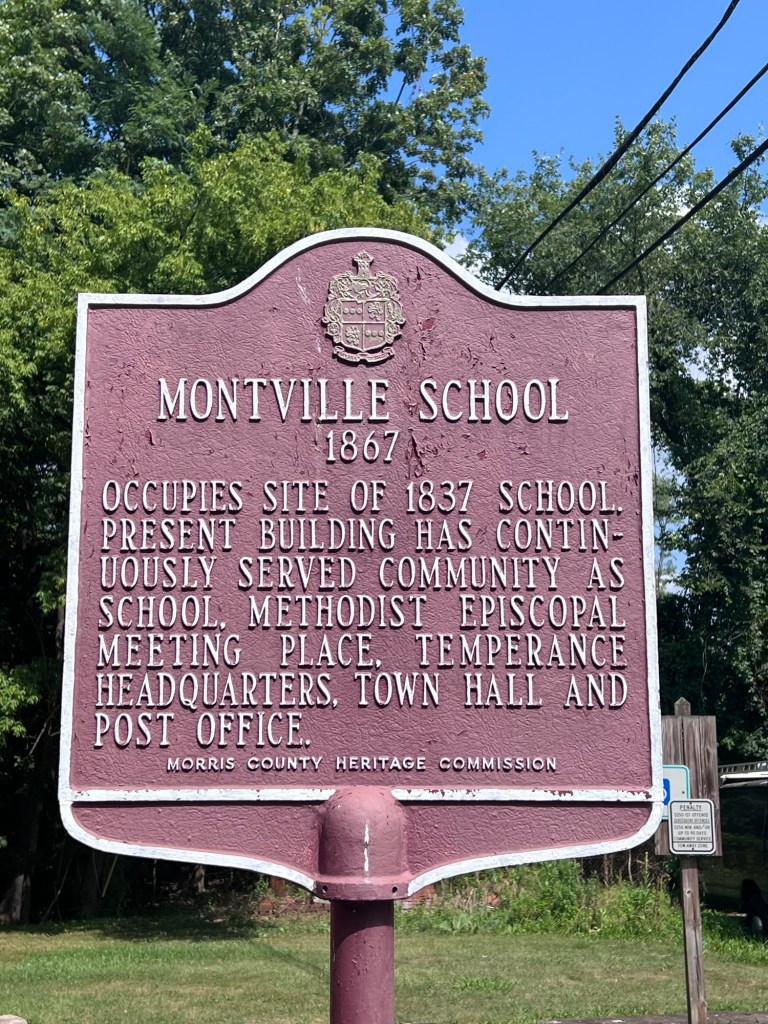
The historic sign for the house
Montville Township Historical Society:
(from the Museum website)
Established in 1963, the Montville Township Historical Society is dedicated to the preservation and promotion of the cultural heritage of Montville Township. Our unwavering commitment to meticulous archival work, interactive educational programs, and community outreach initiatives is aimed safeguarding the rich history of our town. Our ultimate objective is to ensure that the stories and traditions of Montville Township are cherished and celebrated for years to come.

The farm and harvest equipment

General Washington’s payment to the Doremus family for use of their home during the Revolutionary War. I thought this was really cool.

The farming equipment

The farm and household equipment room

The farm equipment from the time of the Revolutionary War
Henry Doremus House History:
(from the Museum’s website)
The Henry Doremus House is a Dutch American stone farmhouse that has been remarkably preserved since the time the first portion was built, circa 1760. The house has never been modernized with heating, plumbing, electricity, or wiring, and is one of only seven left in New Jersey without modern electricity. What is now Route 202 was one of the main military routes during the Revolutionary War through Montville and Towaco, (then part of Pequannock Township). The Henry Doremus house was located in a small community often referred to as Doremus Town.

The main room of the original house during the tour

The kitchen and cooking equipment by the open hearth fireplace

The open hearth fireplace for cooking and heat for the home

Cooking items
I visited Diane’s Dairy at 446 Main Road Suite 8 after my tour of the Henry Doremus House, a local ice cream store just around the corner from the historic home. What started as a place to turn around my car, I had to stop on this historical looking strip mall. When I saw the words ‘homemade ice cream’ I of course had to stop. Ice cream is one of my weaknesses.

Diane’s Dairy at 446 Main Road Suite 8

The menu of the selection of flavors
What was nice was I got to meet Diane herself that morning and she explained to me that they create and make over 92 flavors inside the store. I could tell by the quality and taste of the ice cream that a lot of care was taken in the making of her ice creams.

The section of ice cream
Diane has created many unique flavors so it was hard for me to choose but I wanted to try something different and settled on Bubble Gum flavored ice cream. It was delicious.

The Bubble Gum ice cream
The ice cream was rich and dense and had such an intense flavor of cream and cherry flavored gum. What I also liked was her prices were very fair and the portion size for a small ice cream is the size of most mediums sizes at the commercial ice cream stores. Plus I like to support local businesses. Diane has created a wonderful product and could not have been nicer.

The ice cream is do good
This ice cream was the best. Funny enough though I was her first review on TripAdvisor. I would have thought more people would have been singing her praises. After my snack, it was off to the second site on my list, the Florham Park Little Red Schoolhouse.
I visited the “Little Red Schoolhouse” Museum at 203 Ridgedale Avenue in Florham Park, which is also rarely opened. This interesting little museum showcases the town’s historical collection of items from the 1800’s and 1900’s dealing with all aspects of town life.
Schooling at the “little red frame building” prospered and so by the 1850’s, the building was “in condition of dilapidation rendering it unfit to be occupied” due to overcrowding.
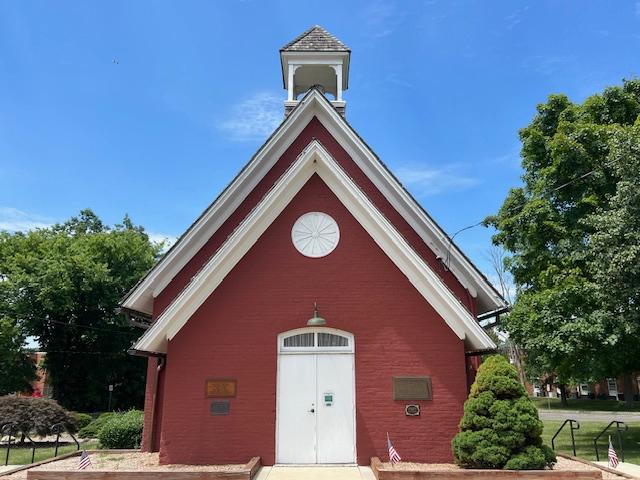
The schoolhouse from the front

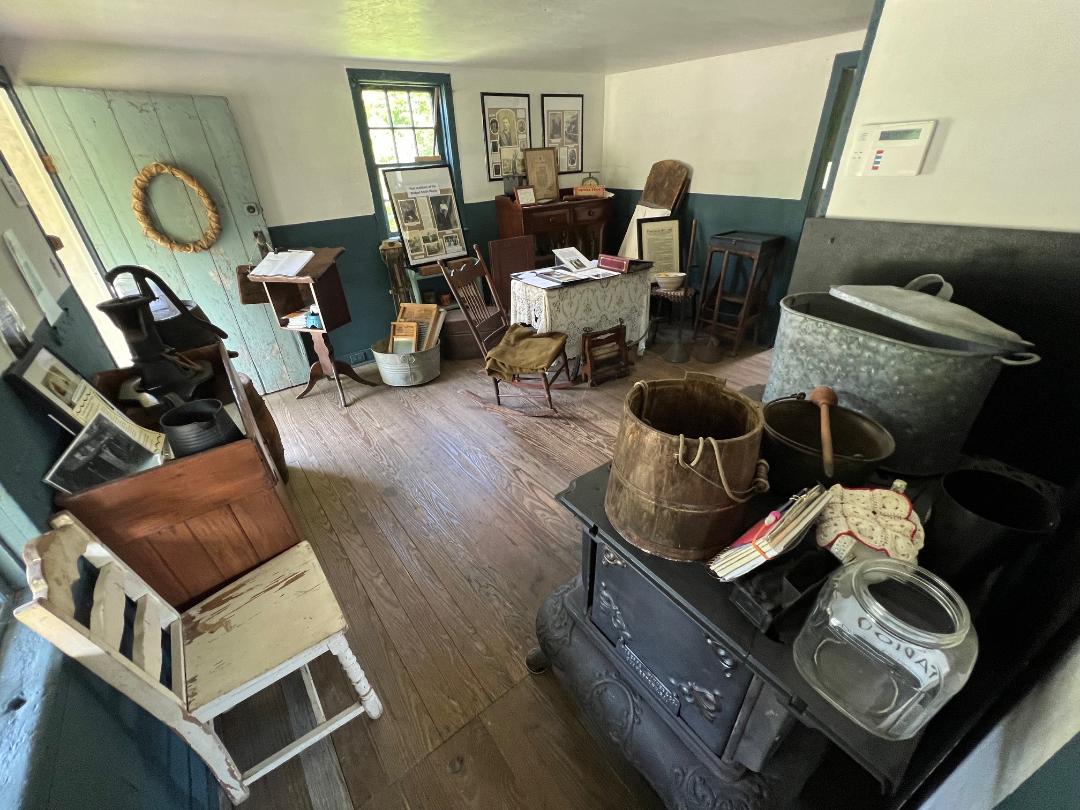
The inside of the museum schoolhouse display

The inside of the old classroom

The schoolhouse setting
In the back there is a small classroom set up keeping with the theme of the building. This lets students, who are visiting the building of their counterpart’s early education with desks, ink wells and chalk boards that have not changed that much over the years.

Not much has changed in the modern classroom over the years

The old schoolhouse desks
There is early century clothing, farming equipment from the town’s farming past and even Native American objects found in the town and in private collections.

The town artifacts and school items

The hitching post
Other items included decorative items from the home including dishware, home products and furnishings.

Each section of the museum is divided up by lifestyle.
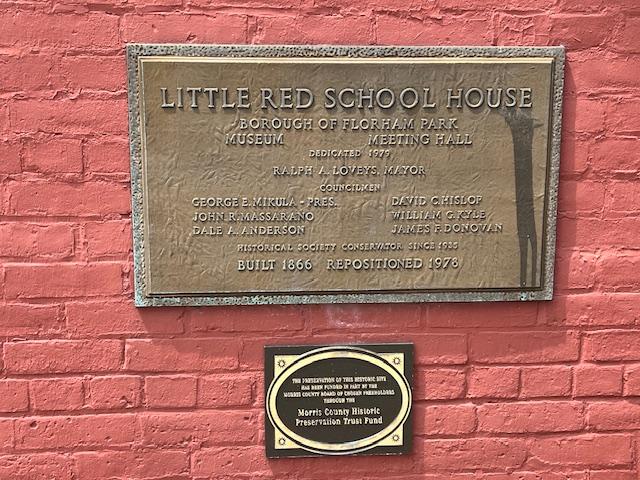
The museum’s historic plaque
The docents that day explained that the items were reflect the town’s past and some came from families that have been in town for years. The museum reflects the community spirit of town’s past. It explains that times have progressed but not changed too much over the years.
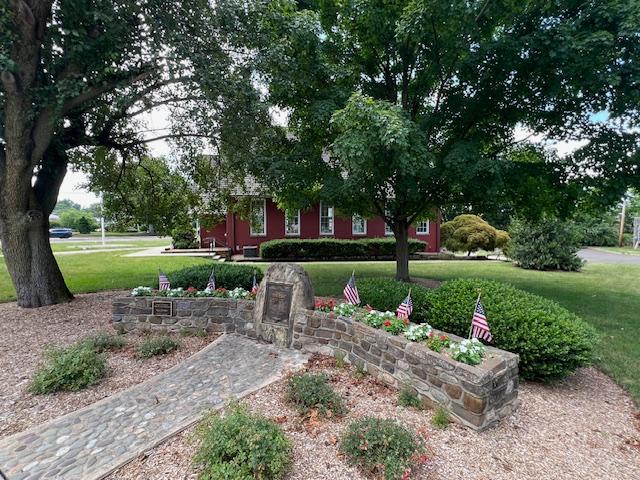
The Veteran’s Monument outside the museum
History of the Little Red Schoolhouse Museum:
(From the Museum Website)
By Kat Kurylko, Research Assistant
In 1830, the residents of Columbia, now Florham Park, sought to improve their thriving farming and broom-making community by establishing a public school for the local children. Therefore, a small schoolhouse, Columbia School #5, was built on the corner of Columbia Turnpike and Ridgedale Avenue and dedicated it on February 17th, 1831.

The schoolroom display
Schooling at the “little red frame building” prospered and so by the 1850’s, the building was “in condition of dilapidation rendering it unfit to be occupied” due to overcrowding. It just showed me one thing as an educator, that the concept of modern education has not changed that much in 150 years.
I next visited the Tunis-Ellicks House 16 Village Road in New Vernon and enjoyed the self-guided tour of this well maintained and displayed home. Unlike many sites I have visited over the years where things are left out and jumbled on tables, the Tunis-Ellicks House offers a look at small family farms from before the Civil War. The displays depict and discuss the life of a farming family in Central New Jersey.

The Tunis-Ellicks House in New Vernon, NJ

The house sign

The house is located in the New Vernon Historic District
The house was located in one of the oldest sections of the community, facing other structures in the historical district of New Vernon, NJ.

The house and front garden from the road

The vegetable garden in the front of house
In front of the house was a large vegetable and fruit garden with a grape arbor for spirits on the side of the house. These items would be jarred and pickled for the winter months or sold at market.
I liked the way the volunteers maintained the gardens with fruits and vegetables that would have been used in Colonial times mixed in with a modern twist.
Mission Statement:
(From the Museum website)
The Harding Township Historical Society is a private, not-for-profit corporation founded in 1977 to stimulate interest in the history of Harding Township. The Society shall support, assist in and seek to achieve the preservation of documents, buildings and sites related to Harding Township. It shall also collect, preserve, maintain and interpret original cultural material, which illuminates this history. In addition, The Society is responsible for preserving and maintaining the Tunis-Ellicks House and environs. Through use of its historic site, collections and programs, the society endeavors to document and illustrate the history of Harding Township for present and future generations (Tunis-Ellicks website).
You enter the museum from the back of the house. In the backyard of the home, there were all sorts of activities going on while you could start a self-guided tour of the house.

The back of the Tunis-Ellick’s House

The beautiful view from the back door of the home

The inside of the main part of the museum
The main part of the museum was the newer extension of the home where the living room and dining rooms were located. There were displays on the walls discussing farm life in New Jersey during the late 1700’s and early 1800’s.

The Dining Room section of the house

The workings of the Dining Room

The story of ‘Country Life’ and the gentleman farmer

Pieces of the decor on display
The kitchen area of the older part of the home offers a homey fireplace for cooking and summer storage for jarred and pickled food stuffs for the winter.

The kitchen and storage areas of the home

Pottery collection in the museum

The pottery collection

The kitchen dining and cooking area of the home

The fireplace for cooking, roasting and stewing of foods

The oven for baking breads, cookies and pies and the baking equipment

The Summer storage area for canned and jarred provisions for the winter months and for cooking.
History of the Harding Township Historical Society:
(From the Museum website)
The Harding Township Historical Society was formed in 1977 to save the circa 1795 Tunis-Ellicks House and restore it as it appeared in the early 19th century. The society discovered an original 18th century hearth and Federal-style mantel and a water-fed cooling room besides the well. Areas of the house were left exposed to showcase the post-and-beam construction. A permanent exhibit on 19th century farming was created as well as space for temporary exhibits.
The Society saved a circa 1870 Tramp House from destruction when the Great Swamp National Wildlife Refuge was created by having the building moved the Tunis-Ellicks House property. The Harding Township Historical Society maintains an extensive archive containing records, maps, and objects since the colonial era pertaining to the town. The archive is open to researchers, genealogists and the public. Each year we provide an award to a student at the Harding Township School that excels in the subject of history. The Society produces exhibits, lectures, tours, and interactive events to bring history to the public.
When I drove to the Tunis-Ellicks House, I was really hungry and it was lunch time. I had passed the Green Village Deli at 536 Green Village Road and I read the reviews online while in their parking lot and they were excellent so I decided to give it a try. The food and the service were excellent.

The Green Village Deli at 536 Green Village Road

The sign that welcomes you to this local breakfast and lunch establishment
The Village Green Deli is a popular local sandwich shop, where the staff seems to know all the customers by name (with the exception of me) and is located in this small downtown area facing the Village Green.
I really liked the vibe of this small town deli where the owners knew everyone by name and I felt like an interloper at a private party.

The inside of the Village Green Deli
The deli has that small town feel to it, with local art and sports paraphernalia in the walls. The woman who worked the register was greeting everyone by name and the guys that worked the grill seemed happy to see me.

Looking at the menu at the grill
I looked at the extensive lunch menu of popular sandwiches and some wonderful combos. You could even still get breakfast as I saw some of the guys at the counter devouring as I decided on what I wanted to order.

The deli has a wonderful selection of sandwiches, hero’s and other delicious sounding items.
There were so many things I wanted to try that day that it was hard to choose. Was it a breakfast sandwich with local sausage? The Thanksgiving ‘Gobbler’ sandwich with turkey, stuffing and cranberry relish, that sounded so good? I decided on an Italian hero sandwich with a selection of deli meats with fresh lettuce, tomato and onion. The hero was excellent!

The Italian hero with a pickle
The sandwiches here are huge! One half of a sandwich a normal person could eat for lunch and save the rest for another meal. The sandwich was loaded with salami, bologna, ham, Swiss Cheese and fresh veggies. I could barely fit it in my mouth.

The sandwich was excellent
The food was excellent. The bread was so fresh and the cooks did not skimp on one ingredient. The vegetables were so fresh and crispy and I loved the combination of flavors of the cold cuts. I really enjoyed my lunch and would like to make a special trip back just to try more of their sandwiches. I was very happy with my lunch.
One of the last places I visited was the Historical Society of Boonton Township, which is located in the former Oscar Kincaid Farm Homestead 591 Powerville Road. The house and what was left of the acreage of the farm was part of the current museum. The museum was an example of early New Jersey farming that dated from the 1800’s to the Twenty-First century.
There was not much in the way of period furniture or farm equipment (items of the home were sold off since Mr. Kincaid’s passing), but the new historical society is buying artifacts and bringing them back to the farm. This includes one of Mr. Kincaid’s tractors. His roll up desk is also still in the display room which was once the Living Room of the home.

The Kincaid Homestead at 591 Powerville Road
History of Oscar Kincaid and Homestead:
(From the Morris County Historical Society website)
Originally a part of the extensive tract belonging to William Penn, the earliest portion of the home was constructed in 1785 by Adam Miller and Anna DeMouth Miller. Just over a decade later, they sold the property to Adam’s cousin, Sarah Miller Parlimen (of the Miller/Dixon homestead) and her husband, John, who built a sawmill there. After a brief ownership by William Scott of Powerville, a Miller relative, the land was sold to John Decker in 1828. An industrious man, Decker operated both a farm and successful forge, shipping his goods to New York via the Morris Canal. By 1837, he expanded the home, adding a distinctive folk-art painting of a face and unique plasterwork that can still be seen today (MCHS website).
The homestead passed through generations of Decker’s family, ultimately being inherited by Oscar Kincaid Sr. in the early 20th century. Kincaid ran a popular ice cream stand and dairy business throughout the 1920s and 30s. Following World War II, the family opened Valley Farm on the site, which continued until the death of Oscar Kincaid Jr. in 2000. Added to the National Register of Historic Places in 2005, the Decker-Kincaid Homestead today operates as a museum and headquarters of the Historical Society of Boonton Township (MCHS website).

The Kincaid House

The historical marker for the house

The front yard

The entrance to the house

The main foyer of the house
The house is a small farmhouse built in two sections. The original part of the house dates back to the late 1700’s and the newer part in the early 1800’s. The once furnished rooms now hold displays of Morris County and the farming industry of the time plus community artifacts.

The former Living Room

Oscar Kincaid’s desk
There were not much left in the way of family furnishings and heirlooms but this desk was Oscar Kinkaid’s.

The back bedroom

The Flag display for the ‘250th Anniversary’

Story of Oscar Kincaid’s life: Oscar Kincaid was a farmer/businessman, a politician and a conservationist.
After the short tour around the house, I walked around the farm grounds. The house was set on a beautiful piece of land that sloped down to the old farmstand. There was also a swimming pond which was once part of the farm which is now private property.

The farm property from the side with the barn

The barn across the street
The property was about ten acres at the time of his death and parts have been developed. It still has some of the most wonderful views of the area.

The view of the old farm from the front porch
The farm land stretches over different sections of the road and the property is very picturesque. It is a very beautiful homestead.

The view of the farm from the lawn

The swimming pond on the edge of the property

The old farm stand that had been used for eighty years
Places to Visit for the Pathways Tour:
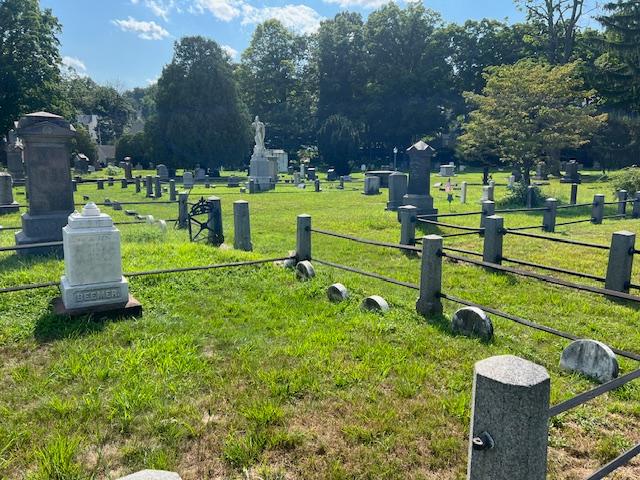
Florham Park Historic Preservation Commission/Little Red Schoolhouse & Hancock Cemetery
203 Ridgedale Avenue
Florham Park, NJ 07932
No Phone Number
https://morriscountyhistory.org/the-little-red-schoolhouse-florham-parks-pride-joy/
Open: Special Events and Pathways tours-Please check their website
Admission: Free but donations are accepted
My review on TripAdvisor:
My review on VisitingaMuseum.com:
Henry Doremus House
490 Main Road
Towaco, NJ 07082
No phone number
https://www.montvilletwphistoricalsociety.com/museums
https://en.wikipedia.org/wiki/Henry_Doremus_House
https://www.facebook.com/groups/1141264633508766/posts/1764205224548034
Open: Special Events and Pathways Tours in Spring and Fall-Please contact through their website
Admission: Free but donations are accepted
My review on TripAdvisor:
My review on VisitingaMuseum.com:
Harding Township Historical Society/Tunis-Ellicks House
16 Village Road
New Vernon, NJ 07976
(973) 272-3661
Open: Special Events and Pathways Tours
Admission: Free but donations are accepted
My review on TripAdvisor:
My review on VisitingaMuseum.com:
Historical Society of Boonton Township/Oscar A. Kincaid Home of History
591 Powerville Road
Boonton Township, NJ 07005
https://historicalsocietyofboontontownship.org/
Open: For Special Events and Pathways Tours only
Admission: Free on the Pathways Tour
My Review on TripAdvisor:
https://www.tripadvisor.com/Profile/R4960NKjustinw/mediabatch/14296162?m=19905
My review on VisitingaMuseum.com:
Places to Eat during the Pathways Tour:
Diane’s Dairy
446 Main Street #8
Towaco, NJ 07082
(973) 265-4620
https://www.facebook.com/DianesDairy
https://www.instagram.com/dianesdairy/reels
My review on TripAdvisor:
Green Village Deli
536 Green Village Road
New Vernon, NJ 07935
(973) 773-1709
https://www.greenvillagedeli.com/menu
https://www.facebook.com/GreenVillageDeli/
Open: Sunday 7:00am-3:30pm/Monday-Friday 6:30am-4:00pm/Saturday 7:00am-3:30pm
My review on TripAdvisor:
My review on DiningonaShoeStringinNYC@Wordpress.com:
https://littleshoponmainstreet.wordpress.com/tag/restaurants