The Hill-Hold House Museum
128 NY 416
Campbell Hall, NY 10916
(845) 291-2404
https://www.orangecountyny.gov/1477/Hill-Hold-Museum
https://en.wikipedia.org/wiki/Bull-Jackson_House
Open: Sunday 12:00pm-4:00pm/Monday-Friday Closed/Saturday 12:00pm-4:00pm Seasonal Tours from May to August.
Admission: Adults $5.00/Children $3.00/Group Tours $4.00-Group Tours for over 20 people have to arranged in advance.
My review on TripAdvisor:
I had never heard of the Hill-Hold Museum and I happened to come across it when I saw a sign on the local highway that the museum was open that day. I thought it was a very interesting home and grounds with historical homes and buildings. Some came from other parts of Orange County, NY.
There are group tours on the hour with the last tour at 3:00pm. I took the last tour by myself with the tour guide and got a one on one tour of the house and grounds. The tour takes you into a step back in time to an agricultural society that no longer exists and times were slower and more structured.

The Hill-Hold Museum

The estate in the background
The Hill-Hold Museum:
A Farm for Two Centuries. This stone farmhouse was built in 1769. This museum reflects the life of the Bull-Jackson family spanning over 200 years. Hill-Hold Museum has circa 1830 Furnishings, a one room School House, a historic 1870 barn, Goosetown Gift Shop, picnic benches, and parking (Museum website).

The house on the estate grounds
The Mission Statement:
(From the museum website)
The Friends of Hill-Hold and Brick House Museums serve to preserve and enhance the preservation of history in Orange County, by maintaining, furnishing and operating programs at both these exemplary 18th century houses. These museums include portraits, memorabilia, photographs, and furnishings pertinent to them, the county and the past ages that touched each house (Museum website).

The front of the Hill-Hold Museum at the start of the tour
History of the Hill-Hold house museum:
(From the museum website)
Visit Hill-Hold museum and see what life was like on a Hudson Valley farm in the 1830s. This was still the era of candlelight, fireplace heat, homegrown food, and homespun clothing. The stone farmhouse was built in 1769 with wide plank floors, handsome paneling, and huge fireplaces (Museum website).
It was the home of a prosperous farmer, Thomas Bull, and his family. Original furnishings range from a prized old mahogany sideboard to made-on-the-farm pieces. Most of the rural family’s needs – food, clothing, fuel came directly from the farm. The property was gifted to the County in 1968 by Eleanor Jackson and the house went through an extensive restoration in the 1970’s to return it to how it appeared when it was originally built in the 18th century. (Museum website).
The Hill-Hold farm served the Bull-Jackson family for more than two hundred years. Now visitors are welcome to tour the farm. As we wander through Orange County, reveling in its rolling farmland scenery, we can go back to when the early Americans brought the gracious living and energetic husbandry to this unique part of the Hudson Valley (Museum website).

The Parlor-sitting room on the first floor was once a bedroom
We started the tour in the formal parlor, which the tour guide told me was once a bedroom along with the Living Room before the house was expanded. The house is filled with Bull family heirlooms that were donated back to the house by distance family members.

The family portrait’s in the Parlor-sitting room with the family piano that was used in the evening for entertainment
The portrait below is of the last member of the Bull family to live in the house before it was donated to the State of New York.

A portrait of the last family member to live in the house
The room was used by the family for entertainment, relaxation and for every evening activities. The room was used for pursuits such a sewing, needlepoint, conversation and with a piano in the room, evening activities with the family. With so much going on the farm, people retired in the evening early as the morning brought a lot of work on this working farm.

The spinning wheel by the fireplace
The Dining Room again was a former bedroom that was expanded for a formal eating as the both the house was expanded as well as the family. Breakfast and a late lunch/supper were served in this room. The Dining Room table, chairs, sideboards and china were pieces that part of the house donated back by the family.

The family dining room

The family China in the sideboard cub-bard in the Dining Room
The complete formal china set was displayed in the china closet as if ready to be used for a formal dinner party.

The sitting area in the Dining Room

The upstairs bedroom
We toured the master bedroom on the second floor of the home. Each of the rooms had fireplaces to keep them warm in the long winter nights with a canopy bed to keep the warmth inside. I could not believe how small people were at this time. This would have barely held one person today.

The canopy bed in the upstairs bedroom
The other bedroom would have been used by the children of the family. Now it contains sewing and weaving machines as well as spinning wheel to create the family clothing.

The second bedroom

The Sewing Room on the second floor with the oven/heater and family spinning wheels
Fabric and clothing was created in the home. Whether flax and wool, material was spun on the farm and the family wardrobe was created here.

The family spinning wheels

The sitting area on the second floor
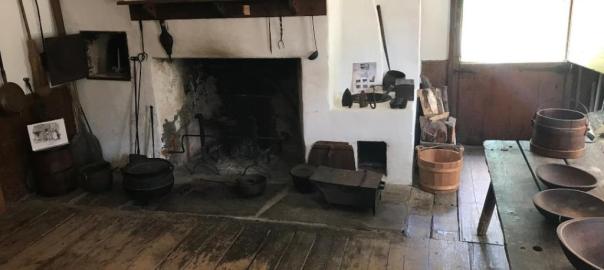
The last part of the house tour was of the family kitchen in the main house. The Summer kitchen was on the other side of the garden outside. The main kitchen inside the house had the fireplace, cooking materials, the family pewter and everything you would need to cook a complete meal.

The family kitchen

The family table set for cooking
Items for bread and dessert baking, butter making, roasting and stewing and all the items needed to cook three meals a day. The bounty of the Spring, Summer and Fall had to supply the long winters when there was no grocery shopping available.

The equipment for washing clothes and other household chores
Wash Day was a whole day reserved for sorting, boiling, scrubbing and hanging clothing to dry. Until the more modern machines were invented in the 1920’s after WWII, this was the weekly ritual for the farm housewife or the staff.

The open hearth and cooking equipment

The cooking equipment

The family pewter set
After we finished the house tour, we explored the outer buildings which included a Summer Kitchen, a smoke house, the vegetable and flower gardens. These buildings were spread around the main house.

The Summer Kitchen

The inside of the Summer kitchen
This Summer Kitchen came from a different property but the use is still the same. As the warmer months of the Summer were upon them, cooking was done in a separate building to keep the house cooler.

Some of the cooking and baking equipment

The flower beds on the side of the house

The flower and vegetable beds on the side of the property and the smoke house
Outside the main house were the vegetable, fruit and flower gardens. Items used in the household for meals, decorations and entertaining.

The barn, the outhouse and the smoke house in the distance

The inside of the smoke house where meats once hung used for family meals
All the family meats were placed in here for cooking and smoking for the family meals. The process took much longer than it does today.

The well in the middle of the property
They also moved an old school house to the property and it was furnished as a complete turn of the last century school house. It was used until 1936.

The schoolhouse on the property

The inside of the school room
The classrooms of the 1700’s and 1800’s to today have not changed much. With the exception of modern heating and air conditioning, the class room set up has not changed much. There is still a board in the front of the room, chairs facing the teacher, who is in charge and books lining the walls.

The teachers desk and the furnace that kept the room warm in the cold months

Games and amusements that were used in recess

Wheels and bikes were part of the games children played at the turn of the last century
Before modern electronics took over starting in the 1970’s, bicycles, hoops and games such as tag and hopscotch were part of playground activities. Playing outside has not changed much throughout the centuries.

Looking over the grounds at the end of the tour
Before I left for the afternoon, I was able to tour the gift shop before the museum closed for the day.

The Goosetown gift shop at the museum entrance at the end of the tour
The Goosetown Gift Shop at Hill-Hold features books, gifts, toys, craft items, and souvenirs. The shop is operated by the Friends of Hill-Hold, Inc., a not-for-profit organization, which aids in the operation of Hill-Hold and Brick House museums (The Museum website).
It really is an interesting tour and a step back in time for a glimpse into the life of a Upper Middle Class farming family.

