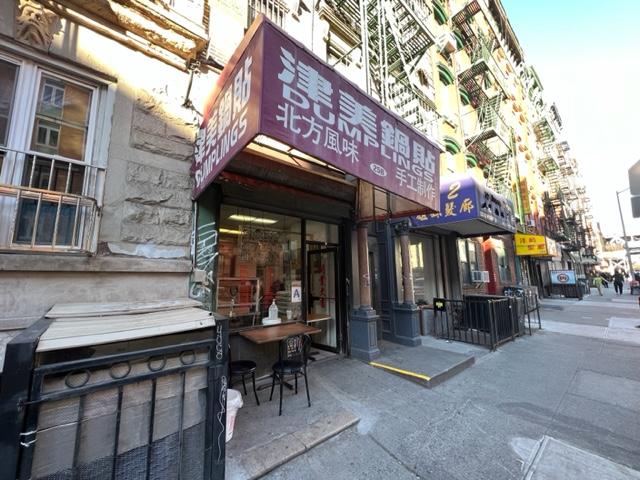
I was searching for someplace to eat in Chinatown after touring a few museums in Brooklyn. It was cold that night and I was in the mood for soup and dumplings. The place I wanted to go to was closed and as I walked around Division Street, I came across a restaurant that was having their grand opening (I would find out later it had opened in the summer).
The owner waved me in on a very cold and welcomed me inside to a warm restaurant where homemade dumplings are made right in front of you. The best part is that there is a lot to order under $10.00. There were so many choices from the menu with dumplings, pancakes and soups and everything was so reasonable.
The Chive Pancake
I started my meal with the Chive Pancakes. These were being made by the women working the counter behind the register. These golden cakes were rather large and were panned fried. With a little soy sauce, what a way to start the meal.
The Chive Pancakes
The were filled with rice noodles, eggs and chives
Then I needed to warm myself up and had the Wonton Noodle Soup with bok choy. The long noodles and the dumplings are made fresh right in front of you. The dumplings go right from the counter where the women just folded them into the soup or into the pan for an order of ten.
The Wonton Noodle Soup with Dumplings
The food and the service were wonderful and the owner could not have been nicer and more welcoming. She pulled me off a cold street and welcomed me into the restaurant. In a time of rising prices and small portions, North Dumpling is that wonderful exception with reasonable prices and excellent food.
What I found out from the manager after dinner was this is the sister restaurant to China North Dumpling, a tiny restaurant on Essex Street which literally has no seating and this is her new, bigger version of that very successful restaurant.
My reviews on China North Dumpling at 23 Essex Street:
The Mount Vernon Hotel Museum at 421 East 61st Street
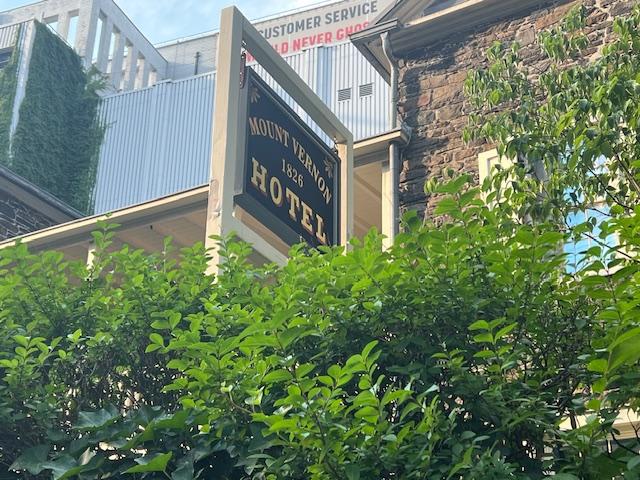
Mount Vernon historical sign during the summer months
The history of the building
The model of the building
I had come across the Mount Vernon Hotel Museum when I was walking on East 61st Street for my blog and went to take the tour of the building. It is a one hour (or more as I there for almost two hours but I was by myself) tour of both floors. You start with a film and a quick talk about the history of the building. The hotel building has had several owners and uses over its over hundred years.
I visited the museum during the holiday season in 2025 and I got to see all the decorations around the hotel. There was elegant decorations in most of the rooms and got to see how people ate during the holiday season as well as with visits guests would have indulged in when they came for the day.
Then you start the tour of the upper room where the ladies would gather and talk. This is where they might have tea, musical recitals and read and sew. They would gather with other women for conversation and debate.
The Upstairs foyer gallery
The foyer landing decorated for the holidays with the former traveler, James Taylor, who discussed in his memoir about visiting the hotel
The Ladies Parlor
The upstairs is where the sleeping rooms and the ladies parlors are located, where female guests would enjoy tea, games, music and reading. The main landing was for dancing and for gatherings.
The Ladies Palour with the Chinese writing desk and festive decorations.
The room set for tea with Englishware
The holiday set up afternoon service
The sleeping rooms were kept simple and functional
The Men’s game room
The main floor was the Men’s gaming rooms, where there is a bar and two rooms for male activities such as cards, gambling and reading. Here the men would discuss politics and business over a drink and games of chance.
The main games room
The main entrance was used as the dining room for dinner (our lunch), which was the biggest meal of the day served around 2:00pm.
The bar area where spirits are sold
The afternoon supper was part of the package and couples would join one another for a several course meal, which would serve as the main meal of the day.
Dinner time at the Mount Vernon Hotel Museum
The tour guide went over what would have been served, menu’s and meal times. Dinner would have been served at 2:00pm, tea time would have been around 4:00pm-6:00pm and Supper around 8:00pm.
The multi course meal for everyday on display
The meal would include popular dishes such as turkey and oysters and a specialty, Turtle soup. Fresh vegetables and fancy desserts would be part of the package.
The tour of the kitchen show preparation of foods, recipe books and all kitchen equipment including the stoves and baking materials.
The kitchen for both the hotel and house
The kitchen used to cook afternoon meals
The area used for baking and roasting
If you like the history of “Old New York” and like old homes, hotels and buildings, this is a very interesting tour that deals with the City’s growing middle-class and the new ‘leisure time’ that was coming with the changes in the work week. There are many pieces of period furniture all over the building that show the growth of affluence of the time.
The side board set with holiday desserts
The side board ladened with holiday treats
Don’t miss the formal walled in garden in the back. It is a place of relaxation from the rest of the city. There are stone walk ways and landscaped gardens as well as an herb garden. The building is owned and maintained by the Colonial Dames of America.
The walled gardens during the winter
The walled garden in the winter
I revisited the museum for the holidays and the hotel was decked out in garland and holy based on the decor traditional for the Revolutionary War era Christmas. The archways and tables were lined with greenery and the tables were loaded with oranges plunged with cloves to give the homes at that time a rich citrus smell.
The downstairs dining table was set for a Christmas meal of wild turkey, mock turtle soup, and apple and pumpkin pies. This would have been served in the afternoon as the main meal while it was still light out.
Holiday goodies at the Mount Vernon Hotel Museum getting ready for the holidays
There had been a light snow while we were touring the hotel so when we visited the gardens, it really did have that Christmas feel to it with that light snow all over the pine and the bushes.
How the neighborhood has changed
The old stable area
During the time of the Revolutionary War and afterwards, homes were not as elaborately decorated as they would have been during Victorian times after the Civil War. Homes were lined with greenery that would have given the home the fragrant smell of pine and strings of cranberries and popcorn would have been used to decorate mantles.
The hotel decorated for the holidays
The hotel was getting ready for one of its many special events during the holidays so there was a lot of commotion going on downstairs. It is a very festive looking place for the holidays so try to tour it when it is open in the month of December.
The museum in the 2025 holiday season
What is the Museum:
Constructed in 1799 as a carriage house and converted into a ‘day hotel’ in 1826, the Museum transports visitors back to Mount Vernon Hotel, a 19th Century country resort for New Yorkers escaping the crowded city below 14th Street.
The model of the original house layout
Recognizing the building as one of the few remaining 18th century sites and the only surviving day hotel in New York City Historic Landmark in 1967, added to the National Register of Historic Places in 1973 and accredited by the American Association of Museums in 1983.
History of the House:
The Mount Vernon Hotel Museum & Garden presents the period of the Mount Vernon Hotel which operated from 1826 until 1833.
Constructed in 1799 as a carriage house for a 23 acre estate and converted into the Mount Vernon in 1826, this stone building sits on land originally owned by Colonel William Stephens Smith and his wife, Abigail Adams Smith, the daughter of John Adams.
This fashionable country resort was popular among New Yorkers who wished to escape the hustle among the bustle of the city, which at that time extended only as far north 14th Street. The Hotel advertised “free from the noise and dust of the public roads and fitted up and intended for only the most gentle respectable” clientele. In those days, one could take the stagecoach or steamboat up to 61st Street spend the day at the hotel sipping lemonade in the ladies parlor or playing cards in the gentlemen’s.
In 1833, the house became the home for three generations of a New York City family. In 1905, as the area became more industrialized, the building was purchased by Standard Gas Light Company (today’s Con-Edison). The Colonial Dames of America, a woman’s patriotic society purchased the building in 1924 and did an extensive restoration to the structure, the Colonial Dames opened the site to the public in 1939. The building endures as a rare reminder of an important era in New York City’s history.
What the organization does:
*Welcome 5000 school children annually in grades-pre-K through high school for field trips.
*Summer History Weeks for children ages 6-12
*A Summer High School Internship for 15 students to support college readiness skills and career exploration.
*Two summer Hearst Fellowships for undergraduates or graduate students.
*40+public programs each year, including:
-monthly free Story time
-monthly Lunchtimes lectures
-holiday programs, garden concerts, hands on craft and cooking workshops.
*Temporary exhibitions on facets of life in early 19th century NYC, some promoting local contemporary artists.
*Special programs for individuals with Alzheimer’s and their caregivers.
*Outreach programs to schools, senior centers and homeless shelters.
*Themed group tours focused on 19th century food, decorative arts or literature.
*Three options for team building events.
*Two free admission days: Smithsonian Museum Day and Open House New York.
Programs are made possible in part by the support of the New York City Department of Cultural Affairs in partnership with the City Council and Council Member Ben Kallos, the New York State Council on the Arts with the support of Governor Andrew Cuomo and the New York State Legislature, the Manhattan Borough President Gale Brewer, the Institute of Museum and Library Services, the Rosenthal Foundation and the Michael Tuch Foundation.
(Mount Vernon Hotel Pamphlet)
The Colonial Dames of America:
With these words, spoken in April 1890, Maria Denning “May” Van Rensselaer imitated what was to become the oldest colonial lineage society for women in the United States. The Colonial Dames of America. Its mission is to preserve historic sites and objects, award scholarships, educate the public about American history, inspire patriotism and promote fellowship among its members.
When I am visiting Philadelphia, I am always in search of reasonable places to eat and find snacks after a long day of touring. I came across Asia Bakery at 115 North 10th Street last year when I came in for the Flower Shos and it has been one of my go to places ever since.
The inside of Asia Bakery and their selection of baked goods to choose from
Their buns and rolls are very reasonable and if you get there earlier in the day, there is also a nice selection of baked goods to choose from. On my first trip there, I stopped for a late afternoon snack and one of their Roast Pork buns and a Cream bun.
I loved the sweetness of the topping and the rich barbecue taste of the chopped pork inside the bun. It is part lunch and part dessert. They are one of my favorite Chinese buns.
The Roast Pork bun
The filling is so good
The Cream buns are wonderful too. Filled with a sweet vanilla cream, they make the perfect dessert after a meal in Chinatown.
On my recent trip, I stopped in to have some dessert after dinner eating elsewhere. There were so many choices but I decided on the Pineapple Cream bun. These sweet soft buns are topped with a sugary crust and filled with a sweet vanilla cream. The perfect pocket dessert.
The Pineapple Cream bun
The filling is delicious
Everything I have tried here is delicious and there are so many choices that it is hard to choose what you want to try. Don’t miss this small hole in the wall bakery in Philadelphia’s Chinatown for a meal on the go or just a quick snack.
The Tuckerton Museum and the Seaport at 120 West Main Street in Tuckerton, NJ
The entrance to the complex from Route 9
The entrance to the Tuckerton Seaport complex on a sunny Saturday morning
The complex was once a bustling fishing and shipping area that has now been preserved as a cultural site with tours, a series of restaurants and a museum.
The Mission of the Museum:
(from the Tuckerton Seaport Museum website)
Our mission at the Tuckerton Seaport is to preserve, present and interpret the rich maritime history, artistry, heritage and environment of the Jersey shore and the unique contributions of its baymen.
The dock area by the coffee shop
The artwork by the parking lot and coffee shop
I walked over to the main building which served as both the gift shop and museum. It was funny that the gift shop took both the first two front rooms of the museum. I had to look behind shirts to see the displays.
The docks and touring boats by the museum
The Seaport Tuckerton Museum at 120 West Main Street
The History of the Complex:
(from the Tuckerton Museum website)
Originally launched as the Barnegat Bay Decoy and Baymen’s Museum, the Tuckerton Seaport has evolved over the past twenty-two years into a community museum and community center occupying 40 acres located along historic Tuckerton Creek in Tuckerton, New Jersey. Tuckerton Seaport benefits from a prime location at the center of the Jersey shore, easily accessible via Exit 58 on the Garden State Parkway. Tuckerton Seaport works as a coastal cultural center to bring folklife traditions of the past and present to life through programs on land and water.
The museum was just opening up as I arrived and the staff was busy getting everything ready so I just walked around the museum. It is an interesting museum on New Jersey’s nautical past and the growth of the shipping and trading that went on in the turn of the last century. The museum also showed the bustling fishing industry that still exists today.
The Giant Chicken greets you at the door
The Giant Chicken was a road stop symbol of the White Way Farm Market and a tourist attraction
I thought it was rather cute and could see why people stopped
The view from the front porch of the museum was spectacular on this sunny day
The exhibit at the museum ‘Museum in the Making’, which is a through look at Tuckerton, its past and its contributions to the growth of New Jersey
The first room also served as a bustling gift shop with the main attraction this carving of the ‘Jersey Devil’
A display of Duck Decoys
A collection of woodcarvings of fisherman
The popular businesses that once lined Route 9 up and down the shore area
Displaying life down the shore in that era with quilting and sewing
The display of wood carvings and artwork on the first floor
The artworks made of driftwood by local artists
The driftwood art display on the first floor
The rooms both on the first and second floor were displayed by themes of Lenape Indian life at the shore, the Dutch and English traders, growth of shore farming, shipping and trade and fishing industries and the development of tourism in the area with steamships and the railroads.
The first room in the museum is a detailed look at the life of the Lenape and the froth of the fishing industry
The early life at the Jersey shore
The Native American display
The first part of the early development of Tuckerton started as the fishing and hunting grounds of the Native Americans until the settlement of the Dutch
The history of the Lenape
The arrival of the Europeans started the bustling shipping and trade industries that supplied the home country
With the growth of industry and farming many people started businesses to supply the population
Some started popular businesses that lasted over a century
E. Walter Parsons Jr. had a very successful fishing business that was in the family until 1984
With the rich soil in the area, local farmers worked the land providing fruits and vegetables for the growing population
Early farming equipment on display
The second floor galleries depicted the developing life at the shore with creating of modern life saving for the shipping and fishing industries and with coming of railroads, the bustling tourism industry with the change of leisure travel after the Civil War and the Industrial Revolution.
The second floor rail transportation display
The second floor display on shipwrecks off the Jersey coast
The development of modern Life Saving procedures
With storms at sea and affecting life in the area, as it still does today, there was a growth and development of modern Live-saving procedures and rescue methods.
The Life Saving exhibit
The use of the Lyle Gun in rescues
The series of pulleys and wenches are still used today in different forms. They had to create a safe way to rescue people not just from storms but accidents as well.
The Life Saving and Rescue display
Rescue display
The railroad made its way to the Jersey shore bringing tourists from both New York and Philadelphia and bustling North Jersey. This opened the area up to tourism as leisure travel grew at the end of the nineteenth century.
One example of a visiting tourist was the Cinderella Cramer display with long distance travel to the shore.
The first female passenger of the Tuckerton Railroad
Getting the rail ticket
Tourism developing at the Jersey shore
The Cinderella Cramer display representing that eras travels to the shore with Victorian standards and use of steamer trunks
Packing the steamer trunks for the long journey
Artifacts from the shore
Life at the shore still had its perils as it does today with storms affecting development and shifting shore lines
The lighthouse light display
The museum once served as a beacon for shipping and the top level served as a lookout. Today you can walk upstairs and enjoy the views.
Traveling up the tower stairs
On this beautiful sunny and clear morning that I visited, the views were spectacular.
The view of the port area of the complex
The view of the inlet and Lake Pohatcong across from Route 9
My video of the views from the top of the lookout
The Tuckerton Seaport Museum tour was a very thorough look at the community and its development over the last three hundred years. The exhibits showed the progress the community has made and where it is headed in the future as the shore communities keep changing.
With the economy, the rise of AI, climate change and overall population growth toward the shore, it will be interesting to see the changes of the future.
Leaving the museum complex at the end of the trip
Tuckerton has an interesting past as a shipping and fishing destination and now you can tour the buildings and see what life was like back then and there it is moving in to the future today.
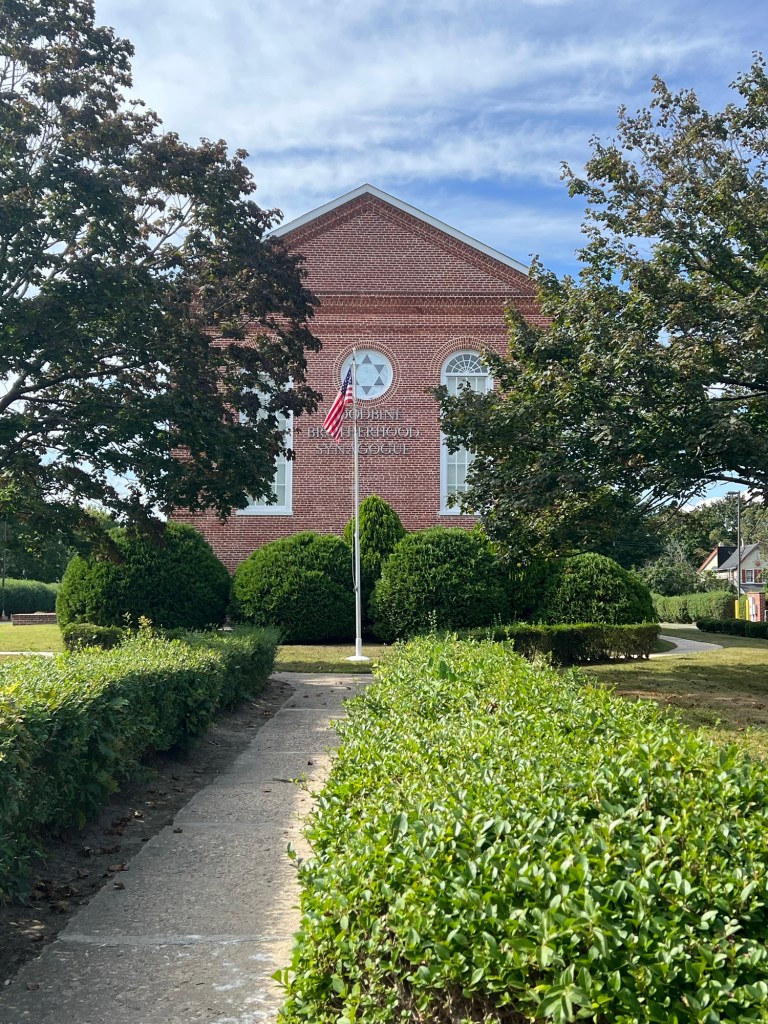
The front of the Sam Azeez Museum of Woodbine Heritage
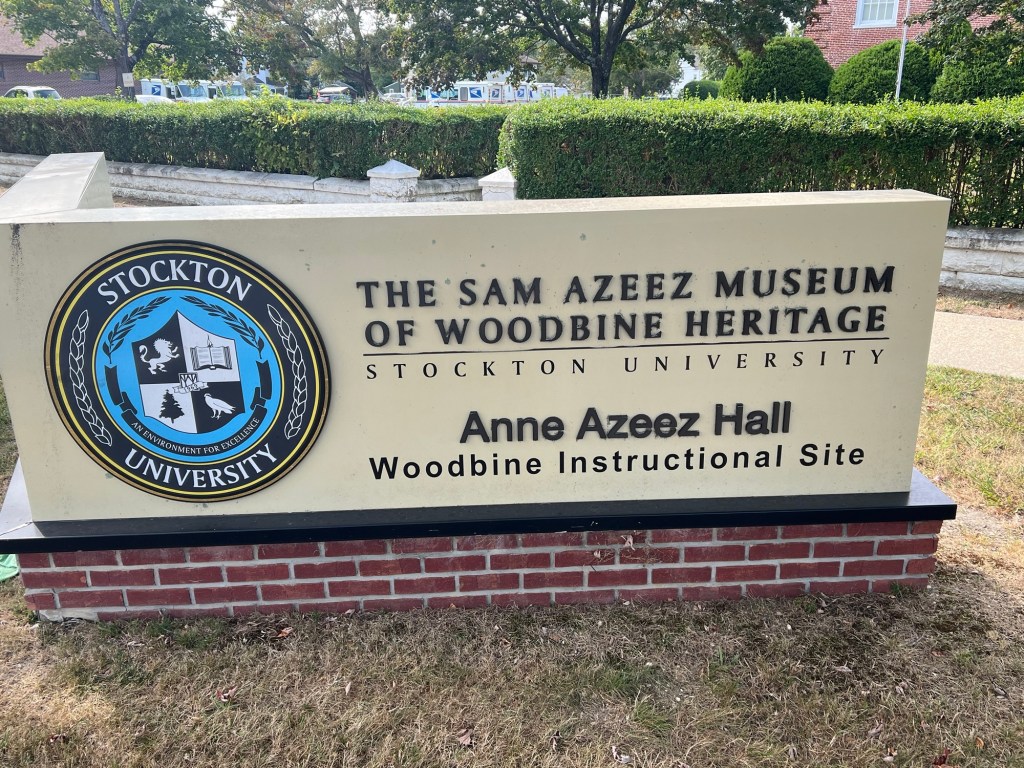
The entrance sign that welcomes you
The History of the Sam Azzez Woodbine Museum:
(from the museum’s website):
The Sam Azeez Museum of Woodbine Heritage is an independent non-profit charitable organization preserving the unique history of Woodbine, NJ.
Established in the 1890’s through Baron de Hirsch’s philanthropy, Woodbine began as an agricultural colony for Russian Jewish immigrants seeking freedom denied in their homeland. As poor soil conditions limited farming, Woodbine evolved into Cape May County’s manufacturing center while maintaining founding values of education, religion and inclusion.
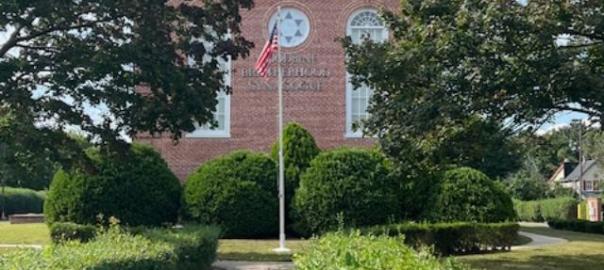
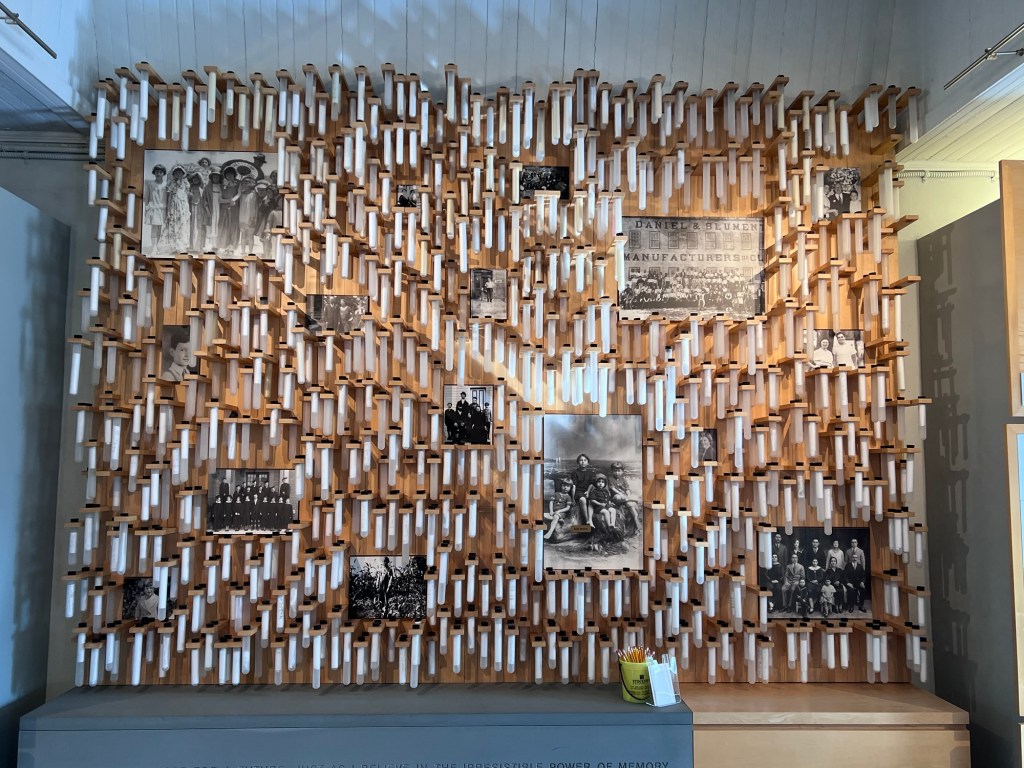
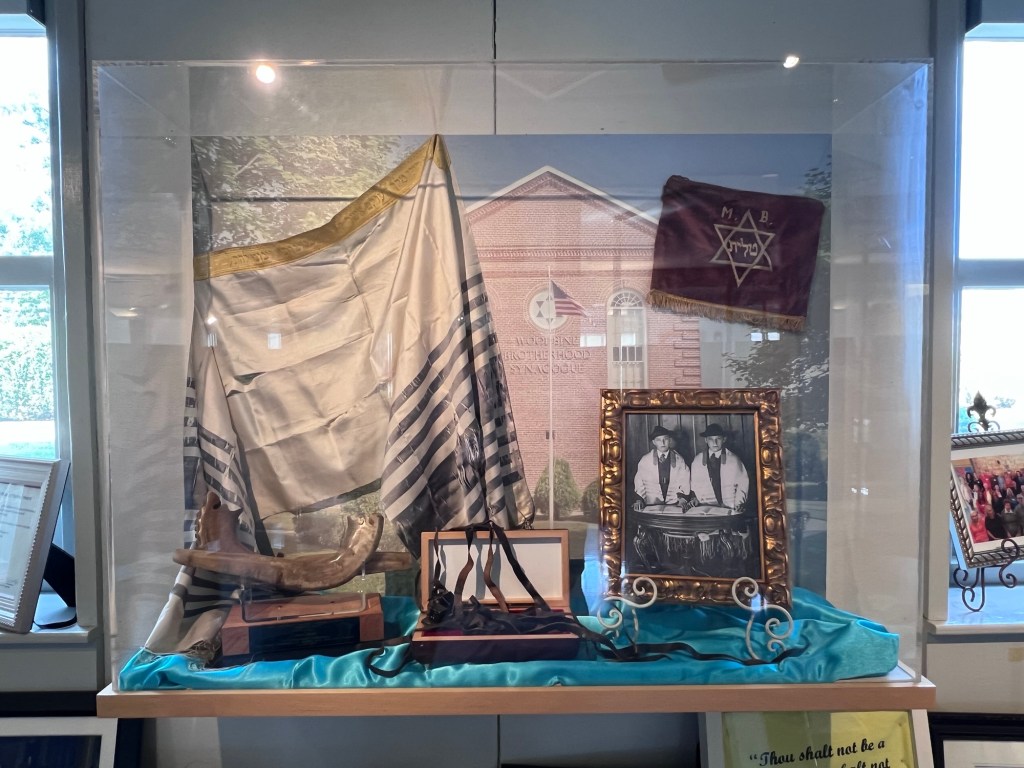
The museum occupies the historic Woodbine Brotherhood Synagogue, listed on the Natural Register of Historic Places. The restored sanctuary hosts special services, while the Brotherhood Hall houses exhibitions including the community-contributed Collective Memory Wall.
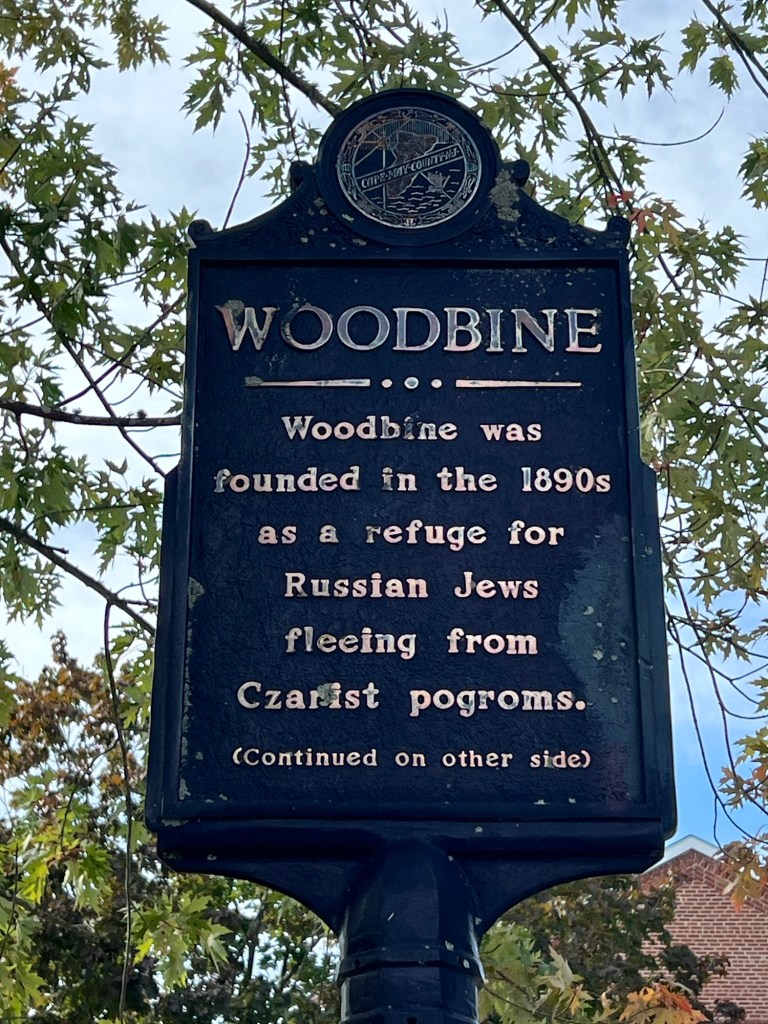
The historical significance of of the Town of Woodbine
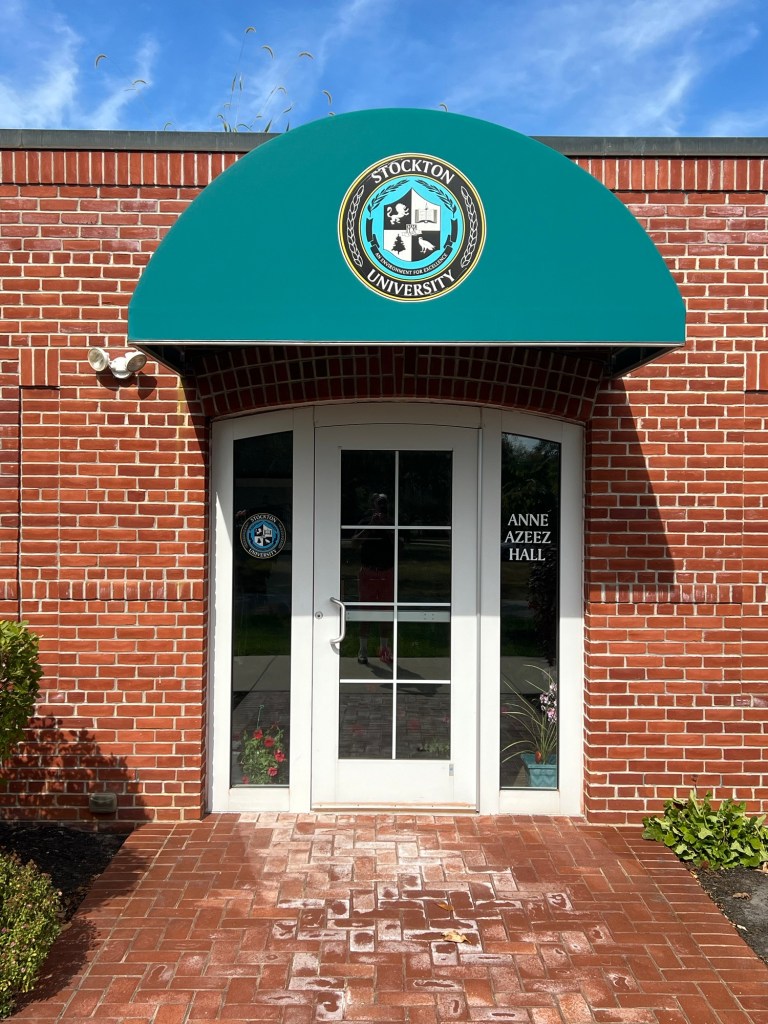
The entrance to the museum
The museum is another interesting look at New Jersey history and the development of the immigrant story of assimilation into American society.
I was given a personal tour by the Assistant Curator and she explained the resettlement of Russian Jewish immigrants by a wealthy patron into this South Jersey community.
The main gallery of the museum
The panels tell the story of how these community came into being and how these people built a community through agricultural and eventually manufacturing and small businesses that supported the community around it. It established a town that was self sustaining and grew to the community center.
The panels show the growth of Woodbine as a community
The residents established their own sports teams, community organizations and civic groups like the councils and fire and police departments.
The records of the many town organizations of Woodbine
Display of one of the first families to settle in Woodbine
Display of the religious faith of the community
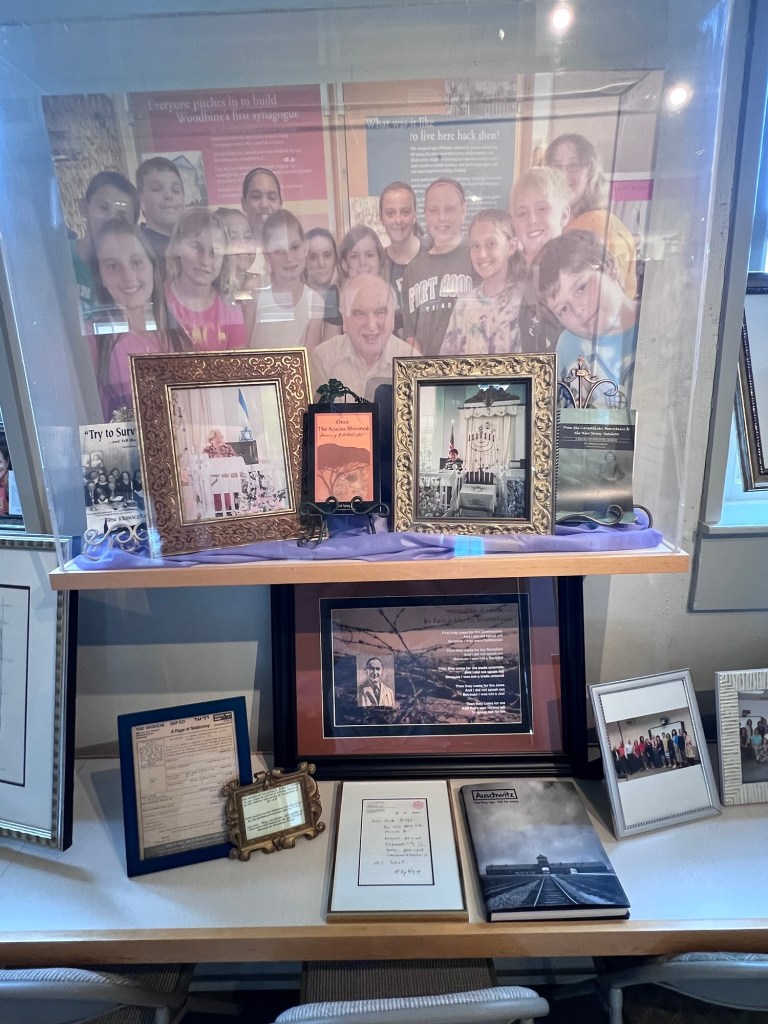
One of the most touching displays is of survivors of the concentration camps during the holocaust. These pictures represent these women as children and them today.
The display of the women who survived the camps
The history of the community and the growth of diverse businesses in Woodbine
Creating and building the Synagogue in the community
On the second floor of the building is the old synagogue of the community which is only used during the high holidays. This is used by descendants of the community and family members of theirs.
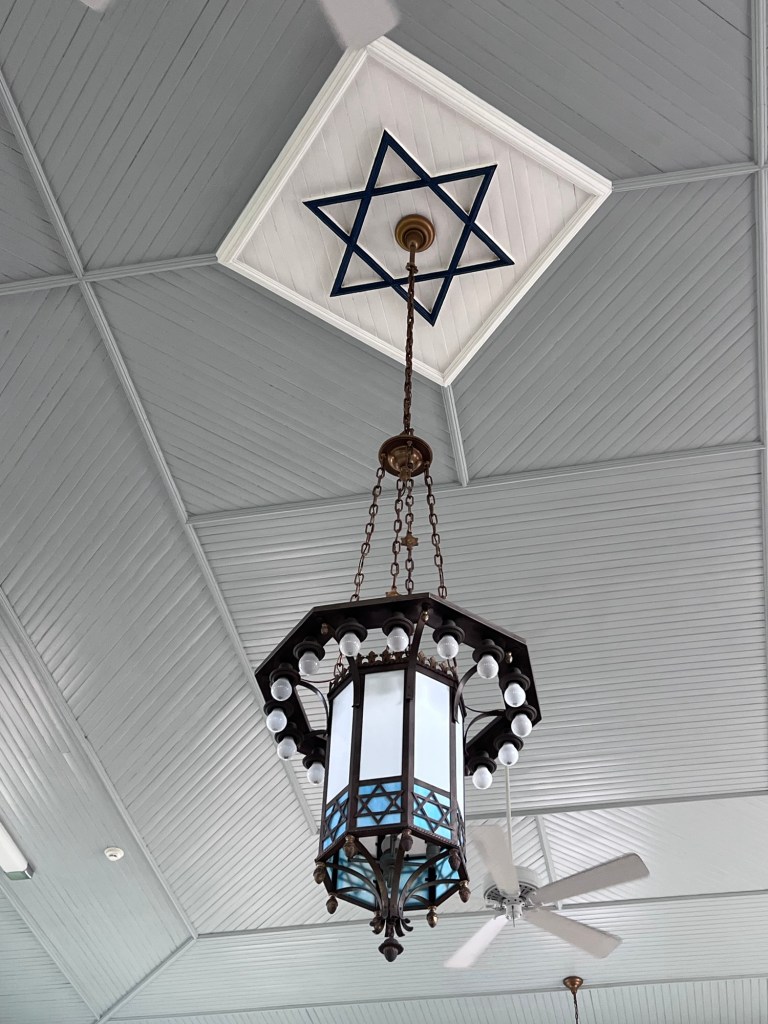
The inside of the synagogue on the second floor of the building
The front of the temple
The chandelier is original to the temple
The space was being prepared for the Jewish New Year and the crowd of people who would be attending.
The Memorial Wall
The traditions of the religion being practiced in the community
The self-government of the community
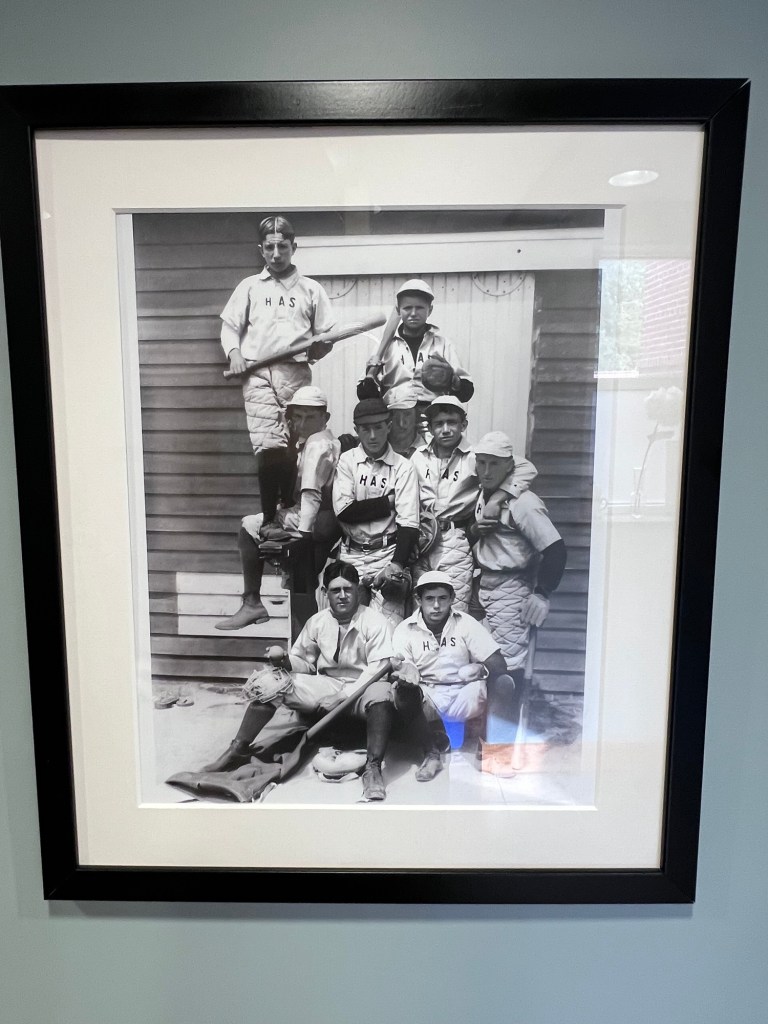
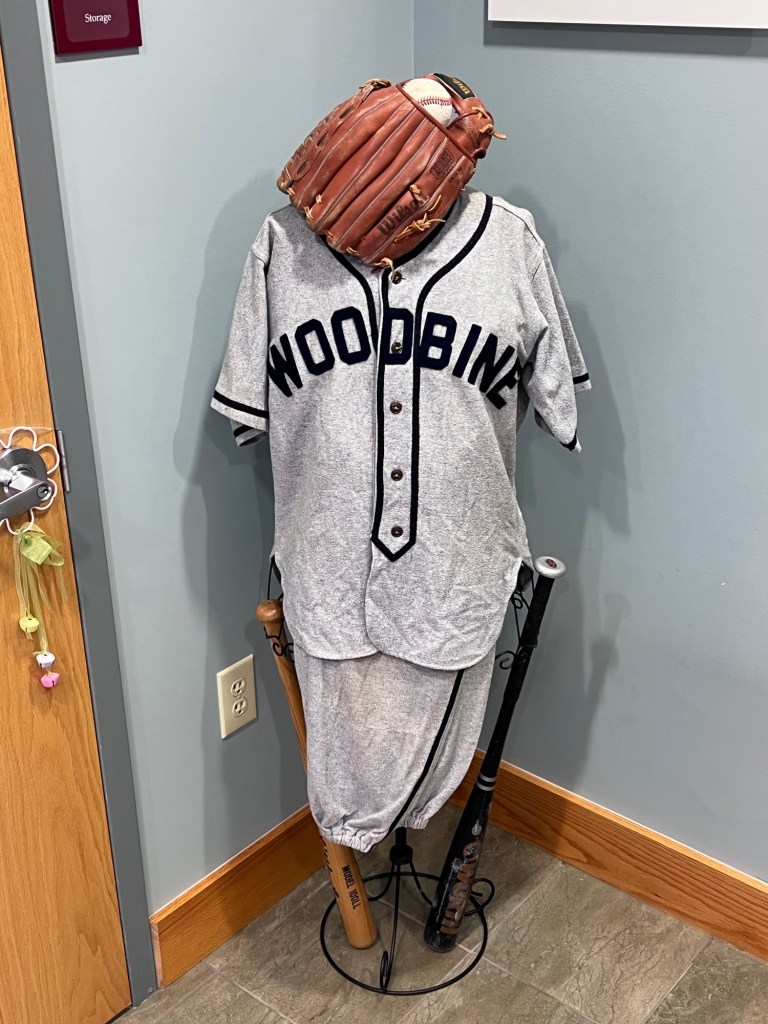
Still the younger generation was all American and wanted to assimilate into society with an all American past time of things like baseball.
The Woodbine youth baseball team
The uniform of the old baseball team for youths in the town
The last display is of the famous alumni who once lived in the community. These are the men and women who once lived here and went on after all odds to do great things and make our country better.
The Hall of Fame
The museum I thought had a bit of an identity crisis as I really did not know what the museum was about.
I was pleasantly surprised to find an interesting part of New Jersey history I had never known. It just goes to show you how a museum can educate you with just one visit. The Assistant curator said there will be more to come in the future.
I started walking the streets of Lower Chelsea after Maricel and I spent the morning wondering around Chinatown with her nephew. I swear that kid has an appetite. We went out for dumplings and roast pork buns and between them and myself nothing was left.
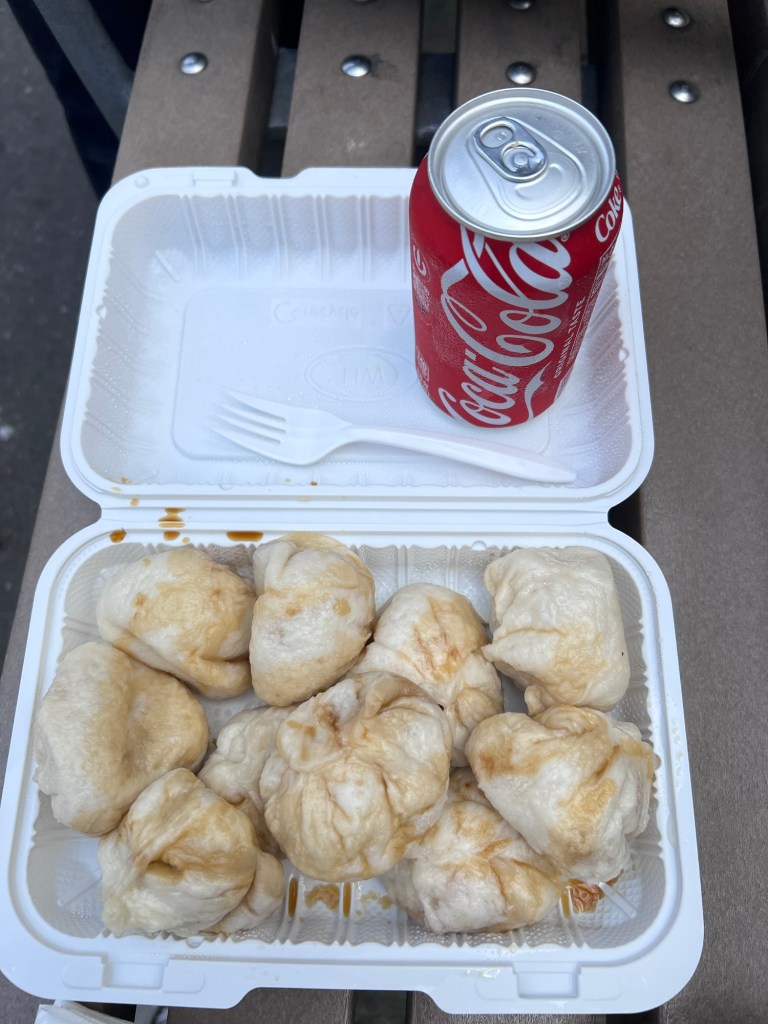
Dumplings is a wonderful place on Henry Street right off Catherine Street in Chinatown and for $5.00 you can get either ten large pork and chive dumplings or ten large pork buns. I opted for the pork buns on this trip.
The Pork Buns from Dumplings
These make the best lunch
We ate in the park and caught up with work. I had to thank her again for that wonderful Afternoon Tea at the Plaza the week before. It was pretty amazing being back in the Palm Court after all those years.
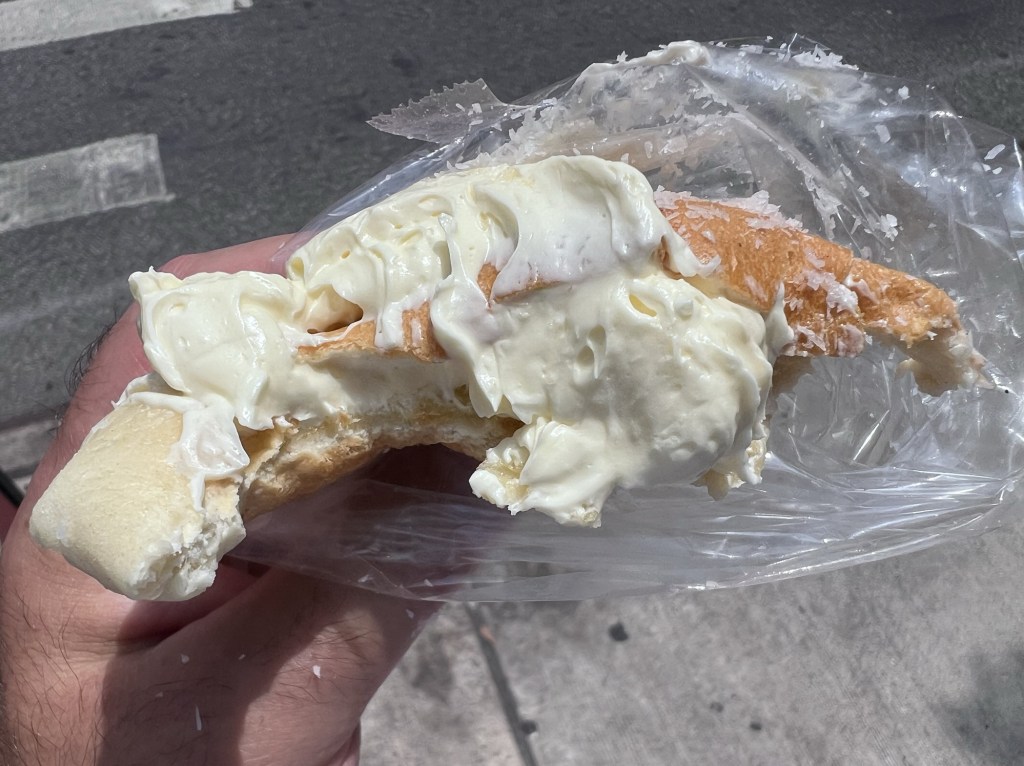
Then it was off the Tasty Bakery on Catherine Street for dessert. We indulged in Cream buns for dessert. Tasty Bakery is one of those very local coffee and bakery places that the older Chinese residents meet during the day and that are quickly disappearing. That’s why you have to visit for these fantastic pastries.
The Cream filled buns are the best
Yum!
After walking around the East Village for a while, they left the City and I ventured up to Lower Chelsea to start the walk of the neighborhood. I walked up from Chinatown as the humidity seemed to die down today. It ended up being a bit cooler than the recent days. The weather had been so hot and humid during some of these walks.
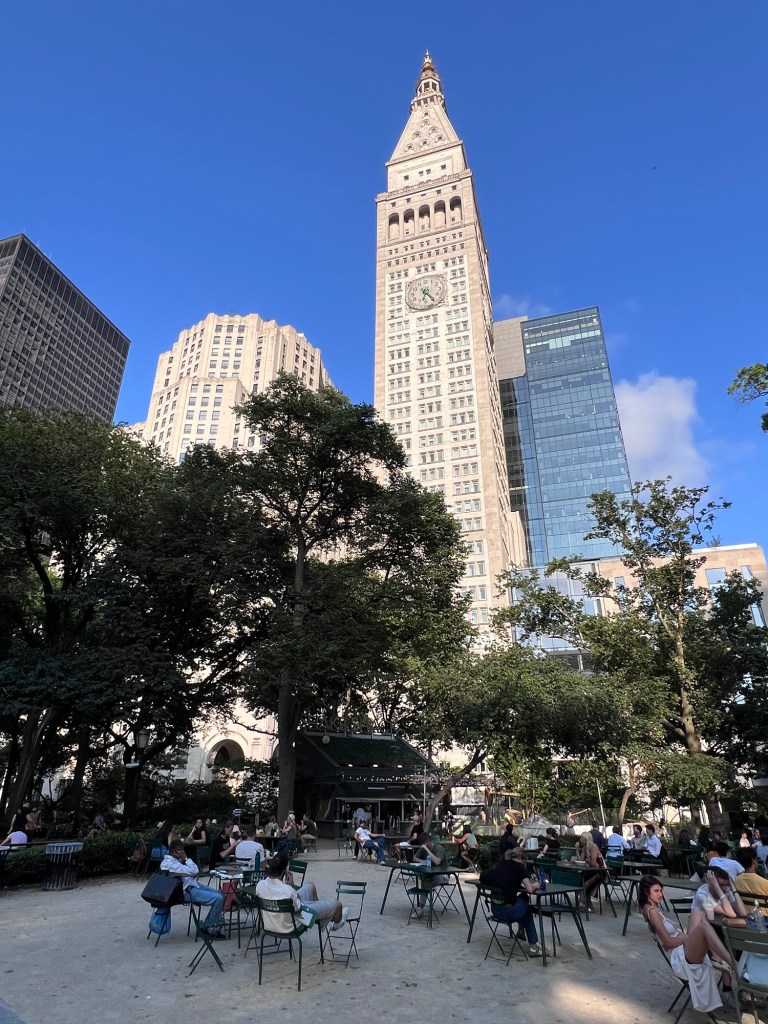
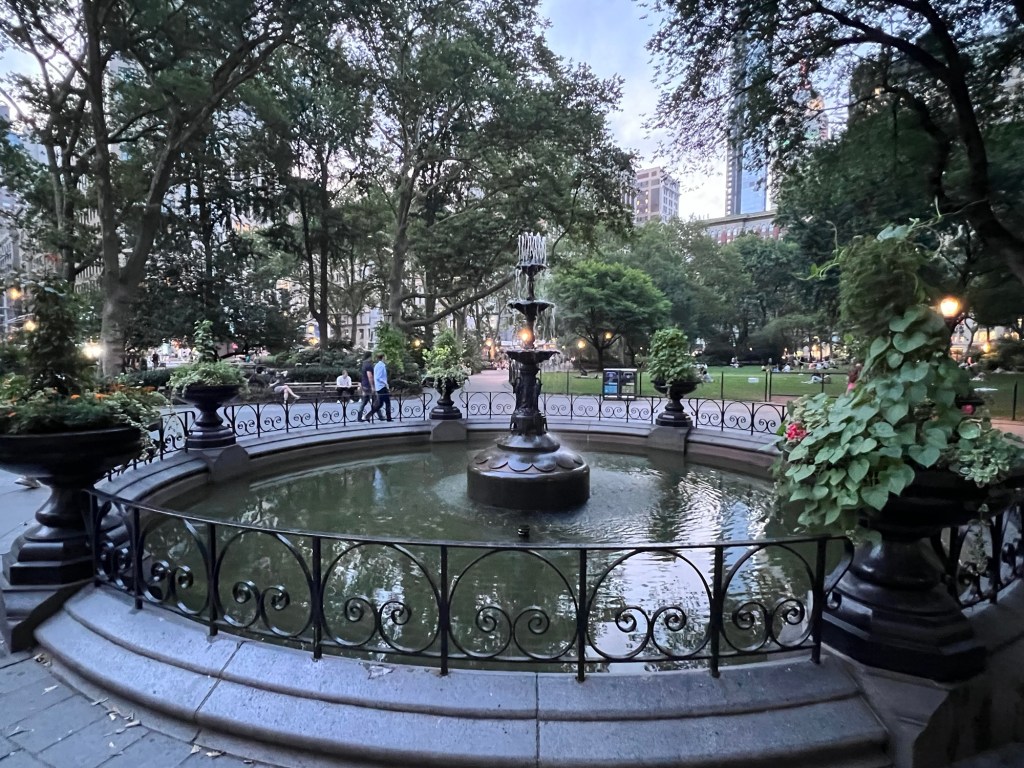
I started the walk on this spectacular day in Madison Square Park. It was such a breathtaking sunny day and the humidity was finally starting to fall. Perfect for walking around the park admiring the gardens and fountains. Everything was in bloom and the park looked spectacular. I love this patch of green in the middle of Manhattan.
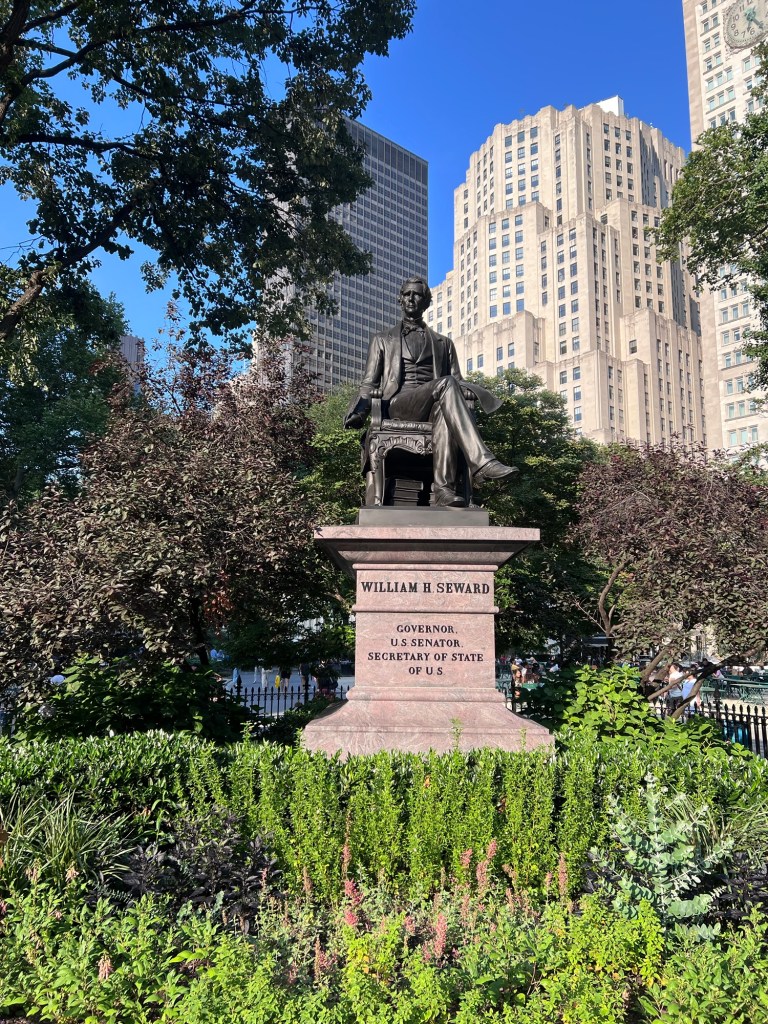
The statute of Senator William Sewart, who was famous for the purchase of Alaska ‘Stewart’s Folly’ greets you at the entrance to Madison Square Park at West 23rd Street
The park was in full bloom in the beginning of the summer and the pathways and gardens were just gorgeous.
Madison Square Park in front of Shake Shack
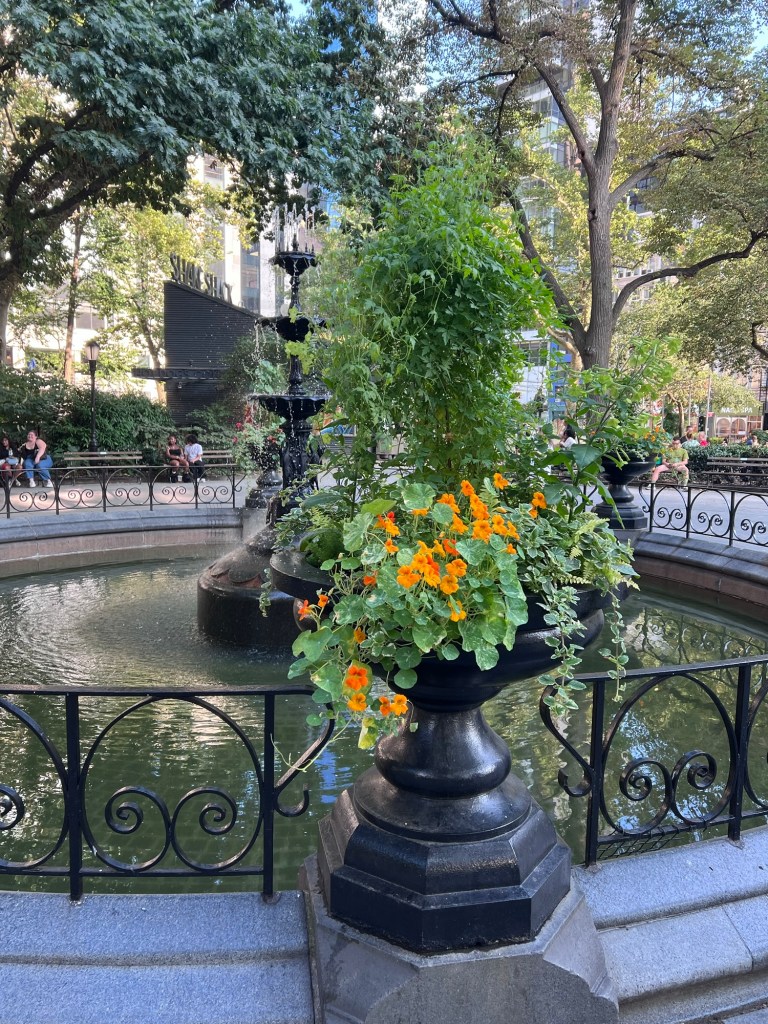
The fountain in the park
The flower pots around the fountain
Looking north of the park with the Empire State Building in the background
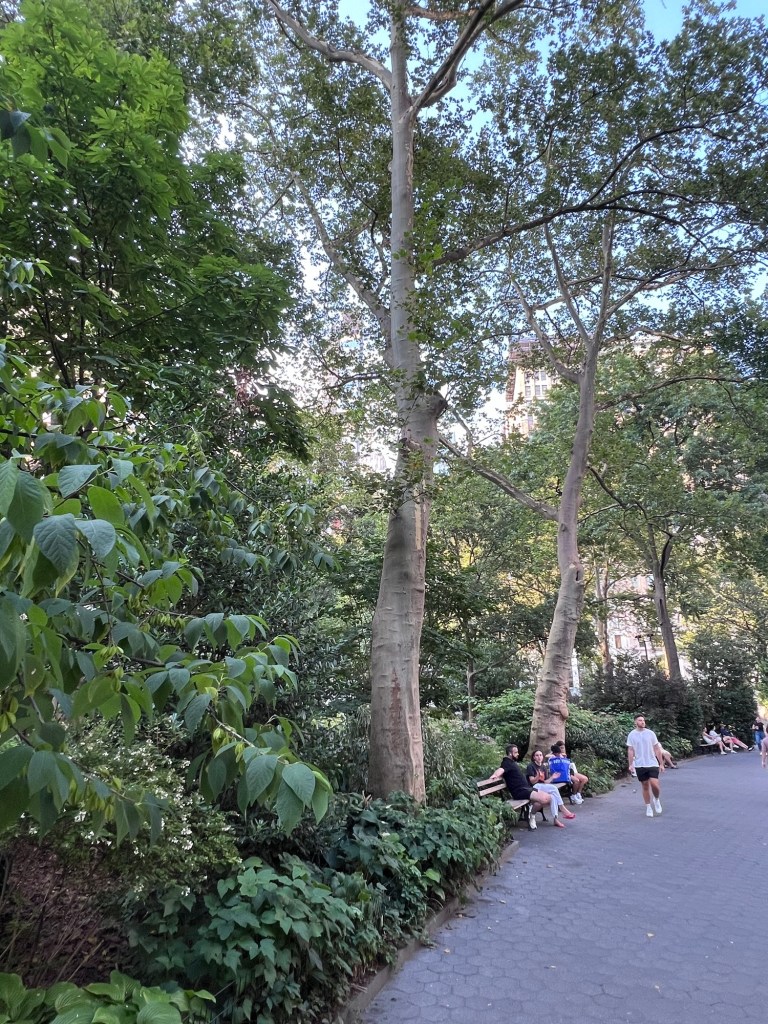
Walking along the paths inside the park
Looking west of the park in the trendy NoMAD neighborhood
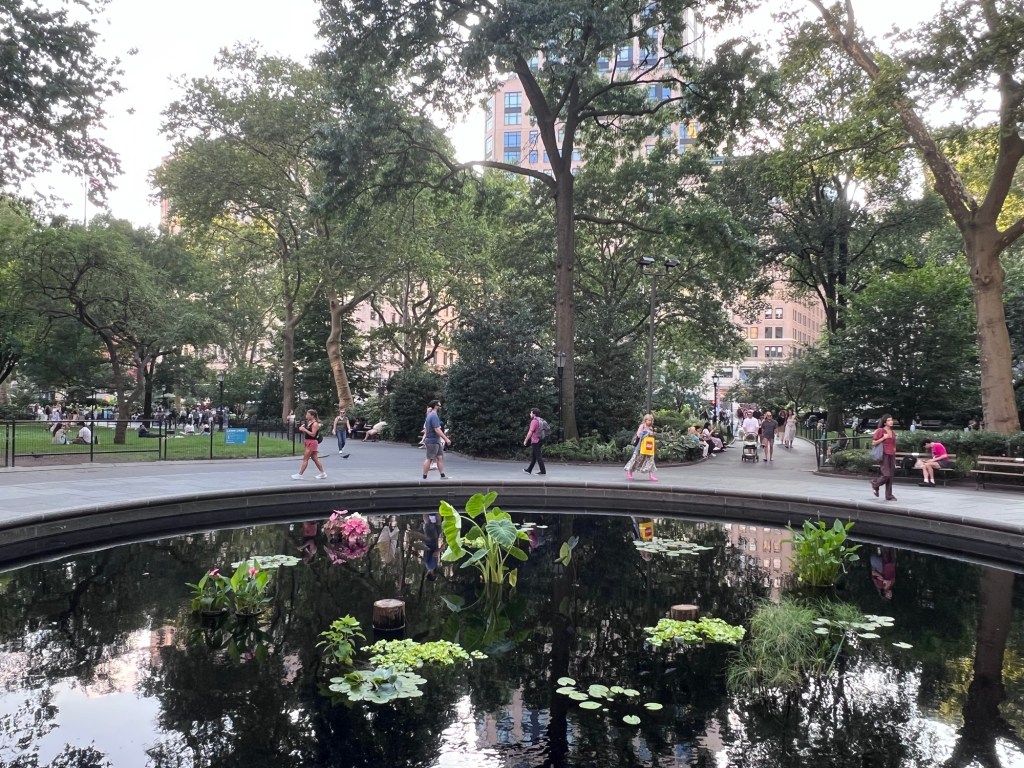
The Lilly Pond in the northern side of the park
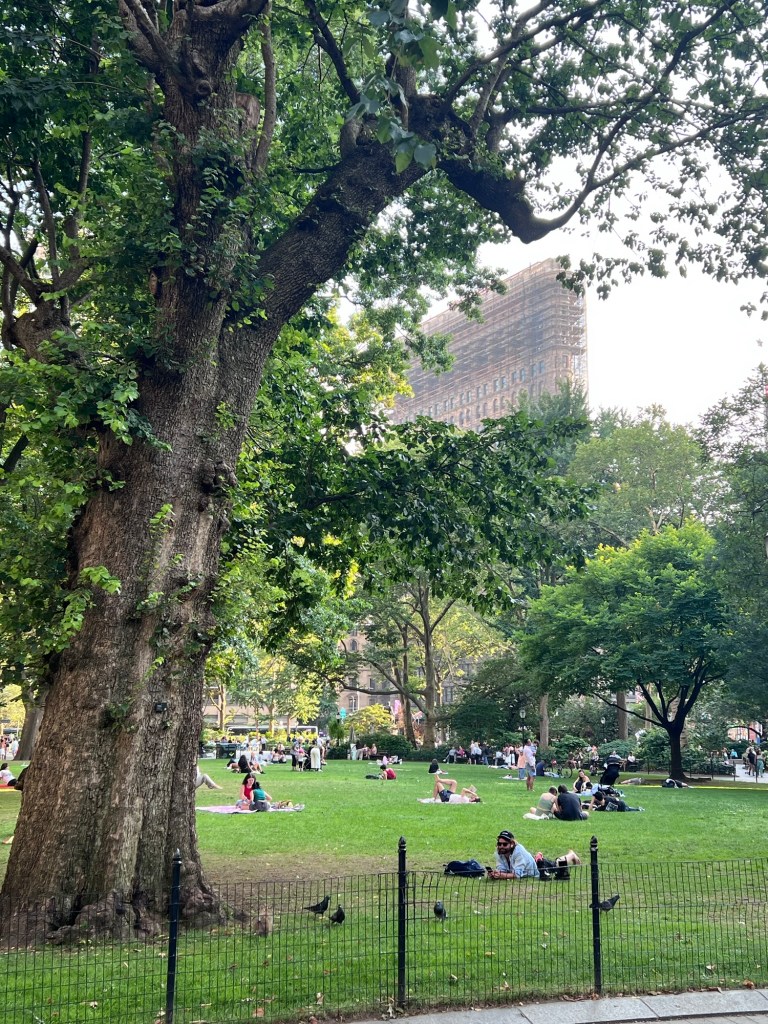
Looking south on the lawn in the middle of the park where office workers and tourists relaxed under the shade trees
Starting the walk on the cross roads of the neighborhood at West 23rd Street and Fifth Avenue
I love the way that the light reflects off the buildings at West 23rd Street
I was lucky that the weather broke. My recent Broadway was ended up being on a 91 degree day. I did not get too far that afternoon as ‘Manhattanhenge’, the alignment of the sun setting to the street grid of the West Side of Manhattan was that evening and I wanted to see it. I needed to get a good spot.
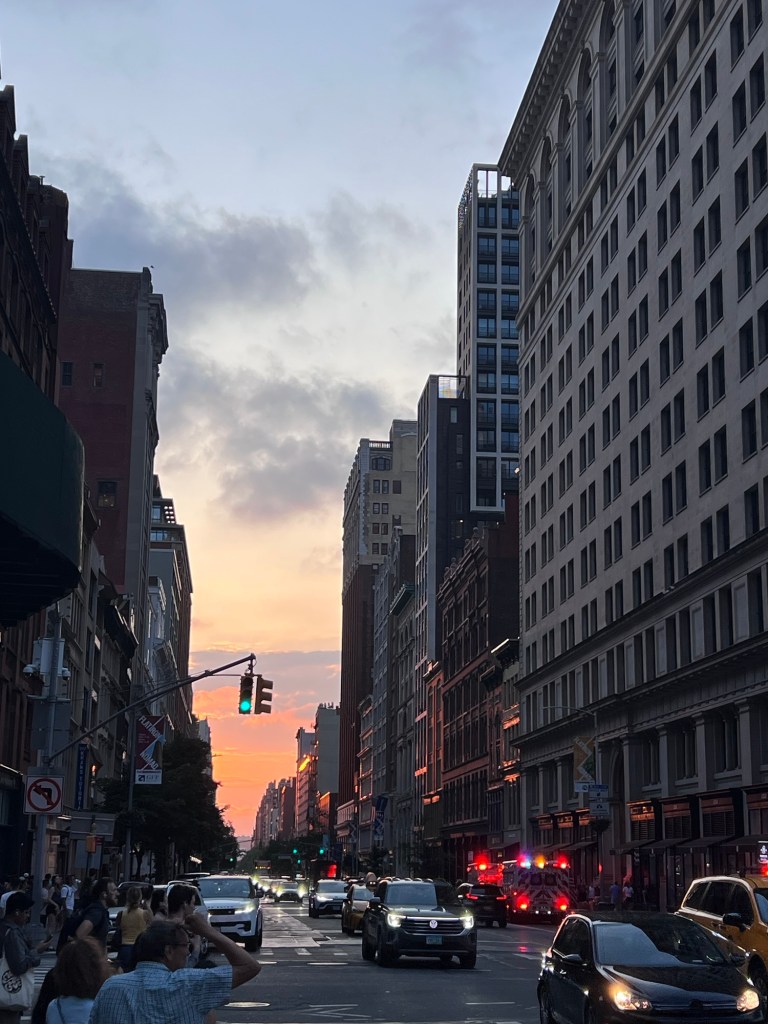
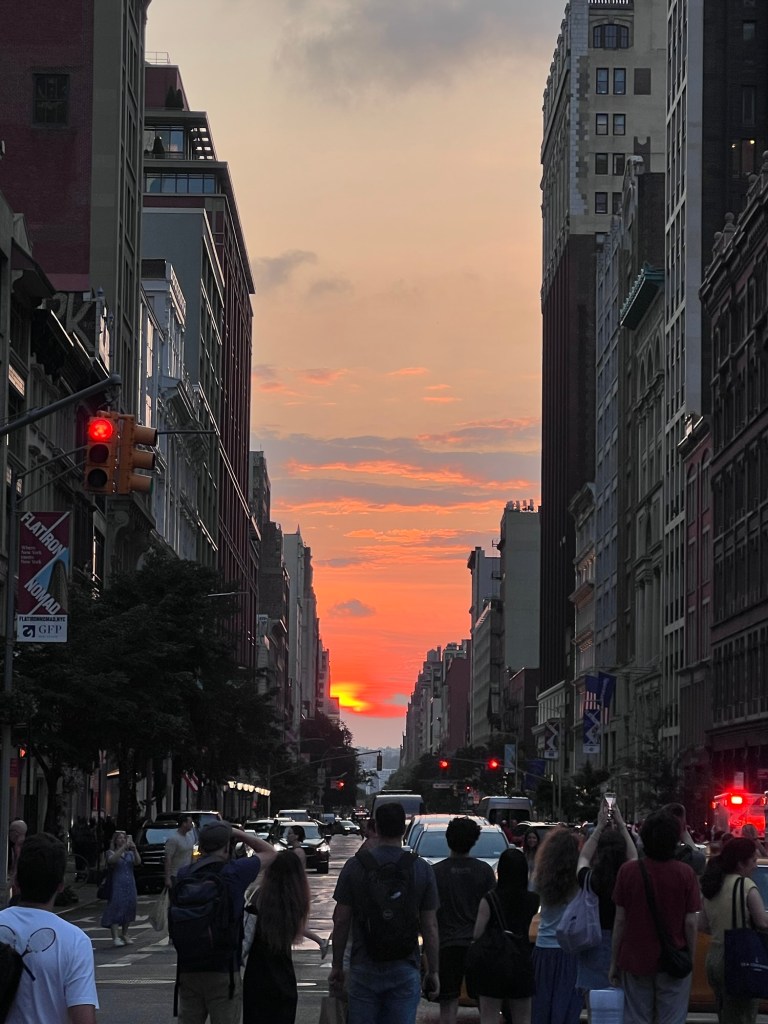
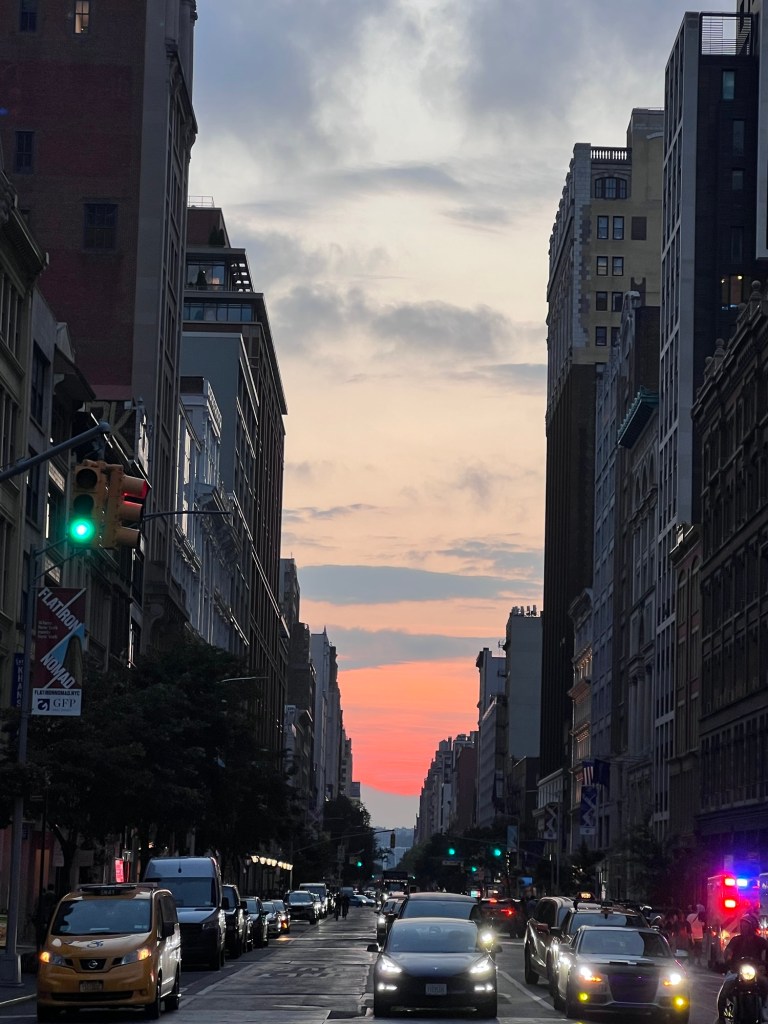
I doubled back that evening to watch ‘Manhattanhenge’, a time when the sun aligns with the buildings on the West Side and set a between the buildings. This happens two times a year and you have to pray for clear weather or else the clouds get in the way. The clouds got in the way this evening.
The start of ‘Manhattanhenge’ at 8:15pm on July 11th, 2025
The sun starting to set
The sun setting on ‘Mznhattanhenge’
Just as the sun set a cloud got in the way
A video of the final setting of the sun
After the sun set, I went back into Madison Square Park and just relaxed. It had been a long week of running around and was going to be busier over the weekend.
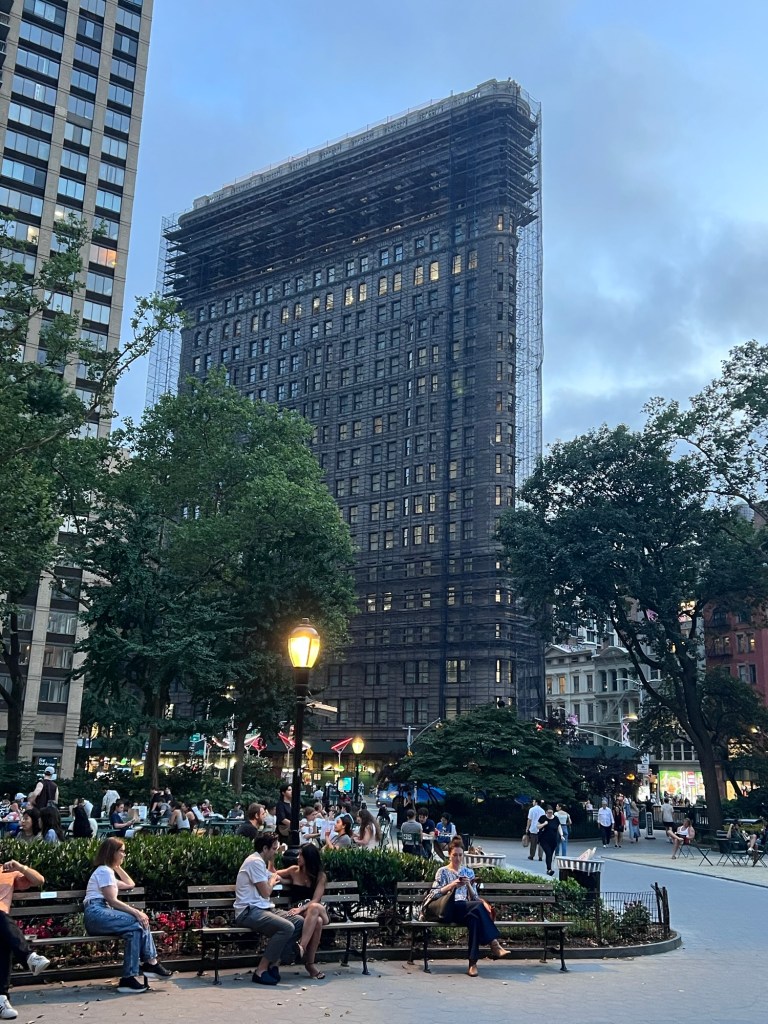
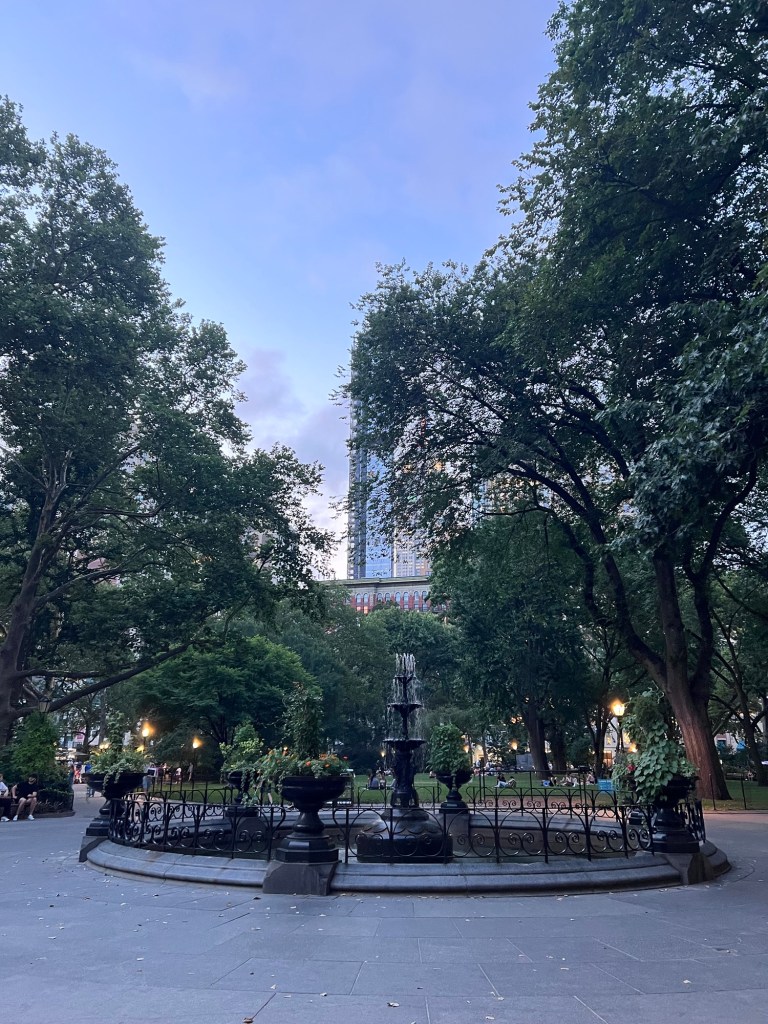
Madison Square Park is especially beautiful in the evening. The lights come on and then the park works its magic with all the beautiful lights, cool music from the patrons and the talking and laughter from the many people visiting on a warm New York evening.
The fountain inside the park at twilight
The Flatiron Building across from the park at night
The fountain flowing while looking north in the park
Video of the Madison Square Park fountain at night
The skyline of the park at night with the Empire State Building lit in the distance
During the warmer months, I have found Madison Square Park to be safe due to the sheer number of people in the park and the extra security the park hired. Still like any part of New York, you have to watch yourself. Don’t let your guard down just because there are people in the park. Just like any other part of New York City, have eyes in the back of your head.
I started my walk of the streets of Lower Chelsea around 1:00pm in the afternoon on a Saturday and found the City to be extremely quiet. Most of the residents must have been out of town. I started at the corner of West 22nd Street and Sixth Avenue in the middle of the old Ladies Shopping District.
The old department stores on Sixth Avenue and West 22nd Street
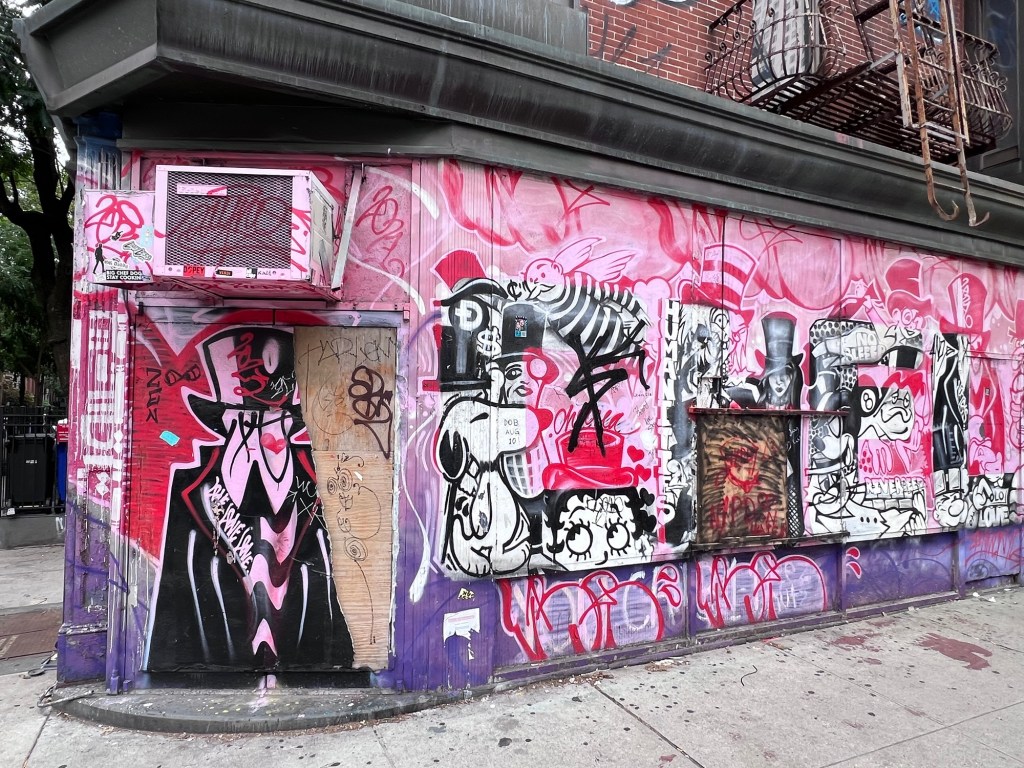
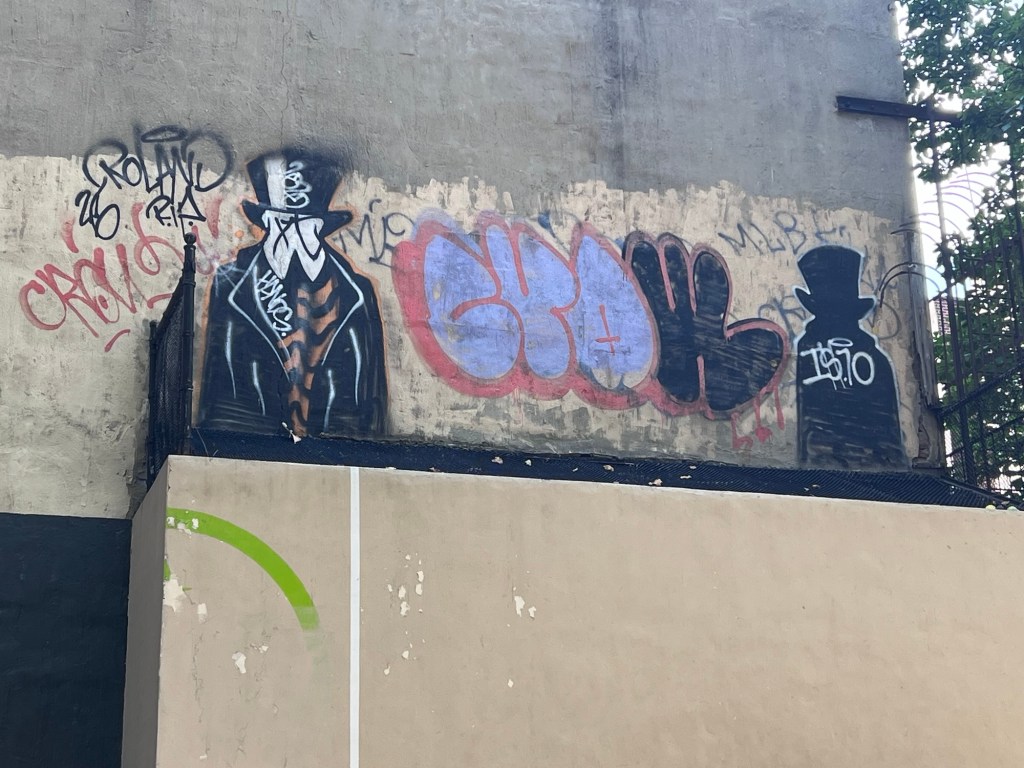
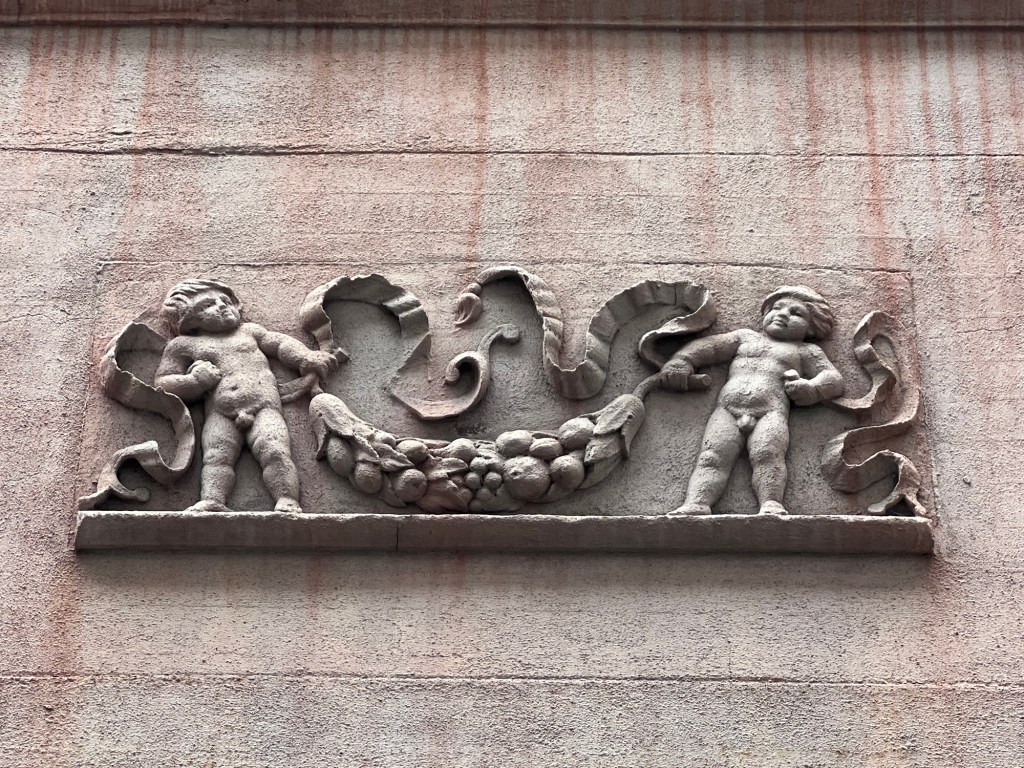
On the way down each block, I admired two things that stood out, the street art and the stone work that seemed to stare out you at every twist and turn on many of the buildings I passed.
The street art at the corner of Seventh Avenue and West 22ns Street
The other walk facing West 22nd Street
Walking down West 22nd Street between Seventh and Eighth Avenues
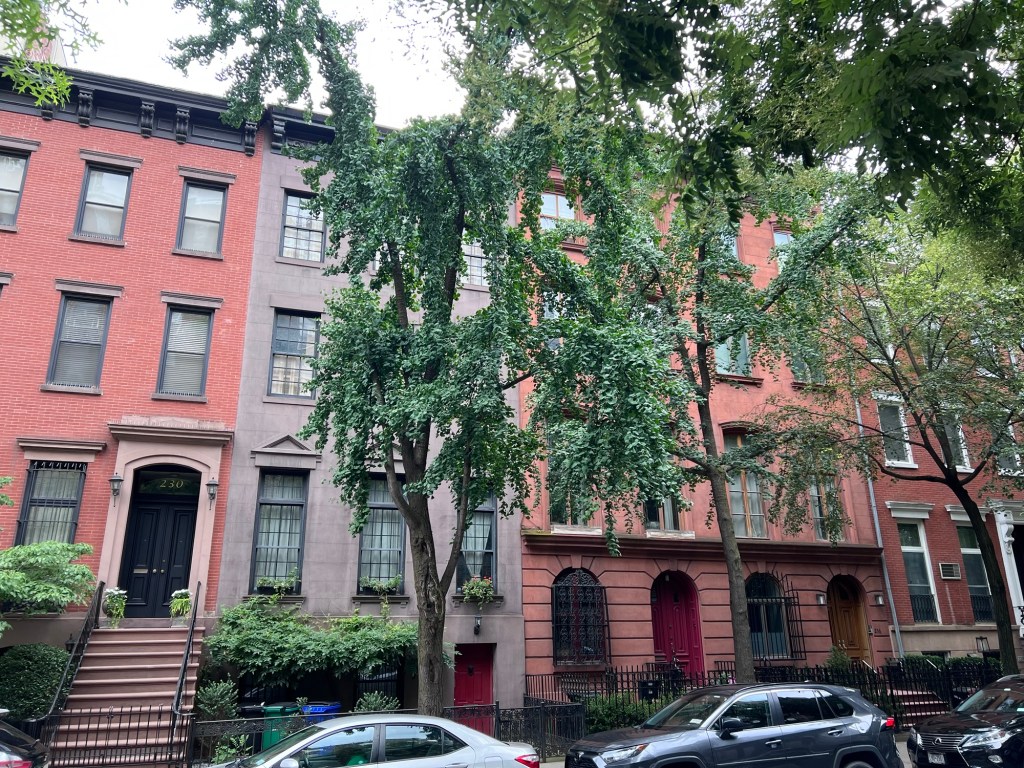
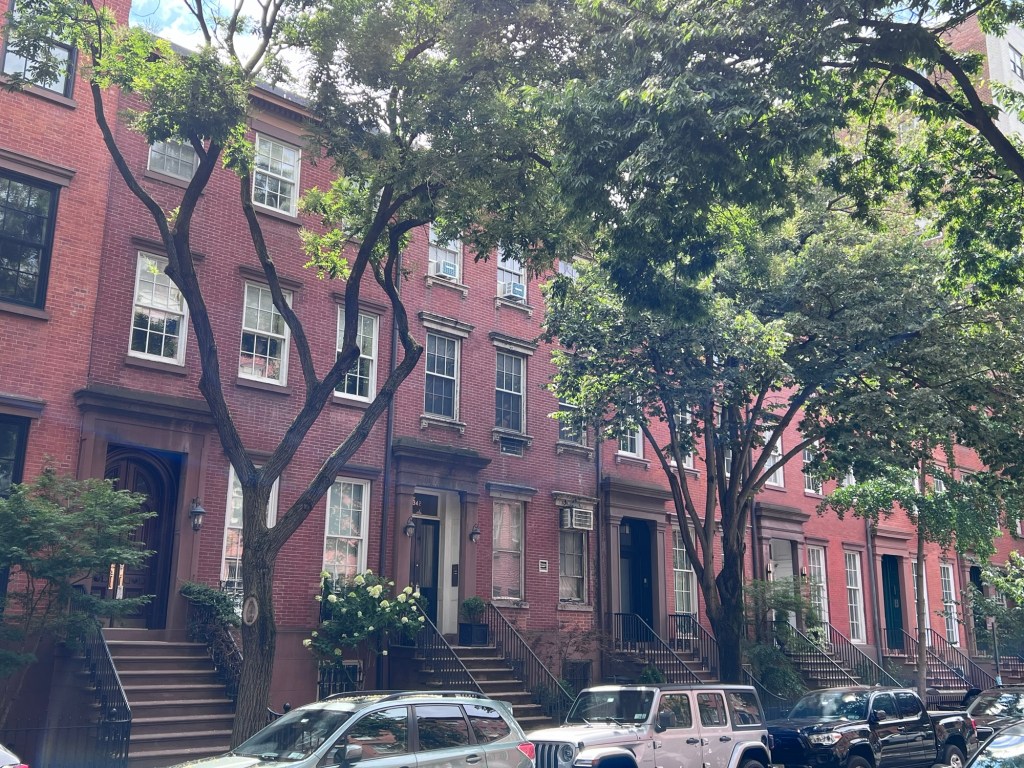
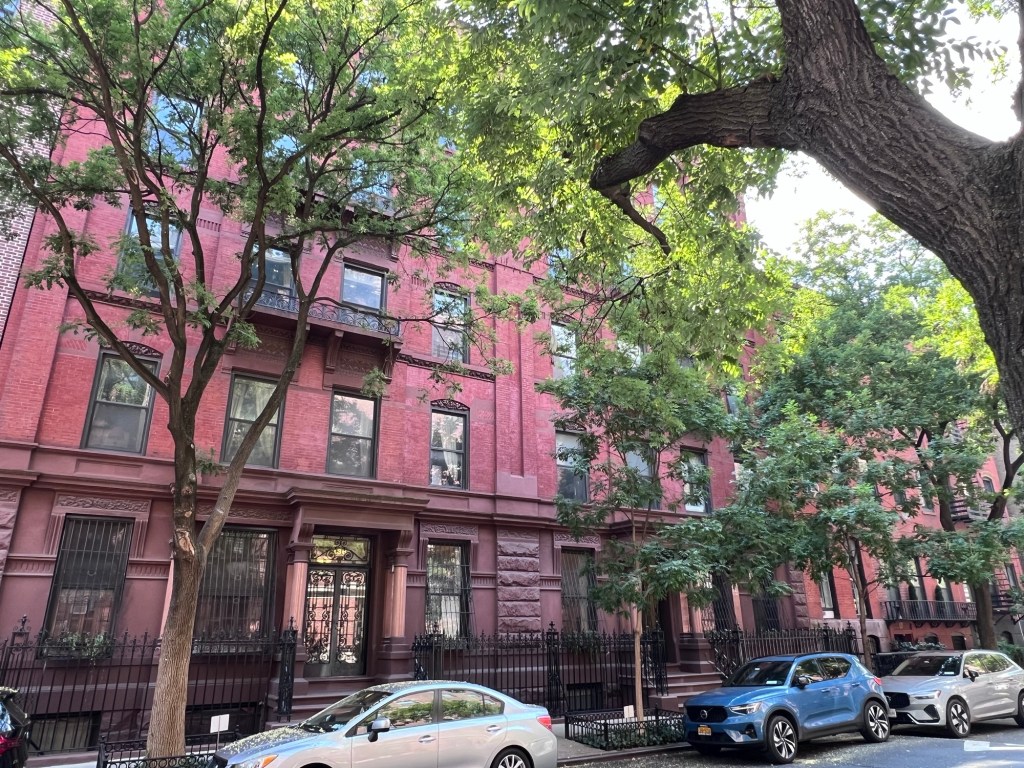
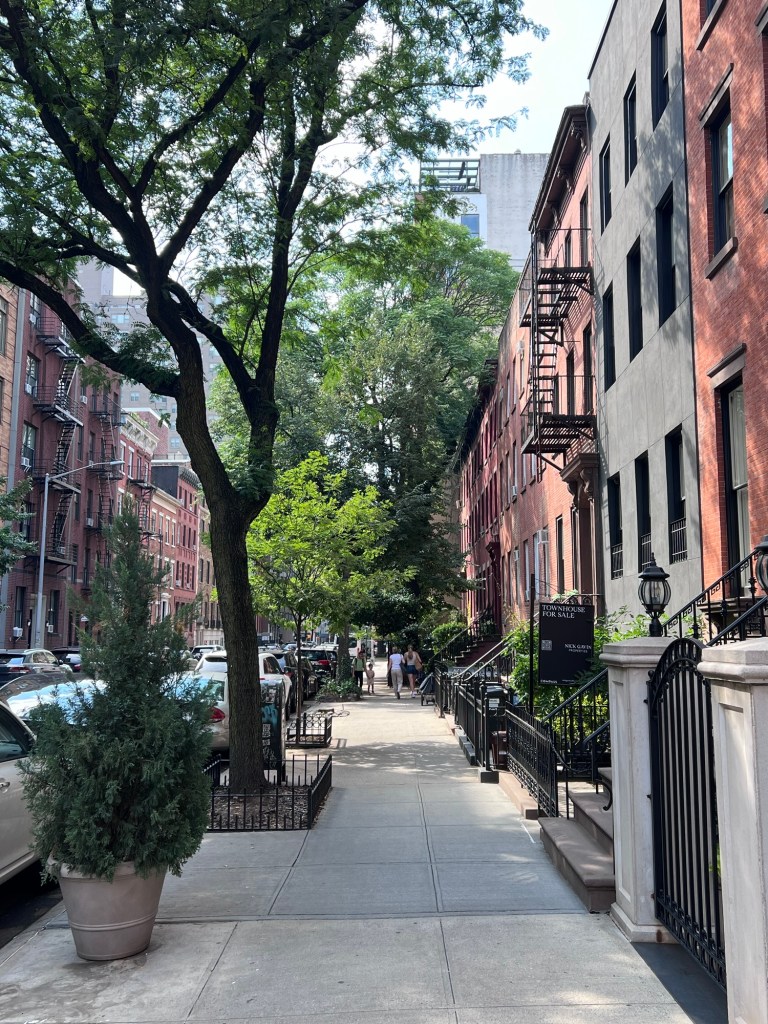
The beautiful brownstones and brick townhouses on the block
One brownstone on this part of the street is 246 West 22nd Street with its interesting embellishments. This building is a pre-war apartment that was built in 1920(Streeteasy.com).
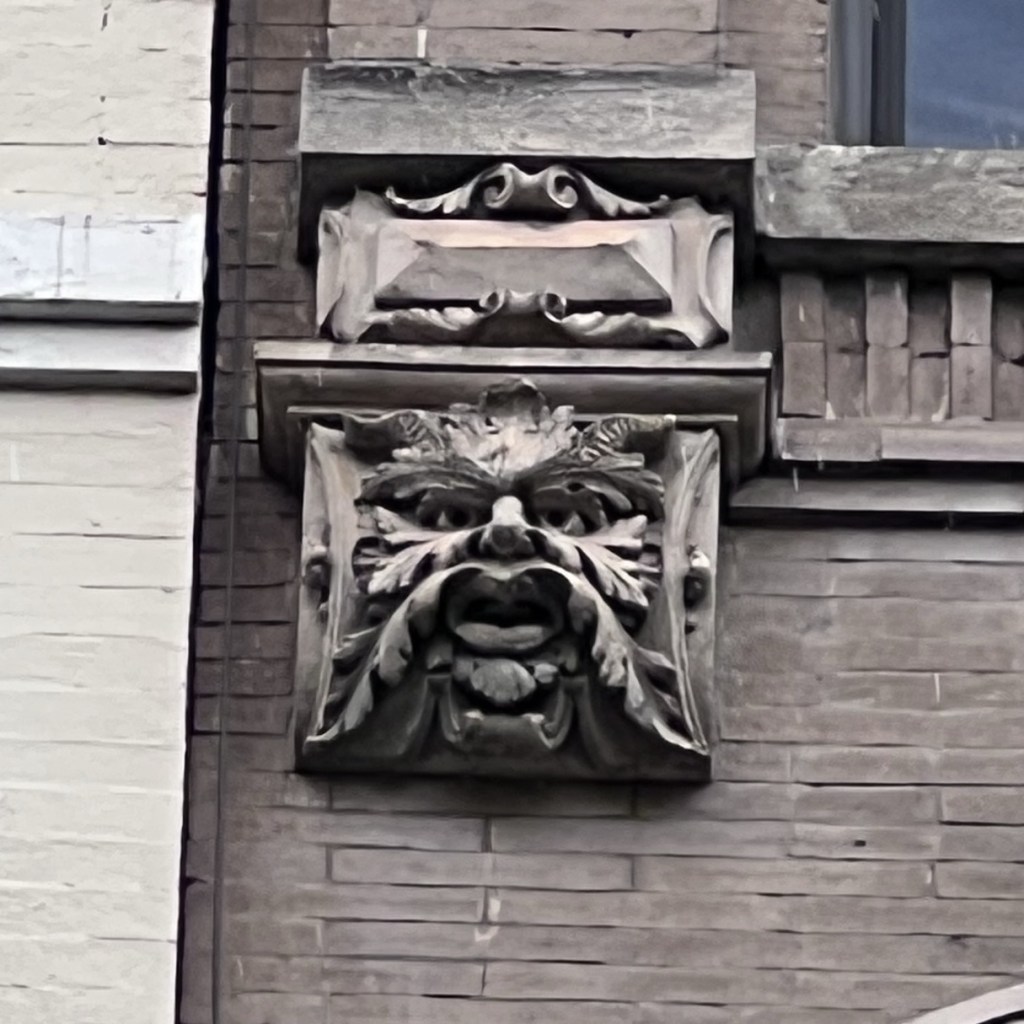
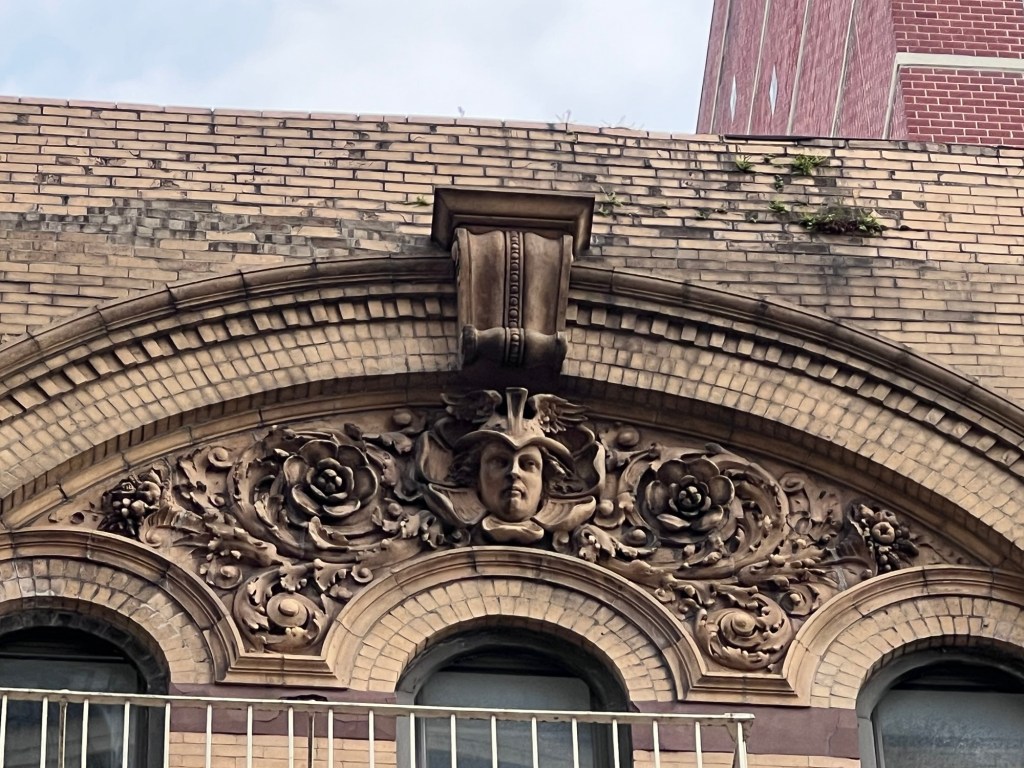
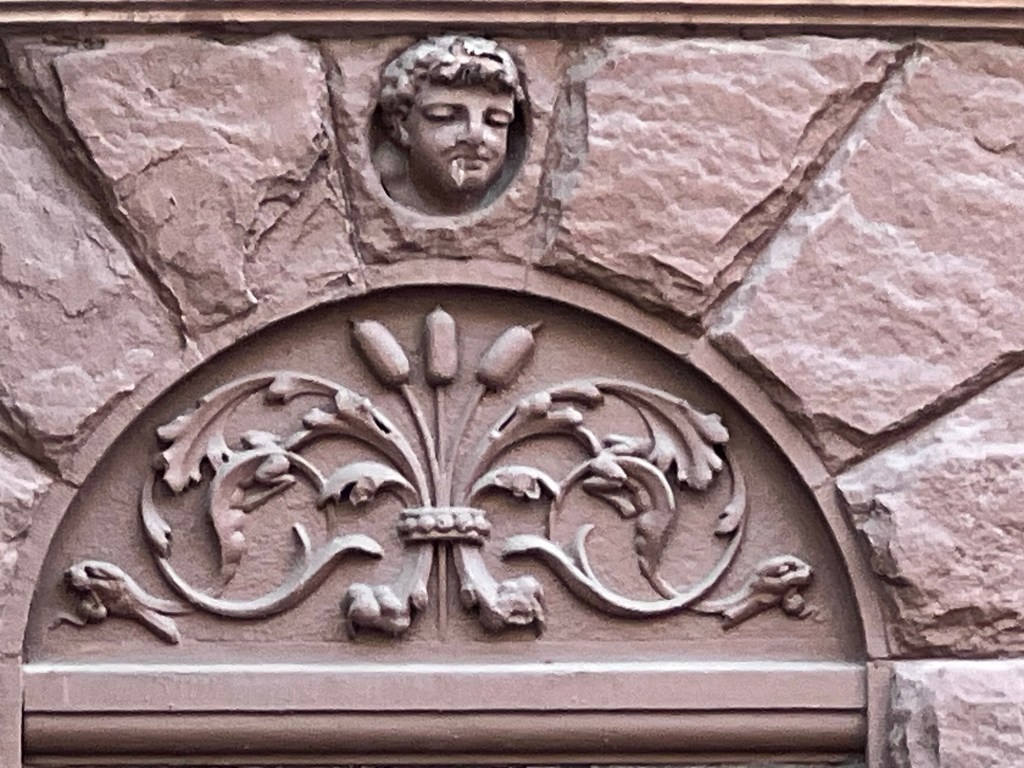
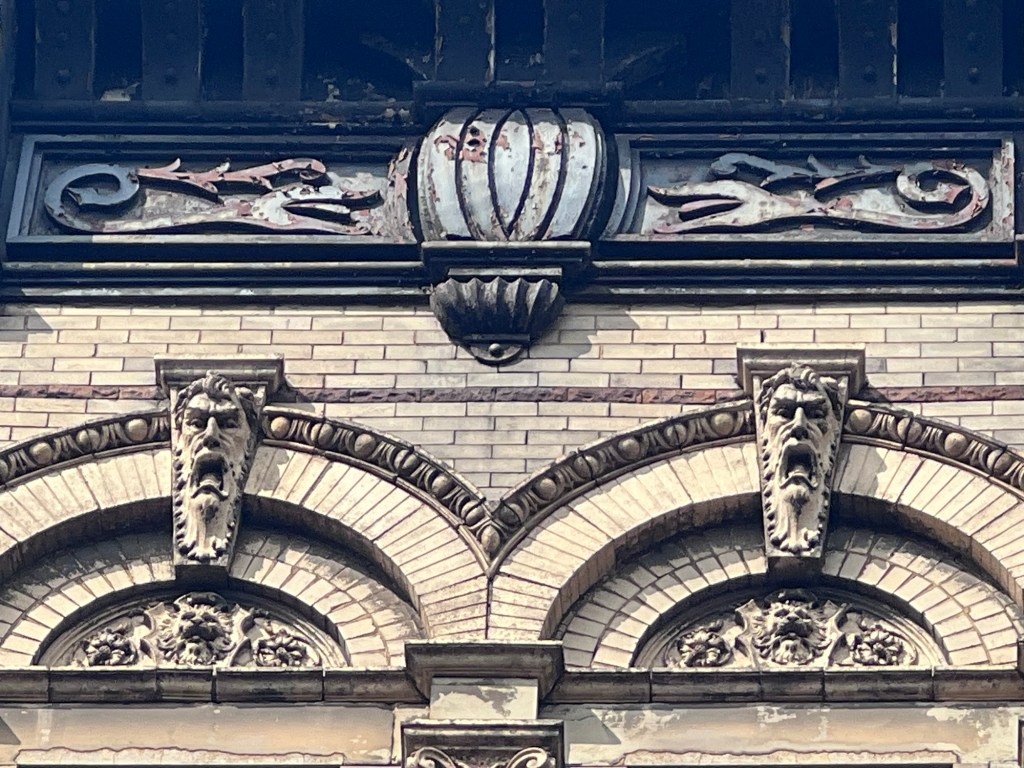
The unusual stonework on the building
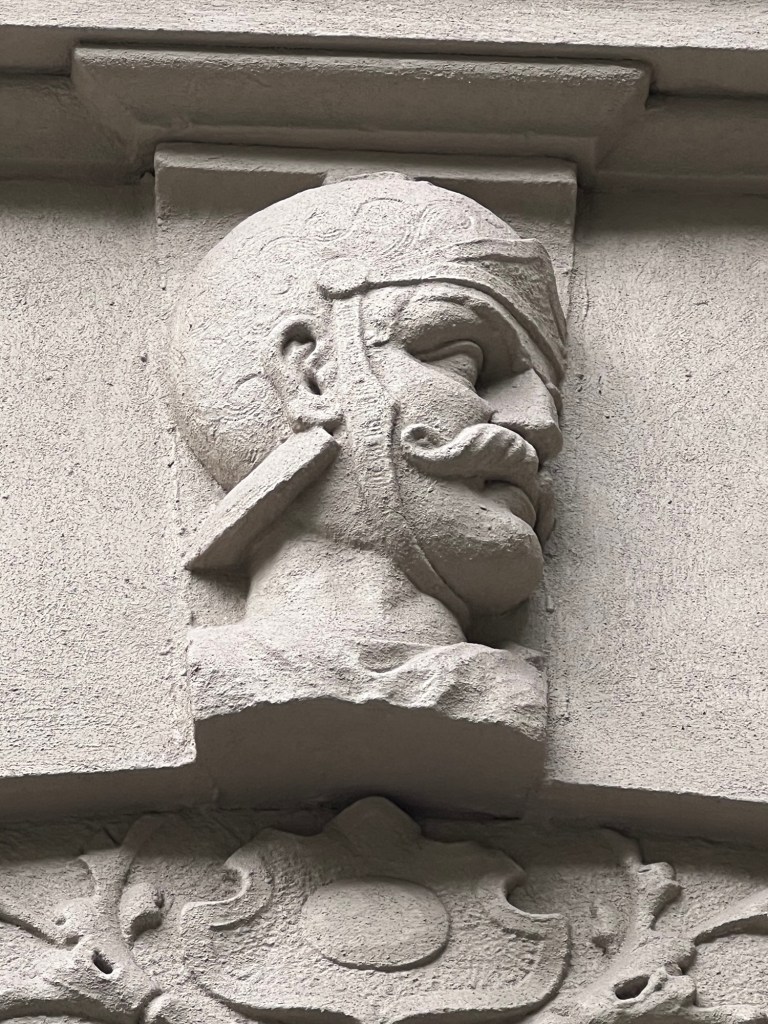
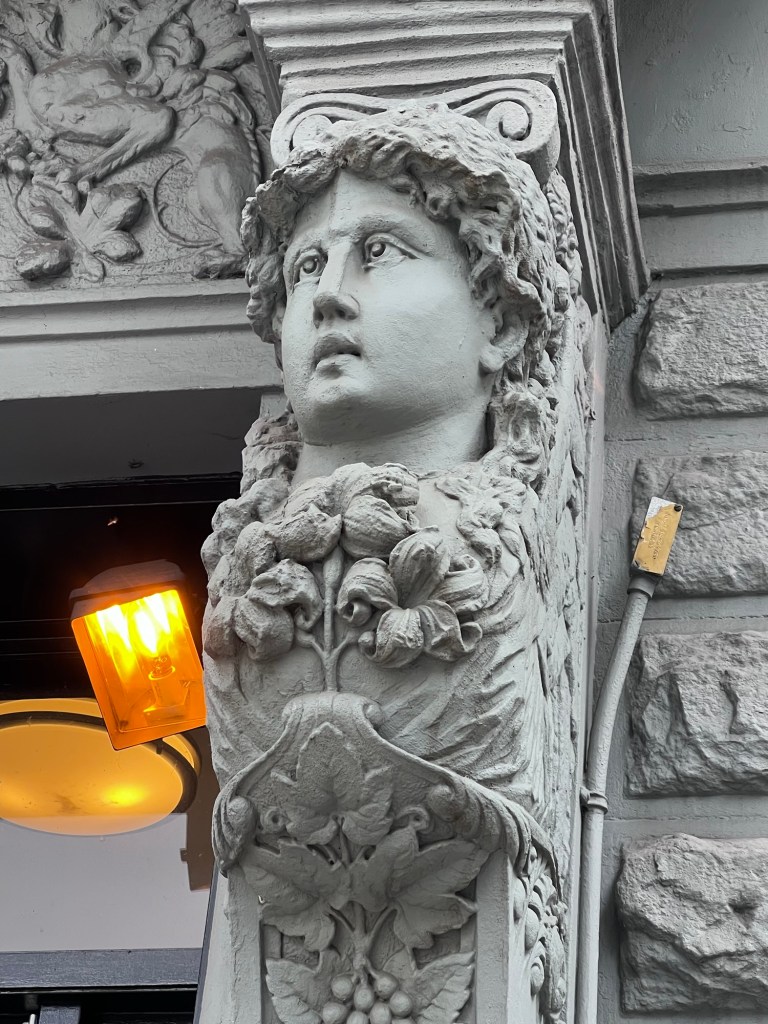
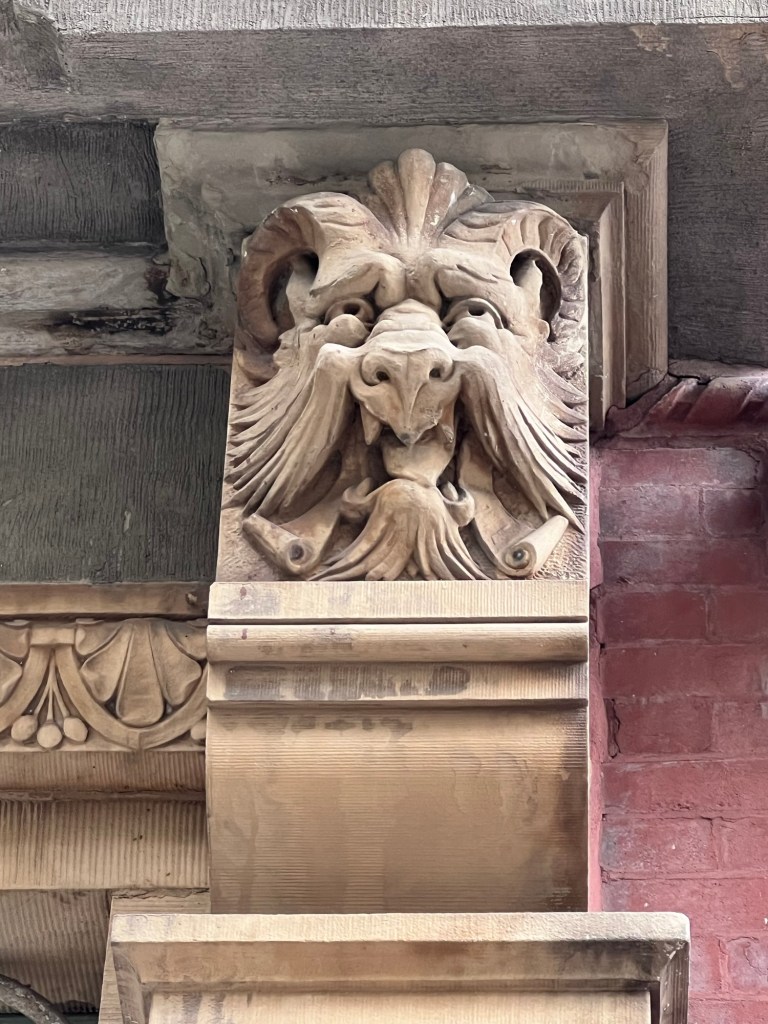
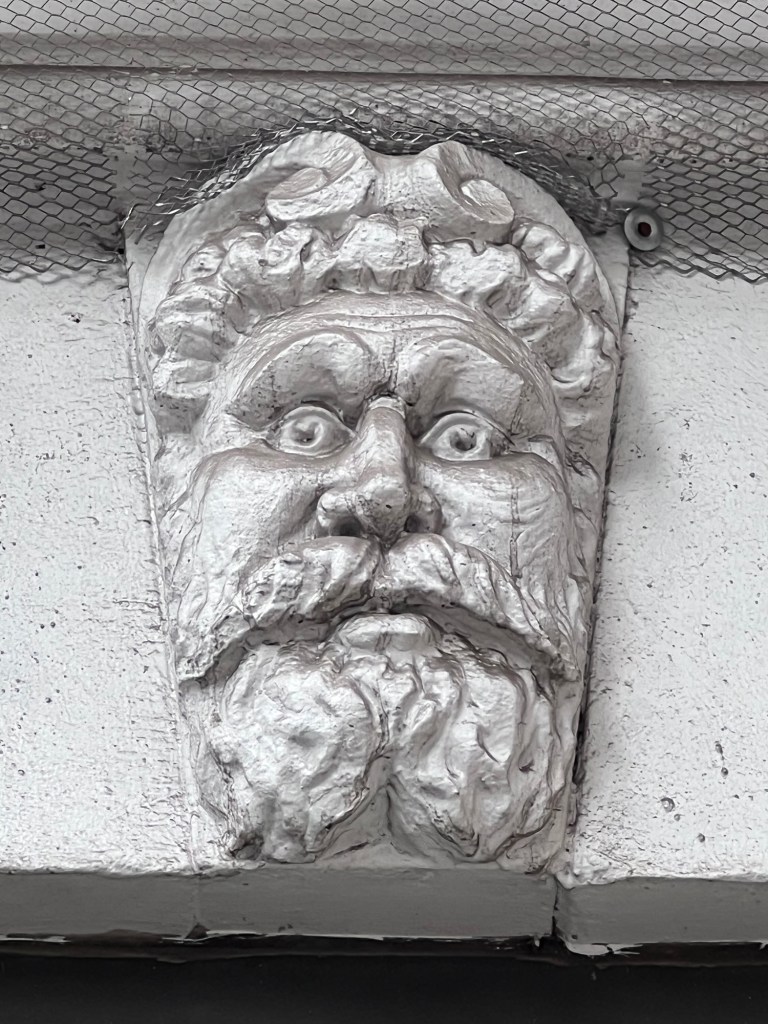
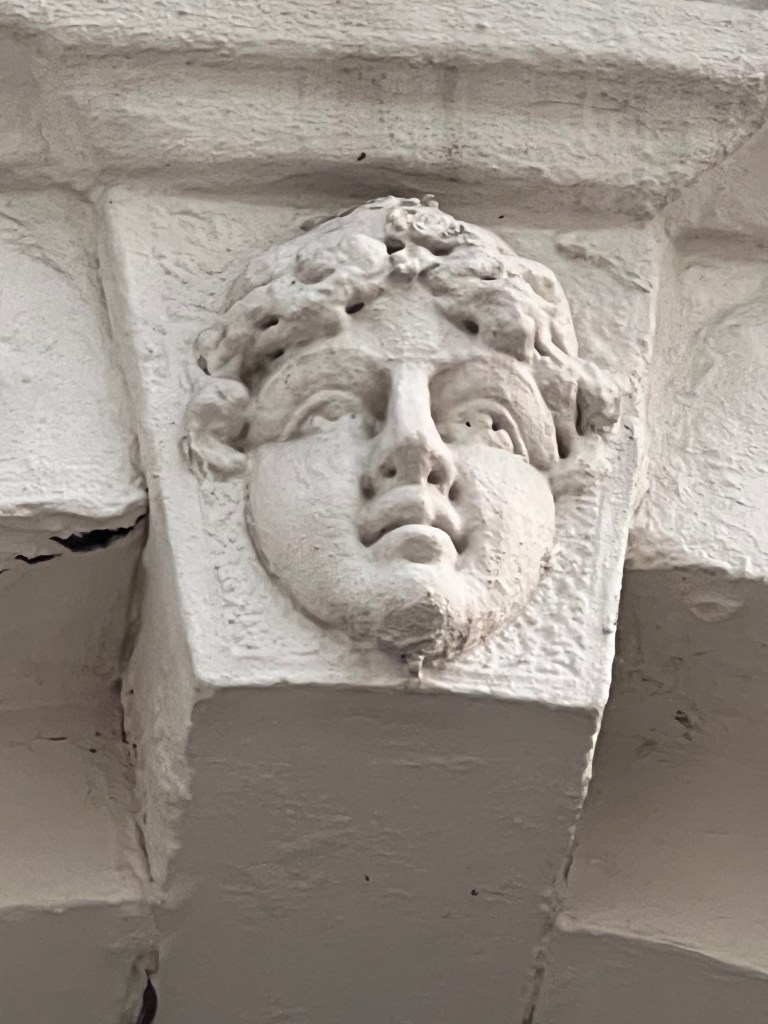
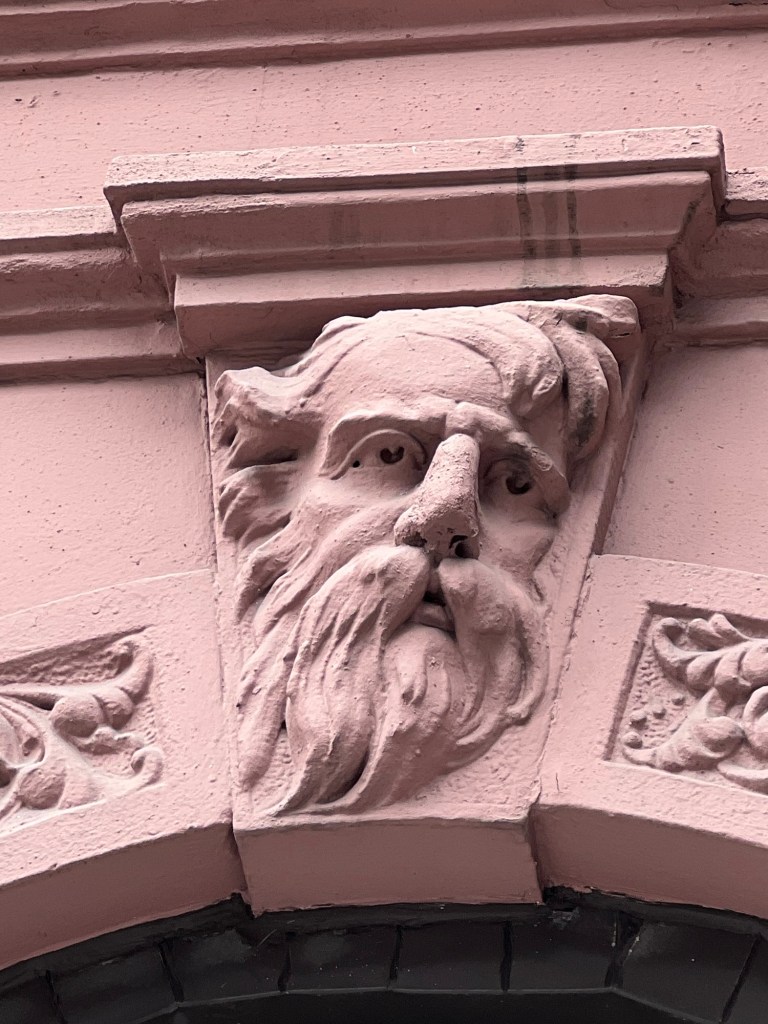
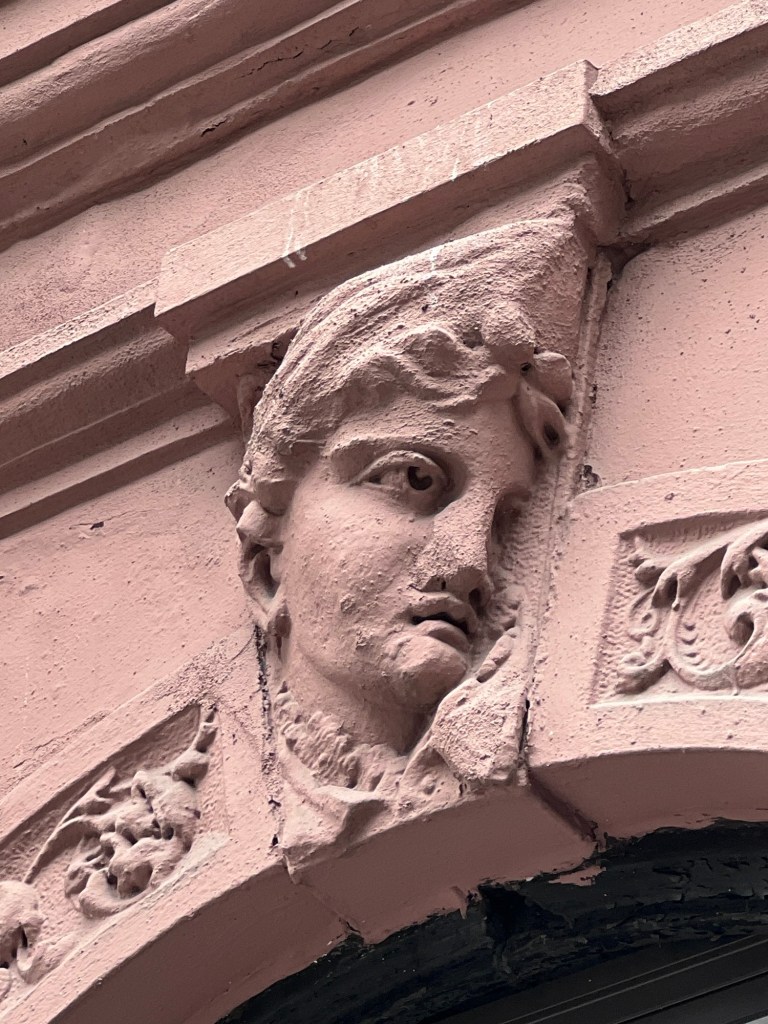
The faces can captivate you
Face number one
Face number two
Face number three
Face number four
The next building to stand out was 262 West 22nd Street. This is another pre-war building was built in 1920 (Streeteasy.com).
Another building whose embellishments were rather unusual were outside of 264 West 22nd Street. This building was another pre-war building in the 1920’s. It has a lot of unique embellishments all over the building (Streeteasy.com).
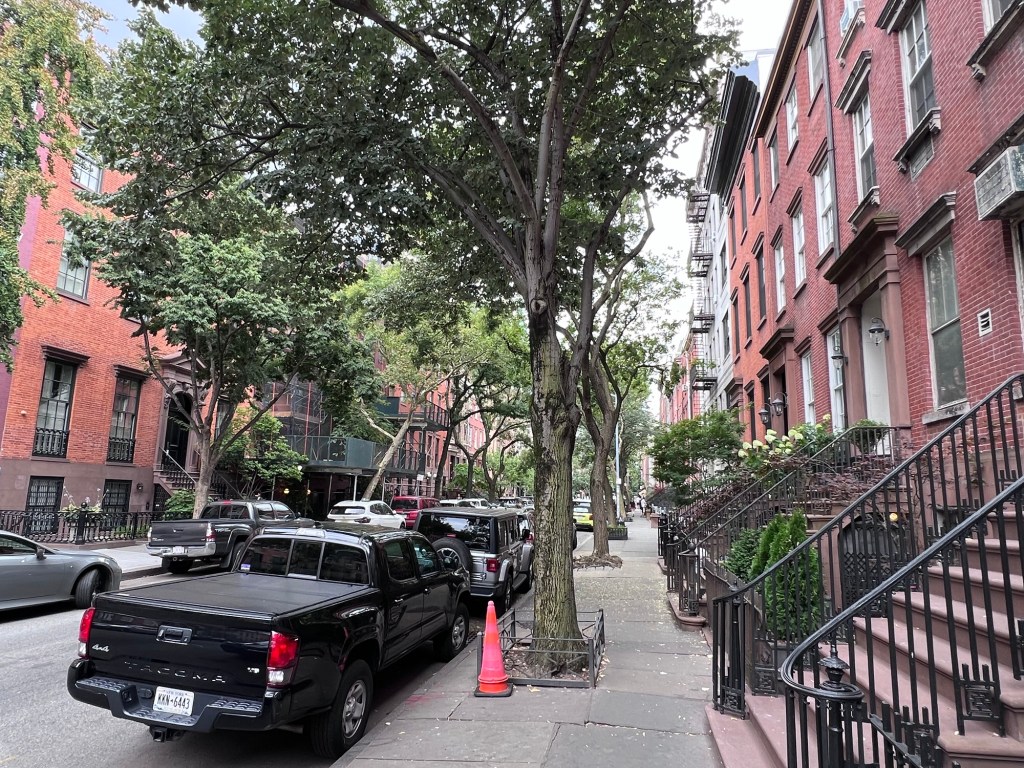
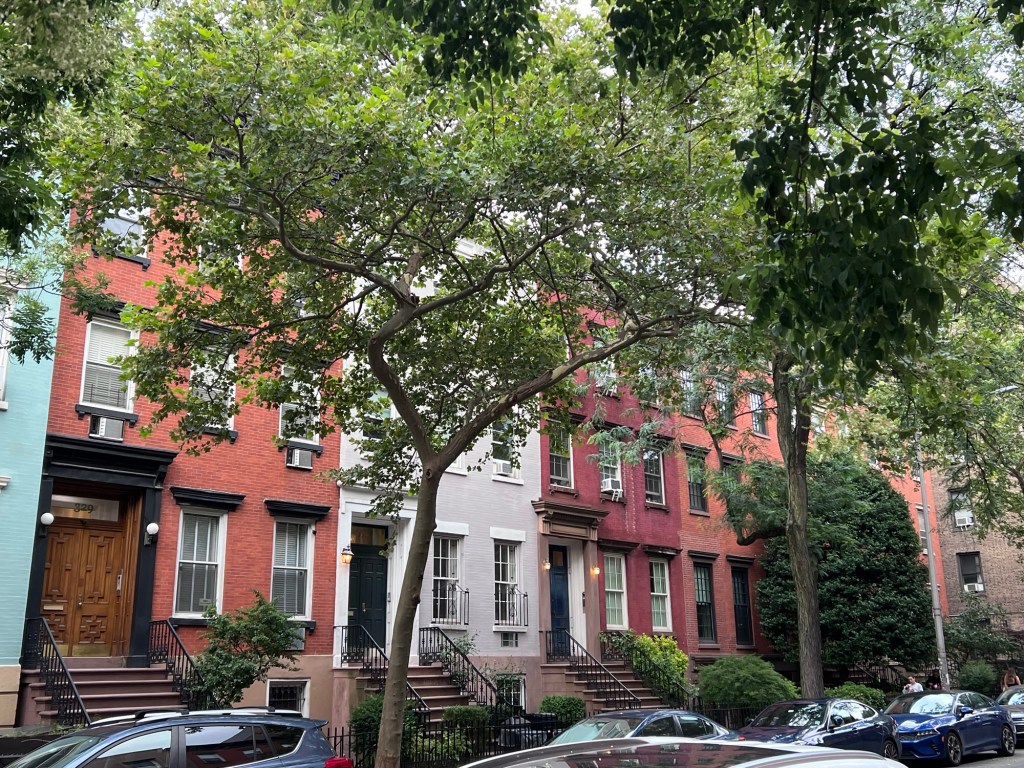
West 22nd Street from Seventh to Ninth Avenues has several blocks of beautiful townhouses and brownstones some dating back to the mid 1880’s. The blocks look something out of a movie set.
Street art on the building at 441 West 16th Street
Street art on the building
Street art on the building
Walking under the High Line Park
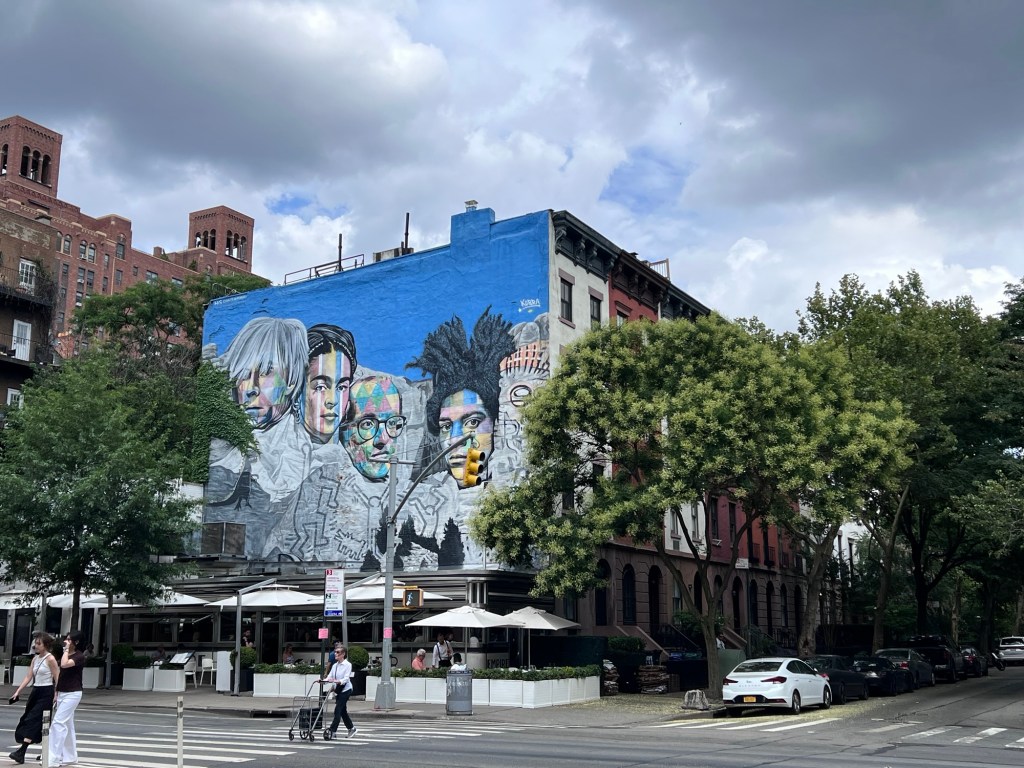
Artist Eduardo Kobra painting “The Mount Rushmore of Art” above the Empire Diner at Tenth Avenue and West 22nd Street
The mural, created by Brazilian artist Eduardo Kobra, “Mount Rushmore of Art”, is the artist’s memorial to some of modern art’s biggest artists including Andy Warhol, Frida Kahlo, Keith Haring and Jean-Michel Basquiat (Vibe Map 2023).
Eduardo Kobra is a Brazilian born artist known for his contemporary and colorful art murals all over the world.
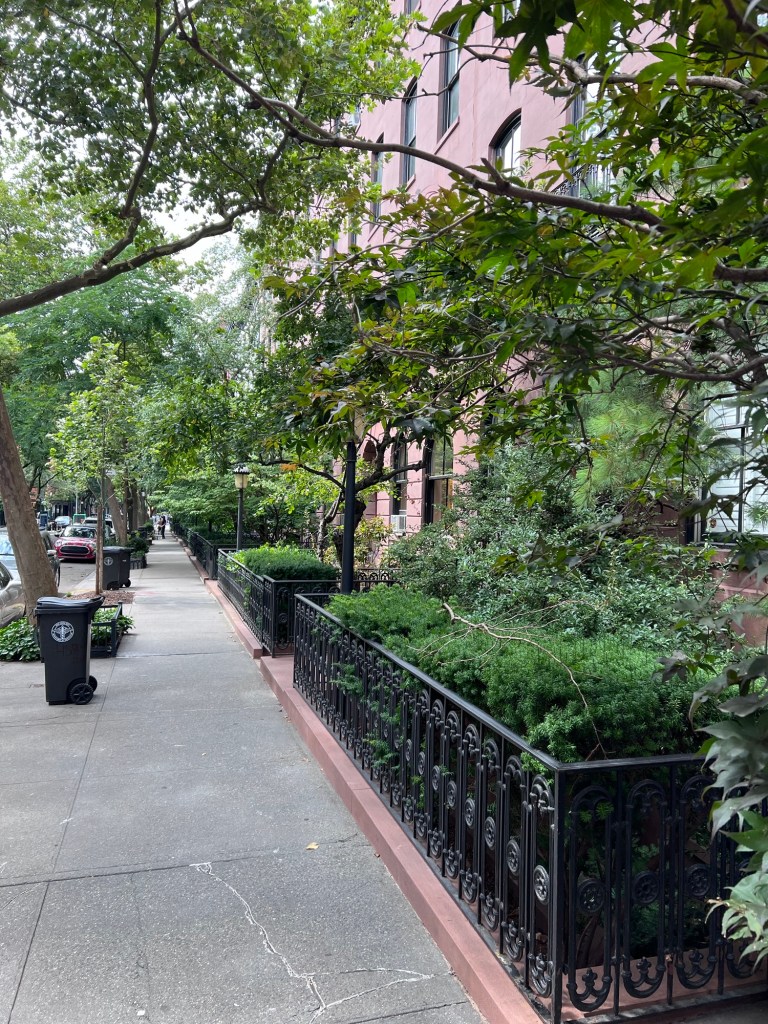
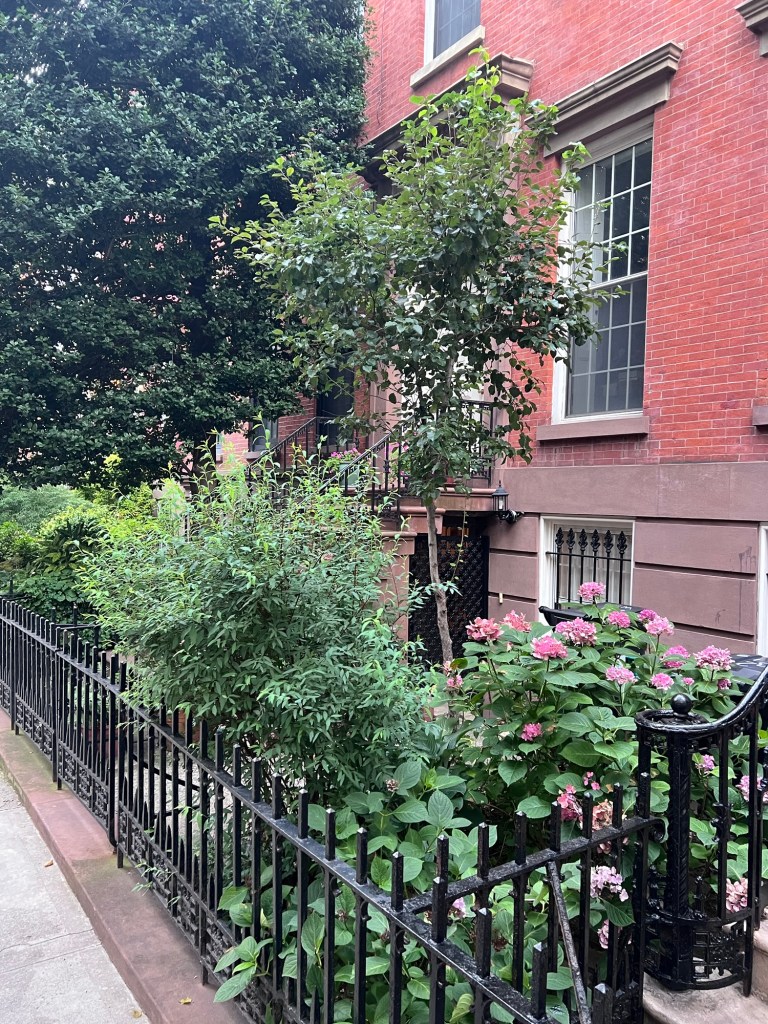
I continued to walk down the road and admired the beauty of each of the streets with their front gardens and plantings.
The beauty of West 22nd Street between Eighth and Seventh Avenues
More faces staring at you while you walk by
I feel like they are passing judgement as you walk by
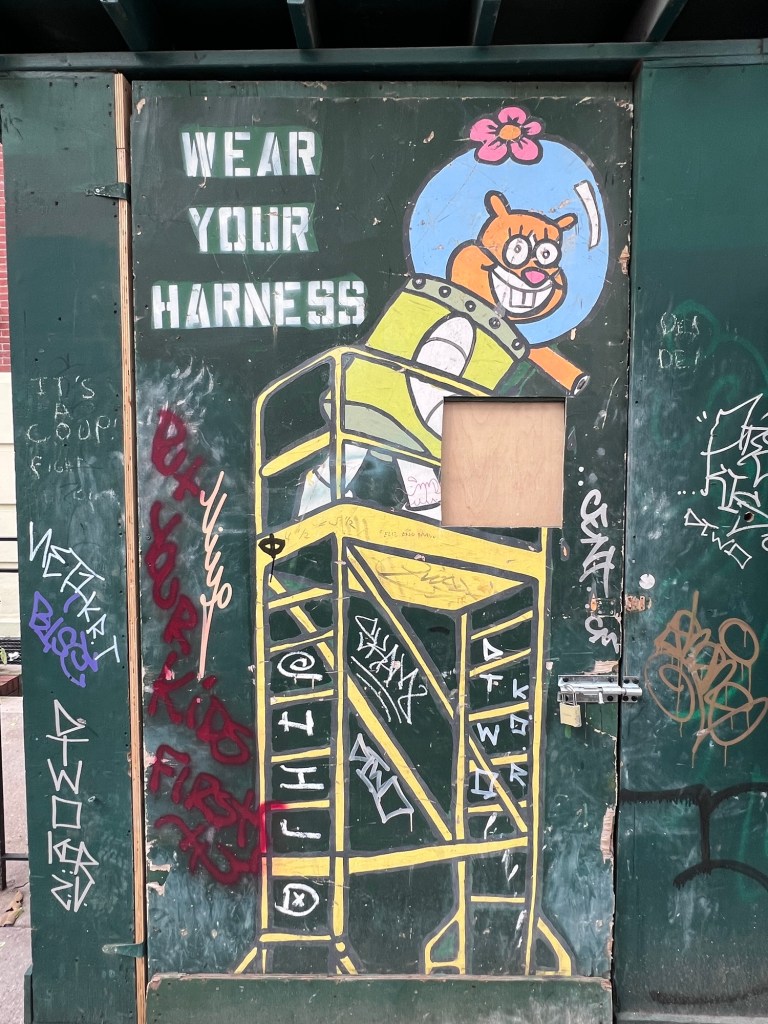
Even the work sites are home to art work
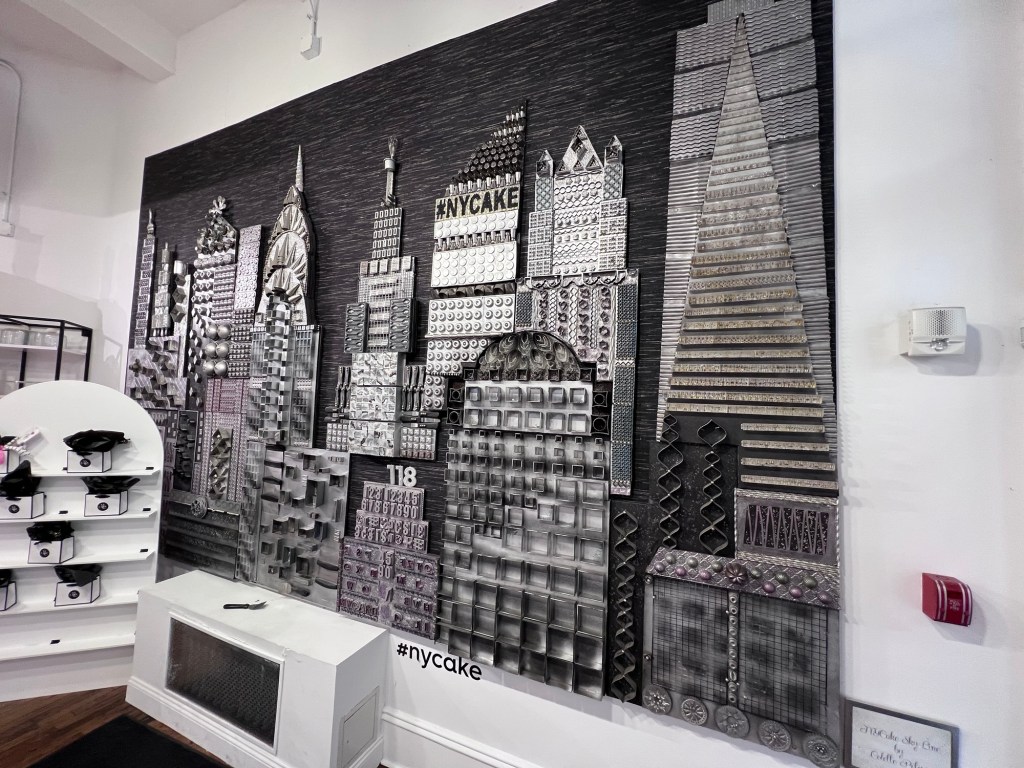
While making my way down West 22nd Street, I passed NY Cake, a specialty store all the items cake decorating and making. The store has everything you need for both professional and amateur baking. I walked along the aisles looking at all the merchandise when I spotted an fascinating piece of art at the front entrance.
Cake Artist Collette Peters is an American born baker, artist, cake design maker and author of “Collette’s Cakes: The Art of Cake Decorating”.
I the rounded West 21st Street and walked down the street admiring all the beautiful homes and street art.
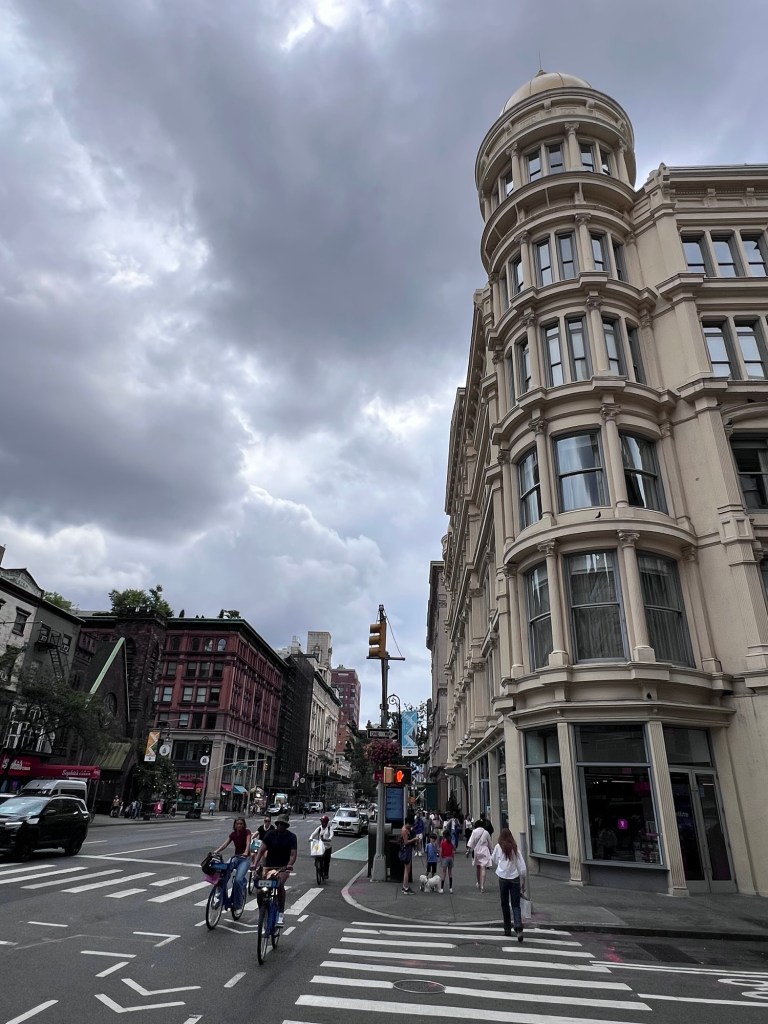
Sixth Avenue and West 23rd Street
This was in the very heart of what once the ‘Ladies Shopping Mike’, with the former Crawford-Simpson Department store
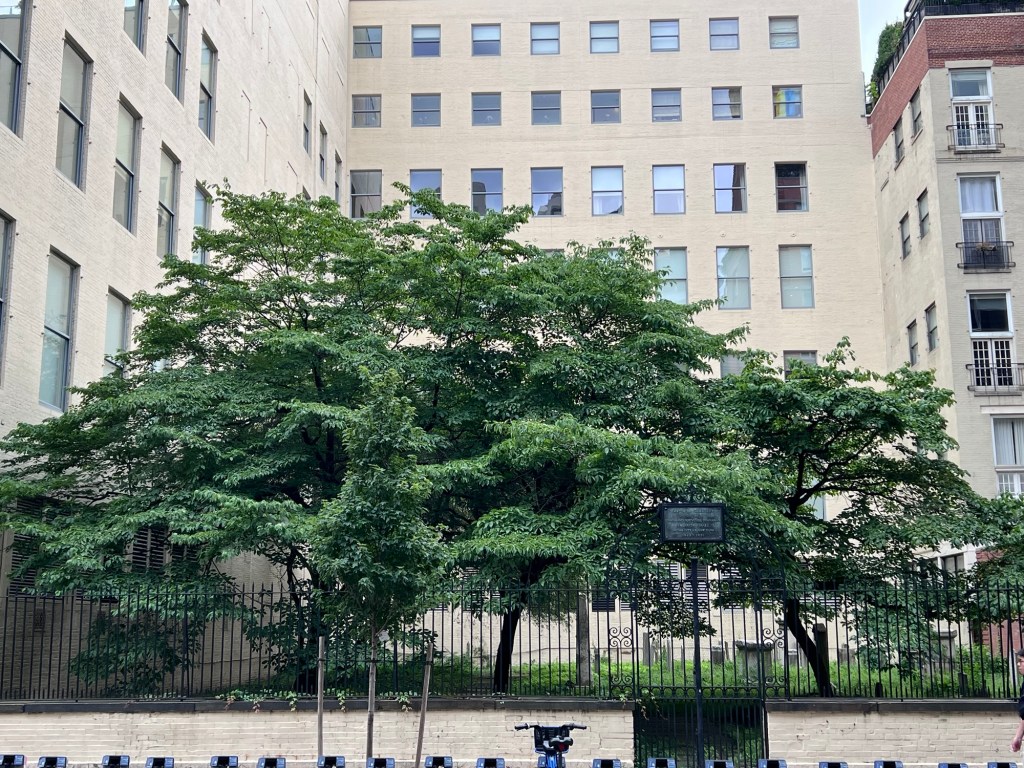
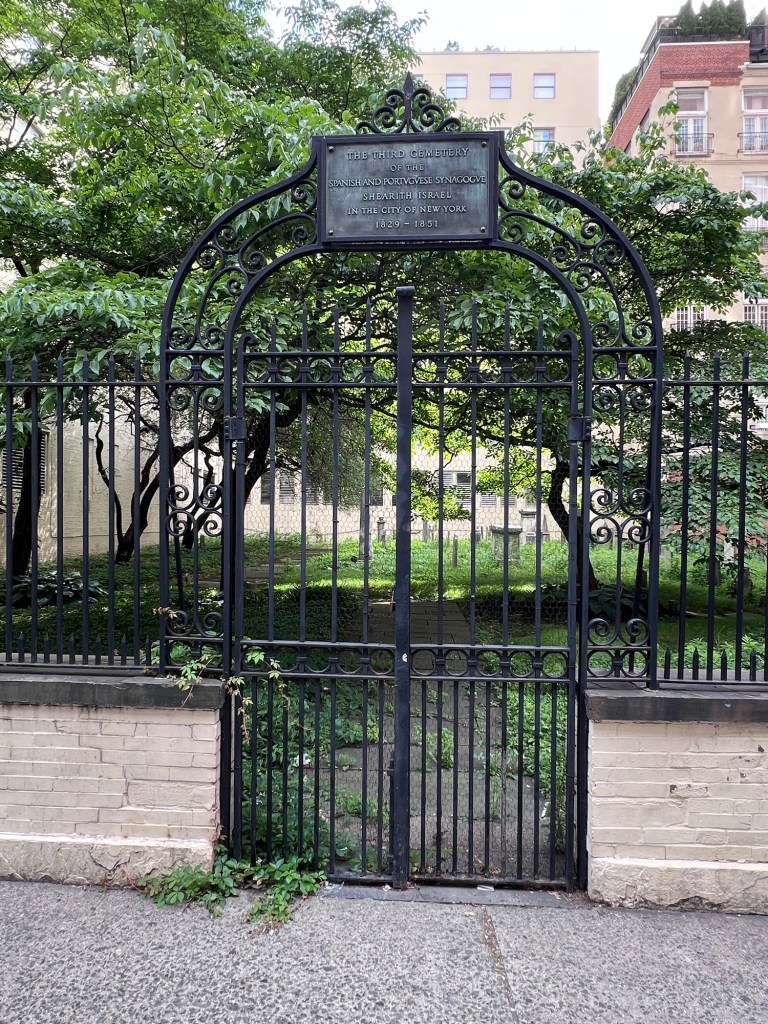
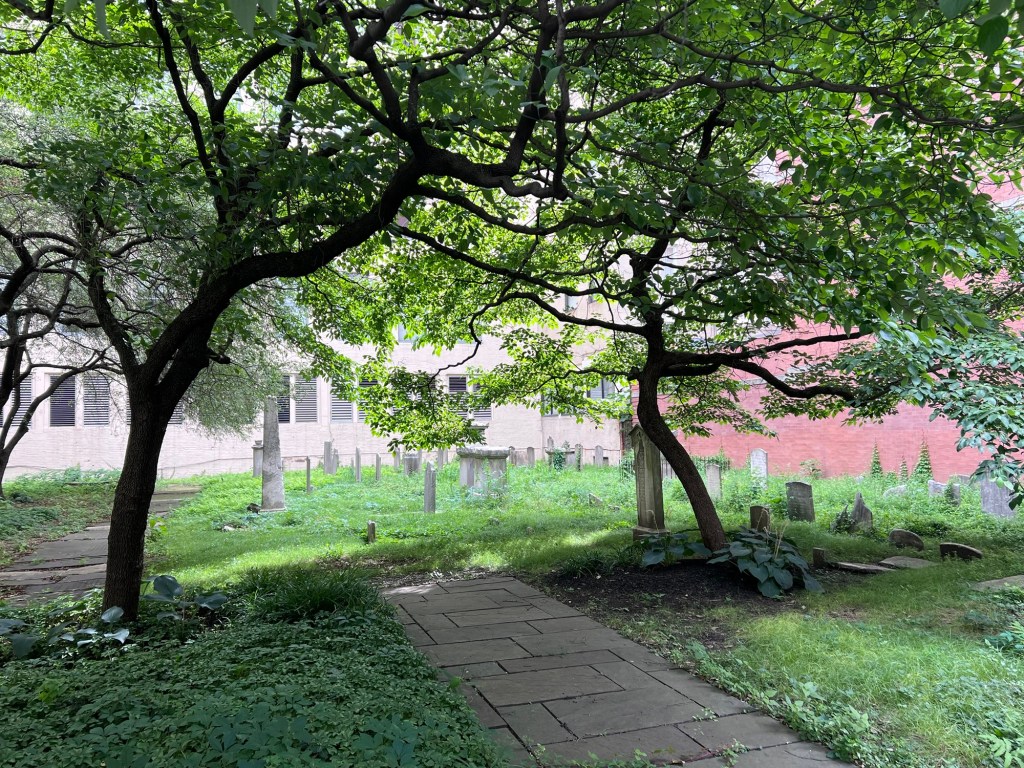
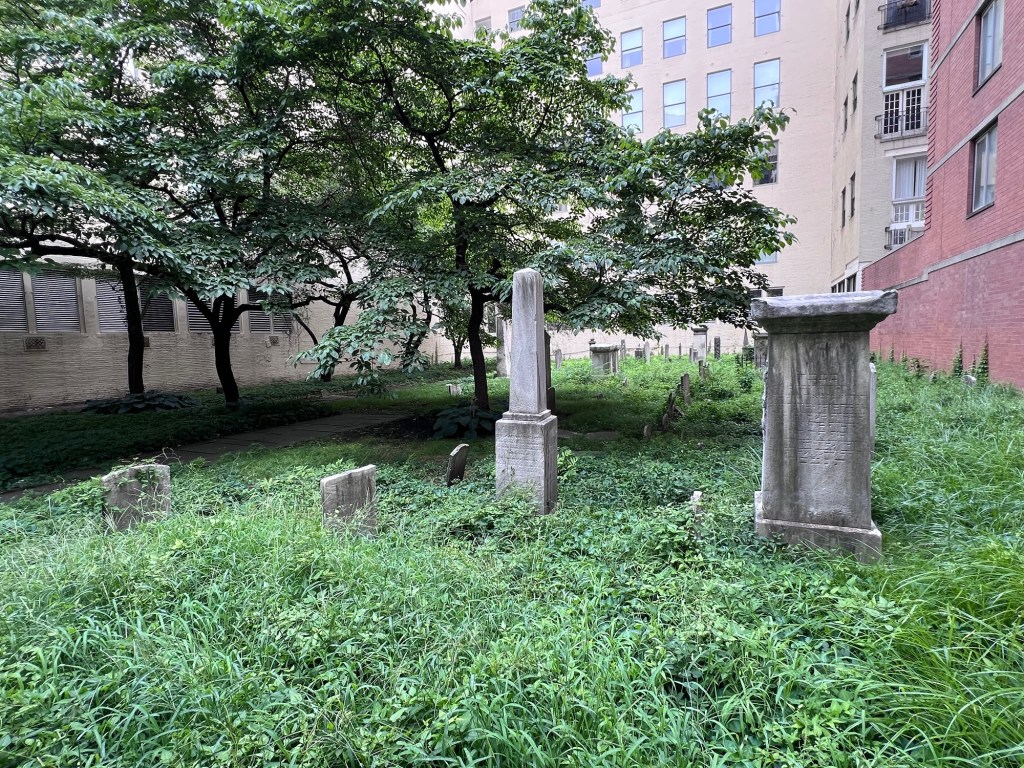
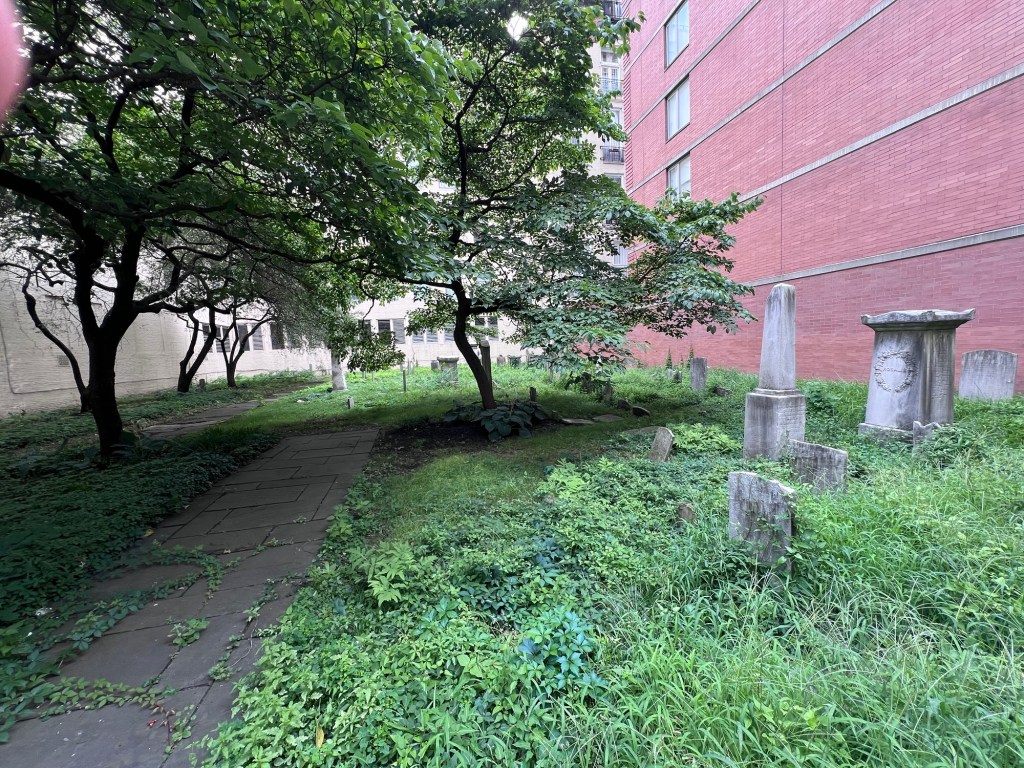
The first thing I saw as I walked down the street admiring, tucked in between the buildings was the Third Shearith Jewish Cemetery at 98-110 West 21st Street.
The Third Shearith Cemetery at 98-110 West 21St Street
When Congregation Shearith Israel was forced to close its graveyard in Greenwich Village in 1829, it established a new cemetery in an area even further away from the city center. The 21st Street cemetery served as the congregation’s burial ground until 1851, when the city banned burials below 86th Street (New York City Cemetery Project website). Their original cemetery was just off Canal Street in Chinatown and also sits behind a locked gate.
The cemetery is a quiet reminder that the City keeps progressing and builds around the past. It just shows how time marches on.
The inside of the cemetery
There is a real beauty to these small historic cemeteries. You wonder if the families understood the changes and progress in the City over the next hundred years.
The small cemetery seems surreal in this built up neighborhood
I wondered if anyone visited these folks anymore. The cemetery looks like it is taken care of but not on a regular basis.
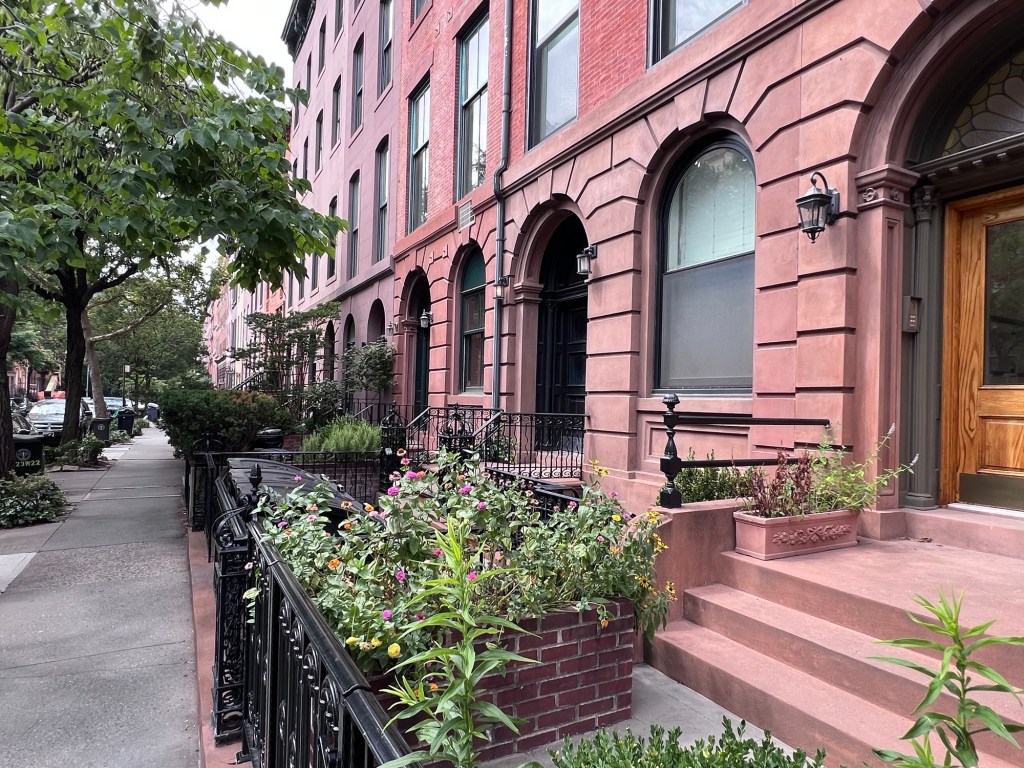
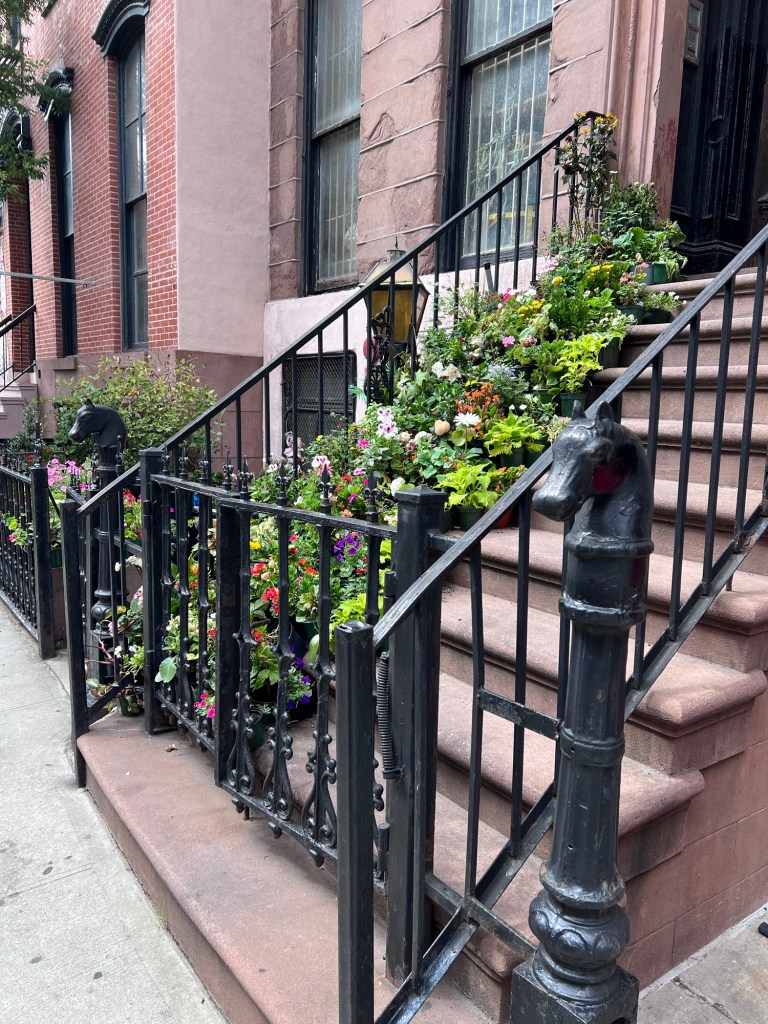
As I continued to walk down the street more surprises popped up along the way. Along the blocks with townhouses and brownstones, there are small pocket gardens and flower beds bursting with color. Along all these streets in Chelsea, there were little surprises everywhere on buildings architecture, tucked in corners by stairs and along the staircases. There is a lot of detail you can miss if you don’t stop for a moment and just appreciate it.
The beautiful plantings and urban gardens that lined the street
Outside of C.S. Hardware at 189 Seventh Avenue there is an interesting mural
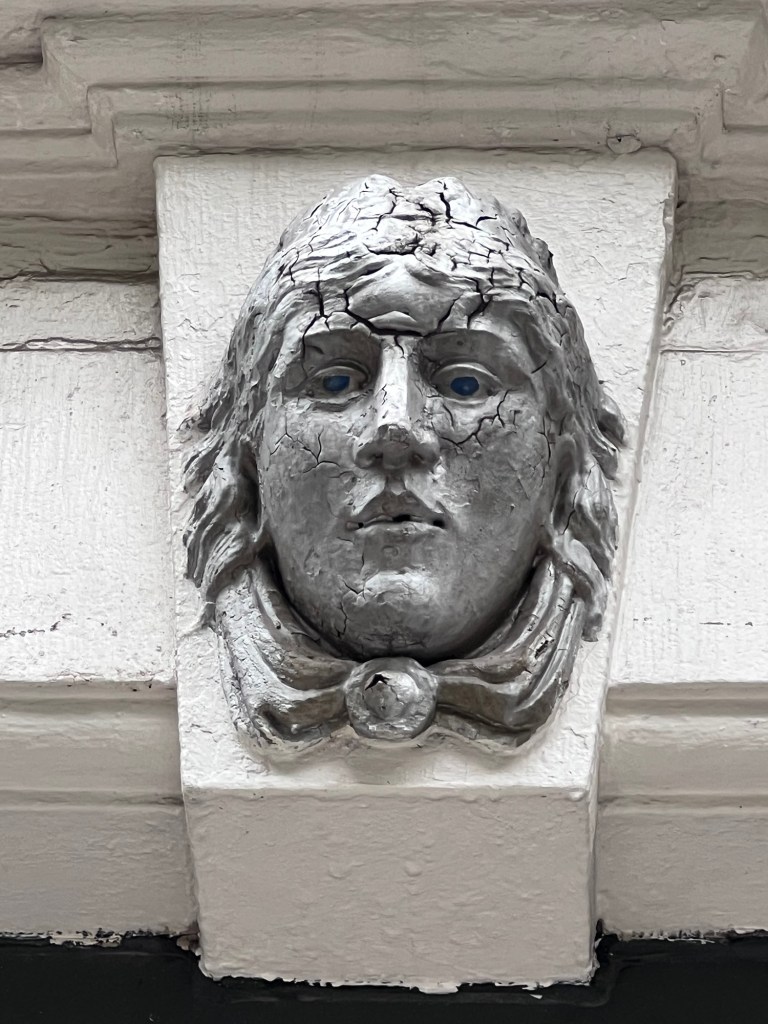
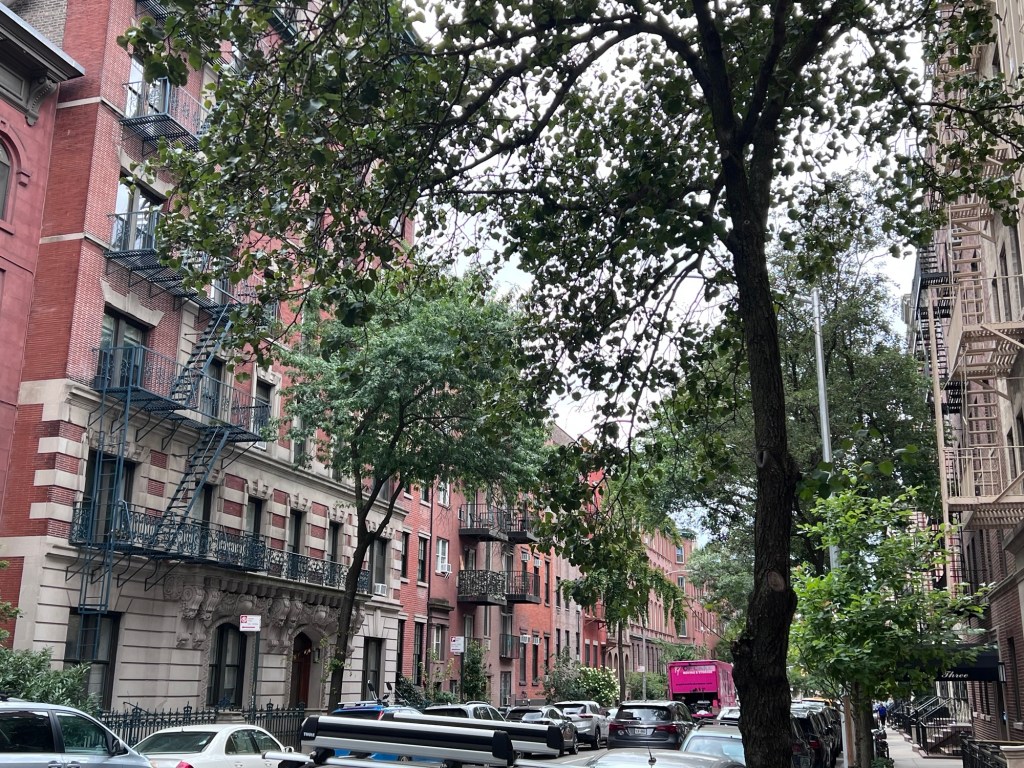
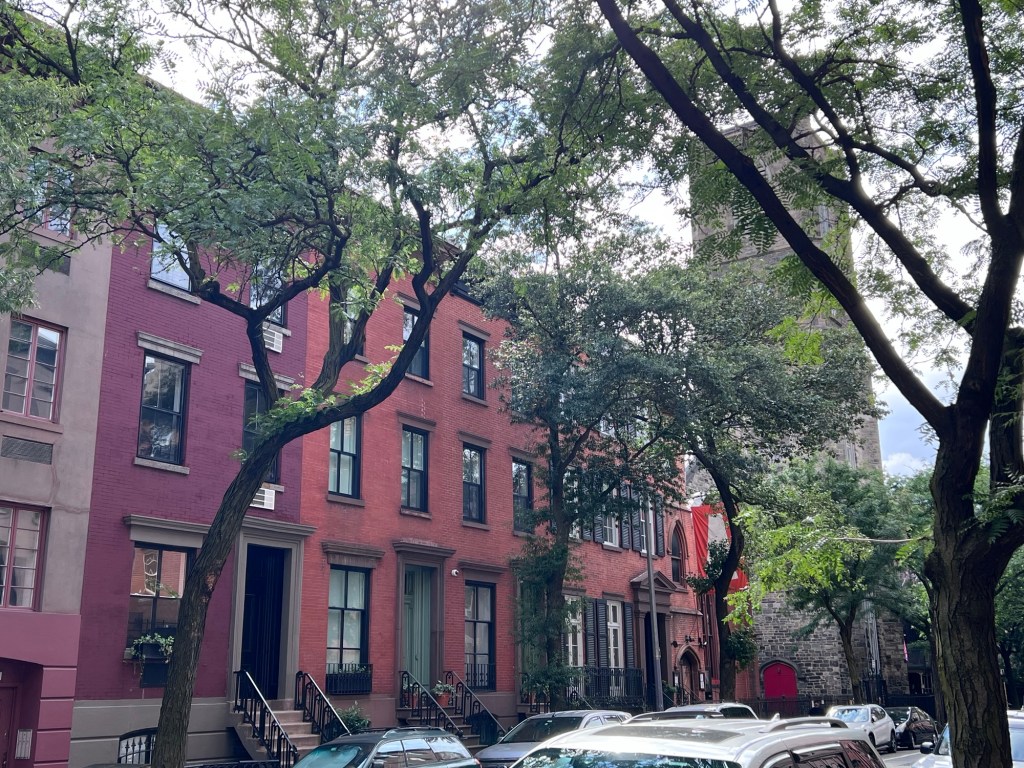
The streets in the neighborhood are really picturesque and look like they are out of a movie set. The streets are lined with beautiful brownstones and brick townhouses. Just be careful as the faces follow you around. You will find one thing about Chelsea, the faces on the buildings are all over the place and each has their own unique look about them.
The beauty of West 21st Street
Faces carved into the doorways around the neighborhood
They just seem to follow you around
Even on the sidewalks faces follow you on the walk to 11th Avenue. The eyes are always watching
I love all the carved faces in the buildings in the neighborhood. These interesting embellishments in some cases are the only decorations the buildings have so I looked out for them as I walked by. The rest of the building is rather plain but the keystone greeting you always has a look of longing.
I wasn’t sure if this was a lion or a demon
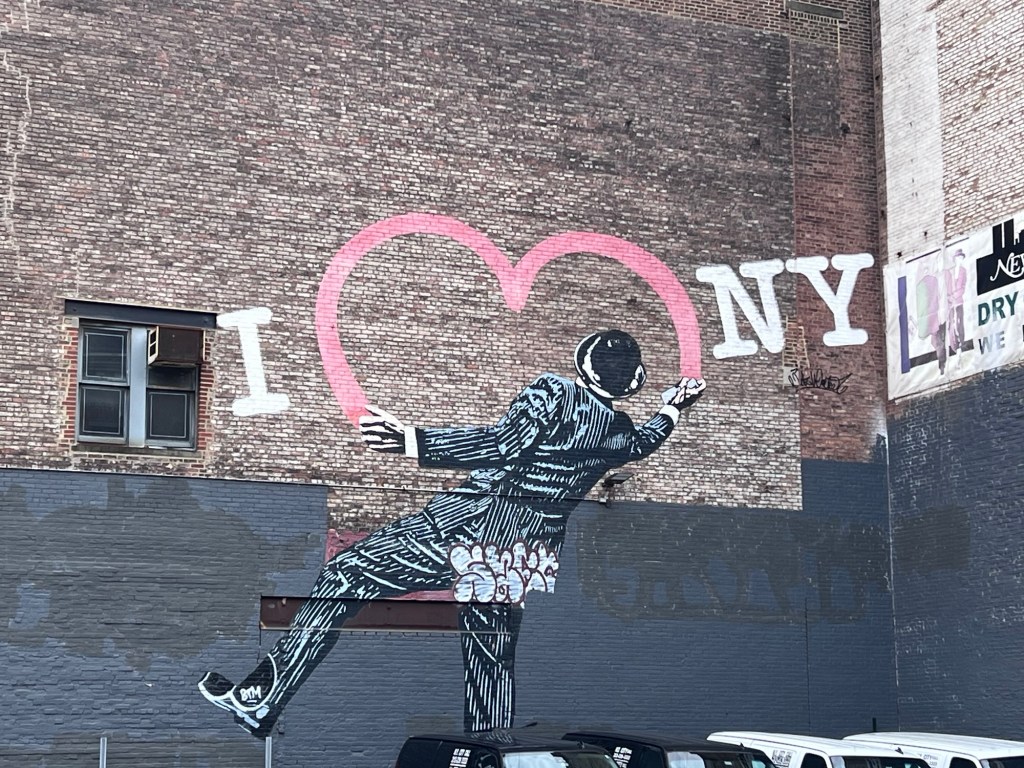
The neighborhood has three Fernando Kobra murals painted on the buildings. This is ‘I ❤️ New York’ on 212 Eighth Avenue.
The Kobra painting ‘I Love New York’
The Kobra painting of Albert Einstein ‘We ❤️ New York’
I continued my walk down West 21st Street looking at the treasure trove of outside art and architecture.
The entrance to the Reilly Building
Has the most interesting face guarding the building
The buildings that watch you
Look at you with a look of horror
The residents creating small gardens along the blocks
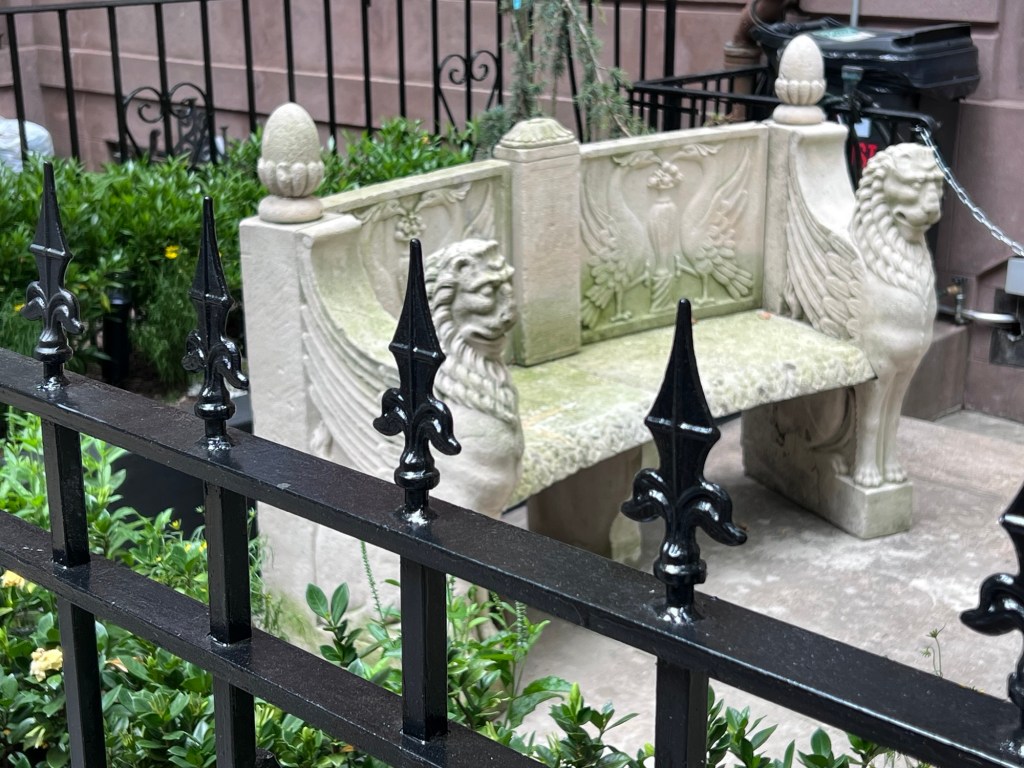
I loved this stone chair outside on of the brownstones
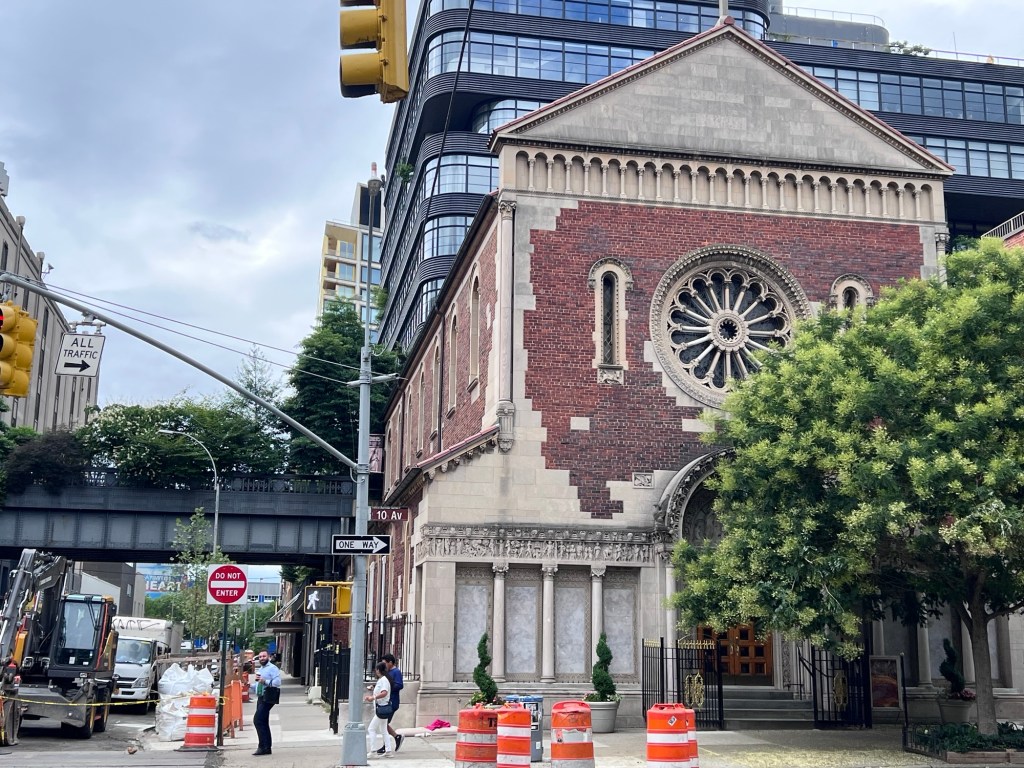
Passing by the Guardian Angel School on 193 Tenth Avenue with High-line Park in full bloom
The church school was designed and built in 1930 by architect John Van Pelt of the Van Pelt, Hardy & Goubert firm. The building was designed in the Southern Sicilian Romanesque style and has many different religious elements in the detail of the outside of the building. You have to look at it from all directions to appreciate its beauty (Wiki).
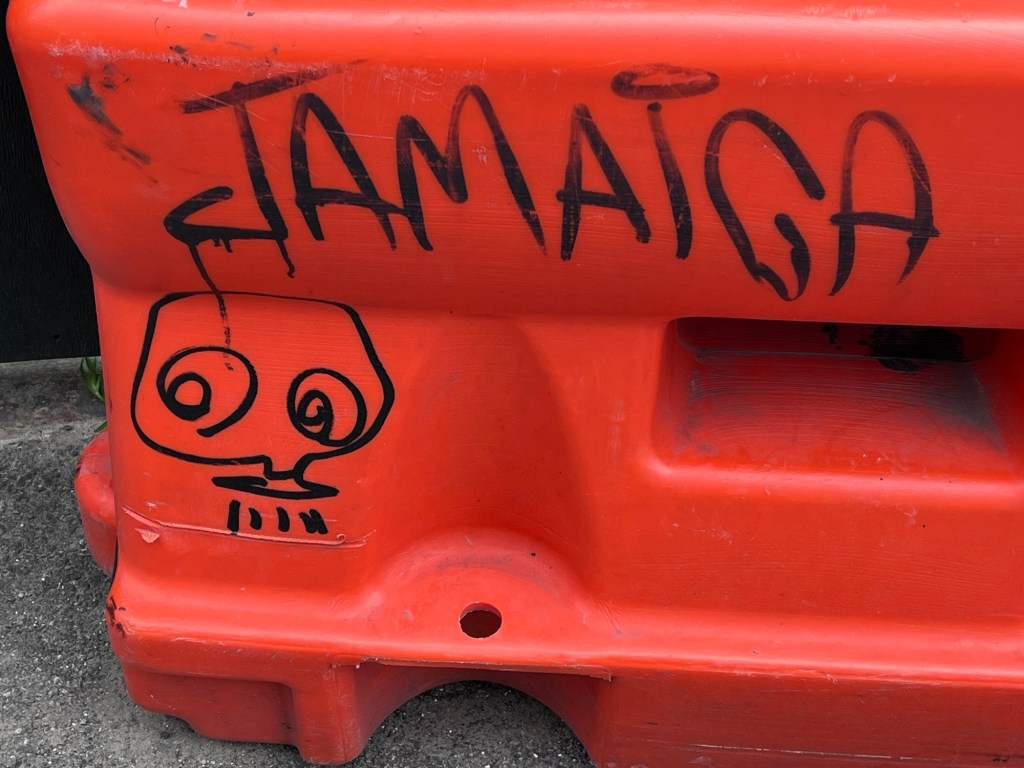
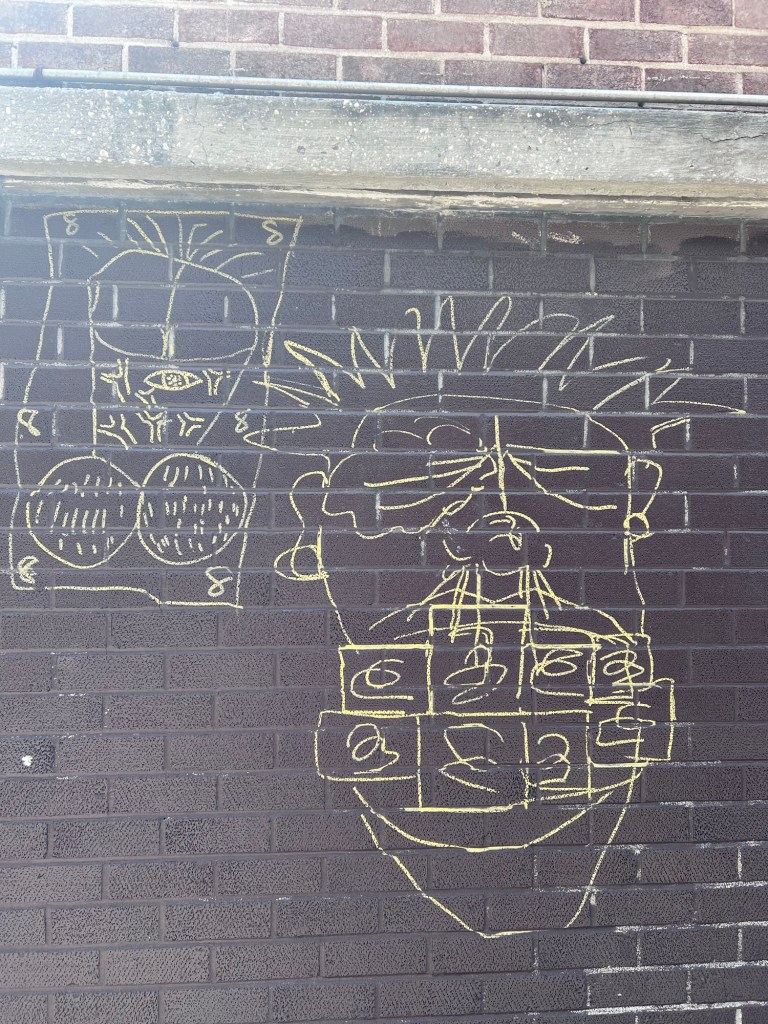
On the corner of West 21st Street and 11th Avenue, I came across this interesting drawing on a plastic barrier. I assumed the street artist was from Jamaica.
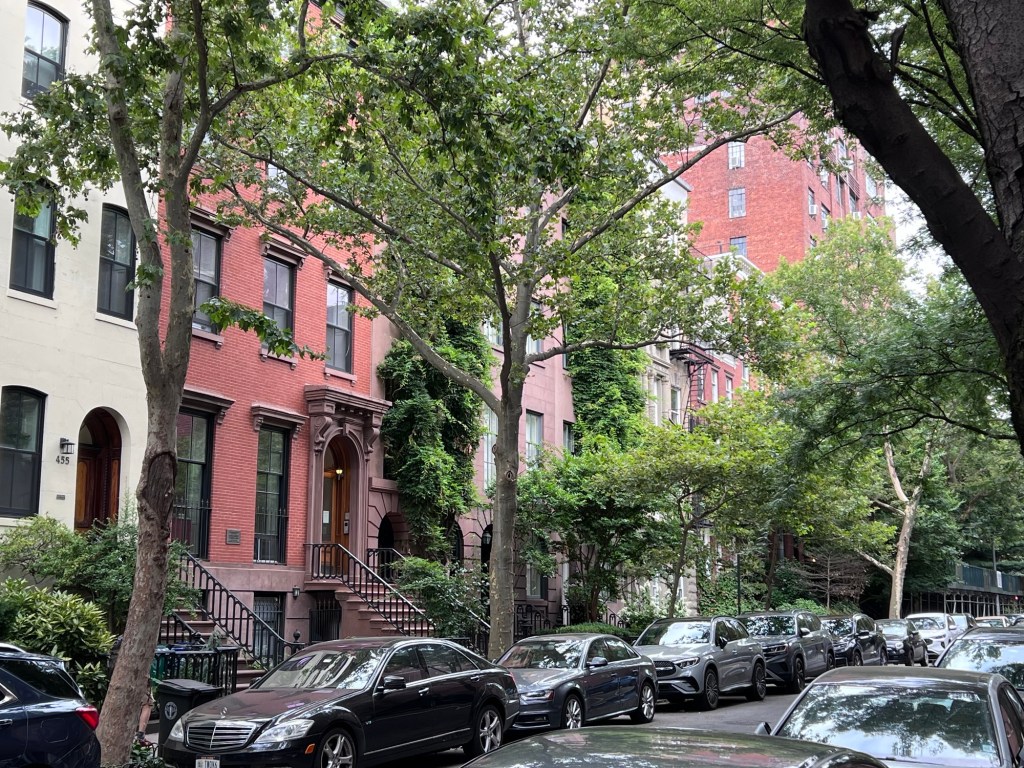
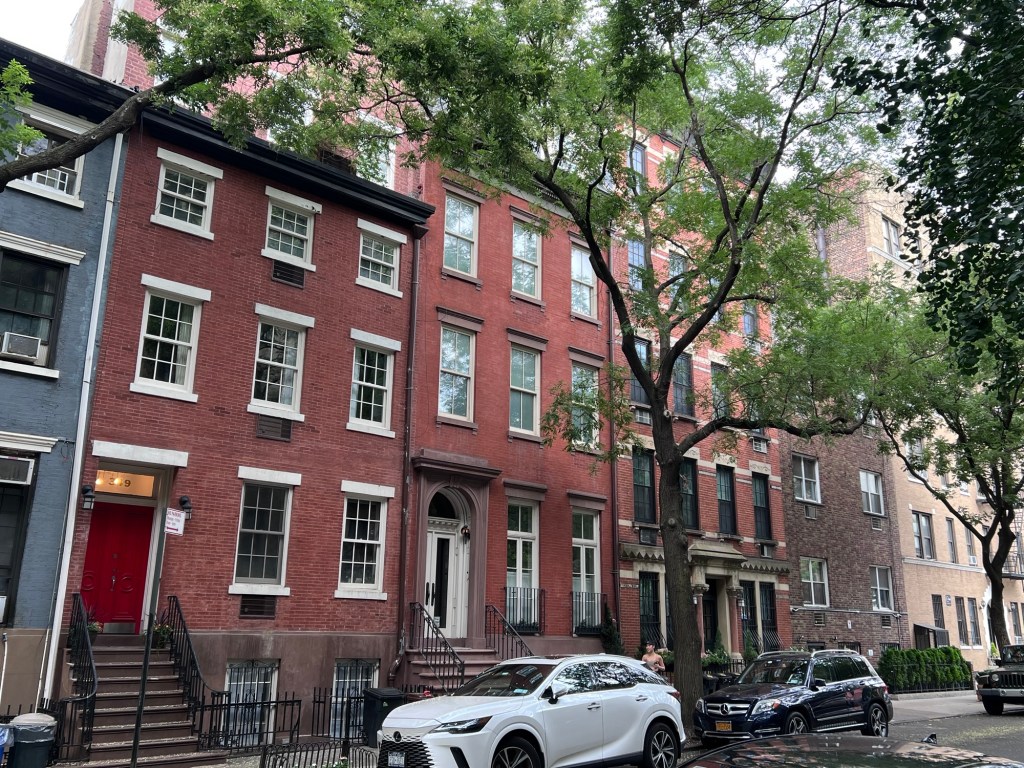
Walking on the other side of West 21st Street on the way back showed just as many interesting views.
High line Park is in full bloom by 10th Avenue
Walking down West 21st Street near Eighth Avenue
Walking past the historic brick townhouses in the neighborhood
As I passed the school yard, I saw this work on the fence and thought it was really whimsical
As I left West 21st Street, I took another peak at the cemetery and thought about when they buried these people. It must have been wilderness at the time this cemetery was created. The first one is down in Chinatown.
I rounded West 20th Street in the late afternoon and I did notice a change in the architecture as I walked further into the neighborhood. It seemed a little more commercial though the use of the buildings seem to be changing.
Then I passed Chelsea Green Park at 140 West 20th Street
The Chelsea Green Park was an oasis from the hot weather that had been going on the week I walked the neighborhood. It seemed all the parents were trying to escape the heat as well as everyone sat under shade trees while the kids ran through the sprays of water and throwing water balloons at each other.
Chelsea Green Park sign
The parks history
This park sits on a former school and when the building was torn down, the neighborhood rallied to create this park. This much needed green space is the neighborhood focal point on these hot summer days that we experienced in the summer of 2025.
Walking by the busy park in the early afternoon
Some of the businesses are quite unique in the neighborhood. I loved the window display at ‘Purple Passion’ at 211 West 20th Street. If anything stood out was this creative set of ensembles.
The display window at Purple Passion at 211 West 20th Street
Purple Passion has become the darling of fetishists-in-the-know over the last few years almost exclusively by word of mouth. A selection of fetish “toys”, restraints and clothing more diverse than almost any other store in New York is crammed into a tiny shop now so packed with merchandise it’s difficult for more than two or three customers to be inside it at once (The NYCGoth.com website).
This interesting brownstone is a pre-war building that was built in 1920. This rather daring face protects the entrance of the building.
The front door is on guard
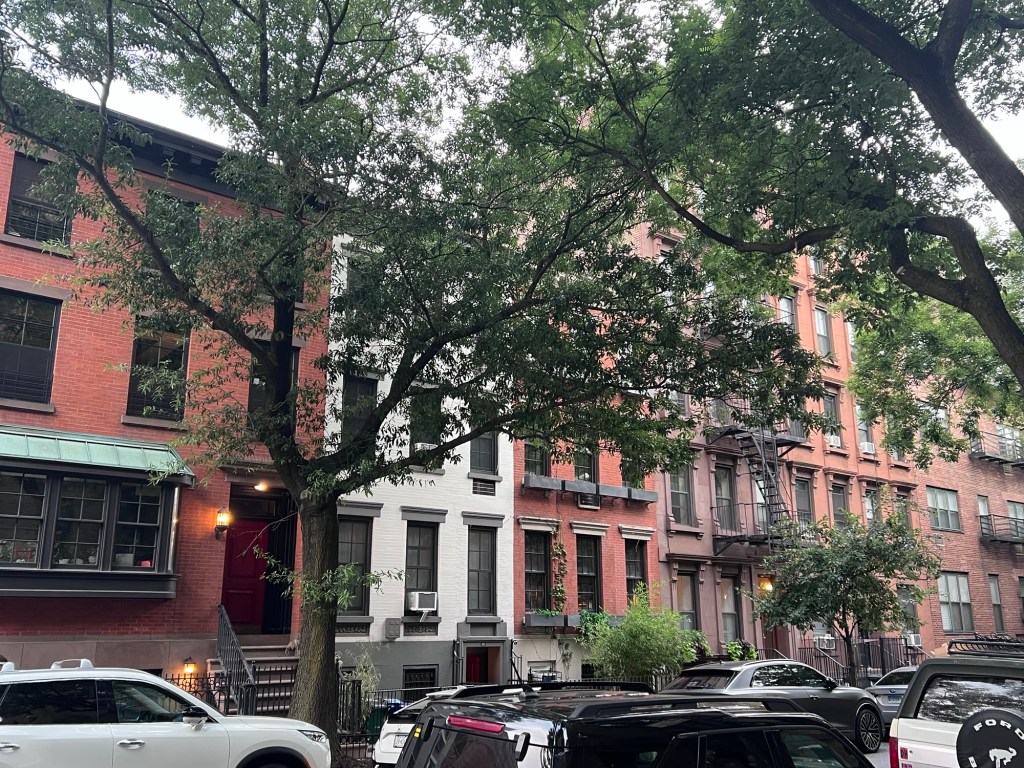
The blocks in the center of the neighborhood down each street from Seventh to Ninth Avenue are lined with rows of rows of tree lined streets with classic brick townhouses.
Walking down the picturesque West 20th Street
The garden boxes along the way
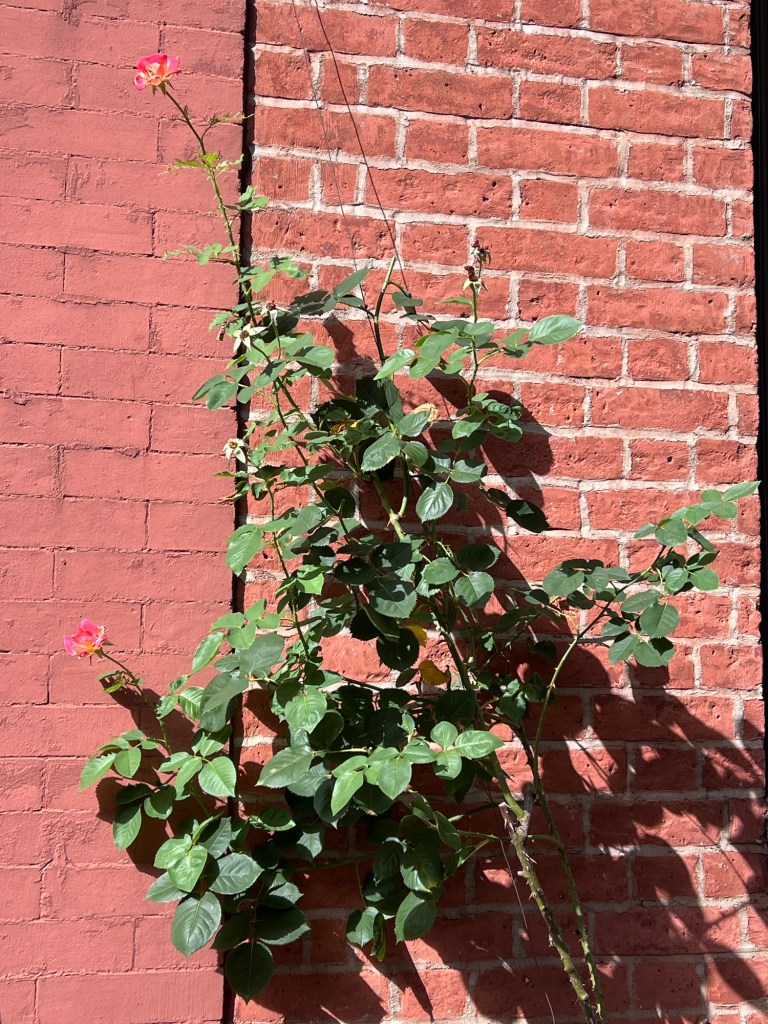
Flowers peaking out here and there along the walls
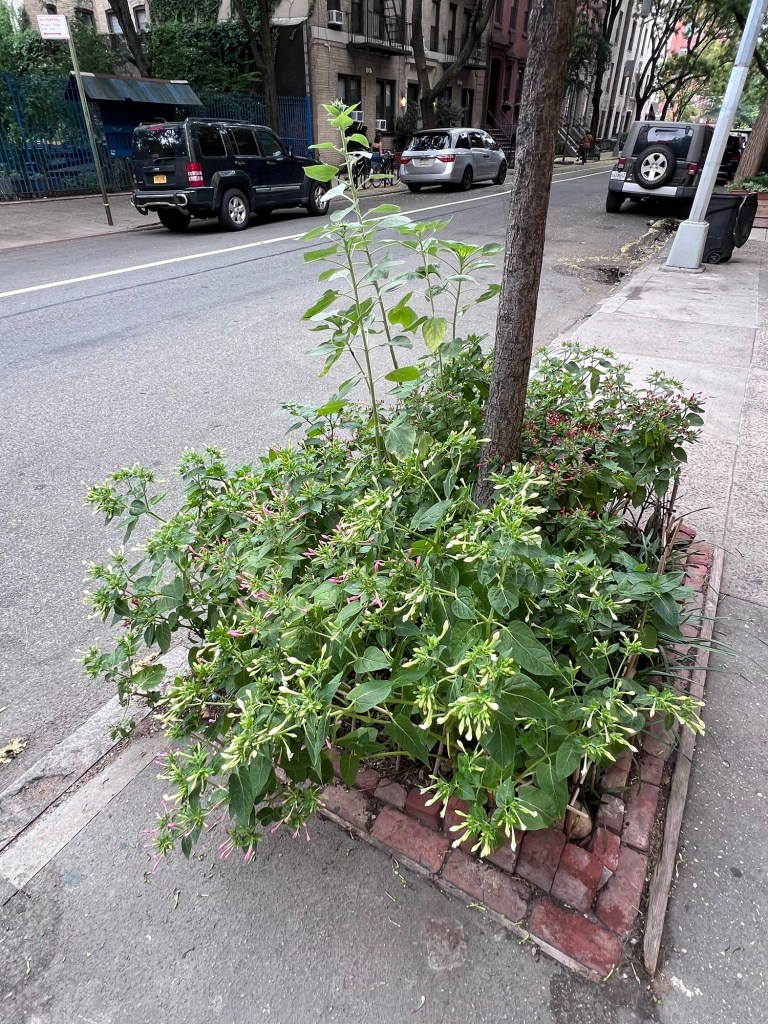
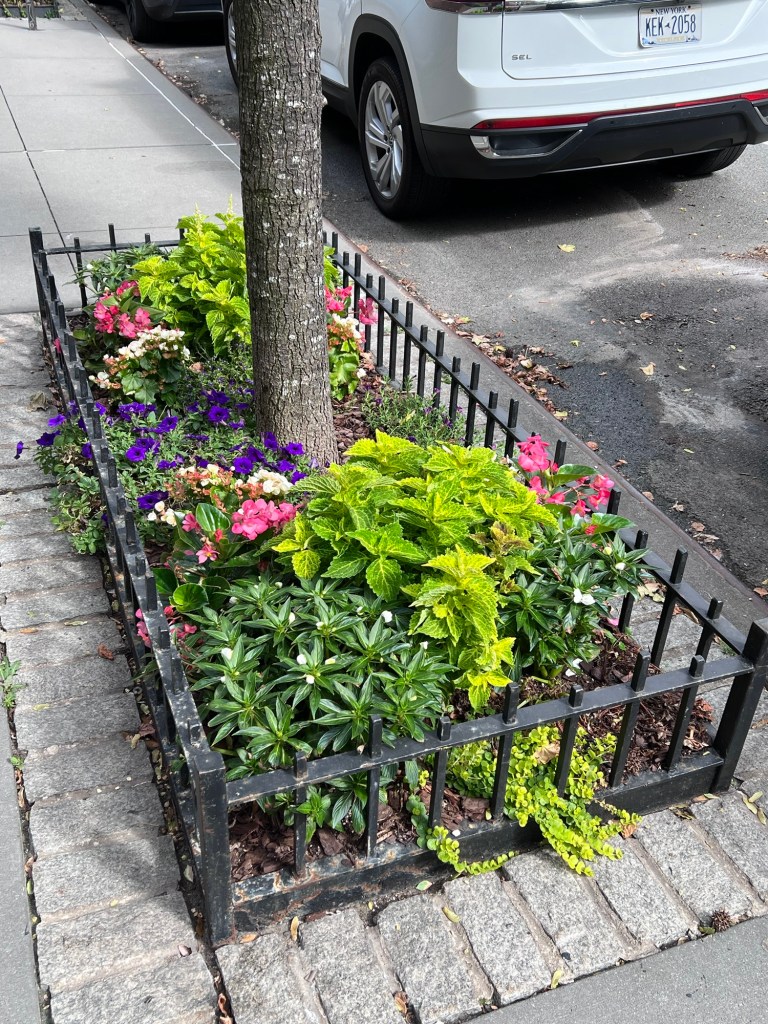
The residents landscaping the tree boxes along the street
A tree growing in the High Line Hotel courtyard at 180 Tenth Avenue
The Cushman Row is one of the finest examples of Greek Revival style of architecture in New York, this superbly designed row of houses has retained most of its handsome original detail. Built by Don Alonzo Cushman, parish leader and financier, in 1840 (from the Cushman Historical Marker).
Then I passed the elegant and beautiful St. Peter’s Church was in the middle of the neighborhood.
The sign for St. Peter’s Episcopal Church at 346 West 20th Street
The historic St. Peter’s Episcopal Church in the summer of 2025
St. Peter’s Episcopal Church was constructed in 1835 and was designed by architect James W. Smith in the Greek Revivial style. The design was also influenced by Clement Clarke Moore, on whose estate the land had been donated (Wiki).
As I passed the 10th Precinct at 230 West 20th Street, I looked at the 9/11 mural and realized that next year would be 25 years since that horrible day. It is amazing how fast it has gone by.
I stopped inside the Chelsea Green Park to relax for a while and it was a lot of kids running around and parents talking amongst themselves. The kids seemed occupied by both a water balloon and a squirt gun fight.
The Chelsea Green Park in the late afternoon
After a nice rest and a lot of water, I turned down West 19th Street to continue my tour.
In front of of the old Siegel-Cooper Department Store building on Sixth Avenue and West 19th Street
Walking past the townhouses along West 19th Street
The street art along the way
The beautiful gardens in front of of the homes
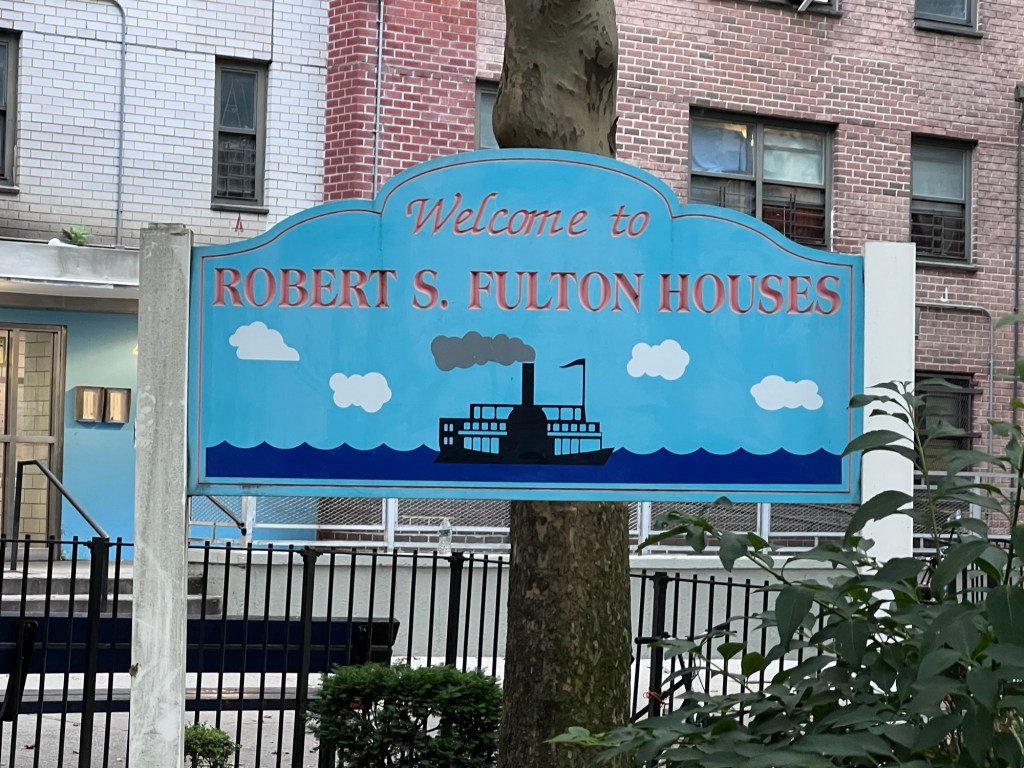
In the middle of the block were the Robert Fulton Houses which along with the Chelsea-Elliott Houses are both slated for demolishing later this year. That will change the completion of this neighborhood. These were opened in 1962 and were designed by architects Brown & Guenther.
Its narrow, 18-foot-width precluded the traditional stable design of a centered carriage bay flanked by a pedestrian entrance and window. The property was a three-story brick house, home to Samuel Weekes and his family who would remain through 1858 (DaytonianinManhattan.com).
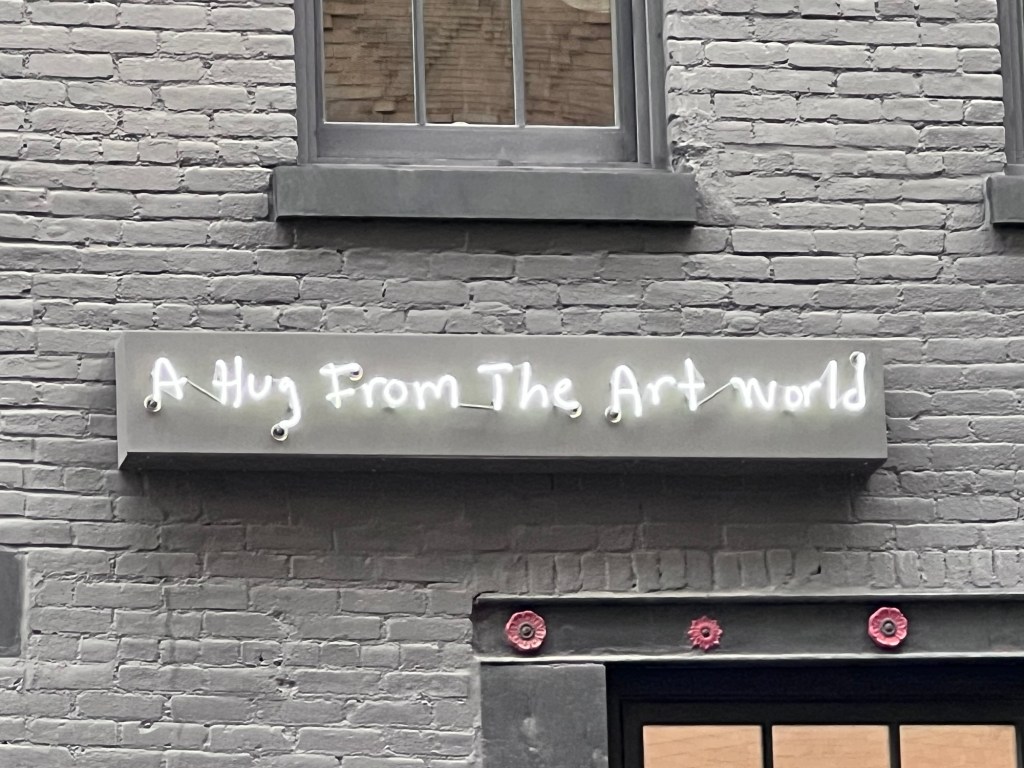
I liked the sign at the top of the door way of the “A Hug from The Art World”
I took a break after all the walking at The Sleeping Cat at 160 Seventh Avenue for a quick snack/late lunch. The place was pretty crowded in the late afternoon. They ran out of the three things I wanted to try so I ordered a Chicken with Brie Club sandwich on a milk bun with a Pomegranate soda for lunch.
My lunch that afternoon
The Chicken and Brie sandwich
Yum!
For dessert I chose a Lemon Poppyseed Cake, which was delicious. You could really taste the fresh lemon juice and zest in the cake.
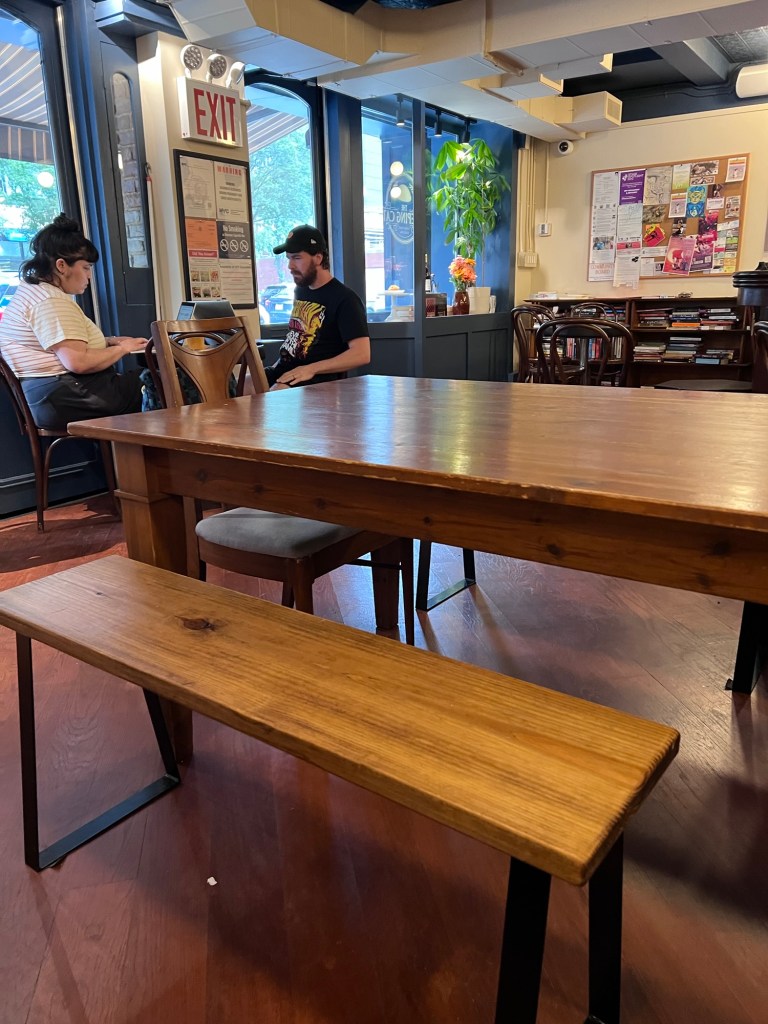
The inside of the unique coffee shop
I continued my tour of the neighborhood a few days later when I came back into the City for the Michigan State Alumni Picnic that Saturday. We ended the picnic at 4:00pm, so I walked from Central Park to West 18th Street after a pit stop to recharge my phone and go to the bathroom.
I wanted to finish the neighborhood before dark but could only finish the blocks from West 18th through West 17th Streets. You just can’t take good pictures after 7:00pm when the shadows hit the buildings.
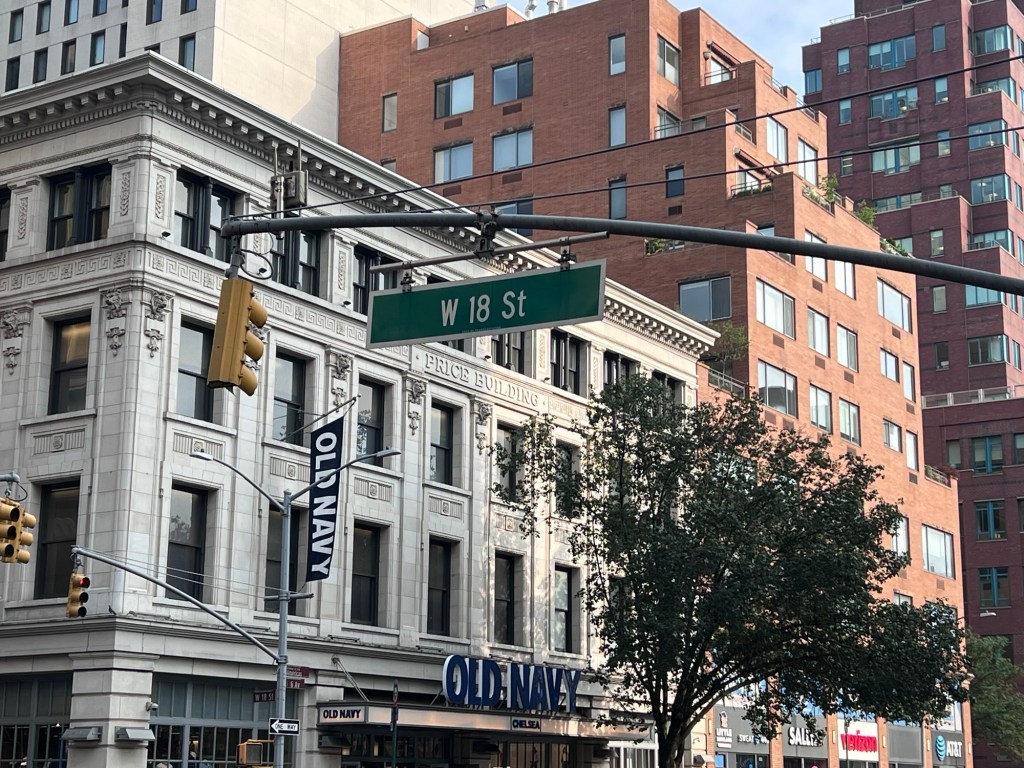
Starting on West 18th Street
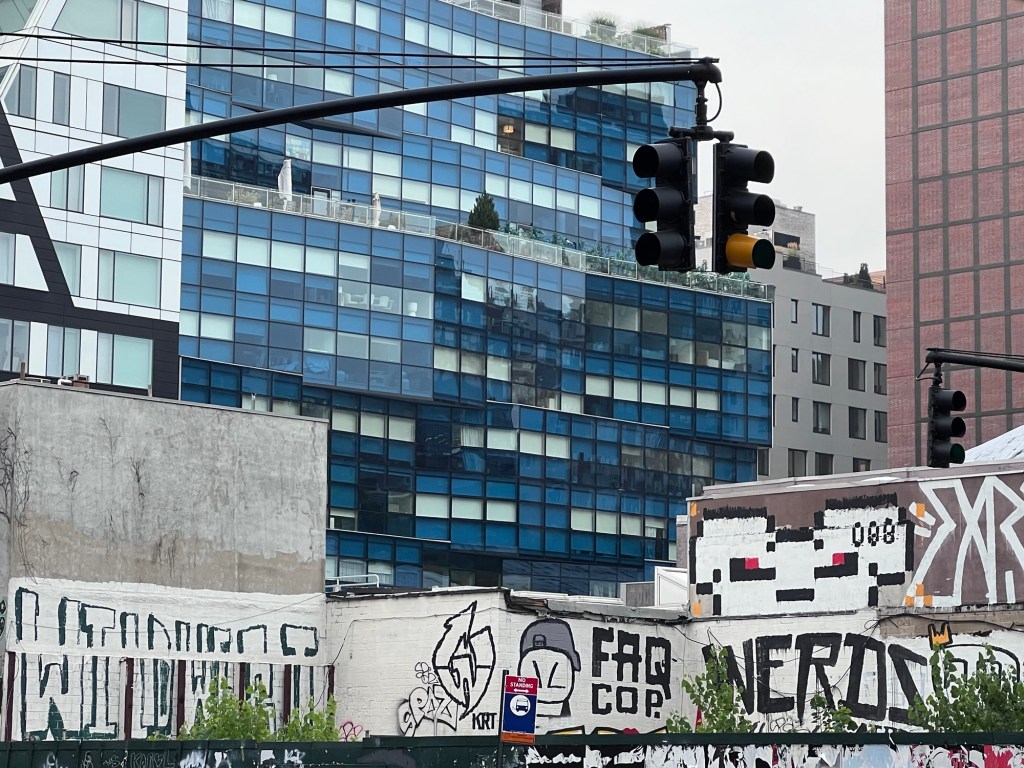
Some of the interesting street art you will see in the neighborhood
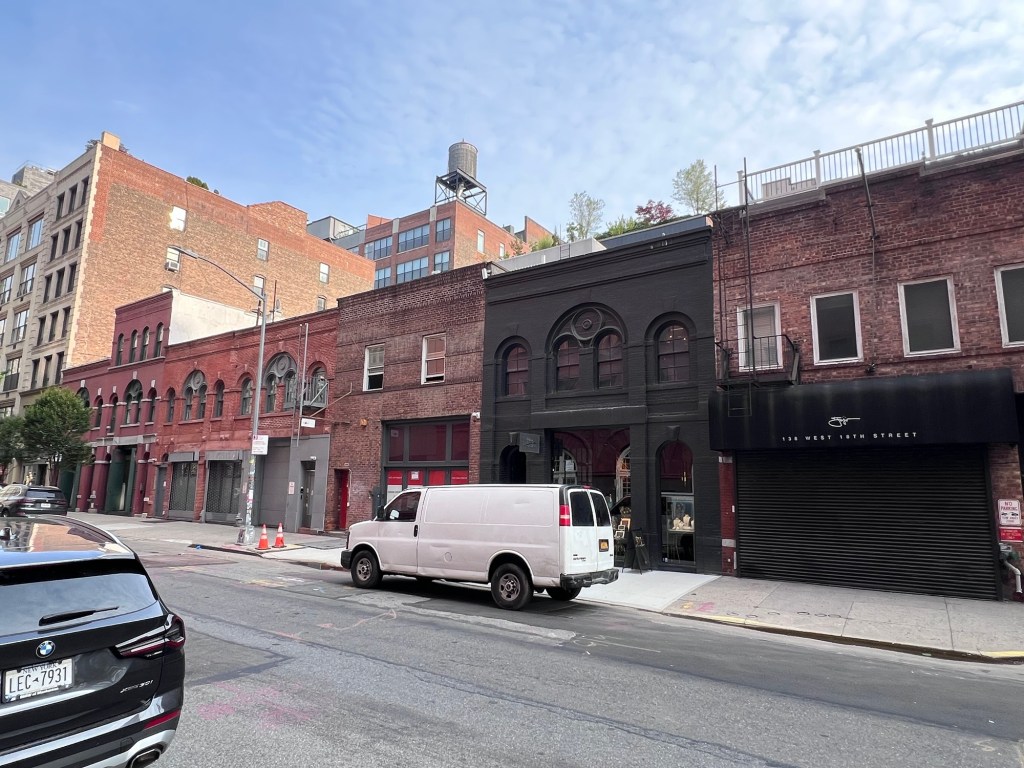
This series of what looks like old carriage houses lines West 18th Street just off Sixth Avenue
These buildings were designed in a round arched utilitarian style related to the German Rundbogenstil and incorporate Romanesque and Renaissance Revival details. They were built between 1864 and 1865 and were used as stables (HDC.com). They are now being used as restaurants, shops and art galleries.
A close up of one of the series of buildings at 136 West 18th Street
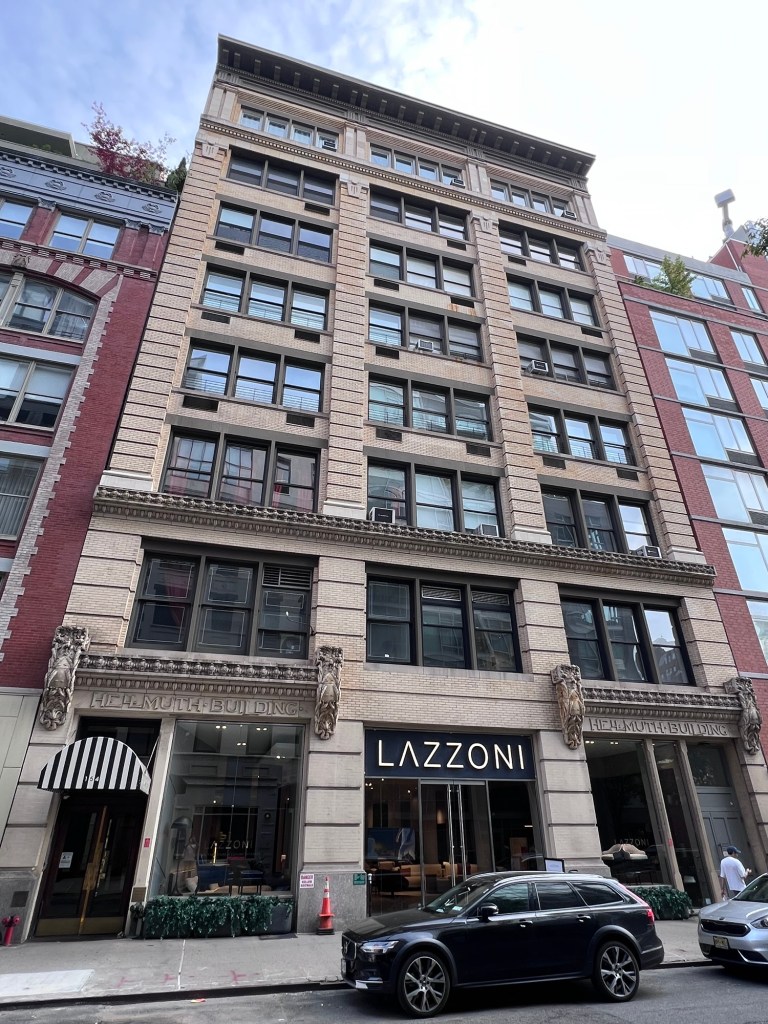
There were several buildings that stood out along West 18th Street and one of them was 154 West 18th Street, the Hellmutg Building now home to the Lazzoni store.
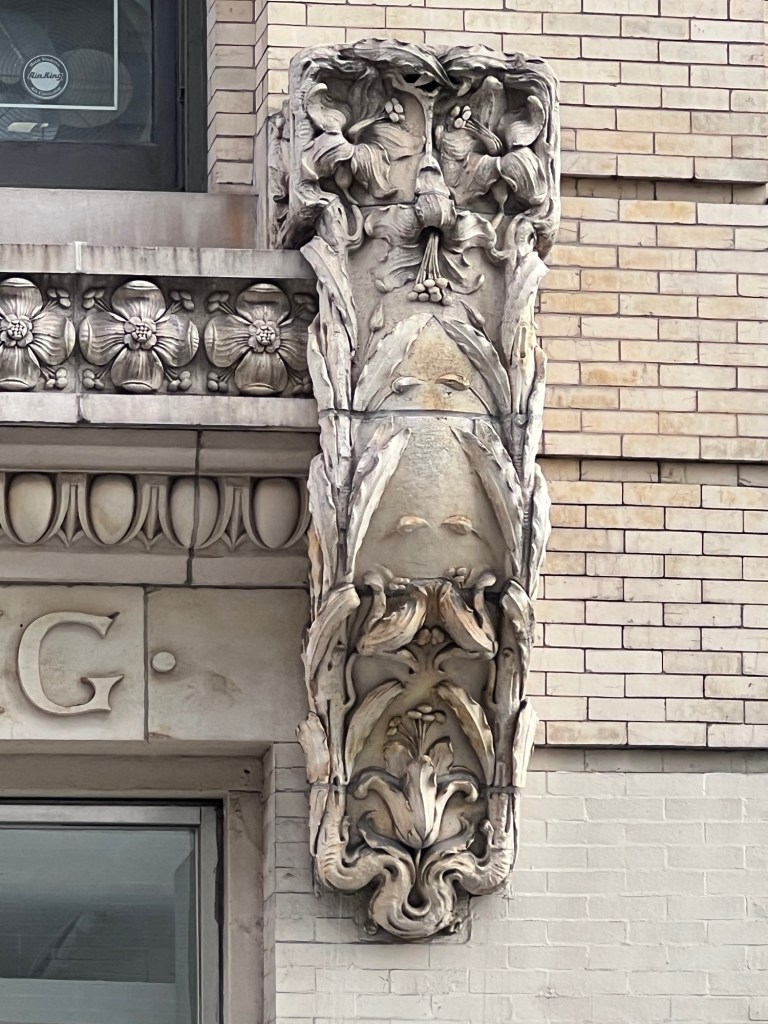
The Hellmuth Building was designed by architect Adolph Schoeller in the Art Nouveau style in 1907 and was built for William Hellmuth, who was a highly-successful manufacturer of printing and lithographic inks and varnishes (DaytonianinNYC.com)
The details of the Hellmuth Building
The carved embellishment of the building
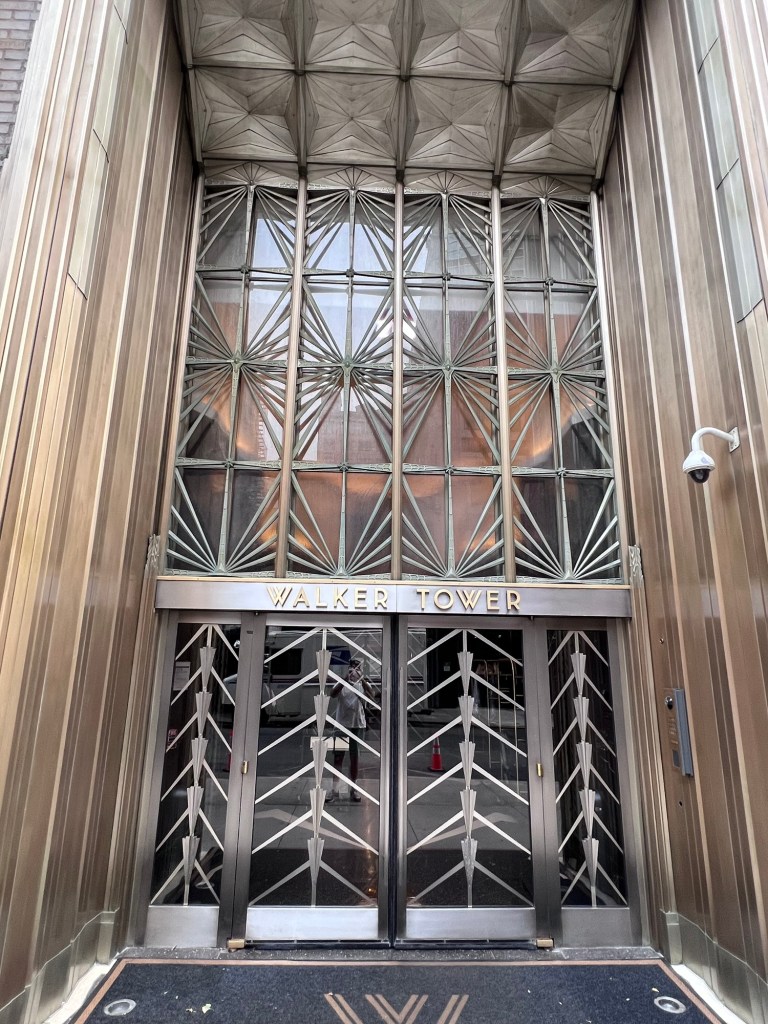
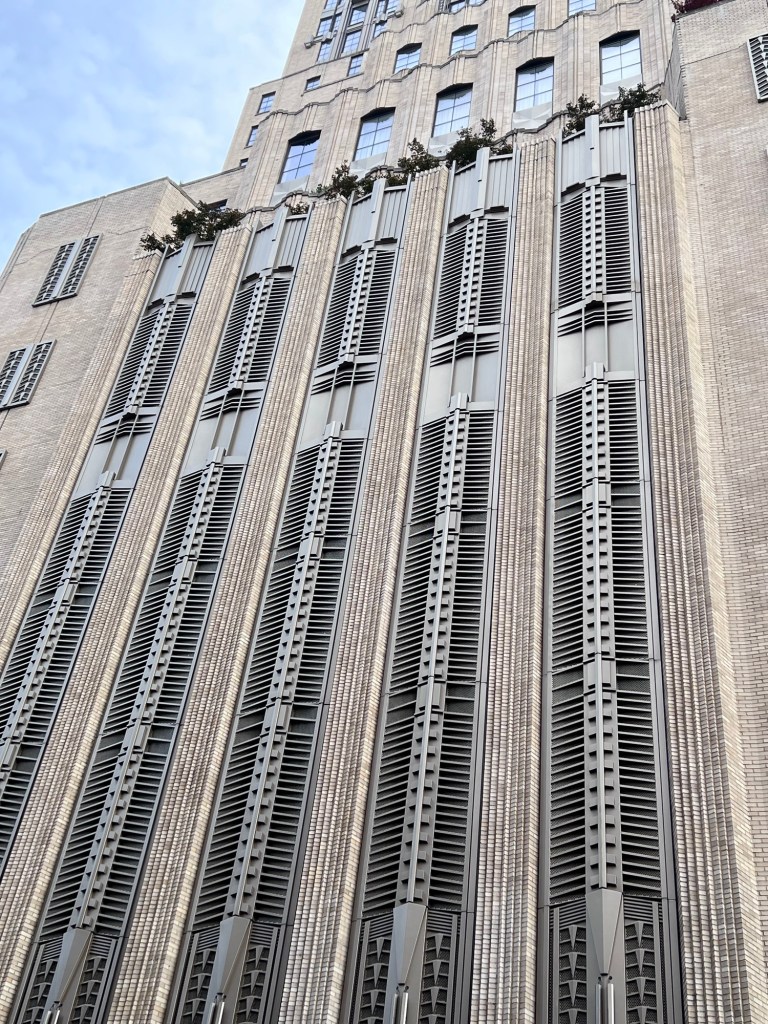
Another building that stood out was the Art Deco style Walker Tower at 212 West 18th Street
Originally constructed in 1929 as a commercial building for the New York Telephone Company, this historic structure was designed by the renowned architect Ralph Thomas Walker, celebrated for his distinctive Art Deco style (The Walker Tower website).
The Walker Tower in full view
The art deco details to the outside of the building
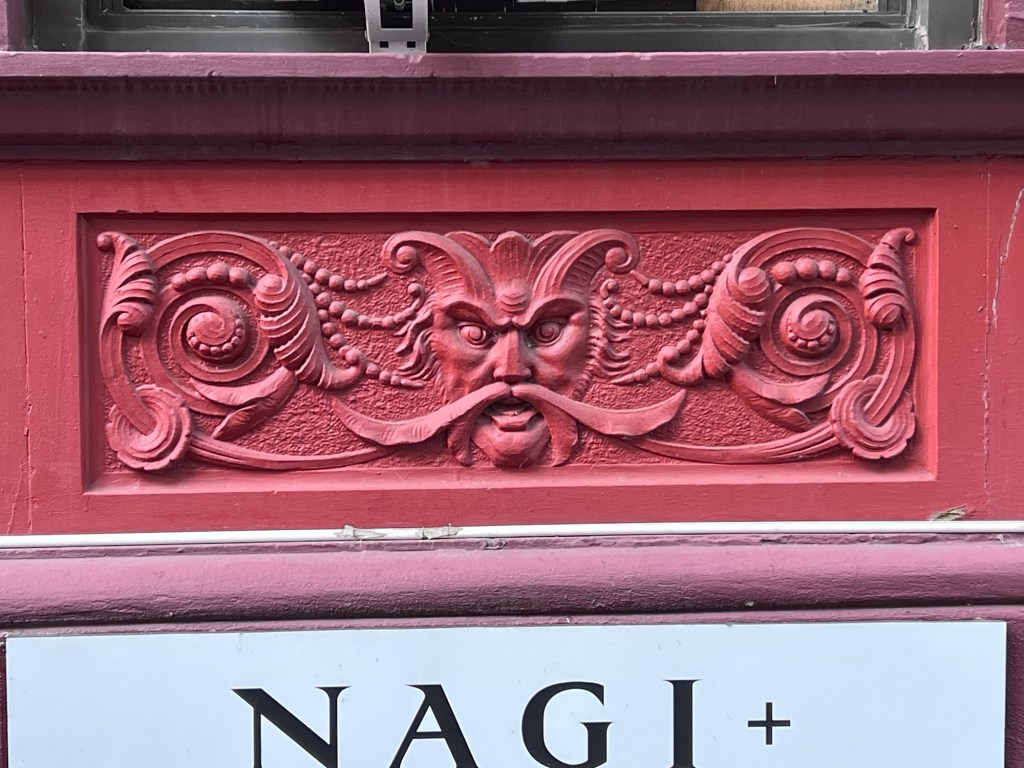
The details outside of 265 West 18th Street were very unique.
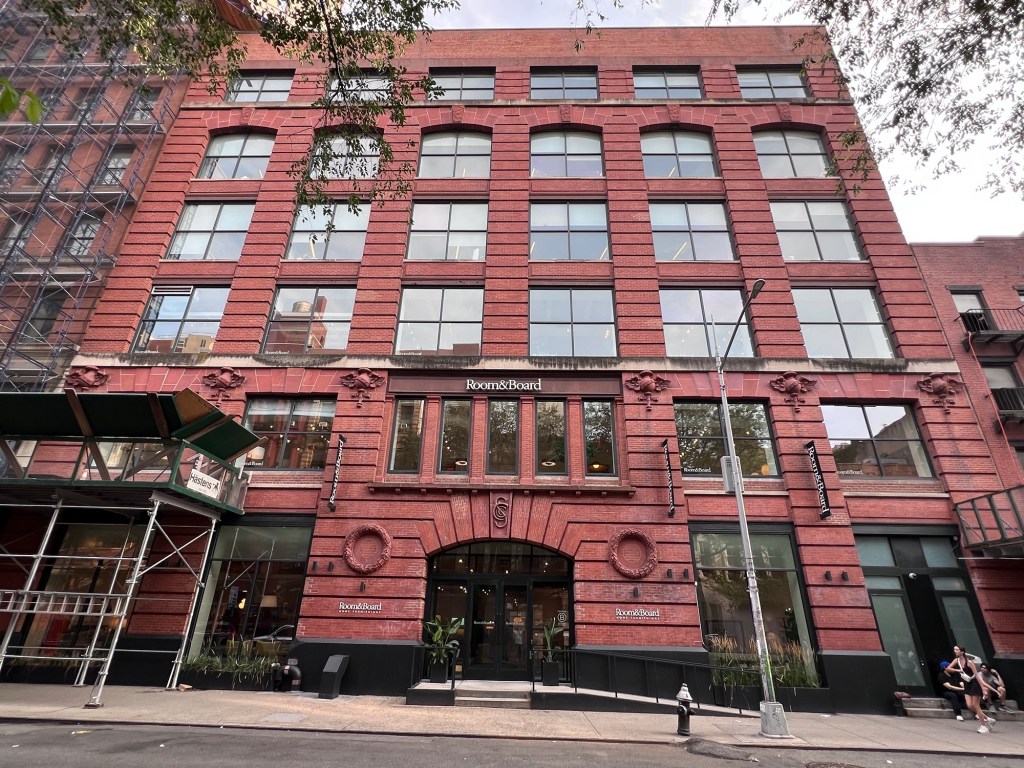
While I was walking down the street, I passed the Room & Board store and saw all the embellishments on the building and wondered what they meant. It was the insignia for the old Seigel-Cooper Warehouse building.
The old Siegel-Cooper Warehouse Building is now home to the Room & Board showroom at 249 West 17th Street with entrance at West 18th Street
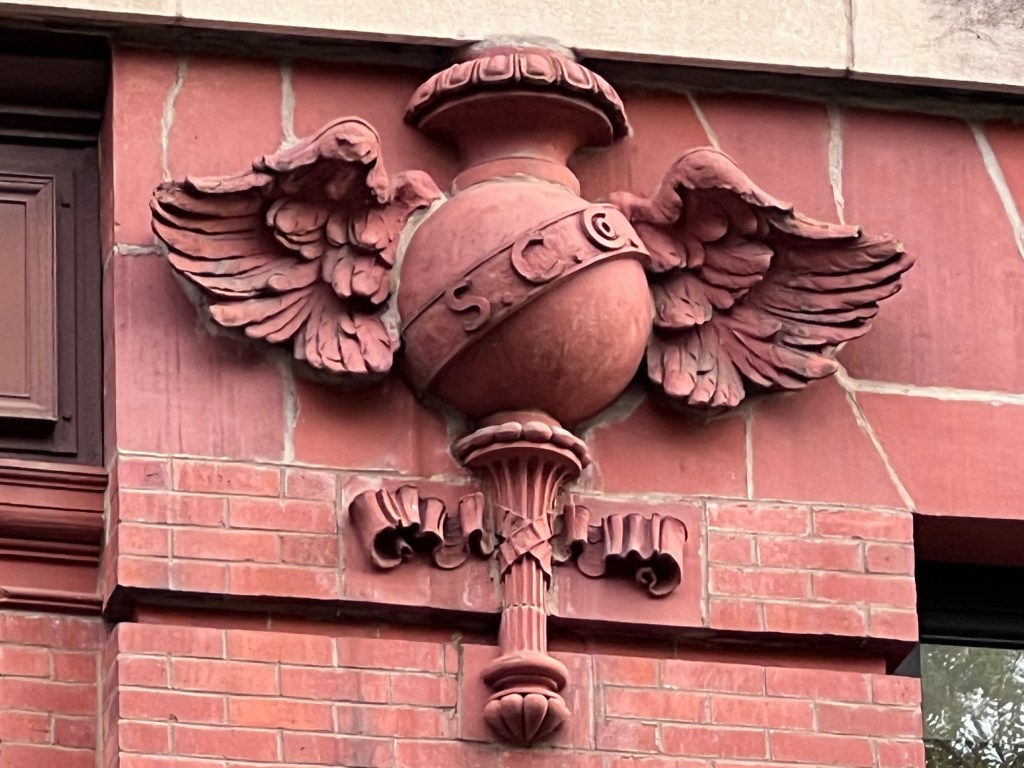
The Seigel-Cooper insignia can still be seen on the building
The building was designed by the architectural firm De Lemos & Cordes and opened in 1904. the architects used lusty terra cotta ornaments to distinguish the façade. Each pier culminated with winged orbs bearing a sash emblazoned with SC&Co; and the bay doors were flanked by large, intricate wreaths (DaytonianinManhattan.com).
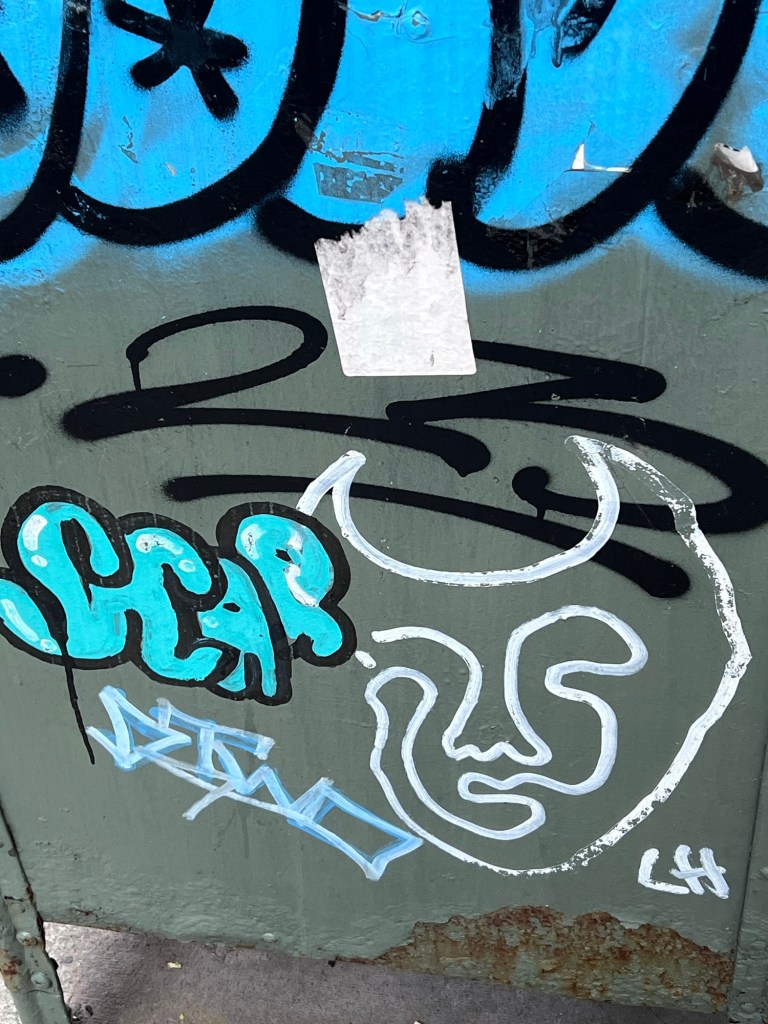
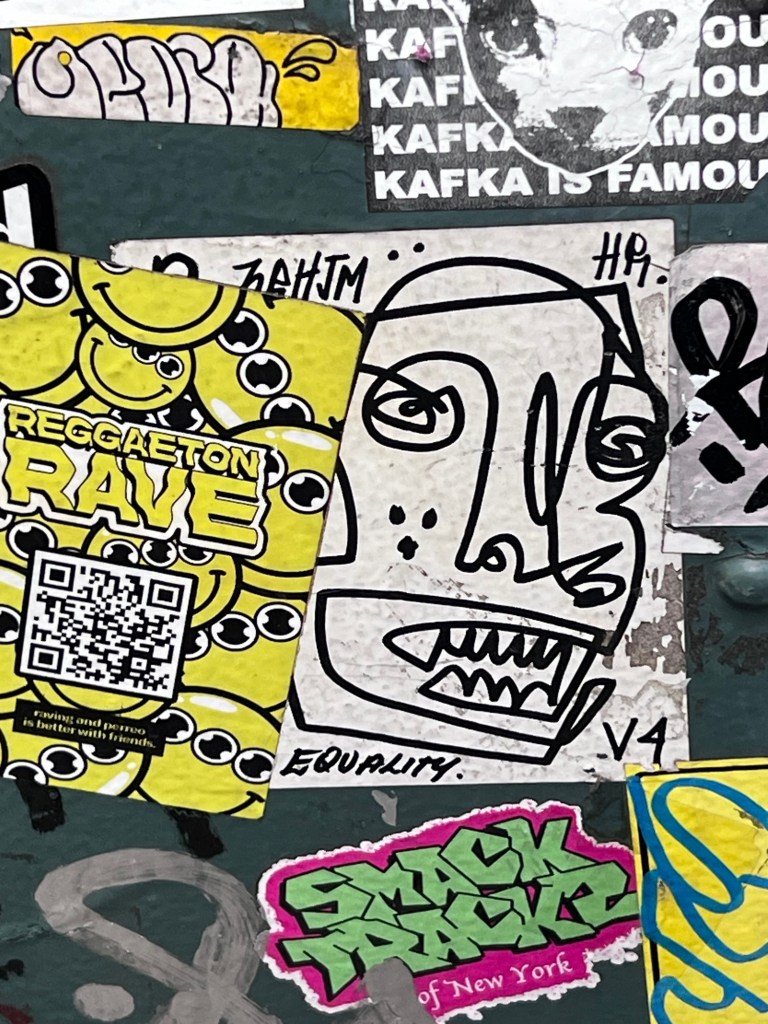
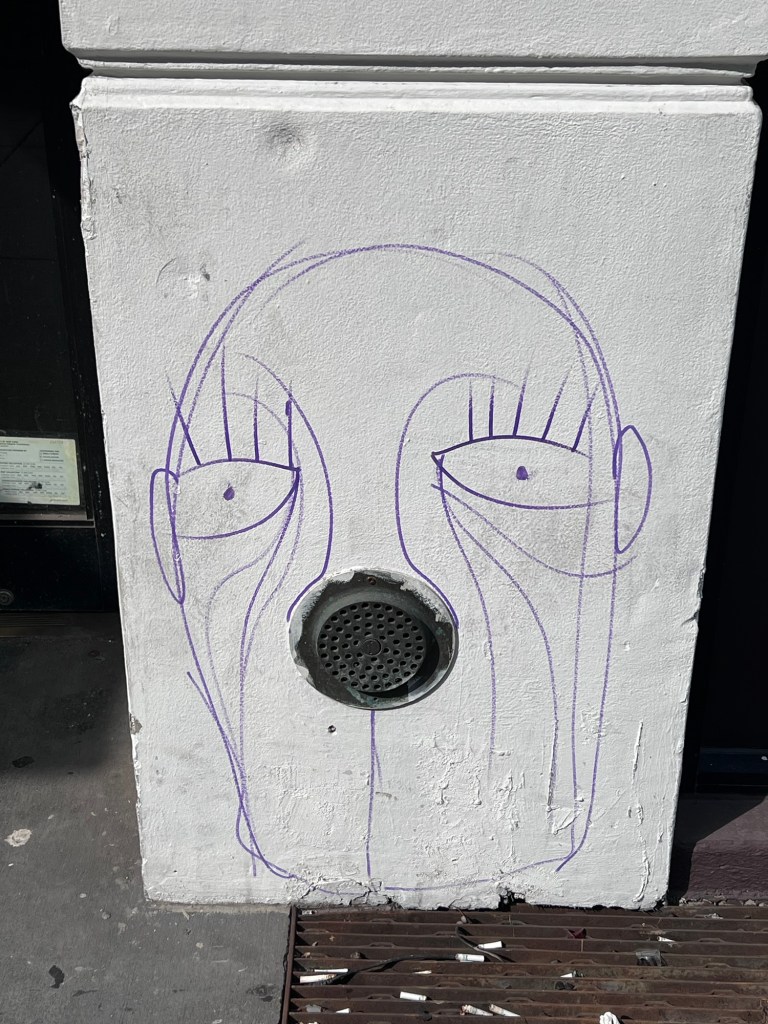
You can find street art all over the sidewalks in this neighborhood. Just look down and many artists leave their mark.
This interesting twin building with a mansard roof was built in 1910 (Streeteasy.com). What I thought was interesting about the building is how it stands out amongst all the brick townhouses that had a plainer design. It looks like something you would see on the Upper East Side inside of this neighborhood.
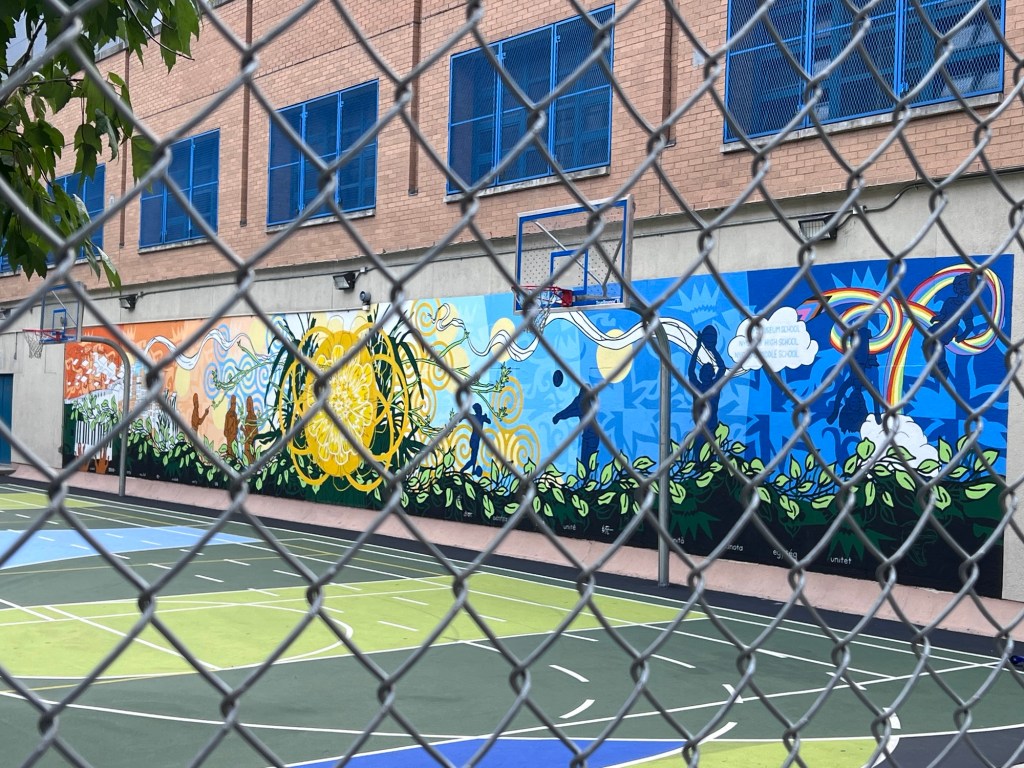
As I passed the high school in the area, I came across this mural painted on the playground walls. I saw this mural on the Liberty High School for Newcomers at 250 West 18th Street. I could not get a good look at it as the playground was locked.
The mural outside of the Liberty High School for Newcomers at 250 West 18th Street
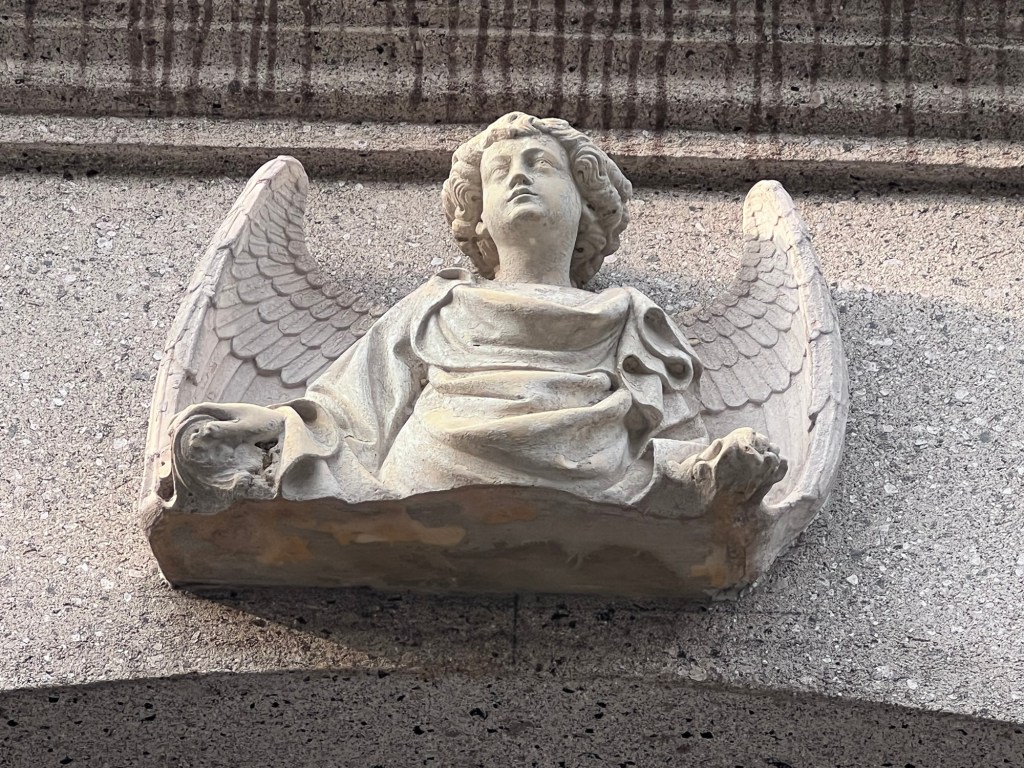
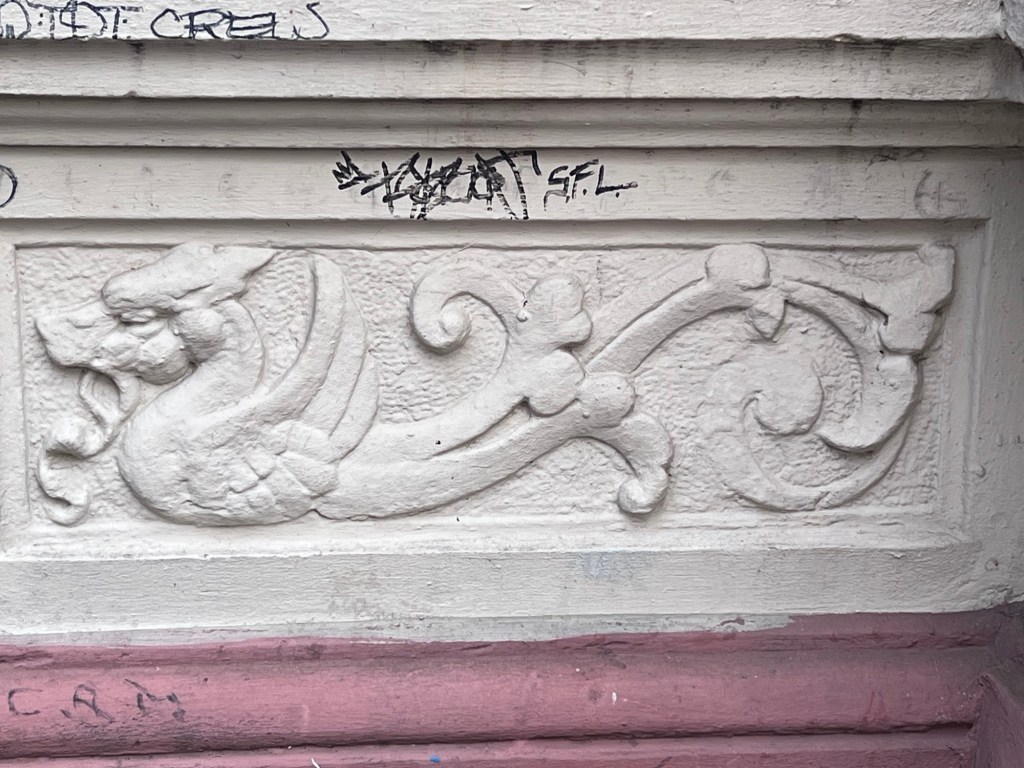
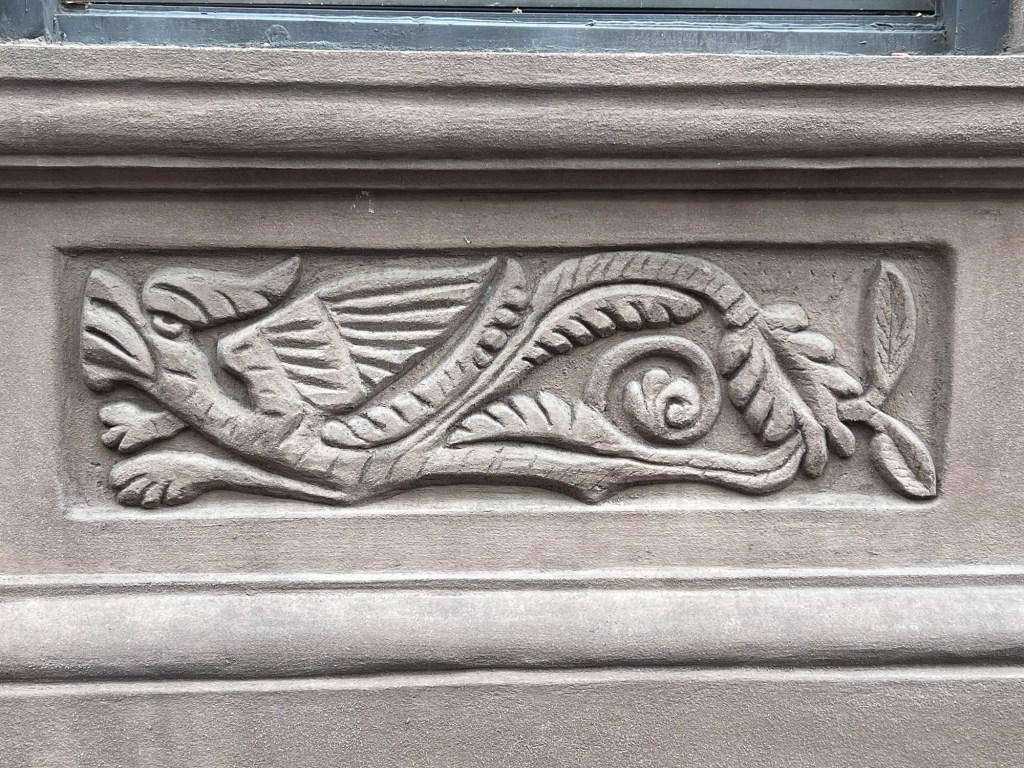
A serpent embellishment outside one of the buildings
Tucked in the corners of buildings all over the neighborhood, there were all sorts of interesting and unusual street art and stone carvings and embellishments. While most of the buildings were rather plain, it was a serpent here, a dragon there and a face staring back at you from the front door keystone that gave the building something special to admire.
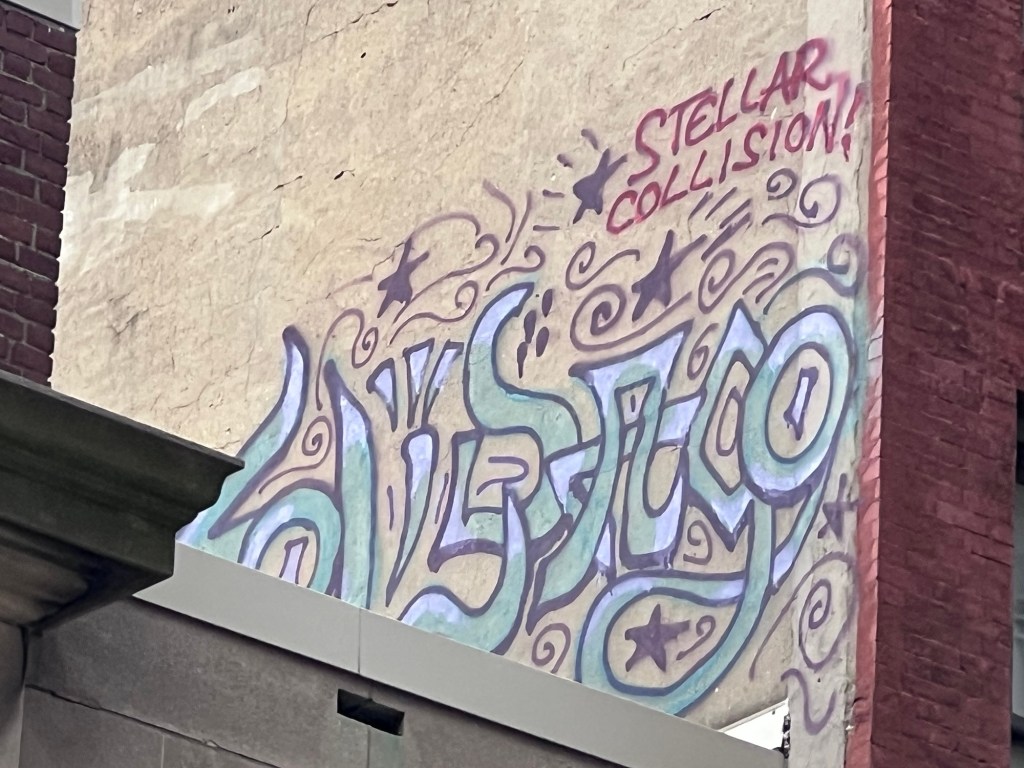
Some of the street artists, whether hired or tagging were very creative on the sides of buildings. I am sure that the building owners were not happy to see this but the City has its own ideas sometimes.
You have to look up or you will miss this street art on the top of one of the buildings
I have seen this artist’s work all over the neighborhood
With all the unique architecture and street art along West 18th Street, I anticipated more surprises when I rounded the corner of West 17th Street. You never know what you will see tucked here and there along these streets.
Turning the corner along West 17th Street and Sixth Avenue
The mural of ‘I Love New York’ is iconic in this neighborhood. This has been here for many years. This work of art was created by artist Nick Walker.
Artist Nick Walker is a British born artist that now lives in Manhattan. He is know for being part of the ‘stencil art’ movement that was started in the 1980’s. He is know for his large murals of contemporary art and is best known for merging freehand work with stenciled imagery (Wiki/Artsy.net).
As I started to walk down West 16th Street, I passed an old friend in the restaurant da Umberto’s at 107 West 17th Street. I have spent the last three Halloween nights enjoying dinner with other volunteers from the Halloween parade here after the parade was over. The food and service are excellent.
Da Umberto’s Restaurant is where we have our dinners after finishing our night volunteering at the Halloween Parade. I have been here for the post dinner celebration for the last four years and the food and service are wonderful (See review on TripAdvisor.com).
Our dinner at Da Umberto’s on Halloween night
The restaurant’s food and service are wonderful and I highly recommend it.
The irony was just to add to the Halloween lore, these street art bats were right next to the restaurant.
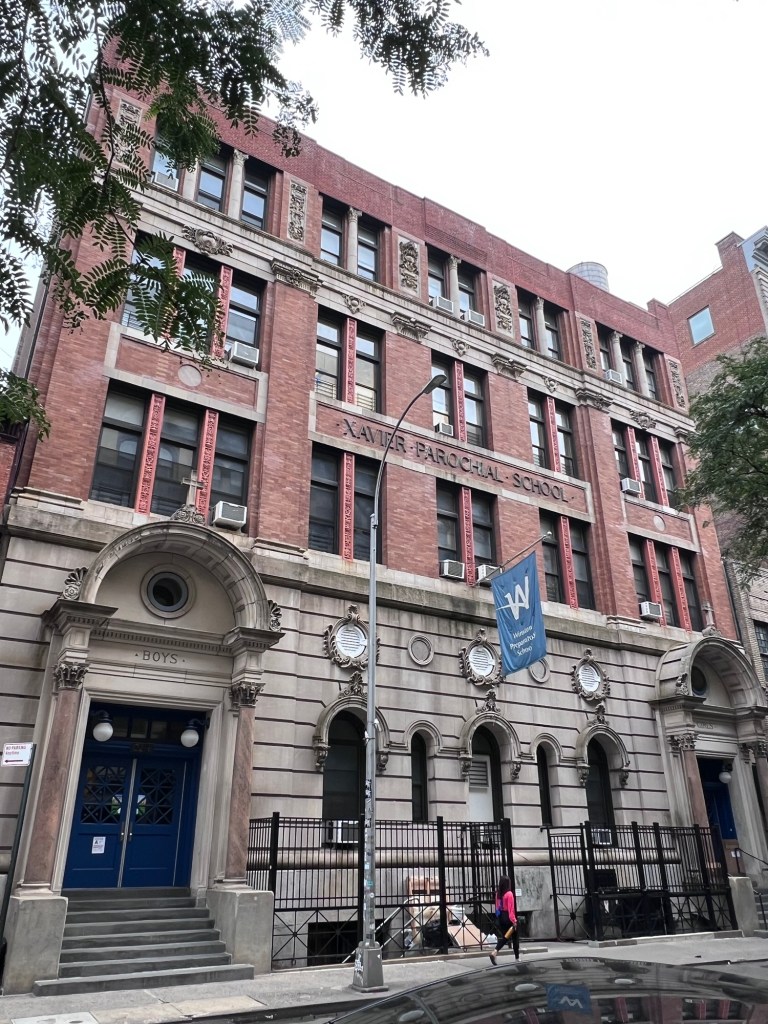
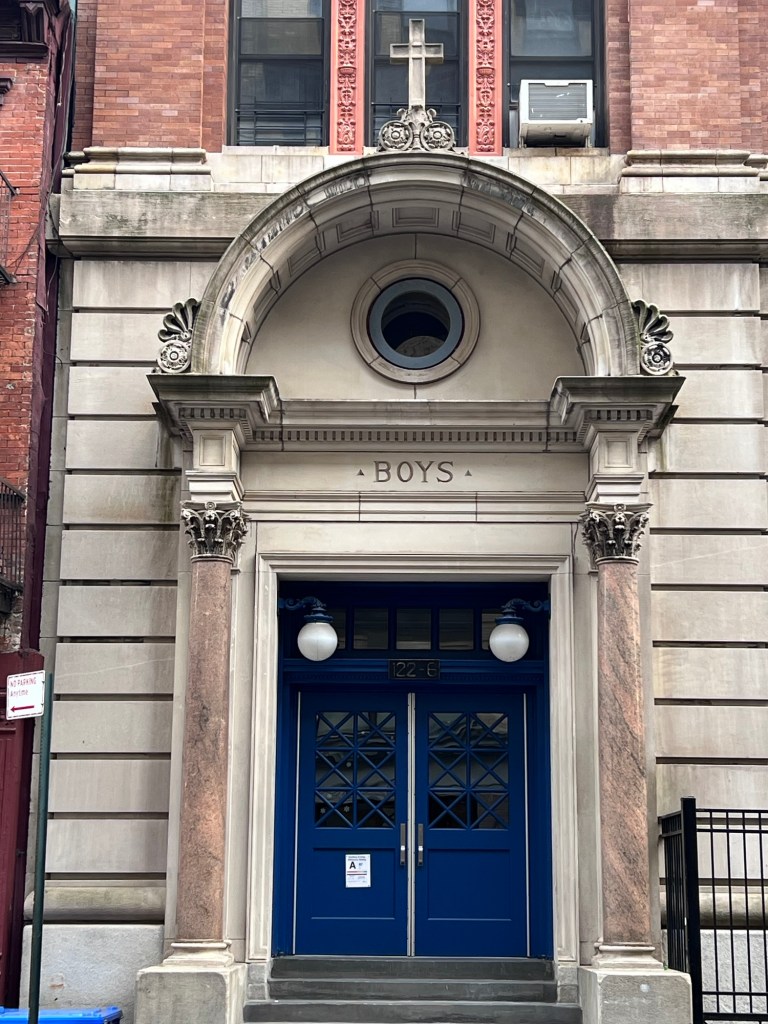
One of the most beautiful buildings on the block is the old Xavier Parochial School now the Winston Preparatory School at 126 West 17th Street. The details on the school are so beautiful and it still has the original entrances of one for Boys and one for Girl’s.
The Winston Preparatory School at 126 West 17th Street
The building at 128 West 17th Street was built around 1853 and had once served as the Xavier Parochial School and now houses the Winston Preparatory School (Wiki).
The old Boys entrance
The old Girl’s entrance
All along the buildings in Chelsea there are the interesting embellishments that stare, surprise and snarl at you. You just have to put down that cellphone and look up.
The top of the building had many snarling tigers staring out into space
Embellishment on the top of the building
The embellishments on the top of the building
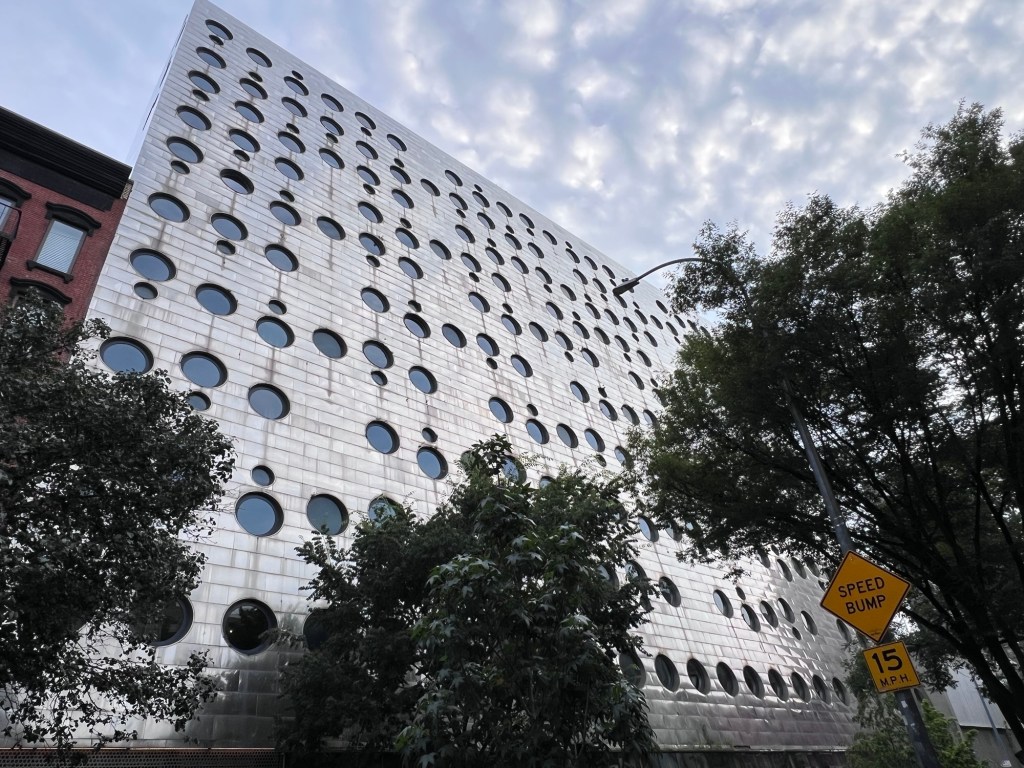
Another building that stood was futuristic structure with all sorts of pot holes. This is the former Maritime Union Building that is now the Dream Hotel. It was once part of a series of three buildings that was part of the National Maritime Union. When the Union folded due to lack of membership as industry changed, the building was left empty. The building designed byBronx-born but New Orleans-based architect Albert C. Ledner in 1966 (New Yorkitecture 2015).
When I walked to the end of the block and turned back, it took a look across the street to the Robert Fulton Houses playground and saw the most creative and unusual set of plantings along the wall. I could not find on the artist on these works (but I will keep looking). These are fun!
The paintings in the Robert Fulton figure
This series of paintings was behind the water fountain along the back wall of the park.
The close up of the third painting in the series
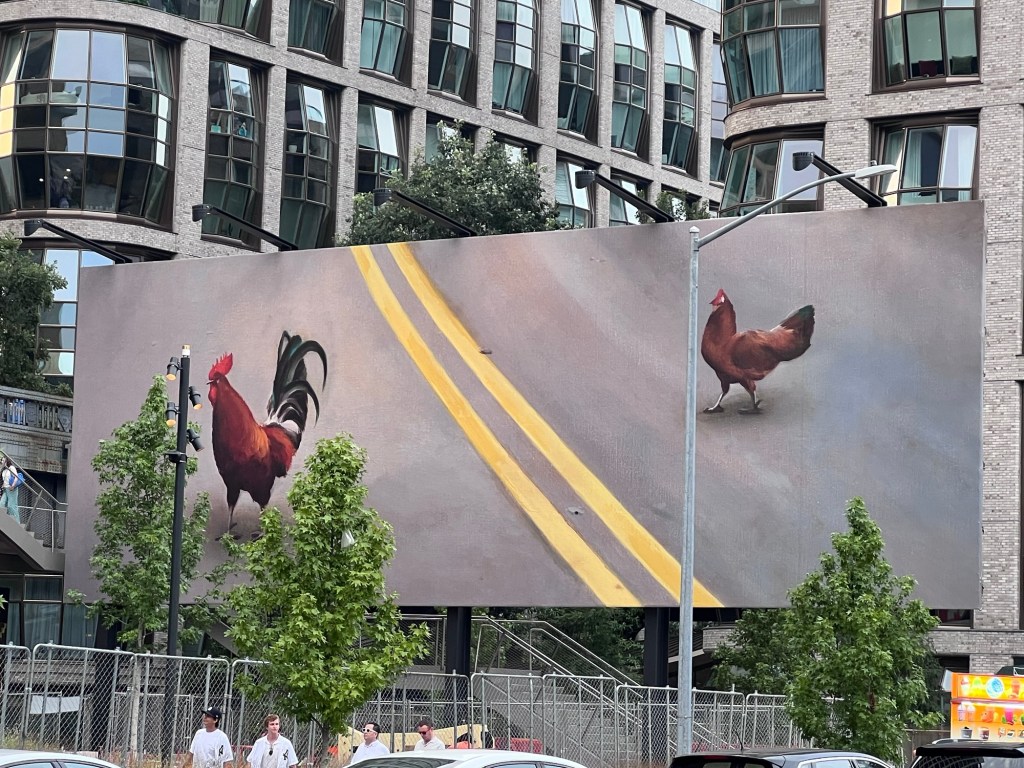
This painting of the Chicken crossing the road “Don’t Ask” by Artist Allison Katz. It seemed to replace the Pink Panther mural of a few weeks ago.
Artist Allison Katz presents Don’t ASK. On this monumental scale, a rooster and hen are depicted in the middle of an asphalt street, seemingly bringing to life the classic anti-joke, “why did the chicken cross the road?” (High Line.org).
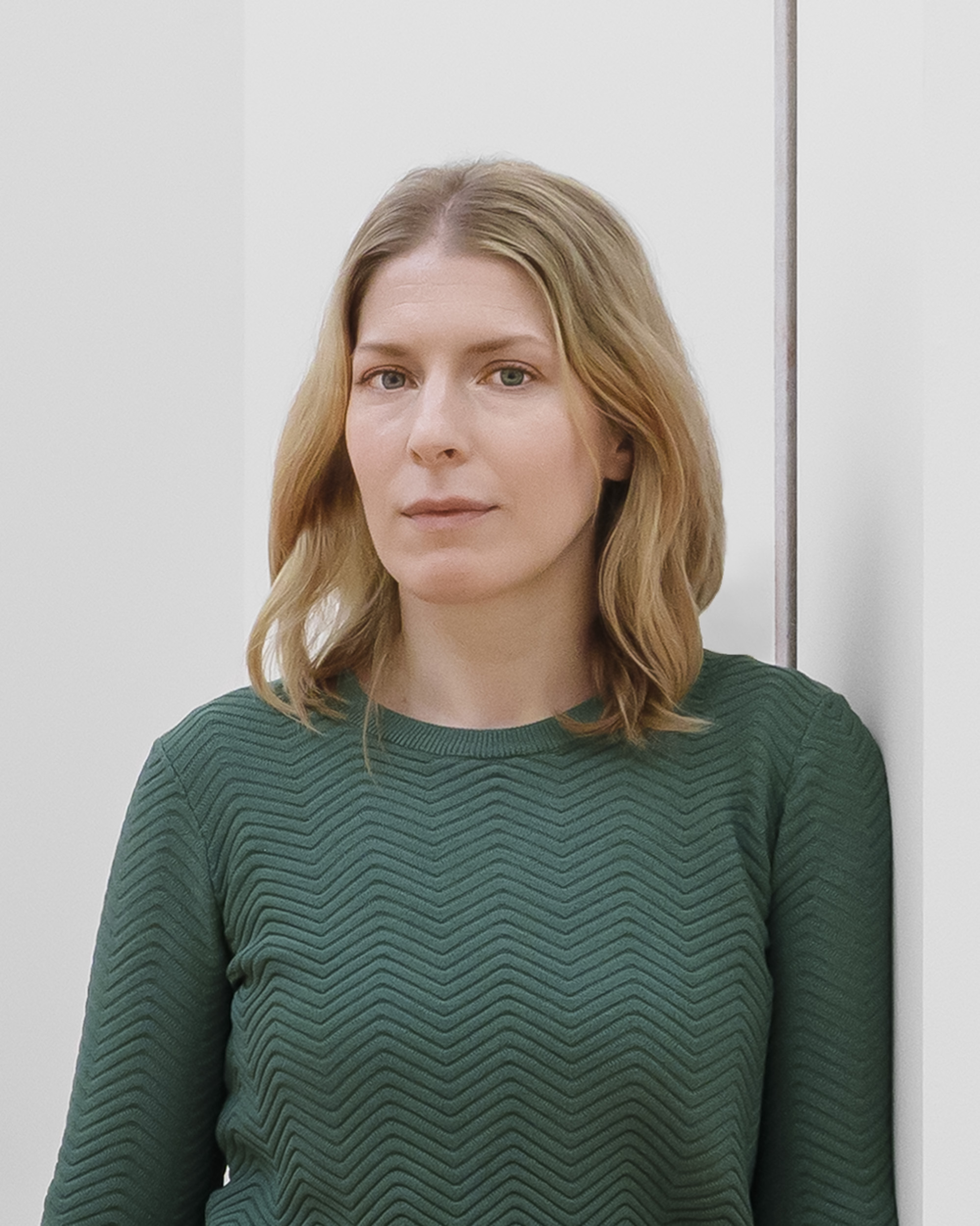
Artist Allison Katz is Canadian born artist who now lives in London, England. She studied Fine Arts at Concordia University in Montreal and received her MFA from Columbia University in New York. Katz’s work investigates the ways in which aesthetic practices link and absorb autobiography, information systems, graphic icons, and art history (Ago.ca).
At the very end of the road, West 17th Street turned into a cobblestone street and you do not see much of this anymore in Manhattan.
Walking back from Tenth Avenue, I saw the street art from a different angle and I could see the street art peaking out from behind the fence.
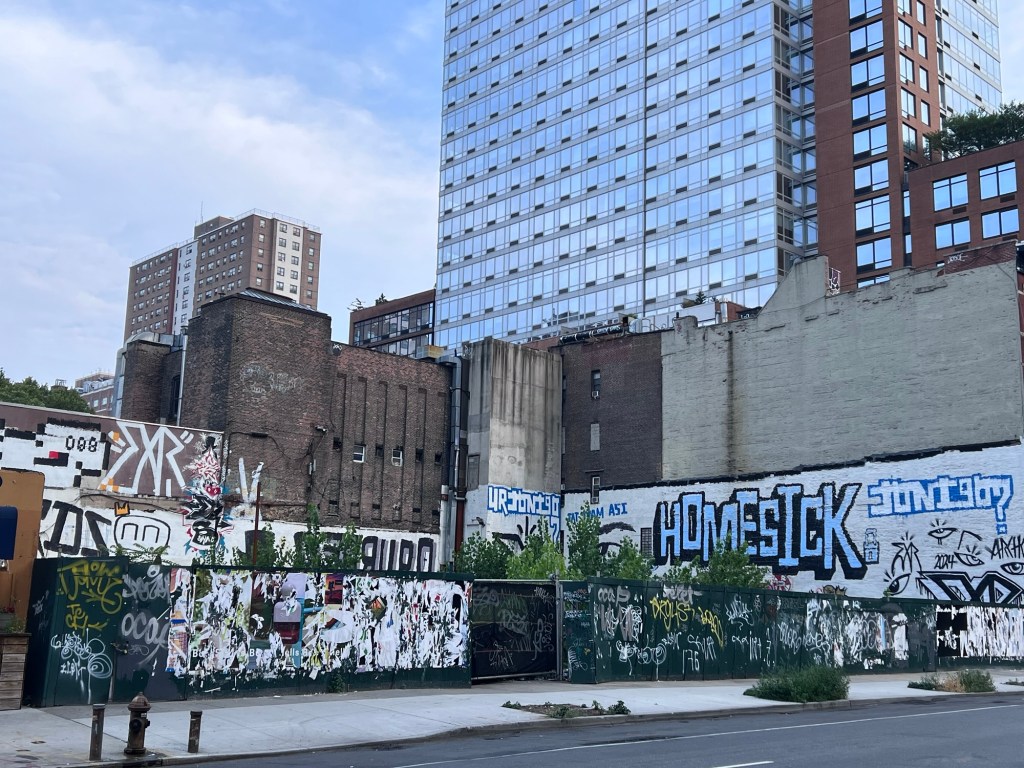
The street art in the empty lot along 20th Avenue
There was something unique about this tiny garden just off 10th Avenue
Another face staring out at me
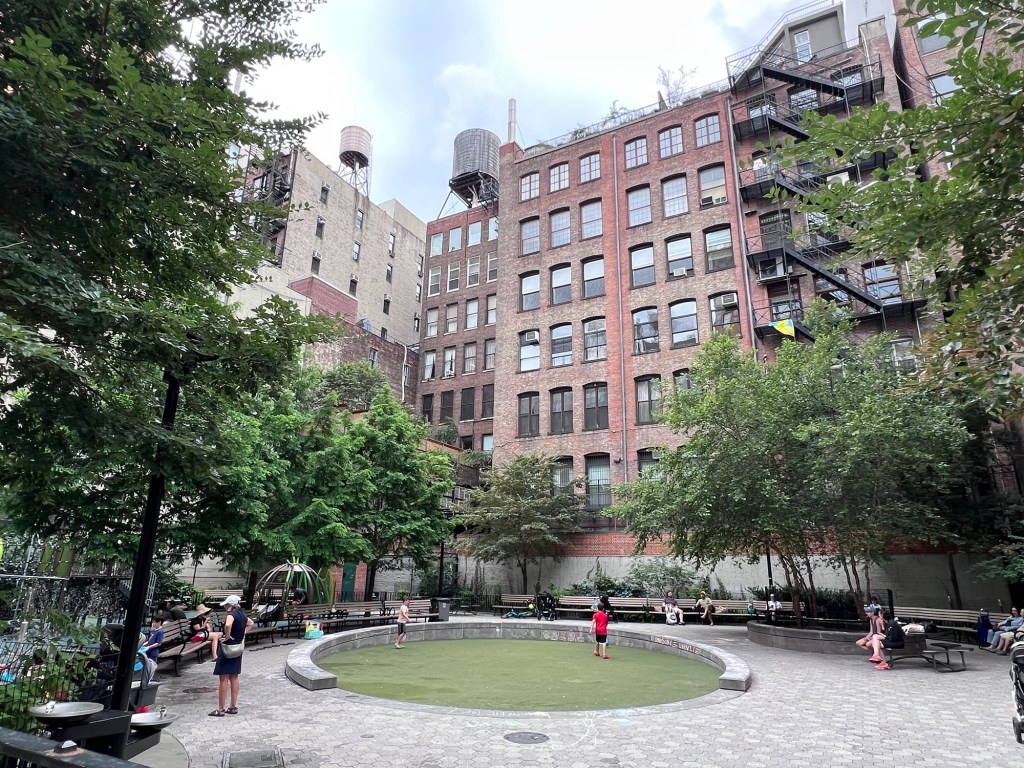
There was another small park on this block to relax and cool off too. The Dr. Gertrude Kelly Park is another patch of green where residents were relaxing that afternoon.
It was nice to be able to sit under a shade tree and just relax. Though it was not as hot as previous days, it got warmer in the late afternoon.
The inside of Dr. Gertrude B. Kelly Park on hot afternoon
The park goes through the two blocks
On the way back to Sixth Avenue, I passed the back of the old Siegel-Cooper Department Store warehouse building that is now the Room & Board store. The same beautiful details were on both sides of the building.
The Seigel-Cooper Warehouse Building
Here and there I kept seeing such interesting street art along the walls and corners of buildings all over the neighborhood.
This interesting looking ‘PAC Man’ figure was on one of the walls of a building on the block
The last building I passed was the Rubin Museum which was closed that day. I had not been there in over a decade and remembered that it did have very interesting art. I had not realized that the museum had closed its doors in the Fall of 2024. It closed October 6th, 2024.
The Rubin Museum at 140 West 17th Street (Closed in October 2024)
The Rubin Museum of Himalayan Art (formerly Rubin Museum of Art) was founded in 2004 as a haven for Himalayan art in the Chelsea neighborhood of New York City by Shelley and Donald Rubin, who are philanthropists, cultural leaders, and collectors. The opening was the culmination of 30 years of art collecting, six years of planning, and the purchase and renovation of the former Barneys department store (Rubin Museum website-Museum Closed in October 2024).
As I exited West 17th Street to finish my walk of this part of the Chelsea neighborhood, I came across this interesting piece of street art on Seventh Avenue. It always amazes me with people on what they can create.
This was on the wall of an empty store on Seventh Avenue
On my last day walking around the lower part of the neighborhood, the temperature hit 96 degrees and the humidity was worse. Since I only had to walk from Sixth to Eleventh Avenues from 15th to 16th Streets, I thought it would take about an hour. Throw in lunch and a dessert break and it was two and a half hours in the heat.
Starting the walk at the corner of West 16th Street and Sixth Avenue
The tree lined blocks between Sixth and Seventh Avenues
Here and there the small gardens pop up with lots of colorful flowers
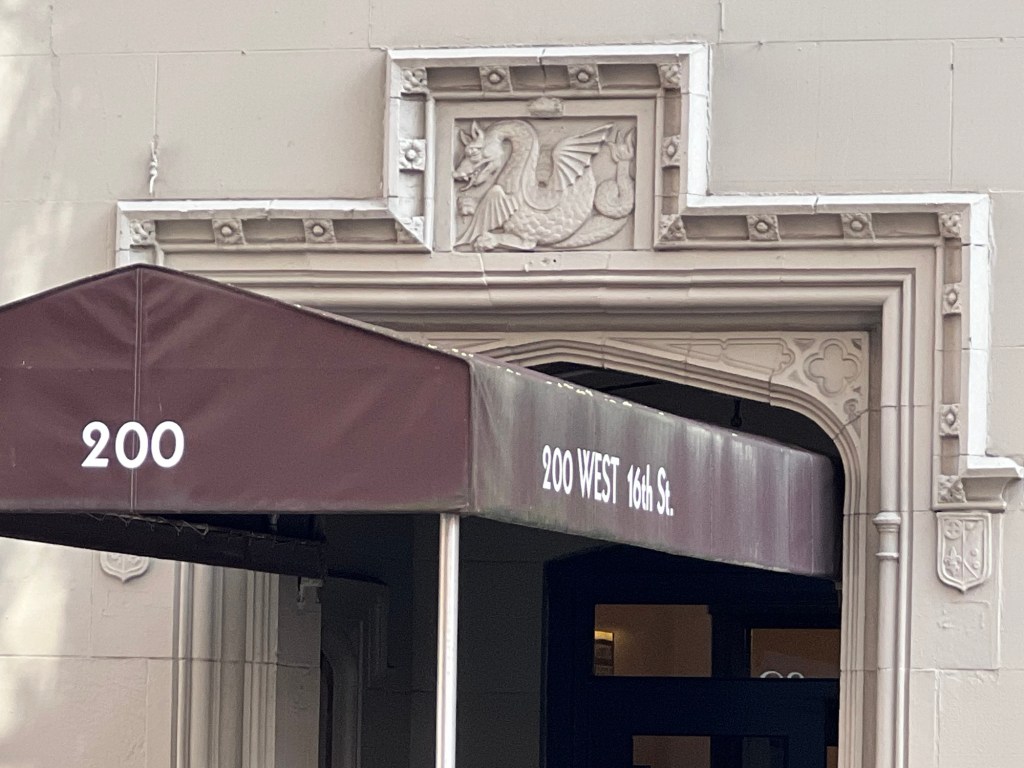
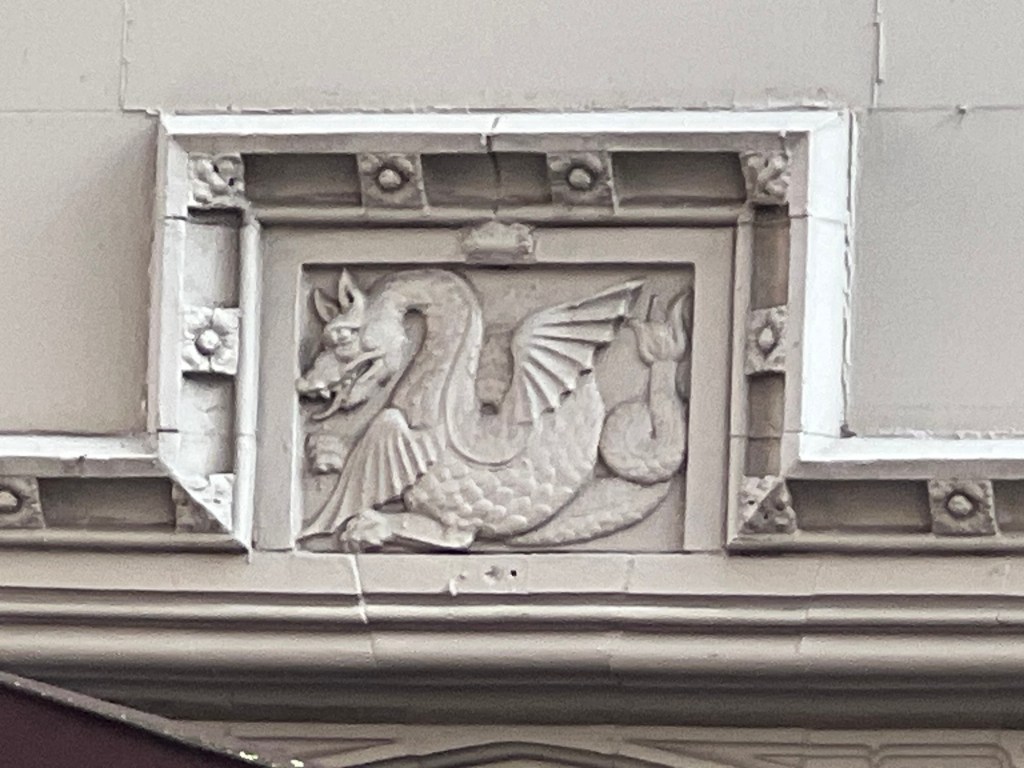
I loved this serpent carving at the entrance of 200 West 16th Street. The building was covered with all types of creatures.
t was the first of the four distinguished developments by visionary developer Henry Mandel and was designed by esteemed architects Farrar & Watmough. Farrar & Watmough harmoniously blended the Jazz Age and Gothic Revival styles creating a building with a visually striking and architecturally significant facade adorned with variegated orange brick, limestone and terracotta (Streeteasy.com)
The serpent above the doorway at 200 West 16th Street
I had to stop for some lunch and I came across a pizzeria that had been my ‘go-to’ since I started at NYU. I always enjoyed the specials for lunch and dinner. In just a year, the prices did go up a few dollars but the pizzeria is still reasonable.
J’s Pizza at 96 Seventh Avenue at the corner of Seventh Avenue and West 16th Street
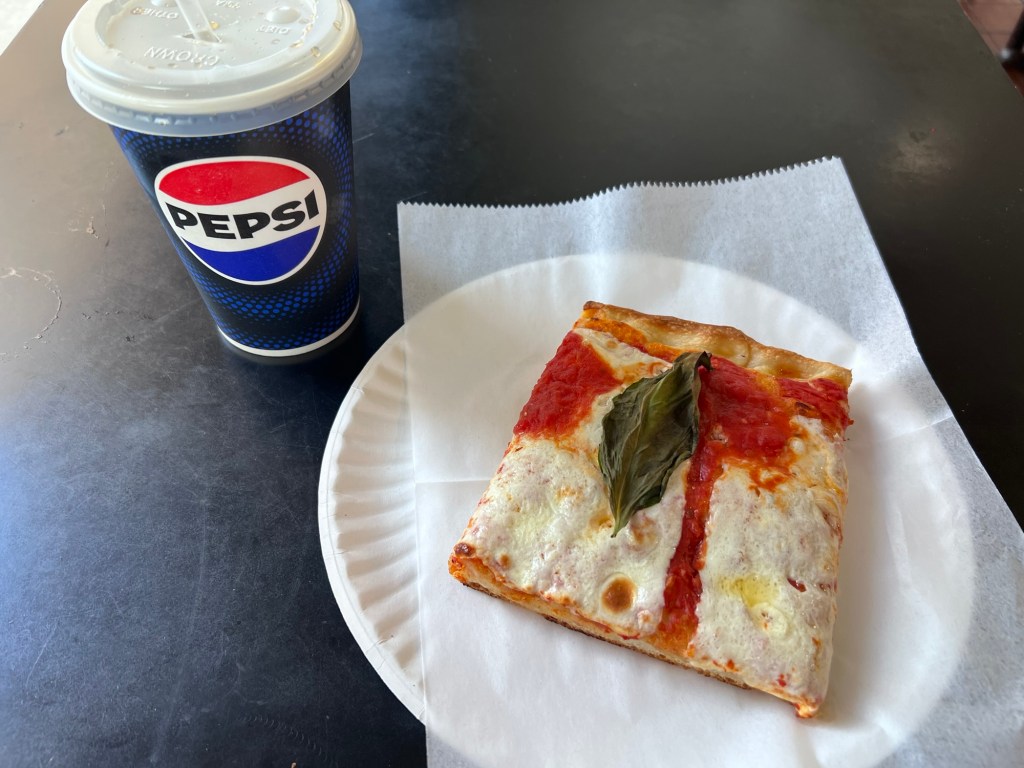
I stopped in at J’s Pizza for a quick lunch. I had not realized I had not eaten here since I had graduated from NYU in the middle of last year (did college fly by in the blink of an eye). I forgot how good their food was when I ordered my lunch. I had a slice of their Fresh Mozzarella Sicilian pizza and a Coke and it hit the spot on this hot day.
My Sicilian slice
What a great lunch and a nice break
I continued my walk down West 16th Street passing businesses and homes and noticing the changes in the neighborhood with renovations and new buildings going up. More and more this particular neighborhood is getting very desirable and the homes more expensive.
The embellishments outside of 224 West 16th Street
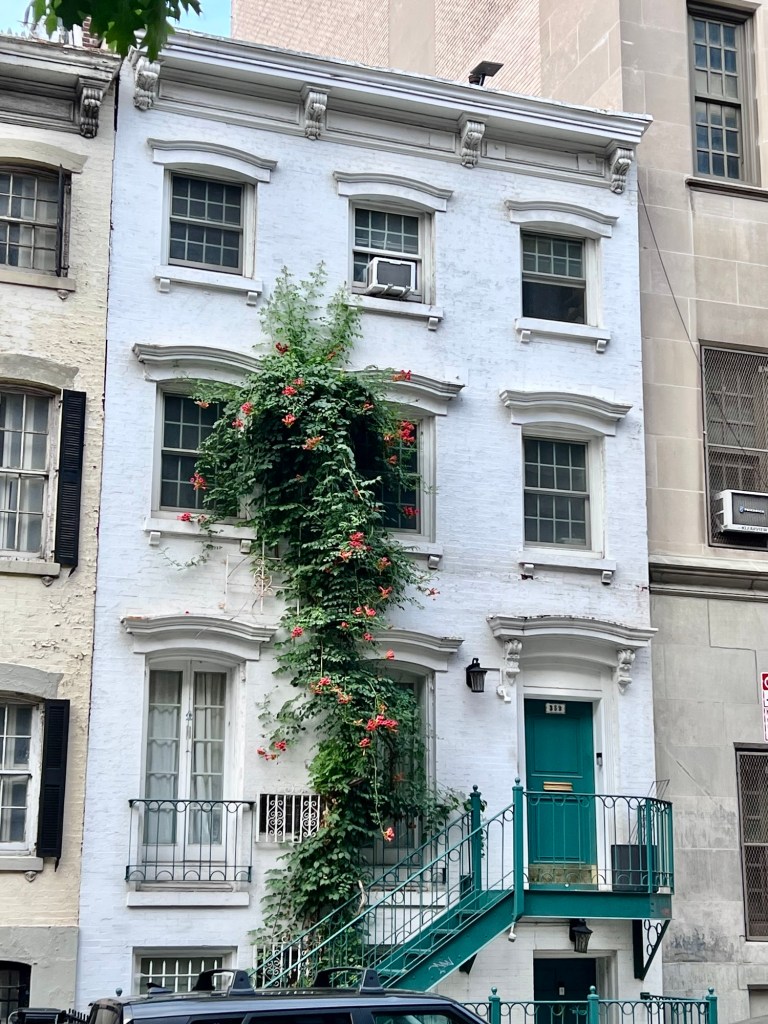
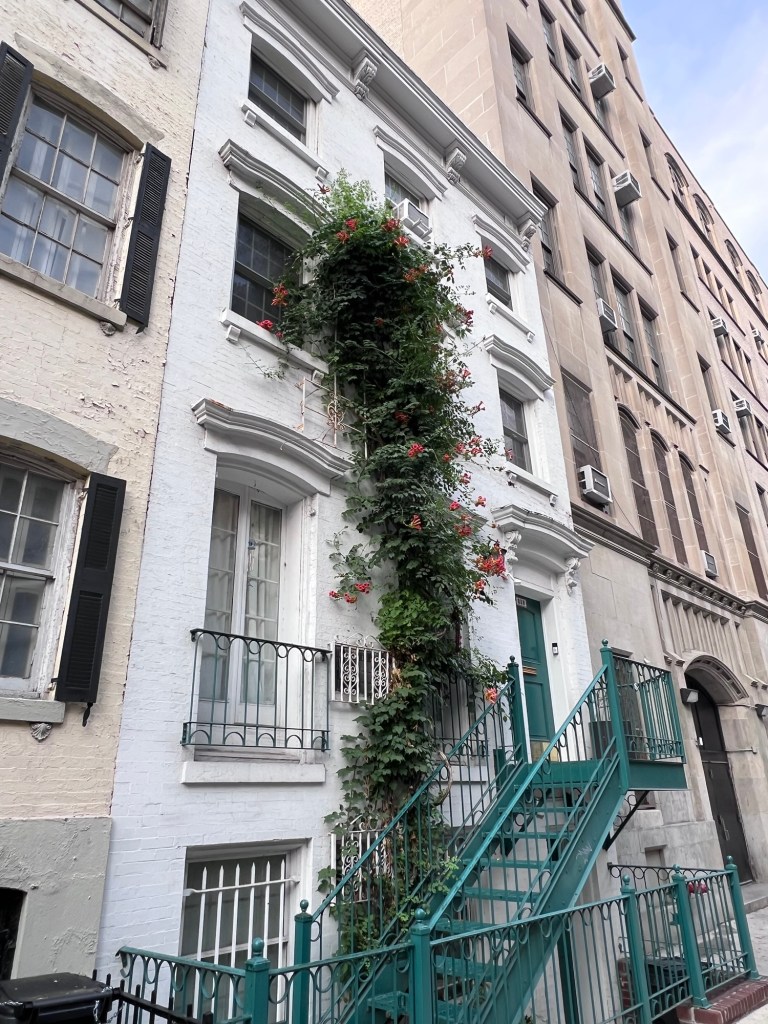
This interesting pre-war building was built in 1800’s (Streeteasy.com). By the mid-1840’s Timothy Phelan and his family lived in the three story, brick-faced house at 197 West 16th Street (renumbered 319 in 1859), just west of Eighth Avenue. Twenty-five feet wide, its dignified Greek Revival design reflected influences of the emerging Italianate, notably in the understated entrance above a stone stoop (DaytonianinNYC.com)
The stonework in more detail
The end of the block is dominated by the Marine Hotel and its series of high end restaurants
The Marine Hotel with its restaurant, Tao Downtown is in front
Then I saw this very unusual street art right by the Fulton Houses
The High Line Park dominates over this part of the neighborhood with its lush plantings and its interesting display of artwork. Try to walk the distance on the walkways of this incredible urban park.
As I was walking back up the street, I noticed a whole building of faces following me along the sides of 111-114 Eleventh Avenue. You have to look really closely to see the changes by each window.
Along Eleventh Avenue I had not noticed this building at all
You have to look at each window and doorway from across the street to really appreciate the beauty of this building.
The last of art that I saw on the block was this mural for the Bond Vet business around the corner by artist Jade Purple Brown. I thought the colors were so vibrant and that it really promoted this business well.
Jade Purple Brown is a Brooklyn based artist known for her vibrant portrayals of Black women in psychedelic, dreamlike worlds (Artist bio on website).
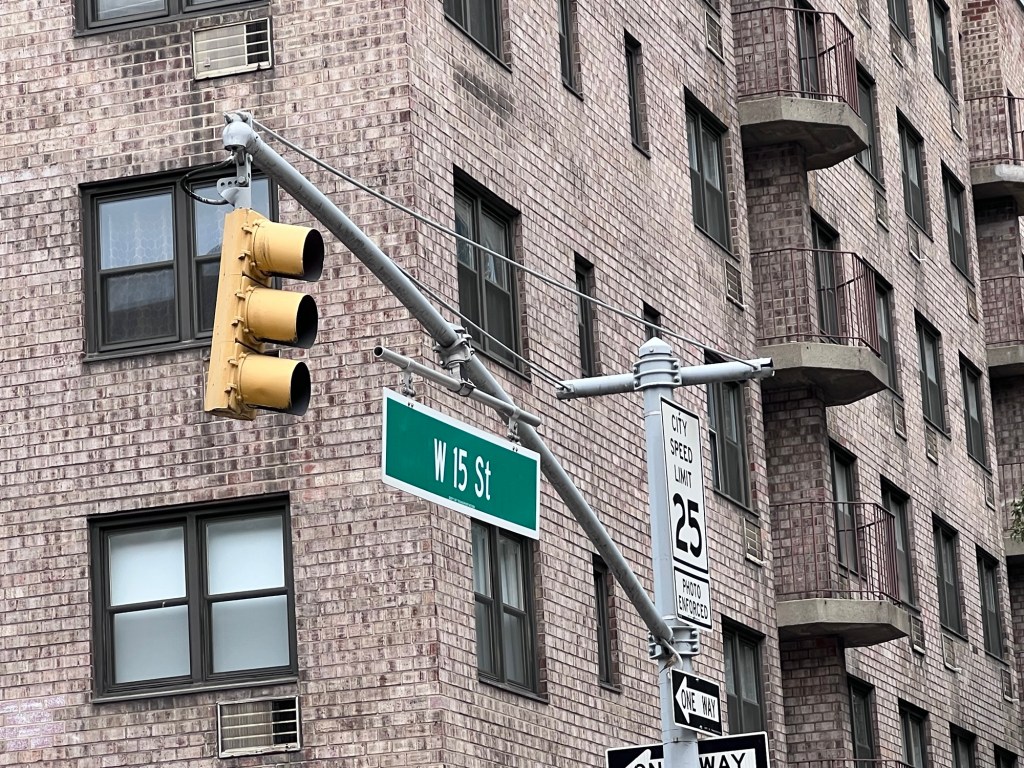
I finally rounded West 15th and Sixth Avenue in the late afternoon and breathed a sigh of relief as it was getting so hot out.
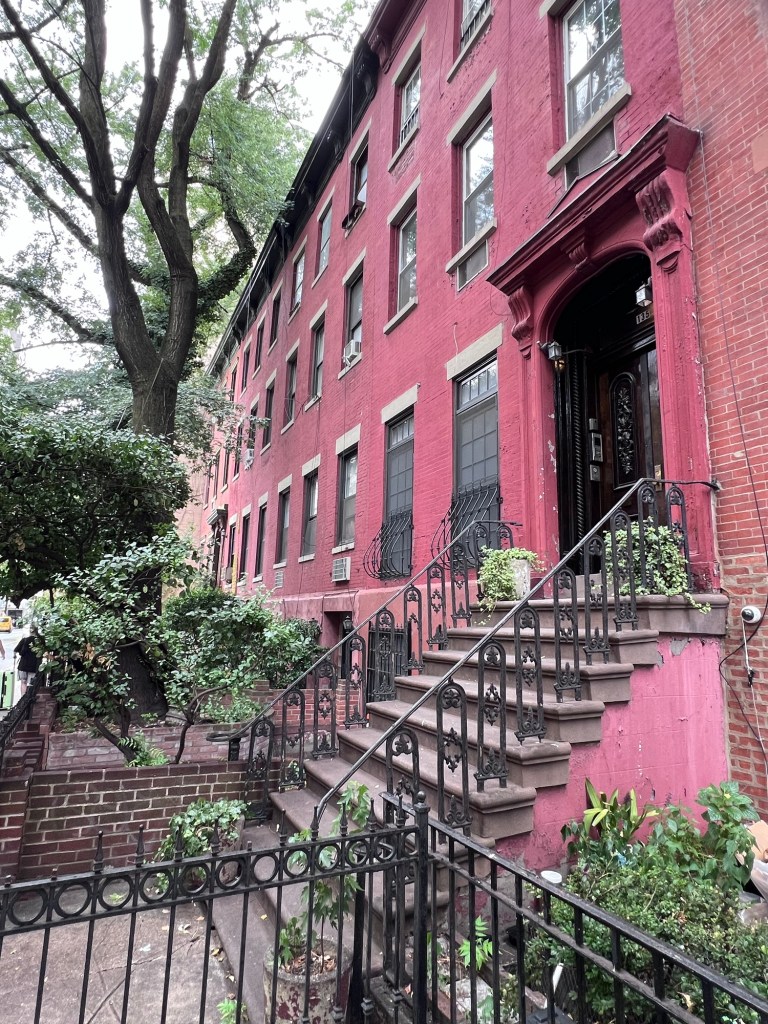
Reaching West 15th Street and the edge of both Lower Chelsea and the Meatpacking District at the end of a hot afternoon. There was a picturesque view of old New York between Sixth and Seventh Avenues. More tree lined blocks with brick townhouses.
The Old Nee York look about the blocks in Chelsea
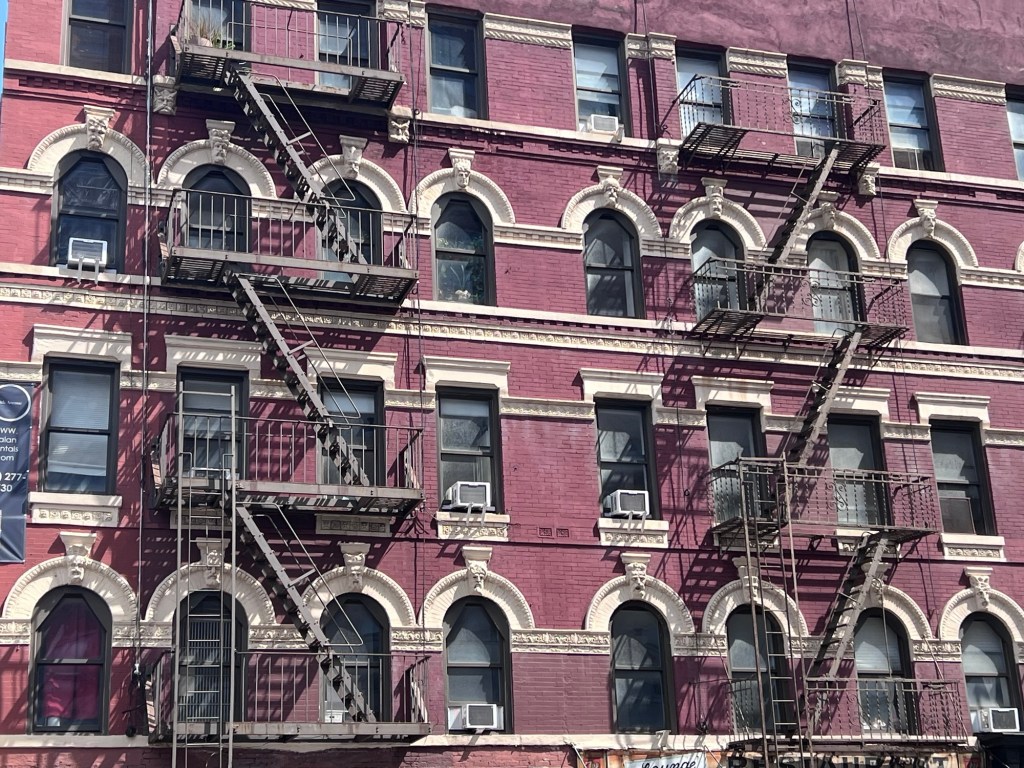
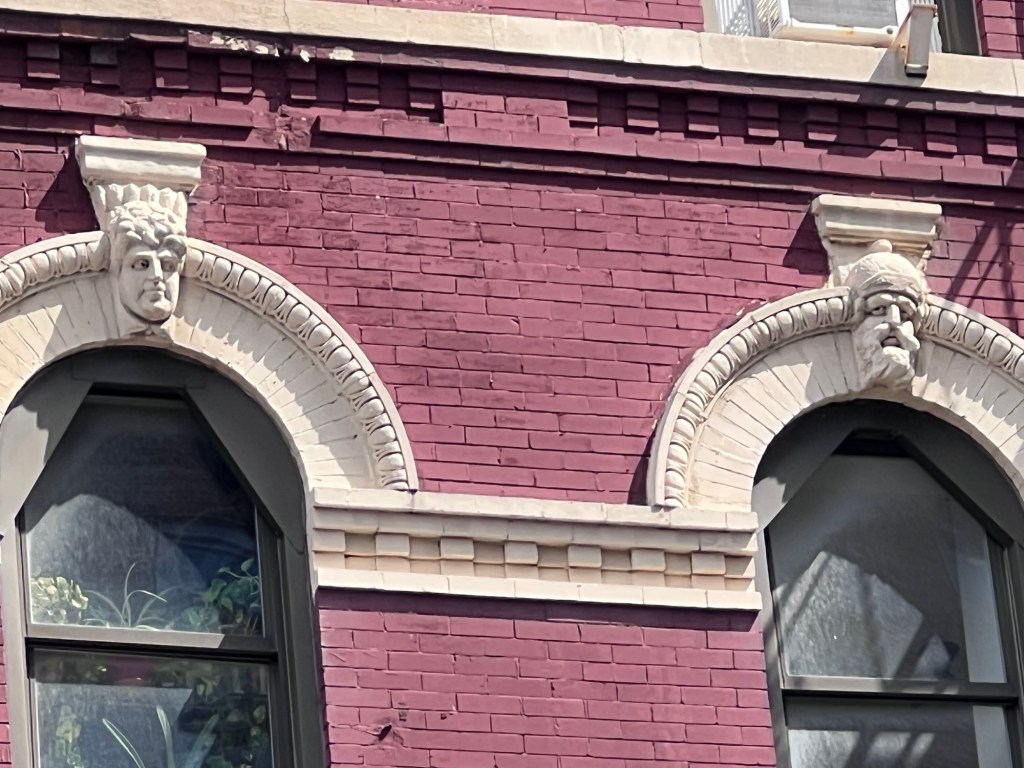
Here and there tucked within dome of plain brick and brownstone homes, interesting carvings and embellishments can be found.
Decorated below the windows of 229 West 15th Street, I saw these interesting carvings staring back at me.
This unique pre-war building was built in 1901 (Streeteasy.com)
Face number one staring back with an evil look
Face number two just as evil
As I walked down the street, a French flag and the colors of France when I passed La Sandwicherie Chelsea, which I found out later had two small sister restaurants. I saw these festive signs for crepes and sandwiches, I stopped in to take a peek.
I was still a little stuffed from the pizza but thought a crepe might be nice to tide me through the rest of the evening.
The front of La Sandwicherie Chelsea at 239 West 15th Street
The selling point was the sign. It did remind me of Paris
The sandwiches sounded interesting too
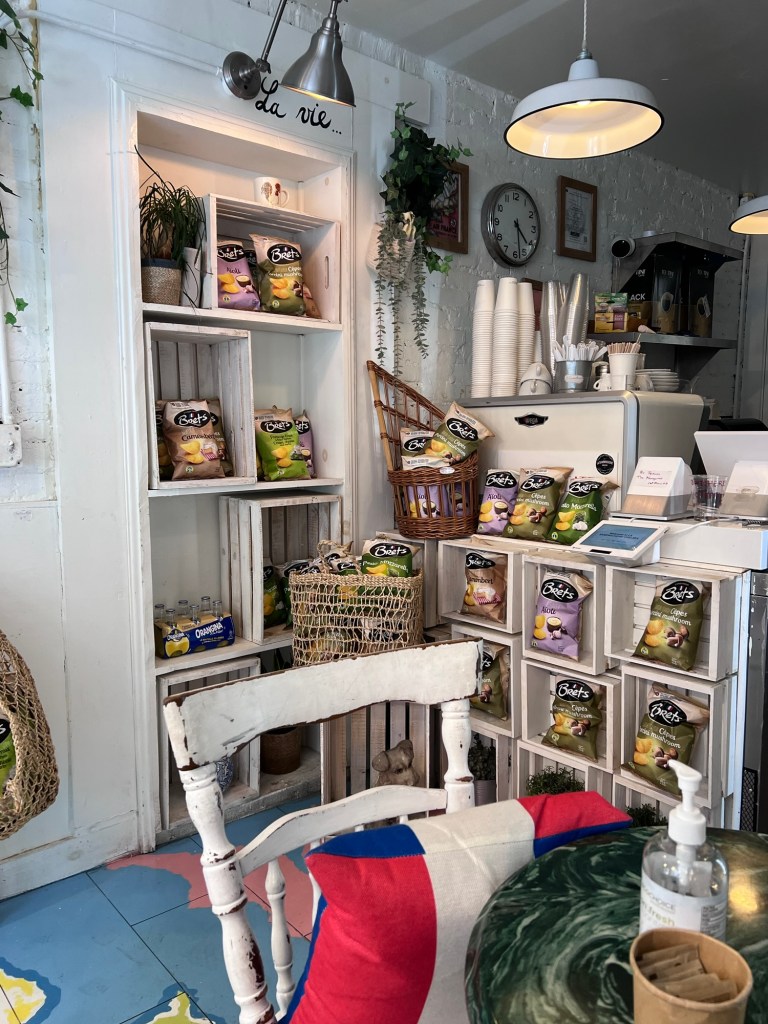
I stopped inside and I swear I was back in Paris again with the tiny chairs and tables and the French music. I was not thrilled that the price was higher inside but only by a dollar and the manager explained it to me. I was still in the mood for that crepe.
The inside of the restaurant brought me right back to Paris
The shelves were lined with the wonderful French potato chips I had tried at the food show
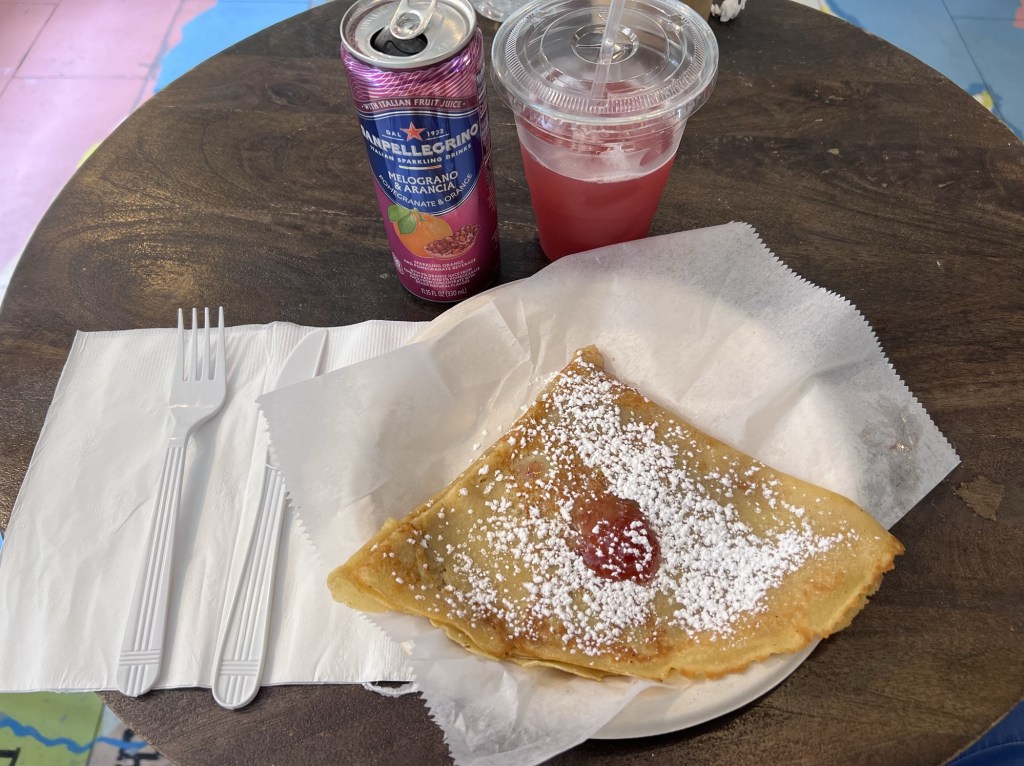
I ordered a Strawberry Crepe, which was a freshly made crepe( he even showed me the crepe batter to prove it), which was filled with strawberry jam and topped with sugar. I ordered a Pomegranate soda to have with my dessert.
The Strawberry Crepe with my soda
Yum!
Now having some more carbs and sugar to wear off, I started back down West 15th Street happy and content. The crepe brought back a lot of memories of my trip to Paris two summers ago.
I continued my walk down West 15th Street with more pairs of eyes watching me at the buildings.
What I love about this building is the extensive embellishment of faces and curvatures throughout the front of the building. Faces stare at you from all directions and passing judgement right by the front door. You have to look up and down to really appreciate this building.
There is emended detail to building
The faces staring back
Don’t pass judgement
The sister building next door at 251 West 15th Street had just as many details.
At Stonehenge Gardens, travel through the private gate and along the walkway where you will find this gem of a building setback between 14th and 15th streets. Built in 1950, this six-story building is located in the center of Manhattan’s trendiest downtown neighborhoods: Chelsea, the West Village and Union Square (From the Stonehenge website).
The private gate and gardens were locked when I was visiting the neighborhood but you could see how beautiful it was right behind the gate.
Finishing my walk down West 15th Street
The Jazz Concert that evening at the Brooklyn Botanic Gardens:
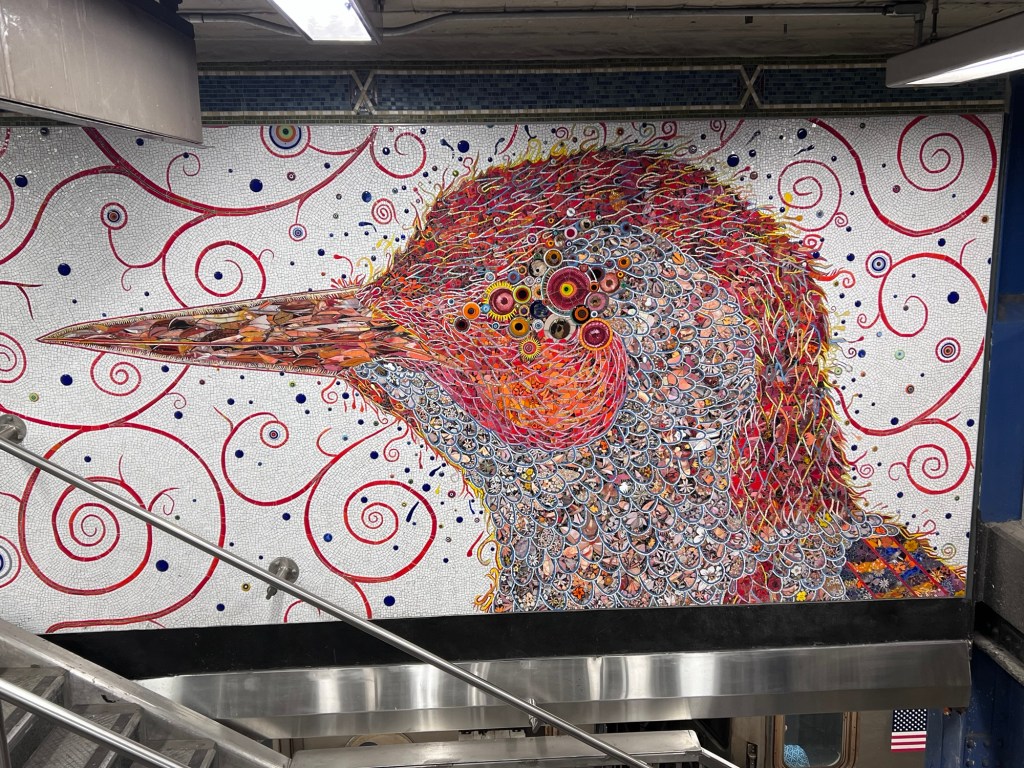
After I finished the streets of Lower Chelsea, I took the subway to Brooklyn for a Jazz Concert at the Brooklyn Botanic Gardens. On the way to the subway, I noticed these two mosaics on the wall of the subway platform. What interesting work by Brooklyn based artist Fred Tomaselli entitled “Wild Things”. These gorgeous and colorful works flank both the upstairs and downstairs of the subway station
Artist Fred Tomaselli is an American born artist best known for his highly detailed paintings on wood panels, combining an array of unorthodox materials suspended in a thick layer of clear, epoxy resin. He studied at California State University and his studio is in Brooklyn (Wiki).
It was a quick subway ride to the gardens on the express subway and I got there in record time . It was enough time to tour the gardens before the concert. The gardens were at their peak in the middle of the summer and everything was so green.
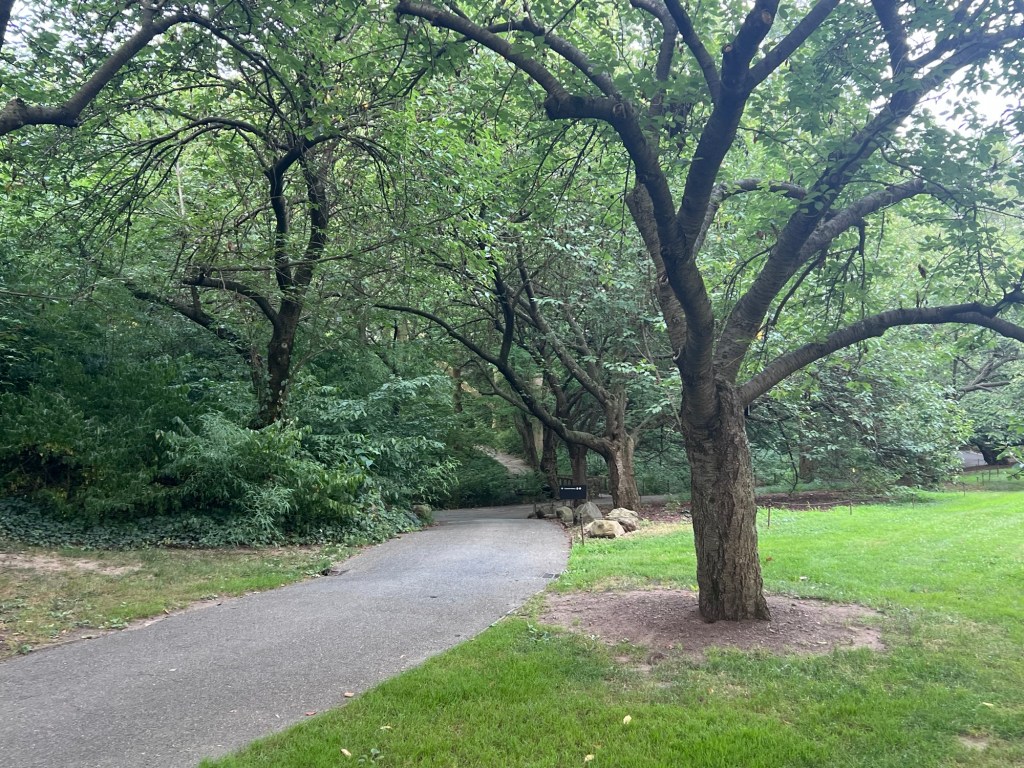
The lawn by the Cherry Bloom Gardens
The Cherry Bloom lawn is where the concerts are held
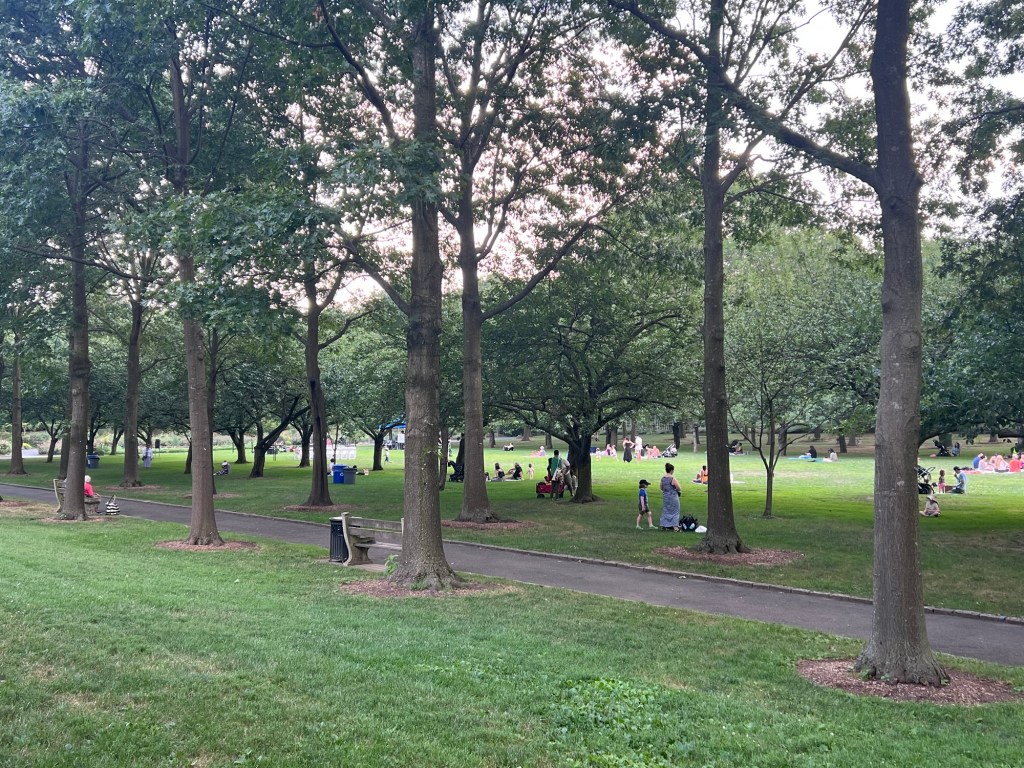
People getting ready for the concert
Members waiting on the lawn for the concert to begin
I was sunny and warm out when I got there and just about five minutes before they were supposed to start the concert, it poured for the next twenty minutes. They end up cancelling the concert again on me. The weather played havoc that evening.
The only problem was that the moment it stopped those twenty minutes later, the sun came back and it was beautiful as the musicians were packing up. I can tell everyone hoped they would have a change of heart. They kept packing up and I decided to walk around the gardens again. There would be one more concert in the future the next week.
It did clear up after it stopped raining
The sun rose over the Japanese Gardens
So for the next hour, I just wanted to walk around and admire the flowers and the garden beds.
It ended up being a nice night and the best way to end of evening.
Even though the concert was cancelled, it still was a nice evening and I did get my share of exercise. Even as the lights turned on in the Botanic Gardens, there is still such a magic of walking along the beds and admiring the flowers and the other plantings. You should not miss the gardens during any of the seasons. There is always something to see even in the dead of winter. The true beauty though is in the late Spring and early Summer when everything is in bloom.
It is especially nice when the museum is closed and you can visit the museum with all the other members in a private event just for us.
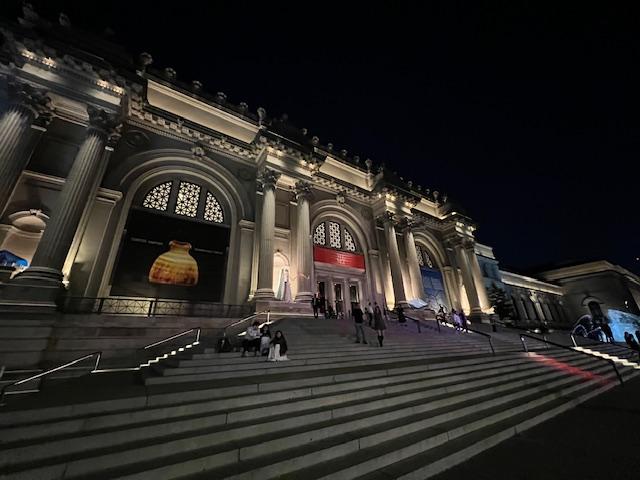
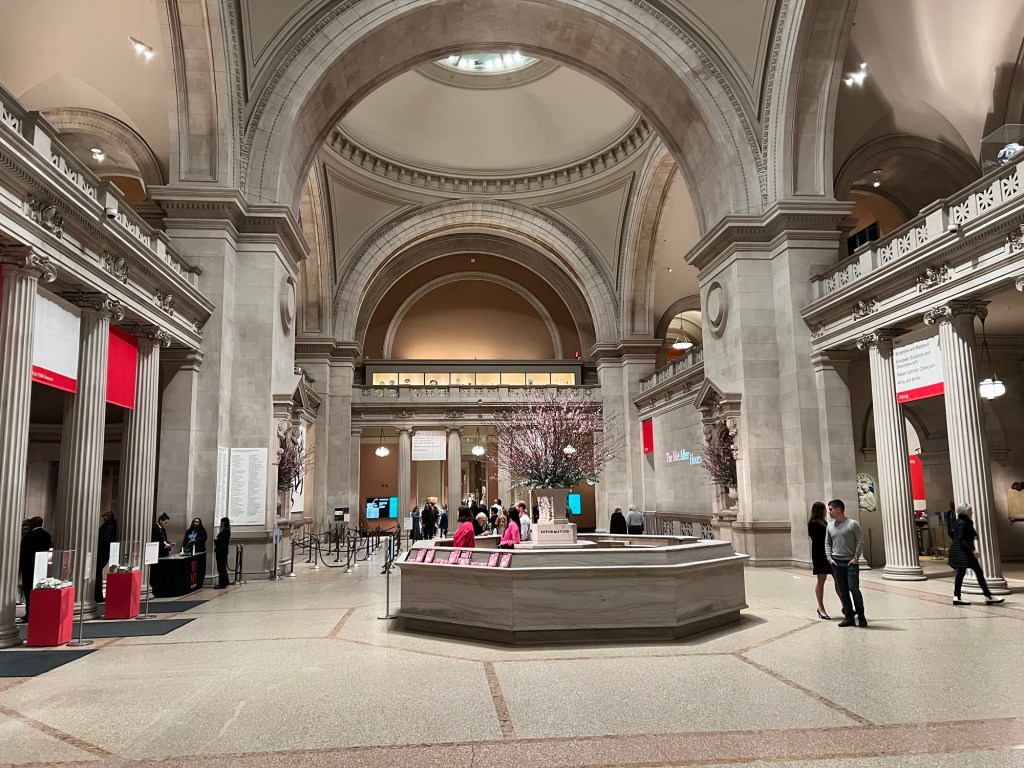
It was time for another ‘Met After Hours’ member event
I wait for these evenings as a member. It is so much fun to walk the halls of the Met after the museum closes and just relax, look at exhibitions that I might have missed on my last several trips to the museum, have a much needed cocktail (one specialty drink is more than enough) and enjoy listening to the speaker.
Entering the main hall of the museum
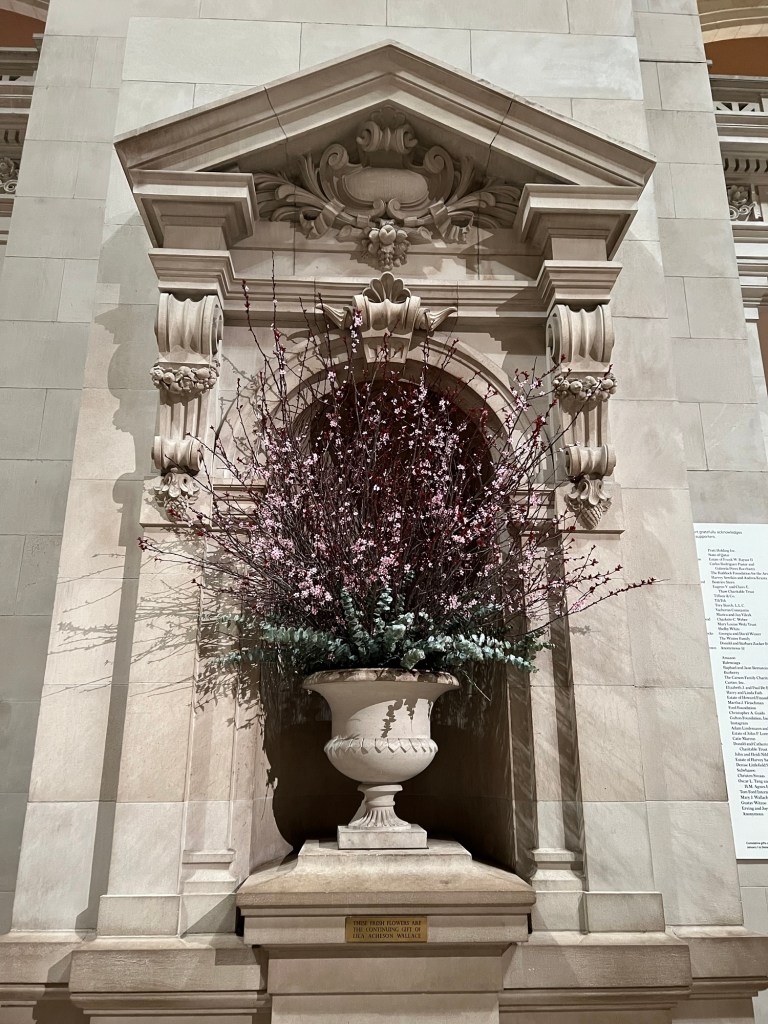
The beautiful Cherry Blossoms are in season in all the urns
Walking through the Greek Galleries on my way to the exhibitions that were open that evening
I decided to start on the second floor of the museum since most of the members seem to settle on the first floor. My first stop was the Jesse Krimes exhibition ’Corrections’.
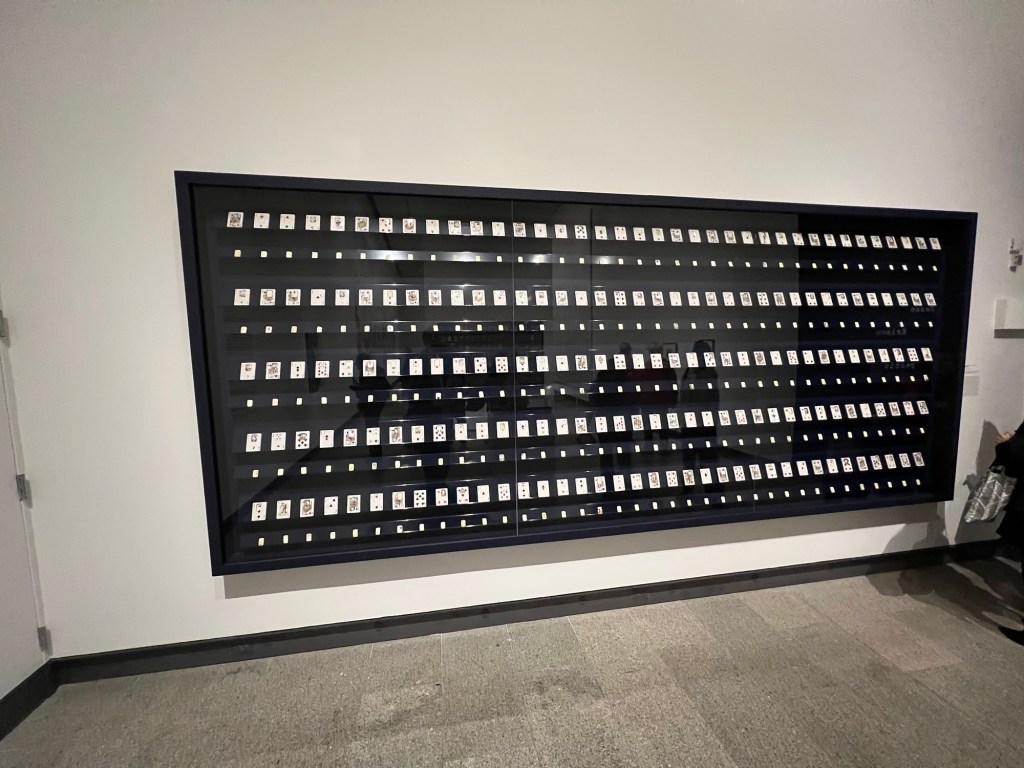
Krimes’s image-based installations, made over the course of his six-year incarceration, reflect the ingenuity of an artist working without access to traditional materials. Employing prison-issued soap, hair gel, playing cards, and newspaper he created works of art that seek to disrupt and recontextualize the circulation of photographs in the media (Met website).
Displayed at The Met in dialogue with Bertillon, whose pioneering method paired anthropomorphic measurements with photographs to produce the present-day mug shot, Krimes’s work raises questions about the perceived neutrality of our systems of identification and the hierarchies of social imbalance they create and reinscribe. An artist for whom collaboration and activism are vital, Krimes founded the Center for Art and Advocacy to highlight the talent and creative potential among individuals who have experienced incarceration and to support and improve outcomes for formerly incarcerated artists (Met website).
The description of the show ‘Jesse Krimes Corrections’
The art work ‘Purgatory’ where the artist put faces of the artist’s imagination while in solitary confinement.
The signage for the piece
The sculpture ‘Naxos’ with thousands of pebbles from prison yards
The signage for ‘Naxos’
I then toured through the Asian Galleries to see what exhibitions were open that evening. Some of the displays for Chinese New Year were still prominent in the galleries and I admired them in the cases.
This very evil looking statue just stares at you while you pass it
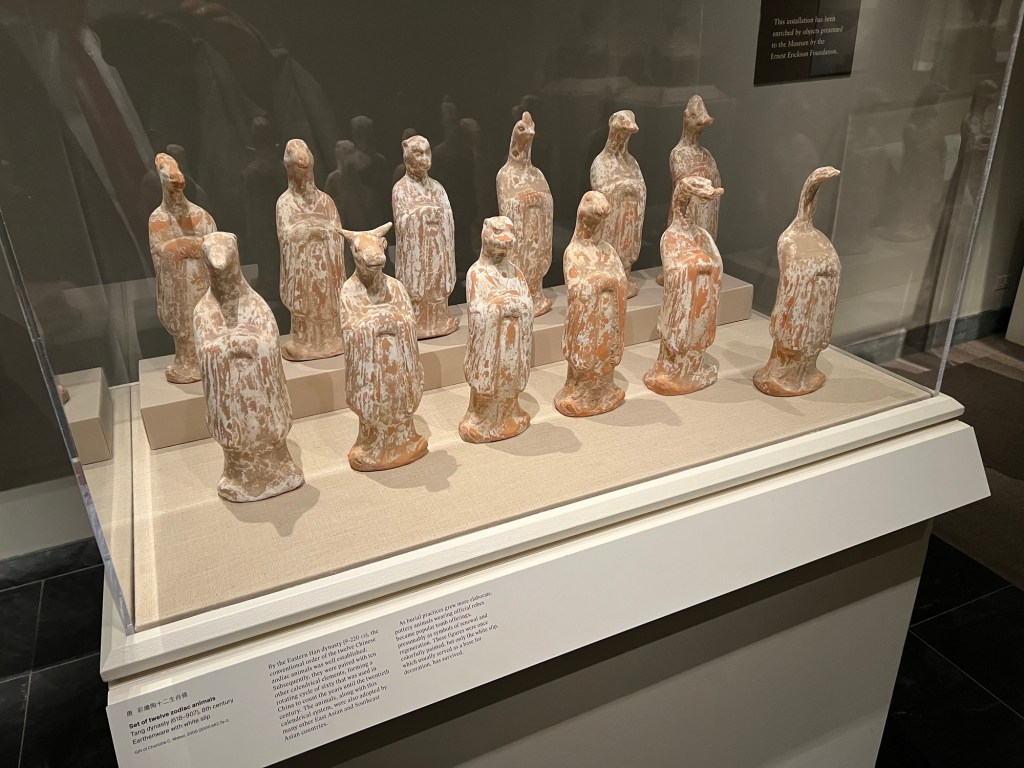
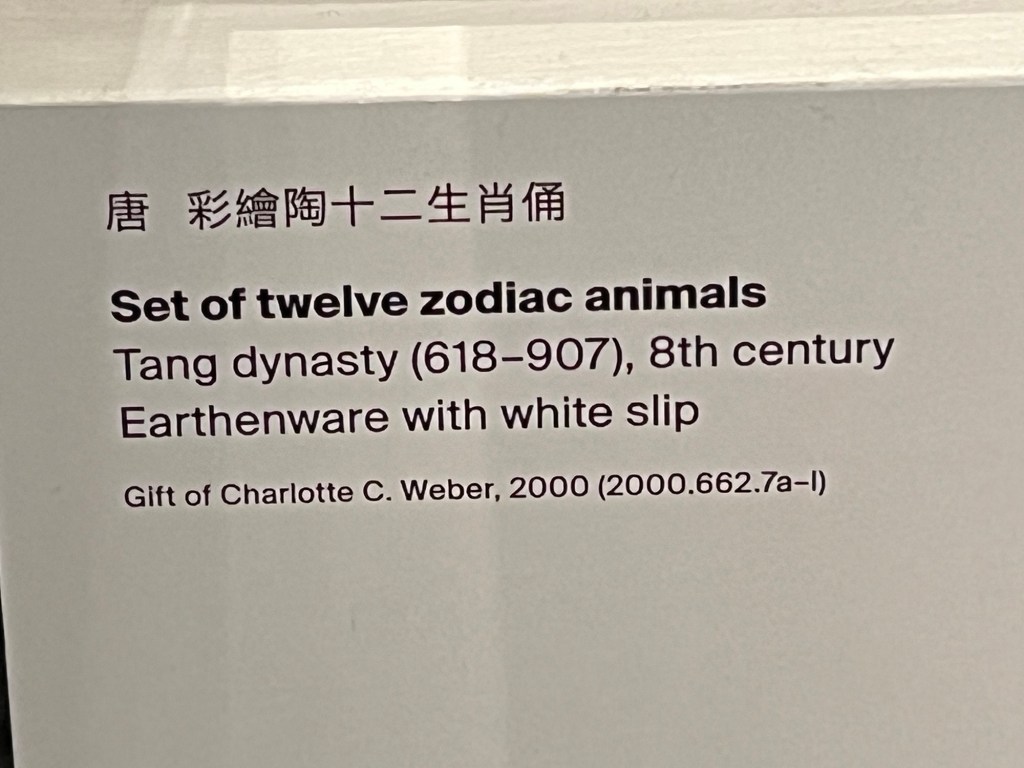
I admired the Chinese Zodiac sculptures in the Asian Wing and found my sculpture in the year of the Snake. Chinese New Year was over but the displays for the year of the Snake were still on display.
The sculptures of the Chinese Zodiac
The sign for the Zodiac animals
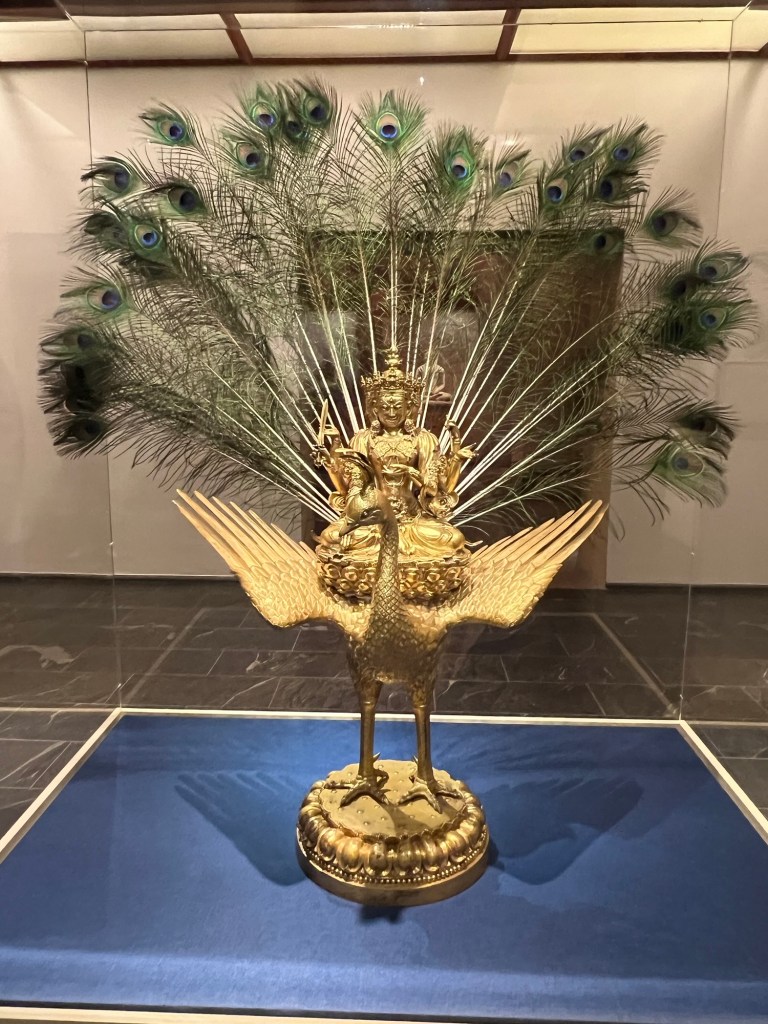
At the entrance to one of the galleries, one sculpture stood out to me that has been accented by peacock feathers.
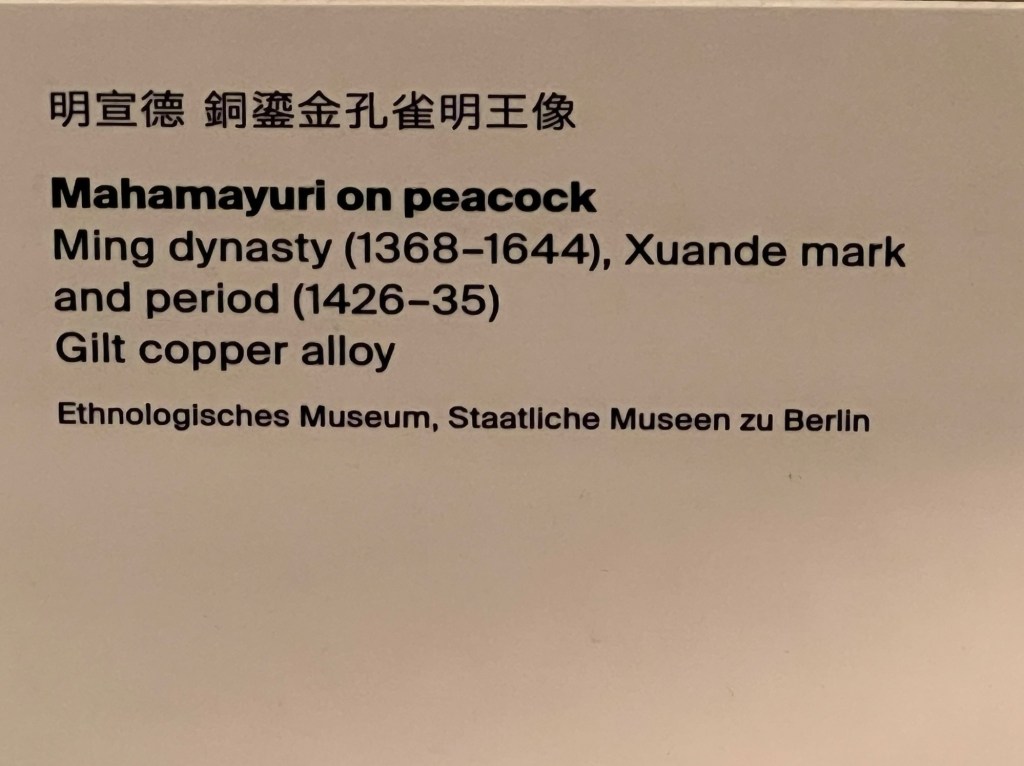
The peacock sculpture ‘Mahamayuri on Peacock’
The sign for the sculpture
The piece stood out for its grace and its beauty. There was something unique about it.
I then visited the other side of the floor that was open in the Arabic Wing. I had visited the gallery in length during one of the other member nights when they officially reopened. I love all the displays of rugs and decorative objects throughout the various rooms.
Walking through one of the rug gallery rooms
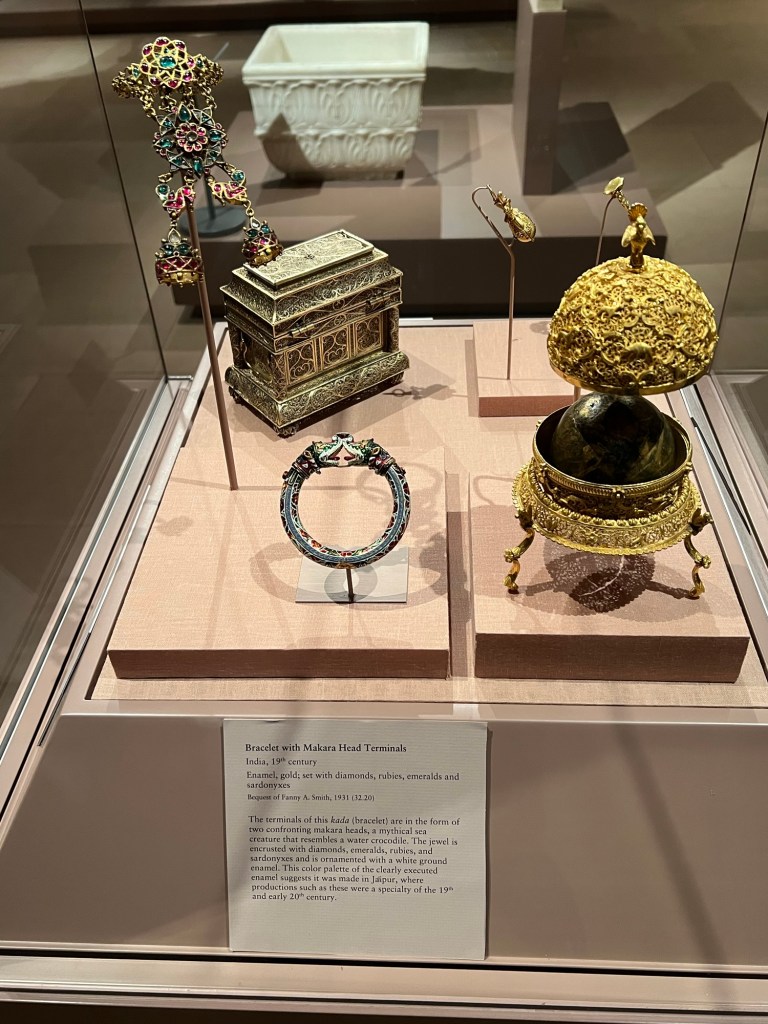
What I admire the most from some of these artisans is the approach to precious items like gold, silver and jewels in the works. You could really see the amazing detail to these works.
Several decorative items in the display case
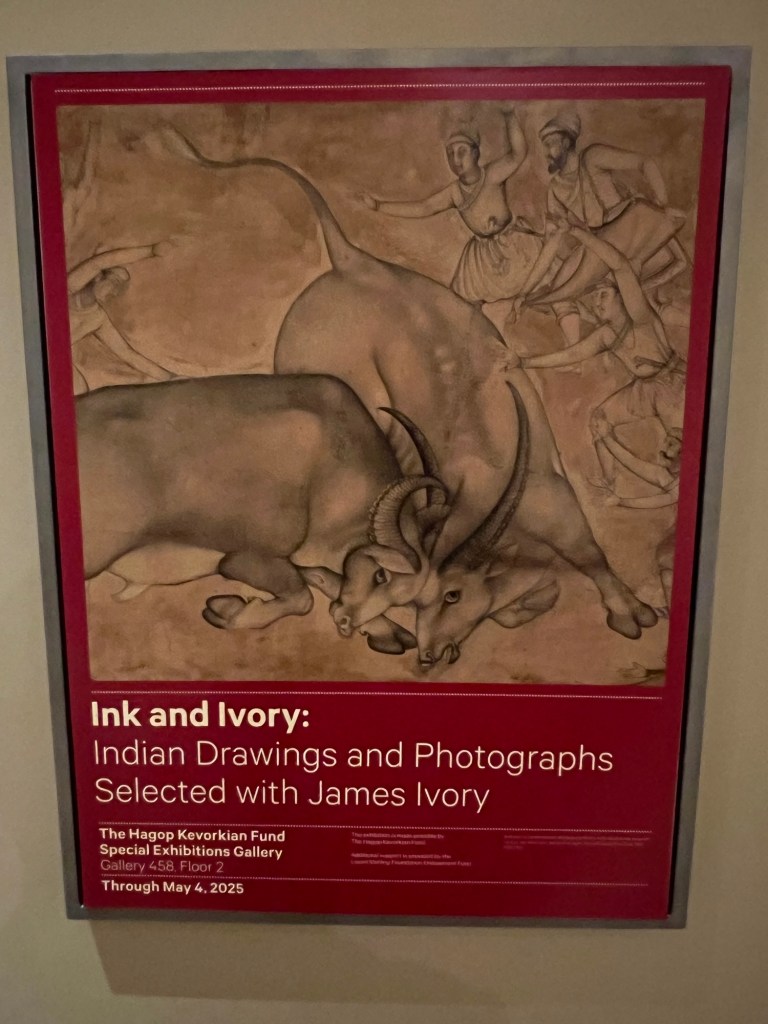
One of the special exhibitions in the Arabic Wing was the Merchant Ivory exhibition ‘Ink to Ivory’ from the Director’s private collection.
This focused exhibition presents a selection of superlative drawings from the courts and centers of India and Pakistan (with a few related Persian works) dating from the late sixteenth to the twentieth century. These works are mainly selected from The Met collection in partnership with film director James Ivory, whose recent gift to the Museum of nineteenth-century photograph albums will also be featured in the exhibition (Met website).
The drawings will include fresh and informal preparatory exercises for paintings as well as beautifully finished works in their own right. The photographs will present the subject matter and styles that came about in the contexts of royal patronage and ceremony; views of architecture, cities, landscapes, and people, among others. As an artist and filmmaker, James Ivory will help us appreciate this material through his unique gaze (Met website).
The description of the show at the Met
The exhibition was a selection of drawings and photos from the British possession of India. I could see from the pictures the Caste system that had been created. The drawings though were quite interesting and showed a different perspective of Indian life at that time. I liked the mix of royals both from England and India.
When I got to the first floor, I noticed the time as getting late in the evening. This special evening was ending at 9:00pm rather than the usual 10:00pm and after the last three weeks that I had with Midterms and papers to grade and leading a recent field trip with my students. I really needed to relax and have a drink.
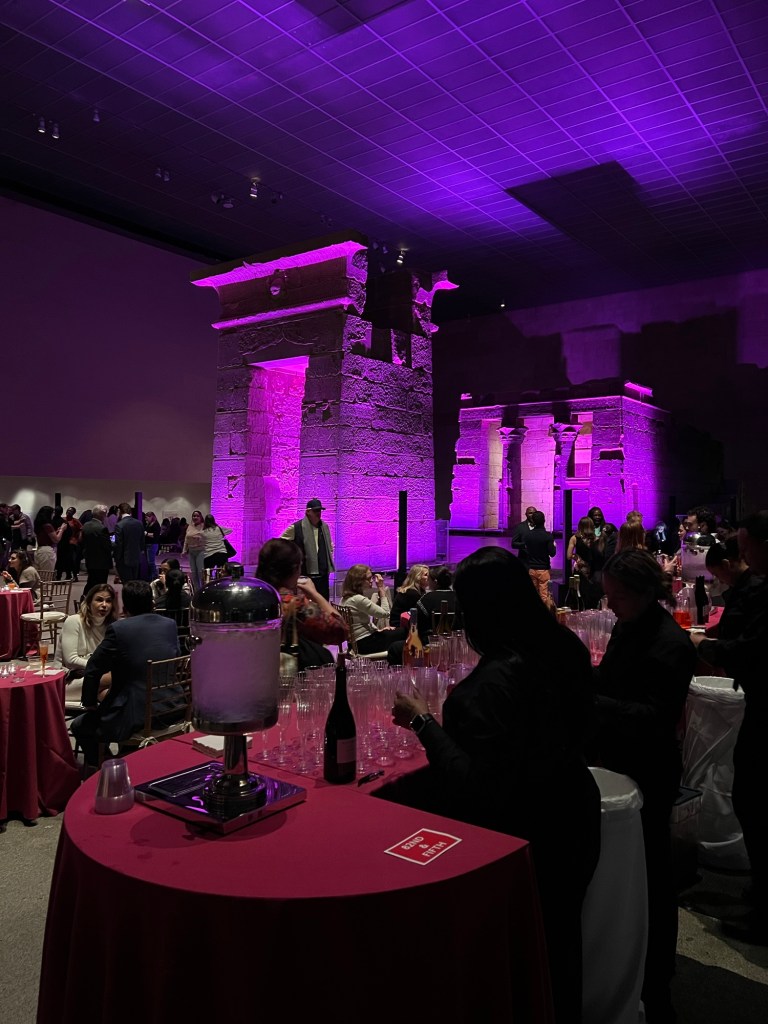
The Temple of Dendur gallery was lit for the evening and music was playing when I arrived. I guess all the other members felt the way I did as the place was packed. I was wondering why the halls were so quiet.
The Temple of Dendur Gallery was set up for the Members Bar
The lighting really accented the ancient temple
The crowds really packed the cocktail tables
Everyone had to get drink tickets to get a beverage and trust me this did not look like the soft drink crowd. They were featuring a ‘Berry Fizz’ as their signature drink that evening.
The signature drink ‘The Berry Fizz’
Relaxing at the end of the evening on the rim of the pool at the Temple of Dendur Gallery
Relaxing and talking to other members at the Temple of Dendur that evening
The bewitching hour of 9:00pm came and the bar area was still going strong but other parts of the museum began to clear out and close for the evening.
As we left, members of the staff handed out Chocolate Flowers that represented the Cherry Blossoms that were prominently featured all over that entrance and would be blooming all over the City in the next few weeks.
The Chocolate Flower we got when we left. I think this was a nice touch as was the pumpkin at the Halloween members night
All the Cherry Blossoms around the Great Hall entrance as I left
It was not a pleasant night as we left for the evening. It was pouring down rain and I could see this when I was in the Temple of Dendur Gallery.
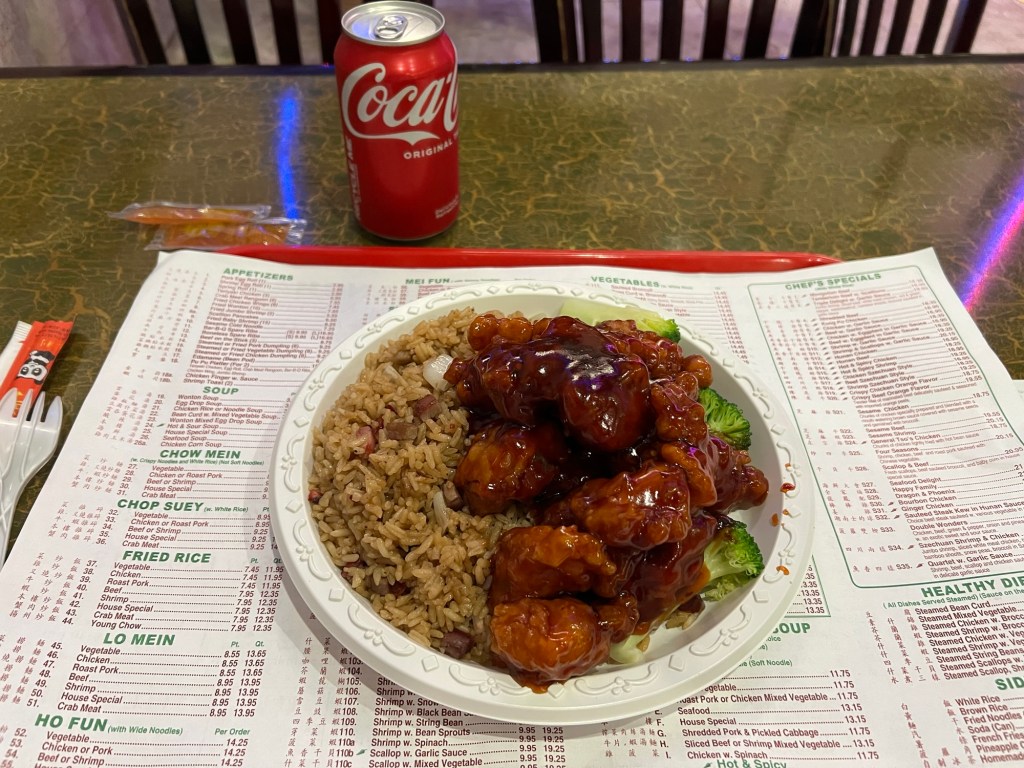
I walked to East 72nd Street and had dinner at Shanghai Chinese Food at 1388 Second Avenue for dinner. This little hole in the wall restaurant has some of the best Chinese food in Manhattan.
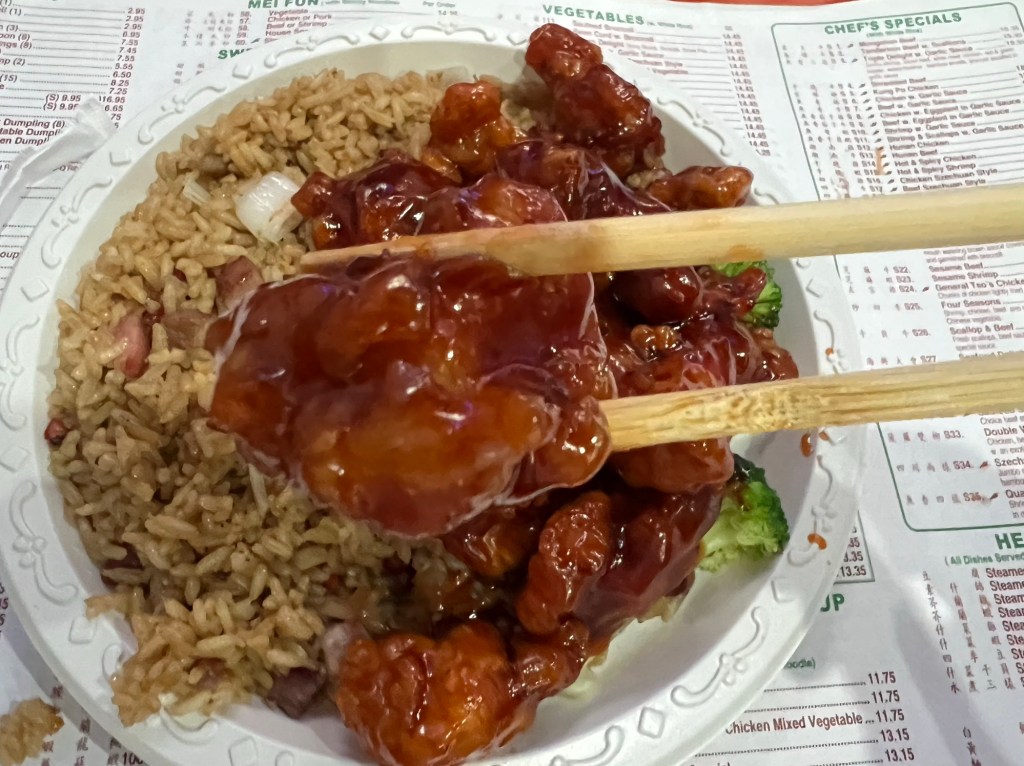
I needed the ultimate comfort food that night and ordered the General Tso’s Chicken with Pork Fried rice. That took the gloom off this rainy evening.
The crispy rich sweetness of the dish is so satisfying
I love this delicious dish
Each piece was a delight
The nice part was that the staff let me relax and finish my dinner. Since I was still dressed in a suit from classes earlier in the day I just assumed they thought I worked at the hospital nearby. It is always so funny to see peoples reactions to me being all dressed up.
It was a nice relaxing evening and a great way to end the day.





























































































































 mywalkinmanhattan