The Doo Wop Preservation League Museum at 4500 Ocean Avenue.
I visited the Doo Wop Preservation League Museum when I was visiting Wildwood, NJ for the Firemen’s Convention. They were sponsoring the DJ on the stage behind the museum. It was easy to miss the museum with all the fire equipment around it and hundreds of firemen milling around.
The neon signs in front of the Doo Wop Museum.
The old neon hotel signs outside the museum
Once inside, this small museum is a treasure trove of history of the resort motels that once lined the beaches of Wildwood, Wildwood Crest and North Wildwood. As time rolls on, many of these old motels, hotels and restaurants are giving way to condos, newer homes and new chain hotels changing the landscape of Wildwood. It is bringing it into modern times with newer looks.
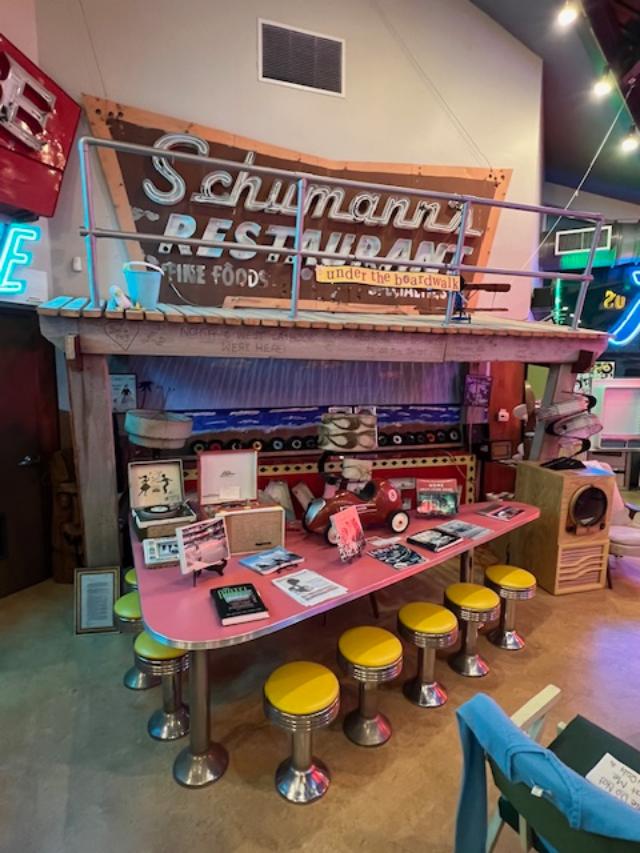
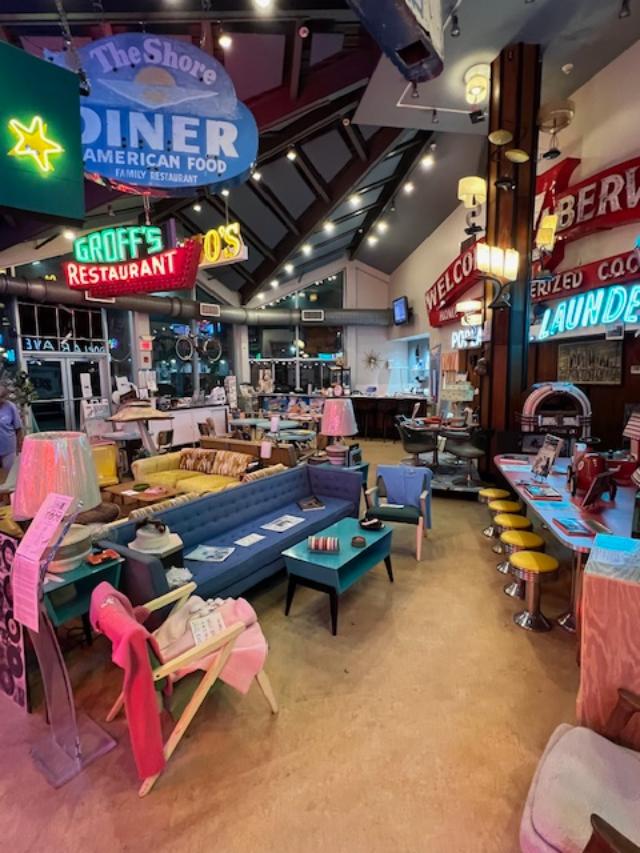
The restaurant section of the Doo Wop Museum
When many of these motels are torn down, the establishments donate old furnishes, decorative objects and signs from the outside to the museum. The outside of the museum is decorated with signs of businesses that are now closed, there neon lights still shining but for a different purpose. These somewhat gaudy and over-grandised signs and looks were of a time of great optimism and travel. Since the middle and working class families did not have the money to travel to these exotic places, something similar was created for them in the Wildwoods bringing that look to the Jersey shore.
The restaurant section of the Doo Wop Museum
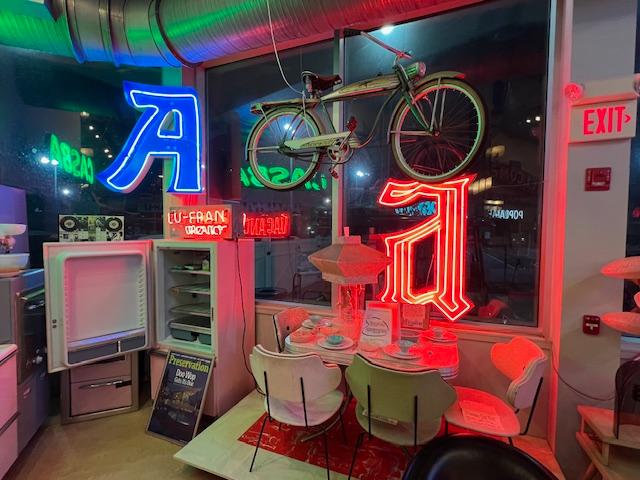
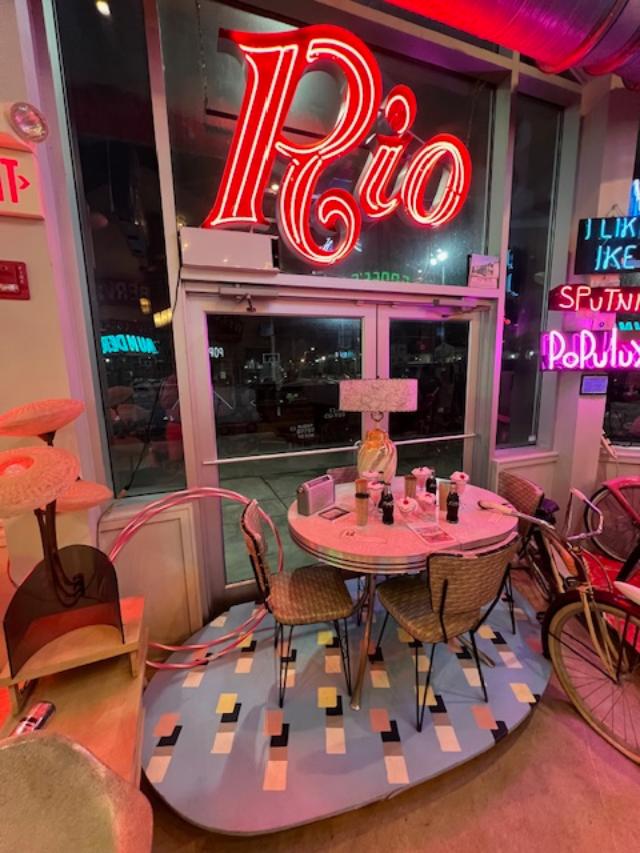
The neon room of the 1950’s
When talking to the curators , a couple that ran the museum said that the museum represents the change in décor used after WWII when they used the neon lights and steel from the war into the signs and lighting of the new resorts. It was a unique style of the late 1950’s and 60’s, when these materials were plentiful and motel owners were getting creative to bring in the rising middle class tourists that could not afford the trips to Hawaii and Miami Beach. These owners brought these themes to Wildwood with a creative twist. Check out the signing and furniture that lines the walls and dining set ups of the museum.
The old neon signs of the hotels in Wildwood, NJ.
The museum is small and takes only about an hour to walk through. Each of the vignettes are designed as its own room with furnishings from old hotels and motels like tables, chairs, lamps and ashtrays in one corner, in another are stools, a jukebox and menus from a 50’s or 60’s style restaurant or items used at the time like bicycles or scooters.
The interesting preservation by the museum shows all over
The History of the Doo Wop Museum:
The Doo Wop Preservation League was founded in 1997 as a 501C3 to preserve the 1950’s and 60’s architectural styles of the Wildwood’s. Doo Wop style is a combination of Space Age dreams of the late 60’s and the exotic seaside tropics of recently opened South Seas Islands like Hawaii which became out 50th State in 1959. The Polynesian look was very ‘in’ at this time as most people could not afford to go but wanted to replicated for them.
The signs of the museum beacon visitors.
The museum is housed in the 1960’s ‘Space Age’ restaurant “The Surfside” that was saved from the wrecking ball and moved to this spot right across the Convention Center and the Boardwalk. On Tuesdays and Thursdays when in season (i.e. Warmer Months), there are bus tours offered by the museum. The museum’s goal is catalogue the remaining businesses in town that still keep their look of the era (Museum website and The Wildwooder Newspaper).
Don’t miss the museum tours:
The best part is that the museum is free (donation suggested) and you can take your time for a self-guided tour of the museum.
While I was searching for the Cape May Maritime Museum, I made a detour into a parking lot and came across the Garrett Family Preserve
The sign that welcomes you to the park
Visiting the Preserve:
(from the Cape May Visitor website)
The Nature Conservancy protects the 180-acre Garrett Family Preserve situated between Seashore Road and Cape Island Creek, offering a tranquil setting for walking, picnics, painting, biking, and observing nature.
The preserve offers six trails ranging from 0.2-0.5 miles in length, and a two-mile perimeter loop along the forested edge–four miles in total. Explore year-round on foot or by bicycle. Sights vary by season, with bird migration peaking in the spring and fall, and the wildflower field blooming from May through July. Beginning in late August into the fall, Monarch butterflies stop here to feed before their journey south.
Preserve amenities include a mobile bird blind, welcome kiosk, shaded pavilion with picnic tables, benches and picnic tables along the trails, and three adjustable art easels. From November 1st to March 1st, leashed dogs are welcome. Because this is a preserve, the Nature Conservancy does not provide trash receptacles. Be sure to take anything you’ve brought with you.
The size of the preserve
The history of the Garrett Family
History of the Preserve:
(From the Nature Conservatory website)
Originally slated for development, TNC acquired the property in 2000, as the preserve offered an unusual opportunity to manage a significant piece of land for migratory songbirds, whose stopover habitat, especially at the southern tip of the peninsula, has been all but wiped out.
In 2013, the generosity of the Garrett family enabled TNC to further protect Cape Island Creek for future generations by acquiring crucial land, improving and stewarding habitat, performing coastal research and installing enhanced visitor amenities.
After reading some of the history of the preserve, I decided to take a walk down the paths. I ended up walking down several paths that took me through woods and many natural gardens. I could see by how dry everything was how the lack of rain was affecting the preserve.
The pathways leading to different parts of the preserve
Following the pathways through the preserve
My first stop was the picnic area and rest stop
The Insect Hotel
The Insect Hotel
The description of the insect hotel
I thought this was an interesting concept of creating a place for insects to have a breather. It is a place of reproduction and in helping pollinate the preserve.
The fields of plants and wildflowers that make up the preserve
The flowering plants and wildflowers in the fields
Each of the paths took me through different parts of the preserve that were wooded or with meadows or an array of wildflowers that attracted birds, butterflies and bees.
The batches of wildflowers in the meadow
The Salt Marsh part of the Preserve was filled with more wildflowers that had bees and butterflies swarming them.
The Salt Marsh Habitat
The sign for the Salt Marsh Habitat
The the pathways though the meadows
The fields of flowers and plants in the marsh area
Th e next section of the preserve I visited was the Wildflower Meadows
The Wildflower Meadows in the late summer
The Wildflower Meadows paths
As I left this part of the preserve, I took many paths around the park lands. There are all sorts of fields of flowers and woods to shade the way during touring the preserve.
Going on the different trails throughout the preserve
I walked down the paths to the Bird Habitat area
The golden rod flowers attract all sorts of bees and butterflies
Flowering Honey Suckle
Beautiful flowering plants in the woods area
The colorful paths of flowers that lined the Bird Sanctuary
This all led to the end of the trails and a wrap up of how the pollinators work. How the plants, insects and birds play a role in nature.
The last thing I saw at the preserve was this butterfly sculpture by the parking lot
The history of the Garrett family
The park changes its complexity with each season. What I noticed at the end of the summer with no rain is how dry the fields were and the trees were changing colors early because the lack of moisture.
It will be interesting to see the preserve in the Spring and early Summer in the future. It was a nice walk through the preserve.
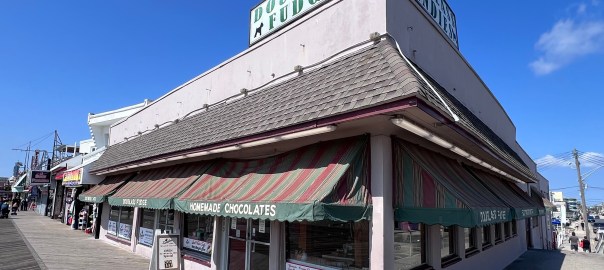
I visit Douglass Candies on the Boardwalk in Wildwood, NJ every time I am visiting for the NJ State Firemen’s Convention. The selection of homemade candies is like talking a walk through Mr. Wonka’s factory.
The inside of this delicious fudge shop
When you walk through the front do , you can see the workers making and cutting fudge. You can see how fresh their candy is and how it is packaged right in front of you.
The one product I really like at the store is their candy bars especially their milk chocolate. They are a bit pricy but a once in a while treat is a good thing. You can always taste the richness in freshly made chocolate and their chocolate bars are the best. Their taffy was delicious too when they were sampling it.
The delicious taffy and assorted candies
The decorated Candy Apples
Each counter has a different type of candy and even in early September, the store was being decorated for Halloween. This smiling witch greeted customers at the door.
The store decorated for Halloween
The store on a sunny day on the Boardwalk
This institution on the Boardwalk is a summer tradition for me and for generations of beach goers. The beauty and old fashioned feel of the store harks back to a time when quality and care still meant something and excellent customer service meant a warm welcome and a smile. Douglass Candies has both.
The History of the Company:
(from the company website)
Douglass Candies, Inc. is a fourth generation candy company founded in 1919. We are the oldest family owned business in Wildwood! Since our origin, we have been making the highest quality cream fudge, gourmet chocolates, and REAL salt water taffy giving us our slogan “We Make The Candy We Sell”. You might recognize us by our signature plaid box and trademark scotty dog. The plaid represents our Scottish/Irish heritage while the scotty dog was simply used because our founder, Charles Douglass, adored his scotty dogs. We pride ourselves on customer service, quality control, family, and tradition.
Our founder, Charles Douglass, was an exemplary citizen of the Wildwoods. He was a prominent boardwalk business man, hotel operator, chairman of the Wildwood outing committee, board member of the chamber of commerce, executive committee member of the New Jersey State Hotel Association, and president of the Wildwood Golf Club. Charles founded Douglass Candies in 1919 and opened up his first location at Wildwood Ave and the Boardwalk where we continue to do business nearly 100 years later!
Charles’ candy career began in Philadelphia where he owned a store in Rittenhouse Square. In 1905, Charles and wife Flora moved to Wildwood. They opened the Douglass Hotel in 1913 on Atlantic and Pine Avenues, followed by a small candy concession stand on Cedar Ave in 1917. After some success with the candy store, Charles moved his operation to the boardwalk at Wildwood Ave. The building was constructed by recycling an army barracks from Cape May, NJ. During his reign as President of Douglass Candies from 1919-1941, the business gained major popularity and success. It was doing so well, in 1922 Charles built a pavilion across from his business for customers to get out of the sun/rain and enjoy a nice place to relax. Recipes and techniques created over the course of these years are the basis of our recipes that we still use today.
Charles passed away peacefully in his home at the age of 77. Following his death, Charles’ brother Joseph took over the business. Joseph Douglass also began his business career in Philadelphia. He lived in the famous Lemon Hill Mansion in Fairmont Park where he ran a candy/ice cream shop. After seeing the success of his brother, he moved his family to Wildwood in 1919. Upon arriving, he opened a boarding house and restaurant on Cedar Ave. He later opened the Douglass Cafeteria on Oak and Atlantic Ave. The cafeteria specialized in homemade ice cream. Joseph also owned the Bellevue Hotel and Restaurant in Cape May Court House. Joseph took over Douglass Candies in 1941 and owned it for less than a year before passing in 1942.
Upon Joseph’s death, his beloved wife Minerva took over the business along with their three children; Charles, Harvey, and June. Minerva and June handled administration and the store front while Harvey and Charles took care of the production side of the company. Minerva and her children aided in the continued success to Douglass Candies. They even brought in a famous German chocolatier, Frank Steiner, to help perfect our techniques and recipes. Minerva died in 1969, followed by Charles in 1972. June then bought out Harvey, leaving her the sole owner of Douglass Candies. Harvey passed in 1983. His children, Joe and Charlie, went on to pursue careers in candy on the west coast.
In the late 1970’s, as the President of Douglass Candies, June took over all administration work and oversaw all production. Her only child, Barbara aka “Babs”, handled the storefront and helped Douglass expand during her time with the business. June worked into her late 70’s and passed away in her home in Wildwood Crest is 2003. Barbara ran the entire business herself from 2000-2013, at which time she passed it on to her boys, James and Jason. Barbara passed away in 2014.
James and Jason have continued the family tradition as fourth generation owners and have given the business new life. They are responsible for the addition of new product lines as well as expansion into Stone Harbor. They were incredibly proud to celebrate Douglass’ 100th year in business in 2019 and look forward to continuing the Douglass tradition for years to come!
Also known as the U.S. Coast Guard Station No. 126, this is the only life-saving station (now museum) of its design in NJ (1 of 6 in the country) still in existence. The designer and architect was James Lake Parkinson in a Carpenter Gothic style. This building is one of 42 stations built in New Jersey. It was also the workplace of the brave surfmen who were the beachfront First Responders of the day.
The anchor outside the building
The historical plaque outside the building
The History of the Building and Museum:
(from the State of NJ Historic website)
The U.S. Life Saving Station in Ocean City is significant as an example of a significant type of life saving station and for its association with the activities of the U.S. Life Saving Service. The building was constructed in 1885 in what was referred to as the “1882 type.” There were 25 life-saving stations constructed in this style. In 1905 the building’s footprint was expanded to nearly twice its original size. The expansion was done in a style unique to New Jersey Life Saving Stations.
In 1915 the U.S. Life Saving Service and the Revenue Cutter Service were combined to form the U.S. Coast Guard. The Coast Guard continued to utilize the building until it was decommissioned during the 1940s and sold. It was used as a private residence until the City purchased it in May 2010.
The first room inside was the formal dining room where guests who visited or who had been rescued had dined. It was a rather formal affair.
I visited the museum on a weekend day to learn of the rescue procedures and the job these men did on a day to day basis. The first thing I learned was how shifting tides can change an island.
This building which now sits about four blocks inland was once at the shoreline a hundred years ago. Talk about change and Mother Nature’s role in this.
The first room I visited was the formal dining room in the newer extension of the building. This would be where the officers and men would entertain guests and visitors to the building. It could be a casual or formal affair.
The first floor formal dining room
The entertainment for the evening was either board games or a music box
Some of the items salvaged from the sea
The Life Guard officer formal outfit was worn for formal affairs
The officers would be dressed formally to receive guests
The next room over was the Rescue room and door where the boats and other equipment would be held when the alarm sounded.
The docent discussed how the doors were opened and the boats needed to be pulled out on a stormy night. Everything you needed had to be close by, in good shape and ready to go.
The rescue boats and pulleys that would be used in the sea
The ropes and pulleys used to assist in the rescue
The lanterns were used as communication between shore watch and the tower
The equipment used to repair the items used for rescue
The rescue boat and the items used for a water rescue
The additional boats used in rescue
Some boats were used for fishing and collecting shell fish
The Sneak Box was used for duck hunting to camouflage yourself
The sneak box
We then toured the second floor sleeping room for the crew. This offered a great view of the sea when the building was at shore line. These men were given good accommodations for the time.
While not very private, it was comfortable and served its purpose for a job where you might not get a good nights sleep.
The sleeping quarters
The main sleeping room was for a crew of six
The loft lead to the tower where the look out for the evening would sleep (it is not open to tours right now).
The loft area from the window
We then headed back downstairs where we toured the station manager’s room and office.
The station manager’s room off from the kitchen
The station manager’s office where all the monthly paperwork was done and business was conducted.
The kitchen
The Station Manager’s office was right next to the kitchen stove so that the room was kept warm during the winter months and on cool nights.
The kitchen stove
All the meals for the crew and visitors were cooked either by the men or their wives might be allowed to visit and assist in duties in the building.
The kitchen
All the storage of the foodstuffs has to be accounted for because getting them was rough with no cars for transportation and no bridges to cross to the mainland.
The gift shop
The museum and grounds
The museum offers a glimpse of the everyday life of these brave men who were on call 24/7 and performed such dangerous work. Ocean City has done a wonderful job preserving this legacy.
The museum has docents on hand for more formal tours and are very detailed on their knowledge of the building and its contents. It is a very interesting look at Ocean City’s past.
The Tuckerton Museum and the Seaport at 120 West Main Street in Tuckerton, NJ
The entrance to the complex from Route 9
The entrance to the Tuckerton Seaport complex on a sunny Saturday morning
The complex was once a bustling fishing and shipping area that has now been preserved as a cultural site with tours, a series of restaurants and a museum.
The Mission of the Museum:
(from the Tuckerton Seaport Museum website)
Our mission at the Tuckerton Seaport is to preserve, present and interpret the rich maritime history, artistry, heritage and environment of the Jersey shore and the unique contributions of its baymen.
The dock area by the coffee shop
The artwork by the parking lot and coffee shop
I walked over to the main building which served as both the gift shop and museum. It was funny that the gift shop took both the first two front rooms of the museum. I had to look behind shirts to see the displays.
The docks and touring boats by the museum
The Seaport Tuckerton Museum at 120 West Main Street
The History of the Complex:
(from the Tuckerton Museum website)
Originally launched as the Barnegat Bay Decoy and Baymen’s Museum, the Tuckerton Seaport has evolved over the past twenty-two years into a community museum and community center occupying 40 acres located along historic Tuckerton Creek in Tuckerton, New Jersey. Tuckerton Seaport benefits from a prime location at the center of the Jersey shore, easily accessible via Exit 58 on the Garden State Parkway. Tuckerton Seaport works as a coastal cultural center to bring folklife traditions of the past and present to life through programs on land and water.
The museum was just opening up as I arrived and the staff was busy getting everything ready so I just walked around the museum. It is an interesting museum on New Jersey’s nautical past and the growth of the shipping and trading that went on in the turn of the last century. The museum also showed the bustling fishing industry that still exists today.
The Giant Chicken greets you at the door
The Giant Chicken was a road stop symbol of the White Way Farm Market and a tourist attraction
I thought it was rather cute and could see why people stopped
The view from the front porch of the museum was spectacular on this sunny day
The exhibit at the museum ‘Museum in the Making’, which is a through look at Tuckerton, its past and its contributions to the growth of New Jersey
The first room also served as a bustling gift shop with the main attraction this carving of the ‘Jersey Devil’
A display of Duck Decoys
A collection of woodcarvings of fisherman
The popular businesses that once lined Route 9 up and down the shore area
Displaying life down the shore in that era with quilting and sewing
The display of wood carvings and artwork on the first floor
The artworks made of driftwood by local artists
The driftwood art display on the first floor
The rooms both on the first and second floor were displayed by themes of Lenape Indian life at the shore, the Dutch and English traders, growth of shore farming, shipping and trade and fishing industries and the development of tourism in the area with steamships and the railroads.
The first room in the museum is a detailed look at the life of the Lenape and the froth of the fishing industry
The early life at the Jersey shore
The Native American display
The first part of the early development of Tuckerton started as the fishing and hunting grounds of the Native Americans until the settlement of the Dutch
The history of the Lenape
The arrival of the Europeans started the bustling shipping and trade industries that supplied the home country
With the growth of industry and farming many people started businesses to supply the population
Some started popular businesses that lasted over a century
E. Walter Parsons Jr. had a very successful fishing business that was in the family until 1984
With the rich soil in the area, local farmers worked the land providing fruits and vegetables for the growing population
Early farming equipment on display
The second floor galleries depicted the developing life at the shore with creating of modern life saving for the shipping and fishing industries and with coming of railroads, the bustling tourism industry with the change of leisure travel after the Civil War and the Industrial Revolution.
The second floor rail transportation display
The second floor display on shipwrecks off the Jersey coast
The development of modern Life Saving procedures
With storms at sea and affecting life in the area, as it still does today, there was a growth and development of modern Live-saving procedures and rescue methods.
The Life Saving exhibit
The use of the Lyle Gun in rescues
The series of pulleys and wenches are still used today in different forms. They had to create a safe way to rescue people not just from storms but accidents as well.
The Life Saving and Rescue display
Rescue display
The railroad made its way to the Jersey shore bringing tourists from both New York and Philadelphia and bustling North Jersey. This opened the area up to tourism as leisure travel grew at the end of the nineteenth century.
One example of a visiting tourist was the Cinderella Cramer display with long distance travel to the shore.
The first female passenger of the Tuckerton Railroad
Getting the rail ticket
Tourism developing at the Jersey shore
The Cinderella Cramer display representing that eras travels to the shore with Victorian standards and use of steamer trunks
Packing the steamer trunks for the long journey
Artifacts from the shore
Life at the shore still had its perils as it does today with storms affecting development and shifting shore lines
The lighthouse light display
The museum once served as a beacon for shipping and the top level served as a lookout. Today you can walk upstairs and enjoy the views.
Traveling up the tower stairs
On this beautiful sunny and clear morning that I visited, the views were spectacular.
The view of the port area of the complex
The view of the inlet and Lake Pohatcong across from Route 9
My video of the views from the top of the lookout
The Tuckerton Seaport Museum tour was a very thorough look at the community and its development over the last three hundred years. The exhibits showed the progress the community has made and where it is headed in the future as the shore communities keep changing.
With the economy, the rise of AI, climate change and overall population growth toward the shore, it will be interesting to see the changes of the future.
Leaving the museum complex at the end of the trip
Tuckerton has an interesting past as a shipping and fishing destination and now you can tour the buildings and see what life was like back then and there it is moving in to the future today.
I had a very busy weekend of running around South Jersey. I have been updating my blog on the Historical Sites of South Jersey and trying to visit as many of this small museums and special events venues before they close for the season. Like any of my blogging trips, I planned the weekend like “D Day”. I lucked out as the weather was wonderful both days, clear, sunny and in the mid 80’s. I could not think of a better time to go to the shore than post-Labor Day weekend. My goal was to attend the Apple Festival that I had heard about at the Gandy Farmstead Museum when I toured the home for my blog, VisitingaMuseum.com (see blog and reviews).
The JW Gandy Farmstead Museum at 26 Tyler Road in Greenfield, NJ
Two weeks after my initial visit to the Gandy House during the Firemen’s Convention, I returned for the Historical Society’s Annual Apple Festival on Saturday, October 4th. The event reminded me of the Brinckerhoff House Strawberry Festival I had attended in May , a very nice family and community event that attracted everyone.
The East Fishkill Historical Society-Brinckerhoff House Strawberry Festival 2025/Exploring Fishkill, NY blog:
Since there were a lot of shore towns I wanted to revisit while the weather was nice, I arranged to stay at an Airbnb in Ocean City so I had plenty of time to do what I needed to do and relax afterwards. Plus when the event was over, I could visit Ocean City and explore both the downtown and the boardwalk.
I could not believe how crowded the roads were as so many places were having either Fall festivals or October Fest. Route 9 was like a parking lot near Smithville, NJ as the town was having their ‘October Fest’ over both days of the weekend. Traffic was backed up for about two miles trying to get in so I got off Route 9 and traveled down the Garden State Parkway.
I got to the Apple Festival around noon and the parking lot was packed with people. One of the members said later that afternoon that he could not believe the consistent crowds as it was still busy at 2:15pm (the festival was over by 3:00pm). The crowds were filled with several generations of family members who I am sure were traveling from one event to another on this spectacular sunny morning. People were still arriving even as the event was winding down that afternoon.
The sign welcoming you to the event
When I arrived at the festival, the parking lot was still filling up so I had to park way in the back so I could get in and out easily.
On the Gandy family property on the other side of the home, they had an antique car show, a mini train ride around the tracks of this part of the property and a Caboose train car that you could explore.
The train tracks around the farm property
The train set up and tracks to tour around the farm
The train rides were really popular with both the small and ‘big’ kids
This small train trip had a nice sized line to it as families were really enjoying themselves
I then toured the Caboose which was set up for service and a day in the life of a conductor. Some of the volunteers were even dressed as conductors leading tour and talking to families. I did not understand how the train car got there but I thought it was an interesting look at life on the early train system of this country especially how it opened up the State of New Jersey.
The caboose on the farm property
The inside of the caboose
Getting ready for the holidays
Life of a train conductor shown in the caboose
After the tour of the car show and watching the families have fun on the trains, I headed across the street to the Gandy House for the tours and activities. There were all sorts of craft vendors, food and entertainment. The music duo was performing the James Taylor song “How Sweet it is to be loved by You” when I arrived.
The back of the Gandy Farmstead with crafts and entertainment
Entering the Apple Festival with a Farmers Market and Apple sale
The Farmers Market of locally grown produce
There was a stand that was a mini Farmers Market with locally grown apples, pumpkins, squash and tomatoes on top of other produce. It was so nicely displayed and the prices were really reasonable.
They had a wonderful duo interesting the crowds that afternoon
There were all sorts of crafts stands around where the entertainment was performing
The local crafts people were really talented and included crocheted, painters, floral arrangers and jewelry markers. There were all sorts of handmade items and there were stands to buy homemade jellies and pickles and the prices were not like North Jersey, where a jar of jam at a Farmers Market will run you $15.00. The prices here were closer to $5.00 for certain items, which I thought was very fair.
One woman sold flowers from her gardens and arranged bouquets
This woman painted her own crafts and did beautiful work for both Halloween and Christmas
Here beautiful holiday crafts
I loved this Santa tree and was going to get it for my mom
This woman had the most beautiful handmade doll clothing and knit items for the holidays
What is an Apple Festival without food? I went to the concession stand for lunch and ordered a hot dog with a glass of locally made Apple cider and had an homemade Apple Shortcake, which I found out later the members had made the night before.
The concession stand where all the food was made
Enjoying my lunch. Both the hotdogs and apple cider were locally made and that’s why it tasted so good! The apple cider was from a local farm and I wished they had sold this at the festival. I think the farmer would have sold out!
Hot dogs taste so good off the grill!
The delicious homemade Apple Shortcake with homemade apple topping were made by the members
I also stopped off at the apple stand where cases of apples were being sold. It looked like many people were going to make pies and sauce with these and the stand looked like they were selling out.
I managed to buy one of the Mango sweet apples they were selling individually
The apples were so hard, fresh and sweet that it made the perfect addition to dessert. Nothing is better than a Jersey Apple right off the vine. I could not believe how fast they sold out of the boxes of apples and the individual apples were selling just as fast.
The Mango Sweet apples
Talk about delicious
After lunch, I ran into the Board members who had helped me with the tour two weeks early and I took a quick tour of the first floor of the home. The laundry room was not open the day of my private tour, so I toured this part of the house on top of taking a better look at the first floor.
Touring the outside grape arbor
The grape arbor on an early Fall day
Touring the first floor laundry room
An early washing machine
How to do laundry at the turn of the last century
After having lunch, touring the house and visiting all the vendors I relaxed for the rest of the afternoon and listened to the entertainment perform. The duo performed a combination of 70’s hit songs, country music and some James Taylor.
The duo performing classic hits
The first part of the song “Brandy (You’re a Fine Girl)” from the 1970’s before people walked in the way
The rest of the song performed. They did an excellent job with it
Before I left just after 2:00pm, I stayed to see who won the Apple pie contest. There were only three contributors but I wanted to get a slice before I left. They did not slice them up while I was there. Bummer! I really wanted a piece of fresh Apple pie.
The winners of the Apple pie contest
The Apple Festival sponsored by the Upper Township Historical Society happens every October. It is a wonderful family event and fundraiser for the Historical Society. I know I had a lot of fun and it reminded me of the events that I went to as a kid in the 1970’s, which was long before cell phones.
It was funny that the only person who had a cell phone glued to his hand was me but then I was there to cover this event. It really was a relaxing and wonderful afternoon with good food and entertainment. It was just like the 1970’s all over again with families enjoying each other’s company. Sometimes I think that people underate these local events which are so much fun.
By the time I left, most everyone was gone but I did watch families still walking in and heading to the food concessions. I hope they had that delicious Apple Shortcake. I assume the Festival did not close until after 3:00pm.
From the festival, I headed to Somers Point for an afternoon of picture taking. I had been here the summer before Grad school to visit the three museums on Shore Road, the Somers Mansion, the Atlantic County Historical Society and the Somers Point Historical Society and never got the exterior shots of the town that I wanted. I ended up revamping the whole blog and almost all the pictures.
As I was heading into Somers Point, I came across the most unusual farm stand sign and had to stop to take a picture. I thought this was fun and engaging and what a way to capture your attention.
The sign for Vaughan’s Farm Stand
The entrance to the Vaughan’s Farm at 312 Roosevelt Boulevard in Marmora, NJ
I stopped for a quick visit to the Vaughan’s farm stand and took a quick walk around the greenhouse to admire the plants and fall decorations on sale. I thought there might be food but just colorful plants and gardening supplies for local homes.
The flower and plant selection
The beautiful plants that they carry
The selection of seasonal items and Halloween themed gifts that they carried
Then I headed into Somers Point and my first stop, the original Somers Mansion which was the only museum open at the time. The other museums had closed earlier in the day but I had already visited all three in the past.
While the house looks impressive from the outside and was once home to five generations of the Somer family, the inside is a dusty relic of the past and they will not allow you to take pictures inside (I think they think someone will steal the dusty relics). I just think the inside could be a better interpretation of the family who lived here. Still the views from the house are amazing on a sunny day.
The view of the bay and the highway and bridge
On this trip I had about two and a half hours to really tour and explore the town. I ended up revamping the entire blog from three years ago with more pictures and a better depiction of this historical town.
I walked through the historical district of the town which stretches from the Somers Mansion to the modern downtown and got a better understanding of the growth of this community.
The district is filled with old and classic beach homes
Then I walked down Shore Avenue, the heart of Somers Point historical area and came across the statue of Richard Somers.
The statue of Master Commandant Richard Somers
Walking down to the elementary school on New York Avenue, I also visited the graves of the Somers family which is tucked off to the side.
The family cemetery was once part of their estate
After my tour of the historic district and revamped my entire blog on Somers Point, I remembered the Dairy Queen in town and had a craving for a Banana Split. It still tastes the same as it did in 1972!
The Dairy Queen in Somers Point at 501 Shore Drive
After my snack, it was time to walk it off. I took a tour by the shore line and discovered parks that I had not seen on my last trip to town.
The park and beach by the bay
As I walked further down the road, I came across the walkway under the bridge and the highway. That was an interesting walk.
The walkway under the bridge offers great views of the bay and dazzling sunsets
The sun was starting to make its descent in the late afternoon
I wanted to get to the Airbnb by 5:00pm and relax before dinner. Driving between Somers Point and Ocean City is a breeze in the off season and I made it in about twenty minutes.
My Airbnb was right next to downtown Ocean City and three blocks from their Boardwalk
After I settled in and relaxed a bit, I took a walk through the downtown to look at the stores and restaurants. I pretty much knew where I wanted to go for dinner but wanted to see my options.
Their pizza is always a treat and I look forward to eating here every time I am in Ocean City. Their red sauce has a nice flavor and is so well spiced. While a bit pricy for a slice (the meat lovers slice was $8.00), they did not skimp on the toppings.
A slice of the Meatlovers and a slice of Cheese pizza
I really enjoyed my dinner. The Meatlovers was loaded with different types of meat and you could taste the complexity in every bite. It was also fun to watch everyone glued to the Phillies game. When I explored Beach Haven the next day, it was all about the Giants.
After dinner, I took a stroll down the Boardwalk and walked through the amusement parks and games. Ocean City does not have the ‘honky-tonky’ feel of Wildwood or Point Pleasant. It really has the feel of family resort.
Walking through the amusement area
The park was really busy for a Saturday night post Labor Day
What was really beautiful was my walk on the beach and the light of the moon rising over the shore.
The beach views were breathtaking
My video of Ocean City Beach at sunset
Just walking on the boardwalk in the evening on a beautiful fall night was a treat. It had not gotten cool yet and it was still warm that evening.
My last stop before I headed back to the Airbnb was a stop at Johnson’s Popcorn. By this point it was now 9:00pm and everyone was closing up shop fast. I have never seen an amusement park empty out that fast.
The girl at the counter of the main Johnson’s Popcorn could not have been nicer. She told me she had plenty of popcorn left and gave me a bag of a combination of Caramel and Cheddar in addition to my cup of popcorn that I could barely finish.
My bag of Johnson’s Popcorn
The combination of the Cheddar and Caramel has the best flavor
I was a very happy camper that night
The popcorn was still warm and the caramel was still really sticky. Even at that time of the evening, the popcorn was such high quality. Trust me, not a kernel went to waste on the Boardwalk.
I slept so soundly that night and had one of the best night’s sleep in a long time. The Airbnb was great because it was so close to everything that it was a short walk back from the boardwalk I could get right into bed.
My room at the Airbnb
The next morning I wanted to take a quick walk around town before I headed towards my next shore town of Beach Haven just up the coast.
I stopped for a quick breakfast at McDonalds in Ocean City and indulged in the new Sausage McMuffin and Egg Breakfast Extra Value meal.
The new McDonalds in Ocean City, NJ at 900 West Street
I still think the Sausage McMuffin with Egg is the best breakfast in the industry
I wanted to make two stops before I left town. I started with a walk on the boardwalk admiring the sunny morning. Nothing is more wonderful than walking around a boardwalk on a quiet Sunday morning. The stores and restaurants were opening for breakfast and surfers were out in full force ‘catching waves’. Mornings in a shore community have their own life.
The boardwalk at Ocean City, NJ
The beach with early risers
The amusement area in the distance
There’s a big surfer culture here
I could not believe the amount of surfers who were on the Ocean City beach. The waves were not that big that morning but I could imagine what the waves were like during the recent storms. These folks have their own culture and lingo.
My video on the Surfers of Ocean City on the beach that morning
After my walk on the beach, I headed off to the US Lifeguard Station 30 Museum to see the exhibitions.
I was very lucky that I was able to visit the museum before it closed for the season and tour the facility. I found the life of the rescue teams fascinating and all the work these men did before the creation of the Coast Guard. The way they handled rescues and the training they needed back before the advent of phones and walkie-talkies was interesting. How the lanterns were used for as a form of communication between the beach and the building.
The inside Rescue Gallery
The formal Dining Room
There was a whole formal culture built on this and visitors and guests were welcomed to the building by officers, some meals cooked by the members wives and some by themselves.
The pulleys and wenches that saved people
Additional rescue boats
Life here was active but comfortable as I judged by the bunk room. This loft once overlooked the sea that is now three blocks away. Here the men had to be ready for anything and the windows offered perfect access to the sea.
The Bunk Room loft where the men slept and watched over the beaches
After I left the museum, it was time to travel to Beach Haven. So I took more walk around Ocean City to enjoy the beauty of this Jersey shore town. Even though it was just an overnight trip, there is a lot to see and do in these South Jersey communities packed with historical sites and interesting restaurants and especially beautiful beaches.
One last walk on the Boardwalk that morning
One last look at the spectacular beach
Now it was on to Exploring Beach Haven, NJ and Long Beach Island. I wanted to revamp that blog as well as there were places I wanted to visit before the weather got cooler. This is the best time to visit the Jersey shore and what a spectacular weekend it was!
My blog on Visiting and Exploring Beach Haven and Long Beach Island:
It was another wonderful afternoon in South Jersey and really shows all the wonderful things this area of the State has to offer. These little festivals show what volunteers can accomplish and I think we are better as tourists when we ger to attend them.
The front of Frog Hollow Bakery in the summer of 2025
I was on a historical tour of the Gandy Farmstead up the road from the Frog Hollow Bakery and one of the Board members suggested we stop for a doughnut. I was fine with that and what I discovered about Frog Hollow Bakery is their warm, freshly made doughnuts are excellent. I had a Sugar doughnut that was still warm and was out of this world. I would have ordered more but I was going to have lunch later. When I returned a few weeks later, they had just closed for the afternoon and I had wanted to get one of their butter cakes.
The grounds of the bakery on NJ 50
This tiny bakery sits on a quiet part of Route 50 near a quiet lane at the intersection of Route 50 and Tyler Road.
I thought their sign was very clever
It’s a beautiful little place in the Summer of 2025
The front of the bakery has a nice seating area in a quiet garden and you can take your purchases and eat them out here. On a warm sunny afternoon, it is a nice place to stop for a snack. When it is warm out, they have this wonderful shaded area off to the side of the bakery that you can sit and enjoy your baked treats.
The even have a small series of tables to enjoy your baked goods
The bakery has all sorts of delicious goodies to choose from with cakes, cookies and twists. I was eyeing the gooey butter cake but the bakery only accepts cash and I did not have enough to get it. For the next trip I figured.
The inside of this wonderful bakery has the most interesting collection of wonderful treats
They also carry all sorts of breads and rolls and I forgot to ask the woman if this changes on a regular basis. They have a nice selection of artwork and tee shirts for sale.
The nice selection of gifts for sale inside the bakery
They have a nice area to dine inside as well
We took our doughnuts to the Gandy Farmstead Museum up the road which I was touring that afternoon. I got to enjoy my doughnut while on the tour of the grounds. These delicious fried doughnuts have a cake like texture and were still warm when we bought them.
Their fried Sugar doughnuts are spectacular
The store was also selling different variety of tomatoes outside the bakery I figured from the farm next door.
They even sell tomatoes and strawberries when they are in season outside the store. I am sure that there is more produce on sale when it is season.
I love the clever sign in the parking lot
The bakery does have limited hours and the only bad thing is that they close at 1:00pm, so you have to hurry to get there. It is well worth the trip.
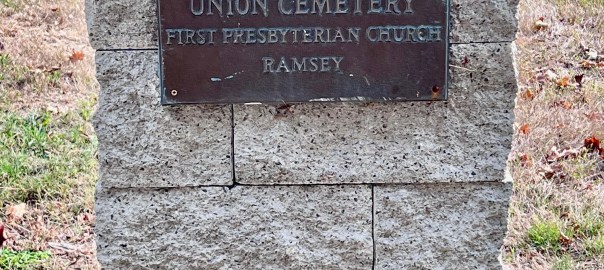
The Union Cemetery of The First Presbyterian Church of Ramsey, NJ
History of the Cemetery:
(from the church website)
Union Cemetery is a religious cemetery located at 316 Darlington Ave. in Ramsey, NJ. The cemetery is owned and managed by the First Presbyterian Church in Ramsey. As a religious cemetery, the cemetery is restricted under New Jersey state law and is not open to the general public. Only members of a Christian church and their immediate relatives may be interred at the cemetery.
The historic cemetery from the road. To the left is the oldest part of the cemetery
Entering the cemetery from Darlington Avenue
The newer part of the cemetery is to the right of the driveway
I was visiting the Union Cemetery in search of veterans of the Revolutionary War and found an interesting cemetery with a deep history in Bergen County. Many first families of Bergen County are buried here and veterans not just from the Revolutionary War but the Civil War all the way up to today are buried in this active town cemetery.
The older part of the cemetery is to the left of the driveway. These tombstones are from the early 1800’s.
The older part of the cemetery dates back to before the Revolutionary War
Many of the early family plots are located here with well known names like Hopper, Christie, Ackerman and the town’s namesake, the Ramsey family, whose family plot is in the oldest section of the cemetery.
The grave of Hannah Jane Ramsey in the Ramsey family plot
Part of the Ramsey family plot
The Ramsey family plot
The Union Cemetery to find the graves of Revolutionary War veterans and found some but not all of them. The tombstones are so worn after over two hundred years that they either had disappeared or were so worn you could not read them.
The oldest section of the cemetery where many veterans both from the Revolutionary and Civil War are buried. It was hard to read many of the tombstones. Some the veterans were buried in their family plots, others with their spouses separately. The burials were concentrated in the oldest part of the cemetery. Most of the veterans have been honored with American flags.
The first tombstones I found were from Ackerman family members
I could not make out the name of this Ackerman member but I figured it was one of the brothers wife
The grave of veteran John P. Post
The Post family history:
(from the Saddle River Historical Society website)
The Post family was of Dutch descent. The first Post was a soldier, who came here to protect the new settlements along the Hudson. They soon turned to milling; the name Post is attached to several mills in Bergen and Rockland Counties. Joseph Post, born in 1775, built a mill on the west branch of the Saddle River about 1800. He also opened a tavern and store on what is now West Saddle River Road, just north of Parker Place, across from the entrance to the mill.
The graves of members of the community at that time including the grave of John P. Post
The grave of veteran William Vanderbeck
The grave of a member of the Van Blarcom family, who was married to James Ramsey
I was not too sure who this was but by the veteran’s flower I am assuming the grave of veteran John Van Blarcom
The grave of Hannah (I believe Ackerman)
The Christie family plot
The Hopper family plot
The Hopper Family history:
(from the Saddle River Historical Society website)
The Hopper family is one of the oldest of European descent in Bergen County. Andries Hopper came from the Netherlands to New Amsterdam in the 1640’s. His widow and her son Hendrick were in the Polifly area (Hackensack) by the late 1600s. There was land to be had in the unsettled areas of what became Bergen County. Hendrick’s two oldest sons, Andries and Jan settled in the HoHoKus area (part of Paramus) around 1712. The Hopper name appears on many old homes and mills on early maps of the area. It was two of Andries’ children, Abram and Jan, who settled sometime around 1730 along the Saddle River in what is now Upper Saddle River.
The sign welcoming you the the Endicott-Reardon Family museum
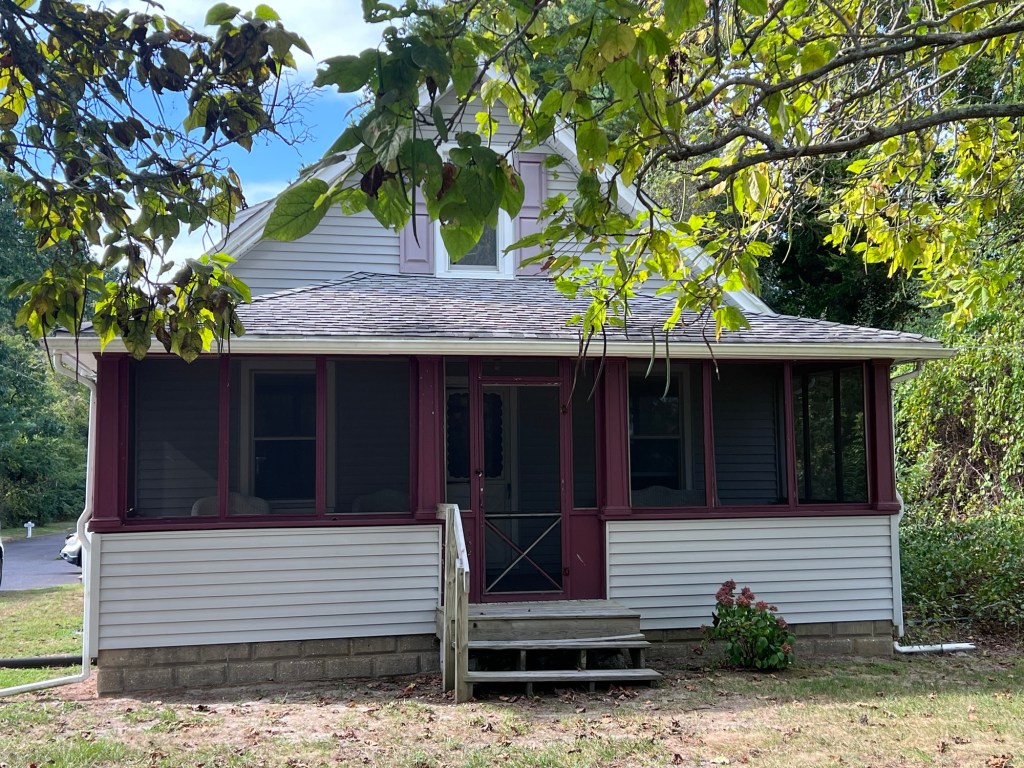
The original Endicott-Reardon Homestead that sits in the front of the museum
The entrance to the museum dedicated to the lives of both the Endicott and Reardon families.
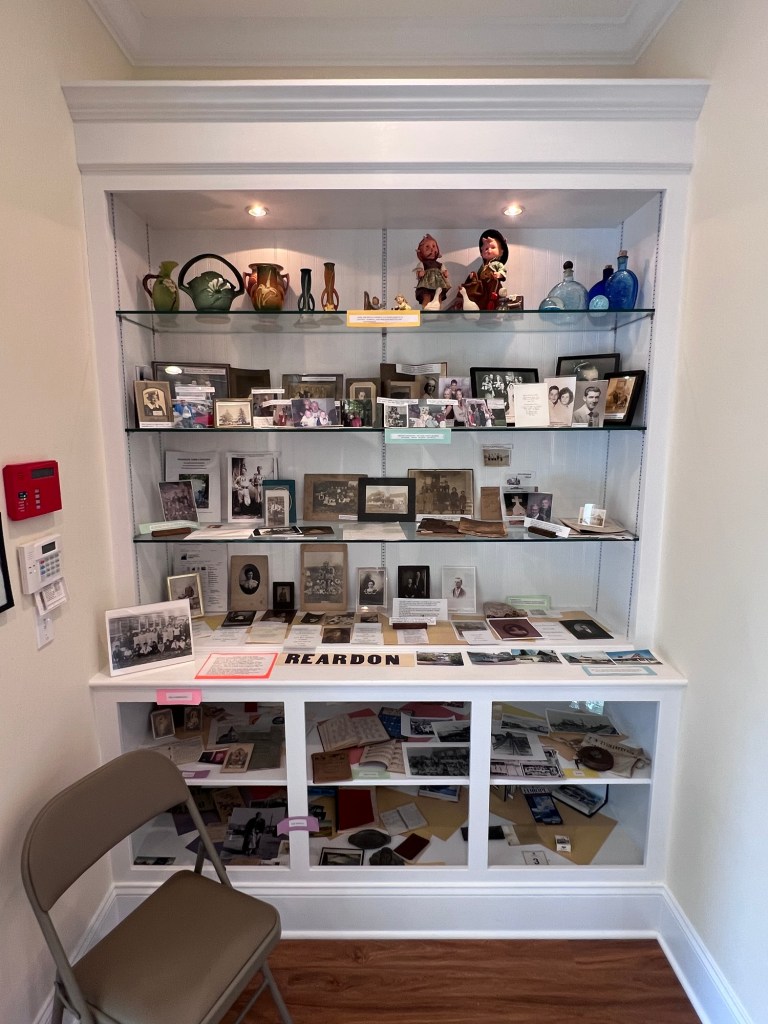
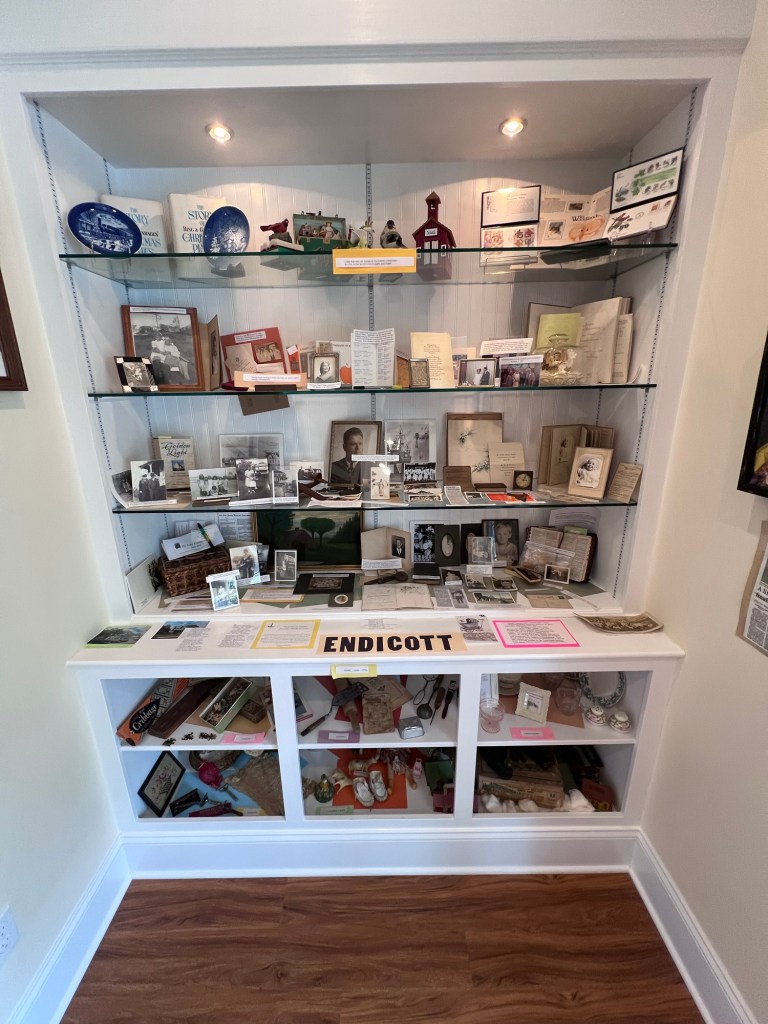
The family artifacts and heirlooms at the museum as you enter the museum
The Endicott family display at the entrance
The museum is a real surprise as entire set of displays is dedicated to the lives of the local Reardon and Endicott families and their family items. A fascinating look of the lives of these early New Jersey families for over a hundred years. This is the collection of Harriett Reardon Bailey and her family. All these wonderful items were saved over the last 100 years and now it was time to share them with the world.
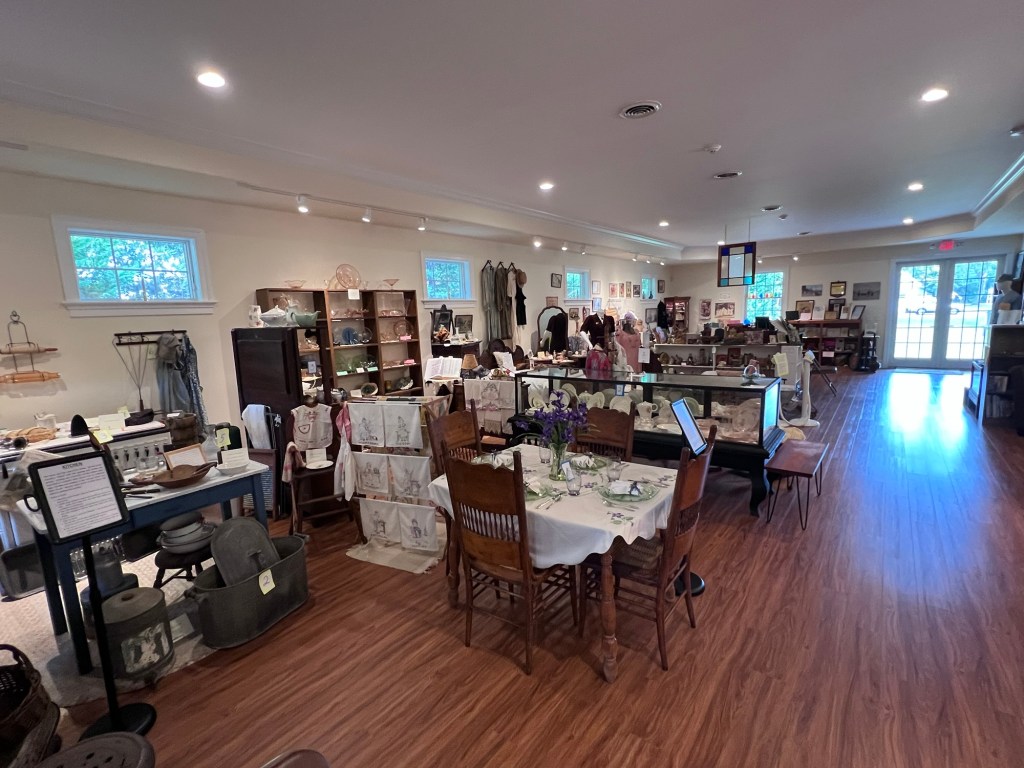
The various family items are organized by sections categorized by lifestyle and collection.
I was given a personal tour that I had arranged with the current curator who had known and worked with the owner of this extensive collection. It had been her dream to open a museum to share her collection with the public.
This beautiful, well lit and displayed collection of family heirlooms and personal items gives a glimpse of the lives of an upper middle class family in Southern New Jersey. It is organized and displayed as a household would be at that time.
The first section of the museum was dedicated to items from the kitchen and preparations.
The family Living room furnishings and decorations
The family piano that once graced their Living Room
A decorative toy car used in the Living Room
The kitchen area and artifacts of the cooking and washing done in the house
The table set for a formal dinner
The next part of the exhibit was the formal Dining Room and on display were many of the China patterns that the family owned.
All the china collections the family owned plus other decorative pieces
The family collection of China and glass pieces
The family had various collections of China
Mainly of the bedroom items have been preserved too from linens to comforters to every day clothing. There are also a selection of family member’s clothing, jewelry and personal items.
The Bedroom vignette with clothing and accessories
Another view of the bedroom
Harriett Reardon Bailey had been a school teacher like her mother and there were displays of items that reflected her time in the classroom including a classroom setting.
Time on the classroom and family employment
The classroom set up
Activities and programs at the school
More local school items
There were also displays on her father’s time in the army and her uncle’s time working on the railroad with carefully preserved outfits, programs and railroad artifacts from the job.
The Railroad display
School and family items
Work on the railroad
The display on the family contribution to the armed forces
What I thought was interesting was that the founder of the museum had been an only child with relatives that had never been married so that she was the only child and a bit spoiled.
The Toy Room
In a separate room off the side held her extensive collection of dolls and games. She had kept all her childhood items in such beautiful shape and with great care. What impressed me was there was a picture of her as a little girl with all her dolls and stuffed animals her room and since she kept everything, they were able to recreate the display.
The picture of the owner, Harriot Reardon Baily, of the museum as a little girl in her bedroom
The exact replicated display of toys in the same spots in the display
The collection of tea sets
The collection of toys and playthings are extensive and they are all in wonderful working shape
There was a large collection of dolls plus all their clothes and accessories that were kept together in her collection. Even into adulthood, all of her childhood items were kept in pristine condition.
The collectible dolls and clothing
The extensive collection of childhood dolls
The collection of China and baby dolls
The collection of baby dolls
The collection of cloth and rag dolls
The handmade dollhouse and rag dolls
The fancier imported and collectible dolls
What I thought was interesting during the tour was that the curator had said that the founder of this museum had the vision of keeping all these items for so long and packing the house with family memorabilia. I think she knew what she was doing.
She was not just preserving memories, she was preserving a past that was fading away and the memories of a different time. As her family died, she kept their memories alive by preserving their past as well. The curator had said that she had always wanted to create a museum with all her family’s items and share them with the public. Now we get to glimpse into her family’s history and everyday life.
The museum shares with the public the day to day happenings and life of the Endicott-Reardon branches of the family and life as a middle class Victorian family. I think she preserved the best items with such care as to share them with future generations of what life was like at that time. When people knew each other and times were slower and quality mattered. She loved her beautiful things and wanted to share them with us.
The inside of the Endicott-Readon Family Museum
A video of the museum from owner Harriot Reardon Baily and her collection
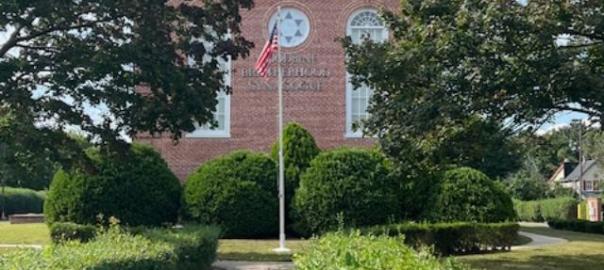
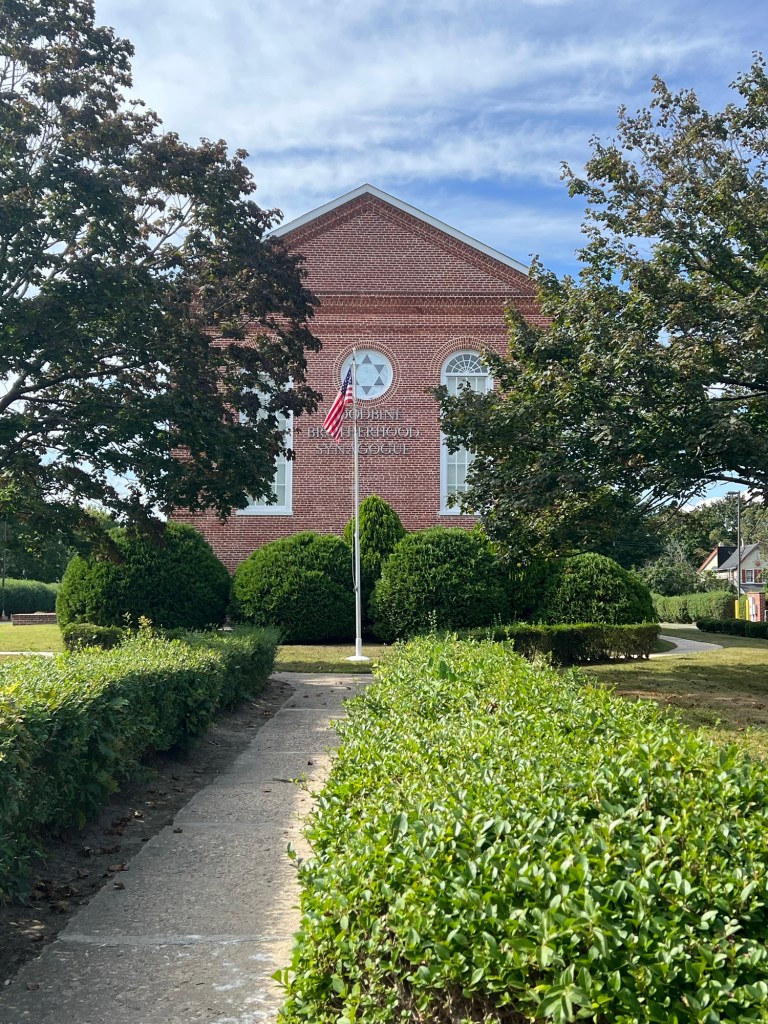
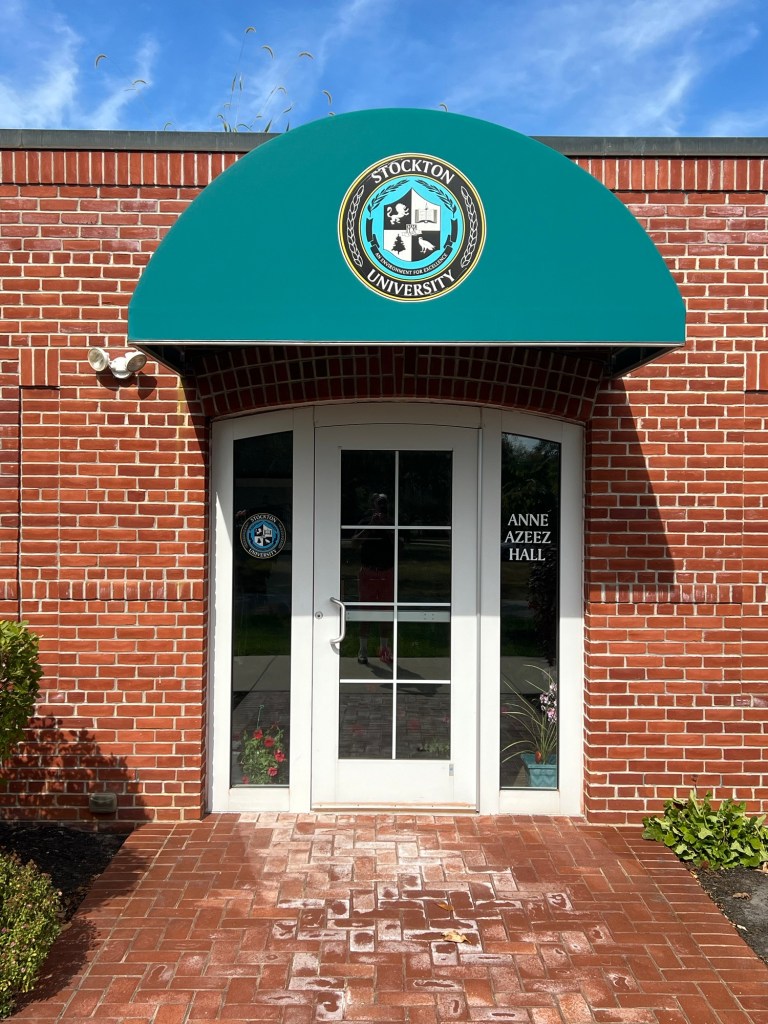
The front of the Sam Azeez Museum of Woodbine Heritage
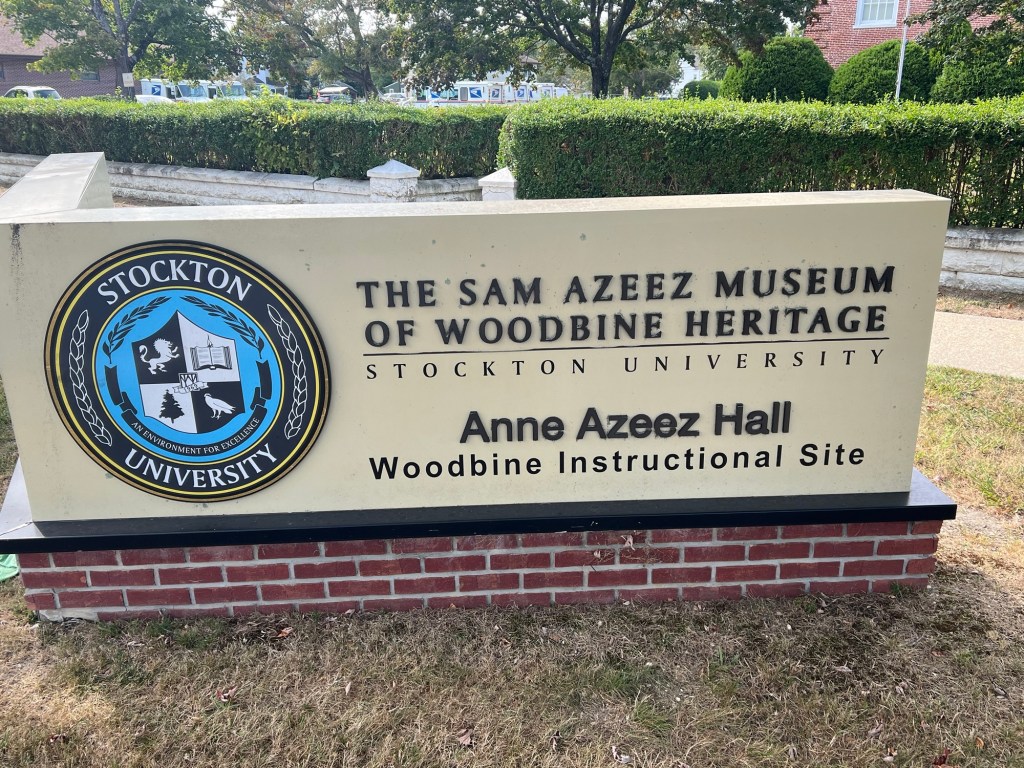
The entrance sign that welcomes you
The History of the Sam Azzez Woodbine Museum:
(from the museum’s website):
The Sam Azeez Museum of Woodbine Heritage is an independent non-profit charitable organization preserving the unique history of Woodbine, NJ.
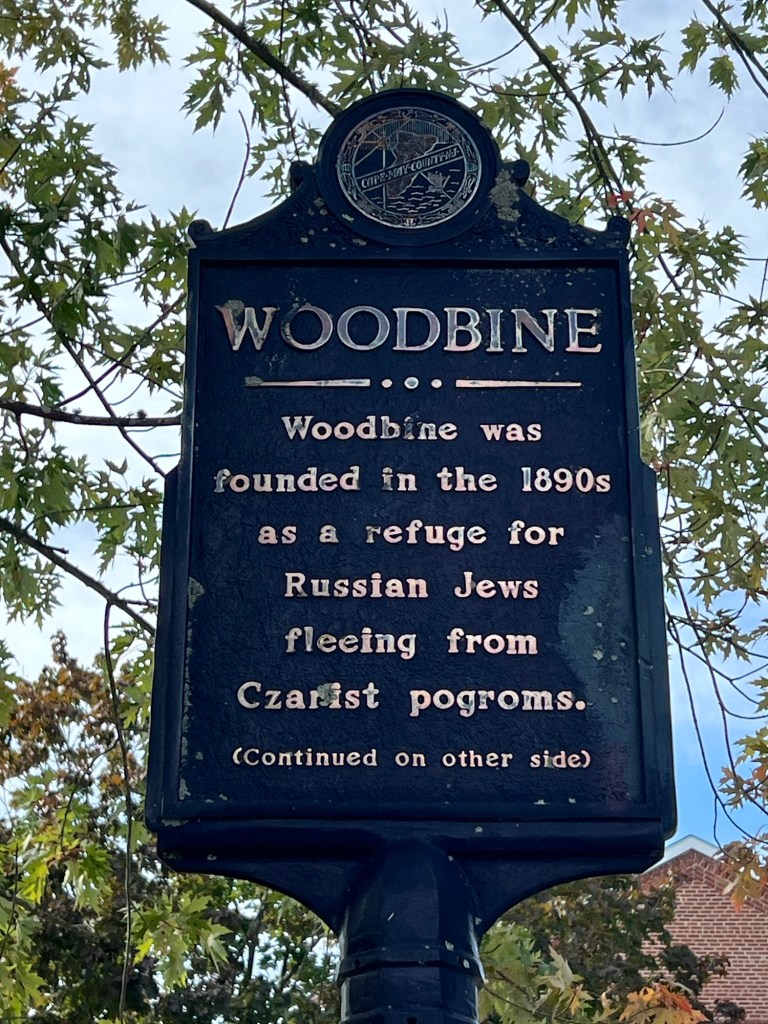
Established in the 1890’s through Baron de Hirsch’s philanthropy, Woodbine began as an agricultural colony for Russian Jewish immigrants seeking freedom denied in their homeland. As poor soil conditions limited farming, Woodbine evolved into Cape May County’s manufacturing center while maintaining founding values of education, religion and inclusion.
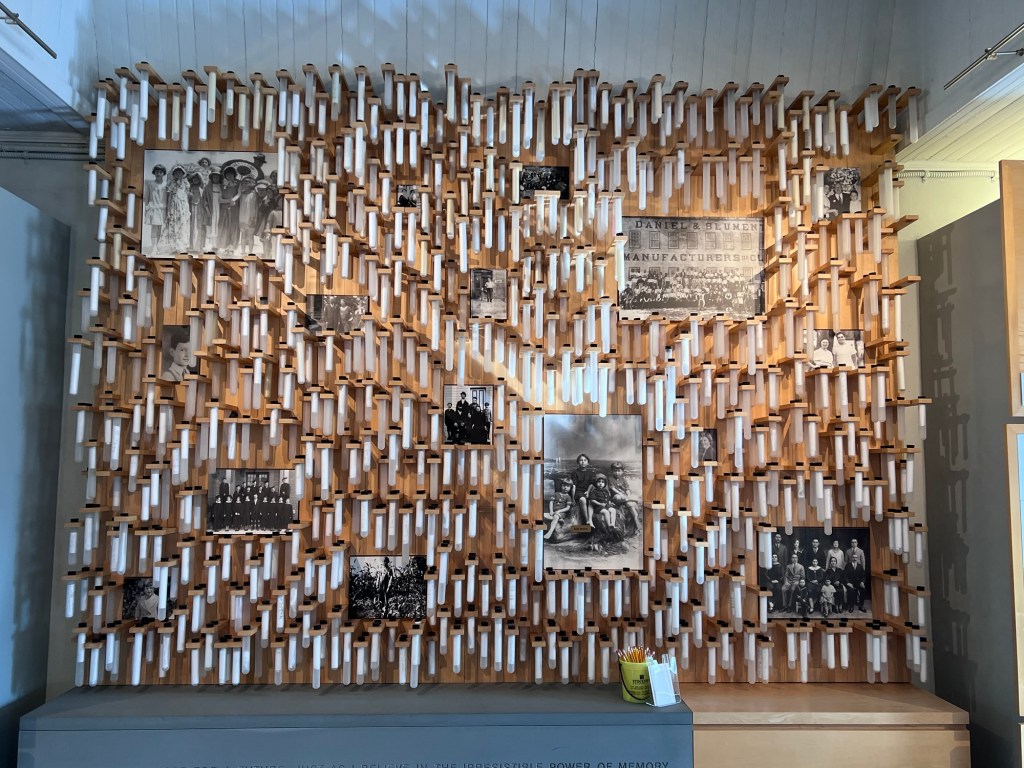
The museum occupies the historic Woodbine Brotherhood Synagogue, listed on the Natural Register of Historic Places. The restored sanctuary hosts special services, while the Brotherhood Hall houses exhibitions including the community-contributed Collective Memory Wall.
The historical significance of of the Town of Woodbine
The entrance to the museum
The museum is another interesting look at New Jersey history and the development of the immigrant story of assimilation into American society.
I was given a personal tour by the Assistant Curator and she explained the resettlement of Russian Jewish immigrants by a wealthy patron into this South Jersey community.
The main gallery of the museum
The panels tell the story of how these community came into being and how these people built a community through agricultural and eventually manufacturing and small businesses that supported the community around it. It established a town that was self sustaining and grew to the community center.
The panels show the growth of Woodbine as a community
The residents established their own sports teams, community organizations and civic groups like the councils and fire and police departments.
The records of the many town organizations of Woodbine
Display of one of the first families to settle in Woodbine
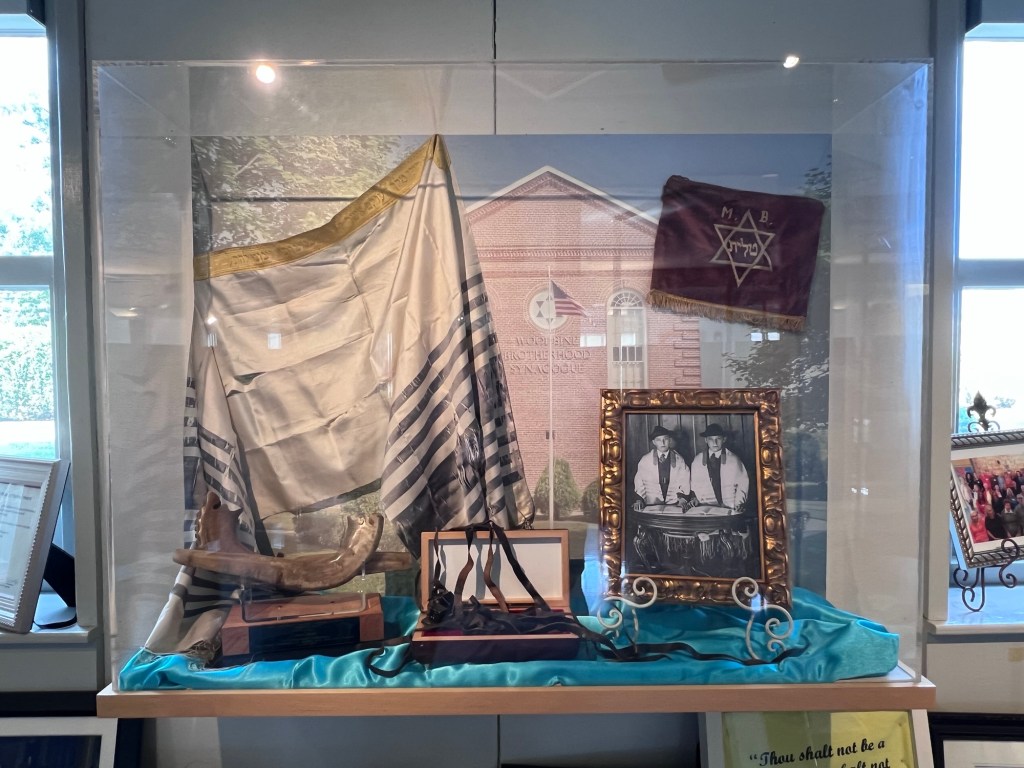
Display of the religious faith of the community
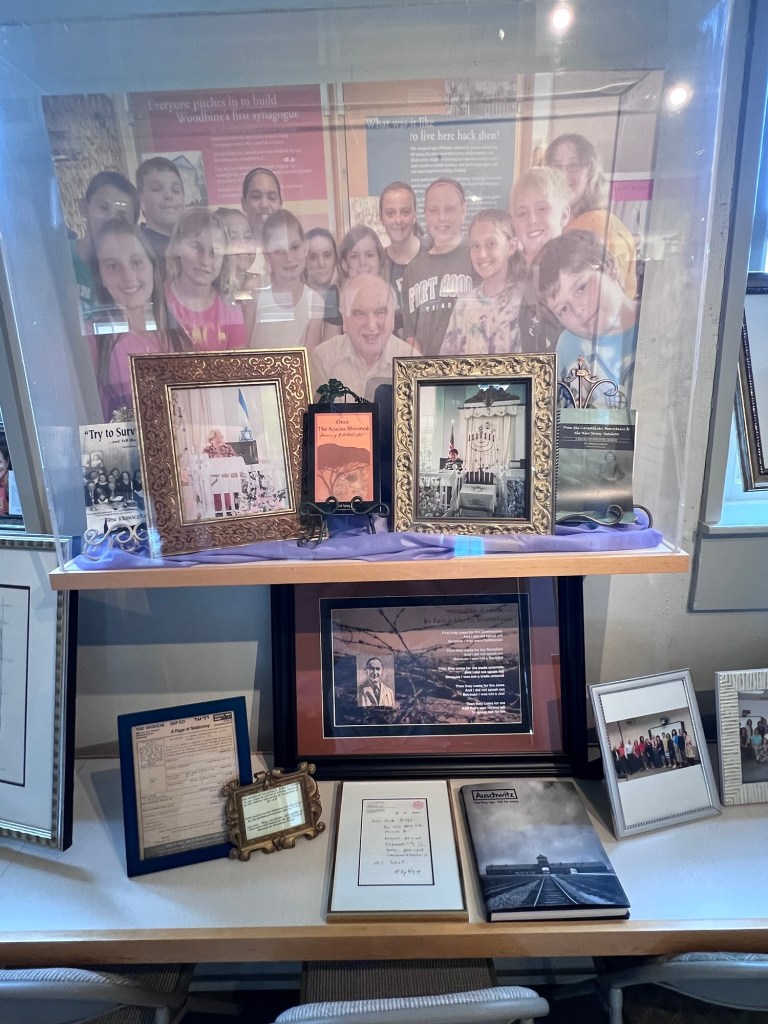
One of the most touching displays is of survivors of the concentration camps during the holocaust. These pictures represent these women as children and them today.
The display of the women who survived the camps
The history of the community and the growth of diverse businesses in Woodbine
Creating and building the Synagogue in the community
On the second floor of the building is the old synagogue of the community which is only used during the high holidays. This is used by descendants of the community and family members of theirs.
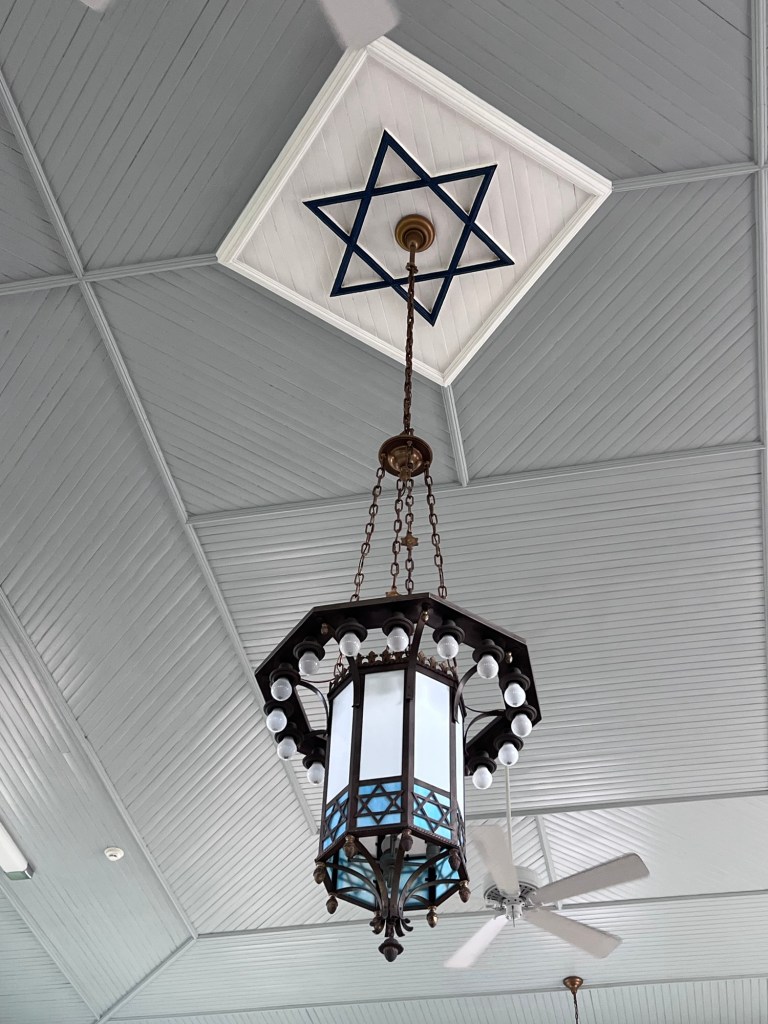
The inside of the synagogue on the second floor of the building
The front of the temple
The chandelier is original to the temple
The space was being prepared for the Jewish New Year and the crowd of people who would be attending.
The Memorial Wall
The traditions of the religion being practiced in the community
The self-government of the community
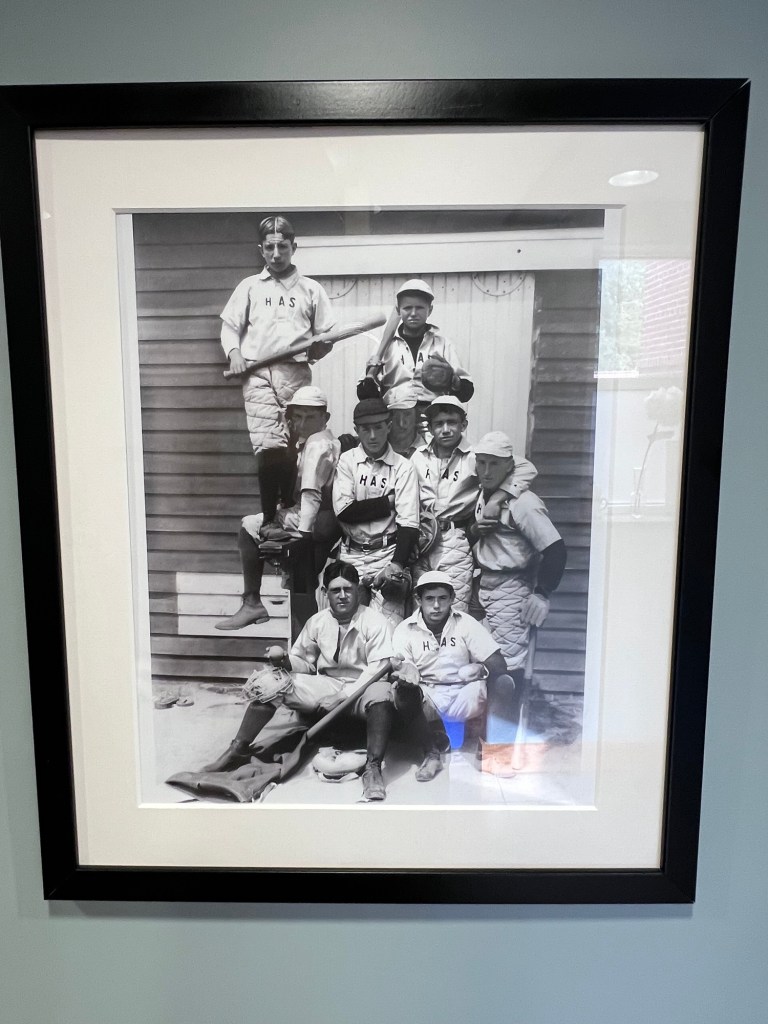
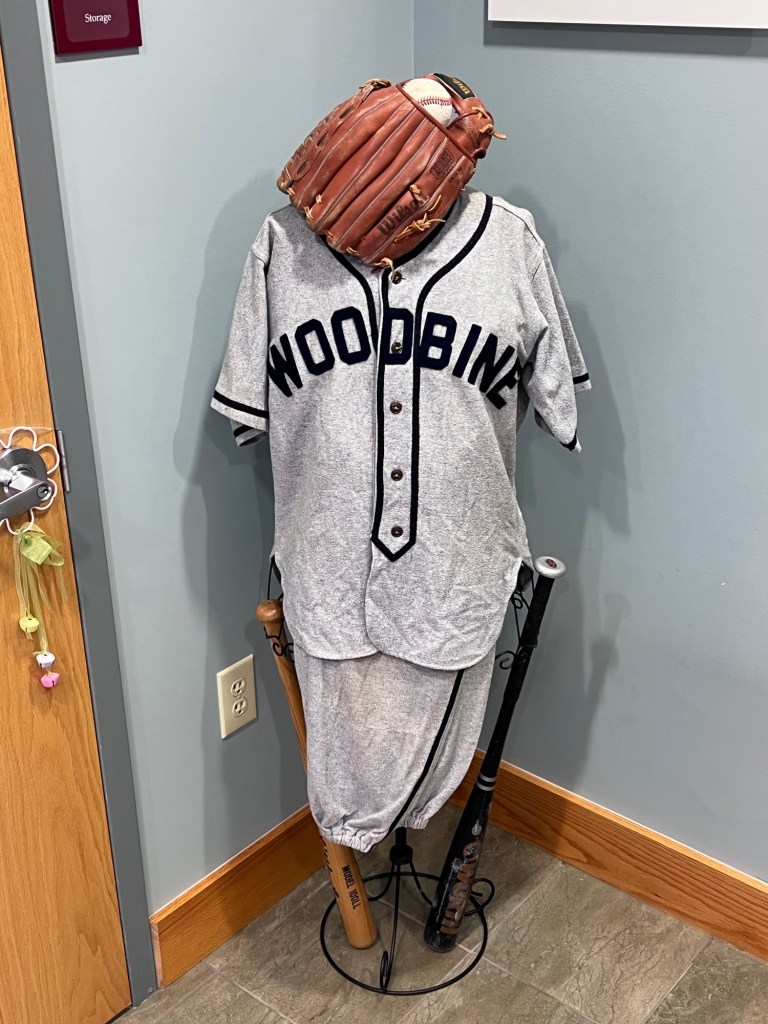
Still the younger generation was all American and wanted to assimilate into society with an all American past time of things like baseball.
The Woodbine youth baseball team
The uniform of the old baseball team for youths in the town
The last display is of the famous alumni who once lived in the community. These are the men and women who once lived here and went on after all odds to do great things and make our country better.
The Hall of Fame
The museum I thought had a bit of an identity crisis as I really did not know what the museum was about.
I was pleasantly surprised to find an interesting part of New Jersey history I had never known. It just goes to show you how a museum can educate you with just one visit. The Assistant curator said there will be more to come in the future.




















 mywalkinmanhattan