This small museum in the Upper West Side neighborhood of Manhattanville is easy to miss. It is in a small brownstone on West 107th Street right near Riverside Drive. You can see the plaque for the museum to the right of the building and there is a side door to get in. The admission is free but they do ask for a donation if you can do it.
The gallery on the second floor
The museum is a specialty collection of the works of artist Nicholas Roerich. They are mostly landscapes and religious themed that cover three floors of the museum.
The is a beauty to all his works especially the ones concentrated in the Himalayas with their colorful and spiritual themes.
The artist’s portrait of his mother on the third floor
It takes about an hour to an hour and a half to see all the floors. A nice touch they had in the afternoon that I was there was a piano player whom you could hear play throughout the brownstone. When you go, it will be a pleasant afternoon where you are not fighting the crowds of the larger museums.
The art pieces enlighten you and I felt gave you a sense of hope.
(The following information is from the museum website)
Artist Nicholas Roerich
(From the museum website)
The Nicholas Roerich Museum was founded in 1949 to house a permanent collection of over two hundred paintings by the Russian-born artist, poet, philosopher and humanitarian, Nicholas Roerich. The museum also houses a library of books and maintains an archive and a collection of artifacts relating to the areas of Roerich’s interests (Museum guide).
The Mission of the Museum:
The mission of the Nicholas Roerich Museum is essentially a narrow one: to make available to the public the full range of Roerich’s accomplishments. These, however, are not narrow; they cover the realms of art, science, spirituality, peacemaking and more. Because Roerich’s activities ranged widely, so do the museum’s.
The second floor galleries
The Museum Collection:
Nicholas Roerich is known first and foremost as a Russian-born artist. His paintings, of which there are thousands around the world, explore the mythic origins, the natural beauty and the spiritual strivings of humanity and of the world.
One of the more spiritual paintings in the collection
The museum houses approximately two hundred of these works and keeps most of them permanently on display for visitors who come from around the world. Indeed, for many of these visitors, the museum is a destination of great importance; the paintings speak to them of their own inner yearnings and possible fulfillment. For them, Roerich’s paintings are a kind of teaching-about spiritual development about culture and its role in human life and about opportunities for the achievement of peace in a fractious world.
The second floor galleries
The beautiful landscapes on the second floor
Publications & Booklist:
The museum also keeps in print a number of books by and about Roerich and his life and work and a substantial stock of postcards and reproductions of his paintings. These too are seen by many as more than just prints; they are hung in homes with a degree of appreciation that is not often given to such things.
The gallery on the first floor with some of the more religious works
Cultural Events:
In addition to these functions, the museum also maintains an active schedule of cultural activities.
The second floor galleries
It was Roerich’s fervent belief that the role of cultural development in the peace and evolution of the world is fundamental and that it is therefore the responsibility of those who work in creative and cultural fields to strive always for that peace and evolution and for those goals to be the chief impulses guiding their creative work. Information about these ideas is always available.
The second floor gallery with Asian themed art
The Roerich Pact & the Banner of Peace:
The museum sustains an ongoing effort to spread public awareness of the intermingled roles of peace and culture and the ways in which each sustains the other. Information and materials about The Roerich Pact and the Banner of Peace are always available.
The patronage of the museum through the Katherine Campbell-Stibbe Foundation
Throughout this century of wars and national struggles, the yearning of the public for ways of achieving peace has been great; the ideas of the Pact and the Banner provide a welcome answer to those yearnings.
The history of the museum through the years
As Roerich’s ideas become better known around the world, attendance at the Museum grows and requests for information and materials about him and his art and social achievements increase.
The gift shop on the first floor. The director of the museum even sells honey from the beehives on top of his building.
*This information is from the Museum’s website.
Disclaimer: This information was taken from a combination of the museum’s website and from the biography of the artist.
Also known as the U.S. Coast Guard Station No. 126, this is the only life-saving station (now museum) of its design in NJ (1 of 6 in the country) still in existence. The designer and architect was James Lake Parkinson in a Carpenter Gothic style. This building is one of 42 stations built in New Jersey. It was also the workplace of the brave surfmen who were the beachfront First Responders of the day.
The anchor outside the building
The historical plaque outside the building
The History of the Building and Museum:
(from the State of NJ Historic website)
The U.S. Life Saving Station in Ocean City is significant as an example of a significant type of life saving station and for its association with the activities of the U.S. Life Saving Service. The building was constructed in 1885 in what was referred to as the “1882 type.” There were 25 life-saving stations constructed in this style. In 1905 the building’s footprint was expanded to nearly twice its original size. The expansion was done in a style unique to New Jersey Life Saving Stations.
In 1915 the U.S. Life Saving Service and the Revenue Cutter Service were combined to form the U.S. Coast Guard. The Coast Guard continued to utilize the building until it was decommissioned during the 1940s and sold. It was used as a private residence until the City purchased it in May 2010.
The first room inside was the formal dining room where guests who visited or who had been rescued had dined. It was a rather formal affair.
I visited the museum on a weekend day to learn of the rescue procedures and the job these men did on a day to day basis. The first thing I learned was how shifting tides can change an island.
This building which now sits about four blocks inland was once at the shoreline a hundred years ago. Talk about change and Mother Nature’s role in this.
The first room I visited was the formal dining room in the newer extension of the building. This would be where the officers and men would entertain guests and visitors to the building. It could be a casual or formal affair.
The first floor formal dining room
The entertainment for the evening was either board games or a music box
Some of the items salvaged from the sea
The Life Guard officer formal outfit was worn for formal affairs
The officers would be dressed formally to receive guests
The next room over was the Rescue room and door where the boats and other equipment would be held when the alarm sounded.
The docent discussed how the doors were opened and the boats needed to be pulled out on a stormy night. Everything you needed had to be close by, in good shape and ready to go.
The rescue boats and pulleys that would be used in the sea
The ropes and pulleys used to assist in the rescue
The lanterns were used as communication between shore watch and the tower
The equipment used to repair the items used for rescue
The rescue boat and the items used for a water rescue
The additional boats used in rescue
Some boats were used for fishing and collecting shell fish
The Sneak Box was used for duck hunting to camouflage yourself
The sneak box
We then toured the second floor sleeping room for the crew. This offered a great view of the sea when the building was at shore line. These men were given good accommodations for the time.
While not very private, it was comfortable and served its purpose for a job where you might not get a good nights sleep.
The sleeping quarters
The main sleeping room was for a crew of six
The loft lead to the tower where the look out for the evening would sleep (it is not open to tours right now).
The loft area from the window
We then headed back downstairs where we toured the station manager’s room and office.
The station manager’s room off from the kitchen
The station manager’s office where all the monthly paperwork was done and business was conducted.
The kitchen
The Station Manager’s office was right next to the kitchen stove so that the room was kept warm during the winter months and on cool nights.
The kitchen stove
All the meals for the crew and visitors were cooked either by the men or their wives might be allowed to visit and assist in duties in the building.
The kitchen
All the storage of the foodstuffs has to be accounted for because getting them was rough with no cars for transportation and no bridges to cross to the mainland.
The gift shop
The museum and grounds
The museum offers a glimpse of the everyday life of these brave men who were on call 24/7 and performed such dangerous work. Ocean City has done a wonderful job preserving this legacy.
The museum has docents on hand for more formal tours and are very detailed on their knowledge of the building and its contents. It is a very interesting look at Ocean City’s past.
Open: Please check the website for the times they are open.
Admission: Free but donations accepted
My review on TripAdvisor:
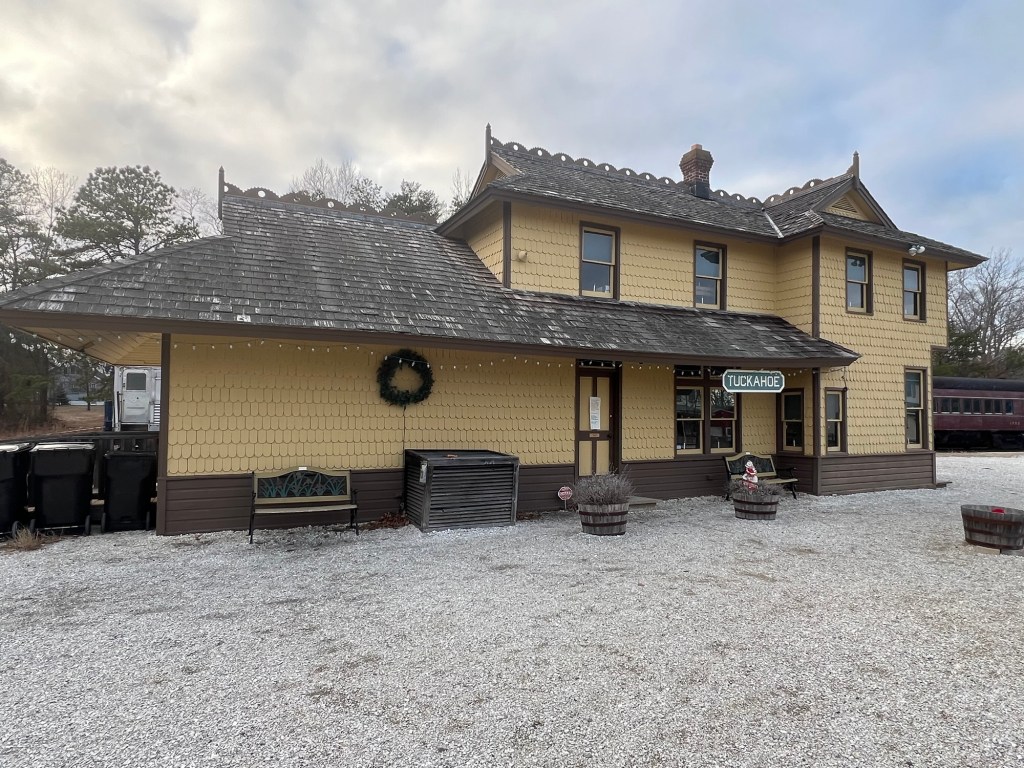
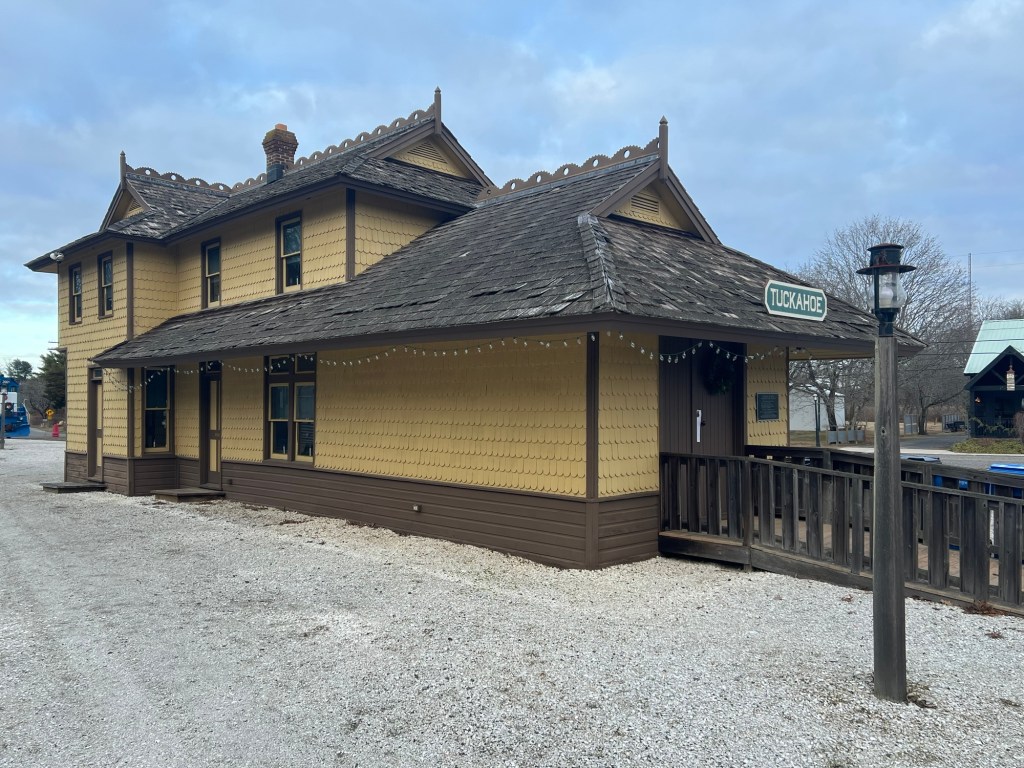
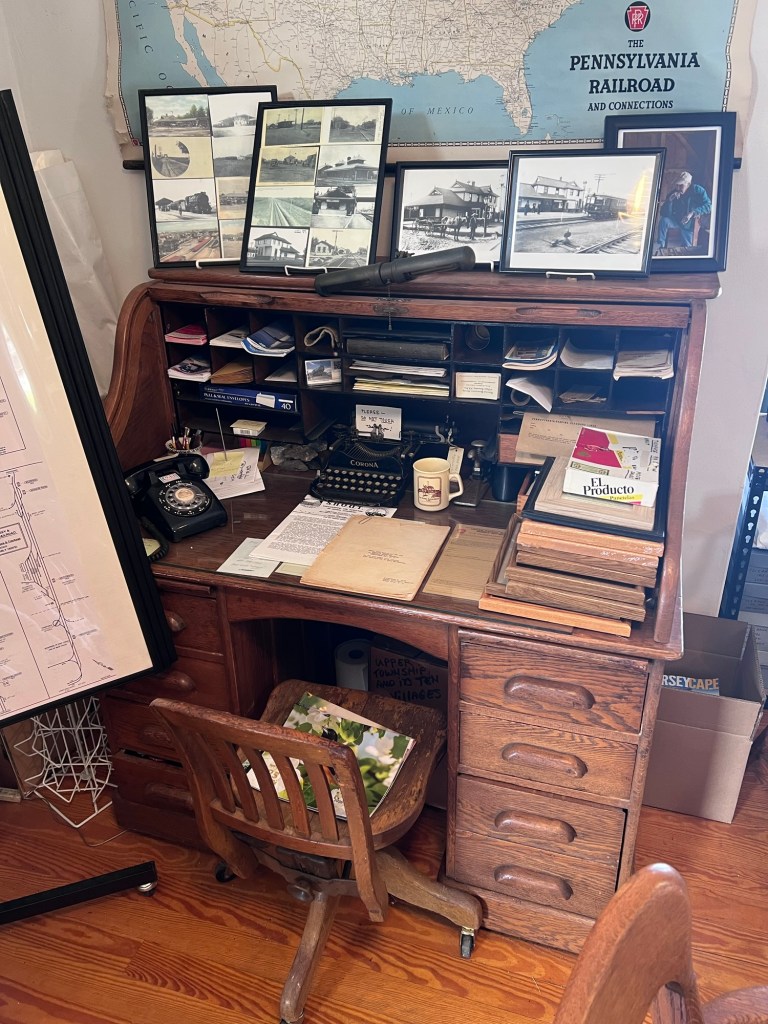
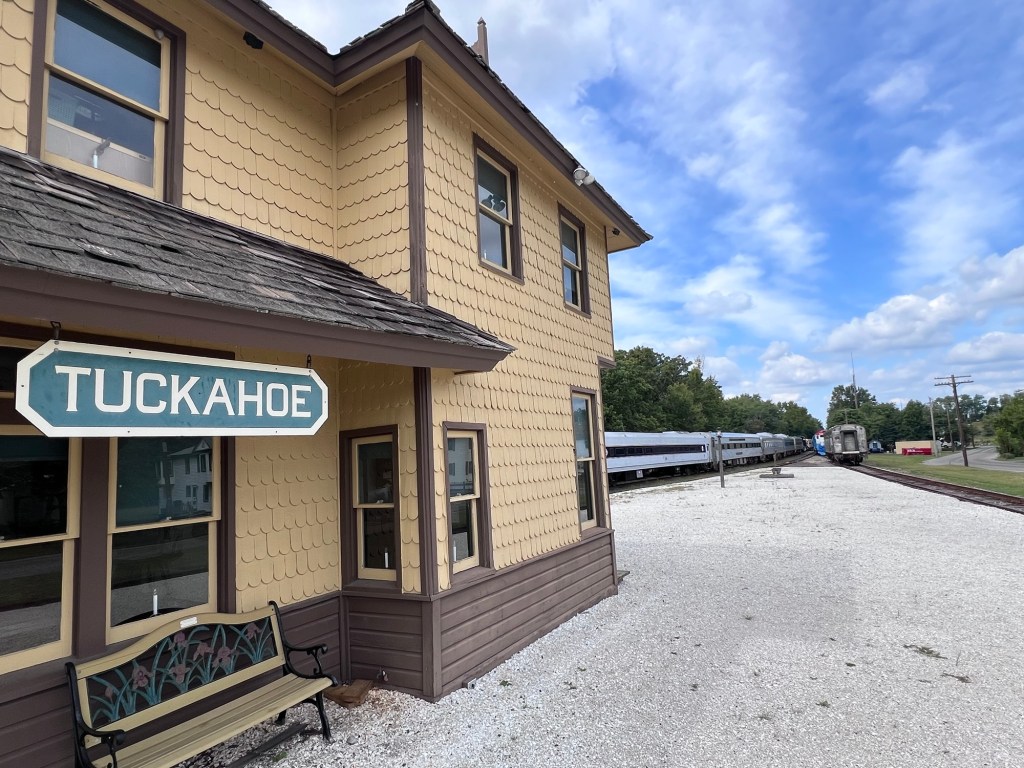
The Tuckahoe Train Station at Mill Street and Railroad Avenue
I visited the Tuckahoe Train Station during Christmas of 2024. The holiday events were long over but the station was still decorated for the holidays. In the Summer of 2025, I arranged a full tour of the station museum and the rail yard.
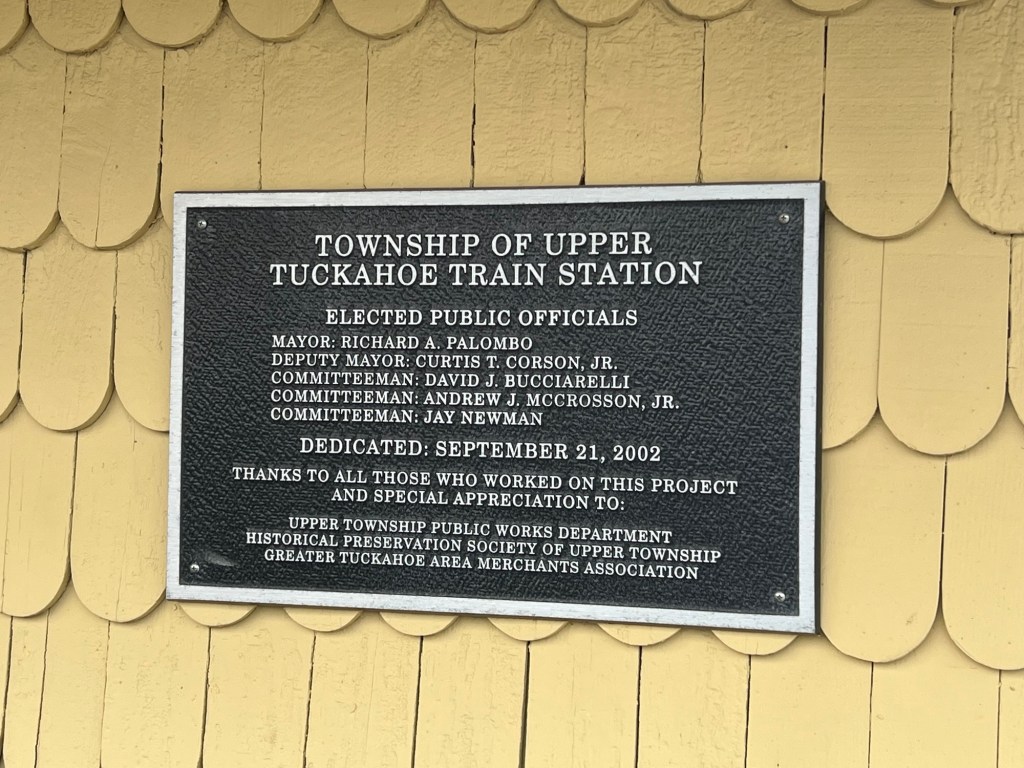
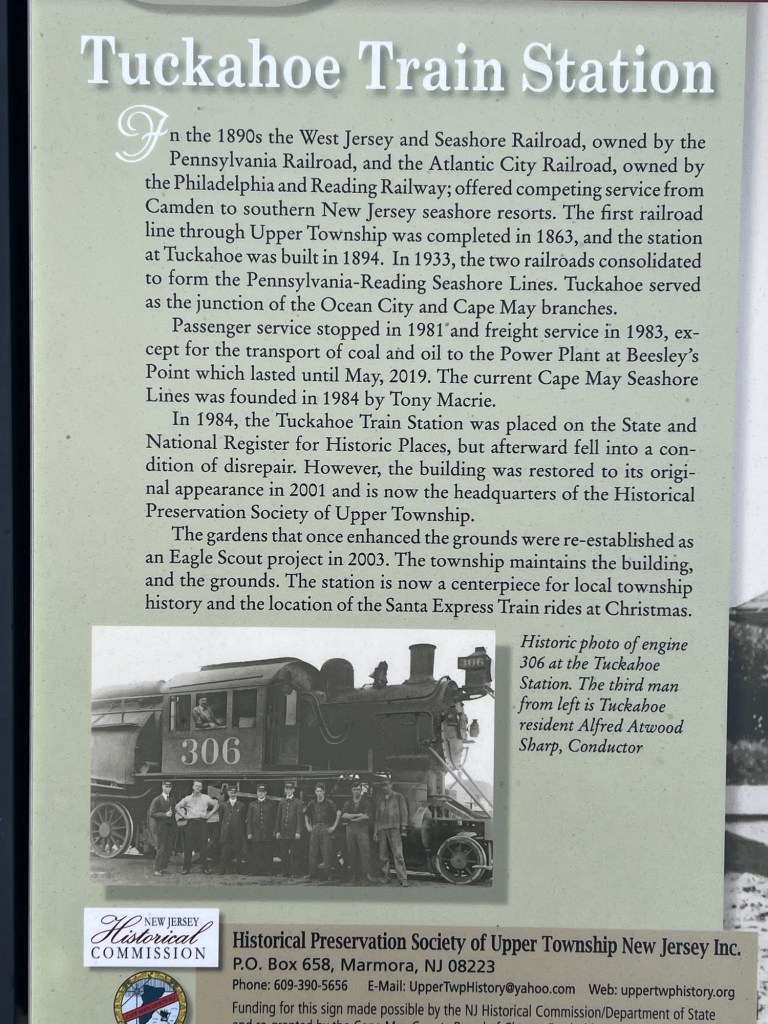
The station’s historic sign
The station’s historic sign
The station was once the hub of the area and visitors would depart from cities like New York and Philadelphia. The trains stopped running to this area in 1981.
The train station from the front of the building in the winter of 2024
I came back in 2025 for a full tour of the train station and the grounds. The Board members of the Upper Cape May County Historical Society had arranged this enjoyable tour of all the rooms.
The station again in 2025
The train station history
The Summer of 2025:
My tour of the train station started with the history of the station and the development of the train station and transportation to the area. The coming of the railroad meant the development of the area as a resort town bringing hundreds of visitors each summer.
The tour started at the inside of the station and took me through the first and second floors of he old station house.
The first floor of the Tuckahoe Train Station
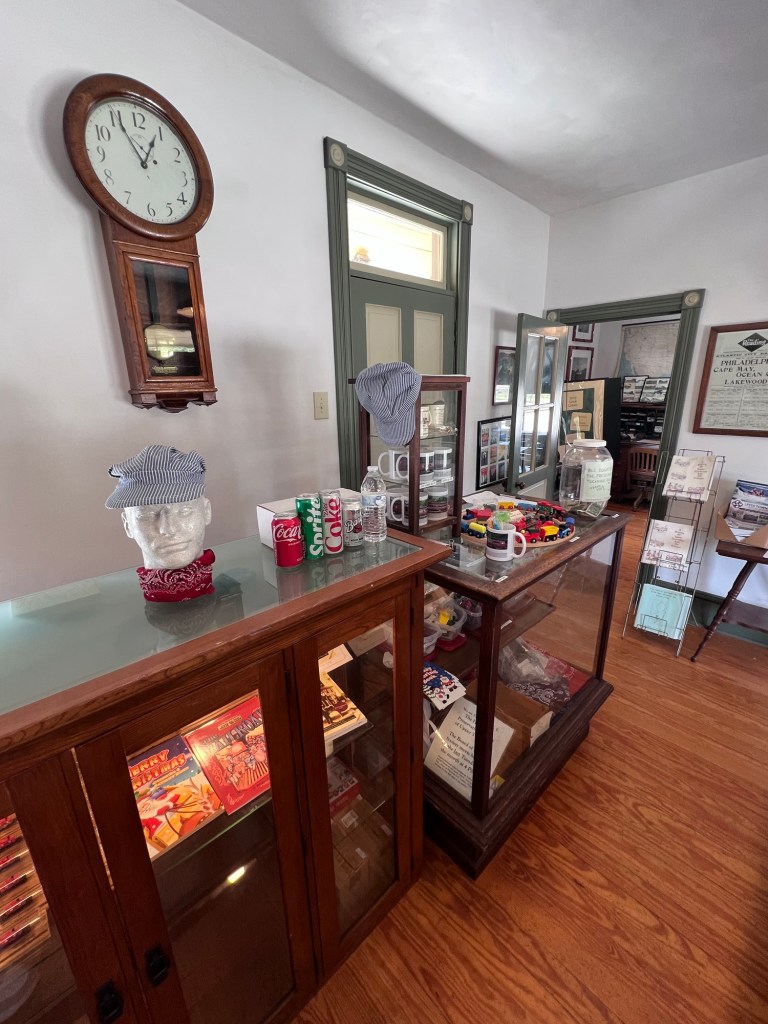
The Ticket a room is now the gift shop
The display cases of memorabilia from the station days
The classic train sets
Ticketing and travel materials
The entrance to the baggage Room
The Baggage Room
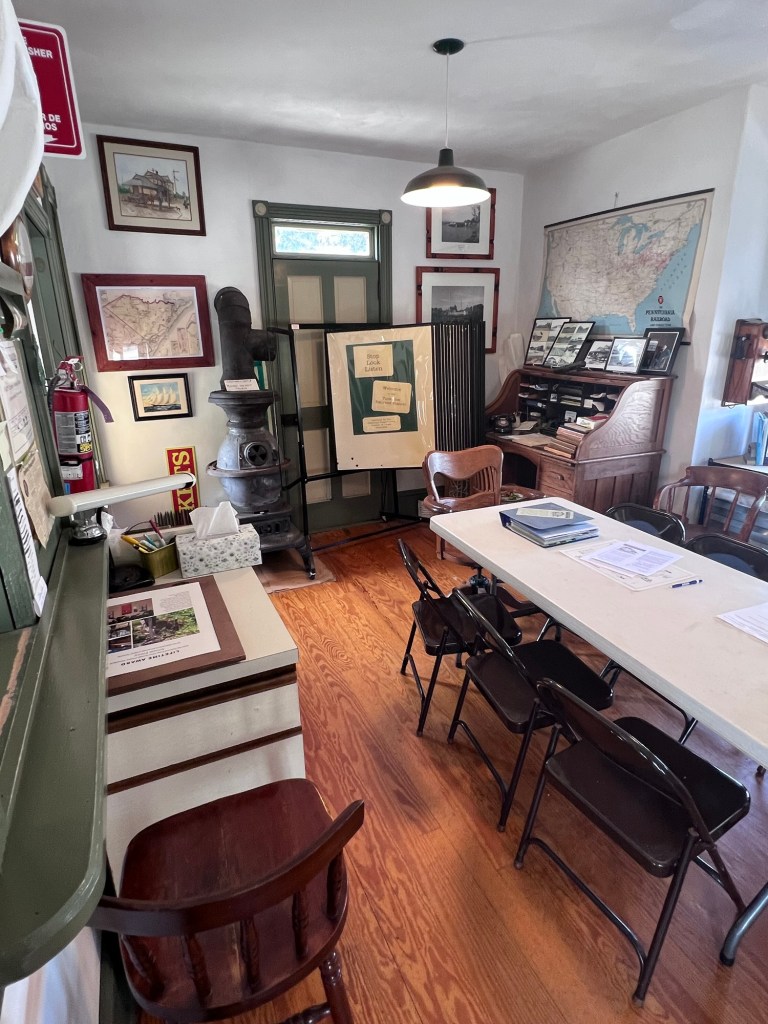
The old Ticketing Room
The Ticketing window
The old seating area in the Ticket Room. The tour guide told me that unions version of the benches was built brand new to match the antique one. I could not tell the difference.
The pot belly stove that kept everyone warm in the winter months
The next room over was the Waiting Room where there were more artifacts to see.
The Waiting Room
The seating in the Waiting Room
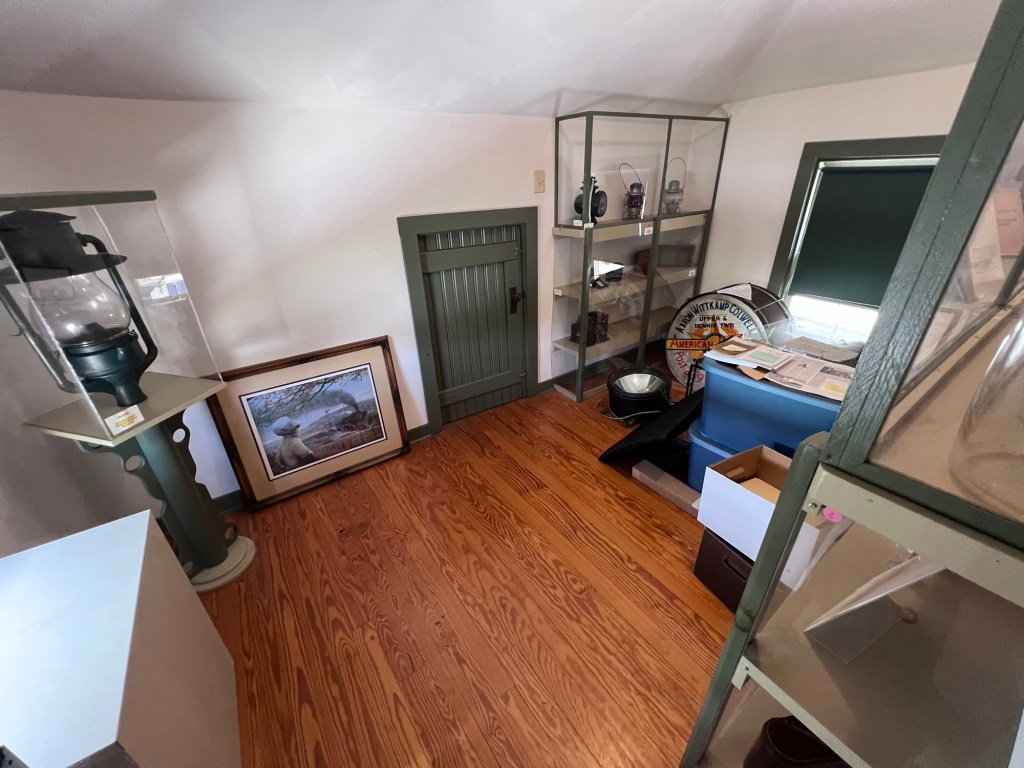
Then we toured the upstairs where the Conductor’s office and bedroom were located.
The Conductors office on the second floor
The conductor’s uniform
The we moved on to the Conductor’s living quarters when at the station working. This type of work had so much more to it in the days when rail travel was the way to go.
The Rail Conductor’s bedroom
The simple bedroom was enough so the conductor could get some rest
The artifacts from the turn of the last century
After we toured the entire building with the docent really giving me the thorough tour and history on the station and its artifacts, we went outside to discuss the trains.
We headed outside to tour the individual trains and their history. This once major shore hub has quieted down with the reduction in rail transportation due to cars.
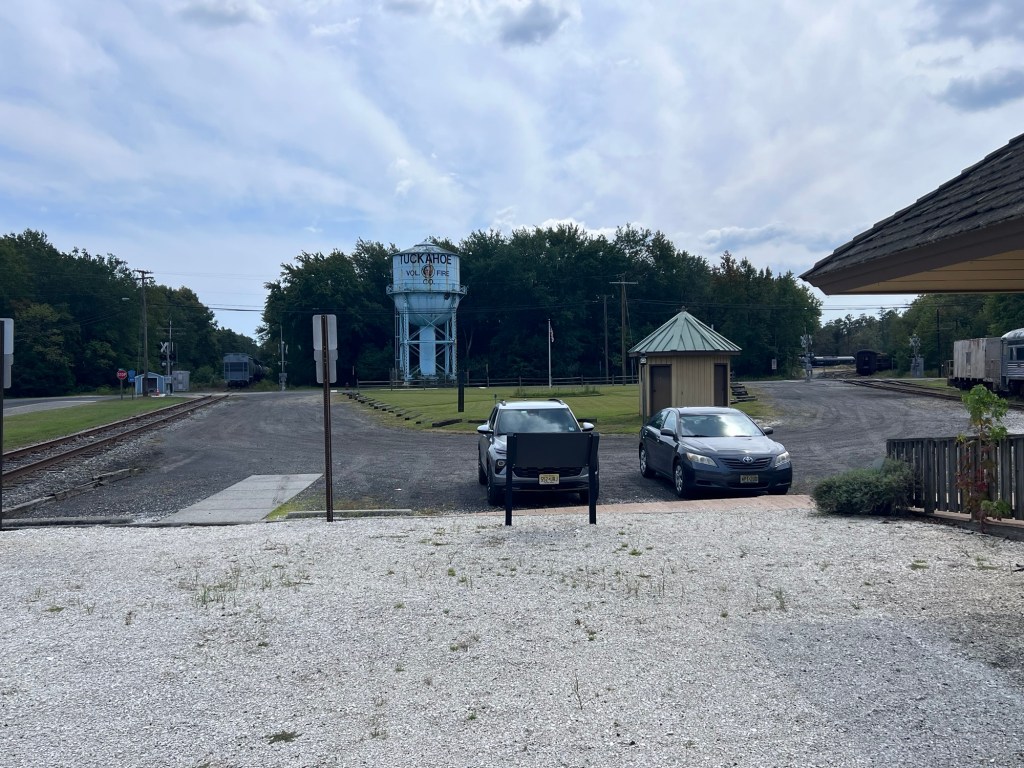
The outside of the train station and its collection of train cars.
The train station outside where the cars are located
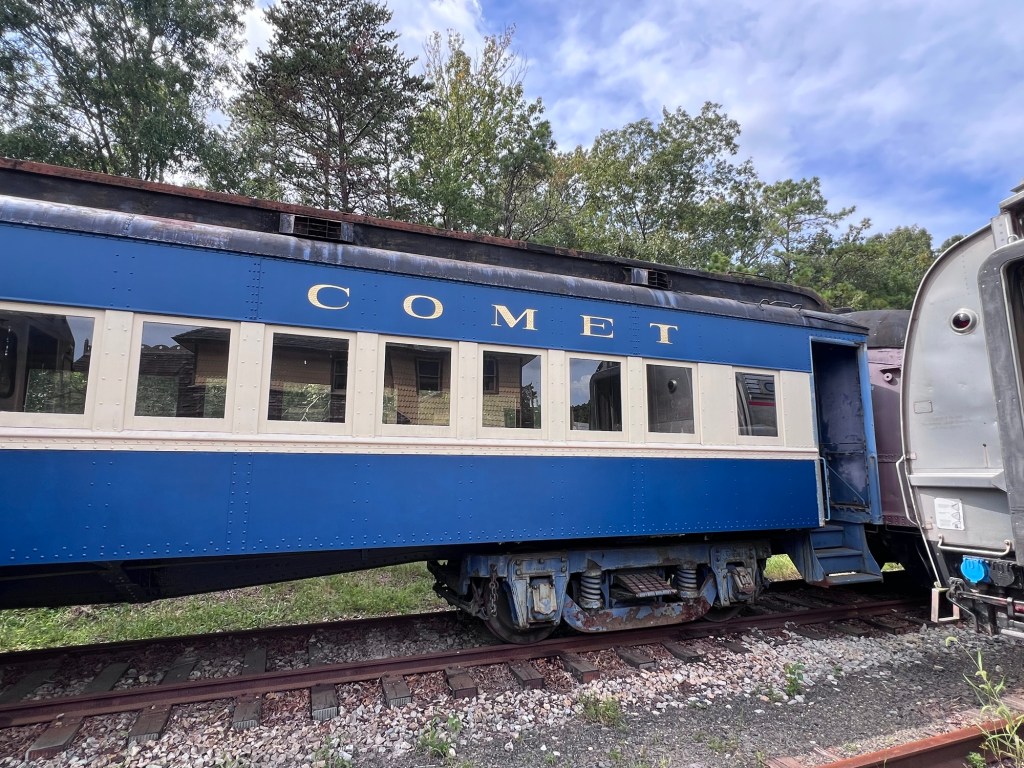
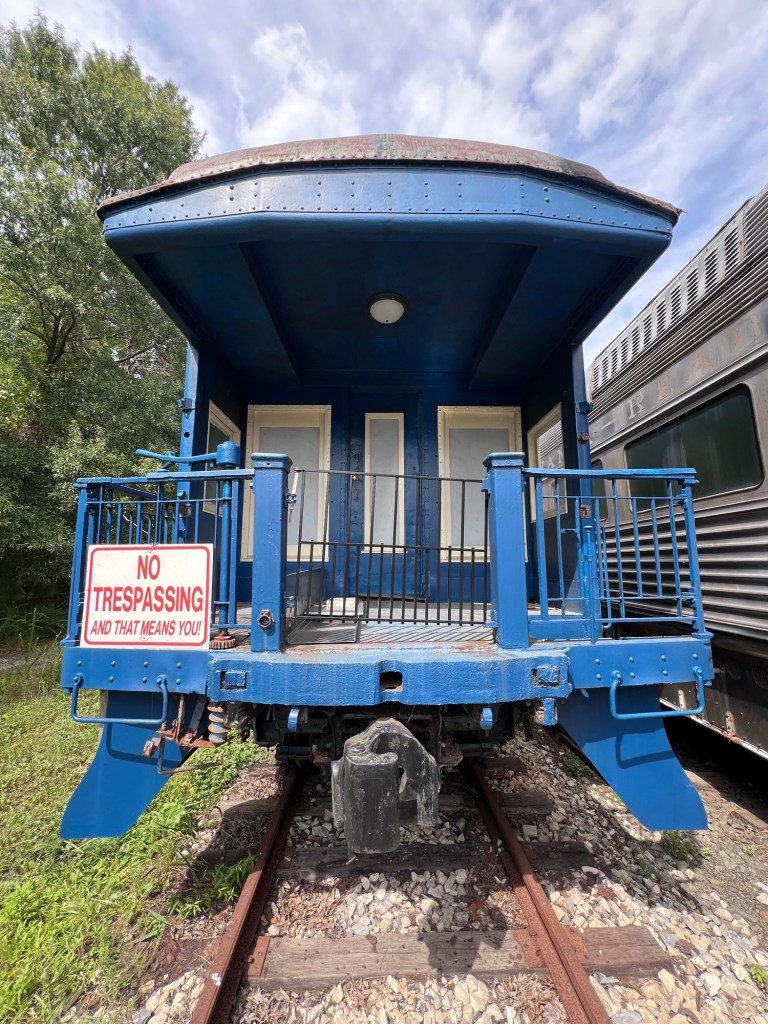
The Blue Comet Beach Train
The Blue Comet was once the ultimate in luxury travel when you came to the shore. This once ‘grand dame’ of travel is being renovated by the museum.
The Showman’s Car
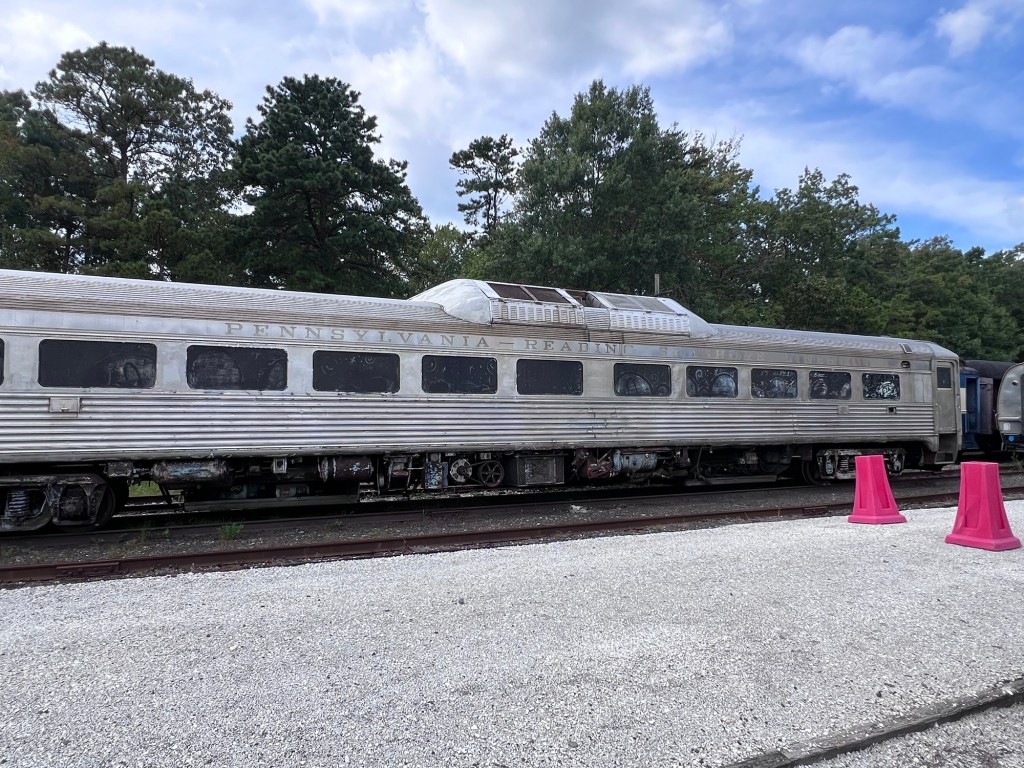
The Pennsylvania Starline
The long line of train cars
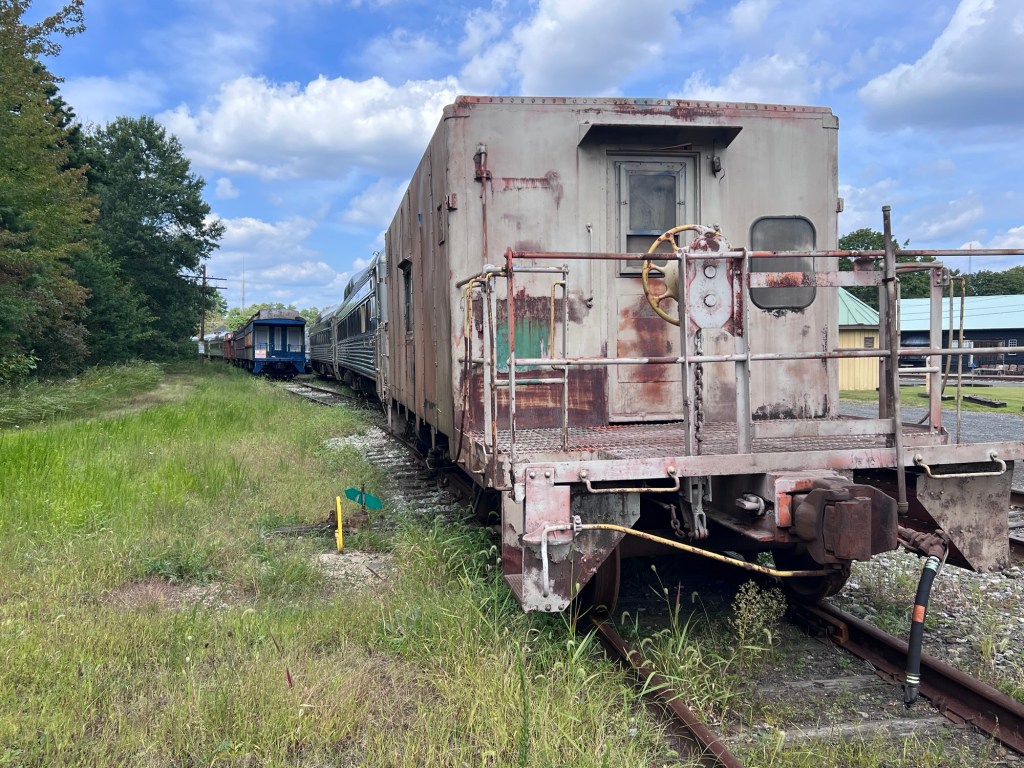
The train cars being renovated
The Beach trains
The last part of these interesting and engaging tour was a tour of the Signal and Control Building, where all communications for the railway took place.
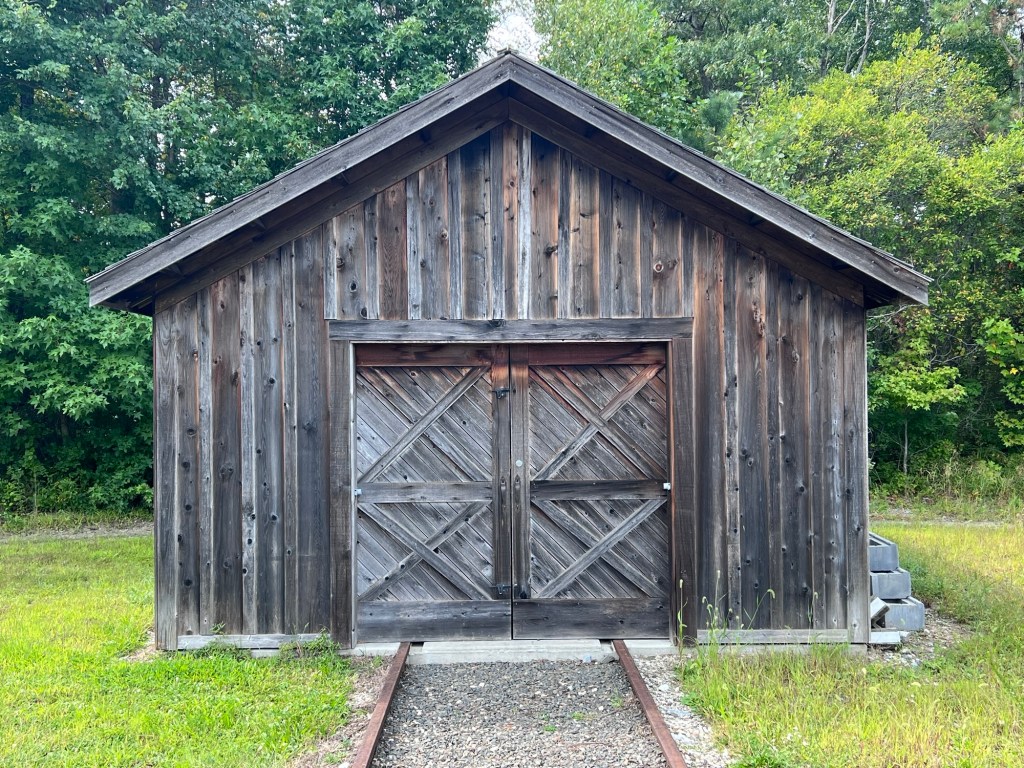
The Control and Signal Building
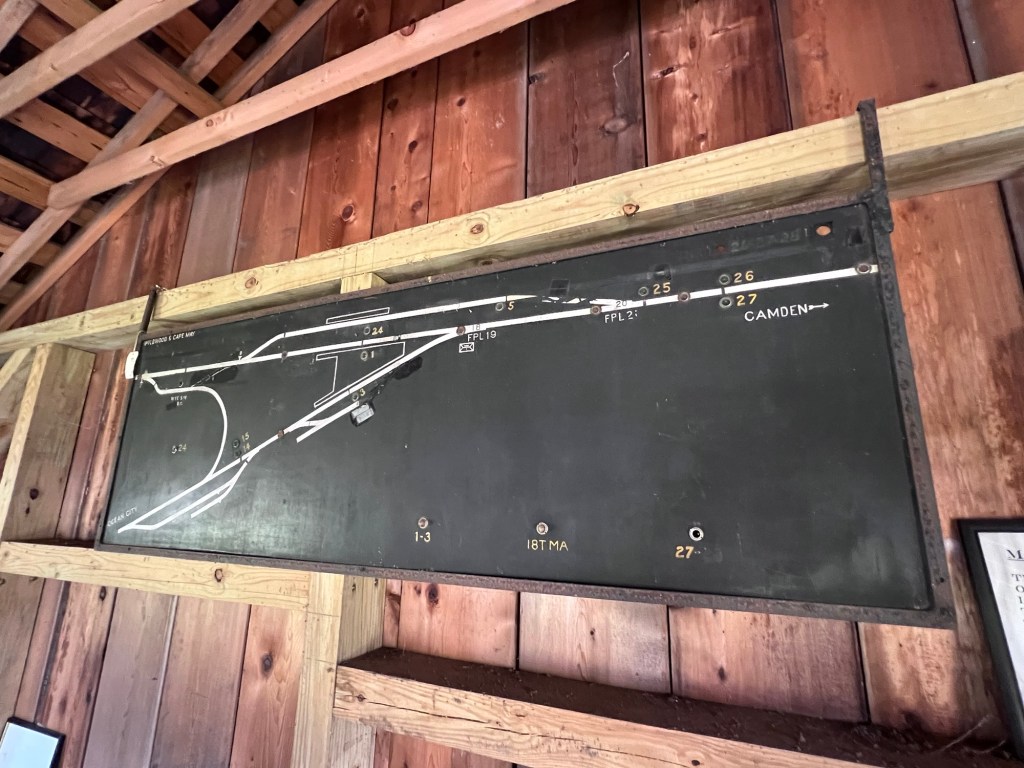
The inside where controls and repairs take place
The signal board to the train turnaround at the Y
The full tour of the Tuckahoe Train Station Museum will give you a glimpse of a once vibrant rail head and the life of visitors down the shore. The inner workings of a train station at that time are on full display here.
The History of the Tuckahoe Train Station Museum:
(from the museum website)
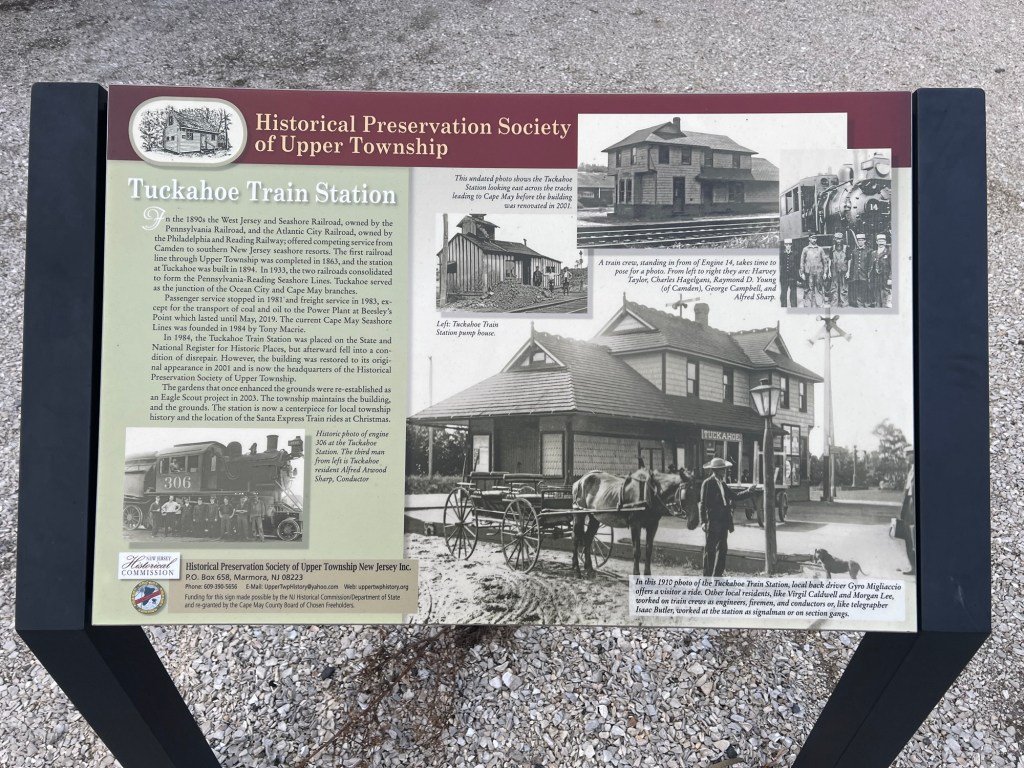
n the 1890’s the West Jersey and Seashore railroad, opened by the Pennsylvania Railroad, and the Atlantic City Railroad, owned by the Philadelphia and reading railway, offered competing service from, Camden to southern New Jersey seashore resorts. The first railroad line through Upper Township was completed in 1863, and the station at Tuckahoe was built over 30 years later in 1894. In 1933 the two railroads consolidated to form the Pennsylvania-Reading Seashore Lines. Tuckahoe served as the junction of the Ocean City and Cape May branches.
Passenger Service stopped in 1981 and soon after, freight service halted in 1983 except for the transport of coal and then oil to the power plant at Beesley’s Point. which lasted until May, 2019. The current Cape May Seashore Lines was founded in 1984 by Tony Macri.
In 1984, the Tuckahoe Train station was placed on the State and National Register for Historic Places, but afterward fell into a condition of disrepair. However, the building was restored to its original appearance in 2001 and is now the headquarters of the Historical Preservation Society of Upper Township.
‘The gardens that once enhanced the grounds were established as an Eagle Scout Project in 2003. Today, the township maintains the building and the grounds. The station is now a centerpiece for local township history and the location of the Santa Express Train rides at Christmas.
I found the tour fascinating of how this museum was once the hub of transportation for this section of the Jersey Shore.
The Paterson Museum is an interesting museum of the history of the City of Paterson, NJ. The museum is broken into different sections of the City’s history. The museum discusses from the time that the Lenape Indians lived in the area to the rise of colonization and then to how it developed into the Silk City through city planning and placement. The museum covers the history of the City of Paterson in the industrial Age as well with the rise of the Silk Industry, the Wright Airplane Factory, the Colt Revolver and the growth of the hospital industry in the City.
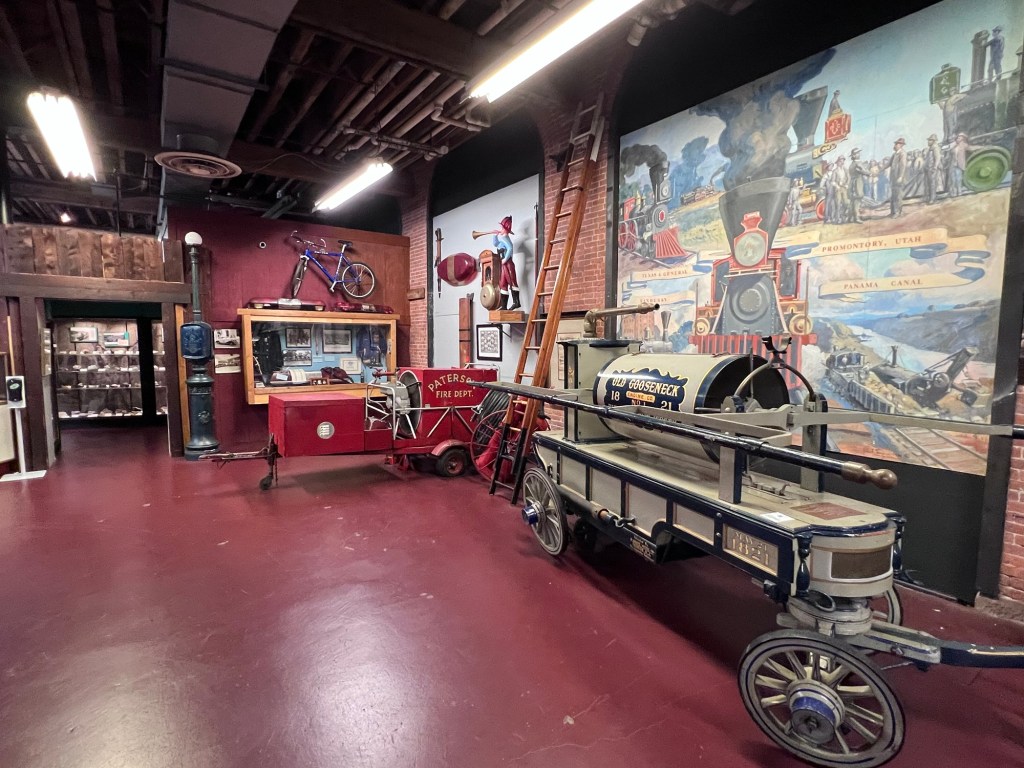
Paterson Fire Department
The Public Safety exhibition
Paterson Steam Engine
Take time to look at the live displays of minerals, Native American artifacts, old fire department equipment and the life and times of its native son, Lou Costello.
The inside of the Paterson Museum
The nice part of this museum is that the parking is free, it can be toured in about two to three hours and it is walking distance to the Paterson Falls and to Little Peru restaurants. It is also free.
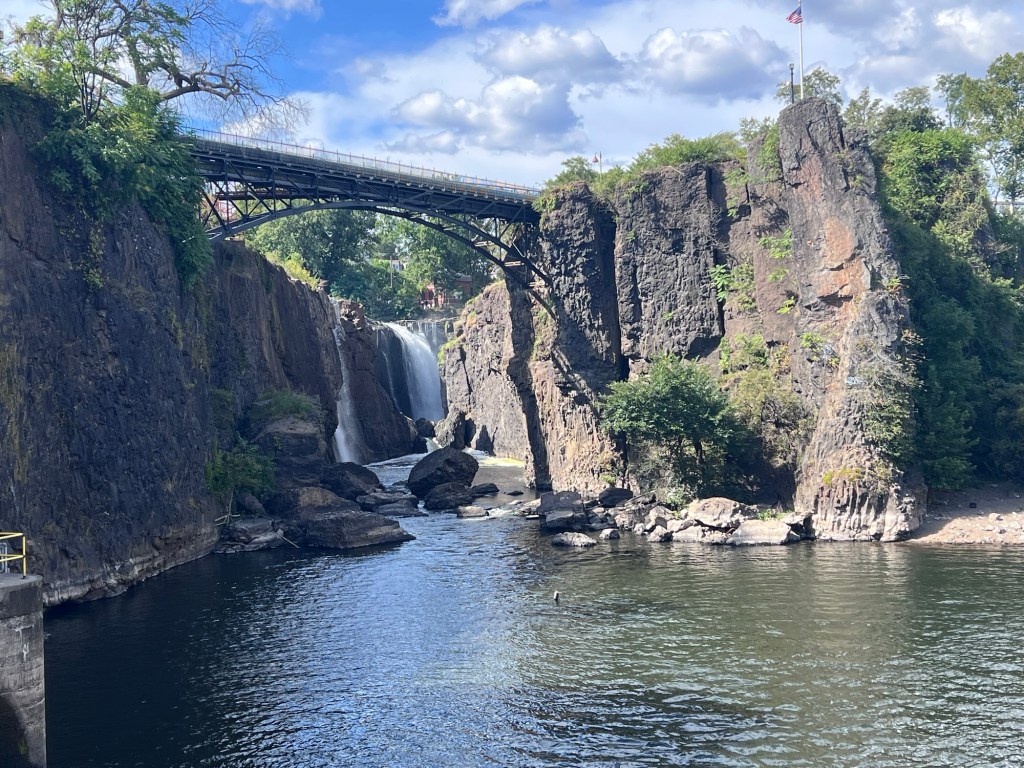
The Paterson Falls up the road
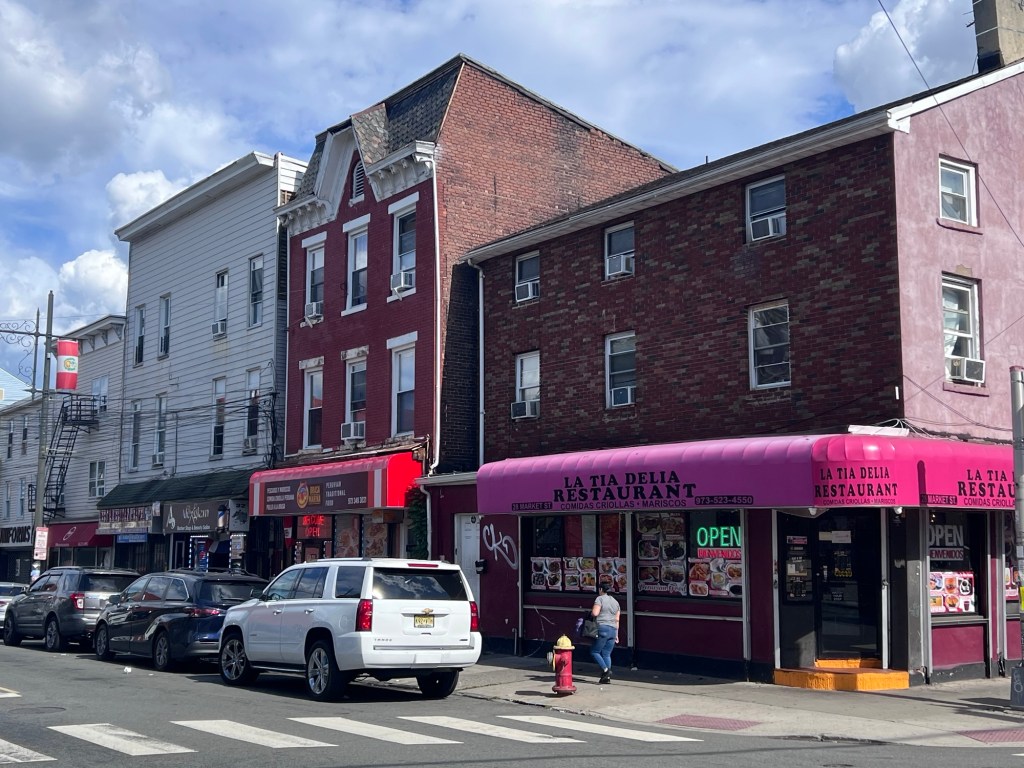
Little Peru down the road
The Introduction:
The Welcome Center
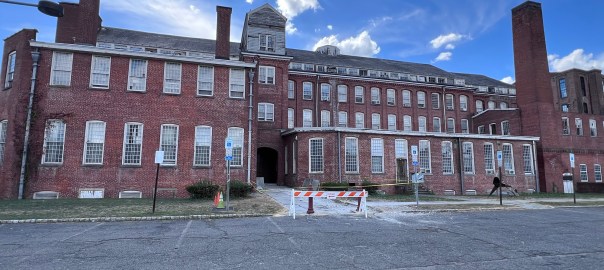
The Paterson Museum offers a ‘History within History’ experience. Located inside the former erecting shop if the Rogers Locomotive & Machine Works, the museum, presents a glimpse of the rich history and the many factors that gave rise to Paterson, New Jersey: “America’s First Planned Industrial City.”
From the natural wonders and the first inhabitants of the land that lay below and above the ground to the vital role Paterson played in setting of our nation’s industrial course. Through the museum’s exhibits. you’ll find out why Paterson was known for more than a century as the “Silk City.”
Silk City
You’ll discover that Paterson was at the forefront of locomotive, submarine and airplane engine development. And that’s just the beginning of our story. By the time you finish your visit, you will want to learn more about this city that surrounds the Great Falls.
The Exhibitions:
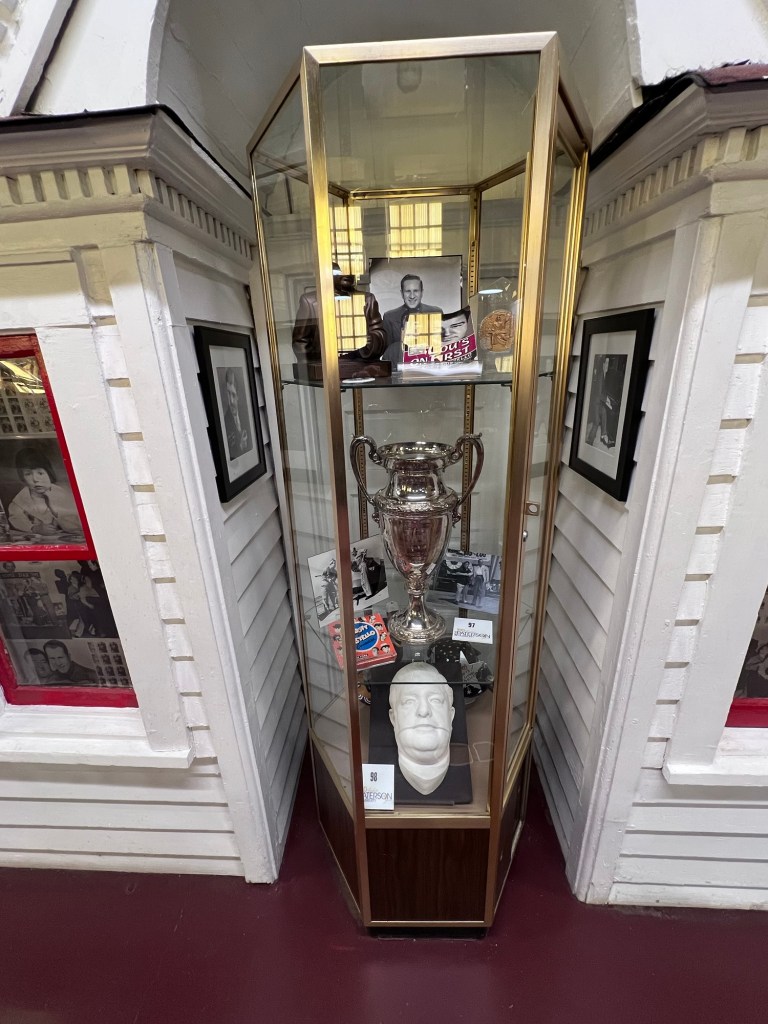
Paterson Residents: There are exhibitions on such celebrity natives as Lou Costello and his life after living in Paterson are shown in detail.
The Lou Costello exhibition
The Lou Costello exhibition
Baseball players, football players and actors have shown against all odds and color barriers they found success in the world with Paterson being their roots.
Sports in Paterson, NJ
The Silk Industry
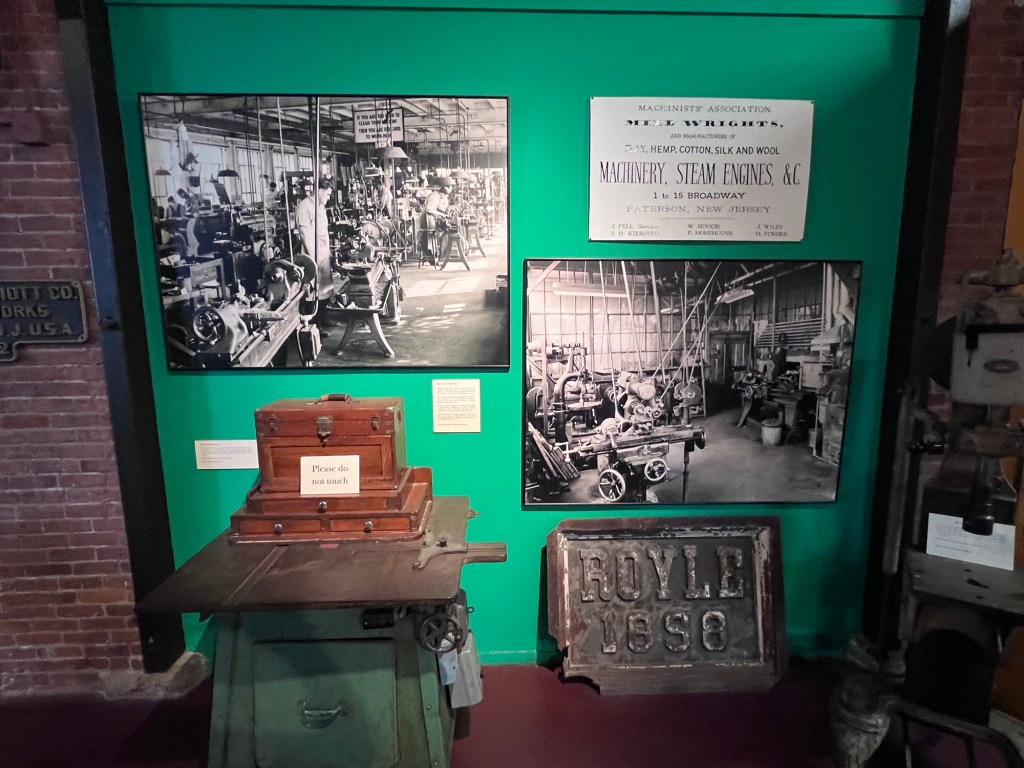
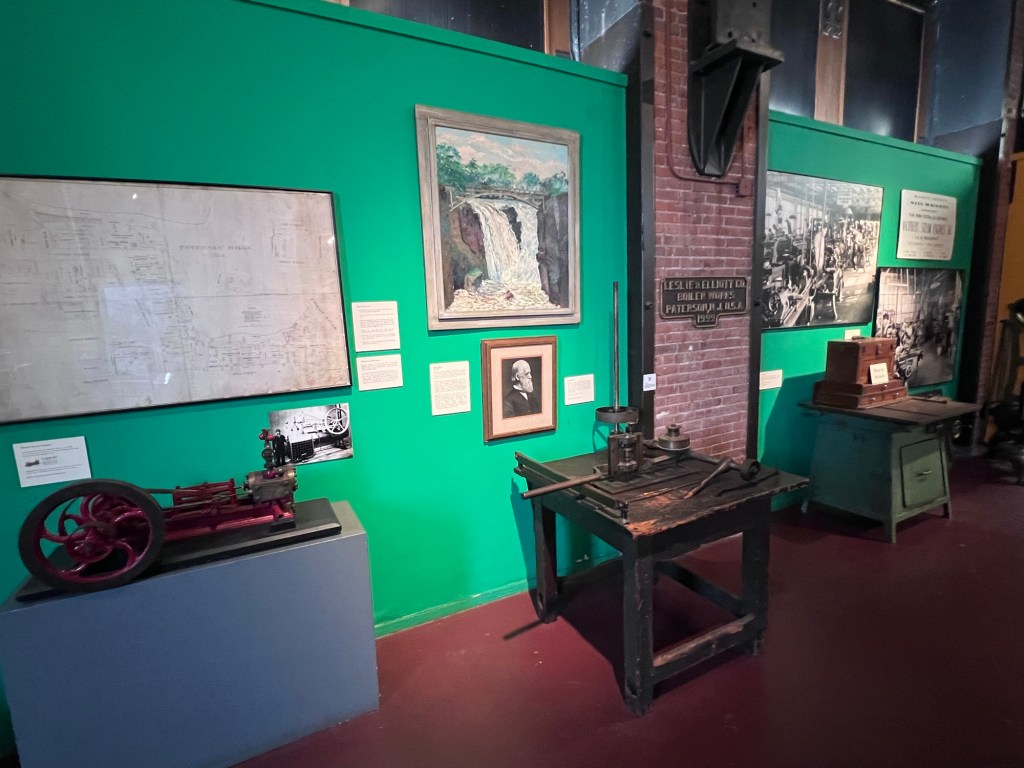
Silk City: The history of Paterson as ‘Silk City’ features winders, warpers and power-looms that produced beautiful fabrics. How the Falls and the location of the City of Paterson played its part in the garment industry at the turn of the last century. Not just in the silk industry but also in other companies like the Wright Aeronautical Corporation and the their time as a manufacturer in Paterson.
The Paterson Fire Department
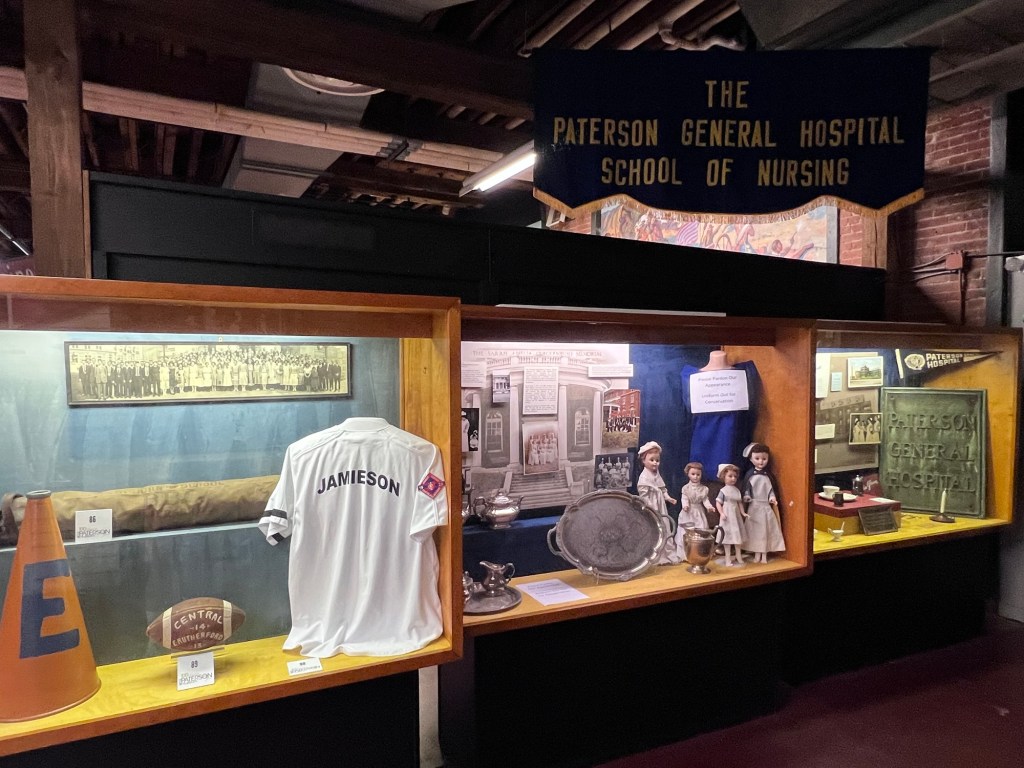
The Paterson Fire and Police Departments: The history and development of both the Paterson Police and Fire Departments are told through pictures, stories, uniforms and equipment through the ages. There are many turn of the last century fire trucks in the museum.
World War Exhibition: The museum has a wonderful exhibition on the history of Paterson and the role it played in the World Wars. There are all sorts of uniforms, munitions and stories to tell.
The War years
The Veterans exhibition
Geographical: There is a whole side exhibition of gems and minerals both native and from all over the country at the museum and a full display of native New Jersey stone formations. There is also a discussion of how the Falls played such an important role inf the development not just of the City of Paterson but of New Jersey as well.
The Minerals
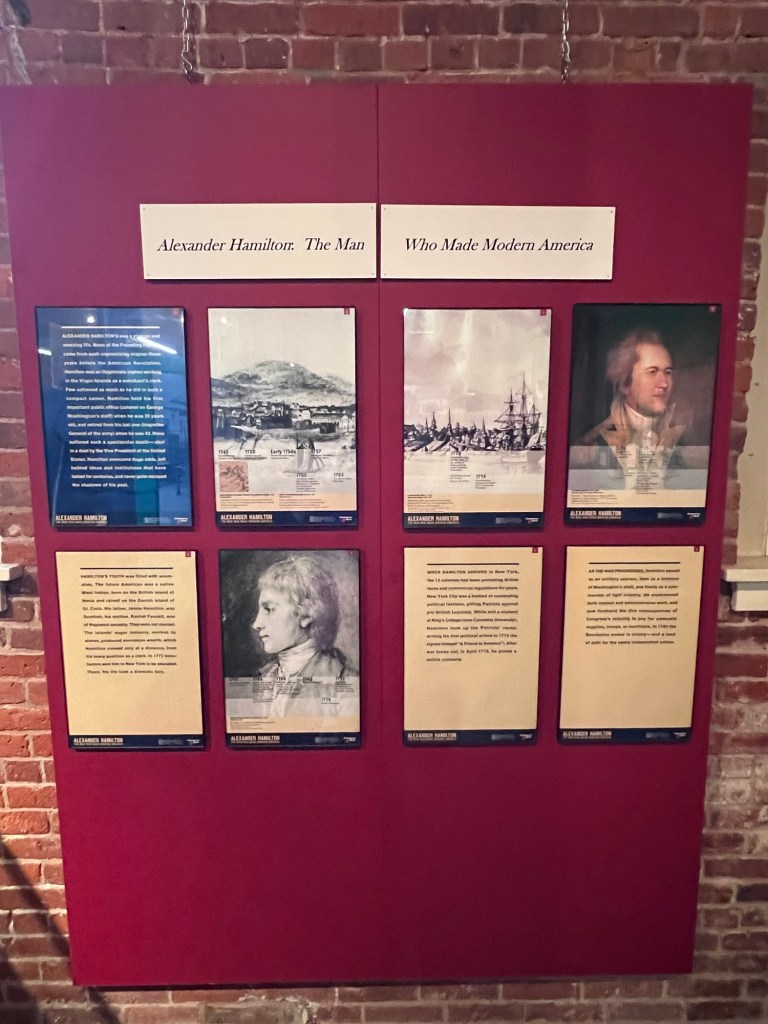
Alexander Hamilton Exhibit: The history and life of Alexander Hamilton is told from the time he was born in the Caribbean to his coming to the United States, his marriage and his rise through the ranks of the government. There is how he helped develop the banking industry and paying of the government debts to his fall from grace and his eventual fatal duel with Aaron Burr.
The Alexander Hamilton exhibit
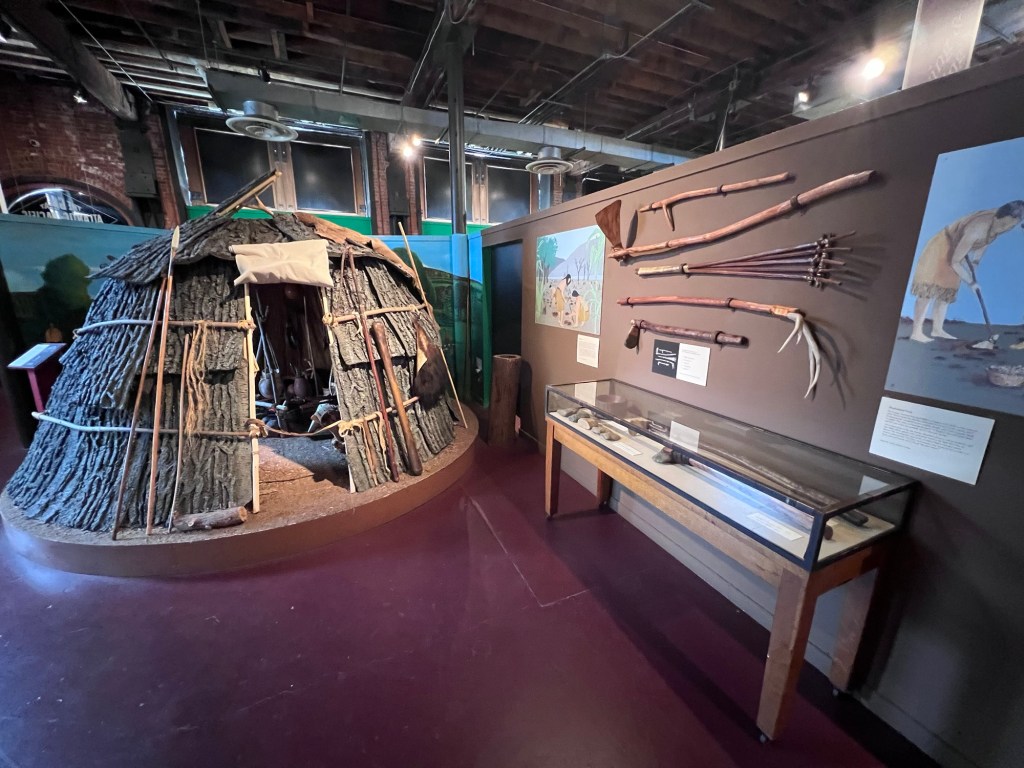
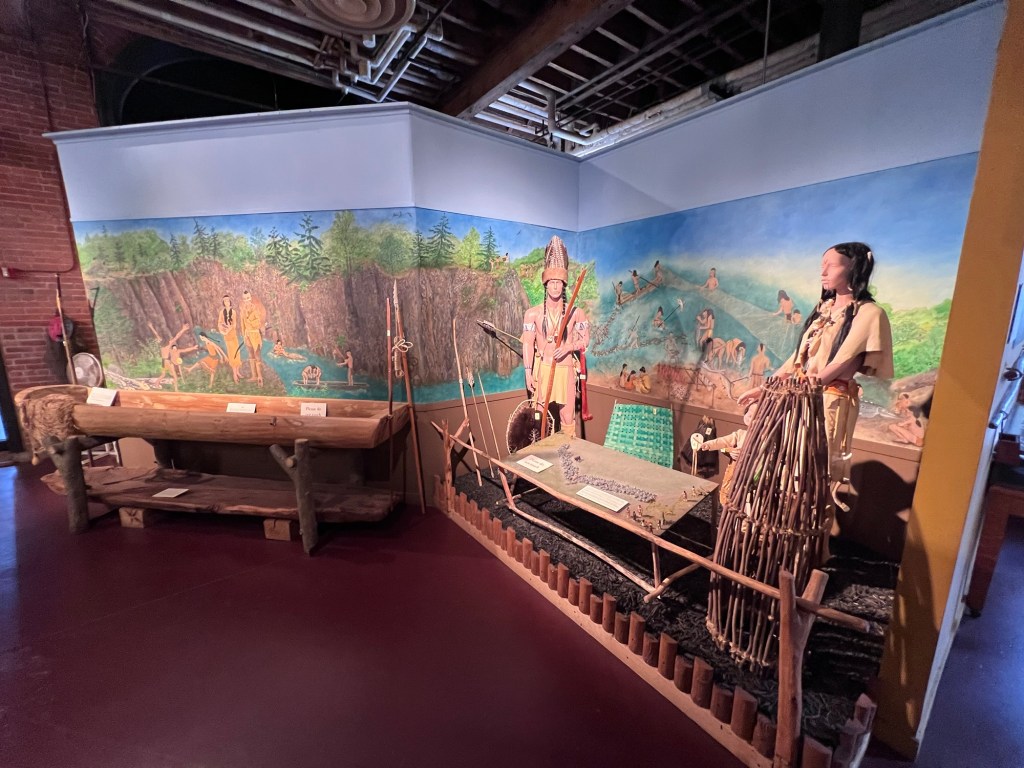
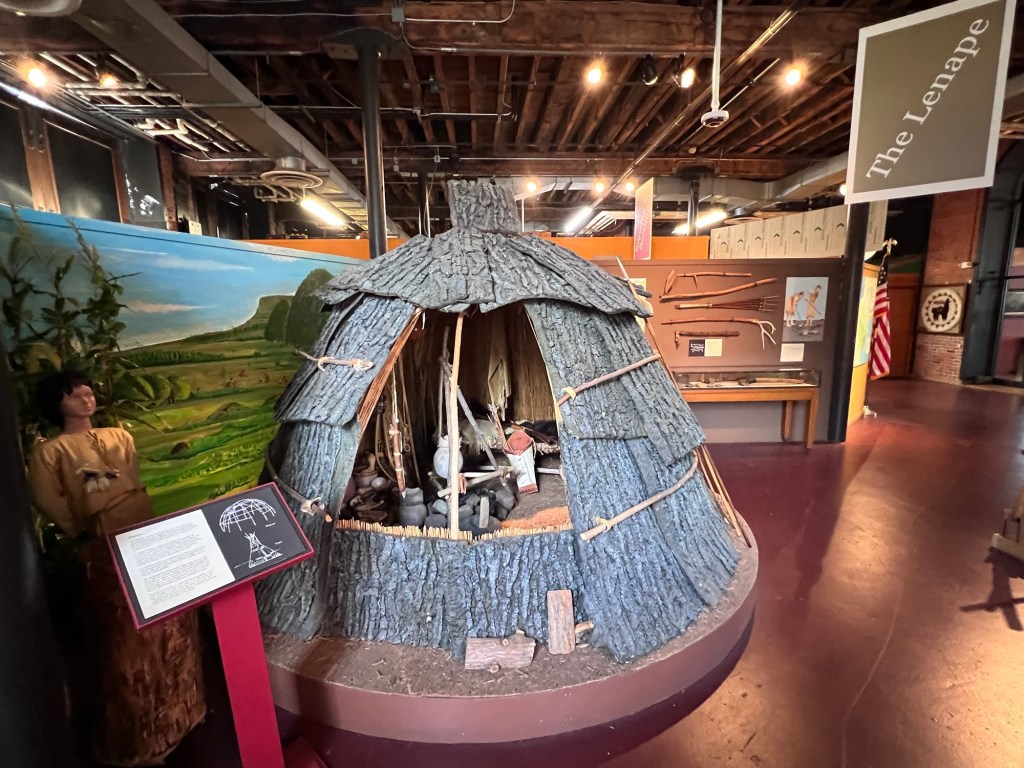
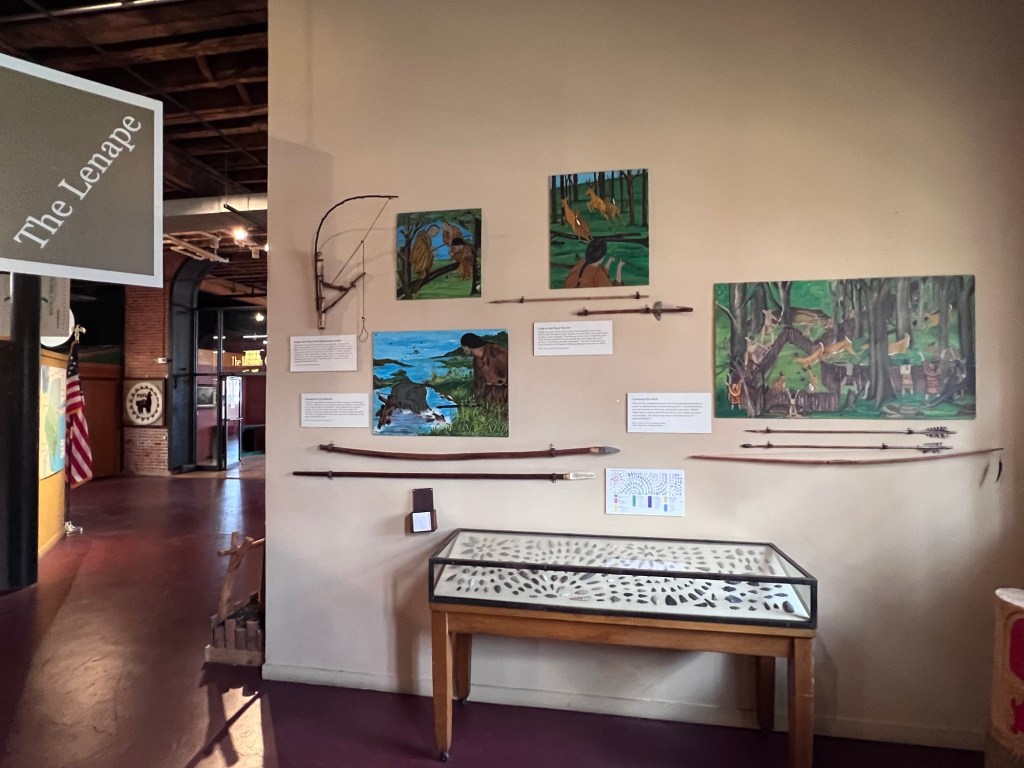
Lenape Indian Culture: The Lenape Native American culture is shown how the tribes developed, lived, worked and hunted and gathered to create the society that was in place before colonization.
The Lenape exhibit
There are all sorts of tools, displays on their regions of living, language, housing (there is a recreation of a Tee Pee here), that native wardrobe and a complete display of tools and arrow heads. It is a very detailed account of life as a Lenape Indian.
Lenape Exhibition at the Paterson Art Museum
The Lenape Indian exhibition
The Lenape exhibition
The museum shows the history not just of Paterson but of the surrounding areas and how growth of the City of Paterson made an impact on the region.
I recently visited The American Labor Museum/Botto House National Landmark for the afternoon and learned a lot about the American Labor Union formations and the rights we now take for granted.
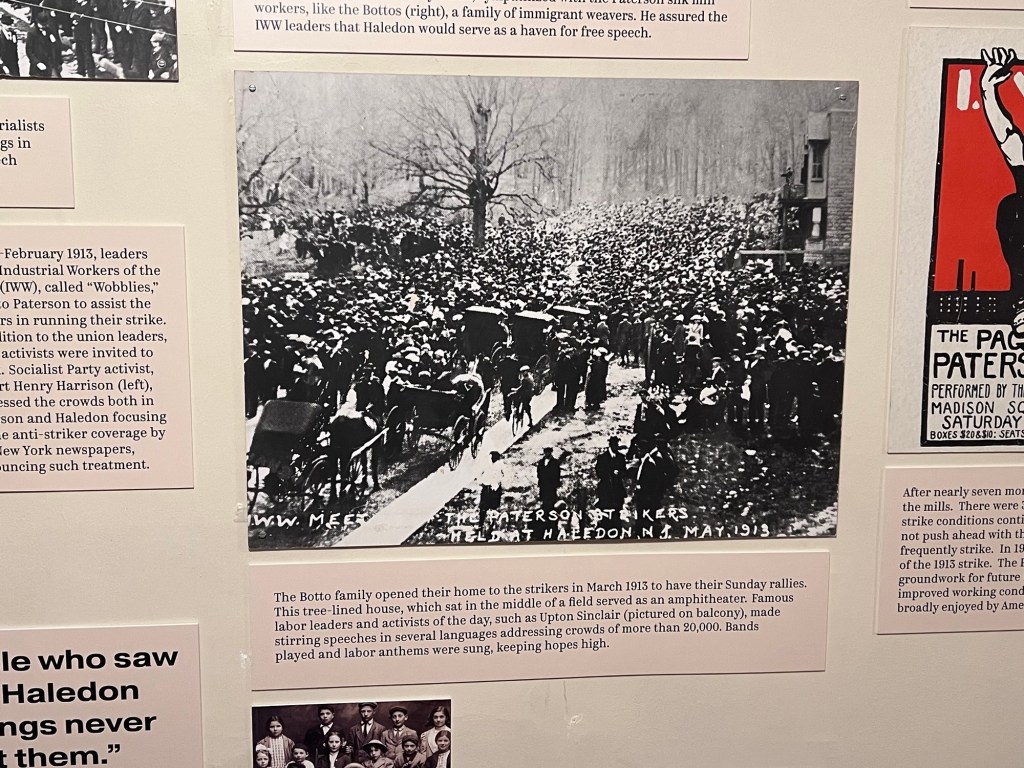
A group of us took the tour of the Botto House and learned of its history and its place in the Paterson Silk Strikes of 1913. The first floor which serves as the meeting room has pictures of the Paterson Silk Strike which lasted just over five months and since the Mayor of Paterson at the time would not let the strikers meet, the Botto’s agreed to let the strikers meet at their home which at the time was in a isolated section of Haledon.
The history of the Silk Strike in Paterson
The Mayor of Haledon was sympathetic to the Union cause and let them meet in the town. Their house was situated in the middle of a field so that the strikers could gather around the home and listen to speakers.
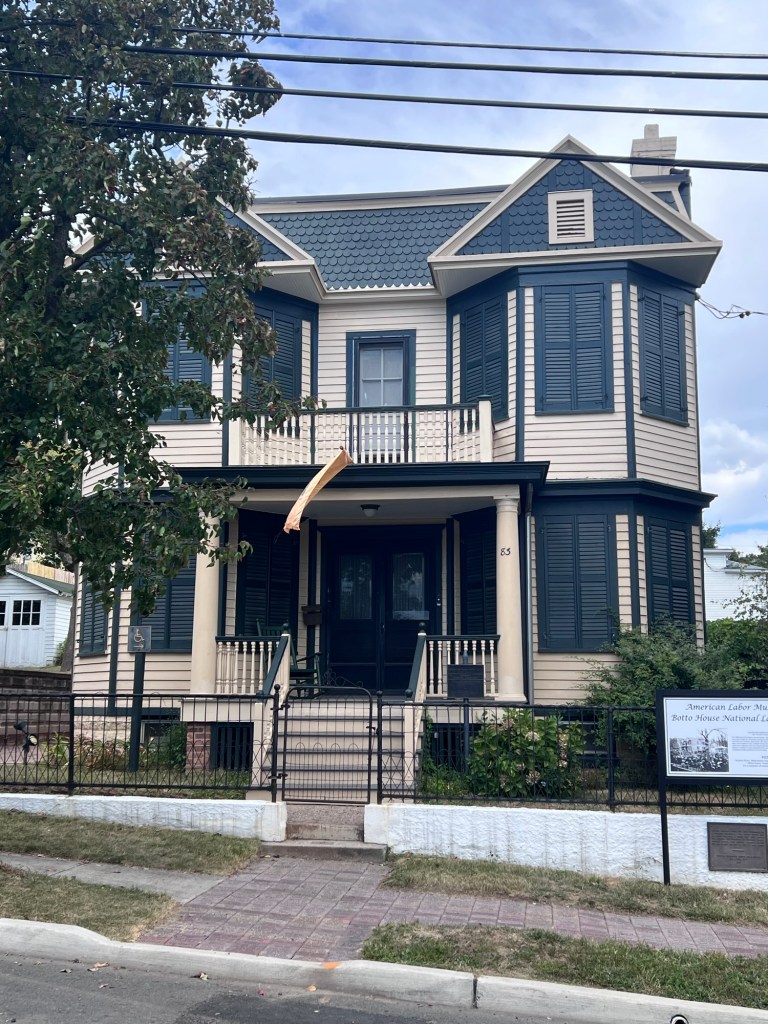
The Botto House during the Paterson Silk Strikes
From their balcony, speakers could talk to the strikers and keep everyone abreast of the situation. Here people gathered and picnicked together and worked together to get their rights heard.
From the main display room, you will tour the home of Pietro and Maria Botto. First stop is the kitchen where Mrs. Botto ran her household. She made extra money selling food to the strikers and arranging meals for Mr. Botto’s co-workers. The family family did what it could to make money for the family.
Mrs. Botto’s kitchen
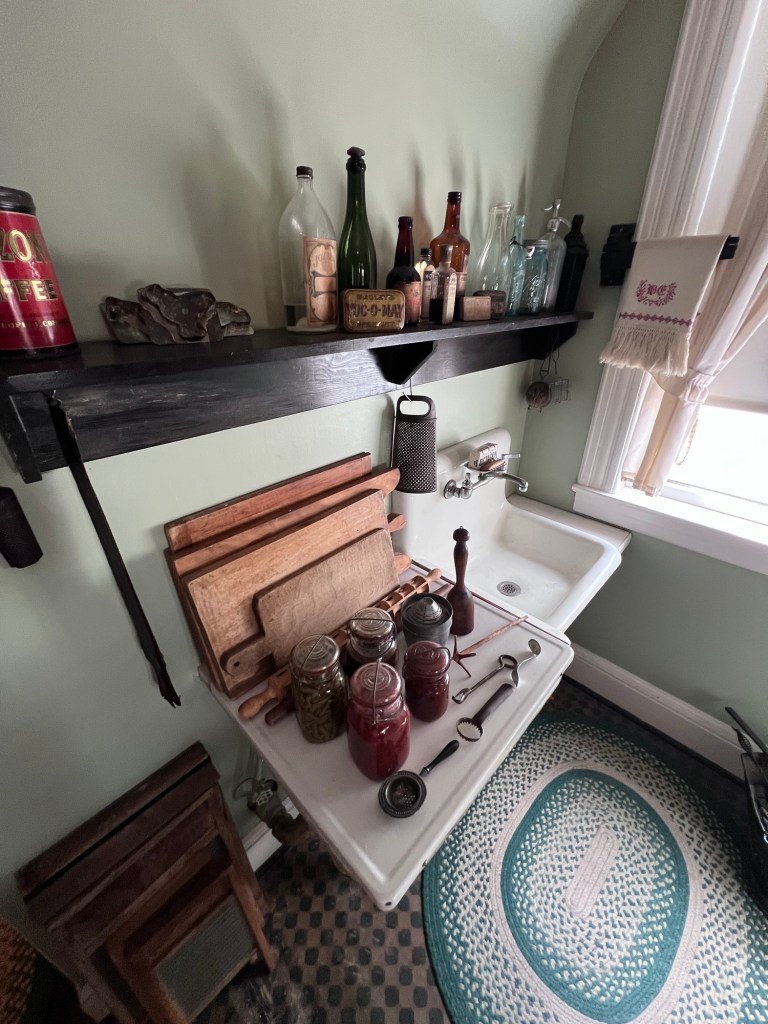
The sink area
Here she made meals for her family, did her jarring and preserving and the washing was done. Then a tour of the dining room, bedroom and the palour area where the family met and greeted people. The upstairs was formerly two apartments that were built to help ‘pay the bills’.
The Botto House Kitchen
The upstairs is now the display space where a display on the Dock Workers Union is currently being shown. We got to stand on the second floor balcony where so many speeches were made.
The backyard area
We took the back stairs to the backyard where the family had the grape arbor, root cellar where the preserves were kept and the boccie ball court. It seemed the family was very social at the time and self-sufficient.
The root cellar and Vineyard
Things turned bad for the family when both Mr. And Mrs. Botto both passed away two years after the strike. The strike could have taken its toll on the family or the fact that Mr. Botto could not find a job after the strike was over. No one knows.
It is an interesting tour of how one family opened their home to an important cause and it made a difference in the success of the strike and getting it resolved.
The history of the Botto’s:
The museum headquarters was the home of an immigrant family of industrial workers whose story is a fascinating one. In many ways, the telling of their saga is a doorway for museum visitors to step through and make connections with their own ethnic backgrounds.
The European Heritage:
Pietro and Maria Botto hailed from the region of Biella, Piedmonte, Italy. This area, at the foothills of the Alps, was a leading textile producer of linen and wool. The mountainous area was home to a fiercely independent people who, for centuries, wove cloth in their homes on looms which they owned.
The Industrial Revolution forced weavers to give upon cottage-based production to seek employment in large shops or mills. the displacement of workers by mechanized looms and weavers’ lack of economic independence caused people in Biella (as in other European textile areas where Paterson’s workforce originated) to embrace new ideas about worker rights and to be a vocal workforce wherever they roamed.
Pietro decided to leave Italy because he was made eligible for a second draft into the army at the recently united Kingdom of Italy (Italy had quadrupled its army at that time to strengthen unification and to acquire African colonies). A skilled weaver who also painted church interiors, Pietro brought his wife, Maria and daughter, Albina (born 1889) on the long voyage to America in 1892.
The Botto’s settled in crowded West Hoboken, New Jersey (today’s Union City), where they worked in silk mills for 15 years until they had saved enough money to afford a home for their growing family. The family now included three more daughters, Adelia (born 1894), Eva (born 1895) and Olga (born 1899). In 1908, the Botto’s moved to Haledon, a tiny community, growing up along the streetcar line from Paterson, where many other country folk from Biella had already settled.
The Botto’s home became a focal point for a dramatic slice of history in 1913 when the epic Paterson Silk Strike broke out. Pietro was on strike with 24,000 fellow silk workers when massive and constant arrests forced the workers to consider the independent borough of Haledon as a location for great outdoor rallies. Mayor William-Brueckmann guaranteed the safety of the workers and Pietro offered his home as a meeting place for the strikers.
The Botto’s courageous stand allowing their home to be so closely identified with the strike stemmed from a belief in the rights of the common man. During the strike, Pietro and his family played host to the social and labor leaders who were the idols of the working person at that time. After the strike, the family had to very circumspect about employment in the mills, with one of the daughters denying her family name to avoid blacklisting by an employer.
The large house and spacious hillside gardens are a tribute to the family’s combined labor. Pietro and his daughters worked 10-12 hour days, 5 1/2 days a week in the mills. The eldest daughter began mill work at age 11 and the youngest at age 13.
On Sundays, the usual day of rest, the girls helped their mother serve patrons of the resort aspect of the property. Maria ran a large household, feed boarders during the week and the scores of people on Sunday and did piecework from mills; she died in 1915 at the age of 45.
Pietro lived until 1945, a beloved father and grandfather to a growing clan.
History of the House and Land:
The house in Haledon, NJ
The total environment of the Botto House National Historic Landmark reflects the ethic origin of this family of silk workers from the Piedmonte (Biella) area of Italy and the development of housing in early streetcar suburbs. It is representative of the sensitive use of small landholdings in American urban areas by various European immigrant groups.
The Botto family purchased Block X, Lots 38, 39 and 40 in 1907 from Alexander King, a real estate speculator. King himself purchased a large parcel of land from the Cedar Cliff Land Company, a group of Paterson industrialist and business leaders who were quick to see the advantages of selling cheap land to workers in Haledon. The completion of a horse-drawn trolley line in 1872 allowed for expansion of residential and recreational areas outside of the City of Paterson, a major American industrial center.
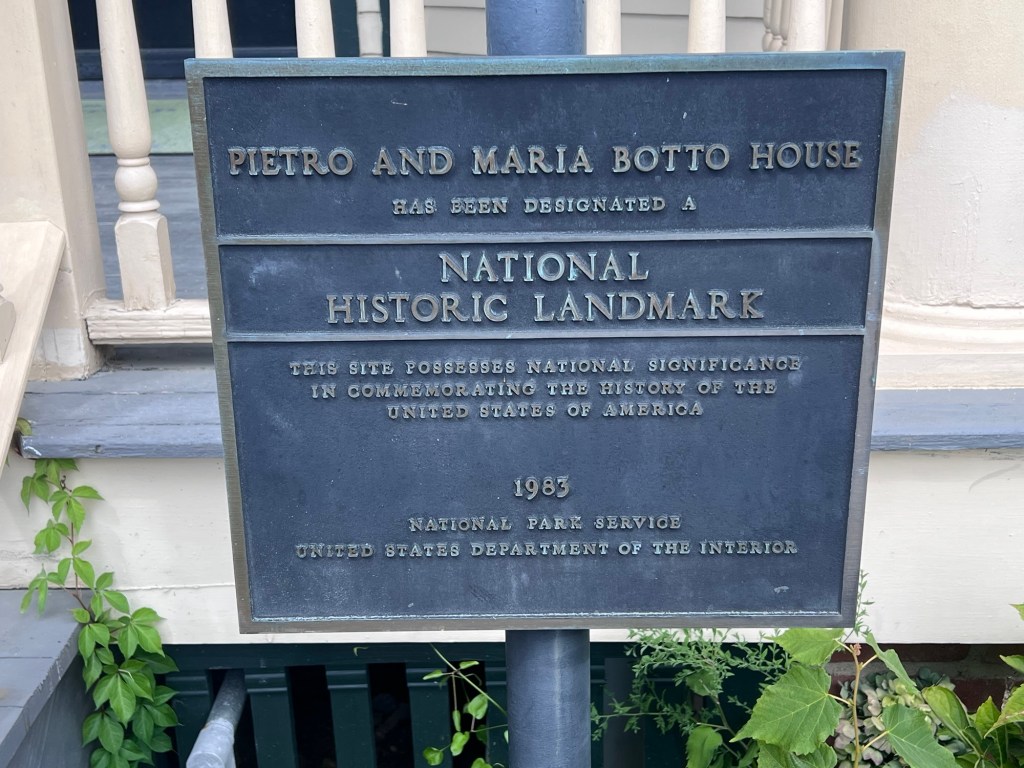
The Botto House sign
(Information from American Labor Museum: Botto House National Landmark, a Brief History)
The Period Rooms:
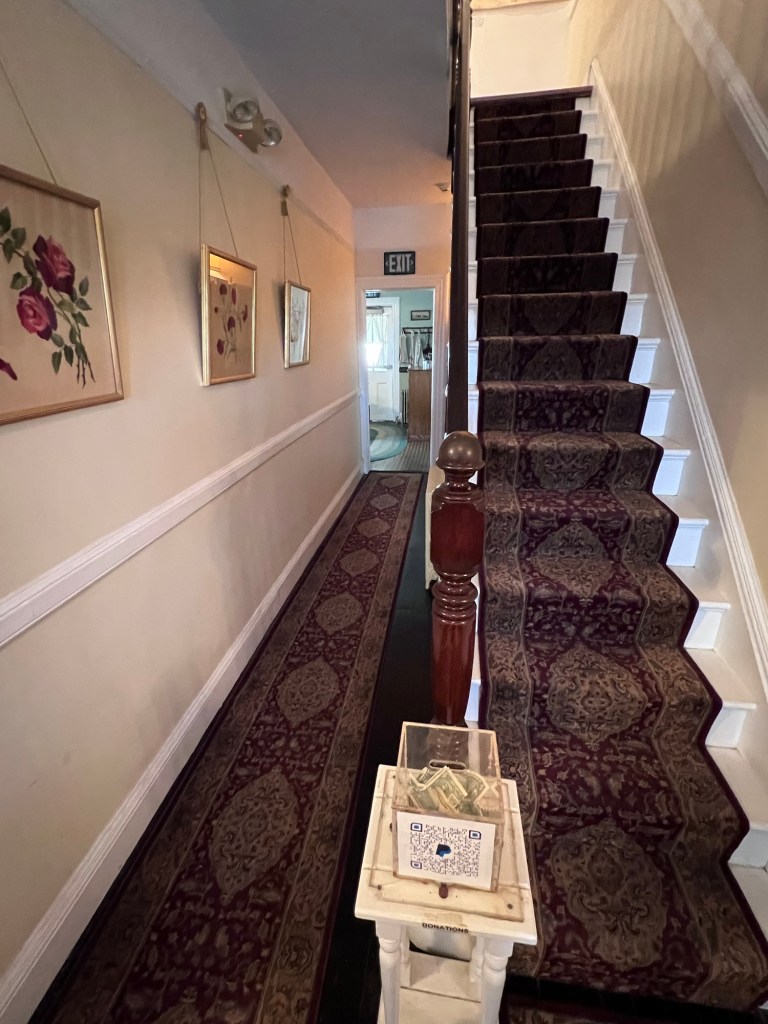
The Front Hall
The front entrance hall light fixture is original to the house. One of the restoration tasks yet to be carried out is the replacement of embossed wallpaper on the walls which was made to look like the carved leather coverings in the homes of the rich.
The front hallway
The Kitchen:
The kitchen was a major center of activity in the household. The large coal and gas range dominates the room. It was used as a heating source as well as for cooking foods. A table provided the space for food preparation; a cupboard stored pots, pans and dishes; an icebox kept food items cold (the root cellar, located in the garden was also used for cold food storage) and a sink for dishes and a tub for laundry utilities indoor plumbing-certainly a recent innovation for working class households.
The kitchen
Even with the convenience of indoor plumbing and the gas range, the kitchen was the scene of virtual non-stop labor for Maria Botto and her daughters. In addition to meals prepared for the family, the Botto’s fed a noon meal to extra people during the week, there were workmen without families, who rented rooms and come from the mills for a hot dinner.
On Sundays, the Botto women prepared food for as many as 100 people who came to recreate on the property. This, of course, provided on additional income for the family.
The Botto family’s foodways reflected their home region of Biella, Piedmonte, Italy. Piedmontese cooked scorned tomato sauce, preferring wine and chicken broth to accompany such staple foods as polenta (corn meal), risotto (rice) and tortellini, a pasta. Generally, rosemary, sage, and other herbs were used in cooking and grown outside in the garden. The herbs also had medicinal uses.
The kitchen sinks
Some of the artifacts placed around the kitchen are the copper put used to cook polenta (purur), meat grinder, fish scale, orange juice squeezer, coffee grinder (from a German immigrant household), rug beater, mousetrap and wall calendars which were used by working people as decorations.
The Botto women were generally charged with kitchen duties. Maria Botto hired a German woman to do the wash. One special job was reserved for Pietro, stirring the polenta and cutting it with a string.
The Dining Room:
The dining room was another work area for the family. Here the family and the ‘boarders’ dined. Here Maria ‘picked’ silk on a frame, located in the corner of the room under the window, examining the bolts of broadsilk brought from the mill for imperfections.
The Dining room
This was another task to bring income to the household. Maria used the sewing machine to make clothes. The table reflects a setting for the family and ‘boarders’, placed with dishes, silver-plated utensils and a condiment set.
The Dining Room
The sideboard, table chairs and sewing machine are family pieces. The lighting fixtures in this room as in the rest of the house were powered by gas. As is typical in the area, paintings were hung by string from a picture rail as the walls were made of plaster.
The Sideboard
The small painting shows sheep, which provide the wool upon which textile manufacture was based, against the backdrop of the Alps. The large sketched portrait of Pietro Botto in later years was produced by his grandson and professional artist, Richard Botto. On the side of the room hang pictures of the Botto daughters in their wedding attire.
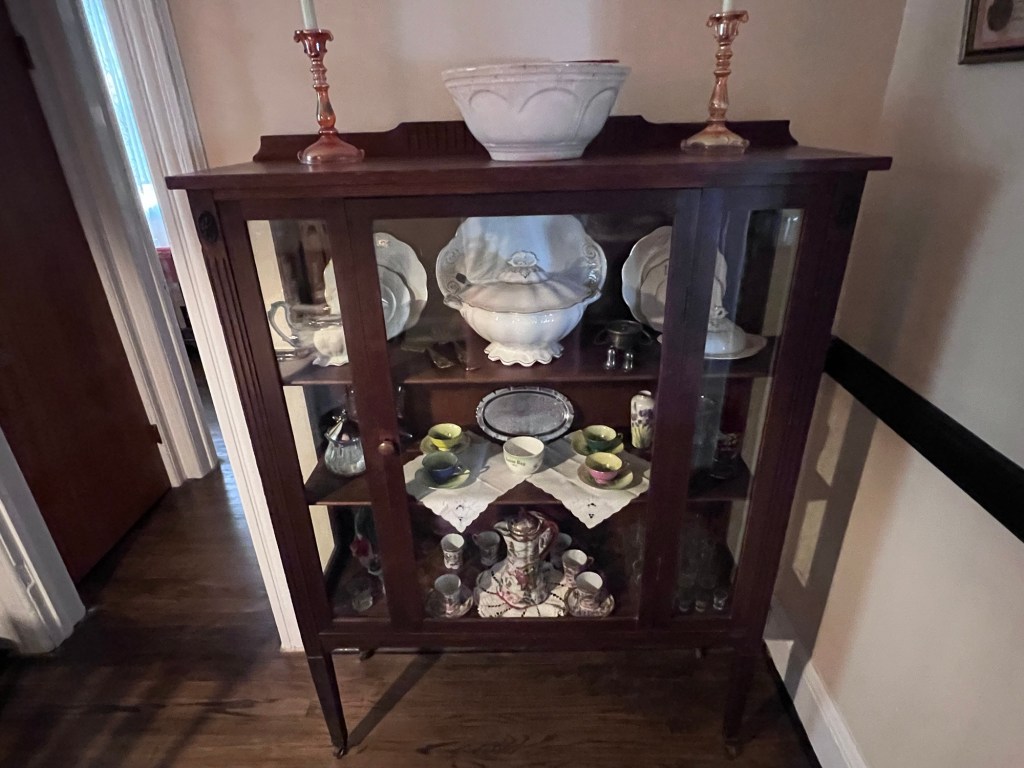
The Dishes in the sideboards
The Bedroom:
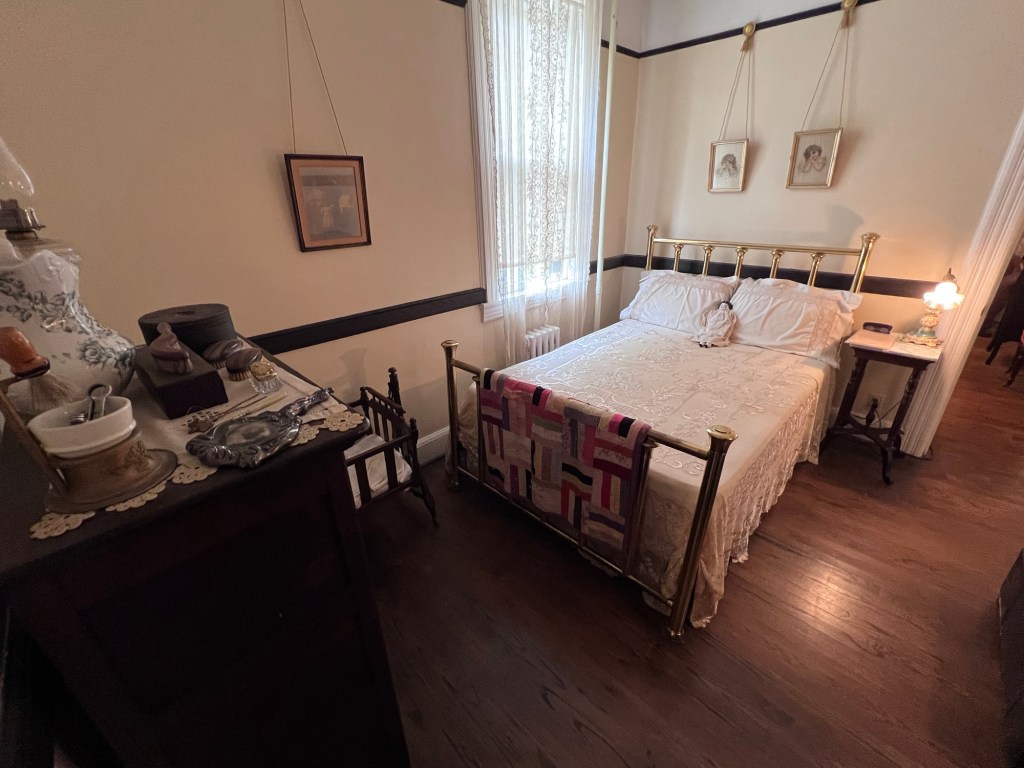
This room, which was actually the girls bedroom has been recreated to resemble where Maria and Pietro slept. The dresser is set with brushes, combs and mirrors that are from the period. The Botto’s slept in a brass bed.
The bedroom at the home
Swimsuits and other clothing hang in the wardrobe. A travelling trunk rests on the floor next to the wardrobe. Next to the window hangs a photograph of Mr. and Mrs. Guala of Biella, Italy. Next to the wardrobe hangs the elaborately framed photograph of Adalgiso Valle of Paterson, NJ, a jacquard card cutter.
The Bedroom
The Parlor:
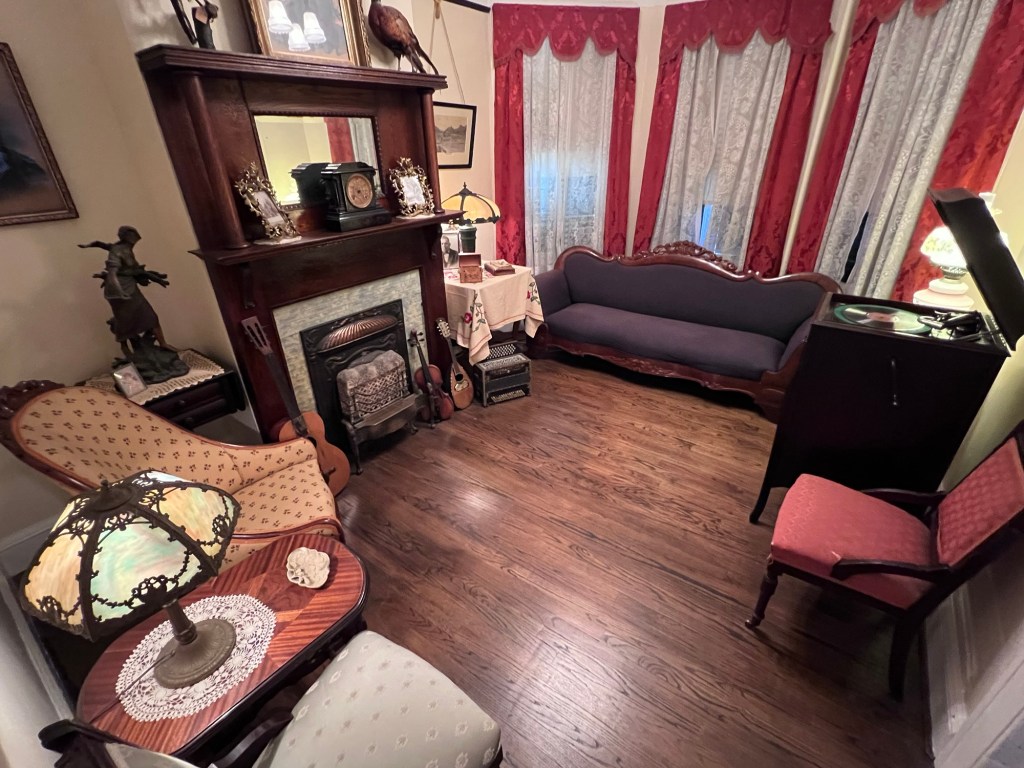
The most formal room in the house, the parlor was used for guests, weddings and wakes. Dominating is the oak mantle with its columns and mirror top. It surrounds a fireplace where, in the winter, a gas heater was attached to a pipe behind the hearth. The clock had to be wound every day and chimes on the half-hour.
The parlor
The photographs on the shelf are Maria’s sisters in Italy (right) and the three eldest Botto daughters (left). Members of the Bocchio family of Biello, Italy are pictured in the photograph to the left of the mantle.
The Parlor and decorations
The furnishings in the house
Other Rooms:
The area making up the library on the first floor was a sitting room and bedroom for the family. The Botto daughters rented the two apartments upstairs when they first married and started their families and other non-family members served as renters through the years. The bathroom on the first floor is the approximate size of the original but today has modern fixtures and is not meant to be part of the restoration.
(From the American Labor Museum/Botto House National Landmark)
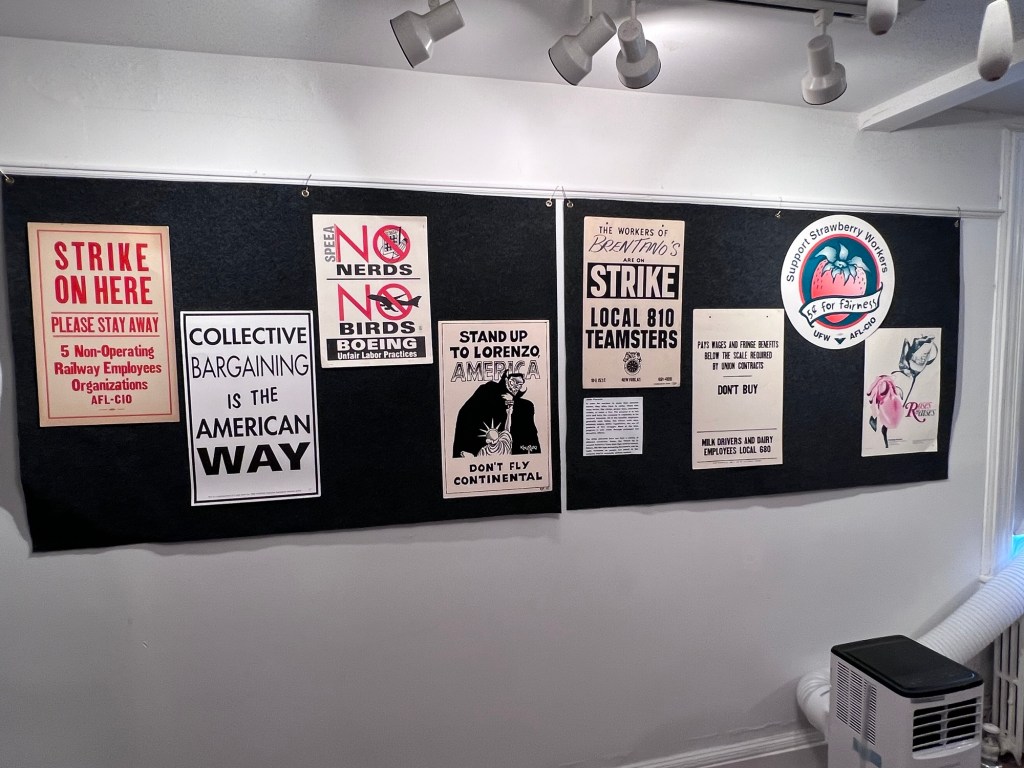
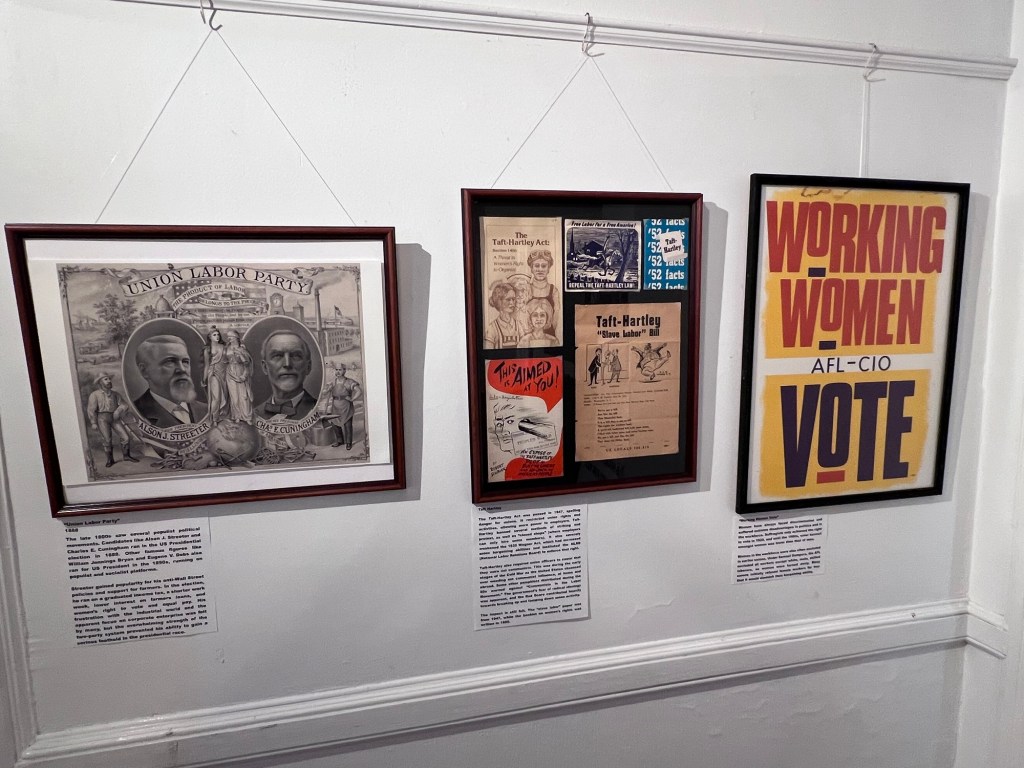
The Labor Day display of the Union history:
Labor display
Labor Display
History of Paterson:
The City of Paterson was founded in 1792 as America’s first planned industrial city. Alexander Hamilton, Elias Boudinot and other members of The Society for the Establishment of Useful Manufactures chose the Great Falls of the Passaic River as the ideal site for a manufacturing center. The Falls provided water power, while the river provided transportation upstream and down.
During the 19th Century, Paterson flourished. It became known as “Silk City” and “The City” with an Arm of Iron in a Sleeve of Silk for the silk mills and locomotive works that made their homes here. Immigrants flocked to the city at first from England, Switzerland. Germany and France and later from Southern and Eastern Europe. Many found jobs in the mills and a few took their place among the captions of industry.
(Mill Worker…Mill Owner-Botto House Museum)
The gift shops
Disclaimer: This information was taken directly from The American Labor Museum/Botto House National Landmark pamphlets. This museum is one of the few historical sites dealing with the Labor Unions in the United States and plays a huge role in workers rights today.
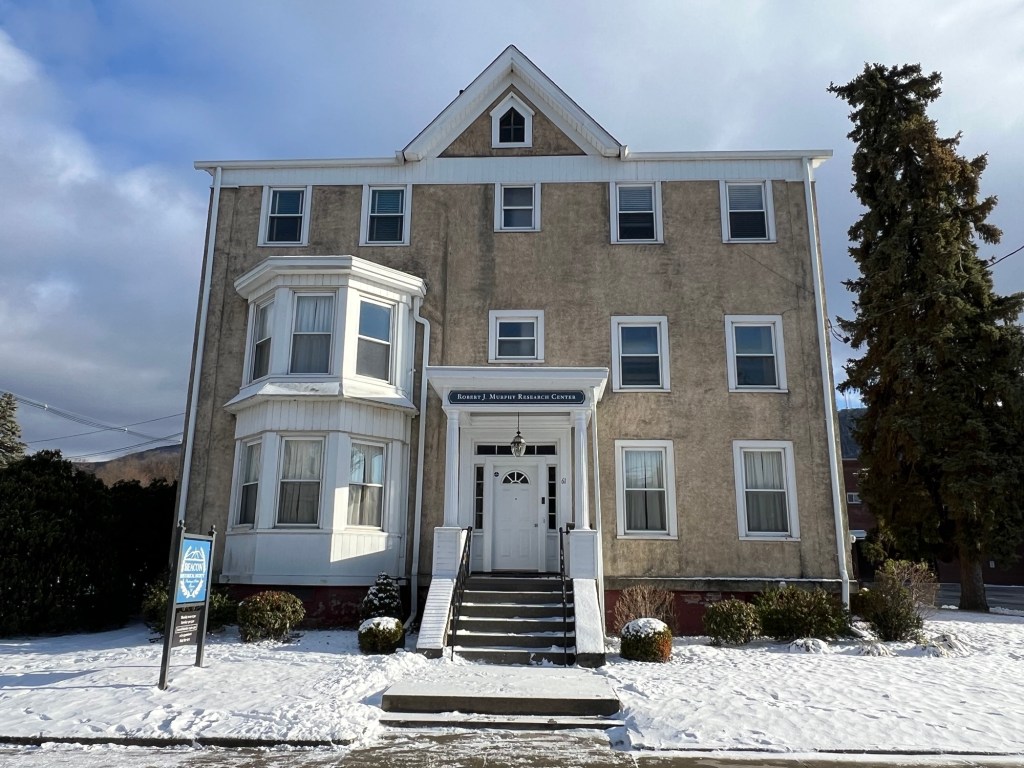
The Beacon Historical Society at 61 Leonard Street at Christmas time
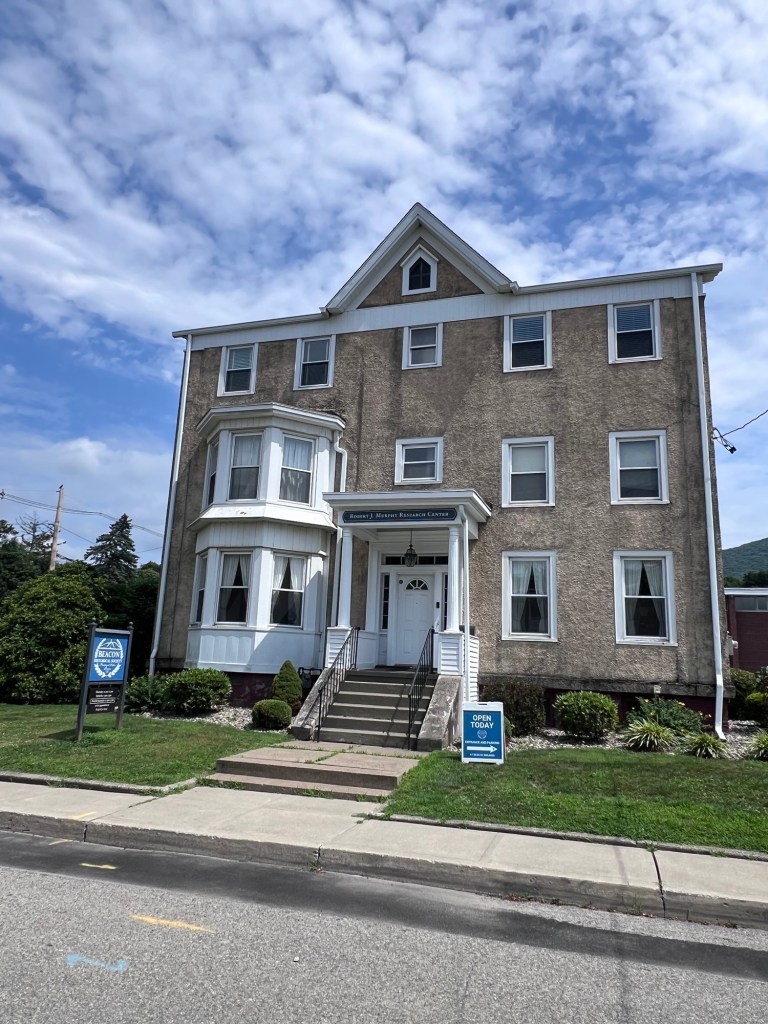
The outside of the building in the Summer
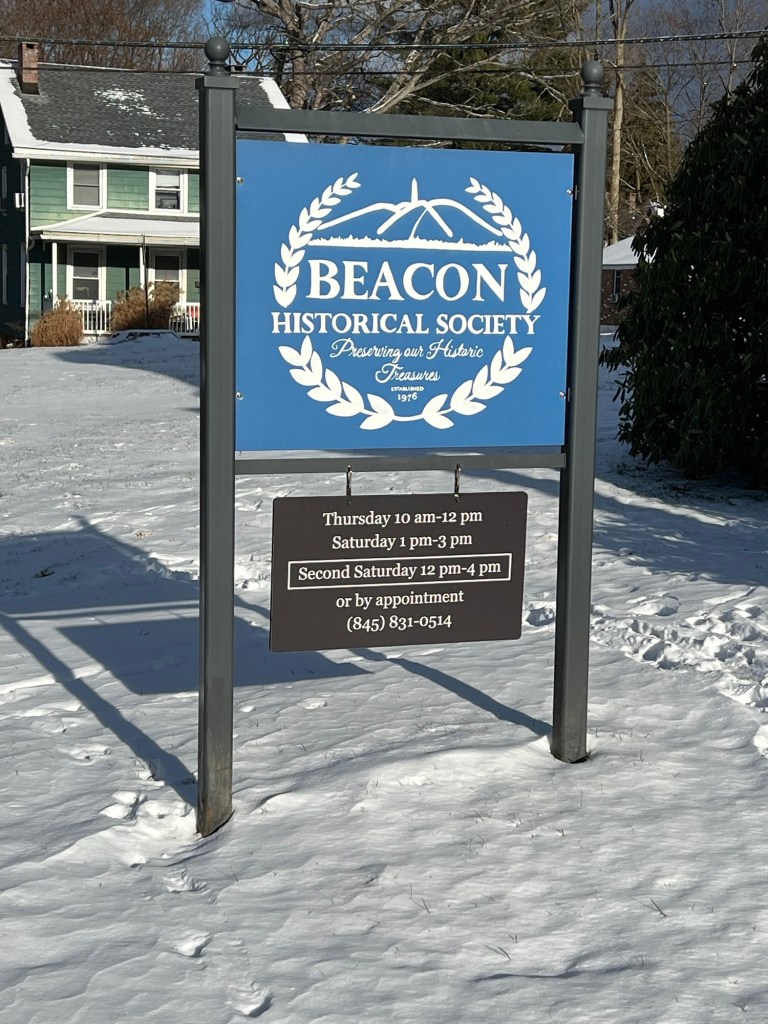
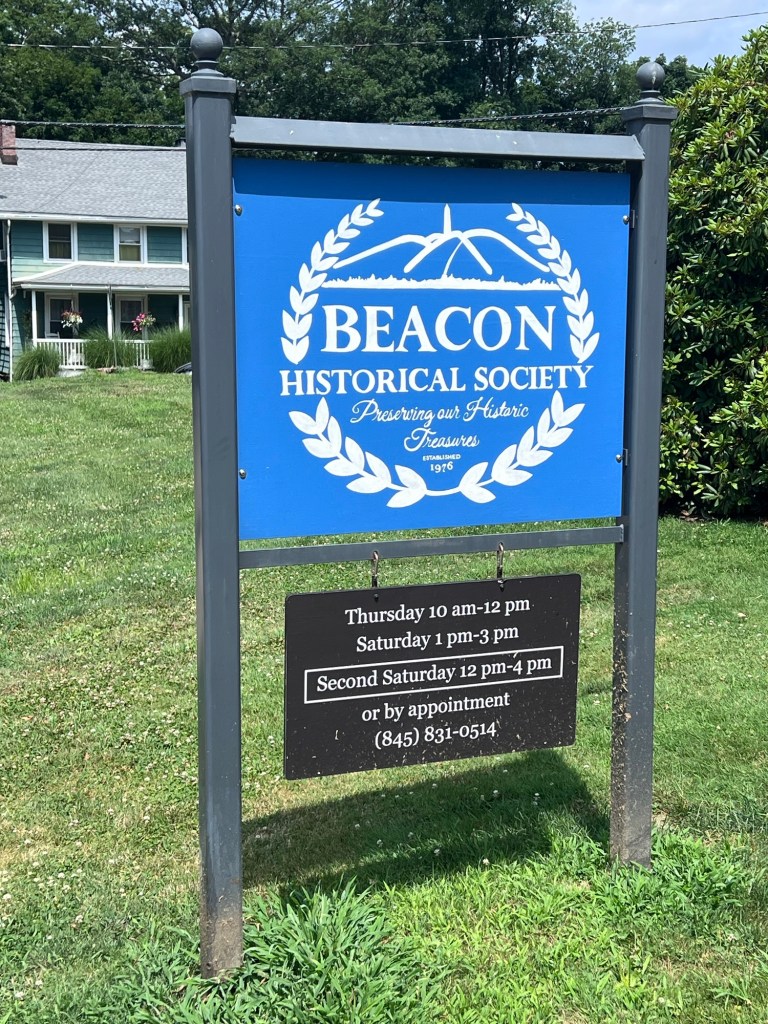
The sign for the Beacon Historical Society at Christmas time
The outside sign in the Summer
The Mission of the Society:
(From the Society pamphlet
The Beacon Historical Society was founded in 1976 to preserve, collect and interpret the rich history of the City of Beacon and its predecessor Villages of Fishkill Landing and Matteawan.
History of the Society:
(From the Museum website)
Established in 1976, the Beacon Historical Society showcases Beacon’s history through exhibitions, collections, programs, books and an informative monthly newsletter. The Beacon Historical Society is proud to serve as Beacon’s repository of rare photographs, paintings and prints, Hudson River ship models, objects and ephemera from local factories and Main Street businesses, records of local cemeteries and Civil War veterans, maps of Beacon, Fishkill Landing and Matteawan.
I recently did a walking tour of Downtown Beacon, NY and was impressed by the numbers of restaurants, bars and stores in the downtown area. It is an impressive downtown with very few empty stores and impressive and lively street life. On my first trip to the Beacon Historical Society I learned this was not always the case.
I recently visited this small historical society packed with information on the history not just of the City of Beacon but the surrounding Hudson River area. The museum gives an in depth view of the industrial history of the area and the highs and lows of many of the river communities. These small communities have seen a renaissance over the last decade especially during COVID and many of the older towns have seen new life being breathed into them.
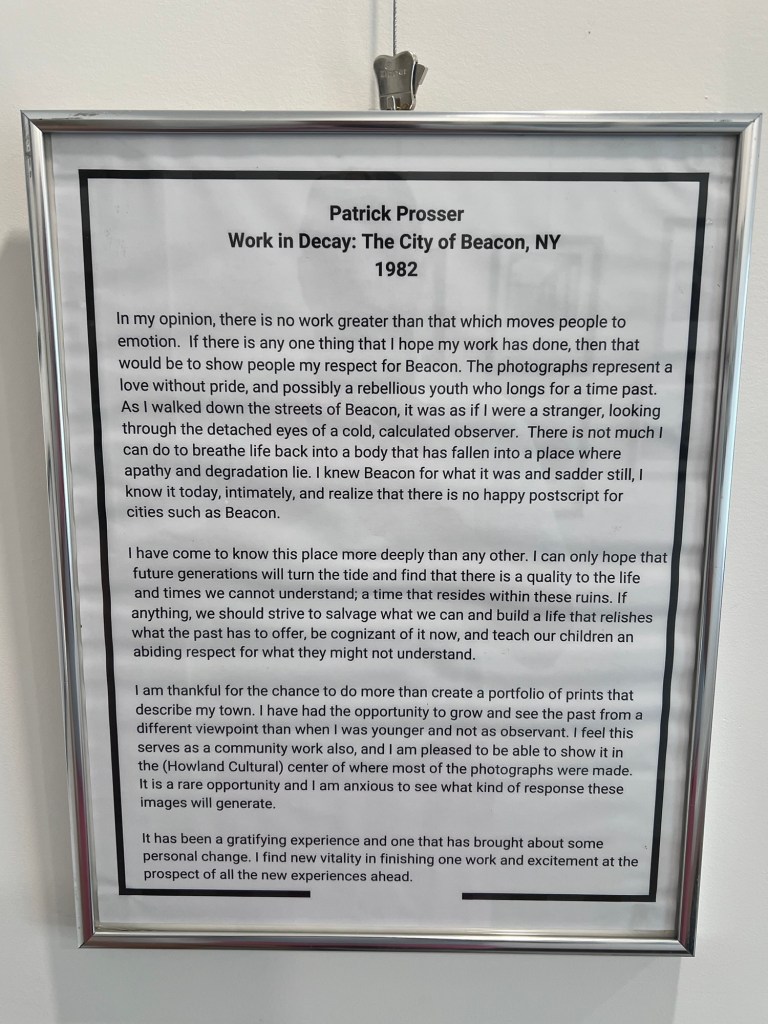
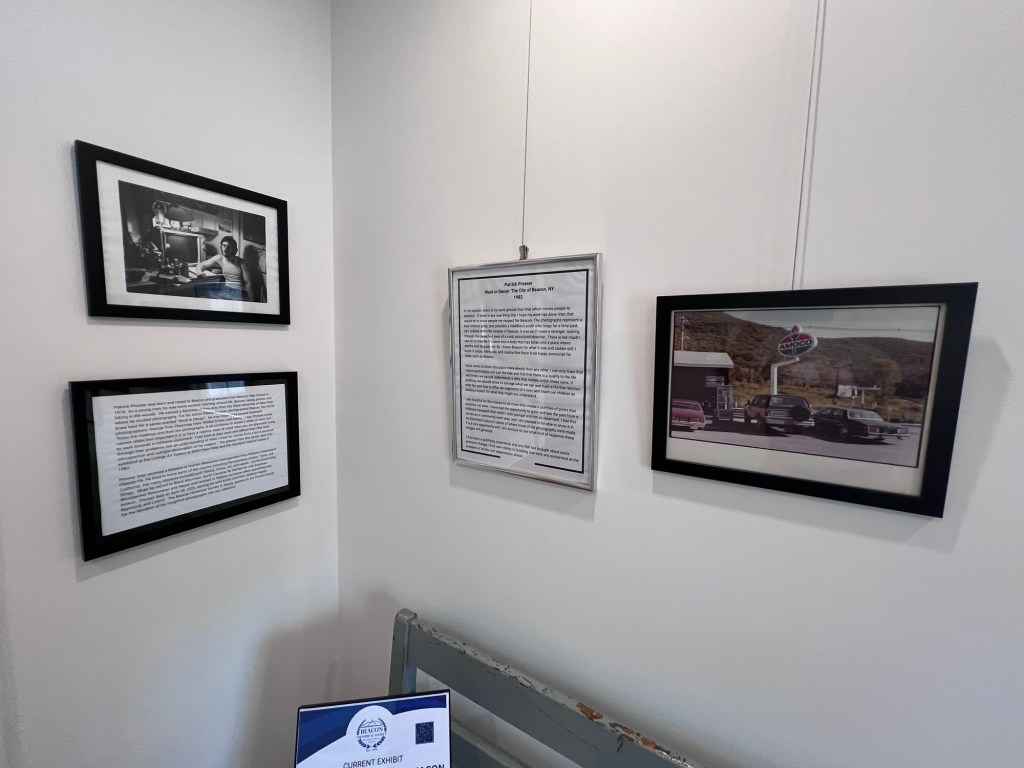
The first exhibition I looked at was the Photographer Patrick Prosser exhibition (being shared with the Howland Cultural Center) ‘Work in Decay: The City of Beacon NY’.
Photographer Patrick Prossner was born and raised in Beacon and a graduate of Beacon High School and SUNY New Paltz with BFA. His work on this project started in 1982 photographing the decay of his home town (Author’s Bio on BHS website).
The photographer moved to the area in the early 1980’s during a time when Beacon’s mills and factories were closing and the downtown was boarded up. It shows what the downtown business district looked like and the changes that were made to shape it today.
The sign for the exhibition
Pictures of the former industrial zone
The pictures showed a once vibrant industrial community and the changes once these factories closed.
The changes in the surrounding area
The exhibition really shows the transformation of these towns from the once industrial hubs to the artsy communities filled with galleries and bars that many of them have become.
Downtown Beacon today filled with art galleries, shops and small restaurants
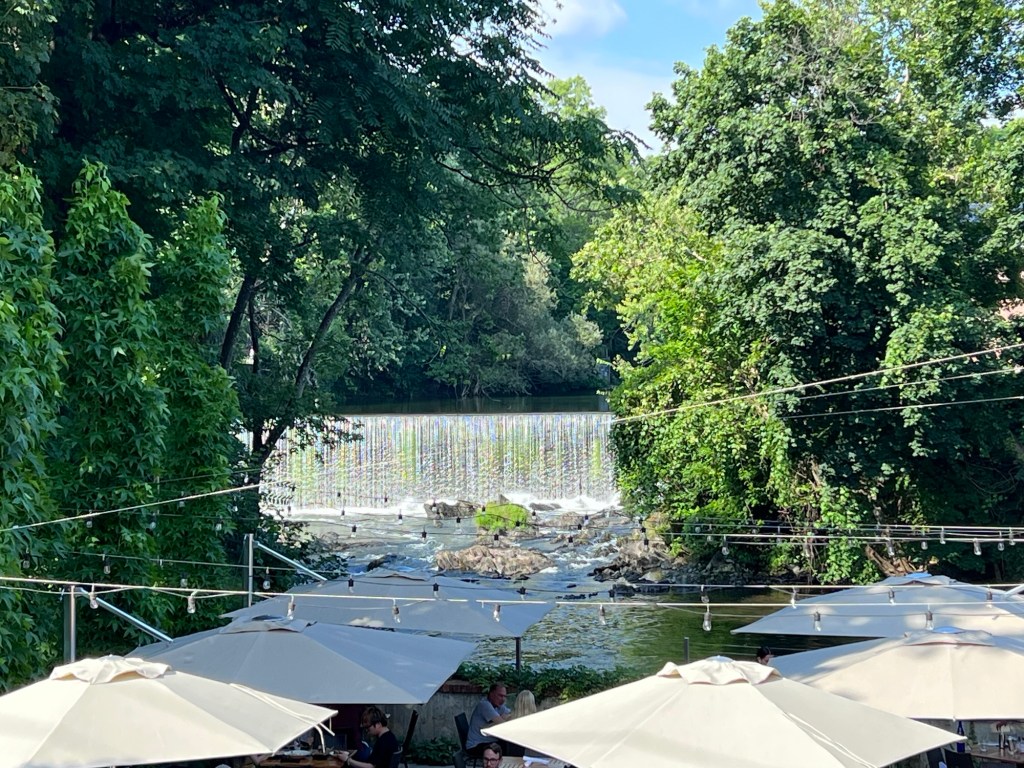
The former mill is now a luxury hotel and restaurant overlooking the same waterfall that used to power the mill
These small communities factories have now become hotels, lofts and in some cases new cottage industries have moved in. Time transforms areas and what is old becomes new again.
The first floor gallery
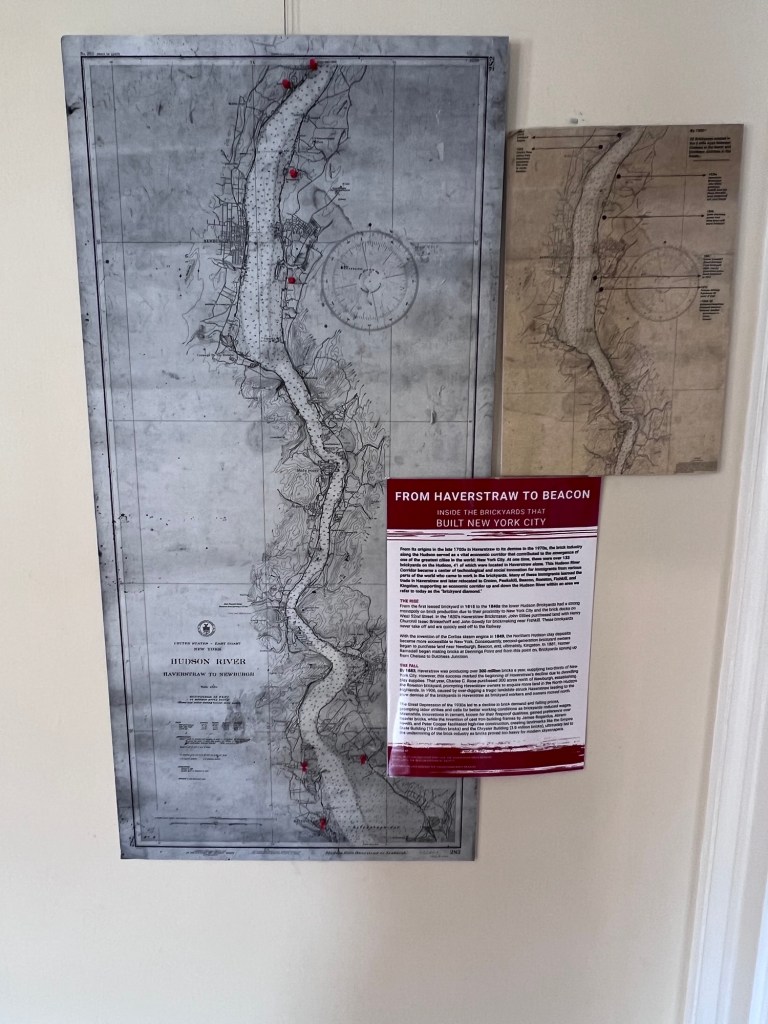
The second exhibition that I walked through was the ‘From Haverstraw to Beacon: Inside the Brickyards the built New York City’, an extensive look at the brickyards and the clay deposits that once lined the Hudson River that build most buildings in the City in the end of the Eighteenth, Nineteenth and early Twentieth centuries.
The exhibition sign
The map of the location of the brickyards along the Hudson River. This depended on the location of the clay deposits.
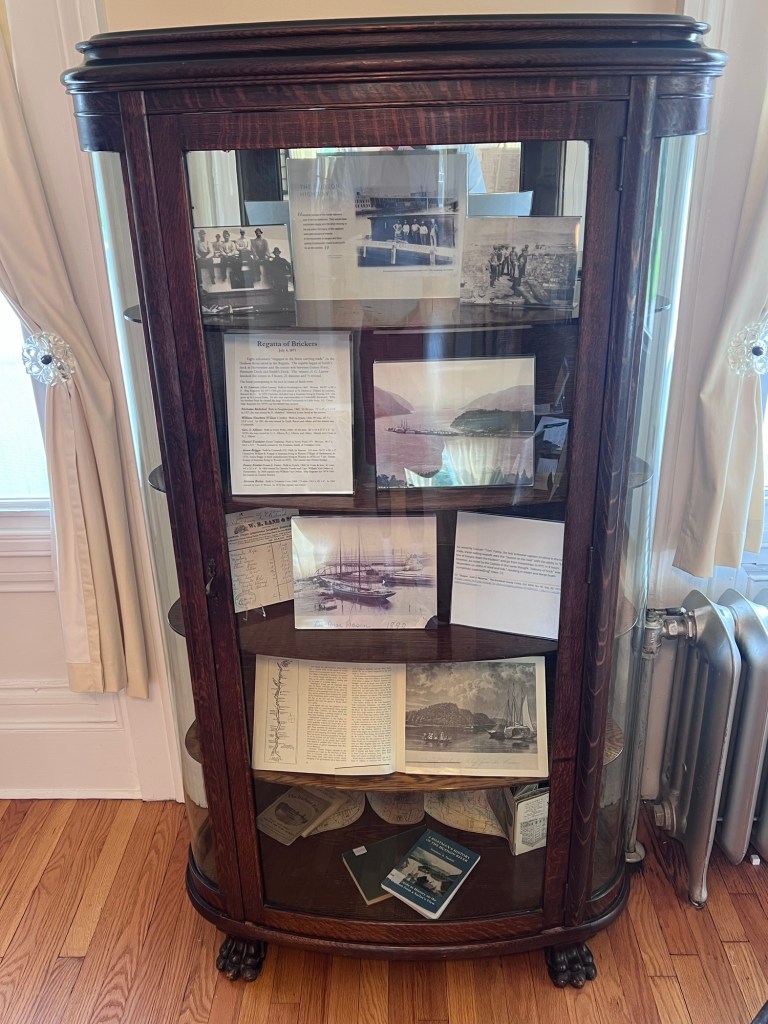
Transportation of freight and people for both recreation and business was described in this display of different boats down the Hudson River.
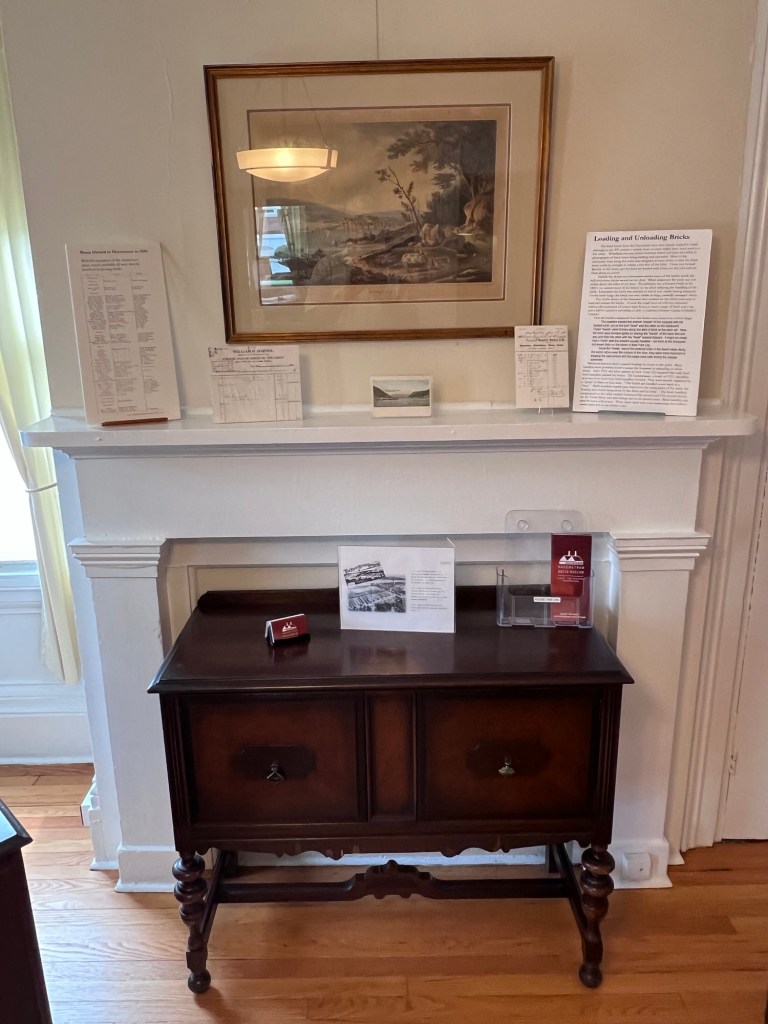
The display of understanding the brick business
Display of the different companies and processes of making bricks
The display of people that make up the industry
The process of mining, making, drying and creating the bricks that would end up in New York City
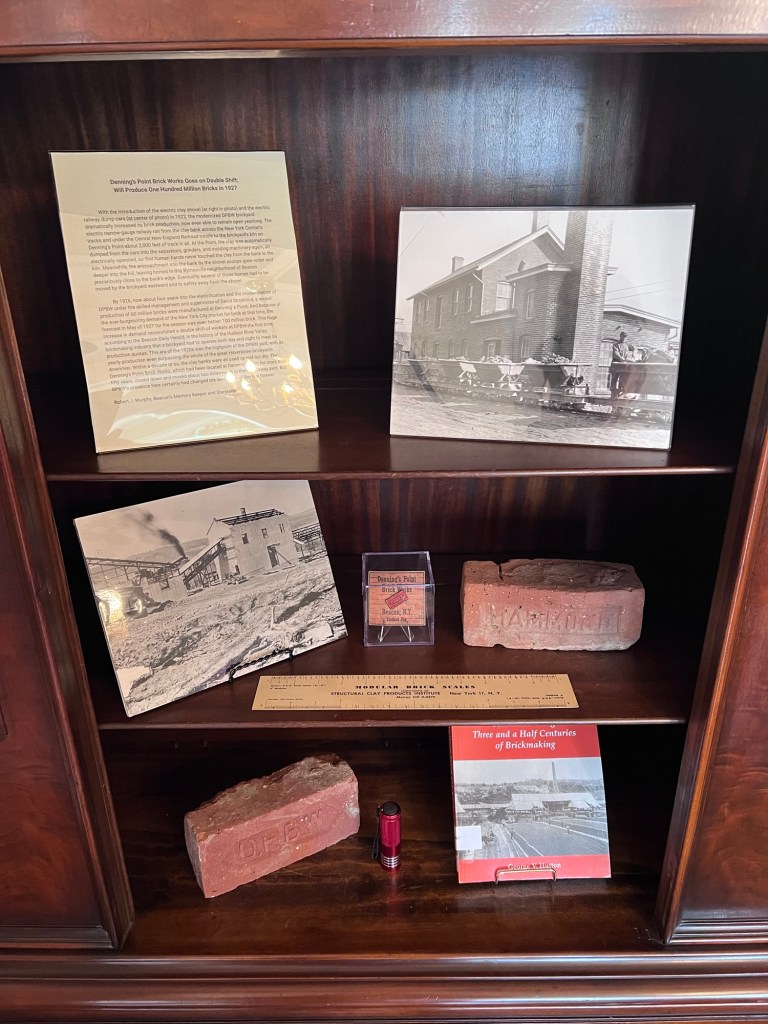
Some of the bricks and the companies from the New York market that were created in the region
Another display on the companies
More of the companies and processes to making bricks
The exhibition was a very interesting look at what was once a dominant industry in the area but like any industry as the clay ran out and building materials changed, the industry diminished in the area and that way of life changed. With it as well was the transformation of the area.
The former brick factories
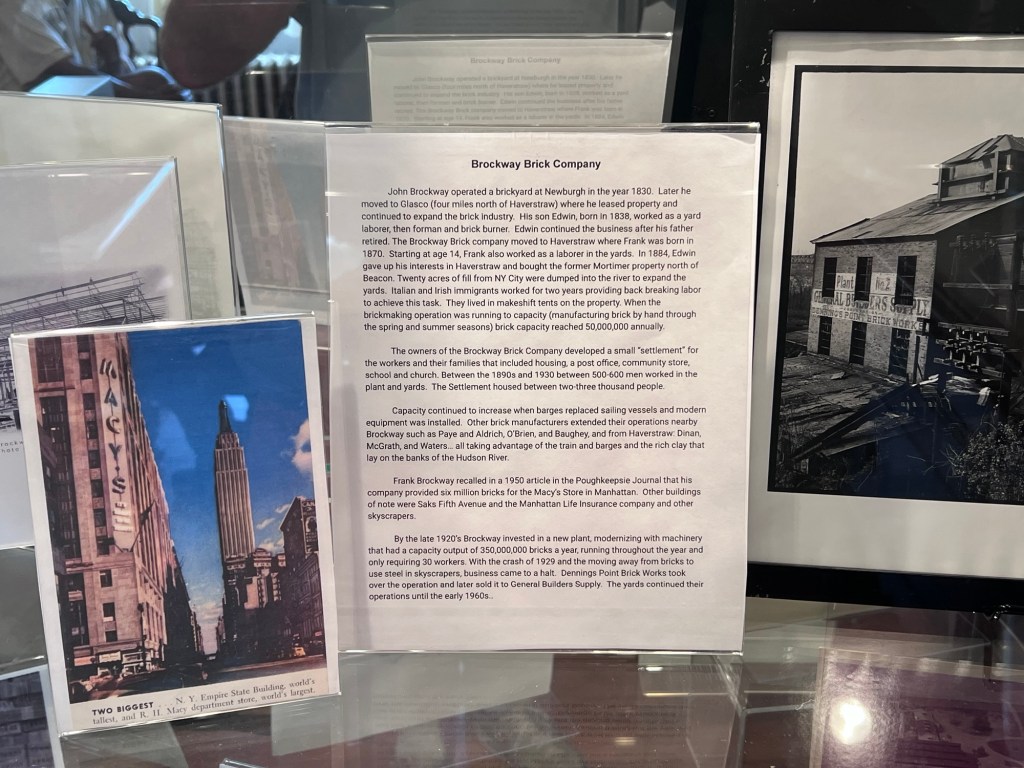
The Brockway Brick Company that built Macy’s original building in Manhattan
There were smaller exhibitions as well all over the two floors of displays. First there was a handmade dollhouse on the first floor that is a favorite of the elementary school students.
The handmade dollhouse on the first floor
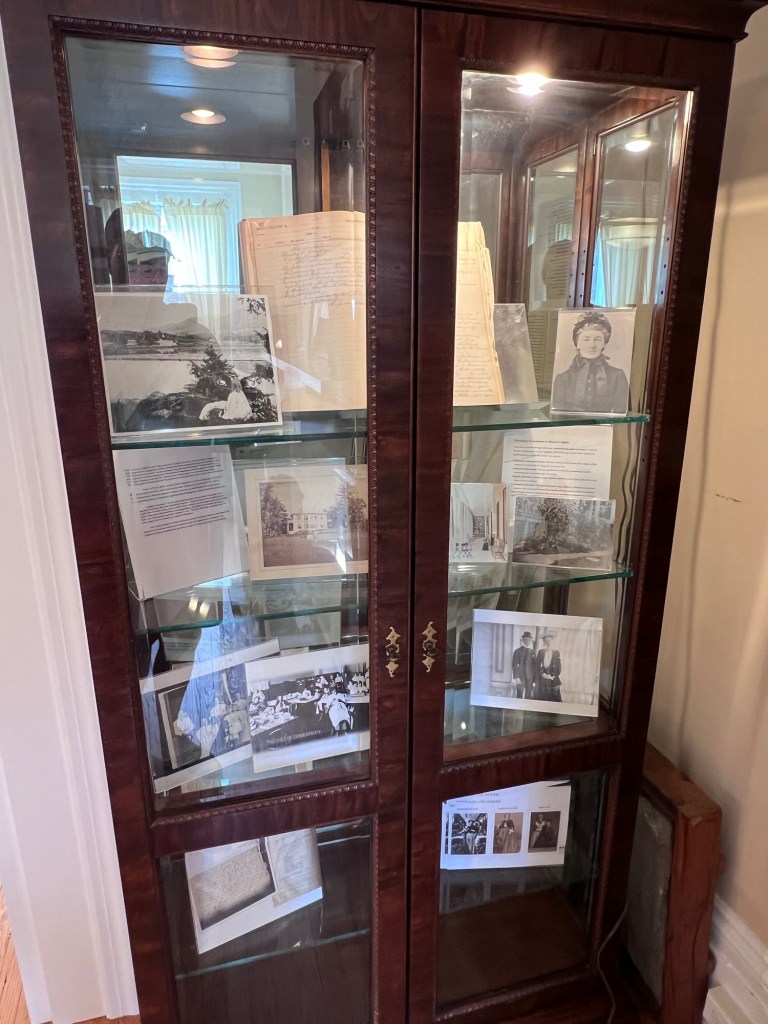
On the seconded floor is a display is the socially prominent Van Nydeck family. The family donated their family tree and many family heirlooms and portraits.
Part of the Schenck Van Nydeck family tree
The Van Nydeck family heirlooms
There was also artwork and artifacts from the surrounding community on display all over the museum.
The painting is by a local artist and the pottery is locally made
The window is a Tiffany window from a local church that the Historical Society saved for the museum
The first floor gallery
The docent told me after I toured the exhibition that there are more exhibitions being planned for the future.
Touring Downtown Beacon, NY:
After the trip through the Historical Society, I ventured and walked Downtown Beacon. The neighborhood has certainly changed since the early eighties.
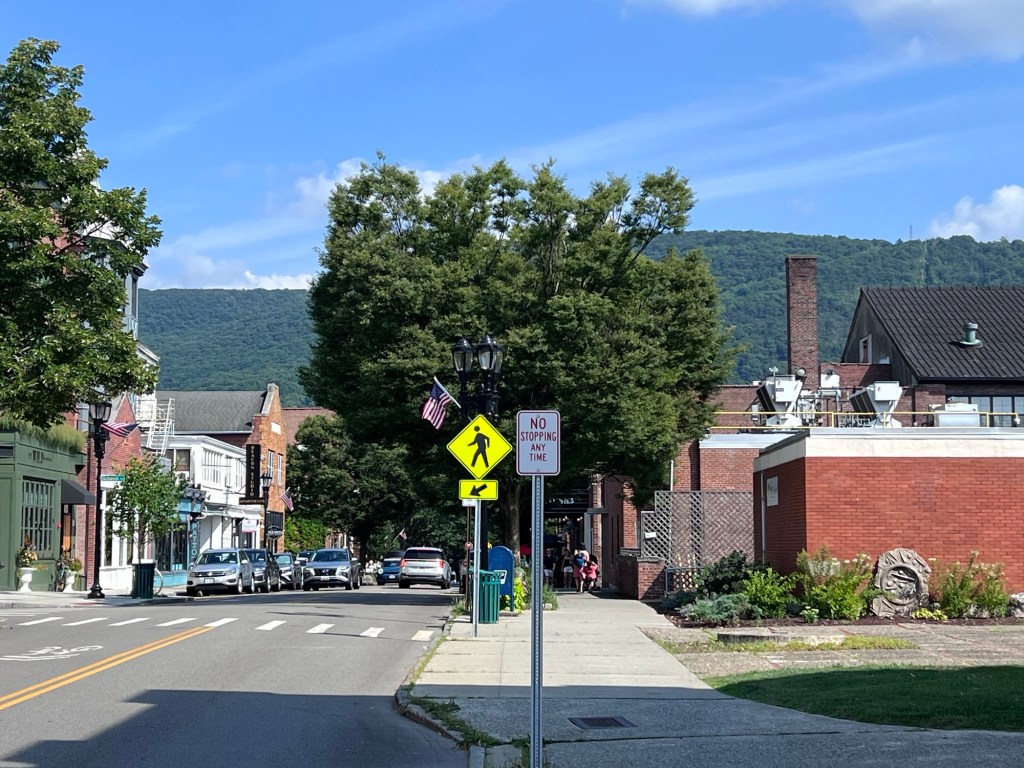
Downtown Beacon today
Downtown Beacon today with Mount Beacon in the distance
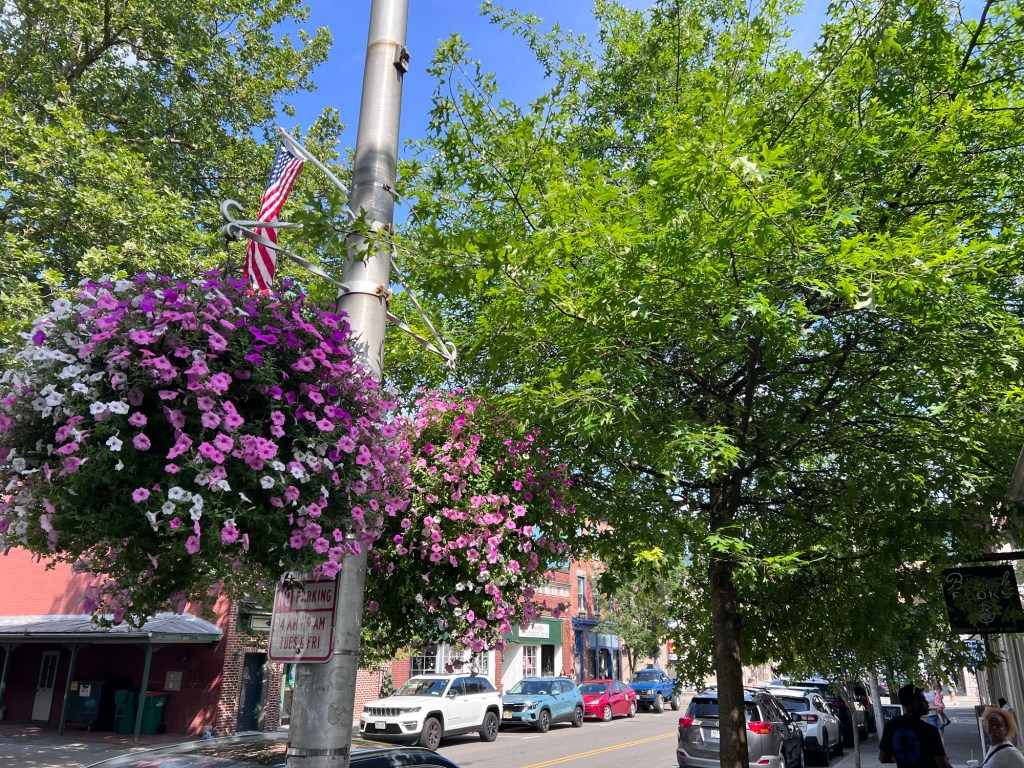
The beautiful floral arrangements in the downtown today
In my live classes, I open my consulting company, “Bergecco-Parc Consulting Inc.”, for business and the whole class bands together and we have one big project. In the era of post-COVID and online learning, I was lucky that I was able to teach one of the live classes on the Bergen Community College, Paramus Campus. It was such a pleasure welcoming students back to campus with live lectures and conversing with them.
The Bergecco-Parc Consulting Inc. corporate logo of the six trees
In the past, I have created these projects under the Bergecco-Parc Consulting Inc. banner, the main consulting company, the Orion Malls banner, a Mall design company and the Buscomonzefi.com banner, my Tech Division. Each business does its best to be creative, forward thinking and have a thought producing presentations. I also challenge the students to top on another in their presentations and build on what they have seen others do in the past.
Professor Justin Watrel, CEO & Co-Founder of Bergecco-Parc Consulting Inc.
As part of the semesters project, I wanted to choose a location that was close to the college that we could promote and staying within the Lyndhurst area. I felt that Lyndhurst’s downtown was a bit fractured with gaps in the downtown making it tougher to market than other downtowns. Then I remembered the Red Schoolhouse Museum that I had visited over the summer to update my blog and thought that would be the perfect choice.
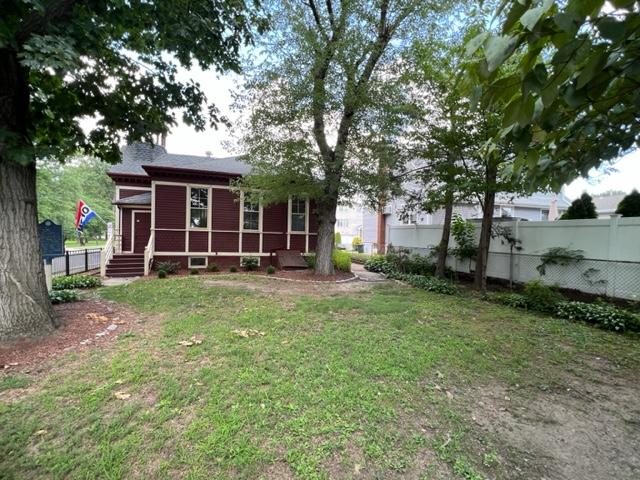
The Lyndhurst Red Schoolhouse Museum at 400 Riverside Avenue in Lyndhurst, NJ during the summer months
The museum is close to campus, was a historical site and really needed some new publicity. So I approached their volunteer Board and we developed a partnership on this project:
It was going to be a tight project as we only had five weeks to pull it off and we had Thanksgiving Weekend break in the middle of the project. I created one less Team and gave them a fair amount of work to develop and then we started the project.
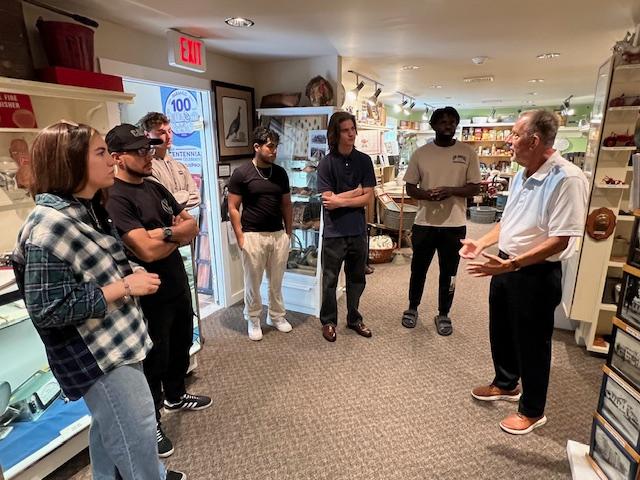
I had an extra credit Team Field trip to the museum that Sunday and about a third of the students showed up. The museum is a one room schoolhouse so it is easy to tour.
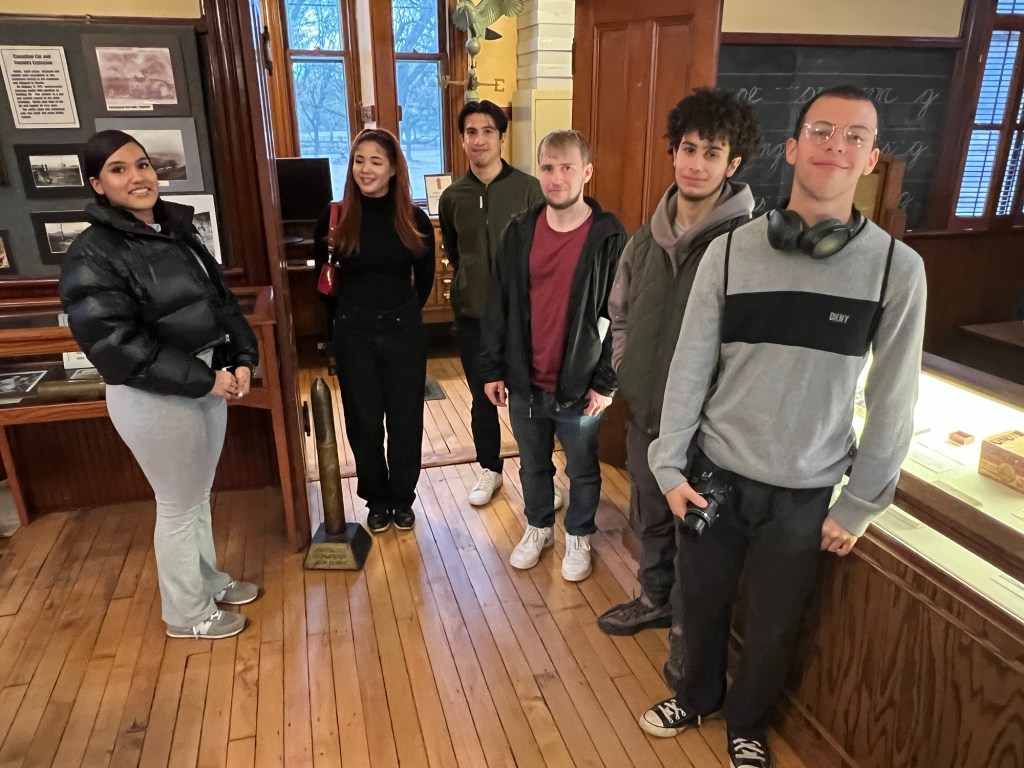
Team members touring the museum on the extra credit trip
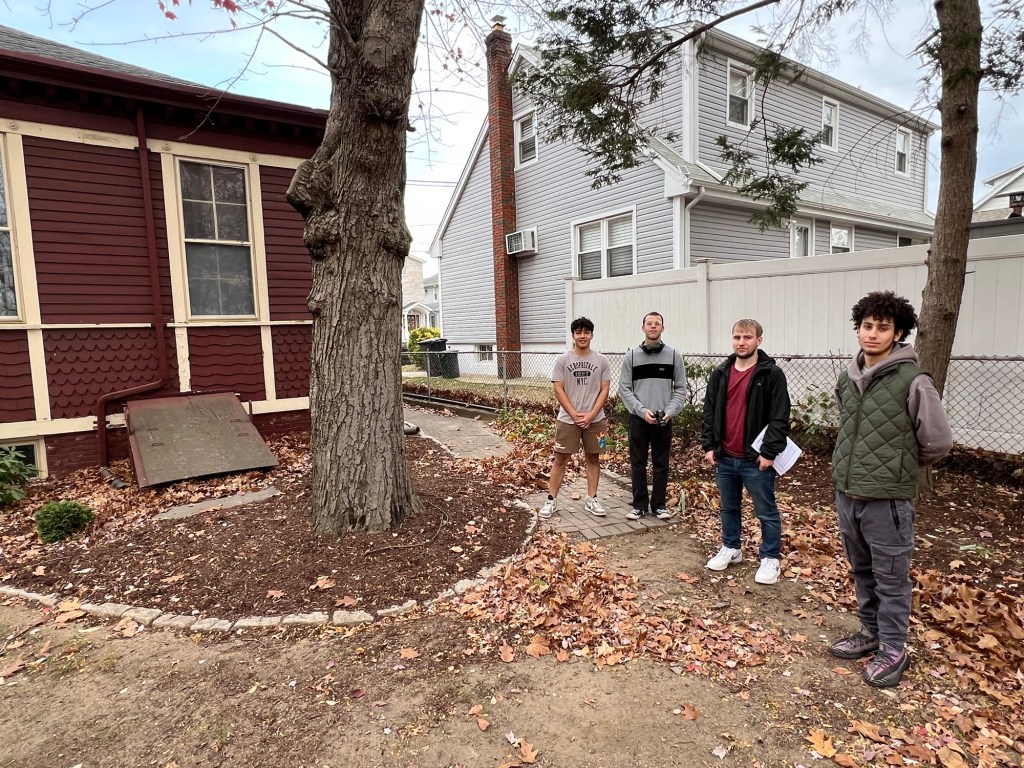
Touring and planning ideas in the museum’s backyard and gardens
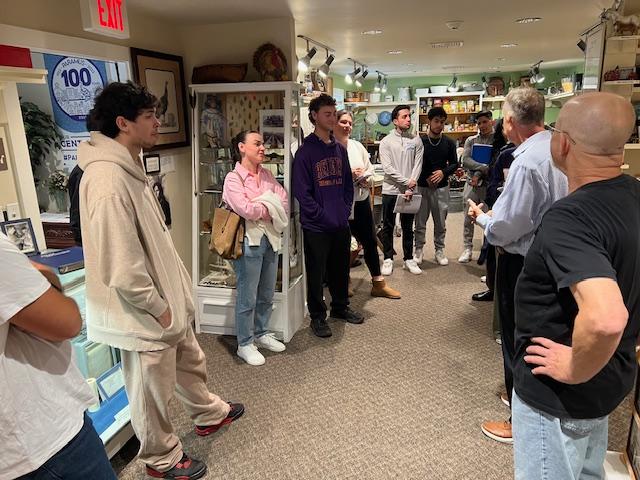
The next week during class time, I took the students on a more formal tour and lecture on the museum where they met with the Museum Board, their volunteers and it was time to ask questions and view the museum from the vantage point of how to we promote this museum and how can we bring people in from outside the Bergen County area.
First we met with the staff at the museum on class night
We started with a discussion of the museum, its history and its direction in the community. We also got to meet the Volunteer Board of the museum.
Then we toured the museum
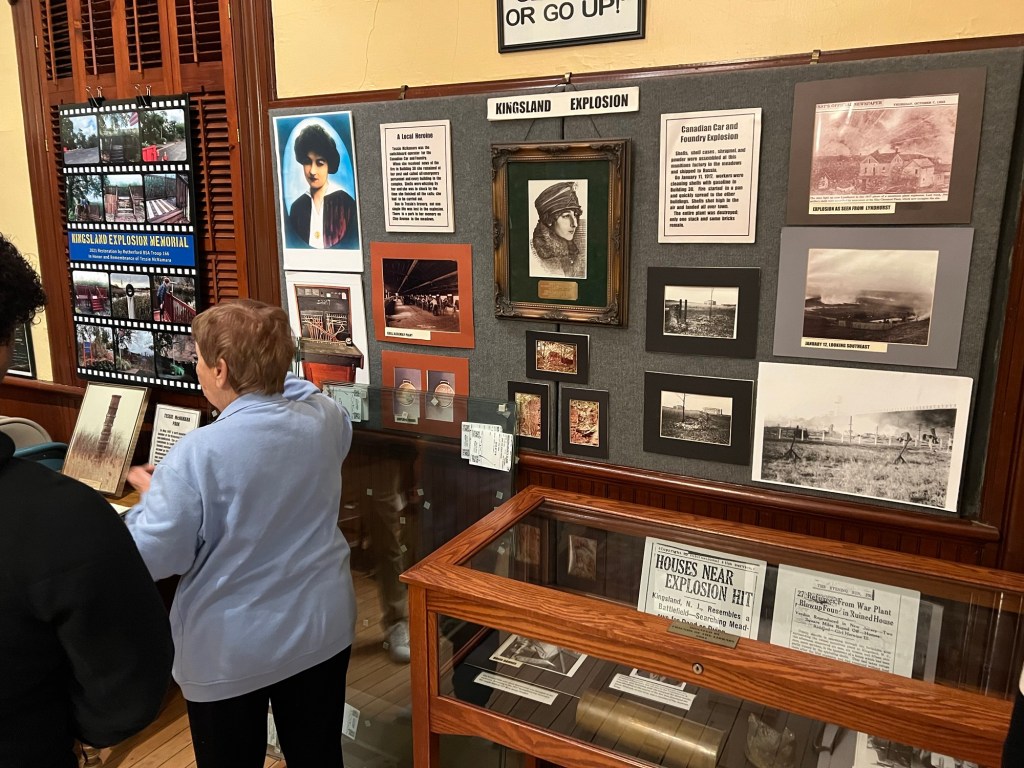
The Kingsland Explosion Fire display
Going over the project steps with the Museum Board
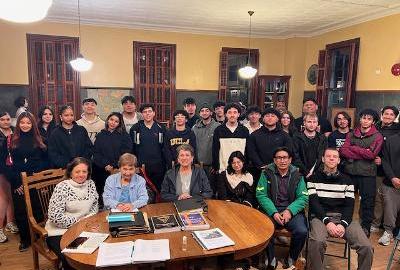
Our Team picture with the Museum Board of the Lyndhurst Red Schoolhouse Museum
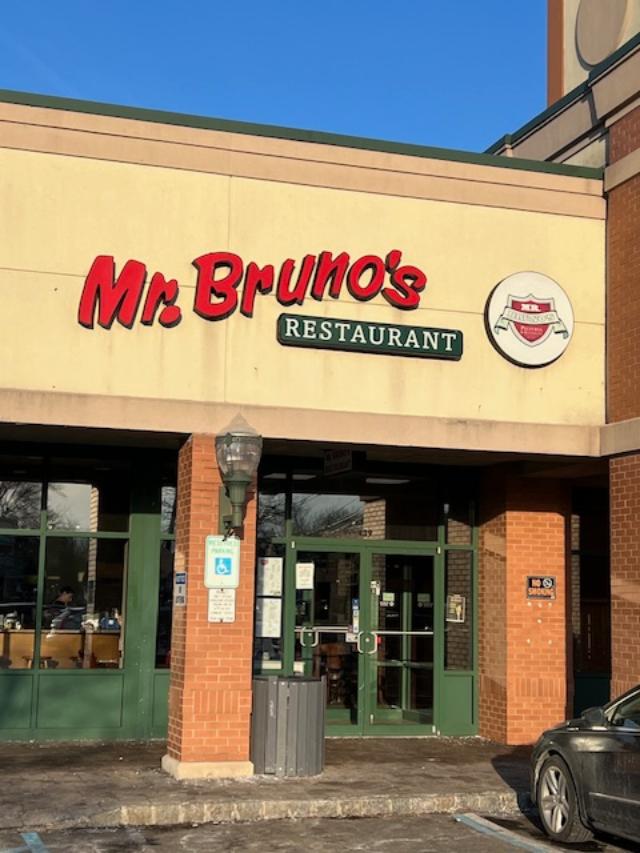
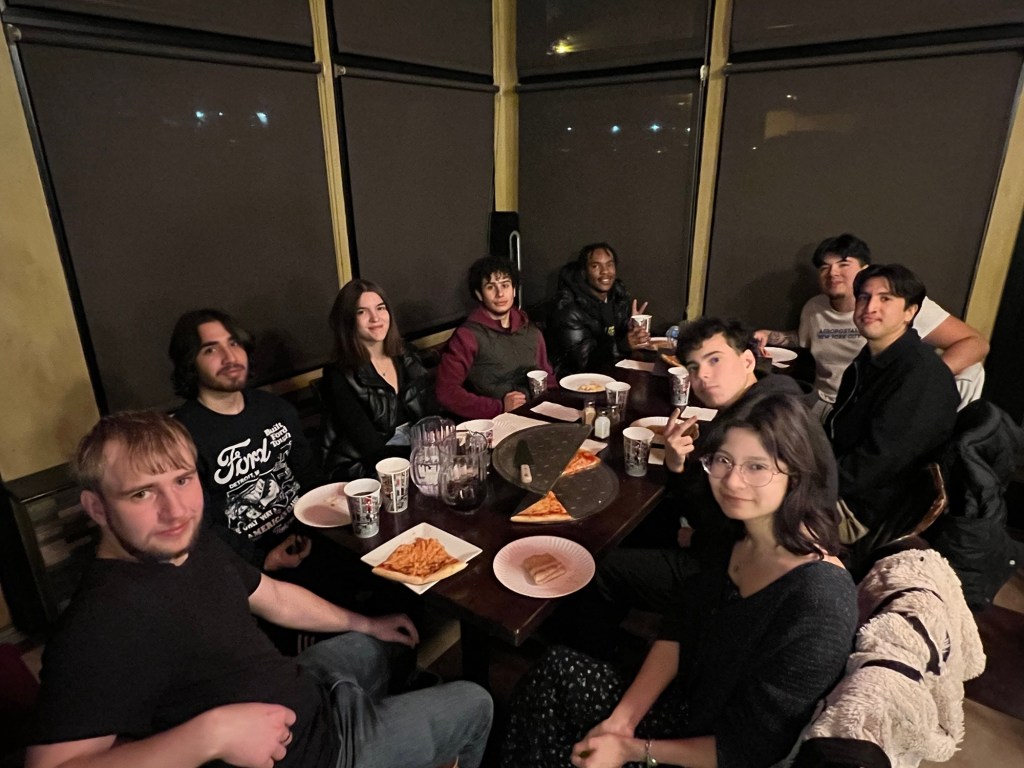
After our visit to the museum, I took the Teams to Mr. Bruno’s Pizzeria in Lyndhurst for a Team Building dinner that I host with all my classes. It is hugely popular with the students and gives them a chance to get to know one another. Nothing is better than Team Building over pizza.
Mr. Bruno’s Pizzeria in Lyndhurst, NJ has a complete dining room
Team Two setting up their game plan while dining at Mr. Bruno’s that evening
Team Two doing together and putting together their game plan
Team Three enjoying dinner together
The restaurant staff at Mr. Bruno’s could not have been nicer to us and everyone enjoyed dinner. It was a really productive evening for everyone. It was a nice Team Building event and the students that dined that night really got to know one another and start setting up their presentations. From this point on, it was up to the Student Consultants to put their projects together and make trips out to the museum on their own time.
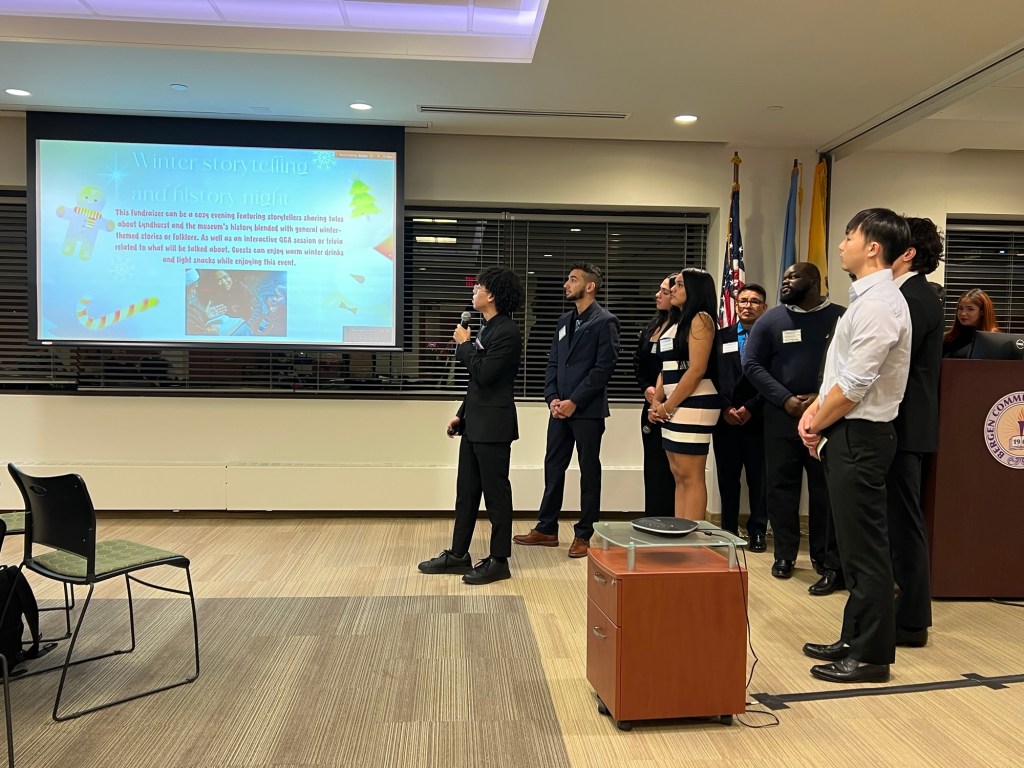
The Lyndhurst Team will have three Teams compete with one another in a series of projects that are part of program in “Promoting the Small Museums of Bergen County”. The goal is to create a new Digital Marketing Campaign for the museum, a series of special events that includes events at the holidays, a Children’s Walking Tour and a fundraiser for the museum.
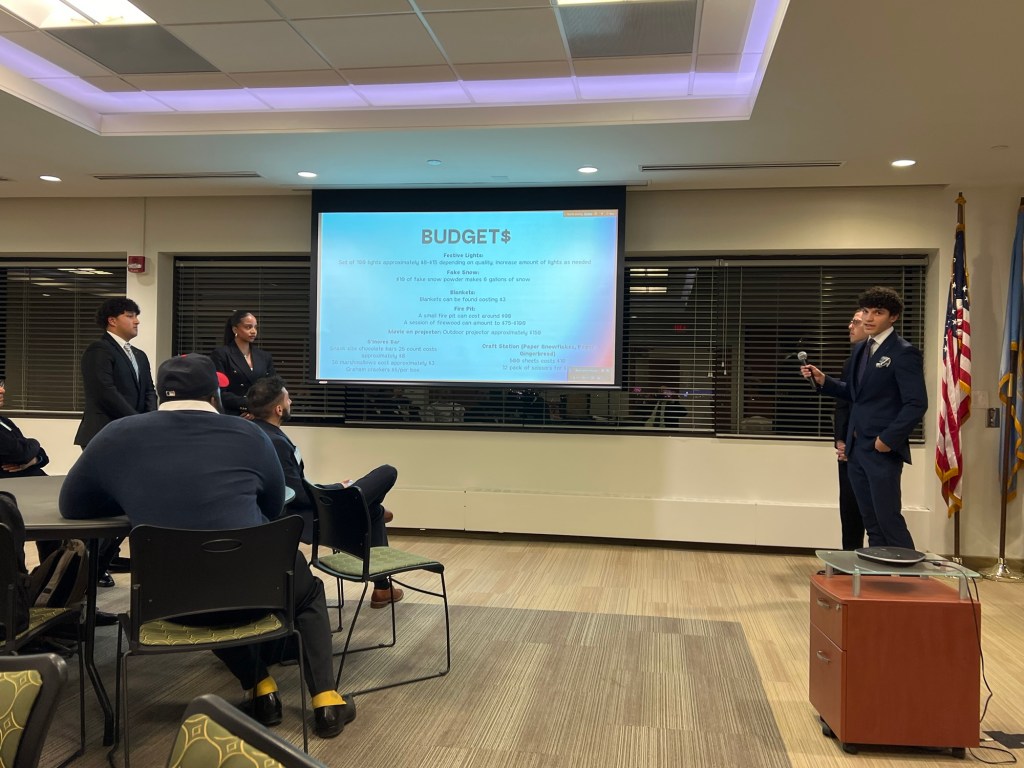
The Teams are to create two holiday events that include a ‘Holiday Village’, a secular December family holiday event where people can enjoy walking around the museum in a festive environment with delicious food and activities. This is the same with the “Spring Event”, another festive event where the museum is decorated for the day with engaging activities and delicious food all in a way to showcase the museum.
Some of the ideas that the museum asked of us was to create a Children’s Walking Tour for school age children who visit with their parents and with their local schools. This is a way for the docents to engage with the children and create a fun environment that speaks to them. The other request from the museum was to create a fundraiser or a series of fundraisers that will raise $10,000 for the museum to help with expenses in running the museum and mounting new exhibitions. It will be interesting to see what the students create to promote the museum.
This Team had it the toughest of my four Teams as they had four weeks to put their project together with one of the classes being the formal tour. They did a wonderful job putting it all together in a short period of time.
The week before the student Teams made their presentation, I gave all four of my Teams the ‘Holiday Project’ Quiz Four, in which each Team was asked by the Corporate office to create a holiday menu proposal for the company dinner, create an invitation and then film a holiday greeting in English and Spanish. That produced interesting presentations.
Video on the Holiday presentation:
PowerPoint Holiday Presentation:
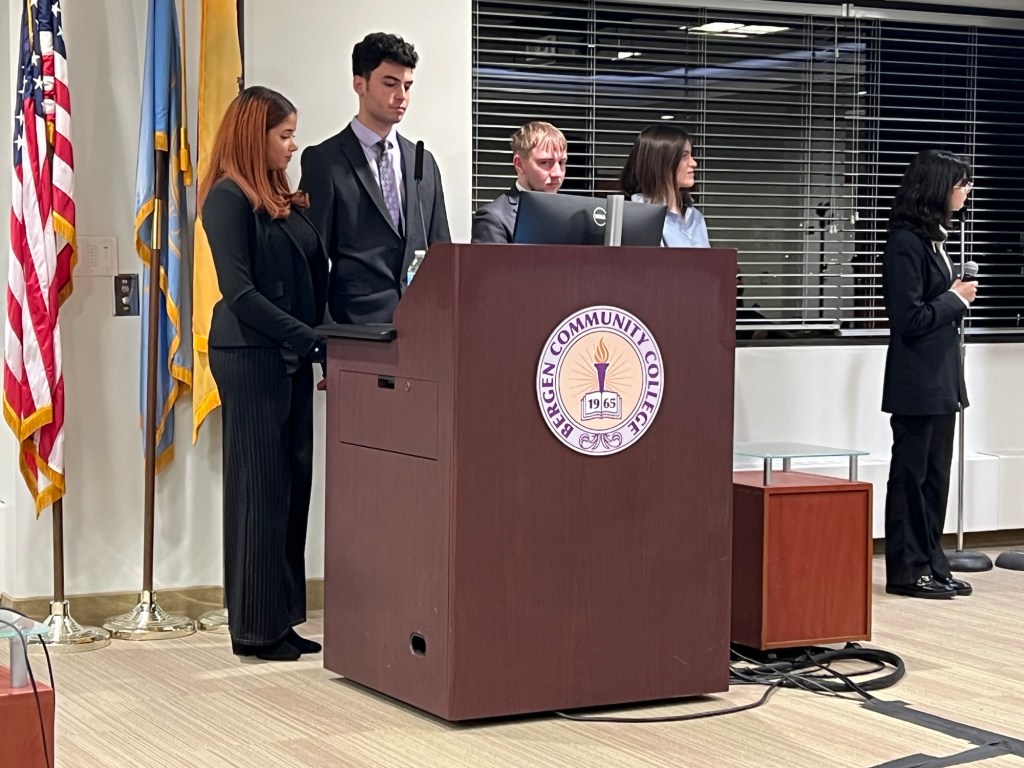
The next week on December 12th, 2024, the students presented the project to myself, the Board and members of the Lyndhurst Schoolhouse Museum and to parents and other invited guests. For a four week project, the students did a good job.
The Bergecco-Parc Corporate Website for the Lyndhurst Schoolhouse Museum Team:
Team Two presenting their Holiday events to the Board
Team Two presenting their Holiday events budgets
Team Three making their presentation
The Lyndhurst Schoolhouse Museum Team at the end of the presentation
At the end of the Presentation, we had a Q &A with the Board of the Museum, who really loved the ideas that the students came up with and how creative they were with such a small museum. The President even admitted to me that she, like all the other museums I worked with this semester, would miss having the students visiting and touring the museum. That made me feel good, that in some small way we made a difference.
I don’t know if the museum will ever use any of these ideas or if all the things will be successful in the end but I could see these events a nice addition in making the museum more successful and create better visitation.
In my live classes, I open my consulting company, “Bergecco-Parc Consulting Inc.”, for business and the whole class bands together and we have one big project. In the era of post-COVID and online learning, I was lucky that I was able to teach one of the live classes on the Bergen Community College, Paramus Campus. It was such a pleasure welcoming students back to campus with live lectures and conversing with them.
The Bergecco-Parc Consulting Inc. corporate logo of the six trees
In the past, I have created these projects under the Bergecco-Parc Consulting Inc. banner, the main consulting company, the Orion Malls banner, a Mall design company and the Buscomonzefi.com banner, my Tech Division. Each business does its best to be creative, forward thinking and have a thought producing presentations. I also challenge the students to top on another in their presentations and build on what they have seen others do in the past.
Professor Justin Watrel, CEO & Co-Founder of Bergecco-Parc Consulting Inc.
The Behnke Museum Project:
I created the Behnke Museum promotion as a way to promote this wonderful museum located right next to the Bergen Community College campus for tourism. It is such a terrific museum but it never seemed to have any visitors. Not only that, it seemed that no one at the college including the Professors had been there or even knew what it was as they passed it everyday on their way to work. This project, which was the first project in the class, was going to change all of that.
With the help of Fred Behnke and the Board of Volunteers, we partnered together to help the museum promote itself for tourism and put the museum on the map. I created with the help of the Executive Team and the Student Consultants, a series of promotions, commercials and ideas to bring traffic into the museum. The Student Consultants also created an Instagram site for the museum, helped create a website and translated pamphlets into Spanish, Korean and Pilipino to help promote the museum to an outside audience where English may not be the first language. We started the project out with a tour of the museum.
The Sunday Extra Credit tour that my class at the museum
On the Sunday before the formal Class tour of the museum, I gave the students extra credit towards their project to come in on a Sunday and tour the museum at their leisure. About a third of the class took advantage of it.
The next class, I picked my Teams, set up the Executive Team and then it was ‘full steam ahead’ with the project.
We arrived at the museum later that week for our formal walking tour of the museum and the class was broken up into two teams one upstairs and one downstairs.
The Class Field Trip to the Behnke Museum as part of the project
The Team Field Trip to the Behnke Museum
Touring the first floor of the museum
After the tour was over, we took our official Team Corporate picture for the project. Even though it was a gloomy day, it was all energy and smiles and a lot of promise to help the museum gain more visitors.
The Bergecco-Parc Consulting Inc. Behnke Museum Team picture with the Museum Volunteer Staff
The Student Consultants had a week to put the Presentation together and create a commercial to promote the museum and their PowerPoint on their ideas to create excitement at the museum. Here is their project Presentation and PowerPoint on the project. Please remember that they had seven days to do this.
The Team Picture after the Behnke Museum Presentation to the Museum Volunteer Staff:
The Bergecco-Parc Consulting Inc. Paramus Team for the Behnke Museum
The Behnke Museum Volunteer Staff was impressed with the students ideas and thought there was a lot good ideas that they can use.
Commercial Group One:
Commercial Group Two:
Marketing Commercial Team Two:
Commercial Group Three:
Marketing Commercial Team Three:
Commercial Group Four:
The Bergenfield Tourism Project: The Bergenfield Museum, Coopers Pond Park and South Church Graveyard Tour Project:
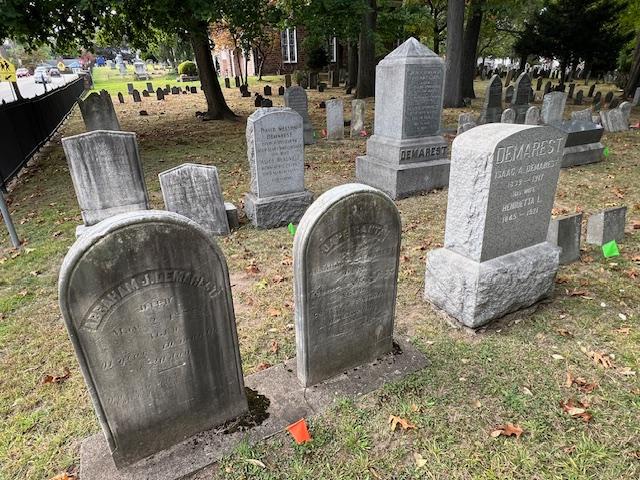
This is when I got the idea of doing the same project in a larger form. I saw the Bergenfield Museum, a small gem on the other side of Coopers Pond Park, that did not much traffic considering the museum is open both during the week and the weekend. The building was an original Demarest homestead and the family had their family plot in the South Church which is located right next to the park. So I approached both the museum and the church to partner with me in creating a project to promote this corner of Bergenfield, NJ for tourism.
Cooper’s Pond Park during the Summer months
So I set up the next series of tours for my students that encompassed the Bergenfield Museum, Coopers Pond Park and the historical South Church graveyard where the Demarest family plot was located. The Bergenfield Museum building is the original Demarest family homestead so it tied in nicely to the project.
Walking through Coopers Pond Park inspired this fascinating project
Two weeks after the Behnke Museum project, I introduced this project and the next week we took a walking tour of all three sites starting with walking through Cooper Pond Park, a WPA project and one of the most beautiful and underrated parks in Bergen County.
We met with the Bergenfield Volunteer Board at the museum to start the tour
The Bergenfield Museum at 100 Cooper Street in Bergenfield, NJ
The President of the Bergenfield Museum Board, Joanne, helped me organize the Team Field Trip of the museum. She had four other docents from the Board helping in four different rooms so each Team would follow each other through the rooms. Each Team had about ten minutes in each room for the docent to explain the collection to them. The Student Consultants got to visit the museum on their own time as well.
Our class being greeted by the President of the Bergenfield Museum, Joanne
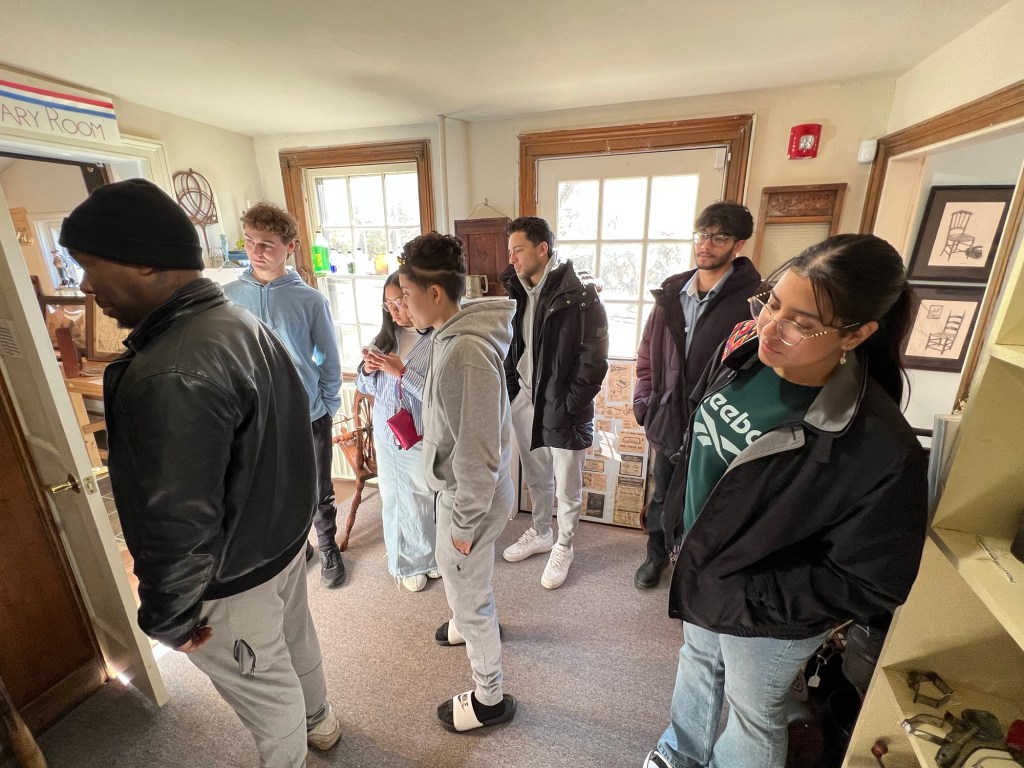
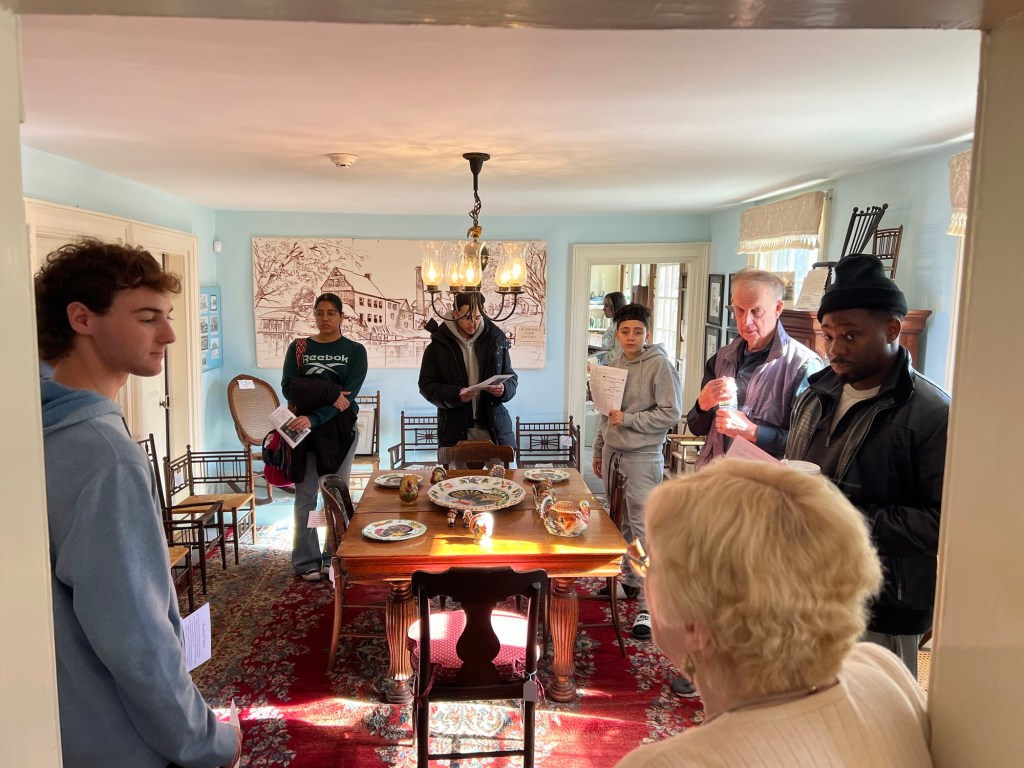
Touring the Living Room of the old Demarest Homestead
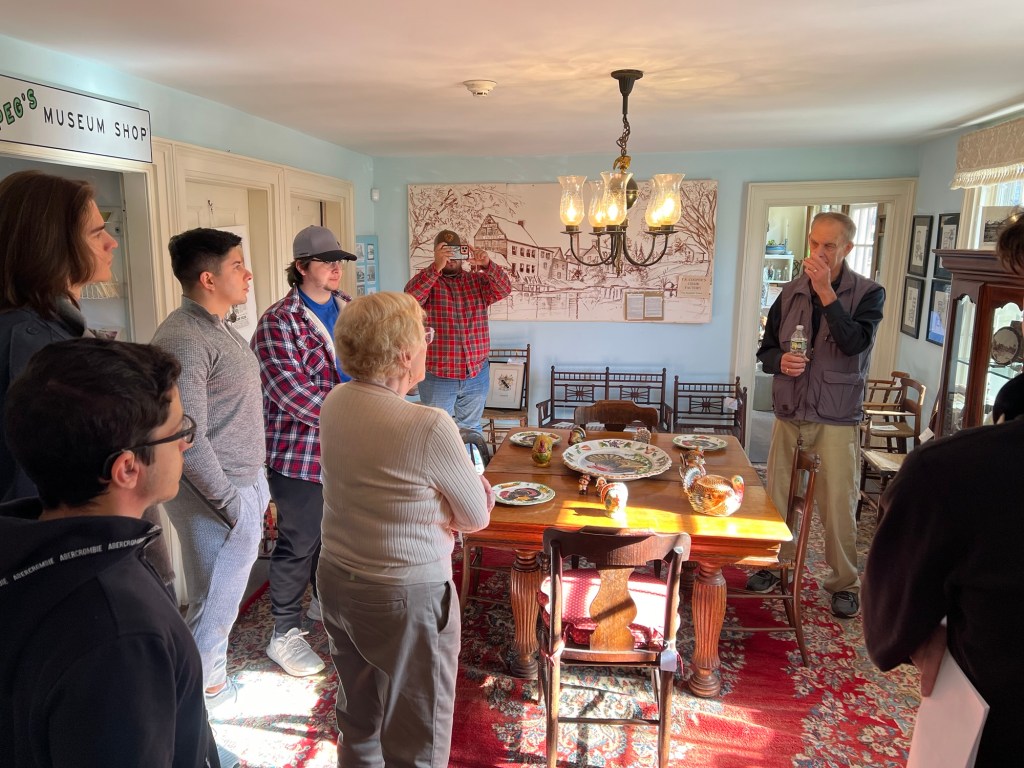
Touring the old Dining Room and the Chair Factory display in the museum
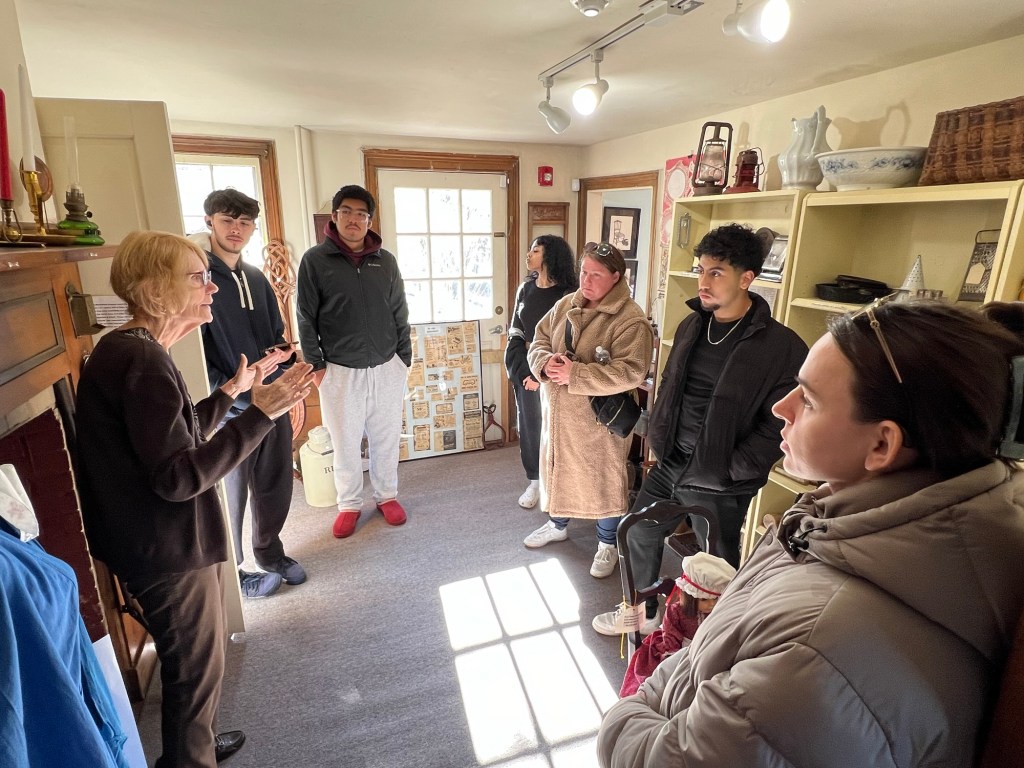
Touring the Kitchen area of the old homestead
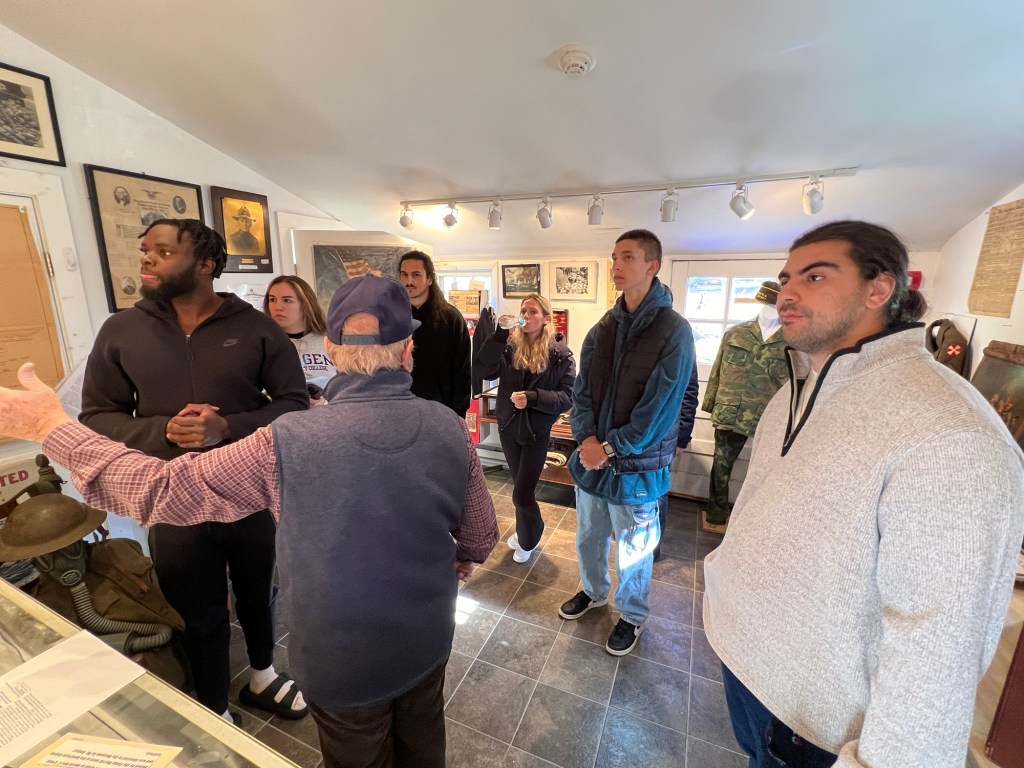
Touring the Military Room of the museum
Discussions of the function of the kitchen on the farm
Discussing the Chair manufacturing in Bergenfield, NJ
The Student Consultants touring the Living Room
The Teams taking notes during the tour
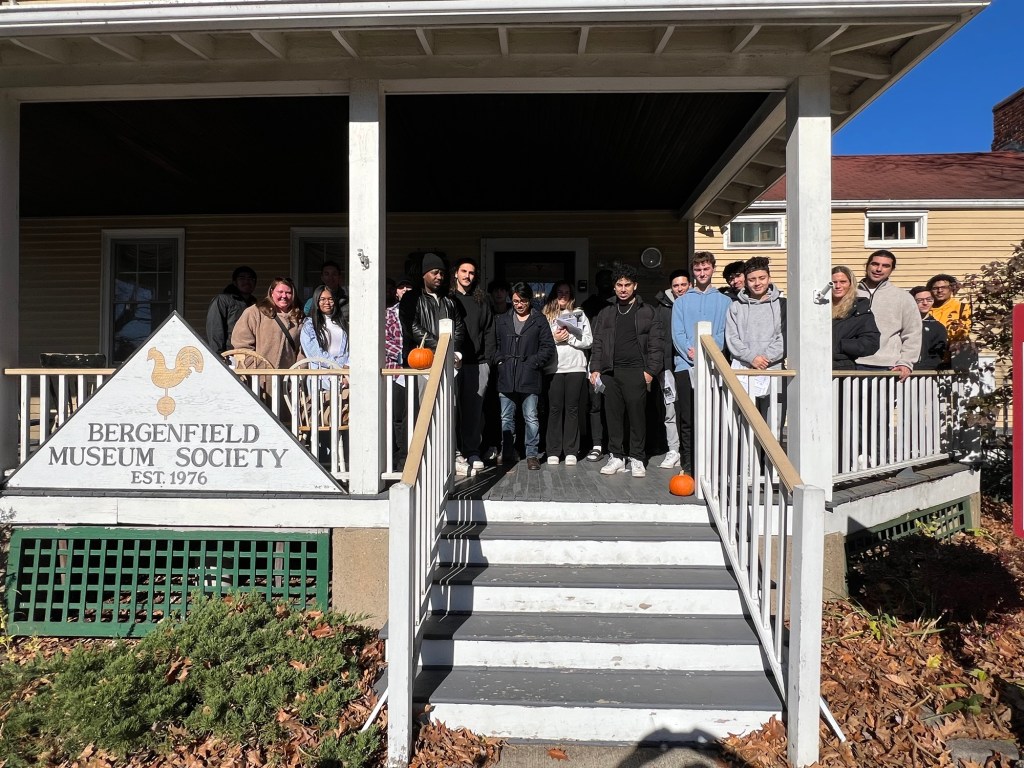
After our tour of the museum was over, we took a group picture outside of the museum with the Board of the museum.
The Student Consultants from Bergecco-Parc Consultants Inc. visiting the Bergenfield museum
After we took the group shot, we walked through the park again to my take note of its Depression era past and beautiful views and colors and made our way to the historic South Presbyterian Church and its historic graveyard where the second half of the project would take place.
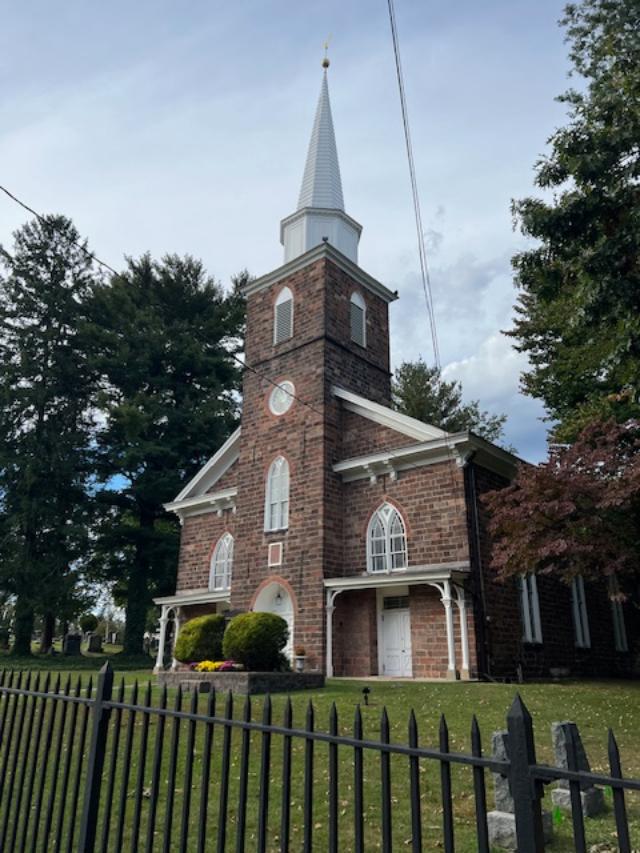
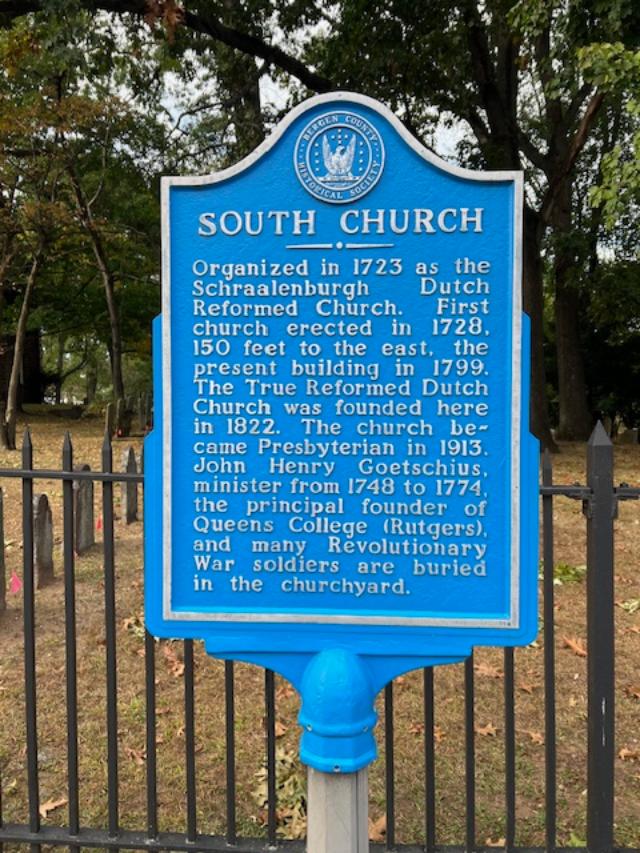
South Presbyterian Church at 150 West Church Avenue
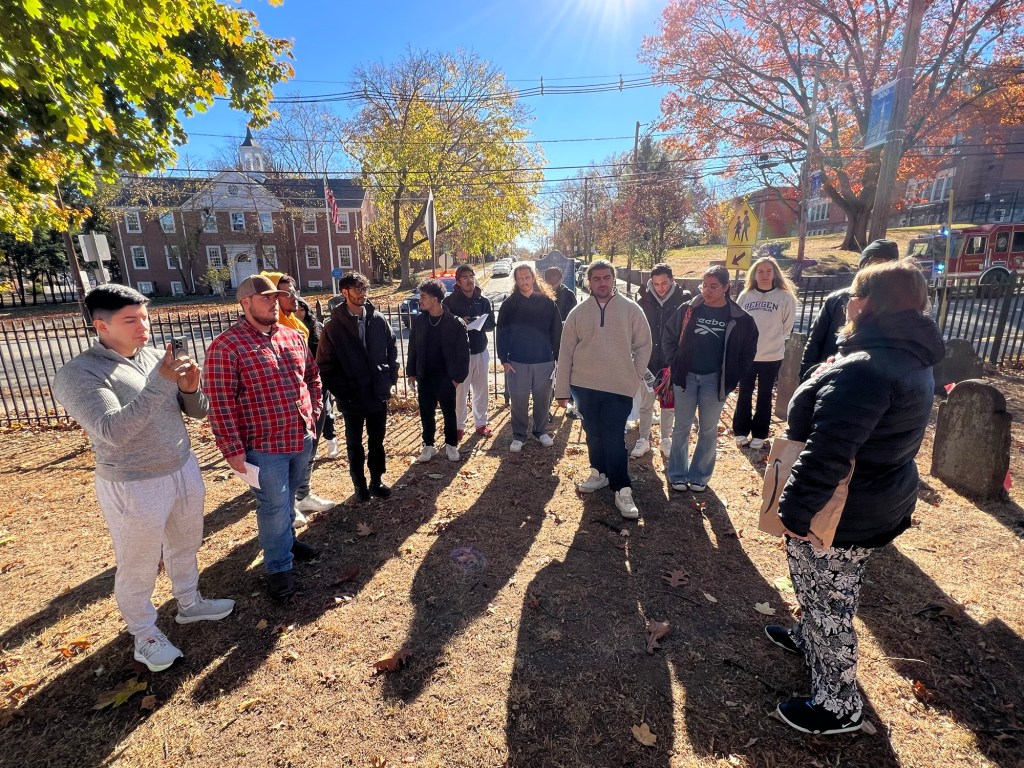
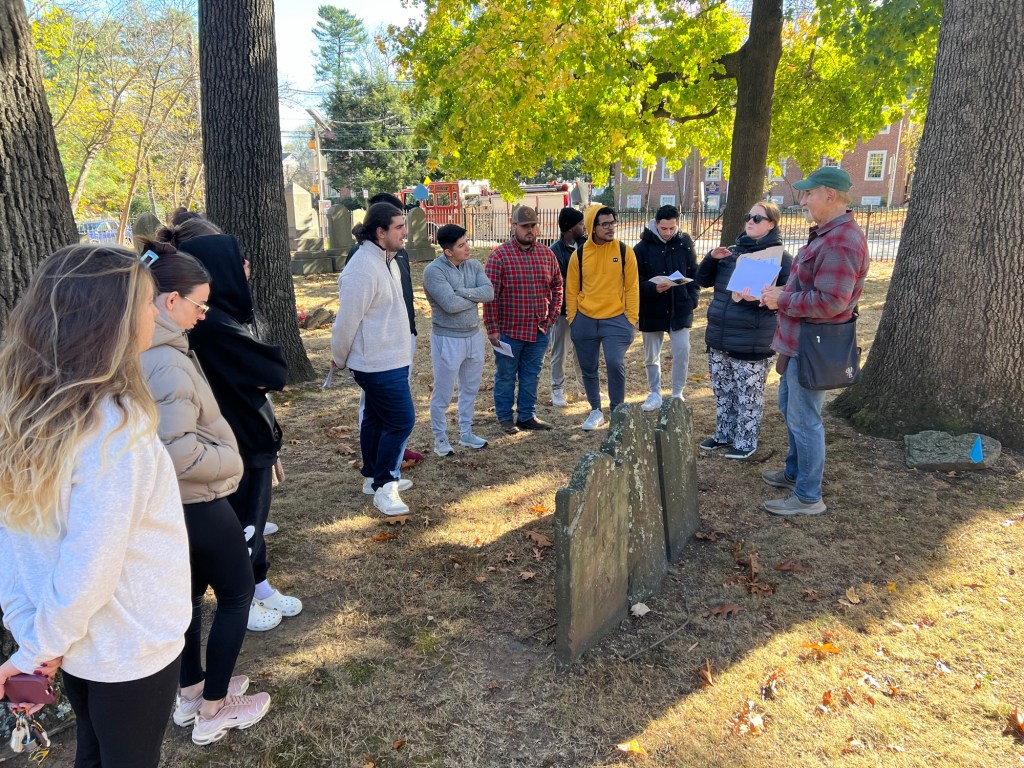
Touring the South Church graveyard for the historical walking tour with members of the Church volunteer staff
The tour was lead by Bob Carpenter, a historian who is helping renovate this historical graveyard
The tour of the historical Demarest family plot, which ties into the museum building’s historical past, was lead by historian Bob Carpenter, who is helping the church renovate and restore the graveyard. Mr. Carpenter explained to us how he was fixing all the plots and historic tombstones and how the maintenance of the stones needs to be carefully done.
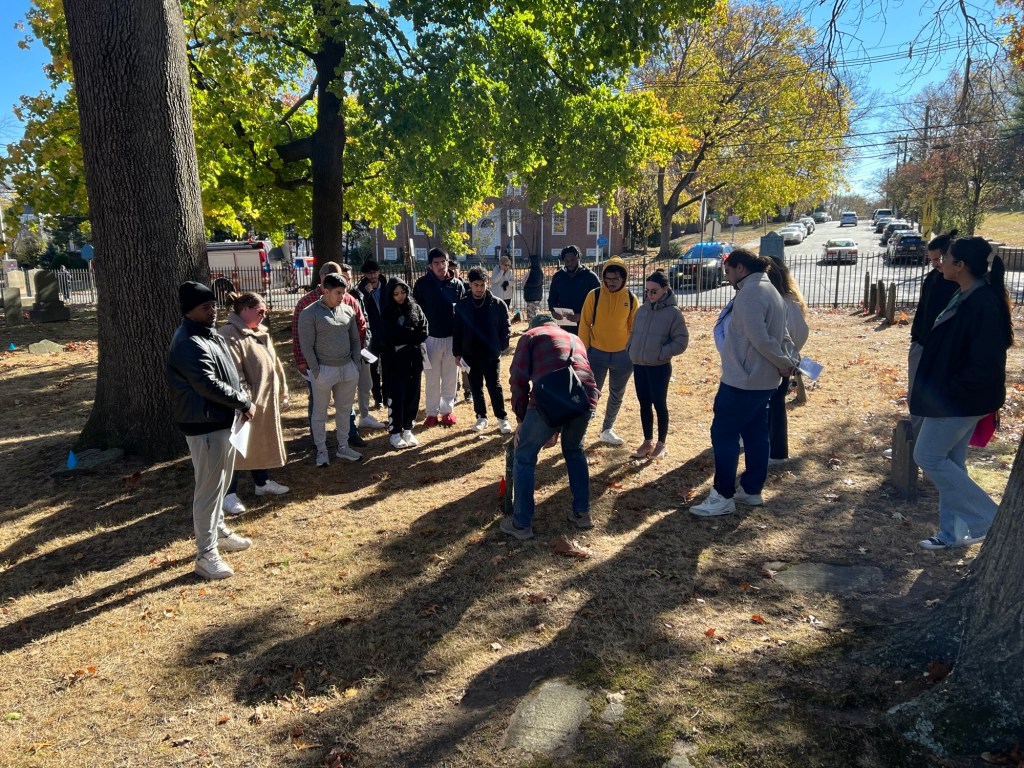
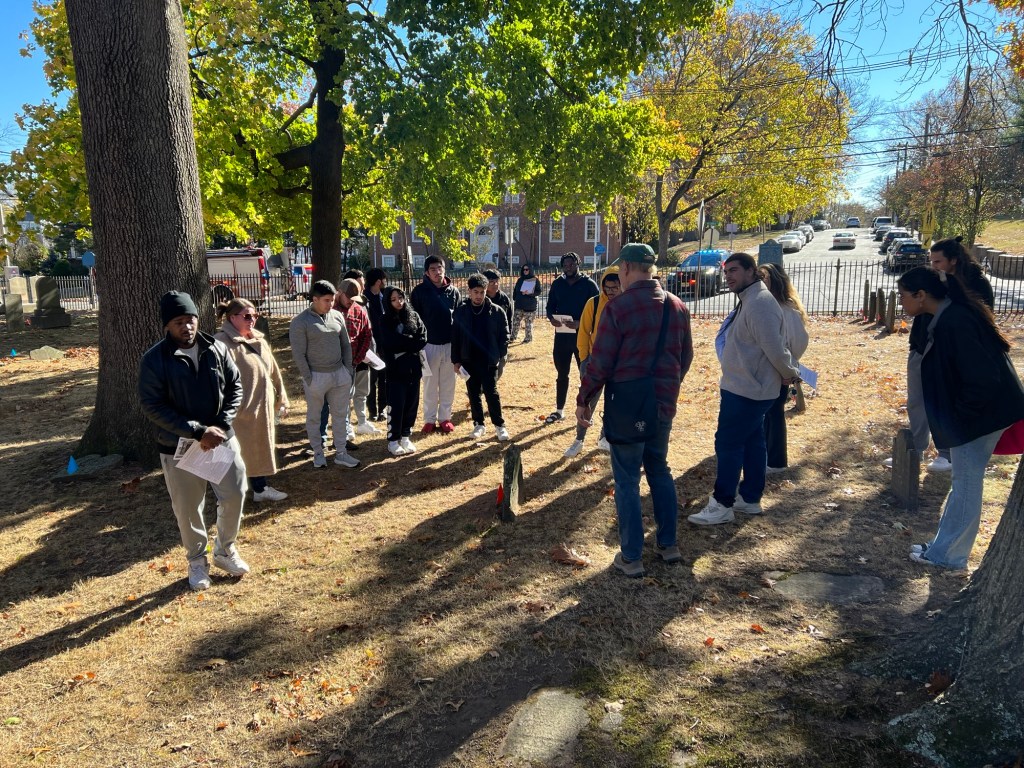
Mr. Carpenter explains how to maintain the tombstones in these historic graveyards
Video of the walking tour of the historic graveyard:
Both the church volunteers and Mr. Carpenter explaining to the students how families were buried in the 1700and 1800’s
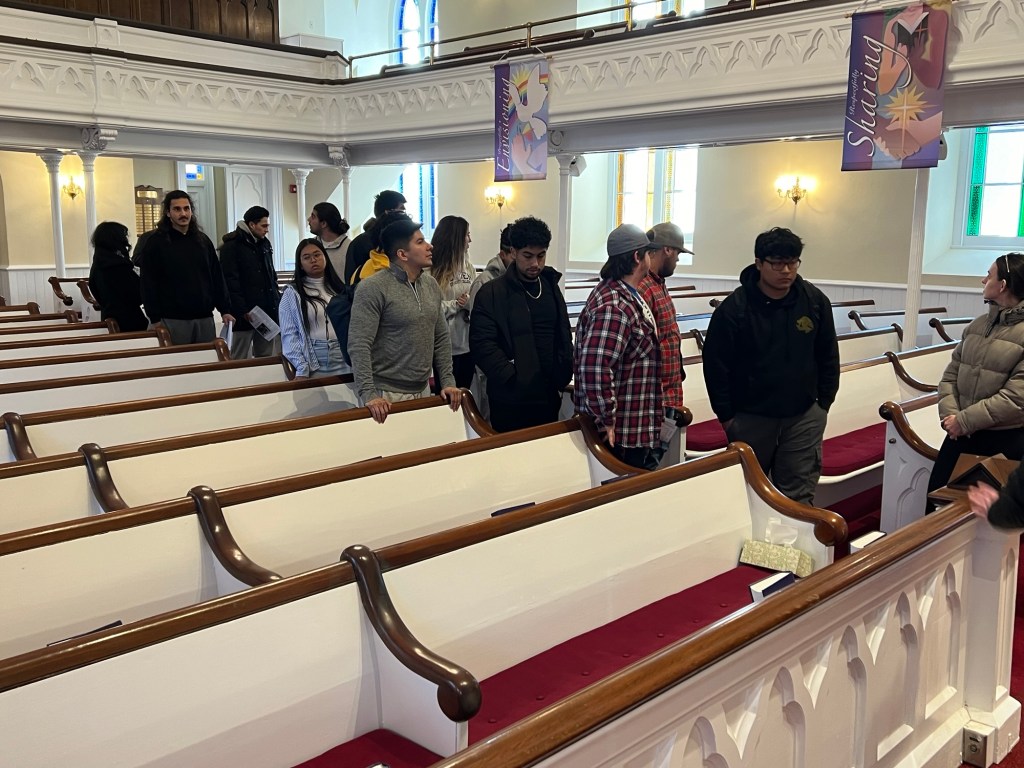
We finished the tour that afternoon inside the South Church to learn its history in the community. Though it will not be part of the project, the church offered the students a glimpse into Bergen County’s past as the original church was built before the Revolutionary War.
The Student Consultants touring the pews of the South Church
Once the tour was complete, the Student Consultants had a better understanding of the locations where the project will take place.
The new project will include walking tours, historical aspects of all three locations, and ways of creating a Destination Marketing Plan for domestic and foreign tourism. This will take place when the Student Consultants present their ideas to myself and the museum and church staffs.
The student consultants had four weeks to this project and put together their game plans. The had to put together commercials to promote the Bergenfield Museum, Coopers Pond Park and the historical cemetery of the South Church. As an extra credit assignment, I had the students develop a Halloween walking tour with food and create a separate commercial for this of which three of the for groups completed.
Quiz Four-The Holiday Project
Before the Team made their final presentation, they created Quiz Four-The Corporate Holiday Party
They did a great job on the ideas for the Corporate Holiday Party and came up with some clever menus and logos.
The Holiday Project PowerPoint:
The Christmas Greeting from the Executive Team:
Executive Greeting:
Team One Greeting:
Team Two Greeting:
Team Three Greeting:
Team Four Greeting:
Then came the big Presentation on December 11th, 2024 and this group did an amazing job with ideas for the Town of Bergenfield promoting the Bergenfield Museum, Coopers Pond Park and the South Church’s Historic Cemetery. Each Team tried to top one another.
The whole idea of the Bergenfield Project was not just to promote the museums, parks and historic churches but to create Destination Marketing Project to promote the Town of Bergenfield as a place to visit for both domestic and foreign tourism. This is the project that promotes that vision:
The Bergenfield Team website for Bergecco-Parc Consulting Inc:
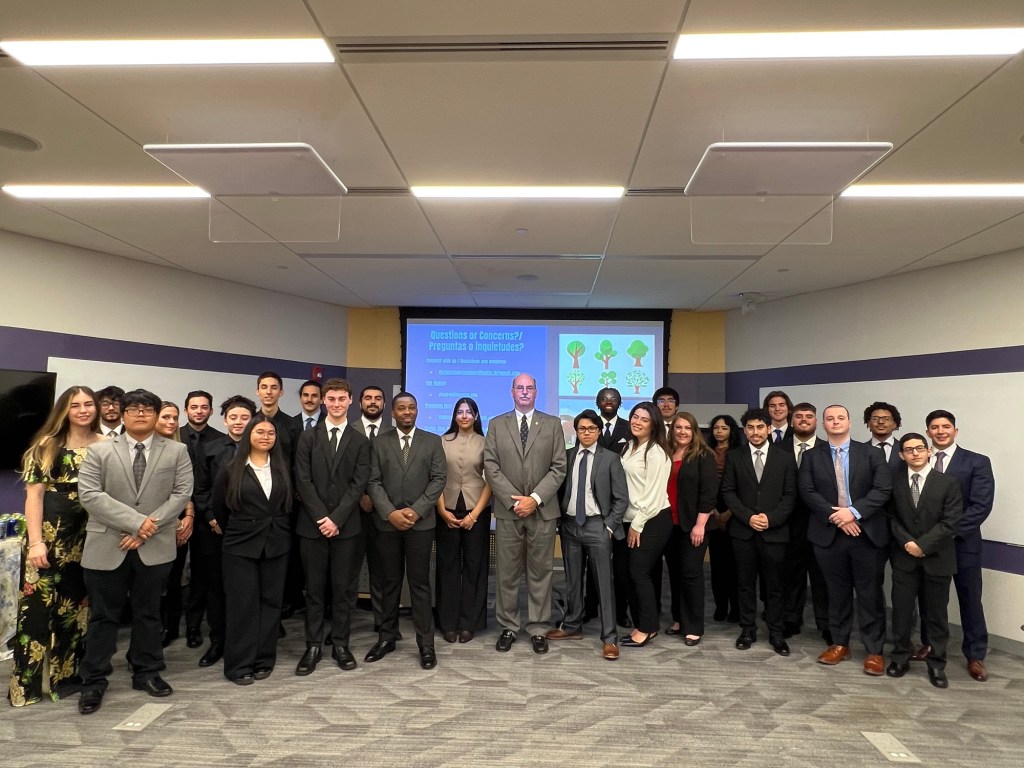
The day of the presentation the students had to be in professional dress with men expected to be in Jacket and tie or a suit and the ladies in blouses, slacks, suits and dresses. We presented this project to the Board and members of the Bergenfield Museum and to the Communications director of Bergenfield, NJ, which really gave the students a stamp of approval.
I thought the commercials the students came up with were very clever.
The Commercials of the Bergenfield Museum:
Team One:
Team Two:
Team Three:
Team Four:
The Children’s Walking Tour of the Bergenfield Museum:
Team One:
Team Two:
Team Three:
Team Four:
The Coopers Pond Walking Tour:
Coopers Pond Park sits between the Bergenfield Museum and the South Church and is one of the most beautiful parks and underrated parks in Bergen County. The students were tasked with creating a Walking Tour of the park.
The beauty of Coopers Pond Park in Bergenfield, NJ during the Christmas Holiday season.
Team One:
Commercial One:
Commercial Two:
Team Two:
Team Three:
Team Four:
The Historic Graveyard Tour of the South Church:
The South Church Cemetery is one of the oldest and historic cemeteries in Bergen County and home to the Demarest family plot, one of the most prominent families in Bergen County. The students were tasked with creating a short Walking Tour video promotion for the project to promote the South Church for tourism.
Team One:
Commercial Two:
Team Two:
Team Three:
Team Four:
Some of the Student Consultants also for extra credit created a Halloween Walk for the Church.
The Corporate Picture at the end of the Presentation:
The Executive Team of the Bergenfield Museum project
Another excellent Project from the Student Consultants of Bergecco-Parc Consulting Inc.-Paramus Benhke/Bergenfield Team
I couldn’t have been more proud of a group of students who created an excellent project!



































































 mywalkinmanhattan