Tag Archives: Exploring the Island of Manhattan

Day Three Hundred and Fifty-Six Walking the Meatpacking District August 9th and 15th, 2025

I finally finished walking Lower Chelsea which means that I have now walked 2/3 of Manhattan island. It has taken a decade to do this since my initial start but life does get in the way. I hope to all you readers you have been enjoying the journey.

The streets of Lower Chelsea took so much time because here in this corner and there in that corner I kept finding more interesting things I wanted to share with everyone. It makes this journey even more fun.

I started my journey in the Meatpacking District in the early afternoon of a glorious summer day. It was clear, sunny and warm and the perfect 80 degree day.

Ninth Avenue and West 14th Street

I started the walk on the corner of West 14th Street and Ninth Avenue, which was once all slaughter houses up until about twenty years ago. Some converted to clubs in the 1980’s and then funky shops and over the last twenty years has seen a change in upscale dining, shopping and living.

There are still meatpacking businesses and distribution centers on the edges of the neighborhood but I am sure that won’t last forever with the cost of real estate in this neighborhood. It’s just funny to see the meat distribution centers sitting across the street from stores selling $1000.00 leather jackets. In just a decade period, I have never seen a neighborhood change as dramatically as this one.

This was one of the scenes of “Sex and the City” where I saw the Meatpacking District change.

Once they featured this neighborhood in ‘Sex and the City’, it was already past trendy. Now most of the streets are lined with ultra chic and expensive stores. I have never seen so many stores lined next to the vestiges of meat wholesale businesses.

The edge of the Meatpacking District at the corner of West 14th Street and Ninth Avenue

Walking down Ninth Avenue to Ganesvoort Street seems to be one long Mexican restaurant. The street is lined with chain restaurants next to luxury condos. The cobblestone streets and plantings though give it a real picturesque look.

Walking down the cobblestone street of Ninth Avenue

Once you reach Gansevoort Street there is nothing left of the neighborhoods storied past

Looking down Gansevoort Street and its cobblestone look

Looking down Gansevoort Street seems like seeing a combination of what was old being converted to new plus a lot of new construction with very innovative design tucked in between. I love the hodge podge of architecture and how it all blends into the neighborhood.

Very whimsical street art along Gansevoort Street

The High Line Park ends on the edge of Ganesvoort because once upon a time these were the famous Washington Markets. The line was used to get produce and other foods transported out of the area.

The new Whitney Museum is at the very edge of the neighborhood and is a catalyst for tourists

https://whitney.org/

My review on TripAdvisor:

https://www.tripadvisor.com/Attraction_Review-g60763-d106189-Reviews-Whitney_Museum_of_American_Art-New_York_City_New_York.html

When I was visiting the neighborhood for the second time to finish Hudson Street, I stopped at the Whitney Museum and found out that after 5:00pm on Friday nights, the museum is free for entry. That and being an NYU Alumni, I got in that night and was able to tour the museum and all the exhibitions for two hours.

On the very edge of Hudson River Park sits one of the few man made beaches in New York City , the Gansevoort Peninsula Sand Bluff that is part of the most southern part of Hudson River Park. This wonderful and relaxing park became my ‘go to’ spot when I wanted to relax after a long day of walking. The views are spectacular and if you can snag one of the lounge chairs either on the beach area or facing the Hudson River, it is even better.

Entering the park from Eleventh Avenue, the Gansevoort Peninsula Sand Bluff

The Gansevoort Peninsula Sand Bluff sign

https://hudsonriverpark.org/locations/gansevoort-peninsula/

My review on TripAdvisor:

https://www.tripadvisor.com/Attraction_Review-g60763-d26727487-Reviews-Gansevoort_Peninsula-New_York_City_New_York.html

The amazing artwork along the beach ‘Days End’ by artist David Hammons

This fascinating piece of art is entitled “Days End” by artist David Hammons. It looked like the shell of an empty building and struck a nerve as the sun started to set on the New Jersey side of the Hudson River. It is an ‘Open Air’ sculpture that explores the history of the neighborhood (Whitney Museum). This sits right at the entrance of the park.

Artist David Hammons

David Hammons

https://en.wikipedia.org/wiki/David_Hammons

http://www.artnet.com/artists/david-hammons/

Mr. Hammons is an American born artist who studied at the Chouinard Art Institute (CalArts) and at Otis Art Institute.  He is known for his Body Prints and sculpture work (Wiki/Artnet.com).

Underneath it is the amazing and very busy beach

The pathway along Hudson River Park

The beautiful plantings along the pathways

The colorful flowers in season in Hudson River Park

The very edge of the dock in the late afternoon looking over Lower Manhattan

The views from the dock section are fantastic and have the most breathtaking views of both Jersey City and Lower Manhattan. It really shows the growth of these areas for business and residential over the last twenty years.

The view of the beach with everyone looking so relaxed

The view looking up from Tenth Avenue

I rounded Gansevoort Street and walked down little 12th Street , which itself is making a lot of changes from business to both retail and residential.

Making the turn on Little 12th Street

The mural above Golden Goose at 812 Washington Street

https://www.goldengoose.com/us/en/stores/new-york/395

The view of the High Line Park from Little 12th Street

I thought the front of 12 Little 12th Street was quite unique

Little 12th Street like most of the neighborhood is in transition right now. Stores and restaurants have been opening and closing in the neighborhood and right now there are quite a few empty storefronts. The effects of COVID are still being felt all over the City.

On the contrary though, the empty store fronts are producing some interesting Street Art on the windows and doors of these establishments. These were some of my favorites.

I thought this was amusing

This looked like something out of the movie ‘Just can’t Wait’

This artist I was seeing all over the neighborhood

I love the irony of politics

Interesting art

I loved the little cents guy

This work was really creative

There is all sorts of public street art like this all over the neighborhood.

Turning on to West 13th Street,, I saw the last vestiges of the Meatpacking and Distribution industries. Some companies are still holding on in the area and their buildings prominently display their signs.

On some buildings, the signs have been kept as a reminder to the areas past and house expensive stores. The neighborhood has not totally gentrified yet and still has a grasp on the food industry, probably catering to the local restaurants and hotels.

Turning onto West 13th Street is a small look into the neighborhood’s past.

The Meat distributors who still operate in the neighborhood are becoming less and less. The London Meat Company and the Weichsel Beef Company still stand strong with their building on Little West 12th Street. These companies are the last holdouts of the old neighborhood. I have a funny feeling with the land worth millions that this will be a luxury condo or hotel in about five years.

What I read about the Meatpacking District is that this area was zoned for the Food Wholesale Markets going back to a deed from the Astor family when they owned this area. This tiny section of the neighborhood is still on that deed and many of these companies still have long term leases. How long before the real estate industry buys them out is anyone’s guess.

The London Meat Company at 56 Little 12th Street

https://londonmeats.com/?srsltid=AfmBOoqoHaUq1O0feW9ZGCAlscnR6ZGelrr2-U4U1DRbtrJBbF9-aiFh

Weichsel Beef Company at 826 Washington Street

https://www.instagram.com/explore/locations/9701751/weichsel-beef/?hl=en

This was a very odd art display across the street

West 13th Street has transitioned from meatpacking to galleries to high end stores and residences. The old cobblestone streets have been repaired.

Old signs still flank the entrances to high end establishments

The sign for Dave’s Quality Veal sits outside the Rag & Bone store at 425 West 13th Street

https://www.rag-bone.com/store-details?storeID=stores-new-york-west-13

https://meatpacking-district.com/rag-bone

This tulip street art was all over the neighborhood

The stonework outside the old P. F. Collier & Son building on West 13th Street which I think are condos and shops now

https://en.wikipedia.org/wiki/Peter_Fenelon_Collier

https://www.arthur-conan-doyle.com/index.php/P.F._Collier%26_Son

https://daytoninmanhattan.blogspot.com/2019/08/the-p-f-collier-co-building-416-424.html

The Collier company was a producer of high end books and magazines and produced the publications in this building to up until the 1960’s. The building was designed by architects Trowbridge & Livingston in 1901 in the Neo-Classic style (Daytonianinmanhattan.com).

Looking at the view down West 13th Street and its future in upscale shopping and residences.

The cobblestone streets on the corner of West 13th Street and Hudson Street

I took a long turn around the neighborhood and walked up Tenth Avenue from the park on Gansevoort Street and walked up this still seedy stretch of the neighborhood.

I have been seeing this artist’s signs all over lower Manhattan

The Gansevoort Market Meat Center is in a state of transition eight now located on 10th Avenue

https://meatpacking-district.com/district/public-markets-as-a-place-in-the-citys-history

The last of the meat distributors line this part of 10th Avenue with Interstate Foods at 565 West Street

https://interstatefoodsinc.com/

Surprisingly, the building has become a haven for street artists. These were some of the works on the building that I thought stood out. It is like an open air contemporary art gallery.

I loved the cartoon like character of this work

I love seeing this artist’s work

This artwork I thought was unique

This was on one of the garage doors

This poster was prominently shown on one of the walls

The signs along 11th Avenue still remind you that this is an area of food distribution.

I never noticed this interesting piece of art on the Rivian Building at West 14th Street

The Rivian Showroom at 461 West 14th Street

https://rivian.com/spaces/new-york

https://stories.rivian.com/nyc-concept-space-2025

The Rivian Company Concept:

(From the company website)

To give both our longtime followers and those new to our brand a chance to connect with a distinct facet of who we are, we’re introducing yearly, rotating concepts that will come to life through immersive design, content, events, and programming. The first concept, “Adventure Is In Us,” tells the stories of people who embody this spirit in their daily lives, including real Rivian owners. While adventure is core to our brand, it doesn’t always mean scaling cliffs or going off-roading. It can also mean starting something new or pursuing a creative path. “Adventure Is In Us” is about celebrating that broader, more inclusive view of adventure and inspiring visitors to embrace it too (Rivian website).

The last block I walked was down the tiny stretch of Washington Avenue that was the ‘Avenue of extremes’.

The upscale shops across from the meat distributors

On one side you had the back of the meat distribution building and on the other side of the street were boutiques selling $1000.00 sweaters and jackets.

The changes in the neighborhood from manufacturing and distribution I staggering. The front of Louis Zucker & Company still stands guard at 830 Washington Street

https://b.assets.dandb.com/businessdirectory/louiszuckercoinc-newyork-ny-2989277.html

I thought this guy was really cool

The neighborhood still showing its grit with the Louis Zuckerberg & Company distributor across the street from ironically enough a new Shake Shack all underneath the High Line Park.

I loved the messages on the garage doors

The view of the transition of 9th Avenue and views of the Highline Park

The tiny cafe tables across the street from the meat distributors and right under the High Line Park

On the second day of the walk around the Meatpacking District, I finished the small corner around Hudson and Gansevoort Streets on the very edge of the neighborhood that it shares with the West Village.

The corner of Gansevoort and Hudson Streets

Looking up Hudson Street

Street Flower boxes on Hudson Street

The hip Starbucks at 687 Hudson Street

https://meatpacking-district.com/places/starbucks

https://www.ubereats.com/store/starbucks-678-hudson-street/lni-k_T1S7WaZvw3Bhnj-A?srsltid=AfmBOoqBcdPs4GtUPQbNNjafC3m7ESVoT65Hvw0DpOlXk5r9xD8JgIrz

Review on TripAdvisor:

https://www.tripadvisor.com/Restaurant_Review-g60763-d4114358-Reviews-Starbucks-New_York_City_New_York.html?m=69573

The colorful mural outside Starbucks

I loved this colorful mural outside of Starbucks but I could not find the artist. I am not sure if it is independently painted or is a corporate painting by the store.

The change in the neighborhood at Hudson and West 14th Street

I walked down 10th Avenue again to see if any of the distributors were still open but they had closed at this time of the evening.

What is left of West Street off 10th Avenue on Gansevoort Street

I realized this is where my grandfather back in the 1930’s owned his garage in side the old Washington Markets. I had a lively conversation via text with my brother that I wished our family still owned the building what we might be worth today. He laughed and said where it stood is an upscale condo. To have a crystal ball!

In the late afternoon, as I was walking back down Gansevoort Street, I noticed that the Whitney Museum was having a free Friday night and I used my NYU pass to get in. What a breathtaking museum with interesting contemporary art and gorgeous views of the Hudson River.

The Whitney Museum at 99 Gansevoort Street

https://whitney.org/

My review on TripAdvisor:

https://www.tripadvisor.com/Attraction_Review-g60763-d106189-Reviews-Whitney_Museum_of_American_Art-New_York_City_New_York.html

I traveled floor by floor from the top to ground floor and explored the museum. There was a special exhibition with artist Christine Sun Kim, whose art reflects the artist’s view on being deaf. I thought her art told a good story on how she has been treated.

The Christine Sun Kim exhibition

Artist Christine Sun Kim

https://en.wikipedia.org/wiki/Christine_Sun_Kim

https://whitney.org/exhibitions/christine-sun-kim-all-day-all-night

From the Whitney Museum website:

In works full of sharp wit and incisive commentary, artist Christine Sun Kim, engages sound and the complexities of communication in its various modes. Using musical notation, infographics, and language—both in her native American Sign Language (ASL) and written English—she has produced drawings, videos, sculptures, and installations that often explore non-auditory, political dimensions of sound. In many works, Kim draws directly on the spatial dynamism of ASL, translating it into graphic form. By emphasizing images, the body, and physical space, she upends the societal assumption that spoken languages are superior to those that are signed. 

The Sun Kim exhibition

This exhibition surveys Kim’s entire artistic output to date and features works ranging from early 2010s performance documentation to her recent site-responsive mural, Ghost(ed) Notes (2024), re-created across multiple walls on the eighth floor. Inspired by similarly named works made throughout her career, the exhibition’s title, All Day All Night, points to the vitality Kim brings to her artmaking; she is relentlessly experimental, productive, and dedicated to sharing her Deaf lived experiences with others (Whitney Museum website).

One of the pieces of relatable art

Then I toured all the floors to see the different exhibitions of art and some of the restaurants and bars in the museum. Food here is very expensive.

The bar on the Eighth Floor

The American flag on the Seventy Floor

The picture of Gertrude Whitney , the founder of the museum

https://en.wikipedia.org/wiki/Gertrude_Vanderbilt_Whitney

Contemporary art on the Seventh Floor

The view of the Hudson River from the Seventh Floor staircase

The lower floors had large scale pieces or were closed for the new exhibitions being mounted for the Fall. So I headed for the first floor to visit both the gift shop and restaurant.

The Gift Shop

https://shop.whitney.org/?srsltid=AfmBOooCdITD9TU08DJAU2YWW8mg3nTU0IhT82XRo0YkjbBWZkov0obD

The Bakery and Restaurant on the first floor

https://whitney.org/visit/dining

Review on TripAdvisor:

https://www.tripadvisor.com/Restaurant_Review-g60763-d32948543-Reviews-Frenchette_Bakery_At_The_Whitney-New_York_City_New_York.html?m=69573

The very pricy pastries

The restaurant, as pretty as it is and as nice as the pastries look, is extremely expensive and I think $14.00 for an eclair is a bit much. I was there on a busy Friday night and no one was in the restaurant. Since it was a free night for patrons, they probably did not get their usual crowd. This is considering it was a lot of tourists and local New Yorkers that night.

The exhibitions will be closing in two weeks to prepare for the fall shows so much of this art will be moved around. What I like about the new Whitney Museum versus the old one on the Upper East Side is the openness and airiness of the galleries and balconies that over look the neighborhood. It feels more inviting and less confined and elitist as the old building. The new museum is so inviting and easy to view. I saw the whole museum in about an hour.

It was still sunny when I got out of the museum at 6:00pm and I went back over to the Gansevoort Beach again. It was clear, sunny with no humidity and a slight breeze, perfect to sit by the river and relax.

I first decided to visit the beginning of the High Line Park, that starts on Gansevoort Street which was once the center of the Washington Markets. They sent produce and farming items to places all over New York City.

The start of the walkway of the High Line Park at Gansevoort Street

High Line Park

https://www.thehighline.org/

My review on TripAdvisor:

https://www.tripadvisor.com/Attraction_Review-g60763-d519474-Reviews-The_High_Line-New_York_City_New_York.html

The view from High Line Park overlooking the Hudson River at twilight

The sculpture ‘Urmodern’ by artist Brittany Marakatt-Lana

Artist Brittany Marakatt-Labba

https://en.wikipedia.org/wiki/Britta_Marakatt-Labba

https://www.instagram.com/brittamarakattlabba/?hl=en

Artist Brittany Marakatt-Labba is a Swedish Sami textile artist, painter, graphic artist, and a member of the Maze Group.  She is a BA in Textile Art from the Art Industrial School. While Marakatt-Labba works with numerous types of media, it is primarily her narrative embroidery using motifs from the Sámi culture and mythology that she is known for around the world (Wiki).

The sign of sculpture “Urmodern”

The view of the High Line Park at 14th Street

The view of West 14th Street from the High Line to the Hudson River

The of West 14th Street border of the neighborhood, which is undergoing massive renovations

After exploring the remainder of the neighborhood and touring the beginning of the High Line, I finished my day relaxing by the Gansevoort Beach and sitting on one of the wooden lounge chairs by the Hudson River. There is nothing like the breezes and the views by the Hudson River.

The most southern part of Hudson River Park

Looking north to Little Island

Walking around the park with a view of the Hudson Yards in the background

The view of the skylines of Lower Manhattan and Jersey City

Enjoying a beautiful sunny day by the Hudson River

A video of the sun and river

The one New Yorker who found the perfect spot in New York City

Video of walking along the pier

The Meatpacking District has so much to offer from interesting architecture to wonderful restaurants at funky street art, there is something for everyone here. You just have to walk around and enjoy the views.

Some much is changing in this neighborhood so we will wait and see what happens next.

Day Three Hundred and Fifty-Five Private Members Morning ‘Oasis in the City’ tour at the MoMA August 9th, 2025

The entrance to the Museum of Modern Art 11West 53rd Street in New York City

https://www.moma.org/

My review on TripAdvisor:

https://www.tripadvisor.com/Attraction_Review-g60763-d105126-Reviews-The_Museum_of_Modern_Art_MoMA-New_York_City_New_York.html

The sign for the gardens

What I love about being a member of the museums in New York City is that there is an opportunity to see the museum in the early hours for private events. This morning I got up early to experience Manhattan on a spectacular sunny morning for the event ‘Oasis in the Garden’, a talk on the design, purpose and art in the MoMA outdoor garden.

We met inside the museum before the tour

Since the museum opened at 9:30am and there was no one at the museum at that hour, we had the outdoor garden to ourselves for almost an hour and a half.

The outdoor garden at the MoMA at 10:00am in the morning

Our tour guide led about fifteen of us through a history of the creation of the gardens, the purpose in the museum, its renovation in 2004 when I joined and the sculpture in the garden.

She also talked about taking her students here and that some of them wanted specific answers to what the art meant rather than forming their own opinion. It is funny how I see this in my own students.

What I liked about our tour group was that it was an older, very educated crowd of people who brought different opinions on how the art we were seeing should be thought about. From the time the artist created it to it modern interpretation by the ‘politically correct police’, I was amazed by the other members take on each piece of art.

The gardens are a refuge from the noise and crowds of the museum and the City

Video of the fountain

The Albert Giacometti ‘Talk Figure III’

Each piece of sculpture we touch upon was chosen specifically for the gardens and we talked about its place from when it was made to the modern interpretation and how they differ. Our first discussion was about the Albert Giacometti sculpture ‘Tall Figure III’. Some people talked about hunger and the stance on poverty. I asked if her students had different thoughts of the statue when it was made versus today.

She explained everything is seen differently through the artist’s eyes versus the modern I perception. It was hard to compare the two opinions without a debate. I thought today’s students needed to lighten up a little and stop taking art at face value and just enjoy it. The context of work over a hundred years ago is very different from how it can be looked at today.

We had time to talk and relax between art pieces and I swear the sound of the fountains relaxed me so much I almost feel asleep.

The fountains were so calming that morning

Video of the Japanese fountain

The August’s Rodin ‘St. John the Baptist Preaching’

We talked about the religious standpoint of the sculpture versus its place in modern society. I thought it was a naked guy hitchhiking. It’s funny how you see art.

The Jacques Lipchitz ‘Figure 1926-30’

With the ‘Figure’ many of the member talked about their interpretation of the modern take of Cubism and some members asked about whether these were arms and legs or something else.

The back of the gardens

The back of the gardens were so peaceful. I stood back from the tour so I could just hear the water rumble.

The Henry Moore sculpture ‘ The Family Group 1948-49

We discussed the modern family unit of today versus when the sculpture was created.

The back of the gardens

The Henri Matisse ‘The Back (III) 1913-16

The Aristide Maillol ‘The River’

We talked about the fall from God. One person said it looked like someone was tripping into the fountain. I thought that was clever.

The Jean Dubuffet ‘Study for Tower with Figures’

This was the last figure we discussed and we were asked as a group what was the first thing that came to our minds when we saw this. I said ‘Juxtaposed’. So much going on and a lot being said. We talked about children and their make up in the family unit. How they change things.

I have to say that I saw the art in a different light this morning. It was interesting to hear the artist’s interpretation versus what members thoughts were on what the art meant. I thought it was a good take away when we finished the tour. There were so many interesting opinions on the art. What I liked was the weather was so amazing, and it was so nice to be outside.

The garden as the public entered later that morning

I know I got a lot out of the tour. It’s always nice to see different points of view of what the art means and how we interpret it. This is why it is fun to be a member of the MoMA. It’s nice to see the museum when it is quiet and you can just take your time.

The gardens really are an “Oasis in the City”.

Day Three Hundred and Fifty Exploring the Streets of Lower Chelsea from Sixth to Twelfth Avenues and from West 22nd to West 15th Streets July 11th-July 30th, 2025

I started walking the streets of Lower Chelsea after Maricel and I spent the morning wondering around Chinatown with her nephew. I swear that kid has an appetite. We went out for dumplings and roast pork buns and between them and myself nothing was left.

Getting to the heart of Mott Street in Chinatown

Dumplings (Jen Mai) at

https://www.instagram.com/explore/locations/269338288/jin-mei-dumpling/?hl=en

My review on TripAdvisor:

https://www.tripadvisor.com/Restaurant_Review-g60763-d5451975-Reviews-Jin_Mei_Dumpling-New_York_City_New_York.html?m=69573

My review on DiningonaShoeStringinNYC@Wordpress.com:

Dumplings is a wonderful place on Henry Street right off Catherine Street in Chinatown and for $5.00 you can get either ten large pork and chive dumplings or ten large pork buns. I opted for the pork buns on this trip.

The Pork Buns from Dumplings

These make the best lunch

We ate in the park and caught up with work. I had to thank her again for that wonderful Afternoon Tea at the Plaza the week before. It was pretty amazing being back in the Palm Court after all those years.

My blog on the Afternoon Tea at the Plaza Hotel:

https://mywalkinmanhattan.com/tag/afternoon-tea-at-the-plaza/

Great Taste Bakery at 35 Catherine Street

https://www.instagram.com/explore/locations/402220001/great-taste-bakery-inc/

My review on TripAdvisor:

https://www.tripadvisor.com/Restaurant_Review-g60763-d26903712-Reviews-Great_Taste_Bakery-New_York_City_New_York.html?m=69573

My review on DiningonaShoeStringinNYC@Wordpress.com:

Then it was off the Tasty Bakery on Catherine Street for dessert. We indulged in Cream buns for dessert. Tasty Bakery is one of those very local coffee and bakery places that the older Chinese residents meet during the day and that are quickly disappearing. That’s why you have to visit for these fantastic pastries.

The Cream filled buns are the best

Yum!

After walking around the East Village for a while, they left the City and I ventured up to Lower Chelsea to start the walk of the neighborhood. I walked up from Chinatown as the humidity seemed to die down today. It ended up being a bit cooler than the recent days. The weather had been so hot and humid during some of these walks.

I started the walk on this spectacular day in Madison Square Park. It was such a breathtaking sunny day and the humidity was finally starting to fall. Perfect for walking around the park admiring the gardens and fountains. Everything was in bloom and the park looked spectacular. I love this patch of green in the middle of Manhattan.

The statute of Senator William Sewart, who was famous for the purchase of Alaska ‘Stewart’s Folly’ greets you at the entrance to Madison Square Park at West 23rd Street

https://madisonsquarepark.org/

https://www.nycgovparks.org/parks/madison-square-park

My review on TripAdvisor:

https://www.tripadvisor.com/Attraction_Review-g60763-d501513-Reviews-Madison_Square_Park-New_York_City_New_York.html

My review on VisitingaMuseum.com:

The park was in full bloom in the beginning of the summer and the pathways and gardens were just gorgeous.

Madison Square Park in front of Shake Shack

The fountain in the park

The flower pots around the fountain

Looking north of the park with the Empire State Building in the background

Walking along the paths inside the park

Looking west of the park in the trendy NoMAD neighborhood

The Lilly Pond in the northern side of the park

Looking south on the lawn in the middle of the park where office workers and tourists relaxed under the shade trees

Starting the walk on the cross roads of the neighborhood at West 23rd Street and Fifth Avenue

I love the way that the light reflects off the buildings at West 23rd Street

I was lucky that the weather broke. My recent Broadway was ended up being on a 91 degree day. I did not get too far that afternoon as ‘Manhattanhenge’, the alignment of the sun setting to the street grid of the West Side of Manhattan was that evening and I wanted to see it. I needed to get a good spot.

Manhattanhenge:

https://www.amnh.org/research/hayden-planetarium/manhattanhenge

My blog on Watching Manhattanhenge:

https://mywalkinmanhattan.com/tag/manhattanhenge/

I doubled back that evening to watch ‘Manhattanhenge’, a time when the sun aligns with the buildings on the West Side and set a between the buildings. This happens two times a year and you have to pray for clear weather or else the clouds get in the way. The clouds got in the way this evening.

The start of ‘Manhattanhenge’ at 8:15pm on July 11th, 2025

The sun starting to set

The sun setting on ‘Mznhattanhenge’

Just as the sun set a cloud got in the way

A video of the final setting of the sun

After the sun set, I went back into Madison Square Park and just relaxed. It had been a long week of running around and was going to be busier over the weekend.

Madison Square Park is especially beautiful in the evening. The lights come on and then the park works its magic with all the beautiful lights, cool music from the patrons and the talking and laughter from the many people visiting on a warm New York evening.

The fountain inside the park at twilight

The Flatiron Building across from the park at night

The fountain flowing while looking north in the park

Video of the Madison Square Park fountain at night

The skyline of the park at night with the Empire State Building lit in the distance

During the warmer months, I have found Madison Square Park to be safe due to the sheer number of people in the park and the extra security the park hired. Still like any part of New York, you have to watch yourself. Don’t let your guard down just because there are people in the park. Just like any other part of New York City, have eyes in the back of your head.

I started my walk of the streets of Lower Chelsea around 1:00pm in the afternoon on a Saturday and found the City to be extremely quiet. Most of the residents must have been out of town. I started at the corner of West 22nd Street and Sixth Avenue in the middle of the old Ladies Shopping District.

The old department stores on Sixth Avenue and West 22nd Street

On the way down each block, I admired two things that stood out, the street art and the stone work that seemed to stare out you at every twist and turn on many of the buildings I passed.

The street art at the corner of Seventh Avenue and West 22ns Street

The other walk facing West 22nd Street

Walking down West 22nd Street between Seventh and Eighth Avenues

The beautiful brownstones and brick townhouses on the block

246 West 22nd Street

https://streeteasy.com/building/246-west-22-street-new_york

https://www.cityrealty.com/nyc/chelsea/246-west-22nd-street/54117

One brownstone on this part of the street is 246 West 22nd Street with its interesting embellishments. This building is a pre-war apartment that was built in 1920(Streeteasy.com).

The unusual stonework on the building

The faces can captivate you

Face number one

Face number two

Face number three

Face number four

The next building to stand out was 262 West 22nd Street. This is another pre-war building was built in 1920 (Streeteasy.com).

262 West 22nd Street

https://streeteasy.com/building/262-west-22-street-new_york

https://www.realtor.com/realestateandhomes-detail/262-W-22nd-St-Apt-10_New-York_NY_10011_M48562-78505

The embellishments on 262 West 22nd Street

Another building whose embellishments were rather unusual were outside of 264 West 22nd Street. This building was another pre-war building in the 1920’s. It has a lot of unique embellishments all over the building (Streeteasy.com).

264 West 22nd Street

https://streeteasy.com/building/264-west-22-street-new_york

https://www.realtor.com/realestateandhomes-detail/264-W-22nd-St-4_New-York_NY_10011_M97749-55939

The embellishments on 264 West 22nd Street

The beautiful stonework

The beautiful stonework

The stone faces staring at you

Either drunk or having a bad day

West 22nd Street from Seventh to Ninth Avenues has several blocks of beautiful townhouses and brownstones some dating back to the mid 1880’s. The blocks look something out of a movie set.

Walking past rows of brick townhouses

Rows of townhouses and gardens

An historic brick townhouse

The townhouse gardens by Eighth Avenue

Clemente Moore Park in the Summer of 2025

https://www.nycgovparks.org/parks/clement-clarke-moore-park

My review on TripAdvisor:

https://www.tripadvisor.com/Attraction_Review-g60763-d27048252-Reviews-Clement_Clarke_Moore_Park-New_York_City_New_York.html

Between Tenth and Eleventh Avenue this commercial brick building has the most interesting street art

A close up shot of the building artistry of 441 West 16th Street, the former Heavenly Body Works building

https://artsology.com/graffiti-on-west-22nd-street-nyc.php#google_vignette

Street art on the building at 441 West 16th Street

Street art on the building

Street art on the building

Walking under the High Line Park

Artist Eduardo Kobra painting “The Mount Rushmore of Art” above the Empire Diner at Tenth Avenue and West 22nd Street

The mural, created by Brazilian artist Eduardo Kobra, “Mount Rushmore of Art”, is the artist’s memorial to some of modern art’s biggest artists including Andy Warhol, Frida Kahlo, Keith Haring and Jean-Michel Basquiat (Vibe Map 2023).

https://vibemap.com/places/details/mt-rushmore-of-art?referrer=https%3A%2F%2Fvibemap.com%2Fplaces%2Fmt-rushmore-of-art

https://worleygig.com/2019/05/02/eduardo-kobras-mount-rushmore-of-art-mural-chelsea-gallery-district/

http://www.hgcontemporary.com/news/kobra-paints-mural-for-hg-contemporary

Artist Eduardo Kobra

https://en.wikipedia.org/wiki/Eduardo_Kobra

https://www.streetartbio.com/artists/about-eduardo-kobra-biography/

Eduardo Kobra is a Brazilian born artist known for his contemporary and colorful art murals all over the world.

I continued to walk down the road and admired the beauty of each of the streets with their front gardens and plantings.

The beauty of West 22nd Street between Eighth and Seventh Avenues

More faces staring at you while you walk by

I feel like they are passing judgement as you walk by

Even the work sites are home to art work

While making my way down West 22nd Street, I passed NY Cake, a specialty store all the items cake decorating and making. The store has everything you need for both professional and amateur baking. I walked along the aisles looking at all the merchandise when I spotted an fascinating piece of art at the front entrance.

NY Cake at 118 West 22nd Street

https://www.instagram.com/nycakeacademy/

The front display at NY Cake

The store has many interesting items to buy, but the art display at the entrance was the most interesting. The detail on it captured my attention.

The artwork at the entrance ‘NY Cake Sky Line’ by Cake Artist Colette Peters

The sign for the would by artist Colette Peters, a renowned Cake Decorator

Cake Artist Collette Peters

https://www.facebook.com/colettescakesinc/

https://www.instagram.com/colette_peters/?hl=en

https://cakeart.com/Colette%27s-Cakes-60-1019/?srsltid=AfmBOop3e3LPuByLH5_M8GZ8YlU90kkjJDXCvZtxskPVL7p8L8-YgUbn

Cake Artist Collette Peters is an American born baker, artist, cake design maker and author of “Collette’s Cakes: The Art of Cake Decorating”.

I the rounded West 21st Street and walked down the street admiring all the beautiful homes and street art.

Sixth Avenue and West 23rd Street

This was in the very heart of what once the ‘Ladies Shopping Mike’, with the former Crawford-Simpson Department store

The first thing I saw as I walked down the street admiring, tucked in between the buildings was the Third Shearith Jewish Cemetery at 98-110 West 21st Street.

The Third Shearith Cemetery at 98-110 West 21St Street

When Congregation Shearith Israel was forced to close its graveyard in Greenwich Village  in 1829, it established a new cemetery in an area even further away from the city center. The 21st Street cemetery served as the congregation’s burial ground until 1851, when the city banned burials below 86th Street (New York City Cemetery Project website). Their original cemetery was just off Canal Street in Chinatown and also sits behind a locked gate.

https://www.findagrave.com/cemetery/2260432/third-cemetery-of-congregation-shearith-israel

My review on TripAdvisor:

My review on VisitingaMuseum.com:
The sign at the Third Shearith Cemetery

The entrance to the cemetery

The cemetery is a quiet reminder that the City keeps progressing and builds around the past. It just shows how time marches on.

The inside of the cemetery

There is a real beauty to these small historic cemeteries. You wonder if the families understood the changes and progress in the City over the next hundred years.

The small cemetery seems surreal in this built up neighborhood

I wondered if anyone visited these folks anymore. The cemetery looks like it is taken care of but not on a regular basis.

As I continued to walk down the street more surprises popped up along the way. Along the blocks with townhouses and brownstones, there are small pocket gardens and flower beds bursting with color. Along all these streets in Chelsea, there were little surprises everywhere on buildings architecture, tucked in corners by stairs and along the staircases. There is a lot of detail you can miss if you don’t stop for a moment and just appreciate it.

The beautiful plantings and urban gardens that lined the street

Outside of C.S. Hardware at 189 Seventh Avenue there is an interesting mural

https://www.facebook.com/CSBrownco/

The mural outside the hardware store

The streets in the neighborhood are really picturesque and look like they are out of a movie set. The streets are lined with beautiful brownstones and brick townhouses. Just be careful as the faces follow you around. You will find one thing about Chelsea, the faces on the buildings are all over the place and each has their own unique look about them.

The beauty of West 21st Street

Faces carved into the doorways around the neighborhood

They just seem to follow you around

Even on the sidewalks faces follow you on the walk to 11th Avenue. The eyes are always watching

I love all the carved faces in the buildings in the neighborhood. These interesting embellishments in some cases are the only decorations the buildings have so I looked out for them as I walked by. The rest of the building is rather plain but the keystone greeting you always has a look of longing.

I wasn’t sure if this was a lion or a demon

The neighborhood has three Fernando Kobra murals painted on the buildings. This is ‘I ❤️ New York’ on 212 Eighth Avenue.

The Kobra painting ‘I Love New York’

The Kobra painting of Albert Einstein ‘We ❤️ New York’

https://streetartcities.com/markers/15376

I continued my walk down West 21st Street looking at the treasure trove of outside art and architecture.

The entrance to the Reilly Building

Has the most interesting face guarding the building

The buildings that watch you

Look at you with a look of horror

The residents creating small gardens along the blocks

I loved this stone chair outside on of the brownstones

Passing by the Guardian Angel School on 193 Tenth Avenue with High-line Park in full bloom

The church school was designed and built in 1930 by architect John Van Pelt of the Van Pelt, Hardy & Goubert firm. The building was designed in the Southern Sicilian Romanesque style and has many different religious elements in the detail of the outside of the building. You have to look at it from all directions to appreciate its beauty (Wiki).

https://en.wikipedia.org/wiki/Church_of_the_Guardian_Angel_(Manhattan)

On the corner of West 21st Street and 11th Avenue, I came across this interesting drawing on a plastic barrier. I assumed the street artist was from Jamaica.

Walking on the other side of West 21st Street on the way back showed just as many interesting views.

High line Park is in full bloom by 10th Avenue

Walking down West 21st Street near Eighth Avenue

Walking past the historic brick townhouses in the neighborhood

As I passed the school yard, I saw this work on the fence and thought it was really whimsical

As I left West 21st Street, I took another peak at the cemetery and thought about when they buried these people. It must have been wilderness at the time this cemetery was created. The first one is down in Chinatown.

I rounded West 20th Street in the late afternoon and I did notice a change in the architecture as I walked further into the neighborhood. It seemed a little more commercial though the use of the buildings seem to be changing.

Then I passed Chelsea Green Park at 140 West 20th Street

https://www.nycgovparks.org/parks/chelsea-green-park

https://www.instagram.com/chelseagreennyc/?hl=en

My review on TripAdvisor:

The Chelsea Green Park was an oasis from the hot weather that had been going on the week I walked the neighborhood. It seemed all the parents were trying to escape the heat as well as everyone sat under shade trees while the kids ran through the sprays of water and throwing water balloons at each other.

Chelsea Green Park sign

The parks history

This park sits on a former school and when the building was torn down, the neighborhood rallied to create this park. This much needed green space is the neighborhood focal point on these hot summer days that we experienced in the summer of 2025.

Walking by the busy park in the early afternoon

Some of the businesses are quite unique in the neighborhood. I loved the window display at ‘Purple Passion’ at 211 West 20th Street. If anything stood out was this creative set of ensembles.

The display window at Purple Passion at 211 West 20th Street

https://www.instagram.com/purplepassion/?hl=en

http://www.nycgoth.com/shops/purple_passion/

Purple Passion has become the darling of fetishists-in-the-know over the last few years almost exclusively by word of mouth. A selection of fetish “toys”, restraints and clothing more diverse than almost any other store in New York is crammed into a tiny shop now so packed with merchandise it’s difficult for more than two or three customers to be inside it at once (The NYCGoth.com website).

The entrance to 220 West 20th Street

https://streeteasy.com/building/220-west-20-street-new_york

https://www.corcoran.com/building/chelsea-hudson-yards/179576

This interesting brownstone is a pre-war building that was built in 1920. This rather daring face protects the entrance of the building.

The front door is on guard

The blocks in the center of the neighborhood down each street from Seventh to Ninth Avenue are lined with rows of rows of tree lined streets with classic brick townhouses.

Walking down the picturesque West 20th Street

The garden boxes along the way

Flowers peaking out here and there along the walls

The residents landscaping the tree boxes along the street

A tree growing in the High Line Hotel courtyard at 180 Tenth Avenue

https://thehighlinehotel.com/

Review on TripAdvisor:

https://www.tripadvisor.com/Hotel_Review-g60763-d4283443-Reviews-The_High_Line_Hotel-New_York_City_New_York.html?m=19905

I was not too sure what the meaning of the sign was but I thought it might have something to do with all the gardens on the block.

The outdoor art museum continued on the side walk with more street art

People taking a lot of pride in their urban gardens

The Chelsea Historic District sign of the neighborhood from West 23rd to West 19th Street

https://en.wikipedia.org/wiki/West_Chelsea_Historic_District

The Cushman Row historic sign

https://ephemeralnewyork.wordpress.com/tag/cushman-row/

https://www.hmdb.org/m.asp?m=127169

The ‘Cushman Row’ historic brick townhouses

The Cushman Row is one of the finest examples of Greek Revival style of architecture in New York, this superbly designed row of houses has retained most of its handsome original detail. Built by Don Alonzo Cushman, parish leader and financier, in 1840 (from the Cushman Historical Marker).

Then I passed the elegant and beautiful St. Peter’s Church was in the middle of the neighborhood.

The sign for St. Peter’s Episcopal Church at 346 West 20th Street

chrome-extension://fheoggkfdfchfphceeifdbepaooicaho/html/site_status_block_page.html

https://www.facebook.com/StPetersChelsea/

The historic St. Peter’s Episcopal Church in the summer of 2025

St. Peter’s Episcopal Church was constructed in 1835 and was designed by architect James W. Smith in the Greek Revivial style. The design was also influenced by Clement Clarke Moore, on whose estate the land had been donated (Wiki).

As I passed the 10th Precinct at 230 West 20th Street, I looked at the 9/11 mural and realized that next year would be 25 years since that horrible day. It is amazing how fast it has gone by.

The 9/11 Mural outside the 10th Precinct

https://www.nyc.gov/site/nypd/bureaus/patrol/precincts/10th-precinct.page

I stopped inside the Chelsea Green Park to relax for a while and it was a lot of kids running around and parents talking amongst themselves. The kids seemed occupied by both a water balloon and a squirt gun fight.

The Chelsea Green Park in the late afternoon

After a nice rest and a lot of water, I turned down West 19th Street to continue my tour.

In front of of the old Siegel-Cooper Department Store building on Sixth Avenue and West 19th Street

https://en.wikipedia.org/wiki/Siegel-Cooper_Company

https://daytoninmanhattan.blogspot.com/2010/08/big-store-1896-siegel-cooper-department.html

Walking past the townhouses along West 19th Street

The street art along the way

The beautiful gardens in front of of the homes

In the middle of the block were the Robert Fulton Houses which along with the Chelsea-Elliott Houses are both slated for demolishing later this year. That will change the completion of this neighborhood. These were opened in 1962 and were designed by architects Brown & Guenther.

The sign for the Robert Fulton Houses

https://en.wikipedia.org/wiki/Fulton_Houses

The Robert Fulton Houses at 421 West 17th Street

Looking up Tenth Avenue into the Hudson Yards neighborhood

Admiring the Jenna Mello mural on the Gotham Pizza building

I thought this mural was really vibrant even though it is by the garbage cans. The cans hide the artist’s name Jenna Morello

Artist Jenna Morello

https://www.jennamorello.com/commissioned

https://www.facebook.com/jenna.morello/

Artist Jenna Morello is an American born artist based in Brooklyn. She is known for her colorful and detailed murals.

A close up of the mural

The artist signature

One of the galleries in an old townhouse at 515 West 19th Street

https://streeteasy.com/building/515-west-19-street-new_york

Its narrow, 18-foot-width precluded the traditional stable design of a centered carriage bay flanked by a pedestrian entrance and window. The property was a three-story brick house, home to Samuel Weekes and his family who would remain through 1858 (DaytonianinManhattan.com). 

I liked the sign at the top of the door way of the “A Hug from The Art World”

https://www.ahugfromtheartworld.com/

There was even more street art on the sidewalk at the end of the block

The rows of historic townhouses heading back to Sixth Avenue

The Street art on a mailbox

The street art on the mailbox on the block

The Sleeping Cat at 160 Seventh Avenue

https://www.sleepingcatbakery.com/

My review on TripAdvisor:

https://www.tripadvisor.com/Restaurant_Review-g60763-d33340258-Reviews-The_Sleeping_Cat-New_York_City_New_York.html?m=69573

My review on LittleShoponMainStreet@Wordpress.com:

The menu in the Sleeping Cat Cafe

I took a break after all the walking at The Sleeping Cat at 160 Seventh Avenue for a quick snack/late lunch. The place was pretty crowded in the late afternoon. They ran out of the three things I wanted to try so I ordered a Chicken with Brie Club sandwich on a milk bun with a Pomegranate soda for lunch.

My lunch that afternoon

The Chicken and Brie sandwich

Yum!

For dessert I chose a Lemon Poppyseed Cake, which was delicious. You could really taste the fresh lemon juice and zest in the cake.

The inside of the unique coffee shop

I continued my tour of the neighborhood a few days later when I came back into the City for the Michigan State Alumni Picnic that Saturday. We ended the picnic at 4:00pm, so I walked from Central Park to West 18th Street after a pit stop to recharge my phone and go to the bathroom.

I wanted to finish the neighborhood before dark but could only finish the blocks from West 18th through West 17th Streets. You just can’t take good pictures after 7:00pm when the shadows hit the buildings.

Starting on West 18th Street

Some of the interesting street art you will see in the neighborhood

This series of what looks like old carriage houses lines West 18th Street just off Sixth Avenue

These buildings were designed in a round arched utilitarian style related to the German Rundbogenstil and incorporate Romanesque and Renaissance Revival details.  They were built between 1864 and 1865 and were used as stables (HDC.com). They are now being used as restaurants, shops and art galleries.

A close up of one of the series of buildings at 136 West 18th Street

There were several buildings that stood out along West 18th Street and one of them was 154 West 18th Street, the Hellmutg Building now home to the Lazzoni store.

154 West 18th Street The Hellmuth Building

https://www.corcoran.com/building/chelsea-hudson-yards/350

https://daytoninmanhattan.blogspot.com/2015/08/the-1907-hellmuth-bldg-no-154-west-18th.html

The Hellmuth Building was designed by architect Adolph Schoeller in the Art Nouveau style in 1907 and was built for William Hellmuth, who was a highly-successful manufacturer of printing and lithographic inks and varnishes (DaytonianinNYC.com)

The details of the Hellmuth Building

The carved embellishment of the building

Another building that stood out was the Art Deco style Walker Tower at 212 West 18th Street

https://www.walkertowernyc.com/

https://propertymg.com/portfolio/walker-tower

The Walker Tower at 212 West 18th Street

Originally constructed in 1929 as a commercial building for the New York Telephone Company, this historic structure was designed by the renowned architect Ralph Thomas Walker, celebrated for his distinctive Art Deco style (The Walker Tower website).

The Walker Tower in full view

The art deco details to the outside of the building

The details outside of 265 West 18th Street were very unique.

265 West 18th Street details

The details outside 265 West 18th Street

While I was walking down the street, I passed the Room & Board store and saw all the embellishments on the building and wondered what they meant. It was the insignia for the old Seigel-Cooper Warehouse building.

The old Siegel-Cooper Warehouse Building is now home to the Room & Board showroom at 249 West 17th Street with entrance at West 18th Street

https://www.roomandboard.com/stores/chelsea?srsltid=AfmBOooiXSDH2jDhrStual5vW84Bk3T06rGQ1aAgsC_g06DwvTyB7Ktt

https://daytoninmanhattan.blogspot.com/2015/09/the-1902-siegel-cooper-warehouse-no-249.html

The details of the building

The Seigel-Cooper logo on the building

The Seigel-Cooper insignia can still be seen on the building

The building was designed by the architectural firm De Lemos & Cordes and opened in 1904. the architects used lusty terra cotta ornaments to distinguish the façade.  Each pier culminated with winged orbs bearing a sash emblazoned with SC&Co; and the bay doors were flanked by large, intricate wreaths (DaytonianinManhattan.com).

You can find street art all over the sidewalks in this neighborhood. Just look down and many artists leave their mark.

On the sidewalk on West 18th Street

The beauty of the outside of 304 West 18th Street

https://serhant.com/properties/304-west-18th-street-new-york-city-ny-10011-rplu-1032523259573

https://streeteasy.com/building/304-west-18-street-new_york

The embellishments outside of 333 West 18th Street

https://streeteasy.com/building/333-west-18-street-new_york

https://www.realtor.com/realestateandhomes-detail/333-W-18th-St_New-York_NY_10011_M30873-27192

An angel protecting the building

Street art on one of the metal stairs. I thought this was very clever.

359 West 18th Street not only had interesting street art but I loved the flowering plant outside the building

https://www.realtor.com/realestateandhomes-detail/359-W-18th-St_New-York_NY_10011_M41482-02947

https://www.corcoran.com/listing/for-rent/359-west-18th-street-2-manhattan-ny-10011/23511293/regionId/1

The plant lined the whole building

On the southern most part of the Lantern Building, I saw this elegant and colorful garden outside the entrance near 11th Avenue.

The garden outside the Lantern Building

https://en.wikipedia.org/wiki/Lantern_House

https://www.related.com/our-company/properties/lantern-house

The street art in an empty lot along 10th Avenue

The lot from both the West 18th and 17th Streets views

The Kobra mural on the outside of the Chelsea Square Market building

The Kobra painting “Tolerance” on the Chelsea Square Market building at 79th Tenth Avenue of Mother Theresa and Gandhi (see artist bio above).

I thought this building with the mansard roof looked really interesting at 363A and 363B

https://streeteasy.com/building/363-west-18th-street-new_york

https://www.homes.com/property/363-w-18th-st-new-york-ny/n29rwlvshqfpq/

This interesting twin building with a mansard roof was built in 1910 (Streeteasy.com). What I thought was interesting about the building is how it stands out amongst all the brick townhouses that had a plainer design. It looks like something you would see on the Upper East Side inside of this neighborhood.

As I passed the high school in the area, I came across this mural painted on the playground walls. I saw this mural on the Liberty High School for Newcomers at 250 West 18th Street. I could not get a good look at it as the playground was locked.

The mural outside of the Liberty High School for Newcomers at 250 West 18th Street

http://www.libertyhsnyc.com/

https://www.creativeartworks.org/blogpreview/2024/3/21/branches-of-belonging

A serpent embellishment outside one of the buildings

Tucked in the corners of buildings all over the neighborhood, there were all sorts of interesting and unusual street art and stone carvings and embellishments. While most of the buildings were rather plain, it was a serpent here, a dragon there and a face staring back at you from the front door keystone that gave the building something special to admire.

Some of the street artists, whether hired or tagging were very creative on the sides of buildings. I am sure that the building owners were not happy to see this but the City has its own ideas sometimes.

You have to look up or you will miss this street art on the top of one of the buildings

I have seen this artist’s work all over the neighborhood

With all the unique architecture and street art along West 18th Street, I anticipated more surprises when I rounded the corner of West 17th Street. You never know what you will see tucked here and there along these streets.

Turning the corner along West 17th Street and Sixth Avenue

The mural of ‘I Love New York’ is iconic in this neighborhood. This has been here for many years. This work of art was created by artist Nick Walker.

‘I Love NY’ by artist Nick Walker

Artist Nick Walker

https://en.wikipedia.org/wiki/Nick_Walker_(artist)

https://www.artsy.net/artist/nick-walker

Artist Nick Walker is a British born artist that now lives in Manhattan. He is know for being part of the ‘stencil art’ movement that was started in the 1980’s. He is know for his large murals of contemporary art and is best known for merging freehand work with stenciled imagery (Wiki/Artsy.net).

As I started to walk down West 16th Street, I passed an old friend in the restaurant da Umberto’s at 107 West 17th Street. I have spent the last three Halloween nights enjoying dinner with other volunteers from the Halloween parade here after the parade was over. The food and service are excellent.

da Umbertos Restaurant at 107 West 17th Street

https://daumbertonyc.com/

My review on TripAdvisor:

https://www.tripadvisor.com/Restaurant_Review-g60763-d423279-Reviews-Da_Umberto-New_York_City_New_York.html?m=69573

Da Umberto’s Restaurant is where we have our dinners after finishing our night volunteering at the Halloween Parade. I have been here for the post dinner celebration for the last four years and the food and service are wonderful (See review on TripAdvisor.com).

Our dinner at Da Umberto’s on Halloween night

The restaurant’s food and service are wonderful and I highly recommend it.

The irony was just to add to the Halloween lore, these street art bats were right next to the restaurant.

One of the most beautiful buildings on the block is the old Xavier Parochial School now the Winston Preparatory School at 126 West 17th Street. The details on the school are so beautiful and it still has the original entrances of one for Boys and one for Girl’s.

The Winston Preparatory School at 126 West 17th Street

https://www.winstonprep.edu/our-campuses/new-york

The building at 128 West 17th Street was built around 1853 and had once served as the Xavier Parochial School and now houses the Winston Preparatory School (Wiki).

The old Boys entrance

The old Girl’s entrance

All along the buildings in Chelsea there are the interesting embellishments that stare, surprise and snarl at you. You just have to put down that cellphone and look up.

The top of the building had many snarling tigers staring out into space

Embellishment on the top of the building

The embellishments on the top of the building

Another building that stood was futuristic structure with all sorts of pot holes. This is the former Maritime Union Building that is now the Dream Hotel. It was once part of a series of three buildings that was part of the National Maritime Union. When the Union folded due to lack of membership as industry changed, the building was left empty. The building designed by Bronx-born but New Orleans-based architect Albert C. Ledner in 1966 (New Yorkitecture 2015).

The Marine Union Bank Building is now the Dream Hotel with many wonderful restaurants

The port building on Ninth Avenue was once the Maritime Union Building and is now the Dream Hotel.

https://www.hyatt.com/dream-hotels/en-US/nycdd-dream-downtown

Review on TripAdvisor:

https://www.tripadvisor.com/Hotel_Review-g60763-d2173604-Reviews-Dream_Downtown-New_York_City_New_York.html?m=19905

When I walked to the end of the block and turned back, it took a look across the street to the Robert Fulton Houses playground and saw the most creative and unusual set of plantings along the wall. I could not find on the artist on these works (but I will keep looking). These are fun!

The paintings in the Robert Fulton figure

This series of paintings was behind the water fountain along the back wall of the park.

The close up of the third painting in the series

This painting of the Chicken crossing the road “Don’t Ask” by Artist Allison Katz. It seemed to replace the Pink Panther mural of a few weeks ago.

https://www.thehighline.org/art/projects/allison-katz/

Artist Allison Katz presents Don’t ASK. On this monumental scale, a rooster and hen are depicted in the middle of an asphalt street, seemingly bringing to life the classic anti-joke, “why did the chicken cross the road?” (High Line.org).

Artist Allison Katz

https://ago.ca/exhibitions/allison-katz-inner-momentum

https://www.instagram.com/allison.katz/?hl=en

Artist Allison Katz is Canadian born artist who now lives in London, England. She studied Fine Arts at Concordia University in Montreal and received her MFA from Columbia University in New York. Katz’s work investigates the ways in which aesthetic practices link and absorb autobiography, information systems, graphic icons, and art history (Ago.ca).

At the very end of the road, West 17th Street turned into a cobblestone street and you do not see much of this anymore in Manhattan.

Walking back from Tenth Avenue, I saw the street art from a different angle and I could see the street art peaking out from behind the fence.

The street art in the empty lot along 20th Avenue

There was something unique about this tiny garden just off 10th Avenue

Another face staring out at me

There was another small park on this block to relax and cool off too. The Dr. Gertrude Kelly Park is another patch of green where residents were relaxing that afternoon.

The Dr. Gertrude B. Kelly history

https://www.nycgovparks.org/parks/dr-gertrude-b-kelly-playground

It was nice to be able to sit under a shade tree and just relax. Though it was not as hot as previous days, it got warmer in the late afternoon.

The inside of Dr. Gertrude B. Kelly Park on hot afternoon

The park goes through the two blocks

On the way back to Sixth Avenue, I passed the back of the old Siegel-Cooper Department Store warehouse building that is now the Room & Board store. The same beautiful details were on both sides of the building.

The Seigel-Cooper Warehouse Building

Here and there I kept seeing such interesting street art along the walls and corners of buildings all over the neighborhood.

This interesting looking ‘PAC Man’ figure was on one of the walls of a building on the block

The last building I passed was the Rubin Museum which was closed that day. I had not been there in over a decade and remembered that it did have very interesting art. I had not realized that the museum had closed its doors in the Fall of 2024. It closed October 6th, 2024.

The Rubin Museum at 140 West 17th Street (Closed in October 2024)

https://rubinmuseum.org/

The Rubin Museum of Himalayan Art entrance

The Rubin Museum of Himalayan Art (formerly Rubin Museum of Art) was founded in 2004 as a haven for Himalayan art in the Chelsea neighborhood of New York City by Shelley and Donald Rubin, who are philanthropists, cultural leaders, and collectors. The opening was the culmination of 30 years of art collecting, six years of planning, and the purchase and renovation of the former Barneys department store (Rubin Museum website-Museum Closed in October 2024).

As I exited West 17th Street to finish my walk of this part of the Chelsea neighborhood, I came across this interesting piece of street art on Seventh Avenue. It always amazes me with people on what they can create.

This was on the wall of an empty store on Seventh Avenue

On my last day walking around the lower part of the neighborhood, the temperature hit 96 degrees and the humidity was worse. Since I only had to walk from Sixth to Eleventh Avenues from 15th to 16th Streets, I thought it would take about an hour. Throw in lunch and a dessert break and it was two and a half hours in the heat.

Starting the walk at the corner of West 16th Street and Sixth Avenue

The tree lined blocks between Sixth and Seventh Avenues

Here and there the small gardens pop up with lots of colorful flowers

I loved this serpent carving at the entrance of 200 West 16th Street. The building was covered with all types of creatures.

The entrance to 200 West 16th Street

https://streeteasy.com/building/200-west-16-street-new_york

https://www.corcoran.com/building/chelsea-hudson-yards/160270

t was the first of the four distinguished developments by visionary developer Henry Mandel and was designed by esteemed architects Farrar & Watmough. Farrar & Watmough harmoniously blended the Jazz Age and Gothic Revival styles creating a building with a visually striking and architecturally significant facade adorned with variegated orange brick, limestone and terracotta (Streeteasy.com)

The serpent above the doorway at 200 West 16th Street

I had to stop for some lunch and I came across a pizzeria that had been my ‘go-to’ since I started at NYU. I always enjoyed the specials for lunch and dinner. In just a year, the prices did go up a few dollars but the pizzeria is still reasonable.

J’s Pizza at 96 Seventh Avenue at the corner of Seventh Avenue and West 16th Street

https://www.jspizzamenu.com/

My review on TripAdvisor:

https://www.tripadvisor.com/Restaurant_Review-g60763-d4432818-Reviews-J_s_Pizza-New_York_City_New_York.html?m=69573

My review on DiningonaShoeString@Wordpress.com:

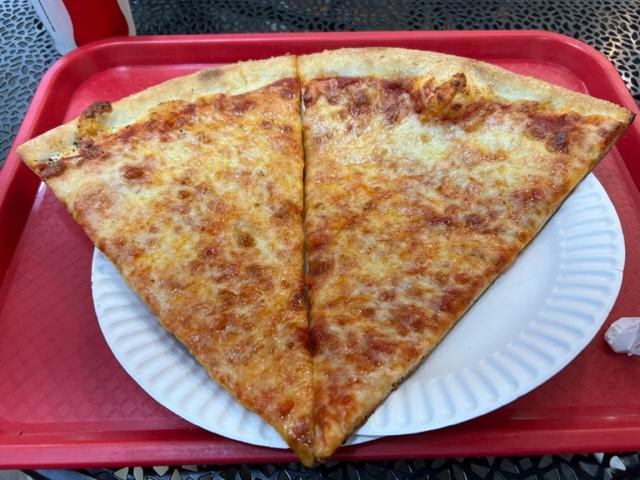
I stopped in at J’s Pizza for a quick lunch. I had not realized I had not eaten here since I had graduated from NYU in the middle of last year (did college fly by in the blink of an eye). I forgot how good their food was when I ordered my lunch. I had a slice of their Fresh Mozzarella Sicilian pizza and a Coke and it hit the spot on this hot day.

My Sicilian slice

What a great lunch and a nice break

I continued my walk down West 16th Street passing businesses and homes and noticing the changes in the neighborhood with renovations and new buildings going up. More and more this particular neighborhood is getting very desirable and the homes more expensive.

The embellishments outside of 224 West 16th Street

https://streeteasy.com/building/224-west-16-street-new_york

https://www.corcoran.com/building/chelsea-hudson-yards/8542

https://www.cityrealty.com/nyc/chelsea/224-west-16th-street/72351

This beautiful pre-war building was built in 1901 (Streeteasy.com)

The beautiful carvings outside the building

The face that guards the entrance

The walls of some of the buildings and the doorways to buildings closed down have some interesting street art that I noticed.

I loved the street art up and down the street

It was fun discovering such interest works tucked in doorways and stairs and back walls

I had seen this artist’s work on Seventh Avenue and again in Dr. Gertrude Kelly Park. This is located on top of one of the basketball courts.

The end of the block was dominated by the Google Building that stretches from Ninth to Tenth Avenues at 75 Ninth Avenue

https://en.wikipedia.org/wiki/111_Eighth_Avenue

https://www.hlw.com/project/google-111-eighth-ave-commons/

I saw this beautiful stonework above 319 West 16th Street

https://streeteasy.com/building/319-west-16-street-new_york

https://daytoninmanhattan.blogspot.com/2022/04/the-timothy-phelan-house-319-west-16th.html#google_vignette

This interesting pre-war building was built in 1800’s (Streeteasy.com). By the mid-1840’s Timothy Phelan and his family lived in the three story, brick-faced house at 197 West 16th Street (renumbered 319 in 1859), just west of Eighth Avenue.  Twenty-five feet wide, its dignified Greek Revival design reflected influences of the emerging Italianate, notably in the understated entrance above a stone stoop (DaytonianinNYC.com)

The stonework in more detail

The end of the block is dominated by the Marine Hotel and its series of high end restaurants

The Marine Hotel with its restaurant, Tao Downtown is in front

https://www.instagram.com/taodowntown/?hl=en

Review on TripAdvisor:

https://www.tripadvisor.com/Restaurant_Review-g60763-d4835511-Reviews-TAO_Downtown_Restaurant-New_York_City_New_York.html?m=69573

They even had a Buddha statue out front

Then I saw this very unusual street art right by the Fulton Houses

The High Line Park dominates over this part of the neighborhood with its lush plantings and its interesting display of artwork. Try to walk the distance on the walkways of this incredible urban park.

The High Line Park sign

https://www.thehighline.org/

https://www.nycgovparks.org/parks/the-high-line

My review on TripAdvisor:

https://www.tripadvisor.com/Attraction_Review-g60763-d519474-Reviews-The_High_Line-New_York_City_New_York.html

The High Line Park near Eleventh Avenue

As I was walking back up the street, I noticed a whole building of faces following me along the sides of 111-114 Eleventh Avenue. You have to look really closely to see the changes by each window.

Along Eleventh Avenue I had not noticed this building at all

The faces staring back at 114-116 Eighth Avenue

https://streeteasy.com/building/114-8-avenue-new_york

You have to look at each window and doorway from across the street to really appreciate the beauty of this building.

The last of art that I saw on the block was this mural for the Bond Vet business around the corner by artist Jade Purple Brown. I thought the colors were so vibrant and that it really promoted this business well.

Artist Jade Purple Brown

https://jadepurplebrown.com/pages/info

https://www.instagram.com/jadepurplebrown/

Jade Purple Brown is a Brooklyn based artist known for her vibrant portrayals of Black women in psychedelic, dreamlike worlds (Artist bio on website).

I finally rounded West 15th and Sixth Avenue in the late afternoon and breathed a sigh of relief as it was getting so hot out.

Reaching West 15th Street and the edge of both Lower Chelsea and the Meatpacking District at the end of a hot afternoon. There was a picturesque view of old New York between Sixth and Seventh Avenues. More tree lined blocks with brick townhouses.

The Old Nee York look about the blocks in Chelsea

Here and there tucked within dome of plain brick and brownstone homes, interesting carvings and embellishments can be found.

Decorated below the windows of 229 West 15th Street, I saw these interesting carvings staring back at me.

The entrance to 229 West 15th Street

https://streeteasy.com/building/229-west-15-street-new_york

https://www.cityrealty.com/nyc/chelsea/229-west-15th-street/19863

This unique pre-war building was built in 1901 (Streeteasy.com)

Face number one staring back with an evil look

Face number two just as evil

As I walked down the street, a French flag and the colors of France when I passed La Sandwicherie Chelsea, which I found out later had two small sister restaurants. I saw these festive signs for crepes and sandwiches, I stopped in to take a peek.

I was still a little stuffed from the pizza but thought a crepe might be nice to tide me through the rest of the evening.

The front of La Sandwicherie Chelsea at 239 West 15th Street

https://www.lasandwicherienyc.com/hours-and-location-test/

https://www.lasandwicherienyc.com/location/la-sandwicherie-chelsea/

My review on TripAdvisor:

https://www.tripadvisor.com/Restaurant_Review-g60763-d33367001-Reviews-La_Sandwicherie_Chelsea_Z-New_York_City_New_York.html?m=69573

The selling point was the sign. It did remind me of Paris

The sandwiches sounded interesting too

I stopped inside and I swear I was back in Paris again with the tiny chairs and tables and the French music. I was not thrilled that the price was higher inside but only by a dollar and the manager explained it to me. I was still in the mood for that crepe.

The inside of the restaurant brought me right back to Paris

The shelves were lined with the wonderful French potato chips I had tried at the food show

I ordered a Strawberry Crepe, which was a freshly made crepe( he even showed me the crepe batter to prove it), which was filled with strawberry jam and topped with sugar. I ordered a Pomegranate soda to have with my dessert.

The Strawberry Crepe with my soda

Yum!

Now having some more carbs and sugar to wear off, I started back down West 15th Street happy and content. The crepe brought back a lot of memories of my trip to Paris two summers ago.

I continued my walk down West 15th Street with more pairs of eyes watching me at the buildings.

This face looked on at 241 West 15th Street

https://streeteasy.com/building/241-west-15-street-new_york

This pre-war building was built in 1901 (Streeteasy.com).

The face just stared out into space

There were many more faces on buildings similar to this one. Not passing judgement but staring into space like they were protecting the building.

Staring one building down

Similar faces staring out

The rows of brick townhouses give the neighborhood that classic feeling

The Chelsea Market at 75 9th Avenue sits like a beacon of gourmet foods and gifts

https://www.chelseamarket.com/

https://en.wikipedia.org/wiki/Chelsea_Market

My review on TripAdvisor:

https://www.tripadvisor.com/Attraction_Review-g60763-d288031-Reviews-Chelsea_Market-New_York_City_New_York.html

The front of the Chelsea Market is so welcoming to neighborhood

Their outdoor seating is safe and well kept for eating outside on a nice day

There are even small gardens to sit next to restaurants

I finally reached the end of the block and beautiful park and gardens of Hudson’s River Park. Here I just relaxed and walked along the flower beds.

https://hudsonriverpark.org/

My review on TripAdvisor:

https://www.tripadvisor.com/Attraction_Review-g60763-d4545669-Reviews-Hudson_River_Park-New_York_City_New_York.html

The enclosed gardens and lawn

The innovative architecture that surrounds the park

The gorgeous landscaping in bloom on a sunny afternoon

I walked back out of the park and headed back down West 15th Street to complete the walk

The skyway between the office buildings and the Chelsea Market

On the way back, it gave me a chance to look at so many of the vintage buildings of the block with their carved details and elaborate embellishments.

The elegance of 253 West 15th Street

https://streeteasy.com/building/253-west-15-street-new_york

https://www.mondaymorningmgmt.com/buildings/253-255-west-15th-street/

What I love about this building is the extensive embellishment of faces and curvatures throughout the front of the building. Faces stare at you from all directions and passing judgement right by the front door. You have to look up and down to really appreciate this building.

There is emended detail to building

The faces staring back

Don’t pass judgement

The sister building next door at 251 West 15th Street had just as many details.

https://www.apartments.com/251-w-15th-st-new-york-ny-unit-24/9hlpgp4/

This unique pre-war building was built in 1928 (Apartments.com).

251 West 15th Street

The faces on this building grapple, snarl and stare at you.

The lion face guarding the door

Faces guarding the sides

Staring from both sides

The details from the top of the building

The Stonehenge Gardens at 108 West 15th Street

https://www.stonehengenyc.com/buildings/stonehenge-gardens

At Stonehenge Gardens, travel through the private gate and along the walkway where you will find this gem of a building setback between 14th and 15th streets. Built in 1950, this six-story building is located in the center of Manhattan’s trendiest downtown neighborhoods: Chelsea, the West Village and Union Square (From the Stonehenge website).

The private gate and gardens were locked when I was visiting the neighborhood but you could see how beautiful it was right behind the gate.

Finishing my walk down West 15th Street

The Jazz Concert that evening at the Brooklyn Botanic Gardens:

https://www.bbg.org/

My review on TripAdvisor:

https://www.tripadvisor.com/Attraction_Review-g60827-d103900-Reviews-Brooklyn_Botanic_Garden-Brooklyn_New_York.html

My review on VisitingaMuseum.com:

https://visitingamuseum.com/tag/brooklyn-botanical-garden/

After I finished the streets of Lower Chelsea, I took the subway to Brooklyn for a Jazz Concert at the Brooklyn Botanic Gardens. On the way to the subway, I noticed these two mosaics on the wall of the subway platform. What interesting work by Brooklyn based artist Fred Tomaselli entitled “Wild Things”. These gorgeous and colorful works flank both the upstairs and downstairs of the subway station

https://www.mta.info/agency/arts-design/collection/wild-things

Bird One

Bird Two

Artist Fred Tomaselli

https://www.instagram.com/fredtomaselli/?hl=en

https://en.wikipedia.org/wiki/Fred_Tomaselli

https://www.artnet.com/artists/fred-tomaselli/

Artist Fred Tomaselli is an American born artist best known for his highly detailed paintings on wood panels, combining an array of unorthodox materials suspended in a thick layer of clear, epoxy resin. He studied at California State University and his studio is in Brooklyn (Wiki).

It was a quick subway ride to the gardens on the express subway and I got there in record time . It was enough time to tour the gardens before the concert. The gardens were at their peak in the middle of the summer and everything was so green.

The lawn by the Cherry Bloom Gardens

The Cherry Bloom lawn is where the concerts are held

People getting ready for the concert

Members waiting on the lawn for the concert to begin

I was sunny and warm out when I got there and just about five minutes before they were supposed to start the concert, it poured for the next twenty minutes. They end up cancelling the concert again on me. The weather played havoc that evening.

The only problem was that the moment it stopped those twenty minutes later, the sun came back and it was beautiful as the musicians were packing up. I can tell everyone hoped they would have a change of heart. They kept packing up and I decided to walk around the gardens again. There would be one more concert in the future the next week.

It did clear up after it stopped raining

The sun rose over the Japanese Gardens

So for the next hour, I just wanted to walk around and admire the flowers and the garden beds.

It ended up being a nice night and the best way to end of evening.

Even though the concert was cancelled, it still was a nice evening and I did get my share of exercise. Even as the lights turned on in the Botanic Gardens, there is still such a magic of walking along the beds and admiring the flowers and the other plantings. You should not miss the gardens during any of the seasons. There is always something to see even in the dead of winter. The true beauty though is in the late Spring and early Summer when everything is in bloom.

Now it off to exploring more neighborhoods

Please read my other blogs of Lower Chelsea:

The Borders of Lower Chelsea:

The Avenues of Lower Chelsea:

The Streets of Lower Chelsea:

Places to Eat:

Dumplings (Jin Mei)

25B Henry Street

New York, NY  10002

(212) 608-8962

Open: Sunday-Saturday-8:00am-9:00pm

My review on TripAdvisor:

https://www.tripadvisor.com/Restaurant_Review-g60763-d5451975-Reviews-Dumplings-New_York_City_New_York.html?m=19905

My review on DiningonaShoeStringinNYC@Wordpress.com

Great Taste Bakery

35 Catherine Street

New York, NY 10038

(212) 566-8383

https://www.restaurantji.com/ny/new-york/great-taste-bakery-

My review on TripAdvisor:

https://www.tripadvisor.com/Restaurant_Review-g60763-d26903712-Reviews-Great_Taste_Bakery-New_York_City_New_York.html?m=19905

My review on DiningonshowStringinNYC@Wordpress.com:

The Sleeping Cat

160 Seventh Avenue

New York, NY 10011

(631) 419-2651

https://www.sleepingcatbakery.com/

Open: Sunday 8:00am-9:30pm/Monday-Tuesday 8:00am-6:30pm/Wednesday-Saturday 8:00am-9:30pm

My review on TripAdvisor:

https://www.tripadvisor.com/Restaurant_Review-g60763-d33340258-Reviews-The_Sleeping_Cat-New_York_City_New_York.html?m=69573

My review on LittleShoponMainStreet@Wordpress.com:
J’s Pizza

96 Seventh Avenue

New York, NY 10011

(646) 760-8120

https://www.jspizzamenu.com/

Open: Sunday-Saturday 11:00am-8:30pm

My review on TripAdvisor:

https://www.tripadvisor.com/Restaurant_Review-g60763-d4432818-Reviews- J_s_Pizza-New_York_City_New_York.html?m=19905

My review on DiningonaShoeStringinNYC@Wordpress.com:

Da Umberto’s

107 West 17th Street

New York, NY 10011

(212) 989-0303

https://daumbertonyc.com/

Open: Sunday Closed/Monday-Thursday 12:00pm-3:00pm/5:00pm-10:00pm/Friday 12:00pm-3:00pm/5:00pm-11:00pm/Saturday 5:00pm-11:00pm

My review on TripAdvisor:

https://www.tripadvisor.com/Restaurant_Review-g60763-d423279-Reviews-Da_Umberto-New_York_City_New_York.html?m=69573

La Sandwicherie Chelsea

239 West 15th Street

New York, NY 10011

(917) 472-7172

https://www.lasandwicherienyc.com/location/la-sandwicherie-chelsea/

Open: Sunday-Saturday 10:00am-5:00pm

My review on TripAdvisor:

https://www.tripadvisor.com/ShowUserReviews-g60763-d33367001-r1021799668-La_Sandwicherie_Chelsea_Z-New_York_City_New_York.html?m=19905

Places to Visit:

Madison Square Park

11 Madison Avenue

New York, NY 10010

(212) 520-7600

https://madisonsquarepark.org/

https://www.nycgovparks.org/parks/madison-square-park/events

Open: Sunday-Saturday 10:00am-9:00pm

My review from TripAdvisor:

https://www.tripadvisor.com/Attraction_Review-g60763-d501513-Reviews-Madison_Square_Park-New_York_City_New_York.html

High Line Park

From 34th Street to West 14th Street Manhattan

New York, NY 10011

(212) 500-6035

https://www.thehighline.org/

https://www.nycgovparks.org/parks/the-high-line

https://en.wikipedia.org/wiki/High_Line

Open: Sunday-Saturday 7:00am-10:00pm (Seasonal)

My review on TripAdvisor:

https://www.tripadvisor.com/Attraction_Review-g60763-d519474-Reviews-The_High_Line-New_York_City_New_York.html

Clemente Clarke Moore Park

10th Avenue and West 22nd Street

New York, NY 10011

(212) 639-9675

https://www.nycgovparks.org/parks/clement-clarke-moore-park

Open: Sunday-Saturday 10:00am-8:00pm (Seasonal)

My review on TripAdvisor:

https://www.tripadvisor.com/Attraction_Review-g60763-d27048252-Reviews-Clement_Clarke_Moore_Park-New_York_City_New_York.html

Chelsea Green Park

West 20th Street between Sixth and Seventh Avenue

New York, NY 10011

(212) 639-9675

https://www.nycgovparks.org/parks/chelsea-green-park

Open: Saturday-Saturday 7:00am-6:00pm

My review on TripAdvisor:

https://www.tripadvisor.com/Attraction_Review-g60763-d17837628-Reviews-Chelsea_Green-New_York_City_New_York.html

Dr. Gertrude Kelly Park

320 West 17th Street

New York, NY 10011

(212) 639-9675

https://www.nycgovparks.org/parks/dr-gertrude-b-kelly-playground

Open: Sunday-Saturday 7:00am-6:00pm

My review on TripAdvisor:

Third Shearith Cemetery

West 21st Street between Sixth and Seventh Avenue

New York, NY 10011

https://www.findagrave.com/cemetery/2260432/third-cemetery-of-congregation-shearith-israel

Open: The cemetery is locked from tourism

Day Three Hundred and Forty-Six Walking the Avenues of Lower Chelsea Tenth, Ninth, Eighth and Seventh Avenues between West 23rd to West 14th Streets June 20th, 2025

The Summer Solstice arrived on a beautiful sunny and warm afternoon. It looked like a heat wave was coming but today and tomorrow we’re going to be spectacular. It would be a nice day for a walk.

I would have ordinarily have done The Great Saunter on my own today but Maricel and I had plans in the afternoon that I did not want to break but fell through the day before. That and I had tickets to a special event at the Brooklyn Botanic Garden for a special ‘Summer Solstice’ concert and I really wanted to go to the concert. Plus being in the Gardens at night for Member’s events is a real treat.

Once the plans fell through and after getting a series of errands done, I headed into Manhattan for a quick lunch and the I would walk all the Avenues between West 23rd and West 14th Streets between 10th and 7th Avenues. It took me about four hours to do because I kept stopping in parks and walking around the Chelsea Market between Ninth and Tenth Avenues.

I started the walk with a good lunch. I had been wanting to go back to Kashmir 9 at 478 Ninth Avenue for a while so I started my day there. The place was packed. The food is a combination of Indian and Arabic cuisines and gets an interesting crowd of people from all walks of life. The food is wonderful and very reasonable.

Kashmir 9 at 478 Ninth Avenue

https://www.facebook.com/kashmire9newyork/

My review on TripAdvisor:

https://www.tripadvisor.com/Restaurant_Review-g60763-d4519138-Reviews-Kashmir_9_New_York-New_York_City_New_York.html?m=69573

My review on DiningonaShoeStringinNYC@Wordpress.com:

The Chicken Kebabs with rice and a Chicken Patty at Kashmir 9 at 479 Ninth Avenue

The Chicken Kebobs here are excellent

The Chicken Patties make a good starter

Yum!

It can be a real culture shock eating here because you will feel like you got transported to the Middle East. You are surrounded by men speaking Hindi and Arabic chatting away while other men are doing their afternoon prayers. It is an interesting experience at lunch.

After a perfect lunch of proteins and carbohydrates, I was ready for the long walk around the neighborhood. It was the perfect day with no humidity and bright sunshine. I walked down to West 23rd Street and Tenth Avenue and started my walk around the neighborhood. Chelsea is such a great neighborhood to walk around in.

The corner of Tenth Avenue and West 23rd Street

This section of the Chelsea neighborhood has been in massive flux since the opening the High Line Park. It has been totally rebuilt over the last several years. I have never seen such changes before in a neighborhood. Along the High Line Park, there are all sorts of innovative new buildings that have been built or under construction.

While walking down Tenth Avenue, I noticed the beautiful mural located outside Juban Restaurant at 206 Tenth Avenue. I thought the colors and design were so vibrant.

The interesting painting outside of Juban at 206 Tenth Avenue

https://www.jubannyc.com/

Review on TripAdvisor:

https://www.tripadvisor.com/Restaurant_Review-g60763-d8619226-Reviews-Juban_NYC-New_York_City_New_York.html?m=69573

I thought the mural outside the restaurant was interesting (I could not find the artist who did the outside mural)

History of the restaurant:

(From the Juban website)

Set in the heart of Chelsea’s gallery district, Juban’s rich culture offers a convivial and inspired experience of authentic fare. Here, seasonal menus and artful murals converge—serving tradition with the wink of innovation. 

Juban is an inventive Izakaya dedicated to bringing wonder to the experience of Japanese cuisine in a local setting. With every meal designed for discovery, its creative spirit unfolds through community.  Artful sushi, masterful seafood, elevated skewers, and neighborhood favorites are served family-style to celebrate sharing and connecting. At once serendipitous and soulful, its unique approach always serves the moment.  

Further down Tenth Avenue outside of the Empire Diner building is the mural “The Mount Rushmore of Art”, one of the many murals in the neighborhood created by artist Eduardo Kobra, who has murals painted all over New York City. This one stuck out for its take on Contemporary Artists of the Twentieth Century.

Artist Eduardo Kobra painting “The Mount Rushmore of Art” above the Empire Diner at Tenth Avenue and West 22nd Street

The mural, created by Brazilian artist Eduardo Kobra, “Mount Rushmore of Art”, is the artist’s memorial to some of modern art’s biggest artists including Andy Warhol, Frida Kahlo, Keith Haring and Jean-Michel Basquiat (Vibe Map 2023).

https://vibemap.com/places/details/mt-rushmore-of-art?referrer=https%3A%2F%2Fvibemap.com%2Fplaces%2Fmt-rushmore-of-art

https://worleygig.com/2019/05/02/eduardo-kobras-mount-rushmore-of-art-mural-chelsea-gallery-district/

http://www.hgcontemporary.com/news/kobra-paints-mural-for-hg-contemporary

Artist Eduardo Kobra

https://en.wikipedia.org/wiki/Eduardo_Kobra

https://www.streetartbio.com/artists/about-eduardo-kobra-biography/

Eduardo Kobra is a Brazilian born artist known for his contemporary and colorful art murals all over the world.

Further down Tenth Avenue, I passed the Guardian Angel School at 193 Tenth Avenue. What stood out on this building was the beautiful and intricate stone work that embellishes the building. It really is an interesting building.

The Guardian Angel School at 193 Tenth Avenue had a lot of interesting stonework around the building. The school is currently closed.

https://www.schools.nyc.gov/schools/MADO

https://twitter.com/gaschool_nyc?lang=en

The church school was designed and built in 1930 by architect John Van Pelt of the Van Pelt, Hardy & Goubert firm. The building was designed in the Southern Sicilian Romanesque style and has many different religious elements in the detail of the outside of the building. You have to look at it from all directions to appreciate its beauty (Wiki).

https://en.wikipedia.org/wiki/Church_of_the_Guardian_Angel_(Manhattan)

The stonework of an angel

The doorway details

The stonework was amazing

What’s sad is that the school has been closed as part of the cutbacks of the Archdiocese of New York. Right now the community is fighting to keep this school open. We will see how the building gets used in the future.

As I walked down Tenth Avenue, you can see all the changes in the neighborhood and the architecture that surrounds both Tenth and Ninth Avenues. This area of the City has seen so many changes due to the opening of the High Line over the last ten years. This part of the neighborhood has some of the most interesting looking buildings and many innovative art galleries and restaurants. It still is in the process of changing. Many old warehouses and factory buildings have been converted into lofts and apartments.

The creativity in the new architecture that lines Tenth Avenue

One of the most beautiful of these new buildings is the Lantern House Apartments at 149 Tenth Avenue

The Lantern House sign at 149 Tenth Avenue

(From the Related Corporate website)

Lantern House is designed by Heatherwick Studio, founded by the British designer Thomas Heatherwick in 1994. The building offers a distinctive reinvention of the Chelsea warehouse architectural style, featuring a modern interpretation of the bay window and a custom masonry façade. The 21-story building comprises a collection of approximately 180 one-, two-, three- and four-bedroom residences, many of which bestow uninterrupted cityscape and Hudson River views and promise to provide residents a totally integrated lifestyle destination. Lantern House is part of a two-tower development that links underneath the High Line.

https://www.related.com/our-company/properties/lantern-house

https://streeteasy.com/building/lantern-house

These are the creative buildings that now line the High Line Park which snakes through this neighborhood

https://www.nycgovparks.org/parks/the-high-line

https://en.wikipedia.org/wiki/High_Line

My review on TripAdvisor:

https://www.tripadvisor.com/Attraction_Review-g60763-d519474-Reviews-The_High_Line-New_York_City_New_York.html

As I walked back up Tenth Avenue, I saw this series of graffiti art on the side of a building that will quickly disappear as the lot next to it will become a new apartment building. Still the work was very interesting.

Even the street graffiti was interesting but will not last with all the new construction

The one thing I like about the Tenth Avenue side of the neighborhood is the access to Hudson River Park and all the trails, shaded areas to relax, gardens and views of the built up side of Jersey City and the Hudson River coastline. There are all sorts of benches and shaded areas to just read a book and talk to people. No matter what the age is, people of all types are conversing in the parks.

Hudson River Park lines the neighborhood and the edges of West 14th Street

The success of the Hudson River Park under the Giuliani/Bloomberg Administrations when things ran correctly in New York City.

Hudson River Park at the corner of Tenth Avenue and West 14th Street in the Summer of 2025

https://hudsonriverpark.org/

My review on TripAdvisor:

https://www.tripadvisor.com/Attraction_Review-g60763-d4545669-Reviews-Hudson_River_Park-New_York_City_New_York.html

Hudson River Park at the corner of West 14th Street and Tenth Avenue

Stopping in Hudson River Park for a half hour to cool off was wonderful. The breezes from the river were really nice and it was relaxing to just sit under a shade tree and watch the world go by. As I left the park and started my walk back up Tenth Avenue, I just saw how breathtaking the view was as I looked back up to West 23rd Street.

Looking up the ever changing neighborhood that lines Tenth Avenue from West 14th Street

I saw people walking around an interesting clothing shop and peeked through the windows. I could not find the entrance and walked through the door of a back hall. It ended up being the back entrance to the Chelsea Market, whose main entrance is on Ninth Avenue. I didn’t even know there was a back entrance and never explored the stores to the back of the complex. The market had once been the old Nabisco factory and you can still see some of the original features of the old building.

History of the Chelsea Market:

https://www.chelseamarket.com/our-story

https://en.wikipedia.org/wiki/Chelsea_Market

The Chelsea Market logo

The inside of the Chelsea Market in the back entrance at Tenth Avenue between West 15th and 16th Street. The Market was mobbed that day. It was the middle of lunch hour. Between the locals and the tourists, you could barely move around the complex.

https://www.chelseamarket.com/

My review on TripAdvisor:

https://www.tripadvisor.com/Attraction_Review-g60763-d288031-Reviews-Chelsea_Market-New_York_City_New_York.html

I always liked Sarabeth’s for lunch at the Chelsea Market

https://www.chelseamarket.com/directory-all/sarabeths

My review on TripAdvisor:

https://www.tripadvisor.com/Restaurant_Review-g60763-d423558-Reviews-Sarabeth_s_Bakery-New_York_City_New_York.html?m=69573

The selection is always nice

The sandwiches are always good here

The selection at Sarabeth’s can be a bit pricey but the quality is excellent and the food is always consistently delicious. When I took a tour of Little Island with NYU at the start of the school year by second year at the college we came here for lunch and then had a picnic on the island. Great selection of items.

The mural “Soft Power” next to the Lantern House Building with the Pink Panther Mural in the front of the High Line

As I walked back up Tenth Avenue, I came across this giant billboard of the Pink Panther. The work is entitled “Soft Power”

(From the High Line website):

https://www.thehighline.org/art/projects/alex-da-corte/

Artist Alex Da Corte presents a new artwork for the High Line’s 18th Street Billboard, inspired by the Pink Panther, a Friz Freleng creation designed for the animated opening sequence of a 1963 Hollywood comedy that came to embody the film and has evolved, through 60 years of spin-offs and reinventions, into cultural ubiquity. Pink’s durability across many generations has allowed it to sell countless products, from fiberglass insulation foam to artificial sweetener, yet the creature’s essence remains out of reach.

With neither master nor peer—and seemingly eternally unbound by the rules of others—Pink represents a certain queer freedom. Da Corte revives Pink as an icon of resistance, supine but poised, wielding a sign of universal protest, brandishing a clear pink purpose. “There is a difference between falling down and laying down,” Da Corte explains. “I call that soft power.” This billboard is an advertisement for the value of such power.

Artist Alex De Corte

http://alexdacorte.com/about

Alex Da Corte is an American born Venezuelan-American artist now living in Philadelphia. Da Corte was the 2023 Philip Guston Rome Prize Fellow at the American Academy in Rome (Artist bio).

Another interesting mural was on the side of The Chelsea Square Market at 130 Tenth Street is of Mother Teresa and Mahatma Gandhi by artist Eduardo Kobra, whose work I had seen earlier on my walk and I have seen all over Manhattan. These two icons of peace face each other in a store that sells delicious deli food (see the artist bio above).

The Kobra painting “Tolerance” on the Chelsea Square Market building at 79th Tenth Avenue of Mother Theresa and Gandhi

https://www.chelseamarket.com/

As I was walking up Tenth Avenue towards West 21st Street, I passed a wine store and saw this sign. It was just after Pride week and I thought this sign was amusing and fun.

I saw this sign outside the wine store, Community Wine & Spirits at 140 Tenth Avenue and thought it was very clever

https://communitywineandspirits.com/?srsltid=AfmBOoodowOmD6AGHKPy5ftEeIz5FFQlokaiJsPjywMhIcXL6UfEQDdi

As I continued up Tenth Avenue, I passed Clement Clarke Moore Park, which was once part of the Moore farm and estate. The park was busy with parents and children cooling off. A series of ice cream men and guys selling ices kept coming in and out of the park while I was there. It is the perfect place to stop and cool off on a hot day.

The Clement Clarke Moore Playground at Tenth Avenue and West 22nd Street

https://www.nycgovparks.org/parks/clement-clarke-moore-park

My review on TripAdvisor:

https://www.tripadvisor.com/Attraction_Review-g60763-d27048252-Reviews-Clement_Clarke_Moore_Park-New_York_City_New_York.html

The park sits on the spot of the original estate of the Moore family and the plaque were the mansion once stood is around the corner on West 23rd Street. This park is wonderful during the warmer months to just sit and relax.

The picnic area of the park

The playground area was packed with kids running around the parks fountains

The gardens were in full bloom and were so well maintained

It was in 1837 that poet Clement Clark Moore claimed to be the author. Even today there is a controversy of who really wrote the poem, Clement Clark Moore or Major Henry James Livingston Jr. This discussion is still being debated today (Wiki).

Clement Clarke Moore.jpg

Clement Clarke Moore poet

https://www.poetryfoundation.org/poets/clement-clarke-moore

https://www.poetryfoundation.org/poems/43171/a-visit-from-st-nicholas

Henry Livingston Jr.

Henry James Livingston Jr. Writer

https://www.poetryfoundation.org/poets/henry-livingston

How the poem mixed well into the tour is that Clement Moore’s family owned an estate here on the area on West 23rd Street between Hudson River and Eighth Avenue from West 24th Street to West 19th Street. His home was at 348 West 23rd Street. He developed the area after donating a large portion of the estate to his church and created a residential neighborhood that still stands today.

Clement Moore Estate.jpg

The Clement Clarke Moore estate when he sold it into real estate parcels

https://thegreatestgrid.mcny.org/greatest-grid/selling-lots/87

http://daytoninmanhattan.blogspot.com/2017/12/the-lost-clement-c-moore-chelsea-house.html

My blog on the Ladies Shopping Mile at Christmas time:

https://mywalkinmanhattan.com/tag/exploring-the-historic-ladies-shopping-mile/

As I walked down West 23rd Street towards Ninth Avenue, I passed 420 West 23rd Street, the former location of the Moore Mansion.

420 West 23rd Street

https://streeteasy.com/building/420-west-23-street-new_york

The historical marker for the Moore Mansion. It is claimed that he penned ‘Twas the Night Before Christmas’ here (this has been debated over the years)

I then started my trip down Ninth Avenue, which has been rapidly gentrifying even around the public housing over the last twenty years. Now it has been announced that the City will be knocking down both the Chelsea-Elliott and Robert Fulton Public Housing complexes. The cost to renovate these structures are too expensive and it will be replaced by mixed housing.

Looking down Ninth Avenue from West 23rd Street and the changes that are coming between Ninth and Tenth Avenues

Discussion on the replacement of the Public Housing Projects around the neighborhood:

The wooden buildings at 185-189 Ninth Avenue

https://daytoninmanhattan.blogspot.com/2020/09/wooden-relics-185-to-189-ninth-avenue.html

As I walked down Ninth Avenue, I was treated to a diversity of architecture from different times. I have admired these two tiny wooden buildings for years and they have an interesting past. They were built in the 1840’s after the Moore estate was broken up for real estate plots for new homes.

These two small building at 185-189 Ninth Avenue were built in the 1840’s by real estate developer James N. Wells and were used by local merchants who lived about them (Daytonian in Manhattan.com). It is amazing to me when buildings from over a hundred years ago have survived this long and still in use. Here and there in Manhattan I have found these buildings from the early 1800’s along street and corners of neighborhoods on the island.

Another building that stood was futuristic structure with all sorts of pot holes. This is the former Maritime Union Building that is now the Dream Hotel. It was once part of a series of three buildings that was part of the National Maritime Union. When the Union folded due to lack of membership as industry changed, the building was left empty. The building designed by Bronx-born but New Orleans-based architect Albert C. Ledner in 1966 (New Yorkitecture 2015).

The port building on Ninth Avenue was once the Maritime Union Building and is now the Dream Hotel.

https://www.hyatt.com/dream-hotels/en-US/nycdd-dream-downtown

Review on TripAdvisor:

https://www.tripadvisor.com/Hotel_Review-g60763-d2173604-Reviews-Dream_Downtown-New_York_City_New_York.html?m=19905

Walking past the hotel, the front of the Chelsea Market stands tall on the corner of Ninth Avenue right across the street from the NYC Google headquarters. Before the layoffs at the company, the Chelsea Market was really bustling with office workers during lunch hour. Now its a majority tourists and local New Yorkers from all over the City. This building was an interesting conversion from building the old Nabisco Manufacturing plant (National Biscuit Company)

History of the National Biscuit company and the building transformation:

https://en.wikipedia.org/wiki/Nabisco

https://meatpacking-district.com/district/nabisco-company-building-chelsea-market

https://www.bakery-square.com/blog/nabisco-factories-now-vs-then

The Chelsea Market on Ninth Avenue between West 15th and 16th Streets

https://en.wikipedia.org/wiki/Chelsea_Market

The Ninth Avenue entrance to the Chelsea Market on a busy lunch hour

https://www.chelseamarket.com/

It seemed more mysterious when you entered from the Tenth Avenue side of what you would expect to see. The market is a lot of fun especially at lunch time or on the weekends when the facility is packed with tourists coming to tour and eat at the Market.

On the very edge of Chelsea, sharing it with the Meatpacking District is the historic Homestead Steakhouse. The restaurant was established in 1868 and is the oldest continuous running steak house in the United States. The restaurant was originally called the ‘Tidewater Trading Post’ and had been opened by German immigrants. The restaurant still has excellent reviews on TripAdvisor and their steaks are considered some of the best in the City.

The oldest steakhouse in NYC, The Homestead Steakhouse at 56 Ninth Avenue and West 14th Street

https://en.wikipedia.org/wiki/Old_Homestead_Steakhouse

Review on TripAdvisor:

https://www.tripadvisor.com/Restaurant_Review-g60763-d457886-Reviews-Old_Homestead_Steakhouse-New_York_City_New_York.html?m=69573

I continued up Ninth Avenue, admiring the ever changing architecture of the neighborhood. This area had once been all shipping and freight filled with warehouses that now are boutique hotels and shops and art galleries. It amazes me the changes in the past thirty years.

Looking up Ninth Avenue from West 14th Street

Another mural that has captured my attention both in the past and on this series of walks in the neighborhood is the painting on the side of Gotham Pizza at 144 Ninth Avenue

Gotham Pizza at 144 Ninth Avenue has the most interesting mural on the side of it. It was created by artist Jenna Morello.

https://www.gothampizzany.com/

My review on TripAdvisor:

https://www.tripadvisor.com/Restaurant_Review-g60763-d4764638-Reviews-Gotham_Pizza-New_York_City_New_York.html?m=69573

I thought this mural was really vibrant even though it is by the garbage cans. The cans hide the artist’s name Jenna Morello

Artist Jenna Morello

https://www.jennamorello.com/commissioned

https://www.facebook.com/jenna.morello/

Artist Jenna Morello is an American born artist based in Brooklyn. She is known for her colorful and detailed murals.

While walking on the other side of the avenue, I got a better look at the architecture along the street. As I walked up the other side of Ninth Avenue I got a better look at the wooden buildings.

185-189 Ninth Avenue

I turned the corner and walked down Eighth Avenue, the heart of the gay community. I have to say, you are always reminded of this too when you pass many of the establishments especially during Pride Week. Rainbow flags and colors were decorated all over the place. Up and down Eighth Avenue, there are all sorts of interesting shops and restaurants.

Walking down Eighth Avenue with the mural “We Love NY”

This is the third mural by artist Eduardo Kobra and shows a playful Albert Einstein showing his love of the “Big Apple”. This interesting painting towers over Eighth Avenue. These murals add such a playful and interesting look at the neighborhood and its creativity.

The Kobra painting of Albert Einstein ‘We ❤️ New York’

https://streetartcities.com/markers/15376

On of my favorite restaurants in Chelsea is S & A Gourmet Deli, which has a wonderful selection of sandwiches and salads located at 240 Eighth Avenue.

What I love about New York is that one every corner there seems to be a favorite bodega or deli that sells what you need when you need it. Some also just stand out for the quality of the food and the service and selection. S & A Gourmet Deli is one of those places.

A friend and I had just stopped in to buy sandwiches for lunch that we were going to enjoy a few blocks away in Madison Square Park. They had a large selection of sandwiches and wraps, and I decided on Chicken Cordon Bleu hero sandwich ($8.99) with a Coke ($1.99).

The sandwich contained a fresh fried chicken breast topped with Swiss cheese and ham and then broiled for a few minutes to combine the ingredients. Inside they put a little mustard to add to the complexity of the flavors. You really felt like you were eating a piece of Chicken Cordon Bleu.

Chicken Cordon Bleu sandwich

My friend ordered an empanada and bought some snacks that we enjoyed after our lunch. The deli has a wide variety of grocery items. She also enjoyed her lunch.

The sandwich was delicious and packed with flavor.

Continuing down Eighth Avenue I saw this flag outside one of the bars on the window and I thought it was so profound but true. We are forgetting the freedom choice, expression and the right to live our lives is available to everyone. This is what makes us American.

I saw this posted outside a bar during ‘Pride Week’ and it’s nice to see people expressing their opinion. I think we are forgetting this.

At the very edge of the neighborhood on the corner of Eighth Avenue and 14th Street, technically the border with the Village is the Museum of Illusions at 77 Eighth Avenue.

At the very end of the block bordering Chelsea with Greenwich Village is the Museum of Illusions at 77 Eighth Avenue

My review on TripAdvisor:

https://www.tripadvisor.com/Attraction_Review-g60763-d14203837-Reviews-Museum_of_Illusions-New_York_City_New_York.html

My review on VisitingaMuseum.com:

It is a perfect museum for a day out with the kids but it is a bit on the pricey side. I had visited the museum at the beginning of last summer and here are some of the things that I enjoyed at the museum.

There are a lot of brain teasers and mirrors to throw you off or add to the display to entertain you. The optical illusions will test your mind and your senses. There are titled rooms to test your balance and your sense of sight, mirrored rooms to show location and reaction and small displays to show size and distance.

Me at the Museum of Illusions

Admittingly it is a very small museum of the steep price of admission ($24.00 for an adult) and you will only be in the museum for about an hour. The problem with this museum is that once you experience it and if they do not change the displays, there is no reason to go back. The small displays can be experienced on two floors.

The Tilted Room display

The afternoon I was here, the museum was packed with summer campers and school aged kids who dominated the place and it is so small that it was hard to maneuver around the museum. Still it was a very interesting museum to experience once as it will test the power of and exercise your brain.

The Clone Table

Me in the Vertical Room

The Illusions Gallery

I found the museum more geared towards children but visiting it once as an adult was a lot of fun. You have to visit the museum at least once because it is very interesting.

My last part of the neighborhood I visited was my walk down Seventh Avenue. Just like Eighth Avenue, these are really commercial blocks and the architecture reflects that. Mostly office buildings and newer apartments. Here and there on the Avenue there were things that stuck out and some interesting little restaurants and shops along the way. The street art was very interesting.

Looking down Seventh Avenue from West 23rd Street

One of my favorite restaurants in the neighborhood sits right on the border of Seventh Avenue and West 23rd Street in the middle of the Chelsea neighborhood, Chelsea Papaya at 171 West 23rd Street. I love coming here for breakfast, lunch and dinner and the best part is you can get all this delicious food 24 hours a day.

Chelsea Papaya at 171 West 23rd Street

I swear that Chelsea Papaya has been part of this neighborhood since the 1970’s. I have passed this place a million times and never stopped in to eat. Recently when I was walking around the rim of Manhattan for ‘The Great Saunter” walk, I needed an early start, and this place opens at 5:00am (please check their website for the changing hours).

Chelsea Papaya at 171 West 23rd Street specials

For breakfast that morning I knew I would need to load up on carbohydrates so I ordered a Breakfast platter. I had four very large pancakes with a side of bacon and two scrambled eggs ($7.95) with a medium Papaya drink. It was the best breakfast on this rare cool summer morning.

The pancakes had a nice malted taste to them and were crisp and fluffy. The eggs were sizzling hot off the grill with the flavor of clarified butter. It was quite a large breakfast and it lasted me for most of the morning and afternoon.

The breakfast is over-sized here and filling. Bring your appetite.

The pancakes and eggs here are delicious

Yum!

The only problem that I had with breakfast was that you could not eat inside and I had to eat at one of the filthy outdoor tables that were available. They looked like the homeless had slept at them all night.

Chelsea Papaya is open all night

For dinner, I tried the Fried Chicken Sandwich and it was much better in the dining area. The Fries had just come out the fryer along with the Chicken Cutlet. Even though it had the shredded lettuce and tomato on top, they seemed much fresher on the second trip. I really enjoyed the meal. It had been after class and I really needed a good dinner.

The Chicken Sandwich and fries are cooked to order here

The Chicken Sandwich #4 Special at Chelsea Papaya

The one thing about Seventh Avenue is the interesting street art tucked here and there all over the Avenue. I love the fact that New York City feels like an open air museum with creative works here and there. The first one of this apple core that lined the wall outside a shop in neighborhood.

The ‘NYC Big Apple’ by artist Mike Makatron

Artist Mike Makatron

https://www.makatron.com/

https://www.facebook.com/MikeMakatronArt/

Mike Maka is a painter and multidisciplinary artist whose practice spans large-scale murals, canvas works, illustration, and sculpture. Mike is based in between New York City and Melbourne, Australia. (Artist’s website).

The one local restaurant that has stood out the me is the Sleeping Cat at 160 Seventh Avenue. This small bakery/cafe has a lot of freshly baked items and sandwiches and it extremely popular both with the locals and the NYU students as I passed here a lot on my way to campus a year ago.

The Sleeping Cat at 160 Seventh Avenue

https://www.sleepingcatbakery.com/

https://www.instagram.com/sleepingcatbakery/?hl=en

My review on TripAdvisor:

I look forward to giving it a try in the future. I loved some of the items on display.

The pastries at the Sleeping Cat

Here and there tucked into corners of buildings and on walls and poles is the most interesting street art. I always notice it at the corner of my eyes and several of them stood out to me when walking around Lower Chelsea.

I thought this was a fun piece of street art. You do not see too many snowmen on skateboards

This street artist I have seen all over the City and has some of the most amazing work. I think the designs are so unusual and the geometrics are amazing. This is just one example of this graffiti artist’s work.

This graffiti artist’s work I have seen all over Manhattan. This was on a building on Seventh Avenue.

On the corner of Seventh Avenue and West 21st Street, there is a series of graffiti art along an abandoned restaurant that I thought was interesting.

A unique homage to many genres

Old Hanna Barbara characters

Snoopy and Mr. Peanut

The Barbadok’ from the horror film

These will disappear when the restaurant reopens one day but for now you can look at them and make your own interpretation.

Another great restaurant that I enjoy is J’s Pizza at 96 Seventh Avenue, which has some of the best pizza and entree specials in the neighborhood. I used to come here a lot at night after classes at NYU and everything was so reasonable and delicious. It is one of those hidden gems for both lunch and dinner.

J’s Pizza at 96 Seventh Avenue

I have been coming to J’s Pizza for many years and had eaten here in the past after viewing the Halloween Parade in October. I just rediscovered it again when I started grad school in the neighborhood and forgot how good the food was when I dined here. The pizza slices are generous in size and their marinara and pizza sauces you can tell are freshly made and not from a can.

The sauces for all the meals here from the pizza, to the spaghetti and meatballs to the sauce that is the side to the many rolls and calzones is well spiced and has so much flavor to it. It really makes the dishes.

J’s Pizza counter is lined with pizzas and calzones

The wonderful garlic knots, Chicken and Pepperoni Rolls and Grandma Pizza

The Chicken, Sausage and Pepperoni rolls and fresh Grandma Pizza

The Tuesday Night Special is Spaghetti & Meatballs for $9.00

I finished my walk of the neighborhood in the early evening when it finally started to cool down. All the restaurants and coffee shops started to fill up with people starting dinner or going for a drink after work.

I headed to the Brooklyn Botanic Garden for a Summer Solstice concert to celebrate the longest day of the year. This was a ‘Members Only’ special event and I was looking forward to cooling off and relaxing on the lawn to listen to Jazz Music. So I took the subway from West 23rd Street into the heart of Brooklyn and joined the other members at the front gate.

The Brooklyn Botanic Garden at 990 Washington Avenue was open late for the concert and watching the sunset in the park

https://www.bbg.org/

https://www.nycgovparks.org/parks/brooklyn-botanic-garden/history

My review on TripAdvisor:

https://www.tripadvisor.com/Attraction_Review-g60827-d103900-Reviews-Brooklyn_Botanic_Garden-Brooklyn_New_York.html

My review on VistitingaMuseum.com:

https://visitingamuseum.com/tag/brooklyn-botanical-garden/

The gardens were in full bloom and members were walking around the Cherry Blossom Lawn. Some people were sneaking a snack on the lawn or having a drink. Some were ordering food from the carts and just relaxing on their blankets. It was a nice night to be out as it cooled down when it got dark.

It was a nice night to walk around

The Garden set the bar up on both sides of the Gardens so that members could buy a cocktail or a snack. This made it easier to get something to eat (some nights you are not allowed food in the gardens except at the cart or in the restaurant inside the gardens).

The bar just outside the Visitors center

The menu at the bar that night

Waiting for the concert to begin

As it got dark the concert began. It really was not what I expected and being so tired from all the walking, I headed home around 9:30pm. It was going to be a two hour trip home. I was lucky that I made both the subway and the bus home as they were both waiting for me when I got to both of them.

It was a really good walk around the City and get the pulse of a neighborhood. Chelsea just keeps evolving and will change even more in the next ten years as the public housing in the neighborhood gets torn down for mixed income housing. The neighborhood will keep changing.

Please read my other blogs of Lower Chelsea:

The Borders of Lower Chelsea:

The Avenues of Lower Chelsea:

The Streets of Lower Chelsea:

Places to Eat:

Kashmir 9

478 Nineth Avenue

New York, NY  10018

(212) 736-7745

Open: Sunday-Saturday 10:00am-5:00pm

Free Delivery

My review on TripAdvisor:

https://www.tripadvisor.com/Restaurant_Review-g60763-d4519138-Reviews-Kashmir_9-New_York_City_New_York.html?m=19905

My review on DiningonaShoeStringinNYC@Wordpress.com:

S & A Gourmet Deli

240 Eighth Avenue

New York, NY 10011

(646) 755-8822

Open: Sunday-Saturday Open 24 hours

My review on TripAdvisor:

https://www.tripadvisor.com/ShowUserReviews-g60763-d23994792-r834392777-S_A_Gourmet_Deli-New_York_City_New_York.html?m=19905

My review on DiningonaShoeStringinNYC@Wordpress.com:

Chelsea Papaya

171 West 23rd Street

New York, NY 10011

(212) 352-9060

https://www.chelseapapayany.com/

Open: Sunday 10:30am-11:00pm/Monday-Wednesday 10:15am-11:00pm/Thursday-Saturday 10:15am-4:00am

My review on TripAdvisor:

https://www.tripadvisor.com/Restaurant_Review-g60763-d4812637-Reviews-Chelsea_Papaya-New_York_City_New_York.html?m=19905

My review on DiningonaShoeStringinNYC@Wordpress.com:

J’s Pizza

96 Seventh Avenue

New York, NY 10011

(646) 760-8120

https://www.jspizzamenu.com/

Open: Sunday-Saturday 11:00am-8:30pm

My review on TripAdvisor:

https://www.tripadvisor.com/Restaurant_Review-g60763-d4432818-Reviews-J_s_Pizza-New_York_City_New_York.html?m=19905

My review on DiningonaShoeStringinNYC@Wordpress.com:

The Sleeping Cat

160 Seventh Avenue

New York, NY 10011

(631) 419-2635

https://www.sleepingcatbakery.com/

https://www.instagram.com/sleepingcatbakery/?hl=en

Open: Sunday 8:00am-9:30pm/Monday-Tuesday 8:00am-6:30pm/Wednesday 8:00am-9:30pm

My review on TripAdvisor:

Sarabeth’s Kitchen Chelsea Market

75 Ninth Avenue

New York, NY 10011

(212) 989-2424

https://www.chelseamarket.com/directory-all/sarabeths

Open: Sunday 9:00am-7:00pm/Monday-Saturday 9:00am-8:00pm

My review on TripAdvisor:

https://www.tripadvisor.com/Restaurant_Review-g60763-d423558-Reviews-Sarabeth_s_Bakery-New_York_City_New_York.html?m=69573

Places to Visit:

Brooklyn Botanic Garden

990 Washington Avenue

Brooklyn, NY  11225

(718) 623-7210

http://www.bbg.org

Open:  Sunday and Saturday 10:00am-6:00pm/Monday Closed/Tuesday-Friday 8:00am-6:00pm

Admission: Depending on the time of year/please check the website

My review on TripAdvisor:

https://www.tripadvisor.com/Attraction_Review-g60827-d103900-Reviews-Brooklyn_Botanic_Garden-Brooklyn_New_York.html?m=19905

My review on VisitingaMuseum.com:

https://visitingamuseum.com/tag/brooklyn-botanical-garden/

The Clement Clarke Moore Playground

Tenth Avenue and West 22nd Street

New York, NY 10011

(212) 639-9675

Open: Sunday-Saturday 6:00am-8:00pm (hours change by season-check the website)

https://www.nycgovparks.org/parks/clement-clarke-moore-park

My review on TripAdvisor:

https://www.tripadvisor.com/Attraction_Review-g60763-d27048252-Reviews-Clement_Clarke_Moore_Park-New_York_City_New_York.html

Chelsea Market

75 Ninth Avenue

New York, NY 10011

(212) 652-2111

https://www.chelseamarket.com/

Open: Sunday-Saturday 7:00am-10:00pm

My review on TripAdvisor:

https://www.tripadvisor.com/Attraction_Review-g60763-d288031-Reviews-Chelsea_Market-New_York_City_New_York.html

High Line Park

Starts from West 34th Street to Gansevoort Street

New York, NY 10011

https://www.thehighline.org/visit/

My review on TripAdvisor:

https://www.tripadvisor.com/Attraction_Review-g60763-d519474-Reviews-The_High_Line-New_York_City_New_York.html

Museum of Illusions

77 Eighth Avenue

New York, NY 10014

(212) 645-3230

https://www.facebook.com/moi.newyork/

Admission: Adults $24.00/Students-Seniors-Essential Workers $22.00/Children Under Six Free/Family Fee (Two Adults and Two Children $75.00)

Open: Sunday 10:00am-12:00am/Monday-Thursday 10:00am-11:00pm/Friday-Saturday 10:00am-12:00am

My review on TripAdvisor:

https://www.tripadvisor.com/Attraction_Review-g60763-d14203837-Reviews-Museum_of_Illusions-New_York_City_New_York.html

My review on VisitingaMuseum.com:

Day Three Hundred and Forty-Five The Tenth Anniversary of ‘MywalkinManhattan.com’ Started June 15th, 2015 and continuing June 15th, 2025

I can’t believe its been ten years since I started this project!

I read online all the time of how people say, “I walked every street in Manhattan in one Summer and I got so much out of it!” Sorry folks, I have been doing this for ten years and I have walked every street, park, road, bridge and byway including other parts of the City and outside the City when the City closed for COVID for a decade and I still have to revisit neighborhoods because they keep changing. The City just keeps changing faster since COVID.

Manhattan like the rest of New York City or any City for that matter is like an onion, you have to keep peeling back the layers and you find more than you thought. You always miss something. I had to revisit the entire Upper Upper and Upper West Side from West 125th Street to West 59th Street over the Fall and there was so much I had to revamp on over a dozen blogs. There is so much you miss the first time around that you have to go back again. Then you go “Wow, how did I miss that?”

The starting point of The Great Saunter at Fraunces Tavern in May 2025

Architecture I missed, restaurants have opened and closed and then opened again under new ownership. Museums that needed to be revisited and so much more that was discovered sometimes in just a one block area. How many residents just pass a building or a statue and give it not a second thought. There is so much to see, do and experience in this City and just on the Island of Manhattan. I think it is all fascinating the complexity of it all.

The only way to really get to know a place is by walking around it and experiencing it. I have done this over the last three years with visits abroad to Paris, Prague, Abu Dhabi and Dubai with NYU, especially when I finally had some time on my own to just walk those cities. What I missed on the tour I visited on my own, especially in Prague and Abu Dhabi, when I had the day to myself and I could relax and do. Just having a morning in Paris to myself and having breakfast near my dorm on my own was an eye-opener, especially to the French who could not believe an American could eat that much for breakfast.

Me doing the tourist thing in front of the Eiffel Tower in Paris the Summer of 2023 with NYU. Talk about walking a City!

This experience I have also shared in the Tri State area with visits to Philadelphia and Washington DC, walking around Newark, NJ (yes it does have it attributes) and exploring the states of New York, New Jersey, Pennsylvania and Connecticut in cities like New Haven, Narrowsburg, Cooperstown, Rhinebeck, Greenwich and exploring the shore towns of Cape May, Seaside Heights and Park, Point Pleasant and Point Pleasant Beach and a complete tour of Long Beach Island towns. There is so much to experience so close to you and each little town has attributes you only experience once you leave the Boardwalk.

I have completed the Broadway Walk from 242nd Street to the Bowling Green over a dozen times and just completed the Great Saunter, the 33 mile perimeter walk of Manhattan for my forth time officially and plan the fifth time unofficially as soon as it stops raining.

On the day of the Tenth Anniversary, it rained all day (it never stopped raining for a week) in the City making walking around the City impossible so I went to the Museum of Modern Art to see some movies that were part of the retrospect that was part of “Pride Week” entitled “Queer and Uncensored”, which was a retrospect of what passed for racy in the 1970’s and 80’s. It is interesting that the MoMA showed what was considered provocative films of that era. I watched some interesting perspectives of art in film.

The Museum of Modern Art at 11 West 53rd Street

https://www.moma.org/

My review on TripAdvisor:

https://www.tripadvisor.com/Attraction_Review-g60763-d105126-Reviews-The_Museum_of_Modern_Art_MoMA-New_York_City_New_York.html

The film festival “Queer and Uncensored”:

https://www.moma.org/calendar/film/5807

The bio of the film series:

(From the MoMA website)

Honoring a courageous history of liberation and transgression, this major survey of queer film and video includes more than 70 shorts and features by 65 filmmakers. This cinematic celebration of lesbian, gay, and transgender sexuality, love, and activism presents seven decades of pioneering, landmark films and lesser-known or marginalized works.

Guest curators MM Serra, longtime head of Film-Maker’s Cooperative, and Erica Schreiner—both filmmakers themselves—write, “Since the inception of queer cinema, artists have faced censorship and invisibility, a challenge that persists today. Queer and Uncensored showcases a powerful selection of rarely seen, suppressed films that are crucial milestones in the evolution of queer filmmaking. Each program focuses on a topic that is relevant to the development and expansion of queer identity and its diversity. These films explore gender, race, class, sexual orientation, and the emergence of the epidemic.”

After the movies were over, I treated myself to dinner. Then the rain subsided finally in the evening and I decided to revisit a restaurant I had eaten at in post-pandemic in Kips Bay, Anjappar Chettinad South Indian Cuisine at 116 Lexington Avenue. I had eaten here a few years ago right after the City opened after the Pandemic and had wanted to come back to try it again. With some of the restaurants that I have visited lately, it is all about ‘the picture’ (meaning going back to restaurants of the past blogs to take pictures of the meals I had before).

My ten year anniversary dinner at Anjappar Chettinad South Indian Cuisine

This was the exact meal I had in the restaurant five years prior when the City had opened up. Because of COVID, only a handful of us were allowed in the restaurant at one time. As I recall, there were only three of us in the restaurant that night. It was nice to return. The food and service are wonderful here (See my review on TripAdvisor).

My review on TripAdvisor:

https://www.tripadvisor.com/ShowUserReviews-g60763-d3667770-r1013216365-Anjappar_Chettinad_South_Indian_Cuisine-New_York_City_New_York.html?m=19905

The Chicken Marsala is very spicy and wonderful with the bread to soak up the sauce

The Parotta bread is a spiral bread perfect for this saucy meal

The Mango Lassi to cool me down

The dinner was fantastic

The dessert, the Gulobjamun, a sweet rice cake in syrup. Unusual and delicious!

If wasn’t the day I had planned with me wanting to do the Broadway walk but that would be for another day. For tonight I dealt with the rain storm as I did the first day of the walk in Marble Hill on June 15th, 2015 (Father’s Day). It has been a long time since that day and I celebrated walking 2/3rds of the Island of Manhattan.

I will keep walking until I have visited every street, park, and garden until I get to the tip of Battery Park and that includes Liberty and Ellis Islands as well. Along the way, I will be sharing with all of you interesting restaurants and stores while seeing how the City keeps changing. I don’t bemoan things of the past but look forward to things of the future. There is more to come so keep walking with me.

There are more adventures ahead and I want all of you to enjoy them with me.

Happy Walking!

Day Three Hundred and Forty-One Walking the border of Lower Chelsea from West 23rd Street to West 14th Street from Sixth Avenue to Twelfth Avenue May 24th, 2025

After six months of classes and finishing Graduate school, I am finally back to walking the neighborhoods again. This time to finish Lower Chelsea, which has changed from a neighborhood of manufacturing and shipping to one of the now more exclusive neighborhoods in Manhattan. I started my walk at Sixth Avenue and West 23rd Street.

I found the City a little quieter than on other weekends but figured those who get out of New York City were probably at their weekend homes either at the shore or in the country.

The corner of Sixth Avenue and West 23rd Street

I started the walk where I left off last November walking the streets of the Lower Flatiron District on the corner of Sixth Avenue and West 23rd Street. This is the border of the Lower Flatiron District and Lower Chelsea. These neighborhoods overlap so much I am not sure where on neighborhood starts and the other stops.

Much of West 23rd Street over the last several years has been torn down and rebuilt with new apartment buildings or older more historical buildings have been renovated for the same purpose. The neighborhood has become that desirable especially with the creation of the High line Park. The first building that always stands out in the neighborhood is the Chelsea Hotel at 204 West 23rd Street.

The historic Chelsea Hotel at 204 West 23rd Street

The one building that always impresses me is the Chelsea Hotel. This former Residential hotel is now a combination of residential apartments and a traditional independent hotel.

The details of the Chelsea Hotel

https://hotelchelsea.com/

https://en.wikipedia.org/wiki/Hotel_Chelsea

Review on TripAdvisor:

https://www.tripadvisor.com/Hotel_Review-g60763-d23887495-Reviews-The_Hotel_Chelsea-New_York_City_New_York.html?m=19905

The Chelsea Hotel at 222 West 23rd Street was built between 1883 and 1885 and was designed by architect Philip Hubert from the firm of Hubert, Pirrson & Company. The hotel is designed in the Queen Anne Revival with a combination of American Gothic (Wiki).

The hotel had originally opened as a cooperative and a home to artists and members of the theater community, but the concept changed in 1905 when it reopened as a hotel. The hotel has gone through several management changes over the years. In early 2022, the Chelsea Hotel reopened again as a hotel when the interior renovations were finished.

The historic plaques at the hotel

The hotel has such a celebrated past with all the famous people who have stayed here. I think all the plaques on the front of the hotel don’t even touch the number of well known names who resided here.

The historic plaque

The historic plaque

The historic plaque

This is just a small portion of the famous people who have resided here.

The hotel went through a massive renovation recently and is now open as a regular hotel. Many older residents still live there but as their numbers dwindle that rest of the building will probably become a regular hotel.

At 244 West 23rd Street is a beautifully embellished building in brick and cream colors was built in 1900 by developer Isidor Hoffstadt. Decorations of garlands adorn the windows and top of the building and some of the upper floor windows are surrounded by archways. It now contains twelve lofts with multiple bedrooms (Daytonian in Manhattan).

244 West 23rd Street is amazingly detailed

The embellishments on the building

https://streeteasy.com/building/244-west-23-street-new_york

http://daytoninmanhattan.blogspot.com/2012/05/sports-film-history-and-modeled-clay.html

West 23rd Street by Eighth Avenue

While the core of West 23rd Street has changed with gleaming new buildings as residential and office space, as you get closer to Eighth Avenue the neighborhood has that classic ‘old New York’ look to it.

Walking down West 23rd Street near Eighth Avenue

I walked the length of West 23rd Street from Sixth Avenue, the border of the lower Flatiron District to Riverside Park. The weather just kept changing going from really sunny to cloudy and rainy the entire time I walked the neighborhood. One comment it was raining and the other it would be dazzling sunshine.

West 23rd Street by Tenth Avenue and the Hi Line Park

https://www.nycgovparks.org/parks/the-high-line

My review on TripAdvisor:

https://www.tripadvisor.com/Attraction_Review-g60763-d519474-Reviews-The_High_Line-New_York_City_New_York.html

At the end of West 23rd Street starts Chelsea Waterside Park and Hudson River Park, which lines the entire side of the Upper West Side. The gardens were at the height of their bloom and it was a beautiful display of flowers.

This was the legacy of the Bloomberg Administration’s ‘Million Tree’ initiative. Between these parks that lined the waterways and the High line Park, it just made the neighborhood more desirable.

https://en.wikipedia.org/wiki/Million_Tree_Initiative

https://en.wikipedia.org/wiki/Chelsea_Waterside_Park

My review on TripAdvisor:

https://www.tripadvisor.com/Attraction_Review-g60763-d17695733-Reviews-Chelsea_Waterside_Park-New_York_City_New_York.html

Chelsea Water Park on a sunny day

The beauty of the park in full bloom

Taking a moment to sit and enjoy the view

Funny how the weather went from sunny to rainy in ten minutes on Memorial Day weekend. By the time I walked to Hudson River Park, it got gloomy again. Still, it did not affect the beauty of the parks and helped water all the beautiful flowers blooming.

The flower beds were in full bloom

The park was in full bloom in the late Spring and was dazzling. Their Friends groups and gardeners are doing a wonderful job maintaining these flower beds.

Walking into Hudson River Park

https://parks.ny.gov/parks/hudsonriverpark/details.aspx

https://hudsonriverpark.org/

My review on TripAdvisor:

https://www.tripadvisor.com/Attraction_Review-g60763-d4545669-Reviews-Hudson_River_Park-New_York_City_New_York.html

Walking through the park as the clouds rolled in

The flower beds in full bloom

The park looked amazing

The true beauty of the gardens

Running for cover as the clouds rolled in

As I walked the piers, the clouds kept rolling in and out and it sprinkled off and on that afternoon.

Admiring the view as I was waiting for the clouds to clear

The skyline of Jersey City was gloomy and impressive at the same time

Then the clouds broke again and the sun came out. This would be the weather all day long. The clouds then the sun then the clouds then rain and then the sun. It made for an interesting walking day.

The sun finally came out on Pier 57

The view of the Hudson Yards was just spectacular when the clouds passed by

The path led from the Hudson River Park to Pier 57 and I took the pathway through the Pier and all the recreation buildings that now make up the complex. I had never seen it from the river side of the pier.

Pier 57 from the waterfront side of the complex with all the pleasure boats

Review on TripAdvisor:

https://www.tripadvisor.com/Attraction_Review-g60763-d24041415-Reviews-Pier_57-New_York_City_New_York.html

As I walked through the passageway, I learned the history of the pier and all the famous ships that had docked or left the pier. There was a display of pictures of famous arrivals and departures from the pier that I stopped to read about. It was a interesting look at the past of these piers,

The people at the dock were waiting for the Carpathian to arrive with the Titanic survivors in 1914.

The Carpathian arriving at New York harbor with the Titanic survivors.

The Lusitania leaving New York harbor for its final voyage. It would be torpedoed before it arrived in Europe.

The modern Chelsea Piers of today

Walking down Eleventh Avenue when the rain cleared

Along past the new construction along Eleventh Avenue

For all the building and changes this neighborhood has been through and so many luxury buildings replacing the docks of the past, there is still a little influence of the old neighborhood that still pops up from time to time. The graffiti art is still fantastic all over the City.

Some of the street art on the construction site on Eleventh Avenue

Some of the street art along the fence of the new construction

I followed Eleventh Avenue down the sidewalk to the Food Court at Pier 57. That was interesting with all the sounds and smells of different cuisines cooking.

The Food Court at Pier 57 should not be missed

The Food Court at Pier 57 really has some wonderful restaurants. There is an interesting mix of Spanish, Italian and Asian cuisines in the food court but it can be a bit pricey. The smells are amazing and you could almost taste the spices in the air. The couple of times I have been here the place is always busy.

The excitement of entering the Pier 57 Food Court

The floral decorations in the middle of the food court. I love the decorations here. They are really festive. The only bad part of the food court is the prices are really high so be prepared to spend money on lunch and dinner.

I left my tour of the food court as the clouds rolled in again and I arrived at Little Island Park, one of the newest and most innovative parks in New York City. The whole park is built on this innovative type of piling that come together to create this whimsical park. Something out of “Whoville”.

My trip to Little Island and the Chelsea Market with my NYU class:

At the very corner of the neighborhood was ‘Little Island Park’ at . This very unique structure has been captivating both New Yorker’s and tourists since it was built.

My review on TripAdvisor:

https://www.tripadvisor.com/Attraction_Review-g60763-d23418324-Reviews-Little_Island-New_York_City_New_York.html

The structure of Little Island

The great lawn on the off again on again

I then took the time to walk all over Little Island. I explored all the paths and stairs and explored all the beautiful gardens and terraces. What views! As the clouds passed by, we had moments of brilliant sunshine and at times it looked like it was going to down pour.

The gardens in full bloom on Little Island

The views from the very top of the terraces as the clouds finally cleared

Walking back down the stairs

The view from the pathway on the way down towards the exit

The view from the exit of Little Island as the clouds rolled by

The rest of the afternoon was on again off again clouds. I crossed over Eleventh Avenue to West 14th Street into the borders of Chelsea and the Meatpacking District (where at this point all the meatpacking companies are gone). In their place now are gleaming new apartment buildings that surround the High Line Park.

Eleventh Avenue at West 14th Street

I crossed the street to see 14th Street Park in full bloom. This park represents this new neighborhood with its gleaming towers and expensive stores. The lawn was perfectly manicured and the flowers were in full bloom. I did not even see any homeless people in the park. Just young couples walking their dogs.

The gardens in 14th Street Park as you cross onto West 14th Street from Eleventh Avenue

The gardens in full bloom at the park on West 14th street

Crossing onto West 14th Street by the Meatpacking District near 11th Avenue

I have been walking around this neighborhood since the 1980’s and talk about change. What used to be buildings that were geared to the docks and shipping, then became clubs in the 1980’s and early 90’s are now lofts and luxury stores. I have really seen this City change.

Walking down West 14th Street

Walking down West 14th Street near the Meatpacking District

Walking in Meatpacking District by Tenth Avenue

This border that Chelsea now shares with the Meatpacking District (which no longer has any more meatpackers) has become one of the trendiest and innovative neighborhoods in the City. Aldo judging by the prices at the restaurants and stores, one of the most expensive.

West 14th Street in the Meatpacking District

Walking down West 14th Street

As you walk further away from the parks along the river coastline and further down West 14th Street, more modern buildings pop up on both sides of the street. Still here and there, details of the old neighborhood still pop up such as at 200 West 14th Street, with its stoic faces and immense detail in the doorway.

The unique sculptures on outside of 200 West 14th Street

https://daytoninmanhattan.blogspot.com/2010/06/jeanne-darc-200-west-14th-street.html

https://www.villagepreservation.org/tag/200-west-14th-street/

The building was marketed with the sophisticated-sounding name “French Flats,” one of the very first of these was built by Jersey City businessman Henry Meinken at the corner of 14th Street and 7th Avenue.  Meinken called on James W. Cole to design his new building in 1888.  Cole was a favorite of the Astor family and he built several factory, warehouse and apartment buildings for them, several a few blocks west on 14th around Hudson and 9th Avenues (Daytonianinmanhattan.com).

It was completed in 1889 and given the cultured name “The Jeanne d’Arc.”   The five-story brick building with brownstone trim had commercial space on the street floor and 8 commodius apartments above — two apartments per floor.  To set the building apart from the baser tenements, Cole added an attractive pressed metal cornice and carved brownstone sills and lintels (Daytonianinmanhattan.com). 

The street art along West 14th Street was very interesting as well. I loved this version of lady liberty. This was painted outside of a pharmacy.

The street art outside the pharmacy by Artist Shira One

Artist Shiro One in front of her work

https://shiro1.com/

Shiro’s artwork is an exploration of classic New York urban history through the lens of an artist who reveres Hip Hop culture. Her artwork is a prime example of the fusion of Japanese aesthetics and old school New York graffiti art. In 2002, she moved to New York alone, and after living between Japan and New York, she obtained an US American artist visa in 2013, acquired an US artist green card in 2021, and is currently based in New York (Artist Shiro1 website).

Another great mural that sits on the side of a building on West 14th that stands out entitled “Mural on 14th Street, New York” by Brazilian artists brothers Gustavo and Otavio Pandolfo known as ‘Osgemeos’. This colorful and engaging piece of artwork towers over the street and shows an exaggerated image of everyday New Yorkers.

The mural makes quite a statement and is very creative.

The painting “Mural on 14th Street, New York” by artists Gustavo and Otavio Pandolfo was created in 2017.

Artists Gustavo and Otavio Pandolfo in front of their mural

https://www.lehmannmaupin.com/news/osgemeos2

https://www.lehmannmaupin.com/artists/osgemeos/biography

The word ‘Osgemeos’ is translated as “the twins” in Portuguese, is a collaborative art duo comprised of twin brothers Gustavo and Otavio Pandolfo. It was in the 1980’s with the invasion of hip-hop, and the explosion of Brazilian culture that the brothers began to use art as a way of sharing their dynamic and magical universe with the public. Combining traditional, folkloric, and contemporary elements of Brazilian culture with graffiti, hip-hop, music, dreams and international youth culture, the artists have created an expansive body of work that includes murals, paintings, sculpture, site-specific installations, and video (Lehmannmaupin.com website).

This is what I love about walking around Manhattan. You do not even have to step foot in a museum to enjoy great artworks that are tucked into corners of every neighborhood on walls, telephone poles, on the street and in courtyards. You just have to look for it.

As I walked further down West 14th Street, between all the new construction going on and the gleaming glass towers that seemed to be changing the face of the neighborhood a few buildings stood out for the beauty and details in their architecture.

The first one was the Church of Our Lady of Guadalupe at 229 West 14th Street. I was attracted the elegant look of the church.

Church of Our Lady of Guadalupe at 229 West 14th Street

https://guadalupestbernard.org/

The church opened in 1902 and was designed by architect Gustave E. Steinback in both the Baroque Revival and the Spanish Baroque style of architecture (Wiki).

The Church of Our Lady of Guadalupe was founded in 1902, and became the first parish in New York City to serve the swelling numbers of Hispanics.  During this time the Archdiocese was ill-staffed with priests who could not speak Spanish and those who were willing to reach out to the newcomers and learn their language and their ways were preoccupied with other important ministries. Our Lady of Guadalupe parish was established as a national parish, responsible for the spiritual care of all Hispanics of the city. (Church of Our Lady of Guadalupe website).

The details of the Church stood out for their beauty and elegance

Another standout building on the corner of West 14th Street and Seventh Avenue is 154 West 14th Street. Arranged in a tripartite base-shaft-capital composition with large window areas, this building is a striking and unusual example of a large loft building partly clad in terra cotta, on the three-story base, on the spandrels between the white-brick piers of the midsection, and on the upper portion. The building was designed by architect Herman Lee Meader and was built between 1912-1913 (The Historic District Council Website).

154 West 14th street

https://marketplace.vts.com/building/154-west-14th-street-new-york-ny

The details on the building are so unusual and you really have to look at the building close to appreciate its beauty.

Another building that stands out on West 14th Street is 144 West 14th Street which is part of the Pratt College today but has an interesting past. Pratt bought the building in 1999.

The beautifully detailed building at 144 14th Street

https://daytoninmanhattan.blogspot.com/2011/11/bicycle-academy-silversmiths-and.html

144 West 14th Street is a grandly-proportioned Renaissance Revival-style loft building. It is faced with limestone, tan brick and terra cotta and was designed by the prominent architects Brunner & Tryon in 1895-96. It is seven stories tall and has a street façade articulated through a series of monumental arches embellished with neo-classical ornament (Historic District Council website).

The detail work at 144 West 14th Street

Though the building reminded me of one of the department stores from the post Civil War period, the building was actually used for manufacturing, one the tenants of the building being Macy’s (DaytonianinNYC website).

Turning the corner onto to Sixth Avenue that Chelsea shares with the Lower Flatiron District, you enter what was once the next great shopping area of the late 1880’s to about 1920 when the “Ladies Shopping District’ moved from 14th Street after the Civil War to Sixth Avenue between West 20th Street to West 23rd Street to create “The Ladies Shopping Mile”.

It would then move to West 34th Street where Macy’s resides today and the ghosts of B. Altman, Stern’s, Orbach’s and Franklin Simon buildings still remain to the last holdout of Lord & Taylor on Fifth Avenue that closed a few years ago that used to line the blocks. Most of the older smaller buildings have been torn down and gleaming new towers are starting to line parts of West 14th Street between Eighth to Fifth Avenues and up along the Avenues.

West 14th Street by Sixth Avenue

Looking up Sixth Avenue and 19th Street, the eastern border of Chelsea

Walking up Sixth Avenue towards West 20th Street, most of the more elaborate buildings are closer to the edge of West 20th Street. Walking back up toward the heart of the former “Ladies Shopping Mile” along Sixth Avenue from West 18th Street to West 23rd Street, the lower part of Sixth Avenue is similar in look to West 14th Street. A mish-mosh architectural styles from years of knocking down the older buildings. Inside are a variety of fast food restaurants, coffee shops and small stores.

The first building left of the former shopping district is the former Pace Building at 610 Sixth Avenue.

610 Sixth Avenue-The former Price building

https://daytoninmanhattan.blogspot.com/2018/06/the-price-buildling-604-612-sixth-avenue.html

David Price opened his first women’s clothing store, D. Price & Co. around 1887.  The Price Building was built in 1910-1912 and designed by Buchman & Fox in the Beaux-Arts style (Wiki). The was the combination of the two stores, the one facing Sixth Avenue and the one facing 18th Street (DaytoninManhattan.com).

The embellishments of 610 Sixth Avenue designed by Buchman & Fox.

Next to the Price Building is what was one of the grandest of the department stores in New York City at 620 Sixth Avenue, Seigel Cooper

620 Sixth Avenue-The former Siegal Cooper Department Store

https://en.wikipedia.org/wiki/Siegel-Cooper_Company

https://daytoninmanhattan.blogspot.com/2010/08/big-store-1896-siegel-cooper-department.html#google_vignette

The original store design in the late 1800’s (New York Historical Society)

The Siegel-Cooper Department store was a Chicago based store that was founded in 1877 by Henry Siegel, Frank H. Cooper and Isaac Keim. They opened the New York City store in 1896 on the Ladies Mile Shopping District. The store was designed by the architectural firm of DeLemons & Cordes in the Beaux-Arts design. When it opened, it was the largest department store in the world until Macy’s opened in 1902 (Wiki).

The Siegal Cooper insignia on the building.

The window details

The details on the upper windows of the store.

Henry Siegel over-extended himself and sold the company in 1902 to an investor and the store declared bankruptcy in 1915 and closed in 1917. After the store closed, it was used as a military hospital and then as a warehouse. Today after years of being used as a warehouse, it now has several retailers located in the store space (Wiki).

Across the street from the Siegel-Cooper store is the old B. Altman & Company store before they moved to East 34th Street.

625 Fifth Avenue-The old B. Altman & Company Department Store.

https://en.wikipedia.org/wiki/B._Altman_and_Company

https://untappedcities.com/2021/10/20/lost-new-york-city-department-store-b-altman/

B. Altman & Company was founded in 1865 as a family store that eventually came under the control of Benjamin Altman. It moved from its Third Avenue and Tenth Street location to 621 Sixth Avenue in 1877. The store expanded four times in this location to cover what is now 625 Sixth Avenue. The store was designed in the Neo-Grec design and built in four stages. First by architects David and John Jardine for the original store in 1877 and then the extension in 1880. Then by architect William Hume in 1887 and then by architects Buchman & Fox in 1910. The store moved to the corner of Fifth Avenue and 34th Street in 1906 when the shopping district moved to 34th Street (Wiki).

The last old department store on the Ladies Mile Shopping District is at 641 Sixth Avenue on the corner of Sixth Avenue and West 20th Street.

641 Sixth Avenue-The old Simpson Crawford Department Store

https://daytoninmanhattan.blogspot.com/2011/12/exclusive-1902-simpson-crawford-dept.html#google_vignette

Simpson Crawford like many stores on Sixth Avenue had its humble beginnings on 19th Street. The store continued to grow and expand catering to the ‘carriage trade’ and selling the finest merchandise. After their new store was destroyed in a fire in 1880, they opened the store at 641 Sixth Avenue in 1899 which was designed by architectural firm William H. Hume & Son in the Beaux-Arts design (dayoninmanhattan.com).

The details of 641 Sixth Avenue.

This part of the Flatiron District feels so different from the northern part of the neighborhood. So much of it has disappeared over the years that the character has changed. It does not have the distinction of the blocks between 23rd and 20th streets. There are blocks of these types of buildings whereas the blocks of the old shopping districts of the early to late 1800’s from 14th to 18th Streets have slowly disappeared over time. Older buildings have since been replaced with modern office and apartment buildings. The buildings have even been refitted for apartments and for the growing college campuses in the area.

While there are many architectural gems in this neighborhood, it just goes to show the progression of Manhattan and how things have changed in the last 100 years. The City keeps marching on. Still this section of the Lower Flatiron District shows just how important this part of the old “Midtown Manhattan” was from the Civil War until WWI. Just look up and admire all the details on each building. There are a surprise and delight for the eyes.

The Street art on West 15th Street off Sixth Avenue “I Love New York”

Read my blog on Walking the Streets of the Lower Flatiron District:

https://wordpress.com/post/mywalkinmanhattan.com/47757

While I was walking around Chelsea, I was trying to figure out where to go for dinner. A guy was sampling slices of pizza outside of a new branch of Pizza Studio on West 14th Street. It was delicious and I decided to eat there for dinner.

Pizza Studio at 364 West 14th Street

https://www.pizzastudio.com/

My review on TripAdvisor:

https://www.tripadvisor.ie/Restaurant_Review-g60763-d33221936-Reviews-Pizza_Studio_Chelsea-New_York_City_New_York.html?m=69573

The inside of Pizza Studio

The menu for the make on the spot pizzas

I thought that the prices were very fair and you got a delicious 12 inch pizza for $10.00 and a lemonade. The whole bill with an extra tip was around $12.50, which was reasonable for all the food. Plus the pizza was delicious.

The ingredients to choose from

The Sausage pizza I ordered that evening

The pizza was wonderful

The pizza served with the Blue Lemonade

What was really nice after the day walking around the neighborhood was the lemonade was so refreshing. You got a choice between Watermelon Lemonade and the Blue Lemonade above and you got free refills. Talk about quenching your thirst on a hot day. It was a great dinner.

Walking past Holy Apostles Church at night

The Empire State Building lit for the holiday

A beautiful site of the Empire State Building

On each corner of the neighborhood, surprises and changes keep this neighborhood in a continuous flux. It just keeps reinventing itself.

Please read my other blogs of Lower Chelsea:

The Borders of Lower Chelsea:

The Avenues of Lower Chelsea:

The Streets of Lower Chelsea:

Day Three Hundred and Twenty-One Walking the Avenues of Gramercy Park Irving Place, Lexington, Third and Second Avenues August 27th, 2024

It has been one busy summer. In between walking the neighborhoods of Manhattan, I have been revisiting neighborhoods, attending events that I had in the past like the Coney Island Sand Castle Building contest and the Dutchess and Ulster County Fairs. I wanted to spend more time at them and I needed new pictures at all of these events (see my full blog, MywalkinManhattan.com for all these interesting blogs). That and I have been exploring the Jersey Shore towns like Point Pleasant and Seaside Park and Heights to really see what is beyond their Boardwalks. It has been a productive summer since graduation running back and forth between the Hudson River Valley and the Jersey Shore.

As I get ready for the school year to begin in a week and a half, I have more places to see and experience. Still in between all this I want to volunteer time at the Soup Kitchen and planning trips outside the City too experience more of New Jersey. Each day of the Month of August is like planning “D Day”.

Gramercy Park is such an interesting neighborhood. From the vibrant commercial areas to the historical parks, Gramercy Park has a lot of hidden treasures tucked here and there throughout the neighborhood. It seems though, along the neighborhoods Avenues, I would have been expected to see more classic architecture and beautiful stonework, I experienced experienced a more commercial environment with modern buildings. Still tucked here and there along the Avenues were many gems of the past and some beautiful little parks.

The Gramercy Park Historic District plaque

I started my walk along the Avenues of the neighborhood with a walk up the Irving Place Street and walked around the park to Lexington Avenue on the other side of the park. Irving Place and Lexington Avenue are separated by Gramercy Park’s north and South borders.

Gramercy Park in full bloom in the Summer of 2024

The section of the neighborhood is shared with the Union Square neighborhood as the lines are blurred from street to street between Gramercy Park, Union Square and the Flatiron District. This neighborhood has distinct architecture, beautiful parks including Gramercy Park, part of the old Rose Hill Farm estate and Stuyvesant Square, part of the former estate of Dutch Governor Peter Stuyvesant.

I started my walk on the southern part of Gramercy Park along the historical Irving Place with its historic homes and restaurants. I passed 4 Irving Place which the first couple of floors were under scaffolding. I admired the clocktower on the top of the building, the beautiful embellishments and just the elegance of the building. The building is home to Consolidated Edison (ConEd).

The was designed by architect Henry Janeway Hardenbergh and architectural firm of Warren and Wetmore in the Neo-Classical design. The first phase of the building was started in 1911 and both phases were finished by 1929. The original section of the building is in the picture with the wings of the building to both sides (Wiki).

I passed 4 Irving Place, the Con Ed Building, just as twilight hit the building and you could see the beauty in its shadows.

Its clock told the time of the early evening.

The next morning when I walked past it again, you could see the true beauty of its design.

I also noticed that the roof top held a more intricate design than I noticed the night before. Look up at its intricate details to admire its beauty. This is part of the originally designed building.

Once I turned onto Irving Place, the old core of its industrial past gave way to the bohemian village it would become and stay in the future. This was once ‘THE’ neighborhood to live in and has stayed that way since even through the rough times of Union Square.

The most impressive object you will see in the neighborhood is this bust of Washington Irving that sits outside the Washing Irving Campus on Irving Place.

https://en.wikipedia.org/wiki/Washington_Irving_Campus

This bust of Washington Irving was created by artist Friedrich Beer

Artist Friedrich Beer

https://en.wikipedia.org/wiki/Friedrich_Beer

https://www.artprice.com/artist/112959/friedrich-beer

Artist Friedrich Beer was a German born artist known for his works on busts of famous individuals.

The neighborhood goes from commercial to more residential as you get further up Irving Place and closer to Gramercy Park. The borders of Union Square overlap with Gramercy Park and the Flatiron District between East 18th and East 20th streets so I revisited buildings that J had seen before. If people went in a Time Machine to Manhattan from 100 years ago they would still see the same buildings but with totally different uses.

The Washington Irving house at 122 East 17th Street and Irving Place (Washington Irving never lived here)

https://www.atlasobscura.com/places/the-irving-house-new-york-new-york

The “Irving House” was built by Peter Voorhis between 1843 and 1844, along with the adjacent two houses at 45 and 47 Irving Place. The original tenants of 49 Irving Place (at that time referred to as 122 East 17th Street) were Charles Jackson Martin, an insurance executive, and his wife, who would reside there from 1844 until 1852. Henry and Ann E. Coggill would live in it in 1853, and in 1854 it would become the home of banker Thomas Phelps and his wife Elizabeth, who would remain until 1863 (Atlasobsucra.com).

The front of the house facing Irving Place

The first mention in print of Irving having lived in the house came in the Sunday Magazine Supplement of the New York Times on April 4, 1897. The article is a human interest story about Elsie de Wolfe and the means and methods she used to decorate “Irving’s house.” In 1905, de Wolfe would become known as the first professional interior decorator and it appears this article is an early attempt at publicity for her. As for the information about Irving, the article takes enormous liberties (actually, it flat-out makes things up), claiming that Irving had conceived of the house himself and was very particular about the architecture and design (Atlasobsucra.com).

The entrance to the house at 122 East 17th street

The plaque on the house dedicated to the writer created by artist Alexander Finta

In 1930, a restaurant called the Washington Irving Tea Room was operating in the basement of the building and in 1934 a plaque sculpted by Rodin-student Alexander Finta was put up on the north facade that would cement the story in the public consciousness. Today, the surrounding area remains covered in references to Irving, from the large art installations in the nearby W Hotel to the Headless Horseman pub on 15th Street(Atlasobsucra.com).

Artist Alexander Finta

https://en.wikipedia.org/wiki/Alexander_Finta

https://www.askart.com/artist/Alexander_Finta/108330/Alexander_Finta.aspx

Artist Alexander Finta was a Hungarian born artist who moved to the United States in 1923. He had studied mechanical engineering in his own country and had studied with Auguste Rodin. His is known for his elaborate busts. He spent the remainder of his career at 20th Century Fox Studios (Wiki)

All along the Irving Place corridor, the street is lined with interesting and historical buildings many of them turned into restaurants or inns. There are many historic plaques in this neighborhood and some creative architecture. The first building that caught my eye was 53 Irving Place, which is the home of Pierre Loti Wine Bar.

Review on TripAdvisor:

https://www.tripadvisor.com/Restaurant_Review-g60763-d2136974-Reviews-Pierre_Loti_Wine_Bar-New_York_City_New_York.html?m=19905

The home of Pierre Lotte Mediterranean Restaurant at 53-55 Irving Place was the home of O Henry

When I looked at the side of the building near the entrance, I was this historic plaque that said that this was the home of author William Sidney Porter (O. Henry). The author lived here from 1903-1907 and wrote the “Gift of the Magi” while living here and eating at Pete’s Tavern across the street (Wiki).

The historic plaque for author O Henry at 53-55 Irving Place

Author William Henry Porter

https://en.wikipedia.org/wiki/O._Henry

Down the road at is Pete’s Tavern, one of the most famous and the oldest literary restaurants in the City. The restaurant was founded in 1864 as the Portman Hotel and then in 1899 when changed to Healy’s Cafe when it was run by John and Tom Healy. Then in 1899, it was bought by Peter D’ Belles and renamed Pete’s Tavern. The restaurant was a ‘Speakeasy’ during prohibition and the dining rooms have not changed much over the last over hundred years (Pete’s Tavern website).

Pete’s Tavern was busy on the night of my first part of the walk.

Pete’s Tavern at 129 East 18th Street

https://en.wikipedia.org/wiki/Pete%27s_Tavern

My review on TripAdvisor:

https://www.tripadvisor.com/Restaurant_Review-g60763-d527869-Reviews-Pete_s_Tavern-New_York_City_New_York.html?m=19905

The entrance of Pete’s Tavern

The entrance to Pete’s Tavern on Irving Place

The painting outside of Pete’s Tavern of the Speakeasy years

Pete’s Tavern was busy both nights that I passed it. I had not eaten there in over a decade when I had a holiday dinner there with friends by I remember the food and service being excellent. The restaurant is really special during the Christmas holiday season from what I can remember.

My friends Barbara, Lillian and I after dinner at Pete’s Tavern in the early 2000’s

Another restaurant I went to before my friend, Barbara, moved to Florida was a Friend of the a Farmer at 77 Irving Place, a farm to table concept before it became very popular. I remember the food being wonderful but the place being a bit noisy. She lived on the fringe of Gramercy Park and had passed this restaurant many times and had wanted to try it that evening.

Another great restaurant is Friend of a Farmer at 77 Irving Place

https://www.friendofafarmer.com/

My review on TripAdvisor:

https://www.tripadvisor.com/Restaurant_Review-g60763-d496790-Reviews-Friend_of_a_Farmer-New_York_City_New_York.html?m=19905

Across the street, I passed this apartment building at 76 Irving Place. I loved the outside embellishments on the building and the friendly looks you get from the statuary. The building was built in 1897 by architect Lyndon P. Smith (Corcoran Group).

You have to look up to admire the details of 76 Irving Place

https://www.corcoran.com/listing/for-sale/76-irving-place-manhattan-ny-10003/23012133/regionId/1

https://streeteasy.com/building/76-irving-place-new_york

The entrance to 76 Irving Place with its tiny angels

This woman guards the front of Irving Place like guard

This woman greets you at 76 Irving Place

The classic architecture of the block especially as you get closer to Gramercy Park changes from smaller apartment buildings to brownstones lining the parks southern border. Gramercy Park offers some of the most interesting architecture. This ivy covered building that impressed me so much as the sun was going down is at 80 Irving Place.

This building at East 19th street and Irving Place is typical for the buildings that once lined this neighborhood

80 Irving Place is currently under renovation

https://daytoninmanhattan.blogspot.com/2014/04/the-1854-house-at-no-80-irving-place.html

https://www.trulia.com/home/80-irving-pl-new-york-ny-10003-31506439

The house was built as a single family mansion between 1853 and 1854 and had been the home of the prominent Wood family and then to actress Agnes Ethel Tracy. Since 1987, it has been a single family home again. What I thought was interesting was that the house was used in the movie “Working Girl” as Sigourney  Weavers character’s home (DaytoninManhattan.com).

Look up at the beautiful details of 81 Irving Place

81 Irving Place in all its glory

https://www.elliman.com/newyorkcity/buildings-communities/detail/527-c-725-2766/81-irving-pl-gramercy-park-new-york-ny

https://streeteasy.com/building/81-irving-place-new_york

https://www.apartments.com/81-irving-pl-new-york-ny-unit-8a/5q6z3mp/

81 Irving Place is one of the most beautiful apartment complexes in the city that I have come across. The embellishments along the building are some of most detailed and elegant I have seen. This prewar Co-Op was built in 1929.

The details along the windows

The embellishments of the building

The dragons and demons that adorn the windows

The embellishments of the building

The unusual creatures at the doorways

The embellishments of the building

The creatures guarding the windows

The embellishments of the building

The rooftop gardens are protected by these griffins

The building has a whimsical almost storybook imagine of creatures protecting their home.

Where I want my future home to be when I retire to the City and can afford it is 19 Gramercy Park South. I have always loved this building since I fell in love with the neighborhood over thirty years ago. I always wanted a home with a key to Gramercy Park. The building has that classic turn of the last century look about it and it has always been my dream to live here when I retire. I need to hurry and win the lottery.

My dream home would be at 19 Gramercy Park South with a key to the park

https://en.wikipedia.org/wiki/19_Gramercy_Park_South

I had thought this was a apartment building but it is actually a single family mansion with 37 rooms. It was built in 1845 and when the mansion was extended by Stamford White in 1887 was the home of socially prominent Stuyvesant-Fish family. It is currently back to being a single family mansion (Wiki).

I did the walk around the Park and continued along Lexington Avenue from East 20th to East 23rd Street. There is more magnificent architecture along the way. Small details that will surprise you and things that will stare you along the walk.

I walked along Lexington Avenue where the campus of Baruch College, which is part of the CUNY system, starts. One of its stand out buildings is The Lawrence and Eris Field Building, also known as the 23rd Street Building by the college. This building opened in 1929 and the ornamented Italian Renaissance revival style façade on 23rd Street  is constructed of limestone and brick and engraved with “The College of the City Of New York.” (CUNY Website)

17 Lexington Avenue-The Lawrence and Eris Field Building, also known as the 23rd Street Building on the Baruch College Campus.

https://17lexupdate.baruch.cuny.edu/history/

The beautiful details of the building

The Baruch College campus is located on the border of Gramercy Park and Kips Bay showcasing the unique architecture of the campus. Many of the buildings on this side of campus are going through a renovation so watch the scaffolding.

The coat of arms on the side of the building

The middle coat of arms on the side of the building

Coat of arms on the side of the building

The building on the Baruch Campus that I admired was the was the Baruch College Administration Center whose entrance is at 135 East 22nd Street. I loved the Art Deco details on the building. These seemed to represent all aspects of business.

The side of the Baruch College with its Art Deco details

Details on the CUNY building-The Baruch College Administration Center Building in its glory

The front of the Baruch College Administration Center at 135 East 22nd Street

https://plexuss.com/u/cuny-bernard-m-baruch-college/history

The elaborate details on the building give it its Art Deco appearance. The Art Deco Administrative Center at 135 East 22nd Street was built in 1937–1939 as the Domestic Relations Court Building, and was connected to the Children’s Court next door (Baruch College Website).

Across the street from CUNY campus, the Sage House at Four Lexington Avenue. Sage House was built in 1913 for the Russell Sage Foundation, a social welfare nonprofit that was an early advocate of social work and urban planning (Streeteasy.com).

The historic Sage House at Four Lexington Avenue

https://www.corcoran.com/building/gramercy-park/3917

https://streeteasy.com/building/the-sage-house

The building is a pre-war office building designed by Grosvenor Atterbury in the Italian Renaissance palazzo style. It has a rusticated red sandstone façade, vaulted ceilings, and carved decorative shields (Wiki). The building was converted to Coop apartments in 1986. The building next to it was the Hotel Gramercy Park which is currently closed and under renovation. Even though the hotel is closed, you can still peek through the scaffolding and see its elegance.

I myself have some wonderful memories of this hotel. I had stayed at the hotel back in 1993 while working at Macy’s Herald Square, when it was a European style old hotel with the large rooms with a view of the park. It had the most amazing bathtubs to sink into the night before I left to assist in the Macy’s Thanksgiving Day Parade. Years later, when Danny Meyers opened the Italian restaurant, Maialino, in the lobby in the early 2000’s, I remember taking my father there for Father’s Day and having the most delicious Roast Pork with potatoes that were cooked in the roast’s juices. It was a fantastic meal and the most perfect Father’s Day. Funny how I still remember that meal almost twenty years later.

The Hotel Gramercy Park at Two Lexington Avenue

The Hotel Gramercy Park was designed by architect Robert T. Lyons and was built by brothers Bing & Bing in 1924 and the hotel opened in 1925. The extension of the hotel along East 21st Street was designed by architects from Thompson & Churchill and built between 1929-1930. The hotel is designed in the Renaissance Revival style (Wiki). Across the street from the hotel is the historic One Lexington Avenue.

One Lexington Avenue facing Gramercy Park

https://streeteasy.com/building/1-lexington-avenue-new_york/9-d

https://www.corcoran.com/building/gramercy/3916

Built in 1910 by noted architect Herbert Lucas. This twelve-story intimate cooperative features extraordinary design details including a stately limestone and brick façade, timeless-elegant marble lobby and wood-paneled elevator still attended full-time by the elevator operator (Streeteasy.com).

The Cyrus West Field plaque on One Lexington Avenue where his home once stood

Cyrus West Field

https://en.wikipedia.org/wiki/Cyrus_W._Field

https://www.pbs.org/wgbh/americanexperience/features/cable-cyrus-field-1819-1892/

One Lexington Avenue was once the home of Cyrus West Field, who was considered the ‘Father of the American Cable” and helped lay the first trans Atlantic cable in 1858. When it broke, it was laid again in 1866 (American Experience).

The original house on the same corner in 1866 (NY Public Library)

Looking back up Lexington Avenue in the Summer of 2024, you can see how this neighborhood just keeps changing and still getting better. The old buildings are finding new uses and this part of the neighborhood is still very exclusive.

Looking up Lexington Avenue from Gramercy Park

The views uptown are so beautiful and will look even better when all the scaffolding comes down on all of these buildings. Still this part of the neighborhood is very impressive.

I walked down East 23rd Street to Third Avenue and it is not as impressive. This part of the neighborhood is more commercial the further you go from the park and most of the architecture here and on Second and First Avenue is mostly businesses housed in new buildings. Here and there though, tucked in the corners there is still a glimpse of the neighborhood’s past. You just have to look up to appreciate it.

Walking down Third Avenue from East 23rd Street

It may be all new construction but it is still impressive. Just a different feel and character. Third Avenue is more of a commercial district of larger stores and small restaurants.

Interesting street art on a Third Avenue mailbox. At least someone has some optimism

Tucked in between the modern architecture and some older brick buildings was this elaborate white building that stood out amongst its more plain neighbors and was one of the few older buildings left on Third Avenue.

The beauty of 190 Third Avenue known as Scheffel Hall

https://en.wikipedia.org/wiki/Scheffel_Hall

Scheffel Hall was designed by architects Henry Adams Weber and Hubert Drosser and was built between 1894 to 1895. This part of Gramercy Park was known as ‘Kleindeutschland’, ‘Little Germany”, when it had a large German immigrant population. The building served as a beer hall and restaurant at that time and was modeled after an early 17th Century building in Heidelberg Castle, the “Friedrichsbau” (Wiki). The building stands out for its beauty and elegant details that make this building special. There is nothing like it in the neighborhood and it a testament to its German past.

I finished my walk down Third Avenue and turned the corner at Second Avenue. As I walked down Second Avenue past Church of the Epiphany at 375 Second Avenue, I came across the historical plaque for the marker of the original “Rose Hill Farm” that was once part of this neighborhood and whose borders now make up the ‘Rose Hill’ neighborhood in Midtown Manhattan. All that remains of the farm today is the current Gramercy Park, which is a corner of the old farm.

The site of ‘Rose Hill Farm’, the home of General Horatio Gates and his second wife, Mary Valens

Rose Hill was originally a farm owned by James DeLancey and it was sold to Honorable John Watts, a member of the Colonial Assembly in 1747. The farm was 130 acres between East 30th to East 21st Street from what is now Irving Place to the East River. John Watts later married Ann DeLancey and they raised their family here. At the start of the Revolutionary War, as Loyalists they returned to England and left the estate to their son, John, who inherited it in 1789 (Wiki).

My blogs on Visiting the Rose Hill section of Manhattan:

Walking the Borders of Rose Hill:

https://wordpress.com/post/mywalkinmanhattan.com/16580

Walking the Streets and Avenues of Rose Hill:

https://wordpress.com/post/mywalkinmanhattan.com/16776

General Horatio Gates

https://en.wikipedia.org/wiki/Horatio_Gates

Revolutionary War General Horatio Gates and his second wife, Mary Valens, bought the farm in 1790 and built a new mansion on the corner of what is now Second and East 22nd Street. They lived here for the next twenty years with him a member of the assembly in 1800 and active in New York Society at that time. He died on the farm in 1806 and the estate was parceled out later on when the new grid pattern for Manhattan was created (Wiki/Horatio Gates website).

Rose Hill Farm

https://en.wikipedia.org/wiki/Rose_Hill,_Manhattan

The beautiful windows of the church of the Church of the Epiphany at 373 Second Avenue

https://epiphanychurch.nyc/

As I looked up from the plaque, I admired the front windows of the Church of the Epiphany at 373 Second Avenue and all the beautiful plantings in front of the church. The original church that had been built in 1870 burned down in 1963. The current church was designed by the architectural firm of Belfatto & Pavarini and was finished in 1967. The stained glass windows of the Madonna and Child were from the original church (Wiki/Church of the Epiphany website).

Walking down at East 23rd Street, it was a short walk down the Avenue where I passed 303 Second Avenue and the beautiful details of this famous piece of the neighborhood history. This is the one really standout building on the block with interesting embellishments all along the windows and doorways.

303 Second Avenue-The Rutherford Place Medical Building

https://streeteasy.com/building/rutherford-place/a

https://www.compass.com/building/the-rutherford-manhattan-ny/319539373204573973/

The Rutherford Medical Building was designed by architect Robert H. Richardson and was finished in 1902. This was a very active hospital delivering sixty percent of the infants in Manhattan at that time before a full part of the hospital. It was converted to luxury condos in recent years (Wiki/Streeteasy.com).

The historic plaques

The historic plaques

The elegant details of the The Rutherford Building

You have to look at the top of this building to really appreciate it

As you cross over from East 17th Street on both sides of Second Avenue, you are greeted by the greenery of Stuyvesant Square, what is left of the former estate of ‘Peg Leg’ Peter Stuyvesant, the Governor of the Dutch colony of New Amsterdam. The park was in full bloom and on a hot day, the shade trees are a pleasure to be under.

As I walked down Second Avenue, I passed the beauty of Stuyvesant Square Park

The sign welcoming sign to Stuyvesant Square Park

https://www.nycgovparks.org/parks/stuyvesant-square

https://en.wikipedia.org/wiki/Stuyvesant_Square

I walked through the park, admiring the paths of flowers and flowering trees. People were outside reading books and listening to the makeshift concert that a resident was putting on. There is a dirty little secret to Stuyvesant Square Park is on the edges of the park there is a lot of loitering by delivery guys and homeless in the corners of the park. The park could also use a little pruning and sprucing here and there.

Looking up Second Avenue from Stuyvesant Square

Stuyvesant Square in full bloom

The Stuyvesant family was the influence of this wonderful park. In 1836, Peter Gerard Stuyvesant, the great great grandson of Peter Stuyvesant and his wife, Helen Rutherfurd sold four acres of the original Stuyvesant Farm to the City for $5.00 as a public park under the stipulation that the City build a fence around it. It took an almost lawsuit from the city to finally build the fence in 1847, which is the fence that surrounds the park today (NYCParks.org).

The colorful flowers surrounding the fountains

In the middle of the park on the right side as you are walking down Second Avenue is the statue of Governor Peter Stuyvesant in all of his glory.

The statue of ‘Peg Leg’ Peter Stuyvesant, the Governor of the Dutch Colony

https://www.nycgovparks.org/parks/stuyvesant-square/monuments/1516

This famous public statue of Governor Peter Stuyvesant was designed by artist Gertrude Vanderbilt Whitney in

Artist Gertrude Vanderbilt Whitney

https://en.wikipedia.org/wiki/Gertrude_Vanderbilt_Whitney

Gertrude Vanderbilt Whitney was an American born New York artist who had studied at the Arts Student League of New York and apprenticed under several well known artists.

The Stuyvesant Square Park in the Summer of 2024

Around the corner from the park as I walked its perimeter was the beautiful testament to God in the form of St. John The Baptist Greek Orthodox Church at 143 East 17th Street

St. John The Baptist Greek Orthodox Church at 143 East 17th Street

https://www.stjohn.ny.goarch.org/

https://www.facebook.com/StJohnBaptistNYC/

Built in 1885, designed by Schwartzmann & Buchman, with a baroque facade that was altered in 1957 by Kyriacos A. Kalfas (Wiki).

The detailed windows of St. John’s Church at East 143 17th Street

As I reached East 14th Streets, I could see that the neighborhood along Second and Third Avenue did not have the same historic appearance as the side streets of the neighborhood. Here and there tucked in between modern buildings, there were a few gems,

This building was at 231 Second Avenue

https://streeteasy.com/building/231-2-avenue-new_york

https://www.elliman.com/newyorkcity/buildings-communities/detail/527-c-725-135503/231-second-ave-gramercy-park-new-york-ny

This prewar apartment building was built in 1910. You have to really look up to see the elegant details of the building and its decorative embellishments.

The beautiful entrance to the apartment building

The classic embellishments of the building

Walking through the other side of Stuyvesant Square I got better views of 303-305 Second Avenue

This city squirrel just ignored me as it chopped away at some nuts

The beauty of Stuyvesant Square in the Summer of 2024

The historic plaque at Stuyvesant Square

Lunch was a slice of Sicilian pizza at Lunetta Pizza at 245 Third Avenue. I had passed Lunetta Pizza many times while walking through the neighborhood and noticed that it was one of the few restaurants in the neighborhood that did not change their prices after COVID. They are still one of the most reasonable pizzerias in Manhattan (See my review on DiningonaShoeStringinNYC@Wordpress.com).

The slice was amazing. Their red sauce is spiced perfectly and that is what makes the structure of the pizza. The Sicilian pizza here is crisp and pillowy, the way it should be.

Lunetta Pizza at 245 Third Avenue

https://www.lunettapizzaandrestaurant.com/

My review on TripAdvisor:

https://www.tripadvisor.com/Restaurant_Review-g60763-d23657421-Reviews-Lunetta_Pizza_Restaurant-New_York_City_New_York.html?m=19905

My review on DiningonaShoeStringinNYC@Wordpress.com:

https://wordpress.com/post/diningonashoestringinnyc.wordpress.com/6060

The prices are extremely fair and are still pre-COVID. They do not rip you off.

The selection of pizzas is extensive

The Sicilian slices were pillowy and crisp with a deep, rich flavor because of their amazing red sauce.

I finished walking the Avenues of Gramercy Park with enough time to take the trip out to Brooklyn for the pre-West Indian Parade event at the Brooklyn Botanic Garden.

My blog on the special event at the Brooklyn Botanic Garden:

https://wordpress.com/post/mywalkinmanhattan.com/53496

The fountain in the Cherry Blossom Esplanade

The private members night

The Carnival like atmosphere right before the West Indian Parade

After the event was over, I headed back to Manhattan for dinner. I had been so impressed by Lunetta Pizza’s food the afternoon, that I bypassed my favorite restaurants in Brooklyn and went back to dinner there.

I had a very impressive Linguini with a Meat Sauce and I then made a better judgement call on the food and it is truly excellent. The meat sauce was so flavorful and the pasta perfectly cooked and a very generous portion size that it made the perfect dinner.

My dinner at Lunetta Pizza, the Linguini with Meat Sauce

Yum!

As I left the neighborhood that night I passed a plaque in the sidewalk from the Mayor Abe Beame Administration (now these were some bad years in the City) dedicating a tree for the beautification of the neighborhood. It just shows has the City just keeps morphing with the cycles the City goes through over the years. Manhattan just keeps changing.

The plaque from the neighborhood beatification program in the 1970’s. This plaque is near East 23rd and Third Avenue. It is also coming out of the ground.

Mayor Abe Beame

https://en.wikipedia.org/wiki/Abraham_Beame

As I passed Bryant Park that evening, twilight had come and the lights of the City were coming on. New York City may have its problems, but there still is a beauty to it.

Passing Bryant Park that evening

The next part of the walk will be visiting the Streets of Gramercy Park.

Places to Visit:

Stuyvesant Square Park

9 Rutherford Place

New York, NY 10003

(212) 639-9675

Open: Sunday-Saturday 7:00am-11:00pm

https://www.nycgovparks.org/parks/stuyvesant-square

https://en.wikipedia.org/wiki/Stuyvesant_Square

My TripAdvisor:

https://www.tripadvisor.com/Attraction_Review-g60763-d218637-Reviews-Stuyvesant_Square-New_York_City_New_York.html

Places to Eat:

Lunetta Pizzeria

245 Third Avenue

New York, NY 10010

(212) 432-5200

https://www.lunettapizzaandrestaurant.com/

Open: Sunday-Saturday 10:00am-4:00am

My review on TripAdvisor:

https://www.tripadvisor.com/Restaurant_Review-g60763-d23657421-Reviews-Lunetta_Pizza_Restaurant-New_York_City_New_York.html?m=19905

My review on DiningonaShoeStringinNYC@Wordpress.com:

https://wordpress.com/post/diningonashoestringinnyc.wordpress.com/6060

Please read my other blogs on Gramercy Park:

Day Three Hundred and Twenty Walking the Borders of Gramercy Park:

https://wordpress.com/post/mywalkinmanhattan.com/51647

Day Three Hundred and Twenty One Walking the Avenues of Gramercy Park:

https://wordpress.com/post/mywalkinmanhattan.com/53432

Day Three Hundred and Twenty Four Walking the Streets of Gramercy Park:

https://wordpress.com/post/mywalkinmanhattan.com/53788

Day Three Hundred and Thirteen Walking the borders of Union Square from Fifth Avenue to Irving Place from 14th to 20th Streets June 16th and 17th, 2024

I finally got into Union Square and at a nice time of the year. The park was packed with people sunning themselves, reading and enjoying the sunshine. The Farmers Market was in full swing and offered so many wonderful things for sale.

What a beautiful day to start the walk in Union Square Park

https://www.nycgovparks.org/parks/union-square-park

My review on TripAdvisor:

https://www.tripadvisor.com/Attraction_Review-g60763-d136291-Reviews-Union_Square-New_York_City_New_York.html

I was able to tour the neighborhood twice in the two day period over Father’s Day Weekend once at twilight just as the sun was setting and the lights were coming on at the cafes and restaurants and then the next morning after breakfast on a clear and sunny day. The buildings took on two different personalities at different times of the day.

The first part of the walk was revisiting lower Fifth Avenue from West 20th to West 14th Streets. Again which I had just covered for my blogs on the Lower Flatiron District. Just after the Civil War to WWI, the was the Midtown Manhattan of that era with the banking and shopping districts where you still see these traces in the beauty of the buildings. From Beaux-Arts to Neo-Classical, these former headquarters buildings were meant to impress. I started my tour passing the same Fifth Avenue buildings that share the border with the Lower Flatiron District.

I passed 156 Fifth Avenue as I walked this part of the neighborhood again and admired it for its detailed stonework carving and unusual styled roof. The Presbyterian Building was built in 1893 and was designed by architect James B. Baker and was designed in the French Gothic style. It was to be used by the Presbyterian Church as their base for domestic and foreign missions and used as office space. The Panic of 1893 changed that, and they had to lease the space out (Daytonian in Manhattan).

156 Fifth Avenue

https://www.loopnet.com/Listing/156-Fifth-Ave-New-York-NY/14050649/

http://daytoninmanhattan.blogspot.com/2011/02/presbyterian-building-156-fifth-avenue.html

I then took the long walk down Fifth Avenue and all the architectural treasures it contains. This was once the core of the old ‘Midtown Manhattan’ after the Civil War and the City started its march uptown.

148 Fifth Avenue

https://streeteasy.com/building/148-5-avenue-new_york

https://www.loopnet.com/property/148-5th-ave-new-york-ny-10011/36061-08210041/

This unique office building was built in 1900 as a office building. This building is currently under renovation.

The details on 148 Fifth Avenue

The details of 148 Fifth Avenue

The next interesting building on the walk down Fifth Avenue was 119 Fifth Avenue which had just finished being renovated.

119 Fifth Avenue

https://www.propertyshark.com/mason/Property/13021/119-5-Ave-New-York-NY-10003/

https://streeteasy.com/building/119-5th-avenue-new_york

119 Fifth Avenue at the corner of East 19th Street in the Flatiron District neighborhood of Manhattan, New York City was built in 1905-06 and was designed by John H. Duncan in the neo-Renaissance style. It was built to be an annex to the Lord & Taylor department store buildings which took up most of the square block between Broadway and Fifth Avenue and East 19th and 20th Streets, being connected by bridge to two of them. After Lord & Taylor moved uptown in 1914, the building had multiple uses (Wiki).

The details of 119 Fifth Avenue

The details of 119 Fifth Avenue

One of the most impressive buildings in the neighborhood is the old Arnold Constable Store building that stretches from its Broadway entrance down the entire block on 18th Street to its Fifth Avenue entrance.

115 Fifth Avenue-Arnold Constable Department Store

https://buildingsofnewengland.com/tag/115-fifth-ave-nyc/

https://en.wikipedia.org/wiki/Arnold_Constable_%26_Company

https://www.realtyhop.com/building/115-5th-avenue-new-york-ny-10003

This seven-story department store building was designed by architect Griffith Thomas in 1868 for the prominent dry-goods company of Arnold Constable & Company. ‘The Palace of Trade’ as it became known as, is located stretches between Broadway and Fifth Avenue. The stunning Second Empire building is faced in marble, brick, and cast-iron, features stacked arch orders and a prominent, two-story, pavilioned mansard roof.  Arnold Constable & Co. was founded by Aaron Arnold, who opened a small dry goods store in the city in 1825 (Buildings of New England).

As the business prospered he moved into larger quarters numerous times. In 1842, James Constable, an employee, married Arnold’s daughter Henrietta and was subsequently made a partner. From this, the company was renamed Arnold Constable & Co. In its heyday, Arnold Constable & Co. was the largest dealer to the elite in New York City, supplying the latest fashions to a clientele that included the leading families in the city (Buildings of New England). 

103 Fifth Avenue

https://streeteasy.com/building/103-5-avenue-new_york

https://daytoninmanhattan.blogspot.com/2011/07/1896-beaux-arts-pierrepont-building-103.html

The building had an interesting history. The building was designed by architect Louis Korn and was designed in the Beaux-Arts design. It was completed in 1896 and it was named after Edwards Pierrepont, whose mansion had stood on the site before the construction of the building. When it opened the building was popular small publishing and mercantile companies (Dayonianinmanhattan.com).

The 103 Fifth Avenue details

103 Fifth Avenue embellishments

In between the buildings there was plaque to Levi Parsons Morton, the former Governor of New York State and the Vice-President of the United States under President Benjamin Harrison. This is where his home was located.

The plaque of the former Vice-President’s home on Fifth Avenue.

Vice-President and former New York Governor Levi Parsons Morton

https://en.wikipedia.org/wiki/Levi_P._Morton

On the building is also the B. Shackman & Company sign for a now long gone Fifth Avenue toy business.

The B. Shackman & Company sign

https://ephemeralnewyork.wordpress.com/tag/b-shackman-co/

The B. Shackman & Company sign was for the former B. Shackman & Company novelty and toy store that was located here until the 1970’s. The store once sold all sorts of novelties and gifts (Ephemeral New York.com/Consumer Grouch).

91 Fifth Avenue

https://en.wikipedia.org/wiki/91-93_Fifth_Avenue#:~:text=91%2D93%20Fifth%20Avenue%20is,built%20between%201895%20and%201896.

https://www.propertyshark.com/mason/Property/12971/91-5-Ave-New-York-NY-10003/

This beautiful office building was designed by architect Louis Korn for businessmen Henry and Samuel Korn in 1896. The office building currently houses small companies (Wiki).

The details of women looking down at us on the street at 91 Fifth Avenue

The lion details on 91 Fifth Avenue.

The last building on this part of Fifth Avenue was under an extensive renovation and I was not able to get the pictures that I wanted but still you could see the details in the building around the renovations.

Looking up Fifth Avenue from 16th Street

The Kensington Building was designed by architect Samuel Sass in the Beaux-Arts design and completed in 1906. Some of the first tenants of the building was the Milton Bradley company. The building was converted into a residential building in 1996 and were designed by architect Joseph Pell Lombardi (Landmark Branding LLC).

73 Fifth Avenue

https://www.cityrealty.com/nyc/flatiron-union-square/the-kensington-73-fifth-avenue/4044

The details on 73 Fifth Avenue

This part of Fifth Avenue has kept its character all these years and now that these buildings are back in vogue because of their history and design detail, they are being refitted for modern times. These were once the headquarters of companies that are now long gone but are housing the new future companies leading us into the 21st Century.

Looking up Fifth Avenue from 15th Street and the core of the Lower Flatiron District.

West 14th Street is a Hodge podge of building types and in various conditions. COVID really hit 14th Street businesses hard and between the pandemic, urban renewal of the neighborhood and changing tastes of building types, there is only a few buildings left from the era when this was a major shopping street at the turn of the last century. This was before everything moved up to the 23rd Street and Sixth Avenue area.

Much of the block between Fifth and Sixth Avenue is in the process of being knocked down, renovated or both. Still there are some architectural gems still left on the street.

On the corner of Fifth Avenue and West 14th Street is 80 Fifth Avenue.

80 Fifth Avenue from the corner view

https://www.loopnet.com/Listing/80-Fifth-Ave-New-York-NY/4632221/

80 Fifth Avenue is an elaborately-detailed Renaissance Revival style office building that was constructed by the architecture firm of Buchman and Fox. This building was constructed in 1908 to be used as manufacturing and office space (Kates, Ariel. Off the Grid).

Seeing better detail work on the building from the West 14th Street view.

This beautiful building’s lower and upper levels feature decorative floral and geometric ornamentation, elaborate cornices, and angled bay windows on the third floor. Ornamented pilasters are found at either side of these windows, with slightly more austere middle floors and in its arched windows and elaborate ornamentation at the top story (Kates, Ariel. Off the Grid).

The beautiful detail work on 80 Fifth Avenue.

The building’s history has a long past of companies that have worked in these offices but the most prominent had been the creation of the gay organization, The National Gay Task Force. Among the Task Force’s accomplishments during the time it was located at 80 Fifth Avenue included getting the American Psychiatric Association to end its classification of homosexuality as a mental illness; getting the federal government to end its ban on employing gay or lesbian people in any federal agencies (Kates, Ariel. Off the Grid).

When I turned to the corner and walked down East 14th Street, I know seeing developers attempt to rid Union Square of its once seedy past. As I pass the park itself, I still remember the days when this was a major drug haven, a major methadone clinic was located here and sensible people stayed far away from Union Square Park. It took Danny Meyers and the creation of Union Square Cafe in 1985 at 101 East 19th Street and then the closing of the methadone clinic to change all that. The popularity of the Farmers Market and the renovation of the park in the late 1980’s changed the complexity of the neighborhood.

The original Union Square Cafe at 21 East 16th Street

https://www.unionsquarecafe.com/about/

My review on TripAdvisor:

https://www.tripadvisor.com/Restaurant_Review-g60763-d457829-Reviews-Union_Square_Cafe-New_York_City_New_York.html?m=19905

My father and I on Father’s Day at the original Union Square Cafe for lunch in early 2000’s

There were also a series of buildings around the square that were knocked down and new buildings built in their place most notably the old S. Klein on the Square building replaced by a new office building, a branch of NYU opening on the southern end of the park and the Zeckendorf Towers buildings at One Union Square changed the who complexity of Union Square into a desirable neighborhood. In the 21st Century, it is now becoming a trendy neighborhood catering to the tech industry.

Even more changes are on there way:

https://www.curbed.com/2021/01/union-square-park-partnership-plan.html

As I crossed Fifth Avenue to West 14th Street towards Union Square I remembered that this was the most southern part of the old Ladies Shopping District before the Civil War. It had been the theater district as well with the Academy of Music closer to Irving Street. After the Civil War, the shopping and theater district moved uptown towards 23rd Street, then to 34th Street and then ending at 42nd Street.

Between Fifth Avenue and Broadway along the southern border of Union Square, there is not much left of that shopping district. Many of the older buildings had been knocked down in the early 1900’s for new stores and since then much of the non-landmarked buildings were again knocked down in the early 1980’s to improve the district. S. Klein stood empty from 1975, when it closed for business to 1983 when it finally was knocked down for the Zeckendorf Towers and that changed the district forever (Wiki).

Still when I walked from Fifth Avenue to Union Square there was one building that stood out amongst all the new late 20th buildings on 14th Street and that was 22-26 East 14th Street.

This impressive building at 22-26 East 14th Street built along the former Ladies Shopping Mile was once meant to impress. This was once the home for Baumann Brothers Furniture & Rugs

https://daytoninmanhattan.blogspot.com/2015/07/the-baumann-bros-bldg-no-22-26-east.html

The building was designed by architects David and Jon Jardine for successful textile merchant James McCreery in 1881. The building was designed in the Neo-Grec and Neo-Classical design and until 1897 was the home for Baumann Brothers Furniture and Carpet store. It then passed to Woolworth’s and the broken up for other retailers. It is now home to Footlocker but you can still see the beauty in this building with its elaborate embellishments (DaytonianinManhattan.com)

You really have to stop and look at its Neo-Classical details to really appreciate this building

The intricate details of the McCreery Building

The floral details in the middle of the building

I got a chance to walk around Union Square once I finished my tours of Fifth Avenue and East 14th Street. It was a beautiful sunny day and people were outside enjoying the sun and shade in the park. The Farmers Market was going on which made it even busier. By the subway station, there were guys hustling to play chess. A typical day in Union Square Park. Thirty years ago just like Bryant Park or Madison Square Park, sensible people stayed away from these squares of green with the garbage and graffiti and drug dealing. How a City transforms itself over a period of time is confounding. From the ashes of COVID, another New York City is rising.

What impresses me the most about the park is that the crazy protestors never knocked our statues down. Inside Union Square are three very prominent and very famous statues of George Washington, Abraham Lincoln and General Lafayette.

George Washington

https://www.mountvernon.org/george-washington/

We are lucky that our statues were not knocked down like other cities in 2020. This impressive statue of General Washington sits at the entrance of Union Square.

https://www.nycgovparks.org/parks/union-square-park/monuments/1676

This impressive statue of George Washington was designed by sculptor Henry Kirke Brown and was dedicated in 1856. The moment Brown depicts is that of Evacuation Day, November 25, 1783, when Washington reclaimed the city from the British. With outstretched hand, he signals to the troops in a gesture of benediction (NYCParks.org).

Artist Henry Kirke Brown

https://en.wikipedia.org/wiki/Henry_Kirke_Brown

Artist Henry Kirke Brown was an American born artist who had studied with artists in Italy for his training. He is best known for his figurative historical statues. He also designed the statue of Abraham Lincoln in Union Square.

On the southern part of Union Square is the Climate Clock atop the NYU Dorms at 60 East 14th Street. The facade of the building makes quite the statement above Union Square if you stop to look at its details.

The new climate clock and NYU dorms replaced the once seedy shopping district the was Union Square at 60 East 14th Street

https://climateclock.world/

https://en.wikipedia.org/wiki/Climate_Clock

The view of Union Square through the ages:

The Climate Clock melds art, science, technology, and grassroots organizing to get the world to #Actin Time. The project is centered on a simple tool: a clock that counts down the critical time window to reach zero emissions (our “Deadline”), while tracking our progress on key solution pathways (“Lifelines”) By showing us what we need to do by when, the Clock frames our critical mission — a rapid and just transition to a safe climate future — and puts it at the very forefront of our attention (Climateclock.world.com).

The building that single handedly changed Union Square (outside of Union Square Cafe) was the Zeckendorf Towers. This replaced the long closed S. Klein Department store that had closed in 1975 and lead to the seediness of the area. The store had been boarded up for years and led to the downfall of Union Square in the early 1980’s.

S. Klein Department Store on Union Square East was boarded up for years

https://en.wikipedia.org/wiki/S._Klein

When the store was torn down to make way for the Zeckendorf Towers, this completely changed the area. That and the renovation of Union Square in the late 1980’s and the creation of the Union Square Farmers Market made this a desirable area once again.

The Zeckendorf Towers at One Irving Place/One Union Square East

https://en.wikipedia.org/wiki/Zeckendorf_Towers

The success of the Zeckendorf Towers changed the complexity of the neighborhood for years to come replacing the S. Klein Department store. The residential building was designed by the architectural firm of Davis, Brody & Associates and was name for owner William Zeckendorf. The building was finished in 1987.

Tucked off in the corner of the park is the statue of General Lafayette. Why this important figure of the Revolutionary War is hidden is unfortunate.

The statue of General Marie-Joseph Paul Yves Roch Gilbert du Motier de La Fayette, Marquis de La Fayette

https://www.nycgovparks.org/parks/union-square-park/monuments/884

General Marie-Joseph Paul Yves Roch Gilbert du Motier de La Fayette, Marquis de La Fayette

https://en.wikipedia.org/wiki/Gilbert_du_Motier,_Marquis_de_Lafayette

The larger-than-life-sized figure was sculpted by Frédéric-Auguste Bartholdi, who also designed the Statue of Liberty (1886), another gift from the French government that figures prominently in New York Harbor. The granite pedestal designed by H.W. DeStuckle was donated by French citizens living in New York. (NYCParks.org).

Artist Frédéric-Auguste Bartholdi

https://en.wikipedia.org/wiki/Fr%C3%A9d%C3%A9ric_Auguste_Bartholdi

Frederic Auguste Bartholdi was a French born artist best known for designing the Statue of Liberty. Bartholdi attended the Lycée Louis-le-Grand in Paris where he graduated in 1852. He then went on to study architecture at the Ecole nationale superieure des Beaux-Arts (Wiki).

As the sun started to set on this Sunday afternoon, I passed 4 Irving Place which the first couple of floors were under scaffolding. I admired the clocktower on the top of the building, the beautiful embellishments and just the elegance of the building. The building is home to Consolidated Edison (ConEd).

The was designed by architect Henry Janeway Hardenbergh and architectural firm of Warren and Wetmore in the Neo-Classical design. The first phase of the building was started in 1911 and both phases were finished by 1929. The original section of the building is in the picture with the wings of the building to both sides (Wiki).

I passed 4 Irving Place, the Con Ed Building, just as twilight hit the building and you could see the beauty in its shadows.

Its clock told the time of the early evening.

The next morning when I walked past it again, you could see the true beauty of its design.

I also noticed that the roof top held a more intricate design than I noticed the night before. Look up at its intricate details to admire its beauty. This is part of the originally designed building.

Once I turned onto Irving Place, the old core of its industrial past gave way to the bohemian village it would become and stay in the future. This was once ‘THE’ neighborhood to live in and has stayed that way since even through the rough times of Union Square.

The most impressive object you will see in the neighborhood is this bust of Washington Irving that sits outside the Washing Irving Campus on Irving Place.

https://en.wikipedia.org/wiki/Washington_Irving_Campus

This bust of Washington Irving was created by artist Friedrich Beer

Artist Friedrich Beer

https://en.wikipedia.org/wiki/Friedrich_Beer

https://www.artprice.com/artist/112959/friedrich-beer

Artist Friedrich Beer was a German born artist known for his works on busts of famous individuals.

The neighborhood goes from commercial to more residential as you get further up Irving Place and closer to Gramercy Park. The borders of Union Square overlap with Gramercy Park and the Flatiron District between East 18th and East 20th streets so I revisited buildings that J had seen before. If people went in a Time Machine to Manhattan from 100 years ago they would still see the same buildings but with totally different uses.

The Washington Irving house at 122 East 17th Street and Irving Place (Washington Irving never lived here)

https://www.atlasobscura.com/places/the-irving-house-new-york-new-york

The “Irving House” was built by Peter Voorhis between 1843 and 1844, along with the adjacent two houses at 45 and 47 Irving Place. The original tenants of 49 Irving Place (at that time referred to as 122 East 17th Street) were Charles Jackson Martin, an insurance executive, and his wife, who would reside there from 1844 until 1852. Henry and Ann E. Coggill would live in it in 1853, and in 1854 it would become the home of banker Thomas Phelps and his wife Elizabeth, who would remain until 1863 (Atlasobsucra.com).

The front of the house facing Irving Place

The first mention in print of Irving having lived in the house came in the Sunday Magazine Supplement of the New York Times on April 4, 1897. The article is a human interest story about Elsie de Wolfe and the means and methods she used to decorate “Irving’s house.” In 1905, de Wolfe would become known as the first professional interior decorator and it appears this article is an early attempt at publicity for her. As for the information about Irving, the article takes enormous liberties (actually, it flat-out makes things up), claiming that Irving had conceived of the house himself and was very particular about the architecture and design (Atlasobsucra.com).

The entrance to the house at 122 East 17th street

The plaque on the house dedicated to the writer created by artist Alexander Finta

In 1930, a restaurant called the Washington Irving Tea Room was operating in the basement of the building and in 1934 a plaque sculpted by Rodin-student Alexander Finta was put up on the north facade that would cement the story in the public consciousness. Today, the surrounding area remains covered in references to Irving, from the large art installations in the nearby W Hotel to the Headless Horseman pub on 15th Street(Atlasobsucra.com).

Artist Alexander Finta

https://en.wikipedia.org/wiki/Alexander_Finta

https://www.askart.com/artist/Alexander_Finta/108330/Alexander_Finta.aspx

Artist Alexander Finta was a Hungarian born artist who moved to the United States in 1923. He had studied mechanical engineering in his own country and had studied with Auguste Rodin. His is known for his elaborate busts. He spent the remainder of his career at 20th Century Fox Studios (Wiki)

All along the Irving Place corridor, the street is lined with interesting and historical buildings many of them turned into restaurants or inns. There are many historic plaques in this neighborhood and some creative architecture. The first building that caught my eye was 53 Irving Place, which is the home of Pierre Loti Wine Bar.

Review on TripAdvisor:

https://www.tripadvisor.com/Restaurant_Review-g60763-d2136974-Reviews-Pierre_Loti_Wine_Bar-New_York_City_New_York.html?m=19905

The home of Pierre Lotte Mediterranean Restaurant at 53-55 Irving Place was the home of O Henry

When I looked at the side of the building near the entrance, I was this historic plaque that said that this was the home of author William Sidney Porter (O. Henry). The author lived here from 1903-1907 and wrote the “Gift of the Magi” while living here and eating at Pete’s Tavern across the street (Wiki).

The historic plaque for author O Henry at 53-55 Irving Place

Author William Henry Porter

https://en.wikipedia.org/wiki/O._Henry

Down the road at is Pete’s Tavern, one of the most famous and the oldest literary restaurants in the City. The restaurant was founded in 1864 as the Portman Hotel and then in 1899 when changed to Healy’s Cafe when it was run by John and Tom Healy. Then in 1899, it was bought by Peter D’ Belles and renamed Pete’s Tavern. The restaurant was a ‘Speakeasy’ during prohibition and the dining rooms have not changed much over the last over hundred years (Pete’s Tavern website).

Pete’s Tavern was busy on the night of my first part of the walk.

Pete’s Tavern at 129 East 18th Street

https://en.wikipedia.org/wiki/Pete%27s_Tavern

My review on TripAdvisor:

https://www.tripadvisor.com/Restaurant_Review-g60763-d527869-Reviews-Pete_s_Tavern-New_York_City_New_York.html?m=19905

The entrance of Pete’s Tavern

The entrance to Pete’s Tavern on Irving Place

The painting outside of Pete’s Tavern of the Speakeasy years

Pete’s Tavern was busy both nights that I passed it. I had not eaten there in over a decade when I had a holiday dinner there with friends by I remember the food and service being excellent. The restaurant is really special during the Christmas holiday season from what I can remember.

My friends Barbara, Lillian and I after dinner at Pete’s Tavern in the early 2000’s

Another restaurant I went to before my friend, Barbara, moved to Florida was a Friend of the a Farmer at 77 Irving Place, a farm to table concept before it became very popular. I remember the food being wonderful but the place being a bit noisy. She lived on the fringe of Gramercy Park and had passed this restaurant many times and had wanted to try it that evening.

Another great restaurant is Friend of a Farmer at 77 Irving Place

https://www.friendofafarmer.com/

My review on TripAdvisor:

https://www.tripadvisor.com/Restaurant_Review-g60763-d496790-Reviews-Friend_of_a_Farmer-New_York_City_New_York.html?m=19905

Across the street, I passed this apartment building at 76 Irving Place. I loved the outside embellishments on the building and the friendly looks you get from the statuary. The building was built in 1897 by architect Lyndon P. Smith (Corcoran Group).

You have to look up to admire the details of 76 Irving Place

https://www.corcoran.com/listing/for-sale/76-irving-place-manhattan-ny-10003/23012133/regionId/1

https://streeteasy.com/building/76-irving-place-new_york

The entrance to 76 Irving Place with its tiny angels

This woman guards the front of Irving Place like guard

This woman greets you at 76 Irving Place

The classic architecture of the block especially as you get closer to Gramercy Park changes from smaller apartment buildings to brownstones lining the parks southern border. Gramercy Park offers some of the most interesting architecture. This ivy covered building that impressed me so much as the sun was going down is at 80 Irving Place.

This building at East 19th street and Irving Place is typical for the buildings that once lined this neighborhood

80 Irving Place is currently under renovation

https://daytoninmanhattan.blogspot.com/2014/04/the-1854-house-at-no-80-irving-place.html

https://www.trulia.com/home/80-irving-pl-new-york-ny-10003-31506439

The house was built as a single family mansion between 1853 and 1854 and had been the home of the prominent Wood family and then to actress Agnes Ethel Tracy. Since 1987, it has been a single family home again. What I thought was interesting was that the house was used in the movie “Working Girl” as Sigourney  Weavers character’s home (DaytoninManhattan.com).

Look up at the beautiful details of 81 Irving Place

81 Irving Place in all its glory

https://www.elliman.com/newyorkcity/buildings-communities/detail/527-c-725-2766/81-irving-pl-gramercy-park-new-york-ny

https://streeteasy.com/building/81-irving-place-new_york

https://www.apartments.com/81-irving-pl-new-york-ny-unit-8a/5q6z3mp/

81 Irving Place is one of the most beautiful apartment complexes in the city that I have come across. The embellishments along the building are some of most detailed and elegant I have seen. This prewar Co-Op was built in 1929.

The details along the windows

The embellishments of the building

The dragons and demons that adorn the windows

The embellishments of the building

The unusual creatures at the doorways

The embellishments of the building

The creatures guarding the windows

The embellishments of the building

The rooftop gardens are protected by these griffins

The building has a whimsical almost storybook imagine of creatures protecting their home.

Where I want my future home to be when I retire to the City and can afford it is 19 Gramercy Park South. I have always loved this building since I fell in love with the neighborhood over thirty years ago. I always wanted a home with a key to Gramercy Park. The building has that classic turn of the last century look about it and it has always been my dream to live here when I retire. I need to hurry and win the lottery.

My dream home would be at 19 Gramercy Park South with a key to the park

https://en.wikipedia.org/wiki/19_Gramercy_Park_South

I had thought this was a apartment building but it is actually a single family mansion with 37 rooms. It was built in 1845 and when the mansion was extended by Stamford White in 1887 was the home of socially prominent Stuyvesant-Fish family. It is currently back to being a single family mansion (Wiki).

As I turned the corner at East 20th Street I never tire of peering into Gramercy Park and keep wishing for that key. Gramercy Park is still one of the most beautiful and fantastical parks in New York City. It has once been part of the Stuyvesant estate and got its name from Gramercy Farm that once stood here. It is the only piece of the old Rose Hill Farm still in existence (Wiki).

Gramercy Park on a glorious Spring day

https://en.wikipedia.org/wiki/Gramercy_Park

Another view of Gramercy Park

I love the beauty of this park. There is an English feel to this park that reminds me of London and some of the neighborhoods that I visited it there. I have never been inside the park but it would be fun to walk around. I found out from researching for another blog on the Rose Hill neighborhood is that Gramercy Park is the corner and last surviving parcel of the old Rose Hill Farm.

East 20th street across from the park has some of the most interesting brownstones in Manhattan. They add to the historic value of the neighborhood. When you turn the corner of Gramercy Park off Irving Place, you will see the classic architecture that surrounds the park. It is one of the most picturesque neighborhoods in Manhattan.

The beauty of East 20th Street across from Gramercy Park

Right across the street from the park sits one of the best known brownstones in the neighborhood housing the “Players Club”. This club was made famous by the movie “Manhattan Murder Mystery’” for the wine tasting scene.

The “Players Club” at 16 East 20th Street

https://theplayersnyc.org/

https://en.wikipedia.org/wiki/The_Players_(New_York_City)

The historic plaque on the building

The scene from “Manhattan Mystery”:

The movie “Manhattan Murder Mystery” by director Woody Allen was shot in the neighborhood

The mansion was built in 1847 and was the home of Valentine G. Hall. The building was bought by actor Edwin Booth, the older brother of John Wilkes Booth who assassinated President Lincoln. He kept a suite for himself at the top of the home and then turned the rest of the building into the “Players Club” in 1888. The club now serves as a social club with artifacts of the theater arts on display and a private restaurant (Wiki).

I loved the entrance way to 13 East 20th Street

https://streeteasy.com/building/13-east-20-street-new_york

This Co-Op building was built in 1910 and has the most elegant appearance at the entrance. This really looks like old New York.

I love the elegance of 13 East 20th Street

Another historical building on the block was 10 East 20th Street which was the home of painter Robert Henri.

East 20th Street the home to painter Robert Henri

The historic marker for painter Robert Henri

Artist Robert Henri

https://en.wikipedia.org/wiki/Robert_Henri

https://www.nga.gov/collection/artist-info.1391.html

Artist Robert Henri was an American born artist. He studied at the Pennsylvania Academy of Fine Arts Philadelphia and at the Ecole des Beaux-Arts in Paris. He is best known for his works in the Impressionism movement (Wiki).

As I crossed Park Avenue South, I entered the familiar neighborhood of the Flatiron District meeting the bottom of the Rose Hill neighborhood. This is when Manhattan neighborhood borders get confusing. Since the Union Square technically ends at East 18th Street but that would leave two blocks open without being in a specific neighborhood, I stretched it to East 20th Street. This again borders the Flatiron and Rose Hill/NoMAD section of the City. I figure that I will let the realtors figure this one out.

When you cross the border at Park Avenue South, I admired the same buildings I had seen several month earlier when I walked these streets and avenues just as Fall semester at NYU began.

The building at 250 Park Avenue South houses the restaurant Barbounia in the base of the building.

Barbounia 250 Park Avenue

https://barbounia.com/

Review on TripAdvisor:

https://www.tripadvisor.com/Restaurant_Review-g60763-d611431-Reviews-Barbounia-New_York_City_New_York.html?m=19905

250 Park Avenue South was designed by architects Rouse & Goldstone in 1911 in the Neo-Classical design.

The detail work on 250 Park Avenue South

https://www.officespace.com/ny/new-york/2231029-250-park-avenue-south

The restaurant ‘Barbounia’ at 250 Park Avenue South

The detail work above the doorway to the building

Next to this building is another beautiful historic building at 42 East 20th Street, housing another great restaurant, The Gramercy Tavern.

The Gramercy Tavern

https://www.gramercytavern.com/

Review on TripAdvisor:

https://www.tripadvisor.com/Restaurant_Review-g60763-d424094-Reviews-Gramercy_Tavern-New_York_City_New_York.html?m=19905

The historic NS Meyer Building that houses the Gramercy Tavern restaurant

42 East 20th Street

https://www.14to42.net/20streete042.html

42 East 20th Street was designed by the architectural firm of Neville & Bagge and was built in 1890 in the Beaux-Arts design. N.S. Meyer was a military company selling Army and Navy equipment since 1868 (14to42.net).

The beauty of the NS Meyer Inc. building

Next to that is another beautiful building the at 36 East 20th Street. This commercial building was built in 1901 with Beaux-Arts details on it.

The building at 36 East 20th Street

36 East 20th Street

https://streeteasy.com/building/36-east-20-street-new_york

https://www.loopnet.com/Listing/36-38-E-20th-St-New-York-NY/32032143/

The building is a commercial building that was built in 1901.

You can see the beauty of all the details

The details on the top of 36 East 20th Street

Right down the street at 28 East 20th Street is the Theodore Roosevelt Birthplace Historic Site Museum. It had been closed for so long after COVID I never thought it would open any time soon. It did finally open late last year and I thought this was one of the most interesting of the historical homes in the City. This one had been completely recreated by the family and then furnished with family heirlooms from the original house. That makes for an interesting museum.

Theodore Roosevelt

https://en.wikipedia.org/wiki/Theodore_Roosevelt

The Theodore Roosevelt Birthplace National Historic Site at 28 East 20th Street

https://www.nps.gov/thrb/index.htm

My review on TripAdvisor:

https://www.tripadvisor.com/Attraction_Review-g60763-d143273-Reviews-Theodore_Roosevelt_Birthplace_National_Historic_Site-New_York_City_New_York.html

My review on VistingaMuseum.com:

At 28 East 20th Street is the Theodore Roosevelt Birthplace Historic Site, which is an exact replication of the original home that President Theodore Roosevelt was born and raised. The house that originally stood on the site was built in 1848 and was bought by the Roosevelts in 1854. Theodore Roosevelt was born there on October 27, 1858, and lived in the house with his family until 1872, when the neighborhood began to become more commercial and the family moved uptown (Wiki).

The Roosevelt House Living Room

The original building was demolished in 1916 to make way for retail space, but upon the death of Roosevelt in 1919 the lot was purchased and the house rebuilt by the Women’s Roosevelt Memorial Association, which eventually merged with the Roosevelt Memorial Association in 1953 to form the Theodore Roosevelt Association. 

Theodore Roosevelt’s bedroom

Noted female American architect Theodate Pope Riddle was given the task of reconstructing a replica of the house, as well as designing the museum, situated next door, that serves to complete the site (Wiki).

The Parlor of the house

You have to take time when the museum is open to take the independent tour. When you walk around the house you will swear that the family had just left the room to grab something. It is well worth the trip to see how the family lived before they moved uptown.

The next building on the block that is unique is 7 East 20th Street, the old Holtz Building.

The old Holtz Building at 7 East 20th Street

The ornate, Beaux-Arts edifice was erected in 1907 as a commercial building with the Holtz Restaurant located on the lower two floors. In the early 1900’s Phillip Braender commissioned architect William C. Frohne to design a 12-story building, with the lower two floors being specifically customized and designed to house for the Holtz Restaurant. The Holtz was a high-end establishment catering to the upper echelon of the population and converted to condo lofts in 1987 (Corcoran Group.org/Streeteasy.org)

https://www.cityrealty.com/nyc/flatiron-union-square/holtz-house-7-east-20th-street/354

https://streeteasy.com/building/7-east-20-street-new_york

The detailed doorway

The embellishments by the doorway

The Holtz logo on the middle of the building

The Holtz Company sign at the top of the building

The beautiful Beaux-Art embellishment on the top of the building

The elegant details at the top of the building guard over the people who work here

Another great building on the block is the Hudson Company building at East 20th Street. This is a mixed use building that was built in 1910.

The Hudson Company building at East 20th Street

5 East 20th Street used to be a former carriage house.

https://streeteasy.com/building/5-east-20-street-new_york

Fifth Avenue and East 20th Street

After I finished the walk down East 20th Street, I walked back down Fifth Avenue to Union Square Park in the mid afternoon to see what was going on. There was a smaller version of the bigger weekend Farmers Market.

The Farmers Market in Union Square is one of the biggest and most popular Farmers Markets in the City

The Union Square Greenmarket in full swing on a sunny afternoon

https://www.grownyc.org/greenmarket/manhattan-union-square-m

After walking through all the stands and admiring the wares and the baked goods, I wanted to cool down with a walk through the park. I never really noticed all the beautiful statuary in the park before. There is a lot of interesting and famous works in the park.

The original layout of the park on a gold map

The golden plaque on the sidewalk outside Union Square Park with the original layout of the park

People relaxing in the park

New Yorkers relaxing on a warm sunny afternoon in Union Square Park

When I walked around the park, I noticed more and more artwork and statuary around the park. This flagpole is located in the middle of the park. You really have to walk around the base to appreciate the details the artist created on this.

The flagpole in the middle of the park

The Independence Flagstaff in Union Square Park

Although this flagstaff commemorates the 150th anniversary of the signing of the Declaration of Independence, it is also known as the Charles F. Murphy Memorial Flagpole. The intricate bas-reliefs and plaques were completed in 1926 by sculptor Anthony De Francisci and feature a procession of allegorical figures representing democracy and tyranny, the text of the Declaration of Independence, and emblems from the original 13 colonies. The enormous flagpole, said to be one of the largest in New York State, is capped with a gilded sunburst (NYCParks.org).

Artist Anthony De Francisci

https://en.wikipedia.org/wiki/Anthony_de_Francisci

https://americanart.si.edu/artist/anthony-de-francisci-1173

Artist Anthony De Francisci is an Italian born artist whose family were stone carvers by trade. He studied at Copper Union and the National Academy of Design when he moved to New York City. He is known for his known for his work as a sculptor and his design of American currency.

The magnificent details in the flagpole

The details are amazing on the flagstaff

The flagpole was erected to commentate the 150th Anniversary of the Declaration of Independence

Located at the northern end of the Union Square is the prominent statue of President Lincoln. This statue stands and overlooks the lawn of the park.

Abraham Lincoln

https://www.whitehouse.gov/about-the-white-house/presidents/abraham-lincoln/

https://www.nycgovparks.org/parks/union-square-park/monuments/913

This impressive statue of Abraham Lincoln was designed by sculptor Henry Kirke Brown and was dedicated in 1870. In his statue of Lincoln, cast in 1868, and dedicated September 16, 1870, he combines a classically styled pose with a perceptive naturalism, uniting realistic detail with an idealistic stance (NYCParks.org).

Artist Henry Kirke Brown

https://en.wikipedia.org/wiki/Henry_Kirke_Brown

Artist Henry Kirke Brown was an American born artist who had studied with artists in Italy for his training. He is best known for his figurative historical statues. He also designed the statue of George Washington in Union Square.

There is a lot more to Union Square than just the park. There is interesting architecture. Historic statuary, wonderful restaurants and great selection of stores.

The amazing part about Union Square is the transformation of the area in the past thirty years from a park that everyone avoided to one that people could not live without. From the days of being home to one of the biggest methadone clinics in the City to be home to Union Square Cafe which transformed the park, Union Square has become the gateway to Uptown.

Finishing up the walk with some relaxation in the park

The Northern end of Union Square Park

The neighborhood has transformed itself with hip cafes, expensive lofts and a Farmers Market that is the benchmark that all others hold themselves. Just watching people sit and relax in the park reminds me of how this area had changed. You have to walk the streets to see the influences of the past and the present and how it has it has morphed to the neighborhood that it has become.

Union Square Park on that sunny warm June afternoon

As I explored the borders of the park, I came across a statue of a mother and child. I never noticed that this was an old water fountain for the park. It is always blocked off by vendors during either the Farmers or Arts Markets. With nothing in front of it, I could finally see it in its full form.

The Union Square Drinking Fountain

https://www.nycgovparks.org/parks/union-square-park/monuments/797

Consisting of a bronze statuary group atop a granite stepped pedestal, it was crafted by German sculptor Karl Adolph Donndorf and donated by philanthropist Daniel Willis James to promote public health as well as the virtue of charity (NYCParks.org).

Artist Karl Adolph Donndorf

https://en.wikipedia.org/wiki/Adolf_von_Donndorf

Artist Karl Adolph Donndorf was a German born artist know for his large realistic sculptures. He had served as an artist apprentice to further his education on sculpture (Wiki).

Just looking at old pictures online of Union Square in the 1970’s and 80’s shows me the power and resilience of Manhattan. It just goes to show you how a City can reinvent itself even in the worst of times and keep morphing!

The other blogs on the Union Square neighborhood:

Day Three Hundred and Thirteen: Walking the Borders of Union Square:

https://wordpress.com/post/mywalkinmanhattan.com/48888

Day Three Hundred and Seventeen: Walking the Avenues of Union Square:

https://wordpress.com/post/mywalkinmanhattan.com/50233

Day Three Hundred and Eighteen: Walking the Streets of Union Square:

https://wordpress.com/post/mywalkinmanhattan.com/50516

Day Three Hundred and Twelve Walking the Streets of the Lower Flatiron District from West 19th Street to West 13th Street between Fifth and Sixth Avenues June 4th and 6th, 2024

I started my walk on the streets of the Lower Flatiron District in between my volunteer time at Holy Apostles Soup Kitchen. I had been working in the pantry for both the morning and afternoon shifts and we finished the morning shift an hour early. I decided to walk down to the neighborhood on break and then walk as many blocks as I could that afternoon. I was able to walk from West 19th to West 17th and then walk back to Holy Apostles in time for lunch and then the next shift.

Each block offered its own surprises. A lot of new restaurants have opened in the area, and I have to say the prices were quite high on most of them. I am sure that the rents are getting higher in this very trendy area. There has also been a transition from commercial to residential in these gorgeous Beaux-Arts and Geo-Classical buildings.

These were buildings that were built to last as the headquarters for businesses that have long since passed. Even some before the Great Depression. Their legacy remains as you admire the details and embellishments of the buildings that line the streets here. Urban Renewal in the 1960’s was the fate of this neighborhood that has thankfully been rediscovered by a population that finally realizes that they ‘don’t build them like this anymore.’

Walking down West 19th Street, like most of the neighborhood was a mixture of architectural types with marble features and embellishments. The Siegel-Cooper Department store dominated most of the block from West 19th to West 18th and the beautiful details on the building were most impressive on the sides of the building as is the front of the building on Sixth Avenue.

The Seigel-Cooper Department store facing Sixth Avenue.

https://en.wikipedia.org/wiki/Siegel-Cooper_Company

https://daytoninmanhattan.blogspot.com/2010/08/big-store-1896-siegel-cooper-department.html#google_vignette

The details of the building were just as impressive when you turned the corner on the next two blocks and were able to admire the rest of the building. This can be seen on both sides of the store on West 19th and West 18th Streets.

The old Siegel-Cooper Department store while walking down West 19th Street.

The Siegel-Cooper Department store was a Chicago based store that was founded in 1877 by Henry Siegel, Frank H. Cooper and Isaac Keim. They opened the New York City store in 1896 on the Ladies Mile Shopping District. The store was designed by the architectural firm of DeLemons & Cordes in the Beaux-Arts design. When it opened, it was the largest department store in the world until Macy’s opened in 1902 (Wiki).

The Siegal Cooper insignia on the top and sides of the building.

The window details in the front of the store.

The windows on the front and sides of the buildings are so elegant.

Henry Siegel over-extended himself and sold the company in 1902 to an investor and the store declared bankruptcy in 1915 and closed in 1917. After the store closed, it was used as a military hospital and then as a warehouse. Today after years of being used as a warehouse, it now has several retailers located in the store space (Wiki).

Another building that stood out on West 19th Street was 11 West 19th Street. It was built in 1904 as an office building in the Beaux Arts design. It has since been converted to apartments.

11 West 19th Street

https://www.propertyshark.com/mason/Property/12369/11-W-19-St-New-York-NY-10011/

https://www.apartments.com/11-w-19th-st-new-york-ny/889qny2/

The beautiful details to 11 West 19th Street

As I turned around Sixth Avenue and walked past the former Price Building, I saw the extensions of the building that lined West 18th Street.

The former D. Price & Company Ladies clothing store at 604-612 Sixth Avenue.

https://daytoninmanhattan.blogspot.com/2018/06/the-price-buildling-604-612-sixth-avenue.html

D. Price and Company was once a fancy women’s store at the turn of the last century which ceased business in the 1920’s upon Mr. Price’s death and the store moved out as the shopping district changed by the 1930’s (DaytonianinManhattan.com).

The lion design was very prominent on many of these buildings.

The signage was very prominent on the buildings and I even saw where McCrorey’s had their business.

The Price Building extension

https://daytoninmanhattan.blogspot.com/2018/06/the-price-buildling-604-612-sixth-avenue.html

The McCrorey Building on West 18th Street

https://en.wikipedia.org/wiki/McCrory_Stores

McCrorey’s was a discount store that had leased part of the Price Building to gain entry to the neighborhood. It closed in the early 1930’s as the neighborhood changed (Wiki).

The I passed 3 West 18th Street which was another charming building.

3 West 18th Street

https://streeteasy.com/building/3-west-18-street-new_york

https://www.propertyshark.com/mason/Property/12347/3-W-18-St-New-York-NY-10011/

3 West 18th Street was built as a commercial building back in 1900 and is still in use for that purpose. The outside of the building has a Neo-Classical look about it.

The details of 3 West 18th Street

When I was walking down West 17th Street to Fifth Avenue, I looked up and saw a series of what I thought was dogs staring down on me from above and I saw the characters from 26 West 17th Street. This is the one building on the block that really stood out.

26 West 17th Street

https://streeteasy.com/building/26-west-17-street-new_york

https://www.propertyshark.com/mason/Property/12308/26-W-17-St-New-York-NY-10011/

This interesting building was built in 1907 and is still being used for commercial purposes. When you look closer they were not dogs but lions staring back at you.

The details on the outside of 26 West 17th Street

The intricate detail work of the embellishments of 26 West 17th Street. The lions have a very inquisitive look about them.

I then passed the exquisitely designed 33-35 West 17th Street. This office building was constructed in 1907 and is still being used for commercial use today.

33-35 West 17th Street

33-35 West 17th Street

https://www.loopnet.com/Listing/33-W-17th-St-New-York-NY/16574913/

https://streeteasy.com/property/9256921-33-west-17-street-7a

I had to race back to the Soup Kitchen for my second shift in the Pantry so I had to wait until two days later when I was in the City to visit the MoMA for an exhibition to finish the neighborhood. Before I headed down to the Flatiron district, I revisited the Upper West Side and covered neighborhoods that I had not been to in four years. Many buildings had been under scaffolding and others I had just missed when walking through the first time.

Then it was back down to West 16th Street and was floored by the detailed by the campus of The Church of Francis Xavier at 36 West 16th Street. The Church is one of the most beautiful I have seen in the City.

The Church of Francis Xavier at 36 West 16th Street

https://en.wikipedia.org/wiki/St.Francis_Xavier_Church(Manhattan)

Review on TripAdvisor:

https://www.tripadvisor.com/Attraction_Review-g60763-d13394639-Reviews-Church_of_St_Francis_Xavier-New_York_City_New_York.html

The details on the church are beautiful.

The church was designed by architect Patrick Charles Keely in the Roman Basilica style and the exterior of the church designed in the Neo-baroque style. The church has been in continual use since 1882 and was dedicated by the Archbishop Michael Corrigan that December (Wiki). The high school complex is attached and just down the road from the original church.

The Church of Frances Xavier High School at 30 West 16th Street

https://www.xavierhs.org/

The history of the high school dates back to the early 1800’s. What was to become Fordham University opened in 1841 and was placed under the direction of the Jesuits in 1846. It was a member of that community, Fr. John Larkin, S.J., who in 1847 traveled to Lower Manhattan to found Xavier. The Regents of the University of the State of New York chartered Xavier in 1861 Francis Xavier HS website).

In 1886, the military department was established under the direction of the National Guard, beginning a lasting military heritage that continues to thrive today. 1897 saw the class systems reorganized to complete the break between college and high school departments. In 1912, the college was closed, and full emphasis was placed on secondary education. The enrollment was 338 at that time. With the National Defense Act of 1916, the Congress of the United States created a Reserve Officer’s Training Corps (ROTC) program and authorized the establishment of Junior ROTC units at secondary schools that would offer a course of military training for a minimum of three academic years. In 1935 Xavier’s military program became a JROTC unit (Francis Xavier HS website).

In 1968, Xavier was raised to the status of a military institute, offering four years of military science and training. Graduates were then eligible for two years credit towards Senior ROTC advancement and one honor cadet could be nominated for each of the major service academies. The JROTC program became optional for students in 1971 (Francis Xavier HS website).

When I was walking on the other side of the street from the high school, I noticed this unique urban garden that this homeowner created and I was struck about the choice of plants and the colors and the vibrance of the plantings. It really pepped up the block.

The urban garden in front of 33 West 16th Street was unique and colorful.

When I walked down West 15th Street, it was later in the afternoon and I could see shadows forming in the corners of the buildings. The back of the Francis Xavier Church and School was the Xavier Mission, which was busy with people lining up to receive food packages. The blocks below West 17th Street until you get to West 14th Street are more residential. The church complex pretty much takes up most of the blocks along West 15th and 16th Streets.

The back part of the school and church complex and the residential area of West 15th Street

Weird street art along West 15th Street

I was not sure whether this street artist was commenting on greed, making fun of those who have money or mocking the wealthy but I thought this was interesting.

There was one standout along West 15th and it was the toy store, Kidding Around, which has been a neighborhood staple since 1993. The store was founded in 1989 on Bleeker Street and has been part of the neighborhood for over thirty years. The store’s philosophy has been “We are a local family-owned toy store founded on the idea that good toys inspire creativity and educate while encouraging family interaction and fun!” (Kidding Around website).

Kidding Around at 60 West 15th Street

The display window for Kidding Around

The toys in the window of Kidding Around

https://kiddingaroundtoys.com/pages/about-us

This interesting little toy store is stocked from floor to ceiling with interactive and educational toys in a whimsical environment. The displays and the signage just add to the fun. Both kids and adults alike when I was walking around were having a good time.

The Dolls and Board Games section of the store.

The Science and Book section of the store.

I finished my walk of the Lower Flatiron District just as it was getting dark. The sun was still peeking out but the early evening was upon me. This is a neighborhood in transition with a lot of renovation and building going on and there will be more changes in the future as these projects finish. It may not be the ‘fashionable’ shopping district of the early 1800’s but it is holding its own.

These beautiful old buildings are finding life again as condos and apartments bringing a new energy to a neighborhood that is growing to be a ‘university’ community with the New School, NYU and CUNY moving into the area. There is a certain vibe and energy happening here.

Read my blog on Walking the Borders and Avenues of the Lower Flatiron District:

https://wordpress.com/post/mywalkinmanhattan.com/47757

Tipsy Scoop 217 East 26th Street New York, NY 10010

Tipsy Scoop at 217 East 26th Street

Inside this playful restaurant

The one thing I suggest getting is the Sprinkle Cookie Cake Batter Vodka Martini infused Ice Cream sandwich. Words can’t describe how good this dessert is and after a long day it will give you a nice buzz.

The Sprinkle Cookie Cake Batter Vodka Martini Ice Cream sandwich I highly recommend

It is delicious

Yum!