
I started October with one game plan, not to over do it this year with loads of activities. At this point, I had been to almost every activity in the area over the last five years and I needed to concentrate on work and my writing this time around. I was still catching up with blogs from the summer and work with my 102 students at the college was getting over whelming. I took it easy this Halloween and did not cram as much in as previous years.
That and the fact that over the last five years I have been to every haunted house tour, cemetery graveyard walk, themed meal event and musical performance that I can find in the tri-state area. I had been to them multiple times and I wanted to find new things to do. Plus work was taking up a lot of my time, so I learned to better pace things this year.
The month started off with a tour to see the foliage both in New Jersey and in Upstate New York. The first trip I made was for the Apple Festival at the Gandy Farmstead which I had toured during the Firemen’s Convention two weeks earlier and two weeks after that it was back to the Hudson River Valley for the Annual Sheep and Wool Festival.
My blog on the Apple Festival at the Gandy Farmstead:
I had a very busy weekend of running around South Jersey. I have been updating my blog on the Historical Sites of South Jersey and trying to visit as many of this small museums and special events venues before they close for the season. Like any of my blogging trips, I planned the weekend like “D Day”. I lucked out as the weather was wonderful both days, clear, sunny and in the mid 80’s. I could not think of a better time to go to the shore than post-Labor Day weekend. My goal was to attend the Apple Festival that I had heard about at the Gandy Farmstead Museum when I toured the home for my blog, VisitingaMuseum.com (see blog and reviews).

The JW Gandy Farmstead Museum at 26 Tyler Road in Greenfield, NJ
Click to access gandy-house-history_copy_%2015June2008.pdf
https://capemaycountynj.gov/DocumentCenter/View/9331/CMC-Heritage-brochure-2022
My review on TripAdvisor:
My blog on the Gandy Farmstead Museum:
Two weeks after my initial visit to the Gandy House during the Firemen’s Convention, I returned for the Historical Society’s Annual Apple Festival on Saturday, October 4th. The event reminded me of the Brinckerhoff House Strawberry Festival I had attended in May , a very nice family and community event that attracted everyone.
The East Fishkill Historical Society-Brinckerhoff House Strawberry Festival 2025/Exploring Fishkill, NY blog:
https://mywalkinmanhattan.com/tag/exploring-fishkill-ny/
Since there were a lot of shore towns I wanted to revisit while the weather was nice, I arranged to stay at an Airbnb in Ocean City so I had plenty of time to do what I needed to do and relax afterwards. Plus when the event was over, I could visit Ocean City and explore both the downtown and the boardwalk.
I could not believe how crowded the roads were as so many places were having either Fall festivals or October Fest. Route 9 was like a parking lot near Smithville, NJ as the town was having their ‘October Fest’ over both days of the weekend. Traffic was backed up for about two miles trying to get in so I got off Route 9 and traveled down the Garden State Parkway.
I got to the Apple Festival around noon and the parking lot was packed with people. One of the members said later that afternoon that he could not believe the consistent crowds as it was still busy at 2:15pm (the festival was over by 3:00pm). The crowds were filled with several generations of family members who I am sure were traveling from one event to another on this spectacular sunny morning. People were still arriving even as the event was winding down that afternoon.

The sign welcoming you to the event
When I arrived at the festival, the parking lot was still filling up so I had to park way in the back so I could get in and out easily.

On the Gandy family property on the other side of the home, they had an antique car show, a mini train ride around the tracks of this part of the property and a Caboose train car that you could explore.

The train tracks around the farm property

The train set up and tracks to tour around the farm

The train rides were really popular with both the small and ‘big’ kids

This small train trip had a nice sized line to it as families were really enjoying themselves
The back of the Gandy Farmstead with crafts and entertainment

Entering the Apple Festival with a Farmers Market and Apple sale

The Farmers Market of locally grown produce
There was a stand that was a mini Farmers Market with locally grown apples, pumpkins, squash and tomatoes on top of other produce. It was so nicely displayed and the prices were really reasonable.

They had a wonderful duo interesting the crowds that afternoon

There were all sorts of crafts stands around where the entertainment was performing
The local crafts people were really talented and included crocheted, painters, floral arrangers and jewelry markers. There were all sorts of handmade items and there were stands to buy homemade jellies and pickles and the prices were not like North Jersey, where a jar of jam at a Farmers Market will run you $15.00. The prices here were closer to $5.00 for certain items, which I thought was very fair.

One woman sold flowers from her gardens and arranged bouquets

This woman painted her own crafts and did beautiful work for both Halloween and Christmas

Here beautiful holiday crafts

I loved this Santa tree and was going to get it for my mom

This woman had the most beautiful handmade doll clothing and knit items for the holidays
What is an Apple Festival without food? I went to the concession stand for lunch and ordered a hot dog with a glass of locally made Apple cider and had an homemade Apple Shortcake, which I found out later the members had made the night before.

The concession stand where all the food was made

Enjoying my lunch. Both the hotdogs and apple cider were locally made and that’s why it tasted so good! The apple cider was from a local farm and I wished they had sold this at the festival. I think the farmer would have sold out!

Hot dogs taste so good off the grill!

The delicious homemade Apple Shortcake with homemade apple topping were made by the members
I also stopped off at the apple stand where cases of apples were being sold. It looked like many people were going to make pies and sauce with these and the stand looked like they were selling out.

I managed to buy one of the Mango sweet apples they were selling individually
The apples were so hard, fresh and sweet that it made the perfect addition to dessert. Nothing is better than a Jersey Apple right off the vine. I could not believe how fast they sold out of the boxes of apples and the individual apples were selling just as fast.

The Mango Sweet apples

Talk about delicious
After lunch, I ran into the Board members who had helped me with the tour two weeks early and I took a quick tour of the first floor of the home. The laundry room was not open the day of my private tour, so I toured this part of the house on top of taking a better look at the first floor.

Touring the outside grape arbor

The grape arbor on an early Fall day

Touring the first floor laundry room

An early washing machine

How to do laundry at the turn of the last century
After having lunch, touring the house and visiting all the vendors I relaxed for the rest of the afternoon and listened to the entertainment perform. The duo performed a combination of 70’s hit songs, country music and some James Taylor.

The duo performing classic hits
The first part of the song “Brandy (You’re a Fine Girl)” from the 1970’s before people walked in the way
The rest of the song performed. They did an excellent job with it
Before I left just after 2:00pm, I stayed to see who won the Apple pie contest. There were only three contributors but I wanted to get a slice before I left. They did not slice them up while I was there. Bummer! I really wanted a piece of fresh Apple pie.

The winners of the Apple pie contest
The Apple Festival sponsored by the Upper Township Historical Society happens every October. It is a wonderful family event and fundraiser for the Historical Society. I know I had a lot of fun and it reminded me of the events that I went to as a kid in the 1970’s, which was long before cell phones.
It was funny that the only person who had a cell phone glued to his hand was me but then I was there to cover this event. It really was a relaxing and wonderful afternoon with good food and entertainment. It was just like the 1970’s all over again with families enjoying each other’s company. Sometimes I think that people underate these local events which are so much fun. I don’t know about everyone else, but I had a ball!
Two weekends later, I headed up to the Sheep and Wool Festival at the Duchess County Fairgrounds and the followed by the Graveyard Walk at St. James Church in Hyde Park. There is such much to see and do this time of year.
Here is my full blog on the events:

Bryant Park on October 1st, 2025
The Sheep and Wool Festival is not as big as the Dutchess County Fair but had a lot of the same food and merchant vendors. On a smaller scale, it is much more manageable but with the number of people who attend this every year, they could use more food vendors for the event.

The sign and directions in the fairgrounds

The foliage was so beautiful that afternoon
The Festival takes place the second week of October just when the Duchess County foliage is coming to its peak. The fairgrounds were covered in golds and reds.

Entering the Midway at the Sheep and Wool Festival where the food vendors were located. The foliage was at peak color.

The Midway was not as packed with vendors as the fair but is had a nice selection of food vendors

Entering the middle of the festival was getting busy

The foliage was amazing both inside and outside the fairgrounds
I got up to the fair late this time, not arriving until 2:00pm ( I thought the festival ended at 6:00pm but it ended at 5:00pm) and needed to get done lunch. Amongst all of my choices, I still always head to Janek’s, the barbecue/hamburger truck that has been my favorite for years.

Janek’s food truck is always at the same location
For years I have been getting the Piggy Back burger with Cheddar cheese and pulled pork on top(which I highly recommend) but I decided to do something different and have the Burger with freshly made Pastrami and Swiss Cheese. A very nice substitute.

The Pastrami and Swiss burger

The burger was perfectly cooked with slices of smoked pastrami on top

Yum!
After a good lunch and getting my energy back, I headed over to the animal pens and the craft stalls to see all the handmade products. My first stop was the Sheep pens, where sheering was going on and they were many contests to showcase the livestock. The Sheep were being shown, sheered and were talking amongst themselves as we walked around the pens admiring them.

I found that the sheep looked really relaxed and seemed to have more fun staring at us

This little guy kept smiling at me watching him
While the livestock contest was going on to a huge crowd, I toured the Crafts stalls. In the Summer for the fair, this was full of cows and goats, it now had all sorts of wool vendors, knit items, handcrafts and cosmetic items.

The colorful wool items on display
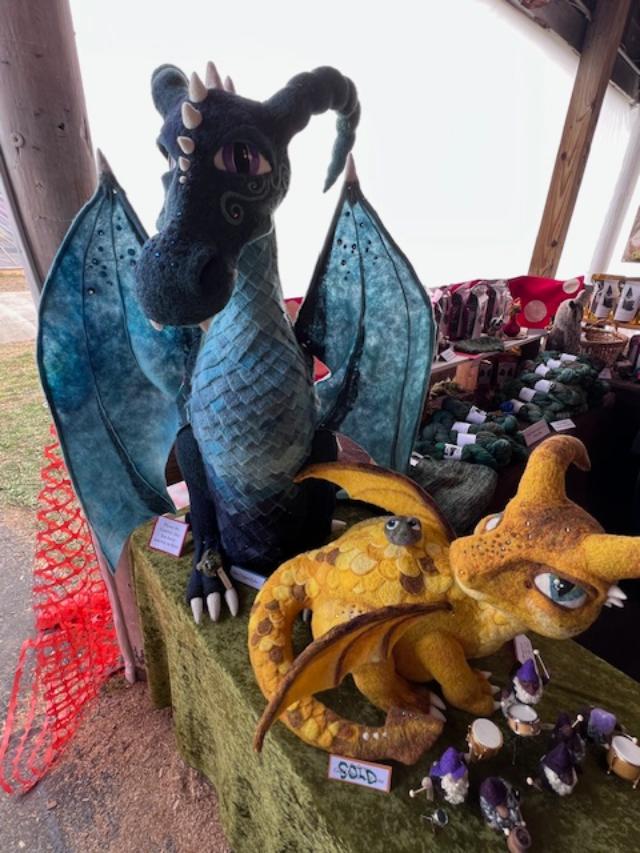
These wool dragon sculptures I thought were really interesting
After the show was over, I decided to tour around Rhinebeck. I just wanted to take a quick walk around the downtown before I took a tour I had done a few years earlier at the St. James Church graveyard. Since I was Upstate, I figured I would do both the same day since the weather was nice.
I got to St. James Church in Hyde Park at 7:30pm so I had plenty of time. I had taken this tour back in 2021 just as everything had opened up and it was a lot of fun, plus I wanted to update my pictures of the church and the graveyard. It also gave me time to talk to the docents and get some background on the church.

St. James Church before twilight at 6:15pm

The staff was just setting up the lights at the cemetery (technically a graveyard)
The inside of St. James Church in Hyde Park, NY, parish of the Roosevelt family
https://www.facebook.com/stjameshydepark/
https://www.dutchess.org/events/st_james_historic_graveyard_tours
My review on TripAdvisor:
I got to the church an hour before my tour and just relaxed and admired the beauty of the church. I never saw an hour fly by before my tour started. Then darkness came and my tour started.

Darkness came by 7:30pm and the cemetery looked much different
We started the lantern tour with a talk of the spirits who were buried in the grave yard. Each of the actors was waiting for us at each stop. I still could not believe these actors were waiting alone in the dark in a graveyard for people to walk by the them.
Each of the actors told their tales of when they were living and stood beside the place that they were buried. It was very intriguing.

The first person we met was Mrs. Emma Victoria Pitkin Marshal
Mrs. Marshall was once known as the ‘Poet Laureate’ of Dutchess County. She was well known in the world of publishing.
The second spirit I met was Mrs. Harper, Mrs. Mill’s housekeeper up at the Staatsburgh mansion. She told us the story of her life working for the Mills and Livingston families.

Mrs. Catherine Kennedy Harper
Mrs. Harper told us about her life working for the Livingston family and her relationship with Ruth, who she was her nanny and then housekeeper.

Our conversation with Mrs. Harper
Our next spirit we visiting was the ghost of Gertrude ‘Gerdie’ Livingston who talked about her time in the Hudson River Valley and in New York City.

Gertrude ‘Gertie’ Livingston

Mrs. Livingston telling her tales of the Hudson River Valley
In between our conversations with the spirits of the past, we walked through the graveyard as twilight gave way to darkness. The graveyard was illuminated with lanterns and lights to follow the paths. It is easy to trip over a tombstone while you are walking around the paths. They did give us lanterns to light the way but there were not enough to go around.

The vaults are illuminated at night to follow the ghostly trail
Our next with the spirits was the ghost of Reverend John McVickar, who was the Rector at St. James Church starting in 1811. He married Eliza Bard, the daughter of Dr. Samuel Bard of Bard College and raised their nine children together.

The spirit of Reverend John McVickar telling his tales of his life in the church

Walking past the church at night
The last apparition we met that night was the spirit of Mr. Augustus C. Colman, the son of a sailing captain who invested heavily in Manhattan real estate on the advice of his boss. John Jacob Astor.

The spirit of Mr. Colman telling his tales of the City

Both himself and the Reverend went at it in the graveyard

The stained glass windows at the church

The church at the end of the tour
I decided to head home after the tour via the Kingston Bridge and drive into downtown Kingston, NY for dinner. I stopped at my favorite go to restaurant in The ‘Stockade District’ Wing Shui at 53 North Front Street. The food is consistently wonderful and extremely reasonable and you can sit down inside the restaurant.
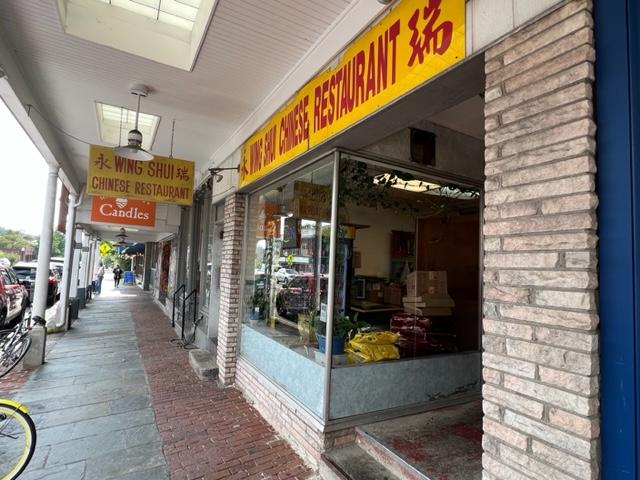
Wing Shui Chinese Restaurant at 53 North Street in Kingston, NY
My review on TripAdvisor:
My review on DiningonaShoeStringinNYC@Wordpress.com:
I was surprisingly hungry even after the big burger at lunch. It got cooler that evening so I ordered the Wonton Soup, the Steamed Dumplings and one of their wonderful eggrolls. It was such a great meal and really warmed me up. For such a small hole in the wall restaurant/take out place, the food is excellent.

My dinner that evening at Wing Shui
The Wonton Soup had for large wontons that you could barely fit in your mouth in the rich chicken broth. That warmed up after a graveyard walk in the dark.

The Wonton Soup with the oversized Wontons and rich chicken broth
The steamed dumplings were plump and moist and filled with spiced pork mixture.

The dumplings here are delicious
Their egg rolls are always a treat and are the first thing that I ever tried here years ago.

The egg rolls here are excellent

Yum!
I was nice to sit in the restaurant and just warm up. The temperature really dropped that evening and it was a rather cool October in comparison to other years. There is nothing like Chinese food after a long walk in a graveyard.
After dinner, I walked around Downtown Kingston some more and admired some of the decorations and store windows decorated for the holidays. It seems like Halloween is now the lead into Christmas rather than Thanksgiving (some places have already decorated for Christmas).

The ‘Jack Pumpkin’ decoration that looked like it out of “The Nightmare before Christmas” in Downtown Kingston, NY
https://andnorth.com/kingston-downtown
From “Nightmare before Christmas”
A lot of windows were decorated for the Halloween holidays. The merchants in Downtown Kingston are so creative and here are some of my favorites.

This was displayed in the window on a North Front Street store.

The faceless entities in the windows

They face this witches hat

The skulls and pumpkins in the window. The merchants get quite creative at the holidays in the downtown area.
The Thursday before my birthday, we had a special late night at the Metropolitan Museum of Art and I finally got to tour the new Rockefeller Wing of the museum. After almost three years and COVID, the galleries have been mounted. The Oceania and African collections had been remounted with a new layout and pieces of the collection that had been in storage had been brought out. The collection looked a brighter and you could appreciate the art better.
I just needed an evening in the City to clear my head before my official birthday and I figured a night at The Met would help. It was nice to finally see these works again after several years of hiding. The galleries looked so much nicer and the works brighter and more vibrant.
The new Rockefeller Wing at the Met:
https://www.metmuseum.org/hubs/the-michael-c-rockefeller-wing

The Oceania collection now redone

The mythic statuary

Pieces from the African collection

Some of the unique pieces in the case

Faces that make a statement

Artwork that reminds you of the Halloween holidays
After I left the Met for the evening, I walked through the Upper East Side neighborhoods west of Madison Avenue and the creativity of the brownstone neighborhoods rivaled anything in that suburbs.

Walking on the Upper East Side before Halloween:

The Pumpkin glare

Black cats and Witches
From twilight to darkness, I walked all the side streets to see how people decorated. There were some very clever displays.

Outside of the grocery store

Then it got dark and the real magic began

Just at twilight

I walked down the Upper East Side from East 79th Street to East 60th Street from Madison to Third Avenues. It depended on the block but some streets were really competitive. These are the best displays I saw.

Guarding a building

Creatures that bump in the night

Halloween land

The doorway

The Headless Horseman

Guarding ghosts

Jolly pumpkins

I loved this ghoul guarding the house

I just hoped he didn’t come to life

Skeleton Parade

Ghostly lights

A happy ghost

More jolly pumpkins

The elaborate Halloween Kingdom

The Evil Witch guarding the house
Here is the witch explaining her wicked ways

More ghouls guarding the homes

A Christmas Halloween

From both angles

Boo!
Last year I did the ‘luxury’ birthday with dinner at Perrine at the Pierre Hotel and Afternoon Tea at the Lowell Hotel on top of my haircut at York Barber, and my trips to the Central Park Zoo and the Met. This year I was just content with staying home and relaxing. I have been doing nothing but running around from one thing to another in between classes.
Maricel asked me what I wanted on my birthday this year and I said ‘rest’. Having over a hundred students between three classes at various stages of their classes can be daunting for anyone especially for me. I had done the whole luxury birthday thing last year and on my birthday this year, it poured so badly during the day that I just stayed home and crashed. I stayed home and watched Michigan State get crushed by UCLA. That was rough!
For my birthday dinner that night, I kept it low key and went to Sofia’s, a Greek restaurant in Hasbrouck Heights. It was perfect because it was relaxing that night and the food was excellent.
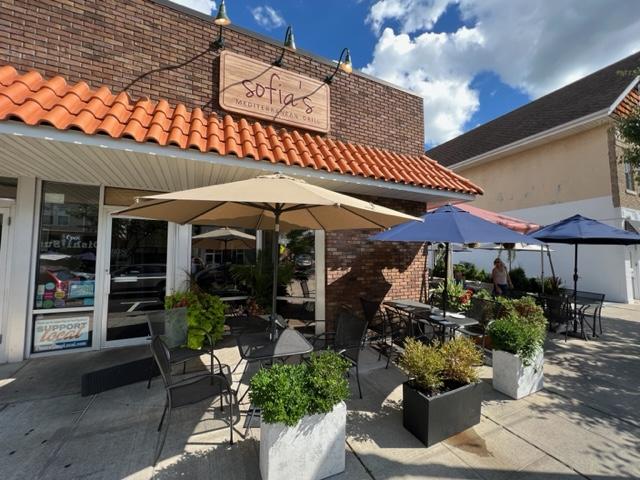
Sofia’s at 220 Boulevard in Hasbrouck Heights, NJ
My review on TripAdvisor:
For dinner I had the Shrimp Saganaki, which is a shrimp appetizer which is cooked in a tomato sauce and topped with cheese. I have loved this dish since they first opened.
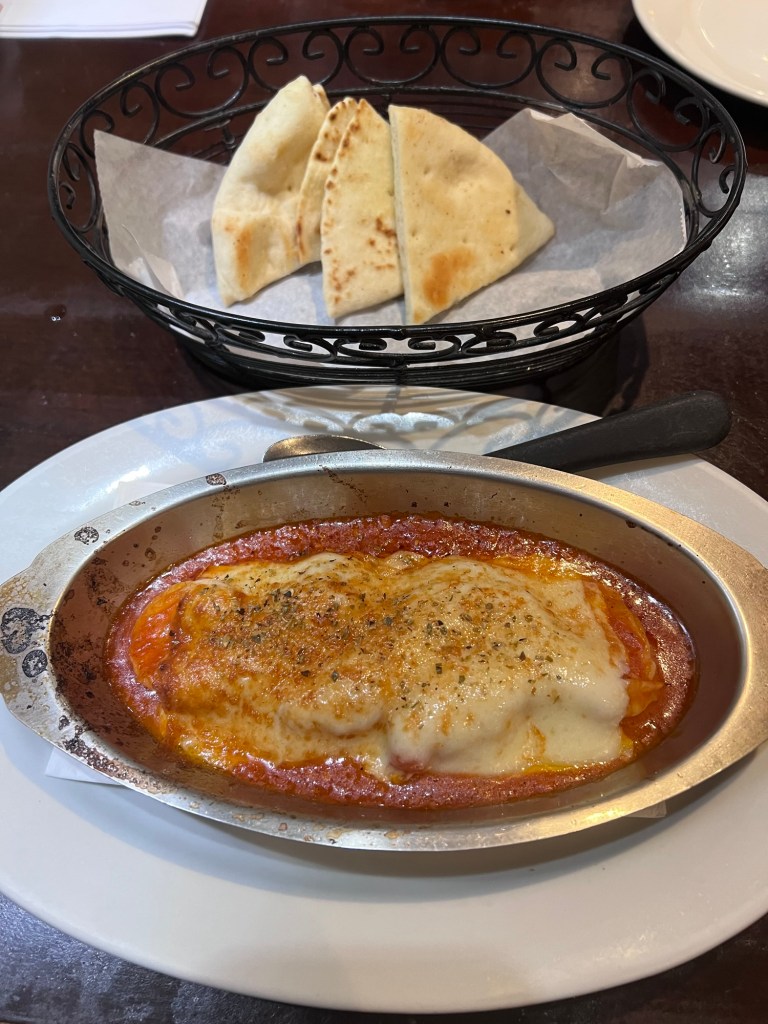
The Shrimp Saganski appetizer

It is as delicious as it sounds
For dinner, I had the Gyro sandwich, which they put on their freshly made pita’s. Their sandwiches are delicious and they do not skimp on anything. I really enjoyed my meal.
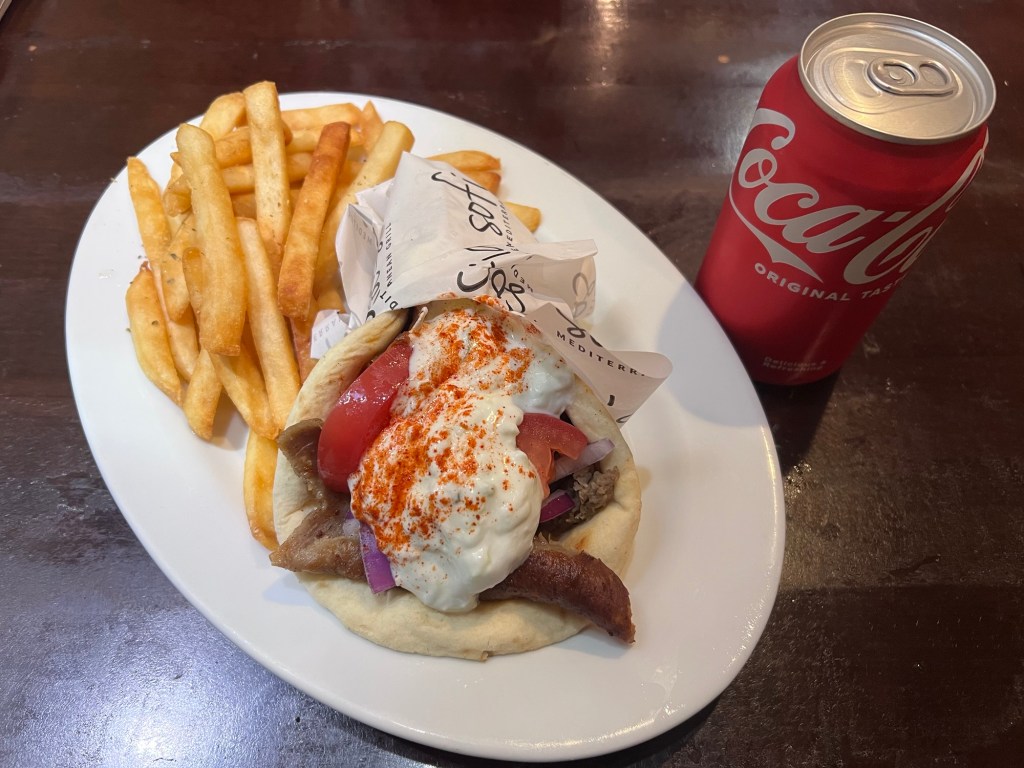
My birthday dinner, the Gyro sandwich
For dessert, I had a change from the $35.00 slice of pink Dior cake at the Lowell and indulged in a slice of Baklava at Sofia’s, who much they make homemade and in house.
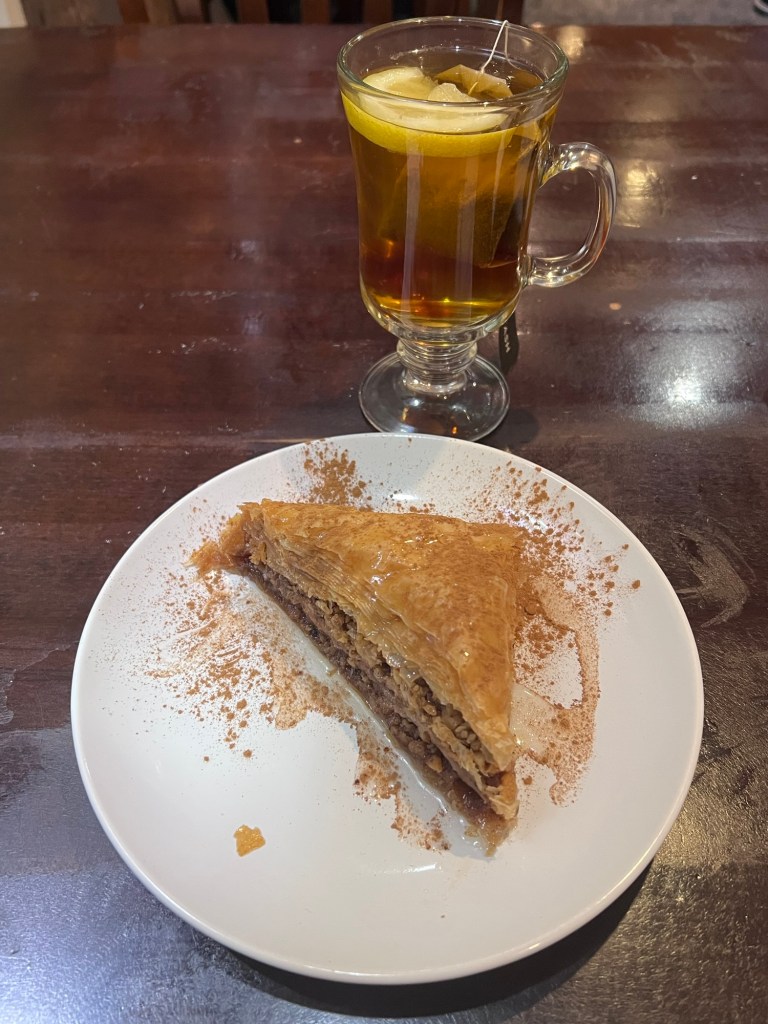
The Baklava at Sofia’s served as my birthday cake this year
This sweet cinnamon indulgence has layers of flaky and sugary phyllo and nuts and lots of honey. The perfect way to end the meal and the cap to my birthday dinner.
The next day Maricel took me out for a breakfast birthday at the IHOP in Hasbrouck Heights. I had not been there in a long time (and was a little shocked at the prices on the menu). I was just expecting pancakes, but Maricel knows me well enough and made the morning even more special. She greeted me with balloons. Turning 60 seemed to be a bigger deal to her than it was to me.

Maricel greeting me at IHOP on my 60th birthday
It is amazing how something as simple as this could mean so much. I love when my friends just do the simple things that touch me so much.
Now for people who say they do not like IHOP, you have never been to the one in Hasbrouck Heights. Their food and service is consistent and delicious. I have been coming here for years and have never once had a bad meal there. I love breakfast and could eat it all day long.
I had the “Two for Two” with two pancakes, two French Toast, two sausage and bacon and they even through in a side of toast. Talk about a perfect breakfast.
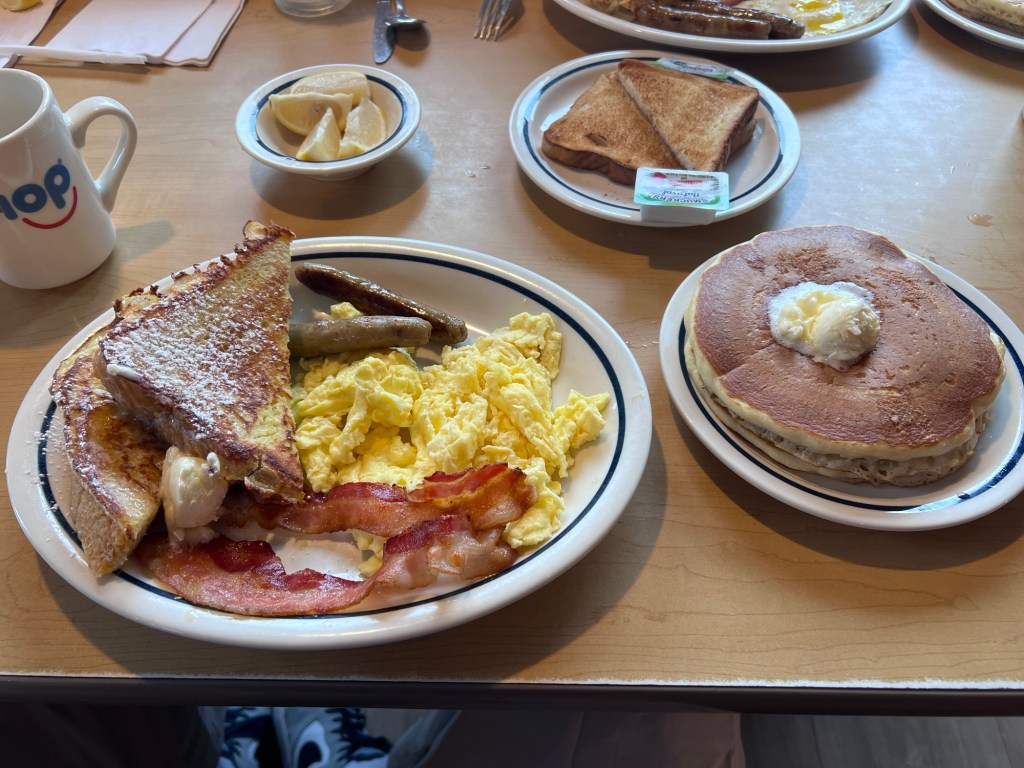
My birthday breakfast at IHOP at 111 Route 17 South in Hasbrouck Heights, NJ
https://restaurants.ihop.com/en-us/nj/hasbrouck-heights/breakfast-111-route-17-south-4667
https://restaurants.ihop.com/en-us/nj/hasbrouck-heights/
https://www.facebook.com/p/IHOP-Hasbrouck-Heights-100069442775972/
My review on TripAdvisor:

You can’t beat a breakfast like this

You cannot beat IHOP’s pancakes!
The staff got caught up in the excitement of our meal and came over to sing “Happy Birthday” to me and brought me a dish of Vanilla ice cream with a candle in it. I was really touched. Sometimes the simplest things people do are the most touching.

The staff at IHOP really made the morning special with kind words, a nice song and their delicious Vanilla ice cream treat! That is good customer service!

This is what a best friend is for!
She saved the best for last and gave me a birthday present. Folks, I hate getting presents! Everyone always gets me what they like and never what I like. I always have to fake a smile and my older brother says I am the worst at it.
Maricel surprised me with a Hermes gift pack of Verte cologne, which is my favorite. I used it for years at Macy’s and Tiffany’s when I could afford it. I swear she totally surprised me. I told her she ‘nailed the birthday and made it perfect!” I love when people can read me.
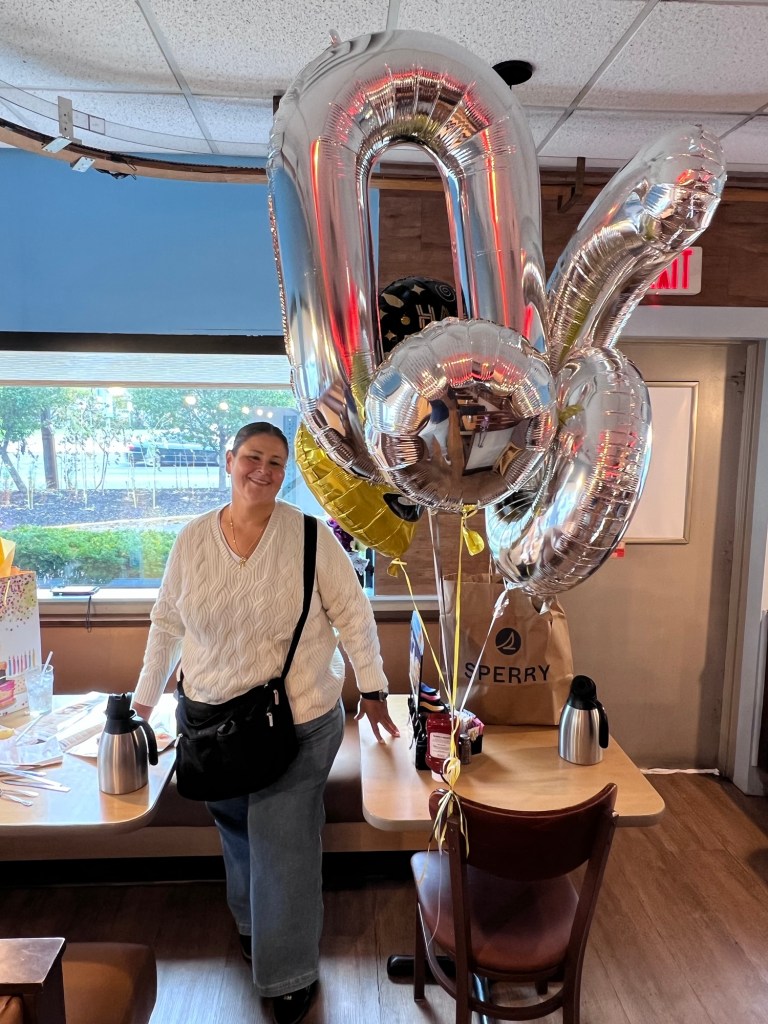
Maricel by the balloons
After my birthday surprise, I took turning 60 with a badge of honor. When I look at my grandparents at my age, they always so much older to me. I guess it was just the times and their life experiences. They had it so much rougher than I did and I am always grateful to them from what I can remember of the love and support they had for us when we were little. With the exception of my father’s mother, none of them lived into my adult hood.
October also meant Midterms, Team Projects and Term Papers, which some of my students just could not handle. It was a struggle in each class to get the students to do their homework. Let’s hope they get to the finish line on December 17th.
My blog on the Bergen County Firemen’s Home Association:

The grounds of the NJ State Firemen’s Home decorated for the Fall holidays
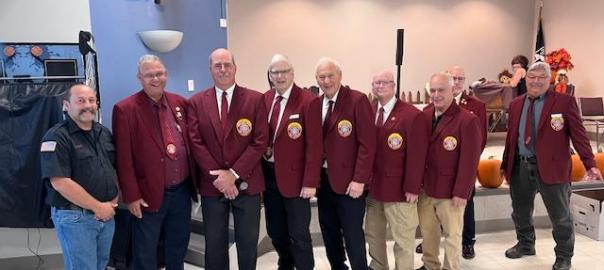
The next weekend, I was in Boonton for our quarterly Bergen County Firemen’s Home Association meeting. Both the outside and inside of the Firemen’s Home was decorated for the Halloween holidays. They really did a nice job with it. After the meeting and entertainment were over, I went up to visit Downtown Boonton to see how it was decorated for Halloween. They do such a good job. The town was decked out with ghosts and ghouls all over the Main Street.
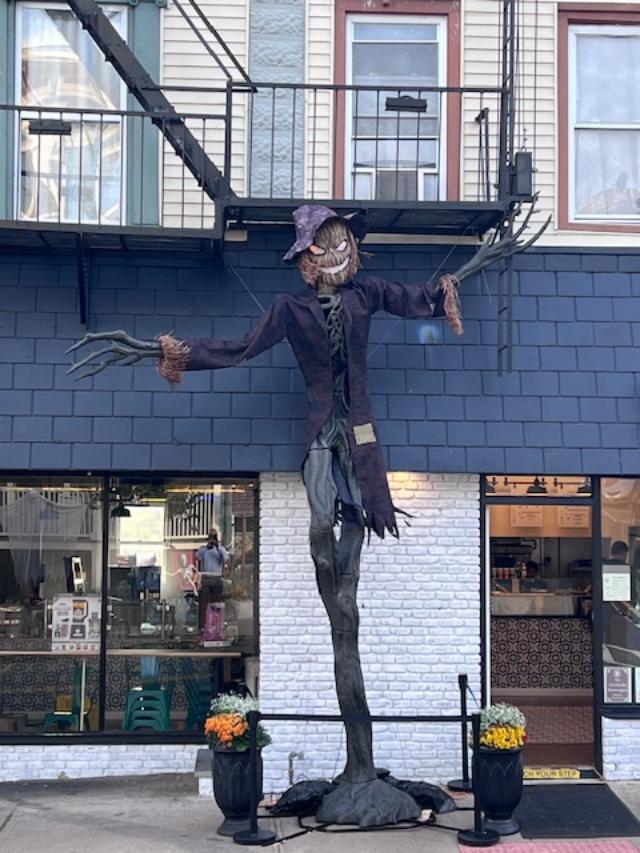
The horrible ghoul in the center of downtown
The town was not decked out for the Halloween and Fall holidays. It was not just the Halloween holidays but the beauty of the change of seasons and the Fall foliage.

The Hill section of Boonton
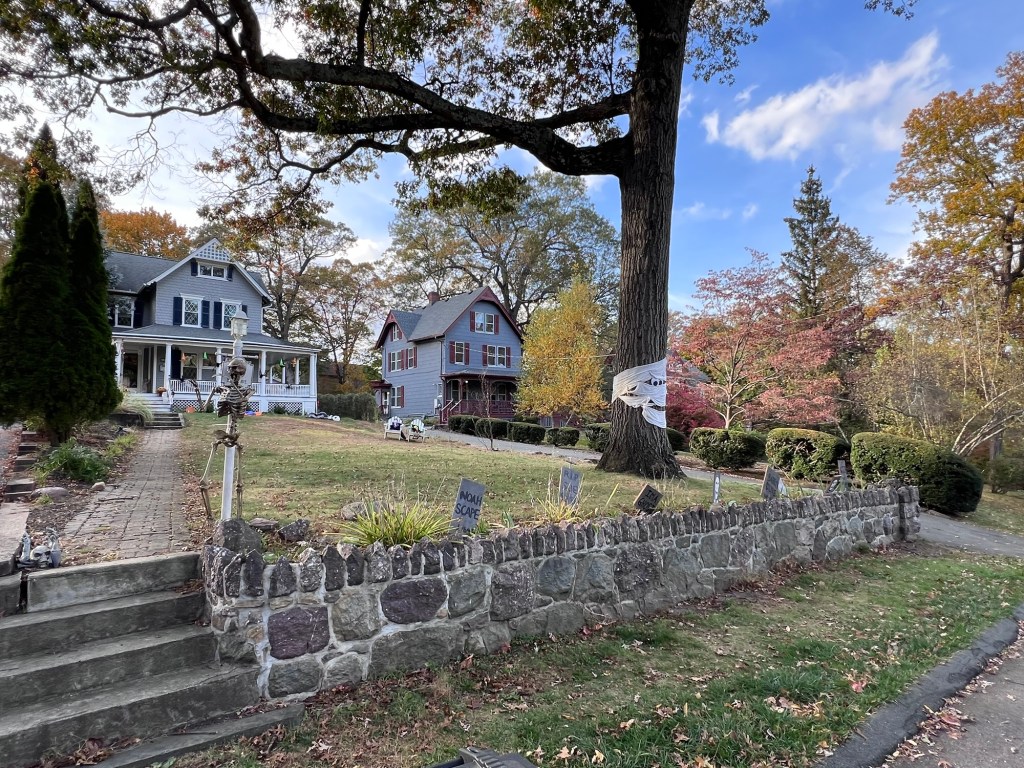
The Hill section of the town in October

The beauty of the Victorian homes

Each street was so beautiful
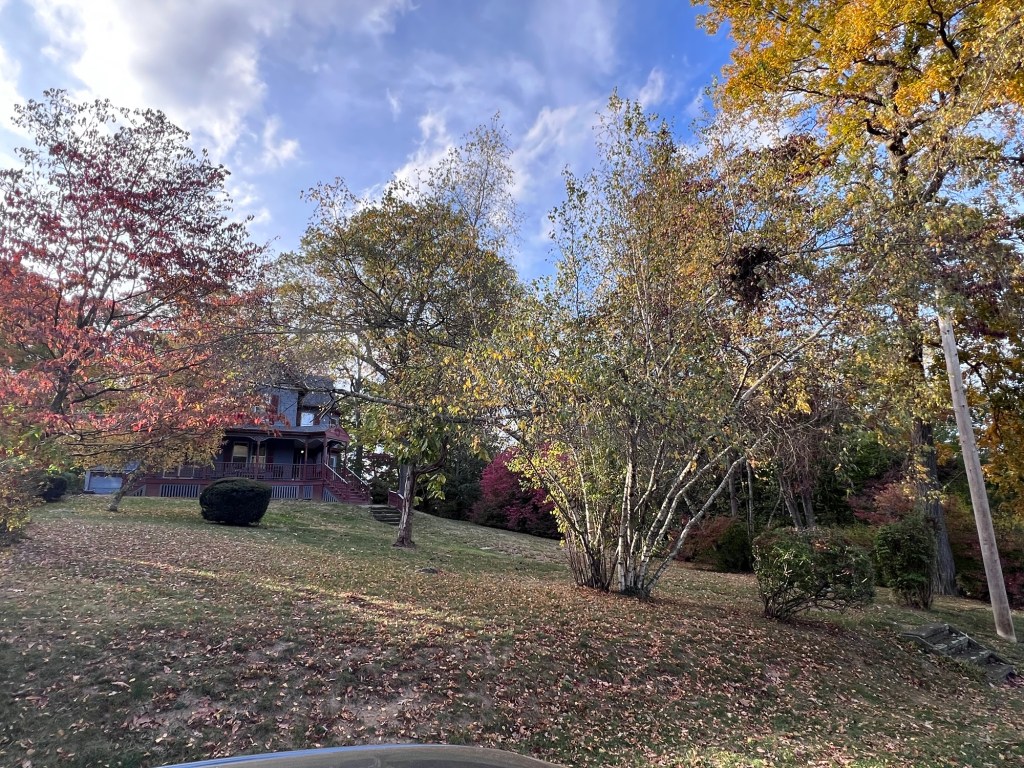
The homes were the colors of gold, red and copper
The businesses did a nice job with the scarecrows this year. The ghosts and ghouls dotted the downtown.

The Annabelle doll

The ghouls are out

The cat in the hat

Pumpkin head
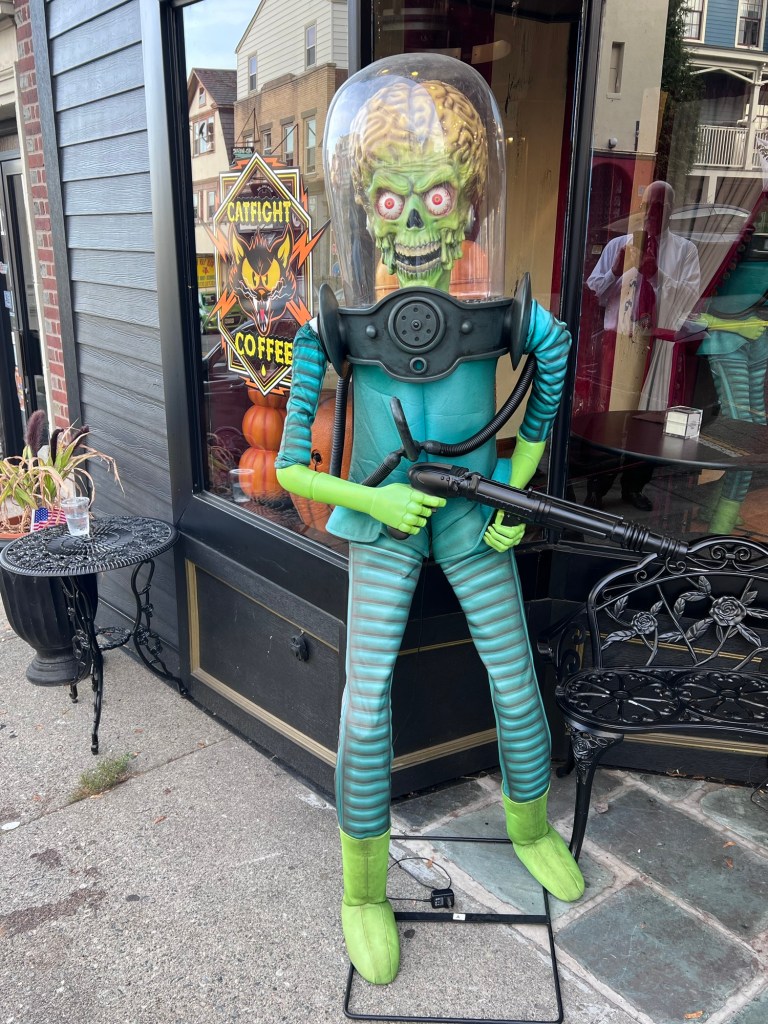
Mars Attacts outside a restaurant
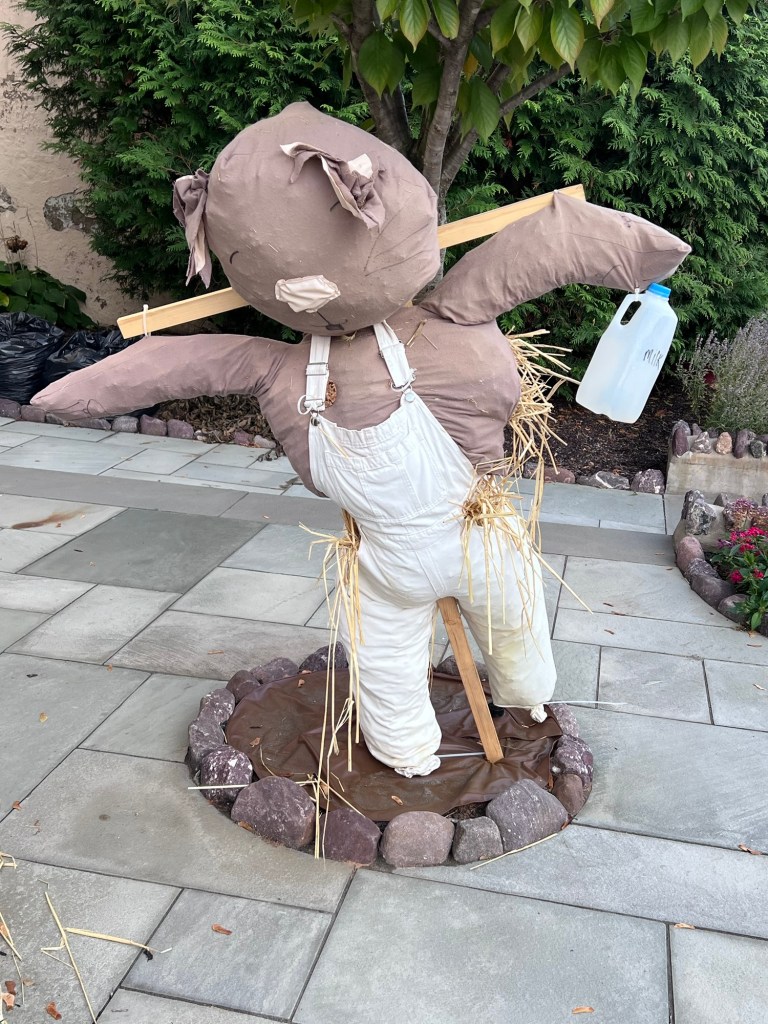
This strange Teddy was outside the library
Boonton does a wonderful job of decorating during both the Halloween and Christmas holidays. The downtown is decorated with all sorts of interesting and creative artwork and beautiful lights. I recently walked around the Downtown at the start of the holiday season and it was really festive. I always get a kick out of the scarecrows decorating the town.
My blog on Exploring Downtown Boonton (a very unique downtown):
https://mywalkinmanhattan.com/tag/exploring-downtown-boonton/
The fire department, even after I retired after 19 years, still keeps me busy. We had our Fire Department Relief Association meeting the night of ‘Halloween in the Park’ and after our meeting was over at 7:30pm, I headed over to Woodland Park in our town and watched everyone get on hay wagons and ride around Woodland Park being chased by ghosts and ghouls. I do not think I have attended this since before COVID. “Halloween in the Park” is an event our town sponsors that bring hay wagons thorough Woodland Park’s small bundles of trees and woods and scares them with costume characters.
It used to be spookier but when neighboring town, Wood Ridge, built a series of condos on the border of our towns and they took down all the trees on their side of the park, all you see is the windows of condos at the back of the park. Still, its a lot of fun and residents get a kick out it.

Woodland Park in Hasbrouck Heights, NJ at night
Halloween starts for me in Hasbrouck Heights with the town’s Annual Halloween in the Park, an event that takes place each fall in Woodland Park in Hasbrouck Heights. First thing to note that since developers have built new condos on the parks edges, it has taken some of the allure from the park. You can see the lights and people moving around.
We ‘stand by’ with the fire department for lights for the event and emergency calls when we have to leave. Still it is a lot of fun watching everyone get on the hayrides and start screaming in the distance. We watch from the equipment while eating a pizza dinner which we share with our Ambulance Squad who is on hand incase someone gets hurt. The last ride of the night, we get to go on when everyone else has left.

Patrons waiting at the Pavillion

The fireplace roaring at the event

Ghouls waiting for you

The park decorated for Halloween
The DPW takes families around the park in hayride fashion with bales of hay in the trailers and everyone on the trailer is chased and harassed by various ghosts, ghouls and witches. You spend most of the evening being chased with someone with a knife or chainsaw.

The start of the haunted hayride
Video of Halloween in the park

Ghouls and creatures of the night chasing everyone
This popular event is always sold out and residents get such a kick out of it. I of course was working that night and got there in time for the last two rides and people were still screaming at 9:30pm.

Halloween in the Park in Hasbrouck Heights, NJ in Woodland Park
I did more traveling down the shore to see what was happening in both Point Pleasant and Seaside Heights beaches. The boardwalks were decorated for the holidays and there were scarecrow contests and pumpkin carving on the Boardwalks. The day started off sunny but then a giant cloud came over the towns which did not clear until 4:00pm. Just as I was leaving, the sun came out again.
Both Seaside Heights and Park and Point Pleasant and Point Pleasant Beach are getting more active during the Fall Holidays as more people have moved down the shore permanently. There are a lot of events for kids and their families families to participate in.
When I visited Seaside Park and Seaside Heights, I stopped in just after a Scarecrow Making Contest. The contest was already over by the time I got there but people were still looking them over. The kids did a really nice job with the contest. While Seaside Heights and Park don’t have the activities that its northern neighbor Point Pleasant has, the activities led to some creative ingenuity of the kids and there were interesting decorations all over the towns over the Halloween weekend.

The Scarecrow Contest in October 2025

The Scarecrows lined up

Some of the Scarecrows I liked
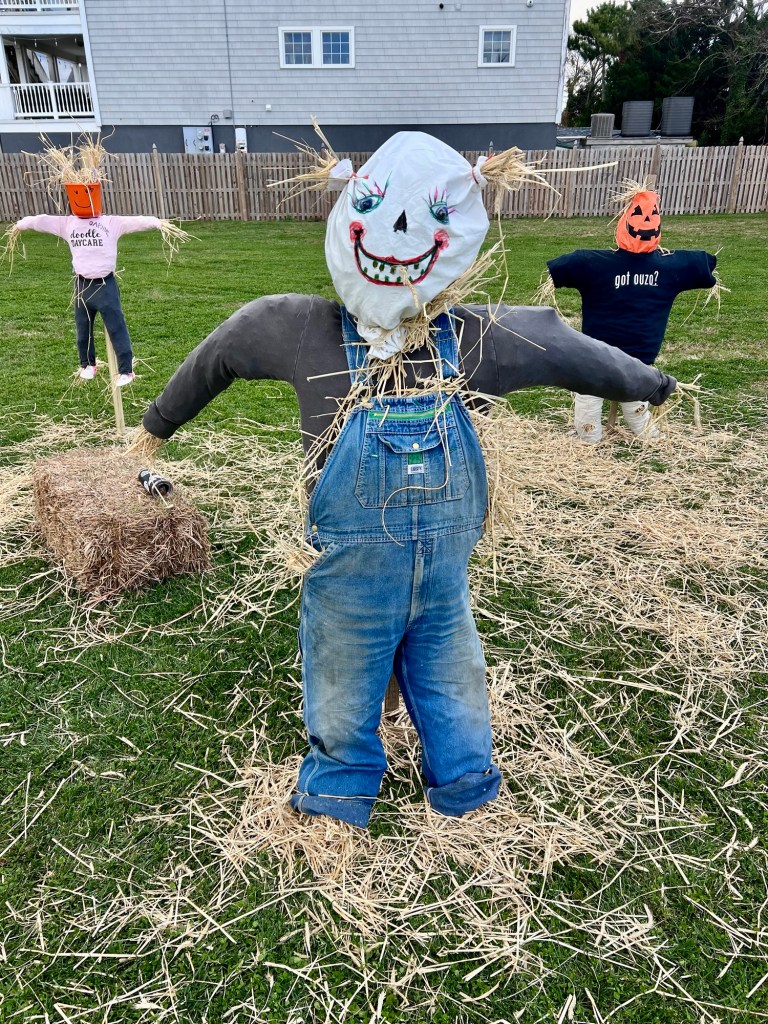
This one stood out
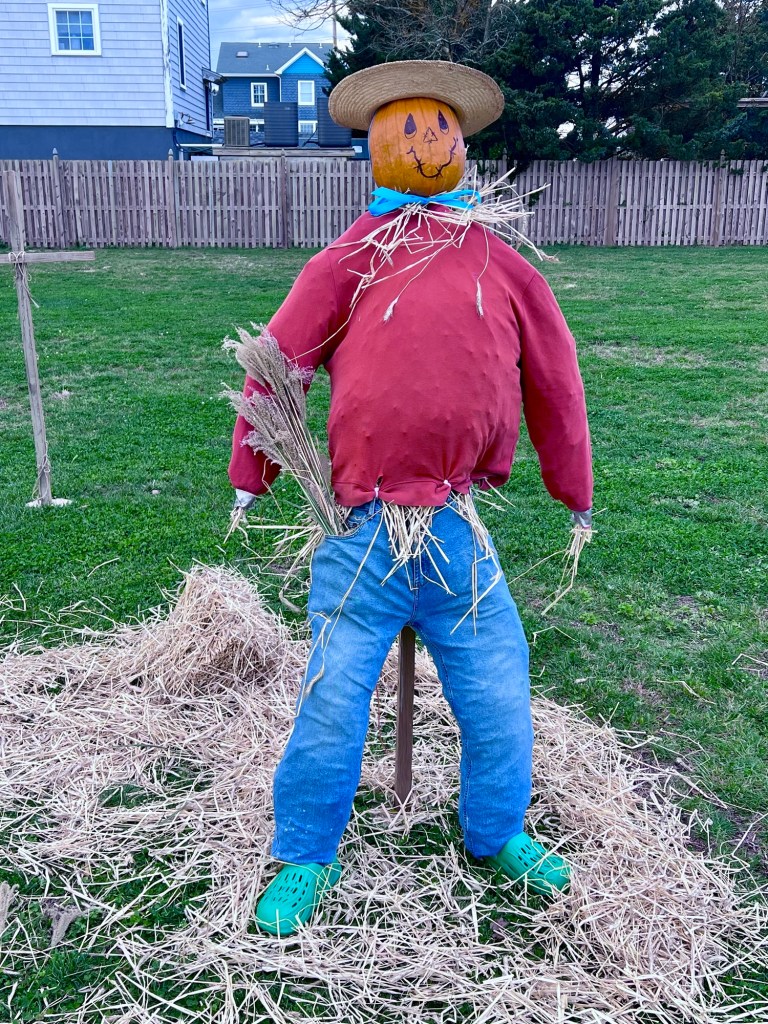
This jolly creature stood out too
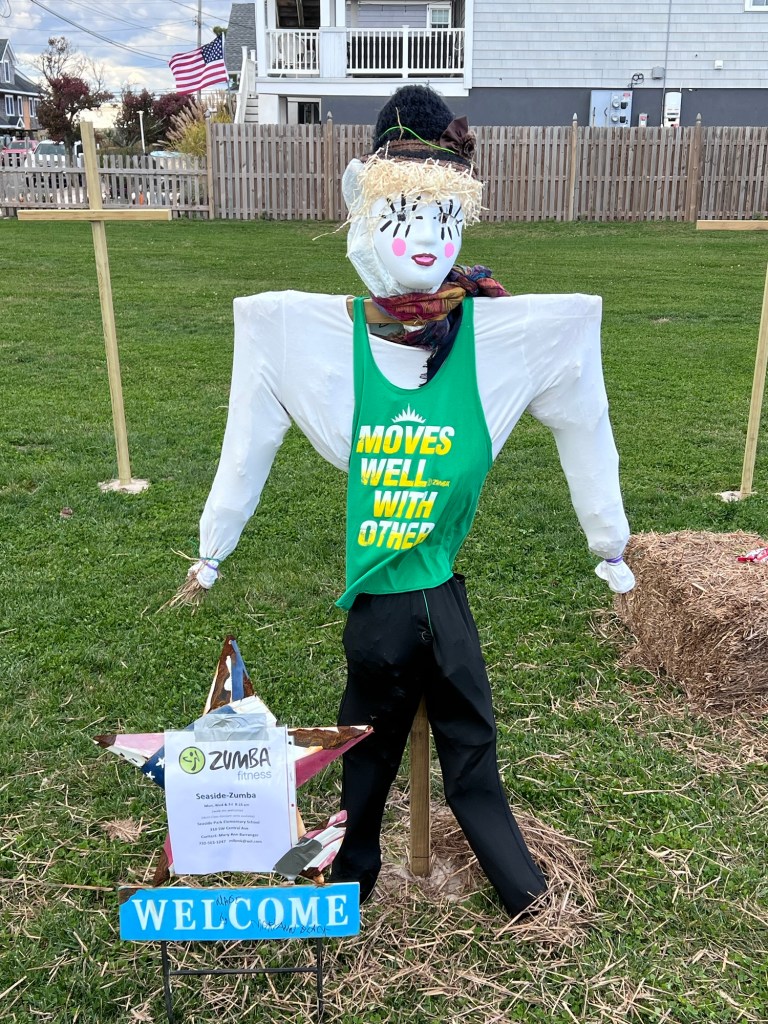
The strange scared scarecrows
The town even decorated the Boardwalk more this year with skeletons and other creatures. There were not many activities on the Boardwalk on the Halloween weekend but the decorations were fun. Even on this warm afternoon at the shore, it put me in the Halloween spirit.
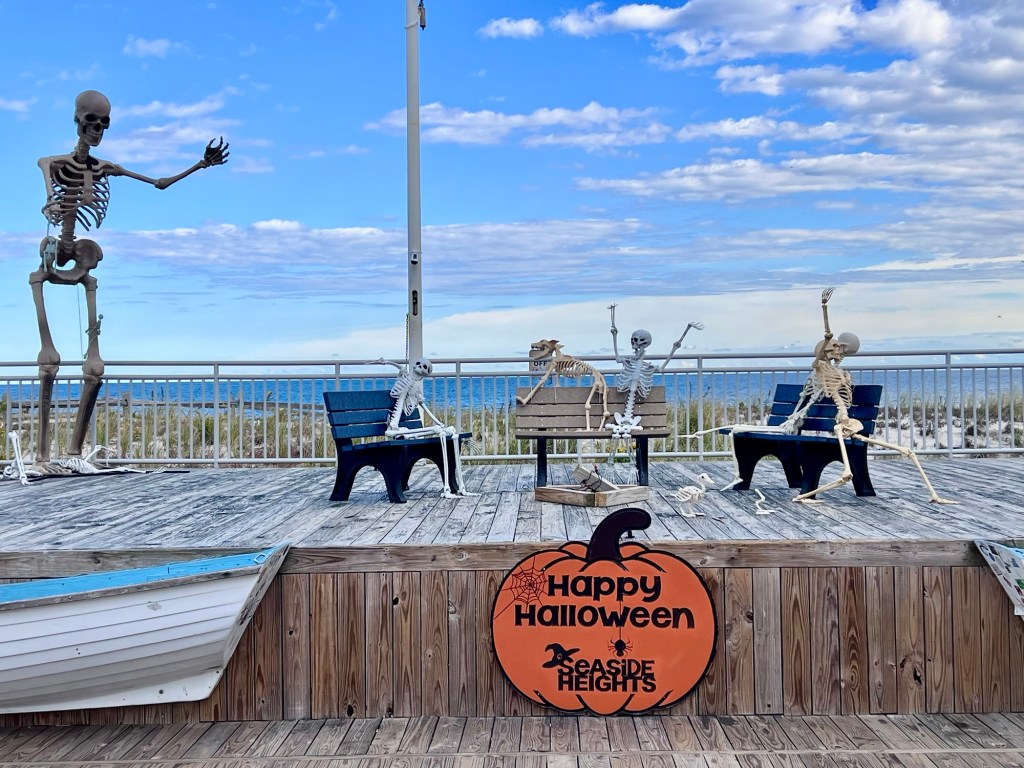
Skeletons on the Boardwalk
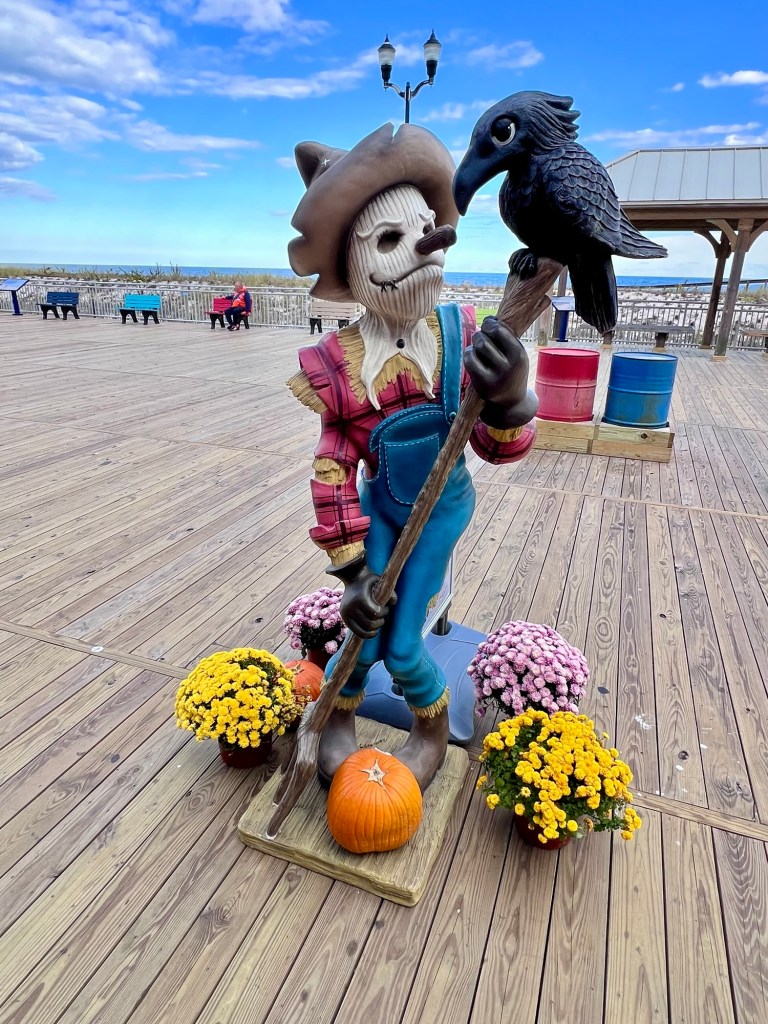
Zombies on the Boardwalk
The Boardwalk was busy with people who had just participated in a Pumpkin carving contest. The weather was overcast by the late afternoon but most of the businesses on the Boardwalk were open and there was a choice of places to eat and shop along the way. The two bars were packed with people who were watching the Giants game. I big change from when I was in Cape May and it is all Philly fans.
My full blog on Visiting both Seaside Heights and Seaside Park:
After my visit to Seaside Heights and debating on where I wanted to go to lunch, I drove up the coastal highway through the other beach communities to Point Pleasant and Point Pleasant Beach. The downtown arts community always knows how to decorate the downtown and Jenkinson’s does a nice job on the Boardwalk.
When I visited Downtown Point Pleasant, I was able to admire the decorations on both the downtown Main Street and then walk to the Boardwalk. The downtown is always so nicely decorated and I love the whimsical scarecrows that decorate the downtown. The windows are filled with creative displays that always seem to be begging for Christmas decorations even before Halloween is even over (like most stores everyone wants to rush the holidays).

Downtown Point Pleasant in the Fall of 2025

The Point Beach Arts community gets very creative in Downtown Point Pleasant with the Gazebo decorated for Halloween
https://www.facebook.com/PointBeachArts/
https://arts.pointpleasantbeach.org/events/scarecrow-contest-2025
The Winners:
https://www.instagram.com/pointbeacharts/?hl=en
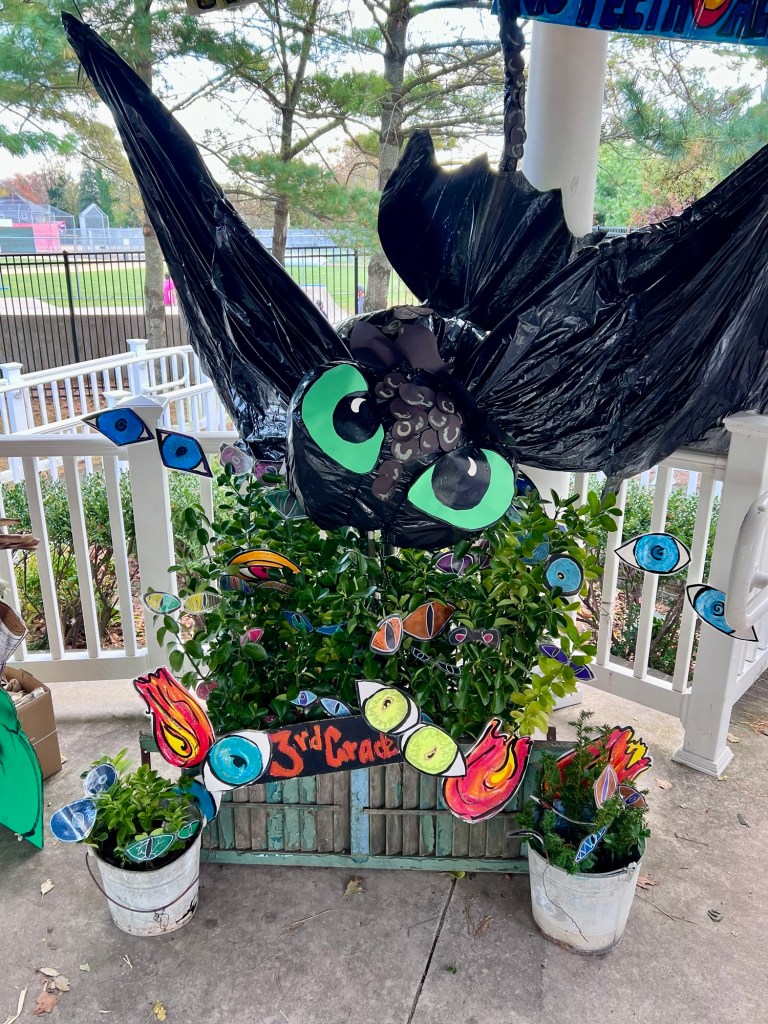
The bat stares at you
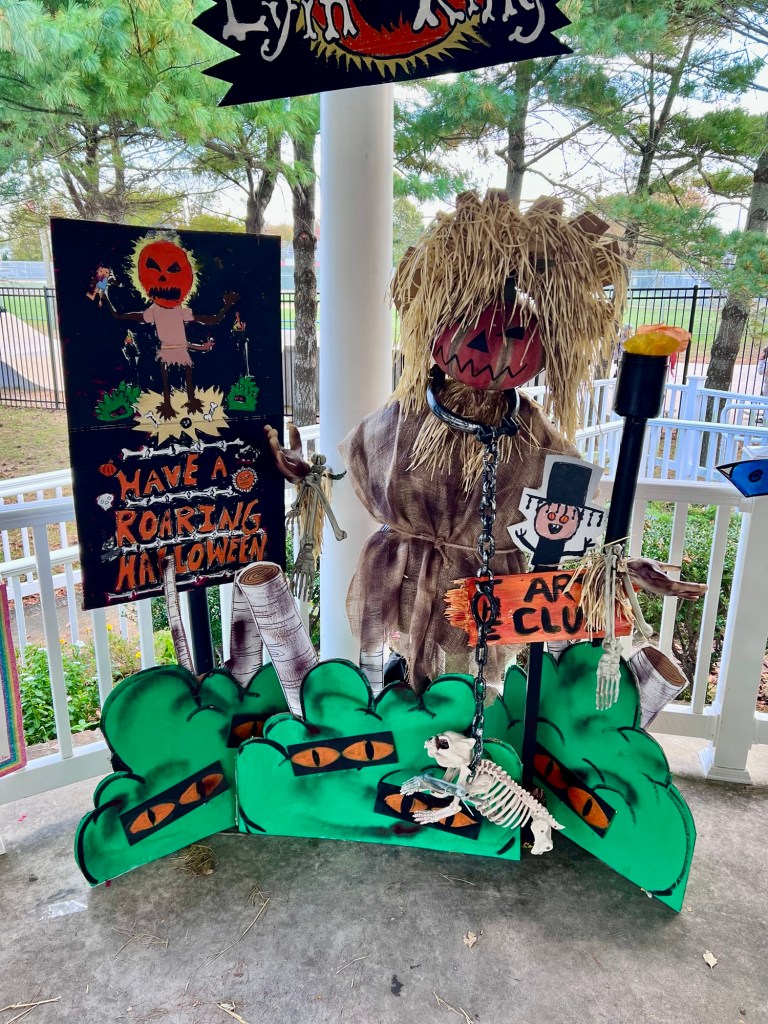
The Scarecrow in the Gazebo
I walked their downtown and saw that their Arts Commission added more scarecrows to the downtown light posts.

The scarecrows from 2025
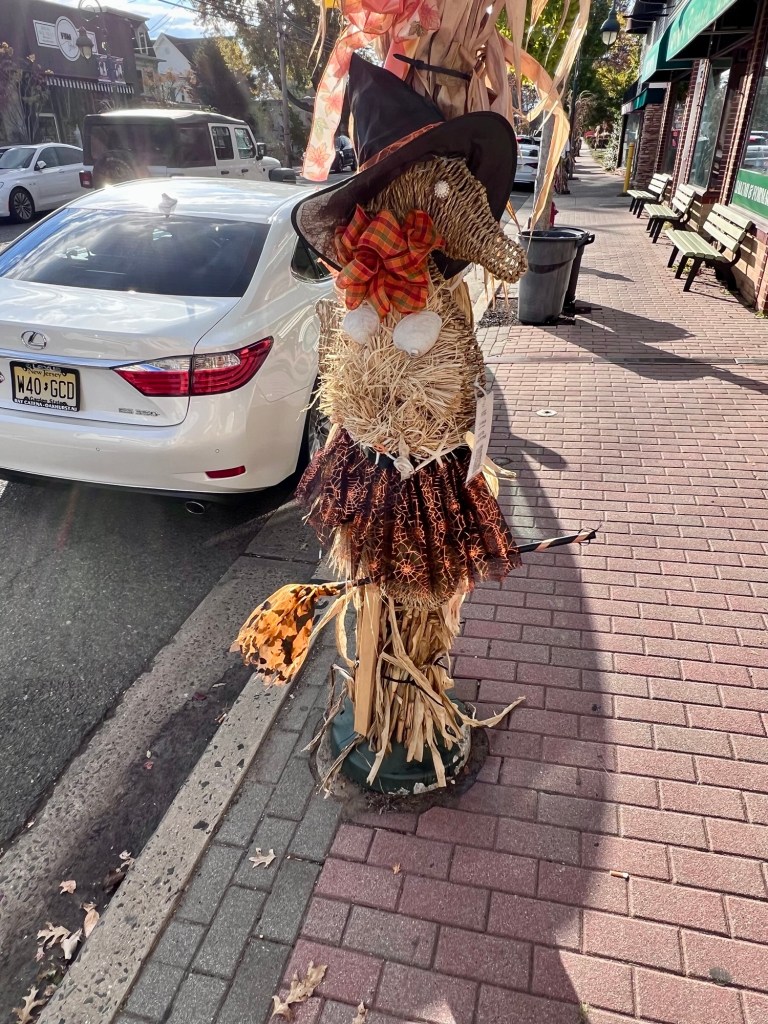
Another creative scarecrow

There was a lot of creativity in this downtown contest

The scarecrows came in all styles

Barbie display

The Phantom bride
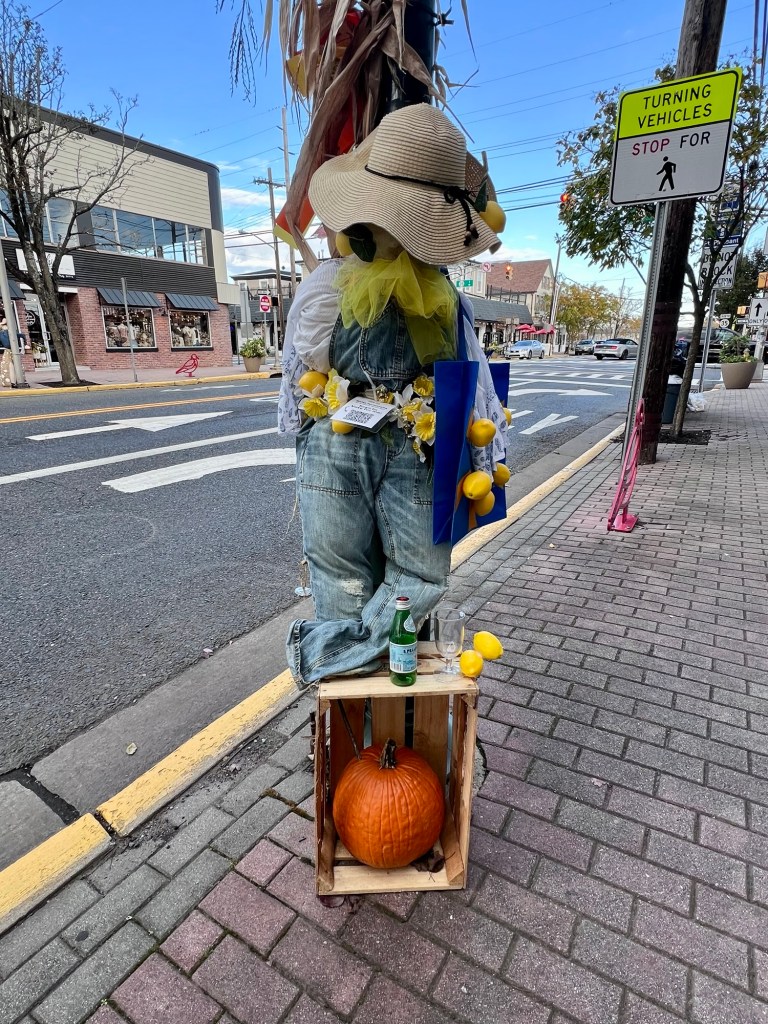
More unusual scarecrows

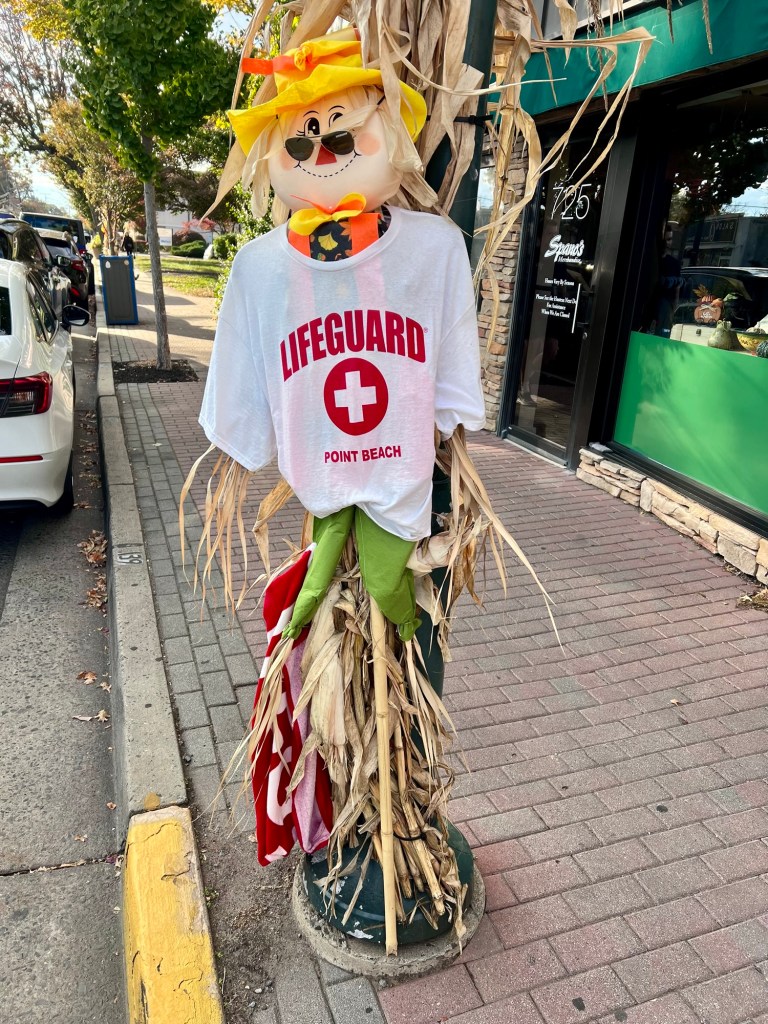
They get very creative in Downtown Point Pleasant
When I walked to the Boardwalk a couple of blocks away, it was a little cooler than last year but there was still a good crowd walking around the Boardwalk. The afternoon activities sponsored by Jenkinson’s kept everyone active with their series of programs at “Boo at the Boardwalk”. They decorated the Boardwalk for the Halloween Holidays and kept all the stores and restaurants open adding to the festivities. With the Fall holidays getting warmer, it is a smart business decision to extend the Summer activities further into Fall.

‘Boo on the Boardwalk’ in 2025
https://jenkinsons.com/boo-at-the-boardwalk-2025-at-jenkinsons-boardwalk

Decorations on the Boardwalk in 2025

Limited rides and attractions were open that day

There were decorations all around the Boardwalk
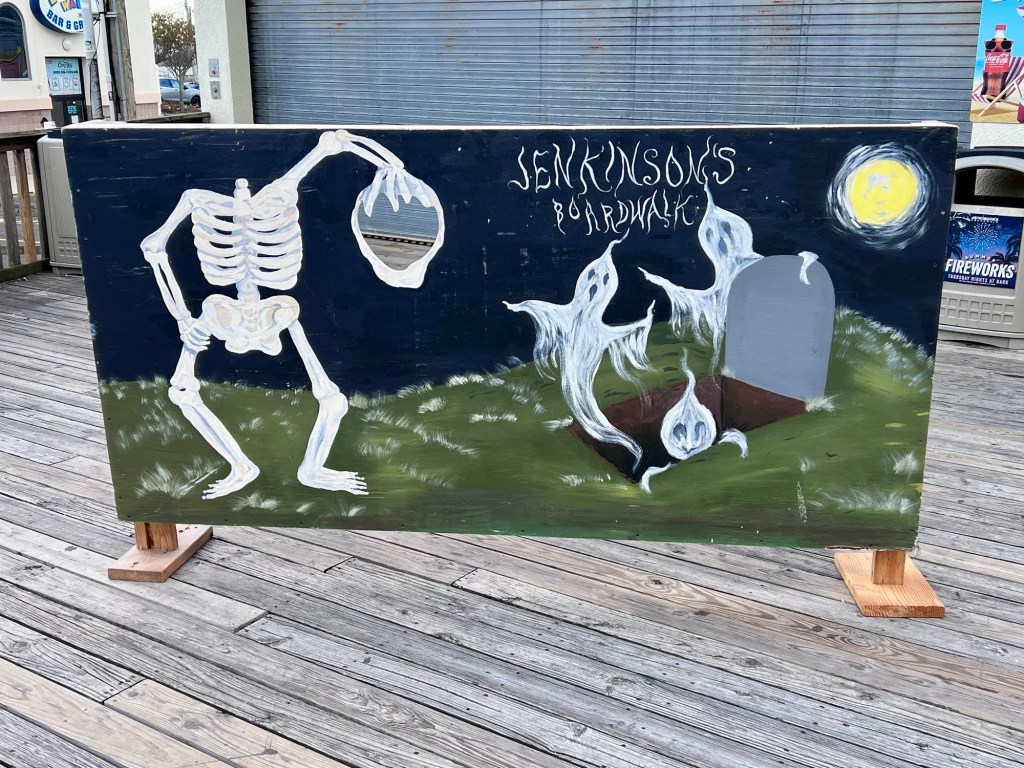
These signs were all over the Boardwalk

The declarations on the Boardwalk on Halloween
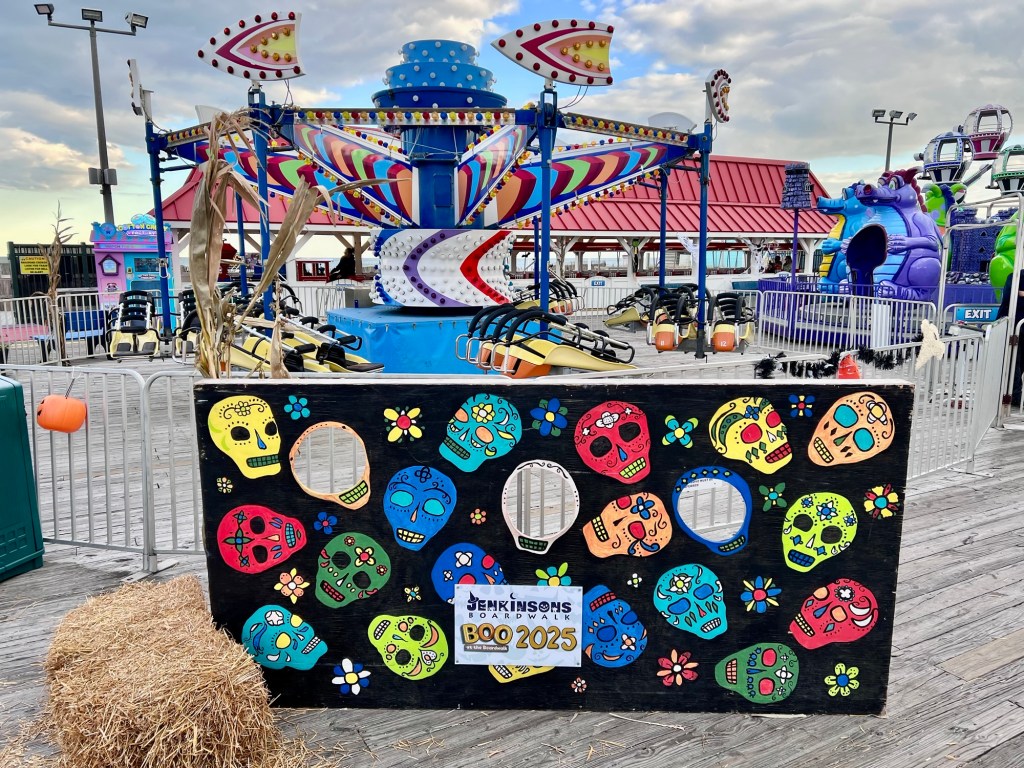
The Boardwalk was busy Halloween weekend of 2025
Halloween is always fun on the Jenkinson Boardwalk. There was always something going on. The towns really get into the Halloween holidays. The park really knows how to celebrate the holidays.
My blog on Exploring both Point Pleasant Beach and Point Pleasant:
https://mywalkinmanhattan.com/category/walking-downtown-point-pleasant-nj/
https://mywalkinmanhattan.com/category/exploring-point-pleasant-beach-nj/
It was a lot of running around the shore from Boardwalk to Boardwalk but it is interesting the amount of activities these towns have been doing and the creativity that goes into them. This led me to visiting another shore town the next week when I visited Long Beach Island the Town of Beach Haven.
It was rather quiet in town when I visited Beach Haven the week before Halloween. Usually there was a lot more going on but it was probably reserved for the weekends. Some parts of the of the town were decorated for the holidays but I did not see the activities of the other shore towns that day. Still there were reminders of Halloween here and there throughout the town.

Woo Hoo at 211 South Bay Avenue
My review on TripAdvisor:
My review on DiningonaShoeStringinNYC@Wordpress.com:
My first stop was Woo Hoo at 211 South Bay Avenue for some ice cream. The store was all decorated for the holiday, and they even had a specialty ice cream flavor for Halloween, Spooky S’mores. The ice cream here is a real treat as it is made in small batches on premise.

Woo Hoo carries some non -ice cream merchandise
They have now cut the menu down to just ice cream. There is no longer any ‘meal’ items like sandwiches and fries. The woman at the window explained, they will be only the homemade ice cream on their menu. I had no problem with that. Woo Hoo was preparing for the Halloween and the shop was decorated for the holidays.

Games for kids

They decorated the interiors

The store was surrounded by ghosts and ghouls
I looked over the menu and I saw a flavor I remembered from the past, Spooky S’mores, which I had when I visited the island a few years ago for Halloween. It is a Marshmallow Ice Cream with a Chocolate swirl with graham crackers and Halloween M&Ms and you only see it at this time of the year. I had to have that.

The Spooky S’mores flavor

It was delicious
The Spooky S’mores was loaded with graham and M&Ms in every bite and the ice cream was so rich and creamy. Going to Woo Hoo at the holidays is the best!

They now have ice Cream making classes
The service could not be friendlier. The staff is very accommodating and will help you make a selection from the various choices. Not only that but the staff knows the island really well and can point things out for you to see.
I spent the rest of the afternoon exploring Beach Haven, walking through the stores and amusements areas which were still open this late into October. The warm weather over the weekend really attracted a lot of people and watching people play miniature golf this late into the season was interesting. The shore towns in New Jersey really are going full season.

Beach Haven Bay during the day
It was a nice snack to enjoy after walking on the beach or exploring the island. I walked down the block at the end of Dock Road and enjoyed the views and watched the boats sail by. I also got a great tan.

Beach Haven, NJ by the bay is just beautiful
Just sitting by the bay relaxing

Admiring the boats while I digested

The creative artwork by the shore
It was fun to just walk around Beach Haven’s downtown that afternoon and enjoy the warm weather. They had a Chowder Cook off going on down the road, so the town was packed with people that afternoon.
My blog on Exploring Long Beach Island and Beach Haven, NJ:
I saw by the weather report that Hurricane Melissa was coming up the coast and I knew that this would knock the foliage down all over the state so I made one last trip down the Route 46 Budd Lake to the Delaware Water Gap. I started at the Delaware Water Gap to take the pictures of the foliage in the sunshine and then I worked my way back, stopping at farms along the way and in Hackettstown to take more pictures. I wanted to get the pictures of the foliage before the storm knocked it all down.

The Delaware Water Gap at River Road off Route 209 in 2025
https://www.nps.gov/dewa/index.htm
I was able to stop at the U turn on Route 80 West and park in the beginning of the trails that go through the park. Since it was so gloomy out and it was getting late in the afternoon, I stuck by the Visitors Center, which was closed for the season and walked along the river. Most of the foliage had been knocked off the trees by the two recent storms but there were still hues of gold and yellow with the trees that were left. It is a breathtaking view of the mountain range.

The foliage from the highway
When I returned in October of 2025, I timed it so that the trees would be at their peak and it was before a major rain storm the next day. I figured this would be the best time to come. Plus it was going to be the last nice day of that week. The trees were just past peak but because there had not been much rain that summer, the leaves changed earlier than in past years.
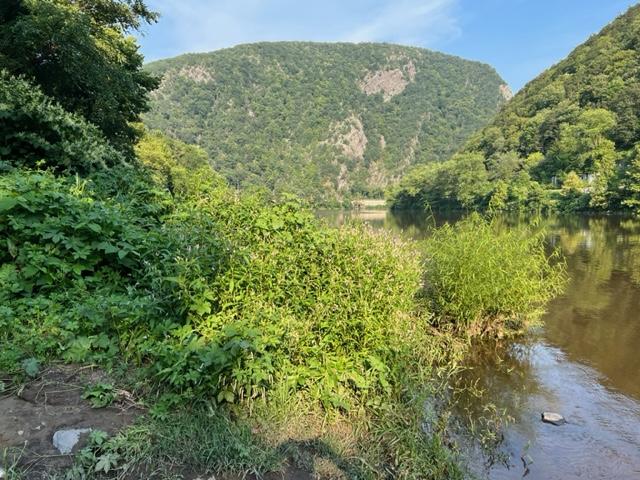
The mountains at the Delaware Water Gap from the Visitors Center in the Summer months
https://www.nationalparks.org/connect/explore-parks/delaware-water-gap-national-recreation-area

The Gap in the Fall of 2025

The Visitors Center in the Fall of 2025

The river in the Fall of 2025
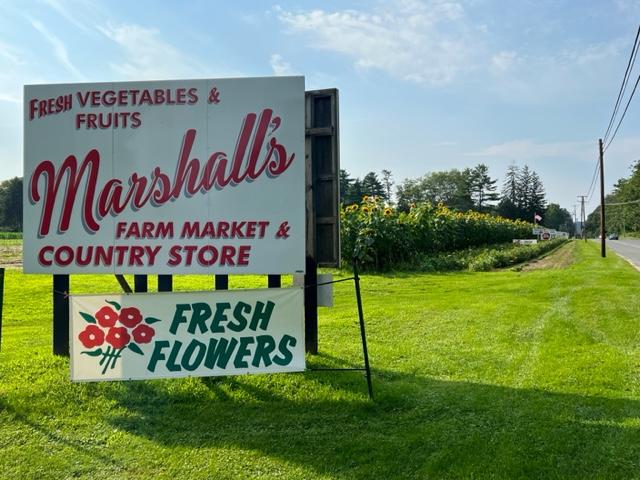
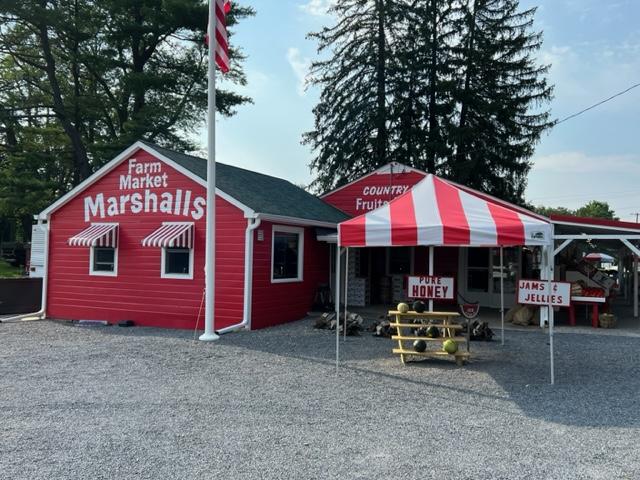
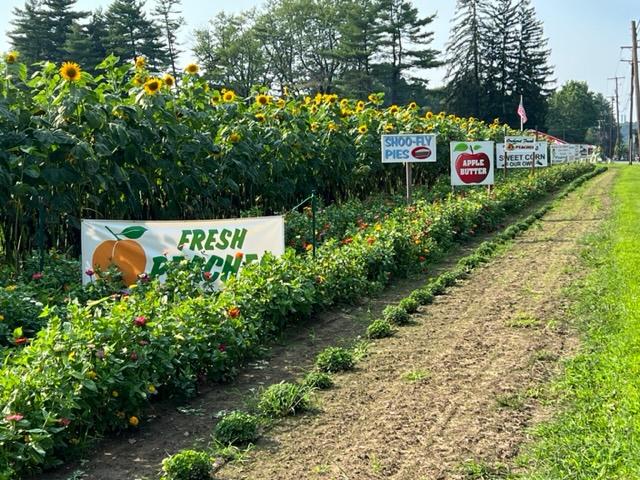
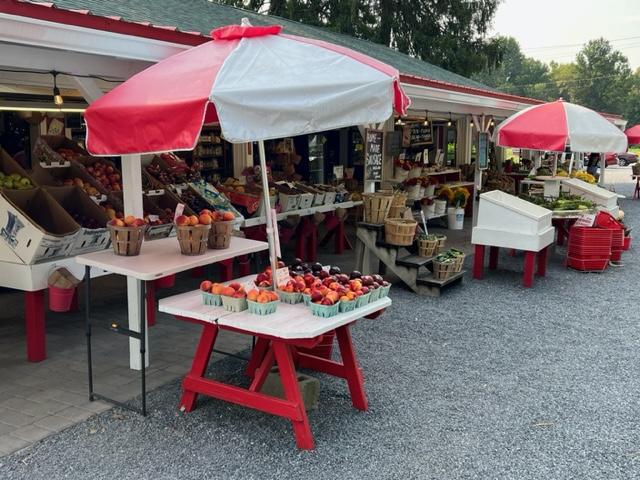
I continued my path down Route 46 East, taking pictures of foliage and stopping at the Marshall Farms to see the Halloween decorations. Sometimes you will pass a farm stand and you see the standard pumpkins, peaches and apples outside. When you pass Marshall’s Farm Stand in Delaware, NJ, you see a whole farm experience with orchards of fruit, corn fields and a property that is decorated for the upcoming Halloween holidays.

The side of the Marshall’s Farm Stand at 114 Route 46
http://www.marshallsfarmmarket.com/
My review on TripAdvisor:
My review on LittleShoponMainStreet@Wordpress.com:

The other side of the farm stand stocked high with pumpkins

The festive pumpkin sat on the roof of the building
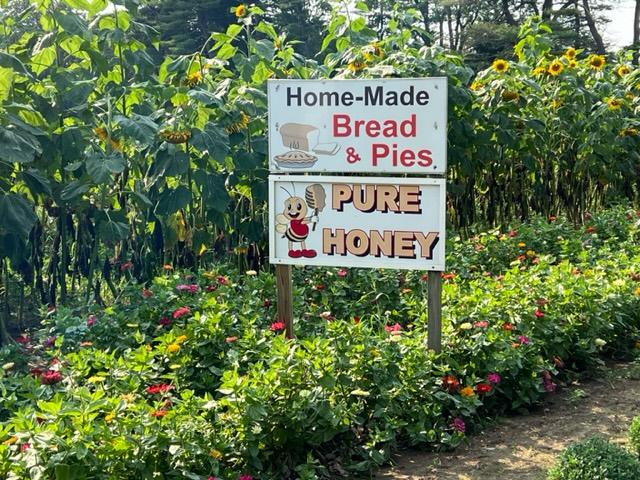
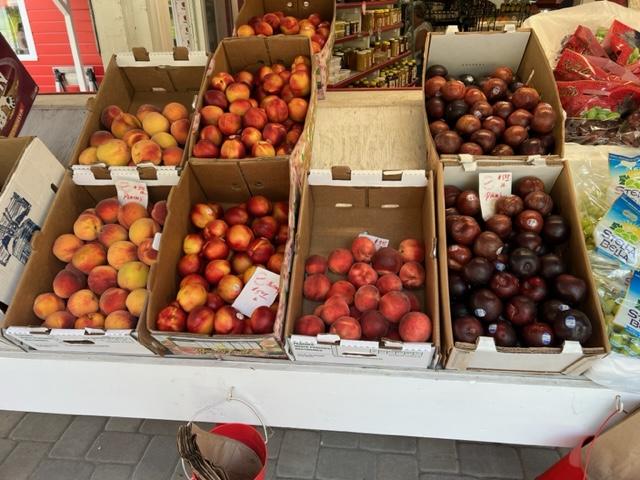
The whole front of the farm was stocked with all sorts of early Fall produce, honey, jams and jellies and delicious baked goods including pies, cakes and rolls and their specialty, their mini Apple Cider doughnuts.

The fresh Jersey produce

The cream rolls and homemade pies, including apple, berry and Shoo Fly pies
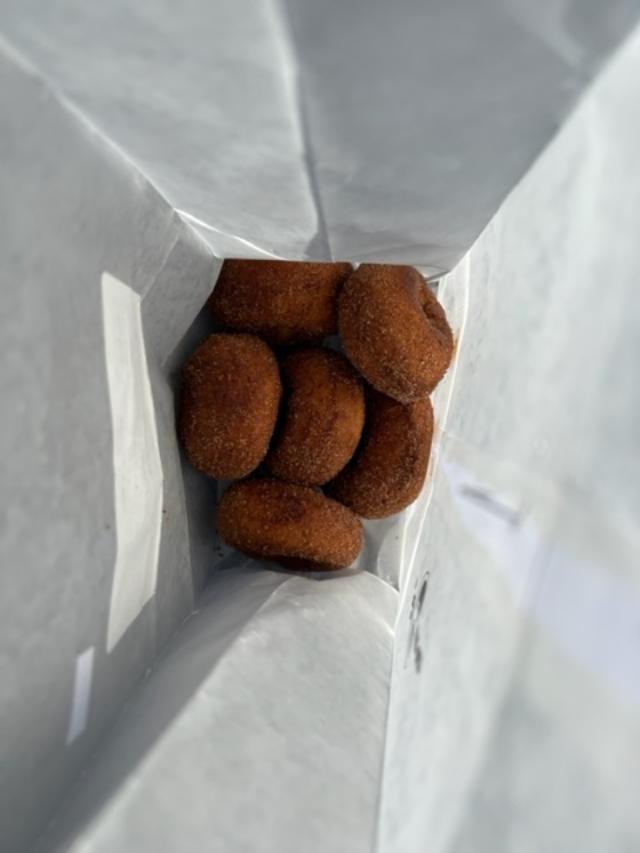
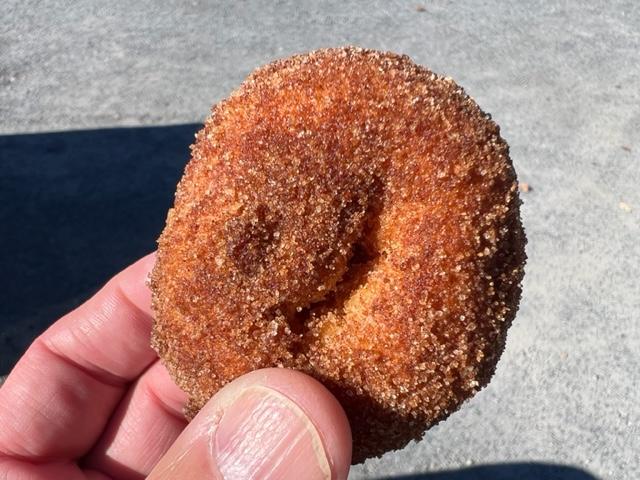
The best is their mini Apple Cider doughnut. One bag of these and you are content for the afternoon. I can barely get out of the parking lot with indulging in one or two of them before my drive down Route 46 to the Delaware Water Gap.

The farm stands addictive Apple Cider doughnuts

These sugary delights are so good!
What I also enjoy is their delicious apple cider. I found out though that they do not make it in house but a farm close by makes it both for their farm and Marshall’s. It is sweet and very refreshing and only comes in gallon containers.
I love walking through the stand, walking past the pumpkin, produce and the crafts display.

The pumpkin display in the parking lot
After I put my purchases in the car, I walked around the farm, looking at all the decorations they had for the upcoming Halloween holidays. The farm has pumpkin picking, corn mazes and a hayride where the $5.00 cost includes along with the hayride a cup of apple cider and a doughnut. I could handle that.

The sign for the weekend hayrides

The witch sign in the parking lot near the Corn Maze

The witch painting at the start of the corn mazes

Ghosts decorating the field
The Corn Maze was still tall and green and I am sure led all around the property. Each part of the front part of the farm was decorated for Halloween festivities which would happen the next weekend.

The cemetery in the back of the farm stand

A horrible ghoul

All the Halloween decorations at the start of the hayride
Here is my blog on the whole trip down Route 46 East and West from Budd Lake to the Delaware Water Gap:
Hurricane Melissa came up the coast the week of Halloween and a lot of functions were either cancelled or had to move inside. I had no desire to go into the City when it was pouring rain. So I missed some of the museum and Central Park events that had been cancelled and stayed home. We really lucked out on Halloween night, and the weather was a brisk 58 degrees. It was clear and the perfect night for the parade. The parade this year went off without a hitch. I got to the parade after a long day at work and I made it into the City by 4:00pm.

We started the sign in for volunteers at 4:00pm
I met my counterparts at the start of the shift and I really lucked out. We had a really good group of people who would answer ‘no’ to people. I was able to see a little bit of the puppet rehearsals before people started to arrive for the event. There was a lot of excitement as everyone got ready to start the parade.

The puppets ate the beginning of the parade

Puppet rehearsal before the parade kick off at 7:00pm
I met many creatures, witches and things that go bump in the night at the beginning of the parade and they enjoyed showing themselves off.
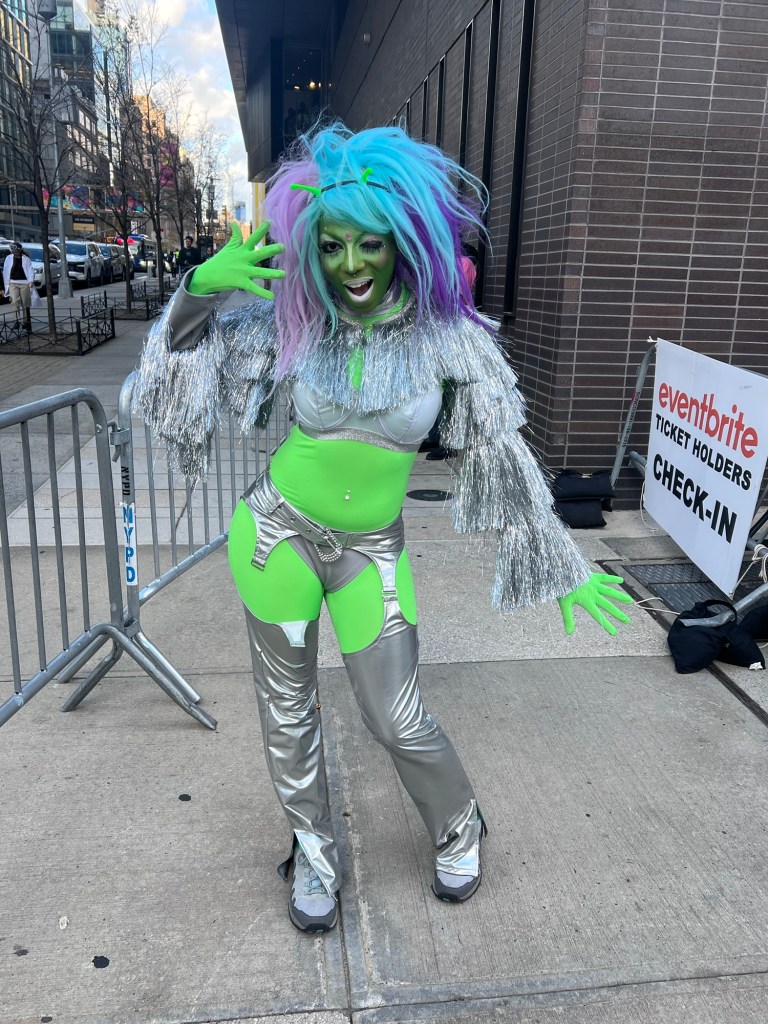
This Sea Maiden joined us at the beginning of the parade

This group of friendly witches and warlocks joined the parade early
As the sun went down and the parade was about to begin, balloon creatures joined as the Good Witch led the way. The parade of costumed characters was in full swing by 5:30pm as people entered the gates for the parade.
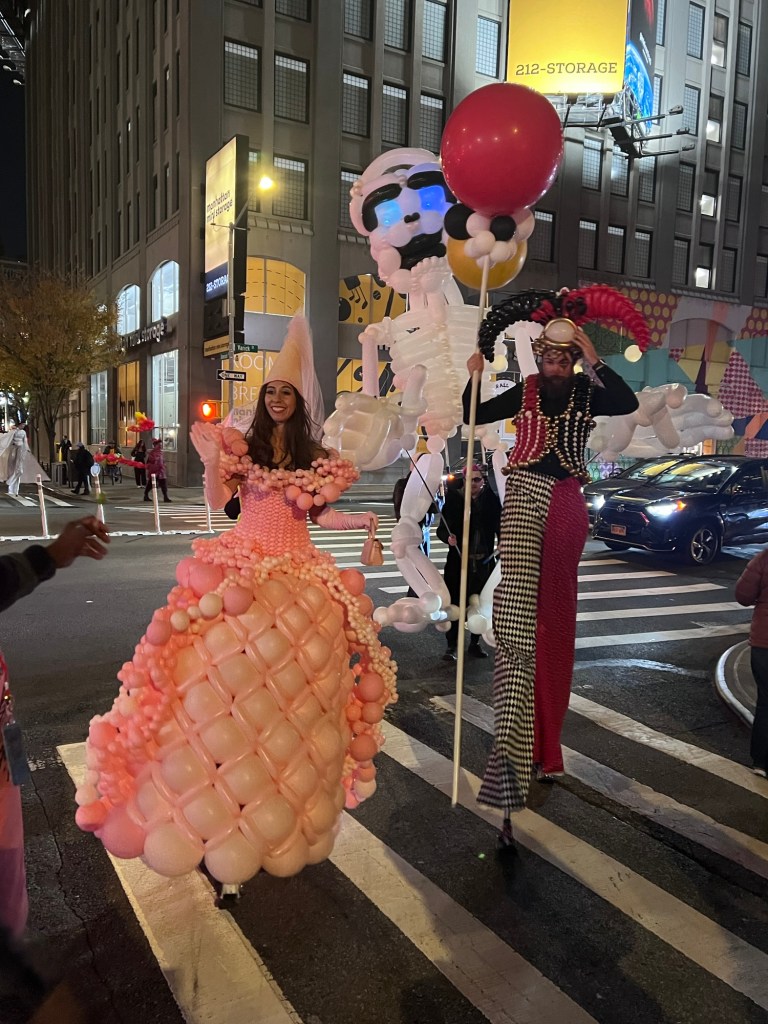
The Good Witch with the balloon creatures

The Good Witch with the insect
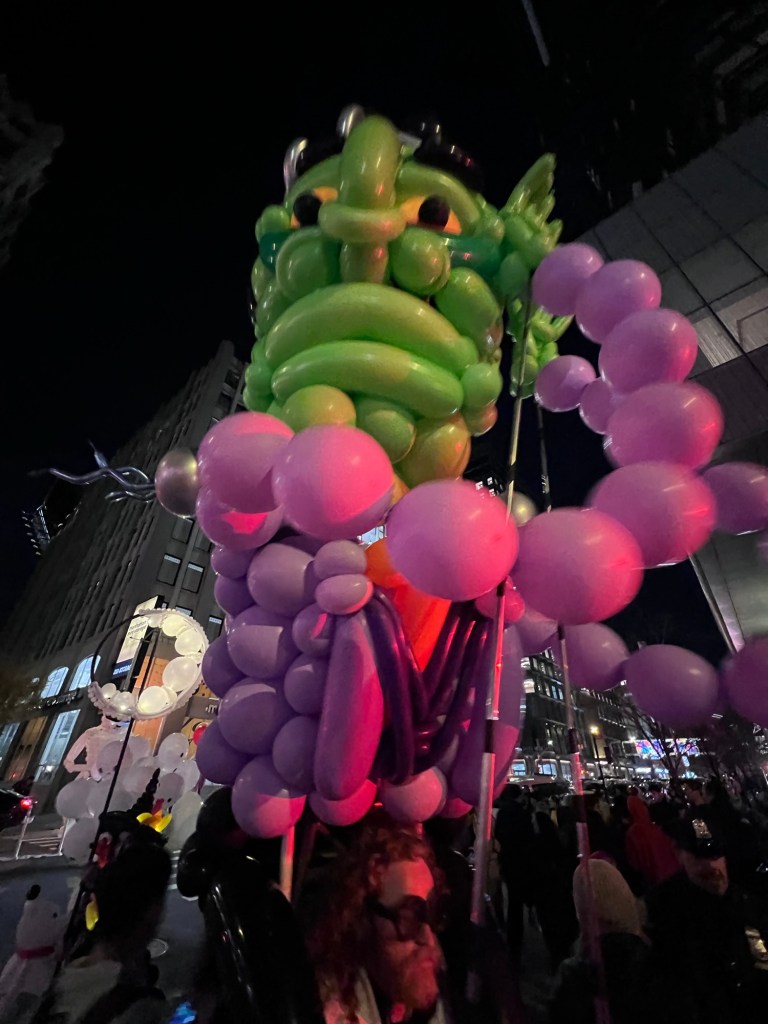
Even Frankenstein joined the parade

Moon creatures joined this Witch of Darknes

Ghosts and ghouls with balloons
Then the parade start was getting closer between 5:30pm and 7:00pm, it got crazy at the gate and people tried every which way to get into the gate. I kept and to talk and finally yelling at people to keep it organized. I swear I have never seen adults act like little children. We have more people try to sneak through the gate with every excuse. I have learned to put my foot down and it is by pass only.
Then the golden hour of 7:00pm came and the parade started. As the floats were heading uptown, people were still scrambling, trying to get in. At 8:00pm, this woman walks up to the gate one hour into the parade and tells me she was here as a volunteer. I told her we were closed at that point and have a nice night and see her next year. It amazes me how people use excuses to get in.

Watching the parade from inside
We finally closed the gate at 8:30pm and the police took over security from there. I was able to walk in and watch where the parade begins. It is always interesting to see how the parade works and how this organized.

Watching the parade progress uptown from the sidelines
The chutes where the floats come out combined with the number of costumed people is carefully done and I have never seen so many people marching in the parade. Later on, someone told me the police were turning people away because too many people were showing up.
The parade from Dominick Street heading uptown
I could not believe how crazy it got in the park as the parade progressed. I have to give the guys who are the volunteers who coordinate the parade so much create. They do an amazing job. They really are worth their weight in gold.

More of the floats heading uptown
The video shows the true magic that goes into the parade from behind the scenes

The last of the floats heading uptown
The last of the floats start to head uptown by 9:00pm and after that, it is all costumed people, not just New Yorkers but people from all over the world who had come to walk our unique parade.

People walking uptown in full drag

The weather cooperated and their was an over flow of people marching and enjoying the parade
The costumers enjoying themselves

I loved the creativity of the costumes
The last of the floats heading uptown

I loved these costumes. The headless guy was pretty gruesome

A better look at the headless Spector

The last of the floats heading uptown
The last of the floats starting uptown before the costumers took over
I left the parade route and walked through the parade to get to at least 8th Street before I veered off on to Seventh Avenue. I walked uptown to join some of the volunteers after the parade for dinner.

Walking through the Village and looking at the decorated windows and homes

Some of the private homes are so beautifully decorated in Greenwich Village

Another great decorated home in Greenwich Village

The West Elm right next to the restaurant on West 12th street
I am sorry but to decorate your store to the hilt on Halloween night is really rushing the holidays. They did this the year before as well. Who ever heard of looking at a Christmas tree on Halloween night?

Still the store looked gorgeous and their visual people did a marvelous job
It was nice to sit down to dinner that night. I was starved rushing from work to the City and then to the parade route. I did not get to eat anything and was famished.

Joining friends for dinner at Da Umbertos at 107 West 17th Street
My review on TripAdvisor:
It was nice to meet some of my counterparts and swap stories about the parade.

Meeting with friends for dinner that night

The restaurant had a wonderful buffet that evening

The Penne Vodka and Sautéed Shrimp were wonderful

The dinner I enjoyed was wonderful
After dinner and some wonderful conversation, I said my goodbyes. I had been going strong since 4:30am that morning and was beginning to run out of steam. I just wanted to head home and go to bed.
I decide to walk back to the Port Authority from the restaurant since it was such a beautiful night. The weather really cooperated and it was a crisp and beautiful night.

Even the Empire State Building was decorated for the holiday
I was lucky that I walk fast. I made the 11:50pm bus out of Manhattan and got home by 12:30am. It had been a long night. The night was still young and I still did not see the spirits of the night except parading up Sixth Avenue.
Even when I reached Hasbrouck Heights, the decorations were still up and lit. It was nice to see that holiday spirit strong in town.

The houses were still lit and decorated when I got home

Residents love to decorate their homes in Hasbrouck Heights

It always amazes me of homeowners creativity
Post Halloween:
There were still traces of Halloween even after the holidays. Stores and homeowners kept their displays up but the lure of Christmas and the warm weekend meant that people started to take things down so the Christmas declarations could go up.
I went down to Mill’s Bakery to check out their Halloween treats and there was still some things left. The sweetest things were available in all the bakery cases.

The front of Mill’s Bakery at 275 Valley Boulevard in Wood Ridge, NJ
My review on TripAdvisor:
My review on DiningonaShoeStringinNYC@Wordpress.com:

I loved the festive Frankenstein cake. Talk about creative!

The festive and creative cupcakes

The fun loving cupcakes

I loved the Halloween cookies and a little pricy at $5.00 each but were well worth it. I bought a few for snacks.

The mummy cookie was so good!

So was the Pumpkin

The ghost was good too!

Mill’s Bakery does such a good job at any holiday
I took my cookies and went back to Downtown Hasbrouck Heights to tour the window paintings from the contest a week earlier. The sweetness of the cookies gave me a sugar rush.

Walking in Downtown Hasbrouck Heights for the Halloween holidays
Downtown Hasbrouck Heights was still decorated for the Halloween holidays with festive window displays and the kids window paintings from the recent Window Painting contest.

Some of the window painting downtown

These kids are so creative
The weekend of Halloween (Halloween fell on Friday night this year), I took my best friend, Maricel to the “Pumpkin Blaze” on Croton on the Hudson, NY. I go to this annual event as part of my membership to Historical Hudson Valley. I love walking through the old Van Cortlandt Estate and seeing the creativity of the carvings and displays.

The entrance to the Pumpkin Blaze
https://www.instagram.com/pumpkinblaze/?hl=en
We started off early and had dinner at one of my favorite Chinese restaurants that I feature on my blog, DiningonaShoeStringinNYC@Wordpress.com, Dong Happy Gardens at 440 South Riverside Avenue in the ShopRite Mall. The food and service are excellent and the family who run it are really nice.

https://hudsonvalley.org/explore-area/listing/listing/dong-happy-garden
https://donghappygarden.restaurants-us.com/menu#google_vignette
My review on TripAdvisor:
My review on DiningonaShoeStringinNYC@Wordpress.com:
I love the food here. It is white tablecloth quality for a small take out place in a strip mall.
I had the Orange Chicken with Pork Fried Rice and an egg roll and Maricel had the same with but with Barbecue Spareribs. I can’t tell you how wonderful the food is in this tiny take out place but you have to try it for yourself. I have never had a bad meal here.

The Orange Flavored Chicken with Pork Fried Rice is excellent
Then we shared some Panfried Pork Dumplings. They really hit the spot on a cool night.

The Panfried Dumplings were a nice addition to dinner
Dinner was a chance for us to catch up and talk. So much has been happening in our lives and we never get a chance to talk.
After dinner, we headed over to the ‘Blaze’ and then the fun began. The parking lot was packed with people and the weather really cooperated. It was cool but not cold and walking through the pathways was nicer than we thought.

The Spider display

A close up shot of the spider

Maricel in front of the rainbow flag that was on display at the entrance of the displays
We started our tour through the Blaze walking through the rows of pumpkin carvings. I noticed there were less of them this year than in years in the past. Still there was some interesting pumpkins.

The first row of carvings I thought were interesting

An interesting face

Another interesting face

The Haunted Pumpkin Windmill

Frog swimmer

The Pumpkin Octopus

Visiting the Hudson River Sites

Pumpkin sling shot

Me in front of the Statue of Liberty sculpture

The Statue of Liberty sculpture

Walking through the Light Tunnel

Maricel and I in the Tunnel of Lights
This is the experience you get when you walk through the Tunnel of Lights
Then we reached the Van Cortlandt Manor, home to the Van Cortlandt family. The house had been closed for years for touring since the renovation but been open for the Blaze.
The cemetery was moved from here to earlier in the tour with a Circus in its place.

The ‘Under the Big Top‘ pumpkin sculpture

The beauty of the Van Courtlandt Manor at night

The Wonderful Lightshow at the manor house
We then toured the amusement area. The Merry Go Round with its eerie sounds and glowing pumpkins made it foreboding.

The eerie Merry Go Round
The Merry Go Round

Maricel though it would be more cheerful with a picture of me
We then looked over the Halloween Circus train that passed us by. I loved looking at all the Circus animals.

The Haunted Circus Train
My video of the Circus Train
We then walked through the end of the display with all sorts of ghosts and ghouls that included a Pumpkin man and the Headless Horsemen.

The Headless Horseman

Chasing poor Ichabod Crane

The evil Pumpkin man showed himself towards the end of the tour

The end of the tour looking back at the lights and displays. There were all sorts of lit pumpkins as we exited the tour.

This was my favorite

Me at the end of the Pumpkin Blaze with one of the flying monkey’s behind me.
It may have been a Halloween with less activities and far less running around but it was far better than my years of Trick of Treating as a kid! Yuck!
Happy Halloween everyone! Until next year!

Boo!

The eerie evening and holiday had now passed
Happy Halloween! Here comes Christmas…….















 mywalkinmanhattan