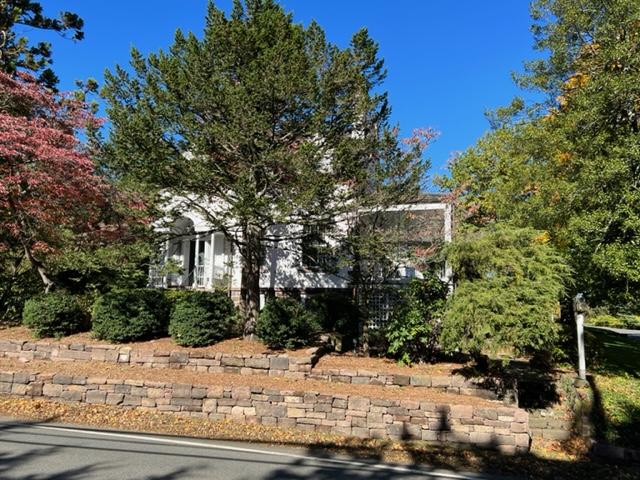
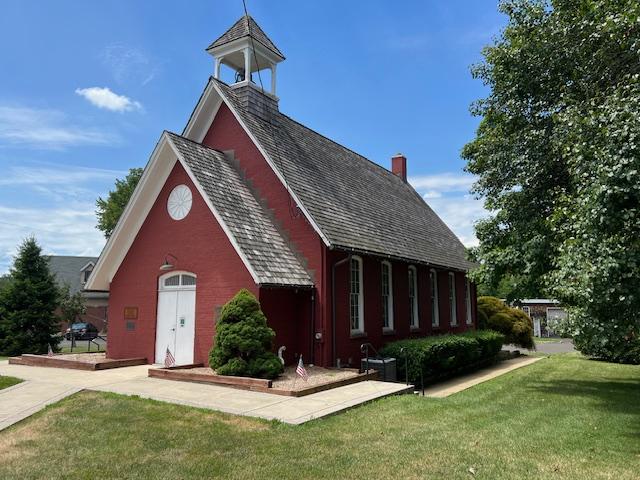
I visited the “Little Red Schoolhouse” Museum in Florham Park as part of the Morris County’s “Pathways to History” event that is held every May. This interesting little museum showcases the town’s historical collection of items from the 1800’s and 1900’s dealing with all aspects of town life.
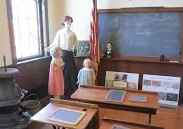
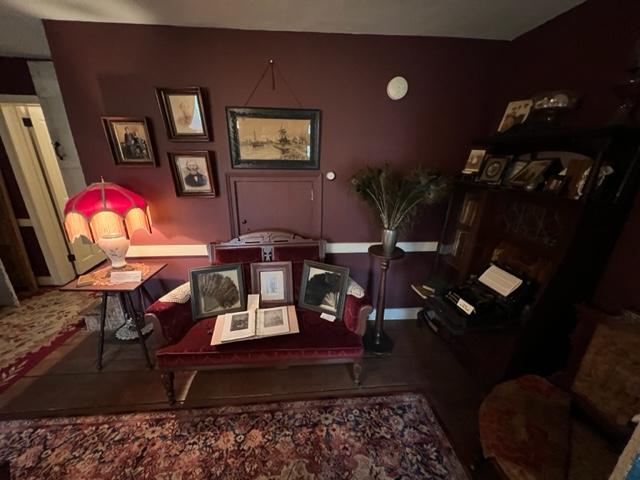
The inside of the museum schoolhouse display
The inside of the old classroom
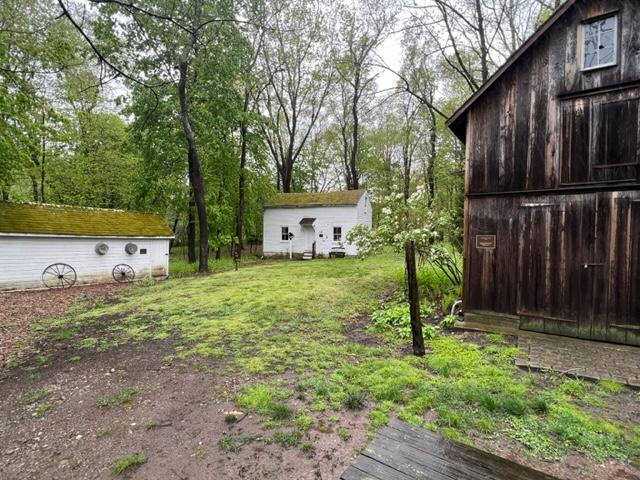
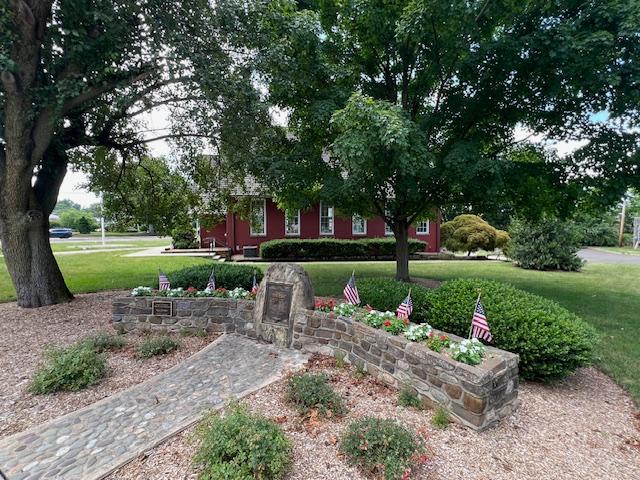
The schoolhouse setting
In the back there is a small classroom set up keeping with the theme of the building. This lets students who are visiting the building of their counterpart’s early education with desks, ink wells and chalk boards that have not changed that much over the years.
Not much has changed in the modern classroom over the years
The old schoolhouse desks
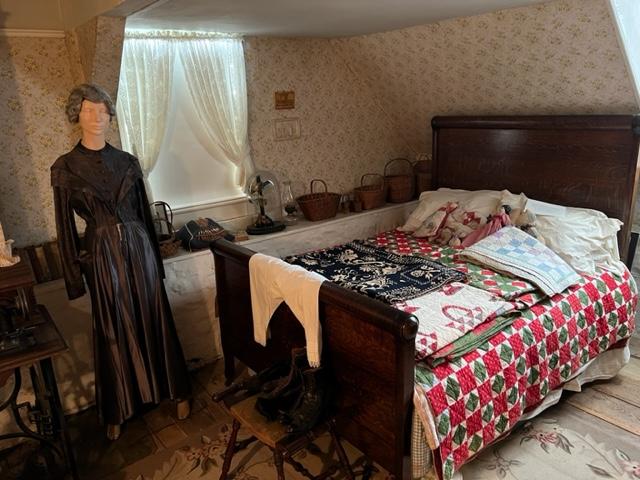
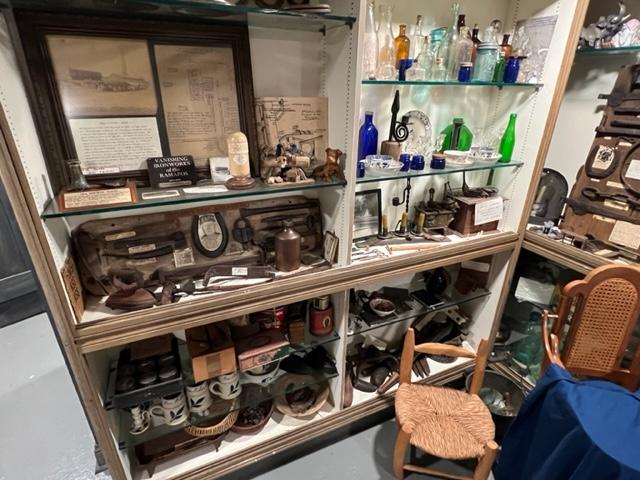
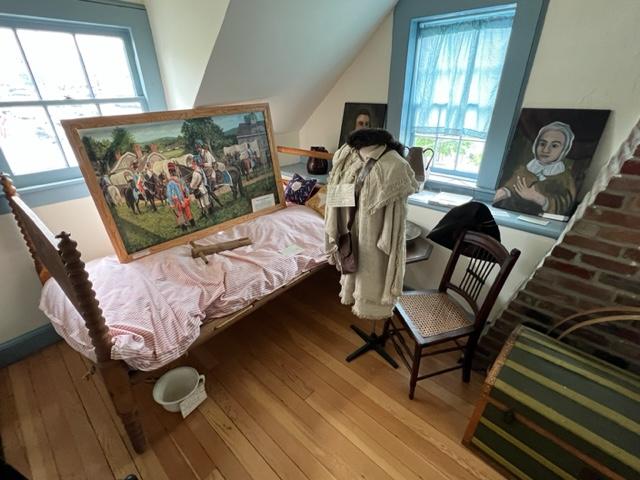
There is early century clothing, farming equipment from the town’s farming past and event Native American objects found in the town and in private collections.
The town artifacts and school items
The post
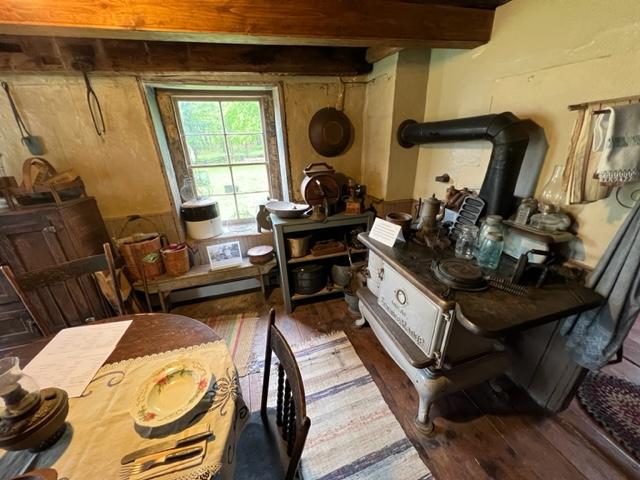
Other items included decorative items from the home including dishware, home products and furnishings.
Each section of the museum is divided up by lifestyle.
The docents that day explained that the items were reflect the town’s past and some came from families that have been in town for years. The museum reflects the community spirit of town’s past. It explains that times have progressed but not changed too much over the years.
In 1830, the residents of Columbia, now Florham Park, sought to improve their thriving farming and broom-making community by establishing a public school for the local children. Therefore, a small schoolhouse, Columbia School #5, was built on the corner of Columbia Turnpike and Ridgedale Avenue and dedicated it on February 17th, 1831.
The schoolroom display
Schooling at the “little red frame building” prospered and so by the 1850’s, the building was “in condition of dilapidation rendering it unfit to be occupied” due to overcrowding.
On March 1st, 1867, nearly 50 children attended their first class in a new one-room brick schoolhouse. The use of brick added prestige but great expense to the project, accounting for nearly half of the budget. The new building was designed based on principles found in Henry Barnard’s book, “School House Architecture.
Much like Thomas Kirkbride’s progressive hospital designs (illustrated locally at Greystone Park Psychiatric Hospital), Barnard’s method School attendance continued to grow and by 1914, a four-room annex building, which could accommodate 78 students was built on the school’s property and the earlier brick building served as an auditorium.
The inside of the schoolhouse
Eventually, the community outgrew both buildings and in 1934, the borough’s current middle school was constructed.
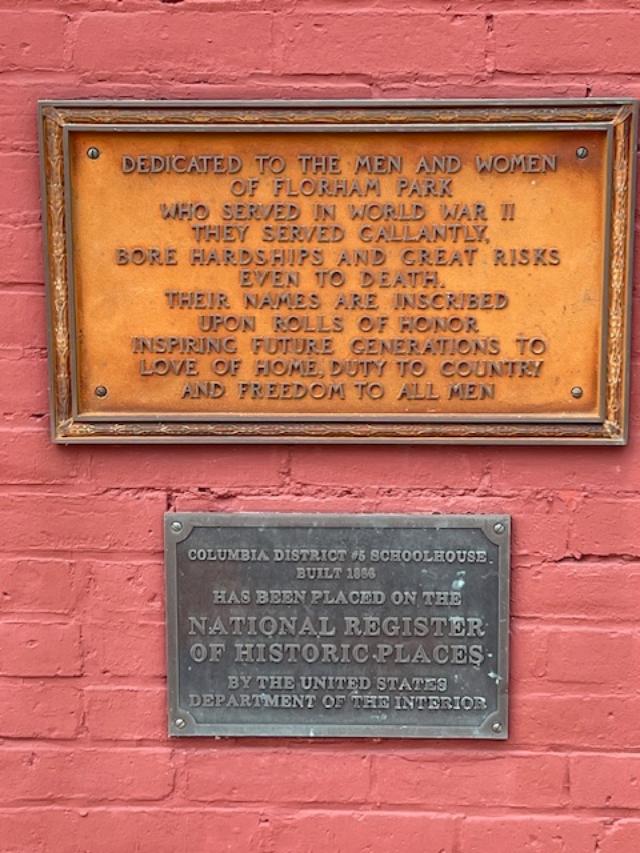
Founded in the 1930’s to preserve the “Little Red Schoolhouse”, the Historical Society of Florham Park now operates the building as a museum. A source of great pride for the local community, the building stands in nearly the same location on the corner of Columbia Turnpike and Ridgedale Avenue, although moved back to accommodate the expansion of Columbia Turnpike. Listed on the NJ and National Registers of Historic Places since the early 1970’s, today the building serves as a reminder of the community’s rural roots.
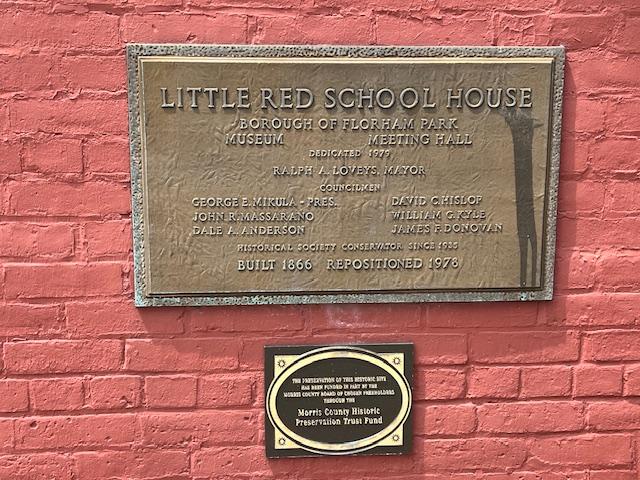
The “Little Red Schoolhouse” Museum historic plaques
(From the Morris County site):
The Little Red Schoolhouse & Museum:
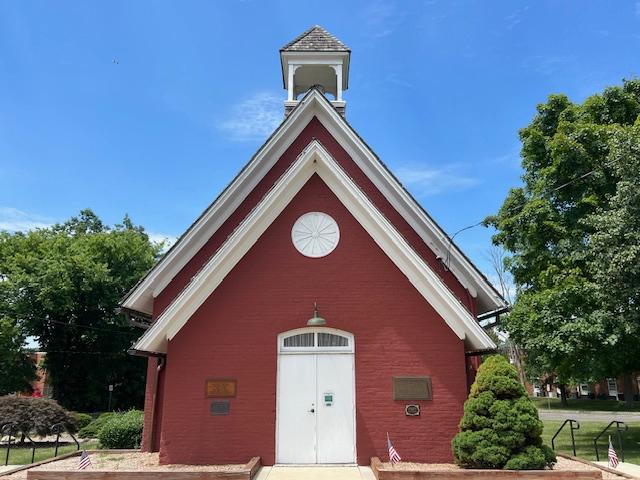
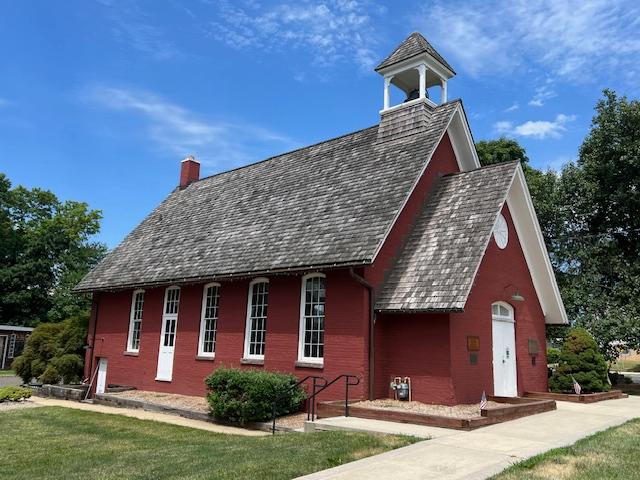
Florham’s Park’s iconic Little Red Schoolhouse was built in 1866 at a cost $2,250. Its open belfry and gable-end entrance instantly identify it as a typical 19th century one-room schoolhouse. The Italianate one-story narrow red brick masonry building is an architectural marvel with its steep roof, tall windows and elaborate arches.
Inside, part of the museum is set up as a 19th century classroom, where small groups can enjoy a lecture. The museum has a variety of artifacts from the 1800’s and 1900’s, vintage school desks and broom-making equipment. Its location at the historic crossroads of Florham Park has remained a key reminder of the borough’s rural origins. The schoolhouse is a stop each fall on the free “Pathways of History” event (which I was on that day I visited).
Town artifacts on display
The school organ on display
Of Special Note:
(from the township website)
*In 1978, the schoolhouse was moved back several yards to accommodate the expanded Columbia Turnpike.
*The schoolhouse is also known as Columbia School District Number 5 Schoolhouse.
*The schoolhouse is the borough’s icon, appearing on the town flag, letter head, website and public works and first responder vehicles.
I visited the “Little Red Schoolhouse” Museum in Florham Park as part of the Morris County’s “Pathways to History” event that is held every May. This interesting little museum showcases the town’s historical collection of items from the 1800’s and 1900’s dealing with all aspects of town life.
In the back there is a small classroom set up keeping with the theme of the building. This lets students who are visiting the building of their counterpart’s early education with desks, ink wells and chalk boards that have not changed that much over the years.
Not much has changed in the modern classroom over the years
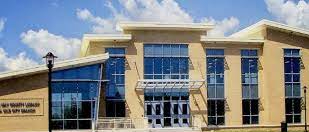
The Sea Isle City Historical Museum is located inside the Sea Isle Library at 4800 Central Avenue just off Downtown Sea Isle City, NJ
On a recent trip of touring the small towns of the Jersey shore, I set out to visiting many of the historical societies that tell the histories of these towns and how they have progressed from small Native American fishing villages to the resort and residential towns of today. Each of these museum has their own unique focus to how they tell their story.
The entrance of the museum from the hallway of the library
The Sea Isle City Historical Museum at 4800 Central Avenue is located in the back of the Municipal Building right next to the Sea Isle City Library. This small museum that is manned by volunteers is packed with local historical artifacts, pictures and exhibitions of the items in the museum. You have to walk to the back of the building to find the museum just off the library entrance.
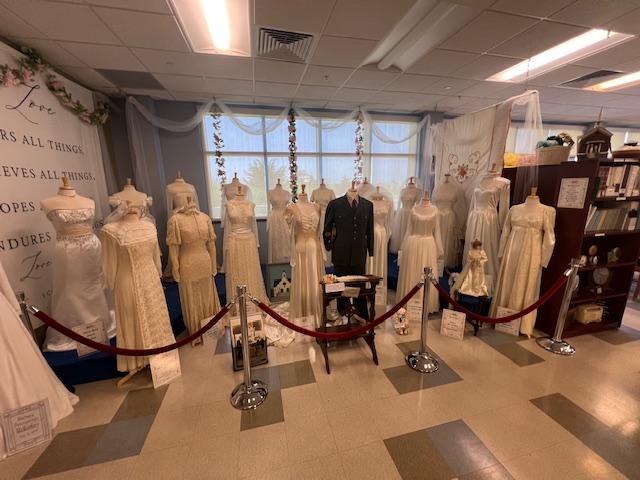
When you walk into the museum, you are greeted by an exhibition of ‘Wedding Dresses through the Ages’, created by curator the late Marie Thompson Stafford, which shows various styles of wedding dresses from 1880 until current day that were worn by brides from Sea Isle City, NJ. Each dress was accompanied in most cases by the owner on her wedding day and gives a unique view of the changing of styles over the last century.
The back part of the museum is broken down into sections. Part of the museum is an on-going library of the history of the families have lived in town over the generations. What I thought was interesting about this was that each family had their own notebook binder to contribute family history and pictures of the family events. They could update their notebook by coming into the Historical Society and personally adding to the book. There have been 30 years of donations to the museum according to the volunteers.
The family history binders and the hat collection of the museum
There were also shelves of books on the Sea Isle City School district, the fire department, the police department and the Municipal departments of the town. These featured old pictures of the departments, artifacts over the years and documents of what happened in the town.
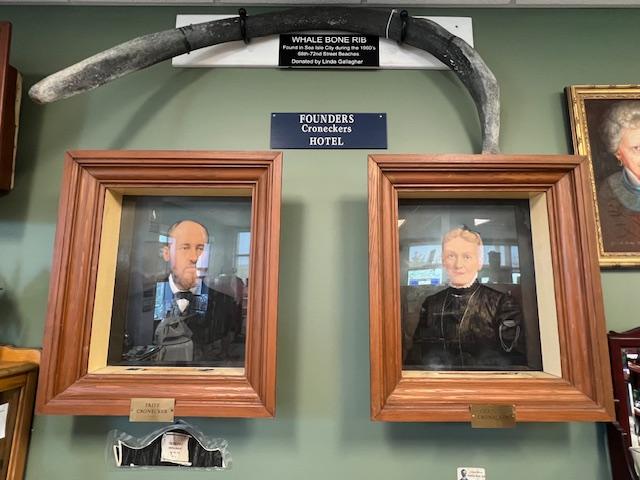
There was a section on the old hotels and restaurants of Sea Isle City at the turn of the last century until today. Various clapboard Victorian hotels used to line the shores here but many had succumbed to either fires or beach erosion. Several of the old restaurants like Cronecker’s Restaurant had just closed over time.
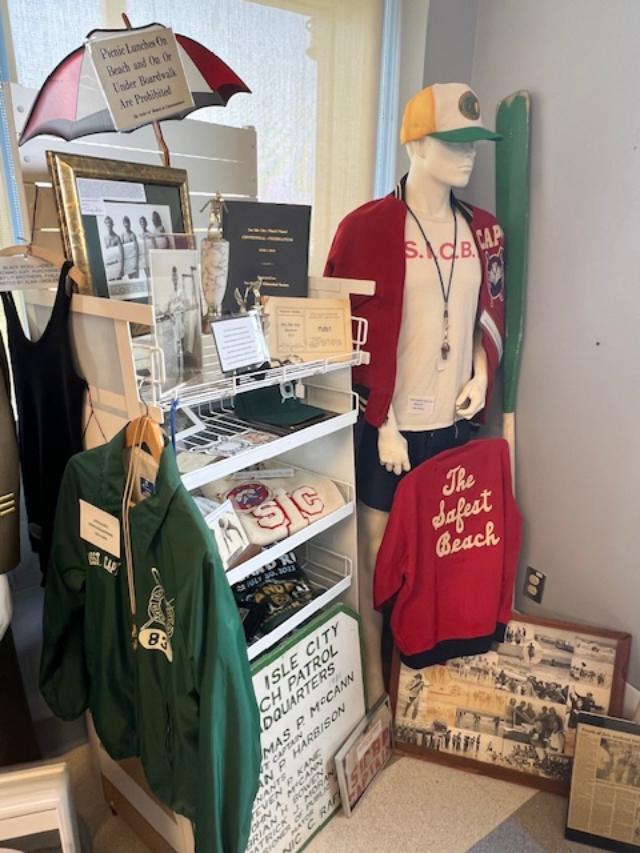
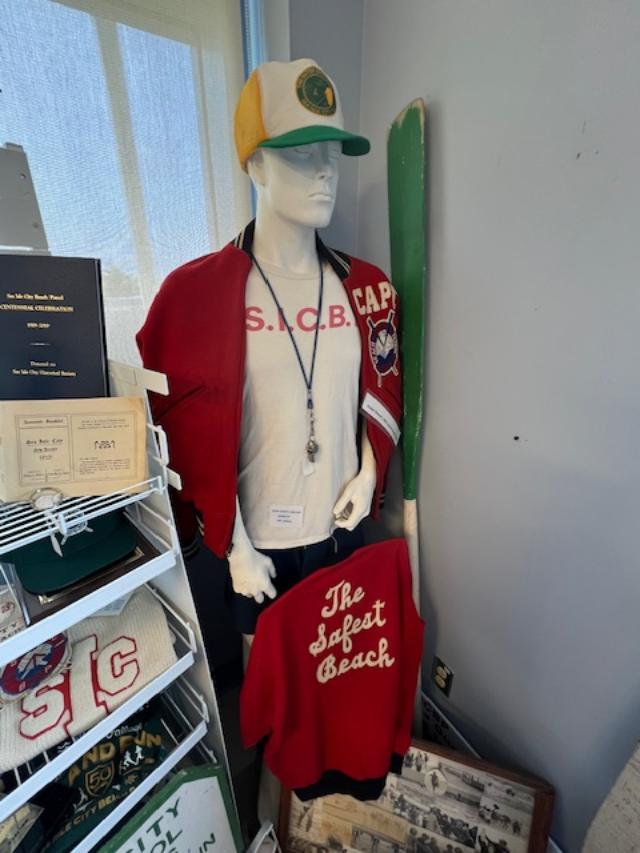
There was an interesting exhibition on the Sea Isle City Beach Patrol and the members who made up the squad. This is a very important part of the culture of the shore towns and their competitions are a very big deal. You can see the bragging rights of the towns over decades of summers. These lifeguards take their jobs very seriously.
Another exhibition was the “Armed Forces in Sea Isle City” and the EMS Armed Patrol. This small exhibition showed the uniforms and items used by the squads who lived in Sea Isle City. It showed the contributions of a small town.
In one corner, there was a display of kitchen wares from the turn of the last century featuring all sorts of kitchen gadgets, an old oven and stove and various household items like an old washing machine that show how things have changed over the year but not by much. We have just modernized what was once considered old.
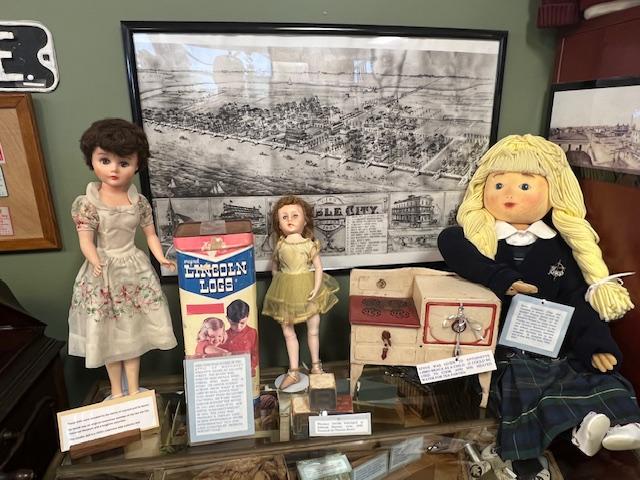
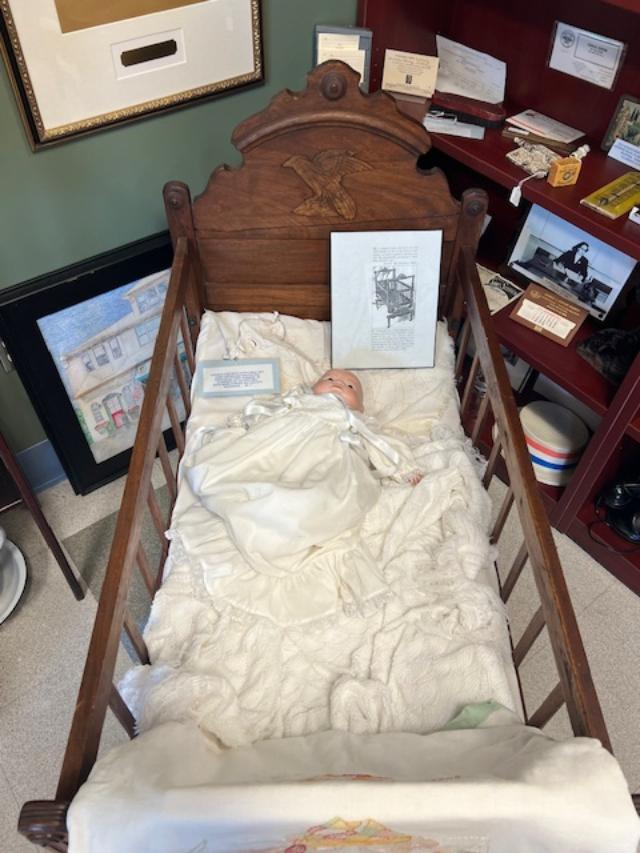
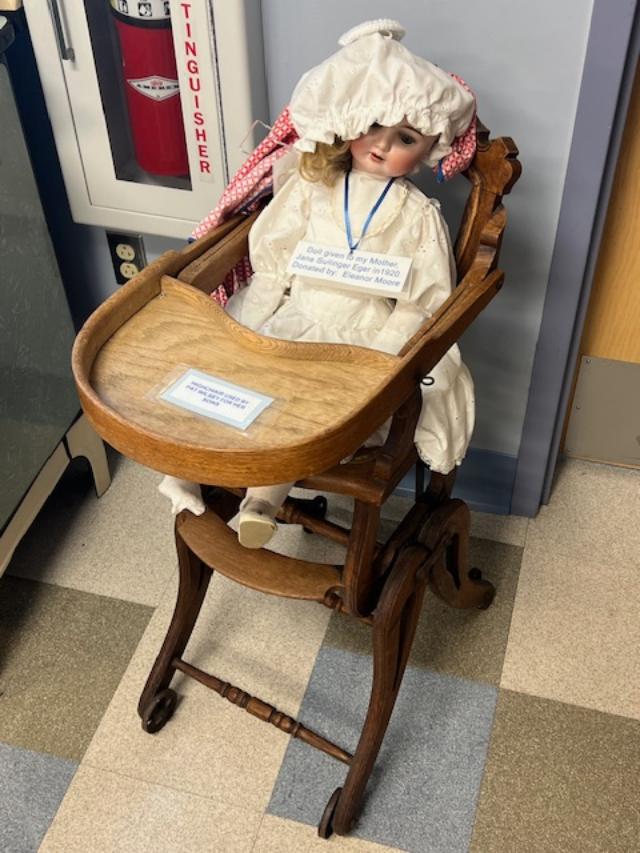
There was an interesting exhibition on Toys through time with all sorts of games, books and dolls that children used up until the 1960’s. It still resonates with me the idea of ‘creative play’ when I see these old dolls and how mature they looked. The board games also challenged the mind the way no cellphone will to a young person.
The last exhibit I looked at was the town history of Sea Isle City by founder Charles K Landis, who the main street of the town is named after who helped create the town in 1882. He also founded Vineland, NJ. This was a small display of pictures and artifacts of the early settlement.
The 1924 Bathing Beauty Contest reminded me of the last scene of ‘The Shining’
Outside the museum is a protected area for the Diamondback Terrapin Turtle as their Nesting Grounds. According to one of the docents, they breed during the Spring and lay their eggs by the shore so the area has to be protected from humans and other wild animals.
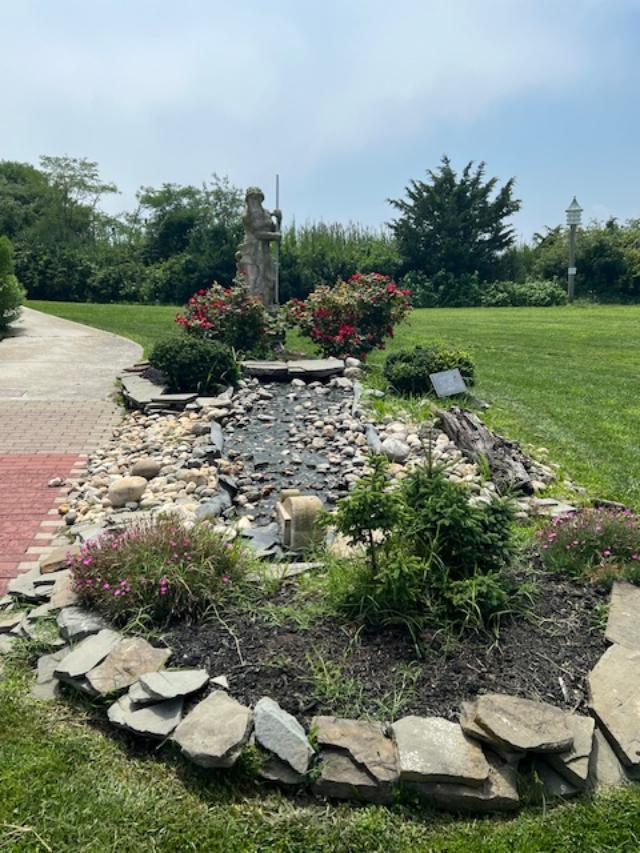
Also outside to the side of the building is the Memorial Garden with its seasonal plantings, small waterfall and statue of Neptune. The Garden is located adjacent to the Historical Museum and offers a quiet and relaxing place to enjoy the natural area that surrounds it. You can purchase a paver to help support the museum and to proudly display your family or loved one’s name on our “Memory Lane Walkway”.
This wonderful little gem of museum is open during the week and is free to the public. They are always docents and volunteers around to answer questions.
History of the Sea Isle Historical Society:
(from the Sea Isle City Historical Museum website)
In 1982, Sea Isle City celebrated the 100th Anniversary of its founding, an occasion which led to the creation of the Sea Isle City Historical Society and Museum. The museum formally opened on January 26th, 1983 in a temporary space in the city public school and moved 17 months later to a building behind the former City Hall. Harriet Reardon Bailey was elected first president and also served as its Curator for thirty years.
One of the stained glass windows from a local church
In 1990, Michael Stafford was elected President. Mike guided the museum through its next 25 years of growth and recognition in the community, resulting in the many displays and programs described throughout the website. The museum moved to larger quarters at 4208 Landis Avenue in 1995 and subsequently in 2011 to its present modern facility as part of the Sea Isle City Library building. Since his retirement in 2014, Mike Stafford has been succeeded by Mike McHale and then by our current President, Abby Powell.
One of the stained glass windows from a local church in the Judeo-Christian theme
Our Facility:
The museum is designed with an open floor plan to allow easy access as you move from exhibit to exhibit. We also provide an area to sit and conduct research, take notes or simply browse through our many articles, books and thousands of photographs. The museum features a unique bridal gown display, more than 200 family albums generated by the families themselves as well as an abundance of artifacts related to Sea Isle and the surrounding area.
Our Mission:
To acquire, preserve, display, celebrate and promote archives and artifacts relevant to the development of our unique cultural heritage and to delight, inspire and educate present and future generations about the story of Sea Isle City, NJ. The Sea Isle City Historical Society and Museum is a certified 501C3 nonprofit organization.
Our Vision:
To be an inviting, informative, educational and innovative community resource that is recognized and respected as the place for exploring and celebrating the rich cultural heritage of Sea Isle City and the surrounding areas.
The Memorial Garden began many years ago at the Pfeiffer’s home in Sea Isle City. In 1996, existing memorial pavers and the statue of Neptune were installed in the Sea Isle City Historical Museum’s Memorial Garden at 4208 Landis Avenue. A formal dedication of the garden tool place on July 8, 2001. In 2001, the Memorial Garden received the coveted Sea Isle Beautification Award.
On August 4, 2012, the garden was dedicated at its new museum home at 4800 Central Avenue. Today, a project is nearly completed to enhance the garden with new landscaping, a diamondback turtle protection station and an active water feature which represents the flow of Sea Isle’s history from the past, to the present and onto the future.
On April 27th, 2016, the enhanced Memorial garden was formally dedicated to or past President, Mike Stafford and his late wife, Marie, both of whom did so much to nurture and grow the Historical Museum to what it is today.
The Sea Isle City Museum is located inside the Sea Isle Library at 4800 Central Avenue just off Downtown Sea Isle City, NJ
On a recent trip of touring the small towns of the Jersey shore, I set out to visiting many of the historical societies that tell the histories of these towns and how they have progressed from small Native American fishing villages to the resort and residential towns of today. Each of these museum has their own unique focus to how they tell their story.
The Sea Isle City Museum at 4800 Central Avenue is located in the back of the Municipal Building right next to the Sea Isle City Library. This small museum that is manned by volunteers is packed with local historical artifacts, pictures and exhibitions…
Exploring Boonton, NJ is an ongoing Downtown project that I enjoy. As current President of the Bergen County Firemen’s Home Association, I go out to the home at least six times a year for meetings. Before I head to the home, I always like to stop in the Downtown and explore all the new businesses, restaurants and shops and see the changes going on. The first wave of art galleries that I had visited in 2017 has given way to a collection of unique boutiques and spas, new art galleries and a collection of interesting street art. Like most of the downtowns featured on this blog, Boonton just seems to be growing and changing all the time.
Working with the Bergen County Firemen’s Home Association at the NJ State Firemen’s Home in Boonton, NJ:
In August of 2021, it had been a tough summer. I pulled a muscle and it has been hard to do long walks around Manhattan so I kept it to short walks around my neighborhood. As I have improved, I have been able to get more done and have started to drive again. I was able to make the trip to Boonton, NJ for the Bergen County Firemen’s Home Association Barbecue.
The members of the Bergen County Firemen’s Home Association at their June 2024 barbecue.
So off I went adjusting the car seat higher with a pillow and an ice pack. It was a short trip with no traffic and the pain has now subsided with more walking. When I arrived at the home for the barbecue, I had to walk around the property to loosen up a bit. When I came back in 2023, 2024 and 2025 for our two barbecues, I felt so much better and was ready to go.
Still it was a marvelous day and the most beautiful weather sunny and clear and 72 degrees. The residents loved being outside to enjoy the fresh air, music and food and the members liked that we still could socially distance and converse with the residents outside as long as there were not too many gathering (we want to keep our retired firefighting brothers safe too). Please check out my blog on the August BCFHA Barbecue:
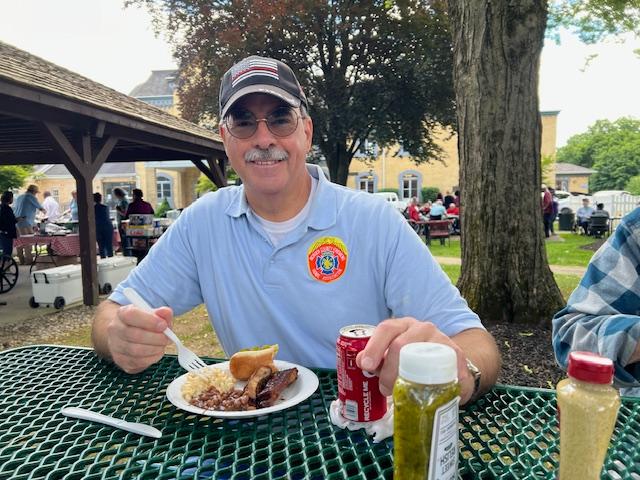
Me finally sitting down to lunch after serving everyone else
The Bergen County Firemen’s Home Association August Barbecue at the NJ Firemen’s Home August 15th, 2021:
After the barbecues were over, I decided to head back to Downtown Boonton to explore the downtown on a weekend and get some stretching for my legs and back in before the long ride home. Downtown Boonton, which has been discovered by the artists and hipsters is going through a major change as we speak. There is so much to see and do.
Since then, I have visited the downtown and watched it grow from a rather sleepy downtown to a destination with galleries, coffee shops, music venues, upscale stores and eclectic restaurants.
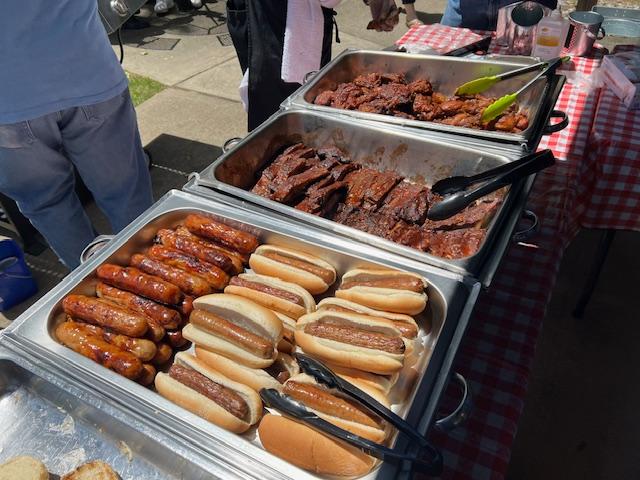
The barbecue feast was amazing at the June 2024 Barbecue
The members of the Bergen County Firemen’s Home Association at the 2025 Picnic with member George Steiger on his 102nd birthday
Our blog on the 2025 barbecues:
It started off as a gloomy and misty day for the Bergen County Fireman’s Association June Barbecue. The weather forecast for the week was for rain but we lucked out with conditions. There was a light rain with breaks between so that residents could come outside and enjoy lunch under the tents.
The grounds of the NJ State Firemen’s Home during the late Spring
With all the rain we had been having the grounds of the home looked so beautiful and lush. The flowers were all in full bloom and the gardens looked amazing.
The gardens and fountains the day of the barbecue. I thought the fire hydrant fountain was pretty good.
Under the direction of Chef Prince of the NJ State Firemen’s Home and our member, NJ Firemen’s Association President Bob Ordway, they cooked up a feast for the residents, their guests and members and families.
NJ State Firemen’s Association President and Bergen County Firemen’s Home Association member Bob Ordway manning the grill.
Chef Prince of the NJ State Firemen’s Home cooking up a storm.
The wonderful lunch that everyone enjoyed
Our entertainment that afternoon was singer Kelly Carpenter, who had entertained at many of our functions in the past. She sang popular show tunes, rock hits and country tunes.
Touring Downtown Boonton, NJ after events and on my own time:
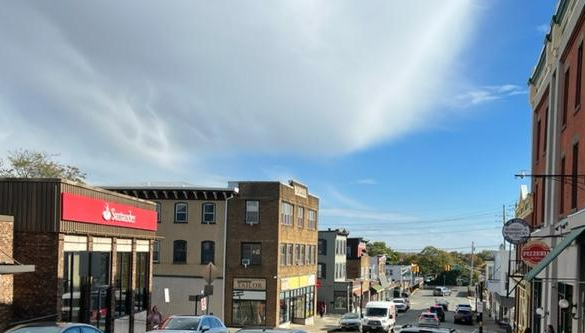
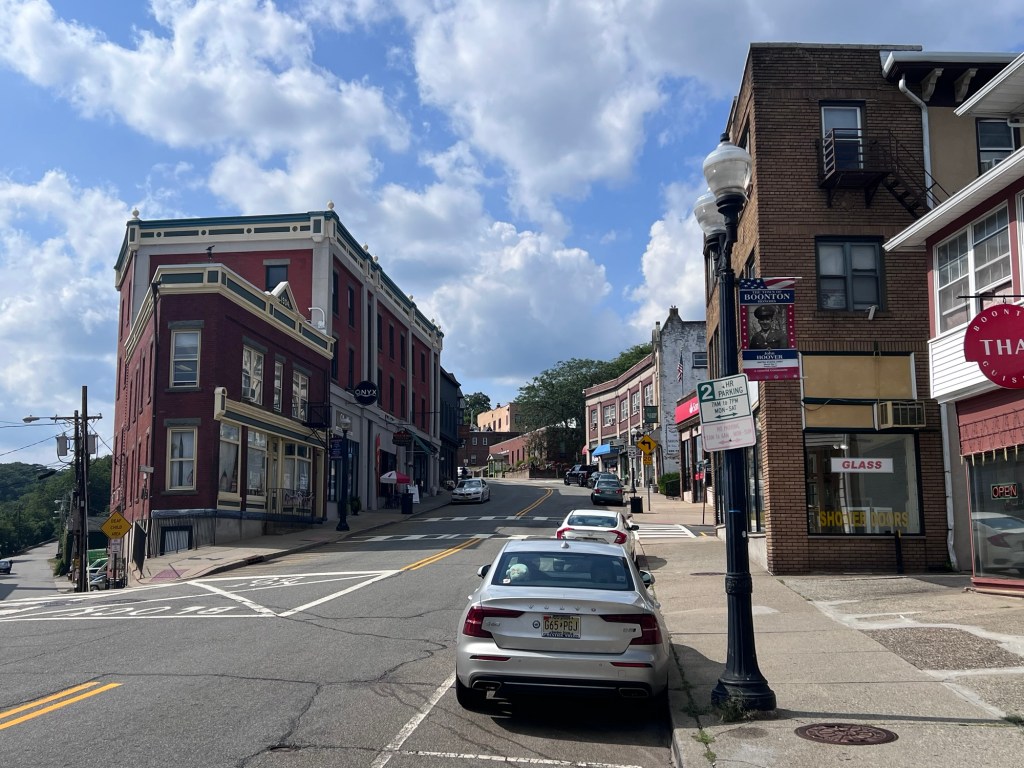
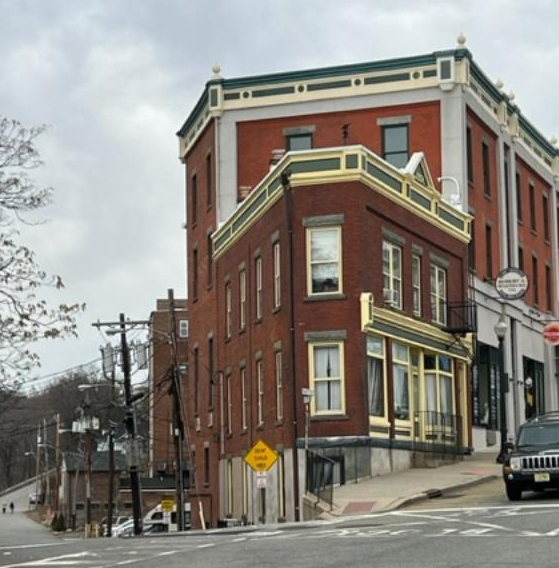
Downtown Boonton, New Jersey is showing a new rebirth from the local shops of the past to new restaurants, galleries and shops popping up all over the downtown. Known for the local ironworks that once made this a company town, somehow this small hamlet was discovered by artists and galleries have been popping up on the main street.
Downtown Boonton in Fall 2022
Downtown Boonton in the Summer of 2025
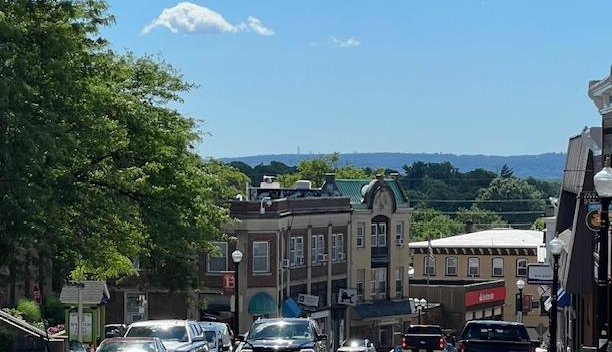
What I like about Boonton’s downtown is the diversity of old and new mixed together and that the main street is a sloped and curving so that you can see the remains of the iron works and the park below. The views of the mountains and trees lined valley’s are spectacular in the summer with swaths of green trees all over.
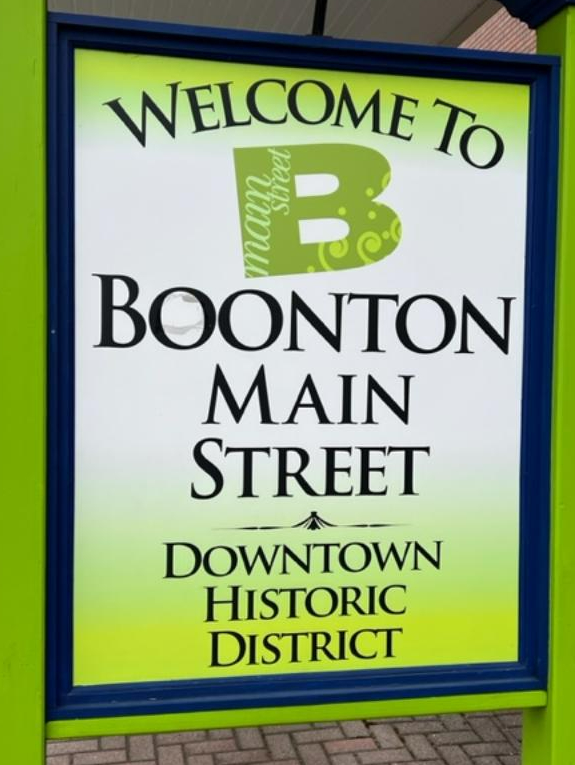
The entrance to the main part of Downtown Boonton and the historical district of downtown
Plank Road in Downtown Boonton leads to the historic district of the old Morris Canal and ironworks
I discovered Downtown Boonton by accident when I decided to drive around when I had time to spare before an event in 2021. I had read something about the Boonton Historical Society in a magazine (See my review on TripAdvisor and VisitingaMuseum.com). So I visited the Historical Society after our April meeting in 2019 and attending their Open House for Christmas. That was a nice event with docent tours, light refreshments and musical performances. Since then I have been back a few more times to explore the shopping district.
I have started many trips at the Boonton Historical Society located at 210 Main Street. This interesting little museum is a treasure trove of local history with displays on the history of the local Iron Works, the Trolley Car industry and its role in the development of transportation in the area and displays on the history of the local police, fire and local schools. There are also some interesting pictures of the changes in the downtown area. They also run great walking tours.
Boonton Historical Society at 210 Main Street at the Christmas Open House in 2022
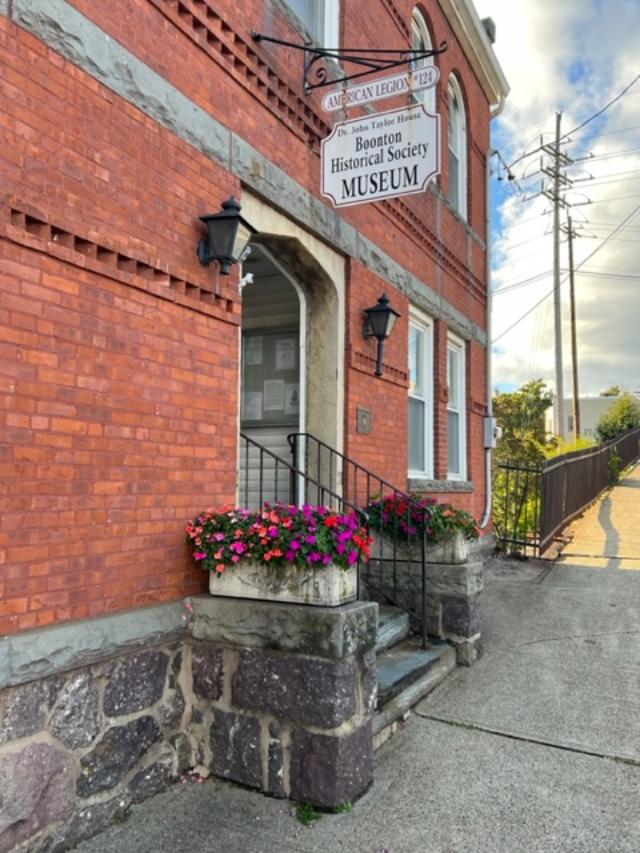
The Boonton Historical Society is the old Taylor House
I have visited the museum during both the 2019 and 2022 Christmas Open House which was an interesting afternoon of Docent tours of the museum’s Trolley and Railroad exhibition memorabilia and then a wonderful concert from a local musician with refreshments following. COVID had stopped this for two years and people were glad that it came back
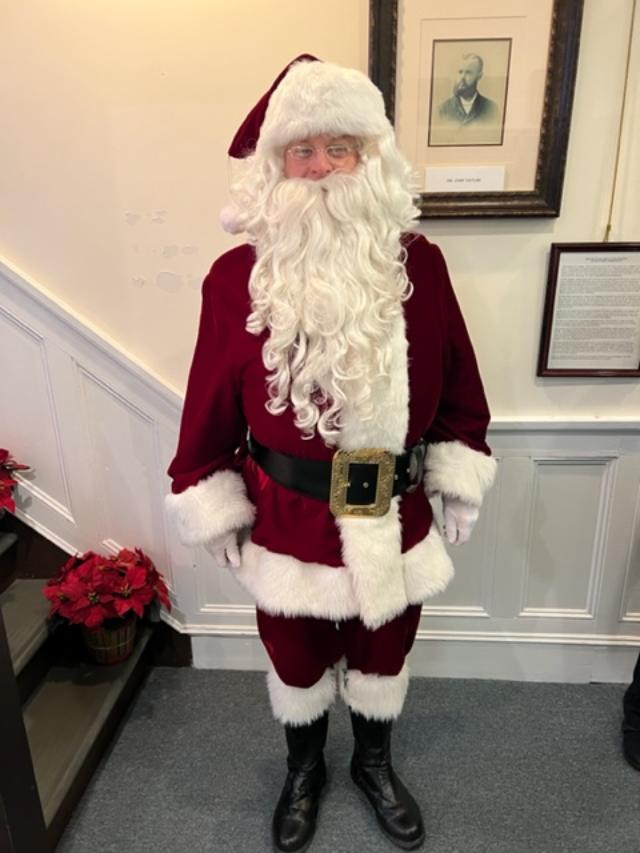
Santa arrived at the Boonton Historical Society
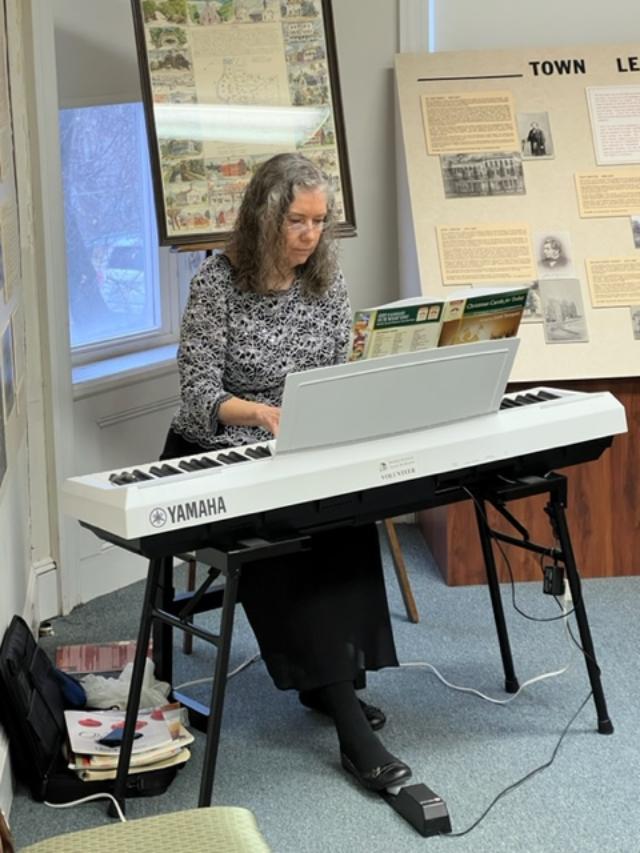
One of the Board members performed at the Christmas Open House in 2022
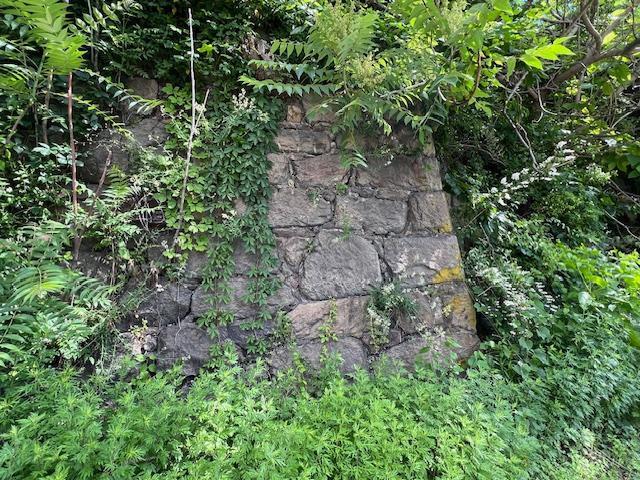
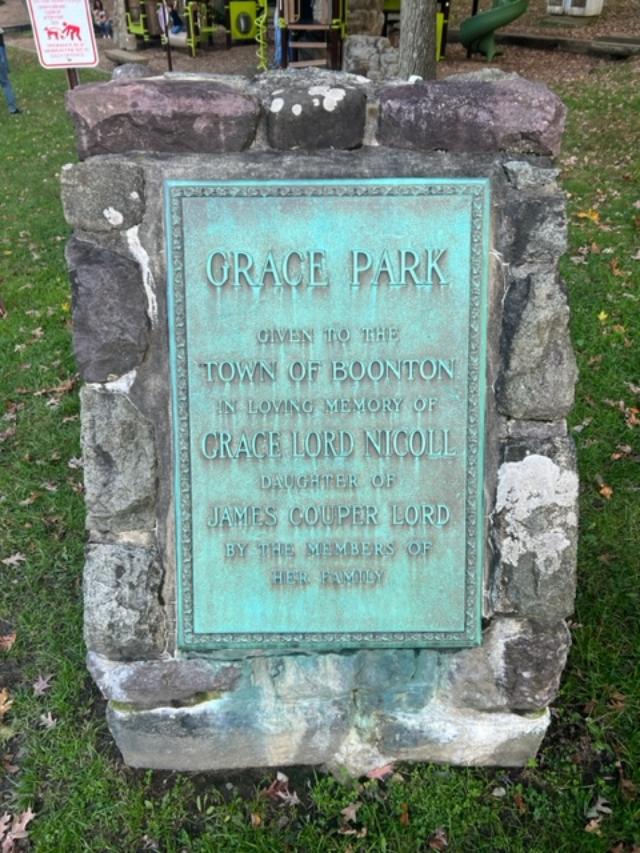
In the Summer of 2021, I took a walking tour of the old Iron Works factory with a local historian. We toured all the spots in Grace Lord Park that had been built up to support the factory along with ruins of the old structures of the complex. It was sad that these will be knocked down for a new condo complex (see my review on TripAdvisor and VisitingaMuseum.com).
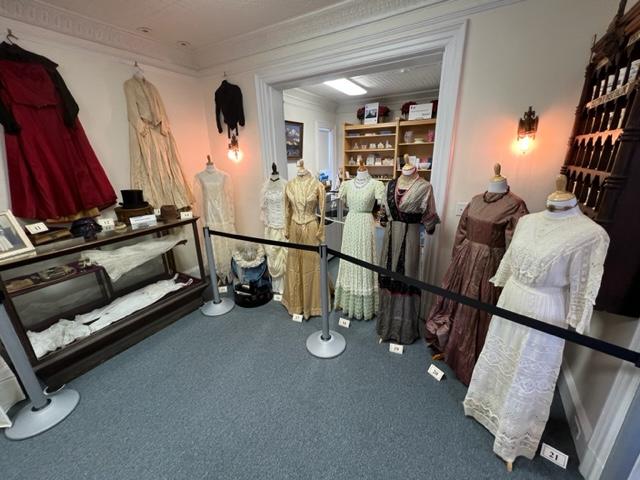
The inside of the Boonton Historical Society “Say Yes to the Dress” exhibition
The inside of the Boonton Historical Society “Small Business” exhibition
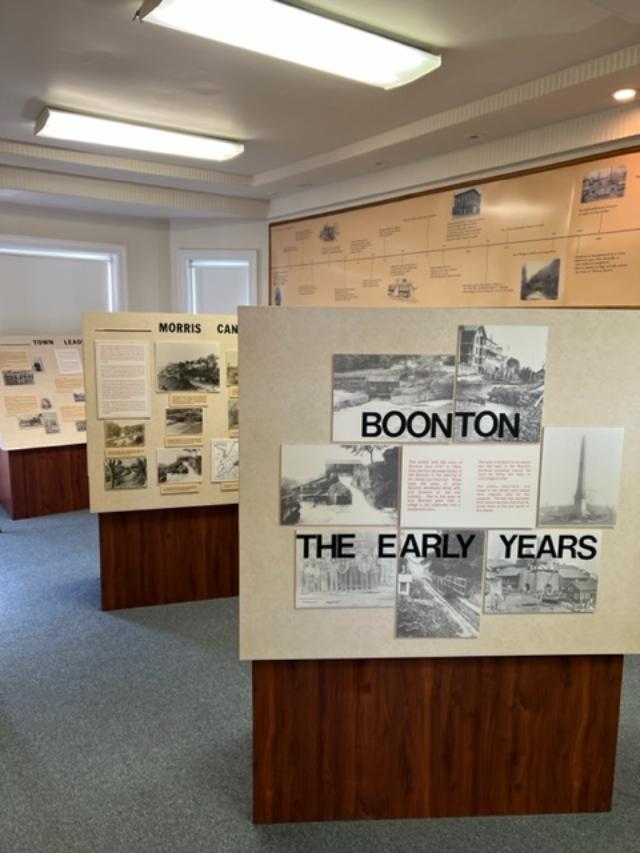
The historical section of the museum
Walking the Downtown in all seasons:
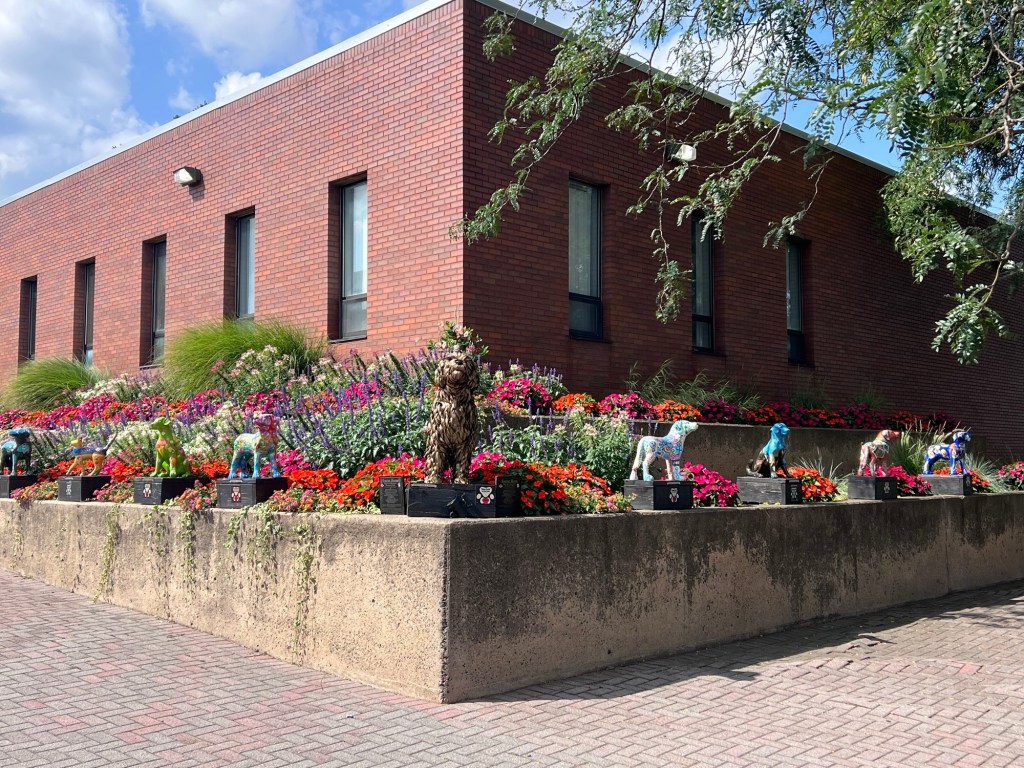
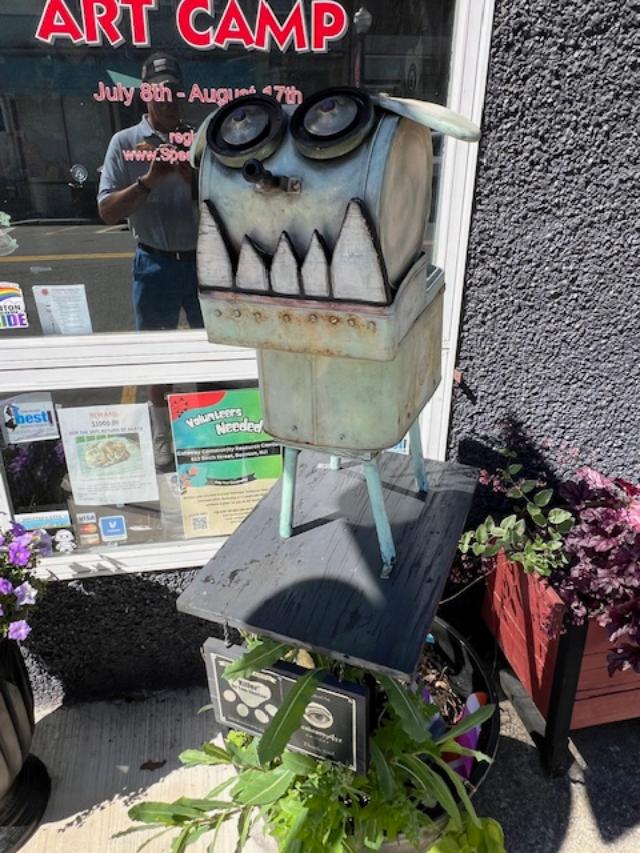
On my last three trips exploring the downtown, I have been admiring the statues of dogs and cats that line the street and flank all the buildings. The Boonton Arts Creative Placemaking Initiative organization in partnership with Boonton Main Street Inc. has been showcasing artists who have created these works.
Dog sculpture in Downtown Boonton, NJ
The Boonton Post Office is flanked by dog statues
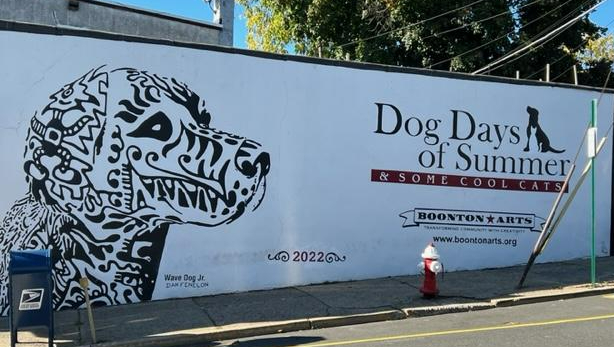
The Dog Days of Summer & Some Cool Cats’ is a public art exhibition showcasing artist’s customer designs on life sized statues displayed on the main street. Artists are sponsored by the public.
“Dog Days of Summer & some Cool Cats” exhibition downtown
The Dog Days of Summer sculptures in 2025:
The sculptures in 2025
The sculptures in 2025
The sculptures in 2025
Once the artist received a sponsor, they get the opportunity to bring their design to life. For the duration of the summer, the sculptures will be available for adoption on the Boonton Arts Etsy page. The project has now raised $70,000 for local animal shelters and over $6,000 for local schools (Boonton Arts).
“Dog Days of Summer & Some Cool Cats” outside one of the coffee shops downtown
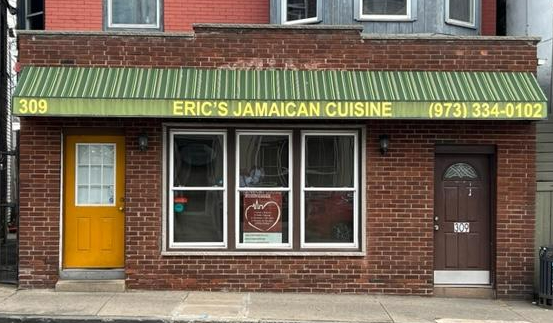
Across the street from the Historical Society at 309 Main Street is Eric’s Jamaican Cuisine which serves breakfast, lunch and dinner. It specializes in roasts, stews, fish dishes and the patties look amazing. The smells of food cooking and spices from the background grill will make your mouth water.
I stopped in on a recent visit and had a Beef and Cheese Jamaican patty ($2.50) and it was delicious. The crust was so light and flaky and had a nice portion of filling inside. The Chicken and Jerk Chicken patties were sold out so I tried one of the Fried Dumplings ($1.00). It was a round deep fried crisp dough that was perfect with a little jam.
The service could not have been nicer and the woman working the counter went over the menu with me. I love the smell of the spices when you enter the restaurant.
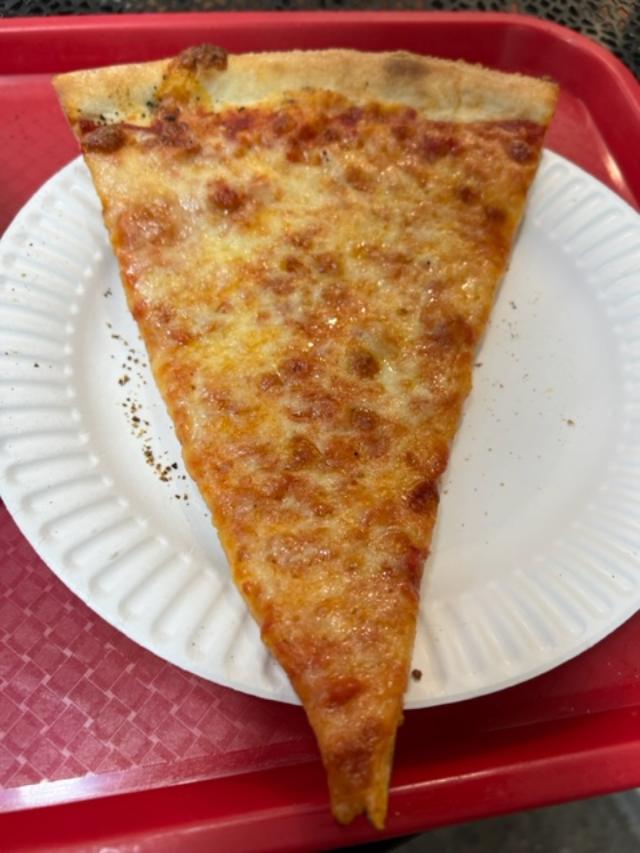
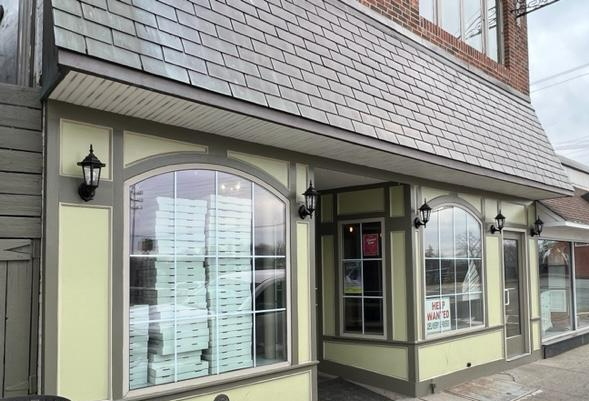
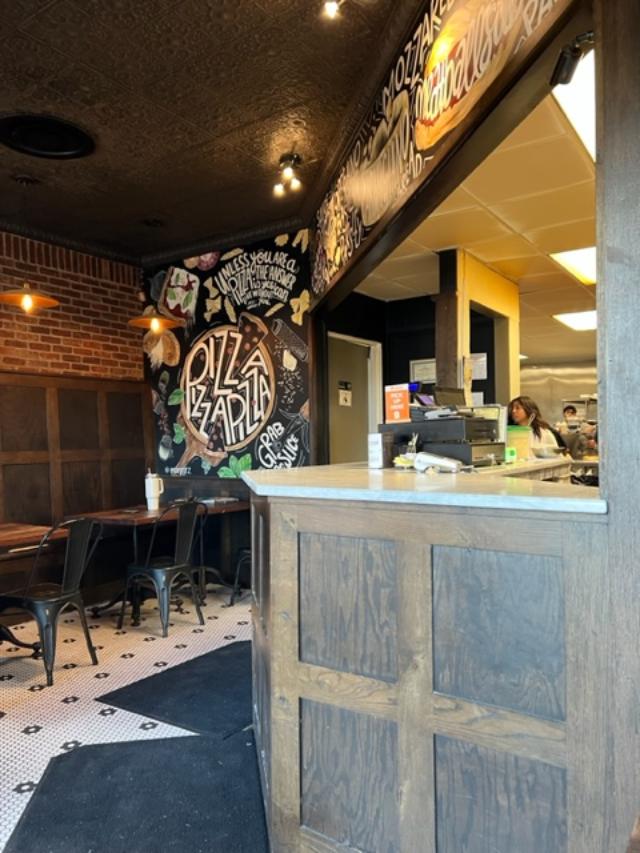
The downtown shopping district has an eclectic mix of the restaurants and shops. One of the first places I ate lunch at when I was touring the downtown on my first trip was Pasquale’s Pizza at 307 Main Street #1. I stopped in for a slice of pizza and a Coke and the pizza here is really good. The slice was full of flavor with a nice gooey consistency.
The cheese pizza here is excellent!
The service was very pleasant and on a cool Sunday afternoon was one of the few places that was open. The service is very friendly.
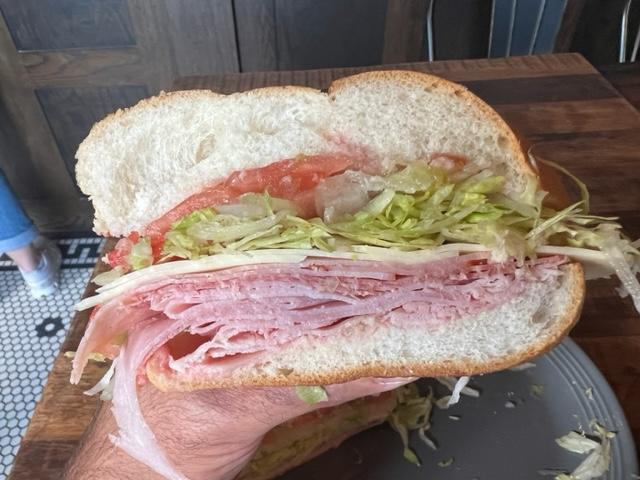
I recently dined at Pasquale’s Pizza for lunch and decided I did not want any pizza even though it looked really good and was in the mood for a deli sandwich. I ordered a half of an Italian hero and was floored when the sandwich came out. It was a half a sandwich that most people would have considered a whole. It was so huge that I had to take half of it home and it made two other meals. It was delicious.
The ‘half’ Italian hero sandwich at Pasquale’s Pizza
It was delicious and everything was so fresh on the sandwich. This is a great place for lunch.
Walking up the hill from the train tracks, you will look up at the winding main street at an interesting mix of historical buildings that are in the process of renovation or have been brought back to their original beauty.
Street art tucked here and there
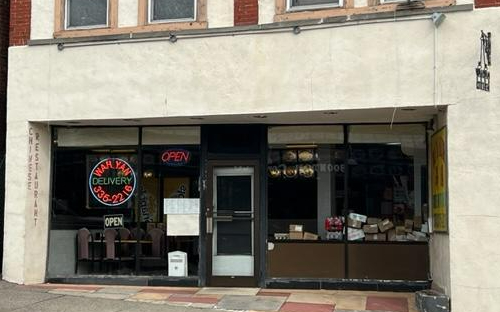
For lunch one afternoon, I ate at Wah Yan Kitchen at 601 Main Street. This little hole in the wall take out restaurant services delicious Cantonese food at very reasonable prices for lunch. The afternoon I was there I had a Shrimp Lo Mein with a side of Pork Fried Rice and an egg roll.
The one thing that differed Wah Yan Kitchen from many of the take out places I have eaten at is the entree was very large and the dish did not skip on the ingredients. There was lots of chopped roast pork in both the fried rice and in the egg roll. Everything was wonderful that I have ordered here in the past. The family who runs the restaurant could not have been nicer to me.
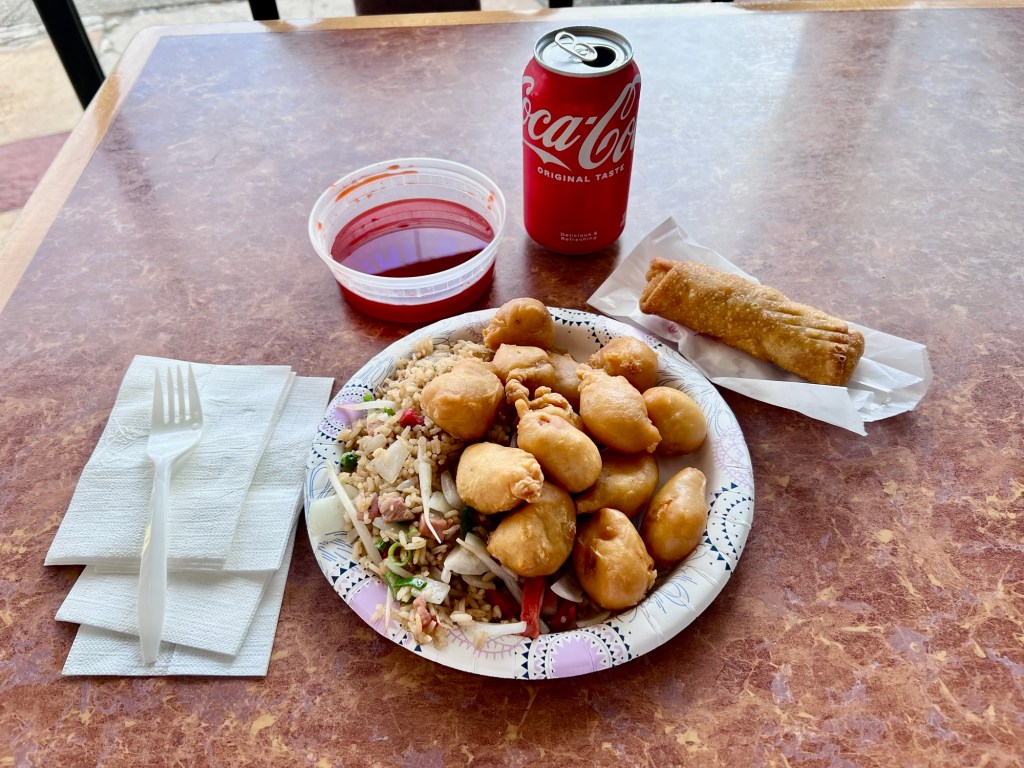
On my recent trip to the restaurant I had the sudden craving for Sweet and Sour Pork and had that for lunch which I thoroughly enjoyed.
The Sweet and Sour Pork combination lunch
The Sweet and Sour Pork was wonderful
The restaurant’s lunch specials are really good and I enjoy coming here when I am in town. Their prices and portion sizes are very fair and the food is really good.
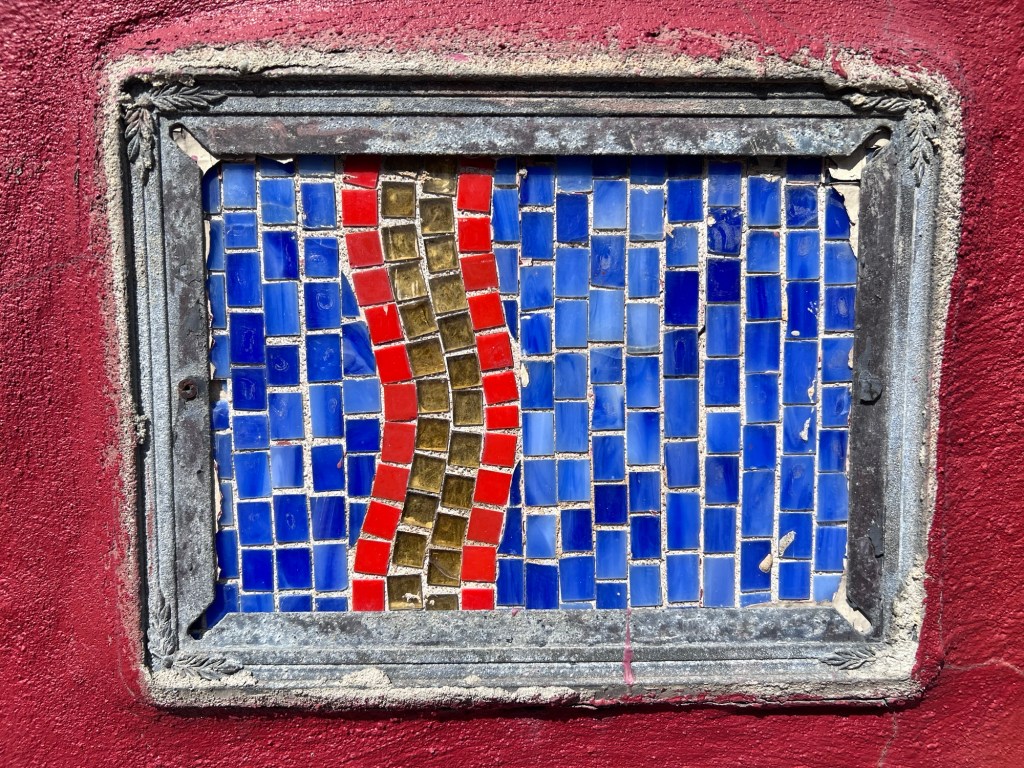
I like their painting against their wall. It is very clever!
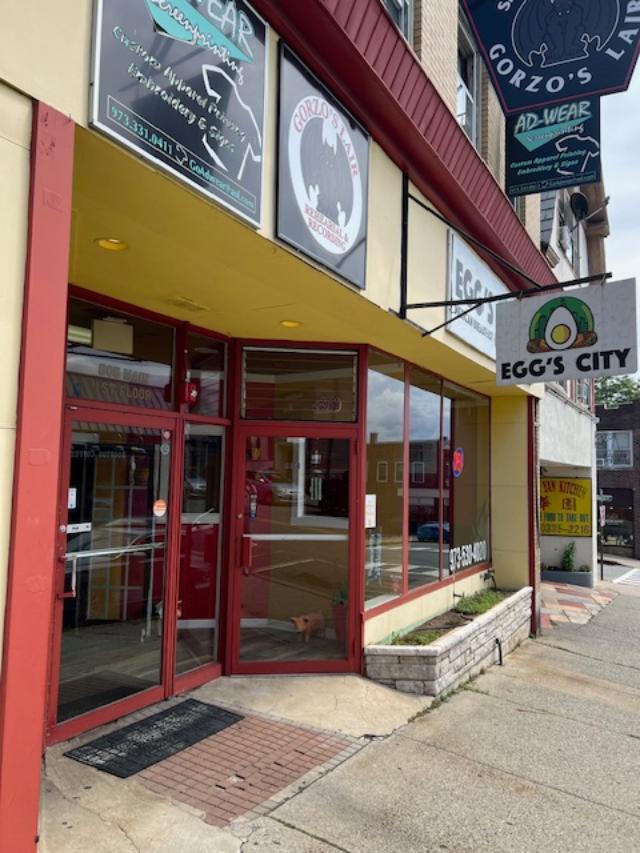
I made two trips to Egg’s City for breakfast ordering the same meal and the food and service are consistently excellent.
Egg City at 605 Main Street and Wah Yah Kitchen at 601 Main Street
The fresh chips and homemade hot sauce to start your meal. They are good!
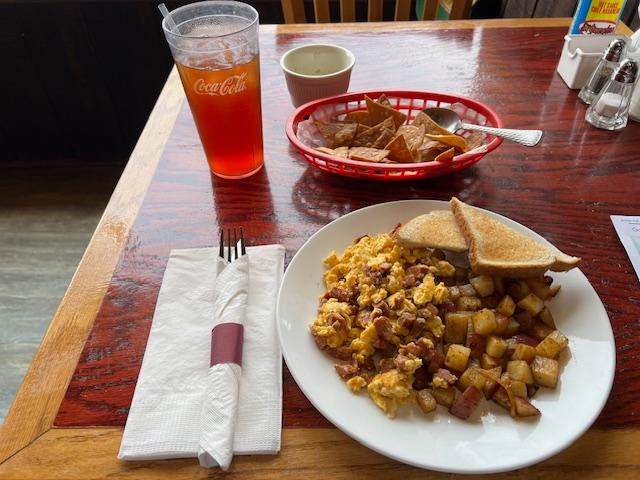
On a recent trip to Boonton, I stopped at Egg City at 605 Main Street for a late breakfast. It was a beautiful sunny day and I sat by the widows watching the world go by. I ordered the Eggs with Chorizo which came with a side of potatoes and wheat toast. The scrambled eggs came in a hard scramble with plenty of spicy Chorizo sausage chopped inside the eggs. Adding some of the hot sauce provided on the table, it added an extra zing to the dish.
My breakfast on both trips to Egg’s City. The food is wonderful
The Scrambled eggs with Chorizo Sausage makes a nice combination
Boonton at one time must have been a very cultural center for the arts in the region having a theater, opera house and a well established library all located within the downtown area. With the Morris Canal cutting through the town and the Ironworks at the bottom of the hill, the traffic in the downtown at the turn of the last century was extremely busy being a place of trade and shipping.
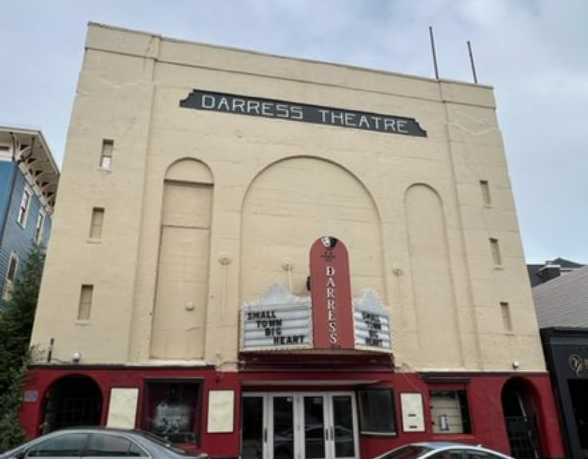
The Darress Theater at 615 Main Street has been closed during the COVID pandemic but was still open in late 2019 when it was showing some classic films. It was closed when I visited the town over the last year and a half though.
The theater was opened in 1919 as a vaudeville house with many famous names on the circuit visiting the town like Burns & Allen and Abbott & Costello. After WWII, the theater became a movie house showing first run movies until the local malls took that business away in the 1980’s. Before it closed due to COVID, it had been showing classic films and live shows (NJ Daily Record).
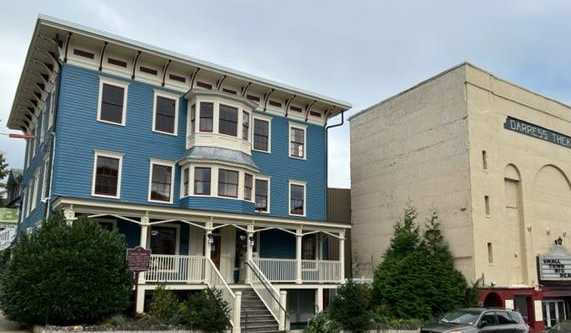
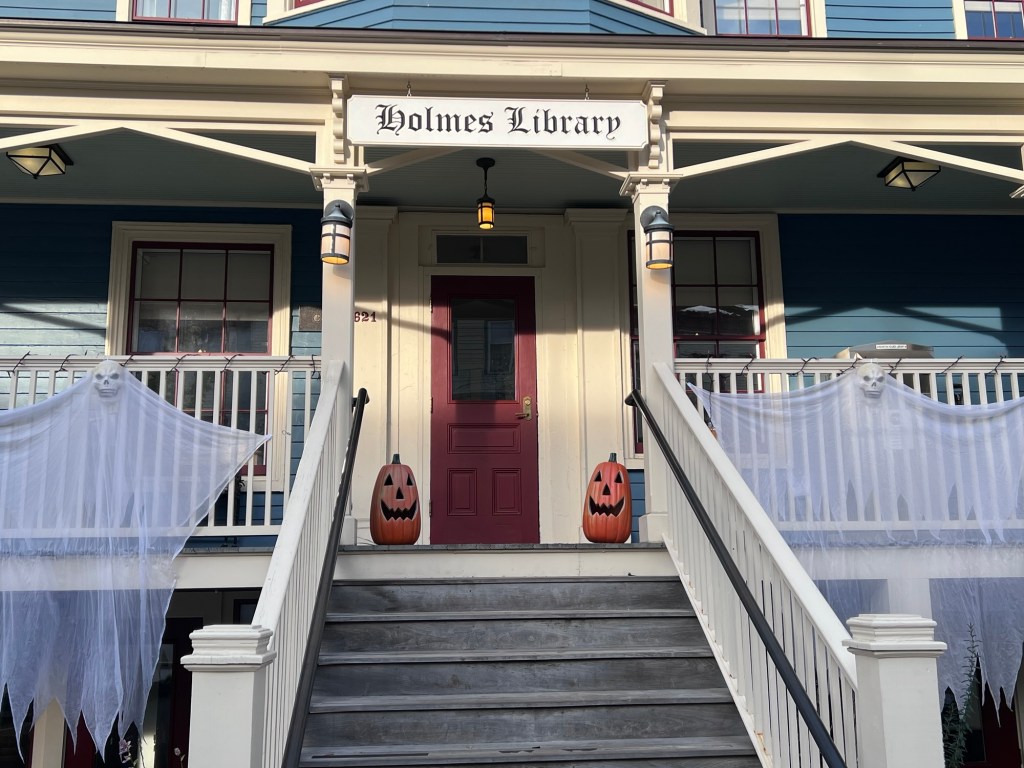
As you make your way up the hill, you will pass the picturesque Boonton Library at 621 Main Street. The library opened in this building in 1894 in a small section of the structure. The property was bought from the Iron Company in 1849 by Eliza Scott and was used for stores. Then the building was bought by local resident James Holmes in 1856 and in 1870 and was converted into the family homes. Upon his death in 1893, he willed the building and a sum of money so that the building could be used as a town library (Best Public Libraries/History of Boonton Library).
The Boonton Public Library at 621 Main Street (next to the Darress Theater)
The impressive old building holds a periodical area, a Children’s and Teen Library and a sitting area for patrons. You can still see from of the impressive details of the old building when walking around the library.
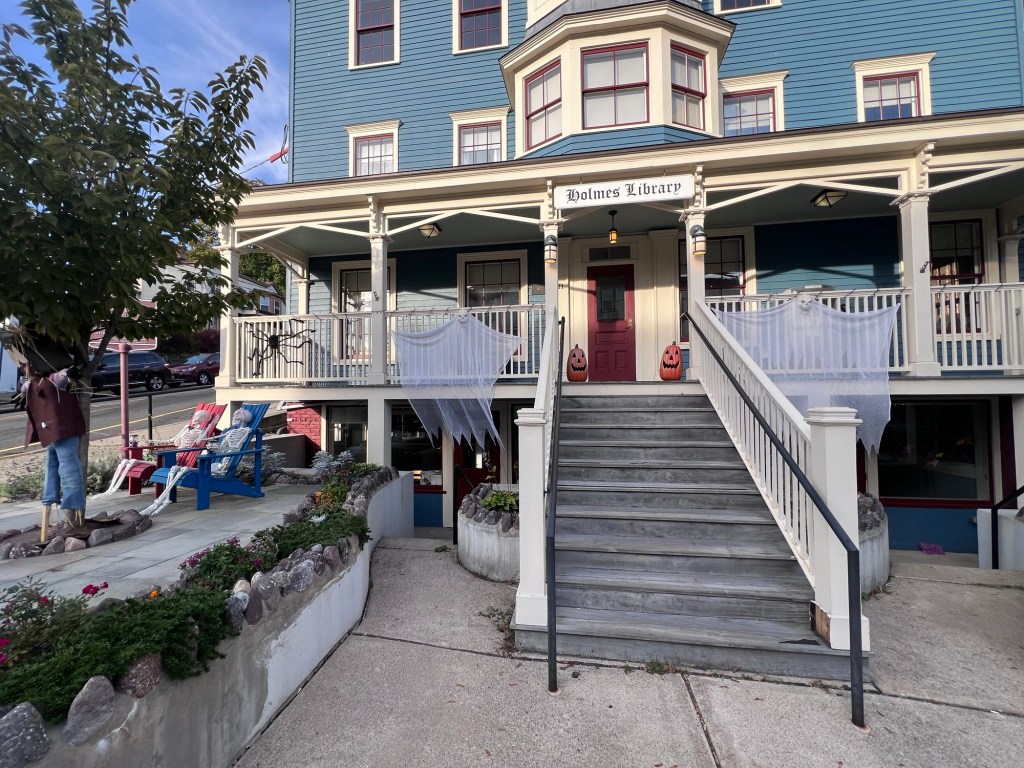
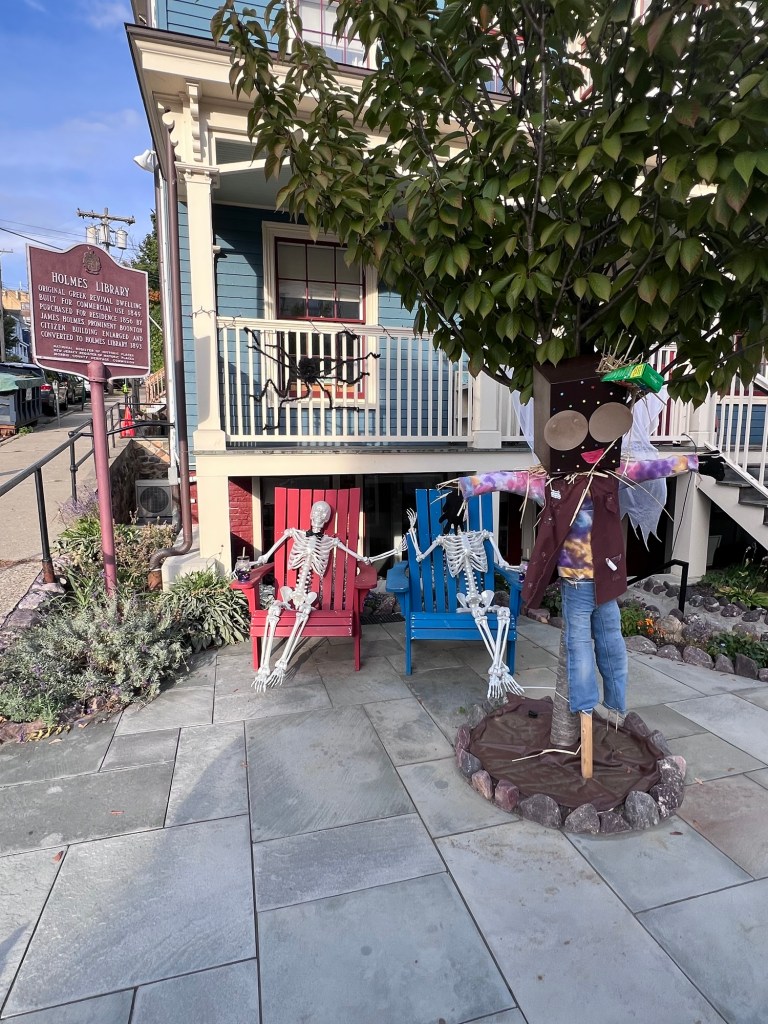
The library does a nice job decorating for the holidays. Halloween seems to be a favorite.
The library Halloween weekend in 2025
The pumpkins and ghosts
The ghosts and ghouls and things that go bump in the night
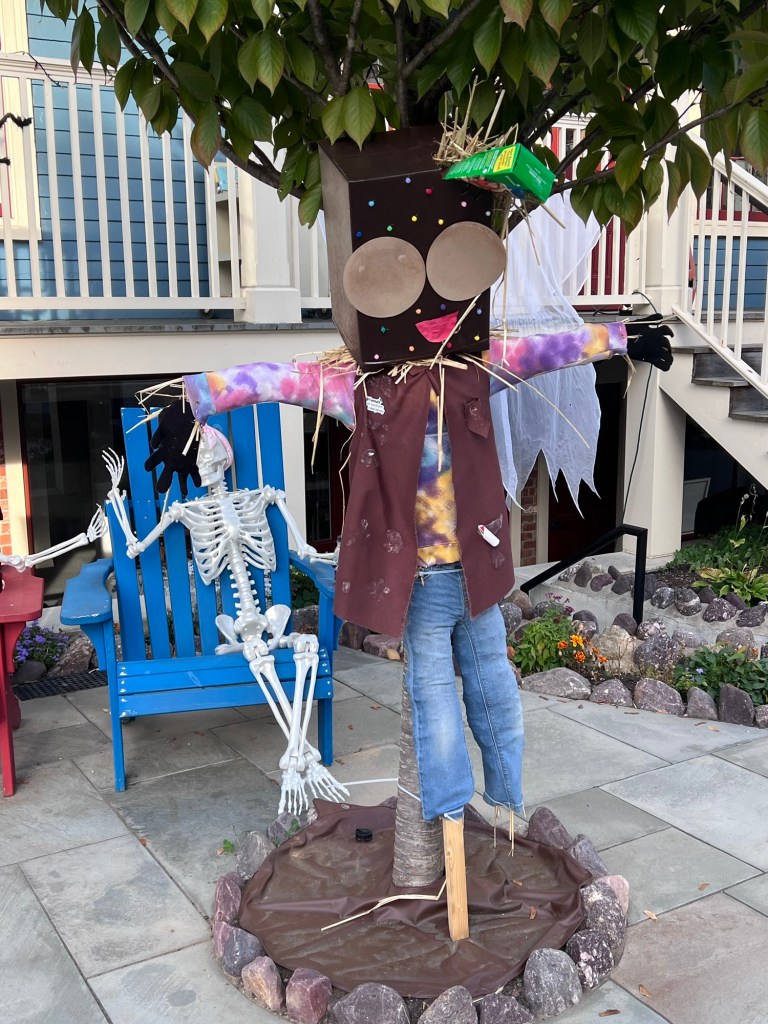
This little creature protected the front of the library
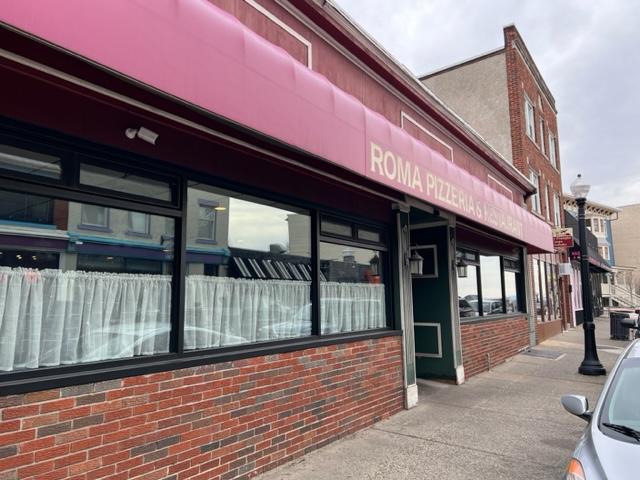
Another wonderful restaurant that I tried one afternoon after a long walking tour of Grace Lord Park was Roma Pizzeria & Restaurant at 709 Main Street. They have the most delicious cheese pizza and their garlic knots are really good. The pizza has the most amazing sauce that tastes of fresh tomatoes, garlic, a bit of hot pepper and olive oil. It really gave each bit a rich flavor. The family that runs the pizzeria is really nice too and I was able to eat at one of the outdoor tables and admire the view of the area.
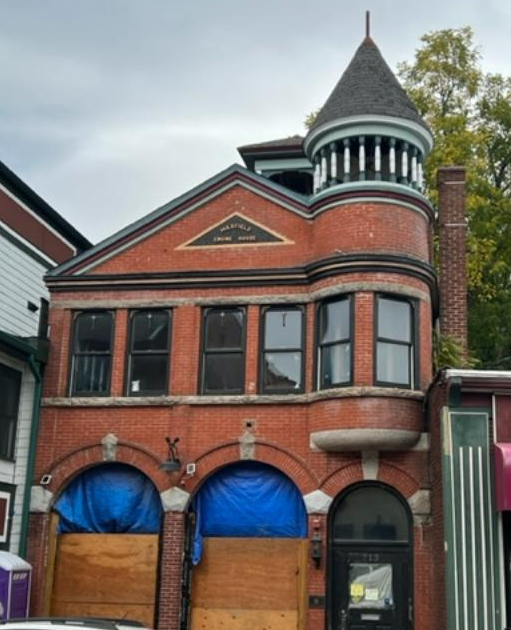
Right down the road is the old Engine/Hose Company One firehouse at 713 Main Street. This original firehouse of the Boonton Fire Department was built in the 1890’s. It was renovated in 2012 and was formerly Maxfield’s Restaurant. The building is currently empty but you can still admire the stonework of the old building and the details that showed its once fire fighting past (LoopNet.com).
The old Engine/Hose Company One at 713 Main Street
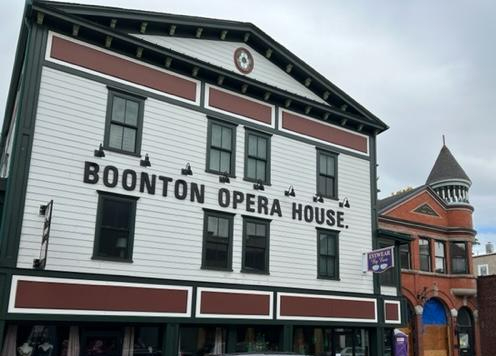
Next to the firehouse is another reminder of Boonton’s cultural past is the Boonton Opera House at 715 Main Street. This architectural gem was built in 1850 as Independence Hall which was used for various functions. Then in 1890, the owner added a third floor and christened it “Mrs. Green’s Opera House”. The building was fully renovated in 2016 by business owners in the area and now houses offices and retail space (Daily Record). Check out the buildings details on the other side of the street.
The Boonton Opera House at 715 Main Street (next to the firehouse)
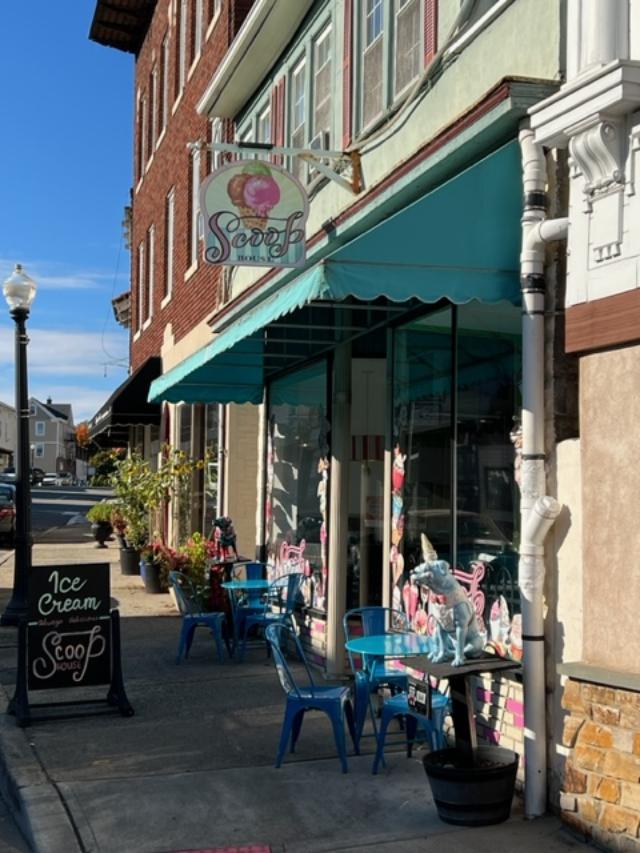
After my walking tour of the Iron Works Company with the Historical Society and a nice lunch at Roma Pizzeria & Restaurant, I sampled Scoop House at 813 Main Street. Scoop House is an old fashioned ice cream parlor with homemade ice cream and unusual flavors. The menu includes all sorts of sundaes, shakes, ice cream sandwiches and waffle & ice cream combos.
I had an unusual flavor called “Cookie Monster”, which was a purple ice cream with cookie dough batter in it and crushed chocolate chip cookies. Talk about different and delicious! The prices are also very fair at a time when other ice cream shops are charging premium prices.
The Scoop House in 2025 changed owners and names and is now known as Meli’s Sweet Shop.
Meli’s Sweet Shop at 813 Main Street
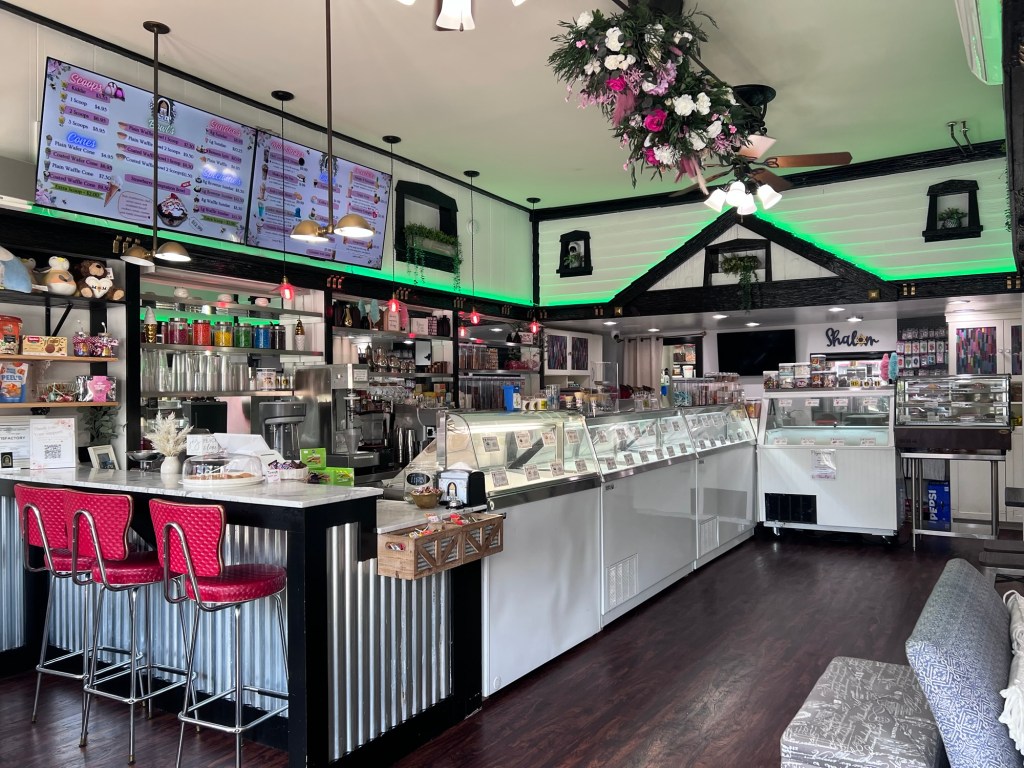
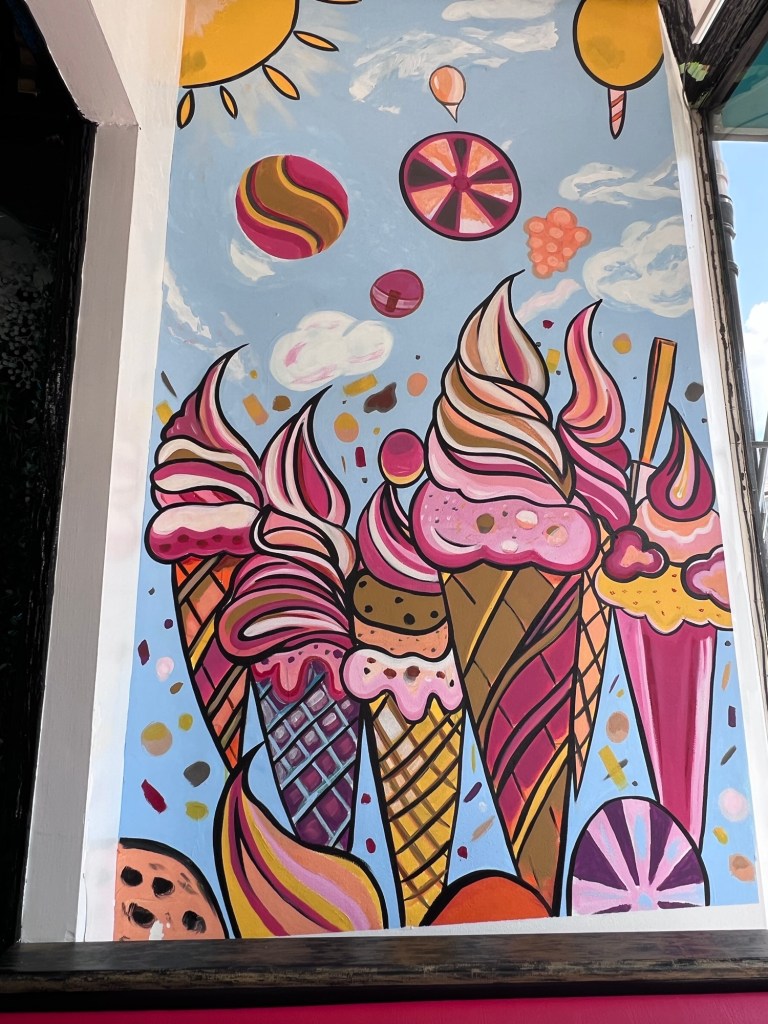
The inside of the shop and the delicious ice creams
The inside of the shop
The artwork inside
I loved the dog outside the shop
What I loved about Meli’s Sweet Shop is that they kept everything that was best about Scoops and added onto it.
Then I had to walk it all off and decided to explore the park.
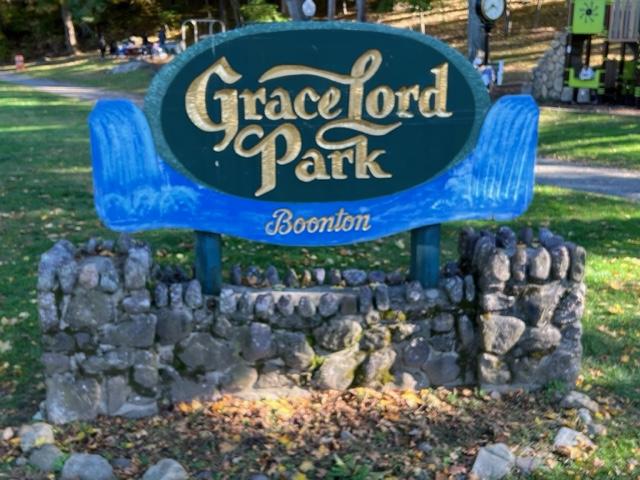
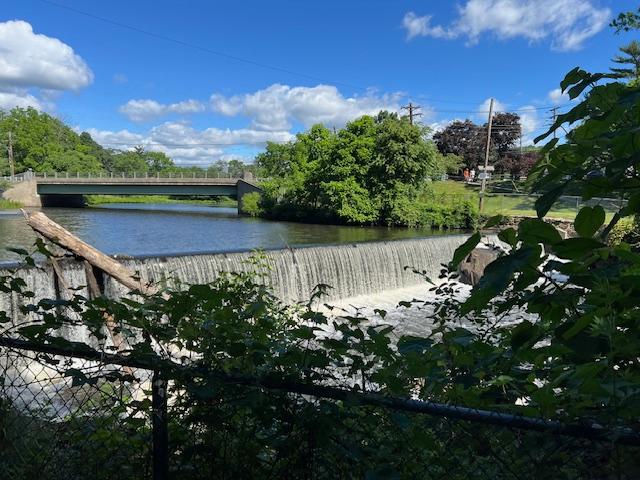
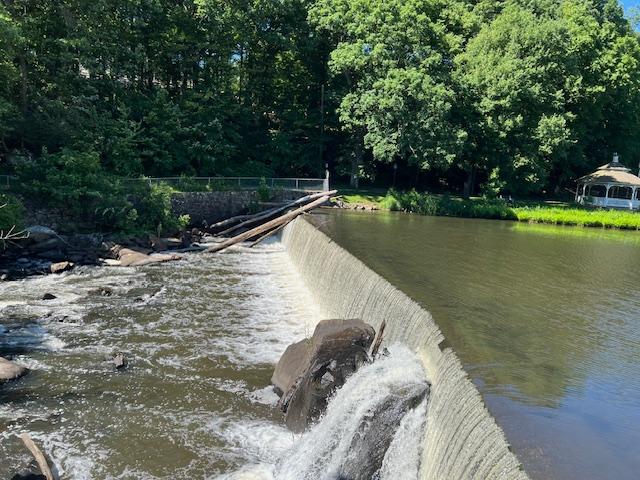
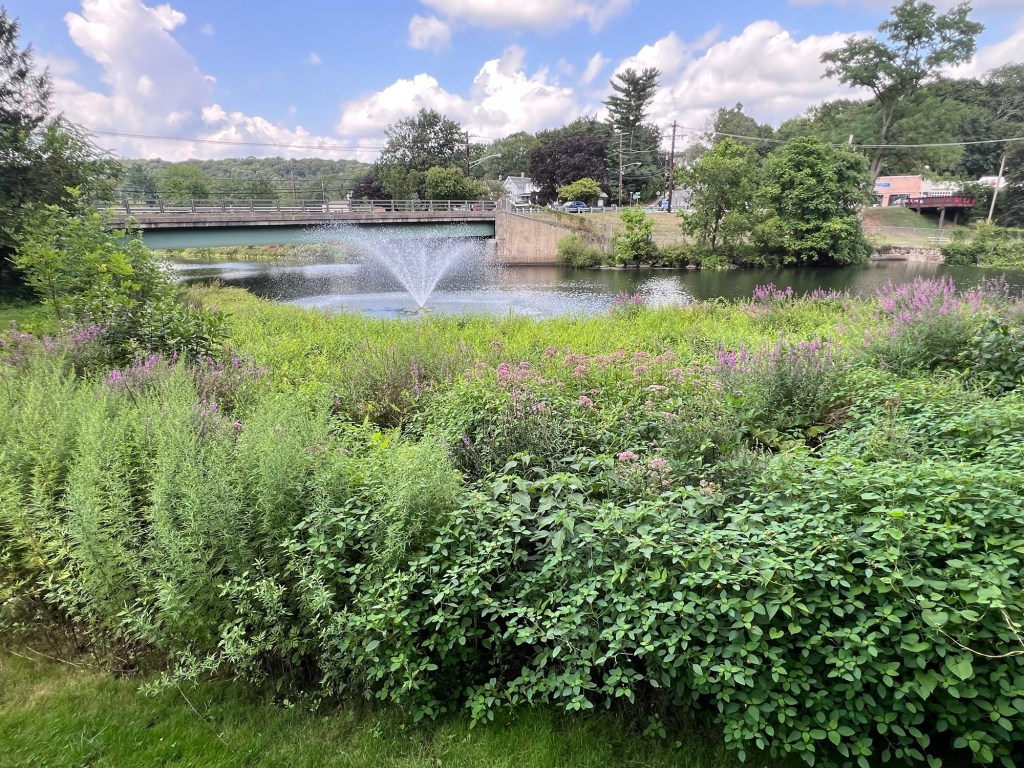
I passed other businesses that were closed on most weekends and made my way to Grace Lord Park which is located at the top part of Downtown Boonton. From the sidewalks you can see the river path through the park and as you get closer to the bend, the waterfall near the bridge. This relaxing little park was once part of the Iron Works Company and where we started our walking tour of the area with the Boonton Historical Society.
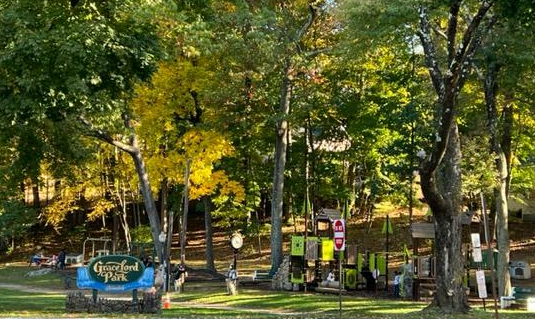
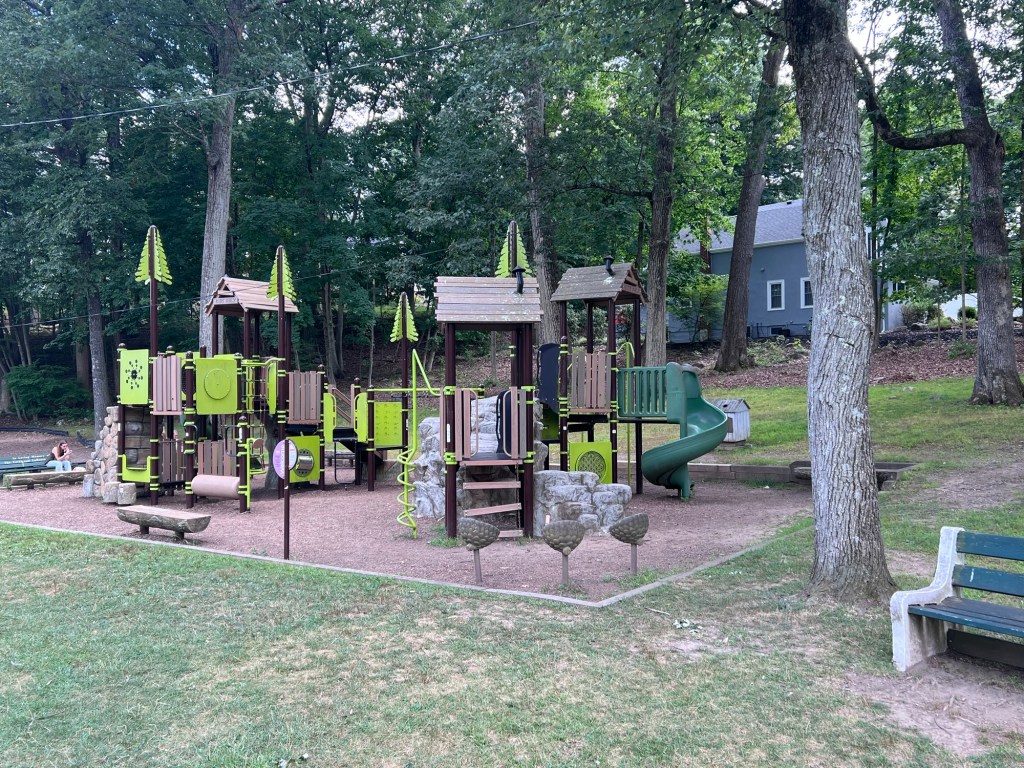
Grace Lord Park in Boonton, NJ and the great playground they have in the park.
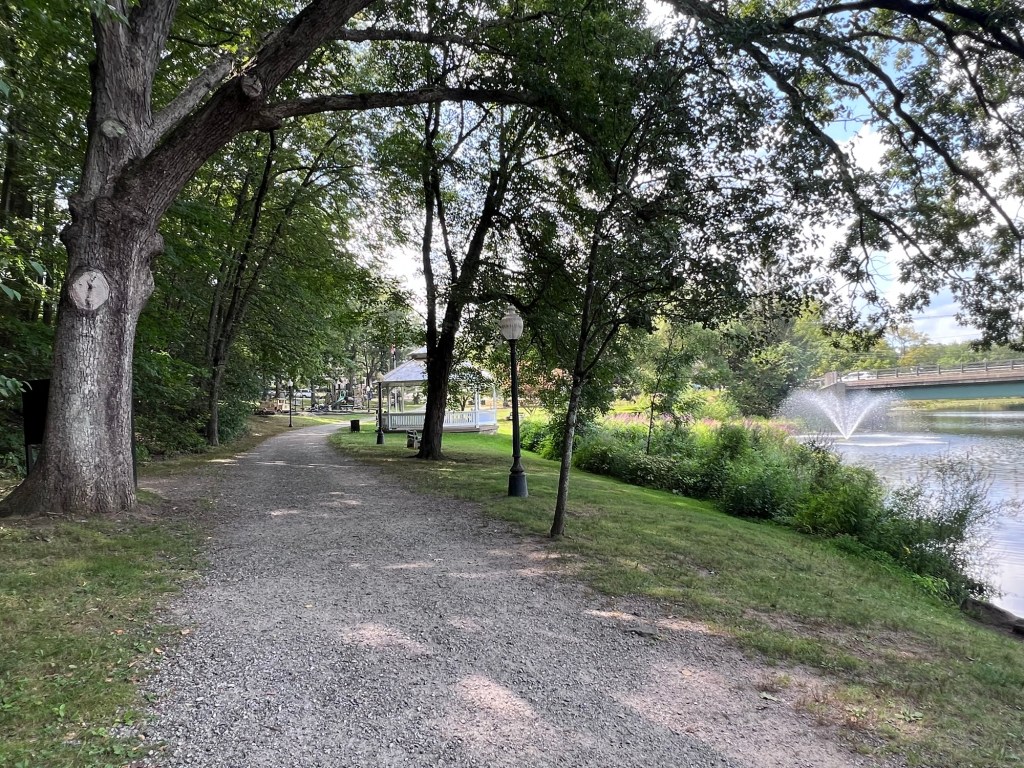
The front part of the park as you enter from the downtown is lined with paths, a children’s playground, a wooded area, historical signs of the site, the gazebo where concerts take place and our meeting ground for the tours and the falls.
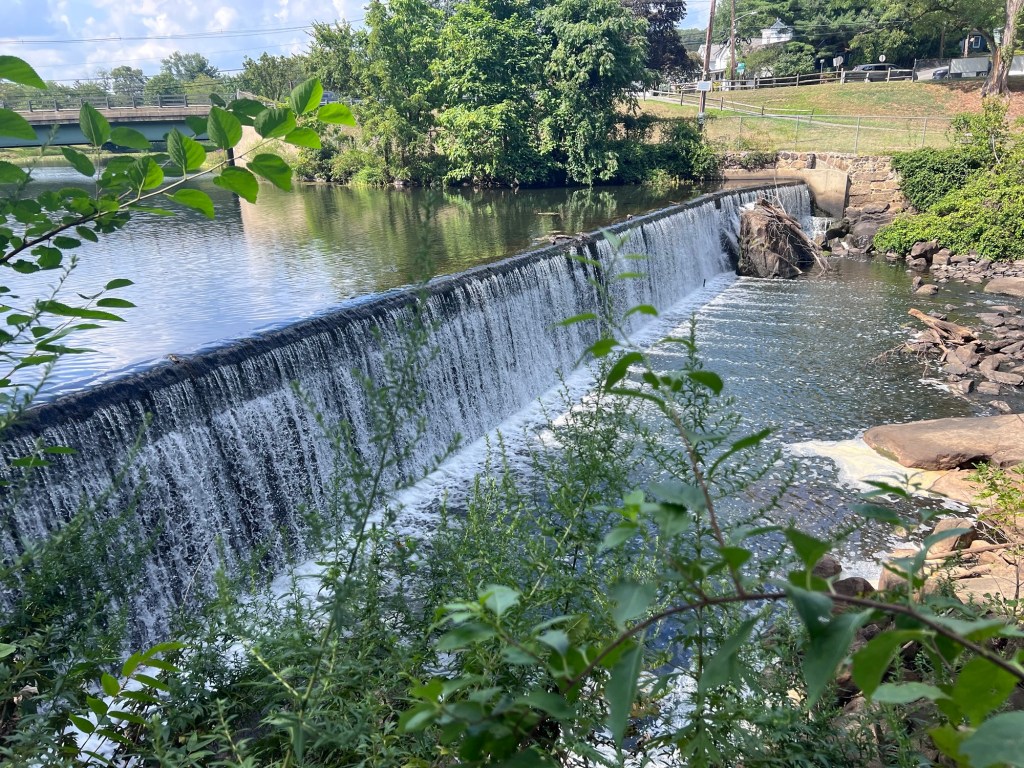
The Falls of Grace Lord Park in Boonton, NJ
The waterfall in the Spring of 2024
On a perfect sunny day, a group of us joined the Historical Society of Boonton, NJ on a tour of the former Iron Works Company and of a section of the Morris Canal that ran through the town during the turn of the last century.
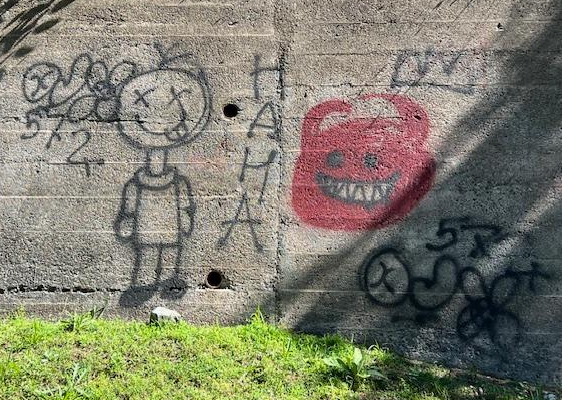
The street art on the walls of the park is interesting
On my more recent trips to the park, I just enjoy walking around the Falls area and taking a short hike down the paths into the woods and admire the river. On a nice day, there are plenty of families running around the park.
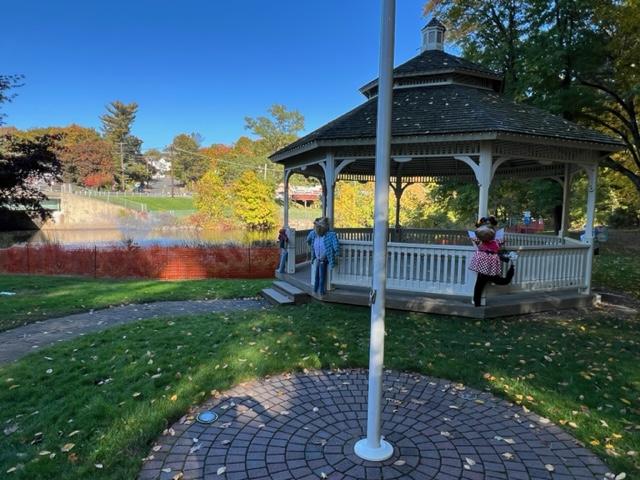
The Gazebo at Grace Lord Park
The lake and fountain in the park in the Fall
The park in the summer of 2025
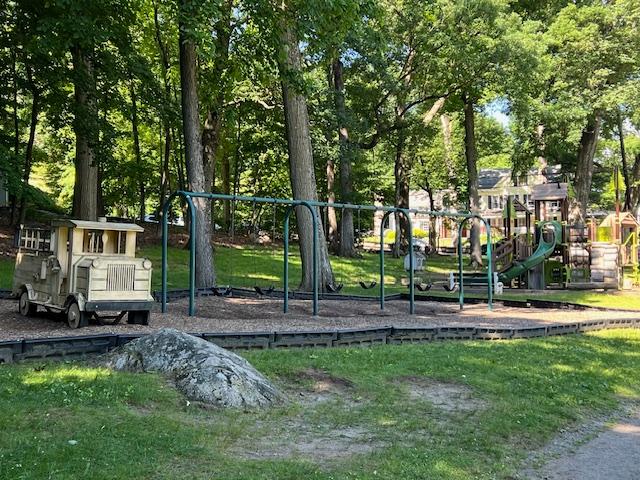
The playground in 2025
The car in the playground
Whether it is Spring, Summer, Winter or Fall, Grace Lord Park is really beautiful at any season. I just love walking down the paths along the river and then watching the waterfall by the paths.
The beauty of the park in the Summer
The pathway to the ironworks in the Summer 2025
The pond in the Spring of 2026
The pond in the Spring of 2026
The waterfall
The video of the waterfall
It’s really beautiful in this park in the summer
In the summer months, there are all sorts of concerts in the park and on the weekends there is the Farmer’s Market.
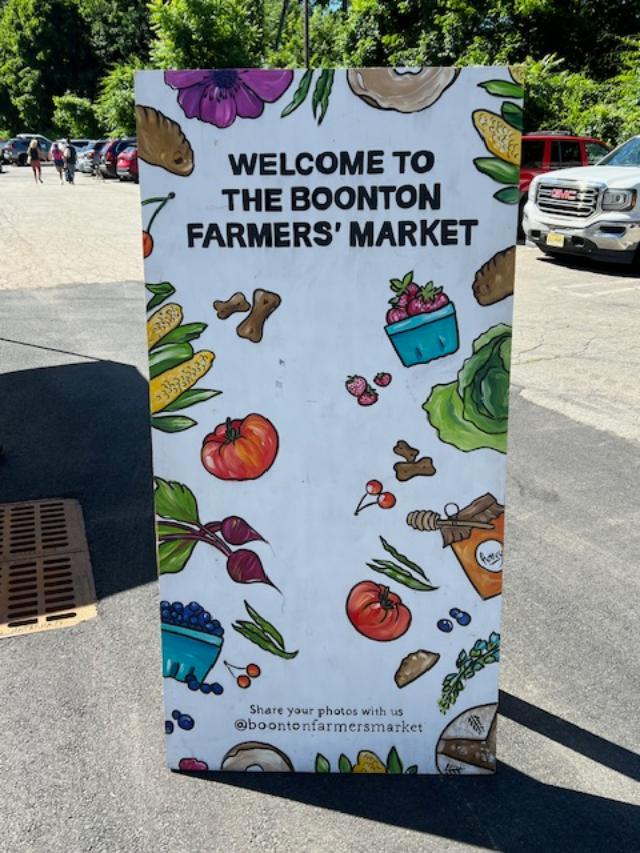
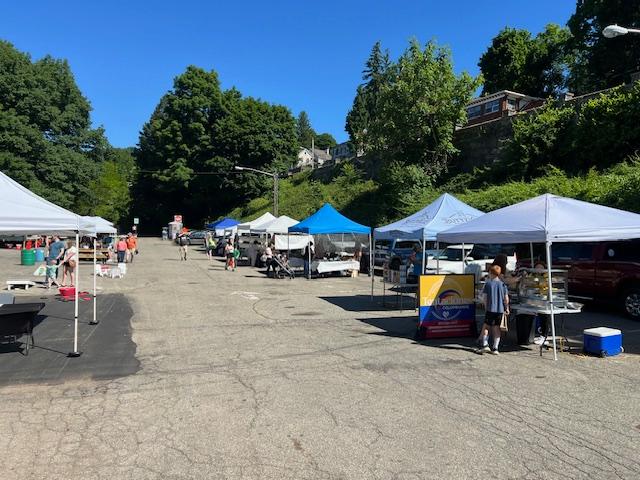
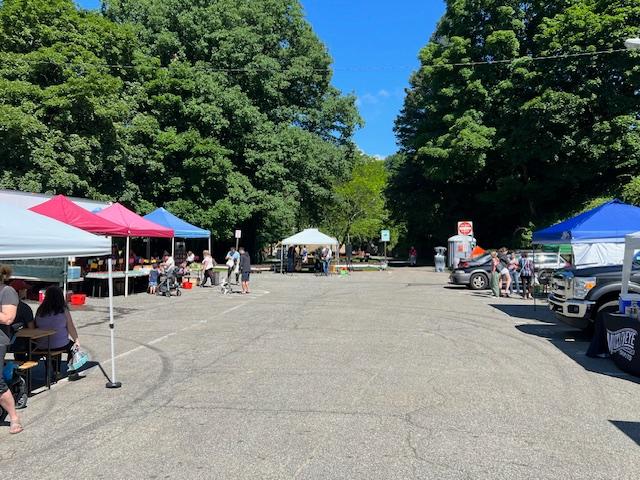
The Farmer’s Market in Boonton has a nice selection of vendors.
I visited the Farmers Market on the Saturday on Labor Day weekend but the town cancelled the market at the last minute. Still there were a few vendors that had set up and I was able to sample their wares. The Schieferstein Farm from Clark, NJ had all of their fruits and vegetable lined up in bins and they had the most flavorful white peaches for a dollar. It was juicy and sweet and there is nothing like a Jersey Peach when it is in season.
Don’t miss the Schieferstein Farm stand for the sweetest Jersey Peaches
The selection of farm produce at the Farmer’s Market
The wares at the Farmers Market change with every season
I returned the next week and there were many more vendors selling all sorts of wares at the Farmers Market. I visited Gizmo’s Pet Products for gourmet pet treats, Race Farms out of Blairstown, NJ for another sweet juicy yellow Jersey Peach ($1.00) and Urban Gypsy Arts by artist Vicki Stafford who sells handmade knit and crocheted hats and scarves, handmade earrings and pins.
A Crocheted Voodoo doll by artist Vicki Stafford, the perfect gift for Halloween
Along the way there were other vendors selling Empanadas, Italian dinners, gourmet cheese, homemade pickles and freshly baked breads and pastries. There really is something for everyone at this Farmer’s Market. There was guitar band performing that morning for the patrons with original songs and a small play area with a Cornhole set up for the kids. The Boonton Farmers Market is a nice way to spend an early Saturday morning.
I visited the Boonton Farmers Market in August of 2026 on a beautiful sunny morning before a function at the NJ State Firemen’s Home. This is the time of year when the produce is at its peak for the Summer and the variety was immense. They also had a very interesting band playing that morning.
The Boonton Farmers Market
The Farmers Market on a sunny Sunday morning
The wonderful selection of booths
The delicious produce at the peak of the season from local farms
Jersey Corn in abundance
Fresh Polish foods at the Zabka Polish Deli booth
The entertainment that morning
On my way back up the hill through the downtown area, there are several bakery and gift shops you have to explore and have a quick dessert before you leave town.
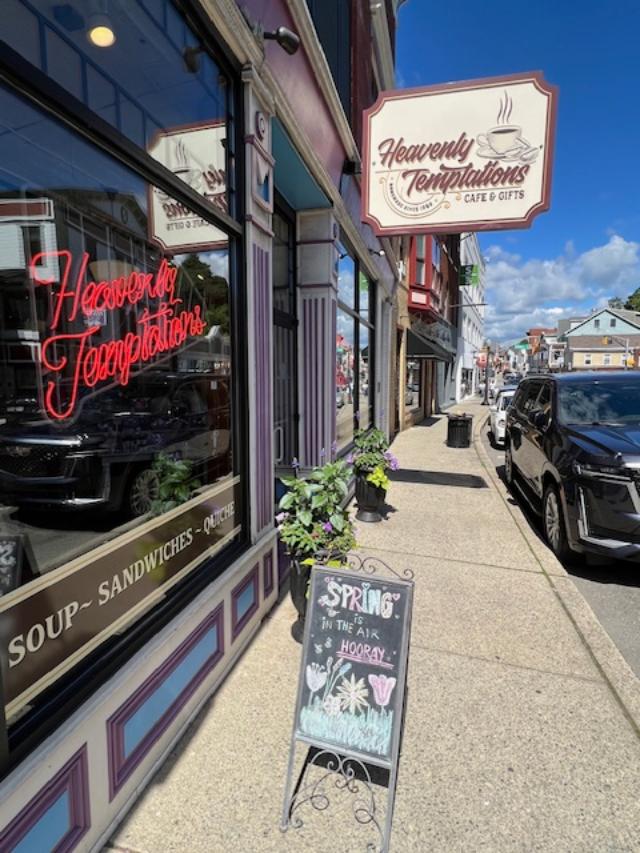
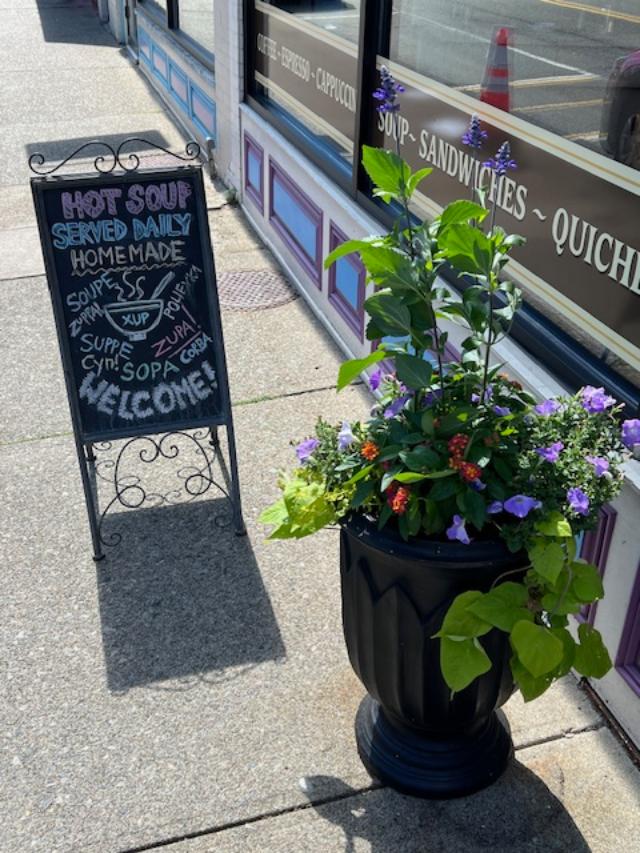
Heavenly Temptations at 712 Main Street is a perfect place to duck into when it rains as it did on two afternoons when visiting Boonton. It has a extensive bakery section with cupcakes, muffins, scones, cookies and croissants. The shop also has an extensive collection of gift baskets, books, local art products and other assorted gifts. It is also a big meeting place for locals (Heavenly Temptations website).
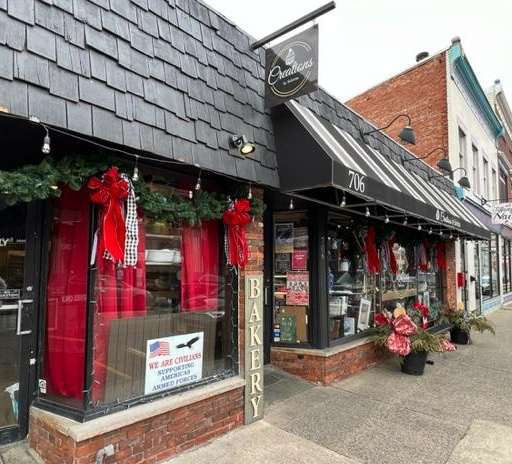
There are several places to get desserts in the downtown area. Another is Creations by Sabrina that adds a touch of elegance to their dessert selections.
Creations by Sabrina is located at 706 Main Street
Creations by Sabrina is like walking into a bakery that treats their bakes goods like displayed jewels in a the case with beautiful and elegant looking cupcakes and cookies for sale. Each cupcake has its own unique look and flavor.
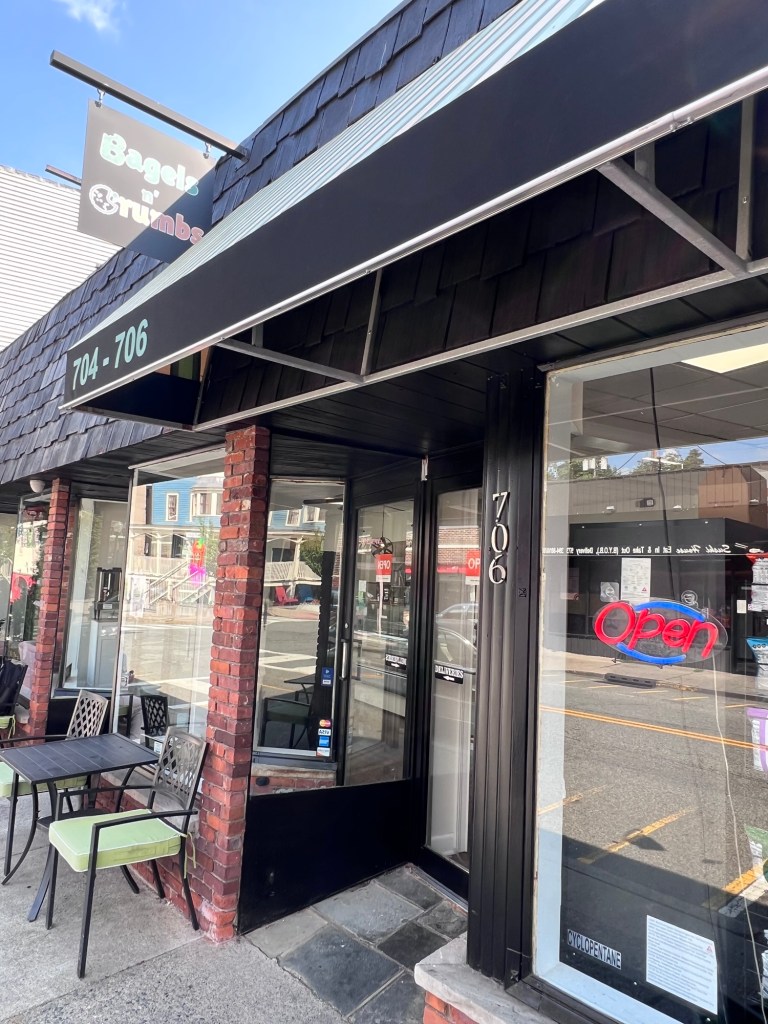
The business has now changed its name and direction of the business to Bagels and Crumbs
Bagels and Crumbs
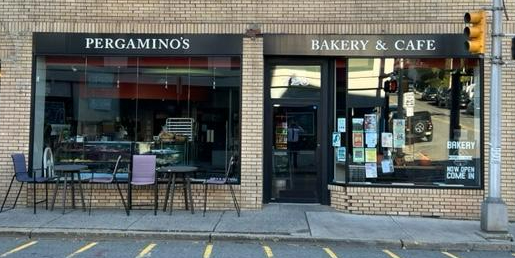
Another establishment to enjoy pastries with a Spanish flair is Pergamino’s Bakery & Café at 720 Main Street.
As of 2024, Pergamino’s closed and this new Columbian Bakery, Tentaciones Bakery, opened in its place. The pastries are still very similar.
I had ducked into Pergaminos during a rainy afternoon when they were closing down for the afternoon and the people working there no only let me walk through while they were cleaning up but I could buy what I liked and they would not rush me out.
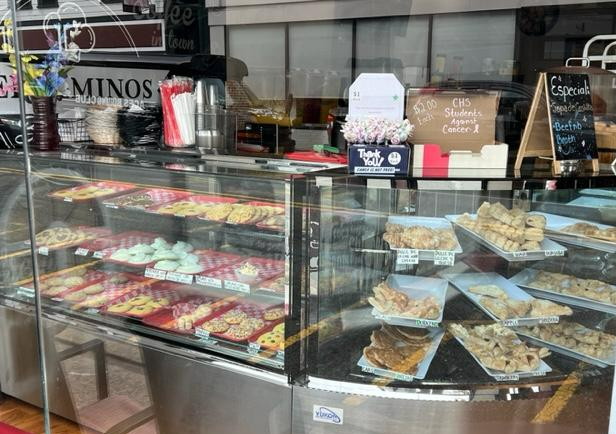
What attracted me to Pergamino’s was the Columbian pastries and hot foods that the bakery restaurant carried. On my first trip, I tried a Guava Plate, which was a flaky pastry split into two and filled with cream cheese and guava jelly. It was flaky and sweet but I was not crazy about the cream cheese in the dessert.
I was also able to try their Beef and Cheese Empanadas, which I ended up taking home with me. They warmed up in the oven perfectly and I liked the spiciness of the beef which was accented by the home made hot sauce they gave me.
On the second trip, I tried one of their Apple Turnovers, which from what the staff said were really popular and I could see why. Surrounded by a sugary puff pastry, these sweet apples are rolled in cinnamon sugar and butter and baked until a golden brown.
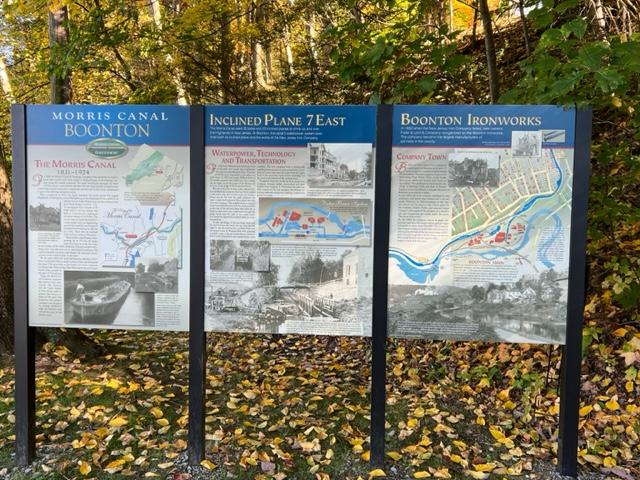
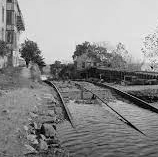
When you reach the middle of the downtown area, you can see the remnants of the old Morris Canal that used to run through town.
Where the old canal was located
When I was taking my tour of the Boonton Iron Works, this section of the canal was filled in years ago but at the turn of the last century, the canal was busy taking iron and other raw materials from the area to market. This is what made Boonton Boonton.
The sign for the Morris Canal
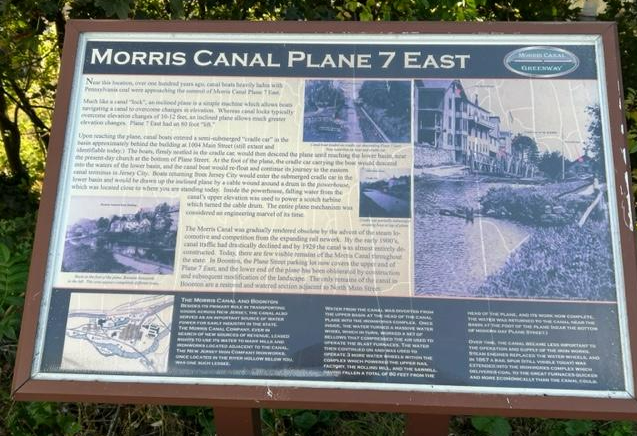
This section of the canal was called Morris Canal Inclined Plane 7 East for the machine that allowed the boats to navigate the canal to overcome changes in the elevation (Boonton Historical Marker).
Morris Canal Inclined Plane 7 East that parallels the downtown
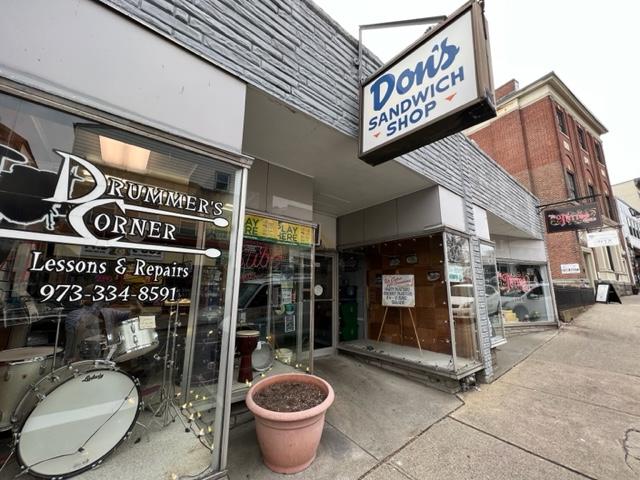
As I made my way down the hill, back to the car, I passed the popular Don’s Sandwich Shop and music store. I stopped in one morning after visiting the Farmer’s Market and had a Bacon, Egg and Cheese sandwich on a soft chewy roll. It was the perfect breakfast on a cool morning.
They made the sandwich with provolone cheese instead of the the traditional American cheese and with a little mayo added the perfect zing to the sandwich. The couple that runs the shop could not have been nicer to me.
The Bacon, Egg and Cheese on a roll is really good here
There is even a music shop within the store, Drummer’s Corner, which is located in the corner of the sandwich shop.
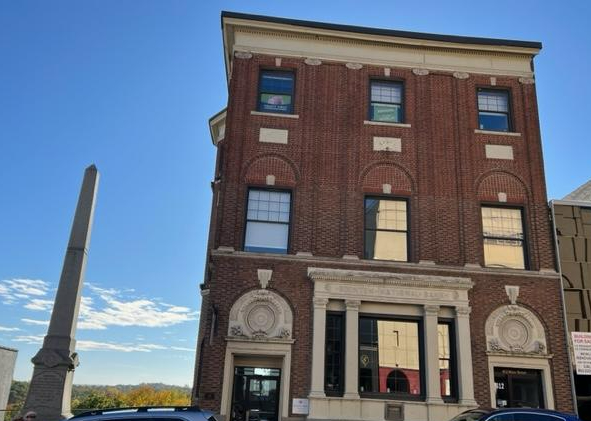
Adding to the many historical sites in Downtown Boonton is the Boonton Civil War monument located in the middle of the shopping district.
The beautiful historic buildings by the Civil War Memorial
This interesting piece of town history was erected in 1876 and was “In grateful remembrance of their fellow citizens who volunteered in defense of The Union of the War of 1861-1865 Honor to the Brave 1876” (Monument). This touching monument is a tribute for those who were lost in the Battle of the States.
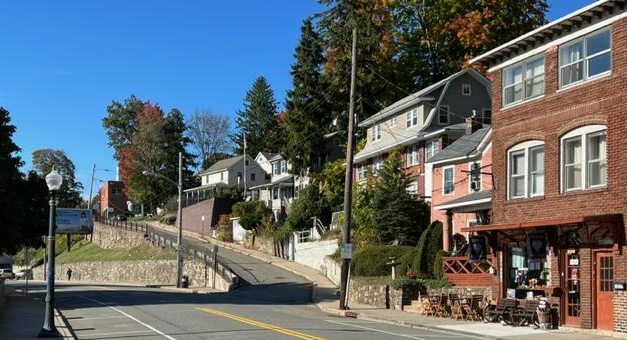
As I walked back to my car, I took time to glance at the scenic views from the main street of the foliage and mountains that make the backdrop of the downtown area. I can see why the artists are starting to move into town and the amount of art galleries that are starting to open (most were closed on the weekends on my last two visits).
Downtown Boonton, NJ in Fall 2022
The edge of Downtown Boonton to the north during the Fall 2022
Take time to walk east of the downtown to visit the historic homes of former factory workers of the Iron Works which are now being snatched up and renovated. When I drove through the downtown one last time and made my way up the hill, I drove past Grace Lord Park.
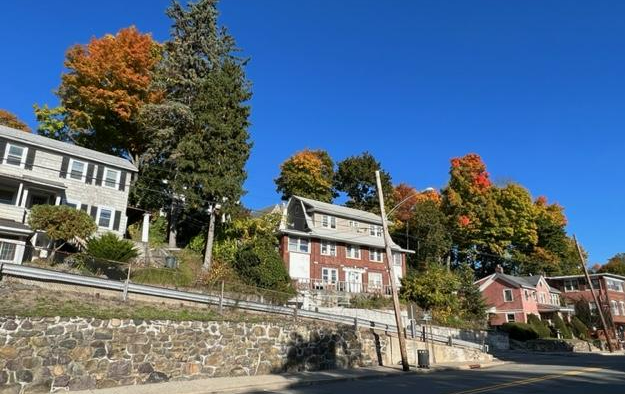
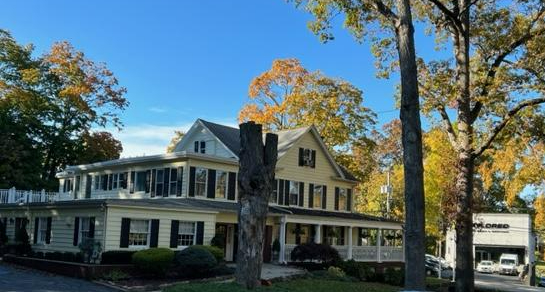
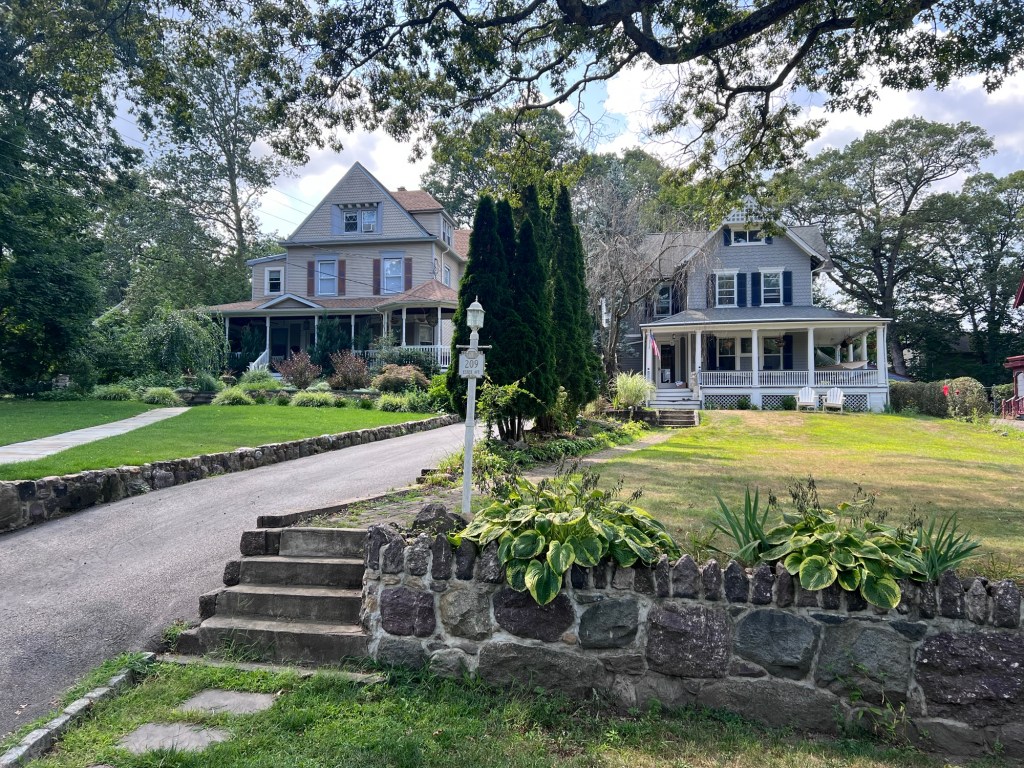
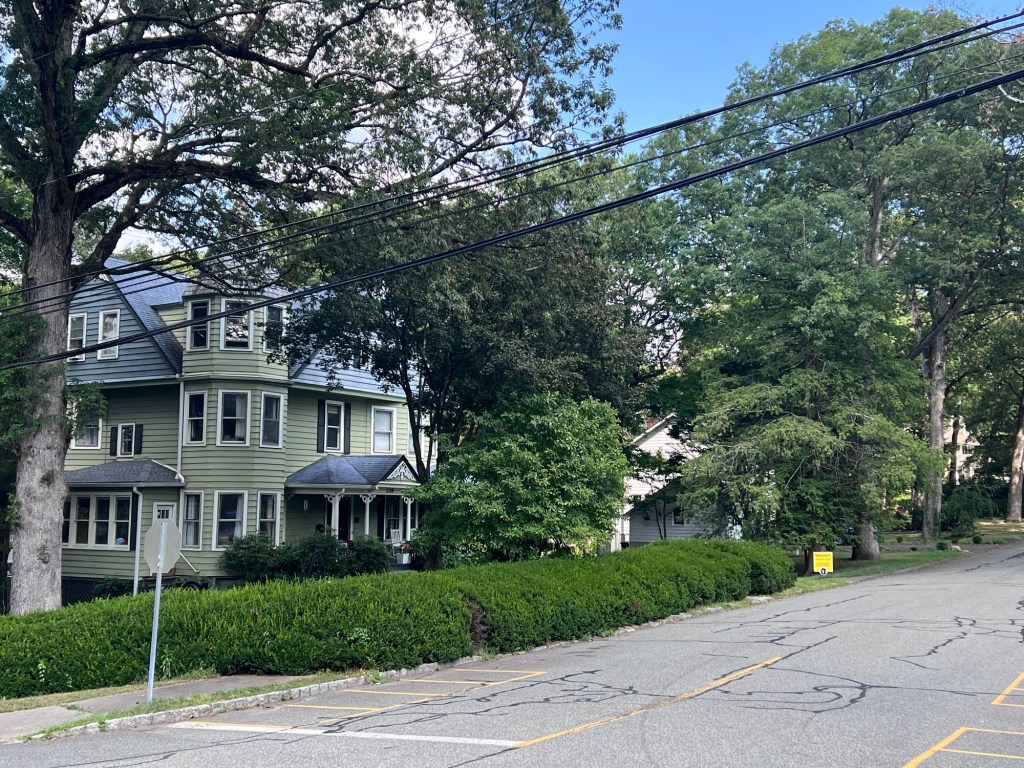
Up the hill through the Essex Street neighborhood above downtown were blocks of old Victorian homes and mansions line the streets overlooking the park.
The Hill section of Downtown Boonton in the Fall
The Hill section of Downtown Boonton in the Fall
The Hill section of Downtown Boonton in the Fall
The Hill section of Downtown Boonton
The Hill section is also beautiful in the summer when everything is in bloom
The Victorian homes in the summer months
The Hill section in the Summer
The Hill section in the summer
There is so much to see and visit when walking Downtown Boonton and with the influx of new residents and the energy of the present ones, it is making Boonton, NJ a vibrant and interesting town to visit.
On the Sunday of Labor Day weekend, I stayed to watch the Boonton Fire Department Labor Day Parade and that was a lot of fun. The Department marched in the parade and fire departments from all over the County joined in with their fire apparatus. It was a beautiful day for the parade.
The Boonton Fire Department had their classic apparatus in the parade
I also visited right before Halloween in 2022 and there was a lot going on in the downtown area. There was a festival going on in the park during the weekend and the park was decorated with all sorts of ghouls and goblins.
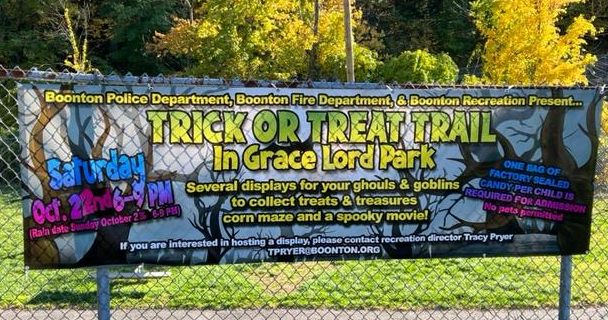
The “Trick or Treat Trail” event in Grace Lord Park
The Goblins in the park
the Goblins in the park
The Ghouls of the park
The beauty of Grace Lord Park in the Fall
The beauty of Grace Lord Park in the Fall
Halloween decorations in 2023 that were all over the downtown for the holidays:
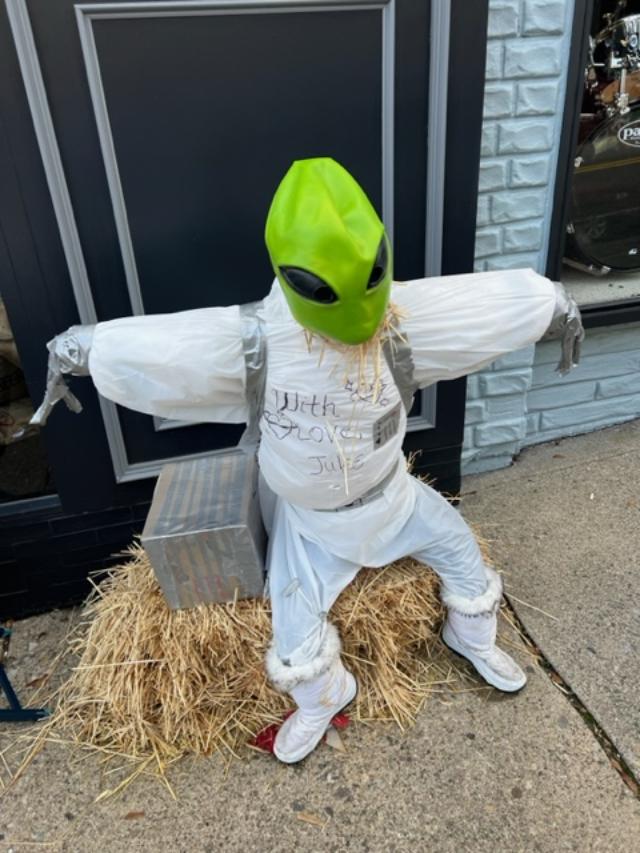
Space Alien
Characters by the library.
More characters by the library.
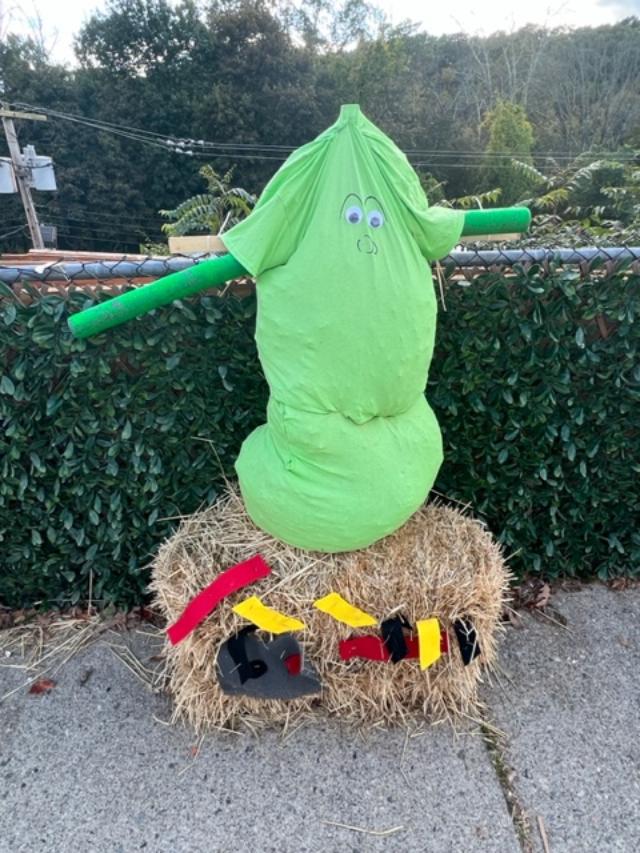
Odd little creature in the downtown.
“Deadhead” in Downtown Boonton, NJ.
In honor of “Friday the 13th”
Mr. Pumpkin Head in Downtown Boonton
Guarding the library steps during a recent Mariachi concert at the library.
I also visited again in 2025, right before Halloween and the town was decorated for the start of the holiday celebration.
The horrible ghoul in the center of downtown
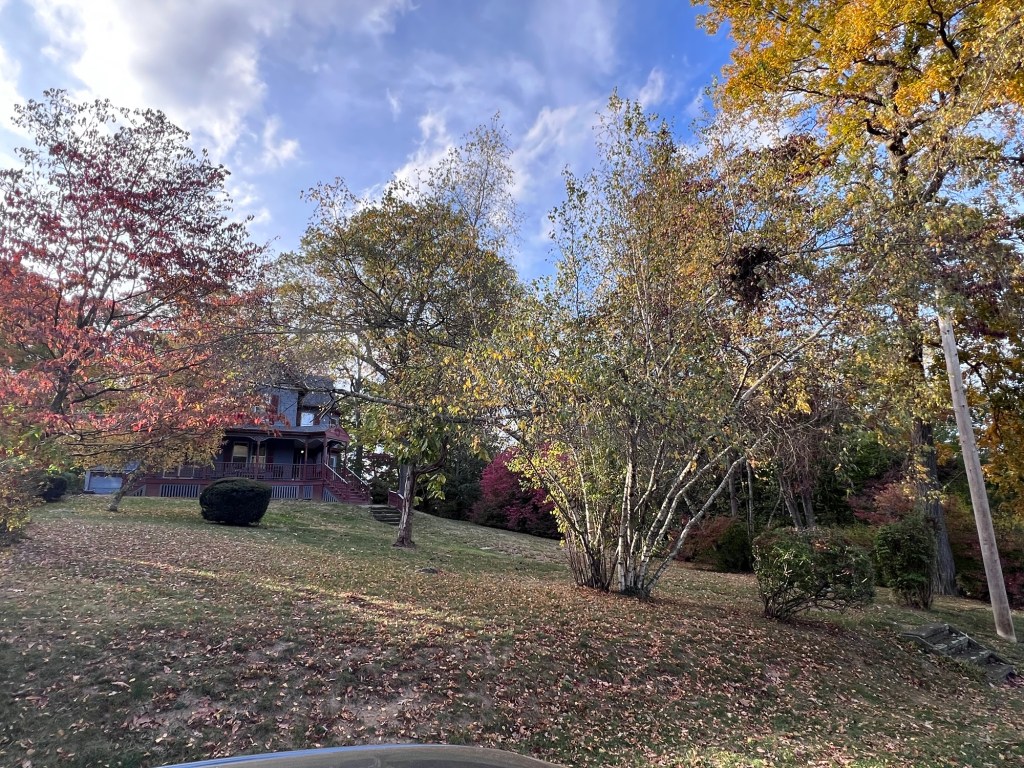
The town was not decked out for the Halloween and Fall holidays. It was not just the Halloween holidays but the beauty of the change of seasons and the Fall foliage.
The Hill section of Boonton
The Hill section of the town in October
The beauty of the Victorian homes
Each street was so beautiful
The homes were the colors of gold, red and copper
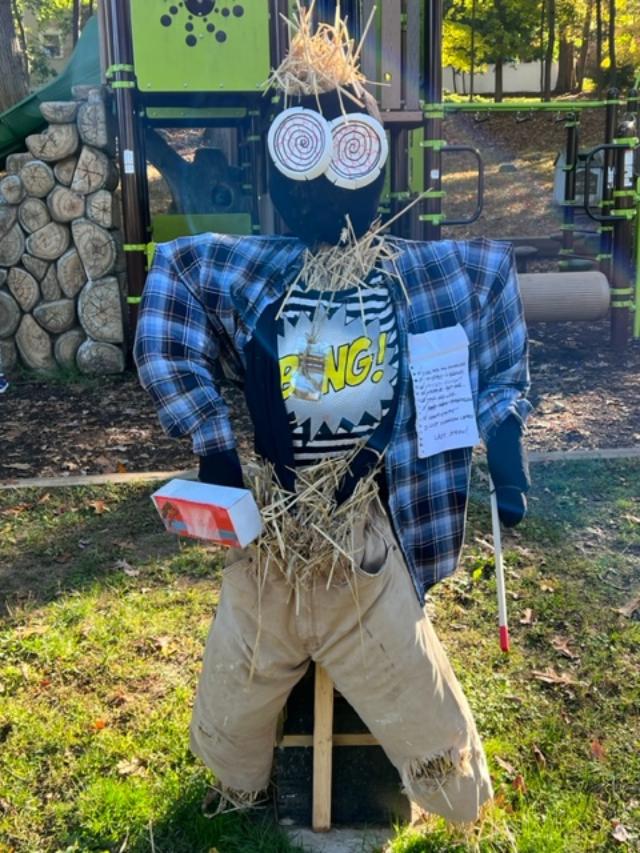
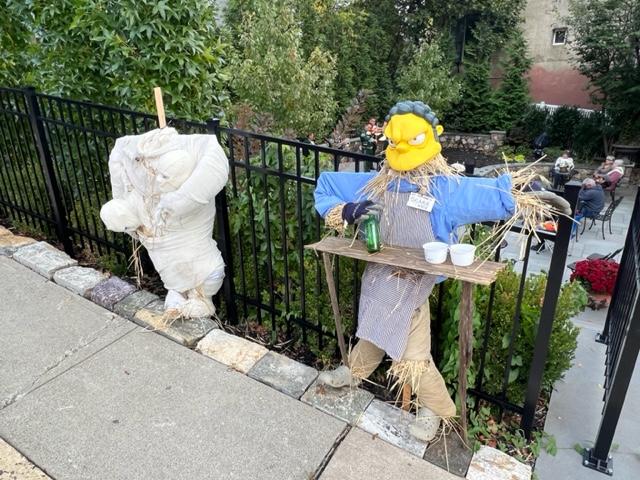
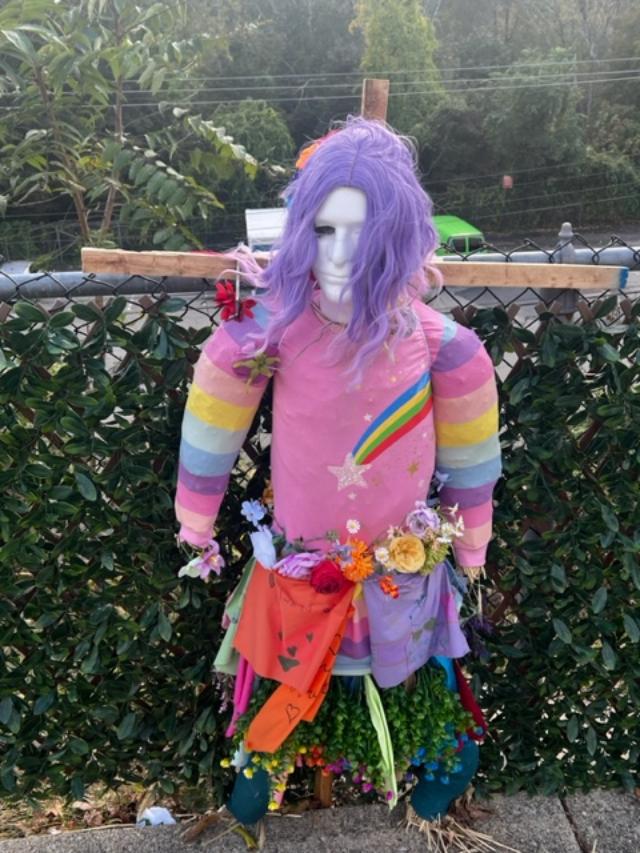
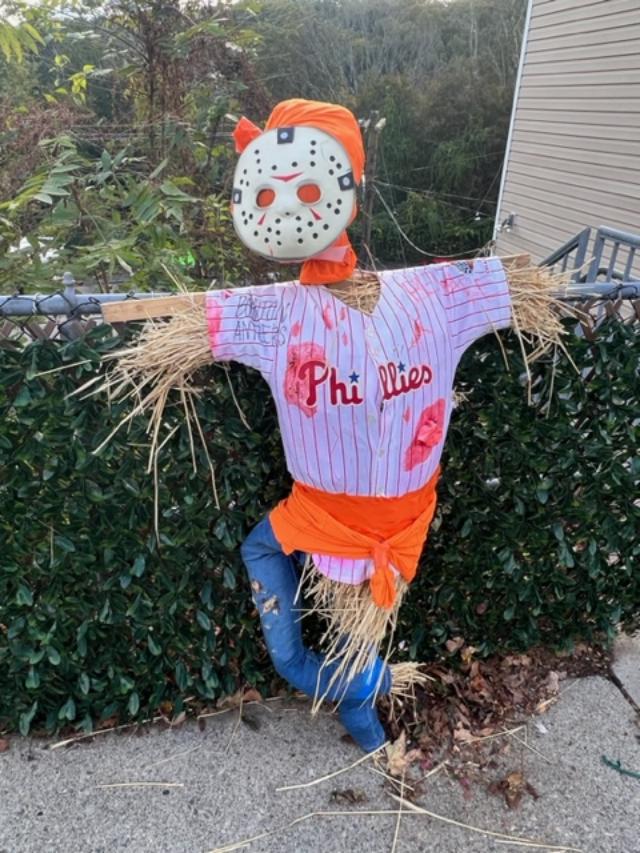
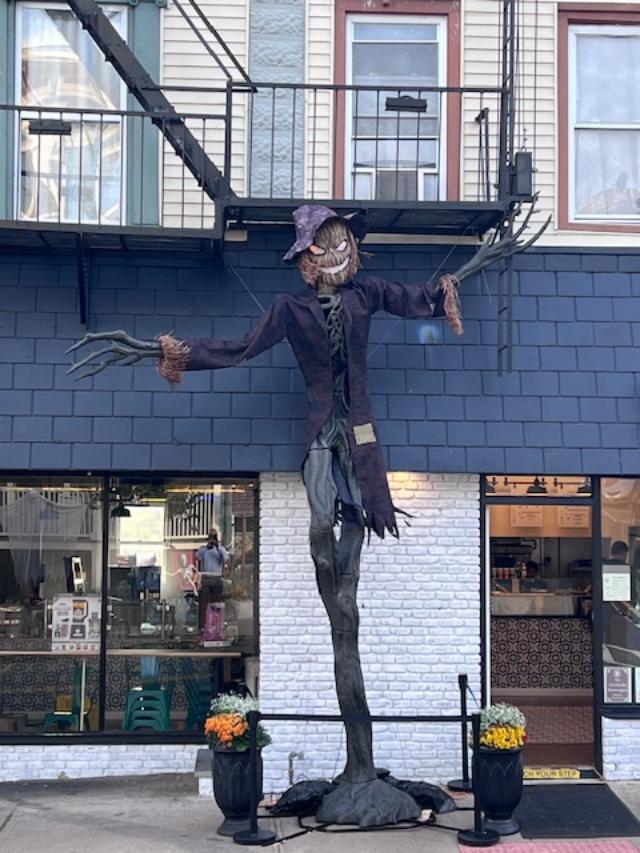
The businesses did a nice job with the scarecrows this year. The ghosts and ghouls dotted the downtown.
The Annabelle doll
The ghouls are out
The cat in the hat
Pumpkin head
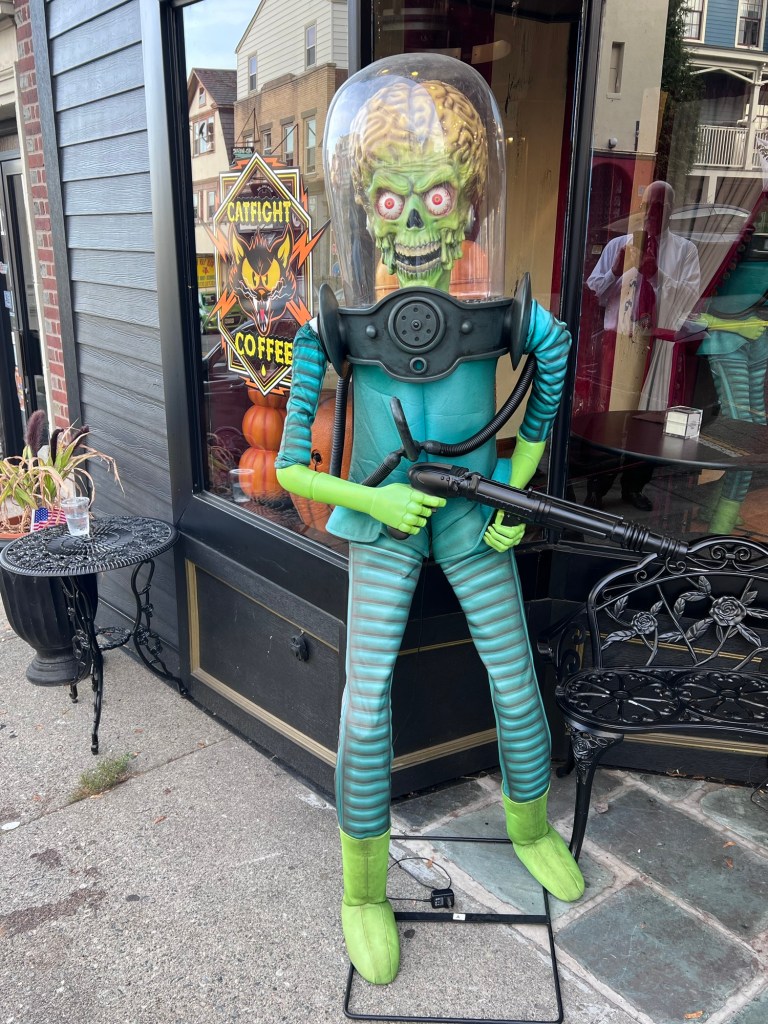
Mars Attacts outside a restaurant
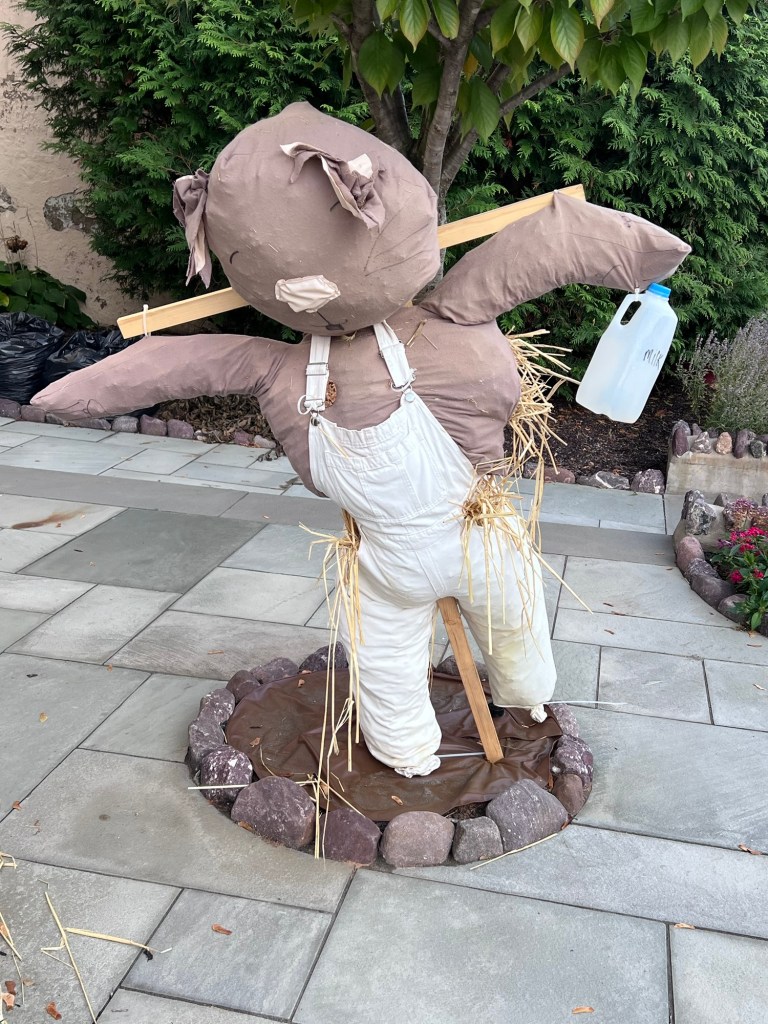
This strange Teddy was outside the library
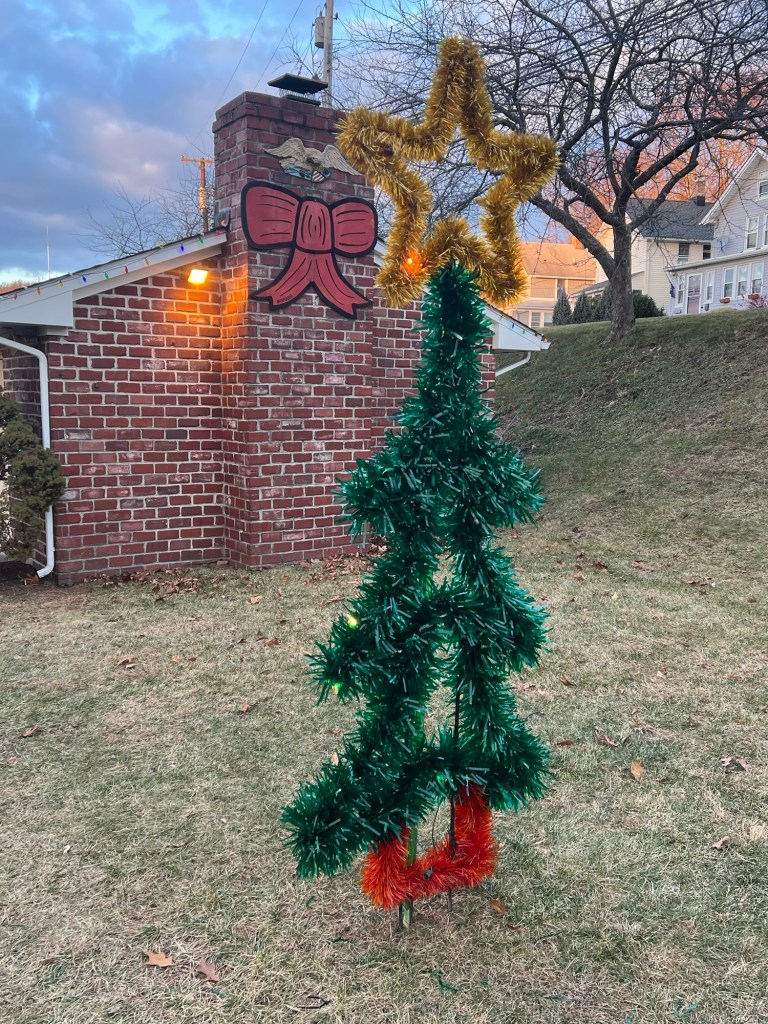
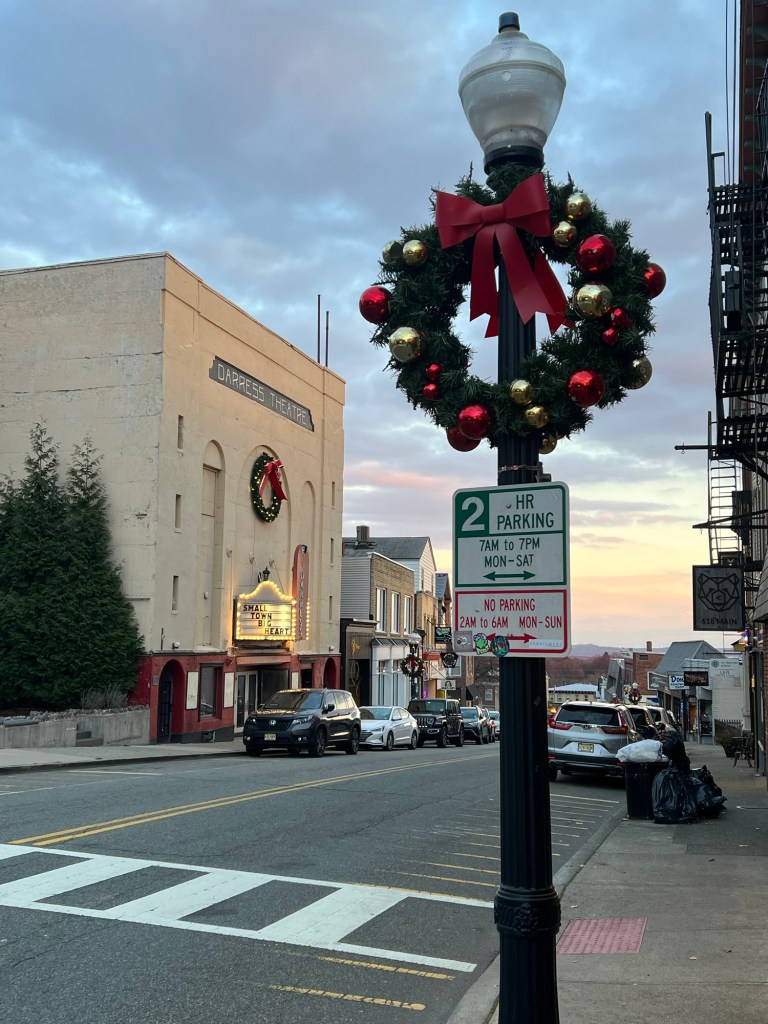
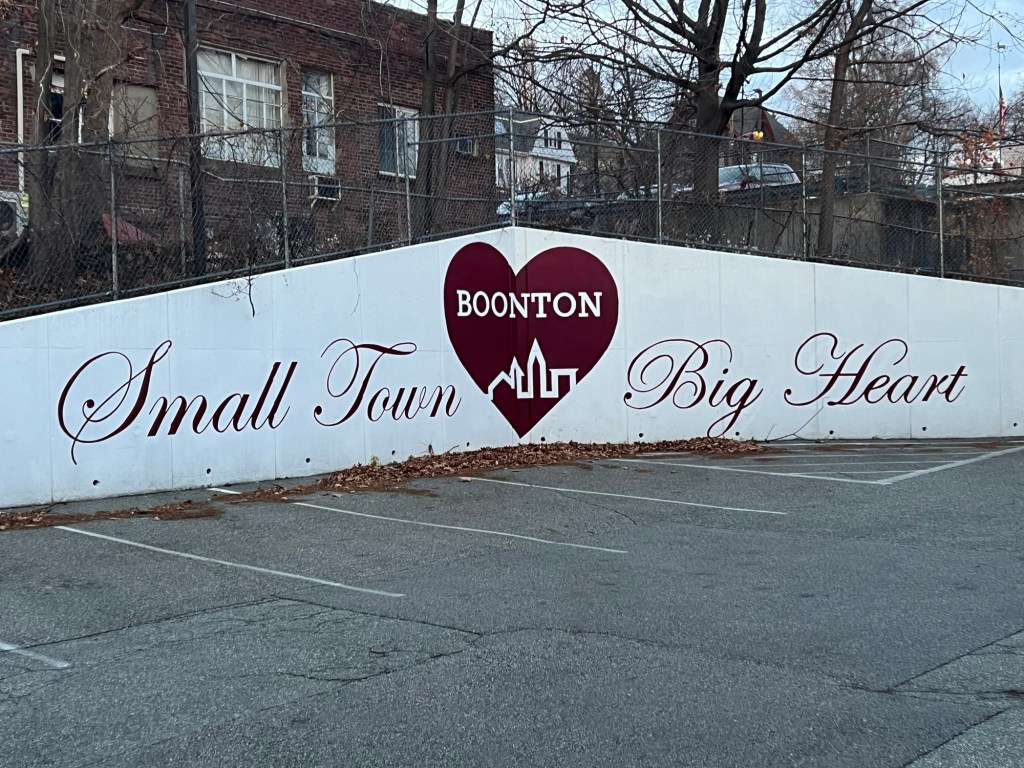
Boonton does a wonderful job of decorating during both the Halloween and Christmas holidays. The downtown is decorated with all sorts of interesting and creative artwork and beautiful lights. I recently walked around the Downtown at the start of the holiday season and it was really festive.
During Christmas time, Downtown Boonton is also beautifully decorated.
The Municipal Building decked out for Christmas
There is something for everyone in Downtown Boonton, NJ. Santaland in Grace Lord Park seems to be very popular.
The entrance to Santaland
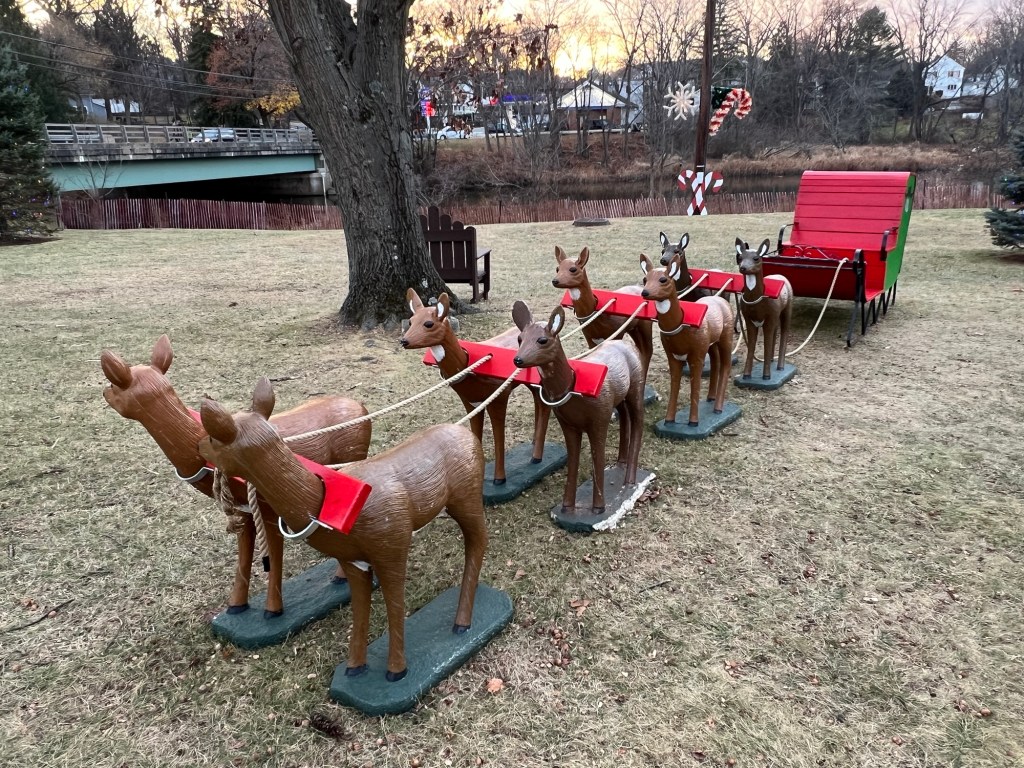
The reindeer decorations in Santaland
The set up for Santaland
The Christmas decorations in Santaland
The entrance to Santaland and to visit Santa
Leaving a message with Santa
Leaving Santaland after a walk through
I walked around Downtown Boonton during the very start of the holiday season and admired the decorations.
Downtown Boonton is becoming quite the arts community
The wreaths were adorning all the lampposts and buildings
The beautiful wreaths that adorn the lampposts
I never noticed this sign in the post office parking lot
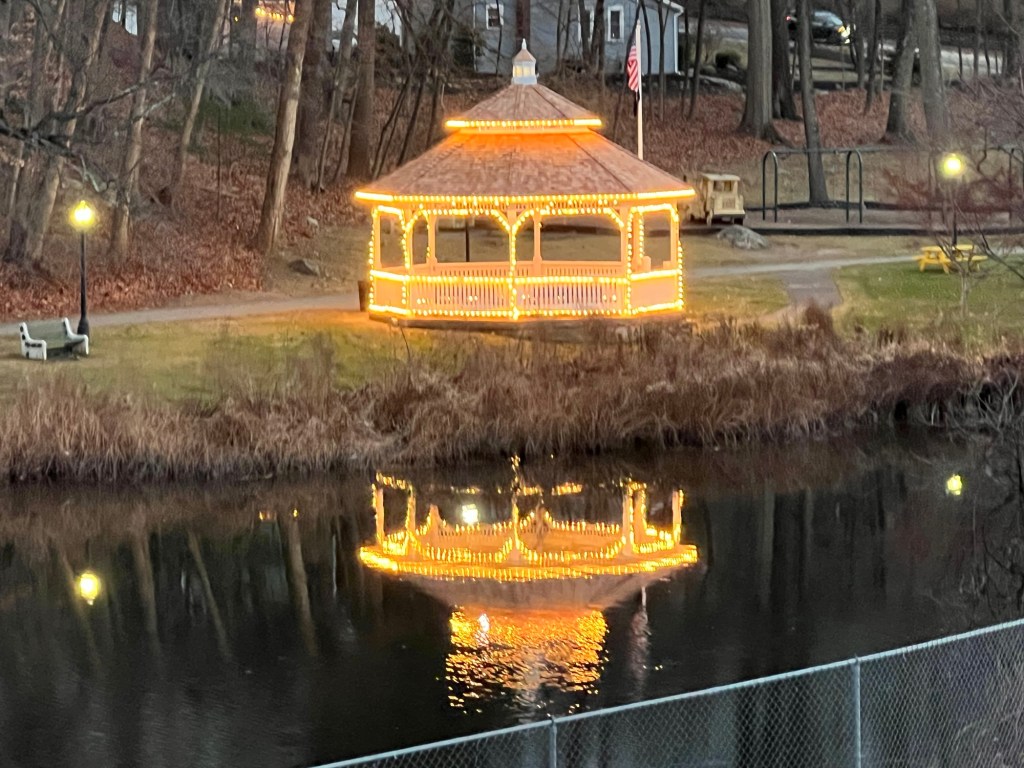
When I doubled back to leave that afternoon, I noticed the lights coming on in the gazebo. It was quite the sight at dusk.
Grace Lord Park at dusk
The beauty of the gazebo at the holidays
Grace Lord Park as well as the rest of Downtown is brilliant at the holidays. Don’t miss the beauty of Downtown Boonton at any season.
The town has attracted a sizable LGBT community of artists, residents and business owners who show their pride in the downtown
There’s always something happening and changing in Boonton, NJ!
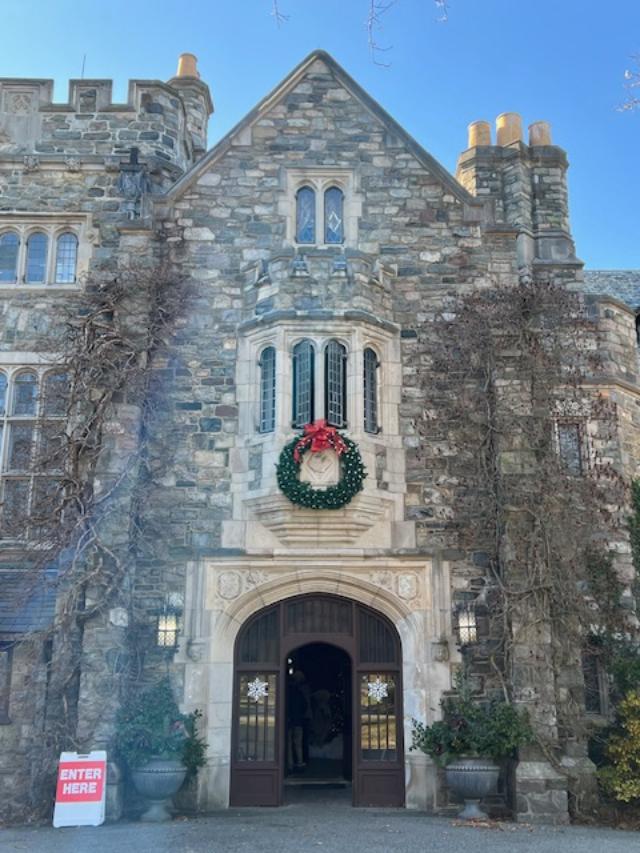
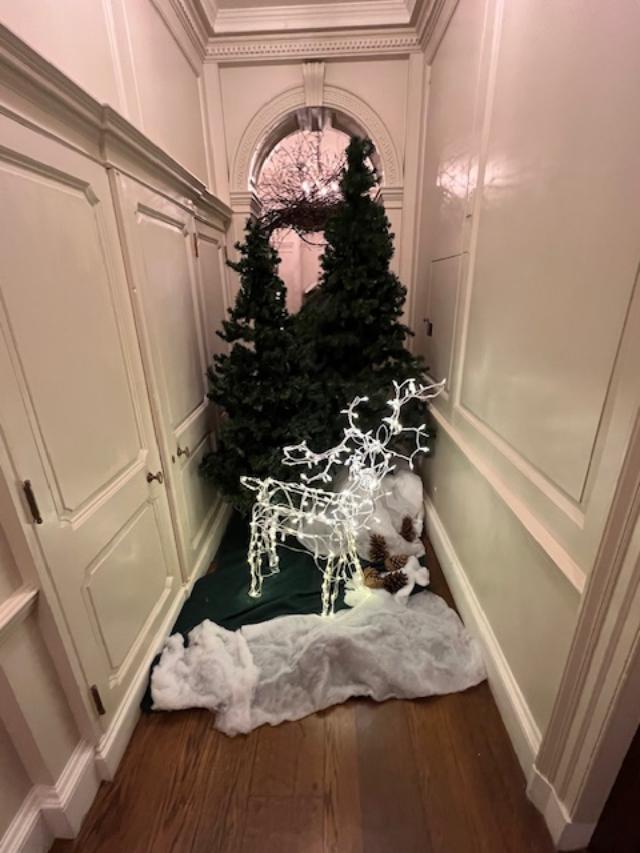
Note: The Skylands Manor is decorated for the holidays during the first week of December and only for one weekend as it used for a banquet facility the rest of the time and as a hotel. The first weekend of December is when local Gardening groups are assigned one room to decorate and they have one week to put it together, display their ideas and explain how they did it to the public.
The front of the Skylands Manor during Christmas time.
The best day to go is the Thursday afternoon opening as it is the quietest day of the four day event with Saturday being the busiest. The best time on Thursday to come is in the morning.
In 2019, the decorations were not as elaborate as the previous two years. The snow storm before the event may have put a damper on a few of the groups decorating. Still the best day to visit the manor is Thursday afternoon as it is the quietest time and you can take the best pictures.
The two best rooms in the manor in 2019 were the Entrance Hall and Grand Staircase decorated by the Magnificent Seven, a group of volunteers whose theme was ‘The Secret Life of Gnomes’ and the trees and staircases were studded with gnomes, large and small, on the trees and wreathes surrounding the stairs.
The other room that was very impressive was the Center Hall whose theme was the “Enchanted Forest, full of little fairies and painted rocks and jeweled winged ornaments. When you looked at the detail work of the trees and table displays you could see the work that went into the decor. Each little fairy on the stands and trees had immense detail and took a lot of time. This display was done by the Friends of Laurelwood Arboretum in Wayne, NJ.
The rest of the rooms in the manor were really pared down from 2018 and did not have the same elaborate details to them. The Library and Study did not have half of the display items that they did in the past.
The Carriage House was used as a restaurant and a gift shop during the event.
The fee to enter the home is still $10.00. The carriage house is being used for a cafe with Chicken Salad sandwiches and hot dogs with toppings. There are all sorts of crafts for sale.
The menu at the pop-up restaurant at the Skylands Manor.
Watch the calendar for 2024 in early December for the next display.
The Display in 2023:
It was just breathtaking!
This was the first time I had visited the mansion and I was able to visit on Thursday morning and the crowds were very small. This is the best time to come to the Skylands Manor.
The house looked amazing as usual and because I came the first day in the morning, it was the perfect time to visit the manor while the crowds were away.
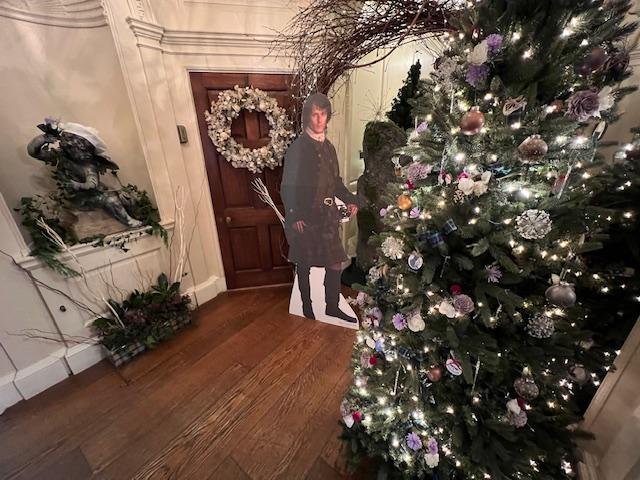
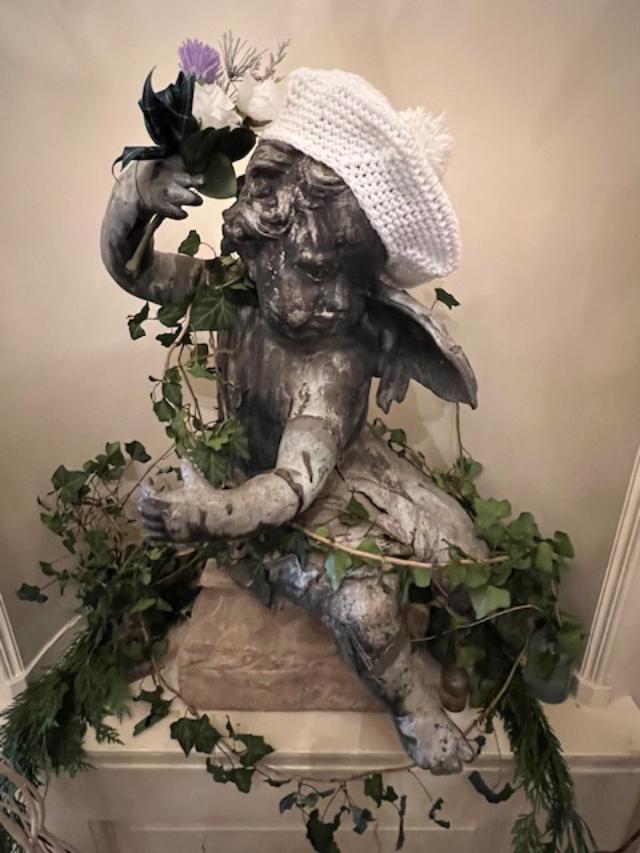
The entrance to the house was decorated by the Passaic County Parks and Recreation. This display was based on the magic of the Scottish Highlands.
After passing through the entrance of the house, it was off to the Ladies Parlor of the home and the decorations of the Garden Club of Teaneck. Then off to the Dining Room that was decorated by the Master Gardeners of Bergen County.
The Master Gardeners of Bergen County were very detail orientated with their display spreading the Christmas cheer as you entered the house. The next room was the Breakfast Room with beautiful sunlight coming into the room and views of the gardens that are dormant at this time.
The theme of the Breakfast Room was that of enchanted forests with sacred fairy springs and moss covered meadows. The Breakfast Room was decorated also by the Master Gardeners of Bergen County.
As I left the Breakfast Room, I entered The Center Hall where the many faucets of Robert Burns, the Scottish author of “My Heart is in the Highlands” themed room was decorated by the Ringwood Garden Club.
The Back Porch of the house just off the Center Hall.
The room was done with the theme “We wish you Blythe Yule as you enter a pastoral view of Holidays in the Highlands”.
The next room I visited the was The Great Hall, which is a Jacobean style interior designed to impress with its arched beams, paneled walls and spectacular stained glass windows (Skylands pamphlet).
The Great Hall decorations by the fireplace off to the side.
I next walked through The Octagonal Hall, that is the transition room between The Great Hall and The Withdrawing Room/Living Room. This was transformed into a boutique lounge with custom made furniture and decor. Festive pops of pattern and color create a merry, modern vibe (Skylands pamphlet). The Octagonal Hall was designed by Stephanie Graham and Diane Simon.
The Living Room was decorated to celebrate a Hip Highland Holiday and transformed into a boutique lounge with custom made furniture and decor. The Living Room/Withdrawing Room was designed by local artists Nicole Cohen (Teaneck), Brenda Gallagher (Upper Saddle River) and Lisa Williamson (Ridgewood).
Transitioning out of the Living Room into the The Study, this room with its window seat is the perfect place to curl up with a good book or share stories of Christmas on a snowy afternoon. The study was designed by artist Linda Karen.
The last room on the tour was The Library that is resplendent with the holiday tree decorated with hundreds of lights and a myriad of ornaments representing the Scottish heritage of its owners (Skylands pamphlet). This room was designed by the Master Gardeners of Passaic County.
The Living Room was the last decorated room in the manor home for the holidays. I exited by the back door and then explored the grounds and the dormant gardens and look out areas of the estate that must look quite spectacular in the Spring and Summer months. I headed back to the Carriage House to look at the menu and explore the gift shop. This display is only open the first weekend of December and then for the rest of the year, the manor house is used for banquets and meetings and as a B & B. Until next year.
Clarence McKenzie Lewis bought Skylands in 1922 from the estate of Francis Lynde Stetson, who founded Skylands in 1891. Mr. Lewis was educated in England and Germany. While he was there, his widowed mother, Helen Forbes Lewis married William Salomon, founder of the New York banking house. Upon his return, Lewis attended Columbia University, where he received a Civil Engineering degree in 1898. In 1908, he married and bought a country place in Mahwah; it was there that Lewis became interested in horticulture.
Helen Lewis Salomon, the mother of Clarence Lewis, was widowed in 1919. Not only thereafter, she and her bereaved son agreed to a joint project; she wanted a Tudor-style showplace; he wanted plants and gardens. Mrs. Salomon worked closely with the architect on Skylands Manor but she died in 1927 before its completion.
John Russell Pope (1874-1937) “an architect born to work, in the grand style” was educated at City College, Columbia University, the American Academy in Rome and the Ecole des Beaux Arts in Paris. He trained under Bruce Price, the master builder of Tuxedo Park. Pope designed many outstanding public buildings, such as the Jefferson Memorial and the National Gallery of Art.
The estate gardens overlooking the mountains and the valley below.
Tutor Architecture originated in England in the late Gothic period and continued to be popular into the Renaissance. It features half-timbering on the exterior, crenelated walls, large groups of rectangular windows, oriel or bay windows and intricate chimney complexes The interiors usually had large central halls, wood paneling, molded plaster ceilings and elaborately carved staircases. Tudor Revival became a popular style for the elegant country houses of wealthy Americans.
The builder of Skylands was the Elliot C. Brown Co., of New York City, which also built the country homes of Franklin Delano Roosevelt at Hyde Park and E. Roland Harriman (Arden House).
Samuel Yellin (1885-1940) decorative metal designer and craftsman, who performed to call himself “the blacksmith”, fashioned the lanterns. electrical fixtures, lamps, gate, and spiral staircase rail for Skylands Manor.
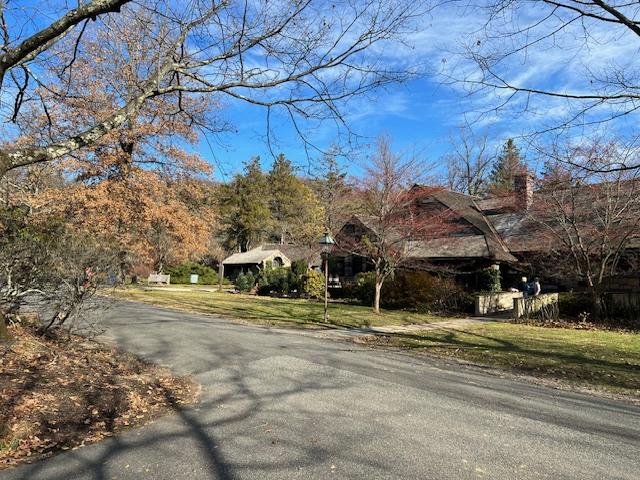
The side of the estate that afternoon in the late fall.
Native Granite for the exterior walls of Skylands was quarried at Pierson Ridge above Emerald Pond in the eastern part of the property in Bergen County.
Mrs. Salomon purchased a collection of antique Stained Glass Medallions from an English collector. The 16th century German, Bavarian and Swiss panes were set in leaded windows by Heinegke & Smith of New York City.
Disclaimer: This information on the details of the history of Skylands Manor was taken directly from their pamphlet and I give them full credit for it. Please call the manor for times that it is open as it is used a banquet/catering facility and a B & B.
The NJ Botanical Gardens just off the Manor House Fall 2026:
I visited the NJ Botanical Gardens in the Fall of 2026 just as all the Fall flowers were in bloom. With the foliage in the background mountains, it gave the whole garden colorful effect on the late afternoon. I will have to remind myself to visit the gardens again in the Spring and early Summer next year. There is a real complexity to these gardens during each season. I will have to visit again in the Spring and early Summer of 2027.
The Skylands Manor is decorated for the holidays during the first week of December and only for one weekend as it used for a banquet facility the rest of the time and as a hotel. The first weekend of December is when local Gardening groups are assigned one room to decorate and they have one week to put it together, display their ideas and explain how they did it to the public. The best day to go is the Thursday afternoon opening as it is the quietest day of the four day event with Saturday being the busiest.
In 2018:
Each of the eleven rooms that were decorated for the event were amazing each with their own decor, docents and gardeners and theme to the room. The Entrance Hall was elegant with its garland and potted…
I put “MywalkinManhattan” on hold for a few days as the local activities in New Jersey started to take up my time. There is so much to see and do as the weather is getting warmer.
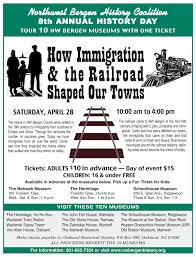
The Northwest Bergen History Coalition every year gives people the opportunity to visit almost a dozen different historical sites in the upper part of Bergen County, NJ and take the time to tour and explore all the sites with the help of trained docents and volunteers who take immense pride in showing off their site all for the low price of $10.00 ($15.00 the day of the event).
Be prepared to drive though because all the sites can be a distance from one another. Also, have a a game plan because there is no way you can see everything in one day. You will only have from 10:00am-4:00pm so plan to visit the remaining sites at another time.
This year’s theme was “How Immigration & the Railroad Shaped our Towns”, so all the exhibits were on the immigration of the area and how it shaped the individual town’s population.
“The towns in Northwest Bergen County were settled in the 18th Century by immigrants from countries in Europe and Africa. Through the centuries the number of countries grew. Today, we have been enriched by immigrants from all over the world. The railroad came to Northwest Bergen in the mid-19th century, bringing with it jobs, prosperity and immigrants. Come see how immigrants and the railroad helped to define what would become our modern towns of today.” was the prospective of the days event.
Since I had toured most of the historic homes and museums to the south of the region, I planned my day to the northern part of the county. I bought my ticket way in advance at the Ridgewood Schoolhouse Museum (featured on my blog, “VisitingaMuseum@Wordpress.com and reviewed on TripAdvisor) when I was viewing the “Thread of Life” exhibition, which you should not miss that is showing through December of 2018. It explores life of the era’s family life through clothing.
In 2018, I planned an early morning and started my Saturday at the Majestic Diner at 1045 Route 17 South in Ramsey, NJ. This way I would be close to my first site, The Old Stone House in Ramsey, NJ. The food at the Majestic Diner I would highly recommend because I really enjoyed my breakfast there.
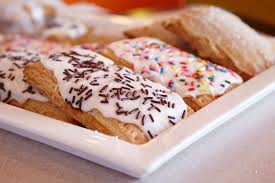
The diner does all their baking on premise and I had one of their homemade ‘Pop-Tarts’ to start the meal. These freshly baked pastries resemble their commercial counterparts. The outside was a flaky pastry crust with a thick white icing and a powdering of cinnamon and the inside was loaded with a thick layer of a cinnamon mixture. Decadent yes but well worth it. You have to try this version of the sweet treat.
Don’t miss their freshly baked ‘Pop-Tarts”
Breakfast itself match in creativity and quality. I ordered the Brioche French Toast with a side of homemade sausage. The one thing I liked about the Majestic Diner is that the portion sizes are not huge and over-whelming. It was just the right amount for breakfast. The French Toast was made out of brioche and it was perfect (See review on TripAdvisor).
Their Brioche French Toast is excellent
They cooked it with a crisp outside and soft inside. As I was eating, I saw the omelettes going by and that was for another time. What was nice about breakfast was that it kept me content for the rest of the afternoon. There would be a lot of running around. In 2026, Majestic Diner had closed last year, so I went to State Line Diner in Mahwah for breakfast.
I had not been to State Line Diner at 375 Route 17 North in Mahwah, NJ for several years. I wanted to come back because I wanted the same French Toast platter again. I was not disappointed. The food here is wonderful and the service is excellent.
The place was packed with people eating breakfast. I barely got in the door as the parking lot was mobbed with people circling around. I lucked out and someone pulled out as I drove in. Then I got inside to eat. I got seated quickly and relaxed in my booth.
The inside of the restaurant
You have to pass the dessert cases first
There is too much to choose from here
I came here for French Toast and that was on my mind when I ordered. I was not disappointed. Everything was delicious.
The French Toast platter with Scrambled eggs and Sausage
The French Toast was so good
In 2023, time was of the essence with graduate studies and getting papers graded for work that I ate at home and planned to eat lunch at the end of the day of touring. I decided again to start the day at the Ridgewood Schoolhouse Museum and buy my ticket there. It was a really gloomy day and was cloudy with a few drops here and there during the day.
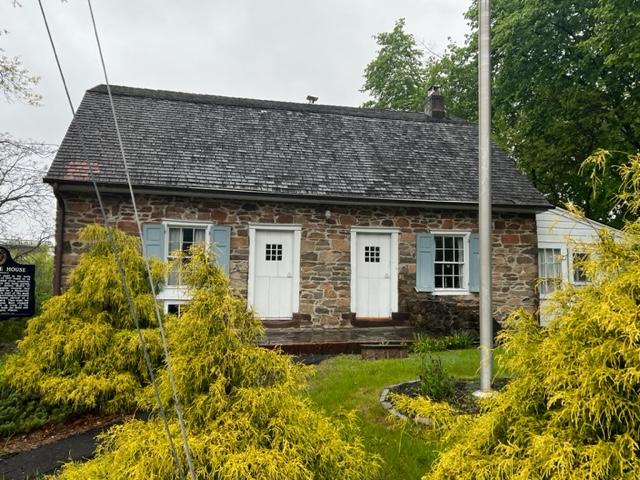
My first stop was at The Old Stone House at 538 Island Road in Ramsey, NJ (See review on VisitingaMuseum@Wordpress.com). This obscure little Dutch home sits on a bend on a hill hidden by trees off a very busy section of Route 17 South and by looking at it, you never would have guessed that it was once home to a 300 acre farm. This is the oldest building in Ramsey and was built from a combination of rubble stone, clay mortar, chopped straw and hog’s hair. The home dates back to 1740 and is run by the Ramsey Historical Society (RHS).
The house is credited to being built by members of the Westervelt family for brothers Uriah and Ruloff Westervelt, who leased the land in 1744. There is a feeling that there had been a house on the property at the time they leased the land. The land had been part of the Ramapough Tract for Proprietors. Other members of the Westervelt family are though to have had influence in the building of the house as well maybe back earlier (RHS).
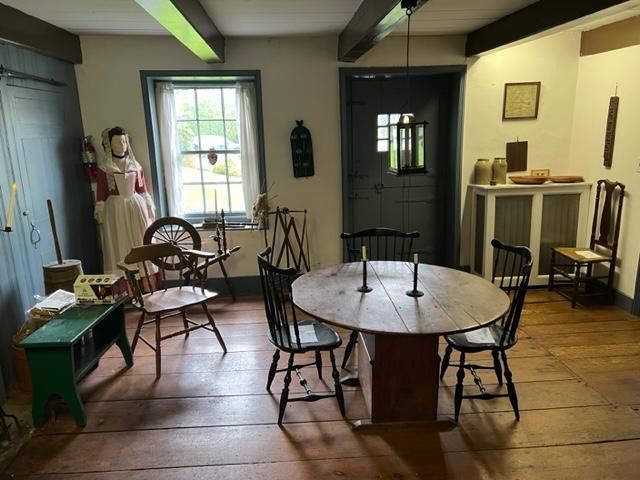
The Old Stone House kitchen
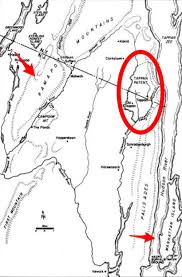
The Ramapough tract situated between the Ramapo Mountains and Saddle River was purchased from the Indians on November 18,1709 and acknowledged by the Indians at Tappan before Cornelius Harring, the Justice of the Peace (RHS).
The Ramapough Tract
The house had been through many owners since and the land around it diminished over time with each owner. In 1950, the building of Route 17 South, made the lot even smaller and destroyed the spring and stream that were once part of the land around the house. Both the Schweizer family and the Labosky families, who were the last two owners of the house, which the Labosky family sold to the state in 1955, operated an antique shop that is now part of the house that faces Route 17 (RHS).
The house is furnished in period furniture and the barn outside is stocked with all sorts of equipment for early Dutch farming from the era. When you tour the house with the historians, they will point out where the fireplaces once were and the original wooden floors that line the house. Upstairs where the bedrooms once were are both Children’s displays of an old schoolhouse and a toy exhibition. In the downstairs area, there are two displays to the War Years and the old antique shop is set up like a general store. The sites next big fundraiser will be the Sinterklaas event in December for a Dutch Christmas.
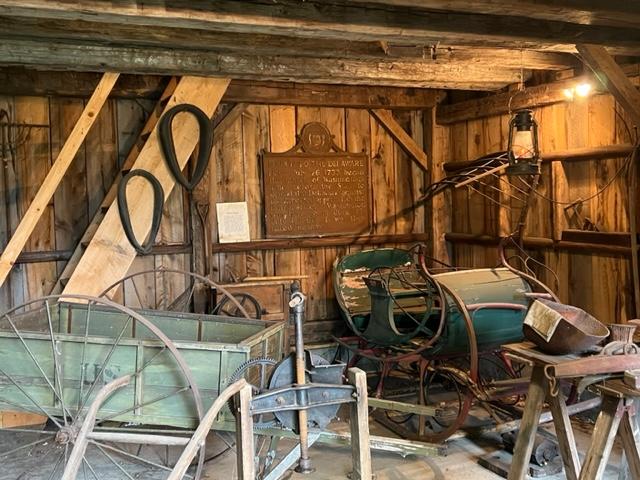
Old Stone House Barn on the inside
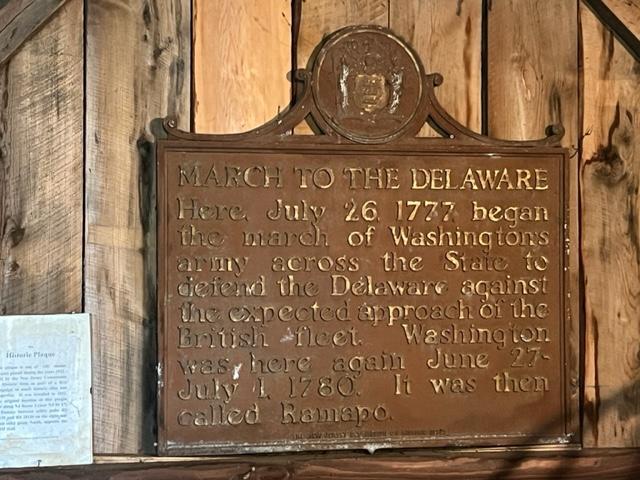
Old Stone House marker
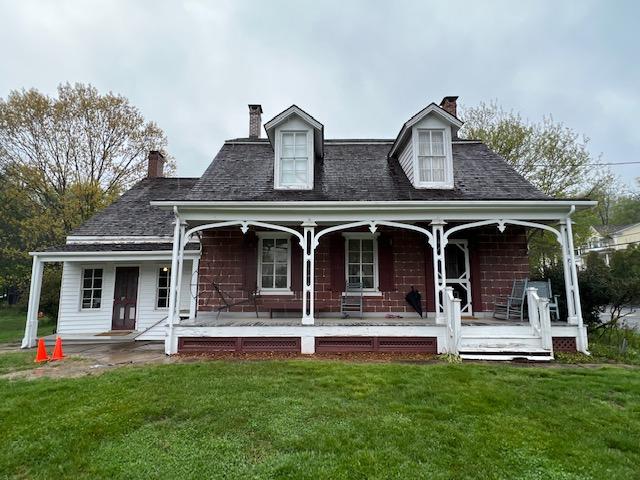
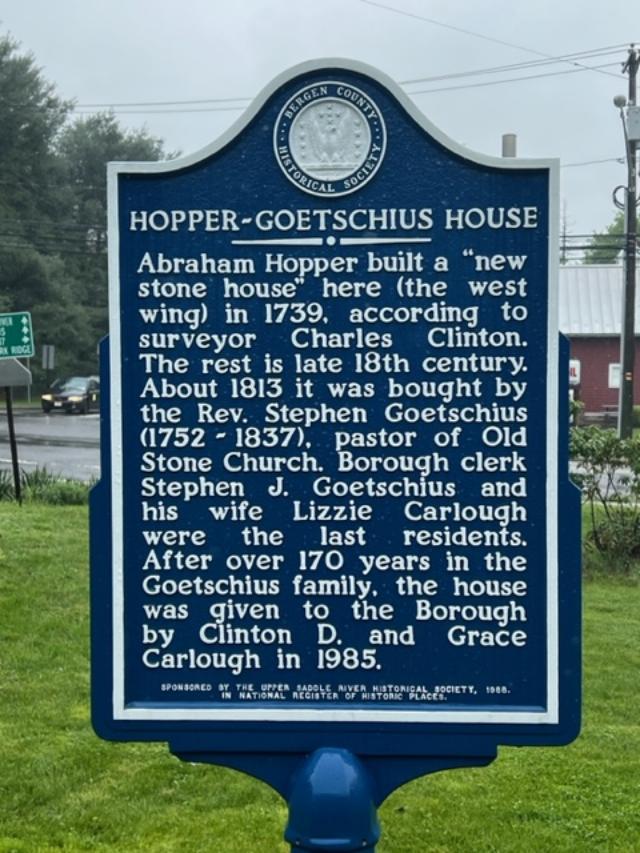
My second stop of the historical tour was the Hopper-Goetschius House and Museum at 363 East Saddle River Road in Upper Saddle River, NJ, run by the Upper Saddle River Historical Society (USRHS). This historic home dates back to 1739 for the original part of the house, which has since been added onto three more times and still kept its historic look even into the 1980’s when the last resident moved out.
Hopper-Goetschius House & Garden at 363 East Saddle River Road
The property houses several buildings that were part of the original house like the outhouse, out kitchen and beehive oven. Other historic buildings that were threatened with being knocked down by developers have since been resembled and brought the property that include a woodshed, a tenant house, the Ramsey Sayer House, a Dutch barn, the Van Riper-Tice Barn and a working blacksmith shop. That part of the property toward the back part of the farmhouse looks like a mini-village and volunteers were working each of the buildings when I was there.
The buildings on the ground of the Upper Saddle River Historical Society
The Hopper-Goetschius House on the corner of Lake Street and East Saddle River Road dates back to 1739. Built by the Hopper family, it is the oldest remaining house in Upper Saddle River, NJ. The Saddle River Historical Society knew it existed in 1739 because it was recorded in surveyor Charles Clinton’s journal and possibly it is older. It was also marked as the home of Gerrit Hoppa on a rough sheepskin map made about 1713. The Hoppers farmed the land and had a lot of it. The property extended from the Saddle River up the hill almost to Montvale, NJ and up to the East Road in Upper Saddle River (USRHS).
The Hopper House Living Room
The house underwent several changes in the mid-1800’s. The large central chimney with back to back fireplaces was removed. Probably with more modern forms of heating available, such as wooden stoves, the fireplace seemed a bit old-fashioned and the owners took it out. They wanted to use the entrance hall as a room, so the stairway along the east wall was removed and a central stairway added where the fireplaces had once been. The dormers were added in the Victorian era (USRHS). Don’t miss the secret stairs in the kitchen that lead to the old second floor which houses a few bedrooms. It is one of the unique features of the house.
The Hopper House upstairs bedroom
In 1814, the house became the home of the Reverend Stephen Goetschius of the Old Stone Church. It remained in the Goetschius family for a century and a half, always a place of central importance in town as Stephen Goetschius, the great-great grandson of the Reverend Stephen, served as the borough clerk for over 40 years and conducted his town business from the east room of the house (USRHS).
The Hopper House kitchen
The house was without running water until Stephen’s death in 1962. Until improvements were made at that time, Stephen’s wife, Lizzie, carried water from the well for washing, cooking and shoveled coal for heat (USRHS).
In 1985, the Hopper-Goetschius House was presented to the Borough of Upper Saddle River by Clinton and Gracie Carlough. Lizzie Goetschius, the last resident of the house was Clint Carlough’s aunt. The house today serves as a museum, run by the Upper Saddle River Historical Society (USRHS) and offers the public historically related events through out the year (USRHS). Check out their website, http://www.usrhistoricalsociety.org for special events and check out their Annual Harvest Festival in October for a day of fun.
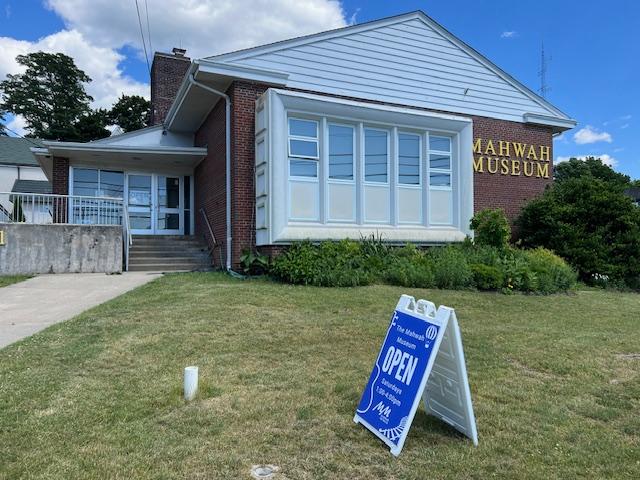
I double backed around the county to the Mahwah Museum at 201 Franklin Turnpike in Mahwah, NJ and the sister museum, The Old Station Museum at 171 Old Station Lane just south of the main museum. What I like about these museums is that it does not take long to tour them and they sponsor interesting exhibitions that feature local history that do not tax you with lengthy displays and loads of reading. They keep everything interesting, factual and get to the point.
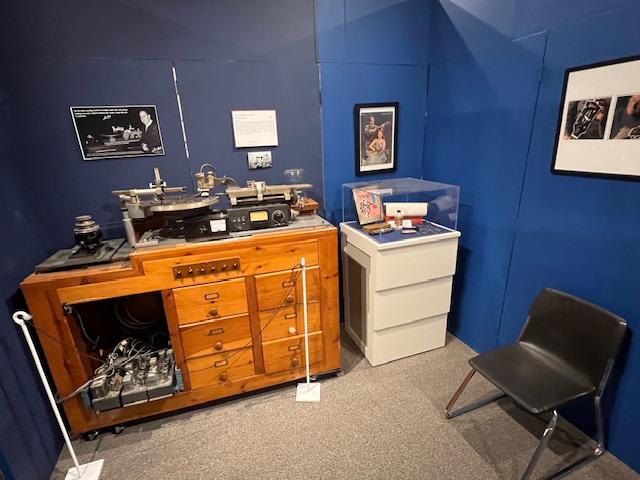
The Les Paul in Mahwah exhibit showcases many of Les’ innovations in solid body electric guitar design and multi-track sound recording. Les called Mahwah home for nearly 60 years and is the only person to be elected to both the Inventor’s Hall of Fame and the Rock and Roll Hall of Fame.
The Les Paul exhibition of recording equipment
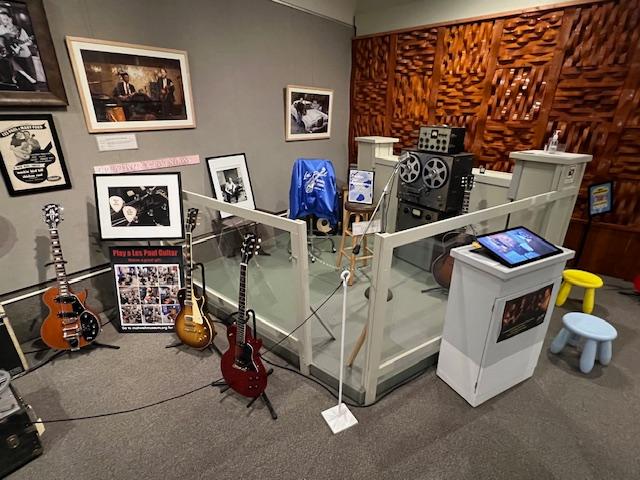
On display are items from Les’s home studio where many of his and Mary Ford’s hits were recorded. The Mahwah Museum is honored to house this landmark equipment which includes his recording console, an Ampex eight track stack, an Ampex 300 deck, the “Wally Box” and part of the studio wall that was expressly designed to create an echo chamber. Also on display is Les’s disk-cutting lathe used to record sound onto acetate disks. Among Les’s guitars on display are one of his “Klunkers” and a replica of “The Log” (an early prototype of the solid body guitar).
The Les Paul recording equipment display
Visitors may play many of the guitars through our Play a Les Paul Guitar program. (Reservations are required.)
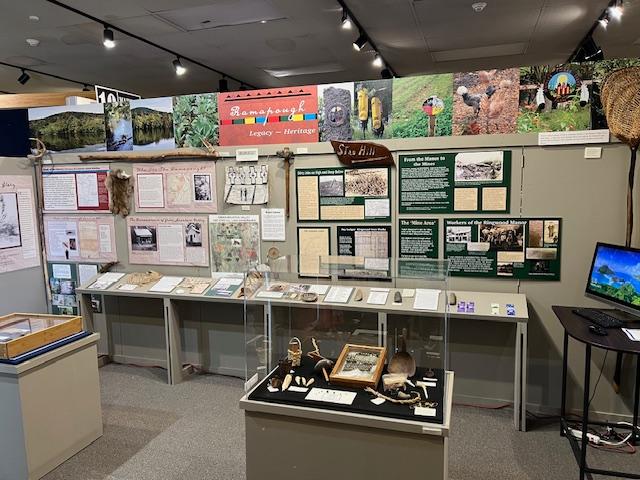
Ramapough Legacy ~ Heritage Exhibition:
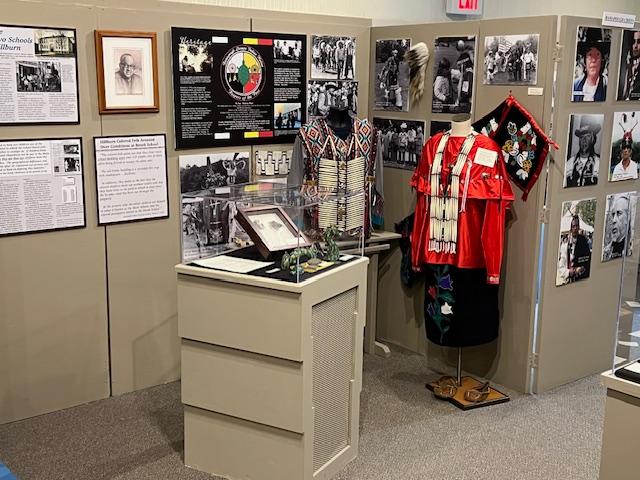
The Ramapough Lenape exhibition
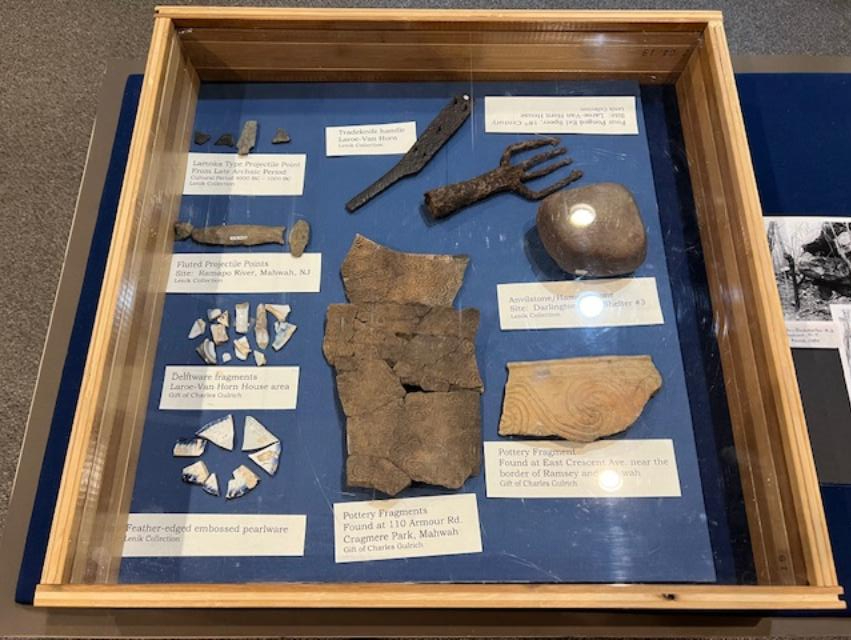
The Ramapough Lenape people have a long and complex history in the Ramapo River Valley communities of Mahwah, Ringwood, and Hillburn. Explore and learn about this Indigenous people’s history, folklore, art, craft, tools, herbs and medicines, costume, and culture.
The Native American exhibition
The Native American display
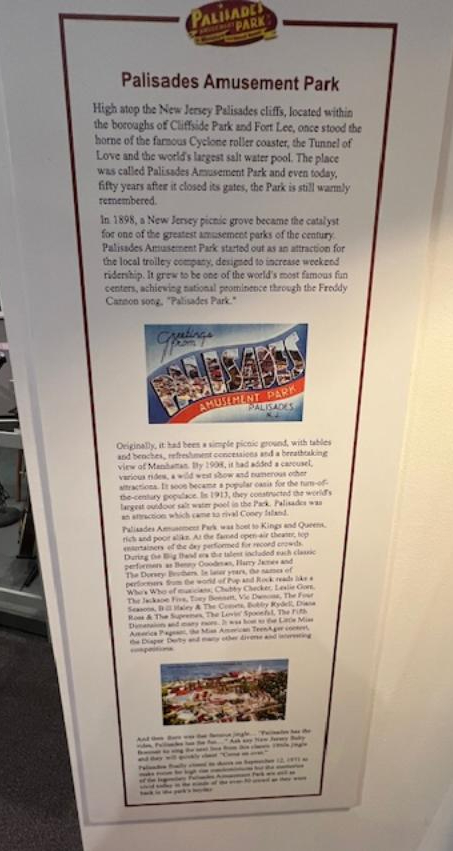
The Palisades Amusement Park exhibition:
The Palisade Amusement Park sign
This miniature depicts the legendary Palisades Amusement Park as it would have looked in the mid 1930s. The scale of this model is 1:12, a common dollhouse scale.
The original builder of the model was Joe Prisco, a longtime park employee. His estimated cost for the initial build was $40,000. Over 3,700 light bulbs and 15 power transformers were used to illuminate the rides and attractions. It was displayed at several locations in Ocean County, New Jersey in the 1990s. Prisco died in 2006 (Museum website).
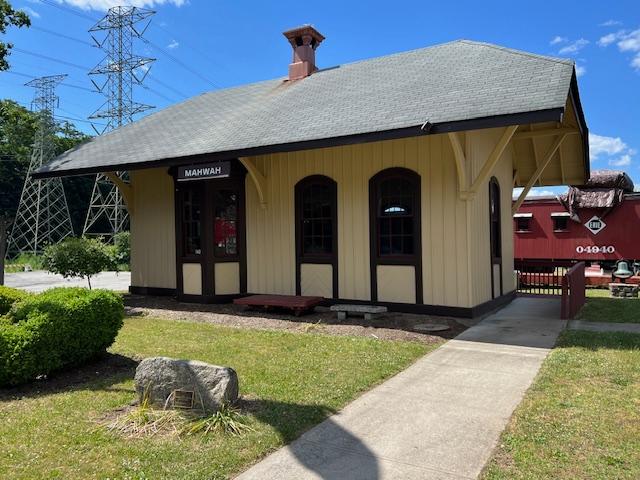
Having been to the Mahwah Museum earlier that month, I wanted to concentrate on The Old Station Museum. This historic train station was built in 1871 and was used for years until the modern station was built. Behind the building, there is a 1929 Erie Line Caboose that you can walk through that shows the life on the railroad and the use of the caboose on a railroad.
The Old Station Museum at 171 Old Station Lane in Mahwah, NJ
The museum has a interesting collection of items from the Pullman era that includes china and menus. There is a collection of trains and interesting items including maps from the era when Mahwah was major point of the railroad in the area.
In 2026, I tried to revisit the museum but it was closed during the 2026 event. So I just took some pictures around the museum and planned to visit again in the Summer months when I know it will be open.
The outside of the Caboose
The outside sign
The inside Station Manager’s display
The inside train set
The next stop on my journey as I drove south through Bergen County was the Waldwick Signal Tower at 1 Bohnert Place in Waldwick, NJ and the sister museum of the Waldwick Museum of Local History at 4 Hewson Avenue in Waldwick, NJ right by the current train station. These are part of the Waldwick Historical Society (WHS).
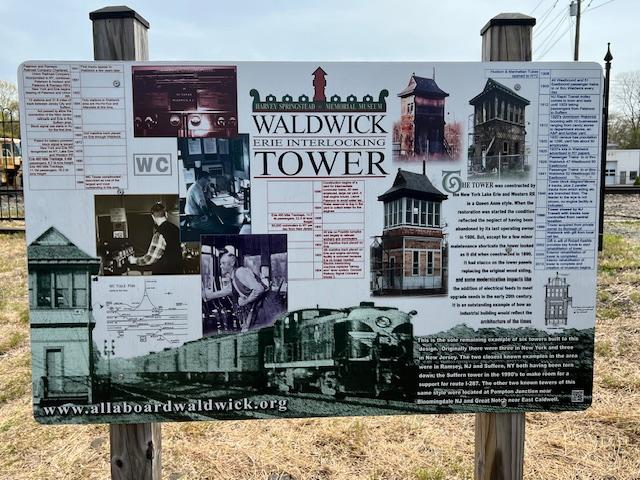
The Erie Railroad Interlocking Tower “WC” was built in 1890 by the New York Lake Erie and Western Railroad the tower in on the National Register of Historic Places. It is a symbol of the overall impact of the railroad industry on the Waldwick area. The tower is constructed in a Queen Anne style and other than a few minor maintenance shortcuts, the tower looks as it did when constructed nearly 130 years ago (WHS).
The tower is a two story museum right next to the tracks in a rather obscure location in the back which you have to reach coming off Hopper Road to 1 Bohnert Place and the parking lot is off to the side.
The Signal Tower still sits on the Pascack Line that leads into New York City.
There is some walking here and not ADA accessible as the building was built so long ago but you can see it from a car from the parking lot and get a feel for its look and purpose at an earlier time in history. The main room downstairs had an interesting exhibition of railroad deeds from the various railroads that used to be part of the system of Bergen County whereas the upstairs which can be reached from the outside.
The train sign
The tower still controlled traffic but as the railroads modernized with radio communications, automatic block control and other labor saving ideas the need for the number of towers on the line was reduced until 1986, when most of the towers outside major hub such as Jersey City were closed. During the last few decades, the tower was only manned during the day (WHS).
Waldwick Signal Tower light display
It is believed that this is the last standing tower of six built to this design. The two closest known examples in the area were in Ramsey, NJ and Suffern, NY, both having been torn down. The tower is named in honor of Harvey Springstead, one of the most famous engineers on the New York Division of the Erie from 1910 until 1929 and a key citizen of Waldwick (WHS).
The downstairs houses a small display of railroad deeds from the various railroads that used to operate in this part of Bergen County and the upstairs has a collection of railroad artifacts as well as pictures of the renovation of the tower.
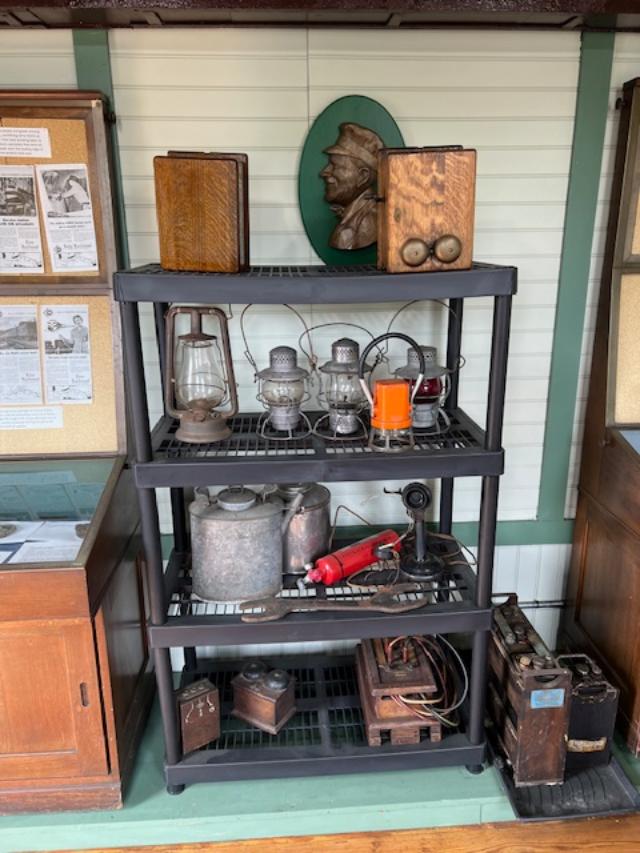
On the lower level of the Signal Tower has the exhibitions on the artifacts of the train station that includes the signal lightening, telephone pole protectors and items used at the station.
The downstairs gallery at the Waldwick Signal Tower.
The schedules and signal lights of the tower.
The map of the railroad into New York City and out into the suburbs.
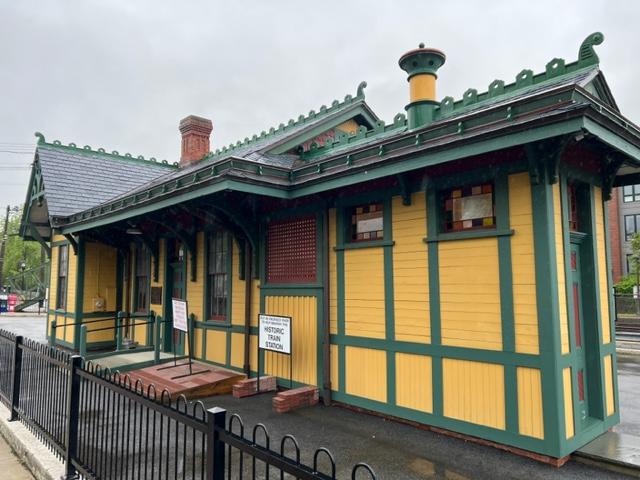
I did a circle around the tracks and stopped at the Waldwick Museum of Local History at 4 Hewson Avenue which is located in the restored 1887 Waldwick Railroad and opened in 2016. It is part of the Waldwick Community Alliance.
The Society was started by member Doug Cowie in 1977 with the purpose to lobby for the placement of the train station on the National Register of Historic Places in order to save it. With the formation of the Society, the station was placed on the registry.
It is noted that these railroad lines are what brought the new population of immigrants to upper Bergen County at the turn of the last century and why these towns had a building boom before and after World War II.
The Train booth display in the museum
The museum has an interesting exhibition on the immigration to the area due to railroad transportation. There are historical items as furniture and clothing and train memorabilia. The history of the rails is well represented at the museum. Members of the museum were on hand to give a personal tour.
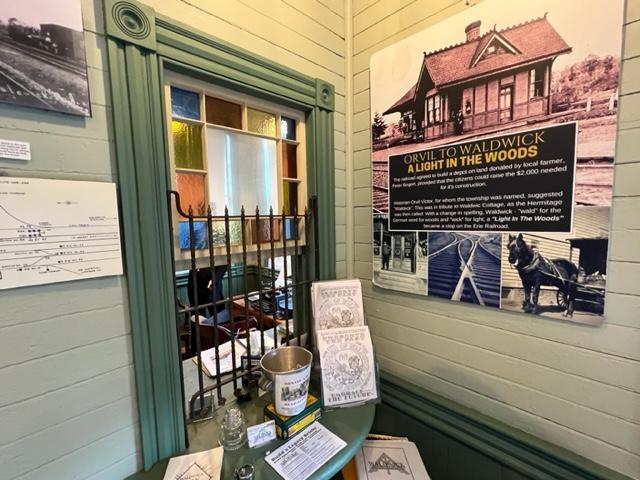
The conductor’s Office right next to the Ticket Booth
The Conductor’s collection of artifacts
The main part of the museum has the history of the town displayed including the schools, police and fire departments and town organizations. The history of the railroad service in town is displayed of how it developed and the how the town grew around the station. Since the town is celebrating its ‘100th Birthday’, there are all sorts of pictures of the town at various stages.
The Railroad display
My last historical place I visited was The Museum at the Station at 176 Rock Road in Glen Rock. The museum is managed by the Glen Rock Historical Society and is housed inside the original 1905 Erie Main Line Train Station on Rock Road.
Museum at the Station at Glen Rock, NJ at 176 Rock Road
The Museum showcases items from Glen Rock’s past with displays that change periodically as well as permanent exhibits on the Erie Railroad and artifacts from Glen Rock’s farming history (BCHS).
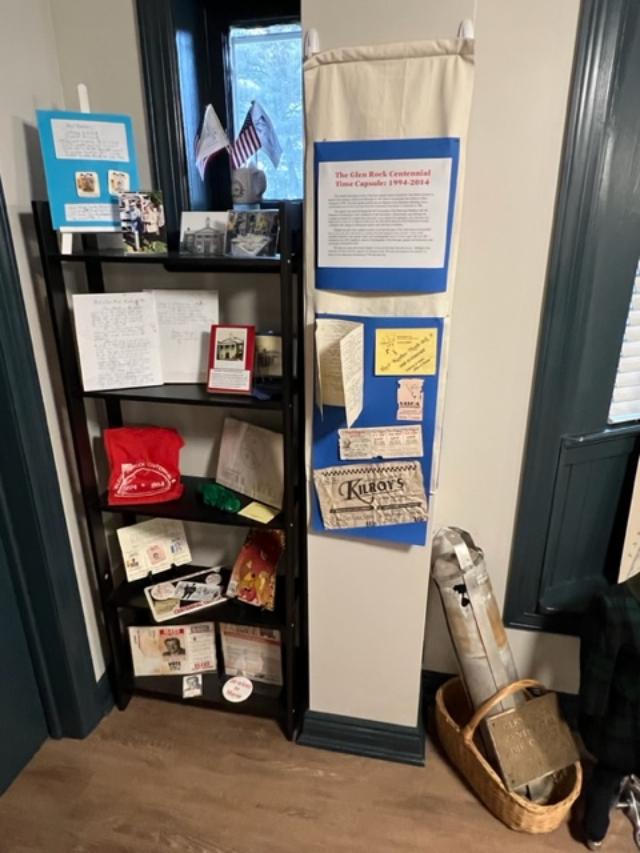
The town time capsule
When I visited it was at the end of the day so I was the ladies last guest. The members of the Society took me around the museum which has a interesting exhibition on immigration and how it affected Glen Rock and how it grew as a town. Many of the items are historic family items donated member of the Glen Rock community including clothing and furniture. They had the most interesting Victrola with the original records and period clothing. One resident donated an interesting collection of antique toys including many trains.
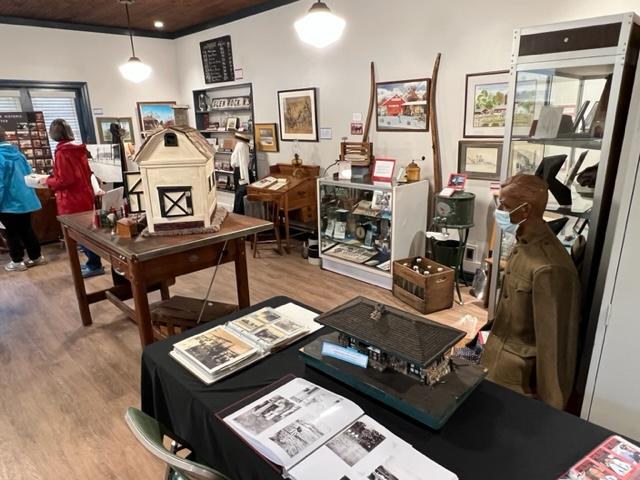
The Museum’s main gallery
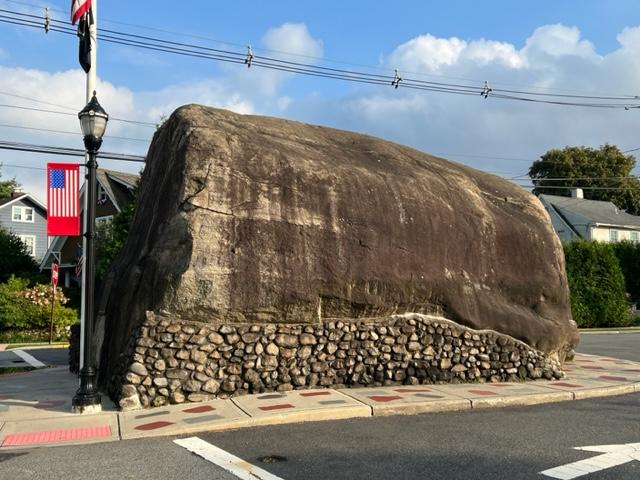
While in Glen Rock, I visited the famous Glen ‘Rock’, located right off the downtown at the intersection of Rock Road and Doremus Avenue, which the town is named. The Rock was pulled to the town by the last Ice Age and was a meeting place and marker for the Lenape Indians when they lived in the area. In the Colonial era, it was a meeting place for residents. There have been many legends about the power of the Rock.
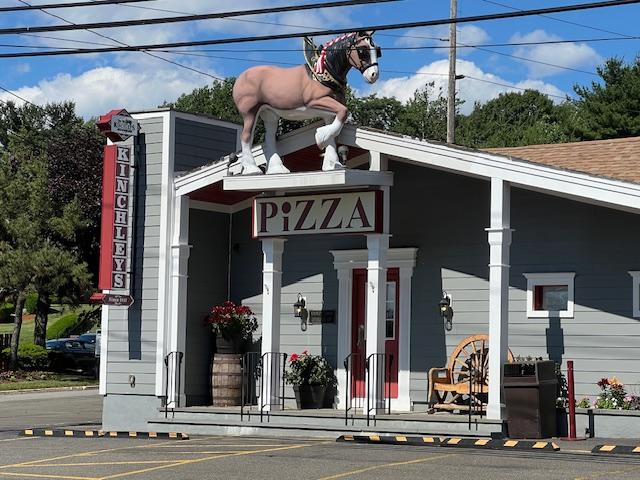
In 2018, I went to dinner that night was a revisit to Mahwah to have pizza at Kinchley’s Tavern at 586 North Franklin Turnpike in Ramsey, NJ, for one of their thin crusted pizzas (See review on TripAdvisor). This is one of the oldest restaurants in this part of upper Bergen County and has been on my must try list for about two years.
Kinchley’s Tavern at 586 Northern Franklin Turnpike
First off, the place is mobbed all the time. I have heard that people swear by their pizza. It is different from the usual Neapolitan pies that I try all over Bergen County. Kinchley’s specializes in thin-crusted pizzas, more of what people would call a ‘bar pizza’. The 12 inch pizza can be easily eaten by one person if they are hungry and the sausage pizza I ordered was loaded with sweet Italian sausage. One thing Kinchley’s doesn’t do is skimp on the ingredients.
The inside of Kinchley’s is very homey
The pizza was cooked to a crisp consistency and was devoured quickly after a long day of touring. The restaurant is a great family restaurant with a good vibe. It was like going back in time to the 70’s when going out to dinner with your family was a treat and a rite of the summer. I highly recommend a visit there at least once when visiting Bergen County.
Kinchley’s Pizza is very good!
Until next year! Don’t miss this event every year in May!
The Northwest Bergen History Coalition 6th Annual History Day Theme: ‘Spreading the News: Rail, Mail & the Press in Days Gone By’
Special Exhibitions at each Museum
Come discover how we communicated when letter were left at the local inn, when postcards were our ‘twitter feed’ and the operator listened to all our calls on the party line. See how mail was delivered by train and what our local newspapers were like in 1900.
I took a day out of touring in the city to tour my own county, Bergen County, New Jersey is rich in Revolutionary, Civil and WWI &II history yet we still have a big link to our Colonial past in each town in Bergen County.
The unfortunate part of this tour is that it only covers a small portion of the county and it was hard to get to all of the sites in one day and really see them once a docent took over. I just didn’t want to leave the sites quickly because each tour was special in its own way.
I got off to a late start and got lost in Ridgewood because the Map Quest was not very good in describing the location of the first site on the west side of Route 17 South on the Ridgewood side of the highway. From there it just got easier.
My first stop was at the Schoolhouse Museum at 650 East Glen Avenue in Ridgewood, NJ (see my reviews on TripAdvisor and VisitingaMuseum.com). This quirky little school house sits at the edge of a vast cemetery next to Route 17 South in Ridgewood.
The School House Museum, built in 1872, is maintained by the Ridgewood Historical Society. This year’s exhibit is ‘Farm to Home: Exploring Our Agrarian Roots with Artifacts from the 18th and 19th Centuries’. Objects on display include early Dutch artifacts, farm tools, home furnishings, quilts, coverlets, pottery and tin ware. During the Spring, there will also be a special small exhibit featuring letters and writing tools as well as newspapers communicating important events. For History Day only, a letter from George Washington will be on display. The current exhibition is called ‘Farm & Home: Exploring our Agrarian Roots with Artifacts from the 18th & 19th centuries’. The museum is open from 1:00pm-3:00pm on Thursdays and Saturdays and 2:00pm-4:00pm on Sundays.
Schoolhouse Museum at 650 East Glen Avenue in Ridgewood, NJ
I bought my pass here to start the tour and a nice donation of $10.00 let me into all the sites on the tour. Since I was the first one to the museum, I got a personal tour by Dot, a retired teacher from Ridgewood who taught in Hasbrouck Heights. It’s a small world.
The Schoolhouse Museum is a step back into Bergen County’s rural past with many interesting displays from the Lenape Indians who first lived in the area and taught the Dutch how to farm and fish to early Colonial clothing and its purpose when working. The displays were beautifully presented and well noted by their cards. The section on cooking utensils and their changes over time with modernization was interesting. How to bake on an open hearth versus a modern cast iron grill is the difference from a rotary phone to a smartphone.
Farm equipment in the collection
The fact that many of these items came from people’s basements and private dwellings was the most interesting part. That people kept these heirlooms for so long and then gave them up when they moved and donated them to the museum really tells the story of Ridgewood’s farming past.
The museum’s antique toy collection
We had good conversation for over an hour and the ladies volunteering that day invited me back in the future and then provided me with chocolate bites and bottled water, which I thought was a nice touch.
My next stop on the tour was The Hermitage located at 335 North Franklin Turnpike in Ho Ho Kus, New Jersey (see my review on TripAdvisor and VisitingaMuseum.com). The old homestead sits on a rather large parcel in the middle of a residential and commercial area that shows how time has progressed on in this town.
The Hermitage at 335 North Franklin Turnpike in Ho Ho Kus, NJ at Halloween
The Hermitage, a National Historic Landmark and house museum, incorporates an 18th century stone house that was visited during the Revolutionary War by General George Washington. It was also the site of the marriage of Aaron Burr and Theodosia Prevost. Its picturesque Gothic Design dates to the 1847-48 Gothic Revival renovation by architect William Ranlett for Elijah Rosencrantz. The house was willed to the State of New Jersey by his granddaughter Mary Elizabeth in 1970 and is furnished as it appeared in the 1890’s. A special exhibition in the 1888 summer kitchen honors the legacy of Bergen County historian, Claire K. Tholl. Her maps, books and drawings are on display.
The Hermitage in the Summer months
Bumping your head on some of these tours is easy as parts of the homes visited were built when people must have been smaller. When you start the tour of the Hermitage, you enter through the kitchen which was built in the late 1700’s and it is small. The rest of the house was built before the Civil War with high ceilings and a more Victorian flair. The rest of the house had been modernized in the 1920’s.
The Revolutionary War display in the house
The later history was hardly the glory days of when Aaron Burr married there. The last of the Rosencrantz descendants had gone broke after the Crash and their source of income which was a tearoom to traveling tourists from New York City when the Franklin Turnpike was a major thoroughfare, had dried up as fewer cars were traveling through the area. It had gotten to the point where the family was living in the back room of the house and the rest of the house was shut down. The house is still in need of a lot of repairs so donations are accepted by the foundation. It is an unique house with an interesting history so take the time and tour the house in detail.
Revolutionary War display at The Hermitage
The next home on the tour was The John Fell House at 475 Franklin Turnpike in Allendale, New Jersey (see my review on TripAdvisor and VisitingaMuseum.com). The house was vacated by the former owner and was scheduled to be knocked down for townhouses. The community rallied together and saved the house from the wrecking ball. Now the house is being renovated room by room to its former glory.
The John Fell House at 475 Franklin Turnpike in Allendale, NJ
The historic John Fell House is named in recognition of Founding Father, John Fell, a revolutionary war patriot, who purchased the property circa 1766. The house was also home to Colonel Joseph Warner Allen, a Civil War hero for whom Allendale is named.
This 22 room Colonial Revival mansion was home to a Founding Father, a Civil War Colonel and a Sunday School that led to the first church in Allendale. The stately house is set on a hill on 2.8 acres near the center of town. The property also includes a late 19th Century Barn, exceptional wetlands and a stand of old-growth.
The Fell House Living Room
The history is very unique. John Fell led the local resistance movement against the British. He was arrested at the house by 25 armed Loyalist and imprisoned in New York City, where he kept a secret diary documenting the British Army’s horrific treatment of American prisoners of war. Located across the street from the house is the Celery Farm Natural Area, 107 acres of wetlands and woods originally known as “Wolf Swamp” and later “Fell’s Meadows”, which was originally part of the Fell estate.
The original section of the John Fell House
The home, which was built circa 1760 and originally called Peterfield, has had several subsequent owners, including John H. Thompson, John G. Ackerman, the Stephen Cable family and the Joseph B. Taylor family, who enlarged it in the Colonial Revival style in the early 1900’s. Colonel Joseph Warner Allen for whom Allendale is named, stayed at the house while he surveyed the route for the Paterson-Ramapo Railroad. He was a key New Jersey figure at the beginning of the Civil War. The house is listed on the National Register of Historic Places.
Exhibits will include recreations of early 18th and 19th century broadsides, early local 20th century newspapers featuring historic military news, copies of historic letters, photos and railroad news. Jim Wright gave a brief talk and a slide show on “Revolutionary Communications: Getting the Word Out in John Fell’s Day.”
The Teapot Collection in the Kitchen
The Fell House is owned and operated by the Concerned Citizens of Allendale, a 501(c) 3 nonprofit group, which saved the house looked mostly modern to me as it had just been lived in by a family before the sale. The exterior of the house needs lots of work saved the property from being bulldozed to make way for a controversial townhouse development. The house is home to a tearoom, community events, school events, nature programs and an annual holiday open house.
The organization has also developed several history programs that inform the public and students about the history of the John Fell House, including reenactments of his arrest at the house. During every open house, docents inform visitors of the timeline of the house and its important role in American history. Historic preservationists have studied the house and produced a Preservation Plan that document the history of the home, barn and landscape while suggesting how to best restore, preserve and maintain the house and property. As a member of the Northwest Bergen History Coalition, the organization works with eight other historical sites to encourage both children and adults to learn about the region’s amazing history. (The Historic John Fell House Pamphlet)
The house tour was very interesting and the docents lead some of us to the outside grounds to show some of us some new discoveries such as an old well that was discovered. The only problem with the tour was that house was modernized for current times as it was a private home until just recently and needs more period furniture and decorations to it. While the outside looks historical on the outside, the interior is quite modern. The Fell House has a rich history but is a work in progress. It is still worth the trip just to see the grounds and hear about its rich history.
The next site on the tour was The Waldwick Signal Tower at 1 Bohnert Place, which had just finished a renovation (see my review on TripAdvisor and VisitingaMuseum.com). The tower sits in a rather obscure place by the railroad tracks up the tracks from the station. You have to make several twists and turns to get to the tower.
Waldwick Signal Tower at 1 Bohnert Place in Waldwick, NJ
Built in 1890 by the New York Lake Erie and Western Railroad, the Waldwick Signal Tower was the key to the movement of railroad traffic within the newly created yard facility. Eventually it also handled 4 tracks of heavy m service on the Erie’s route between New York and Chicago. Manned 24 hours a day, seven days a week for over 50 years, it was also the hub for maintenance of the signal systems between Ridgewood, NJ and Suffern, NY. The tower museum is dedicated to the railroad workers of the area and educates visitors about the variety of jobs and operations of the Waldwick Facility. Check http://www.allaboardwaldwick.org for a schedule of events. (Historical pamphlet)
The train sign inside the Signal Tower
Waldwick’s Train Signal tower is both historically and architecturally significant. It is a rare historical treasure for its residents and railroad enthusiasts from far and wide. Before the turn of 20th Century, the Waldwick rail yard was an active repair depot and turn station for the Erie Main Line from Jersey City, NJ to Port Jervis, NY and was a major employer in Waldwick thus contributing to the bough’s residential and commercial growth.
The ornate Queen Anne style building was built in 1890 and housed the mechanism connecting switches and signals allowing trains to safely move from one track to another. The tower men who operated the switches by hand had a great power indeed in their time. By the mid 1980’s upgrades in computerized signal equipment warranted the elimination of the tower.
The lighting display at the Signal Tower
The tower was slated for demolition in June 1987. The Waldwick Historical Society members led by Kay Williams campaigned to place the tower on The National Registry of Historical Places. This accomplishment allowed the tower to at least stay dormant till the next wave of enthusiasts came along in 1999. Michael Brunkhorst and Glen Corbett banded together a group of citizens to form the All Aboard committee of Waldwick’s Historical Society. Curtis Springstead of Wanaque who is the great-great grandson of the renowned locomotive engineer Harvey Springstead, got wind of the tower’s trials. He stepped up to the plate and purchased the tower for $6,000 then gave the Tower to the Borough of Waldwick as a gift to preserve for future generations in honor of the trainman’s family name. The small All Aboard group set out to create awareness of the tower’s existence and it’s plight.
The historical sign of information
Before long, fund drives were organized and grant applications were filed. The response of the number of supporters including Mr. Robert Keeble have given this project a solid start. Meticulous measures are currently being made can now be witnessed at the track end of Bohnert Place, to maintain the tower’s historic authenticity. Attention is being given to the placement of exact shaped decorative shingles and the repair and replacement of the original slate roof are among the initial stage of it’s restoration.
The railroad tracks outside the Signal Tower
Mission Statement: The All Aboard continues seeking membership and financial support to complete the tower with the vision of becoming “The Harvey Springstead Memorial Tower at Waldwick” for generations of Waldwick citizens and for rail enthusiasts everywhere. If funding continues the tower is sure to be the pride of Waldwick with time and care. (All Aboard Pamphlet of the Waldwick Historical Society).
I was the only one at the tower that part of the afternoon. It was a colorfully decorated tower full of pictures and timelines. The docent who was there that afternoon could not believe the number of visitors that the tower was getting that afternoon. I told him if it were not for the tour, I would have never known the tower even existed. The history of the tower and how it played a role in the town of Waldwick. It was considered very innovative at that time. The fact that it was still being used into the 80’s was pretty amazing. Now they want to bring back some of the equipment that was being used at the time that is just sitting in warehouses. It will be an interesting place to revisit once those items are put into place.
I double backed on the tour with only an hour left and I went to the Zabriskie House at 421 Franklin Avenue in Wyckoff, New Jersey (See my review on TripAdvisor and VisitingaMuseum.com). This old home is a combination of historic home and modern day living as it was in the family’s hands until 1973.
Zabriskie House 421 Franklin Turnpike in Wyckoff, NJ
The original stone structure of the house was built by William Van Voor Haze in 1730 on a 550 acre of tract of land and is believed to be the oldest house in Wyckoff. Prior to 1806, a small parcel of land was purchased from William’s son and heir, Albert, to build the Wyckoff Reformed Church. In 1824, Albert completed a major addition to the house in the classically Dutch Colonial style and the original section of the home became the dining room.
The entrance to the house
The house was purchased by Uriah Quackenbush in 1867 and was willed to his granddaughter, Grace Quackenbush Zabriskie, the wife of the late County Judge John B. Zabriskie. In 1964, Mrs. Zabriskie, the last resident owner, donated the pond and the surrounding acreage to the township of Wyckoff. Upon her death in 1973, she bequeathed the house and the antique furnishings to the town. Throughout its history, the Zabriskie House has been used, at different times, as a village store, a candy store, a tavern, a hotel and a ballroom.
The kitchen in the original section of the house
Under the guidance of the house’s Trustees, the Zabriskie House is continuing restoration for future generations to enjoy. The Trustees have recently overseen extensive work on the porch and stairs, re-oiling of the roof, stone step repairs and limited gutter installation. Children can try colonial toys and all can guess the at the ‘What It’ table.
The Zabriskie House gardens
This was one of the quickest tours I went on as the house was closing down for the day and I was in the kitchen looking at one of the docent’s daughter’s wedding pictures. I excused myself and walked through out the house. It had been left the way it had when Mrs. Zabriskie was still living there. There were many antiques mixed in with the modern furniture. Nothing remains of the original owners but the docents told me that a clock was still in the house from the Quackenbush family. Most everything left in the house was owned by Mrs. Zabriskie.
The grounds outside the house
The docents described all the rooms to me and how the house was added on through the years. Watch your head as some of the places have low ceilings. The kitchen really gives you an idea of how old the home really is in comparison to the rest of the house. It was a nice mix of the old and the new. At the end of the tour, the members of their Friends group had the nicest selection of homemade treats and lemonade. It was nice to talk to members and what goals they have for the house. It looks over the pond in the park next door and is a picturesque view.
The house gardens outside the home
I had just enough time to visit my last house, the Van Allen House at 3 Franklin Avenue (corner of Route 202 & Franklin Avenue) in Oakland, New Jersey. Most of the volunteers were leaving for the day but let me still walk around as many of them were talking around a table. The house is falling apart and the grounds are over-grown.
Van Allen House at 3 Franklin Avenue in Oakland, NJ
The Van Allen House was host to George Washington and troops on July 14, 1777 and helped get word to his field officers by allowing him to compose documents there which were dispatched by carriers along the Ramapo Valley trail, now Route 202. In 1915-1919 owners of the Van Allen House and builders of the Stream House adjacent were the publishers and editors of the Sussex Register of Newton, NJ. Edward Page often published trade and economic articles in the NY Times, inspiring his son Allen to take over the Sussex Register until Allen’s death in 1917, passing on ownership to the father Edward until he died 12/26/1918. The Sussex Register joined the NJ Herald in 1928. (Tour Pamphlet)
Van Allen House artifacts
I was able to tour the Van Allen House and grounds on my own. Most of the docents were relaxing after a long day. I walked up and around the house and there was not much to see as the house needed a serious renovation. The new roof had just been put on the house but there still were leeks in it. The grounds were loaded with weeds and was in need of a good landscaper. The one thing the house had going for it was their gift shop. They had the most interesting sewn dolls that one of the members makes and they had a beautiful selection of Christmas ornaments.
Van Allen House artifacts
One the Van Allen house goes through some form of restoration, it will really be a jewel on the tour as it sits on a nice piece of land that was part of the original estate.
Overall it was a nice tour of the historical sites and gave me a real insight to old Bergen County when it was still called Franklin Township that was formed in 1771. The population was small. The families who lived here all knew one another , worshipped together and intermarried. It showed the important role that Bergen County played in the American Revolution. If you are able to take time out to visit these sites, you will be pleasantly surprised on what you will learn. I did not realize how much history was right in the neighborhood. (Tour Pamphlet)
Van Allen House bedroom
Don’t miss this amazing tour of Historical sites in Northern Bergen Country each May.
Places to Visit:
The Schoolhouse Museum-Ridgewood Historical Society