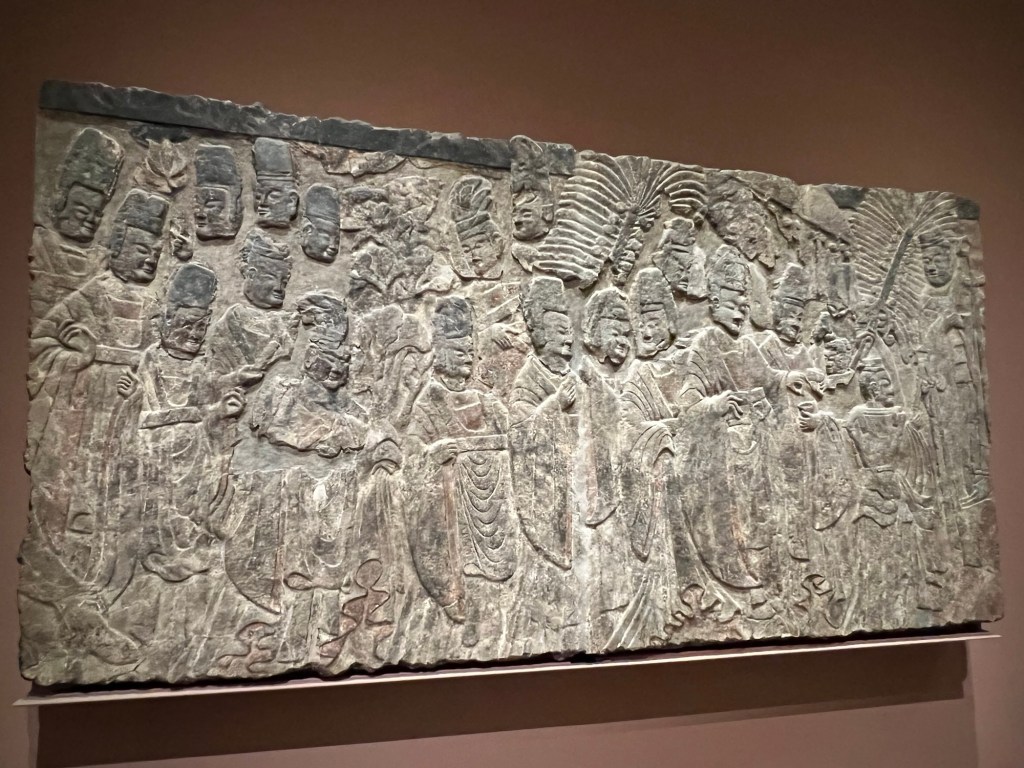
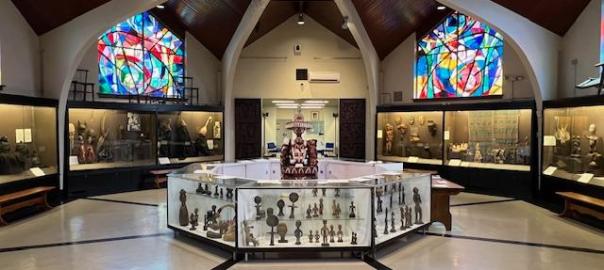
I recently revisited the African Museum of Art on the SMA Father’s and on this trip really took my time to learn about the Mission and study the art in the various displays. Each country that the Mission is involved with is represented here with detailed information on the meaning of the art and its purpose. It is an interesting approach to understanding the culture of each of these countries.
The beautiful stained glass windows line the ceiling and walls and has a beautiful effect in the room on a sunny day.
The sculpture in the middle of the main hall
The History of the Museum:
(From the museum website)
This museum was established in 1980 and is one of the only rare few in the United States dedicated solely to the arts of Africa. Its permanent collections, exhibited on a rotating basis, offer a unique advantage in the study and research of sub-Saharan sculpture and painting, costumes, textiles and decorative arts, religion and folklore.
The main hall of the museum
The history of the Mission
The African Art Museum of the SMA Fathers is one of five museums around the world founded and maintained by the Society of African Missions, an International Roman Catholic missionary organization that serves the people of Africa.
The display case that line the main hall
The art works up close
The descriptions of the works
The display case that line the main hall
Some of the works up close
The description of the masks
The display case that line the main hall
The museum is the continued vision of SMA’s founder, Bishop Melchior de Marion Bresillac (1813-1859). The French-born clergyman urged his Society to respect and preserve the culture of the peoples they serve, the unique among the missionaries of his time. (This information is provided by the museum).
Some of the works being featured in the exhibition
Their current exhibitions is on the “Africanizing of Christian Art” which shows the 20th Century encounter between Catholic Christianity and the visual culture of the Yoruba, a prominent west African people of southwest Nigeria under the conditions of late colonization (This information provided by the museum).
The hallway off the main room
Linking the walls of the main room are wooden carved doors from a palace in Africa. The interesting detail work tells it own story.
The description of one of the doors
Panel One
Panel Two
Panel Three
Panel Four
The collection contains many works in the form of masks, textile work, religious figurines and decorative arts. Each display case shows a different theme in the art.
The works of art in the cases
The puppets in the case
The works of art lining the cases
The engaging Mask collection
The museum is the main hallway of the church. I found it a quiet place where you could really concentrate on the beauty of the art. It grounds are also nice to walk around in in the nice weather.
The Chapel just off the museum is interesting to visit. I wondered how many people came to serve here and how the service was performed.
The main chapel of the mission
The beautiful stained glass windows in the chapel
The museum is a true hidden gem of wonderful and interesting testimonial and contemporary art. An inspiring museum if you take the time to really enjoy it.
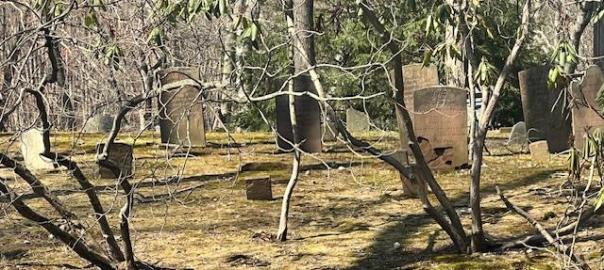
The Sturr Family Cemetery sits on a bend of the driveway of the Chabad Jewish Center of Northwest Bergen County and is a small cemetery that once sat on the edge of the J.H, Sturr farm.
The Sturr Family Cemetery
The farmhouse of the Sturr Family sits on the lot across the street from the cemetery property. This is located on a small buff on what was the edge of the farm.
The Sturr Family cemetery tombstones
The tombstones of the Courter and Carlouch family members
The grave of William Courter
The only visible tombstones that are left in the cemetery are an Ackerman family member, Anny Ackerman and members of the Courter and the Carlouch family’s (who must have married into the family).
The Ackerman family tombstones (the one to the right was unreadable)
The other tombstones are broken and no one is sure who is buried where in the cemetery.
The History of the Cemetery:
(From Find a Grave website)
The cemetery is located in Franklin Township, Bergen County, New Jersey, on what was once the family farm of J.H. Sturr. As of October 1991 only 6 markers were still remaining.
The Sturr Family Cemetery in full view
History of the House:
(From the Franklin Lakes Municipal Website)
H. Sturr House or Blue Meadow Farm Built 1860 378 Pulis Avenue, Block 1510, Lot 8 Franklin Lakes, New Jersey 07417
The Sturr House – also known as Blue Meadow Farm -is a handsome and little altered example of mid 19th century vernacular architecture which incorporates several stylistic elements such as gable returns and frieze area of the early 19th century Greek Revival style. The Borough of Franklin Lakes lists the erection year of the house as 1860.
The façade of this 2 ½ story house consists of clapboard. The front porch has five bays with square posts and a rectangular entrance door with rectangular sidelights. Two tall 1st story windows are on one side of the porch. A single hitching post with iron rings sits in front of the porch stairs. The building has a frieze area with linear design. Semi-circular headed louvered vents are in all gable ends. The rear of the house has a one story wing. There is a detached garage to the west side of the house as well as a round frame well. Further west of the house is a stable which has been extensively remodeled and converted into a residence in recent times. The house combined with associated structures is a significant remnant of the large farmsteads which ones dotted the Borough’s landscape prior to the recent suburban housing boom.
History of the Family:
(From the Franklin Lakes Municipal website)
This Sturr house and the nearby more altered house at 402 Pulis Avenue were duplicate structures and were probably built around the same time by members of the Sturr family. The 19th century Sturr family was descended from Conraedt Sturr who purchased 190 acres of land in this area with John Coeter from Robert Livingston in 1793.
The non-extant homestead and mill was located at present-day 930 Old Mill Road. It is known that Henry Sturr, the son of Conraedt, had a fanning mill at this location in 1850. In a will dated 1852 he bequeathed his property and mill to his grandsons John, Henry, and Daniel (Maria Braun – 1976 page 26 & 27).
The property along Pulis Avenue upon which these houses are situated was probably included in this will since the homes were built around the mid-19th century. Future deed research is recommended to identify the original builder and the construction date of the house (1861: H. Sturr, 1876 Estate of H.M. Sturr). Presently the house is privately owned and occupied.
One of the things I love about being a member the Metropolitan Museum of Art is the private Member’s Night ‘Met After Hours’ they hold about four times a year. The museum is open after the closing hours and it is a night of wondering the museum galleries, great music and entertainment and wonderful tours and talks in the galleries. You really experience the museum at its best and it does shine.
The lines move very quickly to get into the museum and with traffic getting into the City that night, I arrived about twenty minutes after opening and there were no crowds to face and I got right in. There’s always a sense of excitement on these nights.
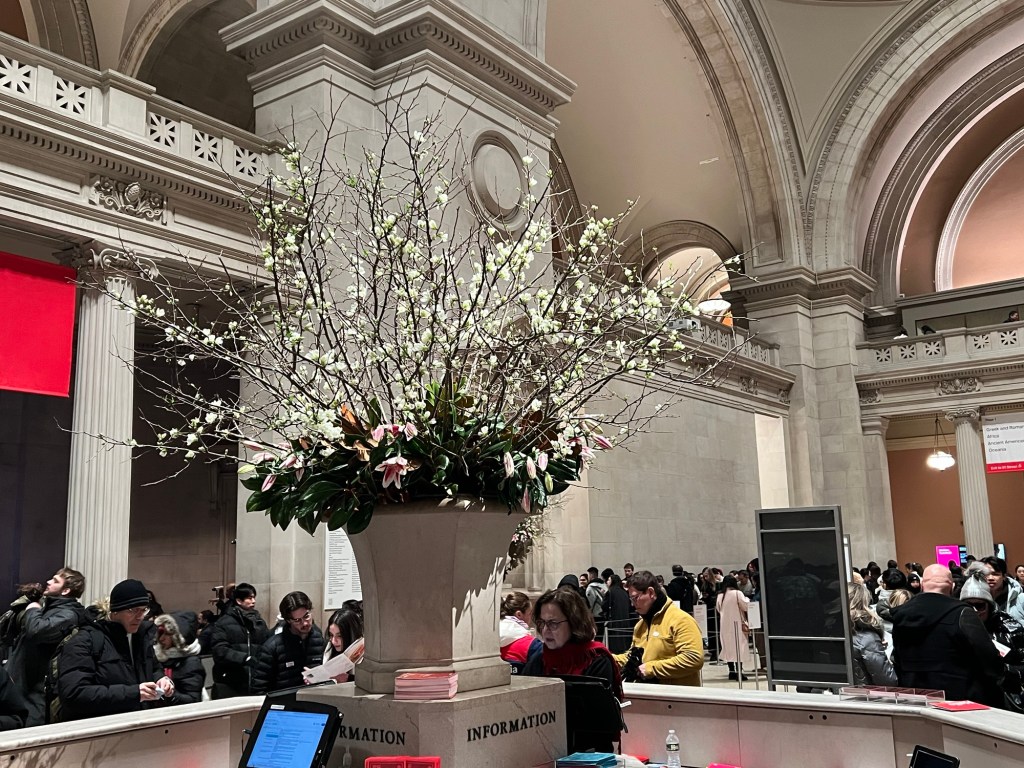
The Grand Hall in the front of the museum decorated with Spring flowers
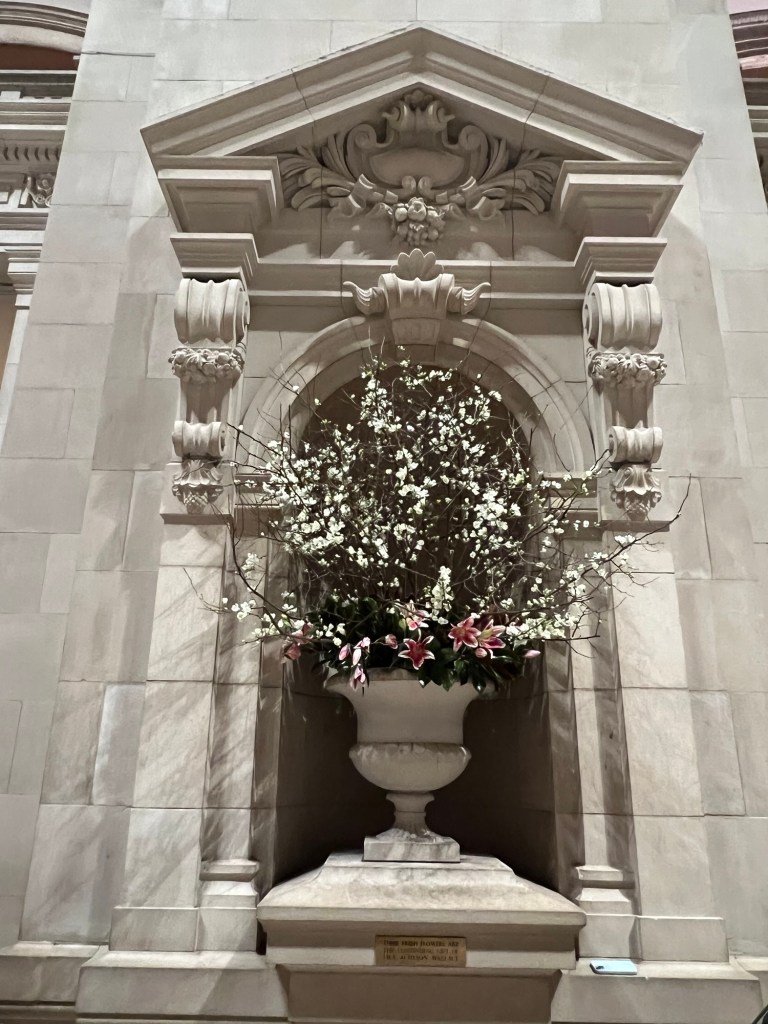
The beautiful Spring flowers lined all the urns around the Great Hall
The museum welcoming all the members of the museum at ‘The Met After Hours’
I started my walk around the galleries in the Greek Wing touring the main hallway. It still boggles my mind how old these statues are and I am looking at something almost two thousand years old.
The Museum’s collection of Greek and Roman art comprises more than thirty thousand works ranging in date from the Neolithic period (ca. 4500 BCE) to the time of the Roman emperor Constantine’s conversion to Christianity in 312 CE. It includes the art of many cultures and is among the most comprehensive in North America. The geographic regions represented are Greece and Italy, but not as delimited by modern political frontiers: Greek colonies were established around the Mediterranean basin and on the shores of the Black Sea, and Cyprus became increasingly Hellenized. For Roman art, the geographical limits coincide with the expansion of the Roman Empire. The department also exhibits the art of prehistoric Greece (Helladic, Cycladic, and Minoan) and pre-Roman art of Italic peoples, notably the Etruscans (Metropolitan Museum of Art website).
One of the statues that stood out that evening
I spent some time admiring the statues and the craftsmanship of the works along the hallway. The only problem is that most of the Greek and Roman Galleries were closed for the evening so I headed off to the Renaissance Wing. I love the luxury objects in the collection of silver and gold and again their craftsmanship is still unrivaled today. To make these objects takes intensive work and talent.
The timepieces show how advanced science had become and the importance of it in not just measurements but in beauty.
The lobby of the American Wing with the facade of what was a former bank and a Wall Street private mansion. I love the quiet elegance of this building and to think they moved it here piece by piece. The American Wing Cafe was open for the evening and the area was busy throughout the evening. It is nice to just sit and enjoy the views by the fountain. The artwork is beautiful.
Visitors to the American Wing will experience in more than 75 galleries on three floors varied art, design, and culture from the mid-seventeenth to the mid-twentieth century, with some contemporary expressions, by a diverse array of artists from across North America. Since our founding in 1924, this curatorial department has evolved its collecting to include some 20,000 artworks in many mediums by African American, Asian American, Euro-American, Latin American, and Native American makers, affirming ever more inclusive definitions of American art and identity. These dynamic holdings include painting, sculpture, drawing, furniture, textiles, regalia, ceramics, basketry, glass, silver, metalwork, jewelry, as well as historic interiors and architectural fragments, produced by highly trained and self-taught artists, both identified and unrecorded (Metropolitan Museum of Art website).
The evening then moved to the Egyptian Wing and the Temple of Dendur, where the entertainment and the cocktail bar was located.
The Temple of Dendur is the hub of activity on Members Nights
This small temple, built about 15 B.C., honored the goddess Isis and, beside her, Pedesi and Pihor, deified sons of a local Nubian ruler. On the outer walls between earth and sky are carved scenes of the king making offerings to deities who hold scepters and the ankh, the symbol of life. The figures are carved in sunk relief. In the brilliant Egyptian sunlight, shadows cast along the figures’ edges would have emphasized their outlines. Isis, Osiris, their son Horus, and the other deities are identified by their crowns and the inscriptions beside their figures (Metropolitan Museum of Art).
These scenes are repeated in two horizontal registers. The king is identified by his regalia and by his names, which appear close to his head in elongated oval shapes called cartouches; many of the cartouches simply read “pharaoh.” This king was actually Caesar Augustus of Rome, who, as ruler of Egypt, had himself depicted in the traditional regalia of the pharaoh. Augustus had many temples erected in Egyptian style, honoring Egyptian deities (Metropolitan Museum of Art).
The area was packed with patrons enjoying music and talking by the bars. The crowds were so large at the beginning of the evening that I waited until after 9:00pm for the second performance of the group playing. So I headed into the section of the Egyptian Wing to look at the galleries that were open. I love walking around the Egyptian Wing of the Met. It is one of the most extensive collections outside of Egypt and the most fascinating Mummy exhibition.
Admiring one of the Mummy exhibits in the Egyptian Wing
The Department of Egyptian Art was established in 1906 to oversee the Museum’s already sizable collection of art from ancient Egypt. In the same year, the Museum’s Board of Trustees voted to establish an Egyptian Expedition to conduct archaeological excavations in Egypt. Between 1906 and 1935, The Met’s Egyptian Expedition worked at a number of important sites, including Lisht in the north and Thebes in the south, and the objects gifted to The Met by the Egyptian antiquities service form the core of our collection. Over the years, the Department of Egyptian Art has also been able to acquire, through purchase and bequest, several important private collections (Metropolitan Museum of Art website).
The ancient tablets outside of the Mummy Exhibition
The Egyptian artwork outside the Mummy Room
The tablets outside the Mummy Room
When the whole gallery is open, it is a treasure trove of objects and information from each Dynasty. I have been mind-boggled by these galleries since I first visited the museum in the third grade for a class field trip. I remember sketching artifacts for a class project and am still fascinated about how old some of these objects are and condition they are still in after thousands of years. It is my favorite part of the museum.
By 9:00pm, the entertainment was starting again, so I joined other members for a cocktail and enjoyed the music in the Temple of Dendur Gallery.
The Temple of Dendur fully lit for the evening before the start of the entertainment
The signature cocktail of the evening, the Starlight Spritz
Enjoying a Starlight Spritz while listening to the music
The bartenders can mix a drink
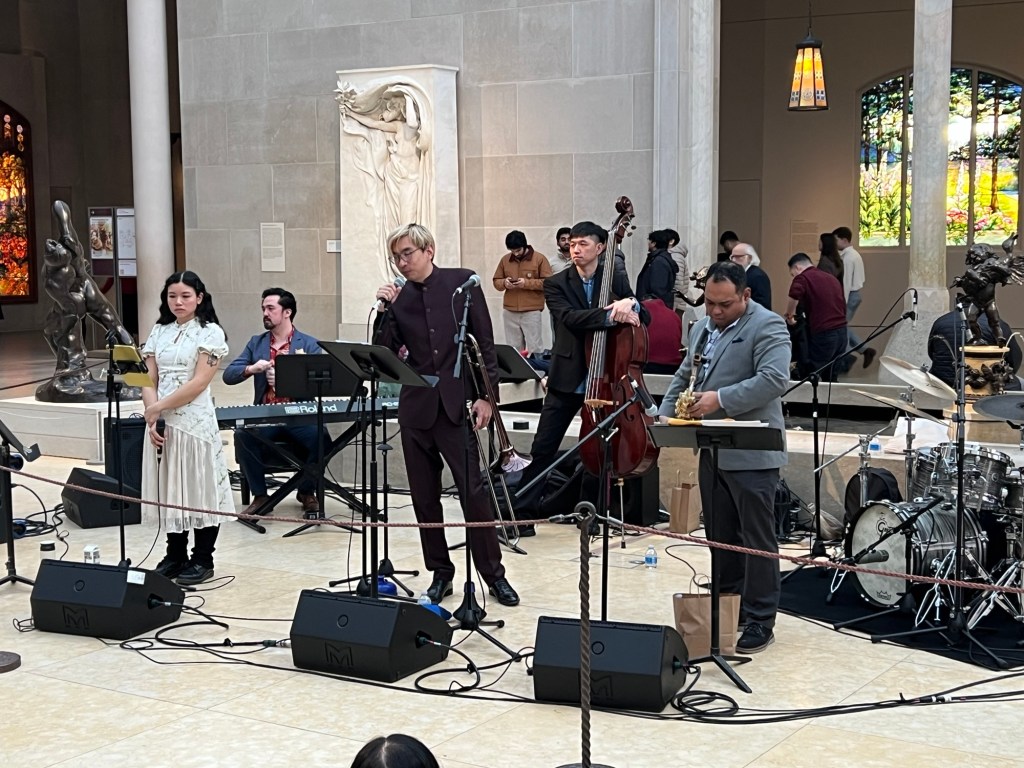
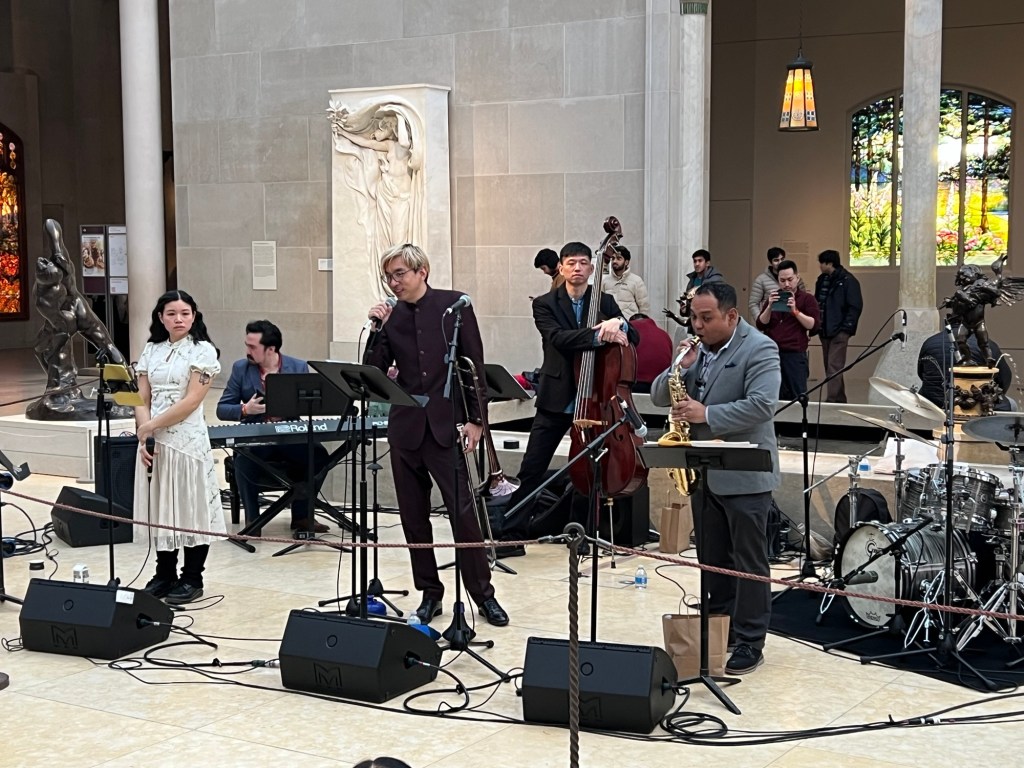
After a long week at work, it was nice to relax and enjoy the music. The music that night was performed by artist Jasim Perales and Friends, an Afro-Latin Jazz performance. The music was relaxing and soulful and the crowd had a wonderful time.
The start of the music again at 9:00pm
The trio performing
A clip from the entertainment that night
The Master of Ceremonies that night, Jasim Perales
All good things come to an end and it was time leave. The night was dark and the winter air was crisp creating the perfect Winter evening to set out into for the walk back to Port Authority. The Upper East is so beautiful at night.
The front of the Met that night
The artwork is always so impressive outside the Met
It was in the low 40’s that evening and the perfect night for a walk around the Upper East Side and Midtown. It still surprises me after all these years of walking around Manhattan how beautiful the City really is at night.
It was another spectacular evening at the Metropolitan Museum of Art. Thank you to the Membership and Special Events Departments for hosting another wonderful evening.
In post Valentine’s Day season, we conducted our first meeting of the year. It has been a good start to the year with donations coming in from Bergen County Fire Department’s and their continued generosity. We are trending ahead of last year so far and appreciate the support we always get for our fundraiser.
We talked about the plans for the upcoming summer barbecues, the Christmas Party in December, which seems to come faster and faster and talking at the Bergen County Caucus in August, where we want to spread the word about our organization and the benefits joining the organization does.
After the meeting was over, we joined the residents in the main hall to enjoy the entertainment and refreshments. Crowd pleaser, Gigi, entertained the residents with a series of uplifting love songs and ballads. It was still Valentine’s Day at the NJ State Firemen’s Home.
Crowd favorite Gigi entertaining everyone
Gigi singing ‘Everlasting Love’
The concert continued with more popular songs from contemporary pop songs to popular live ballads. The residents really loved it, especially on this gloomy afternoon.
The continued through the afternoon
Gigi singing ‘They can’t take that away from me
We then got up to introduce ourselves to the crowd of residents. We thanked them for their years of service to their fire departments and hoped they enjoyed the Christmas Party a month and a half ago. They really appreciate all the things we do for them and we are most happy to do it. Then we took our group shot.
The members of the Bergen County Firemen’s Home Association
We ended the concert and the afternoon with Gigi singing both ‘I love you more than Yesterday’ and ‘God Bless America’.
Gigi belting out ‘I love you more today than Yesterday’
Another wonderful song
It was a great afternoon and both the residents and ourselves enjoyed it. We predict another great year!
Mills Bakery at 275 Valley Boulevard in Wood Ridge, NJ
Mills famous Crumb Cake
Their delicious doughnuts
The History of Mills Bakery and the business story:
Head Master Baker, John Cabrera started at Mills Bakery in November of 1998 at the age of 14 to earn a few dollars during his freshman year in high school. Starting out as a dishwasher, John quickly learning simple baker tasks such as dipping cookies with sprinkles and chocolate to learning how to use a pastry bag. All through high school he worked side by side with seasoned bakers and realized this business was for him.
He later received his associates degree in baking & pastry arts from Johnson & Wales University in Providence, Rhode Island. Upon graduation he became Head Baker of the Mirage Hotel & Casino in Las Vegas. After Vegas, he knew he wanted to own his own business. An opportunity came about to own Mills Bakery, the very place in which he learned his craft, and he jumped on it. He is proud to say that he is the owner of a small town landmark which has been around for almost a century.
Video on the the Business:
The store is always decked out so nicely for each holiday so you have to visit to see all the creative treats.
Coming to Mills on the holiday of love
The store decked out for the holiday of love
Cookies and cakes that everyone loves
Cakes and pies and things that people love
Sweet Heart cookies are always the perfect gift
The store comes to life at the holidays. At Christmas every year, it is a fantasy land of cakes, cookies and pastries beautifully decorated and smiling back at you. The store is always nicely decorated.
There is nothing like Mills Bakery at the Christmas holiday season. I stop in for all sorts of baked items to take to my mother’s, who loves their doughnuts and turnovers. I will bring desserts down too when we are having a meal at the house. Over the years, I have taken the best pictures at the store as Christmas has gotten bigger every year since the renovation.
The store at Christmas time
Mills has such delicious treats at the Christmas holidays
The penguin cupcakes at Christmas time
Christmas and Butter Cookies at Mills Bakery
The store has a nice selection at every holiday
The joyful cookies at the holidays
The beautiful cakes
The beautiful Gingerbread houses at Christmas time
In the Christmas holiday season of 2025, Mills really went all out with the declarations both inside and outside of the store.
The front of Mills Bakery Christmas Eve 2025
The gingerbread lady outside the store
The gingerbread man outside the store
The beautiful display of holiday goodies
The window display for the holidays
The display cases bursting with holiday cookies, cakes and pies
Case lines topped with gingerbread men and holiday butter cookies
Holiday cookies smile and wink
Bunche De Noel’s lined up for Christmas
Snowmen cakes at Christmas time
An igloo cake at Christmas time
Mill’s Bakery is very creative at all the holidays and adds that special touch to all their products.
The bakery has a lot of interesting baked items for St. Patrick’s Day as well.
The delicious cookies at St. Patrick’s day
The selection of delicious looking cakes at St. Patrick’s Day
The delicious cakes at the holidays
St. Patrick’s Day cakes at Mills Bakery
Halloween offers such colorful and artistic baked goods. I loved the Frankenstein cake.
The decorations during the Halloween season
The Halloween treats in the bakery case
The Ghost cookie
The Mummy cookies
I had to come back and buy one of these. It scared me that it was $5.00!
Who says there’s nothing to do in the cold months? It all depends on how much you want to bundle up and enjoy the outdoors.
The last weekend of the ‘Monet & Venice’ showing at the Brooklyn Museum brought me out to Brooklyn on a sunny but chilly Saturday afternoon recently. I knew there would be crowds at the Brooklyn Museum as everyone was probably thinking of doing the same (at the end of the visit I found this to be true) so I got to the museum by noon and got tickets to the first slot open at 2:30pm.
Since I had a couple of hours until my tour of the exhibit, I decided to tour the Brooklyn Botanic Garden next door. There were no walking tours that day and the gardens were under a foot of snow from the recent storm. There was a quiet beauty of all the snow and the way it fell and shined in the sun all over the gardens. There were no lines or crowds (like the recent lightshow a few weeks earlier), so I had the gardens pretty much to myself.
The first stop on my walk was the Japanese Gardens, which has I had visited recently for the lightshow and experienced the fantastic musical display. The pond now sat under snow and ice and still it was impressive looking.
Walking through the Brooklyn Botanic Garden next to the Japanese Gardens
The Japanese Gardens in the early afternoon
The inside of the Japanese Gardens in the middle of winter. It was such a spectacular view of the pond.
The beauty of the snow covered pool
Another view of the Garden
I never realized how beautiful the Japanese Gardens were in the winter. The sun shines so nicely on the snow covered trees. It was just as beautiful snow covered as it is in the Spring and Summer when the garden is in full bloom.
The fountain in the Shakespeare Garden
I then walked through the entire gardens stopping in various gardens to see what they looked like topped with snow. My first stop was the Shakespeare Gardens and I marveled at the elegance of the snow covered fountain I like so much in the Spring. The variety of the colors of this garden are waiting just under the snow for the warmer months.
The view of the snow covered gardens
I then walked around the paths to the back of the gardens along the watershed lawns that were under a foot of snow and still impressive.
Daffodil Hill in the winter. In two months this will be covered by hundreds of brightly colored daffodils
The Magnolia tree court and sun dial
In the Spring, this is my favorite part of the garden with the hues of pinks and whites of the Magnolia trees and the yellows of the daffodils.
My favorite fountain just off the Magnolia Court on the stairs leading to the Lotus polls
The snow covered fountains by the Lotus pools
The snow covered Lotus pools shined in the sun
I then got out of the cold weather and entered into the warmth of the Tropical Garden Collection. This series of gallery of plants is a series of greenhouses at various degrees of temperatures that display a series of themed gardens. They don’t just display plants but also keep you warm in a cold day.
The indoor tropical gardens
The Tropical Garden collection
The first room I visited wasabi the Bonsai Museum room. The temperature controlled room was perfect for a stroll.
The Bonsai museum
These beautiful tiny well pruned trees lined the tables with their elegance and been so well maintained.
The Bonsai trees lining the tables in the galleries
The beautiful bonsai
The flowering bonsai
The beautifully shaped bonsai
The Cherry blossom bonsai in the middle of the winter
The other trees in the gallery
The video tour of one side of the Bonsai Gallery:
The video tour of one side the Bonsai Gallery:
My video of the gallery tour
The Tropical Room
The tropical room
I then toured the Tropical Garden collection with its series of flowering plants and palms. It was so nice and warm inside and a break from the cool temperatures outside.
A video tour of the Tropical Gallery:
The walk is amazing
The Tropical Room
Colorful tropical flowers line the walkway in the dead of winter
The blooming Lotus
The real White Lotus
I then walked through the second tropical room in the rain forest and there were more beautiful plants to see and experience. There was a wedding garden shoot going on so I was not able to tour the complex.
The flowering tiers of plants in the Tropical room
The flowering plants in the Tropical gallery
The beautiful violets
I then began the tour of the Desert Gallery and the beauty and warmth of the room made me very happy.
The Birds of Paradise in bloom
Along the walls of the gallery, more flowering plants were placed.
Flowers in bloom in the winter
The climate controlled Desert collection was filled with cactus and other plantings the defied the weather. They have a pretty extensive collection of desert flowers and cactus in the room.
The Desert Collection gallery
The flowering cactus family
Walking back through the rainforest
Walking back through the Desert Gallery before exiting to tour the snow covered gardens
Video tour of the Desert Gallery:
There was still a foot of snow on the ground when I visited the gardens that day, which did not make it popular with people wanting to visit the gardens but I found a quiet elegance in just walking the paths and admiring the snow covered plantings. It was like they were waiting to awake again in the near future.
I walked through the gardens which while under a blanket of snow still offered the most beautiful views. I was one of the few people walking through the gardens that afternoon so it was quiet and you could just enjoy watching nature.
Walking past the Children’s Garden in the Winter
Walking over the bridge in the Watershed lawn
I saw this little squirrel holding on to the tree looking cold
The geese feeding on the Watershed lawn
The Cherry Blossom lawn in the winter
The Rose Garden Fountain in the winter
Walking through the Cherry Blossom lawn
Walking back through the Magnolia garden
Taking one last walk around the Lotus Pools
Before I left the gardens that afternoon, I stopped in the Gift Shop for some warmth and see the items they were carrying. They have such beautiful selection of flowers and gifts and the perfect place to warm up on a cold day. Everything is so colorfully displayed.
The Gift Shop at the Brooklyn Botanic Garden
Everything was in full bloom and really colorful
Everything was so beautifully displayed here
Before I left for the Brooklyn Museum to start my 2:30 pm tour, I stopped at one of my favorite sandwich shops down the road from the museum, Bahn Mai Place at 824b Washington Avenue for lunch. I love their sandwiches and drinks.
I ordinarily try a restaurant a few times before I recommend it for my dining website, DiningonaShoeStringinNYC@Wordpress.com, but I had the most amazing sandwich for dinner a few years ago and I had to share this place with the world.
There are also all sorts of rice dishes on the menu, Pho (soups) and salads on the menu as well most priced around $10.00. On the Beverage menu, there is a selection of Hot, Iced and Milk drinks to choose from as well as a selection of Bubble teas and smoothies.
One sandwich I can recommend on a cold day is the Grilled Chicken Banh Mai. I had the sandwich with a mild hot sauce on a cold wintery day. The warm bun and crunchy fresh vegetables with the spicy sauce really warmed me up on a cold afternoon in Brooklyn.
The Grilled Chicken Bahn Mi with a mild spicy sauce
The grilled chicken with fresh veggies
The mild spicy sauce really brings out the flavor of the grilled meat. With a little plumb and chili sauces, it really brings out the flavor of the sandwich.
The chicken was spicy and moist
It was the perfect lunch
The service was very quick and very friendly. The woman who made my sandwich pushed my order ahead of someone else’s who ordered the same thing as me so I could be on my way which I thought was very nice of her.
After lunch, it was off to the Brooklyn Museum and the tour of the ‘Monet & Venice’ exhibition. I was so lucky that I got to the museum early and got the tickets. The show was completely sold out by the time I left.
The museum was seriously packed that afternoon, not just for the show but all over the museum. I have been coming here for over twenty years and I had never seen it so packed. Every floor was filled with people.
Claude Monet once claimed that Venice was “too beautiful to be painted,” a challenge he embraced by creating an extraordinary sequence of works depicting the Italian city. Monet and Venice is the first exhibition to focus on Monet’s luminous Venetian paintings—a radiant yet underexplored chapter in the artist’s late career—since their debut in 1912 (Brooklyn Museum website).
New York’s largest museum show dedicated to Monet in over 25 years, the exhibition features more than 100 artworks, books, and ephemera. Two masterpieces, the Brooklyn Museum’s own Palazzo Ducale and The Grand Canal, Venice from the Fine Arts Museums of San Francisco, are presented alongside selections from throughout Monet’s career—including 19 of his Venetian paintings (Brooklyn Museum website).
The artist’s singular vision of Venice is also set in dialogue with portrayals of the city by renowned artists such as Canaletto, Paul Signac, John Singer Sargent, and Pierre-Auguste Renoir. Where others focused on Venice’s busy streets and canals, Monet’s interpretation is hauntingly devoid of human presence. Instead, he captures the interplay of architecture with color and light, enveloping viewers in the city’s distinctive atmosphere. Sonic installations by Niles Luther, the Museum’s composer in residence, and other immersive elements will further transport you to this fabled place (Brooklyn Museum website).
Walking through the galleries admiring the art
These were some of my favorite pieces from the show. These also were a favorite of Monet himself to the City of Venice.
The paintings of the Grand Canal
The views along the coastline of Italy
One of Monet’s famous ‘Water Lilly’ collection
Views from the Grand Canal
Walking around the gallery
Another view of the Grand Canal
I could not believe how packed the exhibition got behind me as I double backed through the gallery on the way out. Not only did the crowds grow in the exhibition but the line outside the exhibition was over a hundred deep and wrapped around three galleries on the Fifth Floor. It was so busy on the floor, I decided to walk around other exhibitions.
My favorite painting in the American Wing of the Mountain House Hotel in the Catskills
Then I walked down to the Middle Eastern Wing with the Assyrian and Egyptian Art, one of personal favorites in the museum. Unlike the Met, the Egyptian Wing of the museum is not overwhelming and is easier to view as the exhibits are not as packed with artifacts.
I started first admiring the Assyrian panels of the genies gracing the walls of the famous palace. It blows my mind that these are almost over a thousand years old.
The panels of genies along the walls of the old palace
The panels of genies along the walls
The different versions of genies along the walks
I have been visiting the Egyptian Wing of the museum since I attended the opening of the renovation with my father over a decade ago. It has an iconic entrance to the wing of the museum.
The entrance to the Egyptian Wing of the Brooklyn Museum
Walking through the Egyptian Galleries
Admiring the art on the wall
Walking through the Mummy display
The details on the Mummy coffin
Finishing the tour of the Egyptian galleries
I had a nice time at both the Brooklyn Botanic Gardens and at the Brooklyn Museum. There is more than enough to see and do at both cultural locations in the heart of Brooklyn.
It was a wonderful walk around neighborhood and even with all the snow on the ground, it was easy to maneuver around the sidewalks and streets. The snow may have covered the ground but was a backdrop for the beauty that it displayed. The recent storm did not keep us inside but brought us outside to see how it looked and enjoy its beauty.
I love the holidays in New York City. There are so many Christmas themed events to go to and decorated homes to visit. One of my favorite tours is at the Met Cloisters for their Christmas themed walking tours that take place from December through early January.
The Cloisters Museum & Gardens: A Branch of The Metropolitan Museum of Art
To finish my weekend of holiday festivities before the Epiphany, I took the annual Christmas walking tour of the Met Cloisters. The museum hosts an interesting walking tour of the history of the holidays during the Medieval era. Each tour has a different theme to it. There is the history of Christmas in that era, the use of plants and flowers in the decorating of the religious sites and the historic significance of the visit of the Three Kings.
Each tour guide incorporates the artwork, architecture and plants into the discussion. On average you will have about forty people on the tour.
The entrance of the Cloisters decorated for the holidays
The entrance of the gift shop decorated for the holidays
The archways were decorated with seasonal plants and fruits. I read online that the volunteers went into Fort Tyron Park and collected ivy from the wild to decorate the museum. Every day the museum is open during the holidays these are replaced on a daily basis.
The entrance to the galleries decorated for the holidays
We started the tour with a discussion of plants that once decorated churches and ministries
With the change in attitude towards the Christmas holidays during the Middle Ages and its incorporation into church traditions, decorating for the holidays came back into style. The use of holly, evergreen and mistletoe became part of the Christmas tradition and to justify the decorating, they were related to Christian symbols.
The beauty of the life plants in winter
Each of the Cloisters were lined with fresh greens and potted plants giving each of the Cloisters its own special mood.
One of the Cloisters bright with plants
The stairs leading into the chapel decorated for the holidays
The chapel on the main floor decorated for the holidays
The colorful floral displays lining the window sills of the chapel
This led to a discussion about what each plant, flower and fruit meant in the Christian tradition, a clever way to justify decorating and celebrating during the holidays. Ivies, pine, winter flowers and even late season apples not only lined places of worship but gave a festive look and district smell to these buildings. A symbol of life in the cold winter months while they waited for the arrival of Spring.
The plant types that decorated the houses of worship
The flowers and plants lining the chapel
The decorative candle stands lining the walls of the chapel
We then toured the main Cloister, closed for the Winter but was lined with plants, flowers and greens brighting every corner of the building. These were examples of plants and flowers that would have decorated these halls at the holidays.
Walking the halls of the Cloisters
Touring the halls of the Cloisters with flowers and plants to celebrate the season
Walking the halls of the Cloisters
The flowering plants of the Cloisters
The flowering plants and vines that would have decorated churches in Medieval times
We then toured the Tapestry Room and discussed the use of plants in art form and the use of the detail as symbolism in art. These tapestries were meant to cover the drafty walls of palaces and bring in color and decoration to the stone walls.
The famous ‘Hunt of the Unicorn’ tapestry
We then took a detour to the outside gardens that are enjoying their winter slumber. These gardens were used by the cloisters for food, medicines and decorative use. They will start coming to life in a few months.
The Cloisters Gardens
The garden terrace over looking the Hudson River
The terrace gardens in the winter waiting to come to life
Then we went back inside for a discussion of the Three Kings and the Epiphany and its symbolism in art at the Cloisters. These are some of the works featured on the ‘Christmas Tide’ tour to symbolize that visit.
Some of the woodwork from that era
The Visitation of the Three Kings
The Visitation of the Three Kings depicted in stained glass
The Visitation of the Three Kings depicted in statuary
We visited the last of the Cloisters and discussed some of the plants in the collection
We were admiring the plants and flowers
A candelabra in the hallway of the Cloisters
As I exited the building that afternoon, there were potted plants at the entrance of the Cloisters. It was a real treat to walk around the building at the holidays.
The potted plants outside the entrance of the museum
On my way down the stairs and out the door to Fort Tryon Park, I took another walk down the stone steps and walked through Ann Loftus Park. This popular playground was quiet this time of year, awaiting the Spring and the wonderful warm afternoons ahead.
I love coming for breakfast at G’s Coffee Shop after a tour of The Cloisters. The food and service of this small ‘hole in the wall’ diner is wonderful. The meals are so reasonable and when you dine at the counter, you can watch the food cooked right in front of you. I had a wonderful Bacon, Egg and Cheese sandwich with a side of golden pancakes. What a great meal on a cold winter morning.
The Bacon, Egg and Cheese sandwich
The breakfast sandwiches here are so good
The pancakes were wonderful. The perfect comfort food on a winter day.
It was a really great tour, and it was fun to walk around the neighborhood through the parks and seeing all the post-Christmas decorations. Inwood is a really beautiful section of Manhattan with lots to do and see. It is the perfect place to spend the Christmas break.
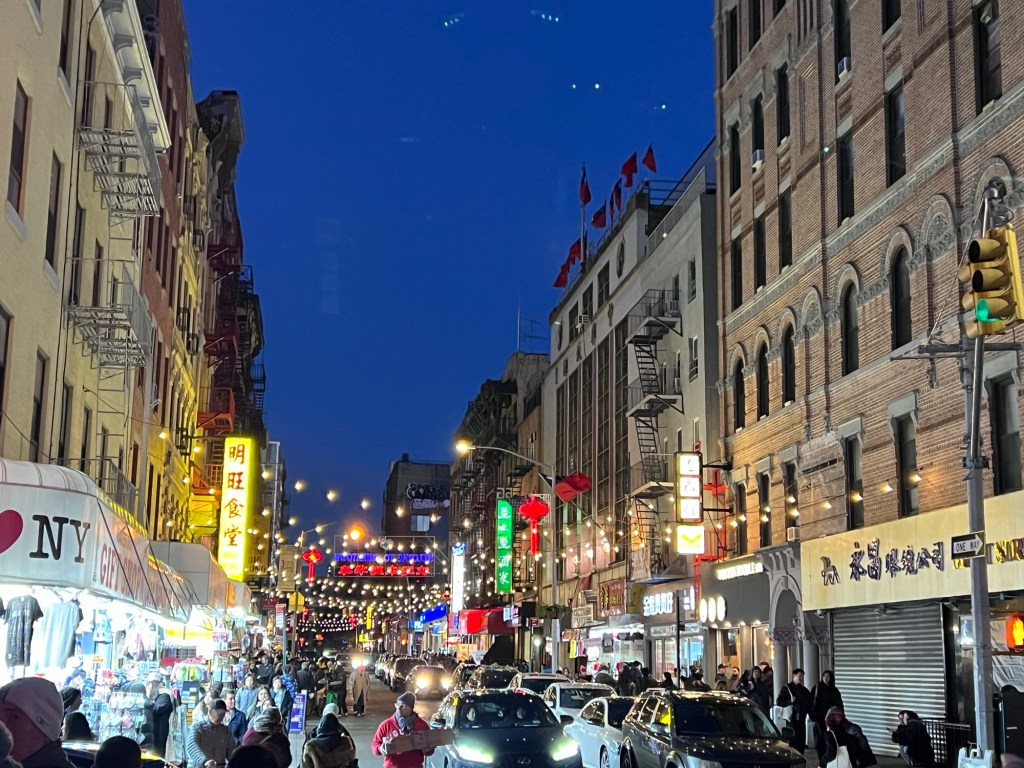
I was searching for someplace to eat in Chinatown after touring a few museums in Brooklyn. It was cold that night and I was in the mood for soup and dumplings. The place I wanted to go to was closed and as I walked around Division Street, I came across a restaurant that was having their grand opening (I would find out later it had opened in the summer).
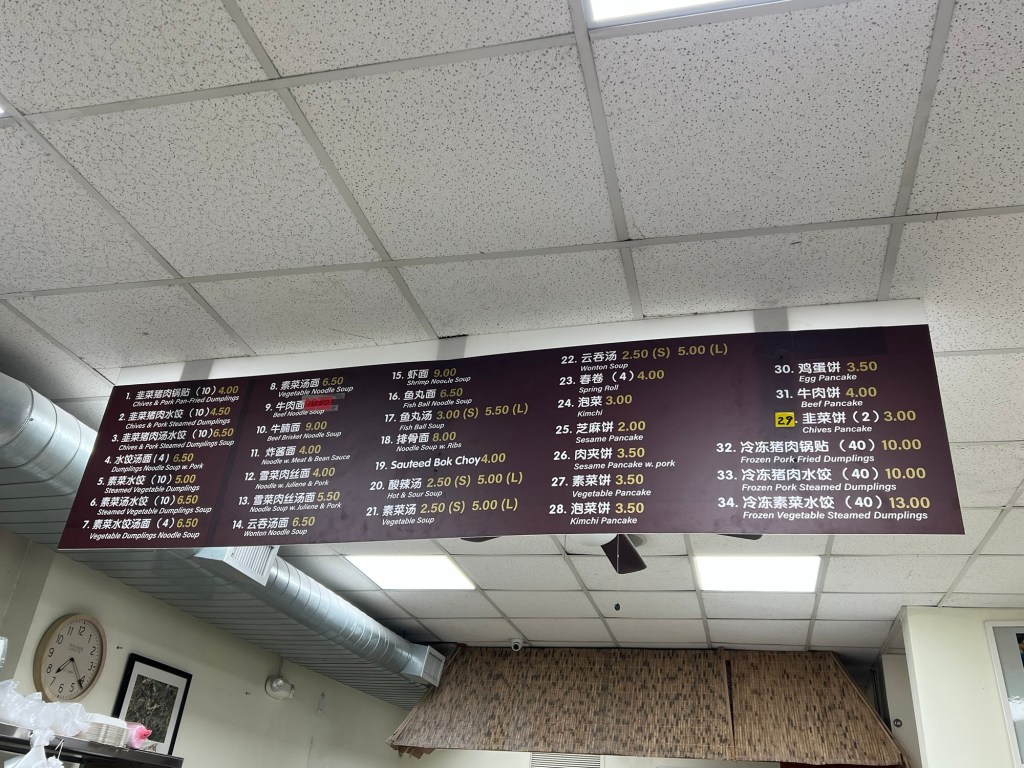
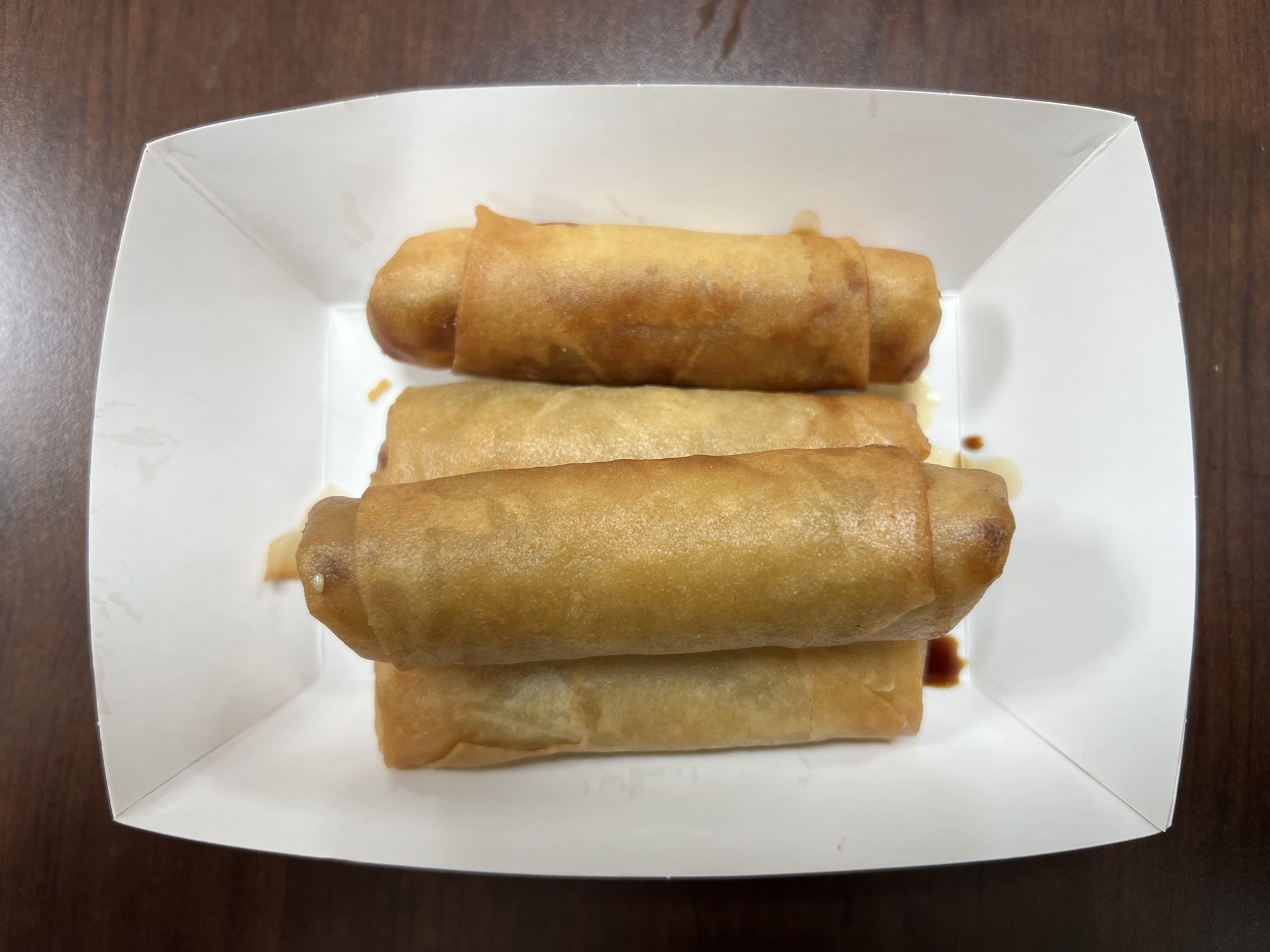
The owner waved me in on a very cold and welcomed me inside to a warm restaurant where homemade dumplings are made right in front of you. The best part is that there is a lot to order under $10.00. There were so many choices from the menu with dumplings, pancakes and soups and everything was so reasonable.
The Chive Pancake
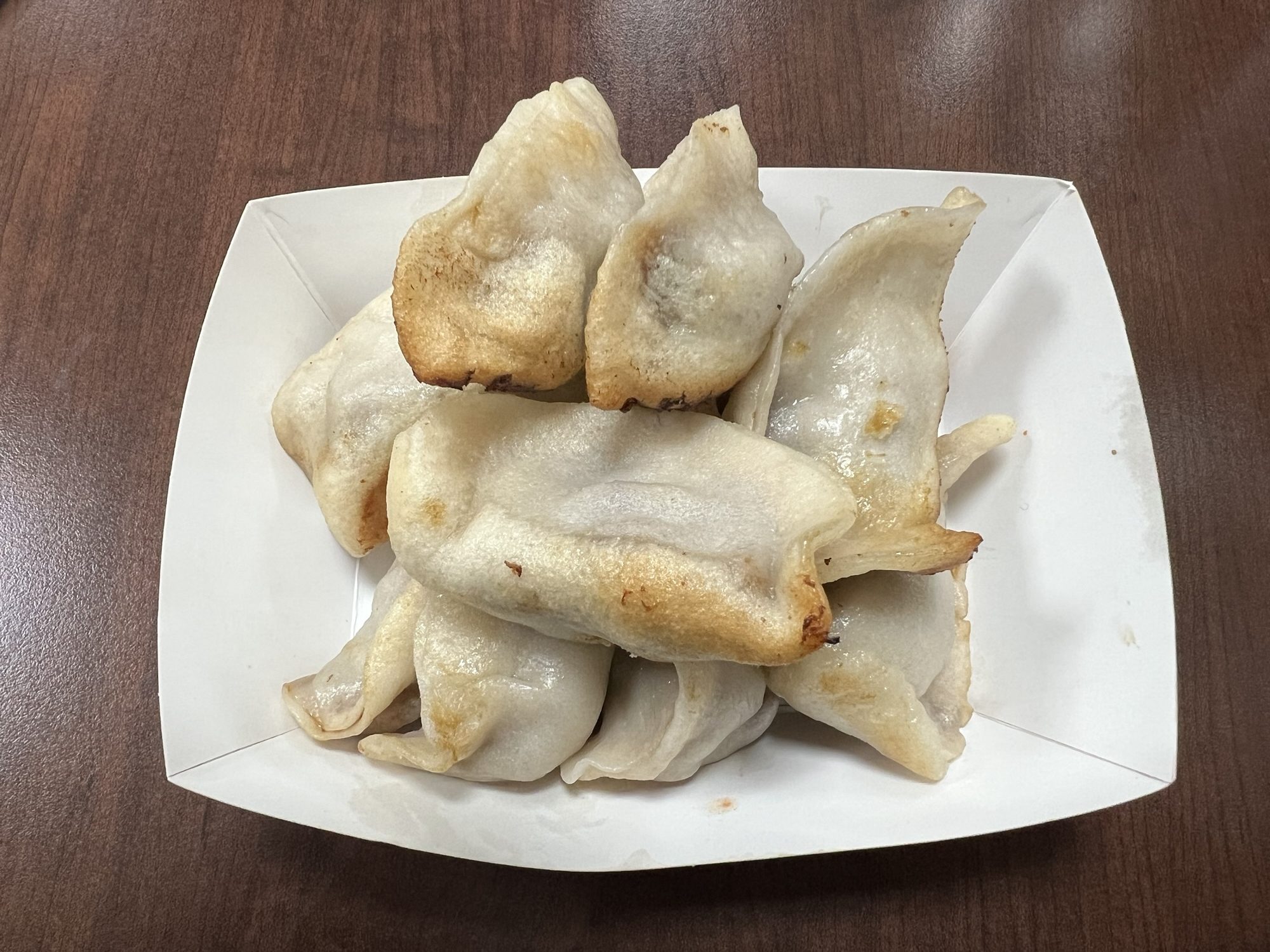
I started my meal with the Chive Pancakes. These were being made by the women working the counter behind the register. These golden cakes were rather large and were panned fried. With a little soy sauce, what a way to start the meal.
The Chive Pancakes
The were filled with rice noodles, eggs and chives
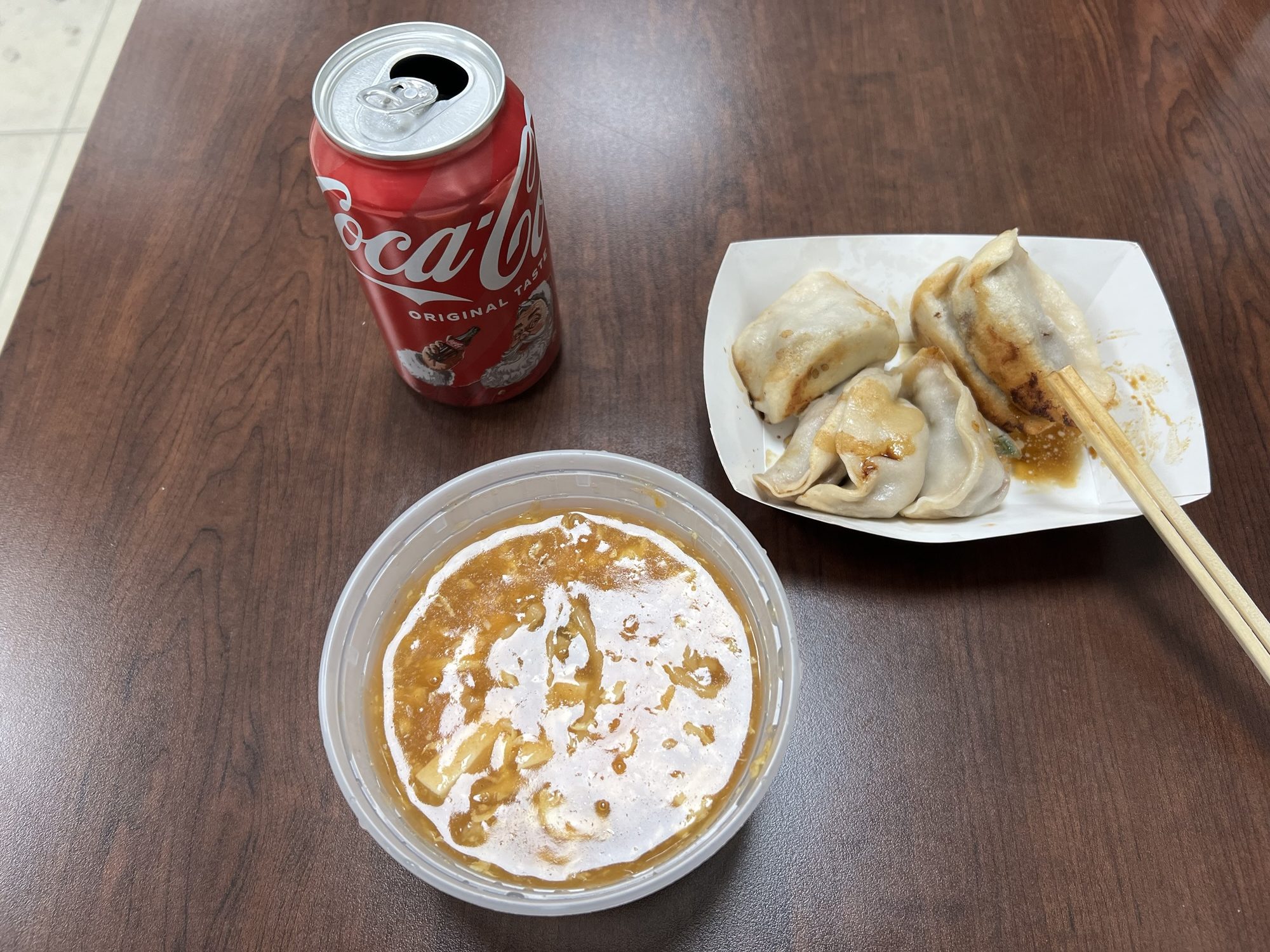
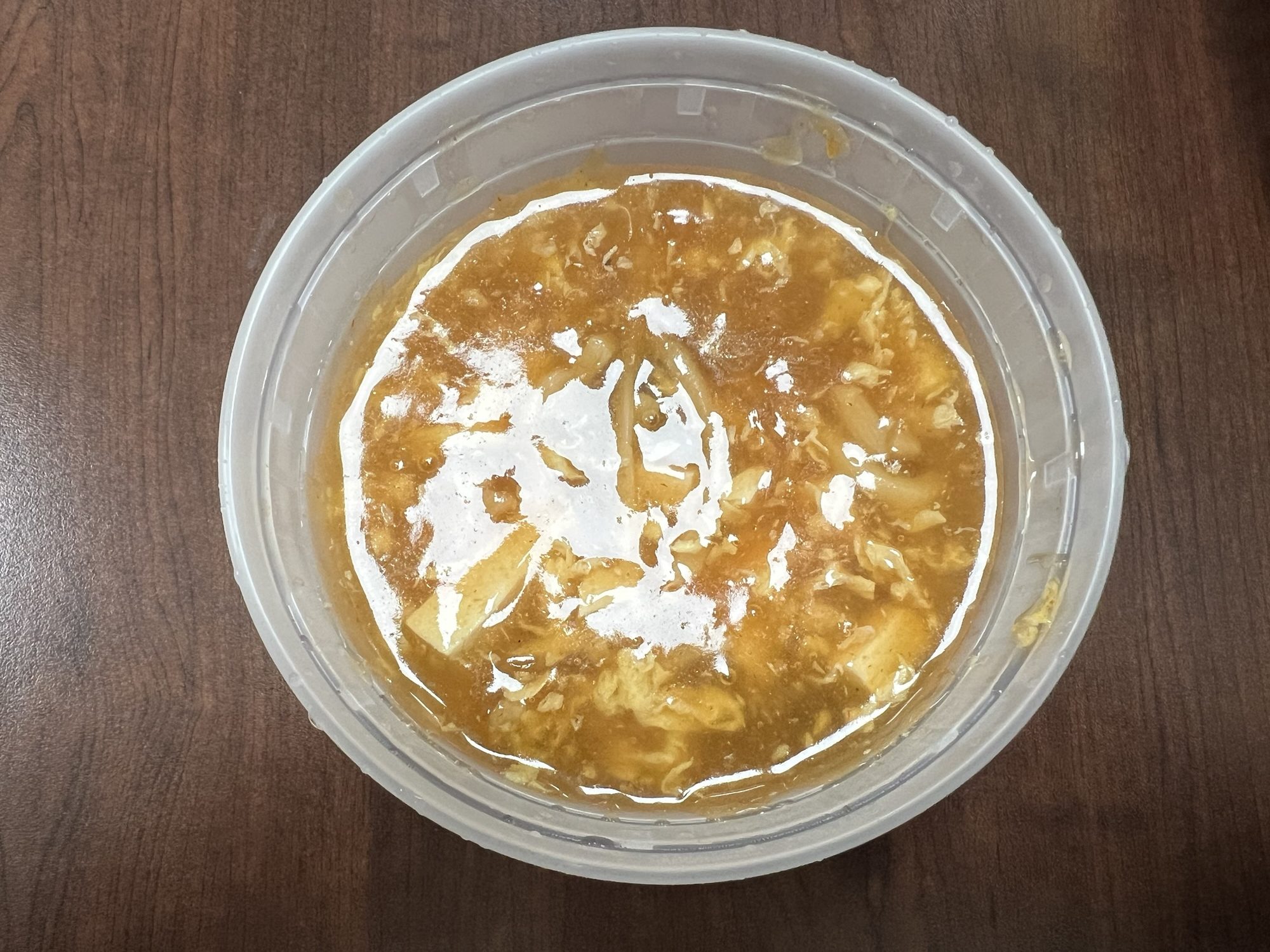
Then I needed to warm myself up and had the Wonton Noodle Soup with bok choy. The long noodles and the dumplings are made fresh right in front of you. The dumplings go right from the counter where the women just folded them into the soup or into the pan for an order of ten.
The Wonton Noodle Soup with Dumplings
The food and the service were wonderful and the owner could not have been nicer and more welcoming. She pulled me off a cold street and welcomed me into the restaurant. In a time of rising prices and small portions, North Dumpling is that wonderful exception with reasonable prices and excellent food.
What I found out from the manager after dinner was this is the sister restaurant to China North Dumpling, a tiny restaurant on Essex Street which literally has no seating and this is her new, bigger version of that very successful restaurant.
My reviews on China North Dumpling at 23 Essex Street:
The members of the Bergen County Firemen’s Home Association met at the Harrington Park Fire House to start the stuffing of the envelopes for the fundraising efforts of the organization. Monies raised by the fundraiser help pay for entertainment, refreshments, the food for the barbecue, gifts to the residents and for items that residents might need.
The members of the Bergen County Firemen’s Home Association at our 2025 Christmas Party for the residents
Santa joining us for the Annual Christmas party at the home
This fundraising effort does so much for our fellow firefighters at the home. It provides entertainment, refreshments, gifts at the holidays, special projects at the home that benefit everyone and funds for us to run our annual barbecues and Christmas parties.
Chef Prince cooking at our Annual Barbecue in August 2025
The wonderful barbecue feast made for the residents of the NJ State Firemen’s Home at the August 2025 Barbecue
If you are interested in becoming a member of the Bergen County Firemen’s Home Association, please attend one of our meetings at the Boonton Firemen’s Home in Boonton, NJ. Our meetings are in February, April, June, August, October and the first weekend in December for our Annual Holiday Party.
Members enjoying breakfast at our November meeting hosted by the Wyckoff Fire Department
The members of the Bergen County Firemen’s Home Association
If you would like to make a donation to our organization, please send it to:
BCFHA
C/O Jeff Parma
277 Harriott Avenue
Harrington Park, NJ 07640
Please make the checks out to the Bergen County Firemen’s Home Association
Our 2026 Meeting Schedule:
All our meetings at the home start at 12:00pm at the NJ State Firemen’s Home in Boonton, NJ:
February 15th
April 19th
June 13th (June Barbecue)
August 15th (August Barbecue)
October 18th
December 6th (Annual Christmas Party)
A big “Thank you” from The Bergen County Firemen’s Home Association Executive Board 2026
Over the years I have heard newspapers saying some negative things about the City of Bridgeton, NJ in Cumberland County. The crime, the problems and the rows of rundown housing. I have to admit that the city has its share of problems like any city but Bridgeton is a paradox. For all its problems, it has so many interesting things to see and do. As I have been exploring historical sites of South Jersey, I have made many trips through the city and driven through the neighborhoods and walked the downtown and its really interesting.
When you leave the city on any side, you are in the countryside. There are all sorts of fields of crops as far as the eye can see and many Farmers Markets just outside its borders. When you return though, you know immediately that you are in the city’s borders as housing just seems to pop out of nowwhere.
When I was visiting museums and historical sites for a blog I was writing on Southern New Jersey, I left Greenwich, NJ and took a local country road that took me through the back roads and farm country to the big city of Bridgeton, NJ where I explored their now rundown downtown. I then explored the crown jewel of the community, the Old Presbyterian Church and Cemetery.
The church stands out like a stately jewel in the middle of the town and is so beautiful and graceful at any time of the year especially in the late Spring and the early Fall when it is perfect for taking pictures. I love its historic cemetery with its Colonial era church and the gravesite that dates back to the 1700’s.
The Old Presbyterian Church and Cemetery at 54 West Avenue South in Bridgeton, NJ
Visiting the Old Presbyterian Church and Cemetery was an interesting experience. While trying to get from Greenwich to Bridgeton should have been a straight run but there were no names on the signs, and you just had to figure it out. I found the right road and it led me right to the cemetery.
The Presbyterian Church itself is only used now for special occasions and events but is an elegant building that sits on top of a bluff overlooking the downtown area. During the daylight hours you are allowed to roam around the cemetery looking at the gravesites (See my reviews on TripAdvisor and VisitingaMuseum.com).
So many famous politicians, war heroes, founding fathers of the City of Bridgeton and entrepreneurs at the turn of the last century are buried here.
The church and the historic cemetery.
What I found interesting about the cemetery was the family plots with the generations of people buried next to one another and their stories. It was sad when the parents buried their children and then died a few years later. Trying to figure the narrative of these families can be heartbreaking.
The family plots at the cemetery
The really sad part of such a historic cemetery is that it is so overgrown. I was walking through in some parts a foot of weeds. I know that taking care of a cemetery this size must be hard, but I would think there would be more care of the dead considering this is a destination for historians.
The historic cemetery in the Summer of 2024
When I finished touring the church grounds, I took a tour of the Bridgeton Historical Downtown. It was such a waste to see a bunch of old buildings falling apart and most of the businesses closed or small run-down businesses located in them. A block away was a more modern downtown with newer buildings. The shopping district caters to the very large Hispanic population that lives here and is great if you are looking for provisions for a picnic.
The one place that did stand out for me was the Century Bakery at 525 North Pearl Street in Downtown Bridgeton. They have some of the best and most creative doughnuts around. I could never make up my mind.
Century Bakery at 525 North Pearl Street in Downtown Bridgeton
The bakery just smells good when you walk in and the staff could not be nicer and more accommodating. I could barely make up my mind with all the delicious doughnuts to choose from.
I could not figure out what I wanted with all these delicious choices displayed in the cases. I finally decided on a Glazed Cream filled doughnut that was just mind blowing. It was so delicious. I had wanted to go back for another but did not want to ruin my appetite for lunch. For another trip.
This was like biting into a piece of heaven
When I visited Bridgeton in the Fall of 2024 for Halloween, I took the time to visit the Cohanzick Zoo and that was an interesting detour. The Zoo is part of the Bridgeton Park system like it is up in Bergen County. It is a small County zoo that takes about an hour to visit.
The zoo has an old fashioned feel with smaller rescue animals and equally not too large cages. The zoo is mostly comprised of animals who were rescued from either being poached, illegally transported or had been used as pets, many of them being neglected and abused.
The sign that welcomes you to the park at the Cohanzick Zoo
Throughout the park amongst the cages of wildlife are strolling gardens and animal related statuary.
The pathways and gardens were still in bloom the afternoon that I was there and it is a nice way to spend do the afternoon.
The Elephant statuary at the entrance of the zoo
The status of how some animals found their home here
The first resident I finished was the Raccoon House, where it looked like the raccoon was taking a snooze. He really looked out of it when I passed the cage.
The Raccoon House
The Raccoon Crossing sign
This poor little guy was out like a light
The zoo is one of the smaller more localized ones that I have visited so you can see the whole zoo in a short amount of time. Then you can walk leisurely around the paths and revisit the exhibitions again. Some of the animals like the peacock family, just wonder around the park and do their thing.
This gorilla sculpture that greets you in the back part of the zoo
Following the walkway to the back pens where a lot of the small animal and bird displays were located
The next exhibition that I visited was the Sand Hill Crane and I read that the poor little guy had been injured. He seemed a bit more optimistic when I passed the cage. I think that the animals just want some attention.
The Sand Hill Crane display
The Crane was watching all of us as we passed his cage
The next small animal that I visited was the Fennec fox and the two that I saw were fast asleep on this warm afternoon. They must have had a busy morning.
The Fennec fox cage
The foxes that I saw that day were fast asleep
One of the historical sites that I had wanted to visit was the historic Potter’s Tavern across from City Hall. I tried twice to stop in to see the Potters Tavern in Bridgeton but then double checked the guide and found out that it is only open on Sundays in July from 1:00pm-4:00pm.
Finally in the Summer of 2024, Potter’s Tavern opened for touring again and is now open on Sundays. It is well worth stopping and touring this important part of our Revolutionary War history.
Potters Tavern at 49-51 West Broad Street in Bridgeton, NJ
The tavern is one of the city’s connections to the Revolutionary War where patriots from that time met and plotted their strategy during the war. It was also a meeting place for men who need to gather after a hard day on the farm. These taverns were part of the social factor at a time before electronic communication.
The Entrance room of the Potter’s Tavern
The Hearth in the Kitchen in the Potter’s Tavern
The Bar at the Potter’s Tavern
The tavern has been rebuilt and furnished to reflex the time period. There are three floors to tour with the first floor being the tavern itself, the bedrooms upstairs where travelers would stay after a long stagecoach journey. The lower floor was the kitchen and store room where meals would be prepared and staff would sleep.
The upstairs of the Potter’s Tavern was the overnight accommodations
The lower level of Potter’s Tavern
It is an interesting tour that should not be missed but the museum’s hours can be sporadic even as they are posted online and are seasonal so plan accordingly.
On a recent trip to Bridgeton, I was able to finally see the Bridgeton Liberty Bell that sits in a display case across the street from Potter’s Tavern in Bridgeton’s modern courthouse.
The Bridgeton Liberty bell is located in the lobby of the Bridgeton Courthouse, which is open only during the week. You can walk in through the back door from the parking lot and walk through the metal detector to get to the bell that is displayed in the hallway.
The bell was cast in Massachusetts in 1765 and was a source of information during Colonial days.
The Bridgeton Liberty Bell
It was used to call people together for important news and meetings when hanging in the courthouse in the Courthouse that was built in 1760-61. It rang for liberty when the Declaration of Independence was signed and as a warning signal for the War of 1812 (South Jersey Early American Historical Trail pamphlet).
A close up look at the bell
The historic marker of the bell
While walking in the downtown area one afternoon in the summer, I was trying to stop in the Bridgeton Library to visit the Robert Woodruff Museum of Indian Artifacts (that is only open by appointment only). Since nobody was there to help me that afternoon I left the library.
Across the street, a mother-daughter team was barbecuing and preparing tacos and tamales for locals and some workers on the construction site around the corner. The tacos were amazing and they only charged $3.00 for two small tacos and a Coke. I thought this great and the tacos were excellent. The ladies could really cook.
The fresh tacos from the pop up taco stand across from the library
Continue to follow this blog as I explore more of Bridgeton and its historical downtown and all it has to offer. There is so much that can surprise you in the City of Bridgeton, NJ.